
GEOMETRY-BASED
FLASH WORM DETECTION
A Writing Project
Presented to
The Faculty of the Department of
Computer Science
San Jose State University
In Partial Fulfillment
Of the Requirements for the Degree
Master of Science
By
Sang Soo Kim
December, 2006

Approved by:
Department of Computer Science
College of Science
San Jose State University
San Jose, CA
_________________________
Dr. Mark Stamp
_________________________
Dr. Chris Pollett
_________________________
Dr.
Agustin
Araya
2

Abstract
While traditional Internet worms take hours or days to infect a high percentage of
vulnerable hosts, a flash worm takes seconds. Because of the rapid rate at which flash
worms spread, existing worm defense mechanisms cannot respond fast enough to detect
and stop a flash worm infection.
In this project, we propose a geometric-based detection mechanism that can detect the
spread of flash worms in a short period of time without human intervention. We attempt to
detect network traffic patterns that are indicative of a flash worm attack in progress. We
have tested our approach on simulated flash worm traffic using more than 10,000 nodes. In
addition to testing on flash worm traffic, we also tested our method on realistic Internet
traffic to estimate the false alarm rate.
In order to efficiently analyze a large quantity of network traffic, we implemented an
application that converts network traffic data into a graphical form. Using this application
the analysis is done graphically with flash worm attacks appearing as tree structures.
3

Table of Contents
1. Introduction
2. Background
2.1. Common Structure of Flash Worms
2.2. Various Design Issues of Flash Worms
2.2.1. Spread Tree Topology
2.2.1.1. Shallow Spread Tree
2.2.1.2. Deep Spread Tree
2.2.1.3. Robust Spread Tree
2.2.2. Use of Threads
2.2.2.1. No Threads
2.2.2.2. Single Thread
2.2.2.3. Multiple Threads
2.2.3. TCP or UDP
2.3. Designing a New Flash Worm Implementation
3. Implementation of Geometry-based Detector
3.1. Flash Worm Simulation
3.1.1. Finding a Suitable Simulator
3.1.2. Extending Simulator to Flash Worms
3.1.2.1. Modified NS-2 Default Environments
3.1.2.2. A New Network Packet
3.1.2.3. Node and CenterNode Network Entities
3.1.2.4. Network Hierarchy Example
3.1.3. Configurable Parameters
3.2. Flash Worm Detection Mechanism
3.2.1. Geometry-based Flash Worm Detection
3.2.2. Extending NS2 to Flash Worm Detection
3.2.2.1. Node Structure
3.2.2.2. Double Linked-list Sorted by Timestamp
3.2.2.3. Array of Pointers to Node Sorted by Node ID
3.2.2.4. Dynamic Determination of Root Nodes
3.2.2.5. Dynamic Determination of Depth
3.2.2.6. Exiting Parent-Child Relationship
3.2.2.7. Parent-Child Loop Avoidance
3.2.3. Configurable Parameters
3.3. Post-analyzer
3.3.1. Nam (Network Animator)
3.3.2. Custom post-analyzer
4

4. Tests and Results
4.1. Generate Flash Worm Traffic
4.2. Plot and Analyze Flash Worm Traffic
4.3. Plot and Analyze Actual Internet Traffic
4.4. Breaking our Detection Mechanism
5. Conclusion
6. Future Work
Bibliography
5

List of Figures
Figure 1: Flash Worm Spread Pattern
Figure 2: Hit-list and Corresponding Spread Trees
Figure 3: Shallow Spread Tree Topology
Figure 4: Deep Spread Tree Topology
Figure 5: Robust Spread Tree Topology
Figure 6: Single Thread Usage
Figure 7: Network Topology of NS-2
Figure 8: Loop Avoidance
Figure 9: Nam Screen-shot
Figure 10: Sample Flash Worm Traffic
Figure 11: Complete Tree
Figure 12: Zoomed-in and ToolTip
Figure 13: Detection Mechanism in Action
Figure 14: Spread Tree of TCP traffic
Figure 15: Spread Tree of UDP traffic
6

1. Introduction
Since the early days of computer networks, computer worms have been developed,
often causing disruption on the network. As computer network architecture and Internet
security continue to advance to prevent the spread of worms, the worms continue to evolve
as well. Worm writers constantly strive to find ways to infect more hosts in less time.
It has been conjectured that a worm could be developed that would bring down the
entire Internet in less than 30 seconds [8]. Such a worm is termed a “flash worm”, and this
master’s project will consider a possible defense against flash worms.
The fastest worm to date was the Slammer worm, which infected “more than 90 percent
of vulnerable hosts within 10 minutes” [6]. The Slammer worm utilized a random scanning
strategy, in which infected hosts randomly select target addresses until all susceptible hosts
are infected. In a random scanning worm such as Slammer, the initial spread rate increases
exponentially, but the number of newly infected hosts diminishes later as the worm tries to
infect already infected hosts. These redundant infection attempts quickly clog up the
network bandwidth. Furthermore, if the random number generator used to determine
random target addresses has a defect, as was the case in the Slammer worm, the infection
may miss a portion of vulnerable hosts [6].
In order to spread faster and infect a higher percentage of vulnerable hosts, flash worms
must utilize a more effective search strategy. To date, flash worms are only theoretical in
the sense that no reported incidents have been filed. However there are many conjectured
flash worm implementations designed by various researchers. One conjectured
7
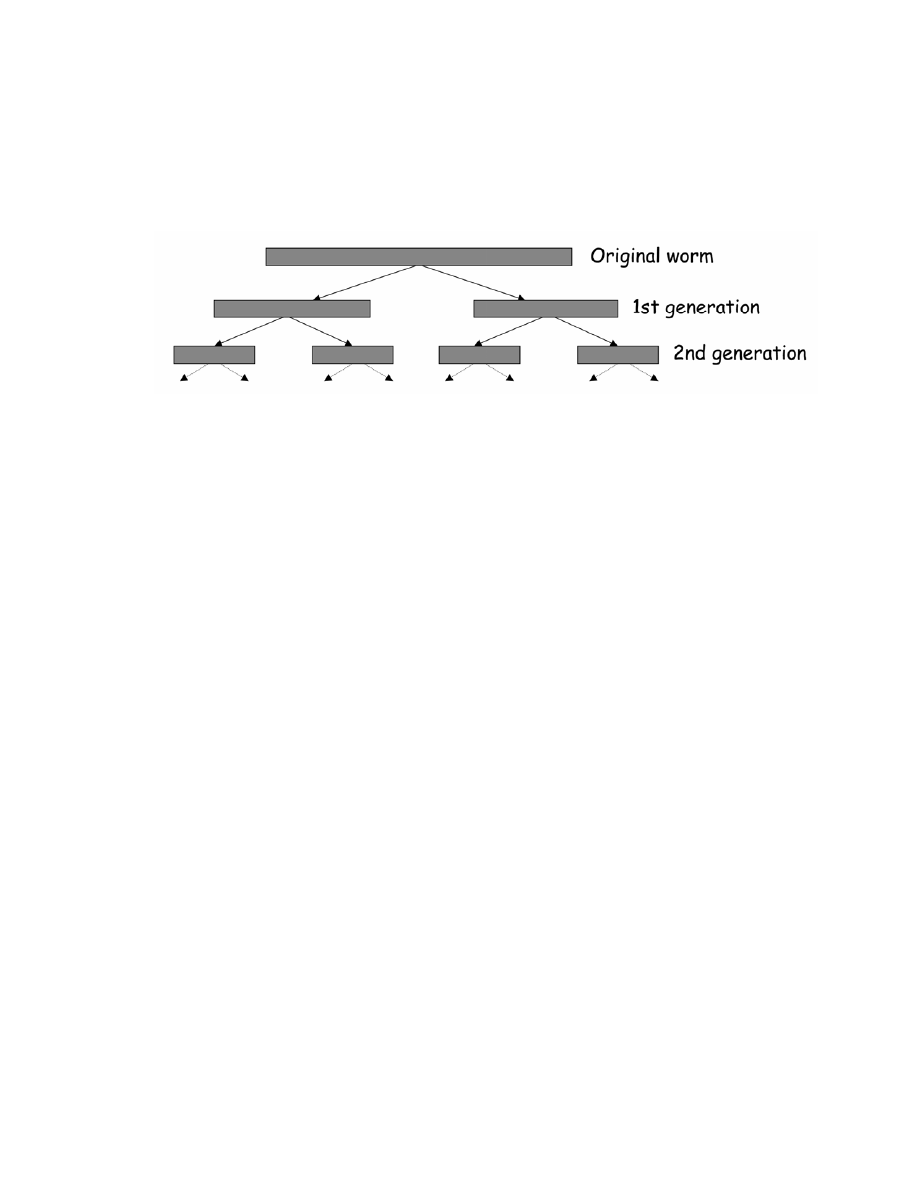
implementation is to pre-scan the entire Internet to generate a hit-list of all potentially
vulnerable hosts.
<Fig. 1: Flash Worm Spread Pattern> [19]
The initial worm includes the entire hit-list. Then upon each successful infection, the worm
divides its hit-list into n blocks, infects one address from each block, then communicates
the list of remaining addresses for each block to newly infected hosts [2]. This process
continues until all the addresses on the hit-list have been infected. In contrast to the
Slammer worm, this hit-list based flash worm does not scan for vulnerable target addresses
while spreading. Since searching for vulnerable target addresses is a slow process,
eliminating this process allows the unprecedented spread rate of the flash worm.
Because of the rapid speed at which a flash worm spreads, some of the prediction and
mitigation algorithms applicable to other worms are not appropriate for flash worms. In
this project, we propose a new geometry-based flash worm detection algorithm in which the
local network activity is monitored. Based on the monitored activity, we create a tree to
indicate the spread of a possible flash worm. This “spread tree” is designed to detect the
tree-like structure a flash worm is likely to use to propagate to the target host list. If the
depth of a spread tree reaches some predefined threshold, the network will automatically
8

shut down to prevent further spread of the flash worm. To avoid false alarms, the spread
tree must be pruned as well as updated periodically.
Prior work on the flash worm simulation and detection can be found in [19] and [20],
respectively. However, in [19] a simple Java simulator was used, while in this paper we
use a sophisticated NS2 packet-level simulation method. Also, the detection method used
in [20] relies on a simple count of the number of types of packets, whereas in this paper we
implement and analyze a novel geometry-based detection method.
In the remainder of this paper, we first describe the conjectured implementations of
flash worms in more detail. Section 2 discusses the essential components of a flash worm
implementation. Section 2 also explains how differentiating these components can result in
different infection behaviors. Section 3 details the design and implementation of our
proposed detection method. Section 4 shows our simulation test processes and the result.
Section 5 summarizes and presents our conclusions and a discussion of future work.
9

2. Background
Because there have been no incidents of flash worm outbreaks reported in the wild,
there is no example of an actual flash worm implementation. However, there are many
conjectured implementations of flash worms by various researchers. In this section, we
discuss several of these conjectured implementations.
2.1. Common Structure of Flash Worms
Despite various differences, every flash worm implementation is expected to have
the following common components:
• Hit-list
While traditional Internet worms scan for target hosts when they infect a
new host, flash worms do not perform this time-consuming process. Instead,
flash worms utilize a hit-list, which contains the list of all the target host
addresses.
o
Hit-list preparation process
Prior to instantiating the spread of flash worms, the worm author must
scan the entire Internet address to determine the vulnerable hosts. If the
author has a fast Internet connection and a high processing power, this
scanning can be done in a day [8]. However, to reduce the risk of being
detected by defense systems, the author may want to purposely slow
10

down the scanning process. Such stealthy scanning may take several
weeks.
o
Typical Size of a Host Address
Since most of the network hosts are in IPv4 domain at this time, the usual
number of bytes required to represent one host address is 32. That means,
a single UDP packet can store about 35 host addresses if the maximum
size of a UDP packet is 1200 bytes.
o
Low Failed Infection Attempts
In addition to increasing the spread speed, the use of a hit-list also
protects flash worms from some existing worm containment defenses.
For example, a containment defense that looks for unusually high
numbers of missed connections cannot detect the spread of flash worms
because most infection attempts are likely to succeed.
• Maximum Infection Number
Given a list of addresses to infect, each host does not infect all the listed
addresses. Instead, each host attempts to infect a small number of addresses
and propagates the remaining addresses to other hosts.
11
• Spread Tree
While the use of a hit-list enables the rapid spread rate of a flash worm, it
also implies that the flash worms spread following a tree-like pattern. We call
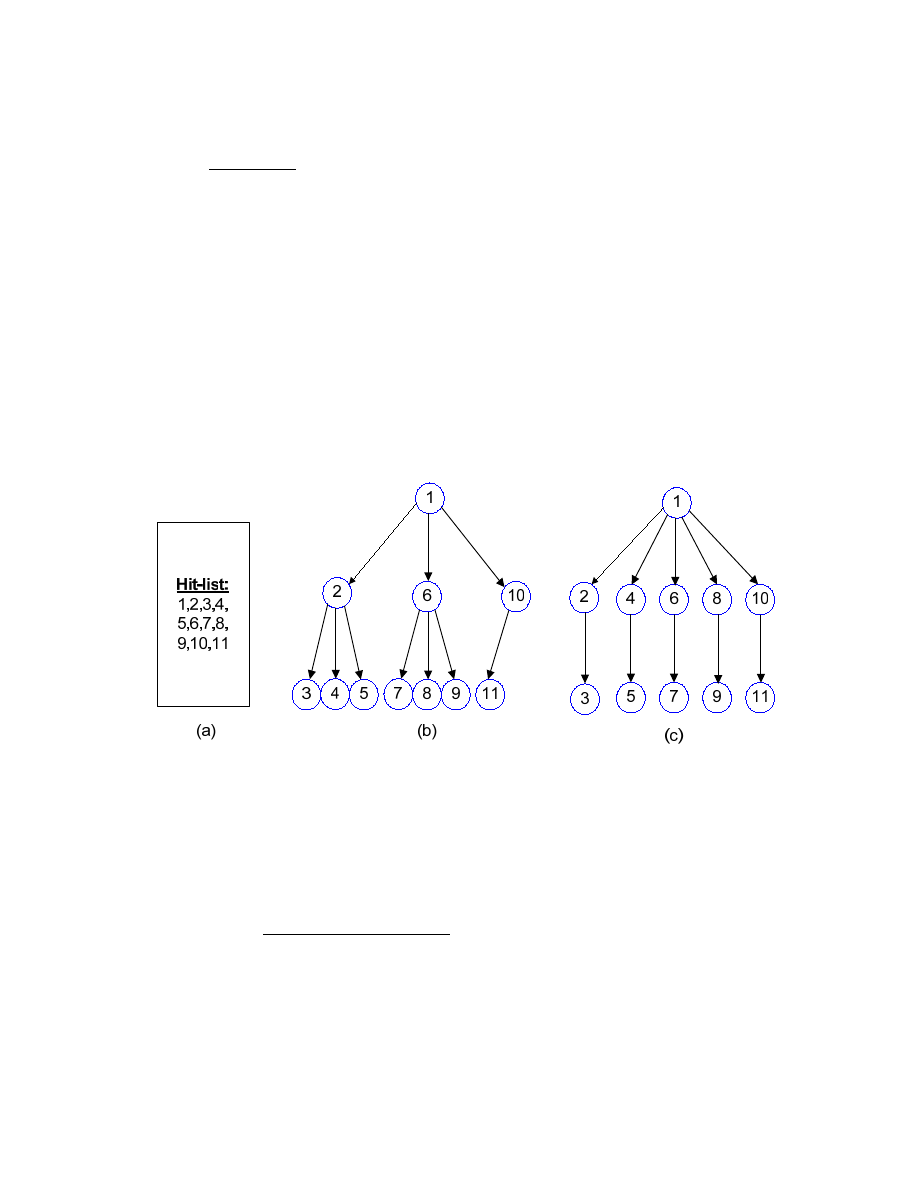
this spread pattern the spread tree. For example, the hit-list of Fig. 1 (a) with
maximum infection number of 3 creates the spread tree shown in Fig. 1 (b). In
the figure, Node 1 is infected first. Then Node 1 infects Nodes 2, 6, and 10.
The subsequent nodes infect up to 3 nodes as well, propagating the remaining
target addresses to other nodes.
<Fig. 2: Hit-list and 2 Corresponding Spread Trees>
(a) The hit-list contains 11 target addresses; (b) The spread tree formulation if each node attempts to
infect 3 other nodes at most; (c) Each node infects 5 nodes at most. Note that only node 1 has the enough
target addresses to infect 5 nodes.
At this point, defining some important components of spread trees is necessary.
o
Parent-Child Relationship
12

There is a one-to-one parent-child relationship if one host infects
another host. For example, in Fig (b) above, Node 6 is a parent
of Node 7, and Node 7 is a child of Node 6.
o
Depth (or Generation) Number
The depth of a node is the maximum length of the path from the
root to the node. In case a node has multiple parents, the
maximum length is assign to the node because our detection
mechanism is designed to trigger an alarm on the first sign of a
flash worm infection. On the other hand, if the minimum length
were assigned to the node, a triggered detection alarm would be
delayed and we wanted to avoid this delay. In Fig (b), for
example, Node 7 has depth of 2 and Node 10 has depth of 1.
The depth can also be called generation number. For example, in
Fig (b), Nodes 2, 6, and 10 are all in the same first generation.
The maximum number of generations required to infect N hosts
if each host infects K other hosts is given by
¾ O(log
K
N)
For example, in Fig (b), the maximum generation number is
O(log
3
11) = 3.
o
Node Creation (or Infection) Time
13

Each node has an associated creation time. This is the time at
which the node was first infected by a flash worm. Note that the
nodes from the same generation should have similar creation
time since they are expected to be infected at about the same time.
o
Total Infection Time
The total infection time is the amount of time required to infect
all of the hosts listed in a hit-list. The total infection time is
equivalent to the node creation time of the last leaf node.
2.2. Various Design Issues of Flash Worms
When designing a flash worm, the worm author has to take the following issues into
account as they will characterize the worm infection behavior. Some of these may
actually be the by-products of the worm behavior, outside of the worm author’s
purposeful design.
2.2.1. Spread Tree Topology
The maximum number of attempt each host tries to infect defines the shape of
the spread tree. The authors of [7], who first published the work regarding flash
worms, have laid out these three spread tree topologies.
14
2.2.1.1. Shallow Spread Tree
In a shallow spread tree topology, each host tries to infect many other hosts.
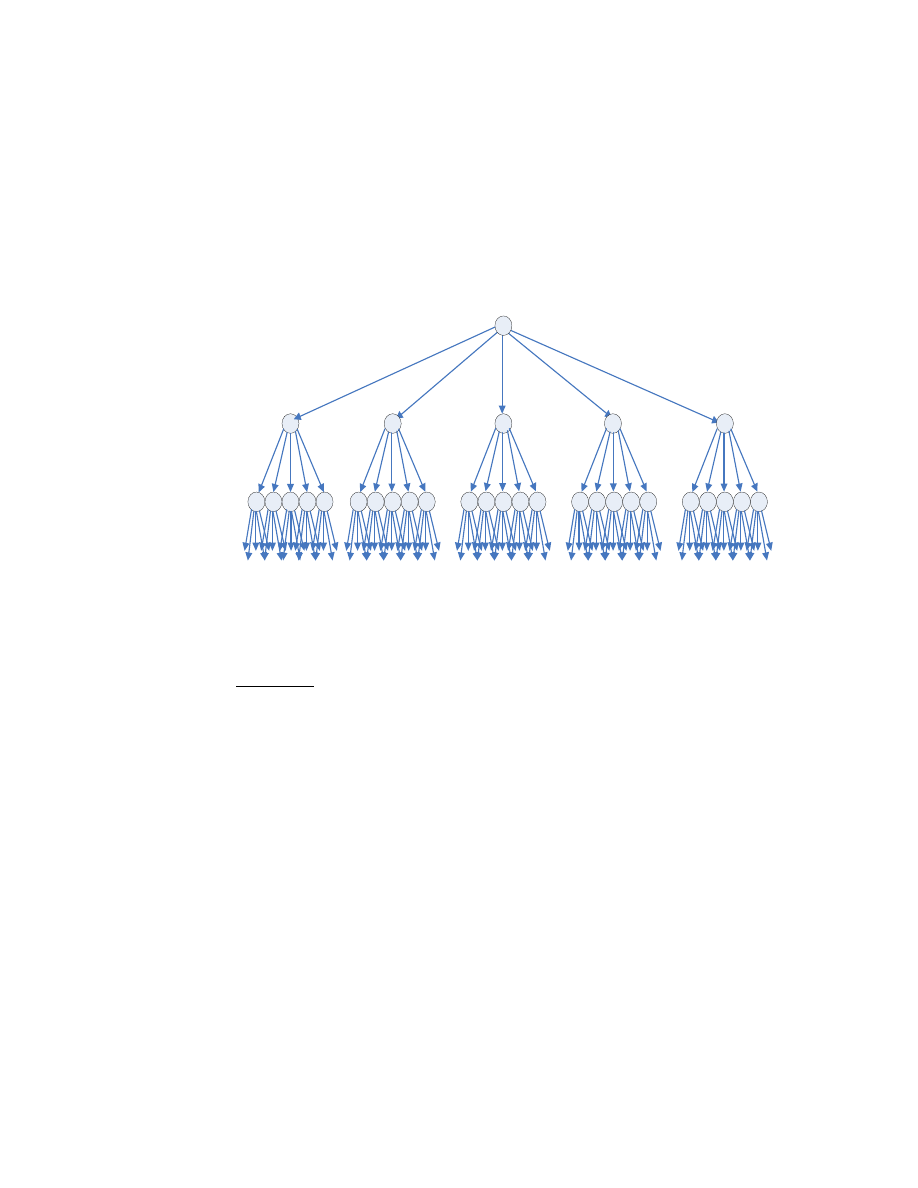
As can be seen in Fig. 2 below, it takes 3 generations to infect 155 hosts if
each host attempts to infect 5 other hosts.
<Fig. 3: Shallow Spread Tree Topology>
Advantage:
Using a shallow spread tree it takes a short amount of time to infect all
of the target hosts since this topology requires a small number of generations.
If there is one root host with OC-12 connection which has a 750Mbps link, it
is claimed in [8] that such a shallow spread tree can infect 1,000,000
vulnerable hosts in less than 1 second. In this particular tree, it is structured
such that the first generation infects 5,000-50,000 hosts, and the second
generation infects 20-200 hosts. Thus, it takes only 2 generations to infect
1,000,000 hosts.
15

Furthermore, this topology is tolerant against a failed infection. A
network host may not get infected by a flash worm for many reasons. The
host may no longer have a security hole, or the infection packet may be lost.
Nevertheless, the problem is if a host is not infected, the hosts constituting
its child nodes in the spread tree will not get infected either. The shallow
spread tree topology is tolerant against such infection failures. For example,
in the Fig. 2 above, suppose one host from first generation fails to get
infected. Then, that means, only 1 out of 5 failed and we still have 4 other
hosts to continue the infections. Assuming no other hosts would fail, still
80% of the total hosts could get infected. Note also that if such a failure
occurs in later generations, there would be less uninfected hosts.
Disadvantage:
As each host tries to infect many other hosts, this topology places
significant computation burden on each host. Furthermore, the traditional
worm defense systems which look for sudden increase in the number of
network connections from a host may detect the worm activities.
2.2.1.2. Deep Spread Tree
In a deep spread tree topology, each host tries to infect only a small number
of other hosts. If we were to infect the same 155 hosts again using a deep
spread tree topology as illustrated in Fig 3, it would require 7 generations to
16
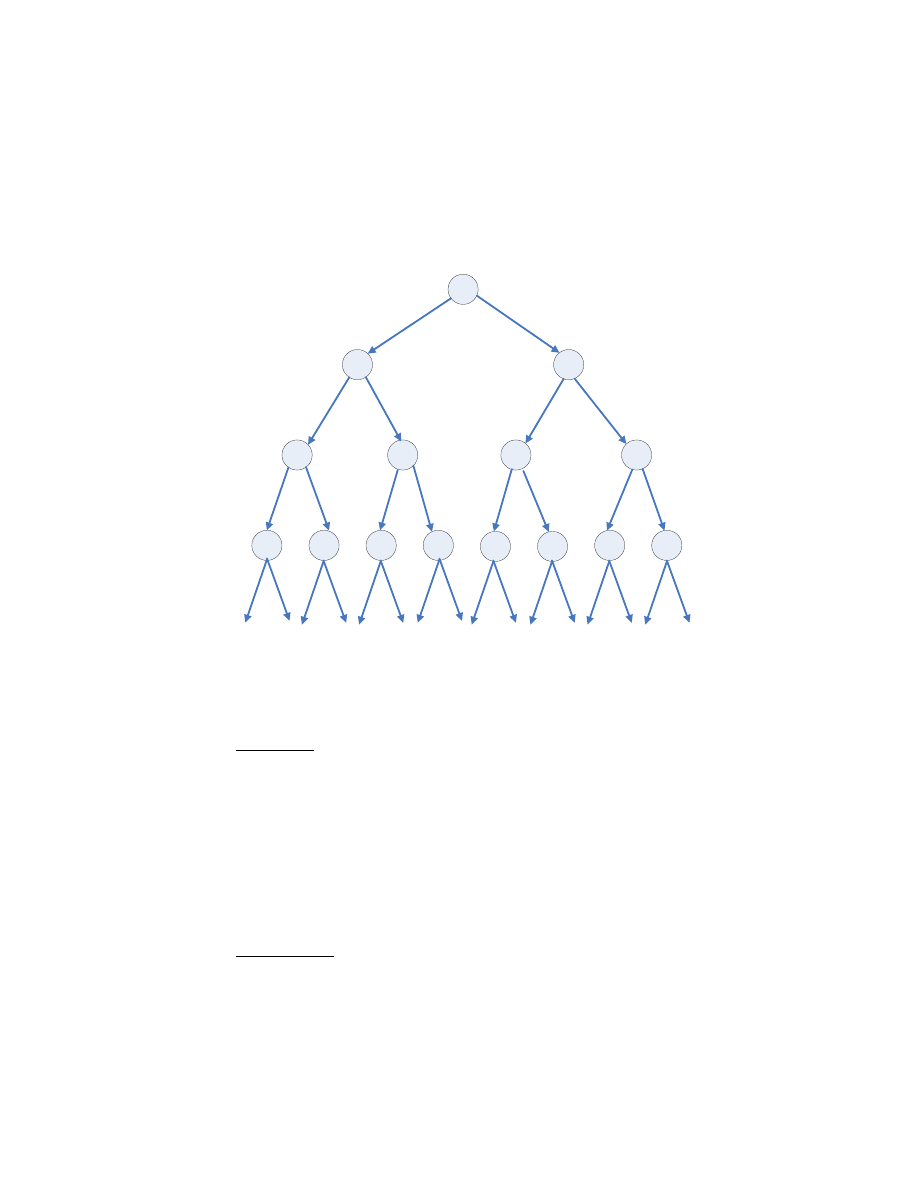
infect all nodes. Recall that the shallow spread tree discussed above would
require only 3 generations.
<Fig. 4: Deep Spread Tree Topology>
Advantage:
Since each host infects a small number of other hosts, the
aforementioned defense systems, which look for a sudden increase in the
number of network connections, would not be effective against this topology.
Disadvantage:
Compared to the shallow spread tree topology, this topology requires
more generations to infect the same number of target hosts. Since there is a
17

propagation delay in sending the target list from one generation to the next,
more generations imply a longer propagation delay. Therefore, this
topology takes a longer time to infect all of the target addresses.
Furthermore, if one node from the early generation fails to get infected,
the impact is larger than in the shallow spread tree. For example, in the Fig
3 above, if one node from generation 1 fails to be infected, then half of the
target addresses would not get infected.
♦ Note
The flash worm detection mechanism that we propose in this paper is most
effective only for a deep spread tree topology because the mechanism
requires that we see the spread tree grow to a certain depth.
2.2.1.3. Robust Spread Tree
One of the obvious difficulties in implementing flash worms is to obtain a
complete hit-list. Since the Internet continues to change as new hosts are
added and deleted, some infection attempts may fail. As discussed in the
deep spread tree topology section, if an infection attempt fails near the root
of the spread tree, then half of the spread tree may not be infected.
To provide a degree of resilience to the failed infection attempts, the
following topology can be used.
18
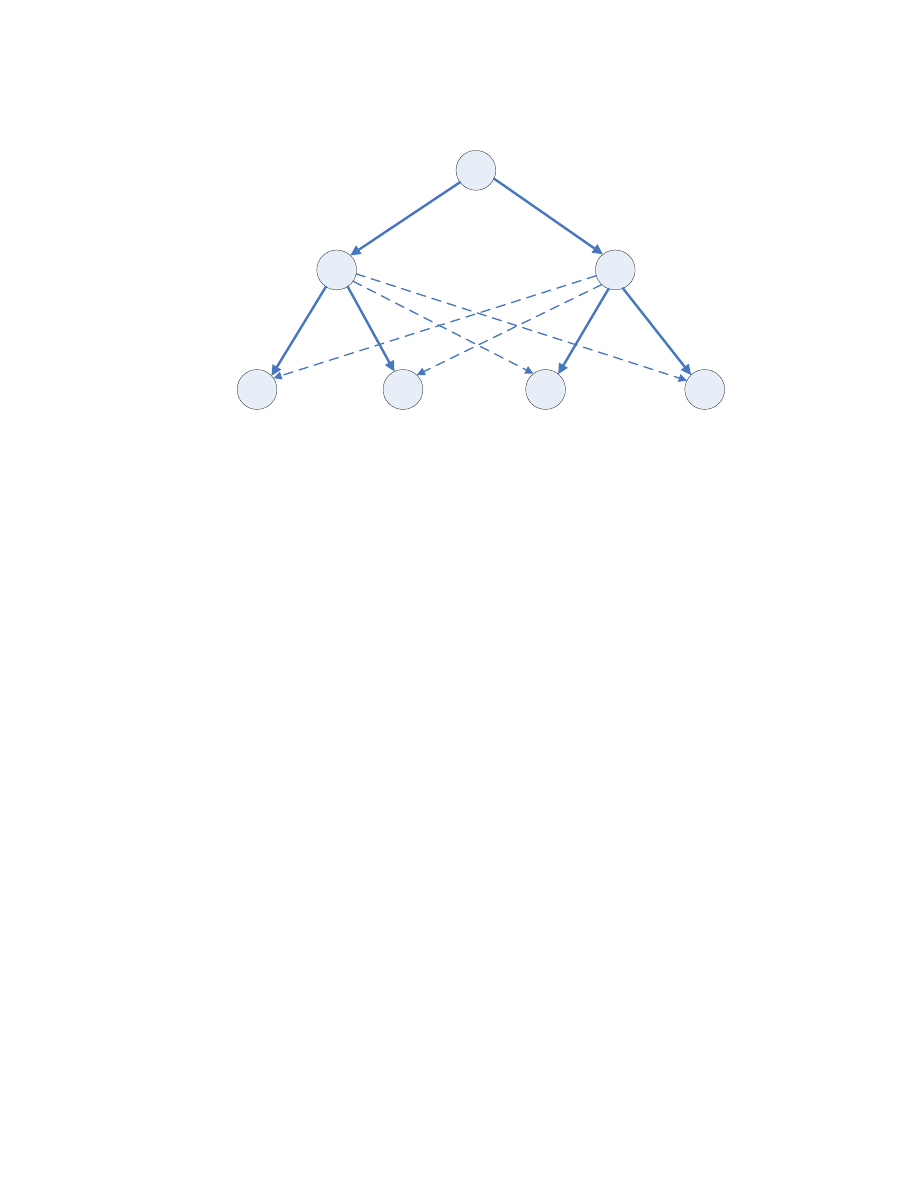
<Fig. 5: Robust Spread Tree Topology>
In this more robust topology, each host tries to infect its neighbor’s child
hosts. Even though this redundancy consumes some additional network
bandwidth and processing power, it protects the worm from a failure to
infect a particular node.
2.2.2. Use of Threads
In addition to defining the spread tree topology, the flash worm author would
need to decide whether to use threads. The use of threads at the application
layer can impact the total infection time.
19

2.2.2.1. No Threads
If threads are not used, then a host has to wait until it receives all the target
addresses from its parent. Until this is completed, the host cannot infect
other hosts. In other words, a task process to receive target lists and another
task process to infect target hosts cannot be run simultaneously if threads are
not used.
The hosts near the root node would expect to wait the longest because the
target address list is larger. On the other hand, as the host is closer to the
leaf nodes, the waiting time is expected to be significantly reduced.
♦ Note
Our simulation implementation of flash worms does not use threads.
Therefore, there are propagation delays which vary with respect to the size
of the target list.
2.2.2.2. Single Thread
In an implementation that can utilize a single thread, the host can create an
instance of a thread to infect its child node immediately after a target address
is received. That is, a thread can be used to receive the target list while
another thread can be used to infect and send the target list. The Fig. 5
illustrates the procedure.
20
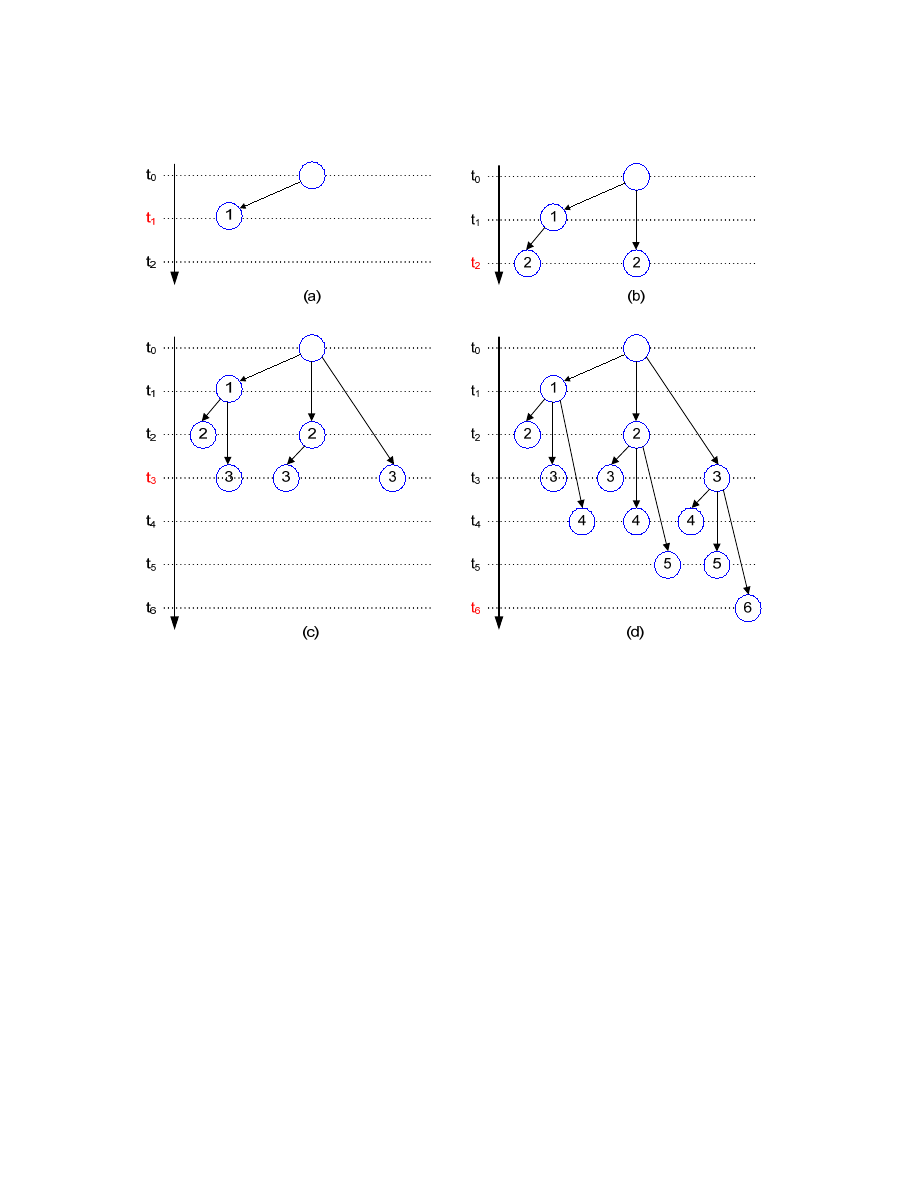
<Fig. 6: Single Thread Usage>
(a) At t
0
, the root node infects one other node; (b) At t
1
, the root node infects second node. The previous child
node has received a target address from the root node and is ready to infect another node. The node infects
another node by creating a thread. (Note that the node is still receiving the target list from its parent); (c) At t
3
,
three new nodes are infected; (d) At t
6
, all nodes are infected. [2]
In the example above, each node creates an instance of a thread every t
x
time.
By using a single thread, a node does not have to wait until it receives all the
target address, which significantly reduces the total infection time.
21

2.2.2.3. Multiple Threads
Multiple threads can be used in an environment where a node receives
multiple target addresses from multiple sources simultaneously. For
example, in a robust spread tree topology, a node may receive multiple
target addresses from different parent nodes. Therefore, a child node may
start different threads for each of the multiple worms it receives, which can
quickly snowball into X
n
threads at a depth of n and X maximum infection
number.
2.2.3. TCP or UDP
Another important decision a flash worm author has to make is whether to
use TCP or UDP. TCP establishes and maintains a connection before
transmitting the data, which requires more packets to be sent than UDP. On the
other hand, UDP does not establish a connection and data can be immediately
transmitted between two hosts. Therefore, a UDP-based flash worm can infect
faster than a TCP-based flash worm.
Even though the use of TCP can be slower than using UDP, the connection-
oriented nature of TCP provides guaranteed delivery of data whereas UDP does
not. As discussed in the spread tree topology section, failure to deliver infection
packets in the early stages of the worm infection can have a huge impact.
Therefore, the worm author has to balance the infection speed against the risk of
22

missed connections when choosing the network transmission protocol. It may be
best to use UDP for speed and build its own reliable delivery mechanism to avoid
missed infections in early generation.
♦ Note
Our simulation of flash worms uses UDP. We assume that only one UDP
packet is required to infect a target host. This is unrealistic for the early
generations of an infection, but it is a reasonable model for later generations.
2.3. Designing a New Flash Worm Implementation
While there are many existing hypothetical implementations of flash worms, there
may be other flash worm implementation designs still unknown. As an effort to
uncover such unknown designs, we propose a new flash worm implementation
below.
Central Hit-list Server based Design
• Instead of distributing the address list from a parent node to a child node, the
hit-list is available from a central server.
• When a new host is infected, it asks the central server for target addresses.
Once the central server receives a packet from a target address, it removes the
23

target address from the hit-list (because it knows that the target address is
already infected).
• For simplicity and efficiency, we use UDP packets. Assuming a UDP packet
can store 1200 bytes, a single UDP packet can store about 35 IP Addresses.
That means, a simple Request-Reply UDP packets will get 35 target lists from
the server.
• Advantage:
o
The central server can efficiently distribute the hit-list
This design eliminates the initial delay in propagating a large hit-
list
This design is also resilient to failed infections; if a node fails to
get infected, other node will infect its child nodes.
o
The hit-list can be updated dynamically as new vulnerable addresses are
added. Also, incorrect addresses can be removed after some timeout.
o
The current infection progress state can be monitored in real time.
• Disadvantage:
o
The hit-list server can be relatively heavily loaded.
24

3. Implementation of Geometry-based Detector
In this section, we discuss how we implemented a simulator to generate the flash worm
traffic. Then, we discuss how we developed a new application to graphically analyze
the flash worm traffic and to test our proposed detection mechanism.
3.1. Flash Worm Simulation
3.1.1. Finding a Suitable Simulator
In order to study the defense against flash worms, we needed to have a
simulator to simulate the behavior of flash worms. Because learning to use a new
simulator in depth is a difficult and often time-consuming process, we wanted to
verify that a specific simulator is capable of simulating many nodes and generating
the packet-level traffic prior to learning the simulator in depth.
List of Simulators:
The following are simulators that can simulate a vast number of nodes:
1) Scalable Simulation Framework [14]
Scalable Simulation Framework has been outdated. The latest simulator
update was in year 2004.
2) Simnet [15]
Simnet was designed mainly for analyzing network security protocols.
25

Although an implementation of a worm model was available, the simulator
did not have detailed documentation.
3) OPNET [16]
Opnet was a commercial-quality network simulator product. A student
license was available that required a complex registration.
4) GTNetS [17]
GTNetS was a network simulator developed from Georgia Tech University.
The simulator was complex to install and use.
5) NS-2 [18]
Developed and maintained by various research orginations, NS-2 was
widely used in academic works. Although NS-2 was well documented, it
was also very complex to use.
Although it seemed to be very complex to use at first, we decided to use NS-
2 because it was easy to install and had some forms of the user documentation.
However, the other simulators could have been used to do the project as well.
3.1.2. Extending the Simulator to Simulate the Spread of Flash Worms
3.1.2.1. Modified NS-2 Default Environments
• By default, NS-2 uses a flat-routing scheme, in which every node knows
the address of every other node, resulting in a routing table size to the
26

order of n
2
for n nodes. To reduce the memory requirement of
simulations over large network topologies, we created a hierarchical-
routing scheme. For hierarchical-routing, each node knows only about
those nodes in its level. Thus, the routing table size was reduced to the
order of log n.
3.1.2.2. Added a New Network Packet:
We enhanced NS-2 to support the following new network packet:
• Packet Format
struct
hdr_fworm {
nsaddr_t
dst;
nsaddr_t
src;
nsaddr_t
target_range_first;
nsaddr_t
target_range_last;
};
o
There are four fields in the packet
dst = packet destination address
src = source address
target_range_first = first range of address to infect
target_range_last = last range of address to infects
o
Instead of transmitting each target address of the hit-list, we
decided to send the range representing the list. So, a single
packet can infect and propagate the target addresses. The
propagation delay to transmit the target addresses is simulated by
forcing infected host to wait for the estimated delay before
27

infecting other hosts. The delay varies with respect to the range
size.
3.1.2.3. Added Two New Network Entities: Node and CenterNode
o
The entity Node represents a host that is vulnerable to flash worm
infections.
o
The entity CenterNode is a special node that is not vulnerable to flash
worm infections. It is located at the center of the network hierarchy, and
it acts as a router to forward flash worm packets amongst Nodes. Every
flash worm data has to go through this entity first. Since it can see all
the flash worm traffic, it is also the ideal place to implement our
detection mechanism.
o
The entities Node and CentorNode provide a global view of a large
network topology. While this might not seem too realistic, similar
structure can be formulated on a LAN or a WAN. In any case, we are
trying to see if our detection mechanism can work in principle.
28
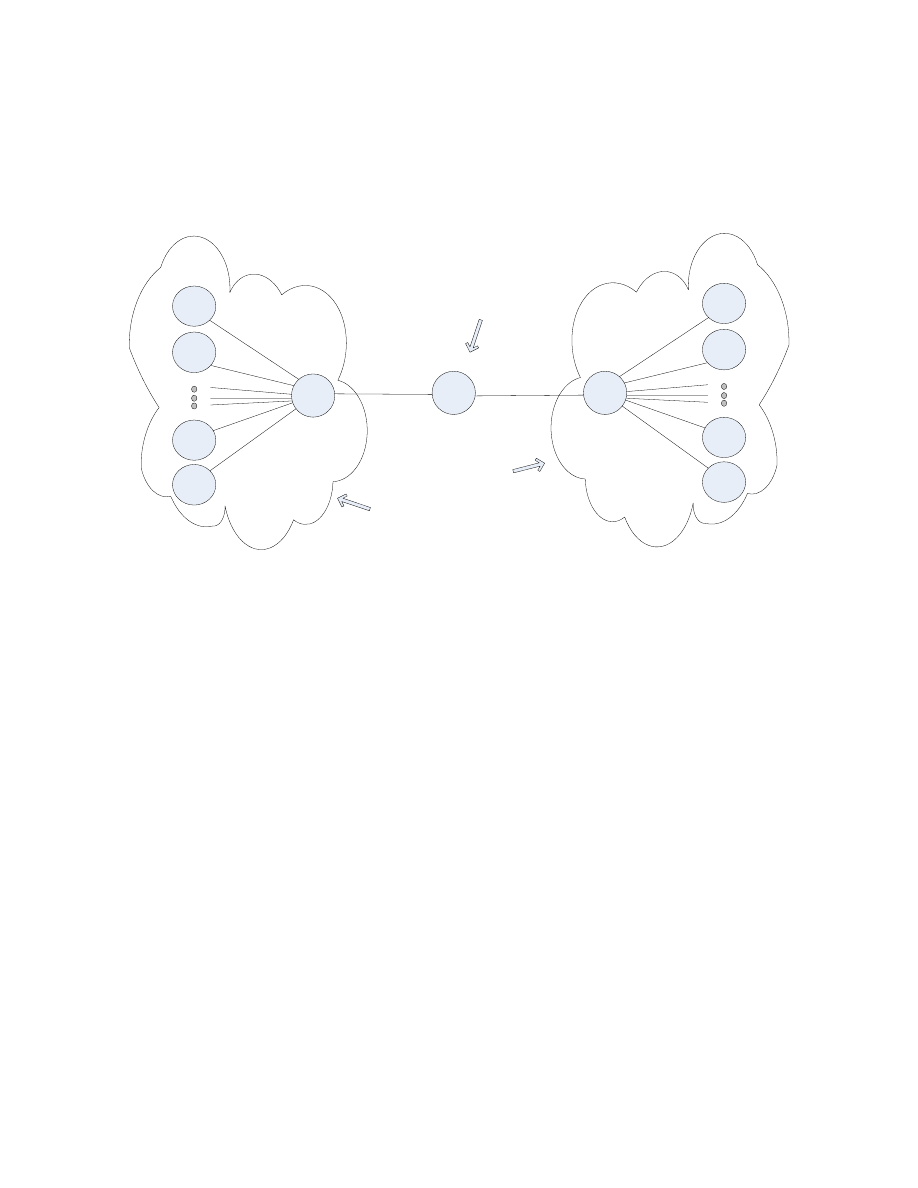
3.1.2.4. Network Hierarchy Example
Fig. 6 displays an example of simulated network topology in NS-2.
0.0.0
0.1.0
0.1.126
0.1.127
0.1.1
0.1.2
0.2.0
0.2126
0.2127
0.2.1
0.2.2
Cluster 2
Cluster 1
CenterNode
<Fig. 7: Network Topology of NS-2, Consisting of Two Clusters>
o
There is always one CenterNode in the topology, which has the address
0.0.0 and is located at the center.
o
Every packet is sent to CenterNode first. Then, the CenterNode
forwards the packet to the correct destination.
o
Each cluster can have maximum of 128 nodes.
o
Of the address form 0.X.Y, X represents the cluster number and Y
represents the node ID within the cluster.
o
A node with the address form of 0.X.0 is a head of the cluster.
29

o
Both the CenterNode and the head of a cluster have enough buffer size
to handle large network traffic.
3.1.3. Configurable Parameters
Following are the configurable parameters to simulate various flash worm
scenarios:
o
Number of Clusters
The simulator can support up to 100 clusters. Since each cluster
has 128 nodes, this means that the simulator can simulate 12,800
nodes.
Our simulation has been performed on a computer with 1GB of
RAM. A computer with higher RAM space should be able to
simulate more than 100 clusters.
o
Infection Number
This is the maximum number that each host tries to infect other
hosts.
o
Link Delay
There is a network propagation delay between the CenterNode
and the head of a cluster. Unless otherwise specified, we use
5ms as the default delay.
There is also a network propagation delay between nodes and the
head of the nodes. Unless otherwise specified, we use 10ms as
the default delay.
30

If using the default delay values, the end-to-end propagation
delay between 2 end-to-end hosts is 10 + 5 + 5 + 10 = 30 ms.
3.2. Flash Worm Detection Mechanism
To discuss our detection mechanism, there are underline assumptions to consider.
First, there are at least one thousand hosts that are vulnerable to flash worm infections.
Second, every host makes the same number of infections. Third, the infected hosts
create deep spread tree. Last, all infection attempts are successful.
Since flash worms spread rapidly, the traditional signature-based defenses or
manual human intervention cannot respond in adequate time to stop the flash worm
propagation. Therefore, much effort has gone into designing automated flash worm
containment mechanisms. Besides the one we are proposing in this paper, there are two
other common defense mechanisms against flash worms:
The author of [1] proposes a defense system against flash worm in which the
addresses of the Internet hosts are changed frequently. By doing so, the goal is to make
the hit-list, which is pre-generated by the flash worm authors, unreliable and unusable.
However, the mechanism requires a significant modification of the existing Internet
infrastructure.
The second defense mechanism is to utilize a honeypot. Traditionally, a honeypot
is a fake network environment where various viruses and worms can be trapped. If the
address of a honeypot is in the hit-list, attempting to infect the honeypot may prevent a
31

part of the spread tree from getting infected. However, as discussed in the robust
spread tree topology section, there are ways to get around this trap.
3.2.1. Geometry-based Detection of Flash Worms
3.2.1.1. Basic Idea
The basic idea of our work is to create a spread tree by monitoring network
traffic activities and shutting down the network if a predefined threshold
level of depth is reached. The spread tree is pruned periodically by
removing the old nodes so that the tree would not grow continuously and
trigger false alarms. By carefully choosing the threshold depth and the
prune period, it should be difficult to trigger the false alarm by non-flash
worm packets.
3.2.2. Extending NS2 to Simulate Detection of Flash Worms
3.2.2.1. Node Structure
In order to create the spread tree, we use the following tree node structure:
• struct node {
int nodeID;
// ID (or address) of this node
int depth;
// depth (or generation) number
double timestamp; // node creation time
node ** children; // list of children
node ** parent; // list of parents
int numChildren; // number of children
int numParent;
// number of parents
32
int maxChildren; // max number of children
int maxParent;
// max number of children
node * before;
// for list sorted by time
node * after;
// for list sorted by time
};
Note that our node implementation can support multiple parents.
This late added feature required more complex computation to be
performed dynamically. For example, it required the support of
parent-child loop avoidance and recursive depth determination which
are discussed below. If the node were to support only one parent, the
implementation could have been much simpler.
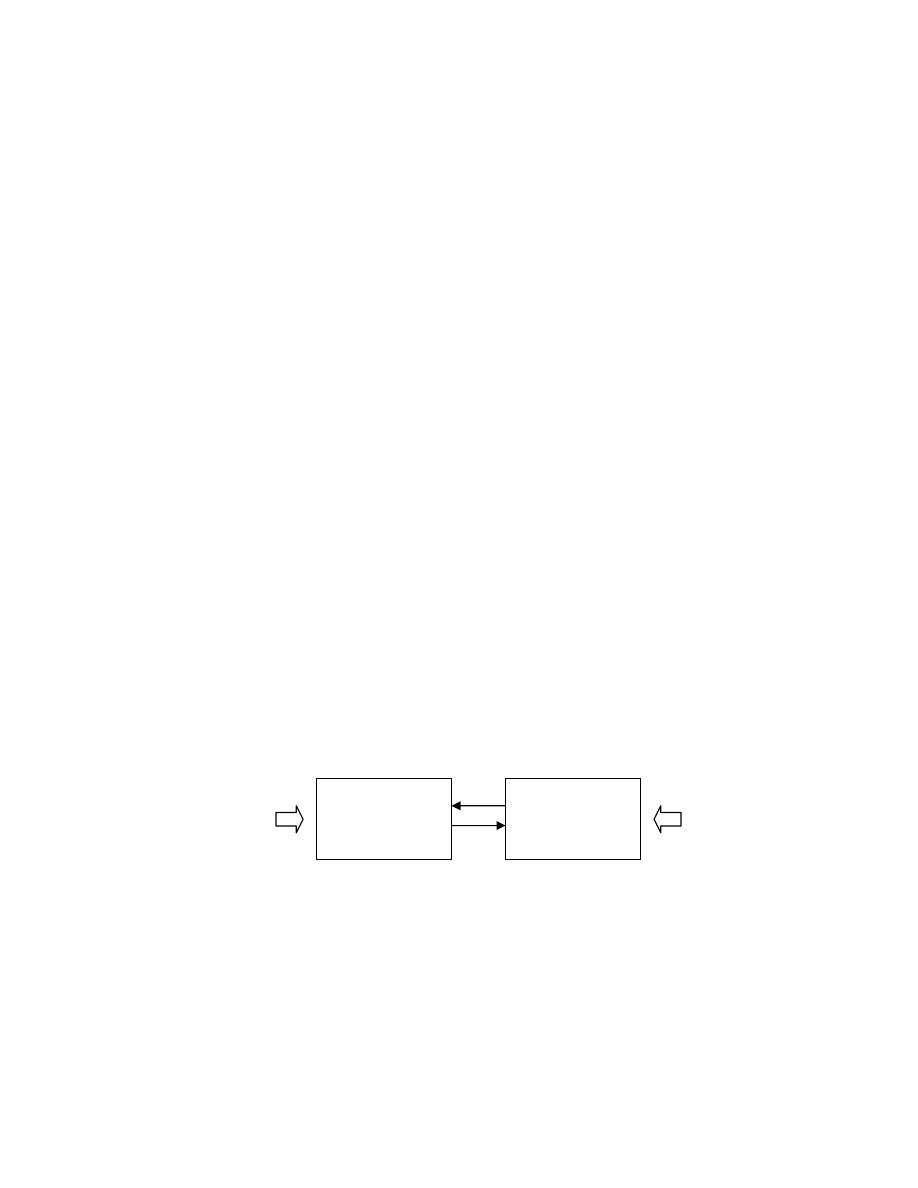
3.2.2.2. Double Linked-list Sorted by Timestamp
To minimize the cost of updating the tree structure, we used the following
double linked-list sorted by timestamp:
o
Linked-list
Node 6
Time: 13
Node 1
Time: 10
By using this linked-list, there is no need to search for old nodes in
the pruning process.
Remove
nodes starting
from head
Add new
nodes starting
from tail
Although a simple single-linked list could have used for this purpose,
we used double-linked list in case the items may have to be sorted.
For example, if the infection time is changeable, then the list has to
33

be updated by sorting. See section 3.2.3.6 for more discussion on
this issue.
3.2.2.3. Array of Pointers to Node Sorted by Node ID
To allow us to easily access the node structure, we created an array of
pointers to node structure that is sorted by Node ID.
o
Node * pNodes[size of max node];
For example, given the a nodeID X, we could access the node
structure by
*pNodes[X]
3.2.2.4. Dynamic Determination of Root Nodes
Through out the operation, there can be many splits or merges of spread
trees. For example, a tree is split if the root node is removed; two trees are
merged if one node infects one node on the other tree. Since it would be
very cumbersome to maintain a list of all the root nodes, we decided to
maintain no explicit list of root nodes. Instead, if the parent number of a
node is 0, the node is the root.
3.2.2.5. Dynamic Determination of Depth
Instead of updating the depth of every child node when the depth of a parent
node is changed, depth is determined recursively as following:
depth = maximum depth of parents + 1
34

3.2.2.6. Exiting Parent-Child Relationship
If there is an existing parent-child relationship between two nodes when
creating a new relationship, we decided to do nothing. Alternatively, we could
have updated the node creation time so that the node would be pruned at a later
time. However, we thought doing so would consume significant computation
power to reorganize the linked-list. For example, if two nodes are
communicating using a TCP connection or running some application, there
would be many rapid requests to update the node creation time in a short period
of time. Therefore, we decided that it would be better not to update the node
creation time.
3.2.2.7. Parent-Child Loop Avoidance
Before a new parent-child relationship is created, a check is performed to
prevent the formation of a parent-child loop. See Fig. 7 below.
35
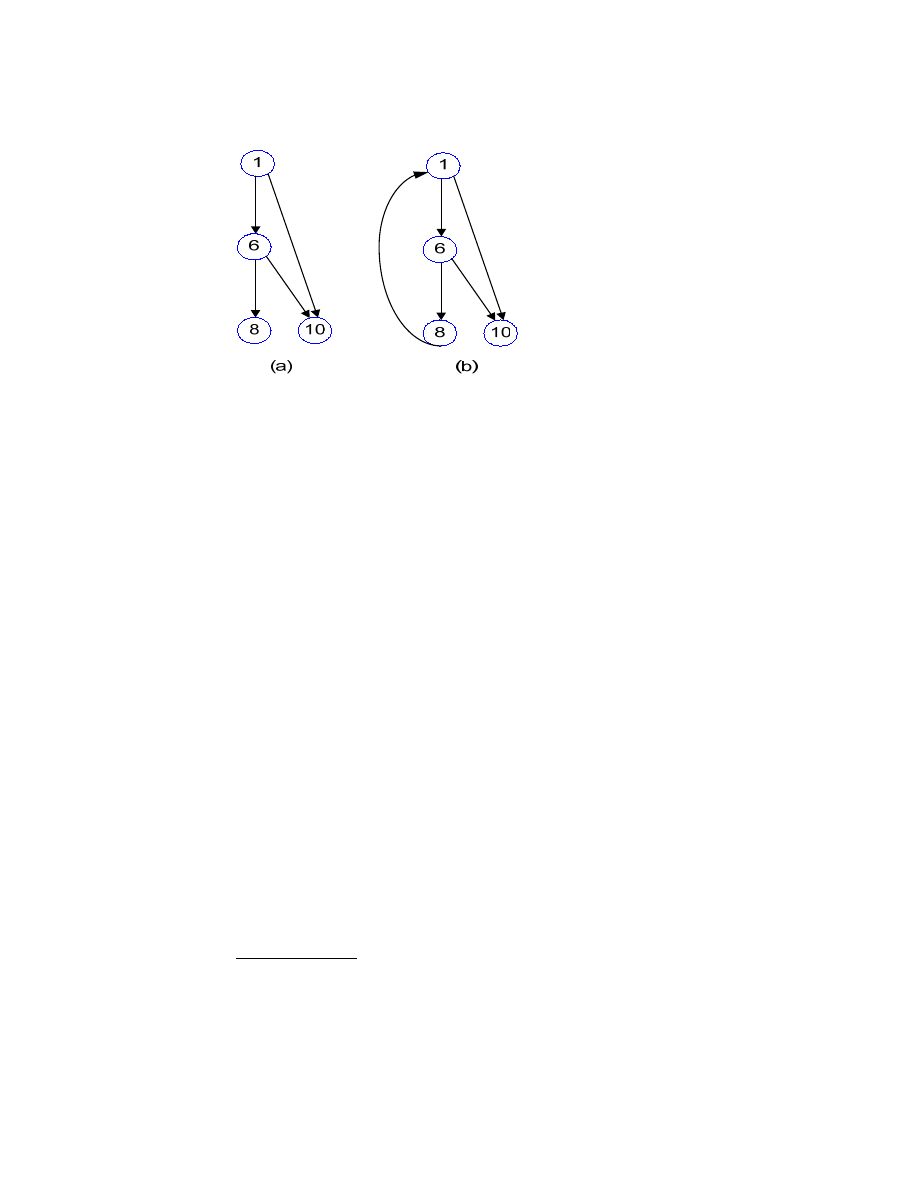
<Fig. 8: Loop Avoidance>
(a) No loop; (b) There is a loop, connecting node 1,6, 8
In Fig 7(a), there is no loop. However, in Fig 7(b) there is a loop among the
nodes 1, 6, and 8. If there is a loop, we cannot determine the depth correctly
since we cannot determine which node is the parent/root node. Therefore, if
a new parent-child relation creates a loop, we remove that relationship right
away. There can be potential attacks against this restriction, one of which
we discuss later.
3.2.3. Configurable Parameters
Similar to the configurable parameters in flash worm simulation, there are
configurable parameters for detection mechanism.
o
Depth Threshold
This is the maximum number of depth allowed before an alarm is
triggered to notify that spread of flash worms has detected.
36

Too lower number is likely to generate many false alarms; too high
number would not detect flash worm early enough to react.
o
Prune Period
This is the amount of time elapsed before next pruning occurs.
o
Prune Amount
This is the amount of time we subtract from the current time, and any
nodes created before that time is pruned. For example, if Prune
Amount is 5 seconds and current time is 30 seconds, the nodes with
creation time less than 30 – 5 = 25 seconds will be removed from the
spread tree.
3.3. Post-analyzer
In this section we discuss how we implemented a post-analyzer to help visualizing
the simulated result.
3.3.1. Nam (Network Animator)
37
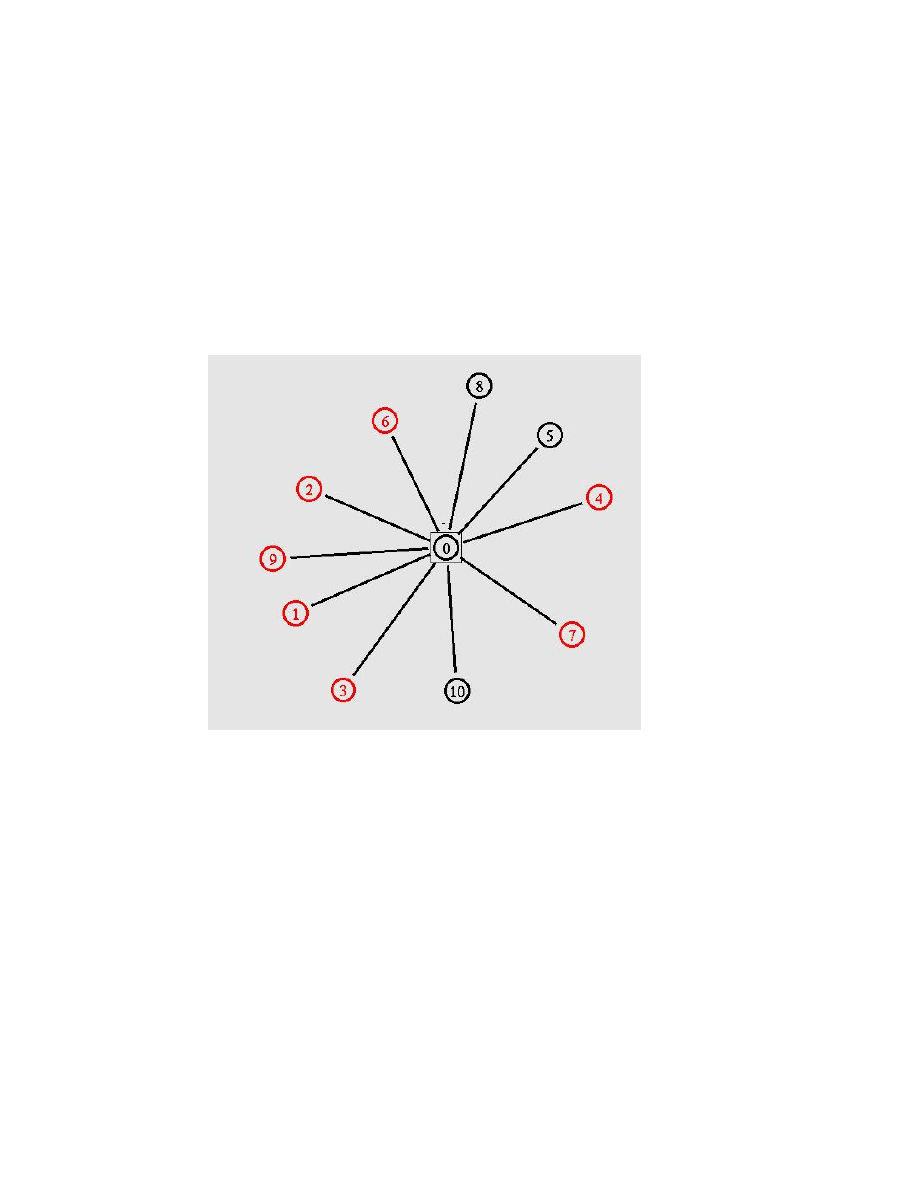
NS-2 provides Nam, which is a graphical utility to display the network topology
and simple network traffic activities. We have implemented Nam such that when a
node is infected, the color of the node changes to red. Following is a sample output
of running the simulation consisting of 10 nodes.
o
nam result
<Fig. 9: Nam screen-shot>
o
Node0 is the CentralNode
o
Nodes 1,2,3,4,6,7,9 have been infected at the time
o
Nodes 5,8,10 have not been infected yet.
o
This is a screen shot of a specific simulation time; eventually, every node
will get infected.
o
Disadvantages:
38

If plotting a lot of nodes, Nam cannot position nodes evenly across
the screen. Nam will display all the nodes close to the CenterNode
and we will eventually see a big dark circle in the middle.
Nam cannot automatically order the nodes into a tree form.
3.3.2. Custom Post-analyzer
To resolve all Nam’s shortcomings, we have implemented a custom post-
analyzer using MFC from Microsoft Visual Studio. Following are the features of
the post-analyzer:
o
Able to plot a vast number of nodes on a screen
o
Able to zoom in (or out) to see detailed structure
o
Able to see detailed information of a node when the mouse is placed over
the node
The information is displayed in a tooltip
• The information is consisted of node address, node creation
time, and depth. The tooltip can be easily modified to display
more information.
o
Able to manually start, stop, and rerun the simulation at any time.
o
Able to run the detection mechanism
The detection mechanism is implemented in both NS-2 and the post-
analyzer. The detection mechanism in NS-2 can be used to monitor
the flash worm packets as soon as they are generated by the
39

simulator. However, the configurable parameter for the detection
mechanism such as Prune Period cannot be changed after the
simulator is started and the testing of the detection mechanism
always requires regeneration of flash worm traffic. On the other
hand using the post-analyzer, the configurable parameters of the
detection mechanism can be changed and tested at any time. The
post-analyzer can also apply the detection mechanism on saved flash
worm traffic so the flash worm traffic does not need to be
regenerated. Therefore, we prefer to use NS-2 only to generate the
flash worm traffic and run the detection mechanism on the post-
analyzer.
40

4. Tests and Results
In this section we explain our testing setup and provide an analysis on the result.
4.1. Generate flash worm traffic
Flash worm traffic was generated by running NS-2 simulator with following
parameters:
• Configurable Parameters:
o
Number of clusters = 10
o
Infection number = 2
• We disabled the detection mechanism of the simulator. If the detection
mechanism is disabled, NS-2 automatically outputs all the flash worm traffic
data into a text file.
• Traffic Format:
o
The traffic is organized by the following fields:
Event Time (in ms), Node Address, Parent Node Address, Target
Address Size
o
Each field is separated by a space.
o
For example, Fig. 9 displays the first five flash worm data.
41

line 1:
0.1 128 0 1279
line 2:
19.2 768 128 639
line 3:
19.2 129 128 638
line 4:
28.8 769 768 318
line 5:
28.8 1088 768 319
<Fig. 10: Sample Flash Worm Traffic>
Line 1 has the initial flash worm data. The line “0.1 128 0 1279”
means “Node 128 was infected by Node 0 at time 0.1 and the
target address size is 1279”. Since we simulate 10 clusters and
each cluster has 128 nodes, the initial hit-list size of 1279 is
correct.
Line 2 and 3 shows that Node 128 correctly infected 2 other
nodes at 19.2 ms. Note that the target address list is divided into
639 and 638 and distributed to Nodes 768 and 129 respectively.
Since our simulation does not utilize threads, the node has to wait
until it receives all the target addresses from its parent. From line
1 and 2, we can see that it took 19.2 – 0.1 = 19.1 ms to transmit
target list size of 639 from Node 128 to Node 768. Also, from
line 2 and line 4, we can see that it took 28.8 – 19.2 = 9.6 ms to
transmit target list size of 318 from Node 768 to Node 769.
Therefore, a higher propagation delay is required to transmit a
larger target list.
42
4.2. Plot and Analyze Flash Worm Traffic
After generating the flash worm traffic, we plotted and analyzed the traffic using
our post-analyzer.
• Spread Tree Topology
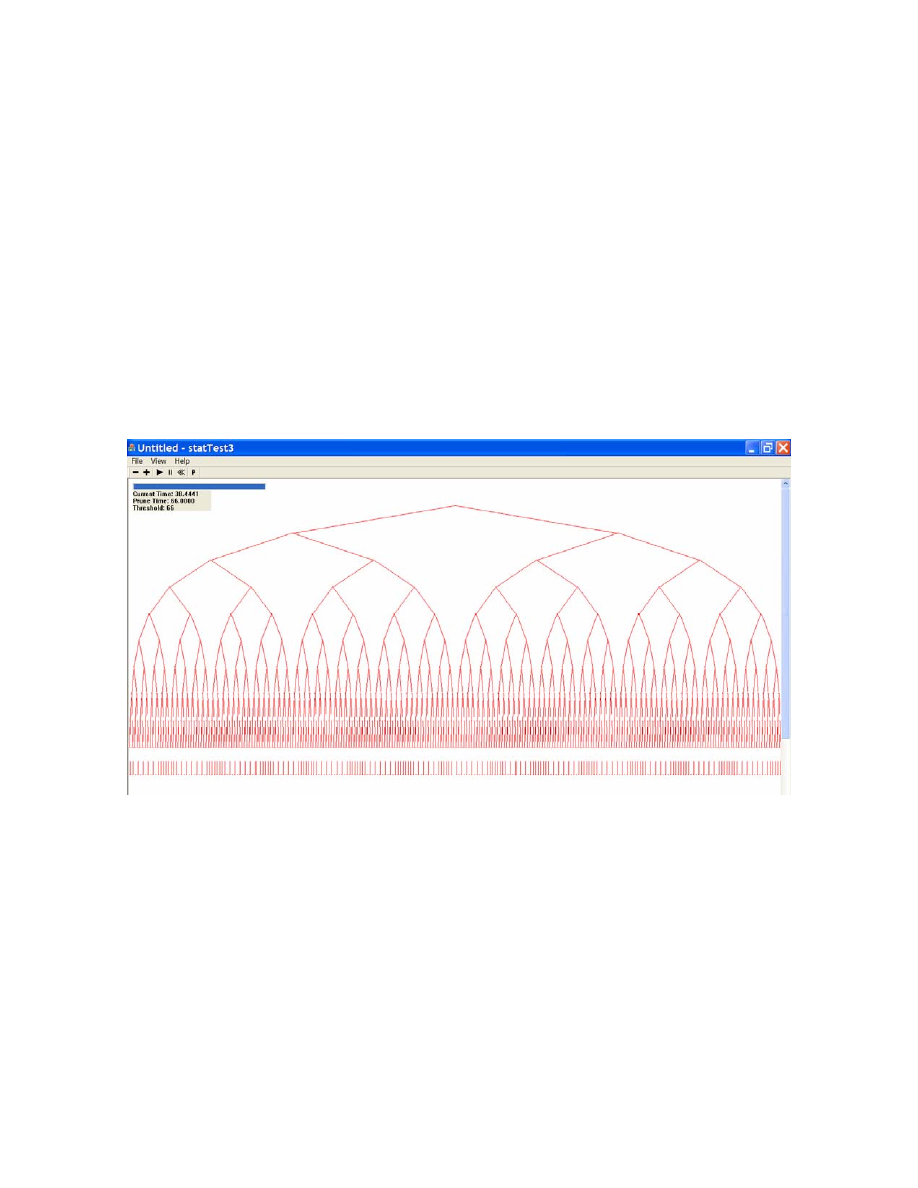
o
Fig. 10 displays all the 1280 target nodes organized into a spread tree
topology.
<Fig. 11: Complete Tree>
Without Pruning
In this test setup, there is no pruning because we specified
sufficiently long pruning time period to display the complete tree
structure.
43
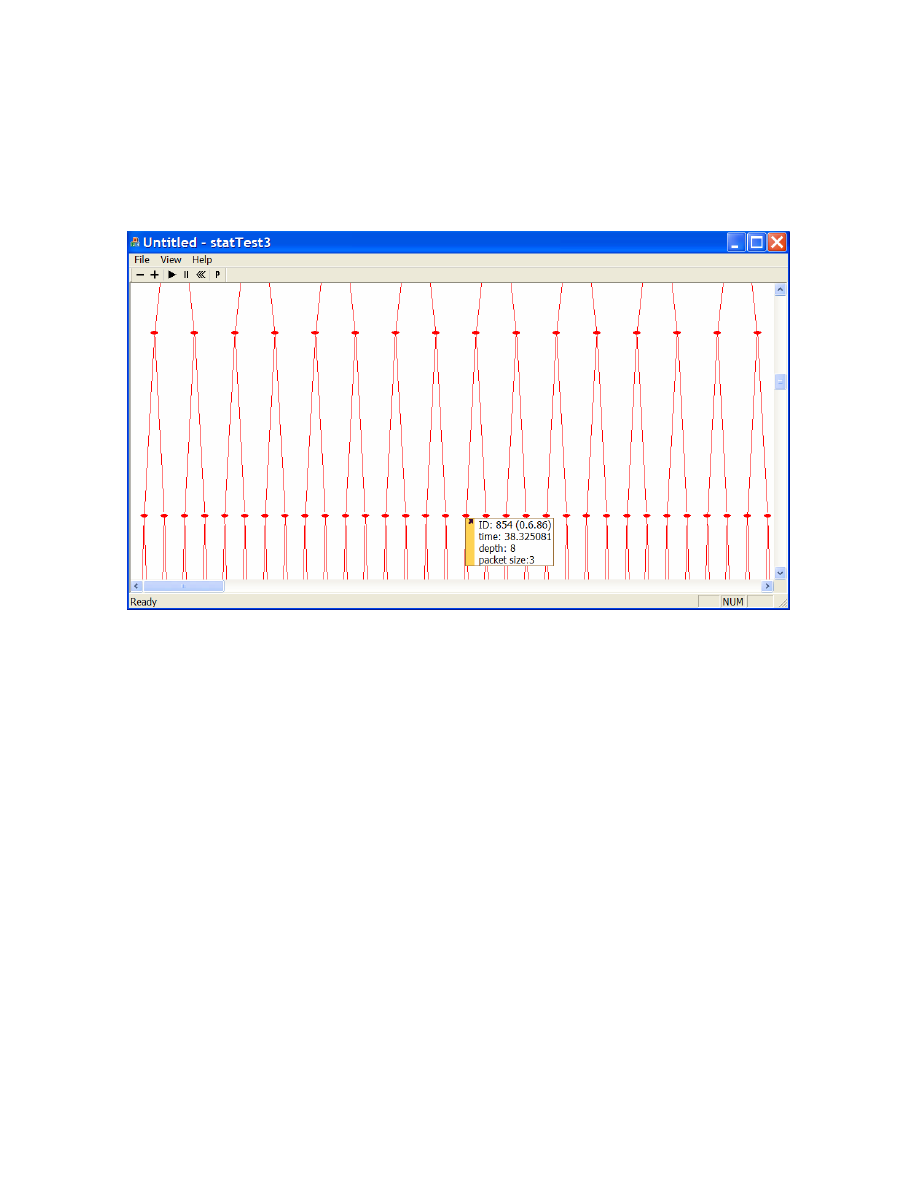
o
Fig. 11 displays a zoomed-in screen shot. It also shows a tooltip, which
describes the detailed information regarding Node 854.
<Fig. 12: Zoomed-in and ToolTip>
• Running Detection Method
o
Fig. 12 shows that our detection method found the spread of flash worms.
44
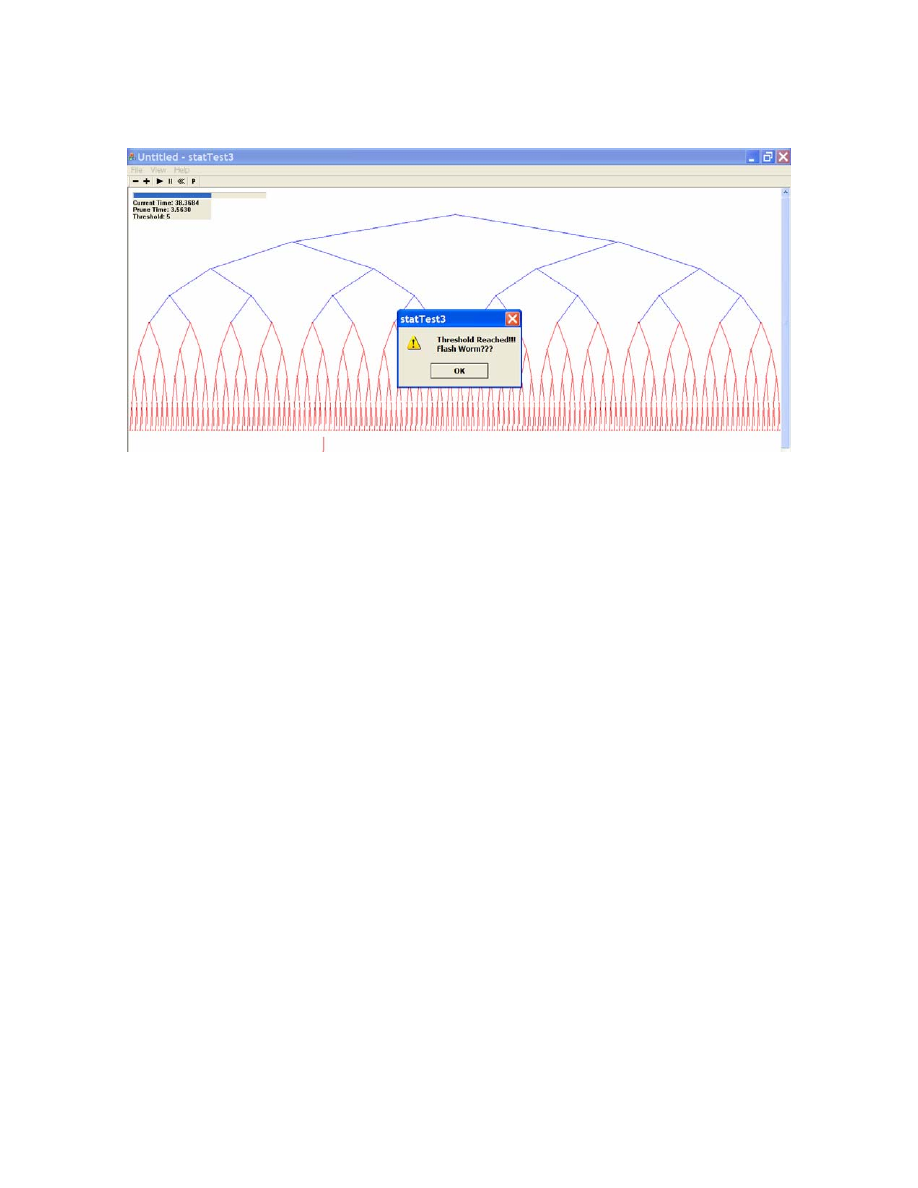
<Fig. 13: Detection Mechanism in Action>
o
For the detection method parameters, Prune Time is set to 3.5630 and
Threshold Depth is set to 5.
o
The nodes and lines marked in blue color indicate the pruned entities. In
the above example, the first 3 generations have been pruned.
4.3. Plot and Analyze the Actual Internet Traffic Captured from Lawrence
National Laboratory
• In the previous experiment, we tested that our detection mechanism can
successfully detect the spread of flash worms. However, we were also
interested to find out how the detection mechanism would respond to the other
network traffic.
45

• Instead of generating various Internet traffic as we generated the flash worm
traffic, we decided to use an archived Internet trace data from [9]. Captured
from the Lawrence National Laboratory using tcpdump of an actual WAN
traffic, the trace data went through a sanitization script to renumber IP addresses
and to remove all private packet contents. The sanitization script also separated
TCP traffic from UDP traffic and places them into different files. One can
capture one’s own Internet traffic using tcpdump and use the same sanitization
script to produce the similar trace data.
• There are more than 10 archived Internet traces available at the site. The trace
file we used for our testing below is called LBL-PKT. It contains an hour's
worth of all wide-area traffic between the Lawrence Berkeley Laboratory and
the rest of the world, started from 14:00 and ended at 15:00 on January 21, 1994.
• Traffic Format:
o
The traffic is organized by the following fields:
Timestamp of packet arrival, Source host, Destination host,
Source port, Destination port, Packet size
o
We modified our post-analyzer to use above fields to create spread trees.
o
We did not utilize the port numbers to create different spread trees for
different port number. However, in a real world deployment of our
detection mechanism, the spread trees should be further separated by the
port number because flash worms will probably use a specific port
number to spread.
46
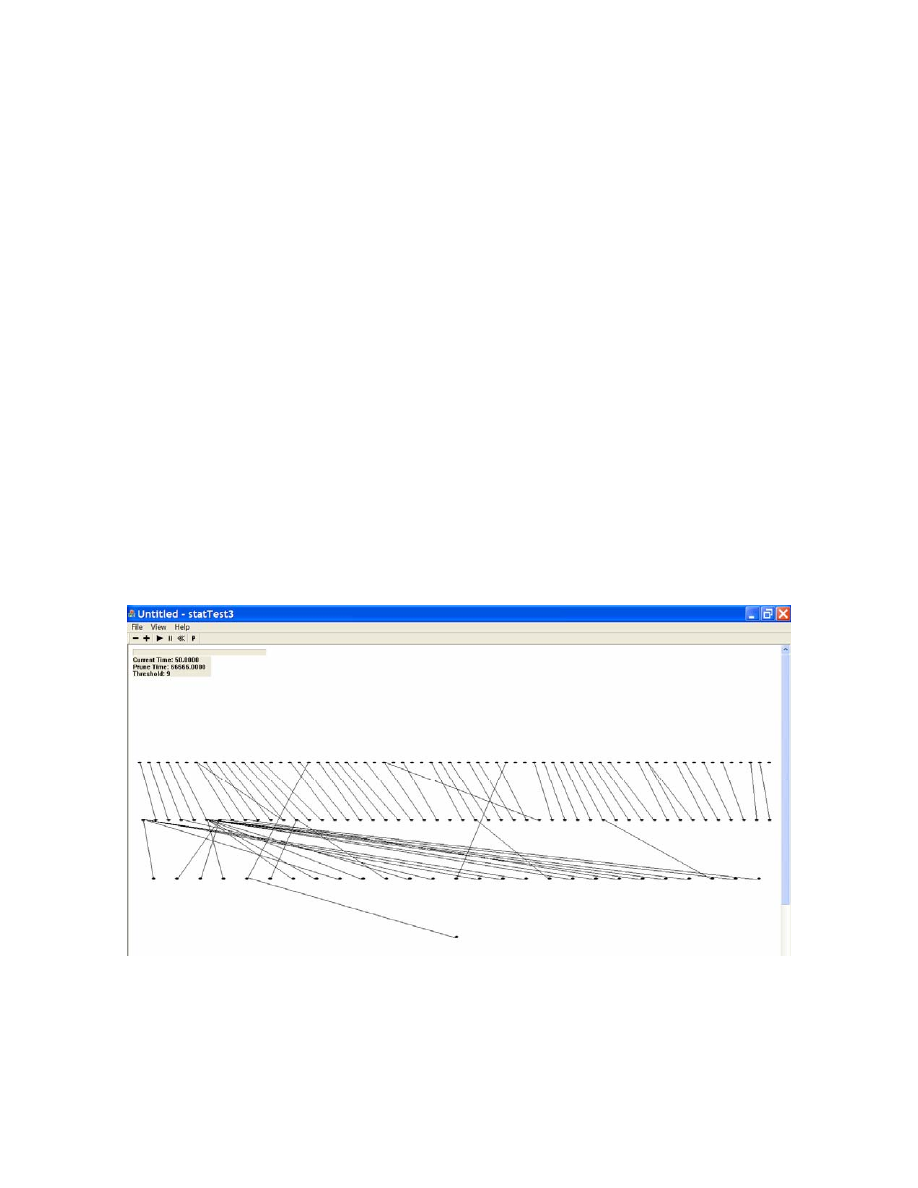
• TCP Traffic
o
The spread tree formulation of the TCP traffic is shown in Fig. 13. Even
though more than 150 packet events were processed, there were many
attempts to create loops or to create repetitive relationships. The
attempts to create loop were avoided and the attempts to recreate
existing parent-child relationship were ignored. Therefore, we did not
see rapid growth of the spread tree.
o
The tree structure seemed to be the reserved formulation of the flash
worm spread tree. The total number of nodes in a generation decreases
as generation number increases. However, the exact opposite happens in
flash worm spread tree.
<Fig. 14: Spread Tree of TCP traffic>
47
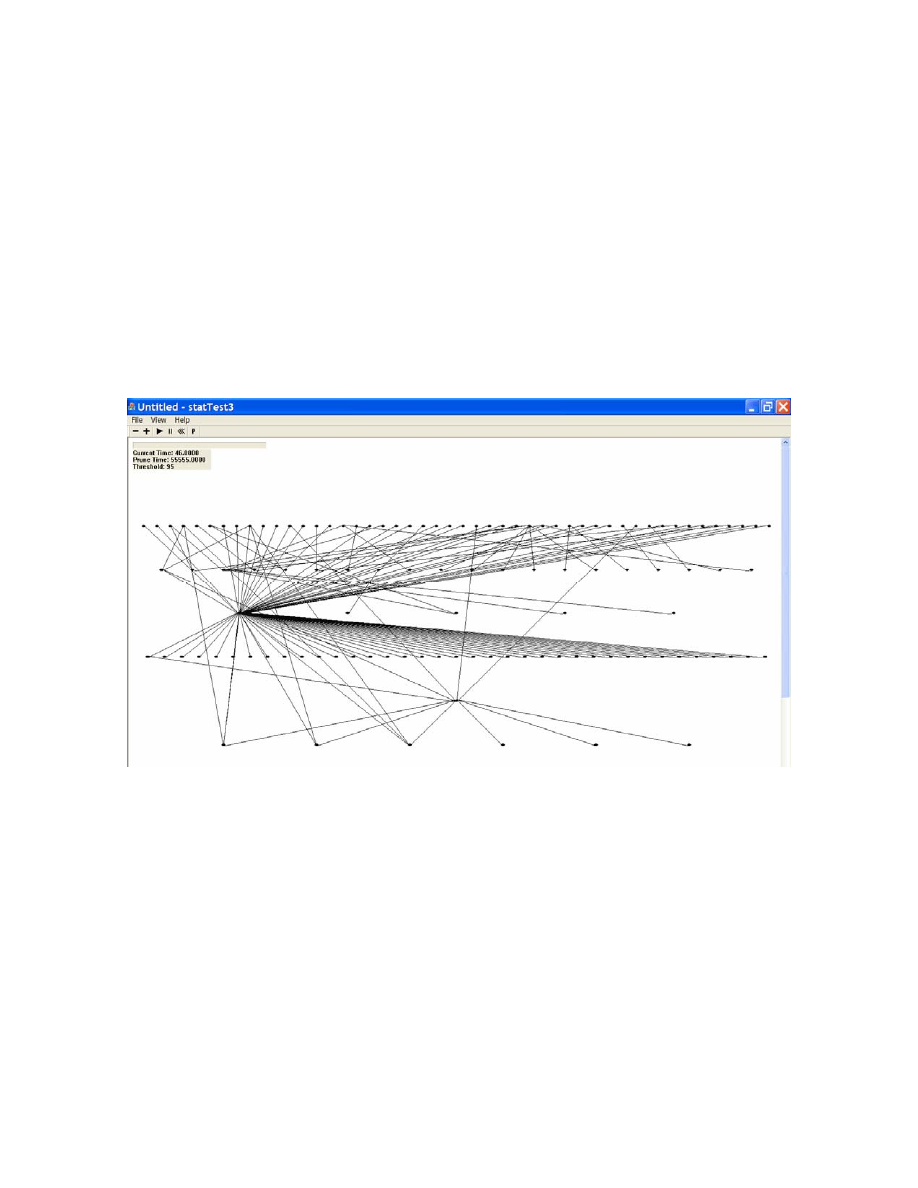
• UDP Traffic
o
In TCP traffic, many network communications were between 2 nodes.
However, in UDP traffic, we saw more interactions among different
nodes. See Fig. 14.
o
This time we processed about 300 packet events, but still it only created
5 generations.
<Fig. 15:
Spread Tree of UDP traffic
>
4.4. Breaking our Detection Mechanism
From the previous section, we saw that typical Internet traffic is not likely to trigger
false detection alarms. However, there are ways to break our detection mechanism:
• Slow down the infection process
48

o
Because nodes are pruned periodically, slowing down the infection
process with respect to the pruning period, the depth of the spread tree
may not grow rapidly.
o
As a counter-measure, the detection mechanism can look for growing
bursts of packets. Since flash worms transmit much higher number of
infection packets from a generation to the next, we could use this
characteristic to detect the spread of flash worms.
o
To address our counter-measure, a flash worm can be implemented to
transmit fixed number of infection packets per prune period. However,
such a flash worm would take significantly long time to spread that other
traditional signature-based detections can be used.
• Use customized source and destination addresses
o
An attacker can transmit customized packets in a way that makes the
flash worm packets be ignored. This attack is possible due to our
restriction that does not allow loops in the tree. For example, before
sending a packet to infect a node from next generation, source and
destination address fields can be switched to create a reverse parent-child
relation in the tree first. When the actual flash worm packet is processed
later, it will attempt to create a loop and will be removed.
o
As a counter-measure, the Internet infrastructure can be reorganized to
prevent or detection such customized packets. For example, the routers
49

can determine if a packet is originated from a network place but is
destined to forward to the same network.
• Fake flash worm traffic
o
An attacker can generate some harmless packets that would simulate the
geometry closely enough to make the detector shut down the network.
However, it would require a high computing power and a fast network
connection to generate the massive amount of flash worm packets in a
short period of time. Furthermore, since the attacker would be
generating customized packets as discussed above, the same counter-
measure is applicable for this attack.
50

5. Conclusion
In this project, we developed a simulator to generate flash worm traffic. We then,
developed an analyzer that can run our proposed geometric-based detection mechanism on
the traffic. We also tested our analyzer on real network traffic. Our results show that the
detection mechanism can be sensitive to the presence of the flash worm traffic while
maintaining insensitivity to other regular Internet traffic. Consequently, we believe that our
detection mechanism can successfully identify the spread of flash worms.
51

6. Future Work
First of all, in order to increase the maximum number of nodes simulated, a
different version of NS simulator can be used. PDNS [20], for example, is a network
simulator that can support parallel and distributed simulation over multiple PCs. The need
to simulate larger network topology may arise when testing our detection mechanism on a
shallow spread tree topology. Our current maximum of 10,000 nodes is not sufficient to
create flash worm traffic with a high infection number. For example, if each host infects 10
other hosts, it takes only 4 generations to infect all 10,000 nodes.
Secondly, more components can be used to identify the unique characteristic of the
flash worm spread tree and, thus, reduce the occurrence of false alarms. In our current
construction of the spread tree, we use depth as the only determining factor to decide
whether a flash worm outbreak has occurred. However, studies can be conducted to find
other factors. For example, there is a pattern that the total number of nodes in a generation
increases from a generation to the next. It follows the form X
G
, where X is the maximum
infection number and G is the generation number. Such a pattern may be used to reduce
false alarms.
As another effort to reduce the false alarms, research can be done on integrating
packet classification technology into our detection mechanism. The ultimate goal is to help
identify the well known application traffic patterns so that the known “safe” network traffic
52

would not be processed into a spread tree. As an example, we suspect that peer-to-peer
query flooding traffic is likely to trigger false alarms because of the many parent-child
relationships amongst a vast number of peers. If the packet classification technology can
identify such peer-to-peer traffic, then the traffic would not be processed by our detection
mechanism, thereby reducing the number of false alarms.
53

Bibliography
[1] S. Antonatos, P. Akritidis, E. P. Markatos, K. G. Anagnostakis, “Defending against
Hitlist Worms using Network Address Space Randomization.”
[2] Yuy Bulygin, “A spread model of flash worms”,
http://isiom.wssrl.org/index.php?option=com_docman&task=doc_download&gid=14
[3] Cheetancheri. "Modelling a Computer Worm Defense System."
http://seclab.cs.ucdavis.edu/papers/Cheetancheri-thesis.ps
[4] Ellis, Aiken, Attwood, Tenaglia. "A Behavioral Approach to Worm Detection."
http://www.wormblog.com/2005/03/a_behavioral_ap.html
[5] Goldi, Hiestand. "Scan Detection Based Identification of Worm-Infected Hosts."
http://www.tik.ee.ethz.ch/~ddosvax/sada/ScanDetection_ma_ws2004_2005.pdf
[6] Moore, Paxson, Savage, Shannon, Staniford, Weaver. “The Spread of the
Sapphire/Slammer Worm.”
http://www.caida.org/publications/papers/2003/sapphire/sapphire.html
[7] S. Staniford, V. Paxson, and N. Weaver, “How to Own the Internet in Your Spare
Time,” in Proceedings of the 11th USENIX Security Symposium (Security’02), San
Francisco, CA, pp. 149-167, Aug. 2002,
http://www.icir.org/vern/papers/cdc-usenix-sec02/
[8] S. Staniford, V. Paxson, and N. Weaver, “Top Speed of Flash Worms,” in Proceedings
of the 2nd ACM Workshop on Rapid Malcode (WORM), 2004,
http://www.caida.org/outreach/papers/2004/topspeedworms/topspeed-worm04.pdf
[9] The Internet Traffic Archive,
54

[10] Vogt. "Simulating and Optimising worm propagation algorithms."
http://web.lemuria.org/security/WormPropagation.pdf
[11] Weaver, Staniford, Paxson. "Very Fast Containment of Scanning Worms."
http://www.icsi.berkeley.edu/~nweaver/containment/containment.pdf
[12] Worm Blog by J. Nazario,
[13] Wu, Vangala, Gao. "An Effective Architecture and Algorithm for Detecting Worms
with Various Scan Techniques."
http://www-unix.ecs.umass.edu/~lgao/ndss04.pdf
[14] Scalable Simulation Framework,
http://www.ssfnet.org/homePage.html
[15] Simnet,
http://www.ece.gatech.edu/research/labs/MANIACS/GTNetS/
[18] The Network Simulator –NS2,
[19] M. Stamp, "Information Security: Principles and Practice", Wiley-Interscience, 2005.
[20] PDNS - Parallel/Distributed NS,
http://www.cc.gatech.edu/computing/compass/pdns/
[21] Y. Li, Anomaly based detection of flash worms, Fall 2005.
[22] T. Nikl, Flash worm simulation and detection, Spring 2005.
55
Wyszukiwarka
Podobne podstrony:
Anomalous Payload based Worm Detection and Signature Generation
Development of a highthroughput yeast based assay for detection of metabolically activated genotoxin
An FPGA Based Network Intrusion Detection Architecture
A Web Based Network Worm Simulator
Genetic algorithm based Internet worm propagation strategy modeling under pressure of countermeasure
Anomalous Payload based Network Intrusion Detection
HoneyStat Local Worm Detection Using Honeypots
Application of Data Mining based Malicious Code Detection Techniques for Detecting new Spyware
SweetBait Zero Hour Worm Detection and Containment Using Honeypots
Design of a System for Real Time Worm Detection
Polymorphic Worm Detection Using Structural Information of Executables
Worm Detection Using Local Networks
Broadband Network Virus Detection System Based on Bypass Monitor
Immunity Based Intrusion Detection System A General Framework
Host Based Detection of Worms through Peer to Peer Cooperation
A Semantics Based Approach to Malware Detection
N gram based Detection of New Malicious Code
więcej podobnych podstron