
Operation of Aircraft
Annex 6
to the Convention on
International Civil Aviation
This edition incorporates all amendments
adopted by the Council prior to
March 200
and supersedes, on 1 November 201 , all previous
editions of Part I of Annex 6.
For information regarding the applicability
of the Standards and Recommended Practices,
Foreword.
see
8
8
8
0
I
International Civil Aviation Organization
International Standards
and Recommended Practices
Seventh Edition
July 2008
Part II
International General
Aviation — Aeroplanes

Published in separate English, Arabic, Chinese, French, Russian and Spanish editions by the International Civil Aviation
Organization. All correspondence, except orders and subscriptions, should be addressed to the Secretary General.
Orders should be sent to one of the following addresses, together with the appropriate remittance in U.S. dollars or in the currency of the country in which
the order is placed. Customers are encouraged to use credit cards (MasterCard, Visa or American Express) to avoid delivery delays. Information on payment
by credit card and by other methods is available in the Ordering Information Section of the Catalogue of ICAO Publications.
International Civil Aviation Organization. Attention: Customer Services Unit, 999 University Street, Montréal, Quebec, Canada H3C 5H7
Telephone: +1 514-954-8022; Facsimile: +1 514-954-6769; Sitatex: YULCAYA; E-mail: sales@icao.int;
World Wide Web: http://www.icao.int
Botswana. Kags and Tsar Investments (PTY) Ltd., Private Bag 254/525, Gaborone
Telephone: +267 390 4384/8; Facsimile: +267 395 0004; E-mail: ops@kagsandtsar.co.bw
Cameroon. KnowHow, 1, Rue de la Chambre de Commerce-Bonanjo, B.P. 4676, Douala / Telephone: +237 343 98 42; Facsimile: +237 343 89 25;
E-mail: knowhow_doc@yahoo.fr
China. Glory Master International Limited, Room 434B, Hongshen Trade Centre, 428 Dong Fang Road, Pudong, Shanghai 200120
Telephone: +86 137 0177 4638; Facsimile: +86 21 5888 1629; E-mail: glorymaster@online.sh.cn
Egypt. ICAO Regional Director, Middle East Office, Egyptian Civil Aviation Complex, Cairo Airport Road, Heliopolis, Cairo 11776
Telephone: +20 2 267 4840; Facsimile: +20 2 267 4843; Sitatex: CAICAYA; E-mail: icaomid@cairo.icao.int
Germany. UNO-Verlag GmbH, August-Bebel-Allee 6, 53175 Bonn / Telephone: +49 0 228-94 90 2-0; Facsimile: +49 0 228-94 90 2-22;
E-mail: info@uno-verlag.de; World Wide Web: http://www.uno-verlag.de
India. Oxford Book and Stationery Co., 57, Medha Apartments, Mayur Vihar, Phase-1, New Delhi – 110 091
Telephone: +91 11 65659897; Facsimile: +91 11 22743532
India. Sterling Book House – SBH, 181, Dr. D. N. Road, Fort, Mumbai 400 001
Telephone: +91 22 2261 2521, 2265 9599; Facsimile: +91 22 2262 3551; E-mail: sbh@vsnl.com
India. The English Book Store, 17-L Connaught Circus, New Delhi 110001
Telephone: +91 11 2341-7936, 2341-7126; Facsimile: +91 11 2341-7731; E-mail: ebs@vsnl.com
Japan. Japan Civil Aviation Promotion Foundation, 15-12, 1-chome, Toranomon, Minato-Ku, Tokyo
Telephone: +81 3 3503-2686; Facsimile: +81 3 3503-2689
Kenya. ICAO Regional Director, Eastern and Southern African Office, United Nations Accommodation, P.O. Box 46294, Nairobi
Telephone: +254 20 7622 395; Facsimile: +254 20 7623 028; Sitatex: NBOCAYA; E-mail: icao@icao.unon.org
Mexico. Director Regional de la OACI, Oficina Norteamérica, Centroamérica y Caribe, Av. Presidente Masaryk No. 29, 3
er
Piso,
Col. Chapultepec Morales, C.P. 11570, México D.F. / Teléfono: +52 55 52 50 32 11; Facsímile: +52 55 52 03 27 57;
Correo-e:
icao_nacc@mexico.icao.int
Nigeria. Landover Company, P.O. Box 3165, Ikeja, Lagos
Telephone: +234 1 4979780; Facsimile: +234 1 4979788; Sitatex: LOSLORK; E-mail: aviation@landovercompany.com
Peru. Director Regional de la OACI, Oficina Sudamérica, Av. Víctor Andrés Belaúnde No. 147, San Isidro, Lima (Centro Empresarial Real, Vía
Principal No. 102, Edificio Real 4, Floor 4)
Teléfono: +51 1 611 8686; Facsímile: +51 1 611 8689; Correo-e: mail@lima.icao.int
Russian Federation. Aviaizdat, 48, Ivan Franko Street, Moscow 121351 / Telephone: +7 095 417-0405; Facsimile: +7 095 417-0254
Senegal. Directeur régional de l’OACI, Bureau Afrique occidentale et centrale, Boîte postale 2356, Dakar
Téléphone: +221 839 9393; Fax: +221 823 6926; Sitatex: DKRCAYA; Courriel: icaodkr@icao.sn
Slovakia. Letové prevádzkové služby Slovenskej Republiky, Štátny podnik, 823 07 Bratislava 21
Telephone: +421 2 4857 1111; Facsimile: +421 2 4857 2105; E-mail: sa.icao@lps.sk
South Africa. Avex Air Training (Pty) Ltd., Private Bag X102, Halfway House, 1685, Johannesburg
Telephone: +27 11 315-0003/4; Facsimile: +27 11 805-3649; E-mail: avex@iafrica.com
Spain. A.E.N.A. — Aeropuertos Españoles y Navegación Aérea, Calle Juan Ignacio Luca de Tena, 14, Planta Tercera, Despacho 3. 11,
28027 Madrid / Teléfono: +34 91 321-3148; Facsímile: +34 91 321-3157; Correo-e: sscc.ventasoaci@aena.es
Switzerland. Adeco-Editions van Diermen, Attn: Mr. Martin Richard Van Diermen, Chemin du Lacuez 41, CH-1807 Blonay
Telephone: +41 021 943 2673; Facsimile: +41 021 943 3605; E-mail: mvandiermen@adeco.org
Thailand. ICAO Regional Director, Asia and Pacific Office, P.O. Box 11, Samyaek Ladprao, Bangkok 10901
Telephone: +66 2 537 8189; Facsimile: +66 2 537 8199; Sitatex: BKKCAYA; E-mail: icao_apac@bangkok.icao.int
United Kingdom. Airplan Flight Equipment Ltd. (AFE), 1a Ringway Trading Estate, Shadowmoss Road, Manchester M22 5LH
Telephone: +44 161 499 0023; Facsimile: +44 161 499 0298; E-mail: enquiries@afeonline.com; World Wide Web: http://www.afeonline.com
3/08
Catalogue of ICAO Publications
Issued annually, the Catalogue lists all publications currently available. Supplements to
the Catalogue announce new publications, amendments, supplements, etc. The
Catalogue is accessible on the ICAO website at www.icao.int.

International Standards
and Recommended Practices
This edition incorporates all amendments
adopted by the Council prior to 8 March 2008
and supersedes, on 18 November 2010, all previous
editions of Part II of Annex 6.
For information regarding the applicability
of the Standards and Recommended Practices,
see Foreword.
Seventh Edition
July 2008
International Civil Aviation Organization
Operation of Aircraft
________________________________
Annex 6
to the Convention on
International Civil Aviation
Part II
International General
Aviation — Aeroplanes

(ii)
AMENDMENTS
Amendments are announced in the supplements to the Catalogue of ICAO
Publications; the Catalogue and its supplements are available on the ICAO website
at www.icao.int. The space below is provided to keep a record of such amendments.
RECORD OF AMENDMENTS AND CORRIGENDA
AMENDMENTS CORRIGENDA
No.
Date
applicable
Date
entered
Entered
by
No.
Date
of issue
Date
entered
Entered
by
1–27
Incorporated in this edition
28 18/11/10
–
ICAO
29 18/11/10
–
ICAO
30 15/12/11
–
ICAO
31 15/11/12
–
ICAO

ANNEX 6 — PART II
(iii)
18/11/10
TABLE OF CONTENTS
Page
Abbreviations and symbols .................................................................................................................................
(vii)
Publications
...................................................................................................................................................
(x)
Foreword ...................................................................................................................................................
(xiii)
SECTION 1. GENERAL
CHAPTER 1.1 Definitions ...............................................................................................................................
1.1-1
CHAPTER 1.2 Applicability ............................................................................................................................
1.2-1
SECTION 2. GENERAL AVIATION OPERATIONS
CHAPTER 2.1 General ....................................................................................................................................
2.1-1
2.1.1 Compliance with laws, regulations and procedures ............................................................................
2.1-1
2.1.2
Dangerous goods ................................................................................................................................
2.1-2
2.1.3
Use
of
psychoactive substances ..........................................................................................................
2.1-2
CHAPTER 2.2 Flight operations .....................................................................................................................
2.2-1
2.2.1
Operating facilities..............................................................................................................................
2.2-1
2.2.2
Operational
management
....................................................................................................................
2.2-1
2.2.3
Flight
preparation ...............................................................................................................................
2.2-2
2.2.4
In-flight
procedures
............................................................................................................................
2.2-5
2.2.5
Duties
of
pilot-in-command
................................................................................................................
2.2-6
2.2.6 Cabin baggage (take-off and landing) .................................................................................................
2.2-7
CHAPTER 2.3 Aeroplane performance operating limitations .....................................................................
2.3-1
2.3.1
General
...............................................................................................................................................
2.3-1
CHAPTER 2.4 Aeroplane instruments, equipment and flight documents ..................................................
2.4-1
2.4.1
General
...............................................................................................................................................
2.4-1
2.4.2
Aeroplanes
on all flights .....................................................................................................................
2.4-1
2.4.3
Aeroplanes
operated as VFR flights ...................................................................................................
2.4-3
2.4.4
Aeroplanes
on
flights over water ........................................................................................................
2.4-3
2.4.5 Aeroplanes on flights over designated land areas ...............................................................................
2.4-4

Annex 6 — Operation of Aircraft
Part II
Page
18/11/10
(iv)
15/11/12
No. 31
2.4.6
Aeroplanes
on
high altitude flights .....................................................................................................
2.4-4
2.4.7 Aeroplanes operated in accordance with the instrument flight rules ..................................................
2.4-5
2.4.8
Aeroplanes
when operated at night .....................................................................................................
2.4-5
2.4.9 Aeroplanes complying with the noise certification Standards in Annex 16, Volume I ......................
2.4-6
2.4.10
Mach
number
indicator
.......................................................................................................................
2.4-6
2.4.11 Aeroplanes required to be equipped with ground proximity warning systems (GPWS) ....................
2.4-6
2.4.12
Emergency
locator transmitter (ELT) .................................................................................................
2.4-7
2.4.13
Aeroplanes
required
to
be equipped with a pressure-altitude reporting transponder .......................... 2.4-8
2.4.14
Microphones
.......................................................................................................................................
2.4-8
2.4.15 Aeroplanes equipped with head-up displays (HUD) and/or enhanced vision systems (EVS) ............
2.4-8
2.4.16
Flight recorders ...................................................................................................................................
2.4-8
CHAPTER 2.5 Aeroplane communication and navigation equipment ........................................................
2.5-1
2.5.1
Communication
equipment
.................................................................................................................
2.5-1
2.5.2
Navigation
equipment
.........................................................................................................................
2.5-1
CHAPTER 2.6 Aeroplane maintenance ..........................................................................................................
2.6-1
2.6.1
Owner’s
maintenance responsibilities ................................................................................................
2.6-1
2.6.2
Maintenance
records
...........................................................................................................................
2.6-1
2.6.3
Modifications and repairs ...................................................................................................................
2.6-2
2.6.4
Maintenance release ............................................................................................................................
2.6-2
CHAPTER 2.7 Aeroplane flight crew .............................................................................................................
2.7-1
2.7.1
Composition
of
the flight crew ...........................................................................................................
2.7-1
2.7.2
Qualifications ......................................................................................................................................
2.7-1
CHAPTER 2.8 Manuals, logs and records .....................................................................................................
2.8-1
2.8.1
Flight
manual
......................................................................................................................................
2.8-1
2.8.2
Journey log book ................................................................................................................................
2.8-1
2.8.3 Records of emergency and survival equipment carried .....................................................................
2.8-1
CHAPTER 2.9 Security ....................................................................................................................................
2.9-1
2.9.1 Security of aircraft ..............................................................................................................................
2.9-1
2.9.2
Reporting
acts
of
unlawful interference ..............................................................................................
2.9-1
APPENDIX 2.1 Lights to be displayed by aeroplanes ...................................................................................
APP 2.1-1
1.
Terminology
............................................................................................................................................
APP 2.1-1
2. Navigation lights to be displayed in the air .............................................................................................
APP 2.1-1
3. Lights to be displayed on the water .........................................................................................................
APP 2.1-2
APPENDIX 2.2 Altimetry system performance requirements for operations in RVSM airspace ............
APP 2.2-1
APPENDIX 2.3 Flight Recorders ....................................................................................................................
APP 2.3-1
1.
General
requirements
...............................................................................................................................
APP 2.3-1

Table of Contents
Annex 6 — Operation of Aircraft
Page
(v)
18/11/10
15/11/12
No. 31
2. Flight data recorder (FDR) ......................................................................................................................
APP 2.3-2
3. Cockpit voice recorder (CVR) and cockpit audio recording system (CARS) .........................................
APP 2.3-5
4. Airborne image recorder (AIR) ...............................................................................................................
APP 2.3-6
5. Data link recorder (DLR) ........................................................................................................................
APP 2.3-6
6.
Aircraft
data
recording systems (ADRS) .................................................................................................
APP 2.3-7
7. Inspections of flight recorder systems .....................................................................................................
APP 2.3-7
ATTACHMENT 2.A Carriage and use of oxygen .........................................................................................
ATT 2.A-1
1.
Oxygen supply .........................................................................................................................................
ATT 2.A-1
2.
Use
of
oxygen
..........................................................................................................................................
ATT 2.A-1
SECTION 3. LARGE AND TURBOJET AEROPLANES
CHAPTER 3.1 Applicability ............................................................................................................................
3.1-1
CHAPTER 3.2 Corporate aviation operations ...............................................................................................
3.2-1
CHAPTER 3.3 General ....................................................................................................................................
3.3-1
3.3.1 Compliance with laws, regulations and procedures ...........................................................................
3.3-1
3.3.2
Safety
management system .................................................................................................................
3.3-1
CHAPTER 3.4 Flight operations .....................................................................................................................
3.4-1
3.4.1
Operating facilities..............................................................................................................................
3.4-1
3.4.2
Operational
management
....................................................................................................................
3.4-1
3.4.3
Flight
preparation ...............................................................................................................................
3.4-3
3.4.4
In-flight
procedures
............................................................................................................................
3.4-4
3.4.5
Duties
of
pilot-in-command
................................................................................................................
3.4-5
3.4.6 Cabin baggage (take-off and landing) .................................................................................................
3.4-5
CHAPTER 3.5 Aeroplane performance operating limitations .....................................................................
3.5-1
3.5.1
General
...............................................................................................................................................
3.5-1
3.5.2 Applicable to aeroplanes certificated in accordance with Parts IIIA and IIIB of Annex 8 ................. 3.5-1
CHAPTER 3.6 Aeroplane instruments, equipment and flight documents ..................................................
3.6-1
3.6.1
General
...............................................................................................................................................
3.6-1
3.6.2
Aeroplanes
on all flights .....................................................................................................................
3.6-1
3.6.3
Flight recorders ...................................................................................................................................
3.6-2
3.6.4
Aeroplanes
in icing conditions ...........................................................................................................
3.6-3
3.6.5 Aeroplanes operated in accordance with the instrument flight rules ..................................................
3.6-4
3.6.6 Pressurized aeroplanes when carrying passengers — weather-detecting equipment ..........................
3.6-4
3.6.7 Aeroplanes operated above 15 000 m (49 000 ft) — radiation indicator ............................................
3.6-4
3.6.8 Aeroplanes required to be equipped with ground proximity warning systems (GPWS) ....................
3.6-4
3.6.9 Aeroplanes carrying passengers — cabin crew seats ..........................................................................
3.6-5
3.6.10
Aeroplanes
required to be equipped with an airborne collision avoidance system (ACAS) ..............
3.6-5

Annex 6 — Operation of Aircraft
Part II
Page
18/11/10
(vi)
15/11/12
No. 31
3.6.11
Aeroplanes
required
to
be equipped with a pressure-altitude reporting transponder .......................... 3.6-5
3.6.12
Microphones
.......................................................................................................................................
3.6-6
CHAPTER 3.7 Aeroplane communication and navigation equipment ........................................................
3.7-1
3.7.1
Communication
equipment
.................................................................................................................
3.7-1
3.7.2
Installation ..........................................................................................................................................
3.7-1
3.7.3
Electronic
navigation data management .............................................................................................
3.7-1
CHAPTER 3.8 Aeroplane maintenance ..........................................................................................................
3.8-1
3.8.1
Operator’s
maintenance responsibilities .............................................................................................
3.8-1
3.8.2
Operator’s
maintenance control manual .............................................................................................
3.8-1
3.8.3
Maintenance
programme
....................................................................................................................
3.8-1
3.8.4
Continuing
airworthiness information ................................................................................................
3.8-1
3.8.5
Maintenance release ............................................................................................................................
3.8-1
CHAPTER 3.9 Aeroplane flight crew .............................................................................................................
3.9-1
3.9.1
Composition
of
the flight crew ...........................................................................................................
3.9-1
3.9.2 Flight crew member emergency duties ...............................................................................................
3.9-1
3.9.3 Flight crew member training programmes ..........................................................................................
3.9-1
3.9.4
Qualifications ......................................................................................................................................
3.9-1
CHAPTER 3.10 Flight operations officer/flight dispatcher ..........................................................................
3.10-1
CHAPTER 3.11 Manuals, logs and records ...................................................................................................
3.11-1
3.11.1
Operator’s
maintenance control manual .............................................................................................
3.11-1
3.11.2
Maintenance
programme
....................................................................................................................
3.11-1
3.11.3
Flight
recorder records ........................................................................................................................
3.11-2
CHAPTER 3.12 Cabin crew ............................................................................................................................
3.12-1
3.12.1
Assignment
of emergency duties ........................................................................................................
3.12-1
3.12.2 Cabin crew at emergency evacuation stations ....................................................................................
3.12-1
3.12.3
Protection
of
cabin crew during flight ................................................................................................
3.12-1
3.12.4
Training ..............................................................................................................................................
3.12-1
CHAPTER 3.13 Security ..................................................................................................................................
3.13-1
3.13.1
Security programme ............................................................................................................................
3.13-1
ATTACHMENT 3.A Company operations manual ......................................................................................
ATT 3.A-1
ATTACHMENT 3.B Minimum equipment list (MEL) .................................................................................
ATT 3.B-1
_____________________

Abbreviations and symbols
Annex 6 — Operation of Aircraft
(vii)
ABBREVIATIONS AND SYMBOLS
(used in this Annex)
Abbreviations
AC
Alternating
current
ACAS
Airborne collision avoidance system
ADREP
Accident/incident
reporting
ADRS
Aircraft data recording system
ADS
Automatic dependent surveillance
AFCS
Automatic flight control system
AGA
Aerodromes, air routes and ground aids
AIG
Accident investigation and prevention
AIR
Airborne image recorder
AIRS
Airborne image recording system
AOC
Aeronautical operational control
APU
Auxiliary
power
unit
ASE
Altimetry system error
ASIA/PAC
Asia/Pacific
ATC
Air traffic control
ATM
Air traffic management
ATS
Air
traffic
services
CARS
Cockpit
audio recording system
CAT I
Category I
CAT II
Category II
CAT III
Category III
CAT IIIA
Category IIIA
CAT IIIB
Category IIIB
CAT IIIC
Category IIIC
CFIT
Controlled flight into terrain
cm
Centimetre
CVR
Cockpit
voice
recorder
DA
Decision
altitude
DA/H
Decision
altitude/height
DC
Device
control
D-FIS
Data link-flight information services
DH
Decision
height
DLR
Data link recorder
DLRS
Data link recording system
DME
Distance measuring equipment
DSTRK
Desired
track
ECAM
Electronic
centralized aircraft monitor
EFIS
Electronic flight instrument system
EGT
Exhaust
gas
temperature
EICAS
Engine indication and crew alerting system
ELT
Emergency locator transmitter
ELT(AD)
Automatic deployable ELT
ELT(AF)
Automatic fixed ELT
18/11/10
No. 29
15/11/12
No. 31

Annex 6 — Operation of Aircraft
Part II
18/11/10
(viii)
ELT(AP)
Automatic portable ELT
ELT(S)
Survival
ELT
EPR
Engine
pressure
ratio
EUROCAE
European Organization for Civil Aviation Equipment
EVS
Enhanced
vision
system
FDAU
Flight data acquisition unit
FDR
Flight
data
recorder
FL
Flight
level
FM
Frequency
modulation
ft
Foot
g
Normal
acceleration
GCAS
Ground collision avoidance system
GNSS
Global navigation satellite system
GPWS
Ground proximity warning system
hPa
Hectopascal
HUD
Head-up
display
IAOPA
International Council of Aircraft Owner and Pilot Associations
IBAC
International Business Aviation Council
IFR
Instrument flight rules
ILS
Instrument landing system
IMC
Instrument meteorological conditions
INS
Inertial
navigation
systems
kg
Kilogram
km
Kilometre
km/h
Kilometres per hour
kt
Knot
m
Metre
MDA
Minimum descent altitude
MDA/H
Minimum descent altitude/height
MDH
Minimum descent height
MEL
Minimum equipment list
MHz
Megahertz
MLS
Microwave landing system
MMEL
Master minimum equipment list
MNPS
Minimum navigation performance specifications
MOPS
Minimum operational performance specification
NAV
Navigation
NM
Nautical
mile
N
1
Low pressure compressor speed (two-stage compressor); fan speed (three-stage compressor)
N
2
High pressure compressor speed (two-stage compressor); intermediate pressure compressor (three-
stage compressor)
N
3
High pressure compressor speed (three-stage compressor)
OCA
Obstacle clearance altitude
OCA/H
Obstacle clearance altitude/height
OCH
Obstacle
clearance
height
PBN
Performance-based
navigation
15/11/12
No. 31

Abbreviations and symbols
Annex 6 — Operation of Aircraft
(ix)
RNAV
Area
navigation
RNP
Required navigation performance
RNPSOR
Required navigation performance and special operational requirements
RVR
Runway
visual
range
RVSM
Reduced vertical separation minima
SI
International System of Units
SICASP
Secondary Surveillance Radar Improvements and Collision Avoidance Systems Panel
SOP
Standard operating procedure
TAWS
Terrain awareness system
TCAS
Traffic alert and collision avoidance system
TLA
Thrust lever angle
TLS
Target level of safety
TVE
Total vertical error
UTC
Coordinated
universal
time
V
D
Design diving speed
VFR
Visual flight rules
VMC
Visual meteorological conditions
VOR
VHF omnidirectional radio range
VSM
Vertical separation minima
V
S0
Stalling speed or the minimum steady flight speed in the landing configuration
WXR
Weather
radar
Symbols
°C Degrees
Celsius
%
Per
cent
15/11/12
No. 31

Annex 6 — Operation of Aircraft
Part II
18/11/10
(x)
PUBLICATIONS
(referred to in this Annex)
Convention on International Civil Aviation (Doc 7300)
European Organization for Civil Aviation Equipment (EUROCAE) Documents ED55 and ED56A
International Regulations for Preventing Collisions at Sea
Policy and Guidance Material on the Economic Regulation of International Air Transport (Doc 9587)
Protocol Relating to an Amendment to the Convention on International Civil Aviation (Article 83 bis) (Doc 9318)
Annexes to the Convention on International Civil Aviation
Annex 1 — Personnel Licensing
Annex 2 — Rules of the Air
Annex 3 — Meteorological Service for International Air Navigation
Annex 5 — Units of Measurement to be Used in Air and Ground Operations
Annex
6
— Operation of Aircraft
Part I — International Commercial Air Transport — Aeroplanes
Part
III
—
International Operations — Helicopters
Annex 8 — Airworthiness of Aircraft
Annex 10 — Aeronautical Telecommunications
Volume
III
(Part
I
—
Digital Data Communication Systems, Part II — Voice Communication Systems)
Volume IV (Surveillance and Collision Avoidance Systems)
Annex 11 — Air Traffic Services
Annex 12 — Search and Rescue
Annex 13 — Aircraft Accident and Incident Investigation
Annex 14 — Aerodromes
Volume I — Aerodrome Design and Operations
Annex 15 — Aeronautical Information Services
Annex 16 — Environmental Protection
Volume I — Aircraft Noise
Annex 18 — The Safe Transport of Dangerous Goods by Air

Publications
Annex 6 — Operation of Aircraft
(xi)
18/11/10
Procedures for Air Navigation Services
ATM — Air Traffic Management (Doc 4444)
OPS — Aircraft Operations (Doc 8168)
Volume I — Flight Procedures
Volume
II
—
Construction of Visual and Instrument Flight Procedures
Regional Supplementary Procedures (Doc 7030)
Manuals
Airport Services Manual (Doc 9137)
Part 1 — Rescue and Fire Fighting
Part 8 — Airport Operational Services
Airworthiness
Manual
(Doc 9760)
Human Factors Training Manual (Doc 9683)
Manual of Aircraft Ground De-icing/Anti-icing Operations (Doc 9640)
Manual of Civil Aviation Medicine (Doc 8984)
Manual on Implementation of a 300 m (1 000 ft) Vertical Separation Minimum Between FL 290 and FL 410 Inclusive
(Doc 9574)
Manual on Required Communications Performance (RCP) (Doc 9869)
Performance-based Navigation Manual (Doc 9613)
Safety Management Manual (Doc 9859)
_____________________


ANNEX 6 — PART II
(xiii)
18/11/10
ANNEX 6 — PART II
INTERNATIONAL GENERAL AVIATION — AEROPLANES
FOREWORD
Historical background
Standards and Recommended Practices for the Operation of Aircraft — International General Aviation were first adopted by
the Council on 2 December 1968 pursuant to the provisions of Article 37 of the Convention on International Civil Aviation
(Chicago, 1944) and designated as Annex 6, Part II, to the Convention. They became effective on 2 April 1969 and
applicable on 18 September 1969.
Annex 6, Part II, was developed in the following manner: the Fifteenth Session of the Assembly, Montreal, June–July 1965,
adopted Resolution A15-15: “Consideration of the needs of international general aviation in relation to the scope of ICAO
technical activities”. Subsequently, the Fourth Air Navigation Conference (Montreal, November–December 1965)
recommended a series of factors which it considered should be taken into account in extending the scope of Annex 6 to meet the
needs of general aviation in accordance with the directives of Assembly Resolution A15-15.
The Fourth Air Navigation Conference recommended that the International Standards and Recommended Practices to be
developed for International General Aviation Operations exclude, for the present, aerial work operations. It was however
clearly the view of the conference that the Annex should be framed in such a manner as to facilitate its extension to cover
aerial work operations at a later date, should such extension prove desirable.
Based on the above considerations, draft International Standards and Recommended Practices for the Operation of
International General Aviation Aircraft were developed by the Air Navigation Commission and, after amendment following
the usual consultation with the Member States of the Organization, were adopted by the Council so as to become, together
with the Foreword approved by the Council, the text of this Annex. In developing this material in 1965
the Air Navigation
Commission was guided by the following philosophies:
Presentation and conformity with Annex 6, Part I. The Annex should be, as nearly as practicable, equivalent in scope and
conform as closely as possible to Annex 6 (now Annex 6, Part I).
Applicability. Although the definition of general aviation originally used in this Annex encompassed aerial work
operations, these were specifically excluded from the provisions of this Annex by Chapter 1.2 — Applicability.
Level of safety. The Annex should ensure an acceptable level of safety to passengers and
third parties (third parties
meaning persons on the ground and persons in the air in other aircraft). Also, as some international general aviation
operations (typically under 5 700 kg) would be performed by crews less experienced and less skilled, with less reliable
equipment, to less rigorous standards and with greater freedom of action than in commercial air transport operations, it was
therefore, accepted that the passenger in international general aviation aircraft would not necessarily enjoy the same level of
safety as the fare-paying passenger in commercial air transport. However, it was recognized that in ensuring an acceptable
degree of safety for third parties, an acceptable level of safety for flight crews and passengers would be achieved.
Freedom of action. The maximum freedom of action consistent with maintaining an acceptable level of safety should be
granted to international general aviation.

Annex 6 — Operation of Aircraft
Part II
18/11/10
(xiv)
Responsibility. The responsibility that devolves upon the operator in Annex 6, Part I, should, in Part II of the Annex, fall
upon the owner and pilot-in-command. Precedent for this course of action exists in Annex 2.
Consequent to the adoption of Annex 6, Part III, International Operations — Helicopters, an amendment to the title was
introduced to indicate that Annex 6, Part II was applicable only to aeroplanes.
In 1986 the Air Navigation Commission commenced a review of Annex 6, Part II, and concluded that the definition of
general aviation should be revised to exclude aerial work thus recognizing that aerial work was a distinct aspect of civil
aviation and recognizing the exclusion of aerial work from the applicability of Annex 6, Part II. As with the Fourth Air
Navigation Conference in 1965, the Air Navigation Commission was not aware of any degree of international aerial work
operations which would necessitate the development of International Standards and Recommended Practices. The revised
definitions for general aviation and aerial work and the revised applicability chapter were submitted to States in the usual
manner and approved by the Council in March 1990.
In 2005 and 2006, the Air Navigation Commission completed a thorough review of Annex 6, Part II, with the intent of
modernizing the provisions to reflect the significant changes in general aviation since the Annex was initially developed. The
Commission considered new general aviation dynamics reflected by the increasing use of large, technically advanced turbine-
engined aeroplanes in international general aviation operations. The Commission endorsed the philosophy established during
initial development of the Annex that the owner and pilot-in-command must assume responsibility for the safety of
operations in non-commercial operations where travel is not open to the general public. In such operations the Standards and
Recommended Practices need not be as prescriptive as those in Annex 6, Part I, due to the inherent self-responsibility of the
owner and pilot-in-command. The State does not have an equivalent “duty of care” to protect the occupants as it does for
fare-paying customers in commercial operations. The Commission endorsed the level-of-safety philosophy that the Standards
and Recommended Practices of Annex 6, Part II, must protect the interests of third parties. It was therefore agreed that the
basic provisions of Annex 6, Part II, should remain applicable to all general aviation operations, but updated to reflect current
technologies and operational procedures and the use of safety management systems where appropriate.
The Commission also considered that additional provisions should be added for the larger, more complex operations, and
all general aviation operations using turbojet aeroplanes. In this regard the Commission decided to add an additional section
applicable to this sector of general aviation.
In large and turbojet operations, it was concluded that their complexity warrants provisions governing an operator,
whereas in the initial development of Annex 6, Part II, the provisions applied to the owner and pilot-in-command. A review
of the safety record of this general aviation sector showed that the principles of individual operator responsibility and
industry codes of practice have been effective given that the safety record is excellent and essentially equivalent to large,
scheduled air transport governed by Annex 6, Part I.
The Commission also expressed the need for a more modern approach to rulemaking through application of
“performance-based” Standards. Such an approach was being considered for other Annexes, including Annex 6, Part III.
Performance-based Standards are facilitated through use of industry “codes of practice”, and the Commission endorsed
reference to acceptable codes in the development of an updated Annex 6, Part II.
Table A shows the origin of amendments together with a list of the principal subjects involved and the dates on which
the Annex and the amendments were adopted by the Council, when they became effective and when they became applicable.
Applicability
The Standards and Recommended Practices of Annex 6, Part II, are applicable to international general aviation operations
with aeroplanes.
The Standards and Recommended Practices represent minimum provisions and, together with those of Annex 6 —
Operation of Aircraft, Part I — International Commercial Air Transport — Aeroplanes, now cover the operation of all
aeroplanes in international civil aviation, except in aerial work operations.

Foreword
Annex 6 — Operation of Aircraft
(xv)
18/11/10
It will be noted that the Standards and Recommended Practices contained in Annex 6, Part II, when applied to the
operation of large aeroplanes, are less stringent than those in Annex 6, Part I, applicable to the same or similar aeroplanes
when used in commercial air transport operations. Nevertheless, it is considered that, in conjunction with existing provisions
in Annexes 1 and 8, Annex 6, Part II, ensures an adequate level of safety for the operations envisaged for the large aeroplanes
in question. In this connection attention is drawn to the point that the entire performance Standards of Annex 8 are applicable
to all aeroplanes of over 5 700 kg mass intended for the carriage of passengers or cargo or mail for international air
navigation, of which the prototype was submitted for certification on or after 13 December 1964. Moreover, by virtue of
Annex 1 the pilot of an aircraft certificated for operation with a minimum crew of at least two pilots must hold a type rating
for that aircraft type.
Action by Contracting States
Notification of differences. The attention of Contracting States is drawn to the obligation imposed by Article 38 of the
Convention by which Contracting States are required to notify the Organization of any differences between their national
regulations and practices and the International Standards contained in this Annex and any amendments thereto. Contracting
States are invited to extend such notification to any differences from the Recommended Practices contained in this Annex,
and any amendments thereto, when the notification of such differences is important for the safety of air navigation. Further,
Contracting States are invited to keep the Organization currently informed of any differences which may subsequently occur,
or of the withdrawal of any differences previously notified. A specific request for notification of differences will be sent to
Contracting States immediately after the adoption of each amendment to this Annex.
The attention of States is also drawn to the provision of Annex 15 related to the publication of differences between their
national regulations and practices and the related ICAO Standards and Recommended Practices through the Aeronautical
Information Service, in addition to the obligation of States under Article 38 of the Convention.
Promulgation of information. The establishment and withdrawal of and changes to facilities, services and procedures
affecting aircraft operations provided in accordance with the Standards and Recommended Practices specified in this Annex
should be notified and take effect in accordance with the provisions of Annex 15.
Status of Annex components
An Annex is made up of the following component parts, not all of which, however, are necessarily found in every Annex;
they have the status indicated:
1.—
Material comprising the Annex proper:
a) Standards and Recommended Practices adopted by the Council under the provisions of the Convention. They
are defined as follows:
Standard: Any specification for physical characteristics, configuration, matériel, performance, personnel or
procedure, the uniform application of which is recognized as necessary for the safety or regularity of
international air navigation and to which Contracting States will conform in accordance with the Convention; in
the event of impossibility of compliance, notification to the Council is compulsory under Article 38.
Recommended Practice: Any specification for physical characteristics, configuration, matériel, performance,
personnel or procedure, the uniform application of which is recognized as desirable in the interest of safety,
regularity or efficiency of international air navigation, and to which Contracting States will endeavour to
conform in accordance with the Convention.
b) Appendices comprising material grouped separately for convenience but forming part of the Standards and
Recommended Practices adopted by the Council.

Annex 6 — Operation of Aircraft
Part II
18/11/10
(xvi)
c) Definitions of terms used in the Standards and Recommended Practices which are not self-explanatory in that
they do not have accepted dictionary meanings. A definition does not have independent status but is an essential
part of each Standard and Recommended Practice in which the term is used, since a change in the meaning of
the term would affect the specification.
d) Tables and Figures which add to or illustrate a Standard or Recommended Practice and which are referred to
therein, form part of the associated Standard or Recommended Practice and have the same status.
It is to be noted that some Standards in this Annex incorporate, by reference, other specifications having the status of
Recommended Practices. In such cases, the text of the Recommended Practice becomes part of the Standard.
2.—
Material approved by the Council for publication in association with the Standards and Recommended Practices:
a) Forewords comprising historical and explanatory material based on the action of the Council and including an
explanation of the obligations of States with regard to the application of the Standards and Recommended
Practices ensuing from the Convention and the Resolution of Adoption;
b) Introductions comprising explanatory material introduced at the beginning of parts, chapters or sections of the
Annex to assist in the understanding of the application of the text;
c) Notes included in the text, where appropriate, to give factual information or references bearing on the Standards
or Recommended Practices in question, but not constituting part of the Standards or Recommended Practices;
d) Attachments comprising material supplementary to the Standards and Recommended Practices, or included as a
guide to their application.
Selection of language
This Annex has been adopted in six languages — English, Arabic, Chinese, French, Russian and Spanish. Each Contracting
State is requested to select one of those texts for the purpose of national implementation and for other effects provided for in
the Convention, either through direct use or through translation into its own national language, and to notify the Organization
accordingly.
Editorial practices
The following practice has been adhered to in order to indicate at a glance the status of each statement: Standards have been
printed in light face roman; Recommended Practices have been printed in light face italics, the status being indicated by the
prefix Recommendation; Notes have been printed in light face italics, the status being indicated by the prefix Note.
The following editorial practice has been followed in the writing of specifications: for Standards the operative verb
“shall” is used, and for Recommended Practices the operative verb “should” is used.
The units of measurement used in this document are in accordance with the International System of Units (SI) as
specified in Annex 5 to the Convention on International Civil Aviation. Where Annex 5 permits the use of non-SI alternative
units these are shown in parentheses following the basic units. Where two sets of units are quoted it must not be assumed that
the pairs of values are equal and interchangeable. It may, however, be inferred that an equivalent level of safety is achieved
when either set of units is used exclusively.
Any reference to a portion of this document, which is identified by a number and/or title, includes all subdivisions of that
portion.

Foreword
Annex 6 — Operation of Aircraft
(xvii)
18/11/10
Table A. Amendments to Annex 6, Part II
Amendment
Source(s)
Subject(s)
Adopted
Effective
Applicable
1st Edition
Fifteenth Session
of the Assembly
(Resolution A15-15) and
Fourth Air Navigation
Conference
1
2 December 1968
1
2 April 1969
18 September 1969
1
Sixth
Air
Navigation
Conference
a) The requirement for additional instruments in aeroplanes operated as
controlled VFR flights in the en-route phase; and
b) the permitting of aeroplanes, when unable to navigate by visual references
to landmarks, to be navigated by equipment other than radio navigation
equipment, e.g. solely by self-contained navigation means, provided that
certain equipment capabilities are met, thus eliminating any requirement
for the carriage of radio navigation equipment.
1
1 June 1970
1
1 October 1970
1
4 February 1971
2
(2nd Edition)
Special Meeting on
Aircraft Noise in
the Vicinity of
Aerodromes
The inclusion of a specification for aeroplanes to be operated within the weight
limitations imposed by the applicable noise certification Standards, except in
prescribed circumstances, and to carry a document attesting noise certification.
1
2 April 1971
1
2 August 1971
1
6 January 1972
3
Seventh
Air
Navigation
Conference
The inclusion of a Recommended Practice covering the design, carriage and
installation of emergency location beacons — aircraft, in such aeroplanes and
on such flights as may be determined by the appropriate authority.
29 May 1973
1
1 October 1973
23 May 1974
4
Revision
of
Annex 12, the Air
Navigation
Commission’s study
concerning
interception of civil
aircraft and the
Council action in
pursuance of
Assembly Resolution
A18-16
a) Provisions for the marking of break-in points on aircraft;
b) provisions for reducing the risk for intercepted aircraft;
c) the revision of the Introductory Note to Chapter 3 of the Annex. The
revision points to a practical method for States to discharge their functions
in the cases of lease, charter and interchange of aircraft in international
operations.
1
4 February 1975
1
4 June 1975
1
9 October 1975
5
Studies by the
Air Navigation
Commission,
Amendment 60 to
Annex 3 and
Amendment 30 to
Annex 14
Requirements for the provision and use of flight crew safety harnesses;
amplification of specifications for the type of timepiece required for operations
in accordance with the instrument flight rules and controlled VFR flights; and
revision of the definitions of Aerodrome and Meteorological information.
1
7 April 1976
1
7 August 1976
30 December 1976
6
ASIA/PAC
Regional Air Navigation
Meeting
The requirement for the carriage of survival radio equipment over those areas
in which search and rescue would be especially difficult to be determined by
States rather than regional air navigation agreement.
16 June 1976
16 October 1976
1
6 October 1977
7
Air
Navigation
Commission study
Recommendation for the fitting of ground proximity warning systems to
certain aeroplanes.
15 December 1977
15 April 1978
10 August 1978
8
Air
Navigation
Commission study
Introduction of requirements for navigation equipment to meet minimum
navigation performance specifications (MNPS).
1
2 April 1980
1
2 August 1980
27 November 1980

Annex 6 — Operation of Aircraft
Part II
18/11/10
(xviii)
Amendment
Source(s)
Subject(s)
Adopted
Effective
Applicable
9
Air
Navigation
Commission study
Revision of the provisions relating to exterior lights to align with new
provisions in Annexes 2 and 8.
22 March 1982
22 July 1982
25 November 1982
10
(3rd Edition)
Seventh
meeting
of
the Obstacle
Clearance Panel,
AGA Divisional
Meeting (1981),
amendments
consequential to
adoption of
Annexes 5 and 18
Introduced provisions related to development and use of instrument approach
procedures, authority and competence to taxi aeroplanes. Changes to the
requirements for the carriage of dangerous goods as a result of adoption by the
Council of Annex 18. Units of measurement were brought in line with the
provisions of Annex 5 and the Note in Chapter 3 concerning lease, charter and
interchange was updated. The term “aerodrome operating minima” was
introduced in lieu of “aerodrome meteorological minima”, and definitions of
“decision altitude/height” and “minimum descent altitude/height” were entered
in Chapter 1.
20 May 1983
20 September 1983
24 November 1983
11
Accident Prevention and
Investigation Divisional
Meeting, AIG (1979)
Introduction of provisions relating to flight recorders. Introduction of related
guidance material in an attachment.
1
8 March 1985
29 July 1985
21 November 1985
12
Air
Navigation
Commission
Carriage of information on board aircraft; communication equipment on
121.5 MHz.
14 March 1986
27 July 1986
20 November 1986
13
Seventh
meeting
of
the Obstacle
Clearance Panel,
Air Navigation
Commission studies
Supply and use of oxygen and pressurization failure warning; refuelling with
passengers on board; provision of climb performance data with all engines
operating.
14 March 1986
27 July 1986
20 November 1986
14
(4th Edition)
Air
Navigation
Commission review
of the Annex,
Stage I,
Third meeting of
the Visual Flight
Rules Operations
Panel,
Air Navigation
Commission study
a) Revision of the definitions of aerial work and general aviation. Revision of
the definition of alternate aerodrome to introduce take-off, en-route and
destination alternate aerodromes. Introduction of a new definition for a
commercial air transport operation and the definitions for flight plan and
flight recorder;
b) deletion of the reference to aerial work from the applicability;
c) alignment with Annex 6, Part I, particularly with respect to flight recorder
records subsequent to accidents or incidents and the requirement for a
Mach number indicator;
d) elimination of the term “controlled VFR flight”;
e) introduction of guidance material concerning flight data recording of
important operational information in aeroplanes with electronic displays.
19 March 1990
30 July 1990
15 November 1990
15
Fifth meeting of the
Operations Panel,
Seventh and Eighth
meetings of the
Review of the
General Concept of
Separation Panel,
Accident Investigation
Divisional Meeting
(AIG/1992),
Air Navigation
Commission studies
)
Revision of definitions of aerodrome operating minima, decision
altitude/height, minimum descent altitude/height and introduction of
definition of obstacle clearance altitude/height;
b) introduction of new definitions for emergency locator transmitters (ELTs),
required navigation performance (RNP) and RNP type;
c) introduction of the definition for the classification of instrument approach
and landing operations;
d) revision of the requirements concerning the use of engraving metal foil
flight data recorders;
21 March 1994
25 July 1994
10 November 1994

Foreword
Annex 6 — Operation of Aircraft
(xix)
18/11/10
Amendment
Source(s)
Subject(s)
Adopted
Effective
Applicable
e) introduction of carriage requirements for emergency locator transmitters
(ELTs) to replace provisions regarding survival radio equipment and
emergency location beacon;
f) introduction of a requirement that the navigation equipment carried shall
enable the aircraft to proceed in accordance with RNP types prescribed for
the intended route(s) or area(s) and provisions to permit the uniform
implementation of 300 m (1 000 ft) VSM above FL 290.
16
(5th Edition)
Air
Navigation
Commission studies,
Fourteenth meeting of
the Dangerous Goods
Panel, editorial
amendment, text
alignment with
Annex 6, Part I and/or
Part III, consequential
amendment
a) Introduction of revised definitions;
b) inclusion of references to Article 35 of the Convention;
c) revision of the provisions concerning operating facilities, briefing,
aeroplane airworthiness and safety precautions, destination alternate
aerodromes, limitations imposed by weather conditions, use of oxygen and
safety harness;
d) new provisions concerning all aeroplanes on all flights, all aeroplanes
operated as VFR flights and ground proximity warning systems (GPWS);
e) revision of the provisions concerning aeroplanes operated in accordance
with the instrument flight rules (IFR);
f) revision of the provisions concerning the composition of the flight crew;
and
g) revision of the provisions concerning the carriage and use of oxygen.
10 March 1995
24 July 1995
1
9 November 1995
17
Fourth meeting
of the Secondary
Surveillance Radar
Improvements and
Collision Avoidance
Systems Panel
(SICASP/4)
Requirement for aeroplanes to be equipped with pressure-altitude reporting
transponders.
19 February 1996
15 July 1996
1
7 November 1996
18
(6th Edition)
First meeting of the
Flight Recorder Panel,
ICAO and Industry
CFIT Task Force, Air
Navigation Commission
studies, Amendment 162
to Annex 1,
Amendment 38 to
Annex 11, editorial
amendment
a) Introduction of new and revised definitions for psychoactive substances
and required navigation performance;
b) revision of the notes concerning lease and interchange;
c) introduction of a note concerning use of psychoactive substances; and
d) new and revised provisions concerning ground proximity warning
systems, pressure-altitude reporting transponders and flight recorders.
20 March 1998
20 July 1998
1
5 November 1998
19
Second meeting of the
Flight Recorder Panel,
Air Navigation
Commission studies
a) Revised definitions; and
b) new provisions concerning the mandatory carriage of ELTs operating on
406 MHz and 121.5 MHz, the addition of a predictive terrain hazard
warning function to the ground proximity warning system (GPWS),
pressure-altitude reporting transponders and the introduction of an
implementation date for the recording of digital communications.
15 March 1999
19 July 1999
1
4 November 1999

Annex 6 — Operation of Aircraft
Part II
18/11/10
(xx)
Amendment
Source(s)
Subject(s)
Adopted
Effective
Applicable
20
Air
Navigation
Commission studies
a) Revised definitions; and
b) revision of the duties of the pilot-in-command and the introduction of
criteria for instrument approach operations.
15 March 2000
17 July 2000
2 November 2000
21
Second meeting of the
Flight Recorder Panel,
Third meeting of the
Global Navigation
Satellite System Panel,
Fifth meeting of the
Continuing
Airworthiness Panel
a) Update of the provisions pertaining to flight recorders, including the
recording of digital communications; FDR requirements for new aircraft;
revised parameter listings; introduction of two-hour duration CVRs;
b) amendment of the classification of instrument approach and landing
operations;
c) new provisions pertaining to approach with vertical guidance (APV)
operations; and
d) new definitions and update of provisions pertaining to maintenance-related
requirements.
1
9 March 2001
16 July 2001
1 November 2001
22
Air
Navigation
Commission studies
Revised requirements for the ground proximity warning system (GPWS) and
forward-looking terrain avoidance function.
15 March 2002
15 July 2002
28 November 2002
23
Separation and Airspace
Safety Panel
Authorization by the State of Registry for operations in RNP airspace.
13 March 2003
14 July 2003
27 November 2003
24
Separation and Airspace
Safety Panel and Air
Navigation Commission
studies
a) New definitions and provisions regarding height-keeping performance and
height-monitoring requirements associated with reduced vertical
separation minimum (RVSM) operations; and
b) new requirements for the carriage of airborne collision avoidance systems
(ACAS II) in general aviation aeroplanes, and associated training
requirements for pilots.
28 February 2005
11 July 2005
24 November 2005
25
Fourteenth
meeting
of
the Obstacle Clearance
Panel (OCP/14)
Pilot awareness of operational requirements determined by procedure design.
1
6 March 2006
─
─
26
First meeting of the
Operational Data Link
Panel (OPLINKP/1) and
Air Navigation
Commission study
a) Amendments to Standards to facilitate implementation of the available
technology in relation to the use of automatic dependent surveillance —
contract (ADS-C) and to the introduction of required communication
performance (RCP) in the provision of air traffic services (ATS); and
b) mandatory
carriage
requirements
of emergency locator transmitters
(ELTs) as of 1 July 2008.
14 March 2007
16 July 2007
22 November 2007
1
1 July 2008
27
(7th Edition)
Secretariat
with
the
assistance of IBAC and
IAOPA; Secretariat with
the assistance of the
RNPSOR Study Group
a) Introduces provisions reflecting current practices in international general
aviation as well changes to the basic structure of the Annex; and
b) amendments to definitions and Standards to align required navigation
performance (RNP) and area navigation (RNAV) terminology with the
performance-based navigation (PBN) concept.
1
7 March 2008
20 July 2008
18 November 2010
18/11/10
No. 28

Foreword
Annex 6 — Operation of Aircraft
(xxi)
18/11/10
Amendment
Source(s)
Subject(s)
Adopted
Effective
Applicable
28
Seventh meeting of the
Operations Panel
(OPSP/7)
a)
Amendment to the definition of “approach and landing operations using
instrument approach procedures” to show a reduced RVR requirement for
CAT II and Cat IIIA and B; and
b)
new Recommendation 3.4.4.4 to introduce provisions for climbs and
descents to reduce unnecessary ACAS II resolution advisories.
1
2 March 2009
20 July 2009
18 November 2010
29
Secretariat, with the
assistance of the
Separation and Airspace
Safety Panel (SASP);
ninth meeting of the
Operations Panel
Working Group of the
Whole (OPSP/WG/
WHL/9); twelfth
meeting of the
Airworthiness Panel
Working Group of the
Whole (AIRP/WG/
WHL/12); Secretariat,
with the assistance of the
second meeting of the
Flight Recorder Panel
Working Group of the
Whole (FLIRECP/WG/
WHL/2)
a)
Amendment to the provisions concerning reduced vertical separation
minimum (RVSM) long-term monitoring requirements;
b)
new provisions for head-up displays (HUD)/enhanced vision systems
(EVS);
c)
amendment to provisions to provide consistency in propulsion
terminology; and
d)
new and updated provisions regarding flight recorders.
26 February 2010
12 July 2010
18 November 2010
30
Secretariat, in order to
implement the Council
mandate, pursuant to
Assembly Resolution
A37-9
The use of a halon replacement agent in lavatory fire extinguishers on or after
31 December 2011 and 31 December 2016 for hand-held fire extinguishers.
13 June 2011
30 October 2011
15 December 2011
31
Secretariat, with the
assistance of the third
meeting of the Flight
Recorder Panel Working
Group of the Whole
(FLIRECP/WP/WHL/3)
Amendment concerning carriage requirements for flight recorders.
7 March 2012
16 July 2012
15 November 2012
_____________________
15/11/12
No. 31


ANNEX 6 — PART II
SECTION 1
GENERAL


ANNEX 6 — PART II
1.1-1
18/11/10
INTERNATIONAL STANDARDS
AND RECOMMENDED PRACTICES
CHAPTER 1.1 DEFINITIONS
When the following terms are used in the Standards and Recommended Practices for the operation of aeroplanes in
international general aviation, they have the following meanings:
Acts of unlawful interference. These are acts or attempted acts such as to jeopardize the safety of civil aviation and air
transport, i.e.:
— unlawful seizure of aircraft in flight,
— unlawful seizure of aircraft on the ground,
— hostage-taking on board an aircraft or on aerodromes,
— forcible intrusion on board an aircraft, at an airport or on the premises of an aeronautical facility,
— introduction on board an aircraft or at an airport of a weapon or hazardous device or material intended for criminal
purposes,
— communication of false information as to jeopardize the safety of an aircraft in flight or on the ground, of
passengers, crew, ground personnel or the general public, at an airport or on the premises of a civil aviation facility.
Aerial work. An aircraft operation in which an aircraft is used for specialized services such as agriculture, construction,
photography, surveying, observation and patrol, search and rescue, aerial advertisement, etc.
Aerodrome. A defined area on land or water (including any buildings, installations and equipment) intended to be used either
wholly or in part for the arrival, departure and surface movement of aircraft.
Aerodrome operating minima. The limits of usability of an aerodrome for:
a) take-off, expressed in terms of runway visual range and/or visibility and, if necessary, cloud conditions;
b) landing in precision approach and landing operations, expressed in terms of visibility and/or runway visual range
and decision altitude/height (DA/H) as appropriate to the category of the operation;
c) landing in approach and landing operations with vertical guidance, expressed in terms of visibility and/or runway
visual range and decision altitude/height (DA/H); and
d) landing in non-precision approach and landing operations, expressed in terms of visibility and/or runway visual
range, minimum descent altitude/height (MDA/H) and, if necessary, cloud conditions.
Aeroplane. A power-driven heavier-than-air aircraft, deriving its lift in flight chiefly from aerodynamic reactions on surfaces
which remain fixed under given conditions of flight.
Aircraft. Any machine that can derive support in the atmosphere from the reactions of the air other than the reactions of the
air against the earth’s surface.

Annex 6 — Operation of Aircraft
Part II
18/11/10 1.1-2
Airworthy. The status of an aircraft, engine, propeller or part when it conforms to its approved design and is in a condition
for safe operation.
Alternate aerodrome. An aerodrome to which an aircraft may proceed when it becomes either impossible or inadvisable to
proceed to or to land at the aerodrome of intended landing where the necessary services and facilities are available,
where aircraft performance requirements can be met and which is operational at the expected time of use. Alternate
aerodromes include the following:
Take-off
alternate. An alternate aerodrome at which an aircraft would be able to land should this become necessary
shortly after take-off and it is not possible to use the aerodrome of departure.
En-route
alternate. An alternate aerodrome at which an aircraft would be able to land in the event that a diversion
becomes necessary while en route.
Destination
alternate. An alternate aerodrome at which an aircraft would be able to land should it become either
impossible or inadvisable to land at the aerodrome of intended landing.
Note.— The aerodrome from which a flight departs may also be an en-route or a destination alternate aerodrome for
that flight.
Altimetry system error (ASE). The difference between the altitude indicated by the altimeter display, assuming a correct
altimeter barometric setting, and the pressure altitude corresponding to the undisturbed ambient pressure.
Approach and landing operations using instrument approach procedures. Instrument approach and landing operations are
classified as follows:
Non-precision approach and landing operations. An instrument approach and landing which utilizes lateral guidance but
does not utilize vertical guidance.
Approach and landing operations with vertical guidance. An instrument approach and landing which utilizes lateral and
vertical guidance but does not meet the requirements established for precision approach and landing operations.
Precision approach and landing operations. An instrument approach and landing using precision lateral and vertical
guidance with minima as determined by the category of operation.
Note.— Lateral and vertical guidance refers to the guidance provided either by:
a) a ground-based navigation aid; or
b) computer generated navigation data.
Categories of precision approach and landing operations:
Category I (CAT I) operation. A precision instrument approach and landing with:
a) a decision height not lower than 60 m (200 ft); and
b) either a visibility not less than 800 m or a runway visual range not less than 550 m.
Category II (CAT II) operation. A precision instrument approach and landing with:
a) a decision height lower than 60 m (200 ft), but not lower than 30 m (100 ft); and
b) a runway visual range not less than 300 m.
15/11/12
No. 31

Chapter 1.1
Annex 6 — Operation of Aircraft
1.1-3
18/11/10
Category IIIA (CAT IIIA) operation. A precision instrument approach and landing with:
a) a decision height lower than 30 m (100 ft) or no decision height; and
b) a runway visual range not less than 175 m.
Category IIIB (CAT IIIB) operation. A precision instrument approach and landing with:
a) a decision height lower than 15 m (50 ft) or no decision height; and
b) a runway visual range less than 175 m but not less than 50 m.
Category IIIC (CAT IIIC) operation. A precision instrument approach and landing with no decision height and no
runway visual range limitations.
Note.— Where decision height (DH) and runway visual range (RVR) fall into different categories of operation, the
instrument approach and landing operation would be conducted in accordance with the requirements of the most demanding
category (e.g. an operation with a DH in the range of CAT IIIA but with an RVR in the range of CAT IIIB would be
considered a CAT IIIB operation or an operation with a DH in the range of CAT II but with an RVR in the range of CAT I
would be considered a CAT II operation).
Area navigation (RNAV). A method of navigation which permits aircraft operation on any desired flight path within the
coverage of ground- or spaced-based navigation aids or within the limits of the capability of self-contained aids, or a
combination of these.
Note.— Area navigation includes performance-based navigation as well as other operations that do not meet the
definition of performance-based navigation.
Cabin crew member. A crew member who performs, in the interest of safety of passengers, duties assigned by the operator or
the pilot-in-command of the aircraft, but who shall not act as a flight crew member.
Commercial air transport operation. An aircraft operation involving the transport of passengers, cargo or mail for remuneration
or hire.
Continuing airworthiness. The set of processes by which an aircraft, engine, propeller or part complies with the applicable
airworthiness requirements and remains in a condition for safe operation throughout its operating life.
Corporate aviation operation. The non-commercial operation or use of aircraft by a company for the carriage of passengers
or goods as an aid to the conduct of company business, flown by a professional pilot(s) employed to fly the aircraft.
Dangerous goods. Articles or substances which are capable of posing a risk to health, safety, property or the environment
and which are shown in the list of dangerous goods in the Technical Instructions or which are classified according to
those Instructions.
Note.— Dangerous goods are classified in Annex 18, Chapter 3.
Decision altitude (DA) or decision height (DH). A specified altitude or height in the precision approach or approach with
vertical guidance at which a missed approach must be initiated if the required visual reference to continue the approach
has not been established.
Note 1.— Decision altitude (DA) is referenced to mean sea level and decision height (DH) is referenced to the threshold
elevation.
18/11/10
No. 29

Annex 6 — Operation of Aircraft
Part II
18/11/10 1.1-4
Note 2.— The required visual reference means that section of the visual aids or of the approach area which should have
been in view for sufficient time for the pilot to have made an assessment of the aircraft position and rate of change of position,
in relation to the desired flight path. In Category III operations with a decision height the required visual reference is that
specified for the particular procedure and operation.
Note 3.— For convenience where both expressions are used they may be written in the form “decision altitude/height”
and abbreviated “DA/H”.
Emergency locator transmitter (ELT). A generic term describing equipment which broadcast distinctive signals on
designated frequencies and, depending on application, may be automatically activated by impact or be manually
activated. An ELT may be any of the following:
Automatic fixed ELT (ELT(AF)). An automatically activated ELT which is permanently attached to an aircraft.
Automatic portable ELT (ELT(AP)). An automatically activated ELT which is rigidly attached to an aircraft but readily
removable from the aircraft.
Automatic deployable ELT (ELT(AD)). An ELT which is rigidly attached to an aircraft and which is automatically deployed
and activated by impact, and, in some cases, also by hydrostatic sensors. Manual deployment is also provided.
Survival
ELT
(ELT(S)). An ELT which is removable from an aircraft, stowed so as to facilitate its ready use in an
emergency, and manually activated by survivors.
Engine. A unit used or intended to be used for aircraft propulsion. It consists of at least those components and equipment
necessary for functioning and control, but excludes the propeller/rotors (if applicable).
Enhanced vision system (EVS). A system to display electronic real-time images of the external scene achieved through the
use of image sensors.
Extended flight over water. A flight operated over water at a distance of more than 93 km (50 NM), or 30 minutes at normal
cruising speed, whichever is the lesser, away from land suitable for making an emergency landing.
Flight crew member. A licensed crew member charged with duties essential to the operation of an aircraft during a flight
duty period.
Flight manual. A manual, associated with the certificate of airworthiness, containing limitations within which the aircraft is
to be considered airworthy, and instructions and information necessary to the flight crew members for the safe operation
of the aircraft.
Flight plan. Specified information provided to air traffic services units, relative to an intended flight or portion of a flight of
an aircraft.
Flight recorder. Any type of recorder installed in the aircraft for the purpose of complementing accident/incident
investigation.
Flight simulation training device. Any one of the following three types of apparatus in which flight conditions are simulated
on the ground:
A flight simulator, which provides an accurate representation of the flight deck of a particular aircraft type to the extent
that the mechanical, electrical, electronic, etc. aircraft systems control functions, the normal environment of flight
crew members, and the performance and flight characteristics of that type of aircraft are realistically simulated;
A flight procedures trainer, which provides a realistic flight deck environment, and which simulates instrument
responses, simple control functions of mechanical, electrical, electronic, etc. aircraft systems, and the performance
and flight characteristics of aircraft of a particular class;
18/11/10
No. 29

Chapter 1.1
Annex 6 — Operation of Aircraft
1.1-5
18/11/10
A basic instrument flight trainer, which is equipped with appropriate instruments, and which simulates the flight deck
environment of an aircraft in flight in instrument flight conditions.
Flight time — aeroplanes. The total time from the moment an aeroplane first moves for the purpose of taking off until the
moment it finally comes to rest at the end of the flight.
Note.— Flight time as here defined is synonymous with the term “block to block” time or “chock to chock” time in
general usage which is measured from the time an aeroplane first moves for the purpose of taking off until it finally stops at
the end of the flight.
General aviation operation. An aircraft operation other than a commercial air transport operation or an aerial work operation.
Head-up display (HUD). A display system that presents flight information into the pilot’s forward external field of view.
Industry codes of practice. Guidance material developed by an industry body, for a particular sector of the aviation industry
to comply with the requirements of the International Civil Aviation Organization’s Standards and Recommended
Practices, other aviation safety requirements and the best practices deemed appropriate.
Note.— Some States accept and reference industry codes of practice in the development of regulations to meet the
requirements of Annex 6, Part II, and make available, for the industry codes of practice, their sources and how they may be
obtained.
Instrument meteorological conditions (IMC). Meteorological conditions expressed in terms of visibility, distance from
cloud, and ceiling
∗, less than the minima specified for visual meteorological conditions.
Note.— The specified minima for visual meteorological conditions are contained in Chapter 4 of Annex 2.
Large aeroplane. An aeroplane of a maximum certificated take-off mass of over 5 700 kg.
Maintenance. The performance of tasks required to ensure the continuing airworthiness of an aircraft, including any one or
combination of overhaul, inspection, replacement, defect rectification, and the embodiment of a modification or repair.
Maintenance programme. A document which describes the specific scheduled maintenance tasks and their frequency of
completion and related procedures, such as a reliability programme, necessary for the safe operation of those aircraft to
which it applies.
Maintenance release. A document which contains a certification confirming that the maintenance work to which it relates
has been completed in a satisfactory manner, either in accordance with the approved data and the procedures described in
the maintenance organization’s procedures manual or under an equivalent system.
Meteorological information. Meteorological report, analysis, forecast, and any other statement relating to existing or
expected meteorological conditions.
Minimum descent altitude (MDA) or minimum descent height (MDH). A specified altitude or height in a non-precision
approach or circling approach below which descent must not be made without the required visual reference.
Note 1.— Minimum descent altitude (MDA) is referenced to mean sea level and minimum descent height (MDH) is
referenced to the aerodrome elevation or to the threshold elevation if that is more than 2 m (7 ft) below the aerodrome
elevation. A minimum descent height for a circling approach is referenced to the aerodrome elevation.
∗ As defined in Annex 2.
18/11/10
No. 29

Annex 6 — Operation of Aircraft
Part II
18/11/10 1.1-6
Note 2.— The required visual reference means that section of the visual aids or of the approach area which should have
been in view for sufficient time for the pilot to have made an assessment of the aircraft position and rate of change of position,
in relation to the desired flight path. In the case of a circling approach the required visual reference is the runway
environment.
Note 3.— For convenience when both expressions are used they may be written in the form “minimum descent
altitude/height” and abbreviated “MDA/H”.
Navigation specification. A set of aircraft and flight crew requirements needed to support performance-based navigation
operations within a defined airspace. There are two kinds of navigation specifications:
Required navigation performance (RNP) specification. A navigation specification based on area navigation that includes
the requirement for performance monitoring and alerting, designated by the prefix RNP, e.g. RNP 4, RNP APCH.
Area navigation (RNAV) specification. A navigation specification based on area navigation that does not include the
requirement for performance monitoring and alerting, designated by the prefix RNAV, e.g. RNAV 5, RNAV 1.
Note 1.— The Performance-based Navigation Manual (Doc 9613), Volume II, contains detailed guidance on navigation
specifications
Note 2.— The term RNP, previously defined as “a statement of the navigation performance necessary for operation
within a defined airspace”, has been removed from this Annex as the concept of RNP has been overtaken by the concept of
PBN. The term RNP in this Annex is now solely used in the context of navigation specifications that require performance
monitoring and alerting, e.g. RNP 4 refers to the aircraft and operating requirements, including a 4 NM lateral performance
with on-board performance monitoring and alerting that are detailed in Doc 9613.
Night. The hours between the end of evening civil twilight and the beginning of morning civil twilight or such other period
between sunset and sunrise, as may be prescribed by the appropriate authority.
Note.— Civil twilight ends in the evening when the centre of the sun’s disc is 6 degrees below the horizon and begins in
the morning when the centre of the sun’s disc is 6 degrees below the horizon.
Obstacle clearance altitude (OCA) or obstacle clearance height (OCH). The lowest altitude or the lowest height above the
elevation of the relevant runway threshold or the aerodrome elevation as applicable, used in establishing compliance
with appropriate obstacle clearance criteria.
Note 1.— Obstacle clearance altitude is referenced to mean sea level and obstacle clearance height is referenced to the
threshold elevation or in the case of non-precision approaches to the aerodrome elevation or the threshold elevation if that is
more than 2 m (7 ft) below the aerodrome elevation. An obstacle clearance height for a circling approach is referenced to the
aerodrome elevation.
Note 2.— For convenience when both expressions are used they may be written in the form “obstacle clearance
altitude/height” and abbreviated “OCA/H”.
Operating base. The location from which operational control is exercised.
Note.— An operating base is normally the location where personnel involved in the operation of the aeroplane work and
the records associated with the operation are located. An operating base has a degree of permanency beyond that of a
regular point of call.
Operational control. The exercise of authority over the initiation, continuation, diversion or termination of a flight in the
interest of the safety of the aircraft and the regularity and efficiency of the flight.
18/11/10
No. 29

Chapter 1.1
Annex 6 — Operation of Aircraft
1.1-7
18/11/10
Operational flight plan. The operator’s plan for the safe conduct of the flight based on considerations of aeroplane performance,
other operating limitations and relevant expected conditions on the route to be followed and at the aerodromes concerned.
Operations manual. A manual containing procedures, instructions and guidance for use by operational personnel in the
execution of their duties.
Operator. A person, organization or enterprise engaged in or offering to engage in an aircraft operation.
Note.— In the context of Annex 6, Part II, the operator is not engaged in the transport of passengers, cargo or mail for
remuneration or hire.
Performance-based navigation (PBN). Area navigation based on performance requirements for aircraft operating along an
ATS route, on an instrument approach procedure or in a designated airspace.
Note.— Performance requirements are expressed in navigation specifications (RNAV specification, RNP specification)
in terms of accuracy, integrity, continuity, availability and functionality needed for the proposed operation in the context of a
particular airspace concept.
Pilot-in-command. The pilot designated by the operator or the owner as being in command and charged with the safe
conduct of a flight.
Psychoactive substances. Alcohol, opioids, cannabinoids, sedatives and hypnotics, cocaine, other psychostimulants,
hallucinogens, and volatile solvents, whereas coffee and tobacco are excluded.
RCP type. A label (e.g. RCP 240) that represents the values assigned to RCP parameters for communication transaction time,
continuity, availability and integrity.
Repair. The restoration of an aeronautical product to an airworthy condition to ensure that the aircraft continues to comply
with the design aspects of the appropriate airworthiness requirements used for the issuance of the type certificate for the
respective aircraft type, after it has been damaged or subjected to wear.
Required communication performance (RCP). A statement of the performance requirements for operational communication
in support of specific ATM functions.
Runway visual range (RVR). The range over which the pilot of an aircraft on the centre line of a runway can see the runway
surface markings or the lights delineating the runway or identifying its centre line.
Safety management system. A systematic approach to managing safety, including the necessary organizational structures,
accountabilities, policies and procedures.
State of Registry. The State on whose register the aircraft is entered.
Note.— In the case of the registration of aircraft of an international operating agency on other than a national basis, the
States constituting the agency are jointly and severally bound to assume the obligations which, under the Chicago
Convention, attach to a State of Registry. See, in this regard, the Council Resolution of 14 December 1967 on Nationality and
Registration of Aircraft Operated by International Operating Agencies which can be found in Policy and Guidance Material
on the Economic Regulation of International Air Transport (Doc 9587).
Target level of safety (TLS). A generic term representing the level of risk which is considered acceptable in particular
circumstances.
Total vertical error (TVE). The vertical geometric difference between the actual pressure altitude flown by an aircraft and its
assigned pressure altitude (flight level).
18/11/10
No. 29

Annex 6 — Operation of Aircraft
Part II
18/11/10 1.1-8
Visual meteorological conditions (VMC). Meteorological conditions expressed in terms of visibility, distance from cloud,
and ceiling
∗, equal to or better than specified minima.
Note.— The specified minima are contained in Chapter 4 of Annex 2.
_____________________
∗ As defined in Annex 2.
18/11/10
No. 29

ANNEX 6 — PART II
1.2-1
18/11/10
CHAPTER 1.2 APPLICABILITY
The Standards and Recommended Practices contained in Annex 6, Part II, shall be applicable to international general aviation
operations with aeroplanes as described in Section 2 and Section 3.
Note 1.— Standards and Recommended Practices applicable to the operation of aeroplanes by operators authorized to
conduct international commercial air transport operations are to be found in Annex 6, Part I.
Note 2.— Standards and Recommended Practices applicable to international commercial air transport operations or
international general aviation operations with helicopters are to be found in Annex 6, Part III.
Note 3.— Section 2 of Annex 6, Part II, applies to all international general aviation aeroplane operations, including
those covered in Section 3. Section 3 adds additional requirements for large aeroplanes, turbojet aeroplanes and corporate
aviation operations.
_____________________


ANNEX 6 — PART II
SECTION 2
GENERAL AVIATION OPERATIONS


ANNEX 6 — PART II
2.1-1
18/11/10
CHAPTER 2.1 GENERAL
Note 1.— Although the Convention on International Civil Aviation allocates to the State of Registry certain functions
which that State is entitled to discharge, or obligated to discharge, as the case may be, the Assembly recognized, in
Resolution A23-13, that the State of Registry may be unable to fulfil its responsibilities adequately in instances where aircraft
are leased, chartered or interchanged — in particular without crew — by an operator of another State and that the
Convention may not adequately specify the rights and obligations of the State of an operator in such instances until such time
as Article 83 bis of the Convention enters into force. Accordingly, the Council urged that if, in the above-mentioned instances,
the State of Registry finds itself unable to discharge adequately the functions allocated to it by the Convention, it delegate to
the State of the Operator, subject to acceptance by the latter State, those functions of the State of Registry that can more
adequately be discharged by the State of the Operator. It was understood that pending entry into force of Article 83 bis of the
Convention the foregoing action would only be a matter of practical convenience and would not affect either the provisions
of the Chicago Convention prescribing the duties of the State of Registry or any third State. However, as Article 83 bis of the
Convention entered into force on 20 June 1997, such transfer agreements will have effect in respect of Contracting States
which have ratified the related Protocol (Doc 9318) upon fulfilment of the conditions established in Article 83 bis.
Note 2.— In the case of international operations effected jointly with aeroplanes not all of which are registered in the
same Contracting State, nothing in this Part prevents the States concerned entering into an agreement for the joint exercise
of the functions placed upon the State of Registry by the provisions of the relevant Annexes.
2.1.1 Compliance with laws, regulations and procedures
2.1.1.1 The pilot-in-command shall comply with the laws, regulations and procedures of those States in which
operations are conducted.
Note.— Information for pilots on flight procedure parameters and operational procedures is contained in PANS-OPS,
Volume I. Criteria for the construction of visual and instrument flight procedures are contained in PANS-OPS, Volume II.
Obstacle clearance criteria and procedures used in certain States may differ from PANS-OPS, and knowledge of these
differences is important for safety reasons.
2.1.1.2 The pilot-in-command shall be familiar with the laws, regulations and procedures, pertinent to the performance
of his or her duties, prescribed for the areas to be traversed, the aerodromes to be used and the air navigation facilities relating
thereto. The pilot-in-command shall ensure that other members of the flight crew are familiar with such of these laws,
regulations and procedures as are pertinent to the performance of their respective duties in the operation of the aeroplane.
2.1.1.3 The pilot-in-command shall have responsibility for operational control.
Note.— The rights and obligations of a State with respect to the operation of aeroplanes registered in that State are not
affected by this provision.
2.1.1.4 If an emergency situation which endangers the safety or security of the aeroplane or persons necessitates the
taking of action which involves a violation of local regulations or procedures, the pilot-in-command shall notify the
appropriate local authority without delay. If required by the State in which the incident occurs, the pilot-in-command shall
submit a report on any such violation to the appropriate authority of such State; in that event, the pilot-in-command shall also
submit a copy of it to the State of Registry of the aeroplane. Such reports shall be submitted as soon as possible and normally
within ten days.

Annex 6 — Operation of Aircraft
Part II
18/11/10 2.1-2
2.1.1.5 Recommendation.— The pilot-in-command should have available on board the aeroplane the essential
information concerning the search and rescue services in the area over which the aeroplane will be flown.
2.1.1.6 The pilot-in-command shall ensure that flight crew members demonstrate the ability to speak and understand
the language used for aeronautical radiotelephony communications as specified in Annex 1.
2.1.2 Dangerous goods
Note 1.— Provisions for carriage of dangerous goods are contained in Annex 18.
Note 2.— Article 35 of the Convention refers to certain classes of cargo restrictions.
2.1.3 Use of psychoactive substances
Note.— Provisions concerning the use of psychoactive substances are contained in Annex 1, 1.2.7 and Annex 2, 2.5.
_____________________

ANNEX 6 — PART II
2.2-1
18/11/10
CHAPTER 2.2 FLIGHT OPERATIONS
2.2.1 Operating facilities
The pilot-in-command shall ensure that a flight will not be commenced unless it has been ascertained by every reasonable
means available that the ground and/or water facilities including communication facilities and navigation aids available and
directly required on such flight, for the safe operation of the aeroplane, are adequate for the type of operation under which the
flight is to be conducted.
Note.— “Reasonable means” in this Standard is intended to denote the use, at the point of departure, of information
available to the pilot-in-command either through official information published by the aeronautical information services or
readily obtainable from other sources.
2.2.2 Operational management
2.2.2.1 Operating instructions — general
An aeroplane shall not be taxied on the movement area of an aerodrome unless the person at the controls is an appropriately
qualified pilot or:
a) has been duly authorized by the owner or in the case where it is leased the lessee, or a designated agent;
b) is fully competent to taxi the aeroplane;
c) is qualified to use the radio if radio communications are required; and
d) has received instruction from a competent person in respect of aerodrome layout, and where appropriate,
information on routes, signs, marking, lights, ATC signals and instructions, phraseology and procedures, and is able
to conform to the operational standards required for safe aeroplane movement at the aerodrome.
2.2.2.2 Aerodrome operating minima
The pilot-in-command shall not operate to or from an aerodrome using operating minima lower than those which may be
established for that aerodrome by the State in which it is located, except with the specific approval of that State.
Note 1.— It is the practice in some States to declare, for flight planning purposes, higher minima for an aerodrome when
nominated as an alternate, than for the same aerodrome when planned as that of intended landing.
Note 2.— The use of head-up displays (HUD) or enhanced vision systems (EVS) may allow operations with lower
visibilities than normally associated with the aerodrome operating minima.
2.2.2.3 Passengers
2.2.2.3.1 The pilot-in-command shall ensure that passengers are made familiar with the location and use of:
a) seat belts;
18/11/10
No. 29

Annex 6 — Operation of Aircraft
Part II
18/11/10 2.2-2
b)
emergency
exits;
c) life jackets, if the carriage of life jackets is prescribed;
d) oxygen dispensing equipment; and
e) other emergency equipment provided for individual use, including passenger emergency briefing cards.
2.2.2.3.2 The pilot-in-command shall ensure that all persons on board are aware of the location and general manner of
use of the principal emergency equipment carried for collective use.
2.2.2.3.3 In an emergency during flight, the pilot-in-command shall ensure that passengers are instructed in such
emergency action as may be appropriate to the circumstances.
2.2.2.3.4 The pilot-in-command shall ensure that, during take-off and landing and whenever considered necessary by
reason of turbulence or any emergency occurring during flight, all passengers on board an aeroplane shall be secured in their
seats by means of the seat belts or harnesses provided.
2.2.3 Flight preparation
2.2.3.1 A flight shall not be commenced until the pilot-in-command is satisfied that:
a) the aeroplane is airworthy, duly registered and that appropriate certificates with respect thereto are aboard the
aeroplane;
b) the instruments and equipment installed in the aeroplane are appropriate, taking into account the expected flight
conditions;
c) any necessary maintenance has been performed in accordance with Chapter 2.6;
d) the mass of the aeroplane and centre of gravity location are such that the flight can be conducted safely, taking into
account the flight conditions expected;
e) any load carried is properly distributed and safely secured; and
f) the aeroplane operating limitations, contained in the flight manual, or its equivalent, will not be exceeded.
2.2.3.2 Recommendation.— The pilot-in-command should have sufficient information on climb performance with all
engines operating to enable determination of the climb gradient that can be achieved during the departure phase for the
existing take-off conditions and intended take-off technique.
2.2.3.3 Flight planning
Before commencing a flight the pilot-in-command shall be familiar with all available meteorological information appropriate
to the intended flight. Preparation for a flight away from the vicinity of the place of departure, and for every flight under the
instrument flight rules, shall include:
a) a study of available current weather reports and forecasts; and
b) the planning of an alternative course of action to provide for the eventuality that the flight cannot be completed as
planned, because of weather conditions.

Chapter 2.2
Annex 6 — Operation of Aircraft
2.2-3
18/11/10
Note.— The requirements for flight plans are contained in Annex 2 — Rules of the Air and Procedures for Air
Navigation Services — Air Traffic Management (PANS-ATM, Doc 4444).
2.2.3.4 Weather conditions
2.2.3.4.1 A flight to be conducted in accordance with the visual flight rules shall not be commenced unless current
meteorological reports or a combination of current reports and forecasts indicate that the meteorological conditions along the
route or that part of the route to be flown under the visual flight rules will, at the appropriate time, be such as to render
compliance with these rules possible.
2.2.3.4.2 A flight to be conducted in accordance with the instrument flight rules shall not be commenced unless
information is available which indicates that conditions at the aerodrome of intended landing or, where a destination alternate
is required, at least one destination alternate aerodrome will, at the estimated time of arrival, be at or above the aerodrome
operating minima.
Note.— It is the practice in some States to declare, for flight planning purposes, higher minima for an aerodrome when
nominated as a destination alternate than for the same aerodrome when planned as that of intended landing.
2.2.3.4.3 A flight to be operated in known or expected icing conditions shall not be commenced unless the aeroplane is
certificated and equipped to cope with such conditions.
2.2.3.4.4 A flight to be planned or expected to operate in suspected or known ground icing conditions shall not take
off unless the aeroplane has been inspected for icing and, if necessary, has been given appropriate de-icing/anti-icing
treatment. Accumulation of ice or other naturally occurring contaminants shall be removed so that the aeroplane is kept in an
airworthy condition prior to take-off.
Note.— Guidance material is given in the Manual of Aircraft Ground De-icing/Anti-icing Operations (Doc 9640).
2.2.3.5 Alternate aerodromes
Destination alternate aerodromes
For a flight to be conducted in accordance with the instrument flight rules, at least one destination alternate aerodrome shall
be selected and specified in the flight plans, unless:
a) the duration of the flight and the meteorological conditions prevailing are such that there is reasonable certainty that,
at the estimated time of arrival at the aerodrome of intended landing, and for a reasonable period before and after
such time, the approach and landing may be made under visual meteorological conditions; or
b) the aerodrome of intended landing is isolated and there is no suitable destination alternate aerodrome; and
1) a standard instrument approach procedure is prescribed for the aerodrome of intended landing; and
2) available current meteorological information indicates that the following meteorological conditions will exist
from two hours before time of arrival:
i) a cloud base of at least 300 m (1 000 ft) above the minimum associated with the instrument approach
procedure; and
ii) visibility of at least 5.5 km or of 4 km more than the minimum associated with the procedure.

Annex 6 — Operation of Aircraft
Part II
18/11/10 2.2-4
2.2.3.6 Fuel and oil supply
A flight shall not be commenced unless, taking into account both the meteorological conditions and any delays that are
expected in flight, the aeroplane carries sufficient fuel and oil to ensure that it can safely complete the flight. The amount of
fuel to be carried must permit:
a) when the flight is conducted in accordance with the instrument flight rules and a destination alternate aerodrome is
not required in accordance with 2.2.3.5, flight to the aerodrome of intended landing, and after that, for at least 45
minutes at normal cruising altitude; or
b) when the flight is conducted in accordance with the instrument flight rules and a destination alternate aerodrome is
required, flight from the aerodrome of intended landing to an alternate aerodrome, and after that, for at least 45
minutes at normal cruising altitude; or
c) when the flight is conducted in accordance with the visual flight rules by day, flight to the aerodrome of intended
landing, and after that, for at least 30 minutes at normal cruising altitude; or
d) when the flight is conducted in accordance with the visual flight rules by night, flight to the aerodrome of intended
landing and thereafter for at least 45 minutes at normal cruising altitude.
Note.— Nothing in 2.2.3.6 precludes amendment of a flight plan in flight in order to replan the flight to another
aerodrome, provided that the requirements of 2.2.3.6 can be complied with from the point where the flight is replanned.
2.2.3.7 Refuelling with passengers on board
2.2.3.7.1 Recommendation.— An aeroplane should not be refuelled when passengers are embarking, on board or
disembarking unless it is attended by the pilot-in-command or other qualified personnel ready to initiate and direct an
evacuation of the aeroplane by the most practical and expeditious means available.
2.2.3.7.2 Recommendation.— When refuelling with passengers embarking, on board or disembarking, two-way
communications should be maintained by the aeroplane’s intercommunication system or other suitable means between the
ground crew supervising the refuelling and the pilot-in-command or other qualified personnel required by 2.2.3.7.1.
Note 1.— The provisions of 2.2.3.7.1 do not necessarily require the deployment of integral aeroplane stairs or the
opening of emergency exits as a prerequisite to refuelling.
Note 2.— Provisions concerning aircraft refuelling are contained in Annex 14, Volume I, and guidance on safe
refuelling practices is contained in the Airport Services Manual (Doc 9137), Parts 1 and 8.
Note 3.— Additional precautions are required when refuelling with fuels other than aviation kerosene or when refuelling
results in a mixture of aviation kerosene with other aviation turbine fuels, or when an open line is used.
2.2.3.8 Oxygen supply
The pilot-in-command shall ensure that breathing oxygen is available to crew members and passengers in sufficient quantities
for all flights at such altitudes where a lack of oxygen might result in impairment of the faculties of crew members or
harmfully affect passengers.
Note 1.— Guidance on the carriage and use of oxygen is given in Attachment 2.A.
Note 2.— Approximate altitudes in the Standard Atmosphere corresponding to the values of absolute pressure used in
the text of Attachment 2.A are as follows:

Chapter 2.2
Annex 6 — Operation of Aircraft
2.2-5
18/11/10
Absolute pressure
Metres
Feet
700 hPa
620 hPa
376 hPa
3 000
4 000
7 600
10 000
13 000
25 000
2.2.4 In-flight procedures
2.2.4.1 Aerodrome operating minima
2.2.4.1.1 A flight shall not be continued towards the aerodrome of intended landing, unless the latest available
information indicates that at the expected time of arrival, a landing can be effected at that aerodrome or at least one
destination alternate aerodrome, in compliance with the operating minima established in accordance with 2.2.2.2.
2.2.4.1.2 An instrument approach shall not be continued beyond the outer marker fix in case of precision approach, or
below 300 m (1 000 ft) above the aerodrome in case of non-precision approach, unless the reported visibility or controlling
RVR is above the specified minimum.
2.2.4.1.3 If, after passing the outer marker fix in case of precision approach, or after descending below 300 m (1 000 ft)
above the aerodrome in case of non-precision approach, the reported visibility or controlling RVR falls below the specified
minimum, the approach may be continued to DA/H or MDA/H. In any case, an aeroplane shall not continue its approach-to-
land beyond a point at which the limits of the aerodrome operating minima would be infringed.
Note.— Controlling RVR means the reported values of one or more RVR reporting locations (touchdown, midpoint and
stop-end) used to determine whether operating minima are or are not met. Where RVR is used, the controlling RVR is the
touchdown RVR, unless otherwise specified by State criteria.
2.2.4.2 Weather reporting by pilots
Recommendation.— When weather conditions likely to affect the safety of other aircraft are encountered, they should
be reported as soon as possible.
Note.— The procedures for making meteorological observations on board aircraft in flight and for recording and
reporting them are contained in Annex 3, the PANS-ATM (Doc 4444) and the appropriate Regional Supplementary
Procedures (Doc 7030).
2.2.4.3 Hazardous flight conditions
Recommendation.— Hazardous flight conditions encountered, other than those associated with meteorological
conditions, should be reported to the appropriate aeronautical station as soon as possible. The reports so rendered should
give such details as may be pertinent to the safety of other aircraft.
2.2.4.4 Flight crew members at duty stations
2.2.4.4.1 Take-off and landing. All flight crew members required to be on flight deck duty shall be at their stations.

Annex 6 — Operation of Aircraft
Part II
18/11/10 2.2-6
2.2.4.4.2 En route. All flight crew members required to be on flight deck duty shall remain at their stations except
when their absence is necessary for the performance of duties in connection with the operation of the aeroplane or for
physiological needs.
2.2.4.4.3 Seat belts. All flight crew members shall keep their seat belts fastened when at their stations.
2.2.4.4.4 Safety harness. When safety harnesses are provided, any flight crew member occupying a pilot’s seat shall
keep the safety harness fastened during the take-off and landing phases; all other flight crew members shall keep their safety
harnesses fastened during the take-off and landing phases unless the shoulder straps interfere with the performance of their
duties, in which case the shoulder straps may be unfastened but the seat belt must remain fastened.
Note.— Safety harness includes shoulder strap(s) and a seat belt which may be used independently.
2.2.4.5 Use of oxygen
All flight crew members, when engaged in performing duties essential to the safe operation of an aeroplane in flight, shall use
breathing oxygen continuously whenever the circumstances prevail for which its supply has been prescribed in 2.2.3.8.
2.2.4.6 Safeguarding of cabin crew and passengers in pressurized aeroplanes
in the event of loss of pressurization
Recommendation.—
Cabin crew should be safeguarded so as to ensure reasonable probability of their retaining
consciousness during any emergency descent which may be necessary in the event of loss of pressurization and, in addition,
they should have such means of protection as will enable them to administer first aid to passengers during stabilized flight
following the emergency. Passengers should be safeguarded by such devices or operational procedures as will ensure
reasonable probability of their surviving the effects of hypoxia in the event of loss of pressurization.
Note.— It is not envisaged that cabin crew will always be able to provide assistance to passengers during emergency
descent procedures which may be required in the event of loss of pressurization.
2.2.4.7 Instrument approach procedures
2.2.4.7.1 One or more instrument approach procedures designed in accordance with the classification of instrument
approach and landing operations shall be approved and promulgated by the State in which the aerodrome is located to serve
each instrument runway or aerodrome utilized for instrument flight operations.
2.2.4.7.2 Aeroplanes operated in accordance with the instrument flight rules shall comply with the instrument approach
procedures approved by the State in which the aerodrome is located.
Note 1.— Definitions for the classification of instrument approach and landing operations are in Chapter 1.1.
Note 2.—Information for pilots on flight procedure parameters and operational procedures is contained in PANS-OPS,
Volume I. Criteria for the construction of visual and instrument flight procedures are contained in PANS-OPS, Volume II.
Obstacle clearance criteria and procedures used in certain States may differ from PANS-OPS, and knowledge of these
differences is important for safety reasons.
2.2.5 Duties of pilot-in-command
2.2.5.1 The pilot-in-command shall be responsible for the operation, safety and security of the aeroplane and the safety
of all crew members, passengers and cargo on board.

Chapter 2.2
Annex 6 — Operation of Aircraft
2.2-7
18/11/10
2.2.5.2 The pilot-in-command shall be responsible for ensuring that a flight:
a) will not be commenced if any flight crew member is incapacitated from performing duties by any cause such as
injury, sickness, fatigue, the effects of any psychoactive substance; and
b) will not be continued beyond the nearest suitable aerodrome when flight crew members’ capacity to perform
functions is significantly reduced by impairment of faculties from causes such as fatigue, sickness or lack of oxygen.
2.2.5.3 The pilot-in-command shall be responsible for notifying the nearest appropriate authority by the quickest
available means of any accident involving the aeroplane, resulting in serious injury or death of any person or substantial
damage to the aeroplane or property.
Note.— A definition of the term “serious injury” is contained in Annex 13.
2.2.6 Cabin baggage (take-off and landing)
The pilot-in-command shall ensure that all baggage carried onto an aeroplane and taken into the passenger cabin is securely
stowed.
_____________________


ANNEX 6 — PART II
2.3-1
18/11/10
CHAPTER 2.3 AEROPLANE PERFORMANCE
OPERATING LIMITATIONS
2.3.1 General
2.3.1.1 An aeroplane shall be operated:
a) in compliance with the terms of its airworthiness certificate or equivalent approved document;
b) within the operating limitations prescribed by the certificating authority of the State of Registry; and
c) if applicable, within the mass limitations imposed by compliance with the applicable noise certification Standards in
Annex 16, Volume I, unless otherwise authorized in exceptional circumstances for a certain aerodrome or a runway
where there is no noise disturbance problem, by the competent authority of the State in which the aerodrome is
situated.
2.3.1.2 Placards, listings, instrument markings, or combinations thereof, containing those operating limitations prescribed
by the certificating authority of the State of Registry for visual presentation, shall be displayed in the aeroplane.
2.3.1.3 The pilot-in-command shall determine that aeroplane performance will permit the take-off and departure to be
carried out safely.
_____________________


ANNEX 6 — PART II
2.4-1
18/11/10
CHAPTER 2.4 AEROPLANE INSTRUMENTS, EQUIPMENT
AND FLIGHT DOCUMENTS
Note.— Specifications for the provision of aeroplane communication and navigation equipment are contained in
Chapter 2.5.
2.4.1 General
In addition to the minimum equipment necessary for the issuance of a certificate of airworthiness, the instruments, equipment
and flight documents prescribed in the following paragraphs shall be installed or carried, as appropriate, in aeroplanes
according to the aeroplane used and to the circumstances under which the flight is to be conducted. The prescribed
instruments and equipment, including their installation, shall be acceptable to the State of Registry.
2.4.2 Aeroplanes on all flights
2.4.2.1 An aeroplane shall be equipped with instruments which will enable the flight crew to control the flight path of
the aeroplane, carry out any required procedural manoeuvres and observe the operating limitations of the aeroplane in the
expected operating conditions.
2.4.2.2 An aeroplane shall be equipped with:
a) an accessible first-aid kit;
b) portable fire extinguishers of a type which, when discharged, will not cause dangerous contamination of the air
within the aeroplane. At least one shall be located in:
1) the pilot’s compartment; and
2) each passenger compartment that is separate from the pilot’s compartment and that is not readily accessible to
the flight crew;
Note.— Refer to 2.4.2.3 for fire extinguishing agents.
c) 1) a seat or berth for each person over an age to be determined by the State of Registry; and
2) a seat belt for each seat and restraining belts for each berth;
d) the following manuals, charts and information:
1) the flight manual or other documents or information concerning any operating limitations prescribed for the
aeroplane by the certificating authority of the State of Registry, required for the application of Chapter 2.3;
2) current and suitable charts for the route of the proposed flight and all routes along which it is reasonable to
expect that the flight may be diverted;
3) procedures, as prescribed in Annex 2, for pilots-in-command of intercepted aircraft;
4) visual signals for use by intercepting and intercepted aircraft, as contained in Annex 2; and
5) the journey log book for the aeroplane;
15/12/11
No. 30
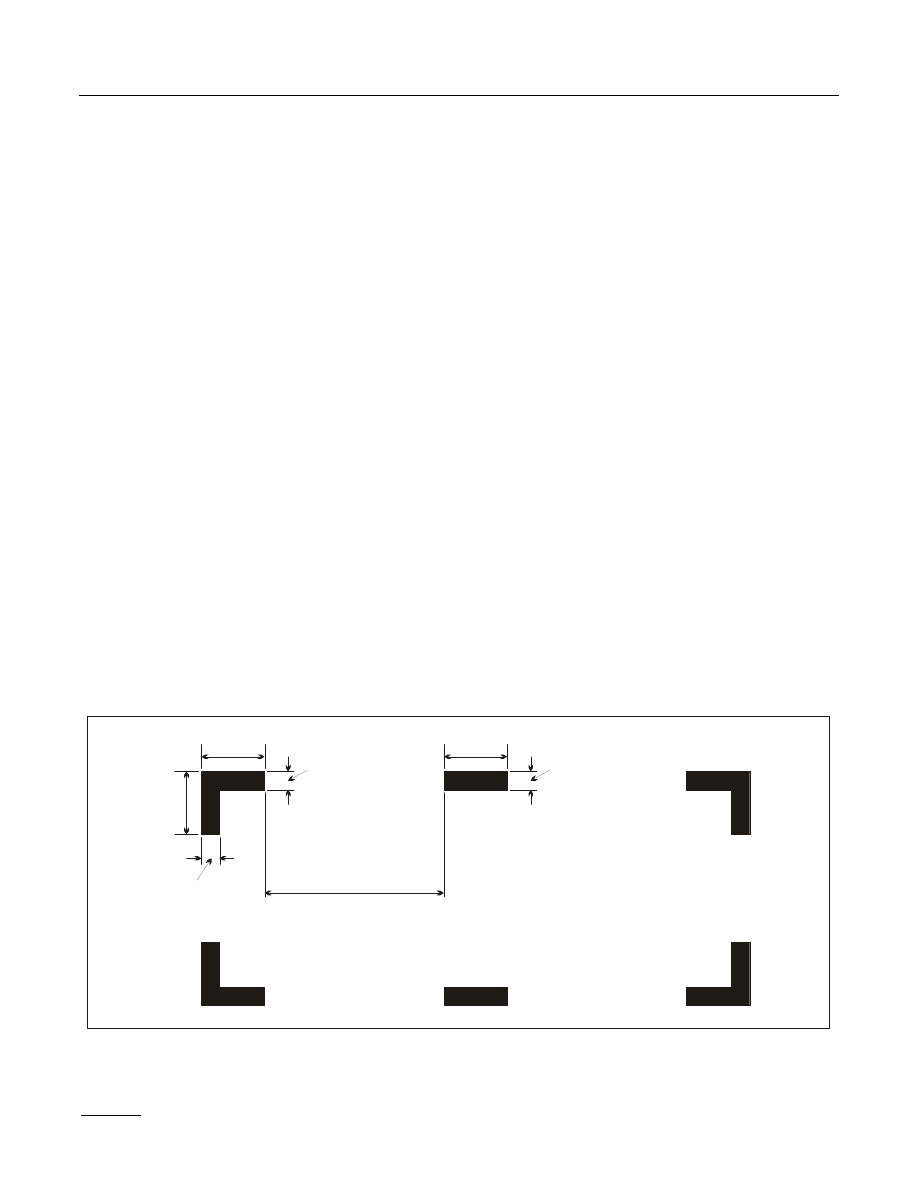
Annex 6 — Operation of Aircraft
Part II
18/11/10 2.4-2
e) where the aeroplane is fitted with fuses that are accessible in flight, spare electrical fuses of appropriate ratings for
replacement of those fuses.
2.4.2.3 Any agent used in a built-in fire extinguisher for each lavatory disposal receptacle for towels, paper or waste in
an aeroplane for which the individual certificate of airworthiness is first issued on or after 31 December 2011 and any
extinguishing agent used in a portable fire extinguisher in an aeroplane for which the individual certificate of airworthiness is
first issued on or after 31 December 2016 shall:
a) meet the applicable minimum performance requirements of the State of Registry; and
b) not be of a type listed in the 1987 Montreal Protocol on Substances that Deplete the Ozone Layer as it appears in the
Eighth Edition of the Handbook for the Montreal Protocol on Substances that Deplete the Ozone Layer, Annex A,
Group II.
Note.— Information concerning extinguishing agents is contained in the UNEP Halons Technical Options Committee
Technical Note No. 1 – New Technology Halon Alternatives and FAA Report No. DOT/FAA/AR-99-63, Options to the Use
of Halons for Aircraft Fire Suppression Systems.
2.4.2.4 Recommendation.— Aeroplanes on all flights should be equipped with the ground-air signal codes for search
and rescue purposes.
2.4.2.5 Recommendation.— Aeroplanes on all flights should be equipped with a safety harness for each flight crew
member seat.
Note.—- Safety harness includes shoulder strap(s) and a seat belt which may be used independently.
2.4.2.6 Marking of break-in points
2.4.2.6.1 If areas of the fuselage suitable for break-in by rescue crews in emergency are marked on an aeroplane such
areas shall be marked as shown below (see figure following). The colour of the markings shall be red or yellow, and if
necessary they shall be outlined in white to contrast with the background.
2.4.2.6.2 If the corner markings are more than 2 m apart, intermediate lines 9 cm
× 3 cm shall be inserted so that there
is no more than 2 m between adjacent markings.
Note.— This Standard does not require any aeroplane to have break-in areas.
MARKING OF BREAK-IN POINTS (see 2.4.2.6)
Not over 2 m
9 cm
9 cm
9
cm
3 cm
3 cm
3 cm
15/12/11
No. 30

Chapter 2.4
Annex 6 — Operation of Aircraft
2.4-3
18/11/10
2.4.3 Aeroplanes operated as VFR flights
2.4.3.1 Aeroplanes when operated as VFR flights shall be equipped with:
a) a means of measuring and displaying:
1)
magnetic
heading;
2) the time in hours, minutes and seconds;
3)
pressure
altitude;
4)
indicated
airspeed;
and
b) such additional equipment as may be prescribed by the appropriate authority.
2.4.3.2 Recommendation.— VFR flights which are operated as controlled flights should be equipped in accordance
with 2.4.7.
2.4.4 Aeroplanes on flights over water
2.4.4.1 Seaplanes
Seaplanes for all flights shall be equipped with:
a) one life jacket, or equivalent individual floatation device, for each person on board, stowed in a position readily
accessible from the seat or berth;
b) equipment for making the sound signals prescribed in the International Regulations for Preventing Collisions at Sea,
where applicable;
c) one anchor; and
d) one sea anchor (drogue), when necessary to assist in manoeuvring.
Note.— “Seaplanes” includes amphibians operated as seaplanes.
2.4.4.2 Landplanes
Single-engined landplanes
Recommendation.— All single-engined landplanes:
a) when flying en route over water beyond gliding distance from the shore; or
b) when taking off or landing at an aerodrome where, in the opinion of the pilot-in-command, the take-off or approach
path is so disposed over water that in the event of a mishap there would be a likelihood of a ditching;

Annex 6 — Operation of Aircraft
Part II
18/11/10 2.4-4
should carry one life jacket or equivalent individual floatation device for each person on board, stowed in a position
easily accessible from the seat or berth of the person for whose use it is provided.
Note.— “Landplanes” includes amphibians operated as landplanes.
2.4.4.3 Aeroplanes on extended flights over water
2.4.4.3.1 All aeroplanes operated on extended flights over water shall be equipped with, at a minimum, one life jacket
or equivalent individual floatation device for each person on board, stowed in a position easily accessible from the seat or
berth of the person for whose use it is provided.
2.4.4.3.2 The pilot-in-command of an aeroplane operated on an extended flight over water shall determine the risks to
survival of the occupants of the aeroplane in the event of a ditching. The pilot-in-command shall take into account the
operating environment and conditions such as, but not limited to, sea state and sea and air temperatures, the distance from
land suitable for making an emergency landing, and the availability of search and rescue facilities. Based upon the
assessment of these risks, the pilot-in-command shall, in addition to the equipment required in 2.4.4.3.1, ensure that the
aeroplane is equipped with:
a) life-saving rafts in sufficient numbers to carry all persons on board, stowed so as to facilitate their ready use in
emergency, provided with such life-saving equipment, including means of sustaining life, as is appropriate to the
flight to be undertaken; and
b) equipment for making the distress signals described in Annex 2.
2.4.5 Aeroplanes on flights over designated land areas
Aeroplanes, when operated across land areas which have been designated by the State concerned as areas in which search and
rescue would be especially difficult, shall be equipped with such signalling devices and life-saving equipment (including
means of sustaining life) as may be appropriate to the area overflown.
2.4.6 Aeroplanes on high altitude flights
2.4.6.1 Aeroplanes intended to be operated at high altitudes shall be equipped with oxygen storage and dispensing
apparatus capable of storing and dispensing the oxygen supplies required in 2.2.3.8.
2.4.6.2 Aeroplanes for which the individual certificate of airworthiness is
first issued on or after 1 January 1990
Pressurized aeroplanes intended to be operated at flight altitudes at which the atmospheric pressure is less than 376 hPa shall
be equipped with a device to provide positive warning to the flight crew of any dangerous loss of pressurization.
2.4.6.3 Aeroplanes for which the individual certificate of airworthiness was
first issued before 1 January 1990
Recommendation.— Pressurized aeroplanes intended to be operated at flight altitudes at which the atmospheric
pressure is less than 376 hPa should be equipped with a device to provide positive warning to the flight crew of any
dangerous loss of pressurization.

Chapter 2.4
Annex 6 — Operation of Aircraft
2.4-5
18/11/10
2.4.7 Aeroplanes operated in accordance with
the instrument flight rules
Aeroplanes when operated in accordance with the instrument flight rules, or when the aeroplane cannot be maintained in a
desired attitude without reference to one or more flight instruments, shall be equipped with:
a) a means of measuring and displaying:
1) magnetic heading (standby compass);
2) the time in hours, minutes and seconds;
3)
pressure
altitude;
4) indicated airspeed, with a means of preventing malfunctioning due to either condensation or icing;
5)
turn
and
slip;
6)
aircraft
attitude;
and
7)
stabilized
aircraft
heading;
Note.— The requirements of 5), 6) and 7) may be met by combinations of instruments or by integrated flight director
systems provided that the safeguards against total failure, inherent in the three separate instruments, are retained.
8) whether the supply of power to the gyroscopic instruments is adequate;
9)
the
outside
air
temperature;
10) rate-of-climb and descent; and
b) such additional instruments or equipment as may be prescribed by the appropriate authority.
2.4.8 Aeroplanes when operated at night
Aeroplanes, when operated at night, shall be equipped with:
a) the equipment specified in 2.4.7; and
b) the lights required by Annex 2 for aircraft in flight or operating on the movement area of an aerodrome;
Note.— Specifications for lights meeting the requirements of Annex 2 for navigation lights are contained in
Appendix 2.1. The general characteristics of lights are specified in Annex 8. Detailed specifications for lights meeting
the requirements of Annex 2 for aircraft in flight or operating on the movement area of an aerodrome are contained in
the Airworthiness Manual (Doc 9760).
c) a landing light;
d) illumination for all flight instruments and equipment that are essential for the safe operation of the aeroplane that are
used by the flight crew;

Annex 6 — Operation of Aircraft
Part II
18/11/10 2.4-6
e) lights in all passenger compartments; and
f) an independent portable light for each crew member station.
2.4.9 Aeroplanes complying with the
noise certification Standards in Annex 16, Volume I
An aeroplane shall carry a document attesting noise certification.
Note.— The attestation may be contained in any document, carried on board, approved by the State of Registry.
2.4.10 Mach number indicator
Aeroplanes with speed limitations expressed in terms of Mach number shall be equipped with a means of displaying Mach
number.
2.4.11 Aeroplanes required to be equipped with
ground proximity warning systems (GPWS)
2.4.11.1 All turbine-engined aeroplanes of a maximum certificated take-off mass in excess of 5 700 kg or authorized to
carry more than nine passengers shall be equipped with a ground proximity warning system which has a forward-looking
terrain avoidance function.
2.4.11.2 Recommendation.— All turbine-engined aeroplanes of a maximum certificated take-off mass of 5 700 kg or
less and authorized to carry more than five but not more than nine passengers should be equipped with a ground proximity
warning system which has a forward-looking terrain avoidance function.
2.4.11.3 Recommendation.— All piston-engined aeroplanes of a maximum certificated take-off mass in excess of
5 700 kg or authorized to carry more than nine passengers should be equipped with a ground proximity warning system
which has a forward-looking terrain avoidance function.
2.4.11.4 A ground proximity warning system shall provide automatically a timely and distinctive warning to the flight
crew when the aeroplane is in potentially hazardous proximity to the earth’s surface.
2.4.11.5 A ground proximity warning system shall provide, at a minimum, warnings of at least the following
circumstances:
a) excessive descent rate;
b) excessive altitude loss after take-off or go-around; and
c)
unsafe
terrain
clearance.
2.4.11.6 Recommendation.— A ground proximity warning system should provide, as a minimum, warnings of at least
the following circumstances:
a) excessive descent rate;

Chapter 2.4
Annex 6 — Operation of Aircraft
2.4-7
18/11/10
b) excessive terrain closure rate;
c) excessive altitude loss after take-off or go-around;
d) unsafe terrain clearance while not in landing configuration;
1)
gear
not
locked
down;
2) flaps not in a landing position; and
e) excessive descent below the instrument glide path.
2.4.11.7 A ground proximity warning system installed in turbine-engined aeroplanes of a maximum certificated take-
off mass in excess of 5 700 kg or authorized to carry more than nine passengers for which the individual certificate of
airworthiness was first issued after 1 January 2011 shall provide, as a minimum, warnings of at least the following
circumstances:
a) excessive descent rate;
b) excessive terrain closure rate;
c) excessive altitude loss after take-off or go-around;
d) unsafe terrain clearance while not in landing configuration;
1)
gear
not
locked
down;
2) flaps not in a landing position; and
e) excessive descent below the instrument glide path.
2.4.12 Emergency locator transmitter (ELT)
2.4.12.1 Recommendation.— All aeroplanes should carry an automatic ELT.
2.4.12.2 Except as provided for in 2.4.12.3, from 1 July 2008, all aeroplanes shall be equipped with at least one ELT of
any type.
2.4.12.3 All aeroplanes for which the individual certificate of airworthiness is first issued after 1 July 2008 shall be
equipped with at least one automatic ELT.
2.4.12.4 ELT equipment carried to satisfy the requirements of 2.4.12.1, 2.4.12.2 and 2.4.12.3 shall operate in
accordance with the relevant provisions of Annex 10, Volume III.
Note.— The judicious choice of numbers of ELTs, their type and placement on aircraft, and associated floatable life
support systems, will ensure the greatest chance of ELT activation in the event of an accident for aircraft operating over
water or land, including areas especially difficult for search and rescue. Placement of transmitter units is a vital factor in
ensuring optimal crash and fire protection. The placement of the control and switching devices (activation monitors) of
automatic fixed ELTs and their associated operational procedures will also take into consideration the need for rapid
detection of inadvertent activation and convenient manual switching by crew members.

Annex 6 — Operation of Aircraft
Part II
18/11/10 2.4-8
2.4.13 Aeroplanes required to be equipped with
a pressure-altitude reporting transponder
2.4.13.1 Aeroplanes shall be equipped with a pressure-altitude reporting transponder which operates in accordance
with the relevant provisions of Annex 10, Volume IV.
2.4.13.2 Unless exempted by the appropriate authorities, aeroplanes operating as VFR flights shall be equipped with a
pressure-altitude reporting transponder which operates in accordance with the relevant provision of Annex 10, Volume IV.
Note.— These provisions are intended to support the effectiveness of ACAS as well as to improve the effectiveness of air
traffic services.
2.4.14 Microphones
Recommendation.— When operating under the instrument flight rules all flight crew members required to be on flight
deck duty should communicate through boom or throat microphones below the transition level/altitude.
2.4.15 Aeroplanes equipped with head-up displays (HUD)
and/or enhanced vision systems (EVS)
Where aeroplanes are equipped with HUD and/or EVS, the use of such systems to gain operational benefits shall be approved
by the State of Registry.
Note.— Guidance on HUD and EVS is contained in Attachment J to Annex 6, Part I.
2.4.16 Flight recorders
Note 1.— Crash protected flight recorders comprise one or more of the following systems: a flight data recorder (FDR),
a cockpit voice recorder (CVR), an airborne image recorder (AIR) and/or a data link recorder (DLR). Image and data link
information may be recorded on either the CVR or the FDR.
Note 2.— Lightweight flight recorders comprise one or more of the following systems: an aircraft data recording system
(ADRS), a cockpit audio recording system (CARS), an airborne image recording system (AIRS) and/or a data link recording
system (DLRS). Image and data link information may be recorded on either the CARS or the ADRS.
Note 3.— Detailed guidance on flight recorders is contained in Appendix 2.3.
2.4.16.1 Flight data recorders and aircraft data recording systems
Note 1.— FDR and AIR performance requirements are as contained in the EUROCAE ED-112, Minimum Operational
Performance Specification (MOPS) for Crash Protected Airborne Recorder Systems, or equivalent documents.
Note 2.— ADRS performance requirements are as contained in the EUROCAE ED-155, Minimum Operational
Performance Specification (MOPS) for Lightweight Flight Recording Systems, or equivalent documents.
Note 3.— Parameters to be recorded are listed in Tables 2.3-1 and 2.3-3 of Appendix 2.3.
15/11/12
No. 31

Chapter 2.4
Annex 6 — Operation of Aircraft
2.4-9
18/11/10
2.4.16.1.1 Types
2.4.16.1.1.1 Types I and IA FDRs shall record the parameters required to determine accurately the aeroplane flight
path, speed, attitude, engine power, configuration and operation.
2.4.16.1.1.2 Type II FDRs shall record the parameters required to determine accurately the aeroplane flight path, speed,
attitude, engine power and configuration of lift and drag devices.
2.4.16.1.2 Operation
Note.— Airborne image recorders classification is defined in 4.1 of Appendix 2.3.
2.4.16.1.2.1 Recommendation.— All turbine-engined aeroplanes of a maximum certificated take-off mass of 5 700 kg
or less for which the individual certificate of airworthiness is first issued on or after 1 January 2016 should be equipped with:
a) a Type II FDR; or
b) a Class C AIR capable of recording flight path and speed parameters displayed to the pilot(s); or
c) an ADRS capable of recording the essential parameters defined in Table 2.3-3 of Appendix 2.3.
2.4.16.1.2.2 All aeroplanes for which the application for type certification is submitted to a Contracting State on or
after 1 January 2016, and which are required to be fitted with an FDR, shall record the following parameters at a maximum
recording interval of 0.125 seconds:
— Pilot input and/or control surface position – primary controls (pitch, roll, yaw).
Note 1.— For aeroplanes with control systems in which movement of a control surface will back drive the pilot’s control,
“or” applies. For aeroplanes with control systems in which movement of a control surface will not back drive the pilot’s
control, “and” applies. In aeroplanes with independent moveable surfaces, each surface needs to be recorded separately. In
aeroplanes with independent pilot input on primary controls, each pilot input on primary controls needs to be recorded
separately.
Note 2.— “The application for type certification that is submitted to a Contracting State” refers to the date of
application of the original “Type Certificate” for the aeroplane type, not the date of certification of particular aeroplane
variants or derivative models.
2.4.16.1.3 Discontinuation
2.4.16.1.3.1 The use of engraving metal foil FDRs shall be discontinued.
2.4.16.1.3.2 Recommendation.— The use of analogue FDRs using frequency modulation (FM) should be
discontinued.
2.4.16.1.3.3 The use of analogue FDRs using frequency modulation (FM) shall be discontinued by 1 January 2012.
2.4.16.1.3.4 The use of photographic film FDRs shall be discontinued.
2.4.16.1.3.5 Recommendation.— The use of magnetic tape FDRs should be discontinued by 1 January 2011.
2.4.16.1.3.6 The use of magnetic tape FDRs shall be discontinued by 1 January 2016.
15/11/12
No. 31

Annex 6 — Operation of Aircraft
Part II
18/11/10 2.4-10
2.4.16.1.4 Duration
All FDRs shall be capable of retaining the information recorded during at least the last 25 hours of their operation.
2.4.16.2 Cockpit voice recorders and cockpit audio recording systems
Note 1.— CVR performance requirements are as contained in the EUROCAE ED-112 Minimum Operational
Performance Specification (MOPS) for Crash Protected Airborne Recorder Systems, or equivalent documents.
Note 2.— CARS performance requirements are as contained in the EUROCAE ED-155, Minimum Operational
Performance Specification (MOPS) for Lightweight Flight Recording Systems, or equivalent documents.
2.4.16.2.1 Operation
2.4.16.2.1.1 Recommendation.— All turbine-engined aeroplanes of a maximum certificated take-off mass of 5 700 kg
or less for which the individual certificate of airworthiness is first issued on or after 1 January 2016 and required to be
operated by more than one pilot should be equipped with either a CVR or a CARS.
2.4.16.2.2 Discontinuation
2.4.16.2.2.1 The use of magnetic tape and wire CVRs shall be discontinued by 1 January 2016.
2.4.16.2.2.2 Recommendation.— The use of magnetic tape and wire CVRs should be discontinued by 1 January 2011.
2.4.16.2.3 Duration
2.4.16.2.3.1 All CVRs shall be capable of retaining the information recorded during at least the last 30 minutes of their
operation.
2.4.16.2.3.2 From 1 January 2016, all CVRs shall be capable of retaining the information recorded during at least the
last two hours of their operation.
2.4.16.2.3.3 Recommendation.— All aeroplanes for which the individual certificate of airworthiness is first issued on
or after 1 January 1990, and that are required to be equipped with a CVR, should have a CVR capable of retaining the
information recorded during at least the last two hours of their operation.
2.4.16.3 Data link recorders
Note.— Data link recorders performance requirements are as contained in the EUROCAE ED-112, Minimum
Operational Performance Specification (MOPS) for Crash Protected Airborne Recorder Systems, or equivalent documents.
2.4.16.3.1 Applicability
2.4.16.3.1.1 All aeroplanes for which the individual certificate of airworthiness is first issued on or after 1 January
2016, which utilize any of the data link communications applications listed in 5.1.2 of Appendix 2.3 and are required to carry
a cockpit voice recorder (CVR), shall record on a flight recorder all data link communications messages.
15/11/12
No. 31

Chapter 2.4
Annex 6 — Operation of Aircraft
2.4-11
18/11/10
2.4.16.3.1.2 All aeroplanes which are modified on or after 1 January 2016 to install and utilize any of the data link
communications applications listed in 5.1.2 of Appendix 2.3 and are required to carry a CVR shall record on a flight recorder
the data link communications messages.
Note 1.— Data link communications are currently conducted by either ATN-based or FANS 1/A-equipped aircraft.
Note 2.— A Class B AIR could be a means for recording data link communications applications messages to and from
the aeroplanes where it is not practical or is prohibitively expensive to record those data link communications applications
messages on FDR or CVR.
2.4.16.3.2 Duration
The minimum recording duration shall be equal to the duration of the CVR.
2.4.16.3.3 Correlation
Data link recording shall be able to be correlated to the recorded cockpit audio.
2.4.16.4 Flight recorders — general
2.4.16.4.1 Construction and installation
Flight recorders shall be constructed, located and installed so as to provide maximum practical protection for the recordings
in order that the recorded information may be preserved, recovered and transcribed. Flight recorders shall meet the prescribed
crashworthiness and fire protection specifications.
Note 1.— Industry crashworthiness and fire protection specifications for FDR, CVR, AIR and DLR are as contained in
the EUROCAE ED-112, Minimum Operational Performance Specification (MOPS) for Crash Protected Airborne Recorder
Systems, or equivalent documents.
Note 2.— Industry crashworthiness and fire protection specifications for ADRS and CARS are as contained in the
EUROCAE ED-155, Minimum Operational Performance Specifications (MOPS) for Lightweight Flight Recording Systems,
or equivalent documents.
2.4.16.4.2 Operation
2.4.16.4.2.1 Flight recorders shall not be switched off during flight time.
2.4.16.4.2.2 To preserve flight recorder records, flight recorders shall be deactivated upon completion of flight time
following an accident or incident. The flight recorders shall not be reactivated before their disposition as determined in
accordance with Annex 13.
Note 1.— The need for removal of the flight recorder records from the aircraft will be determined by the investigation
authority in the State conducting the investigation with due regard to the seriousness of an occurrence and the circumstances,
including the impact on the operation.
Note 2.— The pilot-in-command’s responsibilities regarding the retention of flight recorder records are contained in
2.4.16.4.3.
15/11/12
No. 31

Annex 6 — Operation of Aircraft
Part II
18/11/10 2.4-12
2.4.16.4.3 Flight recorder records
The pilot-in-command, and/or the owner/operator, shall ensure, to the extent possible, in the event the aeroplane becomes
involved in an accident or incident, the preservation of all related flight recorder records, and if necessary the associated
flight recorders, and their retention in safe custody pending their disposition as determined in accordance with Annex 13.
2.4.16.4.4 Continued serviceability
Operational checks and evaluations of recordings from the flight recorder systems shall be conducted to ensure the continued
serviceability of the recorders.
Note.— Procedures for the inspections of the flight recorder systems are given in Appendix 2.3.
2.4.16.4.5 Flight recorder electronic documentation
Recommendation.— The documentation requirement concerning FDR and ADRS parameters provided by operators to
accident investigation authorities should be in electronic format and take account of industry specifications.
Note.— Industry specification for documentation concerning flight recorder parameters may be found in the ARINC
647A, Flight Recorder Electronic Documentation, or equivalent document.
_____________________
15/11/12
No. 31

ANNEX 6 — PART II
2.5-1
18/11/10
CHAPTER 2.5 AEROPLANE COMMUNICATION AND
NAVIGATION EQUIPMENT
2.5.1 Communication equipment
2.5.1.1 An aeroplane to be operated in accordance with the instrument flight rules or at night shall be provided with
radio communication equipment. Such equipment shall be capable of conducting two-way communication with those
aeronautical stations and on those frequencies prescribed by the appropriate authority.
Note.— The requirements of 2.5.1.1 are considered fulfilled if the ability to conduct the communications specified
therein is established during radio propagation conditions which are normal for the route.
2.5.1.2 When compliance with 2.5.1.1 requires that more than one communication equipment unit be provided, each
shall be independent of the other or others to the extent that a failure in any one will not result in failure of any other.
2.5.1.3 An aeroplane to be operated in accordance with the visual flight rules, but as a controlled flight, shall, unless
exempted by the appropriate authority, be provided with radio communication equipment capable of conducting two-way
communication at any time during flight with such aeronautical stations and on such frequencies as may be prescribed by the
appropriate authority.
2.5.1.4 An aeroplane to be operated on a flight to which the provisions of 2.4.4.3.1 or 2.4.5 apply shall, unless
exempted by the appropriate authority, be provided with radio communication equipment capable of conducting two-way
communication at any time during flight with such aeronautical stations and on such frequencies as may be prescribed by the
appropriate authority.
2.5.1.5 The radio communication equipment required in accordance with 2.5.1.1 to 2.5.1.4 shall provide for
communication on the aeronautical emergency frequency 121.5 MHz.
2.5.1.6 For flight operations in defined portions of airspace or on routes where an RCP type has been prescribed, an
aeroplane shall, in addition to the requirements specified in 2.5.1.1 to 2.5.1.5:
a) be provided with communication equipment which will enable it to operate in accordance with the prescribed RCP
type(s); and
b) be authorized by the State of Registry for such operations.
Note.— Information on RCP and associated procedures, and guidance concerning the approval process, are contained
in the Manual on Required Communication Performance (RCP) (Doc 9869). This document also contains references to other
documents produced by States and international bodies concerning communication systems and RCP.
2.5.2 Navigation equipment
2.5.2.1 An aeroplane shall be provided with navigation equipment which will enable it to proceed:
a)
in
accordance
with the flight plan; and

Annex 6 — Operation of Aircraft
Part II
18/11/10 2.5-2
b)
in
accordance
with the requirements of air traffic services;
except when, if not so precluded by the appropriate authority, navigation for flights under the visual flight rules is
accomplished by visual reference to landmarks.
2.5.2.2 For operations where a navigation specification for performance-based navigation has been prescribed, an
aeroplane shall, in addition to the requirements specified in 2.5.2.1:
a) be provided with navigation equipment which will enable it to operate in accordance with the prescribed navigation
specification(s); and
b) be authorized by the State of Registry for such operations.
Note.— Information on performance-based navigation, and guidance concerning the implementation and operational
approval process, are contained in the Performance-based Navigation Manual (Doc 9613). This document also contains a
comprehensive list of references to other documents produced by States and international bodies concerning navigation
systems.
2.5.2.3 For flights in defined portions of airspace where, based on regional air navigation agreement, minimum
navigation performance specifications (MNPS) are prescribed, an aeroplane shall be provided with navigation equipment
which:
a) continuously provides indications to the flight crew of adherence to or departure from track to the required degree of
accuracy at any point along that track; and
b) has been authorized by the State of Registry for the MNPS operations concerned.
Note.— The prescribed minimum navigation performance specifications and the procedures governing their application
are published in the Regional Supplementary Procedures (Doc 7030).
2.5.2.4 For flights in defined portions of airspace where, based on regional air navigation agreement, a reduced vertical
separation minimum (RVSM) of 300 m (1 000 ft) is applied between FL 290 and FL 410 inclusive, an aeroplane:
a) shall be provided with equipment which is capable of:
1) indicating to the flight crew the flight level being flown;
2) automatically maintaining a selected flight level;
3) providing an alert to the flight crew when a deviation occurs from the selected flight level. The threshold for the
alert shall not exceed ± 90 m (300 ft); and
4)
automatically
reporting
pressure-altitude;
b) shall be authorized by the State of Registry for operation in the airspace concerned; and
c) shall demonstrate a vertical navigation performance in accordance with Appendix 2.
2.5.2.5 Prior to granting the RVSM approval required in accordance with 2.5.2.4 b), the State shall be satisfied that:
a) the vertical navigation performance capability of the aeroplane satisfies the requirements specified in Appendix 2.2;
b) the owner/operator has instituted appropriate procedures in respect of continued airworthiness (maintenance and
repair) practices and programmes; and
18/11/10
No. 29

Chapter 2.5
Annex 6 — Operation of Aircraft
2.5-3
18/11/10
c) the owner/operator has instituted appropriate flight crew procedures for operations in RVSM airspace.
Note.— An RVSM approval is valid globally on the understanding that any operating procedures specific to a given
region will be stated in the operations manual or appropriate crew guidance.
2.5.2.6 The State of Registry shall ensure that, in respect of those aeroplanes mentioned in 2.5.2.4, adequate provisions
exist for:
a) receiving the reports of height-keeping performance issued by the monitoring agencies established in accordance
with Annex 11, 3.3.5.1; and
b) taking immediate corrective action for individual aircraft, or aircraft type groups, identified in such reports as not
complying with the height-keeping requirements for operation in airspace where RVSM is applied.
2.5.2.7 The State of Registry that has issued an RVSM approval to an owner/operator shall establish a requirement
which ensures that a minimum of two aeroplanes of each aircraft type grouping of the owner/operator have their height-
keeping performance monitored, at least once every two years or within intervals of 1 000 flight hours per aeroplane,
whichever period is longer. If an owner/operator aircraft type grouping consists of a single aeroplane, monitoring of that
aeroplane shall be accomplished within the specified period.
Note.— Monitoring data from any regional monitoring programme established in accordance with Annex 11, 3.3.5.2,
may be used to satisfy the requirement.
2.5.2.8 All States that are responsible for airspace where RVSM has been implemented, or that have issued RVSM
approvals to owners/operators within their State, shall establish provisions and procedures which ensure that appropriate
action will be taken in respect of aircraft and owners/operators found to be operating in RVSM airspace without a valid
RVSM approval.
Note 1.— These provisions and procedures need to address both the situation where the aircraft in question was
operating without approval in the airspace of the State, and the situation where an owner/operator for which the State has
regulatory oversight responsibility is found to be operating without the required approval in the airspace of another State.
Note 2.— Guidance material relating to the approval for operation in RVSM airspace is contained in the Manual on
Implementation of a 300 m (1 000 ft) Vertical Separation Minimum Between FL 290 and FL 410 Inclusive (Doc 9574).
2.5.2.9 The aeroplane shall be sufficiently provided with navigation equipment to ensure that, in the event of the failure
of one item of equipment at any stage of the flight, the remaining equipment will enable the aeroplane to navigate in
accordance with 2.5.2.1 and where applicable 2.5.2.2, 2.5.2.3 and 2.5.2.4.
Note 1.— This requirement may be met by means other than the duplication of equipment.
Note 2.— Guidance material relating to aircraft equipment necessary for flight in airspace where a 300 m (1 000 ft)
VSM is applied above FL 290 is contained in the Manual on Implementation of a 300 m (1 000 ft) Vertical Separation
Minimum Between FL 290 and FL 410 Inclusive (Doc 9574).
2.5.2.10 On flights in which it is intended to land in instrument meteorological conditions, an aeroplane shall be
provided with radio equipment capable of receiving signals providing guidance to a point from which a visual landing can be
effected. This equipment shall be capable of providing such guidance for each aerodrome at which it is intended to land in
instrument meteorological conditions and for any designated alternate aerodromes.
_____________________
18/11/10
No. 29


ANNEX 6 — PART II
2.6-1
18/11/10
CHAPTER 2.6 AEROPLANE MAINTENANCE
Note 1.— For the purpose of this chapter “aeroplane” includes: engines, propellers, components, accessories,
instruments, equipment and apparatus including emergency equipment.
Note 2.— Guidance on continuing airworthiness requirements is contained in the Airworthiness Manual (Doc 9760).
Note 3.— States are encouraged to conduct a risk assessment when approving a maintenance programme not based on
the type certificate holder’s maintenance recommendations.
2.6.1 Owner’s maintenance responsibilities
2.6.1.1 The owner of an aeroplane, or in the case where it is leased, the lessee, shall ensure that, in accordance with
procedures acceptable to the State of Registry:
a) the aeroplane is maintained in an airworthy condition;
b) the operational and emergency equipment necessary for an intended flight is serviceable; and
c) the certificate of airworthiness of the aeroplane remains valid.
2.6.1.2 The owner or the lessee shall not operate the aeroplane unless it is maintained and released to service under a
system acceptable to the State of Registry.
2.6.1.3 When the maintenance release is not issued by an approved maintenance organization in accordance with
Annex 6, Part I, 8.7, the person signing the maintenance release shall be licensed in accordance with Annex 1.
2.6.1.4 The owner or the lessee shall ensure that the maintenance of the aeroplane is performed in accordance with a
maintenance programme acceptable to the State of Registry.
2.6.2 Maintenance records
2.6.2.1 The owner of an aeroplane, or in the case where it is leased, the lessee, shall ensure that the following records
are kept for the periods mentioned in 2.6.2.2:
a) the total time in service (hours, calendar time and cycles, as appropriate) of the aeroplane and all life limited
components;
b) the current status of compliance with all applicable mandatory continuing airworthiness information;
c) appropriate details of modifications and repairs;
d) the time in service (hours, calendar time and cycles, as appropriate) since the last overhaul of the aeroplane or its
components subject to a mandatory overhaul life;
18/11/10
No. 29

Annex 6 — Operation of Aircraft
Part II
18/11/10 2.6-2
e) the current status of the aeroplane’s compliance with the maintenance programme; and
f) the detailed maintenance records to show that all requirements for the signing of a maintenance release have been
met.
2.6.2.2 The records in 2.6.2.1 a) to e) shall be kept for a minimum period of 90 days after the unit to which they refer
has been permanently withdrawn from service and the records in 2.6.2.1 f) for a minimum period of one year after the signing
of the maintenance release.
2.6.2.3 In the event of a temporary change of owner or lessee, the records shall be made available to the new owner or
lessee. In the event of any permanent change of owner or lessee, the records shall be transferred to the new owner or lessee.
Note 1. — Maintenance records or related documents, other than a valid certificate of airworthiness, need not be carried
in the aeroplane during international flights.
Note 2. — In the context of 2.6.2.3, a judgement on what should be considered as a temporary change of owner or lessee
will need to be made by the State of Registry in the light of the need to exercise control over the records, which will depend
on access to them and the opportunity to update them.
2.6.3 Modifications and repairs
All modifications and repairs shall comply with airworthiness requirements acceptable to the State of Registry. Procedures
shall be established to ensure that the substantiating data supporting compliance with the airworthiness requirements are
retained.
2.6.4 Maintenance release
2.6.4.1 A maintenance release shall be completed and signed, as prescribed by the State of Registry, to certify that the
maintenance work performed has been completed satisfactorily and in accordance with data and procedures acceptable to the
State of Registry.
2.6.4.2 A maintenance release shall contain a certification including:
a) basic details of the maintenance performed;
b) the date such maintenance was completed;
c) when applicable, the identity of the approved maintenance organization; and
d) the identity of the authorized person or persons signing the release.
_____________________

ANNEX 6 — PART II
2.7-1
18/11/10
CHAPTER 2.7 AEROPLANE FLIGHT CREW
2.7.1 Composition of the flight crew
The number and composition of the flight crew shall not be less than that specified in the flight manual or other documents
associated with the certificate of airworthiness.
2.7.2 Qualifications
2.7.2.1 The pilot-in-command shall:
a) ensure that each flight crew member holds a valid licence issued by the State of Registry, or if issued by another
Contracting State, rendered valid by the State of Registry;
b) ensure that flight crew members are properly rated; and
c) be satisfied that flight crew members have maintained competency.
2.7.2.2 The pilot-in-command of an aeroplane equipped with an airborne collision avoidance system (ACAS II) shall
ensure that each flight crew member has been appropriately trained to competency in the use of ACAS II equipment and the
avoidance of collision.
Note 1.— Procedures for the use of ACAS II equipment are specified in the Procedures for Air Navigation Services —
Aircraft Operations (PANS-OPS, Doc 8168), Volume I — Flight Procedures. ACAS II Training Guidelines for Pilots are
provided in PANS-OPS, Volume I, Attachment to Part III, Section 3, Chapter 3.
Note 2.— Appropriate training, to the satisfaction of the State, to competency in the use of ACAS II equipment and the
avoidance of collisions may be evidenced, for example, by:
a) possession of a type rating for an aeroplane equipped with ACAS II, where the operation and use of ACAS II are
included in the training syllabus for the type rating; or
b) possession of a document issued by a training organization or person approved by the State to conduct training for
pilots in the use of ACAS II, indicating that the holder has been trained in accordance with the guidelines referred to
in Note 1; or
c) a comprehensive pre-flight briefing by a pilot who has been trained in the use of ACAS II in accordance with the
guidelines referred to in Note 1.
_____________________


ANNEX 6 — PART II
2.8-1
18/11/10
CHAPTER 2.8 MANUALS, LOGS AND RECORDS
Note.— The following documents are associated with this Annex but are not included in this chapter:
Maintenance records — see 2.6.2.
2.8.1 Flight manual
Note.— The aeroplane flight manual contains the information specified in Annex 8.
The aeroplane flight manual shall be updated by implementing changes made mandatory by the State of Registry.
2.8.2 Journey log book
2.8.2.1 A journey log book shall be maintained for every aeroplane engaged in international air navigation in which
shall be entered particulars of the aeroplane, its crew and each journey.
2.8.2.2 Recommendation.— The aeroplane journey log should contain the following items:
a) aeroplane nationality and registration;
b)
date;
c) crew member names and duty assignments;
d) departure and arrival points and times;
e)
purpose
of
flight;
f) observations regarding the flight; and
g) signature of the pilot-in-command.
2.8.3 Records of emergency and survival equipment carried
The owner of the aeroplane, or in the case where it is leased, the lessee, shall at all times have available for immediate
communication to rescue coordination centres, lists containing information on the emergency and survival equipment carried
on board the aeroplane engaged in international air navigation. The information shall include, as applicable, the number,
colour and type of life rafts and pyrotechnics, details of emergency medical supplies, water supplies and the type and
frequencies of the emergency portable radio equipment.
_____________________


ANNEX 6 — PART II
2.9-1
18/11/10
CHAPTER 2.9 SECURITY
2.9.1 Security of aircraft
The pilot-in-command shall be responsible for the security of the aircraft during its operation.
2.9.2 Reporting acts of unlawful interference
Following an act of unlawful interference, the pilot-in-command shall submit a report of such an act to the designated local
authority.
Note.— In the context of this Chapter, the word “security” is used in the sense of prevention of acts of unlawful interference
against civil aviation.
_____________________


ANNEX 6 — PART II
APP
2.1-1
18/11/10
APPENDIX 2.1 LIGHTS TO BE DISPLAYED BY AEROPLANES
(Note.— See 2.4.8)
1. Terminology
When the following terms are used in this Appendix, they have the following meanings:
Angles of coverage.
a) Angle of coverage A is formed by two intersecting vertical planes making angles of 70 degrees to the right and
70 degrees to the left respectively, looking aft along the longitudinal axis to a vertical plane passing through the
longitudinal axis.
b) Angle of coverage F is formed by two intersecting vertical planes making angles of 110 degrees to the right and
110 degrees to the left respectively, looking forward along the longitudinal axis to a vertical plane passing through
the longitudinal axis.
c) Angle of coverage L is formed by two intersecting vertical planes, one parallel to the longitudinal axis of the
aeroplane, and the other 110 degrees to the left of the first, when looking forward along the longitudinal axis.
d) Angle of coverage R is formed by two intersecting vertical planes, one parallel to the longitudinal axis of the
aeroplane, and the other 110 degrees to the right of the first, when looking forward along the longitudinal axis.
Horizontal plane. The plane containing the longitudinal axis and perpendicular to the plane of symmetry of the aeroplane.
Longitudinal axis of the aeroplane. A selected axis parallel to the direction of flight at a normal cruising speed, and passing
through the centre of gravity of the aeroplane.
Making way. An aeroplane on the surface of the water is “making way” when it is under way and has a velocity relative to
the water.
Under command. An aeroplane on the surface of the water is “under command” when it is able to execute manoeuvres as
required by the International Regulations for Preventing Collisions at Sea for the purpose of avoiding other vessels.
Under way. An aeroplane on the surface of the water is “under way” when it is not aground or moored to the ground or to
any fixed object on the land or in the water.
Vertical planes. Planes perpendicular to the horizontal plane.
Visible. Visible on a dark night with a clear atmosphere.
2. Navigation lights to be displayed in the air
Note.— The lights specified herein are intended to meet the requirements of Annex 2 for navigation lights.

Annex 6 — Operation of Aircraft
Part II
18/11/10 APP
2.1-2
As illustrated in Figure 1, the following unobstructed navigation lights shall be displayed:
a) a red light projected above and below the horizontal plane through angle of coverage L;
b) a green light projected above and below the horizontal plane through angle of coverage R;
c) a white light projected above and below the horizontal plane rearward through angle of coverage A.
3. Lights to be displayed on the water
3.1 General
Note.— The lights specified herein are intended to meet the requirements of Annex 2 for lights to be displayed by
aeroplanes on the water.
The International Regulations for Preventing Collisions at Sea require different lights to be displayed in each of the following
circumstances:
a) when under way;
b) when towing another vessel or aeroplane;
c)
when
being
towed;
d) when not under command and not making way;
e) when making way but not under command;
f) when at anchor;
g)
when
aground.
The lights required by aeroplanes in each case are described below.
Figure 1
L
R
A
110°
110°
Green
Red
140°
White
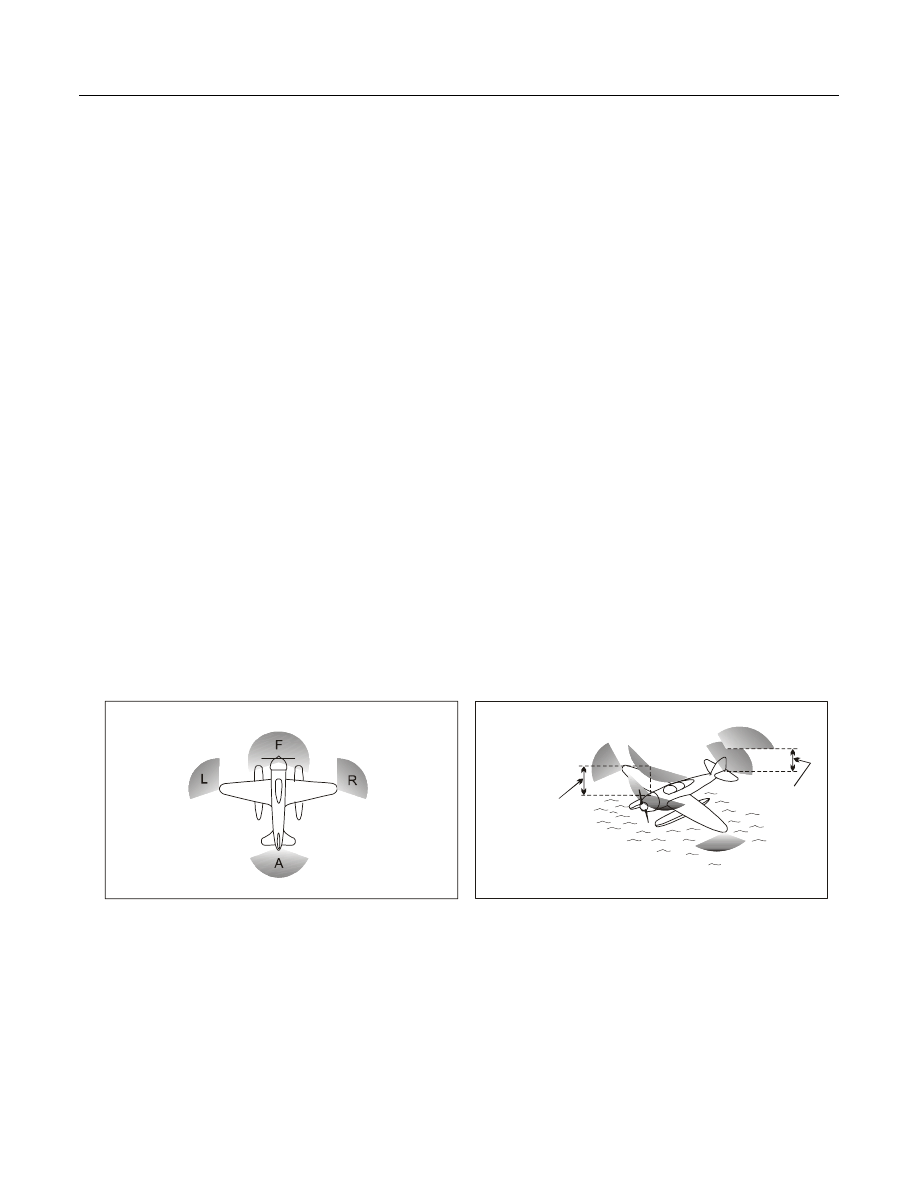
Appendix 2.1
Annex 6 — Operation of Aircraft
APP
2.1-3
18/11/10
3.2 When under way
As illustrated in Figure 2, the following appearing as steady unobstructed lights:
a) a red light projected above and below the horizontal through angle of coverage L;
b) a green light projected above and below the horizontal through angle of coverage R;
c) a white light projected above and below the horizontal through angle of coverage A; and
d) a white light projected through angle of coverage F.
The lights described in a), b) and c) should be visible at a distance of at least 3.7 km (2 NM). The light described in d) should
be visible at a distance of 9.3 km (5 NM) when fitted to an aeroplane of 20 m or more in length or visible at a distance of 5.6
km (3 NM) when fitted to an aeroplane of less than 20 m in length.
3.3 When towing another vessel or aeroplane
As illustrated in Figure 3, the following appearing as steady, unobstructed lights:
a) the lights described in 3.2;
b) a second light having the same characteristics as the light described in 3.2 d) and mounted in a vertical line at least 2
m above or below it; and
c) a yellow light having otherwise the same characteristics as the light described in 3.2 c) and mounted in a vertical line
at least 2 m above it.
3.4 When being towed
The lights described in 3.2 a), b) and c) appearing as steady, unobstructed lights.
110°
110°
220°
Green
Red
140°
White
White
Figure 2
Red
2 metres at least
2 metres at least
Figure 3
110°
White
220°
Green
110°
140°
Yellow
White
220°
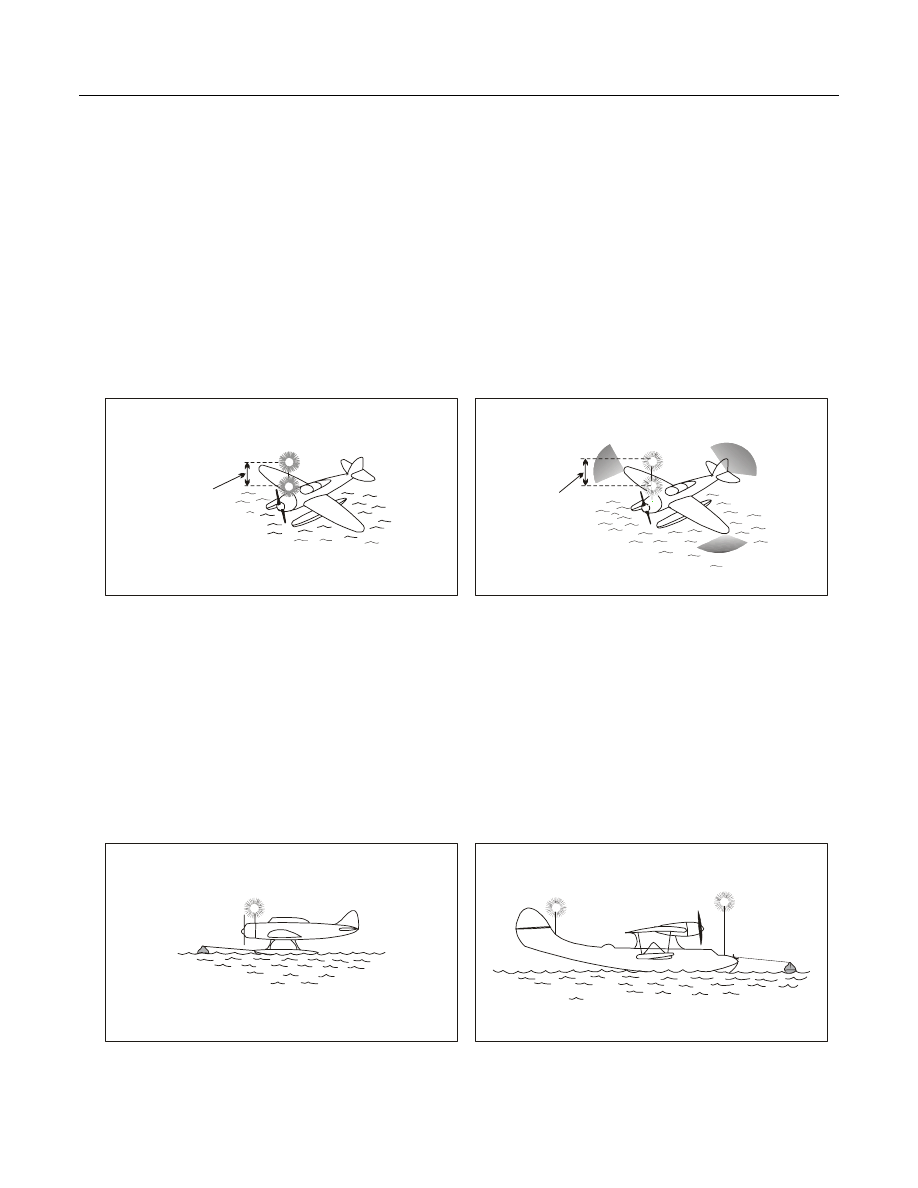
Annex 6 — Operation of Aircraft
Part II
18/11/10 APP
2.1-4
3.5 When not under command and not making way
As illustrated in Figure 4, two steady red lights placed where they can best be seen, one vertically over the other and not less
than 1 m apart, and of such a character as to be visible all around the horizon at a distance of at least 3.7 km (2 NM).
3.6 When making way but not under command
As illustrated in Figure 5, the lights described in 3.5 plus the lights described in 3.2 a), b) and c).
Note.— The display of lights prescribed in 3.5 and 3.6 is to be taken by other aircraft as signals that the aeroplane
showing them is not under command and cannot therefore get out of the way. They are not signals of aeroplanes in distress
and requiring assistance.
3.7 When at anchor
a) If less than 50 m in length, where it can best be seen, a steady white light (Figure 6), visible all around the horizon at
a distance of at least 3.7 km (2 NM).
b) If 50 m or more in length, where they can best be seen, a steady white forward light and a steady white rear light
(Figure 7) both visible all around the horizon at a distance of at least 5.6 km (3 NM).
Red
1 metre at least
Figure 4
Figure 6
Figure 7
Red
Figure 5
110°
Red
Green
110°
140°
White
1 metre at least
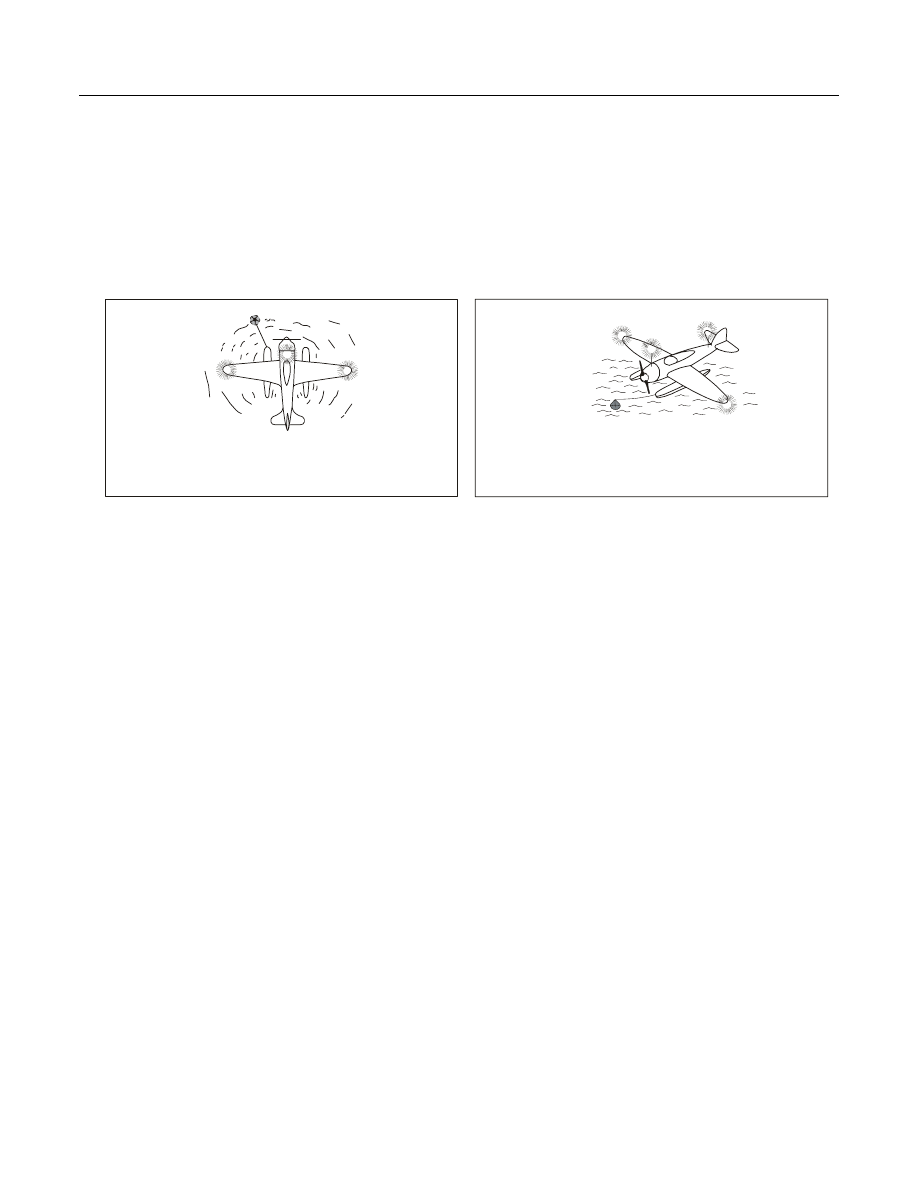
Appendix 2.1
Annex 6 — Operation of Aircraft
APP
2.1-5
18/11/10
c) If 50 m or more in span a steady white light on each side (Figures 8 and 9) to indicate the maximum span and
visible, so far as practicable, all around the horizon at a distance of at least 1.9 km (1 NM).
3.8 When aground
The lights prescribed in 3.7 and in addition two steady red lights in vertical line, at least 1 m apart so placed as to be visible
all around the horizon.
_____________________
Figure 8
Less than 50 metres in length; 50 metres or more in span
Figure 9
50 metres or more in length; 50 metres or more in span


ANNEX 6 — PART II
APP
2.2-1
18/11/10
APPENDIX 2.2 ALTIMETRY SYSTEM PERFORMANCE
REQUIREMENTS FOR OPERATIONS IN RVSM AIRSPACE
(Note.— See 2.5.2.5)
1. In respect of groups of aeroplanes that are nominally of identical design and build with respect to all details that
could influence the accuracy of height-keeping performance, the height-keeping performance capability shall be such that
the total vertical error (TVE) for the group of aeroplanes shall have a mean no greater than 25 m (80 ft) in magnitude and
shall have a standard deviation no greater than 28 – 0.013z
2
for 0 ≤ z ≤ 25 when z is the magnitude of the mean TVE in
metres, or 92 – 0.004z
2
for 0 ≤ z ≤ 80 where z is in feet. In addition, the components of TVE shall have the following
characteristics:
a) the mean altimetry system error (ASE) of the group shall not exceed 25 m (80 ft) in magnitude;
b) the sum of the absolute value of the mean ASE and of three standard deviations of ASE shall not exceed 75 m (245
ft); and
c) the differences between cleared flight level and the indicated pressure altitude actually flown shall be symmetric
about a mean of 0 m, with a standard deviation no greater than 13.3 m (43.7 ft), and in addition, the decrease in the
frequency of differences with increasing difference magnitude shall be at least exponential.
2. In respect of aeroplanes for which the characteristics of the airframe and altimetry system fit are unique and so
cannot be classified as belonging to a group of aeroplanes encompassed by paragraph 1, the height-keeping performance
capability shall be such that the components of the TVE of the aeroplane have the following characteristics:
a) the ASE of the aeroplane shall not exceed 60 m (200 ft) in magnitude under all flight conditions; and
b) the differences between the cleared flight level and the indicated pressure altitude actually flown shall be symmetric
about a mean of 0 m, with a standard deviation no greater than 13.3 m (43.7 ft), and in addition, the decrease in the
frequency of differences with increasing difference magnitude shall be at least exponential.
_____________________


ANNEX 6 — PART II
APP
2.3-1
18/11/10
15/11/12
No. 31
APPENDIX 2.3 FLIGHT RECORDERS
(Note.— See Chapter 2.4, 2.4.16)
The material in this Appendix concerns flight recorders intended for installation in aeroplanes engaged in international air
navigation. Crash protected flight recorders comprise one or more of the following systems: a flight data recorder (FDR), a
cockpit voice recorder (CVR), an airborne image recorder (AIR) and/or a data link recorder (DLR). Lightweight flight
recorders comprise one or more of the following systems: an aircraft data recording system (ADRS), a cockpit audio
recording system (CARS), an airborne image recording system (AIRS) and/or a data link recording system (DLRS).
1. General requirements
1.1 The flight recorder systems containers shall:
a) be painted a distinctive orange or yellow colour;
b) carry reflective material to facilitate their location; and
c) have securely attached an automatically activated underwater locating device.
1.2 The flight recorder systems shall be installed so that:
a) the probability of damage to the recordings is minimized;
b) they receive electrical power from a bus that provides the maximum reliability for operation of the flight recorder
systems without jeopardizing service to essential or emergency loads;
c) there is an aural or visual means for pre-flight checking that the flight recorder systems are operating properly; and
d) if the flight recorder systems have a bulk erasure device, the installation shall be designed to prevent operation of the
device during flight time or crash impact.
1.3 The flight recorder systems, when tested by methods approved by the appropriate certificating authority, shall be
demonstrated to be suitable for the environmental extremes over which they are designed to operate.
1.4 Means shall be provided for an accurate time correlation between the recorder systems recordings.
1.5 The manufacturer shall provide the appropriate certificating authority with the following information in respect of
the flight recorder systems:
a) manufacturer’s operating instructions, equipment limitations and installation procedures; and
b) manufacturer’s test reports.

Annex 6 — Operation of Aircraft
Part II
18/11/10 APP
2.3-2
15/11/12
No. 31
2. Flight data recorder (FDR)
2.1 The flight data recorder shall start to record prior to the aeroplane moving under its own power and record
continuously until the termination of the flight when the aeroplane is no longer capable of moving under its own power.
2.2 Parameters to be recorded
2.2.1 Flight data recorders shall be classified as Type I, Type IA and Type II depending upon the number of parameters
to be recorded.
2.2.2 The parameters that satisfy the requirements for FDRs are listed in the paragraphs below. The number of
parameters to be recorded shall depend on aeroplane complexity. The parameters without an asterisk (*) are mandatory
parameters which shall be recorded regardless of aeroplane complexity. In addition, the parameters designated by an asterisk
(*) shall be recorded if an information data source for the parameter is used by aeroplane systems or the flight crew to operate
the aeroplane. However, other parameters may be substituted with due regard to the aeroplane type and the characteristics of
the recording equipment.
2.2.2.1 The following parameters shall satisfy the requirements for flight path and speed:
—
Pressure
altitude
— Indicated airspeed or calibrated airspeed
— Air-ground status and each landing gear air-ground sensor when practicable
— Total or outside air temperature
— Heading (primary flight crew reference)
—
Normal
acceleration
—
Lateral
acceleration
— Longitudinal acceleration (body axis)
— Time or relative time count
— Navigation data*: drift angle, wind speed, wind direction, latitude/longitude
—
Groundspeed*
—
Radio
altitude*
2.2.2.2 The following parameters shall satisfy the requirements for attitude:
—
Pitch
attitude
—
Roll
attitude
— Yaw or sideslip angle*
—
Angle
of
attack*
2.2.2.3 The following parameters shall satisfy the requirements for engine power:
— Engine thrust/power: propulsive thrust/power on each engine, cockpit thrust/power lever position
— Thrust reverse status*
— Engine thrust command*
— Engine thrust target*
— Engine bleed valve position*
— Additional engine parameters*: EPR, N
1,
indicated vibration level, N
2,
EGT, TLA, fuel flow, fuel cut-off lever
position, N
3
2.2.2.4 The following parameters shall satisfy the requirements for configuration:
— Pitch trim surface position

Appendix 2.3
Annex 6 — Operation of Aircraft
APP
2.3-3
18/11/10
15/11/12
No. 31
— Flaps*: trailing edge flap position, cockpit control selection
— Slats*: leading edge flap (slat) position, cockpit control selection
— Landing gear*: landing gear, gear selector position
— Yaw trim surface position*
— Roll trim surface position*
— Cockpit trim control input position pitch*
— Cockpit trim control input position roll*
— Cockpit trim control input position yaw*
— Ground spoiler and speed brake*: Ground spoiler position, ground spoiler selection, speed brake position, speed
brake selection
— De-icing and/or anti-icing systems selection*
— Hydraulic pressure (each system)*
— Fuel quantity in CG trim tank*
— AC electrical bus status*
— DC electrical bus status*
— APU bleed valve position*
— Computed centre of gravity*
2.2.2.5 The following parameters shall satisfy the requirements for operation:
—
Warnings
— Primary flight control surface and primary flight control pilot input: pitch axis, roll axis, yaw axis
—
Marker
beacon
passage
— Each navigation receiver frequency selection
— Manual radio transmission keying and CVR/FDR synchronization reference
— Autopilot/autothrottle/AFCS mode and engagement status*
— Selected barometric setting*: pilot, first officer
— Selected altitude (all pilot selectable modes of operation)*
— Selected speed (all pilot selectable modes of operation)*
— Selected Mach (all pilot selectable modes of operation)*
— Selected vertical speed (all pilot selectable modes of operation)*
— Selected heading (all pilot selectable modes of operation)*
— Selected flight path (all pilot selectable modes of operation)*: course/DSTRK, path angle
— Selected decision height*
— EFIS display format*: pilot, first officer
— Multi-function/engine/alerts display format*
— GPWS/TAWS/GCAS status*: selection of terrain display mode including pop-up display status, terrain alerts, both
cautions and warnings, and advisories, on/off switch position
— Low pressure warning*: hydraulic pressure, pneumatic pressure
—
Computer
failure*
— Loss of cabin pressure*
— TCAS/ACAS (traffic alert and collision avoidance system/airborne collision avoidance system)*
—
Ice
detection*
— Engine warning each engine vibration*
— Engine warning each engine over temperature*
— Engine warning each engine oil pressure low*
— Engine warning each engine over speed*
— Wind shear warning*
— Operational stall protection, stick shaker and pusher activation*
— All cockpit flight control input forces*: control wheel, control column, rudder pedal cockpit input forces
— Vertical deviation*: ILS glide path, MLS elevation, GNSS approach path
— Horizontal deviation*: ILS localizer, MLS azimuth, GNSS approach path
— DME 1 and 2 distances*

Annex 6 — Operation of Aircraft
Part II
18/11/10 APP
2.3-4
15/11/12
No. 31
— Primary navigation system reference*: GNSS, INS, VOR/DME, MLS, Loran C, ILS
— Brakes*: left and right brake pressure, left and right brake pedal position
—
Date*
—
Event
marker*
— Head up display in use*
— Para visual display on*
Note 1.— Parameter guidance for range, sampling, accuracy and resolution are as contained in the EUROCAE ED-112
Minimum Operational Performance Specification (MOPS) for Crash Protected Airborne Recorder Systems, or equivalent
documents.
Note 2.— It is not intended that aeroplanes issued with an individual certificate of airworthiness before 1 January 2016
be modified to meet the range, sampling, accuracy or resolution guidance detailed in this Appendix.
2.2.2.6 Type IA FDR. This FDR shall be capable of recording, as appropriate to the aeroplane, at least the 78
parameters in Table A2.3-1.
2.2.2.7 Type I FDR. This FDR shall be capable of recording, as appropriate to the aeroplane, at least the first
32 parameters in Table A2.3-1.
2.2.2.8 Type II FDR. This FDR shall be capable of recording, as appropriate to the aeroplane, at least the first
15 parameters in Table A2.3-1.
2.2.2.9 The parameters that satisfy the recommendations for flight path and speed as displayed to the pilot(s) are listed
below. The parameters without an (*) are mandatory parameters which shall be recorded. In addition, the parameters
designated by an (*) are to be recorded if an information source for the parameter is displayed to the pilot and is practicable
to record:
—
Pressure
altitude
— Indicated airspeed or calibrated airspeed
— Heading (primary flight crew reference)
—
Pitch
attitude
—
Roll
attitude
—
Engine
thrust/power
— Landing gear status*
— Total or outside air temperature*
—
Time*
— Navigation data*: Drift angle, wind speed, wind direction, latitude/longitude
—
Radio
altitude*
2.3 Additional information
2.3.1 A Type IIA FDR, in addition to a 30-minute recording duration, shall retain sufficient information from the
preceding take-off for calibration purposes.
2.3.2 The measurement range, recording interval and accuracy of parameters on installed equipment shall be verified
by methods approved by the appropriate certificating authority.
2.3.3 Documentation concerning parameter allocation, conversion equations, periodic calibration and other
serviceability/maintenance information shall be maintained by the operator/owner. The documentation shall be sufficient to
ensure that accident investigation authorities have the necessary information to read out the data in engineering units.

Appendix 2.3
Annex 6 — Operation of Aircraft
APP
2.3-5
18/11/10
15/11/12
No. 31
3. Cockpit voice recorder (CVR) and cockpit audio recording system (CARS)
3.1 Signals to be recorded
The CVR and CARS shall start to record prior to the aeroplane moving under its own power and record continuously until
the termination of the flight when the aeroplane is no longer capable of moving under its own power. In addition, depending
on the availability of electrical power, the CVR and CARS shall start to record as early as possible during the cockpit checks
prior to engine start at the beginning of the flight until the cockpit checks immediately following engine shutdown at the end
of the flight.
3.1.1 The CVR shall record on four separate channels, or more, at least the following:
a) voice communication transmitted from or received in the aeroplane by radio;
b) aural environment on the flight deck;
c) voice communication of flight crew members on the flight deck using the aeroplane’s interphone system, if
installed;
d) voice or audio signals identifying navigation or approach aids introduced in the headset or speaker; and
e) digital communications with ATS, unless recorded by the FDR.
3.1.2 The CARS shall record on two separate channels, or more, at least the following:
a) voice communication transmitted from or received in the aeroplane by radio;
b) aural environment on the flight deck; and
c) voice communication of flight crew members on the flight deck using the aeroplane’s interphone system, if
installed.
3.1.3 The recorder shall be capable of recording on at least four channels simultaneously except for the recorder in
3.6.3.2.1.3. On a tape-based CVR, to ensure accurate time correlation between channels, the recorder shall record in an
in-line format. If a bi-directional configuration is used, the in-line format and channel allocation shall be retained in both
directions.
3.1.4 The preferred channel allocation shall be as follows:
Channel 1 — co-pilot headphones and live boom microphone
Channel 2 — pilot headphones and live boom microphone
Channel 3 — area microphone
Channel 4 — time reference plus the third and fourth crew members’ headphone and live microphone, if applicable.
Note 1.— Channel 1 is located closest to the base of the recording head.
Note 2.— The preferred channel allocation presumes use of current conventional magnetic tape transport mechanisms
and is specified because the outer edges of the tape have a higher risk of damage than the middle. It is not intended to
preclude use of alternative recording media where such constraints may not apply.

Annex 6 — Operation of Aircraft
Part II
18/11/10 APP
2.3-6
15/11/12
No. 31
4. Airborne image recorder (AIR)
4.1 Classes
4.1.1 A Class A AIR captures the general cockpit area in order to provide data supplemental to conventional flight
recorders.
Note 1.—To respect crew privacy, the cockpit area view may be designed as far as practical to exclude the head and
shoulders of crew members whilst seated in their normal operating position.
Note 2.— There are no provisions for Class A AIRs in this document.
4.1.2 A Class B AIR captures data link message displays.
4.1.3 A Class C AIR captures instruments and control panels.
Note.— A Class C AIR may be considered as a means for recording flight data where it is not practical or is
prohibitively expensive to record on an FDR, or where an FDR is not required.
4.1.4 The AIR must start to record prior to the aeroplane moving under its own power and record continuously until the
termination of the flight when the aeroplane is no longer capable of moving under its own power. In addition, depending on
the availability of electrical power, the AIR must start to record as early as possible during the cockpit checks prior to engine
start at the beginning of the flight until the cockpit checks immediately following engine shutdown at the end of the flight.
5. Data link recorder (DLR)
5.1 Applications to be recorded
5.1.1 Where the aircraft flight path is authorized or controlled through the use of data link messages, all data link
messages, both uplinks (to the aircraft) and downlinks (from the aircraft), shall be recorded on the aircraft. As far as
practicable, the time the messages were displayed to the flight crew and the time of the responses shall be recorded.
Note.— Sufficient information to derive the content of the data link communications message and the time the messages
were displayed to the flight crew is needed to determine an accurate sequence of events on board the aircraft.
5.1.2 Messages applying to the applications listed below shall be recorded. Applications without the asterisk (*) are
mandatory applications which shall be recorded regardless of the system complexity. Applications with an (*) shall be
recorded only as far as is practicable given the architecture of the system.
— Data link initiation capability
— Controller–pilot data link communications
— Data link — flight information services
— Automatic dependent surveillance — contract
— Automatic dependent surveillance — broadcast*
— Aeronautical operational control*
Note.— Descriptions of the applications are contained in Table A2.3-2.

Appendix 2.3
Annex 6 — Operation of Aircraft
APP
2.3-7
18/11/10
15/11/12
No. 31
6. Aircraft data recording systems (ADRS)
6.1 Parameters to be recorded
ADRS shall be capable of recording, as appropriate to the aeroplane, at least the essential (E) parameters in Table A2.3-3.
6.2 Additional information
6.2.1 The measurement range, recording interval and accuracy of parameters on installed equipment is usually verified
by methods approved by the appropriate certificating authority.
6.2.2 Documentation concerning parameter allocation, conversion equations, periodic calibration and other
serviceability/maintenance information shall be maintained by the operator/owner. The documentation shall be sufficient to
ensure that accident investigation authorities have the necessary information to read out the data in engineering units.
7. Inspections of flight recorder systems
7.1 Prior to the first flight of the day, the built-in test features for the flight recorders and flight data acquisition unit
(FDAU), when installed, shall be monitored by manual and/or automatic checks.
7.2 Annual inspections shall be carried out as follows:
a) an analysis of the recorded data from the flight recorders shall ensure that the recorder operates correctly for the
nominal duration of the recording;
b) the analysis of the FDR shall evaluate the quality of the recorded data to determine if the bit error rate (including
those errors introduced by recorder, the acquisition unit, the source of the data on the aeroplane and by the tools
used to extract the data from the recorder) is within acceptable limits and to determine the nature and distribution of
the errors;
c) a complete flight from the FDR shall be examined in engineering units to evaluate the validity of all recorded
parameters. Particular attention shall be given to parameters from sensors dedicated to the FDR. Parameters taken
from the aircraft’s electrical bus system need not be checked if their serviceability can be detected by other aircraft
systems;
d) the readout facility shall have the necessary software to accurately convert the recorded values to engineering units
and to determine the status of discrete signals;
e) an annual examination of the recorded signal on the CVR shall be carried out by replay of the CVR recording. While
installed in the aircraft, the CVR shall record test signals from each aircraft source and from relevant external
sources to ensure that all required signals meet intelligibility standards;
f) where practicable, during the annual examination, a sample of in-flight recordings of the CVR shall be examined for
evidence that the intelligibility of the signal is acceptable; and
g) an annual examination of the recorded images on the AIR shall be carried out by replay of the AIR recording. While
installed in the aircraft, the AIR shall record test images from each aircraft source and from relevant external sources
to ensure that all required images meet recording quality standards.

Annex 6 — Operation of Aircraft
Part II
18/11/10 APP
2.3-8
15/11/12
No. 31
7.3 Flight recorder systems shall be considered unserviceable if there is a significant period of poor quality data,
unintelligible signals, or if one or more of the mandatory parameters is not recorded correctly.
7.4 A report of the annual inspection shall be made available on request to regulatory authorities for monitoring
purposes.
7.5 Calibration of the FDR system:
a) for those parameters which have sensors dedicated only to the FDR and are not checked by other means,
recalibration shall be carried out at least every five years or in accordance with the recommendations of the sensor
manufacturer to determine any discrepancies in the engineering conversion routines for the mandatory parameters,
and to ensure that parameters are being recorded within the calibration tolerances; and
b) when the parameters of altitude and airspeed are provided by sensors that are dedicated to the FDR system, there
shall be a recalibration performed as recommended by the sensor manufacturer, or at least every two years.

Appendix 2.3
Annex 6 — Operation of Aircraft
APP
2.3-9
18/11/10
15/11/12
No. 31
Table A2.3-1 Parameter Guidance for Flight Data Recorders
Serial
number Parameter
Measurement
range
Maximum sampling
and recording
interval
(seconds)
Accuracy limits
(sensor input
compared
to FDR readout)
Recording
resolution
1
Time (UTC when available,
otherwise relative time count or
GPS time sync)
24 hours
4
±0.125% per hour
1 second
2
Pressure altitude
–300 m (–1 000 ft) to maximum
certificated altitude of aircraft
+1 500 m (+5 000 ft)
1
±30 m to ±200 m
(±100 ft to ±700 ft)
1.5 m (5 ft)
3
Indicated airspeed or calibrated
airspeed
95 km/h (50 kt) to max
(Note 1)
to 1.2 V
D
(Note 2)
1 ±5%
±3%
1 kt (0.5 kt
recommended)
4
Heading (primary flight crew
reference)
360° 1
±2°
0.5°
5
Normal acceleration (Note 3)
–3 g to +6 g
0.125
±1% of maximum
range excluding
datum error of ±5%
0.004 g
6
Pitch attitude
±75° or usable range whichever
is greater
0.25 ±2° 0.5°
7 Roll
attitude
±180°
0.25
±2°
0.5°
8
Radio transmission keying
On-off (one discrete)
1
9
Power on each engine (Note 4)
Full range
1 (per engine)
±2%
0.2% of full range
or the resolution
required to operate
the aircraft
10*
Trailing edge flap and cockpit
control selection
Full range or each discrete
position
2
±5% or as pilot’s
indicator
0.5% of full range
or the resolution
required to operate
the aircraft
11*
Leading edge flap and cockpit
control selection
Full range or each discrete
position
2
±5% or as pilot’s
indicator
0.5% of full range
or the resolution
required to operate
the aircraft
12*
Thrust reverser position
Stowed, in transit, and
reverse
1 (per engine)
13*
Ground spoiler/speed brake
selection (selection and
position)
Full range or each discrete
position
1
±2% unless higher
accuracy uniquely
required
0.2% of full range
14
Outside air temperature
Sensor range
2
±2°C
0.3°C
15* Autopilot/auto
throttle/AFCS
mode and engagement status
A suitable combination of
discretes
1
Note.— The preceding 15 parameters satisfy the requirements for a Type II FDR.
16 Longitudinal
acceleration
(Note 3)
±1 g
0.25
±0.015 g excluding
a datum error of
±0.05 g
0.004 g
17
Lateral acceleration (Note 3)
±1 g
0.25
±0.015 g excluding
a datum error of
±0.05 g
0.004 g
o
s
V
o
s
V

Annex 6 — Operation of Aircraft
Part II
18/11/10 APP
2.3-10
15/11/12
No. 31
Serial
number Parameter
Measurement
range
Maximum sampling
and recording
interval
(seconds)
Accuracy limits
(sensor input
compared
to FDR readout)
Recording
resolution
18
Pilot input and/or control
surface position-primary
controls (pitch, roll, yaw)
(Notes 3 and 5)
Full range
0.25
±2° unless higher
accuracy uniquely
required
0.2% of full range
or
as installed
19
Pitch trim position
Full range
1
±3% unless higher
accuracy uniquely
required
0.3% of full range
or
as installed
20*
Radio altitude
–6 m to 750 m
(–20 ft to 2 500 ft)
1
±0.6 m (±2 ft)
or ±3%
whichever is greater
below 150 m
(500 ft) and ±5%
above 150 m
(500 ft)
0.3 m (1 ft) below
150 m (500 ft) 0.3
m (1 ft) + 0.5% of
full range above 150
m
(500 ft)
21*
Vertical beam deviation
(ILS/GPS/GLS glide path MLS
elevation, IRNAV/IAN vertical
deviation)
Signal range
1
±3%
0.3% of full range
22*
Horizontal beam deviation
(ILS/GPS/GLS localizer, MLS
azimuth, IRNAV/IAN lateral
deviation)
Signal range
1
±3%
0.3% of full range
23
Marker beacon passage
Discrete
1
24 Master
warning
Discrete
1
25
Each NAV receiver frequency
selection (Note 6)
Full range
4
As installed
26*
DME 1 and 2 distance (includes
distance to runway threshold
(FLS) and distance to missed
approach point (IRNAV/IAN)
(Notes 6 and 7)
0–370 km (0–200 NM)
4
As installed
1 852 m (1 NM)
27 Air/ground
status
Discrete
1
28* GPWS/TAWS/GCAS
status
(selection of terrain display
mode including pop-up display
status) and (terrain alerts, both
cautions and warnings, and
advisories) and (on/off switch
position)
Discrete 1
29*
Angle of attack
Full range
0.5
As installed
0.3% of full range
30*
Hydraulics, each system (low
pressure)
Discrete
2
0.5% of full range
31* Navigation
data
(latitude/longitude, ground
speed and drift angle) (Note 8)
As installed
1
As installed
32*
Landing gear and gear selector
position
Discrete 4
As
installed
Note.— The preceding 32 parameters satisfy the requirements for a Type I FDR.

Appendix 2.3
Annex 6 — Operation of Aircraft
APP
2.3-11
18/11/10
15/11/12
No. 31
Serial
number Parameter
Measurement
range
Maximum sampling
and recording
interval
(seconds)
Accuracy limits
(sensor input
compared
to FDR readout)
Recording
resolution
33*
Groundspeed
As installed
1
Data should be
obtained from the
most accurate
system
1 kt
34
Brakes (left and right brake
pressure, left and right brake
pedal position)
(Maximum metered brake
range, discretes or full range)
1
± 5%
2% of full range
35* Additional
engine
parameters
(EPR, N
1
, indicated vibration
level, N
2
, EGT, fuel flow, fuel
cut-off lever position, N
3
)
As installed
Each engine each
second
As installed
2% of full range
36*
TCAS/ACAS (traffic alert and
collision avoidance system)
Discretes 1
As
installed
37*
Wind shear warning
Discrete
1
As installed
38*
Selected barometric setting
(pilot, co-pilot)
As installed
64
As installed
0.1 mb (0.01 in-Hg)
39*
Selected altitude (all pilot
selectable modes of operation)
As installed
1
As installed
Sufficient to
determine crew
selection
40*
Selected speed (all pilot
selectable modes of operation)
As installed
1
As installed
Sufficient to
determine crew
selection
41*
Selected Mach (all pilot
selectable modes of operation)
As installed
1
As installed
Sufficient to
determine crew
selection
42*
Selected vertical speed (all pilot
selectable modes of operation)
As installed
1
As installed
Sufficient to
determine crew
selection
43*
Selected heading (all pilot
selectable modes of operation)
As installed
1
As installed
Sufficient to
determine crew
selection
44*
Selected flight path (all pilot
selectable modes of operation)
(course/DSTRK, path angle,
final approach path
(IRNAV/IAN))
1
As installed
As installed
45*
Selected decision height
As installed
64
As installed
Sufficient to
determine crew
selection
46*
EFIS display format (pilot, co-
pilot)
Discrete(s) 4
As
installed
47* Multi-function/engine/alerts
display format
Discrete(s) 4
As
installed
48*
AC electrical bus status
Discrete(s)
4
As installed
49*
DC electrical bus status
Discrete(s)
4
As installed
50*
Engine bleed valve position
Discrete(s) 4
As
installed

Annex 6 — Operation of Aircraft
Part II
18/11/10 APP
2.3-12
15/11/12
No. 31
Serial
number Parameter
Measurement
range
Maximum sampling
and recording
interval
(seconds)
Accuracy limits
(sensor input
compared
to FDR readout)
Recording
resolution
51*
APU bleed valve position
Discrete(s)
4
As installed
52*
Computer failure
Discrete(s)
4
As installed
53*
Engine thrust command
As installed
2
As installed
2% of full range
54*
Engine thrust target
As installed
4
As installed
2% of full range
55*
Computed centre of gravity
As installed
64
As installed
1% of full range
56*
Fuel quantity in CG trim tank
As installed
64
As installed
1% of full range
57*
Head-up display in use
As installed
4
As installed
58*
Para-visual display on/off
As installed
1
As installed
59*
Operational stall protection,
stick shaker and pusher
activation
As installed
1
As installed
60*
Primary navigation system
reference (GNSS, INS,
VOR/DME, MLS, Loran C,
localizer glideslope)
As installed
4
As installed
61*
Ice detection
As installed
4
As installed
62*
Engine warning each engine
vibration
As installed
1
As installed
63*
Engine warning each engine
over temperature
As installed
1
As installed
64*
Engine warning each engine oil
pressure low
As installed
1
As installed
65*
Engine warning each engine
over speed
As installed
1
As installed
66*
Yaw trim surface position
Full range
2
±3% unless higher
accuracy uniquely
required
0.3% of full range
67*
Roll trim surface position
Full range
2
±3% unless higher
accuracy uniquely
required
0.3% of full range
68*
Yaw or sideslip angle
Full Range
1
±5%
0.5°
69*
De-icing and/or anti-icing
systems selection
Discretes 4
70*
Hydraulic pressure (each
system)
Full range
2
±5%
100 psi
71*
Loss of cabin pressure
Discrete
1
72*
Cockpit trim control input
position pitch
Full range
1
±5%
0.2% of full range
or as installed
73*
Cockpit trim control input
position roll
Full range
1
±5%
0.2% of full range
or as installed
74*
Cockpit trim control input
position yaw
Full range
1
±5%
0.2% of full range
or as installed

Appendix 2.3
Annex 6 — Operation of Aircraft
APP
2.3-13
18/11/10
15/11/12
No. 31
Serial
number Parameter
Measurement
range
Maximum sampling
and recording
interval
(seconds)
Accuracy limits
(sensor input
compared
to FDR readout)
Recording
resolution
75
All cockpit flight control input
forces (control wheel, control
column, rudder pedal)
Full range (±311 N (±70 lbf),
±378 N (±85 lbf), ±734 N
(±165 lbf))
1
±5%
0.2% of full range
or as installed
76* Event
marker
Discrete
1
77* Date
365
days
64
78*
ANP or EPE or EPU
As installed
4
As installed
Note.— The preceding 78 parameters satisfy the requirements for a Type IA FDR.
Notes.—
1. stalling speed or minimum steady flight speed in the landing configuration is in Section “Abbreviations and Symbols”.
2. V
D
design diving speed.
3. Refer to Chapter 2.4, 2.4.16.1.2.2, for increased recording requirements.
4. Record sufficient inputs to determine power.
5. For aeroplanes with control systems in which movement of a control surface will back drive the pilot’s control, “or” applies. For aeroplanes with control
systems in which movement of a control surface will not back drive the pilot’s control, “and” applies. In aeroplanes with split surfaces, a suitable
combination of inputs is acceptable in lieu of recording each surface separately.
6. If signal available in digital form.
7. Recording of latitude and longitude from INS or other navigation system is a preferred alternative.
8. If signals readily available.
o
s
V

Annex 6 — Operation of Aircraft
Part II
18/11/10 APP
2.3-14
15/11/12
No. 31
If further recording capacity is available, recording of the following additional information should be considered:
a) operational information from electronic display systems, such as electronic flight instrument systems (EFIS),
electronic centralized aircraft monitor (ECAM) and engine indication and crew alerting system (EICAS). Use the
following order of priority:
1) parameters selected by the flight crew relating to the desired flight path, e.g. barometric pressure setting,
selected altitude, selected airspeed, decision height, and autoflight system engagement and mode indications if
not recorded from another source;
2)
display
system
selection/status, e.g. SECTOR, PLAN, ROSE, NAV, WXR, COMPOSITE, COPY;
3)
warnings
and
alerts;
4) the identity of displayed pages for emergency procedures and checklists;
b) retardation information including brake application for use in the investigation of landing overruns and rejected
take-offs.
Table A2.3-2. Description of Applications for Data Link Recorders
Item No.
Application type
Application description
Recording
content
1
Data link Initiation
This includes any applications used to logon to or initiate data link
service. In FANS-1/A and ATN, these are ATS Facilities Notification
(AFN) and Context Management (CM), respectively.
C
2 Controller/Pilot
Communication
This includes any application used to exchange requests, clearances,
instructions and reports between the flight crew and controllers on the
ground. In FANS-1/A and ATN, this includes the CPDLC application.
It also includes applications used for the exchange of oceanic (OCL)
and departure clearances (DCL) as well as data link delivery of taxi
clearances.
C
3 Addressed
Surveillance
This includes any surveillance application in which the ground sets up
contracts for delivery of surveillance data. In FANS-1/A and ATN,
this includes the Automatic Dependent Surveillance (ADS-C)
application. Where parametric data are reported within the message
they shall be recorded unless data from the same source are recorded
on the FDR.
C
4
Flight Information
This includes any service used for delivery of flight information to
specific aircraft. This includes, for example, D-METAR, D-ATIS,
D-NOTAM and other textual data link services.
C
5 Aircraft
Broadcast
Surveillance
This includes Elementary and Enhanced Surveillance Systems, as well
as ADS-B output data. Where parametric data sent by the aeroplane
are reported within the message they shall be recorded unless data
from the same source are recorded on the FDR.
M *

Appendix 2.3
Annex 6 — Operation of Aircraft
APP
2.3-15
18/11/10
15/11/12
No. 31
Item No.
Application type
Application description
Recording
content
6 Aeronautical
Operational Control
Data
This includes any application transmitting or receiving data used for
AOC purposes (per the ICAO definition of AOC).
M *
Key:
C: Complete
contents
recorded.
M: Information that enables correlation to any associated records stored separately from the aeroplane.
*: Applications that are to be recorded only as far as is practicable given the architecture of the system.
Table A2.3-3. Parameter Guidance for Aircraft Data Recording Systems
N° Parameter
name
Parameter
category
Minimum
recording range
Maximum
recording
interval in
seconds
Minimum
recording
accuracy
Minimum
recording
resolution Remarks
1
Heading (Magnetic or
True)
R*
±180°
1
±2
0.5°
* If not
available,
record rates
2 Pitch
attitude
E*
±90°
0.25
±2°
0.5°
* If not
available,
record rates
3
Roll attitude
E*
±180°
0.25
±2°
0.5°
* If not
available,
record rates
4
Yaw rate
E*
±300°/s
0.25
±1% + drift
of 360°/h
2°/s
* Essential if no
heading
available
5
Pitch rate
E*
±300°/s
0.25
±1% + drift
of 360°/h
2°/s
* Essential if no
pitch attitude
available
6
Roll rate
E*
±300°/s
0.25
±1% + drift
of 360°/h
2°/s
* Essential if no
roll attitude
available
7 Positioning
system:
latitude/longitude
E Latitude:
±90°
Longitude: ±180°
2
(1 if available)
As installed
(0.00015°
recommended)
0.00005°
8 Positioning
system
estimated error
E* Available
range 2
(1 if available)
As installed
As installed
* If available
9 Positioning
system:
altitude
E
–300 m (–1 000 ft)
to maximum
certificated altitude
of aircraft +1 500 m
(5 000 ft)
2
(1 if available)
As installed
(±15 m (±50 ft)
recommended)
1.5 m (5 ft)

Annex 6 — Operation of Aircraft
Part II
18/11/10 APP
2.3-16
15/11/12
No. 31
N° Parameter
name
Parameter
category
Minimum
recording range
Maximum
recording
interval in
seconds
Minimum
recording
accuracy
Minimum
recording
resolution Remarks
10
Positioning system:
time*
E
24 hours
1
±0.5 s
0.1 s
* UTC time
preferred where
available.
11 Positioning
system:
ground speed
E
0–1 000 kt
2
(1 if available)
As installed
(±5 kt
recommended)
1 kt
12 Positioning
system:
channel
E 0–360° 2
(1 if available)
As installed
(±2°
recommended)
0.5°
13
Normal acceleration
E
–3 g to +6 g (*)
0.25
(0.125 if
available)
As installed
(±0.09 g
excluding a
datum error of
±0.45 g
recommended)
0.004 g
14 Longitudinal
acceleration
E
±1 g (*)
0.25
(0.125 if
available)
As installed
(±0.015 g
excluding a
datum error of
±0.05 g
recommended)
0.004 g
15
Lateral acceleration
E
±1 g (*)
0.25
(0.125 if
available)
As installed
(±0.015 g
excluding a
datum error of
±0.05 g
recommended)
0.004 g
16
External static pressure
(or pressure altitude)
R
34.4 mb
(3.44 in-Hg) to
310.2 mb (31.02 in-
Hg) or available
sensor range
1 As
installed
(±1 mb (0.1 in-
Hg) or
±30 m (±100 ft)
to ±210 m
(±700 ft)
recommended)
0.1 mb (0.01 in-
Hg) or 1.5 m
(5 ft)
17
Outside air temperature
(or total air
temperature)
R
–50° to +90°C or
available sensor
range
2 As
installed
(±2°C
recommended)
1°C
18
Indicated air speed
R
As the installed
pilot display
measuring system
or available sensor
range
1 As
installed
(±3%
recommended)
1 kt (0.5 kt
recommended)
19
Engine RPM
R
Full range including
overspeed condition
Each engine
each second
As installed
0.2% of full
range
20
Engine oil pressure
R
Full range
Each engine
each second
As installed
(5% of full
range
recommended)
2% of full
range

Appendix 2.3
Annex 6 — Operation of Aircraft
APP
2.3-17
18/11/10
15/11/12
No. 31
N° Parameter
name
Parameter
category
Minimum
recording range
Maximum
recording
interval in
seconds
Minimum
recording
accuracy
Minimum
recording
resolution Remarks
21
Engine oil temperature
R
Full range
Each engine
each second
As installed
(5% of full
range
recommended)
2% of full
range
22
Fuel flow or pressure
R
Full range
Each engine
each second
As installed
2% of full
range
23
Manifold pressure
R
Full range
Each engine
each second
As installed
0.2% of full
range
24 Engine
thrust/power/torque
parameters required to
determine propulsive
thrust/power*
R
Full range
Each engine
each second
As installed
0.1% of full
range
* Sufficient
parameters e.g.
EPR/N1 or
torque/Np as
appropriate to
the particular
engine shall be
recorded to
determine
power in both
normal and
reverse thrust.
A margin for
possible
overspeed
should be
provided.
25
Engine gas generator
speed (Ng)
R 0–150%
Each
engine
each second
As installed
0.2% of full
range
26
Free power turbine
speed (Nf)
R 0–150%
Each
engine
each second
As installed
0.2% of full
range
27
Coolant temperature
R
Full range
1
As installed
(±5°C
recommended)
1°C
28
Main voltage
R
Full range
Each engine
each second
As installed
1 Volt
29 Cylinder
head
temperature
R
Full range
Each cylinder
each second
As installed
2% of full
range
30
Flaps position
R
Full range or each
discrete position
2 As
installed
0.5°
31
Primary flight control
surface position
R
Full range
0.25
As installed
0.2% of full
range
32
Fuel quantity
R
Full range
4
As installed
1% of full
range
33 Exhaust
gas
temperature
R
Full range
Each engine
each second
As installed
2% of full
range
34
Emergency voltage
R
Full range
Each engine
each second
As installed
1 Volt
35
Trim surface position
R
Full range or each
discrete position
1
As installed
0.3% of full
range

Annex 6 — Operation of Aircraft
Part II
18/11/10 APP
2.3-18
15/11/12
No. 31
N° Parameter
name
Parameter
category
Minimum
recording range
Maximum
recording
interval in
seconds
Minimum
recording
accuracy
Minimum
recording
resolution Remarks
36
Landing gear position
R
Each discrete
position *
Each gear every
two seconds
As installed
* Where
available,
record up-and-
locked and
down-and-
locked position
37 Novel/unique
aircraft
features
R
As required
As required
As required
As required
Key:
E: Essential
parameters
R: Recommended
parameters
______________________

ANNEX 6 — PART II
ATT
2.A-1
18/11/10
ATTACHMENT 2.A CARRIAGE AND USE OF OXYGEN
Supplementary to 2.2.3.8
Introduction
The performance of crew members and the well-being of passengers during flights at such altitudes where a lack of oxygen
might result in impairment of faculties are of major concern. Research conducted in altitude chambers or by exposure to
mountain elevations indicates that human tolerance could be related to the altitude concerned and the exposure time. The
subject is dealt with in detail in the Manual of Civil Aviation Medicine (Doc 8984). In light of the above and to further assist
the pilot-in-command in providing the oxygen supply intended by 2.2.3.8 of this Annex, the following guidelines, which take
into account the requirements already established in Annex 6, Part I, are considered relevant.
1. Oxygen supply
1.1 A flight to be operated at altitudes at which the atmospheric pressure in personnel compartments will be less than
700 hPa should not be commenced unless sufficient stored breathing oxygen is carried to supply:
a) all crew members and at least 10 per cent of the passengers for any period in excess of 30 minutes that the pressure
in compartments occupied by them will be between 700 hPa and 620 hPa; and
b) all crew members and passengers for any period that the atmospheric pressure in compartments occupied by them
will be less than 620 hPa.
1.2 A flight to be operated with a pressurized aeroplane should not be commenced unless a sufficient quantity of stored
breathing oxygen is carried to supply all crew members and passengers, as is appropriate to the circumstances of the flight
being undertaken, in the event of loss of pressurization, for any period that the atmospheric pressure in any compartment
occupied by them would be less than 700 hPa. In addition, when an aeroplane is operated at flight altitudes at which the
atmospheric pressure is less than 376 hPa, or which, if operated at flight altitudes at which the atmospheric pressure is more
than 376 hPa and cannot descend safely within four minutes to a flight altitude at which the atmospheric pressure is equal to
620 hPa, there shall be no less than a 10-minute supply for the occupants of the passenger compartment.
2. Use of oxygen
2.1 All flight crew members, when engaged in performing duties essential to the safe operation of an aeroplane in
flight, should use breathing oxygen continuously whenever the circumstances prevail for which its supply has been indicated
to be necessary in 1.1 or 1.2.
2.2 All flight crew members of pressurized aeroplanes operating above an altitude where the atmospheric pressure is
less than 376 hPa should have available at the flight duty station a quick donning type of mask which will readily supply
oxygen upon demand.
Note.— Approximate altitudes in the Standard Atmosphere corresponding to the values of absolute pressure used in the
text are as follows:

Annex 6 — Operation of Aircraft
Part II
18/11/10 ATT
2.A-2
Absolute pressure
Metres
Feet
700 hPa
620 hPa
376 hPa
3 000
4 000
7 600
10 000
13 000
25 000
_____________________

ANNEX 6 — PART II
SECTION 3
LARGE AND TURBOJET AEROPLANES


ANNEX 6 — PART II
3.1-1
18/11/10
CHAPTER 3.1 APPLICABILITY
3.1.1 The following operations shall be subject to the Standards and Recommended Practices of Section 2, and those of
Section 3:
International general aviation operations with:
a) aeroplanes with a maximum certificated take-off mass exceeding 5 700 kg; or
b) aeroplanes equipped with one or more turbojet engines.
3.1.2 Recommendation.— An operation involving an aeroplane with a seating configuration of more than
9 passenger seats should be conducted in accordance with Section 3.
Note.— The applicability of 3.1 does not preclude a general aviation operator from satisfying the requirements of
Section 3 where it may be to the operator’s advantage.
_____________________


ANNEX 6 — PART II
3.2-1
18/11/10
CHAPTER 3.2 CORPORATE AVIATION OPERATIONS
Recommendation.— A corporate aviation operation involving three or more aircraft that are operated by pilots
employed for the purpose of flying the aircraft should be conducted in accordance with Section 3.
Note.— The term “aircraft” is used to indicate that a corporate aviation operation using a mix of aeroplanes and
helicopters is be subject to this Recommendation as long as at least one aeroplane is involved.
_____________________


ANNEX 6 — PART II
3.3-1
18/11/10
CHAPTER 3.3 GENERAL
3.3.1 Compliance with laws, regulations and procedures
3.3.1.1 An operator shall ensure that all employees know that they must comply with the laws, regulations and
procedures of those States in which operations are conducted.
Note.— Information for pilots on flight procedure parameters and operational procedures is contained in PANS-OPS,
Volume I. Criteria for the construction of visual and instrument flight procedures are contained in PANS-OPS, Volume II.
Obstacle clearance criteria and procedures used in certain States may differ from PANS-OPS, and knowledge of these
differences is important for safety reasons.
3.3.1.2 An operator shall ensure that all pilots are familiar with the laws, regulations and procedures, pertinent to the
performance of their duties, prescribed for the areas to be traversed, the aerodromes to be used and the air navigation
facilities relating thereto. The operator shall ensure that other members of the flight crew are familiar with such of these laws,
regulations and procedures as are pertinent to the performance of their respective duties in the operation of the aeroplane.
3.3.1.3 The pilot-in-command is responsible for operational control. An operator shall describe the operational control
system in the operations manual and identify the roles and responsibilities of those involved with the system.
Note.— The rights and obligations of a State in respect to the operation of aeroplanes registered in that State are not
affected by this provision.
3.3.1.4 An operator shall ensure that the pilot-in-command has available on board the aeroplane all the essential
information concerning the search and rescue services in the area over which the aeroplane will be flown.
Note.— This information may be made available to the pilot by means of the operations manual or such other means as
is considered appropriate.
3.3.1.5 An operator shall ensure that flight crew members demonstrate the ability to speak and understand the language
used for aeronautical radiotelephony communications as specified in Annex 1.
3.3.2 Safety management system
3.3.2.1 An operator shall establish and maintain a safety management system that is appropriate to the size and
complexity of the operation.
3.3.2.2 Recommendation.— The safety management system should as minimum include:
a) a process to identify actual and potential safety hazards and assess the associated risks;
b) a process to develop and implement remedial action necessary to maintain an acceptable level of safety; and

Annex 6 — Operation of Aircraft
Part II
18/11/10 3.3-2
c) provision for continuous monitoring and regular assessment of the appropriateness and effectiveness of safety
management activities.
Note.— Guidance on safety management systems is contained in the Safety Management Manual (SMM) (Doc 9859)
and industry codes of practice.
_____________________

ANNEX 6 — PART II
3.4-1
18/11/10
CHAPTER 3.4 FLIGHT OPERATIONS
3.4.1 Operating facilities
An operator shall ensure that a flight will not be commenced unless it has been ascertained by every reasonable means
available that the ground and/or water facilities including communication facilities and navigation aids available and directly
required on such flight, for the safe operation of the aeroplane, are adequate for the type of operation under which the flight is
to be conducted.
Note.— “Reasonable means” in this Standard is intended to denote the use, at the point of departure, of information
available to the operator either through official information published by the aeronautical information services or readily
obtainable from other sources.
3.4.2 Operational management
3.4.2.1 Operator notification
3.4.2.1.1 If an operator has an operating base in a State other than the State of Registry, the operator shall notify the
State in which the operating base is located.
3.4.2.1.2 Upon notification in accordance with 3.4.2.1.1, safety and security oversight shall be coordinated between the
State in which the operating base is located and the State of Registry.
3.4.2.2 Operations manual
An operator shall provide, for the use and guidance of personnel concerned, an operations manual containing all the
instructions and information necessary for operations personnel to perform their duties. The operations manual shall be
amended or revised as is necessary to ensure that the information contained therein is kept up to date. All such amendments
or revisions shall be issued to all personnel that are required to use this manual.
Note 1.— States may reference accepted and recognized industry codes of practice as the basis for the development of an
operations manual.
Note 2.— Attachment 2.A contains guidance on the organization and content of an operations manual.
3.4.2.3 Operating instructions — general
3.4.2.3.1 An operator shall ensure that all operations personnel are properly instructed in their particular duties and
responsibilities and the relationship of such duties to the operation as a whole.
3.4.2.3.2 Recommendation.— An operator should issue operating instructions and provide information on aeroplane
climb performance to enable the pilot-in-command to determine the climb gradient that can be achieved during the departure
phase for the existing take-off conditions and intended take-off technique. This information should be included in the
operations manual.

Annex 6 — Operation of Aircraft
Part II
18/11/10 3.4-2
3.4.2.4 In-flight simulation of emergency situations
An operator shall ensure that when passengers are being carried, no emergency or abnormal situations shall be simulated.
3.4.2.5 Checklists
Checklists shall be used by flight crews prior to, during and after all phases of operations, and in emergencies, to ensure
compliance with the operating procedures contained in the aircraft operating manual and the aeroplane flight manual or other
documents associated with the certificate of airworthiness and otherwise in the operations manual, are followed. The design
and utilization of checklists shall observe Human Factors principles.
Note.— Guidance material on the application of Human Factors principles can be found in the Human Factors Training
Manual (Doc 9683).
3.4.2.6 Minimum flight altitudes
An operator shall specify, for flights which are to be conducted in accordance with the instrument flight rules, the method of
establishing terrain clearance altitudes.
3.4.2.7 Aerodrome operating minima
An operator shall ensure that no pilot-in-command operates to or from an aerodrome using operating minima lower than
those which may be established for that aerodrome by the State in which it is located, except with the specific approval of
that State.
Note 1.— It is the practice in some States to declare, for flight planning purposes, higher minima for an aerodrome when
nominated as an alternate, than for the same aerodrome when planned as that of intended landing.
Note 2.— The use of head-up displays (HUD) or enhanced vision systems (EVS) may allow operations with lower
visibilities than normally associated with the aerodrome operating minima.
3.4.2.8 Fatigue management programme
An operator shall establish and implement a fatigue management programme that ensures that all operator personnel involved
in the operation and maintenance of aircraft do not carry out their duties when fatigued. The programme shall address flight
and duty times and be included in the operations manual.
3.4.2.9 Passengers
3.4.2.9.1 An operator shall ensure that passengers are made familiar with the location and use of:
a)
seat
belts;
b)
emergency
exits;
c) life jackets, if the carriage of life jackets is prescribed;
d) oxygen dispensing equipment, if the provision of oxygen for the use of passengers is prescribed; and
e) other emergency equipment provided for individual use, including passenger emergency briefing cards.
18/11/10
No. 29

Chapter 3.4
Annex 6 — Operation of Aircraft
3.4-3
18/11/10
3.4.2.9.2 An operator shall ensure that all persons on board are aware of the location and general manner of use of the
principal emergency equipment carried for collective use.
3.4.2.9.3 An operator shall ensure that in an emergency during flight, passengers are instructed in such emergency
action as may be appropriate to the circumstances.
3.4.2.9.4 An operator shall ensure that during take-off and landing and whenever considered necessary, by reason of
turbulence or any emergency occurring during flight, all passengers on board an aeroplane are secured in their seats by means
of the seat belts or harnesses provided.
3.4.3 Flight preparation
3.4.3.1 The operator shall develop procedures to ensure that a flight is not commenced unless:
a) the aeroplane is airworthy, duly registered and that appropriate certificates with respect thereto are aboard the
aeroplane;
b) the instruments and equipment installed in the aeroplane are appropriate, taking into account the expected flight
conditions;
c) any necessary maintenance has been performed in accordance with Chapter 3.8;
d) the mass of the aeroplane and centre of gravity location are such that the flight can be conducted safely, taking into
account the flight conditions expected;
e) any load carried is properly distributed and safely secured; and
f) the aeroplane operating limitations, contained in the flight manual, or its equivalent, will not be exceeded.
3.4.3.2 Recommendation.— The operator should make available sufficient information on climb performance with all
engines operating to enable determination of the climb gradient that can be achieved during the departure phase for the
existing take-off conditions and intended take-off technique.
3.4.3.3 Operational flight planning
An operator shall specify flight planning procedures to provide for the safe conduct of the flight based on considerations of
aeroplane performance, other operating limitations and relevant expected conditions on the route to be followed and at the
aerodromes concerned. These procedures shall be included in the operations manual.
3.4.3.4 Alternate aerodromes
3.4.3.4.1 Take-off alternate aerodrome
3.4.3.4.1.1 A take-off alternate aerodrome shall be selected and specified in the flight plan if the weather conditions at
the aerodrome of departure are at or below the applicable aerodrome operating minima or it would not be possible to return to
the aerodrome of departure for other reasons.
3.4.3.4.1.2 The take-off alternate aerodrome shall be located within the following distance from the aerodrome of
departure:
18/11/10
No. 29

Annex 6 — Operation of Aircraft
Part II
18/11/10 3.4-4
a) aeroplanes having two engines. Not more than a distance equivalent to a flight time of one hour at the single-engine
cruise speed; and
b) aeroplanes having three or more engines. Not more than a distance equivalent to a flight time of two hours at the
one-engine inoperative cruise speed.
3.4.3.4.1.3 For an aerodrome to be selected as a take-off alternate the available information shall indicate that, at the
estimated time of use, the conditions will be at or above the aerodrome operating minima for that operation.
3.4.3.5 Refuelling with passengers on board
3.4.3.5.1 An aeroplane shall not be refuelled when passengers are embarking, on board or disembarking unless it is
properly attended by qualified personnel ready to initiate and direct an evacuation of the aeroplane by the most practical and
expeditious means available.
3.4.3.5.2 When refuelling with passengers embarking, on board or disembarking, two-way communication shall be
maintained by the aeroplane’s intercommunication system or other suitable means between the ground crew supervising the
refuelling and the qualified personnel on board the aeroplane.
Note 1.— The provisions of 3.4.3.5.1 do not necessarily require the deployment of integral aeroplane stairs or the
opening of emergency exits as a prerequisite to refuelling.
Note 2.— Provisions concerning aircraft refuelling are contained in Annex 14, Volume I, and guidance on safe
refuelling practices is contained in the Airport Services Manual (Doc 9137), Parts 1 and 8.
Note 3.— Additional precautions are required when refuelling with fuels other than aviation kerosene or when refuelling
results in a mixture of aviation kerosene with other aviation turbine fuels, or when an open line is used.
3.4.3.6 Oxygen supply
3.4.3.6.1 A flight to be operated at flight altitudes at which the atmospheric pressure in personnel compartments will be
less than 700 hPa shall not be commenced unless sufficient stored breathing oxygen is carried to supply:
a) all crew members and 10 per cent of the passengers for any period in excess of 30 minutes that the pressure in
compartments occupied by them will be between 700 hPa and 620 hPa; and
b) the crew and passengers for any period that the atmospheric pressure in compartments occupied by them will be less
than 620 hPa.
3.4.3.6.2 A flight to be operated with a pressurized aeroplane shall not be commenced unless a sufficient quantity of
stored breathing oxygen is carried to supply all the crew members and passengers, as is appropriate to the circumstances of
the flight being undertaken, in the event of loss of pressurization, for any period that the atmospheric pressure in any
compartment occupied by them would be less than 700 hPa. In addition, when an aeroplane is operated at flight altitudes at
which the atmospheric pressure is less than 376 hPa, or which, if operated at flight altitudes at which the atmospheric
pressure is more than 376 hPa and cannot descend safely within four minutes to a flight altitude at which the atmospheric
pressure is equal to 620 hPa, there shall be no less than a 10-minute supply for the occupants of the passenger compartment.
18/11/10
No. 29

Chapter 3.4
Annex 6 — Operation of Aircraft
3.4-5
18/11/10
3.4.4 In-flight procedures
3.4.4.1 Instrument approaches
Recommendation.— In the aircraft operating manual recommended in 3.6.1.2 an operator should include operating
procedures for conducting instrument approaches.
3.4.4.2 Use of oxygen
3.4.4.2.1 All flight crew members, when engaged in performing duties essential to the safe operation of an aeroplane in
flight, shall use breathing oxygen continuously whenever the circumstances prevail for which its supply has been required in
3.4.3.6.1 or 3.4.3.6.2.
3.4.4.2.2 All flight crew members of pressurized aeroplanes operating above an altitude where the atmospheric
pressure is less than 376 hPa shall have available at the flight duty station a quick-donning type of oxygen mask which will
readily supply oxygen upon demand.
3.4.4.3 Aeroplane operating procedures for noise abatement
3.4.4.3.1 Recommendation.— Aeroplane operating procedures for noise abatement should comply with the
provisions of PANS-OPS (Doc 8168), Volume I.
3.4.4.3.2 Recommendation.— Noise abatement procedures specified by an operator for any one aeroplane type
should be the same for all aerodromes.
Note.— A single procedure may not satisfy requirements at some aerodromes.
3.4.4.4 Aeroplane operating procedures for
rates of climb and descent
Recommendation.— Unless otherwise specified in an air traffic control instruction, to avoid unnecessary airborne
collision avoidance system (ACAS II) resolution advisories in aircraft at or approaching adjacent altitudes or flight levels,
pilots should consider using appropriate procedures to ensure that a rate of climb or descent of less than 8 m/s or 1 500
ft/min (depending on the instrumentation available) is achieved throughout the last 300 m (1 000 ft) of climb or descent to the
assigned altitude or flight level, when made aware of another aircraft at or approaching an adjacent altitude or flight level.
Note.— Material concerning the development of these procedures is contained in PANS-OPS (Doc 8168), Volume I,
Part III, Section 3, Chapter 3.
3.4.5 Duties of pilot-in-command
3.4.5.1 The pilot-in-command shall ensure that the checklists specified in 3.4.2.5 are complied with in detail.
3.4.5.2 The pilot-in-command shall be responsible for notifying the nearest appropriate authority by the quickest available
means of any accident involving the aeroplane, resulting in serious injury or death of any person or substantial damage to the
aeroplane or property. In the event that the pilot-in-command is incapacitated the operator shall take the forgoing action.
18/11/10
No. 29

Annex 6 — Operation of Aircraft
Part II
18/11/10 3.4-6
Note.— A definition of the term “serious injury” is contained in Annex 13.
3.4.5.3 The pilot-in-command shall be responsible for reporting all known or suspected defects in the aeroplane, to the
operator, at the termination of the flight.
3.4.5.4 The pilot-in-command shall be responsible for the journey log book or the general declaration containing the
information listed in 2.8.2.
Note.— By virtue of Resolution A10-36 of the Tenth Session of the Assembly (Caracas, June–July 1956) “the General
Declaration, [described in Annex 9] when prepared so as to contain all the information required by Article 34 [of the
Convention on International Civil Aviation] with respect to the journey log book, may be considered by Contracting States to
be an acceptable form of journey log book”.
3.4.6 Cabin baggage (take-off and landing)
An operator shall specify procedures to ensure that all baggage carried onto an aeroplane and taken into the passenger cabin
is adequately and securely stowed.
_____________________
18/11/10
No. 29

ANNEX 6 — PART II
3.5-1
18/11/10
CHAPTER 3.5 AEROPLANE PERFORMANCE
OPERATING LIMITATIONS
3.5.1 General
Recommendation.— For aeroplanes for which Parts IIIA and IIIB of Annex 8 are not applicable because of the
exemption provided for in Article 41 of the Convention, the State of Registry should ensure that the level of performance
specified in 3.5.2 should be met as far as practicable.
3.5.2 Applicable to aeroplanes certificated in accordance with
Parts IIIA and IIIB of Annex 8
3.5.2.1 The Standards contained in 3.5.2.2 to 3.5.2.9 inclusive are applicable to the aeroplanes to which Parts IIIA and
IIIB of Annex 8 are applicable.
Note.— The Standards of Annex 8 — Airworthiness of Aircraft, Parts IIIA and IIIB, apply to all aeroplanes of over 5 700 kg
maximum certificated take-off mass intended for the carriage of passengers or cargo or mail in international air navigation.
3.5.2.2 An aeroplane shall be operated in compliance with the terms of its certificate of airworthiness and within the
approved operating limitations contained in its flight manual.
3.5.2.3 The State of Registry shall take such precautions as are reasonably possible to ensure that the general level of
safety contemplated by these provisions is maintained under all expected operating conditions, including those not covered
specifically by the provisions of this chapter.
3.5.2.4 A flight shall not be commenced unless the performance information provided in the flight manual indicates
that the Standards of 3.5.2.5 to 3.5.2.9 can be complied with for the flight to be undertaken.
3.5.2.5 In applying the Standards of this chapter, account shall be taken of all factors that significantly affect the
performance of the aeroplane (such as: mass, operating procedures, the pressure altitude appropriate to the elevation of the
aerodrome, temperature, wind, runway gradient and condition of runway, i.e. presence of slush, water and/or ice, for
landplanes, water surface condition for seaplanes). Such factors shall be taken into account directly as operational parameters
or indirectly by means of allowances or margins, which may be provided in the scheduling of performance data or in the
comprehensive and detailed code of performance in accordance with which the aeroplane is being operated.
3.5.2.6 Mass limitations
a) The mass of the aeroplane at the start of take-off shall not exceed the mass at which 3.5.2.7 is complied with, nor the
mass at which 3.5.2.8 and 3.5.2.9 are complied with, allowing for expected reductions in mass as the flight proceeds,
and for such fuel jettisoning as is envisaged in applying 3.5.2.8 and 3.5.2.9 and, in respect of alternate aerodromes,
3.5.2.6 c) and 3.5.2.9.
b) In no case shall the mass at the start of take off exceed the maximum take off mass specified in the flight manual for
the pressure altitude appropriate to the elevation of the aerodrome, and if used as a parameter to determine the
maximum take off mass, any other local atmospheric condition.

Annex 6 — Operation of Aircraft
Part II
18/11/10 3.5-2
c) In no case shall the estimated mass for the expected time of landing at the aerodrome of intended landing and at any
destination alternate aerodrome, exceed the maximum landing mass specified in the flight manual for the pressure
altitude appropriate to the elevation of those aerodromes, and if used as a parameter to determine the maximum
landing mass, any other local atmospheric condition.
d) In no case shall the mass at the start of take-off, or at the expected time of landing at the aerodrome of intended
landing and at any destination alternate aerodrome, exceed the relevant maximum masses at which compliance has
been demonstrated with the applicable noise certification Standards in Annex 16, Volume I, unless otherwise
authorized in exceptional circumstances for a certain aerodrome or a runway where there is no noise disturbance
problem, by the competent authority of the State in which the aerodrome is situated.
3.5.2.7 Take-off. The aeroplane shall be able, in the event of a critical engine failing at any point in the take-off, either
to discontinue the take-off and stop within either the accelerate-stop distance available or the runway available, or to continue
the take-off and clear all obstacles along the flight path by an adequate margin until the aeroplane is in a position to comply
with 3.5.2.8.
Note.— “An adequate margin” referred to in this provision is illustrated by the appropriate examples included in
Attachment C to Annex 6, Part I.
3.5.2.7.1 In determining the length of the runway available, account shall be taken of the loss, if any, of runway length
due to alignment of the aeroplane prior to take-off.
3.5.2.8 En route — one engine inoperative. The aeroplane shall be able, in the event of the critical engine becoming
inoperative at any point along the route or planned diversions therefrom, to continue the flight to an aerodrome at which the
Standard of 3.5.2.9 can be met, without flying below the minimum obstacle clearance altitude at any point.
3.5.2.9 Landing. The aeroplane shall, at the aerodrome of intended landing and at any alternate aerodrome, after
clearing all obstacles in the approach path by a safe margin, be able to land, with assurance that it can come to a stop or, for a
seaplane, to a satisfactorily low speed, within the landing distance available. Allowance shall be made for expected variations
in the approach and landing techniques, if such allowance has not been made in the scheduling of performance data.
_____________________
18/11/10
No. 29

ANNEX 6 — PART II
3.6-1
18/11/10
CHAPTER 3.6 AEROPLANE INSTRUMENTS, EQUIPMENT
AND FLIGHT DOCUMENTS
Note.— Specifications for the provision of aeroplane communication and navigation equipment are contained in
Chapter 3.7.
3.6.1 General
3.6.1.1 Where a master minimum equipment list (MMEL) is established for the aircraft type, the operator shall include
in the operations manual a minimum equipment list (MEL) approved by the State of Registry of the aeroplane which will
enable the pilot-in-command to determine whether a flight may be commenced or continued from any intermediate stop
should any instrument, equipment or systems become inoperative.
Note.— Attachment 3.B contains guidance on the minimum equipment list.
3.6.1.2 Recommendation.— An operator should provide operations staff and flight crew with an aircraft operating
manual, for each aircraft type operated, containing the normal, abnormal and emergency procedures relating to the
operation of the aircraft. The manual should be consistent with the aircraft flight manual and checklists to be used. The
design of the manual should observe Human Factors principles.
Note.— Guidance material on the application of Human Factors principles can be found in the Human Factors Training
Manual (Doc 9683).
3.6.2 Aeroplanes on all flights
3.6.2.1 In addition to the requirements contained in 2.4.2.2, an aeroplane shall be equipped with:
a) accessible and adequate medical supplies appropriate to the number of passengers the aeroplane is authorized to
carry.
b)
Recommendation.— Medical supplies should comprise one or more first-aid kits.
Note.— Guidance on the types, number, location and contents of the medical supplies is given in Attachment B to
Annex 6, Part I.
c) a safety harness for each flight crew seat. The safety harness for each pilot seat shall incorporate a device which will
automatically restrain the occupant’s torso in the event of rapid deceleration;
d)
Recommendation.— The safety harness for each pilot seat should incorporate a device to prevent a suddenly
incapacitated pilot from interfering with the flight controls.
Note.— Safety harness includes shoulder straps and a seat belt which may be used independently.
e) means of ensuring that the following information and instructions are conveyed to passengers:
1) when seat belts are to be fastened;

Annex 6 — Operation of Aircraft
Part II
18/11/10 3.6-2
15/11/12
No. 31
2) when and how oxygen equipment is to be used if the carriage of oxygen is required;
3)
restrictions
on
smoking;
4) location and use of life jackets or equivalent individual flotation devices where their carriage is required;
5) location of emergency equipment; and
6) location and method of opening emergency exits.
3.6.2.2 An aeroplane shall carry:
a) the operations manual prescribed in 3.4.2.2, or those parts of it that pertain to flight operations;
b) the flight manual for the aeroplane, or other documents containing performance data required for the application of
Chapter 3.5 and any other information necessary for the operation of the aeroplane within the terms of its certificate
of airworthiness, unless these data are available in the operations manual; and
c) the checklists to which 3.4.2.5 refers.
3.6.3 Flight recorders
3.6.3.1 Flight data recorders
3.6.3.1.1 Operation
3.6.3.1.1.1 All aeroplanes of a maximum certificated take-off mass of over 5 700 kg for which the individual certificate
of airworthiness is first issued on or after 1 January 2005 shall be equipped with a Type IA FDR.
3.6.3.1.1.2 All aeroplanes of a maximum certificated take-off mass of over 27 000 kg for which the individual
certificate of airworthiness is first issued on or after 1 January 1989 shall be equipped with a Type I FDR.
3.6.3.1.1.3 Recommendation.— All aeroplanes of a maximum certificated take-off mass of over 5 700 kg, up to and
including 27 000 kg, for which the individual certificate of airworthiness is first issued on or after 1 January 1989, should be
equipped with a Type II FDR.
3.6.3.2 Cockpit voice recorders
3.6.3.2.1 Operation
3.6.3.2.1.1 All turbine-engined aeroplanes of a maximum certificated take-off mass of over 5 700 kg for which the
application for type certification is submitted to a Contracting State on or after 1 January 2016 and required to be operated by
more than one pilot shall be equipped with a CVR.
3.6.3.2.1.2 All aeroplanes of a maximum certificated take-off mass of over 27 000 kg for which the individual
certificate of airworthiness is first issued on or after 1 January 1987 shall be equipped with a CVR.
3.6.3.2.1.3 Recommendation.— All aeroplanes of a maximum certificated take-off mass of over 5 700 kg, up to and
including 27 000 kg, for which the individual certificate of airworthiness is first issued on or after 1 January 1987, should be
equipped with a CVR.

Chapter 3.6
Annex 6 — Operation of Aircraft
3.6-3
18/11/10
15/11/12
No. 31
3.6.3.3 Combination recorders
Recommendation.— All aeroplanes of a maximum certificated take-off mass over 5 700 kg, required to be equipped
with an FDR and a CVR, may alternatively be equipped with two combination recorders (FDR/CVR).
3.6.3.4 Aeroplanes on long-range over-water flights
3.6.3.4.1 The operator of an aeroplane operated on an extended flight over water shall determine the risks to survival of
the occupants of the aeroplane in the event of a ditching. The operator shall take into account the operating environment and
conditions such as, but not limited to, sea state and sea and air temperatures, the distance from land suitable for making an
emergency landing, and the availability of search and rescue facilities. Based upon the assessment of these risks, the operator
shall, in addition to the equipment required in 2.4.4.3, ensure that the aeroplane is appropriately equipped with:
a) life-saving rafts in sufficient numbers to carry all persons on board, stowed so as to facilitate their ready use in
emergency, provided with such lifesaving equipment, including means of sustaining life, as is appropriate to the
flight to be undertaken; and
b) equipment for making the distress signals described in Annex 2.
3.6.3.4.2 Each life jacket and equivalent individual flotation device, when carried in accordance with 2.4.4.3, shall be
equipped with a means of electric illumination for the purpose of facilitating the location of persons, except where the
requirement of 2.4.4.3.1 is met by the provision of individual flotation devices other than life jackets.
3.6.3.5 Aeroplanes for which the individual certificate of airworthiness
was first issued before 1 January 1990
3.6.3.5.1 Pressurized aeroplanes intended to be operated at flight altitudes at which the atmospheric pressure is less
than 376 hPa shall be equipped with a device to provide positive warning to the flight crew of any dangerous loss of
pressurization.
3.6.3.5.2 An aeroplane intended to be operated at flight altitudes at which the atmospheric pressure is less than 700 hPa
in personnel compartments shall be equipped with oxygen storage and dispensing apparatus capable of storing and dispensing
the oxygen supplies required in 3.4.3.6.1.
3.6.3.5.3 An aeroplane intended to be operated at flight altitudes at which the atmospheric pressure is less than 700 hPa
but which is provided with means of maintaining pressures greater than 700 hPa in personnel compartments shall be provided
with oxygen storage and dispensing apparatus capable of storing and dispensing the oxygen supplies required in 3.4.3.6.2.
3.6.4 Aeroplanes in icing conditions
Aeroplanes shall be equipped with suitable de-icing and/or anti-icing devices when operated in circumstances in which icing
conditions are reported to exist or are expected to be encountered.

Annex 6 — Operation of Aircraft
Part II
18/11/10 3.6-4
15/11/12
No. 31
3.6.5 Aeroplanes operated in accordance with
the instrument flight rules
3.6.5.1 In addition to the requirements contained in 2.4.7, aeroplanes when operated in accordance with the instrument
flight rules, or when the aeroplane cannot be maintained in a desired attitude without reference to one or more flight
instruments, shall be equipped with two independent altitude measuring and display systems.
3.6.5.2 Aeroplanes over 5 700 kg — Emergency power supply for
electrically operated attitude indicating instruments
3.6.5.2.1 Aeroplanes of a maximum certificated take-off mass of over 5 700 kg newly introduced into service after
1 January 1975 shall be fitted with an emergency power supply, independent of the main electrical generating system, for the
purpose of operating and illuminating, for a minimum period of 30 minutes, an attitude indicating instrument (artificial
horizon), clearly visible to the pilot-in-command. The emergency power supply shall be automatically operative after the
total failure of the main electrical generating system and clear indication shall be given on the instrument panel that the
attitude indicator(s) is being operated by emergency power.
3.6.5.2.2 Recommendation.— Aircraft with advanced cockpit automation systems (glass cockpits) should have system
redundancy that provides the flight crew with attitude, heading, airspeed and altitude indications in case of failure of the
primary system or display.
3.6.5.2.3 Instruments that are used by any one pilot shall be so arranged as to permit the pilot to see their indications
readily from his or her station, with the minimum practicable deviation from the position and line of vision normally assumed
when looking forward along the flight path.
3.6.6 Pressurized aeroplanes when carrying passengers —
weather-detecting equipment
Pressurized aeroplanes when carrying passengers shall be equipped with operative weather-detecting equipment capable of
detecting thunderstorms whenever such aeroplanes are being operated in areas where such conditions may be expected to
exist along the route either at night or under instrument meteorological conditions.
3.6.7 Aeroplanes operated above 15 000 m (49 000 ft) —
radiation indicator
Recommendation.—
Aeroplanes intended to be primarily operated above 15 000 m (49 000 ft) should carry equipment
to measure and indicate continuously the dose rate of total cosmic radiation being received (i.e. the total of ionizing and
neutron radiation of galactic and solar origin) and the cumulative dose on each flight. The display unit of the equipment
shall be readily visible to a flight crew member.
Note.— The equipment is calibrated on the basis of assumptions acceptable to the appropriate national authorities.
3.6.8 Aeroplanes required to be equipped with
ground proximity warning systems (GPWS)
All aeroplanes shall be equipped in accordance with 2.4.11.

Chapter 3.6
Annex 6 — Operation of Aircraft
3.6-5
18/11/10
15/11/12
No. 31
3.6.9 Aeroplanes carrying passengers — cabin crew seats
3.6.9.1 Aeroplanes for which the individual certificate of airworthiness
is first issued on or after 1 January 1981
Aeroplanes shall be equipped with a forward or rearward facing seat (within 15 degrees of the longitudinal axis of the
aeroplane), fitted with a safety harness for the use of each cabin crew member required to satisfy the intent of 3.12.1 in
respect of emergency evacuation.
3.6.9.2 Aeroplanes for which the individual certificate of airworthiness
was first issued before 1 January 1981
3.6.9.2.1 Recommendation.— Aeroplanes should be equipped with a forward or rearward facing seat (within 15
degrees of the longitudinal axis of the aeroplane), fitted with a safety harness for the use of each cabin crew member required to
satisfy the intent of 3.12.1 in respect of emergency evacuation.
Note.— Safety harness includes shoulder straps and a seat belt which may be used independently.
3.6.9.2.2 Cabin crew seats provided in accordance with 3.6.9.1 or 3.6.9.2.1 shall be located near floor level and other
emergency exits as required by the State of Registry for emergency evacuation.
3.6.10 Aeroplanes required to be equipped with
an airborne collision avoidance system (ACAS)
3.6.10.1 Recommendation.— All turbine-engined aeroplanes of a maximum certificated take-off mass in excess of
15 000 kg, or authorized to carry more than 30 passengers, for which the individual airworthiness certificate is first issued
after 24 November 2005, should be equipped with an airborne collision avoidance system (ACAS II).
3.6.10.2 All turbine-engined aeroplanes of a maximum certificated take-off mass in excess of 15 000 kg or authorized
to carry more than 30 passengers, for which the individual airworthiness certificate is first issued after 1 January 2007, shall
be equipped with an airborne collision avoidance system (ACAS II).
3.6.10.3 Recommendation.— All turbine-engined aeroplanes of a maximum certificated take-off mass in excess of
5 700 kg but not exceeding 15 000 kg, or authorized to carry more than 19 passengers, for which the individual
airworthiness certificate is first issued after 1 January 2008, should be equipped with an airborne collision avoidance system
(ACAS II).
3.6.11 Aeroplanes required to be equipped with
a pressure-altitude reporting transponder
Aeroplanes shall be equipped with a pressure-altitude reporting transponder which operates in accordance with the relevant
provisions of Annex 10, Volume IV.
Note.— This provision is intended to improve the effectiveness of air traffic services as well as airborne collision
avoidance systems.

Annex 6 — Operation of Aircraft
Part II
18/11/10 3.6-6
15/11/12
No. 31
3.6.12 Microphones
All flight crew members required to be on flight deck duty shall communicate through boom or throat microphones below the
transition level/altitude.
_____________________

ANNEX 6 — PART II
3.7-1
18/11/10
CHAPTER 3.7 AEROPLANE COMMUNICATION AND
NAVIGATION EQUIPMENT
3.7.1 Communication equipment
In addition to the requirements of 2.5.1.1 to 2.5.1.5, an aeroplane shall be provided with radio communication equipment
capable of:
a) conducting two-way communication for aerodrome control purposes;
b)
receiving
meteorological information at any time during flight; and
c) conducting two-way communication at any time during flight with at least one aeronautical station and with such
other aeronautical stations and on such frequencies as may be prescribed by the appropriate authority.
Note.— The requirements of 3.7.1 are considered fulfilled if the ability to conduct the communications specified therein
is established during radio propagation conditions which are normal for the route.
3.7.2 Installation
The equipment installation shall be such that the failure of any single unit required for either communications or navigation
purposes or both will not result in the failure of another unit required for communications or navigation purposes.
3.7.3 Electronic navigation data management
3.7.3.1 An operator of an aeroplane shall not employ electronic navigation data products that have been processed for
application in the air and on the ground unless the State of Registry has approved the operator’s procedures for ensuring that
the process applied and the products delivered have met acceptable standards of integrity and that the products are compatible
with the intended function of the equipment that will use them. The State of Registry shall ensure that the operator continues
to monitor both process and products.
Note.— Guidance relating to the processes that data suppliers may follow is contained in RTCA DO-200A/EUROCAE
ED-76 and RTCA DO-201A/EUROCAE ED-77.
3.7.3.2 An operator shall implement procedures that ensure the timely distribution and insertion of current and
unaltered electronic navigation data to all aeroplanes that require it.
_____________________


ANNEX 6 — PART II
3.8-1
18/11/10
CHAPTER 3.8 AEROPLANE MAINTENANCE
3.8.1 Operator’s maintenance responsibilities
3.8.1.1 An operator shall comply with the requirements of 2.6.1.
3.8.1.2 Recommendation.— An operator should ensure that all maintenance personnel receive initial and
continuation training acceptable to the State of Registry and appropriate to their assigned tasks and responsibilities. This
should include Human Factors and coordination with other maintenance personnel and flight crew.
Note.— Guidance material on the application of Human Factors principles can be found in the Human Factors Training
Manual (Doc 9683).
3.8.2 Operator’s maintenance control manual
Recommendation.— An operator should provide a maintenance control manual, as specified in 3.11.1, for the use and
guidance of maintenance and operations personnel.
Note.— States may provide guidance material as outlined in 3.11.2 or reference accepted industry codes of practice.
3.8.3 Maintenance programme
3.8.3.1 An operator shall provide, for the use and guidance of maintenance and operational personnel concerned, a
maintenance programme, acceptable to the State of Registry, containing the information required by 3.11.2. The design and
application of the operator’s maintenance programme shall observe Human Factors principles according to the State of
Registry’s guidance material.
Note.— Guidance material on the application of Human Factors principles can be found in the Human Factors Training
Manual (Doc 9683).
3.8.3.2 Copies of all amendments to the maintenance programme shall be furnished promptly to all organizations or
persons to whom the maintenance programme has been issued.
3.8.4 Continuing airworthiness information
An operator of an aeroplane of a maximum certificated take-off mass in excess of 5 700 kg shall, as prescribed by the State of
Registry, ensure that the information resulting from maintenance and operational experience with respect to continuing
airworthiness, is transmitted as required by Annex 8, Part II, 4.2.3 f) and 4.2.4.
3.8.5 Maintenance release
3.8.5.1 A maintenance release shall be completed and signed, as prescribed by the State of Registry, to certify that the
maintenance work has been performed in accordance with the maintenance programme or other data and procedures
acceptable to the State of Registry.

Annex 6 — Operation of Aircraft
Part II
18/11/10 3.8-2
3.8.5.2 A maintenance release shall contain a certification including:
a) basic details of the maintenance performed;
b) the date such maintenance was completed;
c) when applicable, the identity of the approved maintenance organization; and
d) the identity of the person or persons signing the release.
_____________________

ANNEX 6 — PART II
3.9-1
18/11/10
CHAPTER 3.9 AEROPLANE FLIGHT CREW
3.9.1 Composition of the flight crew
3.9.1.1 Designation of pilot-in-command
For each flight the operator shall designate a pilot to act as pilot-in-command.
3.9.1.2 Flight engineer
When a separate flight engineer’s station is incorporated in the design of an aeroplane, the flight crew shall include at least
one flight engineer especially assigned to that station, unless the duties associated with that station can be satisfactorily
performed by another flight crew member, holding a flight engineer licence, without interference with regular duties.
3.9.2 Flight crew member emergency duties
An operator shall, for each type of aeroplane, assign to all flight crew members the necessary functions they are to perform in
an emergency or in a situation requiring emergency evacuation. Recurrent training in accomplishing these functions shall be
contained in the operator’s training programme and shall include instruction in the use of all emergency and life-saving
equipment required to be carried, and drills in the emergency evacuation of the aeroplane.
3.9.3 Flight crew member training programmes
3.9.3.1 An operator shall establish and maintain a training programme that is designed to ensure that a person who
receives training acquires and maintains the competency to perform assigned duties, including skills related to human
performance. Ground and flight training programmes shall be established, either through internal programmes or through a
training services provider, and shall include or make reference to a syllabus for those training programmes in the company
operations manual. The training programme shall include training to competency for all equipment installed.
3.9.3.2 Recommendation.— Flight simulators should be used to the maximum extent practicable for initial and
annual recurrent training.
3.9.4 Qualifications
3.9.4.1 Flight crew member licensing
3.9.4.1.1 An operator shall:
a) ensure that each flight crew member assigned to duty holds a valid licence issued by the State of Registry, or if
issued by another Contracting State, rendered valid by the State of Registry;

Annex 6 — Operation of Aircraft
Part II
18/11/10 3.9-2
b) ensure that flight crew members are properly rated; and
c) be satisfied that flight crew members are competent to carry out assigned duties.
3.9.4.1.2 The operator of an aeroplane equipped with an airborne collision avoidance system (ACAS II) shall ensure
that each flight crew member has been appropriately trained to competency in the use of ACAS II equipment and the
avoidance of collisions.
Note 1.— Procedures for the use of ACAS II equipment are specified in the Procedures for Air Navigation Services —
Aircraft Operations (PANS-OPS, Doc 8168), Volume I — Flight Procedures. ACAS II Training Guidelines for Pilots are
provided in PANS-OPS, Volume I, Attachment to Part III, Section 3, Chapter 3.
Note
2.— Appropriate training, to the satisfaction of the State, to competency in the use of ACAS II equipment and the
avoidance of collisions may be evidenced, for example, by:
a) possession of a type rating for an aeroplane equipped with ACAS II, where the operation and use of ACAS II are
included in the training syllabus for the type rating; or
b) possession of a document issued by a training organization or person approved by the State to conduct training for
pilots in the use of ACAS II, indicating that the holder has been trained in accordance with the guidelines referred to
in Note 1; or
c) a comprehensive pre-flight briefing by a pilot who has been trained in the use of ACAS II in accordance with the
guidelines referred to in Note 1.
3.9.4.2 Recent experience — pilot-in-command
An operator shall not assign a pilot to act as pilot-in-command of an aeroplane unless that pilot has made at least three take-
offs and landings within the preceding 90 days on the same type of aeroplane or in a flight simulator approved for the
purpose.
3.9.4.3 Recent experience — co-pilot
An operator shall not assign a co-pilot to operate at the flight controls of an aeroplane during take-off and landing unless that
pilot has made at least three take-offs and landings within the preceding 90 days on the same type of aeroplane or in a flight
simulator approved for the purpose.
3.9.4.4 Pilot proficiency checks
An operator shall ensure that piloting technique and the ability to execute emergency procedures is checked periodically in
such a way as to demonstrate the pilot’s competence. Where the operation may be conducted under the instrument flight rules,
an operator shall ensure that the pilot’s competence to comply with such rules is demonstrated to either a check pilot of the
operator or a representative of the State issuing the pilot licence.
Note.— The periodicity of the checks referred to in 3.9.4.4 is dependent upon the complexity of both the aeroplane and
the operation.
_____________________

ANNEX 6 — PART II
3.10-1
18/11/10
CHAPTER 3.10 FLIGHT OPERATIONS
OFFICER/FLIGHT DISPATCHER
Recommendation.— An operator should ensure that any person assigned as a flight operations officer/flight dispatcher
is trained and maintains familiarization with all features of the operation which are pertinent to their duties, including
knowledge and skills related to Human Factors.
_____________________


ANNEX 6 — PART II
3.11-1
18/11/10
CHAPTER 3.11 MANUALS, LOGS AND RECORDS
Note.— The following document is associated with this Annex but is not included in this chapter:
Operational flight plan — see 3.4.3.3.
3.11.1 Operator’s maintenance control manual
Recommendation.— An operator’s maintenance control manual provided in accordance with 3.8.2, which may be
issued in separate parts, should be developed according to industry codes of practice or to the State of Registry’s guidance
material, and should at a minimum contain information about:
a) the means for complying with the procedures required by 3.8.1.1;
b) the means of recording the names and duties of the person or persons required by 3.8.1.1;
c) the maintenance programme required by 3.8.3.1;
d) the methods used for the completion and retention of the operator’s maintenance records required by 3.8.5;
e) the procedures for complying with the service information reporting requirements of Annex 8, Part II, 4.2.3 f)
and 4.2.4;
f) the procedures for implementing action resulting from mandatory continuing airworthiness information;
g) a system of analysis and continued monitoring of the performance and efficiency of the maintenance programme, in
order to correct any deficiency in that programme;
h) the aircraft types and models to which the manual applies;
i) the procedures for ensuring that unserviceabilities affecting airworthiness are recorded and rectified; and
j) procedures for advising the State of Registry of significant in-service occurrences.
3.11.2 Maintenance programme
3.11.2.1 A maintenance programme for each aeroplane as required by 3.8.3 shall contain the following information:
a) maintenance tasks and the intervals at which these are to be performed, taking into account the anticipated
utilization of the aeroplane;
b) when applicable, a continuing structural integrity programme;
c) procedures for changing or deviating from a) and b) above as approved by the State of Registry; and

Annex 6 — Operation of Aircraft
Part II
18/11/10 3.11-2
d) when applicable and approved by the State of Registry, condition monitoring and reliability programme descriptions
for aircraft systems, components and engines.
3.11.2.2 Maintenance tasks and intervals that have been specified as mandatory in approval of the type design, or
approved changes to the maintenance programme, shall be identified as such.
3.11.2.3 Recommendation.— The maintenance programme should be based on maintenance programme information
made available by the State of Design or by the organization responsible for the type design, and any additional applicable
experience.
3.11.3 Flight recorder records
The owner of the aeroplane, or in the case where it is leased, the lessee, shall ensure, to the extent possible, in the event the
aeroplane becomes involved in an accident or incident, the preservation of all related flight recorder records and, if necessary,
the associated flight recorders, and their retention in safe custody pending their disposition as determined in accordance with
Annex 13.
_____________________
18/11/10
No. 29

ANNEX 6 — PART II
3.12-1
18/11/10
CHAPTER 3.12 CABIN CREW
3.12.1 Assignment of emergency duties
The requirement for cabin crew for each type of aeroplane shall be determined by the operator, based on seating capacity or
the number of passengers carried, in order to effect a safe and expeditious evacuation of the aeroplane, and the necessary
functions to be performed in an emergency or a situation requiring emergency evacuation. The operator shall assign these
functions for each type of aeroplane.
3.12.2 Cabin crew at emergency evacuation stations
When cabin crew are required by a State authority, each cabin crew member assigned to emergency evacuation duties shall
occupy a seat provided in accordance with 3.6.9 during take-off and landing and whenever the pilot-in-command so directs.
3.12.3 Protection of cabin crew during flight
Each cabin crew member shall be seated with seat belt or, when provided, safety harness fastened during take-off and landing
and whenever the pilot-in-command so directs.
3.12.4 Training
3.12.4.1 An operator shall ensure that a training programme is completed by all persons before being assigned as a
cabin crew member.
3.12.4.2 Recommendation.— An operator should establish and maintain a cabin crew training programme that is
designed to ensure that persons who receive training acquire the competency to perform their assigned duties and includes
or makes reference to a syllabus for the training programme in the company operations manual. The training programme
should include Human Factors training.
Note.— Guidance material on the application of Human Factors principles can be found in the Human Factors Training
Manual (Doc 9683).
_____________________


ANNEX 6 — PART II
3.13-1
18/11/10
CHAPTER 3.13 SECURITY
3.13.1 Security programme
Recommendation.— Each Contracting State should ensure that each entity conducting general aviation operations,
including corporate operator aviation operations, using aircraft with a maximum take-off mass greater than 5 700 kg,
establishes, implements and maintains a written operator security programme that meets the requirements of the national
civil aviation security programme of that State .
Note.— Accepted industry codes of practice may be used as the basis for the development of a written operator security
programme.
_____________________


ANNEX 6 — PART II
ATT
3.A-1
18/11/10
18/11/10
No. 29
ATTACHMENT 3.A COMPANY OPERATIONS MANUAL
Supplementary to 3.4.2.2
The following is the suggested content of a company operations manual. It may be issued in separate parts corresponding to
specific aspects of an operation. It should include the instructions and information necessary to enable the personnel
concerned to perform their duties safely and shall contain at least the following information:
a) table of contents;
b) amendment control page and list of effective pages, unless the entire document is reissued with each amendment and
the document has an effective date on it;
c)
duties,
responsibilities
and succession of management and operating personnel;
d) operator safety management system;
e) operational control system;
f) MEL procedures (where applicable);
g) normal flight operations;
h)
SOPs;
i)
weather
limitations;
j) flight and duty time limitations;
k)
emergency
operations;
l)
accident/incident
considerations;
m) personnel qualifications and training;
n)
record
keeping;
o) a description of the maintenance control system;
p)
security
procedures (where applicable);
q) performance operating limitations;
r) use/protection of FDR/CVR records (where applicable);
s) handling of dangerous goods; and
t) use of head-up displays (HUD)/enhanced vision systems (EVS).
_____________________
18/11/10
No. 29


ANNEX 6 — PART II
ATT
3.B-1
18/11/10
18/11/10
No. 29
ATTACHMENT 3.B MINIMUM EQUIPMENT LIST (MEL)
Supplementary to 3.6.1.1
1. If deviations from the requirements of States in the certification of aircraft were not permitted, an aircraft could not
be flown unless all systems and equipment were operable. Experience has proved that some unserviceability can be accepted
in the short term when the remaining operative systems and equipment provide for continued safe operations.
2. The State should indicate through approval of a minimum equipment list those systems and items of equipment that
may be inoperative for certain flight conditions with the intent that no flight can be conducted with inoperative systems and
equipment other than those specified.
3. A minimum equipment list, approved by the State of the Operator, is therefore necessary for each aircraft, based on
the master minimum equipment list established for the aircraft type by the organization responsible for the type design in
conjunction with the State of Design.
4. The State of the Operator should require the operator to prepare a minimum equipment list designed to allow the
operation of an aircraft with certain systems or equipment inoperative provided an acceptable level of safety is maintained.
5. The minimum equipment list is not intended to provide for operation of the aircraft for an indefinite period with
inoperative systems or equipment. The basic purpose of the minimum equipment list is to permit the safe operation of an
aircraft with inoperative systems or equipment within the framework of a controlled and sound programme of repairs and
parts replacement.
6. Operators are to ensure that no flight is commenced with multiple minimum equipment list items inoperative
without determining that any interrelationship between inoperative systems or components will not result in an unacceptable
degradation in the level of safety and/or undue increase in the flight crew workload.
7. The exposure to additional failures during continued operation with inoperative systems or equipment should also be
considered in determining that an acceptable level of safety is being maintained. The minimum equipment list may not deviate
from requirements of the flight manual limitations section, emergency procedures or other airworthiness requirements of the
State of Registry or of the State of the Operator unless the appropriate airworthiness authority or the flight manual provides
otherwise.
8. Systems or equipment accepted as inoperative for a flight should be placarded where appropriate and all such items
should be noted in the aircraft technical log to inform the flight crew and maintenance personnel of the inoperative system or
equipment.
9. For a particular system or item of equipment to be accepted as inoperative, it may be necessary to establish a
maintenance procedure, for completion prior to flight, to deactivate or isolate the system or equipment. It may similarly be
necessary to prepare an appropriate flight crew operating procedure.
10. The responsibilities of the pilot-in-command in accepting an aeroplane for operation with deficiencies in
accordance with a minimum equipment list are specified in 2.2.3.1.
— END —


ICAO TECHNICAL PUBLICATIONS
The following summary gives the status, and also
describes in general terms the contents of the various
series of technical publications issued by the
International Civil Aviation Organization. It does not
include specialized publications that do not fall
specifically within one of the series, such as the
Aeronautical Chart Catalogue or the Meteorological
Tables for International Air Navigation.
International Standards and Recommended
Practices are adopted by the Council in accordance with
Articles 54, 37 and 90 of the Convention on
International Civil Aviation and are designated, for
convenience, as Annexes to the Convention. The
uniform application by Contracting States of the
specifications contained in the International Standards is
recognized as necessary for the safety or regularity of
international air navigation while the uniform
application of the specifications in the Recommended
Practices is regarded as desirable in the interest of safety,
regularity or efficiency of international air navigation.
Knowledge of any differences between the national
regulations or practices of a State and those established
by an International Standard is essential to the safety or
regularity of international air navigation. In the event of
non-compliance with an International Standard, a State
has, in fact, an obligation, under Article 38 of the
Convention, to notify the Council of any differences.
Knowledge of differences from Recommended Practices
may also be important for the safety of air navigation
and, although the Convention does not impose any
obligation with regard thereto, the Council has invited
Contracting States to notify such differences in addition
to those relating to International Standards.
Procedures for Air Navigation Services (PANS)
are approved by the Council for worldwide application.
They contain, for the most part, operating procedures
regarded as not yet having attained a sufficient degree of
maturity for adoption as International Standards and
Recommended Practices, as well as material of a more
permanent character which is considered too detailed for
incorporation in an Annex, or is susceptible to frequent
amendment, for which the processes of the Convention
would be too cumbersome.
Regional Supplementary Procedures (SUPPS)
have a status similar to that of PANS in that they are
approved by the Council, but only for application in the
respective regions. They are prepared in consolidated
form, since certain of the procedures apply to
overlapping regions or are common to two or more
regions.
_____________________
The following publications are prepared by authority
of the Secretary General in accordance with the
principles and policies approved by the Council.
Technical Manuals provide guidance and
information in amplification of the International
Standards, Recommended Practices and PANS, the
implementation of which they are designed to facilitate.
Air Navigation Plans detail requirements for
facilities and services for international air navigation in
the respective ICAO Air Navigation Regions. They are
prepared on the authority of the Secretary General on
the basis of recommendations of regional air navigation
meetings and of the Council action thereon. The plans
are amended periodically to reflect changes in
requirements and in the status of implementation of the
recommended facilities and services.
ICAO Circulars make available specialized
information of interest to Contracting States. This
includes studies on technical subjects.
_____________________

© ICAO 2008
7/08, E/P1/1525
Order No. AN 6-2
Printed in ICAO
Wyszukiwarka
Podobne podstrony:
ICAO ANNEX 2 RULES OF THE AIR
ICAO ANNEX 11 AIR TRAFFIC SERVICES 1
ICAO ANNEX 10 — AERONAUTICAL TELECOMMUNICATIONS
ICAO Annex 15
ICAO Annex 10 Volume 5
ICAO Annex 13
ICAO Annex 5
ICAO Annex 9
ICAO Annex 12
ICAO Annex 11
ICAO Annex 16 Volume 2
ICAO Annex 19
ICAO Annex 17
ICAO Annex 10 Volume 2
ICAO Annex 18
Eurocode 5 Part 1 2 1995 2004 Design of Timber Structures General Structural Fire Design UK Ann
GbpUsd analysis for July 06 Part 1
~$Production Of Speech Part 2
więcej podobnych podstron