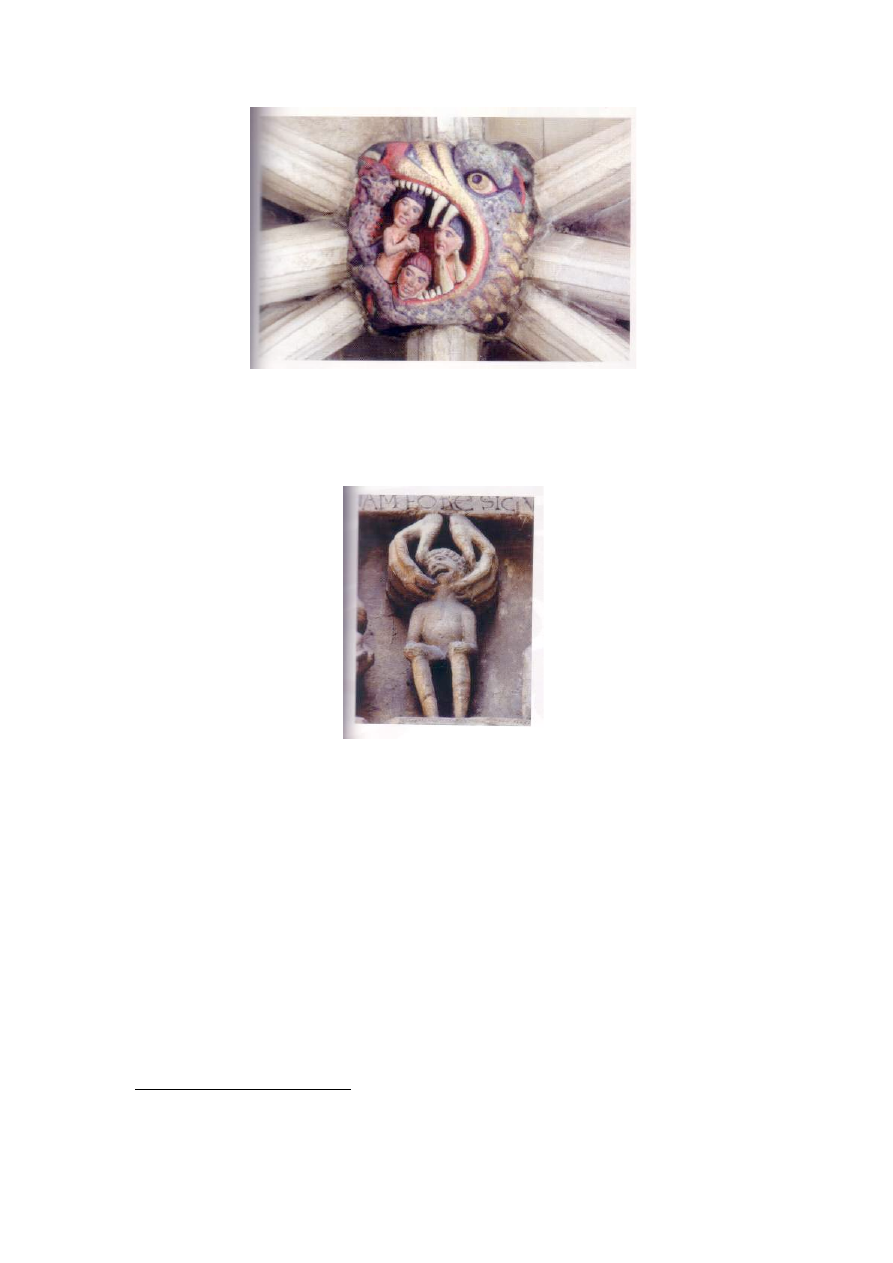
1
T
HE
D
ATING AND
D
ATABILITY OF
B
EOWULF IN AN
H
ISTORICAL AND
E
SCHATOLOGICAL
C
ONTEXT
2
Erica Steiner
Centre for Medieval Studies
University of Sydney
Thesis submitted to fulfill requirements for the degree of Bachelor of Arts (Honours),
University of Sydney, 2008.
1
Roof Boss from Norwich Cathedral, c. 1145; Laura Ward & Will Steeds, Demons: Visions of Evil in
Art; Carlton Books, Ltd., 2007, p. 95.
2
Scene from ‘The Last Judgement’ on the tympanum of the Cathedral of Saint-Lazare, Autun, France,
c. 1130-40; ibid, p. 131.

2
A
CKNOWLEDGEMENTS
:
I am sincerely thankful for the endless patience of both my supervisor, Daniel
Anlezark, and course co-ordinator, John Pryor; the love and support of my parents
Karl and Katarina; and the eyes and ears of Michelle and Vicki, and all of my friends
– without whom this thesis would not have been the work it is.
*
*
*
For all the Old English texts used the source of the Old English was the
Dictionary of Old English Corpus in Electronic Form, (ed.) Antoinette di Paolo
Healey; Centre for Medieval Studies, University of Toronto, 2005; except for Beowulf
which is taken from Beowulf and the Fight at Finnsburg, (ed.) Fr. Klaeber; D.C.
Heath & Co., 3
rd
ed., 1950, and the prose Guthlac, which is taken from Felix, Life of
Saint Guthlac, (trans.) Bertram Colgrave; Cambridge University Press, 1956, and the
poetic Guthlac, which is taken from The Guthlac Poems of the Exeter Book, (ed.) Jane
Roberts; Oxford University Press, Clarendon Press, 1979. All translations from the
Old English, where in single quotation marks, are my own, and where in double
quotation marks, are from Anglo-Saxon Poetry, (trans., ed.) S.A.J. Bradley;
Everyman’s Library, 2004; except for Beowulf, which is taken from Beowulf: A new
verse translation, (trans.) R.M. Liuzza; Broadview Literary Texts, 2000, unless other
wise specified, and the Riddles, taken from The Exeter Book Riddles, (trans.) Kevin
Crossley-Holland; Penguin Books, revised ed., 1993. The dictionary used was An
Anglo-Saxon Dictionary based on the manuscript collections of the late Joseph
Bosworth, (ed.) T. Northcote Toller; Oxford University Press, Clarendon Press, 1898;
http://beowulf.engl.uky.edu/~kiernan/BT/ Bosworth-Toller.htm.
For Old Norse texts, all translations are from the edition cited, and the
dictionary consulted throughout was Richard Cleasby & Gudbrand Vigfusson, An
Icelandic-English Dictionary, http://www.northvegr.org/vigfusson/index.php.
For Latin texts, translations given in single quotation marks are my own, and
in double quotation marks, from the edition cited. The dictionary consulted
throughout was Charlton T. Lewis & Charles Short, A Latin Dictionary; Oxford
University Press, Clarendon Press, 1958.

3
The Modern English dictionary consulted throughout was The Oxford English
Dictionary; http://www.dictionary.oed.com.
Regarding places referred to in England; the etymology was provided by The
Cambridge Dictionary of English Place-Names, Based on the collections of the
English Place-Name Society, (eds.) Victor Watts, John Insley, Margaret Gelling;
Cambridge University Press, 2004; the charters referred to are all taken from Sawyer,
P.H., Anglo-Saxon Charters: An Annotated list and Bibliography; Offices of the
Royal Historical Society, London, 1968, and their contents from the Dictionary of Old
English Corpus in Electronic Form, (ed.) Antoinette di Paolo Healey; Centre for
Medieval Studies, University of Toronto, 2005.

4
T
ABLE OF
C
ONTENTS
:
Acknowledgements:
2
Introduction:
5
Chapter One: The Historical Context of Beowulf:
8
The Date of the Manuscript:
8
Scandinavian Influences:
11
Historical Concordances:
17
Chapter Two: The Religious Context of Beowulf:
22
Datable Aspects of Christianity and Heathenism in Beowulf:
23
Funeral Rites in Beowulf:
30
Chapter Three: The Eschatological Context of Beowulf:
40
The Barrow-Dweller:
43
The Draugar:
48
Removal of the Draugar:
71.
Conclusion:
77
Bibliography:
79
Primary Sources:
79
Secondary Sources:
84

5
I
NTRODUCTION
“The greater the distance between the date of the Beowulf
manuscript...and the posited date of the poem as we have it
now, the heavier the element of hypothesis.”
3
Almost every period of Anglo-Saxon history has been used to provide a
context for the date of the composition of Beowulf; but from the available evidence,
the date of highest probability may be whittled down to two periods: the middle third
of the eighth century and the first third of the tenth. In line with Eric Stanley’s
cautionary reminder, quoted above, Chapter One, will examine the physical evidence
of the manuscript that may help to locate a most likely date of composition for the
poem, which I believe, lies in the abovementioned latter period of the early tenth
century. Secondly, the historical realities of this period being one of close linguistic,
literary, and human relationships between the Scandinavians who had migrated to and
settled in parts of England, and the Anglo-Saxons, will be put forth as the historical
and social context of the poem. In Chapter Two, the religious scenery used in Beowulf
will be placed in the historical context of the transition from heathenism to
Christianity in Anglo-Saxon and Anglo-Scandinavian England. Finally, Chapter
Three will be a case-study of the themes of cross-cultural interaction and borrowing
between Anglo-Saxons and (Anglo)-Scandinavians in an eschatological context
through the identification of a specific type of supernatural being, the barrow-dweller,
who through the influence of Christianity was transformed into a malevolent version
of its former self, the draugr. The barrow-dweller was a human who remained alive,
or was reanimated, within their grave that almost invariably was a barrow; while the
demonised characterisation of the draugr depends on the conception of not just the
barrow-dweller, but also giants, witches, demons and devils. The draugar may be
found in Beowulf, in the figures of Grendel and his mother, while the possibility that
Beowulf was perceived to have become a barrow-dweller will be briefly introduced.
Much of the evidence which may be used to date Beowulf lies outside of the
spatial limitations of this study; and of the majority of that which has been examined,
no more than a brief treatment was possible. Some of the evidence not examined
3
E.G. Stanley, ‘The Date of Beowulf: Some Doubts and No Conclusions’, The Dating of Beowulf, (ed.)
Colin Chase; University of Toronto Press, 1981, p.197.

6
includes the interesting approach of Jennifer Neville, who has looked at the
descriptions of horses in the poem, and shown them to be not in line with standards
of horses in the tenth and eleventh centuries.
4
In Roberta Frank’s study of the
similarities between the genre of the eulogy in Old English and Old Norse, she
concludes that the earliest examples of the former which date from the tenth century
may have been a direct result of the influence of the latter;
5
and Walter Goffart’s
identification of the Hugas, used as a by-name for the Franks in Beowulf, with the
followers and inhabitants of the lands of the Frankish ‘Hughs’,
6
rulers of Neustria
from the later ninth to mid-tenth century, brings him to conclude that “the poem was
written no earlier than in the second quarter of the tenth century...near the year 923
[CE].”
7
Others have noted the choice of the Geatas as the heroic race in the poem, to
point to the reign of Alfred, when an ancestry including the Geatas seemed to be
ideologically important to the West Saxons.
8
The form in which the personal and
tribal names have been preserved in the poem, has usually been taken to show that it
is an early composition,
9
and yet there also exists the strong likelihood that the
original spelling of Beowulf’s name was in fact Biowulf, which would accord with an
Anglo-Scandinavian dialect pronunciation according to Kevin Kiernan.
10
4
This may be explained by the disruptions to the breeding practices and stock over the course of the
Vikings’ depredations across England; or as a genuine unadulterated preservation of pre-ninth, or even
pre-seventh century conditions; or as a depiction of the Scandinavian horse breed akin to the modern
Norwegian Fjord Pony, (especially, p. 139-42, 152-3, and n. 49, the latter which states that c. 930 CE,
horses from this time on were ‘definitely’ unlike that in Beowulf); Jennifer Neville, ‘Hrothgar’s horses:
feral or thoroughbred?’, Anglo-Saxon England, v. 35, 2006, p. 131-57.
5
Robert E. Bjork & Anita Obermeier, ‘Date, Provenance, Author, Audiences’, A Beowulf Handbook,
(eds.) Robert E. Bjork & John D. Niles; University of Exeter Press, 1997, p. 23.
6
Hugh the Abbot, fl. 866-880’s CE, and Hugh the Great, 923-56 CE, the latter also married a sister of
King Æthelstan of Wessex in 926 CE.
7
Walter Goffart, ‘Hetware and Hugas: Datable Anachronisms in Beowulf’, The Dating of Beowulf,
(ed.) Colin Chase; University of Toronto Press, 1981, p. 100.
8
Jane Acomb Leake, The Geats of Beowulf: A Study in the Geographical Mythology of the Middle
Ages; University of Wisconsin Press, 1967, p. 12, is willing to place the writing of Beowulf either
“before the Viking incursions began on a large scale, or after the Danes had been settled in the
Danelaw and the process of assimilation had begun”; Craig R. Davis, ‘An Ethic Dating of Beowulf’,
Anglo-Saxon England, v. 35, 2006, p. 120-5, and John D. Niles, Old English Heroic Poems and the
Social Life of Texts; Brepols, 2007, p. 39-48, both place the generation of the myth of the West Saxons’
heroic ancestry from the Geatas in Alfred’s reign, and the latter also adds that the inclusion of the
character of Wiglaf into the poem must date from after the death of his grandson, Wihstan son of
Wigmund (the name of Wiglaf’s father in Beowulf is Weohstan/Wigstan, son of Wægmund) in the late
ninth century, ibid., p. 38.
9
Bjork & Obermeier, p. 27; there is also Unfer∂, whose name Robert Fulk dates to being a form
preserved from prior to 700 CE, R.D. Fulk, ‘Unferth and his Name’, Modern Philology, v. 85:2. Nov.
1987, p. 121-2.
10
However, it is confined to Scribe B, who has a marked preference for using the -io- spelling, more
than twenty times more likely to use it than Scribe A who prefers the -eo- spelling – this may point to
Scribe B having a preference for an Anglo-Scandinavian dialect; but Judith, also transcribed by Scribe
B contains no such -io- spellings, though this may be due to the large portion of Judith which has been

7
In Kiernan’s controversial study of Beowulf, one of his major points was that
Scribe B was in fact the author of Beowulf as it stands, who melded “two distinct
poems ... combined for the first time in our extant MS.”
11
This long-outdated theory
has been proven to be false, notably by Janet Bately, who has shown that the use of
the conjunction siþþan is consistent in its syntactical positioning to a degree that
cannot warrant multiple authorship of the poem.
12
This thesis hinges on a number of a priori assumptions, about the author and
the audience of Beowulf, and therefore about the text. That there are some, but not a
great number of Nordicisms in the poem, and only two possible Old Norse loan-
words, against the late, ‘classical’ West Saxon of the poem, and the Old English
metre, means Beowulf can only be an Old English product. Christianity is ever-
present in the poem in a subtle way; God is continually praised, invoked and thanked
by the ‘narrator’ and the characters of the poem, and the word god itself is by far the
most common one used of God, occurring in over a third of all the references to God,
as almost frequently as the three next most popular by-names, metod, wealdend and
dryhten put together. Christianity brought Latin literacy to heathen Anglo-Saxon
England, but it did not oust orality;
13
instead the two remained the accepted modes of
information communication along side one another, as the vocabulary of literacy may
indicate,
14
alongside the example of Aldhelm who apparently mastered the art of
composition in both oral and written registers.
15
Thus Beowulf is a product of an
Anglo-Saxon, Christian, elite, well-versed in both the oral and literate modes of their
culture.
lost; Kevin Kiernan, Beowulf and the Beowulf Manuscript; University of Michigan Press, 1996, xxvi;
Peter J. Lucas, ‘The Place of Judith in the Beowulf-Manuscript’, The Review of English Studies, v. 41,
new series, no. 164, 1990, p. 473-4. 9.
11
Kiernan, 1996, p. 171.
12
Janet Bately, ‘Linguistic Evidence as a Guide to the Authorship of Old English Verse: A
Reappraisal, with Special Reference to Beowulf’, Learning and Literature in Anglo-Saxon England,
(ed.) Michael Lapidge & Helmut Gnuess; Cambridge University Press, 1985, p. 421-2, 431.
13
Katherine O’Brien O’Keeffe, Visible Song: Transitional Literacy in Old English Verse; Cambridge
University Press, 1990, p. 9-11. 77.
14
Christine Fell, ‘Introduction to Anglo-Saxon Letters and Letter-Writers’, Lastworda Betst, (eds.)
Carole Hough & Kathryn A. Lowe; Shaun Tyas, 2002, p. 282, 284-6.
15
O’Brien O’Keeffe, p. 8.

8
C
HAPTER
O
NE
:
T
HE
H
ISTORICAL
C
ONTEXT OF
B
EOWULF
In any examination of the origins of Beowulf, the first consideration must be to
construct the broadest possible borders within which it could have been created, and
for this the terminus post quem must be provided by the events, episodes and
characters in Beowulf that can be verified in historical sources outside of the poem.
The other limit for the date of Beowulf, the terminus ante quem, is of course the date
of the manuscript itself, the only copy of which is contained within the early eleventh
century Nowell Codex; a composite manuscript containing three prose texts – an
acephalous Passion of St. Christopher, an illustrated Wonders of the East; and
Alexander’s Letter to Aristotle – and two verse texts – Beowulf and a fragmentary
Judith; itself bound with the unrelated twelfth century Southwell Codex at an
unknown later date into the manuscript B.L. Cotton Vitellius A XV.
THE DATE OF THE MANUSCRIPT:
The Nowell Codex was written in two different handwriting styles that each
offer separate date-ranges for their usage: Scribe A used a variation of early English
Vernacular minuscule, while Scribe B wrote in late Anglo-Saxon Square minuscule.
The latter script had its origins in the early tenth century, which, by the second
quarter, had superseded earlier styles of Insular minuscule, remaining in favour for
roughly fifty years.
16
Imported Caroline minuscule was first used in England for the
transcription of Latin texts from the middle of the tenth century, and by the end of its
last quarter, it had effectively replaced Square minuscule for that purpose, “no
specimen of [which] is datable later than ... after AD 1000”.
17
English Vernacular
minuscule (an Insular script strongly influenced by Caroline minuscule), whose
origins are in the ‘small print’ of the dual-language charters from the last decades of
the tenth century,
18
is conversely found no earlier than the first decade of the eleventh
century.
19
This provides a remarkably slender window of the years around the turn of
16
David N. Dumville, ‘Beowulf come lately: Some Notes on the Paleography of the Nowell Codex’,
Archiv für das Studium der neuren Sprachen und Literaturen, v. 225:1, 1988, p. 51-2.
17
ibid., p. 52-4.
18
ibid., p. 53.
19
ibid., p. 54.

9
the millennium within which the Nowell Codex may be placed. Moreover, the fact
that Scribe B’s portion sequentially and continuously follows Scribe A’s work,
support the conclusion that the Nowell Codex is “a product of the quarter-century
interval [centred on] the turn of the millennium.”
20
The other application of paleography to the dating of Beowulf, recently
championed by Michael Lapidge, examines the type of errors made by the scribes
with a view to postulating the script style of the exemplar. Concentrating on the
confusion of five sets of letter-forms (a/u, r/n, p/þ, c/t and d/ð) Lapidge concludes that
the exemplar was written in a script unfamiliar to the scribes.
21
To one unfamiliar
with Cursive, or Current minuscule, the open ‘a’, was virtually indistinguishable from
an ‘u’ and a confusion between ‘et’ and ‘ec’ ligatures, both point to a cursive style
script;
22
but, since the ‘r’s’ and ‘n’s’ are also confused, the exemplar cannot have
been entirely written in Cursive or Current minuscule.
23
The confusion of the runic þ
with ‘p’ seems to be universal in the copying all Anglo-Saxon scripts.
24
Concerning
the last letter-set, however, Lapidge dates the beginning of the process of the
consistent application of ð “to distinguish the interdental fricative from the aveolar
stop” (‘d’) to the second half of the eighth century, thus dating the Beowulf exemplar
prior to the mid eighth century.
25
Yet it is actually very clear from the examples
chosen for his article that the forms ‘d’ and ð are quite impossible to confuse in
Anglo-Saxon Set minuscule (the script he proposes the exemplar to have been written
in), and thus he fails in his purpose of using ‘literal’ scribal errors to theorise a date
for the exemplar of the Nowell Codex. Furthermore, in his desire to date the
exemplar to the early eighth century, he does not dwell on the fact that features of Set
minuscule and Cursive/Current can be found in datable texts up to the early years of
the tenth century.
26
This semi-formal or informal script, which was designed for
speed and not for clarity, peppered with contractions and abbreviations, was used for
“when scholars wrote for their own purposes ... and, so long as they themselves could
20
Francis Leneghan, ‘Making Sense of Ker’s Dates: The Origins of Beowulf and the Paleographers’,
Proceedings of the Manchester Centre for Anglo-Saxon Studies Postgraduate Conference, 1, 2005, p.
7.
21
Michael Lapidge, ‘The archetype of Beowulf’, Anglo-Saxon England, v. 29, 2000, p. 7.
22
Lapidge, 2000, p. 17-9, 27-8.
23
ibid., p. 22-3.
24
Leneghan, p. 4.
25
Lapidge, p. 34.
26
ibid., p. 34-5, n. 86.

10
read what they had written, were not greatly concerned with legibility.”
27
It seems
then, that the exemplar of Beowulf (perhaps even the entire Nowell Codex) was
essentially written in an Anglo-Saxon shorthand – though one not influenced by
Caroline minuscule. Thus the conclusion of the paleographic evidence is that the
exemplar could have been written at any time after c.700 CE, but before the tenth
century got underway.
Some metrical theories have also been used to support an early eighth century
date for the exemplar, as with Kuhn’s laws; which, governing the position of half-
lines in poetry and therefore the order in which the sense of a passage was related to
the audience, “preserved archaic features of primitive Germanic after those features
had more or less disappeared from the language of everyday speech”
28
– a
phenomenon which whose end-point be dated to no later than the mid eighth century.
But this law may conversely be used to support the existence of a ‘dual literary
register’, since the lexicons of poetry and prose appear to have been governed by two
separate sets of rules throughout the Anglo-Saxon period. Another metrical test uses
Kaluza’s law, which “asserts that ... short endings are prone to metrical resolution,
while...long endings resist resolution;”
29
therefore a poem’s strong adherence to this
law suggests that it was composed prior to the “shortening of long vowels in
unstressed syllables.”
30
The processes behind both laws had already concluded by the
end of the first quarter of the eighth century.
31
Robert Fulk and Seiichi Suzuki have
both used Kaluza’s law to date the composition of Beowulf (if geographically located
in ‘Southumbria’) prior to 725 CE. However, in Bellender Hutcheson’s application of
Kaluza’s law to poems datable to the tenth century, he found that in a number of
instances “the late poetry actually adheres to Kaluza’s law better than Beowulf,”
32
and
since the basis of the law cannot be applied to the linguistic conditions present in the
tenth century, he concludes that Old English poetry preserved the integrity of the
ancient form of the traditional oral-formulaic units, to a very high degree.
33
Beowulf
27
ibid., p. 16-7.
28
Calvin B. Kendall, ‘The Metrical Grammar of Beowulf: Displacement’, Speculum, v. 58:1, 1983, p.
5.
29
B.R., Hutcheson, ‘Kaluza’s Law, The Dating of Beowulf, and the Old English Poetic Tradition’,
Journal of English and Germanic Philology, v. 103, 2004, p. 297.
30
(quoting Suzuki) ibid, p. 298.
31
ibid., p. 297.
32
ibid., p. 309.
33
ibid., p. 318-9.

11
therefore, “can either be very early, or heavily influenced by an oral-formulaic
tradition, or both, but it cannot be neither.”
34
Finally, the spelling preferences of the poet may provide some support to a
late date of composition since, on the one hand some words, such as hoe whose form
“does not occur in prose until the reign of Edgar in the late tenth century, and is never
found in verse,”
35
and the occasional use of the late case-ending –an for –um, may be
found in the poem;
36
while on the other, no very early forms of words may be
identified.
37
However, this is more likely to indicate the spelling norms at the time of
the manuscript’s transcription c. 1000 CE. Other aspects of the spelling that are likely
to be genuine indications of a late date, is the fact that where the poet was able to, he
did not use the early genitive plural which contains an ‘i’ in the case ending.
38
SCANDINAVIAN INFLUENCES:
It is to the poet’s mode of expression and turn of phrase, illustrated by the
prevalence of litotes and the overall restrained tone of the poem, as well as his
frequent use mod and its compounds, which indicate that the poem’s intended
audience is an elite Anglo-Saxon one.
39
But, as shown above, Beowulf is likely to
have originated (in the Nowell Codex version) in the first decades of the tenth
century, a date traditionally rejected due to the idea that an Anglo-Saxon poem
concerned with heroic Danes could not have been in circulation at a time when Danes
were engaged in the harrying and settlement of England.
40
And yet, the manuscript
itself was transcribed in such a period of renewed Scandinavian aggression in the
reign of Æthelred Unræd. Among the West Saxon kings of the ninth to eleventh
34
ibid., p. 320.
35
Roberta Frank, ‘Beowulf and Sutton: The Odd Couple’, The Archaeology of Anglo-Saxon England:
Basic Readings, (ed.) Catherine E. Karkov; Garland Publishing, 1999, p. 328.
36
In ahlæcan, l. 646b, Alfred Bammesberger, ‘Eight Notes on the Beowulf Text’, Inside Old English:
Essays in Honour of Bruce Mitchell, (ed.) John Walmsey, Blackwell Publishing, 2006, p. 29.
37
Wundini is no longer considered a genuinely early form, Kiernan, ’96, p. 31-2.
38
Stanley, p. 209; R.D. Fulk, A History of Old English Meter; University of Pennsylvania Press,
Philadelphia, 1992, §279-81, p. 243-5.
39
Roberta Frank, ‘The Incomparable Wryness of Old English Poetry’, Inside Old English: Essays in
Honur of Bruce Mitchell, (ed.) John Walmsey, Blackwell Publishing, 2006, p. 63-5; mod is a shorthand
expression for something like ‘inner aristocratic warrior nature’ that is found all throughout Beowulf to
denote the thought patterns and actions of the elite person, John Highfield, ‘Mod in the Old English
‘Secular’ Poetry: An indicator of aristocratic class, Bulletin of the John Rylands University Library of
Manchester, v. 79:3, 1997, p. 85-8.
40
This theory may be swiftly dismissed simply by acknowledging that the portrayal of the Danes in
Beowulf was not heroic, since they were unable to prevent the depredations of Grendel, and
furthermore were engaged, at least sometimes, in the heathen worship of idols.

12
centuries alone, the contacts with Scandianvians and Anglo-Scandinavians can be
seen to be both strong and deep.
Æthelred Unræd, king of England at the time of the manuscript’s production,
spent the majority of his reign staving off the attacks of the Danes under chiefly led
by Swein Forkbeard. And yet in the middle of his reign, he contracted his second
marriage to Emma, daughter of Richard I of Normandy, a family whose sympathies to
those same Vikings harrying England were widely known.
41
The pair had been
married for only six months when Æthelred ordered the massacre of ‘foreign’ Danes
in England on St. Brice’s Day, but it was during the same winter of 1002, that he
“enrolled northern warlords and their followers in his military forces” and patronised
the Icelandic court poet Gunnlaugr Ormstunga.
42
Æthelred’s father, Edgar the
Peaceable, had himself been raised in Æthelstan the ‘Half-King’s’ household
(ealdorman of Danish Mercia and East Anglia),
43
and was said to have “loved bad
foreign habits, and brought heathen customs too fast into this land.”
44
Edgar’s uncle,
king Æthelstan was foster-father to Harald Fairhair of Norway’s son, Haakon the
Good, and it is possible that when the latter returned to take the throne of Norway in
934 CE, he brought with him the first Anglo-Saxon (or perhaps Anglo-Scandinavian)
missionaries to that country.
45
The court of Æthelstan’s grandfather, Alfred, was
noted for the “Franks, Frisians, Gauls, Vikings, Welshmen, Irishmen and Bretons
[who] subjected themselves willingly to his lordship, nobles and commoners alike.”
46
Frisians were involved in Alfred’s naval attacks on the Danes, three of them
mentioned by name in the Chronicle,
47
and of course the Old English Orosius was
translated at Alfred’s court, incorporating the testimony of Ohthere the Norwegian
and Wulfstan the Frisian.
48
41
Mike Ashley, The Mammoth Book of British Kings & Queens; Carroll & Graf Publishers Inc., New
York, 1998, p. 483.
42
M.K. Lawson, Cnut: The Danes in England in the Early Eleventh Century; Longman, 1993, p. 6.
43
Ashley, p. 478.
44
The Anglo-Saxon Chronicles, ( trans., ed.) Michael Swanton; Phoenix Press, 2003, under year 959
CE; Alexander Callander Murray, ‘Beowulf, the Danish Invasions, and Royal Genealogy’, The Dating
of Beowulf, (ed.) Colin Chase; University of Toronto Press, 1981, p. 110.
45
Fridjov Birkeli, ‘The Earliest Missionary Activities from England to Norway’, Nottingham Medieval
Studies, v. 15, 1971, passim.
46
Asser, Life of King Alfred, (trans.) Simon Keynes & Michael Lapidge, Penguin Books, 2004, §76, p.
91.
47
Wulfheard, Æbbe and Æthelhere; Anglo-Saxon Chronicles, under year 897 CE.
48
The Old English Orosius, (ed.) Janet Bately; Oxford University Press, 1980; lxxi-ii.

13
“By the second quarter of the tenth century there was clearly a well-
established Anglo-Scandinavian society in the Danelaw,”
49
but one that was
comprised of migrant populations of Scandinavian elites whose numbers were more
likely to have been in the hundreds rather than the thousands,
50
and yet who were able
to lay such a lasting impression on the northern and eastern regions in which they had
settled that it was felt for centuries after their total integration into English society had
been accomplished. With regard to the linguistic repercussions of the permanent
settlements of Scandinavians in England from the last quarter of the ninth century,
Old Norse and Old English speakers in the tenth century were thought to have
developed a sort of Anglo-Scandinavian Creole in the north of England;
51
apparent in
the use of dialect words in Olaf’s speech in the Battle of Maldon;
52
and Wulfstan’s
sermons, which, when Bishop of York, included more Scandinavian loan-words than
his speeches and sermons dating from his tenure as Bishop of London.
53
Old English
personal names may have been given to some of the migrants,
54
while elsewhere
Anglo-Saxon families may have introduced Old Norse names into their family ‘pool’,
probably through intermarriage.
55
Roberta Frank has identified a number of individual words which, when
viewed in the context of their Old Norse cognates’ contexts, bring a fuller meaning to
their use in Beowulf such as: lofgeornost which in Old English prose carries a
pejorative tone, ‘over-eager for praise’, while in Old Norse poetry it means ‘most
eager for praise’;
56
dollic, ‘foolish’ in prose contexts, and ‘bold’ in poetic;
57
mere and
sund play on their dual prosaic and poetic meanings (‘pool’ and ‘swimming’ versus
‘sea’ and ‘sea/sound’ respectively) in such a way that the composer of Beowulf firmly
49
Julian D. Richards, Viking Age England; Tempus, 2004, p. 41.
50
D.M. Hadley, ‘Viking and native: re-thinking identity in the Danelaw’, Early Medieval Europe, v.
11:1, 2002, p. 46-8.
51
Hadley, p. 55.
52
Robert E. Bjork, ‘Scandinavian Relations’, A Companion to Anglo-Saxon Literature, (eds.) Phillip
Pulsiano & Elaine Trehearne, Blackwell Publishers, 2001, p. 392.
53
Matthew Townend, ‘Viking Age England as a Bilingual Society’, Cultures in Contact: Scandinavian
Settlement in England in the Ninth and Tenth Centuries, (eds.) Dawn M. Hadley & Julian D. Richards;
Brepols, 2000, p. 92-3.
54
For example in the continued use of ‘Æthelstan’ in East Anglia from pre-Viking times, to Guthrum’s
adoption of it as his baptismal name, to Æthelstan ‘half-king’, the lord of East Anglia in 930’s.
55
Hadley, p. 59-60.
56
Roberta Frank, ‘Did Anglo-Saxon Audiences have a Skaldic Tooth?’, Scandinavian Studies, v. 59,
1987, p. 344-5.
57
ibid., loc. cit.

14
shows his own skaldic capabilities.
58
Elsewhere, the poet seems to falter, as seen in
his lack of confidence when using difficult kennings which he then explains more
plainly not more than a few lines later; however, this may in fact be a fault, not of the
original composer, but of the scribe(s) who found the meanings of the kennings hard
to fathom.
59
Another such word, whose context in Beowulf lies in an Anglo-
Scandinavian millieu, is eorl, which in the earliest Old English texts denotes a man of
the highest social rank second only to the king or prince of that region. By the late
ninth century, though, this meaning had been replaced in most contexts by the words
ealdorman and þegn, and it was not until later, in the tenth century, that the earlier
sense of eorl was revived through contacts with the Anglo-Scandinavian communities
who used the Old Norse jarl in a similar sense of ‘leading man’ or ‘ruler’.
60
This is
the Beowulfian usage, and since þegn is just as common throughout the text as eorl, it
may point to a post-Alfredian period of composition (rather than deliberate archaising
on the part of the poet) since the two words only co-existed in Old English through
Scandinavian influence.
Other words came into Old English through actual loans from the Old Norse;
however, and though no one seems to have made a case for any such loan-words in
Beowulf as yet, there are two words that deserve reappraisal as possible loan-words.
The first is eoton, an Old English word for 'giant’ that is semantically identical with
ent.
61
The latter is a relatively common word which is used in both prose and poetry,
but eoton’s only appearances in the Old English Corpus are in Beowulf at least seven
times, and twice in early eleventh century glosses for edax, ‘rapacious, glutton,
voracious’.
62
Such a relatively high frequency in Beowulf, but nowhere else, suggests
that this is an anglicisation of one of the Old Norse words for giant, jötunn (pl.
jötnar), which happens to be similar to a pre-existing Old English word for the same
58
Roberta Frank, “Mere’ and ‘Sund’: Two Sea-Changes in Beowulf, Modes of Interpretation in Old
English Literature: Essays in Honour of Stanley B. Greenfield, (eds.) Phyllis Russ Brown et al;
University of Toronto Press, 1986, p. 156-161.
59
Frank, 1987, p. 343.
60
H.R. Loyn, ‘Kings, Gesiths and Thegns’, The Age of Sutton Hoo: The Seventh Century in North-
Western Europe, (ed.) M.O.H. Carver, The Boydell Press, 1992, p. 77; Roberta Frank, ‘Skaldic Verse
and the Date of Beowulf’, The Dating of Beowulf, (ed.) Colin Chase; University of Toronto Press,
1981, p. 124.
61
See Chapter Three.
62
Eoton – l. 112, 421, 761, 883, eotonweard – l. 668, eotonisc – l. 1558, 2979, are all definite; here it is
unclear if eoton refers to ‘giant’ or ‘Jute’ – l. 902, 1072, 1088, 1141, 1145; both glosses occur in the
Cotton Cleopatra A.III in the form eotend.

15
creature.
63
Furthermore, since it is not an isolated occurrence in the text, it strengthens
the theory of Scandinavian influence on the poem’s composition. The second word,
hold, has an Old English homophone meaning ‘loyal, faithful’, but on one occasion in
Beowulf, it is better translated by the Old Norse meaning of a ‘vassal’ or ‘free man,
land-holder, noble one’, which Mary Serjeantson noted, in 1935, “may be ascribed to
the period before 1016 [CE].”
64
The höldr in Old Norse, was of a rank just below the
jarl in the Anglo-Scandinavian usage.
65
Roy Liuzza, it may be noted, does not even
translate the word holdra in the following, instead dovetailing its Old English
meaning into the ‘dear (and faithful) troop’, when: ahte ic holdra þy læs deorre
duguðe þe þa deað fornam, ‘then I had less land-holders in the noble troop, when
death seized them from me’ (l. 487b-8).
The words used in Beowulf to denote Scandinavia itself, Scedenig (l.1686) and
Scedeland (l.19), do not appear to be current in the tenth century. Instead, Sconeg
66
and Skáney,
67
were both used to refer to the region of Skåne in the tenth century, but
Eric Stanley provides the timely reminder that “[one] cannot date the obsolescence of
Scedenig.”
68
In addition, Frank has noted that Scedenig and Scedelandum properly,
and accurate philologically, denote Scandza (as Scandinavia as a whole was termed
by many a medieval author), rather than Skåne; which usage makes more contextual
sense in Beowulf than if Skåne alone were indicated.
69
Carol Clover’s delineation of the difference between skaldic and eddic poetry
is that the former “is emphatically non-anonymous,” as the poet will regularly place
himself personally into the role of narrator – showing his presence in the events
related, or his opinions through asides – rather than “anonymously narrating
traditional tales in the impersonal epic manner.”
70
This technique may also be
discerned in Old English poetry, as, among others, in Beowulf itself. Likewise, the
63
Probably because they are descended from the same Proto-Germanic root. The same can be seen in
the other direction, since there is place-name in Iceland, Enta, denoting a volcanic crater, (whose
neighbouring crater is named Katla, ‘witch, she-troll’), that is considered to be a ‘definite loan-word
from the Old English’; Stefán Einarsson, ‘Old English ent: Icelandic enta’, Modern Language Notes, v.
67:8, Dec. 1952, p. 554-5.
64
Mary S. Serjeantson, A History of Foreign Words in English; Routledge & Kegan Paul, 1962, p. 64-
5.
65
Anglo-Saxon Chronicles, p. 94, n. 7; term occurs under the years 905, 911, 921.
66
Its only occurrence precisely datable to c. 890 CE [Bately, 1980, xcii-iii].
67
c. 1000 CE – Frank, 1981, p. 124-5, n. 8.
68
Stanley, 1981, p. 207.
69
Frank, 1981, p. 125, n. 8.
70
Carol J. Clover, ‘Skaldic Sensibility’, Archiv för Nordisk Filologi, v. 93, 1978, p. 63-4.

16
trading of insults between Beowulf and the coastguard, Beowulf and Wulfgar the
Wendel prince, and most famously, Beowulf and Unferth, has been shown to be
directly related to the genre of flyting in its structure of claim, defense and
counterclaim, and content of “boasts and insults in varying proportions with a
admixture of threats, curses or vows.”
71
In these verbal combats, Beowulf is as
successful in defeating all of his challengers as he is in his physical contests in
Denmark, a trait which would be recognised and relished by an audience educated in
an Old Norse literary milieu.
72
On a larger scale, excerpts from a number of eddic and skaldic poems have
been found to be directly related to passages in Beowulf and other Old English
poems.
73
Robert Fulk has uncovered an analogue to the stories of Scyld and Scef in
the English tradition, in the tale of Bergelmir in Vafþrúðnismál, which may also
further illuminate William of Malmesbury’s account of the monks of Abindgon who
set a sheaf of grain (OE yelm) on a shield floating downriver ostensibly to demarcate
a boundary line.
74
Another example of textual echoes may be found in the
descriptions of Heorot throughout Beowulf, comparable to the descriptions of
otherworldly halls found in Old Norse literature in general, but specifically to the hall
in Hindar Fell, the ‘rocky hill of the hind’ (note that Heorot is the ‘stag hall’) in
Fáfnismál. There the description where “a high hall stands on Hindar Fell, all
enfolded it is by fire without, cunning craftsmen this castle built, of the glistening
gold of rivers”, may be paralleled in that of Heorot which is fyrbendum fæst ... innan
ond utan irenbendum searoþoncum besmiþod, “fast in its forged bands ... inside and
out with iron bonds cunningly crafted” (l. 722a ... 774-5a).
75
Finally, an exact
correspondence may be argued between the portrayal of King Alfred in Egil's saga
who was deemed the first 'true' ruler of all England and Englishmen since “had
deprived all the tributary kings of their rank and power; those who had been kings or
princes before were now titled earls” with Scyld Scefing in Beowulf, who was the
71
Carol J. Clover, ‘The Germanic Context of the Unferþ Episode’, Speculum, v.55:3, 1980, p. 452-3.
72
ibid., p. 464-5.
73
For quick overview of others, see Bjork, 2001, p. 391ff.
74
Relying on the Old English stories mistakenly attributing the tales of the son (Beow) to the
father/grandfather (a not uncommon mistake), and the philological interpretation of Bergelmir as
originally a barley deity, comparative to the identification of his ‘father’ Aurgelmir with the ‘ear’ or the
‘spike’ of the barley (ruðgelmir – perhaps ‘mighty bundle (of grain)’?), and the common basis of the
tale that this barley figure was set adrift in a grain-box; R.D. Fulk, ‘An Eddic Analogue to the Scyld
Scefing Story’, The Review of English Studies, new series, v. 40, no. 159, Aug. 1989, passim.
75
Fáfnismál, st. 42, p. 231; The Poetic Edda, (trans.) Lee M. Hollander; University of Texas Press,
Austin, 2
nd
ed., 2004.

17
‘first’ king of the Danes (as presented by the poet) since he had “refused mead-
benches to many nations, struck terror into the earls” (l. 4-6).
76
HISTORICAL CONCORDANCES:
The original poet of Beowulf then, was well acquainted with Scandinavian
modes of expression, so much so that his own style is, in parts, comparable in
technique, vocabulary and stories common to the skaldic and eddic traditions which
are apparent from the end of the ninth century, but which most likely stretches back to
the Volkerwanderung whence much of the material for the heroic stories originated.
The characters and tribal groups referred to in Beowulf may also be traced to having
originated in this period; however, these references do not correspond to any single
historical period, but are a literary backdrop created to invoke a generic past time that
juxtaposes with the present time of the narration of Beowulf. Since all of those
included as part of this ‘scenery’ must necessarily be in the past at the time of
composition, a terminus a quo for Beowulf may then be placed at the point of the
latest entity. The only problem with this approach is that almost all of these figures,
who occur only once or twice in the poem, cannot be located in other literature; or if
they can, it is not within the context of a historical event or datable document.
The most famous exception to this is the figure of Hygelac in Beowulf whom
Nicholas Gruntvig, in 1817, first equated with the historical figure of Chlochilaich,
whose death c. 530 CE was recorded by Gregory of Tours (c. 580’s CE) while he was
on his fatal raid into “Frisian territory” (l. 2357b).
77
Since realistic time-keeping was
not the intention of Beowulf’s poet, it is uncertain how much could have elapsed
between this and Beowulf’s own death, but the longest possible gap was a little under
fifty years.
78
Since Hygelac’s raid is the earliest historically verifiable event related in
the poem, it has been understood that the terminus a quo must be c. 530-80 CE. But
this conclusion has then been used to assert that all of the action (with the exception
of the ‘Finnsburg Episode’ which is presented as a past within the past) occurred
within this historical time-frame, and yet there is nothing to support such a belief.
76
Egil’s Saga, (trans.) Bernard Scudder, (ed.) Svanhildur Óskarsdóttir; Penguin Books, 2004, ch. 51, p.
90; Beowulf interpretation from Bammesberger, p. 20.
77
Gregory of Tours, The History of the Franks, (trans.) Lewis Thorpe; Penguin Books, 1974, 3:3, p.
163-4.
78
Beowulf returned to Geatland while Hygelac’s was still alive, with the necklace that was a present
from Wealhþeow; which was the necklace Hygelac himself wore on the aforementioned fatal raid.

18
Even archaeological evidence, which can be vague at the best of times in the absence
of precisely datable objects,
79
cannot agree with the dating of the action in Beowulf to
the sixth century, as shown by the descriptions of the ships in the poem which clearly
have the option of sails – an innovation which did not reach Northern Europe until the
close of the seventh century.
80
It may be pertinent to note here in the context of
archaeology, that while innovation may be dated, obsolescence cannot.
The character of Ongenþeow has two philologically exact correspondences in
the historical figures of a Danish king Ongendus,
81
who flourished c. 700 CE, and an
Angandeo, brother to the Danish king Hemming, whose solitary reference is found in
the Annales Regni Francorum as a signatory to Charlemagne’s peace treaty with the
Danes of 811 CE.
82
There is also the reference in Widsið to an “Ongenþeow [who
ruled] the Swedes” (l. 31b), but this can remain no more than a teaser since Widsið
can in now way be considered a historically accurate source. Ongendus appears in
Alcuin’s Life of St. Willibrord described as “a man more savage than any wild beast
and harder than stone,”
83
one that accords well the characterisation of Ongenþeow in
Beowulf.
The tribal name, Scyldingas, used throughout Beowulf in reference to the
Danes, arguably provides as firm a terminus a quo from the composition of the poem
as the concordance of Hygelac and Chlochilaich does. The earliest mention of
Scyldingas comes c. 950 CE in the Historia de Sancto Cuthberti naming the sons of
Ragnarr Loðbrók, Ívarr the Boneless and Halfdan the Black, as leaders of the
Scaldingi;
84
linguistically, this form of the name could not have been borrowed from
the Old Norse after the ninth century.
85
In the Historia, the Scaldingi refer to the
combined Danish forces of Ívarr and Olaf the White at the battle of York in 867, and
the same army led by Halfdan after Ívarr’s death. These ‘Scyldingas’, who likely had
their origins in the generation before Ragnarr and Olaf, in the chaos of the civil wars
79
Even in the presence of datable objects like coins, the interpretation is not assured, as with the case
of Mound 1 from Sutton Hoo, which may be dated to that of the latest of the coins, or alternatively, it
has been seen as a deliberate collection of rare coins which may have been collected at any time.
80
l. 217-8, does not explicitly state there are sails, but l. 1903b-13, does, and likewise Scyld’s ship has
a mast which indicates sails, l. 35b-6a; Arne Emil Christensen, ‘Scandinavian Ships from earliest times
to the Vikings’, A History of Seafaring based on underwater archaeology, (ed.) George F. Bass;
Walker & Co. New York, 1972, p. 165.
81
In Beowulf, ð and þ seem to be interchangeable, and so are ð and d as seen in Hreþel/Hreðel/Hrædel.
82
Annales Regni Francorum, [under year] 811, http://www.thelatinlibrary.com/annalesregni
francorum.html
83
Alcuin, The Life of St. Willibrord, p. 9; [in] The Anglo-Saxon Missionaries in Germany, (trans., ed.)
C.H. Talbot; Sheed & Ward Ltd., London, 1981.
84
Leneghan, p. 10.
85
Frank, 1981, p. 127, n. 17.

19
of Denmark that lasted c. 810-40 CE, were more likely to have originally been the
‘Men of the Shield’ (a term comparable to the “Rondingas” in Widsið), rather than
‘the descendants of Scyld’.
86
This latter idea apparently only emerged in the second
datable period of the name’s use during the first half of the eleventh century by Old
Norse skalds who used it to refer specifically to Cnut the Great, St. Olaf Haraldsson
and Magnus Olafsson the Good.
87
The usage of Scyldingas in Beowulf,
chronologically falls between these two periods and is also a combination of the
earlier application to incorporate the followers of the ‘descendant of Scyld’, and the
later preference for using it to refer only to that royal descendant himself. Where
Scyld fits into the Anglo-Saxon tradition may be briefly contextualised by glancing at
the ever-expanding genealogy of the kings of Wessex.
The purpose of the royal genealogy in late Anglo-Saxon England, was
arguably to assert the right of rule over a people through the citation of a common,
heroic, ancestor with the leading, or princely families of that region. The core of a
royal genealogy generally would go no farther back in time than three of four
generations from the present, as is the case with the genealogies provided in
Beowulf.
88
Such a core would have existed for the early West Saxon kings, but as
their spheres of influence grew, “those who calculat[ed] the reigns of kings,”
89
fabricated a common ancestry between the West Saxons and their subject peoples.
90
Scyld was likely to be one such adopted ancestor who could have been a combination,
in the West Saxon genealogy, of a hero claimed by some of the Scandinavian
Scaldingi in England, and a legendary “boat-borne hero ... originally fostered by the
Wuffings,” the indigenous East Anglian royal line.
91
Sam Newton has shown that
these Wuffings most likely laid claim in their own genealogy to the characters of
Hroðmund and Wealþeow, who of course are members of the Scyldingas in Beowulf,
and moreover, that since “there may have been dynastic kinship between East Anglia
and Wessex during the second quarter of the ninth century ... [this provided] a context
86
ibid., p. 127.
87
Leneghan, p. 10.
88
As is the case with the genealogies Bede provides for Hengest, and Æthelberht, and it may be noted
that even though Hengest occupies the fourth place back for Æthelberht, Bede does not link the two in
the way that the Chronicle tends to; Bede, Ecclesiastical History of the English People, (trans.) Leo
Shirley-Price, (revised) R.E. Latham; Penguin Books, 1990, 1:15, p. 63, 2:5, p. 112; Kenneth Sisam,
‘Anglo-Saxon Royal Genealogies’, Proceedings of the British Academy, v. 39, 1953, p. 322-3, 329.
89
Bede, 3:1 p. 144.
90
David N. Dumville, ‘Kingship, Genealogies and Regnal Lists’, Early Medieval Kingship, (eds.) P.H.
Sawyer & I.N. Wood; School of History, University of Leeds, 1977, p. 81.
91
Newton, p. 142.

20
for the West Saxon acquisition of Wuffing ancestral traditions.”
92
The theoretical
supremacy of the West Saxon kings was a fait accompli by the opening years of the
tenth century,
93
having assimilated the illustrious (and distant) ancestors of all the
people now subject to them; though how far this was applied in reality is another
matter all together. With regard to Beowulf, the Anglo-Scandinavian milieu by which
it was greatly influenced – though not so much so that it may be seen as an Anglo-
Scandinavian product – may perhaps tentatively be placed within the Danish kingdom
of East Anglia, that was demarcated c. 890 CE in the treaty between Alfred and
Guthrum, but which remained autonomous for less than thirty years, when, after some
years of upheaval, Edward the Elder permanently gained control over the region in
917 CE.
94
*
*
*
The majority of authors, in any period of history, when they are writing about
the past, are unable to avoid presenting their material “in the social idiom of [their]
own day, creating an atmosphere and a way of life that would have been familiar to
[their] audience.”
95
Some authors are better able to dissociate from their cultural
surroundings than others, but it can be hard to tell whether or not this indicates an
objective transmission of an old story over time, or a conscious re-working of the
material in an archaistic fashion. As noted by Hutcheson, Beowulf is unlikely to be the
work of an archaist on metrical grounds as “there is nothing in the surface phonology
[of traditional poetry] that indicates that Kaluza’s law is operating, [and a] tenth
century poet would have had no way of knowing which verses were archaic and
which were not.”
96
This is clear evidence for the ability of tenth century poets to
compose new material in the style of ancient poetry which does not necessitate a
written form from the eighth century, but simply the barely-changed Old English
traditions of oral composition into the tenth century (and probably further). That the
exemplar from which the Nowell Codex was copied was itself written in a scribal
shorthand, much like a modern-day stenographer’s shorthand, raises the possibly that
this was the original written copy of Beowulf transcribed during a performance. This
92
ibid. loc.cit.
93
Davis, p.127-9.
94
Ashley, p. 467.
95
Karl P. Wentersdorf, ‘Beowulf: The Paganism of Hrothgar’s Danes’, Studies in Philology,v. 78,
1981, p. 92.
96
Hutcheson, p. 319.

21
has been suggested by Paul Sorrell, among others, who notes that since more than one
version of events is related over the course of Beowulf,
97
and the relationship of the
storyline’s progression is in a “‘zigzag’ pattern of the oral method...an incremental
style that is very close to...the so-called ‘digressions’ in Beowulf,”
98
the form of the
poem as it stands is very close to an orally delivered original (from which the
exemplar is taken).
A scenario for the composition and transmission of the Nowell Codex Beowulf
may be presented in the ‘recording’ of a recital by one or more scribes, at some point
during the first quarter of the tenth century, somewhere in Anglo-Saxon England
sympathetic to the West Saxons. More precisely, a plausible point of origin for the
written poem lies in the late 910’s or early 920’s when Wessex was re-asserting itself
in the southern Danelaw, or even a little later in the reign of Æthelstan who was
sometimes styled Angelsaxonum Denorumque gloriosissimus rex.
99
It was then that
the mixed population of the ‘Danelaw’ were not viewed unfavourably in the Anglo-
Saxon Chronicle,
100
may have shifted the focus of their cultural milieu to Wessex,
101
away from the northern Danelaw which in was ruled by a series of heathen Dublin
Norse, who held onto it for the next thirty or so years.
102
97
Paul Sorrell, ‘Oral Poetry and the World of Beowulf’, Oral Tradition, v. 7:1, 1992, p. 37.
98
ibid., p. 41, also fig. 1, p. 44.
99
Murray, p. 109-10.
100
Both Danes and Englishmen work together to improve the fortifications of Nottingham; Anglo-
Saxon Chronicles, under year 922.
101
For instance in Lincolnshire; David Stocker & Paul Everson, ‘Five towns funerals: decoding
diversity in Danelaw stone sculpture, Vikings and the Danelaw, (eds.) James Graham-Campbell et al;
Oxbow Books, 2001, p. 241.
102
Every successive ruler of Danish Northumbria/York in the tenth century, was depicted in the West
Saxon sources as officially sponsored in baptism by a West Saxon king, though some delayed this act,
many later apostasised, and all were antagonistic towards Christianity; Ashley, p. 462-6.

22
C
HAPTER
T
WO
:
T
HE
S
OCIO
-R
ELIGIOUS
C
ONTEXT OF
B
EOWULF
Everything which modern scholarship knows about early medieval European
heathenism, has passed through the pens and perceptions of Christians – but all of the
archaeological evidence from the periods prior to Christian influence and adherence,
is mute without this literary context. In fact, very little has survived the early
medieval period, which can be proven to have been drawn from an actual eyewitness
account (or even a reliable firsthand report) of heathen practices,
103
most literary
references to heathenism being far-removed from their source in either time, or place,
or chain of communication – or all three at once. And even when the derivative,
fictive, and un-informed elements are stripped away from an account, the most which
the modern scholar may be provided with are descriptions of the external expressions
and manifestations of heathenism, since not even the most well-informed and intuitive
Christian recorder or complier could report the beliefs underlying the rituals
witnessed without having had them reported to him by their holders, or been one
himself at some stage.
Beowulf is no exception, since even though there are instances of heathen
activities and people in the poem, what they tell us about the nature of any heathenism
known to the Christian Anglo-Saxons is arguably less than what can be gathered from
the Old English penitential corpus.
104
However, the nature of the latter is more
concerned with heathen practices among the general population, than with what may
be termed the elite expressions of heathenism, such as those which the Beowulf poet
draws upon. Those are discussed here include the role of the heathen priest, the
maintenance of heathen temples, and the elaborate and expensive funerary rites,
which, without an aristocratic class to perpetuate them, would arguably not exist, or at
least be greatly altered in form. This discussion does not set out to resurrect the old
103
With some notable exceptions, eg; Ibn Fadlan’s account of the Rus funeral and the letters of
Sidonius Apollinaris.
104
Wentersdorf has shown through the use of excerpts from this and other sources, that in the eighth
century heathen practices were still of great concern to the Anglo-Saxon church – eg, in Egbert of
York’s penitential, c. 750 CE, specific aspects of the usual ‘idol-worship, divination, amulet wearing’
are given: eclipses are special times where by “outcries and charms” one can “defend” oneself,
Thursday and “the first day of January” is dedicated to Jovis, divination ma be done through “oracles
of the saints” and “whatever kind of writings”, while amulets may be of “grass or amber”, p. 102 – and
even of concern to Rome, who sent a stern decree in 787 CE to the Anglo-Saxon bishops to root out
such practices and practitioners as mentioned above, p. 102-3.

23
pagan-Christian debate; but instead hopes to quell it by showing that the poet displays
a knowledge of only the public expressions of heathenism, which themselves cannot
be seen outside of the context of Scandinavian influences, and thus shows himself to
be a product of a Christian society long accustomed to that state.
DATABLE ASPECTS OF CHRISTIANITY AND HEATHENISM IN BEOWULF:
Christian concepts are virtually undatable beyond their earliest point of their
inception; likewise individual texts, except through datable manuscript rescensions,
and even Christianity itself in Anglo-Saxon England, beyond the date of its official
introduction,
105
are both impossible to date. Within Beowulf in particular, specific
ideas such as the theme of the ‘soul-shooter’ from the Psalms and Ephesians,
106
and
texts including Gregory’s Moralia On Job
107
and Duodecim abusivas,
108
may be
shown to have a very pervasive influence throughout the poem; the problem in using
them to date Beowulf, lies in their ubiquity in Anglo-Saxon England. However, an
exception has been made in the case of the late tenth century Blickling Homily #17,
‘Dedication of St. Michael’s Church’, in which the description of hell has been
proven to be textually paralleled in the description of Grendel’s mere in Beowulf.
Both stem from the Visio St. Pauli (The ‘Apocalypse’ of St. Paul), one of the most
widespread and enduring texts in medieval western Christian eschatology;
109
and the
pre-eminent authority of its textual transmission, Theodore Silverstein, has shown that
neither text is dependent upon the other, but that both are derived from a ninth century
Anglo-Saxon rescension.
110
Not much more can be said of the datable aspects of
Christianity evident in Beowulf; while for the non-Christian elements, there is a single
105
The kingdoms of Anglo-Saxon England were converted officially between 597 and 678 CE, but it is
erroneous to assume that there were no Christians in Britain prior to these events, since many Anglo-
Saxons arrived from the Continent (arguably a large portion of them only in the mid sixth century)
where Christianity was establishing itself among the Franks, and had been a part of the culture (in the
form of Arianism) of most of the Germanic tribes to have settled in the Roman Empire for at least a
century. And of course the Romano-British themselves were largely Christian at the time of the arrivals
of the Anglo-Saxons (and others), and many of them maintained their religion if the evidence of place-
names and the cults of SS Alban and Sixtus, as a minimum, are anything to go by.
106
Mark Atherton, ‘The Figure of the Archer in Beowulf and the Anglo-Saxon Psalter’, Neophilologus,
v. 77, 1993, p. 653.
107
Judson Boyce Allen, ‘God’s Society and Grendel’s Shoulder Joint: Gregory and the Poet of the
Beowulf’, Neophilologische Mitteilungen, v. 78:3, 1977, p. 239-40.
108
Particularly in the ninth abuse of the unjust king; Rob Meens, ‘Politics, mirrors of princes and the
Bible: sins, kings and the well-being of the realm’, Early Medieval Europe, v. 7, 1998, p. 350-1.
109
Second only the Apocalypse of St. John, or Revelation, and in many places and periods, the Visio
St. Pauli surpassed the latter in importance.
110
Frank, 1981, p. 138, n. 63.

24
reference to the activities of heathens,
111
when hwilum hie geheton æt hrærg trafum
wig weorþunga wordum bædon þæt him gastbona geoce gefremede wið þeodþreaum,
‘at times [the Danes] vowed at the temple-sanctuary of the being they worshipped,
prayed with words that for them the soul-slayer/spirit-slayer might be a help against
the people’s-misery’ (l.175-6a). Hrærg is invariably emended to hearg, which has a
wide semantic range of ‘temple, altar, sanctuary, idol’ – none of which refers to a
Christian place – while træf likewise is a word associated with places of
heathenism.
112
With reference to the cognate Old Norse hörgr, which is “a heathen
place of worship,”
113
Thomas Markey concludes that the Old English hearg was “a
learned translation of ‘heathen temple’ in Christian texts ... which in its pre-Christian
context would have referred to an (elevated) area in the open where pagan rites were
conducted.”
114
The only other piece of information which these lines yield is that the
being (wig
115
) to whom the Danes “offered worship in [their] pagan cult centres,”
116
is synonymous with the gastbona, who, as any Christian in Anglo-Saxon England
would have known, was the Devil himself.
117
It is then a natural progression for the
poet to state that the Danes were destined to burn forever in hell because of their
actions (l. 183b-6a).
On one occasion the poet refers to Beowulf’s Geats as heathens, when they
arrive back at the court of Hygelac and Hæreðes dohtor ... liðwæge bær hæðnum to
handa, “Hæreth’s daughter bore the cup to the heathens by her [own] hand”, (l.1981-
111
There is the possibility of a single reference in to divination in the poem, though not the traditionally
identified one at l. 204, which Christine Fell has shown to be a prosaic ‘wished him well’, as opposed
to the usual, ‘they cast lots’, or ‘scrutinised the omens’, ‘Paganism in Beowulf: A Semantic Fairy-Tale’,
Germania Latina II: Pagans and Christians, (eds.) T. Hofstra, et al ; Egbert Forsten, 1995, p. 30-3. It
is the ‘day-raven’ of l. 1801-3, which, if the adjective describing the raven is emended from blaca to
blota (according to Lapidge’s set of common substitutional scribal errors (c/t and a/o), the confusion
over whether it is ‘shining’ or ‘dark’ may be dispelled with it would then be - o† †æt hrefn blaca
heofones wynne bli∂heort bodode, ‘[all Heorot slept] until the hallowed raven foretold the joy of
heaven’, ie, that Heorot was now safe from attacks. This emendation alliterates better with the bodode
below, and would be an example of augury from the flight of birds.
112
TOE; Fell, 1995, p. 21-3.
113
That is either a naturally occurring outcrop of stones, or a man-made cairn or barrow in contrast to
the hof which was a man-made temple, associated with buildings and human habitation; C-V.
114
Thomas L. Markey, ‘Germanic Terms for Temple and Cult’, Studies for Einar Haugen: Presented
by Friends and Colleagues, (eds.) Evelyn Scherabon Firchow, et al; Mouton & Co., 1972, p. 368.
115
Wig/Weoh, means ‘idol, being, creature’; it is interesting that the related word wiga means ‘man,
warrior’, which if the wig here is in fact Grendel, accords well with his man/demon split character.
116
Fell, 1995, p. 23.
117
Paul Cavill, ‘Christianity and Theology in Beowulf’, The Christian Tradition in Anglo-Saxon
England: Approaches to Current Scholarship and Teaching, (ed.) Paul Cavill; D.S. Brewer, 2004, p.
27 & n. 35.

25
3a).
118
This, as noted by Roy Liuzza and Benjamin Slade, is the manuscript reading,
which, even though it now reads hænum, in fact has “an original ð erased between the
æ and the n.”
119
Most editors have emended it to hæleðum, ‘the hero(es)’, Kiernan
retains hænum, ‘the lowly ones’; but ‘the heathens’ is just as appropriate an
appellation for the Geats who, if they even existed,
120
did so long before any
Christianity had reached northern Europe. In any case, the Geats’ heathenism seems
to have been less of an issue for the poet than the Scyldingas’ similar state, mainly
because they did not engage in conspicuously heathen activities that from a Christian
point of view would have damned them to hell. Concerning the other heathens in the
poem, hell is of course the fate of the heathen Grendel (l. 852a, 986a) – who was both
Godes andsaca, ‘God’s adversary’ (l. 786b, 1682b) and feond mancynnes, ‘the enemy
of mankind’ (l. 164b, 1276a) – which was made explicit when hæþene sawle...hel
onfeng, ‘his heathen soul...hell received’ (l. 852). Elsewhere, the word hæðen is twice
used to describe the treasures of the dragon’s hoard (l. 2216a, 2276b), which may
equally refer to the dragon being a heathen creature, or to the undoubtedly heathen
state of the people who had originally deposited the treasures into the barrow along
with their dead chief a millennium ago. When the gold is taken from the dragon’s
barrow and then re-interred into Beowulf’s barrow, it is not called heathen as such;
but the poet comments that the treasures are again eldum swa unnyt þær hit æror wæs,
‘just as useless to men [in] there [as they were] before’ (l. 3168), which “recall[s] the
biblical injunction against ‘storing up treasures on earth’ (Matthew 6:19),”
121
echoed
in the tenth century poem, The Seafarer,
122
and probably points to the gold still
considered as heathen, since it was not orthodox Christian practice in the tenth
century, to bury the dead with grave-goods.
118
Hæðnum can only be a dative plural (unless this is one of Lapidge’s ‘literal’ errors where the ū was
mistaken for a open-topped a in the exemplar, and since hæðen is declined like hand, they may in that
case agree with one another), and handa may be anything but a dative plural; to can govern the dative
or the genitive, and mean not just ‘to’, but also ‘at’ and ‘by’. It is also interesting to note that another
occurrence of hæðnum (l. 2216) also has hond and wæge in the same line, suggesting that there is a
deliberate mirroring of terms here; firstly that a cup is given to the heathen one(s), and secondly that a
cup is taken from the heathen (hoard).
119
Benjamin Slade, ‘Semi-Diplomatic Edition (Old English Text only with notes on the MS)’, Beowulf
on Steorarume (Beowulf in Cyberspace), (ed.) Benjamin Slade; http://www.heorot.dk, note for l.1983.
120
Probably not, since they were a fantastic, fictitious tribes from whom many a nation assigned at
least part of its descent, if the equation is made with the Geatas and the Getae, Leake, passim, but esp.
p. 71-9, 127ff.
121
Beowulf: A new verse translation, (trans.) R.M. Liuzza; Broadview Literary Texts, 2000, p. 38.
122
The Seafarer: ‘Though he wished the grave with gold to strew, the brother for his brother, he buried
beside the dead the precious things that he himself would wish with him; [but] for that soul who was
full of sins he could not [give] gold [as] a consolation against God’s awesome power, for he had
hoarded it before whilst he was living’ (l. 97-103).

26
When one turns the search from heathen practices to practitioners, the
evidence is just as slim on the ground; and not just in Beowulf, but in the Germanic
world in general. Complicating the matter is the lack of a permanent priesthood,
comparable to the established ecclesiastical hierarchy of Christianity, in the pre-
Christian Germanic religions where the role of a people’s spiritual leadership was
appropriated by the secular leader.
123
This dovetailing of spiritual and secular
authority is preserved best in the Icelandic sources in the duties of the great land-
owning magnates of the goði, the island’s de facto rulers, whose sacred role in pre-
Christian times was to be “responsible for the upkeep of the temple and ensuring it
was maintained properly, as well as for holding sacrificial feasts in it.”
124
Nowhere
else in western European sources is the overlap so well defined, though hints of it
may be found in enough diverse examples to conjecture that the priest-chief was once
the pre-Christian norm. Earl Hákon Grjotgardsson of Lade, ‘held [ie, presided over]
sacrifices’,
125
King Radbod of Frisia, was arguably the chief worshipper of his god,
Fosite,
126
and the ‘custodian’ of the idol in Walcheren was clearly a wealthy man
since he not only owned his own sword, but was apparently unable to be brought to
compensate Willibrord for attempted murder, indicating his higher social status.
127
In
Anglo-Saxon England, King Redwald arguably tended his own temple, as there is no
mention of any priest(s) who performed this task; likewise, he was able to add another
god (Christ) to his ‘set’ without any opposition.
128
It is also telling that there is no
mention of a Christian priest who accompanied him from Kent after his baptism,
suggesting that he expected to be his own priest.
129
Lastly, King Edwin, prior to his
conversion, is chastised by Pope Boniface in a letter to Æthelburga queen, for
123
Przemysław Urbanczyk, ‘The Politics of Conversion in North Central Europe’, The Cross Goes
North: Processes of Conversion in Northern Europe AD 300-1300, (ed.) Martin Carver; York
Medieval Press, 2003, p. 19-20.
124
The first generation of Norwegian emigré goðar also usually built these temples in Iceland;
Hrafnkel’s Saga and other Icelandic Stories, (trans.) Hermann Pálsson; Penguin Books, 1977, ch. 2, p.
36; Eyrbyggja saga [in] Gisli Sursson’s Saga and The Saga of the People of Eyri, (trans.) Judy Quinn
& Martin S. Regal; Penguin Books, 2003, ch. 4, p. 75-6.
125
Urbanczyk, p. 19.
126
Alcuin, Life of St. Willibrord, [in], The Anglo-Saxon Missionaries in Germany, (trans., ed.) C.H.
Talbot; Sheed & Ward Ltd., London, 1981, p. 10-11.
127
However, the Anglo-Saxons were foreigners in the area and may not necessarily been covered for
reimbursement for physical attacks under local Frisian law, and in any case the attack was justified
from the Frisian point of view, since Willibrord had attacked the idol first. Luckily for Willibrord, God
was there to settle the matter in his favour, since one suspects that in real life the ‘custodian’ would
have won any case brought against him; ibid., p. 12-3.
128
It is only sole Christian worship to which Redwald’s wife and advisors seem to object.
129
Bede, HE, 2:15, p. 133.

27
‘serving abominable idols’ “with the implication that [he] was involved in these
ceremonies.”
130
Ian Wood has pointed out the discrepancy, across the Germanic world,
between the meagre references to priests in the literature, and the number of words
which mean ‘priest’.
131
One such word is the Old Norse þulr, whose role seemed
primarily to be that of a speaker, as shown through the closely related words þular,
‘poetic lists and mnemonic catalogues of beings and events’, and þylja ‘to speak,
recite, chant’.
132
A secondary association of the þulr is with engaging in divination
and prophecy,
133
and being considered a keeper of wisdom and knowledge.
134
The
earliest occurrence of this word is from a memorial stone in Snoldelev, Denmark,
whose inscription, Gunnwalds stæinn sonar Hróalds þulaR á Salhaugum, “the stone
of Gunnwaldr Hróaldsson, ‘speaker’ at the hall-mounds” is dated to the ninth
century.
135
The þulr seems to be a Scandinavian phenomenon, but there is a cognate
word in Old English, þyle, which Adelaide Hardy first argued may be translated as
‘heathen priest’.
136
Outside of Beowulf, þyle occurs only in Widsið as the name of an
ancient hero in Þyle [weold] Rondingum, “Þyle ruled the Rondingas” (l. 24b),
137
and
in five Old English glosses – twice for orator in the Cotton Cleopatra A.III, (l.4455)
130
Bede, HE, 2:11, p. 124; Barbara Yorke, ‘The Adaptions of the Anglo-Saxon Royal Courts to
Christianity’, The Cross Goes North: Processes of Conversion in Northern Europe AD 300-1300, (ed.)
Martin Carver; York Medieval Press, 2003, p. 252.
131
It is interesting to note here that ealdormann is a synonym for preost in the Thesaurus of Old
English; Ian N. Wood, ‘Pagan Religions and Superstitions East of the Rhine from the Fifth to the Ninth
Century’, After Empire: Towards and Ethnology of Europe’s Barbarians, (ed.) G. Ausenda; The
Boydell Press, 1995, p. 258.
132
Cleasby-Vigfusson.
133
Odin is the fimbulþulr (Ynglingatal, st. 6), and his alter ego in Hávamál calls both himself (st. 80,
111, 134, 142) and the speaker of the chair at Urthr’s well a þulr...and also sacrifice as in Ida Masters
Hollowell, ‘Unferð the þyle in Beowulf’, Studies in Philology, v. 73:3, Jul. 1976, p. 244, (There may be
a link with the chair of the þulr and the platform used in seiðr, as well as to the platforms which may
be archaeologically found as an Anglo-Saxon construction over prehistoric mounds (Sarah Semple, ‘A
fear of the past: the lace of the prehistoric burial mound in the ideology of middle and later Anglo-
Saxon England’, World Archaeology: The Past in the Past: The Reuse of Ancient Monuments, v. 30:1,
Jun. 1998, p. 116-7), and the literary evidence from Gisli Sursson’s saga that esoteric rituals performed
on burial mounds which involved a nine-year old gelding ox and a scaffold structure, were in honour if
Frey (ch. 18, p. 30-1), who of course was the first of the gods/kings buried in a barrow in Saxo
Grammaticus, The First Nine Books of the Danish History, (trans.) Oliver Elton; Publications of the
Folk-Lore Society, Kraus Reprint Ltd., 1967, book 5, §171, p. 210-1; and Snorri Sturluson, Ynglinga
saga, ch. 13-5, [in] Heimskringla: Chronicles of the Kings of Norway, (trans.) Samuel Laing;
http://www.sacred-texts.com/neu/heim/index.htm.
134
Hollowell, p. 245-6; Rudolph Simek, Dictionary of Northern Mythology, (trans.) Angela Hall; D.S.
Brewer, 2006, ’06, p. 114, 331-2.
135
Simek, p. 331.
136
Adelaide Hardy, ‘The Christian Hero Beowulf and Unfer∂ †yle’ Neophilologus, v. 53, 1969, p. 63.
137
Incidentally a tribal name reminiscent of the Scyldingas; stretching the link, the ‘rim-men’ or
‘shield-edge-men’ bring to mind the chess pieces from the Isle of Lewis, whose the rooks are portrayed
biting the edges of their shields, the ‘shield-edge-biters’ perhaps.

28
and the Liber Scintillarum (32.36),
138
and in the compounds fæþelas glossing
histriones,
139
and hofþelum for scurris
140
– all of which have a base meaning of
‘speaker’. A point which other scholars have not given the emphasis it requires, is that
all of these glosses date from the early eleventh century,
141
leaving Widsið and
Beowulf to support an earlier date. The former, who context outside of the late tenth
century manuscript is irretrievable,
142
cannot place þyle before c. 950 CE at the
earliest,
143
while the latter is not likely to reflect a historical situation prior to the turn
of the ninth/tenth centuries.
Thus the þyle covered the same primary meaning as the þulr; the secondary
meaning of ‘priest’, which likely originated from the ritual location of the ‘speaker’s’
activities,
144
though the evidence is not as firm, may also be demonstrated in the Old
English sources. Firstly, the gloss hofþelum may point to a priestly role similar to that
of the Old Norse hofgoðar (which is was used to specifically refer to the pagan
sacerdotal duties of the goði
145
), since here the element hof- refers to the Old Norse
use of the word meaning ‘temple’ rather than ‘house’.
146
Secondly, W.H. Stephenson
notes that when the þyle is described as æt fotum sæt, ‘sitting at the feet’ of Hrothgar
(l. 500a), it is a term equivalent to pedisequus, ‘follower’, which was itself an
equivalent to þegn, used in Asser’s Life of King Alfred.
147
The role of the þyle accords
with the pre-Christian role of the priest being located in the person of a secular
authority, especially in light of the dual description of Coifi as both King Edwin’s
“chief priest” and (indirectly) “[one] of the king’s chief men.”
148
Therefore, even
though pre-Christian Anglo-Saxons had combined their secular and spiritual
leadership into a single person, it seems that after the transitional period of the
138
Orator does indeed mean ‘speaker, spokesman, ambassador’, but it also covers one who prays or
supplicates for anything’, which can be seen in the counter-glosses for orator in wordsnotere,
‘eloquent’ (lit. word-wisdom), spelbodan, ‘messenger, angel, ambassador, prophet’, forspeca,
‘advocate, mediator, sponsor (at baptism)’; Lewis & Short; þelcræfte glosses rhetorica.
139
Fah~ likely means ‘wicked/hostile ‘speaker”, while historiones is ‘actor, boaster’.
140
Hof~ is a ‘temple-þyle’; scurris does indeed mean ‘bufoon, jester’, but it can also mean ‘guardsman’
(of the emperor) in late imperial Latin, a use which may compare to the secular roles of the priests
hitherto emphasised.
141
Hollowell, 250-2.
142
Joyce Hill, ‘Widsið and the Tenth Century’, Neuphilologische Mitteilungen, v. 85:3, 1984, p. 313,
315.
143
Anglo-Saxon Poetry, p. 201.
144
Hollowell also cites the Danish place-names Tulshøj and Tulehøj as evidence for an association of
the þulr with barrows, p. 243.
145
Cleasby-Vigfusson, also see Eyrbyggja saga ch. 4, p. 76.
146
Markey, p. 366-7.
147
Hardy, p. 66.
148
Bede, HE, 2:13, p. 129.

29
conversions had come to an end by the middle of the eighth century, literate Anglo-
Saxons in the late ninth and tenth centuries may have had to borrow words from the
Old Norse (or at least add meanings to existing Old English words) in order to
adequately describe the religious roles of heathen rulers with whom they were in
contact.
This contact could have come, locally, at any time before the middle of the
tenth century, since after this point it was highly unlikely for there to have been any
heathen Anglo-Scandinavians in the Danelaw. Of course exactly when the majority of
the migrants were converted to Christianity, and the depth of it, is another question
altogether. It is a fact that the Scandinavians, who were to later settle in the Danelaw,
were heathen when they arrived in England in the last quarter of the ninth century; but
by the 950’s CE, most of the heathen Scandinavian settlers had become transformed
into Christian Anglo-Scandinavians (at least nominally). The earliest of the recorded
conversions of the settlers in the Anglo-Saxon sources, was Guthrum, the Dane who
made himself King of East Anglia. He, along with ‘thirty of his nobles’ went to
Alfred under their treaty terms in 878 CE, and accepted baptism from him.
149
Alfred
was apparently fond of this tactic, for he used on more than one occasion, since
Hæsten’s wife and sons had also been baptised as a result of a treaty in the early 890’s
between the Scandinavians settling and raiding in Eastern England and the West
Saxons.
150
The coinage of the Danelaw may also be indicative of the elite Anglo-
Scandinavians’ religious mood, with the St. Edmund pennies which began to be
minted c. 895 CE,
151
and the similar St. Peter’s pennies in York from c. 905 CE and
St. Martin pennies in Lincoln in the 920’s CE.
152
Gothfrith, or Guthred, the Dane
elected king of Northumbria in 883 CE, was reputedly a Christian on his ascension (as
well as his death in 895 CE) and he was accorded a Christian burial in York
Minster.
153
However, Northumbria – sometimes comprising the Kingdom of York
alone, sometimes including all or part of the Five (sometimes Seven) Boroughs – was
ruled by a series of heathens from the turn of the century to the expulsion of Eric
Bloodaxe in 954.
154
149
Anglo-Saxon Chronicle, under year 878, p. 76-7.
150
Anglo-Saxon Chronicle, under year 894, p. 86-7.
151
Mark Blackburn, ‘Expansion and Control: aspects of Anglo-Scandinavian minting south of the
Humber’, Vikings and the Danelaw, (eds.) James Graham-Campbell et al; Oxbow Books, 2001, p. 132.
152
ibid., p. 135-6.
153
Ashley, p. 460.
154
Sihtric the Squint-Eyed, ruled 921-7 CE, submitted to Æthelstan in 926, and accepted baptism and
his sister from him, though within a few months he had renounced both; Olaf Sihtricson, ruled 941-3,

30
As Lesley Abrams points out, the lack of ecclesiastical centres and personnel
in the Scandinavian Danelaw suggests that, at least for the majority of the elite
Scandinavians, Christianity came hand in hand with West Saxon rule from the 920’s
onwards; since no matter how many individuals converted to Christianity, without
any ecclesiastical presence in the Danelaw, no conversion could have been entirely
effective or long-lasting.
155
Especially considering that, apart from the office of the
Bishop of York, no bishopric was held continuously in the period of the settlement of
the Danelaw;
156
indeed many posts never recovered. However, just as notable is that
there do not seem to be accounts of the smashing of idols or temples in the Danelaw,
as was commonly the course of the Christian evangelisation (or re-conversion) of a
people in early Medieval Europe. This in turn suggests that while the population of
the Danelaw were not Christians themselves, neither were they, from the evidence of
their Christian neighbours, overtly visible practitioners of heathenism.
FUNERAL RITES IN BEOWULF:
It has already been noted that the both the Danes and the Geats were labeled
heathens in the poem, and their funerary rites certainly reinforce this fact, since not
one of the funerary rites referred to in Beowulf, would have been considered
appropriate for a Christian at the time of the manuscript. Four characters – Scyld,
Hnæf, Beowulf and ‘Chief’ (the anonymous chieftain whose tomb the dragon later
inhabits) – have their funerals described at length in the poem; and with what little the
poet actually states, all four can be seen to be described in a remarkably similar
manner: all are accompanied by grave-goods in the form of multiple sets of weapons
and numerous ‘treasures’; Beowulf and ‘Chief’ are buried in barrows, the former in
one constructed specially for him, while Hnæf is most likely buried within one, since
his pyre is located for hlawe “before the barrow” (l. 1120a). Points of difference lie in
Beowulf and Hnæf being cremated, and Hnæf being accompanied by his nephew on
the pyre.
157
Cremation is the rite which Wiglaf expresses his preference for, when he
948-52 CE, submitted to Edmund, but renounced Christianity soon after; Ragnall Gothfrithson, ruled
943-5 CE, submitted to Edmund and was baptised a few months in; Erik Bloodaxe, ruled 947-8, 952-4,
was never baptised, and expelled; Ashley, p. 462-6.
155
Lesley Abrams, ‘The Conversion of the Danelaw’, Vikings and the Danelaw, (eds.) James Graham-
Campbell et al; Oxbow Books, 2001, p. 37-9.
156
ibid., p. 33-4.
157
Compare Hildeburh who “commanded that her own son be consigned to the flames ... at his uncle’s
shoulder” l. 1114-7 in Beowulf, to Brynhild in Volsunga saga where she has Sigurd’s three-year old

31
says that god wat on mec þæt me is micle leofre þæt minne lichaman mid minne
goldgyfan gled fæðmie, ‘God knows for my part that for me it is greater, more loving,
that my body [be] alongside my gold-giver’s in the flames’ embrace’, (l. 2650b-2), in
which a similar ritual to that of Hnæf being accompanied by his nephew may be
implied. Æschere would likewise have been cremated had he not died in the
circumstances and manner in which he did, since bronde forbærnan ne on bel hladan,
‘[the Danes were unable] to burn [him] up with a fire-brand upon the bale-mound’ (l.
2124-9).
The other point of difference between the four funerals is of course that
Scyld's takes place on a boat which is then set adrift. At first there is a superficial
resemblance to the many ship-themed funerals rites practiced all over north-western
Europe from the seventh to tenth centuries;
158
however, it ought to be rapidly apparent
that the rite described in Beowulf is in fact not found anywhere else in early medieval
literature, and neither can it be verified from the archaeological record.
159
Where ship-
funerals are mentioned in the Old Norse literature, they are never simply set adrift –
and if they are, the boat is set on fire first
160
– usually they are not even physically
associated with water, being covered by a burial-mound on dry land.
161
In presenting
this lack of evidence for Scyld’s funeral rites, Audrey Meaney cites a hagiographical
tradition which may have been an influence on the Beowulf poet, found in both the
Breton Life of St. Gildas and a number of Rhenish saints, where the dead saint was
not only laid out on a funerary boat, but let drift free on the assumption that God was
guiding their boat to land where he so wished them to be buried.
162
But even in the
case of Gildas’ funeral which is of these the closest descriptively to Scyld’s funeral in
Beowulf,
163
the motif seems to be somewhat of a thin parallel. It is much easier to
assume that either a fuller description of Scyld’s funeral that fits better with the other
Beowulfian funerals was lost in the course of the scribal transmission; or that the
son killed to accompany them, along with other retainers and servants, onto the funeral pyre, ch. 33, p.
93.
158
Simek, p. 39-40; Audrey L. Meaney, ‘Scyld Scefing and the Dating of Beowulf – Again’, Bulletin of
the John Rylands University Library of Manchester, v. 79:1, 1989, p. 22-6.
159
Fell, 1995, p. 26.
160
Meaney, 1989, p. 28.
161
For instance: Aud the Deep-Minded in Laxdæla saga, ch. 7, p. 57; Thorgrim in Gisli Sursson’s
saga, ch. 17, p. 30 – here the boat is also ‘moored’ into the earth by a huge boulder being thrown into it
which goes through to the ground level; Ragnar the Sea-King in Barða saga, ch. 20.
162
Meaney, 1989, p. 29-30.
163
Meaney, 1989, p. 32.

32
poet’s knowledge is faulty; or that in fact the poet was merely cobbling together all
the snippets which he had heard about in relation to Scandinavian ship-funerals.
Another burial practice of laying the dead on a couch or a bed, which is only
occasionally found in the archaeological record, may be alluded to in three enigmatic
instances in Beowulf. The first mention comes in the poet’s aside after Grendel has
been defeated, that “Death is not an easy thing to escape...but compelled by necessity
all must come to that place set aside for [people]”, which is described as þær his
lichoma legerbedde fæst swefeþ æfter symle, ‘there [where] his body sleeps on the
death-bed, fast after the feast’, (l. 1007-8a). The second describes Grendel, when
Beowulf, after defeating Grendel’s mother, comes across him in the recede,
‘chamber’ of the hall, where he on ræste geseah guðwerigne Grendel licgan
aldorleasne, ‘[Beowulf] saw the battle-weary one on the bed; Grendel lay lifeless’, (l.
1585b-7a).
164
The third concerns Hreðel, who, just before he dies (l. 2469-71),
gewiteð þonne on sealman sorhleoð gæleð ‘then lay upon his death-couch, chanting a
song-of-sorrow...’ (l. 2460).
165
The three words used to describe the piece of furniture,
legerbedde, ræste and sealman, are all used to describe both a bed or a couch,
166
as
well as the grave.
167
The modern English cliché of being ‘asleep’ in the grave may
have once been a more literal conception, if the occurrence of the couch or bed in
early medieval graves is anything to go by. Some of the well-known examples include
the early sixth century tomb found underneath Cologne Cathedral of a young boy
lying on an ornate bed, and the beds which were found in the Gokstad and Oseberg
ship-burials from the late ninth and mid tenth centuries respectively. Relevant here are
also a number of ninth century burials found under York Minster, where the bodies
were laid in stone coffins, one of which had a recess for the head, while others had
what have been termed stone ‘pillows’.
168
An early Anglo-Saxon point of reference,
may be provided by the late seventh century (secondary) barrow inhumation at
Swallowcliffe Down of a young woman, accompanied by a rich array of grave-goods
164
Reced may be used to refer to a grave, Thesaurus of Old English Online (henceforth TOE).
165
The phenomenon of singing one’s own the death-song is widespread in Germanic literature, but
related closely to the speech of the haugbúar; N.K. Chadwick ‘Norse Ghosts II: Continued’, Folklore,
v. 57:3, Sep. 1946, p. 114-5.
166
TOE.
167
TOE; Sealman only occurs once elsewhere in reference to Lazarus' death-bed, Bosworth & Toller;
also Kathryn A. Lowe, ‘A Fine and Private Place: The Wife’s Lament ll.33-34, the Translators and the
Critics’, Lastworda Betst, (eds.) Carole Hough & Kathryn A. Lowe; Shaun Tyas, 2002, p. 124-8.
168
These may also be reminiscent of St. Gildas’ pillow; Julian D. Richards, ‘The Case of the Missing
Vikings: Scandinavian Burial in the Danelaw’, Burial in Early Medieval England and Wales, (eds.)
Sam Lucy & Andrew Reynolds; The Society for Medieval Archaeology, London, 2002, p. 163.

33
(a number of which were undoubtedly Christian in character
169
), and interred upon a
bed constructed from “ash plank sides and headboard, iron hand-rails and leather
‘webbing’ forming the base”.
170
It is also notable that a similar grave assemblage
including a bed was found at a nearby, similarly dated barrow, at Cranbourne
Chase.
171
The Swallowcliffe Down barrow also contained feasting and drinking
apparatus among the grave-goods (not uncommon in Anglo-Saxon graves);
172
these
may provide a context for the reference in Beowulf to the body being ‘laid on the bed
after the feast’ (l. 1007-8a).
Therefore, with the exception of Scyld’s ship being set adrift (and perhaps the
inclusion of a couch among the grave-goods) it seems that for the Beowulf poet, a
noble heroic burial entailed cremation, expensive (but generic) grave-goods, and
interment within a barrow. However, it is a fact that not since the middle of the
seventh century, at the latest, was cremation a normal burial rite in Anglo-Saxon
England.
173
Similarly, the provision of grave-goods “with a range of items, do[es] not
appear on present evidence [to] significantly ... outlast the eighth century”, with
instead the norm being “the near-complete abandonment of grave-goods in the first
decades of the eighth century”;
174
and barrow burials – even secondary interments –
seem to have gone the way of furnished graves, the last being dated to the first third
of the eighth century.
175
But not only had such burial rites not been in use in Anglo-
Saxon England for at least a century and a half, if not for over two hundred years, it is
also a fact that these three main characteristics of the Beowulfian funerals, are never
found combined together in actual Anglo-Saxon burials.
176
There is one possible
exception to this statement in the Asthall barrow, from Oxfordshire, a (primary)
barrow erected over an in situ pyre, on which had been “a total cremation of a rich
grave assemblage” together with a body;
177
the best concordance from the Anglo-
Saxon archaeological record to the evidence from Beowulf. However, it must be
169
Howard Williams, Death and Memory in Early Medieval Britain; Cambridge University Press,
2006, p. 30.
170
C.J. Arnold, An Archaeology of the Early Anglo-Saxon Kingdoms; Routledge, 2
nd
ed., 1997, p. 75 &
fig. 4.5.
171
Williams, 2006, p. 32.
172
ibid., p. 30.
173
ibid., p. 23, fig. 1.4.
174
Geake, Helen, The Use of Grave-Goods in Conversion-Period England, c.600-c.850; BAR British
Series #261, 1997, p. 125.
175
Williams, 2006, p. 30.
176
Fell, 1995, p. 27-8.
177
Tania M. Dickinson & George Speake, ‘The Seventh-Century Cremation Burial in Asthall Barrow,
Oxfordshire: A Reassessment’, The Age of Sutton Hoo, (ed.) M.O.H. Carver; The Boydell Press, 1992,
p. 115.

34
stressed that this is an isolated example, not just in the unique combination of
elements,
178
but more importantly in that if the Beowulf poet was indeed referring to
this particular event (or one like it for which there is no archaeological proof), then
the chain of information connecting the mid seventh to the close of the ninth century
at the earliest, is far too long and unreliable. A more likely source of information, that
would have had a shorter route to reach the Beowulf poet, may have been accounts of
the funerary customs practiced by Scandinavians of his own day and age (or at least to
within a generation), which most likely reach him through the reported activities of
those Scandinavians who lived on his own doorstep in the Danelaw, as well as from
further afield.
The archaeological evidence for ship-burial noted above (with respect to the
lack of a parallel that can be found for Scyld Scefing’s ship-funeral), points to an
overwhelmingly Scandinavian context for the practice, with over four hundred such
graves having been found in Scandinavia,
179
as opposed to the handful from
elsewhere in Europe.
180
There is a significant overlap with the practice of barrow
burial, since the majority (if not arguably all) of the ship-burials may be seen within
the context of a primary barrow construction;
181
however, within the range of barrow
burials known in the archaeological and literary records, ship-burial was simply one
of many options. Barrow burial seems to have been the most popular option for the
interment of the elite dead in Scandinavia during the ninth and tenth centuries,
182
mirroring the preference of the Beowulf poet. However, the choice of either cremation
or inhumation, seems to be due to dynastic or familial preferences, and such a
distinction does not seem to be shown in Beowulf, where all the familial groups –
Scyldingas and Wægmundingas – practice similar rites.
183
The provision of a wide
range of rich grave-goods in the Scandinavian barrows, was not limited to beg &
siglu, ‘rings and necklaces’ (l. 3163b), or hildewæpnum ond heaðowædum billum ond
byrnum ... madma mænigo, ‘war-weapons and battle-dress, blades and byrnies ...
many riches’, (l. 39-41a) – though these were certainly included – but encompassed
178
Dickinson & Speake, p. 118-9.
179
Meaney, 1989, p. 22.
180
England: Sutton Hoo, Snape; Isle of Man: Balladoole; Continental Europe: Île de Groix; Iceland.
181
Simek, p. 39-40.
182
Simek, p. 49.
183
The Hreþlingas all have deviant burials, except for Beowulf if he is considered one of them through
fosterage and the maternal line.

35
“personal possessions and all the familiar objects of daily life ... farming implements,
smiths’ tools, kitchen objects and all [those] necessary for spinning and weaving,” as
well as the common inclusion of animal companions within this range.
184
With regards to heathen Scandinavian funerals and burials meant to have
occurred in England, there are three examples of barrow burial in the literary sources:
the barrow of Ubbe Ragnarsson, which was erected for especially for him near where
he fell in battle in Devonshire, was named after him and remembered locally for some
time;
185
Ivarr Ragnarsson, was buried in a barrow somewhere in England;
186
and
Thorolf Skallagrimsson was buried by his brother in Egil with weapons and armour in
a burial-mound.
187
It is very interesting to note that two of the sons of Ragnar
Loðbrok, whose descendants were known as the Scaldingi from the ninth century,
share not just a name with the Scyldingas of Beowulf, but a preferred mode of burial
as well. There do not appear to be any accounts of Scandinavian cremations or ship-
burials that were meant to have occurred within Anglo-Saxon England.
In the archaeological record, burials in England that may be securely seen as
originating from a heathen Scandinavian milieu, are just as rare as the literary
examples. With the exception of the Cumbrian and Northumbrian barrow burials of
the late ninth to early tenth centuries, which belong in the context of the Irish Sea
zone,
188
the evidence for Scandinavian burials in England that may be identifiable as
such is rather slim.
189
James Graham-Campbell in his survey of all the probable,
possible and doubtful heathen Scandinavian burials in England known up to 1997, is
able to conclude that the sum of the possible, but likely, is a meagre total of fifteen
such burials.
190
Their heathen characteristics are thus: all the male burials bar two,
have weapons interred with the body;
191
three may be associated with coin hoards
184
Hilda Roderick Ellis, The Road to Hel: A Study of the Conception of the Dead in Old Norse
Literature; Cambridge University Press, 1943, p. 10.
185
Anglo-Saxon Chronicle, p. 75, n. 12.
186
Ragnar Loðbrok’s saga, Hemings Þattr; Martin Biddle & Birthe Kjølbye-Biddle, ‘Repton and the
‘great heathen army’, 873-4’, Viking and the Danelaw, (eds) James Graham-Campbell et al, Oxbow
Books, 2001, p. 82-3.
187
Egil’s saga, ch. 55, p. 99.
188
All are furnished, and one, maybe two are cremations out of perhaps twenty noted by Richards,
2002, p. 158-9, and 2004, p. 191-5, fig. 14; Ireland, Isle of Man, Western Isles and Northumbria may
be seen as outliers of influence
189
Richards, 2002, p. 156-7.
190
Nottingham x2, Newark-on Trent, Stanton Downham, Middle Harling, Thetford x2, Wicken Fen
(?), Leigh-on-Sea, Saffron Walden, Reading, Sonning, St. Mary’s at Reading, Hook Norton x2; p. 105-
15; James Graham-Campbell, ‘Pagan Scandinavian burial in the central and southern Danelaw’,
Vikings and the Danelaw, (eds.) James Graham-Campbell et al; Oxbow Books, 2001.
191
Saffron Walden and Sedgeford are both women; no weapons at either Hook Norton; p. 112-5; ibid.

36
dating to before c. 900 CE,
192
four are interred with a horse;
193
and two are definitely
barrow burials.
194
However, four clearly occur within the context of a Christian
church, and yet display heathen attributes.
195
From York, two only early tenth century
burials with meagre grave-goods have been found, one with a ‘St. Peter’s penny’, a
schist whetstone and a copper buckle, the other with a silver ring on one arm;
196
though it must be considered that so little of the settlement or cemetery areas of any
period in York may be archaeologically inaccessible due to modern use of the sites,
and thus whatever is uncovered cannot be seen to be representative of the area.
There remain the two important sites of Repton and Ingleby for Scandinavian
heathen burials. Until the 873/4 CE wintering of the ‘Great Army’, Repton was both a
royal Mercian double-house monastery and burial place for several Mercian kings,
including Wigstan,
197
but during the Viking winter, Repton was occupied, and
transformed with a series of earthworks into a defensible location, with the church
buildings used as part of these earthworks.
198
Datable to this historical event, in the
opinion of the excavators Martin Biddle and Birthe Kjølbye-Biddle, in the vicinity of
the church, three graves (# 295, 511, 529) have been definitely identified as heathen
burials: all were buried with weapons, the latter two with personal jewellery, and
#511 had not just a Thor’s Hammer, but also a jackdaw bone and boar’s tusk
deliberately placed in the grave with him.
199
There were also three Scandinavian-type
weapons found in the vicinity that may suggest up to three more such graves.
200
Outside of the defenses, an existing small building was leveled by the Vikings, and
transformed into a barrow containing a richly furnished tomb of heathen Scandinavian
character, in which a central figure lay in a stone coffin in the burial chamber which
was filled with the disinterred bones of at least 250 of the monastery’s cemetery’s
occupants (revealed when the earthworks were cut
201
), and accompanied by grave-
192
Hook Norton #1, c. 875; St. Mary’s, c. 870-1; Leigh-on-Sea, c. 895; p. 114-5; ibid.
193
Sedgeford; Leigh-on-Sea; Reading; Saffron Walden; p. 112-5; ibid.
194
Stanton Downham, Hook Norton #2; p. 110-1, 115; ibid.
195
Sedgeford, Saffron Walden, are both buried with horses in a churchyard, the latter also has
Scandinavian pendants and a necklace dated to c. 900 CE based on its style; p. 112, 114; Newark-on-
Trent is not actually a burial, but a report of a Viking sword found while digging underneath a church,
p. 106-8; St. Mary’s is from the churchyard, a coffin/cist containing an 11+ coin hoard, p. 115; ibid.
196
Richards, 2002, p. 163.
197
The very king whom a number of scholars have equated with the Weohstan Wægmunding of
Beowulf; Biddle & Kjølbye-Biddle, p. 50-2.
198
ibid., p. 57-60.
199
Biddle & Kjølbye-Biddle, p. 61-5.
200
ibid., p.65.
201
Richards, 2002, p. 167.

37
goods and weapons.
202
This barrow has been plausibly interpreted as the tomb of the
abovementioned Ivarr Ragnarsson.
203
The dating of Repton stems from the five coins
datable to the mid 870’s CE from burial #529, and the five coins datable to c. 872 CE
(four of the coins) and c. 873/4 (one coin).
204
Even though the church was apparently
not in use again until at least the 910’s CE,
205
the burials noted above served as a
focus for the continued use of the area around them as a cemetery, and one grave from
c. 900 CE has been identified as probably heathen is that of a woman with an iron
knife and a strike-a-light.
206
Turning to Ingleby, the only cremation cemetery in post seventh century
England; Julian Richards, who conducted the most recent series of excavations of the
site, has, in a number of papers, dated the cemetery as concurrent with the events
referred to above in Repton, suggesting that the later schism in the ‘Great Army’ may
be dated to this point when two separate camps were set up close to one another.
207
However, he does concede that the cemetery may instead be ‘artefactually’ dated to
any time within c. 860-90,
208
and “in use for a relatively brief period of time, and
probably for no more than 20-30 years”.
209
The cemetery itself is comprised of an
original total of fifty-nine barrows, all of which thus far excavated
210
are either in situ
cremations or placed peripherally cremation deposits (which had previously been
identified as cenotaphs), both of which would thereafter have been covered by a
mound.
211
Cremated animal bones have also been recovered from the mounds
alongside weapons, and the presence of the many iron nails from the cremation beds
has been most plausibly linked to the use of biers or platforms for the body while it
was on the pyre.
212
Finally, that some of the “metalwork in both iron and bronze is
fragmentary and unrecognisable, apart from some buckles and strap-fittings,”
213
may
be as a result of metal objects being burnt on the pyre along with the body.
202
That anything could be found after at least three previous openings of the tomb in the seventeenth,
eighteenth and twentieth centuries is quite remarkable!
203
Biddle & Kjølbye-Biddle, p. 81-4.
204
ibid., p. 65, 69.
205
ibid., p. 53.
206
ibid., p. 65.
207
Richards, 2002, p. 169-70.
208
Graham-Campbell, p. 109-10.
209
Richards, 2004, p. 199
210
A third have been excavated as of 2004.
211
Richards, 2002, p. 168.
212
Graham-Campbell, p. 109; Richards, 2002, p. 168-9.
213
Graham-Campbell, p. 109.

38
In relation to the funerals in Beowulf, Ingleby may well have been an
influence; especially if the cemetery can be shown to have been in use for a
generation. Beowulf’s barrow is constructed over his pyre (l. 2802b-3a, 3159-61a), as
were many of the in situ cremations; and the context of cremations held within a
barrow cemetery, may be suggestive of the description of Hnæf’s funeral pyre which
at the apex of its burning, hlynode for hlawe, ‘bellowed in front of the barrow’ (l.
1120a), suggestive of there being more than one barrow in the place where Hnæf
would thereafter be interred. But Beowulf’s funeral was not located in the context of
other cremations or other barrows, so if his funeral is archaeologically verifiable, then
the solitary barrow rite must be examined. The Ingelby selection of rites may also be
comparable to the Beowulfian accounts of the weapons being assembled on the pyre
along with the body (and then presumably burnt), as in the case of Hnæf and his
nephew (l. 1110-3a) and Beowulf (l. 3137-40); but unfortunately, there is not enough
evidence for these suggestions to leave the realm of conjecture.
Thus Hnæf’s funeral may well have a parallel in the Ingelby cremations
(though this is far from certain); ‘Chief’s’ funeral is so generic as to be able to
describe any furnished barrow inhumation from any period; and Scyld’s funeral may
indeed be based upon a popular form of Scandinavian funerary rite, but ultimately, it
is a work of fiction. The correspondence between Beowulf’s funeral and the Asthall
barrow burial is intriguing – but the great distance in time between the two, and if the
location of the Beowulf’s barrow in the poem is to be taken at face-value, in that it
refers to a coastal headland, where Asthall is nowhere near a coast, does discourage
any direct links. However, this apparent lack of an archaeological parallel in England
to Beowulf’s funeral, does not need to be troubling, since unknown numbers of sites
may well have vanished or been destroyed over the intervening period of over a
millennium. There are two environmental factors that are of relevance here. Firstly,
most of Britain’s coastline (especially in areas of Scandinavian settlement) is prone to
high levels of erosion (as a result of being exposed to strong offshore winds and large
tidal ranges), and secondly, Britain is tectonically subsiding to the south-east. Both of
these factors have been the major causes of the disappearance of a number of villages,
towns and regions (and archaeological sites) in Britain in historical memory,
214
and it
214
For instance towns such as, Ravenser Odd on the Holderness, Dunwich in Suffolk, Shipden and
Eccles in Norfolk and Brighthelmstone in Sussex; whole tracts of land such as the Wirral peninsula,
and the Goodwin Sands.

39
is tempting to see Hronesnæs (l. 3136b) as one of these headlands that has been since
lost to the sea.
*
*
*
The extent of the Beowulf poet’s knowledge of heathen practices goes no
further than those aspects which were public manifestations – the person of the
heathen priest, religious activities in places which were not Christian churches, and
expensive non-Christian burial practices incorporating cremation and barrow building
– which were unlikely to survive without the wealthy aristocratic classes perpetuating
them. The source of his knowledge was most unlikely to have been cultural memories
of Anglo-Saxon heathenism, which endured to at least the end of the eighth
century,
215
since the linguistic evidence of the ‘temples’ and ‘priests’ in Beowulf
points to “Norse, rather than Anglo-Saxon pagan cult practices,”
216
and the
descriptions of the funerals from Beowulf, where they depart from common Germanic
pre-Christian practice, are most closely paralleled in the Scandinavian archaeological
record, both in the homelands and in overseas settlements. With regard to the Danes
being called heathens; this may have come at almost any point before the last third of
the tenth century when Harald Bluetooth of Denmark officially converted to
Christianity. But the Danes are referred to throughout the poem as Scyldingas, and
before Canute the Great, these could only have referred to the Scandinavians of the
Danelaw, who were definitely considered to be Christian after c. 950 CE. If the
reference to the heathenism of the Danes in Beowulf was meant to be a reflection of
the contemporary knowledge of the poet regarding Scandinavian people and practices,
(as he demonstrates elsewhere), then Beowulf was most probably composed at a time
before these Danelaw Scyldingas were entirely converted to Christianity. This may
have come in the last quarter of the ninth century when prominent Scandinavian elites
converted; but until the 920’s in Southumbrian lands, and the 940’s/50’s in
Northumbrian territory, any such individual conversions would have been negated by
the lack of a support base for Christianity that indicates the heathenism of the area, in
the sense of actual non-Christian beliefs and practices as well as the laspsed or non-
orthodox Christianity.
215
Wentersdorf, p. 100-3, 107.
216
Markey, p. 368.

40
C
HAPTER
T
HREE
:
T
HE
E
SCHATOLOGICAL
C
ONTEXT OF
B
EOWULF
:
The eschatological aspects of Beowulf as a means of better understanding the
social context of the poem, seem to have been somewhat neglected by recent
scholarship – though admittedly there is not much to go from the poem alone. The
two possible references to an afterlife, come in the course of Hnæf’s funeral where
guðrinc astah wand to wolcnum wælfyra mæst, “the warrior ascended; to the clouds
coiled the mighty funeral fire” (l. 1118b-9), and in Beowulf’s funeral where heofon
rece swealg, “heaven swallowed the smoke” from his pyre (l. 3155b). These have
been compared to the practice of taking omens regarding the future status of the dead
man from the pyre’s smoke as in Ynglinga saga,
217
where the precedent of Odin’s
cremation was understood to mean that: “the higher the smoke arose in the air, the
higher he would be raised whose pile it was, and the richer he would be, the more
property was consumed with him.”
218
This was a concept with great longevity in the
Germanic world, since even in eighteenth and early nineteenth century Norway, the
burning of the bed-straw from a death-bed was a practice not only enforced by law,
but also used for omens of the future of the living population as the direction of the
smoke was used to “indicate the place from which the next funeral was to come.”
219
The fate of dead could also be indicated thus, since if the smoke rose straight up into
the air, “it augured well for the future state of the deceased.”
220
Even though no
mention is made of how the smoke would behave if the dead person were to enjoy a
miserable afterlife in the later sources, an indication may be found in Eyrbyggja saga
when during the burning of the corpse of Thorolf the draugr “the wind was strong and
blew the ashes far and wide once the burning took off.”
221
Since his spirit was able to
return to possess a bull-calf (after its mother ingested of the ashes) he may be safely
presumed to have been a damned soul.
217
Paul Beekman Taylor, ‘Heofon riece swealg: A Sign of Beowulf’s state of grace’, Philological
Quarterly, v. 42:2, Apr. 1963, p. 257-9; Cooke also notes this as a possibility, but he prefers to see the
reference in Hnæf’s funeral as referring to a ‘warrior stepped up to the pyre’, itself a reference to Odin
mounting Baldr’s pyre to whisper words into Baldr’s ear, presumably a promise of the afterlife, and
perhaps a ritual evident in Ibn Fadlan’s account of the Rus funeral – William Cooke, ‘Two notes on
Beowulf (with glanes at Vaf†ru∂nismál, Blickling Homily 16 and Andreas lines 839-846’, Medium
Ævum, v. 72:2, 2003, p. 297-8) – both explanations may point to omens about the future life.
218
Ynglinga saga, ch. 10.
219
Reidar Th. Christiansen, ‘The Dead and the ‘Living’, Studia Norvegica, no. 2, 1946, p. 41-2.
220
ibid., p. 42.
221
Eyrbyggja saga, ch. 63, p. 189.

41
If the smoke of Beowulf and Hnæf travels in any particular manner in
Beowulf, it goes upwards; though what this means for the Christian audience of the
poem is not clear, since the poet seems unwilling to commit himself as to where
exactly in the afterlife the good characters like Scyld and Beowulf end up (l. 50b-2;
2819-20). Yet, he is not so coy regarding the bad ones, firmly stating that they will be
in hell (l. 183b-6a; 851-2). However, the fate of the ‘good’ ones may be reassessed by
comparing the similar wording of Scyld who was sent “into the keeping of the flood”
(l. 42) with all of his treasures, and the disposal of the dragon by “allowing the waves
to take him, the flood embrace that treasure-guardian” (l. 3132b-3a), which may
allude to a common destination. And Beowulf himself may in fact not secean
soðfæstra dom, ‘seek the judgement of those steadfast-in-truth’ (l. 2820) (ie; his
heavenly reward for being resolute in life), but instead be judged by those resolute
ones and sent to hell, in line with the common knowledge that non vult rex celestis
cum paganis et perditis nominetenus regibus communionem habere ... ille paganus
perditus plangit in inferno, ‘the heavenly King does not desire to have even nominal
communion with the damned pagan kings ... the desperate pagan [who] smites himself
in hell’.
222
The poet and his audience know that the characters in Beowulf are heathens
– and what happens to such people – even if they apparently prefer not dwell on this
fact.
The Christianity of the poet and the audience (and thus the poem) was stated
earlier as one of the a priori assumptions of this thesis, and in the previous chapter it
was indirectly averred, since the extent of the author’s knowledge of heathenism
seemed to extend no further than a superficial awareness of what certain practices
may have entailed. If the two lines from Beowulf do refer to the practice of augury
from the funeral pyre, then either the poet or the scribe(s) misunderstood exactly what
this would have entailed, since there is nothing to suggest a heathen afterlife
anywhere in Beowulf. Indeed the statements that it was Beowulf’s soul which sought
judgement (l. 2820) and Grendel’s soul which was claimed by Hell (l. 852), indicate
an Augustinian separation of the soul and the body after death.
223
This is a sentiment
echoed throughout the poem, with the body being the guardian of the soul in life (l.
1741b-2a), and death being the event which would sundur gedælan lif wið lice, ‘tear
asunder life from limb’ (l. 2422b-3a), rendering the now dead body literally
222
Alcuin, letter to Bishop Higbald.
223
Jean-Claude Schmitt, Ghosts in the Middle Ages: The Living and the Dead in Medieval Society,
(trans.) Teresa Lavender Fagan; The University of Chicago Press, 1998, p. 25-7.

42
sawolleas, ‘soul-less’ (l. 1406b, 3033b), after which the soul alone would be either
bescufan in fyres fæþm, ‘thrust into the abyss of fire’, or fæder fæþmum, ‘the embrace
of the Father’ (l. 184b-8).
It is therefore ironic that the characterisation of Grendel and his mother in the
poem are dependent upon the type of supernatural beings known as draugar in the
Old Norse tradition,
224
corporeal revenants who haunted and preyed upon the living in
what can only be seen as directly (though not consciously) contrary to the
Augustinian concepts of the dead being only present as imagines, ‘images,
representations’ of the dead person, and completely unable to influence the world of
the living.
225
The features of the draugar are directly descended from those of the
haugbúar, dead people who had become reanimated within the grave; but through the
influence of Christianity on heathen Germanic eschatology, the draugar also inherited
many of their characteristics from the inhabitants of hell – not just hell’s ‘aboriginal’
demons and devils, but also those who were transported there through the process of
the demonisation of heathen spirits and deities (especially in the case of giants), and
heathen people themselves.
Before an examination of these beings and their influence upon Beowulf will
be entered into, a brief look at the terminology of the living dead is necessary. As will
be shown below, both the haugbáur and draugar can be found in the Old English
literature; but there are no Old English words with which to express their entire
semantic range. The Old Norse haugbúar are well described by the translation
‘barrow-dweller’, but there is nothing like a ‘hearg-buend’, or ‘hlæw-buend’ to be
found. Nor is this sufficient to denote the malevolent aspect displayed in the demonic
draugar. Orcneas, meaning ‘hellish, demonic corpse’, comes the closest, being likely
derived from the Latin Orcus, ‘Hades, death’, and ne(o), ‘corpse’,
226
the latter which
may also be found in the compounds nefuglas, ‘carrion-birds’ (Genesis, l. 2159),
drihtneum, ‘troop-of-corpses’ (Exodus, l. 163), and that troublesome word
neorxnawang, ‘paradise’.
227
A second word which may have pointed in the same
direction is (another) uncommon word, aglæca, ‘awesome’ or ‘terrible’ one, whose
224
Derived from the Proto-Germanic *dreugh, ‘harmful spirit’; Simek, p. 65.
225
Schmitt, 1998, p. 25-7.
226
Related to the Gothic naus and the Old Norse nár, both of which mean corpse.
227
Perhaps ne+orcus+wang = corpse-death-plain? Jane Crawford, ‘Evidences for Witchcraft in Anglo-
Saxon England’, Medium Ævum, v.32:3, 1963, p. 102-3.

43
meaning ranged from denoting a reverent awe to a terrible fear of the one thus
described.
228
THE BARROW-DWELLER:
The corporeal revenant may be found all over the Germanic world, though its
fullest expression lies in the Old Norse traditions, where the earliest manifestation is
found in the haugbúi, “the animated corpse of the dead man [who] liv[es] on in the
barrow in which he has been enclosed.”
229
The earliest datable account of a dead man
being thought to be still alive in his tomb, is found in Paul the Deacon’s Historia
Langobardum, where the grave of the fifth century hero Alboin was ransacked in the
eighth century by a local nobleman, Giselpert, who “opened [Alboin’s] grave and
took away his sword and other of his ornaments found there ... [and] he boasted ...
among ignorant men that he had seen Alboin.”
230
The haugbúar were restricted to the
immediate area of their tomb (usually inside, but sometimes seen on top of the
mound), within which life did not greatly differ from the dead person’s earthly
pursuits. Even in the seventeenth century, a German source tried to denounce the
popular belief that the dead remained alive in their grave, citing as false reports which
had been circulating of “a shoemaker being heard cobbling in his coffin, of infants
shedding their milk teeth and growing second teeth, of [corpses] gnawing their grave
clothes.”
231
A similar idea is found in Thorstein Mansion-Might, where two female
barrow-dwellers are seen together, one weaving on a loom, and the other rocking a
baby.
232
That physical life continued after death was an enduring idea, is shown in the
many folktales and legends from all over Europe of great heroes who sleep in hills
228
See below p. 68ff.
229
N.K. Chadwick ‘Norse Ghosts: A study in the Draugr and the Haugbúi’, Folklore, v. 57:2, Jun.
1946, p.51. There is also a related form of life after death embodied in the bergbúi, the ‘mountain
dweller’, who were though to live within a mountain that was ‘reserved’ for their kin-group – “the
Holy Mountain is the hall of the ancestors”, where they would all together feast endlessly, Odd
Nordland, ‘Valhall and Helgafell: Syncretistic traits of the Old Norse religion’, Syncretism, (ed.), Sven
Hartman; Almqvist & Wiksell, Stockholm, 1969, p.70-1, 81; eg, Eyrbyggja saga, ch.4, p.77; Njál’s
saga, ch. 14, p. 33-4; bergbúi is also another term for giant in the later literature. Some of the confusion
seen in Old English with whether the beorg indicated a barrow or a natural feature may reflect
something akin to this; L.V. Grinsell, ‘Barrows in the Anglo-Saxon Land Charters’, The Antiquaries
Journal, v. 71, 1991, p. 46.
230
Paul the Deacon, History of the Lombards, (trans.) William Dudley Foulke, (ed.) Edward Peters;
University of Pennsylvania Press, Philadephia, 1974, 2:28, p. 83.
231
Sabine Baring-Gould, Cliff-Castles and Cave-Dwellings of Europe, 1911;
http://en.wikisource.org/wiki/Castles_and_Cave_Dwellings_of_Europe/Chapter_XII.
232
Thorstein Mansion-Might, [in] Seven Viking Romances, (trans.) Hermann Pálsson & Paul Edwards;
Penguin Books, 1985, ch. 2, p. 259-60.

44
and caves, waiting for the time when they will awaken and emerge to protect or save
their country from some great peril.
233
The perennially popular legend of the Seven
Sleepers of Ephesus is a Christian representative of this genre, while similarly
structured stories about King Arthur, Charlemagne, Barbarossa, William Tell, Sigurd
and other heroes abound.
234
Even though all of these figures are generally thought to
be asleep, at regular intervals or in warning of times of danger they are believed to stir
from their sleep. When they are disturbed in their caves by some person, they are
reported to be alive and may converse with the living intruder in formulaic speech,
which is usually interpreted by the dead hero to mean that their time to emerge has
not yet come, so they go back to sleep. At other times, the intruder gives the wrong
answer, and thus they are permanently enclosed.
The Old Norse barrow-dwellers similarly tend to speak exclusively in verse,
and some are able to bestow upon the living the power of such poetic speech.
235
The
ability to foretell the future to those who speak with them is one of the primary
functions of the haugbúar; chief of those who converse with the newly dead, and
summon the long-dead to prophesise whether they are willing or not, is Odin, who in
Hárbazljóð is said to have his “words ... from wights so old who dwell in the howes-
of-the-home.”
236
This same ability to raise the dead for their prophetic value is also
accorded to giants, as in the case of the giantess Hardgrep who “graved on wood
some very dreadful spells, and caused Hadding [her heroic human lover] to put them
under the dead man’s tongue, thus forcing him to utter” responses to questions put to
him.
237
The scrap of wood which she places under his tongue seems likely to be
typologically the same as the barrow-dweller’s gold which brings the power of
eloquence when placed under the root of the tongue in Thorsteins Þáttr Uxafóts, and
the instance of the barrow-dweller physically grabbing hold of a man’s tongue to
bring him poetic eloquence in Thorliefs Þáttr Jarlsskálds.
238
Humans may also have the ability to raise the dead, as in the case of the hero
Svipdag, who raised his mother Gróa, a witch, from her barrow, so that she would
233
Even Winston Churchill after his death was believed by some to be “not really dead but in hiding,
and that he would return when his country needed him”, Sabine Baring-Gould, Myths of the Middle
Ages, (ed.) John Matthews; Blandford, 1996, p. 19.
234
Baring-Gould, 1996, p. 18-9, 24-6.
235
N. Chadwick, 1946a, p. 60-4; N. Chadwick, 1946b, p. 106-8, 112-3, 116.
236
Hárbazljóð st. 44-5; also in Hávamál, st. 157, and Voluspá, Voluspá hin skanmna, passim, Baldrs
draumr st. 4, p. 117-8, [all in] Poetic Edda, Hollander, 2004.
237
Saxo, book 1, §22-3, p. 27-8.
238
N. Chadwick, 1946a, p. 61-3.

45
give him guidance concerning the future.
239
Likewise according to Ælfric, certain
witches “still go to cross-roads and to heathen burials with their delusive magic and
call to the devil, and he comes to them in the likeness of the man who is buried there,
as if he arise from death; but she cannot bring it about that the dead arise through her
magic.”
240
This association of witches as necromancers is apparently one common to
the Germanic languages,
241
and which endured in Iceland into the seventeenth century
with Eirikur Magnusson, a known magician, who raises a dead man from his grave,
physically wrests a grimoire from him which he then reads, until at dawn he is
compelled to hand the book back to the dead man who then is swallowed up by the
ground into his grave.
242
The ability to raise the dead back to life is also accorded to a
number of saints, such as St. Milburga of Wenlock (daughter of King Merewealh of
the Magonsætna) who revives a widow’s dead son,
243
and St. Edith of Aylesbury
(daughter of King Penda of Mercia) who revives a girl that had been drowned and lain
underwater on a riverbed for three days.
244
The other purpose of the barrow-dweller, less frequently referred to, is their
possession of healing powers and/or the ability to bring fertility to a place or a person.
The latter aspect can be seen in the veneration of Frey’s/Frode’s body,
245
which
(while it was kept hidden for a period of three years in his barrow, before his death
was formally announced
246
) guaranteed the fertility of the land.
247
In Óláfs saga
Helga, a barren woman wears a belt that had belonged to her husband’s barrow-
dweller ancestor, until it was retrieved from the tomb, and (successfully) used to
promote her fertility.
248
However, the physical healing abilities of the barrow-dweller
are to be found primarily in the possession of Christian barrow-dwelling saints with
239
Grogáldr st. 1-2, p. 141.
240
l. 118-25; Pope 11, 796; in Audrey L. Meaney, ‘Ælfric and Idolatry’, Journal of Religious History,
v. 13:2, Dec. 1984, p. 130-1.
241
OE wicce is derived from the Proto-Germanic *wikkjaz, ‘to raise the dead’; also Crawford p. 103-4;
Meaney, 1989, p. 16-7.
242
David Keyworth, Troublesome Corpses: Vampires and Revenants from Antiquity to the Present;
Desert Island Books, 2007, p. 194.
243
“The abbess prayed over the little corpse and, while doing so, she suddenly appeared to the poor
supplicant to be raised from the earth and surrounded by lovely flames - the living emblem of the
fervour of her prayer. Within a few minutes, the child had recovered”;
http://www.earlybritishkingdoms.com/adversaries/bios/milburga.html.
244
http://www.earlybritishkingdoms.com/adversaries/bios/osith.html.
245
Snorri has Frey, Saxo has Frode.
246
Probably referring to a 1000 day period of mourning, as is found in other cultures, past and present,
across the world, where the dead person is remembered, and, in spirit, participates in ceremonies held
at regular intervals from the time of death, such as is still practiced in orthodox Islam.
247
Ynglinga saga, ch. 11 (Heimskringla); Saxo 5:171, p. 210-1.
248
N. Chadwick, 1946a, p. 58-9.

46
the tangible healing touch of the saint-king Magnus of Orkney,
249
and the custom of
touching, or eating or drinking the tomb-dust, of the relics of SS Oswald and Chad
(among others) in Anglo-Saxon England.
250
Thus it can be seen that the positive attributes of the barrow-dweller were
applied to the first generations of native saints whose eligibility for sanctity was
understood to stem from their noble family line.
251
The pre-Christian priest-chief had,
in life, a monopoly in both spiritual and secular authority,
252
which prerogative
continued after death with the expectation of continued contact with the people they
ruled in life in the guise of the haugbúar. As Barbara Yorke has put it, the royal line
was both a stirps regia and a stirps beata;
253
with the conversions to Christianity, this
latter quality inherent in the nobility did not vanish, but was transformed into a
Christian holiness. After all, the primary role of the saint, “to exercise intercessionary
prayer on behalf of those who invoked him,”
254
was very similar in substance to that
of the pre-Christian barrow dweller, who was seen as a sort of portal to
communication with spirits and deities through whom knowledge of the future
(after)life was transmitted. At first, the process was none too subtle, seen in Anglo-
Saxon England with “the promotion of kings, by themselves or by members of their
immediate families, as men who can demonstrate a close link with the new source of
supernatural power through a manifestation of saintliness, achieved either through
‘martyrdom’ ... or through life as a monastic that might also lead to canonisation.”
255
This idea can be demonstrated by both those pre-Christian kings who were deified,
like Eric of Sweden, Hálfdan the Black and Olaf Geirstaðaálfr to whom “men
sacrificed and believed in,”
256
and also the Christian royals who on their death were
taken straight to heaven, like St. Earcongota and the kings Æthelberht, Oswald and
Sigeberht.
257
Sometimes, the process of a ruler’s sanctification took place among their
subjects even when it was not invited, as in the case of Olaf the Holy who was
commonly thought to be a reincarnation of his barrow-dwelling ancestor Olaf
249
Orkneyinga Saga: The History of the Earls of Orkney, (trans.) Hermann Pálsson & Paul Edwards;
Penguin Books, 1981, ch. 57, p. 105.
250
Oswald – Bede, HE, 3:2, p. 145-6, 3:9-13, p. 158-64; Chad – ibid, 4:3, p.211.
251
There is no single saint from the first generations of any people’s conversion in Germanic Europe
who was not ‘of a noble house’ as minimum, aided by the almost exclusively aristocratic populations
of monasteries and nunneries.
252
See Chapter Two.
253
Yorke, p. 255.
254
Farmer, ix.
255
Yorke, p. 252.
256
Ellis, p. 100, 102.
257
Bede, HE, 3:8, p. 156-7; 2:5, p. 111; 3:14, p. 164.

47
Geirstaðaálfr (‘elf of Geirstaða’
258
), though he himself apparently did not encourage
it.
259
In later generations, the nobility still dominated the ranks of saints, and though it
was less likely that members of the aristocratic classes were considered holy simply
due to their birth, it was not unknown.
260
One of the most important and popular of these saints (and it seems, the only
one who actually dwelt in a barrow) was Guthlac, a member of the Mercian royal
family who voluntarily exiled himself into the fenland of the Wash. There he finds a
suitably desolate spot where he may be a hermit: an earthen barrow upon an island
where there is a subterranean chamber,
261
which he turns into his abode for the next
fifteen years, and in which he requests his body to be laid when he dies.
262
The way in
which he was viewed by others in life is alluded in his Vita by his servant Beccel, also
a cleric, who had at one point attempted to murder Guthlac so that he would
“afterwards live in Guthlac’s dwelling and also enjoy the great veneration of kings
and princes.”
263
This suggests that Guthlac had, for some people at least, come to be
perceived as a barrow-dweller, who though not a revenant, displayed the attributes of
the living dead barrow dweller, since he “abound[ed] in the spirit of prophecy” and
had “foreknowledge of the future,”
264
as well as the ability to reveal and recover
hidden secrets, actions and objects
265
and to exorcise demons from people in the
same way he had exorcised the demons of the fenland.
266
Beowulf was also
essentially an exorcist – but of physical places, rather than people – when he
(successfully) vows to Heorot fælsian, ‘(spiritually) cleanse Heorot’ (l. 432b; 825a,
1176b, 1620b, 2352b). This does not make Beowulf a barrow-dweller in the same
way as Guthlac was viewed, since he did not engage in either prophecy
267
or healing
258
This epithet was only given to him after his death, and it brings up an interesting comparison with
the MS reading of alfwalda at l. 1314 in Beowulf, where it is perhaps applied to Beowulf himself, and
may suggest a sort of ‘pre-barrow-dweller’ eligibility for him; Slade, ‘Semi-Diplomatic Edition’ &
‘Bilingual Edition’, note for line 1314.
259
Ólaf’s saga Helga, Ellis, p. 139.
260
As for instance in the case of Edith, sister of Æthelstan; Yorke, p. 255.
261
... in praedicta insula tumulus agrestibus glaebis coacervatus ... in cuius latere velut cisterna inesse
videbatur ..., Felix, Life of Saint Guthlac, (trans.) Bertram Colgrave; Cambridge University Press,
1956, ch. 28, p. 93-5.
262
Guthlac B, l. 1192b-6; The Guthlac Poems of the Exeter Book, (ed.) Jane Roberts; Oxford
University Press, Clarendon Press, 1979, p. 118.
263
Felix, ch. 35, p. 111-3.
264
ibid., ch. 43, p. 133.
265
ibid., ch.43-4, 46.
266
ibid., ch. 41-2, p. 131-3.
267
Knowing Unferð’s fate (l. 588b-9), is something any of the audience would have known (though
perhaps the Danes within the poem did not), and the disgression on relating Ingeld’s eventual treaty-
breaking is phrased as though anyone ought to be able to see it coming (2063-9a); moreover, if

48
acts, nor did he live in a barrow. In fact, nowhere in Beowulf can the positive aspects
of the barrow-dweller be found, only those negative traits which the draugar
inherited.
THE DRAUGAR:
By the middle of eighth century, in Anglo-Saxon England, furnished barrow
burial was a thing of the past; and excepting the anomaly of the Scandinavian burials
within the Danelaw in the late ninth century, for the Anglo-Saxons of the later eighth
century onwards, the only contemporary context for barrow burial would have been
either foreign or ancient, but definitely heathen. And likewise, the inhabitants of a
barrow would themselves have been seen as heathens, despite the fact that many of
the last generation who had buried in primary or secondary barrow burials were
arguably just as likely to have been Christians rather than heathens, to judge from the
Christian motifs and objects upon and among their grave-goods.
268
Perhaps at first the
distinction between barrows in which Christians and heathens had been buried, was
kept, but probably not for long or in every region, since as early as c. 730-40 CE,
when Felix’s Life of St. Guthlac was written,
269
the barrow is equated with the
dwelling-places of demons from hell. After the transitional generations of the
conversions (and again excepting the Scandinavian settlers in the Danelaw), the adult
unbaptised were rarely found among the Anglo-Saxons, with usually only unbaptised
infants that died as ‘heathens’.
270
But another group who were referred to as heathens,
in a direct translation of gentilis,
271
were the bad or lapsed Christians who committed
mortal sins, or held heretical beliefs, or practiced customs denounced as
‘superstitions’ or relics of heathenism.
272
And when they died, naturally they would
have been thought to go straight to hell.
273
Beowulf can see into the future, he should have known that there was Grendel’s mother to contend
with as well as Grendel himself, and that he would not survive the bout with the dragon.
268
Arnold, p. 167; Williams, 2006, p. 29-30.
269
Felix, p. 19.
270
Andrew Reynolds, ‘Burials, Boundaries and Charters in Anglo-Saxon England: A Reassessment’,
Burial in Early Medieval England and Wales, (eds.) Sam Lucy & Andrew Reynolds, The Society for
Medieval Archaeology, London, 2002, p. 172, n.9.
271
R.A. Markus, Gregory the Great’s Pagans’, Belief and Culture in the Middle Ages, (eds.) R.
Gameson & H. Leyser; Oxford University Press, 2001, p. 24-5, 34.
272
Reynolds, 2002, p. 172, n.9.
273
As in the case of Ceolred of Mercia, who appeared in a vision of a monk of Wenlock, (reported by
St Boniface in a letter to Eadburga, abbess of Thanet), where the king was given a foretaste of his fate
in hell; #13 Kylie, p. 87; this was confirmed on his death in 716 CE, when “Ceolred ... without

49
As well as the cessation of pre-Christian burial rites, in the first third of the
eighth century, the practice of churchyard, consecrated burial, seems to have taken
off, and by the end of the century be considered the normal location for a Christian’s
burial. Consecrated burial was not accorded to the heathen, and though this would
have covered any location not within the bounds of a churchyard cemetery, the most
common locations for heathen burials was in those areas already damned by an
association with hell. These were the liminal zones of ancient roadways or abandoned
buildings, ditches, embankments and barrows, and marshland or mountains, which
were frequently used as to delineate boundaries between groups ranging in size from
neighbouring estates to kingdoms. The association of spirits with liminal zones is an
ancient one pre-dating the influence of Christianity; though with regard to the latter,
the spirits and deities who had inhabited the liminal zones remained active, but in the
guise of demons, since it was the practice of Christianity to damn the deities which
they supplanted in the course of their missions. Even though it is impossible to know
which association originally prompted the other – whether the barrow-dweller became
a spirit in the otherworld because of the liminal location of their burial, or whether it
was because of the intention or assumption that they would become spirits like those
who dwelt in these places that they were deliberately buried in liminal locations – the
fact remains that these places became synonymous with hell.
In Beowulf, this correlation is made clear with the well-known parallel
between Grendel’s mere and the vision of hell in Blickling Homily #17. Both
descriptions begin with a harne stan, ‘ancient grey stone’, which an Anglo-Saxon,
specifically West-Saxon, audience could well have taken to mean a boundary marker.
This is borne out by their frequent use together in charters from the mid eighth to the
mid eleventh century from western Wessex, in a cluster between Bristol, Gloucester,
and Abingdon/Oxford,
274
which may indicate the presence of a people enclosed
within these bounds who customarily used the term harne stan to refer to a boundary
penitence and confession, insane and distraught, conversing with the devils and cursing the priests of
God, he departed from this light assuredly to the torments of hell” (p. 169) #40 Kylie.
274
From west-east/south-north: Ashwick (Somer., # 1034), Priston (Somer., # 414), Stoke Bishop
(Glouc., #1346), Pucklechurch (Glouc., #553), Winterbourne Basset (Wilts., #668), Wanborough
(Wilts., # 312), Brightwalton (Berks., # 448), South Cerney (Glouc., #896), Bessels Leigh (Ox., # 673),
Cumnor (Ox., # 757), Taynton (Ox., #1028), Hawling (Glouc., #179), Hawling (Gloucs., # 179),
Bishop’s Cleeve (Glouc., #1549), Cutsdean (Glouc., # 1335, #1353), Tredington (Warw., #55); see
“hoary stone” map at
http://maps.google.co.uk/maps/ms?ie=UTF8&hl=en&msa=0&msid=104960581339095231258.000450
082a3a05b1d3a94&ll=51.689585,-1.84021&spn=1.01648,1.851196&t=p&z=9.

50
marker.
275
Furthermore, this may imply that the Beowulf poet had some connection to
these people, which would then indicate a similar one for the author of the Blickling
Homilies,
276
as well as for the authors of The Ruin and Andreas,
277
since these last two
poems contain the only other examples of these words used together to indicate a
boundary marker. Of course this may only be due the chance survival of records
(which was more likely to have occurred in Wessex than in areas closer to the
Danelaw), but when the four instances of the term in charters just outside of this
region are included,
278
the distribution is still within the authority of Wessex in the
tenth century, and the modern English word ‘hoar-stone’, which still retains the sense
of a boundary marker, may also have, in the seventeenth century at least, referred to a
memorial stone, or marker, “according to the dialect of Sommersett [sic].”
279
What this hoary stone was meant to have looked like in to the Anglo-Saxon
may be indicated from its contextual usage in the poetry. In The Ruin, the lines within
which the pair is found are damaged: leton þonne geotan <ofer> harne stan hate
streamas <un þæt> hringmere hate þær þa baþu wæron, ‘then they allowed to flow
over the hoary stone in hot streams in that circular-mere, hot then were there the
baths’ (l. 42-6), but the description brings to mind that in Beowulf, where the dragon’s
breath which stream ut þonan brecan of beorge wæs þære burnan wælm heaðofyrum
hat, ‘in a stream burst out from within the barrow, there that spring was burning with
battle-flames’ (l. 2545b-7a), which comes just before Beowulf shouts out his
challenge, which stefn in becom heaðotorht hlynnan under harne stan, ‘the summons
280
became battle-bright echoing in [and] under the ancient boundary-stone’ (l. 2552b-
3). Harne stan is used to refer to the abode of both Beowulf’s (l. 2553b, 2744b) and
Sigemund’s dragons (l. 887b), but the far more common description for the former is
275
A hypothesis which may be strengthened slightly by the presence in this enclosure of Hook Norton,
where two possible heathen Scandinavian barrow burials from the late ninth century were briefly noted
in Chapter Two.
276
Unless this usage only stems from such an association for the ninth century author of the version of
the Visio St. Pauli, upon which both rely.
277
Andreas’ debt to Beowulf is well known; The Ruin is probably about the Roman ruins of Aquae
Sulis.
278
Three geographical outliers – in Taunton (Somer., #1819), Horton (Dorset, #969) and one spurious
charter from around Wolverhampton (Staffords., #1380) – and one unknown in South Hams (on
Homme, Devon, # 298) which was not included, as it could not be found.
279
OED, under ‘hoar-stone’.
280
Stefn may either be ‘voice’, or the poet may have been borrowing another homophonic word’s
meaning from Scandinavian usage where stefna means summons in a legal sense, which here is much
more fitting that Beowulf issue formal challenge to the dragon, which then also parallels the earlier
boast of Beowulf that he would ðing wið þyrse, ‘make a treaty with the thurse’, l. 426a. See also
Chapter One for further examples of Scandiavian possible loan-words.

51
as a barrow, identified through the treasure within, as well as by the words used to
describe it,
281
thus fulfilling the truism in Maxims II that “the dragon belongs in its
barrow, canny and jealous of its jewels” (l. 26).
Sudden burning streams of fire are also associated with the barrows inhabited
by draugar, as in the Grettir’s saga, where “a huge fire burst forth on the headland”
in the place of the barrow of Kar the Old and which was interpreted to mean that there
was treasure within the barrow,
282
and that it was guarded by the dead inhabitant who
was seen as still active. This phenomenon is also related to supernatural fires seen in
marshlands that supposedly show the way to a great treasure, since both types of fire
exit in the natural world with the combustion of methane and other gases indicative of
decomposition – of vegetation in the case of swampy land, and of the dead body in
the tomb in the case of the barrow-flame – which only need a spark caused by friction
from innocuous random events, or from the opening of a tomb when the gases are
released, or from the torches which are used to light the way in a tomb.
283
This beacon
which marked the location of the ‘active dead’, was also interpreted as a sign that the
tomb’s original inhabitant was now in hell, as with St. Eucherius, who had a vision in
which he saw Charles Martel in hell, and acted upon it by going with a group to
inspect his burial place, and “on opening the tomb they saw a dragon dart out
suddenly and found the grave all blackened as though it had been burnt up.”
284
This
only served to confirm their suspicions, since “forever at the doors of hell dwell
dragons with fire at their heart.”
285
Likewise, when the bones of Snorri Goði along
with his mother Thordis and uncle, Bork the Stout, are exhumed and translated into a
church, Thordis’ bones were “as black as if they had been singed,” suggesting that she
too lived in hell because she had died unbaptised.
286
A more comical treatment of the hell-dwelling draugr may be found in the late
Icelandic tale of Thorstein Goosple-Pimples, where the hero encounters one such
being, Thorkell the Thin, called a þúki, ‘troll, demon’ and a draugr, as well as other
words used to denote demons; dólgr, fjándi and skelmir, the latter which also refers to
281
stanbeorh: 2213a; beorg: 2241b, 2272b, 2299b, 2304b, 2322b, 2524b, 2529a, 2546a, 2559a, 2580b,
2755b, 2842a, 3066b; hlæw: 2296b, 2411a, 2773a.
282
Grettir’s Saga, (trans.) Denton Fox & Hermann Pálsson; Uni. of Toronto Press, 1974, ch. 18, p. 36.
283
This is probably the natural explanation behind the barrow-dweller being a night-time entity, since
the gases are more likely to have ignited at night when the use of a torch was necessary to see the way,
rather than during the day when one could most see without it.
284
H. Munro Chadwick, The Heroic Age; Cambridge University Press, 1926, p.127.
285
Christ and Satan, p. 90, Bradley.
286
Eyrbyggja saga, ch. 65, p. 198.

52
a ‘plague-bearer’.
287
He answers Thorstein’s questions about hell, reporting that both
Sigurd Fafnesbane and Starkað the Old are tormented there. By doing so he fulfils the
barrow-dweller’s prophetic purpose of transmitting knowledge of the future life.
However, the noxious aspect of Thorkell is more interesting, reflecting the reality of
the barrow-dweller being a decomposing body, since he rises up through the toilet
seats of a latrine-house to pester the hero Thorstein, where no doubt Thorkell’s
decomposing smell blended in with his surroundings. This connects with the ‘plague-
bearer’ description of him – an attribute of the draugr found in the twelfth century
English draugar reported by William of Newburgh, Geoffrey of Burton and Walter
Map, where the wandering dead are considered to be the direct cause of ‘pestilence’
in the communities they haunt.
288
The connection between the harne stan and hell may also be implied in the
description of Mermedonia when St. Andrew wong sceawode fore burggeatum
beorgas steape hleoðu hlifodon ymbe harne stan tigelfagan trafu torras stodon
windige weallas, ‘saw the way [stretch] before the stronghold’s gates, the mountains
towered with their steep slope; around the ancient marker, tile-covered temples stood,
stone-towers [and] wind-swept walls’ (l. 839-42), like Beowulf who also beforan
gengde ... wong sceawian, ‘saw the way stretch before him’ when he is approaching
the mere. The heathen connotations of traf have already been noted,
289
and likewise
the barrow is a feature associated with hell, since often it is said to be “the door of the
dead”
290
– an entrance to the otherworld, especially when it is the barrow of a
witch.
291
The man-made stronghold of Mermedonia in Andreas recalls the description
of hell in Christ and Satan as þes windiga sele eall inneweard atole gefylled, “this
windswept hall all inwardly filled with venom”, whose flor is on welme attre onæled,
“floor is seething with burning venom” (l. 135-6; l. 39) – which itself brings to mind
one version of the Christianised Old Norse hell from Voluspá where “a hall stands ...
on the corpse-strand’s shore ... drops of poison drip through the louvre, its walls are
clad with coiling snakes”
292
– while both are also is similar to the natural features of
287
Aaron Gurevich, Historical Anthropology of the Middle Ages, (ed.) Jana Howlett); Polity Press,
1992, p. 117-8.
288
Keyworth, p. 26-7, 98-102.
289
See Chapter Two.
290
Grógaldr, st.1, p. 141.
291
Thorstein Mansion-Might; Baldrs draumar, st. 4, p. 117, st. 13, p. 119;
292
Voluspá, st. 38, p. 8.

53
Grendel’s mere. In the latter, the approach marked by steap stanhliðo stige nearwe
enge anpaðas, ‘steep stony slopes, with a narrow track, claustrophobic one-man-
paths’ (l. 1409-10a), and when the mere comes into view, like Satan’s hall in Chrst
and Satan, which is located under næssum (l. 133), one sees the wulfhleoþu windige
næssas, “wolf-haunted slopes, windy headlands” (l. 1358). Cliffs also feature in the
hell of Blickling Homily 17, where it is twelve miles between the top of the sheer cliff
and the black water below into which sinners fall when the twigs on which they hang
break. These twigs, presumably have grown from the hrimige bearwas...isigean
bearwum, ‘hoar-frosted woods ... icy groves’,
293
which are paralleled in the
description of Grendel’s mere in the hrinde bearwas, ‘hoary groves’ (l. 1363b) that
hang over the water on a cliff (l. 1358-61a).
The link between the grove and the hillside is made clear in both Guthlac A
where the barrow within which Guthlac dwells
294
is twice called the beorg on
bearwe, ‘the barrow in the grove’ (l. 148a, 429a), and in The Wife’s Lament, where
the ‘wife’s’ dwelling is on wudu bearwe under actreo in þam eorðscræfe: eald is þes
eorðsele, ‘in the wooded grove under the oak-tree in that grave: ancient is this
earthen-hall’ (l. 27b-9a). The Wife’s Lament is unique in that the poem is narrated by
an actual barrow-dweller, who was “commanded” to live within a grave (though the
reasons for her enclosure are unclear), which can be seen to be a barrow, especially if
its description is compared to that of ‘Chief’s’ barrow in Beowulf that is called
eorðhus, eorðreced, and eorðscrafa, (l. 2232a, 2719a, 3046a). A barrow may also be
intended by Sigmund’s jarðhús, ‘earthen house’,
295
which lay in the middle of a
forest, and the outlaws’ ‘underground cave’ in the middle of the forest in Örvar-Odds
saga.
296
The other word used of the ‘wife’s’ dwelling, is herheard, which is generally
emended to herg-eard. The second element means ‘abode, native place’, and the first
‘sanctuary, holy place’, which is used in Old English in the context of a heathen
temple;
297
so together, they may be taken to mean ‘the holy (heathen) sanctuary being
her natural abode’. The barrow-dweller is thus perceived to be a guardian of their
sanctuary, much like the role a priest(ess) would hold – perhaps implied when the
293
The Blickling Homilies, (trans.) R. Morris; In Parentheses Publications, Old English Series,
Cambridge, Ontario, 2000, p. 105.
294
The most common (only?) word used to denote Guthlac’s abode in the poetic version is beorg,
while in the prose Vita, tumulus is used for the same; so although in general the meaning of beorg may
waver between hill and barrow, here the latter is more appropriate.
295
Volsunga Saga ch. 6, p.42, 114, n. 20.
296
Arrow-Odd, [in] Seven Viking Romances, ch. 17, p. 73.
297
See Chapter Two.

54
heathen priest is called a heargweard in Andreas (l. 1126) – but just as likely to refer
to a deity or spirit who is the custodian of the holy mound.
298
Sarah Semple has drawn
a persuasive link between the narrator in The Wife’s Lament and the figure on the
Franks’ Casket depicted seated on a small mound,
299
whose accompanying inscription
herh os sitæþ on hærmberge likely reads “the deity of the grove sits on the mound-of-
sorrow,”
300
and is reminiscent of the misery which the ‘wife’ not only endures, but
threatens to deal out to others.
301
This ability to curse is one of the characteristics of the barrow-dweller (in their
ability to bring eloquence, inspiration and knowledge to those with whom they
communicate) which was reversed in the draugar. In Harthar saga ok Hólmverja, a
barrow-dweller’s mound in broken into, and when the intruders steal his special ring,
the draugr springs into life and “protests in verse, prophesying that the ring ... will be
a curse on whoever shall possess it ... unless it be a woman,”
302
and in Eyrbyggja
saga, Thorgunna’s last request is that her gold ring, her bed and bedclothes are all to
be burnt upon her death “because I wouldn’t like it if, because of me, people became
as badly afflicted as I know they will be if what I say is disregarded.”
303
Naturally, her
request is not carried out to the letter, and a whole host of people from the farm are
led to their deaths and return to torment the dwindling numbers of the living. Not all
curses are such a ‘blanket’ curse that affects everyone involved in the transgression
against the draugr, but are specific against individuals only. Thus in Orkneyinga
saga, the former earl St. Magnus, is able to blind one of his detractors from beyond
the grave, in what may be termed a non-verbal curse;
304
the giantess Hardgrep is
cursed by the dead she had temporarily reanimated,
305
and the terrifying draugr Glam
in Grettir’s saga, lays a curse on the hero for having drawn him out in order to slay
298
Grendel and his mother are designated ‘guardian’ of something on numerous occasions – their mere,
Heorot, the fens etc.
299
Semple, p. 122.
300
Frank’s Casket, Alfred Becker, ‘H-Panel (Right Side) – The Inscription: Herh-os’; There is also an
obscure and probably euhemerised Anglo-Saxon saint Bega, who was said to have fled an unwanted
wedding by cutting a strip of turf and flying on it over the Irish Sea to land in Cumbria at her
eponymous headland, St. Bee’s Head, she was also associated with a bracelet over which false oaths
were tested, and her name itself is probably derived from OE beag, ring, to this may be compared
Þorgerðr Horgabrúðr’s attribute which is also an oath-ring. It is also suggestive that the riddle
immediately preceding The Wife’s Lament in the Exeter Book, is about a ring which brings well-being
to those who turn it.
301
A.N. Doane, ‘Heathen Form and Christian Function in The Wife’s Lament’, Mediaeval Studies, v.
28, 1966, p.88-9.
302
N. Chadwick, 1946b, p. 107-8.
303
Eyrbyggja saga, ch. 51, p. 169.
304
Orkneyinga saga, ch. 57, p. 103-4.
305
Saxo, book 1, §23, p. 28.

55
him.
306
In The Wife’s Lament, the figure of the ‘wife’ is found cursing ‘a certain
young man’ to essentially become what she is – an exile – and in Beowulf, the original
user of the dragon’s barrow, a great chieftain of his people (the Geats?), was laid in
his tomb with innumerable treasures and: þonne wæs þæt yrfe eacencræftig iummona
gold galdre bewunden ... swa hit oð domes dæg diope benemedon þeodnes mære þa
þæt dydon þæt se secg wære synnum scildig hergum geheaðerod hellbendum fæst
wommun gewitnad, se ðone wong strude næfne, ‘then was that patrimony of ancient
men’s gold craftily-strengthened and encircled with a curse ... that famous champions
had terribly pronounced [to hold] until doomsday, from the time when they placed
[the treasure] there, that any warrior would be guilty of sins, restrained fast in
(heathen) sanctuaries with hellish-bonds, tortured with terrors – he who would
plunder the ground’ (l. 3051-2...3069-73). This curse had already remained active for
a thousand years, and claimed three victims; the ‘last survivor’, the dragon, and
Beowulf himself. It is of note that the one cursed by this treasure is to remain in the
hergum, which if it may be translated as ‘heathen sanctuary’ as in The Wife’s Lament,
then the one cursed may be arguably restrained within the barrow where the treasure
was secreted. Moreover, the ‘hellish bonds’ and the wommum with which the hoard-
plunderer is to be tortured, are the tortures of a Christian hell.
307
Whether this implies
that the intruder, if he did not survive the journey into the barrow (whether because
‘God did not will it he should survive’, or that he was killed by the barrow-dweller
within) became a barrow-dweller himself cannot be shown; though Beowulf is not left
within the barrow and buried elsewhere, suggesting that there was at least a potential
for him to have become a barrow-dweller.
When Beowulf sets out after Grendel’s mother with a party of Danes and
Geats to accompany him, their first indication that they have entered into her realm is
when fyrgenbeamas ofer harne stan hleonian funde wynleasne wudu, ‘the mountain-
trees leaning over the ancient marker-stone, the joyless wood, was found’ (l. 1414b-
6a); their second is coming across Æschere’s head, which Grendel’s mother probably
deliberately placed under this boundary marker (l. 1420-1). As soon as the party
crosses the boundary she has thus marked, they announce their arrival into foreign
306
Grettir’s saga, ch. 35, p. 79.
307
Hell, for the heathen Germanic peoples, was not a place of torture, and thus all the references to the
tortures of hell in Beowulf, come from Christian eschatology; Simek, p. 137-8.

56
territory by blowing a horn as a warning (l. 1423b).
308
These mountain-trees occur
where the bearwas, ‘groves’ occur elsewhere, growing on, or over, what is variously
the barrow or marker-stone, and the element fyrgen may have prompted associations
of the otherworld for this environment among the audience,
309
since elsewhere in Old
English, it is usually found in the compound fyrgenstream; the waters which encircle
the earth,
310
whence the mythical origins of the barnacle-goose
311
and the phoenix.
312
In Beowulf this river is the body of water which flows under the cliffs, and covers
Grendel’s hall (l. 1359-60), over which Grendel’s mother carries the dead body of
Æschere (l. 2128), typologically connecting it to the stream, which only the dead and
god(-like) can cross, that divides the otherworld from the land of the living. The
fyrgenstreamas which she crosses, are probably the same as both the cealde streamas
(l. 1261a) that she inhabits, as well as the ‘cold and poisonous’ river inhabited by
“mainsworn men and murderers”
313
that is a part of the vision of hell in Voluspá
which derives from Christian visions of hell where the waters were cold, not burning;
though often, as with the mere, the extremes of cold and heat were presented as
existing simultaneously.
Meanwhile in Andreas, St. Andrew summons a flood, called a firgendstream
at one point (l. 1572), to burst forth from the very stone pillars and foundations of
Mermedonia, the eald enta geweorc, ‘ancient work or giants’ (l. 1494). The flood
rises terribly, and is accompanied by a raging fire; which together are another
indicator of a literally hellish environment where hat and ceald hwilum mencgað
‘heat and cold at times mingle’.
314
Therefore, it is no surprise that the mere in
Beowulf, which has already been located in a hellish otherworld through a number of
clues, is also a place where niðwundor seon fyr on flode, ‘a terrible marvel [is] to be
seen: fire on the water’ (l. 1365b-6a). Hell, which has both water and fire
simultaneously, is also a characteristic of the mere in general (l. 1365-6) and
Grendel’s home in particular, with the great “expanse of water” that covered the hall,
a contrast to the fyrleoht geseah blacne leoman beorhte scinan, ‘fire-light he
308
Cooke, p. 299-300.
309
Related to the Old Norse fjörgyn, the mother of Thor, Mother-earth, or to fjörgynn, the father of
Frigg; also to fjarg-hus, heathen temple, and Gothic faírguni, mountain.
310
Maxims II, ymb ealra landa gehwylc flowan fyrgenstreamas, ‘around each and every land flow the
World-streams’, l. 46-8.
311
Riddle #10, The Exeter Book Riddles, (trans.) Kevin Crossley-Holland; Penguin Books, revised ed.,
1993, p. 14.
312
The Phoenix, l. 100.
313
Voluspá, st. 36, p. 7.
314
Christ and Satan, l. 131.

57
[Beowulf] saw; the bleak radiance shining brightly’ (l. 1516b-7), lixte se leoma leoht
inne stod efne swa of hefen hadre scineð rodores candel, ‘that radiance illuminated: a
light stood within exactly as the firmament’s candle shines clearly from heaven’, (l.
1570-2a). The eerie fire in Grendel’s hall is rather like that which is seen in the
barrow of Gunnar, in Njal’s saga, when suddenly from one moment to the next, the
mound had apparently opened, and “Gunnar [was seen to have] turned around in his
grave and was looking at the moon. They [Skarphedin and Hogni] thought they saw
four lights burning in the cairn; yet none of them seemed to cast any shadow.”
315
Even the word mere itself was connected to hell, describing both the swampy,
stagnant pools of water found in the fenlands of England, as well as the water features
of hell itself.
316
It also provides another connection to the aforementioned region of
“parts of Wessex and West Mercia” where harne stan seems to have been most
commonly used to denote a boundary, with mere, and perhaps even (to judge from
local charters) Grendeles mere, was a byword for hell itself.
317
The harne stan which demarcates the land of the living and the dead – the
world of humans and hell – is twice used in Beowulf to specifically refer to a barrow.
And even though it is not explicitly said that Grendel’s abode is a burial mound, the
parallels within Beowulf and other texts are quite suggestive that the poet intended for
Grendel’s home to be like the burial mounds elsewhere. When Grendel is first
introduced as waiting to attack Heorot, he is se ellengæst earfoðlice þrage geþolode
se þe in þystrum bad, ‘that bold spirit [who] impatiently suffered for a time, he who in
the dark murk dwelt’ (l. 86-7). His abode is formless and dark, but confining, thus
perfectly conveying the feel of a tomb, and the word is used elsewhere to denote a
tomb, notably in Guthlac B when Guthlac is giving his servant Beccel instructions for
the disposal of his body: þis banfæt beorge bifæste, lame biluce, lic orsawle in
þeostorcofan þær hit þrage sceal in sondhofe siþþan wunian, ‘ [she] ought to commit
this body to the mound, lock it in the loam, the soul-less body into the dark-chamber
where it shall for a time afterwards dwell in the sandy-house’ (l. 1193-6). When
Grendel is overpowered by Beowulf, hyge wæs him hinfus wolde on heolstor fleon
secan deofla gedræg, ‘his soul was eager to escape from him, to flee into the
darkness, and seek out the company of devils’ (l. 755-6a); and heolstor(cofa) is
315
Njal’s saga, ch. 78, p. 153.
316
Frank, 1986, p. 156-7.
317
ibid., loc. cit.

58
another word which in other contexts has been used to denote a tomb.
318
Moreover,
Grendel is the feond on helle, ‘the fiend in hell’ (l. 101b) before his season of
depredation begins, and as he was not yet near the hall at the time of this description,
the complicated emendation that he is the ‘enemy in the hall’ is unwarranted.
319
If
Grendel inhabits a tomb, he must have been dead; and, if he had been an evil person
or a non-Christian, then his residence in hell would have been the obvious conclusion
of a Christian audience. Even if the þystrum in which he dwells is not a tomb, then
mere is clearly meant to represent hell, and the combination of epithets applied to
Grendel point to his hellish nature.
A man could not be a demon, nor could a demon be a man – but it was well-
known that a demon could seem to be a human by inhabiting the body of a man. Even
the usually sober William of Malmesbury reports that ‘it was a common belief of the
English in the twelfth century that “the dead body of a wicked man runs about, after
death, by the agency of the devil,”
320
and it has already been noted earlier that Ælfric
likewise reports a belief in the apparent reanimation of heathens, who are in fact
inhabited by the devil. It seems quite likely that Grendel is one such example of a
dead body, that of a man who had died a heathen, being reanimated by magic and
possessed by a hellish spirit. It may even help to incorporate Robert Kaske’s
suggestion that Grendel is the name of a demon, judging from the -el ending which he
shares with the ranks the fallen angels.
321
It will be recalled here that since not only
was the poem set in a timeless historical limbo in which all of the characters were
arguably meant to be heathen, but those people who were actually called heathens in
the period of the poem’s composition, were usually criminals, deviants, alongside the
small proportion of the unbaptised in society. Every description of hell from this
period on is brimming with these criminals, outlaws, and oath-breakers, who are
sometimes punished as sinners, and sometimes are the demons themselves. These
social criminals are also the most highly represented group in the ‘heathen’ burials,
mentioned above, that are executed and buried in these liminal spaces, since they are
damned to go to hell, and since it has been shown that the dead remained a physical
318
TOE, under ‘grave, burial place’.
319
Bammesberger, p. 20-2
320
William of Malmesbury, Chronicle of the Kings of England: From the earliest period to the reign of
King Stephen, (trans., ed.) J.A. Giles; Henry J. Bohn, London, 1847, 2:4, p. 122.
321
R.E. Kaske, ‘Beowulf and the Book of Enoch’, Speculum, v. 46:3, Jul. 1971, p. 426. A further
suggestion is that the ‘grinder’ demon may have been a personification of hell itself, since after all, the
jaws of hell grind all sinners.

59
presence in the grave, those dead who were claimed by hell could not remain where
those claimed by heaven were buried. Thus the un-Christian in life were buried in a
place where the spirits of hell could easily access them, since they themselves
inhabited the liminal places.
This can be supported by the archaeological evidence for these heathen burial
sites, where there is frequently evidence for decapitation and dismemberment,
skeletons whose hands were tied behind their back when they were buried, and most
commonly, evidence of hanging.
322
This immediately recalls Blickling Homily 17
where on þæm clife hangodan ... manige swearte saula be heora handum gebundne,
‘on that cliff hang ... many a blackened soul with their hands bound’;
323
an image of
the sinner in the afterlife that was a ’snapshot’ of the moment of their death, similar to
that of other draugar also spend the afterlife in the state that they had died.
324
Executions burials in liminal zones are not confined to Anglo-Saxon England, with
many of the continental European bog bodies from the later medieval period which
have been uncovered, also showing signs of mutilation and execution style deaths.
Some of the more pertinent examples include, a strangulated male with his left fore-
arm missing from the Lykkegård fen in East Jutland,
325
the face-down man with his
left foot struck off in fen to the west of river Ems,
326
and the Bocksten bog man, from
Halland, Sweden, c. 1360, was found laying face-down in a bog which was on the
junction of four parish boundaries.
327
He was killed with a blow to the head, two birch
stakes driven through his back (one just above the buttocks and a second almost
piercing him nearby), an oak stake driven through his heart, and one of his feet was
also missing,
328
while his body was confined within the burial by a ‘cage’ made from
sticks pinned into the ground, as found in the case of many other bog bodies, who
were thus confined to stop them from walking after death.
329
In Beowulf, there is one
type of death not mentioned in the previous chapter of deviant death, which is
represented primarily by Grendel and his mother, both of whom are decapitated and
their body parts then displayed after death; but which also includes Æschere, who
322
A. Reynolds, ‘Executions and hard Anglo-Saxon justice’, British Archaeology, no. 31, Feb. 1998.
323
Blickling Homilies, p. 105.
324
For instance the drowned in Eyrbyggja saga, ch. 54, p. 173-4.
325
P.V. Glob, The Bog People: Iron Age Man Preserved, (trans.) Rupert Bruce-Mitford, New York
Review Books, 2004, p.96-7.
326
ibid., p.104.
327
ibid., p. 148-51.
328
ibid, p. 149.
329
ibid, p.66, 74-7, 93, 105-7, 151.

60
may have been seen as a criminal from the point of view of Grendel’s mother,
330
and
Hygelac who was engaged in a criminal raid from the point of view of the Franks and
Frisians, and suffered for this after death with his body being displayed in a liminal
zone.
331
A discussion of the treatment of criminals would not be complete without
reference to the first criminal – Cain – who was outlawed for fratricide by God, and
condemned to live in the wastelands, where in this isolation, he gave rise to these
inhuman and non-human beings. In the earlier prose Guthlac, the demons who
torment him are described as the filii tenebrum, semen Cain, ‘sons of darkness, seed
of Cain’,
332
and in Beowulf, Grendel is likewise identified a member of the extended
kin of Cain, described there as comprising of untydras ealle ... eotenas ond ylfe ond
orcneas swylce gigantas þa wið gode wunnon lange þrage, “all the misbegotten ones
...’etins’ and elves and ‘orcs’, [and] likewise the giants who strove against God for a
long time’ (l. 111-4a).
333
The latter are the only non-Germanic group of beings linked
to the Grendel-kin, their name originally from the Latin gigantes (sing. gigas). The
word (as in Beowulf l. 113, 1689b-90 – both referring to the giants killed in the
biblical flood) is always used with reference to giants from the Bible or the inherited
Latin Tradition. There are only two possible exceptions to this.
334
The first is found in
the prose Solomon and Saturn in the statement that Mercurius se gigant (16.2); this
may be taken as either the Roman god Mercury, or Woden/Odin (since both the latter
gods were commonly identified with the former through the interpretatio romana,
and with each other in the Anglo-Saxon tradition). The second occasion is when
Beowulf finds an ancient sword – the ealdsweord eotensic (l. 1558), giganta geweorc
(l. 1562), and enta ærgeweorc (l. 1679) – in Grendel’s hall which he then uses to
330
Grendel’s arm which Beowulf wrenched off is hung at Heorot; Grendel’s mother retaliates and
displays Æschere’s head; Beowulf goes back and decapitates both of them, returning with Grendel’s
head which is displayed.
331
The island in the middle of the Rhine – Liber Monstrorum, which the Beowulf poet arguably knew;
Michael Lapidge, ‘Beowulf, Aldhelm, the Liber Monstrorum and Wessex’, Studi Medievali, 3
rd
ser., v.
23, 1982, p. 151-92.
332
Felix, ch. 31, p. 101-7.
333
Elves were likely only used here for alliteration, yet they are rather more common in the rest of the
corpus than the other demons listed in the poem). However, their ability to possess humans and their
possible affinity with water tie them into the type of monster depicted by the poet; H. Stuart, ‘The
Anglo-Saxon Elf’, Studia Neophilologica, v. 48, 1976, p. 313-20.
334
Gigant: 4 times in poetry – Poetic Genesis A, l. 1268, Beowulf l. 113, 1562, 1679; 11 times in prose
– Solomon & Saturn, Blickling Homilies 1 & 3, the Old English Life of St. Machutus, in the prose
Paris Psalter, and Old English Boethius; 26 glosses – Latin words it covers are: gigans, cyclopes,
terrigenae, ‘earth-born’ (Old English counter-glosses for gigans are ent/eten (11), gigant (12) and
ormæta (3), the last of which means the ‘immense, excessive one’.).

61
behead Grendel and his mother. Ent and eoten (variant eten) seem to cover the same
semantic range of a gigantic being with a voracious appetite, who often lives in old or
skillfully made constructions.
335
The other types of giant in Beowulf include the fifel and the þyrs, and the
enigmatic orcneas. The meaning of fifel is obscure and it only occurs in a handful of
references (five in poetry, three in glosses), but it also seems to be associated with the
sea or rivers, jewellery, and gigantism (in size and qualities).
336
The þyrs likewise
exhibits the same sort of characteristics as other giants such as having a tremendous
appetite, and great size.
337
Its most common attribute is that it sceal on fenne
gewunian ana innan lande, “must dwell in a fen, alone within the land,”
338
or in a pyt,
or a mere, a marshy, boggy environment comparable to that for which the modern
dialect term grindle, ‘narrow ditch, or drain’ is used.
339
The only other giant type who
has an association with a certain place is the ent who once occupies a hlæw,
‘barrow’,
340
and the demon type scucca.
341
The latter appears once in a couplet with
scinnum, when Hrothgar is describing the laþan, ‘hateful ones’, who had besieged
335
Enta geweorc, eald enta geweorc, enta ærgeweorc are all very common, especially in the poetry,
and refers to something ancient, or large, and/or very skillfully/intricately made that can range from
buildings to jewellery. Though mostly refer to biblical/classical giants like the gigantes.
336
Elene, fifelwæg, Widsið the river Eider is the Fifeldor, Metres of Boethius, fifelstream; Waldere &
glosses for scarabeus, ‘scarab’, fibula, ‘brooch’ and spalagius (?); related to Old Icelandic fíflmegir,
giant, fífl, ‘clown, fool’, fífla (v.) to seduce (as in the Icelandic and Norwegian Rune poems, and related
to the seduction of human women by giants in the Book of Enoch, Kaske, p. 426-7.
337
Ic mesan mæg meahtelicor ond efnetan ealdum þyrse, ‘I can gorge more greedily than an old giant,
holding my own in a eating match’ (Riddle #40, l. 59-60, Exeter Book Riddles, p. 43); Þyrs glosses
colosi imagini, ~ anlicnes, ‘likeness of a colossus, giant’; Marsi (& incantatores), ~ & wyrmgaleres,
the Marsi are renowned snake-charmers and wizards, incantator is enchanter, wizard, wyrmgaleres are
literally snake-charmers, in glosses on Aldhelm’s de Virginate, and in the saint’s life of St. Felicity and
her seven sons, all martyrs who refused to worship idols etc; cacus, both a proper name for a giant, and
specifically for the son of Vulcan who dwelt in a cave on Mount Aventius; cyclopes, and lastly, orcus
is glossed simultaneously by orc, þyrs & heldeofol [see above, orcneas]; all from the early 11
th
century
Cotton Cleopatra A.III Latin/Old English glossary; the Old Norse þurs, and OHG turse also gloss
Orcus.
338
Maxims II, l. 42b-3a, Audrey L. Meaney, ‘The Ides of the Cotton Gnomic Poem’, New Readings on
Women in Old English Literature, (eds.) Helen Damico & Alexandra Hennessey Olsen, Indiana
University Press, 1990, p. 166.
339
Charter #222 (883 x 911 CE, bounds of Marlcliff, in Cleeve Prior, ~7km NE from Evesham,
Worcestershire) has a þyrs pyt; Thursford, ~8km NE from Fakenham, Norfolk; Thursgill, Thursgill,
Yorkshire, Thrushgill, Lancashire, Thursgyll, (1350 CE), near Capenwray ~12km north from
Lancaster; #255 (739 CE, bounds of Crediton, Devon, ~12km from Exeter) has a grendeles pytte; #416
(931 CE, bounds of Ham, Wiltshire, ~15km from Newbury) has a grendlesmere; #579 (951 x 5 CE,
bounds of Old Swinford, Worcestershire, ~15km from Birmingham, is itself only ~20km from a place
called Grindle; #669 (951 CE?, bounds of an estate on Thames between the Fleet river and Tyburn) has
a feature called grendel (ie; mod.dial. grindle?); #1451 (972 x 8 CE, bounds of Lotheres leage, in
Middlesex) has a grendeles gatan.
340
Enta hlæw in Charters #465 (940 CE) & 970 (1033 CE), both for the same place, Poolhampton, near
Overton in Hampshire.
341
Shocklach, ~10km east of Wrexham, Cheshire; (Lower & Upper) Shuckburgh, ~8km west from
Daventry, Warwickshire; Shucknall, 6km ENE from Hereford.

62
Heorot – clearly a reference to Grendel and his kin. In the rest of the Old English
corpus, the scinn is rarely found, but likely to be an apparition or idol connected with
times or places of pagan sacrifice,
342
and it may be connected to the Scandinavian
loan-word scinn, ‘skin, fur’, especially in the sense that Wulfstan uses wodscinn in a
homily.
343
The scucc is not described in any Old English source, beyond its identification
with the devil or other demons, but folklore traditions from East Anglia (and other
areas bordering on the Wash) up to the present day have preserved many tales about
(Old) Shuck or Shock, a large shaggy dog-like creature with large fiery eyes who
haunts primarily crossroads, boundary areas and barrows, and whose appearance is
usually seen as an omen of death.
344
Likewise in the case of Grendel, him of eagum
stod ligge gelicost leoht unfæger, ‘in his eyes stood an un-fair light most like fire’ (l.
726b-7), which may be compared to the demons in the vision of Dryhthelm, who have
“glowing eyes and foul flames issuing from their mouths and nostrils,”
345
as well as
the beings in the Wonders of the East “whose eyes shine as brightly as is one had lit a
great lantern on a dark night,”
346
and the serpents in the same whose eyes also “shine
at night as brightly as lanterns.”
347
Two variant names for the Shuck, Galleytrot and
Guytrash, are supposedly a corruption of the Norman French gardez le trésor, ‘guard
the treasure’,
348
another variant, Skriker, is related to the Old Norse skrætt, ‘demon’,
to which there is a very interesting analogue with the modern Czeck škrtič, ‘the
strangler’, from the region of the Krušné Hory mountains, the source of the Elbe.
349
342
Scinn as a simplex occurs in Beowulf, (poetic) Solomon & Saturn, the Whale, Gregory the Great’s
Dialogues; unrihte ~ glosses monstrum, ‘monster, divine omen, portent’ and nefandum, ‘abominable,
unspeakable’; deofolscinn occurs in the Legend of the Seven Sleepers, glossing dæmonia, ‘demon, evil
spirit’; scinncræftig in the prose life of St. Columba, glossing phantasmaticis satane, ‘illusions from
satan’; scinnhiw appears in Ælfric’s Peter and Paul homily, and once glosses fantasie, ‘phantom,
apparition’; place-names: Shincliffe, ~3km SE from Durham, Skinburness, prominent headland on
south side Solway Firth, ~30km from Carlisle.
343
wodscinn is the only compound not to also appear as a gloss somewhere, it is interesting to
speculate that this may have meant something like a ‘frenzy-skin’, or type of ritual clothing or
covering, or animal skin used to attain a state of wod, divine madness, inspiration and purpose, and
may point to a Scandinavian origin.
344
Newton, p. 143-4.
345
Bede, 5:12, p.286.
346
The Wonders of the East, §22, [in] Andy Orchard, Pride and Prodigies; D.S. Brewer, 1995, p. 199.
347
ibid., §5, p. 187.
348
Peter Haining, A Dictionary of Ghosts, Robert Hale Ltd., 1982, p. 93.
349
This demon has shape-shifting abilities being able to transform into the form of a bear, wolf, snake,
salamander, or ‘misshapen’ worm, or most commonly, a black or white ‘phantom dog’ with fiery eyes,
which then jumps onto people’s backs and strangles them. It is said to guard a treasure which lies
within a marsh (or a pool). It is most associated with a village called Raschau (in the outskirts of
Oelsnitz, near Plauen) on the Weiße Elster (which joins the Saale in Haale, which itself joins the Elbe

63
The last of the demons with whom Grendel can be compared, are the orcneas, already
mentioned earlier. This word occurs only the once in the corpus, leaving it up to the
almost as rare word orc to further illuminate orcneas.
350
In its less common meaning
of a demon, orc appears alongside þyrs and heldeofol (self-evident, if tautological)
glossing Orcus, ‘hell, the underworld, (god of) death’, in both the eighth century
Corpus Glossary, and the early eleventh century Cotton Cleopatra A.III glossary. The
only other similar sound in Old English is found in the Orkney Islands - the Orcades
in the Classical tradition,
351
but Insa Orc in the Old Irish, and Orkneyjar in the Old
Norse – which in the vernacular was very close to orcneas, being the Orcanege and
Orcanie.
352
This may not be so far-fetched a connection, since at various times, the
Orkneys were thought one of the mouths of hell, and there is a great pre-historic
chambered cairn which the Norse settlers called Orkahaugr, ‘the mound of
Orc(us)’,
353
reinforcing the idea that the barrow can be an entrance to hell.
If there were any doubts in the minds of early medieval people about whether
a dead person had become an evil revenant, were the corpse found to have an
unnaturally heavy and swollen body any such doubts would be dispelled. It is a
common feature of the draugar that they are enormously swollen with darkly mottled
skin.
354
In Eirik’s saga rauða, a witch’s grave is uncovered under the floorboards of a
church, and she is identified by her “bones which were blue and evil-looking, and a
brooch, and a large witch’s wand...The bones were taken far away to a place where
people were least likely to pass by,”
355
and in Eyrbyggja saga, Thorolf Twist-Foot
repeatedly haunts his farm, and when his body is uncovered, it is “monstrous to look
Dessau and Magdeburg) in the border region which, in German is the Erzgebirge, ‘Ore-mountains’,
and in Czeck ‘the Crusher-mountains’. See http://www.alte-salzstrasse.de/index.php?id-461&L=3.
350
There are two different meanings for orc (1) occurs in Beowulf, Judith and the prose Exodus, and
glosses calix, ‘cup, goblet, drinking vessel’, amphora, ‘vessel, usually for storing, transporting,
measuring wine’, and orca, likewise a ‘large-bellied vessel, wine-butt’; (2) occurs only in glosses, for
orcus, ‘the underworld, abode of the dead, god of the dead (Pluto), and death itself; Orcus is also
glossed by infernus, mors, deað and muþa, (presumably in the sense the mouth/entrance (of hell).
351
Orcadus – Old English Orosius, Chronicle A; Orcadius – Chronicle C; Orcadas – Old English
Bede.
352
Chronicle D and the Old English Bede respectively; *orcas, Proto-Celtic for pig, orcynus, a ‘large
sea-fish of the tunny species’ in Classical Latin, orkn, in Old Norse a type of seal (could this be related
to the supernatural seal like Killer-Hrapp in Laxdæla saga, or Thorgunna in Eyrbyggja saga?), have all
be suggested as etymologies.
353
Also, in later Norse sources, people from the Orkneys and Hebrides have strong associations with
magic (see http://www.orkneyjar.com); Orcus as a focus of worship? In Saxo, 1:36-7, p. 44.
354
See title page, the mottled demon prodding sinners into the jaws of hell, from Norwich Cathedral
roof boss c. 1145.
355
Eirik’s saga rau∂a, ch. 76, [in] The Vinland Sagas: Grænlendinga Saga and Eirik’s Saga, (trans.)
Magnus Magnusson & Hermann Pálsson; Penguin Books, 1965, p. 235.

64
at. He was as black as Hell and as huge as an ox.”
356
Thorolf also overpowers the
shepherd overnight, and when the latter’s body is found in the morning, “His body
was coal-black all over and every bone was broken,”
357
while in a very similar
episode in Grettir’s saga, the shepherd Glam is killed by the nameless monster of
Forsæludale farm (‘shadow valley’) prior to his reanimation as a draugr, and “his
body was dark-blue in colour and swollen up to the size of an ox”
358
when the people
found it near the cliffs at the head of the valley (presumably close to the monster’s
lair). One of William of Newburgh’s tales, the revenant of Anant is found to be
“grotesque and distended, with a swollen reddened face” when the body is
exhumed.
359
Grendel himself wæs mara þone ænig man oþer, ‘was larger than any
other man’ (l. 1353), and together with his mother, they were micle mearcstapas,
‘huge boundary-walkers’ (l. 1348a). His head which is so great that it takes four men
to carry it back to the hall on the wælstenge, ‘slaughter-stake’ (l. 1635-9), need not be
physically enormous in size, if it is instead preternaturally heavy in the manner of the
bodies of the Scandinavian draugar.
Yet Grendel’s swollen-ness is not just a physical characteristic since he
gebolgen wæs, “he bulged” with anger (l. 723b), which coupled with his great pride
(l. 2090a), may point to this being a late characteristic of the draugr since being
physically swollen is a sign in Christian exegesis of the mortal sin of pride.
360
After
all, it is Satan’s immense pride that is the direct cause of his downfall and physical
transformation into a monstrous being.
361
Pride (in greed for glory) is the one thing
which Hrothgar warns Beowulf to be on guard against, lest he go the way of
Heremod; but perhaps the warning was too late since Beowulf was already larger and
stronger than other men,
362
and on his deathbed it is the only thing which he omits
from his list of good deeds and characteristics when he is dying, while the famous last
words of the poet assert that Beowulf was lofgearnost, ‘most eager for praise’ (l.
3182b). When he receives his fatal wound from the dragon, ða sio wund ongon ...
swelan ond swellan he þæt sona onfand þæt him on breostum bealonið weoll attor on
innan, ‘then that wound began ... to burn and swell, he then immediately realised that
356
Eyrbyggja saga, ch. 63, p. 189.
357
Eyrbyggja saga, ch. 34, p. 133-4.
358
Grettir’s saga, ch. 32, p. 72-3.
359
Keyworth, p. 100-2.
360
Orchard, p. 47ff.
361
Genesis, l. 347-56, p. 22, Christ and Satan, l.65-75, p. 89.
362
l. 247b-51a, 533-4, 752b-3a, 1560-1 – in some Old Norse sagas, those who became draugr had been
more huge than other men in life, as with Skallagrim in Egils’ saga., and Glam in Grettir’s saga.

65
within him, in his breast, an evil-wickedness welled, poison on the inside’ (l. 2711b ...
2713-5a). This may refer to either a poison which was contained in or exuded by the
dragon and transferred to Beowulf, or even to something within Beowulf which was
activated by the death-wound.
363
There is a seldom remarked upon analogue to the portrayal of Grendel in
Beowulf, found in the character of Ogmund in Örvar-Odds saga,
364
who is described
as “dappled black and blue, with long black hair, and had a rough tussock hanging
down over the eyes where his forelock ought to be,”
365
“more of a monster ... troll ...
phantom ... than a man,”
366
and is “strengthened with witchcraft, so that ordinary
weapons couldn’t bite him.”
367
Ogmund is Arrow-Odd’s recurrent opponent
throughout the saga, and they fight by wrestling with one another, until Arrow-Odd
wins, but Ogmund escapes by magic. Ogmund’s mother, Grimhild, is also a draugr
who compared to Grendel’s mother, is “enormous ... [with] a human head and huge
fangs, a long, thick tail, and talons of fantastic size with a great gleaming sword in
each claw.”
368
She attacks Örvar-Odds saga’s party by the side of a lake, and was
able to kill sixty men in her first rush, and kills one of the heroes by “knocking him
flat ... [and] thr[owing] herself on top of him”
369
but when she attacks Arrow-Odd,
she seems to try to grapple with him, and claw his chest, but he is wearing his special
shirt that renders him invincible (unless he retreats during battle). He then cuts off her
tail before shooting her dead with his special arrow.
370
It is also notable that this
“ogress” apparently lived in “the north of England”, before she was sent to harrass
him.
371
She is also noteworthy for living beneath a waterfall, as do the Sandhaugar
trolls in Grettirs saga,
372
though elsewhere underwater abodes are very rare. There is
the case of Alaric’s tomb for which “His people [the Visigoths] ... turn[ed] from its
363
Like Hygelac’s last raid, which was a prideful act, for which his body was displayed like a criminal.
It is also important to note that all of the Geats have a tradition of being gigantic in stature (did all of
them come to prideful ends?), and there is a connection to the region mentioned above with the harne
stan, since in Aldworth, there is a traditon of the local Norman ruling family in the thirteenth to
fourteenth centuries being giants, http://www.aldworth.info/Aldworth/giants.html.
364
There is also a parallel with the flyting between Örvar-Odds saga and Sjolf and Sigurd, and the
contest between Beowulf and Unferð in Beowulf, ch. 27, p. 101-8; see also Clover, 1980, p. 463.
365
Örvar-Odds saga, ch. 19, p. 81.
366
ibid., ch. 13, p. 58-9, ch. 19, p. 82.
367
ibid., ch. 19, p. 81.
368
ibid., ch. 20, p. 83.
369
ibid. loc cit.
370
ibid, p. 84.
371
ibid., ch. 19, p. 82.
372
Grettir’s saga, ch. 64-6, p. 135-40.

66
course the river Busentus near the city of Consentia ... led a band of captives into the
midst of its bed to dig out a place for his grave. In the depths of this pit they buried
Alaric, together with many treasures, and then turned the waters back into their
channel,”
373
and Baldr’s burial mound which spontaneously gushed out a flood of
water on the one occasion an attempted robbery was made.
374
In relation to the underwater dwelling-places of the draugar Grimhild and
Grendel’s mother and the nameless ones from Sandhaugar, there is a late folktale
tradition in Norway, concerning a certain type of sea-spirit called the draug who can
“assume any shape at will, but he is most often seen in the guise of a sailor-man –
without a head. In some parts of Norway, however, they maintain that he has a tin-
plate on his neck with burning coals for eyes” and he foretells of storms to come, or is
an omen of death to the fisherman.
375
In the tale of ‘The Fisherman and the Draug’,
the latter is able to take the form of a seal and a “big man ... [with] a long iron hooked
spike sticking out of his back”, with a gaping mouth, who steers his ship manned by
the dead when he is on the prowl for humans during storms. Another tale, ‘Finn
Blood’, has the draug appear on an upturned boat “glaring savagely ... with a pair of
dull reddish eyes. He was so heavy that the boat’s bottom began to slowly sink down
at the end where he sat.”
376
He waits with it in a storm to see if it will be wrecked and
he can claim it. In this tale, the draug is simply the drowned man who did not receive
Christian burial. This is related to the portrayal of trolls in the Saga of Ketil Trout,
since there they dwell in the sea, and live off men whom they drag to their death at the
bottom of the ocean,
377
as well as the description of Grendel’s mother who lives at the
bottom of the mere, dragging men down to the bottom where she crushes them (or
attempts to) to death (l. 1501-12a), which is why she is called the grundwyrgenne,
literally the ‘ground-strangler’ (l. 1518b).
378
Two points from these late folktales are important here; firstly that the draug’s
physical appearance of a being an enormous man (or woman), with a huge yawning
mouth, fiery eyes, and an overly heavy body are all relics of the physical appearance
of the draugar, even though the last quality was also shared with some haugbúar,
373
Jordanes, Origins and Deeds of the Goths, (trans.) Charles C. Mierow;
http://www.ucalgary.ca/%7Evandersp/Courses/texts/jordgeti.html, 30:158.
374
Saxo, 3:77-8, p. 95-4.
375
A Book of Sea Legends, (ed.) Michael Brown; Puffin Books, 1974, p. 106.
376
ibid, p. 124-5.
377
The Saga of Ketil Trout, (trans.) Gavin Chappell; http://www.northvegr.org/lore/oldheathen/
index.php, ch. 5
378
From wyrgan, ‘choke, strangle’, but also related to wiergan, ‘curse’.

67
such as the saints whose body was unable to be moved without fulfillment of certain
conditions.
379
The second aspect of the draug is that he is connected with storms,
since it is from them that he gains his bodies, and in this the connection is not so
much with the draugar, but with giants, who In Old Norse and Old English sources
were connected with the weather, and some were connected to tempests as above. If
the Exeter Book Riddles 1-3, whose solutions are usually taken to be ‘storm at sea’,
and ‘earthquake’ are taken as either one large riddle,
380
or having the same answer,
then each of the poems may be seen to focus on some aspect of a giant’s activity. In
the final riddle, there is a reference to the invaders of a stronghold as the scriðende
scin, ‘the harming demon’ (l. 50) who shoots spears and arrows at humans in the
guise of lightning, and another aspect of the giant who is enclosed under the earth, in
þystrum, ‘in the dark (chamber?)’ (l. 4), just as Grendel is before he begins his
assaults on Heorot.
One last point must be made here, which returns to the earlier identification of
necromancy as a means by which the barrow-dwellers are summoned, since there is
already noted a connection between witches and giants. This may be illustrated by the
word helrune which is used in Beowulf to refer to both Grendel and his mother
(l.163), while elsewhere it denotes either a human witch, or a female deity akin to the
Old Norse norns or the Classical parcae.
381
Robert Kaske has shown that Grendel is
related to the specific Old Testament, cannibalistic, giants from the Book of Enoch,
and that Grendel’s mother may be related to the sirens, “spectral wanders in the
wasteland ... the companions of demons ... violent flesh-eating monsters,”
382
which
accords with the description of the halirunnae from Jordanes’ Getica as “certain
witches ... [who] wanderered through the wilderness, bestowed their embraces upon
(the unclean spirits) and begat this savage race, which dwelt at first in the swamps – a
stunted, foul and puny tribe, scarcely human, and having no language save one which
bore but slight resemblance to human speech. Such was the descent of the Huns ...”
383
The Huns were also demonised by Gregory of Tours, when in an invasion of King
Sigibert’s lands, “just as they were about to join battle, the Huns, who were highly
skilled in necromancy, made a number of phantom figures dance before their eyes and
379
For instance St. Germanus, bishop of Paris in Gregory of Tours, 5:8, p. 264.
380
Exeter Book Riddles, p. 85; especially since he takes l. 12-4 to refer to the Old Testament flood,
which is of relevance to Beowulf’s and Guthlac’s demons (giants).
381
Crawford, p. 104.
382
Kaske, p. 427.
383
Jordanes, 24:121-2; Except that the Huns are here depicted as scrawny rather than gigantic.

68
so beat them easily.”
384
That Grendel’s mother is also referred to as ides, ‘lady’ (l.
1259a) is important here since this word may be traced to the same root as the Old
Norse dís, ‘goddess’,
385
though Audrey Meaney would argue that the word originally
refers to a human woman with powers of magic who was later demonised.
386
Grendel’s mother may have been as human as her son once, but associations with hell
have thoroughly de-humanised her. Though not associated with raising the dead,
another figure variously portrayed as a giantess, a troll, a valkyrie type who summons
a storm during a battle, or else as a human woman associated with barrows
387
is one
of the obscure goddesses in Norway, Þorgerðr Horgabrúðr, whose name literally
means ‘Thor’s Earth-giantess barrow-bride.
388
Her function appears to have been that
of a prophetic chthonic fertility goddess, and Hilda Ellis Davidson notes that
Þorgerðr’s brother was himself a draugr, and that they and her family were
“associated with the cult of the dead.”
389
Within the first hundred lines of Grendel’s introduction, the poet is able to
introduce all of these aspects. He explicitly called a man a number of times,
390
and his
abode is described in terms applied to human houses
391
– but much more often he is
called by names given to demons,
392
or of the devil himself.
393
He is a spirit,
394
who is
also able to physically grasp and devour men, a giant,
395
and yet a criminal as well.
396
He inhabits the liminal, unnatural places which men do not, making him the wiht
unhælo, ‘unholy being’ (l. 120b) akin to the demons of Crowland. Where Guthlac had
chosen to isolated himself, was infested with monsters that had until then deterred
384
Gregory of Tours, 4:29, p. 223.
385
Simek, p. 61-2.
386
Meaney, 1990, p. 164-6.
387
Simek, p. 326-7; N. Chadwick, 1946a, p. 53-4.
388
Not always spelt thus, but N. Chadwick argues this is the earliest form of the name, 1946a, p. 54.
389
Ellis, p. 105.
390
wonsæli wer, ‘wretched man’, l. 105a; rinc, ‘warrior’, l. 720b; feasceaft guma, ‘miserable man’, l.
973a; hæþenes ... hilderinces, ‘the heathen battle-warrior’s’, l.986; on weres wæstmum, ‘in the form of
a man’ l. 1352a; here referring either Beowulf or Grendel, or both at once: reþe cempa, ‘fierce warrior’
l. 1585a; gromheort guma, ‘angry-hearted man’, l. 1682a.
391
ham (l. 124b); hof (l. 1506b-7); hus (l. 1666a); recede (l. 1572b); sele (l. 1512b-7, 2139a); wic (l.
125b, 821a, 1575b, 1612a).
392
helle gast, (l. 1274a), feond (l. 101b, 143b... 11 times); Grendel is also included in the following
groups: deofla (l. 1680a); scuccum ond scinnum (l. 939a).
393
feond mancynnes (l. 164b, 1276a); Godes ansacan (l. 786b, 1682b), ealdgewinna (l. 1776a)
394
ellengæst (l. 86a), grimma gæst (l. 102), gastbona (l. 177), gæst yrre (l. 2073b), wælgæst, (l. 1995a),
ættren ellorgæst (l. 1617a).
395
eoten (l. 668b, 761a), þyrs, (l. 426a), mæra (ie; ‘nightmare, incubus’; Nicolas K. Kiessling,
‘Grendel: A New Aspect’, Modern Philology, v. 65:3, Feb. 1968, p. 194, 198, 201.).
396
heorowearh, ‘sword-outlaw’; Fred C. Robinson, ‘Germanic *uargaz (OE wearh) and the Finnish
Evidence’, Inside Old English, (ed.) John Walmsey; Blackwell Publishing, 2006, p. 246.

69
others from going there,
397
while in the poetic version, the whole region of mearclond
and westennum, ‘uncultivated, borderlands’ (l. 174a, 159a) around Crowland
398
was
considered to be the ‘resting-place’ of the demons until Guthlac arrived: wræcsetla
fela eardas onhæle earmra gæsta sindon wærlogan þe þa wic bugað ‘the abode of
many an exile, criminal place, of wretched spirits is in this land, oath-breakers
are
those that inhabit this land’ (l. 296b-8).
399
Similarly, Beowulf evicts Grendel and his
mother from their realm that they had previously ruled.
One of the words which is used of both the demons in Guthlac A & B and
Beowulf, is aglæca;
400
which was suggested earlier as a possible word with which to
denote the draugr and the barrow-dweller. It only occurs rarely in the corpus in a total
of thirty-eight times (only once in prose), occasionally as an abstract noun that has
variously been translated as meaning ‘misery’,
401
‘torment’,
402
or ‘oppression’,
403
or
as a place or state of torture.
404
The adjectives it most frequently occurs with, earme,
‘wretched, despicable’, and atol, ‘terrifying, loathsome’, may also help round out the
abstract semantic range of this word. But where it denotes a creature, a monstrous
being of some sort is indicated, like the cannibal inhabitants of Mermedonia in
Andreas (l. 1131), and in The Whale where that creature’s habit of tempting fish into
its yawning mouth so that it may “the grim jaws gnash together around the prey” is
explicitly paralleled with the devil who tempts humans to sin so upon which they fall
into hell and the devil “gnashes fast together those grim jaws, the gaol-gates of hell”
(l. 51). The identification of this being with the devil is made explicit elsewhere, when
either lesser demons,
405
or the ‘old enemy’, Satan himself is referred to as an aglæc.
406
It most commonly occurs in Beowulf, (sixteen times) where it is used to refer mainly
to Grendel,
407
but also to the dragon,
408
and otherwise unidentified monstrous beings
who inhabit watery places and are hostile to humans.
409
397
locum monstrari ... demorantium fantasias demonum, Felix, ch. 25, p. 88-9.
398
Itself derived from crug-land – Celtic for ‘barrow-land’.
399
Wærlogan itself is not found in Beowulf, but when Grendel had forsworen all weapons to be able to
hurt him, this word literally means ‘to renounce an oath’, thus ‘oath-breaker’.
400
Guthlac A (l. 174), Beowulf, (l. 159a, 425a...18 times).
401
Riddle #53, l. 3; Riddle #81, l. 6.
402
Daniel, l. 237.
403
Elene, l. 1186.
404
Riddle #3, l. 6; Riddle #93, l. 20.
405
Guthlac A, l. 574; The Phoenix, l. 437; Juliana, l. 267, 319, 429.
406
Christ and Satan, l. 159, 441, 573; Andreas, l. 1311, 1358.
407
Beowulf, l. 159a, 425a, 433b, 592a, 732a, 739a, 816a, 1000b.
408
Beowulf, l. 2520a, 2534a, 2557a, 2905a.
409
Beowulf, l. 556a, 1512a.

70
There are also a further six special occurrences of the word which may
indicate an originally human aspect to its semantic range. Firstly, in Beowulf, where it
is unclear if the referent is a monster or the human hero in opposition to it,
410
and in
which cases the human hero is most unlikely to be seen as a demon; secondly, when
Grendel’s mother is called an aglæcwif (l. 1259a), which suffix is used elsewhere in
the corpus exclusively of female humans.
411
Thirdly, elsewhere in the corpus, quite
frequently the demons to whom the word refers, in that specific line, also have the
power of speech,
412
which ability may likewise apply to Grendel on the occasion of
Beowulf’s boasting of his future success, when he says that in the encounter wið
Grendel sceal wið þam aglæcan ana gehegan ðing wið þyrse, ‘I will with Grendel,
with that terrible one, once and for all settle the strife (with words) with the fen-giant’
(l. 424b-6a).
413
That Grendel is frequently called by names also used of Satan (whose
power of speech is never lacking in Old English poetry) further reinforces the idea
that Grendel may have had the power of speech. Finally, there is of course the only
occurrence of the word in the prose Old English corpus, which cannot be seen to
describe its subject as demonic in any way, where Bede is se æglæca lareow, ‘Bede,
that awesome teacher’.
414
Therefore, aglæca must be translated by a word that can
equally describe the terrifying and the admirable qualities in both heroic humans and
demonic beings, and an ideal meeting ground is the figure of the barrow-dweller, who
gave rise to the demonic draugar. In this respect, it must not be forgotten that Bede
was considered a saint in Anglo-Saxon England “within fifty years of his death”,
accompanied by the usual claim of miracles performed through his relics,
415
and
though not himself a type of barrow-dweller, it is arguable that by that time of his
cult, the transferal of the barrow-dwellers’ attributes onto those of the saints was well-
established.
410
Sigemund/dragon, l. 893a; Beowulf/Grendel, l. 1269a; Beowulf/dragon, l. 2592a.
411
Melinda J. Menzer, Aglæcwif (Beowulf 1259a): Implications for –wif compounds, Grendel’s mother,
and other aglæcan’, English Language Notes, v. 34:1, Sept. 1996, p. 4.
412
Christ and Satan, l. 159, 441; Andreas, l. 1311, 1358; Guthlac A, l. 574; Juliana, l. 267, 319, 429.
413
E.G. Stanley, ‘Two Old English Poetic Phrases Insufficiently Understood for Literary Criticism:
Þing gehegan and seonoþ gehegan’, Old English Poetry: Essays on Style, (ed.) Daniel G. Calder;
University of California Press, 1979, p. 77-9.
414
Used in the biblical sense of ‘awesome, terrifying’; Byrhtferth’s Enchiridion, 2.1.174.
415
David Hugh Farmer, The Oxford Dictionary of Saints; Oxford University Press, 5
th
ed., 2004, p. 47.

71
REMOVAL OF THE DRAUGAR:
Apart from the physical characteristics of the draugar which largely came
from other sources than the haugbúar, the environmental limitations of the barrow-
dweller, were the physical bounds of their tomb, which occasionally extended to the
outside surface of the barrow so that they were seen on top of it.
416
But in general,
unless the tomb were opened by magical means
417
or was broken into, the barrow-
dweller remained within. This was not the case with many of the draugar who were
able to exit the confines of their tomb, and haunt the local area, as with William of
Malmesbury’s report, in The Chronicles of the Kings of England, of King Alfred
being first buried in a cathedral, but later translated to a monastery (which had been
his original wish) since it was reported that “royal spirit, resuming its carcass,
wandered nightly through the buildings” until it was given its new “quiet resting-
place in the new minster.”
418
At first the barrow-dweller may have only been active
during certain hours of the night
419
or certain seasons,
420
or due the un-avenged death
of the barrow-dweller; but the later draugar seem to be able to haunt the living at any
time or place, their only restriction being that they haunt in the hours of darkness.
421
The draugar may have also received strange burial rites, such as being seated
or sanding within their grave,
422
but in a number of cases in the Old Norse sagas, the
barrow-dweller lived on in the grave because they had entered it while still alive, and
as a consequence, was ‘turned into a monster’; ie a draugr. This can be seen in the
stories of Agnar, in Halfdan Eysteinsson’s saga, one of the hero’s opponents who,
after he escaped the fight alive, “went to Halogaland and became a notorious
troublemaker. He amassed a heap of riches and eventually built himself a huge grave
mound, which he entered alive just as his father had done along with all his crew, and
turned into a monster, money and all;”
423
and Thrain in Hromund Gripsson’s saga
likewise had been a powerful ruler in life, and “had accomplished everything by
416
Thorstein Mansion-might, ch. 2, p. 259-60; Thorleifs Þáttr Jarlsskaálds, N. Chadwick, 1946a, p. 61-
2.
417
Njal’s saga, ch. 78, p. 153.
418
William of Malmesbury, 2:4, p. 122.
419
Hrafnkel’s saga, ch. 6, p. 43.
420
Grettir’s saga, ch. 32-3, p. 72-5.
421
Even Glam’s haunting of Forsæludale, occurred in the winter months, when the valley was
permanently in shadow (ch. 32, p. 72).
422
Buried seated – Aran in Egil and Asmund, Kar the Old in Gretir’s saga, Gunnar in Njal’s saga; also
compare to the chair in one of the Vendel graves (Ellis, p. 16). Buried standing up – Killer-Hrapp in
Laxdæla saga; Skallagrim dies in a seated position and cannot be bent out of place, Egils’s saga.
423
Halfdan Eysteinsson’s saga, [in] Seven Viking Romances, ch. 26, p. 198.

72
sorcery. He did much evil, until he was so old ... so he went alive into the barrow and
took much wealth with him;”
424
and Earl Agdi in Thorstein Mansion-Might who “had
a burial mound built for himself ... then retired into it with a great deal of money,”
425
but he comes back to life and pesters Thorstein, so the hero goes into Agdi’s open
mound, and picks up one his favourite treasures, which brings the wandering draugr
back into the mound to protect his treasure, but Thorstein tricks him, and shuts him
back in his barrow by putting up a Christian cross on the doorway to the mound.
426
In
the story of Egil and Asmund, Asmund and his sworn brother, Aran, make a pledge
that “the one who lived the longer should raise a burial mound over the one who was
dead, and place in it as much money as he thought fit; and the survivor was to sit in
the mound over the dead for three nights, but after that he would be free to go
away.”
427
Aran was the first to die and it was done as they had agreed, with Asmund
providing large barrow for Aran, and stocking it with treasures, Aran’s horse, hound,
and hawk, and food for himself before he entered the mound, and had it sealed behind
him. Aran comes back to life, and on the first night he consumes the hawk and the
hound, on the second the horse, and on the third, he attempts to eat Asmund himself,
and manages to rip off his ears before Asmund kills him.
428
Saxo has what seems to
be the same story about an Asmund Alfsson and an Aswit Biornsson who likewise
vow to be enclosed in a barrow with one another, and again Asmund’s friend dies
first, and a horse and dog are provided (but no bird).
429
However, here the period of
interment for Asmund is indefinite, and it is only when a passing group of men break
open the barrow in search of treasure, that they encounter him, and believe on seeing
him that he too has become one of the cannibalistic living dead.
430
Cannibalism seems to be a common characteristic of the later draugar, with
some of the malevolent corpses recorded by William of Newburgh, being called
“blood-suckers,”
431
with fresh blood also being found on the corpses of the Drakelow
revenants.
432
In Volsunga saga, Sigemund and his son by incest, Sinfjoti, are said to
424
Hromund Gripsson’s saga, ch. 4. http://www.northvegr.org/lore/oldheathen/index.php
425
Thorstein Mansion-Might, ch. 12, p. 275.
426
ibid., ch. 12-3, p. 274-5.
427
Egil and Asmund ch. 6, p. 236.
428
ibid., ch. 7, p. 237-8.
429
Saxo, book 5, §161-2, p. 200-1.
430
Saxo, book 5, §163, p. 201-2.
431
Keyworth, , 100-2.
432
ibid., p. 26.

73
have “sucked the blood of many corpses,”
433
while late manifestations of cannibal
giants are found in many English fairy tales where almost every giant encountered
recites a stock phrase along the lines of ‘Fee Fi Fo Fum, I small the blood of an
earthly one, be he living or be he dead, I’ll have his bones to grind my bread.”
434
Likewise in medieval depictions of hell, there invariably is a large, hairy demon that
devours humans by the handful.
435
We are then left with Grendel, who is described in
the poem in the very act of eating a person when he grabs a man at random from the
group and slat unwearnum bat banlocan blod edrum dranc synsnædum swealh sona
hæfde unlyfigendes eal gefeormod fet ond folma, “ripped without restraint, crunched
joints, drank the blood from his veins; he swallowed that criminal meal; soon he had
the lifeless one all consumed from tip to toe” (l. 741b-5a); and the other water-
monster whom Beowulf battles with in Breca episode, where “to the bottom [of the
sea] the hostile fiendish-injurer dragged me [Beowulf], terrible in his grip, however to
me it was granted that I would reach that awesome one with the point of my battle-
blade, in the battle-rush I destroyed that mighty swamp-beast with my own hands ...
they were unable to rejoice in their fill, the man-eaters when they would partake of
me at the feast they sat around near the sea-floor” (l. 553b-8 ... 562-4).
Live interment was not a phenomenon confined to men, as seen in the story
which Saxo tells of Drott, who was shut up in an underground cave by her father, the
Norwegian king Regnald, with many weapons and servants for the duration of a
war.
436
The story is given a fuller treatment in the Swedish fairytale, The Princess and
the Earthen Cave, where the premise is the same, but she is enclosed not with a
retinue and weapons, but with her handmaiden, her dog and a rooster, “to help them
tell the difference between day and night.”
437
Seven years they remained within the
cave, until the food ran out and the princess had to eat her rooster. Her servant then
mysteriously dies, and the princess escapes from the barrow with the dog. Roaming
through the forest, she comes across a wolf, who kindly offers to take her to safety in
exchange for the dog for its food, and so the princess rides on the wolf’s back to a
433
Volsunga saga, ch. 9, p. 49.
434
Joseph Jacobs, English Fairy Tales, 1890; http://www.sacred-texts.com/neu/eng/eft/eft14.htm, ‘Jack
and the Beanstalk’; ~/eft20.htm, ‘Jack the Giant-Killer’; ~/eft22.htm, ‘Childe Rowland’; ~/eft23.htm,
‘Molly Whuppie’; ~/eft24.htm, ‘The Red Ettin’.
435
Visions of Evil, passim.
436
Saxo, book 7, §240-1, p. 288-9.
437
‘The Princess and the Earthen Cave’, Swedish Folktales and Legends, (trans., ed.) Lone Thygesen
Blecher & George Blecher; University of Minnesota Press, Minneapolis, 2004, p. 160-1.

74
castle.
438
This last motif is important to note since it identifies her with mythological
representations of giantesses (such as Hyrokkin who comes to Baldr’s funeral riding
on the back of a wolf, with vipers for reins
439
), suggesting that she too, in an earlier
version, may have become a monster while she had been alive in the tomb.
The barrow-dweller was invariably seen as a benevolent force, in pre-
Christian eschatology; but there was nothing good about the draugar, being
associated closely with the condemned, and the damned. Therefore, the malevolent
dead had to be disposed of in such a way that it could not possibly return. If the
draugr was encountered live in its barrow, frequently there would be wrestling
between it and the hero, but primarily, it had to be decapitated with a sword;
sometimes only their own sword would do the job,
440
in such a way Hrunting failed
Beowulf
441
against Grendel’s mother’s magic, for he was only able to kill her and her
son using the sword that hung on their own wall (l. 1557-8). On other occasions, the
draugr was dismembered,
442
or pierced through the heart;
443
these and similar
precautions may have even been taken when it was feared that the dead person may
become a draugr death.
444
It is also notable that when Judith slays Holofernes, she
does so firstly by decapitating him (l. 98-111), and secondly by displaying his head on
her triumphant arrival back to Bethulia (l. 173-4). This does not mean that Holofernes
was meant to be portrayed as a draugr, but it does thematically connect this poem to
the rest of the Nowell Codex, re-integrating Judith into the ‘book of monsters’.
445
And
finally to return to the eschatological evidence of cremation cited at the beginning of
438
ibid., p. 162.
439
Simek, p. 170.
440
Like Starkað who is decapitated, at his request, by his own sword after his third lifetime is up, and
as his head falls, it literally bites the dust; Saxo, book 8, §274, p. 329.
441
Like in the much later folk-tale of Childe Rowland, who must decapitate every being he encounters
in the otherworld with “the good brand that never struck in vain”, else he would never return to earth
(Childe Rowland, Jacobs, http:// www.sacred-texts.com/neu/eng/eft/eft23.htm), Beowulf takes the
sword Hrunting, which “had never failed any man who grasped it in his hands in battle, who dared to
undertake a dreadful journey into the very home of the foe” (l. 1460b-3a).
442
Keyworth, p. 100-2.
443
A hill in Dynved, in north-west of island of Åls, Denmark, at turn of the century, was supposed to
be haunted, until a clergyman living on mainland, directly opposite the hill across the water, “one day
... appeared on the hill with a heavy oak stake and a hammer, walked around for a while on the hillside
and finally drove in the stake at a spot where there was nothing in particular to be seen”, after which
there were no more hauntings; forty years later, this spot was excavated (without knowledge of the
tale) and a Viking grave was found, with the stake having been driven straight through the corpse’s
heart; Glob p.76-7.
444
Martin Puhvel, ‘The Ride Around Beowulf’s Barrow’, Folklore, v. 94:1, 1983, p. 109.
445
Rolf H. Bremmer Jr., ‘Grendel’s arm and the law’, Studies in English Language and Literature,
(eds.) M.J. Toswell & E.M. Tyler; Routledge, 1996, p. 124-5.

75
this chapter, the body of a person who it was feared may return to haunt the living, or
the exhumed corpse of who had, was cremated to prevent any possibility of their
return.
*
*
*
The function of the barrow-dweller may be summarised as consisting of a link
between the living and the otherworld that may be accessed by certain people skilled
in wiccecræft (literally ‘necromancy’), who are thus able to gain knowledge
(especially of the future), and/or promote the health and fertility of the land belonging
to the barrow, and the people dwelling within its borders. With the introduction of
Christianity, the function of the noble barrow-dweller as a spiritual conduit did not
vanish, but was instead transformed within Christianity by the forging of new links
with the Christian otherworld through the ‘passing over’ of Christian barrow-
dwellers. However, the existing connections to the spirits of the heathen otherworld
through the unbaptised generations of barrow-dwellers were no longer the desirable
conduits for spiritual knowledge, and whichever influenced the other first – the
liminal location of the barrow-dweller, the means by which their knowledge was
‘tapped’, or the fact that they were heathens and thus from a Christian point of view in
hell – the actual barrow-dwellers themselves joined the infernal ranks of demons and
sinners and were transformed into malevolent versions of their former selves. Instead
of bringing health and well-being to a land and its people, the draugr is associated
with pestilence and encountering or touching him is an omen of death. He is still able
to foretell the future, but instead of bringing inspiration and knowledge, he brings
curses upon the people who seek him out.
The way in which Grendel and his mother are portrayed in Beowulf cannot be
fully understood outside of the context of pre-Christian Germanic eschatology in
which the elite dead were thought to live on after death in their tomb. However, the
transformation of these barrow-dwellers from being noble intercessionary helpful
entities into malevolent, harmful ones is due to the influence of Christianity, with both
the barrow-dwellers themselves and the location of their tomb being demonised. The
attributes of the barrow-dweller were transferred onto the noble Christian equivalent,
saints and holy royals, while the actual previous generations of barrow-dwellers who
were heathens were metaphorically and literally cast into hell. After the conversions,

76
there were still heathens present in Anglo-Saxon society, but these were rarely
unbaptised adults, instead heathens were those people who died as criminals or were
excommunicated, or died unshriven. In Beowulf, all of the characters were arguably
heathen, and thus their was fate in hell.

77
C
ONCLUSION
Based on the physical evidence of the manuscript, the exemplar from which
the Nowell Codex Beowulf was copied c. 1000 CE, was most likely written in the first
quarter of the tenth century CE, though an earlier date of any time between the early
eighth and early tenth centuries cannot be entirely discounted. Chapter One examined
the evidence for the early tenth century Scandinavian influence on Anglo-Saxon
society, primarily through the settlement of a Scandinavian population within the
lands of the Danelaw, as being an integral part of the background of Beowulf. The
strongest evidence is found firstly in the, apparently hitherto unidentified, loan-words
from Old Norse into Old English of eoten and hold, the use of eorl which reflects Old
Norse usage, and possibly also in þyle, discussed in Chapter Two. Secondly, the focus
on the Scyldingas in Beowulf, whose creation is most unlikely to be dated to before
the mid ninth century, and who would not have been known in Anglo-Saxon England
before the last quarter of the ninth century, also places the composition of the poem,
in the form preserved in the Nowell Codex, in the generations surrounding the turn of
the ninth/tenth century. A synthesis of Scandinavian and Anglo-Saxon culture was
effected primarily in the regions of the former people’s settlement, and it is this
Anglo-Scandinavian context which in turn influenced Anglo-Saxon society in the
tenth century as the Danelaw slowly came into the sphere of control of the West
Saxons, who had by now begun to present themselves as the rightful rulers of all the
people who lived in English territory. Chapter Two discussed what evidence of
heathenism may be found in Beowulf, concluding that while it is not much, what the
poet did know can be shown to have been a result of the common knowledge and
perceptions among Anglo-Saxons, of what Scandinavian practices in the first
generation or two of their settlement in England entailed, with the poet “us[ing] the
word ‘heathen’ to condemn distant (Danish), ancient and general paganism.”
446
Finally, the bulk of this thesis was a close study of what the supernatural
beings found in Beowulf were, and where their context lay. Again, in the
characterisations of the barrow-dwellers and the draugar, the parallels with
Scandinavian culture were inescapable, mainly since it is in Old Norse literature that
these beings are to be found. However, the way in which the barrow-dwellers and
446
Cavill, p. 30.

78
especially draugar are presented in Beowulf owe just as much to Anglo-Saxon
Christian eschatological ideas than to similar Old Norse ideas. This may be shown by
the tentative suggestion of Western Wessex as a place where these concepts have
been preserved in the landscape, in place-names and local legends; arguably the
Anglo-Saxon region farthest from direct Anglo-Scandinavian influences.
No more than a brief treatment of the evidence has been possible in this thesis,
but even so, the evidence presented, to my mind, confirms the theory of not only an
early tenth century exemplar, but also composition, of the Nowell Codex Beowulf,
since the Anglo-Scandinavian influences are so much a part of the language and style
and content and context of the poem, that, as it stands, without them there would be
no Beowulf.

79
B
IBLIOGRAPHY
:
P
RIMARY
S
OURCES
(Editions, Translations and Compilations):
A Book of Sea Legends, (ed.) Michael Brown; Puffin Books, 1974.
Annales Regni Francorum; http://www.thelatinlibrary.com/
annalesregnifrancorum.html.
An Anglo-Saxon Dictionary based on the manuscript collections of the late
Joseph Bosworth, (ed.) T. Northcote Toller; Oxford University Press, Clarendon
Press, 1898.
The Anglo-Saxon Missionaries in Germany, (trans., ed.) C.H. Talbot; Sheed &
Ward Ltd., London, 1981.
Anglo-Saxon Poetry, (trans., ed.) S.A.J. Bradley; Everyman’s Library, 2004.
Asser, Life of King Alfred, (trans.) Simon Keynes & Michael Lapidge,
Penguin Books, 2004.
Bede, Ecclesiastical History of the English People, (trans.) Leo Shirley-Price,
(revised) R.E. Latham; Penguin Books, 1990.
Beowulf: A new verse translation, (trans.) R.M. Liuzza; Broadview Literary
Texts, 2000.
Beowulf and the Fight at Finnsburg, (ed.) Fr. Klaeber; D.C. Heath & Co., 3
rd
ed., 1950.
Beowulf on Steorarume (Beowulf in Cyberspace), (ed.) Benjamin Slade;
http://www.heorot.dk.

80
The Blickling Homilies, (trans.) R. Morris; In Parentheses Publications, Old
English Series, Cambridge, Ontario, 2000.
Cleasby, Richard & Vigfusson, Gudbrand, An Icelandic-English Dictionary,
http://www.northvegr.org/vigfusson/index.php.
The Cambridge Dictionary of English Place-Names, Based on the collections
of the English Place-Name Society, (eds.) Victor Watts, John Insley, Margaret
Gelling; Cambridge University Press, 2004.
Dictionary of Old English Corpus in Electronic Form, (ed.) Antoinette di
Paolo Healey; Centre for Medieval Studies, University of Toronto, 2005.
Egil’s Saga, (trans.) Bernard Scudder, (ed.) Svanhildur Óskarsdóttir; Penguin
Books, 2004.
The English Correspondence of Saint Boniface: Being for the most part letters
exchanged between the Apostle of the Germans and his English friends, (trans., ed.)
Edward Kylie; Cooper Sqaure Publishers Inc., New York, 1966.
The Exeter Book Riddles, (trans.) Kevin Crossley-Holland; Penguin Books,
revised ed., 1993.
Felix, Life of Saint Guthlac, (trans.) Bertram Colgrave; Cambridge University
Press, 1956.
Farmer, David Hugh, The Oxford Dictionary of Saints; Oxford University
Press, 5
th
ed., 2004.
Gisli Sursson’s Saga and The Saga of the People of Eyri, (trans.) Judy Quinn
& Martin S. Regal; Penguin Books, 2003.
Gregory of Tours, The History of the Franks, (trans.) Lewis Thorpe; Penguin
Books, 1974.

81
Grettir’s Saga, (trans.) Denton Fox & Hermann Pálsson; University of
Toronto Press, 1974.
The Guthlac Poems of the Exeter Book, (ed.) Jane Roberts; Oxford University
Press, Clarendon Press, 1979.
Hrafnkel’s Saga and other Icelandic Stories, (trans.) Hermann Pálsson;
Penguin Books, 1977.
Hromund Gripsson’s saga, (trans.) Gavin Chappell,
http://www.northvegr.org/lore/ oldheathen/index.php
Jordanes, Origins and Deeds of the Goths, (trans.) Charles C. Mierow;
http://www.ucalgary.ca/%7Evandersp/Courses/texts/jordgeti.html,
Joseph Jacobs, English Fairy Tales, 1890; http://www.sacred-
texts.com/neu/eng/eft/
Laxdæla Saga, (trans.) Magnus Magnusson & Hermann Pálsson; Penguin
Books, 1969.
Lewis, Charlton T. & Short, Charles, A Latin Dictionary; Oxford University
Press, Clarendon Press, 1958.
Medieval Ghost Stories: An Anthology of Miracles, Marvels and Prodigies,
(ed.) Andrew Joynes; The Boydell Press, 2001.
Njal’s Saga, (trans.) Carl F. Bayerschmidt & Lee M. Hollander; Wordsworth
Editions Ltd., 1998.
The Old English Orosius, (ed.) Janet Bately; Oxford University Press, 1980.
Orkneyinga Saga: The History of the Earls of Orkney, (trans.) Hermann
Pálsson & Paul Edwards; Penguin Books, 1981.

82
Paul the Deacon, History of the Lombards, (trans.) William Dudley Foulke,
(ed.) Edward Peters; University of Pennsylvania Press, Philadephia, 1974.
The Poetic Edda, (trans.) Lee M. Hollander; University of Texas Press,
Austin, 2
nd
ed., 2004.
The Saga of Ketil Trout, (trans.) Gavin Chappell;
http://www.northvegr.org/lore/ oldheathen/index.php
The Saga of the Volsungs: The Norse Epic of Sigurd the Dragon Slayer,
(trans.) Jesse L. Bycock; Penguin Books, 1990.
Sawyer, P.H., Anglo-Saxon Charters: An Annotated list and Bibliography;
Offices of the Royal Historical Society, London, 1968.
Saxo Grammaticus, The First Nine Books of the Danish History, (trans.)
Oliver Elton; Publications of the Folk-Lore Society, Kraus Reprint Ltd., 1967.
Seven Viking Romances, (trans.) Hermann Pálsson & Paul Edwards; Penguin
Books, 1985.
Snorri Sturluson, The Prose Edda of Snorri Sturluson: Tales from Norse
Mythology, (trans., ed.) Jean I. Young; University of California Press, 1992.
~, Heimskringla: Chronicles of the Kings of Norway, (trans.) Samuel Laing;
http://www.sacred-texts.com/neu/heim/index.htm.
Swedish Folktales and Legends, (trans., ed.) Lone Thygesen Blecher &
George Blecher; University of Minnesota Press, Minneapolis, 2004.
Thesaurus of Old English Online; University of Glasgow, 2005, http://libra.
englang.arts.gla.ac.uk/oethesaurus/
The Vinland Sagas: Grænlendinga Saga and Eirik’s Saga, (trans.) Magnus
Magnusson & Hermann Pálsson; Penguin Books, 1965.

83
Laura Ward & Will Steeds, Demons: Visions of Evil in Art; Carlton Books,
Ltd., 2007.
William of Malmesbury, Chronicle of the Kings of England: From the earliest
period to the reign of King Stephen, (trans., ed.) J.A. Giles; Henry J. Bohn, London,
1847.

84
S
ECONDARY
S
OURCES
:
Abrams, Lesley, ‘The Conversion of the Danelaw’, Vikings and the Danelaw:
Select Papers from the Proceedings of the Thirteenth Viking Congress, Nottingham
and York, 21-30 August 1997, (eds.) James Graham-Campbell, Richard Hall, Judith
Jesch, David N. Parsons; Oxbow Books, 2001, p. 31-44.
Allen, Judson Boyce, ‘God’s Society and Grendel’s Shoulder Joint: Gregory
and the Poet of the Beowulf’, Neophilologische Mitteilungen, v. 78:3, 1977, p. 239-40.
Arnold, C.J., An Archaeology of the Early Anglo-Saxon Kingdoms; Routledge,
2
nd
ed., 1997.
Ashley, Mike, The Mammoth Book of British Kings & Queens; Carroll & Graf
Publishers Inc., New York, 1998.
Atherton, Mark, ‘The Figure of the Archer in Beowulf and the Anglo-Saxon
Psalter’, Neophilologus, v. 77, 1993, p. 653-7.
Bammesberger, Alfred, ‘Eight Notes on the Beowulf Text’, Inside Old
English: Essays in Honour of Bruce Mitchell, (ed.) John Walmsey, Blackwell
Publishing, 2006, p. 17-37.
Baring-Gould, Sabine, Cliff-Castles and Cave-Dwellings of Europe, 1911;
http://en.wikisource.org/wiki/Castles_and_Cave_Dwellings_of_Europe.
~, Myths of the Middle Ages, (ed.) John Matthews; Blandford, 1996.
Bately, Janet, ‘Linguistic Evidence as a Guide to the Authorship of Old
English Verse: A Reappraisal, with Special Reference to Beowulf’, Learning and
Literature in Anglo-Saxon England: Studies Presented to Peter Clemoes on the
Occasion of his Sixty-fifth Birthday, (ed.) Michael Lapidge & Helmut Gnuess;
Cambridge University Press, 1985, p. 409-31.
Frank’s Casket, (ed.) Alfred Becker; http://www.franks-casket.de.

85
Biddle, Martin & Kjølbye-Biddle, Birthe, ‘Repton and the ‘great heathen
army’, 873-4’, Viking and the Danelaw: Select Papers from the Proceedings of the
Thirteenth Viking Congress, Nottingham and York, 21-30 August 1997, (eds.) James
Graham-Campbell, Richard Hall, Judith Jesch, David N. Parsons; Oxbow Books,
2001, p. 45-96.
Birkeli, Fridjov, ‘The Earliest Missionary Activities from England to
Norway’, Nottingham Medieval Studies, v. 15, 1971, p. 27-37.
Bjork, Robert E. & Obermeier, Anita, ‘Date, Provenance, Author, Audiences’,
A Beowulf Handbook, (eds.) Robert E. Bjork & John D. Niles; University of Exeter
Press, 1997, p. 13-34.
Bjork, Robert E., ‘Scandinavian Relations’, A Companion to Anglo-Saxon
Literature, (eds.) Phillip Pulsiano & Elaine Trehearne, Blackwell Publishers, 2001, p.
388-99.
Blackburn, Mark, ‘Expansion and Control: aspects of Anglo-Scandinavian
minting south of the Humber’, Vikings and the Danelaw: Select Papers from the
Proceedings of the Thirteenth Viking Congress, Nottingham and York, 21-30 August
1997, (eds.) James Graham-Campbell, Richard Hall, Judith Jesch, David N. Parsons;
Oxbow Books, 2001, p. 125-42.
Bremmer Jr., Rolf H., ‘Grendel’s arm and the law’, Studies in English
Language and Literature: ‘Doubt Wisely’, Papers in Honour of E.G. Stanley, (eds.)
M.J. Toswell & E.M. Tyler; Routledge, 1996, p. 121-32.
Cavill, Paul, ‘Christianity and Theology in Beowulf’, The Christian Tradition
in Anglo-Saxon England: Approaches to Current Scholarship and Teaching, (ed.)
Paul Cavill; D.S. Brewer, 2004, p. 15-39.
Chadwick, H. Munro, The Heroic Age; Cambridge University Press, 1926.
Chadwick, N.K. ‘Norse Ghosts: A study in the Draugr and the Haugbúi’,
Folklore, v. 57:2, Jun. 1946, p.50-65.
~, ‘Norse Ghosts II: Continued’, Folklore, v. 57:3, Sep. 1946 106-27.

86
Christensen, Arne Emil, ‘Scandinavian Ships from earliest times to the
Vikings’, A History of Seafaring based on underwater archaeology, (ed.) George F.
Bass; Walker & Co. New York, 1972, p. 160-80.
Christiansen, Reidar Th., ‘The Dead and the ‘Living’, Studia Norvegica, no. 2,
1946, p. 3-96.
Clover, Carol J., ‘Skaldic Sensibility’, Archiv för Nordisk Filologi, v. 93,
1978, p. 63-81.
~, ‘The Germanic Context of the Unferþ Episode’, Speculum, v.55:3, 1980, p.
444-68.
Cooke, William, ‘Two notes on Beowulf (with glances at Vafþruðnismál,
Blickling Homily 16 and Andreas lines 839-846’, Medium Ævum, v. 72:2, 2003, p.
297-300.
Crawford, Jane, ‘Evidences for Witchcraft in Anglo-Saxon England’, Medium
Ævum, v.32:3, 1963, p. 99-116.
Davis, Craig R., ‘An Ethnic Dating of Beowulf’, Anglo-Saxon England, v. 35,
2006, p. 111-29.
Dickinson, Tania M. & Speake, George, ‘The Seventh-Century Cremation
Burial in Asthall Barrow, Oxfordshire: A Reassessment’, The Age of Sutton Hoo,
(ed.) M.O.H. Carver; The Boydell Press, 1992, p. 95-130.
Doane, A.N., ‘Heathen Form and Christian Function in The Wife’s Lament’,
Mediaeval Studies, v. 28, 1966, p. 77-91.
Dumville, David N., ‘Kingship, Genealogies and Regnal Lists’, Early
Medieval Kingship, (eds.) P.H. Sawyer & I.N. Wood; School of History, University
of Leeds, 1977, p. 72-104.

87
~, ‘Beowulf come lately: Some Notes on the Paleography of the Nowell
Codex’, Archiv für das Studium der neuren Sprachen und Literaturen, v. 225:1, 1988,
p. 49-63.
Ellis, Hilda Roderick, The Road to Hel: A Study of the Conception of the Dead
in Old Norse Literature; Cambridge University Press, 1943.
Einarsson, Stefán, ‘Old English ent: Icelandic enta’, Modern Language Notes,
v. 67:8, Dec. 1952, p. 554-5.
Fell, Christine, ‘Paganism in Beowulf: A Semantic Fairy-Tale’, Germanic
Latina II: Pagans and Christians: The interplay between Christian Latin and
Taditional Germanic Cultures in Early Medieval Europe, Proceedings of the 2
nd
Germania Latina Conference held at the University of Groningen, May 1992, (eds.)
T. Hofstra, L.A.J.R. Houwen, A.A. MacDonald ; Egbert Forsten, 1995, p. 9-34.
~, ‘Introduction to Anglo-Saxon Letters and Letter-Writers’, Lastworda Betst:
Essays in memory of Christine E. Fell, with her unpublished writings, (eds.) Carole
Hough & Kathryn A. Lowe; Shaun Tyas, 2002, p. 278-87.
Frank, Roberta, ‘Skaldic Verse and the Date of Beowulf’, The Dating of
Beowulf, (ed.) Colin Chase; University of Toronto Press, 1981, p. 123-39.
~, “Mere’ and ‘Sund’: Two Sea-Changes in Beowulf, Modes of Interpretation
in Old English LIterature: Essays in Honour of Stanley B. Greenfield, (eds.) Phyllis
Russ Brown et al; University of Toronto Press, 1986, p. 153-72.
~, ‘Did Anglo-Saxon Audiences have a Skaldic Tooth?’, Scandinavian
Studies, v. 59, 1987, p. 338-55.
~, ‘Beowulf and Sutton Hoo: The Odd Couple’, The Archaeology of Anglo-
Saxon England: Basic Readings, (ed.) Catherine E. Karkov; Garland Publishing,
1999, p. 317-338.
~, ‘The Incomparable Wryness of Old English Poetry’, Inside Old English:
Essays in Honour of Bruce Mitchell, (ed.) John Walmsey; Blackwell Publishing,
2006, p. 59-73.

88
Fulk, Robert D., ‘Unferth and his Name’, Modern Philology, v. 85:2. Nov.
1987, p. 113-27.
~, A History of Old English Meter; University of Pennsylvania Press,
Philadelphia, 1992.
Geake, Helen, The Use of Grave-Goods in Conversion-Period England, c.600-
c.850; BAR British Series #261, 1997.
Glob, P.V., The Bog People: Iron Age Man Preserved, (trans.) Rupert Bruce-
Mitford, New York Review Books, 2004.
Goffart, Walter, ‘Hetware and Hugas: Datable Anachronisms in Beowulf’, The
Dating of Beowulf, (ed.) Colin Chase; University of Toronto Press, 1981, p. 83-100.
Graham-Campbell, James, ‘Pagan Scandinavian burial in the central and
southern Danelaw’, Vikings and the Danelaw: Select Papers from the Proceedings of
the Thirteenth Viking Congress, Nottingham and York, 21-30 August 1997, (eds.)
James Graham-Campbell, Richard Hall, Judith Jesch, David N. Parsons; Oxbow
Books, 2001, p. 105-23.
Grinsell, L.V., ‘Barrows in the Anglo-Saxon Land Charters’, The Antiquaries
Journal, v. 71, 1991, p. 46-63.
Gurevich, Aaron, Historical Anthropology of the Middle Ages, (ed.) Jana
Howlett); Polity Press, 1992.
Hadley, D.M., ‘Viking and native: re-thinking identity in the Danelaw’, Early
Medieval Europe, v. 11:1, 2002, p. 45-70.
Haining, Peter, A Dictionary of Ghosts, Robert Hale Ltd., 1982.
Hardy, Adelaide, ‘The Christian Hero Beowulf and Unferð þyle’
Neophilologus, v. 53, 1969, p. 55-69.

89
Highfield, John, ‘Mod in the Old English ‘Secular’ Poetry: An Indicator of
Aristocratic Class, Bulletin of the John Rylands University Library of Manchester, v.
79:3, 1997, p. 79-92.
Hollowell, Ida Masters, ‘Unferð the þyle in Beowulf’, Studies in Philology, v.
73:3, July 1976, p. 239-65.
Hill, Joyce, ‘Widsið and the Tenth Century’, Neuphilologische Mitteilungen,
v. 85:3, 1984, p. 305-15.
Hutcheson, B.R., ‘Kaluza’s Law, The Dating of Beowulf, and the Old English
Poetic Tradition’, Journal of English and Germanic Philology, v. 103, 2004, p. 297-
322.
Kaske, R.E., ‘Beowulf and the Book of Enoch’, Speculum, v. 46:3, Jul. 1971,
p. 421-31.
Kendall, Calvin B., ‘The Metrical Grammar of Beowulf: Displacement’,
Speculum, v. 58:1, 1983, p. 1-30.
Keyworth, David, Troublesome Corpses: Vampires and Revenants from
Antiquity to the Present; Desert Island Books, 2007.
Kiernan, Kevin S., Beowulf and the Beowulf Manuscript; University of
Michigan Press, 1996.
Kiessling, Nicolas K., ‘Grendel: A New Aspect’, Modern Philology, v. 65:3,
Feb. 1968, p. 191-201.
Lapidge, Michael, ‘Beowulf, Aldhelm, the Liber Monstrorum and Wessex’,
Studi Medievali, 3
rd
ser., v. 23, 1982, p. 151-92.
~, ‘The archetype of Beowulf’, Anglo-Saxon England, v. 29, 2000, p. 5-41.

90
Lawson, M.K., Cnut: The Danes in England in the Early Eleventh Century;
Longman, 1993.
Leake, Jane Acomb, The Geats of Beowulf: A Study in the Geographical
Mythology of the Middle Ages; University of Wisconsin Press, 1967.
Leneghan, Francis, ‘Making Sense of Ker’s Dates: The Origins of Beowulf
and the Paleographers’, Proceedings of the Manchester Centre for Anglo-Saxon
Studies Postgraduate Conference, no. 1, 2005, p. 2-13.
Lowe, Kathryn A., ‘A Fine and Private Place: The Wife’s Lament ll.33-34, the
Translators and the Critics’, Lastworda Betst: Essays in memory of Christine E. Fell,
with her unpublished writings, (eds.) Carole Hough & Kathryn A. Lowe; Shaun Tyas,
2002, p. 122-43.
Loyn, H.R., ‘Kings, Gesiths and Thegns’, The Age of Sutton Hoo: The Seventh
Century in North-Western Europe, (ed.) M.O.H. Carver, The Boydell Press, 1992, p.
75-9.
Lucas, Peter J., ‘The Place of Judith in the Beowulf-Manuscript’, The Review
of English Studies, v. 41, new series, no. 164, 1990, p. 463-78.
Markey, Thomas L., ‘Germanic Terms for Temple and Cult’, Studies for Einar
Haugen: Presented by Friends and Colleagues, (eds.) Evelyn Scherabon Firchow,
Karen Grimstad, Nils Hasselmo, Wayne A. O’Neil; Mouton & Co., 1972, p. 365-78.
Markus, R.A., Gregory the Great’s Pagans’, Belief and Culture in the Middle
Ages: Studies Presented to Henry Mayr-Harting, (eds.) R. Gameson & H. Leyser;
Oxford University Press, 2001, p. 23-34.
Meaney, Audrey L., ‘Ælfric and Idolatry’, Journal of Religious History, v.
13:2, Dec. 1984, p. 119-35.
~, ‘Scyld Scefing and the Dating of Beowulf – Again’, Bulletin of the John
Rylands University Library of Manchester, v. 79:1, 1989, p. 7-40.

91
~, ‘The Ides of the Cotton Gnomic Poem’, New Readings on Women in Old
English Literature, (eds.) Helen Damico & Alexandra Hennessey Olsen, Indiana
University Press, 1990, p. 158-75.
Meens, Rob, ‘Politics, mirrors of princes and the Bible: sins, kings and the
well-being of the realm’, Early Medieval Europe, v. 7, 1998, p. 345-57.
Menzer, Melinda J., Aglæcwif (Beowulf 1259a): Implications for –wif
compounds, Grendel’s mother, and other aglæcan’, English Language Notes, v. 34:1,
Sept. 1996, p. 1-5.
Murray, Alexander Callander, ‘Beowulf, the Danish Invasions, and Royal
Genealogy’, The Dating of Beowulf, (ed.) Colin Chase; University of Toronto Press,
1981, p. 101-11..
Neville, Jennifer, ‘Hrothgar’s horses: feral or thoroughbred?’, Anglo-Saxon
England, v. 35, 2006, p. 131-57.
Niles, John D., Old English Heroic Poems and the Social Life of Texts;
Brepols, 2007.
Nordland, Odd, ‘Valhall and Helgafell: Syncretistic traits of the Old Norse
religion’, Syncretism: Based on papers read at the symposium on cultural contact,
meeting of religions, syncretism held at Åbo on the 8th-10th of September, 1966,
(ed.), Sven Hartman; Almqvist & Wiksell, Stockholm, 1969, p. 66-99.
O’Brien O’Keeffe, Katherine, Visible Song: Transitional Literacy in Old
English Verse; Cambridge University Press, 1990.
Orchard, Andy, Pride and Prodigies, Studies in the Monsters of the Beowulf-
Manuscript, D.S. Brewer, 1995.
Martin Puhvel, ‘The Ride Around Beowulf’s Barrow’, Folklore, v. 94:1, 1983,
p. 108-112.

92
Reynolds, Andrew, ‘Executions and hard Anglo-Saxon justice’, British
Archaeology, no. 31, Feb. 1998.
~, ‘Burials, Boundaries and Charters in Anglo-Saxon England: A
Reassessment’, Burial in Early Medieval England and Wales, (eds.) Sam Lucy &
Andrew Reynolds, The Society for Medieval Archaeology, London, 2002, p. 171-94.
Richards, Julian D., ‘The Case of the Missing Vikings: Scandinavian Burial in
the Danelaw’, Burial in Early Medieval England and Wales, (eds.) Sam Lucy &
Andrew Reynolds, The Society for Medieval Archaeology, London, 2002, p. 156-70.
~, Viking Age England; Tempus, 2004.
Robinson, Fred C., ‘Germanic *uargaz (OE wearh) and the Finnish
Evidence’, Inside Old English: Essays in Honour of Bruce Mitchell, (ed.) John
Walmsey; Blackwell Publishing, 2006, p. 242-7.
Schmitt, Jean-Claude, Ghosts in the Middle Ages: The Living and the Dead in
Medieval Society, (trans.) Teresa Lavender Fagan; The University of Chicago Press,
1998.
Semple, Sarah, ‘A fear of the past: the place of the prehistoric burial mound in
the ideology of middle and later Anglo-Saxon England’, World Archaeology: The
Past in the Past: The Reuse of Ancient Monuments, v. 30:1, Jun. 1998p. 109-26.
Serjeantson, Mary S., A History of Foreign Words in English; Routledge &
Kegan Paul, 1962.
Simek, Rudolph, Dictionary of Northern Mythology, (trans.) Angela Hall;
D.S. Brewer, 2006
Stanley, E.G., ‘Two Old English Poetic Phrases Insufficiently Understood for
Literary Criticism: Þing gehegan and seonoþ gehegan’, Old English Poetry: Essays
on Style, (ed.) Daniel G. Calder; University of California Press, 1979, p. 67-90.
~, ‘The Date of Beowulf: Some Doubts and No Conclusions’, The Dating of
Beowulf, (ed.) Colin Chase; University of Toronto Press, 1981, p. 197-211.

93
Stocker, David & Everson, Paul, ‘Five towns funerals: decoding diversity in
Danelaw stone sculpture, Vikings and the Danelaw: Select Papers from the
Proceedings of the Thirteenth Viking Congress, Nottingham and York, 21-30 August
1997, (eds.) James Graham-Campbell, Richard Hall, Judith Jesch, David N. Parsons;
Oxbow Books, 2001, p. 223-43.
Stuart, H., ‘The Anglo-Saxon Elf’, Studia Neophilologica, v. 48, 1976, p. 313-
20.
Taylor, Paul Beekman, ‘Heofon riece swealg: A Sign of Beowulf’s state of
grace’, Philological Quarterly, v. 42:2, Apr. 1963, p. 257-9.
Townend, Matthew, ‘Viking Age England as a Bilingual Society’, Cultures in
Contact: Scandinavian Settlement in England in the Ninth and Tenth Centuries, (eds.)
Dawn M. Hadley & Julian D. Richards; Brepols, 2000, p. 89-105.
Urbanczyk, Przemysław, ‘The Politics of Conversion in North Central
Europe’, The Cross Goes North: Processes of Conversion in Northern Europe AD
300-1300, (ed.) Martin Carver; York Medieval Press, 2003, p. 15-27.
Wentersdorf, Karl P., ‘Beowulf: The Paganism of Hrothgar’s Danes’, Studies
in Philology,v. 78, 1981, p. 91-119.
Wiliams, Howard, Death and Memory in Early Medieval Britain; Cambridge
University Press, 2006.
Wood, Ian N., ‘Pagan Religions and Superstitions East of the Rhine from the
Fifth to the Ninth Century’, After Empire: Towards and Ethnology of Europe’s
Barbarians, (ed.) G. Ausenda; The Boydell Press, 1995, p. 253-67.
Yorke, Barbara, ‘The Adaptions of the Anglo-Saxon Royal Courts to
Christianity’, The Cross Goes North: Processes of Conversion in Northern Europe
AD 300-1300, (ed.) Martin Carver; York Medieval Press, 2003, p. 243-57.
Wyszukiwarka
Podobne podstrony:
Guide to the properties and uses of detergents in biology and biochemistry
Sterne The Life and Opinions of Tristram Shandy, Gentleman
SHSBC418 The Progress and Future of Scientology
ebook Martial Arts The History and Philosophy of Wing Chun Kung Fu
Herrick The History and Theory of Rhetoric (27)
Becker The quantity and quality of life and the evolution of world inequality
The Disproof and proof of Everything
The positive and negative?fects of dna profiling
The Agriculture and?onomics of Peru
The Goals and?ilures of the First and Second Reconstructio
The Differences and Similarities of Pneumonia and Tuberculosi
The?vantages and disadvantages of travelling by?r
The problems in the?scription and classification of vovels
Bertalanffy The History and Status of General Systems Theory
więcej podobnych podstron