
Volume 2014 | Issue 1 | Page 1
Critical Focus
Digital Irreducible Complexity: A Survey of Irreducible
Complexity in Computer Simulations
Winston Ewert
*
Biologic Institute, Redmond, Washington, USA
Cite as: Ewert W (2014) Digital irreducible complexity: A survey of irreducible complexity in computer simulations. BIO-Complexity 2014
Editor: Ola Hössjer
Received: November 16, 2013; Accepted: February 18, 2014; Published: April 5, 2014
Copyright: © 2014 Ewert. This open-access article is published under the terms of the
Creative Commons Attribution License
, which permits free distribution
and reuse in derivative works provided the original author(s) and source are credited.
Notes: A Critique of this paper, when available, will be assigned
.
INTRODUCTION
The concept of irreducible complexity was introduced by
Michael Behe in his book, Darwin’s Black Box [1]. A system is
irreducibly complex if it is:
a single system composed of several well-matched,
interacting parts that contribute to the basic func-
tion, wherein the removal of any one of the parts
causes the system to effectively cease functioning [1].
Behe illustrated his concept using a snap mousetrap, and
then went on to argue that a number of biological systems such
as the bacterial flagellum, blood clotting cascade, and mam-
malian immune system are irreducibly complex [1]. He also
argued that irreducible complexity posed a serious challenge to
a Darwinian account of evolution, since irreducibly complex
systems have no direct series of selectable intermediates.
Irreducible complexity does not mean that irreducibly com-
plex systems are logically impossible to evolve, though many
have misunderstood the concept as making that claim [2]. This
is not the case, and in fact Behe has said:
Even if a system is irreducibly complex (and thus
cannot have been produced directly), however, one
cannot definitively rule out the possibility of an
indirect, circuitous route. As the complexity of an
interacting system increases, though, the likelihood
of such an indirect route drops precipitously [1].
Behe argues that while logically possible, Darwinian explana-
tions of irreducibly complex systems are improbable. Extensive
arguments have been written about whether or not Darwinian
evolution can plausibly explain irreducibly complex systems
[2−8]. Ultimately, this is not a question that can be settled by
argument. Instead, it should be settled by experimental verifica-
tion.
In order to experimentally verify whether or not irreducibly
complex systems can be evolved, we need to observe evolu-
tion on a very large scale. The E. coli experiments of Richard
Lenski have begun to meet this criterion [9,10]. Lenski and
co-workers have observed the evolution of E. coli bacteria in a
laboratory under minimal growth conditions over the course
of twenty-five years, totaling some 10
13
bacteria. However, that
experiment is dwarfed in size by the natural experiment of HIV
evolution, with an estimated 10
20
viruses over the past few
decades, and by the even larger natural experiment of malarial
evolution, representing some 10
20
cells per year [11]. Even at
these large scales evolution has not been observed to produce
Abstract
Irreducible complexity is a concept developed by Michael Behe to describe certain biological systems. Behe claims that
irreducible complexity poses a challenge to Darwinian evolution. Irreducibly complex systems, he argues, are highly
unlikely to evolve because they have no direct series of selectable intermediates. Various computer models have been
published that attempt to demonstrate the evolution of irreducibly complex systems and thus falsify this claim. How-
ever, closer inspection of these models shows that they fail to meet the definition of irreducible complexity in a num-
ber of ways. In this paper we demonstrate how these models fail. In addition, we present another designed digital sys-
tem that does exhibit designed irreducible complexity, but that has not been shown to be able to evolve. Taken together,
these examples indicate that Behe’s concept of irreducible complexity has not been falsified by computer models.

Volume 2014 | Issue 1 | Page 2
Digital Irreducible Complexity
complex novel biological structures [11−13].
1
Certainly noth-
ing of the complexity of a bacterial flagellum or blood clotting
cascade has been observed.
Irreducibly complex systems in biological organisms are nec-
essarily very complex, and thus would take more time to evolve
than human observers can wait. This observational limitation
has led some to turn in a new direction. Instead of attempt-
ing to evolve complex structures in biological experiments, they
attempt to evolve complex systems or features in computer
models.
A number of evolutionary models have been published that
claim to demonstrate the evolution of irreducibly complex
systems. These models are purported to evolve irreducible
complexity in computer code [14], binding sites [15], road net-
works [16], closed shapes [17], and electronic circuits [18]. It is
claimed that these models falsify the claims of Behe and other
intelligent design proponents.
However, a closer look at these models reveals that they have
failed to falsify the hypothesis because the systems they evolve
fail to meet the definition of irreducible complexity. In some
cases, the evolved systems fail to pass the knockout test, mean-
ing they continue to function after parts have been removed.
In almost all cases, the parts that make up the system are too
simple. None of the models attempt to describe the functional
roles of the parts. Finally, some of the models are clearly con-
trived in such a way that they are able to evolve new systems,
demonstrating a designer’s ability to design a system that can
evolve, rather than one that reflects natural processes.
THE MODELS
Computer evolutionary models have existed for some time
[19]. It is claimed that some of these models have demonstrated
that Darwinian evolution can account for irreducibly complex
systems. Sometimes the claim is made directly by the authors of
the papers in which these models are presented; sometimes the
claim is made not by the authors but by others who have com-
mented on their models. This paper is concerned solely with the
claims of evolved irreducible complexity, regardless of whether
or not such claims were the primary intention of the creator of
the model.
These models can be very complicated; however, for the
purposes of determining whether a model can indeed evolve
irreducibly complex systems, most of the precise details of
the model are not directly relevant. Instead, we can focus on
understanding the evolution of a system by looking at the inter-
mediate evolutionary steps. Any complex system will require
intermediate evolutionary steps in order to evolve.
1
Lenski’s experiments have produced a strain of E. coli that can metabolize citrate
under aerobic conditions. This change to the strain is a fascinating innovation.
However, because E. coli already has the ability to take up and metabolize citrate
under anaerobic conditions, this innovation is simply the re-use of existing parts
under different conditions. It is not an example of the de novo evolution of an
irreducibly complex process. Upon sequencing the new strain it was found that,
besides one or two permissive mutations such as the up-regulation of the path-
way involved in citrate metabolism, the bacteria had amplified the gene involved
in citrate transport, and placed it under the control of a new regulatory element,
such that it was now expressed under aerobic conditions. No new complex ad-
aptations or structures had been created; rather pre-existing ones were regulated
differently [13].
Whether or not a complex system can evolve hinges on
whether the fitness function rewards those intermediate steps.
Thus, the key concept for each of these simulations is the fitness
function, the rule by which it is decided which digital organ-
isms are fitter than others. The fitness function determines the
rewards and penalties assigned to the digital organisms. This
rule is often carefully designed in order to help the model
achieve its desired outcome.
For each of these models, we are primarily concerned with
these two questions. What does the model reward and penal-
ize? What are the intermediate steps leading to the allegedly
irreducibly complex system? This work will focus on these ques-
tions. Readers interested in more technical details about these
models should consult the original works.
Some of these models are biologically inspired. They are
necessarily a much simplified version of biological reality. A
system modeled after one that is irreducibly complex in biology
may no longer fit the definition of irreducible complexity in
a simplified form. Therefore, the model itself, not its original
biological inspiration, must be evaluated to determine whether
its products are truly irreducibly complex.
In the following sub-sections we will introduce each of the
models briefly, before turning to a discussion of their flaws in
the next section.
Avida
Avida [14] seeks to evolve a sequence of computer instruc-
tions in order to perform a calculation known as EQU. EQU is
not a commonly known function, but it is in essence very sim-
ple. Given two strings of ones and zeros, write down a one for
each bit in agreement and a zero for each bit in disagreement:
0 1 0 0 1 0 0 0 1 1 1 0 0 0 1 0 0 0 1 1 0 1 0 1 0 0 1 0 0 0 1 1
0 0 1 0 0 0 1 0 1 1 0 1 0 0 0 1 1 0 1 1 1 0 1 0 0 1 0 1 1 0 0 1
1 0 0 1 0 1 0 1 1 1 0 0 1 1 0 0 0 1 1 1 0 0 0 0 1 0 0 0 0 1 0 1
From a human perspective, this seems to be a rather trivial
task. However, for the computer model Avida, the EQU func-
tion requires nineteen instructions, or separate steps. This
is because in a computer each step must be trivially simple,
requiring many steps to perform interesting tasks.
Avida begins with simple organisms that can evolve by insert-
ing new instructions into their code. Sometimes those new
instructions are able to perform a simple task. Avida rewards
organisms that complete increasingly difficult tasks, accord-
ing to a specified fitness function. The fitness function dictates
bonuses that increase exponentially, according to the difficulty
of the task accomplished. To evolve EQU requires the prior
evolution of a number of these simpler tasks.
A simplified analogy for this process would be to “evolve” the
ability of students to successfully calculate the area of a circle
(
πr
2
) by giving an “A” to all students that calculate
πr
2
, a “B”
to all students who calculate
πr, and a “C” to all students that
write down the value of
π. Eventually the correct formula will
be found by rewarding students that are closer to the goal with
higher grades.
In the case of Avida, if the simpler functions are not rewarded,

Volume 2014 | Issue 1 | Page 3
Digital Irreducible Complexity
Avida works less well or not at all [14,20]. The simplest func-
tions require only a few steps to accomplish, with progressively
more steps required for more complex functions. A visual
depiction of the process of evolving the Avida program is avail-
able on the Evolutionary Informatics website.
2
A paper on Avida did claim to be exploring the “evolution-
ary origin of complex features” [14]; however, the published
research made no claims to have evolved irreducible complexity.
Nevertheless, Robert T. Pennock, one of the paper’s authors,
testified at the Dover Trial:
We can test to see, remove the parts, does it break? In
fact, it does. And we can say here at the end we have
an irreducibly complex system, a little organism this
[sic] can produce this complex function.
3
The parts in Avida are the individual steps in the process. If
any of the steps in the process are missing, Avida will fail to cal-
culate the EQU function. In this sense Pennock is correct, but
we will discuss whether he is correct with respect to the other
terms of Behe’s definition.
Ev
The purpose of the model Ev [15] is to evolve binding sites.
In biological terms, binding sites are the regions or places along
the molecular structure of RNA or DNA where they form
chemical bonds with other molecules. Ev models the evolu-
tion of these binding sites in predefined locations. In Ev the
first part of the genome defines a recognizer that specifies a rule
for recognizing binding sites; portions of the genome that fol-
low are the binding sites themselves (see Figure 1). The rule is
determined by the sequence of bases in the recognizer. In effect,
the recognizer encodes a perceptron, which determines the set
of patterns that will be recognized as binding sites. Every time
that Ev is run, the recognizer evolves to specify a different rule,
and requires completely different patterns in the binding sites.
The rule, and thus the required bases, may even change during
a single run.
Ev starts with a specified set of correct binding site locations
and a random genome. A random genome is highly unlikely
to contain binding sites in the correct locations. Over time the
organisms may evolve binding sites in various locations, some
2
http://www.evoinfo.org/minivida/
3
http://www.aclupa.org/files/5013/1404/6696/Day3AM.pdf
of which match the correct locations, and others of which do
not match one of the predefined locations. The organisms are
rewarded for each binding site in a correct location and penal-
ized for each binding site in an incorrect location. Thus a digital
organism with six correctly located binding sites is considered
better than a digital organism with only five correctly located
binding sites. The intermediate stages of evolution are various
organisms with an increasing number of correct binding sites.
This process of evolution can be observed on Schneider’s web-
site
4
or the Evolutionary Informatics website.
5
Schneider, the author of Ev, created Ev to demonstrate the
evolution of information as measured by Shannon information
theory. This paper is not concerned with that, the primary the-
sis of Schneider’s work, but rather with his claim that Ev has
demonstrated the evolution of irreducible complexity:
This situation fits Behe’s definition of ‘irreducible
complexity’ exactly ... yet the molecular evolution
of this ‘Roman arch’ is straightforward and rapid, in
direct contradiction to his thesis [15].
Schneider views the recognizer and binding sites as the parts
of an irreducibly complex system. Whether or not they are is
something we will discuss.
Steiner trees
Dave Thomas presented his model as a genetic algorithm that
evolves solutions to the Steiner tree problem [16], a problem
that can be viewed as how to connect a number of cities by
a road network using as little road as possible. In his model
Thomas penalizes excess roads and disconnected cities; the fit-
ness function assesses a small penalty for each length of road
and a large penalty for leaving any city disconnected.
Thomas claims that his model can evolve an irreducibly com-
plex system:
And finally, two pillars of ID theory, “irreducible
complexity” and “complex specified information”
were shown not to be beyond the capabilities of evo-
lution. [16]
He makes this claim because removal of any roads in Figure 2
disconnects the network, and makes it impossible to travel
4
http://schneider.ncifcrf.gov/toms/toms/papers/ev/evj/evjava/index.html
5
T G G A T A G T T G G G G A G G G G T T A T G A C T A G C A
C T G C G T G C G G A T G G G G G G C G T G G T C A G G A G
A G A T A A A A A T C G A A C T C T G G A A G G T G G C C A
T C G C C T T A G G C A C A G T G C A A T A G T G A A G T T
T G G T T C T C A C T C T C T A C C C C G C G G A C T C G G
T C C T T G T G T G C A G A T T C T A G T T T T C G A T G C
G G A A T G G G A G A G C C A G A T T A T A G A C T A G T A
T G C A C A A C G G T T T G C T A A A G G T G A C A C A C T
G C A A T A T G A C G C C A A C C C T G C
Figure 1: A depiction of the Ev Genome. The large box represents the recognizer, which defines the rule for recognizing binding sites. The small
boxes represent the binding sites themselves.

Volume 2014 | Issue 1 | Page 4
Digital Irreducible Complexity
between some of the cities. According to Thomas, the roads are
therefore the parts of an irreducibly complex system. It should
be noted, however, that obtaining a connected road network
is actually trivial—a connected network can be achieved by
random chance alone. A depiction of such a network can be
seen in Figure 2. The difficulty in the Steiner tree problem is in
trying to minimize the amount of road used [21], not in getting
a connected network. Therefore we can say that there are no
intermediate evolutionary stages in obtaining such a network.
Geometric model
Sadedin presented a geometric model of irreducible complex-
ity [17]. This model operates on a triangular lattice (the shape
in Figure 3 here is the same as figure 1A in Sadedin’s paper).
Each point of the lattice is either on or off. Black circles in
the figure represent points that are turned on. If two adjacent
points are turned on, they are connected, which is depicted by
a solid line between the two points. If the lines form a closed
shape, as in the figure, that is taken to be a “functional system.”
Sadedin argues that these shapes are examples of irreducible
complexity:
Given these premises, the shape in Figure 1A meets
Behe’s criteria for an irreducibly complex system [17].
If any of the points were removed, there would be a hole in
the side of the figure and it would no longer be closed. It would
cease to function. Thus Sadedin argues she has generated an
irreducibly complex system.
The model rewards increased area inside closed shapes and
penalizes points being turned on. Due to the triangular shape
of the lattice, turning on a nearby point will always be able to
increase the closed area. The intermediate evolutionary stages
increase the shape size by adding additional points, and remov-
ing points internal to the shape. The result is shapes enclosing
a large area without any active internal points. Without any
internal points, removing a single point on the edge will cause
the entire shape to be open and thus entirely nonfunctional.
Digital ears
Adrian Thompson ran a digital evolution experiment to
evolve circuits that would distinguish between sounds at dif-
ferent frequencies [18]. It ran on an FPGA, which is a form of
programmable hardware. An FPGA allows the use of custom
circuits without physically building them. Instead, the FPGA
can be configured to act like a large number of different circuits.
An FPGA is built out of many cells. Each cell is simple, but can
be programmed in a variety of ways. When many such cells are
combined, complex behaviors can be exhibited.
Thompson makes no reference to irreducible complexity.
Rather, Talk Origins, another website, makes the claim:
However, it is trivial to show that such a claim is
false, as genetic algorithms have produced irreduc-
ibly complex systems. For example, the voice-recog-
nition circuit Dr. Adrian Thompson evolved is com-
posed of 37 core logic gates. Five of them are not
even connected to the rest of the circuit, yet all 37
are required for the circuit to work; if any of them
are disconnected from their power supply, the entire
system ceases to function. This fits Behe’s definition
of an irreducibly complex system and shows that an
evolutionary process can produce such things.
6
The “logic gates” mentioned in the quotation above should
be called “cells.” The thirty-seven cells represent the parts of the
allegedly irreducibly complex system, which we shall discuss.
FLAWS IN CLAIMS OF IRREDUCIBLE
COMPLEXITY
The previous section presented the various models that claim
to demonstrate the computational evolution of irreducible
complexity. This section discusses the various flaws in these
models, according to the kind of error they make, and shows
why they fail to demonstrate the evolution of irreducible
complexity.
The knockout test
Behe’s definition of irreducible complexity includes a knock-
out test. The system must effectively cease to function if essential
parts are removed. Some parts of a system may be optional, i.e.
their removal will degrade the performance of the system but
the system will still continue functioning. Irreducible complex-
ity is concerned with required parts. If these parts are required,
the system will stop working when they are removed. A system
is considered irreducibly complex if it has several well-matched,
interacting parts that must be present for it to function.
Let us now consider the model Ev with respect to the knock-
out test. Removing one of the binding sites in Ev will leave the
system functional—it will still recognize the rest of the binding
6
http://www.talkorigins.org/faqs/genalg/genalg.html
Figure 2: A depiction of a Steiner tree. The circles represent cities, and
the lines, roads between the cities.
Figure 3: A redrawing of the shape in Figure 1A of Sadedin’s model.

Volume 2014 | Issue 1 | Page 5
Digital Irreducible Complexity
sites. In fact, this is how the Ev system evolves, one binding site
at a time. Schneider’s justification for his claim that Ev’s evolved
genome is irreducibly complex states:
First, the recognizer gene and its binding sites co-
evolve, so they become dependent on each other and
destructive mutations in either immediately lead to
elimination of the organism[15].
It appears that Schneider has misunderstood the definition
of irreducible complexity. Elimination of the organism would
appear to refer to being killed by the model’s analogue to natu-
ral selection. Given destructive mutations, an organism will
perform less well than its competitors and “die.” However, this
is not what irreducible complexity is referring to by “effectively
ceasing to function.” It is true that in death, an organism cer-
tainly ceases to function. However, Behe’s requirement is that:
If one removes a part of a clearly defined, irreducibly
complex system, the system itself immediately and
necessarily ceases to function [8].
The system must cease to function purely by virtue of the
missing part, not by virtue of selection.
Commercial twin jet aircraft are required to be able to fly with
only one functional engine. This means that the aircraft would
continue to function if one of the engines were lost, albeit at
reduced capacity. However, the airline does not fly aircraft with
only one functional engine for reasons of safety; if the remain-
ing engine cannot be repaired the aircraft will be dismantled.
Does this mean that an aircraft with only one engine ceases to
function? No, the aircraft with only one engine still works even
if the eventual consequence is the dismantling of the aircraft.
Irreducible complexity is not concerned with the organism’s
eventual fate but whether the molecular machine still has all
necessary components in order to function. The question is
whether the machine, in this case the binding site recognition,
still retains some function. It is clear that it does. Removing one
binding site will allow all of the remaining binding sites to still
be recognized.
Now let us consider whether or not the model called digital
ears evolved an irreducibly complex system. As noted above,
Thompson did not make any claims about irreducible complex-
ity with regard to his experiment. Those claims come from a
third-party website, which states that the removal of any part
caused the evolved system to cease functioning. It cites a New
Scientist article [22] that says:
A further five cells appeared to serve no logical pur-
pose at all—there was no route of connections by
which they could influence the output. And yet if
he disconnected them, the circuit stopped working.
This would seem to support the claim, but is actually a matter
of imprecise wording. If we look at the original paper published
by Thompson discussing those same cells, he wrote:
Clamping some of the cells in the extreme top-left
corner produced such a tiny decrement in fitness
that the evaluations did not detect it [18].
Rather than the circuit effectively ceasing to function when
the parts were removed, the circuit exhibited such a small deg-
radation of performance that it was difficult to detect. This does
not represent an example of irreducible complexity.
Trivial parts
According to Behe, irreducibly complex systems are by
definition too improbable to be accounted for by chance alone,
unaided by selection. In addition, Behe argues that irreduc-
ibly complex systems are unlikely to be produced by selectable
intermediate steps. If the system is simple enough to explain
without intermediates, Behe’s argument against intermediates
is irrelevant. It follows that any system that fails to meet Behe’s
complexity requirement is not an example of irreducible com-
plexity.
The requirement for this complexity is captured in the defini-
tion that specifies “several” components that are “well-matched.”
“Several” components indicate that at least three components
are required. For a component to be “well-matched” implies
that there are other components that would be ill-matched, and
that the well-matched component is one of the few possible
parts that could fulfill its role. Behe’s definition implies both a
minimum of three parts and individual complexity of the parts.
Although Behe did not explicitly state a requirement for parts
to be individually complex in his book, his examples of irre-
ducible complexity make this an implicit requirement. In his
examples each individual part is at least a single protein, whose
sequence specificity (complexity) is very high. The complexity
of a part can be measured by the probability of obtaining that
part. Absent selection, how probable would obtaining the part
be? For example, proteins are made from 20 standard amino
acids. If 3 of those amino acids would function in a given
position along a protein chain, the probability of obtaining a
working amino acid at that position is
3
/
20
. We can estimate
the complexity of any part by estimating the probability that
random processes could produce a workable part. For proteins
the probability of finding that sequence by chance decreases
exponentially with each additional amino acid in length. This
is one reason why the origin of proteins has proven extremely
difficult for Darwinian evolution to explain [23,24].
Although Behe does not argue for the irreducible complex-
ity of individual proteins, their complexity is clear. Further, the
adaptation of one protein to another is itself complex. If one
were to argue that we need not explain the origin of proteins,
just the adaptation of existing proteins to work together, that
adaptation itself would also require multiple amino acid substi-
tutions, and is itself highly unlikely.
Behe hints at the problem of adapting parts to one another
in discussing a hypothetical evolutionary pathway for a mouse-
trap. He points out the complex aspects of the mousetrap that
the pathway skips over:
The hammer is not a simple object. Rather it con-
tains several bends. The angles of the bends have to
be within relatively narrow tolerances for the end of
the hammer to be positioned precisely at the edge

Volume 2014 | Issue 1 | Page 6
Digital Irreducible Complexity
of the platform, otherwise the system doesn’t work.
7
Behe’s concept of irreducible complexity thus assumes that
the component parts are themselves complex.
From what is said above, it is clear that parts themselves
may be constructed of smaller parts. For example a molecular
machine is made of proteins, which are made of amino acids.
When we consider the complexity of a part, then, we are consid-
ering the complexity of the parts that make up the irreducibly
complex system, not just the constituent subcomponents of the
parts. While an amino acid by itself is too simple to be a com-
ponent in an irreducibly complex system, a protein made up of
many amino acids is sufficiently complex.
How rare or improbable does a component have to be? For
computer simulations, this depends on the size of the experi-
ment. The more digital organisms that live in a model, the more
complexity can be accounted for by chance alone. For example,
suppose that the individual parts in a system each have a proba-
bility of one in a hundred. Given a system of three components,
the minimum necessary for a system of several components,
the probability of obtaining all three components by chance
would be one in a million, derived by multiplying the prob-
abilities of the three individual components. Given a million
attempts, we would expect to find a system with a probability
of one in million once on average. To demonstrate that the
irreducibly complex system could not have arisen by chance,
the level of complexity must be such that average number of
guesses required to find the element is greater than the number
of guesses available to the model.
The largest model considered here, Avida, uses approxi-
mately fifty million digital organisms [14]. The smallest model
considered, Sadedin’s geometric model, uses fifty thousand
digital organisms [17]. The individual components should be
improbable enough that the average guessing time exceeds
these numbers. We can determine this probability by taking
one over the cube root of the number of digital organisms in the
model. We are taking the cube root because we are assuming
the minimal number of parts to be three. The actual system may
have more parts, but we are interested in the level of complex-
ity that would make it impossible to produce any system of
several parts. Making this calculation gives us minimal required
levels for complexity of approximately
1
/
368
for Avida and
1
/
37
for Sadedin’s model.
Inspection of the models reveals that almost all of them have
parts with a complexity less than even the lower limit derived
above. Avida has twenty-six possible instructions. That gives a
probability of at least
1
/
26
: insufficiently complex.
In Ev, there are 4
6
= 4096 possible binding sites. However,
many different binding sites will fit a given rule and be rec-
ognized. In order to measure how many patterns would fit, I
used the Ev Ware Simulation.
8
I ran the Ev search one thousand
times, and each time measured how many possible binding sites
fit. On average approximately 235 of the 4096 binding sites
fit the pattern. Thus, approximately one in eighteen patterns
7
http://www.arn.org/docs/behe/mb_mousetrapdefended.htm
8
would be a valid binding site. Ev’s parts are also too simple;
finding a binding site is too probable by chance alone.
The Steiner and Geometric models are similar in that each
part is either on or off, controlled by a single bit. This means
that parts are of the smallest possible level of complexity. It is
not a matter of being able to build or find the part, but only of
being able to turn it on. Neither model can claim to be demon-
strating the evolution of irreducible complexity because finding
a solution is well within the reach of each model by chance
alone.
Almost all of the cases of proposed irreducible complexity
consist of parts simple enough that a system of several compo-
nents could be produced by chance, acting without selection.
As such, they fail to demonstrate that their models can evolve
irreducibly complex systems, especially on the scale of biologi-
cal complexity.
Roles of parts
Discussion of irreducible complexity in the literature has
typically focused on the second part of the definition, the
knockout test. For a system to be irreducibly complex, it must
effectively cease to function when essential parts are removed.
However, this is only part of the requirements for a system to be
irreducibly complex [2]. The first part of the definition is also
important. It requires that the system necessarily be “composed
of several well-matched, interacting parts that contribute to the
basic function”[1,8]. None of the presented models attempt to
show that they fit this criterion.
Behe does not argue that systems are irreducibly complex
based simply on the fact that the systems fail when a part is
removed. Rather, he identifies the roles of the parts of the system
and argues that all the roles are necessary for the system to oper-
ate. He states:
The first step in determining irreducible complexity
is to specify both the function of the system and all
system components … The second step in determin-
ing if a system is irreducibly complex is to ask if all
the components are required for the function. [1]
For example, a mousetrap has a hammer. The hammer hits
the mouse and kills it. Any trap that kills a mouse by blunt force
trauma will require a part that fulfills the role of the hammer. It
is not simply that the removal of the hammer causes the trap to
fail. Rather, the hammer or something fulfilling the same role
must be in place by virtue of the mechanism used to kill the
mouse. The other parts of the mousetrap can be argued to be
necessary in a similar way.
In most of the models considered, defining the roles of the
parts is not possible. In the Steiner trees or geometric model
it would be difficult to argue that any sort of mechanism is
actually involved. The workings of the digital ear circuit are not
understood [18,22,25] and Behe has noted that understanding
the mechanism is a prerequisite to identifying irreducible com-
plexity [8]. Ev has a recognizer gene and binding sites; however,
that only identifies two roles in the system, not several.
In order to claim that a system is irreducibly complex, it is
Volume 2014 | Issue 1 | Page 7
Digital Irreducible Complexity
necessary to establish the roles of the parts and show that all the
roles are necessary to the system. However, none of the models
attempt to do this. There is no attempt to show that there is a
functional system composed of well-matched interacting parts.
Without that, the definition of irreducible complexity has not
been fulfilled.
Designed evolution
Darwinian evolution is an ateleological process. It does
not receive assistance from any sort of teleological process or
intelligence. If a model is designed to assist the evolution of
an irreducibly complex system, it is not a model of Darwinian
evolution. Since it is not a model of Darwinian evolution, it
cannot tell us whether or not Darwinian evolution can account
for irreducibly complex systems. Any decision in the con-
struction of a model made with an eye towards enabling the
evolution of irreducible complexity invalidates the model. In
order to demonstrate that a computer simulation can evolve
irreducibly complex systems, the simulation must not be intel-
ligently designed to evolve the irreducibly complex system.
Avida deliberately studied a function that could be gradu-
ally constructed by first constructing simpler functions. The
authors discuss this:
Some readers might suggest that we ‘stacked the
deck’ by studying the evolution of a complex feature
that could be built on simpler functions that were
also useful. However, that is precisely what evolu-
tionary theory requires, and indeed, our experiments
showed that the complex feature never evolved when
simpler functions were not rewarded [14].
Out of all the possible features that could be studied, the
developers of Avida chose features that would be evolvable.
They have deliberately constructed a system where evolution
proceeds easily. They justify this by stating that it is required
by evolutionary theory. However, the question is whether this
requirement will be met in realistic cases, and Avida has simply
assumed an answer to that question.
The geometric model was designed to allow irreducible
complexity to evolve. The sole intent of the model was to dem-
onstrate the evolution of irreducible complexity. There is no
attempt to justify the model in terms of realistic problems.
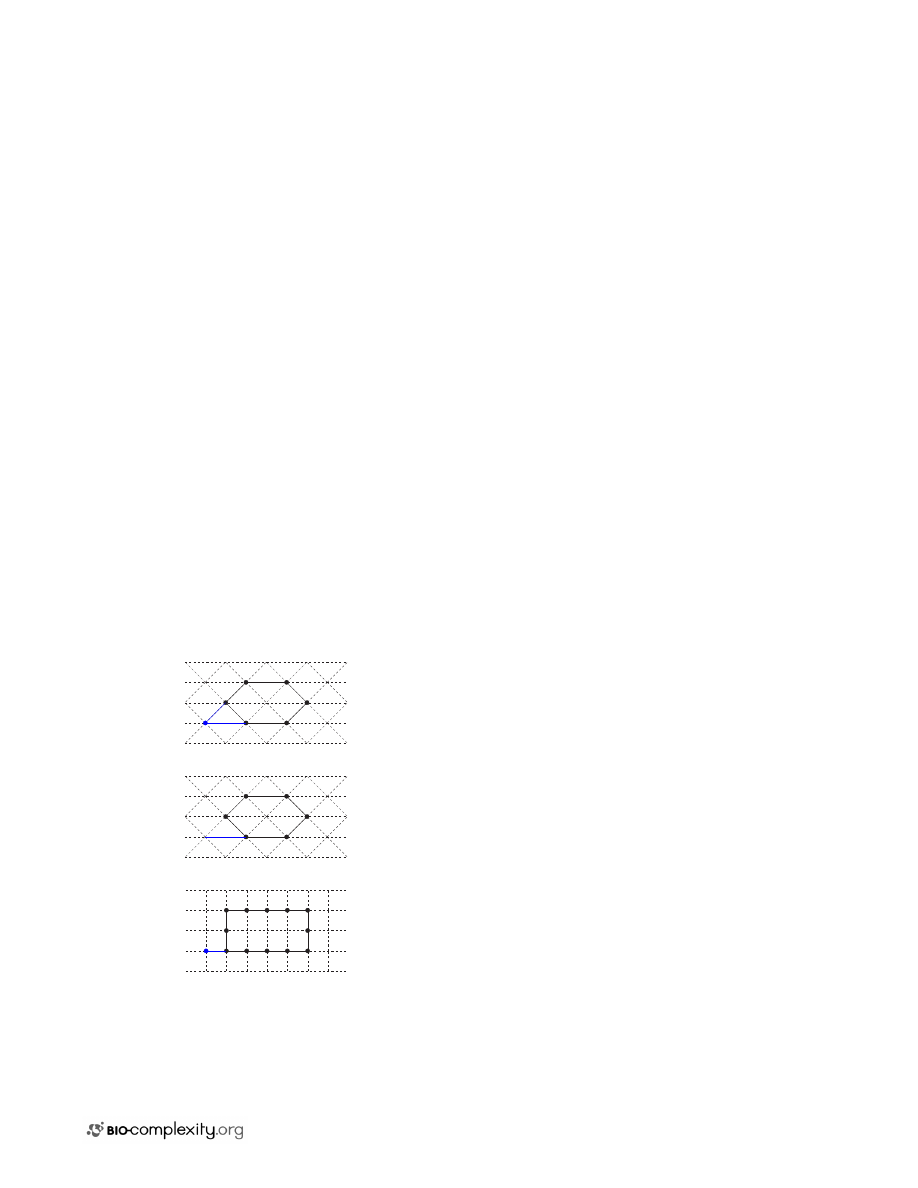
To see how Sadedin’s model is designed to evolve, consider
the growth of shapes in her model as compared to two simi-
lar models. In Sadedin’s model, turning on one point near the
existing shape is sufficient to add area to the shape (see Figure
4A). However, if mutations were to add lines rather than points
we’d have the situation depicted in Figure 4B. There is no line
that can be added to this shape that would expand its area. Fig-
ure 4C depicts a similar scenario, except that the shape is on a
rectangular grid, rather than a triangular lattice. Here there is
no line or point that can be added to the shape to increase its
size. The ability of Sadedin’s model to easily grow large shapes
depends on the specific design of the model. The model was
designed to evolve irreducible complexity.
It is possible to evolve irreducibly complex systems using a
model carefully constructed toward that end. The irreducible
complexity indicates the design of the model itself. It does not
show that Darwinian processes can account for irreducible
complexity.
MODEL SUMMARY
The models we have described have been presented by others
as demonstrating that irreducibly complex systems can evolve.
However, we have shown that these models have a number of
common flaws. Table 1 shows a summary of these results.
Avida fails by three criteria. The parts are of trivial complex-
ity. There is no attempt to show that the parts are necessary
for the working of the system. Furthermore, the system was
deliberately chosen as a subject of study because it would be
evolvable.
Ev’s genes continues to function at a lower capacity if binding
sites are removed. The ease of obtaining a working part makes
them trivially complex. There is no attempt to assign roles to the
parts in the system. However, Ev was not deliberately designed
to evolve irreducible complexity.
The parts in Dave Thomas’s Steiner tree algorithm consist of
only a single on/off switch and thus are as trivial as possible.
There is nothing that can be considered a mechanism. There is
no attempt to show that the parts are well-matched.
The geometric model has on/off switches for parts. There is
no mechanism or an attempt to show how the parts are nec-
essary for the mechanism. Furthermore, the entire system is
designed to allow evolution in a particular way.
Thompson’s electronic ear circuit fails the knockout test. The
mechanism by which the circuit works is unknown, and thus
A
B
C
Figure 4: The success of the geometric model depends on several
features chosen by the designer. A) As the model is intended to
work, when an adjacent blue point is turned on, new area is added to
the closed shape. B) When mutations cause a line to be added (not part
of the model as designed), no additional area is added to the shape.
C) Changing the shape of the grid to rectangular prevents single
mutations from adding area to the shape.

Volume 2014 | Issue 1 | Page 8
Digital Irreducible Complexity
it would be impossible to attempt to assign roles to the various
parts.
Thus, none of the published models has demonstrated the
evolution of irreducible complexity because they fail to meet
the required definition of irreducible complexity.
AN EXAMPLE OF IRREDUCIBLE COMPLEXITY
Tierra
If none of the presented models demonstrate the evolution of
irreducible complexity, what kind of model would demonstrate
it? To help answer that question, we present an example taken
from Tierra. Thomas Ray developed Tierra in an attempt to
produce a digital Cambrian explosion based on self-replicating
organisms [26]. However, Tierra has been shown to adapt
mostly by loss and rearrangement rather than by acquiring new
functionality [27].
In the original version of Tierra, a number of programs, or
“cells,” were simulated on a single computer and allowed to
evolve by competing to become the most efficient self-replica-
tor. Later, Ray developed a network version of Tierra that added
the ability for programs to jump between multiple computers
running the Tierra simulation [28]. Not all computers were
equally desirable from the perspective of the self-replicating
programs, however. Some computers ran faster due to faster
hardware or lack of other programs running. The Tierra pro-
grams were given the ability to read information about other
computers before jumping, in order to choose the best one.
Tierra does not attempt to model the origin of life. Rather, it
begins with the equivalent of a first self-replicating cell seeded
into the simulation. This is called the ancestor program. Figure
5 depicts the ancestor program used in Network Tierra. The
distinct colors represent the genes (or subsystems) that carry out
a particular function within Tierra, and the individual boxes
represent subgenes (sub-subsystems necessary for the overall
function). The depiction shown is derived from the network
ancestor program available for download from the Tierra web-
site.
9
The yellow gene is the sensory system, which is responsible
for collecting the information about other computers on the
9
Tierra network and making the decision about which computer
to jump to.
The sensory system present in the network Tierra ancestor
is irreducibly complex. To see this, consider the functionality
of the three largest subgenes in the sensory system gene. The
sensory-tissue-setup subgene collects information about fifteen
different computers on the Tierra network. The sensory-data-
analysis subgene determines which computers are better. The
sensory-data-report subgene acts on that decision, causing the
best computer to be selected as the target.
If the sensory-tissue-setup subgene were missing, the infor-
mation about the other computers would not be collected and
the other genes would operate on and produce garbage infor-
mation. If the sensory-data-analysis subgene were missing, the
sensory-data-report gene would act upon decisions that had
nothing to do with the data. Effectively, a random computer
would end up being chosen. If the sensory-data-report subgene
were missing, the decision reached by the analysis gene would
be ignored, and again a random computer would be selected.
If any of the parts are missing, the system fails to use the avail-
able information to select an appropriate target computer; it
effectively ceases to function.
Are the parts sufficiently complex? In order to derive the
limit, we need to consider the number of guesses or simulated
organisms in Tierra. Unfortunately, Ray’s paper does not pro-
vide an estimate of the number of organisms. The experiment
was run for fourteen days on sixty computers. This comes out
to approximately three million seconds of computation time.
Making the generous assumption of one nanosecond per digital
organism, this gives us about three quadrillion digital organ-
isms. Taking the cube root of this number gives us a complexity
requirement of approximately one in 144,609.
There are 50 possible instructions in a network Tierra
self-exam
differentiate
repro-setup
repro-loop
copy-tissue-setup
copy-loop
copy-tissue-cleanup
tissue-development
sensory-tissue-setup
sensory-processing-coordination
sensory-system-synchronization
sensory-data-analysis
sensory-data-report
Figure 5: A depiction of the Tierra Network Ancestor. The ancestor
cell is composed of genes that carry out particular functions and are
shown in a particular color. The subgenes that make up each gene are
represented as rectangles, with the size of the rectangle relative to the
size of the subgene. Each rectangle is labeled with its sub-function.
Table 1: Summary of flaws in models
Avida
Ev
Steiner Geometric
Ears
Failed
Knockout
X
X
Trivial Parts
X
X
X
X
Roles of
Parts
X
X
X
X
X
Designed to
Evolve
X
X

Volume 2014 | Issue 1 | Page 9
Digital Irreducible Complexity
program. The smallest subgene is twelve instructions long.
For the three subgenes considered the core of the irreducibly
complex system, the shortest is twenty-two instructions long.
It is possible that other, possibly shorter, sequences could fulfill
the same role. However, if we assume that at least four of the
twenty-two instructions are necessary for the role there are 50
4
=
6,250,000
combinations, giving approximately a
1
/
6250000
prob-
ability of picking the correct four instructions. This exceeds the
complexity limit, and thus we conclude that the parts are suf-
ficiently complex.
Thus the Tierran sensory system is an example of irreducible
complexity. It consists of several parts with roles indispensible
to the mechanism of the system. It passes the knockout test and
the parts and system are not trivial in their complexity.
Could it evolve?
The sensory system did not evolve; it was designed as part of
the ancestor used to seed the Tierran simulation. But the real
question is whether or not it could have evolved. The observed
evolution of the sensory system has been to either lose or sim-
plify that system [28]. There was an opportunity to re-evolve
the sensory system after it had been lost, but such an event was
not reported and presumably did not happen.
But could it have evolved? Is there a Darwinian way to evolve
the complex sensory system that we find in the Tierran ances-
tor? One might attempt to construct it beginning with a simple
sensory system that picks a computer at random. However,
even that first step requires the evolution of code of non-trivial
complexity. Tierra has shown very limited abilities to evolve
new sections of code [27].
But ultimately, the question is not whether humans can find
a way to make it happen. The question is whether Darwinian
evolution can evolve the system. If Darwinian evolution is
capable of developing systems like the Tierran sensory system,
then we should see models that demonstrate this evolution.
CONCLUSION
This paper has investigated a number of published models
that claim to demonstrate the evolution of irreducibly complex
systems, and found that these models have failed on a number
of fronts. Two of the models fail to satisfy the knockout test, in
that they maintain functionality after parts have been removed.
Almost all of the models use parts that are trivially complex, on
the order of an amino acid rather than a protein in complexity.
None of the models attempt to show why the mechanism used
necessarily requires its parts. Finally, some of the models have
been carefully designed to evolve. Thus, none of the models
presented have demonstrated the ability to evolve an irreducibly
complex system.
In contrast, we do find irreducible complexity in the designed
sensory system of the Tierran ancestor. This system is an exam-
ple of what kind of system it would be necessary to evolve in
order to falsify the claim that irreducible complexity is difficult
to evolve. It has not been proven that the sensory system cannot
evolve, but neither has it been shown that the sensory system
can evolve. The prediction of irreducible complexity in com-
puter simulations is that such systems will not generally evolve
apart from intelligent aid.
The prediction that irreducibly complex systems cannot
evolve by a Darwinian process has thus far stood the test in
computer models. Some have claimed to falsify the prediction,
but have failed to follow the definition of irreducible complex-
ity. However, it is always possible that a model will arrive that
will falsify the claim. Until then, as a falsifiable prediction the
evidence for irreducible complexity grows stronger with each
failed attempt.
Acknowledgements
The author thanks George Montañez for insightful com-
ments on previous drafts of this paper.
1. Behe MJ (1996) Darwin’s Black Box: The Biochemical Challenge
to Evolution. Free Press (New York).
2. Dembski WA (2004) Irreducible Complexity Revisited. Avail-
able:
http://www.designinference.com/documents/2004.01.
3. Dembski WA (2004) Still Spinning Just Fine: A Response To Ken
Miller: 1–12. Available:
http://www.designinference.com/docu-
ments/2003.02.Miller_Response.htm
. Accessed 6 January 2014.
4. Miller KR (2004) The flagellum unspun: the collapse of “irre-
ducible complexity.” In: Dembski WA, Ruse M, eds. Debating
Design: From Darwin to DNA. Cambridge University Press, pp
81–97.
5. Miller KR (1999) Finding Darwin’s God: A Scientist’s Search for
Common Ground Between God and Evolution. 1st ed. Harper-
Collins (New York).
6. Behe MJ (2006) Irreducible Complexity: Obstacle to Darwin-
ian Evolution. In: Dembski WA, Ruse M, eds. Debating Design:
From Darwin to DNA. Cambridge University Press, pp 352–370.
7. Aird WC (2003) Hemostasis and irreducible complexity. J Thromb
Haemost 1:227–230.
doi:10.1046/j.1538-7836.2003.00062.x
8. Behe MJ (2001) Reply to my critics: A response to reviews of
Darwin’s Black Box: The Biochemical Challenge to Evolution.
Biol Philos 16:685–709.
9. Pennisi E (2013) The man who bottled evolution. Science
342:790–793.
doi:10.1126/science.342.6160.790
.
10. Khan AI, Dinh DM, Schneider D, Lenski RE, Cooper TF (2011)
Negative epistasis between beneficial mutations in an evolving
bacterial population. Science 332:1193–1196.
doi:10.1126/sci-
.
11. Behe MJ (2007) The Edge of Evolution. Free Press (New York).
12. Behe MJ (2010) Experimental evolution, loss-of-function muta-
tions, and “the first rule of adaptive evolution.” Q Rev Biol
85:419–445.
13. Blount ZD, Barrick JE, Davidson CJ, Lenski RE (2012) Genomic
analysis of a key innovation in an experimental Escherichia coli
population. Nature 489: 513–518.
.
14. Lenski RE, Ofria C, Pennock RT, Adami C (2003) The evolution-
ary origin of complex features. Nature 423:139–144.
doi:10.1038/
15. Schneider TD (2000) Evolution of biological information.
Nucleic Acids Res 28:2794–2799.
doi:10.1093/nar/28.14.2794
.

Volume 2014 | Issue 1 | Page 10
Digital Irreducible Complexity
16. Thomas D (2010) War of the weasels: An evolutionary algorithm
beats intelligent design. Skept Inq 43:42–46.
17. Sadedin S (2005) A simple model for the evolution of irre-
ducible complexity. Available:
au/~suzannes/files/Sadedin2006TR.pdf
. Accessed 25 July 2013.
18. Thompson A (1997) An evolved circuit, intrinsic in silicon,
entwined with physics. In: Evolvable Systems From Biology to
Hardware, vol 1259:390–405.
.
19. Fogel DB (1998) Evolutionary Computation: The Fossil Record.
Wiley-IEEE Press.
20. Ewert W, Dembski WA, Marks II RJ (2009) Evolutionary Syn-
thesis of Nand Logic: Dissecting a Digital Organism. 2009 IEEE
International Conference on Systems, Man and Cybernetics.
IEEE. pp 3047–3053.
doi:10.1109/ICSMC.2009.5345941
.
21. Ewert W, Dembski WA, Marks II RJ (2012) Climbing the Steiner
tree—Sources of active information in a genetic algorithm for
solving the Euclidean Steiner tree problem. BIO-Complexity
2012(1):1−14.
22. Davidson C (1997) Creatures from primordial silicon. New Sci
2108:30−34.
23. Axe DD (2004) Estimating the prevalence of protein sequences
adopting functional enzyme folds. J Mol Biol 341:1295–1315.
.
24. Axe DD (2010) The case against a Darwinian origin of protein
folds. BIO-Complexity 2010(1):1–12.
25. Davidson C (1998) The chip that designs itself. Comput Bull
40:18.
26. Ray TS (1991) An approach to the synthesis of life. In: Langton
C, Taylor C, Farmer JD, Rasmussen S, eds. Artificial Life II: Pro-
ceedings of the Workshop on Artificial Life held February, 1990
in Santa Fe, New Mexico. Addison-Wesley (Redwood City, CA),
pp 371–408.
27. Ewert W, Dembski WA, Marks II RJ (2013) Tierra: The charac-
ter of adaptation. In: Marks RJ II et ‘al, eds. Biological Informa-
tion—A New Perspective. WORLD SCIENTIFIC, pp 105–138.
doi:10.1142/9789814508728_0005
28. Ray TS, Hart J (1999) Evolution of differentiated multi-threaded
digital organisms. In: Intelligent Robots and Systems, IROS’99.
Proceedings. 1999 IEEE/RJS Int Conf, vol 1, pp 1–10.
Wyszukiwarka
Podobne podstrony:
A Survey of Cryptologic Issues in Computer Virology
Bostrom, Nick Do We Live in a Computer Simulation
Bostrom, Nick Are You Living in a Computer Simulation
FIDE Trainers Surveys 2013 07 02, Uwe Boensch The system of trainer education in the German Chess F
Analysis of nonvolatile species in a complex matrix by heads
Rindel Computer Simulation Techniques For Acoustical Design Of Rooms How To Treat Reflections
Simulation of crack propagation in rock in plasma blasting technology
FIDE Trainers Surveys 2012 08 31 Uwe Bönsch The recognition, fostering and development of chess tale
0 Simulation of fatigue failure in a full composite wind turbine blade Shokrieh Rafiee 2006
Reflectivity in Pre Service Teacher Education A Survey of Theory and Practice
Paleopathology survey of ancient mammal bones in israel
Functional and Computational Assessment of Missense Variants in the Ataxia Telangiectasia Mutated (A
Biological Models of Security for Virus Propagation in Computer Networks
Farina, A Pyramid Tracing vs Ray Tracing for the simulation of sound propagation in large rooms
Fregni A study of the manufacture of copper spearheads in the old copper complex
(wydrukowane)simulation of pollutants migr in porous media
Dance, Shield Modelling of sound ®elds in enclosed spaces with absorbent room surfaces
więcej podobnych podstron