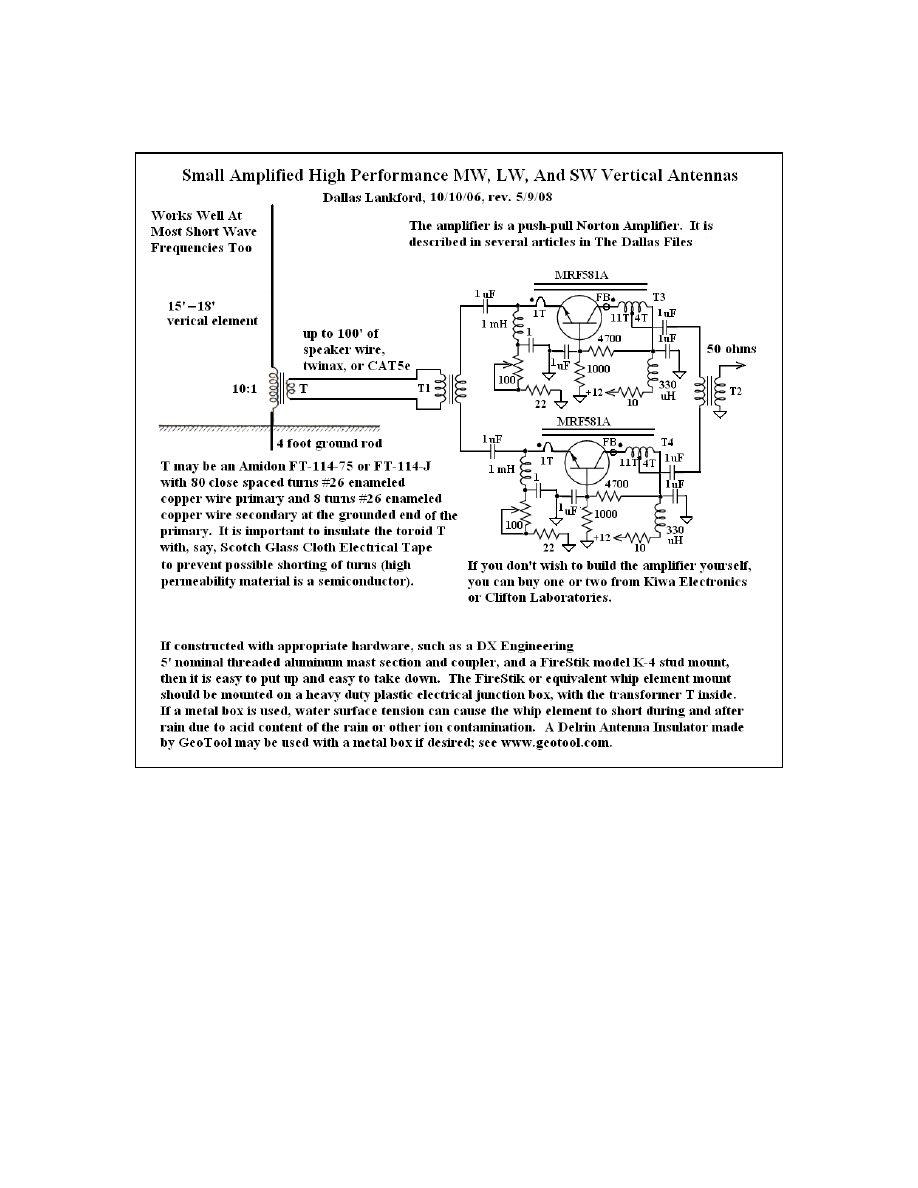
The Best Small Amplified Vertical Antenna For MW, LW, And SW
Dallas Lankford, 5/5/08, rev. 7/19/2011
The amplified vertical antenna above was developed during experiments to see how short I could make a noise reducing
vertical antenna while maintaining good sensitivity using only a 10.8 dB gain push-pull Norton amplifier to bring signal
levels back up to a good level. The amplified 15 foot noise reducing vertical antenna is not an active antenna. The push-
pull Norton amplifier, which is located at the receiver, is a low impedance device (as opposed to the high impedance FET's
used in most active antennas) and consequently does not have the common mode noise problems which active whips and
active dipoles sometimes have. This amplified short noise reducing vertical was tested with twin lead up to 100 feet in
length. A pair of these separated by about 60 feet makes a good MW phased array. If you are not a builder, you can buy an
equivalent Norton amp from KIWA Electronics for about $110 plus shipping (as of May 2008). Clifton Laboratories also
sells excellent Norton transformer feedback amplifiers. I like the the one with leaded 2N5109's . It should be relatively
simple to convert it to an LIN (with dual MRF581A's) if you want state of the art noise figure (assuming you can find
MRF581A BJT's). The gain of the 15 foot noise reducing vertical is about –15 dB compared to a full size noise reducing
antenna. Its 2
nd
and 3
rd
order intercepts are typically greater than +120 dBm and +60 dBm respectively in the MW band. Of
course, when followed by an amplifier the intercepts of the antenna system will be lower (dependent on the intercepts of
the amplifier). When used with a push pull Norton amplifier the cascaded input 2
nd
and 3
rd
order intercepts of the system
are greater than +95 dBm and +50 dBm respectively in the MW band. It is, in my opinion, the best small omnidirectional
LW-MW-SW receiving antenna, period. A previous version with fewer transformer turns used relay switching for
1

improved performance at higher SW frequencies. Increasing the antenna transformer turns made relay switching
unnecessary. I use two of them as my current phased receiving array. The antenna is now excellent for LW, MW, and SW.
All of my longer and higher passive inverted L's and verticals and all of my active antennas have been permanently retired.
At least one person has claimed that noise reducing antennas are noisy. But when I quizzed him about his implementation,
it turned out that he had not implemented the antenna correctly. If you do not follow the instructions, then you may end up
with a noise increasing antenna like he did.
In my opinion, active whip antennas are no longer among the best small antennas, and so none are included here. The small
receiving loop antennas commonly used and praised are generally insensitive at lower frequencies, and their nulls are not
nearly as good as somewhat larger flag antennas, and so they are also not included here.
2
Wyszukiwarka
Podobne podstrony:
Close Space MW Phased Vertical Antennas
A small LF loop antenna
2 m70 cm Vertical Dipole Antennaid 513
The Best Small Antennas For MW, LW, And SW rev 2
Small Loop Antennas Joseph J Carr
The uA741 Operational Amplifier[1]
Popular Mechanics Repairing Power Antennas
McMartin LT2000D Power Amplifier
Cessna 172XP Small Checklist
M 5202 Small color dress
P000718 A Eng Vertical shaft assembly
Free Energy & Technological Survival Homemade Wireless Antenna
2012 2 MAR Common Toxicologic Issues in Small Animals
Hafler P7000 Amplifier
Hydrocotyle Verticillata Aquaristik Aquarium
Arctic sea ice extent small as never before
PRAWO MORSKIE sem IX v small
AGH Analog electronics Chapter III 5 Power amplifiers
więcej podobnych podstron