
T E A C H E R
’ S N O T E S A N D K E Y
April 2009
© Pearson Longman 2009
- 1 -
S
TARTING OFF
The task here is designed to introduce the topic, to generate interest and to activate relevant language. The focus,
therefore, is on fluency and opinions rather than accuracy and factual information. Try to encourage the students to
explain t
heir opinions (‘because…’) and make a note of any relevant vocabulary which crops up, perhaps putting a word
list on the board at the end.
B
EFORE YOU READ
/
F
IRST READING
A straightforward prediction task to be done before the students read, of course. Key:
1. C
2. A
3. B
4. B
5. TRUE
6. C
S
ECOND READING
This is still a global reading task, focusing on gist reading and giving the students an overview of the text’s organisation. It
should not require detailed reading and so a time limit might be appropriate to encourage the students to read quickly and
not get bogged down. Key (see the Teacher’s Copy of the text for the full text):
1. THE WORLD’S FAVOURITE MACHINE
2. THE FIRST BICYCLE
3. BICYCLES TODAY
4. BICYCLE RACES
5. BIKE LOVERS
6. BICYCLE RECORDS
T
HIRD READING
Although there are only four questions this task might take longer than the others as it requires quite detailed reading and
some ability to interpret the text. Key:
1. FALSE
2. FALSE
3. TRUE
4. TRUE
V
OCABULARY
1
Matching key:
‘almost certainly’…...
when you are almost definite - 99% sure...
‘fair to say’…………..
when it is a reasonable thing to say...
‘later’………………….
when you want to say what came next...
‘such as’……………...
when you want to give an example…
‘probably’…………...
when you think there is a good chance of something...
Gapped sentences key:
1. it’s fair to say
2. such as
3. probably
4. Later
5. almost certainly
T E A C H E R ’ S N O T E S A N D K E Y
April 2009
© Pearson Longman 2009
- 2 -
V
OCABULARY
2
The words needed are highlighted in the text, but the students can try to complete the task without referring to the text at
first. Key:
V
OCABULARY
3
The grammar of multi-word verbs may well not yet be familiar to the students, but they do not need that for the task. After
the gap-fill task make a list of the multi-word verbs on the board and ask the students to translate them into their own
language, highlighting that many have one-word equivalents in other languages. Key:
1. set off
2. get on
3. slow down 4. fall off
5. get off
6. start off
7. speed up
S
PEAKING
The goal here is for the students to reflect on where they live and express themselves in honest ways, so encourage
differences of opinion. The questions naturally lead into vocabulary work so you should be ready to manage the activity
actively, moving from group work to whole class work and back again.
E
XTENSION
There are many possibilities for extension. If the final discussion engaged the students you could consider writing a letter
(in English, of course) to the local council or Urząd Wojewódzki making suggestions for local improvements.
An alternative would be to develop the vocabulary work done in Vocabulary 2. The students could work in groups to
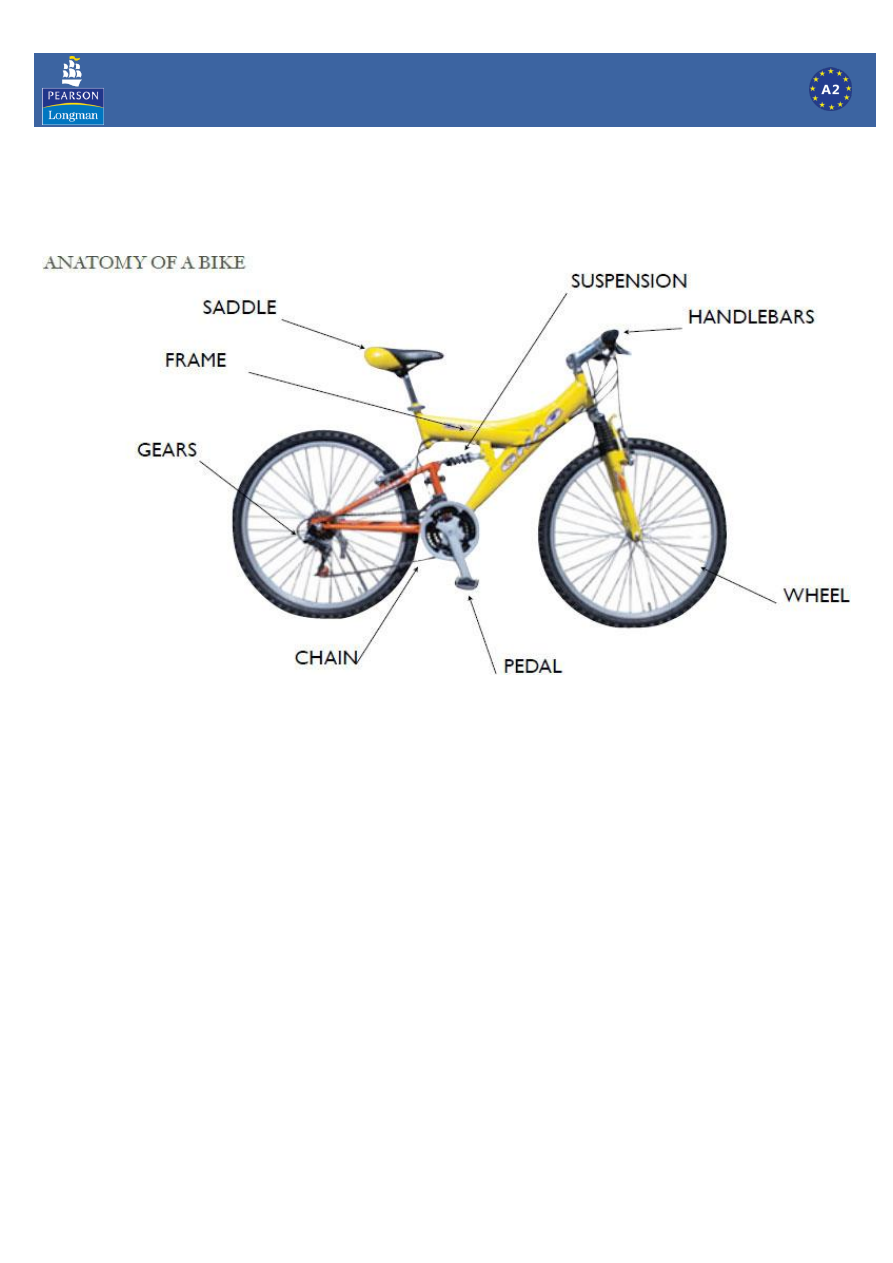
produce posters on different means of transport, marking vocabulary on pictures (as on the picture of the bike) and
including useful verbs (such as the multi-word verbs). The posters can be displayed once finished. around
T E A C H E R ’ S N O T E S A N D K E Y
April 2009
© Pearson Longman 2009
- 3 -
“I want to ride my bicycle
I want to ride my bike,
I want to ride my bicycle
I want to ride it where I like”
Queen, ‘Bicycle Races’
The world’s favourite machine
Nobody knows how many bicycles
there are in the world but is almost
certainly more than 1 billion. There
are about 500 million bicycles just in
China!
Some use their bikes for transport,
some for fun, but it is probably fair to
say that no other machine is so
popular in the world.
The first bicycle
The first bicycles were made
almost 200 years ago but they looked
very different from today’s bikes. The
first bikes were made of
wood and had no
pedals
or
chain
; the
rider pushed the bike
along with his feet.
There was no
saddle
to sit on either,
so the bikes were not very
comfortable.
Later bikes were
made which had
pedals, but the
pedals were on
the front
wheel
and
this wheel was very big.
Bicycles today
Today bicycles use a chain and
gears
- sometimes as many as thirty
gears - to make them easier to ride.
We have specialist bikes for racing,
for off-road, for commuting, for
touring and for tricks, all with different
shapes and
handlebars
. Some
modern bikes can cost as much as a
car, or even more: a specialist bike
for some stages of the Tour de
France can cost $20,000!
Modern bikes are very high-tech.
They use strong and light materials
for their
frames
such as aluminum or
carbon fibre. Some mountain bikes
even have
suspension
to make them
easier to ride off-road. T
oday’s bikes
are a long way from the first bikes!
Bicycle races
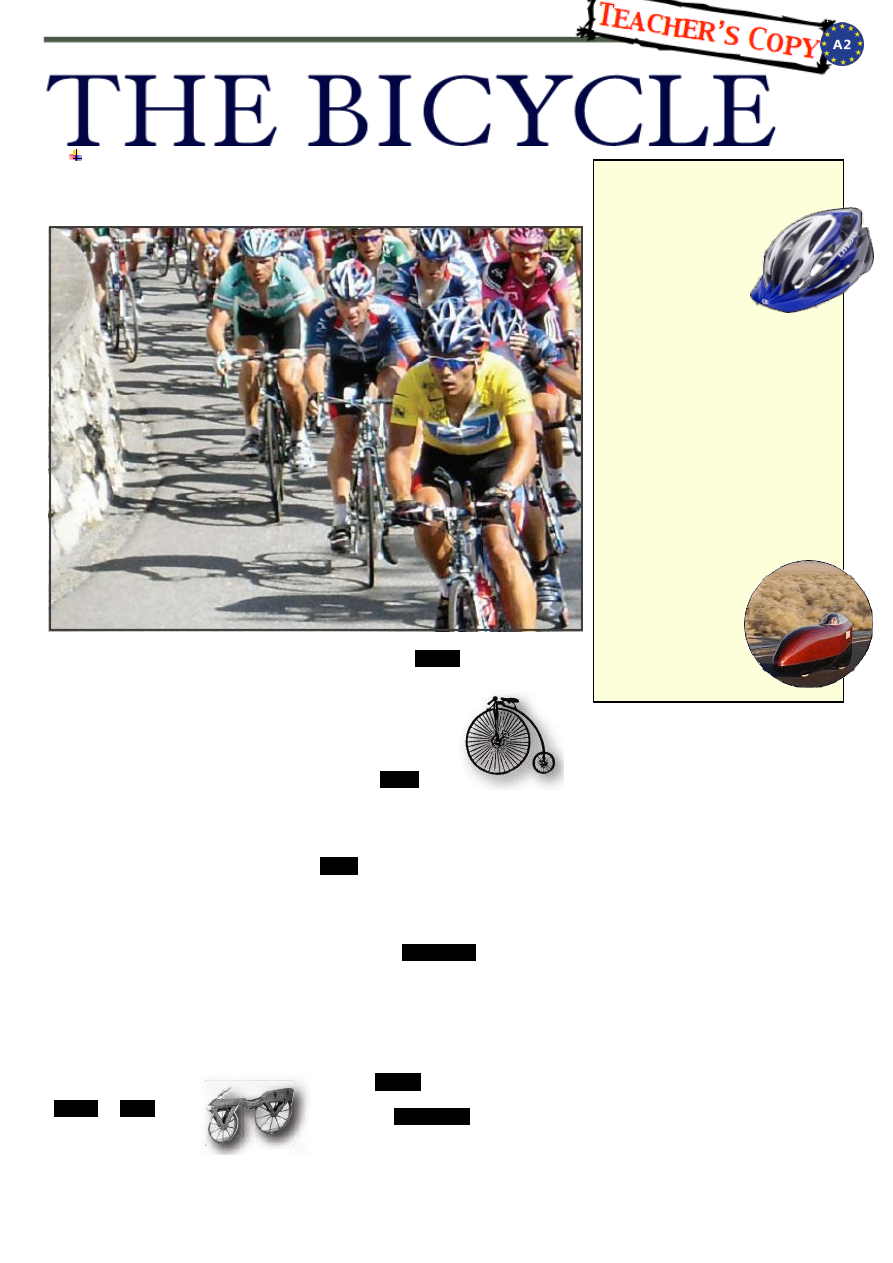
The most famous bike race in the
world is, of course, the Tour de
France. It takes place each year in
the summer, always in two countries
and always finishes in Paris. The
Tour is one of the most difficult sports
events in the world, with the riders
going up and down mountains and
riding over 3,500 km.
Bike lovers
China is the country with the most
bicycles - there are 500 million just in
that one country - but it is probably
the Dutch who love bicycles the
most. In the Netherlands there are 18
million bicycles. That might not sound
like a great number compared to
China, but there are only 16.3 million
people in the Netherlands so there
are more bikes than people in that
country!
“I want to ride my bicycle…”
Almost 200 years old and still going strong: the bicycle
Bicycle records
The bicycle is the best
way for a person to travel:
it is the best way to turn
energy into movement.
Bikes can also be very
very fast.
An Olympic sprinter
such as Usain Bolt can run
around 50km/h, but on a normal
road bike most cyclists can reach
this speed. In the velodrome in
competition riders can go as fast
as 65km/h. But even this is not
the world record.
The world record for speed on
a bike was set by a Canadian,
Sam Whittingham in Nevada in
the
USA in 2002. Sam’s bike was
not a regular bike, though: it was
a recumbent, a kind of bike where
the rider lies down instead of
sitting up. Sam was also
covered by an
aerodynamic shell.
On, or in, this bike
Sam reached a top
speed of 130.36km/h
- faster than you can
go on a motorway!
Wyszukiwarka
Podobne podstrony:
april 2009 lowersecondary exam teachers
april 2009 lowersecondary exam students
september 2009 lowersecondary teachers
april 2009 lowersecondary students
newsletter february 2009 lowersecondary teachers notes
may 2009 lowersecondary teachers
march 2009 lowersecondary teachers
october 2009 lowersecondary teachers
krzyzowka tematy gimn april 2009 lowersecondary 2
march 2009 lowersecondary teachers
april 2009 uppersecondary teachers
june 2009 lowersecondary teachers
october 2009 lowersecondary exam teachers
february 11 lowersecondary teachers
march 2009 lowersecondary students
The future of private equity, McKinsey, April 2009
April Fool s PreIntermediate Teacher s notes
december 2009 uppersecondary teachers
więcej podobnych podstron