
The Ultimate
Tarrasch Defense
by Eric Schiller
[Portions of the text materials and chess analysis are
taken from Complete Defense to Queen Pawn Openings
by Eric Schiller, Published by Cardoza Publishing. Addi-
tional material is adapted from Play the Tarrasch by
Leonid Shamkovich and Eric Schiller, published by
Pergamon Press in 1984. Some game annotations have
previously appeared in various books and publications
by Eric Schiller. Additional analysis on the Tarrasch De-
fense can be found at
1

Introduction
What is the Tarrasch Defense?
The Tarrasch Defense is a variation belonging to the
Queen’s Gambit Declined. The Tarrasch is a flexible for-
mation that can be used to meet just about any move or-
der used by White. It normally is reached by
1.d4 d5
2.c4 e6 3.Nc3 c5
. We’ll look at transpositional paths
later on.
cuuuuuuuuC
{rhb1kgn4}
{0pDwDp0p}
{wDwDpDwD}
{Dw0pDwDw}
{wDP)wDwD}
{DwHwDwDw}
{P)wDP)P)}
{$wGQIBHR}
vllllllllV
Ultimate Tarrasch Defense
2

Black challenges the center immediately. White now has
to constantly consider the consequences of captures in
the center. Usually White exchanges the c-pawn for
Black’s d-pawn, and later the White d-pawn can be ex-
changed for the Black c-pawn.
This gives Black an isolated d-pawn, which we will dis-
cuss in detail later. For now, let’s consider the typical
pawn structure that arises after an exchange of pawns at
d5.
cuuuuuuuuC
{rhb1kgn4}
{0pDwDp0p}
{wDwDwDwD}
{Dw0pDwDw}
{wDw)wDwD}
{DwHwDwDw}
{P)wDP)P)}
{$wGQIBHR}
vllllllllV
Ultimate Tarrasch Defense
3

There is a lot of tension in the center. White can capture
at
c5
or Black can capture at
d4
, in either case setting up
the isolated d-pawn for Black. It is important to note,
however, that clarification of the situation does not usu-
ally take place in the first few moves. When a central ten-
sion is resolved, then it is possible to concentrate on plans
which are appropriate to the central situation. While the
center remains fluid, it is harder to find the correct plan
because the central situation can change quickly. So usu-
ally this pawn center stays intact until move 9, when both
sides have competed development.
Who Plays the Tarrasch Defense?
The Tarrasch Defense is used primarily by advanced
players, but this is mostly a result of the tendency for
teachers of young chess players to avoid openings which
involve isolated pawns, on the grounds that they are diffi-
cult to defend. Therefore it is only when players graduate
to higher levels of competition that they begin to encoun-
ter the defense.
Ultimate Tarrasch Defense
4

Many great players have used the Tarrasch Defense. You
will meet some of them in the section on Heroes in the
Tarrasch Defense. For now, all that need be said is that
World Champions such as Garry Kasparov and Boris
Spassky relied on the Tarrasch to get to the top.
The Tarrasch appeals to players with a strong fighting
spirit. Tactics can dominate the middlegame, with long
combinations involving temporary and permanent sacri-
fices.
The stronger the endgame skills, the better, since the
Tarrasch often leads to endgames which are difficult to
win, or even draw (some of the time)! As you play the
Tarrasch your understanding of many endgames, espe-
cially those with Rooks and minor pieces, will broaden
and deepen, making you a better overall player.
How to Study the Tarrasch Defense
The Tarrasch Defense is very easy to learn, because there
are only a few types of structures that can arise, most of
Ultimate Tarrasch Defense
5

them involving isolated d-pawns or a small chain with
pawns at
c6
and
d6
.
Therefore the opening is best studied from the middle-
game outward. Start with the sections on typical tactics,
just to observe the kinds of resources available to each
side.
Then play through each of the illustrative games, ignor-
ing at first most of the discussion of the first 15 moves or
so. Observe the flow of the pieces, typical maneuvers,
and tactical traps.
The next step is to examine the types of endgames you
are likely to encounter. Just play through the longest
games, including the ones in the notes to other games,
and casually take note of the types of structures that are
most frequently seen.
Finally, go back and study the notes to the opening phase
of each game. Try to learn where to place your Rooks,
how the Queens operate, and when to capture at
d4
or al-
low capture of your Knight at
c6.
Ultimate Tarrasch Defense
6

You will then be ready to go out and use the Tarrasch De-
fense to defeat your tournament and casual opponents!
Dr. Tarrasch and his Defence
Siegbert Tarrasch was born in Wroclaw (then Breslau)
on 5 March, 1862 and died on 13 February, 1934. His ca-
reen began during the Classical period of chess, and
ended well into the Modern period (We consider the
Modern period to have begun when Bronstein was born -
1924). During these years chess openings underwent fun-
damental changes, beginning with a preference for
1.d
4
over
1.e4,
and continuing with the development of
Hypermodern theories by Nimzowitsch and Alekhine.
Tarrasch’s main contribution to chess was a result of his
work on the IQP (Isolated Queen Pawn) position in the
French Defense and Queen’s Gambit. Tarrasch believed
in the strength of the IQP and adopted very dogmatic po-
sitions based on this belief. While contemporary chess
does not share his views completely, it certainly credits
him with pointing out the cramping influence and attack-
ing power of the IQP.
Ultimate Tarrasch Defense
7

Tarrasch was 15 years old when he first took up chess se-
riously, and did not make his debut until1881 in Berlin,
and that was a bit of a disaster. He was not dissuaded,
however, and played brilliantly in his next tournament in
Nuremberg, 1883. He reached the master level in 1885,
finishing second in Hamburg, and went on to scone a se-
ries of victories in major international events. For sorne
reason he did not manage to arrange a match for the
World Championship until 1908, and he was soundly de-
feated by Emmanuel Lasker by a score of 10.5-5.5. A re-
match in 1916 proved even worse, as he went down to
defeat without winning a single game. For the remainder
of his career he played in very strong events, usually fin-
ishing in the middle of the field.
It is his writing, rather than his playing, which makes
Tarrasch such an important figure in chess history. His
books are classics of the chess literature: Dreihundert
Schachpartie, Die Moderne Schachpartie, and his trea-
tise on the Queen’s Gambit. In these and other writing he
expounded his chess theories, which were quite different
from those of his contemporaries.
Ultimate Tarrasch Defense
8

Tarrasch introduced the “new” variation of the Queen’s
Gambit in 1888 in his game against von Bardeleben,
though the basic moves had been seen in games fifty
years pervious. At first all went well, with no one chal-
lenging the basic premise of the opening: that an IQP is
not necessarily a liability in the middlegame. Soon, how-
ever, Karl Schlechter and Akiba Rubinstein worked out a
System against the Tarrasch Defense (as it was already
being called), involving the fianchetto of the
Bf1
at
g2
.
(See the game Schlechter-Dus Chotimirski). There soon
arose a sort of tabiyah after
1.d4 d5 2.c4 e6 3.Nc3 c5
4.cxd5 exd5 5.Nf3 Nc6 6.g3 Nf6 7.Bg2 Be7 8.0-0
0-0.
This is the standard position of the Classical Tarrasch,
which can be reached by many transpositional paths.
Black has solved the main problem of the Queen’s Gam-
bit. The light-squared Bishop is able to enter the game.
On the other hand, Black has accepted an isolated pawn
at
d5
, since White can either play
9.dxc5
or force Black
to play an eventual ...
cxd4.
Black can defend this pawn
with many pieces, but White will be able to set up a
Ultimate Tarrasch Defense
9

blockade on
d4
(after
dxc5
or ...
cxd
4) and then bring
pressure to bear along the d-file and hl-a8 diagonal, while
his minor pieces harass the Black defenders. Tarrasch
held (in Gegenwartige stand der wichtigsten Eroffnungen,
1918) that Black’s position was fine, but he found few
followers at the time. It has always been a “minority” de-
fence, but that “minority” includes many of the best play-
ers in the history of the game, appealing to players who
prefer their own judgements to those of the theoreticians.
The Tarrasch did not achieve respectability quickly.
Cook’s Compendium (1902) gave the defense just two
columns, quoting Pillsbury-Schlechter (Munich 1900)
and Schlechter-Tarrasch (Nuremberg 1906). These were
not among the most impressive examples of play for
Black. In the 1910 edition of Freeborough and Ranken’s
Chess Openings the line was merely mentioned in a foot-
note, although it must be admitted that the
1.d4
openings
were almost completely ignored there anyway, probably
because the book was based on early editions of Cook’s
Compendium which were written during the heyday of
1.e4
. Less old-fashioned editors took mre note of
3...c5.
Ultimate Tarrasch Defense
10

In Blanshard’s Classified Chess Games with Notes, pub-
lished by the Glasgow Chess Club in 1911, the opening
was carefully considered and the lines given were quite
acceptable for Black, but the Schlechter-Rubinstein
Variation (
6.g3
) was not mentioned. Opening theory
traveled more slowly in those days.
The leading theoreticians continued to scoff at the de-
fense. Salvioli (1930) dismissed the variation with a
number of smashing wins for White, i.e. Reti-Tarrasch,
Pistyan 1922 and other games in which Black mishan-
dled the defense. Efim Bogoljubow, in Die Moderne
Eroffnung
1.d2 d4!
(1928) concurred. His comments are
worth considering: “The idea of the opening which is
named after Tarrasch is to attack the enemy pawn at
d4
(after Black has defended his own pawn with
...e7-e6
)
with
...c7-c5,
simultaneously freeing his position. The
Tarrasch Defense is not really a defense in the literal
sense of the word, but rather a counterattack. Should
Black, logically in the role of the defender, be able to take
over the attack so early in the game, then the Queen’s
Gambit would be no attacking weapon for White and
Ultimate Tarrasch Defense
11

would be absent from the modern opening reper-
toire....White can attack the isolated d-pawn after
4.cxd5! exd5 5.Nf3 Nc6 6.g3!
, and that
Pd5
will re-
main a point of attack. Black has many difficult problems
to solve before he sees his way out of the jam.”
In the 1930s the Tarrasch received aid from an unex-
pected source. The Swedish team (Stahlberg, Lundin,
and Stoltz) at the 1933 Olympiad in Folkestone prepared
a new answer to Schlechter’s
6.g3,
namely
6....c4!?
. This
aggressive move gave a whole new character to the
Tarrasch, and for a while it was a mighty tournament
weapon. Eventually, however, improved methods of play
were found for White, and the opening is no longer con-
sidered fully playable. During the war years other
openings dominated Black’s repertoire against
1.d4.
Nevertheless, Max Euwe had a high opinion of the
Tarrasch. He wrote (in Chess, 1947):
“Nowadays
4.cxd5
is considered to offer White no clear
advantage, so that there is no reason to condemn the
Tarrasch. It is obvious from its sporadic adoption that it
Ultimate Tarrasch Defense
12

does not inspire much trust, all the same.” The 7th edition
of Modern Chess Openings (1946) repeated the usual po-
sition that the Rubinstein Variation favored White (“so
strong that most masters prefer to avoid the defense alto-
gether”), that the Swedish variation was interesting but
unsound, etc.
The view in Eastern Europe was much the same. In the
1957 edition of Kurs Debiutov Panov wrote that “the fun-
damental drawback of the Tarrasch Defense remains the
weakness of the central pawn
d5,
which limits the ma-
neuverability of the Black pieces and guarantees White a
solid initiative.” Evidently no one paid much attention to
Tarrasch’s claim that the opening guaranteed Black’s
pieces greater mobility! Players, however, are usually ca-
pable of making better positional judgements than theo-
reticians, and soon several Soviet stars took a second
look at the Tarrasch. Keres led the way, followed by
Aronin, Geller, and Mikenas. The ground was laid for a
comeback.
Ultimate Tarrasch Defense
13

In 1969, Boris Spassky shocked the chess world by using
the Tarrasch Defense to win the World championship. He
wrote about the reasons behind his choice of openings:
“While in the first match I occasionally led the game into
the paths of the Ujteiky Defense, this time I abandoned
such deployment of my Bishops and took up the classical
Tarrasch Defence. Maybe this came as some surprise to
the spectators and commentators, and perhaps even
Petrosian did not expect it, since he specialized in playing
against the isolated pawn. But as for me, I love the defen-
sive style. lt is true that the match has demonstrated how
demanding and nervewracking this opening is, but the
defense fulfilled its role admirably in the match.” Here
Spassky talks about defense, where Bogoliubow had
stated that the opening was not a defense at all. Clearly,
times had changed.
When an opening scores a big success in the international
arena, all the contenders scurry to find a refutation. In the
1970s the Tarrasch took a pounding as improvements
came pouring in for White. By the end of the decade the
opening was being defended by a mere handful of inter-
Ultimate Tarrasch Defense
14

national players: Gligoric, Nunn, Manjanovic, Petursson
and Palatnik among them. They contributed many fine
defensive improvements for Black, from innovations in
well-trodden paths to whole new defensive strategies.
The opening received a boost in Sergiu Samarian’s ex-
cellent study The Classical Tarrasch Defence, Q.G.D.
and in his book Queen’s Gambit Declined (1974). De-
spite White’s success, the opening started to make a brief
comeback. Paul van der Sterren updated Euwe’s classic
book (in Dutch: De Opening 1B) and concluded that the
Tarrasch was quite respectable.
In Batsford Chess Openings, 1982, Kasparov and Keene
expressed the opinion that White could count on no
more than a minute advantage. Referring to the
Schlechter-Rubinstein Variation
(6.g3),
Jon Tisdall
wrote that “Black may fall just short of equality, but his
position is both active and extremely playable.” The
1980s saw the Tarrasch rebound from its loss of popular-
ity after Spassky gave it up, while during the 1970s it was
not seen with great frequency. A shift began around
1980, when Armenian, Yugoslav, East German and Eng-
Ultimate Tarrasch Defense
15

lish Grandmasters revived it. There was no current litera-
ture on the opening, and that meant that both original and
older ideas could be used without fear that the opponent
would be well prepared.
The first major examination of the Tarrasch in English
was my book with Grandmaster Leonid Shamkovich,
Play the Tarrasch, published by Pergamon Press in 1984.
Garry Kasparov had received a copy of the manuscript
from me long before it was published, and he started to
play it at that time. I take no credit for his adding the
opening to the repertoire, though we were meeting fre-
quently throughout the period of writing the book (he had
collaborated with me on Batsford Chess Openings and
Fighting Chess, and I had translated some of his books)
and had great respect for the theoretical ideas of my
co-author. In any case, the games below were well
known to him from his studies and I think the Tarrasch
just fit in well with his style of play at the time. He stuck
with the Tarrasch until severe defeats at the hands of
Anatoly Karpov led him to the Gruenfeld, which, in some
Ultimate Tarrasch Defense
16

lines, is like a Tarrasch reversed, with Black adopting the
fianchetto against White’s central bastion at
d4
.
After some brutal defeats at the hands of Anatoly Kar-
pov, Kasparov left the Tarrasch for the Gruenfeld and
King’s Indian Defenses, but in the 1990s new followers
appeared in the form of Miguel Illescas-Cordoba,
Spain’s leading native player, and Joel Lautier, the
French star. The authoritative opening manuals took a
more respectful view of the opening, with BCO 2
(Kasparov, Keene, Schiller), MCO 14 (DeFirmian), and
NCO (Nunn) providing no clear path to an advantage for
White.
Tarrasch once wrote “The future will decide who has
erred in estimating this defence, I or the chess world!”
We’re coming around, Doctor, we’re coming around.
Ultimate Tarrasch Defense
17

Overview of the Tarrasch Defense
1.d4
cuuuuuuuuC
{rhb1kgn4}
{0p0p0p0p}
{wDwDwDwD}
{DwDwDwDw}
{wDw)wDwD}
{DwDwDwDw}
{P)PDP)P)}
{$NGQIBHR}
vllllllllV
The Tarrasch Defense can be reached from just about any
opening except for
1.e4
. The highly transpositional na-
ture of the opening requires less memorization and places
a premium on understanding important strategic con-
cepts and typical tactical devices. Naturally, White does
not have to play straight into the main lines of the
Ultimate Tarrasch Defense
18

Tarrasch, so we must examine all the other reasonable
options.
In this book we will try to adopt the Tarrasch formations
wherever we can. Playing
...d5, ...e6
and
...c5
in rapid
succession. Against some of White’s alternative strate-
gies, this is not always the most efficient plan in terms of
achieving equality. However, it is easier to play familiar
positions, and to the extent that you sometimes get less in
the opening, you receive benefits in the middlegame
where your experience provides a great deal of assis-
tance.
All of the lines in this book have been thoroughly tested
and White cannot achieve more than a very minimal ad-
vantage. There are no openings that can absolutely guar-
antee an equal position for Black, since the advantage of
the first move takes time to overcome. The opening rep-
ertoire provided in this book is as good as any alternative
system, and has a number of significant advantages.
Ultimate Tarrasch Defense
19

The most important aspect of the Tarrasch Defense is the
isolated d-pawn which appears in many variations. As
you learn how to handle the isolani, you will be able to
apply your knowledge in almost every game. Your expe-
rience in typical endgames will also provide an edge. The
repertoire supplied here maximizes the use of familiar
patterns and structures, so you can get up to speed
quickly.
1...d5
cuuuuuuuuC
{rhb1kgn4}
{0p0w0p0p}
{wDwDwDwD}
{DwDpDwDw}
{wDw)wDwD}
{DwDwDwDw}
{P)PDP)P)}
{$NGQIBHR}
vllllllllV
Ultimate Tarrasch Defense
20

The best defenses for Black prevent White from taking
control of the center early in the game. Black’s
1...d5
prevents
2.e4
, and therefore is one of the best moves. It is
strongly recommended that you adopt this move order,
even though others are available. After
1...e6
White can
force you into a French Defense with
2.e4
, which is only
acceptable to Francophiles. Often
1...Nf6
can reach
Tarrasch positions, but usually only when White fails to
take advantage of precise move orders that render this
strategy risky. In any case,
1...Nf6
invites many alterna-
tives by White, such as the Trompovsky Attack (
2.Bg5
)
which is very popular these days.
Ultimate Tarrasch Defense
21

2.c4
cuuuuuuuuC
{rhb1kgn4}
{0p0w0p0p}
{wDwDwDwD}
{DwDpDwDw}
{wDP)wDwD}
{DwDwDwDw}
{P)wDP)P)}
{$NGQIBHR}
vllllllllV
There are several options for White here. In the analysis
sections of the book we will look at the most popular al-
ternatives to
2.c4.
For really strange moves you should
consult Unorthodox Chess Openings, but we will cover
everything which is seen in serious games.
2.Nf3
is the most popular alternative, and we devote
three games to handling the variations where White re-
Ultimate Tarrasch Defense
22

frains from an early
c2-c4.
The Torre Attack, London
System, and Colle System are not particularly ambitious
openings for White, and Black can achieve a comfortable
game without difficulty.
2.Nc3
is the harmless Veresov Attack. I used to play it
but eventually gave it up because there is no way to get an
advantage for White. If you play the Caro-Kann, then
2...c6
is a good reply, transposing to the main lines after
3.e4
. Similarly, the French is available after
2...e6
. In
this book we will concentrate on a quite different ap-
proach with the gambit line
2...e5
which is very obscure
but nevertheless seems to be quite sound.
2.e4
is the Blackmar Diemer Gambit. Black can get a
good game by either accepting or declining the offer of a
pawn. French and Caro-Kann players will already be
used to this approach, as the gambit is played in several
forms against those opening. I’ll show you a simple and
solid reaction.
Ultimate Tarrasch Defense
23

2...e6
cuuuuuuuuC
{rhb1kgn4}
{0p0wDp0p}
{wDwDpDwD}
{DwDpDwDw}
{wDP)wDwD}
{DwDwDwDw}
{P)wDP)P)}
{$NGQIBHR}
vllllllllV
This is the only move to head for Tarrasch territory.
Black supports the pawn at
d5
and opens a line for the
Bishop at
f8
in support of
...c7-c5,
which is the next
move in our strategy.
Ultimate Tarrasch Defense
24

3.Nc3
cuuuuuuuuC
{rhb1kgn4}
{0p0wDp0p}
{wDwDpDwD}
{DwDpDwDw}
{wDP)wDwD}
{DwHwDwDw}
{P)wDP)P)}
{$wGQIBHR}
vllllllllV
White should bring out a Knight here, and it doesn’t
make much of a difference which one is developed first.
3.Nf3
gives White a few additional options later in the
game and sidesteps a gambit line for Black which does
not enter into our repertoire. Often this position is
reached when the game starts with
1.c4
or
1.Nf3.
Ultimate Tarrasch Defense
25

3...c5
cuuuuuuuuC
{rhb1kgn4}
{0pDwDp0p}
{wDwDpDwD}
{Dw0pDwDw}
{wDP)wDwD}
{DwHwDwDw}
{P)wDP)P)}
{$wGQIBHR}
vllllllllV
This is the defining move of the Tarrasch Defense. From
here on, both sides must contemplate the effects of pawn
exchanges in the center. Black now has a clear plan for
development. The Knights will come to
c6
and
f6,
the
Bishop moves from
f8
to
e7
, and Kingside castling fol-
lows. The role of the Bishop at
c8
depends on White’s
plans. Usually White will exchange at
d5
, opening up a
line for the Bishop to move to
g4
,
f5
or
e6.
Ultimate Tarrasch Defense
26

4.cxd5
cuuuuuuuuC
{rhb1kgn4}
{0pDwDp0p}
{wDwDpDwD}
{Dw0PDwDw}
{wDw)wDwD}
{DwHwDwDw}
{P)wDP)P)}
{$wGQIBHR}
vllllllllV
This is the normal reply. White will weaken Black’s cen-
tral pawn formation and spend most of the game trying to
win the d-pawn. Don’t worry, this plan rarely succeeds
without giving Black more than enough counterplay, as
we will see in our Illustrative Games.
4.e3
is the primary alternative. This leads to somewhat
dull, symmetrical play in the opening but the game can
explode in fireworks later, as you can see in the game
Ultimate Tarrasch Defense
27

Rotlewi-Rubinstein, one of the finest masterpieces. In
any case, by locking the Bishop at
c1
behind the e-pawn,
White gives up any hope of building an attack and Black
can develop in an atmosphere of peace and quiet.
4...exd5
cuuuuuuuuC
{rhb1kgn4}
{0pDwDp0p}
{wDwDwDwD}
{Dw0pDwDw}
{wDw)wDwD}
{DwHwDwDw}
{P)wDP)P)}
{$wGQIBHR}
vllllllllV
Ultimate Tarrasch Defense
28

We now see that Black has a semi-open e-file ready to
use once Black manages to castle and bring the Rook to
e8
.
5.Nf3
cuuuuuuuuC
{rhb1kgn4}
{0pDwDp0p}
{wDwDwDwD}
{Dw0pDwDw}
{wDw)wDwD}
{DwHwDNDw}
{P)wDP)P)}
{$wGQIBDR}
vllllllllV
The only logical move, really.
5.e3
leads to a particularly poor form of the opening for
White. Just compare the power of the Bishop at
c8
to the
shut in at
c1!
The Ultimate Tarrasch
29

5.dxc5
is the Tarrasch Gambit, and while it is not com-
pletely harmless, Black obtains a superior game with cor-
rect play.
5.e4
is the unsound Marshall Gambit. A solid defense is
presented in our Illustrative Game.
5...Nc6
cuuuuuuuuC
{rDb1kgn4}
{0pDwDp0p}
{wDnDwDwD}
{Dw0pDwDw}
{wDw)wDwD}
{DwHwDNDw}
{P)wDP)P)}
{$wGQIBDR}
vllllllllV
Ultimate Tarrasch Defense
30

In the Tarrasch, you usually develop your Knights in al-
phabetical order. If Black plays casually with
5...Nf6
,
White gets a good game with
6.Bg5!
, as I found out to
my discomfort against British Grandmaster Tony Miles
many years ago.
6.g3
cuuuuuuuuC
{rDb1kgn4}
{0pDwDp0p}
{wDnDwDwD}
{Dw0pDwDw}
{wDw)wDwD}
{DwHwDN)w}
{P)wDP)w)}
{$wGQIBDR}
vllllllllV
This is the most logical formation. The Bishop will come
to
g2
and put additional pressure at
d5.
Ultimate Tarrasch Defense
31

6.Bg5 Be7 7.Bxe7 Ngxe7
is nothing special for
White, but you should make certain that you are familiar
with the theory and ideas as explained in our Illustrative
Game.
6.Bf4
is completely harmless. The Bishop does not oper-
ate effectively from this square.
6...Nf6
cuuuuuuuuC
{rDb1kgw4}
{0pDwDp0p}
{wDnDwhwD}
{Dw0pDwDw}
{wDw)wDwD}
{DwHwDN)w}
{P)wDP)w)}
{$wGQIBDR}
vllllllllV
Ultimate Tarrasch Defense
32

Notice how our opening follows the classical wisdom of
developing a few pawns in the center and then bringing
out Knights before Bishops!
7.Bg2
cuuuuuuuuC
{rDb1kgw4}
{0pDwDp0p}
{wDnDwhwD}
{Dw0pDwDw}
{wDw)wDwD}
{DwHwDN)w}
{P)wDP)B)}
{$wGQIwDR}
vllllllllV
The position of the Bishop at
g2
gives Black two strate-
gic possibilities. Since the Bishop no longer protects the
pawn at
e2
, that can easily become a target. This is espe-
cially true in the main lines. In addition, Black can set up
a battery of Bishop and Queen on the
c8-h3
diagonal and
Ultimate Tarrasch Defense
33

play
...Bh3
as part of a Kingside attack. On the other
hand, the Bishop not only aims at
d5,
but can also place
annoying pressure at
c6
and
b7
. That is why it is consid-
ered a particularly powerful weapon. Once in a while, it
can even maneuver into a position to attack the Black
Kingside, as seen in Kasparov-Gavrikov.
7...Be7
cuuuuuuuuC
{rDb1kDw4}
{0pDwgp0p}
{wDnDwhwD}
{Dw0pDwDw}
{wDw)wDwD}
{DwHwDN)w}
{P)wDP)B)}
{$wGQIwDR}
vllllllllV
Ultimate Tarrasch Defense
34

Some players try to delay this, so that if White captures at
c5
, no tempo is lost. That is logical, but impractical, since
White need not capture there at all
.
It is time to get ready
to castle, and in any case there really aren’t any accept-
able alternatives. It is much too early to determine the
best square for the Bishop at
c8
, and if you bring it to the
wrong square, you would still have to give up a tempo to
reposition it later.
8.0-0 0-0
cuuuuuuuuC
{rDb1w4kD}
{0pDwgp0p}
{wDnDwhwD}
{Dw0pDwDw}
{wDw)wDwD}
{DwHwDN)w}
{P)wDP)B)}
{$wGQDRIw}
vllllllllV
Ultimate Tarrasch Defense
35

Not much to say about castling. It’s available and it is
good, so just do it! Here White has a wide range of possi-
bilities. These will be examined in individual games but
here is a quick overview.
9.Bg5
cuuuuuuuuC
{rDb1w4kD}
{0pDwgp0p}
{wDnDwhwD}
{Dw0pDwGw}
{wDw)wDwD}
{DwHwDN)w}
{P)wDP)B)}
{$wDQDRIw}
vllllllllV
Ultimate Tarrasch Defense
36

White places pressure at
f6
, and thereby undermines the
support of the weak pawn at
d5.
This move, and the im-
mediate capture at
c5,
are the most promising continua-
tions for White and one of the two is almost always the
choice of a top player. Black can respond with one of
three strategies: a central exchange, advance of the
c-pawn or a passive defense with
...Be6.
All three are
playable and when you have played the Tarrasch for over
a decade, as I have, you may wish to explore all three.
Defending the
...Be6
lines requires a lot of endgame
skill, so it is not for amateurs. The
...c5-c4
lines are very
sharp and to be honest, White should be able to gain an
advantage against it. So we will stick with the central ex-
change
...cxd4
, which is the traditional main line and
bears the greatest similarity to other lines in our reper-
toire.
Ultimate Tarrasch Defense
37

9.dxc5
cuuuuuuuuC
{rDb1w4kD}
{0pDwgp0p}
{wDnDwhwD}
{Dw)pDwDw}
{wDwDwDwD}
{DwHwDN)w}
{P)wDP)B)}
{$wGQDRIw}
vllllllllV
This is equal in popularity to the
9.Bg5
line, and after
Black recaptures at
c5
White usually play
10.Bg5.
The
old line with
9...d4
is now considered refuted, and I
haven’t played it in a dozen years, when the line I consid-
ered Black’s last, best hope was refuted in a game I
played in an international tournament in London. The ad-
vance of the d-pawn is a key part of Black’s strategy, but
there is no need to sacrifice a pawn to achieve it.
Ultimate Tarrasch Defense
38

9.b3
cuuuuuuuuC
{rDb1w4kD}
{0pDwgp0p}
{wDnDwhwD}
{Dw0pDwDw}
{wDw)wDwD}
{DPHwDN)w}
{PDwDP)B)}
{$wGQDRIw}
vllllllllV
The Queenside fianchetto was popular until the mid-
1980s, when Garry Kasparov won convincing games as
Black during his World Championship ascent. This vari-
ation can be a lot of fun for Black, as you can see in my
game against Meins.
Ultimate Tarrasch Defense
39

9.Be3
cuuuuuuuuC
{rDb1w4kD}
{0pDwgp0p}
{wDnDwhwD}
{Dw0pDwDw}
{wDw)wDwD}
{DwHwGN)w}
{P)wDP)B)}
{$wDQDRIw}
vllllllllV
This is an odd-looking move but the idea is to place as
much pressure as possible at
c5.
Black can get a reason-
able game by placing either Bishop or Knight at
g4.
The
capture at
d4
can be played, but by contrast with the
9.Bg5 cxd4 10.Nxd4 h6 11.Be3
line, which is the
principal variation of the Tarrasch, Black suffers from
the lack of “luft” for the King, and back rank mates can
become a problem.
Ultimate Tarrasch Defense
40

9.Bf4
cuuuuuuuuC
{rDb1w4kD}
{0pDwgp0p}
{wDnDwhwD}
{Dw0pDwDw}
{wDw)wGwD}
{DwHwDN)w}
{P)wDP)B)}
{$wDQDRIw}
vllllllllV
The Bishop does not belong here and Black can play an
early
...Bd6
if the need arises to defend the dark squares.
By developing the Bishop from
c8
and placing a Rook
there, typical Tarrasch strategy, Black gets a good game.
No other moves need to be taken seriously or require spe-
cial preparation. Just bring a Rook to
e8
and
c8,
after
moving the Bishop from
c8
to some useful square.
Moves such as
...Ne4
and
...Qa5
can be played where
Ultimate Tarrasch Defense
41

appropriate. Just head for the normal pawn structures,
capturing at
d4
when the time is right.
Basic Concepts
All good chessplayers understand the basic ideas which
underlie good opening play. They are not always easy to
articulate, and it must never be forgotten that principles
often come into conflict, and should never be followed
unthinkingly. Consider them as mere guidelines or good
advice, and try to follow them as often as you can.
Strategic goals of the opening
Black’s goals in the Tarrasch Defense are very simple.
First of all, Black will develop pieces as quickly as possi-
ble. First we place three pawns in or near the center at
d5,
e6
and
c5
. Let’s concentrate on the Black side. We will
ignore White’s formation, for the moment.
Ultimate Tarrasch Defense
42

cuuuuuuuuC
{rhb1kgn4}
{0pDwDp0p}
{wDwDpDwD}
{Dw0pDwDw}
vllllllllV
Next, the Knights are developed.
cuuuuuuuuC
{rDb1kgw4}
{0pDwDp0p}
{wDnDphwD}
{Dw0pDwDw}
vllllllllV
Then the dark-squared Bishop moves to allow castling.
Ultimate Tarrasch Defense
43

cuuuuuuuuC
{rDb1w4kD}
{0pDwgp0p}
{wDnDphwD}
{Dw0pDwDw}
vllllllllV
After castling the position of the light-squared Bishop
can be determined. Usually by this time White has played
cxd5
and we have answered with
...exd5.
cuuuuuuuuC
{rDb1w4kD}
{0pDwgp0p}
{wDnDwhwD}
{Dw0pDwDw}
vllllllllV
The result is a flexible piece formation which can be used
to attack on all three areas of the board. On the Queenside
the c-file is used either to advance the c-pawn or as a
highway for Rooks headed to the seventh rank. In the
Ultimate Tarrasch Defense
44

center,
d4
is the target. Either Black will advance an iso-
lated d-pawn to
d4
, or will try to aim pieces at a White
pawn on that square, using a Knight at
c6
and Bishop at
f6, b6
or
a7.
In most cases, Black can use the
e4
-square
for a Knight, pointing at the vulnerable
f2
squares.
On the Kingside, many attacking formations are possi-
ble. Black can use the dark-squared Bishop on the
b8-h2
diagonal or
a7
-g1 diagonal. Knights operate from
e4
and
e5
, and the Queen usually enters at
h4
or
f6.
Rooks can
join the action via
...Rc6
(or
...Re6-g6
) but also com-
monly attack from the side on the seventh rank.
Black has a flexible position with comfortable develop-
ment. Therefore it is important to keep the pieces well co-
ordinated throughout the opening and early middlegame.
Sometimes this may involve sacrificing a pawn, and as a
general rule it is better to give up a pawn than to fall into a
passive defense.
Ultimate Tarrasch Defense
45

The Isolated d-pawn
Much has been written on the most famous “isolani” of
all, the isolated d-pawn. Siegbert Tarrasch was con-
vinced that the traditional evaluation of an isolated pawn,
that it is a major weakness, was wrong and that the iso-
lated pawn was in fact a strong weapon. Let’s first look at
the pawn structure by itself.
cuuuuuuuuC
{wdwdwdwd}
{0pDwDp0p}
{wDwDwDwD}
{DwdpDwDw}
{wDwdwDwD}
{DwdwDwDw}
{P)wDP)P)}
{dwdwdwdw}
vllllllllV
Ultimate Tarrasch Defense
46

If the game comes down to a King and pawn endgame,
Black would be in real trouble. The pawn at
d5
is weak,
and can easily be blockaded by an enemy King at
d4.
In
fact, the blockade is the best-known strategy for operat-
ing against an isolated d-pawn is to blockade it with a
piece, usually a Knight.
When there is a White piece at
d4
, then Black cannot ad-
vance the pawn from
d5
and White can aim other pieces
at it. Extreme views have been expressed on the subject
of the isolani. The great Hypermodern strategist Aron
Nimzowitsch considered the blockade very a potent
weapon against the isolani, rendering it quite weak. For
Tarrasch, on the other hand, the isolani is a source of dy-
namic strength, because it cramps the enemy position. In
any case, there is no doubt that the isolani has “the lust to
expand”. It wants to move forward whenever possible.
Modern thinking holds that the isolani is neither good nor
bad considered alone, but must be judged depending on
the surrounding circumstances.
Ultimate Tarrasch Defense
47

Dynamic players such as Korchnoi and Kasparov have
been willing, and even eager, to accept an isolated
d-pawn, while for more positional players such as Kar-
pov and Andersson are reluctant to play with an isolani
and are more often found battling against it. In any case,
there is hardly a Grandmaster who lacks a strong feeling
one way or another!
From our point of view, as Black, the isolani provides us
with many tactical and strategic possibilities. In the worst
case, it will sit passively at
d5
until it is swept off the
board by the White army. Even then, however, many of
the resulting endgames are merely drawn, and not lost, as
we will see in examples later in the book.
Heroes of the Tarrasch Defense
Siegbert Tarrasch
Siegbert Tarrasch was born on March 5, 1862 in Breslau
(now Wroclaw, Poland). A follower of the classical style,
Tarrasch had strong beliefs about the role of the center.
Ultimate Tarrasch Defense
48

During his lifetime opening theory underwent several
revolutions, including the great Hypermodern movement
of the late 1920s which saw the focus shift from the
Closed Game with
1.d4 d5
to the Indian Defenses with
1.d4 Nf6.
Tarrasch believed that the isolated d-pawn was a power-
ful weapon, and was very dogmatic on this point.
Actually, he was dogmatic on just about all chess mat-
ters. His ultra-conservative views are still valued as the
basis for sound play, although the door has opened to al-
ternative views.
His chess career started very late, at the age of fifteen,
and his first tournament was in Berlin in 1881. We are
lucky he stuck with the game, as his debut was a disaster.
Undaunted, he worked hard on his game and played very
well in his next tournament, two years later in
Nuremberg, which was to become a frequent chess stop
for him.
Ultimate Tarrasch Defense
49

In 1885 he was awarded the title of Master, helped by a
second-place finish in Hamburg. After that his career re-
ally took off and he won many major international tour-
naments. Eventually he established himself as a leading
contender for the World Championship.
In 1908 he got his chance, but was clobbered by Lasker,
10.5 to 5.5. His result in the 1916 rematch was even more
embarrassing and from then on he only managed mid-
dling results.
Though he is remembered for some fine games and tour-
nament results, Tarrasch’s real legacy is to be found in
the great books and magazine articles he wrote through-
out his career. His Dreihundert Schachpartie, Die
Moderne Schachpartie, and his treatise on the Queen’s
Gambit remain classics of the literature, and new genera-
tions of chessplayers are still weaned on his The Game of
Chess.
Kurschner vs. Tarrasch Nuremberg, 1887 is a fine game,
which is still of importance to the theory of the opening.
Ultimate Tarrasch Defense
50

Svetozar Gligoric
The great Yugoslav Grandmaster Svetozar Gligoric,
born in Yugoslavia in 1923, was one of the greatest of the
post-war players from chess-addicted Yugoslavia. He
dominated the country’s chess in the 50s and 60s, and re-
mained a vibrant force into the 90s. He was decorated for
bravery for acts he performed fighting against the Nazi
invaders, and his chess shows this underlying courage.
The Tarrasch Defense and the Nimzoindian Defense
(which have many similar structural characteristics in-
cluding frequent isolated d-pawn positions) were his fa-
vorites. He won many tournament and brilliancy prizes,
and has written extensively on chess. As he grew older he
became an International Arbiter and has refereed many
very important World Championship events.
Toran vs. Gligoric, Buenos Aires 1955 is one of his end-
game contributions to the library of Tarrasch Defense
games.
Ultimate Tarrasch Defense
51

Boris Spassky
For a while, Gligoric was one of very few Grandmasters
who used the Tarrasch Defense at the highest levels of
chess. That changed in 1969, when Boris Spassky used it
to successfully challenge Tigran Petrosian for the World
Championship. The opening featured prominently in that
match, and caused commentators and analysts all over
the world to re-evaluate the opening.
Boris Vasilyevich Spassky was born in 1937 in Lenin-
grad, and learned a lot of his chess as a child during the
Second World War. He rose to prominence in Russian
circles, and afterward received training from Leningrad’s
finest trainers. He first qualified for the Soviet champion-
ship in 1955 and was a participant 11 times. He rose to
the top of the Soviet talent pool and after tremendous vic-
tories in the 1960s was able to work through the interna-
tional ranks and qualified for a World Championship bid
in 1966, but lost by a point. In 1969 he was better pre-
pared, and armed with new ideas in the Tarrasch he won
the title, only to lose it in 1972 to the American phenome-
non Bobby Fischer.
Ultimate Tarrasch Defense
52

Losing the title brought serious consequences for
Spassky, who was persecuted by the Soviet regime.
Eventually he fled to France, where he still makes his
home. The fine French culture cooled his fighting spirit,
and his games were more often drawn than not. He never-
theless remains a popular figure, known as “The Gentle-
man of Chess”, quite a contrast to the World Champions
who preceded and followed him.
Petrosian vs. Spassky, World Championship, 1969 is one
of the most famous Tarrasch games of the Spassky era.
Smbat Lputian
The Armenian Grandmaster (born in 1958) rose to prom-
inence in the early and mid-1980s, and played the
Tarrasch Defense consistently. Azmaiparashvili vs.
Lputian, Soviet Union, 1980 was seen all over the world.
Ultimate Tarrasch Defense
53

Slavolub Marjanovic
You would think that someone whose first name trans-
lates to “Slav-lover” would choose the Slav Defense, but
Marjanovic, born in 1955, inherited the Tarrasch bug
from Gligoric and has been addicted to the opening
throughout his career. Natsis-Marjanovic, Istanbul 1980
is a fine attacking game.
John Nunn
Dr. John Nunn is one of the greatest chess theoreticians.
Born in 1955, he was a true prodigy, entering Oxford at
the age of 14 and graduating in 1973. He was awarded his
doctoral degree in 1978, by which time he had already
joined the ranks of England’s leading players.
Nunn’s writings are among the most detailed analyses
available on opening and endgame theory. It is hardly
surprising that an endgame specialist would find the
Tarrasch Defense appealing, and Nunn’s endgame prow-
ess served him well.
Ultimate Tarrasch Defense
54

Of course, Nunn is also on of the Royal Game’s most
brilliant tacticians, as he showed in Vadasz vs Nunn, Bu-
dapest 1978.
Murray Chandler
Another major figure on the British Tarrasch scene was
Grandmaster Murray Chandler, who was born in New
Zealand in 1960, but most of his career has been Lon-
don-based. He served as a second to many excellent Brit-
ish players and has written many treatises on the opening.
See King vs. Chandler, Reykjavik 1984.
Garry Kasparov
Garry Kimovich Kasparov was born April 13th, 1963 in
Baku. He rose quickly to a prominent position in the
chess world, and was already a superstar when he made
the Soviet Olympiad team in 1980. He won his first So-
viet Championship a year later, qualified for the candi-
dates matches in 1982, and defeated Korchnoi,
Belyavsky and Smyslov on his way to the first show-
Ultimate Tarrasch Defense
55

down with his “eternal rival” Anatoly Karpov. That
match was suspended after six months in 1984/85, during
much of which Karpov held a 5-0 advantage but could
not bring home the final point.
Kasparov won the rematch later in 1985, and defended
his title in 1986, 1987, and 1990 before breaking ranks
with the World Chess Federation in 1993, defeating
Nigel Short in London for the Professional Chess Associ-
ation title. He defended that title in 1995 against
Viswanathan Anand. Having temporarily exhausted the
supply of human challengers, in 1996 he defeated the sili-
con beast Deep Blue, the product of IBM technology. A
rematch was scheduled for May of 1997. He lost his title
to Vladimir Kramnik in the fall of 2000, after enjoyoing a
fifteen year reign at the top.
We will see a selection of his games in the Illustrative
Games chapter. Another fine game is from one of his si-
multaneous exhibitions against a set of strong masters is
Zueger vs. Kasparov, Simultaneous Exhibition 1987.
Ultimate Tarrasch Defense
56

Margeir Petursson
Icelandic Grandmaster was born in 1960 and has been a
leading player in that chess-loving country for many
years. His special contribution to the Tarrasch is in the
main lines with
9.Bg5 cxd4 10.Nxd4,
where he discov-
ered that
10...Re8
is playable in addition to the normal
10...h6.
A sample of his artistry is the game Schussler vs.
Petursson, Gausdal Zonal (10) 1985.
Miguel Illescas Cordoba
Grandmaster Miguel Illescas Cordoba is the leading na-
tive-born player of Spain, a country with over a thousand
years of chess tradition. He has been devoted to the
Tarrasch throughout his career. See Beliavsky vs.
Illescas Cordoba, Linares 1990.
Ultimate Tarrasch Defense
57

Theory of the Tarrasch Defense
The games listed below illustrate the most important the-
oretical lines in the Tarrasch Defense, and the most reli-
able defenses to White’s other plans.
Classical Tarrasch
A)
9.dxc5 Bxc5
a1
) 10.Bg5 d4
Lasker-Tarrasch, 1918
Zagorovsky-Nielsen, 1972
Andersson-Nunn, 1980
Ornstein-Raaste, 1981
Chandler-Engl, 1981
Schneider-Raaste, 1982
King-Chandler, 1984
Andersson-Chandler, 1984
Maric-Reimer, 1986
Miles-Klinger, 1986
Ultimate Tarrasch Defense
58

Ivanchuk-Marjanovic, 1989
Molo-Mozzino, 1989
Mednis-Lputian, 1989
Bystrov-Timoshenko, 1990
Lerner-Nenashev, 1991
Vasilenko-Kudriashov, 1991
Miles-Lautier, 1992
Shirov-Illescas, 1993
Cramling-Ponomariov, 1996
Tsesarsky-Manor, 1999
a2)
10.Bg5 Be6
Analysis - Classical
9.Bg5 Be6 10.Rc1
, 2000
Tal-Keres, 1959
Smyslov-Vaganian, 1978
Martin-Kolbe, 1985
Dobsa-Blaesing, 1986
DeLaat-Eveelens, 1992
Samarin-Soltau, 1994
Ultimate Tarrasch Defense
59

a3)
10.Bg5
Others
Olej-Jaworski, 1989
a4)
10.a3
Bernstein-Levenfish, 1912
Szypulski-Zoinierowicz, 1996
a5)
10.Na4
Stein-Parma, 1971
Radulov-Spassov, 1974
Schussler-Petursson, 1985
B)
9.dxc5 d4
Batik-Dyckhoff, 1930
Demetriescu-Nagy, 1936
Vidmar-Dyckhoff, 1936
Fine-Horowitz, 1939
Muir-Whitfield, 1948
Rompteau-Engel, 1965
Ilic-Marjanovic, 1976
Ultimate Tarrasch Defense
60

Arganian-Schiller, 1983
Karpov-Ofiesh, 1991
C)
9.Bg5
c1)
9...cxd4 10.Nxd4 h6 11.Be3 Re8
12.Rc1 Bf8
Petrosian-Spassky, 1969
Stein-Tarve, 1971
Zapetal-Nielsen, 1972
Timman-Gligoric, 1978
Smith-Carleton, 1992
Soyer-Poulenard, 1990
Gurevich-Tal, 1990
Hawkes-Mintchev, 1990
Sutkus-Chandler, 1991
Katisonoks-Ivanov, 1991
Kramnik-Illescas, 1992
Bowyer-Curnow, 1992
Flear-Arkell, 1992
Ultimate Tarrasch Defense
61

Robatsch-Hübner, 1993
Karpov-Illescas, 1993
Kasparov-Illescas, 1994
Gligoric-Stamenkovic, 1997
c2)
9...cxd4 10.Nxd4 h6 11.Be3 Re8
12.Rc1
Others
Gligoric-Polugaevsky, 1969
Spassky-Martin Gonzalez, 1991
Timman-Chandler, 1983
Inkiov-Sibarevic, 1983
Zueger-Kasparov, 1987
Marin-0Petursson, 1987
Hjartarson-Illescas, 1988
Sanchez-Tarrio, 1991
San Segundo-Lautier, 1993
Greenfeld-Shmuter, 1996
Knaak-Chandler, 1996
Classical Tarrasch-Repertoire 2000
Ultimate Tarrasch Defense
62

c3)
9...cxd4 10.Nxd4 h6 11.Be3 Re8
Others
Tal-Stean, 1975
Vadasz-Nunn, 1978
Belyavsky-Kasparov (2), 1983
Belyavsky-Kasparov (6), 1983
Smyslov-Kasparov, 1984
Karpov-Kasparov, 1984
Sandstrom-Breutigam, 1985
Van Wely-Brinck Claussen, 1989
Stefansson-Johannesson, 1990
Muco-Ivanovic, 1990
Skembris-Ivanovic, 1990
Yakovich-Todorovic, 1990
Tiulin-Lutovinov, 1991
Topalov-Martin Gonzalez, 1992
De Boer-Vladimirov, 1994
c4)
9...cxd4 10.Nxd4
Others
Petrosian-Spassky, 1969
Ultimate Tarrasch Defense
63

Ljubojevic-Marjanovic, 1978
Antoshin-Palatnik, 1981
Seirawan-Kasparov, 1983
Jussupow-Petursson, 1983
Landenbergue-Kindermann, 1983
Kouatly-Marjanovic, 1987
Van Osmael-Berecz, 1988
Mesterton-Ojala, 1990
Sokolov-Todorovic, 1991
Matlak-Populsen, 1991
Farago-Magomedov 1992
Christiansen-Piket, 1992
Gelfand-Illescas, 1993
Campos Moreno-Segura, 2000
c5)
9...c4
Rubinstein-Perlis, 1909
Flohr-Maroczy, 1932
Jussupow-Lputian, 1979
Ultimate Tarrasch Defense
64

Kasparov-Hjorth, 1980
Azmaiparashvili-Lputian, 1980
Bagirov-Lputian, 1980
Garcia Gonzales-Braga, 1984
Granberg-Vodep, 1984
Blees-Peek, 1986
Salov-Lputian, 1986
Chernin-Marjanovic, 1987
Huzman-Legky, 1987
Dzhandzhava-Lputian, 1987
Hansen-Lputian, 1988
McKay-Peek, 1988
Petran-Anka, 1989
LaplaZa-Mozzino, 1990
Khenkin-Magomedov, 1990
Dokhoian-Nenashev, 1991
Summermatter-Balashov, 1991
Alterman-Zagema, 1994
Ultimate Tarrasch Defense
65

Sherbakov-Egin, 1996
c6)
9...Be6
Dus Chotimirsky-Teichmann, 1911
Kiviaho-Lagland, 1971
Bielecki-Kahn, 1980
Barbero-Espig, 1987
Taylor-Grobe, 1990
Janniro-Schiller, 1994
c7)
9...Bf5
Najdorf-Yanofsky, 1946
D)
9.b3
Uhlmann-Espig, 1976
Levitt-Schiller, 1981
Larsen-Kasparov, 1983
Berg-Timman, 1986
Golubenko-Kiik, 1987
Lagunov-Novik, 1989
Ultimate Tarrasch Defense
66

Tisdall-Lalic, 1990
Boensch-Mende, 1992
Shutt-Schiller, 1996
Meins-Schiller, 1996
Tyomkin-Shmuter, 1999
E)
9.Bf4
Lengyel-Quinones, 1964
Djuric-Adianto, 1987
Naumkin-Knikitin, 1991
Schienmann-Schwagli, 1991
Kiselev-Jelen, 1992
F)
9.Be3
Petrosian-Keres, 1956
Lombardy-Emma, 1958
Miles-Fernandez, 1980
Gurevich-Wilder, 1984
Wickens-O’Duill, 1985
Larsen-Kasparov, 1987
Ultimate Tarrasch Defense
67

Pinto-Schiller, 2000
G) Others
Rubinstein-Tarrasch, 1922
Adams-Schiller, 1989
H) Swedish Variation
Heemsoth-Kunz, 1958
Wikstroem-Kunz, 1961
Kallinger-Mikenas, 1972
Foldi-Mikenas, 1972
Ftacnik-Miralles, 1988
Barreras-Real Naranjo, 1992
Tregupov-Moskalenko, 1994
Becerra-Palao, 1995
I) Misc. Rubnistein-Schlechter Lines
Forgacs-Tarrasch, 1912
Marshall-Corzo, 1913
De Mauro-Jensen, 1991
Ultimate Tarrasch Defense
68

J) Asymmetrical Tarrasch: Main Lines
Harrwitz-Staunton, 1846
Evans-Larsen, 1957
Salonen-Ojala, 1974
Sunye Neto-Kasparov, 1981
Portisch-Suba, 1986
Belov-Foisor, 1987
Rodriguez-Suba, 1987
Gheorghiu-Wahls, 1987
Karpov-Illescas, 1987
Speelman-Larsen, 1987
DeFirmian-Ravi, 1987
Tal-Timman, 1988
Janosi-Peterson, 1989
Kopriva-Rybak, 1992
Karpov-Morovic, 1994
Schiller-Ivanov, 2000
Ultimate Tarrasch Defense
69

K) Symmetrical Tarrasch & Misc. Asymmetrical
Lines
McDonnell-La Bourdonnais, 1834
Rubinstein-Kulomzin, 1903
Rotlewi-Rubinstein, 1907
Schlechter-Prokes, 1907
Lasker-Janowski, 1910
Nielsen-Larsen, 1979
Hass-Andersen, 1982
Nikolaiczuk-Cramling, 1986
Dollner-Van Oosterom, 1987
Kalantaryan-Schiller, 2000
Stevens-Schiller, 2000
L) Gruenfeld Gambit
Bareyev-Lobron, 1995
M) Tarrasch Gambit
Burn-Tarrasch, 1889
Bernstein-Spielmann, 1906
Ultimate Tarrasch Defense
70

Bernstein-Marco, 1906
Miettinen-Valve, 1967
Khasin-Nun, 1969
Smagar-Shkurovich, 1980
Pyshkin-Weijerstrtass, 1989
Roncan-Mozzino, 1990
Blokh-Lutovinov, 1993
Bareyev-Lobron, 1995
N) Marshall Gambit
Marshall-Spielmann, 1908
O) Anglo-Indian
Maroczy-Tarrasch, 1903
Kuczynski-Wagner, 1910
P) Von Hennig Gambit
Benzinger-Von Hennig, 1929
Foltys-Rohacek, 1941
Smyslov-Estrin, 1951
Ultimate Tarrasch Defense
71

Mitov-Estrin, 1972
Hein-Schiller, 2000
Q) Schara Gambit
q1) Main Lines with
9.Qd1 Bc5 10.e3 Qe7 11.Be2
Kluger-Honfi, 1956
Brilla Banfalvi-Nun, 1968
Brilla Banfalvi-Berta, 1968
Nathe-Kornath, 1968
Polugaevsky-Zaitsev, 1969
Bouabid-Kerr, 1970
Vilela-Rodriguez, 1972
Preinfalk-Berta, 1975
Beecham-Mcmillan, 1976
Brilla Banfalvi-Nun, 1968
Lputian-Danov, 1981
Nickl-Roach, 1985
Tozer-Schiller, 1986
Ultimate Tarrasch Defense
72

Soppe-Bronstein, 1987
Borwell-Van Perlo, 1987
Dijkstra-Morgado, 1989
Serper-Brandner, 1989
Taylor-Hartman, 1989
Destaing-Martine, 1992
Bronzik-Cech, 1993
Ford-Schiller, 1994
Farla-Fitzpatrick, 1997
q2) Main Lines with
9.Qd1 Bc5 O
thers
Prokorovich-Ravinsky, 1958
Mengarini-Radiicic, 1967
Glikshtein-Shkurovich, 1970
Hult-Berkell, 1972
Bruening-Lopez Esnaola, 1973
Kuznetsov-Lerner, 1977
Sidhoum-Kuijf, 1985
Tiemann-Felchtner, 1987
Ultimate Tarrasch Defense
73

De Mauro-Trapl, 1989
Sargent-Drueke, 1989
Panno-Bertona, 1990
Hovenga-Schiller, 1996
Vigny-Lannaloli, 1997
Izumakawa-Schiller, 1997
q3) White Plays
9.Qd1
Without
9...Bc5
Alatotzev-IlyinZhenevsky, 1934
Lisitsin-Estrin, 1949
Markovic-Kozomara, 1949
q4) White Plays
9.Qb3
Plukkend-Messere, 1969
Hort-Cuartas, 1982
Pieterse-Kuijf, 1987
Oirschot-Schroeder, 1990
q5) White Varies at Move 8
Pirc-Alekhine, 1931
Ultimate Tarrasch Defense
74

Geister-Zaitsev, 1960
Narkin-Pol, 1972
Suba-Rodriguez, 1979
Litvinchuk-Randolph, 1984
Strand-Sabel, 1988
Azmaiparashvili-Marjanovic, 1989
Karpov-Hector, 1990
R) Misc. Games
Busch-Ragozin, 1929
Bareyev-Ljubojevic, 1993
S) White Plays
4.dxc
5
Marshall-Tarrasch, 1903
Olmeda-Gomez, 2000
T) White Delays or Omits
Nc3
Forgacs-Tarrasch, 1912
Marshall-Corzo, 1913
Nimzowitsch-Tarrasch, 1914
Ultimate Tarrasch Defense
75

Spitzbarth-Krempel, 1989
Tarrasch Defense: Named Variations
Classical Variation (D34)
1.d4 d5 2.c4 e6 3.Nc3 c5 4.cxd5 exd5 5.Nf3 Nc6 6.g3
Nf6 7.Bg2 Be7 8.0-0 0-0
Carlsbad Variation (D34)
1.d4 d5 2.c4 e6 3.Nc3 c5 4.cxd5 exd5 5.Nf3 Nc6 6.g3
Nf6 7.Bg2 Be7 8.0-0 0-0 9.Bg5
Endgame Variation (D34)
1.d4 d5 2.c4 e6 3.Nc3 c5 4.cxd5 exd5 5.Nf3 Nc6 6.g3
Nf6 7.Bg2 Be7 8.0-0 0-0 9.Bg5 Be6
Bogoljubow Variation (D34)
1.d4 d5 2.c4 e6 3.Nc3 c5 4.cxd5 exd5 5.Nf3 Nc6 6.g3
Nf6 7.Bg2 Be7 8.0-0 0-0 9.Bg5 Be6 10.Rc1 c4
Ultimate Tarrasch Defense
76

Advance Variation (D34)
1.d4 d5 2.c4 e6 3.Nc3 c5 4.cxd5 exd5 5.Nf3 Nc6 6.g3
Nf6 7.Bg2 Be7 8.0-0 0-0 9.Bg5 c4
Spassky Variation (D34)
1.d4 d5 2.c4 e6 3.Nc3 c5 4.cxd5 exd5 5.Nf3 Nc6 6.g3
Nf6 7.Bg2 Be7 8.0-0 0-0 9.Bg5 cxd4 10.Nxd4 h6
11.Be3 Bg4
Main Line (D34)
1.d4 d5 2.c4 e6 3.Nc3 c5 4.cxd5 exd5 5.Nf3 Nc6 6.g3
Nf6 7.Bg2 Be7 8.0-0 0-0 9.Bg5 cxd4 10.Nxd4 h6
11.Be3 Re8
Chandler Variation (D34)
1.d4 d5 2.c4 e6 3.Nc3 c5 4.cxd5 exd5 5.Nf3 Nc6 6.g3
Nf6 7.Bg2 Be7 8.0-0 0-0 9.Bg5 cxd4 10.Nxd4 h6
11.Be3 Re8 12.Rc1 Be6
Petursson Variation (D34)
1.d4 d5 2.c4 e6 3.Nc3 c5 4.cxd5 exd5 5.Nf3 Nc6 6.g3
Nf6 7.Bg2 Be7 8.0-0 0-0 9.Bg5 cxd4 10.Nxd4 Re8
Ultimate Tarrasch Defense
77

Réti Variation (D34)
1.d4 d5 2.c4 e6 3.Nc3 c5 4.cxd5 exd5 5.Nf3 Nc6 6.g3
Nf6 7.Bg2 Be7 8.0-0 0-0 9.dxc5 Bxc5 10.Na4
General (D32)
1.d4 d5 2.c4 e6 3.Nc3 c5
Marshall Gambit (D32)
1.d4 d5 2.c4 e6 3.Nc3 c5 4.cxd5 exd5 5.e4
Prague Variation (D33)
1.d4 d5 2.c4 e6 3.Nc3 c5 4.cxd5 exd5 5.Nf3 Nc6 6.g3
Nf6
Main Line (D33)
1.d4 d5 2.c4 e6 3.Nc3 c5 4.cxd5 exd5 5.Nf3 Nc6 6.g3
Nf6 7.Bg2 Be7
Rubinstein System (D33)
1.d4 d5 2.c4 e6 3.Nc3 c5 4.cxd5 exd5 5.Nf3 Nc6 6.g3
Schara Gambit (D32)
1.d4 d5 2.c4 e6 3.Nc3 c5 4.cxd5 cxd4
Ultimate Tarrasch Defense
78

Swedish Variation (D33)
1.d4 d5 2.c4 e6 3.Nc3 c5 4.cxd5 exd5 5.Nf3 Nc6 6.g3
c4
Symmetrical Variation (D32)
1.d4 d5 2.c4 e6 3.Nc3 c5 4.e3 Nf6 5.Nf3 Nc6
Tarrasch Gambit (D32)
1.d4 d5 2.c4 e6 3.Nc3 c5 4.cxd5 exd5 5.dxc5 d4 6.Na4
b5
Two Knights Variation (D32)
1.d4 d5 2.c4 e6 3.Nc3 c5 4.cxd5 exd5 5.Nf3
Von Hennig Gambit (D32)
1.d4 d5 2.c4 e6 3.Nc3 c5 4.cxd5 cxd4 5.Qxd4 Nc6
6.Qd1 exd5 7.Qxd5 Be6
Wagner Variation (D33)
1.d4 d5 2.c4 e6 3.Nc3 c5 4.cxd5 exd5 5.Nf3 Nc6 6.g3
Nf6 7.Bg2 Bg4
Ultimate Tarrasch Defense
79

The
Ultimate
Tarrasch
Defense
by Eric Schiller
Published by Sid Pickard & Son, Dallas
All text copyright 2001 by Eric Schiller.
Portions of the text materials and chess analysis are taken from Complete Defense to Queen Pawn Openings
by Eric Schiller, Published by Cardoza Publishing. Additional material is adapted from Play the Tarrasch by Leonid
Shamkovich and Eric Schiller, published by Pergamon Press in 1984. Some game annotations have previously
appeared in various books and publications by Eric Schiller.
This document is distributed as part of The Ultimate Tarrasch CD-Rom, published by Pickard & Son,
Publishers (www.ChessCentral.com).
Additional analysis on the Tarrasch Defense can be found at
http://www.chesscity.com/
.

Introduction .................................................................................................................................................................................2
What is the Tarrasch Defense ..................................................................................................................................................2
Who plays the Tarrasch Defense .............................................................................................................................................3
How to study the Tarrasch Defense .........................................................................................................................................3
Dr. Tarrasch and his Defence ......................................................................................................................................................4
Overview of the Tarrasch Defense ..............................................................................................................................................7
The Tarrasch Defense: an overview ........................................................................................................................................7
Basic Concepts...........................................................................................................................................................................12
Strategic goals of the opening................................................................................................................................................12
The isolated d-pawn...............................................................................................................................................................12
Heroes of the Tarrasch Defense.................................................................................................................................................14
Siegbert Tarrasch ...............................................................................................................................................................14
Svetozar Gligoric ...............................................................................................................................................................14
Boris Spassky.....................................................................................................................................................................14
Smbat Lputian....................................................................................................................................................................15
Slavolub Marjanovic..........................................................................................................................................................15
John Nunn..........................................................................................................................................................................15
Murray Chandler................................................................................................................................................................15
Garry Kasparov..................................................................................................................................................................15
Margeir Petursson ..............................................................................................................................................................15
Miguel Illescas Cordoba ....................................................................................................................................................15
Theory of the Tarrasch Defense.................................................................................................................................................16
Classical Tarrasch ..................................................................................................................................................................16
9.dxc5 Bxc5 .......................................................................................................................................................................16
9.dxc5 d4............................................................................................................................................................................16
9.Bg5..................................................................................................................................................................................17
9.b3 ....................................................................................................................................................................................18
9.Bf4 ..................................................................................................................................................................................19
9.Be3..................................................................................................................................................................................19
Others.................................................................................................................................................................................19
Swedish Variation..................................................................................................................................................................19
Misc. Rubnistein-Schlechter lines .........................................................................................................................................19
Asymmetrical Tarrasch: Main Lines ....................................................................................................................................19
Symmetrical Tarrasch & Misc. Asymmetrical lines ..............................................................................................................19
Gruenfeld Gambit ..................................................................................................................................................................20
Tarrasch Gambit ....................................................................................................................................................................20
Marshall Gambit ....................................................................................................................................................................20
Anglo-Indian..........................................................................................................................................................................20
Von Hennig Gambit...............................................................................................................................................................20
Schara Gambit .......................................................................................................................................................................20
Main Lines with 9.Qd1 Bc5 10.e3 Qe7 11.Be2 .................................................................................................................20
Main Lines with 9.Qd1 Bc5...............................................................................................................................................21
White plays 9.Qd1 without 9...Bc5....................................................................................................................................21
White plays 9.Qb3 .............................................................................................................................................................21
White varies at move 8 ......................................................................................................................................................21
Misc. games .......................................................................................................................................................................21
White plays 4.dxc5 ................................................................................................................................................................21
White delays or omits Nc3.....................................................................................................................................................21
Introduction
What is the Tarrasch Defense
The Tarrasch Defense is a variation belonging to the Queen’s Gambit Declined. The Tarrasch is a flexible
formation that can be used to meet just about any move order used by White. It normally is reached by 1.d4 d5;
2.c4 e6; 3.Nc3 c5. We'll look at transpositional paths later on.
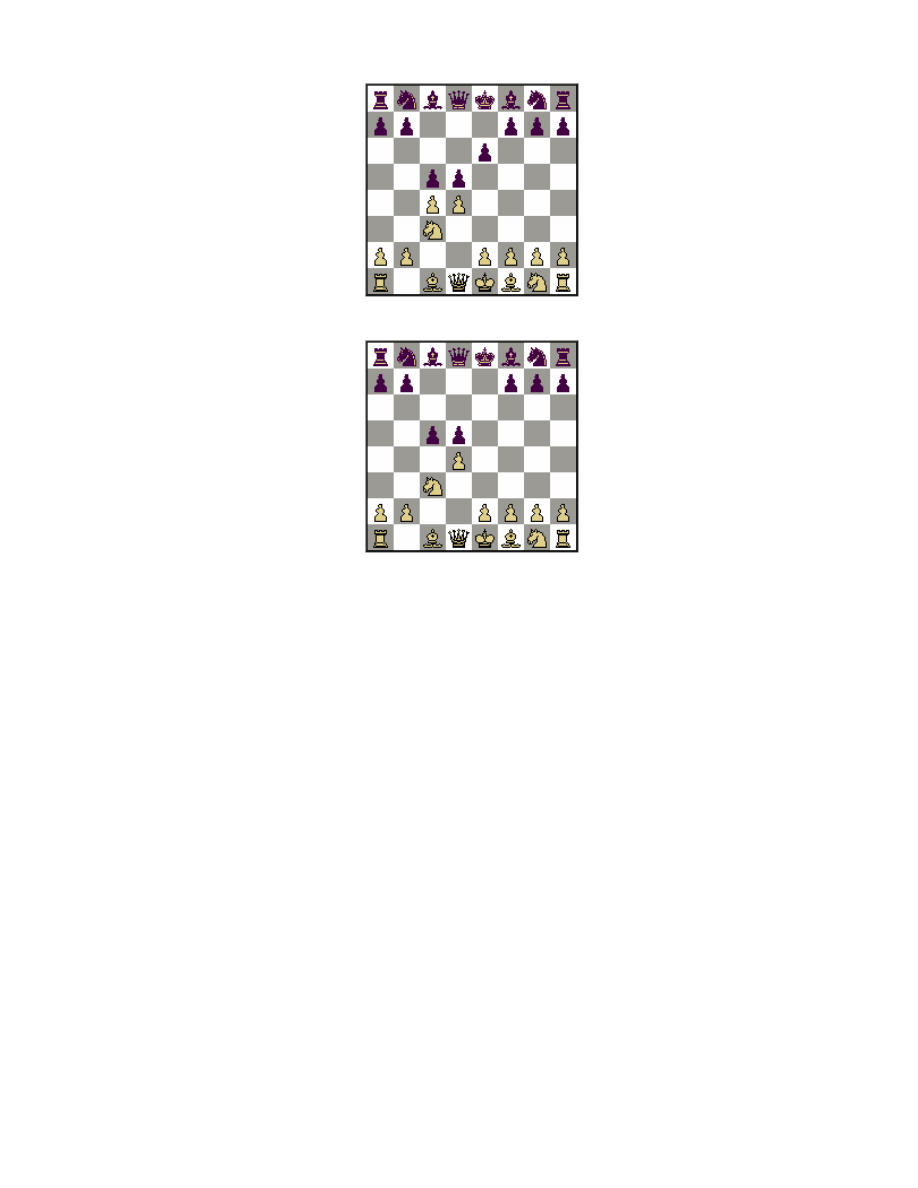
Black challenges the center immediately. White now has to constantly consider the consequences of captures
in the center. Usually White exchanges the c-pawn for Black’s d-pawn.
Later the White d-pawn can be exchanged for the Black c-pawn. This gives Black an isolated d-pawn, which
we will discuss in detail later. For now, let’s consider the typical pawn structure that arises after an exchange of
pawns at d5.
There is a lot of tension in the center. White can capture at c5 or Black can capture at d4, in either case setting
up the isolated d-pawn for Black. It is important to note, however, that clarification of the situation does not
usually take place in the first few moves. When a central tension is resolved, then it is possible to concentrate on
plans which are appropriate to the central situation. While the center remains fluid, it is harder to find the correct
plan because the central situation can change quickly. So usually this pawn center stays intact until move 9, when
both sides have competed development.
Who plays the Tarrasch Defense
The Tarrasch Defense is used primarily by advanced players, but this is mostly a result of the tendency for
teachers of young chessplayers to avoid openings which involve isolated pawns, on the grounds that they are
difficult to defend. Therefore it is only when players graduate to higher levels of competition that they begin to
encounter the defense.
Many great players have used the Tarrasch Defense. You will meet some of them in the section on Heroes in
the Tarrasch Defense. For now, all that need be said is that World Champions such as Garry Kasparov and Boris
Spassky relied on the Tarrasch to get to the top.
The Tarrasch appeals to players with a strong fighting spirit. Tactics can dominate the middlegame, with long
combinations involving temporary and permanent sacrifices.
The stronger the endgame skills, the better, since the Tarrasch often leads to endgames which are difficult to
win, or even draw (some of the time)! As you play the Tarrasch your understanding of many endgames, especially
those with rooks and minor pieces, will broaden and deepen, making you a better overall player.
How to study the Tarrasch Defense
The Tarrasch Defense is very easy to learn, because there are only a few types of structures that can arise, most
of them involving isolated d-pawns or a small chain with pawns at c6 and d6.
Therefore the opening is best studied from the middlegame outward. Start with the sections on typical tactics,
just to observe the kinds of resources available to each side.
Then play through each of the illustrative games, ignoring at first most of the discussion of the first 15 moves
or so. Observe the flow of the pieces, typical maneuvers, and tactical traps.

The next step is to examine the types of endgames you are likely to encounter. Just play through the longest
games, including the ones in the notes to other games, and casually take note of the types of structures that are
most frequently seen.
Finally, go back and study the notes to the opening phase of each game. Try to learn where to place your
rooks, how the queens operate, and when to capture at d4 or allow capture of your knight at c6.
You will then be ready to go out and use the Tarrasch Defense to defeat your tournament and casual
opponents!
Dr. Tarrasch and his Defence
Siegbert Tarrasch was born in Wroclaw (then Breslau) on
5
March, 1862 and died on 13 February, 1934. His
careen began during the Classical period of chess, and ended well into the Modern period (We consider the
Modern period to have begun when Bnonstein was born
—
1924). During these years chess openings underwent
fundamental changes, beginning with a preference fon 1 d4 over 1 e4, and continuing with the development of
Hypermodern theories by Nimzowitsch and Alekhine. Tarrasch‘s main contribution to chess was a result of his
work on the IQP (Isolated Queen Pawn) position in the French Defence and Queen‘s Gambit. Tarrasch believed in
the strength of the IQP and adopted very dogmatic positions based on this belief. While contemporary chess does
not share his views completely, it certainly credits him with pointing out the cramping influence and attacking
power of the IQP.
Tarrasch was 15 years old when he first took up chess seriously, and did not make his debut until 1881 in
Berlin, and that was a bit of a disaster. He was not dissuaded, however, and played brilliantly in his next
Tournament in Nuremberg, 1883. He reached the master level in 1885, finishing second in Hamburg, and went on
to scone a series of victories in major international events. For some reason he did not manage to arrange a match
for the World Championship until 1908, and he was soundly defeated by Emmanuel Lasker by a scone of
10.5—5.5.
A rematch in 1916 proved even worse, as he went down to defeat without winning a single game. For the
remainder of his career he played in very strong events, usually finishing in the middle of the field.
It is his writing, rather than his playing which makes Tarrasch such an important figure in chess history. His
books are classics of the chess literature: Dreihundert Schachpartie, Die Moderne Schachpartie, and his treatise on
the Queen‘s Gambit. In these and other writings he expounded his chess theories, which were quite different from
those of his contemporaries.
Tarrasch introduced the “new“ variation of the Queen‘s Gambit in 1888 in his game against von Bardeleben,
though the basic moves had been seen in games fifty years pervious. At first all went well, with no one challenging
the basic premise of the opening: that an IQP is not necessarily a liability in the middlegame. Soon, however, Karl
Schlechter and Akiba Rubinstein worked out a System against the Tarrasch Defence (as it was already being
called), involving the fianchetto of the Bf1 at g2. (See Schlechter—Dus Chotimirski). There soon arose a sort of
tabiyah after 1 d4 d5 2 c4 e6 3 Nc3 c5 4 cxd5 exd5
5
Nf3 Nc6 6 g3 Nf6 7 Bg2 Be7 8 0-0 0-0.
This is the standard position of the Classical Tarrasch, which can be reached by many transpositional paths.
Black has solved the main problem of the Queen‘s Gambit. The light-squared bishop is able to enter the game. On
the other hand, Black has accepted an isolated pawn at d5, since White can either play 9 dxc5 or force Black to
play an eventual cxd4. Black can defend this pawn with many pieces, but White will be able to set up a blockade
on d4 (after dxc5 or cxd4) and then bring pressure to bear along the d-file and hl-a8 diagonal, while his minor
pieces harass the Black defenders. Tarrasch held (in Gegenwartige stand der wichtigsten Eröffnungen, 1918) that
Black‘s position was fine, but he found few followers at the time. It has always been a “minority“ defense, but that
“minority “ includes many of the best players in the history of the game, appealing to players who prefer their own
judgments to those of the theoreticians.
The Tarrasch did not achieve respectability quickly. Cook‘s Compendium (1902) gave the defense just two
columns, quoting Pillsbury-Schlechter (Munich 1900) and Schlechter- Tarrasch (Nuremberg 1906). These were
not among the most impressive examples of play for Black. In the 1910 edition of Freeborough and Ranken‘s Chess
Openings the line was merely mentioned in a footnote, although it must be admitted that the d4 openings were
almost completely ignored there anyway, probably because the book was based on early editions of Cook‘s
Compendium, which were written during the heyday of 1 e4. Less old-fashioned editors took more note of 3
...
c5. In
Blanshard‘s
Classified Chess Games
with Notes, published by the Glasgow Chess Club in 1911, the opening was
carefully considered and the lines given were quite acceptable for Black, but the Schlechter-Rubinstein Variation
(6 g3) was not mentioned. Opening theory traveled more slowly in those days.

The leading theoreticians continued to scoff at the defense. Salvioli (1930) dismissed the Variation with a
number of smashing wins for White, i.e. Réti—Tarrasch, Pistyan 1922 and other games in which Black mishandled
the defense. Efim Bogoljubow, in Die Moderne Eröffnung 1
d2—d4!
(1928) concurred. His comments are worth
considering: “The idea of the opening which is named after Tarrasch is to attack the enemy pawn at d4 (after Black
has defended his own pawn with
e7—e6)
with c7—c5, simultaneously freeing his position. The Tarrasch Defence is
not really a defense in the literal sense of the word, but rather a counterattack. Should Black, logically in the role of
the defender, be able to take over the attack so early in the game, then the Queen‘s Gambit would be no attacking
weapon for White and would be absent from the modern opening repertoire
...
White can attack the isolated d-
pawn after 4 cxd5! exd5
5
Ng1—f3 Nb8—c6 6 g2—g3!, and that the pawn at d5 will remain a point of attack.
Black has many difficult problems to solve before he sees his way out of the jam.“
In the 1930s the Tarrasch received aid from an unexpected source. The Swedish team (Stahlberg, Lundin, and
Stoltz) at the 1933 Olympiad in Folkestone prepared a new answer to Schlechter‘s 6 g3, namely 6
...
c4!? This
aggressive move gave a whole new character to the Tarrasch, and for a while it was a mighty tournament weapon.
Eventually, however, improved methods of play were found for White, and the opening is no longer considered
fully playable. During the war years other openings dominated Black‘s repertoire against 1 d4. Nevertheless, Max
Euwe had a high opinion of the Tarrasch. He wrote (in Chess, 1947:
“Nowadays 4.cxd5 is considered to offer White no clear advantage, so that there is no reason to condemn the
Tarrasch. it is obvious from its sporadic adoption that it does not inspire much trust, all the same.“ The 7th edition
of Modern Chess Openings (1946) repeated the usual position that the Rubinstein Variation favored White (“so
strong that most masters prefer to avoid the defense altogether“), that the Swedish variation was interesting but
unsound, etc.
The view in Eastern Europe was much the same. In the 1957 edition of Kurs Debiutov Panov wrote that “the
fundamental drawback of the Tarrasch Defence remains the weakness of the central pawn d5, which limits the
maneuverability of the Black pieces and guarantees White a solid initiative.“ Evidently no one paid much attention
to Tarrasch‘s claim that the opening guaranteed Black‘s pieces greater mobility! Players, however, are usually
capable of making better positional judgments than theoreticians, and soon several Soviet stars took a second look
at the Tarrasch. Keres led the way, followed by Aronin, Geller, and Mikenas. The ground was laid for a comeback.
In 1969, Boris Spassky shocked the chess world by using the Tarrasch Defence to win the World
championship. He wrote about the reasons behind his choice of openings: “While in the first match 1 occasionally
led the game into the paths of the Ujteiky Defence, this time abandoned such deployment of my bishops and took
up the classical Tarrasch Defence. Maybe this came as some surprise to the spectators and commentators, and
perhaps even Petrosian did not expect it, since he specialized in playing against the isolated pawn. But as for me, I
love the defensive style. it is true that the match has demonstrated how demanding and nerve-wracking this
opening is, but the defense fulfilled its role admirably in the match.“ Here. Spassky talks about defense, where
Bogoljubow had stated that the opening was not a defense at all. Clearly, times had changed.
When an opening scores a big success in the international arena, all the contenders scurry to find a refutation.
In the 1970s the Tarrasch took a pounding as improvements came pouring in for White. By the end of the decade
the opening was being defended by a mere handful of international players: Gligoric, Nunn, Marjanovic, Petursson
and Palatnik among them. They contributed many fine defensive improvements for Black, from innovations in
well-trodden paths to whole new defensive strategies. The opening received a boost in Sergiu Samarian‘s excellent
study The Classical Tarrasch Defence, Q.G.D. and in his book Queen ‘s Gambit Declined (1974). Despite White‘s
success, the opening started to make a brief comeback. Paul van der Sterren updated Ewe’s classic book (in Dutch:
De Opening 1B) and concluded that the Tarrasch was quite respectable.
In Batsford Chess Openings, 1982, Kasparov and Keene expressed the opinion that White could count on no
more than a minute advantage. Referring to the Schlechter- Rubinstein Variation (6 g3), Jon Tisdall wrote that
“Black may fall just short of equality, but his position is both active and extremely playable.“ The 1980s saw the
Tarrasch rebound from its loss of popularity after Spassky gave it up, and during the 1970s it was not seen with
great frequency. A shift began around 1980, when Armenian, Yugoslav, East German and English Grandmasters
revived it. There was no current literature on the opening, and that meant that both original and ideas could be
used without fear that the opponent would be well prepared.
The first major examination of the Tarrasch in English was my book with Grandmaster Leonid Shamkovich,
Play the Tarrasch, published by Pergamon Press in 1984. Garry Kasparov had received a copy of the manuscript
from me long before it was published, and he started to play it at that time. I take no credit for his adding the

opening to the repertoire. Though we were meeting frequently throughout the period of writing the book (he had
collaborated with me on Batsford Chess Openings and Fighting Chess, and I had translated some of his books) and
had great respect for the theoretical ideas of my co–author. In any case, the games below were well known to him
from his studies and I think the Tarrasch just fit in well with his style of play at the time. He stuck with the
Tarrasch until severe defeats at the hands of Anatoly Karpov led him to the Gruenfeld, which, in some lines, is like
a Tarrasch reversed, with Black adopting the fianchetto against White’s central bastion at d4.
After some brutal defeats at the hands of Anatoly Karpov, Kasparov left the Tarrasch for the Gruenfeld and
King's Indian Defenses, but in the 1990s new followers appeared in the form of Miguel Illescas-Cordoba, Spain's
leading native player, and Joel Lautier, the French star. The authoritative opening manuals took a more respectful
view of the opening, with BCO 2 (Kasparov, Keene, Schiller), MCO 14 (DeFirmian), and NCO (Nunn) providing
no clear path to an advantage for White.
Tarrasch once wrote “The future will decide who has erred in estimating this defense, 1 or the chess world!“
We‘re coming around, Doctor, we‘re coming around.
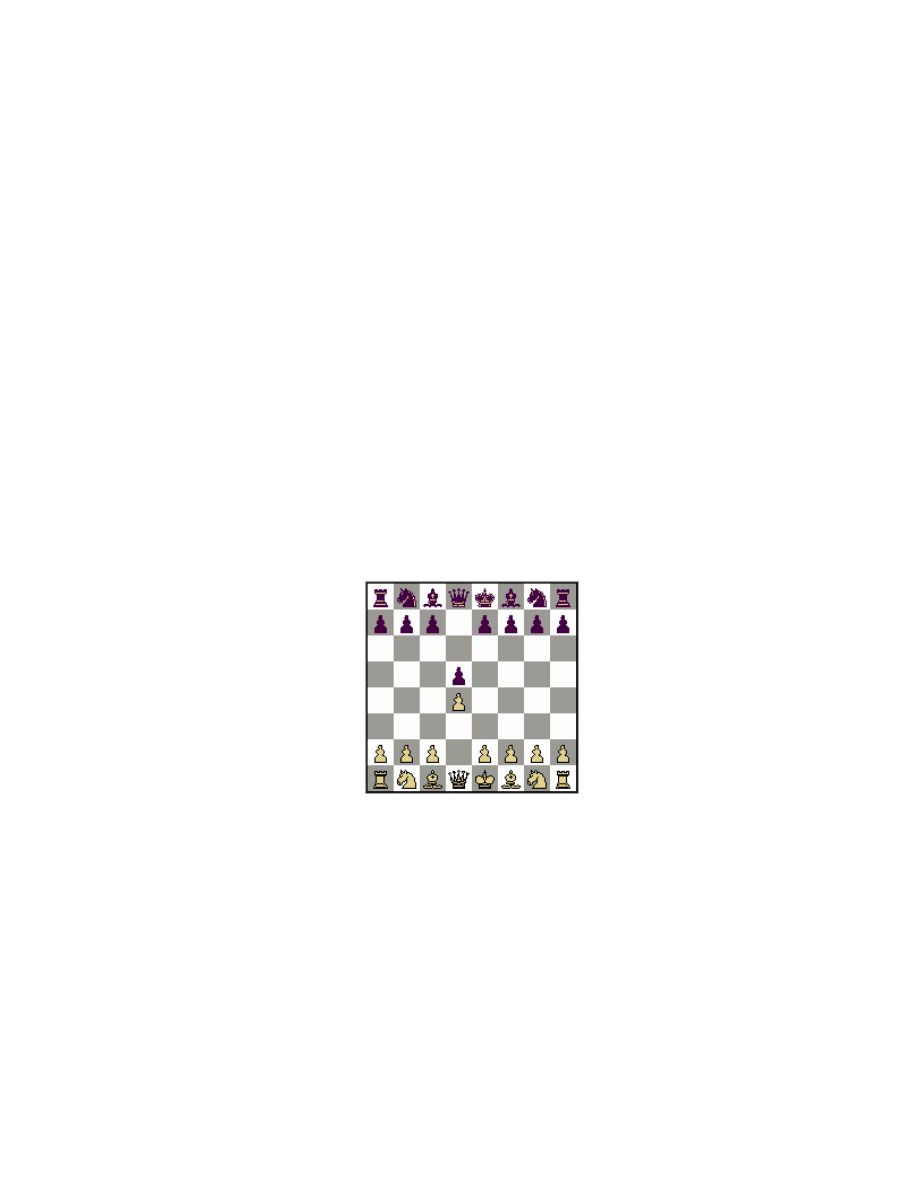
Overview of the Tarrasch Defense
The Tarrasch Defense: an overview
1.d4
The Tarrasch Defense can be reached from just about any opening except for 1.e4. The highly transpositional
nature of the opening requires less memorization and places a premium on understanding important strategic
concepts and typical tactical devices. Naturally White does not have to play straight into the main lines of the
Tarrasch, so we must examine all the other reasonable options.
In this book we will try to adopt the Tarrasch formations wherever we can. Playing …d5, …e6 and …c5 in
rapid succession. Against some of White’s alternative strategies, this is not always the most efficient plan in terms
of achieving equality. However, it is easier to play familiar positions, and to the extent that you sometimes get less
in the opening, you receive benefits in the middlegame where your experience provides a great deal of assistance.
All of the lines in this book have been thoroughly tested and White cannot achieve more than a very minimal
advantage. There are no openings that can absolutely guarantee an equal position for Black, since the advantage of
the first move takes time to overcome. The opening repertoire provided in this book is as good as any alternative
system, and has a number of significant advantages.
The most important aspect of the Tarrasch Defense is the isolated d-pawn, which appears in many variations.
As you learn how to handle the isolani, you will be able to apply your knowledge in almost every game. Your
experience in typical endgames will also provide an edge. The repertoire supplied here maximizes the use of
familiar patterns and structures, so you can get up to speed quickly. 1…d5.
The best defenses for Black prevent White from taking control of the center early in the game. 1…d5 prevents
2.e4, and therefore is one of the best moves. It is strongly recommended that you adopt this move order, even
though others are available. After 1…e6 White can force you into a French Defense with 2.e4, which is only
acceptable to Francophiles. Often 1…Nf6 can reach Tarrasch positions, but usually only when White fails to take
advantage of precise move orders that render this strategy risky. In any case, 1…Nf6 invites many alternatives by
White, such as the Trompovsky Attack (2.Bg5), which is very popular these days.
2.c4. There are several options for White here. In the analysis sections of the book we will look at the most
popular alternatives to 2.c4. For really strange moves you should consult Unorthodox Chess Openings, but we will
cover everything that is seen in serious games.
2.Nf3 is the most popular alternative, and we devote three games to handling the variations where White
refrains from an early c4. The Torre Attack, London System, and Colle System are not particularly ambitious
openings for White, and Black can achieve a comfortable game without difficulty.
2.Nc3 is the harmless Veresov Attack. I used to play it but eventually gave it up because there is no way to get
an advantage for White. If you play the Caro–Kann, then 2…c6 is a good reply, transposing to the main lines after
3.e4. Similarly, the French is available after 2…e6. In this book we will concentrate on a quite different approach
with the gambit line 2…e5 which is very obscure but nevertheless seems to be quite sound.
2.e4 is the Blackmar Diemer Gambit. Black can get a good game by either accepting or declining the offer of a
pawn. French and Caro–Kann players will already be used to this approach, as the gambit is played in several
forms against those opening. I’ll show you a simple and solid reaction.
2…e6 This is the only move to head for Tarrasch territory. Black supports the pawn at d5 and opens a line for
the bishop at f8 in support of …c5, which is the next move in our strategy. 3.Nc3.
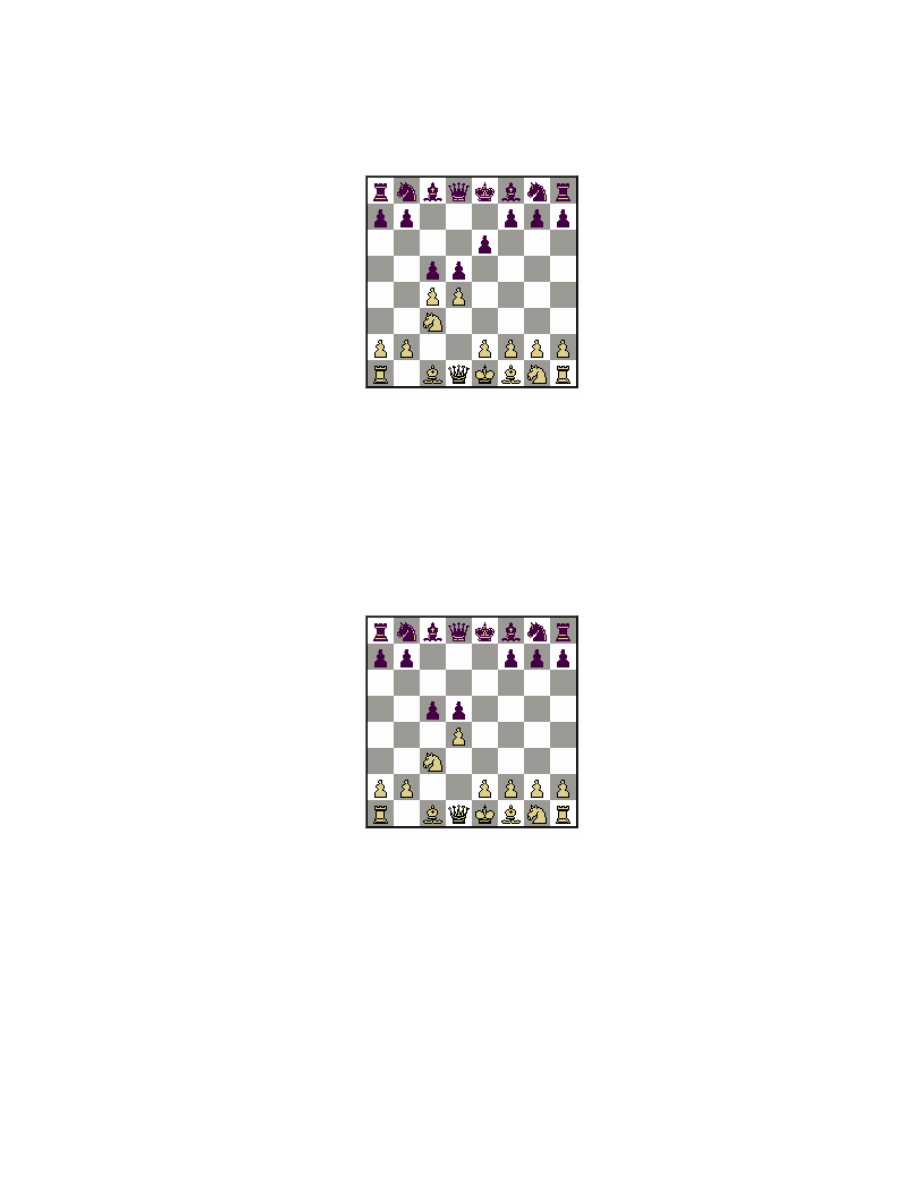
White should bring out a knight here, and it doesn’t make much of a difference that one is developed first.
3.Nf3 gives White a few additional options later in the game and sidesteps a gambit line for Black, which does
not enter into our repertoire. Often this position is reached when the game starts with 1.c4 or 1.Nf3.
3…c5
cuuuuuuuuC
This is the defining move of the Tarrasch Defense. From here on, both sides must contemplate the effects of
pawn exchanges in the center. Black now has a clear plan for development. The knights will come to c6 and f6,
the bishop moves from f8 to e7, and kingside castling follows. The roe of the bishop at c8 depends on White’s
plans. Usually White will exchange at d5, opening up a line for the bishop to move to g4, f5 or e6.
4.cxd5. This is the normal reply. White will weaken Black’s central pawn formation and spend most of the
game tying to win the d-pawn. Don’t worry, this plan rarely succeeds without giving Black more than enough
counterplay, as we will see in our illustrative games.
4.e3 is the primary alternative. This leads to somewhat dull, symmetrical play in the opening but the game can
explode in fireworks later, as you can see in the game Rotlevi–Rubinstein, one of the finest masterpieces. In any
case, by locking the bishop at c1 behind the e-pawn, White gives up any hope of building an attack and Black can
develop in an atmosphere of peace and quiet.
4…exd5
We now see that Black has a semi–open e-file ready to use once Black manages to castle and bring the rook to
e8. 5.Nf3. The only logical move, really.
5.e3 leads to a particularly poor form of the opening for White. Just compare the power of the bishop at c8 to
the shut–in at c1!
5.dxc5 is the Tarrasch Gambit, and while it is not completely harmless, Black obtains a superior game with
correct play.
5.e4 is the unsound Marshall Gambit. A solid defense is presented in our illustrative game.
5…Nc6. In the Tarrasch, you usually develop your knights in alphabetical order. IF Back plays casually with
5…Nf6, White gets a good game with 6.Bg5!, as I found out to my discomfort against British Grandmaster Tony
Miles many years ago.
6.g3.
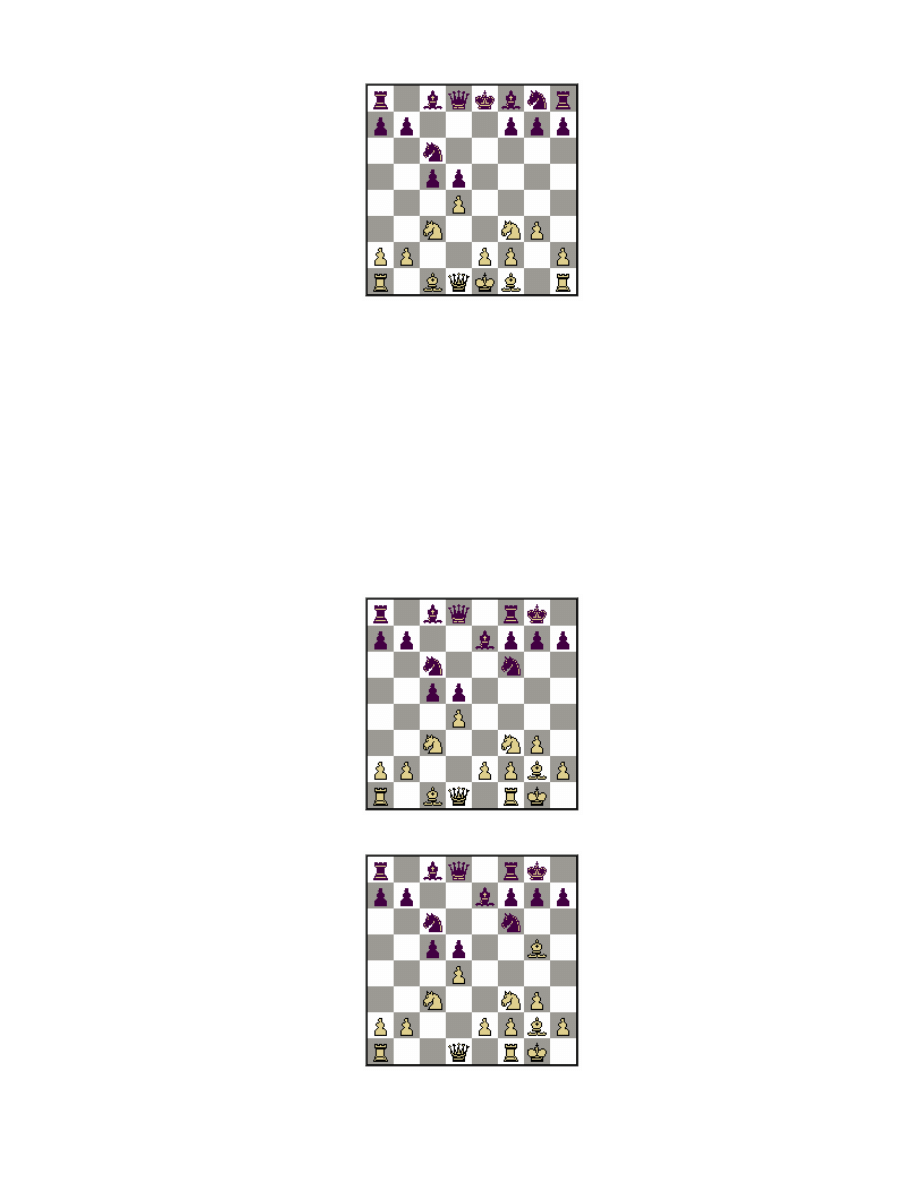
This is the most logical formation. The bishop will come to g2 and put additional pressure at d5.
6.Bg5 Be7; 7.Bxe7 Ngxe7 is nothing special for White, but you should make certain that you are familiar with
the theory and ideas as explained in our illustrative game.
6.Bf4 is completely harmless. The bishop does not operate effectively from this square.
6…Nf6. Notice how our opening follows the classical wisdom of developing a few pawns in the center and
then bringing out knights before bishops! 7.Bg2. The position of the bishop at g2 gives Black two strategic
possibilities. Since the bishop no longer protects the pawn at e2, that can easily become a target. This is especially
true in the main lines. In addition, Black can set up a battery of bishop and queen on the c8–h3 diagonal and play
…Bh3 as part of a kingside attack. On the other hand, the bishop not only aims at d5, but can also place annoying
pressure at c6 and b7. That is why it is considered a particularly powerful weapon. once in a while, it can even
maneuver into a position to attack the Black kingside, as seen in the game
Kasparov–Gavrikov
. 7…Be7.
Some players try to delay this, so that if White captures at c5, no tempo is lost. That is logical, but impractical,
since White need not capture there at all. It is time to get ready to castle, and in any case there really aren’t any
acceptable alternatives. It is much too early to determine the best square for the bishop at c8, and if you bring it to
the wrong square, you would still have to give up a tempo to reposition it later. 8.0–0 0–0. Not much to say about
castling. It’s available and it is good, so just do it!
Here White has a wide range of possibilities. Here is a quick overview.
9.Bg5.
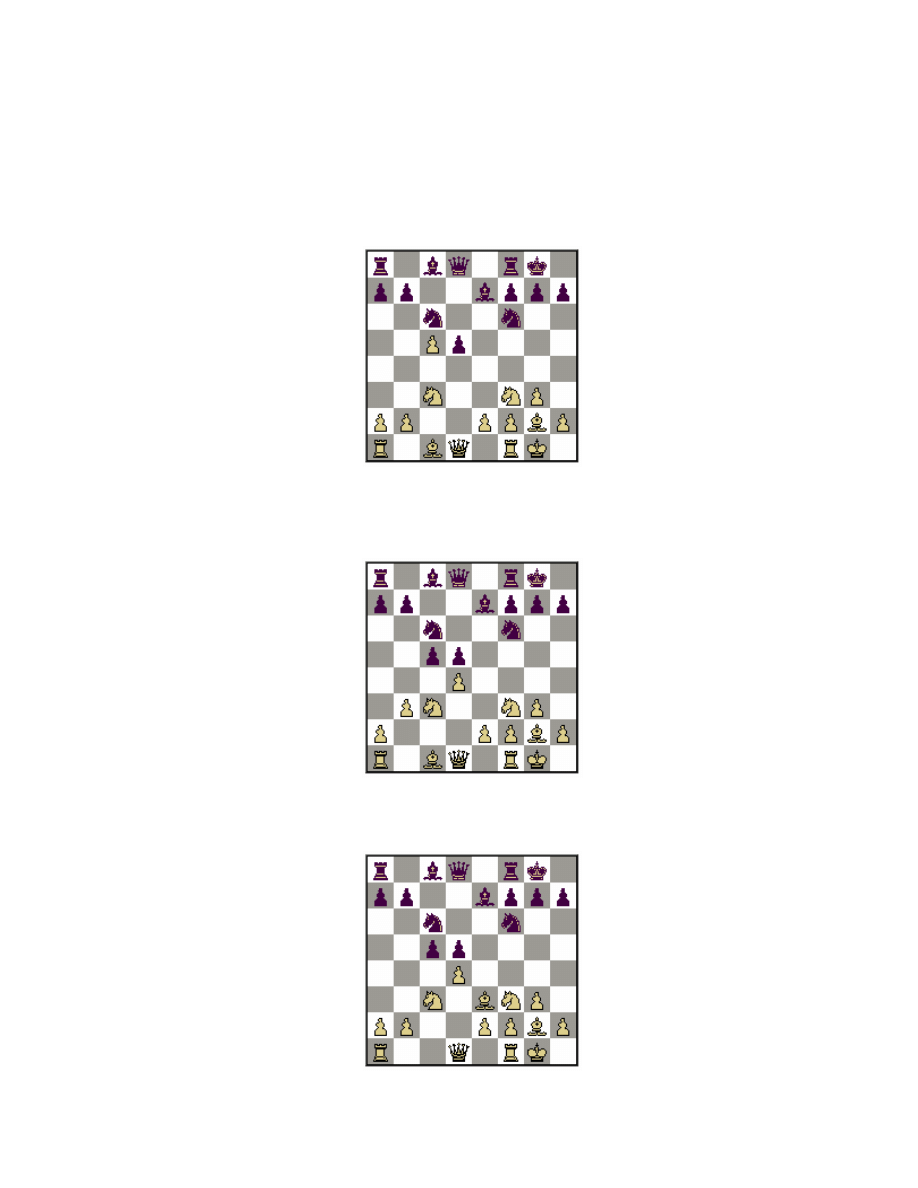
White places pressure at f6, and thereby undermines the support of the weak pawn at d5. This move and the
immediate capture at c5 are the most promising continuations for White and one of the two is almost always the
choice of a top player. Black can respond with one of three strategies: a central exchange, advance of the c-pawn or
passive defense with …Be6. All three are playable and when you have played the Tarrasch for over a decade, as I
have, you may wish to explore all three. Defending the …Be6 lines requires a lot of endgame skill, so it is not for
amateurs. The …c4 lines are very sharp and to be honest, White should be able to gain an advantage against it. So
we will stick with the central exchange …cxd4, which is the traditional main line and bears the greatest similarity
to other lines in our repertoire.
9.dxc5
This is equal in popularity to the Bg5 line, and after Black recaptures at c5. White usually play 10.Bg5. The old
line with 9…d4 is making a comeback. I have previously expressed an undeservedly low opinion of it. With care.,
White can perhaps gain a small advantage, but it may not be enough to provide serious winning chances unless
Black makes a mistake.
9.b3
The queenside fianchetto was popular until the mid–1980s, when Garry Kasparov won convincing games as
Black during his World Championship ascent. This variation can be a lot of fun for Black, as you can see in my
game against Meins.
9.Be3
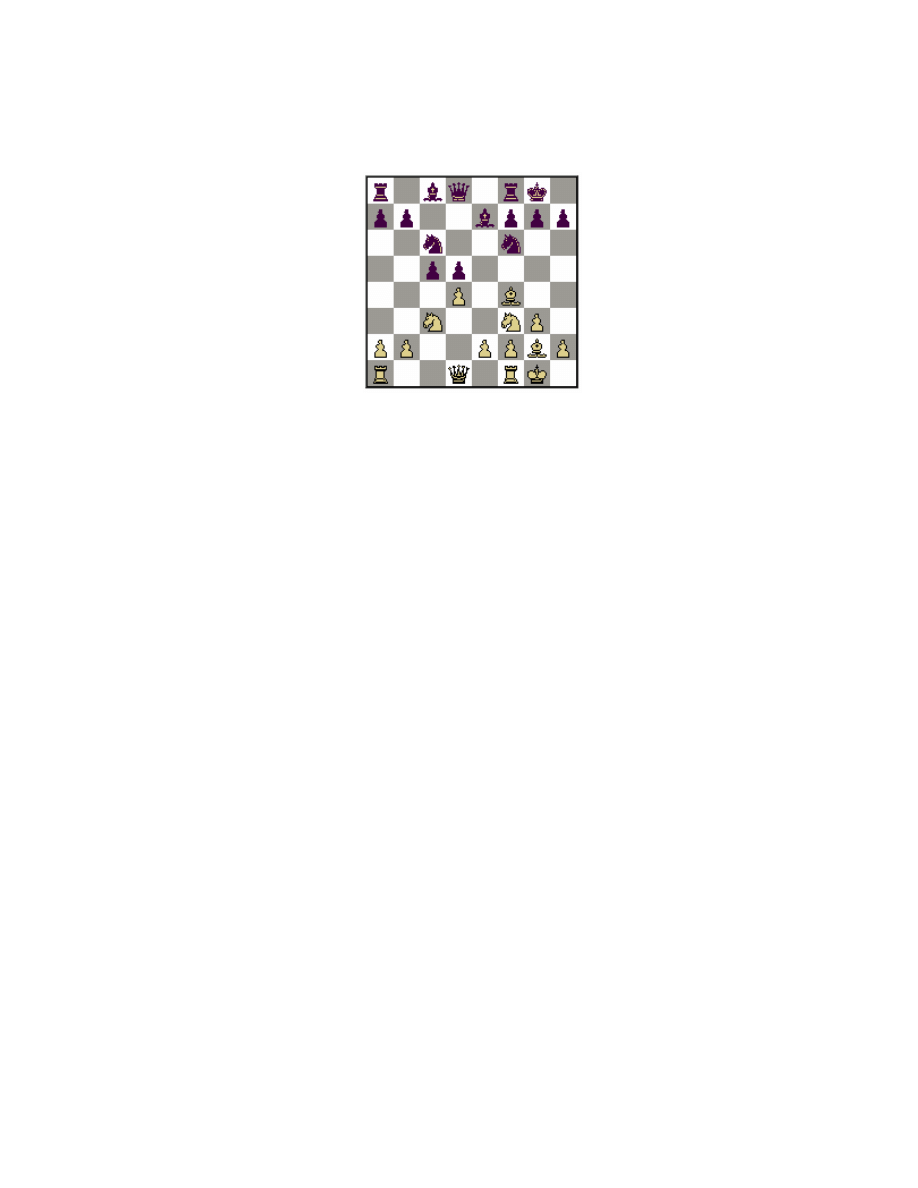
This is an odd–looking move but the idea is to place as much pressure as possible at c5. Black can get a
reasonable game by placing either bishop or knight at g4. The capture at d4 can be played, but by contrast with the
9.Bg5 cxd4; 10.Nxd4 h6; 11.Be3 line, which is the principal variation of the Tarrasch, Black suffers from the lack of
“luft” for the king, and back rank mates can become a problem.
9.Bf4
The bishop does not belong here and Black can play an early …Bd6 if the need arises to defend the dark
squares. By developing the bishop from c8 and placing a rook there, typical Tarrasch strategy, Black gets a good
game. No other moves need to be taken seriously and require special preparation. Just bring a rook to e8 and c8,
after moving the bishop from c8 to some useful square. Moves such as …Ne4 and …Qa5 can be played where
appropriate. Just head for the normal pawn structures, capturing at d4 when the time is right.

Basic Concepts
All good chessplayers understand the basic ideas, which underlie good opening play. They are not always easy
to articulate, and it must never be forgotten that principles often come into contact, and should never be followed
unthinkingly. Consider them as mere guidelines or good advice, and try to follow them as often as you can.
Strategic goals of the opening
Black’s goals in the Tarrasch Defense are very simple. First of all, Black will develop pieces as quickly as
possible. First we place three pawns in or near the center at d5, e6 and c5. Let's concentrate on the Black side. We
will ignore White's formation, for the moment.
cuuuuuuuuC
{rhb1kgn4}
{0pDwDp0p}
{wDwDpDwD}
{Dw0pDwDw}
vllllllllV
Next, the knights are developed
cuuuuuuuuC
{rDb1kgw4}
{0pDwDp0p}
{wDnDphwD}
{Dw0pDwDw}
vllllllllV
Then the dark–squared bishop moves to allow castling.
cuuuuuuuuC
{rDb1w4kD}
{0pDwgp0p}
{wDnDphwD}
{Dw0pDwDw}
vllllllllV
After castling the position of the light–squared bishop can be determined. Usually by this time White has
played cxd5 and we have answered with ...exd5.
cuuuuuuuuC
{rDb1w4kD}
{0pDwgp0p}
{wDnDwhwD}
{Dw0pDwDw}
vllllllllV
The result is a flexible piece formation which can be used to attack on all thee areas of the board. On the
queenside the c-file is used either to advance the c-pawn or as a highway for rooks headed to the seventh rank. In
the center, d4 is the target. Either Black will advance an isolated d-pawn to d4, or will try to aim pieces at a White
pawn on that square, using a knight at c6 and bishop at f6, b6 or a7. In most cases, Black can use the e4–square for
a knight, pointing at the vulnerable f2–squares.
On the kingside, many attacking formations are possible. Black can use the dark squared bishop on the b8–h2
diagonal or a7–g1 diagonal. Knights operate from e4 and e5, and the queen usually enters at h4 or f6. Rooks can join
the action via …Rc6 (or 36)–g6 but also commonly attack from the side on the seventh rank.
Black has a flexible position with comfortable development. Therefore it is important to keep the pieces well
coordinated throughout the opening and early middlegame. Sometimes this may involve sacrificing a pawn, and as
a general rule it is better to give up a pawn than to fall into a passive defense.
The isolated d-pawn
Much has been written on the most famous “isolani” of all, the isolated d-pawn. Siegbert Tarrasch was
convinced that the traditional evaluation of an isolated pawn, that it is a major weakness, was wrong and that the
isolated pawn was in fact a strong weapon. Let's first look at the pawn structure by itself.

cuuuuuuuuC
%wdwdwdwd}
20pDwDp0p}
3wDwDwDwD}
&DwdpDwDw}
5wDwdwDwD}
6DwdwDwDw}
7P)wDP)P)}
(dwdwdwdw}
vllllllllV
If the game came down to a king and pawn endgame, Black would be in real trouble. The pawn at d5 is weak,
and can easily be blockaded by an enemy king at d4. In fact, the blockade is the best–known strategy for operating
against an isolated d-pawn is to blockade it with a piece, usually a knight.
When there is a White piece at d4, the Black pawn cannot advance the pawn from d5 and White can aim
other pieces at it. Extreme views have been expressed on the subject of the "isolani". The great Hypermodern
strategist Aron Nimzowitsch considered the blockade such a potent weapon against the isolani, rendering it very
weak. For Tarrasch, on the other hand, the isolani is a source of dynamic strength, because it cramps the enemy
position. In any case, there is no doubt that the isolani has "the lust to expand". It wants to move forward
whenever possible. Modern thinking holds that the isolani is neither good nor bad in isolation, but must be judged
depending on the surrounding circumstances.
Dynamic players such as Korchnoi and Kasparov have been willing, and even eager, to accept an isolated d-
pawn, while for more positional players such as Karpov and Andersson are reluctant to play with an isolani and are
more often found battling against it.. In any case, there is hardly a Grandmaster who lacks a strong feeling one way
or another!
From our point of view, as Black, the isolani provides us with many tactical and strategic possibilities. In the
worst case, it will sit passively at d5 until it is swept off the board by the White army. Even then, however, many
of the resulting endgames are merely drawn, and not lost..

Heroes of the Tarrasch Defense
Siegbert Tarrasch
Siegbert Tarrasch was born on March 5, 1862 in Breslau (now Wroclaw, Poland). A follower of the classical
style, Tarrasch had strong beliefs about the role of the center. During his lifetime opening theory underwent
several revolutions, including the great Hypermodern movement of the late 1920s, which saw the focus shift from
the Closed Game with 1.d4 d5 to the Indian Defenses with 1.d4 Nf6.
Tarrasch believed that the isolated d-pawn was a powerful weapon, and was very dogmatic on this point.
Actually, he was dogmatic on just about all chess matters. His ultra–conservative views are still valued as the basis
for sound play, although the door has opened to alternative views.
His chess career started very late, at the age of fifteen, and his first tournament was in Berlin in 1881. We are
lucky he stuck with the game, as his debut was a disaster. Undaunted, he worked hard on his game at played very
well in his next tournament, two years later in Nuremberg, which was to become a frequent chess stop for him.
In 1885 he was awarded the title of Master, helped by a second–place finish in Hamburg. After that victory,
his career really took off and he won many major international tournaments. Eventually he established himself as a
leading contender for the World Championship.
In 1908 he got his change, but was clobbered by Lasker, 10.5–5.5. His result in the 1916 rematch was even
more embarrassing and from then on he only managed middling results.
Though he is remembered for some fine games and tournament results, Tarrasch’s real legacy is to be found in
the great books and magazine articles he wrote throughout his career. His Dreihundert Schachpartie, Die Moderne
Schachpartie, and his treatise on the Queen’s Gambit remain classics of the literature, and new generations of
chessplayers are still weaned on his The Game of Chess.
Kurschner vs. Tarrasch,
!Nuremberg, 1887
is a fine game, which is still of importance to the theory of the
opening.
Svetozar Gligoric
The great Yugoslav Grandmaster Svetozar Gligoric, born in Yugoslavia in 1923, was one of the greatest of the
post–war players from chess–addicted Yugoslavia. He dominated the country’s chess in the 50s and 60s, and
remained a vibrant force into the 90s. He was decorated for bravery for acts he performed fighting against the Nazi
invaders, and his chess shows this underlying courage. The Tarrasch Defense and the Nimzoindian Defense (which
have many similar structural characteristics including frequent isolated d-pawn positions) were his favorites. He
won many tournament and brilliancy prizes, and has written extensively on chess. As he grew older he became an
International Arbiter and has refereed many very important World Championship events.
Toran vs. Gligoric, Buenos Aires, 1955
is one of his endgame contributions to the library of Tarrasch Defense
games:
Boris Spassky
For a while, Gligoric was one of very few Grandmasters who used the Tarrasch Defense at the highest levels
of chess. That changed in 1969, when Boris Spassky used it to successfully challenge Tigran Petrosian for the
World Championship. The opening featured prominently in that match, and cause commentators and analysts all
over the world to re–evaluate the opening.
Boris Vasilyevich Spassky was born in 1937 in Leningrad, and learned a lot of his chess as a child during the
Second World War. He rose to prominence in Russian circles, and afterward received training from Leningrad’s
finest trainers. He first qualified for the Soviet championship in 1955 and was a participant 11 times. He rose to the
top of the Soviet talent pool and after tremendous victories in the 1960s was able to work through the
international ranks and qualified for a World Championship bid in 1966, but lost by a point. In 1969 he was better
prepared, and armed with new ideas in the Tarrasch he won the title, only to lost it in 1972 to the American
phenomenon Bobby Fischer.
Losing the title brought serious consequences for Spassky, who was persecuted by the Soviet regime.
Eventually he fled to France, where he still makes his home. The fine French culture cooled his fighting spirit, and
his games were more often drawn than not. He nevertheless remains a popular figure, known as The Gentleman of
Chess, quite a contrast to the World Champions who preceded and followed him.
Petrosian vs. Spassky, World Championship, 1969
is one of the most famous Tarrasch games of the Spassky
era.

Smbat Lputian
The Armenian Grandmaster (born in 1958) rose to prominence in the early and mid–1980s, and played the
Tarrasch Defense consistently.
Azmaiparashvili vs. Lputian, Soviet Union, 1980
was seen all over the world.
Slavolub Marjanovic
You would think that someone whose first name translates to Slav–lover would choose the Slav Defense, but
Marjanovic, born in 1955, inherited the Tarrasch bug from Gligoric and has been addicted to the opening
throughout his career.
Natsis– Marjanovic Istanbul, 1980
is a fine attacking game.
John Nunn
Dr. John Nunn is one of the greatest chess theoreticians. Born in 1955, he was a true prodigy, entering Oxford
at the age of graduating in 1973. He was awarded his doctoral degree in 1978, by which time he had already joined
the ranks of England’s leading players.
Nunn’s writings are among the most detailed analyses available on opening and endgame theory. If is hardly
surprising that an endgame specialist would find the Tarrasch Defense appealing, and Nunn’s endgame prowess
served him well.
Of course, Nunn is also on of the Royal Game’s most brilliant tacticians, as he showed in
Vadasz vs. Nunn
Budapest, 1978.
Murray Chandler
Another major figure on the British Tarrasch scene was Grandmaster Murray Chandler, who was born in New
Zealand in 1960, but most of his career has been London–based. He served as a second to many excellent British
players and has written many treatises on the opening.
King vs. Chandler Reykjavik, 1984
Garry Kasparov
Garry Kimovich Kasparov was born April 13
th
, 1963 in Baku. He rose quickly to a prominent position in the
chess world, and was already a superstar when he made the Soviet Olympiad side in 1980. He won his first Soviet
Championship a year later, qualified for the candidates matches in 1982, and defeated Korchnoi, Belyavsky and
Smyslov on his way to the first showdown with his “eternal rival” Anatoly Karpov. That match was suspended
after six months in 1984/85, during much of which Karpov held a 5–0 advantage but could not bring home the
final point.
Kasparov won the rematch later in 1985, and defended his title in 1986, 1987, and 1990 before breaking ranks
with the World Chess Federation in 1993, defeating Nigel Short in London for the Professional Chess Association
title. He defended that title in 1995 against Viswanathan Anand. Having temporarily exhausted the supply of
human challengers, in 1996 he defeated the silicon beast Deep Blue, the product of IBM technology. A rematch is
scheduled for May of 1997. He lost his title to Vladimir Kramnik in the fall of 2000, after enjoying a fifteen year
reign at the top.
We have already seen a selection of his games in the Illustrative Games chapter. He is another fine game from
one of his simultaneous exhibitions against a set of strong masters.
Zueger vs. Kasparov Simultaneous Exhibition,
1987
Margeir Petursson
Icelandic Grandmaster was born in 1960 and has been a leading player in that chess–loving country for many
years. His special contribution to the Tarrasch is in the main lines with 9.Bg5 cxd4; 10.Nxd4, where he discovered
that 10…Re8 is playable in addition to the normal 10…h6. Here is a sample of his artistry.
Schussler vs. Petursson
Gausdal Zonal (10), 1985
Miguel Illescas Cordoba
Grandmaster Miguel Illescas Cordoba is the leading native–born player of Spain, a country with over a
thousand years of chess tradition. He has been devoted to the Tarrasch throughout his career.
Beliavsky vs. Illescas
Cordoba Linares, 1990

Theory of the Tarrasch Defense
The games listed below illustrate the most important theoretical lines in the Tarrasch Defense, and the most
reliable defenses to White's other plans.
Classical Tarrasch
9.dxc5 Bxc5
10.Bg5 d4
Lasker-Tarrasch, 1918
Zagorovsky-Nielsen, 1972
Andersson-Nunn, 1980
Ornstein-Raaste, 1981
Chandler-Engl, 1981
Schneider-Raaste, 1982
King-Chandler, 1984
Andersson-Chandler, 1984
Maric-Reimer, 1986
Miles-Klinger, 1986
Ivanchuk-Marjanovic, 1989
Molo-Mozzino, 1989
Mednis-Lputian, 1989
Bystrov-Timoshenko, 1990
Lerner-Nenashev, 1991
Vasilenko-Kudriashov, 1991
Miles-Lautier, 1992
Shirov-Illescas, 1993
Cramling-Ponomariov, 1996
Tsesarsky-Manor, 1999
10.Bg5 Be6
Analysis – Classical 9.Bg5 Be6 10.Rc1, 2000
Tal-Keres, 1959
Smyslov-Vaganian, 1978
Martin-Kolbe, 1985
Dobsa-Blaesing, 1986
DeLaat-Eveelens, 1992
Samarin-Soltau, 1994
10.Bg5 Others
Olej-Jaworski, 1989
10.a3
Bernstein-Levenfish, 1912
Szypulski-Zoinierowicz, 1996
10.Na4
Stein-Parma, 1971
Radulov-Spassov, 1974
Schussler-Petursson, 1985
9.dxc5 d4
Batik-Dyckhoff, 1930
Demetriescu-Nagy, 1936
Vidmar-Dyckhoff, 1936
Fine-Horowitz, 1939
Muir-Whitfield, 1948
Rompteau-Engel, 1965
Ilic-Marjanovic, 1976

Arganian-Schiller, 1983
Karpov-Ofiesh, 1991
9.Bg5
9...cxd4 10.Nxd4 h6 11.Be3 Re8 12.Rc1 Bf8
Petrosian-Spassky, 1969
Stein-Tarve, 1971
Zapetal-Nielsen, 1972
Timman-Gligoric, 1978
Smith-Carleton, 1992
Soyer-Poulenard, 1990
Gurevich-Tal, 1990
Hawkes-Mintchev, 1990
Sutkus-Chandler, 1991
Katisonoks-Ivanov, 1991
Kramnik-Illescas, 1992
Bowyer-Curnow, 1992
Flear-Arkell, 1992
Robatsch-Hübner, 1993
Karpov-Illescas, 1993
Kasparov-Illescas, 1994
Gligoric-Stamenkovic, 1997
9...cxd4 10.Nxd4 h6 11.Be3 Re8 12.Rc1 others
Gligoric-Polugaevsky, 1969
Spassky-Martin Gonzalez, 1991
Timman-Chandler, 1983
Inkiov-Sibarevic, 1983
Zueger-Kasparov, 1987
Marin-0Petursson, 1987
Hjartarson-Illescas, 1988
Sanchez-Tarrio, 1991
San Segundo-Lautier, 1993
Greenfeld-Shmuter, 1996
Knaak-Chandler, 1996
Classical Tarrasch-Repertoire 2000
9...cxd4 10.Nxd4 h6 11.Be3 Re8 12. others
Tal-Stean, 1975
Vadasz-Nunn, 1978
Belyavsky-Kasparov (2), 1983
Belyavsky-Kasparov (6), 1983
Smyslov-Kasparov, 1984
Karpov-Kasparov, 1984
Sandstrom-Breutigam, 1985
Van Wely-Brinck Claussen, 1989
Stefansson-Johannesson, 1990
Muco-Ivanovic, 1990
Skembris-Ivanovic, 1990
Yakovich-Todorovic, 1990
Tiulin-Lutovinov, 1991
Topalov-Martin Gonzalez, 1992
De Boer-Vladimirov, 1994
9...cxd4 10.Nxd4 others
Petrosian-Spassky, 1969
Ljubojevic-Marjanovic, 1978
Antoshin-Palatnik, 1981

Seirawan-Kasparov, 1983
Jussupow-Petursson, 1983
Landenbergue-Kindermann, 1983
Kouatly-Marjanovic, 1987
Van Osmael-Berecz, 1988
Mesterton-Ojala, 1990
Sokolov-Todorovic, 1991
Matlak-Populsen, 1991
Farago-Magomedov 1992
Christiansen-Piket, 1992
Gelfand-Illescas, 1993
Campos Moreno-Segura, 2000
9...c4
Rubinstein-Perlis, 1909
Flohr-Maroczy, 1932
Jussupow-Lputian, 1979
Kasparov-Hjorth, 1980
Azmaiparashvili-Lputian, 1980
Bagirov-Lputian, 1980
Garcia Gonzales-Braga, 1984
Granberg-Vodep, 1984
Blees-Peek, 1986
Salov-Lputian, 1986
Chernin-Marjanovic, 1987
Huzman-Legky, 1987
Dzhandzhava-Lputian, 1987
Hansen-Lputian, 1988
McKay-Peek, 1988
Petran-Anka, 1989
LaplaZa-Mozzino, 1990
Khenkin-Magomedov, 1990
Dokhoian-Nenashev, 1991
Summermatter-Balashov, 1991
Alterman-Zagema, 1994
Sherbakov-Egin, 1996
9...Be6
Dus Chotimirsky-Teichmann, 1911
Kiviaho-Lagland, 1971
Bielecki-Kahn, 1980
Barbero-Espig, 1987
Taylor-Grobe, 1990
Janniro-Schiller, 1994
9...Bf5
Najdorf-Yanofsky, 1946
9.b3
Uhlmann-Espig, 1976
Levitt-Schiller, 1981
Larsen-Kasparov, 1983
Berg-Timman, 1986
Golubenko-Kiik, 1987
Lagunov-Novik, 1989
Tisdall-Lalic, 1990
Boensch-Mende, 1992
Shutt-Schiller, 1996

Meins-Schiller, 1996
Tyomkin-Shmuter, 1999
9.Bf4
Lengyel-Quinones, 1964
Djuric-Adianto, 1987
Naumkin-Knikitin, 1991
Schienmann-Schwagli, 1991
Kiselev-Jelen, 1992
9.Be3
Petrosian-Keres, 1956
Lombardy-Emma, 1958
Miles-Fernandez, 1980
Gurevich-Wilder, 1984
Wickens-O'Duill, 1985
Larsen-Kasparov, 1987
Pinto-Schiller, 2000
Others
Rubinstein-Tarrasch, 1922
Adams-Schiller, 1989
Swedish Variation
Heemsoth-Kunz, 1958
Wikstroem-Kunz, 1961
Kallinger-Mikenas, 1972
Foldi-Mikenas, 1972
Ftacnik-Miralles, 1988
Barreras-Real Naranjo, 1992
Tregupov-Moskalenko, 1994
Becerra-Palao, 1995
Misc. Rubnistein-Schlechter lines
Forgacs-Tarrasch, 1912
Marshall-Corzo, 1913
De Mauro-Jensen, 1991
Asymmetrical Tarrasch: Main Lines
Harrwitz-Staunton, 1846
Evans-Larsen, 1957
Salonen-Ojala, 1974
Sunye Neto-Kasparov, 1981
Portisch-Suba, 1986
Belov-Foisor, 1987
Rodriguez-Suba, 1987
Gheorghiu-Wahls, 1987
Karpov-Illescas, 1987
Speelman-Larsen, 1987
DeFirmian-Ravi, 1987
Tal-Timman, 1988
Janosi-Peterson, 1989
Kopriva-Rybak, 1992
Karpov-Morovic, 1994
Schiller-Ivanov, 2000
Symmetrical Tarrasch & Misc. Asymmetrical lines
McDonnell-La Bourdonnais, 1834
Rubinstein-Kulomzin, 1903
Rotlewi-Rubinstein, 1907
Schlechter-Prokes, 1907

Lasker-Janowski, 1910
Nielsen-Larsen, 1979
Hass-Andersen, 1982
Nikolaiczuk-Cramling, 1986
Dollner-Van Oosterom, 1987
Kalantaryan-Schiller, 2000
Stevens-Schiller, 2000
Gruenfeld Gambit
Bareyev-Lobron, 1995
Tarrasch Gambit
Burn-Tarrasch, 1889
Bernstein-Spielmann, 1906
Bernstein-Marco, 1906
Miettinen-Valve, 1967
Khasin-Nun, 1969
Smagar-Shkurovich, 1980
Pyshkin-Weijerstrtass, 1989
Roncan-Mozzino, 1990
Blokh-Lutovinov, 1993
Bareyev-Lobron, 1995
Marshall Gambit
Marshall-Spielmann, 1908
Anglo-Indian
Maroczy-Tarrasch, 1903
Kuczynski-Wagner, 1910
Von Hennig Gambit
Benzinger-Von Hennig, 1929
Foltys-Rohacek, 1941
Smyslov-Estrin, 1951
Mitov-Estrin, 1972
Hein-Schiller, 2000
Schara Gambit
Main Lines with 9.Qd1 Bc5 10.e3 Qe7 11.Be2
Kluger-Honfi, 1956
Brilla Banfalvi-Nun, 1968
Brilla Banfalvi-Berta, 1968
Nathe-Kornath, 1968
Polugaevsky-Zaitsev, 1969
Bouabid-Kerr, 1970
Vilela-Rodriguez, 1972
Preinfalk-Berta, 1975
Beecham-Mcmillan, 1976
Brilla Banfalvi-Nun, 1968
Lputian-Danov, 1981
Nickl-Roach, 1985
Tozer-Schiller, 1986
Soppe-Bronstein, 1987
Borwell-Van Perlo, 1987
Dijkstra-Morgado, 1989
Serper-Brandner, 1989
Taylor-Hartman, 1989
Destaing-Martine, 1992
Bronzik-Cech, 1993
Ford-Schiller, 1994

Farla-Fitzpatrick, 1997
Main Lines with 9.Qd1 Bc5
Prokorovich-Ravinsky, 1958
Mengarini-Radiicic, 1967
Glikshtein-Shkurovich, 1970
Hult-Berkell, 1972
Bruening-Lopez Esnaola, 1973
Kuznetsov-Lerner, 1977
Sidhoum-Kuijf, 1985
Tiemann-Felchtner, 1987
De Mauro-Trapl, 1989
Sargent-Drueke, 1989
Panno-Bertona, 1990
Hovenga-Schiller, 1996
Vigny-Lannaloli, 1997
Izumakawa-Schiller, 1997
White plays 9.Qd1 without 9...Bc5
Alatotzev-IlyinZhenevsky, 1934
Lisitsin-Estrin, 1949
Markovic-Kozomara, 1949
White plays 9.Qb3
Plukkend-Messere, 1969
Hort-Cuartas, 1982
Pieterse-Kuijf, 1987
Oirschot-Schroeder, 1990
White varies at move 8
Pirc-Alekhine, 1931
Geister-Zaitsev, 1960
Narkin-Pol, 1972
Suba-Rodriguez, 1979
Litvinchuk-Randolph, 1984
Strand-Sabel, 1988
Azmaiparashvili-Marjanovic, 1989
Karpov-Hector, 1990
Misc. games
Busch-Ragozin, 1929
Bareyev-Ljubojevic, 1993
White plays 4.dxc5
Marshall-Tarrasch, 1903
Olmeda-Gomez, 2000
White delays or omits Nc3
Forgacs-Tarrasch, 1912
Marshall-Corzo, 1913
Nimzowitsch-Tarrasch, 1914
Spitzbarth-Krempel, 1989
Wyszukiwarka
Podobne podstrony:
Schiller The Ultimate Tarrasch Defense
Schiller Eric The Classical Caro Classical Caro Classical Caro Kann in Action OCR, 148p
Schiller Eric Strategic themes in action, 1991 OCR, 102p
Eric Frank Russell The Ultimate Invader
Eric Frank Russell The Ultimate Invader
The Ultimate Enlarged Manual QKVHX2PTU7Y7DR6HM4ZYZ77FQ3IKDMIGCSHE76A
20140418 The Ultimate 2 fold Te Nieznany (2)
20140418 The Ultimate Twofold T Nieznany (2)
20140418 The Ultimate Twofold T Nieznany (3)
eBook Sex The Ultimate Female Orgasm
Lyle McDonald The Ultimate Diet 2 0
THE ULTIMATE?GINNER'S GUIDE TO HACKING AND PHREAKING
THE ULTIMATE PHRASAL VERB BOOK
Burnout Paradise The Ultimate Box
Functions of the Department of Defense
Hot Latin Men 3 1 The Ultimate Merger Delaney Diamond
Patrick G Redford Prevaricator The Ultimate Ring of Truth
kody do emergency 2 the ultimate fight for the life 2
Perkins, THE VERSES IN ERIC THE RED’S SAGA
więcej podobnych podstron