
[2
nd
Edition Electronic PDF version]
an
outlaw
of
a
concept
for
magicians
&
psych-illusionists
by
daniel
madison
performances
Page Three
Outlaw Prediction
Page Three
Blatant Outlaw
Page Three
Outlaw
Page Three
Outlaw Trip
Page Three
Outlaw vs. Swami
Page Three
Invisible Outlaw
Page Four
Outlaw associate
Page Four
Outlaw Disassociate
Page Four
Double Crossed Outlaw
explanations
Page Five
the Principal
Page Five
Making the deck
Page Six
Faking the deck
Page Seven
Outlaw Prediction
Page Eight
Blatant Outlaw
Page Nine
Outlaw
Page Ten
Outlaw Trip
Page Eleven
Outlaw vs. Swami
Page Twelve
Invisible Outlaw
Page Thirteen
Outlaw associate
Page Thirteen
Outlaw Disassociate
Page Fourteen
Double Crossed Outlaw
afterthoughts
outlaw

outlaw is the merge of two simple concepts that play to the Machiavellian characteristics of ones repertoire
With this concept you will be able to predict a merely thought of playing card with remarkable accuracy on even the
most sceptical of participants
All you need is a permanent marker and a deck of playing cards

outlaw
prediction
The performer uses the back of the top card on which to write a prediction | The performer then continues his attempt to
psychologically force a playing card on the participant | A card is named by the participant | The deck is turned face up to reveal
the correct written prediction
EXPLAINED ON PAGE ONE
blatant
outlaw
The performer states that he will try to psychologically suggest a playing card to his participant | When a card is named the
performer admits that it wasn't the card he wanted them to name | He tells them the card he was trying to force on them and
then takes out their named card to reveal the force card written on the back
EXPLAINED ON PAGE ONE
outlaw
A card is removed without the participant seeing .the card is placed in the performers' pocket | The performer attempts to
psychologically force the removed card on the participant | A card is named by the participant | The deck is scanned and the
named card is found still in the deck and not in the performers pocket as expected | The failed force card is removed from the
performers pocket and turned face down to reveal a written prediction of the named card on the back
EXPLAINED ON PAGE ONE
outlaw
trip: EXPLAINED
The performer invites one participant to name any playing card, which is noted | The performer then names a playing card and
also notes it down | Another participant is invited to name another playing card, which is found in the deck | The final named
playing card is turned over to reveal the first participants named card written on the back, this card is removed and left on the
surface face-down | The performer then reminds the participants of the card he named… The removed card is turned face up
only to have changed to be the performers named card.
EXPLAINED ON PAGE ONE
outlaw
vs.
swami
The performer writes a prediction of which card will be thought of by the participant | The deck is spread face up and the
participant is invited to name any card | The prediction is shown to be wrong, however the prediction card is taken out and
turned over to reveal the named card written on the back
EXPLAINED ON PAGE ONE
invisible
outlaw
Two decks are in use the performer states that he placed a prediction card in his deck face-down | A card is named by the
participant who holds the other deck | The performer reveals the face-down prediction to be incorrect | When the named card
is found in the participants pack and the prediction card can be found written on the back of it
EXPLAINED ON PAGE ONE

On all above occasions, the deck can be shown to be legit with all cards-other than the named card unmarked
The following effects differ in performance as in these effects the deck is shown to be a specially marked psychological-
experiment deck, whereas each card has another playing card written on its back in no particular order
outlaw
associate
The deck is shown as a special deck. marked on the back of each card is a different random playing card the deck is set
up in no order and offered to the participant for shuffling | The participant is asked to name any playing card, they are
then asked to name another card of which they would associate with the first card | The named card is turned over to
reveal the 2nd named card written on the back
EXPLAINED ON PAGE ONE
outlaw
disassociate
(outlaw
associate
reversal)
The participant is asked to name any playing card; the backs of the cards are searched to find the named card written
in marker pen | They are then asked to name another card of which they would associate with the first card | The card
is turned over to reveal the 2nd named card
EXPLAINED ON PAGE ONE
double
crossed
outlaw
An envelope is handed to the participant. they are asked to name any playing card; the marked playing card on the
reverse of this card is noted | They are then asked to name another playing card; the cards are scanned through face-
down to find their marked card, the face card that this is marked on the back of is also noted |
The envelope is opened to reveal the first noted playing card with the 2nd noticed playing card marked on the back of it
EXPLAINED ON PAGE ONE
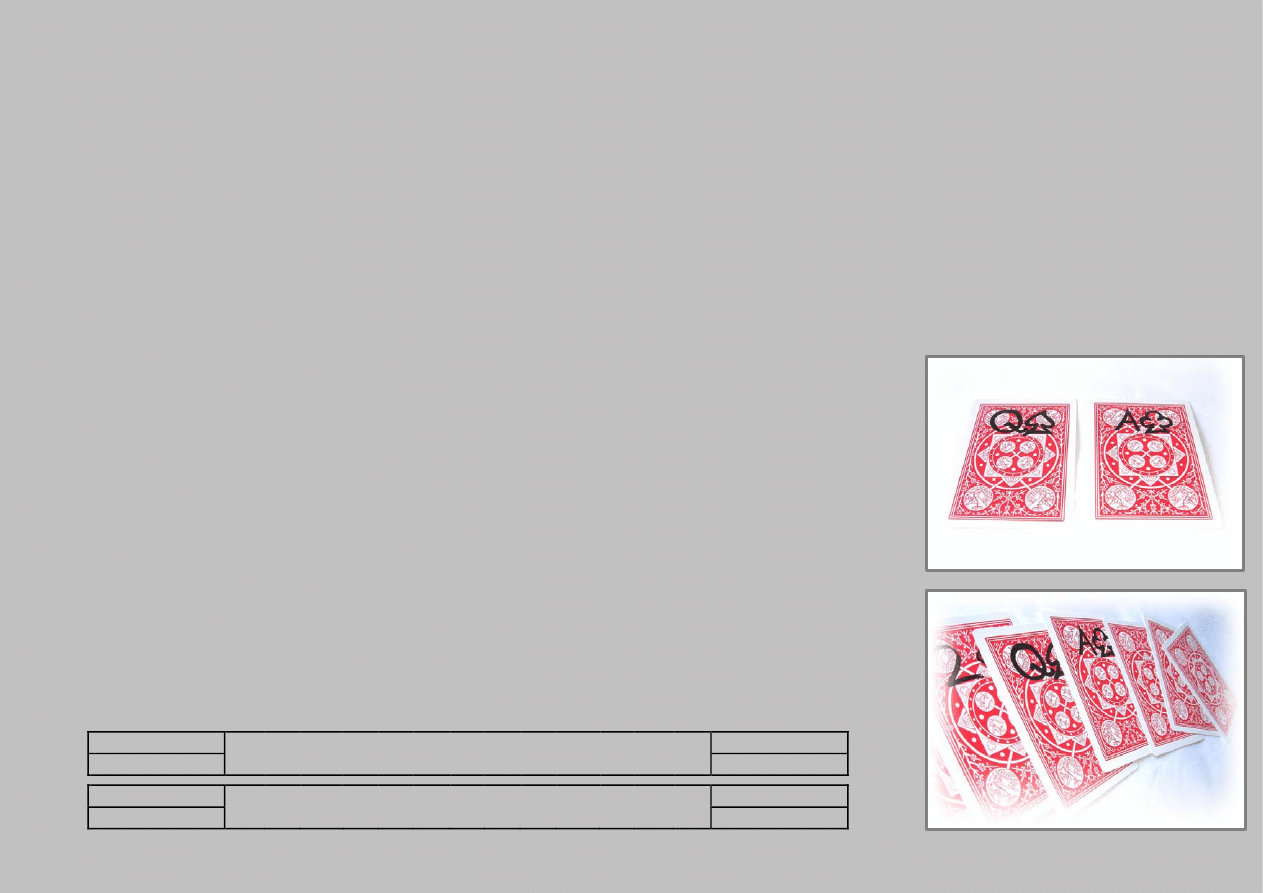
the
principal
Outlaw is a gimmicked deck; each and every card in the deck has a different card value on the back of it
The possibilities of mentalism effects with this deck go out of the roof, some of which are shared in this
documentation
For the main and first five effects, the markings must be unseen by your participants at all times and the deck must
pose as a standard un-gimmicked regulation deck of cards
Methods of how to make the deck appear normal are explained...
making
the
deck
For these effects you will need a regular deck of cards. You will also need three
outsider cards, these cards can be the jokers and advertisement cards or just
duplication cards. The faces of these cards are never shown. As long as they are of
the same colour and design as the deck you are using, they will suffice
Every card in the deck other than the extra three cards needs to be marked on the
back with permanent marker pen. The markings need to be on the top side of the back
of the playing cards as in image 01
The system used for marking the cards is an age old mathematical concept using a
division of 13 on the back of the 2 of hearts you need to mark the jack of diamonds: 2
+ jack = 13.. 5 of clubs + 8 of spades = 13 and so on (jack = ii. queen = 12. king =
13) image 02 shows an exposed view of how the deck should look once marked.
PLAYING CARD AS
2S 3S
4S 5S 6S 7S 8S 9S 10S JS QS KS MARKING
MARKING QC JC 10C 9C 8C 7C 6C 5C 4C 3C
2C AC KC PLAYING CARD
PLAYING CARD AH 2H 3H
4H 5H 6H 7H 8H 9H 10H JH QH KH MARKING
MARKING QD JD 10D 9D 8D 7D 6D 5D 4D 3D
2D AD KD PLAYING CARD
IMAGE ONE
IMAGE TWO

faking
the
deck
it is important that the three (unmarked) cards remain on top of the deck at all times (except for effects 6, 7 and 8)
these cards allow the deck to appear normal. you will be able to spread the cards without the marks being seen, the
top three cards can spread a little further creating the illusion that the rest of the deck follows in suite you are also
able to fan the deck as long as you make sure that all the markings are at the same end and that this end is at the
grip of the fan in the same grip the deck can be riffled and even survive a spring flourish without the marks being seen
the deck won't take much getting used to and none of the effects require horrible sleights that would cause suspicion
that you are trying to hide something. As there are three unmarked cards, the deck can be cut in a riffle (top-card-
force) motion; cutting the top half of the deck retaining the top card, from this cut, the deck can be convincingly faro-
shuffled.

outlaw
prediction
: EXPLAINED
The performer uses the back of the top card on which to write a prediction | The performer then continues his
attempt to psychologically force a playing card on the participant | A card is named by the participant | The deck is
turned face up to reveal the correct written prediction
Take the deck and on the back of the top card, pretend to write a prediction with a
marker pen, turn the deck face up so that the prediction cannot be seen. Once the
card has been named by the participant, search for the named card as well as the
matching marked card… [EG. If the 4 of Hearts is named, search for this card and
the matching card = 9 of Diamonds.] Out-jog the named card and slip the matching
card under the spread deck as shown in image 03.
Work the hidden card to the top of the deck.
When searching for the playing cards, if you find the named card first, just simply
out jog and carry on searching for the matching card as you say…
You could have named any of these cards but you went for this one…
This will buy you time to find the matching card to perform the slip (or
Cull
) technique.
Once set, take out the named card placing it down to the surface face-up, slowly and fairly turn the deck face up to
reveal the correct prediction written on the back of the top card…
Remove the marked card throwing it to the surface and place the deck down. The situation calls for no suspicion, the
named card is marked on the back of the top card and no other cards are marked.
Be sure not to turn over the removed named card as a marking will be revealed on the back of it, even though the card
marked matches the card marked on the back of the named card, this would only confirm that a trick has been played
defying the idea of a mentalism effect.
IMAGE THREE

blatant
outlaw
: EXPLAINED
The performer states that he will try to psychologically suggest a playing card to his participant | When a card is
named the performer admits that it wasn't the card he wanted them to name | He tells them the card he was trying
to force on them and then takes out their named card to reveal the force card written on the back
This is the first effect i performed with this deck for many people and decided to market the idea based on the
concept.
This is as blatant as a mentalism effect can be, but its ease and honesty secure that most wonderful and
unquestionable reaction that we all long for.
An attempt is made to psychologically force a playing card on the participant… Once a card has been named,
calculate the matching card in your mind and confess your failure... if they name the 2 of clubs…
I'll be honest with you it didn’t work, at and point did you think of the jack of spades? The only card in your mind was
the 2 of Clubs?
As you said this, scan the deck protruding the named card whilst looking for the matching card, in this case the jack
of spades is removed.
Even though we had different cards in mind, we’re still on the same wave-length…
Turn over the card to reveal their named card on the back.
Simple. Effective.
outlaw
: EXPLAINED
A card is removed without the participant seeing .the card is placed in the
performers' pocket | The performer attempts to psychologically force the removed
card on the participant | A card is named by the participant | The deck is scanned
and the named card is found still in the deck and not in the performers pocket as
expected | The failed force card is removed from the performers pocket and
turned face down to reveal a written prediction of the named card marked on the
back
When removing a card, you have two possibilities of the named card actually being
the card you removed; I usually remove the 7 of hearts which has the 6 of
diamonds on the back as these are very popular cards. Should either of these
cards be named you would have landed the perfect effect and call for the
participant to remove the card from your pocket.
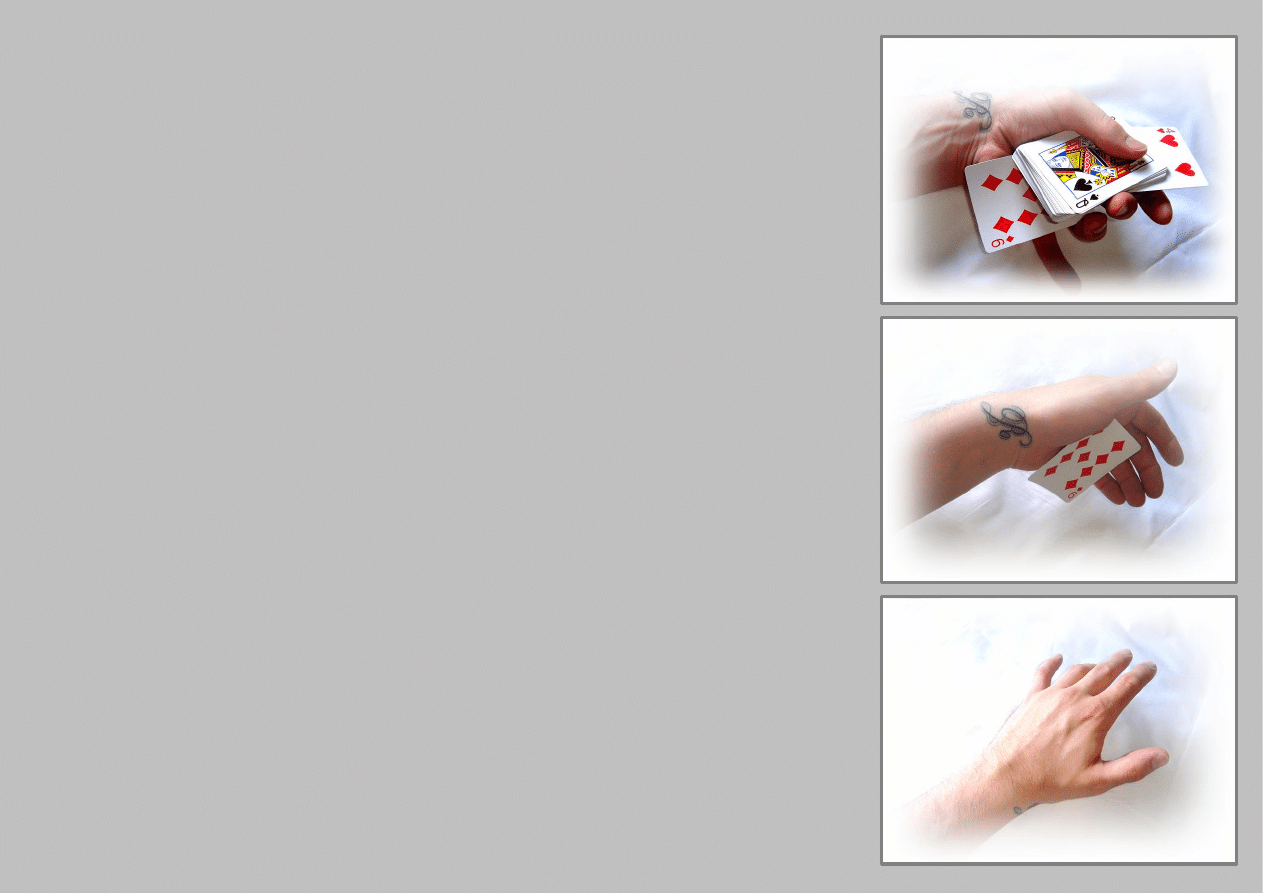
Once a card has been named, you will need to search through to find the relating
card… if the 4 of hearts was named you would find the 9 of diamonds and slip it
under the spread as shown in image 03 and work it all the way to the top of the
deck; the card is now in position for a gamblers cop. For those who do not know
this method of palming… image 04 shows an exposed view of the card copped
under the deck, gripped into the palm in the shade of the deck. As the free hand
takes away the deck, the palmed card is lowered to the side of the body, this will
take a while to get used to, you will see the card protruding from your hand and it
will feel uncomfortable but as long as it's palmed as in image 05 it won't be
noticed. Image 06 shows how the hand looks to the participant.
The palmed card is taken to the pocket that has the prediction card in it and then
removed posing as the original prediction card. When revealing the card, it is vital
to the effect that the card is first shown face up, this will happen naturally due to
the condition of the palm. If possible, place the card face up on a surface or in the
participants hand with no hesitation as you do not want the participant to think
that you could have somehow marked the card after it was named.
IMAGE FOUR
IMAGE FIVE
IMAGE SIX

outlaw
trip
: EXPLAINED
The performer invites one participant to name any playing card, which is noted | The performer then names a playing
card and also notes it down | Another participant is invited to name another playing card, which is found in the deck |
The final named playing card is turned over to reveal the first participants named card written on the back, this card is
removed and left on the surface face-down | The performer then reminds the participants of the card he named… The
removed card is turned face up only to have changed to be the performers named card.
You may need a pen and pad of paper for this effect. When the first card is named - eg the 4 of Hearts - it is noted
on the paper, the performer then names an apparent random card which is in fact the card marked on the back of the
named 4 of Hearts, which would be the 9 of Diamonds. This is also noted. The third named card – eg Jack of Spades -
is searched for and left protruding the deck, whilst scanning the deck, the performer is also searching for the 9 of
Diamonds which needs to be slipped under the spread deck and then slipped behind the protruding Jack ready for the
double-lift… This is a similar process to THE 180 PLACEMENT as taught in ONE; Deception, Subterfuge & a deck of
cards… Below is a description of the sleight
the
one
eighty
placement
Say the spectator names the 7 of Hearts, scan through the deck looking for the card. A card – marked on the back – is in place on top of the deck. When you find the 7 of
hearts, upjog it slightly so that it protrudes the deck. Manoeuvre the marked card behind the spread and underneath the 7, if you can perform the slip force this will be easy.
Simply hold the spread deck from left to right – with your left fingers, work/slide the top card under the spread… with your right forefinger reach under and pull it toward and
work it under the 7, as the 7 is protruding this is very easy to do. Square up the deck so that the marked card is now directly behind the 7 [Figure 44.] Cut the deck from above
the 7 so that the 7 is the foremost card and square up the deck, now simply perform a double lift to show that the named card is the only card in the deck with a marking on the
back.
When you make the double lift with the 9 behind the Jack the first revelation is made with the 4 of Hearts written ion
the back of the Jack (apparently,) take the card away (9 of Diamonds) from the deck as you turn the deck face down
hiding the Jack upside-down at the bottom of the deck and unseen by the participants. The 9, thought to be the Jack
is placed face-down on the surface where it is shortly revealed to have changed into the performers named card – the
Nine of Diamonds.

outlaw
vs
swami
: EXPLAINED
The performer writes a prediction of which card will be thought of by the participant | The deck is spread face up and
the participant is invited to name any card | The prediction is shown to be wrong, however the prediction card is taken
out and turned over to reveal the named card written on the back
For this effect you will need to use a swami gimmick or any durable thumb writer.
Take a pen/pencil matching the swami and on a notepad fake-write a prediction
All i want you to do is think of a playing card; keep it in your mind; don said it out loud; I’m going to attempt to
condition you to think of the playing card that I've just written down…
When their card is named, swami the
matching
card (not the named card but the card which is marked upon the back
of the named card – EG if they named the 7 of clubs; swami the 6 of spades etc) onto the notepad and show them
Close? Close enough? No? Okay let's see how close my prediction really was…
Scan the deck removing the prediction card and invite the participant to turn the card over.

invisible
outlaw
: EXPLAINED
Two decks are in use the performer states that he placed a prediction card in his deck face-down | A card is named by
the participant who holds the other deck | The performer reveals the face-down prediction to be incorrect | When the
named card is found in the participants pack and the prediction card can be found written on the back of it
For this effect you will need an invisible deck. The performer holds the invisible deck and the participant holds the
Outlaw deck.
In this deck (invisible,) I’ve turned a card face-down, it's a prediction card, it's my prediction of the card that you are
about to name out loud…
Calculate in your mind the value of the matching card and reveal this card upside down in the invisible deck (do not
reveal the named card but the card that is written on the back of this card in the outlaw deck.)
That didn't work huh? You know what. Have a look in your deck (Outlaw) go through and take out the card you named
aloud…
Once the card is taken out, take the deck off of them and place it aside before asking them to turn over the card.
You need not worry about them seeing the markings on the back as they search for their card as at that point they
are only interested in the faces of the cards. If need be, you can show them the deck as being normal after the effect
using some of the
Faking
methods described earlier.

outlaw
associate
: EXPLAINED
The deck is shown as a special deck. marked on the back of each card is a different random playing card the deck is set
up in no order and offered to the participant for shuffling | The participant is asked to name and playing card, the are
then asked to name another card of which they would associate with the first card | The named card is turned over to
reveal the 2nd named card written on the back
For this example i shall explain as if the 1st named card is the 4 of clubs and 2nd named card is the 10 of diamonds.
For this effect you will need to know the 180 placement, as explained earlier.
The named playing card (4 of clubs) is found in the deck and left protruding as the second card is named (10 of
diamonds) calculate its matching card in your mind; in this case it would be the 3 of hearts. As you scan the deck for
the 4 of clubs, when you get to the 3 of hearts you will need to slip it beneath the deck and work it behind the
protruding 4 of clubs flush into the deck, it is now in position for the double lift revelation
outlaw
disassociate
(outlaw associate reversal) : EXPLAINED
The participant is asked to name and playing card. the backs of the cards are searched to find the named card written
in marker pen | They are then asked to name another card of which they would associate with the first card | The card
is turned over to reveal the 2nd named card
(No explanation necessary) This is just a reverse play on OUTLAW ASSOCIATE

double
crossed
outlaw
: EXPLAINED
An envelope is handed to the participant. they are asked to name any playing card; the marked playing card on the
reverse of this card is noted | They are then asked to name another playing card; the cards are scanned through face-
down to find their marked card, the face card that this is marked on the back of is also noted |
The envelope is opened to reveal the first noted playing card with the 2nd noticed playing card marked on the back of it
For this effect you will need a spare Jack of Spades on the back of which you will need to write the 4 of Hearts, this
card is then placed in an envelope. Alternatively you could have both these playing cards in an envelope (unmarked.)
The envelope can then be held by the spectator throughout.
You will need to position the jack of spades at the bottom of the deck and the 9 of diamonds on top of the deck.
As the spectator names a card, for example the 8 of clubs, search through the backs of the cards looking for the
marker written 8 of clubs, although the card this is marked on is the 5 of spades, you will perform the 180 placement
to slip the bottom card (jack of spades) into position one card below the marked 8 of clubs ready to perform a double
lift to show that the 8 of clubs is marked on the back of the jack of spades. The jack is then noted on the envelope by
the participant.
As the 9 of diamond is on top of the deck, the deck is turned face up; you can false shuffle to retain this card in
position. A second card is named, for example, the king of hearts… Another 180 placement is made positioning the 9
of diamonds one card behind the king of hearts, once again in place to perform a double lift to show that on the back of
the named king of hearts is the marker written 4 of hearts, which is also noted on the envelope by the participant.
On the envelope we now have the two required force cards as written and selected by the participant - jack of spades
and 4 of hearts.
The revelation card/s can now be removed from the envelope.

outlaw:
afterthoughts
I have held back on patter throughout the explanations as I always feel it fair to allow you; the performer the
opportunity to discover and create your own unique routine that will best apply to your persona and repertoire
The OUTLAW concept, since its discovery, has been used in 2 specific effects that have also been released within the
magic market industry, one of which used in a blatantly rip-off manner almost word-for-word, effect-for-effect without
credit or mention… Without naming names or retaliating as childishly, I simply inform you the reader of this so that
no confusion is met should you also discover either of these products. I’d also like to applaud the author/s for
successful becoming rip-off-merchants, with which I hope you gain a good reputation for.
I owe and pay great respect and acknowledgement to Larry Jennings for the introduction of the gamblers cop. He is a
genius.
With special thanks to R and J for all of your inspirations
OUTLAW © Daniel Madison 2004 – 2006 all rights reserved | TWISTED RAIN PRODUCTIONS
Wyszukiwarka
Podobne podstrony:
Daniel Madison Cut
Daniel Madison 82
Daniel Madison Two
Daniel Madison bound
Daniel Madison Irreversible
Daniel Madison The Devil s Touch
Daniel Madison Wrath
Daniel Madison theFINEscripture
Ember Madison Daniel
Danielsson, Olson Brentano and the Buck Passers
Danielewicz, Fizjoterapia, Rehabilitacja osób ze złożoną niepełnosprawnością
32(3), PROROCTWO DANIELA
Ćw nr 9, 09.., Meksuła Daniel
Barok, NABOROWSKI, DANIEL NABOROWSKI (1573-1640)
Biomchanika, BIO-sprawozdanie z równi, Daniel Lewandowski
Przetworniki2, DANIEL BORNUS
Madisonzamowienie
Daniel Namborowski, Daniel Namborowski: krótkość żywota- epigramat składa się z 13 wersów po 13 głos
19. W rok przez Biblię, Księga Daniela
więcej podobnych podstron