
English for Specific Purposes
1
1
MINISTRY OF EDUCATION AND TRAINING
HUE COLLEGE OF AGRICULTURE AND FORESTRY
0o0
A COURSE OF ENGLISH
FOR STUDENTS OF AGRICULTURAL ENGINEERING
Course designer: LEÂ THÒ THANH CHI
HUE – 12/2008

English for Specific Purposes
2
2
LÔØI MÔÛ ÑAÀU
“A course of English for students of agricultural engineering” là giáo trình tiếng Anh
chuyên ngành có thể dùng làm tài liệu giảng dạy hoặc tài liệu tham khảo cho sinh viên
ngành cơ điện nông nghiệp, ngành kỹ thuật cơ khí nông nghiệp của trường Đại Học
Nông Lâm và Đại Học Sư Phạm (ngành kỹ thuật).
Giáo trình này được biên soạn trên cơ sở sinh viên đã học qua chương trình
tiếng Anh cơ bản; có vốn kiến thức cơ bản về ngữ pháp tiếng Anh và kiến thức cơ bản
về các chuyên ngành liên quan đến cơ điện; sinh viên có nhu cầu phát triển kỹ năng
đọc, viết và dịch tiếng Anh chuyên ngành cơ điện nông nghiệp. Do đó mục đích của
giáo trình là:
Giúp sinh viên làm quen với văn phong tiếng Anh khoa học kỹ thuật.
Rèn luyện kỹ năng đọc hiểu các văn bản khoa học.
Cung cấp cho sinh viên các từ, thuật ngữ chuyên ngành.
Luyện thực hành viết và dịch một số cấu trúc ngữ pháp thường gặp.
Với đối tượng của giáo trình là sinh viên năm thứ 3 trường Đại Học Nông Lâm Huế và
thời lượng dành cho môn học là 60 tiết (4 đơn vị học trình), giáo trình này gồm 10
units và một số bài đọc thêm. Các bài text được trích dẫn hoặc phỏng theo các tài liệu
khoa học nhằm đảm bảo tính xã thực của văn bản. Các bài tập ngữ pháp được biên
soạn theo ngữ pháp tiếng Anh cơ bản và kết hợp các kiến thức chuyên ngành cơ điện
cơ bản mà sinh viên đã được học.
Việc biên soạn giáo trình này chắc chắn không tránh khỏi những khiếm khuyết.
Chúng tôi mong nhận được góp ý xây dựng của độc giả và người học để giáo trình
ngày càng hoàn thiện hơn.
Lê Thị Thanh Chi

English for Specific Purposes
3
3
TABLE OF CONTENTS
Page
Part I: Electrical and Mechanical Engineering
Unit 1: Engineering – What’s it all about ? ………………
Unit 2: Engineering Materials …………………………….
Unit 3: Mechanisms ………………………………………..
Unit 4: Forces in Engineering ……………………………..
Unit 5: The Electric Motor ………………………………...
Part II: The Agricultural Machinery
Unit 6: The Agricultural Tractor ………………………...
Unit 7: Tractor Engines …………………………………...
Unit 8: The Combine Harvester (A) ……………………..
Unit 9: The Combine Harvester (B) ……………………..
Unit 10: Farm Management ……………………………….
Further reading
Portable Generator.............................................................
Engine Classification ........................................................
Connecting Rods and Crankshaft .....................................
The reel …………………………………………………..
Water Pumping System ………………………………….
Mechanization in Sugarcane Production –
Development of seed cane planter ………………………
References
…….4
…….10
…….15
…….24
…….31
…….39
…….50
…….59
…….69
…….77
English for Specific Purposes
4
4
PART I: ELECTRICAL AND MECHANICAL ENGINEERING
UNIT 1: Engineering – What’s it all about ?
A. Reading:
1. Read the following passage and find out how many branches of engineering are
mentioned.
Engineering is largely a practical activity. It is about putting ideas into action. Civil
engineering is concerned with making bridges, roads, airports, etc. Mechanical engineering
deals with the design and manufacture of tools and machines. Electrical engineering is about
the generation and distribution of electricity and its many applications. Electronic engineering
is concerned with developing components and equipment for communications, computing,
and so on.
Mechanical engineering includes marine, automobile, aeronautical, heating and
ventilating, and others. Electrical engineering includes electricity generating, electrical
installation, lighting, etc. Mining and medical engineering belong partly to mechanical and
partly to electrical.
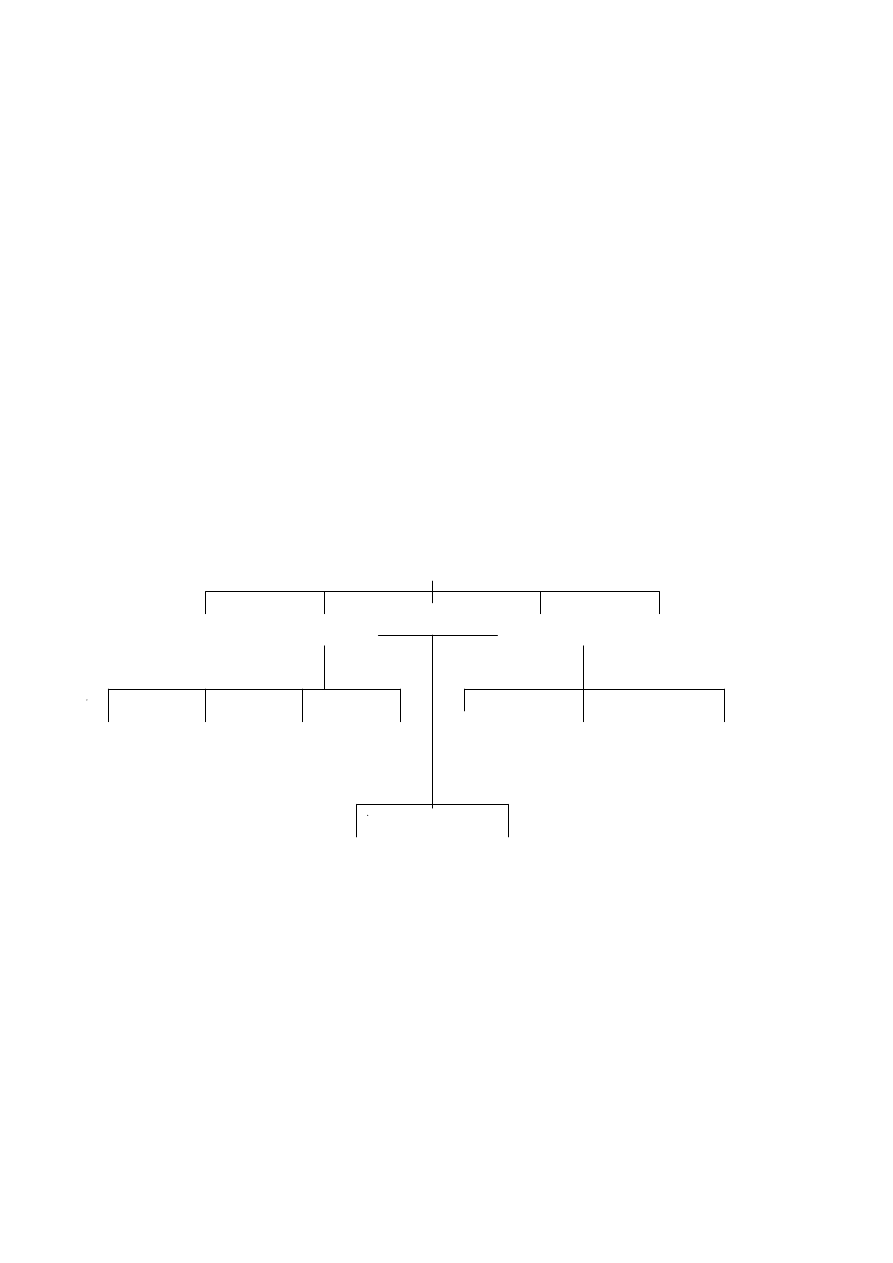
2. Complete the blanks in this diagram using information from the text.
Engineering
Civil
1………
Electrical
2……….
3
……. Automobile Aeronautical 4…… Electricity Electrical
6. ……...
5………
installation
7. ……….
Medical
3. Study these special words. They show some of the areas in which engineers work.
Can you identify them? What kinds of engineers are concerned with these areas – electrical,
mechanical or both?
Beer brewery – planes - super highway – blocks of building – X ray machine
Now read the following texts to check your answer. Match each text to one of the word
or phrase above.
Transport: cars, trains, ships and planes are all products of mechanical engineering.
Mechanical engineers are also involved in support services such as roads, rail track, harbours
and bridges.
Food processing: Mechanical engineers design, develop and make the machines and the
processing equipment for harvesting, preparing and preserving the foods and drinks that fill

English for Specific Purposes
5
5
the supermarket.
Medical engineering: Body scanners, X-ray machines, life-support systems, and other
high-tech equipment result from mechanical and electrical engineers combining with medical
experts to convert ideas into life-saving and preserving products.
Building services: Electrical engineers provide all the services we need in our homes
and places of work, including lighting, heating, ventilation, air-conditioning, refrigeration,
and lifts.
Energy and power: Electrical engineers are concerned with the production and
distribution of electricity to homes, offices, industry, hospitals, colleges and schools, and the
installation and maintenance of the equipment involved in these processes.
(Source: Adapted from Turning Ideas into Action, Institution of Mechanical Engineers,
and Engineering a career, Institution of Electronics and Electrical Incorporated Engineers)
4. When you read, it is important to have a clear purpose. Here are some of the
purposes you may have for reading the texts. Match one purpose to each kind of text.
A
B
1. finding a job
2. pricing a component
3. finding out how to do something
4. choosing the best chapter to read
5. looking for specific information on a topic
6. learning about electrical equipment
7. choosing a course
8. looking for a specification
a. table
b. index
c. contents
d. book title
e. manual
f. price list of components
g. college brochure
h. job advertisement
5.
Fill in the gaps in this text with the words given below. Each gap represents
one word. Compare your answer with your partner.
In the United Kingdom you can …(1)… engineering at a college of further education or
a university. Most college courses …(2)… from one to two years. University undergraduate
course …(3)… engineering last from three to four years.
A college will take …(4)… after four years of secondary school education. Most
students study full-time, …(5)… day-release courses are available for people who …(6)… in
local engineering companies. Students will be given a certificate …(7)… a diploma at the
…(8)… of their course.
Most university students will have completed six …(9)… of secondary school. Others
will have taken a diploma course at college. …(10)… give degrees. A Bachelor‟s degree
…(11)… three to four years. A Master‟s …(12)… requires a further year.
Students / degree / last / years / in / work / end / study
/ universities / or / but (although) / takes
B. Language study:
deals with / is concerned with
What is the link between column A and column B ?

English for Specific Purposes
6
6
A
B
mechanical
machines
electrical
electricity
Column A lists a branch of engineering or a type of engineer. Column B lists things
they are concerned with. We can show the link between them in a number of ways:
1.
Mechanical engineering deals with machines.
2.
Mechanical engineers deal with machines.
3.
Mechanical engineering is concerned with machines.
4.
Mechanical engineers are concerned with machines.
5.
Machines are the concern of mechanical engineers.
Match each item in column A with an appropriate item from column B and link the two
in a sentence.
A
B
1. marine
2. aeronautical
3. heating and ventilating
4. electricity generating
5. automobile
6. civil
7. electronic
8. electrical installation
9. medical
a. air-conditioning
b. roads and bridges
c. body scanners
d. cables and switch-gear
e. communication and equipment
f. ships
g. planes
h. cars and trucks
i. power stations
C. Word study:
Word stress
Words are divided into syllables. For example:
engine
en.gine
engineer
en.gin.eer
engineering
en.gin.eer.ing
Each syllable is pronounced separately, but normally only one syllable is stressed. That
means it is said more slowly and clearly than the other syllables. We say „engine but
engin‟eer. A good dictionary will show the stress syllables.
Look at these words. Try to mark the stressed syllable.
1. machinery
2. mechanical
3. machine
4. install
5. installation
6. electricity
7. electrical
8. electronic
9. aeronautical
10. ventilation

English for Specific Purposes
7
7
New words and expressions:
- Engineering (n.):
- civil engineering:
- mechanical engineering:
- deal with:
- putting ideas into action:
- manufacture (v.):
- electricity generation:
- distribution of electricity:
- marine(n. & adj.):
- aeronautical(adj.):
- heating and ventilating:
- food processing
- harvesting:
- preserving:
- maintenance (n.):
- power station:
ngành kỹ thuật
kỹ thuật dân dụng
kỹ thuật cơ khí
liên quan đến
chuyển ý tưởng thành hành động
sản xuất
sự phát điện
sự phân phối điện năng
(thuộc về) hàng hải
(thuộc) ngành hàng không
sưởi và thông gió
chế biến thực phẩm
thu hoạch
bảo quản
bảo dưỡng, bảo trì (máy móc)
trạm điện năng
--- 0o0 ---
LANGUAGE IN FOCUS
Using adverb clauses to show time relationships
:
after
(a)After she graduates, she will get a job.
(b) After she (had) graduated, she got a job
A present tense, not a future
tense is used in an adverb
clause of time. Notice example
(b) and (d).
before
(c) I will leave before he comes.
(d) I (had) left before he came.
when
(e) When I arrived, he was talking on the phone.
(f) When I got there, he had already left.
(g) When it began to rain, I stood under a tree.
(h) When I was in Chicago, I visited the museum.
(i) When I see him tomorrow, I will ask him.
When = at that time
(notice the different time
relationship expressed by the
tenses)
While
As
(j) While I was walking home, it began to rain.
(k) As I was walking home, it began to rain.
While, as = during that time
By the time
(l) By the time he arrived, we had already left.
(m) By the time he comes, we will already have left.
By the time = one event is
completed before another
event. (notice the use of the

English for Specific Purposes
8
8
past perfect and future perfect
in the main clause)
Since
(n) I haven‟t seen him since he left this morning.
Since = from that time to the
present. (Notice the present
perfect is used in the main
clause)
Until
till
(o) We stayed there until we finished our work.
(p) We stayed there till we finished our work.
Until, till = to that time and
then no longer (till is used
primarily in speaking rather
than writing)
As soon as
Once
(q) As soon as it stops raining, we will leave.
(r) Once it stops raining, we will leave.
As soon as, once = when one
event happens, another event
happens soon afterwards.
As long as
So long as
(s) I will never speak to him again as long as I live.
(t) I will never speak to him again so long as I live
As soon as, so long as = during
all that time, from beginning to
end.
Whenever
Every time
(u) Whenever I see her, I say hello.
(v) Every time I see her, I say hello.
Whenever = every time
The first time
The last time
The next time
(w) The first time I went to New York, I went to an
opera.
(x) I saw two plays the last time I went to New York.
(y) The next time I go to New York, I‟m going to see
a ballet.
Adverb clauses can be
introduced by the following:
first
The second time
third
last
next
PRACTICE
A. Complete the following. Pay attention to verb tenses.
1. Last night I went to bed after I _________ my homework.
2. Tonight I will go to bed after I ______________ my homework.
3. Ever since I was a child, I _________ afraid of dogs.
4. Jane‟s contact lens popped out while she basketball.
5. Be sure to reread your composition for errors before you __________ it in to the
teacher tomorrow.
6. By the time I left my apartment this morning, the mail carrier _____ the mail.
7. I have known Jim Bates since he ___________ ten years old.
8. A black cat ran across the road as I ____________ my car to work this morning.
9. By the time I leave this city, I ___________ here for four months.
10. Whenever Mark __________ angry, his nose gets red.
11. I __________ to the beach whenever the weather was fine, but now I don‟t have
time to do that because I have to study.
12. We will have a big party when _____________.

English for Specific Purposes
9
9
13. The next time I _________ to Hawaii, I‟m going to visit Mauna Loa, the world
largest volcano.
14. I had fried chicken the last time I ___________ at that restaurant.
B. Complete the following sentences. Punctuate carefully. Pay attention to verb
tense usage.
1. Just as I was falling asleep last night ............................................................
2. I‟ll help you with your homework as soon as I .............................................
3. .................................................... as long as I live.
4. Just before I ................................................................
5. The last time I .............................................................
6. I had already ................................. when ......................
7. Whenever ....................................................................
8. I will be here until I ......................................................
--- o0o ---

English for Specific Purposes
10
10
UNIT 2: ENGINEERING MATERIALS
A. Reading:
Scanning tables
In engineering, it is important to practice reading tables, charts, diagrams, and graphs
because so much information is represented in these ways.
Scanning is the best strategy for finding information in a table. With scanning, you
know before you read what sort of information you are searching for. To scan a table, you
move your eyes up and down the columns until you find the word or words you want. To scan
quickly, you must learn to ignore any information which will not help you with your task.
1. Scan the table which follows to find a material which is:
a. soft
b. ductile
c. malleable
d. tough
e. scratch-resistant
f. conductive and malleable
g. durable and hard
h. stiff and brittle
i. ductile and corrosion-resistant
j. heat-resistant and chemical-resistant
Materials
Properties
Uses
Metal
Aluminium
Light,
soft,
ductile,
highly
conductive, corrosion-resistant
Aircraft, engine components,
foil, cooking utensils.
Copper
Very malleable, tough & ductile,
highly
conductive,
corrosion-
resistant.
Electric wiring, PCBs, tubing
Brass (65% copper,
35% zinc)
Very corrosion-resistant. Casts well,
easily machined. Can be work
hardened. Good conductor.
Valves, taps, castings, ship
fittings, electrical contacts
Mild
steel
(iron
with 0.15% to 0.3%
carbon)
High strength, ductile, tough, fairly
malleable, cannot be hardened and
tempered, low cost, poor corrosion
resistance
General purpose
High carbon steel
(iron with 0.7% to
1.4% carbon)
Hardest of the carbon steels but less
ductile and malleable. Can be
hardened and tempered.
Cutting tools such as drills,
files, saws
Thermoplastics
ABS
High impact strength & toughness,
scratch-resistant, light & durable
Safety
helmets,
car
components,
telephones,
kitchenware

English for Specific Purposes
11
11
Materials
Properties
Uses
Acrylic
Nylon
Stiff, hard, very durable, clear, can
be polished easily, can be formed
easily
Hard, tough, wear-resistant, self-
lubricating
Aircraft canopies, baths,
double glazing
Bearings, gears, castings
for power tools
Thermosetting plastics
Epoxy resin
Polyester resin
Urea formaldehyde
High strength when reinforced,
good chemical & wear resistance
Stiff, hard, brittle. Good chemical
and heat resistance
Stiff, hard, strong, brittle, heat-
resistant, and a good electrical
insulator
Adhesive, encapsulation of
electronic components
Moulding, boat and car
bodies
Electrical fitting, adhesives
2. Scan the table to find:
a. A metal used to make aircraft.
b. Plastics used for adhesives
c. Steel which can be hardened
d. An alloy suitable for castings
e. A plastic with very low friction
f. A material suitable for safety helmets
g. A metal suitable for a salt-water environment
h. A metal for general construction use but which should be protected from corrosion
i. A plastic for car bodies
j. The metal used for the conductors in printed circuit boards
B. Language study:
1. Making definitions
Study these facts from the table about aluminium:
1.
Aluminium is a light metal.
2.
Aluminium is used to make aircraft.
We can link these facts to make a definition of aluminium:
1+2 Aluminium is a light metal which is used to make aircraft.
We can use the relative pronoun which in making definition of something, and the
which-clause is known as the adjective clause in these cases.
Use the table above to make definitions of each of the materials in column A. Choose the
correct information in column B and C to describe the materials in column A.

English for Specific Purposes
12
12
A
B
C
1. an alloy
2. a thermoplastic
3. mild steel
4. a conductor
5. an insulator
6. high carbon steel
7. brass
8. a thermosetting plastic
a metal
a material
an alloy
a. allows heat or current to flow easily
b. remains rigid at high temperatures
c. does not allow heat or current to flow easily
d. contains iron & 0.7% to 1.4% carbon
e. becomes plastic when heated
f. contains iron & 0.15% to 0.3% carbon
g. formed by mixing other metals or elements
h. consists of copper and zinc
2. Adding information to a text
Study this sentence about aluminium
Aluminium is used to make aircraft, engine components, and many items for the kitchen.
We can add extra information to the sentence like this:
Aluminium, which is light, soft, and ductile, is used to make aircraft, engine
components – for example, cylinder heads – and many items for the kitchen, such as
pots.
Note that the extra information is marked with commas or dashes:
, which …,
- for example, … -
, such as …,
Add this extra information to the following text about plastics.
1. Plastics can be moulded into plates, car components, and medical aids.
2. Thermoplastics soften when heated again and again.
3. Thermosetting plastics set hard and do not alter if heated again.
4. ABS is used for safety helmets.
5. Nylon is self-lubricating.
6. Nylon is used for motorized drives in cameras.
7. Acrylic is a clear thermoplastic.
8. Acrylic is used for aircraft canopies and double glazing.
9. Polyester resin is used for boat and car bodies.
10. Polyester resin is hard and has good chemical and heat resistance.
Plastics are synthetic materials. They can be softened and moulded into useful articles.
They have many applications in engineering. There are two types of plastics: thermoplastics
and thermosetting plastics.
ABS is a thermoplastic which is tough and durable. Because it has high impact strength,

English for Specific Purposes
13
13
it has application where sudden loads may occur.
Nylons is a hard, tough thermoplastic. It is used where silent, low-friction operation is
required.
Acrylic can be formed in several ways. It is hard, durable, and has many uses.
Polyester resin is a thermosetting plastic used for castings. It has a number of useful
properties.
C. Word study: Properties of materials
Study these examples of adjective and noun pairs for describing the properties of materials.
Adjective
Noun
Flexible
flexibility
Light
lightness
Strong
strength
Now fill in the gaps in this table with the missing adjectives and nouns
Adjective
Noun
……….
elastic
……...
tough
soft
rigid
wear-resistant
………
hard
wind resistance
………
plasticity
……….
………
……….
………
brittleness
……….
New words and expressions:
- ductile (adj.):
- malleable (adj.):
- scratch-resistant (adj.):
- conductive (adj.):
- durable (adj.):
- stiff and brittle (adj.):
- corrosion-resistant (adj.):
- friction (n.):
- salt-water environment:
- circuit board:
- alloy (n.):
dễ kéo sợi, dễ uốn
dễ dát mỏng
chống trầy xướt
có tính dẫn điện
bền
cứng và giòn, dễ gãy
chống ăn mòn (kim loại)
lực ma sát
môi trường nước mặn
bảng điện
hợp kim

English for Specific Purposes
14
14
LANGUAGE IN FOCUS
Using English to define
Aristotle suggested that a good definition should include the general classification of a term
plus the specific characteristics that differentiate the term from other members of its class. For
example, a definition of a giraffe should include a classification, such as, A giraffe is an
animal, and specific characteristics, such as, A giraffe is tall, African animal with a very long
neck.
Definition formula:
Term = Class + characteristics
Example: Chemical energy is potential energy that is stored in gasoline, food, and oil.
(Frequently, the characteristics appear as a relative clause beginning with which, that, who, or
where)
Chemical energy = potential energy + that is stored in gasoline, food and oil.
(term)
(class)
(characteristics)
Relative clauses:
A clause is a part of a sentence that contains a noun and a verb. A relative clause is one
that begins with which, that, where, or who. Which and that are most commonly used in
science definitions; who is used when referring to people. Science definitions often include
relative clauses containing the characteristics that distinguish an item from others in the class.
Formulating definitions: Using the information given in each series, write a definition. Use
the sentence patterns above to guide you.
1. an amoeba / one-celled animal / constantly change its shape.
An amoeba is a one-celled animal that constantly changes its shape.
2. an antibiotic / drug / cures bacterial diseases.
3. lung / organ / breathing.
4. acoustics / science / sound.
5. photosynthesis / process / plants manufacture food.
6. catalyst / substance / speeds up but is not changed by a chemical reaction.
7. calorie / unit / measures heat.
8. cyclotron / apparatus / bombards the nuclei of atoms.
Creating definitions: A good way to see if the definition is complete is to reverse it. For
example, if we reverse an elephant is an animal, we get an animal is an elephant, and it is
obvious that the definition for each of the following words and test each one by reversing it. If
you need help, use a dictionary.
1. a camera
2. a bridge
3. an x-ray
4. a butterfly
5. geology
6. a diamond
7. an echo
8. a virus
9. caffeine
10. an aquarium
--- o0o --

English for Specific Purposes
15
15
UNIT 3: MECHANISMS
A. Reading:
Scanning a text
Scanning is the best strategy for searching for specific information in a text. Move your
eyes up and down the text until you find the word or words you want. Try to ignore any
information which will not help you with your task.
1.
Scan the text opposite quickly to find out which of these mechanisms are
mentioned
1. cam 2. tap 3. pendulum
4. foot pump
5. Escalator
Mechanisms are an important part of everyday life. They allow us to do simple things
like switch on lights, turn taps, and open doors. They also make it possible to use escalators
and lifts, travel in cars and fly from continent to continent.
Mechanisms play a vital role in industry. While many industrial processes have
electronic control systems, it is still mechanisms that deliver the power to do the work. They
provide the forces to press steel sheets into car body panels, to lift large components from
place to place, to force plastic through dies to make pipes.
All mechanisms involve some kind of motion. The four basic kinds of motion are:
Rotary: Wheels, gears, and rollers involve rotary movement.
Oscillating: The pendulum of a clock oscillates – it swings backwards and forwards.
Linear: The linear movement of a paper trimmer is used to cut the edge of the paper.
Reciprocating: The piston in a combustion engine reciprocates.
Many mechanisms involve changing one kind of motion into another type. For example,
the reciprocating motion of a piston is changed into a rotary motion by the crankshaft, while a
cam converts the rotary motion of the engine into the reciprocating motion to operate the
valves.
2. Now read the text to find the answer to these questions.
1. What does a cam do?
2. What does oscillating mean?
3. How are plastic pipes formed?
4. What simple mechanisms in the home are mentioned directly or indirectly?
5. What is the function of the crankshaft?
6. Give an example of a device which can produce a linear movement?
7. How are car body panels formed?
8. What do mechanisms provide in industry?
B. Language study:
1. Ways of linking ideas
When we write, we may have to describe, explain, argue, persuade, complain, etc. in all these
forms of writing, we use ideas. To make our writing effective, we have to make sure our
readers can follow our ideas. One way of helping our readers is to make the links between the

English for Specific Purposes
16
16
ideas in our writing.
What are the links between these pairs of ideas ? What words can we use to mark the links ?
1. Mechanisms are important to us.
2. They allow us to travel.
3. Mechanisms deliver the power to do work.
4. They play a vital role in industry.
5. Friction is sometimes a help.
6. It is often a hindrance.
Sentence 2 is a reason for sentence 1. We can link 1 and 2 like this:
Mechanisms are important to us because/since/as they allow us to travel.
Sentence 4 is a result of sentence 3. We can link 3 and 4 like this:
Mechanisms deliver the power to do work so they play a vital role in industry.
Mechanisms deliver the power to do work; therefore they play a vital role in industry.
Sentence 6 contrasts with sentence 5. We can link 5 and 6 like this:
Friction is sometimes a help but it is often a hindrance.
Show the links between these sets of ideas using appropriate linking words.
1. Copper is highly conductive. It is used for electric wiring.
2. Weight is measured in newtons. Mass is measured in kilogram.
3. Nylon is used for bearings. It is self-lubricating.
4. ABS has high impact strength. It is used for safety helmets.
5. The foot pump is the class 2 lever. The load is between the effort and the fulcrum.
6. Friction is essential in brakes. Friction is a nuisance in an engine.
7. The upper surface of a beam is in compression. The lower surface is in tension.
8. Concrete beams have steel rods near the lower surface. Concrete is weak in tension.
2. Dealing with technical terms
One of the difficult things about the English of engineering is that there are many technical
terms to learn. Newer terms may be the same, or almost the same, in your own language. But
many terms will be quite different and you may not always remember them. When this
happens, you will have to use whatever English you know to make your meaning clear.
The technical terms in column A are similar in meaning to the more general English in
column B. Match them.
A
B
1. oscillates
2. rotates
3. reciprocates
4. has a linear motion
5. converts
6. motion
7. escalator
8. sheets
a. changes
b. large, thin, flat pieces
c. moving stairs
d. goes round and round
e. movement
f. goes in a line
g. swings backwards and forwards
h. goes up and down

English for Specific Purposes
17
17
C. Word study:
Noun and Noun compounds
We can use adjectives to describe an object in greater detail. For example:
light
electric light
a motor
an electric motor
steel
stainless steel
gears
helical gear
We can also use nouns. For example:
light
laser light
a motor
an air motor
steel
carbon steel
gears
titanium gears
Many relationships are possible in noun compounds. For example:
an air motor
a motor which uses air
carbon steel
steel which contains carbon
titanium gears gears made of titanium
1. Put each of these examples in the correct column.
1. carbon blocks
2. a power tool
3. aluminium alloy
4. a ball bearing
5. carbon fibre
6. a concrete beam
7. a gas burner
8. a diesel boat
9. roller bearings
10. a spring balance
11. a circuit board
12. a plastic tube
13. a plastic pipe
14. steel sheets
15. magnesium alloy
Uses
is made of
contains
……………
……………….
………………..
…………...
………………
………………..
…………...
………………
………………..
…………...
………………
………………..
…………...
………………
………………..
…………...
………………
………………..
…………...
………………
………………..
…………...
………………
………………..
2. What new relationships can you find in the example below? Rewrite each compound to
show the relationship. For example:
a foot pump
a pump which is operated by foot
a ribbon cable a cable which is like a ribbon

English for Specific Purposes
18
18
a gear lever
a lever for operating gears
1. chain wheel
6. College lecturer
2. disc wheel
7. Toe-clip
3. foot brake
8. Boiler thermostat
4. a hand throttle
9. Safety helmet
5. strain gauge
10. Aircraft engineer
New words and expressions:
- pendulum (n.):
- escalator (n.):
- tap (n.):
- cam (camshaft) (n.):
- make it possible:
- continent (n.):
- play a vital role:
- industrial processes:
- electronic control system:
- oscillating (n.):
- linear (n.):
- reciprocating:
- rotary motion:
- steel sheet:
- fulcrum (n.):
- concrete beam:
- stainless steel:
- a spring balance:
- swing backwards and forwards:
- hindrance (n.):
- self-lubricating:
con lắc
cầu thang cuốn
vòi nước
trục cam
làm cho có thể
châu lục
đóng/giữ một vai trò quan trọng
qui trình công nghiệp
hệ thống điều khiển bằng điện tử
(chuyển động) dao động
(chuyển động) thẳng
(chuyển động) tới lui
chuyển động quay
tấm thép
điểm tựa
dầm làm bằng bê-tông
thép không gỉ
cân lò xo
đung đưa lui tới
trở lực
tự bôi trơn
--- o0o ---

English for Specific Purposes
19
19
LANGUAGE IN FOCUS
A. Adjectives and adverbs
Look at these examples:
- Our vacation was too short – the time passed very quickly.
- The driver of the car was seriously injured in the accident.
Quickly and seriously are adverbs. Many adverbs are made from an adjective + -ly:
Adjective:
quick
serious careful quiet heavy
bad
Adverb:
quickly seriously
carefully
quietly heavily
badly
Not all words ending in –ly are adverbs. Some adjectives end in –ly too, for example:
friendly
lively
elderly lonely
silly
lovely
B. Adjective or adverb ?
* Adjectives (quickly/careful, etc.) tell us
about a noun. We use adjectives before nouns
and after some verbs, especially be:
- Tom is a careful driver. (not a
carefully driver)
- We didn‟t go out because of the heavy
rain.
- Please be quiet.
- I was disappointed that my test results
were so bad.
* We also use adjectives after the verbs
look/feel/sound/taste/smell/seem, etc.
- Why do you always look so serious?
- She speak perfect English.
* Adverbs (quickly/carefully, etc.) tell us about a
verb. An adverb tells us how somebody does
something or how something happens:
- Tom drove carefully along the narrow
road. (not drove careful)
- We didn‟t go out because it was raining
heavily (not raining heavy)
- Please speak quietly. (not speak quiet)
- I was disappointed that I did so badly on
the test. (not did so bad)
- Why don‟t you ever take me seriously?
- She speaks English perfectly.
Compare these sentences with look:
Tom looked sad when I saw him. (= he seemed sad; his expression was sad)
Tom looked at me sadly. (= he looked at me in a sad way)
C. Comparison
Look at these examples:
- Should I drive or take a train ?
- You should drive. It‟s cheaper.
- Don‟t take the train. It‟s more expensive.
Cheaper and more expensive are comparative forms.
After comparatives you can use than:
It‟s cheaper to drive than to take a train.
Taking the train is more expensive than driving.

English for Specific Purposes
20
20
The comparative form is –er or more ...
We use –er for short words (one syllable):
cheap –cheaper, fast – faster, large – larger
We also use –er for two syllable words that
end in –y (-y => -ier)
lucky – luckier, early – earlier, easy – easier,
pretty – prettier
- you‟re older than me.
- The exam was easy – easier than we
expected.
- Can you walk a little faster ?
- I‟d like to have a bigger car.
- Last night I went to bed earlier than
usual.
We use more ... for longer words (two
syllables or more):
more serious, more often, more expensive
We use more... for adverbs that end in –ly:
more slowly, more seriously, more quietly,
more carefully
- You‟re more patient than me.
- The exam was difficult – more
difficult than we expected.
- Can you walk a little more slowly ?
- I‟d like to have a more reliable car.
- I don‟t play tennis much these days. I
used to play more often.
* You can use –er or more ... with some two-syllable adjectives, especially:
quiet clever narrow shallow simple
Example: It‟s too noisy here. Can we go somewhere quieter / more quiet?
The adjectives and adverbs have irregular comparative forms:
Good/well => better bad/badly => worse
far => farther/further
Comparison with as ... as ...
You can use as ... as... (but not so ... as ...) in positive sentences and questions:
Example: I‟m sorry I‟m late. I got here as fast as I could.
There‟s plenty of food. You can have as much as you want.
Can you send me the money as soon as possible, please ?
Tom isn‟t as old as he look. (= Tom is older than he is.)
It‟s not warm, but it isn‟t so cold as yesterday.
Less ... (than) is similar to not as ... (as):
I spent less money than you. ( = I didn‟t spend as much money as you.)
The shopping mall was less crowded than usual. (= It wasn‟t as crowded as usual.)
You can also use twice as ... as..., three time as ...as..., etc.
Gas is twice expensive as it was a few years ago.
Their house is about three times as big as ours.
We say the same as (not the same like):
Ann‟s salary is the same as mine. Or Ann makes the same salary as me.
Tom is the same age as Brian.

English for Specific Purposes
21
21
D. Superlatives.
The superlative form is –est or most ... In general, we use –est for short words and
most for longer words. (The rules are the same as those for the comparative.)
long – longest hot – hottest easy – easiest
hard – hardest
but
most famous
most boring
most difficult
most expensive
These adjectives are irregular:
good – best
bad – worst
far – farthest/furthest
We normally use the before a superlative (the longest / the most famous, etc.)
Yesterday was the hottest day of the year.
That was the most boring movie I‟ve ever seen.
Why does he always come to see me at the worst possible moment ?
After superlative we use in with places (town, buildings, etc.)
What is the longest river in the world? (not of the world)
We had a great room. It was one of the nicest in the hotel. (not of the hotel)
________________________
PRACTICE
I. Complete the sentences with adverbs. The first letters of each adverb are given.
1. We didn‟t go out because it was raining h___________.
2. Our team lost the game because we played very ba___________.
3. I had no trouble finding a place to live. I found an apartment quite ea________.
4. We had to wait for a long time, but we didn‟t complain. We waited pat_______.
5. Nobody knew Steve was coming to see us. He arrived unex______________.
6. Mike stays in shape by playing tennis reg__________.
II. Put in the right word.
1. The driver of the car was _____________ injured. (serious/seriously)
2. I think you behaved very _____________. (selfish/selfishly)
3. Kelly is _____________ upset about losing her job. (terrible/terribly)
4. There was a ___________ change in the weather. (sudden/suddenly)
5. Everybody at the party was ___________ dressed. (colorful/colorfully)
6. Linda likes wearing _____________ clothes. (colorful/colorfully)
7. She fell and hurt herself quite _____________. (bad/badly)
8.These pants started coming apart after I wore them only once. They‟re
_____________ made (bad/badly)
9. Don‟t go up that ladder. It doesn‟t look _________. (safe/safely)
10. He looked at me _____________ when I interrupted him. (angry/angrily)
III. Rewrite these sentences so that they have the same meaning.

English for Specific Purposes
22
22
1. Jack is younger than he looks.
Jack isn‟t ............................................................
2. I didn‟t spend as much money as you.
You ....................................................................
3. The station was nearer than I thought.
The station wasn‟t ...............................................
4. I go out less than I used to.
I don‟t .....................................................................
5. Her hair isn‟t as long as it used to be.
She used to ..............................................................
6. I know them better than you do.
You don‟t ................................................................
7. There were fewer people at this meeting than at the last one.
There weren‟t ..........................................................
IV. Write sentences using the same as.
1. Sally and Kate are both 22 years old. Sally is ......................................................
2. You and I both have dark brown hair. Your hair .................................................
3. I arrived at 10.25 and so did you. I ......................................................................
4. My birthday is April 5. Tom‟s birthday is April 5, too. My ................................
V. Complete the sentences . Use a superlative (-est or most ...) + a preposition.
1. It‟s a very nice room. It‟s ......................................... the hotel.
2. It‟s a very cheap restaurant. It‟s ................................ the town.
3. It‟s a very happy day. It was .......................................... my life.
4. She‟s a very intelligent student. She ..................................... the class.
5. It‟s a very valuable painting. It ............................................. the gallery.
6. Spring is a very busy time for me. It ..................................... the year.
7. He‟s a very rich man. He‟s one of ........................................... the world.
8. It was a very bad experience. It ................................................. my life.
9. It‟s a very good college. It‟s one ................................................ the state.
10. He‟s a very dangerous criminal. He .......................................... the country.
VI. Complete the sentences. Use a superlative (-est or most ...) or a comparative (-er or
more ...)
1. We stayed at ...the cheapest... hotel in town. (cheap)
2. Our hotel was ...cheaper... than all the other hotels in the town. (cheap)
3. The United State is very large, but Canada is ________________. (large)

English for Specific Purposes
23
23
4. What‟s _______________ river in the world ? (long)
5. He was a little depressed yesterday, but he looks ___________ today. (happy)
6. It was an awful day. It was ______________ days of my life. (bad)
7. What is _____________ sport in your country ? (popular)
8. Everest is _______________ mountain in the world. It is ___________ than any other
mountain. (high)
9. We had a great vacation. It was one of the _____________ vacation we‟ve ever had.
(enjoyable)
10. I prefer this chair to the other one. It‟s _________________. (comfortable)
11. What‟s ______________ way of getting from here to the bus station? (quick)
12. Mr. and Mrs. Brown have three daughters. ______________ is 14 years old. (old)
--- o0o ---
English for Specific Purposes
24
24
UNIT 4: FORCES IN ENGINEERING
A. Reading:
Predicting
As you learn in unit 1, it is important to think about what you are going to read before
you read. Do not start to read a text immediately. One way to help you reading is to think
about the words which might appear in the text. The title might help to focus your thoughts.
Which words might appear in a text with the title Forces in Engineering ?
1.
The text you are going to read is called Forces in Engineering. Here are some
of the words it contains. Can you explain the links between each word and the title of the text?
weight
buoyancy
equilibrium
elasticity
magnitude
resultant
Newton
gravity
Now read the text. Use the information in the text to check the explanation you made above.
Forces in engineering
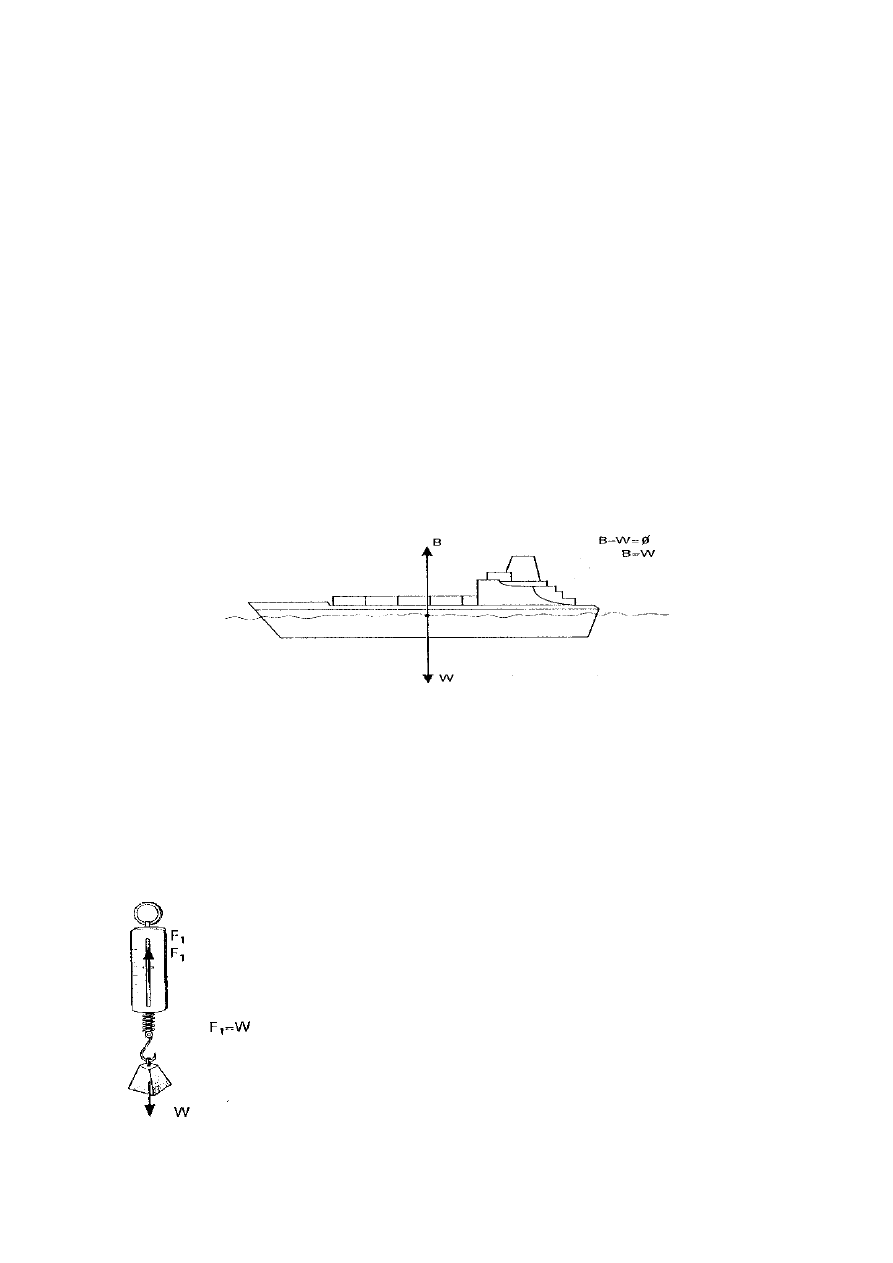
To solve the ship problem, we must look at the forces on the ship (Fig.1). The weight,
W, acts downwards. That is the gravity force. The buoyancy force, B, acts upwards. Since the
ship is in equilibrium, the resultant force is zero, so the magnitude of B and W must be the
same.
Another very important force in engineering is the one caused by elasticity. A good
example of this is a spring. Springs exert more force the more they are stretched. This
property provides a way of measuring force. A spring balance can be calibrated in newtons,
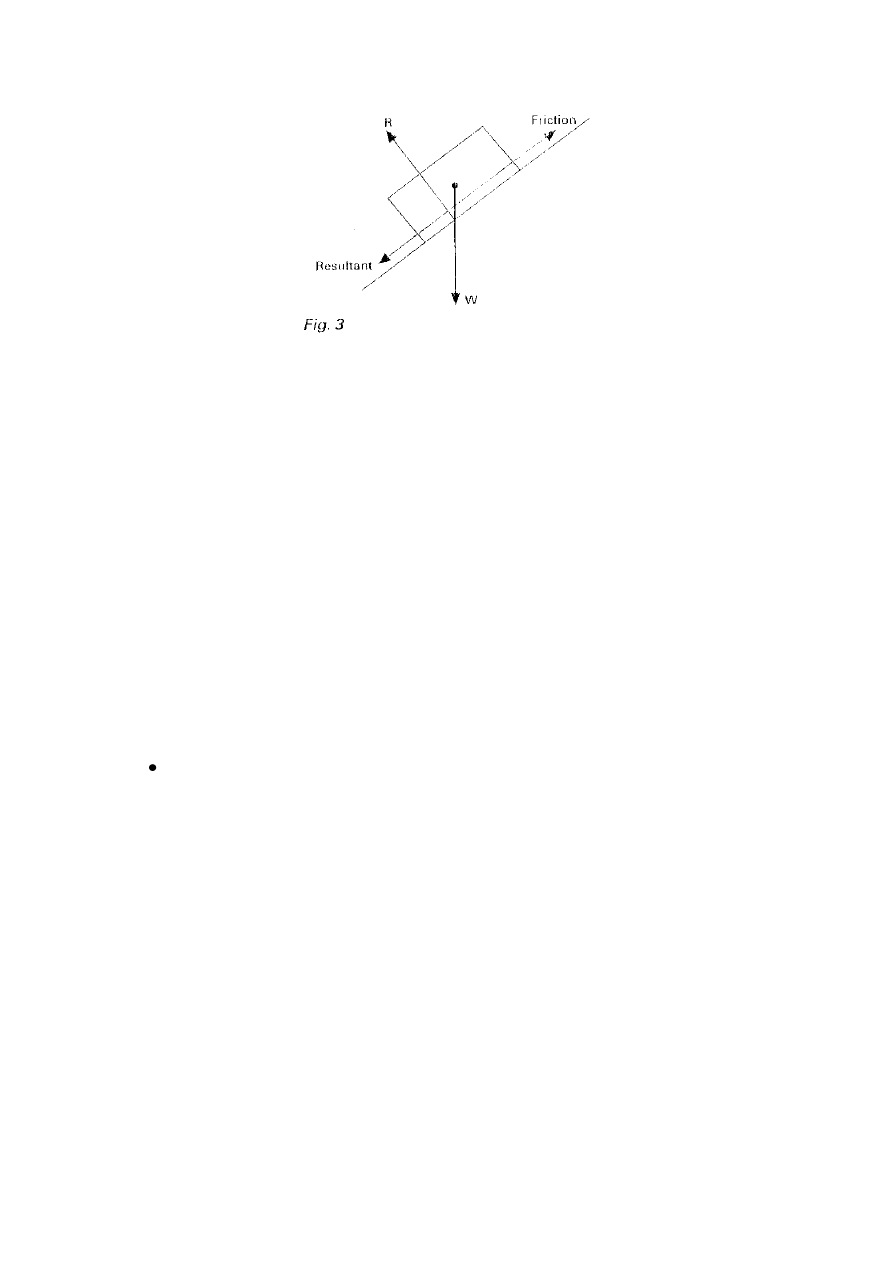
the unit of force. The block in Fig.2 has a weight of 10 newtons. The weight on the balance
pulls the spring down. To give equilibrium, the spring pulls up to oppose that weight. This
upward force, F1, equals the weight of the block, W.
It is important to get the distinction between mass and weight absolutely clear. Mass is
the quantity of matter in an object. Weight is the force on that object due to gravity. Mass is
measured in kilograms, whereas weight, being a force, is measured in newtons.
We have looked at the buoyancy, elasticity, and gravity. There is a
fourth force important in engineering, and that is friction. Friction
is a help in some circumstances but a hindrance in others. Let us
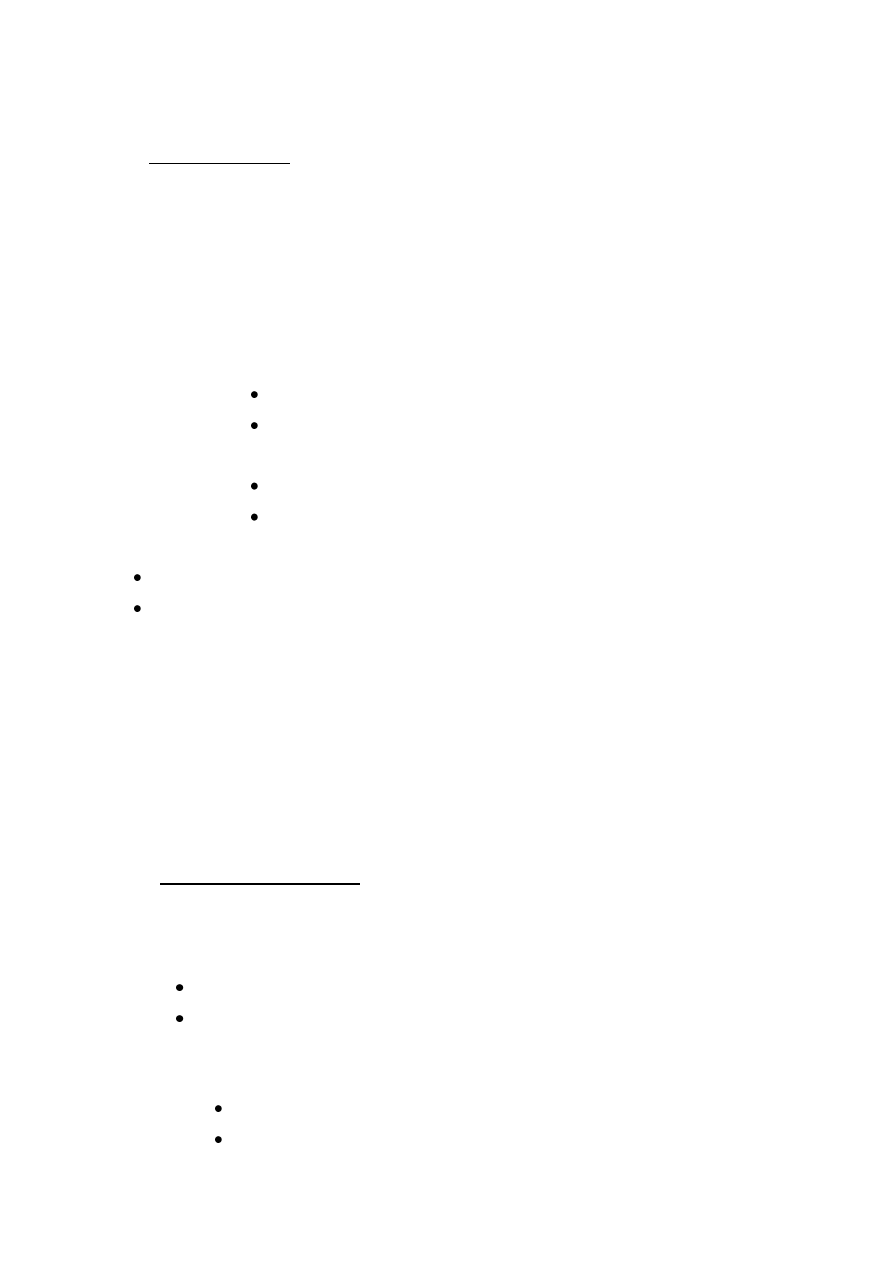
examine the forces on the box (Fig.3). Firstly, there is its weight,
W, the gravity force, then there is the reaction, R, normal to the
plane. R and W have a resultant force trying to pull the box down
the slope. It is the friction force, F, acting up the slope, that stop it
sliding down.
English for Specific Purposes
25
25
B. Language study:
1. Grammar links in texts
One of the ways in which sentences in a text are held together is by grammar links. In
this extract, note how each expression in italics links with an earlier expression.
Another very important force in engineering is the one caused by elasticity. A good
example of this is a spring. Springs exerts more force the more they are stretched. This
property provides a way of measuring force.
Sometimes these links cause problems for readers because they cannot make the right
connection between words in different parts of a text
Study these common grammar links:
1.
A repeated noun becomes a pronoun.
Springs becomes they.
2.
A word replaces an earlier expression.
Forces in engineering becomes one.
3.
A word replaces a whole sentence or clauses.
Springs exerts more force the more they are stretched becomes this property
With which earlier expressions do the words in italics link ? Join them as in the
example above.
Friction in machine is destructive and wasteful. It causes the moving parts to wear and it
produces heat where it is not wanted. Engineers reduce friction by using very highly polished
materials and by lubricating their surfaces with oil and grease. They also use ball bearings and
roller bearings because rolling objects cause less friction than sliding ones.
(Source: S. Larkin and L. Bernbaun (eds.), The Penguin Book of the Physical World)
2. The present passive: Study these instructions for a simple experiment on friction.
1. Place a block of wood on a flat surface.
2. Attach a spring balance to one end of the block.
3. Apply a gradually increasing force to the balance.
4. Note the force at which the block just begins to move.
5. Pull the block along so that it moves at a steady speed.
6. Note the force required to maintain movement.

English for Specific Purposes
26
26
7. Compare the two forces.
When we describe this experiment, we write:
A block of wood is placed on a flat surface. A spring balance is attached to one end of
the block.
This description uses the present passive. We form the present passive using
is/are + past participle
Complete this description of the experiment using the present passive.
A block of wood …1… on a flat surface. A spring balance …2… to one end of the
block. A gradually increasing force …3… to the balance. The force at which the block just
begins to move …4… The block …5… along at a steady speed. The force required to
maintain movement …6… The two forces …7… It is found that the first force is greater than
the second.
(This experiment show that the force required to overcome static friction is greater than
the force required to overcome sliding friction)
C. Word study: Verbs and related nouns
Each of the verb in column A has a related noun ending in –er or –or in column B.
Complete the blanks. Use a dictionary to check any spellings which you are not certain about.
For example: refrigerate (a verb) - refrigerator (a noun)
A. Verbs
B. Nouns
1. condense
………….
2. ………...
evaporator
3. compress
………….
4. resist
………….
5. ………...
charger
6. generate
………….
7. conduct
………….
8. ……….
Exchanger
9. radiate
………….
10. control
………….
New words and expressions:
- buoyancy force:
-
elasticity force:
- equilibrium (n.):
- gravity (n.):
- resultant force:
- calibrated (adj.):
- distinction (n.):
- slope (n.):
lực nổi
lực đàn hồi
sự cân bằng
lực trọng trường
lực tương đương, tổng lực
được chuẩn hóa, được xác định
sự khác biệt
dốc
--- o0o ---
English for Specific Purposes
27
27
LANGUAGE IN FOCUS
Making Questions
In questions, we usually put the first auxiliary verb (AV) before the subject (S).
S + AV
AV + S
Tom will => Will Tom?
Will Tom be here tomorrow?
You have => Have you?
Have you been working hard?
I can => Can I?
What can I do for you?
The house was => was the house? When was the house built?
In simple present questions, we use do/does:
Do you live near here?
What time does the movie begin?
In simple past questions, we use did:
Did you sell your car?
How did the accident happen?
But do not use do/does/did if who/what / which is the subject of the sentence.
Emma phoned somebody.
=>
Who did Emma phone?
Somebody phoned Emma.
=>
Who phoned Emma?
More examples: - Who wants something to eat? (not who does want)
- What happened to you last night? (not what did happen)
- Which bus goes downtown? (not which bus does go)
Note the position of prepositions in questions beginning Who/What/Which/Where ... ?
- Who do you want to speak to?
- Which job has Jane applied for?
- What was the weather like yesterday?
- Where are you from?
Subject –Verb Agreement.
A verb must match its subject in number, singular subjects take singular verbs, and
plural subjects take plural verbs.
Basic Subject-Verb Agreement
My friend is/was/has/does ...
My friends are/were/have/do ...
Frequently Asked Question Typed
A. When the subject and verb are split:
The teacher, along with his students, wants to play soccer.
The institute that helps them is financially supported by the government.
English for Specific Purposes
28
28
The instructor, as well as his students, has welcomed the school‟s decision
of the uniform.
Note: The number of a subject is not affected by a phrase or clause that separates the
subject from its verb.
B. When the subject is an expression of time, distance, price, and weight.
Ten dollars is too much for a drink.
Twenty miles is too long a way to walk in a day.
Twenty minutes is not enough time for me to get there.
C. When a fraction or its equivalent initiates a subject:
Two-thirds of the land has been sold.
Two-thirds of them are students.
Note: In these cases, the noun in the of-phrase determines the number of the verb.
D. When a subject begins with either A or B, neither A nor B, or not only A but
(also) B.
Either he or his pupils are going to help us.
Not only John but his parents want to help us.
Note: When these expressions initiate a subject, the verb must agree with B in number.
E. When a subject consists of a proper noun or a branch of learning ending in -s:
The United State has a population of over 265 million people.
Mathematics is my favorite subject.
Physics has been studied for many centuries.
F. When a subject contains expressions like every, each, more than one, many a, etc.
More than one person has applied for that position.
Every girl and boy was upset because of the outcome.
G. When a subject contains expressions like many of, a number of, a couple of, a
group of, a few, several, both, etc.
A number of my friends are from China.
Many countries have joined the European Union.
Several cars were damaged in the accident.
-----------------------------------------
PRACTICE
I. Ask Joe questions. (look at his answers before you write the questions)
1.(where / from?) ................................................
- From Toronto originally.
2. (where /live / now?)........................................
- In Vancouver.
3. (married?)........................................................
- Yes.
4. (how long / married?)......................................
- Twelve years.

English for Specific Purposes
29
29
5. (children?).......................................................
- Yes, three boys.
6. (how old / they?).............................................
- They‟re 4, 7, and 9.
7. (what / wife / do?)..........................................
- She‟s a police officer.
8. (she / like her job?)........................................
- Yes, very much.
II. Make questions with who or what.
1. Somebody gave me the key.
- ....................................................................
2. Something happened.
- .....................................................................
3. Diane told me something. - .....................................................................
4. The book belongs to somebody.
- .....................................................................
5. Somebody lives in that house.
- .....................................................................
6. I fell over something.
- ......................................................................
7. Something fell on the floor.
- ......................................................................
8. This word means something.
- ......................................................................
9. I borrowed the money from somebody.
- .................................................
10. I‟m worried about something.
- .......................................................................
III. Choose the best word or phrase that best completes the sentence.
1. ________ cats as faithful as dogs?
A. Be
B. Is
C. Am
D. Are
2. Mathematics ________ the study of numbers, quantities, or shapes.
A. be
B. is
C. are
D. was
3. Each book _________ unique illustrations.
A. have
B. has
C. having
D. haves
4. The people _________ lining up to get on the train.
A. is
B. gets
C. are
D. is being
5. The captain, together with his crew members, _________ struggling to control the
ship.
A. was
B. were
C. has
D. becomes
6. Each of our products ___________ guaranteed for sixty years.
A. will
B. to be
C. is
D. are
7. A number of researchers ___________ expected to attend the conference.
A. be
B. is
C. are
D. become
8. Two thirds of the land __________ already been sold.
A. is
B. are
C. has
D. have
9. Not only the teacher but the students __________ opposed to the new uniforms.
A. is
B. are
C. will
D. is being

English for Specific Purposes
30
30
10. Three hours ___________ too short a time for us to talk about this matter.
A. is
B. are
C. takes
D. take
11. Could you __________ me a big favor?
A. offer
B. make
C. work
D. do
12. He must have missed the train; otherwise, he __________ arrived by now.
A. has
B. have
C. had
D. would have
13. There were plenty of people who _________ black.
A. was wear
B. was wearing
C. wearing
D. were wearing
14. He is earning ten dollars an hour, which ______ not a small amount of money.
A. be
B. to be
C. is
D. are
15. His daughter is married __________ a doctor.
A. with
B. by
C. for
D. to
---------------------------------------

English for Specific Purposes
31
31
UNIT 5: THE ELECTRIC MOTOR
A. Reading:
Skimming
In Unit 2 you studied scanning – locating specific information quickly. Another useful
strategy is reading a text quickly to get a general idea of the kind of information it contains.
You can then decide which parts of the text are worth reading in more detail later, depending
on your reading purpose. This strategy is called skimming.
1.
Skim this text and identify the paragraphs which contain information on each
of these topics. The first one has been done for you.
a. What electric motors are used for
Paragraph 1
b. The commutator
………
c. Why the armature turns
………
d. Electromagnets
……….
e. Effect of putting magnets together
……….
f. The armature
………
In an electric motor, an electric current and magnetic field produce a turning movement.
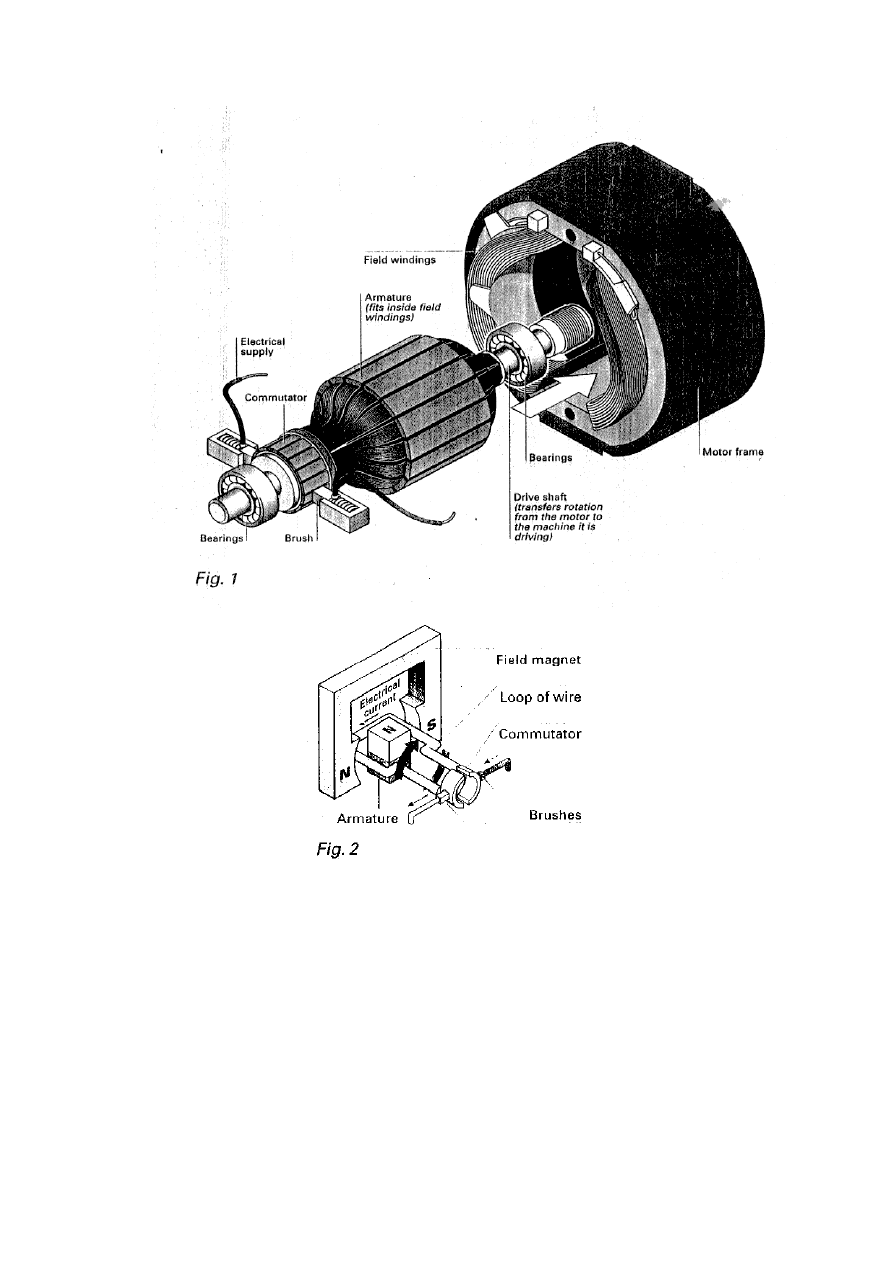
This can drive all sorts of machines, from wrist-watches to trains. The motor shows in Fig. 1
is for a washing machine. It is a universal motor, which can run on direct current or
alternating current.
A electric current running through a wire produces a magnetic field around the wire. If
an electric current flows around a loop of wire with a bar of iron through it, the iron becomes
magnetized. It is called an electromagnet; one end becomes a north pole and the other a south
pole, depending on which way the current is flowing around the loop (see Figure 1).
If you put two magnets close together, like poles – for example, two north poles – repel
each other, and unlike poles attract each other.
In a simple electric motor, like the one showed in Fig. 2, a piece of iron with loops of
wire round it, called an armature, is placed between the north and south poles of a stationary
magnet, known as the field magnet. When electricity flows around the armature wire, the iron
becomes an electromagnet (see Figure 2).
The attraction and repulsion between the pole of this armature magnet and the poles of
the field magnet make the armature turn. As a result, its north pole is close to the south pole of
the field magnet. Then the current is reversed so the north pole of the armature magnet
becomes the south pole. Once again the attraction and repulsion between it and the field
magnet make it turn. The armature continues turning as long as the direction of the current,
and therefore its magnetic poles keeps being reversed.
To reverse the direction of the current, the ends of the armature wire are connected to
different halves of a split ring called a commutator. Currents flow to and from the commutator
through small carbon blocks called brushes. As the armature turns, first one half of the
commutator comes into contact with the brush delivering the current, and then the other, so
the direction of the current keeps being reversed.
English for Specific Purposes
32
32
(Source: adapted from „Inside out: Electric Motor‟, Education Guadian)
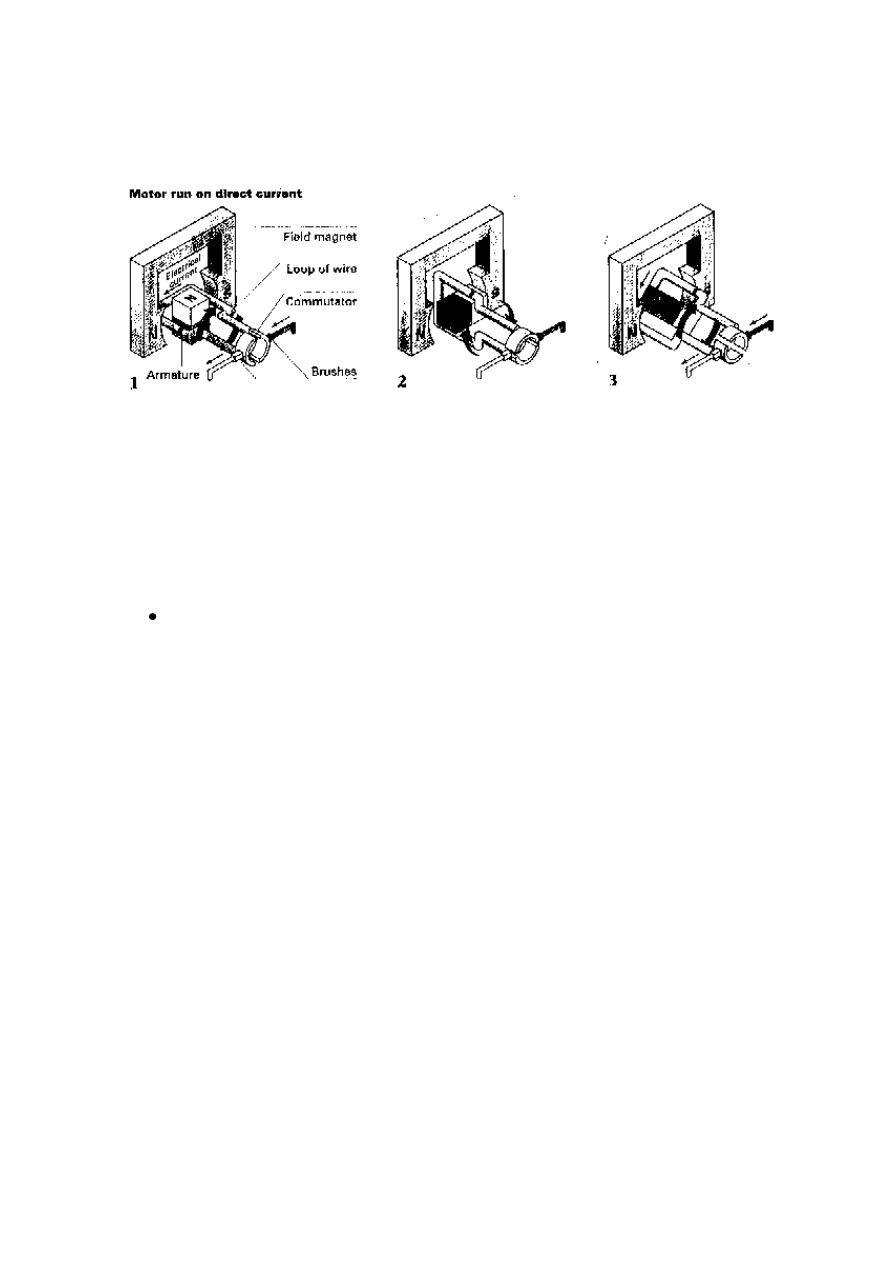
2.
Match each of these diagrams with the correct description a, b, c or d. One of
the description does not match any of the diagrams.(The diagrams are in the correct
sequence, but the descriptions are not.)
a. The armature turn a quarter of a turn. Then electric contact is broken because of the
gap in the commutator, but the armature keeps turning because there is nothing to
stop it.
b. When the current flows, the armature becomes an electromagnet. Its north pole is
attracted by the south pole and repelled by the north pole of the field magnet.
c. When an universal motor is run on direct current, the magnetic poles in the armature
change while those of the field magnet remain constant.
English for Specific Purposes
33
33
d. When the commutator comes back into contact with the brushes, current flows
through the armature in the opposite direction. Its poles are reversed and the turn
continues.
B. Language study:
1. Describing function
Try to answer this question: „What does an electric motor do ?‟
When we answer a question like this, we describe the function of something. We can
describe the function of an electric motor in this way:
An electric motor converts electrical energy to mechanical energy.
We can emphasize the function like this:
The function of an electric motor is to convert electrical energy to mechanical energy.
Match each of these motor components to its function, and then describe its function in
a sentence.
Component
Function
1. armature
2. bearings
3. brushes
4. commutator
5. drive shaft
6. field windings
a. transfer rotation from the motor.
b. create an electromagnet field
c. converts electromagnetic energy to rotation
d. reverses the current to the armature
e. support the drive shaft
f. supply current to the armature
2. Describing components
Now study this description of the motor
A simple dc motor consists of a field magnet and an armature. The armature is placed
between the poles of the magnet. The armature is made up of a loop of wire and a split ring
known as a commutator. The loop is connected to the commutator. Current is supplied to the
motor through carbon blocks called brushes.
To write a description, you need to use language to:
1. dismantle a piece of equipment into its main parts. These expression will help:
A A consists of X and Y
Is made up of
Is composed of

English for Specific Purposes
34
34
2. name components:
Carbon blocks known as brushes.
called
3. locate components:
The armature is placed between the poles.
4. connect components:
The loop is connected to the commutator.
Use the following words to complete the text:
Are made up / is placed / is composed / consists
A transformer ………. Of two coils, a primary and a secondary. The coils are wound on a
former which is mounted on a core. The coils ……… of a number of loops of wire. The
core ……… of thin pieces of soft iron. U- and T- shaped pieces are used. The former
…….. on the leg of the T.
C. Word study:
Verbs with –ize /-ise
Study these statement: The rotor is magnetized.
What does it mean? Can you say it another way? We can rewrite this statement as:
The rotor is made magnetic.
Verbs ending in –ize / -ise have a range of meanings with the general sense of
„make + adjective‟
Rewrite these sentences replacing the phrases in italics with appropriate –ize/-ise.
1. Some cars are fitted with a security device which makes the engine immobile.
2. In areas where the power supply fluctuates, for sensitive equipment a device to
make the voltage stable is required.
3. Manufacturers seek to keep costs to a minimum and profits to a maximum.
4. Most companies have installed computers to control their production line.
5. Companies may make their operation more rational by reducing the variety of
products they make.
New words and expressions:
- commutator (n.):
- armature (n.):
- electromagnet (n.):
- magnetic field:
- direct current:
- alternating current:
- a loop of wire:
- repel (v.):
- attract (v.):
- the direction of the current:
- carbon blocks / brushes:
cổ ghóp
lõi sắt, phần ứng
nam châm điện
từ trường
dòng điện một chiều
dòng điện xoay chiều
cuộn dây điện
đẩy
hút
chiều dòng điện
chổi than
--- o0o ---

English for Specific Purposes
35
35
Further reading:
Portable generator
Although most electricity comes from power stations, power can also be generated by
far smaller means. Nowadays, electricity generators can be small enough to hold in the hand.
Portable generators are made up of two main parts: an engine, which powers the
equipment, and an alternator, which convert motion into electricity.
The engine runs on petrol. It is started by pulling a cord. This creates a spark inside
which ignites the fuel mixture.
In a typical four-stroke engine, when the piston descends, the air inlet valve opens and a
mixture of air and petrol is sucked in through a carburetor.
The valve closes, the piston rises on the compression stroke and a spark within the
upper chamber ignites the mixture. This mini-explosion pushes the piston back down, and as
it rises again the fumes formed by the ignition are forced out through the exhaust valve.
This cycle is repeated many times per second. The moving piston makes the crankshaft
rotate at great speed.
The crankshaft extends directly to an alternator, which consists of two main sets of
windings – coils of insulated copper wire wound closely around an iron core. One set, called
stator windings, is in a fixed position and shaped like a broad ring. The other set, the armature
windings, is wound on the rotor which is fixed to the rotating crankshaft. The rotor makes
about 3,000 revolutions per minute.
The rotor is magnetized and as it spins round, electricity is generated in the stator
windings through the process of electromagnetic induction. The electric current is fed to the
output terminals or sockets.
This type of generator can produce a 700 watt output, enough to operate lights,
television, and some domestic appliances. Larger versions provide emergency power to
hospitals and factories.
The four-stroke cycle
In the four-stroke cycle, the piston descends on the intake stroke, during which the inlet
valve is open. The piston ascends on the compression stroke with both valves closed and
ignition takes place at the top of the stroke. The power or expansion stroke follows. The gas
generated by the burning fuel expands rapidly, driving the piston down, both valves remaining
closed. The cycle is completed by the exhaust stroke, as the piston ascends once more, forcing
the products of combustion out through the exhaust valve. The cycle then repeats itself.
(Source: Adapted from „Inside out: Portable generator‟, Education Guardian)
Questions:
1. What are its main parts?
2. What does the engine run on?
3. What are the four strokes called?
4. What is the function of the crankshaft?
5. What do both stator and rotor have?
6.
What is the difference between stator and rotor?

English for Specific Purposes
36
36
LANGUAGE IN FOCUS
Gerunds and Infinitives
Infinitives: An infinitive is the base form of a verb with to preceding it.
A. Use a to-infinitive after the following common verbs: agree, decide, expect, happen,
pretend, promise, manage, tend.
He decided to go home.
B. Use a to-infinitive after the following common verbs plus their object: advise, allow,
expect, forbid, want, force, tell.
His manager allowed him to go home.
C. Use an infinitive without to after the common following verbs plus their object: have,
let, make, feel, see, hear, smell, find.
He let Tom go home.
Gerunds: A gerund is the –ing form of a verb. It is used as a noun.
Use an –ing form after the following common verbs: avoid, can‟t help, deny, feel like,
give up, imagine, mind, postpone, enjoy.
He denies eating the cake.
Choosing Between Infinitives and Gerunds
A gerund is always used when a verb is followed by a preposition: admit to, approve of,
argue about, believe in, care about, complain about, concentrate on, confess to.
They apologized for being late.
He dreamt about eating a hamburger.
The following common verbs allow both a to-infinitive form and an –ing form.
Sentences with either form will have the same meaning. They are: attempt, begin, continue,
hate, like, love, neglect, prefer, regret, stand/can‟t stand, start.
He hates running.
He hates to run.
The following common verbs allow both a to-infinitive form and an –ing form.
However, their meanings are different in each case: remember, forget, stop, regret, try.
I forgot to turn the light off. (= I didn‟t turn it off, and it remained on)
I forgot turning the light off. (= I actually turned it off. I forgot that I had done that.)
Note: The choice of a to-infinitive or an –ing form depends on the meaning.
Choosing Subjects
A. Use objective case pronouns with an infinitive.
expect him to help her.
allow them to do it.
let him go.
B. Use a possessive pronoun with a gerund.

English for Specific Purposes
37
37
enjoy their singing.
mind my smoking.
Some more verbs followed by –ing
Some more verbs followed by to-infinitive
finish avoid consider admit miss
involve quit postpone delay imagine
deny risk practice
offer decide hope deserve attempt mean
promise agree plan aim afford manage
intend threaten refuse arrange learn need
fail
------------------------------------------------------
PRACTICE
I. Put the verb into the correct form, to-infinitive or –ing form.
1. When I‟m
tired, I enjoyed ___________ TV. It‟s relaxing. (watch)
2. It was a nice day, so we decided __________ for a walk. (go)
3. There was a lot of traffic, but we managed _________ to the airport in time. (get)
4. I‟m not in a hurry, I don‟t mind __________. (waiting)
5. They don‟t have much money. They can‟t afford _________ out very often. (go)
6. We‟ve got a new computer in our office. I haven‟t learned how _____ it yet. (use)
7. I wish that dog would stop _________. It‟s driving me crazy. (bark)
8. Our neighbor threatened _________ the police if we didn‟t stop the noise. (call)
9. We were all afraid to speak. Nobody dared ________ anything. (say)
10. We were hungry, so I suggested _________ dinner early. (have)
II. Choose the word or phrase that best completes the sentences.
1. Who does she ________ to take care of her ?
A. want
B. wants
C. to want
D. will want
2. I can‟t afford _________ a new car.
A. buy
B. to buy
C. buying
D. bought
3. They are considering __________ to Atlanta.
A. move
B. to move
C. moving
D. will move
4. I would like ___________ by your office on my way home.
A. drop
B. to drop
C. dropping
D. will drop
5. I seldom forget __________ my teeth before going to bed.
A. brush
B. to brush
C. brushing
D. brushed
6. They politely asked me ___________ in another place.
A. stand
B. to stand
C. standing
D. stood
7. Since we live by an airport, we can easily watch the airplanes __________off.

English for Specific Purposes
38
38
A. take
B. to take
C. be taking
D. will take
8. We think __________ him to have access to the Internet is a bad idea.
A. allow
B. to allow
C. allowing
D. allowance
9. My son is not very good at _________ yet.
A. drive
B. to drive
C. driving
D. will drive
10. They were heard ___________ goodbye to their friends.
A. say
B. saying
C. said
D. be saying
11. Now we are going to _____________ about our plans for next year.
A. discuss
B. tell
C. talk
D. say
12. Please keep me __________ as to his whereabouts.
A. interred
B. informed
C. deformed
D. reformed
13. I‟m looking forward to __________ from you soon.
A. hear
B. hearing
C. heard
D. have heard
14. Mother ___________ me clean the floor with a mop.
A. got
B. made
C. forced
D. told
15. Nobody is opposed __________ your suggestion.
A. at
B. on
C. to
D. with
---- o0o ----

English for Specific Purposes
39
39
PART II: THE AGRICULTURAL MACHINERY
…………………………………………………………………………………..
Unit 6:
THE AGRICULTURAL TRACTOR
General
1 The importance of agricultural tractors in the world today should never be under-
estimated. They provide a great source of power which has almost entirely replaced the power
of horse, and of man, for the many heavy and time-consuming tasks carried out on land.
2 This power is being used to produce food for the nations of the world and there is no
more important task than this. A tractor can do the work of numerous horses, and do this work
in the same time, without having to be rested to recover from fatigue. Provided reasonable
attention is given to its lubrication and it is kept supplied with fuels, it will work on
indefinitely. The driver, of course, will require his rest, but it is not unusual for tractors to
work around the clock when relief drivers are available.
3 As more and more food production is required to feed the ever-increasing world
population, the numbers of tractors used will increase to meet the demand. Great areas of land
will yet be brought into food production and the tractor will supply the necessary power for
the work.
Tractor Types
4 The present-day tractor is a most useful machine, capable of supplying its power to
numerous farm tasks. The most power absorbing of these tasks is usually the basic cultivation
of land; therefore the tractor is designed to be able to do this task whilst at the same time
being amply powered for the many other field tasks it is required to do, such as drilling seed,
top dressing, spraying, haulage, etc.
5 During the years since the First World War, and in particular during, say, the last 20
years, a great amount of progress has been made in developing a machine capable of
operating efficiently a very wide range of implements and machines. Many devices have been
incorporated in the mechanism of the tractor for this purpose.
6 The type of tractor used on the land depends on the type of work to be done.
Track-Laying Tractors (Fig. 1)
7 These tractors are sometimes referred to as “crawlers” and are usually tractors with a
large horse-power and capable of doing very heavy work. On farms, they may be used for
pulling a five- or six- furrow plough or for heavy cultivation. Yet, On the other hand, there is
a very small track-laying tractor of no more than 6 h.p. (horse-power) which is used for work
on market gardens.
Heavy Wheeled Tractors
8 Not only track-laying tractors are used for the heavy work on farms. Very large four-
wheel-drive tractors are now common which are capable of pulling up to twelve furrow
ploughs with engines of up to 500 h.p. These large tractors may be equipped with twin wheels
all round, and no longer run in the furrow when ploughing, but run on top in the same way as
a crawler tractor. They also carry out very heavy cultivation.
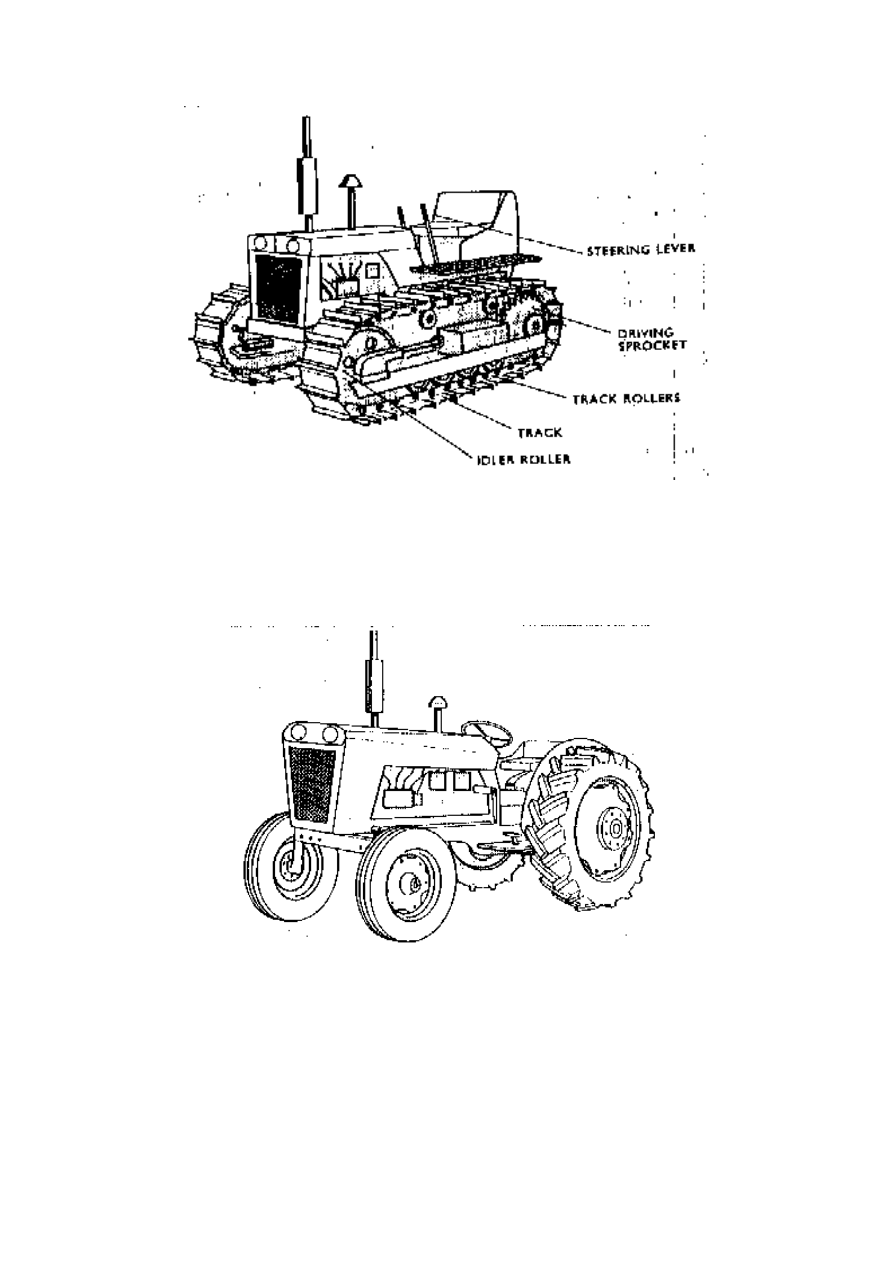
English for Specific Purposes
40
40
Fig.1. A track-laying tractor.
General-purpose Tractors (Fig.2)
9 The general-purpose tractor is a wheeled tractor and the lighter type may be powered
by an engine of about 40 h.p. whilst the other type may have an engine of 100 h.p. Either one
or both of these types may be used on most farms and they are the most common type used
today.
Fig. 2. A General-purpose tractor
Two-wheeled Tractors
10 Another type of tractor to be found on many small holdings and market gardens is
the hand-operated. This type is powerful enough to do light cultivation and is steered by a
walking operator.
11 Most tractors nowadays are powered by internal combustion engines, which,
although they may vary slightly between one make and another as regards detail of
construction, operate on the same basic principles.

English for Specific Purposes
41
41
The Internal Combustion Engine
12 The tractor‟s power is used for doing work in the field and also for driving stationary
machines.
13 The power, which is produced by the engine, is transmitted through various
mechanisms until it reaches the rear wheels which rotate. These mechanisms will be
explained in later chapters. The power unit must be considered first.
14 In any internal combustion engine there are a number of essential parts which are so
arranged that a basic series of events occur. This series of events is usually known as the
operating cycle and most tractor engines operate on what is known as the four-stroke cycle.
15 The internal combustion engine is a form of heat engine and the name “heat engine”
is given to it because heat energy, produced by the burning of fuel within the engine, is
changed into mechanical energy. Different types of fuel are used in the different types of
tractor engines but this does not alter the basic operation. The fuels used are petrol or propane
for spark ignition, and diesel fuel is used in compression ignition engines.
This text was taken from SHIPPEN et al. , Basic Farm Machinery, Pergamon Press
I. COMPREHENSION CHECK:
Now read the text carefully, looking up any new items in a dictionary or reference
book. Then answer the following questions:
1. What source of power have tractors largely replaced?
2. What does the tractor need to work on indefinitely?
3. Why will the number of tractors increase?
4. Which farm task uses most tractor power?
5. On what basis is the type of tractor chosen for use?
6. Where is the smallest track-laying tractor used?
7. What do heavy wheeled tractors and track-laying tractors have in common?
8. Which is the commonest type of tractor?
9. How are most tractors powered?
10. What does the internal combustion engine change?
II. VOCABULARY:
In this section you should use your dictionary to help you answer the questions about
the text.
1. Look at paragraphs 1 -3 again. What words have the same meaning as:
taking a lot of time.
tiredness
get better
thought too little of
completely
without any time limit
English for Specific Purposes
42
42
a great many
2. Look at paragraphs 4 - 6 again. What words have the opposite meaning to :
unable to
not enough
taken out of
3. Look at paragraph 7 again. Can you explain the words:
heavy cultivation
market garden
4. Look at paragraph 8 again. Can you explain the words:
plough
furrow
5. Look at paragraph 9 again. What word has the opposite meaning to:
heavier
6. Look at paragraph 10 - 11 again. Which words correspond to the definitions:
general laws shown in the working of machines
direct the course of a machine
a small area of land usually farmed by the owner or tenant himself
a little bit
7. Look at paragraphs 12 - 15 again. What words have the same meaning as:
sent through
change
turn in a circle
not moving
III. GRAMMAR:
1. Look at this table:
General purpose tractor
Tractor system
Function
hydraulic system
raises and lowers implements; controls depths of
ploughs and harrows
rear power take-off shaft
drives implements e.g. seeders and sprayers
drawbar
pulls trailers and implements, e.g. harvesters
Now look at the following sentences and answer the questions:
The rear power take-off shaft drives implements.
The rear power take-off shaft is used for driving implements.

English for Specific Purposes
43
43
The function of the rear power take-off shaft is to drive implements.
a) What is the hydraulic system used for?
b) What is the function of the draw-bar?
2. Look at the table below:
Implement
Function
Plough
lifts the topsoil and turns it over
Harrow
breaks up the topsoil and prepares it for seeding
Sprayer
applies herbicides, fungicides and insecticides to the crop
Seeder
make a furrow and sows the seed
Harvester
cuts forage and lifts root crops
Now ask and answer questions containing the words used for and function.
3. Look at these sentences:
The tractor can raise and lower implements.
For this purpose the hydraulic system is used.
Now write six similar sentences using the table in exercise 1.
4. Look at these sentences:
The function of the draw-bar is to pull implements whereas the hydraulic system is
used for raising and lowering them.
Now complete the following sentences:
a) The plough .................... whereas the harrow ......................
b) The plough lifts the topsoil and turns it over, whereas ......................... and sowing
the seed.
Make similar sentences contrasting the functions of the seeder and the harrow, and the
harvester and the plough.
5. The impersonal passive
Examine the following active and passive sentences, and note the verb form of each
passive sentence. Note that the words in brackets are optional, and are often omitted in
scientific writing.
Active
Passive
We improve the fertility of the soil.
The fertility of the soil is improved
The fruit encloses the seeds.
The seeds are enclosed by the fruit.
We should plough under leguminous
plants
Leguminous plants should be ploughed under.
Now, write down the passive version of the following active sentences. Then combine
the passive sentences you have written following the clues provided.

English for Specific Purposes
44
44
E.g. A: The tiny root hairs absorbed water and mineral. An increase in the number of
root hairs increases the power of absorption.
P: Water and mineral are absorbed by the tiny root hairs. Therefore, the power of
absorption is increased by an increase in the number of root hairs.
1. A: The fruit encloses the seeds. The fruit protects them while they are developing.
P: The seeds ... by the fruit. Consequently, they ...while they are developing.
2. A: The plant takes in oxygen. The plant uses oxygen to break down carbohydrates.
P: Oxygen ... in by the plant and ... to break down carbohydrates.
3. A: Wind and insects transfer pollen from one flower to another. They deposit the
pollen on the stigmas of the other flower.
P: When pollen ... by the wind and insects from one flower to another, it ... on the
stigmas of the other flower.
4. A: The human body requires small quantities of several minerals. The human body
obtains these minerals from plants.
P: Small quantities of several minerals which are ... by the human body ... from
plants.
5. A: We can use some roots to reproduce the species. We should remove the whole
root of harmful weeds such as docks instead ploughing them in lightly.
P: Some roots ... to reproduce the species. Thus, the whole root of harmful weeds
such as docks ... instead of ... lightly.
6. A: Soil texture influences all aspects of root development. A heavy compact soil
creates a physical barrier to root growth.
P: All aspect of root development ... by soil texture. For example, a physical barrier
to root growth ... by a heavy compact soil.
7. A: Too much cultivation destroys the soil structure.
A pasture phase under grass can improve the structure.
P: Since soil structure ... by too much cultivation, the structure ... by a pasture phase
under grass.
8. A: The plant manufactures food from chemical substances present in the soil & air.
The roots take in chemical substances from the soil.
The leaves take in carbon dioxide from the air.
P: Food is ... by the plant from chemical substances which ... from the soil by the
roots and from carbon dioxide which ... from the air by the leaves.
9. A: We can use a unit called a soil profile to describe soils.
When we wish to compare two soils, we examine their profiles.
We can define a soil as having an individual profile.
P: A unit called a soil profile ... to describe soils. So when we wish to compare two
soils, their profiles ..., and each soil can thus ... as having an individual profile.
10. A: Ploughing „turn in‟ the whole surface of a field.

English for Specific Purposes
45
45
It buries and kills the weeds
It loosens and exposes the soil to the air.
P: The whole surface of the field „.....‟ by ploughing, with the result that weeds ...
and ... and the soil ... and ... to the air.
New words and expressions:
- be under-estimated:
- source of power:
- time-consuming task:
- fatigue (n.):
- kept supplied with fuels:
- available (adj.):
- basic cultivation:
- a track-laying tractor:
- horse power:
- incorporated:
- furrow plough:
- carry out:
- general-purpose tractor:
- holdings (n.):
- detail of construction:
- basic principles:
- the internal combustion engine:
- the operating cycle:
- the four-stroke cycle:
- heat energy:
- mechanical energy:
- hydraulic system:
- rear power-take-off shaft:
- harrow (v.):
- harvester (n.):
- soil texture:
- absorption (n.):
- leguminous plants:
- seeder (n.):
- sprayer (n.):
đánh giá thấp
nguồn năng lượng
công việc mất nhiều thời gian
sự mệt nhọc
được cung cấp nhiên liệu đầy đủ
có sẵn
trồng trọt cơ bản
máy kéo bánh xích
mã lực
phối hợp
luống cày
tiến hành, thực hiện
máy kéo đa năng
khu đất nhỏ
chi tiết cấu tạo
những nguyên tắc cơ bản
động cơ đốt trong
chu kỳ vận hành
chu kỳ bốn thì
nhiệt năng
cơ năng
hệ thủy lực
trục thu công suất sau
bừa
máy gặt
kết cấu đất
sự thẩm thấu
cây họ đậu
máy gieo hạt
máy phun thuốc (trừ sâu)

English for Specific Purposes
46
46
Further reading:
Engine Classification
The engine can be classified in the following several ways:
(1) operating cycle(2) piston action, (3) piston connection, (4) cylinder arrangement, (5)
method of fuel injection, and (6) speed.
Operating cycle: Diesel and gas-burning engines can be divided into two groups
based on the number of piston strokes per cycle, either four or two. An engine which needs
four strokes to complete one cycle is a four-stroke cycle engine or, for short, a four-stroke
engine. If it need only two strokes to complete a cycle, it is called a two-stroke cycle engine
or, for short, a two -cycle engine. Thus, a two-cycle engine fires twice as often as a four -
cycle engine.
Piston action: An engine's piston action may be classified a (a) single action (b)
double-action, (c) opposed-piston.
Single-acting engines use only one end of the cylinder and face of the piston to
develop power. This working space is at the end away from the crankshaft, that is, at the
upper end of a vertical engine.
Double-acting engines use both ends of the cylinder and both faces of the piston to
develop power on the up-stroke as well as on the down-stroke. The construction is
complicated; therefore, double-acting engines are built only in large and comparatively low-
speed units, generally to power motor-ships.
An opposed-piston engine has cylinders in each of which two pistons travel in opposite
directions. The combustion space is in the middle of the cylinder between the pistons. There
are two crankshafts; the upper pistons drive one, the lower pistons drive the other. Note that
each piston is single-acting; that is, it develops power with only one face of the piston.
Piston connection: The piston may be connected to the upper end of the connecting rod
either directly ("trunk piston" type) or indirectly ("crosshead" type).
In trunk-piston engines, a horizontal pin within the piston is encircled by the upper end
of the connecting rod. This by far the most common construction.
In crosshead-type engines, the piston fastens to a vertical piston rod whose lower end is
attached to a sliding member called a "crosshead", which slides up and down in guides. The
crosshead carries a crosshead pin which is encircled by the upper end of the connecting rod.
This more complicated construction is required in double-acting engines. It is also used in
some large, slow-speed, single-acting engines.
Cylinder arrangement: The four basic cylinder arrangements of a diesel or gas -
burning engine are: (a) cylinder-in-line, (b) V-arrangement, (c) flat and (d) radial.
A cylinder-in-line arrangement. This is the simplest and most common arrangement,
with all cylinders arranged vertically in line. This construction is used for engines having up
to 12 cylinders. Engines are also built with horizontal cylinders, usually one or two, in a few
cases with three cylinders.
If an engine has more than eight cylinders, it becomes difficult to make a sufficiently
rigid frame and crankshaft with an inline arrangement. Also, the engine becomes quite long
and take up considerable space. The v-arrangement, with two connecting rods attached to
each crankpin, permits reducing the engine length by almost on-half, thus making it much
more rigid, with a stiff crankshaft. It also costs less to manufacture and install. This is a

English for Specific Purposes
47
47
common arrangement for engines with eight, twelve and sixteen cylinders. Cylinder lying in
one line are called a "bank", and the angle between the banks may vary, in manufacturing
practice, from 30
0
to 120
0
, the most common angles being between 40
0
and 75
0
(a complete
circle is 360
0
).
A flat engine is a v-engine with the angle between the banks increase to 180*. This
arrangement is used where there is little head room, as in trucks, buses and rail cars. Flat
engines are also called "opposed-cylinder" engines.
In a radial engine, all the cylinders are set in a circle and all point toward the centre of
the circle. The connecting rods of all the pistons work on a single crankpin, which rotates
around the centre of the circle. Such a radial engine occupies little floor space. By attaching
the connecting rods to a master disk surrounding the crankpin, as many as twelve cylinders
have been made to work on a single crankpin.
Method of fuel injection. Diesel engines are divided into air-injection engines and
solid or mechanical injection engines. Air-injection engines use a blast of highly compressed
air to blow the fuel into the cylinder. Air injection was commonly used on early diesel engines
but with the development of solid-injection systems the air-injection engine is rapidly
disappearing.
Speed. All diesel and gas-burning engines may be divided into three classes according
to speed: low-speed, medium-speed and high-speed engines. Automotive diesel engines often
run faster than 1,200 rpm, but the great majority of other engines run between 350 and 1,200
rpm and are termed medium-speed engines.
New words and expressions:
- fuel injection:
- divide into ... :
- be based on ... :
- piston stroke:
- for short:
- (be) away from:
- trunk-piston engine:
- by far:
- gas-burning engine:
- cylinder-in-line:
- a sufficiently rigid frame:
- radial engine:
s
ự phun nhiên liệu
chia thành
... được dựa trên
hành trình piston
gọi tắt, để ngắn lại
cách xa so với
động cơ piston nối trực tiếp
nhiều đến mức
động cơ đốt bằng khí, động cơ chạy ga
xylanh thẳng hàng
sườn đủ cứng
động cơ hình sao
--- o0o ---

English for Specific Purposes
48
48
LANGUAGE IN FOCUS
Using the passive
Example: (a) Rice is growing in India.
(b) Our house was built in 1980.
(c) The olive oil was imported from Spain.
Usually the passive is used without a “by phrase” . The passive is most frequently used
when it is not known or not important to know exactly who performs an action.
In (a) : Rice is grown in India by people, by farmers, by someone. In sentence (a) it is
not known or important to know exactly who grows rice in India. (a), (b) and (c) illustrate the
most common use of the passive, i.e., without the “by phrase”.
(d) Life on the Mississippi was written by Mark Twain.
The “by phrase” is included only if it is important to know who performs an action. In
(d), by Mark Twain is important information.
(e) My aunt made this rug. (active)
(f) This rug was made by my aunt.
This rug was made by my mother.
If the speaker/writer knows who performs an action, usually the active is used, as in (e).
The passive may be used with the “by phrase” instead of the active when the speaker/writer
wants to focus attention on the subject of a sentence. In (f) the focus of attention is on two
rugs.
PRACTICE
Change the following active sentences to passive sentences if possible. (some of the verbs are
intransitive and cannot be changed). Keep the same tense. Include “by phrase” only if
necessary.
1. People grow corn in Iowa. => Corn is grown in Iowa.
2. Peter came here two months ago. (no change)
3. Someone made this antique table in 1734.
4. An accident happened at the corner of Fifth and Main.
5. Someone stole my purse.
6. Someone was making the coffee when I walked into the kitchen.
7. Translators have translated that book into many languages.
8. Jim‟s daughter drew that picture. My son drew this picture.
9. The judges will judge the applicants on the basic of their originality.
10. My sister‟s plane will arrive at 10.35.
11. Is professor Rivers teaching that course this semester?
12. When did someone invent the radio?
13. The mail carrier had already delivered the mail by the time I left for school this morning.

English for Specific Purposes
49
49
14. When is someone going to announce the results of the contest?
15. After the concert was over, hundreds of fans mobbed the rock music star outside the
theater.
16. Ever since I arrived here, I have been living in the dormitory because someone told me
that it was cheaper to live there than in an apartment.
17. They are going to build the new hospital next year. They have already built the new
elementary school.
18. If you expose a film to light while you are developing it, you will ruin the negatives.
--- O0O ---
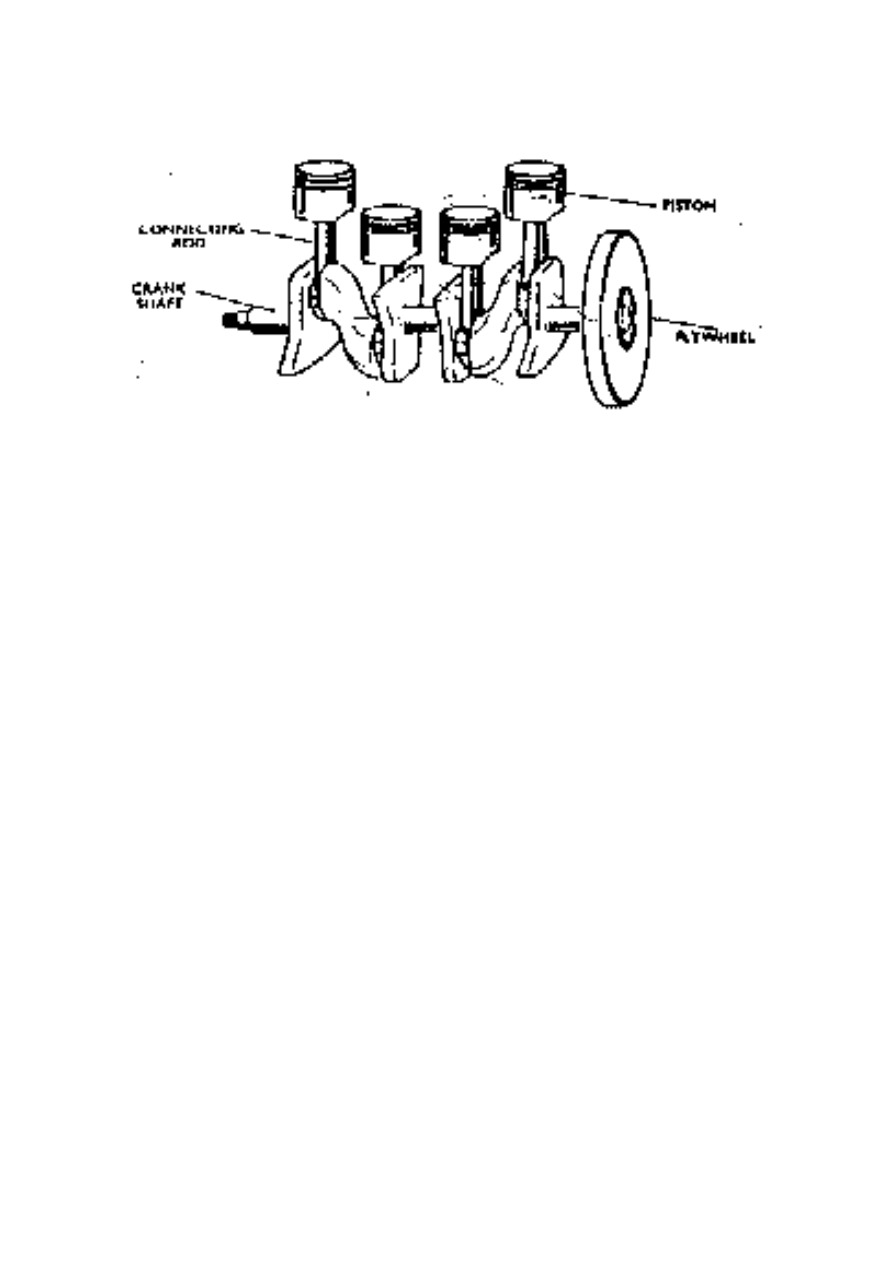
English for Specific Purposes
50
50
UNIT 7 :
TRACTOR ENGINES
Fig. 1. A four-cylinder engine crankshaft with connecting rods and pistons
1 Tractor engines are usually four-cylinder engines but it is not uncommon for them to
have six cylinders; one, two and three cylinders are also used. Figure 1 shows a crankshaft
with pistons and connecting rods for a four-cylinder engine.
2 Whether an engine is vertical, horizontal, or is single- or multi-cylinder, does not alter
the method in which it operates. The basic cycle still takes place independently in each
cylinder of the engine; which means that in a multi-cylinder engine, each cylinder with its
piston, connecting rod and valves, etc. ,should be considered as an independent mechanical
unit.
3 From Fig.2 it will be seen that if the flywheel is turned, the crankshaft will also turn
and this will cause the piston, which is free to move in the cylinder, to travel up and down.
Because the gear wheel on the crankshaft is in mesh with the gear on the camshaft, the valves
will also move up and down. If a thrust is applied to the top of the piston, the flywheel and
crankshaft will again turn and in doing so will also operate the camshaft and valves.
4 This in fact is just what happens in the engine. Fuel / air mixture comes into the
cylinder when the inlet valve is open, and when the valve closes, the mixture is compressed
by the piston moving up. The mixture is then ignited and expands rapidly, and the expansion
produces a downward thrust to the piston which in turn causes the crankshaft to rotate. The
thrust is sufficient to keep the crankshaft turning so that the piston also continues to move up
and down. The movement of these parts in relation to each other makes possible the operating
cycle.
The Four-stroke Cycle (Spark Ignition)
5 Engines that are designed to run on petrol or propane require an electric spark to
ignite the fuel / air mixture. These are known as Spark Ignition engines.
6 No. 1. The induction stroke. The piston moves down , inlet valve open, exhaust valve
closed. This downward movement of the piston creates a partial vacuum inside the cylinder
causing fuel/air mixture to rush in through the inlet valve passage. When the piston reaches
the bottom of its stroke the inlet valve closes to prevent any escape of the fuel, therefore the
fuel is trapped inside the cylinder.
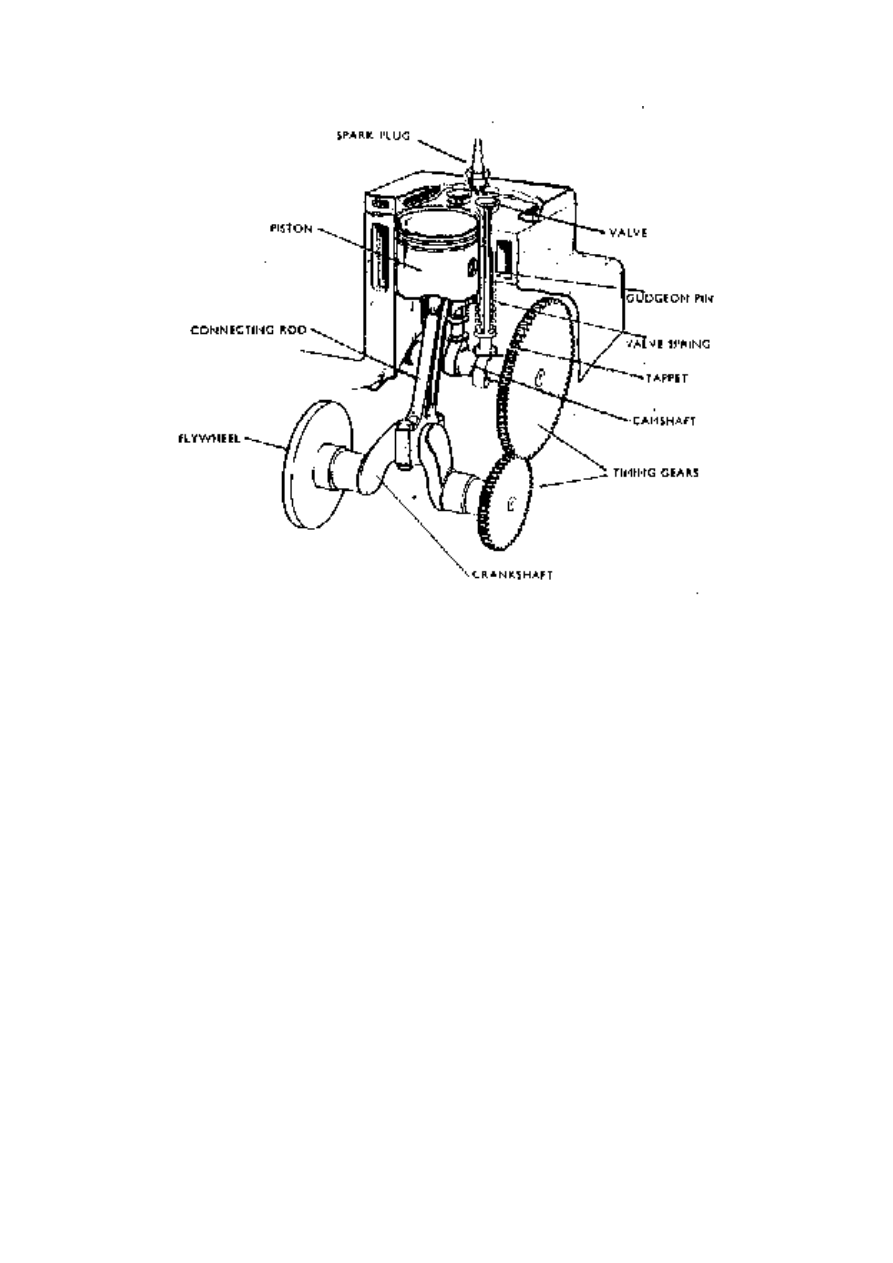
English for Specific Purposes
51
51
Fig. 2. A section through a single-cylinder engine showing the relative position of the working
parts.
7 No. 2. The compression stroke. The piston moves up, the inlet valve is closed, the
exhaust valve is closed. This upward movement compresses the fuel/air mixture into a small
space at the top of the cylinder. This space is usually provided by having the underside of the
cylinder head suitably shaped, e.g. slightly concave.
8 No. 3. The power stroke. When the piston is at the top of the compression stroke with
both valves closed, a spark is arranged to take place across the points of a spark plug which
protrudes partly inside the combustion space. This spark immediately sets fire to the mixture
which burns and expands, and in doing so forces down the piston; this provides the power.
9 No. 4. The exhaust stroke. The piston moves up the cylinder again, the inlet valve is
closed, the exhaust valve is open. This upward movement pushes the burnt gases out through
the exhaust valve outlet and to the atmosphere.
10 At the end of the exhaust stroke, the cycle starts again with a fresh charge of fuel /
air mixture being taken into the cylinder.
11 Of the three strokes in operating cycle, only one does the work. This is the third
stroke which is the power stroke. The other three strokes make the power stroke possible, and
the thrust of the power stroke keeps the crankshaft turning so that these strokes can take place.
A stroke is one movement from top dead centre to bottom dead centre or vice versa.
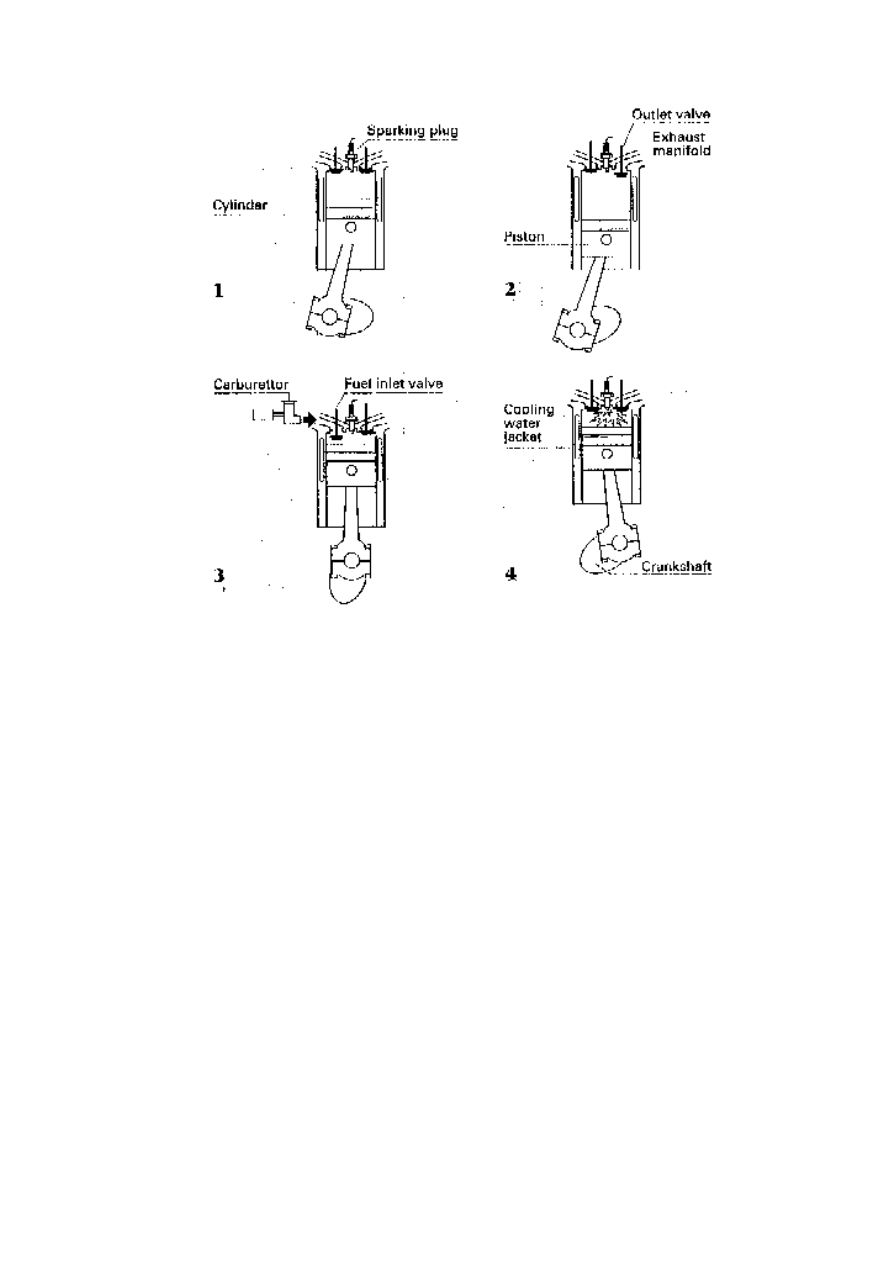
English for Specific Purposes
52
52
I. COMPREHENSION CHECK :
1. Look at paragraph 1 again. Are these statements correct or incorrect ?
* Tractor engines never have six cylinders.
* Tractor engines can have 1, 2, 3, 4, or 6 cylinders.
2. Look at par. 2 again . Is this statement correct or incorrect ?
* The method in which an engine works depends on the number of cylinders.
3. Look at par. 3 again. Is this statement correct or incorrect ?
* Both the pistons and the valves move up and down.
4. Look at par. 4 again. Are these statements correct or incorrect ?
* A fuel/air mixture enters the cylinder when the valves closed.
* The piston moves up and down because the crankshaft keeps turning.
5. Look at par. 5 again. Is this statement correct or incorrect ?
* Engines which use petrol or propane are called Spark Ignition Engines.
6. Look at par. 6 again. Is this statement correct or incorrect ?
* The engine part which stops fuel escaping is the piston.
7. Look at par. 7 again. Is this statement correct or incorrect ?
* The fuel/air mixture is compressed into the piston.
8. Look at par.8 again. Is this statement correct or incorrect ?
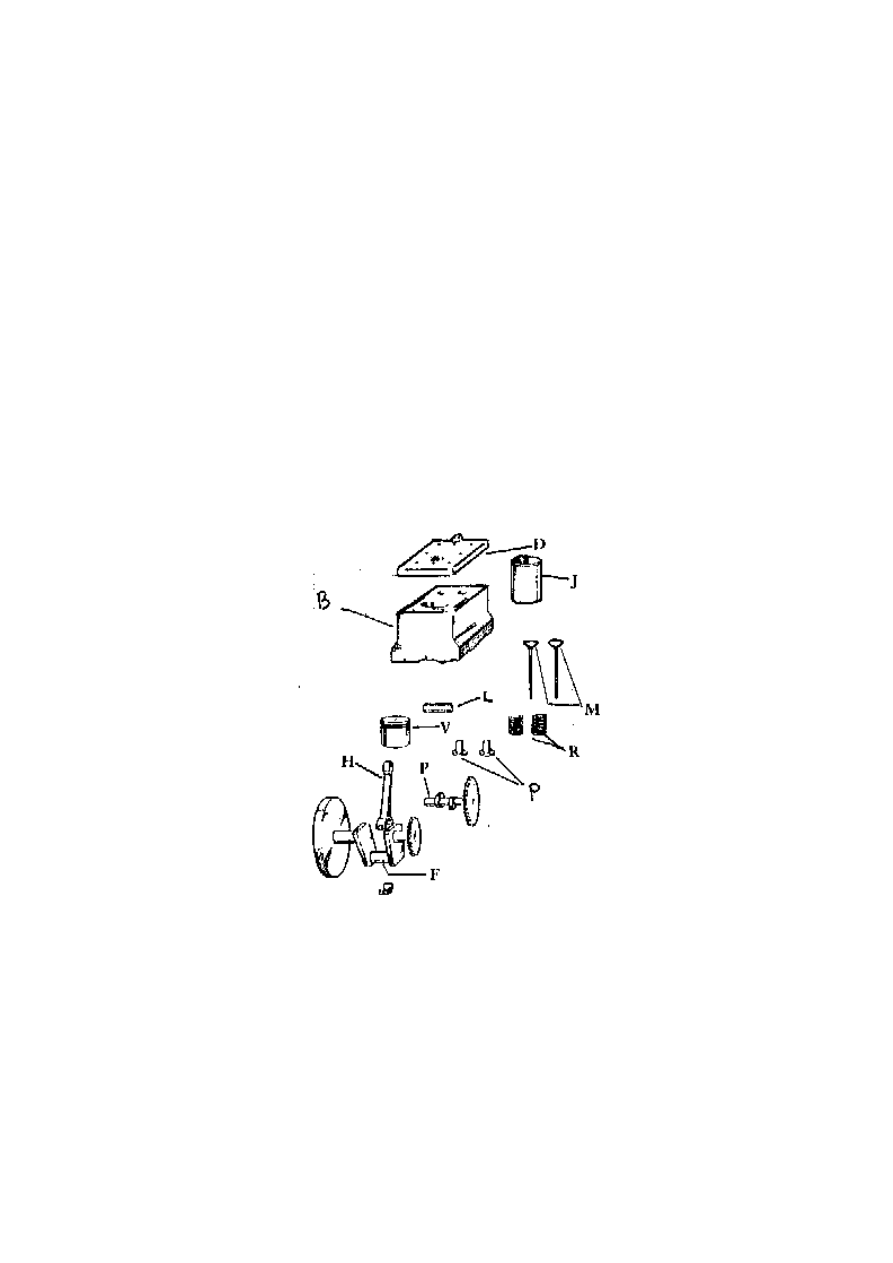
English for Specific Purposes
53
53
* The mixture is ignited when both valves are closed.
9. Look at par.9 again. Is this statement correct or incorrect ?
* Burnt gases escapes because of an upward movement.
10. Look at par.10 - 11 again. Is this statement correct or incorrect ?
* The crankshaft is turned by all four strokes in the operating cycle.
II. VOCABULARY;
Listen to the lecturer. He is going to tell you about the main parts of an internal
combustion engine. Then look at the parts below and write down the letters that correspond to
the different parts.
- Cylinder block
------------
- Cylinder head -------------
- Cylinder liner
------------
- Piston
-------------
- Crankshaft
------------
- Connecting rod
-------------
- Gudgeon pin ------------
- Valves
-------------
- Camshaft
------------
- Valve springs
-------------
III. GRAMMAR:
1. Using compound adjectives with participles for describing.
A. Shorten the following sentences without changing their meaning, like this :
Weeding is a task that consumes a great deal of time.
Weeding is a time-consuming task.
1. You use a tractor which lays tracks in market gardens.
2. Plants which produce fruits can be classified in many ways.
3. The pineapple is a perennial which grows at a low level.

English for Specific Purposes
54
54
4. Hawaii is an area that produces pineapples.
5. The mango is a tree which bears fruits.
6. The tsetse fly is an insect which carries disease.
7. The banana is a herbaceous plant which grows fast.
8. Some kinds of celery branch themselves.
9. Some plants are plants which pollinate themselves.
10. Farmers must feed a world population which is increasing all the time.
B. Shorten the following sentences without changing their meaning, like this:
Lettuce is a crop which is harvested by hand.
Lettuce is a hand-harvested crop.
1. Snap bean is a crop which has large seeds.
2. Celery is a crop which is propagated from seed.
3. The pineapple has leaf bases which are shaped like funnels.
4. The Muturu is a breed of cattle that has short horns.
5. The papaya is a plant which has a single stem.
6. Cucurbita is a squash which has a fine grain.
7. Lettuce is an annual plant which has a swallow root.
8. Some crops must be transported in cars which are cooled by ice.
9. Most watermelon are of the type which has a red flesh.
10. A spade is an example of a tool which is operated by hand.
2.
Expressions of degree: too and enough
A. Rewrite the following sentences using too and make any other changes that are
necessary. The first two have been done for you.
(a) The soil was dry so the seed could not germinate.
Or The soil was too dry for the seed to germinate.
(b) The soil was heavy and clayey and, as a result, it was unsuitable for root crops.
Or The soil was too heavy and clayey to be suitable for root crops.
1. The soil particles are fine so the water cannot percolate easily through the soil.
2. Because the soil was compact, it was not suitable for root crops.
3. Soil aeration was inadequate and consequently the plant could not receive a proper
supply of oxygen.
4. As a result of the land being waterlogged, it was not possible to produce a healthy
crop.
5. The soil profile was so shallow that it could not give the roots sufficient anchorage.
6. As the root system was poorly developed, the plant could not produce a good top
growth.

English for Specific Purposes
55
55
7. It was dark and as a result photosynthesis could not take place.
8. The current was swift so that the silt would not be deposited.
B. Now look at the sentences you have written and rewrite them using not + adjective +
enough, using the adjective given for each sentence.
Examples: - The soil was too dry for the seed to germinate. (wet)
= The soil was not wet enough for the seed to germinate.
- The soil was too heavy and clayey to be suitable for root crops. (light and
sandy)
= The soil was not light and sandy enough to be suitable for root crops.
1. coarse; 2. Loose; 3. Adequate; 4. Well-drained;
5. Deep; 6. Well-developed; 7. Bright; 8. Slow.
New words and expressions:
- four-cylinder engine:
- connecting rods:
- alter (n.):
- an independent mechanical unit:
- flywheel (n.):
- be in mesh with:
- a downward thrush:
- fuel/air mixture:
- compressed (adj.):
- crankshaft (n.):
- spark ignition engine:
- create a partial vacuum:
- the induction stroke:
- the compression stroke:
- the power stroke:
- the exhaust stroke:
- spark plug:
- protrude (v.):
- combustion space:
- top/bottom dead centre:
- cylinder head:
- gudgeon pin:
- valve springs:
động cơ bốn xy-lanh
thanh truyền động
thay đổi
đơn vị cơ học độc lập
bánh đà
ăn khớp với
lực đẩy xuống
hỗn hợp nhiên liệu/khí
nén
trục khuỷu
động cơ đánh lửa
tạo ra một khoảng chân không bộ phận
thì nạp nhiên liệu
thì nén
thì sinh công
thì xả
bu-gi đánh lửa
nhô ra
buồng đốt
điểm chết trên/dưới
nắp xy-lanh
chốt nối
van lò xo
--- o0o ---

English for Specific Purposes
56
56
Further reading:
Connecting Rods and Crankshaft
The connecting rods link the pistons with the crankshaft and transmit to it the loads
arising from the combustion gas pressure taken by the pistons. In operation, the connecting
rod is subjected to both gas pressure and inertia loads, and therefore, it must be adequately
strong and rigid and light in weight as well. Connecting rods are generally fabricated from a
high-quality steel in the form of a bar with ring-shaped heads at its ends, the heads being
known as the connecting rod big end and small end and serving to attach the rod to the
crankpin and the gudgeon pin of the piston respectively.
Shank, or blade 3 of the connecting rod is provided with an I-cross section to give the
rod maximum rigidity with the minimum of weight. The small end of the connecting rod is
made in the form of a continuous eye into which bronze bush 2 is pressed so as to provide an
interference fit, whereas the big end of the rod is split into two halves with the upper half
integral with the rod shank and the lower half in the form of detachable cap.
The crankshaft takes the downward thrusts of the pistons and connecting rods when the
fuel-air mixture is burned in the cylinders and changes these thrusts into torque which is
transferred to the drive line of the automobile; it also drive various engine mechanisms and
components. The periodic gas pressure and inertia forces taken by the crankshaft may cause it
to suffer wear and bending and torsional strains. The crankshaft therefore must be adequately
strong and wear-resistant.
The crankshaft is either forged from a high-quality steel or cast in a high-strength iron.
It consists of main bearing journals, crankpin, webs, or cheeks that connect the journals and
crankpins together, a nose(front end), and a shank (rear end). Counterbalance weights 12
necessary for balancing the crankshaft are either formed integrally with, or attached separately
to, the crank webs. The main bearing journals and crankpins are induction hardened to
improve their wear resistance. Drilled diagonally through the crank webs are oil holes to
supply oil to the crankpins. The crankpins are bored hollow in order to reduce the crankshaft
inertia. The open end (or end where angular blind holes are necessary to clear counterbalance
weights) are sealed by screw plug, since the hollow interior of each crankpin also acts as an
oil supply duct for big end lubrication and as a centrifugal oil cleaner. With the crankshaft
rotating, mechanical impurities (wear products) contained in the oil inside the hollow
crankpins settle in the crankpin interior walls under the action of centrifugal forces. In V-type
engines, each crankpin has two connecting rods assembled on it, and therefore the crankpin
here are longer than in in-line cylinder engines. The crankshaft front end carries one or two
gears for driving the valve mechanism and also other engine mechanisms, fan drive-pulley,
and a starting crank jaw (ratchet) or bolt. Mounted between the crankshaft pulley and gear is
oil slinger that throw oil away from the crankshaft front bearing seal. In some engines, the
crankshaft gear is carried on the rear end of the shaft.
--- o0o ---
LANGUAGE IN FOCUS
-ing and -ed phrases
Example: - Do you know the woman talking to Tom?
- The boy injured in the accident was taken to the hospital.
We use -ing phrases to say what somebody (or something) is/was doing at a particular time:
Do you know the woman talking to Tom? (the woman is talking to Tom)

English for Specific Purposes
57
57
Police investigating the crime are looking for three men. (police are investigating)
Who were those people waiting outside? (they were waiting)
I was awaken by the bell ringing. (a bell is ringing)
When you are talking about things (and sometime people), you can use an –ing phrase to say
what something does all the time, not just at a particular time.
The road connecting the two towns is very narrow.
I have the large bedroom overlooking the garden.
Can you think of the name of a flower beginning with “t”?
-ed phrases have passive meaning:
The boy injured in the accident was taken to the hospital. (the boy was injured
in the accident)
Some of the people invited to the party can‟t come. (they have been invited)
Most of the good made in this factory are exported. (the goods are made ...)
The police never found the money stolen in the robbery. (the money was
stolen)
We can use left in this way, with the meaning not used, still there:
We‟ve spent almost our money. We only have a little left.
We often use -ing, -ed phrases after there is/there was, etc.
There were some children swimming in the river.
Is there anybody waiting?
There was a big red car parked outside the house.
PRACTICE
I. Make one sentence from two. Use the information in parentheses to make an -ing
phrase.
1. I was awaken by the bell. (the bell was ringing)
...............................................................................
2. I didn‟t talk much to the man. (the man was sitting next to me on the plane)
...................................................................................
3. The taxi broke down. (The taxi was taking us to the airport)
.....................................................................................
4. At the end of the street there is a path. (The path leads to the river)
.....................................................................................
5. A new factory has just opened in town. (The factory employs 500 people)
.....................................................................................
II. Make one sentence from two. Each time make an –ed phrase.
1. A man was arrested by the police. He was released yesterday.
...........................................................................................

English for Specific Purposes
58
58
2. A number of suggestions were made at the meeting. Most of them were not very
practical.
Most of the suggestions ..........................................................................
3. Some paintings were stolen from the museum. They haven‟t been found yet.
The .............................................................................................................
4. A man was investigated by the police. What was his name?
What was the name ......................................................?
III. Complete the sentences using one of the following verbs in the correct form:
blow drive invite live name offer read ring sell sit
1. I was awaken by a bell ___________.
2. A lot of the people _____________ to the party cannot come.
3. Life must be very unpleasant for people ______________ near busy airports.
4. A few days after the interview, I received a letter ___________ me the job.
5. Somebody _________ Jack phoned while you were out.
6. There were a tree __________ down in the storm last night.
7. The waiting room was empty except for a young man___________ by the window
_________ a magazine.
8. Look! The man ___________ the red car almost hit the person _______________
newspapers on the street corner.
IV. Use the words in parentheses to make sentences using there is/ there was, etc.
1. That house is empty. (no one / live / in it)
........................................................................
2. The accident wasn‟t serious. (nobody / injure)
........................................................................
3. I can hear footsteps. (someone / come)
...........................................................................
4. The train was full. (a lot of people / travel)
...........................................................................
5. We were the only guests at the hotel. (nobody else / stay there)
.........................................................................
6.
The piece of paper was blank. (nothing / write / on it)
.............................................................
7. The school offers English courses in the evening. (a course / begin / next Monday)
.................................................................
--- o0o ---

English for Specific Purposes
59
59
UNIT 8: THE COMBINE HARVESTER (A)
1 The combine harvester is used to harvest all types of grain and seed crops and its use
has relieved farmers of much of the burden of harvest. It has not taken all the problems out of
harvesting, most of which are created by weather conditions, but it has enabled farmers to
rescue crops which otherwise may have been lost. Fewer acres of crops are now left to perish
in the fields.
2 The combine was first developed for use in countries where the climate is more
suitable for grain production and it was said that the climate in such countries as the British
Isles is totally unsuitable for its use. This is not true. Combine will work in quite damp
conditions, but where the conditions are not ideal, they must be used in conjunction with a
grain drier where the grain can be dried to a safe moisture content for storage.
3 Its use results in a big reduction of time and layout required to harvest a given crop
because one man, or at the most two men only, are needed to operate the machine. Other
labour is required to transport the grain to the farmstead, but this is not excessive. There is no
stooking, carting, stacking, or any of the other work associated with harvesting when the
binder is used. The combine cuts and threshes the grain in one operation.
Combine types
4 Three main types of combines are available and these are :
(a) tractor p.t.o. driven combine,
(b) tractor-drawn, engine-driven combine,
(c) self-propelled combine.
5 The tendency today is towards the use of the self-propelled type because of certain
advantages that it has over the other two. It is more or less a self-contained unit propelled and
having the threshing mechanisms powered by its own engine. This means that it is not
necessary to provide a tractor to drive it and/or pull it. It is usually quite easy to manoeuvre
and work in the field because all the controls used to operate it are close to the driver; and
when he becomes acquainted with them, he finds it no more difficult to drive than his tractor.
Probably the worst hazard confronting the driver of a self-propelled combine is the constant
cloud of dust surrounding him whilst he is working with the machine. This is much worse
when crop conditions are very dry. However, it is possible to have fitted to a combine, an air-
conditioned cab which considerably alleviated the dust problem.
6 Self-propelled combines are made in widths of cut ranging from about 4 - 16m (5 -
20 ft), the latter being used on the great grain-growing areas in such countries as Canada. In
this country such wide cutter-bars can present problems when it is necessary to move the
combine from field to field down narrow country lanes, and 965 cm (12 ft) of cut is a
common size.
7 Of the other two types of combines the main difference is the way in which they are
driven but in both cases a tractor is required to haul the combine. In one, the tractor hauls the
machine which is driven by an engine, whilst in the other tractor hauls and drives the combine
by the p.t.o. shaft. The width of cut of these types generally does not exceed 560 cm (7 ft) but
this does not mean that their output is necessarily lower than a larger-cut self-propelled
combine. Combine output depends more on the capacity of the threshing and cleaning
mechanism within the machine than on width of cut it will take.
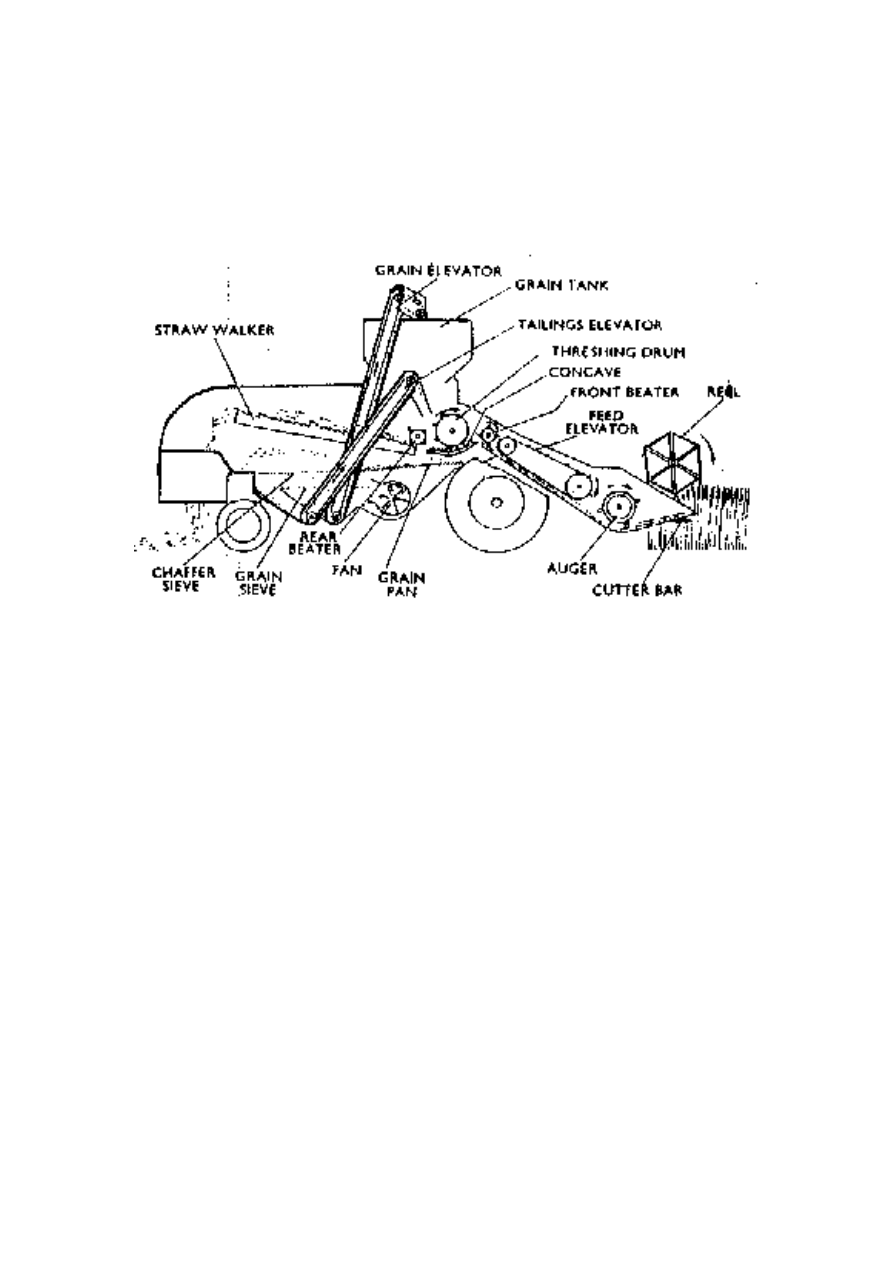
English for Specific Purposes
60
60
Combine layout
8 The combine harvester can be described as a mobile threshing machine because it
differs little from the stationary thresher except that a crop is fed into a combine much more
evenly and continuously as it move forward. Figure 1 shows the various working parts of a
typical self-propelled combine and the flow of the crop through it. Reference should be made
to this in conjunction with the following text in unit 4
Fig. 1. A section through a combine harvester.
The cutter-bar
9 The cutting mechanism on a combine harvester is the same as that on a binder,
consisting of a finger bar and reciprocating knife. This method of cutting crops has been used
for many years now and, provided that the mechanisms are properly maintained, it is
satisfactory. The mower is another machine which employs this method. The knives used on
combines and binders operate at a slower speed than the mower knife because the dry straw
crop is easier to cut than a swath of grass. Furthermore, it is normal practice to use a serrated
edged knife on machine cutting straw crops whilst the mower uses a smooth edged knife.
Very often it is found necessary to use a smooth edged knife on a combine if there is a lot of
green undergrowth to be cut, but it is better to avoid cutting this undergrowth if at all possible.
10 Figure 2 shows methods used to provide knife movement. The drive to the crank
pulley is usually by a V-belt and this should be kept correctly tensioned to prevent any loss of
knife speed.
11 The height of the cutter-bar is adjustable vertically by mechanical or hydraulic
control and it is usually arranged so that the whole cutter-bar bed and reel rises and lowers as
a complete unit.
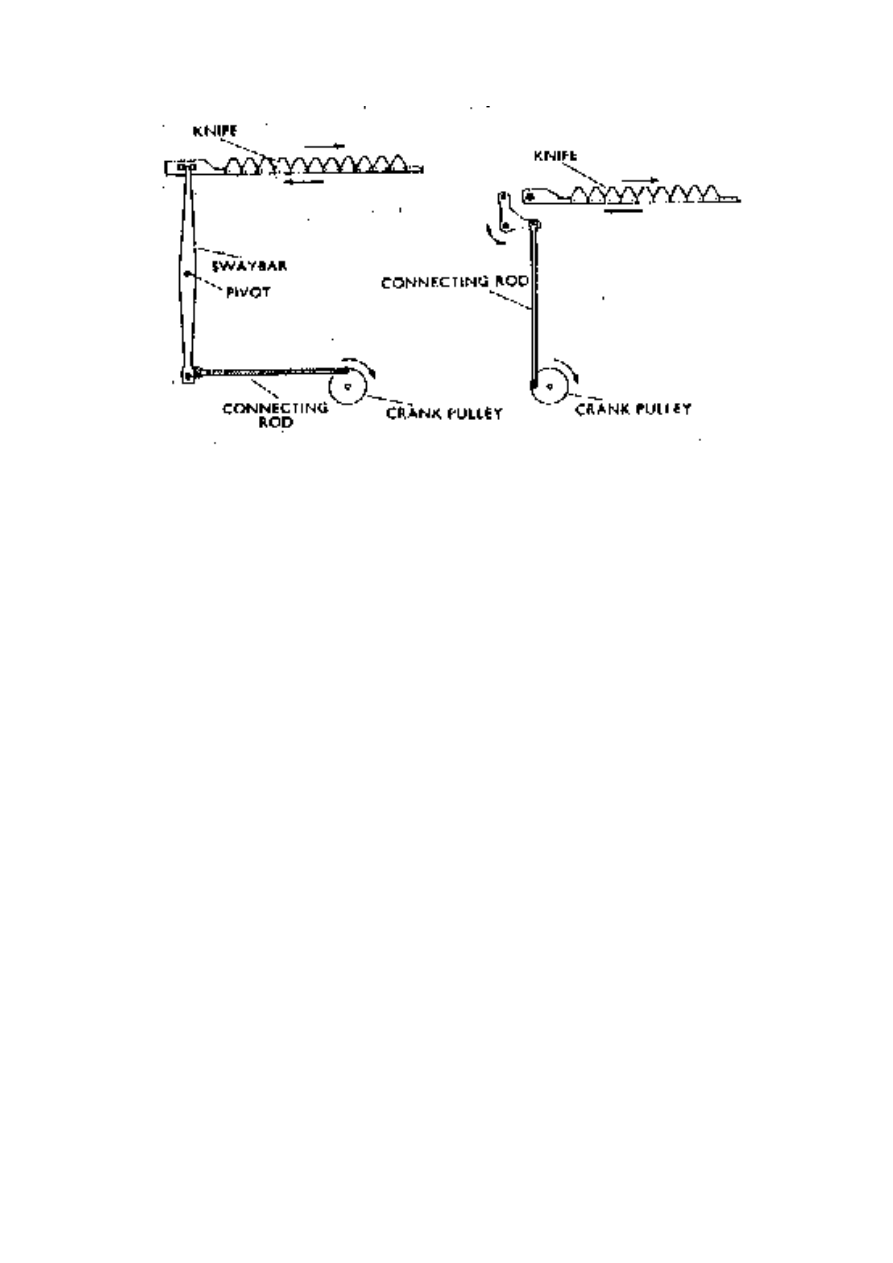
English for Specific Purposes
61
61
Fig. 2. Methods of providing knife movement
Text and illustration from SHIPPEN et al., Basic Farm Machinery,Pergamon Press
I. COMPREHENSION CHECK:
1. Has the combine solved all the problems of harvesting ?
2. Can a combine work in damp climate ?
3. How must they be used in damp climate ?
4. What work does a binder eliminate ?
5. What danger does the driver of a self-propelled combine face ?
6. What is the main difference between type (a) and (b) ?
7. What does combine output depend on ?
8. What does Figure 6 show in addition to the parts ?
9. What do a mower and a combine have in common ?
10. How do you adjust a cutter-bar ?
II. VOCABULARY:
1. Look at the first paragraph again. What words have the same meaning as:
- save
- made
- made it possible for- something difficult or troublesome to do
2. Look at paragraph 2 again. What word has the opposite meaning to :
- without; separated from
3. Look at paragraph 3 again. Can you explain the words:
- stooking
- carting
- stacking

English for Specific Purposes
62
62
4. Look at paragraph 4 and 5 again. What words have the same meaning as:
- familiar with
- move about
- danger
- facing
5. Look at paragraph 6 again and say what this word refers to:
- line 2: latter.
6. Look at paragraph 7 again. What words have the same meaning as:
- be more than one
- pull
7. Look at paragraph 8 again. Can you explain what is meant by:
- the flow of the crop
8. Look at paragraph 9 again. What words correspond to these definitions:
- kept in good working order
- having a toothed edge, like a saw
- ridge of wheat, grass etc., lying after it has been cut
- plants etc. growing at a lower level than the crop
9. Look at paragraph 10 and 11 again. What word has the opposite meaning to:
- horizontally
III. GRAMMAR:
1. Active or Passive voice ?
Change the following sentences into passive or active voice
1. Today they grow watermelons worldwide.
2. The first Europeans were growing this kind of vine in the Mississippi Valley when
they arrived there.
3. The watermelon is usually considered to have originated in Africa.
4. They harvest watermelons when they are mature but not overripe.
5. A long, warm growing season is required for watermelons.
6. They are harvested by hand and loaded on trucks or trailers.
7. Until recently only seeded types were on the market, but seedless cultivars have now
been introduced.
2. Defining and non-defining relative clauses
Look at these:
The water which can be taken up by the plant roots is called the available water.
The amount of water which is then retained by the soil is called the field capacity
* The clauses in italics define the kind of water: they are defining relative clauses.
The pore space, which may be filled with air or water or both, is a network of spaces or
channels.

English for Specific Purposes
63
63
Nitrogenous fertilizers, which have nitrogen as the main food element, strengthen plant
tissues.
* Here the clauses in italics gives us additional information about the pore space and
fertilizer. They are non-defining relative clauses. They are separated from the rest of the
sentences by commas.
Use the relative clauses to combine each pair of sentences into a single sentence. In each
case say whether the relative clause is defining or non-defining:
1. The amount of water depends on a number of factors. The amount of water is
required for irrigation.
2. Soil texture is the characteristic of soil. Soil texture determined by the amount of silt,
sand, clay and organic matter.
3. The topsoil or the surface soil is a layer about 8-45 cm deep. Most of the plant roots
are found in the topsoil.
4. A leguminous crop will add as much nitrogen to the soil per acre as 3 to 10 tons of
farmyard manure. A leguminous crop is plough under.
5. Banana is a starchy staple in many tropical regions of the world. Banana is usually
considered a fruit in the United States.
6. A compost is a mixture of partly broken down material. This material is usually
made up of leaves or grass cutting.
7. Organic matter is broken down most rapidly in warm, moist soils. The soils are well
limed and well aerated.
8. The amount of humus formed is greatest from plants. Plants have a lot of
strengthening (lignified) tissues (e.g. straw).
9. Fungi attack the aerial parts of the crop, the leaves, stems etc. Fungi can be controlled
by means of chemical substances. These chemical substances are known as
fungicides.
10. Fertilizer or manure is required for rice cultivation. The quantity of fertilizer or
manure depends on the fertility of the soil and the nutrients. The nutrients are
released from the rooted weeds and stubble. The weeds and stubble are ploughed in
during cultivation.
3. Short-form relative clauses
Relative clauses often appear in a shortened form. The relative pronoun and the form of
verb to be can be omitted and with, the -ing form of the verb, past participle, adjective or noun
may be used instead.
E.g. Rice varieties with short erect leaves respond well to high level of fertilizer.
Rice varieties having short erect leaves respond well to high level of fertilizer.
The quantity of fertilizer required for rice cultivation partly depends on the variety
of rice used.
Common nitrogen fertilizers suitable for rice are ammonium sulphate & urea.
Urea, the substance in human and animal urine, is a nitrogenous fertilizer.
* Combine each of the following pairs of sentences into a single sentence. Then shorten
the relative clauses.

English for Specific Purposes
64
64
1. Viruses are very small organisms. They are usually transmitted by means of insects.
2. Nematodes are small worms in the soil that enter plant roots. They cause serious
losses in some crops, particularly in the tropics.
3. Compound fertilizers are multiple nutrient materials. They supply two or three plant
nutrients simultaneously.
4. It is essential to understand the materials. The materials are available to the farmer to
maintain the supply of minerals in the soil.
5. Fungi are microscopic organisms. These organisms produce thread-like growths.
These growths are known as hyphae.
6. The types of disease organisms are fungi and bacteria. They are found in the soil.
They attack the roots of plants and they cause root rot and wilt.
7. Another fertilizer is urea. This fertilizer contains nitrogen.
8. A soil will contain quite a high proportion of calcium. Such a soil has a pH value of
6.5 or more.
9. A compost is a mixture of partly broken down material. This material is usually
made up of leaves or grass cutting.
10. Fungi attack the aerial parts of the crop, the leaves, stems etc. Fungi can be
controlled by means of chemical substances. These chemical substances are known
as fungicides.
New words and expressions:
- the combine harvester:
- be used in conjunction with:
- safe moisture content:
- excessive (adj.):
- tractor p.t.o. driven combine:
- tractor-drawn, engine-driven combine:
- self-propelled combine:
- manoeuvre (v.):
- become acquainted with:
- air-conditioned cab:
- alleviated:
- stationary thresher:
- the cutter bar:
- reciprocating knife:
- mower (n.):
- smooth edged knife
- serrated edged knife:
- crank pulley:
máy gặt đập liên hợp
được dùng kết hợp với
độ ẩm an toàn
quá lớn, quá nhiều
máy gặt được lái bằng máy kéo có p.t.o.
máy gặt bằng động cơ, đầu máy kéo
máy gặt liên hợp tự đẩy
thao tác
trở nên quen thuộc với
cabin có gắn máy điều hòa (nhiệt độ)
được giảm bớt
máy đập/tuốt (lúa) cố định
thanh cắt
dao cắt (chuyển động qua laị)
máy cắt cỏ
dao phẳng
dao răng cưa
trục tời

English for Specific Purposes
65
65
LANGUAGE IN FOCUS
Relative clauses
Look at this example:
The woman who lives next door is a doctor.
Relative clause
A clause is a part of a sentence. A relative clause tells us which person or thing
(or what kind of person or thing) the speaker means:
- The woman who lives next door ... (“who lives next door” tells us which woman)
- People who live in London ... (“who live in London” tells us what kind of peole)
* We use who in a relative clause when we talking about people (not things). We use
who instead of she/he/they:
An architect is some one who designs buildings.
What was the name of the man who lent you the money ?
Anyone who is interested in the job must apply before next Friday.
You can use that (instead of who). But you can not use that in non-defining relative
clauses (as the next part).
* When we are talking about things, we use that or which in a relative clause:
Where the cheese that/which was in the refrigerator ?
I don‟t like stories that/which have unhappy endings.
The machine that broke down has now been repaired.
That is more usual than which. But sometimes you must use which in non-defining
relative clause (as the next part)
* Look at these examples:
My brother Jim, who lives in Houston, is a doctor.
Brad told me about his new job, which he‟s enjoying very much.
We stayed at the Grand hotel, which Ann recommended to us.
In these sentences, the relative clauses do not tell us which person or thing the speaker
means. We already know which thing or person is meant: “my brother Jim”, “Brad‟s
new job”, and “the Grand hotel”
The relative clauses in these sentences give us extra information about the person or
thing; they are non-defining relative clauses.
We use comma (,) in these clauses
My English teacher, who comes from Texas, loves computers.
In these types of relatives clauses, we use who for people and which for things (you can
not use that). Whom can be used when it is an object.
John , who (not that) speaks French and Italian, works as a tourist guide.
Brad told me about his job, which (not that) he‟s enjoying it very much.

English for Specific Purposes
66
66
This morning I met Ann, whom (or who) I haven‟t seen for ages.
We cannot leave out who or which in this type of clauses. (but we can leave out
who/which/that when it is the object in defining relative clauses.
We stayed at the hotel (that/which) Ann recommended.
This morning I met somebody (who/that) I hadn‟t seen for ages.
Whom is unusual in this type of clauses.
Whose is used in relative clauses instead of his/her/their:
A widow is a woman whose husband is dead. (her husband is dead.)
I met a man whose sister knows you. (his sister knows you.)
Where can be used in a relative clause to talk about a place:
The hotel where we stayed wasn‟t very clean.
I recently went back to the town where I was born.
PRACTICE
I. Make one sentence from two. Use who/that/which:
1. A girl was injured in the accident. She is now in the hospital.
... The girl who was injured in the accident is now in the hospital...
2. A man answered the phoned. He told me you were away.
.......................................................................................................
3. A waitress served us. She was very impolite and impatient.
.......................................................................................................
4. A building was destroyed in the fire. It has now been rebuilt.
.....................................................................................................
5. Some people were arrested. They have now been released.
......................................................................................................
6. A bus goes to the airport. It runs every half hour.
.....................................................................................................
II. Complete the sentences. Choose the most appropriate ending from the box and
make it into a relative clause.
he invented the telephone it makes washing machines
she runs away from home it give you the meanings of words
they are never on time it won the race
they stole my car it can support life
they were on the wall it cannot be explained
1. Barbara works for a company ______________________.
2. The book is about a girl _____________________.

English for Specific Purposes
67
67
3. What was the name of the horse ______________________.
4. The police have caught the men ____________________.
5. Alexander Graham Bell was the man ____________________________.
6. What happened to the pictures ______________________.
7. A mystery is something _____________________________.
8. A dictionary is a book ______________________________.
9. I don‟t like people ___________________________.
10. It seems that Earth is the only planet ______________________.
III. Combine each of the following pairs of sentences to produce a one-sentence
definition with a relative clause:
1.Protons are positively charged particles. They are contained in the nucleus of an atom.
2.A black hole is an area in space. It has a gravitational pull so powerful that nothing,
not even light, can escape.
3.Marine biologists are scientists. They study animals and plants that live in the sea.
4.The stratosphere is a portion of the atmosphere. It is over seven miles high.
5.Insulin is used in the treatment of diabetes. It is a hormone produced by the pancreas.
6.The most abundant forms of life on earth are bacteria. They are simple forms of plant
life.
7.Nitrogen makes up 80 per cent of the air. It is a colorless, odorless gas.
--------------------------------

English for Specific Purposes
68
68
IV. FURTHER READING:
THE REEL
The purpose of the reel is twofold. Where a crop is standing well, the reel must steady it
against the cutter-bar whilst it is being cut. Where the crop is not standing well, and may be in
a tangled and flattened mass, the reel must pull it into the cutter-bar for cutting and feeding
into the combine.
Generally, a fairly standard type of reel, known as the pick-up reel, is used and there are
few badly laid crops that it cannot effectively pull into the combine, provided that it is
correctly set. This type of reel has spring tines fitted to it which can be set at an angle if
necessary.
The other type of reel is known as a bat reel and its use is restricted to crops in good
standing condition. It is not fitted with tines for pulling in laid crops.
To provide for different crop conditions, certain adjustments can be made to the reel.
For example, the reel must not strike the crop any more than necessary otherwise grain will be
shed out of the ears and on the ground. This will happen if the reel speed is too fast. On the
other hand, if the reel speed is too slow the crop will be pushed forward by the cutter-bar and
fall beneath it. The speed at which the reel rotates can therefore be altered to suit the volume
of crop. Alteration is usually brought about by fitting the different size of reel-drive sprocket.
It is also necessary to be able to raise and lower the reel whilst the combine is working
and this is done so that it can be held in its correct position according to the height of the crop.
It should be just low enough to have a steadying action on the crop. If it is set too low, the
straw will be carried around on the reel bars and tines. An hydraulic or mechanical control
may be provided to make this adjustment.
One other important adjustment is necessary and this is to be able to move the reel
forward and backward if necessary. The usefulness of this is when a crop is laid forward away
from the cutter-bar.
* Put questions about:
1. The purpose of the reel.
2. Different types of reel.
3. Their uses.
4. Adjustments for different crop conditions.
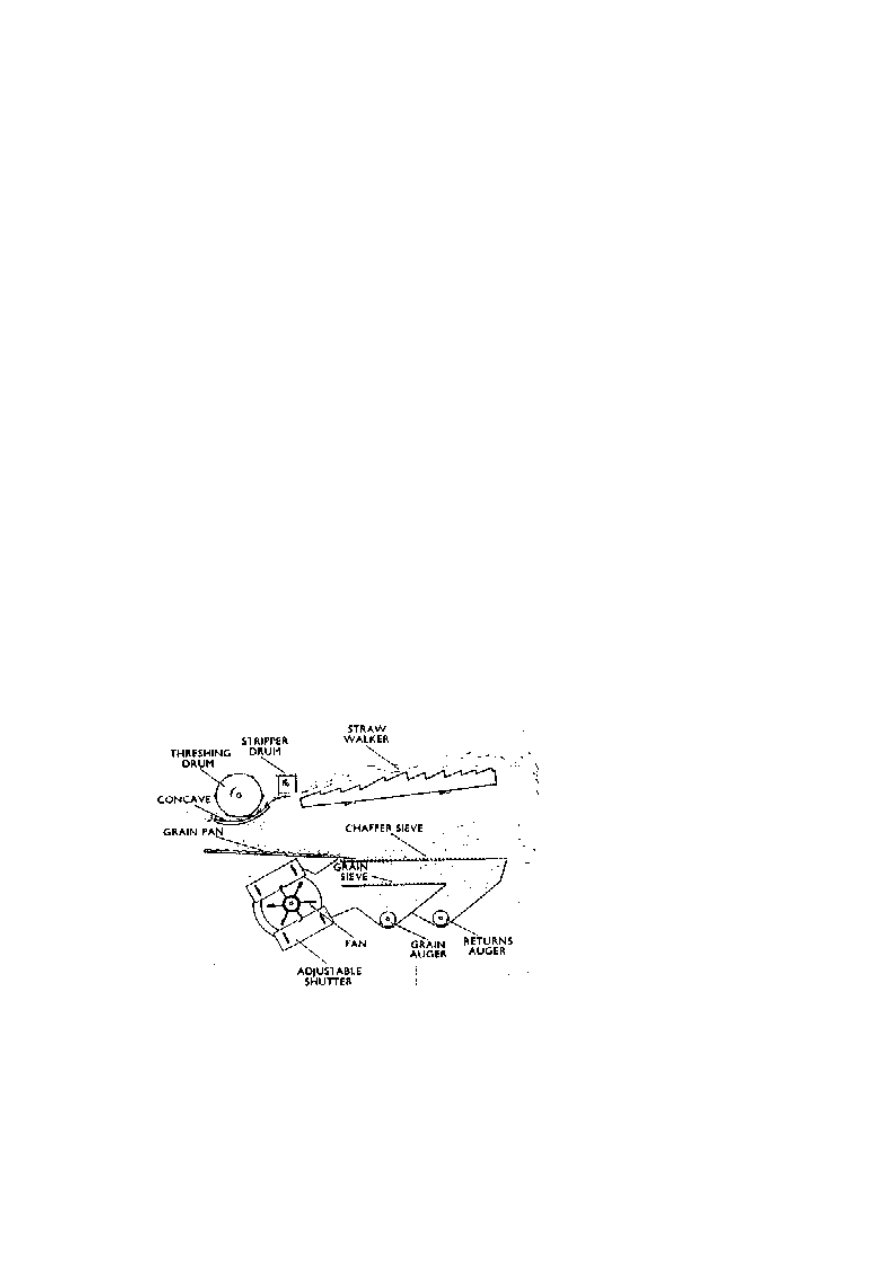
English for Specific Purposes
69
69
UNIT 9: THE COMBINE HARVESTER (B)
The Grain Pan
1 The grain is threshed out of the ears by the drum and concave, and the grain that
comes from the straw walkers, falls on the grain pan which is situated beneath the concave.
This grain pan usually takes the form of a stepped plate occupying the full width of the
cleaning unit and it also has a rearward shaking motion.
2 Whilst the grain falls through the concave and on to the pan there is also a large
quantity of trash that come through with it. Chaff, short ends of straw, weed seeds, etc., all
come through mixed with the grain. This trash must be separated from the grain, so from the
grain pan this mixture of trash and grain passes through a cleaning unit.
The Cleaning Unit
3 This consists of two sieves which also have a rearward shaking motion, and an air
blast which can be directed up and through these sieves. The top sieve, often referred to as the
chaffer sieve, extends from the grain pan and is adjustable so that the size of aperture can be
increased or decreased. Grain and trash pass from the grain pan on to this sieve and the aim in
setting this sieve is to set it at such a position as will allow all the grain to fall through it,
whilst heavy trash is shaken rearward and out of the combine. If it is set too close, all the
grain may not pass through and some may be shaken out over the rear of the combine, whilst
on the other hand, if it is set too wide, excessive trash may go through it with the grain.
4 The bottom sieve, referred to as the grain sieve, is usually a sieve full of holes of a
given size and is therefore not adjustable. However, this is not always the case and in some
instances an adjustable sieve may be fitted. The purpose of the grain sieve is to carry out
further separation of grain from trash should any trash have come through the chaffer sieve.
5 The grain sieve must be of such size as to allow the grain only to pass through and
down the grain auger. Anything larger will not pass through and will be shaken rearward to
fall into the returns auger trough. Such material as broken heads will go to the returns auger.
Fig. 1. The cleaning unit.
6 Whilst the grain is moving over these sieves a constant blast of air is being blown up
and through them. The purpose of this is to prevent the majority of the trash from settling on
the sieves. By doing this, the sieves are kept clear and the grain can fall through readily.
7 The force of the air blown through can be varied and this is necessary because the
weights of different grains and seeds vary. For example, the force of air required to keep the
sieves clear when combining wheat would, when combining grass seed, also blow out the
seed.

English for Specific Purposes
70
70
8 To alter the air blast, the usual method is to reduce the inlet through which the fan
draws the air. This is done by adjustable blanking-off plates. In some instances it may be
possible to alter the speed at which the fan rotates by fitting a different size of pulley wheel to
the fan shaft, or by a variable-speed pulley.
9 Sieves and air blast must be set in conjunction with each other to suit a particular
crop and wherever possible combining should be carried out with as much air blast as possible
and with the sieves set as wide as possible.
10 This will ensure that little trash is allowed to settle on the sieves and anything
lighter in weight than the grain is blown out. Also, the wide sieve setting will ensure that the
grain can easily pass through.
The Augers
11 The auger beneath the grain sieve transfers the grain, which at this stage should be
quite free of any trash, to an elevator which elevates it to either a grain tank or to a cleaning
and bagging platform.
12 The returns auger transfers any broken unthreshed heads and the like to another
elevator which elevates these to a position where they can either be returned to the threshing
drum for rethreshing or put back over the clean unit. In some cases the returns may be taken
to a separate unit entirely where rethreshing is carried out if necessary and the grain is then
passed back over the cleaning unit.
The Grain Tank
13 Grain from the grain elevator is put into a tank built on to the combine and which is
usually of sufficient size to hold between 1500 and 1750 kg (60 - 70 bushels). This usually
amounts to about half an hour‟s combining. The tank can be unloaded into trailers either
whilst the combine is stationary or working. This is done by a clutch-operated auger put in
and out of drive by the combine operator.
Cleaner and Bagger
14 Where a grain tank is not used, a bagging platform is provided where a man is
employed sacking the grain as it is being combined. Often, before the grain is sacked, it
passes through a rotating screen which takes out any weed seeds that may have escaped the
cleaning unit.
Additional Attachments
15 Various devices can be fitted to combines for use in different crops and crop
conditions.
16 Grain lifters are used when the crop has been badly laid down by the weather and
they help to lift it so that it can be cut and pulled in by the reel. These lifters fit on to the
cutter-bar fingers and project 38 - 45 cm (15 - 18 in. approx.) in front of the cutter-bar, and it
is usual to use one per foot length of cutter-bar.
17 Dividers of some form or other are normally fitted to the outside of the cutter-bar
and their purpose is to push through the crop ahead of the cutter-bar, separating the crop
which is being cut from that which is standing. These dividers can be fitted with extensions
for use in laid crops.
18 Straw spreaders may be fitted to the rear of the combine to spread the straw across
the field as it leaves the straw walkers. The spreader may take the form of a horizontal
rotating disc positioned beneath the straw outlet.
English for Specific Purposes
71
71
19 Chopper spreaders may be fitted at the straw outlet, when straw leaving the
combine is chopped into very short lengths and spread over the field.
20 Windrow pick-up attachments are used to pick up crops that have previously been
cut by a mowing machine. This is often done to harvest such crops as grass seed, peas and
trefoil seed. The crop is cut by a mower so that the seed can ripen in the swath and later the
swath is picked up by this attachment which passes it into the combine for threshing.
21 Grain loss-monitors may be fitted to provide the operator with a guide to the
combines performance. They consist primarily of acoustic chambers attached to the end of the
straw walkers and sieves. Grain falling on these sensors has a percussion effect which creates
an electrical impulse, this in turn is relayed to a control panel and displays a reading which
compares with the original setting. Any increased reading shows an increased loss of grain
and vice versa.
This text was taken from SHIPPEN et al., Basic Farm Machinery, Pergamon Press
I. COMPREHENSION CHECK:
1. Look at the first paragraph again. What words have the same meaning as :
towards the back
taking up
located
2. Look at paragraph 2 again. Can you explain the words:
trash
chaff
3. Look at paragraph 3 again. Are these statements correct or incorrect:
The chaffer sieve is another word for the grain pan.
--------
Heavy trash will always pass through the chaffer sieve. --------
4. Look at paragraph 5 again. Is this statement correct or incorrect :
The returns auger trough does not receive grain.
--------
5. Look at paragraph 6 to 8 again. Note down the purpose of having
a constant air blast
6. Look at paragraph 9 and 10 again. Is this statement correct or incorrect:
You won‟t get much trash on the sieves if they are set as wide as possible with a
strong air blast.
7. Look at paragraph 11 and 12 again. What word has the opposite meaning to:
drops down
8. Look at paragraph 13 again. Can you explain the word:
bushel
9. Look at paragraph 14 again. Is this statement correct or incorrect:
You do not use both a grain tank and a bagging platform at the same time.
10. Look at paragraph 15 to 21 again. Which of these additional attachments would be

English for Specific Purposes
72
72
of most use in your country ? Say which of these attachments you think would be most useful
to a typical farmer and why.
II. GRAMMAR:
1. Expressing purpose: to-infinitive
E.g. We cut ditches at certain intervals between the crops. Our purpose in doing this is
to remove surface water.
= Ditches are cut at certain intervals between the crops to remove surface water
Rewrite the following sentences using the passive forms of the main verbs as in the
example above.
1. A plant uses sunlight. The purpose in using it is to combine carbon dioxide with
water to form carbohydrates.
2. In countries with inadequate rainfall we irrigate the land. Our object in doing this is to
supply enough moisture for satisfactory plant growth.
3. The roots of plants such as sugar beet, carrots and parsnips store food. The object of
doing this is to enable them to live more than one season.
4. We should add fertilizers or manure to the soil. Our aim in doing this is to encourage
plant growth.
5. If a soil is very acid we can spread lime on it. Our purpose in doing this is to correct
the acidity.
6. A plant transforms water and carbon dioxide into sugar and starch in the presence of
light. Its purpose in doing this is to provide the plant with food and energy for growth
and reproduction.
7. We apply inorganic materials to the soil. Our object in doing this is to increase the
supply of one or more of the essential nutrients such as nitrogen, phosphorous, and
potash.
8. Tile drains may be laid in or on the land. The reason for this is to remove surplus
water from the fields.
9. We should keep ditches as straight as possible and on an even gradient. The reason
for this is to prevent them from silting up.
10. We add bulky materials to the soil like animal or green manure. Our aim in doing
this is to improve the physical condition of the soil and to keep up its humus content.
2. Expressing purpose: in order to + infinitive / so as to + infinitive
E.g We need irrigation. The reason for this is to make up for lack of natural rainfall.
= Irrigation is needed in order to/so as to make up for lack up natural rainfall.
Rewrite the sentences in Exercise B using the new structure in order to/so as to
+infinitive and the passive form as in the above example.
3. Infinitive or verb-ing?
Do you remember ?
- Some verbs in English are followed by the infinitive, „to‟:
I want to finish my essay today.

English for Specific Purposes
73
73
- Others are followed by the -ing form:
I enjoy playing football.
- Verbs followed by a particle like „in‟, „from‟, etc. are followed by the -ing form:
He insisted on going to a film last night.
- Some verbs can take both „to‟ and -ing, but their meaning sometimes changes:
He remembered (= did not forget) to bring his book.
I remember (= recall) meeting his brother last year.
Now complete the following sentences:
a. He suggested (watch) ............................... the football match on Saturday.
b. I didn‟t stop (work) ....................... until midnight last night.
c. I‟m sorry, I‟ve forgotten (bring) ......................... my essay.
d. What machine do we use (plough) ....................... the field ?
e. You must avoid (spill) .................... chemicals on your hands.
f. Try (understand) ...................... what the lecturer is saying.
g. Try (look) .................... that word up in your dictionary.
h. Would you mind (explain) .................... that again ?
I. The lecturer began (talk) ................... about cereal crops.
k. Tomorrow I intend (discuss) ..................... different kinds of fertilizer.
m. Sickness prevented him from (attend) ........................ the demonstration.
n. I am looking forward to (study) ...................... agriculture.
4. Joining sentences
Match the following clauses together, using and, but, when, after, so and because.
1. the next evening he needed them
a. Robert could not attend
2. he arrived at the canteen
b. Robert finally arrived
3. this did not please Andrew very much
c. he went to the canteen to
look for Robert
4. last night Andrew lent Robert his
d. Robert has not return them
lecture notes
5. Andrew needed his notes immediately
e. Robert was not there
6. he had waited for an hour
f. he decided to wait
Now arrange your sentences into a sensible paragraph.
New words and expressions:
- drum (n.):
- concave (n.):
- grain pan:
trống đập
lòng máng/máng trống
chảo thóc

English for Specific Purposes
74
74
- a rearward shaking motion:
- separated:
- a cleaning unit:
- sieve (n.):
- adjustable:
- aperture (n.):
- a constant blast of air:
- prevent (v.):
- trash/chaffer (n.):
- elevate (v.):
- the grain tank:
- clutch-operated:
- rotating screen:
- acoustic chambers:
- sensors (n.):
- percussion effect:
- electrical impulse:
- control panel:
- ditch (n.):
- inadequate rainfall:
- fertilizer (n.):
- manure (n.):
- green manure:
- to correct the acidity:
- inorganic materials:
- surplus water:
- even gradient:
- humus content:
chuyển động rung về phía sau
được tách ra
bộ phận làm sạch
sàng/rây
có thể điều chỉnh được
lỗ, khoảng cách
luồng hơi liên tục
ngăn ngừa
cỏ/rác
nâng lên
thùng đựng hạt
được điều khiển bằng bộ ly hợp
màn quay
khoang có độ vang
bộ cảm ứng
tác động gõ
xung điện
bảng điều khiển
con mương nước
lượng mưa không đủ
phân bón (hóa học)
phân chuồng
phân xanh
điều chỉnh độ chua (của đất)
các chất vô cơ
nước thừa
độ dốc ngang nhau
lượng mùn
--- o0o ---

English for Specific Purposes
75
75
LANGUAGE IN FOCUS
We use to infinitive to say why somebody does something (= the purpose of an action):
- “Why did you go out?”
- “ To mail a letter.”
- A friend of mine called to invite me to a party.
- We shouted to warn everybody of the danger.
- I need a few days to think about your proposal.
- They gave us some money to buy some food.
For ... and to ...
We use for + noun
I‟m going to Spain for a vacation.
What would you like for dinner?
Let‟s go to the café for coffee.
We use to + verb
I‟m going to Spain to learn Spanish
(not for learn, not for learning)
What would you like to eat? (not for eat)
Let‟s go to the café to have coffee.
Note that you can say “for somebody to do something”:
- There weren‟t any chairs for us to sit on, so we had to sit on the floor.
You can use for –ing to say what the general purpose of the thing is. To ... is also possible
- The knife is only for cutting bread. (or to cut bread)
You can use What ... for? To ask about purpose:
- What is this switch for?
- What did you do that for?
So that ...
We use so that + clause for purpose.
- Leave early so that you won‟t miss the bus.
- She‟s learning English so that she can study in Canada.
- He wore glasses and a fake beard so that nobody would recognize him.
PRACTICE
I. Use a sentence from Box A and a sentence from Box B to make a new sentence.
A
B
1. I shouted.
2. I had to go to the bank.
3. I‟m saving money.
4. I went to the hospital.
5. I‟m wearing two sweaters.
6. I called the police.
a. I want to keep warm.
b. I wanted to report that my car was stolen.
c. I want to go to Canada.
d. I had to have an operation.
e. I needed to get some money.
f. I wanted to warn people of danger.
Example: 1. I shouted to warn people of the danger.

English for Specific Purposes
76
76
2. ...........................................................................
3. ...........................................................................
4. ..........................................................................
5. .........................................................................
6. ..........................................................................
II. Complete these sentences using an appropriate verb.
1. The president has a team of bodyguards ____to protect____ him.
2. I didn‟t have enough time ________________ the newspaper today.
3. I came home by taxi. I didn‟t have the energy __________.
4. “Would you like something ____________?”
“ Yes, please. A cap of coffee.”
5. We need a bag _____________ these things in.
6. There will be a meeting next week ________________ the problem.
7. I wish we had enough money ________________ a new car.
8. I saw Kelly at the party, but we didn‟t have a chance ______________ to each other.
9. I need some new clothes. I don‟t have anything nice ______________.
10. I can‟t do all this work alone. I need somebody ____________ me.
III. Write sentence with so that:
1. I hurried. I didn‟t want to be late.
I hurried so that I wouldn‟t be late.
2. We wore warm clothes. We didn‟t want to be cold.
We wore .......................................................................
3. The man spoke very slowly. He wanted me to understand what he said.
The man .......................................................................
4. Please arrive early. We want to be able to start the meeting on time.
Please ..............................................................................................
5. She locked the door. She didn‟t want to be disturbed.
The door .....................................................................................
6. I slowed down. I wanted the car behind me to be able to pass.
I ..............................................................................................
--- o0o ---

English for Specific Purposes
77
77
UNIT 10: FARM MANAGEMENT
I. Reading text:
Management is the key ingredient. The manager „make‟ or „break‟ a business. Brain are
more important than brawn. How often have you heard these or similar statements or read
them in farm magazines? They all emphasize an important factor in the operation of a farm or
ranch in today‟s world. Management is important. This does not mean that management was
not important in the past. However in agriculture which is highly mechanized, uses many
technological innovations, and operates with large amounts of borrowed capital, management
takes on a new dimension and importance.
Why do some farmers make more money than others? Why do some farm businesses
grow and expand while others struggle to maintain their current size? Good or bad luck can
not explain all the differences observed in the profitability of farms and ranches even among
those which have about the same amount of land and capital available. Farm business records
from many states show the top one-third of the farm to be highly profitable while the bottom
one-third are often operating as a loss. Why the difference? Observation and analysis often
lead to the same conclusion. The difference is due to management.
These differences in management can show up in three areas: production, marketing and
financing. Production differences include the choice of agricultural commodities to be
produced and how they are produced. Marketing includes the when, where, and how of
purchasing inputs and selling commodities. Differences here are reflected in different prices
paid and received. Financing covers not only borrowing money and the related questions of
when, where, and how much, but also the entire area of how to acquire the resources
necessary to produce agricultural commodities. There is risk to be considered in all three
areas – how farm managers adapt to and handle this risk can have a major impact on profit.
If management is so important, we must ask even more questions. What exactly is
management? What do managers do ? what is the difference between management and labor ?
what knowledge and skills are needed to become a better manager ?
Farm and ranch management
There are some differences in the management of a farms or ranch and a management
of a non-farm business corporation. The obvious differences are in size, type of business, and
the products or services produced. Other differences include the relationship between labor
and management and the setting of goals.
In a corporation, the board of directors sets policies and goals and hires managers to
achieve them. It is generally easy to separate corporation employees who are managers from
those who provide the labor necessary to produce a product or provide a service. On a typical
farm or ranch, one individual or a family group sets the goals, provides the management, and
performs much or all of the labor required. This makes it difficult to separate the management
activity from labor because the same individuals are involved and both tasks may be
performed at the same time. For example, a farmer may be mentally planning a marketing
strategy or developing next year‟s cropping program while operating a tractor or combine.
When one person performs both the management and labor functions, there is a danger that
the immediate need for labor to perform some task will place management in a secondary
role, with management decisions postpones or delayed.
These differences are not readily apparent when definitions of business management
and farm and ranch management are compared, but they are nevertheless important. There are
many different textbook definitions of farm and ranch management, but several common

English for Specific Purposes
78
78
points run through all of them. One of the more concise definitions is „Farm management is
concerned with the decisions which affect the profitability of the farm business‟. This broad
definition contains several important points. First, it identifies profitability as a major
objective of the business but not necessarily to the exclusion of other objectives. Second, this
definition specifically identifies decisions and decision making as part of the management
process.
Other farm management texts contain alternative definitions but with many of the
same concepts or ideas. There is usually some reference to decisions or decision making as
being part of management process. Also some mention is made of goals or objectives. This
may be done in general terms, or a more specific goal such as profit maximization may be
identified as being an important end to which the management effort is directed. Finally, some
mention of the organization and operation of the farm or ranch business is included in many
definitions.
Farm and ranch management can be thought of, then, as being a decision-making
process. It is a continual process because of the continual changes taking place in our
economy and in an individual business. The decision are concerned with allocating the limited
resources of land, labor, and capital among alternative and usually competing uses. This
allocation process forces the manager to identify goals and objectives to guide and direct the
decision making.
In this text, the following definition will be adopted: farm and ranch management is
the decision-making process whereby limited resources are allocated to a number of
production alternatives to organize and operate the business in such a way as to attain some
objective(s). While this definition is somewhat long, it does identify most of the
characteristics of the management activities found on farms and ranches.
II. Comprehension questions:
1.
Why has farm management taken on a new dimension and importance ?
2.
Does luck account for the success or failure of farms ?
3.
What factor does account for the success or failure of farms ?
4.
In what three areas does the farm manager face risks ?
5.
What is different between a farm and a business corporation ?
6.
Why is it difficult to separate management and labor on a farm ?
7.
What danger does a farmer who is both manager and worker face ?
8.
What ideas do most definitions of farm management have in common ?
9.
How does the writer think of farm management ?
10.
Why does this process go on all the time ?
III. Vocabulary:
1. Look at the first paragraph again. What words respond to the definitions:
a measurement of any sort
something new that is introduced
physical strength
money with which the business is started or expanded
English for Specific Purposes
79
79
something that is said
2. Look at par. 2 again. What words have the same meaning as:
keep
present, at the moment
working
3. Look at par. 3, 4 again. What words have the opposite meaning to:
minor
exclude
selling
lending
ignorance
4. Look at par. 5, 6 again. What words have the same meaning as:
carries out, does
reach, attain
employs
in the mind
very clear, easy to understand
put off until the later date
5. Look at par. 9. 10. What words correspond to these definitions ;
giving as a share or for a purpose
choice between two or more things
by which
IV. Grammar:
A.
–ing form or the infinitive ?
Eg: He admitted taking my book but He agreed to lend me his book.
Make sentences from the following notes. Think whether you should use the infinitive
or the –ing form after the verbs.
1. he /suggest / read / chapter 5 / before / we / go / lecture.
2. He / want / spend / more time / study.
3. The rain / not stop / fall / until yesterday evening.
4. A good farmer / try / set / objectives.
5. Peter / prevent / harvest / his crop / bad weather.
6. I / enjoy / listen / music.
7. He / not mind / work / weekends.

English for Specific Purposes
80
80
8. I / not want / risk / fail / my exams.
9. He / forget / hand in / his essay / yesterday.
10. There / nothing / that shop / worth / buy.
11. It / no use / leave / your work / last minute.
12. I / miss / watch / college football match / last week.
13. He / hope / get / good results / his examinations.
14. I / expect / grow / more vegetables / next year.
B. Make nouns from the following adjectives, using –ness or –ability.
1. Complete
2. Useful
3. Profitable
4. Suitable
5. Comparable
6. Wet
7. Dry
8. Responsible
9. Hard
10. Divisible
New words and expressions:
- management (n.):
- brawn (n.):
- the operation of a farm:
- ranch (n.):
- technological innovation:
- borrowed capital:
- maintain (v.):
- profitable (adj.):
- be due to:
- agriculture commodities:
- the setting of goals:
- individual (n.):
- apparent (adj.):
- allocation (n.):
- major objective:
- characteristic (n.):
sự quản lý
cơ bắp
việc điều hành một trang trại
trại chăn nuôi
sự đổi mới kỹ thuật
vốn vay mượn
duy trì
có lợi nhuận
do bởi
các mặt hàng nông sản
việc đặt ra mục tiêu
cá nhân
rõ ràng
sự phân phối
mục đích chính
đặc điểm
--- o0o ---
LANGUAGE IN FOCUS
Participial forms
Form of participles: -ing and –ed
A. If a noun modified by a participle is the agent, choose an –ing form.
- the tiring game (game is the agent of tiring)
- an exciting speech (speech is the agent of exciting)

English for Specific Purposes
81
81
B. If a noun modified by a participle is NOT the agent, choose an –ed form.
- the tired players (players is not the agent of tiring)
- the bored audience (audience is NOT the agent of boring)
Participle clauses
A. An –ing form can be used when two things occur at the same time.
He suddenly went out shouting.
B. An –ing form can be used when one action occurs during another action.
She hurt herself cooking dinner.
C. An –ing clause can be an explanation of its main clause.
Feeling tired, he went to bed early.
Compare adjectives ending in –ing and –ed:
boring
= I‟m bored with my job.
interesting
= I‟m not interested in my job any more.
My job is
tiring
= I‟m always tired when I get home after work.
satisfying
= I‟m satisfied with my job.
depressing
= My job makes me depressed. (etc.)
(the –ing adjective tells you about (the –ed adjective tells you how somebody
the job)
feels about the job)
Compare these sentences:
interesting
Julia thinks politics is very interesting.
surprising
It was quite surprising that he passed the
exam.
disappointing
The movie was disappointing. We
expected it to be much better.
interested
Julia is very interested in politics.
surprised
Everybody was surprised that he passed
the exam.
disappointed
We were disappointed in the movie. We
expected it to be much better.
PRACTICE
I. Make one sentence from two using an –ing phrase:
1. Jim was playing tennis. He hurt his arm.
... Jim hurt his arm playing tennis...
2. I was watching TV. I fell asleep.
..........................................................
3. The man slipped. He was getting off the bus.
......................................................................
4. Margaret was driving to work yesterday. She had an accident.
.................................................................................................
5. Two kids got lost. They were hiking in the woods.

English for Specific Purposes
82
82
..................................................................................................
6. I felt tired. So I went to bed early.
..........................................................................................
7. I thought they might be hungry. So I offered them something to eat.
..........................................................................................................
8. She is a foreigner. So she needs a visa to stay in this country.
...................................................................................................
9. I didn‟t know his address. So I wasn‟t able to contact him.
..................................................................................................
10. Sarah had traveled a lot. So she knows a lot about other countries.
...........................................................................................................
11. The man wasn‟t able to understand English. So he didn‟t know what I wanted.
..............................................................................................................................
12. We had spent nearly all our money. So we couldn‟t afford to stay in a hotel.
..............................................................................................................................
II. Choose the correct word:
1. I was disappointing / disappointed in the movie. I had expected it to be better.
2. Are you interesting / interested in soccer?
3. The soccer game was quite exciting / excited. I had a great time.
4. It‟s sometime embarrassing / embarrassed when you have to ask people for money.
5. Do you get embarrassing / embarrassed easily?
6. I had never expected to get the job. I was really amazing / amazed when it was
offered to me.
7. She has learned really fast. She has made astonishing / astonished progress.
8. I didn‟t find the situation funny. I was not amusing / amused.
9. It was a terrifying / terrified experience. Everybody was very shocking / shocked.
10. Why do you always look so boring / bored? Is your life really so boring / bored?
------------------------------

English for Specific Purposes
83
83
Further reading:
WATER PUMPING SYSTEM
Experimental study of the vertical-axis sail-wing
A simplified wind powered water pumping system is essential and suitable to the people
in developing countries. It should be simple in design and should be made from indigenous
and low cost materials, so it is cost effective and feasible for introduction to farmers. For this
purpose, sail-wing windmills are the most suitable types.
There are two types of sail-wing windmills. One is a horizontal-axis wind rotor and the
other is a vertical-axis one. In order to determine the optimum design configuration of the
rotor, various model tests were carried out in a wind-tunnel. The effects of design parameters
on the aerodynamic performance of the rotor were experimentally determined. The
parameters were the shape of the sail and the number of sails. On the basis of experimental
studies in a wind tunnel, a full-scale windmill was fabricated. Its design has four sails of
rectangular shape. Experimental studies were carried out to clarified the water discharge
capability and starting characteristics of this V-axis sail-wing water pumping system. The
results of the experiment show that the V-axis sail-wing water pumping system has self-
starting characteristics and the capability to pump up 25 l/m of water at 6 m/s velocity. By
contrast, the Savonius-type water pumping system could pump up only 13 l/m of water at the
same wind velocity. Thus it can be concluded from the performance that V-axis sail-wing
windmill is suitable for water pumping systems.
(adapted from the report of DEI, CHANDRAand USHIYAMA at the international
workshop on AGRICULTURAL MECHANIZATION-CURRENT STATUS AND ISSUES
OF PRIORITIES, 1998)
Questions:
1. Why is this kind of water pumping system suitable for farmers in developing
countries ?
2. Where do the model tests take place ?
3. How many sails has the windmill got ? What shape are they ?
4. What is the purpose of the experimental studies ?
6. The advantage of the V-axis sailing water pumping system in comparison to the
Savonius-type .
--- o0o ---
MECHANIZATION IN SUGAR CANE PRODUCTION
- DEVELOPMENT OF SEED CANE PLANTER -
Sugar cane is one of the sweet source producing crop grown in tropical and subtropical
regions. Sugar cane is grown as one of the main crops in south-east islands of Kagoshima and
Okinawa which locate the most southern part of Japan, and contributed to the development of
regional agricultural industries. Recently, the number of farmers decreased in sugar cane
production region and the cultivated area or the yield of sugar cane tends to decrease. For
sugar cane production, many kinds of operations are required such as tilling, planting, weed
control, applying pesticide, harvesting, leaf stripping and conditioning. The mechanization of
each operation has been demanded and tilling, maintenance of the field and harvesting
operation have been mechanized, and the working hour has gradually decreased while the
growing area per farm household has increased in these several years. But the seed-cane
planting has not mechanized which shares nearly 20% of the whole working hours for sugar

English for Specific Purposes
84
84
cane production. Therefore, to develop the full automatic seed-cane planter, a prototype
machine was developed and the planting performance was evaluated.
Seed-cane planting
The first step for planting sugar cane is to prepare the seed-cane which is cut from the
stem in the length of 20 to 30 cm generally containing two buds. After tilling and making
groove on field, seed-canes are put horizontally at the bottom of the groove and covered with
soil at the depth of around 20 to 30 cm. Some parts of the seed-cane planting operation is
mechanized as the one or two additional operator should ride on a planting machine which is
called semi-automatic planter.
The aiming of this research is to develop a full automatic seed-cane planter with any
additional operator. This system enables to operate all of the planting procedure such as tilling
soil, seed-cane planting, covering soil and mulching by one operator who is driving a tractor.
This research may contribute to the establishment of the mechanized sugar cane production
from planting through harvesting. In this research, a feeding mechanism of two buds-seed-
cane was developed and evaluated. With the results obtained in a laboratory test, field tests
were carried out mounting the developed system behind tractor and rotary tiller.
Materials and methods
The seed-cane variety used in this test was Nco310 and the 20 cm seed-cane were cut
from the sugar cane stem of 150 to 180 cm length. The average diameter of the seed-canes
was 2.1 cm and weight was 77.3 g. The schematic diagram of the tested seed-cane feeding
mechanism is shown in the Fig. below. The seed-canes are kept in hopper which can hold 500
seed-canes and are shaken by the board for the smooth feeding to the rotating roll. The seed-
cane are fed downward by a couple of rolls (20cm diameter and 30cm length) to the groove
conveyor and then carried to the planting outlet. At the lower end of the shaking board, 12
links of chains are attached to assist the smooth feeding of seed-canes. The board was shaken
by a cam attached on roll shaft and they shook 3 times per one rotation of the roll. The roll
was made of urethane rubber. A guide plate was mounted under the roll to ensure seed-canes
filling in conveyor groove. The under cover of the conveyor was supported by coil spring.
The outlet height was designed to be 30cm from the bottom regarding the conventional
planting method. A VS motor was used for driving the roll and the conveyor at laboratory
experiment.
(adapted from the reports at the International Workshop of Agricultural Mechanization
Current Situation and Issues of Priorities, 1998)
Question:
1. Where is sugar cane grown ? Do you know anywhere in Vietnam growing sugar cane
as one of the main crops ?
2. What kinds of operation are required in sugar cane production ? Which operation has
not been mechanized ?
3. How are seed-canes planted in the groove ?
4. How are seed-canes fed to the groove ? What assist the smooth feeding of seed-canes
5. What was the roll made of ?

English for Specific Purposes
85
85
REFERENCES
[1] Allen, J.P.B. & Windowson, H.G. (1974), English in Focus: English in Agriculture,
OUP, Oxford.
[2] Bates, M. & Dudley-Evans, A. (1976), Nucleus: General Science, Longman.
[3] Barden, H. & Parrish (1987), Plant Science, McGraw-Hill.
[4] Buckett (1980), Introduction to Livestock Husbandry, Pergamon Press.
[5] Candlin, C.N. (1984), “Syllabus Design as a Critical Process” in Language
Learning and Education, C.J.Brumfit (ed.), 1984a.
[6] Carroll, B.J. (1980), Testing Communicative Performance, Pergamon.
[7] Chitravelu, N. (1980), “English for Special Purposes Project” in ELT Documents
107, British Council.
[8] Close, R.A. (1965), The English We Use for Science, Longman.
[9] Coffey, B. (1980), “English for Academic Purposes”, Paper presented at the
Regional Language Centre (R.E.L.C), Singapore, Seminar, March 1980.
[10] Coffey, B. (1984), “ESP-English for Specific Purposes” in Language Teaching
Vol.17, No.I, January 1984, Cambridge University Press.
[11] Crymes, R.H. (1978), The Developing Art of TESOL: Theory and Practice in C.H.
Blatchford and J. Schachter, Washington D.C.
[12] Denny, S. ,Kerr, L., Phillips, M., Shettlesworth, C. (1985), Agriculture, Nucleus,
Longman.
[13] Ewer, J.R & Latorre, G. (1967), “Preparing an English Course for Students of
Science” in English Language Teaching Journal, Vol. 21, 3, 1967, pp.221 - 229.
[14] Ewer, J.R. & Latorre, G. (1969), A Course in Scientific English, Longman.
[15] Ewer, J.R. (1971), “Further Notes on Developing an English Programme for
Students of Science and Technology” in English Language Teaching, Vol. 15, No.
I, 1971, pp. 65 - 70.
[16] Ewer, J.R. & Hughes-Davies, E. (1972), “Further Notes on Preparing an English
Programme for Students of Science and Technology” in English Teaching Journal,
Vol. 26, 3, 1972, pp. 269 - 273.
[17] Halliday, M.A.K., McIntosh, A. & Strevens, P. (1964), The Linguistic Sciences and
language Teaching, London, Longman, pp. 190.
[18] Halliday, M.A.K. (1969), “Existing Research and Future Work” in Language for
Special Purposes, CILT Reports and Papers No. I, CILT, 1969.
[19] Herbert, A.J. (1965), The Structure of Technical English, Longman.
[20] Holliday, A. & Cooke, T. (1988), “An Ecological Approach to ESP”, ELT Journal,
Vol. 42/2, April 1988, Oxford University Press.
[21] Hutchinson, T. & Waters, A. (1989), English for Specific Purposes: A Learning-
Centred Approach, CUP, Cambridge.
[22] Huxley, P. & Van Housten, H. (1997), Glossary for Agroforestry, International
Centre for Research in Agroforestry, English Press, Nairobi, Kenya.

English for Specific Purposes
86
86
[23] James, C.V. (1972), “A Note On Language Skills”, in CILT Reports and Papers
No.8, September 1972.
[24] Jordan, R.R. (1977), Identification of Problems and Needs: a Student Profile, in
Cowie and Heaton, pp. 12 - 20.
[25] Joy & Wibberley (1979), A Tropical Agriculture Handbook, Cassel
[26] Lassoie, J.P., Buck, E. & Fernandes, E.C.M. (1999), Agroforestry in Sustainable
Agricultural System, CRC Press LLC, Lewis Publishers.
[27] Lockhart & Wiseman (1988), Introduction to Crop Husbandry, 6
th
ed., Pergamon
Press.
[28] Mackay, R. & Mountford, A. (1978), English for Specific Purposes, Longman.
[29] Mackay, R. (1978), “Identifying the Nature of the Learner‟s Needs” in Mackay, R.
and Mountford, A. (eds.) (q.v), pp.21 - 37.
[30] Mackay, R. & Palmer, J.D. (1981), Language for Specific Purposes: Program
Design and Evaluation, Newburry House.
[31] Mackay, R. (1983), “The Need for Close Integration of Components in ESP
Programs” in The ESP Journal, Vol.2, No.11983, pp. 58 - 59.
[32] Mc Donough, J. (1984), ESP in Perspectives - A Practical Guide, Collins ELT:
London and Glasgow.
[33] Morrow, K. (1977), “Authentic tests and ESP”, in Holden (ed.) (q.v. 1977), pp. 13 -
15.
[34] Munby, J.L. (1977), “Processing Profiles of Communicative Needs” in the British
Council, Bogota, pp. 15 - 22.
[35] Munby, J.L. (1978), Communicative Syllabus Design, Cambridge: Cambridge
University Press.
[36] Phillips, M., Shettesworth, C., Kerr, L., & Denny, S. (1974), “Some Linguistics and
Functional Aspects of an English Course for Students in Agriculture”, Paper
Delivered at the 4
th
Annual Seminar of Association of Professors of English in Iran,
14
th
- 17
th
March 1974, British Council.
[37] Robinson, P. (1980), ESP: The Current Position, Pergamon Press.
[38] Robinson, W. (1981), “The Helpful EST Teacher” in ELT Documents 112, British
Council. pp. 28 - 32.
[39] Rudebject, P.G. & Del Castillo, R.A. (1998), How Agroforestry is Taught in
Southeast Asia,ICRA.
[40] Rudebject, P. (1999), Guiding Learning Agroforestry, ICRA.
[41] Smith, F. (1984), “The Promise and Perils of Computerized Instruction”, Paper
presented at Dartmouth House, June 1984, London.
[42] Van Ek, J. (1975), Threshold Level English, Oxford: Pergamon.
[43] Waters, A. (1982), Issues in ESP, Pergamon Press.
[44] Widdoson, H.G. (1976), “The Authenticity of Language Data”, in Fanselow, J.F.
and Grymes, R.H. (eds) on TESOL‟ 76 TESOL, Washington D.C.
[45] Widdowson, H.G. (1981), “English for Specific Purposes: Criteria for Course

English for Specific Purposes
87
87
Design", in English for Academic and Technical Purposes: Studies in Honor of
Louis Trimble, Selinker, L. , Tarone, E. & Hanzel, V. (eds.), Newburry House.
[46] Yalden, J. (1984), Syllabus Design in General Education, in C.J.Brumfit, 1984a.
[47] Yalden, J. (1987), Principles of Course Design for Language Teaching, Canbridge,
UK: Cambridge University Press.
[48] Yates, C.St.J. (1987), Agricuture, Pergamon Press.
Document Outline
Wyszukiwarka
Podobne podstrony:
BCVT Bài Tập Tiếng Anh Chuyên Ngành Điện Từ Viễn Thông Ths Nguyễn Quỳnh Giao, 86 Trang
ĐHBK Bài Giảng Hệ Điều Hành (NXB Hà Nội 2001) Lê Tiến Dũng, 96 Trang
Slide Ngôn Ngữ Lập Trình Tính Toán Fortran Trần Thùy Dương, 71 Trang
KC 01 01 Sinh Tham Số An Toàn Cho Hệ Mật RSA Ts Lều Đức Tân, 43 Trang
фонетика органы речи
Василь Кожелянко Українська книга мертвих
Под Катынью погиб президент Польши
Гірік Той самий Сталін і його історики
Аркадий и Борис Стругацкие Трудно быть богом
Giám Sát Thi Công Và Nghiệm Thu Lắp Đặt Thiết Bị Trong Công Trình Dân Dụng (NXB Hà Nội 2002) Lê Kiề
Ортега и Гассет Хосе Дегуманизация искусства
Рецепты для ногтей
Наблюдатель 1895 Указатель статей за 1882 1894 г
Головко Війна за “галицьку спадщину” (1187–1189)
Một Số Phương Pháp Tính Cốt Thép Cho Vách Phẳng Bê Tông Cốt Thép Ks Nguyễn Tuấn Trung, 11 Trang
Căn Bản Về IP CNTT VNE, 16 Trang
02 Все могут короли
Barbara Cartland Дар богов
Ситий Любеч та його округа в 1726 р
więcej podobnych podstron