
1
Electrician’s Tricks of the Trade
Use wirenut to correct threads: To correct messed up threads on all-thread, take a red wirenut
on 1/4-20 thread, screw it on tight then unscrew. The threads will now be like new. Use a blue
wirenut on 3/8-16 thread.
Amps. By Multiplication: Dividing shortcut, Hey if your like me, when you’re trying to figure
out how many amps. a piece of Equipment draws, long division is a hassle and I usually get it
wrong, but multiplying is a lot easier. Well with this shortcut you can use multiplication instead
of division to divide watts by volts.
Example: usual way to figure how many amps. in 5000 watts with a voltage of 120 volts is to
divide 5000/120=41.66 amps.
Shortcut : You multiply the watts 5000 by the reciprocal of 120 which will give you the same
answer as dividing.
The reciprocals for these voltages are 120=.008333
208=.004807
230=.004347
277=.003610
480=.002083
Shortcut Example:
watts x reciprocal=amps
5000 x .008333=41.66
5000 x .004807=24.03
5000 x .004347=21.73
5000 x .003610=18.05
5000 x .002083=10.41
By the way to get the reciprocal of a number divide 1 by the number you want the
reciprocal of the result is the reciprocal
Anti-itch Remedy For Insulation: How often do you have to work in an attack or lay in ceiling
that has insulation? Well, there is a remedy that will keep the itch a way. Take a bottle of baby
powder or corn starch and apply it to your hands, arms, neck and a face (be carefull not to get in
your eyes). The powder protects your skin from the insulation and prevents the irritation and
itching
Locating Locations In Attic With Ease: After your customer decides where they want the new
devices installed in existing drywalls, you can drill (or nail) a 1/8 hole at these locations into the
attic (or floor), push a bare #14 CU about 3 feet long into the 1/8 hole then go into the attic or
crawl space and locate where you want to drill the hole. The shinny copper wire is really visible
with flashlight in dark attics or crawlspaces.
Use a Ballon to Plug Unused Conduits: An inexpensive way to plug unused conduits is to use a
balloon and spray foam. First the balloons were blown up to fit the conduit snugly and then the
balloon was pushed about 6 inches back into the conduit and then filled with foam. The conduits
can be opened easily for future use.

2
90° Bends Simplified: When bending a 90° bend on a sidewall or a chicago bender and you do
not do the deduction for that size pipe. Try this... Let's say you need a 36 90° on a piece of 2 inch
conduit. Put a mark at 36 inches and then deduct the size pipe., which is 2 inches and put a mark
there. Now put the pipe into the bender and take a level and line up the back of the shoe, on the
lip (not in the shoe) with your mark and bend. You will now have a 36 90° without having to
know the deduction. This trick works with all sizes. Just make sure you put your level on the lip
of the shoe not inside the shoe.
Use Bender To Bend PVC: You can bend PVC pipe with a bender also! I have found that if you
bend it to 90 degrees you will get a 45. It seems to work out pretty close to half of the degrees you
bend it at. You will have to make 2 bends to get a 90 but it is MUCH FASTER than heating the
pipe! I haven't tried it on any pipe larger than 1 inch but I would guess that as the pipe gets
bigger, the maximum degrees that you would be able to use this method would decrease. Another
handy way is to find something that resembles the degrees you want and lay the pipe on it and let
the sun COOK it if you have time before it needs to be installed. Anything to make life easier
since we are such HARD WORKERS!
How to repair bent/kinked fish tape: Every wireman and contractor has struggled with a bent
or kinked fishtape. Often, the damaged tape is discarded, and a new one purchased. The next
time you are faced with this problem, try the following:
Drive 8 or 10 16- or 20-penny nail in a straight line into a block of wood, at least 12 long, a post
or anything that can be secured. The nail should be about 3/4 to 1 apart. Next, unwind the fish
tape completely and weave it through the nails at the reel end. Now, pull the length of the fish
tape through the nails. It may be necessary to repeat the steps two to three times until it is
bent/kink free.
Drywall Biscuits For Old Work: When we need to notch a stud or fireblock to run flex/Romex
in a wall, we use the hole saws to cut down on the mess and to make the repair easier later. Find
the center of the stud. Drill through the drywall with a 3 hole saw, and save the round biscuit for
patching later. Don't drill out the stud yet. Switch to a 1 1/2 (EMT size) hole saw and plunge drill
the stud far enough to get your flex/Romex in. Knock out the round wooden plug with a chisel.
The 3 biscuit opening should give you enough room reach in and fish your wire from stud cavity
to stud cavity. Once you get your wire in, nail a Dottie plate over the notch you have made and
glue the drywall biscuit back in.
How To Keep Blueprints Wrinkle-Free: Cut a scrap piece of 2 or 2 1/2 pVC conduit a few
inches longer than your blueprint, make and fasten a wooden plug in one end using three screws,
and smooth the other end with sandpaper. Now you can keep your blueprints behind the seat or
in the gangbox without their getting wrinkled or torn.
Installing box supports in a double sheetrock wall: When installing a cut-in-box in double
sheetrock wall, you will find that the box supports or to short to reach inside the box like they
are intended to. So to make to box supports work correctly take a flat screwdriver or a small
chisel and beat out the back layer of sheetrock on the top and bottom of your hole. Take out as
much sheetrock that you can with out effecting the front layer. Now you can insert your box
supports and they will now be long enough to reach the inside of the box. There are a few
apprentices out there they do not know this.

3
Use Paper To Catch Debris: When cutting boxes in sheetrock walls of finished rooms, take a
couple sheets of paper and lay them on the floor in front of the wall you will be cutting in. This
will keep the sheetrock dust and debris off the carpet. Leave paper down until your are
completley done with your installation. Then just pick up paper slowly and discard it. This will
keep your customer very happy and make you have very little clean up.
Use Ceiling Grid Wire to Fish Walls: If you have to fish flex down insulated walls, all you need
is some metal wire(preferably ceiling grid wire). You take the wire and bend one end into a hook,
then you wrap the wire around the flex that you are pulling. These are great tools to have, no
tape or stripping needed. When you're finished you unscrew the tool and re-use. I hope this
makes someones life a little easier.
Removing 'Chico' with Ease: To remove hardened chico from a seal off to re-pull a circuit use
common household vinegar. It will soften the chico so it can be removed.
Chipboard Tongues Makes Great Snake: Found on most building sites the tongue is used to join
the flooring together most lengths are 4 meters long they are great to push up wall to snake
cables down or up they can be drilled through on the to make a hole to attach cables and can be
bent to go around corners (little trick when pushing tongue up the wall and it gets stuck spin the
tongue around and it will twist push up and it will most time go around the obstruction.
Use Tape Measure to find Circuit Color: If anyone is like me you don't always know what color
a circuit should be. If you take your tape out and look up the circuit numer it will show you. On
low voltage 1-2 is black,3-4 is red, 5-6 is blue and then it repeats. Example, for circuit number 37,
slide the tape out and on the 37 inch mark you will see it is 3ft 1in, then you know that the circuit
color is black. I hope this helps.
Using duct tape to keep boxes clean: When pre-making boxes and stubs to be installed in block
walls, employ the following method. After the first conduit stub is installed into the appropriate
mason mud box, cover the entire opening with duct tape. Then, write the height at which the
specific box is to be installed and the device that goes into that box on the face of the opening.
This makes it easier to complete the installations later and ensures that the boxes and screw holes
remain mortar free.
When it is time to pull wire, simply cut the tape in a X pattern. This allows you to enter the wires
into the box, while providing protection from paint.
Use duct tape to remove adhesive: One of the chief obstacles to a finishing touch for an
installation is the easy-peel sticker - the list features plastered to the oven door, or the cleaning
instructions on the light fixture lens. Often the paper comes off, leaving rubbery adhesive
behind, looking terrible. To save customer aggravation, firmly press a piece of duct tape onto the
stickum, and peel it off. The adhesive usually comes off with the duct tape, leaving a spotless
installation.
Necessary Tool for Clean-up: Buy a cheap 2 wide paintbrush and carry it in your tool pouch. It
comes in real handy when cleaning dust and metal shavings out of panels and boxes. That is all
well and good, but one would be well advised to use electrical tape to cover the metal used to
crimp the brushes to the handle, just in case...

4
Use a Cloth Bag For Photocell Test: A small dark cloth bag w/drawstring can be used to test
photocells, save your tape and time. A royal crown bag works for me.
Chipboard Tongues Makes Great Snake: Found on most building sites the tongue is used to join
the flooring together most lengths are 4 meters long they are great to push up wall to snake
cables down or up they can be drilled through on the to make a hole to attach cables and can be
bent to go around corners (little trick when pushing tongue up the wall and it gets stuck spin the
tongue around and it will twist push up and it will most time go around the obstruction.
Use coat hanger to drill: How many times have you needed to run a very small drill bit through
a wall, ceiling, or floor in order to see where to drill a hole from the other side, but your small
diameter drill bits aren't long enough? Take a wire coat hanger, and clip the straight bottom off
of it. Cut it to the desired length by cutting one end at a 45-degree angle. Take your time drilling,
and you'll find that this 'probe' will eventually drill through most building materials except
masonry. The wires used to hang drop ceilings work pretty well for this, too, as long as they're
straight, so pick up their scraps.
How to repair a coiled up fish tape: Often when a tape is pulled across a connector the tape
turns into a tight coil.. To remove the coiling use a piece of EMT abd a little pulling soap or WD-
40 and the tape will lay flat on the floor like it should. Take a bender and bend the EMT into the
shape pf three or four consecutive sine waves. Push the fish tape through the EMT, sometimes
the soap or WD-40 makes this part easier. Push the tape through and pull back out
Color blueprints for easy use: When tackling a good size job, take your set of blue prints and
color code all of your circuits. Then make a legend off to side on that set of prints telling you
which color corresponds with what circuit. This helps speed up the job and makes things go
much smoother, when all the circuits are somewhat divided up in colored sections. What I usally
do on the light plan is color in all the lights that are on the same circuit. This makes it much
easier to see, because some of the drawings now a days, especially CAD drawings, it is really
hard to see where the engineer intended for the circuit to start and begin. On the power plan, I
just loop all my receptacle circuits and then color in the area of the homerun, according to what
color j-box I have it going to. This is really great for apprentices, because it will not confuse
them, and it also makes looking at the prints quicker.
Use Compact Mirror to see in wall: To find if your wire is hung up in the wall or if you need to
see it coming use a compact mirror. hold the mirror in the wall and shine a flashlight onto the
mirror. this will enable you to see up the inside of the wall.
Use conduit bender as a vise: You can use a conduit bender to hold a piece of conduit when you
cut it with a hacksaw. First lay the bender flat on the ground. Then raise the heel of the bender
head enough to slip the pipe through the hole (most one-shot benders have these holes). Slide
enough pipe out to where you are at a comfortable cutting position. Finally apply downward
pressure on the bender (this can be done with your knee or you can use your hand or both) to
keep the conduit steady during the cut. This works really well.

5
A continous Wire Feed for Nipples: When filling a nipple to 60% it can get crowded. Take a
length of jet line , go through the nipple and tie a knot.as the nipple fills just keep taping the
wires to the line , a continous pulling loop.
Use Cosecant For Multiplier: Many electricians know that when bending a offset on 30 degrees
you take your measurement then double it when laying it out on the conduit, but the same can be
done for any degree by using the cosecant (or the reciprocal of the sine). Here are a few below,
that have been rounded off for a much easier number to work with:
Most Common Degrees used in the field:
10 degrees: 6 x measurement
15 degrees: 4 x measurement
30 degrees: 2 x measurement
Use Copper Tubing To Set Ground Rod: I use a copper pipe or tube about the same size and
length as the ground rod with a short piece of garden hose and a female garden hose fitting
circular clamped to the end of the pipe or tube. Then attach a on / off valve ( from the hardware
store ) attached to a garden hose and let the water drill a hole into the ground. After you drill the
length of the pipe or tube into the ground, turn the water off, pull it out and easily knock the
ground rod down the wet hole and let it sit. After the dirt settles around it you have a nice tight
fit.
Crazy Bars: Cutting in old work boxs into two layers of sheetrock can be a nightmare.When
putting the madison bars in I cut them in 1/2 bend them at 90 degrees and tap them between the
two layers of sheetrock.Its easy and you don't need to buy the long madison bars.
Cutting through Fire Walls With Ease: As an Electrician sometimes you need to drill a hole in a
Fire Rated Wall! The easy way to do so is get a hole saw arbor and remove the metal bit , and
then cut a piece of 1/4'' all thread about 13'' long ,and angle cut one end of the all thread, which
would go in front of the hole saw. Install the all thread in the arbor about half way! THEN you
can change the size of your hole to drill , by simple changing the hole saw!
Using cotton string to cut PVC pipe: When cutting exposed PVC pipe conduit that is buried in a
ditch you can use a cotton string instead of a hacksaw or a hand saw. Wrap the string (such as
the kind contractors use for form lines) half-way around the conduit and see-saw the ends. The
friction will cut the PVC cleanly as quickly as a hacksaw and does not require the space. Nylon
string will not work because nylon and the PVC melt together.
Cutting Selatight With Ease: The best way to cut 1/2 to 1 sealtight i found is to take a razor
knife ,make a 360 degree score around the sealtight, then snap it.then I take a pair of tinsnips
and trim it neatly. it makes a nice cut and you dont cut your knuckles at the same time.
Use EMT to make Deep Socket: An easy way to make a deep socket for your rack is to use a
piece of 1/2 emt and put a 3/8 nut into the end of the emt. Use your hammer and hit the emt
around the nut. Take out the nut and you have a deep socket. Cut the pipe as long as needed.

6
Difficult Fish, Done Easier: When I have difficult time fishing in a hard pipe, I remove my fish
tape and wrap the end with tape. Then I dip the taped end in pulling compound for about 6. Put
the fish tape back in the conduit and push right by any obstructions with ease!
A different way to ream pipe: In commercial work time is of the essence. When cutting EMT,
reaming is not just code but standard. If on a small pipe run without a file to ream, cut your pipe
and use the scrap piece to rub the inner and outer diameter of the good piece.Using circular back
and forth motions ensures a smooth fitting for your connector or coupling. This can save time
from walking back and forth to the van on a large jobsite.
A Driller's Helper: Searching through a work pouch for those small fastening screws cab be
both time-wasting and frustrating. Make it easier on yourself by taping a strong magnet to the
top of your cordless drill. Put the screws you need on this magnet. When you run out of screws,
just dip your drill magnet into the box of screws, removing the excess screws for safety. Once
again, you're loaded and ready to go!
Use holesaw in reverse to save life: To make hole saws last longer when drilling through drywall,
run the drill in reverse. It takes only a second or two longer to drill the hole, yet the sharp edges
of the hole saw will not be ruined.
Easy way to use drive pins ('t nails'): Here is a easier way to use drive pins (t nails); Put a rod
coupling on a short piece of 3/8 rod. Screw the coupling onto the rod with 1/4 female threads
remaining. Easier to use than just using a hammer, and, rod couplings/rod are usually easy to
find.. (Or, Just leave a short piece in your tool box).
Driving ground rods with ease: Ground rods are a pain in the butt. Especially if one is short or
the earth is very rocky. If you have a hammer drill available, slip then empty head onto the
ground rod. Tape up the trigger if there is no lock on it, and lead the end of the ground rod into
place with the hammer drill on the other. The hammer drill does all the work for you and will
save you so much time! If it is going down a bit slow - leave it. The handle on the hammer drill
will prevent the ground rod from being driven in too far.
Keep wires dry: This ideas is useful when you are running underground or working in damp
locations. You can take a little silicon and squirt it in the wire nut and this will keep water and
moisture out. When the silicon dries, it is air tight.
Duct seal helps hole sawing: When you have repetitive hole sawing to perform, especially when
drilling through Q decking, panels or other similar materials, hole saws may burn out, slugs can
jam the cutters, and the person drilling the holes may incur temporary deafness. Packing the
hole saw with duct seal prevents the slug from becoming stuck. The duct seal also acts as a heat
sink, which prolongs the life of your hole saw and reduces noise to a more tolerable level. The
duct seal compound can be left in the hole saw indefinitely. This method works best when
drilling 1-inch and larger holes. Using these cutters over and over also saves on replacement hole
saws.
Use Duct Strap For Positioning Spring Nuts: When placing and positioning spring nuts in
unistrut that contains holes, take a scrap piece of duct strap and place it in the top of the
channel. This makes sliding the spring nuts much easier. When finished just pull out the strap.

7
Portable Dust mask in your Hardhat: On jobs that require hard hats, you can always carry a
dust mask in the hard hat between the shell and the straps above your head. No going back to the
job box for one now !
Easy bend for PVC conduit: A hot air gun comes in handy when a quick bend is needed for PVC
conduit. Just heat the area to be bent until pliable and then make your bend. Larger conduits
can be bent by inserting the area of the conduit to be bent through a 3 or 4 inch PVC tee and the
hot air gun in the remaining opening in the tee. Leave the conduit in the tee until it's bendable.
Easy Clean up: Buy a cheap 2 wide paintbrush and carry it in your tool pouch. It comes in real
handy when cleaning dust and metal shavings out of panels and boxes.
Cutting conduit made easy: Take 1/2 wood nailers, tap them about the second rung of your
ladder(depending on your height) one on each leg or side of the ladder, put your conduit on the
nailers( they hold the conduit) put your foot on one of the rungs of the ladder and your knee
against the conduit and hack away!! This is a great way of doing your conduit cutting, try it and
you wont go back to your old way, guaranteed!!!
Easy labeling for NMC: When wiring a home with NM cable, after removing the sheathing from
the cable in the loadcenter cut a 2-3 inch section of the sheathing and write the circuit's
identification on it. Then slide the sheathing back on the current carrying conductor(black/red).
When circuit breakers are installed leave this tag on the wires. It makes labeling the panel a
breeze. Leaving the tags on permanently will make circuit identification easy when the
loadcenter door is removed for servicing.
Easy Way To Set Nail-In Anchors: If your hammerdrilling holes for nail-in anchors, bandsaw
cut an old or broken drill shaft off, swap with good bit in drill a hammer away.(I found using a
5/8 SDS about 2 long to work best after boring a small dimple in the center of the cut end).
Easy way to find phase for circuit number: For 3 phase systems:
A easy way to figure what phase a circuit number is to divide it by 6 and what ever the
remainder is will be the corresponding phase. If it divides evenly it is always C phase.
Panel Phase Positions
1 A 2
3 B 4
5 C 6
7 A 8
9 B 10
11 C 12
and so on...
Lets say you have circuit number 27. Divide it by 6 , which 6 will go into 27 , 4 times leaving a
remainder of 3. Normally panels are labeled with the odds on the left and the evens on the right.
So 3 is the second one down from the top on the odd side, so therefore it will be B phase. Let's try
another one; Say your circuit number is 54. Divide it by 6, which 6 will go into 49, 9 times leaving
a remainder of 0(Remember if it goes in evenly it will always be C Phase).. So the correct phase

8
for circuit 49 will be C phase. This is taken in consideration if the the 3 phase system is phased
A,B,C left to right. This is the normal phasing of a system.
Easy wire pulls in PVC: To make for easier wire pulls in PVC conduit, especially those which
have numerous bends, prelube the elbows or bends with wire ease. Although it takes a little extra
time in the conduit run, it will pay off in easier wire pulls, and saved backs.
Finding Boxes After The Drywallers: After installing all the wall boxes on your project, take a
can of spray paint and paint one spot on the floor below each receptacle box, two spots for a
switch box, and three for a wall light. Then, after the drywallers are done, you can immediately
identify and find any wall box they missed cutting out without the prints.
Finding A Lost Wire Or Box: If you have had a wire stub or box buried on you by drywallers,
but the circuit still holds when turned on. Turn on circuit,and take a directional compass and
pass it by the area where the box or wire should be and observe the compass needle. The EMF of
the energized wire will attract the needle and lead you to it. I used this my self yrs ago.
Fishing alone made easy: When trying to fish a wire in a wall, Try inserting a few feet of 2 pair
phone wire into your hole at least 3 feet or so.Run your snake in the other hole with a small hook
on the end, give the snake a few twists and pull it out, If not caught try again.The phone wire is
so flexible you can usually pull a knot of it down through a 3/4' hole then tie on your wire or
cable and pull it in.
Fishing An Eave: Instead of pushing the NM into the attic and having to get nasty with
insulation, use a 10 ft piece of PVC place a large hook on the NM and slide the end into the pipe.
Push the pipe as far into the attic as possible (from the eave) This will usually make it much
easier to retreive the wire in the attic. No More belly crawls in hip roofs!
Fishing Insulated Walls: You can easily fish an insulated wall with very little overhead working
room with a folding rule with a hook on the end made from a short piece of steel fish tape. Tape
the hook on the end of the rule and use a jack chain on the hook.You can also fasten two folding
rules together with electrical tape to fish greater distances down insulated walls. This is a fail
proof way to fish down insulated walls. When you think you are close to your cutout reach in and
grab the chain and remove it from the hook that you taped on your rule and use chain to pull
conductors through the insulation. This method works great! This idea was passed on to me from
Tim Kaminski at Lockheed Martin Akron, Ohio.
Fishing NM to existing J Boxes in uninsulated Walls: When fishing cable to an existing junction
in finished uninsulated walls, attach a 6' piece of pull chain on the stripped end of the cable to be
installed. Drop the chain into wall from above to junction box. You can cut a 1/4 hole in the
drywall above the box which will still be covered by plate. Use a 15 Piece of #12 Solid with a bend
on the end to hook the chain. A lot of times the chain will be sitting right on the box. After
pulling chain out of top, use a drywall saw to place the end of the chain back towards the KO
and use needle nose to grab the end of the chain. Wire will pull thru and no one will know you
were there!

9
Use Flat Boring Bit to Fish Walls: When fishing in a wall put a string in the hole of a flat boring
bit and drop it in the wall. Works every time.
Reduce friction when drilling: Buy a new inexpensive toilet bowl wax seal ring at your local
hardware store. Fill a small container, like a camera film container, with the wax and keep it in
your material pouch. When driving screws with a cordless drill, just stick the screw threads in
the wax. The reduced friction gets you through the job fast, and saves on battery power.
Galvanized Wire Twister: Many of us use galvanized tie-wire to secure fixtures to the hat-track
type of suspended gypboard ceilings. Twisting the wire with pliers can get old in a hurry.
This duty can be eased by the purchase of a little tool commonly used by concrete workers to
twist the tie wire used to hold re-bar together. Unfortunately I don't know the 'official name'
name of this tool - but it is a wooden handle with a specially bent floating shaft that protruding
from the center. You will know the tool when you see it.
To use - you position your fixture and start the tie-wire - make a small loop on the lapped ends of
the tie-wire - hook and spin the tool to twist the wire tight. In operation - it is really fast!
Use #2 To Grind Paint Off: Need to grind paint off a junction box to insure a good bond, but
don't have a wire wheel or abrasive bit handy. Keep a piece of # 2 wire in your truck. Cut a piece
about 3 long, leaving about 3/4 of copper showing. Flare the ends of the strands slightly, put it in
your drill and go to town on that paint. I used this trick today for the first time and it worked
very well
Sinking ground rods with ease: To sink a ground rod quickly and without mushrooming the
head of the ground rod, push the rod into the dirt as far as it will go. Pull it back out and fill the
hole with water. Replace the ground rod, go up and down with it a few more times. Remove it,
refill the hole with more water, and repeat. It works like a champ. Just watch out for the muddy
water that shoots out the hole! If you are in real hard dirt let the water soak in the hole a few
minutes and when it absorbs all the water put more in and then try it.
Hammer Through Block Walls: You can make perfectly round holes in block walls with a 32oz.
ball peen hammer. In the middle of a cell, start pecking with the round end, making sure to hit
the same spot each time. Pretty soon you'll get through the first side. Measure the other side and
repeat the procedure.
This method may not be as accurate as a hammer drill, but it does save time. With practice you
will need very little firestop to close around conduit.
Handy notepad on tape measure: Have you ever needed to write down more information than
you can remember? Try this; the next time you visit the local home improvement center, grab a
sample white kitchen counter top laminate sample. Cut it
to fit the side of your tape measure, and glue it on. The next time you need to make some quick
notes, use a pencil, and you've got a handy, yet convenient notepad. This comes in handy when
you measure for multiple
conduit bends, panel layouts, even phone numbers. When you're done, wipe it off with your
finger!

10
Hanging cans with ease: When hanging electrical cans, I have found a smart way of making this
installation go smoother. When hanging a can and you do not have pipes entering the bottom of
the can, take (2) 2 x 4's cut to the proper length you want your can mounted. Take these 2 x 4's
and put them against the wall where you will be placing the can. Then all you have to do is to set
the can on top of the 2 x 4's and mount it to the wall. This can usually be done with one person.
Now, if you have pipes entering the bottom of the can then just stub up your pipes to the proper
length and use them to rest the can on. I would think that would be only way to do this anway,
because it would be kind of tough to put the pipes in the bottom after you hang the can.
Supporting the can to drywall can be simplified by taking a 7/8 unibit and drilling out the
manufacturer's 3/8 - 1/2 hole to 7/8. Then when you are ready to set the can all you have to do
now is take your drill and drill a hole through the sheetrock where the hole mounts are and then
you will be able to stick your toggle bolts through the hole mounts with out having to fight the
can back down. You will have to use some type of fender washer to cover up to oversize hole
mounts.
Use Hanger To Find Wall Location: Still measuring from the foundations to find the location to
drill up a wall? Try this.. Take a insulation hanger or a coat hanger snip off the end on a 45
degree angle, insert it into your drill, and drill a small hole on a 45 degree angle on the floor next
to the molding.. Homeowners never notice the hole because it is so small and you have a location
from underneath!
Getting fishtape through a hard pipe: This trick works best on large pipes. If your fishtape isn't
making it through the pipe tie a few three or four inches bows to the end with the thick, blue and
white, nylon jet line. This will hold the end off the pipe so it will skip right over obstacles such as
couplings.
Hard To Fish Conduit: If a conduit run is either, too long without proper pulling points, or
there is too many bends in a conduit run pushing a fish tape can be an aggravating mission.
However if you have two fishtapes or two pieces of a fishtape, you simply tie on a string in a loop
and push as far as you can with force if necessary then taking your 2nd tape you form a tight
hook without any tape on it you push the fish tape as far as you can when you're sure your to the
point past the 1st fish tape you twist the 2nd fish tape @ a dozen or so times, next you gently pull
on the 2nd fish tape once you've hooked on to the 1st fish tape's string the person on the 1st end
feeds -----viola
Putting holes in drywall with ease: If you've got to put a lot of holes in drywall for inserting
toggle bolts, use a 10- to 18-inch piece of 1/2 or 3/4 EMT. Cut one end at a 45-degree angle.
Strike the sqaure end with a hammer, and in a few swings you'll have a nice, neat, round hole.
It's easy to carry around all day (lighter than a cordless drill/driver), saves money by not dulling
drill bits and hole saws, and is quick and easy to replace if you destroy or lose it. I've put up
scores of flourescent lights in motels with this method.
How to hook your fish tape from the other end: When you push your fish tape in a conduit and
it finally comes to a dead stop, knowing that it must be there but is not you have two choices;
either you can pull it out and try pushing it from the other side or you can go to the other end
and take another fish tape (if another one is handy or you can use a piece of wire, #10 solid
would be the best choice) with a open hook and push it in until you feel it hit the fish tape. When
it hits the fish tape, push additional 3 to 5 feet. Then take the piece of fish tape or wire and twist

11
it inside the conduit with fast, circular motion (crank it like you would a old manul crank). Make
at least 15 to 20 circular motions. Then when you are ready to pull back, make sure the fish tape
on the other end is ready to be fed in. When you pull back you will see that the wire you put in to
grab your fish tape is twisted around and hooked to it.
This trick works most of the time, it may take sometime to get the feel for it, but once you get the
feel of it, it really saves some aggravation.
Indicator bulb Removal: If you don't have the small rubber tool to remove indicator bulbs. Use
a piece of electical tape put the sticky side to the bulb and it sticks now you can turn it easy or
pull it out.
Indentify boxes for circuit location: It is alway a good practice to label every junction box plate
with circuit number, panel which it comes from, what it feed, and any spares. Also make sure if
you have more that one neutral always have them grouped inside the box (as well as in the panel)
(NEC 300-20a) and note than on the cover as well. This comes in very practical for the next guy
who has to come behind to troubleshoot or add a circuit. That next guy may possibly be you one
day, so make it easy for yourself. It only makes sense!
Save Time With Index Cards: As electricians we all know how many little parts there are to
completing our tasked .My advice to all is to look at that job and write every little part you need
to complete on an index card.So there is no problem getting to the end of the job smooth.AND
YOU ALL KNOW WHAT I AM SAYING HAY..Also take pictures of your work when
completed...Its all about the $$$$$$$$$$$$$ Keep our standard standard....
Use insulation to cover burrs: When dragging out holes for feed through panels, try using the
insulatuion off a #6 THHN or larger to cover up the sharp edges on the holes. Take a #6 (or
whatever size would be adequate, usually #6 or whatever you used for a ground) and skin the
insulation off the wire, where it will be split down the middle. Cut off desire length (this would be
the length that would cover the drugged out hole) and start on inside of the hole with the split of
the insulation to the hole and fit the insulation around the hole until the entire hole is protected.
If you use the right size insulation, it should fit like a glove.
Keep Threaded Rod From Rolling: To keep threaded rod from rolling around in the back of
the van on every turn of the road ,simply cut a piece if 1 5/8 kindorf strut 2 1/2 feet long and lay
the lengths of rod inside.
Keep Your Strands Together: Strip off the wire approximately 2 inches from the end but only
strip off about 3/4 of an inch. You should be left with some wire to wrap around the screw
terminal of a device without having the stranded wire come apart. e.g., #########======######
(wire).
Use KO Filler To Enlarge Hole: Just so happends you do not have 3/4 dragout readily
accessible, but you do have a 3/4 hole saw and you need to enlarge this 1/2 hole to 3/4. Take a 1/2
KO filler and bend over the tabs. Then you can make a pilot hole in the KO filler and the hole
saw want jump around.

12
Knock-out Removal made easy : During renovation work, when adding an extra cable to an
existing wall box with knock-outs in concealed sheetrock, there may be trouble removing the
knock-out with out banging the box right its mounting. To remedy this, partially drill in a self-
tapping screw. Using diagonal or side cutters just pull the knock-out in the direction it was
meant to go!
Laser -Pointer Pipe Runs: To decrease offsets and saddles around various obstacles in drop
ceilings, as well as trips up and down, I use a laser pointer to find the clearest route for my pipe.
Use the ceiling grid as a guide. Measure from the top of the tile to a point free of obstacles and
have your apprentice, on the other end of the run, hold a two gang blank cover plate behind his
tape, measuring off the tile. Place the laser-pointer next to your tape and aim for the cover plate.
Measure up and down with the pointer for large pipes. If your path is clear, the laser will make it
to the cover plate. This works great for long pipe runs.
Lifting Wire Spools With Less Ache: Say your running 1000' reals of wire and your using a 6
foot step ladder as a wire rack LAY the ladder down on the floor on its side roll the wire
between the legs run pipe in place and lift the ladder up this will give you more leverage and save
those aching backs.
Liquid soap is no lubricant: On a past job with a nearing deadline, homeruns needed to be
pulled in a commercial building through EMT. This run was excessive and required lubricant.
None being available, liquid hand soap was easily available and used. Months later, an extra
circuit was needed. For times sake we embarked on using the pipe run to accommodate an extra
circuit.The soap dried to a concrete form, forbidden any access to the panel room. Never use any
lubricant unless its UL listed also.The existing wires needed to be pulled out also. This was not at
all feasible since the pipe run was embedded in concrete slab.
Use a magnet to keep screws, bits, etc handy: If you carry a material pouch on your toolbelt, I
have found that it is a lot handier to take a small magnet, like the kind out of a small speaker,
and put it in the small pocket of your pouch. This can be used to keep screws, nails, small bits
and accessories handy. It is much easier to lift the magnet out of your pouch and see what you
got besides digging through your pouch and taking a risk on pricking your finger with a screw.
Making Holes In wall: When you need to make large holes for conduit and you don't have the
large drill bit needed, try this. make your template where you want to drill, and then drill a
series of holes around the exterior. follow up with one center hole, and be sure you're level. finish
with a piece of 1/2 rigid and a hammer to bang out the hole clean. work every time!!!!!
Straighten Your Mangled Fish Tape: Take a 3/4 x 5ft conduit, bend a quick 90 on one end and
one at the other the opposite direction, bend an offset at 45 angles in the middle at a 90 to the
first two 90's. Now take any mangled fish tape and slide it through to make it new!!
Mark Wirenuts With Pen: I Always carry a permanant marking pen with a small and large tip
to write on wire nuts until I can tape them with a number and also for trouble-shooting circuits
to mark them, open, grounded or shorted. Great time saver and safe also.
How many times have we used white electrical tape to write on?

13
How to Match 90º Bends With Ease: Say you are running 1 rigid beside a 2 rigid in a rack, and
you come to a 90º. To match this 2 90º just take your 1 and put it in the 2 shoe of your bender
and bend. This 1 90º will now have the same radius as the 2 90º. One would think that using a
bigger shoe for a smaller pipe it would flatten it. Well, I have tried this and it works not to say
that it want flatten it if you happened to get a weaker piece of pipe. Also, this trick will only work
on rigid, if tried with EMT it will just basically collapse the pipe.
Installing MC or BX cable with ease: When installing one of these aluminum or metal fabricated
cable assemblies always start with the end from the center or middle of the coil. Take the end
from the center and pull out enough coils that you estimate to be the length of the run that you
will be installing. Roll this out onto the floor between both of your forearms as you would a coil
of wire and install cable. On a larger installation that you expect to install the entire roll, unroll
the entire cable onto the floor and take the end that you last end up with (this is the same as the
end from the middle) and install cable. This prevents drag and catching on metal studs,
suspended ceilings, bar joists, etc. The reason for this can be easily noticed by looking at the
cable sheath. The corrugated edges on the cable only catch on things in one direction.
Use Magnet To Collect Shavings: When drilling into a panel box, take a magnet and set it next
to the hole you are drilling. This will keep all the metal shavings from flying into the energized
panel. Just remeber, it is a lot easier to remove the shavings from the magnet if you first put a
plastic bag over the magnet.
Removing Miniature Lamps with Ease: Removing miniature lamps from indication lights and
so forth can be tough to do. This is especially true if you have big fingers. You can use a small
rubber hose or the outer jacket of SO cord to remove miniature light bulbs from HOA's and
indicator lights by pushing it over the light to grip it.
Modify your cutting pliers to retain wire pieces: If you use traditional cutting pliers like dikes
or linemen pliers to trim wire, add an RTV sealent to the cut-out on the opposite side of the
blades to keep small wire pieces from littering your work site. Prep cut-out by sanding or using
an RTV primer. Tape tool handles shut. Fill cut-out with RTV, smoothing level with wet fingers.
Allow to dry following manufactures guidelines. After drying, use a razor blade and slit the RTV
down to the cutter blades and toward the tip. Carefully open the handles, slitting any excess
RTV. Pliers are ready for use. The RTV will retain wire pieces after the wire is cut and release
them when the jaws open.
Another Repair for Acoustical Tile: What I've found to work quite well is common household
non-shrink spackle,color dries to unnoticeable and the nature of spackle allows for detail texture
matching when needed
Use Morse code: When two electricians are pulling wire through a conduit run, and they are
too far apart to talk to each other (or it's too noisy), use a Morse Code type system to
communicate. One 'tug' means Stop, two tugs means I'm ready. Go, three tugs means We're
here. Stop now. This obviously only works with pulling by hand, but if properly understood by
both parties, it can be a very effective means of communication.
No More Sharp Edges On Tie Wraps: No more sharp edges on tie raps / nylon tie. This even
works better then just twisting off the ends of the tie raps. Just take your dykes and cut a 45

14
degree angle on the locking head part of the tie rap. This really leaves a nice smooth cut and it
seems to not affect the lock. Note: A small pair of cutters such as what you would use for cutting
telecommunication wires works even better.
Prevent tangled wires: When pulling stranded THHN wire off of several spools in tandem on
1/2-inch EMT, all spools tend to rotate at the same speed. The problem occurs when the pulling
stops; the momentum of the spools varies and excess wire gets tangled. With different amounts of
wire on each spool, the spool with least amount of wire controls the speed of the lot. This makes
the spools with the more wire rotate too fast. The uncoiling excess wire gets tangled and binds up
the ring. To avoid this place the spools on the pipe so they unroll in opposite directions. They
will stop immediately when the pulling stops, and this allows each spool to unroll at the exact
speed necessary to keep the wires taut. There will be a slight increase in friction on the pull, but
it is a little to put up with compared to avoiding the aggravation of untangling wire.
No pull, for underground services: When installing underground services, I found a way to cut
the installation time in half. I lay the triplex cable next to the trench, glue twenty feet of pipe
together, and slide it down the wire. Once it is all glued up, I roll it into the trench. I'll never
break my back pulling wires again.
5/16 Nutdriver for wirenuts: If you are doing a lot of splicing with wirenuts, use a nut driver!
The 5/16 works very well for the tan Ideal wirenuts. Try other sizes for other types of wirenuts.
This is cheaper than going out and buying one of the specialty tools for this purpose, and it's one
less tool in your pouch! Besides, the ground screws are normally 5/16 anyway, so you should
already have one on you! Your fingers will thank you.
Instant Allthread Nut Spinner: Wrap 3 to 6 layers of tape around a cordless drill chuck,
wrapping outer layer sticky side out. Start the nut onto the allthread, then touch the spinning
chuck to the nut side. This way it is possible to twist a nut up 8 feet of allthread in less than 20
seconds. Saves time when suspending strut, and works well even with slightly damaged or dirt-
caked thread.
Take the edge off of nylon ties: Have you ever worked in a panel where nylon ties were used to
keep the wires neat & tidy? Have you ever cut yourself on the ones that were clipped with dykes
or linemans? If you answered yes, then you know how important it is to make your work safe for
the next guy. An easy way to get rid of that excess part of the nylon tie and not leave any sharp
edges is to use your linemans to twist it off. Put your linemans straight onto the tail (excess part)
all the way up to the little square catch. Push slightly and twist the pliers several complete turns.
The tail will twist off with ease and all sharp edges will be removed.
How To Get Obstructions Out Of Pipe: If you come across an obstruction in your pipe when
trying to pull wire, use an old length of fish tape and feed it down the emt until you reach the
obstruction, put your cordless on the end of the fish tape and power on through.
Using Old Conduit in Old Houses: When rewiring a property check if the switch drops have
previosly been wired using singles and conduit which most old houses will have been and if so
pull the new switch wires in on the old singles saving loads of mess and time.

15
Make use of old tape measure: Take an old tape measure, that still works and turn it into a
plumb bob holder. This is real simple to accomplish. First pull out the all the tape. When you
come to the end, take the tape off of the hook(be careful not to let go of the hook, if you do, just
open the inside of the tape measure and feed it back through) and take the string your plumb
bob is attached to and tie it to the hook on the tape measure and then let it roll it in. Now when
you need your plumb bob, you will not have to worry about rolling up the string manually, just
hit the button on your tape measure. Also this will protect your string from damage on and off
the job site.
Use A Oven Mitt To Form PVC: When forming PVC pipe,use an oven mitt and soak it in a pail
of water to form the pipe. You will come out with a near perfect formed pipe to your
specifications and not burn your hands.
Paint boxes for ease of identifying: Take a little more time a the start and make the job easier
and quicker at the end by first making a color code chart on your prints of the boxes and pipe
runs for receptacles, lights, fire alarm, etc. When running the pipe and setting the boxes, take
some spray paint and paint the inside of the boxes according to the color chart you previously
made. This will make things much easier for you as well as your helpers.
Use Paper to Hold Screw on Screwdriver: Using a piece of paper about 1/2 inch by 1/2 inch
wrap head of screwdriver and slip it in to the slot on the screw. Will work best when slot is
deepest May have to bend paper once to tighten the slot. This also works for nutdrivers.
Penetrations through fire-rated partitions: As an electrician in a hospital, I often need to run
conduits through fire-rated walls. Since the gap around the conduit must be as small as possible,
I use a saw made from a short length of conduit that has saw teeth cut into it.
They do not have to be perfect. I have a set of three (1/2, 3/4 and 1 sizes) that fit inside one
another for storage. To use, simply determine where the conduit is to go through the wall, place
the saw at that point, tap lightly to start the teeth, then twist the conduit to cut the hole. The
advantage of doing it this way is that the opposite side of the wall does not blow out as it would
by driving a hole and also the holes are perfectly aligned with each other since the conduit is the
same diameter as the saw. Very little firestopping compound is required by this method.
Perfect Templet For Recess Cans: If you have ever installed several recess cans, you know how
much of a pain it is to cut the drywall or ceiling tiles..a very easy way is to take a roll of #12
thhn..it makes a perfect templet!..enjoy!
Use the phone to identify wiring: When trying to identify unmarked wiring in a large or small
wire pulls, wire two telephone hand sets according to the diagram below. Be sure the power to
the wires being tested is off.
Put one lead from the first phone to ground and the other lead to one of the unmarked wires. Put
one lead from the second phone to ground and then touch the second lead to each of the
unmarked wires. When you touch the same wire your partner is on, you will be able to talk with
him clearly and decide your next move and what marking is needed. This idea has proven to be
a time saver. It will allow you to test areas where visual contact is impaired by obstacles and
grounding where continuity methods become slow, and in noisy surroundings which impair
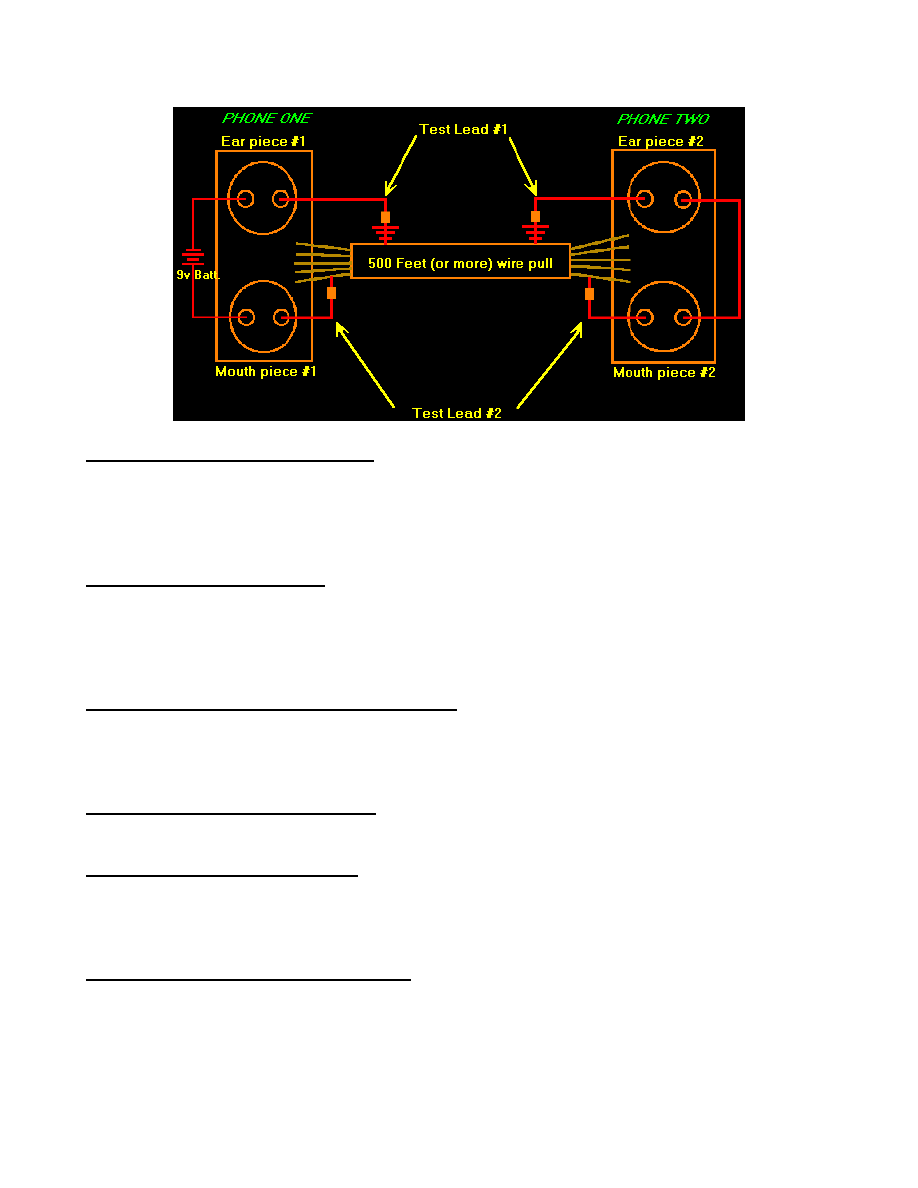
16
hearing with a radio set. It is known to work up to 500 feet and maybe even further.
Ease of troubleshooting for photcells: Here's a way to ease the task of replacing bulbs or doing
maintenance on site that is controlled by photocells. Instead of covering the photocell to test
lights, you can wire in a test switch in parallel to override the controls. This saves time of
working with the photocell (waiting for it to activate or deactivate), is inexpensive to install, and
easy to do. You can use a key-operated switch for security, if needed.
Use A Plastic bag For A Mouse: We often use a mouse or pre-wraped floss line to blow through
the pipe, or some sort of vaccum. This doesn't always work. If you are having trouble do what I
do. take a plastic bag and twist it together at the opening trapping just a little air in the bag. tape
this to your floss line and use a vaccum at the other end. It will blow your mind at how well it
works!
Use Plastic Bottle To Help Fish Tape in Big Pipe: If your having trouble getting your fish tape
through big water filled conduit try using a plastic pop bottle. Cut a hole in the cap big enough to
put the fish tape through, then wrap enough tape around the fish tape to keep it from coming
out. Screw the cap back on the bottle and fish it through.
Use Magnet To Clean Metal Shavings: Put any decent sized magnet in a plastic bag, swipe over
shavings, remove magnet from bag over garbage.
Put Plumber's Scraps To Good Use: Plumbers frequently leave left over supply line on the job.
The plastic lines (1/4 in. pvc) can come in very handy from time to time. It is very easy to cut and
works great to space receptacles and switches. It will also fit over 1/4 - 20 bolts to protect wires
from the rough edges. I'm sure there are many other uses as well.
Making larger panel cover easier to access: There is an easier way to remove and replace large
panel covers. First, drill out a panel cover and drill and tap the flange of the back box. Then run
a bolt through the top cover hole from the back of the flange. This gives a stud to help keep the
cover in place while installing the mounting screws. Use a wing nut on the stud to secure the top
of the cover. This works on surface or flush panels. In most cases, 1/4 bolts can be used. Larger
covers may require 3/8 bolts. Universal screen door type handles are also a great help. Bolt the

17
bottom on a horizontal plane and mount the top vertically. On larger MDP-type panels, you may
need to use four handles in order to allow two people to remove or replace the panel covers.
Use Excel To make Panel Schedules: I make all my panel schedules on my laptop using Excel (or
any other spreadsheet program) by creating a 1,3,5 or 2,4,6 template. When I do any future
work, I update and print a new schedule for the panel. By keeping the schedules on file, I can tell
my customers which breaker to turn on (or leave off) in case of a tripped breaker over the
phone.
Production PVC bends: If you've got a lot of identical bends to make in PVC conduits, make a
template with EMT first. Then when you take the PVC out of the hot box, you can use the EMT
as a 'form' to bend the PVC. Even if you are bending different sizes of PVC, all the bends will be
the same.
Professional Off-sets: After bending your off-set, let it rest on the floor away from you, while
letting it rest on your hand between your thumb and forefinger. If the off-set was bent correctly,
it will hang straight down, if not it will lean to one side.
How to protect your 7/8 holesaw from damage: To keep from breaking the 1/4 bit or the teeth on
the 7/8 hole saw when drilling in a metal box, put a 1/4 x 1-1/4 fender washer over the center of
the hole to be drilled, the hole saw teeth will hit the fender washer and spin. The fender washer
can be removed, and the hole can be drilled. The fender washer keeps the teeth from grabbing
into the metal of the box.
How to pull cables across existing ceilings: Take some string and a slingshot and tie a lead
anchor on to the string. Shoot the fishing line across the ceiling, this can get you a 20' to 30' pull,
easy with very little effort, and tie on the cable and pull back. It takes a fraction of a time
normally required to lift and replace ceiling tiles..
Pulling Heavy Gauge Cable Manually & Efficiently: When you need slack (to enter a building)
while pulling heavy-guage cable manually with a cable crew, to save time and effort (a tugger
can take too long), first use length tape to get a measurement on your first run. Then, the trick is
to pull loops between your pulleys to reach your crews' acquired lengths before splitting up your
crew. This procedure helps to complete your pulls effectively, efficiently, and specifically, safely,
to prevent back breaking work for one or more men feeding into the building.
Making wire pull smoother: When pulling wire in pvc pipe, the wire, snake, or drag will burn
through the throat of the connector if not pulled exactly straight through the connector. Install a
metal bushing so the wire, snake, or drag can ride on the bushing and not damage the pipe or the
wire. When pulling MC or BX cable across a T-bar ceiling, install a scrap piece of 1/2-inch or
3/4-inch EMT with caddy fasteners to the starting grid so as to keep the MC or BX from
snagging the edge of the grid and bending it. It will also aid in pulling smoother. This could also
be used when pulling communication cables.
Use Pull String to Pull Wire: When making up a head for pulling wire, cut 3 pieces of 150lbs
pulling string about 8 feet long. Take each piece and fold them in half and then tie the folded
pieces on to your rope. Now you have 6 pieces 4 foot long. Now grab two strings and start
braiding them down your wire and when your done brading tie them off and grab 2 more, and

18
then finally the last 2. This makes a really strong head that will not brake and it is a lot quicker
than using the tye wire method and of lot more flexible.
PVC thread-in connector lube: I'm sure we all know how much of a pain it is to screw a PVC
connector into an aluminum outdoor box. One cheap and easy method is to use a couple drops of
dish soap, and work it into the threads of the connector with your fingers. Once you screw it in,
the soap will eventually harden, literally gluing it in place, and also contributing to the
waterproofing of the connection. If you run quite a bit of PVC, this is also more cost-effective in
the long run, saving you money on wire lube.
How to repair underground PVC pipes: Here is an alternative to extensive digging when
repairing damaged underground PVC pipes of any size. Cut out the bad section of pipe, then cut
a new pipe to fit. Ream out the ridge in the center of the two couplings, apply pulling soap, and
slide completely over each end of pipe. Set in new section of pipe and use hammer to slide
couplings into the proper position.
Using PVC pipe to punch under sidewalks: Instead of digging under a curb or sidewalk, dig
trench up to both sides, use any lenght of 1/2, or 3/4 PVC pipe, a male threaded connector and
screw onto a garden hose. Use the pipe with the water on to punch under the curb or sidewalk.
Works best in loose soils. the threaded connector may then be cut off, and leave the pipe in place
for the wiring task.
PVC to EMT Transitions: When making a transition from PVC to EMT and it's hard to screw
the EMT connector into the female adaptor, place a little PVC glue onto the threads of the
female adaptor. This softens the threads allowing the connector to screw in easier.
Stop stripping threads on quickbolts: Stick an all-thread rod coupling of various sizes (1/4 x 20,
3/8, 1/2, etc.) in your tool box. Use those to set quickbolts (stud anchors) instead of using the nut
supplied with the anchor. It works great. That way you don't destroy the threads on the anchor
(causing you to start all over again), and you can use this as a stop to be sure you leave the right
number of threads showing. Also, if you did not know this, always drill your hole deep on a
quickbolt, because you can stop the set whenever you want even if the hole is too deep.
Use Pliers To Ream Pipe: After cutting your pipe, take your lineman pliers or sidecuts, opening
them up insert one end in pipe, your cutter on your pliers will make a nice smooth edge so your
wire will not get damaged....
A good way to ream rigid: To ream rigid pipe, I find using a unibit drill bit does a fine job and
leaves a smooth inside rim on the pipe.
How to replace a broken light bulb: First test to see if circuit is dead. Clean broken particles
that remain in the socket with a screwdriver or pliers. Insert new light bulb into socket twisting
in reverse, as this will remove the broken end of the old light bulb, (usually this is the hardest
part to take out). This should clean out all damaged parts, leaving the socket ready for the new
light bulb.

19
Use wire to make spring for oversize receptacle hole: If the drywall hangers got a little
ambitious when they cut the hole around your box, and the devices' strap won't reach the
drywall, take a scrap of #14 or #12 wire, wrap it around your #2 phillips screwdriver shaft and
make a 'spring. Cut it to length (needed to reach the strap to the box), and place it around the
devices' 6-32 screw. No more 'floaters' and broken cover plates!
Repair marked up accoustical tile: At, times when you put in fixtures in accoustical tile, you will
find that marks, dents, and scrapes peroidically occur on the tile. There is an easy way to touch
up the tile. Use Liquid Paper or white shoe polish. These liquids blend in extremely well with the
tile.
Repair for Acoustical Tile: Any scratch or gouge in an acoustical tile can be mended effortlessly
with a simple bathroom product. 'DESENEX' (you know, the athletes foot powder) in an aerosol
can will erase any damage you may have caused. Simply spray the affected area with the
'DESENEX' as though you were painting and the scratch or gouge will disappear. Just don't use
to much of it or you will clear the building you are working in.
Replacing residential switch boxes: When adding an additional switch to an existing location,
find the side of the box the stud is located on. Cut the drywall to the size of the replacement box.
{ two gang etc.}Remove the old box. With a hack saw, cut the nail holders off of the new plastic
box. After installing the necessary wiring, place the new box in the hole and run two drywall
screws through the inside of the box into the stud. The finished result will look like the box was
always there.
Use A Rubber Ball for Clean-Up: When drilling holes in the ceiling cut a hollow rubber ball in
half and put a hole in the center,put the shaft of your drill bit or hole saw through the hole
before chucking it in your drill. The ball catches most of the dust.
How to keep rust off your tools: If hand-tools are carried in a metal-enclosed toolbox,
condensation may cause the tools to rust or oxidize. To help prevent this from occurring place a
piece of charcoal in the toolbox. The charcoal will absorb the moisture and prolong tool life.
Safer fishing in live panels: When pushing a steel fish tape into live panel, a safer way to prevent
accidental short circuits is to remove the locknut where the conduit enters the panel and replace
it with a female connector and cap (or a rigid coupling and threaded plug, be careful not to drop
it). When you can push no further, unscrew the female connector or the threaded plug, only the
tip of the fish tape will be exposed. Then replace the locknut.
Extend life of saw blades. To extend the useful service of a reciprocating saw blades up to 75%,
start with the saw shoe extended to the maximum length possible for the material and type of
cut. As the portion of the blade that contacts the work becomes dull, move the shoe closer to the
saw, bringing sharp teeth into contact with the wood, plaster, or metal. When metal cutting
blades break right where they fasten to the saw, they can be reused by grinding down the broken
ends and to match original notch/pattern.

20
Sealtight Hacksawing Made Easy: Open your lineman's pliers, place them on the ground with
the handles down, and jaws pointing up. Place Sealtight in jaws and hacksaw (gently) in a
straight up and down motion (towards ground). It's almost as quick as using a razor knife and
dykes but installing fittings is much easier.
Self-Holding Screwdriver: Keep a wad of Blu Tack pressed on to your screwdriver where the
handle meets the shaft.When you need a screw to stay on the tip of your driver place a small
piece of Blu Tack the tip and press the screw intoit. Replace the Blu Tack on the shaft for next
time.
Drilling for a Service Riser: When drilling for a service riser on a pitch roof overhang, remove
the pilot drill bit and replace it with a 18 or longer feeler bit in the hole saw. This will keep your
holes in line and also keep the hole saw horizontal on the angled roof. Your conduit riser will
slide in with ease.
Use Bulb To Check Short Circuits: If you have a short circuit one way to tell if it is cleared is to
wire a light bulb pig-tail in series with the problem circuit right off the breaker, or if edison base
fuses are being used replace the fuse with the light bulb. Turn the circuit back on, the bulb
should be full bright.Then start isolating the short by disconnecting things down the
circuit.When found the bulb will dim or go out depending on what load might still be on that
circuit.Fix the problem and remove the bulb.
Reinforcing sledge hammer. Don't you get tired of replacing handles after handles on your
sledgehammer. Well there is a easy fixed to this and you will probably never have to replace it
again. Take a 2 in. by 3 in. galvanized pipe nipple and slip it over the handle and weld it to the
the head. When welding you may want to use a electric welder, and allow enough time to cool
down between the several passes. Now when you strike something the nipple will take the impact
and not the handle.
Also you can take a 1 in. piece of rigid and use it for your handle. Just take the rigid pipe and
weld it onto the head of the sledge. This works really well, but I would recommend putting
sometime type of cushioning on the handle.
Slip joint pliers used to ream conduit: An excellent way to ream the end of cut conduit is by
using the uninsulated handles of a pair of slip joint pliers (generically called Channellocks). For
smaller sizes, both handles fit in and the grip pattern files the burrs. For larger conduit, open the
handles so that one handle rubs each side of the conduit. Even with a crooked cut (Heaven
forbid), the edge comes out nice and smooth.
Smoothing Sharp Boxes: When making wire pulls into a gutter or any tight boxes, take 1/0 awg
or larger and strip the insulation with the score in a straight line and make it a good foot. With
this insulation push it onto the edge of the gutter that your wire is hitting. This also saves on
busted knuckles.
Use a small pulley to pull wire. If at all possible keep a small awning pulley that is made of steel
and accepts a 3/8 rope in your toolbox. When pulling wire, you can fasten the pulley up over the
top of the pipe with a beam clamp or a piece of rope. This allows you to take the pull line that is
in the pipe and route it up and over the pulley and use it as a snatch block.

21
How to make a circular snake holder: A 1/2 or 3/4 flexible metal conduit about 3 feet long makes
an excellent circular snake holder, easy to retract. Here's how: Take the snake and tape it at the
beginning of the snake circle to the long end of the snake. The snake does not kink or tangle
while spinning in or out. Hold the snake and rotate the flexible metal conduit.
Re-usable Splitbolt Bugs: To re-use splitbolt bugs, first take some plastic wrap and wrap the
splitbolt bug completley. This will alleviate a headache to re-use at a later date. To remove, all
you will need to do is to take a razor knife and slit the bug long ways and fold off.
Leave Plastic Wrap on Spring Nuts: When installing spring nuts into slotted channel, you may
try purchasing spring nuts with shrink wrap...leave it on during installation. If they do not come
with shrink wrap take your side cutters and stretch the base of the spring out bigger than the
opening in the strut.
Use Milk To Drill Stainless Steel: I was working last week in a fish wholesalers market and was
working with some stainless steel and the owner of the business showed me a trick for drilling
stainless steel. Instead of oil to help with the drilling he got out a can of evaporated milk and
what a difference it made.
How to make a stand light: First, take an old extention cord that has been damaged on one
end,cut the bad end off. Second,take a scrap piece of conduit making a base square or round (
square makes a better base than round) leaving 4 to 5 feet sticking up in the middle . take a 300
watt halogon flood light ( wal-mart has these for about $7.00 ) use a set screw connector and a
rigid coupling both 1/2 to attach the light too. Then. push cord in the conduit leaving the male
end out at the bottom. make joints using butt connectors ,screw light to coupling , plug in, and let
there be light . Perfect for when you have no temporary lights at the job sight.
How To Keep cables straight in Tray: When pulling long multiple cables pulls, in cable tray it is
almost impossible to do without getting the cables tangled up, making it hard to tie down neatly!
Try this next time, Get a piece of 4/0 ground cable or the like and form a loop about the size of
the cable tray you are pulling in. Tie each cable to the loop and drag it down the cable tray, being
careful not to let the loop twist. This will help to keep the cables in order making them much
easier and faster to tie down!
Use Stick Ruler To find Degrees: If you do not have a protractor handy, you can still find
degrees by using your stick ruler, here how:
Open the ruler to 30 inches. Bend the first and second sections of the ruler (at the 6 and 12
marks) so that the 1 mark hits the 23 mark on the ruler. Return the second section so that the
level with the rest of the ruler. You now have a 45 degree angle on the first section.
Bend at the same 6 and 12 mars, hitting the 1 mark at differernt numbers for the degree you
want: Examples:
•
30 deg: 1 mark hits 23 1/2
•
20 deg: 1 mark hits 23 3/4
•
10 deg: 1 mark hits 23 7/8

22
Keep Pipe Racks Even And Straight: When installing conduit on a rack or trapeeze system, cut
a piece of 1/2 EMT the length of the rack and place center marks on it with a marker, measuring
the center of each pipe laid on the first rack. Now all you have to do is pencil mark each rack as
you come to it, align the pipes, and strap them down for a perfectly ran conduit rack.
Use Strain Reliefs in Correct K.O.s': Strain reliefs for cords should be used in either a K.O. of
the same size or a hole of the same size for the strain relief should be knocked out to accomodate
it. I say this because I have seen cords short out because they were used in multi size K.O.'s that
had one or two sizes left to knock out...
Strip wire, Then Push: When pushing wire through metal conduit, strip the insulation off the
wire before making your hook. Copper seems to push easier than leaving the insulation on.
Remember to always stagger your wires also.
Use Tape Meausre to Fish: A good handy tool to fish walls with is your tape measure. A 1 inch
bladed tape measure is excellent for pushing through most insulation and can be driven straight
down the wall. Also you can tell how far down you are in the wall. When you get the blade out of
the hole just tie your flex or cable on to the eye in the end of the blade and secure, the pull up. It
works great, especially if you do not have a fish tape handy.
Tape Measure Note Pad: For a scratch or note, glue one of those formica samples onto your tape
measure. You can write things down on it with your pencil and erase it when needed.
Make template top hang lights: If you're hanging fluorescent fixtures on a drywalled ceiling and
are using toggle bolts, use the cardboard box the fixture came with to make a template of the
fixture. Knock out the holes you need removed from the fixture, and transfer those holes directly
onto the cardboard. Cut out the cardboard in the appropriate places, and you'll find the
cardboard is much easier to work with on the ceiling while standing on a ladder. You can square
up your marks on the ceiling much faster.
Temporary Splitbolts: When changing a service and having to jump from the old meter to the
new meter instead of using expensive slpitbolts that the power companies always take, use a 3/4
inch or 1 inch romex conector to connect the wires together. Then tape as usual. This will cost
about 3 dollars instead of about 60 dollars.
Terminating Stranded Wire Under A Device: When you have to put a stranded wire under a
terminal ,like a duplex outlet , strip the wire a little longer and re-twist the wire counter clock
wise or backwards. This really seems to make it pull into the screw head , instead of pushing out.
Threading PVC Coated Conduit: If you've ever threaded pvc coated conduit with a porta-pony
on a tri-vise you know how difficult it is to keep the conduit tight in the vise so not have the
conduit spin in place causing you to scrap your $50 piece of pipe or spray a whole can of pvc
coating on it.
Thus a solution, take two pieces of 90 degree angle iron cut about 12 inches in length, place one
on the vise and place your conduit in the v and place your 2nd piece on top of your conduit next
take your chain and hook it to the vise. With this method you are sure to get clamping effect you
need to hold the conduit in place while eliminating the teeth marks.

23
Using Torpedo to find back of conduits: When dragging out holes for conduits and the pipe is
strapped to 1 5/8 strut and your can is firmly against the wall, take your level (Craftsman
torpedo) and lay it flat on the can and push it to the wall and the take your pencil and draw a
line using the edge of the level. This line will be exactly 1 5/8. So now you have just found the
back of your pipes with out the hassle.
Use Velcro To Hold Tester: Ever needed a spare hand to keep your tester in site of vision, when
no one around? The answer is yes. A way I found to get around it is to sew a soft part of velcro to
the forearm, close to the elbow of your coat or jacket and too glue the rough, prickly part to the
back side of your tester and voila...firm hold and now now you have an extra hand to work your
leads.
Use Tape On Holesaw In Live Panel: When I holesaw into a live panel, I wrap electrical tape
around the holesaw about 3/8 of an inch from the bottom, make sure to wrap it about 15 times,
this will prevent the saw from pusing right through the panel and a firworks show.
Use Arc Tube To Sharpen Knife: Find a bad high pressure sodium bulb preferably a 400 or
1000 watt. Carefully break outer glass and remove the long slender arc tube. Use the arc tube as
you would a knife sharpening steel to keep your electricians knife sharp.
Trim Out Advice: Apply a piece of masking tape around the edges of your torpedo level. When
you go to level the trim plate you wont leave marks on the wall. Also, turn the trim screws where
the slot is parallel with the device. This makes for a neater and more professional looking
installation.
Use Golfball To Snake Pipe: Try drilling a hole through a golfball and bending a piece of ceiling
wire through it sort of like a paint roller handle. Tape it to the end of your snake the ball will roll
through the pipe!
Threading PVC Coated Rigid Pipe: When threading PVC coated rigid pipe, it is difficult to
keep the conduit from spinning in the threading head or pipe vise which causes the coating to
tear off. Wrap a piece of emery cloth (rough side toward coating) to grip coating and keep pipe
from spinning.
Use Metal Strapping To Fish Walls: Take an appropriate length of metal pallet strapping and
grind one end to a point. Drill a hole in the end. Working from the top, slowly push the metal
strapping down through the insulation, it'll slice its way through nicely. When you are close to
the box hole, use a magnetic stud finder to locate the steel strapping and pull it out of the hole.
Tape on the wire and pull it up through. You can even slip this flat strapping between the face of
the vapor barrier and the back of the drywall so you don't need to go through the insulation.
Works nicely in tight spots with low overhead clearance too.
Locating Walls From Basement in Old Houses: Get a length of coathanger wire about 8 inches
long being sure it is straight, cut it at a slant to get a sharp point.put it into a 3/8 drill and use it
as a drill bit. When trying to find an exact location to drill up from the basement to the floor
above, simply use the coat hanger to drill a very discrete hole close to the baseboard,in this way
you are sure to be in the right bay when you drill up with your wood bit.The small hole that you

24
made with the coat hanger can be filled with wood putty.I did not believe this would work so I
tested it on a 1 inch piece of oak, it works great.
One Man Wire Pulling: If you need to pull wires into 1/2" or 3/4" conduit without any helper
using a plastic or metal funnel works good. Tape or wedge the funnel so the spout goes into the
conduit so wires won't get nicked when they go past the fitting edge and the funnel helps keep the
wires from rubbing.
Ground Rod In frozen Ground: Dig a small hole and fill with windshield washer fluid and let
melt down repeat until through frost.
Straighten Your Mangled Fish Tape: Take a 3/4 x 5ft conduit, bend a quick 90 on one end and
one at the other the opposite direction, bend an offset at 45 angles in the middle at a 90 to the
first two 90's. Now take any mangled fish tape and slide it through to make it new!!
Use a Cloth Bag For Photocell Test: A small dark cloth bag w/drawstring can be used to test
photocells, save your tape and time. A royal crown bag works for me.
Use #12 To Fish Insulated Walls: Take 18 to 20 feet of #12 solid wire double it together. Now
hook folded end into a vice or something to keep it from turning, then chuck up the two ends into
a drill and slowly twist it into a solid flexible fish leader with an
eyelet at one end. Works great in walls with insulation.
A Good Way To Bend Wiremold: When bending wiremold around obstructions, mouldings,
casings,box-offsets, lay the wiremold in it's place unbent and mark the bend as you would
regular conduit. Then use wood blocks to fabricate the obstruction, moulding, offset etc. Then
form the wiremold using a rubber mallet. This will work on most bends, and saves your scrap
pile from getting too high.
Wyszukiwarka
Podobne podstrony:
Haldeman, Joe Tool of the Trade
Joe Haldeman Tool of the Trade
Haldeman, Joe Tool of the Trade
Jankovsky Jason Alan The Art Of The Trade What I Learned (And Lost) Trading The Chicago Futures Mar
Comparison of the U S Japan and German British Trade Rivalr
Catalogue of the Collection of Greek Coins In Gold, Silber, Electrum and Bronze
[Mises org]French,Doug Walk Away The Rise And Fall of The Home Ownership Myth
A D Seergev Nonlinear interaction of the pantograph of electric rolling stock and the overhead cate
Rally hits the buffers ahead of U S China trade deal Reuters
Wójcik, Katarzyna A Polymorphism of the DNA Base Excision Repair Genes in Keratoconus (2014)
On the trade off between speed and resiliency of Flash worms and similar malcodes
Bearden EXPLANATION OF THE MOTIONLESS ELECTROMAGNETIC GENERATOR WITH 0(3) ELECTRODYNAMICS
MODELING OF THE ACOUSTO ELECTROMAGNETIC METHOD FOR IONOSPHERE MONITORING EP 32(0275)
The Left Hand of the Electron Isaac Asimov
[Mises org]George,Henry Protection Or Free Trade An Examination of The Tariff Question, With
Measurements of the temperature dependent changes of the photometrical and electrical parameters of
[Mises org]French,Doug Walk Away The Rise And Fall of The Home Ownership Myth
English Summary of The Invisible Rainbow A History of Electricity and Life 3
Canadian Patent 142,352 Improvement in the Art of Transmitting Electrical Energy Through the Natural
więcej podobnych podstron