
Forests 2015, 6, 734-747; doi:10.3390/f6030734
forests
ISSN 1999-4907
www.mdpi.com/journal/forests
Article
Colonization with Arbuscular Mycorrhizal Fungi
Promotes the Growth of Morus alba L. Seedlings under
Greenhouse Conditions
Nan Lu
1,†
, Xia Zhou
2,†
, Ming Cui
2,†
, Meng Yu
2
, Jinxing Zhou
1,
*, Yongsheng Qin
3
and
Yun Li
1,
*
1
Beijing Forestry University, Beijing 100083, China; E-Mails: ln_890110@163.com (N.L.);
zjx001@bjfu.edu.cn (J.Z.); yunli@bjfu.edu.cn (Y.L.)
2
Institute of Desertification Studies, Chinese Academy of Forestry, Beijing 100091, China;
E-Mails: xzhou2013@163.com (X.Z.); cuiming4057@126.com (M.C.); carfeild@163.com (M.Y.)
3
Beijing Municipal Bureau of Landscaping and Forestry, Beijing 100029, China;
E-Mail: qinyscn@126.com
†
These authors contributed equally to this work.
* Authors to whom correspondence should be addressed; E-Mails: zjx001@bjfu.edu.cn (J.Z.);
yunli@bjfu.edu.cn (Y.L.); Tel.: +86-10-62338561 (J.Z.); +86-10-62336094 (Y.L.);
Fax: +86-10-62338561 (J.Z.).
Academic Editor: Douglas L. Godbold
Received: 16 October 2014 / Accepted: 25 February 2015 / Published: 16 March 2015
Abstract: Morus alba L. is an important tree species planted widely in China because of its
economic value. In this report, we investigated the influence of two arbuscular mycorrhizal
fungal (AMF) species, Glomus mosseae and Glomus intraradices, alone and together, on the
growth of M. alba L. seedlings under greenhouse conditions. The growth parameters and
physiological performance of M. alba L. seedlings were evaluated 90 days after colonization
with the fungi. The growth and physiological performance of M. alba L. seedlings were
significantly affected by the AMF species. The mycorrhizal seedlings were taller, had longer
roots, more leaves and a greater biomass than the non-mycorrhizae-treated seedlings. In
addition, the AMF species-inoculated seedlings had increased root activity and a higher
chlorophyll content compared to non-inoculated seedlings. Furthermore, AMF species
colonization increased the phosphorus and nitrogen contents of the seedlings. In addition,
simultaneous root colonization by the two AMF species did not improve the growth of
OPEN ACCESS

Forests 2015, 6
735
M. alba L. seedlings compared with inoculation with either species alone. Based on these
results, these AMF species may be applicable to mulberry seedling cultivation.
Keywords: arbuscular mycorrhizal fungi; Glomus species; simultaneous colonization;
Morus alba L.
1. Introduction
Arbuscular mycorrhizal fungi (AMF) are common endophytic fungi that play an important role in
vegetation succession in ecosystems, species productivity and the restoration of damaged ecosystems.
About 90% of the flowering plants, ferns and mosses on Earth have a symbiotic relationship with
AMF
[1]
. Previous studies have demonstrated that AMF may affect multiple metabolic processes in plants
and that they promote the evolution, growth, nutritional status, water use, disease resistance and stress
resistance of host plants
[2,3]
. Arbuscular mycorrhizal (AM) symbioses are usually mutualistic and are
based on the bidirectional transfer of organic carbon from the plant and soil-derived nutrients, particularly
phosphorus (P), nitrogen (N) and zinc, from the fungi
[4]
.
The response of plants to colonization by AMF depends mainly on the host plant and fungal species,
as well as on environmental conditions, such as nutrient levels, light intensity and temperature
[5]
. In
previous studies, it has been suggested that plant colonization by different AMF with complementary
functions may be more beneficial than colonization with a single species
[6,7]
.
Morus alba L. is native to China and is now widely cultivated (even naturalized) globally. Mulberry
leaves are important as the primary food of silkworms, whose cocoon is used to make silk. In addition,
mulberry leaves are commonly used in traditional Chinese medicine; for example, M. alba L. leaf
extracts are used to treat atherosclerosis [8]. Mulberry plants can also help diabetic patients by reducing
the absorption of blood glucose. Thus, mulberry has high economic and medicinal value [9].
The application of AMF during the cultivation of mulberry seedlings holds great promise in
improving plant nutritional quality, growth and survival under conditions of abiotic stress. To date, only
limited reports have explored mulberry inoculation with AMF. Katiyar et al. (1995) demonstrated that
vesicular-arbuscular mycorrhizal (VAM) inoculation can help reduce the use of phosphate fertilizer in
mulberry cultivation [10]. Mamatha et al. (2002) inoculated ten-year-old mulberry plants with Glomus
fasciculatum in field conditions, finding that P fertilizer application can be reduced by 50% without
reducing yield [11]. However, research regarding the effects of AMF inoculation on the growth of
mulberry seedlings is still scarce; and there are no reports on mulberry seedlings simultaneously inoculated
with more than one AMF species.
In this report, we investigated the effect of Glomus mosseae and Glomus intraradices on the growth
parameters of, photosynthetic pigments of and mineral uptake by mulberry seedlings. To determine
whether an AMF community composed of two different species can improve plant growth and mineral
uptake more than a single species, a mixture of G. mosseae and G. intraradices was also included in our
study to increase our understanding of the application of AMF for mulberry seedling cultivation.

Forests 2015, 6
736
2. Materials and Methods
2.1. Experimental Design
The substrate used in the pot experiment consisted of turfy soil (Klasmann-Deilmann GmbH, Geeste,
Germany), sand and pearl stone mixed at a ratio of 4:3:4. The properties of the substrate were: total N,
3.92 g/kg; total P, 2.147 g/kg; total potassium (K), 43.0 g/kg; available N, 145.85 mg/kg; available P,
55.08 mg/kg; available K, 256.1 mg/kg; organic matter, 171.5 g/kg; and pH, 7.23. The plant growth
substrate was sterilized using an autoclave at 0.14 MPa and 121 °C for 2 h before use.
Seeds of M. alba L. were obtained from the Research Institute of Forestry, Chinese Academy of
Forestry. All seeds were surface-sterilized in 10% hydrogen peroxide (H
2
O
2
) for 10 min and then washed
with sterile distilled water, after which they were soaked in warm sterile distilled water for 24 h, then
germinated on plates containing pretreated sand (121 °C, 2 h). All germinated seeds were transferred to
nursery containers when they reached 1 cm in length.
Glomus mosseae 0023 (GM) and G. intraradices 0042 (GI), obtained from the Beijing Academy of
Agriculture and Forestry Science, were used as fungal inocula. The two inocula were propagated for 4
months in sterile potted soil containing cropped Trifolium repens L. in a controlled environmental
chamber. Both inoculates contained substrate, root segments, hyphae and spores. The number of spores
in mycorrhizal inoculum was 30.8/g (GM) and 114.6/g (GI), respectively. The root colonization rate was
76.73% (GM) and 91.03% (GI), respectively. Four inoculations were performed: GM, G. mosseae alone;
GI, G. intraradices alone; GH (a code name), a mixture of 50% G. mosseae and 50% G. intraradices;
and control, no AMF. Three seedlings were used per pot, with three replicates per treatment. On Day
40, three similar-sized seedlings were transplanted to plastic pots (30 cm deep with a 24-cm diameter)
containing 5 kg of sterilized soil. Before transplantation, 100 g of inoculum mixture and sterilized
mycorrhizal inoculum were placed 5 cm below the surface of the substrate in each mycorrhizal treatment
pot for fungal treatment. To ensure the same number of spores in each treatment, inocula were prepared
to contain 100% (GM), 26.88% (GI) and 63.44% (GH, 50-g GM and 13.44-g GI) of the total weight. The
control pots received the same amount of sterilized mycorrhizal inoculum. Morus alba L. seedlings were
grown in a greenhouse from August to November in 2011 for 90 days. The experiment was conducted in
a greenhouse at the Chinese Academy of Forestry with 12-h diurnal light/dark cycles; a temperature of 25
°C in the light cycle and 18 °C in the dark cycle; a 6.7-lumen output flux; and 70% relative humidity. The
containers were irrigated with distilled water to maintain the moisture level at field capacity, and to
guarantee sufficient nutrient supply, seedlings were fed Hoagland nutrient solution every 3 weeks.
2.2. Plant Measurements, Nutrient Analysis and Mycorrhizal Colonization
The growth and physiological parameters of the plants were measured 90 days after the beginning of
treatment. Plant height was measured using a steel ruler; the base diameter was measured using vernier
calipers. After the seedlings were treated for 90 days, whole seedlings were removed from the pots. The
shoots and roots were then dried at 105 °C for 30 min and 80 °C for 24 h, after which they were dried to a
constant weight in an oven, and the total seedling biomass was calculated as the sum of the shoot and root
dry weights. Mycorrhizal dependency (MD) was defined according to Gerdemann (1974) as “the degree
to which a plant is dependent on the mycorrhizal condition to produce its maximum growth or yield at

Forests 2015, 6
737
a given level of soil fertility [12].” In this study, MD = mycorrhizal plant dry weight/non-mycorrhizal
plant dry weight × 100%.
The AMF colonization rate was measured as described by Biermann (1981) [13], and the roots were
stained and destained as described by Phillips and Hayman (1970) [14]. The roots were harvested and
cut into segments of 1.5 cm for each treatment and then cleared with 10% (w/v) potassium hydroxide
(KOH) and incubated at 90 °C for 15 min. After removal of the KOH, the roots were washed until the
brown color disappeared. The clear roots were then soaked in 2% hydrochloric acid (w/v) for 5 min and
washed under running tap water. The root segments were stained in 0.05% trypan blue prepared in
lactophenol for 25 min (incubated in 90 °C water). The roots were then destained and stored in clean
lactophenol. The stained root segments were observed under a microscope: 50 stained root segments of
each pot were randomly selected, prepared as permanent slides and viewed under a stereomicroscope at
12× and 50×. Colonization was measured as the proportion of the total number of root segments
colonized by AMF (root segments with vesicles, arbuscules or hyphae were treated as AMF-colonized
root segments). The AMF colonization rate = infected root segments/total root segments × 100%.
The plant inorganic nutrient content was examined by analyzing elements in the roots, shoots and
leaves. The samples were oven-dried at 105 °C for 30 min and then at 80 °C for 24 h until a constant
weight was reached. Each sample (0.2 g) was collected by coning and quartering and added to a 100-mL
Kjeldahl flask containing 5 mL of concentrated sulfuric acid. The mixtures were gently shaken and then
heated until they turned brown-black. After cooling, 5 mL of 30% (w/v) H
2
O
2
were added to the solution.
The mixtures were then gently shaken and heated again for 20 min. The last step was repeated until the
liquid became clear, and the flasks were heated for 10 min until the H
2
O
2
was eliminated. Distilled water
was then added to each flask to a final volume of 100 mL. Each solution was analyzed for N, P and K. The
total nutrient content was determined using the Kjeldahl method [15]; P was determined using the
Mo-Sb colorimetric method [16]; and total K was detected using ammonium acetate extraction-flame
photometry [17].
2.3. Chlorophyll Content and Root Activity
Fresh tissue (1.0 g) was sampled from the second expanded leaf from the top of each plant.
Chlorophyll was extracted with 90% acetone and measured using a UV/visible spectrophotometer at
663, 645 and 750 nm according to methods in Inskeep et al. (1985) [18]. The absorbance at 750 nm was
subtracted from the absorbance at the other two wavelengths to correct for any turbidity in the extract
prior to chlorophyll concentrations being calculated using the following formulas:
Chlorophyll A (mg/mL) = 11.64 × (A
663
) − 2.16 × (A
645
)
(1)
Chlorophyll B (mg/mL) = 20.97 × (A
645
) − 3.94 × (A
663
)
(2)
where A
663
and A
645
represent the absorbance at 663 and 645 nm, respectively.
As an important organ for absorption and synthesis, plant roots directly affect the growth of branches
and leaves and play a role in supporting belowground plant components and in absorbing moisture and
mineral nutrition from the soil; thus, they play a role in both plant growth and metabolism. In this
experiment, root activity was determined using the 2,3,5-triphenyl tetrazolium chloride (TTC) method.
According to Wu et al. (2013) [19], roots (0.5 g) were cut into 1-cm segments, added to a test tube with
Forests 2015, 6
738
5 mL of 0.4% (m/v) TTC and 5 mL of 0.1 mol/L phosphate buffer (0.05 mol/L Na
2
HPO
4
and 0.05 mol/L
KH
2
PO
4
) and incubated for 1 h at 37 °C in the dark. Subsequently, 2 mL of 2 mol/L H
2
SO
4
were added
to the test tube to terminate the reaction. Afterwards, the roots were removed from the test tube and dried
with paper towels. The dry roots were ground with quartz sand and 3–4 mL of acetic ether in a mortar,
to extract three phenyl methyl hydrazone (TTF). The extract was transferred to a test tube, the residue
washed three times with acetic ether, and a constant volume of 10 mL was maintained using acetic ether.
The absorbance of the extract at 485 nm was recorded. Root activity was expressed as: TTC reduction
mass (mg)/root fresh mass (g) × time (h).
2.4. Statistics
The data were statistically analyzed by a one-way ANOVA with SPSS 19.0.
3. Results
3.1. The AMF Colonization Rate
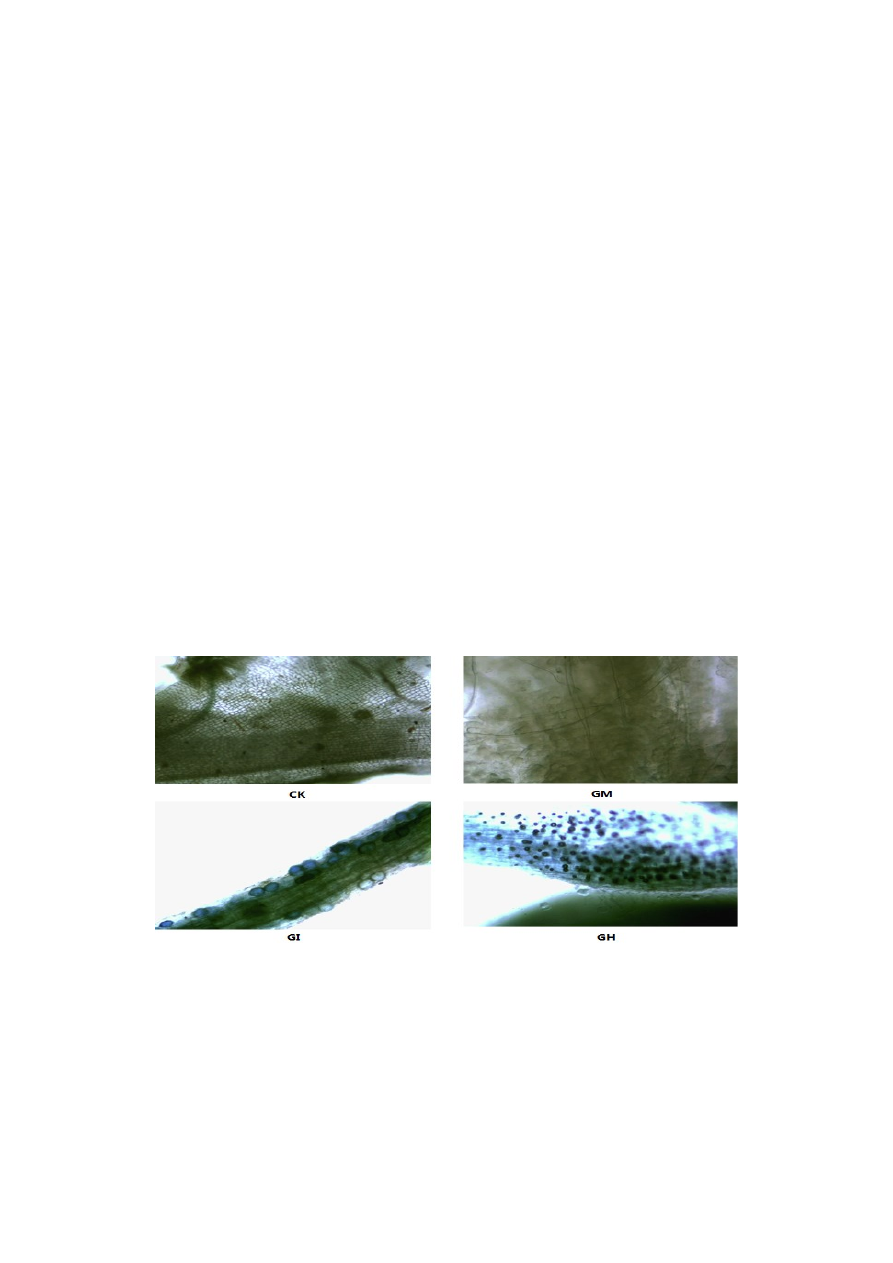
Mulberry seedlings were colonized after all treatments involving inoculation with AMF (Figure 1).
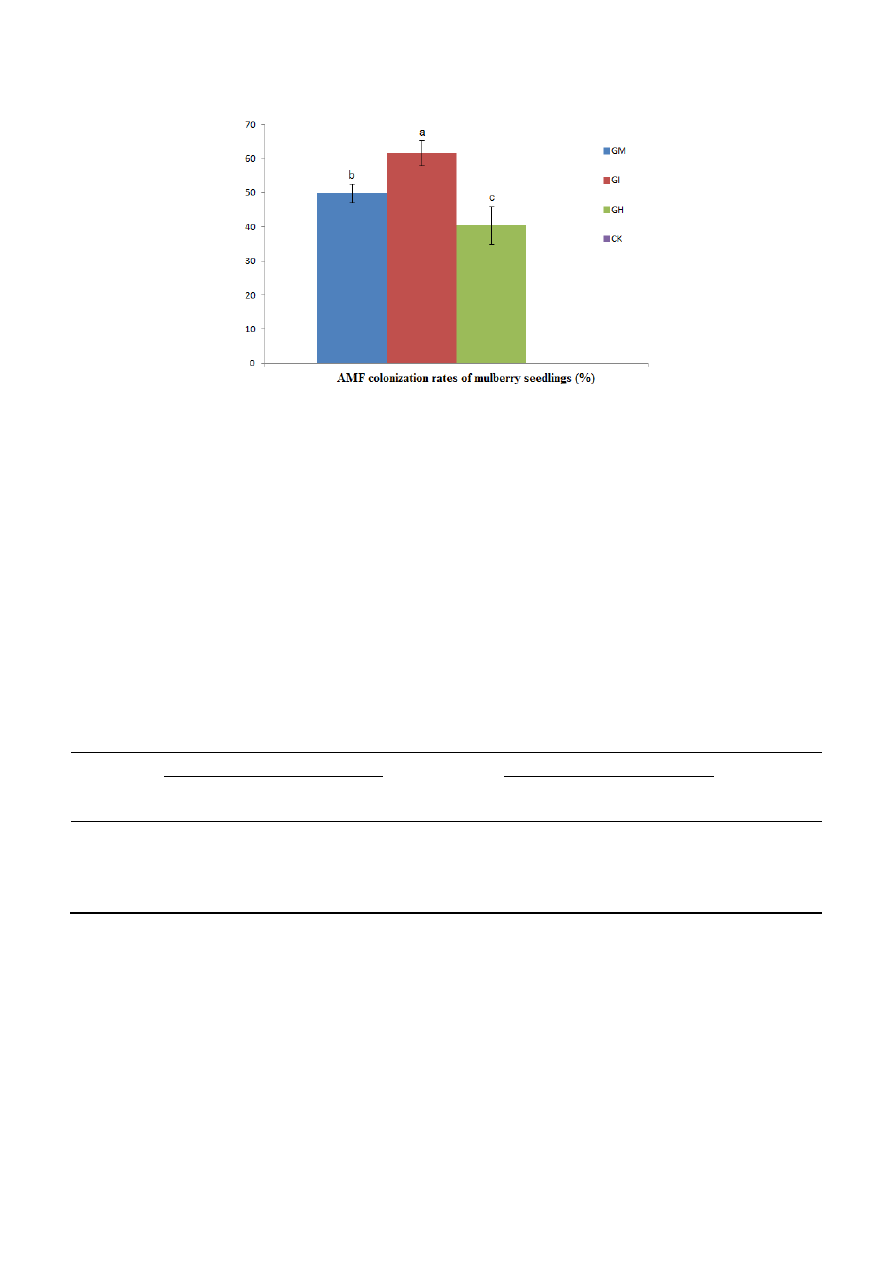
The non-inoculated samples showed no colonization. However, colonization rates between the three
treatments showed significant differences (p < 0.05). The colonization rates were: 49.83% (GM), 61.64%
(GI) and 40.40% (GH) (Figure 2). The AMF colonization rate showed the following pattern from high
to low: GI > GM > GH.
Figure 1. Arbuscular mycorrhizal fungal (AMF) colonization of mulberry seedling roots:
Glomus mosseae (GM), Glomus intraradices (GI), a mixture of 50% Glomus mosseae and
50% Glomus intraradices (GH) and Controls, without AMF (CK).
Forests 2015, 6
739
Figure 2. AMF colonization rates of mulberry seedlings: Glomus mosseae (GM),
Glomus intraradices (GI), a mixture of Glomus mosseae and Glomus intraradices (GH) and
Controls, without AMF (CK).
3.2. Plant Growth, Biomass and Mycorrhizal Dependence
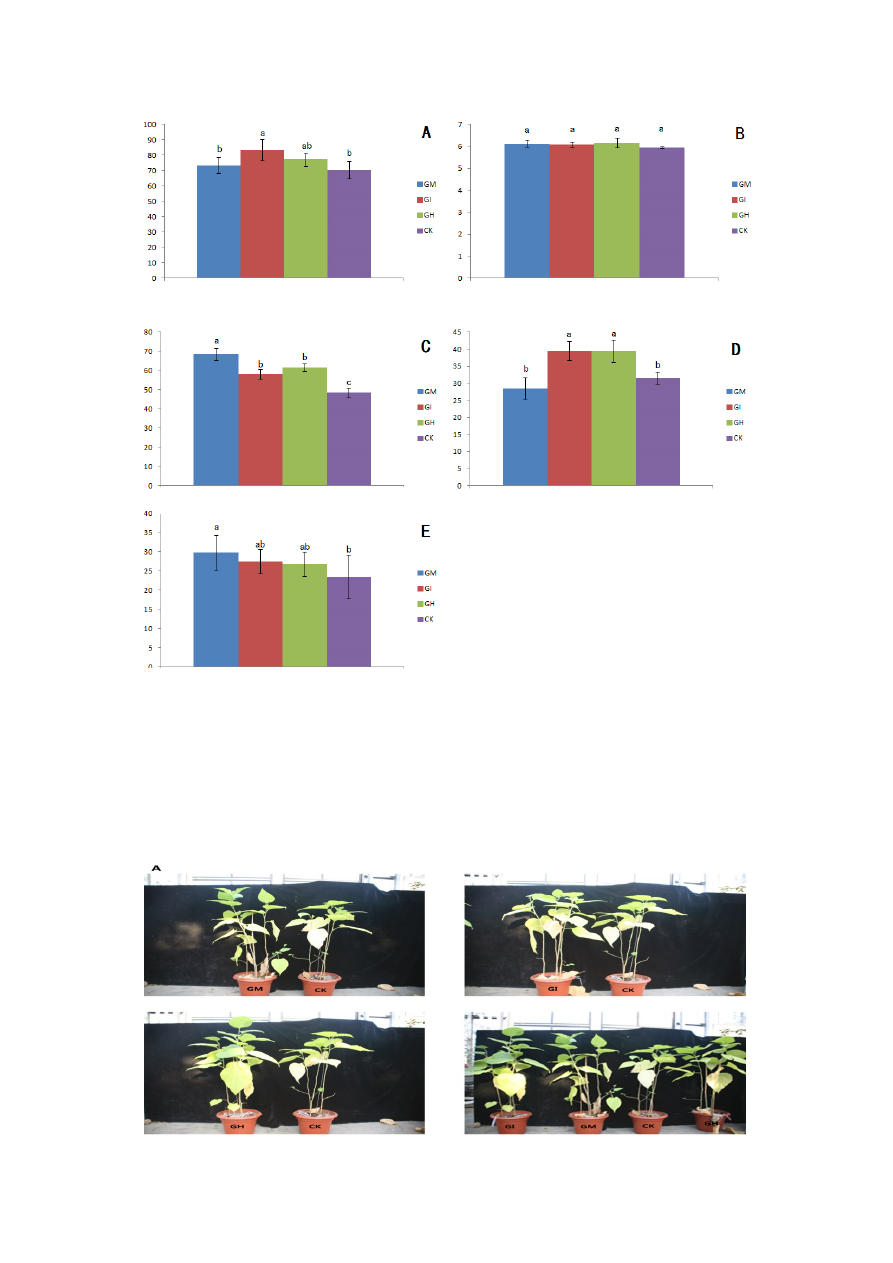
Excluding the base diameter (Figure 3B), all growth parameters of the AMF colonized plants were
significantly higher than in the control. The GI treatment had a significant effect on total biomass
(Table 1), lateral root number (Figure 3D) and plant height (Figures 3A and 4). The GM treatment had
the greatest influence on leaf number (Figure 3E) and root length (Figures 3C and 4).
Table 1. Effect on the biomass of mulberry seedlings grown in soil inoculated with:
Glomus mosseae (GM), Glomus intraradices (GI), a mixture of Glomus mosseae and
Glomus intraradices (GH) and without AMF (CK).
Treatments
Fresh Weight (g/pot)
Total Fresh
Weight (g/pot)
Dry Weight (g/pot)
Total Dry
Weight
(g/pot)
Aboveground
Plant Parts
Belowground
Plant Parts
Aboveground
Plant Parts
Belowground
Plant Parts
GM
76.10 ± 5.33
ab
69.00 ± 7.33
ab
145.10 ± 12.66
ab
38.45 ± 2.76
ab
34.43 ± 1.95
ab
72.88 ± 4.71
ab
GI
96.91 ± 8.52
a
78.42 ± 8.46
a
175.33 ± 16.98
a
46.29 ± 4.12
a
39.39 ± 3.54
a
85.67 ± 7.66
a
GH
84.61 ± 7.83
ab
69.88 ± 6.43
ab
154.49 ± 14.26
ab
37.99 ± 3.55
ab
37.39 ± 2.87
a
75.38 ± 6.42
ab
CK
67.83 ± 5.52
b
60.28 ± 6.65
b
128.11 ± 12.17
b
31.74 ± 3.43
b
29.43 ± 2.10
b
61.18 ± 5.53
b
Note: Different letters denote significant differences (p < 0.05) between treatments according to Duncan’s
multiple range test.
Forests 2015, 6
740
Figure
3. Effects of AMF inoculation on mulberry seedling growth: Glomus mosseae (GM),
Glomus intraradices (GI), a mixture of Glomus mosseae and Glomus intraradices (GH) and
without AMF (CK). (A) Plant height; (B) plant base diameter; (C) root length; (D) number of
lateral roots; and (E) number of leaves. Note: different letters denotesignificant differences
(p < 0.05) between treatments according to Duncan’s multiple range test.
The base diameter of mulberry seedlings (mm)
The height of mulberry seedlings (cm)
The number of lateral roots (per pot)
The length of roots (cm)
The number of leaves (per pot)

Forests 2015, 6
741
Figure 4. Growth of mulberry seedlings inoculated with: Glomus mosseae (GM),
Glomus intraradices (GI), a mixture of Glomus mosseae and Glomus intraradices (GH) and
Controls (CK): (A) aboveground and (B) belowground growth.
Based on Figures 3 and 4, the roots of the AMF-inoculated mulberry plants were significantly longer
than the control roots. In the three inoculation treatments (GM, GI and GH), root length increased by
41.23%, 23.29% and 26.52%, respectively, compared with controls roots (Figure 4).
The GI and GH treatments significantly increased the number of lateral roots in the mulberry
seedlings by 33.33% compared to the controls; however, the GM treatment did not increase the number
of lateral roots, and the treated plants showed a lower number of lateral roots than the controls
(Figure 3D).
The number of leaves for the three inoculation treatments (GM, GI and GH) increased by 31.82%,
27.27% and 22.73%, respectively, compared with CK leaves; however, only the GM treatment reached
a significant level (Figure 3E). The mycorrhizal dependence of the inoculated mulberry seedlings was
highest (140%) in the GI treatment, followed by the GH (123%) and GM (119%) treatments (Table 2).
Table 2. Mycorrhizal dependence (MD) of inoculated mulberry seedlings: Glomus mosseae
(GM), Glomus intraradices (GI) and a mixture of Glomus mosseae and
Glomus intraradices (GH).
Treatment
Dry Biomass (g/pot)
Dry Biomass of Control (g/pot)
MD (%)
GM
72.88 ± 4.71
b
61.18
119.12 ± 7.70
b
GI
85.67 ± 7.66
a
140.03 ± 12.52
a
GH
75.38 ± 6.42
b
123.21 ± 10.49
b
Note: Different letters denote significant differences (p < 0.05) between treatments according to Duncan’s
multiple range test.
3.3. Chlorophyll Content
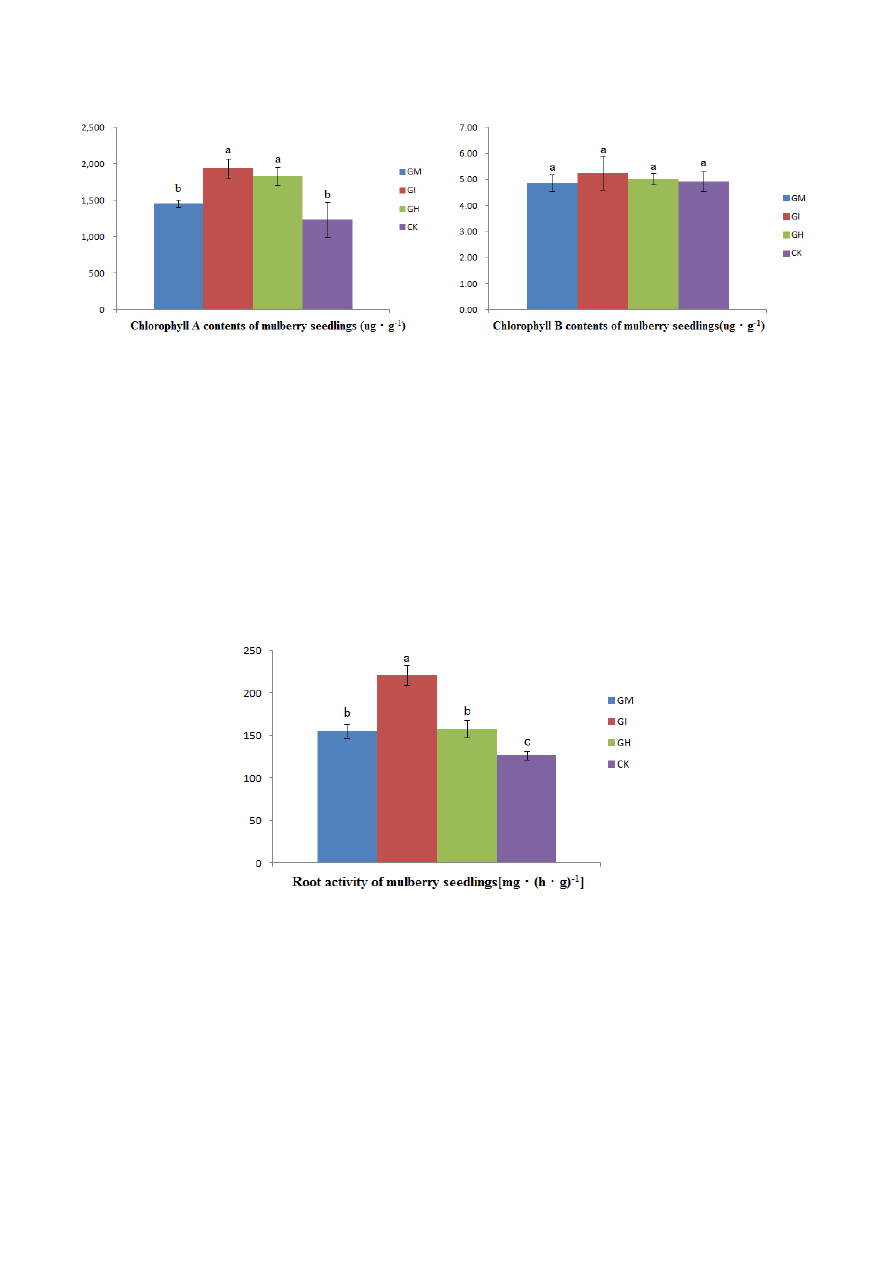
The chlorophyll A content of the plant leaves in the three AMF treatment groups (GM, GI and GH)
was increased by 13.44%, 51.01% and 44.97%, respectively, compared to control leaves (Figure 5A).
However, differences in chlorophyll A content were only significant for the GI and GH treatments
(Figure 5A). The chlorophyll B content did not differ between any treatments (Figure 5B).
Forests 2015, 6
742
Figure 5. Effects of AMF inoculation on the chlorophyll A (A) and chlorophyll B (B)
contents of mulberry seedlings: Glomus mosseae (GM), Glomus intraradices (GI), a mixture
of Glomus mosseae and Glomus intraradices (GH) and without AMF (CK). Note: different
letters denote significant differences (p < 0.05) between treatments according to Duncan’s
multiple range test.
3.4. The Influence on Root Activity
The TTC deoxidizing ability of the GM, GI and GH plants increased by 19.02%, 58.59% and 20.27%
compared to the controls, respectively, resulting in significantly higher levels, especially under GI
treatment (Figure 6).
Figure 6. Effects of AMF inoculation on the root activity of mulberry seedlings:
Glomus mosseae (GM), Glomus intraradices (GI), a mixture of Glomus mosseae and
Glomus intraradices (GH) and without AMF (CK). Note: different letters denote significant
differences (p < 0.05) between treatments according to Duncan’s multiple range test.
3.5. Nutritional Content
In our study, all three AMF-inoculated groups showed improved nutrient accumulation. The GI
treatment resulted in the most efficient nutrient absorption (Table 3), with increases of 66.5% (N), 36.5%
(P) and 48.6% (K) in plants. Inoculation treatments significantly improved the plant nutrient content,
excluding the P contents of the leaf. GI treatment increased the content of all three nutrient elements in
B
A

Forests 2015, 6
743
the stems and roots most significantly, but did not improve the leaf N content. GH treatment significantly
increased the leaf N content.
Although the three treatments did not significantly increase leaf P content, the total accumulation of
P was 36.5% (GI), 22.0% (GH) and 14.8% (GM) higher than that in the controls, respectively. All three
treatment groups showed significantly increased root nutrient contents. The mixed treatment (GH) did
not result in superior nutrient uptake compared with either the GM or GI treatments.
Table 3. Nutrient content (mg/pot) in leaves, stems and roots of mulberry seedlings:
Glomus mosseae (GM), Glomus intraradices (GI), a mixture of Glomus mosseae and
Glomus intraradices (GH) and without AMF (CK).
Treatment
Nitrogen
Phosphorus
Potassium
Leaf
Stem
Root
Leaf
Stem
Root
Leaf
Stem
Root
GM
183.1 ±
20.6
b
218.4 ±
11.9
b
254.6 ±
1.8
ab
18.5 ±
2.1
a
49.9 ±
2.7
ab
63.8 ±
3.2
ab
160.9 ±
18.1
b
248.2 ±
13.5
b
346.2 ±
5.2
a
GI
223.8 ±
7.4
ab
328.4 ±
28.3
a
354.0 ±
91.1
a
25.1 ±
0.8
a
59.2 ±
5.1
a
72.9 ±
9.0
a
244.9 ±
8.1
a
312.3 ±
26.9
a
359.2 ±
19.6
a
GH
275.3 ±
54.9
a
220.0 ±
20.2
b
262.0 ±
15.8
ab
24.5 ±
4.9
a
47.1 ±
4.3
b
69.0 ±
6.0
a
197.6 ±
39.4
ab
245.8 ±
22.6
b
366.3 ±
8.8
a
CK
168.4 ±
54.9
b
178.2 ±
29.4
b
197.6 ±
6.0
b
18.9 ±
6.2
a
41.9 ±
6.9
b
54.7 ±
1.8
b
138.3 ±
45.1
b
203.7 ±
33.6
b
274.6 ±
27.7
b
Note: Different letters denote significant differences (p < 0.05) between treatments according to Duncan’s
multiple range test.
4. Discussion
The characteristics of AMF and host plants play an important role in AMF colonization. In our study,
the three treatments showed AMF colonization of the roots of mulberry seedlings after 90 days.
However, the colonization rates for the three inoculation treatments differed. The colonization rate for the
GI treatment was 61.64%, which is significantly higher than for the GM (49.83%) or GH (40.40%)
treatments. The colonization rate for the GI treatment was significantly higher than for the GM or GH
treatments, which may be due to the different degree of host specificity in mulberry. Interestingly, the
mixed inoculation (GH) group showed lower colonization rates than the GM and GI groups, which were
inoculated with a single species. Bennett et al. (2009) found that AMF species competed for root space
and that the best competitor was the worst mutualist, while the worst competitor was the best
mutualist [20]. In some cases, competition between two or more fungal species could result in the
exclusion of an AMF species from host roots. The mechanism of competition during mycorrhiza
formation has a physiological basis and may involve the carbohydrate supply of the host [21].
Hepper et al. (1988) suggested that the successful establishment of a mycorrhizal inoculate in the soil
depends on the indigenous mycorrhizal species [22]. These studies indicate that a mixed inoculate
may reduce the spore yield and create competition among various AMF species [22,23]. Thus,
competition between different AMF should be taken into consideration if such species are used for
seedling cultivation.

Forests 2015, 6
744
Inoculation with AMF species, which has previously been applied to other plants, may be used to
increase mulberry plant growth. Our results showed that mulberry plants inoculated with AMF had a
higher aerial biomass and root biomass than non-mycorrhizal plants, which means the mycorrhizal plants
had improved growth over the non-mycorrhizal plants. This is in agreement with many greenhouse
studies on plants, such as tomatoes [24], oranges [25], cotton [26] and others [27].
It is known that AMF stimulate plant growth through a range of mechanisms that include improved
nutrient acquisition [28], and AMF and non-AMF plants often display differences in the photosynthetic
rate [29]. In our study, we found that the inorganic nutrient (N, P, K) contents of AMF-colonized
mulberry seedlings were higher than in non-AMF-colonized seedlings, which indicates that AMF
colonization may improve nutrient absorption and accumulation, a phenomenon similar to that in
other plants [30,31].
In our study, we found a significant increase in chlorophyll A content, which is possibly due to
improved N and K uptake [32,33]. A change in chlorophyll has been found to correlate positively with
photosynthetic capacity, and a screening of progeny for a high photosynthetic rate could be
accomplished in a breeding program by measuring chlorophyll content [34,35]. However,
Reynolds et al. (2005) demonstrated that AMF colonization could not enhance N acquisition, nor the
growth of old-field perennials under low N conditions [36], indicating that the ability of AMF to promote
the growth of host plants may be restricted by the availability of nutrients in the soil. In future studies,
we will explore the performance of AMF-colonized seedlings under nutrient-limited conditions, to
examine the possibility of mycorrhizal-induced growth depressions due to nutrient competition between
host plants and fungi.
In our study, inoculation and colonization with G. mosseae and G. intraradices improved the growth
and nutrient uptake of mulberry seedlings. These species are known to be beneficial for maize, Prunus
cerasifera, olive trees and other plants, even under stressful conditions [37–40]. Compared to G. mosseae, G.
intraradices had a higher root colonization capacity and increased plant growth, and the nutrient uptake
of M. alba L. seedlings was also improved. This indicates that G. intraradices is a more efficient AMF
species than G. mosseae when colonizing M. alba L. roots. However, the length of the roots and the
number of the leaves of M. alba L. seedlings inoculated by G. mosseae were greater than those of G.
intraradices-inoculated seedlings. This indicates that G. mosseae can also be used to improve seedling
growth. Mixed treatment was not superior to inoculation of the plants with a single species. Our results
are similar to those of Jansa et al. (2007), who showed that the effects of two or three AMF mixtures on
plant growth and P uptake were mostly within the range of the effects exerted by the respective single
species [41]. In their study, Jansa et al. also found that when G. mosseae was included in the mixture,
the root community became dominated by this species, indicating that a dominant AMF species may
strongly influence the composition of the AMF community in roots and, hence, influence the symbiotic
performance of plants colonized by mixtures.
5. Conclusions
Both G. mosseae and G. intraradices improved the growth and nutrient uptake of mulberry seedlings,
and simultaneous root colonization by two or more AMF may not be superior to the infection of plants
with a single species. Our study provides a foundation for the application of G. mosseae and G.

Forests 2015, 6
745
intraradices in mulberry cultivation. However, many other factors should be taken into account,
including the performance of inoculated seedlings under field conditions. Experimental conditions,
where the plants are inoculated with a limited number of AMF species and receive adequate nutrition,
are not representative of field conditions in which multiple AMF species can be present in a single root
system or in combination with nutrient or environmental stress.
Acknowledgments
The authors appreciate the financial support from the National Science and Technology Support
Program (No. 2012BAC09B03); Beijing Bureau of Landscaping and Forestry Science and
Technology Projects (No.2014-6); Beijing Municipal Science and Technology Commission Program
(No. 111100066111001).
Author Contributions
Jinxing Zhou, Yun Li Conceived and designed the experiments; Nan Lu, Xia Zhou, Ming Cui, Meng
Yu, Yongsheng Qin performed the experiments; Nan Lu, Xia Zhou, Ming Cui wrote the
paper together.
Conflicts of Interest
The authors declare no conflicts of interest.
References
1. Smith, S.E.; Read, D.J. Mycorrhizal Symbiosis; Academic Press: London, UK, 1996.
2. Gianinazzi, S.; Gollotte, A.; Binet, M.; van Tuinen, D.; Redecker, D.; Wipf, D. Agroecology: The key
role of arbuscular mycorrhizas in ecosystem services. Mycorrhiza 2010, 20, 519–530.
3. Smith, S.E.; Smith, F.A. Roles of Arbuscular Mycorrhizas in Plant Nutrition and Growth: New
Paradigms from Cellular to Ecosystem Scales. Ann. Rev. Plant Biol. 2011, 62, 227–250.
4. Jones, M.D.; Smith, S.E. Exploring functional definitions of mycorrhizas: Are mycorrhizas always
mutualisms? Can. J. Bot. 2004, 82, 1089–1110.
5. Smith, F.A.; Smith, S.E. Mutualism and parasitism: Diversity in function and structure in the
“arbuscular” (VA) mycorrhizal symbiosis. Adv. Bot. Res. 1996, 22, 1–43.
6. Van der Heijden, M.G.; Klironomos, J.N.; Ursic, M.; Moutoglis, P.; Streitwolf-Engel, R.; Boller, T.;
Wiemken, A.; Sanders, I.R. Mycorrhizal fungal diversity determines plant biodiversity, ecosystem
variability and productivity. Nature 1998, 396, 69–72.
7. Maherali, H.; Klironomos, J.N. Influence of Phylogeny on Fungal Community Assembly and
Ecosystem Functioning. Science 2007, 316, 1746–1748.
8. Chang, Y.; Huang, K.; Huang, A.; Ho, Y.; Wang, C. Hibiscus anthocyanins-rich extract inhibited LDL
oxidation and oxLDL-mediated macrophages apoptosis. Food Chem. Toxicol. 2006, 44, 1015–1023.
9. Butt, M.S.; Nazir, A.; Sultan, M.T.; Schroën, K. Morus alba L. Nature’s functional tonic.
Trends Food Sci. Technol. 2008, 19, 505–512.

Forests 2015, 6
746
10. Katiyar, R.S.; Das, P.K.; Choudhury, P.C.; Ghosh, A.; Singh, G.B.; Datta, R.K. Response of irrigated
mulberry (Morus alba L.) to VA-mycorrhizal inoculation under graded doses of phosphorus. Plant
Soil. 1995, 170, 331–337.
11. Mamatha, G.; Bagyaraj, D.; Jaganath, S. Inoculation of field-established mulberry and papaya with
arbuscular mycorrhizal fungi and a mycorrhiza helper bacterium. Mycorrhiza 2002, 12, 313–316.
12. Gerdemann, J.W.;
Trappe, J.M. Endogonaceae in the Pacific Northwest. Mycologia Mem 1974, 5,
1–76.
13. Biermann, B.; Linderman, R.G. Quantifying vesicular-Arbuscular mycorrhizae: A proposed
method towards standardization. New Phytol. 1981, 87, 63–67.
14. Phillips, J.M.; Hayman, D.S. Improved procedures for clearing roots and staining parasitic and
vesicular-arbuscular mycorrhizal fungi for rapid assessment of infection. Trans. Br. Mycol. Soc.
1970, 55, 118–158.
15. Bradstreet, R.B. The Kjeldahl Method for Organic Nitrogen; Academic Press Inc: New York, NY,
USA, 1965.
16. Lu, R.K. Soil Analytical Methods of Agronomic Chemica; China Agricultural Science and Technology
Press: Beijing, China, 2000.
17. Page, A.L. Methods of soil analysis. Part 2. In Chemical and Microbiological Properties; American
Society of Agronomy, Soil Science Society of America: Madison, WI, USA, 1982.
18. Inskeep, W.P.; Bloom, P.R. Extinction coefficients of chlorophyll a and b in N,N-dimethylformamide
and 80% acetone. Plant Physiol. 1985, 77, 483–485.
19. Wu, H.X.; Ma, Y.Z.; Xiao, J.P.; Zhang, Z.H.; Shi, Z.H. Photosynthesis and root characteristics of
rice (Oryza sativa L.) in floating culture. Photosynthetica 2013, 51, 231–237.
20. Bennett, A.E.; Bever, J.D. Trade-offs between arbuscular mycorrhizal fungal competitive ability
and host growth promotion in Plantago lanceolata. Oecologia 2009, 160, 807–816.
21. Pearson, J.N.; Abbott, L.K.; Jasper, D.A. Phosphorus, soluble carbohydrates and the competition
between two arbuscular mycorrhizal fungi colonizing subterranean clover. New Phytol. 1994, 127,
101–106.
22. Hepper, C.M.; Azcon-Aguilar, C.; Rosendahl, S.; Sen, R. Competition Between Three Species of
Glomus Used as Spatially Separated Introduced and Indigenous Mycorrhizal Inocula for Leek
(Allium porrum L.). New Phytol. 1988, 110, 207–215.
23. Pearson, J.N.; Abbott, L.K.; Jasper, D.A. Mediation of Competition between Two Colonizing VA
Mycorrhizal Fungi by the Host Plant. New Phytol. 1993, 123, 93–98.
24. Abdel Latef, A.A.H.; Chaoxing, H. Effect of arbuscular mycorrhizal fungi on growth, mineral nutrition,
antioxidant enzymes activity and fruit yield of tomato grown under salinity stress. Sci. Hortic. 2011,
127, 228–233.
25. Wu, Q.S.; Xia, R.X. Effects of arbuscular mycorrhizal fungi on plant growth and osmotic adjustment
matter content of trifoliate orange seedling under water stress. J. Plant Physiol. Mol. Biol. 2004, 30,
583–588.
26. Smith, G.S.; Roncadori, R.W. Responses of three vesicular-arbuscular mycorrhizal fungi at four
soil temperatures and their effects on cotton growth. New Phytol. 1986, 104, 89–95.

Forests 2015, 6
747
27. Shrestha, Y.H.; Ishii, T.; Kadoya, K. Effect of vesicular-arbuscular mycorrhizal fungi on the growth,
photosynthesis, transpiration and the distribution of photosynthates of bearing satsuma mandarin
(Citrus reticulata) trees. J. Jpn. Soc. Hortic. Sci. 1995, 64, 517–525.
28. Artursson, V.; Finlay, R.D.; Jansson, J.K. Interactions between arbuscular mycorrhizal fungi and
bacteria and their potential for stimulating plant growth. Environ. Microbiol. 2006, 8, 1–10.
29. Sheng, M.; Tang, M.; Chen, H.; Yang, B.; Zhang, F.; Huang, Y. Influence of arbuscular mycorrhizae
on photosynthesis and water status of maize plants under salt stress. Mycorrhiza 2008, 18, 287–296.
30. Al-Karaki, G.N. Growth of mycorrhizal tomato and mineral acquisition under salt stress. Mycorrhiza
2000, 10, 51–54.
31. Jia, Y.; Gray, V.M.; Straker, C.J. The influence of Rhizobium and arbuscular mycorrhizal fungi on
nitrogen and phosphorus accumulation by Vicia faba. Ann. Bot. 2004, 94, 251–258.
32. Menéndez, M.J.; Herrera-Silveira, J.; Comín, F.A. Effect of nitrogen and phosphorus supply on
growth, chlorophyll content and tissue composition of the macroalga Chaetomorpha linum
(O.F. Müll.) Kütz in a Mediterranean coastal lagoon. Sci. Mar. 2002, 66, 355–364.
33. Zhao, D.; Oosterhuis, D.M.; Bednarz, C.W. Influence of potassium deficiency on photosynthesis,
chlorophyll content, and chloroplast ultrastructure of cotton plants. Photosynthetica 2001, 39,
103–109.
34. Buttery, B.R.; Buzzell, R.I. The relationship between chlorophyll content and rate of photosynthesis
in soybeans. Can. J. Plant Sci. 1977, 57, 1–5.
35. Murchie, E.H.; Horton, P. Acclimation of photosynthesis to irradiance and spectral quality in British
plant species: Chlorophyll content, photosynthetic capacity and habitat preference. Plant Cell Environ.
1997, 20, 438–448.
36. Reynolds, H.L.; Hartley, A.E.; Vogelsang, K.M.; Bever, J.D.; Schultz, P.A. Arbuscular mycorrhizal
fungi do not enhance nitrogen acquisition and growth of old-field perennials under low nitrogen
supply in glasshouse culture. New Phytol. 2005, 167, 869–880.
37. Eom, A.H.; Hartnett, D.C.; Wilson, G.W.T. Host plant species effects on arbuscular mycorrhizal
fungal communities in tallgrass prairie. Oecologia 2000, 122, 435–444.
38. Estaun, V.; Camprubi, A.; Calvet, C.; Pinochet, J. Nursery and Field Response of Olive Trees
Inoculated with Two Arbuscular Mycorrhizal Fungi, Glomus intraradices and Glomus mosseae.
J. Am. Soc. Hortic. Sci. 2003, 128, 767.
39. Wu, S.C.; Cao, Z.H.; Li, Z.G.; Cheung, K.C.; Wong, M.H. Effects of biofertilizer containing N-fixer,
P and K solubilizers and AM fungi on maize growth: A greenhouse trial. Geoderma 2005, 125,
155–166.
40. Berta, G.; Gianinazzi-Pearson, V.; Gianinazzi, S. Arbuscular mycorrhizal induced changes to plant
growth and root system morphology in Prunus cerasifera. Tree Physiol. 1995, 15, 281–293.
41. Jansa, J.; Smith, F.A.; Smith, S.E. Are there benefits of simultaneous root colonization by different
arbuscular mycorrhizal fungi? New Phytol. 2008, 177, 779–789.
© 2015 by the authors; licensee MDPI, Basel, Switzerland. This article is an open access article
distributed under the terms and conditions of the Creative Commons Attribution license
(http://creativecommons.org/licenses/by/4.0/).
Wyszukiwarka
Podobne podstrony:
The Growth of?mocracy
Johnsond Carnap, Menger, Popper Explication, Theories Of Dimension, And The Growth Of Scientific
Orning, The Growth of the Medieval Icelandic
A Way With Words I Writing Rhetoric And the Art of Persuasion Michael D C Drout
Predicting the Growth of Different Dimensions of M
Differences in mucosal gene expression in the colon of two inbred mouse strains after colonization w
All the Way with Gauss Bonnet and the Sociology of Mathematics
APA practice guideline for the treatment of patients with Borderline Personality Disorder
Lumiste Tarski's system of Geometry and Betweenness Geometry with the Group of Movements
A ZVS PWM Inverter With Active Voltage Clamping Using the Reverse Recovery Energy of the Diodes
Periacetabular osteotomy for the treatment of dysplastic hip with Perthes like deformities
Good Capitalism, Bad Capitalism, and the Economics of Growth and Prosperity
DANCE WITH ME TO THE END OF LOVE
The growth and economic development, Magdalena Cupryjak 91506
Geoffrey Hinton, Ruslan Salakhutdinov Reducing the dimensionality of data with neural networks
Barbara Stallings, Wilson Peres Growth, Employment, and Equity; The Impact of the Economic Reforms
McDougall G, Promotion and Protection of All Human Rights, Civil, Political, Economic, Social and Cu
Suke Wolton Lord Hailey, the Colonial Office and the Politics of Race and Empire in the Second Worl
Dan Sullivan The Laws of Lifetime Growth
więcej podobnych podstron