
"The Perfection of Yoga"
by His Divine Grace A.C. Bhaktivedanta Swami Prabhupada.
COPYRIGHT NOTICE:
This is an evaluation copy of the printed version of this book, and is NOT FOR
RESALE. This evaluation copy is intended for personal non-commercial use only,
under the "fair use" guidelines established by international copyright laws. You
may use this electronic file to evaluate the printed version of this book, for your
own private use, or for short excerpts used in academic works, research, student
papers, presentations, and the like. You can distribute this evaluation copy to
others over the Internet, so long as you keep this copyright information intact and
do not add or subtract anything to this file and its contents. You may not reproduce
more than ten percent (10%) of this book in any medium without the express
written permission from the copyright holders.
Reference any excerpts in the following way: “Excerpted from “The Perfection of
Yoga” by A.C. Bhaktivedanta Swami Prabhupada, courtesy of the Bhaktivedanta
Book Trust International,
This book and electronic file is Copyright 1972-2004 Bhaktivedanta Book Trust
International, 3764 Watseka Avenue, Los Angeles, California 90034, USA. All
rights reserved. For any questions, comments, correspondence, or to evaluate
dozens of other books in this collection, visit the website of the publishers,

Copyright © 1998 The Bhaktivedanta Book Trust Int'l. All Rights Reserved.
1
Chapter One
“Yoga as Rejected by Arjuna”
There have been many yoga systems popularized in the Western world,
especially in this century, but none of them have actually taught the
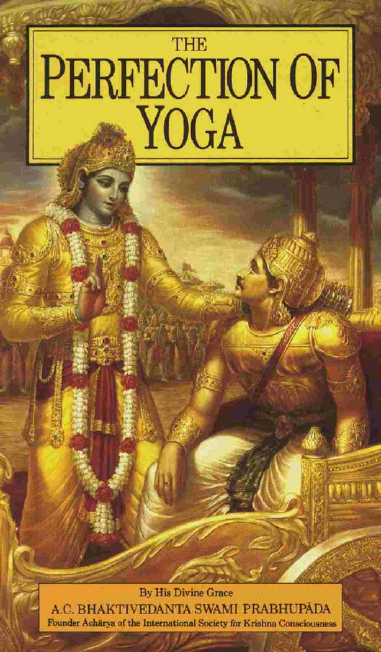
perfection of yoga. In the Bhagavad-gétä, Çré Kåñëa, the Supreme
Personality of Godhead, teaches Arjuna directly the perfection of yoga.
If we actually want to participate in the perfection of the yoga system, in
Bhagavad-gétä we will find the authoritative statements of the Supreme
Person.
It is certainly remarkable that the perfection of yoga was taught in the
middle of a battlefield. It was taught to Arjuna, the warrior, just before
Arjuna was to engage in a fratricidal battle. Out of sentiment, Arjuna
was thinking, “Why should I fight against my own kinsmen?” That
reluctance to fight was due to Arjuna’s illusion, and just to eradicate
that illusion, Çré Kåñëa spoke the Bhagavad-gétä to him. One can just
imagine how little time must have elapsed while Bhagavad-gétä was being
spoken. All the warriors on both sides were poised to fight, so there was
very little time indeed—at the utmost, one hour. Within this one hour,
the whole Bhagavad-gétä was discussed, and Çré Kåñëa set forth the
perfection of all yoga systems to His friend Arjuna. At the end of this
great discourse, Arjuna set aside his misgivings and fought.
However, within the discourse, when Arjuna heard the explanation of
the meditational system of yoga—how to sit down, how to keep the body
straight, how to keep the eyes half-closed and how to gaze at the tip of
the nose without diverting one’s attention, all this being conducted in a
secluded place, alone—he replied,
yo ’yaà yogas tvayä proktaù
sämyena madhusüdana
etasyähaà na paçyämi
caïcalatvät sthitià sthiräm

Copyright © 1998 The Bhaktivedanta Book Trust Int'l. All Rights Reserved.
2
“O Madhusüdana, the system of yoga which You have summarized
appears impractical and unendurable to me, for the mind is restless and
unsteady.” (Bg. 6.33) This is important. We must always remember that
we are in a material circumstance wherein at every moment our mind is
subject to agitation. Actually we are not in a very comfortable situation.
We are always thinking that by changing our situation we will overcome
our mental agitation, and we are always thinking that when we reach a
certain point, all mental agitations will disappear. But it is the nature of
the material world that we cannot be free from anxiety. Our dilemma is
that we are always trying to make a solution to our problems, but this
universe is so designed that these solutions never come.
Not being a cheater, being very frank and open, Arjuna tells Kåñëa that
the system of yoga which He has described is not possible for him to
execute. In speaking to Kåñëa, it is significant that Arjuna addresses
Him as Madhusüdana, indicating that the Lord is the killer of the demon
Madhu. It is notable that God’s names are innumerable, for He is often
named according to His activities. Indeed, God has innumerable names
because He has innumerable activities. We are only parts of God, and we
cannot even remember how many activities we have engaged in from
our childhood to the present. The eternal God is unlimited, and since
His activities are also unlimited, He has unlimited names, of which
Kåñëa is the chief. Then why is Arjuna addressing Him as Madhusüdana
when, being Kåñëa’s friend, he could address Him directly as Kåñëa? The
answer is that Arjuna considers his mind to be like a great demon, such
as the demon Madhu. If it were possible for Kåñëa to kill the demon
called the mind, then Arjuna would be able to attain the perfection of
yoga. “My mind is much stronger than this demon Madhu,” Arjuna is
saying. “Please, if You could kill him, then it would be possible for me to
execute this yoga system.” Even the mind of a great man like Arjuna is
always agitated. As Arjuna himself says,

Copyright © 1998 The Bhaktivedanta Book Trust Int'l. All Rights Reserved.
3
caïcalaà hi manaù kåñëa
pramäthi balavad dåòham
tasyähaà nigrahaà manye
väyor iva suduñkaram
“for the mind is restless, turbulent, obstinate and very strong, O Kåñëa,
and to subdue it is, it seems to me, more difficult than controlling the
wind.” (Bg. 6.34)
It is indeed a fact that the mind is always telling us to go here, go there,
do this, do that—it is always telling us which way to turn. Thus the sum
and substance of the yoga system is to control the agitated mind. In the
meditational yoga system the mind is controlled by focusing on the
Supersoul—that is the whole purpose of yoga. But Arjuna says that
controlling this mind is more difficult than stopping the wind from
blowing. One can imagine a man stretching out his arms trying to stop a
hurricane. Are we to assume that Arjuna is simply not sufficiently
qualified to control his mind? The actual fact is that we cannot begin to
understand the immense qualifications of Arjuna. After all, he was a
personal friend of the Supreme Personality of Godhead. This is a highly
elevated position and is one that cannot be at all attained by one
without great qualifications. In addition to this, Arjuna was renowned as
a great warrior and administrator. He was such an intelligent man that
he could understand Bhagavad-gétä within one hour, whereas at the
present moment great scholars cannot even understand it in the course
of a lifetime. Yet Arjuna was thinking that controlling the mind was
simply not possible for him. Are we then to assume that what was
impossible for Arjuna in a more advanced age is possible for us in this
degenerate age? We should not for one moment think that we are in
Arjuna’s category. We are a thousand times inferior.
Moreover, there is no record of Arjuna’s having executed the yoga
system at any time. Yet Arjuna was praised by Kåñëa as the only man
worthy of understanding Bhagavad-gétä. What was Arjuna’s great
qualification? Çré Kåñëa says, “You are My devotee. You are My very dear
friend.” Despite this qualification, Arjuna refused to execute the
meditational yoga system described by Çré Kåñëa. What then are we to

Copyright © 1998 The Bhaktivedanta Book Trust Int'l. All Rights Reserved.
4
conclude? Are we to despair the mind’s ever being controlled? No, it can
be controlled, and the process is this Kåñëa consciousness. The mind
must be fixed always in Kåñëa. Insofar as the mind is absorbed in Kåñëa,
it has attained the perfection of yoga.
Now when we turn to the Çrémad-Bhägavatam, in the Twelfth Canto we
find Çukadeva Gosvämé telling Mahäräja Parékñit that in the golden age,
the Satya-yuga, people were living for one hundred thousand years, and
at that time, when advanced living entities lived for such lengths of
time, it was possible to execute this meditational system of yoga. But
what was achieved in the Satya-yuga by this meditational process, and in
the following yuga, the Tretä-yuga, by the offering of great sacrifices,
and in the next yuga, the Dväpara-yuga, by temple worship, would be
achieved at the present time, in this Kali-yuga, by simply chanting the
names of God, hari-kértana, Hare Kåñëa. So from authoritative sources
we learn that this chanting of Hare Kåñëa, Hare Kåñëa, Kåñëa Kåñëa,
Hare Hare/ Hare Räma, Hare Räma, Räma Räma, Hare Hare is the
embodiment of the perfection of yoga for this age.
Today we have great difficulties living fifty or sixty years. A man may
live at the utmost eighty or a hundred years. In addition, these brief
years are always fraught with anxiety, with difficulties due to
circumstances of war, pestilence, famine and so many other
disturbances. We’re also not very intelligent, and, at the same time,
we’re unfortunate. These are the characteristics of man living in Kali-
yuga, a degraded age. So properly speaking, we can never attain success
in this meditational yoga system described by Kåñëa. At the utmost we
can only gratify our personal whims by some pseudoadaptation of this
system. Thus people are paying money to attend some classes in
gymnastic exercises and deep-breathing, and they’re happy if they think
they can lengthen their lifetimes by a few years or enjoy better sex life.
But we must understand that this is not the actual yoga system. In this
age that meditational system cannot be properly executed. Instead, all of
the perfections of that system can be realized through bhakti-yoga, the
sublime process of Kåñëa consciousness, specifically mantra-yoga, the
glorification of Çré Kåñëa through the chanting of Hare Kåñëa. That is
recommended in Vedic scriptures and is introduced by great authorities
like Caitanya Mahäprabhu. Indeed, the Bhagavad-gétä proclaims that the

Copyright © 1998 The Bhaktivedanta Book Trust Int'l. All Rights Reserved.
5
mahätmäs, the great souls, are always chanting the glories of the Lord. If
one wants to be a mahätmä in terms of the Vedic literature, in terms of
Bhagavad-gétä and in terms of the great authorities, then one has to
adopt this process of Kåñëa consciousness and of chanting Hare Kåñëa.
But if we’re content at making a show of meditation by sitting very
straight in lotus position and going into a trance like some sort of
performer, then that is a different thing. But we should understand that
such show-bottle performances have nothing to do with the actual
perfection of yoga. The material disease cannot be cured by artificial
medicine. We have to take the real cure straight from Kåñëa.

Copyright © 1998 The Bhaktivedanta Book Trust Int'l. All Rights Reserved.
6
Chapter Two
“Yoga as Work in Devotion”
We have heard the names of so many different yogas and yogés, but in
Bhagavad-gétä Kåñëa says that the actual yogé is he who has surrendered
himself “fully unto Me.” Kåñëa proclaims that there is no difference
between renunciation (sannyäsa) and yoga.
yaà sannyäsam iti prähur
yogaà taà viddhi päëòava
na hy asannyasta-saìkalpo
yogé bhavati kaçcana
“What is called renunciation is the same as yoga, or linking oneself with
the Supreme; for no one can become a yogé unless he renounces the
desire for sense gratification.” (Bg. 6.2)
In Bhagavad-gétä there are three basic types of yoga delineated—karma-
yoga, jïäna-yoga and bhakti-yoga. The systems of yoga may be likened to
a staircase. Someone may be on the first step, someone may be halfway
up, or someone may be on the top step. When one is elevated to certain
levels, he is known as a karma-yogé, jïäna-yogé, etc. In all cases, the
service to the Supreme Lord is the same. It is a difference in elevation
only. Thus Çré Kåñëa tells Arjuna that he must understand that
renunciation (sannyäsa) and yoga are the same, because without being
freed from desire and sense gratification one can become neither a yogé
nor a sannyäsé.
There are some yogés who perform yoga for a profit, but that is not real
yoga. Everything must be engaged in the service of the Lord. Whatever
we do as an ordinary worker or as a sannyäsé or as a yogé or as a
philosopher must be done in Kåñëa consciousness. When we are
absorbed in the thought of serving Kåñëa and when we act in that
consciousness, we can become real sannyäsés and real yogés. for those

Copyright © 1998 The Bhaktivedanta Book Trust Int'l. All Rights Reserved.
7
who are taking the first step up the staircase of the yoga system, there is
work. One should not think that simply because he is beginning yoga he
should stop working. In Bhagavad-gétä Kåñëa asks Arjuna to become a
yogé, but He never tells him to cease from fighting. Quite the contrary.
Of course, one may ask how a person may be a yogé and at the same time
a warrior. Our conception of yoga practice is that of sitting very straight,
with legs crossed and eyes half-closed, staring at the tip of our nose and
concentrating in this way in a lonely place. So how is it that Kåñëa is
asking Arjuna to become a yogé and at the same time participate in a
ghastly civil war? That is the mystery of Bhagavad-gétä: one can remain a
fighting man and at the same time be the highest yogé, the highest
sannyäsé. How is this possible? In Kåñëa consciousness. One simply has to
fight for Kåñëa, work for Kåñëa, eat for Kåñëa, sleep for Kåñëa and
dedicate all activities to Kåñëa. In this way one becomes the highest yogé
and the highest sannyäsé. That is the secret.
In the Sixth Chapter of Bhagavad-gétä, Çré Kåñëa instructs Arjuna how
to perform meditational yoga, but Arjuna rejects this as too difficult.
How then is Arjuna considered to be a great yogé? Although Kåñëa saw
that Arjuna was rejecting the meditational system, He proclaimed
Arjuna to be the highest yogé because “You are always thinking of Me.”
Thinking of Kåñëa is the essence of all yoga systems—of the haöha,
karma, jïäna, bhakti or any other system of yoga, sacrifice or charity. All
the recommended activities for spiritual realization end in Kåñëa
consciousness, in thinking always of Kåñëa. The actual perfection of
human life lies in being always Kåñëa conscious and always being aware
of Kåñëa while performing all types of activities.
In the preliminary stage one is advised to always work for Kåñëa. One
must be always searching out some duty or some engagement, for it is a
bad policy to remain idle even for a second. When one actually becomes
advanced through such engagements, then he may not work physically,
but he is always engaged within by constantly thinking of Kåñëa. In the
preliminary stage, however, one is always advised to engage one’s senses
in the service of Kåñëa. There are a variety of activities one can perform
in serving Kåñëa. The International Society for Krishna Consciousness
is intended to help direct aspirant devotees in these activities. for those
working in Kåñëa consciousness, there are simply not enough hours in

Copyright © 1998 The Bhaktivedanta Book Trust Int'l. All Rights Reserved.
8
the day to serve Kåñëa. There are always activities, engagements both
day and night, which the student of Kåñëa consciousness performs
joyfully. That is the stage of real happiness—constant engagement for
Kåñëa and spreading Kåñëa consciousness around the world. In the
material world one may become very tired if he works all the time, but if
one works in Kåñëa consciousness, he can chant Hare Kåñëa and engage
in devotional service twenty-four hours a day and never get tired. But if
we vibrate some mundane vibration, then we soon become exhausted.
There is no question of becoming tired on the spiritual platform. The
spiritual platform is absolute. In the material world everyone is working
for sense gratification. The profits of one’s labor in the material world
are used to gratify one’s senses. But a real yogé does not desire such fruits.
He has no desire other than Kåñëa, and Kåñëa is already there.

Copyright © 1998 The Bhaktivedanta Book Trust Int'l. All Rights Reserved.
9
Chapter Three
“Yoga as Meditation on Kåñëa”
In India there are sacred places where yogés go to meditate in solitude, as
prescribed in Bhagavad-gétä. Traditionally, yoga cannot be executed in a
public place, but insofar as kértana—mantra-yoga, or the yoga of
chanting the Hare Kåñëa mantra: Hare Kåñëa, Hare Kåñëa, Kåñëa Kåñëa,
Hare Hare/ Hare Räma, Hare Räma, Räma Räma, Hare Hare—is
concerned, the more people present, the better. When Lord Caitanya
Mahäprabhu was performing kértana in India some five hundred years
ago, He organized in each group sixteen people to lead the chanting, and
thousands of people chanted with them. This participation in kértana, in
the public chanting of the names and glories of God, is very possible and
is actually easy in this age; but as far as the meditational process of yoga
is concerned, that is very difficult. It is specifically stated in Bhagavad-
gétä that to perform meditational yoga one should go to a secluded and
holy place. In other words, it is necessary to leave home. In this age of
overpopulation it is not always possible to find a secluded place, but this
is not necessary in bhakti-yoga.
In the bhakti-yoga system there are nine different processes: hearing,
chanting, remembering, serving, worshiping the Deity in the temple,
praying, carrying out orders, serving Kåñëa as a friend and sacrificing for
Him. Out of these, çravaëaà kértanam, hearing and chanting, are
considered the most important. At a public kértana one person can
chant Hare Kåñëa, Hare Kåñëa, Kåñëa Kåñëa, Hare Hare/ Hare Räma,
Hare Räma, Räma Räma, Hare Hare, while a group listens, and at the
end of the mantra, the group can respond, and in this way there is a
reciprocation of hearing and chanting. This can easily be performed in
one’s own home, with a small group of friends or with many people in a
large public place. One may attempt to practice meditational yoga in a
large city or in a society, but one must understand that this is one’s own

Copyright © 1998 The Bhaktivedanta Book Trust Int'l. All Rights Reserved.
10
concoction and is not the method recommended in Bhagavad-gétä.
The whole process of the yoga system is to purify oneself. And what is
this purification? Purification ensues upon the realization of one’s actual
identity. Purification is realizing that “I am pure spirit—I am not this
matter.” Due to material contact, we are identifying ourselves with
matter, and we are thinking, “I am this body.” But in order to perform
real yoga one must realize his constitutional position as being distinct
from matter. The purpose of seeking out a secluded place and executing
the meditational process is to come to this understanding. It is not
possible to come to this understanding if one executes the process
improperly. In any case, this is the consideration of Lord Caitanya
Mahäprabhu:
harer näma harer näma
harer nämaiva kevalam
kalau nästy eva nästy eva
nästy eva gatir anyathä
[Adi 17.21]
“In this age of quarrel and disagreement [Kali-yuga], there is no other
way of spiritual realization but this chanting of the names. There is no
other way, there is no other way, there is no other way.”
It is generally thought, at least in the Western world, that the yoga
system involves meditating on the void. But the Vedic literatures do not
recommend meditating on any void. Rather, the Vedas maintain that
yoga means meditation on Viñëu, and this is also maintained in
Bhagavad-gétä. In many yoga societies we find that people sit cross-legged
and very straight, then close their eyes to meditate, and so fifty percent
of them go to sleep, because when we close our eyes and have no subject
matter for contemplation, we simply go to sleep. Of course, this is not
recommended by Çré Kåñëa in Bhagavad-gétä. One must sit very straight,
and the eyes be only half-closed, gazing at the tip of one’s nose. If one
does not follow the instructions, the result will be sleep and nothing
more. Sometimes, of course, meditation goes on when one is sleeping,
but this is not the recommended process for the execution of yoga. Thus,
to keep oneself awake Kåñëa advises that one always keep the tip of the
nose visible. In addition, one must be always undisturbed. If the mind is

Copyright © 1998 The Bhaktivedanta Book Trust Int'l. All Rights Reserved.
11
agitated or if there is a great deal of activity going on, one will not be
able to concentrate. In meditational yoga one must also be devoid of
fear. There is no question of fear when one enters spiritual life. And one
must also be brahmacäré, completely free from sex life. Nor can there be
any demands on one meditating in this way. When there are no
demands, and one executes this system properly, then he can control his
mind. After one has met all the requirements for meditation, he must
transfer his whole thought to Kåñëa, or Viñëu. It is not that one is to
transfer his thought to vacancy. Thus Kåñëa says that one absorbed in
the meditational yoga system is “always thinking of Me.”
The yogé obviously has to go through a great deal of difficulty to purify
the ätmä (mind, body and soul), but it is a fact that this can be done
most effectively in this age simply by the chanting of Hare Kåñëa, Hare
Kåñëa, Kåñëa Kåñëa, Hare Hare/ Hare Räma, Hare Räma, Räma Räma,
Hare Hare. Why is this? Because this transcendental sound vibration is
nondifferent from Kåñëa. When we chant His name with devotion, then
Kåñëa is with us, and when Kåñëa is with us, then what is the possibility
of remaining impure? Consequently, one absorbed in Kåñëa
consciousness, in chanting the names of Kåñëa and serving Him always,
receives the benefit of the highest form of yoga. The advantage is that
he doesn’t have to take all the trouble of the meditational process. That
is the beauty of Kåñëa consciousness.
In yoga it is necessary to control all of the senses, and when all the
senses are controlled, the mind must be engaged in thinking of Viñëu.
One becomes peaceful after thus conquering material life.
jitätmanaù praçäntasya
paramätmä samähitaù
“for one who has conquered the mind, the Supersoul is already reached,
for he has attained tranquillity.” (Bg. 6.7) This material world has been
likened to a great forest fire. As in the forest, fire may automatically
take place, so in this material world, although we may try to live
peacefully, there is always a great conflagration. It is not possible to live
in peace anywhere in the material world. But for one who is
transcendentally situated—either by the meditational yoga system or by
the empirical philosophical method or by bhakti-yoga—peace is possible.

Copyright © 1998 The Bhaktivedanta Book Trust Int'l. All Rights Reserved.
12
All forms of yoga are meant for transcendental life, but the method of
chanting is especially effective in this age. Kértana may go on for hours,
and one may not feel tired, but it is difficult to sit in lotus position
perfectly still for more than a few minutes. Yet regardless of the process,
once the fire of material life is extinguished, one does not simply
experience what is called impersonal void. Rather, as Kåñëa tells Arjuna,
one enters into the supreme abode.
yuïjann evaà sadätmänaà
yogé niyata-mänasaù
çäntià nirväëa-paramäà
mat-saàsthäm adhigacchati
“By meditating in this manner, always controlling the body, mind and
activities, the mystic transcendentalist attains to the kingdom of God
through cessation of material existence.” (Bg. 6.15) Kåñëa’s abode is not
void. It is like an establishment, and in an establishment there is a
variety of engagements. The successful yogé actually attains to the
kingdom of God, where there is spiritual variegatedness. The yoga
processes are simply ways to elevate oneself to enter into that abode.
Actually we belong to that abode, but being forgetful, we are put in this
material world. Just as a madman becomes crazy and is put into a lunatic
asylum, so we, losing sight of our spiritual identity, become crazy and are
put into this material world. Thus the material world is a sort of lunatic
asylum, and we can easily notice that nothing is done very sanely here.
Our real business is to get out and enter into the kingdom of God. In
Bhagavad-gétä Kåñëa gives information of this kingdom and also gives
instructions about His position and our position—of what He is and
what we are. All the information necessary is set forth in Bhagavad-gétä,
and a sane man will take advantage of this knowledge.

Copyright © 1998 The Bhaktivedanta Book Trust Int'l. All Rights Reserved.
13
Chapter Four
“Yoga as Body and Mind Control”
Throughout Bhagavad-gétä, Kåñëa was encouraging Arjuna to fight, for
he was a warrior, and fighting was his duty. Although Kåñëa delineates
the meditational yoga system in the Sixth Chapter, He does not stress it
or encourage Arjuna to pursue it as his path. Kåñëa admits that this
meditational process is very difficult:
çré-bhaga vän uväca
asaàçayaà mahä-bäho
mano durnigrahaà calam
abhyäsena tu kaunteya
vairägyeëa ca gåhyate
“The Blessed Lord said: O mighty-armed son of Kunté, it is undoubtedly
very difficult to curb the restless mind, but it is possible by constant
practice and by detachment.” (Bg. 6.35) Here Kåñëa emphasizes practice
and renunciation as ways to control the mind. But what is that
renunciation? Today it is hardly possible for us to renounce anything,
for we are so habituated to such a variety of material sense pleasures.
Despite leading a life of uncontrolled sense indulgence, we attend yoga
classes and expect to attain success. There are so many rules and
regulations involved in the proper execution of yoga, and most of us can
hardly give up a simple habit like smoking. In His discourse on the
meditational yoga system, Kåñëa proclaims that yoga cannot be properly
performed by one who eats too much or eats too little. One who starves
himself cannot properly perform yoga. Nor can the person who eats
more than required. The eating process should be moderate, just enough
to keep body and soul together; it should not be for the enjoyment of the
tongue. When palatable dishes come before us, we are accustomed to

Copyright © 1998 The Bhaktivedanta Book Trust Int'l. All Rights Reserved.
14
take not just one of the preparations but two, three and four—and
upwards. Our tongue is never satisfied. But it is not unusual in India to
see a yogé take only a small spoonful of rice a day and nothing more. Nor
can one execute the meditational yoga system if one sleeps too much or
does not sleep sufficiently. Kåñëa does not say that there is such a thing
as dreamless sleep. As soon as we go to sleep, we will have a dream,
although we may not remember it. In the Gétä Kåñëa cautions that one
who dreams too much while sleeping cannot properly execute yoga. One
should not sleep more than six hours daily. Nor can one infected by
insomnia, who cannot sleep at night, successfully execute yoga, for the
body must be kept fit. Thus Kåñëa outlines so many requirements for
disciplining the body. All these requirements, however, can essentially
be broken down into four basic rules: no illicit sexual connection, no
intoxication, no meat-eating and no gambling. These are the four
minimum regulations for the execution of any yoga system. And in this
age who can refrain from these activities? We have to test ourselves
accordingly to ascertain our success in yoga execution.
yogé yuïjéta satatam
ätmänaà rahasi sthitaù
ekäké yata-cittätmä
niräçér aparigrahaù
“ A transcendentalist should always try to concentrate his mind on the
Supreme Self; he should live alone in a secluded place and should always
carefully control his mind. He should be free from desires and feelings of
possessiveness.” (Bg. 6.10) from this verse we can understand that it is
the duty of the yogé to always remain alone. Meditational yoga cannot be
performed in an assembly, at least not according to Bhagavad-gétä. In the
meditational system it is not possible to concentrate the mind upon the
Supersoul except in a secluded place. In India, there are still many yogés
who assemble at the Kumba Melä. Generally they are in seclusion, but
on rare occasions they come to attend special functions. In India there
are still thousands of yogés and sages, and every twelve years or so they
meet in particular holy places—Allahabad, etc.—just as in America
they have businessmen’s conventions. The yogé, in addition to living in a
secluded place, should also be free from desires and should not think

Copyright © 1998 The Bhaktivedanta Book Trust Int'l. All Rights Reserved.
15
that he is performing yoga to achieve some material powers. Nor should
he accept gifts or favors from people. If he is properly executing this
meditational yoga, he stays alone in the jungles, forests or mountains
and avoids society altogether. At all times he must be convinced for
whom he has become a yogé. He does not consider himself alone because
at all times the Paramätmä—Supersoul—is with him. from this we can
see that in modern civilization it is indeed very difficult to execute this
meditational form of yoga properly. Contemporary civilization in this
age of Kali has actually made it impossible for us to be alone, to be
desireless and to be possessionless.
The method of executing meditational yoga is further explained in
considerable detail by Kåñëa to Arjuna. Çré Kåñëa says,
çucau deçe pratiñöhäpya
sthiram äsanam ätmanaù
näty-ucchritaà näti-nécaà
cailäjina-kuçottaram
tatraikägraà manaù kåtvä
yata-cittendriya-kriyaù
upaviçyäsane yuïjyäd
yogam ätma-viçuddhaye
“To practice yoga, one should go to a secluded place and should lay kuça
grass on the ground and then cover it with a deerskin and a soft cloth.
The seat should be neither too high nor too low and should be situated
in a sacred place. The yogé should then sit on it very firmly and should
practice yoga by controlling the mind and the senses, purifying the heart
and fixing the mind on one point.” (Bg. 6.11–12) Generally yogés sit on
tigerskin or deerskin because reptiles will not crawl on such skins to
disturb their meditations. It seems that in God’s creation there is a use
for everything. Every grass and herb has its use and serves some
function, although we may not know what it is. So in Bhagavad-gétä
Kåñëa has made some provision whereby the yogé doesn’t have to worry
about snakes. Having acquired a good sitting place in a secluded
environment, the yogé begins to purify the ätmä—body, mind and soul.
The yogé should not think, “Now I will try to achieve some wonderful

Copyright © 1998 The Bhaktivedanta Book Trust Int'l. All Rights Reserved.
16
powers.” Sometimes yogés do attain certain siddhis, or powers, but these
are not the purpose of yoga, and real yogés do not exhibit them. The real
yogé thinks, “I am now contaminated by this material atmosphere, so
now I must purify myself.”
We can quickly see that controlling the mind and body is not such an
easy thing and that we cannot control them as easily as we can go to the
store and purchase something. But Kåñëa indicates that these rules can
be easily followed when we are in Kåñëa consciousness.
Of course everyone is motivated by sex life, but sex life is not actually
discouraged. We have this material body, and as long as we have it, sex
desire will be there. Similarly, as long as we have the body, we must eat
to maintain it, and we must sleep in order to give it rest. We cannot
expect to negate these activities, but the Vedic literatures do give us
guidelines for regulation in eating, sleeping, mating, etc. If we at all
expect success in the yoga system, we cannot allow our unbridled senses
to take us down the paths of sense objects; therefore guidelines are set
up. Lord Çré Kåñëa is advising that the mind can be controlled through
regulation. If we do not regulate our activities, our mind will be more
and more agitated. It is not that activities are to be stopped, but
regulated by the mind always in Kåñëa consciousness. Being always
engaged in some activity connected with Kåñëa is actual samädhi. It is
not that when one is in samädhi he doesn’t eat, work, sleep or enjoy
himself in any way. Rather, samädhi can be defined as executing
regulated activities while absorbed in the thought of Kåñëa.
asaàyatätmanä yogo
duñpräpa iti me matiù
vaçyätmanä tu yatatä
çakyo ’väptum upäyataù
“for one whose mind is unbridled,” Kåñëa further says, “self-realization is
difficult work.” (Bg. 6.36) Anyone knows that an unbridled horse is
dangerous to ride. He can go in any direction at any speed, and his rider
is likely to come to some harm. Insofar as the mind is unbridled, Kåñëa
agrees with Arjuna that the yoga system is very difficult work indeed.
“But,” Kåñëa adds, “he whose mind is controlled and strives by right
means is assured of success. That is My judgment.” (Bg. 6.36) What is

Copyright © 1998 The Bhaktivedanta Book Trust Int'l. All Rights Reserved.
17
meant by “strives by right means”? One has to try to follow the four
basic regulative principles as mentioned and execute his activities
absorbed in Kåñëa consciousness.
If one wants to engage in yoga at home, then he has to make certain that
his other engagements are moderate. He cannot spend long hours of the
day working hard to simply earn a livelihood. One should work very
moderately, eat very moderately, gratify the senses very moderately and
keep his life as free from anxiety as possible. In this way practice of yoga
may be successful.
What is the sign by which we can tell that one has attained perfection
in yoga? Kåñëa indicates that one is situated in yoga when his
consciousness is completely under his control.
yadä viniyataà cittam
ätmany evävatiñöhate
nispåhaù sarva-kämebhyo
yukta ity ucyate tadä
“When the yogé, by practice of yoga, disciplines his mental activities and
becomes situated in Transcendence—devoid of all material desires—he
is said to have attained yoga.” (Bg. 6.18) One who has attained yoga is
not dependent on the dictations of his mind; rather, the mind comes
under his control. Nor is the mind put out or extinguished, for it is the
business of the yogé to think of Kåñëa, or Viñëu, always. The yogé cannot
allow his mind to go out. This may sound very difficult, but it is possible
in Kåñëa consciousness. When one is always engaged in Kåñëa
consciousness, in the service of Kåñëa, then how is it possible for the
mind to wander away from Kåñëa? In the service of Kåñëa, the mind is
automatically controlled.
Nor should the yogé have any desire for material sense gratification. If
one is in Kåñëa consciousness, he has no desire other than Kåñëa. It is
not possible to become desireless. The desire for sense gratification must
be overcome by the process of purification, but desire for Kåñëa should
be cultivated. It is simply that we have to transfer the desire. There is no
question of killing desire, for desire is the constant companion of the
living entity. Kåñëa consciousness is the process by which one purifies
his desires; instead of desiring so many things for sense gratification, one

Copyright © 1998 The Bhaktivedanta Book Trust Int'l. All Rights Reserved.
18
simply desires things for the service of Kåñëa. for example, we may desire
palatable food, but instead of preparing foodstuffs for ourselves, we can
prepare them for Kåñëa and offer them to Him. It is not that the action
is different, but there is a transfer of consciousness from thinking of
acting for my senses to thinking of acting for Kåñëa. We may prepare
nice milk products, vegetables, grains, fruits and other vegetarian dishes
for Kåñëa and then offer them to Him, praying, “This material body is a
lump of ignorance and the senses are a network of paths leading to
death. Of all the senses the tongue is the most voracious and difficult to
control. It is very difficult to conquer the tongue in this world; therefore
Çré Kåñëa has given us this nice prasäda, spiritual food, to conquer the
tongue. So let us take this prasäda to our full satisfaction and glorify
Their Lordships Çré Çré Rädhä and Kåñëa and in love call for the help of
Lord Caitanya and Nityänanda Prabhu.” In this way our karma is
sacrificed, for from the very beginning we are thinking that the food is
being offered to Kåñëa. We should have no personal desires for the food.
Kåñëa is so merciful, however, that he gives us the food to eat. In this
way our desire is fulfilled. When one has molded his life in such a way—
dovetailing his desires to Kåñëa’s—then it is to be understood that he
has attained perfection in yoga. Simply breathing deeply and doing some
exercises is not yoga as far as Bhagavad-gétä is concerned. A whole
purification of consciousness is required.
In the execution of yoga, it is very important that the mind is not
agitated.
yathä dépo niväta-stho
neìgate sopamä småtä
yogino yata-cittasya
yuïjato yogam ätmanaù
“As a lamp in a windless place does not waver, so the transcendentalist,
whose mind is controlled, remains always steady in his meditation on the
transcendent self.” (Bg. 6.19) When a candle is in a windless place, its
flame remains straight and does not waver. The mind, like the flame, is
susceptible to so many material desires that with the slightest agitation it
will move. A little movement of the mind can change the whole
consciousness. Therefore in India one seriously practicing yoga

Copyright © 1998 The Bhaktivedanta Book Trust Int'l. All Rights Reserved.
19
traditionally remained brahmacäré, or celibate. There are two kinds of
brahmacäré: one is completely celibate and the other is gåhastha-
brahmacäré, that is to say he has a wife, he does not associate with any
other woman, and his relations with his own wife are strictly regulated.
In this way, either by complete celibacy or restricted sex life, one’s mind
is kept from being agitated. Yet when one takes a vow to remain a
complete celibate, his mind may still be agitated by sexual desire;
therefore in India those practicing the traditional yoga under strict vows
of celibacy are not allowed to sit alone even with a mother, sister or
daughter. The mind is so fickle that the slightest suggestion can create
havoc.
The yogé should have his mind trained in such a way that as soon as his
mind wanders from meditation on Viñëu, he drags it back again. This
requires a great deal of practice. One must come to know that his real
happiness is in experiencing the pleasure of his transcendental senses,
not the material senses. Senses are not to be sacrificed, and desires are
not to be sacrificed, but there are both desires and sense satisfaction in
the spiritual sphere. Real happiness is transcendental to material,
sensual experience. If one is not convinced of this, he will surely be
agitated and will fall down. One should therefore know that the
happiness he is trying to derive from material senses is not really
happiness.
Those who are actually yogés truly enjoy, but how do they enjoy?
Ramante yogino ’nante—their enjoyment is unlimited, that unlimited
enjoyment is real happiness, and such happiness is spiritual, not
material. This is the real meaning of Räma, as in the chant Hare Räma.
Räma means enjoyment through spiritual life. Spiritual life is all
pleasure, and Kåñëa is all pleasure. We do not have to sacrifice pleasure,
but we do have to enjoy it properly. A diseased man cannot enjoy life;
his enjoyment of life is a false enjoyment. But when he is cured and is
healthy, then he is able to enjoy. Similarly, as long as we are in the
material conception of life, we are not actually enjoying ourselves but
are simply becoming more and more entangled in material nature. If a
sick man is not supposed to eat, his eating unrestrictedly actually kills
him. Similarly, the more we increase material enjoyment, the more we
become entangled in this world, and the more difficult it becomes to get

Copyright © 1998 The Bhaktivedanta Book Trust Int'l. All Rights Reserved.
20
free from the material entrapment. All of the systems of yoga are meant
to disentangle the conditioned soul from this entrapment, to transfer
him from the false enjoyment of material things to the actual enjoyment
of Kåñëa consciousness. Çré Kåñëa says,
yatroparamate cittaà
niruddhaà yoga-sevayä
yatra caivätmanätmänaà
paçyann ätmani tuñyati
sukham ätyantikaà yat tad
buddhi-grähyam aténdriyam
vetti yatra na caiväyaà
sthitaç calati tattvataù
yaà labdhvä cäparaà läbhaà
manyate nädhikaà tataù
yasmin sthito na duùkhena
guruëäpi vicälyate
taà vidyäd duùkha-saàyoga-
viyogaà yoga-saàjïitam
“In the stage of perfection called trance, or samädhi, one’s mind is
completely restrained from material mental activities by practice of yoga.
This is characterized by one’s ability to see the self by the pure mind and
to relish and rejoice in the self. In that joyous state, one is situated in
boundless transcendental happiness and enjoys himself through
transcendental senses. Established thus, one never departs from the
truth, and upon gaining this he thinks there is no greater gain. Being
situated in such a position, one is never shaken, even in the midst of
greatest difficulty. This indeed is actual freedom from all miseries arising
from material contact.” (Bg. 6.20–23) One form of yoga may be difficult
and another may be easy, but in all cases one must purify his existence to
the conception of Kåñëa conscious enjoyment. Then one will be happy.
yadä hi nendriyärtheñu
na karmasv anuñajjate
sarva-saìkalpa-sannyäsé

Copyright © 1998 The Bhaktivedanta Book Trust Int'l. All Rights Reserved.
21
yogärüòhas tadocyate
uddhared ätmanätmänaà
nätmänam avasädayet
ätmaiva hy ätmano bandhur
ätmaiva ripur ätmanaù
“A person is said to have attained to yoga when, having renounced all
material desires, he neither acts for sense gratification nor engages in
fruitive activities. A man must elevate himself by his own mind, not
degrade himself. The mind is the friend of the conditioned soul, and his
enemy as well.” (Bg. 6.4–5) We have to raise ourselves to the spiritual
standard by ourselves. In this sense I am my own friend and I am my own
enemy. The opportunity is ours. There is a very nice verse by Cäëakya
Paëòita: “No one is anyone’s friend, no one is anyone’s enemy. It is only
by behavior that one can understand who is his friend and who is his
enemy.” No one is born our enemy, and no one is born our friend. These
roles are determined by mutual behavior. As we have dealings with
others in ordinary affairs, in the same way the individual has dealings
with himself. I may act as my own friend or as an enemy. As a friend, I
can understand my position as spirit soul and, seeing that somehow or
other I have come into contact with material nature, try to get free from
material entanglement by acting in such a way as to disentangle myself.
In this case I am my friend. But if even after getting this opportunity I
do not take it, then I should be considered my own worst enemy.
bandhur ätmätmanas tasya
yenätmaivätmanä jitaù
anätmanas tu çatrutve
vartetätmaiva çatru-vat
“For he who has conquered the mind, the mind is the best of friends; but
for one who has failed to do so, his very mind will be the greatest
enemy.” (Bg. 6.6) How is it possible for one to become his own friend?
This is explained here. Ätmä means “mind,” “body” and “soul.” When we
speak of ätmä, insofar as we are in the bodily conception, we refer to the
body. However, when we transcend the bodily conception and rise to
the mental platform, ätmä refers to the mind. But actually when we are

Copyright © 1998 The Bhaktivedanta Book Trust Int'l. All Rights Reserved.
22
situated on the truly spiritual platform, then ätmä refers to the soul. In
actuality we are pure spirit. In this way, according to one’s spiritual
development, the meaning of the word ätmä differs. As far as the Nirukti
Vedic dictionary is concerned, ätmä refers to body, mind and soul.
However, in this verse of Bhagavad-gétä, ätmä refers to mind.
If, through yoga, the mind can be trained, then the mind is our friend.
But if the mind is left untrained, then there is no possibility of leading a
successful life. for one who has no idea of spiritual life, the mind is the
enemy. If one thinks that he is simply the body, his mind will not be
working for his benefit; it will simply be acting to serve the gross body
and to further condition the living entity and entrap him in material
nature. If, however, one understands one’s position as spirit soul apart
from the body, the mind can be a liberating factor. In itself, the mind
has nothing to do; it is simply waiting to be trained, and it is best trained
through association. Desire is the function of the mind, and one desires
according to his association; so if the mind is to act as friend, there must
be good association.
The best association is a sädhu, that is, a Kåñëa conscious person or one
who is striving for spiritual realization. There are those who are striving
for temporary things (asat). Matter and the body are temporary, and if
one only engages himself for bodily pleasure, he is conditioned by
temporary things. But if he engages himself in self-realization, then he is
engaged in something permanent (sat). Obviously if one is intelligent he
will associate with those who are trying to elevate themselves to the
platform of self-realization through one of the various forms of yoga. The
result will be that those who are sädhu, or realized, will be able to sever
his attachment to material association. This is the great advantage of
good association. for instance, Kåñëa speaks Bhagavad-gétä to Arjuna just
to cut off his attachment to this material affection. Because Arjuna is
attracted to things that are impeding the execution of his own duty,
Kåñëa severs these things. To cut something, a sharp instrument is
required; and to cut the mind from its attachments, sharp words are
often required. The sädhu or teacher shows no mercy in using sharp
words to sever the student’s mind from material attractions. By speaking
the truth uncompromisingly, he is able to sever the bondage. for
example, at the very beginning of Bhagavad-gétä Kåñëa speaks sharply to

Copyright © 1998 The Bhaktivedanta Book Trust Int'l. All Rights Reserved.
23
Arjuna by telling him that although he speaks like a learned man, he is
actually fool number one. If we actually want detachment from this
material world, we should be prepared to accept such cutting words from
the spiritual master. Compromise and flattery have no effect where
strong words are required.
In Bhagavad-gétä the material conception of life is condemned in so
many places. One who thinks the country in which he is born is
worshipable, or one who goes to holy places and yet ignores the sädhus
there, is likened unto an ass. As an enemy is always thinking of doing
harm, so the untrained mind will drag one deeper and deeper into
material entanglement. Conditioned souls struggle very hard with the
mind and with the other senses. Since the mind directs the other senses,
it is of utmost importance to make the mind the friend.
jitätmanaù praçäntasya
paramätmä samähitaù
çétoñëa-sukha-duùkheñu
tathä mänäpamänayoù
“For one who has conquered the mind, the Supersoul is already reached,
for he has attained tranquillity. To such a man happiness and distress,
heat and cold, honor and dishonor are all the same.” (Bg. 6.7) By
training the mind, one actually attains tranquillity, for the mind is
always dragging us over nonpermanent things, just as an unbridled horse
will pull a chariot on a perilous course. Although we are permanent and
eternal, somehow or other we have become attracted to nonpermanent
things. But the mind can be easily trained if it is simply fixed on Kåñëa.
Just as a fort is safe when it is defended by a great general, if Kåñëa is
placed in the fort of the mind, there will be no possibility of the enemy’s
entering. Material education, wealth and power will not help one to
control the mind. A great devotee prays, ‘ ‘When will I be able to think
of You constantly? My mind is always dragging me about, but as soon as I
am able to fix my mind on the lotus feet of Kåñëa, it becomes clear.”
When the mind is clear, it is possible to meditate on the Supersoul. The
Paramätmä, or Supersoul, is always seated within the heart along with
the individual soul. The yoga system involves concentrating the mind
and focusing it on the Paramätmä, or Supersoul, seated within the heart.

Copyright © 1998 The Bhaktivedanta Book Trust Int'l. All Rights Reserved.
24
The previously quoted verse from Bhagavad-gétä indicates that one who
has conquered the mind and has overcome all attachment to
nonpermanent things can be absorbed in thought of the Paramätmä.
One so absorbed becomes free from all duality and false designations.

Copyright © 1998 The Bhaktivedanta Book Trust Int'l. All Rights Reserved.
25
Chapter Five
“Yoga as Freedom from Duality and Designation”
This material world is a world of duality—at one moment we are
subjected to the heat of the summer season and at the next moment the
cold of winter. Or at one moment we’re happy and at the next moment
distressed. At one moment honored, at the next dishonored. In the
material world of duality, it is impossible to understand one thing
without understanding its opposite. It is not possible to understand what
honor is unless I understand dishonor. Similarly, I cannot understand
what misery is if I have never tasted happiness. Nor can I understand
what happiness is unless I have tasted misery. One has to transcend such
dualities, but as long as this body is here these dualities will be here also.
Insofar as one strives to get out of bodily conceptions—not out of the
body but out of bodily conceptions—one has to learn to tolerate such
dualities. In the Second Chapter of Bhagavad-gétä Kåñëa informs Arjuna
that the duality of distress and happiness is due to the body alone. It’s
like a skin disease, or skin itch. Just because there is itching, one should
not be mad after it to scratch it. We should not go mad or give up our
duty just because mosquitoes bite us. There are so many dualities one has
to tolerate, but if the mind is fixed in Kåñëa consciousness, all these
dualities will seem insignificant.

Copyright © 1998 The Bhaktivedanta Book Trust Int'l. All Rights Reserved.
26
How is it one can tolerate such dualities?
jïäna-vijïäna-tåptätmä
küöa-stho vijitendriyaù
yukta ity ucyate yogé
sama-loñöräçma-käïcanaù
“A person is said to be established in self-realization and is called a yogé
(or mystic) when he is fully satisfied by virtue of acquired knowledge
and realization. Such a person is situated in transcendence and is self-
controlled. He sees everything—whether it be pebbles, stones or gold—
as the same.” (Bg. 6.8) Jïäna means theoretical knowledge, and vijïäna
refers to practical knowledge. for instance, a science student has to study
theoretical scientific conceptions as well as applied science. Theoretical
knowledge alone will not help. One has to be able to also apply this
knowledge. Similarly, in yoga one should have not only theoretical
knowledge but practical knowledge. Simply understanding “I am not this
body” and at the same time acting in a nonsensical way will not help.
There are so many societies where the members seriously discuss
Vedänta philosophy while smoking and drinking and enjoying a sensual
life. It will not help if one only has knowledge theoretically. This
knowledge must be demonstrated. One who truly understands “I am not
this body” will actually reduce his bodily necessities to a minimum.
When one increases the demands of the body while thinking “I am not
this body,” then of what use is that knowledge? A person can only be
satisfied when there is jïäna and vijïäna side by aide.
When a person is situated on the practical level of spiritual realization, it
should be understood he is actually situated in yoga. It is not that one
should continue to attend yoga classes and yet remain the same
throughout his life; there must be practical realization. And what is the
sign of that practical realization? The mind will be calm and quiet and
no longer agitated by the attraction of the material world. Thus self-
controlled, one is not attracted by the material glitter, and he sees
everything—pebbles, stones or gold—as the same. In the material
civilization, so much paraphernalia is produced just to satisfy the senses.
These things are produced under the banner of material advancement.

Copyright © 1998 The Bhaktivedanta Book Trust Int'l. All Rights Reserved.
27
He who is situated in yoga sees such paraphernalia as just so much
rubbish in the street. Moreover,
suhån-miträry-udäséna-
madhyastha-dveñya-bandhuñu
sädhuñv api ca päpeñu
sama-buddhir viçiñyate
“A person is said to be still further advanced when he regards all—the
honest well-wisher, friends and enemies, the envious, the pious, the
sinner and those who are indifferent and impartial—with an equal
mind.” (Bg. 6.9) There are different kinds of friends. There is suhåt, who
is by nature a well-wisher and is always desiring one’s welfare. Mitra
refers to an ordinary friend, and udäséna is one who is neutral. In this
material world someone may be my well-wisher, friend or neither friend
nor enemy but neutral. Someone else may serve as a mediator between
me and my enemies, and in this verse he is called madhya-stha One may
also see someone as pious and another as sinful according to his own
calculations. But when he is situated in transcendence, all of these—
friends, enemies or whatever—cease to exist. When one becomes
actually learned, he does not see any enemy or any friend because in
actuality “no one is my enemy, no one is my friend, no one is my father,
no one is my mother, etc.” We are all simply living entities playing on a
stage in the dress of father, mother, children, friend, enemy, sinner and
saint, etc. It is like a great drama with so many characters playing their
parts. However, on the stage a person may be an enemy or whatever, but
off the stage all the actors are friends. Similarly, with these bodies we are
playing on the stage of material nature, and we attach so many
designations to one another. I may be thinking, “This is my son,” but in
actuality I cannot beget any son. It is not possible. At the utmost I can
only beget a body. It is not within any man’s power to beget a living
entity. Merely by sexual intercourse a living entity cannot be begotten.
The living entity must be placed in the emulsification of secretions. This
is the verdict of Çrémad-Bhägavatam. Thus all the multifarious
relationships between bodies are just so much stage play. One who is
actually realized and has actually attained yoga no longer sees these
bodily distinctions.

Copyright © 1998 The Bhaktivedanta Book Trust Int'l. All Rights Reserved.
28
Chapter Six
“The Fate of the Unsuccessful Yogé”
It is not that Bhagavad-gétä rejects the meditational yoga process; it
recognizes it as a bona fide method, but it further indicates that it is not
possible in this age. Thus the subject in the Sixth Chapter of Bhagavad-
gétä is quickly dropped by Çré Kåñëa and Arjuna. Arjuna next asks,
ayatiù çraddhayopeto
yogäc calita-mänasaù
apräpya yoga-saàsiddhià
käà gatià kåñëa gacchati
“What is the destination of the man of faith who does not persevere,
who in the beginning takes to the process of self-realization but who
later desists due to worldly-mindedness and thus does not attain
perfection in mysticism?” (Bg. 6.37) In other words, he is asking what
becomes of the unsuccessful yogé, or the person who attempts to perform
yoga but somehow desists and does not succeed. It is something like a
student who does not get his degree because he drops out of school.
Elsewhere in the Gétä, Çré Kåñëa points out to Arjuna that out of many
men, few strive for perfection, and out of those who strive for
perfection, only a few succeed. So Arjuna is inquiring after the vast
number of failures. Even if a man has faith and strives for perfection in
the yoga system, Arjuna points out that he may not attain this
perfection due to “worldly-mindedness.”

Copyright © 1998 The Bhaktivedanta Book Trust Int'l. All Rights Reserved.
29
kaccin nobhaya-vibhrañöaç
chinnäbhram iva naçyati
apratiñöho mahä-bäho
vimüòho brahmaëaù pathi
“O mighty-armed Kåñëa,” Arjuna continues, “does not such a man, being
deviated from the path of Transcendence, perish like a riven cloud, with
no position in any sphere?” (Bg. 6.38) When a cloud is torn apart by the
wind, it does not mend back together again.
etan me saàçayaà kåñëa
chettum arhasy açeñataù
tvad-anyaù saàçayasyäsya
chettä na hy upapadyate
“This is my doubt, O Kåñëa, and I ask You to dispel it completely. But for
Yourself, no one is to be found who can destroy this doubt.” (Bg. 6.39)
Arjuna is asking this question about the fate of the unsuccessful yogé so
that in the future people would not be discouraged. By a yogé, Arjuna is
referring to the haöha-yogé, jïäna-yogé and bhakti-yogé; it is not that
meditation is the only form of yoga. The meditator, the philosopher and
the devotee are all to be considered yogés. Arjuna is questioning for all
those who are attempting to become successful transcendentalists. And
how does Çré Kåñëa answer him?
çré-bhagavän uväca
pärtha naiveha nämutra
vinäças tasya vidyate
na hi kalyäëa-kåt kaçcid
durgatià täta gacchati
Here, as in many other places throughout the Gétä, Çré Kåñëa is referred
to as Bhagavän. This is another of the Lord’s innumerable names.
Bhagavän indicates that Kåñëa is the proprietor of six opulences: He
possesses all beauty, all wealth, all power, all fame, all knowledge and all
renunciation. Living entities partake of these opulences in finite

Copyright © 1998 The Bhaktivedanta Book Trust Int'l. All Rights Reserved.
30
degrees. One may be famous in a family, in a town, in a country or on
one planet, but no one is famous throughout the creation, as is Çré
Kåñëa. The leaders of the world may be famous for a few years only, but
Lord Çré Kåñëa appeared five thousand years ago and is still being
worshiped. So one who possesses all six of these opulences in
completeness is considered to be God. In Bhagavad-gétä Kåñëa speaks to
Arjuna as the Supreme Personality of Godhead, and as such it is to be
understood that He has complete knowledge. Bhagavad-gétä was
imparted to the sun-god and to Arjuna by Kåñëa, but nowhere is it
mentioned that Bhagavad-gétä was imparted to Kåñëa. Why? Complete
knowledge means that He knows everything that is to be known. This is
an attribute of God alone. Being that Kåñëa knows everything, Arjuna is
putting this question to Him about the fate of the unsuccessful yogé.
There is no possibility for Arjuna to research the truth. He simply has to
receive the truth from the complete source, and this is the system of
disciplic succession. Kåñëa is complete, and the knowledge that comes
from Kåñëa is also complete. If Arjuna receives this complete knowledge
and we receive it from Arjuna as it was spoken to him, then we also
receive complete knowledge. And what is this knowledge? “The Blessed
Lord said: Son of Påthä, a transcendentalist engaged in auspicious
activities does not meet with destruction either in this world or in the
spiritual world; one who does good, My friend, is never overcome by
evil.” (Bg. 6.40) Here Kåñëa indicates that the very striving for yoga
perfection is a most auspicious attempt. When one attempts something
so auspicious, he is never degraded.
Actually Arjuna is asking a very appropriate and intelligent question. It
is not unusual for one to fall down from the platform of devotional
service. Sometimes a neophyte devotee does not keep the rules and
regulations. Sometimes he yields to intoxication or is trapped by some
feminine attractions. These are impediments on the path of yoga
perfection. But Çré Kåñëa gives an encouraging answer, for He tells
Arjuna that even if one sincerely cultivates only one-percent worth of
spiritual knowledge, he will never fall down into the material whirlpool.
That is due to the sincerity of his effort. It should always be understood
that we are weak and that the material energy is very strong. To adopt
spiritual life is more or less to declare war against the material energy.

Copyright © 1998 The Bhaktivedanta Book Trust Int'l. All Rights Reserved.
31
The material energy is trying to entrap the conditioned soul as much as
possible, and when the conditioned soul tries to get out of her clutches
by spiritual advancement of knowledge, material nature becomes more
stringent and vigorous in her efforts to test how much the aspiring
spiritualist is sincere. The material energy, or mäyä, will then offer more
allurements.
In this regard, there is the story of Viçvämitra Muni, a great king, a
kñatriya, who renounced his kingdom and took to the yoga process in
order to become more spiritually advanced. At that time the
meditational yoga process was possible to execute. Viçvämitra Muni
meditated so intently that Indra, the King of heaven, noticed him and
thought, ‘ ‘This man is trying to occupy my post.” The heavenly planets
are also material, and there is competition—no businessman wants
another businessman to exceed him. fearing that Viçvämitra Muni
would actually depose him, Indra sent one heavenly society girl, named
Menakä, to allure him sexually. Menakä was naturally very beautiful,
and she was intent on disrupting the muni’s meditations. Indeed, he
became aware of her feminine presence upon hearing the sound of her
bangles, and he immediately looked up from his meditation, saw her, and
became captivated by her beauty. As a result, the beautiful girl
Çakuntalä was born by their conjugation. When Çakuntalä was born,
Viçvämitra lamented: “Oh, I was just trying to cultivate spiritual
knowledge, and again I have been entrapped.” He was about to flee
when Menakä brought his beautiful daughter before him and chastised
him. Despite her pleading, Viçvämitra resolved to leave anyway.
Thus there is every chance of failure on the yogic path; even a great sage
like Viçvämitra Muni can fall down due to material allurement.
Although the muni fell for the time being, he again resolved to go on
with the yoga process, and this should be our resolve. Kåñëa informs us
that such failures should not be cause for despair. There is the famous
proverb that “failure is the pillar of success.” In the spiritual life
especially, failure is not discouraging. Kåñëa very clearly states that even
if there is failure, there is no loss either in this world or in the next. One
who takes to this auspicious line of spiritual culture is never completely
vanquished.

Copyright © 1998 The Bhaktivedanta Book Trust Int'l. All Rights Reserved.
32
Now what actually happens to the unsuccessful spiritualist? Çré Kåñëa
specifically explains,
präpya puëya-kåtäà lokän
uñitvä çäçvatéù samäù
çucénäà çrématäà gehe
yoga-bhrañöo ’bhijäyate
[Bg. 6.41]
athavä yoginäm eva
kule bhavati dhématäm
etad dhi durlabhataraà
loke janma yad édåçam
[Bg. 6.42]
“The unsuccessful yogé, after many, many years of enjoyment on the
planets of the pious living entities, is born into a family of righteous
people, or into a family of rich aristocracy. Or he takes his birth in a
family of transcendentalists who are surely great in wisdom. Verily, such
a birth is rare in this world.” (Bg. 6.41–42) There are many planets in
the universe, and on the higher planets there are greater comforts, the
duration of life is longer, and the inhabitants are more religious and
godly. Since it is said that six months on earth is equal to one day on the
higher planets, the unsuccessful yogé stays on these higher planets for
many, many years. Vedic literatures describe their lifetimes as lasting ten
thousand years. So even if one is a failure, he is promoted to these higher
planets. But one cannot remain there perpetually. When the fruits or
the results of one’s pious activities expire, he has to return to earth. Yet
even upon returning to this planet, the unsuccessful yogé meets with
fortunate circumstances, for he takes his birth in either a very rich
family or a pious one.
Generally, according to the law of karma, if one enacts pious deeds, he is
rewarded in the next life by birth into a very aristocratic family or into a
very wealthy family, or he becomes a great scholar, or he is born very
beautiful. In any case, those who sincerely begin spiritual life are
guaranteed human birth in the next life—not only human birth, but

Copyright © 1998 The Bhaktivedanta Book Trust Int'l. All Rights Reserved.
33
birth into either a very pious or a very wealthy family. Thus one with
such a good birth should understand that his fortune is due to his
previous pious activities and to God’s grace. These facilities are given by
the Lord, who is always willing to give us the means to attain Him. Kåñëa
simply wants to see that we are sincere. In the Çrémad-Bhägavatam it is
stated that every particular person has his own duty in life, regardless of
his position and regardless of his society. If, however, he gives up his
prescribed duty and somehow—either out of sentiment or association or
craziness or whatever—takes shelter of Kåñëa, and if, due to his
immaturity, he falls from the devotional path, still there is no loss for
him. On the other hand, if a person executes his duties perfectly but
does not approach God, then what does he earn? His life is indeed
without benefit. But a person who has approached Kåñëa is better
situated, even though he may fall down from the yogic platform.
Kåñëa further indicates that of all good families to be born into—
families of successful merchants or philosophers or meditators—the best
is the family of yogés. One who takes birth in a very rich family may be
misled. It is normal for a man who is given great riches to try to enjoy
those riches; thus rich men’s sons often become drunkards or prostitute
hunters. Similarly, one who takes birth in a pious family or in a
brahminical family often becomes very puffed up and proud, thinking, “I
am a brähmaëa; I am a pious man.” There is chance of degradation in
both rich and pious families, but one who takes birth in a family of yogés
or of devotees has a much better chance of cultivating again that
spiritual life from which he has fallen. Kåñëa tells Arjuna,
tatra taà buddhi-saàyogaà
labhate paurva-dehikam
yatate ca tato bhüyaù
saàsiddhau kuru-nandana
“On taking such a birth, he again revives the divine consciousness of his
previous life, and he tries to make further progress in order to achieve
complete success, O son of Kuru.” (Bg. 6.43)
Being born in a family of those who execute yoga or devotional service,
one remembers his spiritual activities executed in his previous life.
Anyone who takes to Kåñëa consciousness seriously is not an ordinary

Copyright © 1998 The Bhaktivedanta Book Trust Int'l. All Rights Reserved.
34
person; he must have taken to the same process in his previous life. Why
is this?
pürväbhyäsena tenaiva
hriyate hy avaço ’pi saù
“By virtue of the divine consciousness of his previous life, he
automatically becomes attracted to the yogic principles—even without
seeking them.” (Bg. 6.44) In the material world, we have experience that
we do not carry our assets from one life to another. I may have millions
of dollars in the bank, but as soon as my body is finished, my bank
balance is also. At death, the bank balance does not go with me; it
remains in the bank to be enjoyed by somebody else. This is not the case
with spiritual culture. Even if one enacts a very small amount on the
spiritual platform, he takes that with him to his next life, and he picks
up again from that point.
When one picks up this knowledge that was interrupted, he should know
that he should now finish the balance and complete the yogic process.
One should not take the chance of finishing up the process in another
birth but should resolve to finish it in this life. We should be determined
in this way: “Somehow or other in my last life, I did not finish my
spiritual cultivation. Now Kåñëa has given me another opportunity, so
let me finish it up in this life.” Thus after leaving this body one will not
again take birth in this material world, where birth, old age, disease and
death are omnipresent, but will return to Kåñëa. One who takes shelter
under the lotus feet of Kåñëa sees this material world simply as a place of
danger. for one who takes to spiritual culture, this material world is
actually unfit. Çréla Bhaktisiddhänta Sarasvaté used to say, “This place is
not fit for a gentleman.” Once one has approached Kåñëa and has
attempted to make spiritual progress, Kåñëa, who is situated within the
heart, begins to give directions. In the Gétä, Çré Kåñëa says that for one
who wants to remember Him, He gives remembrance, and for one who
wants to forget Him, He allows him to forget.

Copyright © 1998 The Bhaktivedanta Book Trust Int'l. All Rights Reserved.
35
Chapter Seven
“Yoga as Reestablishing Relations with Kåñëa”
We have heard many times of the yoga system. The yoga system is
approved by Bhagavad-gétä, but the yoga system in Bhagavad-gétä is
especially meant for purification. The aim is threefold: to control the
senses, to purify activities and to link oneself to Kåñëa in a reciprocal
relationship.
The Absolute Truth is realized in three stages: impersonal Brahman,
localized Paramätmä (Supersoul) and ultimately Bhagavän, the Supreme
Personality of Godhead. In the final analysis, the Supreme Absolute
Truth is a person. Simultaneously He is the all-pervading Supersoul
within the hearts of all living entities and within the core of all atoms,
and He is the brahmajyoti, or the effulgence of spiritual light, as well.
Bhagavän Çré Kåñëa is full of all opulence as the Supreme Personality of
Godhead, but at the same time He is full of all renunciation. In the
material world we find that one who has much opulence is not very
much inclined to give it up, but Kåñëa is not like this. He can renounce
everything and remain complete in Himself.
When we read or study Bhagavad-gétä under a bona fide spiritual master
we should not think that the spiritual master is presenting his own
opinions. It is not he who is speaking. He is just an instrument. The real
speaker is the Supreme Personality of Godhead, who is both within and
without. At the beginning of His discourse on the yoga system in the
Sixth Chapter of Bhagavad-gétä, Çré Kåñëa says,

Copyright © 1998 The Bhaktivedanta Book Trust Int'l. All Rights Reserved.
36
anäçritaù karma-phalaà
käryaà karma karoti yaù
sa sannyäsé ca yogé ca
na niragnir na cäkriyaù
“One who is unattached to the fruits of his work and who works as he is
obligated is in the renounced order of life, and he is the true mystic; not
he who lights no fire and performs no work.” (Bg. 6.1) Everyone is
working and expecting some result. One may ask, What is the purpose of
working if no result is expected? A remuneration or salary is always
demanded by the worker. But here Kåñëa indicates that one can work
out of a sense of duty alone, not expecting the results of his activities. If
one works in this way, then he is actually a sannyäsé; he is in the
renounced order of life.
According to Vedic culture, there are four stages of life: brahmacäré,
gåhastha, vänaprastha and sannyäsa. Brahmacäré is student life devoted to
training in spiritual understanding. Gåhastha life is married householder
life. Then upon reaching the approximate age of fifty, one may take the
vänaprastha order—that is, he leaves his home and children and travels
with his wife to holy places of pilgrimage. finally he gives up both wife
and children and remains alone to cultivate Kåñëa consciousness, and
that stage is called sannyäsa, or the renounced order of life. Yet Kåñëa
indicates that for a sannyäsé, renunciation is not all. In addition, there
must be some duty. What then is the duty for a sannyäsé, for one who has
renounced family life and no longer has material obligations? His duty is
a most responsible one; it is to work for Kåñëa. Moreover, this is the real
duty for everyone in all stages of life.
In everyone’s life there are two duties: one is to serve the illusion, and
the other is to serve the reality. When one serves the reality, he is a real
sannyäsé. And when one serves the illusion, he is deluded by mäyä. One
has to understand, however, that he is in all circumstances forced to
serve. Either he serves the illusion or the reality. The constitutional
position of the living entity is to be a servant, not a master. One may
think that he is the master, but he is actually a servant. When one has a
family he may think that he is the master of his wife, or his children, or

Copyright © 1998 The Bhaktivedanta Book Trust Int'l. All Rights Reserved.
37
his home, business and so on, but that is all false. One is actually the
servant of his wife, of his children and of his business. The president
may be considered the master of the country, but actually he is the
servant of the country. Our position is always as servant—either as
servant of the illusion or as servant of God. If, however, we remain the
servant of the illusion, then our life is wasted. Of course everyone is
thinking that he is not a servant, that he is working only for himself.
Although the fruits of his labor are transient and illusory, they force him
to become a servant of illusion, or a servant of his own senses. But when
one awakens to his transcendental senses and actually becomes situated
in knowledge, he then becomes a servant of the reality. When one
comes to the platform of knowledge, he understands that in all
circumstances he is a servant. Since it is not possible for him to be
master, he is much better situated serving the reality instead of the
illusion. When one becomes aware of this, he attains the platform of real
knowledge. By sannyäsa, the renounced order of life, we refer to one
who has come to this platform. Sannyäsa is a question of realization, not
social status.
It is the duty of everyone to become Kåñëa conscious and to serve the
cause of Kåñëa. When one actually realizes this he becomes a mahätmä,
or a great soul. In Bhagavad-gétä Kåñëa says that after many births, when
one comes to the platform of real knowledge, he “surrenders unto Me.”
Why is this? Väsudevaù sarvam iti [Bg. 7.19]. The wise man realizes that
“Väsudeva [Kåñëa] is everything.” However, Kåñëa says that such a great
soul is rarely found. Why is this? If an intelligent person comes to
understand that the ultimate goal of life is to surrender unto Kåñëa, why
should he hesitate? Why not surrender immediately? What is the point
in waiting for so many births? When one comes to that point of
surrender, he becomes a real sannyäsé. Kåñëa never forces anyone to
surrender unto Him. Surrender is a result of love, transcendental love.
Where there is force and where there is no freedom, there can be no
love. When a mother loves a child, she is not forced to do so, nor does
she do so out of expectation of some salary or remuneration.
Similarly, we can love the Supreme Lord in so many ways—we can love
Him as master, as friend, as child or as husband. There are five basic
rasas, or relationships, in which we are eternally related to God. When

Copyright © 1998 The Bhaktivedanta Book Trust Int'l. All Rights Reserved.
38
we are actually in the liberated stage of knowledge, we can understand
that our relationship with the Lord is in a particular rasa. That platform
is called svarüpa-siddhi, or real self-realization. Everyone has an eternal
relationship with the Lord, either as master and servant, friend and
friend, parent and child, husband and wife, or lover and beloved. These
relationships are eternally present. The whole process of spiritual
realization and the actual perfection of yoga is to revive our
consciousness of this relationship. At present our relationship with the
Supreme Lord is pervertedly reflected in this material world. In the
material world, the relationship between master and servant is based on
money or force or exploitation. There is no question of service out of
love. The relationship between master and servant, pervertedly
reflected, continues only for so long as the master can pay the servant.
As soon as the payment stops, the relationship also stops. Similarly, in
the material world there may be a relationship between friends, but as
soon as there is a slight disagreement, the friendship breaks, and the
friend becomes an enemy. When there is a difference of opinion
between son and parents, the son leaves home, and the relationship is
severed. The same with husband and wife; a slight difference of opinion,
and there is divorce.
No relationship in this material world is actual or eternal. We must
always remember that these ephemeral relationships are simply
perverted reflections of that eternal relationship we have with the
Supreme Personality of Godhead. We have experience that the
reflection of an object in a glass is not real. It may appear real, but when
we go to touch it we find that there is only glass. We must come to
understand that these relationships as friend, parent, child, master,
servant, husband, wife or lover are simply reflections of that relationship
we have with God. When we come to this platform of understanding,
then we are perfect in knowledge. When that knowledge comes, we
begin to understand that we are servants of Kåñëa and that we have an
eternal love relationship with Him.
In this love relationship there is no question of remuneration, but of
course remuneration is there, and it is much greater than whatever we
earn here through the rendering of service. There is no limit to Çré
Kåñëa’s remuneration. In this connection there is the story of Bali

Copyright © 1998 The Bhaktivedanta Book Trust Int'l. All Rights Reserved.
39
Mahäräja, a very powerful king who conquered a number of planets. The
denizens of the heavenly planets appealed to the Supreme Lord to save
them, for they had been conquered by the demoniac king, Bali
Mahäräja. Upon hearing their pleas, Çré Kåñëa took the shape of a dwarf
brähmaëa boy and approached Bali Mahäräja, saying, “My dear king, I
would like something from you. You are a great monarch and are
renowned for giving in charity to the brähmaëas, so would you give Me
something?”
Bali Mahäräja said, “I will give You what You want.”
“I simply want whatever land I can cover in three steps,” the boy said.
“Oh, is that all?” the king replied. “And what will You do with such a
small piece of land?”
“Though it may be small, it will suffice Me,” the boy smiled.
Bali Mahäräja agreed, and the boy-dwarf took two steps and covered the
entire universe. He then asked Bali Mahäräja where He was going to
take His third step, and Bali Mahäräja, understanding that the Supreme
Lord was showing him His favor, replied, ‘ ‘My dear Lord, I have now lost
everything. I have no other property, but I do have my head. Would You
so kindly step there?”
Lord Çré Kåñëa was then very much pleased with Bali Mahäräja, and He
asked, “What would you like from Me?”
“I never expected anything from You,” Bali Mahäräja said. “But I
understand that You wanted something from me, and now I have offered
You everything.”
“Yes,” the Lord said, “but from My side I have something for you. I shall
remain always as an order-carrier servant in your court.” In this way the
Lord became Bali Mahäräja’s doorman, and that was his return. If we
offer something to the Lord, it is returned millions of times. But we
should not expect this. The Lord is always eager to return the service of
His servant. Whoever thinks that the service of the Lord is actually his
duty is perfect in knowledge and has attained the perfection of yoga.

Copyright © 1998 The Bhaktivedanta Book Trust Int'l. All Rights Reserved.
40
Chapter Eight
“The Perfection of Yoga”
It is a fact, therefore, that in the progress of the living entity toward the
perfection of yoga, birth in a family of yogés or devotees is a great boon,
for such a birth gives one special impetus.
prayatnäd yatamänas tu
yogé saàçuddha-kilbiñaù
aneka-janma-saàsiddhas
tato yäti paräà gatim
“But when the yogé engages himself with sincere endeavor in making
further progress, being washed of all contaminations, then ultimately,
after many, many births of practice, he attains the supreme goal.” (Bg.
6.45) When one is finally freed from all contaminations, he attains the
supreme perfection of the yoga system—Kåñëa consciousness.
Absorption in Kåñëa is the perfect stage, as Kåñëa Himself confirms:
bahünäà janmanäm ante
jïänavän mäà prapadyate
väsudevaù sarvam iti
sa mahätmä sudurlabhaù
“After many births and deaths, he who is actually in knowledge
surrenders unto Me, knowing Me to be the cause of all causes and all
that is. Such a great soul is very rare.” (Bg. 7.19) Thus after many
lifetimes of executing pious activities, when one becomes freed from all
contaminations arising from illusory dualities, he engages in the
transcendental service of the Lord. Çré Kåñëa concludes His discourse on
this subject in this way:

Copyright © 1998 The Bhaktivedanta Book Trust Int'l. All Rights Reserved.
41
yoginäm api sarveñäà
mad-gatenäntarätmanä
çraddhävän bhajate yo mäà
sa me yuktatamo mataù
“And of all yogés, he who always abides in Me with great faith,
worshiping Me in transcendental loving service, is most intimately
united with Me in yoga and is the highest of all.” (Bg. 6.47)
It therefore follows that the culmination of all yogas lies in bhakti-yoga,
the rendering of devotional service unto Kåñëa. Actually, all of the yogas
delineated in Bhagavad-gétä end on this note, for Kåñëa is the ultimate
destination of all the yoga systems. from the beginning of karma-yoga to
the end of bhakti-yoga is a long way to self-realization. Karma-yoga,
without fruitive results, is the beginning of this path. When karma-yoga
increases in knowledge and renunciation, the stage is called jïäna-yoga,
or the yoga of knowledge. When jïäna-yoga increases in meditation on
the Supersoul by different physical processes, and the mind is on Him, it
is called añöäìga-yoga. And, when one surpasses añöäìga-yoga and comes
to worship the Supreme Personality of Godhead, Kåñëa, that is called
bhakti-yoga, the culmination. factually, bhakti-yoga is the ultimate goal,
but to analyze bhakti-yoga minutely one has to understand the other
processes. The yogé who is progressive is therefore on the true path to
eternal good fortune. One who sticks to a particular point and does not
make further progress is called by that particular name—karma-yogé,
jïäna-yogé, dhyäna-yogé, räja-yogé, haöha-yogé, etc.—but if one is
fortunate enough to come to the point of bhakti-yoga, Kåñëa
consciousness, it is to be understood that he has surpassed all the other
yoga systems.
Kåñëa consciousness is the last link in the yogic chain, the link that
binds us to the Supreme Person, Lord Çré Kåñëa. Without this final link,
the chain is practically useless. Those who are truly interested in the
perfection of the yoga process should immediately take to Kåñëa
consciousness by chanting Hare Kåñëa, understanding Bhagavad-gétä,
and rendering service to Kåñëa through this society for Kåñëa

Copyright © 1998 The Bhaktivedanta Book Trust Int'l. All Rights Reserved.
42
consciousness and thereby surpass all other systems and attain the
ultimate goal of all yoga— love of Kåñëa.

The Perfection of Yoga
e-book
This e-book and others are available for download at:
Hard bound books may be purchased at:
Email comments or questions to:
This e-book was completed on November 16,2005
e-books copyright ©1998 Bhaktivedanta Book Trust International, all rights reserved
Distributed by
with permission of the publishers
Document Outline
- Copyright Notice
- The Perfection of Yoga
- Ch 1 "Yoga as Rejected by Arjuna"
- Ch 2 "Yoga as Work in Devotion"
- Ch 3 "Yoga as Meditation on Krsna"
- Ch 4 "Yoga as Body and Mind Control"
- Ch 5 "Yoga as Freedom from Duality and Designation"
- Ch 6 "The Fate of the Unsuccessful Yogi"
- Ch 7 "Yoga as Reestablishing Relations with Krsna"
- Ch 8 "The Perfection of Yoga"
- About e-vedas
Wyszukiwarka
Podobne podstrony:
Heart of Yoga
Wood great Systems of Yoga
Swami Krishnananda Process of Yoga
ESSENCE OF YOGA BY SRI SWAMI SIVA
Gopi Krishna Purpose of Yoga
Yoga The Alpha And The Omega Aka The Path Of Yoga, Vol 01 10
Yoga The Alpha And The Omega Aka The Path Of Yoga, Vol 08 10
Yoga The Alpha And The Omega Aka The Path Of Yoga, Vol 03 10
Yoga The Alpha And The Omega Aka The Path Of Yoga, Vol 07 10
Swami Krishnananda Textbook of Yoga
Crowley A Eight Lectures of Yoga
Yoga The Alpha And The Omega Aka The Path Of Yoga, Vol 02 10
Diamond Perfection Of Wisdom Sutra (Buddhism, Mind, Spirit, English
Gopi Krishna Kundalini Secret of Yoga
Yoga The Alpha And The Omega Aka The Path Of Yoga, Vol 10 10
Yoga The Alpha And The Omega Aka The Path Of Yoga, Vol 05 10
Osho Introduction to the Path of Yoga
Yoga The Alpha And The Omega Aka The Path Of Yoga, Vol 09 10
więcej podobnych podstron