
MQL4 COURSE
By Coders’ guru
-14-
Your First Expert Advisor
Part 2
--------------------
W
elcome to the second part of creating Your First Expert Advisor lesson.
In the previous part we have taken the code generated by the new program wizard and
added our own code which we are going to crack it today line by line.
Did you wear your coding gloves? Let’s crack.
Note: I have to repeat that our expert advisor is for educational purpose only and will
not (or aimed to) make profits.
The code we have:
//+------------------------------------------------------------------+
//| My_First_EA.mq4 |
//| Coders Guru |
//| http://www.forex-tsd.com |
//+------------------------------------------------------------------+
#property
copyright
"Coders Guru"
#property
link
//---- input parameters
extern
double
TakeProfit
=
250.0
;
extern
double
Lots
=
0.1
;
extern
double
TrailingStop
=
35.0
;
//+------------------------------------------------------------------+
//| expert initialization function |
//+------------------------------------------------------------------+
int
init
()
{
//----
//----
return
(
0
);
}
//+------------------------------------------------------------------+
//| expert deinitialization function |
//+------------------------------------------------------------------+
int
deinit
()
{
//----

//----
return
(
0
);
}
int
Crossed
(
double
line1
,
double
line2
)
{
static
int
last_direction
=
0
;
static
int
current_direction
=
0
;
if
(
line1
>
line2
)
current_direction
=
1
;
//up
if
(
line1
<
line2
)
current_direction
=
2
;
//down
if
(
current_direction
!=
last_direction
)
//changed
{
last_direction
=
current_direction
;
return
(
last_direction
);
}
else
{
return
(
0
);
}
}
//+------------------------------------------------------------------+
//| expert start function |
//+------------------------------------------------------------------+
int
start
()
{
//----
int
cnt
,
ticket
,
total
;
double
shortEma
,
longEma
;
if
(
Bars
<
100
)
{
(
"bars less than 100"
);
return
(
0
);
}
if
(
TakeProfit
<
10
)
{
(
"TakeProfit less than 10"
);
return
(
0
);
// check TakeProfit
}
shortEma
=
iMA
(
NULL
,
0
,
8
,
0
,
MODE_EMA
,
PRICE_CLOSE
,
0
);
longEma
=
iMA
(
NULL
,
0
,
13
,
0
,
MODE_EMA
,
PRICE_CLOSE
,
0
);
int
isCrossed
=
Crossed
(
shortEma
,
longEma
);
total
=
OrdersTotal
();
if
(
total
<
1
)
{
if
(
isCrossed
==
1
)

{
ticket
=
OrderSend
(
Symbol
(),
OP_BUY
,
Lots
,
Ask
,
3
,
0
,
Ask
+
TakeProfit
*
Point
,
"My EA"
,
12345
,
0
,
Green
);
if
(
ticket
>
0
)
{
if
(
OrderSelect
(
ticket
,
SELECT_BY_TICKET
,
MODE_TRADES
))
(
"BUY order opened : "
,
OrderOpenPrice
());
}
else
(
"Error opening BUY order : "
,
GetLastError
());
return
(
0
);
}
if
(
isCrossed
==
2
)
{
ticket
=
OrderSend
(
Symbol
(),
OP_SELL
,
Lots
,
Bid
,
3
,
0
,
Bid
-
TakeProfit
*
Point
,
"My EA"
,
12345
,
0
,
Red
);
if
(
ticket
>
0
)
{
if
(
OrderSelect
(
ticket
,
SELECT_BY_TICKET
,
MODE_TRADES
))
(
"SELL order opened : "
,
OrderOpenPrice
());
}
else
(
"Error opening SELL order : "
,
GetLastError
());
return
(
0
);
}
return
(
0
);
}
for
(
cnt
=
0
;
cnt
<
total
;
cnt
++)
{
OrderSelect
(
cnt
,
SELECT_BY_POS
,
MODE_TRADES
);
if
(
OrderType
()<=
OP_SELL
&&
OrderSymbol
()==
Symbol
())
{
if
(
OrderType
()==
OP_BUY
)
// long position is opened
{
// should it be closed?
if
(
isCrossed
==
2
)
{
OrderClose
(
OrderTicket
(),
OrderLots
(),
Bid
,
3
,
Violet
);
// close position
return
(
0
);
// exit
}
// check for trailing stop
if
(
TrailingStop
>
0
)
{
if
(
Bid
-
OrderOpenPrice
()>
Point
*
TrailingStop
)
{
if
(
OrderStopLoss
()<
Bid
-
Point
*
TrailingStop
)
{
OrderModify
(
OrderTicket
(),
OrderOpenPrice
(),
Bid
-
Point
*
TrailingStop
,
OrderTakeProfit
(),
0
,
Green
);
return
(
0
);
}
}
}
}
else
// go to short position
{

// should it be closed?
if
(
isCrossed
==
1
)
{
OrderClose
(
OrderTicket
(),
OrderLots
(),
Ask
,
3
,
Violet
);
// close position
return
(
0
);
// exit
}
// check for trailing stop
if
(
TrailingStop
>
0
)
{
if
((
OrderOpenPrice
()-
Ask
)>(
Point
*
TrailingStop
))
{
if
((
OrderStopLoss
()>(
Ask
+
Point
*
TrailingStop
))
||
(
OrderStopLoss
()==
0
))
{
OrderModify
(
OrderTicket
(),
OrderOpenPrice
(),
Ask
+
Point
*
TrailingStop
,
OrderTakeProfit
(),
0
,
Red
);
return
(
0
);
}
}
}
}
}
}
return
(
0
);
}
//+------------------------------------------------------------------+
The idea behind our expert advisor.
Before digging into cracking our code we have to explain the idea behind our expert
advisor. Any expert advisor has to decide when to enter the market and when to exit.
And the idea behind any expert advisor is what the entering and exiting conditions are?
Our expert advisor is a simple one and the idea behind it is a simple too, let’s see it.
We use two EMA indicators, the first one is the EMA of 8 days (sort EMA) and the
second one is the EMA of 13 days (long EMA).
Note: using those EMAs or any thought in this lesson is not a recommendation of mine,
they are for educational purpose only.
Entering (Open):
Our expert advisor will enter the market when the short EMA line crosses the long
EMA line, the direction of each lines will determine the order type:
If the short EMA is above the long EMA will buy (long).
If the short EMA is below the long EMA we will sell (short).

We will open only one order at the same time.
Exiting (Close):
Our expert advisor will close the buy order when the short EMA crosses the long EMA
and the short EMA is below the long EMA.
And will close the sell order when the short EMA crosses the long EMA and the short
EMA is above the long EMA.
Our order (buy or sell) will automatically be closed too when the Take profit or the Stop
loss points are reached.
Modifying:
Beside entering (opening) and exiting (closing) the market (positions) our expert advisor
has the ability to modify existing positions based on the idea of Trailing stop point.
We will know how we implemented the idea of Trialing stop later in this lesson.
Now let’s resume our code cracking.
//---- input parameters
extern
double
TakeProfit
=
250.0
;
extern
double
Lots
=
0.1
;
extern
double
TrailingStop
=
35.0
;
In the above lines we have asked the wizard to declare three external variables (which
the user can set them from the properties window of our expert advisor).
The three variables are double data type. We have initialized them to default values (the
user can change these values from the properties window, but it recommended to leave
the defaults).
I have to pause again to tell you a little story about those variables.
Stop loss:
It’s a limit point you set to your order when reached the order will be closed, this is
useful to minimize your lose when the market going against you.
Stop losses points are always set below the current asking price on a buy or above the
current bid price on a sell.
Trailing Stop
It’s a kind of stop loss order that is set at a percentage level below (for a long position) or
above (for a short position) the market price. The price is adjusted as the price fluctuates.
We will talk about this very important concept later in this lesson.
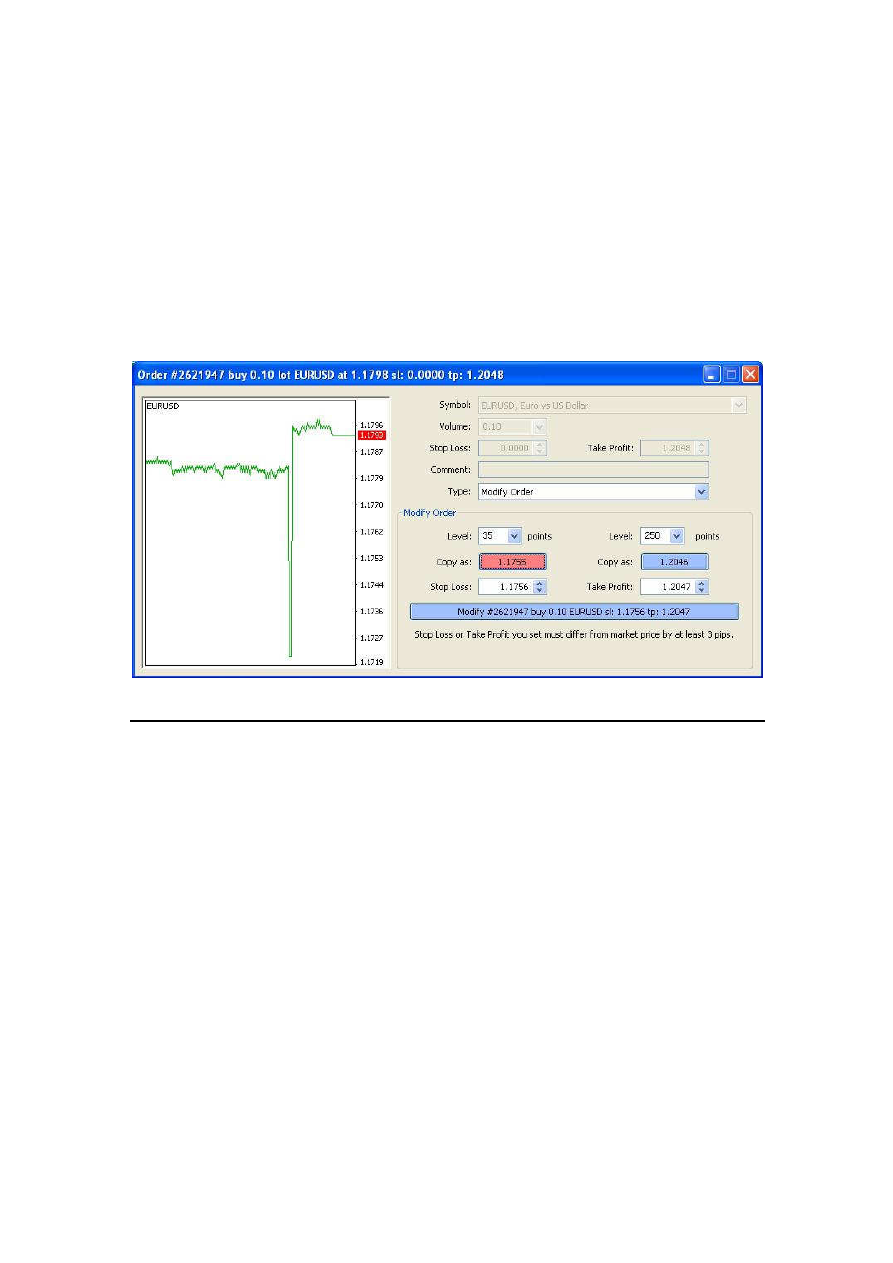
Take profit:
It’s similar to stop lose in that it’s a limit point you set to your order when reached the
order will be closed
There are, however, two differences:
•
There is no “trailing” point.
•
The exit point must be set above the current market price, instead of below.
Figure 1 – Setting Stop loss and Take profit points
int
Crossed
(
double
line1
,
double
line2
)
{
static
int
last_direction
=
0
;
static
int
current_direction
=
0
;
if
(
line1
>
line2
)
current_direction
=
1
;
//up
if
(
line1
<
line2
)
current_direction
=
2
;
//down
if
(
current_direction
!=
last_direction
)
//changed
{
last_direction
=
current_direction
;
return
(
last_direction
);
}
else
{
return
(
0
);
}
}

As I told you before, the idea behind our expert advisor is monitor the crossing of the
short EMA and the long EMA lines. And getting the direction of the crossing (which line
is above and which line is below) which will determine the type of the order (buy, sell,
buy-close and sell-close).
For this goal we have created the Crossed function.
The Crossed function takes two double values as parameters and returns an integer.
The first parameter is the value of the first line we want to monitor (the short EMA in our
case) and the second parameter is the value of the second we want to (the long EMA).
The function will monitor the two lines every time we call it by saving the direction of
the two lines in static variables to remember their state between the repeated calls.
•
It will return 0 if there’s no change happened in the last directions saved.
•
It will return 1 if the direction has changed (the lines crossed each others) and the
first line is above the second line.
•
It will return 2 if the direction has changed (the lines crossed each others) and the
first line is below the second line.
Note: You can use this function in your coming expert advisor to monitor any two lines
and get the crossing direction.
Let’s see how did we write it?
int
Crossed
(
double
line1
,
double
line2
)
The above line is the function declaration, it means we want to create Crossed function
which takes two double data type parameters and returns an integer.
When you call this function you have to pass to it two double parameters and it will
return an integer to you.
You have to declare the function before using (calling) it. The place of the function
doesn't matter, I placed it above start() function, but you can place it anywhere else.
static
int
last_direction
=
0
;
static
int
current_direction
=
0
;
Here we declared two static integers to hold the current and the last direction of the two
lines. We are going to use these variables (they are static variables which means they
save their value between the repeated calls) to check if there’s a change in the direction of
the lines or not.

we have initialized them to 0 because we don’t want them to work in the first call to the
function (if they worked in the first call the expert advisor will open an order as soon as
we load it in the terminal).
if
(current_direction != last_direction)
//changed
In this line we compare the two static variables to check for changes between the last call
of our function and the current call.
If last_direction not equal current_direction that’s mean there’s a change happened in the
direction.
last_direction
=
current_direction
;
return
(
last_direction
);
In this case (last_direction not equal current_direction) we have to reset our
last_direction by assigning to it the value of the current_direction.
And we will return the value of the last_direction. This value will be 1 if the first line is
above the second line and 2 if the first line is below the second line.
else
{
return
(
0
);
}
Else (last_direction is equal current_direction) there’s no change in the lines direction
and we have to return 0.
Our program will call this function in its start() function body and use the returned value
to determine the appropriate action.
In the coming part of this lesson we will know how did we call the function, and we will
know a lot about the very important trading functions.
To that day I hope you the best luck.
I welcome very much the questions and the suggestions.
See you
Coders’ Guru
01-12-2005
Wyszukiwarka
Podobne podstrony:
13 Lesson13 Your First Expert Advisor (Part 1)
15 Lesson15 Your First Expert Advisor (Part 3)
16 Lesson16 Your First Expert Advisor (Part 4)
11 Lesson11 Your First Indicator (Part2)
17 Lesson17 Your First Script
12 Lesson12 Your First Indicator (Part3)
Lekcje, Nauka.pl Lesson 14, Lesson 13
Chapter 3 Your room or mine part 4
Chapter 3 Your rooom or mine part 3
Daniel King Power Play Volume 14 Test Your Tactics
Build Your Double Bass Chops Part 1
Expert Advisors
You are on your first military mission
Build Your Double Bass Chops Part 2
Build Your Double Bass Chops Part 1 (continued)
więcej podobnych podstron