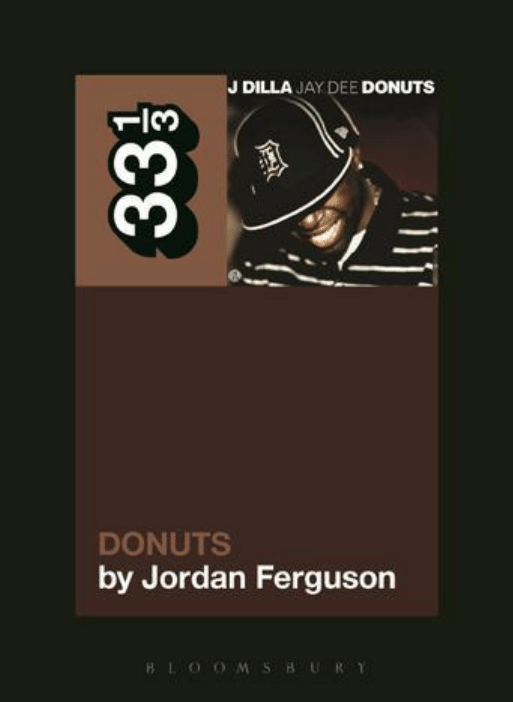

DONUTS
Praise for the series:
It was only a matter of time before a clever publisher realized that there
is an audience for whom Exile on Main Street or Electric Ladyland are as
significant and worthy of study as The Catcher in
the Rye or Middlemarch … The series … is freewheeling and
eclectic, ranging from minute rock-geek analysis to idiosyncratic personal
celebration—The New York Times Book Review
Ideal for the rock geek who thinks liner notes
just aren’t enough—Rolling Stone
One of the coolest publishing imprints on the planet—Bookslut
These are for the insane collectors out there who appreciate fantastic
design, well-executed thinking, and things that make your house look
cool. Each volume in this series takes a seminal album and breaks it
down in startling minutiae. We love these.
We are huge nerds—Vice
A brilliant series … each one a work of real love—NME (UK)
Passionate, obsessive, and smart—Nylon
Religious tracts for the rock ’n’ roll faithful—Boldtype
[A] consistently excellent series—Uncut (UK)
We … aren’t naive enough to think that we’re your only
source for reading about music (but if we had our way …
watch out). For those of you who really like to know everything
there is to know about an album, you’d do well to check
out Continuum’s “33 1/3” series of books—Pitchfork
For reviews of individual titles in the series, please visit our blog at
333sound.com
and our website at http://www.bloomsbury.com/
musicandsoundstudies
Follow us on Twitter: @333books
Like us on Facebook: https://www.facebook.com/33.3books
For a complete list of books in this series, see the back of this book.

Forthcoming in the series:
Smile by Luis Sanchez
Biophilia by Nicola Dibben
Ode to Billie Joe by Tara Murtha
The Grey Album by Charles Fairchild
Fresh Fruit for Rotting Vegetables by Mike Foley
Freedom of Choice by Evie Nagy
Live Through This by Anwyn Crawford
My Beautiful Dark Twisted Fantasy by Kirk Walker Graves
Dangerous by Susan Fast
Exile in Guyville by Gina Arnold
Definitely Maybe by Alex Niven
Sigur Ros: ( ) by Ethan Hayden
and many more …

Donuts
Jordan Ferguson

Bloomsbury Academic
An imprint of Bloomsbury Publishing, Inc.
1385 Broadway
50 Bedford Square
New York
London
NY 10018
WC1B 3DP
USA
UK
www.bloomsbury.com
Bloomsbury is a registered trade mark of Bloomsbury
Publishing Plc
First published 2014
© Jordan Ferguson, 2014
All rights reserved. No part of this publication may be reproduced
or transmitted in any form or by any means, electronic or
mechanical, including photocopying, recording, or any information
storage or retrieval system, without prior permission in writing from
the publishers.
No responsibility for loss caused to any individual or organization
acting on or refraining from action as a result of the material in this
publication can be accepted by Bloomsbury or the author.
Library of Congress Cataloging-in-Publication Data
Ferguson, Jordan, 1977- author.
J Dilla’s Donuts / Jordan Ferguson.
pages cm. -- (33 1/3)
Includes bibliographical references.
ISBN 978-1-62356-183-3 (pbk.)
1. J Dilla, 1974-2006. Donuts. 2. J Dilla, 1974-2006--Criticism and
interpretation. 3. Rap (Music)--History and criticism. I. Title.
ML420.J113F47 2014
782.421649092--dc23
2013046268
ISBN: 978-1-6235-6360-8
Typeset by Fakenham Prepress Solutions, Fakenham, Norfolk
NR21 8NN

Track Listing
1. “
Donuts (Outro)
” (0:11)
2. “
Workinonit
” (2:57)
3. “
Waves
” (1:38)
4. “
Light My Fire
” (0:35)
5. “
The New
” (0:49)
6. “
Stop
” (1:39)
7. “
People
” (1:24)
8. “
The Diff’rence
” (1:52)
9. “
Mash
” (1:31)
10. “
Time: The Donut of the Heart
” (1:38)
11. “
Glazed
” (1:21)
12. “
Airworks
” (1:44)
13. “
Lightworks
” (1:55)
14. “
Stepson of the Clapper
” (1:01)
15. “
The Twister (Huh, What)
” (1:16)
16. “
One Eleven
” (1:11)
17. “
Two Can Win
” (1:47)
18. “
Don’t Cry
” (1:59)
19. “
Anti-American Graffiti
” (1:53)
20. “
Geek Down
” (1:19)
21. “
Thunder
” (0:54)
22. “
Gobstopper
” (1:05)

D O N U T S
•
vi
•
23. “
One for Ghost
” (1:18)
24. “
Dilla Says Go
” (1:16)
25. “
Walkinonit
” (1:15)
26. “
The Factory
” (1:23)
27. “
U-Love
” (1:00)
28. “
Hi
.” (1:16)
29. “
Bye.
” (1:27)
30. “
Last Donut of the Night
” (1:39)
31. “
Welcome to the Show
”(1:12)

•
vii
•
Contents
Track Listing v
Acknowledgments viii
Welcome to the Show
1
The Diff’rence
7
Hi
12
Waves 24
Stop! 38
The Twister (Huh, What)
43
Workinonit 67
Two Can Win
78
Geek Down
83
The New
100
Bye
106
Endnotes 114
Works Cited 127

•
viii
•
Acknowledgments
This book owes its existence to David Barker, whose
championing of the open submission process for the
33 1/3 series kept the door open long enough for me
to stumble through. Special thanks as well to Ally Jane
Grossan and Kaitlin Fontana for shepherding the series
into a new era of continued success, and for handling my
occasional panicked emails with calm and poise.
For their patience, insight, assistance, and, above all,
time, thank you to: Jeff Jank, Eothen Alapatt, Freddy
Anzures, Khaiam Dar, Jay Hodgson, House Shoes, Linda
Hutcheon, Chris Manak, Ronnie Reese, J. Rocc, Joseph
Schloss, Les Seaforth, Waajeed, Dean van Nguyen, and
R. J. Wheaton.
For general support and sanity maintenance, thank
you to Greg Atkinson, Glenn Evans, Melanie Correia,
Chris Kozak, Jeff Meloche, the crews at YD 286 and
HHK Toronto, the Toronto Public Library, and, my
parents, Danny and Kathy Ferguson.

J O R D A N F E R G U S O N
•
ix
•
Raise it up for Ma Dukes.
Caitlin MacKinnon did the work.
Nicole Bryant kept the faith.
Sarah Jacobs saw it through.


•
1
•
Welcome to the Show
The Cedars-Sinai Medical Center makes for an unlikely
and unassuming hip-hop landmark. Located in the Fairfax
District of Los Angeles, the building is nevertheless a
monument on the topography of hip-hop tragedies. In
1994, NWA founder Eric ‘Eazy-E’ Wright died there
from complications brought on by AIDS. Three years
later, staff at Cedars-Sinai pronounced Christopher
Wallace, the Notorious B.I.G., dead on arrival after
suffering four gunshot wounds in a drive-by shooting
as he left a party at the nearby Petersen Automotive
Museum. Kanye West received reconstructive surgeries
following a 2004 auto collision. A year before doctors
repaired West’s jaw, Anthony Berkeley, known as the
rapper Too Poetic and a founding member of the under-
ground supergroup Gravediggaz, succumbed to colon
cancer there, addressing his condition on the group’s
final album. Cedars has been name-checked in lyrics
from Tyler the Creator, Slaughterhouse and Kool Keith.
But, despite the hospital’s role in some of the music’s
most tragic endings, Cedars-Sinai was also the site of
completion for some of the weirdest, most beautiful and
influential music the genre has ever seen.

D O N U T S
•
2
•
In 2005, 31-year-old rapper/producer James J Dilla
Yancey underwent treatment at Cedars-Sinai for compli-
cations brought on by a pair of autoimmune disorders:
thrombotic thrombocytopenic purpura (TTP), a
condition that causes microscopic clots to form in the
body’s blood vessels; and a form of lupus, which leaves
the body unable to distinguish between healthy and
damaged tissue. The combination of the two would leave
him dead within a year.
Lupus is a monstrous disease, causing the body to essen-
tially become allergic to itself: “Immunologically speaking,
it is the opposite of what happens in cancer or AIDS. In
lupus, the body overreacts to an unknown stimulus and
makes too many antibodies, or proteins directed against
body tissue.”
1
Coupled with TTP, the pair formed a brutal
tag-team of ailments that damaged Dilla’s kidneys and left
the joints in his hands swollen and stiff, particularly cruel
punishments for a man who spent his life flipping through
stacks of records and tapping out beats on the pads of a
sampler. Intensely private, he played down his condition
in the hip-hop press, referring to it as “this lil illness,” and
that he was in “A-1 health and everything.” He chalked
it up to malnutrition from eating poorly overseas.
2
Even
friends who came to see him in Cedars-Sinai didn’t ask too
many questions: “I poker faced it,” said Michael “House
Shoes” Buchanan, who was a longtime friend of Dilla’s
back in Detroit, where they both grew up. “It was hard as
hell.”
3
But while the illness debilitated his body, his mind
remained sharp, still dreaming up sounds that demanded
to be shared with the world.
Fans and followers know the story well: despite his
own body holding him hostage, J Dilla refused to go

J O R D A N F E R G U S O N
•
3
•
quietly; if he had to go, he was going to make sure he
left heads bobbing. With a makeshift recording setup
in his hospital room, a stack of records and a laptop,
he marshaled every last bit of strength in his weakened
frame, forcing his stiffened fingers to create the sounds
he heard in his mind. The result: a collection of 31 tracks
that would forever change the way beatmakers view their
art form, named after a favorite food he could no longer
eat.
J Dilla’s Donuts is not hip-hop music. Not as “hip-hop
music,” is typically defined and understood. There are no
raps, no hooks, no skits, no songs longer than 3 minutes;
most clock in at a minute and a half. There are beats,
yes; there are scratches and samples too, some of which
will be very familiar to hip-hop enthusiasts. But none of
the music on the album ever resolves itself; resolution
seems to be the last thing desired. Songs careen and
crash into each other, starting and stopping without
warning, never giving a listener the opportunity to
fully enter them; just when you’re getting comfortable,
as you familiarize yourself with the elements in front
of you and align your perspective to the workings of
Dilla’s mind, he flips it on you. For a man who loved to
frequently master and switch musical styles, Donuts acts
as a document of his career in miniature. The original
press release for the album likened it to scanning radio
stations in an unfamiliar city, a perfect description if
the station’s program director were playing half-broken
45s found buried out back of the building. The soulful
vocal melodies of The Jacksons, Dionne Warwick and
The Isley Brothers are scratched, chopped, pulled and
mutated into stunning, indecipherable aural pastiches.

D O N U T S
•
4
•
Tempos shift gears without warning; time stretches and
morphs, leaving the listener disoriented. The atmos-
phere can shift from sexy and lush string arrangements
to aggressive, obnoxious horn loops and sinister, futurist
synths, all within a five-minute span, the only constants
the crackly static of a needle in the groove, and the alarm
blast of a siren.
James Yancey had been many things by 2005: John
Doe, DJ Silk, Jay Dee, Dilla Dawg; a member of 1st
Down, Slum Village, The Ummah, The Soulquarians,
and Jaylib; the Motor City’s neglected son and Los
Angeles’s conquering hero. His productions for A Tribe
Called Quest, The Pharcyde, Common, Busta Rhymes
and Janet Jackson had made him legendary among those
in the industry and fans paying attention. But major
label frustrations and a refusal to take large paydays for
work he wasn’t passionate about had driven him back
underground, working with a trusted crew of MCs and
other collaborators, many of whom he came up with in
Detroit. His sound was equally mutable: setting aside
the syrupy basslines and crispy snares he innovated
and perfected throughout the 1990s in favor of the live
instrumentation, electro-influence and world sounds of
his solo debut
Welcome 2 Detroit
, and the lo-fi grime
found on the Ruff Draft EP and Champion Sound, his
collaboration with L.A.-based producer Madlib.
“He was always constantly reinventing himself, on
a monthly basis,” recalled House Shoes, a DJ who met
Dilla at Detroit’s Street Corner Music in the mid-90s
and became one of his most ardent local supporters.
“You know, the batch [of beats] you get this month didn’t
sound nothing like the batch you got last month, didn’t

J O R D A N F E R G U S O N
•
5
•
sound nothing like the batch you got the month before
that.”
4
As the beats that would eventually form Donuts began to
circulate, listeners discovered Dilla had opted to go in yet
another direction, a synthesis of everything he had done to
that point, taking the electro weirdness he’d favored earlier
in the decade, combining it with the rare groove sensi-
bilities of his 90s work, blending it with the soul revivalism
found in the music of chart-topping producers like Kanye
West or Just Blaze, and slicing, chopping and reworking it
into a sound singularly his own.
“When I heard all that together in the way he actually
wanted it to come out, I was like, Fuck me, man. These
last couple years has completely flipped music on its
head once again,” said Eothen “Egon” Alapatt, former
General Manager for Stones Throw Records, the Los
Angeles-based label that would eventually release Donuts.
“There’s no way anybody’s gonna know what to do
with this. It was so astronomically different from every-
thing that everybody had tried to do with that source
material.”
5
All as Dilla’s health continued to decline.
Despite sounding jarring and scattershot, Donuts is
a deceptively unified album, a work that challenges and
confronts expectations, designed to be listened to in its
entirety: a rarity in a genre not known for being album-
oriented. As Dilla told an interviewer in 2005, in maybe
the only public comment he made on the album before
his death, “It’s just a compilation of the stuff I thought
was a little too much for the MCs. That’s basically what it
is, ya know? Me flipping records that people really don’t
know how to rap on but they want to rap on.”
6

D O N U T S
•
6
•
Donuts was never meant for you. It was never meant
for me. It’s a private and personal record, a conver-
sation between an artist and his instrument, which just
happens to be the history of recorded music. It’s the final
testament of a man coming to terms with his mortality;
a last love letter to his family and the people he cared
about. It’s clearly a record about death; the evidence
found in its rebus of samples, sequencing and song titles
leaves little doubt of that.
More puzzling, though, is why a producer continually
heralded for his ability to find the best part of a record,
to pinpoint the prime cut of a song and loop it into a
slice of headknocking perfection, when faced with the
end of his life, would produce a final work as beautiful yet
intimidating and confrontational as Donuts. Dilla never
made mistakes; friends and colleagues say he would have
a beat assembled in his head before he even turned the
sampler on. Nothing was stumbled upon in the studio;
frankly, his health didn’t allow him the time for, or luxury
of, discovery. As a prolific producer and dedicated fan
with a voracious appetite for the history and mechanics
of the music he loved, he knew the records that went
into constructing Donuts inside and out. If it’s accepted
that Dilla made his final work a record about death, the
question becomes, why did he make this record about
death?

•
7
•
The Diff’rence
Despite being historically one of the major centers of
black culture in America, hip-hop came late to Detroit.
In the mid 70s and early 80s, the sound of Motown
wasn’t the party grooves of The Sugarhill Gang or
Kurtis Blow, but the pulsing synths and thudding 808s of
Afrika Bambaataa’s Planet Rock, brought to the airwaves
by freeform radio legends such as Jeff “The Wizard”
Mills and Charles Johnson, professionally known as The
Electrifying Mojo.
Mojo’s five-hour program on WJLB, “The Mothership
Connection,” refused to be constrained by what was
traditionally considered “black radio.” In a typical night,
listeners could hear New Order, Prince, The J. Geils
Band and Parliament-Funkadelic, often in the same
block of songs. His eclectic tastes and bold programming
decisions had a lasting influence on listeners, including
three teenagers from the suburbs named Juan Atkins,
Derrick May and Kevin Saunderson, who would come
together to eventually create the genre of techno.
“Mojo really had a lot of impact on music in Detroit.
He used to play a lot of German and British imports.
The first place I heard Kraftwerk was on his show, in

D O N U T S
•
8
•
78 or 79. He’d play anything from the B-52s to Jimi
Hendrix to Kraftwerk, Peter Frampton … all kinds of
stuff,” said Atkins. “He played all the Parliament and
Funkadelic that anybody ever wanted to hear. Those two
groups were really big in Detroit at the time. In fact, they
were one of the main reasons why disco didn’t really grab
hold in Detroit in 79. Mojo used to play a lot of funk just
to be different from all the other stations that had gone
over to disco. When [Funkadelic’s ‘Not Just] Knee Deep’
came out, that just put the last nail in the coffin of disco
music.”
1
Across the dial on WDRQ (and eventually snagging
Mojo’s spot on WJLB after he left the station) The
Wizard took Mojo’s encyclopedic musical knowledge
and turbo-boosted it, his nightly mixes blending records
at whirlwind speed across three turntables, usually only
for seconds at a time. Mills attributed his innovative style
as a reaction to the realities of radio broadcasting.
“Some people might say I mix very fast, from one
record to another. That basically came from radio. I
had to keep the people’s attention for a very short time,
because otherwise they’d flip the channel to another
station. I would have to keep the pace moving.”
2
Even after the realities of radio consolidation and
mandated playlists drove Mills and Mojo from the
airwaves by the late 1980s, their influence would be felt
for years afterward, creating a culture of dance music in
Detroit centered on minimalism, where the DJ, not the
MC, was the featured attraction.
This isn’t to say rap music was completely absent
from Detroit’s airwaves during the 1980s. The Scene,
a popular local dance show that aired at 6:00 p.m.

J O R D A N F E R G U S O N
•
9
•
daily on WGPR-TV, America’s first wholly black-
owned television station, made a hit of its theme song,
“Flamethrower Rap” by Felix and Jarvis, and featured
battles between area crews in its “Rap-A-Dance”
segments. By the end of the decade, aspiring MCs who
grew up watching The Scene and listening to “Billy T’s
Basement Tapes” on WGPR’s radio affiliate, brought
the tempos down and spoke to their experiences. Artists
like Awesome Dre, Kaos & Mystro, Smiley, and Detroit’s
Most Wanted began to carve out the city’s hip-hop
identity, reaching an early peak with the success of MC
Breed’s “Ain’t No Future in Your Frontin’.” A hybrid of
Midwest swagger and traditionally West Coast sample
sources (“Funky Worm,” by The Ohio Players, and Zapp
and Roger’s “More Bounce to the Ounce”) the success
of the single kept his debut album on the Billboard
R&B charts for an impressive 52 weeks.
3
Despite the
magnitude of his success, though, Detroit still couldn’t
claim a national breakthrough for itself: Breed was from
neighboring Flint, Michigan.
To the eyes of the world, the story coming out of
Detroit wasn’t hip-hop, it was techno, and within the
city limits divisions of taste and class were being drawn.
The success of techno overseas and the acclaim for
its founding fathers (the “Belleville Three” of Atkins,
Saunderson, and May) ensured most club spots were
dedicated to the new dance sound of the city, to the
exclusion of everything else: “Some flyers from early
techno dance events had explicitly banned ‘jits,’ a derog-
atory term for undesirable elements from Detroit’s black
working class youth. Of course, these same supposed
undesirables were some of the same youth that turned to

D O N U T S
•
10
•
hip hop. But at local dance clubs like the famous Music
Institute in downtown Detroit … this classist stance
against hip hop culture spilled on to the dance floor: no
rap was tolerated.”
4
With the dominance of techno in the Detroit club
scene, the city’s hip-hop lovers would have to find alter-
native venues.
No discussion of hip-hop in Detroit during the
1990s happens without a mention of Maurice Malone.
Originally a fashion designer who promoted techno
and dance parties on the side, Malone moved to New
York in 1990 to seek out new markets for his clothing
designs and educate himself about the fashion industry.
During his time there, he became enamored with that
city’s flourishing hip-hop scene, and returned to Detroit
a year later with a clear mandate: bring the energy and
enthusiasm he saw in NY back to the Motor City.
What initially began as a series of rotating events and
concerts called the Rhythm Kitchen, centered around a
weekly function at Stanley Hong’s Mannia Café on East
Baltimore Street, eventually expanded into the Hip-Hop
Shop, a retail space on West 7 Mile Road. Essentially an
outlet to sell Malone’s designer jeans and other items,
the marquee attractions were the open mic battles that
took place on Saturdays between 5:00 and 7:00 p.m.
The Saturday battles and the shop as a whole became a
mandatory destination for hip-hop heads, a space wholly
dedicated to the love and appreciation of the music and
the culture, and a place for the city’s growing crew of
artists to network and collaborate.
Malone built on the success of the Shop and began
running events in The Shelter on East Congress Street,

J O R D A N F E R G U S O N
•
11
•
located in the basement of St. Andrew’s Hall (made
famous as the scene of 8 Mile’s climactic rap battles).
The night quickly proved to be such a success it moved
to Saturday nights and took over the entire venue as
“Three Floors of Fun,” giving artists wider exposure to
a suburban audience that would come into the city on
weekends, thanks in part to the enthusiasm and advocacy
of resident DJ House Shoes.
Between the Rhythm Kitchen parties, the battles at
The Hip-Hop Shop and the “Three Floors of Fun,”
at St. Andrew’s, by the mid-1990s Detroit had finally
built itself a nurturing environment and community for
aspiring MCs and producers, including artists such as
Phat Kat, Elzhi, Eminem, and Dilla’s first group Slum
Village.

•
12
•
Hi
James DeWitt Yancey entered the world on February
7, 1974, the first of Beverly and Maureen “Ma Dukes”
Yancey’s three children. The family, raised in the Conant
Gardens neighborhood on Detroit’s northeast side, was
steeped in music: Beverly was a bassist and vocalist
who toured playing halftime shows with the Harlem
Globetrotters, Maureen classically trained in opera and
jazz vocal.
“Jazz was the music he grew up with and was raised
on,” said Ma Dukes. “Since he was a couple of months
old, he wouldn’t go to sleep unless he heard jazz, so my
husband had to sing and play for him to go to sleep. It
was his lullaby music as a child in his nursery.”
1
Dilla’s mother encouraged a love of music and
performance throughout her family, scheduling weekly
entertainment nights where each member would perform
for the others.
“Every Friday night was Family Night, everybody in
the household had to perform, entertain each other. It
was cheap! You didn’t have to pay to entertain. You eat
dinner and everyone would go in the living room. I had
mics in the living room like people have cocktail tables.

J O R D A N F E R G U S O N
•
13
•
So you just plug in, grab your mic and do your thing. But
everyone had to do something.”
2
Dilla’s love for music quickly changed from a private,
personal appreciation into a DJ’s need to spread the
gospel of the music they loved with others.
“He started playing records at two years old—he’d
spin records in Harmonie Park,” said Ma Dukes. “My
husband would get off of work and take James to the
park, and he’d have his arms full of 45s—his little arms,
you know, fit right through the holes. He’d take his 45s
and his record player to the park and spin records—adult
records, not kiddie records. My husband would take him
record shopping so he could play all the new releases.”
3
However, despite a continued passion and talent for
music that followed him through childhood and into
high school, his parents began to have concerns about
his future. When Dilla won admission to Detroit’s Davis
Aerospace Technical High School, Ma Dukes strongly
encouraged him to go, to nurture a natural gift he had
for the sciences.
“You don’t want your children to grow into something
that can’t be fulfilled within themselves, and I think
that’s where the fear came in … I insisted that he go
to [Davis]. This was an opportunity of a lifetime; they
chose one student from every middle school each year.
It was a hard process because [students] graduated with
a year of college.”
4
Dilla went reluctantly, not wanting
to disappoint his mother, though it wasn’t long before
his primary interest manifested. He was soon spinning
records at school parties at least once a month as DJ
Silk. Desperate to keep him enrolled at Davis, his mother
struck a compromise.

D O N U T S
•
14
•
“His counter-action was, ‘Well, I’m doing these DJ
gigs, you want me to go there, my name is DJ Silk, I
should be wearing silk shirts.’ So I’m like, ‘Okay, I’m
going to give you that. You’ll have every silk shirt.’ He
had a rainbow of colors, including pink, which he was
not afraid to wear. That drew a lot of attention. He knew
who he was so it didn’t bother him.”
5
Adding further tension to an already strained situation
was Dilla’s involvement with local musician Joseph
“Amp” Fiddler, a session keyboard player, songwriter
and producer who toured with George Clinton’s P-Funk
All-Stars. Fiddler was a neighborhood success story
(the Yanceys lived across the street from the church he
attended) who would offer any interested area youth an
invitation to visit his home studio and gain experience on
his equipment, to learn the mechanics of sampling and
production. For the young Dilla, it was too good an offer
to resist.
“That’s where we bumped heads, because he was
supposed to be at school early for lab class, but he was at
Amp’s all night in the studio … He was supposed to be
at school—at a school I wanted him to excel in!”
6
Amp cut a unique figure throughout the city: tall
and lanky with an expansive afro and beatnik beard,
often sporting large sunglasses with concaved lenses that
covered much of his face, he was a walking symbol to the
kids in Conant Gardens that not only could they succeed
and be true to themselves, but they could transcend an
environment already feeling the realities of growing
poverty and the crack epidemic.
“I would say Amp served, in my opinion, he served
more as a reference to like, ‘You can do this. You can

J O R D A N F E R G U S O N
•
15
•
get out of here, you can see the world, you can wear
weird-ass boots and still be relevant,’ ”
7
said Robert
“Waajeed” O’Bryant, another onetime Conant Gardens
resident and longtime Dilla confidante.
For his part, Dilla made an early impression on his
first mentor.
“He was the most respectful, the most gentleman-like
kid that I had come into my house because everyone else
was wild,” said Fiddler. “He was the only one that seemed
to have integrity, like, if he said he was coming at three
o’clock, he came at three o’clock. And a lot of people
don’t get that your word is everything and his word [was]
bond.”
8
Dilla soon became a fixture at Fiddler’s, making his
first attempts to transition from spinning other people’s
beats to making his own, applying the methodology he’d
picked up during his years of study at Davis. Even at
that early stage in his development, his nascent talent
emerged.
“When he first started making beats,” recalled Fiddler,
“he was just looping, but he had a particular way of doing
it. Most people would start on the one of the kick, but
he would start on the snare or the hi-hat or some other
shit and just fit it into the equation, like a mathematician.
I worked with a lot of people coming by and trying to
learn the MPC [sampler], trying to learn how to produce,
but nobody came like he did. They could do basic shit,
but they couldn’t do anything exceptional. He had an
exceptional ear for putting rhythms together.”
9
Fiddler maintained a relatively hands-off approach
with his “students” —they were free to use his equipment,
but he wasn’t going to hold their hands as they did so.

D O N U T S
•
16
•
“Actually, what Amp did, he’d play some stuff out
[on the MPC] but he was like, ‘I’m not going to show
you how to work it. You gotta learn on your own.’ He
was like, ‘Don’t use a book,’” Dilla recalled to Scratch
Magazine in 2006. “[To this] day I never read the books
to samplers and all of that, I just try to learn them.”
10
His
early exposure to this laissez-faire approach, free from the
prescribed intents and restrictions set by the manufac-
turers, working without rules, planted the seeds of a
philosophy that would guide Dilla throughout his career:
with no one telling him what he couldn’t do, there were
no limits to what he could.
Having established himself as a local DJ and gaining
experience by the day at Camp Amp, by his senior year of
high school, there weren’t enough silk shirts in the world
to keep Dilla at Davis Aerospace. He demanded his
mother allow him to transfer to the public high school,
Pershing Heights: “He put his foot down after that third
year and said, ‘It’s not happening. I don’t care what you
do to me,’” said Ma Dukes.
11
It wasn’t long before he and the other hip-hop talent
in the school began circling each other, primarily R. L.
“T3” Altman and Titus “Baatin” Glover. T3 and Baatin
were already respected as a duo throughout Pershing’s
hip-hop circles, when they caught wind of the new kid
with skills.
“We heard about J Dilla—which was Jay Dee then—a
guy who was really dope on the beats who went to Pershing
High School as well,” said T3. “At first, we just started out
being friends, kind of like that. Then he invited us to his
house. When we heard the beats, they were way ahead of
their time of what was out hip-hop wise back then.”
12

J O R D A N F E R G U S O N
•
17
•
Intrigued by what he was hearing about his new
classmate and impressed by the talent emerging in the
area, T3 selected a number of MCs, DJs, and aspiring
producers to an event at his grandmother’s house.
“I wouldn’t call it a competition, but just people
showcasing their talent in Detroit,” he said.
13
Impressed by each other’s talents, Dilla joined up
with T3 and Baatin, as well as Waajeed (who had
already worked as a producer with Baatin and who
bought beats from Dilla as early as 1992) and Dilla’s
cousin Que. D as a dancer, forming the crew Senepod, a
variation of the word “dopeness,” spelled backwards. “We
were doing high school stuff—rapping in the lunchroom
and vibing. Just basically keeping it moving,” said T3.
14
When Waajeed and Que. D focused on solo pursuits, the
remaining trio regrouped as Slum Village.
While the group is usually remembered as Dilla, T3
and, Baatin, membership was always a somewhat fluid
concept. Waajeed and Que. D were never far, and collab-
orations were frequent among other members of the
Pershing High/Conant Gardens hip-hop community.
“It was always some funny stuff like I was the fifth
Beatle or some shit,” said Ronnie “Phat Kat” Watts,
a frequent collaborator who met Dilla at the Rhythm
Kitchen and gave him his first commercial production
credit in 1995 as half of the duo 1st Down. “I mean, we
was crew, so I guess you could say I was an honorary
member.”
15
For Waajeed, the group always represented more than
music.
“Slum Village was meant to be a refuge for us not
to have to deal with hood shit. We wouldn’t have to be

D O N U T S
•
18
•
concerned with the neighborhood politics. It was our out
in terms of artistic expression, and ultimately it was our
out to get out of the hood.”
16
Despite the good intentions, T3 and Dilla directed
the early career of Slum Village, as Baatin had been lured
into the fast money and deadly risks of street life.
“Baatin had started selling drugs,” said T3, “and we
went to confront him about it. He was like, ‘Man, fuck
that … I gotta do what I gotta do.’ That’s when we
started Slum Village. Slum Village started as rebellion
against Baatin, to get him to fall back into hip-hop
again.”
17
In 1992 the group scored a management deal from
local R&B musician R. J. Rice and John Salley, a former
Detroit Piston turned actor and game show host. The
pair were given free rein in Rice’s home studio, allowing
them to improve the skills they’d already begun to build
at Camp Amp. Baatin quickly returned to the group full
time and they began developing the songs that would
eventually appear on the group’s demo, Fan-tas-tic Vol. 1.
Though raw, those early demos still feature signs
of the innovation that would come to define them:
the lyrical subject matter might never have strayed far
from the acquisition of wealth, cars, and women, but
they maintained a freestyle flavored, rhythmic, often
joyous vocal delivery. They meshed perfectly with Dilla’s
surprisingly mature and fully realized sonic palettes,
playing the warm Fender Rhodes samples and thick
basslines against bright, cracking snares. While music
typically precedes vocals in hip-hop song craft, T3 and
Baatin had an ear for flowing in and out of the grooves
of Dilla’s accents and melodies in a way that wasn’t

J O R D A N F E R G U S O N
•
19
•
typically seen from MCs, where lyrical complexity was
the order of the day. For Slum, it was all about that
swing, and if the words didn’t fit, make them fit. On the
four “Fantastic” interludes that appear throughout the
album, the trio’s lyrics barely form a complete sentence,
relying on “ay-yo”s and teeth sucking to pad out the bars,
but lyrical coherence was never the point. Instead, their
voices become another percussive instrument: Baatin’s
rasp, T3’s cocksure, nasally tone, and Dilla’s smoothed
out confidence unite to stick and move throughout the
beats with impressive agility.
On “I Don’t Know,” an early favorite, from Vol. 1,
the MCs frequently step to the side, allowing their
sentences to be finished, commented on or punctuated
by the signature shouts and yelps of the Godfather of
Soul, using some of hip-hop’s foundational materials in
unheard-of ways.
“[Dilla] had did it [with] just one verse with a couple
of stabs, and he came to my crib where me and Que. D
stayed,” said T3. “We got in the car and he played it. I
was like, ‘Ah man, that’s dope! You know what we should
do? We should all pick James Brown stabs and just make
it a whole song,’ … We just went through a bunch of
James Brown records and we just started picking stuff. I
got to pick the stabs, and we just told Dilla where to put
the stabs at, and we wrote our rhymes around the stabs
… I think we did that the same day he played it for us.”
18
“My recollection was, this group was on some other shit.
There was nothing—nothing— like that out at the time.
Nothing sounded like it, nothing felt like it,” recalled
American hip-hop producer DJ Spinna. “It was almost like
they were groove rappers or something, they were caught

D O N U T S
•
20
•
up in the moment, caught up in the way the beats made
you feel and just flowed with it. Totally letting the music
dictate how you flow on the record, and not really caring
about normalcy. And it further established Jay’s sound and
established him as a force to be reckoned with.”
19
Slum Village’s music, while influenced by the bangers
coming out of New York, built a sound that was distinctly
rooted in the aesthetic of the Motor City.
“Detroit is definitely more experimental, more
open-minded,” Dilla said in 1996. “The hip-hop’s more
creative than violent, like gangsta rap is. Because it’s
been influenced by all different kinds of music, not just
rap; everything from the house music on The New Dance
Show,
20
to Electrifying Mojo and The Wizard’s mix
shows. Growing up, that was what we had.”
21
“I feel like, because he came from Detroit, a lot of
the music whether it was techno, the real techno, you
know, or ghettotech or whatever, it’s music to make you
dance … I think he had that background, that’s why he
put that bounce, that oomph in his music, so you can
like, get into it,” said DJ Amir, a music historian and rare
groove specialist. “[In New York] … it was all about you
got your Walkman on in the subway just like mean, ill
screwface and shit. It’s not like you in the car or a club,
or the strip club and chicks are all up in your face, ass
wiggling in your face, you need music for that. You need
a soundtrack for that, and Dilla provided for that.”
22
For Waajeed, the music Slum made combined
the realities of where they were with aspirations for
something more.
“I think that Detroit, being in the middle [of the
U.S.], we like [A] Tribe [Called Quest] shit, but we like

J O R D A N F E R G U S O N
•
21
•
gangsta shit, too. We’re from the middle of the fucking
hood … After 1984, in terms of crack cocaine flooding
our streets, [Conant Gardens] became a fucking war
zone. It was really tough at that time, so our sensibilities
in music were street. But to some degree, we were kind
of hippies, so we identified with the East—Tribe and all
that other shit. It’s like conscious dudes that pack pistol;
that’s kind of what it was for us.”
23
As Dilla’s work with Slum Village and a tight-knit
crew of affiliated acts like Phat Kat, Que. D, and 5 Ela
continued to win acclaim, Amp Fiddler recognized a
perfect opportunity to help break his one-time protégé
on a national stage.
Fiddler was heading out on the 1994 edition of the
Lollapalooza tour as part of George Clinton’s band. Also
on the tour were New York hip-hop icons A Tribe Called
Quest, who had claimed their spot among the elite class
following the release of their third album Midnight
Marauders, and Amp was determined to get Dilla’s music
to Q-Tip, the group’s primary beatmaker.
Said Q-Tip, “When we started on the tour, [Amp]
came by … and he was like, ‘Yo, it’s a pleasure meeting
you, I got this kid, I really want you to hear him, you
gonna love him … I want you to meet him when we get
to Detroit.’ I was like, ‘All right.’ We had twelve cities to
get to Detroit and each day he would still come and say
the same thing to me. So, we finally get there and … I’m
on the tour bus and … I remember Dilla had on some
glasses and he came on smiling, the first thing I saw was
his smile … and he gave me his tape personally.”
24
The initial meeting between the two producers might
have been somewhat anticlimactic, but a late night bus

D O N U T S
•
22
•
ride was about to change not only Dilla’s life, but Q-Tip’s
as well.
On days off from Lollapalooza, Tribe performed
shows with longtime friends and colleagues De La Soul.
It was leaving one of these shows that Q-Tip popped in
the tape that Dilla had given him back in Detroit.
“I had my whole set up in the back of the bus. We’re
driving off to the next city, and I was listening to it like,
what the fuck is this shit? It was a Slum Village demo. And
then I looked … to see if anyone was around, cause like,
this shit is ill! … [Dave from De La Soul], he was the first
person I played Dilla shit for. I was like, ‘Yo, this dude is
ill, right?’ He’s like, ‘Uhhh, yeah. Yo, it sounds like your
shit but … Just, better.’”
25
In Dilla’s music, Q-Tip saw the familiarity of his own
influence and that of his peers, famed producers like Pete
Rock, Large Professor, and DJ Premier, but with a less
rigid, more organic, more human approach.
“The way he had shit [equalized], the way that it was
programmed … it was the most authentic feeling; he was
programming it, but it felt live, the swing of it, his time
signature[s] … the way that he had the swing percentages
26
on his beats and shit; like the way he had the music parti-
tioned—he had bass where it needed to be, the kick was
where it needed to be, the hi-hat … he was just clean, you
know what I mean? He had an understanding of it that he
could manipulate it any way that he wanted to.”
27
Armed with that demo, Q-Tip began playing the music
for colleagues and collaborators: the other members
of Tribe and De La Soul, the soul singer D’Angelo,
California rap crew The Pharcyde; without exception,
Dilla’s beats were turning heads.

J O R D A N F E R G U S O N
•
23
•
“Slowly but surely I started playing it for people,
and I called his house, I was like, ‘Yo, man, people gotta
hear your shit somehow. We gotta figure something
out,’” said Q-Tip.
28
To that end, he invited Dilla to join
him in The Ummah, a production collective that also
included Tribe’s DJ Ali Shaheed Muhammad and former
Tony! Toni! Toné! member Raphael Saadiq. With Q-Tip
spreading the word and his work catching the ears of
everyone who heard it, Dilla was ready to step out into
what would be his first golden age.

•
24
•
Waves
Once upon a time, no one knew where hip-hop music
came from. Thousands bought the records but, for
most, the kicks and claps coming out of their stereos
were anonymous, built in service of the true attraction:
the MC. The first breakout rap singles featured session
players performing original compositions or recreating
the disco hits of the day, emulating the loops and breaks
popular at the block parties where rap was performed.
One of these session players was Larry Smith, a bassist
from Queens, New York, and early partner of future Def
Jam Records co-founder Russell Simmons.
Smith had played on a few hits for rap superstar
Kurtis Blow in the early 1980s, but his partner was losing
patience with the prominent aesthetic in the hip-hop of
the time, all disco grooves and uptown fashion. Simmons
believed rap should reflect the sound and the look of
where it came from, and, as work began on a demo for
his younger brother Joe and his buddy Darryl, Simmons
urged Smith to strip away at his arrangements, making
them sparse and beat-driven, with little care for melody.
Smith ended up taking the beat from the single
“Action” by his band Orange Krush and programmed it

J O R D A N F E R G U S O N
•
25
•
into a drum machine. He called it the “Krush Groove.”
Joe and Darryl wrote some rhymes about their skills on
the mic and the wackness of their competitors, and didn’t
bother with a hook or chorus. Nothing more than a beat
and rhymes, the success of Run-DMC’s “Sucker MC’s”
snatched rap away from the disco and planted it firmly
on the block, establishing the percussive focus that would
come to define the music.
Following the success of “Sucker MC’s” and
Run-DMC’s other early singles, Smith signed on to
produce the sophomore album for Brooklyn crew
Whodini after Russell Simmons took over their
management. Where Smith’s approach in Run-DMC
was decidedly minimalist, Whodini were looking for a
wider audience, something for the b-boys and the clubs,
and encouraged Smith to take the pounding drums of
“Sucker MC’s” and reintegrate the melody and instru-
mentation of the earlier party records. The resulting
album, 1984’s Escape, earned the group their first gold
record and established Smith’s diversity as a producer.
Talking with Rime magazine in 2003, Dilla cited
Larry Smith’s drum work as the spark that ignited his
interest in beat-making: “When I heard ‘Sucker MC’s’
and [Whodini’s] ‘Big Mouth’, it made me curious to how
the beats were made. Those songs were the first time I
heard the beats that weren’t melodic—just drums. Being
someone who was taking drum lessons at the time, that
made me real curious. That led me into deejaying, which
slowly led to me doing parties and that led me into
production.”
1
One aspiring producer who was less enamored
with the sounds of the 80s was Marlon “Marley Marl”

D O N U T S
•
26
•
Williams, a DJ on radio legend Mr. Magic’s Rap Attack
show on New York’s WBLS.
“In those days, Kurtis Blow was the king as producer
… They started throwing little singing hooks in there,
havin’ them Linn and DMX drum beats—all that dumb
shit soundin’ stupid. But I was Magic’s DJ, and since
[Kurtis] was his man I had to play all these wack records
that I hated. I was like, ‘Yo, man, I can make better shit
than this.’”
2
Quality is subjective, but Marley did change the face
of production forever when he ran a sampler through a
drum machine, using it to trigger previously recorded
acoustic drum sounds instead of the preloaded electronic
instruments.
“I was trying to sample a vocal for a chorus and the
snare went in accidentally. And I started playing the
snare along with the track and it made it sound better.
[It was like], ‘Do you know what this means? We can take
any drum sound off of any record, manipulate it, make
our own patterns off of it.’ And immediately I went and
got [The Honey Drippers’] ‘Impeach the President.’ … I
always noticed that every time I would play “Impeach the
President” at a party it was the banger. I probably made
like ten records with those drum sounds. In the same
week.”
3
It cannot be overstated how much Marley’s innovation
shattered every previously established rule of hip-hop
production. The limitations forced on producers by their
equipment were removed and replaced with a freedom
restricted only by the creativity of the individual. The
entirety of recorded sound became the producers’ toolbox,
and they attacked and pillaged their record collections,

J O R D A N F E R G U S O N
•
27
•
working every classic party-rocking break they could find
into their songwriting with a nuance and flexibility they’d
never had before. Hip-hop would never sound the same.
Marley was also a canny self-promoter: MC’s dropped
his name in their lyrics, he made cameo appearances
in their videos, he even recorded the occasional intro-
duction or ad-lib in the gravelly high-pitched tone of an
old-timey prospector. The strategy worked, and by the
late 1980s most rap fans knew that, if they saw Marley’s
name on the record, it would be worth a listen. Popular
singles for members of his “Juice Crew” posse as well as
his work with acts like Eric B. & Rakim solidified Marley’s
track record as a hitmaker, so much so that Cold Chillin’
Records offered him a deal to produce a solo album,
1988s In Control Volume I. The album featured ten tracks
produced by Marley, showcasing new and established
members of the Juice Crew, most successfully on the
monster posse cut, “The Symphony.” In Control estab-
lished the producer as something more than a shadowy
figure buried in the credits of a record: he was an artist in
his own right, a curator and director able to express his
personality through his collaborative choices.
“It was definitely an important thing to have a
producer thought of as an artist, especially [in 1988].
Up to that point, the vocalist or MC was the person
that an album was about. Positioning me like that on the
album was something different for the whole game,” said
Marley. “I had never thought of doing my own album,
but with In Control I was one of the first producers to
actually step up as an artist.”
4
Following Marley’s success with In Control, producers
began to assert themselves as personalities in front of the

D O N U T S
•
28
•
mic as well as behind the boards: Q-Tip and Dr. Dre
rhymed as well as produced for their respective groups;
Gang Starr’s DJ Premier used his skills as a turntablist
to add his own sonic signature all over their records;
Prince Paul, who assisted and directed De La Soul’s first
three albums, was the honorary fourth man of the group,
appearing in, and inventing the concept of album skits,
and showing up in early videos as a Rod Serling-like host,
offering bizarre philosophical conundrums before the
featured attraction started.
As DJs and producers took inspiration from Marley’s
use of sampling, the first wave of source material began
to dry up: how many ways could someone flip “Impeach
the President,” or the James Brown catalog without it
starting to grow stale, creating the same sort of sonic
monotony that frustrated Marley enough to try and
change the music in the first place? One way to avoid
that particular problem was to cast a wider net, moving
away from the funk and soul standards DJs might have
heard coming out of their parents’ stereos, and going
more esoteric, digging deeper into jazz, fusion, pop,
and rock, never discounting a potential source because
it didn’t originate in the traditionally sampled genres.
Prince Paul and Q-Tip had already started down this
road in the late 80s, but it was Mount Vernon, New
York’s Pete Rock who perfected it.
Pete started as a DJ in high school, building a solid
reputation, and caught a break filling in on Marley Marl’s
WBLS radio show in 1988 when the regular DJ was
injured in a car accident. He ended up keeping the job.
“Being close to Marley made me take all my work
to a step higher—it brought me to that next level. He

J O R D A N F E R G U S O N
•
29
•
brought sampling to the world’s attention with the tracks
he did, and so many cats followed what he did. I wanted
to know, ‘Damn, how can I make beats like that but also
have my own swing and aura to them?’ And after a while
of doing beats on my own, I made my own identity. But
I learned a lot from Marley, and from listening to guys
like Larry Smith.”
5
Pete’s approach to beats not only incorporated more
instruments (primarily horns) into a predominantly
drum and bass-driven music, but brought a serious crate-
digging aesthetic to his sample selection.
“When I looked at [his] record collection, I was so
mad!” said veteran hip-hop A&R man Dante Ross,
who signed Pete and his partner CL Smooth to Elektra
Records. “Not only did he have every record I had, but
he also had every record I wanted. It was amazing.”
6
Pete Rock’s two albums with CL Smooth (1992’s Mecca
and The Soul Brother and 1994’s The Main Ingredient)
sounded like little that had come before: The drums
hit harder, the basslines were funky and filtered, the
horns brought added musicality and sophistication to the
compositions, and the samples were new and unfamiliar to
all but the most dedicated vinyl collectors. They also paid
close attention to sequencing, and would often include
musical interludes before and after the tracks, usually
short loops of jazz and soul records (not unlike what can
be heard on Donuts). Pete’s interludes are a testament to
his skill and dedication as a crate digger, a quick flash to
remind listeners and competitors that for every hot track
on the album, he could have added two more just as easily.
And he could brand himself as well as he could produce:
where Marley Marl would drop the occasional ad-lib,

D O N U T S
•
30
•
Pete Rock’s voice was all over his records, sometimes
rapping verses or laying down hooks, but most often
operating in the back of the mix, punctuating the work
of the MC’s, doubling their vocals or responding to a
hot line with an “Aw yeah” or “Whoo,” just as a DJ or
hype man would during a live performance. His remixes
usually opened with a reminder to listeners that they
were, in fact, about to hear “Another Pete Rock remix.”
He seasoned his beats with his voice, removing the
dividing glass between the artist and producer, while
marketing himself in the process, a uniquely hip-hop
technique that’s been appropriated ever since by contem-
porary beatmakers including Timbaland, Diddy, and
Pharrell Williams.
Pete Rock’s approach to sampling and songwriting
had a massive impact on the generation behind him,
including Dilla, who often cited Pete as his idol. After
hearing Dilla’s demo from Q-Tip, Pete hopped a plane
to meet the up and comer: “[W]hen he first brought me
his beat tape I was floored. I mean absolutely floored like
who is this!? To the point that I had bought a ticket to go
to Detroit just to meet homie.” Upon meeting the source
of his inspiration, Dilla told Pete that when he started
making beats, “I was trying to be you.”
7
House Shoes
summed up Pete’s influence with trademark candor:
“Before I heard Jay, Pete Rock was Jesus Christ.”
8
As sampling became the predominant method of
making hip-hop music, an interesting thing started
happening: An unspoken code of rules and ethics
began to evolve among its practitioners. Not “ethics,”
inasmuch as whether it’s appropriate to take one
artist’s previously recorded work and reconstruct it

J O R D A N F E R G U S O N
•
31
•
into something new (obtaining legal permission, or
“clearing,” samples being standard procedure by the
early 1990s), but how those samples should be used:
What you could take, how you took it, and it in
what ways you could use it and still be respected by
your peers. Through years of listening, longtime fans
could instinctively pick up these codes based on what
they heard in the music, but ethnomusicologist Joseph
G. Schloss took pains to outline them in his 2004
book Making Beats: The Art of Sample Based Hip-Hop.
Based on numerous interviews with producers and DJs,
Schloss breaks the rules down to six commandments:
No biting, no sampling from anything other than
vinyl, no sampling hip-hop records, no sampling from
records one respects, no sampling from reissues or
complilation albums, and no sampling multiple instru-
ments from the same record.
No “Biting”
While not the cardinal sin it once was, flagrantly copying
or appropriating another producer’s work (or “biting”)
is still not looked upon favorably, as it takes the work of
another producer who found, sampled and re-arranged
(“chopped”) the source, and presents it as one’s own. The
general rule is not to sample a record already used by
another producer, but, if one does, put in the appropriate
work to make a new sound out of it. Controversies over
biting can still flare up, as when Pete Rock took issue
with producer B-Side for biting the beat to Pete’s best
known work, “They Reminisce Over You (T.R.O.Y.)” for
Chicago MC Lupe Fiasco’s “Around My Way (Freedom

D O N U T S
•
32
•
Ain’t Free)” in 2011, calling it “fuckery,” and “corny,” on
Twitter.
9
Viny l is the only acceptable sample s ource
In an era of digital, this rule might seem archaic and unrea-
sonable, but its origins are twofold. For one, digging for
records is considered by most producers a rite of passage,
how up and comers develop their musical knowledge
base,
10
regardless of whether they sample records or
make, “keyboard beats,” with drum machines and synthe-
sizers. But there’s also practicality at work: hardware
samplers generally have limited storage space for each
individual sample (22 seconds each on Akai’s MPC 3000,
for example). But by sampling a 33 1/3 RPM record at 45
revolutions per minute and then slowing it back down to
the original speed, a producer could get around the equip-
ment’s limitations and squeeze out more sample time at a
lower quality, something a digital format wouldn’t allow.
Additionally, much of the music people are interested in
sampling is never released digitally; it only exists on vinyl
copies that have since gone out of print.
Don’t sample other hip-hop re cords
Something as simple as a snare sound on a hip-hop
record can be the result of hours of labor spent isolating,
sampling, and equalizing the frequencies of the sample
to get the desired sound. Sampling from hip-hop records
is another example of letting someone else do the work,
and can be seen as disrespectful to the producer who did.

J O R D A N F E R G U S O N
•
33
•
Don’t sample re cords you resp e ct
The logic being, if sampling a classic record doesn’t
improve upon the original, it shouldn’t be done, and is
usually not a sufficient challenge if it is, they’re too easily
identifiable by the public. And if it was already dope to
begin with, why risk messing it up?
Don’t sample from reissues or compi lations
A corollary of sorts to the second rule, using reissues of
out of print records or compilations (such as the Ultimate
Breaks and Beats series, which collected numerous songs
with notable samples or breakbeats in one place) is
considered unethical because, “[s]imply put, compila-
tions are seen as a shortcut. They save the producer
much of the effort that was previously necessary to make
a beat.”
11
Don’t sample more than one element from
a re cord
As with most of these guidelines, taking multiple sounds
off of the same record is considered lazy, and limiting:
What new elements is the producer adding if he or
she takes components that were already designed to fit
together? It’s far more impressive to take disparate pieces
and adjust pitch, tempo, and equalization to make them
fit together.
These ethical codes, typically self-imposed by
members of the production community, would seem to
center around two axes: “Is it lazy?” and “Is it creative?”

D O N U T S
•
34
•
If it’s lazy, or a means of avoiding effort, the rule should
be the guide; if breaking the rule results in something
new and unexpected, violations can be forgiven.
Few producers seemed to flagrantly violate the estab-
lished rules of hip-hop production like J Dilla. Those
who speak of him often return to not only his almost
monastic work ethic, but also the fact that he refused to
be limited by anything when it came to how he made his
music. Just as he discarded the equipment manuals in
Amp Fiddler’s basement while he learned to make beats,
Dilla cast aside any notions of what was expected of him
as a producer if they weren’t of any use to him.
“The biggest thing with Jay was there were no rules,”
said House Shoes. “When it started off he used to look
for like a specific line of records but once he broke out
of that, that’s when the fuckin’ shit really got wild.”
12
Bootie Brown, a member of California group The
Pharcyde, whose 1995 sophomore album Labcabincalifornia
gave Dilla some of his first major national exposure,
remembered the effect watching Dilla’s approach had
on him: “Jay Dee didn’t have those rules. He sampled
from anything, he’d sample something that came out
yesterday, CD, cassette tape, it didn’t make a difference.
And for me to see what the product was after he would
do something like that, it kind of erased the boundaries
of like, ‘man, it’s only me putting me in this frame of
mind of holding myself back, I need to just do whatever
I want to do.’ That’s what music is, experimentation.”
13
Even the most shallow look through Dilla’s extensive
catalog of beats will show that during his career he
seemed to make it a point to return to records and breaks
that were staples of hip-hop production, as though he

J O R D A N F E R G U S O N
•
35
•
were working through some sort of checklist, to prove
that he could take any record and make something
listeners hadn’t heard before. Using songs like “Footsteps
in the Dark” by The Isley Brothers, “Genius of Love” by
Tom Tom Club, or Bob James’s “Take Me to the Mardi
Gras” could be considered biting in some circles, given
how frequently they’ve been used. But the work Dilla
put into twisting and chopping his source material into
something original could not be denied. As he wrote in
the liner notes for his 2001 album
Welcome 2 Detroit,
“I
like to ‘freak’ shit that’s been abused, just 2 see if I can
do something different with it.”
14
No moment typifies
this philosophy more than the origins of the song “Little
Brother” by Black Star, a favorite anecdote of Roots
drummer Questlove, who witnessed parts of its assembly.
It’s universally acknowledged that Dilla was always
working, always making beats. Sometimes he would make
beats he had no intention of ever selling to MCs, he just
considered them practice (Waajeed released three volumes
of these “practice beats” on his Bling47 label between 2002
and 2005). Occasionally, this practice took the form of
finding alternative ways to sample deep cuts already used by
other producers. While killing time at Dilla’s house waiting
for a flight in 1999, Questlove heard Dilla playing around
with the Roy Ayers song “Ain’t Got No Time,” which had
been looped by Pete Rock and used as a brief interlude, no
small feat considering Ayers sings or speaks throughout
most of the song’s two and a half minutes. After concluding
that there was no obvious loop he could take, Dilla did the
only reasonable thing he could think of: he made one.
According to Questlove, “Dilla goes through the
entire two minutes and twenty-seven seconds of ‘Ain’t

D O N U T S
•
36
•
Got No Time’ and he literally takes one second, or less
than one second … half-second pieces, of all the parts
of the song that Roy Ayers is not talking … and what he
does is, he masterfully places it together and somehow
makes it sound fluid. When you play ‘Little Brother’
for anybody you’re just like, ‘Oh, okay, it’s an eight-bar
loop.’ But no, he literally took half-second chops, thirty-
two times, and made it sound fluid … This was like
when Matt Damon saw that math problem in Good Will
Hunting, this was that.”
15
Questlove pleaded with Dilla to make him a copy of
the beat, but he refused, not wanting to be seen as disre-
specting his idol. “[H]e was like, ‘Naw, man, this is one of
Pete’s beats, I can’t do it.’”
Lifting that Roy Ayers song, under any other circum-
stance, could have been considered a felonious offense
of the beatmaker’s ethics, biting at its most flagrant,
and Dilla knew it. It was only divine providence that
saw fifteen seconds of it accidentally end up on a beat
tape passed to Mos Def and Talib Kweli, who looped
it straight from the cassette to make “Little Brother,”
a song that resembles Pete’s interlude, but has its own
melody and rhythms. Without Dilla’s willingness to
abandon the conventions of hip-hop production, the
song would never have been made. No one else would
have had the audacity to try.
“What’s interesting about that to me is that the
producers I knew at the time still really respected him,”
said Schloss. “In fact, I remember that a lot of the people
I was working with considered him one of their favorite
producers when he was still working with Slum Village. I
haven’t gone back and asked them about it, but my guess

J O R D A N F E R G U S O N
•
37
•
would be that they felt that his creativity outweighed any
perceived violations.”
Even with his refusal to adhere to the “rules” of his
craft, Dilla’s transgressions never injured his credibility
in the production community because they always passed
the dual litmus tests of laziness and creativity. One could
accuse “Little Brother” of biting Pete Rock, but no
one could say that it cut corners, or that the resulting
music didn’t advance and inspire the artform. He always
refused to limit himself, he valued his ears over what the
accepted rules of production might dictate he do. He
would program his drums ahead of or behind the beat, or
lift a sample from any source in any genre from funk and
soul to lounge and folk, and still make something wholly
his own, a fearlessness that cemented his position among
the all time greats of the art form.
As Pete Rock himself said shortly after Dilla’s passing,
“In the beginning of my career, I did a lot of new things.
And this guy took it at least two or three levels higher
than me. It was a chain reaction. It was like from Larry
Smith to Marley Marl, Marley Marl to Pete Rock, from
Pete Rock to Jay Dee.”
16

•
38
•
Stop!
J Dilla would hate this book.
I’ll never know this for a fact, and he’ll never be able
to tell me himself, but everything I’ve read, everything I
know about the man suggests he would not be a fan. This
sort of intense examination of his older work seemed
to make him extremely uncomfortable. His focus was
always on forward movement.
Frank Nitt, half of Detroit rap duo Frank-n-Dank
and one of Dilla’s oldest friends, told a documentary
crew in 2010, “I know that for him, he was always on to
the next. He kind of let it all go at some point. I think
what bothered him the most [was] people would call him
about something he did three months ago. And he’d be
like Aw, man, they want this old-ass beat, I don’t even want
to fuck with this beat right now, it’s old to me.”
1
House Shoes concurred: “[He’d] get on one page,
he would conquer that and be satisfied and then he
would move on … and he wouldn’t look back, there was
always no looking back with Jay. Like, ‘I did that, I’m
done with it, let’s go five years ahead.’”
2
If Dilla’s career
is any indication, the music he might have made after
Donuts would certainly have sounded markedly different

J O R D A N F E R G U S O N
•
39
•
from anything he did before. In a musical landscape
filled with trap beats, electro and dubstep, I could try to
predict what sounds might have caught his attention and
inspired him. But he’s not here, so I’ll never know.
This leads to a common rebuttal to those who would
claim the album’s greatness: Would Donuts be considered
a classic had Dilla survived? Would we still be talking
about it? Would it still possess the haunted power that it
does? Would I be writing this book? Or would it just be
some anomalous blip in his discography, an artifact left
over from a bout of bad health? Maybe it would. But I’ll
never know.
There are a lot of things I won’t know. Regardless
of what myths and rumors swirl around the album’s
creation, despite how personally many fans might cherish
it, Donuts is the singular vision of James Yancey, with very
little collaboration from anyone else. No matter what
evidence can be pulled from the album, no matter how
sound my arguments or anyone else’s might seem, the
purest truth is that no one knows what Dilla was thinking
when he selected those samples and manipulated them
in the ways that he did. A non-lexical chant sampled on
the song “
People
” is taken from “Mujhe Maar Daalo,” a
track from the 1974 Hindi movie Geeta Mera Naam. The
actual lyrics of the song, when translated to English, tell
the story of a woman facing her demise, seeking to prove
that life does not end with death. Is it even in the realm
of possibility that Dilla knew that when he decided to
sample that song? Only he knew. Whether the point was
to make a grand statement on the nature of mortality,
or assert how dominant his beatmaking skills were, no
one can say definitively what he intended. Any inference

D O N U T S
•
40
•
I make regarding those intentions is, in a way, speaking
for Dilla, and that’s a proposition I find more than a little
discomfiting.
But isn’t that, to some extent, the entire purpose of
criticism? To pull meaning and appreciation from a work
of art through the prism of one’s experience, as well as an
understanding of its historical and biographical context
and one’s familiarity with the conventions of the genre?
The predominant tension among critics of the last 80
years revolves around these ideas of authorial intention:
Essentially, whose opinion matters more, the person
who produces the work or the person who consumes it?
For most of the twentieth century, multiple schools of
thought, including the so-called “New Criticism,” post-
structuralism, and deconstructivism argued that meaning
should be derived only from what can be extracted
from the work itself through close reading; that is what
matters, the artist is little more than what the poet T. S.
Eliot considered a “medium,” free of personality. Or, as
the critics W. K. Wimsatt and Monroe Beardsley posit in
their essay “
The Intentional Fallacy
”: “The poem is not
the critic’s own and not the author’s (it is detached from
the author at birth and goes about the world beyond
his power to intend about it or control it). The poem
belongs to the public.” Wimsatt and Beardsley might
have been discussing poetry, but the idea is equally
applicable to any work of art, including Donuts. By this
reasoning, the inability to know or verify what Dilla
meant makes no difference to what I might take away
from repeated listens, because what he might have been
thinking or feeling when he made it is irrelevant to my
interpretation.

J O R D A N F E R G U S O N
•
41
•
But.
The formalist sensibility only works if I can commit to it
fully, and, if I do, I end up thinking my way into a paradox:
What Dilla might have thought or felt as he made the
album is irrelevant to the meaning I pull out of it, but what
if the meaning I pull out has everything to do with what I
think Dilla might have thought or felt? This line of thought
also demands not only that all evidence be contained in the
object, but that the object exists free of any other historical
or cultural influence, and that’s something I can’t do.
One man created Donuts, but it didn’t spring forth from a
vacuum. It’s the product of a cultural tradition, and the end
point of decade-long career; I can’t ignore these factors.
What I’m trying to do probably ends up falling more in
line with the historicist, reader-response schools, where
interpretation is a collaborative process between the artist
and the listener: I extract meaning from the album based on
what I know, while acknowledging what was going on at the
time, both in his life and the larger musical landscape.
Ultimately, my mind is too feeble to deem one path
“correct”; I’m just trying to establish the precedent at
work here. The truth is, there are many people who don’t
think Donuts has anything to do with dying; they just
let the album breathe as it is. I happen to think it’s very
much about mortality, in more ways than Dilla might
have even realized. And my opinion isn’t any “more
right” than theirs; “rightness” isn’t the point here. The
point is that when any album enters the public space, the
creators of the work relinquish their right to dictate what
the listener takes away from it.
“Donuts has proven itself as a great work of art
[because it’s] open to theories like that—this is great,”

D O N U T S
•
42
•
said Jeff Jank, longtime Art Director at Stones Throw
Records, who worked closely with Dilla on the album as
it moved to completion.
“Dilla went from being his own person with a lot
of privacy, to being the public’s person. The public
discussion about the work has become a part of it.”
3
There might be many things I’ll never know about
this record, but that doesn’t mean the questions shouldn’t
be asked.

•
43
•
The Twister (Huh, What)
By 2003 J Dilla had established himself as one of the
best producers in the industry, and had built a catalog
impressive by any standard. He’d provided classic tracks
for The Pharcyde, De La Soul, and Busta Rhymes.
He’d co-produced the last two A Tribe Called Quest
albums, Beats, Rhymes and Life in 1996, followed by The
Love Movement in 1998. The year 2000 was particularly
good to him: As part of a loose collection of likeminded
artists called “The Soulquarians,” he manned the boards
for most of Common’s critical and commercial break-
through Like Water for Chocolate, inspired the musical
aesthetic of D’Angelo’s album Voodoo, and released Slum
Village’s sophomore album, Fantastic Volume 2.
Originally recorded in 1998, Volume 2 delivered
on the promise of its predecessor, offering a mix of
re recorded tracks from the initial demos as well as new
material. For many fans of his work, that album was
their first uncut glimpse into what Dilla was capable of
when he made music for himself, and proof that he’d
perfected the sloppy drums, soupy bass, and chopped-up
keyboards that typified his sound during that period in
his career.

D O N U T S
•
44
•
“Eighty to ninety percent of all these joints that
people have heard? Fifteen minutes, twenty minutes
tops. The first beat I ever saw him make was ‘Get a
Hold,’ off of Beats, Rhymes and Life … and it probably
took him about twelve minutes to make. And he was
getting frustrated. He was getting frustrated on the
drums. Finally he got them, and then just to chop the
loop up and put it on top took him like two, three
minutes,” said House Shoes.
1
Dilla’s increasing success, combined with a ravenous
fan base constantly hungering for new material, meant
that, by the time Volume 2 was released, it had already
leaked and been heavily bootlegged, though that never
seemed to bother Dilla very much.
“They say we went multiplatinum in the streets
because it was bootlegged, I mean everybody at different
companies bootlegged to the point that when it finally
came out, everybody already had it,” he told the BBC in
2001, “But it’s all good. I thank the bootleggers because
you actually helped me. That gave me a little, I guess
you would say power in this industry … It took all of
that bootlegging for the labels to look at it and say, okay,
people want this, so let’s get on it. So I appreciate every-
thing. It’s cool with me.”
2
Due to the heavy delays and piracy, Volume 2 inadvert-
ently acted as a capstone to the first phase of Dilla’s
career. “We made that when everything else coming
out was real harsh and hardcore. We always tried to do
what everybody wasn’t doing, so that album was directed
towards the females, really,” Dilla said in 2003. “We had
a couple of songs on there for the DJs and production
heads, but the majority of the album was real soft. Then

J O R D A N F E R G U S O N
•
45
•
when we came out, finally, that’s when everybody else
was doing soft shit.”
3
With his sound becoming the
standard and no longer the outlier, he started getting
restless, eager to change his style.
He didn’t have to wait long for the chance. The English
label Barely Breaking Even offered him the opportunity
to kick off their “Beat Generation” series of compila-
tions, designed to give solo opportunities to noteworthy
beatmakers and DJs, in the tradition of Marley Marl’s In
Control.
4
The resulting album, 2001’s
Welcome 2 Detroit,
the first to feature the “J Dilla” moniker (changed to avoid
confusion with Atlanta-based producer Jermaine Dupri,
who also went by “JD”), was a watershed moment in his
career, and a notice to listeners that he was preparing to
broaden his sonic range. As he wrote in the album’s liner
notes, “Originally I went into this project 2 produce a
breakbeat LP. What happened? BBE basically told me to
do whatever I wanted to do. UH OH!”
Welcome 2 Detroit
offered listeners the first glimpses into where Dilla was
headed, a mix of live instrumentation, world music, and
the sort of Kraftwerkian electronic sounds that wouldn’t
have sounded out of place on The Electrifying Mojo’s
radio show 20 years earlier. All the buzz paid off when he
signed a production deal with MCA Records later that
year.
But for all his momentum, Dilla had also witnessed
more than his share of industry controversy by 2003.
He’d watched The Pharcyde implode in front of his eyes,
frequently telling the story of two members getting into
an actual fistfight over the merits of competing drum
filters. He’d watched Tribe fall apart as well, and left
Slum Village as a full-time member not only to focus

D O N U T S
•
46
•
on his solo career, but also to avoid the same outcome
between himself and the people he came up with.
“Sometimes that friction is a lil too much to handle
and I was glad that I was able to walk away before ill shit
went down like fighting with niggas on some crazy shit.
Like I seen from Pharcyde to Tribe to all that shit, you
being able to see that shit behind the scenes … I saw that
shit about to happen and that’s exactly the path that we
were on.”
5
T3 recalled, “[W]e were doing a photo shoot. He
pulled me aside and he was like, ‘Yo, 3, man, I think y’all
got this. Y’all can handle this, y’all don’t need me for this,
man. I’ve got some other stuff I want to do,’ or whatever
… I wasn’t mad—even though I was kind of mad—but I
gotta respect the man who was up front and honest with
me.”
6
There was also the matter of the mysterious circum-
stances surrounding the creation of Janet Jackson’s 1997
single “Got Til It’s Gone.” While production is credited
to Jackson and her frequent songwriting partners Jimmy
Jam and Terry Lewis, the song features all the hallmarks
of Ummah-era J Dilla, from the gurgly bass and keys to
the crack of the snare and the Q-Tip rap break, leaving
some questions regarding who actually produced the
track.
Dilla, for his part, tried to remain diplomatic: “That
doesn’t sound like a Jimmy Jam and Terry Lewis beat,
not to say any names, but it just doesn’t sound like it. I
know they couldn’t have done it. Why is Q-Tip rapping
on it, it sounds like a Tribe beat. We all had an input into
that, me, Tip and Ali. In this game there’s cats coming up
producing and have had joints come out and [their] name

J O R D A N F E R G U S O N
•
47
•
is not on it. It’s all good, it’s all good. In the end you just
gotta stay focused.”
7
Still, when it came time to do the
remix, he couldn’t help himself. He turned up the low
frequencies, filtered the organ, packed on the kick drum
notes and made the snare extra dry, all of his trademark
maneuvers. He called it the “Ummah Jay Dee’s Revenge
Mix.”
Problems began to develop on the streets as well as in
the studio. Dilla was as meticulous about his appearance
as his production, and, as record company money started
coming in, he wasn’t above splurging a little to keep
himself looking right. According to Karriem Riggins, a
session drummer who met Dilla through Common and
played on
Welcome 2 Detroit,
“He was fresh, man. He
would always come fresh. I would go shopping with him
sometimes and he would go and pick the illest stuff …
the crib was crazy, he had racks of clothes, he had a room,
it looked like a store.”
8
But Detroit could be a difficult place for a young black
man who took pride in his appearance, and Dilla soon
found his encounters with the city’s police force were
increasing dramatically.
“He caught so much flack from the police for being
a clean young man,” said Ma Dukes, “The police
department was down the street from where we lived,
and every time he pulled off they’d stop him and
harass him. They even tossed the car once looking for
something; because he was young and clean-cut, they
thought he was selling drugs.”
9
Seeing her son’s frustration, Ma Dukes suggested he
channel his anger into his music, resulting in the “Fuck
the Police” twelve-inch. Echoing N.W.A.’s controversial

D O N U T S
•
48
•
song of the same name, the track took Dilla’s anger and
set it to a relentless drum break and a funky flute loop.
Lyrically, the song marked a sharp departure from the
laid-back freestyles of Slum Village, openly voicing his
disdain for local law enforcement and inviting “any
offended people, suck my balls.”
“It’s getting so crazy in Detroit now with the police,
man. I just felt like I wanted to speak on it. People knew
it from N.W.A., but I just wanted to touch it on a more
underground level so the people that I fuck with can
relate too and people know that it’s still going on,” said
Dilla. “It’s like you can go through life and act like it’s
not but I deal with it everyday, for real, just riding in a
nice car they’ll fuck with you. Just being a black person
in Detroit, it’s so stupid.”
10
Due in part to its honesty, and in part to that beat,
the song was embraced by the hip-hop underground
and remains a cherished moment in Dilla’s solo career:
“[P]eople are still singing it today!” said Ma Dukes, “Every
time I go somewhere, that’s one of the songs they play.”
11
Not everything he did was met with the usual acclaim
from listeners, however. Dilla had already dealt with fans
that were ill prepared for the different direction found on
the final two Tribe albums. After three certified classics,
fans expected more of the youthful exuberance they were
used to. Instead, they got the somber and somewhat
weary insights of a group that was maturing as artists
and growing apart as individuals. Further complicating
matters was the change in sound, bringing Dilla’s woozy
drum patterns and re-assembled chops to a group always
heralded for its precision looping of four-bar samples.
It’s not that Beats, Rhymes and Life or The Love Movement

J O R D A N F E R G U S O N
•
49
•
are bad albums, they were just different; Questlove later
likened it to, “advanced calculus being taught to a class
that just recently mastered algebra.”
12
“[He was] changing the course of people’s careers,
which was at the time quote-unquote for the worse,” said
Ronnie Reese, a journalist who has written about Dilla’s
career extensively. “Like with Tribe, people heard Beats,
Rhymes and Life, and The Love Movement and were like,
‘Man, this doesn’t sound like old Tribe.’ And looking
back, you realize how brilliant it was.”
As the new man in the crew, Dilla ended up taking
most of the heat from fans who didn’t want their favorite
group to change, a criticism that persisted for years
afterwards: In 2009, one hip-hop blog looked back on
Beats with the blunt sub-head, “Did Dilla Destroy A
Tribe Called Quest?” (the writer concluded he did not;
many commenters disagreed). When Q-Tip veered in a
decidedly more commercial direction for his solo debut
Amplified, fan distaste only increased. It would not be
the last time Dilla would be accused of “destroying” a
beloved artist.
By the time Common started work on the follow-up
to Like Water for Chocolate, he was ready to cut loose and
push his art wherever he could. Inspired by both his
fellow Soulquarians and recording in New York’s historic
Electric Lady studios, 2002’s Electric Circus threw rock,
funk, soul, and even ragtime jazz into a blender, making
for a raucous and eclectic album that was more ambitious
than most were prepared for.
“A lot of people didn’t really understand the Electric
Circus album, but coming up with some of the music
for that was crazy. Common wanted to go to the next

D O N U T S
•
50
•
level and be really experimental, and we were going
there,” said keyboardist James Poyser, a member of the
Soulquarians who played on the project. “That was an
amazing time. There was so much music we made that
couldn’t possibly be used for anything else, because it was
so left field—things with different tempos, different time
signatures. It was just really creative—extra creative. We
tried to go as far as possible with it.”
13
“When we started to do Common’s [album], he was
like, ‘Nah, man. I’m putting the drums away. I’m putting
all that African sound away, and I’m going straight
Kraftwerk; you coming with me?’” said Questlove. “At
that point, it had taken me six years to establish a
trademark sound, which everyone now instantly knew …
But he was like, ‘Nah, man. Let’s go the opposite. Go the
complete opposite of what you would do.’ And I was just
like, ‘Why?’ He was like, ‘Cause, man, this is what you
gotta do. Everyone has now caught up to what you’re
doing, and for you to stay ahead of the pack, you’re
going to have to get uncomfortable and just go there.’”
14
While Electric Circus scored a healthy level of critical
approval, the public seemed baffled, and the record was a
commercial failure.
Never one to sweat public opinion much, Dilla seemed
uncharacteristically stung by the album’s reception in a
2005 interview: “[W]hat people don’t understand is …
when I go in the studio, I just try to give the artist what
they want. With Like Water for Chocolate, we were both
looking toward the direction of where he started or what
would have been rugged hip-hop at that time. Then
with Electric Circus, he wanted to do something totally
different. I would bring him a batch of beats, and he’d

J O R D A N F E R G U S O N
•
51
•
just be sitting there, then as soon as I make something
crazy as hell, up-tempo, he’d be like, ‘Yeah, let’s use that
one.’ I don’t want people to think this is all I’m giving
him. I gotta give him what he wants. It’s kind of hard to
read those reviews knowing that they don’t understand
that shit.”
15
Life on a major label wasn’t working out as well as
he would have liked, either. He’d signed a one-year
deal on MCA with an option for a second, provided
he turned in two albums the label accepted for release.
Instead of repeating the format he’d used on Welcome 2
Detroit, he didn’t plan to produce any of the music for
his sophomore solo effort; he just wanted to rap over
beats by other producers. Any beats he made for MCA
were set aside for the second project, a full-length album
titled 48 Hours by his childhood friends Frank Bush and
Derrick Harvey, who performed together as the duo
Frank-n-Dank.
Why would an artist signed on the strength of his
production work choose not to produce any of the
music on his next solo effort? Why would an artist with
his connections opt to produce an album for a pair of
rappers few outside of Detroit had ever heard of?
The latter question might be easier to answer. By 2002
Dilla was at a point in his career where he could devote
his energies to projects he was passionate about, and
his passions were sending him back to the underground
(and turning down offers from the likes of N*SYNC,
Diddy, and Dr. Dre). The early endorsement from Tribe,
association with The Soulquarians and his decision to
make music oppositional to what was popular at the time
meant he’d been saddled with the “backpacker” label,

D O N U T S
•
52
•
even though his sensibilities were always more corner
than conscious. As Dilla recalled to XXL in 2004:
It was kinda fucked up [getting that stamp] because
people automatically put us in that [Tribe] category. That
was actually a category that we didn’t actually wanna be
in. I thought the music came off like that, but we didn’t
realize that shit then. I mean, you gotta listen to the lyrics
of the shit, niggas was talking about getting head from
bitches. It was like a nigga from Native Tongues never
woulda said that shit. I don’t know how to say it, it’s kinda
fucked up because the audience we were trying to give
to were actually people we hung around. Me, myself, I
hung around regular ass Detroit cats. Not the backpack
shit that people kept putting out there like that. I mean, I
ain’t never carried no goddamn backpack, but like I said,
I understand to a certain extent. I guess that’s how the
beats came off on some smooth type of shit … and there
was a lot of hard shit on the radio so our thing was we’re
gonna do exactly what’s not on the radio.
16
Working with Frank-n-Dank not only gave Dilla the
chance to give his childhood friends an opportunity to
share in his good fortune, it also gave him the chance to
reconnect with the part of himself looking to hang with
“regular ass Detroit cats.”
The decision to dedicate his solo project to rhyming may
have been more personal. While Dilla’s musical output was
typically well received, his skills as a rapper were less warmly
embraced (SPIN magazine claimed in 2000 he “may be the
worst rapping producer since Warren G”;
17
the AllMusic
Guide called the rappers dated and uninteresting
18
).

J O R D A N F E R G U S O N
•
53
•
“Nobody was really feeling [Slum Village] lyrically,
in comparison to the beats that Dilla was making,”
said Ronnie Reese. “People didn’t really understand the
style of rapping that Dilla, Baatin, and T3 were doing.
Coming out of that classic Rakim, Gang Starr mentality,
you hear Slum for the first time you’re like What the fuck
is this?”
Despite the criticisms, MC’ing was an essential part
of Dilla’s musical identity, a way to let loose, to have fun
with the music in a way that his relentless creative drive
might not have allowed.
“Definitely an alter ego,” said Karriem Riggins. “He
called him Niggaman … he’d start talking about ‘Yo, I
got the [Range Rover] … with the fifth wheel on the
back, that was Niggaman all day.’ ”
19
Dilla even calls
the alias out explicitly on
Welcome 2 Detroit
’s “Shake it
Down.”
The MCA album would have been a deliberate
thwarting of expectations, and Dilla recruited an impressive
roster of producers he knew and admired to provide beats,
including Pete Rock, a young Kanye West and a rising
underground star from Los Angeles named Madlib.
“That would have been his defining moment,” said
House Shoes. “Everyone was fronting on his lyrics.”
20
His defining moment would have to wait. The
absorption of MCA by Geffen Records the year after
Dilla signed his deal left him and other hip-hop acts
in the wind; turnover in the A&R department was so
frequent no one knew who was responsible for what, and
both projects ended up shelved.
Frustrated and fed up, Dilla threw himself into music
for its own sake, crafting the songs that would make up

D O N U T S
•
54
•
the Ruff Draft EP (allegedly in a week) with a deliberate
aesthetic in mind, a philosophy explicitly outlined in
the album’s introduction.
Ruff Draft
was for people who
wanted “real live shit,” but more tellingly, was to “sound
like it’s straight from the motherfuckin’ cassette.” In ten
tracks over 20 short minutes, Dilla again overturned any
expectations fans and listeners might have had about
what his sound should be. As was his habit, he looked at
the clean, sleek production of The Neptunes, Dr. Dre,
and Irv Gotti, turned around and walked in the opposite
direction. Live instrumentation was put back on the shelf
in a return to sampling obscure, experimental synth,
disco, and rock records. He coated the songs in a film
of tape hiss. He abandoned traditional song structures,
tracks could alternately have no hooks (“Let’s Take It
Back”) or consist of nothing but (“Nothing Like This”).
Lyrically, the album was a mission statement designed
to finally separate himself from the ideas people had of
him based on who he worked with, rapping “and these
backpackers wanna confuse it cause niggas is icy, it ain’t
got nothing to do with the music,” on “Make’em NV.”
He pressed a small run of vinyl with his own money
and released it on his own Mummy Records label, scoring
distribution through Groove Attack, a tiny German
distributor now one of the largest in Europe. Dilla found
the experience of working with small, independent labels
to be far preferable to the machinery of a major. His
comments around that time seem to presage the direction
the music industry would trend toward, at a time when
online distribution was seen as more of a threat than a tool.
“You know, if I had a choice, skip the major labels and
just put it out yourself man!” he said in a 2002 interview.

J O R D A N F E R G U S O N
•
55
•
“I tell everybody it’s better to do it yourself and let the
indies come after you instead of going in there and
getting a deal and you have to wait. It ain’t fun, take
it from me. Right now, I’m on MCA but it feels like
I’m an unsigned artist still. It’s cool, it’s a blessing, but
damn I’m like, ‘When’s my shit gonna come out? I’m
ready now, what’s up?’ They’re just like they gotta wait
on this person and this person and they’re firing this
person. It’s getting crazy. I woulda did a lot better just
not even fucking with them, keep doing what I was doing
before.”
21
Hard lessons weren’t the only takeaway from the
MCA experience, however; it also sparked the creative
partnerships that would define the remaining years of
Dilla’s life.
There’s a video of Dilla, Frank, Dank, and Common in
Dilla’s home studio in Michigan’s Clinton Township, date
unknown, likely 2003. Frank and Dank are acting as hosts,
narrating what’s going on, taking the camera on a tour of
the facility, showing off the pool table, the vocal booth,
the drum room filled with records. In the video’s closing
moments the duo are swapping stories to Common about
how they would go dancing when they were younger. And
in the back corner, seated by a turntable and his MPC
sampler, is Dilla, laughing as his friends clown and crack
jokes. He’s obviously paying attention to the conver-
sation, but his hands never stop moving. He puts records on
the turntable, places the needle, listens for what only he
knows he wants, removes the record, meticulously places
it back in its sleeve and into a protective plastic bag. He
looks, to a certain extent, like a man apart.
22

D O N U T S
•
56
•
It’s isolating, being a genius. To devote that much
energy to your craft, to obsess over it, to commit to the
Gladwellian 10,000 hours and master it in the way that
Dilla had means there are large parts of yourself that
other people, even your closest friends, are never going
to understand, part of you will always remain unknown.
It’s a rift of necessity; for artists to create at that caliber
they have to sequester themselves from everything but
their art. For an artist to meet someone who can create at
his level, someone he can respect as a peer, not elevate as
an idol, is to find someone who understands that which
defines him at his core. Meeting someone like that could
change your life.
In many ways, Dilla and Otis “Madlib” Jackson were
the mirror images of each other from opposite sides
of the country. Prolific beatmakers well versed across
genres; celebrated for their music but maligned for their
MC’ing; reserved, silent types who only spoke when they
had something to say. They were that rarest of things,
artists each confident enough in their own abilities to
see the other as an inspiration, not a threat. They were
Byron and Shelley, Basquiat and Haring, or (to borrow
and tweak an analogy Madlib once used) Coltrane and
Miles.
After hearing Madlib’s work on his group Lootpack’s
debut album, Dilla invited him to fly out to Detroit in
2001 and work on his vocal project.
“Just to know that Madlib did that stuff on the
SP1200 [drum machine/sampler] freaked me out because
the only cat I knew that could really freak that machine
was Pete Rock,” Dilla told URB magazine in 2004. “That
[Lootpack] album was crazy. Me and my partners rode

J O R D A N F E R G U S O N
•
57
•
that shit for the longest time. As soon as I popped my
deal with MCA, I went looking for him.”
Speaking on Fan-tas-tic Vol. 1, Madlib told the same
interviewer, “At that time, I ain’t heard no producers
like that, doing the same shit as me. It was completely
different from my stuff but still the same, you know?
Like it’s always raw and soulful and it never sounds too
computerized.”
23
In Dilla’s beats, Madlib found something that inspired
him in a way nothing else had: “I can’t rap to too many
other people’s beats, and I can barely rap to my own. But
when I hear his shit, there’s just something to it that I
connect with. I could just write to it all day.”
24
At the time of their first meeting, Madlib was working
primarily with the indie label Stones Throw Records.
After starting as a means for founder Chris “Peanut
Butter Wolf” Manak to release music he made with his
late friend Charles “Charizma” Hicks, by 2000 Stones
Throw had moved from the Bay Area to L.A. and
centered around the four-man team of Wolf, graphic
designer Jeff Jank, General Manager Eothen “Egon”
Alapatt, and Madlib as the marquee artist. Their base of
operations was a house in the Mount Washington neigh-
borhood where the four lived, complete with a 1950s-era
bomb shelter Madlib used as a studio.
Dilla’s reputation on the West Coast was already estab-
lished by that point, with L.A.’s underground community
embracing him with an enthusiasm his hometown never
did.
“Back then, like ’96, early ’97, there was already a
community of Dilla heads,” said J. Rocc, co-founder of
L.A.’s Beat Junkies DJ crew. “So [demos were] already

D O N U T S
•
58
•
floating around. I told Madlib I had one … so I dubbed
it for him, [and] he went and made a bunch of songs over
those beats.”
25
One of those songs was eventually called “The Message,”
and featured Madlib freestyling over one of the most
notorious beats in Dilla’s career, a flip of Stereolab’s “Come
and Play in the Milky Night,” previously used officially by
Busta Rhymes on 2000’s “Show Me What You Got.”
“I remember at the time [photographer] B+ was the
one hipping us to it, like, ‘Man, you guys aren’t listening
to Stereolab?’” Egon recalled. “I’m like, ‘Man, that’s the
shit that the fucking kids at my college radio station are
listening to. I’m playing boom-bap hip-hop, or funk,’ …
[But Dilla] was grabbing from everything and Madlib
was the same … you know, no boundaries, that was just
the way those guys worked.”
26
In 2002 Peanut Butter Wolf was working on a mixtape
compilation and decided to include “The Message” as an
exclusive. Wanting to be able to play it when he DJ’d, and
digital software not yet being the standard, Wolf pressed
up a couple hundred copies as a white-label vinyl release.
“We didn’t even tell Dilla, actually, when we did it,
and Dilla called me up afterwards like, ‘Yo, what’s up
with the bootleg, man?!’ And I wasn’t sure if he was like,
‘What’s up?’ like, ‘I’m pissed off at you,’” recalled Wolf,
“And he was like, ‘Yo, man, let’s do some shit like that but
official.’ So we came up with the idea of Madlib rapping
over Dilla beats for half the album and Dilla rapping
over Madlib beats for the other.”
27
Jeff Jank remembered the discussion being a little
more tense. “So when Dilla heard about it he calls up
Wolf and chews him out. ‘That ain’t how you do it, if you

J O R D A N F E R G U S O N
•
59
•
want to do something, do it the right way.’ The plan to
do a Jaylib record was sparked right then and there … If
Dilla didn’t have the balls to call Wolf and chew him out,
there would have been no collab. I always had a lot of
respect for Dilla from that, I mean, he was totally right.
We all learned from it.”
Even though Madlib and Dilla worked on what would
become 2003’s Champion Sound separately, sending CDs
from their respective cities, the mutual impact they were
having on each other gave the album a surprisingly
unified feel.
Said Egon, “Dilla and Madlib had this energy that
they shared and it was obvious when they were doing the
Jaylib project that the music they were sending back and
forth was influencing the music that they were making. A
lot of that was vocal performances but subtly you could
hear it in the beats that Dilla would send through and the
beats Madlib would send to Dilla.”
28
For the crew at Stones Throw, unfamiliar with the
stylistic shift Dilla started working through on Ruff
Draft, the selections he made from the beats offered to
him were surprising but thrilling.
“[T]he way that he would pick Madlib’s tracks, you
would think he would go through three hundred Madlib
beats and would be picking some of the more slick …
commercial sounding beats,” said Egon. “He went for
the grimiest of the grimy Madlib beats and flipped em.
And now all of a sudden you find a lot of people trying to
record music like that but at the time he was saying this
is relevant on a commercial scale.”
29
While Champion Sound was well received in the
press it ended up being overshadowed by another of

D O N U T S
•
60
•
Madlib’s projects: Madvillain, his collaboration with
the enigmatic, metal-masked rapper MF Doom. Their
album Madvillainy quickly became one of Stones Throw’s
highest-selling albums and most critically acclaimed.
“This whole [Jaylib] thing was happening while
Madvillain was being created. But for Madvillain there
was a huge buzz, we were about to have our first hit,”
said Jeff Jank. “Jaylib was cool, but no hit … I mean, it
got around, people know it and love it, but more on an
underground level.”
Sales notwithstanding, the project allowed Dilla to
fully commit to a style that would inform where he later
went on Donuts: a return to straight loops and samples
with both feet planted firmly in the underground.
“You know, I think with the Jaylib record he was able
to do something totally off the fucking cuff, like you
know, it gets released as an album in short order with
no one telling him, ‘You need to change this, oh you
need to change that.’ I think he felt like, ‘Oh wow there’s
something here,’ ” said Egon. “I think he got a cool vibe
from [us]. I think he thought we were a little bit tighter
of a family than we were, you know we were a very
dysfunctional family that even then was on the verge of
splitting up.”
“No one was fucking with Jay at that time,” J. Rocc
recalled. “There was Busta Rhymes and Common, and
De La, but from the end of 2002 through 2003, if you
look at his discography, there’s nothing but independent
shit. He went back to his roots, basically. He went
360.”
30
***

J O R D A N F E R G U S O N
•
61
•
Dilla’s collaborations with Madlib may have brought a
renewed sense of focus to his musical output after his
experience at MCA, but there were distractions of a
personal nature he couldn’t ignore.
After a European tour to promote the release of Ruff
Draft, Dilla stepped off the plane feeling like he had
the flu. He drove to his parents’ house, complaining of
nausea and chills. When he didn’t improve, Ma Dukes
took him to the emergency room in neighboring Grosse
Pointe, Michigan. According to the
Detroit Free Press,
Dilla’s blood platelet
31
count was below 10, when it
should have been between 140 and 180. He shouldn’t
have been able to even stand. A specialist later delivered
the diagnosis of TTP. Dilla stayed at the hospital for a
month and a half, only to return a few weeks later with
the same complaints. He would occasionally rally enough
to travel to L.A. and shoot a Jaylib video (looking heavy
from the medications he was on) or to do a short tour
through North America with other Stones Throw artists,
but he would always get sick again. Despite the frequent
hospital stays, when Common offered him the chance to
move out to Los Angeles with him, he took the invitation.
“I thought Southern California would be good for
his spirits,” said Common, “the sun, the warmth, the
beautiful women.”
32
To some on the West Coast, it seemed a sudden and
surprising decision for someone who held down his city
as fiercely as he did.
“Dilla was synonymous with Detroit for all of us,” said
Egon. “[A]ll of us kind of regarded him as a mythic figure
… He would pop into these different cities but he was
clearly Detroit.”
33

D O N U T S
•
62
•
But the love Dilla had for his city sometimes felt like
a one-sided relationship, telling journalists he considered
the city’s hip-hop scene to be at “zero percent,” as
far back as 1999.
34
He started to notice differences in
reception when he took a rare moment away from his
studio to travel, telling a reporter in Toronto, “It’s weird,
in Detroit I’m just a regular joe. But you go to New York
or Cali or London, even coming to Toronto now; it’s a
whole different thing. I get the love for what I do in that
basement, it’s like appreciated so I go back and do more
shit. But it’s hard in the D ’cause you gotta come with a
commercial-ass single to get played or get noticed, or you
gotta be hard as hell and talk about killing somebody.”
35
“You know, when you get older, you look for a certain
type of vibe to do what you do … and maybe Detroit
just didn’t have it for him anymore. He’d used it up,” said
Frank.
36
House Shoes, a Detroit-to-L.A. transplant himself,
has never been one to mince words regarding how he
feels his hometown treats its artists.
“I’ve said this shit to people around the world and
nobody can wrap their head around it, and that is the
fact that nobody in Detroit gives a fuck about Detroit
hip-hop. Nobody. Nobody in Detroit knows who Dilla is
… it’s pretty much a dumb-ass city … having to fucking
fight for the respect of your city, it beats you up …
Nobody knew who the fuck Dilla was in the city. Dilla
could be at the mall, don’t nobody know who the fuck
he is. He’s out [in L.A.], he’s signing autographs at the
fucking gas station.”
37
Leaving behind the snow and sleet of harsh Michigan
winters was its own reward, but a move to California

J O R D A N F E R G U S O N
•
63
•
may have allowed Dilla’s surroundings to catch up to his
creative convictions.
“Detroit’s home, but it’s good to go out there and feel
a different environment and just get an understanding
that there’s a different way of life than the Midwest,”
said Ronnie Reese. “Waajeed told me, and I knew
this, Detroit’s a black city. It’s rich in African-American
history and African-American culture. I think that’s
contributed to the greatness of the music that’s come out
of that area. But you go to L.A. and you see the diversity
out there and it just gives you whole new perspectives on
creativity because you’re being fed things from a number
of different cultures … Coming from where Dilla was …
making the type of beats that he was making with Boz
Skaggs records and Tomita and shit like that, mentally in
a sense, he was already there.”
The move would also allow Dilla the chance to
continue exploring a creative relationship that had
already proven to be extremely rewarding.
“I honestly think Madlb was a big reason why he
moved here,” said Wolf. “I never talked to him about it,
and there’s no way to confirm or deny that, but that’s just
how I felt about it.”
38
Ronnie Reese added, “Dilla really had no peers other
than Madlib. Even outside of music, you have two cats
who love to smoke weed, love to go to strip clubs. They
bonded in a number of different ways.”
“When he moved to L.A., we hung out all the time.
We talked all the time. That’s the only dude I talked to;
I don’t pick my phone up,” said Madlib.
39
That camaraderie extended to the rest of the Stones
Throw team, as well as others like J. Rocc, who DJ’d and

D O N U T S
•
64
•
toured with Jaylib, his Beat Junkies crewmate Rhettmatic,
and Dave NewYork, a luxury car rental agent who built a
strong reputation in the hip-hop community.
“Everybody loved him,” said J. Rocc, “We were like
his second family, more or less, in addition to the family
he’s got in the D, like House Shoes and those cats. Out
here, it was like, bam! You’re down. You’re Dilla—if
you’re down, we’re rolling with you.”
40
Ma Dukes also noticed how readily the Golden State
embraced her son: “Detroit will look at you and let you
go—they don’t embrace you. In Los Angeles, it’s totally
different. The love there is like you were born and raised
there … Maybe it’s because we have so many people
here that are talented, that we take them for granted,
and it takes something like people leaving here for us to
look.”
41
Thrilled as they were to have him out in L.A., nobody
at the time knew the reason for the move, or how bad his
condition could get.
Jeff Jank recalled, “There was a time in late 2004,
Egon and I were over at Madlib’s studio in Echo Park,
not too long after he moved from the house where the
four of us lived. Madlib says Dilla had driven over to
see him, they probably smoked, went through a bunch
of records … So Dilla leaves, and Madlib stayed in the
studio a few more hours before leaving himself. But
when he goes outside, Dilla is still in the front seat of his
car. You see, there was something wrong with him. We
had no idea what was going on, and hadn’t thought much
of it at the time because we’d seen him looking good and
enjoying life in L.A. But soon after that he started one of
his lengthy stays at [Cedars Sinai].” Not long after, Dilla

J O R D A N F E R G U S O N
•
65
•
called his mother requesting she go to Los Angeles to
help him out. She stayed with him until he passed.
Dilla started 2005 at Cedars, prompting some websites
to erroneously report he’d been rushed to the emergency
room and was in a coma. With most of his people back in
Detroit, Ma Dukes reached out to the crew in L.A.
According to Egon, “One day … she said, ‘Look,
there’s going to be times where he’s good and there’s
going to be times when’s he’s bad,’— and this was before
anyone knew how serious things were—she was like, ‘If
he’s in a good way, you can just come by.’
“And I think to myself, well that’s kind of weird, you
know? I run this record company, we put out his records,
I’m not trying to be that dude. She’s like, ‘You need to
come by. Somebody needs to come by, his friends need
to come by.’ And so I just said, you know what, I’m just
going to take this at face value, I’m not going to be a
fucking weirdo about it I’m just going to go in there and
do whatever it is that you do, sitting in a hospital room.
So I started going.”
The Stones Throw circle soon began visiting Dilla on
a regular basis during his hospital stays. They celebrated
his birthday there in February 2005, sneaking a cake
into his room. They brought him video games, copies
of whatever they were working on, portable samplers,
and turntables. They watched Napoleon Dynamite with
him. Most importantly, they brought music, the one
thing he couldn’t do without. This crew of exceptional
oddballs rallied around Dilla, not out of obligation to
some professional working relationship, but because
they respected the man as the greatest producer of his
generation and felt he didn’t deserve to be alone.

D O N U T S
•
66
•
“He was in the hospital for about eight months to a
year. Not moving. Couldn’t leave the room, ain’t no get
up and go for a walk, ain’t none of that shit,” said J. Rocc,
“It was like, you show up, Ma Dukes was already there
chilling—‘Aw, you’re here, I’m going to go take a break,
all right, I’ll see you later.’ And it was just him in the
bed. With a sampler right here, and a stack of 45s. And
whatever we would bring him. We would show up, aw
man Madlib, let’s go bring him some records, or Egon,
or yo, Wolf, what you got for him? … [E]veryone was
coming out for him.”
42
“I think you know, in some weird way … he probably
thought we were all sort of misfits in one way or another,
but then again he didn’t necessarily fit in where he was.
And he loved Los Angeles, he loved hanging out in the
sunshine, and he loved kicking it with Madlib,” said
Egon. “You know it was just like, one of those things,
man. We were just fucking there at the right time, and
it was very unfortunate because it was the wrong time,
too.”

•
67
•
Workinonit
From the outside looking in, it might have seemed as
though Dilla’s musical output had slowed down much
more considerably than it had. Aside from a pair of tracks
he contributed to Be, Common’s quote–unquote comeback
album in 2005, what little material released publicly was
with independent or underground acts like Talib Kweli or
other Stones Throw artists like MED and Madlib’s brother
Oh No. But he continued working on beats whenever his
health would permit. He’d worked out a deal to do another
album for BBE, and spent most of his time working on
the project, a true follow-up to
Welcome 2 Detroit
where he
would produce all of the music and share rhyming duties
with collaborators. And he still “practiced,” filling CDs with
beats, working his way through yet another shift in style.
While the music he was making during the L.A. years
continued to feature the dusty drums and lower fidelity
first found on
Ruff Draft,
he replaced the synths and
electronic sounds with acoustic instruments and soulful
vocal samples. Soul samples had seen a revival since
Kanye West and Just Blaze used them throughout Jay-Z’s
album The Blueprint in 2001, but Dilla came at them
from an entirely different angle.

D O N U T S
•
68
•
An early indication of where he was at musically can
be found on “Dollar,” by British electronic artist Steve
Spacek. Built around a 12-second sample of “Let the Dollar
Circulate” by Philadelphia soul singer Billy Paul, Dilla snags
a moment of Paul’s vibrato delivery of the word “circulate,”
and stretches it through the length of an entire verse, turning
his voice into an hypnotic, indecipherable drone. Unlike the
way in which they were used by his contemporaries, Dilla’s
use of soul vocals accented the melodies of the composition,
he never looped them: Instead, he stripped them down into
their most basic elements, slicing, stretching, and bending
them into bizarre and compelling new forms.
“It was a more mature version of that Kanye West
school of production, with the chipmunk voices and
using vocals as part of the melody,” said Rich Medina,
a DJ and member of New York’s legendary Rocksteady
Crew. “Like, ‘Nah B, hold on. Y’all niggas some Toyotas.
Here’s the Mercedes.’ Even if he didn’t mean it that way,
that’s what it sounded like to me.”
1
The shift in sound during his time in L.A. may have
had practical reasons as well: “He only came to L.A. with
the [MPC] and that was basically it. And then whatever
Otis would buy him and whatever else he would buy at
Guitar Center,” said J. Rocc.
2
Having left a sophisticated
studio setup back in Detroit, if Dilla was going to keep
making music, he’d have to do it on what he could take
with him. And since the days of Camp Amp and Davis
Aerospace, hardware limitations were just problems to be
solved, so it wasn’t long before new beat batches started
circulating through the city.
“He was always giving us beat tapes and he was
making kind of jokey names for them, one of them was

J O R D A N F E R G U S O N
•
69
•
called Pizza Man, one was Donuts, and it was always this
unhealthy food,” said Wolf. “I just remember it was me,
Madlib and him in the car, and he was like, ‘here’s my
new stuff.’ … He played it and I wasn’t sure if it was
supposed to be a beat tape for rappers or what it was
supposed to be, but to me it sounded like the songs were
full, finished songs, and I said we should put this out as it
is.”
3
Everyone at Stones Throw agreed the music that
would end up on Donuts was exceptional (Jank remem-
bered thinking it was the best beat tape he’d ever heard),
but Egon had some reservations; he was more interested
in pursuing a follow-up to Champion Sound.
“If it wasn’t for Chris, Donuts wouldn’t [have]
happened because Chris said, ‘We’re making an instru-
mental record around Jay Dee because that’s all he can
do.’ I was the first person to say ‘That’s ridiculous, you
need to get the next Jaylib record done because the Jaylib
record is the one that made him healthy during his first
bout with lupus.’ And Chris is like, ‘No, we’re going to
do an instrumental record because it’s all he can do, that’s
what we’re going to do.’ Period, full stop.”
There was one problem: Because it had originated as
a “beat tape,” short sketches of the kind producers would
use to shop their work to rappers and labels, the CD
Dilla had given them was only 22 minutes long.
“[S]o the Donuts beat CD comes around and I really
remember it as being a mutual understanding that we
wanted to release this as a record … It’s a little out of the
ordinary for a label to put out a whole record of beats,
some of which could potentially be profitable for the
producer later on, but we decide to wing it,” said Jank.

D O N U T S
•
70
•
“The only question is, how is this 22-minute CD
with some rugged transitions going to become a record?
Dilla wasn’t saying he was going to turn it into an album
overnight, and Wolf and Egon weren’t going to work on
it, I think because they were both a little afraid of making
a wrong turn and getting on Dilla’s bad side.”
Dilla’s temper was no secret to those who knew him.
While not quick to anger, he didn’t hesitate to voice his
opinion if he thought he’d been slighted: he let Wolf
have it over the Jaylib bootleg; he chewed Egon out for
inadvertently letting it slip to someone outside the circle
that he was hospitalized; he almost came to blows with
House Shoes over a crate of records, prompting him to
slide a diss into his verse on the Jaylib song “Strapped.”
“If you was really fucking with Jay, it wasn’t always
a bed of roses,” said Shoes.
4
“We’d be in the studio and
there’d be like some hoe-ass business shit going on that
he’d be upset about, and then somebody completely
unrelated to that would call and he would just go in on a
motherfucker.”
Even Ma Dukes could acknowledge her son was not
without his moments: “He got stronger, I guess from
the knocks of coming along in [the music industry],
and he became just outright belligerent at times. He
never backed down … we would get neck and neck
sometimes.”
5
With Egon and Wolf not looking to press their luck,
there was one person left on the label side to act as
liaison and guide the project.
“I never had my chance to get on his bad side, so
I became the exec[utive] producer,” said Jank. “The
process from [there] was, which other music to include

J O R D A N F E R G U S O N
•
71
•
to make it longer—without changing what we loved
about the original—and a process of editing, mastering,
and whatnot. This happened entirely when Dilla was at
Cedars.”
6
There were business concerns as well. Stones Throw
was a small label, but they wanted to figure out a means
to ensure Dilla was properly compensated. So, in the
sort of move that could only fly somewhere like Stones
Throw, they worked out a deal where the label would
retain the product of Donuts the album as an asset, but
Dilla was still free to take the beats contained therein and
shop them to other artists.
“It was a very open-ended deal, you know,” said Egon,
“it was meant to say … you’re a working musician, we
will market a beat tape for you. You can sell the beats,
you can do whatever you want, and we’re just going to
put this out, because we believe in you.”
If anything, Donuts emerged as a sort of unanticipated
side project. The primary focus was The Shining, his
follow-up to
Welcome 2 Detroit
on BBE, most of which
was completed in 2004. Trying to chart an accurate
chronology for the music of that time is difficult at best;
when a man is known for building beats in 15 minutes,
and is consistently ahead of the curve, keeping it all
straight becomes nigh impossible. Jank remembered
going to meet Dilla once and having him hand over
a disc with seven new beats on it that would end up
comprising the last half of Donuts. Whether they were
newly created, or older works he thought fit the mood of
the album, is unclear.
“He was always concerned with getting out the beats
he’d made in 2002 and 2003 which still seemed new. Like

D O N U T S
•
72
•
that MED beat [2005’s ‘Push’], he probably made that
beat in 2001,” said Egon.
7
Even though they weren’t working on anything
official, the spiritual connection between Dilla and
Madlib continued as well. During one hospital visit, Jank
brought Dilla a copy of The Further Adventures of Lord
Quas, by Madlib’s helium-voiced alter ego Quasimoto.
“He asked me on the spot if I’d do the cover for The
Shining, ‘with some of this Quasimoto type shit.’ So I
originally planned to have those two albums linked in
some way. I put Dilla on the cover of Further Adventures
and drew a foldout that would match a foldout for The
Shining. But that ended up going into Donuts.”
8
Indeed,
when placed together, the interior art of both albums line
up to form two blocks of a slightly surreal Los Angeles,
from the crowds flowing out of “Dilla’s Donuts,” down
the street from the chain-smoking aardvark, Quasimoto
himself, checking out the Blaxploitation flicks being
shown at the Pussycat Theatre.
Jank recalled, “It’s incredible to think about now, but
he had this crazy full-face mask at the hospital for some
procedure, and he wanted a photo of that on his album
cover [for The Shining]. I took a picture of it!”
9
It was a difficult time. Dilla’s kidney function had
dropped significantly; dialysis became a regular part of
his life, three times a week. Long periods spent sedentary
in a hospital bed weakened his legs; he would get
around with a walker or cane, sometimes a wheelchair.
The diagnosis of lupus came just before his thirty-first
birthday in 2005. But he refused to be limited by his
condition. Dr. Aron Bick, Dilla’s hematologist in L.A.,
told the
Detroit Free Press,
“He didn’t want to be a

J O R D A N F E R G U S O N
•
73
•
professional patient. The treatment was difficult because
he would not want to go to the hospital. He was very
intelligent. He said, ‘I hear you, doc. But here are my
decisions about my own life.’
“I admired that on a human level. He got the medical
care he needed. He really did not let his medical situation
handicap his life. To him, life came first. He made peace
with himself before we even knew it.”
10
When Madlib and photographer/filmmaker Brian
“B+” Cross offered him an invitation to tag along on
their trip to a film festival in Brazil, Dilla enthusiastically
accepted, even if it quickly became apparent his body
wasn’t up for it.
“[H]e was just hype, ‘Hell yeah, I wanna do it.’ But we
didn’t realize how sick he was,” said Cross. “So we picked
him up from the house and I noticed when we took him
out to the car he looked kind of bent over a bit and he
looked very weak … [We realized] he was far too weak
to be traveling. He shouldn’t have been traveling. Put his
life in danger basically.”
11
Dilla made it through three days on the trip, seeing
the sights and digging for records before he had to be
flown back to L.A. on an ambulance flight to Cedars-
Sinai. “His hand swelled up like—Madlib called it the
‘Hulk hand’—His hand just swelled the fuck up. Like he
was really in pain and … he locked himself in the hotel
room,” said Egon.
His sudden and unexpected return to L.A. derailed
another reason for the trip: Stones Thrown had asked B+
to snap some photos for the cover of Donuts. Back in the
hospital, and in his current condition, taking new photos
wasn’t an option, and the label already went through

D O N U T S
•
74
•
what photos they had promoting Jaylib. So Jank reached
out to Andrew Gura, a Los Angeles-based video director
who had done the clip for MED’s Dilla-produced song
“Push.” In the long tradition of hip-hop videos but a rare
move for him, Dilla made a cameo appearance, so Jank
asked Gura if there were any stills from the shoot that
could be used. He sent back three, including one of Dilla
with his head in a downward tilt, laughing at a joke he
and MED cracked moments before, his face half-covered
by a Detroit Tigers fitted cap. It was a compromise to
circumstance, now considered by many to be an iconic
image.
12
Stones Throw’s mandate for the album is clear in the
rest of the cover’s design: remind the public of who he
was. It uses both the “J Dilla” and “Jay Dee” monikers,
and (on early pressings) included a one-sentence rundown
of his notable collaborations, as well as quotes extolling
his greatness from the biggest hit makers of the time,
Pharrell Williams and Kanye West.
By October 2005, Donuts was ready for release, but
Stones Throw hit a roadblock in their supply chain.
Their distributor, EMI, didn’t think a weird, difficult
instrumental album by an underground producer would
move the projected 10,000 copies.
“That wasn’t just some loser at EMI, that was like
people that we respected, that believed in Stones Throw
… and they were like, ‘It ain’t gonna happen,’” said
Egon. “You know to be fair to them, Champion Sound
had flopped … it had just absolutely and utterly flopped.
For a company like Stones Throw, that was next to
disastrous.” Coming to an agreement with the distributor
pushed the album’s release back to early 2006.

J O R D A N F E R G U S O N
•
75
•
With the album finished, Dilla was already looking
to his next move, one few could have predicted. In early
December 2005 he boarded a plane and flew overseas
for a short series of European dates with Frank-n-Dank
and Phat Kat. His health had deteriorated so much he
had to travel confined to a wheelchair, but he refused to
allow a silly thing like standing prevent him from rocking
a crowd, performing songs from
Welcome 2 Detroit
and
Champion Sound while in the chair. As reports and photos
began to circulate, the public received a rare glimpse at
the effects his illness had wrought.
“For somebody who was so concerned with keeping
his health kind of to himself, or keeping it a secret, I
was really surprised that he did that. It showed so much
character,” said Wolf.
13
For Dilla, the trip to Europe was a chance, in some
ways, to close a circle, to see the world with friends old
and new (Ma Dukes, Rhettmatic of the Beat Junkies,
and Dave NewYork accompanied him on the trip) and
perform for crowds that had always supported him.
“It was like his farewell tour. It was postponed like
twice, and he was the one who wanted to do it,” said Phat
Kat. “We did that because that’s what Dilla wanted to do
… and in between, you know, days we had off, he’d go on
dialysis. I mean, this nigga was a fucking soldier. Still up
there every motherfuckin night, spittin. There wasn’t no
night where he was like, ‘Yo, I can’t do this,’ and even if
he had done that, motherfuckas would have understood
that. But this dude rocked every night. He was making
beats in the hotel room while we were over there.”
14
Frank-n-Dank filmed footage during that tour,
released on the Frank-n-Dank European Vacation DVD

D O N U T S
•
76
•
in 2007. Dilla is a supporting player in the film, passing
through the background of shots, appearing fully onstage
at the shows or in one lengthy segment filmed at an
airport. His face is thin and gaunt, angular. His clothing
seems extra baggy, almost to the point of absurdity,
possibly to disguise how slight his frame had become.
When he swings his arms during another telling of
the Pharcyde fistfight story, he does so slowly, feebly.
But there’s a light in his eyes, it’s obvious his spirit is
energized by the experience, there’s an optimism there,
of the sort that makes it easy to understand why anyone
who knew him then didn’t acknowledge the possibility of
him not recovering. He also nails every one of his verses.
Having come to an understanding with their
distributor, Donuts was set for release in early February,
2006. Stones Throw also pressed up a bonus for some
retailers, a seven-inch single of “Signs,” a beat made at
the same time as the Donuts batches but never intended
for inclusion on the album. There was excitement to
finally see the project through to completion, but it was
tinged with melancholy.
“When I went to deliver finished copies of the Donuts
LP, CD, and the [seven-inch], it was one of these days
that was not a good time. He’d undergone dialysis, he
looked like he was in serious pain, not a good time for
visitors,” said Jank, “I said my hello and gave him the
records because I knew he was looking forward to them.
That was maybe Feb 1st. I had to fly to N.Y. right after
that, and that was the last I saw him.”
15
Questlove swung through to visit in January 2006,
during Grammy week. Even he wasn’t fully aware of just
how sharply Dilla’s health had declined. “When I stepped

J O R D A N F E R G U S O N
•
77
•
into his house in California, I was totally unprepared for
what I saw. It was just Dilla and his mother, and it really
wasn’t Dilla at all. In his place was a frail, eighty-pound
man in a wheelchair. He couldn’t communicate at all. He
was mumbling and gesturing weakly … all I knew at the
time was what I saw, which was that he was dying.”
16
Donuts
was released on Dilla’s thirty-second birthday,
February 7, 2006. The Stones Throw crew planned a
small party at Common’s house to celebrate: Madlib,
Wolf, J. Rocc, and Egon, who arrived late after picking
up a donut-shaped cake.
“I pull up to the house with the fucking cake, and I
see Madlib and he’s looking at me shaking his head. And
I’m like, ‘What are you doing outside?’ And [Wolf] looks
at me and he was just like, ‘You can’t go in,’ … and I was
like, ‘What do you mean I can’t go in?’ He’s like, ‘Yo,
really. This is really, really fucking bad.’”
“At that point I really felt like something was wrong,
more so than ever,” said Wolf. “Even a few weeks before
that he was in a wheelchair, but he was energetic and
showing me music and showing me his equipment and
talked about moving all of his equipment that’s still in
Detroit to L.A.”
17
Egon recalled, “I felt like I was having a heart attack.
Like it was the worst thing I’d ever felt in my life and I
was like, ‘I gotta go right now,’ … [and Wolf is] like ‘Fine,
then I’m coming with you.’ And I went straight to the
hospital and checked myself into the emergency room. I
was just having an anxiety attack or something you know,
or whatever. But my chest caved in.”
James Yancey died three days later on February 10,
2006.

•
78
•
Two Can Win
Forget about dying for a minute. Forget about hospital
beds and dialysis machines and wheelchairs. It almost
seems unfair to do so, that’s how intrinsically linked
they’ve become with the album. But put them aside.
Imagine finding the album in a record store during that
three-day window between its release and the day he
died. How is one meant to listen to Donuts? How does
it process?
[T]he album’s credited to Dilla, but what does that even
really mean, given how he builds his house from other
people’s bricks while at the same time decoupling the
snippets of song, the bits of music, the loops, from their
original source … in traditional music, you see (or at least
imagine) the source of the sound. If it’s Aretha Franklin,
you see her holding the microphone at the Fillmore or
sitting at the piano pounding out “Spirit in the Dark,”
and even if you don’t see her, you see her …
1
But what does one “see” as the source of the sounds
on Donuts? They flicker across the mind as a collage of
images, colors, and mood. It’s hip-hop as musique concrète.

J O R D A N F E R G U S O N
•
79
•
Even knowing all the sample sources doesn’t make the
sounds any more discernible in one’s mind, it only turns
the experience of listening to it into an absurdist horror
movie: Galt McDermott is peacefully tinkling away on
his piano when the Jacksons fall on top of him as though
dropped from a flatbed truck in the sky. Michael and his
brothers twitch and jerk like androids with faulty wiring,
garbling out unintelligible vocal spurts. They bring the
tempo down as Lou Rawls pulls himself from the muck
of a blackwater swamp to the side of stage left, dragging
his wheezing carcass into view before being obliterated
by the horns of Gene and Jerry, fired with the intensity
of a laser shot from a satellite. The assault is over quickly,
but it’ll take more than that to finish Lou, who continues
his trembling crawl across the stage, commenting on the
entire affair: sure, it’s strange … No, Donuts is a game of
resonant emotion, a mind meld between its maker and
the listener.
It starts as though in mid-thought, like dropping the
needle in the middle of the record; with no previous
knowledge the CD might seem faulty. Pianos jingle,
his name stutters repeatedly, announcing his arrival.
Thirteen seconds to settle in before the accelerating
rumble of “
Workinonit
” explodes like a muscle car
roaring across the pavement, heralded by the shriek of a
siren.
First heard on
Ruff Draft,
the siren had grown into a
sonic signature, a way for him to identify his beats for
MCs sorting through piles of unmarked tracks: If you
heard it, you knew it was a Dilla beat. It’s pulled from a
song by New York electro-hop duo Mantronix, a mix of
classic breaks and loops not unlike Donuts itself: “Amen,

D O N U T S
•
80
•
Brother.” “Funky Penguin.” “Take Me to the Mardi
Gras.” It’s startling and unsettling, conjuring images
of air raids, ambulances, and emergencies. The siren
appears on nine of the album’s 31 beats, one of the few
unifying elements to be found.
The first time Donuts is heard, it may seem curious
what the big deal is. Like his work on “Little Brother,”
it’s easy to mistake it for a series of minimalist loops
with a few scratches on top and the occasional flourish
of virtuosic chopping. Overrated, all hype. Something
like “
Lightworks
,” when compared to the Raymond
Scott original, seems like little more than a re-edit with
a cleaner mix. But the beat running in the background,
nowhere on the original, is a wonder of programming,
it’s so low in the mix it’s easy to miss just how hard it
swings; when J. Rocc plays the track in his sets, he often
strips away everything else but the drums, letting them
ride out for minutes, demonstrating to the audience just
how much is going on there.
If you know what he’s working with, these moments
of stupefying brilliance happen more than once. Did he
really lift the drums for “The Twister” from that Stevie
Wonder live track? How the hell did he snag clean
vocals from James Brown’s introduction on “My Thing”
to use on “
Light My Fire?
” How did he turn Luther
Ingram’s “To the Other Man” into two beats that sound
so distinctly different from each other? How does a
person’s brain listen to the Chicago soul of LV Johnson
and decide, “Oh, I’ll make ‘Airworks’ with that”? It makes
no sense. If he’d done one of these things, it would have
been an inspired achievement but the fact that he does
them all, again and again? Stunning.

J O R D A N F E R G U S O N
•
81
•
The album features a cast of recurring characters in
addition to the siren. Ad Rock of the Beastie Boys makes
cameo appearances on “
Workinonit
,” and “
The New.
”
Joeski Love, a rapper who scored a novelty hit in 1986
with “Pee-Wee’s Dance” shows up on “
Workinonit
,”
“The Twister,” and “Anti-American Graffitti.” He’s the
audience stand-in, the Greek Chorus of the album,
taking in the pandemonium around him with a confused,
“Huh? What?” Introductions play a recurring role as well:
Numerous tracks feature the sound of someone being
welcomed onto the stage, invited to perform, reminding
the audience of the performer’s accomplishments, just as
Dilla was trying to do on this album. But the supporting
character with the largest role, however, is error. Mistakes.
They happen again and again, tiny glitches that get stuck
in the ear: A pinched piano note on “
Mash
,” the start/stop
of “Airworks,” the microphone feedback on “Dilla Says
Go,” or the multiple time variations throughout.
J Dilla: “I used to listen to records and actually,
I wouldn’t say look for mistakes, but when I heard
mistakes in records it was exciting for me. Like, ‘Damn,
the drummer missed the beat in that shit. The guitar
went off key for a second.’ I try to do that in my music a
little bit, try to have that live feel a little bit to it.”
2
Jeff Jank: “[Something] which really seemed much
more true with Dilla once I became immersed in this
record while it was being edited, is how you don’t feel
like he’s necessarily working with machines. There’s a lot
of hip-hop and electronic music—even the really good
stuff—where you constantly hear the machines. But he
uses these source records and the machines as naturally
as one would use a bass and drums.”

D O N U T S
•
82
•
Jay Hodgson, a recording engineer and professor at
the University of Western Ontario: “One of the hardest
things is that, if you have training, at some point you
sound trained. You do what you’re supposed to do … but
hip-hop made a virtue of [not knowing], and it’s just so
fantastically creative … Here are the tools, no one’s really
told me what I’m supposed to do with this, but I’m going
to use this thing to make music.” As an unidentified
sample says on “
Don’t Cry,
” I’ll show you how my voice has
made an unbelievable thing good.
Hodgson again: “It’s common often to do what he’s
doing, it’s uncommon to do it that well, with that much
artistry.”
As the album progresses, a dichotomy of mood begins
to emerge: Each beat can be plotted on a graph with
“skullkicking” on one axis and “heartbreaking” on the
other; each track containing both colors in varying
opacities. It’s the transition he works over and over again:
“The Twister” into “
One-Eleven
,” “
The Factory
” into
“
U-Luv,
” “
Thunder
” into “
Gobstopper
.”
The siren takes a break through the middle movements
of the album, returning for three consecutive songs
starting with “
Thunder
.” But it feels different when it
returns, a change that remains through repeated listens.
It seems to stop being frightening and begins feeling
powerful, not a wail of despair as much as a screaming
defiance in the face of an abyss. That siren is an avatar,
a primal “I am,” from a man sapped of energy in his real
life. Who is he? Who he’s always been. It’s right there in
the title of the Mantronix song the siren originated from.
“King of the Beats.”
All hail.

•
83
•
Geek Down
Death is the great universal, the thread that connects me,
you, Dilla, every living thing on this planet. We are all
going to die. This is not something most individuals care
to consider. Existence, consciousness itself, is an industry
designed to distract us from that fact, the “screen,”
Tolstoy wrote of in “The Death of Ivan Ilyich.” The
story’s titular character, slowly succumbing to injuries
sustained in a fall, tries to distract himself from that
truth, but can never outrun it fully: “Suddenly it would
flash from behind the screen, he would see it. It flashes,
he still hopes it will disappear, but he involuntarily senses
his side—there sits the same thing, gnawing in the same
way, and he can no longer forget it.”
1
For many listeners,
especially those with at least a passing familiarity with
the album’s origins, Donuts rips down that screen, its
music and messages a stark representation of one man
confronting the truth of his mortality, which, while
true, is a bit of a facile interpretation. Yes, the record
is concerned with such matters, but it expresses that
concern in a more nuanced and complicated manner,
part of a conversation humanity has been having with
itself for centuries.

D O N U T S
•
84
•
From the moment humans learned how to think
critically, they’ve been thinking critically about death,
and most of that thinking centers on whether death is
essentially good or bad. The idea is that if one can prove
philosophically that death is not harmful, it doesn’t
merit the fear and panic so often associated with it.
The ancient Greek philosopher Epicurus worked this
lane first, arguing that death is not a thing to be feared
because it removes all sensation, all pleasure or pain,
from life. Why fear something that cannot “harm” us in
any traditional sense? Epicurus’s dismissal of death was
so absolute it spawned an epitaph used on the graves of
many of his followers: “I was not, I was; I am not, I do
not care.”
The Roman poet Lucretius furthered that idea of
death’s irrelevance in his “Symmetry Argument,” which
posited that one’s “absence” in death is analogous to the
“absence” experienced before birth. You weren’t “here”
before you were born, and you didn’t notice one way or
the other, so, not being “here” after you die shouldn’t
matter either: Waiting to walk onto the stage is no
different than stepping off if it. Which makes death, if
not necessarily a good thing, not inherently bad, either.
It seems sound on the surface, if one can ignore the
fact that conscious existence brings with it experience,
challenges, victories, heartbreaks, love, pain, and joy.
Death, as we currently understand it (read: secularly),
obliterates the memory of all past experience and
the promise of the future; you’ll never get to learn
Swedish, visit Morocco, or take breakdance lessons once
you’re dead. To Epicureans and humanists, this doesn’t
matter: Death removes all experience, bad and good,

J O R D A N F E R G U S O N
•
85
•
and sometimes you just have to take the bitter with the
sweet. What we get is all we have, make the most of it
and make room for the generation after you. Rational,
but not exactly comforting. Or is it?
No modern school of philosophy examined the
nature of death and its relationship to life quite like the
Existentialists. First explicated by the Danish philosopher
Søren Kierkegaard and revitalized by twentieth-century
thinkers like Martin Heidegger, Jean-Paul Sartre, and
Albert Camus, this philosophy (painting here with an
admittedly broad brush) argued that only the individual
could bring meaning to life in the face of an absurd world
and faceless God: “After two world wars, everyone was
ready for a philosophy that could nod to the irrational
elements in life; hence, perhaps the immense popularity
of both psychoanalysis and existentialism after the
abattoir of the twentieth century.”
2
What better guide
for tackling the question of finding meaning in life when
death is certain?
Camus looked at that paradox in his essay “The Myth
of Sisyphus.” The myth in question concerns a Greek
king, condemned by the gods to push an immense
boulder to the top of a hill, only for it to roll back
down again upon reaching the summit, forcing him to
repeat the act for eternity. Camus used the myth as a
starting point to address what he considered “the one
true philosophical question, and that is suicide. Judging
whether life is worth living amounts to answering the
fundamental question of philosophy.”
3
For Camus, the
puzzle to solve was not whether death was good or bad,
but whether its reality negated the purpose of living; he
wanted to understand why we bother. Sisyphus’s sentence

D O N U T S
•
86
•
is absurdity in action, as, some might argue, is life. But,
for Camus, redemption is found in the moment the
condemned king makes his descent back to his rock to
start again; that moment surges with possibility, and the
hope that maybe this time … “Where would the torture
be, indeed, if at every step the hope of succeeding upheld
him?”
4
To Camus, the toil of Sisyphus is no less absurd
than that of anyone who sweeps floors, sells stocks,
makes music, or writes books, but there is meaning in
the struggle, purpose in the toil, a thought echoed by the
modern philosopher Todd May: “Imagine trying to live
without projects, without a career trajectory, or relation-
ships or hobbies. These are central elements of a human
life … we cannot abandon our projects to live in the
present. We must integrate them somehow … One can
live engaged in the present and yet also be engaged by
one’s projects that extend into the future.”
5
Given what
we know of him, continuing to make his music between
rounds of dialysis, it’s a sentiment Dilla would appear to
have shared.
These may be fun puzzles to muse over, but thinking
about death in these ways seems to strip away its dignity;
how “good” or “bad” death is, embracing life’s absurdity
and the subtleties of conscious existence likely offers
little comfort to a person facing his or her definite end.
They also approach death as an abstract concept instead
of a physical process: Ask even the most stoic man if he’s
prepared to die and he may say yes; tell him he’ll die in
an hour and his response may be different. What does
death really mean to the dying? What does it mean to
sit there, as Dilla did, performing from a wheelchair on
the other side of the world and face the thing we’re all

J O R D A N F E R G U S O N
•
87
•
trying to avoid, to have Ivan Ilyich’s screen torn down in
front of you? What then? How do you process it, in life
and in art?
***
In 1969 Swiss psychiatrist Elisabeth Kübler-Ross formu-
lated one of, if not the most popular perspectives on facing
the end of life in her book
On Death and Dying.
Intended
as a guide for medical professionals, the book sought
to examine how human beings process the knowledge
of impending death, so attending physicians and other
medical staff could better relate to their patients.
When she was a girl growing up in Switzerland,
Kübler-Ross’s neighbor fell from a tree, and was not
expected to survive his injuries. The neighbor wished
to stay in his home, to forgo any treatments or trips to
the hospital. No one denied his request. The man talked
with his wife and children, left instructions, put his affairs
in order. Kübler-Ross and her parents stayed with the
man’s family until he died, mourning with them. When
he passed, there wasn’t a viewing, no cosmetic deception
to make him look as if he were sleeping; they simply
removed the corpse and buried him.
Decades later Kübler-Ross, now a psychiatrist at the
University of Chicago Medical Center, witnessed vastly
different attitudes toward terminal patients: Clinical,
reticent, treating the individual as a series of problems
to be solved in the name of extending life. She wasn’t
entirely sure the methodology was superior: “[A patient]
may want one single person to stop for one single minute
so he can ask one single question—but he will get a

D O N U T S
•
88
•
dozen people around the clock, all busily preoccupied
with his heart rate, pulse … his secretions or excretions
but not with him as a human being.”
6
Kübler-Ross found
her colleagues’ devotion to clinical distance unsettling,
and couldn’t shake the idea that it neglected a patient’s
basic humanity. In 1965 a group of theology students
approached her for assistance on a research project they
were working on. They wanted to examine death as the
biggest crisis in human life, but were unsure how to
collect any data. Her suggestion was simple: If you want
to know about death, talk to the dying.
Kübler-Ross and the students began interviewing
terminal patients, asking them how they felt about
their experiences with doctors, family members, and
their own mortality. The more they talked, the more
she began to notice patterns emerging, a similarity
of experience among them. Her findings entered the
popular consciousness as the five-stage “Kübler-Ross
Model,” which is still used as an aid in understanding the
process of confronting death. It’s also useful in under-
standing and interpreting the chaotic mood switches of
Donuts.
Like most details about Donuts, accounts vary on
how accurate the “deathbed creation” legend actually is.
A 2006 article in The Source reported Dilla completed
29 of the album’s 31 tracks in the hospital, though
“completed” has often been erroneously interpreted as
“created.”
“[T]here was always like a little box of 45s, stuff like
that, but most of the record, almost all of it was made
before he got to the hospital,” said Egon. “But it was edited
in the hospital … [he’d have] his computer out and his

J O R D A N F E R G U S O N
•
89
•
headphones on and he’d be editing … He would be in there
making the final mix of the record.” Adjusting the levels,
mixing the sounds and adding effects could have taken as
long or longer than chopping and looping the samples, and
would have been no less labor intensive, especially when the
joints in Dilla’s fingers would so often stiffen and swell.
“The one thing his mom will tell you is that he would
go over the same track over and over again, making
minute changes. I think [that’s] why Chris was so pissed
that Jeff was just going to get, like thrown out of the
room if he brought an idea to edit the album over to him.
Because Dilla was so meticulous about that,” said Egon.
Whenever he selected the samples or where he was
when he did so doesn’t really matter; he still gravitated
to songs with titles like, “You Just Can’t Win,” “I Can’t
Stand to See You Cry,” “Sweet Misery,” and the almost
too on-the-nose, “When I Die.” Much of his work from
the 2005 batches, which turned up on Spacek’s “Dollar,”
and posthumous releases like Mos Def’s “History,” or
“Love” and “Won’t Do” from The Shining, among others,
strike a similarly restrained and thoughtful, if less chaotic,
mood than what’s heard on Donuts.
“I think a lot of the kind of, melancholy stuff, when I
started hearing it was more or less when I knew that he
was sick. So I think, in some ways, all of that kind of ties
in together,” said Waajeed.
7
By the time he was making those beats, Dilla had
been sick long enough, gone through enough treatments
and hospital stays to have a sense of how his story might
conclude, whether anyone else did or not. Kübler-Ross
notes that, oftentimes, patients are the first to understand
the severity of their conditions.

D O N U T S
•
90
•
“[T]he outstanding fact, to my mind, is that [terminal
patients] are all aware of the seriousness of their illness
whether they are told or not. They do not always share
this knowledge with their doctor or next of kin.”
8
Said B+, “Listen to Donuts. Do you really think the
dude didn’t know what was gonna happen to him? He
fully knew what was gonna happen.”
9
“Like, his mom was in there like literally massaging
his fingers, she tells that story and it’s true. Like you
know, and not only that, but she was taking like, not
heaps of abuse, because it’s her son, and he loved her and
it was obvious, but you know the dude was going through
some serious shit when he was making that final version
of the record,” said Egon.
10
Any man who continues to make music until days
before his death (Questlove once claimed the last beat
Dilla ever made, a flip of Funkadelic’s “America Eats Its
Young,” was made hours before he died),
11
who flies to
Europe and performs from a wheelchair two months
before his death, is Camus’s ideal. Dilla’s life was absurd
in the extreme, but how he lived it despite that absurdity
was heroic. If his illness was Sisyphus’s rock, the descent
was his music, the thing that made it bearable, even if it
stared mortality in the face.
“When he passed, the shit just took on a whole new
meaning … Like, was he really that nuts, to basically
make a goodbye letter? That shit is like saying goodbye,”
said House Shoes.
12
It’s therefore not unreasonable to look at the album,
to step into the sources used to make it and conclude
that death and dying are present there: “[H]e really
wasn’t able to communicate. Which really makes Donuts

J O R D A N F E R G U S O N
•
91
•
that much creepier for me to hear because all of those
[samples], I’m now certain beyond a shadow of a doubt,
were actual messages from him,” said Questlove.
13
It’s
only after repeated listens, when one gets “under the
hood” of the tonal moods on the sampled records, that
Donuts reveals it is not just sending messages about dying
but about living as well.
The first stage of Kübler-Ross’s model is denial;
when faced with the news of oncoming death, patients
initially cannot believe it, refuse to acknowledge that
their time might be running short. That sense of denial
doesn’t appear often on the album, but that’s not to say
it’s completely absent.
It’s there in the album’s proper opener, “
Workinonit
.”
The longest song on the album, and most traditionally
structured, it offers listeners a false sense of security
before the controlled chaos that erupts throughout the
record’s remaining 40 minutes. The beat’s built around
“The Worst Band in the World,” a satirical take on
stardom by British art-rock band 10cc. Dilla takes the
loose jam of the original recording and turns it into the
tightest rhythm section this side of the JB’s, liberally
inserting stabs of distorted guitar and choked sirens.
There are vocal samples, mostly unintelligible save for
the repeated mantra of “play me, buy me, workin’ on
it.” The beat’s a statement of intent, a declaration to
people who might have forgotten about him in the years
following Slum Village, Tribe, and Common that he was
still here, still relevant, still working.
Yet, despite that confidence, there’s a moment in the
song’s second movement where Dilla loops one last
sample from the original’s vocal. Coming at the end of

D O N U T S
•
92
•
the 10cc song, and playing on a motif of the band-as-
product (in this case a vinyl record), the lyric on the
original is fade me. When Dilla gets through with it, the
sample seems to slur into something else entirely: Save
me.
Denial is felt explicitly on “
Dilla Says Go
,” where a
sample of The Trammps assures the listener, “I’ll get
over it, baby.” It’s also there on beats that use well-worn
samples, like the thundering drums from Mountain’s
“Long Red” on “
Stepson of the Clapper
” or the metallic
grind of ESG’s “UFO” on “
Geek Down
.” These are not
rare sources; most hip-hop fans would recognize them
instantly even if they couldn’t name them. But their use
has a sense of finality, as though Dilla knew this would be
his last pass, so he’s going to prove just how dope he can
make them. “Stepson” takes Mountain’s live intro and
turns it into a gospel breakdown, all clubbing drums, call
and response vocals, and the audience applause looped
into a soul clap. “
Geek Down
” takes ESG’s guitars and
plays with the gain, turning them nauseous, making them
lurch and roll on top of a crushing drum break lifted
from The Jimi Entley Sound, a one-off side project of
Portishead members Geoff Barrow and Adrian Utley.
14
These songs, and any time Dilla uses a staple of the
genre, that abused shit he mentioned in the Welcome 2
Detroit liner notes, are challenges, the sort of nut-grabbing
bravado that’s been hip-hop’s bread and butter from day
one, the same challenge heard in every Huh? What? from
Joeski Love. It’s Dilla saying, “Could a dying man do
this?!”
The second of the five stages manifests itself less
overtly on Donuts, in that it permeates through some

J O R D A N F E R G U S O N
•
93
•
of the tracks, but it simmers beneath the surface most
of the time. According to Kübler-Ross, “When the first
stage of denial cannot be maintained any longer, it is
replaced by feelings of anger, rage, envy, and resentment.
The logical next question becomes, ‘Why me?’”
15
This
feeling of anger and resentment can be felt on the “skull-
kicker” side of Donuts’ twin moods. “The Twister (Huh,
What)”, “The Factory” and “Geek Down” all contain a
sort of aggression in the way the drums are placed at the
front of the mix; the kicks bludgeon, the snares crack
like a slap to the face, and the hi-hats sizzle with treble.
Anger also runs underneath the otherwise lovely song
“
Anti-American Graffiti
” as Wolfman Jack barks about
“a lot of sincere confusion about just what the doctor
said,” feeling overwhelmed (“too much to do!”) and
demanding to know, “who’s going to take responsibility?”
But nowhere else on the album is anger and aggression
felt more strongly than “
Glazed
.” Compared to the other
beats, “
Glazed
” is downright unpleasant, appearing as it
does between the twin standouts “Time: The Donut of
the Heart” and “Airworks.” Dilla takes a one-bar horn
break from Gene and Jerry’s “You Just Can’t Win,”
pushes up the high end and loops it ad infinitum. It’s
noisy, punishing, grueling, impossible to be anything
besides what it is: What MC would ever try to rhyme
over that? It’s the only moment on the album where
it feels as though Dilla is overtly getting in listeners’
faces, challenging their endurance to see how much
they can take, before rewarding them with the sublime
“
Airworks
.”
By the third stage, Kübler-Ross noticed that patients
would start to accept the reality of their situation, but

D O N U T S
•
94
•
viewed it more as a problem to be solved, with an answer
they could discover. As such, they start to bargain, try
to cut deals, convinced there’s something they can do to
extend their lives: “The bargaining is really an attempt to
postpone … and it includes an implicit promise that the
patient will not ask for more if this one postponement is
granted.”
16
Postponement. An attempt to squeeze more time out
of a finite amount, to arrange for an event to take place
at a later time. Postponement is at work in the greatest
trick Dilla pulls on the entire album, checked by name on
what might be its most moving track.
“
Time: The Donut of the Heart
” is a beautiful, wistful
song, speeding up the intro to The Jacksons’ “All I Do Is
Think of You,” and giving it the patented Dilla bounce;
as strings wash over the background and the sound of a
woman sighing in pleasure becomes a labored exhale of
release. The song features the first appearance of Dilla’s
Dadaist vocal chopping, taking slices of Michael and his
brothers so short they lose their meaning, and using them
as tonal accents throughout the track. At the one-minute
mark, Dilla slows the whole thing down (on the third
beat no less), switching the hi-hat to eighth notes, halving
the tempo of the guitar, and then speeds it up again on
the one without missing a step. It’s a prodigious display
of drum programming for a producer who tapped out his
drums by hand, but it’s also his attempt to control time,
to stretch it and pull it, to slow its progression through
his music in ways he could not in his life.
Kübler-Ross also notes that much of the bargaining
done during this stage is done via prayer. While Ma
Dukes told the
Detroit Free Press
that Dilla became

J O R D A N F E R G U S O N
•
95
•
more spiritual in the last year of his life (often returning
to the Book of Job), God isn’t felt much throughout
Donuts, with one exception: On “
One Eleven
,” Smokey
Robinson’s sweet falsetto sings Lord, have mercy. It’s not
the centerpiece of the beat, that’s the string melody
from “A Legend in its Own Time” (another “King of
the Beats” moment, perhaps), but it’s there, and it’s
unobscured. It also doesn’t appear to be taken from
the record that serves as the basis for the rest of the
beat, suggesting Dilla went out of his way to include it.
For what it’s worth, while the title most likely refers to
nothing more than the length of the song, Chapter 1,
Verse 11 of the Book of Job is the moment Satan dares
God to test Job’s faith by taking everything he has.
Bargaining is felt most concretely, though, on “
Stop!
”
The song is one of the album’s early high points, a
return to a more solid song structure with a spacious
introduction that gives listeners a chance to catch their
breath after the whirlwind of music that starts the album.
Dilla takes Dionne Warwick’s warning to a trifling lover,
chops it, rearranges it, and directs it back at the universe:
You better stop, and think about what you’re doing, give a little
back my way … Dilla also makes good on the warning,
pausing the music for one beat in the only outright
moment of silence on the entire album, as if to say, “This
is what happens if you go through with this.”
“
Stop!
” actually went through the most changes
during the album’s many iterations. The version on
the release is what was on the original beat tape, but
sometime during the editing process, Dilla handed in
a second version, a more straightforward loop with the
silence removed. Jank asked for the older version back.

D O N U T S
•
96
•
Individuals who enter the fourth stage, having begun
to understand the reality of their situation and how little
control they have over it, grow depressed and emotionally
dark, grieving for their departure from the world. Many
songs on Donuts “feel” sad (“
Thunder
,” “
The Factory,
”
“
Last Donut of the Night
”) but it’s on “
Walkinonit
”
that the emotions bubble to the surface. Over trilling
strings, a refrain lifted from The Undisputed Truth’s
performance of the classic heartbreak song “Walk on
By” repeats again and again with little variation: Broken
and blue, walking down the street, broken and blue. The two
lyrics come from entirely separate verses on the sample;
they were put together deliberately. It’s the rawest, least
obfuscated moment on the album, almost confessional
by comparison to everything else, making it all the more
startling and powerful.
Finally, Kübler-Ross notes that if a patient has enough
time to process their situation and make their way
through the preceding stages, “He will have mourned the
impending loss of so many meaningful people and places
and he will contemplate his coming end with a certain
degree of quiet expectation.”
17
Surprisingly, it’s this stage of acceptance that becomes
more noticeable after repeated listens, and is most present
throughout. Many of the songs have a sense of closure, of
settling affairs, and making peace: “
Waves
,” another 10cc
flip, takes the band’s biker death ballad “Johnny Don’t Do
It,” and morphs the title into a loop of John—do—it, likely
a dedication to his younger brother John, now known
as the MC Illa J; “
People
,” “
Don’t Cry,
” and “
U-Luv
”
seem explicit messages of comfort to the people he cares
about. “
Hi
” is about reunion, of seeing someone again

J O R D A N F E R G U S O N
•
97
•
after a long time apart. In the original song, “Maybe”
by Philadelphia soul trio The Three Degrees, the entire
story started in that sample is told: The narrator speaks
of leaving her man and regretting it, until she encounters
him again at a bus stop and joins him for a drink, where
she declares her love and begs for a second chance.
Giving “
Hi
” an added air of mystery, Dilla offers no
such resolution, he starts the narrative at the bus stop
and ends it at the moment the speaker turns around; the
listener has no idea what it is she sees when she does. It’s
a moment pregnant with unfulfilled expectation, and has
a sense of hope; it’s clear from the tone of the woman’s
voice she’s pleased by what she finds behind her.
While it’s likely unrelated to “
Hi
” but not insig-
nificant, Ma Dukes told Ronnie Reese in Wax Poetics that
during one stay in the ICU, Dilla wasn’t fully coherent
for two days and would ramble to himself, but she
heard him talking to someone named “OD,” murmuring
“Okay, I’ll wait on the bus, the white bus … okay, I won’t
get the red bus. Don’t get the red bus.” When she asked
him about it later, Dilla told her he’d seen Wu-Tang MC
Ol’Dirty Bastard, who died in 2004: “He explained that
ODB told him not to catch the red bus—everyone that
catches the red bus goes to hell. He was to wait for ODB
and the white bus. Everyone that is true to the game,
and true to their music, could have any ride that they
wanted.”
“
Bye
.” reprises the tempo trick from “Time” but
when it returns near the album’s end, it has a different
effect, faltering and regaining its balance like someone
stumbling and regrouping his or her strength near the
end of a long journey. It’s a subdued track, as are most of

D O N U T S
•
98
•
the songs in the album’s later moments, before exploding
into one final burst of energy in “
Welcome to the Show.
”
The last song on Donuts is typically the first “A-ha!”
moment for listeners who begin to investigate the parts
used to make the album. The song takes its sample from
“When I Die” by 60s Canadian pop-rockers Motherlode
and turns it into a hymn, looped outbursts of ecstatic joy.
This isn’t the muted optimism of a funeral, this is the
raucous celebration of a New Orleans-style wake; Dilla’s
taking us to church. Amid the rapturous cries, a lyric
begins to rise to the surface, out of context, but taken
from a beautifully simple summation of what anyone
might hope for when facing their end: When I die, I
hope to be the kind of man that you thought I would be. The
song then ends with the unexpected reprise of the Gary
Davis-sampling “
Donuts (Outro)
” before cutting out and
ending the album.
None of this is to say that Kübler-Ross’s model is a
checklist to be ticked off (“Done denying? Better get
angry!”). It’s not a linear or prescriptive model; she
allowed that stages could overlap, and patients have also
shown they can skip steps or double back and repeat.
It’s also not true to say that death pervades every song
on the album; how dour an affair would that be? Donuts
has humor (Frank Zappa’s assurance that “you are going
to dance, like you’ve never danced before!”; a tweak of
the vocal that makes it seem as though “
Lightworks
”
is encouraging everyone to “light up the spliffs”), and
swagger (“
The New
”). Songs like “
The Diff’rence
”
and “
Two Can Win
” are downright happy. Everyone
ultimately faces their end alone, there’s no prescription
or rulebook for processing it, everyone faces it in their

J O R D A N F E R G U S O N
•
99
•
own way. Dilla faced it through music. As Donuts ends,
one gets the sense he was coming to terms.
That is, if Donuts even really ends. Play the CD on
“repeat all,” and the end of “
Welcome to the Show
” feeds
directly into the start of “
Donuts (Outro)
.” The end is
the beginning, the first is the last, and some things go
on forever, like a circle. Like good music. Maybe like the
human soul.
Dilla being Dilla, though, he couldn’t let the ends of
the album sync up perfectly: the transition between the
two jerks and stutters just slightly as the album restarts.
He always did love mistakes.

•
100
•
The New
As Dilla’s final work, Donuts will always carry extra
significance in the minds of many listeners. There’s
something about an artist’s last work that seems to bring
added resonance. According to the novelist John Updike,
“[W]orks written late in a writer’s life retain a fasci-
nation. They exist, as do last words, where life edges into
death, and perhaps have something uncanny to tell us.”
1
If the presence of death and dying can be felt and heard
throughout Donuts, if hidden messages are scattered
throughout it, they don’t explain why they’re delivered in
the ways in which they are. As the end point of a career
that spanned over a decade and went through at least a
quartet of distinct styles, it’s hard to deny that Donuts is,
at its most basic, really weird. To try and glean a sense of
why that is, one must consider what it means for artists
when they’re faced with their expected or untimely end,
and what that means for their art.
In 2006, the same year Donuts was released, the
literary theorist Edward Said published On Late Style,
a book that sought to explore why great artists and
composers late in their lives (meaning near the end, not
necessarily elderly) frequently produce work in one of

J O R D A N F E R G U S O N
•
101
•
two styles: A sort of creative final summation, the period
at the end of the sentence as found in Shakespeare’s
The Tempest, or works that suggest not, “harmony and
resolution but … intransigence, difficulty and unresolved
contradiction.”
2
With those moods at either end of the
continuum, Donuts clearly falls along the latter.
Said draws heavily on the work of German philos-
opher Theodor Adorno, specifically what he had to say
in a 1937 essay on the late works of Beethoven:
For Adorno … those compositions that belong to
[Beethoven’s] third period … constitute … a moment
when an artist who is fully in command of his medium
nevertheless abandons communication with the estab-
lished social order of which he is a part and achieves a
contradictory, alienated relationship with it.
3
Like Adorno’s Beethoven, J Dilla was also an artist at
the height of his powers, struck down by forces he could
not control just as he ventured out into what would be
the last phase of his career. The move to L.A., collabora-
tions with Madlib, and an easy working relationship with
Stones Throw seem to have given Dilla the freedom to
move his art wherever he wanted. As a musician he had
nothing left to lose, no limits or rules to concern himself
with. And, if what Kübler-Ross suggests is true, he was
acutely aware his window to do so was rapidly closing.
“I think mentally [moving] just kind of freed his mind,
you know? It’s a better way of life out here compared to
where we were. I think it just freed him up to kind of
think like, ‘man, I can do whatever I want to do,’” said
Frank Nitt.
4

D O N U T S
•
102
•
Since the publication of Said’s book (written during
his own late period as he battled leukemia and published
posthumously), critics and scholars have been engaged
in a sort of tug-of-war regarding the validity of his ideas.
The most common criticism is that, considering each
individual encounters death in his or her own way, one
cannot shoehorn a universal theory of late style onto all
circumstances, there are too many variables at play: Some
artists have no idea death is imminent, some are aware of
its possibility for years; some endure physical disabilities
or diseases, some do not; some are elderly, some are
taken tragically young. It’s unreasonable to think that
any theory of late style is applicable in all scenarios. Even
the term itself falls under criticism: “[It] can’t be a direct
result of aging or death, because style is not a mortal
creature, and works of art have no organic life to lose,”
5
writes Michael Wood in his introduction to Said.
But just because critics can’t agree on a unified aesthetic
for late style doesn’t mean that late style, as a phenomenon,
does not exist. One doesn’t need to be a classical music
scholar to notice the sweeping sonic and structural changes
between Beethoven’s “Moonlight Sonata” and the Ninth
Symphony, first performed three years before his death and
long after he started losing his hearing. Late style has been
applied to Stravinsky, Strauss, and Schumann, and is equally
applicable to J Dilla. Look at the adjectives frequently
incorporated to describe what is considered “late style”:
Fragmentary, difficult, irascible, nostalgic, and introspective.
Donuts can be legitimately described with an identical
vocabulary. So where does Dilla’s late style come from?
According to the scholar Joseph N. Straus, the one
unifying characteristic among authors working in a late

J O R D A N F E R G U S O N
•
103
•
style is disability, not impending death, as death cannot
typically be predicted accurately, but nonnormative
bodily functions are something the artist endures every
day: “[I]n the end there may be nothing late about late style
in the sense of chronological age, the approach of life’s
end, or authorial or historical belatedness … late style
may be less about anticipating death than living with
disability, less about the future hypothetical than the
present reality” (emphasis in the original).
6
Certainly,
Dilla’s present reality during the mixing of Donuts could
be considered nonnormative, and was bound to have a
psychological and physical impact on the music he made.
Ronnie Reese echoed Peanut Butter Wolf’s comment
to Egon before Donuts entered production, that a project
of its sort was maybe the only thing Dilla could produce.
“I think that it was the album that it was most feasible for
him to make. You know, it’s not like he can go to studios
and master things or had access to a tremendous amount
of equipment or gear when he was working on Donuts.
So what he gave is the most he was able to give us at that
time.”
Like the Kübler-Ross model, late style theory is not
intended to be a catch-all for all works by dying artists,
and not every dying artist’s work conforms to every
aspect of late style: “It would be unlikely for any single
work to exhibit all of these characteristics, but a late-
style work would necessarily have most of them.”
7
This
is certainly true of Donuts.
Contrary to Said’s argument regarding the late artist’s
contradictory relationship to the present, though, Donuts
doesn’t abandon the present social order as much as tilts
its head at it in “What’s up?” moment of acknowledgment,

D O N U T S
•
104
•
not just in its use of classic breaks and sounds but in
specific response to the larger hip-hop landscape. “Dilla
Says Go” takes the same sample source as “Hate It or
Love It,” a chart-topping single by L.A. rapper The
Game released in early 2005, and makes something that
sounds entirely different. More interestingly, “
Stop!
”
uses the same Dionne Warwick sample as “Throwback,”
a 2004 song by the R&B singer Usher produced by Just
Blaze. The song, like many contemporary R&B songs,
features a rap break on the bridge, in this case provided
by Jadakiss. In the opening moments of “
Stop!
” it’s
Jadakiss’s voice that’s manipulated to ask, “Is (death)
real?” Is it a coincidence that Dilla took the same sample
used on a song that came out the year before Donuts and
even sampled the voice of that song’s featured rapper? It’s
a question that can’t be answered but it certainly seems
too coincidental to be an accident. The choice may have
been more intentional than anyone thought.
An online message board post attributed to Questlove,
dated 2007 (its authorship is unverified, though it has a
voice extremely similar to Questlove’s writing from that
time), alleges that the 2005 beats, including Donuts, were
Dilla’s “Kanye Batches” just as the process that led to
the “Little Brother” beat came from the “Pete Rock
Batches.” They were the result of Dilla taking inspiration
from what he was impressed by in hip-hop, and trying to
put his own stamp on it.
“He told me that ‘Spaceship’ [from West’s debut The
College Dropout] fucked him up cause for the first time
he never heard that interpretation of [Marvin Gaye’s]
‘distant lover’ in his head when he heard ‘distant lover’.
kinda fucked him up a lil [sic].”
8
If the post is to be

J O R D A N F E R G U S O N
•
105
•
believed, for the first time in years, Dilla was actually
taken aback by something he heard in hip-hop, a flip
he never would have considered. So he tried not only
to approximate the style popularized primarily by West
and Just Blaze, he looked to master it, taking their soul-
sampling approach, annihilating it, and reconstructing it
into something wholly his own.
For all of these reasons, Donuts continues to exist
as a late work in all its irascible, confrontational glory,
continuing to challenge and irritate new listeners looking
for insight into mortality with its occasionally impen-
etrable contradictions.
As the cultural critic Terry Teachout writes, “[M]ost
of us want to know what to expect at the end of our own
lives, and look to art to shed light on that dark encounter.
But true artists, unlike the Hollywood kind, don’t always
tell us what we want to hear.”
9

•
106
•
Bye
February 9, 2013, at Detroit’s Fillmore Theater, on one of
the city’s few remaining vibrant blocks along Woodward
Avenue. The air carries a typically Midwestern chill,
though the streets are mercifully clear of the snow
brought in by a large system that rolled in off the Great
Lakes and pummeled the city a week earlier. The lobby
of the venue is like a bazaar, booths from local streetwear
vendors, booksellers, and indie labels display their wares;
Maurice Malone’s Hip-Hop Shop must have felt like this
20 years ago.
A car pulls up to the front of the theater, crunching the
curbside remains of pebble-flecked brown slush under its
tires. A burly man in a crisply pressed black suit with a
neatly trimmed beard and a wave in his hair steps out and
opens the back door of the vehicle. He helps Ma Dukes
exit the car and whisks her to the balcony entrance as
security frisks ticketholders. She looks smaller in person,
but it may be a visual trick caused by the sheer mass of
the hulking man accompanying her: A cross between
professional wrestler and Baptist preacher. He holds the
door for her as she gives a quick wave to the smattering
of people calling her name.

J O R D A N F E R G U S O N
•
107
•
Mirroring his career in a way, this is only the second
Dilla Day Detroit, despite annual parties being well
established in places like New York, Los Angeles, and
London for the last seven years.
“I wanted his name in lights in his own hometown
… we’ve got a young man doing incredible work that
the whole world is admiring and [Detroiters] don’t even
know who he is,” said Ma Dukes.
1
Tonight, her wish is
granted: Along the marquee of the Fillmore, under the
event’s details, is a simple phrase, the plain truth behind
every beat that touched the lives of the people waiting in
line: J Dilla has done the work.
The crowd in attendance is a marketer’s dream, a
grab bag of demographics across race, gender, and age.
They’ve come from Chicago, Cleveland, Toronto, and
all over Michigan. They form a sea of Tigers caps as
they walk into the concert hall. Some of the kids in the
crowd must have been in pre-school when Fan-tas-tic Vol.
1 began to circulate, when House Shoes was playing the
freshest Dilla beats at St. Andrews. It’s a testament to the
timeless nature of Dilla’s music. He’s playing tonight,
House Shoes. Along with Talib Kweli, DJ Spinna,
Frank-n-Dank, and J. Rocc. Violinist and composer
Miguel-Atwood Ferguson and a four-piece band play
live arrangements of Dilla joints, written specifically
for this night. Jazz saxophonist Allan Barnes makes an
unannounced appearance, giving an impromptu solo
rendition of “Think Twice,” by his former teacher and
bandmate, Donald Byrd, which Dilla covered in one
of
Welcome 2 Detroit
’s more inspired and surprising
moments. Lit by a lone spotlight on a darkened stage,
Barnes’s restrained performance in honor of Dilla and

D O N U T S
•
108
•
Byrd, who passed the previous week, gives the crowd a
chance to pause and reflect on the loss of two of Detroit’s
best. After Barnes finishes, a pair of men in their mid- to
late 30s, dressed for the night in blazers, sweaters over
collared shirts, and chains shining on their chests, each
let out an impressed Whooo and give each other dap.
“That is a talent I do not have,” says one.
The evening seems as much an opportunity to
celebrate Detroit as Dilla. The iconic Tigers’ logo is
projected large on the backdrop. The mayor of neigh-
boring Highland Park says a few encouraging words
about perseverance and hope, the director of a local
gallery and hip-hop cultural center spins records between
sets. When Ma Dukes hits the stage that night, she talks
about ensuring the children of the city have choices and
opportunities. Given Dilla’s complicated relationship
with his hometown, the place he repped until the day
he died, smiling beneath the brim of his Tigers cap on
the cover of Donuts, it’s somewhat strange to watch the
city try to reclaim him. Give people their flowers while
they’re here. Such talk is best saved for later. Tonight is
for the music.
And there will be music. For nearly six hours the
crowd is treated to classic hits and deep cuts, as well as
notable songs Dilla sampled, a secret language shared
among those in attendance. When Shoes drops “Open
Your Eyes” by Bobby Caldwell, which Dilla flipped for
Common’s classic love song “The Light,” a cheer goes up
through the crowd. This song would be a piece of cruise
ship schmaltz anywhere else, but tonight, in this room, in
this crowd, it’s a sacred text. Arms raised, fingers pointed
to the sky, they sing in unison, they sing to strangers,

J O R D A N F E R G U S O N
•
109
•
they sing to friends, “There are times, when you need
someone, I will be by your side …”
Five months later, the City of Detroit would file for
bankruptcy, but tonight the spirit and will of its people
feels unbreakable.
In the years since his passing, J Dilla’s legacy has
seen equal parts highs and lows. The Shining, estimated
at 75 percent complete when Dilla died, was finished
by Karriem Riggins at Ma Dukes’s personal request,
and released in August 2006. Other beat compilations
have continued to trickle out over the years, notably
the Pete Rock-curated Jay Stay Paid in 2009. Despite
Dilla’s assertion that the music on Donuts was too busy
for an MC to handle, it hasn’t stopped acts like The
Roots, Common, or Busta Rhymes from rhyming over it.
Ghostface Killah took the beat Dilla left for him by name
(“
One for Ghost
”) and released it as the appropriately
comic yet longing “Whip You With a Strap” in 2006, a
month after Dilla’s passing. The song is a rare example
of a Donuts beat being, not improved upon, but used to
make something great in its own right.
In January 2013, Stones Throw rereleased Donuts
as a box set of 45s, along with an extra disc of “Signs”
and “Sniper Elite”/“Murder Goons,” a pair of vocal
tracks made during late 2005 (MF Doom rapping over
“Anti-American Graffiti,” and Ghostface Killah on “Geek
Down,” respectively). Pitchfork gave it a perfect score
and named it “Best New Reissue.”
2
Ma Dukes continues
to work tirelessly, appearing at events around the world,
giving interviews, and running the J Dilla Foundation, a
non-profit that works to promote music education in the
inner city. Dilla’s brother Illa J released his first album

D O N U T S
•
110
•
Yancey Boys in 2008, a collection of 14 songs made by his
late brother. Bringing one story back around, he joined
Slum Village in 2011.
Established MCs like Big Sean and Drake, or up-and-
comers like Chance the Rapper and Joey Bada$$
continue to find inspiration in Dilla’s music, dropping
freestyles on mixtapes or name checking him in their
verses. Jazz musicians such as pianist Robert Glasper and
electronic artists like Flying Lotus compose and perform
new arrangements of his work regularly, proving how
versatile Dilla’s music continues to be, how it works
across genres and styles. In 2013 Kanye West told a
documentary crew, as only Kanye West can, that Dilla’s
music, “felt like drugs. I mean, his music sounded like
good pussy.”
3
Madlib rarely speaks about Dilla in interviews, when
he does interviews at all. He said everything he cared to
through two volumes of his Beat Konducta series in 2009,
dedicated to the memory of his late friend and partner.
Like Donuts, they’re filled with their own mysteries and
codes to unpack, sprinkled through a nonstop blend of
funk and soul.
While his musical reputation continued to thrive
after his passing, Dilla’s estate was left in a shambles.
As reported by Kelly Carter in a 2009
VIBE
magazine
article, Dilla’s unpaid medical expenses and outstanding
tax debts, combined with a breakdown in communication
between his heirs and his executor, meant his family
hadn’t seen a dime from his work since his death. Things
became so bizarrely litigious that Ma Dukes’s initial
attempts to start the foundation in her son’s name were
met with a cease and desist letter from his estate.

J O R D A N F E R G U S O N
•
111
•
She later admitted her focus on taking care of her
son may have been to the detriment of future financial
security.
“He was trying to prepare me for over a year—so I’m
not faultless. While I was there taking care of him for the
two years, he always would be like, ‘Okay, I want you to
set up this, and I want you to do this. … [But] I didn’t
care because I thought he’s gonna be alright. And even if
I had to stay with him for the rest of his life, I knew he’d
be alive and taking care of his business.”
4
In an effort to help her gain control of her son’s estate,
Egon obtained a lawyer for her, paid for with his own
savings: “I wouldn’t even have any money right now, if it
wasn’t [for] Jay Dee. So if I spent all of it, no matter how
much it is, then at least I’ve done what I can with what
he made possible for me,” he said.
With Ma Dukes established as the primary executor
of the estate, numerous projects once thought lost have
started to trickle out. Frank-n-Dank’s 48 Hours finally
saw proper release in 2013 after almost a decade of
bootlegging, and at the time of this writing, Dilla’s
shelved vocal project is free from major label limbo and
also scheduled for release. And there will likely be much
more.
In the summer of 2012 a Detroit-area record store
owner named Jeff Bubeck bought an abandoned storage
unit that was filled with records, around 6,000, he told
NPR: “Tons of seventies jazz, really a lot of off-the-
wall, obscure stuff. There was a little bit of everything
in there.”
5
Impressed with enough of what he found,
Bubeck bought the unit. Upon returning to it, he found
a plastic tub tucked in the back, packed tightly with

D O N U T S
•
112
•
cassettes, and some junk mail addressed to a “James
Yancey.” Bubeck didn’t think anything of it. Later, on a
whim, he ran the name through an internet search, and
learned he’d stumbled onto the mother lode of Dilla
artifacts: Most if not all of his record collection, packed
away after he left the D, and forgotten about once his
mother left to join him in Los Angeles.
The second the news hit, social media exploded. “It
was like instant backlash,” said Bubeck. “‘What business
does he have selling Jay’s stuff?’ That’s what it was. ‘Who
the fuck are you?’”
6
However, of greater interest was the
knowledge that Bubeck had ended up with stacks of beat
tapes that had never seen the light of day, even among
Dilla completists who scoured the internet over the years
searching for leaked batches. Though tempted briefly
to sell them to the highest bidder, and threatened by an
unnamed record company over their ownership, Bubeck,
having learned the condition of Dilla’s estate, ultimately
decided to return them to Ma Dukes.
“I just felt … I’ll be damned if I’m giving it to any
record company. In the moment, I was just trying to do
the right thing.” Bubeck put a call in to Ma Dukes, took
her to the storage unit and gave her the tapes. “It was
her son’s stuff, you know? I told her ‘take it with you, it’s
yours.’ It felt really good that she had it again.”
7
Ma Dukes was floored when she discovered the tapes
not only contained beats, but rough song sketches and
freestyles. “I didn’t expect to hear his voice in any of the
music … he’s not sick, he’s not suffering and he’s just
alive.” Ma Dukes estimated the tapes contain hundreds
of beats, enough to keep new Dilla material coming out
for years. The first batch dropped in 2013, titled The

J O R D A N F E R G U S O N
•
113
•
Lost Scrolls. For a woman who had lost so much in the
struggle to preserve her son’s legacy and music, she’d
finally regained something precious.
“Dilla was my backbone, my support … when he left,
I was standing alone. I never mourned normally, not
knowing whether to be angry or to cry, I couldn’t cry, I
hadn’t shed a tear … I was in denial of everything, I just
had this void … [the tapes] brought back what Dilla had
said to me in California. He was in the wheelchair, he
grabbed my [hands] and he said, ‘I want to thank you for
all that you have done, and I want you to know, you’re
going to be all right, I promise you. You’re gonna be all
right.’”
8
And for the first time, a mother cried for her son.
Another circle completes.

•
114
•
Endnotes
C hapter One
1
Daniel J. Wallace, The Lupus Book, 5th edn (Oxford:
Oxford University Press, 2013), 5.
2
Anslem Samuel, “J Dilla, The Lost Interview,
Circa 2004,” XXL.com, February 10, 2010, http://
www.xxlmag.com/news/2010/02/j-dilla-the-lost-
interview-circa-2004/3/
3
Kelly Carter, “Jay Dee’s Last Days,” Detroit Free
Press, February 23, 2006, http://www.freep.com/
article/20061127/ENT04/111270003/
4
“
J Dilla Still Shining (Part 1 of 4)
,” YouTube
Video, 8:30, posted by Bryan “
B.Kyle
” Atkins,
February 11, 2011, http://www.youtube.com/
watch?v=wMEWWKg0pz8
5
“
Stussy—J Dilla Documentary Part 3 of 3,”
YouTube
Video, 11:19, posted by “
StussyVideo
,” May 25, 2011,
http://www.youtube.com/watch?v=mOvYv79Lb6Q
6
Alvin Blanco, “J Dilla: Still Lives Through,” Scratch
Magazine, May/June 2006, http://thediggersunion.
com/enjoy-and-be-educated/j-dilla-still-lives-through-
scratch-magazine-mayjune-2006/

J O R D A N F E R G U S O N
•
115
•
C hapter Two
1
Simon Trask, “
Future Shock
,”
Music Technology
,
December 1988, http://www.mobeus.org/archives/
juanatkins/
2
“Jeff Mills in 1997, old school, underground mixing
+ interview. Pt1,” YouTube video, 8:50, posted
by “
chvaxy,
” September 13, 2011, https://www.
youtube.com/watch?v=_A2CwGBDlLE
3
Billboard,
“
MC Breed
,” http://www.billboard.com/
artist/276847/mc-breed/biography
4
Carleton S. Gholz, “Welcome to tha D: Making
and Remaking Hip Hop Culture in Post-Motown
Detroit,” Hip-Hop in America: A Regional Guide,
ed. Mickey Hess (Santa Barbara, CA: Greenwood
Press, 2010), 397.
C hapter Thre e
1
Ronnie Reese, “
Biography,
” http://www.j-dilla.com/
biography/
2
“KillerBoomBoxTV: A Conversation With Ma
Dukes Pt. 1,” YouTube video, 13:19, posted by
“
KillerBoomBoxTV,
” February 23, 2012, http://
www.youtube.com/watch?v=R6pB2qvZNjY
3
Ronnie Reese, “Son of Detroit: Jay Dee
Remembered,” Wax Poetics, June/July 20
06,
99–110.
4
“KillerBoomBoxTV: A Conversation With Ma
Dukes Pt. 1.”
5
Ibid.
6
Reese, “
Biography.
”

D O N U T S
•
116
•
7
“Waajeed, DJ Spinna, Raydar Ellis discussing
J Dilla at BEI, Part of BHF10 Week,” YouTub
e
video, 8:23, posted by “
justhunte
,” July 13, 2010,
http://www.youtube.com/watch?v=fugDzBQ0fuo
8
“
J Dilla’s Vinyl Collection—Crate Diggers
,” YouTube
video, 26:44, posted by “fuse,” March 20, 2013, http://
www.youtube.com/watch?v=XL3ENrZwjmw
9
Reese, “Son of Detroit,” 102.
10
Blanco,
Scratch Magazine.
11
“KillerBoomBoxTV: A Conversation With Ma
Dukes Pt. 1.”
12
Dean Van Nguyen, “
Kindred Soul
,”
Wax Poetics
,
Issue 55, Summer 2013, 30.
13
Van Nguyen, “
Kindred Soul
,” 32.
14
Reese, “Son of Detroit,” 101.
15
Van Nguyen, “
Kindred Soul
,” 32.
16
Marisa Aveling, “
Detroit Lion
,”
Wax Poetics
, Issue
55, Summer 2013, 36–41.
17
Reese, “
Biography.
”
18
Van Nguyen, “
Kindred Soul
,” 32.
19
“Bling47 Breaks—Dilla Edition: Get This
Money—DJ Spinna,” YouTube video, 1:45, posted
by “Bling47music,” May 8, 2012, http://www.
youtube.com/watch?v=p1ytpeDMKAU
20
The successor to The Scene, which took over the
6:00 p.m. timeslot on WGPR in 1988.
21
Hobey Eclin, “
Dial 313 for the 411 on Hip-Hop
,”
Metro Times
, October 2–8, 1996, 21.
22
“
Bling47 Dilla Breaks Edition: DJ Amir—Love
,”
YouTube video, 2:28, posted by “
Bling47music
,”
February 15, 2012, http://www.youtube.com/
watch?v=39HVVG02Lvo

J O R D A N F E R G U S O N
•
117
•
23
Van Nguyen, “
Kindred Soul
,” 30.
24
“
Lecture: Q-Tip (New York, 2013)
,” online video,
2:05:53, posted by “
Red Bull Music Academy,
” June
1, 2013, http://vimeo.com/67440689
25
Red Bull Music Academy, “Lecture: Q-Tip (New
York, 2013),” http://www.redbullmusicacademy.
com/lectures/q-tip
26
Referring to the level of quantization on Dilla’s beats.
Quantization refers to a process of automatically
correcting improper drum timing by “rounding” the
note to the nearest beat. Many samplers articulate
this setting as a “swing percentage,” to denote how
rigid or loose the rounding is: Too much and the
beat can sound artificial and mechanical, not enough
and it can sound sloppy and off-time.
27
Red Bull Music Academy, “
Lecture: Q-Tip
” (New
York, 2013).
28
Ibid.
C hapter Four
1
Don Hogan, “
The J Dilla Interview,
”
RIME,
Issue
8, 2003, http://culturekingmedia.com/2010/02/07/
j-dilla-interviewed-by-moonsatellite-for-rime-
magazine-feature/
2
Jeff “Chairman” Mao, “Behind the Boards: The
Legacy of Marley Marl,” Ego Trip, Issue 12, http
://
www.egotripland.com/marley-marl-interview-ego-
trip-magazine/
3
“
Introducing Marley Marl!
,” YouTube video, 10:00,
posted by “Diggiti,” July 13, 2007, http://www.
youtube.com/watch?v=vof_jmhBSU8

D O N U T S
•
118
•
4
Bryan Coleman, Check the Technique: Liner Notes for
Hip-Hop Junkies (New York: Villard Books, 2007),
250.
5
Ibid., 305.
6
Ibid., 307.
7
Fullerton, Jason, “
J Dilla
,”
Attack and Rebuild,
March 2013, http://issuu.com/attackrebuild/docs/
attackandrebuild-issue1#download
8
“
J Dilla Still Shining (Part 2 of 4)
,” YouTube
Video, 8:30, posted by Bryan “
B.Kyle
” Atkins,
February 11, 2011, http://www.youtube.com/
watch?v=eCMkaJtYtPY
9
Christopher R. Weingarten, “Pete Rock Slams
Lupe Fiasco for Crappy ‘T.R.O.Y.’ Bite,” SPIN
,
May 22, 2012, http://www.spin.com/articles/
pete-rock-slams-lupe-fiasco-crappy-troy-bite/
10
A 2011 interview between the then 20-year-old
Odd Future leader Tyler the Creator and Canadian
weirdo Nardwuar saw Tyler wax rhapsodic when
presented with records by jazz musicians Alan Tew
and Roy Ayers.
11
Joseph G. Schloss, Making Beats: The Art of Sample-
Based Hip-Hop (Middletown, OH: Wesleyan
University Press, 2004), 122.
12
“Bling47 Dilla Breaks Edition: House Shoes—
In the Streets,” YouTube video, 3:01, posted by
“Bling47music,” October 1, 2012, http://www.
youtube.com/watch?v=KN_07KaW2t8
13
Bootie Brown, Interview,
Jusayin Radio,
August 16,
2012.
14
James Yancey, liner notes to
Welcome 2 Detroit,
BBE, BBE BG CD 001, CD, 2001.

J O R D A N F E R G U S O N
•
119
•
15
Late Night with Jimmy Fallon, “Questlove Explains
“Little Brother’s Beat,” Hulu video, January 3,
2012, http://www.hulu.com/watch/315258
16
“
J Dilla Still Shining (Part 2 of 4)
,” YouTube
video, 8:30, posted by Bryan “
B.Kyle
” Atkins,
February 11, 2011, http://www.youtube.com/
watch?v=eCMkaJtYtPY
C hapter Five
1
“
Stussy—J Dilla Documentary Part 3 of 3
.”
2
Ibid.
3
Interview via instant message, December 4, 2012.
C hapter Six
1
“
Stussy—J Dilla Documentary Part 3 of 3
.”
2
James Yancey, interview by Gilles Peterson, Gilles
Peterson’s World Wide, BBC Radio 1, February
15, 2001, https://soundcloud.com/92bpm/
jay-dee-w-gilles-petersons
3
Hogan, “
The J Dilla Interview,
” http://
culturekingmedia.com/2010/02/07/j-dilla-inter-
viewed-by-moonsatellite-for-rime-magazine-
feature/
4
Marley and Pete Rock both produced later entries
of the series.
5
Anslem Samuel, “J Dilla, The Lost Interview [circa
2004]. XXL, February 10, 2010, http://www.xxlmag.
com/news/2010/02/j-dilla-the-lost-interview-circa-
2004/

D O N U T S
•
120
•
6
Dean Van Nguyen, “
Kindred Soul
,”
Wax Poetics
,
Issue 55, Summer 2013, 32.
7
Peterson, Gilles Peterson’s World Wide.
8
“
J Dilla Still Shining (Part 2 of 4)
.”
9
Reese, “
Biography.
”
10
Aadel Haleem, “Jay Dee Exclusive,” Urbandetour.
com, November 27, 2003, http://www.illmuzik.co
m/
forums/threads/j-dilla-interview.3328/
11
Reese, “
Biography.
”
12
Ahmir Thompson, “Questlove ?uestlove’s Top 10
Life-Shaping Musical Moments (OG Version),”
Okayplayer.com,
October 27, 2011, http://www.
okayplayer.com/stories/uestloves-top-10-life-
shaping-musical-moments-og-version.html/10
13
Reese, “Son of Detroit,” 107.
14
Adam Fleischer, “Questlove on Why J Dilla Was
the Best Rap Producer of All Time,” XXL, last
modified February 11, 2012, http://www.xxlmag.
com/news/2012/02/questlove-on-why-dilla-was-
the-best-rap-producer-of-all-time/
15
Blanco,
Scratch Magazine.
16
Samuel, “J Dilla, The Lost Interview.”
17
Jon Caramnica, “Slum Village—Fantastic Volume
II,” [sic], SPIN, June 2000, 158.
18
Jason Birchmeier, “Slum Village—
Fantastic, Vol. 2,” AllMusic Guide, June
13, 2000, http://www.allmusic.com/album/
fantastic-vol-2-mw0000602592
19
“
J Dilla Still Shining (Part 2 of 4)
”.
20
Ronnie Reese, liner notes to Ruff Draft, Stones
Throw Records, STH2153, CD, 2007.

J O R D A N F E R G U S O N
•
121
•
21
Haleem, “
Jay Dee Exclusive
.”
22
“Inside Dilla’s Studio,” YouTube video, 5:30, posted
by “AgentV,” April 26, 2006, http://www.youtube.
com/watch?v=_OxH8riGZl8
23
Martin Turenne, “
High Fidelity,
”
URB
, Issue
114, http://www.stonesthrow.com/news/2004/03/
high-fidelity
24
Ibid.
25
“
Stussy—J Dilla Documentary Part 1 of 3
.”
26
“
Stussy—J Dilla Documentary Part 3 of 3
,” video,
11:18, posted by “Stussy,” February 25, 2010,
http://vimeo.com/9733848
27
“
Stussy—J Dilla Documentary Part 1 of 3
.”
28
“
Stussy—J Dilla Documentary Part 2 of 3
,” video,
8:12, posted by “
Stussy,
” February 27, 2010, http://
vimeo.com/9788481
29
Rhapsody, “In Memoriam—J Dilla The
Rhapsody Interview,” November 2006,
http://
www.rhapsody.com/artist/j-dilla/album/
in-memoriam-j-dilla-the-rhapsody-interview
30
Reese, “Ruff Draft Liner Notes.”
31
The cell fragment responsible for blood clotting.
32
Common,
One Day It’ll All Make Sense
(New York:
Atria Books, 2011), 249.
33
“
Stussy—J Dilla Documentary Part 2 of 3
.”
34
Rodrigo Bascuñán, Luke Fox, and Joe Galiwango,
“
Dilla: One of the Best Yet
,”
Pound,
March 2006,
http://www.poundmag.com/bullsh-t/dilla-one-of-
the-best-yet/
35
Haleem, “
Jay Dee Exclusive.”
36
“
Stussy—J Dilla Documentary Part 2 of 3
.”

D O N U T S
•
122
•
37
“
Houseshoes—From Detroit to L.A.
,” YouTube
video, 10:09, posted by “
ab0181
,” May 24, 2012,
http://www.youtube.com/watch?v=fJckmxSlcRY
38
Stussy, “J Dilla Documentary Part 2 of 3.”
39
Andre Torres, “
Astral Traveler
,”
Wax Poetics
, Issue
56, Fall 2013, 56.
40
Reese, “Son of Detroit,” 109.
41
Ibid.
42
“
J Dilla’s Vinyl Collection—Crate Diggers
.”
C hapter S e ven
1
“Bling47 Dilla Breaks Edition: Rich Medina—
History,” YouTube video, 2:52, posted by
“
Bling47music
,” August 12, 2012, http://www.
youtube.com/watch?v=V5s4OWinwzw
2
“
J Dilla’s Vinyl Collection—Crate Diggers
.”
3
“
Stussy—J Dilla Documentary Part 3 of 3
.”
4
“Bling47 Dilla Breaks Edition: House Shoes—
Ruff Draft Intro,” YouTube video, 4:01, posted
by
“
Bling47music
,” October 21, 2012, http://www.
youtube.com/watch?v=f7FPV0qVF_8
5
“J Dilla’s Vinyl Collection—Crate Diggers
.”
6
Interview via instant message, December 4, 2012.
7
Phone interview, January 18, 2013.
8
Interview via instant message, December 4, 2012.
9
Interview via instant message, December 4, 2012.
10
Carter, “
Jay Dee’s Last Days.”
11
Ego Trip, “The Stories Behind 6 Iconic J Dilla
Images with Photographer Brian B+ Cross,” las
t
modified February 9, 2013, http://www.egotripland.
com/gallery/j-dilla-brian-cross-photos/23600/

J O R D A N F E R G U S O N
•
123
•
12
For more on this see Andrew Gura “
set wrap
,” last
modified October 23, 2008, http://www.flickr.com/
photos/trype_williamz/2966729377/
13
“Ruff Draft Interviews Part 4,” YouTube video,
3:12, posted by “stonesthrow,” March 28, 2007,
http://www.youtube.com/watch?v=j7lbBS0f86c
14
“
J Dilla Still Shining (Part 4 of 4)
,” YouTube
video, 10:35, posted by Bryan “
B.Kyle
” Atkins,
February 11, 2011, http://www.youtube.com/
watch?v=hzx_-sEd3v0
15
Interview via instant message, December 4, 2012.
16
Thompson, ?uestlove’s Top 10 Life-Shaping
Musical Moments, 226.
17
Carter, “
Jay Dee’s Last Days
.”
C hapter Eig ht
1
Ahmir “
Questlove
” Thompson,
Mo’ Meta Blues
(New York: Grand Central Publishing, 2013), 230.
2
Blanco,
Scratch Magazine.
C hapter Nine
1
Ivan Tolstoy, The Death of Ivan Ilych and Other
Stories, translated by Richard Pevear and Laris
sa
Volokhonsky (New York: Knopf, 2009), 107.
2
Gordon Marino, “Introduction,” Basic Writings of
Existentialism, ed. Gordon Marino (New York: Th
e
Modern Library, 2004), xiv.
3
Albert Camus,
The Myth of Sisyphus,
translated by
Justin Long (London: Penguin, 2005), 2.

D O N U T S
•
124
•
4
Ibid., 117.
5
Todd May,
Death
(Stocksfield: Acumen Publishing,
2009), 106.
6
Elisabeth Kübler-Ross,
On Death and Dying
(New
York: Scribner, 1969), 22.
7
“Bling47 Dilla Breaks Edition: Rich Medina—
History.”
8
Kübler-Ross, On Death, 263.
9
“
Stussy—J Dilla Documentary Part 3 of 3
.”
10
Phone interview, January 18, 2013.
11
Ryan Dombal, “
5-10-15-20: ?uestlove
,”
Pitchfork,
last modified June 24, 2010, http://pitchfork.com/
features/5-10-15-20/8474-5-10-15-20-uestlove/
12
“
Stussy—J Dilla Documentary Part 3 of 3
.”
13
Fleischer, “Questlove on Why J Dilla Was the Best
Rap Producer.”
14
The break comes from the b-side of the project’s
only release, a cover of The Incredible Bongo
Band’s “Apache,” one of the foundational breaks of
hip-hop, and perhaps what drew Dilla to pick up
the record in the first place.
15
Kübler-Ross, On Death, 63.
16
Ibid., 97.
17
Ibid., 124.
C hapter Ten
1
John Updike, “
Late Works
,”
The New Yorker
,
August 7, 2006, http://www.newyorker.com/
archive/2006/08/07/060807crat_atlarge
2
Edward W. Said, On Late Style: Music and Literature
Against the Grain (New York: Vintage, 2006), 7.

J O R D A N F E R G U S O N
•
125
•
3
Ibid., 8.
4
“Stussy—J Dilla Documentary 2 of 3.”
5
Michael Wood, “Introduction,” On Late Style: Music
and Literature Against the Grain by Edward W. Said
(New York: Vintage, 2006), xiii.
6
Straus, Joseph N., “Disability and ‘Late Style’ in
Music,” The Journal of Musicology, Vol. 25, No. 1
(Winter 2008), 6.
7
Ibid., 11.
8
“Questlove on Dilla’s Inspirations,” Stones Throw
Message Board, http://webcache.googleusercontent.
com/search?q=cache:9VrxiWumegsJ:www.
stonesthrow.com/messageboard/index.php%253F
showtopic%253D4357+&cd=1&hl=en&ct=clnk&
gl=ca
9
Terry Teachout, “Facing the Final Curtain,” The
Wall Street Journal, September 18, 2009, http://
online.wsj.com/article/SB100014240529702045185
04574418790035029918.html
C hapter E le ven
1
“Dilla Day Detroit—Talib Kweli, DJ Spinna,
House Shoes & J. Rocc,” YouTube video, 4:50
,
posted by “
fuse
,” February 19, 2013, http://www.
youtube.com/watch?v=tB5_TN4q80M
2
Nate Patrin, “
J Dilla—Donuts (45 Box Set)
,” last
modified January 16, 2013, http://pitchfork.com/
reviews/albums/17510-donuts-45-box-set/
3
“
Kanye West Talks Dilla, God & Pornography,
”
Okayplayer, last modified June 25,
2013,
http://www.okayplayer.com/news/

D O N U T S
•
126
•
kanye-west-dilla-god-pornography-w-magazine.
html
4
Kelly L. Carter, “Interview: Ma Dukes Speaks
On Dilla’s Legacy—And What Really Happened
With His Estate,” Complex, February 9, 2012,
http://www.complexmag.ca/music/2012/02/
interview-ma-dukes-speaks-on-dillas-legacy-and-
what-really-happened-with-his-estate
5
National Public Radio, “
J Dilla’s Lost Scrolls
,”
Snap Judgment
, July 17, 2013, archived at
https://soundcloud.com/snapjudgment/j-
dillas-lost-scrolls?in=snapjudgment/sets/
the-reunion
6
Ibid.
7
Ibid.
8
Ibid.

•
127
•
Works Cited
Adorno, Theodor, “Late Style in Beethoven,” Essays on Music, ed.
Richard Leppert, translated by Susan H. Gillespe (Berkeley,
CA: University of California Press, 2002).
Aveling, Marisa, “
Detroit Lion
,”
Wax Poetics
, Issue 55, Summer
2013, 36–41.
Blanco, Alvin, “
J Dilla: Still Lives Through
,”
Scratch Magazine,
May/June 2006.
Camus, Albert,
The Myth of Sisyphus,
translated by Justin Long
(London: Penguin, 2005).
Caramanica, Jon, “
Slum Village—Fantastic Volume II
,” [
sic
],
SPIN
, June 2000, 158.
Carter, Kelly Louise, “Dollars to Donuts,”
VIBE,
February
2009, http://www.freep.com/article/20061127/
ENT04/111270003/
Co
leman, Bryan, Check the Technique: Liner Notes for Hip-Hop
Junkies (New York: Villard Books, 2007).
Common,
One Day It’ll All Make Sense
(New York: Atria Books,
2011).
Eclin, Hobey, “
Dial 313 for the 411 on Hip-Hop
,”
Metro Times
,
October 2–8, 1996.
Gh
olz, Carleton S., “Welcome to tha D: Making and Remaking
Hip Hop Culture in Post-Motown Detroit,” Hip-Hop in

D O N U T S
•
128
•
America: A Regional Guide
, ed. Mickey Hess (Santa Barbara,
CA: Greenwood Press, 2010), 397–428.
Jank, Jeff, “Instrumental album from icon hip-hop producer,”
press release, 2006.
Kübler-Ross, Elisabeth,
On Death and Dying
(New York:
Scribner, 1969).
Ma
rino, Gordon, “Introduction,” Basic Writings of
Existentialism, ed. Gordon Marino (New York:
The
Modern Library, 2004).
May, Todd,
Death
(Stocksfield: Acumen Publishing, 2009).
Re
ese, Ronnie, “Son of Detroit: Jay Dee Remembered,” Wax
Poetics, June/July 2006, 98–110.
—Liner notes to
Ruff Draft,
Stones Throw STH2153, CD, 2007.
Sai
d, Edward W., On Late Style: Music and Literature Against the
Grain (New York: Vintage, 2006).
Sc
hloss, Joseph G., Making Beats: The Art of Sample-Based
Hip-Hop (Middletown, OH: Wesleyan University Pres
s,
2004).
Str
aus, Joseph N. “Disability and ‘Late Style’ in Music,” The
Journal of Musicology, Vol. 25, No. 1 (Winter 2008), 3–45.
Thompson, Ahmir, “
Questlove
,”
Mo’ Meta Blues
(New York:
Grand Central Publishing, 2013).
Tolstoy, Ivan,
The Death of Ivan Ilych and Other Stories,
translated
by Richard Pevear and Larissa Volokhonsky (New York:
Knopf, 2009).
Torres, Andre, “
Astral Traveler
,”
Wax Poetics
, Issue 56, Fall 2013.
URB Magazine, “Jay Dee 1974 − 2006.” April 3, 2006.
Wimsatt, W. K. and M. C. Beardsley, “
The Intentional Fallacy,
”
The Sewanee Review, Vol. 54, No. 3 (July–September 1946),
468–88
W
ood, Michael, “Introduction,” On Late Style: Music and
Literature Against the Grain, Edward W. Said (New Yo
rk:
Vintage, 2006), xi–xix.
Yancey, James, Liner notes to
Welcome 2 Detroit,
BBE, BBE BG
CD 001, CD, 2001.

J O R D A N F E R G U S O N
•
129
•
Online
Ba
scuñán, Rodrigo, Luke Fox and Joe Galiwango, “Dilla: One
of the Best Yet.” Pound, March 2006. http://www.poundmag
.
com/bullsh-t/dilla-one-of-the-best-yet/ (last accessed June 5,
2013).
Billboard
, “
MC Breed—Biography,
” http://www.billboard.com/
artist/276847/mc-breed/biography
Carter, Kelly L., “
Jay Dee’s Last Days
,”
Detroit Free Press,
February 25, 2006. http://www.freep.com/article/20061127/
ENT04/111270003/Jay-Dee-s-last-days
—“
Interview: Ma Dukes Speaks On Dilla’s Legacy—And What
Really Happened With His Estate,” Complex, February
9, 2012. http://www.complexmag.ca/music/2012/02/
interview-ma-dukes-speaks-on-dillas-legacy-and-what-really-
happened-with-his-estate
Dombal, Ryan, “
5-10-15-20: ?uestlove
,”
Pitchfork,
last modified June 24, 2010. http://pitchfork.com/
features/5-10-15-20/8474-5-10-15-20-uestlove/
Ego Trip, “The Stories Behind 6 Iconic J Dilla Images
with photographer Brian B+ Cross,” last modified
February 9, 2013. http://www.egotripland.com/
gallery/j-dilla-brian-cross-photos/23600/
Fle
ischer, Adam, “Questlove on Why J Dilla Was the Best Rap
Producer of All Time,” XXL, last modified February 11,
2012. http://www.xxlmag.com/news/2012/02/questlove-on-
why-dilla-was-the-best-rap-producer-of-all-time/
Fullerton, Jason, “
J Dilla
.”
Attack and Rebuild,
March
2013. http://issuu.com/attackrebuild/docs/
attackandrebuild-issue1#download
Gura, Andrew, “
set wrap
,” last modified October 23, 2008.
http://www.flickr.com/photos/trype_williamz/2966729377/
Haleem, Aadel, “
Jay Dee Exclusive
,”
Urbandetour.com,
November 27, 2003. http://www.illmuzik.com/forums/
threads/j-dilla-interview.3328/

D O N U T S
•
130
•
Hogan, Don, “
The J Dilla Interview,
”
RIME,
Issue 8, 2003.
http://culturekingmedia.com/2010/02/07/j-dilla-interviewed-
by-moonsatellite-for-rime-magazine-feature/
Ma
o, Jefferson, “Behind the Boards: The Legacy of Marley
Marl,” Ego Trip, Issue 12. http://www.egotripland.com/
marley-marl-interview-ego-trip-magazine/
Reese, Ronnie, “
Biography,
” http://realhiphop4ever.ucoz.com/
blog/j_dilla_biography_written_by_ronnie_reese/2010-01-
26-17
Samuel, Anslem, “
J Dilla, The Lost Interview [circa 2004]
,”
XXL, February 10, 2010. http://www.xxlmag.com/
news/2010/02/j-dilla-the-lost-interview-circa-2004/
Te
achout, Terry, “Facing the Final Curtain,” The Wall Street
Journal, September 18, 2009. http://online.wsj.com/artic
le/
SB10001424052970204518504574418790035029918.html
Th
ompson, Ahmir, “Questlove”. “?uestlove’s Top 10
Life-Shaping Musical Moments (OG Version),” Okayplayer.
com, October 27, 2011. http://www.okayplayer.com/stories/
uestloves-top-10-life-shaping-musical-moments-og-version.
html/10
Trask, Simon, “
Future Shock
,”
Music Technology
, December 1988.
http://www.mobeus.org/archives/juanatkins/
Turenne, Martin, “
High Fidelity,
”
URB
, March 2004. http://
www.stonesthrow.com/news/2004/03/high-fidelity
Updike, John, “
Late Works
,”
The New Yorker
, August 7, 2006. http://
www.newyorker.com/archive/2006/08/07/060807crat_atlarge
Van Nguyen, Dean, “
Kindred Soul
,”
Wax Poetics
, Issue 55,
Summer 2013, 28–34.
We
ingarten, Christopher R., “Pete Rock Slams Lupe Fiasco for
Crappy ‘T.R.O.Y.’ Bite,” SPIN, May 22, 2012. http://www.spin.
com/articles/pete-rock-slams-lupe-fiasco-crappy-troy-bite/

J O R D A N F E R G U S O N
•
131
•
R adio Inter v ie ws
BBC Radio 1, “Jay Dee Feature,” Gilles Peterson’s Worldwide,
February 15, 2001. Archived at https://soundcloud.
com/92bpm/jay-dee-w-gilles-petersons
Bootie Brown, “Interview,”
Jusayin Radio,
August 16, 2012.
National Public Radio, “
J Dilla’s Lost Scrolls
,”
Snap Judgment
,
July 17, 2013. Archived at https://soundcloud.com/
snapjudgment/j-dillas-lost-scrolls?in=snapjudgment/sets/
the-reunion
Rhapsody, “
In Memoriam—J Dilla The Rhapsody Interview,
”
November 2006. http://www.rhapsody.com/artist/j-dilla/
album/in-memoriam-j-dilla-the-rhapsody-interview
Vide os
“Bling47 Dilla Breaks Edition: Black Milk—Shake it Down,”
YouTube video, 2:52. Posted by “Bling47music,” June 25,
2012. http://www.youtube.com/watch?v=rfnWGKWiiLk
“
Bling47 Dilla Breaks Edition: DJ Amir—Love
,” YouTube video,
2:28. Posted by “
Bling47music
,” February 15, 2012. http://
www.youtube.com/watch?v=39HVVG02Lvo
“Bling47 Dilla Breaks Edition: DJ Spinna—Get This Money,”
YouTube video, 1:45. Posted by “Bling47music,” May 8, 2012.
http://www.youtube.com/watch?v=p1ytpeDMKAU
“
Bling47 Dilla Breaks Edition: House Shoes—Ruff Draft Intro
,”
YouTube video, 4:01. Posted by “
Bling47music
,” October 21,
2012. http://www.youtube.com/watch?v=f7FPV0qVF_8
“Bling47 Dilla Breaks Edition: Rev Shines—Track 35,” YouTube
video, 1:59. Posted by “Bling47music,” February 1, 2012.
http://www.youtube.com/watch?v=5Q4QB6QSgFc
“
Bling47 Dilla Breaks Edition: Rich Medina—History,
”
YouTube video, 2:52. Posted by “
Bling47music
,” August 12,
2012.
http://www.youtube.com/watch?v=V5s4OWinwzw

D O N U T S
•
132
•
“Detroit’s Best Kept Secret (J Dilla),” YouTube video, 49:14.
Posted by “Teaquest,” August 1, 2009. http://www.youtube.
com/watch?v=GcUYEXiDroE
“
Dilla Day Detroit—Talib Kweli, DJ Spinna, House
Shoes & J. Rocc,” YouTube video, 4:50. Posted by
“
fuse
,” February 19, 2013. http://www.youtube.com/
watch?v=tB5_TN4q80M
“DJ Spinna, Waajeed discuss J Dilla’s Technique at BEI, part of
BHF10,” YouTube video, 8:17. Posted by “justhunte,” July
13, 2010. http://www.youtube.com/watch?v=VM5J6AXv9_I
“
Houseshoes—From Detroit to L.A
.,” YouTube video, 10:09.
Posted by “
ab0181
,” May 24, 2012. http://www.youtube.com/
watch?v=fJckmxSlcRY
“
Introducing Marley Marl!
,” YouTube video, 10:00. Posted
by “
Diggiti
,” July 13, 2007. http://www.youtube.com/
watch?v=vof_jmhBSU8
“J Dilla Interviews Pt 1,” YouTube video, 3:07. Posted by
“stonesthrow,” March 6, 2007. http://www.youtube.com/
watch?v=oGZrjd6hMPc
“J Dilla Interviews Pt 2,” YouTube video, 1:43. Posted by
“stonesthrow,” March 11, 2007. http://www.youtube.com/
watch?v=eVoWm9qcxo0
“J Dilla Interviews Pt 3,” YouTube video, 3:05. Posted by
“stonesthrow,” March 20, 2007. http://www.youtube.com/
watch?v=xAlmingNBFg
“J Dilla Interviews Pt 4,” YouTube video, 3:12. Posted by
“stonesthrow,” March 28, 2007. http://www.youtube.com/
watch?v=j7lbBS0f86c
“J Dilla Interviews Pt 6,” YouTube video, 3:07. Posted by
“stonesthrow,” April 16, 2007. http://www.youtube.com/
watch?v=47olSdWCo0k
“
J Dilla’s Vinyl Collection—Crate Diggers
,” YouTube video,
26:44. Posted by “fuse,” March 20, 2013. http://www.youtube.
com/watch?v=XL3ENrZwjmw
“
J Dilla Still Shining. (Part 1 of 4)
,” YouTube video, 8:30. Posted

J O R D A N F E R G U S O N
•
133
•
by Bryan “
B.Kyle
” Atkins, February 11, 2011. http://www.
youtube.com/watch?v=wMEWWKg0pz8
“
J Dilla Still Shining. (Part 2 of 4)
” YouTube video, 8:30. Posted
by Bryan “
B.Kyle
” Atkins, February 11, 2011. http://www.
youtube.com/watch?v=eCMkaJtYtPY
“
J Dilla Still Shining. (Part 4 of 4)
,” YouTube video, 10:35.
Posted by Bryan “
B.Kyle
” Atkins, February 11, 2011. http://
www.youtube.com/watch?v=hzx_-sEd3v0
“
Jeff Mills in 1997, old school, underground mixing + interview.
Pt1,” YouTube video, 8:50. Posted by “chvaxy,” September 13
2011. https://www.youtube.com/watch?v=_A2CwGBDlLE
“
Kanye West Talks Dilla, God & Pornography,
” Okayplayer, last
modified June 25, 2013. http://www.okayplayer.com/news/
kanye-west-dilla-god-pornography-w-magazine.html
“
KillerBoomBoxTV: A Conversation With Ma Dukes Pt. 1
,”
YouTube video, 13:19. Posted by “
KillerBoomBoxTV,
”
February 23, 2012. http://www.youtube.com/
watch?v=R6pB2qvZNjY
“
Lecture: Q-Tip (New York, 2013)
,” online video, 2:05:53.
Posted by “
Red Bull Music Academy,
” June 1, 2013. http://
vimeo.com/67440689
Patrin, Nate, “
J Dilla—Donuts (45 Box Set)
,” last modified
January 16, 2013. http://pitchfork.com/reviews/
albums/17510-donuts-45-box-set/
“
Questlove Explains “Little Brother’s Beat
,” Hulu video, January
3, 2012. http://www.hulu.com/watch/315258
“
Stussy—J Dilla Documentary Part 1 of 3
,” YouTube video, 8:50.
Posted by “StussyVideo,” May 25, 2011. http://www.youtube.
com/watch?v=Op20Rab2pPg
“
Stussy—J Dilla Documentary Part 2 of 3
,” YouTube video, 8:13.
Posted by “
StussyVideo
,” May 25, 2011. http://www.youtube.
com/watch?v=DT77otLYAos
“
Stussy—J Dilla Documentary Part 3 of 3
,” YouTube video,
11:19. Posted by “StussyVideo,” May 25, 2011. http://www.
youtube.com/watch?v=mOvYv79Lb6Q

D O N U T S
•
134
•
“
Waajeed, DJ Spinna, Raydar Ellis discussing J Dilla at BEI,
Part of BHF10 Week,” YouTube video, 8:23. Posted by
“
justhunte
,” July 13, 2010. http://www.youtube.com/
watch?v=fugDzBQ0fuo
“Waajeed, Raydar Ellis, DJ Spinna discussing Dilla, the
slum village at BEI,” YouTube video, 9:14. Posted by
“justhunte,” July 13, 2010. http://www.youtube.com/
watch?v=RX3scqKzsxU

•
135
•
Also Available in the Series
1. Dusty in Memphis by Warren
Zanes
2. Forever Changes by Andrew
Hultkrans
3. Harvest by Sam Inglis
4. The Kinks Are the Village Green
Preservation Society by Andy
Miller
5. Meat Is Murder by Joe Pernice
6. The Piper at the Gates of Dawn
by John Cavanagh
7. Abba Gold by Elisabeth
Vincentelli
8. Electric Ladyland by John Perry
9. Unknown Pleasures by Chris Ott
10. Sign ‘O’ the Times by
Michaelangelo Matos
11. The Velvet Underground and Nico
by Joe Harvard
12. Let It Be by Steve Matteo
13. Live at the Apollo by Douglas
Wolk
14. Aqualung by Allan Moore
15. OK Computer by Dai Griffiths
16. Let It Be by Colin Meloy
17. Led Zeppelin IV by Erik Davis
18. Exile on Main Street by Bill
Janovitz
19. Pet Sounds by Jim Fusilli
20. Ramones by Nicholas Rombes
21. Armed Forces by Franklin Bruno
22. Murmur by J. Niimi
23. Grace by Daphne Brooks
24. Endtroducing … by Eliot Wilder
25. Kick Out the Jams by Don
McLeese
26. Low by Hugo Wilcken
27. Born in the U.S.A. by Geoffrey
Himes
28. Music from Big Pink by John
Niven
29. In the Aeroplane Over the Sea by
Kim Cooper
30. Paul’s Boutique by Dan LeRoy
31. Doolittle by Ben Sisario
32. There’s a Riot Goin’ On by Miles
Marshall Lewis
33. The Stone Roses by Alex Green
34. In Utero by Gillian G. Gaar
35. Highway 61 Revisited by Mark
Polizzotti
36. Loveless by Mike McGonigal
37. The Who Sell Out by John
Dougan
38. Bee Thousand by Marc
Woodworth
39. Daydream Nation by Matthew
Stearns

D O N U T S
•
136
•
40. Court and Spark by Sean Nelson
41. Use Your Illusion Vols. 1 and 2 by
Eric Weisbard
42. Songs in the Key of Life by Zeth
Lundy
43. The Notorious Byrd Brothers by
Ric Menck
44. Trout Mask Replica by Kevin
Courrier
45. Double Nickels on the Dime by
Michael T. Fournier
46. Aja by Don Breithaupt
47. People’s Instinctive Travels and the
Paths of Rhythm by Shawn Taylor
48. Rid of Me by Kate Schatz
49. Achtung Baby by Stephen
Catanzarite
50. If You’re Feeling Sinister by Scott
Plagenhoef
51. Pink Moon by Amanda Petrusich
52. Let’s Talk About Love by Carl
Wilson
53. Swordfishtrombones by David
Smay
54. 20 Jazz Funk Greats by Drew
Daniel
55. Horses by Philip Shaw
56. Master of Reality by John
Darnielle
57. Reign in Blood by D. X. Ferris
58. Shoot Out the Lights by Hayden
Childs
59. Gentlemen by Bob Gendron
60. Rum, Sodomy & the Lash by
Jeffery T. Roesgen
61. The Gilded Palace of Sin by Bob
Proehl
62. Pink Flag by Wilson Neate
63. XO by Matthew LeMay
64. Illmatic by Matthew Gasteier
65. Radio City by Bruce Eaton
66. One Step Beyond … by Terry
Edwards
67. Another Green World by Geeta
Dayal
68. Zaireeka by Mark Richardson
69. 69 Love Songs by L. D. Beghtol
70. Facing Future by Dan Kois
71. It Takes a Nation of Millions to
Hold Us Back by Christopher R.
Weingarten
72. Wowee Zowee by Bryan Charles
73. Highway to Hell by Joe Bonomo
74. Song Cycle by Richard Henderson
75. Kid A by Marvin Lin
76. Spiderland by Scott Tennent
77. Tusk by Rob Trucks
78. Pretty Hate Machine by Daphne
Carr
79. Chocolate and Cheese by Hank
Shteamer
80. American Recordings by Tony
Tost
81. Some Girls by Cyrus Patell
82. You’re Living All Over Me by
Nick Attfield
83. Marquee Moon by Bryan
Waterman
84. Amazing Grace by Aaron Cohen
85. Dummy by R. J. Wheaton
86. Fear of Music by Jonathan
Lethem
87. Histoire de Melody Nelson by
Darran Anderson
88. Flood by S. Alexander Reed and
Philip Sandifer
89. I Get Wet by Phillip Crandall
90. Selected Ambient Works Volume II
by Marc Weidenbaum
91. Entertainment! by Kevin J. H.
Dettmar
92. Blank Generation by Pete Astor
Document Outline
- FC
- Praise for the series
- Forthcoming in the series
- Title
- Copyright
- Track Listing
- Contents
- Acknowledgments
- Welcome to the Show
- The Diff’rence
- Hi
- Waves
- Stop!
- The Twister (Huh, What)
- Workinonit
- Two Can Win
- Geek Down
- The New
- Bye
- Endnotes
- Works Cited
- Also Available in the Series
Wyszukiwarka
Podobne podstrony:
33 1 3 020 Ramones Ramones Nicholas Rombes (retail) (pdf)
33 1 3 075 Slint s Spiderland Scott Tennent (retail) (pdf)
33 1 3 064 Nas s Illmatic Matthew Gasteier (retail) (pdf)
33 1 3 059 Afghan Whigs' Gentlemen Bob Gendron (retail) (pdf)
33 1 3 034 Nirvana's In Utero Gillian G Gaar (retail) (pdf)
33 1 3 059 Afghan Whigs' Gentlemen Bob Gendron (retail) (pdf)
33 1 3 034 Nirvana's In Utero Gillian G Gaar (retail) (pdf)
33 1 3 023 Jeff Buckley s Grace Daphne A Brooks (retail) (pdf)
33 1 3 059 Afghan Whigs Gentlemen Bob Gendron (retail) (pdf)
33 1 3 096 Liz Phair s Exile in Guyville Gina Arnold (retail) (pdf)
33 1 3 051 Nick Drake s Pink Moon Amanda Petrusich (retail) (pdf)
33 1 3 089 Andrew W K s I Get Wet Phillip Crandall (retail) (pdf)
33 1 3 056 Black Sabbath s Master of Reality John Darnielle (retail) (pdf)
33 1 3 091 Gang of Four s Entertainment! Kevin J H Dettmar (retail) (pdf)
33 1 3 094 The Beach Boys Smile Luis Sanchez (retail) (pdf)
33 1 3 034 Nirvana s In Utero Gillian G Gaar (retail) (pdf)
33 1 3 088 They Might Be Giants Flood S Alexander Reed & Philip Sandifer (retail) (pdf)
33 1 3 097 Kanye West s My Beautiful Dark Twisted Fantasy Kirk Walker Graves (retail) (pdf)
Mark Hebden [Inspector Pel 19] Pel and the Perfect Partner Juliet Hebden (retail) (pdf)
więcej podobnych podstron