Pillsbury's Torment by Edward Winter
Pillsbury’s Torment
Edward Winter
(2002, updated 2005 )
From page 267 of Lasker’s Chess Magazine, April 1905:
‘Mr Pillsbury was operated on at the Presbyterian Hospital,
Philadelphia on 27 March, and a few days later, while in a high fever,
he tried to jump from a fourth story window. He was finally controlled
and returned to bed.’
Or, as A. Bisguier and A. Soltis recounted the story on page 76 of American Chess
Masters from Morphy to Fischer (New York, 1974):
‘… he tried to commit suicide by jumping from the fourth floor of a
Philadelphia hospital where he was being treated for mental disorders.’
C.N.s 997, 1272, 1608 and 1696 discussed this matter, and below we republish the
http://www.chesshistory.com/winter/extra/pillsbury.html (1 of 13)20/11/05 09:42:32

Pillsbury's Torment by Edward Winter
contemporary accounts, beginning with two newspaper reports sent to us by Jeremy
Gaige. The first comes from the (Philadelphia) Evening Bulletin of 31 March 1905,
pages 1-2:
‘During a fit of temporary insanity Harry W. [sic; the photograph
caption, moreover, gave ‘Henry N. Pillsbury’.] Pillsbury, the
American champion chess player, tried to plunge through a fourth
story window of the Presbyterian Hospital last night, and was
overcome only after a desperate encounter with several nurses, doctors
and hospital attachés.
One nurse, who arrived first on the scene on hearing the sound of
breaking glass and seized [sic] the frenzied man, was felled to the
floor. Only the arrival of reinforcements prevented a tragedy.
Unknown to many of his wide circle of acquaintances, Pillsbury has
been a patient at the West Philadelphia Hospital since last Sunday, at
which time he went there to have an operation performed. As he had
been looking forward with eagerness to playing on the American team
in the annual English-American cable chess match, which opens on 15
April, he was nervously anxious to recover as quickly as possible.
No one at the hospital today would discuss the subject of Pillsbury’s
outbreak. All the attachés were instructed not to say a word to
http://www.chesshistory.com/winter/extra/pillsbury.html (2 of 13)20/11/05 09:42:32

Pillsbury's Torment by Edward Winter
inquirers. It was even impossible to ascertain the condition of the
famous chess expert, although early in the day an attaché said he was
in a precarious state.
It is said that besides a few cuts from the glass in the window through
which he tried to jump, Pillsbury was not marked, but it is believed the
shock may prove disastrous as yesterday was the turning point in his
condition following the operation.
Chess players were amazed today on hearing of the episode which
almost took the life of one of the most brilliant players the game of
chess has produced, the man who held the record of playing 28
simultaneous games [sic]. It was recalled in this connection that
Steinitz, a famous player of his time, died in a mad house [sic], having
been driven insane by the game to the mastery of which he had
devoted his life.
A New Englander by birth, Pillsbury has been a resident of
Philadelphia for about five years. He is about 33 years old, and made
his home in the Atlantic Apartment House, at the N.E. corner of 11th
and Winter sts., where he occupied rooms on the fourth floor with his
wife, who was formerly Miss Bush, of Brooklyn. Mrs Pillsbury is a
beautiful woman.
Dr Joseph T. Griffiths, a druggist at 11th and Vine sts., who knows the
Pillsburys well, expressed the greatest surprise today when he heard
the report of Pillsbury’s outbreak. He said:
“I was talking to Harry on Saturday, and he told me he
was going out to the hospital the next day to be operated
on. He said the doctors told him he would be out again
in a few days, and he wouldn’t have to interfere with his
chess engagements. His wife was with him at the time. I
can’t believe he tried to kill himself unless he was out of
his mind temporarily at the time. He was a nervous,
excitable man.”
Out at the hospital no information on the case was to be had, but
Superintendent Skeen, who was indignant that any news of the matter
has leaked out, finally said: “There was no attempt at suicide and Mr
Pillsbury in a spell of temporary insanity made a demonstration in his
room. That’s all there was to it.”
http://www.chesshistory.com/winter/extra/pillsbury.html (3 of 13)20/11/05 09:42:32

Pillsbury's Torment by Edward Winter
From other sources it was learned that Pillsbury came to the hospital
on Sunday and was operated on the next day. He occupied a room on
the fourth floor, overlooking the corner of 39th and Filbert sts. He had
a private male nurse. The operation was thought to be successful, and
yesterday was the turning point of the patient’s condition.
About 7.30 o’clock last night those on the fourth floor of the hospital
were startled by a sound of crashing glass and a nurse who had just
been in Pillsbury’s room ran to that apartment. The chess player had
broken the glass in the window with his fists and when the nurse
appeared he was trying to force his way through the shattered pane.
The nurse grabbed him by the legs, pulling him back, but Pillsbury,
who evidently was not responsible for his actions, swung his arm
around and knocked the nurse to the floor.
Two other nurses and an orderly arrived at this juncture and all seized
the demented patient. Others arrived and there was a desperate
encounter before Pillsbury, with the heruclanean [sic] strength of a
man temporarily beside himself, gave his captors the struggle of their
lives. But they finally overpowered him and sedatives were applied to
quiet him. Beyond a few cuts Pillsbury was unmarked, but it was the
shock of the outbreak and struggle that worried the caretakers.
Before Pillsbury had been quieted by sedatives administered
hyperdermically he raved about chess in the wildest fashion. He called
out moves in a game of his imagination and it was only with the
greatest difficulty that he was finally quieted.
The outbreak created consternation in the ward outside of Pillsbury’s
room. Several of the women patients screamed outright in their terror,
and the nurses, who had been aiding in the subduing of Pillsbury, had
to run to them to prevent a panic.
A later report of the matter had it that Pillsbury walked out of his room
waving his arm wildly over his head and uttering chess movements
[sic]. He entered the room of a woman patient and she, terrified, rang
her bell for assistance, and her nurse responded at once. Pillsbury’s
male nurse also arrived at this juncture and the two managed to drag
the temporarily insane man back into his room. Then it was, according
to this account, that Pillsbury broke away and tried to get through the
window.
http://www.chesshistory.com/winter/extra/pillsbury.html (4 of 13)20/11/05 09:42:32

Pillsbury's Torment by Edward Winter
Henry [sic] Nelson Pillsbury is one of the most famous chess players
of the world. Although he never technically [sic] won the world’s
championship, now held by Emanuel Lasker, he has several times
defeated the latter in tournament play and in offhand games. In
blindfold play, however, his supremacy is unchallenged. Repeatedly
he has engaged in 20 simultaneous contests without sight of boards or
men, almost a dozen more than attempted by any other player [sic].
His greatest achievement at regular chess was the winning of the
International Masters’ tournament at Hastings, Eng. in 1895, when
among those who finished behind him were Lasker, Steinitz, Tarrasch,
Chigorin, Schiffers, Teichmann and Bardeleben.’
The report closed with a brief account of the rest of Pillsbury’s chess career and this
physical description of him:
‘In person Mr Pillsbury is of medium height, with an intellectual head
and clean-cut, classic features. He has a kindly though exceedingly
resolute disposition, and an incisive speech at once courteous and
fearless. He is slight, with dark hair and smooth face.’
The second newspaper report provided to us by Mr Gaige was in the Philadelphia
Enquirer of l April 1905, pages 1 and 4:
http://www.chesshistory.com/winter/extra/pillsbury.html (5 of 13)20/11/05 09:42:32

Pillsbury's Torment by Edward Winter
‘While critically ill as a result of a delicate operation, Henry [sic]
Nelson Pillsbury, the American champion chess player, became
temporarily insane on Thursday evening last at the Presbyterian
Hospital.
While physicians and nurses were trying to prevent the crazed man
from reaching a fourth-story window Mrs Pillsbury arrived, and at the
sound of her voice her husband quieted down almost instantly. He
permitted Mrs Pillsbury to lead him back to his bed, and yesterday
was reported to be improving.
The first intimation the attending physician had that his patient had
http://www.chesshistory.com/winter/extra/pillsbury.html (6 of 13)20/11/05 09:42:32

Pillsbury's Torment by Edward Winter
become irrational was when he entered the chess player’s room and
found him dressing himself. The physician remonstrated with Mr
Pillsbury, but the latter said that his friend, Attorney Walter Penn
Shipley, was giving a ball at the Bellevue Stratford and that he had
promised Mrs Pillsbury to take her there.
Perceiving at once that Mr Pillsbury’s mind was wandering, the
physician humored him until the chess player finally agreed to
abandon his idea to attend the imaginary ball and permitted himself to
be undressed and put to bed again.
No sooner had he returned to bed than he informed the nurse in
attendance upon him that he was burning up for want of water. She
left the room to get him some water, and he followed her. She
persuaded him to return to bed again until she brought him a glass of
water. Then the chess player complained that the water was full of
“strange creatures”.
The nurse, realizing that Mr Pillsbury’s condition was becoming more
serious, summoned the physician who was looking after him. Together
they persuaded him that the water was free of “strange creatures”, and
he was about to drink it when he suddenly paused and demanded that
he be permitted to draw the water himself. Suddenly he leaped from
his bed, despite his weak condition, and succeeded in reaching the
hallway, nurse and physician trying vainly to stop him.
Other physicians and nurses arrived and they surrounded Mr Pillsbury
just as he was making for a window. They prevented him from
reaching it, but he became violent, and but for the opportune arrival of
Mrs Pillsbury there might have been more serious results.
Mrs Pillsbury had been at the hospital almost constantly since her
husband underwent an operation on Tuesday last. She was on one of
the lower floors, resting, when Mr Pillsbury started for the hallway
window on the fourth floor. The sound of his voice reached her and
she hastened up stairs. No sooner had she spoken to him and placed a
restraining hand upon him than she accomplished more than the seven
or eight physicians and nurses could.
Mr Pillsbury became quiet, and then he smiled as Mrs Pillsbury seized
his hands and slowly led him back to his bed. Later he fell asleep and
yesterday was apparently rational again, though extremely weak.
http://www.chesshistory.com/winter/extra/pillsbury.html (7 of 13)20/11/05 09:42:32

Pillsbury's Torment by Edward Winter
Mr Pillsbury has been in ill health for two or three years. Recently his
condition prevented him from participating in chess tournaments, and
this is believed to have caused him much worry. A New Englander by
birth, Mr Pillsbury has resided in this city for five years. Mrs Pillsbury
was formerly Miss Bush of Brooklyn. Mr Pillsbury was long a
resident of Brooklyn and achieved distinction as a chess player when a
member of the chess club of that city. He is a member of the Franklin
Chess Club of this city.’
Such journalism was criticized on page 164 of the March 1905 American Chess
Bulletin:
‘On 31 March the American press gave wide circulation to a story of
attempted suicide on the part of Harry N. Pillsbury, emanating from
Philadelphia, and it affords the Bulletin pleasure to lay the following
concise statement on the subject, by president Walter Penn Shipley of
the Franklin Chess Club, before its readers:
“The statement in the papers in reference to Mr
Pillsbury’s condition have [sic] been grossly
exaggerated. Mr Pillsbury entered the Presbyterian
Hospital, one of the best institutions in Philadelphia, on
26 March, for a slight operation for a trouble from
which he has been suffering for the past two years.
There was nothing unusual in the trouble and the
operation is one most customary in such cases. Dr
Henry J. Wharton, one of the best surgeons in this city,
performed the operation, which was entirely
satisfactory, two days later, and Mr Pillsbury was
expected to be around again in about a week.
His condition following the operation has been
favorable, but as is usual in a case of this kind, his diet
had to be for a few days restricted. As a result of the
lack of nourishment and the effect of the ether, Mr
Pillsbury had a delusion on the night of the 30th that he
must be present at an entertainment given for him in
Philadelphia, and that he must be on hand promptly. No
doubt the entertainment that he had in mind was one
that was given at the Franklin Chess Club about a week
before, at which he was present. Pillsbury got up and
dressed himself and started to leave the hospital, when
http://www.chesshistory.com/winter/extra/pillsbury.html (8 of 13)20/11/05 09:42:32

Pillsbury's Torment by Edward Winter
he was interfered with by the nurses.
Thinking that the interference was unwarranted and
being in a trance somewhat similar to a man that walks
in his sleep, he did not see any reason why they should
detain him and attempted to force his way out of the
hospital. He was, however, aroused in the course of
about half an hour, realized where he was and retired
peacefully to bed. I saw Dr Wharton the next morning.
His condition then was favorable and he was resting
quietly. I believe, in the course of a week or ten days, he
will be around and, after he recovers his strength, will
be strong and well as he was three or four years ago.
The statements that appeared in the papers are
unwarranted and a gross outrage, both to Mr Pillsbury,
his friends and the public. It is absolutely untrue that his
wife was at the hospital, as set forth in the papers, and
her remarks, as well as other supposed details, were
manufactured by the reporters who wrote up the
articles.”’
We are grateful to Neil Brennen for sending a further contemporary report on
Pillsbury. It comes from The North American (Philadelphia), 1 April 1905, page 3:
‘PILLSBURY, OF CHESS FAME, TRIES MAD LEAP
Nurses, after desperate fight, prevent him from jumping through
window
TEMPORARILY INSANE
Henry [sic] N. Pillsbury, the American chess champion, tried to jump
from a fourth-story window of the Presbyterian Hospital early
yesterday morning. He struck down one nurse and fought with several
other attendants before he was overpowered and forced back to his
bed.
It was said last night, and vigorously denied by his friends, that
Pillsbury’s mind has become affected by the severe mental strain of
http://www.chesshistory.com/winter/extra/pillsbury.html (9 of 13)20/11/05 09:42:32

Pillsbury's Torment by Edward Winter
his feats at chess, particularly the games in which he participated
while blindfolded.
Pillsbury entered the hospital as a patient last Sunday, and was
apparently then in possession of his full mental powers. An operation,
the nature of which the hospital physicians would not divulge
yesterday, was performed Monday, and since that time his condition
has been somewhat unfavorable.
He was guarded night and day by a male nurse. Shortly after midnight
yesterday the nurse left Pillsbury’s room for a short time. He was
recalled hastily by the sound of heavy blows and crashing glass.
The patient had not thought to open the window, but had attacked it
with a chair, demolishing pane and sash. When he saw the nurse
returning he attempted to launch his body through the aperture. The
nurse seized him and pulled him back into the room.
Then Pillsbury turned on the attendant in a frenzy and struck him to
the floor, just as two other male nurses, a watchman and a doctor, who
were attracted by the noise, ran into the room.
Fought Four Men
His muscles strengthened with the strange power of madness, the big
chess player was almost a match for the four men. He battled with
them for several minutes before he was forced down upon a bed in
another room. Sedatives were administered.
Attendants at the hospital were very reticent yesterday concerning the
matter. They said Superintendent Skeen had ordered them to say
nothing about it. Skeen said the chess player did not try to commit
suicide.
“In a fit of temporary insanity Mr Pillsbury caused a disturbance in his
room by trying to jump out the window” was the way he explained it.
Pillsbury’s condition was reported yesterday as much improved.
Not many of his friends knew that Pillsbury was a patient in the
Presbyterian Hospital. He has been living with his wife in apartments
at Eleventh and Winter streets, and inquiries there elicited merely the
information that he was ill.
http://www.chesshistory.com/winter/extra/pillsbury.html (10 of 13)20/11/05 09:42:32

Pillsbury's Torment by Edward Winter
He was to have played on the American team of chess players who
will compete with an English team in a match by cable, beginning 15
April.
His Brilliant Record
Few chess players have achieved the prominence that Pillsbury
achieved by his brilliant victories over American and European
masters of the game within the past ten years.
Although he has never been world’s champion, he has frequently
beaten Emanuel Lasker, who now holds that title, both in tournament
play and in off-hand games.
Pillsbury’s greatest achievement at chess was his winning of the
International Masters’ Tournament at Hastings, England, in 1895,
when Lasker, Steinitz, Tarrasch and all the other great players of the
time were vanquished by the young American.
Pillsbury has lived in Philadelphia for several years.’
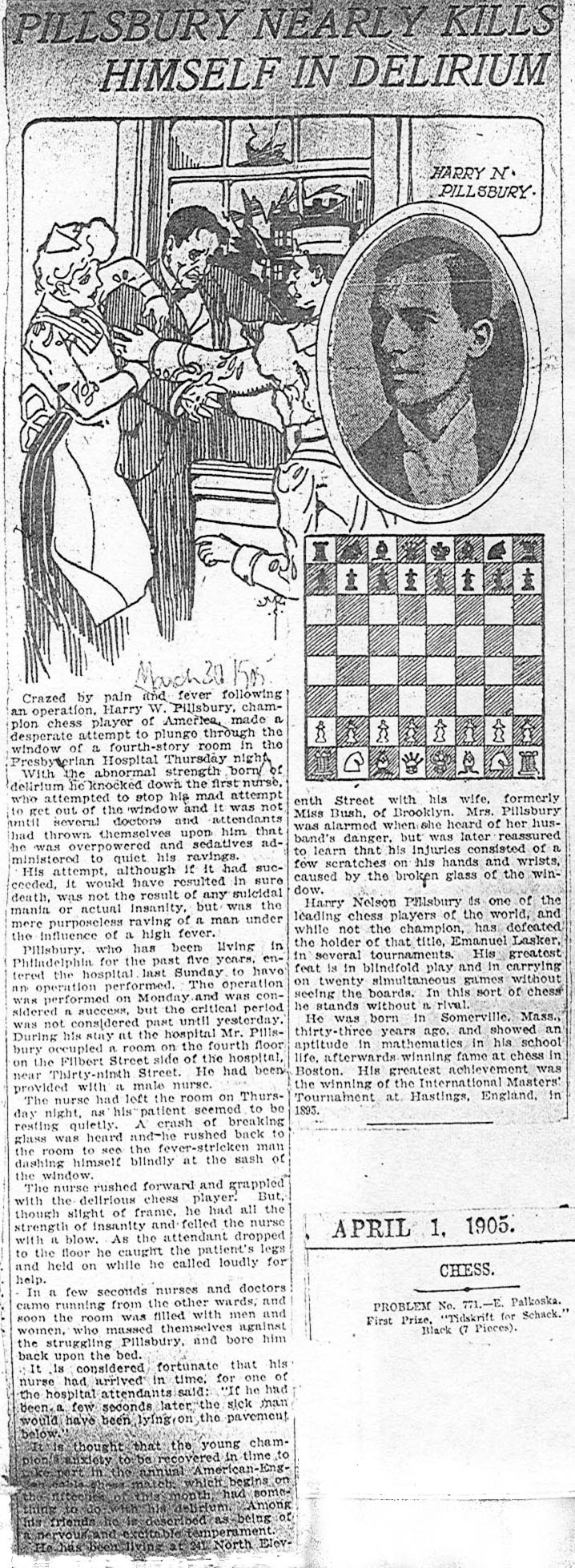
Afterword: The above accounts were given in C.N.s 2707 and 2723. In November
2005 (C.N. 4018) John Hilbert provided the following additional report from an
unidentified contemporary newspaper:
http://www.chesshistory.com/winter/extra/pillsbury.html (11 of 13)20/11/05 09:42:32

Pillsbury's Torment by Edward Winter
For a larger version, click
here
.
To the Chess Notes
main page
.
To the Archives for
other feature articles
.
http://www.chesshistory.com/winter/extra/pillsbury.html (12 of 13)20/11/05 09:42:32

Pillsbury's Torment by Edward Winter
Copyright 2005 Edward Winter. All rights reserved.
http://www.chesshistory.com/winter/extra/pillsbury.html (13 of 13)20/11/05 09:42:32
Document Outline