Distributed Computing with a Trojan Horse
Lauri Auronen, Antti Peltonen, Sami Vaarala, and Teemupekka Virtanen
Telecommunications Software and Multimedia Laboratory
Helsinki University of Technology, Finland,
lauri.auronen@hut.fi,
antti.peltonen@kolumbus.fi
sami.vaarala@iki.fi
tpv@tml.hut.fi
Abstract
Growing numbers of households are getting broadband Internet connections, forming an attractive platform for
distributed computing. We describe how a trojan horse for covert distributed computing could be constructed:
the mechanisms used, and how the user could be tricked to install the trojan using a known Microsoft Outlook
Express vulnerability. The gains and risks of such a construction are considered. We found that such a trojan
is straightforward to implement, even using a high level language such as Java. While installation of the trojan
is platform dependent, the actual trojan can be run on any Java platform.
Keywords
Trojans, Trojan Horse, Distributed Computing
INTRODUCTION
Growing numbers of households are getting broadband Internet connections, forming an attractive platform for
distributed computing (AeA 2003, Office of Telecommunications 2002, Nielsen//NetRatings 2003). On the
other hand a large number of newly connected computers with homogeneous operating system installations have
also attracted malicious parties. The amount of virus and worm activity is rising rapidly (ICSA 2002,
Subramanya and Lakshminarasimhan 2001, Heinonen et al. 2003). The worms and viruses have thus far mainly
concentrated on spreading mechanisms while carrying only limited payloads; some have had destructive effects,
but mostly they have not done anything besides spreading (Moore et al. 2003, Kaspersky Lab 2003). However,
a more destructive worm or virus might take advantage of the victim computer's computing power, creating a
large distributed computing environment for the attacker.
In this paper we construct a fairly simple, but generic distributed computing platform that can be distributed as a
trojan horse email attachment. We explain the mechanisms used to make the attachment look unsuspicious and
how our distributed computing agent is installed on a user’s machine. Lastly, we will discuss using the
constructed distributed computing platform for finding the decryption key to a message encrypted with the DES
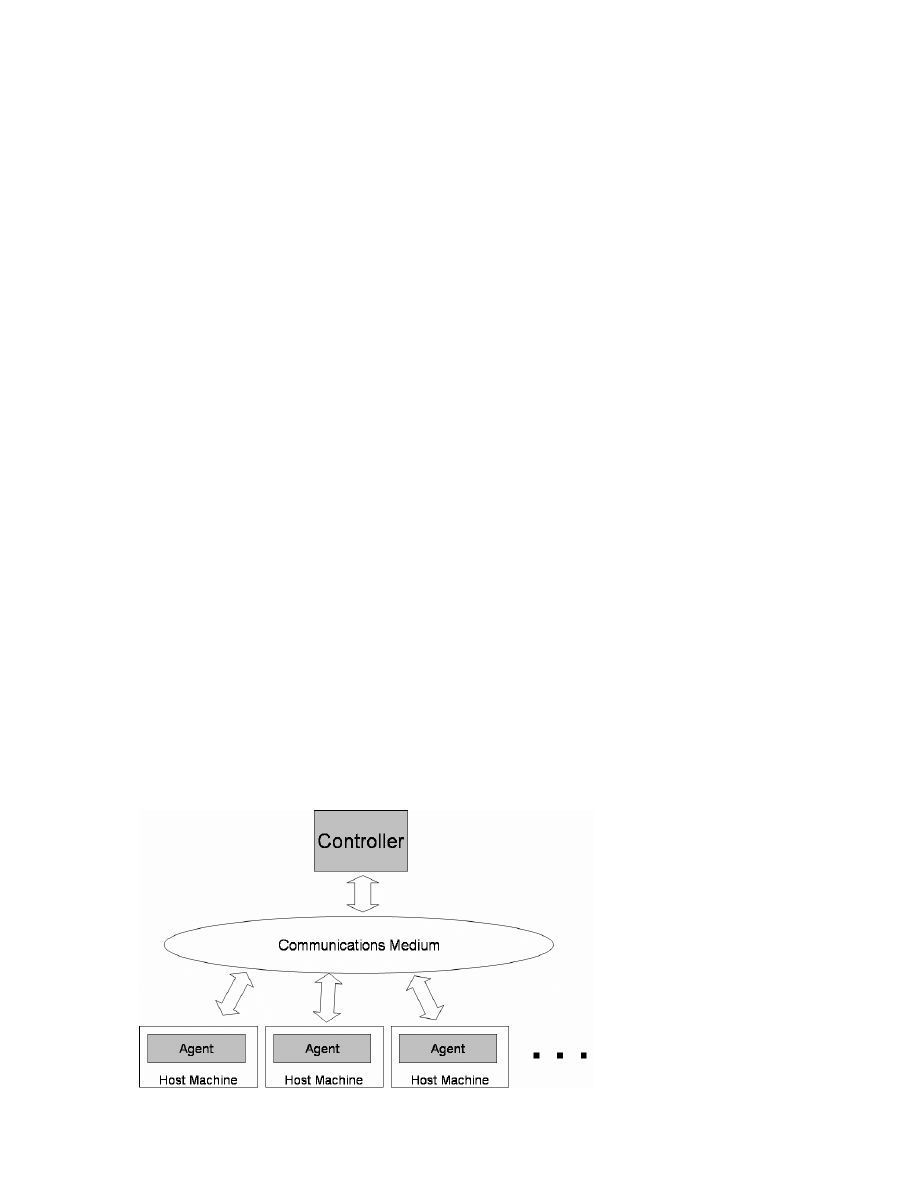
encryption algorithm. The conceptual model of the computing platform is shown in figure 1.
We aim to demonstrate how easily such an agent can be constructed. We also try to point out the danger of
having a large homogeneous operating system base, controlled by home users.

Figure 1. Conceptual model of a distributed computing platform. The communications medium could be, for
example, an IRC network.
The rest of the paper is organized as follows. Section 2 describes the background and the needed technologies
for constructing the agent. In section 3 we discuss the actual implementation. In section 4 we analyze the gains
and risks of constructing a distributed computing network of such agents, and we also discuss how the trojan
activity could be detected and blocked. Finally, in Section 5, we draw our conclusions of the subject and suggest
directions for further research.
BACKGROUND AND CONCEPTS
In this section we briefly discuss the conceptual background and technologies needed for constructing, installing
and running our trojan horse.
Email Vulnerabilities
Complex and feature rich email clients and operating systems are a mixed blessing. On the other hand they
provide many useful things to users but at the same time they open up doors for hackers. We will take a look at
two vulnerabilities: Scripts executed from email clients and the Three Extensions Vulnerability.
Scripting with VBScript
All Microsoft Windows operating systems include a component known as the Windows Script Host (WSH)
used to create scripts of actions (Microsoft 2003). WSH scripts have the same access rights as the user executing
them. Thus, if we are able to trick the user into executing a WSH script, we have access to all the user’s
resources. Such a script can also be sent as an email attachment and the receiver can choose to run the script
directly from her email client.
Three Extensions Vulnerability
The three extensions vulnerability of Microsoft Outlook Express is a way of persuading the user to open a
malicious file by making it look safe. The vulnerability can be exploited using a specially crafted suggested
filename in the Content-Disposition field (MessageLabs 2003); a simplified example is the filename
‘malware.jpg .vbs .jpg’. The first extension is visible to the receiver of the message, making the file appear safe
to open. The second extension tells Outlook Express how to handle the attachment; ‘.vbs’ means that the file is
interpreted as Visual Basic Script. The third extension is used by Outlook Express to choose an icon for the
attachment. The icon of a ‘.jpg’ image makes the attachment seem safe to open. In addition to making the
attachment to look safe, the vulnerability allows the mail to get past some content filters. (MessageLabs 2003)
Trojan Horses, Zombie Software, Computing Agents
Overview
A Trojan horse is malicious or harmful code contained inside apparently harmless program or data in such a way
that it can get control and do its chosen form of damage (Pelaez and Bowles 1991). Trojan horses may be self-
operating and execute some pre-destined malicious activity or they may open up a communications channel for
their author to control them. A trojan can be installed on a single machine or a larger base of machines to obtain
access to a larger base of computing power. A trojan can be included as a payload to a worm for larger scale
distribution.
A large base of machines compromised with trojans has been used to launch distributed denial-of-service
(DDOS) attacks (Yinjin 2001). Packet flooding is probably the most common use of the compromised machines,
usually called zombies, but their computing power could also be used for any other form of computation (Geng
and Whinston 2000).
Current and Possible Uses
Currently Trojan Horses are mainly used to install malicious software such as backdoors or zombie agents into
victim computers. Backdoors such as Back Orifice and NetBus (Symantec 2003) are used to sniff user actions,
retrieve passwords or steal files from victim computers. Zombie agents are software capable of sending real or
spoofed packets to a selected victim. Zombie agents wait silently in the infiltrated computers for their controller
to launch an attack.
Rather than performing aggressive attacks on hosts, Trojans can also be used more passively for e.g. covert
computation. We demonstrate such use by harnessing our Trojan horse to break DES encryption keys.
Distributed Computing Using Other People’s Resources
Utilizing Idle Computing Capacity

Most home computers are idle. Some efforts have been made to harness this great latent potential, such as search
for extra-terrestrial intelligence in the Seti@Home project and breaking encryption algorithms (Seti@Home
2003, Gladychev 1998).
Distributed computing has been recently noticed also in the fields of biotechnology and finance. For example
such companies as Parabon Computation and Entropia PC Grid Computing are offering distributed computing
time for their clients. The price of such processor time is significantly lower than same processor time bought
from a supercomputer. These companies also pay or are planning to pay for the leased processor time to the
owner of the computer participating in their distributed computing projects.
The last group of programs that try to utilize idle computing time is the malicious software, doing anything from
distributed computing to denial-of-service attacks. We discussed the current and possible uses of such software
in the section Current and Possible Uses above.
Agent Distribution
In order for a distributed computing environment to be useful the number of individual agents performing
computations should be as large as possible—we neglect controlling overhead for the time being. There are
several mechanisms available for distributing the agents to clients.
One possibility is to directly install the agent software manually on each client. This requires access to the
terminal and is therefore quite inefficient, and also poses severe difficulties with e.g. access control. A more
efficient way of installing the agents is to do it through the network. The agent could be sent by email or put on
a web site for people to download. In this way, a much larger network is achievable with the same time and
costs.
One step further is to use an Internet worm for the distribution task. Such a worm could be used to obtain an
agent base spanning up to tens of millions of hosts. The worm-like distribution method is discussed in detail in
Staniford et al. (2001).
Agent Control Structure
Distributed computing is quite well researched. Previous work in the field includes such works as Nieuwpoort et
al. on their Manta system (Nieuwpoort et al. 1999) and Gladychev et al. on Cracking RC5 with Java Applets
(Gladychev et al. 1998). We will next give a brief introduction to these two works and compare them to our
work.
Nieuwpoort et al. (1999) uses a modified version of the Remote Method Invocation (RMI) mechanism for
communicating between their distributed computing nodes. However, their approach differs fundamentally from
our approach. Their Manta system uses a collection of high performance parallel machines rather than
workstation distributed geographically at random positions. The network they use for communication is
different as well. While they use a fast dedicated wide-area ATM network, our network connection to the client
can be almost anything from slow modem connection to fast T3 class connection. Also their system is somewhat
hierarchical while our system is totally flat.
Much more similar to our work is the DISCO system by Gladychev et al (1998). The DISCO system uses Java
applets for breaking a RC5 encryption key by distributed computing. Gladychev et al. pointed out four problems
that are present when performing distributed computing on open networks. These are centralization,
heterogeneous execution platform, dynamic runtime behaviour and lack of security. Both DISCO and our
system use a centralized server - this restricts the scalability of the system. Heterogeneous execution platform
raises the need for benchmarking the client. In the DISCO system this was taken into account, while we did not
implement benchmarking for simplicity. Dynamic runtime behaviour is also an issue that DISCO and our system
have in common. Dynamic runtime behaviour means that clients may leave and join the distributed computing
task on the fly.
Large delay and variance in the network raise the need to reduce the control traffic between the nodes. This can
be best achieved by making subtasks bigger, reducing control traffic and task setup overhead proportionately.
Several methods for coordination of a large number of clients is discussed in Staniford et al. (2001).
Anonymizing the Controller
An important goal for an attacker is to avoid detection. Several techniques may be used. The attacker may use
an anonymizing middle-man instead of direct client-to-controller connections. For instance, Internet news
servers or peer-to-peer networks might be used. Control messages may be encrypted or obfuscated, or may even
be hidden in ordinary messages using steganographic methods (Petitcolas el al. 1999).
We used Internet Relay Chat (IRC) (Kalt 2000a, 2000b) as an anonymizing middle-man in our experiment. IRC
utilizes a basic client-server model where clients connect to servers to send and receive messages. The IRC
servers are interconnected and exchange messages with each other. Messages can be sent directly to other users

or to IRC channels that users can join. IRC messages are textual and have a maximum length, so a controller
needs to encapsulate and fragment control messages for IRC transport.
Some downsides of using IRC are: (1) IRC channels can be ‘hijacked’, (2) the default IRC server port is often
blocked by company firewalls, and (3) IRC servers limit the amount of client traffic, which imposes some
scalability constraints. Nevertheless IRC is useful as a model of a typical anonymization infrastructure.
Our scheme can be easily improved by the attacker. For instance, controller connections can be ‘bounced’ off
clients: the controller connects to an existing client, which connects to the IRC server on behalf of the controller.
This improves anonymization: even if the control connection was traced to the client, the client can easily hide
any evidence of the bounced connection.
IMPLEMENTATION
Our distributed computing system consists of two parts: the server part and a large number of clients. The server
divides the computation task at hand—ciphertext decryption, astronomical data analysis and so forth—into
smaller units that are given to clients. We will first discuss the client side.
Agent Architecture
The agent consists of Java class files installed on the computer’s hard drive. It includes a class called
ClientContext which binds the client functionality together, and a control connection subsystem, an input
handler subsystem, and a task runner subsystem. The control connection is a two-way text communications pipe.
Any protocol can be used for the actual data transfer.
The input handler reads commands sent by the control connection and processes them. The control connection
can also be used to relay data to and from the client, including Java class files. The input handler also includes
dynamic class loading functionality for new commands and task classes. The mechanism is similar to the
programmatic updates mentioned in Staniford et al. (2001).
The distributed computing part of the client software is built into the task runner subsystem. Each client includes
one TaskRunner class and several task classes that are subclasses of the BaseTask class. When the TaskRunner
is started it loads the last task and its state from disk and starts running the task. When the client software is
stopped it again saves the current task and its state to disk. Through TaskRunner the controller of the software
can change the task that is executed, give new data for the current task to process and set the priority at which
the task thread executes. DESBreakerTask is our reference implementation of a client side task. It executes a
known plaintext attack as a brute-force search for the correct decryption key.
Server Architecture
The server consists of a task manager, a control connection and a command line user interface with input
handler.
The control connection sends data between the clients and the server, in our reference implementation using
IRC. The command line user interface is used to issue commands to the server and it can also be used to directly
command an individual client through the control connection.
The server can install new command and task classes to the client. For transfer over the control connection the
class files are Base64 encoded and, in the case of the IRC connection, also divided into sufficiently small blocks
that are sent in a delayed manner so that the IRC network will not drop them.
The distributed computing part of the server software consists of TaskManager and task classes. TaskManager is
responsible for keeping track of the distributable tasks. All the actions that deal with the tasks are accessed using
this front-end. TaskManager is also responsible for periodically firing up a checking process that checks that the
distributable tasks do not have any subtasks that should already be finished and could be redistributed.
All distributable tasks should implement the interface DistributableTask. This interface includes the actions that
are essential for all distributable tasks. KeyBreakerTask is our reference implementation for a distributable task,
which searches through a key space for an encryption key. The third essential class in the task package is the
SubTask. SubTask is a piece of the distributable task that is assigned to one client for processing. Subtask
includes information such as the actual data to process, the client who is processing the subtask, and timestamps
for task start, expected completion, and actual completion.
Installing the Client
Our implementation of the trojan horse is targeted for email distribution. In other words, each copy of the trojan
is manually sent to a target machine. As discussed in section Agent Control Structure above, more efficient
propagation methods are available. For distribution through email the compiled software is first packaged into a
zip archive. In this way the several class files can be distributed more easily. The zip package is then
transformed into a self-extracting zip archive, voiding the need to have an unzip utility on the receiving
computer.
WinZip Self-Extractor allows the creation of self-extracting archives that, when run, extract without prompting
the user for any input and in the end execute a file extracted from the archive. This is very useful for trojan horse
use.
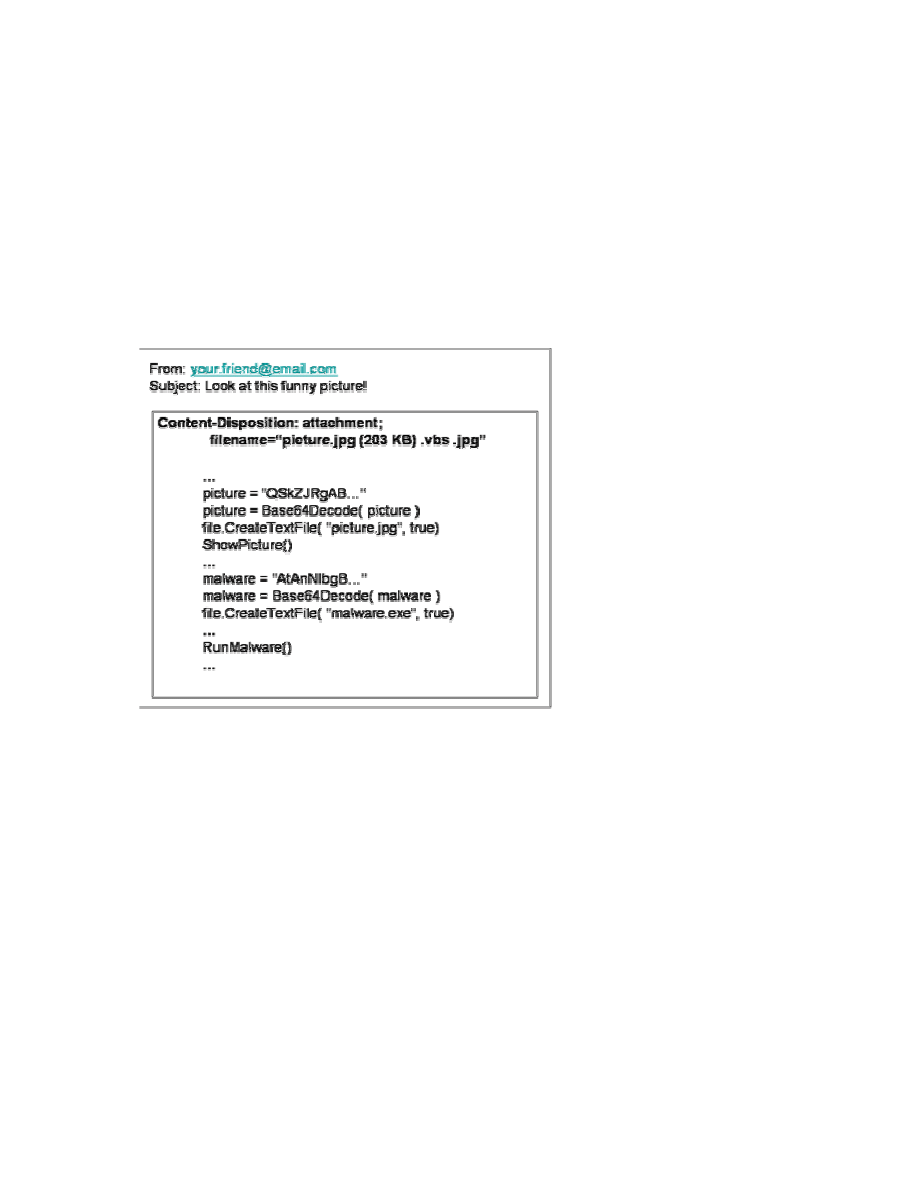
Next, a specially tailored email utilizing the three extensions vulnerability is created. Attached to the email is a
VBScript file (Figure 2) with two embedded files stored as Base64 encoded strings. The first file is an image
that is used to mislead the user and the second one is the self-extracting zip archive. When executed, for
example by double clicking the attachment in Outlook Express, the script Base64 decodes the image file and the
archive file and writes them on disk. The image file is decoded and saved first and it is then shown using the
system default viewer while the script continues to process the archive file in background. After the archive is
extracted a batch file is run from the destination folder, which then starts the client software. Finally, the
VBScript file adds a Windows registry entry which causes the client to start during reboot.
Figure 2. Outline of an email with malicious attachment
Utilizing the Client
If a given task unit is not finished in an estimated maximum time interval, the task unit is sent to a client again.
A further improvement on the architecture would be to account for tampering of results. One possible protection
is to send the same task unit to several agents (Gärtner 1999).
The reference implementation includes additional client-server communication to detect new clients in the
network and to report tasks finished by clients.
ANALYSIS
In this section we analyze the gains and risks involved from the attacker’s viewpoint. We also discuss how to
detect and protect oneself against the attacks we used.
Attacker’s Viewpoint
Gains
Our reference computer had AMD Duron 600 Mhz processor with 384 MB of memory running at 133 Mhz.
Checking 20 million keys in one million key subtasks took 919 seconds from our reference computer. The
average speed of processing one million keys is thus around 46 seconds. By using this result we can extrapolate
the worst case time that is needed for breaking a 40 bit DES algorithm by brute-force known plaintext attack. By
using mere 1000 computers concurrently to complete this attack would take around 14 hours.

There are several commercial networks that sell computing time or other processing on the network (for
example, see http://www.gomez.com/?porivo=true). The controller could thus sell the processing power he gains
from the covertly setup network.
Risks Involved
The risks from the attacker’s viewpoint are divided into two categories: Legal risks resulting from possibly
unauthorized use of computer systems (Lee 1990) and risks to the computation results from performing the
distributed computing in an open environment.
Because the computation is performed covertly the probability of damage to the computation results is low. This
is more of a problem in high profile distributed computing projects where status can be gained by faked results
(Colley 2002).
The bigger issue might be the legal issues involved in utilization of computer systems without the owner’s
consent. Eventually the trojan horse software running on a computer will be noticed. Then the safeguard for the
controller of the trojan is the IRC network. By analysis of the class files, the trojan horse can be tracked to the
control channel in the IRC network. By listening to the traffic on the channel the controller can be detected.
After that the controller’s information can be extracted from the IRC server’s logs. Thus there is a risk of being
tracked down even with IRC used as an anonymizer, unless more levels of indirection are used.
Detecting the Attacks and Protecting Oneself against Them
We will next discuss how different elements of our Trojan horse can be detected and what actions one needs to
take to gain protection against these attacks.
Covert Software Distribution through Email
If preview is enabled in the Outlook Express email client our script is shown as a broken image (red cross). This
can give the user a hint that the attachment is not what it seems. The user may also choose to save the
attachment to disk before opening it. In the save file dialog, the script file is always shown with the correct
‘.vbs’ -extension.
If the user chooses to open the file it takes some time to Base64 decode the cover-up image file. Also, processor
and disk activity continues after opening the image, which can be detected. When the batch file is run after
extracting the WinZip SE archive, a command prompt window is very briefly visible on screen. However,
more sophisticated malware would not be detectable this way.
Also, if the user is running good anti-virus software it will warn about malicious script activity. The best
protections against this attack thus are using up-to-date anti-virus software with real-time protection capabilities
and also to use an email client that does not have unpatched known vulnerabilities.
Three Extensions Vulnerability
This exploit can be detected by observing the name of the attachment file. In the attachment field after the file
name there are many space characters and in the end of the line the string ‘....vbs(203KB)’ or ‘...’.
Another way to detect this attack is when the file is opened. Depending on the level of patches installed, after
opening the attachment you may get two confirmation windows that warn that the file may be suspicious.
Answering ‘no’ to these questions will block the trojan horse installation.
The ultimate protection against this attack is to strip all email attachments. However, this is rarely plausible
because of the legitimate uses for attachments. Another way to protect your computer against this particular
attack is to simply not use Microsoft Outlook Express. However, other email clients have their own
vulnerabilities.
Using IRC as a Signaling Channel
If the client, i.e. the trojan horse, cannot access its communications channel, the client cannot be controlled or
used for distributed computing. Thus, a firewall that can block outgoing connections is sufficient to detect and
protect against IRC communication. A good firewall configuration for an organization that does not utilize IRC
for its operations should by default block all outgoing connections that are not explicitly allowed.
Another way to detect the control traffic is to monitor the system's network activity. Keeping an IRC connection
live means sending data periodically to and from the server (Kalt 2000b).
The administrator of an IRC server used for such communication could also detect this attack by filtering traffic.
Most of the data exchanges are very different from people chatting. For example, the statistical differences
between subsequent client replies are small compared to natural language. The attacker could also make the
detection more difficult by hiding the control traffic using steganography; the intent being to provide covert
communication between two parties without exposing this activity to observers (Petitcolas et al. 1999).

Distributed Computing
Covert distributed computing activity can be easily detected by observing a computer’s idle processor load. This
can in Windows be done using the Task Manager. If there is a process that is taking a lot of computing time
when the computer should be idle, there is reason for suspicion.
CONCLUDING REMARKS
We found in our experiments that creating a trojan horse application with a distributed computing component
was fairly straightforward. We found that such a malware application can be created and executed covertly even
in the high-level programming language Java. This relied on Microsoft’s JView virtual machine being found on
the Windows hosts used. It should be noted that only the install mechanism is platform dependent and the actual
client application could be run on any Java enabled platform.
The distributed computing mechanisms implemented were simple; an attacker could implement a number of
improvements to increase robustness and to make tracing more difficult.
Stealing processor time from computers is only one possible hazard caused by malware. A trojan horse payload
could be more dangerous by distributing the user’s personal data to the attacker, for example. Stealing processor
time is a significant threat as it gives a monetary benefit to the attacker. We can conclude that an involuntary
peer-to-peer file sharing network built by trojans is probable in the future. The upside of these threats is the
raised security awareness of home users.
Further research could be useful, for example, in hierarchical control of the clients, incorporating self-
propagation mechanisms to the client, and making installation of the software platform independent.
REFERENCES
AeA (2003), Broadband Subscriptions Up 488 Percent Since December 1999, URL
http://www.aeanet.org/PressRoom/pret052203_Broadband2003Main.asp, Accessed 1 Oct 2003.
Colley, A. (2002) Cheats wreak havoc on seti@home: participants, URL
http://www.zdnet.com.au/newstech/security/story/0,2000024985,20269509,00, Accessed 26 Mar 2003.
Petitcolas , F.A.P., Anderson, R.J. and Kuhn, M.G. (1999) Information Hiding – A Survey, Proceedings of the
IEEE, special issue on protection of multimedia content, 87(7), 1062-1078.
Geng, X. and Whinston, A.B. (2000) Defeating distributed denial of service attacks, IT Professional, 2(4), 36-
42.
Gladychev, P., Patel, A. and O’Mahony, D. (1998) Cracking rc5 with java applets; Proceedings of the ACM
Workshop on Java for High-Performance Network Computing (1998).
Gärtner, F.C. (1999) Fundamentals of fault-tolerant distributed computing in asynchronous environments, ACM
Computing Surveys, 31(1), 1-26, URL http://doi.acm.org/10.1145/311531.311532
Heinonen, A., Virtanen T. and Addams-Moring R. (2003), ”We are running what ?!” – why the Slapper worm
was able to spread in Finland, Bill Hutchinson (ed)” Proceedings of 2nd European Conference on
Information Warfare and Security”, 0-9544577-0-6, MCIL, UK.
ICSA Labs Virus Prevalence Survey 2002 (2002) URL
https://www.trusecure.com/download/dispatch/VPS2002.pdf?ECDE=W0107, Accessed 2 Oct 2003.
Kalt, C. (2000a) RFC 2811 - Internet relay chat: Channel management.
Kalt, C. (2000b) RFC 2812 - Internet relay chat: Client protocol.
Kaspersky Lab (2003) Virus Encyclopedia - Worm.SQL.Slammer (aka Helkern, aka Sapphire), URL
http://www.viruslist.com/eng/viruslist.html?id=59159, Accessed 2 Oct 2003.
Lee, M.K.O. (1990), Hacking and computer viruses-the legal dimension, Viruses and their Impact on Future
Computing Systems, IEE Colloquium, 6/1 -6/4.
Messagelabs (2003) Messagelabs - virus report - outlook express quirks being exploited by trojan writers 29 jan
2003, URL http://www.messagelabs.com/viruseye/report.asp?id=130, Accessed 1 Aug 2003.
Microsoft (2003) Windows script host basics, URL
http://msdn.microsoft.com/library/default.asp?url=/library/en-us/script56/html/wsconwshbasics.asp,
Accessed 1 Aug 2003.
Moore, D., Paxson, V., Savage, S., Shannon, C., Staniford, S. and Weaver, N. (2003) Inside the Slammer worm,
Security & Privacy Magazine, IEEE, 1(4), 33 -39.

Nielsen//NetRatings (2003) Broadband Users Exceed 50% of All Household Internet Users, Nielsen//NetRatings
NetView Audience Measurement Service Report on Japan Internet Ratings for April.
Van Nieuwpoort, R., Massen, J., Bal, H.E., Kielmann, T. and Veldema, R. (1999) Wide-area parallel computing
in Java, Proceedings of the ACM 1999 Java Grande Conference, 8-14.
Office of Telecommunications (UK) (2002), UK reaches one million high speed broadband connections, URL
http://www.oftel.gov.uk/press/releases/2002/pr58_02.htm, Accessed 1 Oct 2003.
Pelaez, C.E. and Bowles, J. (1991) Computer viruses, Proceedings of Twenty-Third Southeastern Symposium on
System Theory, 513 -517.
Seti@Home (2003) SETI@home: Search for Extraterrestrial Intelligence at home, URL
http://setiathome.ssl.berkeley.edu/, Accessed 5 Oct 2003.
Staniford, S., Paxson, V. and Weaver, N. (2002) How to 0wn the Internet in Your Spare Time, Proceedings of
the 11th USENIX Security Symposium, 149-167, URL http://www.cs.berkeley.edu/~nweaver/cdc.web/
Subramanya, S.R. and Lakshminarasimhan, N. (2001), Computer Viruses , Potentials, IEEE, 20(4), 16-19.
Symantec Corporation (2003) Information on Back Orifice and NetBus, URL
http://www.symantec.com/avcenter/warn/backorifice.html, Accessed 1 Aug 2003.
Yinjin@indiana.edu (2001) Ddos resources - basics of ddos, URL
http://www.anml.iu.edu/ddos/howtowork.html, Accessed 1 Aug 2003.
COPYRIGHT
[Lauri Auronen, Antti Peltonen, Sami Vaarala, Teemupekka Virtanen] © 2003. The author/s assign the
AIWSC03 & University of South Australia a non-exclusive license to use this document for personal use
provided that the article is used in full and this copyright statement is reproduced. The authors also grant a non-
exclusive license to the AIWSC03 & UniSA to publish this document in full in the Conference Proceedings.
Such documents may be published on the World Wide Web, CD-ROM, in printed form, and on mirror sites on
the World Wide Web. Any other usage is prohibited without the express permission of the authors.
Wyszukiwarka
Podobne podstrony:
A Filter That Prevents the Spread of Mail Attachment Type Trojan Horse Computer Worms
The Worm Programs Early Experience with a Distributed Computation
tROJAN HORSE
How To Think Like A Computer Scientist Learning With Python
Neubauer Prediction of Reverberation Time with Non Uniformly Distributed Sound Absorption
Computer Science With Mathematica Errata
Modeling computer virus prevalence with a susceptible infected susceptible model with reintroduction
Is Your Cat Infected with a Computer Virus
Computer Modelling with CATT Acoustic Theory and Practice of Diffusion Reflection and Array Modelin
Functional and Computational Assessment of Missense Variants in the Ataxia Telangiectasia Mutated (A
WHATS REALLY WRONG WITH THE COMPUTATIONAL Jonathan Knowles
FIDE Trainers Surveys 2017 05 19 Miguel Illescas Working with Computers
A NEW CATALOGUE OF THE CERAMBYCIDAE (COLEOPTERA) OF ISRAEL WITH NOTES ON THEIR DISTRIBUTION AND HOST
Turing Machines and Undecidability with Special Focus on Computer Viruses
The Worm Programs Early Experience with a Distributed Intelligence
więcej podobnych podstron