
ENERGY SCIENCE REPORT No. 4
This Report was first published in 1994 at a time when the author was involved in
experimental research aimed at seeing if one could tap energy from the vacuum
medium. This might seem to be an absurd pursuit but there were certain anomalies in
experimental findings and debatable issues of a theoretical nature that needed resolution.
As this Report shows, the author was not alone in seeing the need to clarify some of the
mystery which clouds our understanding of magnetism. This version of the Report now
published on Internet some nine years on from its printed publication in 1994 is an
unamended copy of that original text, made available here for historical record of the
author's efforts........... Harold Aspden, 18 June 2003
ENERGY SCIENCE REPORT NO. 4
POWER FROM MAGNETISM: THE POTTER DEBATE
© HAROLD ASPDEN, 1994
Contents
Introduction
Page 1 of 31
ENERGY SCIENCE REPORT No. 4
25.4.2005
http://www.aspden.org/reports/Es4/esr4.htm

Preliminary Background
The Kilmister Introduction
The Rotating Magnet in a Cyclically-Exited Solenoid
Axially Reciprocating Magnet in a Cyclically-Excited Solenoid
Preliminary Remarks
Step-by-Step Analysis of the Problem
Onward Experimentation
COMMENTARY ON APPENDICES
APPENDIX A: Letter from Frank Potter
APPENDIX B: Potter's Reciprocating Magnet engine Proposal
APPENDIX C: How Flux Develops EMF in a Solenoid
APPENDIX D: EMF Generated in Solenoid by Rotating Magnet
****************
POWER FROM MAGNETISM: THE POTTER DEBATE
Introduction
This Energy Science Report is written at a time when a surge of activity has developed on the 'free
energy' scene concerning the prospect of tapping energy from the quantum action of the vacuum
state - the aether.
The research claims of New Zealander Robert G. Adams have become the focus of attention owing
Page 2 of 31
ENERGY SCIENCE REPORT No. 4
25.4.2005
http://www.aspden.org/reports/Es4/esr4.htm

to his disclosure of the design of a motor which performed anomalously and which was said to
deliver more mechanical power than was supplied as electrical input. This has been mentioned in
ENERGY SCIENCE REPORT NO. 1 in this series and more on the motor topic generally will be
reported in later reports. The scenario developing at the present time has become one of contention
amongst different proponents working in this field as the struggle for recognition begins to cloud the
interpretation of the evidence and results in the withholding of information.
The 'free energy' prospect is still an issue of debate awaiting the clear demonstration of a working
machine that can withstand all tests and scrutiny by experts. It had been hoped that the Adams motor
would have featured in such a demonstration at the Denver, Colorado symposium in May 1994
organized by the Institute for New Energy, but, at the present time, April 1994, that is no longer in
prospect for reasons totally unrelated to the technical merits of the Adams development.
This author seeks by this Report to draw attention to what, in a sense, has been a 'behind the scenes'
secret debate pursued by Frank F. Potter of Croydon in England who has aroused the interest of a
few physicists in British universities. His topic is that of calculating the interactions and behaviour
between magnets and a magnetizing solenoid. His concern is to get an answer to the question of how
the energy involved can be formulated theoretically in a way which allows experimental testing.
Potter's intuition has, it seems, followed for many years a track not too different from that which may
have inspired Robert Adams and others, including the German, Hans Coler, whose experimental
work, after confirmation, became the subject of a secret government report dating from the World
War II era. What is so fascinating about the Potter interest is that, although it dates from many years
past, it has not surfaced hitherto in a way which has become known to those now interested in the
'free energy' field. It is especially interesting because Potter's correspondence indicates that
academics skilled in mathematical physics, though showing diligence in their efforts, have been
unable to provide answers that satisfy Potter.
The Potter debate provides a new perspective and a new starting point for resolving the 'free energy'
issue concerning magnets subjected to solenoidal fields, bearing closely upon the theory of operation
of the Adams motor. It is timely to discuss openly the answers to the questions raised.
Preliminary Background
It may interest readers to know the background of how it was that this author came to hear about
Frank F. Potter.
For several years there have been annual meetings held in September at Cambridge University in
England by an organization named ANPA, the Alternative Natural Philosophy Association. One
theme pursued with great interest by many members of this association is that of calculating the
basic physical constants, such as the proton-electron mass ratio, by mathematical techniques
involving what is termed a 'combinational hierarchy'.
This author has long been interested in the creative activity of the vacuum energy field in producing
protons and that research had led to published work on the calculation of the proton-electron mass
ratio by methods distinct from those of special interest to ANPA. A spin-off from that research was
the theoretical derivation of the measured properties of the deuteron. The author had been especially
interested also in the electrodynamic properties of these particles and electrodynamic actions within
metal conductors and so, with the advent of 'cold fusion', there was purpose in extending the research
with the 'alternative energy' scene in mind.
A particularly interesting development was the extension of the theory to the theoretical derivation of
the properties of the third isotope of hydrogen, namely the triton and it was the simple derivation of
Page 3 of 31
ENERGY SCIENCE REPORT No. 4
25.4.2005
http://www.aspden.org/reports/Es4/esr4.htm

the lifetime of triton, which the author saw as confirming his theory, that gave reason for an initiative
to attend the 1993 ANPA meeting in Cambridge to present that theory.
That latter subject warrants its own Report in this series of ENERGY SCIENCE REPORTS and will
be dealt with separately.
Now, in attending that September ANPA meeting, the author had very much in mind the fact that he
had earlier, in April 1993, attended the Denver, Colorado symposium on New Energy and become
very interested in the reports on the Adams motor. Also, in August, the author had attended a
meeting in Atlanta, Georgia to report experimental progress on energy conversion technology in
which magnetism affecting electric free charge carriers in metal can convert thermal energy into
electrical output. In a sense, this is magneto-hydrodynamics at work within a solid metal. This is the
subject of ENERGY SCIENCE REPORT No. 2 and No. 3.
Therefore, although in Cambridge to talk about protons, deuterons and tritons in a theoretical
context, the author had become more preoccupied by his interest in the extraction of power from
magnetism, as evidenced by the Adams motor technology and as researched somewhat superficially
by the author in his own earlier work. It was the Adams situation that gave stimulus for new
experimentation, and it was a question of being patient and waiting for Adams himself and others to
take that work forward or whether to divert effort into one's own experimental programme.
One thought had been to build a kind of recriprocating engine, resembling a steam-engine piston-
and-cylinder action, there being a soft-iron 'piston' member moving inside a solenoid and interacting
with a permanent magnet to open and close an air gap.
Indeed, owing to the fact that there was a corner shop at the junction of Trinity street and Bridge
Street in Cambridge, located between Trinity College where the author was lodging and the college
venue of the ANPA meeting, the author had pursued enquiries in that shop with the experiment in
mind. It had a model steam engine in the window.
So it was later that morning that, in a side discussion with Professor Clive Kilmister during a coffee
break at the Cambridge meeting, the author mentioned the growing interest in USA in 'free energy',
centred on the Denver, Colorado event. Specifically mentioned were the claims made by Adams in
his description of the motor as reported in the Australian magazine NEXUS.
Surprisingly this evoked the comment from Professor Kilmister that for several years he had been
exchanging correspondence with a person named Frank Potter who had been suggesting something
very similar. He resolved to tell Potter about my interest in the subject and it was this which gave the
basis for this Report.
Extracts from some of Frank Potter's letters to this author are to be found in APPENDIX A and B.
Having promised Potter a full reply, on the basis that what was said would be published in some
way, that reply is documented here as the subject of this Report. It was intended to allow this to
evolve with a view to presenting a summary account at the September 1994 ANPA meeting and in
the hope that Professor Kilmister might participate in the discussion, but in view of the surge of
criticism that is currently affecting the Adams motor project the author has brought this version of
the Report forward so as to have it in hand at the May 1994 New Energy Symposium in Denver,
Colorado.
The reason for this is that it is better to address the basic physics of the subject from a new starting
point, one that has background in U.K. and has involved some discussion in academic circles, rather
than building a physical account which relies on a version of a motor for which there is no
authenticated performance data.
Page 4 of 31
ENERGY SCIENCE REPORT No. 4
25.4.2005
http://www.aspden.org/reports/Es4/esr4.htm

It could well be that different implementations of the Adams-type motor may function differently,
some operating 'over-unity' and some not, this being owing to a lack of design understanding of the
basic physical factors that are at work. Hence, a first-principle analysis has merit, especially if it
meets Potter's objective of providing what hopefully is a reliable theoretical model on which to base
experiment.
Finally, as further background, it should be mentioned that research reported by Stefan Marinov is
relevant to the subject under discussion and no doubt Marinov will contribute to the later debate
which this Report initiates. However, as the sole object here is to answer Frank Potter's questions the
commentary below will be confined to that pursuit.
The Kilmister Introduction
The following is a confirming letter dated September 18, 1993 sent to the author by Professor Clive
Kilmister.
"Dear Harold,
It was very interesting hearing your talk at ANPA and even more so hearing what you
say about magnetism.
I have for a long time been exchanging letters with someone who is convinced that there
is something odd about the energy of permanent magnets and has devised mechanical
devices (a bar magnet suspended entirely within a large solenoid for example) to show
this.
I have taken the liberty of suggesting to him that you might be able to give him some
references to other work. Sorry about the handwriting - I haven't been home since
ANPA. The man's name is Frank Potter.
Yours,
Clive."
Readers familiar with the 'free energy' research involving magnets, research which is seldom
mentioned in the orthodox scientific literature, will understand how it is that there can be questions
in this field that really do need answering in open debate but seldom surface for fear of the 'perpetual
motion' issue that pervades the subject.
There is, it seems, something lacking in our world of education when the doctrinaire background of
physics sets up a barrier in the form of statements of physical law, without involving discussion in a
tolerant, patient and in-depth way of the factors that govern ferromagnetism at its energy frontier
with the sub-quantum world. This is not just a question of classification of what is observed as a
hierarchy of quantum behaviour of electrons in atoms; it is really the issue of how the action we
associate with such quantum theory delivers energy able to sustain the properties of a ferromagnet.
How is it that permanent magnets can suffer fluctuating field influences continuously for decades, if
not centuries, whilst keeping their magnetic vitality? The word 'permanent' has meaning, as does the
word 'perpetual', but scientists accept 'permanent magnetism', which is, in a sense, 'perpetual
magnetism', whilst showing amusement and derision at the idea of 'perpetual motion', even though
'permanent motion' or motion at a uniform velocity is countenanced in mechanics.
There is a case to answer and it is hoped that this Report will serve in making that case, if not the
answer, clear enough for the scientific community to take this subject seriously.
Page 5 of 31
ENERGY SCIENCE REPORT No. 4
25.4.2005
http://www.aspden.org/reports/Es4/esr4.htm
The intention in the pages which follow is to follow standard physics to give prediction of what is to
be expected in the Potter experiments proposed. We will not restrict ourselves to the short-cut of the
doctrinaire route, not because one sees merit in challenging doctrine and discrediting established
physics, but more with a view to directing experimentation at what potentially is the key area that
has been neglected for too long. Only the subsequent experimental investigation can give the final
answer to this probe into energy matters, but we must not allow a restrictive interpretation of energy
conservation doctrine, as such, to stand in the way of such experiment.
The subject of a new energy source is far too important for us to allow any stone obstructing our path
to remain unturned and, even if the 'thought' experiment which is our starting point might not have
practical application in the form presented, it is worth scrutiny.
The Rotating Magnet in a Cyclically-Excited Solenoid
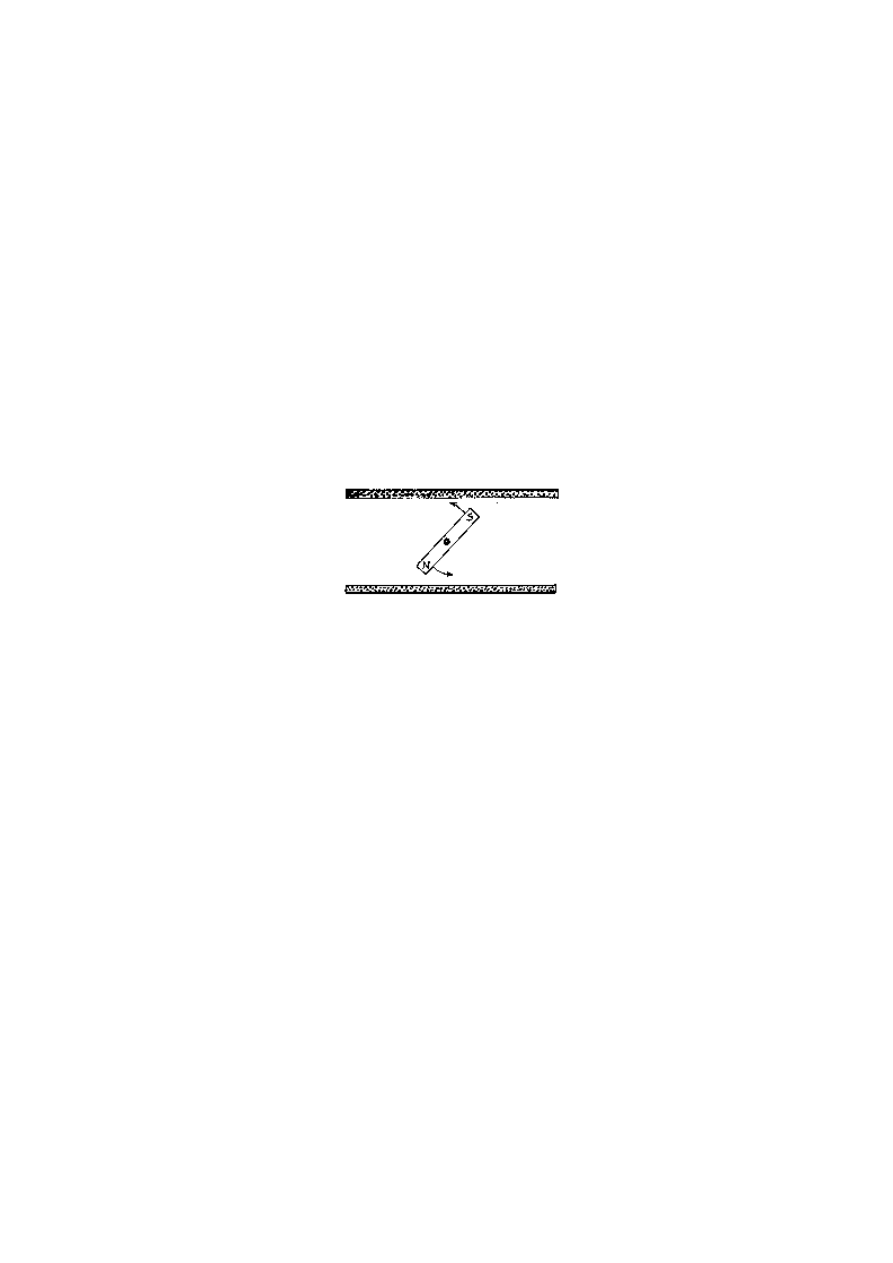
One can conceive building an electric motor by mounting a magnet to rotate inside a large solenoid,
so that the plane of rotation of the magnet lies along the longitudinal axis of the solenoid. Then by
reversing the current in the solenoid periodically the magnet should turn at the same rate and so be
driven as the rotor of a motor. A schematic illustration of such a system is shown in Fig. 1.
Fig. 1 Solenoid excited rotating magnet motor
Readers may say that this is only a special, and rather poor, form of a class of motors known in
standard technology where permanent magnet rotors interact with the commutated excitation of a
stator winding. Such motors are known to comply with energy conservation principles and perform
in accordance with well-established design practices and pose no anomalies. Indeed, their
performance efficiences are clearly set out in the commercial literature used to market them and it
might, therefore, seem absurd and pointless to even consider the theory of operation of the motor
system shown in the figure.
However, Frank Potter has a way of putting his question logically, if not concisely, and guiding us
into a state of doubt (See Appendix A). To put this in context it is not just a question of observing a
real motor performing overall on a duty cycle averaged over a complete revolution of the rotor. Like
a tight-rope walker who stays on the rope, one may well perform a balancing trick by which the
energy books are kept in balance, but this does not preclude a tendency for that tight-rope walker to
fall off the rope and draw on gravitational energy in the fall. If he does not fall off, he is nevertheless
constantly exchanging energy with the quantum world that powers gravity, drawing on that as his
centre of gravity drops and giving that energy back to Nature's store of gravitational potential as he
recovers an erect posture. The overall equilibrium performance disguises the fact that he is a kind of
human 'free energy' machine at least for about half the time he is on that rope.
So it may be that, if we study the energy action step-by-step as the motor rotates, conceivably the
magnetic energy can cause a 'fall-out' which we can use beneficially. Remember that the magnet
keeps its magnetic polarization even though it may have done some work and it has its own way of
recovering naturally. Our task is to work out how to exploit the energy released in a way which
allows us to refuse to give it back, or renders us unable to give it back because the energy has been
Page 6 of 31
ENERGY SCIENCE REPORT No. 4
25.4.2005
http://www.aspden.org/reports/Es4/esr4.htm

spent, whilst leaving the motor magnetism to recover its equilibrium by drawing on its own reserves
in what is known as a 'magnetocaloric' thermal action!
It is not easy and not normal practice to calculate energy deployment step-by-step in a real motor
without begging the question and assuming non-thermal energy conservation. Designers only think
of heat problems in relation to I
2
R losses and hysteresis loss and do not factor into their design the
magnetocaloric effects which are intrinsic to actions where the strong fields of permanent magnets
play a special role. Being blind to this possibility they would have little patience with the questions
raised by Frank Potter, but his approach is to present a design configuration which, though still far
from posing an easy calculation task, nevertheless is one that is amenable to definitive calculation.
It is this that characterizes the Potter approach. If the calculation can be done, it should be done and
the energy deployment traced step-by-step.
There is, as already noted, something special about a permanent magnet. It has an endurance when
confronted with moderate demagnetizing fields and not enough is said in textbooks about the real
action that underpins that endurance. Giving reason for what is known as 'coercive force', is not
tantamount to explaining how a magnet sustains its polarization, even though one can draw a line
through a stable state represented in a quadrant of a B-H magnetization loop.
Indeed, harping back to the Adams motor, and noting that Adams has used Alnico magnets, one will
find that textbook authority on the understanding of the high coercive properties of that particular
material reveals some uncertainty as to the physics involved.
This author is especially interested in this aspect of the problem, because the thermoelectric
conversion devices with which the author is associated as inventor use a laminated structure of
nickel and aluminium and exhibit anomalous behaviour in converting heat into electrical action,
including the heat-driven internal generation of powerful magnetic polarization.
So, it may be understood why the line of reasoning adopted by Frank Potter in his communications
in Appendix A has interested the author.
Our task is to perform the necessary calculations.
One aspect of interest to Frank Potter concerns how a rotating magnet inside a long solenoid of large
radius can couple inductively with the windings of the solenoid. There is the question of how a back
EMF is generated in that solenoid as the magnet rotates. Potter realises that without a sufficient back
EMF there is no adequate way in which energy can be fed into the rotor motion and yet there is a
cyclic magnetic field which sets up the forces turning that rotor. Accordingly this leads him to ask
for calculations applied to a practical structure of a large solenoid of reasonable length to radius
ratio.
As will be seen, this author feels obliged to separate that issue concerning back EMF calculation and
the large radius solenoid from the more important underlying energy balance question which
involves ferromagnetic properties, whether those of a rotating electromagnet or a permanent magnet.
However, before entering the calculation phase on that lesser issue, Frank Potter's question which
relates more to the practical prospect of an operating Adams-type motor will be introduced.
Axially Reciprocating Magnet in an Cyclically-Excited Solenoid
If one has a permanent magnet and a soft iron core of an electromagnet mounted coaxially side-by-
side in-line within a solenoid and the soft iron core constitutes an electromagnet which can
reciprocate axially to open or close a gap between it and the permanent magnet, so one can imagine a
Page 7 of 31
ENERGY SCIENCE REPORT No. 4
25.4.2005
http://www.aspden.org/reports/Es4/esr4.htm
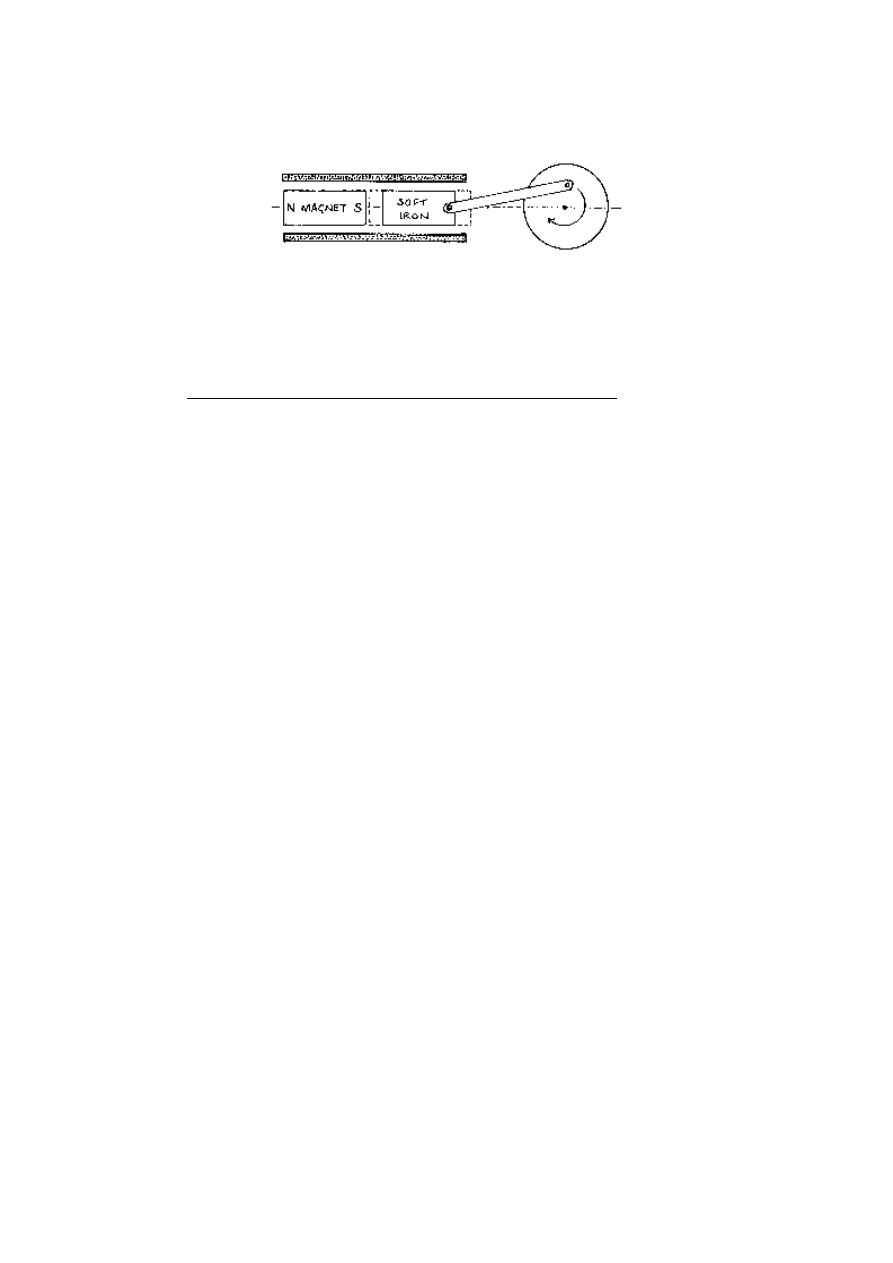
motor which operates by magnetizing the electromagnet on the closing half-cycle of the motion and
demagnetizing it during the opening half-cycle of the motion. This is depicted in Fig. 2.
Fig. 2 Reciprocating magnetic reluctance motor
In an Adams-type motor the action just described is reversed in the sense that there is no
electromagnetic excitation during the closure half-cycle but there is magnetization of the
electromagnet in opposition to the field direction of the permanent magnet during the opening half-
cycle.
However, the calculation task posed by Potter is much the same for both of these configurations.
Preliminary Remarks
In approaching the question of calculating the actions in which Frank Potter has expressed interest,
the author is mindful of the mathematical analysis which he has prevailed upon others to perform
and Potter's problem of understanding the methods they used. A valid and correct answer expressed
in a 'bottom-line' formula is not convincing to someone who has approached the problem along a
different intuitive route and hopes to match the result with that personal perception of what is
involved.
Yet, one can perform calculations in electromagnetism by using magnetic potential techniques or by
routine calculation of inductive couplings or by methods involving systematic field calculation and
flux linkage rates of change to determine EMFs. All of these methods give the same results because
electromagnetic theory is self-consistent and its techniques are well-established. It is just a question
of deciding what form of answer one seeks, whether in terms of energy, force, EMF or whatever.
Also, in performing calculations one either has to adopt special finite element methods of
computation and pursue rigorous computer analysis or make simplifying assumptions, such as apply,
for example, to uniform current excitaton of infinitely long solenoids or solenoids of finite length
with simplified geometry for the component acted on within that solenoid.
The object of the exercise, however, is to present a case which Frank Potter can understand and
verify from his own position, directed essentially at the key issue of the energy deployment. Frank
Potter has expressed a desire to see calculations which derive EMFs in terms of field actions and
motion affecting field rates of change. In energy analysis he wishes to see inductance energy
calculations rather than magnetic potentials. He further insists that the calculations conform with
orthodox physics, meaning that the basis of communication has to be that generally accepted. The
latter, of course, is the only way in which one can develop a valid basis for any research in this field,
but the concern is understandable because the author has given reason in ENERGY SCIENCE
REPORT NO. 1 for interpreting energy storage by inductance as a vacuum field reaction. However,
that development concerned causal features underlying theoretical physics, a topic touched upon in
APPENDIX C, and it in no way affects the proven principles of physics as applied to calculating
closed circuital interaction which is the subject now under study.
Within these constraints, this author offers the following sequence of argument to set out the scope
Page 8 of 31
ENERGY SCIENCE REPORT No. 4
25.4.2005
http://www.aspden.org/reports/Es4/esr4.htm

of the investigation here reported. The text used is written as if addressed directly to Frank Potter.
Note that the question of the effect of expanding solenoid radius will be dealt with before the
primary issue of the basic motor operation.
It should be read after some scrutiny of the subject of the Potter correspondence as set out in
Appendix A and Appendix B.
Step-by-Step Analysis of the Problem
1. Since your ultimate objective is to determine whether energy is conserved rather than determine
EMFs or forces, the logical method of analysis is to work directly in terms of deployment of field
energy density.
This does not preclude calculation of back EMF generated in the magnetizing solenoid, especially if
there is intention to perform an experiment to rotate a magnet inside such a solenoid and measure
that EMF. However, some general conclusions from this analysis need to be developed first and this
is best done in terms of energy as such.
I intend to avoid what is known formally as 'magnetic potential' but will need to distinguish energy
of a form that seeks to decrease from that which involves a tendency to increase. Thus I will need to
refer to the former as having a 'potential' character and the latter as having a 'dynamic' or 'kinetic'
character. The way to look at this is to say that if one pushes a ball up a hill it will have a higher
potential energy at the top of the hill but as it rolls back down the hill that potential energy reduces as
energy transfers into a kinetic form.
Magnetic field energy is energy of motion. If we try to describe it as having a 'potential' then we
need to bring in a minus sign to convey the message that it tends to increase in magnitude. This is a
subterfuge of modern physics. If one seeks to work with equations and wishes energy change to
relate to force it becomes a problem if energy of different kinds has to be put on opposite sides of the
equation. One wants all the energy terms to be on one side so that the other side is left clear for
symbols relating to force action.
By making magnetic energy 'negative' it can be deemed to have a 'potential' alongside electric field
energy, but one does see a perplexing anomaly in this area when applying Maxwell's equations to a
propagating electromagnetic wave. Here there are no forces on empty space and so, given that
energy is assumed to propagate with the wave, physicists need to think of magnetic energy as
positive in a real sense. The alternative to this is not something we should discuss here, but if that
energy were seen as 'negative' in potential terms or as exchanged with electric energy when
expressed by real, positive and dynamic terms, so an electromagnetic wave would, in theory, not
transport energy by waves as such. Indeed, one would then have to think of the momentum transfer
by photons and see the waves as the catalyst in conveying information about the energy activity in a
universal standing vacuum energy field.
All this is a little complicated but there is an underlying consistency with the prospect of there being
a standing energy background. I refer to it because you have urged a need to comply with Maxwell's
equations and, if taken literally, that may put the argument in a straight-jacket. I will proceed
therefore without further mention of Maxwell's equations but I will comply with the standard
teachings on the subject of electromagnetism because, as you may know, most electrical science
textbooks adequately cover the basic ground that applies to power circuits before worrying about
wave propagation and bringing in the Maxwell wave formulations.
2. Remember now that two magnets attracted into close proximity will exhibit strong field
interactions. They have a way of increasing the strength of the magnetic field and, in energy terms,
to make sense of this, one must see the action as a dynamic effect arising from charge in motion.
Page 9 of 31
ENERGY SCIENCE REPORT No. 4
25.4.2005
http://www.aspden.org/reports/Es4/esr4.htm

I will address first the problem of the magnet mounted to rotate within a long solenoid excited to
produce a uniform internal magnetic field of intensity H which is reversed cyclically so that the
system works as a motor.
3. If the magnet has an intrinsic strength that is constant and independent of the field H and is
orientated with its north-south poles producing a field opposed to H, the magnetic energy of the
system will be lower than for the pole orientation the other way. The potential energy will be higher.
The energy difference between the two orientation directions is simply a measure of the amount of
energy fed into the solenoid every half cycle as needed to run the motor. There is no reason
whatsoever to suspect that there can be non-conservation of energy.
For example, if the magnet itself produces a field component H' at a point in the solenoid, outside the
body of the magnet, the energy density there will be proportional to (H'-H)
2
and when H' reverses as
the magnet rotates to a corresponding reversed position this will be (H'+H)
2
. The difference 4H'H,
when summed within the space bounded by the solenoid, is a measure of the work fed into the
solenoid as the magnet is primed to reverse direction.
4. Now, it might seem that I have made this assertion blindly, based on the principle that energy is
conserved and not by proving my case, as by calculating the back EMFs induced in the solenoid and
then merging this with solenoid current over the half-cycle period to evaluate the energy input.
However, let us examine what happens to the mutual interaction component field energy term 2H'H
when we reverse H. Note that this applies to the permanent magnet rotor situation.
5. At the point in the field under study, H' is constant and so all the mutual action depends upon the
reversal of the current in the solenoid. This current change occurs with no back EMF attributable to
induction produced by change of H'. Therefore, in theory at least, there can be no power input surge
accompanying that current reversal in the solenoid. How then does the solenoid drive the motor? The
answer lies in the fact that H', as a component in the H field direction, increases in that forward
direction of H as the magnet turns through 180 degrees. This increase in the H' component, as seen
by an imaginary loop circuit at the field location, develops a back EMF which interacts with the
now-constant field H to put all the work action onto the power supplied to the solenoid. Note that the
ampere-turns comprising the solenoidal excitation operate to produce a uniform magnetic field H
within that solenoid and so can be said to comprise numerous contiguous loops of current all having
the same current strength per unit length of solenoid. Any back EMF in each component loop which
tends to resist the setting up of the field by the current is overcome by the forward EMF transmitted
from the solenoid through contiguous imaginary current loops that fill the space within the solenoid.
Without such action there would be no basis for explaining how it is that a uniform field component
H can be produced and sustained within the solenoid when current is fed into it.
I have enlarged on this theme in Appendix C so as not to detract here from the flow of the argument.
6. Consider now the electromagnet rotor. Here, at the point under study, when H reverses, so it is
that H' also reverses, but in this case the mutual energy density in the field becomes proportional to
H
2
because H' is proportional to H. We are assuming that the core has a constant magnetic
permeability over the range of magnetization used. In order now to operate the device as a motor we
must cause the rotor to turn through 90 degrees with H zero and then switch the power on for the
next quarter turn to bring the rotor into line with the solenoidal axis before repeating the action and
having a quarter turn with power off followed by a quarter turn with power on. See Fig. 3.
Page 10 of 31
ENERGY SCIENCE REPORT No. 4
25.4.2005
http://www.aspden.org/reports/Es4/esr4.htm
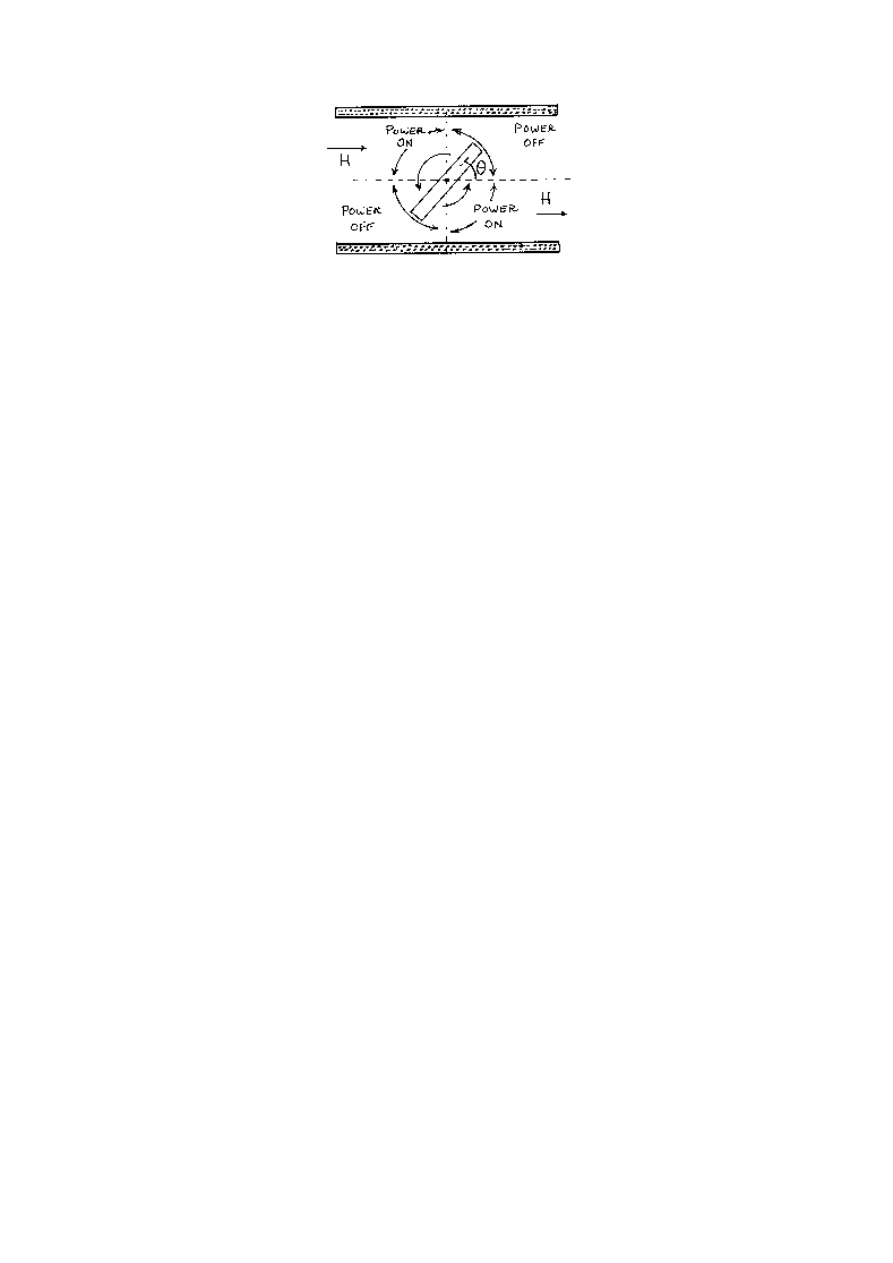
Fig. 3
Here, the same argument about back EMF applies, because H' is µHcosΘ, where Θ is the angle
between the rotor axis and the solenoidal axis. At the moment when Θ is 90 degrees we switch on
the current, but the H' component is then zero and so there can be no surge of power drawn from the
solenoid or the rotor core at the moment of switch-on, at least so far as feeding the mutual interaction
field energy as opposed to the self-inductance field energy. What then happens is that the rotor turns
so that the magnetic interaction field energy density increases, but this again sets up the back EMFs
in those imaginary current loops that make up the whole solenoidal field and put load on the forward
EMF applied to that solenoid. The back EMF is proportional to the factor µ used to express the
added field strength attributable to the magnetic properties of the rotor core.
7. It would seem therefore that the electromagnet rotor case just discussed is one that requires all the
motor operating power to be fed in as current overcoming a back EMF induced in the solenoid. It is
pertinent to mention that an electromagnetic rotor core can, in theory, be regarded as one of infinite
magnetic permeability without changing this argument. The field action in the free space around the
rotor is what is governing and that magnetic core will only accept the H' polarization governed by H
if H does all the work of overcoming the back MMFs (magnetomotive forces) that apply in the
demagnetizing sense in the pole regions.
8. To this point, therefore, there seems no case for suspecting any non-conservation of energy in
motor operations for either forms described, but it is stressed that we have not gone out of our way to
design a motor that makes unusual demands on the magnetic core and have applied basic physics to
proving the case based on back EMF argument, as requested. Although those actual EMF values
have not been calculated they are readily deduced, given the necessary design parameters and by
working backwards from knowledge of the solenoidal current and the principle of energy
conservation. See, however, the alternative treatment in Appendix D.
9. The next question at issue is the problem of how the motor functions with H being the same
regardless of whether we use a solenoid that is very large in radius relative to the dimensions of the
rotor. The thought that it might be impossible to justify the back EMF and solenoidal power drive
coupling if the wire comprising the solenoid is far removed from the rotor is certainly thought-
provoking. I would certainly expect the motor to run with the same performance regardless of the
radius of the solenoid, if one could ignore I
2
R losses, as you assume. However, though it might seem
questionable, I hold to the view implicit in the above argument, namely that the back EMFs in those
imaginary current loops in the solenoidal field are propagated back to the solenoid proper so as to
prevent the vacuum field from becoming one turmoil of eddies and vortices responding to local
EMFs induced in space. Again, I refer to Appendix C.
I stress here that it is an experimental fact that EMFs can be induced around loops which are not
bounded by wire. A closed circuit through a conductor is not essential to define the action of an
EMF. One can have partial EMFs acting around parts of circuits and these can vary in two identical
halves of a circular wire loop embracing a varying field. The experiment is one discussed on pages
Page 11 of 31
ENERGY SCIENCE REPORT No. 4
25.4.2005
http://www.aspden.org/reports/Es4/esr4.htm
119-120 of my book MODERN AETHER SCIENCE.
10. The suspicion that the EMF needed to power the solenoid has to be weaker because the wire is
removed from the magnet cannot be supported. The reason is that the physics of the probem is
governed by energy supplied to the solenoid to meet the field requirements. The minute back EMF in
each cm length of each turn of the wire in the solenoid is balanced by the inversely proportional
increase in the overall circumferential length of that turn.
11. The question raised about calculating the actual EMF conditions in a system having a fixed ratio
of solenoid radius to length, but on an increasing scale in relation to the rotor size, is one that I aim
to avoid because I see no end purpose of value. I will, however, argue the case for a limiting
situation, which applies regardless of the extended dimensions and shape of the solenoid.
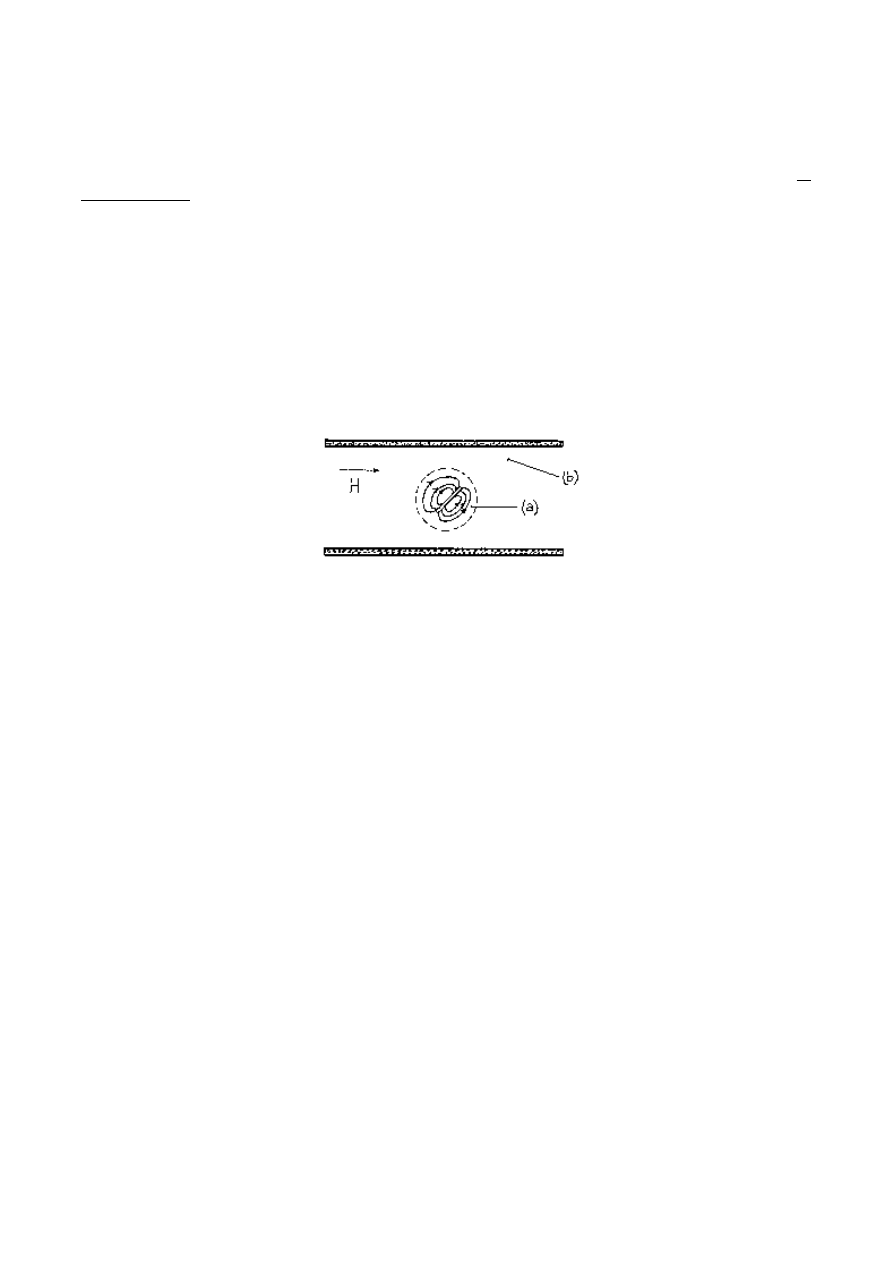
Refer to Fig. 4 and imagine (a) that the rotor magnet and its field H' are confined to a spherical
volume of fixed radius in which it interacts with the uniform solenoidal field H and (b) the separate
remaining region of a non-uniform field H within the solenoid of bounded extent.
Fig. 4
The total field energy in the latter region (b) will not vary with change of orientation of the rotor
magnet whatever the solenoid radius, whereas the total field energy of the former region (b) will so
vary but will not vary with solenoid radius. Accordingly, the back EMF induced in the solenoid will
not depend upon that radius and the motor will operate at the same power rating set by H and its
reversal frequency.
12. There is, therefore, no valid basis for suspecting that the change of radius can cause non-
conservation of energy and any calculation by EMF or magnetic potential methods is bound to give
the same result, because the latter are based on magnetic induction principles which derive from the
changing values and disposition of the field energy density.
Of course, owing to self-induction effects, the cyclic switching of current will prove more difficult
with the much larger solenoid, but that is a practical consideration not relevant to the problem under
discussion.
13. The important point so far as the permanent magnet rotor is concerned, however, is that the
magnetization-demagnetization sequence has been symmetrical in its action and energy has merely
been 'pumped' from the solenoid current source to the motor output in both half cycles of this
sequence.
The scenario can be entirely different if the solenoid closely embraces and contains the permanent
magnet fixed in a coaxial position with an air gap interfacing with a coaxial soft iron core that can
reciprocate mechanically to drive a motor steam-engine-style via a connecting rod and flywheel.
14. However, let us first discuss a situation where the solenoid, as before, contains a rotating magnet
but in addition also a non-rotating soft iron core or, alternatively, a rotating soft-iron core and a fixed
permanent magnet.
Page 12 of 31
ENERGY SCIENCE REPORT No. 4
25.4.2005
http://www.aspden.org/reports/Es4/esr4.htm
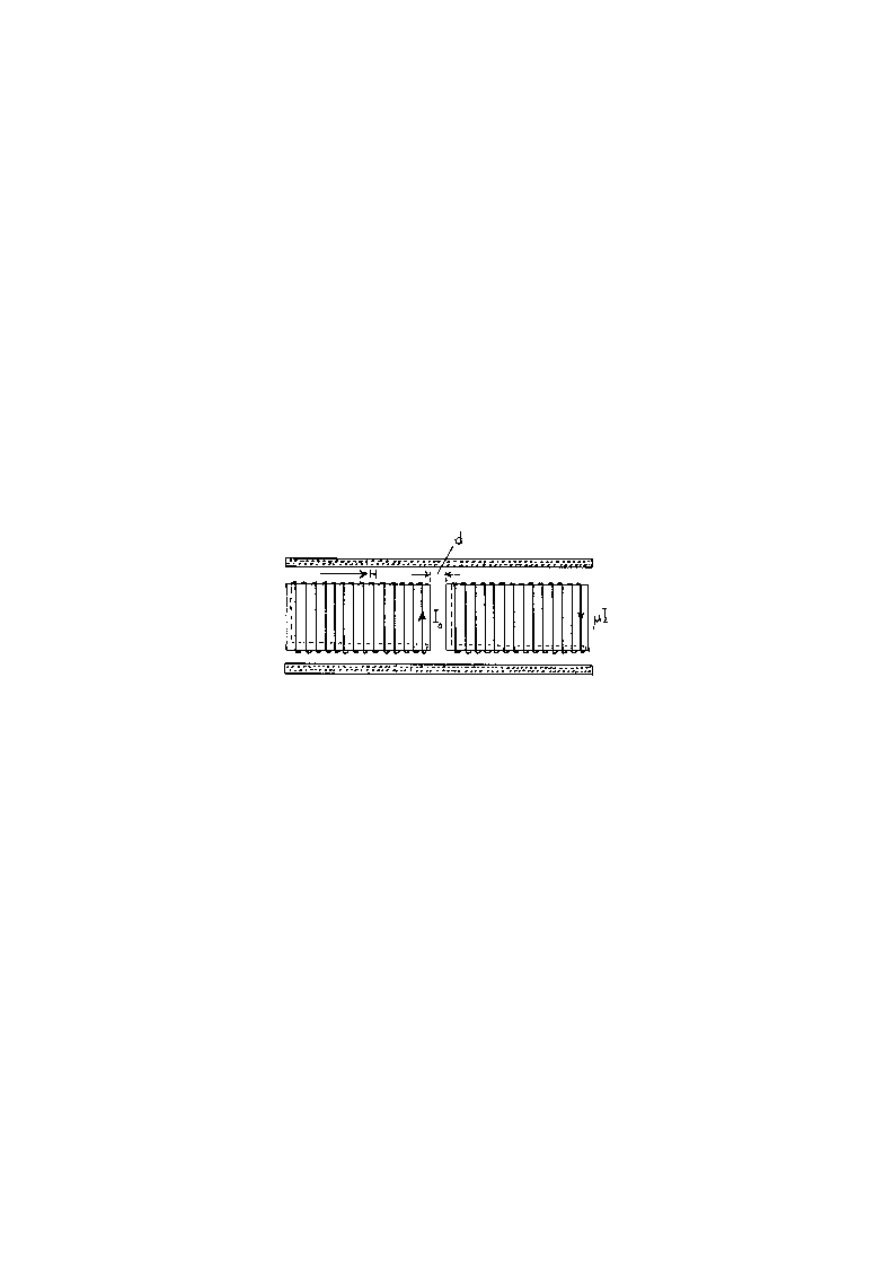
Here we are looking at the prospect of using the primary solenoidal magnetic field H to produce a
controlled magnetic field in the soft-iron core which then regulates the interaction with the
permanent magnet resulting from rotation.
The problem becomes that of a three-part interaction.
15. Now, contrary to the prior situation, where the electromagnet had to turn through 90 degrees
without power input and then be driven by power input over the next 90 degrees of motion, we can
have here a situation where the permanent magnet does all the work in driving the motor in one
quarter cycle and the input power operates to weaken the electromagnet in the next quarter cycle.
This brings the problem closer to the Adams motor principle.
The question then at issue is the calculation of the energy needed to be supplied as input in relation
to that of the drive generated by the magnet, bearing in mind that rather special interactions between
two ferromagnetic cores are now at work. This is not a proposal raised by the correspondence but it
warrants consideration as part of the analytical treatment of the question that has been raised,
because the same analysis applies to the reciprocating machine of Appendix B.
16. The key mathematical exercise is that of calculating the energy fed by solenoid current in setting
up H in the system shown in Fig. 5.
Fig. 5
The magnet is itself equivalent to an air-cored solenoid carrying a constant current I
o
and the soft
iron core defines a region of constant permeability µ.
The field action of the primary solenoid current upon the permanent magnet can be ignored in this
analysis, at least initially, because the coercive force of the magnet material is so high that a
relatively weak magnetic field could hardly affect its action.
The soft iron core can, therefore, itself be replaced by a solenoid carrying a current µ times that in
the solenoid proper and we can dispense with the solenoid for the purpose of calculation. We are left
simply with the analysis of the interaction between two coaxial solenoids spaced by a gap width d,
one carrying current I
o
and one carrying current µI.
It is assumed for convenience of preliminary analysis that the radii of these solenoidal
representations of the magnet and the core are the same and that the turns per unit length are also the
same.
17. Our problem has reduced therefore to that of working out the mutual inductance between two
coils which can move relative to one another along the common axis.
Page 13 of 31
ENERGY SCIENCE REPORT No. 4
25.4.2005
http://www.aspden.org/reports/Es4/esr4.htm

However, we must be mindful of our objective, which is to see how energy conservation principles
apply to this problem. If the only question at issue is whether energy is really conserved we do not
need to work out the rigorous mathematical solution giving precise values for the inductances
involved in terms of the finite lengths of the magnet and core.
18. As a function of the air gap width d and the radii and lengths of the two solenoids, we could
calculate the following quantities L
m
, L
c
, M
mc
, where L represents self-inductance and M mutual
inductance and the suffix terms m and c apply to the magnet and the core, respectively.
The magnetic energy of the system is then expressed as an energy quantity stated in potential terms
as:
- ˝L
m
I
o
2
- ˝L
c
µ
2
I
2
- M
mc
µI
o
I
This means that if we were to reduce the current we would recover energy because a time differential
of - ˝L
c
µ
2
I
2
, for example, becomes -Lµ
2
dI/dt and dI/dt is negative so that the energy change as
measured by potential is energy returned. When seen from the viewpoint of the exciting solenoid the
factor µ applies rather than µ
2
but there is return of energy according to such formulae when current
is switched off.
19. Note now that, if d were to remain constant as I varies, the energy fed into or out of these
inductances with cyclic change of I is the same on the up-cycle as on the down cycle, so to that
extent energy must be conserved by the electromagnetic system. I
o
is constant. Therefore, if d
changes, only the mutual term depending upon d need be considered.
This leaves only the term in M
mc
as a subject for detailed analysis.
20. Now, we can presume that the magnet and the core, though of finite length are very long in
relation to the small gap width d. In this case we can follow standard magnetic circuit theory, where
a long magnet has very small demagnetization effects due to free poles at the ends, but we will still
develop this to allow for a finite valued ratios of length to radius for both the magnet and the core.
Here we are advancing the argument towards a point where we can calculate inductance attributable
to an air gap in a magnetic core solely in terms of the field energy known to be stored in that gap.
This is a valid proposition in accepted theory because leakage flux is deemed to be minimal and
because the gap-dependent inductance energy is nothing other than the sum of the magnetic field
energy in the system, this being a quantity that has a negligible component inside iron of high
magnetic permeability.
However, as that may seem to be an easy way of escaping from the more difficult task of calculating
the actual mutual inductance and proceeding from there, I will address the latter problem.
21. First, however, I emphasise that the reason a calculation of air gap energy offers a more direct
route to a solution is that the flux density across the gap and through the interface between the
magnet and the soft iron core will involve far greater energy density in a unit (vacuum) permeability
zone than in the soft iron. The energy density is proportional to B
2
/µ and µ in the soft iron will be
very much greater when µ is unity.
Also, it must be remembered that even if a saturation level of magnetism in the permanent magnet
implies a low differential permeability, the fact that it is saturated has predetermined the B-
dependent energy density value and so it cannot contribute terms that are d-dependent in any
Page 14 of 31
ENERGY SCIENCE REPORT No. 4
25.4.2005
http://www.aspden.org/reports/Es4/esr4.htm

significant measure when judged alongside the energy in that gap.
22. Now, having decided to represent the action between the permanent magnet and that of the
magnetic core as notional solenoids carrying high currents, one might expect that the mutual
inductance between two such solenoids will be very high. A small gap between two sections of a
single solenoid does not affect its inductance to any significant degree, but a small gap separating
two solenoids that happen to carry very high current can involve energy change in substantial
measure. The energy of the self-inductance intrinsic to our notional solenoids is really that of the
intrinsic ferromagnetic condition of the magnet and the core and that energy is beyond our reach as it
is locked into the atomic quantum behaviour of the atoms of the ferromagnetic material.
The mutual inductance energy is what is amenable to our control in our experiments.
23. To provide an interim summary of the purpose of this discourse, it is noted that, whilst aiming to
show how the general problem can be analysed mathematically, we are scrutinizing energy
conservation processes where we draw motor power from a magnet as the gap closes, then switch on
the current I to oppose the magnet's field action across the gap so as to allow the core to be pulled
away from the magnet with little energy demand. We expect, on basic physics teaching, to find that
we must do work against a back EMF to achieve this condition, work exactly equal to that available
from the magnet upon closure of the gap. However, we want to be sure that the accepted theory,
when worked out in detail, does sustain this standard energy conservation assumption. Our hope, of
course, if we are minded to probe new ground in the search for new energy conversion discoveries is
that the energy books will not balance and that we might tap some of that thermodynamic energy
resource which powers ferromagnetism at its quantum atomic level.
24. To proceed, the route to determining the mutual inductance will start from the formula for self
inductance of a single solenoid which we will then divide into two sections.
By way of reference the author will take as a base the textbook 'Electrical Measurements and
Measuring Instruments' (3rd edition) by E. W. Golding. It was published in London by Sir Isaac
Pitman & Sons Ltd in 1946. It happens to be the university textbook used by the author in his early
studies and similar reference data is probably available in other and more recent works, though there
is a secondary reference to 'Nagaoka Factors' which feature in a paper by Nagaoka, Journal of
College of Science, Tokyo, Art. 6, p. 18 (1909) and the data from the latter may be difficult to trace.
In any event the calculations pose no problems to modern computer analysis, but it suffices for the
present purpose to rely on the textbook authority which is home-based in U.K. and dates from the era
when we were both introduced to electrical engineering studies.
25. The self inductance of a solenoid of circular section and diameter a having N turns uniformly
wound over a length D is:
L = K
2
N
2
a
2
/D
nano-henries. This is given at p. 178 of the Golding book and K is the Nagaoka factor plotted in
graphs on page 179 as a function of the diameter/length ratio of the solenoid.
For the onward calculation we now need to specify that ratio a/D and I will choose here three ratios
for which D/a is 20:1, 10:1 and 5:1. The Nagaoka factors are, respectively, 0.98, 0.95 and 0.91.
Now, suppose we chop the solenoid in half, notionally, and see it as two coaxaial solenoids arranged
adjacent one another with no gap in between. The overall inductance is then the self inductance of
each half plus the mutual inductance between the two halves. Note that in energy storage terms, with
Page 15 of 31
ENERGY SCIENCE REPORT No. 4
25.4.2005
http://www.aspden.org/reports/Es4/esr4.htm

a current I, the self inductance energy of each half is ˝LI
2
and the mutual inductance energy is MI
2
.
So, regarding this as a self inductance energy of a common single solenoid, L of the double length
solenoid is 2(L+M) of the two-part configuration.
Thus, if D/a is 20 for the overall single solenoid and 10 for each half, N being double and D being
double in the above formula gives 2K, where K is 0.98, as equal to 2(K+M/L) with K as 0.95,
making M/L equal to 0.03, where L is the inductance of the half-solenoid of D/a of 10.
Alternatively, if D/a is 10 for the overall single solenoid and 5 for each half, we find that 2K with K
as 0.95 equals 2(K+M/L) with K as 0.91, making M/L equal to 0.04, where L is the inductance of the
half-solenoid for D/a of 5.
26. We have now determined the mutual inductance between two sections of solenoid of equal
length and, as this holds regardless of the currents in the two sections, we can say that the mutual
inductance energy is MI
o
I, where, according to the choice of D/a ratios, M is 0.03 or 0.04 times the
value of L as given by the above formula for the separate sections.
27. This is the amount of energy that can be expected to be extracted by the mechanical pull as the
core is attracted from a well separated position to close the air gap between it and the magnet.
The formidable question now faced is that of deciding how energy is deployed if we decide to alter
the current excitation so as to demagnetize the core before separating it from the magnet.
28. To proceed, we need to enter the territory of field effects from free end poles of a magnet.
Suppose that the magnet exists at rest inside the solenoid and no current I is fed to that solenoid. The
core is initially at rest spaced from that magnet by the gap distance d.
The magnet, unaided, will assert an attractive field which pulls the core into contact. This field will
be deemed sufficiently strong to impart substantial polarization and set up a fairly strong level of
magnetism in the electromagnetic core. Thus, even with no external exciting current present, there is
an effective polarization current in the core of the order of I
o
/µ, because the magnetic flux traversing
the air gap will be the same on both sides.
On this basis we can confine our study of power input to the task of demagnetizing the magnetic core
once it has closed into contact with the magnet. We divert therefore to the study of this problem.
29. We have, in effect, a magnet and we have put, as an extension of its length, a soft iron core in
contact with it. This means that the magnet will transfer an end pole from itself, and through the core
to its outer extremity. The magnet with a D/a ratio of 10:1 becomes, say, an extended magnet with a
D/a ratio of 20:1.
The question at issue now is that of contriving to drive that pole back to the original position in the
magnet proper and before we separate the core from the magnet.
Here, we need to keep in mind that a soft iron core needs very little field to determine the direction
of its magnetization. The reaction owing to demagnetization effects set up at the free end poles is
what makes the demand on any applied field. So, if we look to a mid position inside the core and ask
how the adjacent magnet and the pole demagnetization effects and any external field cooperate in
deciding a direction of magnetization, we can begin to see what is needed.
30. The demagnetizing field effective on a magnetized bar and equivalent to the offset needed in a
magnetizing solenoid is known from data of demagnetization factors found in textbooks. The
Golding book referenced above shows such data at p. 360.
Page 16 of 31
ENERGY SCIENCE REPORT No. 4
25.4.2005
http://www.aspden.org/reports/Es4/esr4.htm

For D/a of 20 the demagnetizing field intensity is 0.5% of the flux density and for D/a of 10 it is
1.6% of the flux density.
Now consider what this means in terms of controlling the magnetic flux density through an air gap
between the magnet and the core.
Firstly, those demagnetizing factors apply to specimens that are not permanent magnets, so response
to externally applied magnetic fields cannot be predicted so far as action within that magnet is
concerned.
Secondly, the soft iron core will respond to net field action and if it were replaced by air we see that
the additional demagnetizing field effect that comes into play is about 1.1% of the flux density in the
magnet, this being the difference between the two demagnetizing factors.
This suggests that, even if the soft iron core were left in position, the additional application of a back
field of the same amount, or possibly more corresponding to the 1.6% factor, would drive the pole
back into the magnet.
If this were so, the energy needed to be supplied to the demagnetizing winding would be of the order
of ˝LI
2
µ which compares with the mutual inductance energy of 4% of LI
o
Iµ. Remember then that I
o
is of the same magnitude as Iµ and that µ as it applies here is the magnetic permeability of the soft
iron expressed in gaussian units, meaning that it is of the order of 10
3
.
Very clearly, on this basis, it needs far less energy to demagnetize the core than we have available as
mechanical work from the action of the magnet in closing the air gap. The above figures suggest an
energy ratio of the order of 1:100.
But are we right in this argument?
31. Firstly, let us assume that we have a correct analysis. What does this mean in terms of energy
conservation? Since energy has to be conserved in any physical process it simply means that the
magnet can stand up to the demagnetizing field set up by its free poles by calling upon its atomic
quantum-powered sources to keep it ferromagnetic, meaning that it gets energy from a
thermodynamic interaction with the quantum world. Alternatively, if it owes its permanent
magnetism to some internal thermally-related activity, it may simply cool to sustain the magnetic
requirement.
That may be speculation, but one fact we do know is that the magnet has a way of recovering once
we pull away the demagnetized core using very little effort and prior to switching off the
demagnetizing current.
Secondly, let us assume we are wrong, but then how do we know? We set out to calculate the effect
of a magnetizing field on a magnet and a soft iron core and we encountered the problem of deciding
how the field set up externally from the free poles of the magnet affected the soft iron core. We had
to estimate the back field needed to counter that influence. We know that the free magnet sets up its
own back field and have used that as a measure for our calculations. If this is wrong how else can we
proceed?
32. The only sensible way forward from this position is by experiment and already it should be said
that I would never have begun this exercise had I not heard of experiments that purport to involve
permanent magnets and reveal anomalous gain of electrical/mechanical power.
However, I have accepted your challenge to perform calculations which might give you some
Page 17 of 31
ENERGY SCIENCE REPORT No. 4
25.4.2005
http://www.aspden.org/reports/Es4/esr4.htm
satisfaction in your pursuit over so many years to find an answer to your questions and although I
think I have gone far enough in that theoretical endeavour I will go one step further.
33. We have considered above how two solenoids having a 10:1 length to diameter ratio, one
representing a permanent magnet and one a soft iron core, interact magnetically.
A question of interest is that of determining what equivalent current strength I would suffice in an
external magnetizing solenoid closely embracing the soft iron core to offset and cancel, at the centre
of the soft iron core, the magnetic field set up by the equivalent current I
o
of the magnet.
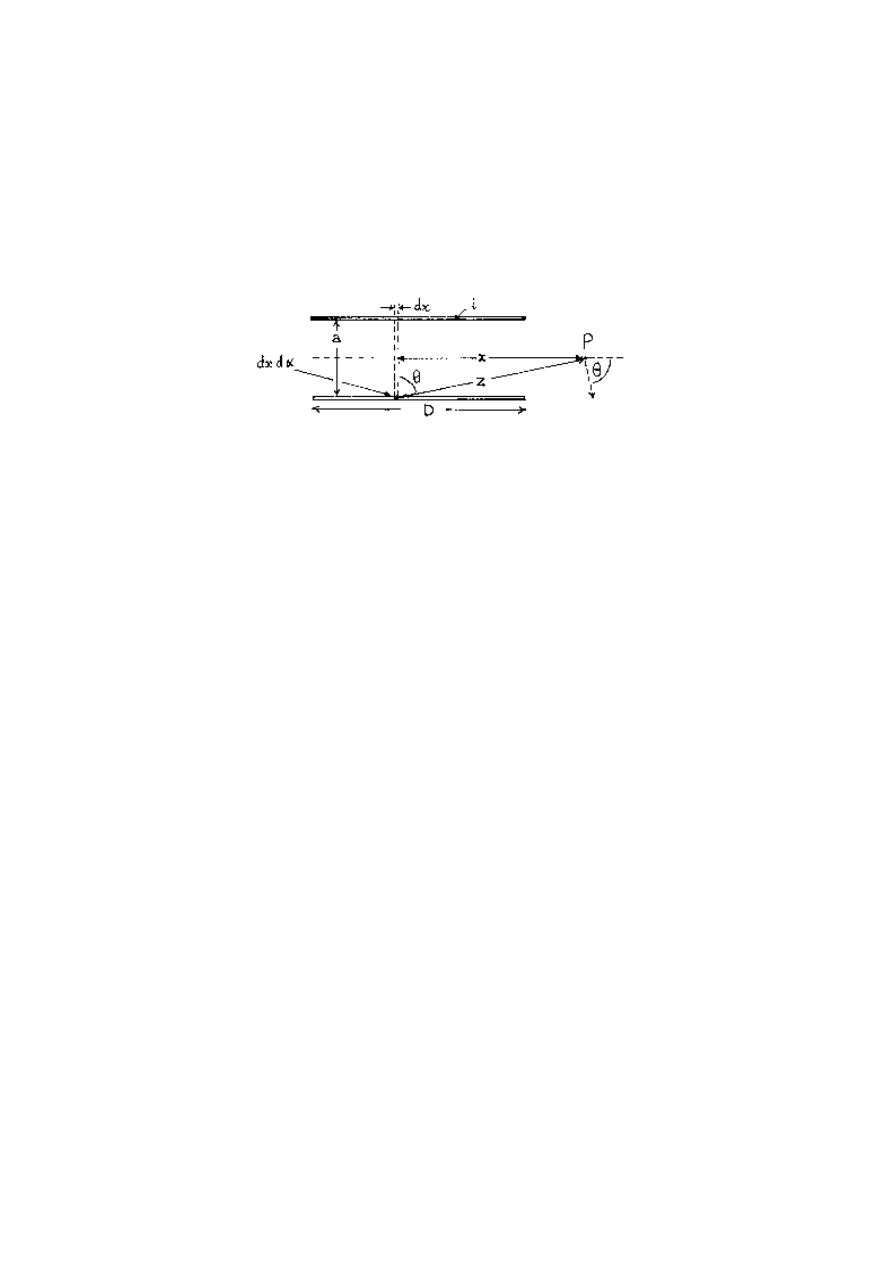
Fig. 6
Referring to Fig. 6, the task is to calculate the axial field at a point P set up by a current of i ampere
turns per unit length of solenoid.
We consider an elemental section i(dx)(dα) of the energized solenoid and note that this angular
element (α radians) of ring form, of diameter
a
distant x from P along the axis, will set up a magnetic
field at P given by the formula α(
a
/2)(idx)/z
2
, where z
2
is (
a
/2)
2
+x
2
. This field is directed at an angle
Θ to the axis, where x is (
a
/2)tanθ and (
a
/2) is zcosΘ. Then, since dx is (
a
/2)sec
2
ΘdΘ or (
a
/2cos
2
Θ)
dΘ, the component field at P attributable to idx over the α = 2π range of the ring element is:
(4/
a
)cos
3
Θ(idx)
and, as dx is (
a
/2)sec
2
ΘdΘ, this reduces to:
2πicosΘdΘ
This can now be integrated to obtain 2πisinΘ and so determine the axial field intensity at P
attributable to the whole length of the solenoid representing the magnet, namely from an angle for
which tanΘ is 10 to one for which tanΘ is 30.
With tanΘ as 10 this gives sinΘ as 0.995037 and with tanΘ as 30 this gives sinΘ as 0.999445 so the
difference is a factor of 0.004408.
In contrast the same current in the solenoid centred on P would develop a field at P given by the
same formula applied between limits for which tanΘ is 10 and -10, respectively. This gives a
difference of twice 0.995037 or 1.990074 as the comparable factor representing axial field intensity
at P.
The ratio of these two field strengths is 451:1, meaning that the field developed by a powerful
current I
o
in the solenoid representing the magnet could be cancelled at P by an opposing current in
the magnetizing solenoid of the soft iron core that is only 1/451 of the strength of I
o
.
Page 18 of 31
ENERGY SCIENCE REPORT No. 4
25.4.2005
http://www.aspden.org/reports/Es4/esr4.htm

34. It is submitted on the basis of this analysis that it is not at all unreasonable to contemplate that a
small current supplied to a magnetizing coil around the soft iron core and directed in opposition to
the polarity of the magnet can serve severely to curtail the attractive force between the magnet and
the core.
This being so there is every reason to expect the motor contemplated to operate by drawing drive
power from the magnet and using a relatively small amount of input power to restrain the braking
action as the motor reestablishes the gap between the magnet and the core.
[This ends the author's formal response to Frank Potter]
Onward Experimentation
The above discourse has probed the principles of operation of a device which can possibly serve us
as a new means for generating power.
Machines testing these principles must now be developed to verify what has been suggested by
routine application of established scientific principle.
The only departure from established physics has been an awareness that there might be a hidden
thermodynamic source of energy which could feature in the energy balance calculations, which has
meant that we would not rely on taking the short cut of working out our answers by assuming that
the only energy action is electromagnetic or mechanical in form.
So often, physicists who set out to calculate a result A assume a conservation rule by which A + B =
0 and then calculate B instead. That may well prove to be a very costly mistake that has had a
damaging effect on progress in the energy field. One is thereby relying on assumption, albeit
accepted doctrinaire assumption, and using inadequate knowledge of the range of the energy
components that must be considered. Thermodynamics, meaning the realm of heat energy in some
form, even the heat latent in atomic electron activity, is a subject of relevance to electromagnetic
machine design that ventures into what seems hitherto to have been forbidden research territory,
because, as already stated, researchers fear the stigma of addiction to 'perpetual motion'.
Given the kind of question asked by Frank Potter and his persistence in seeking answers after
decades of effort, given the motor developments championed by Robert Adams and given the reports
of the research of Hans Coler and others on solid-state magnetic devices posing energy anomalies,
this author can but share their frustration and this is why this ENERGY SCIENCE REPORT is
necessary.
One can do experiments, as others have done, but even that will not convince the skeptic who wants
to adhere to principles of disbelief. Without a theoretical base moulded around the existing
framework of physics one cannot get a hearing, far less attract the interest of those who will advise
funding sources to invest in the 'free energy' field.
Furthermore one needs a basis on which to understand why those who try to get 'free energy'
machines to work may fail. One cannot just throw a pile of magnets together and hope to work
magic.
It is pointless to take this discussion theme much further, until the necessary experiments have been
performed by the author and are duly reported in a sequel to this ENERGY SCIENCE REPORT.
Commentary on the Appendices
In winding up this introduction to the 'Potter debate', a few points outstanding from the
Page 19 of 31
ENERGY SCIENCE REPORT No. 4
25.4.2005
http://www.aspden.org/reports/Es4/esr4.htm

correspondence initiated by the Potter letter of 15th October 1993 warrant comment. That letter is
reproduced in Appendix A.
By letter dated 21st October 1993, Potter, by the following words, acknowledged my expression of
interest:
"I think I will begin with the phrase in your first paragraph "what you say is right!",
which caused me to rub my eyes in astonishment, because it is the first time that any
reputable scientist has ever said that to me; not even Professor Kilmister who, although
he has been most generous indeed in helping me literally for years past, and has
acknowledged that I have been right on some points, is like all mathematicians and
scientists extremely dubious about anything touching Conservation of Energy."
Later in the same letter:
"I was particularly interested in your phrase about a "hidden source that sustains the
electron 'spins' in a ferromagnetic material". That is precisely the sort of thing that has
been at the back of my mind for a very long time indeed (though I know little
technically about 'spin' theory), in fact gradually since 1956. I really got going about 11
years ago with the ideas about which I wrote to you. That was in 1982, which also
seems quite a long time ago now, when I approached Professor Kilmister on these
matters."
In his 15th October letter, Potter had mentioned four issues of debate but disclosed only two. His
letter of 7th November began with the words:
"Thank you for your further note and the extracts from New Energy News that you
kindly sent enclosed. Before going on to some comments upon this very interesting
material I would like to present the other two ideas that you said you would be willing to
comment upon."
"The first one .... involves an experiment. I took a very good quality permanent magnet
and wound a close-wound wire coil around it, and then passed a current through it in the
opposite direction to that of the current that would have magnetized the magnet. At the
start of the experiment, before the current was switched on, there were a number of soft
iron tin-tacks adhering to the magnet. I got the result that I had anticipated. On
increasing the current there came a point where the tin-tacks flopped off; and on
increasing the current still further they jumped on again. All fairly obvious I suppose -
the two fields cancelling one another. But the puzzle was this: Energy is supposed to be
in the 'field' surrounding the magnet (or the coil), and yet, since the tin-tacks were not
attracted at the particular level of current there must have been no field there to
magnetize them. But there is energy inside the permanent magnet, and the energy must
also have been put into the coil in the build-up of its own energy field, this energy
coming from the battery. Where have these two energies gone to? On switching off,
pretty obviously these two energies come back, though I was not able to check
practically the restoration of the energy of the coil to its surroundings. The magnet
appeared to be unaffected afterwards."
"The last of the four ideas (two in my earlier letter) depends upon the one just given, and
concerns a small machine that I had an idea to build, but the practicalities of doing so
were difficult with the tools or apparatus available to me; and also later on a possible
snag in the idea occurred to me (which I will mention in a later paragraph); so, after
doing practical work upon it, I gave it up for the time being and went over to the two
ideas in my previous letter to you.
Page 20 of 31
ENERGY SCIENCE REPORT No. 4
25.4.2005
http://www.aspden.org/reports/Es4/esr4.htm

The machine was this ...."
This next portion of the Potter letter is in Appendix B. It is a description of what the author has
referred to above in the context of a reciprocating steam-engine-style movement of a permanent
magnet cum soft iron core combination.
As already mentioned, it is what this author had in mind before that first discussion with Professor
Kilmister at the Cambridge meeting.
However, whereas the opening letter from Potter had concerned the mathematical task of analysing
what could be said to be thought experiments bearing upon the conservation of energy issue, here
was a third 'idea' raising questions of energy disposition based on an experiment with a magnet and a
fourth 'idea' which concerned a machine that resembles the Adams motor. The difference is similar
to that between the early reciprocating steam engine and the four-cylinder rotary engine.
In the above discourse, the author has already dealt with the themes Potter raised by his first, second
and fourth 'ideas' and wonders now whether to comment on the magnet experiment of that third
'idea'.
The disposition of energy when work is done to 'demagnetize' a magnet has already been discussed
in this Report. We are talking here about the physics of the process at room temperatures,
temperatures well below the Curie temperature. In this situation one never demagnetizes a
ferromagnetic substance, whether it is a permanent magnet material or soft-iron. All one can do is to
'depolarize' the specimen under test. Its intrinsic minute magnetic domain constitution becomes
randomly directed amongst the axes in the crystals of the material and it merely appears to be
demagnetized.
So, the primary energy is always trapped by the ferromagnetic state and any modest change that does
occur involves, to some extent, that which can occur at the limits of transition as one takes the
magnet through its Curie temperature. There is a thermodynamic energy exchange involving that
hidden field we associate with quantum theory.
As to why Potter's magnet recovered its polarization after undergoing the 'opposed' current effect, as
tin-tacks fell off and were picked up again, that is not easily explained without knowing precisely the
properties and state of the magnet and the sizes of magnet, demagnetizing coil and current in that
coil.
If the magnet reversed its polarity it is perplexing if it could reverse back again when the current was
switched off. It could not have been one having a high coercive force if a small coil carrying current
available from normal domestic sources could perform that polarity reversal function. If, however,
the coil wrapped around it did extend, in its influence, to the tin-tack region, we may have here
precisely the evidence that shows how a weak field on a soft iron core can affect the attraction of a
magnet.
In the latter case the commentary above and the calculations which show how a small field action
can limit the influence of a magnet interacting with a soft-iron core are very relevant to Potter's tin-
tack experiment.
By letter to the author dated 23rd March 1994, Frank Potter acknowledged certain book references
that I had sent him showing methods of calculating mutual inductance and included the comment:
"The interesting, but to me difficult, calculations that you sent (though, as you say,
routine for engineers) are in particular for self-inductance and a lot about mutual
inductance. The specific problem that I and my friends have struggled with for so long is
Page 21 of 31
ENERGY SCIENCE REPORT No. 4
25.4.2005
http://www.aspden.org/reports/Es4/esr4.htm

not that, but rather the induction of EMF by a rotating permanent magnet --- in other
words 'back EMF' in a rather special form of motor. This EMF is the thing that seems so
difficult to get an exact answer for in this case; and the specific problem is whether the
EMF does depend upon the ratio of the length of magnet to the radius of the solenoid. I
think it does. I have, as you know, been hankering after a calculation on the basis of the
Blv formula; but I shall be most interested in your own calculation, when you can do it,
and I can only hope that it is as 'routine' as the ones you kindly sent me."
Upon reading this this author wondered about the emphasis placed on the ratio of the length of the
magnet to the radius of the enclosing solenoid. In earlier communications the question had been
understood to relate to the problem of using a solenoid of realistic (not infinite length) proportions,
whilst increasing the radius of the solenoid, but at all times the magnet itself has to be 'within' the
solenoid. In other words one should not just imagine something approaching a ring coil with a
magnet mounted to rotate about the centre of the coil and having its poles sweeping through an arc
protruding from the plane of the coil.
Accordingly, it was assumed that Frank Potter was primarily interested in calculating the EMF
induced in a solenoid by a rotating magnet having a length that is small in relation to solenoid radius,
but yet the length of the solenoid is large enough for it to be said that the solenoid encloses the
magnet fully. In other words one seeks to rely on the assumption that the field produced by the
solenoid and acting on the magnet is essentially that applicable at the centre of the solenoid.
On this basis, of course, one must surely agree with Frank Potter that the back EMF induced in the
solenoid owing to rotation of the magnet does depend upon the radius of the solenoid.
As to the calculation of this EMF, this poses no real difficulty, but in view of Frank Potter's concern
about method of calculation and his apprehension about mutual inductance formulae, the author has
deemed it appropriate to provide the additional analysis set out in APPENDIX D. No doubt there
will be others who read this Report that have interest in the general problem but are not too familiar
with the various methods of calculation that can be used in electromagnetism.
Between 7th November 1993 and 23rd March 1994, and later, Potter wrote many further letters to
the author prior to completion of this Report, mainly to be sure that his questions were fully
understood and revealing his anxiety that, having found someone willing to resolve the issues raised,
the main points would not be missed. The other letters bore the following sequence of dates: 26th
December 1993 and, in 1994, 14th January, 16th January (two letters), 19th January, 8th February,
26th February, 1st March, 7th March and 7th April. The 23th March letter was followed by one
dated 2nd April. All related to the general topic of the four 'ideas' that have preoccupied Frank Potter
for so long and all were written before any of this author's response, as provided by this Report, was
conveyed to him.
It will, therefore, be appreciated by the reader that this question of whether a magnetic machine can
be operated in a way which breaches the Principle of Conservation of Energy, as interpreted in the
realm of electro-magnetism and mechanics, is one very close to the heart of this 83 year old
gentleman. His letters, as quoted, should show the reader that Potter is not a 'crank' experimenter
who believes in 'perpetual motion'.
No doubt, much that has been said in this Report will not be easy to digest and there will be more
that has to be said. The author has suggested to Potter that he should await events and see how the
'free energy' world that is now addressing similar issues progress with the experiments on new
machines. Not surprisingly, Potter wants to keep involved and contribute to the momentum of
something affecting his brainchild. However, there are limitations in what one can do in a
disbelieving world that is competitive in matters scientific and so this Report can only serve to
introduce Potter's interest to those few who may read what is said here.
Page 22 of 31
ENERGY SCIENCE REPORT No. 4
25.4.2005
http://www.aspden.org/reports/Es4/esr4.htm

It is hoped that the 'Potter debate' will arouse interest and lead to progress on the alternative energy
field. In bringing a different perspective to the present scene, perspective which complements the
ongoing debate that now centres around the claims concerning the Adams motor, hopefully
something of benefit will emerge from what this author is contributing by issuing this Report.
This author acknowledges Potter's kindness in allowing this material to be presented in this Report
form, with text from his correspondence, and ends by wishing him well in his further endeavours,
coupled with the hope that he will see feedback as others now take up the debate.
10th April 1994
HAROLD ASPDEN
APPENDIX A
LETTER DATED 15 OCTOBER 1993 FROM FRANK F. POTTER
Dear Dr. Aspden
I hear from Professor C. W. Kilmister that during a discussion with you at Cambridge
some weeks ago he mentioned to you my name and my interest in Magnetism and
particularly in Conservation of Energy. He did not know your address at the time, but a
few days ago he found it and sent me a most interesting letter stating that he had heard
from you that some experiments with permanent magnets in USA appear to indicate that
energy may not be conserved in some of the phenomena involved --- very remarkable
news!
He also said that Magnetism is a subject in which you are an expert, and that he thought
you would be willing to hear certain ideas that I have upon these matters concerning
Conservation of Energy, particularly in relation to Magnetism.
So these are the reasons for my letter.
For myself, I have (very unfortunately) had no formal training in Science or
Mathematics beyond school days 66 years ago, my work having been mainly in other
fields, though I was a sergeant wireless mechanic on Ground Staff of the RAF during
the War. Some of my main interests have been in Physics and Electricity and Radio and
Mathematics and I have dabbled in these, though all at a rather low level in which I have
regrettably had to be largely self-taught, though with some help from a few kind friends
such as Professor Kilmister in particular. I am now 83.
There are two problems in relation to Magnetism and Conservation of Energy that I
have discussed with Professor Kilmister for a very long time; or even three or four
separate such problems, but it is two of them in particular that I would like to put to you.
In fact, in this letter I will concentrate mainly upon one of them, which I think is much
the simpler to discuss, but I will give a brief account of the second one at the end of this
letter. I would be most happy to tell you full details of this other one (in fact all four) if
you were interested to hear and pursue them later on. But in this letter I am keeping
mainly to the one, as I do not want to burden you with a mass of material in which you
might not be interested; nor do I want to go to unnecessary trouble myself.
Page 23 of 31
ENERGY SCIENCE REPORT No. 4
25.4.2005
http://www.aspden.org/reports/Es4/esr4.htm

Now to the one main problem: Suppose that an electro-magnet is rotating inside and at
the centre of a fairly long (i.e. large length/diameter ratio) current-fed stationary
solenoid, the plane of rotation being that of the long axis, the cause of the rotation of this
electro-magnet being the magnetic field of the solenoid inside itself. In other words, this
is a rather special form of electric motor, in which Motor/Generator theory and 'back
EMF' will apply. For mathematical simplicity let it be assumed that I
2
R heat dissipation
can be ignored, since that is energy-conserved and 'wasted' only from an engineering
point of view; and in particular let it be assumed that both solenoid and electro-magnet
each have their current maintained constant by a separate 'extra battery' in series with
the one heating the coils, these extra batteries in this 'thought-experiment' being
infinitely and instantly adjustable to oppose exactly the EMFs that will be induced into
both solenoid and electro-magnet by the fact that each is moving, relatively, in the
magnetic field of the other. This will maintain constant current in both. (To ignore the
I
2
R heat dissipation one could imagine super-conducting circuits).
Now suppose, as one would be expected to do, that in this electro-magnetic arrangement
(really a special type of motor) energy is exactly conserved. I found it more difficult
than I had thought to work out just how this would be, partly because at the end of each
half-cycle of rotation the constant currents (or anyway one of them) would have to be
switched off for reversal of direction, and the energy 'stored' in the magnetic fields of
the two coils during the momentary build-up at the start would need to be 'recovered'
from the collapsing fields (or one of them anyway), and whether to switch off both or
only one current, and if both in what order or together, and in particular the fact that at
the end of the half-cycle the electro-magnet coil would be physically the opposite way
around from what it was at the beginning. I found this all rather confusing to try and
think out; so let it be assumed that these are just two of Maxwell's interacting current-
fed circuits in which energy is conserved overall if everything is accounted for.
One important point of my argument revolves around the fact that both of these current-
fed circuits are moving in the magnetic field of the other, and as such (a) both coils will
experience a force from the other one, but, the solenoid being stationary in the
laboratory, the free electro-magnet will be accelerated and will gain kinetic energy from
the arrangement; and (b) both coils will induce an EMF (countered by the two 'extra
batteries' in order to maintain constant currents) into the other coil, so these two 'extra
batteries' will lose chemical energy; and since Conservation of Energy is being assumed,
these energy losses from the two batteries will be exactly matched by the kinetic energy
gain to the mass of the magnet; and moreover, this will not be only over a period, but
pari passu, step by step at every moment of the motion. And the energy 'stored' in the
two magnetic fields is assumed to be 'recoverable'. As said, all this is really just ordinary
motor and 'back EMF' theory in this special case.
Now the really essential part of my non-Conservation of Energy argument is this: It is
well known that a long cylindrical permanent magnet can be exactly simulated by a
piece of soft iron of the same dimensions with close-wound coils around it, fed by an
appropriate constant current --- i.e. an electro-magnet such as in the foregoing
paragraphs; and if the two, electro and permanent magnets, were put each into a 'Black
Box' it would not be possible to distinguish between them, either in their capacity to
attract soft iron, or in their capacity, when moving to induce EMFs into surrounding
conductors --- provided of course that the current in the electro-magnet were maintained
constant against EMFs induced into it by reaction from outside.
So the final step in my argument is to replace the electro-magnet in the paragraphs
above by a permanent magnet and repeat the experiment. Everything will be exactly the
same, except that the permanent magnet, being self-sustaining, will not need to have
Page 24 of 31
ENERGY SCIENCE REPORT No. 4
25.4.2005
http://www.aspden.org/reports/Es4/esr4.htm

energy taken from an 'extra battery' to maintain constant current as in the case of the
electro-magnet. Hence, Conservation of Energy (whether true or not) having been
assumed for the case of the electro-magnet, there is an energy difference here for the
permanent magnet, and in fact an unbalanced energy gain. So, how can energy have
been conserved in this case? I suggest that energy is not conserved here, and that there is
a nett energy gain.
Finally, here is a brief account of the other similar but separate problem, about which I
am not sending you details (though there is a large amount of it), parallel to the problem
described above: The one above was actually the last of the four in time, and arose
directly out of the one I am about to mention. But they are in fact two quite separate
(though closely allied) problems on their own.
Suppose one has an electro-magnetic arrangement exactly the same as above, with a
permanent magnet (or maybe it could be an electro-magnet, but let's say a permanent
magnet), with as before a solenoid with a large length/diameter ratio. Now the force
field formula inside the coils at the centre for such a long solenoid (theoretically an
infinite one) is µ
o
4nI, which is independent of the radius of the solenoid. Now, keeping
everything the same, including the shape of the solenoid, i.e. its length/diameter ratio,
vary the radius of the solenoid, let's say, make it larger. What will be the effect upon the
EMF induced into the solenoid and opposing the battery voltage and taking energy from
the battery? The formula above for the force field H acting upon the mass of the magnet
and thus imparting energy gain to it is independent of radius as above. If the EMF
induced into the solenoid (still the same shape), despite this increase in radius, is still the
same, then the drain on the battery and consequent energy loss for a given current will
also be the same as before. Then one can say that this energy loss is independent of
radius, just the same as the energy gain is independent of radius, and one would have no
reason to suppose that energy is not conserved. However, 'common sense' is not always
right (!), and the answer is by no means clear. It is a lot more difficult than it looks. A
lot of work of various kinds has been done on this (mainly by Professor Kilmister and
myself, but one or two others as well), and there is as yet no conclusive proof, either
way. One difficulty, a mathematical one, is the absence of exact integrals in working on
the problem. I think, on all the evidence available, that energy is not strictly conserved,
and that there is the possibility of an uncompensated gain in energy; but I cannot prove
it absolutely. As said at the beginning, I would be very happy to send you a lot of detail
about this, if you are interested to pursue it, and especially if you could advise or help in
the matter. The other two problems of the total of four are related to both of the above,
but are each really an independent problem, three of the total indicating the possibility
of non-Conservation of Energy, the one other being simply a puzzling electromagnetic
problem.
I would be most interested to hear from you, and particularly whether you can give any
answer to, or throw any light upon, any of the above matters, or help in any way. Thank
you for allowing your name to be passed on to me by Professor Kilmister. If in your
reply you include any calculations, particularly calculus, would you please set out the
steps in full, since my maths is at a rather low level, though I can often follow the
simpler calculations, more or less, provided they are set out in detail. I hope I am not
bothering you too much over this. No hurry, of course.
With best wishes,
Yours sincerely,
Frank F. Potter
Page 25 of 31
ENERGY SCIENCE REPORT No. 4
25.4.2005
http://www.aspden.org/reports/Es4/esr4.htm

APPENDIX B
POTTER'S FOURTH PROPOSAL: THE RECIPROCATING MAGNET ENGINE
The following is an excerpt from Frank Potter's 7th November 1993 letter to the author:
"The machine was this: A good modern permanent magnet has a close-wound coil
wound around it in such a way that current can be passed in the direction opposite to
that which magnetized the magnet. Standing at a short distance from one pole face of the
magnet is a piece of soft iron, which is allowed to be attracted by the magnet while no
current is flowing in the coil. The (potential) energy taken from the soft iron and
imparted to its acceleration can be taken from it by some means, say by attachment to a
crank and flywheel etc. like an old-fashioned reciprocating steam engine. When the
piece of soft iron is stopped at the pole face switch on the current at a magnitude that
will oppose and exactly balance the magnetism of the permanent magnet. There will be
a momentary build-up of stored field energy in the coil, which can be 'recovered' later.
But also, there will now be no field outside the permanent magnet and hence no
magnetization of the piece of soft iron and no attractive force upon it, and in particular
no loss-producing EMF induced by it into the coils by its motion if it is now drawn
away from its starting position, and so no electromagnetic energy changes will take
place. The mechanical energy used in accelerating it away from the pole face can be
conserved by the flywheel.
So, draw the piece of soft iron away to its starting position. There will be no magnetic
force restraining it and hence no expenditure of electrical energy (i.e. induced EMF) or
mechanical energy (which the flywheel has taken care of) in thus moving it away again.
Then switch off the opposing current when everything has returned to its starting
position and recover the 'stored' energy in the field of the coils (say by discharging into a
condenser or by other means), thus at the same time automatically restoring the soft iron
to its original condition of being attracted by the permanent magnet. Repeat the
operation continuously, using the flywheel to smooth things out mechanically. It appears
that on each completed cycle there is a nett gain of energy, so energy is not conserved.
Is there anything wrong with that?
I did work on this idea, both theoretically and practically, on and off many years ago in
the late 1950s, in between many other calls in a very busy life. But I had to give it up, in
favour of the other two ideas recorded in my earlier letter, partly due to the lack of time,
but more particularly for two other reasons. The lesser of these was that I was by no
means a good enough mechanical engineer to get the thing going, and doing it at home
anyway. The greater reason, which was the one that really finally stopped me, at least
for the time being, was that a possible theoretical and practical snag in the whole idea
occurred to me, and I had not the necessarly theoretical and mathematical (particularly
mathematical) ability to deal with it.
It concerns the 'recovery' of the 'stored' energy in the solenoid coils surrounding the
permanent magnet, and it is this: What is the nature of the whole solenoid itself? Clearly
it is not a soft iron cored solenoid, in which self-inductance L would be very much
larger than that for the coils alone, because in this apparatus its core is a good modern
permanent magnet, in which presumably the billions of molecular iron magnets
composing it would have little if any room for motion under the influence of an applied
field; and as I understand the matter it is this very freedom to move of the molecules of
the soft iron that causes the great increase in self-inductance of the soft-iron cored
Page 26 of 31
ENERGY SCIENCE REPORT No. 4
25.4.2005
http://www.aspden.org/reports/Es4/esr4.htm

solenoid over an air cored one. So, in effect, the coils are an air cored solenoid, because
the permanent magnet inside them would be virtually unaffected by the current; or even
slightly more than that, a vacuum cored one because the volume of the permanent
magnet would replace the air.
What all this boils down to is that the self-inductance L of the coils would really be
rather small, whereas I had I think been viewing it, more or less automatically, as quite
large (like a soft-iron cored electromagnet). Now, what follows from this is the
relationship of the piece of moveable soft iron into the solenoid. If it were really a soft
iron cored solenoid with high L then the position of a relatively small piece of soft iron
just outside it would make little difference to its large self-inductance. But in the case of
the virtually vacuum-cored solenoid there might be quite a significant relative difference
between its rather small self-inductance, say L
1
, when the piece of iron is at the pole
face, and its also small self-inductance, say L
2
, when drawn away. Hence, keeping the
current I constant during the whole half-cycle of withdrawal of the soft iron, and the
formula for 'stored' energy of self-inductance being ˝LI
2
, there would be some
difference between the energy put in at the start and that recovered at the end of the
second half-cycle, i.e. ˝I
2
(L
1
- L
2
). So, there would actually seem to be some energy loss
here, insignificant if the solenoid were really soft-iron cored (as I had been more or less
assuming), but possibly significant as it actually was constructed.
So, the final question was whether it were possible and, indeed, likely that this energy
loss would exactly balance out the very evident kinetic energy gain that would be
obtained on the first half-cycle by the permanent magnet attracting and moving the soft
iron?
I did not think the loss would be sufficient to balance out completely the gain, leaving
Conservation of Energy valid; but I could not be at all sure. So the real difficulty came
down to a question of theory, and in particular mathematics, in default of laboratory
proof one way or the other. And I had no idea at all what the relative magnitudes were,
i.e. whether the figures would be significant or not, and how this difference could be
calculated, even possibly by a mathematician, let alone by myself, since obviously it
would not be a very easy problem, even for an expert; and I think for many people it
would come under your own "sweeping under the carpet" principle (!), assuming
Conservation of Energy and thus conveniently forgetting all about it. Naturally enough
really; though I would not have been happy about that, but did not know what to do. As
said, much later, after a difficult period with other work etc. in my life, I went over to
the other two ideas of my previous letter."
Though this led into the remark "that explains my four different ideas" this letter from Frank Potter
went on for a further four pages on issues such as whether Clerk Maxwell's theories had extended to
permanent magnets.
APPENDIX C
HOW CONCENTRATED FLUX DEVELOPS EMF IN AN ENCLOSING
SOLENOID
One needs to explain how a magnetic flux change concentrated in a central core region of the space
within a large solenoid can develop induced EMF in the solenoid.
Page 27 of 31
ENERGY SCIENCE REPORT No. 4
25.4.2005
http://www.aspden.org/reports/Es4/esr4.htm
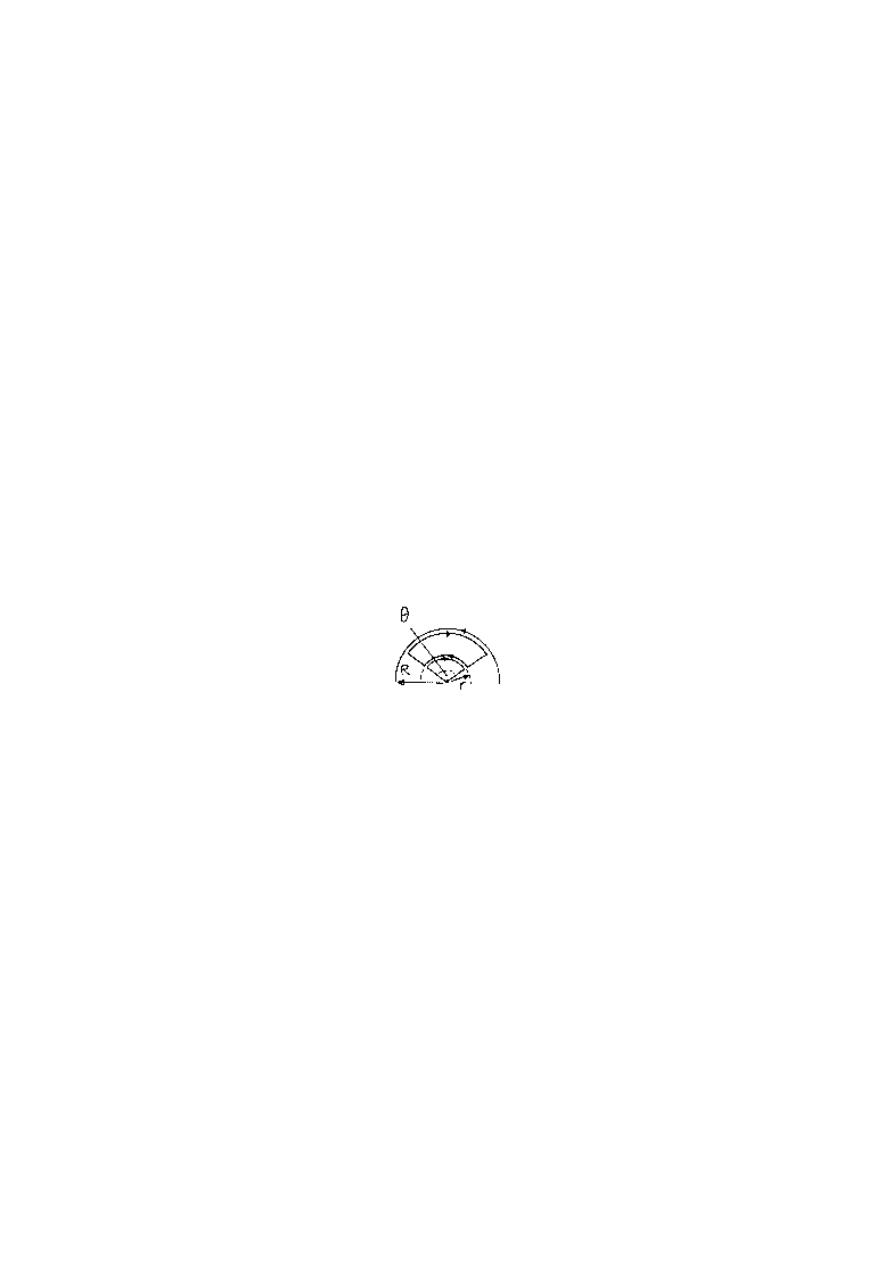
It is not a sufficient answer in the quest to explain the nature of magnetic phenomena and induction
to say that the EMF is simply the rate of change of flux dφ/dt enclosed by each circuit loop (or
winding turn) of the solenoid.
In practice, space itself is, in a sense, a 'perfect' conductor [See footnote at end of this Appendix] in
that elemental regions of empty space can be said to be bounded by a closed flow path and any dφ/dt
action in that bounded region will also produce a circuital EMF.
Since there is current flow, essential to develop a field reaction, and since no I
2
R energy loss is
involved, we know that either R applicable to the loop is zero or something else is effective to set up
a cancelling EMF in opposition in that loop of space. That 'something else' is the circuital component
of an EMF set up in an adjacent loop region of space, which, for the purposes of this discussion, is
deemed to be subject to its own dφ/dt magnetic flux exchange process.
For there to be current flow in this adjacent loop and a negligible EMF driving that flow, the R factor
applicable to space must be virtually zero as if it were a superconductor, and yet this is not a strict
analysis because the space medium is able to sustain oscillations of electromagnetic field.
The current flow in the adjacent loop corresponds to a net zero EMF comprising a component EMF
adjacent the inner loop that balances the dφ/dt-related EMF and a component EMF now in the outer
section of the outer loop that keeps the balance.
In mathematical terms, imagine a sector of the space within the solenoid to be that of an arc of angle
Θ bounded between inner and outer radii r and R, respectively. See Fig. 7.
Fig. 7 Elemental arcuate sectors of a solenoidal field
The EMF induced by dφ/dt in the central core sector with a segment of inner radius r will be:
(dφ/dt)Θ/2π
The EMF induced in a closed loop sector between r and R is zero, because all the flux Φ is deemed
to be concentrated within radius r. In order that the EMF acting within the inner core sector should
not do work on the 'nothingness' of space, the outer loop responds by setting up a back EMF in the
arc segment of radius r which is exactly cancelled by a forward EMF in the arc segment of radius R.
It is therefore the response of regions of vacuum space in developing circuital loop reaction currents
in a non-resitive medium that is the cause of a transfer of action outwards to the winding of the
solenoid by virtue of the back-to-back EMF response in contiguous sections of adjacent reaction
current loops.
Once the EMF finds itself trying to develop current flow in the wire of the winding of the solenoid,
then it does meet resistance and normal circuit theory applies, but the action could not occur without
the buffer response of virtual current activity in the intervening space.
It is essential that this very important point should be well understood as, otherwise, we are left with
experimental mathematical formulae that convey no explanation of the true energy activity involved
Page 28 of 31
ENERGY SCIENCE REPORT No. 4
25.4.2005
http://www.aspden.org/reports/Es4/esr4.htm
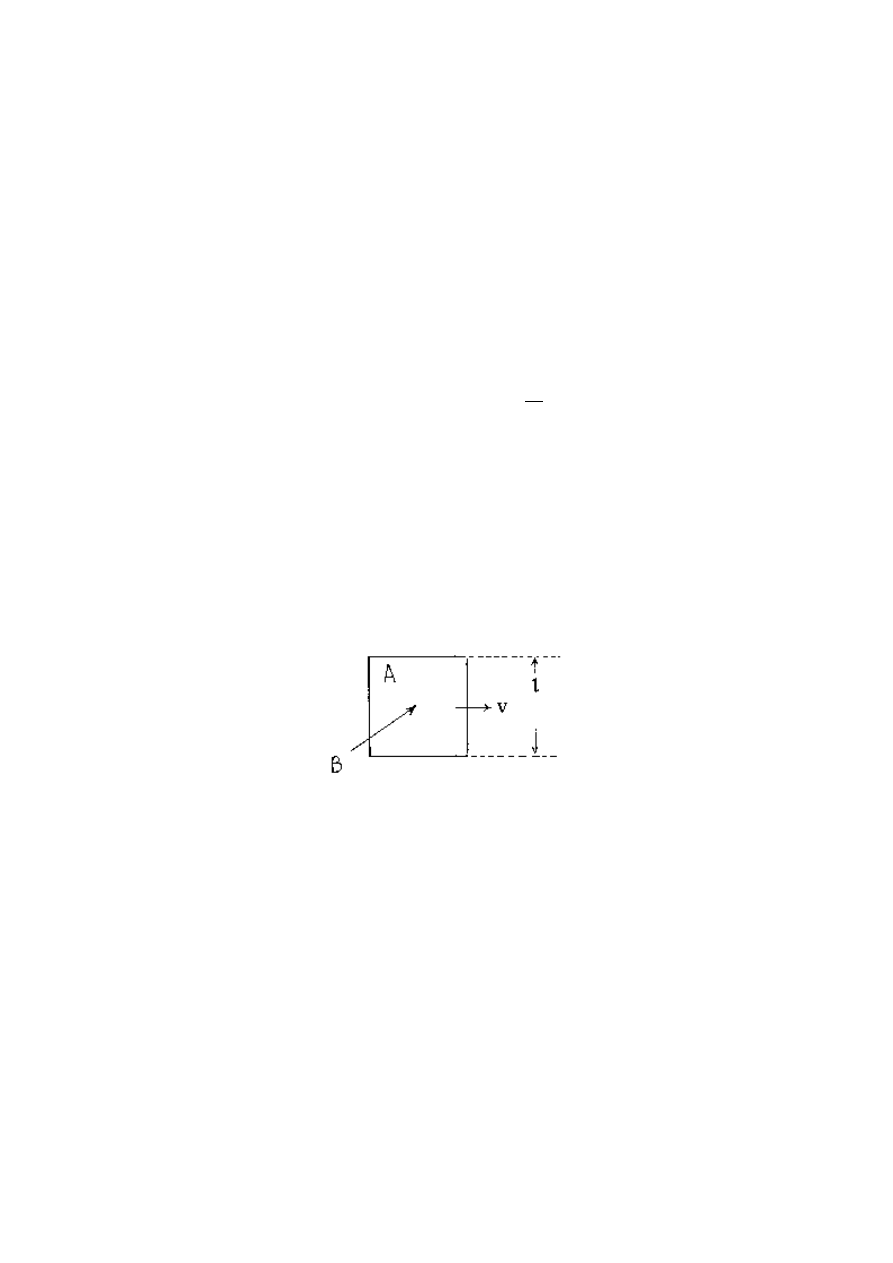
in magnetic inductance.
The explanation here is provided because Frank Potter has questioned whether the enlargement of
the solenoid radius to realms far removed from the seat of the flux change activity dφ/dt can result in
a restriction on the induced EMF, meaning the back EMF, if the power supplied to the solenoid is
what causes rotation of the magnet developing the dφ/dt flux change.
Footnote: Note that each element of a 'perfect' circuit could have inductance L and
capacitance C and develop finite currents and an EMF even if resistance R were zero.
Each cell of space must be regarded as a parallel-connected LC circuit and, as applied to
the vacuum medium with its non-dispersive properties in wave propagation, one also
needs a self-tuning resonance effect in response to rates of change of signal disturbances
in transit. However, as back-up for this, there is the further property that steady reacting
current flow is possible owing to the orbital motion of the vacuum charges in their
quantum states. Readers interested in this should refer to the author's article 'The Ether -
an Assessment', in the U.K. magazine Wireless World, 88, pp. 37-39 (1982), which
discusses the self-tuning property of the vacuum medium. The steady-field reacting
current flow has been discussed in ENERGY SCIENCE REPORT NO. 1.
APPENDIX D
EMF GENERATED IN A SOLENOID BY A ROTATING BAR MAGNET
Fig. 8
Reference is made to Fig. 8. The calculation of induced EMF in a coil is based on the rate of change
of magnetic flux linkage through the area of that coil. Thus, if the 'coil' is really a rectangular loop
with one side of length l expanding outwards at a speed v in a plane perpendicular to a steady field
B, the EMF will be proportional to Blv. Alternatively, if the loop area A is fixed so, the EMF
induced will be proportional to A times the rate of change of B.
The 'linkage' is what is meant by 'mutual inductance', in the sense that, whatever circuit or source
produces B, that will have a mutual inductance vis-a-vis the circuit loop of area A. Suppose, for
example, that B is produced by a current I
o
then the EMF induced in the loop of area A will be
proportional to the time rate of change of MI
o
, where M is mutual inductance.
To calculate M for a particular interaction one really is doing nothing other than working out how B
produced by I
o
links with an area A.
Now, there are two ways of going about this calculation. Because the action is 'mutual' it has a
Page 29 of 31
ENERGY SCIENCE REPORT No. 4
25.4.2005
http://www.aspden.org/reports/Es4/esr4.htm
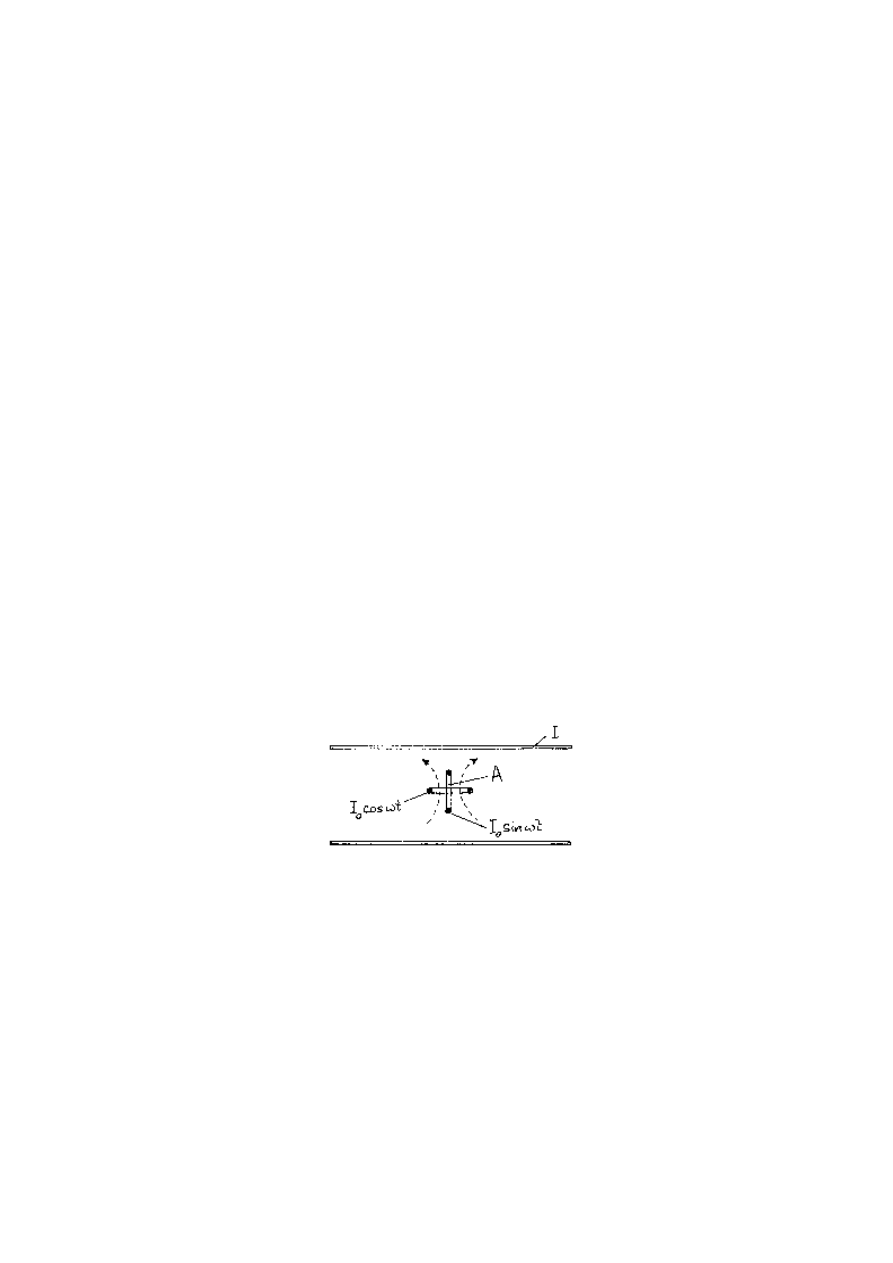
certain recriprocity and one can take either component of the system as the generator of a field B and
work out how this links the area of the other component. Obviously, since both must give the same
answer for M, by symmetry of action, it is logical to choose the easier of the two possible
calculations.
In the case of a bar magnet rotating inside a solenoid it is not difficult to proceed in either way, but
there is sense in taking the solenoid as the field source. The reason is that the field produced by a bar
magnet is that of its two poles and is a rather complex function of magnet length and distance from
the centre of the magnet, whereas the field acting on the magnet and produced by the solenoid is a
uniform field in the case under analysis.
Having in mind that this Appendix is written to meet the concerns of Frank Potter, it is stressed that
'mutual inductance' means just that: the mutual action by which energy can be transferred by induced
EMF between two interacting circuit elements is one that works either way with no nett gain or loss
of inductance energy. Indeed, if the mutual inductance favoured one or other of the circuit
components in this exchange of energy, so one could design a transformer or oscillator that would be
nothing other than coils of wire in air and yet would generate electricity continuously without the aid
of any external agency.
Whilst we do have in mind the issue of energy conservation with the bar magnet itself being a
prospective coupling with such an external agency, the problem at hand is one of orthodox electrical
engineering calculation of mutual coupling between two circuits aimed at deriving an EMF value.
Hence, the logical route to finding that answer is the calculation of mutual inductance M in the
problem under study and we shall do this by working out the field linkages from the solenoid to the
magnet, rather than the other way around.
That said, and referring to Fig. 9, we shall now substitute the rotating bar magnet by a small coil of
area A carrying current I
o
sint so as to produce its field along the central axis of the solenoid and a
similar small coil of area A carrying current I
o
cost arranged at right angles so as to produce its field
along a radius vector from the centre of the solenoid.
Fig. 9
Note that this represents a circuit having a magnetic moment I
o
A which is chosen to equal the
magnetic moment of the magnet, the latter being its pole strength times its length. The eventual EMF
to be calculated will need to be expressed in terms of this magnetic moment. The action described
represents a magnet rotating with an angular frequency ω.
Now, first, looking at the effect which the current I
o
cost has in inducing an EMF in the solenoid, we
can see by symmetry that this is zero, because the field diverges in opposite directions in each half of
the solenoid and so the flux linkages will be such as to develop a clockwise EMF in one half of the
solenoid and an anti-clockwise EMF in the other half of the solenoid and these will back against one
another to sum to zero nett EMF. Therefore, that tells us that the mutual inductance for the
configuration including the cost component is zero.
Page 30 of 31
ENERGY SCIENCE REPORT No. 4
25.4.2005
http://www.aspden.org/reports/Es4/esr4.htm

The task next is to calculate the field produced by the solenoid that links with the other notional coil
of area A.
Let the current in the solenoid be denoted I. If the solenoid were of infinite length then, assuming
vacuum permeability µ
o
, the axially-directed field intensity in the solenoid is µ
o
NI, where N is the
number of turns per unit length of solenoid. Note that in the gaussian system of units used elsewhere
in this Report the permeability would be unity with a 4π factor added.
The flux linking the area A is then A times this quantity and the flux per unit current I is simply
Aµ
o
N, which therefore is the value of M, the mutual inductance.
Now, by the reciprocity argument concerning the 'mutual' nature of this inductance, the same value
of M applies if we regard the rotating magnet as the source inducing an EMF in the solenoid. EMF is
rate of change of flux linkage or M times rate of change of I
o
sint, which is M times I
o
cosωt.
The EMF produced in the solenoid is therefore (AI
o
)µ
o
Ncosωt.
Had we assumed that the solenoid has a finite length D and a diameter
a
, then the field at the centre
of the solenoid is reduced by the factor D/(D
2
+
a
2
)
1/2
, and the EMF is accordingly reduced by the
same factor.
The derivation of this latter factor can be confirmed from the analysis given in section 33 above. The
sine of the angle Θ is the factor just mentioned. It is unity for a solenoid of infinite length.
It follows, therefore, that if the radius of the solenoid is progressively increased to a very large value,
then provided the length of the solenoid increases in proportion, so the EMF induced in it by the
rotating magnet will be unchanged. However, N, which is the number of turns on the solenoid per
unit length, must be the same so that the total number of turns must increase in proportion as well,
otherwise the EMF will be reduced.
In effect, one is here seeing the fact that the field from a bar magnet drops inversely as the cube root
of distance, whilst the area of a solenoid turn increases as the square of distance, so unless the
number of turns increases in proportion to distance the flux linkage rate will not be sustained with
change of scale.
Note that this Appendix is added purely to answer a question raised by Frank Potter. It has no
relevance to the prospect of building a motor that can conceivably perform anomalously in energy
terms, because the interaction under study is the standard interaction between a magnet and a current
in a winding.
As explained elsewhere in this and other ENERGY SCIENCE REPORTS on magnetism, the
prospect of generating what is termed 'free energy' is one that comes into sight where we have a
magnet and a ferromagnetic core interacting under the control of a current in an external winding.
That is a scenario where the third party to the action disturbs the 'mutual' reciprocal action which
otherwise implies symmetry extending to energy exchange processes and it is that which brings a
new dimension into energy research.
Page 31 of 31
ENERGY SCIENCE REPORT No. 4
25.4.2005
http://www.aspden.org/reports/Es4/esr4.htm
Wyszukiwarka
Podobne podstrony:
Aspden POWER FROM SPACE INERTIA AND GRAVITATION (1994)
Aspden POWER FROM MAGNETISM (2004)
Aspden POWER FROM ICE THE THERMOELECTRIC REGENERATOR (1997)
Aspden POWER FROM MAGNETISM OVER UNITY MOTOR DESIGN (1996)
Aspden POWER FROM WATER COLD FUSION PART 1 (1994)
Aspden POWER FROM SPACE THE CORREA INVENTION (1996)
Aspden POWER FROM ICE THERMOELECTRICS PART 1 (1994)
44905242 Recipes from Power Foods by the Editors of Whole Living Magazine
David Runciman Political Hypocrisy, The Mask of Power, from Hobbes to Orwell and Beyond (2008)
Morimoto, Iida, Sakagami The role of refections from behind the listener in spatial reflection
Home Power Magazine Betting the Farm Wind Electricity Pays Off
337.esej, From all the translations of R
Morimoto, Iida, Sakagami The role of refections from behind the listener in spatial reflection
The Imagery Debate
Power Training in the Zone II Instructions
Roberta Modugno Crocetta Murray Rothbard’s anarcho capitalism in the contemporary debate A critical
Jerry Davis Elko the Potter
Richard Scott Chord Melodies From Around The World
więcej podobnych podstron