
280 PRZEGLĄD ELEKTROTECHNICZNY (Electrical Review), ISSN 0033-2097, R. 85 NR 11/2009
Sławomir ZALEWSKI
Politechnika Warszawska
Application of LEDs in road lighting
Streszczenie. Na rynku pojawia się coraz więcej diodowych opraw oświetlenia drogowego. Niektóre z nich oprawami drogowymi są tylko z nazwy.
Tworzenie konstrukcji nowych LEDowych opraw oświetleniowych dobrze spełniających swoje zadania wymaga posiadania stosownej wiedzy i
umiejętności oraz wykazanie się starannością i przezornością większą niż przy projektowaniu opraw z konwencjonalnymi źródłami światła.
Spełnienie wymagań normatywnych w obliczeniach projektowych oświetlenia realizowanego na oprawach diodowych nie gwarantuje, że
zrealizowane oświetlenie będzie prawidłowe. (Zastosowanie diod elektroluminescencyjnych w oświetleniu drogowym).
Abstract: There are more and more LED luminaires for road lighting at the market. Some of them are road luminaires only by their name. Creation
new construction of LED luminaires well fulfilling their aims needs proper knowledge and skills owning as well as accuracy and foresight greater than
used in designing equipment with traditional light sources. Implementation of standardisation claims in lighting designing realised by LED’s
luminaires doesn’t guarantee that realised lighting will be correct.
Słowa kluczowe: diody elektroluminescencyjne, drogowe oprawy oświetleniowe, bryła fotometryczna, oświetlenie drogowe
Keywords: Light emitting diode, road luminaire, road lighting, light intensity distribution.
Introduction
LED producers give information that their products
achieve lighting efficiency comparable with parameters of
high pressure lamps but products available on the markets
are behind. Direction and rate of LED evolution encourage
for working under future implementations.
LEDs as a synonym of modernity and progress in
lighting – instead of lows of essential base – are present in
city street lighting. Lighting equipment producers aim to
have in their offers road luminaries made in LED
technology. Investors are trying to use them. Therefore,
there is a need to analyse capability of creating LED
luminaire according to technical competitive with traditional
light sources.
Advantages and disadvantages of LED lighting
LED – from the point of view of their peculiar
constructional features – allows achieve completely new
standards in lighting. The same parameters are at the same
time source of serious constructional problem, of which
existing producers, users and constructors have no idea of
theirs existing. LED’s small size and their high luminance
allow for getting very narrow beams with high maximum
luminous intensity at the same time keeping reasonable
sizes of elements concentrating light. Through proper
gathering such beams it is possible achieve any luminous
intensity distribution in space. By dint of, it is possible to
precise supplying light flux on lighting surface and much
better utilization comparing to traditional sources. It is
necessary to remember, that high LED luminance is
potential source of glare [1].
True advantage of LEDs is their easiness for control.
Immediate ignition and instant achieving nominal flux allow
for building new systems of dynamic lighting. Ability of
unlimited regulation light flux allow adjusting temporary
control energy consumption to demands for lighting flux as
well as correction luminaire parameters to power supply
conditions, environmental pollution, LED’s waste and
technical condition of equipment.
LED luminaires are and long time will be multisource. In
contrast to traditional, equipped with single light source, in
case of expiration source caused by its wear or defect, they
don’t extinct as a whole but still work sending reduced light
flux. It is associated with changing photometrical solid of
luminaire. Such changes are strictly related to configuration
of supply unit and realisation method of summary luminous
intensity distribution. Making recognition such relation
needs carrying out many simulation calculations or
strenuous measurements.
Methods of luminous intensity distribution creation
Resultant photometrical solid of multisource luminaire
could be received by many ways: adding, putting and
overlapping component photometrical solids individual
coming from light sources. Replication and
complementation are extremely different methods.
In replication method all light sources are equally
oriented in space and equipped with the same optical
elements or cooperating with mutual optical system. All
sources at the same level work on intensity of luminaire in
every direction. Shape of resultant light flux distribution of
whole luminaire is identical as shape of component
distributions, is multiplication of them. Thanks to such
solution extension any LED in proportion weaken luminous
intensity in all directions not changing shape of
photometrical solid of whole luminaire. In this method
luminaires with rather gentle luminous distribution curves
are created. By reason of this, in pure form it is little useful
in road luminaires design.
Complementation method is a completely oppose to
replication method. Each source is responsible for different
part of luminaire photometrical solid. Elementary light flux
distributions coming from different sources are narrow or
very narrow and individually realize the whole luminous
intensity of luminaire in given direction. There happen only
minimal overlapping adjacent elementary flux distribution
incoming in their marginal areas. Each LED is equipped
with specific optical element and is characterized by unique
direction. The great advantage of this method is simplicity of
designing photometrical solid. It is not recommended
because luminaire is very susceptible for assemble faults
and required high diligence of workmanship. Besides dying
out, any LED causes gap in luminous intensity distribution
and appearance of dark spot at the illuminated surface.
The best results are gained by skilful mixing above
mentioned methods. This way their advantages are taken
together and disadvantages are cancelled. Application of
groups of light source with identical luminous intensity
distribution and similar directions allows for a certain
unification of optical elements and limiting changes of flux
distribution happened as a result of expiring of single LEDs.
The same time it lowers system sensibility for light sources
montage spread. Division of photometrical solid for parts
realized by each LEDs group notable simplifying geometry
of optical units comparing to ones created in replication
method. Obviously incompetent using of mixing method
could bring opposite effect, join disadvantages basic
methods and ruin advantages.
PRZEGLĄD ELEKTROTECHNICZNY (Electrical Review), ISSN 0033-2097, R. 85 NR 11/2009 281
Luminous intensity distribution forming
Designing optical unit of LED road luminaire there
should be carefully balanced proportion between division of
flux distribution on parts realised by other groups of LEDs
and overlapping flux from single light sources. The primary
need is consideration of optimal diversity of used optical
elements. Quality of project and – in effect – usefulness of
final product in main depends on established assumptions.
Economic reasons constrain layout of road luminaires in
possible big distances on not very high pillars. In
conventional lighting, achievement of distance between
luminaires amount up to five times height of their montage
is available. Similar or higher modules are expected during
LED lighting use. It causes that angle from each luminaire
to roadway width at base the next one is half smaller
comparing to the angle to roadway width directly under
current luminaire and is about 20 degree. At the same time
angle of luminous intensity distribution along roadway is
close to 150 degree. It is necessary to get average values
of intensity at wide angle directly under luminaire, very big
values in narrow angles in directions approximately 60
degrees at sides along roadway and very low values at all
other than illuminated area of roadway and roadsides
directions. Taking into consideration sensible management
of light flux imposes particular conditions of luminous
intensity distribution [2].
Individual forming of photometrical solid of each LED
and direction them to the points determined according to
standard PN-EN 13201-x seems reasonable. But it is very
expensive solution and requires using LEDs with different
optical units in number of calculation points.
Getting together in groups light sources and lighting by
each one group crosswise lane of roadway including single
row of calculation points is possible to realisation. In such
case designing of different optical units as many as rows of
calculation points (at least 10) is necessary.
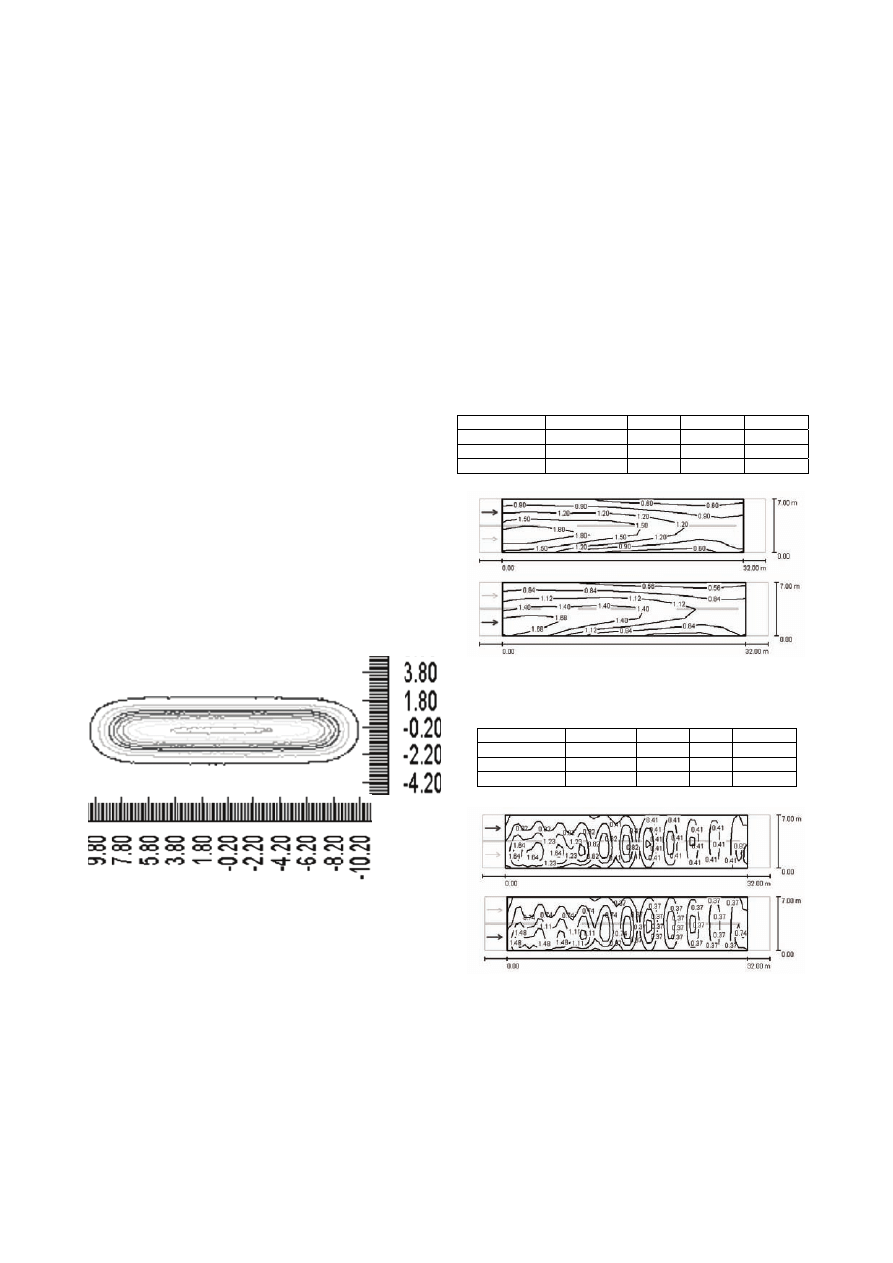
Fig.1. Isocandelas of LED with Massie collimator
There was analyzed the opportunity of creating
luminaire in which all LEDs are equipped with the same
optical elements (massive collimators) realizing identify
component photometrical solids differencing only aiming.
The analysis was carried at virtual model on simulation of
possible to manufacturing massive collimator working with
real LED. Applied collimator realizes light beams cluster of
two symmetry surfaces in which angle divergence amount
respectively 4 and 20 degree. Light flux distribution of this
unit working with lambertian LED as isocandelas is shown
at fig1. Each LED with collimator is located in that way to
get elongated light spot with longer axe perpendicular to
road axe and grouped. Each group of LEDs illuminates
whole roadway wide around one row of calculation points.
Assumption is established that luminaires illuminate road
7m wide, are located at 12m high pillar with 32m distance
between each other. Lighting class ME3c is expected.
Standardization imposes for such case 11 rows of
calculated points along module, 6 points in each row. As a
result of calculations comes out that luminaire is able to fulfil
requirement in points given by European Standard.
LED luminaire and Standard PN-EN 13201-x
Detailed analysis of road surface luminance distribution
calculation results shows that instead of fulfilling standard
requirements lighting realized on designed LED luminaires
is not sufficient.
Luminance average value, longitudinal, as well as
overall uniformities calculated based on mentioned
standard grid of points (11x6) are given at table 1. They are
sufficient to fulfil requirements demanded for ME3c lighting
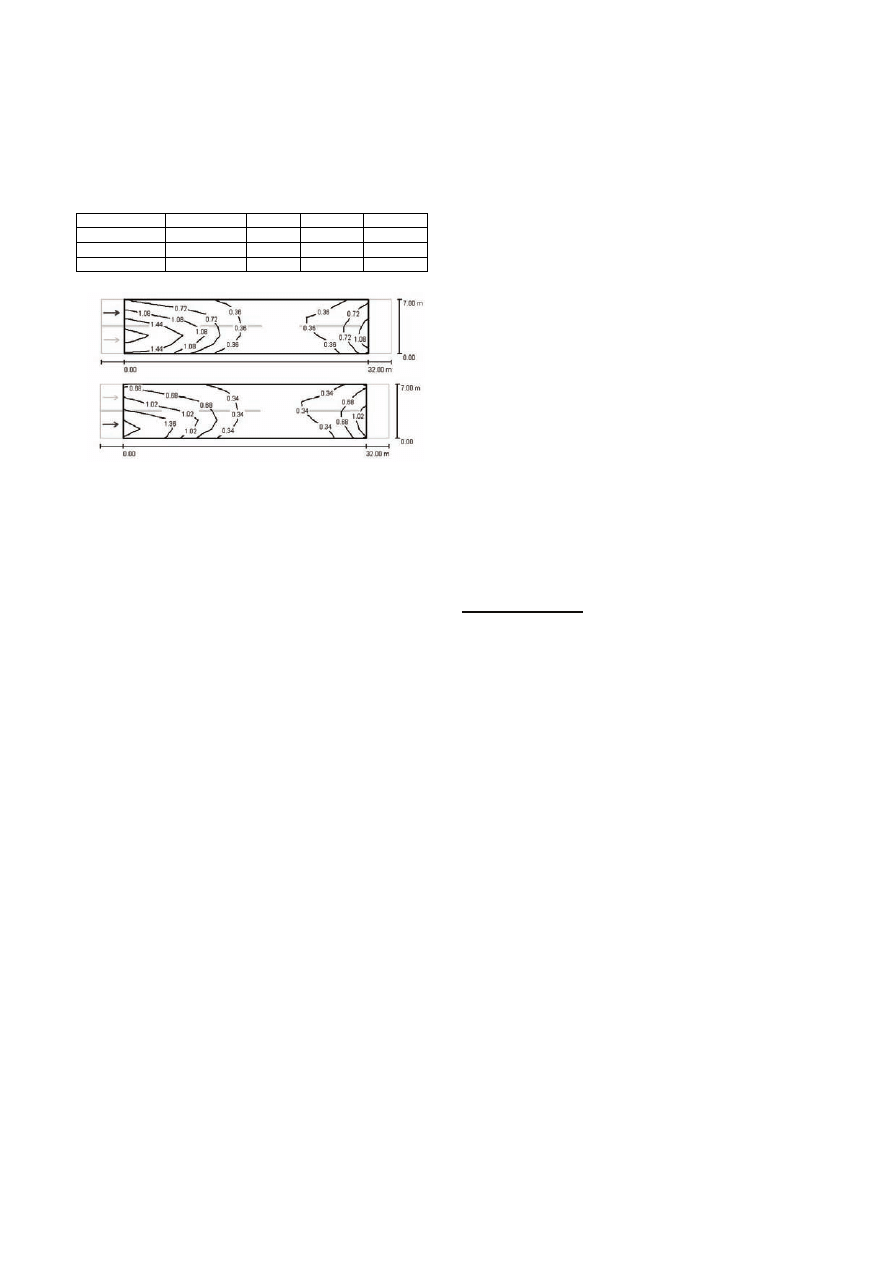
class. Luminance distributions of roadway surface
generated by programme aiding calculations – Dialux ® are
shown at fig. 2. and also do not made anxiety.
Table 1. Parameters of road lighting calculated from standard grid
of calculation points (11x6)
L
sr
[Cd/m
2
] U
0
U
l
Ti
Required 1,0
0,4 0,5 15
Observer 1
1,1
0,5
0,5
4
Observer 2
1,2
0,4
0,6
3
Table 2. Parameters of road lighting calculated from increased grid
of calculation points (55x6)
L
sr
[Cd/m
2
] U
0
U
l
Ti
Required 1,0
0,4 0,5
15
Observer 1
0,7
0,2
0,1
6
Observer 2
0,8
0,1
0,1
5
Fig.3. Luminance distribution of roadway surface calculated from
standard points grid (55x18) for observer: a) first; b) second
Change of calculating points grid in described example
depended on 5 time tightening along road (55x6), shows
that luminance distribution is bad. Luminance average value
for analyzed area and uniformities are too low. Results are
shown at table 2. Fig. 3. shows luminance distributions of
surface. For obtainment of distribution full picture number of
calculation points was increased: 5 times along and 3 times
perpendicular road (55x18).
Fig.2. Luminance distribution of roadway surface calculated
from standard points grid (11x6) for observer: a) first; b) second
282 PRZEGLĄD ELEKTROTECHNICZNY (Electrical Review), ISSN 0033-2097, R. 85 NR 11/2009
Unsuitable luminance distribution is just noticeable in
minimal change of calculation number of points.
Enlargement number of rows by one (12x6) causes
decreasing parameters below values required by standard.
Results of calculations and luminance distribution are
shown at table 3 and fig. 4.
Table 3. Parameters of road lighting calculated from increased grid
of calculation points (12x6)
L
sr
[Cd/m
2
] U
0
U
l
Ti
Required 1,0
0,4 0,5 15
Observer 1
0,6
0,2
0,1
7
Observer 2
0,7
0,2
0,2
5
Fig.4. Luminance distribution of roadway surface calculated from
standard points grid (12x6) for observer: a) first; b) second
In the above presented analysis, it is necessary to pay
attention for an exceptionally low level of glare expressed
by Ti. It is achieved by very high gradient of luminous
intensity at the end of photometrical solid especially with
angle measured parallel to road axis surface. Thanks to it
LED technology could allow for lowering height of mounting
of luminaires.
Conclusions
Current standard of road lighting, which comes true in
case of using luminaires with conventional light sources,
unnecessarily could be good in application of LED
luminaires. Its requirement fulfilment does not guarantee
that lighting would be realized correctly. Acceptance of
wrong luminaire concept and creation project similar to that
shown in the example could be the reason of serious
conflict between investor and road light builder. Results of
after built measurements, carried out according to the same
standard will be significant different from results of project
stage. In future, standard requirements regulating methods
of light LED designing have to guarantee rejection of
projects, which creates similar situations, at the calculation
stage.
Conscious and reasonable use of LED technology could
give surprisingly positive effects. Applying lower pillars or
increasing modules allows lowering installation costs.
Aiming light beam – more precise than in traditional
luminaires – allows for more efficient use, which could have
an influence on spent energy. To achieve above mentioned
– there is needed increasing light efficiency of LED to level
compared with high efficient fluorescent light sources.
REFERENCES
[1] Żagan W., „Rzetelnie i rozważnie o LED-ach – ocena
obecnych i prognoza przyszłych aplikacji oświetleniowych diod
elektroluminescencyjnych” Przegląd Elektrotechniczny, 1/2008
[2] Zalewski S., Optymalizacja bryły fotometrycznej opraw
oświetlenia drogowego ze względu na równomierny rozkład
luminancji nawierzchni, Przegląd Elektrotechniczny –
Konferencje 1/2007
[3] Czyżewski D., Pomiary oświetlenia drogowego – opis
wymagań formalnych, Elektrosystemy 2(73) luty 2006
Author: dr inż. Sławomir Zalewski, Politechnika Warszawska,
Instytut Elektroenergetyki, Zakład Techniki Świetlnej ul. Koszykowa
75, 00-662 Warszawa, E-mail: slawomir.zalewski@ien.pw.edu.pl.
Wyszukiwarka
Podobne podstrony:
1 Application of Joints and Springs in ANSYS
Applications of magnetic resonance spectroscopy in radiotherapy treatment planning
Some Oceanographic Applications of Recent Determinations of the Solubility of Oxygen in Sea Water
Evidence and Considerations in the Application of Chemical Peels in Skin Disorders and Aesthetic Res
Smarzewska, Sylwia; Ciesielski, Witold Application of a Graphene Oxide–Carbon Paste Electrode for t
Raifee, Kassaian, Dastjerdi The Application of Humorous Song in EFL Classroom and its Effect onn Li
Application of light emitting diodes for local lighting
SzczygielskiStopa Usage of new soil improvement techniques in road embankment constructions
Application of SPME for determination of organic vapours in
The Application of Domestication and Foreignization Translation Strategies in English Persian Transl
Walterowicz, Łukasz A comparative analysis of the effects of teaching writing in a foreign language
20979544 Application of Reality Therapy in clients with marital problem in a family service setting
Application of Magnetic Resonance Spectroscopy in the Mental Diseases of Schizophrenia and Autism
04 Laws of Microactuators and Potential Applications of Electroactive Polymers in MEMS
Production of benzaldehyde, a case study in a possible industrial application of phase transfer cata
Han, Z H & Odlin, T Studies of Fossilization in Second Language Acquisition
Jacobsson G A Rare Variant of the Name of Smolensk in Old Russian 1964
Chirurgia wyk. 8, In Search of Sunrise 1 - 9, In Search of Sunrise 10 Australia, Od Aśki, [rat 2 pos
więcej podobnych podstron