
G-
DESIGN AND CONSTRUCTION GUIDANCE FOR COMMUNITY SAFE ROOMS
SECOND EDitiON
Appendix G
Design Guidance on Missile
Impact Protection Levels for
Wood Sheathing
Reinforced concrete and reinforced masonry have been the most common wall and roof
materials used with success in non-residential safe rooms. The use of wood panels for exterior
wall sheathing in non-residential safe room applications had been limited. This appendix provides
limited information on wood panel testing that has been performed for both hurricane and tornado
safe room applications.
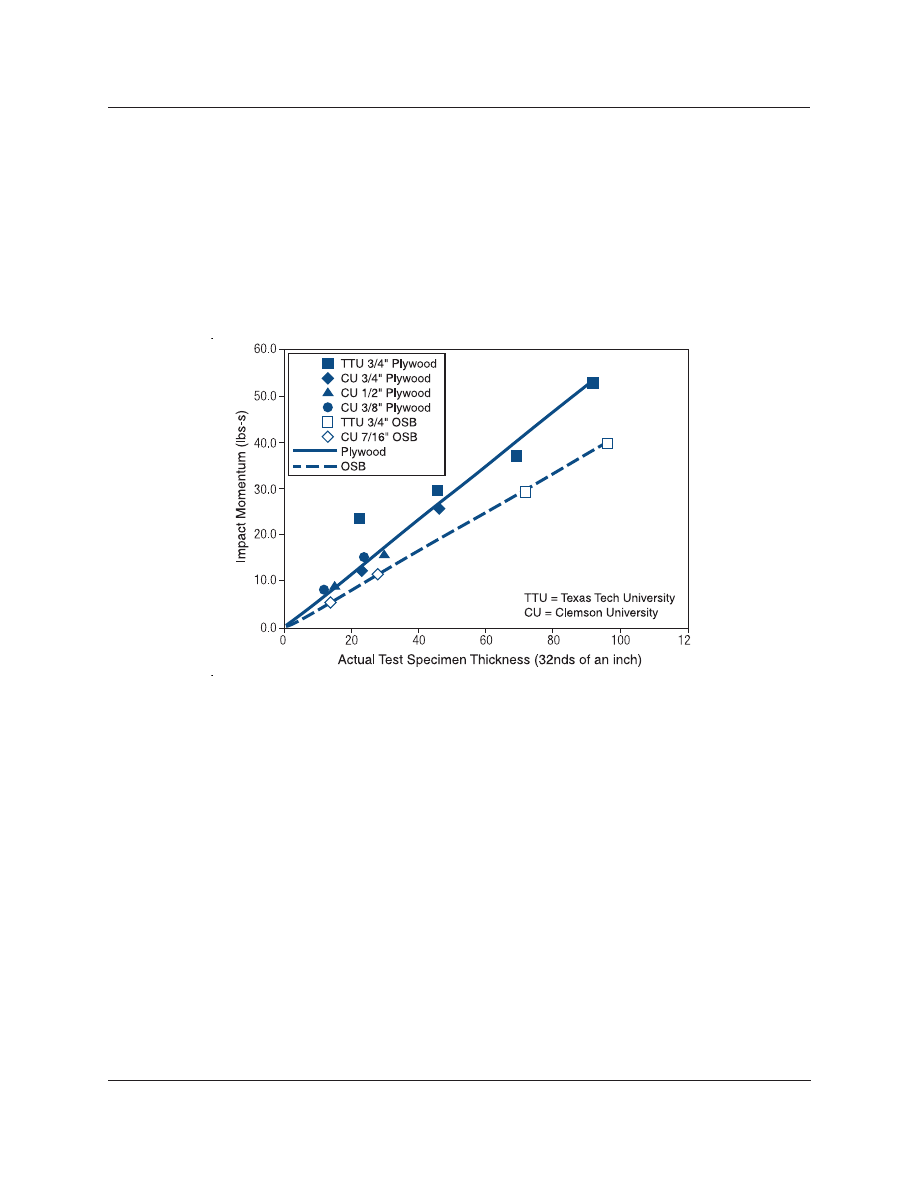
Data from the missile impact tests on walls with plywood and oriented strand board (OSB)
sheathing conducted at Texas Tech University (Carter 998) and at Clemson University
(Clemson 2000) have been combined to determine the variation of missile perforation resistance
with thickness of the sheathing. In order to put all the data on a consistent basis, missile weights
and lowest impact velocities for perforation of the sheathing have been extracted from previous
test results. The weight and impact velocity information were used to calculate the impact
momentum {weight (lb) x velocity (ft/sec)/acceleration of gravity (32.2 ft/sec
2
) = momentum (lb/
sec)} and the impact energy {weight (lb) x velocity squared (ft/sec)
2
/acceleration of gravity (32.2
ft/sec
2
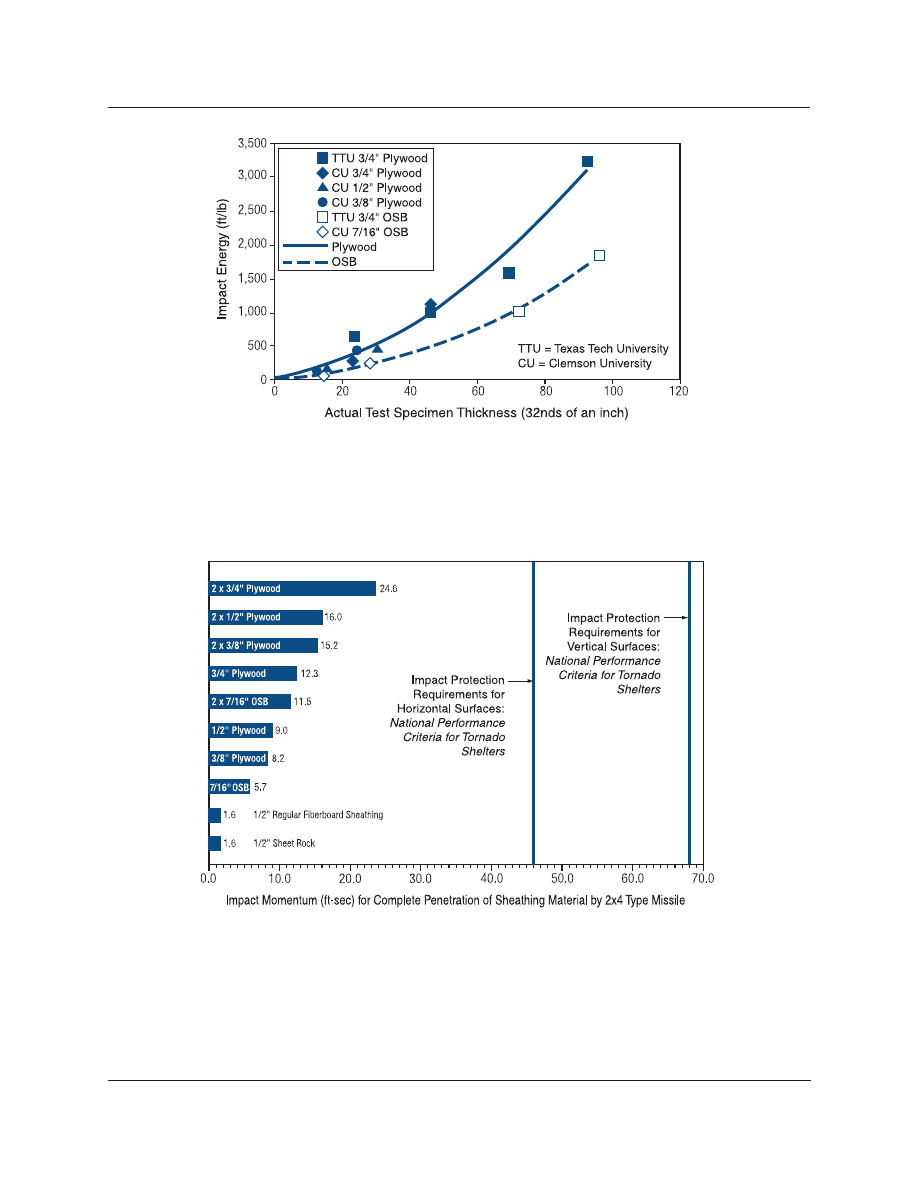
) = energy (ft/lb)}. The resulting impact momentum and impact energy for perforation of the
sheathing are plotted as a function of sheathing thickness (in /32 inch) in Figures G- and G-2.
The momentum required for a wood 2x4 missile to cause perforation varies essentially linearly
with thickness of the sheathing material for both plywood and OSB. This suggests, at least
for this type of missile and common sheathing materials, that a desired target penetration
resistance (ability to resist a certain impact momentum) can be achieved by simply adding up
the contributions of the various layers of sheathing. For example, in Figure G-, sheathing with a
30/32-inch thickness represents two layers of 5/32-inch material.
Figure G-3 provides information on the relative resistance of various common sheathing
materials, in terms of impact momentum absorption, for a compact impact area such as that
associated with a wood 2x4 missile impacting perpendicular to the sheathing material. Summing
the momentum resistance of the various layers of common sheathing materials is permissible
when developing initial design criteria for walls that provide adequate protection. However, this
G-2
G
design guidance on missile impact protection levels for wood sheathing
DESIGN AND CONSTRUCTION GUIDANCE FOR COMMUNITY SAFE ROOMS
SECOND EDitiON
process may not work for other types of missiles or for wall materials that absorb impact energy
by undergoing large deformations (i.e., corrugated metal panels).
For the large design missile of this publication (a 5-lb wood 2x4 missile), the maximum
horizontal impact speed designated in the criteria is 00 mph, and the corresponding momentum
is approximately 68 lb/sec. For vertical impacts, the maximum impact velocity designated is
reduced to 67 mph; the corresponding momentum to the maximum vertical impact speed is
approximately 46 lb/sec.
figure g-1. variation of impact momentum required for missile penetration vs. wall sheathing thickness
G-3
G
design guidance on missile impact protection levels for wood sheathing
DESIGN AND CONSTRUCTION GUIDANCE FOR COMMUNITY SAFE ROOMS
SECOND EDitiON
figure g-2. variation of impact energy required for missile penetration vs. wall sheathing thickness
figure g-3. impact momentum required for a 2x4 wood missile to penetrate various common sheathing
materials (impact perpendicular to sheathing surface). note: all wood products provide less than half the
required impact momentum resistance needed to meet the horizontal surface impact resistance required by
the National Performance Criteria for Tornado Shelters.

Wyszukiwarka
Podobne podstrony:
fema361 apndx f
fema361 apndx h
fema361 apndx d
fema361 apndx e
fema361 apndx a
fema361 apndx g id 169157 Nieznany
fema361 apndx f
fema361 apndx h
fema361 apndx e
fema361 apndx d
fema361 apndx a
fema361 apndx f
fema361 chap 3
więcej podobnych podstron