The
The
Day
Day
Trader’s
Trader’s
Bible
Bible
Or…
My Secrets of Day
Trading In Stocks
By Richard D. Wyckoff
The Day Trader’s Bible
Richard D. Wyckoff
The Day Trader’s Bible
Or… My Secrets of Day Trading In Stocks
By Richard D. Wyckoff
[ Originally Published by Ticker Publishing, 1919]
Author’s preface:
Published By ePublishingEtc.com
2811 Oneida Street, Suite 900-907
Utica, New York 13501-6504
Web: http://ePublishingEtc.com/
ISBN 1-931045-05-4
Edited Revisions
Copyright 1999-2001 David Vallieres.
All rights reserved. No part of this publication may be reproduced, stored in a
retrieval system or transmitted in any form or by any means, electronic,
mechanical, photocopying, recording or otherwise, without prior written
permission.
No responsibility is assumed by the Publisher for any injury and/or damage
and/or financial loss sustained to persons or property as a matter of the use of
this instruction. While every effort has been made to ensure reliability and
profitability of the strategies within, the liability, negligence or otherwise, or from
any use, misuse or abuse of the operation of any methods, strategies,
instructions or ideas contained in the material herein is the sole responsibility of
the reader.
“Contained within are the results of a lifetime of studies in
tape reading. It’s a pursuit that is profitable…but it’s not for
the slow minded or weak hearted. You must be
resolute…strength of will is an absolute requirement as is
discipline, concentration, study and a calm disposition. May
your efforts bear fruit and strengthen your will to persevere.”
Richard D. Wyckoff
Table of Contents
CHAPTER IX ………………..Page 83
Daily Trading vs. Long-Term Trading
CHAPTER X ……………..….Page 94
Various Examples and Suggestions
CHAPTER XI ……………..…Page 99
Obstacles to be Overcome
Potential Profits
CHAPTER XII …………...…Page 105
Closing Trades (as important as
opening trades)
CHAPTER XIII …………..…Page 113
Two Day’s Trading – An Example Of
My Method Applied
CHAPTER XIV………....…..Page 114
The Principles Applied to Longer
Term Trading
CHAPTER I ………………………...Page 4
Introduction
CHAPTER II ………………………..Page 14
Getting Started In Tape Reading …Page
CHAPTER III ……………………....Page 24
The Stock Lists and Groups Analyzed
CHAPTER IV ……………………….Page 30
Trading Rules
CHAPTER V …………………..…..Page 44
Volumes and Their Significance
CHAPTER VI ……………….……..Page 58
Market Technique
CHAPTER VII ……………………..Page 66
Dull Markets and Their Opportunities
CHAPTER VIII ……………………..Page 77
The Use of Charts as Guides and Indicators
Richard D. Wyckoff
CHAPTER I
Introduction
T
HERE is a widespread demand for more light on the subject of Tape
Reading or the reading of moment by moment transactions in a stock.
Thousands of those who operate in the stock market now
recognize the fact that the market momentarily indicates its own
immediate future; and
That these indications are accurately recorded in the market
transactions second by second; and
Therefore those who can interpret what transactions take place
second by second or moment by moment have a distinct advantage over
the general trading public.
Such an opinion is warranted, for it’s well known that many of
the most successful traders of the present day began as Tape Readers,
trading in small lots of stock with a capital of only a few hundred dollars.
Joe Manning, was one of the shrewdest and most successful of all
the traders on the floor of the New York Stock Exchange.
A friend of mine once said:
"Joe and I used to trade in ten share lots together. He was an ordinary
trader, just like me. We used to hang over the same ticker."
The speaker was, at the time he made the remark, still trading in
ten-share lots, while I happened to know that Joe's bank balance -- his
active working capital -- amounted to $100,000, and that this represented
but a part of the fortune built on his ability to understand the tapes’
secrets and interpret the language of the tape.
Why was one of these men able to generate a fortune, while the
other never acquired more than a few thousand dollars day trading?
Richard D. Wyckoff
Their chances were equal at the start of their pursuit as far as capital and
opportunity. The profits were there, waiting to be won by either or both.
The answer seems to be in the peculiar qualifications of the
mind, highly potent in the successful trader, but not possessed by the
other.
There is, of course, an element of luck in every case, but pure
luck could not be so sustained in Manning's case as to carry him through
day trading operations covering a term of years.
The famous Jesse Livermore used to trade solely on what the tape
told him, closing out every-thing before the close of the market. He
traded from an office and paid the regular commissions, yet three trades
out of five showed profits. Having made a fortune, he invested it in
bonds and gave them all to his wife. Anticipating the 1907 panic, he put
his $13,000 automobile up for a loan of $5,000, and with this capital
started to play the bear side of the market, using his profits as additional
margin. At one time he was short 70,000 shares of Union Pacific stock.
His whole lot was covered on one of the panic days, and his net profits
were over a million dollars!
By proper mental qualifications we do not mean the mere ability
to take a loss, define the trend, or to execute some other move
characteristic of the professional trader. I refer to the active or dormant
qualities in his make-up.
For example: The power to force himself into the right mental
attitude before trading; to control his emotions: fear, anxiety, elation,
recklessness; and to train his mind into obedience so that it recognizes
but one master -- the tape. These qualities are as vital as natural ability,
or what is called the sixth sense in trading. Some people are born
musicians, others seemingly void of musical taste, develop themselves
until they become virtuosos.
It is the WILL, the strength of discipline and character in a man or
woman which makes them mediocre or successful,
"a loser" or "a winner."
Richard D. Wyckoff
Jacob Field is another exponent of Tape Reading. Those who
knew "Jakey" when he began his Wall Street career, noted his ability to
read the tape and follow the trend. His talent for this work was doubtless
born in him; time and experience have proven and intensified it.
Whatever awards James R. Keene won as operator or syndicate
manager, do not detract from his reputation as a Tape Reader as well.
His scrutiny of the tape was so intense that he appeared to be in a
trance while his mental processes were being worked out. He seemed to
analyze prices, volumes and fluctuations down to the finest imaginable
point. It was then his practice to telephone to the floor of the Stock
Exchange to ascertain the character of the buying or selling and with this
auxiliary information complete his judgment and make his commitments.
At his death Mr. Keene stood on the pinnacle of fame as a Tape
Reader, his daily presence at the ticker hearing testimony that the work
paid and paid well.
You might be urged to say: "Yes, but these are rare examples.
The average man or woman never makes a success of day trading by
reading moment by moment transactions of the market." Right you are!
The average man or woman seldom makes a success of anything! That is
true of trading stocks, business endeavors or even hobbies!
Success in day trading usually results from years of painstaking effort
and absolute concentration upon the subject. It requires the devotion of
one's whole time and attention to - the tape. He should have no other
business or profession. "A man cannot serve two masters," and the tape
is a tyrant.
One cannot become a Tape Reader by giving the ticker absent
treatment; nor by running into his broker's office after lunch, or seeing
"how the market closed" from his evening newspaper.
He cannot study this art from the far end of a telephone wire. He
should spend twenty-seven hours a week or more at a ticker, and many
more hours away from it studying his mistakes and finding the "why" of
his losses.
Richard D. Wyckoff
If Tape Reading were an exact science, one would simply have to
assemble the factors, carry out the operations indicated, and trade
accordingly. But the factors influencing the market are infinite in their
number and character, as well as in their effect upon the market, and to
attempt the construction of a Tape Reading formula would seem to be
futile. However, something of the kind (in the rough) may develop as we
progress in this investigation, so kind an open mind because we have
many secrets, tricks and tips to reveal that are not in the pocket of the
average day trader.
What is Tape Reading?
This question may be best answered by first deciding what it is not.
•
Tape Reading is not merely looking at what the tape to determine
how prices are running.
•
It is not reading the news and then buying or selling "if the stock
acts right."
•
It is not trading on tips, opinions, or information.
•
It is not buying "because they look strong," or selling "because
they look weak."
•
It is not trading on chart indications or by other mechanical
methods.
•
It is not "buying on dips and selling on peaks."
•
Nor is it any of the hundred other foolish things practiced by the
millions of people without method, planning or strategy.
It seems to us, based on our experience, that Tape Reading is the
defined science of determining from the tape the immediate trend of
prices.
It is a method of forecasting, from what appears on the tape now in
the moment, what is likely to appear in the immediate future.
Tape Reading is rapid- fire common sense. Its object is to determine
whether stocks are being accumulated or distributed, marked up or down,
or whether they are being neglected by the large investors.
Richard D. Wyckoff
The Tape Reader aims to make deductions from each succeeding
transaction -- every shift of the market kaleidoscope; to grasp a new
situation, force it, lightning- like, through the weighing machine of the
mind, and to reach a decision which can be acted upon with coolness and
precision.
It is gauging the momentary supply and demand in particular stocks
and in the whole market, comparing the forces behind each and their
relationship, each to the other and to all.
A day trader is like the manager of a department store; into his office
are submitted hundreds of reports of sales made by the various
departments. He notes the general trend of business -- whether demand
is heavy or light throughout the store but lends special attention to the
products in which demand is abnormally strong or weak.
When he finds it difficult to keep his shelves full in a certain
department or of a certain product, he instructs his buyers
accordingly, and they increase their buying orders for that product;
when certain products do not move he knows there is little demand
(or a market) for them, therefore, he lowers his prices (seeking a
market) to induce more purchases by his customers.
A floor trader on the exchange who stands in one crowd all day is
like the buyer for one department in a store -- he sees more quickly than
anyone else the demand for that type of product, but has no way of
comparing it to what may have strong or weak demand in other parts of
the store.
He may be trading on the long side of Union Pacific stock, which has
a strong upward trend, when suddenly a decline in another stock will
demoralize the market for Union Pacific stock, and he will be forced to
compete with others who have stocks to sell.
The Tape Reader, on the other hand, from his perch at the ticker,
enjoys a bird's eye view of the whole field. When serious weakness
develops in any quarter, he is quick to note the changes taking place,
weigh them and act accordingly.
Richard D. Wyckoff
Another advantage in favor of the Tape Reader: The tape tells the
news minutes, hours and days before the newspapers, and before it can
become current gossip. Everything from a foreign war to the elimination
of a dividend; from a Supreme Court decision to the ravages of the boll-
weevil is reflected primarily upon the tape.
The insider who knows a dividend is to be jumped from 6 per cent to
10 per cent shows his hand on the tape when he starts to accumulate the
stock, and the investor with 100 shares to sell makes his fractional
impress upon its market price.
The market is like a slowly revolving wheel: Whether the wheel will
continue to revolve in the same direction, stand still or reverse depends
entirely upon the forces which come in contact with its hub and tread.
Even when the contact is broken, and nothing remains to affect its
course, the wheel retains a certain impulse from the most recent
dominating force, and revolves until it comes to a standstill or is
subjected to other influences.
The element of manipulation need not discourage any one.
Manipulators are giant traders, with deep pockets. The trained ear can
detect the steady "chomp, chomp," as they gobble up stocks, and their
teeth marks are recognized in the fluctuations and the quantities of stock
appearing on the tape.
Little traders are at liberty to tiptoe wherever the food trail leads, but
they must be careful that the giants do not turn quickly on them. The
Tape Reader has many advantages over the long-term investor. He never
ventures far from shore; that is he plays with a close stop, never laying
himself open to a large loss. Accidents or catastrophes cannot seriously
injure him because he can reverse his position in an instant, and follow
the newly- formed stream from source to mouth. As his position on either
the long or short side is confirmed and emphasized, he increases his line,
thus following up the advantage gained.
A pure tape reading day trader does not care to carry stocks over
night. The tape is then silent, and he only knows what to do when it tells
him. Something may occur at midnight which may crumple up his
Richard D. Wyckoff
diagram of the next day's market. He leaves nothing to chance; hence he
prefers a clean sheet when the market gong strikes.
By this method interest charges on margin are avoided, reducing the
percentage against him to a considerable extent.
The Tape Reader is like a vendor of fruit who, each morning,
provides himself with a stock of the choicest and most seasonable
products, and for which there is the greatest demand. He pays his cash
and disposes of the goods as quickly as possible, at a profit varying from
50 to 100 per cent on cost. To carry his stock over night causes a loss on
account of spoilage. This corresponds with the interest charge to the
trader.
The fruit vendor is successful because he knows what and when to
buy, also where and how to sell. But there are stormy days when he
cannot go out; when buyers do not appear; when he is arrested, fined, or
locked up by a blue coated despot or his wares are scattered abroad by a
careless trackmen. All of these unforeseen circumstances are a part of
trading and life, in general.
Wall Street will readily apply these situations to the various attitudes
in which the Tape Reader finds himself. He ventures $100 to make $200,
and as the market goes in his favor his risk is reduced, but there are times
when he finds himself at sea, with his stock deteriorating. Or the market
is so unsettled that he does not know how to act; he is caught on stop or
held motionless in a dead market; he takes a series of losses, or is
obliged to he away from the tape when opportunities occur. His
calculations are completely upset by some unforeseen event or his capital
is impaired by overtrading or poor judgment.
The vendor does not hope to buy a barrel of apples for $3 and sell
them the same day for $300. He expects to make from nothing to $3 a
day. He depends upon a small but certain profit, which will average
enough over a week or a month to pay him for his time and labor.
This is the objective point of the Tape Reader-to make an average
profit. In a month's operations he may make $4,000 and lose $3,000 -- a
net profit of $1,000 to show for his work. If he can keep this average up,
Richard D. Wyckoff
“The professional day
trader must be able to
say: "The facts are in
front of me; my analysis
of the situation is this;
therefore I will do this
and this."
trading in 100 share lots, throughout a year, he has only to increase his
unit to 200, 300, and 500 shares or more, and the results will be
tremendous.
The amount of capital or the size of the order is of secondary
importance to this question: Can you trade in and out of all kinds of
markets and show an average profit over losses, commissions, etc.?
If so, you getting proficient in the art of tape reading.
If you can trade with only a small average loss per day, or come
out even, you are rapidly getting there.
A Tape Reader abhors information and follows a definite and
thoroughly tested PLAN, which, after months and years of practice,
becomes second nature to him. His
mind forms habits that operate
automatically in guiding his market
adventures. Practice will make the
Tape Reader just as proficient in
forecasting stock market events, but his
intuition will be reinforced by logic,
reason and analysis.
Here we find the characteristics
that distinguish the Tape Reader from
the Scalper. The latter is essentially
one who tries to grab a point or two
profit "without rhyme or reason"- he
don't care how, so long as he gets it.
A Scalper will trade on a news tip, a look, a guess, a hear-say,
gossip -- on what he thinks or what a friend of a friend of friend says.
The Tape Reader evolves himself into a ‘trading machine’ which
takes note of a situation, weighs it, decides upon a course and gives an
order. There is no acceleration of the pulse, no nervousness, no hopes or
fears concerning his actions. The result produces neither elation nor
depression:
Richard D. Wyckoff
There is calmness before, during and after the
trade.
The Scalper is a car without shocks, bouncing over every little
bump in the road with rattling windows, a rickety motion and a strong
tendency to swerve into oncoming traffic.
The Tape Reader, on the other hand, is like a fine train, which
travels smoothly and steadily along the tracks of the tape, acquiring
direction and speed from the market engine, and being influenced by
nothing else whatever.
Having thus described our ideal Tape Reader in a general way, let
us inquire into some of the pre-requisite qualifications.
First, he must be absolutely self- reliant and self-determining. A
dependent person, whose judgment hangs on the advise or passing words
of others will find himself swayed by a thousand outside influences. At
critical points his judgment will be useless because he has not been able
to exercise his ‘judgment muscles’ – they are weak from inactivity!
The professional day trader must be able to say: "The facts are in
front of me; my analysis of the situation is this; therefore I will do this
and this."
Second, he must be familiar with the mechanics of the market, so
that every little incident affecting prices will be given due weight. He
should know the history of earnings of the stocks he is trading and
financial condition of the companies in whose stock he is trading; the
ways in which large operators accumulate and distribute stocks; the
different kinds of markets (bull, bear, sideways, trending, etc.); be able to
measure the effect of news and rumors; know when and in what stocks it
is best to trade and measure the market forces behind them; know when
to cut a loss (without fear or depression) and take a profit (without pride
and puffery).
Richard D. Wyckoff
He must study the various swings and know where the market
and the various stocks stand; he must recognize the inherent weakness or
strength in prices; understand the basis or logic of movements. He should
recognize the turning points of the market; see in his mind's eye what is
happening on the floor of the exchange.
He must have the nerve to stand a series of losses; persistence to
keep him at the work or trading during adverse periods; self-control to
avoid overtrading; an amiable and calm disposition to balance him at all
times.
For perfect concentration as a protection from stock tips, gossip
and other influences which are rampant in a broker's office he should, if
possible, seclude himself. A small room with a ticker (ed. note: a
computer with real time data), a desk and private telephone connection
with his broker's office are all the facilities required. The work requires
such delicate balance of the faculties that the slightest influence either
way may throw the result against the trader.
You may say: "Nothing influences me," but unconsciously it does
affect your judgment to know that another man is bearish at a point
where he thinks stocks sho uld be bought. The mere thought, "He may be
right," has a deterrent influence upon you and clouds your own
judgments; you hesitate and the opportunity is lost. No matter how the
market goes from that point, you have missed a beat and your mental
machinery is thrown out of gear.
Silence and concentration, therefore, is needed to lubricate the
day trader’s mind.
The advisability of having even a news feed in the room, is a
subject for discussion. The conclusion is that ‘news’ is ‘news’; the
recording of wha t has already taken place, no more, no less. It
announces the cause for the effect that has already been more or less felt
in the market. On the other hand the tape tells the present and future of
the market.
Money is made in Tape Reading by anticipating what is
coming -- not by waiting till it happens and going with the crowd.
Richard D. Wyckoff
The effect of news is an entirely different proposition.
Considerable light is thrown on the technical strength or weakness of the
market and special stocks by their action in the face of important news.
For the moment it seems to us that a news feed might be admitted to the
sanctum, provided its whisperings are given only the weight to which
they are entitled.
To evolve a practical methodology – one which the trader may
use in his daily operations and which those with varying proficiency in
the art of Tape Reading will find of value and assistance -- such is the
task we have set before us in this manual.
We shall consider all the market factors of vital importance in
Tape Reading, as well as methods used by experts. These will be
illustrated by reproductions from the tape. Every effort will be made to
produce something of definite, tangible value to those who are now
operating in a hit-or-miss sort of way.
Chapter II
Getting Started In Tape Reading
W
HEN embarking on any new
business enterprise, the first thing to
consider is the amount of capital
required. To study Tape Reading "on
paper" is one thing, but to practice and
become proficient in the art is quite
another. Almost anyone can make
money on imaginary trades because there
is no risk of any kind -- the mind is free
from the strain and apprehension that
accompanies an actual trade; fear does
not enter into the situation; patience is
unlimited.
“The trader of little
experience suffers
mental anguish if the
stock does not go his
way immediately; he
fears he made a
mistake and a loss of
his money…”
Richard D. Wyckoff
All this is changed when even a small commitment is made. Then
his judgment becomes warped, and he closes the trade in order to get
mental relief.
As these are all symptoms of inexperience they cannot be overcome by
avoiding the issue. The business- like thing to do is to wade right into the
game and learn to play it under conditions that are to be met and
conquered before success can be attained.
After a complete absorption of every available piece of educational
writing bearing upon Tape Reading, it is best to commence trading in ten
share lots, so as to acquire genuine trading experience. This may not suit
some people with a propensity for gambling, and who look upon the ten-
share trader as being afraid and a ‘babe in the woods’.
The average lamb with $10,000 in capital wants to commence
with 500 to 1000 share lots
-- he wishes to start at the top and work down. It is only a question of
time when he will have to trade in 50 share lots – having lost the
majority of his capital in large trades.
To us it seems better to start at the bottom with 50 shares. There
is plenty of time in which to increase the unit if you are successful. If
success is not eventually realized you will be many dollars better off for
having risked a minimum quantity.
It has already been shown by experience that the market for odd
lots (100 shares or less) on the exchanges is very active, so there is no
other excuse for the novice who desires to trade in round lots than greed-
of- gain, or a get-rich-quick mentality. Think of a baby, just learning to
walk, being entered in a race with professional sprinters!
In the previous chapter we suggested that success in Tape
Reading should be measured by the number of points profit over points
lost. For all practical purposes, therefore, we might trade 10 share lots,
were there no objection on the part of our broker and if this quantity
were not so absurdly small as to invite careless execution. 50 shares is
really the smallest quantity that should be considered, but we mention 10
Richard D. Wyckoff
shares simply to impress upon our readers that in studying Tape Reading,
it’s better keep in mind that you are playing for points, not dollars.
The dollars will come along fast enough if you can make more points
net than you lose. The professional billiardist playing for a stake
aims to out-point his antagonist. After trading for a few months
don’t consider the dollars you are ahead or behind, but analyze the
record in points. In this way your progress can be studied.
As the initial losses in trading are likely to be heavy, and as the
estimated capital must be a more or less an arbitrary amount, we should
say that units of $5,000 would be necessary for each 50 share lot traded
in at the beginning. This allows for more losses than profits, and leaves a
margin with which to proceed.
Some people will secure a footing with less capital; others may
he obliged to put up several units of $5,000 each before they begin to
show profits; still others will spend a fortune (large or small) without
making it pay, or meeting with any encouragement.
Look over the causes of failure of most businesses and you will find
the chief causes to be:
(1) Lack of capital, and
(2) Incompetence.
Lack of capital in Wall Street trading can usually be traced to over-
trading. This proves the saying, "Over-trading is financial suicide." It
may mean too large a quantity of stock being traded, or if the trader loses
money, he may not reduce the size of his trade to correspond with the
shrinkage in his capital.
To make our point clear: A man starts trading in 50 share lots with
$1,000 capital. After a series of losses he finds that he has only $500
remaining. That’s on 10 points on 50 shares, but does he reduce his
orders in shares? No. He risks the $500 on a 50 share trade in a last
desperate effort to recoup. The stock loses 10 points and he’s out $500.
Richard D. Wyckoff
After being wiped out he tells his friends how he "could have made
money if be had had more capital."
Incompetence really deserves first place in the list. Supreme
ignorance is the predominant feature of both stock market lamb and
seasoned speculator. It is surprising how many people stay in the Street
year after year, acquiring nothing more, apparently, than a keen scent for
tips and gossip. Ask them a technical question that smacks of method
and planning in trading and they are unable to reply.
Such folks remain on the Street for one of two reasons: They have
either been "lucky" or their margins are replenished from some source
outside of the markets.
The proportion of commercial failures due to Lack of Capital or
Incompetence is about 60 per cent. Call the former by its Wall Street
cognomen – Overtrading -- and the percentage of stock market
disasters traceable thereto would be about 90 per cent.
Success is only for the few who really want the work (not the glory),
and the problem is to ascertain, with the minimum expenditure of time
and money, whether you are fitted for the work.
These, in a nutshell, are the vital questions up to this point:
•
Have you technical knowledge of the market and the
factors that move it?
•
Have you $1,000 or more that you can afford to lose in
an effort to demonstrate your ability at day trading?
•
Can you devote your entire time and attention to the
study and the practice of this science?
•
Are you so fixed financially that you are not dependent
upon your possible profits, and so that you will not
suffer if none are forthcoming now or later?
Richard D. Wyckoff
There is no sense in mincing words over this matter, nor in holding
out false encouragement to people who are looking for an easy, drop-a-
penny- in the-slot way of making money. Tape Reading is hard work,
and those who are mentally lazy need not apply.
Nor should anyone to whom it will mean worry as to where his bread
and butter is coming from. Money-worry is not conducive to clear-
headedness. Over-anxiety upsets the equilibrium of a trader more than
anything else. So, if you cannot afford the time and money, and have not
the other necessary qualifications, do not begin. Start right or not at all.
Having decided to proceed, the trader who is equal to the foregoing
finds himself asking, "Where shall I trade?"
The choice of a broker is an important matter to the Tape Reader. He
should find one especially equipped for the work: who can give close
attention to his orders, furnish quick bid and asked prices, and other
technical information, such as the quantities wanted and offered at
different levels, etc.
The broker most to be desired should never have so much business
on hand that he cannot furnish the trader with a verbal flash of what "the
crowd" in this or that stock is doing. This is important, for at times it
will be money in the pocket to know just in what momentary position a
stock or the whole market stands. The broker who is not overburdened
with business can give this service; he can also devote time and care to
the execution of orders.
Let me give an instance of bow this works out in practice: You are
long 100 shares of Union stock, with a stop-order just under the market
price; a dip comes and 100 shares sells at your stop price -- say 164.
Your careful, and not too busy broker, stands in the crowd. He
observes that several thousand shares are bid for at 164 and only a
few hundred are offered at the price. He does not sell the stock, but
waits to see if it won't rally. It does rally. You are given a new lease of
life. This handling of the order may benefit you $50, $100 or several
hundred dollars in each instance, and is an advantage to be sought when
choosing a broker. Having knowledge of the depth of the market – how
Richard D. Wyckoff
much is offered for sale and at what price and how much is bid and at
what price; the placement of bid and ask orders are of tremendous
importance to the tape reader.
The brokerage house which transacts an active commission business
for a large clientele is unable to give this type of service. Its stop-orders
and other orders not "close to the market," must be given to exchange
Specialists, and the press of business is such that it cannot devote marked
attention to the orders of any one client.
In a small brokerage house, such as we have described, the Tape
Reader is less likely to be bothered by a gallery of traders, with their
diverse and loud-spoken opinions. In other words, he will be left more
or less to himself and be free to concentrate upon his task.
The ticker should he within calling distance of the telephone to the
Stock Exchange. Some brokers have a way of making you or a clerk
walk a mile to give an order. Every step means delay. The elapse of a
few seconds may result in a lost market or opportunity.
If you are in a small private room away from the order desk, there
should be a private telephone connecting you with the order clerk. Slow
execution won’t make it in Tape Reading.
Your orders should generally be given "at the market." We make this
statement as a result of long experience and observation, and believe we
can demonstrate the advisability of it.
The process of reporting transactions on the tape, consumes from
five seconds to five minutes, depending upon the activity of the market.
For argument's sake, let us consider that the average interval between the
time a sale takes place on the floor and the report appears on the tape is
half a minute.
A market order in an active stock is usually executed and reported to
the customer in about two minutes. Half this time is consumed in putting
your broker into the crowd with the order in hand; the other half in
transmitting the report. Hence, when Union Pacific comes 164 on the
Richard D. Wyckoff
tape and you instantly decide to buy it, the period of time between your
decision and the execution of your order is as follows:
The tape is behind the market …30 seconds
Time elapsed before broker can execute the order … 30 seconds
It will therefore be seen that your decision is based on a price
which prevailed half a minute ago, and that you must purchase if you
will, at the price at which the stock stands one minute after.
This might happen between your decision and the execution of
your order:
UP 164, ¼, 1/8, ¼, ½, ½, 3/8, ¼, 1/8, 164,
…and yours might be the last hundred. When the report arrives you may
not be able to swear that it was bought at 164 before or after it touched
164½. Or you might get it at 164½, even though it was 164 when you
gave the order, and when the report was handed to you.
Just as often, the opposite will take place -- the stock will go in
your favor. In fact, the thing averages up in the long run, so that traders
who do not give market orders are hurting their own chances.
An infinite number of traders seeing Union Pacific at 164, will
say: "Buy me a hundred at 164."
The broker who is not too busy will go into the crowd, and,
finding the stock at 164¼ at ¼ will report back to the office that "Union
is ¼ bid."
The trader gives his broker no credit for this service; instead he
considers it a sign that his broker, the floor traders and the insiders have
all conspired to make him pay ¼ per cent higher for his 100 shares, so he
replies:
“Let it stand at 164. If they don't give it to me at that, I won't buy it at
all."
Richard D. Wyckoff
How foolish! Yet it is characteristic of the style of reasoning used
by the public. His argument is that the stock, for good and sufficient
reasons, is a purchase at 164. At 164¼ or 1/2 these reasons are
completely nullified; the stock becomes dear, or he cares more to foil the
plans of this "band of robbers" than for a possible profit.
If you believe UP stock is cheap at 164 it's still cheap at 164¼.
Here’s the best advice I can give: If you can't trust your broker, get
another.
If you think the law of supply and demand is altered to catch your
$25, floor -- you better reorganize your thinking.
Were you on the floor you could probably buy at 164 the minute
it touched that figure, but even then you have no certainty. You would,
however, be 60 seconds nearer to the market. Your commission charges
would also be practically eliminated. Therefore, if you have two hundred
seventy or eighty thousand dollars which you do not especially need, buy
a seat on the Stock Exchange.
A Tape Reader who deserves the name, makes money in spite
of commissions, taxes and delays. If you don't get aboard your train,
you'll never arrive.
Giving limited orders loses more good dollars than it saves.
We refer, of course, to orders in the big, active stocks, wherein the
bid and asked prices are usually 1/8th apart.
Especially is this true in closing out a trade. Many foolish
people are interminably hung up because they try to save eighths by
giving limited orders in a market that is running away from them.
For the Tape Reader there is a psychological moment when he
must open or close his trade. His orders must therefore be "at the
market." Haggling over fractions will make him lose the thread of the
tape, upset his poise and interrupt the workings of his mental machinery.
In ‘scale’ buying or selling it is obvious that limit orders must be
used. There are certain other times when they are of advantage, but as
Richard D. Wyckoff
the Tape Reader generally goes with the trend, it is a case of "get on or
get left."
By all means "get on."
The selection of stocks is an important matter, and should be
decided in a general way before one starts to trade. Let us see what we
can reason out.
If you are trading in 100 share lots, your stock must move your
way one point to make $100 profit.
Which class of stocks are most likely to move a point? Answer:
The higher priced issues.
Looking over the records we find that a stock selling around $150
will average 2½ points fluctuations a day, while one selling at 50 will
average only one point. Consequently, you have 2½ times more action in
the higher priced stock.
The commission and tax charges are the same in both. Interest
charges are three times as large, but this is an insignificant item to the
Tape Reader who doses out his trades each day. The higher priced stocks
also cover a greater number of points during the year or cycle than those
of lower price. Stocks like Great Northern, although enjoying a much
wider range, are not desirable for trading purposes when up to 300 or
more, because fluctuations and bid and asked prices are too far apart to
permit rapid in-and-out trading.
Look for stock leaders where there is a large floating supply;
where there is a wide public interest in the stock; where there is a broad
market and wide swings; where trends are definable (not too erratic);
these are popular with floor traders, big and little.
It is better for a Tape Reader to trade in one or two stocks at the
most -- rather than more -- since concentration is absolutely necessary
for the work at hand.
Richard D. Wyckoff
Stocks have habits and characteristics that are as distinct as those
of human beings
or animals. By a close study the trader becomes intimately acquainted
with these habits and is able to anticipate the stock's action under given
circumstances. A stock may be stubborn, sensitive, irresponsive,
complaisant, and aggressive; it may dominate the tape or trail along
behind the rest; it is whimsical and exhibit serendipity. Its moods must
be studied if you would know it personally.
Study implies concentration. A person who trades in a dozen
stocks at a time cannot concentrate on one.
The popular method of trading (which means the unsuccessful
way) is to say:
"I think the market's going bearish. ‘Smelters’, ‘Copper’ and ‘St.
Paul’ have had the biggest rise lately; they ought to have a good reaction;
sell a hundred short of each for me."
Trades based on what one "thinks" seldom pan out well. The
selection of two or three stocks by guesswork, instead of one by reason
and analysis, explains many of the public's losses. If a trader wishes to
trade in three hundred shares, let him sell that quantity of this stock
which he knows most about. Unless he is playing the long term he
injures his chances by trading in several stocks at once. It's like chasing a
drove of pigs --while you're watching this one the others get away.
It’s better to concentrate on one or two stocks and study them
exhaustively. You will find that what applies to one does not always fit
the other; each must be judged on its own merits. The varying price
levels, volumes, percentage of floating supply, earnings, the
manipulation of large traders and other factors, all tend to produce a
different combination in each particular case.
Richard D. Wyckoff
CHAPTER III
Analyzing The List of Stocks
I
N the last chapter we referred to Union Pacific stock as the most
desirable stock for active trading. A friend of mine once made a
composite chart of the principal active stocks, for the purpose of
ascertaining which, in its daily fluctuations, followed the course of the
general market most accurately. He found Union Pacific was what might
be called the market backbone or leader, while the others, especially
Reading Railroad, frequently showed erratic tendencies, running up or
down, more or less contrary to the general trend.
Of all the issues under inspection, none possessed the all-around
steadiness and general desirability for trading purposes displayed by
Union Pacific.
But the Tape Reader, even if he decides to operate exclusively in
one stock, cannot close his eyes to what is going on in others. Frequent
opportunities occur elsewhere. In proof of this, take the market in the
early fall of 1907: Union Pacific was the leader throughout the rise from
below 150 to l67 5/8. For three or four days before this advance
culminated, heavy selling occurred in Reading, St. Paul, Copper, Steel
and Smelters, under cover of the strength in Union.
This made the turning point of the market as clear as daylight.
One had only to go short of Reading and await the break, or he could
have played Union with a close stop, knowing that the whole market
would collapse as soon as Union turned downward. When the liquidation
in other stocks was completed, Union stopped advancing, the supporting
orders were withdrawn, and the "pre-election break" took place. This
amounted to over a 20 point decline in Union, with proportionate
declines in the rest of the groups’ list.
The operator who was watching only Union would have been
surprised at this; but had he viewed the whole market he must have seen
what was coming. Knowing the point of distribution, he would be on the
Richard D. Wyckoff
lookout for the accumulation which must follow, or at least the level
where support would be forthcoming. Had he been expert enough to
detect this, quick money could have been made on the subsequent rally
as well.
While certain stocks constitutes the backbone or leadership
position, this important member is only one part of the market body that,
after all, is very like the physical structure of a human being.
Suppose Union Pacific is strong and advancing. Suddenly New
York Central develops an attack of weakness; Consolidated Gas starts a
decline; American Ice becomes nauseatingly weak; Southern Railway
and Great Western follow suit. There may be nothing the matter with the
"leader," but its strength will be affected by weakness among all the
others.
A bad break may come in Brooklyn Rapid Transit, occasioned by
a political attack, or other purely local influence. This cannot possibly
affect the business of the large transportation stocks or transcontinentals,
yet St. Paul, Union, and Reading decline as much as B. R. T. A person
whose finger is crushed will sometimes faint from the shock to his
nervous system, although the injured member will not affect the other
members or functions of the body.
The time-worn illustration of the “chain which is as strong as its
weakest link”, will not serve. When the weak link breaks the chain is in
two parts, each part being as strong as its weakest link. The market does
not break in two, even when it receives a severe blow.
If something occurs in the nature of a financial disaster; interest
rates rise; investment demand falls; public sentiment or confidence is
shaken; or corporate earning power is declining or are deeply affected --
a tremendous break may occur, but there is always a level, even in a
panic, where buying power becomes strong enough to produce a rally or
a permanent upturn.
The Tape Reader must endeavor to operate in that stock which
combines the widest swings with the broadest market; he may therefore
frequently find it to his advantage to switch temporarily into other stock
Richard D. Wyckoff
issues which seem to offer the quickest and surest profits. Therefore it is
necessary for us to become familiar with the characteristics of the
principal speculative methods that we may judge their advantages in this
respect, as well as their weight and bearing upon a given market
situation.
The market is made by the minds of many men. The state of these
minds is reflected in the prices of securities in which their owners
operate. Let’s examine some of the individuals, as well as the influences
behind certain stocks and groups of stocks in their various relationships.
This will, in a sense, enable us to measure their respective power to
affect the whole list or the specific issue in which we decide to operate.
The market leaders are, at the time of this writing – and for
illustration only --, Union Pacific, Reading, Steel, St. Paul, Anaconda
and Smelters. Manipulators, professionals and the public derive their
inspiration largely from the action of these six issues, in which, except
during the "war" markets of 1914-16, from forty to eighty per cent of the
total daily transactions are concentrated. We will therefore designate
these as the "Big Six". The Tape Reader should understand basic
principles of the market. One being that leadership changes frequently.
But for our purpose we will concentrate on this list.
Three stocks out of the Big Six are chiefly influenced by the
buying and selling operations of what is known as the Kuhn-Loeb-
Standard Oil group. Their four stocks are Union, St. Paul, Reading and
Anaconda. Of the other two, Smelters is handled by the Guggenheims,
while Steel, controlled by Morgan, is unquestionably swung up and
down more by the influence of public sentiment than anything else.
Of course, the condition of the steel trade forms the basis of
important movements in this issue, and occasionally Morgan or some
other large interest may take a hand by buying or selling a few hundred
thousand shares, but, generally speaking; it is the attitude of the public
which chiefly affects the price of Steel common. This should be borne
strictly in mind, as it is a valuable guide to the technical position of the
market, which turns on the overbought or oversold condition of the
market.
Richard D. Wyckoff
Next in importance comes what we will term the Secondary
Leaders; for example those that at times burst into great activity,
accompanied by large volume. These are termed Secondary Leaders,
because while they seldom influence the Big Six to a marked extent the
less important issues usually fall into line at their initiative.
Another group which we will call the Minor Stocks is comprised
of less important issues, mostly low-priced, and embracing many public
favorites.
Some people, when they see an advance inaugurated in some of
the Minor Stocks, are led to buy the Primary or Secondary Leaders, on
the ground that the latter will be bullishly affected. This sometimes
occurs, more often it doesn’t. It is just as foolish to expect a 5,000 share
trader to follow the trading patterns of a 100 share trader, or a 100 share
man to be influenced by buying and selling of the 10 share trader.
The various stocks in the market are like a gigantic fleet of boats,
all hitched together and being towed by the tugs "Interest Rate," and
"Business Conditions". In the first row are the Big Six; behind them, the
Secondary Leaders, the Minors, and the Miscellaneous issues. It takes
time to generate steam and to get the fleet under way. The leaders are
first to feel the impulse; the others follow in turn.
Should the tugs halt, the fleet will run along for a while under its
own momentum, and there will be a certain amount of bumping, hacking
and filling. In case the direction of the tugs is changed abruptly, the
bumping is apt to be severe. Obviously, those in the rear cannot gain and
hold the leadership without an all-around readjustment.
The Leaders are representative of America's greatest industries-
railroading, steel making, and mining. It is but natural that these stocks
should form the principal outlet for the country's speculative tendencies.
The Union Pacific and St. Paul systems cover the entire West. Reading,
of itself a large railroad property, dominates the coal mining industry; it
is so interlaced with other railroads as to typify the Eastern situation.
Steel is closely bound up with the state of general business throughout
the states, while Anaconda and Smelters are the controlling factors in
copper mining and the smelting industry.
Richard D. Wyckoff
This is how you should look at groups of stocks. Who is the
Primary Leader in the group? Who are the Secondary Leaders and who
the Minor issues?
By classifying the principal active stocks we can recognize more
clearly the forces behind their movements. For instance, if Consolidated
Gas suddenly becomes strong and active, we know it will probably affect
Brooklyn Union Gas, but there is no reason why the other stocks should
advance more than slightly and out of sympathy.
If all the stocks in the Standard Oil group advance in a steady and
sustained fashion, we know that these capitalists are engaged in a bull
campaign. As these people do not enter deals for a few points it is safe to
go along with them for a while, or until distribution becomes apparent.
An outbreak of speculation in Colorado Fuel is not necessarily a
bull argument on the other Steel stocks. If it were based on trade
conditions, U. S. Steel would he the first to feel the impetus – then it
would radiate to the others.
In selecting the most desirable stock out of the Kuhn- Loeb-
Standard Oil group, for instance, the Tape Reader must consider whether
conditions favor the greatest activity and volumes in the railroad or
industrial stocks. In the former case, his choice would be Union Pacific
or St. Paul; in the latter, Anaconda. Erie may come out of its rut (as it
did during the summer of 1907, when it was selling around 24), and
attain leadership among the low-priced stocks. This indicates some
important development in Erie; it does not foreshadow a rise in all the
low-priced stocks.
But if a strong rise starts in Union Pacific, and Southern Pacific
and the others in the group follow consistently, the Tape Reader will get
into the leader and stay with it. He will not waste time on Erie, for while
it is moving up 5 points, Union Pacific may advance 10 or 15 points,
provided it is a genuine move. Many valuable deductions may be made
by studying groupings of stocks.
Richard D. Wyckoff
Experience has shown that when a rise commences in a
Secondary Leader, the Leaders are about done in their advance and
distribution is taking place, under protection of the strength in the
Secondary stock and others in its class.
Professional traders used to call these stocks "Indicators."
The absence of inside manipulation in a stock leaves the way
open for pools to operate, and many of the moves that are observed in
these groups are produced by a handful of floor or office operators, who,
by joining hands and swinging large quantities of stock, are able to force
their stock in the desired direction.
For example, U.S. Steel is swayed by conditions in the steel
trade, and the speculative temper of the general public, assisted
occasionally by some insiders. No other stock on the list is such a true
index of the attitude of the public, or the technical position of the market.
Including those who own the stock out-right, and those who carry it on
margin. Reports of the steel trade are most carefully scrutinized, and the
corporation's earnings and orders on hand minutely studied by thousands.
This great public rarely sells its favorite short, but carries it on
margin until a profit is secured, or until it is shaken or scared out in a
violent decline. So, if the stock is strong under adverse news, we may
infer that public holdings are strongly fortified, and that confidence is
strong as well. If Steel displays more than its share of weakness, an
untenable position of the public is indicated.
At this point public sentiment becomes intensely bullish and
spreads itself in the low-priced speculative shares. Insiders in the junior
steel stocks take advantage of this and are able to advance and find a
good market for their holdings.
Stocks find their chief inspiration in the orders for cars,
locomotives, etc., placed by the railroads. These orders are dependent
upon general business conditions. Consequently, the equipment issues
can seldom be expected to do more than follow the trend of prosperity or
depression.
Richard D. Wyckoff
We should introduce ourselves to the principal speculative mediums
and their families, each of which, upon closer acquaintance, seems to
have a sort of personality. If we stand in a room with fifty or a
hundred people, all of whom we know, as regards their chief motives
and characteristics, we can form definite ideas as to their probable
actions under a given set of circumstances.
So it behooves the Tape Reader to acquaint himself with the most
minute of details pertaining to these market identities, also with the
habits, motives and methods of the men who make the principal moves
on the Stock Exchange chess board.
CHAPTER IV
Trading Rules
W
HEN a person contemplates an extensive trip, one of the first things
taken into account is the expense involved. In planning our excursion
into the realms of day trading we must, therefore, carefully weigh the
expenses, or fixed charges in trading.
Were there no expenses, making a profit would be far easier --
profits would merely have to exceed losses. Whether you are a member
of the New York Stock Exchange or not, in actual trading- profits must
exceed losses and expenses. These are incurred in every trade, whether it
shows a gain or a loss.
They consist of:
•
Commissions
•
'Invisible eighth’ (i.e. the difference between bid and asked price,
assuming that you buy and sell at the market price)
Richard D. Wyckoff
•
Income Tax on sale
•
Exchange fees
In addition… interest if the trade is carried over night.
By purchasing a New York Stock Exchange seat, the commission
can be reduced to $1 per hundred shares, if bought and sold the same
day, or $3.12 if carried over night. This advantage is partly offset by
interest on the cost of the seat, dues, assessments, etc.
The "invisible eighth" is a factor that no one -- not even a
member -- can overcome. The bid and asked price is never less than an
eighth apart. If the market is 45¼ to 3/8 when you buy, you will as a
rule, pay 45 3/8. Were you to sell it would be at 45 ¼. This hypothetical
difference follows you all through the trade and has been designated by
the writer as the "invisible eighth".
The Tape Reader who is a non-member of the exchange must,
therefore, realize that the instant he gives an order to go long or short
100 shares, he has lost an eighth of a point. In order that he may not fool
himself, he should add his commissions to his purchase price, or deduct
them from his selling price immediately.
People who boast of their profits usually forget to deduct
expenses. Yet it is this insidious item that frequently throws the net
result over to the debit side.
The expression is frequently heard, "I got out even, except for the
commissions," the speaker evidently scorning such a trifling
consideration. This sort of self- deception is ruinous, as will be seen by
computing the fixed charges on a trade of 100 shares.
Bear in mind that a loss of the commission on the first trade
leaves double that amount-to be made on the second trade before a dollar
of profit is secured.
It therefore appears that the Tape Reader's problem is not only to
eliminate losses, but to cover his expenses as quickly as possible. If he
Richard D. Wyckoff
has a couple of points profit in a long trade, there is no reason why he
should let the stock run back below his net buying price.
Here circumstances seem to call for a stop order, so that no
matter what happens, he will not be compelled to pay out money. This
stop should not be thrust in when net cost is too close to the market price.
A small reaction must be allowed for.
A Tape Reader is essentially one who follows the immediate
trend. An expert can readily distinguish between a change of trend and a
simple, minor reaction.
When his mental barometer indicates a change he does not wait
for a stop order to be caught, but cleans house or reverses his position in
an instant. The stop order at net cost is, therefore, of advantage only in
case of a reversal which is sudden and pronounced.
A stop should also be placed if the operator is obliged to leave
the tape for more than a moment, or if the ticker suddenly is out of order.
While he has his eye on the tape the market will I tell him what to do.
The moment this condition does not exist he must act as he would if
temporarily stricken blind -- he must protect himself from forces which
may attack him in the dark.
I know a trader who once bought 500 shares of Sugar and then
went out to lunch. He paid 25 cents for what he ate, but on returning to
the tape he found that the total cost of that lunch was $5,000 and 25
cents! He had left no stop order, Sugar went down ten points, and his
broker sent him a margin call.
The ticker has a habit of becoming incoherent at the most critical
points. Curse it as we may, it will resume printing intelligibly when the
trouble is overcome -- not before. As the loss of even a few quotations
may be important, a stop should be placed at once and left in until the
flow of prices is resumed.
If a trade is carried over night, a stop should be entered against
the possibility of accident to the market or the trader. An important event
may develop before the next day's opening by which the stock will be
Richard D. Wyckoff
violently affected. The trader may be taken ill, be delayed in arrival, or in
some way be incapacitated. A certain allowance must be made for
accidents of every kind.
As to where the stop should be placed under such conditions, this
depends upon circumstances. The consensus of shrewd and experienced
traders is in favor of two points maximum gross loss on any one trade.
This is purely arbitrary, however. The Tape Reader knows, as a rule,
what to do when he is at the tape, but if he is separated from the market
by any contingency, he will he obliged to fall back upon the arbit rary
stop.
A closer stop may be obtained by noting the "points of
resistance" in a stock -- the levels at which the market turns after a
reaction.
For example, if you are short at 130 and the stock breaks to 128,
rallies to 129, and then turns down again, the point of resistance is 129.
The more time it turns at 129 the stronger the case you have.
In case of temporary absence or interruption to the service, a
good stop would be 129¼ or 129¼. These "points of resistance" will be
more fully discussed later.
If the operator wishes to use an automatic stop, a very good
method is this:
Suppose the initial trade is made with a one-point stop. For every
¼ pt. the stock moves in your favor, change the stop to correspond, so
that the stop is never more nor less than one point away from the extreme
market price. This gradually and automatically reduces the risk, and if
the Tape Reader be at all skilful, his profits must exceed losses.
As soon as the stop is thus raised to cover commissions, it would
seem best not to make it automatic thereafter, but let the market develop
its own stop or 'signal" to get out.
One trouble with this kind of a stop is that it interferes with the
free play of judgment. An illustration will explain why: A tall woman
Richard D. Wyckoff
“Fear, hesitation and
uncertainty are
deadly enemies of
the Tape Reader. The
chief cause of fear is
over-trading.”
and a short man attempt to cross the street. An automobile approaches.
The woman sees that there is ample time in which to cross, but he has
her by the arm and being undecided himself backs and fills, first pushing,
then pulling her by the arm until they finally return to the curb, after a
narrow escape. Left to herself, she would have known exactly what to
do.
It is the same with the Tape Reader.
He is hampered by an automatic stop. It is
best that he be free to act as his judgment
dictates, without feeling compelled by a prior
resolution to act according to hard and fast
rule.
There is another time when the stop
order is of value to the Tape Reader, viz.,
when his indications are not clearly defined.
The original commitment should, of course,
be made only when the trend is positively indicated, but situations will
develop when he will be uncertain whether to stand pat, close out, or
reverse his position. At such a time it seems better to push the stop up to
a point as close as possible to the market price, witho ut choking off the
trade. By this we mean a reasonable area should he allowed for
temporary fluctuations. If the stock emerges from its uncertainty by
going in the desired direction, the stop can be changed or cancelled. If
its trend becomes adverse, the trade is automatically closed.
Fear, hesitation and uncertainty are deadly enemies of the Tape
Reader. The chief cause of fear is over-trading. Therefore commitments
should be no greater than can be borne by one's susceptibility thereto
Hesitation can be overcome by disciplined self-training.
To observe a positive indication and not act upon it is fatal --
more so in closing than in opening a trade. The appearance of a definite
indication should be immediately followed by an order. Seconds are
often more valuable than minutes. The Tape Reader is not the captain --
he is the engineer who controls the machinery. The Tape is the pilot and
the engineer must obey orders with promptness and precision.
Richard D. Wyckoff
We have defined a Tape Reader as one who follows the
immediate trend. This means that he pursues the line of least resistance.
He goes with the market -- he does not buck it.
The operator who opposes the immediate trend pits his judgment
and his hundred or more shares against the world's supply or demand and
the weight of its millions of shares.
Armed with a broom, he is trying to keep at bay the incoming
tide. When he goes with the trend, the forces of supply, demand and
manipulation are working for and with him.
A market which swings within a radius of a couple of points
cannot be said to have a trend, and is a good one for the Tape Reader to
avoid.
The reason is:
Unless he catches the extremes of the little swings, he cannot pay
commissions, take occasional losses and come out ahead. No yacht can
win in a dead calm. As it costs him nearly half a point to trade, each risk
should contain a probable two or five points profit, or it is not justified.
A mechanical engineer, given the weight of an object, the force of the
blow that strikes it, and the element through which it must pass, can
figure approximately how far the object will be driven.
So the Tape Reader, by gauging the impetus or the energy with
which a stock starts and sustains a movement, decides whether it is likely
to travel far enough to warrant his going with it -- whether it will pay its
expenses and remunerate him for his boldness.
The ordinary speculator trading on tips gulps a point or two
profit and disdains a loss, unless it is big enough to strangle him. The
Tape Reader must do the opposite -- he must cut out every possible
eighth loss and search for chances to make three, five and ten points. He
does not have to grasp everything that looks like an opportunity. It is not
necessary for him to be in the market continuously. He chooses only the
best of what the tape offers.
Richard D. Wyckoff
His original risks can be gradually effaced by clever arrangement
of stop orders when a stock goes his way. He may keep these in his head
or put them on the "floor." For my own part I prefer, having decided
upon a danger point, to maintain a mental stop and when the price is
reached close the trade "at the market."
Reason: There may be ground for a change of plan or opinion at
the last moment; if a stop is on the floor it takes time to cancel or change
it, hence there is a period of a few minutes when the operator does not
know where he stands. By using mental stops and market orders he
always knows where he stands, except as regards the prices at which his
orders are executed. The main consideration is, he kno ws whether he is
in or out.
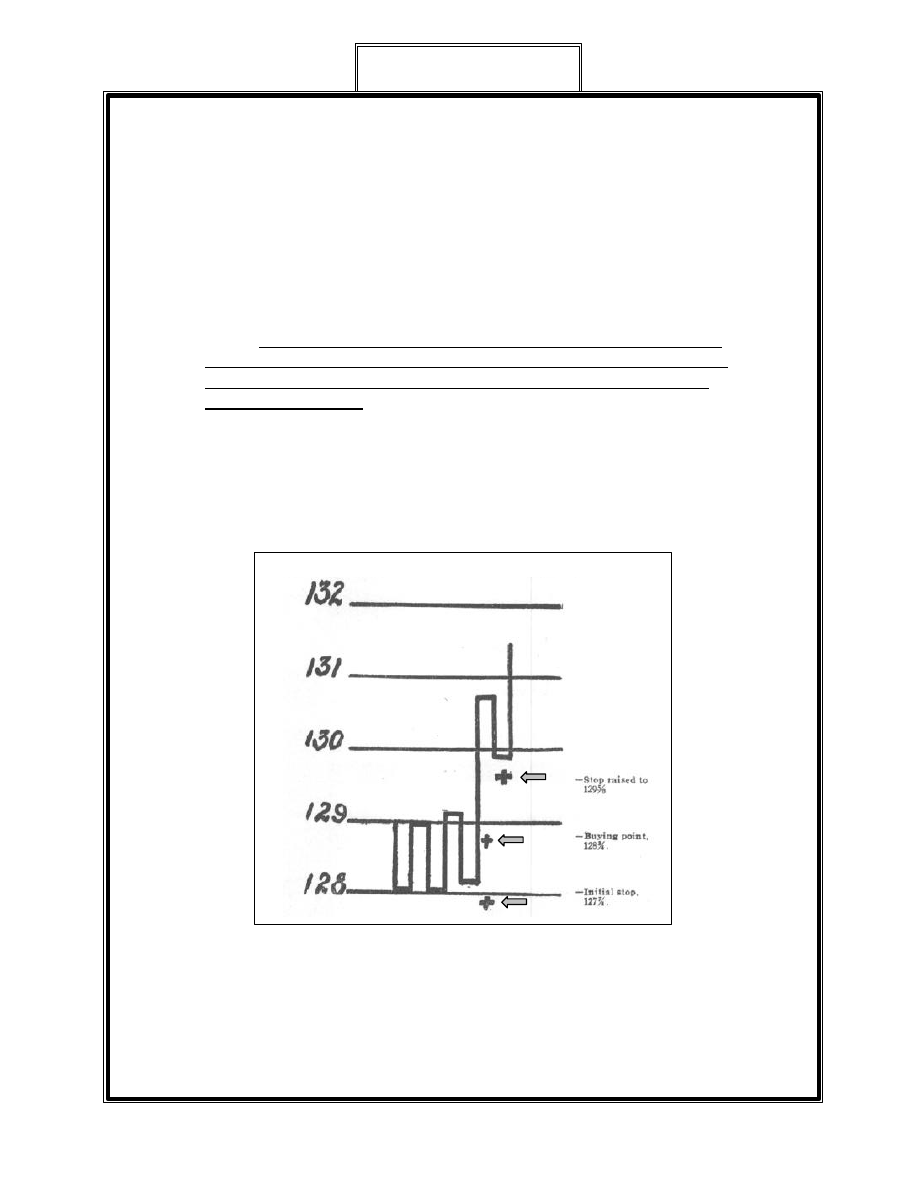
The placing of stops is most effectual and scientific when
indicated by the market itself. An example of this is as follows:
Here a stock, fluctuating between 128 and 129, gives a buying
indication at 128 3/4.
Richard D. Wyckoff
Obviously, if the indication is true, the price will not again break
128, having met buying sufficiently strong to turn it up twice from that
figure and a third time from 128 1/8. The fact that it did not touch 128 on
the last down swing forecasts a higher up swing; it shows that the
downward pressure was not so strong and the demand slightly larger and
more urgent. In other words, the point of resistance was raised 1/8.
Having bought at 128 3/4, the stop is placed at 127 7/8, which is ¼
below the last point of resistance.
The stock goes above its previous top (129 1/8) and continues to
130 3/4. At any time after it has crossed 130 the trader may raise his stop
to cost plus commission (129). The stock reacts at 129 7/8, then
continues the advance to above 131. As soon as a new high point is
reached the stop is raised to 129 5/8, as 129 7/8 was the point of
resistance on the dip.
In such a case the initial risk was 7/8 of a point plus
commissions, etc…the market giving a well defined stop point, making
an arbitrary stop not only unnecessary but expensive.
The illustration is given in chart form, but the experienced Tape
Reader generally carries these swings in his head. A series of higher
tops and bottoms are made in a pronounced up swing and the reverse in a
down swing.
Arbitrary stops may, of course, be used at any time, especially if
one wishes to clinch a substantial profit, but until a stock gets away from
the price at which it was entered, it seems best to use the stops it
develops for itself.
If the operator is shaken out of his trade immediately after
entering the trade, it does not prove his judgment was wrong. Some
accident may have happened, some untoward development in a particular
issue, of sufficient weight to affect the rest of the list. It is these
unknown occurrences that make the limitation of losses most important.
In such a case it would he folly to change the stop so that the risk
is increased. This, while customary with the general investing public, is
Richard D. Wyckoff
something a professional Tape Reader seldom does. Each trade is made
on its own basis, and for certain definite reasons. At the outset the
amount of risk should be decided upon, and, except in very rare
instances, should not he changed, except on the side of profit. The Tape
Reader must eliminate, not increase, his risk.
Averaging does not come within the province of the Tape
Reader. Averaging is groping for the top or bottom. The Tape Reader
must not grope. He must see and know, or he should not act.
It is impossible to fix a rule governing the amount of profit the
operator should accept. In a general way, there should be no limit set as
to the profits. A deal, when entered, may look as though it would yield
three or four points, but if the strength increases with the advance it may
run ten points before there is any sign of halt.
We wish our readers to bear fully in mind that these
recommendations and suggestions are not to be considered final or
inflexible. It is not our aim to assume the role of an oracle. Rather, we
are reasoning things out on paper, and as we progress in these studies
and apply these tentative rules to the tape, in actual or paper trading, you
probably have occasion to modify some of our conclusions.
A Tape Reader must close a trade:
(1) when the tape tells him to close;
(2) when his stop is caught;
(3) when his position is not clear;
(4) when he has a large or satisfactory profit and wishes to utilize
those funds for better opportunities.
The first and most important reason for closing a trade is:
The tape says so.
This indication may appear in various forms. Assuming that one
is trading in a Leader stock, the warning may come in the stock itself.
Richard D. Wyckoff
Within the recording of sales, there runs the fine silken thread of
the trend. It is clearly distinguishable to one sufficiently versed in the art
of Tape Reading, and, for reasons previously explained, is most readily
observed in the leaders.
So, when one is short of Union Pacific and this thread suddenly
indicates that the market has turned upward, it’s foolish to remain short.
Not only must one cover quickly, but if the power of the movement is
sufficient to warrant the risk, the operator must go long. In a market of
sufficient breadth and swing, the Tape Reader will find that when it is
time to close a trade, it is usually time to reverse his position. One must
have the flexibility of whalebone, and entertain no rigid opinion.
He must obey the tape implicitly. The indication to close a trade
may come from another stock, several stocks or the general market.
For example, on the day of the Supreme Court decision in Consolidated
Gas, suppose the operator was long of Union Pacific at 11 o'clock,
having paid therefor182 ¾.
Between 11 and 12 o'clock Union rallied to
183 1/2, and Reading, which was more active,
to 144. Just before, and immediately after, the
noon hour, tremendous transactions took place
in Reading, over 50,000 shares changing
hands within three-quarters of a point.
These may have been largely wash
sales, accompanied by inside selling; it is
impossible to tell. If they were not, the
inference is that considerable buying power developed in Reading at this
level and was met by selling heavy enough to supply all bidders and
prevent the stock advancing above 144 3/8.
Large quantities coming within a small range indicated either one
of two things:
(1) That considerable buying power suddenly developed at this
point, and the insiders chose to check it or to take advantage
of the opportunity to unload.
“If a stock or the
whole market cannot
be advanced, the
assumption is that it
will decline --a market
seldom stands still.”
Richard D. Wyckoff
(2) The demonstratio n in Reading may have been intended to
distract attention from other stocks in which large operators
were unloading. (There was no special evidence of this,
except in New York Central).
If the selling was not sufficient to check the upward move, the
market for Reading would have absorbed all that was offered and
advance to a higher level, but in this case the selling was more effectual
than the buying, and Reading fell back, warning the operator that the
temporary leader on the bull side of the market had met with defeat.
At this point the operator was, therefore, on the lookout for a slump.
Reading subsided, in small lots, back to 143 7/8. Union Pacific,
after selling at 183 5/8, declined to 183 ¼. Both stocks developed
dullness, and the whole market became more or less inactive.
Suddenly Union Pacific fell to 183 1/8. Then UP traded 500 shares
@183, 200 at 182 7/8, 500 at 183, 200 at 182 7/8, and 500 at 182 3/4,
indicating not only a lack of demand, but remarkably poor support.
Immediately following this, New York Central, which sold only a few
minutes before 400 shares at 131½ came131 on 1700 shares, 130¼ on
500 shares and ended at 130 on 700 shares.
This demonstrated that the market was remarkably hollow and in
a position to develop great weakness. The large quantities of New York
Central at the low figure, after a running decline of a point and one- half,
showed that there was not only an absence of supporting orders, but that
sellers were obliged to make great concessions in order to dispose of
their holdings.
The quantities, especially in view of the narrowness of the
market, proved that the sellers were not small traders. Coupled with the
wet blanket put on Reading and the poor support in Union Pacific, this
weakness in New York Central was another advance notice of a decline.
On any indication of this kind, the trader must be ready to jump out of
his long stock and get short of the market.
Richard D. Wyckoff
While waiting for his cue, the Tape Reader has time to consider
which stock among the leaders is the most desirable for selling. He
quickly chooses Reading, on the ground that the large lots which have
apparently been distributed around 144 will probably come into the
market as soon as weakness develops.
Reason: The general investing public generally buys on just such
peaks as the one which has taken place in Reading. A large volume, even
if accompanied by only a fractional advance, has the effect of making the
ordinary trader intensely bullish, the result being that he bites off a lot of
long stock at the top of the market. This is exactly what the manipulator
wishes him to do.
We have all heard people boast that their purchase was at the
top eighth and that it had the effect of turning the stock down. Those
who make their purchases after this fashion are quickest to become
scared at the first sign of weakness, and throw overboard what they
have bought. First greed and then fear controlled them.
In choosing Reading, therefore, the Tape Reader is picking out
the stock in which he is likely to have the most help on the bear side.
At 12.30 PM the market is standing still, the majority of
transactions being in small lots and then only fractional changes.
Reading shows the effect of the recent unloading. It is coming out 500 at
143 3/4, 500 at 143 5/8, 400 at 143 ½ and 400 at 143 3/4.
The operator realizes that Reading is probably a short sale right
here, with a stop order at 144 1/2 or 5/8, on the ground that the bulls
must have an extraordinary amount of buying power to push the stock
above its former top, where, at every eighth advance over 144 3/8, they
will encounter a considerable portion of 50,000 shares. This reasoning,
however, is all aside from our main argument, which is to show how the
clue to get out of the stock will be given by the action of stocks other
than that in which the trader is working.
Union Pacific shows on the tape in small lots at 182 3/4; New
York Central 1100 at l30, and 900 at 130 3/8. The rest of the market
Richard D. Wyckoff
seems to have all the snap and ginger taken out of it and the operator
does not like his position on the long side.
He has no definite indication to sell short, however, he feels that
his chances on the long side have been reduced to practically nothing by
the weak undertone of the market, he therefore gets out of his Union
Pacific and waits until the tape tells him to sell Reading short.
Union Pacific weakens to182 5/8. The others slide off
fractionally. The weakness is not strong enough to forecast any big
break, so he continues to wait. There are 1800 shares of Union
altogether at 182 5/8, followed by 3000 at 182 1/2. Other stocks respond
and the market looks more bearish.
Consolidated Gas trades 163¾ - 163 ¼ - 163. This is the first
sign of activity in the stock, but the move is nothing unusual for Gas, as
its fluctuations are generally wide and erratic. The balance of the list
rallies a fraction. Gas trades 162 ½ to ¾, then 500 at 162 1/4. At this
point Gas, which has been very dull up to now, forces itself, by its
decline and weakness, upon the notice of the operator. He begins to look
upon the stock as the possible shears which will cut the thread of the
market and let everything down.
12.45 PM Gas trades 500 at 161 1/2. It is very weak. The
balance of the list is steady, Union Pacific 182 5/8, Central 130 3/8,
Reading 143 3/4. There is a fractional rally -- Union Pacific to 182 7/8
and Gas to 162. Plenty of Central for sale around 130; Reading is 143
1/2.
The rally peters out gradual weakening all around, but the Tape
Reader cannot go with the trend until he is sure of a big move. Central
trades at 129¾, showing that after all the buyers at 130 are filled up
considerable stock is still for sale. The others show only in small lots.
The market is on the verge of a decline; it is where a jar of any sort will
start it down. Union Pacific is heavy at 182 1/2 - trades 300 at 182 3/8,
200 at 1/2; Reading 143 1/2, 3/8, and 1000 shares at 1/2; Central trades
2000 at 130 and 800 at 1/8.
Richard D. Wyckoff
Here is the thrust he has been looking for! Gas 163¾ on 200, 1/2
on 400, 161 on 300, 160 on 400! He waits no longer and gives an order
to sell Reading short at the market. They are all on the run now, Reading
143 1/2, 600 at ¼, 1300 at 1/4. Central 130, 129 1/2, Gas trades 500 at
159 1/2. Something very rotten about Gas and it's a cinch to sell it short
if you don't mind trading in a buzz-saw stock.
The market breaks so rapidly that he does not get over 142 3/4
for his Reading, but he is short not far from the top of what looks like a
wide open break.
Everything is slumping now -- Steel, Smelters, Southern Pacific,
St. Paul. Union Pacific is down to 181 5/8 and the rest in proportion.
Gas 158 1/2,158 on 300, 157, 156, 155, 154, 153 and the rest
"come tumbling after." Reading 141 3/8, 500 at ¼, 400 at 141, 140 3/4,
500 at 1/2, 200 at 140, 600 at 139 3/4, 500 at 5/8. Union 181 - 180 7/8,
3/4, 1/2, 1/4, 600 at 1/8, 500 at 180, 179 3/4, 500 at 1/2, 300 at 1/4,
Central 127 1/2.
The above illustrates some of the workings of a Tape Reader's
mind; also how a break in a stock, entirely foreign to that which is being
traded in, will furnish an indication to get out and go short of one stock
or another.
The indication to close a trade may come from the general market
where the trend is clearly developed throughout the list all stocks
working in complete harmony. One of the best indications in this line is
the strength or weakness on rallies and reactions.
Of course the break in Gas, which finally touched 138, was due
to the Supreme Court decision, announced on the news tickers at 1:10
PM, but, as is usually the case, the tape told the news many minutes
before anything else. This is one of the advantages of getting your news
from the first place where it is reflected. Other people who wait for such
information to sift through telephone wires and reach them by the
roundabout way of news tickers or word of mouth, are working under a
tremendous handicap.
Richard D. Wyckoff
That not even the insiders knew what the decision was to be - is
shown in the dullness of the stock all morning. Those who heard the
decision in the Supreme Court chamber doubtless went straight to the
telephone and sold the stock short. Their sales showed on the tape before
the news arrived in New York. Tape Readers were, therefore, first to be
notified. They were short before the Street knew what had happened.
CHAPTER V
Volumes and Their Significance
A
S the whole object of these studies is to learn to read what the tape
says, I will now explain a point which should be known and understood
before we proceed, otherwise the explanations cannot be made clear.
First of all, we must recognize that the market for any stock -- at
whatever level it may be -- is composed of two sides, represented by the
bid and the asking price.
Remember that the "last sale" is something entirely different from
the "market price." If Steel has just sold at 50, this figure represents
what has happened. It's history. The market price of Steel is either 49
1/8@50 or 50@50 1/8. The bid and asked prices combined form the
market price.
This market price is like a pair of scales, and the volume of stock
thrown out by sellers and reached for by purchasers, shows toward which
side the preponderance of weight has momentarily shifted.
For example, when the tape shows the market price is 50 1/8, and
the large volumes are on the up side.
US
500 @ 50
Richard D. Wyckoff
1000 @ 50 1/8
200 @ 50
1500 @ 50 1/8
In these four transactions there are 700 shares sold at 50 verses
2500 bought at 50 1/8, proving that at the moment the buying is more
effective than the selling.
The deduction to be made from this is that Steel will probably sell
at 50 1/4 before 49 7/8. There is no certainty, because supply and
demand is changing with every second, not only in Steel but in every
other stock on the list.
Here is one advantage in trading only the leaders: The
influence of demand or pressure is first evidenced in the principal
stocks.
The hand of the dominant power, whether it be an insider, an
outside manipulator or the public, is shown in these volumes. The reason
is simple. The big fellows cannot put their stocks up or down without
trading in large amounts. In an advancing market they are obliged to
reach up for or bid up their stocks, as, for example:
U
1000 @ 182 1/8
200 @182
1500 @ 182 1/8
200 @ 182 1/4
3500 @ 182 3/8
2000 @ 182 1/2
Take some opening trades and subsequent transactions like the
following:
200... 47 1/4
100... 45 7/8
100... 45 7/8
1900... 46 3/4
100... 46 1/8
100... 46
100... 46 5/8
100... 46
600... 45 7/8
100... 46 1/2
200... 46 1/4
500... 45 3/4
Richard D. Wyckoff
100... 46 3/8
100... 46 3/8
200... 45 5/8
600... 46 1/4
11 A. M.
100... 45 1/2
100... 46 1/8
300... 46 3/8
100... 45 5/8
600... 46
100... 46 1/8
400... 45 7/8
100... 45 7/8
100... 46
100... 45 3/4
200... 45 3/4
100... 45 7/8
400... 45 5/8
100... 46
100... 46
100... 45 3/4
Here the opening market price was 46 3/4 bid @ 47¼ asking, and
the buyers of 200 shares "at the market" paid the high price.
All bids at 46 3/4 were then filled. This is proved by the next
sale, which is at 46 5/8. The big lots thereafter are mostly on the down
side, showing that pressure still existed.
The indications were, therefore, that the stock would go lower. A
lot of 1900 shares in some stocks would be a large quantity; in others
insignificant. These points have a relative value with which traders must
familiarize themselves.
Volumes must be considered in proportion to the activity of
the market, as well as the relative activity of that particular issue . No
set rule can be established. I have seen a Tape Reader make money by
following the lead of a l000 share lot of Northwest which someone took
at a fraction above the last sale. Ordinarily Northwest is a sluggish
investment stock, and this size lot appeared as the fore-runner of an
active speculative demand.
Now let us see what happens on the floor to produce the above-
described effect on the tape.
Let's prove that our method is correct.
A few years ago the control of a certain railroad was being
bought on the floor of the New York Stock Exchange. One brokerage
house was given all the orders, with instructions to distribute them and
conceal the buying as much as possible. The original order for the day
would read, "Take everything that is offered up to 38".
Richard D. Wyckoff
38 was about 3 points above the market of the day before. This
left considerable leeway for the broker to whom the buying order was
entrusted.
He would instruct his floor broker as follows:
"The stock closed last night at 35. You take everything offered up
to 35 1/2 and then report to me how things stand. Don't bid for the stock
-- just take it as it is offered and mark it down whenever you can".
In such a case the floor member stands in the crowd awaiting the
opening. On the markets open the chairman's gavel strikes and the crowd
begins yelling. Someone offers "Two Thousand at an eighth." Another
broker says "Thirty- five for five hundred." Our broker takes the 2000 at
an 1/8 then offers one hundred at one-eighth himself, so as to keep the
price down. Others also offer one or two hundred shares at 1/8, so he
withdraws his offer, as he wishes to accumulate and only offers or sells
when it helps him buy more, or puts the price down. The buyer at 35 has
300 shares of his lot cancelled, so he alters his bid to "thirty- five for two
hundred." The other sellers supply him and he then bids "7/8 for a
hundred." Our broker sells him 100 at 7/8 just to get the price down.
Someone comes in with "a thousand at five." Our broker says, "I'll take
it." Five hundred more is offered at 1/8. This he also takes.
Let us see how the tape records these transactions:
Open 35
2000 @ 35 1/8
200 @ 35
100 @ 34 /7/8
100 @ 35
500 @ 35 1/8
The day trader interprets these transactions:
Opening bid and asked price was 35 1/8 someone took the large
lot (2000 shares) at the high price.
Richard D. Wyckoff
The two sales following were in small lots, showing light
pressure.
The 100 @ 35 after 34 7/8 shows that on the “7/8 bid” -“5 ask”
market the buyer took the stock at the offered price and followed it up by
taking 500 more at the eighth. The demand is dominant and it does not
matter whether the buyer is one individual or a dozen, the momentary
trend is upward.
To get the opposite side, let us suppose that a manipulator is
desirous of depressing a stock. This can be accomplished by offering
and selling more than there is a demand for, or by coaxing or frightening
other holders into throwing over their shares.
It makes no difference whose stock is sold; "The Lord is on the
side of the heaviest battalions," as men used to say. When a manipulator
puts a broker into a crowd with orders to mark it down, the broker
supplies all bids and then offers it down to the objective point or until he
meets resistance too strong for him to overcome without the loss of a
large block of stock.
The stock in question is selling around 80, we will say, and the
broker's orders are to "put it to 77." Going into the crowd, he finds 500
wanted at 79 7/8 and 300 offered at 80. Last sale, 100 at 80.
"I'll sell you that five hundred at seven-eighths. A thousand or any part
at three quarters," he shouts.
"I'll take two hundred at three-quarters," says another broker.
"A half for five hundred," is heard. "Sold!" is the response.
"A half for five hundred more."
"Sold 1"
"That's a thousand I sold you at a half. Five hundred at three-eighths!"
"I'll take a hundred at three-eighths," comes a voice.
Richard D. Wyckoff
"You're on!" is the reply.
"Quarter for five hundred."
"Sold!" is the quick response.
His pounding of the stock would reveal itself on the tape as follows:
Open 80.
500 sold@ 79 7/8
200 sold@ 79 3/4
1000 sold@ 79 ½
500 sold @79 ¼
If he met strong resistance at 79 it would appear on the tape something
like this:
1000 sold @ 79
500 sold @ 79
800 @ 79
300 @ 79 1/8
1000 @ 79
500 @ 79 1/4
200 @ 79 1/2
…showing that at 79 there was a demand for more than he was willing to
supply.
(For example: There might have been 10,000 shares still wanted at 79
which is more than he could supply).
Frequently a broker meeting such an obstacle will leave the
crowd long enough to phone his principal. His departure opens the way
for a rally, as the stock is no longer under pressure, and the large buying
order at 79 acts as a back log for floor traders. So those in the crowd bid
it up to 79 1/2 in hopes of scalping a fraction on the long side.
Richard D. Wyckoff
Take another case where two brokers are put into the crowd --
one to depress the stock and the other to accumulate it. They play into
each other's hands, and the tape makes the following report of what
happens:
Open 80 1/8 - 80
200 @ 79 7/8
1000 @ 79 7/8
200 @ 79 5/8
500 @ 79 3/4
300 @ 79 3/4
1500 @ 79 1/2
500 @ 79 1/4
100 @ 79 1/8
Were we on the floor we should see one broker offering the stock
down, while the other grabbed every round lot that appeared. We cannot
tell how far down the stock will be put, but when these indications
appear it makes us watch closely for the turning point, which is our time
to buy.
The Tape Reader does not care whether a move is made by a
manipulator, a group of floor traders, the public or a combination of
all.
The figures on the tape represent the consensus of opinion, the
effect of manipulation and the supply and demand, all combined. That is
why tape indications are more reliable than what anyone hears, knows or
thinks.
With the illustration of the pair of scales (supply – demand)
clearly implanted in our minds, we scan the moment by moment
transactions of the tape, mentally weighing each indication in our effort
to learn on which side the tendency is strongest. Not a detail must
escape our notice. A sudden demand or a burst of liquidation may
enable us to form a new plan, revise an old one or prompt us to assume a
neutral attitude.
Richard D. Wyckoff
These volume indications are not always clear. Nor are they
infallible. It doesn’t do any good to rely upon the indications of any one
stock to the exclusion of the rest. There are times when certain stocks are
run up, while volume indications in other active stocks show clearly that
they are being distributed as fast as the market will take them. This
happens frequently on a large or small scale. Especially is it apparent at
the turning point of a big swing, where accumulation or distribution
requires several days to complete.
Volumes can be studied from the reports printed in the Wall
Street Journal, but the real way to stud y them is from the tape.
If you are not able to spend five to seven hours a day at the tape
while the ticker is in operation, you can arrange to have the tape saved
for you each day. The tape can then be studied at leisure.
In studying under these conditions let it be on as small a scale as
you like, but make actual trades with real money.
There are times when the foregoing rule of volumes indicates
almost the reverse of what we have explained. One of these instances
was described in our last chapter. In this case the trans
700... 143 5/8
500... 143 3/4
5000... 143 5/8
1700... 143 3/4
200... 143 5/8
4300... 143 3/4
3700... 143 7/8
100... 144
12 P.M.
5000... 144
1300... 143 7/8
3000... 144
5000... 144 1/8
2100... 144 1/4
2200... 144 1/8
3500... 144 1/4
“…do not let yourself be
deceived as to your ability to
make money on paper.
Imaginary trades prove
nothing. The way to test
your powers is to get into
the game.”
Richard D. Wyckoff
4000... 144 3/8
3000…144 1/4
2500... 144 1/8
3500... 144
400... 144 1/8
1000... 144
500.... 144 1/8
1100... 144
2000... 143 7/8
2500... 143 3/4
1000... 143 5/8
Turning Point in Reading, morning of
Jan. 4, 1909~the day of the Consolidated Gas collapse
…actions in Reading suddenly swelled out of all proportion to the rest of
the market and its own previous volume. Notwithstanding the
predominance of apparent demand, the resistance offered (whether
legitimate or artificial) became too great for the stock to overcome, and it
fell back from 144 3/8. On the way up these volumes suggested a
purchase, but the tape showed abnormal transactions, accompanied by
poor response from the rest of the list. This smacked of manipulation and
warned the operator to be cautious on the bull side.
The large volume in Reading was sustained even after the stock
reacted, but the large lots were evidently thrown over at the bid prices.
On the way up the volumes were nearly all on the up side and the small
lots on the down side.
After 144 3/8 was reached the large lots were on the down side
and the small lots on the up.
It is just as important to study the small lots as the large lots.
The smaller quantities are like the feathers on an arrow -- they
indicate that the business part of the arrow is at the other end. In other
Richard D. Wyckoff
words, the smaller lots keep one constantly informed as to what fraction
forms the other side of the market.
For example: During the first five trades in Reading, recorded
above, the market quotation is shown to have been 5/8@3/4; it then
changed to 3/4@7/8 and again to 7/8@4. On the way down it got to be
4@1/8, and at this level the small lots were particularly valuable in
showing the pressure that existed.
Stocks like Union, Reading and Steel usually make this sort of a
turning point on a volume of from 25,000 to 50,000 shares. That is, when
they meet with opposition on an advance or a decline it must be in some
such quantity in order to stem the tide.
Walk into the hilly country and you will find a small river
running quietly on its way. The stream is so tiny that you can place your
hand in its course and the water will back up. In five minutes, it
overcomes this resistance by going over or around your hand. You fetch
a shovel, pile dirt in its path, pack it down hard and say, "There, I've
dammed you up". But you haven't at all, for the next day you find your
pile of dirt washed away. You bring cartloads of dirt and build a
substantial dam, and the flow is finally held in check.
It is the same with an individual stocks or the market. Prices
follow the line of least resistance. If Reading is going up someone may
throw 10,000 shares in its path without perceptible effect. Another lot of
20,000 shares follows; the stock halts, but finally overcomes the
obstacle. The seller gives another order -- this time 30,000 shares more
are thrown on the market. If there are 30,100 shares wanted at that level,
the buyer will absorb all of the 30,000 and the stock will go higher; if
only 29,900 shares are needed to fill all bids, the price will recede
because demand has been overcome by supply.
It looks as though something like this happened in Reading on
the occasion referred to. Whether or not manipulative orders
predominated does not change the aspect of the case. In the final test the
weight was on the down side.
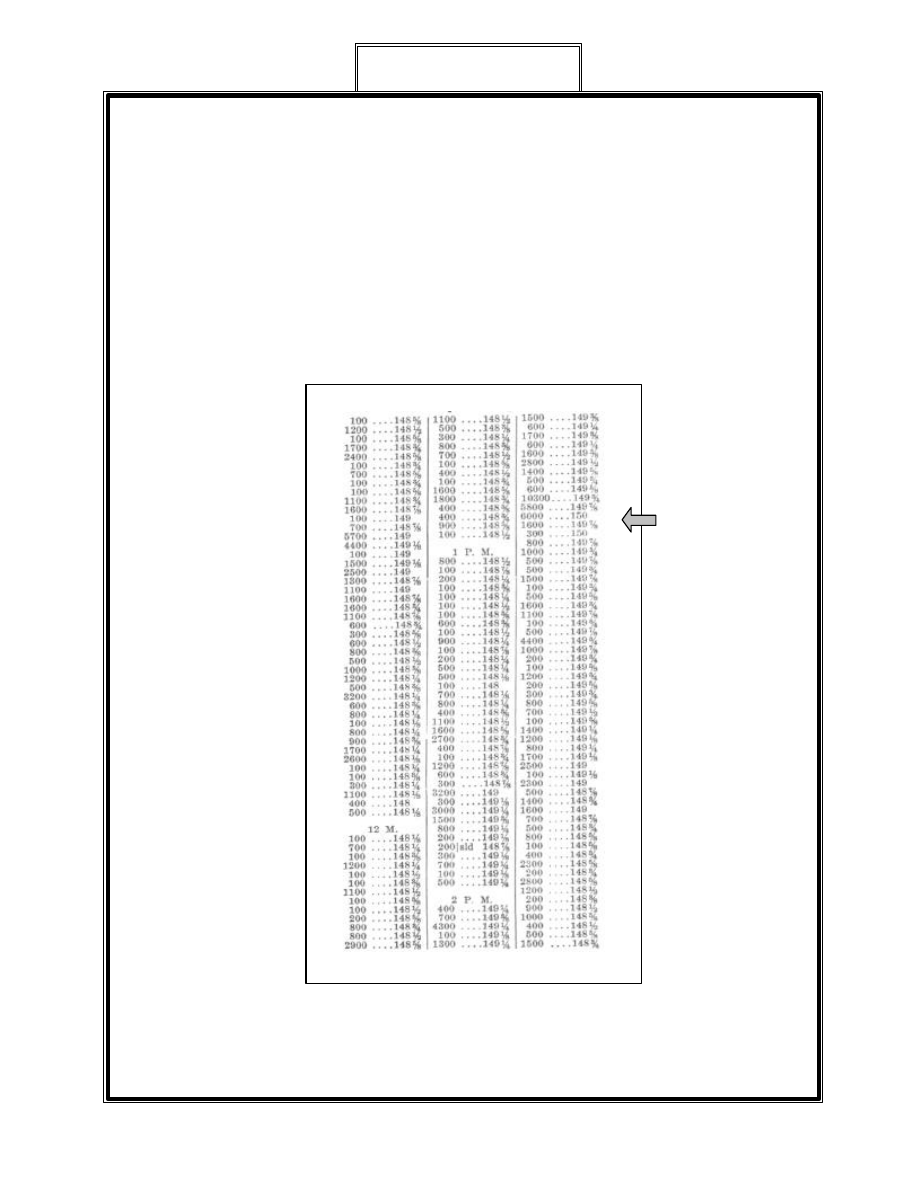
Richard D. Wyckoff
The public and the floor traders do not stand aside while the
manipulator is at work, nor is the reverse true. Every-body's stock looks
alike on the tape.
The following is a good illustration of E. H. Harriman's work at
an important turning point in Union Pacific:
Volume Study in Union Pacific, showing 39,300 shares supplied at
149 ¾ to 150, checking the rise:
Richard D. Wyckoff
When a stream breaks through a dam it goes into new territory.
Likewise the breaking through of a stock is significant, because it means
that the resistance has been overcome.
The stronger the resistance, the less likelihood of finding further
obstacles in the immediate vicinity. Dams are not usually built one
behind the other. So when we find a stock emerging into a new field it is
best to go with it, especially if, in breaking through it, it carries the rest
of the market along.
While a lot can be learned from the reports printed in the daily
newspapers mentioned above, the moment by moment transactions –
trades as they appear -- is the only real instruction book. A live tape is to
be preferred, for the element of speed with which you receive the
information is of no small concern.
The comparative activity of the market on peaks and breaks is a
guide to the technical condition of the market. For instance, during a
decline, if the ticker is very active and the volume of sales large,
voluntary or compulsory liquidation is indicated. This is emphasized if,
on the subsequent rally, the tape moves sluggishly and only small lots
appear. In an active bull market the ticker appears to be choked with the
volume of sales poured through it on the advances, but on reactions the
quantities and the number of impressions decrease until, like tile ocean at
ebb tide, the market is almost lifeless.
Another indication of the power of a movement is found in the
differences between sales of active stocks, for example:
1000 @ 180
100 @ 180 1/8
500 @ 180 3/8
1000 @ 180 1/2
This shows that there was only 100 shares for sale at 180 1/8,
none at all at 180¼, and only 500 at 3/8. The jump from 1/8 to 3/8
emphasizes both the absence of pressure and persistency on the part of
the buyers. They are not content to wait patiently until they can secure
the stock at 180¼; they "reach" for it.
Richard D. Wyckoff
On the opposite side this would show lack of support.
Each indication is to be judged not so much by rule as according
to the conditions surrounding it. The tape furnishes a continuous series of
motion pictures, with their respective explanations written between the
printings.
These motion pictures of the market are in a language which is
foreign to all casual investors – but understandable to the professional
Tape Reader.
A NUMBER of people who have read previous editions of this
book have been misled by the apparent ease with which some kinds of
markets may be read by means of the volumes. They have erroneously
come to the conclusion that all one has to do is sit beside a ticker and
observe which side the volumes are on -- the buying or the selling side.
This is a mistake. Under the old exchange rule a buyer who
desired to influence the market in an upward direction could bid for
10,000 shares or any other very large quantity, and no one could sell him
any less than the quantity bid for, unless the buyer was willing to take it.
Under the present rules, the buyer is obliged to take any part of 10,000
shares, or whatever quantity he bid for if he does not specify “all or
none” to his broker.
This revision of the rules, and the other restrictions against
matched orders, manipulations, etc., eliminates a very large number of
transactions in big quantities at the advanced or the decreased price. It
was an old trick of Harriman's and some of the old Standard Oil party, as
well as other minor manipulators and floor traders, to make these bids
and offers in round lots and have some one else supply or take them for
its effect on the market. But the change in the rules has greatly reduced
the volume and decreased the value of these indications. Hence, while
they are still very suggestive to an observant tape reader, and while the
principle is unchanged, it will not do to depend on them entirely.
The volumes which we have been discussing are least liable to
mislead when manipulation prevails, for the manipulator is obliged to
Richard D. Wyckoff
deal in large blocks of stock, and must continually show his hand. A
complete manipulative operation on the long side consists of three parts:
(1) Accumulation,
(2) marking up, and
(3) distribution.
In the case of a shorting operation -- the distribution comes first, then
the mark down and the accumulation. No one of these three sections is
complete without the other two.
The manipulator must work with a large block of stock or the deal
will not be worth his time, the risk and expenses. The Tape Reader must
therefore, be on the lookout for extensive
operations on either side of the market.
Accumulation will show itself in the
quantities and in the way they appear on the
tape. .
He does not buy it at once, because it may
take weeks or months for the manipulator to
complete the accumulation of his line, and
there might be opportunities to buy cheaper.
By holding off until the psychological
moment he forces someone else to carry the stock for him -- to pay his
interest. Furthermore, his capital is left free in the meantime.
When the marking up begins he gets in at the commencement of
the move, and goes along with it till there are signs of a halt or
distribution. Having passed through the first two periods, he is in a
position to fully benefit by the third stage of the operation.
In this sort of work a figure chart, which I described in another
chapter, will help the trader, especially if the manipulative operation is
continued over a considerable period of time. It will give him a bird's-
eye view of the deal, enabling him to drop or resume the thread at any
stage.
“Having detected the
accumulation, the
Tape Reader has only
to watch its progress,
holding himself in
readiness to take on
some of the stock the
moment the marking-
up period begins.”
Richard D. Wyckoff
CHAPTER VI
Market Technique
O
N Saturday morning, February 27, 1909, the market opened slightly
higher than the previous night's close.
Reading was the most active stock. After touching 123 1/2 it slid
off to 122 1/2, at which point it invited short sales. This indication was
emphasized at 122, at 121 1/2 and again at 121. The downward trend
was strongly marked until it struck 119 7/8, then it followed a quick rally
of 1 1/8 points.
This was a vicious three-point jab into a market that was only just
recovering from a decline in early February.
What was its effect on the other principal stocks? Union Pacific
declined only 3/4, Southern Pacific 5/8 and Steel 5/8. This proved that
they were technically strong; that is, they were in hands which could
view with equanimity a three-point break in a leading issue.
Had this drive occurred when Reading was around 145 and
Union 185 the effect upon the others would probably have been very
different.
In order to determine the extent of an ore body, miners use a
diamond drill. This produces a core, the character of which shows what
is beneath the surface. If it had been possib le to have drilled into the
market at the top of the foregoing rise, we should have found that the
bulk of the floating supply in Steel, Reading and some others was held
by a class of traders who buy heavily in booms and on bulges. These
people operate with comparatively small margins, nerve and experience.
They are exceedingly vulnerable, so the stocks in which they operate
suffer the greatest declines when the market receives a jar. The figures
are interesting:
Richard D. Wyckoff
-------------Points----------
Per cent
1907-9
Feb, '09
Break to
Advance
Decline
Advance
U.P.
84¼
12 3/8
14.7
Reading
73¼
26 3/8
33.6
Steel
36¼
16 1/2
44.6
The above shows that the public was heavily extended in Steel
somewhat less loaded with Reading, and was carrying very little Union
Pacific. In other words, Union showed technical strength by its resistance
to pressure. Whereas Reading and Steel offered little or no opposition to
the decline.
Both the market as a whole and individual stocks are to be judged
as much by what they do as what they do not do at critical points.
If the big fellows who accumulated Union below 120 had
distributed it above 180, the stock would have broken something like
thirty points, due to its having passed from strong to weak hands. As it
did not have any such decline, but only a very small reaction compared
to its advance, the Tape Reader infers that Union is destined for much
higher prices; that it offers comparative immunity from declines and a
possible large advance in the near future.
Even were Union Pacific scheduled for a thirty-point rise in the
following two weeks, something might happen to postpone the campaign
for a considerable time. But the Tape Reader must work with these
broader considerations in full view. He has just so much time and capital,
and this must be employed where it will yield the greatest results. If by
watching for the most favorable opportunities he can operate with the
trend in a stock which will some day or week show him ten points profit
more than any other issue he could have chosen, be is increasing his
chances to that extent.
Richard D. Wyckoff
A long advance or decline usually culminates in a wide, quick
movement in the leaders. Take the break of February 23, 1909:
Reading declined from 128 3/4 to 118 and Steel from 46 to 41 1/4 in one
day. Southern Pacific, after creeping up from 97 to 112, reached a
climax in a seven-point jump during one session.
Instances are so numerous that they are hardly worth citing.
The same thing happens in the market as a whole -- an exceptionally
violent movement, after a protracted sag or rise, usually indicates its
termination.
A stock generally shows the Tape Reader what it proposes to do
by its action under pressure or stimulation. For example: On Friday,
February 19,1909, the United States Steel Corporation announced an
open market in steel products.
The news was out.
Everybody in the country knew it by the following morning. The
Tape Reader, in weighing the situation before the next day's opening,
would reason – “As the news is public property, the normal thing for
Steel and the market to do is to rally. Steel closed last night at 48 3/8.
The market hinges upon this one stock. Let's see how it acts."
The opening price of U. S. Steel was three-quarters of a point
down from the previous closing -- a perfectly natural occurrence in view
of the announcement. The real test of strength or weakness will follow.
For the first ten minutes Steel shows on the tape:
200 @ 47 7/8
4500 @ 47 3/4
1200 @ 47 7/8
1500 @ 47 3/4
…without otherwise varying. Eighteen times the price swings back and
forth between the same fractions.
Meanwhile, Union Pacific, which opened at 177 1/2, shows a
tendency to rally and pull the rest of the market up behind it.
Richard D. Wyckoff
Can Union lift Steel? That is the question. Here are two opposing forces,
and the Tape Reader watches like a hawk, for he is "going with the
market" -- in the direction of the trend. Union is up 7/8 from the opening
and Southern Pacific is reinforcing it.
But Steel does not respond. Not once does it get out of that 3/4 -
7/8 rut -- not even single hundred share lot can be sold at 48. This proves
that it is freely offered at 47 7/8 and that it possesses no rallying power,
in spite of the leadership displayed by the Harrimans.
Union seems to make a final effort to induce a following:
2000 @ 178 1/2
…to which Steel replies by breaking through with a thud:
800 @ 47 5/8
This is the Tape Reader's cue to go short. In an instant he has put
out a
line of Steel for which he gets 47 1/2 or 47 3/8 as there are large volumes
traded in at those figures.
Union Pacific seems disheartened. The Steel millstone is hanging
round its neck. It slides off to 178 ¾, ¼, 1/8 and finally to 177 7/8.
The pressure on Steel increases at the low level.
Successive sales are made as follows.
6800 @ 47 ½
2600 @ 47 3/8
500 @ 47 1/4
8800 @ 47 1/8
From this time on there is a steady flow of long stock all through
the list. Reading and Pennsylvania are the weakest railroads. Colorado
Fuel breaks seven points in a running decline and the other steel stocks
Richard D. Wyckoff
follow suit. U. S. Steel is dumped in bunches at the bid prices, and even
the dignified preferred is sympathetically affected.
At the end of the two hour session; the market closes at the
bottom, with Steel at 46, leaving thousands of accounts weakened by the
decline and a holiday ahead for holders to worry over.
It looks to the Tape Reader as though the stock would go lower
on the following Tuesday. At any rate, no covering indication has
appeared, and unless it is his invariable rule to close every trade each
day, he puts a stop at 47 on his short Steel and goes his way. (His
original stop was 48 1/8).
Steel opens on the following session at 44 ¾ @ 1/2, and during
the day makes a low record of 41¼.
A number of lessons may be drawn from this episode.
Successful tape reading is a study of Force; it requires ability to
judge which side has the greatest pulling power and one must have the
courage to go with that side. There are critical points which occur in each
swing, just as in the life of a business or of an individual. At these
junctures it seems as though a feather's weight on either side would
determine the immediate Critical trend.
Any one who can spot these points has much to win and little to
lose, for he can always play with a stop placed close behind the turning
point or "point of resistance".
If Union had continued in its upward course, gaining in power,
volume and influence as it progressed, the dire effects of the Steel
situation might have been overcome. It was simply a question of power,
and Steel pulled Union down.
This study of ‘responses’ to stimulation or outside influences on
stocks is one of the most valuable in the Tape Reader's education. It is
an almost unerring guide to the technical position of the market. Of
course, all responses are not so clearly defined.
Richard D. Wyckoff
It is a matter of indifference to the Tape Reader as to who or what
produces these tests, or critical periods. They constantly appear and
disappear; he must make his diagnosis and act accordingly. If a stock is
being manipulated higher, the movement will seldom be continued
unless other stocks follow and support the advance barring certain
specific developments affecting a stock, the other issues should be
watched to see whethe r large operators are unloading on the strong spots.
Should a stock fail to break on bad news, it means that insiders
have anticipated the decline and stand ready to buy.
A member of a trading syndicate once said to me:
"We are going to dissolve tomorrow."
I asked, "Won’t there be considerable selling by people who don't want
to carry their share of the securities?"
"Oh!" he replied, "we know how every one stands. Probably 10,000
shares will come on the market from a few members who are obliged to
sell, and as a few of us have sold that much short in anticipation, we'll be
there to buy it when the time comes."
This reminds us that it is well to consider the insider's probable
attitude on a stock.
The tape usually indicates what this is. One of the muckraking
magazines once showed that Rock Island preferred had been driven
down to 28 one August to the accompaniment of receivership rumors.
The writer of the article was unable to prove that these rumors originated
with the insiders, for he admitted that the transactions at the time were
not fully understood.
Perhaps they were inscrutable to a person inexperienced in tape
reading, but we well remember that the indications were all in favor of
buying the stock on the break. The transactions were very large -- out of
all proportion to the capital stock outstanding and the floating supply.
Richard D. Wyckoff
What did this mean to the Tape Reader? Thousands of shares
of stock were traded in per day, after a ten-point decline and a small
rally. If the volume of sales represented long stock, some one was
there to buy it. If there was manipulation it certainly was not for the
purpose of distributing the stock at such a low level. So, by casting
out the unlikely factors, a Tape Reader could have arrived at the
correct conclusion.
The market is being put to the test continually by one element of
which little has been said, i.e., the floor traders. These shrewd fellows
are always on the alert to ferret out a weak spot in the market, for they
love the short side.
Lack of support, if detected, in an issue generally leads to a raid
which, if the technical situation is weak, spreads to other parts of the
floor and produces a reaction or a slump all around. Or, if they find a
vulnerable short interest, they are quick to bid up a stock and drive the
shorts to cover. With these and other operations going on all the time, the
Tape Reader who is at all expert is seldom at a loss to know on which
side his best chances lie. Other people are doing for him what he would
do himself if he were all-powerful.
While it is the smaller swings that interest him most, the day
trader must not fail to keep his bearings in relation to the broader
movements of the market.
When a panic prevails he recognizes it in the birth of a bull
market and operates with the certainty that prices will gradually rise until
a boom marks the other extreme of the swing. In a bull market he
considers reactions of from two to five points normal and reasonable.
He looks for occasional drops of 10 to 15 points in the leaders, with a 25-
point break at least once a year. When any of these occur, he knows
what to look for next.
In a bull market he expects a drop of 10 points to be followed by
a recovery of about half the decline, and if the rise is to continue, all of
the drop and more will be recovered. If a stock or the market refuses to
rally naturally, he knows that the trouble has not been overcome, and
therefore looks for a further decline.
Richard D. Wyckoff
Take American Smelters, which made a top of 99 5/8 a few years
ago, then slumped off under rumors of competition until it reached 78.
Covering indications appeared around 79 1/2. Had the operator also
gone long here, he could confidently have expected Smelters to rally to
about 89. The decline having been 21 5/8 points, there was a rally of 10
3/4 points due.
As a matter of record the stock did recover to 89 3/8. Of course,
these things are mere guide posts, as the Tape Reader's actual trading is
done only on the most positive and promising indications; but they are
valuable in teaching him what to avoid. For instance, he would be wary
about making an initial short sale of Smelters after a 15 point break, even
if his indications were clear. There might be several points more on the
short side, but he would realize that every point further decline would
bring him closer to the turning point, and after such a violent break the
safest money was to wait for an opportunity on the long side.
Another instance: Reading sold on January 4, 1909, at 144 3/8.
By the end of the month it touched 1311/2, and on
February 23rd broke ten points to 118. This was a
decline of 24 3/8 points (allowing for the 2 per
cent dividend paid). As previously stated, the
stock looked like an attractive short sale, not only
on the first breakdown, but on the final drive. The
conservative trader would have waited for a
buying indication, as there would have been less
risk on the long side.
It is seldom that the market runs more than
three or four consecutive days in one direction
without a reaction, so the Tape Reader must realize that his chances
decrease as the swing is prolonged.
The daily movements offer his best opportunities; but he must
keep in stocks which swing wide enough to enable him to secure a profit.
As Napoleon said: "The adroit man profits by everything, neglects
nothing which may increase his chances".
“Few people are
willing to go to the
very bottom of things.
Is it any wonder that
success is for the few
-- the few who are
willing to work at it?”
Richard D. Wyckoff
I once knew a speculator who bought and sold by the clock. He
had no idea of the hourly swing, but would buy at 12 o'clock, because it
was 12 o'clock, and would sell at 2 o'clock, for the same reason.
The methods employed by the average outside speculator are not
so very much of an improvement on this, and that is why so many lose
their money.
The expert Tape Reader is diametrically opposed to such people
and their methods. He applies science and skill in angling for profits.
He studies, figures, analyzes and deduces. He knows exactly
where he stands, what he is doing and why.
CHAPTER VII
Dull Markets and Their Opportunities
M
ANY people are apt to regard a dull market as a problem for trading
purposes. They claim: "Our hands are tied; we can't get out of what
we've got; if we could there'd be no use getting in again, for whatever we
do we can't make a dollar".
Such people are not Tape Readers. They are Sitters.
As a matter of fact, dull markets offer innumerable opportunities
and we have only to dig beneath the crust of prejudice to find them.
Dullness in the market or in any special stock means that the
forces capable of influencing it in either an upward or a downward
direction have temporarily come to a balance. The best illustration is that
of a clock which is about run down -- its pendulum gradually decreases
the width of its swings until it comes to a complete standstill, like this:
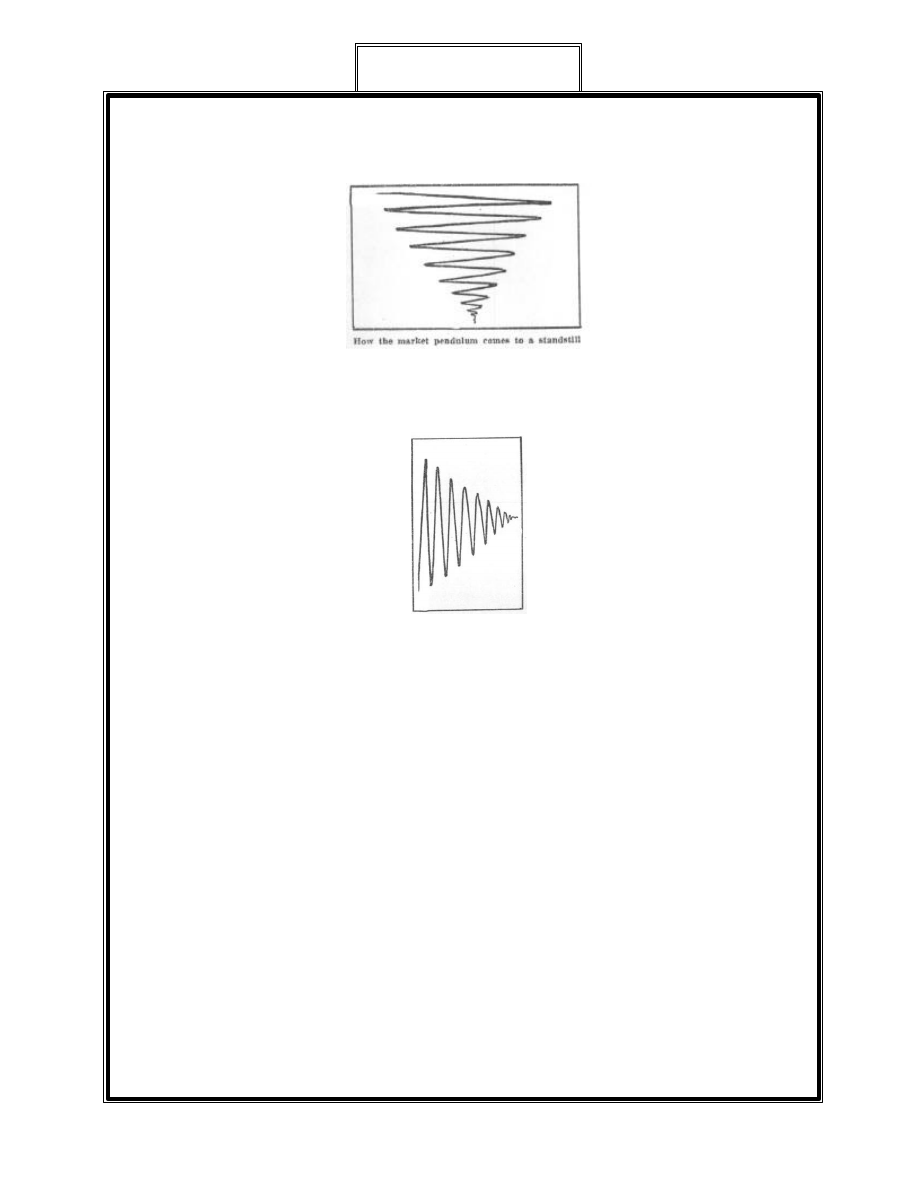
Richard D. Wyckoff
Turn this diagram sideways and you see what the chart of a stock or the
market looks like when it reaches the point of dullness:
These dull periods often occur after a season of delirious activity
on the bull side.
People make money, pyramid on their profits and glut themselves
with stocks at the top. As every one is loaded up, there is comparatively
no one left to buy, and the break which inevitably follows would happen
if there were no bears, no bad news or anything else to force a decline.
Nature has her own remedy for dissipation. She presents the
debauch' with its start, its climax and its collapse, with a thumping head
and a moquette tongue. These tend to keep him quiet until the damage
can be repaired. So with these intervals of market rest. Traders who have
placed themselves in a position to be trimmed are duly trimmed.
They lose their money and temporarily, their nerve. The market,
therefore, becomes neglected. Extreme dullness sets in.
Richard D. Wyckoff
If the history of the market were to be written, these periods of
lifelessness should mark the close of each chapter. The reason is: The
factors that were active in producing the main movement, with its start,
its climax and its collapse, have spent their force.
Prices, therefore, settle into a groove, where they remain
sometimes for weeks or until affected by some other powerful influence.
When a market is in the midst of a big move, no one can tell how long or
how far it will run. But when prices are stationary, we know that from
this point there will be a pronounced swing in one direction or another.
There are ways of anticipating the direction of this swing. One is
by noting the technical strength or weakness of the market, as described
in a previous chapter. The resistance to pressure mentioned as
characteristic of the dull period in March, 1909, was followed by a
pronounced rise, leading stocks selling many points higher.
This was particularly true of Reading, in which the shakeouts
around 120 (one of which was described) were frequent and positive.
When insiders shake other people out it means that they want the stock
themselves. These are good times for us to get in.
When a dull market shows its inability to hold rallies, or when it
does not respond to bullish news, it is technically weak, and unless
something comes along to change the situation, the next swing will be
downward.
On the other hand, when there is a gradual hardening in
prices; when bear raids fail to dislodge considerable quantities of
stock; when stocks do not decline upon unfavorable news, we may
look for an advancing market in the near future.
No one can tell when a dull market will merge into a very active
one; therefore the Tape Reader must be constantly on the watch. It is
foolish for him to say: "The market is dead dull. No use watching it
Richard D. Wyckoff
today. The leaders only swung less than a point yesterday. Nothing
profitable can happen in such a market".
Such reasoning is apt to make one miss the very choicest
opportunities -- those of getting in on the ground floor of a big move.
For example: During the previous mentioned accumulation in
Reading, the stock ranged between 120 and 124 1/2. Without warning, it
one day gave indication (around 125) that the absorption was about
concluded, and the stock had begun its advance.
The Tape Reader having reasoned beforehand that this
accumulation was no small investors game, would have grabbed a bunch
of Reading as soon as the indication appeared. He might have bought
more than he wanted for scalping purposes, with the intention of holding
part of his line for a long swing, using the rest for regular trading.
As the stock drew away from his purchase price he could have
raised his stop on the lot he intended to hold, putting a mental label on it
to the effect that it is to be sold when he detects inside distribution. Thus
he stands to benefit to the fullest extent by any manipulative work which
may be done. In other words, he says: "I'll get out of this lot when the big
boys and their friends get out of theirs".
He feels easy in his mind about this stock, because he has seen
the accumulation and knows it has relieved the market of all the floating
supply at about this level.
This means a sharp, quick rise sooner or later, as little stock is to
be met with on the way up. If he neglected to watch the market
continuously and get in at the very start, his chances would be greatly
lessened. He might not have the courage to take on the larger quantity.
On Friday, March 26, 1909. Reading and Union were about as
dull as two gentlemanly leaders could well be. Reading opened at 132
3/4, high was 133¼, low 132¼, last 132 5/8. Union's extreme fluctuation
was 5/8! -- from 180 5/8 to 181¼. Activity was confined to Beet Sugar,
Kansas City Southern, etc.
Richard D. Wyckoff
The following day, Saturday, the opening gave every indication
that the previous day's dullness would be repeated, initial sales showing
only fractional changes.
Let’s see… B. & 0., Wabash pfd. and Missouri Pacific were up 3/8 or
1/2. Union was an 1/8th higher and Reading 1/8 lower.
Beet Sugar was down 5/8, with sales at 32. Reading showed 1100 @
132¼, 800 @ 3/8, Union 800 @ 181, 400 @ 181, 200 @ 181 1/8, 400 @
181. A single hundred Steel at 45½ 1/8. B& O 100 @ 109 7/8.Market
dead, mostly single 100 share lots…
Ah! Here's our cue ! Reading 2300 @ 132½., 2000 @ ½, 500 @
5/8. Coming out of a dead market, quantities like these taken at the
offered prices can mean only one thing, and without argument the Tape
Reader takes on a bunch of Reading "at the market."
Whatever is happening in Reading, the rest of the market is slow
to respond, although N. Y. Central seems willing to help a little – 500 @
127½ (after ¼). Beets are up to 33¼. Steel is 45 1/8, and Copper 77 ¼ -a
fraction better.
Reading 300 @ 132/2.
Steel 1300 @ 45 1/8, ¼
Union 100 @ 181
Reading 300 @ 132 5/8
Beets 100 @ 33½.
Union 700 @ 181½
N.Y. Central 127 5/8, 600 @ ¾… 7/8!…There’s some help coming!
Union 900 @ 181½ now
Reading 100 @ 132 3/4.
Copper 700 @ 71½.
Reading 800 @ 132 7/8, 100 @ 133, 900 @ 133, 1100 @ 1/8...
Reading 1500 @ 133¼ , 3500 @ 133 ½…not much doubt about the
trend now.
Richard D. Wyckoff
The whole market is responding to Reading, and there is a steady
increase in power, breadth and volume. The rapid advances show that
short covering is no small factor.
It looks as though a lot of people are throwing their Beet Sugar
and getting into the big stocks. St. Paul Copper and Smelters begin to
lift a little.
Around 11 A.M. there is a brief period of hesitation, in which the
market seems to take a long breath in preparation for another effort.
There is scarcely any reaction and no weakness. Reading backs up a
fraction to 133¼ and Union to 181 3/8.
There are no selling indications, so the Tape Reader stands by his guns.
Now they are picking up again…
Reading 133 3/8, ½, 5/8, ¾…
Union 181 5/8
N.Y. Central 128½ 1/8, 700 @ ¼,
Union 1000 @ 181½, 3500 @ 5/8, 2800 @ 7/8, 4100 @ 182
Steel 45 ½….
From then right up to the close it's nothing but bull, and
everything closes within a fraction of its highest. Reading makes 134
3/8, Union 183, Steel 46 1/8, Central 128 7/8, and the rest in proportion.
The market has gained such headway that it will take dire news to
prevent a high, wide opening on Monday, and the Tape Reader has his
choice of closing out at the high point or putting in a stop and taking his
chances over Sunday.
So we see the advantage of watching a dull market and getting in
the moment it starts out of its rut. One could almost draw lines on the
chart of a leader like Union or Reading (the upper line being the high
point of its monotonous swing and the lower line the low point) and buy
or sell whenever the line is crossed. Because when a stock shakes itself
loose from a narrow radius it is clear that the accumulation or
distribution or resting spell has been completed and new forces are
Richard D. Wyckoff
at work. These forces are most pronounced and effective at the
beginning of the new move -- more power is needed to start a thing than
to keep it going.
Some of my readers may think I am giving illustrations after
these things happen on the tape, and that what a Tape Reader would have
done at the time is problematical.
I therefore wish to state that my tape illustrations are taken from
the indications which actually showed themselves when they were
freshly printed on the tape, at that time I did not know what was going to
happen.
There are other ways in which a trader may employ himself
during dull periods. One is to keep tab on the points of resistance in the
leaders and play on them for fractional profits. This, we admit, is a
rather precarious occupation, as the operating expenses constitute an
extremely heavy percentage against the player, especially when the
leading stocks only swing a point or so per day.
But if one chooses to take these chances rather than be idle,
the best way is to keep a chart on which should be recorded every
fluctuation.
This forms a picture of what is occurring and clearly defines the
points of resistance, as well as the momentary trend.
In the following chart the stock opens at 181¼ and the first point
of resistance is 181½. The first indication of a downward trend is shown
in the dip to 181 1/8, and with these two straws showing the tendency,
the Tape Reader goes short "at the market," getting, say, 181¼ (we'll
give ourselves the worst of it).
After making one more unsuccessful attempt to break through the
resistance at 181½, the trend turns unmistakably downward, as shown by
an almost and broken series of lower tops and bottoms.
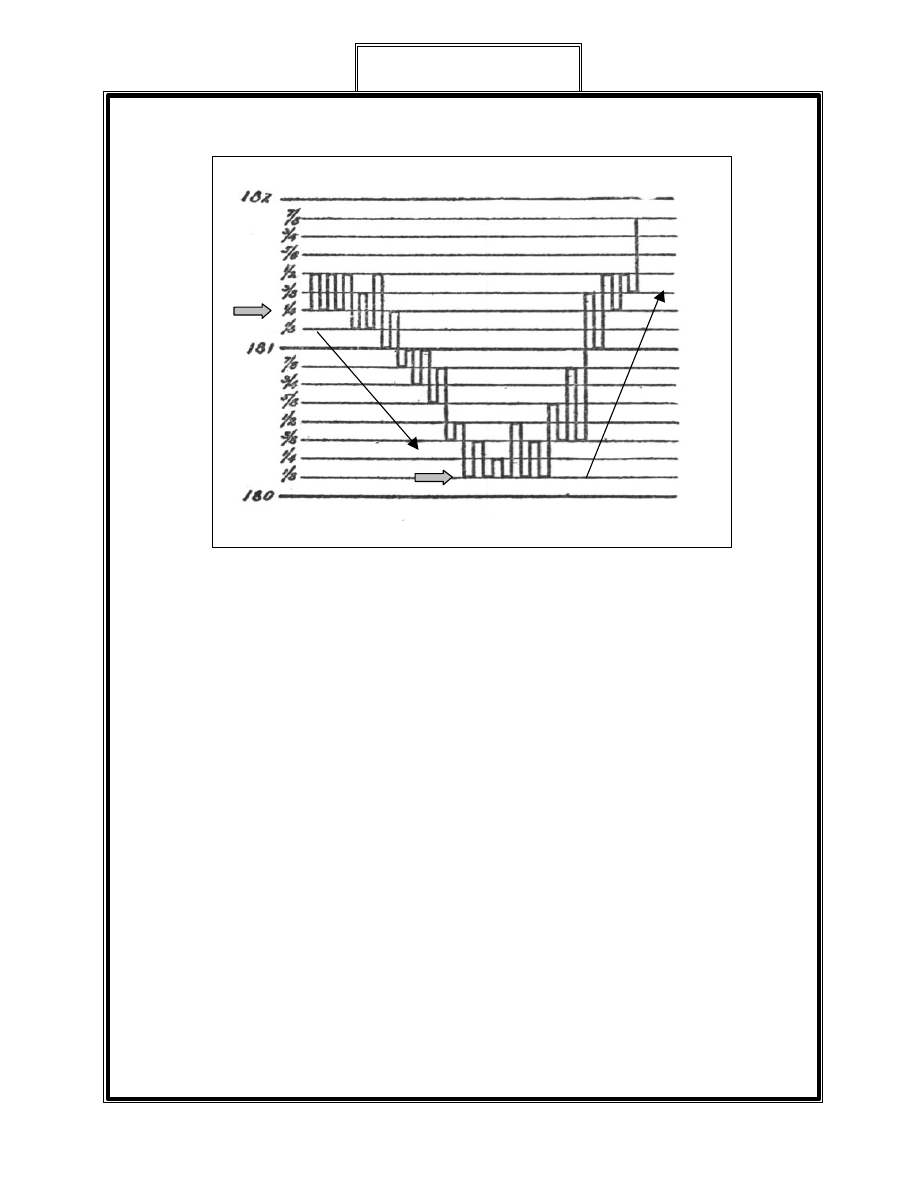
Richard D. Wyckoff
These indicate that the pressure is heavy enough to force the
price to new low levels, and at the same time it is sufficient to prevent
the rally going quite as high as on the previous bulge.
At 180 1/8 a new point of resistance appears. The decline is
checked. The Tape Reader must cover and go long -- the steps are now
upward and as the price approaches the former point of resistance he
watches it narrowly for his indication to close out. This time, however,
there is but slight opposition to the advance, and the price breaks
through. He keeps his long stock.
In making the initial trade he placed a "double" stop at 181 5/8 or
3/4, on the ground that if his stock overcame the resistance at 181 1/2 it
would go higher and he would have to go with it. Being short 100
shares, his double stop order would read "Buy 200 at 181 5/8 stop".
Of course the price might just catch his stop and go lower. These
things will happen, and anyone who cannot face them without becoming
perturbed had better learn self-control.
Richard D. Wyckoff
After going long around the low point, he should place another
double stop at 180 or 179 7/8, for if the point of resistance is broken
through after he has covered and gone long, he must switch his position
in an instant. Not to do so would place him in the attitude of a guesser.
If he is playing on this plan he must not dilute it with other ideas.
Remember this method is only applicable to a very dull market,
and, as we have said, is precarious business.
We cannot recommend it.
It will not as a rule pay the Tape Reader to attempt scalping
fractions out of the leaders in a dull market. Commissions, taxes and the
invisible eighth, in addition to frequent losses, form too great a handicap.
There must be wide swings if profits are to exceed losses. and the thing
to do is wait for good opportunities.
"The market is always with us" is an old and true saying. We are
not compelled to trade and results do not depend on how often we trade,
but on how much money we make.
There is another way of turning a dull market to good account,
and that is by trading in the stocks which are temporarily active, owing
to manipulative or other causes.
The Tape Reader does not in the care a bit what sort of a label
they put on the goods. Call a stock "Harlem Goats preferred" if you like,
and make it active, preferably by means of manipulation, and the agile
Tape Reader will trade in it with profit. It doesn’t matters to him
whether it's a railroad or a shooting gallery; whether it declares regular or
"Irish" dividends; whether the abbreviation is X Y Z or Z Y X -- so long
as it furnishes indications and a broad liquid market on which to get in
and out.
Take Beet Sugar on March 26, 1909, the day on which Union and
Reading were so dull. It was easy to beat Beet Sugar. Even an embryo
Tape Reader would have gone long at 30 or below, and as it never left
him in doubt he could have dumped it at the top just before the close, or
held it till the next day, when it touched 33½.
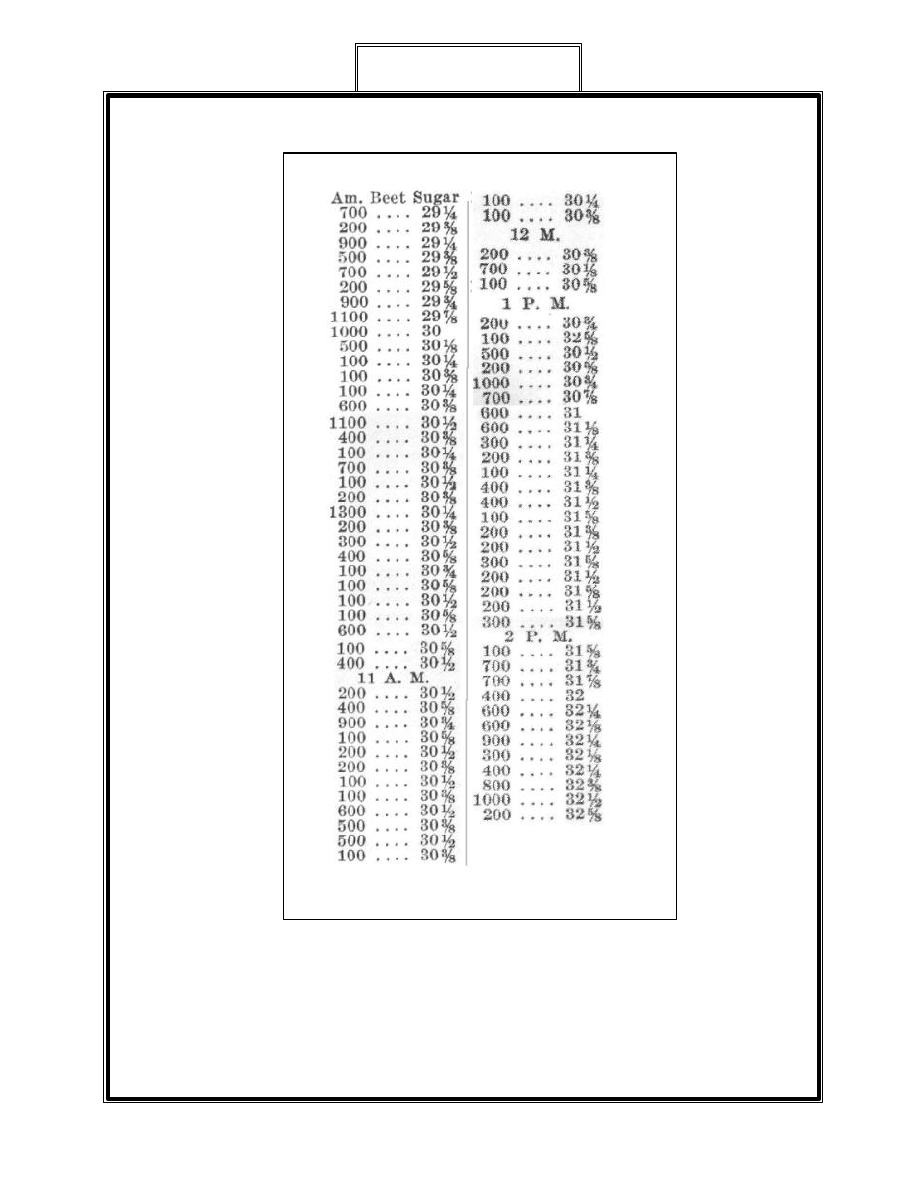
Richard D. Wyckoff
On March 5,1909, Kansas City Southern spent the morning
drifting between 42 3/4 and 43 1/2. Shortly after the noon hour the stock
burst into activity and large volume. Does any sane person suppose that
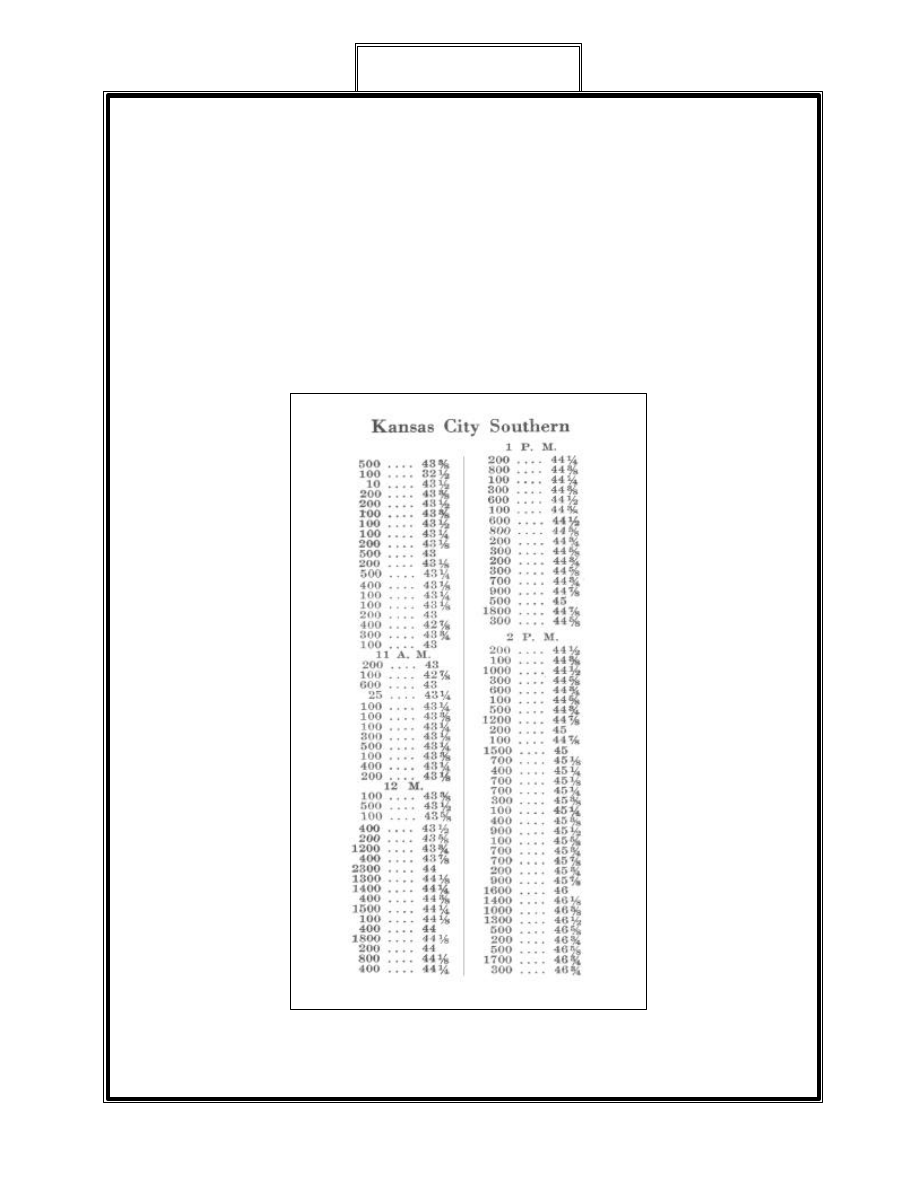
Richard D. Wyckoff
a hundred or more people became convinced that Kansas City Southern
was a purchase at that particular moment?
What probably started the rise was the placing of manipulative
orders, in which purchases predominated.
Thus the sudden activity, the volume and the advancing tendency
gave notice to the Tape Reader to "get aboard." The manipulator showed
his hand and the "get aboard" Tape Reader had only to go long with the
current.
Richard D. Wyckoff
The advance was not only sustained, but emphasized at certain
points. Here the Tape Reader could have pyramided, using a stop close
behind his average cost and raising it so as to conserve profits. If he
bought his first lot at 44, his second at 45, and his third at 46, he could
have thrown the whole at 46 5/8 and netted $406.50 for the day if he
were trading in 100 share units, or $2,032.50 if trading in 50 share units.
CHAPTER VIII
The Use of Charts as Guides and Indicators
M
ANY interesting queries have been received regarding the use of
charts. The following is a letter representative of most:
“Referring to your figure chart explained in Volume 1 of the
Magazine of Wall Street, I have found it a most valuable aid to detecting
accumulation or distribution in market movements. I have been in Wall
Street a number of years, and like many others have always shown a
skeptical attitude toward charts and other mechanical methods
of forecasting trends; but after a thorough trial of the chart on Union
Pacific, I find that I could have made a very considerable sum if I had
followed the indications shown. I note your suggestions to operators to
study earnings, etc., and not to rely on charts, as they are very often
likely to mislead. I regret that I cannot agree with you. You have often
stated that the tape tells the story; since this is true, and a chart is but a
copy of the tape, with indications of accumulation or distribution, as the
case may be, why not follow the chart entirely, and eliminate all
unnecessary time devoted to study of earnings, etc?”
Let us consider those portions of the above which relate to Tape
Reading, first clearly defining the difference between chart operations
and tape reading.
Richard D. Wyckoff
The genuine chart player usually operates in one stock at a time,
using as a basis the past movements of that stock and following a more
or less definite code of rules. He treats the market and his stock as a
machine. He uses no judgment as to market conditions, and does not
consider the movements of other stocks; but he exercises great discretion
as to whether he shall "play" an chart signal or not.
The Tape Reader operates on what the tape shows now. He is not
wedded to any particular issue, and, if he chooses, can work without
pencil, paper or memoranda of any sort. He also has his code of rules --
less clearly defined than those of the chart player. So many different
situatio ns present themselves that his rules gradually become intuitive --
a sort of second nature evolved by self-training and experience.
A friend to whom I have given some points in Tape Reading once
asked if I had my rules all down so fine that I knew just which to use at
certain moments. I answered him this way: “When you cross a street
where the traffic is heavy, do you stop to consult a set of rules showing
when to run ahead of a trolley car or when not to dodge a wagon? No.
You take a look both ways and at the proper moment you walk across.
Your mind may be on something else but your judgment tells you when
to start and how fast to walk. That is the position of the trained Tape
Reader”.
The difference between the Chart Player and the Tape Reader is
therefore about as wide as between day and night. But there are ways in
which the Tape Reader may utilize charts as guides and indicators and
for the purpose of reinforcing his memory.
The Figure Chart is one of the best mechanical means of
detecting accumulation and distribution. It is also valuable in showing
the main points of resistance on the big swings.
A figure chart cannot be made from the open, high, low and last
prices, such as are printed in the average newspaper.
We produced a Figure Chart of Amalgamated Copper showing
movements during the 1903 panic and up to the following March (1904):
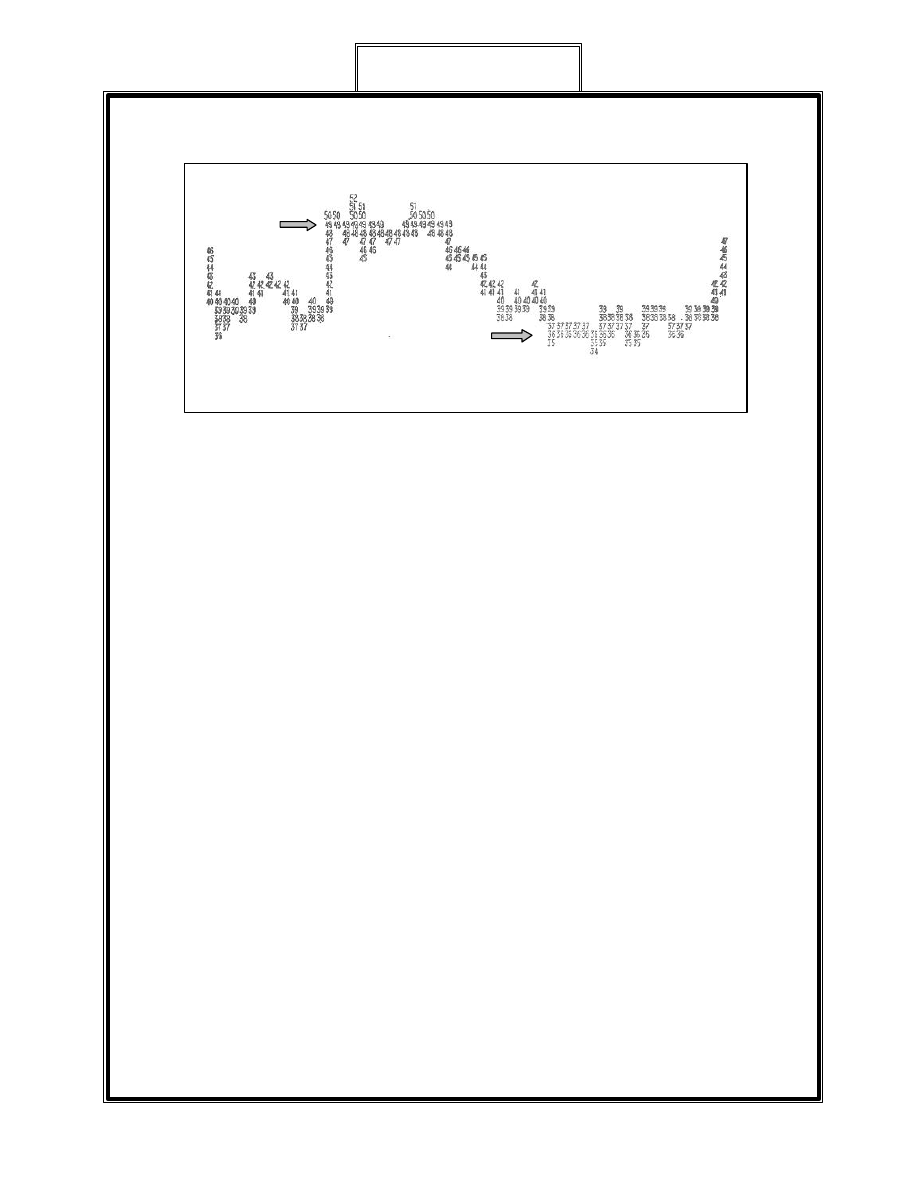
Richard D. Wyckoff
Price/Time Chart
It makes an interesting study. The stock sold early in the year at
75 5/8 and the low point reached during the above period was 33 5/8.
The movements prior to those recorded here show a series of downward
steps, but when 36 is reached, the formation changes, and the supporting
points are raised. A seven-point rally, a reaction to almost the low figure,
and another sixteen-point rally follow.
On this rally the lines 48-49 gradually form the axis and long
rows of these figures seem to indicate that plenty of stock is for sale at
this level. In case we are not sure as to whether this is further
accumulation or distrib ution we wait until the price shows signs of
breaking out of this narrow range. After the second run up to 51 the
gradually lowering tops warn us that pressure is resumed. We therefore
look for lower prices.
The downward steps continue until 35 is touched, where a 36-7
line begins to form. There is a dip to 33 5/8, which gives us the full
figure 34, after which the bottoms are higher and lines commence
forming at 38-9. Here are all the earmarks of manipulative depression
and accumulation -- the stock is not allowed to rally over 39 until
liquidation is complete. Then the gradually raised bottoms notify us in
advance that the stock is about to push through to higher levels.
If the Figure Chart were an infallible guide no one would have to
learn anything more than its correct interpretation in order to make big
money.
Richard D. Wyckoff
Our writer says, "after a thorough trial of the chart on U. P. I find
that I could have made a very considerable sum if I had followed the
indications shown". But he would not have followed the indications
shown. He is fooling himself. It is easy to look over the chart afterwards
and see where he could have made correct plays, but I venture to say he
never tested the plan under proper conditions.
Let anyone, who thinks he can make money fo llowing a Figure
Chart or any other kind of a chart have a friend prepare it, keeping secret
the name of the stock and the period covered. Then put down on paper a
positive set of rules which are to be strictly adhered to, so that there can
be no guesswork. Each situation will then call for a certain play and no
deviation is to be allowed. Cover up with a sheet of paper all but the
beginning of the chart, gradually sliding the paper to the right as you
progress. Record each order and execution just as if actually trading.
Put my name down as covering the opposite side of every trade
and when done send me a check for what you have lost.
I have yet to meet the man who has made money trading on any
kind of Chart over an extended period.
The Figure Chart can be used in other ways. Some people
construct figure charts showing each fractional change instead of full
points. The idea may also be used in connection with the Dow Jones
average prices. But for the practical Tape
Reader the full figure chart first described
is about the only one we can recommend.
Its value to the Tape Reader lies chiefly
in its warnings of important moves thus
putting him on the watch for the moment
when either process is completed and the
marking up or down begins.
The chart gives the direction of coming
moves; the tape says "when."
“Any kind of a chart will
show some profits at
times, but the test is:
How much money will it
make during a year's
operations?”
Richard D. Wyckoff
The ordinary single line chart which is so widely used, is
valuable chiefly as a compact history of a stock's movements. If the
stock which is charted were the only one in the market, its gyrations
would be less erratic and its chart, therefore, a more reliable indicator of
its trend and destination. But we must keep before us the
incontrovertible fact that the movements of every stock are to a greater
or lesser extent affected by those of every other stock.
This in a large measure accounts for the instability of stock
movements as recorded in single line charts.
Then, too one stock may he the lever with which the whole
market is being held up, or the club with which the general list is being
pounded. A chart of the pivotal stock might give a strong buying
indication, whereupon the blind chart devotee would go long to his
ultimate regret; for when the concealed distribution was completed his
stock would probably break quickly and badly.
This shows clearly the advantage of Tape Reading over Charts.
The Tape Reader sees everything that is goes on; chart player's vision is
limited. Both aim to get in right and go with the trend, but the eye that
comprehends the market as a whole is the one which can read this trend
most accurately.
If one wishes a mechanical trend indicator as a supplement
and a guide to his Tape Reading, he had best keep a chart composed
of the average daily high and low of ten leading stocks in a group.
First find the average high and average low for the day and make
a chart showing which was touched first. This will be found a more
reliable guide than the Dow Jones averages, which only consider the
high, low and closing bid of each day, and which, as strongly illustrated
in the May, 1901, panic, frequently do not fairly represent the day's
actual fluctuations.
Such a composite chart is of no value to the Tape Reader who
scalps and closes out everything daily. But it should benefit those who
read the tape for the purpose of catching the important five or ten point
moves. Such a trader will make no commitments not in accordance with
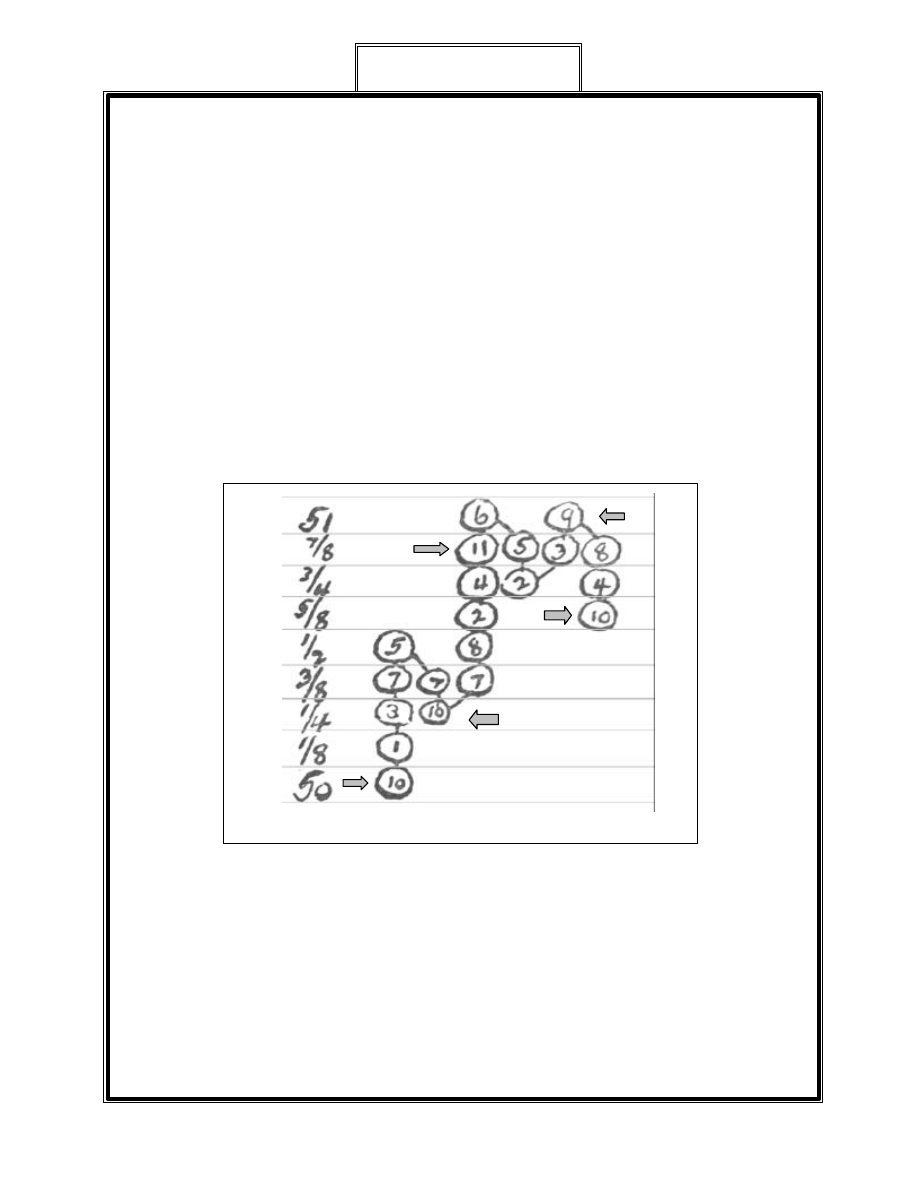
Richard D. Wyckoff
the trend, as shown by this chart. His reason is that even a well planned
bull campaign in a stock will not usually be pushed to completion in the
face of a down trend in the general market. Therefore he waits until the
trend conforms to his indication.
It seems hardly necessary to say that an up trend in any chart is
indicated by consecutive higher tops and bottoms, like stairs going up,
and the reverse by repeated steps toward a lower level. A series of tops
or bottoms at the same level shows resistance. A protracted zigzag within
a short radius accompanied by very small volume means lifelessness, but
with normal or abnormally large volume, accumulation or distribution is
more or less evidenced.
Here is a style of hand chart especially adapted to the study of volumes:
Volume Figure Chart
When made to cover a day's movements in a stock, this chart is
particularly valuable in showing the quantity of stock at various levels.
Figures represent the total 100 share lots at the respective fractions.
Comparisons are ready made by adding the quantities horizontally.
Many other suggestions may be derived from the study of this chart.
Richard D. Wyckoff
The proficient Tape Reader will doubtless prefer to discard all
mechanical helps, because they interfere with his sensing the trend.
Besides, if he keeps the charts himself the very act of running them
distracts his attention from the tape on which his eye should be
constantly riveted. This can of course be overcome by employing an
assistant; but taking everything into consideration -- the division of
attention, the contradictions and the confusing situations which will
frequently result -- we advise students to stand free of mechanical helps
so far as it is possible.
Our correspondent in saying "a chart is but a copy of the tape"
doubtless refers to the chart of one stock. The full tape cannot possibly
be charted. The tape does tell the story, but charting one or two stocks is
like recording the actions of one individual as exemplifying the actions
of a very large family.
CHAPTER IX
Daily Trading vs. Longer-Term Trading
J
UST now I took a small triangular piece of blotting paper three-eighths
of an inch at its widest, and stuck it on the end of a pin. I then threw a
blot of ink on a paper and put the blotter into contact. The ink fairly
jumped up into the blotter, leaving the paper comparatively dry.
This is exactly how the market acts on the tape when its
absorptive powers are greater than the supply- large quantities are taken
at the offered prices and at the higher levels. Prices leap forward. The
demand seems insatiable.
After two or three blots had thus been absorbed, the blotter wo uld
take no more. It was thoroughly saturated. Its demands were satisfied.
Just in this way the market comes to a standstill at the top of a rise and
hangs there. Supply and demand are equalized at the new price level.
Richard D. Wyckoff
Then I filled my pen with ink, and let the fluid run off the point
and onto the blotter. (This illustrated the distribution of stocks in the
market). Beyond a certain point the blotter would take no more. A drop
formed and fell to the paper. (Supply exceeded demand). The more I put
on the blotter the faster fell the drops. (Liquidation- market seeking a
lower level).
This is a simple way of fixing in our minds the principal
opposing forces that are constantly operating in the market-absorption
and distribution, demand and supply, support and pressure. The more
adept a Tape Reader becomes in weighing and measuring these
elements, the more successful he will be.
But he must remember that even his most accurate readings will
often be nullified by events that are transpiring every moment of the day.
His stock may start upward with a rush-apparently with power enough to
carry it several points; but after advancing a couple of points it may run
up against a larger quantity of stock than can be absorbed or some
unforeseen incident may change the whole complexion of the market.
To show how an operator may be caught twice on the wrong side
in one day and still come out ahead, let us
look at the tape of December 21, 1908.
Union Pacific opened below the previous
night's close:
500 @ 179
6000 @ 178 3/4
…and for the first few moments looked as
though there was some inside support.
Supposing the Tape Reader had…
BOUGHT 100 UNION PACIFIC AT l78 7/8
…he would have soon noticed fresh selling orders in sufficient volume
to produce weakness. Upon this he would have immediately…
“The Tape Reader
must be quick to
detect such changes,
switch his position
and go with this
newly formed trend.”
Richard D. Wyckoff
SOLD 200 UNION PACIFIC AT 178¼
…putting him short one hundred at the latter price. The weakness
increased and after a drive to 176 1/2, two or three warnings were given
that the pressure was temporarily off. A comparatively strong undertone
developed in Southern Pacific as well as other stocks and short covering
began in Union Pacific, which came
600 @ 176 5/8
1000 @ 176 ¾
…then 177¼.
Assuming that the operator considered this the turn, he would have…
BOUGHT 200 UNION PACIFIC AT 176 7/8
…which was the next quotation. This would have put him long.
Thereafter the market showed more resiliency, but only small lots
appeared on the tape.
A little later the market quiets down. The rally does not hold
well. He expects the stock to react again to the low point. This it does,
but it fails to halt there; it goes driving through to 176, accompanied by
considerable weakness in the other active stocks. This is his indication
that fresh liquidation has started. So he…
SELLS 200 UNION PACIFIC AT 176
That is, he dumps over his long stock and goes short at 176.
The weakness continues and there is no sign of a rally until after the
stock his struck 174 1/2. This being a break of 6¼ points since yesterday,
the Tape Reader is now wide awake for signs of a turn, realizing that
every additional fraction brings him nearer to that point, wherever it may
be. After touching 174 1/2 the trend of the market changes completely.
Larger lots are in demand at the offered prices. There is a final drive but
very little stock comes out on it. During this drive he…
BUYS 100 UNION PACIFIC AT 175 7/8
Richard D. Wyckoff
…and as signs of a rally multiply he…
BUYS 100 UNION PACIFIC AT 175 1/4
From that moment it is easy sailing. There is ample opportunity for him
to unload his last purchase just before the close when he…
SELLS 100 UNION PACIFIC AT 176 5/8
Bought
Sold
Loss
Profit
178 7/8
178 ¼
62.50
-
176 7/8
178 ¼
-
137.50
176 7/8
176
87.50
-
174 7/8
176
-
112.50
175 ¼
176 5/8
-
137.50
Commissions and taxes
135.00
-
285.00
387.50
Totals
Less Loss
- 285.00
Net Profit for the day
$102.50
This is doing very well considering he was caught twice on the
wrong side and in his anxious trading paid $135.00 in commissions and
taxes.
Success in trading comes down to a question of reducing and
eliminating losses, commissions, interest and taxes.
Let us see whether he might have used better judgment. His first
trade seems to have been made on what appeared to be inside buying.
No trend had developed. He saw round lots being taken at l78 3/4 and
over and reasoned that a rally should naturally follow pronounced
support.
Richard D. Wyckoff
His mistake was in not waiting for a clearly defined trend. If
waiting for the buying was strong enough to absorb all offerings and turn
the market, he would have done better to have waited until this was
certain. When a stock holds steady within a half point radius it does not
signify a reversal of trend, but rather a halting place from which a new
move in either direction may begin.
Had he followed the first sharp move, his original trade would
have been on the short not the long side. This would have saved him his
first loss with its attendant expenses, aggregating $89.50, and would
have nearly doubled the day's profits.
His second loss was made on a trade which involved one of the
finest points in the art of Tape Reading -- that of distinguishing a rally
from a change in trend. A good way to do this successfully is to figure
where a stock is due to come after it makes an upturn, allowing that a
normal rally is from one-half to two-thirds of the decline.
That is, when a stock declines two and a half points we can look
for at least a point and a quarter rally unless the pressure is still on. In
case the decline is not over, the rally will fall short.
What did Union do after it touched 176½? It sold at 176 5/8 –
177 ¾ - 177 ¼ . Having declined from 179 1/8 to 176 ½, 2 5/8 points, it
was due to rally at least 1¼ points, or to 177 ¾ . Its failing to make this
figure indicated that the decline was not over and that his short position
should be maintained.
Also, that last jump of half a point between sales showed an
unhealthy condition of the market. For a few moments there was
evidently a cessation of selling, then somebody reached for a hundred
shares offered at 177¼. As the next sale was 176 7/8 the hollow-ness of
the rise became apparent.
While this rally lasted, the lots were small. This of itself was
reason for not covering. Had a genuine demand sprung from either longs
or shorts a steady rise, on increasing volumes, would have taken place.
Richard D. Wyckoff
The absence of such indications seems to us now a reason for not
covering and going long at 176 7/8.
It is very difficult for anyone to say what he would actually have
done under the circumstances, but had both these trades been
avoided for the reasons mentioned, the profit for the day would have
been $421, as the 100 sold at 178 ¼ would have been covered at 174
7/8, and the long at 175 ¼ sold out at 176 5/8. So we can see the
advantage of studying our losses and mistakes, with a view to
benefiting in future transactions.
As previously explained, the number of dollars profit is
subordinate to whether the trader can make profits at all and whether the
points made exceed the points lost. With success from this standpoint it
is only a question of increased capital enabling one to enlarge his trading
unit.
A good way to watch the progress of an account is to keep a book
showing dates, quantities, prices, profits and losses, also commission, tax
and interest charges. Beside each trade should be entered the number of
points net profit or loss, together with a running total showing just how
many points the account is ahead or behind. A chart of these latter
figures will prevent anyone fooling himself as to his progress. People are
too apt to remember their profits and forget their losses.
The losses taken by an expert Tape Reader are so small that he
can trade in much larger units than one who is away from the tape or
who is trading with an arbitrary stop. The Tape Reader will seldom take
over half a point to a point loss for the reason that he will generally buy
or sell at, or close to, the pivotal point or the line of resistance.
Therefore, should the trend of his stock suddenly reverse, he is
with it in a moment.
Richard D. Wyckoff
The losses in the above mentioned Union Pacific transactions
(5/8 and 7/8 respectively) are perhaps a fair average, but frequently he
will be able to trade with a risk of only ¼, 3/8, or ½ point.
The fact that this possible loss is confined to a fraction should not
lead him to trade too frequently. It is better to look on part of the time; to
rest the mind and allow the judgment to clarify. Dull days will often
constrain one for a time and are therefore beneficial.
The big money in Tape Reading is made during very active
markets. Big swings and large volumes produce unmistakable
indications and a harvest for the experienced operator. He welcomes
twenty, thirty and fifty-point moves in stocks like Reading, Union or
Consolidated Gas-powerful plays by financial giants.
And this fact reminds us: Is it better to close trades each day, or
hold through reactions, and if necessary, for several days or weeks in
order to secure a large profit?
The answer to this question depends somewhat upon the
temperament of the Tape Reader. If his make-up be such that he can
closely follow the small swings with profit, gradually becoming more
expert and steadily increasing his commitments, he will shortly "arrive"
by that route.
If his nerves are such that he cannot trade in and out actively, but
is content to wait for big opportunities and patient enough to hold on for
large profits, he will also "get there."
It is impossible to say which style of trading would produce the
best average results, because it depends altogether upon individual
qualifications, attitudes and tolerance of risk.
Looking at the question broadly, we should say that the Tape
Reader who understood the lines thus far suggested in this series, might
find it both difficult and less profitable to operate solely for the long
swings. In the first place, he would be obliged to let twenty or thirty
opportunities pass by to every one that he would accept. The small
swings of one to three points greatly outnumber the five and ten-point
Richard D. Wyckoff
movements, and there would be a considerable percentage of losing
trades no matter how he operated.
Many of the indications, such as the extent of reactions, lines of
resistance, etc., will be found equally operative in the broader swings,
just as an enlargement of a photograph retains the lines of its original.
Tape Reading seems essentially a profession for the person who
is mentally active and flexible, capable of making quick and accurate
decisions and keenly sensitive to the smallest and almost imperceptible
signals and indications.
On the other hand, trading for the larger swings requires one to
ignore the minor indications and to put some stress upon the influential
news of the day, and its effect upon sentiment; he must stand ready to
take larger losses and in many ways handle himself in a manner
altogether different from that of the day trader.
The more closely we look at the differences between the longer-
term trader/investor and the day trader, the more the two methods of
operating seem to disunite, the long-term investing player appearing best
adapted to those who are not in continuous touch with the market and
who therefore have the advantage of distance and perspective.
There is no reason why the Tape Reader should not make long-
term trading an auxiliary profit producer if he can keep such trades from
influencing his daily operations.
For example, in the previously mentioned shake-down in
Reading from 144 3/8 to 118, on his first buying indication he could
have taken on an extra lot for the long swing, knowing that if the turn
had really been made, a rally to over 130 was due. A stop order would
have limited his risk and conserved his profits as they rolled up and there
is no telling how much of the subsequent forty point rise he might been
able to ride.
Another case was when Steel broke from 58 3/4 (November,
1908) to 41¼ in February.
Richard D. Wyckoff
The market at the time was hinging on Steel and it was likely that
the Tape Reader would he operating in it. His first long trade under this
plan would be for at least a hundred shares more than his usual amount,
with a stop on the long pull lot at say 40 3/4. He would naturally expect
a rally of at least 8 3/4 points (to 50), but would, in a sense, forget this
hundred shares, so long as the market showed no signs of another
important decline.
When it reached 60 he might still be holding it.
The above are merely a couple of opportunities. Dozens of such
show themselves every year and should form no small part of the Tape
Reader's income. But he must separate such trades from his regular daily
trading; to allow them to conflict with each other would destroy the
effectiveness of both. If he finds the long pull trade interfering with the
accuracy of his judgment, he should close it out at once. He must play on
one side of the fence if he cannot operate on both.
You can readily foresee how a trader with one hundred
shares of Steel at 43 for the long -term, and two hundred for the day,
would be tempted to close out all three hundred on indications of a
decline. This is where he can test his ability to act in a dual capacity.
He must ask himself: Have I good reason for thinking Steel will
sell down five points before up five? Is this a small reaction or a big
shake-down? Are we still in a bull swing? Has the stock had its no rmal
rally from the last decline?
These and many other questions will enable him to decide
whether he should hold this hundred shares or "clean house." It takes an
exceptionally strong will and clear head to act in this way without
interfering with your regular trading.
Anyone can sell two hundred and hold one hundred; but will his
judgment be biased because he is simultaneously long and short-bullish
and bearish?
There's the problem!
Richard D. Wyckoff
The real Day Trader is more likely to prefer a clean slate at
market closing every day, so that he can sit down to his ticker at the next
morning's opening and say, "I have no commitments and no opinion. I
will follow the first strong indication."
He would rather average $100 a day for
ten days than make $1,000 on one trade in
the same length of time. The risk is
generally limited to a fraction and having
arrived at a point where he is showing
even small average daily profits, his
required capital per 100 shares need not
be over $1,500 to $2,000.
Suppose for sixty days on 100 share a day
trading his average profits over losses
were only a quarter of a point – or $25 a day. At the end of that time his
capital would have been increased by $1,500, enabling him to trade in
200 share lots. Another thirty days with similar results and he could trade
in 300 share lots, and so on.
I don’t mention these figures for any other purpose than to again
emphasize that the objective point in Tape Reading is not large
individual profits, but a continuous chipping in of small average net
profits per day.
Some time ago, I am told, a man from the West Coast came into
my office and said that he had been impressed by this series on Tape
Reading, and had come to New York for the sole purpose of trying his
hand at it. He had $1,000 which he was willing to lose in demonstrating
whether he was fitted for the work.
I was later informed that he called again and related some of his
experiences. It seems that he could not abstain from trading, but started
within two or three days after he decided on a brokerage house. He stated
that during the two months he had made forty-two trades of ten shares
each and had never had on hand over twenty full shares at any one time.
He admitted that he had frequently mixed guesswork and tips with his
Tape Reading but as a rule he had followed the tape.
“He was advised not to
trade in over ten-share
lots, and was especially
warned against operating
at all until after he had
actually studied the tape
for two or three months.”
Richard D. Wyckoff
His losses were seldom over a point and his greatest loss was one
and a half points. His maximum profit was three points. He had at times
traded in other stocks beside the leaders. In spite of his inexperience, and
his attempt to mix tips and guess with shrewd judgment, he was ahead of
the game, after paying commissions, taxes, etc.
This was especially surprising in view of the trader's market
through which be had passed. While the amount of his net profit was
small, the fact that he had shown any profit during this study period was
reason enough for congratulations.
Another handicap which he did not perhaps realize was his
environment. He had been trading in an office where he could hear and
see what everyone else was doing, and where news, gossip and opinions
were freely and openly expressed by many people.
All these things tended to influence him, and to switch him from
his foundation in Tape Reading fundamentals to other methods but he is
persisting and shows some signs of discipline. I have no doubt that
having mastered the art of cutting losses and keeping commitments down
and returning to Tape Reading fundamentals, he will soon overcome his
other deficiencies and begin showing remarkable progress.
Given a broad, active market, he should show increasing average
daily profits.
Speculation is a business. It must he learned.
Richard D. Wyckoff
CHAPTER X
Various Examples and Suggestions
R
ECENT trading observations and experiments have convinced me
that it is impracticable and almost impossible to gauge the extent of a
move by its initial fluctuations.
Many important swings begin in the most modest way. The top of
an important decline may present nothing more than a light volume and a
drifting tendency toward lower prices, subsequently developing into a
heavy, slumpy market, and ending in a violent downward plunge.
If it has been moving within a three-point radius and suddenly
takes on new life and activity, bursting through its former bounds, he
must go with it.
I do not mean that he should try to catch every wiggle. If the
stock rises three points and then reverses one or one and a half points on
light volume, he must look upon it as a perfectly natural reaction and not
a change of trend.
The expert operator will not ordinarily let all of three points get away
from him. He will keep pushing his stop
up behind until the first good reaction puts
him out at close to the high figure.
Having purchased at such a time, he will
sell out again as the price once more
approaches the high figure, unless
indications point to its forging through to a
new high level.
The more we study volumes, the better we
appreciate their value in Tape Reading. It
frequently occurs that a stock will work
within a three-point range for days at a
time without giving one a chance for a
“My opinion is that the
operator should aim to
catch every important
swing in the leading
active stock. To do this
he must act promptly
when a stock goes into a
new field or otherwise
gives an indication, and
he must he ready to
follow wherever it leads.”
Richard D. Wyckoff
respectable-sized ‘scalp’. Without going out of these boundaries, it
suddenly begins coming out on the tape in thousands instead of
hundreds. This is evidence that a new movement has started, but not
necessarily in the direction first indicated. The Tape Reader must
immediately go with the trend, but until it is clearly defined and the stock
breaks its former limits with large and increasing volumes, he must use
caution.
The reason is this:
If the stock has been suddenly advanced, it may be for the
purpose of facilitating sales by a large operator. The best way to
distinguish the genuine from the fictitious move is to watch out for
abnormally large volumes within a small radius. This is usually
evidence of manipulation. The large volume is simply a means of
attracting buyers and disguising the hand of the operator.
A play of this kind took place when Reading struck 159 3/4 in
June1909. I counted some 80,000 shares within about half a point of 159
-- unmistakable notice of a coming decline. This was a case where the
stock was put up before being put down, and the Tape Reader who
interpreted the move correctly and played for a good down swing would
have made considerable money.
We frequently hear people complaining that "the public is not in
this market," as though that were a reason why stocks should not go up
or the market should be avoided. The speaker is usually one of those who
constitute "the public," but he regards the expression as signifying "every
outsider except myself."
In the judgment of many the market is better off without the
public. To be sure, brokers do not enjoy so large a business, the
fluctuations are not so riotous, but the market moves in an orderly way
and responds more accurately to prevailing conditions.
A market in which the general pubic predominates the purchase
of individual stocks represents a sort of speculative "jag" indulged in by
those whose stock market knowledge should be rated at 1/8’s.
Richard D. Wyckoff
Everyone recognizes the fact that when the smoke clears away,
the Street is full of victims who didn't know how and couldn't wait to
learn.
Their buying and selling produce violent fluctuations, however,
and in this respect are of advantage to the Tape Reader who would much
rather see ten-point than three-point swings.
To offset this, there are some disadvantages. First, in a market
where there is "rioting of accumulated margins," the tape is so far behind
that it is seldom one can secure an execution at anywhere near his price.
This is especially true when activity breaks out in a stock which
has been comparatively dull. So many people with money, watching the
tape, are attracted by these apparent opportunities, that the scramble to
get in results in every one paying more than he figured; thus the Tape
Reader finds it impossible to know where he is at until he gets his report.
His tape prices are five minutes behind and his broker is so busy it takes
four or five minutes for an execution instead of seconds.
In the next place, stop orders are often filled at from small
fractions to points away from his stop price-there is no telling what
figure he will get, while in ordinary markets he can place his stops within
¼ of a resistance point and frequently have the price come within 1/8 of
his stop without catching it.
Speaking of stop orders: The ways in which one may manipulate
his stops for protection and advantage, become more numerous as
experience is acquired. If the Tape Reader is operating for a
fractional average profit per trade, or per day, he cannot afford to
let a point profit run into a loss, or fail to "plug" a larger profit at a
point where at least a portion of it will be preserved.
One of my recent day's trading will illustrate this idea. I had just
closed out a couple of trades, in which there had been losses totaling
slightly over a point. Both were on the long side. The market began to
show signs of a break, and singling out Reading as the most vulnerable, I
got short at 150 3/4.
Richard D. Wyckoff
In a few moments it sold below 150. My stop was moved down
so there couldn't be a loss, and soon a slight rally and another break gave
me a new stop that insured a profit.
A third drive started, and I pushed the stop down to within ¼ of
the tape price at the time, as it was late in the day and I considered this
the final plunge. By the time my order reached the floor the price was
well away from this latest stop and when the selling became most violent
I told my broker to cover "at the market." The price paid was within ¼ of
the bottom for the day, and
netted 2 5/8 after commissions
were paid.
I strongly advocate this method
of profit insuring.
It is also a question
whether, in such a case, the trade
had better not be stopped out
than closed out. When you push
a stop close behind a rise or a
decline, you leave the way open
for a further profit; but when you
close the trade of your own volition, you shut off all such chances.
If it is your habit to close out everything before market close
daily, the stop may be placed closer than ordinarily during the last fifteen
minutes of the session, and when a sharp move in the desired direction
occurs the closing out may be done by a stop only a fraction away from
the extreme price. This plan of using stops is a sort of squeezing out the
last drop of profit from each trade and never losing any part that can
possibly be retained.
Suppose the operator sells a stock short at 53 and it breaks to 51. He
is foolish not to bring his stop down to 51¼ unless the market is ripe for
a heavy decline. With his stop at this point he has two chances out of
three that the result will be satisfactory:
(1) The price may go lower and yield a further profit;
“The scientific elimination of loss
is one of the most important
factors in the art, and the
operator who fails to properly
protect his paper profits will find
that many at point which he
thought he had cinched has
slipped away from him.”
Richard D. Wyckoff
(2) The normal rally to 52 will catch his stop and enable him to put
the stock out again at that price;
(3) The stock will rally to about 51 ¼, catch his stop and then go
lower. But he can scarcely mourn over the loss of a further
profit.
If the stock refuses to rally the full point to which it is entitled, that
is, if it comes up to 51½ or 5/8 and still acts heavy, it may be expected to
break lower, and there usually is ample time to get short again at a price
that will at least cover commissions.
There is nothing more confusing than to attempt scalping on
both sides of the market at once. You might go long of a stock which
is be ing put up or is going up for some special reason, and short of
another stock which is persistently weak. Both trades may pan out
successfully, but in the meantime your judgment will be interfered
with and some foolish mistakes will be made in four cases out of five.
As Dickson G. Watts said, "Act so as to keep the mind clear, the
judgment trustworthy." The mind is not clear when the trader is working
actively on two opposing sides of the market. A bearish indication is
favorable to one trade, and unfavorable to the other. He finds himself
interpreting every development as being to his advantage and forgetting
the important fact that he is also on the opposite side.
If you are short of one stock and see another that looks like a
purchase, it is much better to wait until you have covered your short
trade (on a dip if possible), and then take the long side of the other issue.
The best time for both covering and going long is on a recession that in
such a case serves a double purpose. The mind should he made up in
advance as to which deal offers the best chance for profit, so that when
the moment for action arrives there will he nothing to do but act.
This is one great advantage the Tape Reader has over other operators
who do not employ market science. By a process of elimination he
decides which side of the market and which stock affords the best
opportunity. He either gets in at the inception of a movement or waits
for the first reaction after the move has started.
Richard D. Wyckoff
He knows just about where his stock should come on the reaction and
judges by the way it then acts whether his first impression is confirmed
or contradicted. After he gets in it must act up to expectations or he
should abandon the trade and get out of it immediately.
If it is a bull move, the volume must increase and the rest of the
market offer some support or at least not oppose it. The reactions must
show a smaller volume than the advances, indicating light pressure, and
each upward swing must be of longer duration and reach a new high
level, or it will mean that the rise has spent its force either temporarily or
finally.
Tape Reading is the only known method of trading which gets you in
at the beginning, keeps you posted throughout the move, and gets you
out when it has culminated.
Has anyone ever heard of a man, method, system, or anything else
that will do this for you in Wall Street?
It has made fortunes for the comparatively few who have followed it.
It is an art in which one can become highly expert and more
and more successful as experience sharpens his instincts and
judgment and shows him what to avoid.
CHAPTER XI
Obstacles to be Overcome - Potential Profits
M
ENTAL poise is an indispensable factor in Tape Reading.
The mind should be absolutely free to concentrate upon the
work; there should be no feeling that certain things are to be
accomplished within a given time; no fear, anxiety, or greed.
Richard D. Wyckoff
When a Tape Reader has his emotions well in hand, he will play
as though the game were dominoes.
When anything interferes with this attitude it should be
eliminated. If, for example, there be an unusual series of losses, the
trader had better suspend operations until he discovers the cause.
Following are the Tape Readers 7 Commandments:
1. Do not overtrade ! One may be trading too often. Many opportunities
for profit develop from each day's movements; only the very choicest
should he acted upon. There should be no haste. The market will be there
to-morrow in case to-day's opportunities do not meet requirements.
2. Eliminate anxiety! Anxiety to make a record, to avoid losses, to
secure a certain profit for the day or period will greatly warp the
judgment, and lead to a low percentage of profits. Tape Reading is a
good deal like laying eggs. If the hen is not left to pick up the necessary
food and retire in peace to her nest, she will not produce properly. If she
is worried by dogs and small boys, or tries to lay seven eggs out of
material for six, the net proceeds may be an omelet.
The Tape Reader's profits should develop naturally. He should buy or
sell because it is the thing to do -- not because he wants to make a profit
or fears to make a loss.
3. Don’t trade when the market isn’t acting right! The market may be
unsuited to Tape Reading operations. When prices drift up and down
without trend, like a ship without a rudder, and few positive indications
develop, the percentage of losing trades is apt to be high. When this
condition continues it is well to hold off until the character of the market
changes.
4. Get a broker you can trust! One's broker may be giving poor
service. In a game as fine as this, every fraction – every second counts.
Executions of market orders should average not over one minute. Stop
orders should be reported in less time as such orders are on the floor and
at the proper post when they become operative. By close attention to
details in the handling of my orders, I have been able to reduce the
Richard D. Wyckoff
average time of my executions to less than one minute. The quickest
report obtained thus far required but 25 seconds.
A considerable portion of my orders are executed in from thirty
to forty seconds, varying according to whether my broker is near the
phone or in a distant crowd when the orders reach the floor and how far
the identical 'crowd" is from his 'phone’.
5. Do not leave orders to the discretion of the broker! Make your
orders clear and firm. Do not say, “Try to sell better than the bid and let
me know what happened” – say, “Sell at the bid price and report
instantly!”
He cannot “do better" than the momentary bid or offered price.
Ordinarily it is expected and is really an advantage to the general run of
speculators to have the broker use some discretion; that is, try to do
better, providing there is no chance of losing his market. But I do not
wish my broker to act like that for me. My indications usually show me
the exact moment when a stock should be bought or sold under this
method, and a few moments' delay often means a good many dollars lost.
With the execution of orders reduced to a matter of seconds, I can
also hold stop orders in my own hands and when the stop price is
reached, phone the order to buy or sell at the market. Results are very
satisfactory as my own broker handles the orders and not the specialist or
some other floor broker.
6. Keep alert, calm after losses! The Tape Reader should be careful to
trade only in such amounts as will not interfere with his judgment. If he
finds that a series of losses upsets him it is an easy matter to reduce the
number of shares to one-half or one-quarter of the regular amount, or
even to ten shares, so that the dollars involved are no longer a factor.
This gives him a chance for a little self-examination.
7. Stay physically and mentally fit! If a person is in poor physical
condition or his mental alertness below par for any reason, he may be
unable to stand the excitement attending the work. Dissipation, for
example, may render one unfit to carry all the quotations in his head, or
to plan and execute his moves quickly and accurately. When anything of
Richard D. Wyckoff
this kind occurs which prevents the free play of all the faculties it is best
to bring the day's work to a close.
Some of my readers may think it futile to aim for a fractional
average profit per trade when there are many full points per day to be
made by holding on through days and weeks and getting full benefit of
the big moves. Admitting that it is possible to make many more points at
times there is a risk of losses corresponding to the profits and the
question is not how much we can make, but how much we can make net.
Tape Reading reduces profit- making to a manufacturing basis.
To show how the nimble eighths pile up when their cumulative
power is fully employed, I have prepared a table representing the results
of 250 trading days, starting with a capital of $1,000. It is assumed that
the Tape Reader has reached that stage of expertness where he can
average one trade a day and a profit of $12.50 per trade, and that as fast
as $1,000 is accumulated he adds 100 shares to his trading unit.
These results depend solely upon the Tape Reader's ability to
make more than he loses per day. There is no limit to the number of
shares he can trade in, provided he has the margin. If he is at all
proficient his margin will not be depleted more than a few points before
he makes up his losses and more. He is not pyramiding in the ordinary
sense of the word; he is simply doing an increasing volume of shares as
his capital expands. All progressive business men increase commitments
as fast as warranted by their capital and opportunities.
What a profit 1/8 of point per day would amount to in 250 days if
profits were used as additional margin:
Richard D. Wyckoff
100 shares $12.50 a day 1,000.00
In 80 days, etc.
200
“
25.00
1,000.00
40
300
“
37.50
1,012.50
27
400
“
50.00
1,000.00
20
500
“
62.50
1,000.00
16
600
“
75.00
1,050.00
14
700 “
87.50
1,050.00
12
800
"
100.00
1,000.00
10
900
"
112.50
1,012.50
9
1000 "
125.00
1,000.00
8
1100 "
137.50
962.50
7
1200 “
150.00
1,050.00
7
Gross
$12,137.50 In 250 days
Less tax/commissions
- 1,942.00
Net Profit
$10,195.50
Assuming that there are about three hundred Stock Exchange
sessions in the year, the two hundred and fifty days figured represent
five-sixths of a year or ten months. From that time on, having struck his
gait, the Tape Reader can, without increasing his unit to over 1200
shares, make $900 a week or $46,800 a year.
One trader who for years has been trying to scalp the market and
who could never quite secure a profit, reports that his first attempts at
applying these rules resulted in a loss of about $20 per trade. This he
gradually reduced to $12, then to $8, finally succeeding in throwing the
balance over to the credit side and is now able to make a daily profit of
from $12 to $30 per 100 shares. That’s only an example of small traders.
Medium size traders goal should be to make $150 to $350 per 1000
shares. This is doing very well indeed. I have no doubt that profits will
continue to increase as experience increases.
Some people seem to hold the opinion that as the profits desired
are only 1/8 average per trade one should limit himself in taking profits.
Richard D. Wyckoff
Perhaps I have not made myself clear.
I buy and sell when I get my indications. In going into a trade I
do not know whether it will show a profit or a loss, or how much. I try to
trade at a point where I can secure protection with a stop from ¼ to ½
point away, so that my risk is limited to this fraction plus commission
and tax. If the trade goes in my favor I push the stop up as soon as
possible, to a point where there can be no loss.
I do not let profits run blindly but only so long as there appears
no indication on which to close. No matter where my stop order stands, I
am always on the watch for danger signals. Sometimes I get them away
in advance of the time a trade should be closed; in other instances my
"get out" will flash onto the tape as suddenly and as clearly defined as a
streak of lightning against a black sky.
When the tape says "get out" I never stop to calculate how much
profit or loss I have or whether I am ahead or behind on the day. I strive
for an increasing average profit but I do not keep my eye so much on the
fraction or points made or lost, so much as on myself and keeping alert.
I endeavor to perfect myself in resolute calmness and precision,
quickness of thought, accuracy of judgment, promptness in planning and
executing my trades, foresight, intuition, courage and initiative.
Masterful control of myself in these respects will produce a winning
average -- it is merely a question of practice.
To show how accurately the method works out in practice, I will
describe one recent day's trading in which there were three transactions,
involving six orders (three buying and three selling). The market didn’t
go one-eighth against me in five orders out of the six. In the sixth, the
stock went 5/8 above the selling price at which my order was given. Here
are the details:
I had no open trades at the market’s open bell. Kansas City
Southern, which had been intensely dull, came on the tape 2600 at 46
3/4. I gave a buying order and before it could reach the "post" the Tape
said 46 7/8 and 47. The stock rose steadily and after selling at 48 5/8 and
Richard D. Wyckoff
coming back to 48 1/2 I gave the selling order. It did not touch 48 5/8
again.
The next trade was in Reading. I saw that it was being held in
check in spite of its great strength. The stock had opened at 158. After a
certain bulge I saw the reaction coming. When it arrived, and the stock
was selling at 157 1/2, I gave the buying order, got mine at 157 5/8. It
immediately rose to 158 3/4. I noted selling indications and gave the
order while the stock was at that price on the tape. It did not react
sufficiently to warrant my picking it up again and later went to 159 3/8,
which was 5/8 above my selling indication.
Southern Pacific suddenly loomed up as a winner and I bought it
at 135. It promptly went to 135 1/2. The rest of the market began to look
temporarily over-bulled, so I gave my order to sell when the stock was
135 1/2, which proved to be the highest for the day, making the fifth time
out of six orders when my stock moved almost instantly in my favor.
This illustration is given as an example of the high percentage
of accuracy possible under this method of trading. I do not pretend
to be able to accomplish these results except occasionally, but I am
constantly striving to do so in a large percentage of my trades.
If one makes 2 3/8 points one day and loses 2 points in the next
two days, he is 3/8 ahead for the three days, or an average of 1/8 per day.
He may have losing and winning streaks, get discouraged and lose his
nerve at times, but if he is made of the right stuff he will in time
overcome all obstacles and land at the desired goal.
CHAPTER XII
Closing the Trade
T
HE student of Tape Reading, especially he who puts his knowledge
into actual practice, is constantly evolving new ideas and making
discoveries which modify his former methods. From each new elevation
Richard D. Wyckoff
he enjoys a broader view; what were obstacles disappear; his problems
gradually simplify.
We have previously defined Tape Reading as the art of
determining the immediate trend of prices. If one can do this successfully
in the majority of his trades, his profits should roll up. But recognizing
the trend and getting in at the right moment is only one-half of the
business.
Knowing when to close a trade is just as important if not the most
important part of a complete transaction.
At a certain point in my trading, I became aware that a large
percentage of my losing trades resulted from failure to close at the
culmination of what I have termed the immediate trend.
An example will make this clear: New York Central was on a
certain day the strongest stock in a bull market that showed a tendency to
react. The pressure was on Reading and Steel. My indications were all
bullish, so I couldn't consistently sell either of the latter short.
I was looking for an opportunity to buy.
The market began to slide off, Reading and Steel being the
principal clubs with which the pounding was done. I watched them
closely and the moment I saw that the selling of these two stocks had
ceased, gave my order to buy New York Central, getting it at 137 1/4. It
never touched there again, and in ten minutes was 139 bid for 5,000
shares.
Here I should have sold, as my buying indication was for that
particular advance. Especially should I have sold when I saw the rise
culminate in a spectacular bid which looked like bait for outside buyers.
Of course the stock might have gone higher The main trend for the day
was upward. But for the time being 139 was the high point. I knew the
stock was due to react from this figure, and it did, but at the bottom of
the normal reaction selling broke out in fresh quarters and the whole
market came down heavily.
Richard D. Wyckoff
The result was that my profit was only a fraction of what it ought
to have been.
This is the way the trade might have been made: I should have
sold when 139 was noisily bid, and when the reaction had run its course,
picked it up again, provided indications were still bullish. If they were
not I would have been in the position of looking to get short instead of
waiting for a chance to get out of my long.
Having reserved in the early part of this book the right to revise
my views, I will here record the claim that the best results in active Tape
Reading lie in recognizing the moves as they occur, getting in when they
start and out when they culminate.
This will in most cases cause failure to get all of the moves in the
one most active stock for the day, but should result in many small
profits, and I believe the final results will exceed those realized by sitting
through reactions with any one stock.
There is a very wide difference in mental thought processes
between the man who feels compelled to get out of something and one
who has money to invest and is looking for a chance to make a fresh
trade.
The start and finish of a small move is best illustrated by a
triangle -- the narrow end representing the beginning, and the wide end
the termination of the move. The width, an upward move would appear
like this:
Richard D. Wyckoff
…and a downward move like this:
These figures denote the widening character of a move as it
progresses and are intended to show how volume, activity and number of
transactions expand until, at the end, comparatively active conditions
prevail.
The principle works the same in the larger market moves; witness
the spectacular rise in Union Pacific within a few sessions marking the
end of the August1 1909, boom.
After closing out a trade the tape will tell on the following
reaction whether you are justified in taking the same stock on again or
whether some other issue will pay better.
Frequently a stock will be seen preparing for a move two or three
swings ahead of the one in which it becomes the leader. This is a fine
point, but with study and practice the most complicated indications
clarify.
And now a word about you – you who are endeavoring to
turn day trading to practical account.
The results which are attainable depend solely upon the YOU.
Richard D. Wyckoff
Each must work out his own method of trading, based on
suggestions derived from these suggestions or from other sources. It will
doubtless be found that what is one man's meat is another's poison, and
that no amount of "book learning" will be of any use if the student does
not put his knowledge to an actual test in the market.
It is surprising how an familiarity with subjects relative to the
stock market, but seemingly having no bearing upon Tape Reading, will
lead to opportunities or aid in making deductions.
And so when asked what books will best for supplementing these
suggestions, I should say:
Read everything you can get hold of. If you find but a single idea
in a publication it is well worth the time and money spent in procuring
and studying it.
Wall Street is crowded with men who are there in the hope of
making money, but who cannot be persuaded to look at the proposition
from a practical business standpoint.
Least of all will they study it, for this means long hours of hard
work, and Mr. Speculator is laziness personified. Frequently I have met
those who pin their faith to some one point, such as the volumes up or
down, and call it Tape Reading.
Others, unconsciously trading on mechanical indications such as
charts, pretend to be reading the market.
Then there is a class of people who read the tape with their
tongues, calling off each transaction, a certain accent on the higher or
lower quotations indicating whether they are bullish or bearish. These
and others in their class are merely operating on the superficial. If they
would spend the same five or six hours a day (which they now
practically waste) in close study of the business of speculation, the result
in dollars would be more gratifying at the end of the year. As it is, the
majority of them are now losing money.
Richard D. Wyckoff
It is a source of satisfaction, however, that these suggestions of
mine which, I believe, are the first practical articles ever written on the
subject of Tape Reading, have stirred the minds of many people to the
possibilities in the line of scientific speculation.
This is shown in a number of letters I’ve received, many of them
from traders situated in remote localities. In the main, the writers, who
are now carrying on long distance operations for the big swings are
desirous of testing their ability as Tape Readers. No doubt those who
have written represent but a small percentage of the number who are thus
inclined.
To all such persons I would say you can make a success of Tape
Reading but you must acquire a broad fundamental knowledge of the
market. A professional singer who was recently called upon to advise a
young aspirant said:
"One must become a 'personality' -- that is, an intelligence
developed by the study of many things besides music".
It is not enough to know a few of the underlying principles; one
must have a deep understanding. To be sure, it is possible for a person to
take a number of the "tricks of the trade" herein mentioned and trade
successfully on these alone.
Even one idea which forms part of the whole subject may be
worked and elaborated upon until it becomes a method in itself. There
are endless possibilities in this direction, and after all it matters little
how the money is extracted from the market, so long as it is done
legitimately.
But real Tape Reading takes everything into account -- every
little character which appears on the tape plays its part in forming one of
the endless series of "moving pictures". In many years study of the tape,
I do not remember having seen two of these "pictures" which were
duplicates. One can realize from this how impossible it would be to
formulate a simple set of rules to fit every case or even the majority of
them, as each 5 day trading session produces hundreds of situations,
which, so far as memory serves, are never repeated. This goes on to
Richard D. Wyckoff
suggest further that charts and chart ‘pictures’ are merely guides and
cannot be relied upon to form judgments of the market at the moment
you need it to.
The subject of Tape Reading is therefore practically
inexhaustible, which makes it all the more interesting to the man who
has acquired a habit of study habit.
Having fortified himself with the necessary fundamental
knowledge, the student of Tape Reading should thoroughly digest these
suggestions and any others which may be obtainable in future. It is not
enough to go over and over a lesson as a student in elementary school
does, driving the facts into his head by monotonous repetition; tapes
must be procured and the various indications matched up with what has
been studied. And even after one believes he understands, he will
presently learn that, to quote the words of a certain song, "You don't
know how much you know until you know how little you know".
One of my instructors in another line of study used to make me
go over a thing three or four times after I thought I knew it, just to make
sure that I did.
I should say that it is almost impossible for one who has never
before traded from the tape to go into a broker's office, start right in and
operate successfully. In the first place, there are the abbreviations and all
the little characters and their meanings to know the abbreviations of the
principal stocks; it is necessary to know everything that appears on the
tape, so that nothing will be overlooked. Otherwise the trader will be like
a person who attempts to read classic literature without knowing words
of more than four letters.
It is a common impression that anyone who has the money can
buy a seat on the Stock Exchange and at once begin making money as a
floor trader. But floor trading is also a business that one has to learn, and
it usually takes months and years to become accustomed to the physical
and nervous strain and learn the ropes.
Frequent requests are made for the name of someone who will
teach the Art of Tape Reading. I do not know of anyone able to read the
Richard D. Wyckoff
tape with profit who is willing to become an instructor. The reason is
very simple. Profits from the tape far exceed anything that might be
earned by charging tuition fees to his students. It’s simple economics.
In addition to the large operators and floor traders who use Tape
Reading in their daily work, there are a number of New York Stock
Exchange members who never go on the floor, but spend the session at
the ticker in their respective offices. Experience has taught them that
they can produce larger profits by this method, or else they would not
follow it. The majority of them trade in 5000 share lots and up and their
business forms an important share of the daily volume.
A number of so-called semi-professionals operate on what may
be termed pure ‘intuitive’ tape reading. They have no well-defined code
of rules, methods or strategies and probably could not explain clearly just
how they do it, but they "get the money" and that is the best proof of the
pudding.
The existence of even a comparatively small body of successful
Tape Readers is evidence that money making by this means is an
accomplished fact and should encourage you.
One of the greatest difficulties which the novice has to overcome
is known as "cold feet". Too many people start and dabble a little
without going far enough to determine whether or not they can make a
go of it. And even those who get pretty well along in the subject will be
scared to death at a string of losses and quit just when they should dig in
harder.
For in addition to learning the art they must form a sort of trading
character, which no amount of reverses can discourage nor turn back and
which constantly strives to eliminate its own weak points such as fear,
greed, anxiety, nervousness and the many other mental factors which go
to make or unmake the profits in this business.
Perhaps I have painted a difficult proposition. If so, the greater
will be the reward of those who master it. As stated at the beginning,
Tape Reading is hard work. There seems no good reason for altering
that opinion.
Richard D. Wyckoff
CHAPTER XIII
Two Day’s Trading – An Example Of My Method
Applied
B
ELOW is a record of transactions made by me, results having been
obtained by following the methods suggested in these pages on Tape
Reading. The object is to show the possibilities in this adventure and to
encourage anyone who wants to master the art of day trading.
Please note that out of fifteen transactions, figuring on the buying
and selling prices alone, there were thirteen wins and only one loss. One
transaction showed neither profit nor loss.
Seven trades were on the long side and eight on the short. The
stock fluctuated between 166 3/4 and 170 3/8 (3 5/8 points) during these
two sessions, and gave numerous trading opportunities.
All transactions were protected by a close stop, in some cases not
more than 1/8 or ¼ point from the original buying or selling price.
These stop orders were not always put on the floor.
The reason: in such active trading -- stops could be changed or
cancelled more quickly when they were carried in the head and executed
"at the market" when the price hit the required figure.
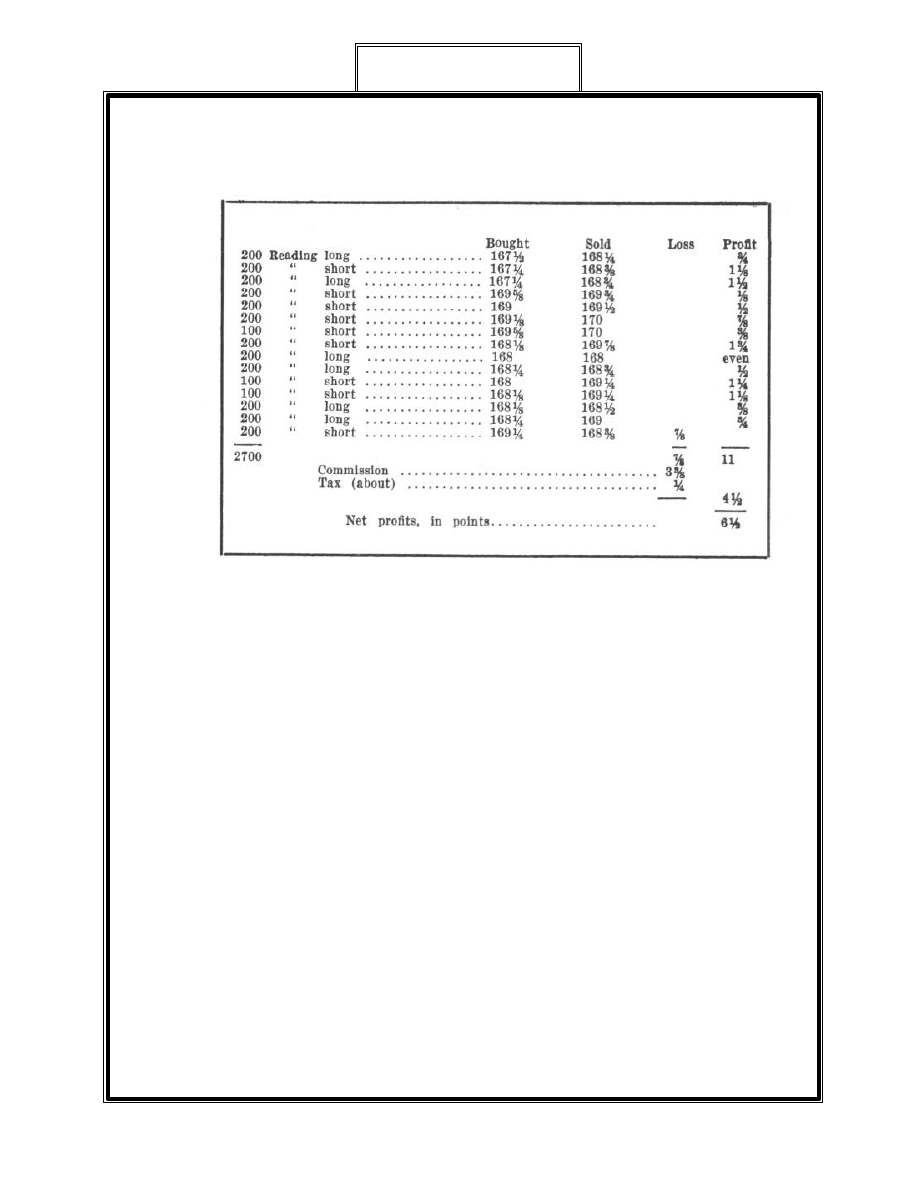
Richard D. Wyckoff
CHAPTER XIV
The Principles Applied to Longer Term Trading
T
HE first edition of this book having been exhausted, it has been my
privilege to edit the foregoing chapters in preparation for the second
edition. This has required a consideration of the principles therein set
forth, and has enabled me to test and compare these principles in their
adaptation to the stock market of 1916.
I find that in no important degree is it necessary to modify what
has been written. While the character of the trading has altered since the
outbreak of the European War, this change represents more a shifting of
Richard D. Wyckoff
the leadership and a widening of the swings, due to extraordinary
conditions.
Proof that these rules and methods are correct is also found in
their adaptation to other forms of trading, chief among which is the
detection of accumulation and distribution at certain important turning
points in the market.
I have used this method successfully in forecasting the market for
these principal swings and find it to be a much more comfortable way of
following the market, because it is not so confining.
Preparation for a long advance or decline, as well as for the
intermediate movements are numerous, is clearly apparent to those who
understand the art of Tape Reading.
In judging the market by its own action, it is unimportant whether
you are endeavoring to forecast the next small half hourly swing or the
trend for the next two or three weeks. The same indications as to price,
volume, activity, support and pressure, are exhibited in the preparation
for both.
The same elements will be found in a drop of water as in the
ocean, and vice versa.
A study of the stock market means a study in the forces above
and below the present level of prices. Each movement has its period of
preparation, execution and termination, and the most substantial of
movements are those that make long preparation. Without this
preparation and gathering of force, a movement is not likely to be
sustained. On the other hand, the greater the preparation, the greater the
probable extent of the swing.
Preparation for the principal movements in the market will very
often occupy several months. This may be preceded by a decline, in
which large operators accumulate their stocks. They may even
precipitate this decline in order to pave the way for such accumulation.

Richard D. Wyckoff
Large operators differ from small ones in their ability to foresee
important changes in stock market values from six months to a year in
advance, and to prepare themselves for it.
A study of these preparatory periods discloses to those who
understand the anatomy of market movements the direction and
possible extent of the next big move. Thus, a study of these important
turning points, principal among which are booms and panics, is the most
essential.
Small operators should take a leaf from the book of those who
buy and sell enormous quantities of securities. It is their foresight which
enables them to profit. To cultivate foresight means to study the markets
condition.
In a lecture at the Finance Forum, New York, I showed how all
influences of every sort affecting the stock market are shown on the tape,
and in the changes in prices.
While I would not for a moment discourage the student from
acquiring any knowledge, and giving some consideration to Fundamental
Statistics such as crops, money, politics, corporate earnings, etc.-- but the
advantages of studying the action of the market, as a guide to future
prices, are productive of too great results to warrant their dilution with
factors which are really of secondary importance.
I make this claim because of my conviction that the position of
large operators is more important than the so-called basic factors.
For several years past I have applied the principles in this book to
the forecasting of the swings of from 5 to 20 points. Results have been
highly outstanding.
For this reason I can recommend that the subject be studied with
a view to the formation of a method of trading, especially adapted to the
individual requirements of those who wish to follow this intensely
interesting and highly profitable business.
Wyszukiwarka
Podobne podstrony:
RICHARD SWIFT The Novelist Walking Without Effort 2xCD (Secretly Canadian) SC111cdsc111
Miller William Ian Audun and the Polar Bear Luck, Law, and Largesse in a Medieval Tale of Risky Bus
Richard A Knaak Warcraft Day Of The Dragon 2001 Lit Novel Ebook Dementia
Extra Sword Art Online The Day After
Level II Trading Warfare The Underground Trader's Powerful Weapons for Winning
Extra Sword Art Online The Day Before (Aincrad 22nd Floor, 24 October 2024)
Kazuo Ishiguro The Remains of the Day
My career in the army, opracowania tematów
Shadow of the Day
In The Shadow of the Day
Back In The Day
Bella Andre The Sullivans 08 Always On My Mind
Before the Day Breaks Conversations and Correspondence with Einstein by Immanuel Velikovsky
The Day the Earth Stood Still Arthur Tofte
Mark B Fisher, The Logical Trader Applying A Method To The Madness
Richard Cowper The Tithonian Factor
The Vampire Predator Bible
The Day They Landed Paul Chadwick
więcej podobnych podstron