Planet Stories, Spring 1955
The Beast-Jewel of Mars
By V. E. THIESSEN
The city was strange, fantastic,
beautiful. He’d never been there before,
yet already he was a fabulous legend—
a dire, hateful legend.
E LAY on his stomach, a lean man in
faded one piece dungarees, and an odd
metallic hat, peering over the side of the
canal. Behind him the little winds sifted red dust
into his collar, but he could not move; he could
only sit there with his gaze riveted on the spires and
minarets that twinkled in the distance, far down the
bottom of the canal.
One part of his mind said, This is it, this is the
fabled city of Mars. This is the beauty and the
fantasy and the music of the legends, and I must go
down there. Yet somewhere deeper in his mind,
deep in the primal urges that kept him from death;
the warning was taut and urgent. Get away. They
have a part of your mind now. Get away from the
city before you lose it all. Get away before your
body becomes a husk, a soulless husk to walk the
low canals with sightless eyes, like those who came
before you.
He strained to push back from the edge, trying
to get that fantastic beauty out of his sight. He
fought the lids of his eyes, fought to close them
while he pushed himself back, but they remained
open, staring at the jeweled towers, and borne on
the little winds the thin wail of music reached him,
saying, Come into the city, come down into the
fabled city.
He slid over the edge, sliding down the sloping
sides of the canal. The rough sandstone tore at his
dungarees, tore at his elbow where it touched but
he did not feel the pain. His face was turned toward
the towers, and the sound of his breathing was less
than human.
His feet caught a projecting bit of stone and
were slowed for an instant, so that he turned
sideways and rolled on, down into the red dust
bottom of the canal, to lie face down in the dust,
with the chin strap of the odd metallic hat cutting
cruelly into his chin.
He lay there an instant, knowing that now he
had a chance. With his face down like this, and the
dust smarting his eyes the image was gone for an
instant. He had to get away, he knew that. He had
to mount the sides of the canal and never look
H

Planet
Stories
2
back.
He told himself, “I am Eric North, from Earth,
the Third Planet of Sol, and this is not real.”
He squirmed in the dust, feeling it bite his
cheeks; he squirmed until he could get up and see
nothing but the red sandstone walls of the canal. He
ran at the walls and clawed his way up like an
animal in his haste. He wouldn’t look again.
The wind freshened and the tune of the music
began to talk to him. It told of going barefoot over
long streets of fur. It told of jewels, and wine, and
women as fair as springtime. These and more were
in the city, waiting for him to claim them.
He sobbed, and clawed forward. He stopped to
rest, and slowly his head began to turn. He turned
and the spires and minarets twinkled at him,
beautiful, soothing, stopping the tears that had
welled down his cheeks.
When he reached the bottom of the canal he
began to run toward the city.
When he came to the city there was a high wall
around it, and a heavy gate carved with lotus
blossoms. He beat against the gate and cried, “Oh!
Let me in. Let me in to the city!” The music was
richer now, as if it were everywhere, and the gate
swung open without the faintest sound.
A sentinel stood before the opened gate at the
end of a long blue street. He was dressed in red silk
with his sleeves edged in blue leopard skin, and he
wore a belt with a jeweled short sword. He drew
the sword from its scabbard, and bowed forward
until the point of the sword touched the street of
blue fur. He said, “I give you the welcome of my
sword, and the welcome of the city. Speak your
name so that it may be set in the records of the
dreamers.”
The music sang, and the spires twinkled, and
Eric said, “I am Eric North!”
The sword point jerked and the sentinel
straightened. His face was white. He cried aloud,
“It is Eric the Bronze. It is Eric of the Legend.” He
whirled the sword aloft, and smashed it upon Eric’s
metal hat, and the hatred was a blue flame in his
eyes.
HEN Eric regained consciousness the
people of the city were all about him. They
were very fair, and the women were more beautiful
than music. Yet now they stared at him with red
hate in their eyes. An older man came forward and
struck at the copper hat with a stick. The clang
deafened Eric and the man cried, “You are right. It
is Eric the Bronze. Bring the whips and let him be
scourged from the city.”
The man drew back the stick and struck again,
and Eric’s back took fire with the blow. The crowd
chanted, “Whips, bring the whips,” and fear forced
Eric to his feet. He fled then, running on the
heedless feet of panic, outstripping those who were
behind him until he passed through the great gates
into the red dust floor of the canal. The gates closed
behind him, and the dust beat upon him, and he
paused, his heart hammering inside his chest like a
great ball clapper. He turned and looked behind to
be sure he was safe.
The towers twinkled at him, and the music
whispered to him, “Come back, Eric North. Come
back to the city.”
He turned and stumbled back to the great gate
and hammered on it until his fists were raw,
pleading for it to open and let him back.
And deep inside him some part of his mind said,
“This is a madness you cannot escape. The city is
evil, an evil like you have never known,” and a fear
as old as time coursed through his frame.
He seized the copper hat from his head, and beat
on the lotus carvings of the great door, crying, “Let
me in! Please, take me into the city.”
And as he beat the city changed. It became dull
and sordid and evil, a city of disgust, with every
part offensive to the eye. The spires and minarets
were gargoyles of hatred, twisted and misshapen,
and the sound of the city was a macabre song of
hate.
He stared, and his back was chill with
superstitions as old as the beginning of man. The
city flickered, changing before his eyes until it was
beautiful again.
He stood, amazed, and put the metal hat back on
his head. With the motion the shift took place
again, and beauty was ugliness. Amazed, he stared
at the illusion, and the thought came to him that the
metal hat had not entirely failed him after all.
He turned and began to walk away from the
city, and when it began to call he took the hat off
his head and found peace for a time. Then when it
began again he replaced the hat, and revulsion sped
his footsteps. And so, hat on, hat off, he made his
way down the dusty floor of the canal, and up the
rocky sides until he stood on the Martian desert,
and the canal was a thin line behind him. He
breathed easily then, for he was beyond the range
W

The
Beast-Jewel
of
Mars
3
of the illusions.
And now that his mind was his own again he
began to study the problem, and to understand
something of the nature of the forces against which
he had been pitted.
The helmet contained an electrical circuit,
designed as a shield against electrical waves tuned
to affect his brain. But the hat had failed because
the city, whatever it was, had adjusted to this
revised pattern as he had approached it. Hence, the
helmet had been no defense against illusion.
However, when he had jerked the helmet off
suddenly to beat on the door, his mental pattern had
changed, too suddenly, and the machine caught up
only after he had glimpsed another image. Then as
the illusion adjusted, replacing the helmet threw it
off again.
He grinned wryly. He would have liked to know
more about the city, whatever it was. He would
have liked to know more about the people he had
seen, whether they were real or part of the illusion,
and if they were as ugly as the second city had
been.
Yet the danger was too great. He would go back
to his ship and make the arrangements to destroy
the city. The ship was armed, and to deliver
indirect fire over the edge of the canal would be
simple enough. Garve North, his brother, waited
back at the ship. If he knew of the city he would
have to go there. Eric must not take a chance on
that. After they had blasted whatever it was that lay
in the canal floor, then it would be time enough to
tell Garve, and go down to see what was left.
The ship rested easily on the flat sandstone area
where he had established base camp. Its familiar
lines brought a smile to Eric’s face, a feeling of
confidence now that tools and weapons were his
again.
He opened the door and entered. The lock doors
were left open so that he could enter directly into
the body of the ship. He came in a swift leap,
calling, “Garve! Hey, Garve, where are you?”
The ship remained mute. He prowled through it,
calling, “Garve,” wondering where the young
hothead had gone, and then he saw a note clipped
to the control board of the ship. He tore it loose
impatiently and began to read. Garve had scrawled:
Funny thing, Eric. A while ago I thought I
heard music. I walked down to the canal,
and it seemed like there were lights, and a
town of some sort far down the canal. I
wanted to investigate, but thought I’d
better come back. But the thing has been
in my mind for hours now, and I’m going
down to see what it is. If you want to
follow, come straight down the canal.
Eric stared at the note, and the line of his jaw
was white. Apparently Garve had seen the city
from farther away, and its effect had not been so
strong. Even so, Garve’s natural curiosity had done
the rest.
Garve had gone down to the city, and Garve had
no shielded hat. Eric selected two high explosive
grenades from the ship’s arsenal. They were small
but they packed a lot of power. He had a pistol
packed with smaller pellets of the same explosive,
and he had the hat. That should be adequate. He
thrust the bronze hat back on his head and began
walking back to the canal.
HE return back to the city would always live
in his mind as a phantasmagora, a montage of
twisted hate and unseemly beauty. When he came
again to the gate he did not attempt to enter, but
circled the wall, hat on, hat off, stiff-limbed like a
puppet dancing to the same tune over and over
again. He found a place where he could scale the
wall, and thrust the helmet on his head, and clawed
up the misshapen wall. It was all he could do to
make himself drop into the ugly city.
He heard a familiar voice as he dropped. “Eric,”
the voice said. “Eric, you did come back.” The
voice was his brother’s, and he whirled, seeking the
voice. A figure stood before him, a twisted
caricature of his brother. The figure cried, “The
hat! You fool, get rid of that hat!” The caricature
that was his brother seized the hat, and jerked so
hard that the chin strap broke under Eric’s chin.
The hat was flung away and sailed high and far
over the fence and outside the city.
The phantasm flickered, the illusion moved.
Garve was now more handsome than ever, and the
city was a dream of delight. Garve said, “Come,”
and Eric followed down a street of blue fur. He had
no will to resist.
Garve said, “Keep your head down and your
face hidden. If we meet someone you may not be
recognized. They won’t be expecting you from this
side of the city.”
Eric asked, “You knew I’d come after you?”
T

Planet
Stories
4
“Yes. The Legend said you’d be back.”
Eric stopped and whirled to face his brother.
“The Legend? Eric the Bronze? What is this wild
fantasy?”
“Not so loud!” Garve’s voice cautioned him.
“Of course the crowd called you that because of the
copper hat and your heavy tan. But the Elders
believe so, too. I don’t know what it is, Eric,
reincarnation, prophesy, superstition. I only know
that when I was with the Elders I believed them.
You are a part of a Legend. You are Eric the
Bronze.”
Eric looked down at his suntanned hands and
flexed them. He loosened the explosive pistol in its
holster. At least he was going to be a well armed,
well prepared Legend. And while one part of his
mind marveled at the city and relaxed into a
pleasure as deep as a dream, another struggled with
the almost forgotten desire to rescue his brother and
escape. He asked, “Who are the Elders?”
“We are going to them, to the center of the
city.” Garve’s voice sharpened, “Keep your head
down. I think the last two men we passed are
looking after us. Don’t look back.”
After a moment Garve said, “I think they are
following us. Get ready to run. If we are separated,
keep going until you reach City Center. The Elders
will be expecting you.” Garve glanced back, and
his voice sharpened, “Now! Run!”
They ran. But as they ran figures began to
converge upon them. Farther up the street others
appeared curing off their flight.
Garve cried, “In here,” and pulled Eric into a
crevice between two buildings. Eric drew his gun,
and savagery began to dance in his eyes. The soft
fur-muffled sounds of pursuit closed in upon them.
Garve put one hand on Eric’s gun hand and
said, “Wait here. And if you value my life, don’t
use that gun.” Then he was gone, running deer-like
down the street.
For an instant Eric thought the ruse had
succeeded. He heard cries and two men passed him
running in pursuit. But then the cry came back.
“Let him go. Get the other one. The other one.”
Eric was seen an instant later, and the people of
the city began to converge upon him. He could
have destroyed them all with his charges in the gun,
but his brother’s warning shrieked in his ears: “If
you value my life don’t use the gun.”
There was nothing he could do. Eric stood
quietly until he was taken prisoner. They moved
him to the center of the wide fur street. Two men
held his arms, and twisted painfully. The crowd
looked at him, coldly, calculatingly. One of them
said, “Get the whips. If we whip him he will not
come back.” The city twinkled, and the music was
so faint he could hardly hear it.
There was only one weapon Eric could use. He
had gathered from Garve’s words that these people
were superstitious.
He laughed, a great chest-shattering laugh that
gusted out into the thin Martian air. He laughed and
cried in a great voice, “And can you so easily
dispose of a Legend? If I am Eric of the Legend,
can whips defeat the prophesy?”
There was an instant when he could have
twisted loose. They stood, fear-bound at his words.
But there was no place to hide, and without the use
of his weapons Eric could not have gone far. He
had to bluff it out.
HEN one of the men cried, “Fools! It is true.
We must take no chance with the whips. He
would come back. But if he dies here before us
now, then we may forget the prophesy.”
The crowd murmured and a second voice cried,
“Get the sword, get the guards, and kill him at
once!”
Eric tensed to break away but now it was too
late. His captors were alert. They increased the
twist on his arms until he almost screamed with the
pain.
The crowd parted, and the guard came through,
his red silk clothing gleaming in the sun, his sword
bright and deadly. He stopped before Eric, and the
sword swirled up like a saber, ready for a slashing
cut downward across Eric’s neck.
A woman’s voice, soft and yet authoritative,
called, “Hold!” And a murmur of respect rippled
through the crowd.
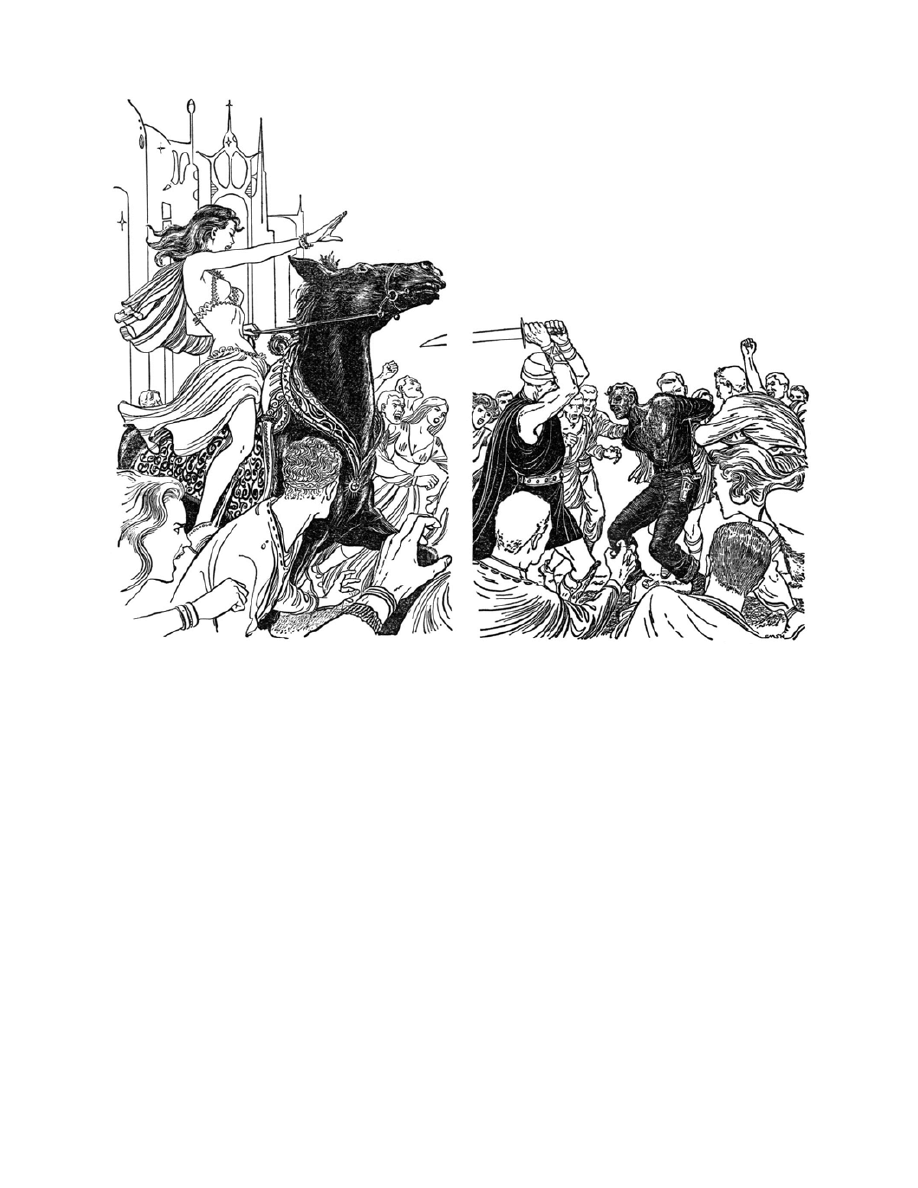
“Nolette! The Daughter of the City comes.”
Eric turned his gaze to the side and saw the
woman who had spoken. She was mounted upon a
black horse with a jeweled bridle. She was young
and her hair was long and free in the wind. She had
ridden so softly across the fur street that no one had
been aware of her presence.
She said, “Let me touch this man. Let me feel
the pulse of his heart so that I may know if he is
truly the Bronze one of the Legend. Give me your
hand, stranger.” She leaned down and grasped his
hand. Eric shook his arms free, and reached up and
T

The
Beast-Jewel
of
Mars
5
clung to the offered hand, thinking, “If I pull her
down perhaps I can use her as a shield.” He tensed
his muscles and began to pull.
She cried, “No! You fool. Come up on the
horse,” and pulled back with an energy as fierce as
his own. Then he had swung up on the horse, and
the animal leaped forward, its muffled gallop
beating out a tattoo of freedom.
Eric clung tightly to the girl’s waist. He could
feel the young suppleness of her body, and the fine
strands of her hair kept swirling back into his face.
It had a faint perfume, a clean and heady scent that
made him more aware of the touch of her waist. He
breathed deeply, oddly happy as they rode.
After five minutes ride they came to a building
in the center of the city. The building was cubical,
severe in line and architecture, and it contrasted
oddly with the exquisite ornament of the rest of the
city. It was as if it were a monolith from another
time, a stranger crouched among enemies.
The girl halted before the structure and said,
“Dismount here, Eric.”
Eric swung down, his arms still tingling with
pleasure where he had held her. She said, “Knock
three times on the door. I will see you again inside.
And thank your brother for sending me to bring
you here.”
Eric knocked on the door. The door was as plain
as the building, made of a luminous plastic. It had
all the beauty of the great gate door, but a more
timeless, more functional beauty.
The door opened and an old man greeted Eric.
“Come in. The Council awaits you. Follow me,
please.”
Eric followed down a hallway and into a large
room. The room was obviously designed for a
conference room. A great table stood in the room,
made of the same luminous plastic as the door of
the building. Six men sat at this conference table.
Eric’s guide placed him in a chair at the base of the
T-shaped table.
There was one vacant seat beside the head of the
T, and as Eric watched, the young woman who had
rescued him entered and took her place there. She
smiled at Eric, and the room took on a warmth that
it had lacked with only the older men present. The
man at her right, obviously presiding here looked at
Eric and spoke. “I am Kroon, the eldest of the
elders. We have brought you here to satisfy
ourselves of your identity. In view of your danger
in the City you are entitled to some sort of
explanation.” He glanced around the room and
asked, “What is the Judgment of the elders?”
RIC caught a faint nod here, a gesture there.
Kroon nodded as if in satisfaction. He turned
to the girl, “And what is your opinion, Daughter of
the City?”
Nolette’s expression held sorrow, as if she
looked into the far future. She said, “He is Eric the
Bronze. I have no doubt.”
Eric asked, “And what is this Legend of Eric the
Bronze? Why am I so despised in the city?”
Kroon answered, “According to the Ancient
Legend you will destroy the city. This, and other
things.”
Eric gaped. No wonder the crowd had shown
such hatred. But why were the elders so friendly?
They were obviously the governing body, and if
there was strife between them and the people it had
not shown in the respect the crowd had accorded
Nolette.
Kroon said, “I see you are puzzled. Let me tell
you the story of the City. The City is old. It dates
from long ago when the canals of Mars ran clear
and green with water, and the deserts were
vineyards and gardens. The drought came, and the
changes in climate, and soon it became plain that
the people of Mars were doomed. They had ships,
and could build more, and gradually they left to
colonize other planets. Yet they could take little of
their science. And fear and riots destroyed much.
Also there were those who were filled with love for
this homeland, and who thought that one day it
might be habitable again. All the skill of the ancient
Martian fathers went into the building of a giant
machine, the machine that is the City, to protect a
small colony of those who were chosen to remain
on Mars.”
“This whole city is a machine?” Eric asked.
“Yes, or the product of one. The heart of it lies
underneath our feet, in caverns beneath this
building. The nature of the machine is this, that it
translates thought into reality.”
Eric stared. The idea was staggering.
“This is essentially simple, although the
technology is complex. It is necessary to have a
recording device, to capture thought, a transmuting
device capable of transmuting the red dust of the
desert into any sort of material desired, and a
construction device, to assemble this material into
the pattern already recorded from thought.” Kroon
E

Planet
Stories
6
paused. “You still doubt, my friend. Perhaps you
are thirsty after your escape. Think strongly of a
tall glass of cold water, visualize it in your mind,
the sight and the fluidity and the touch of it.”
Eric did so. Without warning a glass of water
stood on the table before him. He touched the water
to his lips. It was cool and satisfying. He drank it,
convinced completely.
Eric asked, “And I am to destroy the City?”
“Yes. The time has come.”
“But why?” Eric demanded. For an instant he
could see the twinkling beauty as clearly as if he
had stood outside the walls of this building.
Kroon said, “There are difficulties. The machine
builds according to the mass will of the people,
though it is sensitive to the individual in areas
where it does not conflict with the imagination of
the mass. We have had strangers, visitors, and even
our own people, who grew drunk with the power of
the machine, who dreamed more and more lust and
greed into existence. These were banished from the
city, and so strong is the call of the city that many
of them became victims of their own evilness, and
now walk mindlessly, with no thought but to seek
for the beauty they have lost here.”
Kroon sighed. “The people have lost the will to
learn. Many do not even know of the machine. Our
science is almost gone, and only a few of us, the
dreamers, the elders, have kept alive the old
knowledge of the machine and its history. By the
collected powers of our imagination we build and
control the outward appearance of the city.
“We have passed this down from father to son.
A part of the ancient Legend is that the builders
made provisions for the machine to be destroyed
when contact with outsiders had been made once
again, so that our people would again have to
struggle forward to knowledge and power. The
instrument of destruction was to be a man termed
Eric the Bronze. It is not that you are reborn. It is
just that sometime such a man would come.”
Eric said, “I can understand the Bronze part.
They had thought that a spaceman might well be
suntanned. They had thought that a science to
protect against this beautiful illusion would provide
a metal shield of some sort, probably copper in
nature. That such a man should come is inevitable.
But why Eric. Why the name Eric?”
For the first time Nolette spoke. She said
quietly, “The name Eric was an honorable name of
the ancient fathers. It must have been their thought
that the new beginning should wait for some of
their own far flung kind to return.”
Eric nodded. He asked, “What happens now?”
“Nothing. Dwell here with us and you will be
safe from our people. If the prediction is not soon
fulfilled and you are not the Eric of the Legend,
you may stay or go as you desire.”
“My brother, Garve. What about him?”
“He loves the city. He will also stay, though he
will be outside this building.” Kroon clasped his
hands. “Nolette, will you show Eric his quarters?”
RIC followed Nolette through a hallway to a
well furnished room. Walking behind her, the
graceful sway of her walk reminded him of the
touch of her waist as he held it earlier when they
rode, and he felt the blood racing through his veins.
He was tempted to seize her shoulder, turn her, and
take her in his arms.
She indicated the room with a gesture. “You
will be comfortable here, and you have only to
wish strongly for food or drink. If your wishes do
not conflict with those of the elders they will come
into being.”
Eric asked, “And is this true of any wish?
Suppose for instance I wished for—you.”
She looked at him steadily, “That would depend
on the nature of your wish. If you wished to take
me as your wife the elders would approve.”
Eric looked at her. He had hardly known her
two hours. Yet the madness of the moment made
him rash, and he asked, “And what of your wishes,
Nolette?”
She said, “I am the Daughter of the City, and a
virgin. If the Legend is to be fulfilled I would be
wed before I die.”
He took a step forward and reached out to take
her in his arms, but she slipped away, saying
quietly, “Not now. I will go away and let you think.
When you have decided call me in your mind, and
the machine will let me know.” She smiled briefly,
and left him alone in the room.
Eric was hardly aware of his actions as he
seated himself in the comfortable chair. He
fumbled about for his pipe. He must not be a fool.
Perhaps if he thought quietly, and smoked, he could
decide if this was a dream, if he had gone quietly
mad in his space ship, and had been the victim of
hallucinations. The chair was real to his touch, his
pipe was gone, and he remembered leaving it in the
navigators section of the ship upon his earlier
E

The
Beast-Jewel
of
Mars
7
return. The memory seemed real enough. He
wished for his pipe again, and realized that now he
held it in his hand.
This was no mirage. He tamped tobacco created
by the machine from Red Martian dust into the
bowl of the pipe, and the smoke was as fragrant as
ever. He could see how such luxury would stagnate
a race. As the smoke curled around him he knew
that two hours or two years were not important, and
he knew what he wanted. He wished for Nolette.
She came into the room, watching him quietly,
suddenly shy. He said, “It has come to me that I
love you. Will you do me the honor to become my
wife?”
She said, “Yes, Eric. Oh! Yes!” and came
running to him. Her kiss had all the passion of his
own.
An hour later she slipped from his arms, saying,
“I must go and talk with the elder dreamers. We
must be married today, at once. We have so little
time. We must be husband and wife tonight.” She
slipped softly from the room.
Eric watched her, marveling at his luck. He
suddenly remembered that he had not seen his
brother since he had arrived at the house of the
elder dreamers. He wondered where Garve was,
and wanted to talk to him. Perhaps if he thought
strongly enough the machine would get the
message thought to Garve. He concentrated.
Ten minutes later Garve walked into the room.
He said, “I thought I heard you calling. How’d you
make out with the dreamers?”
“Well enough. Don’t think me mad, Garve, but
Nolette and I are to be married, tonight.”
Garve’s face grew red, then as white as river
sand. He said bitterly, “I should have let them kill
you in the street, but how could I? After all we are
brothers.”
“You love her, too.”
“No! But I love this city. It is paradise, and now
you will destroy it.”
Eric said, “The Legend again! Everyone
believes it. Yet it is but a prediction. In time such a
man as the Legend had to come, and some day one
more greedy than myself may destroy the city.
Perhaps I will refuse to carry out the destruction.”
Garve laughed, a bitter cynical laugh. He cried,
“You fool! How can you help yourself? Everyone
believes you are the Bronze one and the machine
will make that come true. How can you defeat the
machine?”
Eric was staggered by a logic he had not even
considered.
“Piece by piece,” Garve said, “the prediction is
coming to pass. Now you are to wed Nolette, and
that too is a part of the Legend.”
“That was predicted?”
“Yes. And that is not the end.” Garve’s voice
was as sharp as the bite of a whip. “Do you know
what else you will do?”
“No!” A thin horror seeped slowly into Eric’s
mind.
“You will destroy the Daughter of the City.”
Eric’s eyes were wide. He shuddered and cried,
“NO! NO!”
Garve’s face took on the glint of madness. He
said, “But I will stop you. I’ll stop you if I have to
kill you.” He turned and strode bitterly from the
room.
ORROR was still fresh in Eric’s mind when
Nolette returned. “All is ready,” she said.
“Come now, my husband-to-be.”
Eric followed her into the chamber of the elder
dreamers. Kroon stood at the doorway and greeted
him as he entered. He said, “One cannot fight the
truth, so we have consented to this marriage. Will
you join hands?”
The ceremony was simple, but beautiful, much
like an Earth wedding, with the city making music
that was beautiful beyond belief. But all the time
Eric listened his mind was working, and by the
time he had kissed his bride at the end of the
ceremony he knew what he had to do. He walked
back to their room with his arm around her waist,
and his resolve weakened with each step.
Yet when he reached the room he had the will to
say, “I must leave you for a time. When I return our
life together will begin.” He kissed her again, and
said, “It will not be long.”
He broke away, and left her. When he reached
the hallway he felt once in his pocket to be sure the
explosive grenades were still there. So far the
machine had controlled his destiny. So far the very
belief of the dreamers in his destiny had brought
the predictions to pass. Very well now, he would
destroy the machine, but not at the request of the
dreamers. He would do it now, before there was
time to consummate the horrible part of the
prediction. Then he would come back to Nolette
and his honeymoon.
He ran along the hallways, always going down
H

Planet
Stories
8
when he found a stairway, always seeking the
central area below that had been indicated by
Kroon in their first talk. And when at length he
came out into a large room, with a maze of delicate
electronic apparatus below, he knew he had
arrived, and he pulled the grenade from his pocket.
Yet before he pulled the safety release he could
not but marvel a moment at the intricate science
below him. Much was familiar, and much was
unintelligible.
As he stood he was seized from behind, and he
twisted to find he was caught in the hate-
strengthened grip of his brother. Pain lanced
through his arm, and Garve gritted, “Drop it.” Eric
dropped the grenade, and it fell between them. Eric
was suddenly glad that the safety had not been
pulled, and then he was fighting savagely with his
brother.
He was older, and wiser in the dirty tricks of
fighters from the planets. After a time he was able
to set himself, and bend forward. Where Garve had
been behind, now he was flung up, over Eric’s back
in a sprawling arc. He fell, teetered for an instant,
and then crashed into the delicate heart of the
machine below. Glass tinkled, and a flare lit the
room. Eric closed his eyes, afraid to look. Garve
must have been electrocuted.
RIC opened his eyes to find the room subtly
changed. It was roughly the same, but the
walls were a rough sandstone, and the glamour was
gone. He heard sounds, and saw Garve struggling
up from the wreckage below. Both of them knew it
was ended. The machine was beyond repair.
Garve paused. He said, “It’s over now. I
suppose in a year or two I shall forget this. I am
going away. Until I can forgive you I shall stay
away. God grant you peace, for you have lost more
than I.” Garve’s steps echoed hollowly on the stone
corridor and he disappeared in the distance.
Eric stood quietly. There was no happiness in
him, only a nameless fear brought on by his
brother’s words, a fear that he had forgotten
something.
Then suddenly he knew what it was. He
remembered the ugly city. When he came out of the
corridor, out of this building, the city would be a
foul sty again. And the people, he had not seen the
people, but they would no doubt be horrible.
Nolette, his wife—he could not let himself think of
how she would look. It seemed Garve was right and
the final prediction had come true. All was
finished, even the Daughter of the City had been
destroyed.
He began to move up out of the subterranean
room and back to the city. He reached the outer
door, and did not even pause to look for Nolette,
but set his teeth, and stepped out into the city.
And there he was surprised. Here was no ugly
city, only a very normal, ordinary one, with
ordinary persons going about the streets, blinking at
the changes. The lines of the city were still there,
but the jeweled panes were ordinary glass.
Eric tried to understand. Then suddenly he
recalled his hatred of the city when he had been
cast out, his subconscious thoughts of it as evil. He
had taken off the helmet, and for an instant he had
been out of contact with the elders, disoriented. In
that instant the city had shown him his own concept
of ugliness. That ugly city was as unreal as the
fantastically beautiful one created by the elders.
Eric turned, and went back into the building,
looking for Nolette.
He found her, standing with Kroon in the great
room, before a table which was only laminated
wood. She was a slender girl, gray eyed, pleasant to
look at, but without the beauty and the music and
the witchery of her counterpart.
She said quietly, “It is finished, Eric, and we are
not the two who married. It is finished, and the
dream is ended.”
Eric said only, “Yes,” watching her.
She said, “I release you from the marriage. It
will be a memory for us both, a wonderful dream
that ended before it was consummated, a dream cut
short too soon.”
Eric asked, “What will you do?” Her voice was
hardly changed, and watching her he felt an odd
pleasure. There was no wild racing of his blood, yet
his interest was awakening.
She said, “Go away, I suppose, as far as I can
from this place.”
He liked the way she was taking this. No
dramatics, no tears.
He said, “I could take you back to Earth as a
passenger. You might like Earth.” He felt oddly
eager as she considered.
And then suddenly, he could not wait, and the
words came tumbling out. “Nolette,” he said, “you
must come with me. I do not know how it will be
with us yet. But somehow I feel that if we stay
together things will be good.”
E

The
Beast-Jewel
of
Mars
9
He waited for her decision, half afraid, half
eager, and then saw a slow smile break the
seriousness of her eyes.
She said gently, “If that is what you wish.” The
smile widened. “A girl must follow her husband.
Even I know that.”
Eric reached out and took her hand. “The ship is
waiting,” he said. “Let’s go home.”
Wyszukiwarka
Podobne podstrony:
Silverberg, Robert The Lost Race of Mars(1)
Edgar Rice Burroughs Martian Tales 06 The Master Mind of Mars
John W Campbell The Brain Stealers of Mars
Iron Maiden The Number Of The Beast
Fritz Leiber The Number of the Beast
David Icke The New Mark Of The Beast Part 5
The Number of the Beast Fritz Leiber
David Icke The New Mark Of The Beast Part 3
Burroughs, Edgar Rice Mars 03 The Warlord of Mars
Robert A Heinlein The Number of the Beast
Zane Grey The Day Of The Beast
Burroughs, Edgar Rice Mars 05 The Chessmen of Mars
Philip Jose Farmer The Image Of The Beast
Aleister Crowley Evocation of Bartzabel the Spirit of Mars Cd4 Id1350945301 Size46
United Mates Of Morgana 1 Bloodsucker And The Beast
Lee, Tanith Paradys 2 The Book of the Beast
Burroughs, Edgar Rice Mars 06 The Mastermind of Mars
Jerry Davis The Code of the Beast
F E Hardart The Beast of Space
więcej podobnych podstron