The Consultation Game That Never Was
Edward Winter
Why would a world champion claim to have lost a 24-move brilliancy if such were not the case? That was a central question in
our investigation into a famous game widely described as won by D. Janowsky and B. Soldatenkov against E. Lasker and
J. Taubenhaus in Paris in 1909:
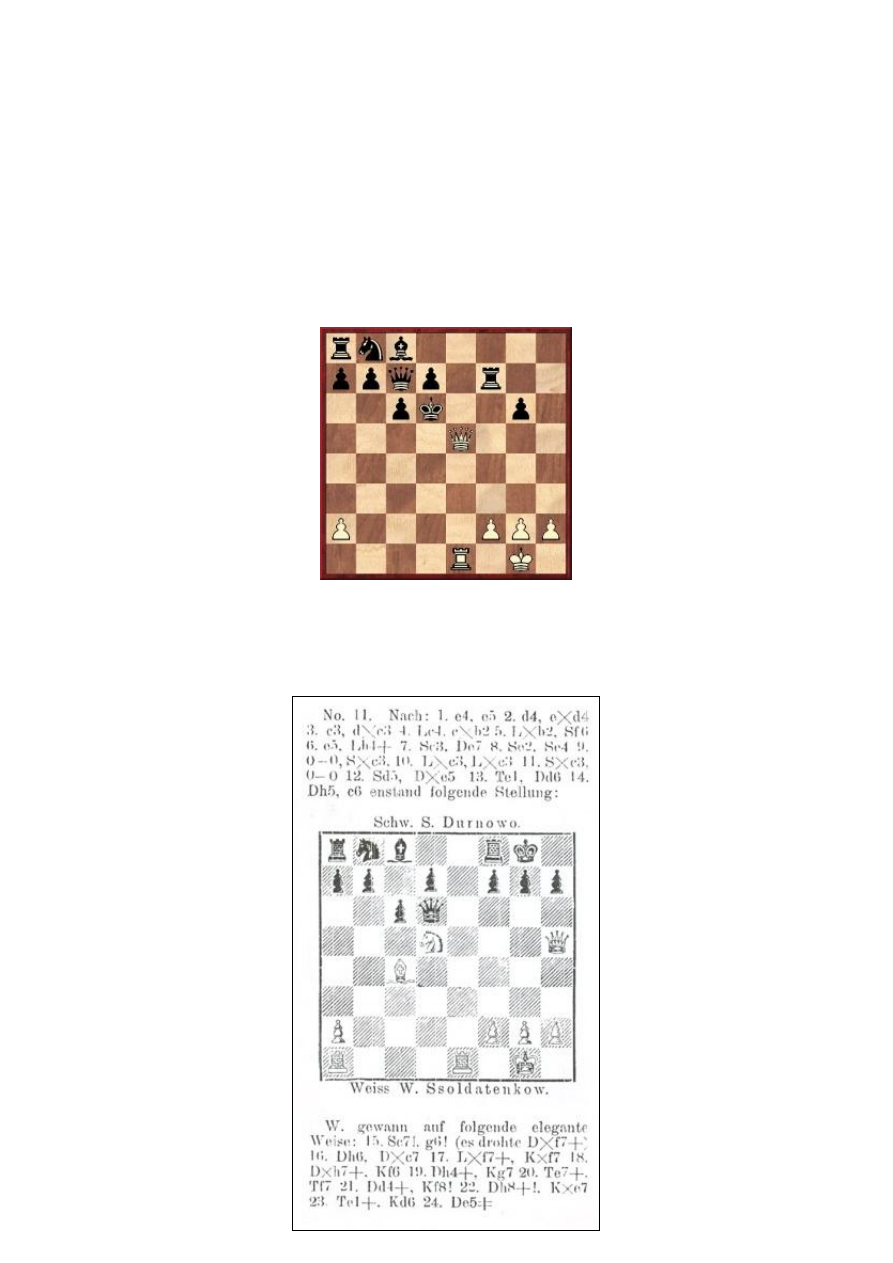
1 e4 e5 2 d4 exd4 3 c3 dxc3 4 Bc4 cxb2 5 Bxb2 Nf6 6 e5 Bb4+ 7 Nc3 Qe7 8 Nge2 Ne4 9 O-O Nxc3 10 Bxc3 Bxc3 11 Nxc3 O-O 12
Nd5 Qxe5 13 Re1 Qd6 14 Qh5 c6 15 Nc7 g6 16 Qh6 Qxc7 17 Bxf7+ Kxf7 18 Qxh7+ Kf6 19 Qh4+ Kg7 20 Re7+ Rf7 21 Qd4+ Kf8
22 Qh8+ Kxe7 23 Re1+ Kd6 24 Qe5 mate.
To mention just one standard source, the above players and occasion were given on page 171 of
The Golden Treasury of Chess
by Francis J.
Wellmuth (Philadelphia, 1943). However, the game had already appeared in the nineteenth century, won by Soldatenkov against
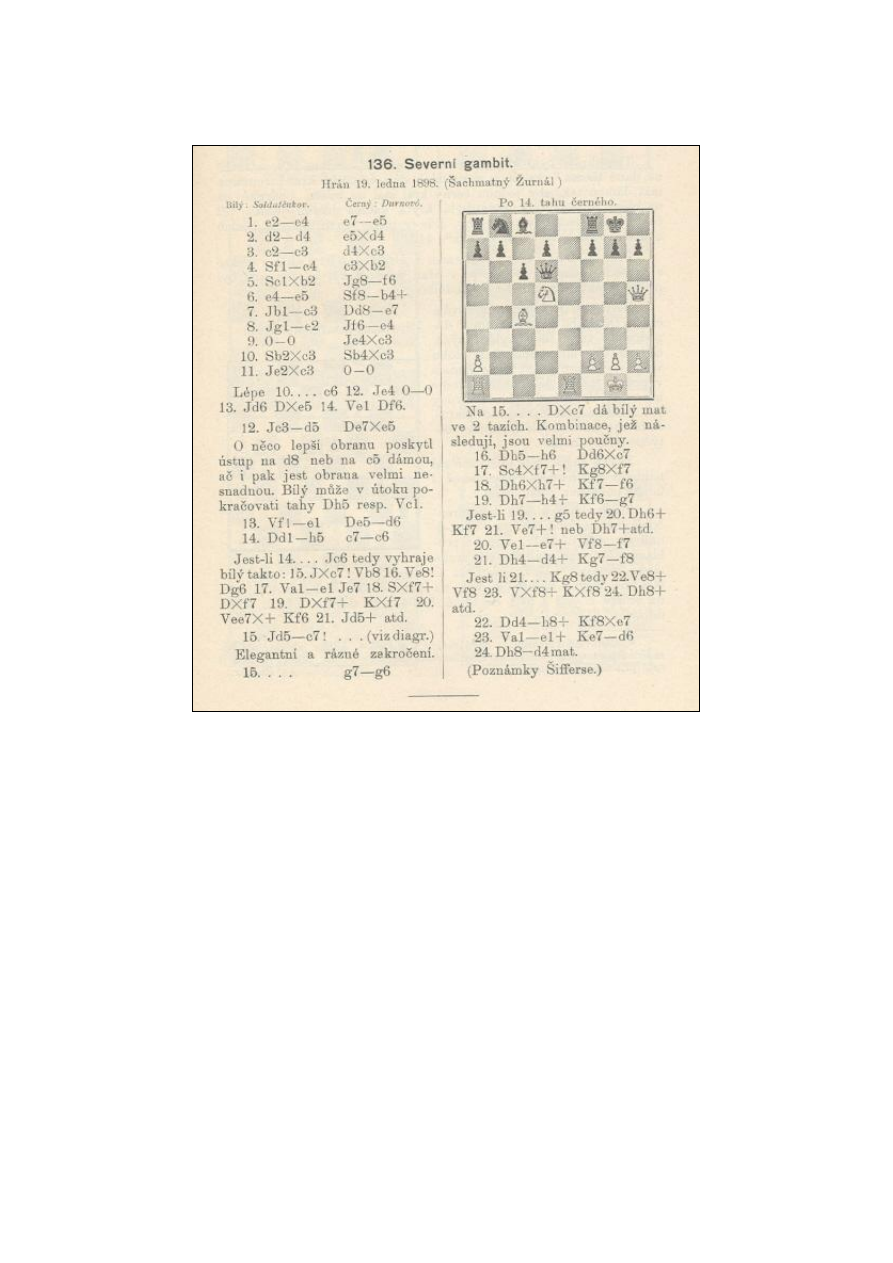
S. Durnovo (or Durnowo). Below, for instance, is what was published on page 18 of
Der Schachfreund
, April 1898:
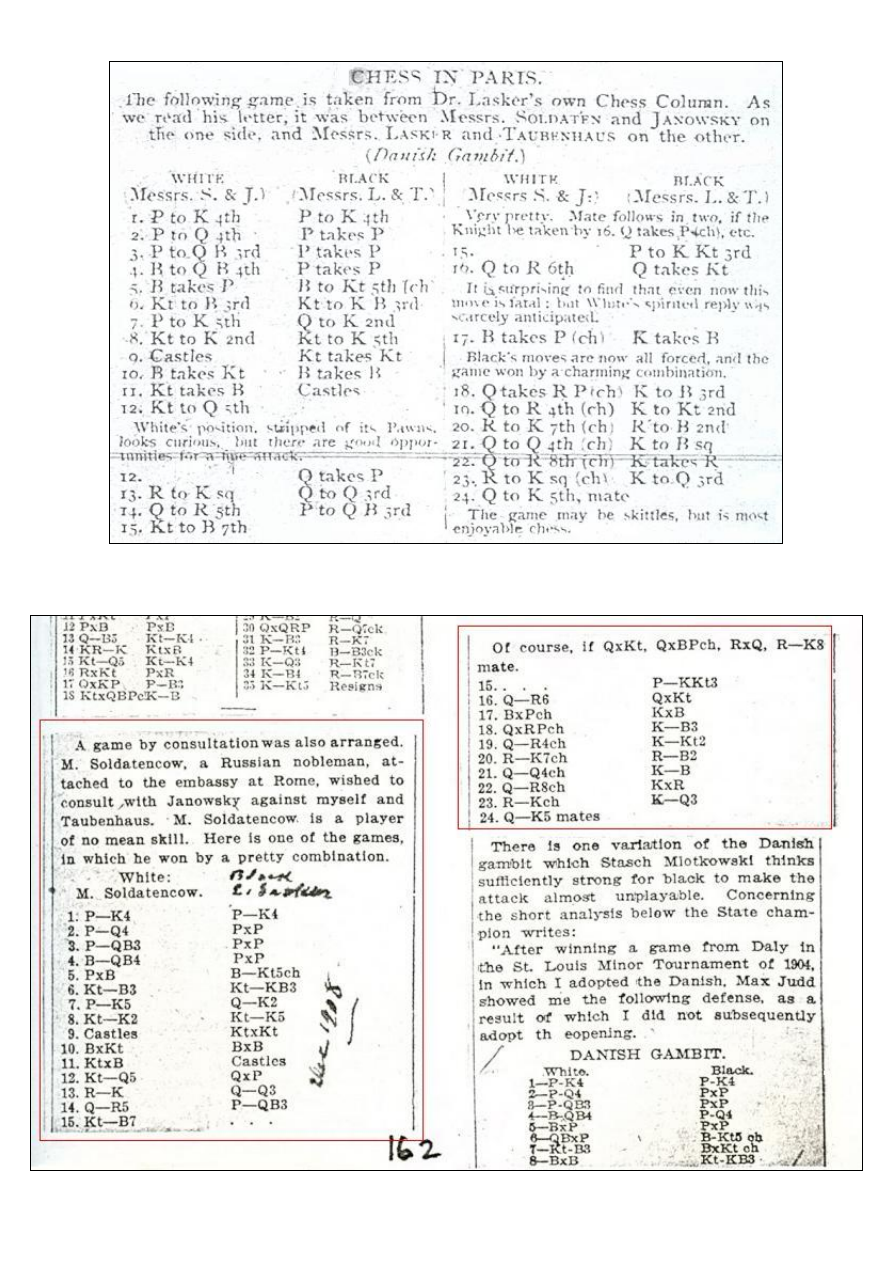
As noted in C.N. 1486, the game was also given as a win for Soldatendov against Durnovo on page 504 of the November
1900
BCM
, from Č
eské Listy
Š achové
. The latter source (April 1898 issue,
page 55) is reproduced below courtesy of Karel Mokrý (Prostějov, Czech Republic):
So did a consultation game in Paris simply repeat the moves of Soldatenkov v Durnovo? At first, that seemed possible, given that,
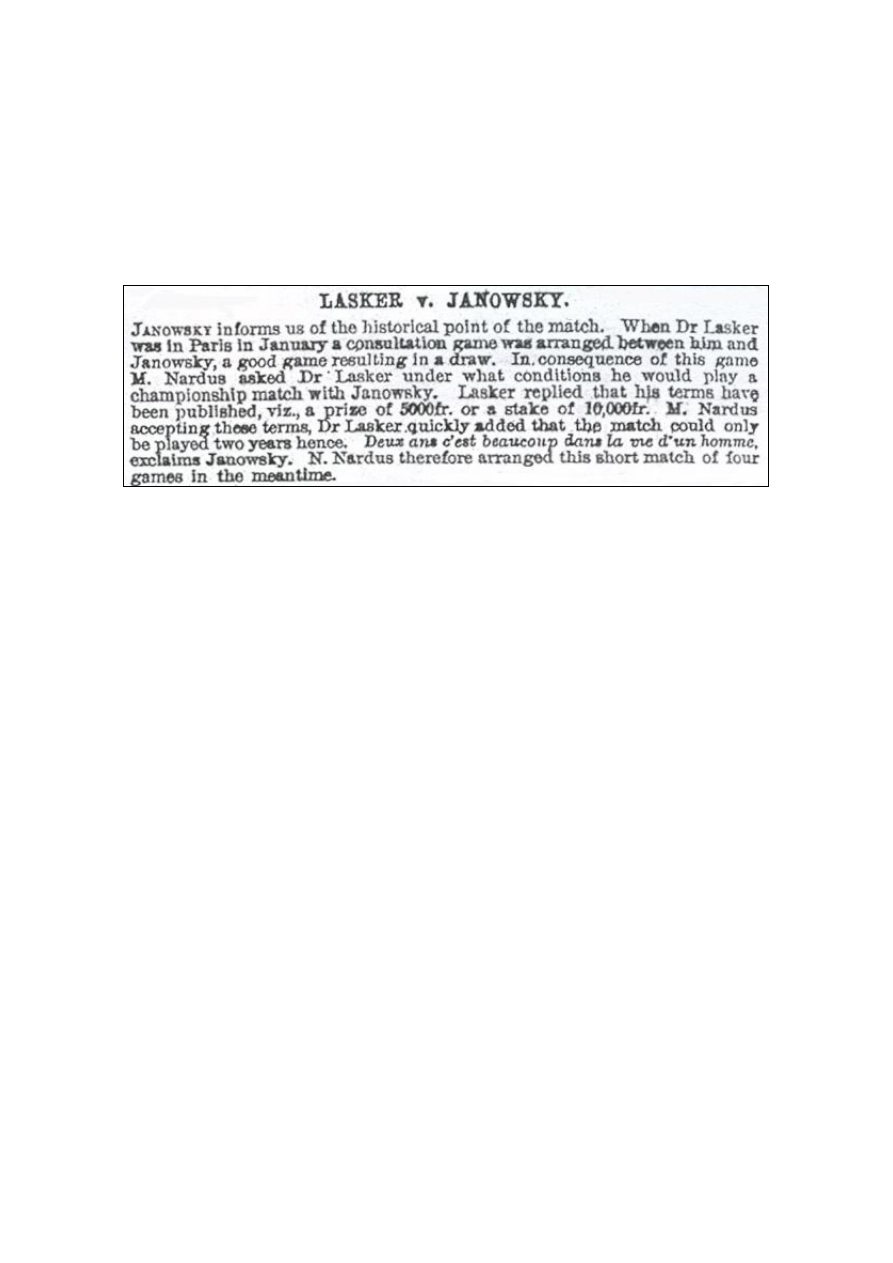
as reported in C.N. 22, the following was presented on page 330 of the
Illustrated London News
, 27 February 1909:
We asked whether Lasker really gave the game in his own column, and C.N. 774 quoted from page 162 of volume A of Walter
Penn Shipley’s scrapbooks, which had a cutting, from an unidentified newspaper, undoubtedly written by Lasker:
In that same item we commented on various points still requiring clarification:
‘a) The date. “1909” has always been given, but, if we are correctly reading a handwritten note in the scrapbook, the article in
question by Lasker appeared on 2 December 1908.
b) The venue. Lasker does not specify Paris or anywhere else, at least not in the “clipped” clip preserved by Shipley.
c) The conditions. The Lasker quote above implies that “Soldatencow”, more than Janowsky, conducted the white pieces, and this
is reinforced by the game heading, which does not mention Janowsky at all (or Lasker or Taubenhaus – only “Soldatencow”).
d) The source. Are we correct in guessing that the column is from the
New York
Evening Post
of 2 December 1908?’
In C.N. 1369 there was further evidence to consider: the text below from page 878 of
The Field
, 22 May 1909:
After quoting this passage, which was also reproduced on page 260 of the June 1909
BCM
, we commented:
‘In [C.N. 774] we wrote, “it would seem therefore that the ‘spurious’ game was indeed played”, but the above
BCM-
Field
quote dents our confidence. If Janowsky and Soldatenkov had scored a win and a draw why would Janowsky
have mentioned to
The Field
only the draw?’
In C.N. 1486 an additional complication was offered: the game appeared on page 77 of the March-April 1933 issue of
Les Cahiers de l
’
Echiquier
Français
as Soldatenkov v Sabourow, St Petersburg, 1909. The magazine stated that the game’s attribution
to Janowsky/Soldatenkov v Lasker/Taubenhaus was a frequent but inexplicable error. It has not been possible to ascertain on
what basis the name Sabourow and the venue St Petersburg were introduced by the French magazine.
Then in C.N. 1574 a correspondent, Jack O’Keefe (Ann Arbor, MI, USA), shed considerable further light on the affair:
‘
Lasker
’
s column in the
“ semi-
weekly
” edition of the
New York Evening Post
appeared on Thursday and
Saturday; the Saturday column was
repeated without change on the
following Monday. Three columns
have a bearing on the Soldatenkov
“ consultation game
” versus
Lasker.
The first, and most important,
is the column of Saturday 30
January (and 1 February) 1909.
Datelined
“ Paris, Jan. 5
” , it
deals with simuls by Lasker in
Amsterdam, Utrecht, Groningen and
Haarlem, and his subsequent trip
to Paris. Lasker
’
s observations
were not confined to the chess
board:
“The women that one sees in the streets and restaurants are far from being pretty, with rare exceptions. But they
dress with style, their conversation is lively, and they show an evident desire to please. Woman is the topic at all
Parisian shows, which becomes a little monotonous after awhile.”
Lasker next describes a visit to
the Café de la Régence, where a
simul was arranged. Then comes
the crucial paragraph:

“A game by consultation was also arranged. M. Soldatencow, a Russian nobleman, attached to the
embassy at Rome, wished to consult with Janowsky and myself and Taubenhaus. M. Soldatencow is
a player of no mean skill. Here is one of the games, in which he won by a pretty combination.
White
M. Soldatencow.”
The moves of the Danish Gambit
game follow. Note that the
reader is not told who played
Black,
2)
the date and place of
the game, and
3)
any consultation
partner of Soldatenkov.
The column for Thursday,
4
February
contains the game Lasker/
Taubenhaus versus Janowsky/
Soldatencow. It is a Ruy López,
as given in Volume 3 of Whyld
’
s
Emanuel
Lasker
, but without the repetition of
moves on 18 and 19, and ending
with 27 (29) PxKt and
“
After a few more moves the game
was abandoned for adjudication, each side having queen and four pawns, with no evident advantage for either party
” .
Finally, in his column of 13
(and 15) February, Lasker says
of the consultation team Janowsky/
Soldatenkov:
“ One
of their games was published in this column a few weeks
ago.
”
[Emphasis mine.]
I believe that the evidence of
these columns, combined with
Janowsky
’
s failure to boast of a
win over Lasker (as mentioned in
C.N. 1369), proves that only
one game
– the Ruy López - was
played between Lasker/Taubenhaus
and Janowsky
/
Soldatenkov.
How did the misunderstanding
arise? I suggest that it is a
combination of 1) the poor
typesetting at the head of the
Danish Gambit game, which gave
the reader no information except
that Soldatenkov played White,
2) Lasker
’
s somewhat awkward
phrasing (
“ Here is one of the
games ...
” instead of
“ Here is
one of his games, in which he won
by a pretty combination
” , and 3)
the failure of magazines that
reprinted the game to heed the
caveat of the
Illustrated London News
:
“ As we
read his letter
it was between Messrs Soldatenkov and Janowsky on the one side
and Messrs Lasker and Taubenhaus on the other
.
” (C.N. 22).
[Again, emphasis mine.]
’
We believe that Mr O’Keefe analysed the matter impeccably. His contribution indicates that the cutting from Shipley’s scrapbook
given above was indeed from Lasker’s
New York Evening Post
column. On
the other hand, the handwritten note in the scrapbook still looks to us like ‘2 Dec. 1908’. If so, however, it must be an error since
the Lasker/Taubenhaus v Janowsky/Soldatenkov consultation game which genuinely took place in Paris (the only one – a drawn
Ruy López) was not played until 24 January 1909. The chronology suggests that during their time together in Paris
Soldatenkov showed Lasker his old game against Durovno, and Lasker published it in his
Post
column a week or so
later. Although it was correctly reproduced on page 86 of the
Chess Weekly,
6 February
1909, with the bare information that Soldatenkov was White, other writers were, as Mr O’Keefe remarked above, misled by
Lasker’s poor presentation into thinking that the game also involved Lasker himself, Janowsky and Taubenhaus and had just
been played in Paris.
Finally, in C.N. 2360 we pointed out that, as reported on page 110 of the 7 November 1909
Deutsche Schachblätter,
Lasker subsequently denied involvement
with the game, after Tarrasch had published the moves in
Gartenlaube
.

.
Copyright 2007 Edward Winter. All rights reserved.
Wyszukiwarka
Podobne podstrony:
Edward Winter The Caissa Morphy Puzzle
Edward Winter The Chess Seesaw
Edward Winter Kasparov, Karpov and the Scotch
The Stone That Never Came Down John Brunner
Edward Bryant The Fire that Scours
Edward Winter Marshall s Gold Coins Game
The fact is that the World War 2 was one of the cruelest
Edward Winter Chess in the Courts
How to Play the Brain Game for Fun and Profit
ANGIELSKI The Commodities Game p1
Język angielski Story by the timeI got there it was too late
Anderson, Poul The Saturn Game
Edward Winter Instant Fischer
Hailey Edwards From the Ashes (pdf)(1)
Steve Mitchell Shortcuts & Secrets To Winning The Stockmarket Game
The 3 Sex Positions That Guarantee Orgasms
55 Defending In The Modern Game Progression 1 – 1v1 Stop
więcej podobnych podstron