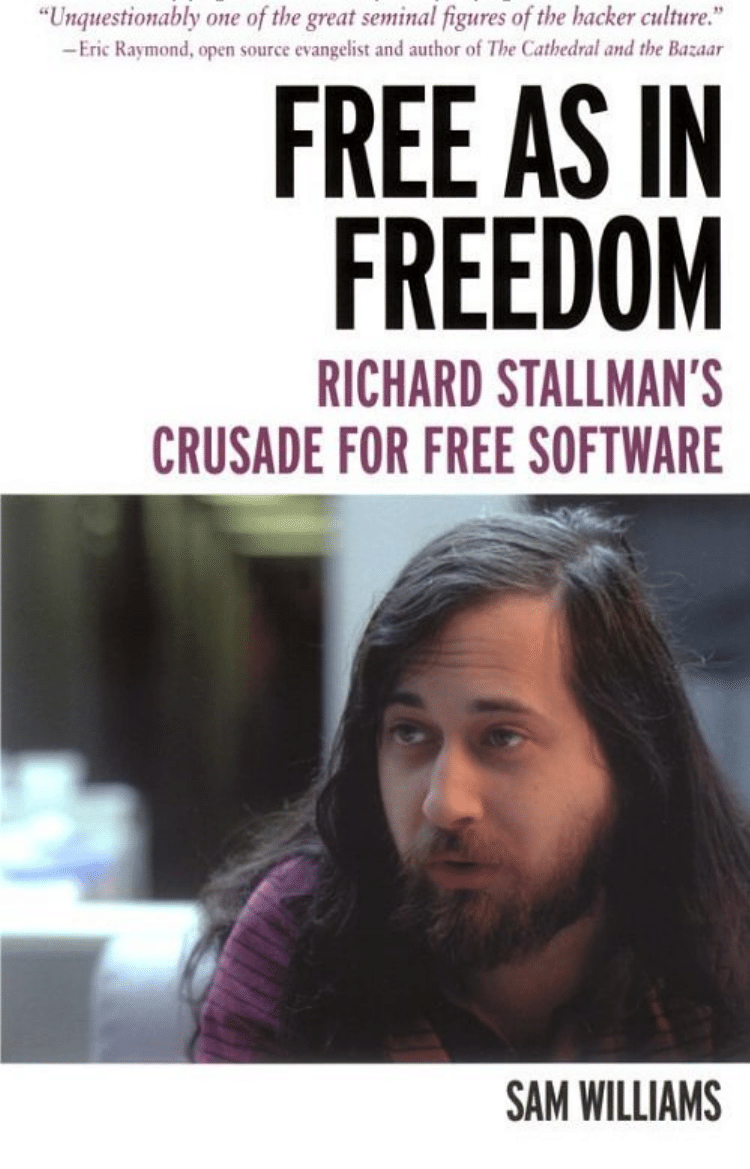

Free as in Freedom
Richard Stallman's Crusade for Free
Software
By Sam Williams
March 2002
0-596-00287-4, Order Number: 2874
240 pages, $22.95 US $34.95 CA
From Library Journal
In 1984, Richard Stallman launched the GNU Project for
the purpose of developing a complete UNIX-like operating
system that would allow for free software use. What he
developed was the GNU operating system. (GNU is a
recursive acronym for "GNU's Not UNIX,'' and it is
pronounced guh-NEW. Linux is a variant of the GNU
operating system.) This biography traces the evolution of
Stallman's eccentric genius from gifted child to teen
outcast to passionate crusader for free software. To
Stallman, free software is morally vital, and for the past
two decades he has devoted his life to eradicating
proprietary source codes from the world. Savvy
programmers revere Stallman; Bill Gates reviles him.
Much of the fascination with Stallman lies in his messianic
zeal, which Williams, a freelance writer specializing in
high-tech culture, has attempted to capture here, drawing

on a number of interviews with the unconventional
Stallman, his associates, fans, and critics. The result is an
esoteric and uneven work whose audience will likely be
limited to the army of programmers drawn to Stallman's
worthy cause. Buy accordingly. Joe Accardi, Harper Coll.
Lib., Palatine, IL Copyright 2002 Cahners Business
Information, Inc.
Book Description
Free as in Freedom interweaves biographical snapshots of
GNU project founder Richard Stallman with the political,
social and economic history of the free software
movement. Starting with how it all began--a desire for
software code from Xerox to make the printing more
efficient--to the continuing quest for free software that
exists today. It is a movement which Stallman has at turns
defined, directed and manipulated with a Stalin-like flair,
and the goal of the book is to document how Stallman's
own personal evolution has done much to shape notions of
what free software is and should be. Like Alan Greenspan
in the financial sector, Stallman has assumed the role of
tribal elder in a community that bills itself as anarchic and
immune to central authority. Free as in Freedom looks at
how the latest twists and turns in the software marketplace
have done little to throw Stallman off his pedestal.
Discover how Richard's childhood and teenage experiences
as well as his years at Harvard and MIT made him the man
he is today. The book's narrative style includes many

candid quotes (like any other type existed) from Richard
and his Mother about his life, education, and work
providing a entertaining, thought-provoking, and some
frustrating look at RMS and Free Software Foundation
(FSF). The author had the opportunity of numerous
meetings with Stallman to uncover what's behind those
piercing eyes. Also, peppered throughout Free as in
Freedom are insights from FSF supporters, detractors, the
early MIT hackers, and those who knew him in high school
and college. If anything, the current software marketplace
has made Stallman's logic-based rhetoric and immovable
personality more persuasive. In a rapidly changing world
people need a fixed reference point, and Stallman has
become that reference point for many in the software
world.
Book Info
Interweaves biographical snapshots of GNU project
founder Richard Stallman with the political, social and
economic history of the free software movement. Looks at
how the latest twists and turns in the software marketplace
have done little to throw Stallman off his pedestal

Table of Contents
Chapter 1: For Want of a Printer
Chapter 2: 2001: A Hacker's Odyssey
Chapter 3: A Portrait of the Hacker as a Young Man
Chapter 5: Small Puddle of Freedom
Chapter 7: A Stark Moral Choice
Chapter 9: The GNU General Public License
Chapter 12: A Brief Journey Through Hacker Hell
Chapter 13: Continuing the Fight
Chapter 14: Epilogue: Crushing Loneliness
Appendix B: Hack, Hackers, and Hacking
Appendix C: GNU Free Documentation License (GFDL)

Preface
The work of Richard M. Stallman literally
speaks for itself. From the documented
source code to the published papers to the
recorded speeches, few people have
expressed as much willingness to lay their
thoughts and their work on the line.
Such openness-if one can pardon a
momentary un-Stallman adjective-is
refreshing. After all, we live in a society that
treats information, especially personal
information, as a valuable commodity. The
question quickly arises. Why would anybody
want to part with so much information and
yet appear to demand nothing in return?
As we shall see in later chapters, Stallman
does not part with his words or his work
altruistically. Every program, speech, and on-
the-record bon mot comes with a price,
albeit not the kind of price most people are
used to paying.
I bring this up not as a warning, but as an
admission. As a person who has spent the
last year digging up facts on Stallman's
personal history, it's more than a little

intimidating going up against the Stallman
oeuvre. "Never pick a fight with a man who
buys his ink by the barrel," goes the old
Mark Twain adage. In the case of Stallman,
never attempt the definitive biography of a
man who trusts his every thought to the
public record.
For the readers who have decided to trust a
few hours of their time to exploring this
book, I can confidently state that there are
facts and quotes in here that one won't find
in any Slashdot story or Google search.
Gaining access to these facts involves paying
a price, however. In the case of the book
version, you can pay for these facts the
traditional manner, i.e., by purchasing the
book. In the case of the electronic versions,
you can pay for these facts in the free
software manner. Thanks to the folks at
O'Reilly & Associates, this book is being
distributed under the GNU Free
Documentation License, meaning you can
help to improve the work or create a
personalized version and release that version
under the same license.
If you are reading an electronic version and
prefer to accept the latter payment option,
that is, if you want to improve or expand this

book for future readers, I welcome your
input. Starting in June, 2002, I will be
publishing a bare bones HTML version of
the book on the web site,
it regularly and expand the Free as in
Freedom story as events warrant. If you
choose to take the latter course, please
review Appendix C of this book. It provides
a copy of your rights under the GNU Free
Documentation License.
For those who just plan to sit back and read,
online or elsewhere, I consider your attention
an equally valuable form of payment. Don't
be surprised, though, if you, too, find
yourself looking for other ways to reward the
good will that made this work possible.
One final note: this is a work of journalism,
but it is also a work of technical
documentation. In the process of writing and
editing this book, the editors and I have
weighed the comments and factual input of
various participants in the story, including
Richard Stallman himself. We realize there
are many technical details in this story that
may benefit from additional or refined
information. As this book is released under
the GFDL, we are accepting patches just like

we would with any free software program.
Accepted changes will be posted
electronically and will eventually be
incorporated into future printed versions of
this work. If you would like to contribute to
the further improvement of this book, you
can reach me at
.
Comments and Questions
Please address comments and questions
concerning this book to the publisher:
O'Reilly & Associates, Inc.
1005 Gravenstein Highway
North
Sebastopol, CA 95472
(800) 998-9938 (in the United
States or Canada)
(707) 829-0515
(international/local)
(707) 829-0104 (fax)
There is a web page for this book, which
lists errata, examples, or any additional
information. The site also includes a link to a
forum where you can discuss the book with
the author and other readers. You can access
this site at:

http://www.oreilly.com/catalog/freedom/
To comment or ask technical questions about
this book, send email to:
For more information about books,
conferences, Resource Centers, and the
O'Reilly Network, see the O'Reilly web site
at:
Acknowledgments
Special thanks to Henning Gutmann for
sticking by this book. Special thanks to
Aaron Oas for suggesting the idea to Tracy
in the first place. Thanks to Laurie Petrycki,
Jeffrey Holcomb, and all the others at
O'Reilly & Associates. Thanks to Tim
O'Reilly for backing this book. Thanks to all
the first-draft reviewers: Bruce Perens, Eric
Raymond, Eric Allman, Jon Orwant, Julie
and Gerald Jay Sussman, Hal Abelson, and
Guy Steele. I hope you enjoy this typo-free
version. Thanks to Alice Lippman for the

interviews, cookies, and photographs.
Thanks to my family, Steve, Jane, Tish, and
Dave. And finally, last but not least: thanks
to Richard Stallman for having the guts and
endurance to "show us the code."
Sam Williams

Chapter 1
For Want of a Printer
I fear the Greeks. Even when they bring
gifts.
---Virgil
The Aeneid
The new printer was jammed, again.
Richard M. Stallman, a staff software
programmer at the Massachusetts Institute of
Technology's Artificial Intelligence
Laboratory (AI Lab), discovered the
malfunction the hard way. An hour after
sending off a 50-page file to the office laser
printer, Stallman, 27, broke off a productive
work session to retrieve his documents.
Upon arrival, he found only four pages in the
printer's tray. To make matters even more
frustrating, the four pages belonged to
another user, meaning that Stallman's print
job and the unfinished portion of somebody
else's print job were still trapped somewhere
within the electrical plumbing of the lab's
computer network.

Waiting for machines is an occupational
hazard when you're a software programmer,
so Stallman took his frustration with a grain
of salt. Still, the difference between waiting
for a machine and waiting on a machine is a
sizable one. It wasn't the first time he'd been
forced to stand over the printer, watching
pages print out one by one. As a person who
spent the bulk of his days and nights
improving the efficiency of machines and
the software programs that controlled them,
Stallman felt a natural urge to open up the
machine, look at the guts, and seek out the
root of the problem.
Unfortunately, Stallman's skills as a
computer programmer did not extend to the
mechanical-engineering realm. As freshly
printed documents poured out of the
machine, Stallman had a chance to reflect on
other ways to circumvent the printing jam
problem.
How long ago had it been that the staff
members at the AI Lab had welcomed the
new printer with open arms? Stallman
wondered. The machine had been a donation
from the Xerox Corporation. A cutting edge
prototype, it was a modified version of the
popular Xerox photocopier. Only instead of

making copies, it relied on software data
piped in over a computer network to turn
that data into professional-looking
documents. Created by engineers at the
world-famous Xerox Palo Alto Research
Facility, it was, quite simply, an early taste
of the desktop-printing revolution that would
seize the rest of the computing industry by
the end of the decade.
Driven by an instinctual urge to play with
the best new equipment, programmers at the
AI Lab promptly integrated the new machine
into the lab's sophisticated computing
infrastructure. The results had been
immediately pleasing. Unlike the lab's old
laser printer, the new Xerox machine was
fast. Pages came flying out at a rate of one
per second, turning a 20-minute print job
into a 2-minute print job. The new machine
was also more precise. Circles came out
looking like circles, not ovals. Straight lines
came out looking like straight lines, not low-
amplitude sine waves.
It was, for all intents and purposes, a gift too
good to refuse.
It wasn't until a few weeks after its arrival
that the machine's flaws began to surface.

Chief among the drawbacks was the
machine's inherent susceptibility to paper
jams. Engineering-minded programmers
quickly understood the reason behind the
flaw. As a photocopier, the machine
generally required the direct oversight of a
human operator. Figuring that these human
operators would always be on hand to fix a
paper jam, if it occurred, Xerox engineers
had devoted their time and energies to
eliminating other pesky problems. In
engineering terms, user diligence was built
into the system.
In modifying the machine for printer use,
Xerox engineers had changed the user-
machine relationship in a subtle but
profound way. Instead of making the
machine subservient to an individual human
operator, they made it subservient to an
entire networked population of human
operators. Instead of standing directly over
the machine, a human user on one end of the
network sent his print command through an
extended bucket-brigade of machines,
expecting the desired content to arrive at the
targeted destination and in proper form. It
wasn't until he finally went to check up on
the final output that he realized how little of
the desired content had made it through.

Stallman himself had been of the first to
identify the problem and the first to suggest
a remedy. Years before, when the lab was
still using its old printer, Stallman had
solved a similar problem by opening up the
software program that regulated the printer
on the lab's PDP-11 machine. Stallman
couldn't eliminate paper jams, but he could
insert a software command that ordered the
PDP-11 to check the printer periodically and
report back to the PDP-10, the lab's central
computer. To ensure that one user's
negligence didn't bog down an entire line of
print jobs, Stallman also inserted a software
command that instructed the PDP-10 to
notify every user with a waiting print job
that the printer was jammed. The notice was
simple, something along the lines of "The
printer is jammed, please fix it," and because
it went out to the people with the most
pressing need to fix the problem, chances
were higher that the problem got fixed in due
time.
As fixes go, Stallman's was oblique but
elegant. It didn't fix the mechanical side of
the problem, but it did the next best thing by
closing the information loop between user
and machine. Thanks to a few additional

lines of software code, AI Lab employees
could eliminate the 10 or 15 minutes wasted
each week in running back and forth to
check on the printer. In programming terms,
Stallman's fix took advantage of the
amplified intelligence of the overall network.
"If you got that message, you couldn't
assume somebody else would fix it," says
Stallman, recalling the logic. "You had to go
to the printer. A minute or two after the
printer got in trouble, the two or three people
who got messages arrive to fix the machine.
Of those two or three people, one of them, at
least, would usually know how to fix the
problem."
Such clever fixes were a trademark of the AI
Lab and its indigenous population of
programmers. Indeed, the best programmers
at the AI Lab disdained the term
programmer, preferring the more slangy
occupational title of hacker instead. The job
title covered a host of activities-everything
from creative mirth making to the
improvement of existing software and
computer systems. Implicit within the title,
however, was the old-fashioned notion of
Yankee ingenuity. To be a hacker, one had
to accept the philosophy that writing a

software program was only the beginning.
Improving a program was the true test of a
hacker's skills.
Such a philosophy was a major reason why
companies like Xerox made it a policy to
donate their machines and software
programs to places where hackers typically
congregated. If hackers improved the
software, companies could borrow back the
improvements, incorporating them into
update versions for the commercial
marketplace. In corporate terms, hackers
were a leveragable community asset, an
auxiliary research-and-development division
available at minimal cost.
It was because of this give-and-take
philosophy that when Stallman spotted the
print-jam defect in the Xerox laser printer,
he didn't panic. He simply looked for a way
to update the old fix or " hack" for the new
system. In the course of looking up the
Xerox laser-printer software, however,
Stallman made a troubling discovery. The
printer didn't have any software, at least
nothing Stallman or a fellow programmer
could read. Until then, most companies had
made it a form of courtesy to publish source-
code files-readable text files that

documented the individual software
commands that told a machine what to do.
Xerox, in this instance, had provided
software files in precompiled, or binary,
form. Programmers were free to open the
files up if they wanted to, but unless they
were an expert in deciphering an endless
stream of ones and zeroes, the resulting text
was pure gibberish.
Although Stallman knew plenty about
computers, he was not an expert in
translating binary files. As a hacker,
however, he had other resources at his
disposal. The notion of information sharing
was so central to the hacker culture that
Stallman knew it was only a matter of time
before some hacker in some university lab or
corporate computer room proffered a version
of the laser-printer source code with the
desired source-code files.
After the first few printer jams, Stallman
comforted himself with the memory of a
similar situation years before. The lab had
needed a cross-network program to help the
PDP-11 work more efficiently with the PDP-
10. The lab's hackers were more than up to
the task, but Stallman, a Harvard alumnus,
recalled a similar program written by

programmers at the Harvard computer-
science department. The Harvard computer
lab used the same model computer, the PDP-
10, albeit with a different operating system.
The Harvard computer lab also had a policy
requiring that all programs installed on the
PDP-10 had to come with published source-
code files.
Taking advantage of his access to the
Harvard computer lab, Stallman dropped in,
made a copy of the cross-network source
code, and brought it back to the AI Lab. He
then rewrote the source code to make it more
suitable for the AI Lab's operating system.
With no muss and little fuss, the AI Lab
shored up a major gap in its software
infrastructure. Stallman even added a few
features not found in the original Harvard
program, making the program even more
useful. "We wound up using it for several
years," Stallman says.
From the perspective of a 1970s-era
programmer, the transaction was the
software equivalent of a neighbor stopping
by to borrow a power tool or a cup of sugar
from a neighbor. The only difference was
that in borrowing a copy of the software for
the AI Lab, Stallman had done nothing to

deprive Harvard hackers the use of their
original program. If anything, Harvard
hackers gained in the process, because
Stallman had introduced his own additional
features to the program, features that hackers
at Harvard were perfectly free to borrow in
return. Although nobody at Harvard ever
came over to borrow the program back,
Stallman does recall a programmer at the
private engineering firm, Bolt, Beranek &
Newman, borrowing the program and adding
a few additional features, which Stallman
eventually reintegrated into the AI Lab's own
source-code archive.
"A program would develop the way a city
develops," says Stallman, recalling the
software infrastructure of the AI Lab. "Parts
would get replaced and rebuilt. New things
would get added on. But you could always
look at a certain part and say, `Hmm, by the
style, I see this part was written back in the
early 60s and this part was written in the mid-
1970s.'"
Through this simple system of intellectual
accretion, hackers at the AI Lab and other
places built up robust creations. On the west
coast, computer scientists at UC Berkeley,
working in cooperation with a few low-level

engineers at AT&T, had built up an entire
operating system using this system. Dubbed
Unix, a play on an older, more academically
respectable operating system called Multics,
the software system was available to any
programmer willing to pay for the cost of
copying the program onto a new magnetic
tape and shipping it. Not every programmer
participating in this culture described himself
as a hacker, but most shared the sentiments
of Richard M. Stallman. If a program or
software fix was good enough to solve your
problems, it was good enough to solve
somebody else's problems. Why not share it
out of a simple desire for good karma?
The fact that Xerox had been unwilling to
share its source-code files seemed a minor
annoyance at first. In tracking down a copy
of the source-code files, Stallman says he
didn't even bother contacting Xerox. "They
had already given us the laser printer,"
Stallman says. "Why should I bug them for
more?"
When the desired files failed to surface,
however, Stallman began to grow suspicious.
The year before, Stallman had experienced a
blow up with a doctoral student at Carnegie
Mellon University. The student, Brian Reid,

was the author of a useful text-formatting
program dubbed Scribe. One of the first
programs that gave a user the power to
define fonts and type styles when sending a
document over a computer network, the
program was an early harbinger of HTML,
the lingua franca of the World Wide Web. In
1979, Reid made the decision to sell Scribe
to a Pittsburgh-area software company called
Unilogic. His graduate-student career
ending, Reid says he simply was looking for
a way to unload the program on a set of
developers that would take pains to keep it
from slipping into the public domain. To
sweeten the deal, Reid also agreed to insert a
set of time-dependent functions- "time
bombs" in software-programmer parlance-
that deactivated freely copied versions of the
program after a 90-day expiration date. To
avoid deactivation, users paid the software
company, which then issued a code that
defused the internal time-bomb feature.
For Reid, the deal was a win-win. Scribe
didn't fall into the public domain, and
Unilogic recouped on its investment. For
Stallman, it was a betrayal of the
programmer ethos, pure and simple. Instead
of honoring the notion of share-and-share
alike, Reid had inserted a way for companies

to compel programmers to pay for
information access.
As the weeks passed and his attempts to
track down Xerox laser-printer source code
hit a brick wall, Stallman began to sense a
similar money-for-code scenario at work.
Before Stallman could do or say anything
about it, however, good news finally trickled
in via the programmer grapevine. Word had
it that a scientist at the computer-science
department at Carnegie Mellon University
had just departed a job at the Xerox Palo
Alto Research Center. Not only had the
scientist worked on the laser printer in
question, but according to rumor, he was still
working on it as part of his research duties at
Carnegie Mellon.
Casting aside his initial suspicion, Stallman
made a firm resolution to seek out the person
in question during his next visit to the
Carnegie Mellon campus.
He didn't have to wait long. Carnegie Mellon
also had a lab specializing in artificial-
intelligence research, and within a few
months, Stallman had a business-related
reason to visit the Carnegie Mellon campus.
During that visit, he made sure to stop by the

computer-science department. Department
employees directed him to the office of the
faculty member leading the Xerox project.
When Stallman reached the office, he found
the professor working there.
In true engineer-to-engineer fashion, the
conversation was cordial but blunt. After
briefly introducing himself as a visitor from
MIT, Stallman requested a copy of the laser-
printer source code so that he could port it to
the PDP-11. To his surprise, the professor
refused to grant his request.
"He told me that he had promised not to give
me a copy," Stallman says.
Memory is a funny thing. Twenty years after
the fact, Stallman's mental history tape is
notoriously blank in places. Not only does he
not remember the motivating reason for the
trip or even the time of year during which he
took it, he also has no recollection of the
professor or doctoral student on the other
end of the conversation. According to Reid,
the person most likely to have fielded
Stallman's request is Robert Sproull, a
former Xerox PARC researcher and current
director of Sun Laboratories, a research

division of the computer-technology
conglomerate Sun Microsystems. During the
1970s, Sproull had been the primary
developer of the laser-printer software in
question while at Xerox PARC. Around
1980, Sproull took a faculty research
position at Carnegie Mellon where he
continued his laser-printer work amid other
projects.
"The code that Stallman was asking for was
leading-edge state-of-the-art code that
Sproull had written in the year or so before
going to Carnegie Mellon," recalls Reid. "I
suspect that Sproull had been at Carnegie
Mellon less than a month before this request
came in."
When asked directly about the request,
however, Sproull draws a blank. "I can't
make a factual comment," writes Sproull via
email. "I have absolutely no recollection of
the incident."
With both participants in the brief
conversation struggling to recall key details-
including whether the conversation even
took place-it's hard to gauge the bluntness of
Sproull's refusal, at least as recalled by
Stallman. In talking to audiences, Stallman

has made repeated reference to the incident,
noting that Sproull's unwillingness to hand
over the source code stemmed from a
nondisclosure agreement, a contractual
agreement between Sproull and the Xerox
Corporation giving Sproull, or any other
signatory, access the software source code in
exchange for a promise of secrecy. Now a
standard item of business in the software
industry, the nondisclosure agreement, or
NDA, was a novel development at the time,
a reflection of both the commercial value of
the laser printer to Xerox and the
information needed to run it. "Xerox was at
the time trying to make a commercial
product out of the laser printer," recalls Reid.
"They would have been insane to give away
the source code."
For Stallman, however, the NDA was
something else entirely. It was a refusal on
the part of Xerox and Sproull, or whomever
the person was that turned down his source-
code request that day, to participate in a
system that, until then, had encouraged
software programmers to regard programs as
communal resources. Like a peasant whose
centuries-old irrigation ditch had grown
suddenly dry, Stallman had followed the
ditch to its source only to find a brand-

spanking-new hydroelectric dam bearing the
Xerox logo.
For Stallman, the realization that Xerox had
compelled a fellow programmer to
participate in this newfangled system of
compelled secrecy took a while to sink in. At
first, all he could focus on was the personal
nature of the refusal. As a person who felt
awkward and out of sync in most face-to-
face encounters, Stallman's attempt to drop
in on a fellow programmer unannounced had
been intended as a demonstration of
neighborliness. Now that the request had
been refused, it felt like a major blunder. "I
was so angry I couldn't think of a way to
express it. So I just turned away and walked
out without another word," Stallman recalls.
"I might have slammed the door. Who
knows? All I remember is wanting to get out
of there."
Twenty years after the fact, the anger still
lingers, so much so that Stallman has
elevated the event into a major turning point.
Within the next few months, a series of
events would befall both Stallman and the AI
Lab hacker community that would make 30
seconds worth of tension in a remote
Carnegie Mellon office seem trivial by

comparison. Nevertheless, when it comes
time to sort out the events that would
transform Stallman from a lone hacker,
instinctively suspicious of centralized
authority, to a crusading activist applying
traditional notions of liberty, equality, and
fraternity to the world of software
development, Stallman singles out the
Carnegie Mellon encounter for special
attention.
"It encouraged me to think about something
that I'd already been thinking about," says
Stallman. "I already had an idea that
software should be shared, but I wasn't sure
how to think about that. My thoughts weren't
clear and organized to the point where I
could express them in a concise fashion to
the rest of the world."
Although previous events had raised
Stallman's ire, he says it wasn't until his
Carnegie Mellon encounter that he realized
the events were beginning to intrude on a
culture he had long considered sacrosanct.
As an elite programmer at one of the world's
elite institutions, Stallman had been perfectly
willing to ignore the compromises and
bargains of his fellow programmers just so
long as they didn't interfere with his own

work. Until the arrival of the Xerox laser
printer, Stallman had been content to look
down on the machines and programs other
computer users grimly tolerated. On the rare
occasion that such a program breached the
AI Lab's walls-when the lab replaced its
venerable Incompatible Time Sharing
operating system with a commercial variant,
the TOPS 20, for example-Stallman and his
hacker colleagues had been free to rewrite,
reshape, and rename the software according
to personal taste.
Now that the laser printer had insinuated
itself within the AI Lab's network, however,
something had changed. The machine
worked fine, barring the occasional paper
jam, but the ability to modify according to
personal taste had disappeared. From the
viewpoint of the entire software industry, the
printer was a wake-up call. Software had
become such a valuable asset that companies
no longer felt the need to publicize source
code, especially when publication meant
giving potential competitors a chance to
duplicate something cheaply. From
Stallman's viewpoint, the printer was a
Trojan Horse. After a decade of failure,
privately owned software-future hackers
would use the term " proprietary" software-

had gained a foothold inside the AI Lab
through the sneakiest of methods. It had
come disguised as a gift.
That Xerox had offered some programmers
access to additional gifts in exchange for
secrecy was also galling, but Stallman takes
pains to note that, if presented with such a
quid pro quo bargain at a younger age, he
just might have taken the Xerox Corporation
up on its offer. The awkwardness of the
Carnegie Mellon encounter, however, had a
firming effect on Stallman's own moral
lassitude. Not only did it give him the
necessary anger to view all future entreaties
with suspicion, it also forced him to ask the
uncomfortable question: what if a fellow
hacker dropped into Stallman's office
someday and it suddenly became Stallman's
job to refuse the hacker's request for source
code?
"It was my first encounter with a
nondisclosure agreement, and it immediately
taught me that nondisclosure agreements
have victims," says Stallman, firmly. "In this
case I was the victim. [My lab and I] were
victims."
It was a lesson Stallman would carry with

him through the tumultuous years of the
1980s, a decade during which many of his
MIT colleagues would depart the AI Lab and
sign nondisclosure agreements of their own.
Because most nondisclosure aggreements
(NDAs) had expiration dates, few hackers
who did sign them saw little need for
personal introspection. Sooner or later, they
reasoned, the software would become public
knowledge. In the meantime, promising to
keep the software secret during its earliest
development stages was all a part of the
compromise deal that allowed hackers to
work on the best projects. For Stallman,
however, it was the first step down a slippery
slope.
"When somebody invited me to betray all
my colleagues in that way, I remembered
how angry I was when somebody else had
done that to me and my whole lab," Stallman
says. "So I said, `Thank you very much for
offering me this nice software package, but I
can't accept it on the conditions that you're
asking for, so I'm going to do without it.'"
As Stallman would quickly learn, refusing
such requests involved more than personal
sacrifice. It involved segregating himself
from fellow hackers who, though sharing a

similar distaste for secrecy, tended to express
that distaste in a more morally flexible
fashion. It wasn't long before Stallman,
increasingly an outcast even within the AI
Lab, began billing himself as "the last true
hacker," isolating himself further and further
from a marketplace dominated by
proprietary software. Refusing another's
request for source code, Stallman decided,
was not only a betrayal of the scientific
mission that had nurtured software
development since the end of World War II,
it was a violation of the Golden Rule, the
baseline moral dictate to do unto others as
you would have them do unto you.
Hence the importance of the laser printer and
the encounter that resulted from it. Without
it, Stallman says, his life might have
followed a more ordinary path, one
balancing the riches of a commercial
programmer with the ultimate frustration of
a life spent writing invisible software code.
There would have been no sense of clarity,
no urgency to address a problem others
weren't addressing. Most importantly, there
would have been no righteous anger, an
emotion that, as we soon shall see, has
propelled Stallman's career as surely as any
political ideology or ethical belief.

"From that day forward, I decided this was
something I could never participate in," says
Stallman, alluding to the practice of trading
personal liberty for the sake of convenience-
Stallman's description of the NDA bargain-
as well as the overall culture that encouraged
such ethically suspect deal-making in the
first place. "I decided never to make other
people victims just like I had been a victim."
Endnote
1. For more on the term "hacker," see

Chapter 2
2001: A Hacker's Odyssey
The New York University computer-science department sits
inside Warren Weaver Hall, a fortress-like building located
two blocks east of Washington Square Park. Industrial-
strength air-conditioning vents create a surrounding moat of
hot air, discouraging loiterers and solicitors alike. Visitors
who breach the moat encounter another formidable barrier, a
security check-in counter immediately inside the building's
single entryway.
Beyond the security checkpoint, the atmosphere relaxes
somewhat. Still, numerous signs scattered throughout the
first floor preach the dangers of unsecured doors and
propped-open fire exits. Taken as a whole, the signs offer a
reminder: even in the relatively tranquil confines of pre-
September 11, 2001, New York, one can never be too
careful or too suspicious.
The signs offer an interesting thematic counterpoint to the
growing number of visitors gathering in the hall's interior
atrium. A few look like NYU students. Most look like
shaggy-aired concert-goers milling outside a music hall in
anticipation of the main act. For one brief morning, the
masses have taken over Warren Weaver Hall, leaving the
nearby security attendant with nothing better to do but
watch Ricki Lake on TV and shrug her shoulders toward the
nearby auditorium whenever visitors ask about "the speech."
Once inside the auditorium, a visitor finds the person who
has forced this temporary shutdown of building security
procedures. The person is Richard M. Stallman, founder of
the GNU Project, original president of the Free Software

Foundation, winner of the 1990 MacArthur Fellowship,
winner of the Association of Computing Machinery's Grace
Murray Hopper Award (also in 1990), corecipient of the
Takeda Foundation's 2001 Takeda Award, and former AI
Lab hacker. As announced over a host of hacker-related web
sites, including the GNU Project's own
site, Stallman is in Manhattan, his former hometown, to
deliver a much anticipated speech in rebuttal to the
Microsoft Corporation's recent campaign against the GNU
General Public License.
The subject of Stallman's speech is the history and future of
the free software movement. The location is significant.
Less than a month before, Microsoft senior vice president
Craig Mundie appeared at the nearby NYU Stern School of
Business, delivering a speech blasting the General Public
License, or GPL, a legal device originally conceived by
Stallman 16 years before. Built to counteract the growing
wave of software secrecy overtaking the computer industry-
a wave first noticed by Stallman during his 1980 troubles
with the Xerox laser printer-the GPL has evolved into a
central tool of the free software community. In simplest
terms, the GPL locks software programs into a form of
communal ownership-what today's legal scholars now call
the "digital commons"-through the legal weight of
copyright. Once locked, programs remain unremovable.
Derivative versions must carry the same copyright
protection-even derivative versions that bear only a small
snippet of the original source code. For this reason, some
within the software industry have taken to calling the GPL a
"viral" license, because it spreads itself to every software
program it touches.
In an information economy increasingly dependent on
software and increasingly beholden to software standards,
the GPL has become the proverbial "big stick." Even
companies that once laughed it off as software socialism

have come around to recognize the benefits. Linux, the Unix-
like kernel developed by Finnish college student Linus
Torvalds in 1991, is licensed under the GPL, as are many of
the world's most popular programming tools: GNU Emacs,
the GNU Debugger, the GNU C Compiler, etc. Together,
these tools form the components of a free software operating
system developed, nurtured, and owned by the worldwide
hacker community. Instead of viewing this community as a
threat, high-tech companies like IBM, Hewlett Packard, and
Sun Microsystems have come to rely upon it, selling
software applications and services built to ride atop the ever-
growing free software infrastructure.
They've also come to rely upon it as a strategic weapon in
the hacker community's perennial war against Microsoft, the
Redmond, Washington-based company that, for better or
worse, has dominated the PC-software marketplace since the
late 1980s. As owner of the popular Windows operating
system, Microsoft stands to lose the most in an industry-
wide shift to the GPL license. Almost every line of source
code in the Windows colossus is protected by copyrights
reaffirming the private nature of the underlying source code
or, at the very least, reaffirming Microsoft's legal ability to
treat it as such. From the Microsoft viewpoint, incorporating
programs protected by the "viral" GPL into the Windows
colossus would be the software equivalent of Superman
downing a bottle of Kryptonite pills. Rival companies could
suddenly copy, modify, and sell improved versions of
Windows, rendering the company's indomitable position as
the No. 1 provider of consumer-oriented software instantly
vulnerable. Hence the company's growing concern over the
GPL's rate of adoption. Hence the recent Mundie speech
blasting the GPL and the " open source" approach to
software development and sales. And hence Stallman's
decision to deliver a public rebuttal to that speech on the
same campus here today.

20 years is a long time in the software industry. Consider
this: in 1980, when Richard Stallman was cursing the AI
Lab's Xerox laser printer, Microsoft, the company modern
hackers view as the most powerful force in the worldwide
software industry, was still a privately held startup. IBM, the
company hackers used to regard as the most powerful force
in the worldwide software industry, had yet to to introduce
its first personal computer, thereby igniting the current low-
cost PC market. Many of the technologies we now take for
granted-the World Wide Web, satellite television, 32-bit
video-game consoles-didn't even exist. The same goes for
many of the companies that now fill the upper echelons of
the corporate establishment, companies like AOL, Sun
Microsystems, Amazon.com, Compaq, and Dell. The list
goes on and on.
The fact that the high-technology marketplace has come so
far in such little time is fuel for both sides of the GPL
debate. GPL-proponents point to the short lifespan of most
computer hardware platforms. Facing the risk of buying an
obsolete product, consumers tend to flock to companies with
the best long-term survival. As a result, the software
marketplace has become a winner-take-all arena.
The
current, privately owned software environment, GPL-
proponents say, leads to monopoly abuse and stagnation.
Strong companies suck all the oxygen out of the
marketplace for rival competitors and innovative startups.
GPL-opponents argue just the opposite. Selling software is
just as risky, if not more risky, than buying software, they
say. Without the legal guarantees provided by private
software licenses, not to mention the economic prospects of
a privately owned "killer app" (i.e., a breakthrough
technology that launches an entirely new market),
companies lose the incentive to participate. Once again, the
market stagnates and innovation declines. As Mundie
himself noted in his May 3 address on the same campus, the

GPL's "viral" nature "poses a threat" to any company that
relies on the uniqueness of its software as a competitive
asset. Added Mundie:
It also fundamentally undermines the
independent commercial software sector
because it effectively makes it impossible to
distribute software on a basis where recipients
pay for the product rather than just the cost of
distribution.
The mutual success of GNU/ Linux, the amalgamated
operating system built around the GPL-protected Linux
kernel, and Windows over the last 10 years reveals the
wisdom of both perspectives. Nevertheless, the battle for
momentum is an important one in the software industry.
Even powerful vendors such as Microsoft rely on the
support of third-party software developers whose tools,
programs, and computer games make an underlying
software platform such as Windows more attractive to the
mainstream consumer. Citing the rapid evolution of the
technology marketplace over the last 20 years, not to
mention his own company's admirable track record during
that period, Mundie advised listeners to not get too carried
away by the free software movement's recent momentum:
Two decades of experience have shown that
an economic model that protects intellectual
property and a business model that recoups
research and development costs can create
impressive economic benefits and distribute
them very broadly.
Such admonitions serve as the backdrop for Stallman's
speech today. Less than a month after their utterance,
Stallman stands with his back to one of the chalk boards at
the front of the room, edgy to begin.

If the last two decades have brought dramatic changes to the
software marketplace, they have brought even more
dramatic changes to Stallman himself. Gone is the skinny,
clean-shaven hacker who once spent his entire days
communing with his beloved PDP-10. In his place stands a
heavy-set middle-aged man with long hair and rabbinical
beard, a man who now spends the bulk of his time writing
and answering email, haranguing fellow programmers, and
giving speeches like the one today. Dressed in an aqua-
colored T-shirt and brown polyester pants, Stallman looks
like a desert hermit who just stepped out of a Salvation
Army dressing room.
The crowd is filled with visitors who share Stallman's
fashion and grooming tastes. Many come bearing laptop
computers and cellular modems, all the better to record and
transmit Stallman's words to a waiting Internet audience.
The gender ratio is roughly 15 males to 1 female, and 1 of
the 7 or 8 females in the room comes in bearing a stuffed
penguin, the official Linux mascot, while another carries a
stuffed teddy bear.
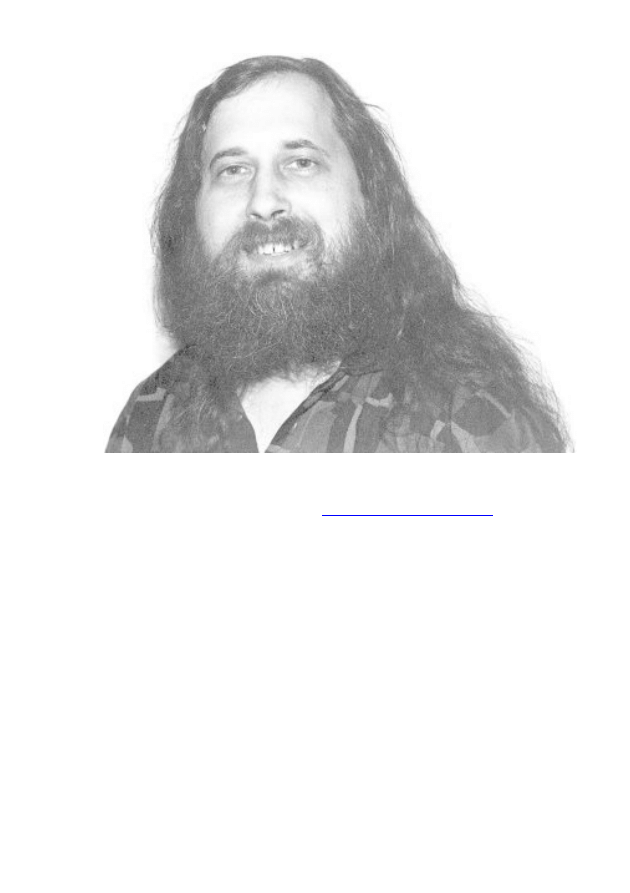
Richard Stallman, circa 2000. "I decided I would develop a
free software operating system or die trying . . . of old age of
Agitated, Stallman leaves his post at the front of the room
and takes a seat in a front-row chair, tapping a few
commands into an already-opened laptop. For the next 10
minutes Stallman is oblivious to the growing number of
students, professors, and fans circulating in front of him at
the foot of the auditorium stage.
Before the speech can begin, the baroque rituals of academic
formality must be observed. Stallman's appearance merits
not one but two introductions. Mike Uretsky, codirector of
the Stern School's Center for Advanced Technology,
provides the first.

"The role of a university is to foster debate and to have
interesting discussions," Uretsky says. "This particular
presentation, this seminar falls right into that mold. I find
the discussion of open source particularly interesting."
Before Uretsky can get another sentence out, Stallman is on
his feet waving him down like a stranded motorist.
"I do free software," Stallman says to rising laughter. "Open
source is a different movement."
The laughter gives way to applause. The room is stocked
with Stallman partisans, people who know of his reputation
for verbal exactitude, not to mention his much publicized
1998 falling out with the open source software proponents.
Most have come to anticipate such outbursts the same way
radio fans once waited for Jack Benny's trademark, "Now
cut that out!" phrase during each radio program.
Uretsky hastily finishes his introduction and cedes the stage
to Edmond Schonberg, a professor in the NYU computer-
science department. As a computer programmer and GNU
Project contributor, Schonberg knows which linguistic land
mines to avoid. He deftly summarizes Stallman's career
from the perspective of a modern-day programmer.
"Richard is the perfect example of somebody who, by acting
locally, started thinking globally [about] problems
concerning the unavailability of source code," says
Schonberg. "He has developed a coherent philosophy that
has forced all of us to reexamine our ideas of how software
is produced, of what intellectual property means, and of
what the software community actually represents."
Schonberg welcomes Stallman to more applause. Stallman
takes a moment to shut off his laptop, rises out of his chair,
and takes the stage.

At first, Stallman's address seems more Catskills comedy
routine than political speech. "I'd like to thank Microsoft for
providing me the opportunity to be on this platform,"
Stallman wisecracks. "For the past few weeks, I have felt
like an author whose book was fortuitously banned
somewhere."
For the uninitiated, Stallman dives into a quick free software
warm-up analogy. He likens a software program to a
cooking recipe. Both provide useful step-by-step
instructions on how to complete a desired task and can be
easily modified if a user has special desires or
circumstances. "You don't have to follow a recipe exactly,"
Stallman notes. "You can leave out some ingredients. Add
some mushrooms, 'cause you like mushrooms. Put in less
salt because your doctor said you should cut down on salt-
whatever."
Most importantly, Stallman says, software programs and
recipes are both easy to share. In giving a recipe to a dinner
guest, a cook loses little more than time and the cost of the
paper the recipe was written on. Software programs require
even less, usually a few mouse-clicks and a modicum of
electricity. In both instances, however, the person giving the
information gains two things: increased friendship and the
ability to borrow interesting recipes in return.
"Imagine what it would be like if recipes were packaged
inside black boxes," Stallman says, shifting gears. "You
couldn't see what ingredients they're using, let alone change
them, and imagine if you made a copy for a friend. They
would call you a pirate and try to put you in prison for years.
That world would create tremendous outrage from all the
people who are used to sharing recipes. But that is exactly
what the world of proprietary software is like. A world in
which common decency towards other people is prohibited

or prevented."
With this introductory analogy out of the way, Stallman
launches into a retelling of the Xerox laser-printer episode.
Like the recipe analogy, the laser-printer story is a useful
rhetorical device. With its parable-like structure, it
dramatizes just how quickly things can change in the
software world. Drawing listeners back to an era before
Amazon.com one-click shopping, Microsoft Windows, and
Oracle databases, it asks the listener to examine the notion
of software ownership free of its current corporate logos.
Stallman delivers the story with all the polish and practice of
a local district attorney conducting a closing argument.
When he gets to the part about the Carnegie Mellon
professor refusing to lend him a copy of the printer source
code, Stallman pauses.
"He had betrayed us," Stallman says. "But he didn't just do it
to us. Chances are he did it to you."
On the word "you," Stallman points his index finger
accusingly at an unsuspecting member of the audience. The
targeted audience member's eyebrows flinch slightly, but
Stallman's own eyes have moved on. Slowly and
deliberately, Stallman picks out a second listener to nervous
titters from the crowd. "And I think, mostly likely, he did it
to you, too," he says, pointing at an audience member three
rows behind the first.
By the time Stallman has a third audience member picked
out, the titters have given away to general laughter. The
gesture seems a bit staged, because it is. Still, when it comes
time to wrap up the Xerox laser-printer story, Stallman does
so with a showman's flourish. "He probably did it to most of
the people here in this room-except a few, maybe, who
weren't born yet in 1980," Stallman says, drawing more

laughs. "[That's] because he had promised to refuse to
cooperate with just about the entire population of the planet
Earth."
Stallman lets the comment sink in for a half-beat. "He had
signed a nondisclosure agreement," Stallman adds.
Richard Matthew Stallman's rise from frustrated academic
to political leader over the last 20 years speaks to many
things. It speaks to Stallman's stubborn nature and
prodigious will. It speaks to the clearly articulated vision
and values of the free software movement Stallman helped
build. It speaks to the high-quality software programs
Stallman has built, programs that have cemented Stallman's
reputation as a programming legend. It speaks to the
growing momentum of the GPL, a legal innovation that
many Stallman observers see as his most momentous
accomplishment.
Most importantly, it speaks to the changing nature of
political power in a world increasingly beholden to
computer technology and the software programs that power
that technology.
Maybe that's why, even at a time when most high-
technology stars are on the wane, Stallman's star has grown.
Since launching the GNU Project in 1984,
Stallman has
been at turns ignored, satirized, vilified, and attacked-both
from within and without the free software movement.
Through it all, the GNU Project has managed to meet its
milestones, albeit with a few notorious delays, and stay
relevant in a software marketplace several orders of
magnitude more complex than the one it entered 18 years
ago. So too has the free software ideology, an ideology
meticulously groomed by Stallman himself.

To understand the reasons behind this currency, it helps to
examine Richard Stallman both in his own words and in the
words of the people who have collaborated and battled with
him along the way. The Richard Stallman character sketch is
not a complicated one. If any person exemplifies the old
adage "what you see is what you get," it's Stallman.
"I think if you want to understand Richard Stallman the
human being, you really need to see all of the parts as a
consistent whole," advises Eben Moglen, legal counsel to
the Free Software Foundation and professor of law at
Columbia University Law School. "All those personal
eccentricities that lots of people see as obstacles to getting to
know Stallman really are Stallman: Richard's strong sense
of personal frustration, his enormous sense of principled
ethical commitment, his inability to compromise, especially
on issues he considers fundamental. These are all the very
reasons Richard did what he did when he did."
Explaining how a journey that started with a laser printer
would eventually lead to a sparring match with the world's
richest corporation is no easy task. It requires a thoughtful
examination of the forces that have made software
ownership so important in today's society. It also requires a
thoughtful examination of a man who, like many political
leaders before him, understands the malleability of human
memory. It requires an ability to interpret the myths and
politically laden code words that have built up around
Stallman over time. Finally, it requires an understanding of
Stallman's genius as a programmer and his failures and
successes in translating that genius to other pursuits.
When it comes to offering his own summary of the journey,
Stallman acknowledges the fusion of personality and
principle observed by Moglen. "Stubbornness is my strong
suit," he says. "Most people who attempt to do anything of
any great difficulty eventually get discouraged and give up.

I never gave up."
He also credits blind chance. Had it not been for that run-in
over the Xerox laser printer, had it not been for the personal
and political conflicts that closed out his career as an MIT
employee, had it not been for a half dozen other timely
factors, Stallman finds it very easy to picture his life
following a different career path. That being said, Stallman
gives thanks to the forces and circumstances that put him in
the position to make a difference.
"I had just the right skills," says Stallman, summing up his
decision for launching the GNU Project to the audience.
"Nobody was there but me, so I felt like, `I'm elected. I have
to work on this. If not me , who?'"
Endnotes
1. Actually, the GPL's powers are not quite that potent.
According to section 10 of the GNU General Public
License, Version 2 (1991), the viral nature of the
license depends heavily on the Free Software
Foundation's willingness to view a program as a
derivative work, not to mention the existing license
the GPL would replace.
If you wish to incorporate parts of the Program into
other free programs whose distribution conditions are
different, write to the author to ask for permission.
For software that is copyrighted by the Free Software
Foundation, write to the Free Software Foundation;
we sometimes make exceptions for this. Our decision
will be guided by the two goals of preserving the free
status of all derivatives of our free software and of
promoting the sharing and reuse of software
generally.

"To compare something to a virus is very harsh,"
says Stallman. "A spider plant is a more accurate
comparison; it goes to another place if you actively
take a cutting."
For more information on the GNU General Public
License, visit
http://www.gnu.org/copyleft/gpl.html
2. See Shubha Ghosh, "Revealing the Microsoft
Windows Source Code," Gigalaw.com (January,
2000).
http://www.gigalaw.com/articles/ghosh-2000-01-
p1.html
3. Killer apps don't have to be proprietary. Witness, of
course, the legendary Mosaic browser, a program
whose copyright permits noncommercial derivatives
with certain restrictions. Still, I think the reader gets
the point: the software marketplace is like the lottery.
The bigger the potential payoff, the more people
want to participate. For a good summary of the killer-
app phenomenon, see Philip Ben-David, "Whatever
Happened to the `Killer App'?" e-Commerce News
(December 7, 2000).
http://www.ecommercetimes.com/perl/story/5893.html
4. See Craig Mundie, "The Commercial Software
Model," senior vice president, Microsoft Corp.
Excerpted from an online transcript of Mundie's May
3, 2001, speech to the New York University Stern
School of Business.
http://www.microsoft.com/presspass/exec/craig/05-
03sharedsource.asp
5. The acronym GNU stands for "GNU's not Unix." In
another portion of the May 29, 2001, NYU speech,
Stallman summed up the acronym's origin:
We hackers always look for a funny or
naughty name for a program, because

naming a program is half the fun of
writing the program. We also had a
tradition of recursive acronyms, to say
that the program that you're writing is
similar to some existing program . . . I
looked for a recursive acronym for
Something Is Not UNIX. And I tried
all 26 letters and discovered that none
of them was a word. I decided to make
it a contraction. That way I could have
a three-letter acronym, for Something's
Not UNIX. And I tried letters, and I
came across the word "GNU." That
was it.
Although a fan of puns, Stallman
recommends that software users
pronounce the "g" at the beginning of
the acronym (i.e., "gah-new"). Not
only does this avoid confusion with the
word "gnu," the name of the African
antelope, Connochaetes gnou, it also
avoids confusion with the adjective
"new." "We've been working on it for
17 years now, so it is not exactly new
any more," Stallman says.
Source: author notes and online transcript of "Free
Software: Freedom and Cooperation," Richard
Stallman's May 29, 2001, speech at New York
University.

Chapter 3
A Portrait of the Hacker as a
Young Man
Richard Stallman's mother, Alice Lippman, still remembers
the moment she realized her son had a special gift.
"I think it was when he was eight," Lippman recalls.
The year was 1961, and Lippman, a recently divorced single
mother, was wiling away a weekend afternoon within the
family's tiny one-bedroom apartment on Manhattan's Upper
West Side. Leafing through a copy of Scientific American,
Lippman came upon her favorite section, the Martin
Gardner-authored column titled "Mathematical Games." A
substitute art teacher, Lippman always enjoyed Gardner's
column for the brain-teasers it provided. With her son
already ensconced in a book on the nearby sofa, Lippman
decided to take a crack at solving the week's feature puzzle.
"I wasn't the best person when it came to solving the
puzzles," she admits. "But as an artist, I found they really
helped me work through conceptual barriers."
Lippman says her attempt to solve the puzzle met an
immediate brick wall. About to throw the magazine down in
disgust, Lippman was surprised by a gentle tug on her shirt
sleeve.
"It was Richard," she recalls, "He wanted to know if I
needed any help."
Looking back and forth, between the puzzle and her son,

Lippman says she initially regarded the offer with
skepticism. "I asked Richard if he'd read the magazine," she
says. "He told me that, yes, he had and what's more he'd
already solved the puzzle. The next thing I know, he starts
explaining to me how to solve it."
Hearing the logic of her son's approach, Lippman's
skepticism quickly gave way to incredulity. "I mean, I
always knew he was a bright boy," she says, "but this was
the first time I'd seen anything that suggested how advanced
he really was."
Thirty years after the fact, Lippman punctuates the memory
with a laugh. "To tell you the truth, I don't think I ever
figured out how to solve that puzzle," she says. "All I
remember is being amazed he knew the answer."
Seated at the dining-room table of her second Manhattan
apartment-the same spacious three-bedroom complex she
and her son moved to following her 1967 marriage to
Maurice Lippman, now deceased-Alice Lippman exudes a
Jewish mother's mixture of pride and bemusement when
recalling her son's early years. The nearby dining-room
credenza offers an eight-by-ten photo of Stallman glowering
in full beard and doctoral robes. The image dwarfs
accompanying photos of Lippman's nieces and nephews, but
before a visitor can make too much of it, Lippman makes
sure to balance its prominent placement with an ironic
wisecrack.
"Richard insisted I have it after he received his honorary
doctorate at the University of Glasgow," says Lippman. "He
said to me, `Guess what, mom? It's the first graduation I
ever attended.'"
Such comments reflect the sense of humor that comes with
raising a child prodigy. Make no mistake, for every story

Lippman hears and reads about her son's stubbornness and
unusual behavior, she can deliver at least a dozen in return.
"He used to be so conservative," she says, throwing up her
hands in mock exasperation. "We used to have the worst
arguments right here at this table. I was part of the first
group of public city school teachers that struck to form a
union, and Richard was very angry with me. He saw unions
as corrupt. He was also very opposed to social security. He
thought people could make much more money investing it
on their own. Who knew that within 10 years he would
become so idealistic? All I remember is his stepsister
coming to me and saying, `What is he going to be when he
grows up? A fascist?'"
As a single parent for nearly a decade-she and Richard's
father, Daniel Stallman, were married in 1948, divorced in
1958, and split custody of their son afterwards-Lippman can
attest to her son's aversion to authority. She can also attest to
her son's lust for knowledge. It was during the times when
the two forces intertwined, Lippman says, that she and her
son experienced their biggest battles.
"It was like he never wanted to eat," says Lippman, recalling
the behavior pattern that set in around age eight and didn't
let up until her son's high-school graduation in 1970. "I'd
call him for dinner, and he'd never hear me. I'd have to call
him 9 or 10 times just to get his attention. He was totally
immersed."
Stallman, for his part, remembers things in a similar fashion,
albeit with a political twist.
"I enjoyed reading," he says. "If I wanted to read, and my
mother told me to go to the kitchen and eat or go to sleep, I
wasn't going to listen. I saw no reason why I couldn't read.
No reason why she should be able to tell me what to do,

period. Essentially, what I had read about, ideas such as
democracy and individual freedom, I applied to myself. I
didn't see any reason to exclude children from these
principles."
The belief in individual freedom over arbitrary authority
extended to school as well. Two years ahead of his
classmates by age 11, Stallman endured all the usual
frustrations of a gifted public-school student. It wasn't long
after the puzzle incident that his mother attended the first in
what would become a long string of parent-teacher
conferences.
"He absolutely refused to write papers," says Lippman,
recalling an early controversy. "I think the last paper he
wrote before his senior year in high school was an essay on
the history of the number system in the west for a fourth-
grade teacher."
Gifted in anything that required analytical thinking,
Stallman gravitated toward math and science at the expense
of his other studies. What some teachers saw as single-
mindedness, however, Lippman saw as impatience. Math
and science offered simply too much opportunity to learn,
especially in comparison to subjects and pursuits for which
her son seemed less naturally inclined. Around age 10 or 11,
when the boys in Stallman's class began playing a regular
game of touch football, she remembers her son coming
home in a rage. "He wanted to play so badly, but he just
didn't have the coordination skills," Lippman recalls. "It
made him so angry."
The anger eventually drove her son to focus on math and
science all the more. Even in the realm of science, however,
her son's impatience could be problematic. Poring through
calculus textbooks by age seven, Stallman saw little need to
dumb down his discourse for adults. Sometime, during his

middle-school years, Lippman hired a student from nearby
Columbia University to play big brother to her son. The
student left the family's apartment after the first session and
never came back. "I think what Richard was talking about
went over his head," Lippman speculates.
Another favorite maternal anecdote dates back to the early
1960s, shortly after the puzzle incident. Around age seven,
two years after the divorce and relocation from Queens,
Richard took up the hobby of launching model rockets in
nearby Riverside Drive Park. What started as aimless fun
soon took on an earnest edge as her son began recording the
data from each launch. Like the interest in mathematical
games, the pursuit drew little attention until one day, just
before a major NASA launch, Lippman checked in on her
son to see if he wanted to watch.
"He was fuming," Lippman says. "All he could say to me
was, `But I'm not published yet.' Apparently he had
something that he really wanted to show NASA."
Such anecdotes offer early evidence of the intensity that
would become Stallman's chief trademark throughout life.
When other kids came to the table, Stallman stayed in his
room and read. When other kids played Johnny Unitas,
Stallman played Werner von Braun. "I was weird," Stallman
says, summing up his early years succinctly in a 1999
interview. "After a certain age, the only friends I had were
teachers."
Although it meant courting more run-ins at school, Lippman
decided to indulge her son's passion. By age 12, Richard
was attending science camps during the summer and private
school during the school year. When a teacher
recommended her son enroll in the Columbia Science
Honors Program, a post-Sputnik program designed for
gifted middle- and high-school students in New York City,

Stallman added to his extracurriculars and was soon
commuting uptown to the Columbia University campus on
Saturdays.
Dan Chess, a fellow classmate in the Columbia Science
Honors Program, recalls Richard Stallman seeming a bit
weird even among the students who shared a similar lust for
math and science. "We were all geeks and nerds, but he was
unusually poorly adjusted," recalls Chess, now a
mathematics professor at Hunter College. "He was also
smart as shit. I've known a lot of smart people, but I think he
was the smartest person I've ever known."
Seth Breidbart, a fellow Columbia Science Honors Program
alumnus, offers bolstering testimony. A computer
programmer who has kept in touch with Stallman thanks to
a shared passion for science fiction and science-fiction
conventions, he recalls the 15-year-old, buzz-cut-wearing
Stallman as "scary," especially to a fellow 15-year-old.
"It's hard to describe," Breidbart says. "It wasn't like he was
unapproachable. He was just very intense. [He was] very
knowledgeable but also very hardheaded in some ways."
Such descriptions give rise to speculation: are judgment-
laden adjectives like "intense" and "hardheaded" simply a
way to describe traits that today might be categorized under
juvenile behavioral disorder? A December, 2001, Wired
magazine article titled "The Geek Syndrome" paints the
portrait of several scientifically gifted children diagnosed
with high-functioning autism or Asperger Syndrome. In
many ways, the parental recollections recorded in the Wired
article are eerily similar to the ones offered by Lippman.
Even Stallman has indulged in psychiatric revisionism from
time to time. During a 2000 profile for the Toronto Star,
Stallman described himself to an interviewer as "borderline
autistic,"

explaining a lifelong tendency toward social and emotional
isolation and the equally lifelong effort to overcome it.
Such speculation benefits from the fast and loose nature of
most so-called " behavioral disorders" nowadays, of course.
As Steve Silberman, author of " The Geek Syndrome,"
notes, American psychiatrists have only recently come to
accept Asperger Syndrome as a valid umbrella term
covering a wide set of behavioral traits. The traits range
from poor motor skills and poor socialization to high
intelligence and an almost obsessive affinity for numbers,
computers, and ordered systems.
nature of this umbrella, Stallman says its possible that, if
born 40 years later, he might have merited just such a
diagnosis. Then again, so would many of his computer-
world colleagues.
"It's possible I could have had something like that," he says.
"On the other hand, one of the aspects of that syndrome is
difficulty following rhythms. I can dance. In fact, I love
following the most complicated rhythms. It's not clear cut
enough to know."
Chess, for one, rejects such attempts at back-diagnosis. "I
never thought of him [as] having that sort of thing," he says.
"He was just very unsocialized, but then, we all were."
Lippman, on the other hand, entertains the possibility. She
recalls a few stories from her son's infancy, however, that
provide fodder for speculation. A prominent symptom of
autism is an oversensitivity to noises and colors, and
Lippman recalls two anecdotes that stand out in this regard.
"When Richard was an infant, we'd take him to the beach,"
she says. "He would start screaming two or three blocks
before we reached the surf. It wasn't until the third time that
we figured out what was going on: the sound of the surf was
hurting his ears." She also recalls a similar screaming

reaction in relation to color: "My mother had bright red hair,
and every time she'd stoop down to pick him up, he'd let out
a wail."
In recent years, Lippman says she has taken to reading
books about autism and believes that such episodes were
more than coincidental. "I do feel that Richard had some of
the qualities of an autistic child," she says. "I regret that so
little was known about autism back then."
Over time, however, Lippman says her son learned to adjust.
By age seven, she says, her son had become fond of
standing at the front window of subway trains, mapping out
and memorizing the labyrinthian system of railroad tracks
underneath the city. It was a hobby that relied on an ability
to accommodate the loud noises that accompanied each train
ride. "Only the initial noise seemed to bother him," says
Lippman. "It was as if he got shocked by the sound but his
nerves learned how to make the adjustment."
For the most part, Lippman recalls her son exhibiting the
excitement, energy, and social skills of any normal boy. It
wasn't until after a series of traumatic events battered the
Stallman household, she says, that her son became
introverted and emotionally distant.
The first traumatic event was the divorce of Alice and
Daniel Stallman, Richard's father. Although Lippman says
both she and her ex-husband tried to prepare their son for
the blow, she says the blow was devastating nonetheless.
"He sort of didn't pay attention when we first told him what
was happening," Lippman recalls. "But the reality smacked
him in the face when he and I moved into a new apartment.
The first thing he said was, `Where's Dad's furniture?'"
For the next decade, Stallman would spend his weekdays at
his mother's apartment in Manhattan and his weekends at his

father's home in Queens. The shuttling back and forth gave
him a chance to study a pair of contrasting parenting styles
that, to this day, leaves Stallman firmly opposed to the idea
of raising children himself. Speaking about his father, a
World War II vet who passed away in early 2001, Stallman
balances respect with anger. On one hand, there is the man
whose moral commitment led him to learn French just so he
could be more helpful to Allies when they'd finally come.
On the other hand, there was the parent who always knew
how to craft a put-down for cruel effect.
"My father had a horrible temper," Stallman says. "He never
screamed, but he always found a way to criticize you in a
cold, designed-to-crush way."
As for life in his mother's apartment, Stallman is less
equivocal. "That was war," he says. "I used to say in my
misery, `I want to go home,' meaning to the nonexistent
place that I'll never have."
For the first few years after the divorce, Stallman found the
tranquility that eluded him in the home of his paternal
grandparents. Then, around age 10 his grandparents passed
away in short succession. For Stallman, the loss was
devastating. "I used to go and visit and feel I was in a
loving, gentle environment," Stallman recalls. "It was the
only place I ever found one, until I went away to college."
Lippman lists the death of Richard's paternal grandparents
as the second traumatic event. "It really upset him," she
says. He was very close to both his grandparents. Before
they died, he was very outgoing, almost a leader-of-the-pack
type with the other kids. After they died, he became much
more emotionally withdrawn."
From Stallman's perspective, the emotional withdrawal was
merely an attempt to deal with the agony of adolescence.

Labeling his teenage years a "pure horror," Stallman says he
often felt like a deaf person amid a crowd of chattering
music listeners.
"I often had the feeling that I couldn't understand what other
people were saying," says Stallman, recalling the emotional
bubble that insulated him from the rest of the adolescent and
adult world. "I could understand the words, but something
was going on underneath the conversations that I didn't
understand. I couldn't understand why people were
interested in the things other people said."
For all the agony it produced, adolescence would have a
encouraging effect on Stallman's sense of individuality. At a
time when most of his classmates were growing their hair
out, Stallman preferred to keep his short. At a time when the
whole teenage world was listening to rock and roll, Stallman
preferred classical music. A devoted fan of science fiction,
Mad magazine, and late-night TV, Stallman cultivated a
distinctly off-the-wall personality that fed off the
incomprehension of parents and peers alike.
"Oh, the puns," says Lippman, still exasperated by the
memory of her son's teenage personality. "There wasn't a
thing you could say at the dinner table that he couldn't throw
back at you as a pun."
Outside the home, Stallman saved the jokes for the adults
who tended to indulge his gifted nature. One of the first was
a summer-camp counselor who handed Stallman a print-out
manual for the IBM 7094 computer during his 12th year. To
a preteenager fascinated with numbers and science, the gift
was a godsend.
By the end of summer, Stallman was
writing out paper programs according to the 7094's internal
specifications, anxiously anticipating getting a chance to try
them out on a real machine.

With the first personal computer still a decade away,
Stallman would be forced to wait a few years before getting
access to his first computer. His first chance finally came
during his junior year of high school. Hired on at the IBM
New York Scientific Center, a now-defunct research facility
in downtown Manhattan, Stallman spent the summer after
high-school graduation writing his first program, a pre-
processor for the 7094 written in the programming language
PL/I. "I first wrote it in PL/I, then started over in assembler
language when the PL/I program was too big to fit in the
computer," he recalls.
After that job at the IBM Scientific Center, Stallman had
held a laboratory-assistant position in the biology
department at Rockefeller University. Although he was
already moving toward a career in math or physics,
Stallman's analytical mind impressed the lab director
enough that a few years after Stallman departed for college,
Lippman received an unexpected phone call. "It was the
professor at Rockefeller," Lippman says. "He wanted to
know how Richard was doing. He was surprised to learn that
he was working in computers. He'd always thought Richard
had a great future ahead of him as a biologist."
Stallman's analytical skills impressed faculty members at
Columbia as well, even when Stallman himself became a
target of their ire. "Typically once or twice an hour
[Stallman] would catch some mistake in the lecture," says
Breidbart. "And he was not shy about letting the professors
know it immediately. It got him a lot of respect but not
much popularity."
Hearing Breidbart's anecdote retold elicits a wry smile from
Stallman. "I may have been a bit of a jerk sometimes," he
admits. "But I found kindred spirits among the teachers,
because they, too, liked to learn. Kids, for the most part,
didn't. At least not in the same way."

Hanging out with the advanced kids on Saturday
nevertheless encouraged Stallman to think more about the
merits of increased socialization. With college fast
approaching, Stallman, like many in his Columbia Science
Honors Program, had narrowed his list of desired schools
down to two choices: Harvard and MIT. Hearing of her
son's desire to move on to the Ivy League, Lippman became
concerned. As a 15-year-old high-school junior, Stallman
was still having run-ins with teachers and administrators.
Only the year before, he had pulled straight A's in American
History, Chemistry, French, and Algebra, but a glaring F in
English reflected the ongoing boycott of writing
assignments. Such miscues might draw a knowing chuckle
at MIT, but at Harvard, they were a red flag.
During her son's junior year, Lippman says she scheduled an
appointment with a therapist. The therapist expressed instant
concern over Stallman's unwillingness to write papers and
his run-ins with teachers. Her son certainly had the
intellectual wherewithal to succeed at Harvard, but did he
have the patience to sit through college classes that required
a term paper? The therapist suggested a trial run. If Stallman
could make it through a full year in New York City public
schools, including an English class that required term
papers, he could probably make it at Harvard. Following the
completion of his junior year, Stallman promptly enrolled in
summer school at Louis D. Brandeis High School, a public
school located on 84th Street, and began making up the
mandatory art classes he had shunned earlier in his high-
school career.
By fall, Stallman was back within the mainstream
population of New York City high-school students. It wasn't
easy sitting through classes that seemed remedial in
comparison with his Saturday studies at Columbia, but
Lippman recalls proudly her son's ability to toe the line.
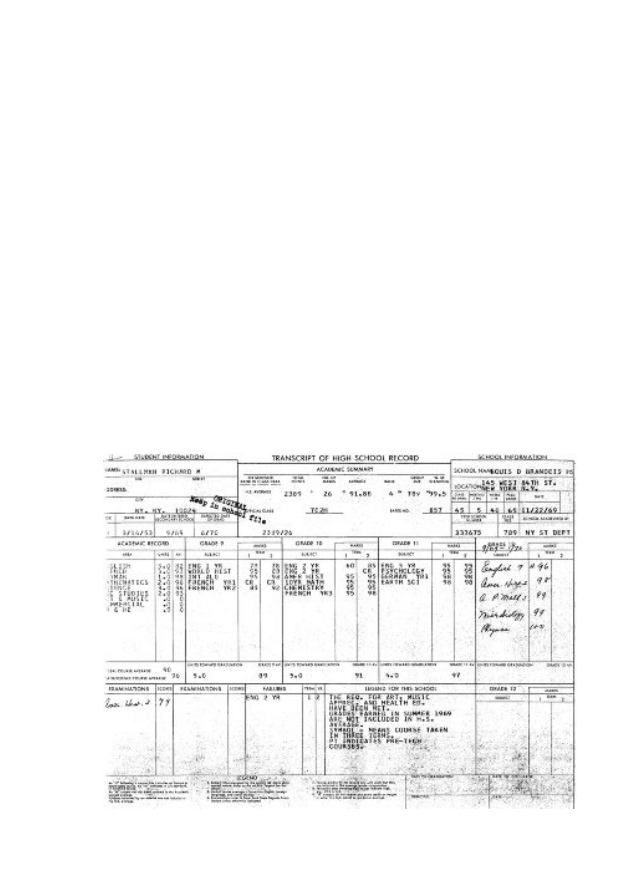
"He was forced to kowtow to a certain degree, but he did it,"
Lippman says. "I only got called in once, which was a bit of
a miracle. It was the calculus teacher complaining that
Richard was interrupting his lesson. I asked how he was
interrupting. He said Richard was always accusing the
teacher of using a false proof. I said, `Well, is he right?' The
teacher said, `Yeah, but I can't tell that to the class. They
wouldn't understand.'"
By the end of his first semester at Brandeis, things were
falling into place. A 96 in English wiped away much of the
stigma of the 60 earned 2 years before. For good measure,
Stallman backed it up with top marks in American History,
Advanced Placement Calculus, and Microbiology. The
crowning touch was a perfect 100 in Physics. Though still a
social outcast, Stallman finished his 11 months at Brandeis
as the fourth-ranked student in a class of 789.
Stallman's senior-year transcript at Louis D. Brandeis H.S.,

November, 1969. Note turnaround in English class
performance. "He was forced to kowtow to a certain
degree," says his mother, "but he did it."
Outside the classroom, Stallman pursued his studies with
even more diligence, rushing off to fulfill his laboratory-
assistant duties at Rockefeller University during the week
and dodging the Vietnam protesters on his way to Saturday
school at Columbia. It was there, while the rest of the
Science Honors Program students sat around discussing
their college choices, that Stallman finally took a moment to
participate in the preclass bull session.
Recalls Breidbart, "Most of the students were going to
Harvard and MIT, of course, but you had a few going to
other Ivy League schools. As the conversation circled the
room, it became apparent that Richard hadn't said anything
yet. I don't know who it was, but somebody got up the
courage to ask him what he planned to do."
Thirty years later, Breidbart remembers the moment clearly.
As soon as Stallman broke the news that he, too, would be
attending Harvard University in the fall, an awkward silence
filled the room. Almost as if on cue, the corners of
Stallman's mouth slowly turned upward into a self-satisfied
smile.
Says Breidbart, "It was his silent way of saying, `That's
right. You haven't got rid of me yet.'"
Endnotes
1. See Michael Gross, "Richard Stallman: High School
Misfit, Symbol of Free Software, MacArthur-
certified Genius" (1999). This interview is one of the
most candid Stallman interviews on the record. I

recommend it highly.
http://www.mgross.com/interviews/stallman1.html
2. See Judy Steed, Toronto Star, BUSINESS, (October
9, 2000): C03.
His vision of free software and social cooperation
stands in stark contrast to the isolated nature of his
private life. A Glenn Gould-like eccentric, the
Canadian pianist was similarly brilliant, articulate,
and lonely. Stallman considers himself afflicted, to
some degree, by autism: a condition that, he says,
makes it difficult for him to interact with people.
3. See Steve Silberman, "The Geek Syndrome," Wired
(December, 2001).
http://www.wired.com/wired/archive/9.12/aspergers_pr.html
4. Regrettably, I did not get a chance to interview
Daniel Stallman for this book. During the early
research for this book, Stallman informed me that his
father suffered from Alzheimer's. When I resumed
research in late 2001, I learned, sadly, that Daniel
Stallman had died earlier in the year.
5. Stallman, an atheist, would probably quibble with
this description. Suffice it to say, it was something
Stallman welcomed. See previous note 1: "As soon
as I heard about computers, I wanted to see one and
play with one."

Chapter 4
Impeach God
Although their relationship was fraught with
tension, Richard Stallman would inherit one
noteworthy trait from his mother: a passion
for progressive politics.
It was an inherited trait that would take
several decades to emerge, however. For the
first few years of his life, Stallman lived in
what he now admits was a "political
vacuum."
Like most Americans during the
Eisenhower age, the Stallman family spent
the 50s trying to recapture the normalcy lost
during the wartime years of the 1940s.
"Richard's father and I were Democrats but
happy enough to leave it at that," says
Lippman, recalling the family's years in
Queens. "We didn't get involved much in
local or national politics."
That all began to change, however, in the
late 1950s when Alice divorced Daniel
Stallman. The move back to Manhattan
represented more than a change of address; it

represented a new, independent identity and
a jarring loss of tranquility.
"I think my first taste of political activism
came when I went to the Queens public
library and discovered there was only a
single book on divorce in the whole library,"
recalls Lippman. "It was very controlled by
the Catholic church, at least in Elmhurst,
where we lived. I think that was the first
inkling I had of the forces that quietly
control our lives."
Returning to her childhood neighborhood,
Manhattan's Upper West Side, Lippman was
shocked by the changes that had taken place
since her departure to Hunter College a
decade and a half before. The skyrocketing
demand for postwar housing had turned the
neighborhood into a political battleground.
On one side stood the pro-development city-
hall politicians and businessmen hoping to
rebuild many of the neighborhood's blocks to
accommodate the growing number of white-
collar workers moving into the city. On the
other side stood the poor Irish and Puerto
Rican tenants who had found an affordable
haven in the neighborhood.
At first, Lippman didn't know which side to

choose. As a new resident, she felt the need
for new housing. As a single mother with
minimal income, however, she shared the
poorer tenants' concern over the growing
number of development projects catering
mainly to wealthy residents. Indignant,
Lippman began looking for ways to combat
the political machine that was attempting to
turn her neighborhood into a clone of the
Upper East Side.
Lippman says her first visit to the local
Democratic party headquarters came in
1958. Looking for a day-care center to take
care of her son while she worked, she had
been appalled by the conditions encountered
at one of the city-owned centers that catered
to low-income residents. "All I remember is
the stench of rotten milk, the dark hallways,
the paucity of supplies. I had been a teacher
in private nursery schools. The contrast was
so great. We took one look at that room and
left. That stirred me up."
The visit to the party headquarters proved
disappointing, however. Describing it as "the
proverbial smoke-filled room," Lippman
says she became aware for the first time that
corruption within the party might actually be
the reason behind the city's thinly disguised

hostility toward poor residents. Instead of
going back to the headquarters, Lippman
decided to join up with one of the many
clubs aimed at reforming the Democratic
party and ousting the last vestiges of the
Tammany Hall machine. Dubbed the
Woodrow Wilson/FDR Reform Democratic
Club, Lippman and her club began showing
up at planning and city-council meetings,
demanding a greater say.
"Our primary goal was to fight Tammany
Hall, Carmine DeSapio and his henchman,"
says Lippman. "I was the representative to
the city council and was very much involved
in creating a viable urban-renewal plan that
went beyond simply adding more luxury
housing to the neighborhood."
Such involvement would blossom into
greater political activity during the 1960s.
By 1965, Lippman had become an
"outspoken" supporter for political
candidates like William Fitts Ryan, a
Democratic elected to Congress with the
help of reform clubs and one of the first U.S.
representatives to speak out against the
Vietnam War.

It wasn't long before Lippman, too, was an
outspoken opponent of U.S. involvement in
Indochina. "I was against the Vietnam war
from the time Kennedy sent troops," she
says. "I had read the stories by reporters and
journalists sent to cover the early stages of
the conflict. I really believed their forecast
that it would become a quagmire."
Such opposition permeated the Stallman-
Lippman household. In 1967, Lippman
remarried. Her new husband, Maurice
Lippman, a major in the Air National Guard,
resigned his commission to demonstrate his
opposition to the war. Lippman's stepson,
Andrew Lippman, was at MIT and
temporarily eligible for a student deferment.
Still, the threat of induction should that
deferment disappear, as it eventually did,
made the risk of U.S. escalation all the more
immediate. Finally, there was Richard who,
though younger, faced the prospect of
choosing between Vietnam or Canada when
the war lasted into the 1970s.
"Vietnam was a major issue in our
household," says Lippman. "We talked about
it constantly: what would we do if the war
continued, what steps Richard or his
stepbrother would take if they got drafted.

We were all opposed to the war and the
draft. We really thought it was immoral."
For Stallman, the Vietnam War elicited a
complex mixture of emotions: confusion,
horror, and, ultimately, a profound sense of
political impotence. As a kid who could
barely cope in the mild authoritarian
universe of private school, Stallman
experienced a shiver whenever the thought
of Army boot camp presented itself.
"I was devastated by the fear, but I couldn't
imagine what to do and didn't have the guts
to go demonstrate," recalls Stallman, whose
March 18th birthday earned him a dreaded
low number in the draft lottery when the
federal government finally eliminated
college deferments in 1971. "I couldn't
envision moving to Canada or Sweden. The
idea of getting up by myself and moving
somewhere. How could I do that? I didn't
know how to live by myself. I wasn't the
kind of person who felt confident in
approaching things like that."
Stallman says he was both impressed and
shamed by the family members who did
speak out. Recalling a bumper sticker on his
father's car likening the My Lai massacre to

similar Nazi atrocities in World War II, he
says he was "excited" by his father's gesture
of outrage. "I admired him for doing it,"
Stallman says. "But I didn't imagine that I
could do anything. I was afraid that the
juggernaut of the draft was going to destroy
me."
Although descriptions of his own
unwillingness to speak out carry a tinge of
nostalgic regret, Stallman says he was
ultimately turned off by the tone and
direction of the anti-war movement. Like
other members of the Science Honors
Program, he saw the weekend
demonstrations at Columbia as little more
than a distracting spectacle.
Ultimately,
Stallman says, the irrational forces driving
the anti-war movement became
indistinguishable from the irrational forces
driving the rest of youth culture. Instead of
worshiping the Beatles, girls in Stallman's
age group were suddenly worshiping
firebrands like Abbie Hoffman and Jerry
Rubin. To a kid already struggling to
comprehend his teenage peers, escapist
slogans like "make love not war" had a
taunting quality. Not only was it a reminder
that Stallman, the short-haired outsider who
hated rock 'n' roll, detested drugs, and didn't

participate in campus demonstrations, wasn't
getting it politically; he wasn't "getting it"
sexually either.
"I didn't like the counter culture much,"
Stallman admits. "I didn't like the music. I
didn't like the drugs. I was scared of the
drugs. I especially didn't like the anti-
intellectualism, and I didn't like the prejudice
against technology. After all, I loved a
computer. And I didn't like the mindless anti-
Americanism that I often encountered. There
were people whose thinking was so
simplistic that if they disapproved of the
conduct of the U.S. in the Vietnam War, they
had to support the North Vietnamese. They
couldn't imagine a more complicated
position, I guess."
Such comments alleviate feelings of
timidity. They also underline a trait that
would become the key to Stallman's own
political maturation. For Stallman, political
confidence was directly proportionate to
personal confidence. By 1970, Stallman had
become confident in few things outside the
realm of math and science. Nevertheless,
confidence in math gave him enough of a
foundation to examine the anti-war
movement in purely logical terms. In the

process of doing so, Stallman had found the
logic wanting. Although opposed to the war
in Vietnam, Stallman saw no reason to
disavow war as a means for defending
liberty or correcting injustice. Rather than
widen the breach between himself and his
peers, however, Stallman elected to keep the
analysis to himself.
In 1970, Stallman left behind the nightly
dinnertime conversations about politics and
the Vietnam War as he departed for Harvard.
Looking back, Stallman describes the
transition from his mother's Manhattan
apartment to life in a Cambridge dorm as an
"escape." Peers who watched Stallman make
the transition, however, saw little to suggest
a liberating experience.
"He seemed pretty miserable for the first
while at Harvard," recalls Dan Chess, a
classmate in the Science Honors Program
who also matriculated at Harvard. "You
could tell that human interaction was really
difficult for him, and there was no way of
avoiding it at Harvard. Harvard was an
intensely social kind of place."
To ease the transition, Stallman fell back on
his strengths: math and science. Like most

members of the Science Honors Program,
Stallman breezed through the qualifying
exam for Math 55, the legendary "boot
camp" class for freshman mathematics
"concentrators" at Harvard. Within the class,
members of the Science Honors Program
formed a durable unit. "We were the math
mafia," says Chess with a laugh. "Harvard
was nothing, at least compared with the
SHP."
To earn the right to boast, however,
Stallman, Chess, and the other SHP alumni
had to get through Math 55. Promising four
years worth of math in two semesters, the
course favored only the truly devout. "It was
an amazing class," says David Harbater, a
former "math mafia" member and now a
professor of mathematics at the University of
Pennsylvania. "It's probably safe to say there
has never been a class for beginning college
students that was that intense and that
advanced. The phrase I say to people just to
get it across is that, among other things, by
the second semester we were discussing the
differential geometry of Banach manifolds.
That's usually when their eyes bug out,
because most people don't start talking about
Banach manifolds until their second year of
graduate school."

Starting with 75 students, the class quickly
melted down to 20 by the end of the second
semester. Of that 20, says Harbater, "only 10
really knew what they were doing." Of that
10, 8 would go on to become future
mathematics professors, 1 would go on to
teach physics.
"The other one," emphasizes Harbater, "was
Richard Stallman."
Seth Breidbart, a fellow Math 55 classmate,
remembers Stallman distinguishing himself
from his peers even then.
"He was a stickler in some very strange
ways," says Breidbart. There is a standard
technique in math which everybody does
wrong. It's an abuse of notation where you
have to define a function for something and
what you do is you define a function and
then you prove that it's well defined. Except
the first time he did and presented it, he
defined a relation and proved that it's a
function. It's the exact same proof, but he
used the correct terminology, which no one
else did. That's just the way he was."

It was in Math 55 that Richard Stallman
began to cultivate a reputation for brilliance.
Breidbart agrees, but Chess, whose
competitive streak refused to yield, says the
realization that Stallman might be the best
mathematician in the class didn't set in until
the next year. "It was during a class on Real
Analysis, which I took with Richard the next
year," says Chess, now a math professor at
Hunter College. "I actually remember in a
proof about complex valued measures that
Richard came up with an idea that was
basically a metaphor from the calculus of
variations. It was the first time I ever saw
somebody solve a problem in a brilliantly
original way."
Chess makes no bones about it: watching
Stallman's solution unfold on the chalkboard
was a devastating blow. As a kid who'd
always taken pride in being the smartest
mathematician the room, it was like catching
a glimpse of his own mortality. Years later,
as Chess slowly came to accept the
professional rank of a good-but-not-great
mathematician, he had Stallman's sophomore-
year proof to look back on as a taunting early
indicator.
"That's the thing about mathematics," says

Chess. "You don't have to be a first-rank
mathematician to recognize first-rate
mathematical talent. I could tell I was up
there, but I could also tell I wasn't at the first
rank. If Richard had chosen to be a
mathematician, he would have been a first-
rank mathematician."
For Stallman, success in the classroom was
balanced by the same lack of success in the
social arena. Even as other members of the
math mafia gathered to take on the Math 55
problem sets, Stallman preferred to work
alone. The same went for living
arrangements. On the housing application for
Harvard, Stallman clearly spelled out his
preferences. "I said I preferred an invisible,
inaudible, intangible roommate," he says. In
a rare stroke of bureaucratic foresight,
Harvard's housing office accepted the
request, giving Stallman a one-room single
for his freshman year.
Breidbart, the only math-mafia member to
share a dorm with Stallman that freshman
year, says Stallman slowly but surely learned
how to interact with other students. He
recalls how other dorm mates, impressed by
Stallman's logical acumen, began welcoming
his input whenever an intellectual debate

broke out in the dining club or dorm
commons.
"We had the usual bull sessions about
solving the world's problems or what would
be the result of something," recalls
Breidbart. "Say somebody discovers an
immortality serum. What do you do? What
are the political results? If you give it to
everybody, the world gets overcrowded and
everybody dies. If you limit it, if you say
everyone who's alive now can have it but
their children can't, then you end up with an
underclass of people without it. Richard was
just better able than most to see the
unforeseen circumstances of any decision."
Stallman remembers the discussions vividly.
"I was always in favor of immortality," he
says. "I was shocked that most people
regarded immortality as a bad thing. How
else would we be able to see what the world
is like 200 years from now?"
Although a first-rank mathematician and first-
rate debater, Stallman shied away from clear-
cut competitive events that might have
sealed his brilliant reputation. Near the end
of freshman year at Harvard, Breidbart
recalls how Stallman conspicuously ducked

the Putnam exam, a prestigious test open to
math students throughout the U.S. and
Canada. In addition to giving students a
chance to measure their knowledge in
relation to their peers, the Putnam served as
a chief recruiting tool for academic math
departments. According to campus legend,
the top scorer automatically qualified for a
graduate fellowship at any school of his
choice, including Harvard.
Like Math 55, the Putnam was a brutal test
of merit. A six-hour exam in two parts, it
seemed explicitly designed to separate the
wheat from the chaff. Breidbart, a veteran of
both the Science Honors Program and Math
55, describes it as easily the most difficult
test he ever took. "Just to give you an idea of
how difficult it was," says Breidbart, "the top
score was a 120, and my score the first year
was in the 30s. That score was still good
enough to place me 101st in the country."
Surprised that Stallman, the best student in
the class, had passed on the test, Breidbart
says he and a fellow classmate cornered him
in the dining common and demanded an
explanation. "He said he was afraid of not
doing well," Breidbart recalls.

Breidbart and the friend quickly wrote down
a few problems from memory and gave them
to Stallman. "He solved all of them,"
Breidbart says, "leading me to conclude that
by not doing well, he either meant coming in
second or getting something wrong."
Stallman remembers the episode a bit
differently. "I remember that they did bring
me the questions and it's possible that I
solved one of them, but I'm pretty sure I
didn't solve them all," he says. Nevertheless,
Stallman agrees with Breidbart's recollection
that fear was the primary reason for not
taking the test. Despite a demonstrated
willingness to point out the intellectual
weaknesses of his peers and professors in the
classroom, Stallman hated the notion of head-
to-head competition.
"It's the same reason I never liked chess,"
says Stallman. "Whenever I'd play, I would
become so consumed by the fear of making a
single mistake that I would start making
stupid mistakes very early in the game. The
fear became a self-fulfilling prophecy."
Whether such fears ultimately prompted
Stallman to shy away from a mathematical

career is a moot issue. By the end of his
freshman year at Harvard, Stallman had
other interests pulling him away from the
field. Computer programming, a latent
fascination throughout Stallman's high-
school years, was becoming a full-fledged
passion. Where other math students sought
occasional refuge in art and history classes,
Stallman sought it in the computer-science
laboratory.
For Stallman, the first taste of real computer
programming at the IBM New York
Scientific Center had triggered a desire to
learn more. "Toward the end of my first year
at Harvard school, I started to have enough
courage to go visit computer labs and see
what they had. I'd ask them if they had extra
copies of any manuals that I could read."
Taking the manuals home, Stallman would
examine machine specifications, compare
them with other machines he already knew,
and concoct a trial program, which he would
then bring back to the lab along with the
borrowed manual. Although some labs
balked at the notion of a strange kid coming
off the street and working on the lab
machinery, most recognized competence
when they saw it and let Stallman run the

programs he had created.
One day, near the end of freshman year,
Stallman heard about a special laboratory
near MIT. The laboratory was located on the
ninth floor an off-campus building in Tech
Square, the newly built facility dedicated to
advanced research. According to the rumors,
the lab itself was dedicated to the cutting-
edge science of artificial intelligence and
boasted the cutting-edge machines and
software programs to match.
Intrigued, Stallman decided to pay a visit.
The trip was short, about 2 miles on foot, 10
minutes by train, but as Stallman would soon
find out, MIT and Harvard can feel like
opposite poles of the same planet. With its
maze-like tangle of interconnected office
buildings, the Institute's campus offered an
aesthetic yin to Harvard's spacious colonial-
village yang. The same could be said for the
student body, a geeky collection of ex-high
school misfits known more for its
predilection for pranks than its politically
powerful alumni.
The yin-yang relationship extended to the AI

Lab as well. Unlike Harvard computer labs,
there was no grad-student gatekeeper, no
clipboard waiting list for terminal access, no
explicit atmosphere of "look but don't
touch." Instead, Stallman found only a
collection of open terminals and robotic
arms, presumably the artifacts of some A.I.
experiment.
Although the rumors said anybody could sit
down at the terminals, Stallman decided to
stick with the original plan. When he
encountered a lab employee, he asked if the
lab had any spare manuals it could loan to an
inquisitive student. "They had some, but a
lot of things weren't documented," Stallman
recalls. "They were hackers after all."
Stallman left with something even better
than a manual: a job. Although he doesn't
remember what the first project was, he does
remember coming back to the AI Lab the
next week, grabbing an open terminal and
writing software code.
Looking back, Stallman sees nothing
unusual in the AI Lab's willingness to accept
an unproven outsider at first glance. "That's
the way it was back then," he says. "That's
the way it still is now. I'll hire somebody

when I meet him if I see he's good. Why
wait? Stuffy people who insist on putting
bureaucracy into everything really miss the
point. If a person is good, he shouldn't have
to go through a long, detailed hiring process;
he should be sitting at a computer writing
code."
To get a taste of "bureaucratic and stuffy,"
Stallman need only visit the computer labs at
Harvard. There, access to the terminals was
doled out according to academic rank. As an
undergrad, Stallman usually had to sign up
or wait until midnight, about the time most
professors and grad students finished their
daily work assignments. The waiting wasn't
difficult, but it was frustrating. Waiting for a
public terminal, knowing all the while that a
half dozen equally usable machines were
sitting idle inside professors' locked offices,
seemed the height of illogic. Although
Stallman paid the occasional visit to the
Harvard computer labs, he preferred the
more egalitarian policies of the AI Lab. "It
was a breath of fresh air," he says. "At the
AI Lab, people seemed more concerned
about work than status."
Stallman quickly learned that the AI Lab's
first-come, first-served policy owed much to

the efforts of a vigilant few. Many were
holdovers from the days of Project MAC, the
Department of Defense-funded research
program that had given birth to the first time-
share operating systems. A few were already
legends in the computing world. There was
Richard Greenblatt, the lab's in-house Lisp
expert and author of MacHack, the computer
chess program that had once humbled A.I.
critic Hubert Dreyfus. There was Gerald
Sussman, original author of the robotic block-
stacking program HACKER. And there was
Bill Gosper, the in-house math whiz already
in the midst of an 18-month hacking bender
triggered by the philosophical implications
of the computer game LIFE.
Members of the tight-knit group called
themselves " hackers." Over time, they
extended the "hacker" description to
Stallman as well. In the process of doing so,
they inculcated Stallman in the ethical
traditions of the "hacker ethic ." To be a
hacker meant more than just writing
programs, Stallman learned. It meant writing
the best possible programs. It meant sitting
at a terminal for 36 hours straight if that's
what it took to write the best possible
programs. Most importantly, it meant having
access to the best possible machines and the

most useful information at all times. Hackers
spoke openly about changing the world
through software, and Stallman learned the
instinctual hacker disdain for any obstacle
that prevented a hacker from fulfilling this
noble cause. Chief among these obstacles
were poor software, academic bureaucracy,
and selfish behavior.
Stallman also learned the lore, stories of how
hackers, when presented with an obstacle,
had circumvented it in creative ways.
Stallman learned about " lock hacking," the
art of breaking into professors' offices to
"liberate" sequestered terminals. Unlike their
pampered Harvard counterparts, MIT faculty
members knew better than to treat the AI
Lab's terminal as private property. If a
faculty member made the mistake of locking
away a terminal for the night, hackers were
quick to correct the error. Hackers were
equally quick to send a message if the
mistake repeated itself. "I was actually
shown a cart with a heavy cylinder of metal
on it that had been used to break down the
door of one professor's office,"
Stallman
says.
Such methods, while lacking in subtlety,
served a purpose. Although professors and

administrators outnumbered hackers two-to-
one inside the AI Lab, the hacker ethic
prevailed. Indeed, by the time of Stallman's
arrival at the AI Lab, hackers and the AI Lab
administration had coevolved into something
of a symbiotic relationship. In exchange for
fixing the machines and keeping the
software up and running, hackers earned the
right to work on favorite pet projects. Often,
the pet projects revolved around improving
the machines and software programs even
further. Like teenage hot-rodders, most
hackers viewed tinkering with machines as
its own form of entertainment.
Nowhere was this tinkering impulse better
reflected than in the operating system that
powered the lab's central PDP-6 mini-
computer. Dubbed ITS, short for the
Incompatible Time Sharing system, the
operating system incorporated the hacking
ethic into its very design. Hackers had built
it as a protest to Project MAC's original
operating system, the Compatible Time
Sharing System, CTSS, and named it
accordingly. At the time, hackers felt the
CTSS design too restrictive, limiting
programmers' power to modify and improve
the program's own internal architecture if
needed. According to one legend passed

down by hackers, the decision to build ITS
had political overtones as well. Unlike
CTSS, which had been designed for the IBM
7094, ITS was built specifically for the PDP-
6. In letting hackers write the systems
themselves, AI Lab administrators
guaranteed that only hackers would feel
comfortable using the PDP-6. In the feudal
world of academic research, the gambit
worked. Although the PDP-6 was co-owned
in conjunction with other departments, A.I.
researchers soon had it to themselves.
ITS boasted features most commercial
operating systems wouldn't offer for years,
features such as multitasking, debugging,
and full-screen editing capability. Using it
and the PDP-6 as a foundation, the Lab had
been able to declare independence from
Project MAC shortly before Stallman's
arrival.
As an apprentice hacker, Stallman quickly
became enamored with ITS. Although
forbidding to most newcomers, the program
contained many built-in features that
provided a lesson in software development
to hacker apprentices such as himself.

"ITS had a very elegant internal mechanism
for one program to examine another," says
Stallman, recalling the program. "You could
examine all sorts of status about another
program in a very clean, well-specified
way."
Using this feature, Stallman was able to
watch how programs written by hackers
processed instructions as they ran. Another
favorite feature would allow the monitoring
program to freeze the monitored program's
job between instructions. In other operating
systems, such a command would have
resulted in half-computed gibberish or an
automatic systems crash. In ITS, it provided
yet another way to monitor the step-by-step
performance.
"If you said, `Stop the job,' it would always
be stopped in user mode. It would be stopped
between two user-mode instructions, and
everything about the job would be consistent
for that point," Stallman says. "If you said,
`Resume the job,' it would continue properly.
Not only that, but if you were to change the
status of the job and then change it back,
everything would be consistent. There was
no hidden status anywhere."

By the end of 1970, hacking at the AI Lab
had become a regular part of Stallman's
weekly schedule. From Monday to
Thursday, Stallman devoted his waking
hours to his Harvard classes. As soon as
Friday afternoon arrived, however, he was
on the T, heading down to MIT for the
weekend. Stallman usually timed his arrival
to coincide with the ritual food run. Joining
five or six other hackers in their nightly
quest for Chinese food, he would jump
inside a beat-up car and head across the
Harvard Bridge into nearby Boston. For the
next two hours, he and his hacker colleagues
would discuss everything from ITS to the
internal logic of the Chinese language and
pictograph system. Following dinner, the
group would return to MIT and hack code
until dawn.
For the geeky outcast who rarely associated
with his high-school peers, it was a heady
experience, suddenly hanging out with
people who shared the same predilection for
computers, science fiction, and Chinese
food. "I remember many sunrises seen from
a car coming back from Chinatown,"
Stallman would recall nostalgically, 15 years
after the fact in a speech at the Swedish
Royal Technical Institute. "It was actually a

very beautiful thing to see a sunrise, 'cause
that's such a calm time of day. It's a
wonderful time of day to get ready to go to
bed. It's so nice to walk home with the light
just brightening and the birds starting to
chirp; you can get a real feeling of gentle
satisfaction, of tranquility about the work
that you have done that night."
The more Stallman hung out with the
hackers, the more he adopted the hacker
worldview. Already committed to the notion
of personal liberty, Stallman began to infuse
his actions with a sense of communal
responsibility. When others violated the
communal code, Stallman was quick to
speak out. Within a year of his first visit,
Stallman was the one breaking into locked
offices, trying to recover the sequestered
terminals that belonged to the lab
community as a whole. In true hacker
fashion, Stallman also sought to make his
own personal contribution to the art of lock
hacking. One of the most artful door-opening
tricks, commonly attributed to Greenblatt,
involved bending a stiff wire into a cane and
attaching a loop of tape to the long end.
Sliding the wire under the door, a hacker
could twist and rotate the wire so that the
long end touched the door knob. Provided

the adhesive on the tape held, a hacker could
open the doorknob with a few sharp twists.
When Stallman tried the trick, he found it
good but wanting in a few places. Getting
the tape to stick wasn't always easy, and
twisting the wire in a way that turned the
doorknob was similarly difficult. Stallman
remembered that the hallway ceiling
possessed tiles that could be slid away. Some
hackers, in fact, had used the false ceiling as
a way to get around locked doors, an
approach that generally covered the
perpetrator in fiberglass but got the job done.
Stallman considered an alternative approach.
What if, instead of slipping a wire under the
door, a hacker slid away one of the panels
and stood over the door jamb?
Stallman took it upon himself to try it out.
Instead of using a wire, Stallman draped out
a long U-shaped loop of magnetic tape,
fastening a loop of adhesive tape at the base
of the U. Standing over the door jamb, he
dangled the tape until it looped under the
doorknob. Lifting the tape until the adhesive
fastened, he then pulled on the left end of the
tape, twisting the doorknob counter-
clockwise. Sure enough, the door opened.

Stallman had added a new twist to the art of
lock hacking.
"Sometimes you had to kick the door after
you turned the door knob," says Stallman,
recalling the lingering bugginess of the new
method. "It took a little bit of balance to pull
it off."
Such activities reflected a growing
willingness on Stallman's part to speak and
act out in defense of political beliefs. The AI
Lab's spirit of direct action had proved
inspirational enough for Stallman to break
out of the timid impotence of his teenage
years. Breaking into an office to free a
terminal wasn't the same as taking part in a
protest march, but it was effective in ways
that most protests weren't. It solved the
problem at hand.
By the time of his last years at Harvard,
Stallman was beginning to apply the
whimsical and irreverent lessons of the AI
Lab back at school.
"Did he tell you about the snake?" his
mother asks at one point during an interview.
"He and his dorm mates put a snake up for

student election. Apparently it got a
considerable number of votes."
Stallman verifies the snake candidacy with a
few caveats. The snake was a candidate for
election within Currier House, Stallman's
dorm, not the campus-wide student council.
Stallman does remember the snake attracting
a fairly significant number of votes, thanks
in large part to the fact that both the snake
and its owner both shared the same last
name. "People may have voted for it,
because they thought they were voting for
the owner," Stallman says. "Campaign
posters said that the snake was `slithering
for' the office. We also said it was an `at
large' candidate, since it had climbed into the
wall through the ventilating unit a few weeks
before and nobody knew where it was."
Running a snake for dorm council was just
one of several election-related pranks. In a
later election, Stallman and his dorm mates
nominated the house master's son. "His
platform was mandatory retirement at age
seven," Stallman recalls. Such pranks paled
in comparison to the fake-candidate pranks
on the MIT campus, however. One of the
most successful fake-candidate pranks was a
cat named Woodstock, which actually

managed to outdraw most of the human
candidates in a campus-wide election. "They
never announced how many votes
Woodstock got, and they treated those votes
as spoiled ballots," Stallman recalls. "But the
large number of spoiled ballots in that
election suggested that Woodstock had
actually won. A couple of years later,
Woodstock was suspiciously run over by a
car. Nobody knows if the driver was
working for the MIT administration."
Stallman says he had nothing to do with
Woodstock's candidacy, "but I admired it."
At the AI Lab, Stallman's political activities
had a sharper-edged tone. During the 1970s,
hackers faced the constant challenge of
faculty members and administrators pulling
an end-run around ITS and its hacker-
friendly design. One of the first attempts
came in the mid-1970s, as more and more
faculty members began calling for a file
security system to protect research data.
Most other computer labs had installed such
systems during late 1960s, but the AI Lab,
through the insistence of Stallman and other
hackers, remained a security-free zone.
For Stallman, the opposition to security was
both ethical and practical. On the ethical

side, Stallman pointed out that the entire art
of hacking relied on intellectual openness
and trust. On the practical side, he pointed to
the internal structure of ITS being built to
foster this spirit of openness, and any
attempt to reverse that design required a
major overhaul.
"The hackers who wrote the Incompatible
Timesharing System decided that file
protection was usually used by a self-styled
system manager to get power over everyone
else," Stallman would later explain. "They
didn't want anyone to be able to get power
over them that way, so they didn't implement
that kind of a feature. The result was, that
whenever something in the system was
broken, you could always fix it."
Through such vigilance, hackers managed to
keep the AI Lab's machines security-free.
Over at the nearby MIT Laboratory for
Computer Sciences, however, security-
minded faculty members won the day. The
LCS installed its first password-based
system in 1977. Once again, Stallman took it
upon himself to correct what he saw as
ethical laxity. Gaining access to the software
code that controlled the password system,
Stallman implanted a software command that

sent out a message to any LCS user who
attempted to choose a unique password. If a
user entered "starfish," for example, the
message came back something like:
I see you chose the password
"starfish." I suggest that you
switch to the password
"carriage return." It's much
easier to type, and also it
stands up to the principle that
there should be no
passwords.
Users who did enter "carriage return"-that is,
users who simply pressed the Enter or
Return button, entering a blank string instead
of a unique password-left their accounts
accessible to the world at large. As scary as
that might have been for some users, it
reinforced the hacker notion that Institute
computers, and even Institute computer files,
belonged to the public, not private
individuals. Stallman, speaking in an
interview for the 1984 book Hackers,
proudly noted that one-fifth of the LCS staff
accepted this argument and employed the
blank-string password.

Stallman's null-string crusade would prove
ultimately futile. By the early 1980s, even
the AI Lab's machines were sporting
password-based security systems. Even so, it
represents a major milestone in terms of
Stallman's personal and political maturation.
To the objective observer familiar with
Stallman's later career, it offers a convenient
inflection point between the timid teenager
afraid to speak out even on issues of life-
threatening importance and the adult activist
who would soon turn needling and cajoling
into a full-time occupation.
In voicing his opposition to computer
security, Stallman drew on many of the
forces that had shaped his early life: hunger
for knowledge, distaste for authority, and
frustration over hidden procedures and rules
that rendered some people clueless outcasts.
He would also draw on the ethical concepts
that would shape his adult life: communal
responsibility, trust, and the hacker spirit of
direct action. Expressed in software-
computing terms, the null string represents
the 1.0 version of the Richard Stallman
political worldview-incomplete in a few
places but, for the most part, fully mature.
Looking back, Stallman hesitates to impart

too much significance to an event so early in
his hacking career. "In that early stage there
were a lot of people who shared my
feelings," he says. "The large number of
people who adopted the null string as their
password was a sign that many people
agreed that it was the proper thing to do. I
was simply inclined to be an activist about
it."
Stallman does credit the AI Lab for
awakening that activist spirit, however. As a
teenager, Stallman had observed political
events with little idea as to how a single
individual could do or say anything of
importance. As a young adult, Stallman was
speaking out on matters in which he felt
supremely confident, matters such as
software design, communal responsibility,
and individual freedom. "I joined this
community which had a way of life which
involved respecting each other's freedom,"
he says. "It didn't take me long to figure out
that that was a good thing. It took me longer
to come to the conclusion that this was a
moral issue."
Hacking at the AI Lab wasn't the only
activity helping to boost Stallman's esteem.
During the middle of his sophomore year at

Harvard, Stallman had joined up with a
dance troupe that specialized in folk dances .
What began as a simple attempt to meet
women and expand his social horizons soon
expanded into yet another passion alongside
hacking. Dancing in front of audiences
dressed in the native garb of a Balkan
peasant, Stallman no longer felt like the
awkward, uncoordinated 10-year-old whose
attempts to play football had ended in
frustration. He felt confident, agile, and
alive. For a brief moment, he even felt a hint
of emotional connection. He soon found
being in front of an audience fun, and it
wasn't long thereafter that he began craving
the performance side of dancing almost as
much as the social side.
Although the dancing and hacking did little
to improve Stallman's social standing, they
helped him overcome the feelings of
weirdness that had clouded his pre-Harvard
life. Instead of lamenting his weird nature,
Stallman found ways to celebrate it. In 1977,
while attending a science-fiction convention,
he came across a woman selling custom-
made buttons. Excited, Stallman ordered a
button with the words "Impeach God"
emblazoned on it.

For Stallman, the "Impeach God" message
worked on many levels. An atheist since
early childhood, Stallman first saw it as an
attempt to set a "second front" in the
ongoing debate on religion. "Back then
everybody was arguing about God being
dead or alive," Stallman recalls. "`Impeach
God' approached the subject of God from a
completely different viewpoint. If God was
so powerful as to create the world and yet do
nothing to correct the problems in it, why
would we ever want to worship such a God?
Wouldn't it be better to put him on trial?"
At the same time, "Impeach God" was a
satirical take on America and the American
political system. The Watergate scandal of
the 1970s affected Stallman deeply. As a
child, Stallman had grown up mistrusting
authority. Now, as an adult, his mistrust had
been solidified by the culture of the AI Lab
hacker community. To the hackers,
Watergate was merely a Shakespearean
rendition of the daily power struggles that
made life such a hassle for those without
privilege. It was an outsized parable for what
happened when people traded liberty and
openness for security and convenience.
Buoyed by growing confidence, Stallman

wore the button proudly. People curious
enough to ask him about it received the same
well-prepared spiel. "My name is Jehovah,"
Stallman would say. "I have a special plan to
save the universe, but because of heavenly
security reasons I can't tell you what that
plan is. You're just going to have to put your
faith in me, because I see the picture and you
don't. You know I'm good because I told you
so. If you don't believe me, I'll throw you on
my enemies list and throw you in a pit where
Infernal Revenue Service will audit your
taxes for eternity."
Those who interpreted the spiel as a word-
for-word parody of the Watergate hearings
only got half the message. For Stallman, the
other half of the message was something
only his fellow hackers seemed to be
hearing. One hundred years after Lord Acton
warned about absolute power corrupting
absolutely, Americans seemed to have
forgotten the first part of Acton's truism:
power, itself, corrupts. Rather than point out
the numerous examples of petty corruption,
Stallman felt content voicing his outrage
toward an entire system that trusted power in
the first place.
"I figured why stop with the small fry," says

Stallman, recalling the button and its
message. "If we went after Nixon, why not
going after Mr. Big. The way I see it, any
being that has power and abuses it deserves
to have that power taken away."
Endnotes
1. See Michael Gross, "Richard
Stallman: High School Misfit,
Symbol of Free Software, MacArthur-
certified Genius" (1999).
2. Carmine DeSapio holds the dubious
distinction of being the first Italian-
American boss of Tammany Hall, the
New York City political machine. For
more information on DeSapio and the
politics of post-war New York, see
John Davenport, "Skinning the Tiger:
Carmine DeSapio and the End of the
Tammany Era," New York Affairs
(1975): 3:1.
3. Chess, another Columbia Science
Honors Program alum, describes the
protests as "background noise." "We
were all political," he says, "but the
SHP was imporant. We would never
have skipped it for a demonstration."
4. See Steven Levy, Hackers (Penguin

USA [paperback], 1984): 144.
Levy devotes about five pages to
describing Gosper's fascination with
LIFE, a math-based software game
first created by British mathematician
John Conway. I heartily recommend
this book as a supplement, perhaps
even a prerequisite, to this one.
5. Gerald Sussman, an MIT faculty
member and hacker whose work at
the AI Lab predates Stallman's,
disputes this memory. According to
Sussman, the hackers never broke any
doors to retrieve terminals.
6. I apologize for the whirlwind
summary of ITS' genesis, an
operating system many hackers still
regard as the epitome of the hacker
ethos. For more information on the
program's political significance, see
Simson Garfinkel, Architects of the
Information Society: Thirty-Five
Years of the Laboratory for Computer
Science at MIT (MIT Press, 1999).
7. See Richard Stallman, "RMS lecture
at KTH (Sweden)," (October 30,
1986).
http://www.gnu.org/philosophy/stallman-
kth.html
8. In an email shortly after this book

went into its final edit cycle, Stallman
says he drew political inspiration
from the Harvard campus as well. "In
my first year of Harvard, in a Chinese
History class, I read the story of the
first revolt against the Chin dynasty,"
he says. "The story is not reliable
history, but it was very moving."
9. See Richard Stallman (1986).
10. See Steven Levy, Hackers (Penguin
USA [paperback], 1984): 417. I have
modified this quote, which Levy also
uses as an excerpt, to illustrate more
directly how the program might
reveal the false security of the
system. Levy uses the placeholder
"[such and such]."
11. See Steven Levy, Hackers (Penguin
USA [paperback], 1984): 417.

Chapter 5
Small Puddle of Freedom
Ask anyone who's spent more than a minute in Richard Stallman's
presence, and you'll get the same recollection: forget the long hair. Forget
the quirky demeanor. The first thing you notice is the gaze. One look into
Stallman's green eyes, and you know you're in the presence of a true
believer.
To call the Stallman gaze intense is an understatement. Stallman's eyes
don't just look at you; they look through you. Even when your own eyes
momentarily shift away out of simple primate politeness, Stallman's eyes
remain locked-in, sizzling away at the side of your head like twin photon
beams.
Maybe that's why most writers, when describing Stallman, tend to go for
the religious angle. In a 1998 Salon.com article titled "The Saint of Free
Software," Andrew Leonard describes Stallman's green eyes as "radiating
the power of an Old Testament prophet."
A 1999 Wired magazine article
describes the Stallman beard as "Rasputin-like,"
while a London
Guardian profile describes the Stallman smile as the smile of "a disciple
seeing Jesus."
Such analogies serve a purpose, but they ultimately fall short. That's
because they fail to take into account the vulnerable side of the Stallman
persona. Watch the Stallman gaze for an extended period of time, and you
will begin to notice a subtle change. What appears at first to be an attempt
to intimidate or hypnotize reveals itself upon second and third viewing as
a frustrated attempt to build and maintain contact. If, as Stallman himself
has suspected from time to time, his personality is the product of autism or
Asperger Syndrome, his eyes certainly confirm the diagnosis. Even at
their most high-beam level of intensity, they have a tendency to grow
cloudy and distant, like the eyes of a wounded animal preparing to give up
the ghost.
My own first encounter with the legendary Stallman gaze dates back to
the March, 1999, LinuxWorld Convention and Expo in San Jose,
California. Billed as a "coming out party" for the Linux software
community, the convention also stands out as the event that reintroduced
Stallman to the technology media. Determined to push for his proper share

of credit, Stallman used the event to instruct spectators and reporters alike
on the history of the GNU Project and the project's overt political
objectives.
As a reporter sent to cover the event, I received my own Stallman tutorial
during a press conference announcing the release of GNOME 1.0, a free
software graphic user interface. Unwittingly, I push an entire bank of hot
buttons when I throw out my very first question to Stallman himself: do
you think GNOME's maturity will affect the commercial popularity of the
Linux operating system?
"I ask that you please stop calling the operating system Linux," Stallman
responds, eyes immediately zeroing in on mine. "The Linux kernel is just
a small part of the operating system. Many of the software programs that
make up the operating system you call Linux were not developed by Linus
Torvalds at all. They were created by GNU Project volunteers, putting in
their own personal time so that users might have a free operating system
like the one we have today. To not acknowledge the contribution of those
programmers is both impolite and a misrepresentation of history. That's
why I ask that when you refer to the operating system, please call it by its
proper name, GNU/Linux."
Taking the words down in my reporter's notebook, I notice an eerie
silence in the crowded room. When I finally look up, I find Stallman's
unblinking eyes waiting for me. Timidly, a second reporter throws out a
question, making sure to use the term " GNU/Linux" instead of Linux.
Miguel de Icaza, leader of the GNOME project, fields the question. It isn't
until halfway through de Icaza's answer, however, that Stallman's eyes
finally unlock from mine. As soon as they do, a mild shiver rolls down my
back. When Stallman starts lecturing another reporter over a perceived
error in diction, I feel a guilty tinge of relief. At least he isn't looking at
me, I tell myself.
For Stallman, such face-to-face moments would serve their purpose. By
the end of the first LinuxWorld show, most reporters know better than to
use the term "Linux" in his presence, and wired.com is running a story
comparing Stallman to a pre-Stalinist revolutionary erased from the
history books by hackers and entrepreneurs eager to downplay the GNU
Project's overly political objectives.
Other articles follow, and while few
reporters call the operating system GNU/Linux in print, most are quick to
credit Stallman for launching the drive to build a free software operating
system 15 years before.

I won't meet Stallman again for another 17 months. During the interim,
Stallman will revisit Silicon Valley once more for the August, 1999
LinuxWorld show. Although not invited to speak, Stallman does managed
to deliver the event's best line. Accepting the show's Linus Torvalds
Award for Community Service-an award named after Linux creator Linus
Torvalds-on behalf of the Free Software Foundation, Stallman wisecracks,
"Giving the Linus Torvalds Award to the Free Software Foundation is a
bit like giving the Han Solo Award to the Rebel Alliance."
This time around, however, the comments fail to make much of a media
dent. Midway through the week, Red Hat, Inc., a prominent GNU/Linux
vendor, goes public. The news merely confirms what many reporters such
as myself already suspect: "Linux" has become a Wall Street buzzword,
much like "e-commerce" and "dot-com" before it. With the stock market
approaching the Y2K rollover like a hyperbola approaching its vertical
asymptote, all talk of free software or open source as a political
phenomenon falls by the wayside.
Maybe that's why, when LinuxWorld follows up its first two shows with a
third LinuxWorld show in August, 2000, Stallman is conspicuously
absent.
My second encounter with Stallman and his trademark gaze comes shortly
after that third LinuxWorld show. Hearing that Stallman is going to be in
Silicon Valley, I set up a lunch interview in Palo Alto, California. The
meeting place seems ironic, not only because of the recent no-show but
also because of the overall backdrop. Outside of Redmond, Washington,
few cities offer a more direct testament to the economic value of
proprietary software. Curious to see how Stallman, a man who has spent
the better part of his life railing against our culture's predilection toward
greed and selfishness, is coping in a city where even garage-sized
bungalows run in the half-million-dollar price range, I make the drive
down from Oakland.
I follow the directions Stallman has given me, until I reach the
headquarters of Art.net, a nonprofit "virtual artists collective." Located in
a hedge-shrouded house in the northern corner of the city, the Art.net
headquarters are refreshingly run-down. Suddenly, the idea of Stallman
lurking in the heart of Silicon Valley doesn't seem so strange after all.
I find Stallman sitting in a darkened room, tapping away on his gray
laptop computer. He looks up as soon as I enter the room, giving me a full
blast of his 200-watt gaze. When he offers a soothing "Hello," I offer a

return greeting. Before the words come out, however, his eyes have
already shifted back to the laptop screen.
"I'm just finishing an article on the spirit of hacking," Stallman says,
fingers still tapping. "Take a look."
I take a look. The room is dimly lit, and the text appears as greenish-white
letters on a black background, a reversal of the color scheme used by most
desktop word-processing programs, so it takes my eyes a moment to
adjust. When they do, I find myself reading Stallman's account of a recent
meal at a Korean restaurant. Before the meal, Stallman makes an
interesting discovery: the person setting the table has left six chopsticks
instead of the usual two in front of Stallman's place setting. Where most
restaurant goers would have ignored the redundant pairs, Stallman takes it
as challenge: find a way to use all six chopsticks at once. Like many
software hacks, the successful solution is both clever and silly at the same
time. Hence Stallman's decision to use it as an illustration.
As I read the story, I feel Stallman watching me intently. I look over to
notice a proud but child-like half smile on his face. When I praise the
essay, my comment barely merits a raised eyebrow.
"I'll be ready to go in a moment," he says.
Stallman goes back to tapping away at his laptop. The laptop is gray and
boxy, not like the sleek, modern laptops that seemed to be a programmer
favorite at the recent LinuxWorld show. Above the keyboard rides a
smaller, lighter keyboard, a testament to Stallman's aging hands. During
the late 1980s, when Stallman was putting in 70- and 80-hour work weeks
writing the first free software tools and programs for the GNU Project, the
pain in Stallman's hands became so unbearable that he had to hire a typist.
Today, Stallman relies on a keyboard whose keys require less pressure
than a typical computer keyboard.
Stallman has a tendency to block out all external stimuli while working.
Watching his eyes lock onto the screen and his fingers dance, one quickly
gets the sense of two old friends locked in deep conversation.
The session ends with a few loud keystrokes and the slow disassembly of
the laptop.
"Ready for lunch?" Stallman asks.

We walk to my car. Pleading a sore ankle, Stallman limps along slowly.
Stallman blames the injury on a tendon in his left foot. The injury is three
years old and has gotten so bad that Stallman, a huge fan of folk dancing,
has been forced to give up all dancing activities. "I love folk dancing
inherently," Stallman laments. "Not being able to dance has been a
tragedy for me."
Stallman's body bears witness to the tragedy. Lack of exercise has left
Stallman with swollen cheeks and a pot belly that was much less visible
the year before. You can tell the weight gain has been dramatic, because
when Stallman walks, he arches his back like a pregnant woman trying to
accommodate an unfamiliar load.
The walk is further slowed by Stallman's willingness to stop and smell the
roses, literally. Spotting a particularly beautiful blossom, he tickles the
innermost petals with his prodigious nose, takes a deep sniff and steps
back with a contented sigh.
"Mmm, rhinophytophilia,"
he says, rubbing his back.
The drive to the restaurant takes less than three minutes. Upon
recommendation from Tim Ney, former executive director of the Free
Software Foundation, I have let Stallman choose the restaurant. While
some reporters zero in on Stallman's monk-like lifestyle, the truth is,
Stallman is a committed epicure when it comes to food. One of the fringe
benefits of being a traveling missionary for the free software cause is the
ability to sample delicious food from around the world. "Visit almost any
major city in the world, and chances are Richard knows the best restaurant
in town," says Ney. "Richard also takes great pride in knowing what's on
the menu and ordering for the entire table."
For today's meal, Stallman has chosen a Cantonese-style dim sum
restaurant two blocks off University Avenue, Palo Alto's main drag. The
choice is partially inspired by Stallman's recent visit to China, including a
lecture stop in Guangdong province, in addition to Stallman's personal
aversion to spicier Hunanese and Szechuan cuisine. "I'm not a big fan of
spicy," Stallman admits.
We arrive a few minutes after 11 a.m. and find ourselves already subject
to a 20-minute wait. Given the hacker aversion to lost time, I hold my
breath momentarily, fearing an outburst. Stallman, contrary to
expectations, takes the news in stride.

"It's too bad we couldn't have found somebody else to join us," he tells
me. "It's always more fun to eat with a group of people."
During the wait, Stallman practices a few dance steps. His moves are
tentative but skilled. We discuss current events. Stallman says his only
regret about not attending LinuxWorld was missing out on a press
conference announcing the launch of the GNOME Foundation. Backed by
Sun Microsystems and IBM, the foundation is in many ways a vindication
for Stallman, who has long championed that free software and free-market
economics need not be mutually exclusive. Nevertheless, Stallman
remains dissatisfied by the message that came out.
"The way it was presented, the companies were talking about Linux with
no mention of the GNU Project at all," Stallman says.
Such disappointments merely contrast the warm response coming from
overseas, especially Asia, Stallman notes. A quick glance at the Stallman
2000 travel itinerary bespeaks the growing popularity of the free software
message. Between recent visits to India, China, and Brazil, Stallman has
spent 12 of the last 115 days on United States soil. His travels have given
him an opportunity to see how the free software concept translates into
different languages of cultures.
"In India many people are interested in free software, because they see it
as a way to build their computing infrastructure without spending a lot of
money," Stallman says. "In China, the concept has been much slower to
catch on. Comparing free software to free speech is harder to do when you
don't have any free speech. Still, the level of interest in free software
during my last visit was profound."
The conversation shifts to Napster, the San Mateo, California software
company, which has become something of a media cause cÈlËbre in
recent months. The company markets a controversial software tool that
lets music fans browse and copy the music files of other music fans.
Thanks to the magnifying powers of the Internet, this so-called "peer-to-
peer" program has evolved into a de facto online juke box, giving ordinary
music fans a way to listen to MP3 music files over the computer without
paying a royalty or fee, much to record companies' chagrin.
Although based on proprietary software, the Napster system draws
inspiration from the long-held Stallman contention that once a work enters
the digital realm-in other words, once making a copy is less a matter of
duplicating sounds or duplicating atoms and more a matter of duplicating

information-the natural human impulse to share a work becomes harder to
restrict. Rather than impose additional restrictions, Napster execs have
decided to take advantage of the impulse. Giving music listeners a central
place to trade music files, the company has gambled on its ability to steer
the resulting user traffic toward other commercial opportunities.
The sudden success of the Napster model has put the fear in traditional
record companies, with good reason. Just days before my Palo Alto
meeting with Stallman, U.S. District Court Judge Marilyn Patel granted a
request filed by the Recording Industry Association of America for an
injunction against the file-sharing service. The injunction was
subsequently suspended by the U.S. Ninth District Court of Appeals, but
by early 2001, the Court of Appeals, too, would find the San Mateo-based
company in breach of copyright law,
a decision RIAA spokesperson
Hillary Rosen would later proclaim proclaim a "clear victory for the
creative content community and the legitimate online marketplace."
For hackers such as Stallman, the Napster business model is scary in
different ways. The company's eagerness to appropriate time-worn hacker
principles such as file sharing and communal information ownership,
while at the same time selling a service based on proprietary software,
sends a distressing mixed message. As a person who already has a hard
enough time getting his own carefully articulated message into the media
stream, Stallman is understandably reticent when it comes to speaking out
about the company. Still, Stallman does admit to learning a thing or two
from the social side of the Napster phenomenon.
"Before Napster, I thought it might be OK for people to privately
redistribute works of entertainment," Stallman says. "The number of
people who find Napster useful, however, tells me that the right to
redistribute copies not only on a neighbor-to-neighbor basis, but to the
public at large, is essential and therefore may not be taken away."
No sooner does Stallman say this than the door to the restaurant swings
open and we are invited back inside by the host. Within a few seconds, we
are seated in a side corner of the restaurant next to a large mirrored wall.
The restaurant's menu doubles as an order form, and Stallman is quickly
checking off boxes before the host has even brought water to the table.
"Deep-fried shrimp roll wrapped in bean-curd skin," Stallman reads.
"Bean-curd skin. It offers such an interesting texture. I think we should get
it."

This comment leads to an impromptu discussion of Chinese food and
Stallman's recent visit to China. "The food in China is utterly exquisite,"
Stallman says, his voice gaining an edge of emotion for the first time this
morning. "So many different things that I've never seen in the U.S., local
things made from local mushrooms and local vegetables. It got to the
point where I started keeping a journal just to keep track of every
wonderful meal."
The conversation segues into a discussion of Korean cuisine. During the
same June, 2000, Asian tour, Stallman paid a visit to South Korea. His
arrival ignited a mini-firestorm in the local media thanks to a Korean
software conference attended by Microsoft founder and chairman Bill
Gates that same week. Next to getting his photo above Gates's photo on
the front page of the top Seoul newspaper, Stallman says the best thing
about the trip was the food. "I had a bowl of naeng myun, which is cold
noodles," says Stallman. "These were a very interesting feeling noodle.
Most places don't use quite the same kind of noodles for your naeng
myun, so I can say with complete certainty that this was the most
exquisite naeng myun I ever had."
The term "exquisite" is high praise coming from Stallman. I know this,
because a few moments after listening to Stallman rhapsodize about naeng
myun, I feel his laser-beam eyes singeing the top of my right shoulder.
"There is the most exquisite woman sitting just behind you," Stallman
says.
I turn to look, catching a glimpse of a woman's back. The woman is
young, somewhere in her mid-20s, and is wearing a white sequinned
dress. She and her male lunch companion are in the final stages of paying
the check. When both get up from the table to leave the restaurant, I can
tell without looking, because Stallman's eyes suddenly dim in intensity.
"Oh, no," he says. "They're gone. And to think, I'll probably never even
get to see her again."
After a brief sigh, Stallman recovers. The moment gives me a chance to
discuss Stallman's reputation vis-ý-vis the fairer sex. The reputation is a
bit contradictory at times. A number of hackers report Stallman's
predilection for greeting females with a kiss on the back of the hand.
May 26, 2000 Salon.com article, meanwhile, portrays Stallman as a bit of
a hacker lothario. Documenting the free software-free love connection,
reporter Annalee Newitz presents Stallman as rejecting traditional family

values, telling her, "I believe in love, but not monogamy."
Stallman lets his menu drop a little when I bring this up. "Well, most men
seem to want sex and seem to have a rather contemptuous attitude towards
women," he says. "Even women they're involved with. I can't understand
it at all."
I mention a passage from the 1999 book Open Sources in which Stallman
confesses to wanting to name the ill-fated GNU kernel after a girlfriend at
the time. The girlfriend's name was Alix, a name that fit perfectly with the
Unix developer convention of putting an "x" at the end of any new kernel
name-e.g., "Linux." Because the woman was a Unix system administrator,
Stallman says it would have been an even more touching tribute.
Unfortunately, Stallman notes, the kernel project's eventual main
developer renamed the kernel HURD.
girlfriend later broke up, the story triggers an automatic question: for all
the media imagery depicting him as a wild-eyed fanatic, is Richard
Stallman really just a hopeless romantic, a wandering Quixote tilting at
corporate windmills in an effort to impress some as-yet-unidentified
Dulcinea?
"I wasn't really trying to be romantic," Stallman says, recalling the Alix
story. "It was more of a teasing thing. I mean, it was romantic, but it was
also teasing, you know? It would have been a delightful surprise."
For the first time all morning, Stallman smiles. I bring up the hand
kissing. "Yes, I do do that," Stallman says. "I've found it's a way of
offering some affection that a lot of women will enjoy. It's a chance to
give some affection and to be appreciated for it."
Affection is a thread that runs clear through Richard Stallman's life, and
he is painfully candid about it when questions arise. "There really hasn't
been much affection in my life, except in my mind," he says. Still, the
discussion quickly grows awkward. After a few one-word replies,
Stallman finally lifts up his menu, cutting off the inquiry.
"Would you like some shimai?" he asks.
When the food comes out, the conversation slaloms between the arriving
courses. We discuss the oft-noted hacker affection for Chinese food, the
weekly dinner runs into Boston's Chinatown district during Stallman's
days as a staff programmer at the AI Lab, and the underlying logic of the
Chinese language and its associated writing system. Each thrust on my

part elicits a well-informed parry on Stallman's part.
"I heard some people speaking Shanghainese the last time I was in China,"
Stallman says. "It was interesting to hear. It sounded quite different [from
Mandarin]. I had them tell me some cognate words in Mandarin and
Shanghainese. In some cases you can see the resemblance, but one
question I was wondering about was whether tones would be similar.
They're not. That's interesting to me, because there's a theory that the
tones evolved from additional syllables that got lost and replaced. Their
effect survives in the tone. If that's true, and I've seen claims that that
happened within historic times, the dialects must have diverged before the
loss of these final syllables."
The first dish, a plate of pan-fried turnip cakes, has arrived. Both Stallman
and I take a moment to carve up the large rectangular cakes, which smell
like boiled cabbage but taste like potato latkes fried in bacon.
I decide to bring up the outcast issue again, wondering if Stallman's
teenage years conditioned him to take unpopular stands, most notably his
uphill battle since 1994 to get computer users and the media to replace the
popular term "Linux" with "GNU/Linux."
"I believe it did help me," Stallman says, chewing on a dumpling. "I have
never understood what peer pressure does to other people. I think the
reason is that I was so hopelessly rejected that for me, there wasn't
anything to gain by trying to follow any of the fads. It wouldn't have made
any difference. I'd still be just as rejected, so I didn't try."
Stallman points to his taste in music as a key example of his contrarian
tendencies. As a teenager, when most of his high school classmates were
listening to Motown and acid rock, Stallman preferred classical music.
The memory leads to a rare humorous episode from Stallman's middle-
school years. Following the Beatles' 1964 appearance on the Ed Sullivan
Show, most of Stallman's classmates rushed out to purchase the latest
Beatles albums and singles. Right then and there, Stallman says, he made
a decision to boycott the Fab Four.
"I liked some of the pre-Beatles popular music," Stallman says. "But I
didn't like the Beatles. I especially disliked the wild way people reacted to
them. It was like: who was going to have a Beatles assembly to adulate the
Beatles the most?"
When his Beatles boycott failed to take hold, Stallman looked for other

ways to point out the herd-mentality of his peers. Stallman says he briefly
considered putting together a rock band himself dedicated to satirizing the
Liverpool group.
"I wanted to call it Tokyo Rose and the Japanese Beetles."
Given his current love for international folk music, I ask Stallman if he
had a similar affinity for Bob Dylan and the other folk musicians of the
early 1960s. Stallman shakes his head. "I did like Peter, Paul and Mary,"
he says. "That reminds me of a great filk."
When I ask for a definition of "filk," Stallman explains the concept. A
filk, he says, is a popular song whose lyrics have been replaced with
parody lyrics. The process of writing a filk is called filking, and it is a
popular activity among hackers and science-fiction aficionados. Classic
filks include "On Top of Spaghetti," a rewrite of "On Top of Old
Smokey," and "Yoda," filk-master "Weird" Al Yankovic's Star Wars-
oriented rendition of the Kinks tune, "Lola."
Stallman asks me if I would be interested in hearing the folk filk. As soon
as I say yes, Stallman's voice begins singing in an unexpectedly clear
tone:
How much wood could a woodchuck chuck,If a woodchuck
could chuck wood?How many poles could a polak lock,If a
polak could lock poles?How many knees could a negro
grow,If a negro could grow knees?The answer, my dear, is
stick it in your ear.The answer is to stick it in your ear.
The singing ends, and Stallman's lips curl into another child-like half
smile. I glance around at the nearby tables. The Asian families enjoying
their Sunday lunch pay little attention to the bearded alto in their midst.
After a few moments of hesitation, I finally smile too.
"Do you want that last cornball?" Stallman asks, eyes twinkling. Before I
can screw up the punch line, Stallman grabs the corn-encrusted dumpling
with his two chopsticks and lifts it proudly. "Maybe I'm the one who
should get the cornball," he says.
The food gone, our conversation assumes the dynamics of a normal
interview. Stallman reclines in his chair and cradles a cup of tea in his
hands. We resume talking about Napster and its relation to the free
software movement. Should the principles of free software be extended to

similar arenas such as music publishing? I ask.
"It's a mistake to transfer answers from one thing to another," says
Stallman, contrasting songs with software programs. "The right approach
is to look at each type of work and see what conclusion you get."
When it comes to copyrighted works, Stallman says he divides the world
into three categories. The first category involves "functional" works-e.g.,
software programs, dictionaries, and textbooks. The second category
involves works that might best be described as "testimonial"-e.g.,
scientific papers and historical documents. Such works serve a purpose
that would be undermined if subsequent readers or authors were free to
modify the work at will. The final category involves works of personal
expression-e.g., diaries, journals, and autobiographies. To modify such
documents would be to alter a person's recollections or point of view-
action Stallman considers ethically unjustifiable.
Of the three categories, the first should give users the unlimited right to
make modified versions, while the second and third should regulate that
right according to the will of the original author. Regardless of category,
however, the freedom to copy and redistribute noncommercially should
remain unabridged at all times, Stallman insists. If that means giving
Internet users the right to generate a hundred copies of an article, image,
song, or book and then email the copies to a hundred strangers, so be it.
"It's clear that private occasional redistribution must be permitted, because
only a police state can stop that," Stallman says. "It's antisocial to come
between people and their friends. Napster has convinced me that we also
need to permit, must permit, even noncommercial redistribution to the
public for the fun of it. Because so many people want to do that and find it
so useful."
When I ask whether the courts would accept such a permissive outlook,
Stallman cuts me off.
"That's the wrong question," he says. "I mean now you've changed the
subject entirely from one of ethics to one of interpreting laws. And those
are two totally different questions in the same field. It's useless to jump
from one to the other. How the courts would interpret the existing laws is
mainly in a harsh way, because that's the way these laws have been bought
by publishers."
The comment provides an insight into Stallman's political philosophy: just
because the legal system currently backs up businesses' ability to treat

copyright as the software equivalent of land title doesn't mean computer
users have to play the game according to those rules. Freedom is an
ethical issue, not a legal issue. "I'm looking beyond what the existing laws
are to what they should be," Stallman says. "I'm not trying to draft
legislation. I'm thinking about what should the law do? I consider the law
prohibiting the sharing of copies with your friend the moral equivalent of
Jim Crow. It does not deserve respect."
The invocation of Jim Crow prompts another question. How much
influence or inspiration does Stallman draw from past political leaders?
Like the civil-rights movement of the 1950s and 1960s, his attempt to
drive social change is based on an appeal to timeless values: freedom,
justice, and fair play.
Stallman divides his attention between my analogy and a particularly
tangled strand of hair. When I stretch the analogy to the point where I'm
comparing Stallman with Dr. Martin Luther King, Jr., Stallman, after
breaking off a split end and popping it into his mouth, cuts me off.
"I'm not in his league, but I do play the same game," he says, chewing.
I suggest Malcolm X as another point of comparison. Like the former
Nation of Islam spokesperson, Stallman has built up a reputation for
courting controversy, alienating potential allies, and preaching a message
favoring self-sufficiency over cultural integration.
Chewing on another split end, Stallman rejects the comparison. "My
message is closer to King's message," he says. "It's a universal message.
It's a message of firm condemnation of certain practices that mistreat
others. It's not a message of hatred for anyone. And it's not aimed at a
narrow group of people. I invite anyone to value freedom and to have
freedom."
Even so, a suspicious attitude toward political alliances remains a
fundamental Stallman character trait. In the case of his well-publicized
distaste for the term "open source," the unwillingness to participate in
recent coalition-building projects seems understandable. As a man who
has spent the last two decades stumping on the behalf of free software,
Stallman's political capital is deeply invested in the term. Still, comments
such as the "Han Solo" wisecrack at the 1999 LinuxWorld have only
reinforced the Stallman's reputation in the software industry as a
disgrunted mossback unwilling to roll with political or marketing trends.

"I admire and respect Richard for all the work he's done," says Red Hat
president Robert Young, summing up Stallman's paradoxical political
nature. "My only critique is that sometimes Richard treats his friends
worse than his enemies."
Stallman's unwillingness to seek alliances seems equally perplexing when
you consider his political interests outside of the free software movement.
Visit Stallman's offices at MIT, and you instantly find a clearinghouse of
left-leaning news articles covering civil-rights abuses around the globe.
Visit his web site, and you'll find diatribes on the Digital Millennium
Copyright Act, the War on Drugs, and the World Trade Organization.
Given his activist tendencies, I ask, why hasn't Stallman sought a larger
voice? Why hasn't he used his visibility in the hacker world as a platform
to boost rather than reduce his political voice.
Stallman lets his tangled hair drop and contemplates the question for a
moment.
"I hesitate to exaggerate the importance of this little puddle of freedom,"
he says. "Because the more well-known and conventional areas of
working for freedom and a better society are tremendously important. I
wouldn't say that free software is as important as they are. It's the
responsibility I undertook, because it dropped in my lap and I saw a way I
could do something about it. But, for example, to end police brutality, to
end the war on drugs, to end the kinds of racism we still have, to help
everyone have a comfortable life, to protect the rights of people who do
abortions, to protect us from theocracy, these are tremendously important
issues, far more important than what I do. I just wish I knew how to do
something about them."
Once again, Stallman presents his political activity as a function of
personal confidence. Given the amount of time it has taken him to develop
and hone the free software movement's core tenets, Stallman is hesitant to
jump aboard any issues or trends that might transport him into uncharted
territory.
"I wish I knew I how to make a major difference on those bigger issues,
because I would be tremendously proud if I could, but they're very hard
and lots of people who are probably better than I am have been working
on them and have gotten only so far," he says. "But as I see it, while other
people were defending against these big visible threats, I saw another
threat that was unguarded. And so I went to defend against that threat. It

may not be as big a threat, but I was the only one there."
Chewing a final split end, Stallman suggests paying the check. Before the
waiter can take it away, however, Stallman pulls out a white-colored
dollar bill and throws it on the pile. The bill looks so clearly counterfeit, I
can't help but pick it up and read it. Sure enough, it is counterfeit. Instead
of bearing the image of a George Washington or Abe Lincoln, the bill's
front side bears the image of a cartoon pig. Instead of the United States of
America, the banner above the pig reads "United Swines of Avarice." The
bill is for zero dollars, and when the waiter picks up the money, Stallman
makes sure to tug on his sleeve.
"I added an extra zero to your tip," Stallman says, yet another half smile
creeping across his lips.
The waiter, uncomprehending or fooled by the look of the bill, smiles and
scurries away.
"I think that means we're free to go," Stallman says.
Endnotes
1. See Andrew Leonard, "The Saint of Free Software," Salon.com
(August 1998).
http://www.salon.com/21st/feature/1998/08/cov_31feature.html
2. See Leander Kahney, "Linux's Forgotten Man," Wired News
(March 5, 1999).
http://www.wired.com/news/print/0,1294,18291,00.html
3. See "Programmer on moral high ground; Free software is a moral
issue for Richard Stallman believes in freedom and free software."
London Guardian (November 6, 1999).
These are just a small sampling of the religious comparisons. To
date, the most extreme comparison has to go to Linus Torvalds,
who, in his autobiography-see Linus Torvalds and David Diamond,
Just For Fun: The Story of an Accidentaly Revolutionary
(HarperCollins Publishers, Inc., 2001): 58-writes "Richard
Stallman is the God of Free Software."
Honorable mention goes to Larry Lessig, who, in a footnote
description of Stallman in his book-see Larry Lessig, The Future of
Ideas (Random House, 2001): 270-likens Stallman to Moses:
. . . as with Moses, it was another leader, Linus

Torvalds, who finally carried the movement into the
promised land by facilitating the development of the
final part of the OS puzzle. Like Moses, too,
Stallman is both respected and reviled by allies
within the movement. He is [an] unforgiving, and
hence for many inspiring, leader of a critically
important aspect of modern culture. I have deep
respect for the principle and commitment of this
extraordinary individual, though I also have great
respect for those who are courageous enough to
question his thinking and then sustain his wrath.
In a final interview with Stallman, I asked him his thoughts about
the religious comparisons. "Some people do compare me with an
Old Testament prophent, and the reason is Old Testament prophets
said certain social practices were wrong. They wouldn't
compromise on moral issues. They couldn't be bought off, and they
were usually treated with contempt."
4. At the time, I thought Stallman was referring to the flower's
scientific name. Months later, I would learn that rhinophytophilia
was in fact a humorous reference to the activity, i.e., Stallman
sticking his nose into a flower and enjoying the moment. For
another humorous Stallman flower incident, visit:
http://www.stallman.org/texas.html
5. See Cecily Barnes and Scott Ard, "Court Grants Stay of Napster
Injunction," News.com (July 28, 2000).
http://news.cnet.com/news/0-1005-200-2376465.html
6. See "A Clear Victory for Recording Industry in Napster Case,"
RIAA press release (February 12, 2001).
http://www.riaa.com/PR_story.cfm?id=372
7. See Mae Ling Mak, "Mae Ling's Story" (December 17, 1998).
http://www.crackmonkey.org/pipermail/crackmonkey/1998q4/003006.htm
So far, Mak is the only person I've found willing to speak on the
record in regard to this practice, although I've heard this from a few
other female sources. Mak, despite expressing initial revulsion at it,
later managed to put aside her misgivings and dance with Stallman
at a 1999 LinuxWorld show.
http://www.linux.com/interact/potd.phtml?potd_id=44
8. See Annalee Newitz, "If Code is Free Why Not Me?" Salon.com
(May 26, 2000).
http://www.salon.com/tech/feature/2000/05/26/free_love/print.html
9. See Richard Stallman, "The GNU Operating System and the Free
Software Movement," Open Sources (O'Reilly & Associates, Inc.,

1999): 65.
10. For more Stallman filks, visit
http://www.stallman.org/doggerel.html
. To hear Stallman singing
"The Free Software Song," visit

Chapter 6
The Emacs Commune
The AI Lab of the 1970s was by all accounts a special
place. Cutting-edge projects and top-flight researchers
gave it an esteemed position in the world of computer
science. The internal hacker culture and its anarchic
policies lent a rebellious mystique as well. Only later,
when many of the lab's scientists and software superstars
had departed, would hackers fully realize the unique and
ephemeral world they had once inhabited.
"It was a bit like the Garden of Eden," says Stallman,
summing up the lab and its software-sharing ethos in a
1998 Forbes article. "It hadn't occurred to us not to
cooperate."
Such mythological descriptions, while extreme, underline
an important fact. The ninth floor of 545 Tech Square was
more than a workplace for many. For hackers such as
Stallman, it was home.
The word "home" is a weighted term in the Stallman
lexicon. In a pointed swipe at his parents, Stallman, to
this day, refuses to acknowledge any home before Currier
House, the dorm he lived in during his days at Harvard.
He has also been known to describe leaving that home in
tragicomic terms. Once, while describing his years at
Harvard, Stallman said his only regret was getting kicked
out. It wasn't until I asked Stallman what precipitated his
ouster, that I realized I had walked into a classic Stallman
setup line.

"At Harvard they have this policy where if you pass too
many classes they ask you to leave," Stallman says.
With no dorm and no desire to return to New York,
Stallman followed a path blazed by Greenblatt, Gosper,
Sussman, and the many other hackers before him.
Enrolling at MIT as a grad student, Stallman rented an
apartment in nearby Cambridge but soon viewed the AI
Lab itself as his de facto home. In a 1986 speech,
Stallman recalled his memories of the AI Lab during this
period:
I may have done a little bit more living at
the lab than most people, because every
year or two for some reason or other I'd
have no apartment and I would spend a few
months living at the lab. And I've always
found it very comfortable, as well as nice
and cool in the summer. But it was not at
all uncommon to find people falling asleep
at the lab, again because of their
enthusiasm; you stay up as long as you
possibly can hacking, because you just
don't want to stop. And then when you're
completely exhausted, you climb over to
the nearest soft horizontal surface. A very
informal atmosphere.
The lab's home-like atmosphere could be a problem at
times. What some saw as a dorm, others viewed as an
electronic opium den. In the 1976 book Computer Power
and Human Reason, MIT researcher Joseph Weizenbaum
offered a withering critique of the " computer bum,"
Weizenbaum's term for the hackers who populated
computer rooms such as the AI Lab. "Their rumpled
clothes, their unwashed hair and unshaved faces, and their

uncombed hair all testify that they are oblivious to their
bodies and to the world in which they move,"
Weizenbaum wrote. "[Computer bums] exist, at least
when so engaged, only through and for the computers."
Almost a quarter century after its publication, Stallman
still bristles when hearing Weizenbaum's "computer bum"
description, discussing it in the present tense as if
Weizenbaum himself was still in the room. "He wants
people to be just professionals, doing it for the money and
wanting to get away from it and forget about it as soon as
possible," Stallman says. "What he sees as a normal state
of affairs, I see as a tragedy."
Hacker life, however, was not without tragedy. Stallman
characterizes his transition from weekend hacker to full-
time AI Lab denizen as a series of painful misfortunes
that could only be eased through the euphoria of hacking.
As Stallman himself has said, the first misfortune was his
graduation from Harvard. Eager to continue his studies in
physics, Stallman enrolled as a graduate student at MIT.
The choice of schools was a natural one. Not only did it
give Stallman the chance to follow the footsteps of great
MIT alumni: William Shockley ('36), Richard P.
Feynman ('39), and Murray Gell-Mann ('51), it also put
him two miles closer to the AI Lab and its new PDP-10
computer. "My attention was going toward programming,
but I still thought, well, maybe I can do both," Stallman
says.
Toiling in the fields of graduate-level science by day and
programming in the monastic confines of the AI Lab by
night, Stallman tried to achieve a perfect balance. The
fulcrum of this geek teeter-totter was his weekly outing
with the folk-dance troupe, his one social outlet that
guaranteed at least a modicum of interaction with the

opposite sex. Near the end of that first year at MIT,
however, disaster struck. A knee injury forced Stallman to
drop out of the troupe. At first, Stallman viewed the
injury as a temporary problem, devoting the spare time he
would have spent dancing to working at the AI Lab even
more. By the end of the summer, when the knee still
ached and classes reconvened, Stallman began to worry.
"My knee wasn't getting any better," Stallman recalls,
"which meant I had to stop dancing completely. I was
heartbroken."
With no dorm and no dancing, Stallman's social universe
imploded. Like an astronaut experiencing the aftereffects
of zero-gravity, Stallman found that his ability to interact
with nonhackers, especially female nonhackers, had
atrophied significantly. After 16 weeks in the AI Lab, the
self confidence he'd been quietly accumulating during his
4 years at Harvard was virtually gone.
"I felt basically that I'd lost all my energy," Stallman
recalls. "I'd lost my energy to do anything but what was
most immediately tempting. The energy to do something
else was gone. I was in total despair."
Stallman retreated from the world even further, focusing
entirely on his work at the AI Lab. By October, 1975, he
dropped out of MIT, never to go back. Software hacking,
once a hobby, had become his calling.
Looking back on that period, Stallman sees the transition
from full-time student to full-time hacker as inevitable.
Sooner or later, he believes, the siren's call of computer
hacking would have overpowered his interest in other
professional pursuits. "With physics and math, I could
never figure out a way to contribute," says Stallman,
recalling his struggles prior to the knee injury. "I would

have been proud to advance either one of those fields, but
I could never see a way to do that. I didn't know where to
start. With software, I saw right away how to write things
that would run and be useful. The pleasure of that
knowledge led me to want to do it more."
Stallman wasn't the first to equate hacking with pleasure.
Many of the hackers who staffed the AI Lab boasted
similar, incomplete academic rÈsumÈs. Most had come in
pursuing degrees in math or electrical engineering only to
surrender their academic careers and professional
ambitions to the sheer exhilaration that came with solving
problems never before addressed. Like St. Thomas
Aquinas, the scholastic known for working so long on his
theological summae that he sometimes achieved spiritual
visions, hackers reached transcendent internal states
through sheer mental focus and physical exhaustion.
Although Stallman shunned drugs, like most hackers, he
enjoyed the "high" that came near the end of a 20-hour
coding bender.
Perhaps the most enjoyable emotion, however, was the
sense of personal fulfillment. When it came to hacking,
Stallman was a natural. A childhood's worth of late-night
study sessions gave him the ability to work long hours
with little sleep. As a social outcast since age 10, he had
little difficulty working alone. And as a mathematician
with built-in gift for logic and foresight, Stallman
possessed the ability to circumvent design barriers that
left most hackers spinning their wheels.
"He was special," recalls Gerald Sussman, an MIT faculty
member and former AI Lab researcher. Describing
Stallman as a "clear thinker and a clear designer,"
Sussman employed Stallman as a research-project
assistant beginning in 1975. The project was complex,

involving the creation of an AI program that could
analyze circuit diagrams. Not only did it involve an
expert's command of Lisp, a programming language built
specifically for AI applications, but it also required an
understanding of how a human might approach the same
task.
When he wasn't working on official projects such as
Sussman's automated circuit-analysis program, Stallman
devoted his time to pet projects. It was in a hacker's best
interest to improve the lab's software infrastructure, and
one of Stallman's biggest pet projects during this period
was the lab's editor program TECO.
The story of Stallman's work on TECO during the 1970s
is inextricably linked with Stallman's later leadership of
the free software movement. It is also a significant stage
in the history of computer evolution, so much so that a
brief recapitulation of that evolution is necessary. During
the 1950s and 1960s, when computers were first
appearing at universities, computer programming was an
incredibly abstract pursuit. To communicate with the
machine, programmers created a series of punch cards,
with each card representing an individual software
command. Programmers would then hand the cards over
to a central system administrator who would then insert
them, one by one, into the machine, waiting for the
machine to spit out a new set of punch cards, which the
programmer would then decipher as output. This process,
known as " batch processing," was cumbersome and time
consuming. It was also prone to abuses of authority. One
of the motivating factors behind hackers' inbred aversion
to centralization was the power held by early system
operators in dictating which jobs held top priority.
In 1962, computer scientists and hackers involved in

MIT's Project MAC, an early forerunner of the AI Lab,
took steps to alleviate this frustration. Time-sharing,
originally known as "time stealing," made it possible for
multiple programs to take advantage of a machine's
operational capabilities. Teletype interfaces also made it
possible to communicate with a machine not through a
series of punched holes but through actual text. A
programmer typed in commands and read the line-by-line
output generated by the machine.
During the late 1960s, interface design made additional
leaps. In a famous 1968 lecture, Doug Engelbart, a
scientist then working at the Stanford Research Institute,
unveiled a prototype of the modern graphical interface.
Rigging up a television set to the computer and adding a
pointer device which Engelbart dubbed a " mouse," the
scientist created a system even more interactive than the
time-sharing system developed a MIT. Treating the video
display like a high-speed printer, Engelbart's system gave
a user the ability to move the cursor around the screen
and see the cursor position updated by the computer in
real time. The user suddenly had the ability to position
text anywhere on the screen.
Such innovations would take another two decades to
make their way into the commercial marketplace. Still, by
the 1970s, video screens had started to replace teletypes
as display terminals, creating the potential for full-screen-
as opposed to line-by-line-editing capabilities.
One of the first programs to take advantage of this full-
screen capability was the MIT AI Lab's TECO. Short for
Text Editor and COrrector, the program had been
upgraded by hackers from an old teletype line editor for
the lab's PDP-6 machine.

TECO was a substantial improvement over old editors,
but it still had its drawbacks. To create and edit a
document, a programmer had to enter a series of software
commands specifying each edit. It was an abstract
process. Unlike modern word processors, which update
text with each keystroke, TECO demanded that the user
enter an extended series of editing instructions followed
by an "end of command" sequence just to change the
text.Over time, a hacker grew proficient enough to write
entire documents in edit mode, but as Stallman himself
would later point out, the process required "a mental skill
like that of blindfold chess."
To facilitate the process, AI Lab hackers had built a
system that displayed both the "source" and "display"
modes on a split screen. Despite this innovative hack,
switching from mode to mode was still a nuisance.
TECO wasn't the only full-screen editor floating around
the computer world at this time. During a visit to the
Stanford Artificial Intelligence Lab in 1976, Stallman
encountered an edit program named E. The program
contained an internal feature, which allowed a user to
update display text after each command keystroke. In the
language of 1970s programming, E was one of the first
rudimentary WYSIWYG editors. Short for "what you see
is what you get," WYSIWYG meant that a user could
manipulate the file by moving through the displayed text,
as opposed to working through a back-end editor
program."
Impressed by the hack, Stallman looked for ways to
expand TECO's functionality in similar fashion upon his
return to MIT. He found a TECO feature called Control-
R, written by Carl Mikkelson and named after the two-

key combination that triggered it. Mikkelson's hack
switched TECO from its usual abstract command-
execution mode to a more intuitive keystroke-by-
keystroke mode. Stallman revised the feature in a subtle
but significant way. He made it possible to trigger other
TECO command strings, or " macros," using other, two-
key combinations. Where users had once entered
command strings and discarded them after entering then,
Stallman's hack made it possible to save macro tricks on
file and call them up at will. Mikkelson's hack had raised
TECO to the level of a WYSIWYG editor. Stallman's
hack had raised it to the level of a user-programmable
WYSIWYG editor. "That was the real breakthrough,"
says Guy Steele, a fellow AI Lab hacker at the time.
By Stallman's own recollection, the macro hack touched
off an explosion of further innovation. "Everybody and
his brother was writing his own collection of redefined
screen-editor commands, a command for everything he
typically liked to do," Stallman would later recall.
"People would pass them around and improve them,
making them more powerful and more general. The
collections of redefinitions gradually became system
programs in their own right."
So many people found the macro innovations useful and
had incorporated it into their own TECO programs that
the TECO editor had become secondary to the macro
mania it inspired. "We started to categorize it mentally as
a programming language rather than as an editor,"
Stallman says. Users were experiencing their own
pleasure tweaking the software and trading new ideas.
Two years after the explosion, the rate of innovation
began to exhibit dangerous side effects. The explosive

growth had provided an exciting validation of the
collaborative hacker approach, but it had also led to over-
complexity. "We had a Tower of Babel effect," says Guy
Steele.
The effect threatened to kill the spirit that had created it,
Steele says. Hackers had designed ITS to facilitate
programmers' ability to share knowledge and improve
each other's work. That meant being able to sit down at
another programmer's desk, open up a programmer's work
and make comments and modifications directly within the
software. "Sometimes the easiest way to show somebody
how to program or debug something was simply to sit
down at the terminal and do it for them," explains Steele.
The macro feature, after its second year, began to foil this
capability. In their eagerness to embrace the new full-
screen capabilities, hackers had customized their versions
of TECO to the point where a hacker sitting down at
another hacker's terminal usually had to spend the first
hour just figuring out what macro commands did what.
Frustrated, Steele took it upon himself to the solve the
problem. He gathered together the four different macro
packages and began assembling a chart documenting the
most useful macro commands. In the course of
implementing the design specified by the chart, Steele
says he attracted Stallman's attention.
"He started looking over my shoulder, asking me what I
was doing," recalls Steele.
For Steele, a soft-spoken hacker who interacted with
Stallman infrequently, the memory still sticks out.
Looking over another hacker's shoulder while he worked

was a common activity at the AI Lab. Stallman, the
TECO maintainer at the lab, deemed Steele's work
"interesting" and quickly set off to complete it.
"As I like to say, I did the first 0.001 percent of the
implementation, and Stallman did the rest," says Steele
with a laugh.
The project's new name, Emacs, came courtesy of
Stallman. Short for "editing macros," it signified the
evolutionary transcendence that had taken place during
the macros explosion two years before. It also took
advantage of a gap in the software programming lexicon.
Noting a lack of programs on ITS starting with the letter
"E," Stallman chose Emacs, making it possible to
reference the program with a single letter. Once again, the
hacker lust for efficiency had left its mark.
In the course of developing a standard system of macro
commands, Stallman and Steele had to traverse a political
tightrope. In creating a standard program, Stallman was in
clear violation of the fundamental hacker tenet-"promote
decentralization." He was also threatening to hobble the
very flexibility that had fueled TECO's explosive
innovation in the first place.
"On the one hand, we were trying to make a uniform
command set again; on the other hand, we wanted to keep
it open ended, because the programmability was
important," recalls Steele.
To solve the problem, Stallman, Steele, and fellow
hackers David Moon and Dan Weinreib limited their
standardization effort to the WYSIWYG commands that
controlled how text appeared on-screen. The rest of the

Emacs effort would be devoted to retaining the program's
Tinker Toy-style extensibility.
Stallman now faced another conundrum: if users made
changes but didn't communicate those changes back to the
rest of the community, the Tower of Babel effect would
simply emerge in other places. Falling back on the hacker
doctrine of sharing innovation, Stallman embedded a
statement within the source code that set the terms of use.
Users were free to modify and redistribute the code on the
condition that they gave back all the extensions they
made. Stallman dubbed it the " Emacs Commune." Just as
TECO had become more than a simple editor, Emacs had
become more than a simple software program. To
Stallman, it was a social contract. In an early memo
documenting the project, Stallman spelled out the contract
terms. "EMACS," he wrote, "was distributed on a basis of
communal sharing, which means that all improvements
must be given back to me to be incorporated and
distributed."
Not everybody accepted the contract. The explosive
innovation continued throughout the decade, resulting in a
host of Emacs-like programs with varying degrees of
cross-compatibility. A few cited their relation to
Stallman's original Emacs with humorously recursive
names: Sine (Sine is not Emacs), Eine (Eine is not
Emacs), and Zwei (Zwei was Eine initially). As a devoted
exponent of the hacker ethic, Stallman saw no reason to
halt this innovation through legal harassment. Still, the
fact that some people would so eagerly take software
from the community chest, alter it, and slap a new name
on the resulting software displayed a stunning lack of
courtesy.
Such rude behavior was reflected against other, unsettling

developments in the hacker community. Brian Reid's
1979 decision to embed "time bombs" in Scribe, making
it possible for Unilogic to limit unpaid user access to the
software, was a dark omen to Stallman. "He considered it
the most Nazi thing he ever saw in his life," recalls Reid.
Despite going on to later Internet fame as the cocreator of
the Usenet alt heirarchy, Reid says he still has yet to live
down that 1979 decision, at least in Stallman's eyes. "He
said that all software should be free and the prospect of
charging money for software was a crime against
humanity."
Although Stallman had been powerless to head off Reid's
sale, he did possess the ability to curtail other forms of
behavior deemed contrary to the hacker ethos. As central
source-code maintainer for the Emacs "commune,"
Stallman began to wield his power for political effect.
During his final stages of conflict with the administrators
at the Laboratory for Computer Science over password
systems, Stallman initiated a software " strike,"
to send lab members the latest version of Emacs until they
rejected the security system on the lab's computers. The
move did little to improve Stallman's growing reputation
as an extremist, but it got the point across: commune
members were expected to speak up for basic hacker
values.
"A lot of people were angry with me, saying I was trying
to hold them hostage or blackmail them, which in a sense
I was," Stallman would later tell author Steven Levy. "I
was engaging in violence against them because I thought
they were engaging in violence to everyone at large."
Over time, Emacs became a sales tool for the hacker
ethic. The flexibility Stallman and built into the software

not only encouraged collaboration, it demanded it. Users
who didn't keep abreast of the latest developments in
Emacs evolution or didn't contribute their contributions
back to Stallman ran the risk of missing out on the latest
breakthroughs. And the breakthroughs were many.
Twenty years later, users had modified Emacs for so
many different uses-using it as a spreadsheet, calculator,
database, and web browser-that later Emacs developers
adopted an overflowing sink to represent its versatile
functionality. "That's the idea that we wanted to convey,"
says Stallman. "The amount of stuff it has contained
within it is both wonderful and awful at the same time."
Stallman's AI Lab contemporaries are more charitable.
Hal Abelson, an MIT grad student who worked with
Stallman during the 1970s and would later assist Stallman
as a charter boardmember of the Free Software
Foundation, describes Emacs as "an absolutely brilliant
creation." In giving programmers a way to add new
software libraries and features without messing up the
system, Abelson says, Stallman paved the way for future
large-scale collaborative software projects. "Its structure
was robust enough that you'd have people all over the
world who were loosely collaborating [and] contributing
to it," Abelson says. "I don't know if that had been done
before."
Guy Steele expresses similar admiration. Currently a
research scientist for Sun Microsystems, he remembers
Stallman primarily as a "brilliant programmer with the
ability to generate large quantities of relatively bug-free
code." Although their personalities didn't exactly mesh,
Steele and Stallman collaborated long enough for Steele
to get a glimpse of Stallman's intense coding style. He
recalls a notable episode in the late 1970s when the two
programmers banded together to write the editor's "pretty

print" feature. Originally conceived by Steele, pretty print
was another keystroke-triggerd feature that reformatted
Emacs' source code so that it was both more readable and
took up less space, further bolstering the program's
WYSIWIG qualities. The feature was strategic enough to
attract Stallman's active interest, and it wasn't long before
Steele wrote that he and Stallman were planning an
improved version.
"We sat down one morning," recalls Steele. "I was at the
keyboard, and he was at my elbow," says Steele. "He was
perfectly willing to let me type, but he was also telling me
what to type.
The programming session lasted 10 hours. Throughout
that entire time, Steele says, neither he nor Stallman took
a break or made any small talk. By the end of the session,
they had managed to hack the pretty print source code to
just under 100 lines. "My fingers were on the keyboard
the whole time," Steele recalls, "but it felt like both of our
ideas were flowing onto the screen. He told me what to
type, and I typed it."
The length of the session revealed itself when Steele
finally left the AI Lab. Standing outside the building at
545 Tech Square, he was surprised to find himself
surrounded by nighttime darkness. As a programmer,
Steele was used to marathon coding sessions. Still,
something about this session was different. Working with
Stallman had forced Steele to block out all external
stimuli and focus his entire mental energies on the task at
hand. Looking back, Steele says he found the Stallman
mind-meld both exhilarating and scary at the same time.
"My first thought afterward was: it was a great
experience, very intense, and that I never wanted to do it
again in my life."

Endnotes
1. See Josh McHugh, "For the Love of Hacking,"
Forbes (August 10, 1998).
http://www.forbes.com/forbes/1998/0810/6203094a.html
2. See Stallman (1986).
3. See Joseph Weizenbaum, Computer Power and
Human Reason: From Judgment to Calculation
(W. H. Freeman, 1976): 116.
4. According to the Jargon File, TECO's name
originally stood for Tape Editor and Corrector.
http://www.tuxedo.org/~esr/jargon/html/entry/TECO.html
5. See Richard Stallman, "EMACS: The Extensible,
Customizable, Display Editor," AI Lab Memo
(1979). An updated HTML version of this memo,
from which I am quoting, is available at
http://www.gnu.org/software/emacs/emacs-
paper.html
.
6. See Richard Stallman, "Emacs the Full Screen
Editor" (1987).
http://www.lysator.liu.se/history/garb/txt/87-1-
emacs.txt
7. See Stallman (1979): #SEC34.
8. In a 1996 interview with online magazine MEME,
Stallman cited Scribe's sale as irksome, but
hesitated to mention Reid by name. "The problem
was nobody censured or punished this student for
what he did," Stallman said. "The result was other
people got tempted to follow his example." See
MEME 2.04.
http://memex.org/meme2-04.html
9. See Steven Levy, Hackers (Penguin USA
[paperback], 1984): 419.
10. In writing this chapter, I've elected to focus more

on the social significance of Emacs than the
software significance. To read more about the
software side, I recommend Stallman's 1979
memo. I particularly recommend the section titled
"Research Through Development of Installed
Tools" (#SEC27). Not only is it accessible to the
nontechnical reader, it also sheds light on how
closely intertwined Stallman's political
philosophies are with his software-design
philosophies. A sample excerpt follows:
EMACS could not have been
reached by a process of careful
design, because such processes
arrive only at goals which are visible
at the outset, and whose desirability
is established on the bottom line at
the outset. Neither I nor anyone else
visualized an extensible editor until
I had made one, nor appreciated its
value until he had experienced it.
EMACS exists because I felt free to
make individually useful small
improvements on a path whose end
was not in sight.

Chapter 7
A Stark Moral Choice
On September 27, 1983, computer programmers logging
on to the Usenet newsgroup net.unix-wizards encountered
an unusual message. Posted in the small hours of the
morning, 12:30 a.m. to be exact, and signed by
, the message's subject line was terse but attention-
grabbing. "New UNIX implementation," it read. Instead
of introducing a newly released version of Unix, however,
the message's opening paragraph issued a call to arms:
Starting this Thanksgiving I am going to
write a complete Unix-compatible software
system called GNU (for Gnu's Not Unix),
and give it away free to everyone who can
use it. Contributions of time, money,
programs and equipment are greatly
needed.
To an experienced Unix developer, the message was a
mixture of idealism and hubris. Not only did the author
pledge to rebuild the already mature Unix operating
system from the ground up, he also proposed to improve it
in places. The new GNU system, the author predicted,
would carry all the usual components-a text editor, a shell
program to run Unix-compatible applications, a compiler,
"and a few other things."
It would also contain many
enticing features that other Unix systems didn't yet offer: a
graphic user interface based on the Lisp programming
language, a crash-proof file system, and networking
protocols built according to MIT's internal networking
system.

"GNU will be able to run Unix programs, but will not be
identical to Unix," the author wrote. "We will make all
improvements that are convenient, based on our
experience with other operating systems."
Anticipating a skeptical response on some readers' part,
the author made sure to follow up his operating-system
outline with a brief biographical sketch titled, "Who am
I?":
I am Richard Stallman, inventor of the
original much-imitated EMACS editor, now
at the Artificial Intelligence Lab at MIT. I
have worked extensively on compilers,
editors, debuggers, command interpreters,
the Incompatible Timesharing System and
the Lisp Machine operating system. I
pioneered terminal-independent display
support in ITS. In addition I have
implemented one crashproof file system and
two window systems for Lisp machines.
As fate would have it, Stallman's fanciful GNU Project
missed its Thanksgiving launch date. By January, 1984,
however, Stallman made good on his promise and fully
immersed himself in the world of Unix software
development. For a software architect raised on ITS, it
was like designing suburban shopping malls instead of
Moorish palaces. Even so, building a Unix-like operating
system had its hidden advantages. ITS had been powerful,
but it also possessed an Achilles' heel: MIT hackers had
designed it to take specific advantage of the DEC-built
PDP line. When AI Lab administrators elected to phase
out the lab's powerful PDP-10 machine in the early 1980s,
the operating system that hackers once likened to a vibrant

city became an instant ghost town. Unix, on the other
hand, was designed for mobility and long-term survival.
Originally developed by junior scientists at AT&T, the
program had slipped out under corporate-management
radar, finding a happy home in the cash-strapped world of
academic computer systems. With fewer resources than
their MIT brethren, Unix developers had customized the
software to ride atop a motley assortment of hardware
systems: everything from the 16-bit PDP-11-a machine
considered fit for only small tasks by most AI Lab hackers-
to 32-bit mainframes such as the VAX 11/780. By 1983, a
few companies, most notably Sun Microsystems, were
even going so far as to develop a new generation of
microcomputers, dubbed "workstations," to take
advantage of the increasingly ubiquitous operating
system.
To facilitate this process, the developers in charge of
designing the dominant Unix strains made sure to keep an
extra layer of abstraction between the software and the
machine. Instead of tailoring the operating system to take
advantage of a specific machine's resources-as the AI Lab
hackers had done with ITS and the PDP-10-Unix
developers favored a more generic, off-the-rack approach.
Focusing more on the interlocking standards and
specifications that held the operating system's many
subcomponents together, rather than the actual
components themselves, they created a system that could
be quickly modified to suit the tastes of any machine. If a
user quibbled with a certain portion, the standards made it
possible to pull out an individual subcomponent and either
fix it or replace it with something better. Simply put, what
the Unix approach lacked in terms of style or aesthetics, it
more than made up for in terms of flexibility and
economy, hence its rapid adoption.

Stallman's decision to start developing the GNU system
was triggered by the end of the ITS system that the AI Lab
hackers had nurtured for so long. The demise of ITS had
been a traumatic blow to Stallman. Coming on the heels
of the Xerox laser printer episode, it offered further
evidence that the AI Lab hacker culture was losing its
immunity to business practices in the outside world.
Like the software code that composed it, the roots of ITS'
demise stretched way back. Defense spending, long a
major font for computer-science research, had dried up
during the post-Vietnam years. In a desperate quest for
new funds, laboratories and universities turned to the
private sector. In the case of the AI Lab, winning over
private investors was an easy sell. Home to some of the
most ambitious computer-science projects of the post-war
era, the lab became a quick incubator of technology.
Indeed, by 1980, most of the lab's staff, including many
hackers, were dividing its time between Institute and
commercial projects.
What at first seemed like a win-win deal-hackers got to
work on the best projects, giving the lab first look at many
of the newest computer technologies coming down the
pike-soon revealed itself as a Faustian bargain. The more
time hackers devoted to cutting-edge commercial projects,
the less time they had to devote to general maintenance on
the lab's baroque software infrastructure. Soon, companies
began hiring away hackers outright in an attempt to
monopolize their time and attention. With fewer hackers
to mind the shop, programs and machines took longer to
fix. Even worse, Stallman says, the lab began to undergo a
"demographic change." The hackers who had once formed
a vocal minority within the AI Lab were losing
membership while "the professors and the students who
didn't really love the [PDP-10] were just as numerous as

before."
The breaking point came in 1982. That was the year the
lab's administration decided to upgrade its main computer,
the PDP-10. Digital, the corporation that manufactured the
PDP-10, had discontinued the line. Although the company
still offered a high-powered mainframe, dubbed the KL-
10, the new machine required a drastic rewrite or "port" of
ITS if hackers wanted to continue running the same
operating system. Fearful that the lab had lost its critical
mass of in-house programming talent, AI Lab faculty
members pressed for Twenex, a commercial operating
system developed by Digital. Outnumbered, the hackers
had no choice but to comply.
"Without hackers to maintain the system, [faculty
members] said, `We're going to have a disaster; we must
have commercial software,'" Stallman would recall a few
years later. "They said, `We can expect the company to
maintain it.' It proved that they were utterly wrong, but
that's what they did."
At first, hackers viewed the Twenex system as yet another
authoritarian symbol begging to be subverted. The
system's name itself was a protest. Officially dubbed
TOPS-20 by DEC, it was a successor to TOPS-10, a
commercial operating system DEC marketed for the PDP-
10. Bolt Beranek Newman had deveoped an improved
version, dubbed Tenex, which TOPS-20 drew upon.
Stallman, the hacker who coined the Twenex term, says
he came up with the name as a way to avoid using the
TOPS-20 name. "The system was far from tops, so there
was no way I was going to call it that," Stallman recalls.
"So I decided to insert a `w' in the Tenex name and call it
Twenex."

The machine that ran the Twenex/TOPS-20 system had its
own derisive nickname: Oz. According to one hacker
legend, the machine got its nickname because it required a
smaller PDP-11 machine to power its terminal. One
hacker, upon viewing the KL-10-PDP-11 setup for the
first time, likened it to the wizard's bombastic onscreen
introduction in the Wizard of Oz. "I am the great and
powerful Oz," the hacker intoned. "Pay no attention to the
PDP-11 behind that console."
If hackers laughed when they first encountered the KL-10,
their laughter quickly died when they encountered
Twenex. Not only did Twenex boast built-in security, but
the system's software engineers had designed the tools and
applications with the security system in mind. What once
had been a cat-and-mouse game over passwords in the
case of the Laboratory for Computer Science's security
system, now became an out-and-out battle over system
management. System administrators argued that without
security, the Oz system was more prone to accidental
crashes. Hackers argued that crashes could be better
prevented by overhauling the source code. Unfortunately,
the number of hackers with the time and inclination to
perform this sort of overhaul had dwindled to the point
that the system-administrator argument prevailed.
Cadging passwords and deliberately crashing the system
in order to glean evidence from the resulting wreckage,
Stallman successfully foiled the system administrators'
attempt to assert control. After one foiled "coup d'etat,"
Stallman issued an alert to the entire AI staff.
"There has been another attempt to seize power," Stallman
wrote. "So far, the aristocratic forces have been defeated."
To protect his identity, Stallman signed the message
"Radio Free OZ."

The disguise was a thin one at best. By 1982, Stallman's
aversion to passwords and secrecy had become so well
known that users outside the AI Laboratory were using his
account as a stepping stone to the ARPAnet, the research-
funded computer network that would serve as a
foundation for today's Internet. One such "tourist" during
the early 1980s was Don Hopkins, a California
programmer who learned through the hacking grapevine
that all an outsider needed to do to gain access to MIT's
vaunted ITS system was to log in under the initials RMS
and enter the same three-letter monogram when the
system requested a password.
"I'm eternally grateful that MIT let me and many other
people use their computers for free," says Hopkins. "It
meant a lot to many people."
This so-called "tourist" policy, which had been openly
tolerated by MIT management during the ITS years,
by the wayside when Oz became the lab's primary link to
the ARPAnet. At first, Stallman continued his policy of
repeating his login ID as a password so outside users
could follow in his footsteps. Over time, however, the
Oz's fragility prompted administrators to bar outsiders
who, through sheer accident or malicious intent, might
bring down the system. When those same administrators
eventually demanded that Stallman stop publishing his
password, Stallman, citing personal ethics, refused to do
so and ceased using the Oz system altogether.
"[When] passwords first appeared at the MIT AI Lab I
[decided] to follow my belief that there should be no
passwords," Stallman would later say. "Because I don't
believe that it's really desirable to have security on a

computer, I shouldn't be willing to help uphold the
security regime."
Stallman's refusal to bow before the great and powerful
Oz symbolized the growing tension between hackers and
AI Lab management during the early 1980s. This tension
paled in comparison to the conflict that raged within the
hacker community itself. By the time the KL-10 arrived,
the hacker community had already divided into two
camps. The first centered around a software company
called Symbolics, Inc. The second centered around
Symbolics chief rival, Lisp Machines, Inc. (LMI). Both
companies were in a race to market the Lisp Machine, a
device built to take full advantage of the Lisp
programming language.
Created by artificial-intelligence research pioneer John
McCarthy, a MIT artificial-intelligence researcher during
the late 1950s, Lisp is an elegant language well-suited for
programs charged with heavy-duty sorting and processing.
The language's name is a shortened version of LISt
Processing. Following McCarthy's departure to the
Stanford Artificial Intelligence Laboratory, MIT hackers
refined the language into a local dialect dubbed
MACLISP. The "MAC" stood for Project MAC, the
DARPA-funded research project that gave birth to the AI
Lab and the Laboratory for Computer Science. Led by AI
Lab arch-hacker Richard Greenblatt, AI Lab programmers
during the 1970s built up an entire Lisp-based operating
system, dubbed the Lisp Machine operating system. By
1980, the Lisp Machine project had generated two
commercial spin-offs. Symbolics was headed by Russell
Noftsker, a former AI Lab administrator, and Lisp
Machines, Inc., was headed by Greenblatt.
The Lisp Machine software was hacker-built, meaning it

was owned by MIT but available for anyone to copy as
per hacker custom. Such a system limited the marketing
advantage of any company hoping to license the software
from MIT and market it as unique. To secure an
advantage, and to bolster the aspects of the operating
system that customers might consider attractive, the
companies recruited various AI Lab hackers and set them
working on various components of the Lisp Machine
operating system outside the auspices of the AI Lab.
The most aggressive in this strategy was Symbolics. By
the end of 1980, the company had hired 14 AI Lab staffers
as part-time consultants to develop its version of the Lisp
Machine. Apart from Stallman, the rest signed on to help
LMI.
At first, Stallman accepted both companies' attempt to
commercialize the Lisp machine, even though it meant
more work for him. Both licensed the Lisp Machine OS
source code from MIT, and it was Stallman's job to update
the lab's own Lisp Machine to keep pace with the latest
innovations. Although Symbolics' license with MIT gave
Stallman the right to review, but not copy, Symbolics'
source code, Stallman says a "gentleman's agreement"
between Symbolics management and the AI Lab made it
possible to borrow attractive snippets in traditional hacker
fashion.
On March 16, 1982, a date Stallman remembers well
because it was his birthday, Symbolics executives decided
to end this gentlemen's agreement. The move was largely
strategic. LMI, the primary competition in the Lisp
Machine marketplace, was essentially using a copy of the
AI Lab Lisp Machine. Rather than subsidize the
development of a market rival, Symbolics executives
elected to enforce the letter of the license. If the AI Lab

wanted its operating system to stay current with the
Symbolics operating system, the lab would have to switch
over to a Symbolics machine and sever its connection to
LMI.
As the person responsible for keeping up the lab's Lisp
Machine, Stallman was incensed. Viewing this
announcement as an "ultimatum," he retaliated by
disconnecting Symbolics' microwave communications
link to the laboratory. He then vowed never to work on a
Symbolics machine and pledged his immediate allegiance
to LMI. "The way I saw it, the AI Lab was a neutral
country, like Belgium in World War I," Stallman says. "If
Germany invades Belgium, Belgium declares war on
Germany and sides with Britain and France."
The circumstances of the so-called "Symbolics War" of
1982-1983 depend heavily on the source doing the telling.
When Symbolics executives noticed that their latest
features were still appearing in the AI Lab Lisp Machine
and, by extension, the LMI Lisp machine, they installed a
"spy" program on Stallman's computer terminal. Stallman
says he was rewriting the features from scratch, taking
advantage of the license's review clause but also taking
pains to make the source code as different as possible.
Symbolics executives argued otherwise and took their
case to MIT administration. According to 1994 book, The
Brain Makers: Genius, Ego, and Greed, and the Quest for
Machines That Think, written by Harvey Newquist, the
administration responded with a warning to Stallman to
"stay away" from the Lisp Machine project.
Stallman, MIT administrators backed Stallman up. "I was
never threatened," he says. "I did make changes in my
practices, though. Just to be ultra safe, I no longer read
their source code. I used only the documentation and
wrote the code from that."

Whatever the outcome, the bickering solidified Stallman's
resolve. With no source code to review, Stallman filled in
the software gaps according to his own tastes and enlisted
members of the AI Lab to provide a continuous stream of
bug reports. He also made sure LMI programmers had
direct access to the changes. "I was going to punish
Symbolics if it was the last thing I did," Stallman says.
Such statements are revealing. Not only do they shed light
on Stallman's nonpacifist nature, they also reflect the
intense level of emotion triggered by the conflict.
According to another Newquist-related story, Stallman
became so irate at one point that he issued an email
threatening to "wrap myself in dynamite and walk into
Symbolics' offices."
Although Stallman would deny any
memory of the email and still describes its existence as a
"vicious rumor," he acknowledges that such thoughts did
enter his head. "I definitely did have fantasies of killing
myself and destroying their building in the process,"
Stallman says. "I thought my life was over."
The level of despair owed much to what Stallman viewed
as the "destruction" of his "home"-i.e., the demise of the
AI Lab's close-knit hacker subculture. In a later email
interview with Levy, Stallman would liken himself to the
historical figure Ishi, the last surviving member of the
Yahi, a Pacific Northwest tribe wiped out during the
Indian wars of the 1860s and 1870s. The analogy casts
Stallman's survival in epic, almost mythical, terms. In
reality, however, it glosses over the tension between
Stallman and his fellow AI Lab hackers prior to the
Symbolics-LMI schism. Instead of seeing Symbolics as an
exterminating force, many of Stallman's colleagues saw it
as a belated bid for relevance. In commercializing the Lisp
Machine, the company pushed hacker principles of

engineer-driven software design out of the ivory-tower
confines of the AI Lab and into the corporate marketplace
where manager-driven design principles held sway.
Rather than viewing Stallman as a holdout, many hackers
saw him as a troubling anachronism.
Stallman does not dispute this alternate view of historical
events. In fact, he says it was yet another reason for the
hostility triggered by the Symbolics "ultimatum." Even
before Symbolics hired away most of the AI Lab's hacker
staff, Stallman says many of the hackers who later joined
Symbolics were shunning him. "I was no longer getting
invited to go to Chinatown," Stallman recalls. "The
custom started by Greenblatt was that if you went out to
dinner, you went around or sent a message asking
anybody at the lab if they also wanted to go. Sometime
around 1980-1981, I stopped getting asked. They were not
only not inviting me, but one person later confessed that
he had been pressured to lie to me to keep their going
away to dinner without me a secret."
Although Stallman felt anger toward the hackers who
orchestrated this petty form of ostracism, the Symbolics
controversy dredged up a new kind of anger, the anger of
a person about to lose his home. When Symbolics stopped
sending over its source-code changes, Stallman responded
by holing up in his MIT offices and rewriting each new
software feature and tool from scratch. Frustrating as it
may have been, it guaranteed that future Lisp Machine
users had unfettered access to the same features as
Symbolics users.
It also guaranteed Stallman's legendary status within the
hacker community. Already renowned for his work with
Emacs, Stallman's ability to match the output of an entire
team of Symbolics programmers-a team that included

more than a few legendary hackers itself-still stands has
one of the major human accomplishments of the
Information Age, or of any age for that matter. Dubbing it
a "master hack" and Stallman himself a "virtual John
Henry of computer code," author Steven Levy notes that
many of his Symbolics-employed rivals had no choice but
to pay their idealistic former comrade grudging respect.
Levy quotes Bill Gosper, a hacker who eventually went to
work for Symbolics in the company's Palo Alto office,
expressing amazement over Stallman's output during this
period:
I can see something Stallman wrote, and I
might decide it was bad (probably not, but
somebody could convince me it was bad),
and I would still say, "But wait a minute-
Stallman doesn't have anybody to argue
with all night over there. He's working
alone! It's incredible anyone could do this
alone!"
For Stallman, the months spent playing catch up with
Symbolics evoke a mixture of pride and profound sadness.
As a dyed-in-the-wool liberal whose father had served in
World War II, Stallman is no pacifist. In many ways, the
Symbolics war offered the rite of passage toward which
Stallman had been careening ever since joining the AI Lab
staff a decade before. At the same time, however, it
coincided with the traumatic destruction of the AI Lab
hacker culture that had nurtured Stallman since his
teenage years. One day, while taking a break from writing
code, Stallman experienced a traumatic moment passing
through the lab's equipment room. There, Stallman
encountered the hulking, unused frame of the PDP-10
machine. Startled by the dormant lights, lights that once
actively blinked out a silent code indicating the status of

the internal program, Stallman says the emotional impact
was not unlike coming across a beloved family member's
well-preserved corpse.
"I started crying right there in the equipment room," he
says. "Seeing the machine there, dead, with nobody left to
fix it, it all drove home how completely my community
had been destroyed."
Stallman would have little opportunity to mourn. The Lisp
Machine, despite all the furor it invoked and all the labor
that had gone into making it, was merely a sideshow to the
large battles in the technology marketplace. The relentless
pace of computer miniaturization was bringing in newer,
more powerful microprocessors that would soon
incorporate the machine's hardware and software
capabilities like a modern metropolis swallowing up an
ancient desert village.
Riding atop this microprocessor wave were hundreds-
thousands-of commercial software programs, each
protected by a patchwork of user licenses and
nondisclosure agreements that made it impossible for
hackers to review or share source code. The licenses were
crude and ill-fitting, but by 1983 they had become strong
enough to satisfy the courts and scare away would-be
interlopers. Software, once a form of garnish most
hardware companies gave away to make their expensive
computer systems more flavorful, was quickly becoming
the main dish. In their increasing hunger for new games
and features, users were putting aside the traditional
demand to review the recipe after every meal.
Nowhere was this state of affairs more evident than in the
realm of personal computer systems. Companies such as
Apple Computer and Commodore were minting fresh

millionaires selling machines with built-in operating
systems. Unaware of the hacker culture and its distaste for
binary-only software, many of these users saw little need
to protest when these companies failed to attach the
accompanying source-code files. A few anarchic
adherents of the hacker ethic helped propel that ethic into
this new marketplace, but for the most part, the
marketplace rewarded the programmers speedy enough to
write new programs and savvy enough to copyright them
as legally protected works.
One of the most notorious of these programmers was Bill
Gates, a Harvard dropout two years Stallman's junior.
Although Stallman didn't know it at the time, seven years
before sending out his message to the n et.unix-wizards
newsgroup, Gates, a budding entrepreneur and general
partner with the Albuquerque-based software firm Micro-
Soft, later spelled as Microsoft, had sent out his own open
letter to the software-developer community. Written in
response to the PC users copying Micro-Soft's software
programs, Gates' " Open Letter to Hobbyists" had
excoriated the notion of communal software development.
"Who can afford to do professional work for nothing?"
asked Gates. "What hobbyist can put three man-years into
programming, finding all bugs, documenting his product,
and distributing it for free?"
Although few hackers at the AI Lab saw the missive,
Gates' 1976 letter nevertheless represented the changing
attitude toward software both among commercial software
companies and commercial software developers. Why
treat software as a zero-cost commodity when the market
said otherwise? As the 1970s gave way to the 1980s,
selling software became more than a way to recoup costs;
it became a political statement. At a time when the

Reagan Administration was rushing to dismantle many of
the federal regulations and spending programs that had
been built up during the half century following the Great
Depression, more than a few software programmers saw
the hacker ethic as anticompetitive and, by extension, un-
American. At best, it was a throwback to the anticorporate
attitudes of the late 1960s and early 1970s. Like a Wall
Street banker discovering an old tie-dyed shirt hiding
between French-cuffed shirts and double-breasted suits,
many computer programmers treated the hacker ethic as
an embarrassing reminder of an idealistic age.
For a man who had spent the entire 1960s as an
embarrassing throwback to the 1950s, Stallman didn't
mind living out of step with his peers. As a programmer
used to working with the best machines and the best
software, however, Stallman faced what he could only
describe as a "stark moral choice": either get over his
ethical objection for " proprietary" software-the term
Stallman and his fellow hackers used to describe any
program that carried private copyright or end-user license
that restricted copying and modification-or dedicate his
life to building an alternate, nonproprietary system of
software programs. Given his recent months-long ordeal
with Symbolics, Stallman felt more comfortable with the
latter option. "I suppose I could have stopped working on
computers altogether," Stallman says. "I had no special
skills, but I'm sure I could have become a waiter. Not at a
fancy restaurant, probably, but I could've been a waiter
somewhere."
Being a waiter-i.e., dropping out of programming
altogether-would have meant completely giving up an
activity, computer programming, that had given him so
much pleasure. Looking back on his life since moving to
Cambridge, Stallman finds it easy to identify lengthy

periods when software programming provided the only
pleasure. Rather than drop out, Stallman decided to stick it
out.
An atheist, Stallman rejects notions such as fate, dharma,
or a divine calling in life. Nevertheless, he does feel that
the decision to shun proprietary software and build an
operating system to help others do the same was a natural
one. After all, it was Stallman's own personal combination
of stubbornness, foresight, and coding virtuosity that led
him to consider a fork in the road most others didn't know
existed. In describing the decision in a chapter for the
1999 book, Open Sources, Stallman cites the spirit
encapsulated in the words of the Jewish sage Hillel:
If I am not for myself, who will be for
me?If I am only for myself, what am I?If
not now, when?
Speaking to audiences, Stallman avoids the religious route
and expresses the decision in pragmatic terms. "I asked
myself: what could I, an operating-system developer, do
to improve the situation? It wasn't until I examined the
question for a while that I realized an operating-system
developer was exactly what was needed to solve the
problem."
Once he reached that decision, Stallman says, everything
else "fell into place." He would abstain from using
software programs that forced him to compromise his
ethical beliefs, while at the same time devoting his life to
the creation of software that would make it easier for
others to follow the same path. Pledging to build a free
software operating system "or die trying-of old age, of
course," Stallman quips, he resigned from the MIT staff in
January, 1984, to build GNU.

The resignation distanced Stallman's work from the legal
auspices of MIT. Still, Stallman had enough friends and
allies within the AI Lab to retain rent-free access to his
MIT office. He also had the ability to secure outside
consulting gigs to underwrite the early stages of the GNU
Project. In resigning from MIT, however, Stallman
negated any debate about conflict of interest or Institute
ownership of the software. The man whose early
adulthood fear of social isolation had driven him deeper
and deeper into the AI Lab's embrace was now building a
legal firewall between himself and that environment.
For the first few months, Stallman operated in isolation
from the Unix community as well. Although his
announcement to the net.unix-wizards group had attracted
sympathetic responses, few volunteers signed on to join
the crusade in its early stages.
"The community reaction was pretty much uniform,"
recalls Rich Morin, leader of a Unix user group at the
time. "People said, `Oh, that's a great idea. Show us your
code. Show us it can be done.'"
In true hacker fashion, Stallman began looking for
existing programs and tools that could be converted into
GNU programs and tools. One of the first was a compiler
named VUCK, which converted programs written in the
popular C programming language into machine-readable
code. Translated from the Dutch, the program's acronym
stood for the Free University Compiler Kit. Optimistic,
Stallman asked the program's author if the program was
free. When the author informed him that the words "Free
University" were a reference to the Vrije Universiteit in
Amsterdam, Stallman was chagrined.

"He responded derisively, stating that the university was
free but the compiler was not," recalls Stallman. "I
therefore decided that my first program for the GNU
Project would be a multi-language, multi-platform
compiler."
Eventually Stallman found a Pastel language compiler
written by programmers at Lawrence Livermore National
Lab. According to Stallman's knowledge at the time, the
compiler was free to copy and modify. Unfortunately, the
program possessed a sizable design flaw: it saved each
program into core memory, tying up precious space for
other software activities. On mainframe systems this
design flaw had been forgivable. On Unix systems it was
a crippling barrier, since the machines that ran Unix were
too small to handle the large files generated. Stallman
made substantial progress at first, building a C-compatible
frontend to the compiler. By summer, however, he had
come to the conclusion that he would have to build a
totally new compiler from scratch.
In September of 1984, Stallman shelved compiler
development for the near term and began searching for
lower-lying fruit. He began development of a GNU
version of Emacs, the program he himself had been
supervising for a decade. The decision was strategic.
Within the Unix community, the two native editor
programs were vi, written by Sun Microsystems
cofounder Bill Joy, and ed, written by Bell Labs scientist
(and Unix cocreator) Ken Thompson. Both were useful
and popular, but neither offered the endlessly expandable
nature of Emacs. In rewriting Emacs for the Unix
audience, Stallman stood a better chance of showing off
his skills. It also stood to reason that Emacs users might
be more attuned to the Stallman mentality.

Looking back, Stallman says he didn't view the decision
in strategic terms. "I wanted an Emacs, and I had a good
opportunity to develop one."
Once again, the notion of reinventing the wheel grated on
Stallman's efficient hacker sensibilities. In writing a Unix
version of Emacs, Stallman was soon following the
footsteps of Carnegie Mellon graduate student James
Gosling, author of a C-based version dubbed Gosling
Emacs or GOSMACS. Gosling's version of Emacs
included an interpreter that exploited a simplified offshoot
of the Lisp language called MOCKLISP. Determined to
build GNU Emacs on a similar Lisp foundation, Stallman
borrowed copiously from Gosling's innovations. Although
Gosling had put GOSMACS under copyright and had sold
the rights to UniPress, a privately held software company,
Stallman cited the assurances of a fellow developer who
had participated in the early MOCKLISP interpreter.
According to the developer, Gosling, while a Ph.D.
student at Carnegie Mellon, had assured early
collaborators that their work would remain accessible.
When UniPress caught wind of Stallman's project,
however, the company threatened to enforce the
copyright. Once again, Stallman faced the prospect of
building from the ground up.
In the course of reverse-engineering Gosling's interpreter,
Stallman would create a fully functional Lisp interpreter,
rendering the need for Gosling's original interpreter moot.
Nevertheless, the notion of developers selling off software
rights-indeed, the very notion of developers having
software rights to sell in the first place-rankled Stallman.
In a 1986 speech at the Swedish Royal Technical Institute,
Stallman cited the UniPress incident as yet another
example of the dangers associated with proprietary
software.

"Sometimes I think that perhaps one of the best things I
could do with my life is find a gigantic pile of proprietary
software that was a trade secret, and start handing out
copies on a street corner so it wouldn't be a trade secret
any more," said Stallman. "Perhaps that would be a much
more efficient way for me to give people new free
software than actually writing it myself; but everyone is
too cowardly to even take it."
Despite the stress it generated, the dispute over Gosling's
innovations would assist both Stallman and the free
software movement in the long term. It would force
Stallman to address the weaknesses of the Emacs
Commune and the informal trust system that had allowed
problematic offshoots to emerge. It would also force
Stallman to sharpen the free software movement's political
objectives. Following the release of GNU Emacs in 1985,
Stallman issued " The GNU Manifesto," an expansion of
the original announcement posted in September, 1983.
Stallman included within the document a lengthy section
devoted to the many arguments used by commercial and
academic programmers to justify the proliferation of
proprietary software programs. One argument, "Don't
programmers deserve a reward for their creativity," earned
a response encapsulating Stallman's anger over the recent
Gosling Emacs episode:
"If anything deserves a reward, it is social contribution,"
Stallman wrote. "Creativity can be a social contribution,
but only in so far [sic] as society is free to use the results.
If programmers deserve to be rewarded for creating
innovative programs, by the same token they deserve to be
punished if they restrict the use of these programs."
With the release of GNU Emacs, the GNU Project finally

had code to show. It also had the burdens of any software-
based enterprise. As more and more Unix developers
began playing with the software, money, gifts, and
requests for tapes began to pour in. To address the
business side of the GNU Project, Stallman drafted a few
of his colleagues and formed the Free Software
Foundation (FSF), a nonprofit organization dedicated to
speeding the GNU Project towards its goal. With Stallman
as president and various hacker allies as board members,
the FSF helped provide a corporate face for the GNU
Project.
Robert Chassell, a programmer then working at Lisp
Machines, Inc., became one of five charter board
members at the Free Software Foundation following a
dinner conversation with Stallman. Chassell also served as
the organization's treasurer, a role that started small but
quickly grew.
"I think in '85 our total expenses and revenue were
something in the order of $23,000, give or take," Chassell
recalls. "Richard had his office, and we borrowed space. I
put all the stuff, especially the tapes, under my desk. It
wasn't until sometime later LMI loaned us some space
where we could store tapes and things of that sort."
In addition to providing a face, the Free Software
Foundation provided a center of gravity for other
disenchanted programmers. The Unix market that had
seemed so collegial even at the time of Stallman's initial
GNU announcement was becoming increasingly
competitive. In an attempt to tighten their hold on
customers, companies were starting to close off access to
Unix source code, a trend that only speeded the number of
inquiries into ongoing GNU software projects. The Unix
wizards who once regarded Stallman as a noisy kook were

now beginning to see him as a software Cassandra.
"A lot of people don't realize, until they've had it happen
to them, how frustrating it can be to spend a few years
working on a software program only to have it taken
away," says Chassell, summarizing the feelings and
opinions of the correspondents writing in to the FSF
during the early years. "After that happens a couple of
times, you start to say to yourself, `Hey, wait a minute.'"
For Chassell, the decision to participate in the Free
Software Foundation came down to his own personal
feelings of loss. Prior to LMI, Chassell had been working
for hire, writing an introductory book on Unix for
Cadmus, Inc., a Cambridge-area software company. When
Cadmus folded, taking the rights to the book down with it,
Chassell says he attempted to buy the rights back with no
success.
"As far as I know, that book is still sitting on shelf
somewhere, unusable, uncopyable, just taken out of the
system," Chassell says. "It was quite a good introduction
if I may say so myself. It would have taken maybe three
or four months to convert [the book] into a perfectly
usable introduction to GNU/Linux today. The whole
experience, aside from what I have in my memory, was
lost."
Forced to watch his work sink into the mire while his
erstwhile employer struggled through bankruptcy,
Chassell says he felt a hint of the anger that drove
Stallman to fits of apoplexy. "The main clarity, for me,
was the sense that if you want to have a decent life, you
don't want to have bits of it closed off," Chassell says.
"This whole idea of having the freedom to go in and to fix
something and modify it, whatever it may be, it really

makes a difference. It makes one think happily that after
you've lived a few years that what you've done is
worthwhile. Because otherwise it just gets taken away and
thrown out or abandoned or, at the very least, you no
longer have any relation to it. It's like losing a bit of your
life."
Endnotes
1. See Richard Stallman, "Initial GNU
Announcement" (September 1983).
http://www.gnu.ai.mit.edu/gnu/initial-
announcement.html
2. See Marshall Kirk McKusick, "Twenty Years of
Berkeley Unix," Open Sources (O'Reilly &
Associates, Inc., 1999): 38.
3. See Richard Stallman (1986).
4. Multiple sources: see Richard Stallman interview,
Gerald Sussman email, and Jargon File 3.0.0.
http://www.clueless.com/jargon3.0.0/TWENEX.html
5. See
http://www.as.cmu.edu/~geek/humor/See_Figure_1.txt
6. See "MIT AI Lab Tourist Policy."
http://catalog.com/hopkins/text/tourist-policy.html
7. See H. P. Newquist, The Brain Makers: Genius,
Ego, and Greed in the Quest for Machines that
Think (Sams Publishing, 1994): 172.
8. Ibid.: 196.
9. Ibid. Newquist, who says this anecdote was
confirmed by several Symbolics executives, writes,
"The message caused a brief flurry of excitement
and speculation on the part of Symbolics'
employees, but ultimately, no one took Stallman's
outburst that seriously."
10. See Steven Levy, Hackers (Penguin USA

[paperback], 1984): 426.
11. See Bill Gates, "An Open Letter to Hobbyists"
(February 3, 1976).
To view an online copy of this letter, go to
http://www.blinkenlights.com/classiccmp/gateswhine.html
12. See Richard Stallman, Open Sources (O'Reilly &
Associates, Inc., 1999): 56.
Stallman adds his own footnote to this statement,
writing, "As an atheist, I don't follow any religious
leaders, but I sometimes find I admire something
one of them has said."
13. See Richard Stallman, "The GNU Manifesto"
(1985).

Chapter 8
St. Ignucius
The Maui High Performance Computing Center is located
in a single-story building in the dusty red hills just above
the town of Kihei. Framed by million-dollar views and the
multimillion dollar real estate of the Silversword Golf
Course, the center seems like the ultimate scientific
boondoggle. Far from the boxy, sterile confines of Tech
Square or even the sprawling research metropolises of
Argonne, Illinois and Los Alamos, New Mexico, the
MHPCC seems like the kind of place where scientists
spend more time on their tans than their post-doctoral
research projects.
The image is only half true. Although researchers at the
MHPCC do take advantage of the local recreational
opportunities, they also take their work seriously.
According to Top500.org, a web site that tracks the most
powerful supercomputers in the world, the IBM SP Power3
supercomputer housed within the MHPCC clocks in at 837
billion floating-point operations per second, making it one
of 25 most powerful computers in the world. Co-owned
and operated by the University of Hawaii and the U.S. Air
Force, the machine divides its computer cycles between the
number crunching tasks associated with military logistics
and high-temperature physics research.
Simply put, the MHPCC is a unique place, a place where
the brainy culture of science and engineering and the laid-
back culture of the Hawaiian islands coexist in peaceful
equilibrium. A slogan on the lab's 2000 web site sums it
up: "Computing in paradise."

It's not exactly the kind of place you'd expect to find
Richard Stallman, a man who, when taking in the beautiful
view of the nearby Maui Channel through the picture
windows of a staffer's office, mutters a terse critique: "Too
much sun." Still, as an emissary from one computing
paradise to another, Stallman has a message to deliver,
even if it means subjecting his pale hacker skin to the
hazards of tropical exposure.
The conference room is already full by the time I arrive to
catch Stallman's speech. The gender breakdown is a little
better than at the New York speech, 85% male, 15%
female, but not by much. About half of the audience
members wear khaki pants and logo-encrusted golf shirts.
The other half seems to have gone native. Dressed in the
gaudy flower-print shirts so popular in this corner of the
world, their faces are a deep shade of ochre. The only
residual indication of geek status are the gadgets: Nokia
cell phones, Palm Pilots, and Sony VAIO laptops.
Needless to say, Stallman, who stands in front of the room
dressed in plain blue T-shirt, brown polyester slacks, and
white socks, sticks out like a sore thumb. The fluorescent
lights of the conference room help bring out the unhealthy
color of his sun-starved skin. His beard and hair are enough
to trigger beads of sweat on even the coolest Hawaiian
neck. Short of having the words "mainlander" tattooed on
his forehead, Stallman couldn't look more alien if he tried.
As Stallman putters around the front of the room, a few
audience members wearing T-shirts with the logo of the
Maui FreeBSD Users Group (MFUG) race to set up camera
and audio equipment. FreeBSD, a free software offshoot of
the Berkeley Software Distribution, the venerable 1970s
academic version of Unix, is technically a competitor to the
GNU/Linux operating system. Still, in the hacking world,

Stallman speeches are documented with a fervor
reminiscent of the Grateful Dead and its legendary army of
amateur archivists. As the local free software heads, it's up
to the MFUG members to make sure fellow programmers
in Hamburg, Mumbai, and Novosibirsk don't miss out on
the latest pearls of RMS wisdom.
The analogy to the Grateful Dead is apt. Often, when
describing the business opportunities inherent within the
free software model, Stallman has held up the Grateful
Dead as an example. In refusing to restrict fans' ability to
record live concerts, the Grateful Dead became more than a
rock group. They became the center of a tribal community
dedicated to Grateful Dead music. Over time, that tribal
community became so large and so devoted that the band
shunned record contracts and supported itself solely
through musical tours and live appearances. In 1994, the
band's last year as a touring act, the Grateful Dead drew
$52 million in gate receipts alone.
While few software companies have been able to match
that success, the tribal aspect of the free software
community is one reason many in the latter half of the
1990s started to accept the notion that publishing software
source code might be a good thing. Hoping to build their
own loyal followings, companies such as IBM, Sun
Microsystems, and Hewlett Packard have come to accept
the letter, if not the spirit, of the Stallman free software
message. Describing the GPL as the information-
technology industry's "Magna Carta," ZDNet software
columnist Evan Leibovitch sees the growing affection for
all things GNU as more than just a trend. "This societal
shift is letting users take back control of their futures,"
Leibovitch writes. "Just as the Magna Carta gave rights to
British subjects, the GPL enforces consumer rights and
freedoms on behalf of the users of computer software."

The tribal aspect of the free software community also helps
explain why 40-odd programmers, who might otherwise be
working on physics projects or surfing the Web for
windsurfing buoy reports, have packed into a conference
room to hear Stallman speak.
Unlike the New York speech, Stallman gets no
introduction. He also offers no self-introduction. When the
FreeBSD people finally get their equipment up and
running, Stallman simply steps forward, starts speaking,
and steamrolls over every other voice in the room.
"Most of the time when people consider the question of
what rules society should have for using software, the
people considering it are from software companies, and
they consider the question from a self-serving perspective,"
says Stallman, opening his speech. "What rules can we
impose on everybody else so they have to pay us lots of
money? I had the good fortune in the 1970s to be part of a
community of programmers who shared software. And
because of this I always like to look at the same issue from
a different direction to ask: what kind of rules make
possible a good society that is good for the people who are
in it? And therefore I reach completely different answers."
Once again, Stallman quickly segues into the parable of the
Xerox laser printer, taking a moment to deliver the same
dramatic finger-pointing gestures to the crowd. He also
devotes a minute or two to the GNU/Linux name.
"Some people say to me, `Why make such a fuss about
getting credit for this system? After all, the important thing
is the job is done, not whether you get recognition for it.'
Well, this would be wise advice if it were true. But the job
wasn't to build an operating system; the job is to spread
freedom to the users of computers. And to do that we have

to make it possible to do everything with computers in
freedom."
Adds Stallman, "There's a lot more work to do."
For some in the audience, this is old material. For others,
it's a little arcane. When a member of the golf-shirt
contingent starts dozing off, Stallman stops the speech and
asks somebody to wake the person up.
"Somebody once said my voice was so soothing, he asked
if I was some kind of healer," says Stallman, drawing a
quick laugh from the crowd. "I guess that probably means I
can help you drift gently into a blissful, relaxing sleep. And
some of you might need that. I guess I shouldn't object if
you do. If you need to sleep, by all means do."
The speech ends with a brief discussion of software
patents, a growing issue of concern both within the
software industry and within the free software community.
Like Napster, software patents reflect the awkward nature
of applying laws and concepts written for the physical
world to the frictionless universe of information
technology. The difference between protecting a program
under copyright and protecting a program under software
patents is subtle but significant. In the case of copyright, a
software creator can restrict duplication of the source code
but not duplication of the idea or functionality that the
source code addresses. In other words, if a developer
chooses not to use a software program under the original
developer's terms, that second developer is still free to
reverse-engineer the program-i.e., duplicate the software
program's functionality by rewriting the source code from
scratch. Such duplication of ideas is common within the
commercial software industry, where companies often
isolate reverse-engineering teams to head off accusations of

corporate espionage or developer hanky-panky. In the
jargon of modern software development, companies refer
to this technique as "clean room" engineering.
Software patents work differently. According to the U.S.
Patent Office, companies and individuals may secure
patents for innovative algorithms provided they submit
their claims to a public review. In theory, this allows the
patent-holder to trade off disclosure of their invention for a
limited monopoly of a minimum of 20 years after the
patent filing. In practice, the disclosure is of limited value,
since the operation of the program is often self-evident.
Unlike copyright, a patent gives its holder the ability to
head off the independent development of software
programs with the same or similar functionality.
In the software industry, where 20 years can cover the
entire life cycle of a marketplace, patents take on a
strategic weight. Where companies such as Microsoft and
Apple once battled over copyright and the "look and feel"
of various technologies, today's Internet companies use
patents as a way to stake out individual applications and
business models, the most notorious example being
Amazon.com's 2000 attempt to patent the company's "one-
click" online shopping process. For most companies,
however, software patents have become a defensive tool,
with cross-licensing deals balancing one set of corporate
patents against another in a tense form of corporate detente.
Still, in a few notable cases of computer encryption and
graphic imaging algorithms, software vendors have
successfully stifled rival technologies.
For Stallman, the software-patent issue dramatizes the need
for eternal hacker vigilance. It also underlines the
importance of stressing the political benefits of free
software programs over the competitive benefits. Pointing

to software patents' ability to create sheltered regions in the
marketplace, Stallman says competitive performance and
price, two areas where free software operating systems
such as GNU/Linux and FreeBSD already hold a distinct
advantage over their proprietary counterparts, are red
herrings compared to the large issues of user and developer
freedom.
"It's not because we don't have the talent to make better
software," says Stallman. "It's because we don't have the
right. Somebody has prohibited us from serving the public.
So what's going to happen when users encounter these gaps
in free software? Well, if they have been persuaded by the
open source movement that these freedoms are good
because they lead to more-powerful reliable software,
they're likely to say, `You didn't deliver what you
promised. This software's not more powerful. It's missing
this feature. You lied to me.' But if they have come to agree
with the free software movement, that the freedom is
important in itself, then they will say, `How dare those
people stop me from having this feature and my freedom
too.' And with that kind of response, we may survive the
hits that we're going to take as these patents explode."
Such comments involve a hefty dose of spin, of course.
Most open source advocates are equally, if not more,
vociferous as Stallman when it comes to opposing software
patents. Still, the underlying logic of Stallman's argument-
that open source advocates emphasize the utilitarian
advantages of free software over the political advantages-
remains uncontested. Rather than stress the political
significance of free software programs, open source
advocates have chosen to stress the engineering integrity of
the hacker development model. Citing the power of peer
review, the open source argument paints programs such as
GNU/Linux or FreeBSD as better built, better inspected
and, by extension, more trushworthy to the average user.

That's not to say the term "open source" doesn't have its
political implications. For open source advocates, the term
open source serves two purposes. First, it eliminates the
confusion associated with the word "free," a word many
businesses interpret as meaning "zero cost." Second, it
allows companies to examine the free software
phenomenon on a technological, rather than ethical, basis.
Eric Raymond, cofounder of the Open Source Initiative and
one of the leading hackers to endorse the term, effectively
summed up the frustration of following Stallman down the
political path in a 1999 essay, titled " Shut Up and Show
Them the Code":
RMS's rhetoric is very seductive to the kind
of people we are. We hackers are thinkers
and idealists who readily resonate with
appeals to "principle" and "freedom" and
"rights." Even when we disagree with bits of
his program, we want RMS's rhetorical style
to work; we think it ought to work; we tend
to be puzzled and disbelieving when it fails
on the 95% of people who aren't wired like
we are.
Included among that 95%, Raymond writes, are the bulk of
business managers, investors, and nonhacker computer
users who, through sheer weight of numbers, tend to decide
the overall direction of the commercial software
marketplace. Without a way to win these people over,
Raymond argues, programmers are doomed to pursue their
ideology on the periphery of society:
When RMS insists that we talk about
"computer users' rights," he's issuing a
dangerously attractive invitation to us to

repeat old failures. It's one we should reject-
not because his principles are wrong, but
because that kind of language, applied to
software, simply does not persuade anybody
but us. In fact, it confuses and repels most
people outside our culture.
Watching Stallman deliver his political message in person,
it is hard to see anything confusing or repellent. Stallman's
appearance may seem off-putting, but his message is
logical. When an audience member asks if, in shunning
proprietary software, free software proponents lose the
ability to keep up with the latest technological
advancements, Stallman answers the question in terms of
his own personal beliefs. "I think that freedom is more
important than mere technical advance," he says. "I would
always choose a less advanced free program rather than a
more advanced nonfree program, because I won't give up
my freedom for something like that. My rule is, if I can't
share it with you, I won't take it."
Such answers, however, reinforce the quasi-religious nature
of the Stallman message. Like a Jew keeping kosher or a
Mormon refusing to drink alcohol, Stallman paints his
decision to use free software in the place of proprietary in
the color of tradition and personal belief. As software
evangelists go, Stallman avoids forcing those beliefs down
listeners' throats. Then again, a listener rarely leaves a
Stallman speech not knowing where the true path to
software righteousness lies.
As if to drive home this message, Stallman punctuates his
speech with an unusual ritual. Pulling a black robe out of a
plastic grocery bag, Stallman puts it on. Out of a second
bag, he pulls a reflective yellow computer disk and places
it on his head. The crowd lets out a startled laugh.
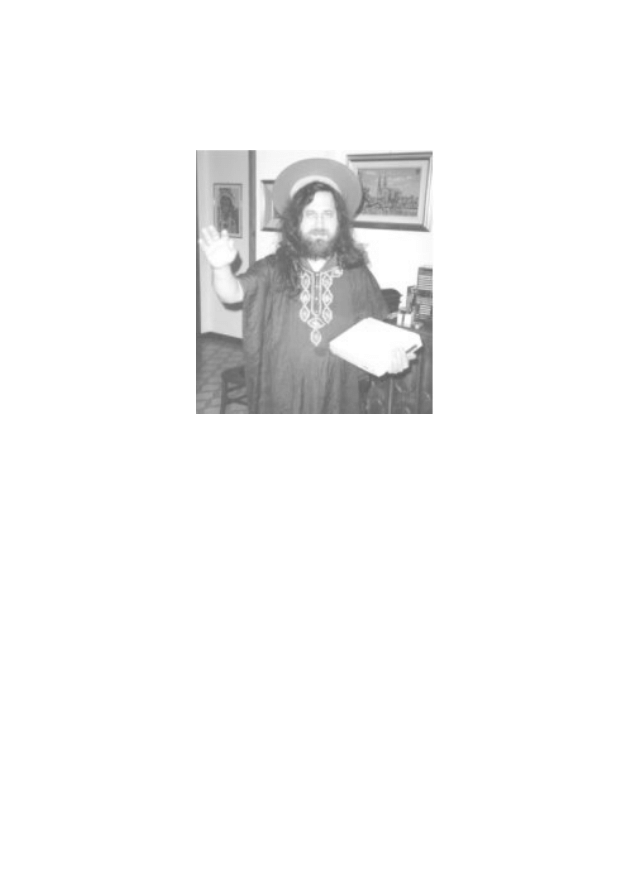
"I am St. Ignucius of the Church of Emacs," says Stallman,
raising his right hand in mock-blessing. "I bless your
computer, my child."
Stallman dressed as St. Ignucius. Photo by Wouter van
Oortmerssen.
The laughter turns into full-blown applause after a few
seconds. As audience members clap, the computer disk on
Stallman's head catches the glare of an overhead light,
eliciting a perfect halo effect. In the blink of an eye,
Stallman goes from awkward haole to Russian religious
icon.
" Emacs was initially a text editor," says Stallman,
explaining the getup. "Eventually it became a way of life
for many and a religion for some. We call this religion the
Church of Emacs."
The skit is a lighthearted moment of self-pardoy, a
humorous return-jab at the many people who might see
Stallman's form of software asceticism as religious
fanaticism in disguise. It is also the sound of the other shoe

dropping-loudly. It's as if, in donning his robe and halo,
Stallman is finally letting listeners of the hook, saying, "It's
OK to laugh. I know I'm weird."
Discussing the St. Ignucius persona afterward, Stallman
says he first came up with it in 1996, long after the creation
of Emacs but well before the emergence of the "open
source" term and the struggle for hacker-community
leadership that precipitated it. At the time, Stallman says,
he wanted a way to "poke fun at himself," to remind
listeners that, though stubborn, Stallman was not the fanatic
some made him out to be. It was only later, Stallman adds,
that others seized the persona as a convenient way to play
up his reputation as software ideologue, as Eric Raymond
did in an 1999 interview with the linux.com web site:
When I say RMS calibrates what he does,
I'm not belittling or accusing him of
insincerity. I'm saying that like all good
communicators he's got a theatrical streak.
Sometimes it's conscious-have you ever seen
him in his St. Ignucius drag, blessing
software with a disk platter on his head?
Mostly it's unconscious; he's just learned the
degree of irritating stimulus that works, that
holds attention without (usually) freaking
people out.
Stallman takes issue with the Raymond analysis. "It's
simply my way of making fun of myself," he says. "The
fact that others see it as anything more than that is a
reflection of their agenda, not mine."
That said, Stallman does admit to being a ham. "Are you
kidding?" he says at one point. "I love being the center of
attention." To facilitate that process, Stallman says he once

enrolled in Toastmasters, an organization that helps
members bolster their public-speaking skills and one
Stallman recommends highly to others. He possesses a
stage presence that would be the envy of most theatrical
performers and feels a link to vaudevillians of years past. A
few days after the Maui High Performance Computing
Center speech, I allude to the 1999 LinuxWorld performace
and ask Stallman if he has a Groucho Marx complex-i.e.,
the unwillingness to belong to any club that would have
him as a member. Stallman's response is immediate: "No,
but I admire Groucho Marx in a lot of ways and certainly
have been in some things I say inspired by him. But then
I've also been inspired in some ways by Harpo."
The Groucho Marx influence is certainly evident in
Stallman's lifelong fondness for punning. Then again,
punning and wordplay are common hacker traits. Perhaps
the most Groucho-like aspect of Stallman's personality,
however, is the deadpan manner in which the puns are
delivered. Most come so stealthily-without even the hint of
a raised eyebrow or upturned smile-you almost have to
wonder if Stallman's laughing at his audience more than the
audience is laughing at him.
Watching members of the Maui High Performance
Computer Center laugh at the St. Ignucius parody, such
concerns evaporate. While not exactly a standup act,
Stallman certainly possesses the chops to keep a roomful of
engineers in stitches. "To be a saint in the Church of Emacs
does not require celibacy, but it does require making a
commitment to living a life of moral purity," he tells the
Maui audience. "You must exorcise the evil proprietary
operating system from all your computer and then install a
wholly [holy] free operating system. And then you must
install only free software on top of that. If you make this
commitment and live by it, then you too will be a saint in
the Church of Emacs, and you too may have a halo."

The St. Ignucius skit ends with a brief inside joke. On most
Unix systems and Unix-related offshoots, the primary
competitor program to Emacs is vi, a text-editing program
developed by former UC Berkeley student and current Sun
Microsystems chief scientist, Bill Joy. Before doffing his
"halo," Stallman pokes fun at the rival program. "People
sometimes ask me if it is a sin in the Church of Emacs to
use vi," he says. "Using a free version of vi is not a sin; it is
a penance. So happy hacking."
After a brief question-and-answer session, audience
members gather around Stallman. A few ask for
autographs. "I'll sign this," says Stallman, holding up one
woman's print out of the GNU General Public License, "but
only if you promise me to use the term GNU/Linux instead
of Linux and tell all your friends to do likewise."
The comment merely confirms a private observation.
Unlike other stage performers and political figures,
Stallman has no "off" mode. Aside from the St. Ignucius
character, the ideologue you see onstage is the ideologue
you meet backstage. Later that evening, during a dinner
conversation in which a programmer mentions his affinity
for "open source" programs, Stallman, between bites,
upbraids his tablemate: "You mean free software. That's the
proper way to refer to it."
During the question-and-answer session, Stallman admits
to playing the pedagogue at times. "There are many people
who say, `Well, first let's invite people to join the
community, and then let's teach them about freedom.' And
that could be a reasonable strategy, but what we have is
almost everybody's inviting people to join the community,
and hardly anybody's teaching them about freedom once
they come in."

The result, Stallman says, is something akin to a third-
world city. People move in, hoping to strike it rich or at the
very least to take part in a vibrant, open culture, and yet
those who hold the true power keep evolving new tricks
and strategies-i.e., software patents-to keep the masses out.
"You have millions of people moving in and building
shantytowns, but nobody's working on step two: getting
them out of those shantytowns. If you think talking about
software freedom is a good strategy, please join in doing
step two. There are plenty working on step one. We need
more people working on step two."
Working on "step two" means driving home the issue that
freedom, not acceptance, is the root issue of the free
software movement. Those who hope to reform the
proprietary software industry from the inside are on a fool's
errand. "Change from the inside is risky," Stallman stays.
"Unless you're working at the level of a Gorbachev, you're
going to be neutralized."
Hands pop up. Stallman points to a member of the golf
shirt-wearing contingent. "Without patents, how would you
suggest dealing with commercial espionage?"
"Well, those two questions have nothing to do with each
other, really," says Stallman.
"But I mean if someone wants to steal another company's
piece of software."
Stallman's recoils as if hit by a poisonous spray. "Wait a
second," Stallman says. "Steal? I'm sorry, there's so much
prejudice in that statement that the only thing I can say is
that I reject that prejudice. Companies that develop nonfree
software and other things keep lots and lots of trade secrets,
and so that's not really likely to change. In the old days-

even in the 1980s-for the most part programmers were not
aware that there were even software patents and were
paying no attention to them. What happened was that
people published the interesting ideas, and if they were not
in the free software movement, they kept secret the little
details. And now they patent those broad ideas and keep
secret the little details. So as far as what you're describing,
patents really make no difference to it one way or another."
"But if it doesn't affect their publication," a new audience
member jumps in, his voice trailing off almost as soon as
he starts speaking.
"But it does," Stallman says. "Their publication is telling
you that this is an idea that's off limits to the rest of the
community for 20 years. And what the hell good is that?
Besides, they've written it in such a hard way to read, both
to obfuscate the idea and to make the patent as broad as
possible, that it's basically useless looking at the published
information to learn anything anyway. The only reason to
look at patents is to see the bad news of what you can't do."
The audience falls silent. The speech, which began at 3:15,
is now nearing the 5:00 whistle, and most listeners are
already squirming in their seats, antsy to get a jump start on
the weekend. Sensing the fatigue, Stallman glances around
the room and hastily shuts things down. "So it looks like
we're done," he says, following the observation with an
auctioneer's "going, going, gone" to flush out any last-
minute questioners. When nobody throws their hand up,
Stallman signs off with a traditional exit line.
"Happy hacking," he says.
Endnotes

1. See "Grateful Dead Time Capsule: 1985-1995 North
American Tour Grosses."
http://www.accessplace.com/gdtc/1197.htm
2. See Evan Leibovitch, "Who's Afraid of Big Bad
Wolves," ZDNet Tech Update (December 15, 2000).
http://techupdate.zdnet.com/techupdate/stories/main/0Y/A>
3. For narrative purposes, I have hesitated to go in-
depth when describing Stallman's full definition of
software "freedom." The GNU Project web site lists
four fundamental components:
The freedom to run a program, for any purpose
(freedom 0).
The freedom to study how a program works, and
adapt it to your needs (freedom 1).
The freedom to redistribute copies of a program so
you can help your neighbor (freedom 2).
The freedom to improve the program, and release
your improvements to the public, so that the whole
community benefits (freedom 3).
For more information, please visit "The Free
Software Definition" at
http://www.gnu.org/philosophy/free-sw.html
4. See Eric Raymond, "Shut Up and Show Them the
Code," online essay, (June 28, 1999).
5. See "Guest Interview: Eric S. Raymond," Linux.com
(May 18, 1999).

Chapter 9
The GNU General Public License
By the spring of 1985, Richard Stallman had settled on the GNU Project's first milestone-a Lisp-
based free software version of Emacs. To meet this goal, however, he faced two challenges.
First, he had to rebuild Emacs in a way that made it platform independent. Second, he had to
rebuild the Emacs Commune in a similar fashion.
The dispute with UniPress had highlighted a flaw in the Emacs Commune social contract.
Where users relied on Stallman's expert insight, the Commune's rules held. In areas where
Stallman no longer held the position of alpha hacker-pre-1984 Unix systems, for example-
individuals and companies were free to make their own rules.
The tension between the freedom to modify and the freedom to exert authorial privilege had
been building before GOSMACS. The Copyright Act of 1976 had overhauled U.S. copyright
law, extending the legal protection of copyright to software programs. According to Section
102(b) of the Act, individuals and companies now possessed the ability to copyright the
"expression" of a software program but not the "actual processes or methods embodied in the
program."
Translated, programmers and companies had the ability to treat software programs
like a story or song. Other programmers could take inspiration from the work, but to make a
direct copy or nonsatirical derivative, they first had to secure permission from the original
creator. Although the new law guaranteed that even programs without copyright notices carried
copyright protection, programmers quickly asserted their rights, attaching coypright notices to
their software programs.
At first, Stallman viewed these notices with alarm. Rare was the software program that didn't
borrow source code from past programs, and yet, with a single stroke of the president's pen,
Congress had given programmers and companies the power to assert individual authorship over
communally built programs. It also injected a dose of formality into what had otherwise been an
informal system. Even if hackers could demonstrate how a given program's source-code
bloodlines stretched back years, if not decades, the resources and money that went into battling
each copyright notice were beyond most hackers' means. Simply put, disputes that had once
been settled hacker-to-hacker were now settled lawyer-to-lawyer. In such a system, companies,
not hackers, held the automatic advantage.
Proponents of software copyright had their counter-arguments: without copyright, works might
otherwise slip into the public domain. Putting a copyright notice on a work also served as a
statement of quality. Programmers or companies who attached their name to the copyright
attached their reputations as well. Finally, it was a contract, as well as a statement of ownership.
Using copyright as a flexible form of license, an author could give away certain rights in
exchange for certain forms of behavior on the part of the user. For example, an author could
give away the right to suppress unauthorized copies just so long as the end user agreed not to
create a commercial offshoot.
It was this last argument that eventually softened Stallman's resistance to software copyright
notices. Looking back on the years leading up to the GNU Project, Stallman says he began to
sense the beneficial nature of copyright sometime around the release of Emacs 15.0, the last
significant pre-GNU Project upgrade of Emacs. "I had seen email messages with copyright
notices plus simple `verbatim copying permitted' licenses," Stallman recalls. "Those definitely
were [an] inspiration."

For Emacs 15, Stallman drafted a copyright that gave users the right to make and distribute
copies. It also gave users the right to make modified versions, but not the right to claim sole
ownership of those modified versions, as in the case of GOSMACS.
Although helpful in codifying the social contract of the Emacs Commune, the Emacs 15 license
remained too "informal" for the purposes of the GNU Project, Stallman says. Soon after starting
work on a GNU version of Emacs, Stallman began consulting with the other members of the
Free Software Foundation on how to shore up the license's language. He also consulted with the
attorneys who had helped him set up the Free Software Foundation.
Mark Fischer, a Boston attorney specializing in intellectual-property law, recalls discussing the
license with Stallman during this period. "Richard had very strong views about how it should
work," Fischer says, "He had two principles. The first was to make the software absolutely as
open as possible. The second was to encourage others to adopt the same licensing practices."
Encouraging others to adopt the same licensing practices meant closing off the escape hatch
that had allowed privately owned versions of Emacs to emerge. To close that escape hatch,
Stallman and his free software colleagues came up with a solution: users would be free to
modify GNU Emacs just so long as they published their modifications. In addition, the resulting
"derivative" works would also have carry the same GNU Emacs License.
The revolutionary nature of this final condition would take a while to sink in. At the time,
Fischer says, he simply viewed the GNU Emacs License as a simple contract. It put a price tag
on GNU Emacs' use. Instead of money, Stallman was charging users access to their own later
modifications. That said, Fischer does remember the contract terms as unique.
"I think asking other people to accept the price was, if not unique, highly unusual at that time,"
he says.
The GNU Emacs License made its debut when Stallman finally released GNU Emacs in 1985.
Following the release, Stallman welcomed input from the general hacker community on how to
improve the license's language. One hacker to take up the offer was future software activist
John Gilmore, then working as a consultant to Sun Microsystems. As part of his consulting
work, Gilmore had ported Emacs over to SunOS, the company's in-house version of Unix. In
the process of doing so, Gilmore had published the changes as per the demands of the GNU
Emacs License. Instead of viewing the license as a liability, Gilmore saw it as clear and concise
expression of the hacker ethos. "Up until then, most licenses were very informal," Gilmore
recalls.
As an example of this informality, Gilmore cites a copyright notice for trn, a Unix utility.
Written by Larry Wall, future creator of the Perl programming language, patch made it simple
for Unix programmers to insert source-code fixes-" patches" in hacker jargon-into any large
program. Recognizing the utility of this feature, Wall put the following copyright notice in the
program's accompanying README file:
Copyright (c) 1985, Larry Wall
You may copy the trn kit in whole or in part as long as you don't try
to make money off it, or pretend that you wrote it.
Such statements, while reflective of the hacker ethic, also reflected the difficulty of translating
the loose, informal nature of that ethic into the rigid, legal language of copyright. In writing the
GNU Emacs License, Stallman had done more than close up the escape hatch that permitted
proprietary offshoots. He had expressed the hacker ethic in a manner understandable to both

lawyer and hacker alike.
It wasn't long, Gilmore says, before other hackers began discussing ways to "port" the GNU
Emacs License over to their own programs. Prompted by a conversation on Usenet, Gilmore
sent an email to Stallman in November, 1986, suggesting modification:
You should probably remove "EMACS" from the license and replace it with
"SOFTWARE" or something. Soon, we hope, Emacs will not be the biggest part
of the GNU system, and the license applies to all of it.
Gilmore wasn't the only person suggesting a more general approach. By the end of 1986,
Stallman himself was at work with GNU Project's next major milestone, a source-code
debugger, and was looking for ways to revamp the Emacs license so that it might apply to both
programs. Stallman's solution: remove all specific references to Emacs and convert the license
into a generic copyright umbrella for GNU Project software. The GNU General Public License,
GPL for short, was born.
In fashioning the GPL, Stallman followed the software convention of using decimal numbers to
indicate prototype versions and whole numbers to indicate mature versions. Stallman published
Version 1.0 of the GPL in 1989 (a project Stallman was developing in 1985), almost a full year
after the release of the GNU Debugger, Stallman's second major foray into the realm of Unix
programming. The license contained a preamble spelling out its political intentions:
The General Public License is designed to make sure that you have
the freedom to give away or sell copies of free software, that you
receive source code or can get it if you want it, that you can change
the software or use pieces of it in new free programs; and that you
know you can do these things.
To protect your rights, we need to make restrictions that forbid
anyone to deny you these rights or to ask you to surrender the
rights. These restrictions translate to certain responsibilities for
you if you distribute copies of the software, or if you modify it.
In fashioning the GPL, Stallman had been forced to make an additional adjustment to the
informal tenets of the old Emacs Commune. Where he had once demanded that Commune
members publish any and all changes, Stallman now demanded publication only in instances
when programmers circulated their derivative versions in the same public manner as Stallman.
In other words, programmers who simply modified Emacs for private use no longer needed to
send the source-code changes back to Stallman. In what would become a rare compromise of
free software doctrine, Stallman slashed the price tag for free software. Users could innovate
without Stallman looking over their shoulders just so long as they didn't bar Stallman and the
rest of the hacker community from future exchanges of the same program.
Looking back, Stallman says the GPL compromise was fueled by his own dissatisfaction with
the Big Brother aspect of the original Emacs Commune social contract. As much as he liked
peering into other hackers' systems, the knowledge that some future source-code maintainer
might use that power to ill effect forced him to temper the GPL.
"It was wrong to require people to publish all changes," says Stallman. "It was wrong to require
them to be sent to one privileged developer. That kind of centralization and privilege for one
was not consistent with a society in which all had equal rights."

As hacks go, the GPL stands as one of Stallman's best. It created a system of communal
ownership within the normally proprietary confines of copyright law. More importantly, it
demonstrated the intellectual similarity between legal code and software code. Implicit within
the GPL's preamble was a profound message: instead of viewing copyright law with suspicion,
hackers should view it as yet another system begging to be hacked.
"The GPL developed much like any piece of free software with a large community discussing
its structure, its respect or the opposite in their observation, needs for tweaking and even to
compromise it mildly for greater acceptance," says Jerry Cohen, another attorney who helped
Stallman with the creation of the license. "The process worked very well and GPL in its several
versions has gone from widespread skeptical and at times hostile response to widespread
acceptance."
In a 1986 interview with Byte magazine, Stallman summed up the GPL in colorful terms. In
addition to proclaiming hacker values, Stallman said, readers should also "see it as a form of
intellectual jujitsu, using the legal system that software hoarders have set up against them."
Years later, Stallman would describe the GPL's creation in less hostile terms. "I was thinking
about issues that were in a sense ethical and in a sense political and in a sense legal," he says. "I
had to try to do what could be sustained by the legal system that we're in. In spirit the job was
that of legislating the basis for a new society, but since I wasn't a government, I couldn't
actually change any laws. I had to try to do this by building on top of the existing legal system,
which had not been designed for anything like this."
About the time Stallman was pondering the ethical, political, and legal issues associated with
free software, a California hacker named Don Hopkins mailed him a manual for the 68000
microprocessor. Hopkins, a Unix hacker and fellow science-fiction buff, had borrowed the
manual from Stallman a while earlier. As a display of gratitude, Hopkins decorated the return
envelope with a number of stickers obtained at a local science-fiction convention. One sticker in
particular caught Stallman's eye. It read, "Copyleft (L), All Rights Reversed." Following the
release of the first version of GPL, Stallman paid tribute to the sticker, nicknaming the free
software license "Copyleft." Over time, the nickname and its shorthand symbol, a backwards
"C," would become an official Free Software Foundation synonym for the GPL.
The German sociologist Max Weber once proposed that all great religions are built upon the
"routinization" or "institutionalization" of charisma. Every successful religion, Weber argued,
converts the charisma or message of the original religious leader into a social, political, and
ethical apparatus more easily translatable across cultures and time.
While not religious per se, the GNU GPL certainly qualifies as an interesting example of this
"routinization" process at work in the modern, decentralized world of software development.
Since its unveiling, programmers and companies who have otherwise expressed little loyalty or
allegiance to Stallman have willingly accepted the GPL bargain at face value. A few have even
accepted the GPL as a preemptive protective mechanism for their own software programs. Even
those who reject the GPL contract as too compulsory, still credit it as influential.
One hacker falling into this latter group was Keith Bostic, a University of California employee
at the time of the GPL 1.0 release. Bostic's department, the Computer Systems Research Group
(SRG), had been involved in Unix development since the late 1970s and was responsible for
many key parts of Unix, including the TCP/IP networking protocol, the cornerstone of modern
Internet communications. By the late 1980s, AT&T, the original owner of the Unix brand name,
began to focus on commercializing Unix and began looking to the Berkeley Software
Distribution, or BSD, the academic version of Unix developed by Bostic and his Berkeley
peers, as a key source of commercial technology.

Although the Berkeley BSD source code was shared among researchers and commercial
programmers with a source-code license, this commercialization presented a problem. The
Berkeley code was intermixed with proprietary AT&T code. As a result, Berkeley distributions
were available only to institutions that already had a Unix source license from AT&T. As
AT&T raised its license fees, this arrangement, which had at first seemed innocuous, became
increasingly burdensome.
Hired in 1986, Bostic had taken on the personal project of porting BSD over to the Digital
Equipment Corporation's PDP-11 computer. It was during this period, Bostic says, that he came
into close interaction with Stallman during Stallman's occasional forays out to the west coast. "I
remember vividly arguing copyright with Stallman while he sat at borrowed workstations at
CSRG," says Bostic. "We'd go to dinner afterward and continue arguing about copyright over
dinner."
The arguments eventually took hold, although not in the way Stallman would have liked. In
June, 1989, Berkeley separated its networking code from the rest of the AT&T-owned operating
system and distributed it under a University of California license. The contract terms were
liberal. All a licensee had to do was give credit to the university in advertisements touting
derivative programs.
In contrast to the GPL, proprietary offshoots were permissible. Only one
problem hampered the license's rapid adoption: the BSD Networking release wasn't a complete
operating system. People could study the code, but it could only be run in conjunction with
other proprietary-licensed code.
Over the next few years, Bostic and other University of California employees worked to replace
the missing components and turn BSD into a complete, freely redistributable operating system.
Although delayed by a legal challenge from Unix Systems Laboratories-the AT&T spin-off that
retained ownership of the Unix brand name-the effort would finally bear fruit in the early
1990s. Even before then, however, many of the Berkeley utilities would make their way into
Stallman's GNU Project.
"I think it's highly unlikely that we ever would have gone as strongly as we did without the
GNU influence," says Bostic, looking back. "It was clearly something where they were pushing
hard and we liked the idea."
By the end of the 1980s, the GPL was beginning to exert a gravitational effect on the free
software community. A program didn't have to carry the GPL to qualify as free software-
witness the case of the BSD utilities-but putting a program under the GPL sent a definite
message. "I think the very existence of the GPL inspired people to think through whether they
were making free software, and how they would license it," says Bruce Perens, creator of
Electric Fence, a popular Unix utility, and future leader of the Debian GNU/Linux development
team. A few years after the release of the GPL, Perens says he decided to discard Electric
Fence's homegrown license in favor of Stallman's lawyer-vetted copyright. "It was actually
pretty easy to do," Perens recalls.
Rich Morin, the programmer who had viewed Stallman's initial GNU announcement with a
degree of skepticism, recalls being impressed by the software that began to gather under the
GPL umbrella. As the leader of a SunOS user group, one of Morin's primary duties during the
1980s had been to send out distribution tapes containing the best freeware or free software
utilities. The job often mandated calling up original program authors to verify whether their
programs were copyright protected or whether they had been consigned to the public domain.
Around 1989, Morin says, he began to notice that the best software programs typically fell
under the GPL license. "As a software distributor, as soon as I saw the word GPL, I knew I was
home free," recalls Morin.

To compensate for the prior hassles that went into compiling distribution tapes to the Sun User
Group, Morin had charged recipients a convenience fee. Now, with programs moving over to
the GPL, Morin was suddenly getting his tapes put together in half the time, turning a tidy profit
in the process. Sensing a commercial opportunity, Morin rechristened his hobby as a business:
Prime Time Freeware.
Such commercial exploitation was completely within the confines of the free software agenda.
"When we speak of free software, we are referring to freedom, not price," advised Stallman in
the GPL's preamble. By the late 1980s, Stallman had refined it to a more simple mnemonic:
"Don't think free as in free beer; think free as in free speech."
For the most part, businesses ignored Stallman's entreaties. Still, for a few entrepreneurs, the
freedom associated with free software was the same freedom associated with free markets. Take
software ownership out of the commercial equation, and you had a situation where even the
smallest software company was free to compete against the IBMs and DECs of the world.
One of the first entrepreneurs to grasp this concept was Michael Tiemann, a software
programmer and graduate student at Stanford University. During the 1980s, Tiemann had
followed the GNU Project like an aspiring jazz musician following a favorite artist. It wasn't
until the release of the GNU C Compiler in 1987, however, that he began to grasp the full
potential of free software. Dubbing GCC a "bombshell," Tiemann says the program's own
existence underlined Stallman's determination as a programmer.
"Just as every writer dreams of writing the great American novel, every programmer back in the
1980s talked about writing the great American compiler," Tiemman recalls. "Suddenly Stallman
had done it. It was very humbling."
"You talk about single points of failure, GCC was it," echoes Bostic. "Nobody had a compiler
back then, until GCC came along."
Rather than compete with Stallman, Tiemann decided to build on top of his work. The original
version of GCC weighed in at 110,000 lines of code, but Tiemann recalls the program as
surprisingly easy to understand. So easy in fact that Tiemann says it took less than five days to
master and another week to port the software to a new hardware platform, National
Semiconductor's 32032 microchip. Over the next year, Tiemann began playing around with the
source code, creating a native compiler for the C+ programming language. One day, while
delivering a lecture on the program at Bell Labs, Tiemann ran into some AT&T developers
struggling to pull off the same thing.
"There were about 40 or 50 people in the room, and I asked how many people were working on
the native code compiler," Tiemann recalls. "My host said the information was confidential but
added that if I took a look around the room I might get a good general idea."
It wasn't long after, Tiemann says, that the light bulb went off in his head. "I had been working
on that project for six months," Tiemann says. I just thought to myself, whether it's me or the
code this is a level of efficiency that the free market should be ready to reward."
Tiemann found added inspiration in the GNU Manifesto, which, while excoriating the greed of
some software vendors, encourages other vendors to consider the advantages of free software
from a consumer point of view. By removing the power of monopoly from the commerical
software question, the GPL makes it possible for the smartest vendors to compete on the basis
of service and consulting, the two most profit-rich corners of the software marketplace.

In a 1999 essay, Tiemann recalls the impact of Stallman's Manifesto. "It read like a socialist
polemic, but I saw something different. I saw a business plan in disguise."
Teaming up with John Gilmore, another GNU Project fan, Tiemann launched a software
consulting service dedicated to customizing GNU programs. Dubbed Cygnus Support, the
company signed its first development contract in February, 1990. By the end of the year, the
company had $725,000 worth of support and development contracts.
GNU Emacs, GDB, and GCC were the "big three" of developer-oriented tools, but they weren't
the only ones developed by Stallman during the GNU Project's first half decade. By 1990,
Stallman had also generated GNU versions of the Bourne Shell (rechristened the Bourne Again
Shell, or BASH), YACC (rechristened Bison), and awk (rechristened gawk). Like GCC , every
GNU program had to be designed to run on multiple systems, not just a single vendor's
platform. In the process of making programs more flexible, Stallman and his collaborators often
made them more useful as well.
Recalling the GNU universalist approach, Prime Time Freeware's Morin points to a critical,
albeit mundane, software package called hello. "It's the hello world program which is five lines
of C, packaged up as if it were a GNU distribution," Morin says. "And so it's got the Texinfo
stuff and the configure stuff. It's got all the other software engineering goo that the GNU Project
has come up with to allow packages to port to all these different environments smoothly. That's
tremendously important work, and it affects not only all of [Stallman's] software, but also all of
the other GNU Project software."
According to Stallman, improving software programs was secondary to building them in the
first place. "With each piece I may or may not find a way to improve it," said Stallman to Byte.
"To some extent I am getting the benefit of reimplementation, which makes many systems
much better. To some extent it's because I have been in the field a long time and worked on
many other systems. I therefore have many ideas to bring to bear."
Nevertheless, as GNU tools made their mark in the late 1980s, Stallman's AI Lab-honed
reputation for design fastidiousness soon became legendary throughout the entire software-
development community.
Jeremy Allison, a Sun user during the late 1980s and programmer destined to run his own free
software project, Samba, in the 1990s, recalls that reputation with a laugh. During the late
1980s, Allison began using Emacs. Inspired by the program's community-development model,
Allison says he sent in a snippet of source code only to have it rejected by Stallman.
"It was like the Onion headline," Allison says. "`Child's prayers to God answered: No.'"
Stallman's growing stature as a software programmer, however, was balanced by his struggles
as a project manager. Although the GNU Project moved from success to success in creation of
developer-oriented tools, its inability to generate a working kernel-the central "traffic cop"
program in all Unix systems that determines which devices and applications get access to the
microprocessor and when-was starting to elicit grumbles as the 1980s came to a close. As with
most GNU Project efforts, Stallman had started kernel development by looking for an existing
program to modify. According to a January 1987 "Gnusletter," Stallman was already working to
overhaul TRIX, a Unix kernel developed at MIT.
A review of GNU Project "GNUsletters" of the late 1980s reflects the management tension. In
January, 1987, Stallman announced to the world that the GNU Project was working to overhaul

TRIX, a Unix kernel developed at MIT. A year later, in February of 1988, the GNU Project
announced that it had shifted its attentions to Mach, a lightweight "micro-kernel" developed at
Carnegie Mellon. All told, however, official GNU Project kernel development wouldn't
commence until 1990.
The delays in kernel development were just one of many concerns weighing on Stallman during
this period. In 1989, Lotus Development Corporation filed suit against rival software company,
Paperback Software International, for copying menu commands in Lotus' popular 1-2-3
Spreadsheet program. Lotus' suit, coupled with the Apple -Microsoft "look and feel" battle,
provided a troublesome backdrop for the GNU Project. Although both suits fell outside the
scope of the GNU Project, both revolved around operating systems and software applications
developed for the personal computer, not Unix-compatible hardware systems-they threatened to
impose a chilling effect on the entire culture of software development. Determined to do
something, Stallman recruited a few programmer friends and composed a magazine ad blasting
the lawsuits. He then followed up the ad by helping to organize a group to protest the
corporations filing the suit. Calling itself the League of Programming Freedom, the group held
protests outside the offices of Lotus, Inc. and the Boston courtroom hosting the Lotus trial.
They document the evolving nature of software industry.
Applications had quietly replaced operating systems as the primary corporate battleground. In
its unfulfilled quest to build a free software operating system, the GNU Project seemed
hopelessly behind the times. Indeed, the very fact that Stallman had felt it necessary to put
together an entirely new group dedicated to battling the "look and feel" lawsuits reinforced that
obsolescence in the eyes of some observers.
In 1990, the John D. and Catherine T. MacArthur Foundation cerified Stallman's genius status
when it granted Stallman a MacArthur fellowship, therefore making him a recipient for the
organization's so-called "genius grant." The grant, a $240,000 reward for launching the GNU
Project and giving voice to the free software philosophy, relieved a number of short-term
concerns. First and foremost, it gave Stallman, a nonsalaried employee of the FSF who had
been supporting himself through consulting contracts, the ability to devote more time to writing
GNU code.
Ironically, the award also made it possible for Stallman to vote. Months before the award, a fire
in Stallman's apartment house had consumed his few earthly possessions. By the time of the
award, Stallman was listing himself as a "squatter"
at 545 Technology Square. "[The registrar
of voters] didn't want to accept that as my address," Stallman would later recall. "A newspaper
article about the MacArthur grant said that and then they let me register."
Most importantly, the MacArthur money gave Stallman more freedom. Already dedicated to the
issue of software freedom, Stallman chose to use the additional freedom to increase his travels
in support of the GNU Project mission.
Interestingly, the ultimate success of the GNU Project and the free software movement in
general would stem from one of these trips. In 1990, Stallman paid a visit to the Polytechnic
University in Helsinki, Finland. Among the audience members was 21-year-old Linus Torvalds,
future developer of the Linux kernel-the free software kernel destined to fill the GNU Project's
most sizable gap.
A student at the nearby University of Helsinki at the time, Torvalds regarded Stallman with
bemusement. "I saw, for the first time in my life, the stereotypical long-haired, bearded hacker
type," recalls Torvalds in his 2001 autobiography Just for Fun. "We don't have much of them in

Helsinki."
While not exactly attuned to the "sociopolitical" side of the Stallman agenda, Torvalds
nevertheless appreciated the agenda's underlying logic: no programmer writes error-free code.
By sharing software, hackers put a program's improvement ahead of individual motivations
such as greed or ego protection.
Like many programmers of his generation, Torvalds had cut his teeth not on mainframe
computers like the IBM 7094, but on a motley assortment of home-built computer systems. As
university student, Torvalds had made the step up from C programming to Unix, using the
university's MicroVAX. This ladder-like progression had given Torvalds a different perspective
on the barriers to machine access. For Stallman, the chief barriers were bureaucracy and
privilege. For Torvalds, the chief barriers were geography and the harsh Helsinki winter. Forced
to trek across the University of Helsinki just to log in to his Unix account, Torvalds quickly
began looking for a way to log in from the warm confines of his off-campus apartment.
The search led Torvalds to the operating system Minix, a lightweight version of Unix developed
for instructional purposes by Dutch university professor Andrew Tanenbaum. The program fit
within the memory confines of a 386 PC, the most powerful machine Torvalds could afford, but
still lacked a few necessary features. It most notably lacked terminal emulation, the feature that
allowed Torvalds' machine to mimic a university terminal, making it possible to log in to the
MicroVAX from home.
During the summer of 1991, Torvalds rewrote Minix from the ground up, adding other features
as he did so. By the end of the summer, Torvalds was referring to his evolving work as the
"GNU/Emacs of terminal emulation programs."
Feeling confident, he solicited a Minix
newsgroup for copies of the POSIX standards, the software blue prints that determined whether
a program was Unix compatible. A few weeks later, Torvalds was posting a message eerily
reminiscent of Stallman's original 1983 GNU posting:
Hello everybody out there using minix-
I'm doing a (free) operating system (just a hobby, won't be big and
professional like gnu for 386 (486) AT clones). This has been brewing
since April, and is starting to get ready. I'd like any feedback on
things people like/dislike in minix, as my OS resembles it somewhat
(same physical layout of the file-system (due to practical reasons)
The posting drew a smattering of responses and within a month, Torvalds had posted a 0.01
version of the operating system-i.e., the earliest possible version fit for outside review-on an
Internet FTP site. In the course of doing so, Torvalds had to come up with a name for the new
system. On his own PC hard drive, Torvalds had saved the program as Linux, a name that paid
its respects to the software convention of giving each Unix variant a name that ended with the
letter X. Deeming the name too "egotistical," Torvalds changed it to Freax, only to have the
FTP site manager change it back.
Although Torvalds had set out build a full operating system, both he and other developers knew
at the time that most of the functional tools needed to do so were already available, thanks to
the work of GNU, BSD, and other free software developers. One of the first tools the Linux
development team took advantage of was the GNU C Compiler, a tool that made it possible to
process programs written in the C programming language.

Integrating GCC improved the performance of Linux. It also raised issues. Although the GPL's
"viral" powers didn't apply to the Linux kernel, Torvald's willingness to borrow GCC for the
purposes of his own free software operating system indicated a certain obligation to let other
users borrow back. As Torvalds would later put it: "I had hoisted myself up on the shoulders of
giants."
Not surprisingly, he began to think about what would happen when other people
looked to him for similar support. A decade after the decision, Torvalds echoes the Free
Software Foundation's Robert Chassel when he sums up his thoughts at the time:
You put six months of your life into this thing and you want to make it available
and you want to get something out of it, but you don't want people to take
advantage of it. I wanted people to be able to see [Linux], and to make changes
and improvements to their hearts' content. But I also wanted to make sure that
what I got out of it was to see what they were doing. I wanted to always have
access to the sources so that if they made improvements, I could make those
improvements myself.
When it was time to release the 0.12 version of Linux, the first to include a fully integrated
version of GCC, Torvalds decided to voice his allegiance with the free software movement. He
discarded the old kernel license and replaced it with the GPL. The decision triggered a porting
spree, as Torvalds and his collaborators looked to other GNU programs to fold into the growing
Linux stew. Within three years, Linux developers were offering their first production release,
Linux 1.0, including fully modified versions of GCC, GDB, and a host of BSD tools.
By 1994, the amalgamated operating system had earned enough respect in the hacker world to
make some observers wonder if Torvalds hadn't given away the farm by switching to the GPL
in the project's initial months. In the first issue of Linux Journal, publisher Robert Young sat
down with Torvalds for an interview. When Young asked the Finnish programmer if he felt
regret at giving up private ownership of the Linux source code, Torvalds said no. "Even with
20/20 hindsight," Torvalds said, he considered the GPL "one of the very best design decisions"
made during the early stages of the Linux project.
That the decision had been made with zero appeal or deference to Stallman and the Free
Software Foundation speaks to the GPL's growing portability. Although it would take a few
years to be recognized by Stallman, the explosiveness of Linux development conjured
flashbacks of Emacs. This time around, however, the innovation triggering the explosion wasn't
a software hack like Control-R but the novelty of running a Unix-like system on the PC
architecture. The motives may have been different, but the end result certainly fit the ethical
specifications: a fully functional operating system composed entirely of free software.
As his initial email message to the comp.os.minix newsgroup indicates, it would take a few
months before Torvalds saw Linux as anything less than a holdover until the GNU developers
delivered on the HURD kernel. This initial unwillingness to see Linux in political terms would
represent a major blow to the Free Software Foundation.
As far as Torvalds was concerned, he was simply the latest in a long line of kids taking apart
and reassembling things just for fun. Nevertheless, when summing up the runaway success of a
project that could have just as easily spent the rest of its days on an abandoned computer hard
drive, Torvalds credits his younger self for having the wisdom to give up control and accept the
GPL bargain.
"I may not have seen the light," writes Torvalds, reflecting on Stallman's 1991 Polytechnic
University speech and his subsequent decision to switch to the GPL. "But I guess something
from his speech sunk in ."

Endnotes
1. See Hal Abelson, Mike Fischer, and Joanne Costello, "Software and Copyright Law,"
updated version (1998).
http://www.swiss.ai.mit.edu/6805/articles/int-prop/software-copyright.html
2. See Trn Kit README.
http://www.za.debian.org/doc/trn/trn-readme
3. See John Gilmore, quoted from email to author.
4. See Richard Stallman, et al., "GNU General Public License: Version 1," (February,
1989).
http://www.gnu.org/copyleft/copying-1.0.html
5. See David Betz and Jon Edwards, "Richard Stallman discusses his public-domain [sic]
Unix-compatible software system with BYTE editors," BYTE (July, 1996). (Reprinted
on the GNU Project web site:
http://www.gnu.org/gnu/byte-interview.html
This interview offers an interesting, not to mention candid, glimpse at Stallman's
political attitudes during the earliest days of the GNU Project. It is also helpful in tracing
the evolution of Stallman's rhetoric.
Describing the purpose of the GPL, Stallman says, "I'm trying to change the way people
approach knowledge and information in general. I think that to try to own knowledge, to
try to control whether people are allowed to use it, or to try to stop other people from
sharing it, is sabotage."
Contrast this with a statement to the author in August 2000: "I urge you not to use the
term `intellectual property' in your thinking. It will lead you to misunderstand things,
because that term generalizes about copyrights, patents, and trademarks. And those
things are so different in their effects that it is entirely foolish to try to talk about them at
once. If you hear somebody saying something about intellectual property, without
quotes, then he's not thinking very clearly and you shouldn't join."
6. The University of California's "obnoxious advertising clause" would later prove to be a
problem. Looking for a less restrictive alternative to the GPL, some hackers used the
University of California, replacing "University of California" with the name of their own
instution. The result: free software programs that borrowed from dozens of other
programs would have to cite dozens of institutions in advertisements. In 1999, after a
decade of lobbying on Stallman's part, the University of California agreed to drop this
clause.
See "The BSD License Problem" at
http://www.gnu.org/philosophy/bsd.html
.
7. See Michael Tiemann, "Future of Cygnus Solutions: An Entrepreneur's Account," Open
Sources (O'Reilly & Associates, Inc., 1999): 139.
8. See Richard Stallman, BYTE (1986).
9. See "HURD History."
http://www.gnu.org/software/hurd/history.html
10. According to a League of Programming Freedom Press, the protests were notable for
featuring the first hexadecimal protest chant:
1-2-3-4, toss the lawyers out the door;
5-6-7-8, innovate don't litigate;
9-A-B-C, 1-2-3 is not for me;
D-E-F-O, look and feel have got to go
http://lpf.ai.mit.edu/Links/prep.ai.mit.edu/demo.final.release
11. I use the term "writing" here loosely. About the time of the MacArthur award, Stallman
began suffering chronic pain in his hands and was dictating his work to FSF-employed
typists. Although some have speculated that the hand pain was the result of repetitive
stress injury, or RSI, an injury common among software programmers, Stallman is not

100% sure. "It was NOT carpal tunnel syndrome," he writes. "My hand problem was in
the hands themselves, not in the wrists." Stallman has since learned to work without
typists after switching to a keyboard with a lighter touch.
12. See Reuven Lerner, "Stallman wins $240,000 MacArthur award," MIT, The Tech (July
18, 1990).
http://the-tech.mit.edu/V110/N30/rms.30n.html
13. See Michael Gross, "Richard Stallman: High School Misfit, Symbol of Free Software,
MacArthur-certified Genius" (1999).
14. See Linus Torvalds and David Diamond, Just For Fun: The Story of an Accidentaly
Revolutionary (HarperCollins Publishers, Inc., 2001): 58-59.
15. See Linus Torvalds and David Diamond, Just For Fun: The Story of an Accidentaly
Revolutionary (HarperCollins Publishers, Inc., 2001): 78.
16. See "Linux 10th Anniversary."
http://www.linux10.org/history/
17. See Linus Torvalds and David Diamond, Just For Fun: The Story of an Accidentaly
Revolutionary (HarperCollins Publishers, Inc., 2001): 96-97.
18. See Linus Torvalds and David Diamond, Just For Fun: The Story of an Accidentaly
Revolutionary (HarperCollins Publishers, Inc., 2001): 94-95.
19. See Robert Young, "Interview with Linus, the Author of Linux," Linux Journal (March
1, 1994).
http://www.linuxjournal.com/article.php?sid=2736
20. See Linus Torvalds and David Diamond, Just For Fun: The Story of an Accidentaly
Revolutionary (HarperCollins Publishers, Inc., 2001): 59.

Chapter 10
GNU/Linux
By 1993, the free software movement was at a
crossroads. To the optimistically inclined, all signs
pointed toward success for the hacker culture. Wired
magazine, a funky, new publication offering stories on
data encryption, Usenet, and software freedom, was
flying off magazine racks. The Internet, once a slang
term used only by hackers and research scientists, had
found its way into mainstream lexicon. Even President
Clinton was using it. The personal computer, once a
hobbyist's toy, had grown to full-scale respectability,
giving a whole new generation of computer users access
to hacker-built software. And while the GNU Project
had not yet reached its goal of a fully intact, free
software operating system, curious users could still try
Linux in the interim.
Any way you sliced it, the news was good, or so it
seemed. After a decade of struggle, hackers and hacker
values were finally gaining acceptance in mainstream
society. People were getting it.
Or were they? To the pessimistically inclined, each sign
of acceptance carried its own troubling countersign.
Sure, being a hacker was suddenly cool, but was cool
good for a community that thrived on alienation? Sure,
the White House was saying all the right things about
the Internet, even going so far as to register its own
domain name, whitehouse.gov, but it was also meeting
with the companies, censorship advocates, and law-

enforcement officials looking to tame the Internet's Wild
West culture. Sure, PCs were more powerful, but in
commoditizing the PC marketplace with its chips, Intel
had created a situation in which proprietary software
vendors now held the power. For every new user won
over to the free software cause via Linux, hundreds,
perhaps thousands, were booting up Microsoft Windows
for the first time.
Finally, there was the curious nature of Linux itself.
Unrestricted by design bugs (like GNU) and legal
disputes (like BSD), Linux' high-speed evolution had
been so unplanned, its success so accidental, that
programmers closest to the software code itself didn't
know what to make of it. More compilation album than
operating system, it was comprised of a hacker medley
of greatest hits: everything from GCC, GDB, and glibc
(the GNU Project's newly developed C Library) to X (a
Unix-based graphic user interface developed by MIT's
Laboratory for Computer Science) to BSD-developed
tools such as BIND (the Berkeley Internet Naming
Daemon, which lets users substitute easy-to-remember
Internet domain names for numeric IP addresses) and
TCP/IP. The arch's capstone, of course, was the Linux
kernel-itself a bored-out, super-charged version of
Minix. Rather than building their operating system from
scratch, Torvalds and his rapidly expanding Linux
development team had followed the old Picasso adage,
"good artists borrow; great artists steal." Or as Torvalds
himself would later translate it when describing the
secret of his success: "I'm basically a very lazy person
who likes to take credit for things other people actually
do."
Such laziness, while admirable from an efficiency

perspective, was troubling from a political perspective.
For one thing, it underlined the lack of an ideological
agenda on Torvalds' part. Unlike the GNU developers,
Torvalds hadn't built an operating system out of a desire
to give his fellow hackers something to work with; he'd
built it to have something he himself could play with.
Like Tom Sawyer whitewashing a fence, Torvalds'
genius lay less in the overall vision and more in his
ability to recruit other hackers to speed the process.
That Torvalds and his recruits had succeeded where
others had not raised its own troubling question: what,
exactly, was Linux? Was it a manifestation of the free
software philosophy first articulated by Stallman in the
GNU Manifesto? Or was it simply an amalgamation of
nifty software tools that any user, similarly motivated,
could assemble on his own home system?
By late 1993, a growing number of Linux users had
begun to lean toward the latter definition and began
brewing private variations on the Linux theme. They
even became bold enough to bottle and sell their
variations-or "distributions"-to fellow Unix aficionados.
The results were spotty at best.
"This was back before Red Hat and the other
commercial distributions," remembers Ian Murdock,
then a computer science student at Purdue University.
"You'd flip through Unix magazines and find all these
business card-sized ads proclaiming `Linux.' Most of the
companies were fly-by-night operations that saw
nothing wrong with slipping a little of their own source
code into the mix."
Murdock, a Unix programmer, remembers being "swept

away" by Linux when he first downloaded and installed
it on his home PC system. "It was just a lot of fun," he
says. "It made me want to get involved." The explosion
of poorly built distributions began to dampen his early
enthusiasm, however. Deciding that the best way to get
involved was to build a version of Linux free of
additives, Murdock set about putting a list of the best
free software tools available with the intention of
folding them into his own distribution. "I wanted
something that would live up to the Linux name,"
Murdock says.
In a bid to "stir up some interest," Murdock posted his
intentions on the Internet, including Usenet's
comp.os.linux newsgroup. One of the first responding
email messages was from
Murdock instantly recognized the address. It was
Richard M. Stallman, founder of the GNU Project and a
man Murdock knew even back then as "the hacker of
hackers." Seeing the address in his mail queue, Murdock
was puzzled. Why on Earth would Stallman, a person
leading his own operating-system project, care about
Murdock's gripes over Linux?
Murdock opened the message.
"He said the Free Software Foundation was starting to
look closely at Linux and that the FSF was interested in
possibly doing a Linux system, too. Basically, it looked
to Stallman like our goals were in line with their
philosophy."
The message represented a dramatic about-face on
Stallman's part. Until 1993, Stallman had been content
to keep his nose out of the Linux community's affairs. In

fact, he had all but shunned the renegade operating
system when it first appeared on the Unix programming
landscape in 1991. After receiving the first notification
of a Unix-like operating system that ran on PCs,
Stallman says he delegated the task of examining the
new operating system to a friend. Recalls Stallman, "He
reported back that the software was modeled after
System V, which was the inferior version of Unix. He
also told me it wasn't portable."
The friend's report was correct. Built to run on 386-
based machines, Linux was firmly rooted to its low-cost
hardware platform. What the friend failed to report,
however, was the sizable advantage Linux enjoyed as
the only freely modifiable operating system in the
marketplace. In other words, while Stallman spent the
next three years listening to bug reports from his HURD
team, Torvalds was winning over the programmers who
would later uproot and replant the operating system onto
new platforms.
By 1993, the GNU Project's inability to deliver a
working kernel was leading to problems both within the
GNU Project and within the free software movement at
large. A March, 1993, a Wired magazine article by
Simson Garfinkel described the GNU Project as
"bogged down" despite the success of the project's many
tools.
Those within the project and its nonprofit
adjunct, the Free Software Foundation, remember the
mood as being even worse than Garfinkel's article let on.
"It was very clear, at least to me at the time, that there
was a window of opportunity to introduce a new
operating system," says Chassell. "And once that
window was closed, people would become less
interested. Which is in fact exactly what happened."

Much has been made about the GNU Project's struggles
during the 1990-1993 period. While some place the
blame on Stallman for those struggles, Eric Raymond,
an early member of the GNU Emacs team and later
Stallman critic, says the problem was largely
institutional. "The FSF got arrogant," Raymond says.
"They moved away from the goal of doing a production-
ready operating system to doing operating-system
research." Even worse, "They thought nothing outside
the FSF could affect them."
Murdock, a person less privy to the inner dealings of the
GNU Project, adopts a more charitable view. "I think
part of the problem is they were a little too ambitious
and they threw good money after bad," he says. "Micro-
kernels in the late 80s and early 90s were a hot topic.
Unfortunately, that was about the time that the GNU
Project started to design their kernel. They ended up
with alot of baggage and it would have taken a lot of
backpedaling to lose it."
Stallman cites a number of issues when explaining the
delay. The Lotus and Apple lawsuits had provided
political distractions, which, coupled with Stallman's
inability to type, made it difficult for Stallman to lend a
helping hand to the HURD team. Stallman also cites
poor communication between various portions of the
GNU Project. "We had to do a lot of work to get the
debugging environment to work," he recalls. "And the
people maintaining GDB at the time were not that
cooperative." Mostly, however, Stallman says he and the
other members of the GNU Project team underestimated
the difficulty of expanding the Mach microkernal into a
full-fledged Unix kernel.

"I figured, OK, the [Mach] part that has to talk to the
machine has already been debugged," Stallman says,
recalling the HURD team's troubles in a 2000 speech.
"With that head start, we should be able to get it done
faster. But instead, it turned out that debugging these
asynchronous multithreaded programs was really hard.
There were timing books that would clobber the files,
and that's no fun. The end result was that it took many,
many years to produce a test version."
Whatever the excuse, or excuses, the concurrent success
of the Linux-kernel team created a tense situation. Sure,
the Linux kernel had been licensed under the GPL, but
as Murdock himself had noted, the desire to treat Linux
as a purely free software operating system was far from
uniform. By late 1993, the total Linux user population
had grown from a dozen or so Minix enthusiasts to
somewhere between 20,000 and 100,000.
once been a hobby was now a marketplace ripe for
exploitation. Like Winston Churchill watching Soviet
troops sweep into Berlin, Stallman felt an
understandable set of mixed emotions when it came time
to celebrate the Linux "victory."
Although late to the party, Stallman still had clout. As
soon as the FSF announced that it would lend its money
and moral support to Murdock's software project, other
offers of support began rolling in. Murdock dubbed the
new project Debian-a compression of his and his wife,
Deborah's, names-and within a few weeks was rolling
out the first distribution. "[Richard's support] catapulted
Debian almost overnight from this interesting little
project to something people within the community had
to pay attention to," Murdock says.

In January of 1994, Murdock issued the " Debian
Manifesto." Written in the spirit of Stallman's "GNU
Manifesto" from a decade before, it explained the
importance of working closely with the Free Software
Foundation. Murdock wrote:
The Free Software Foundation plays an
extremely important role in the future of
Debian. By the simple fact that they will
be distributing it, a message is sent to the
world that Linux is not a commercial
product and that it never should be, but
that this does not mean that Linux will
never be able to compete commercially.
For those of you who disagree, I challenge
you to rationalize the success of GNU
Emacs and GCC, which are not
commercial software but which have had
quite an impact on the commercial market
regardless of that fact.
The time has come to concentrate on the
future of Linux rather than on the
destructive goal of enriching oneself at the
expense of the entire Linux community
and its future. The development and
distribution of Debian may not be the
answer to the problems that I have
outlined in the Manifesto, but I hope that
it will at least attract enough attention to
these problems to allow them to be
solved.
Shortly after the Manifesto's release, the Free Software
Foundation made its first major request. Stallman

wanted Murdock to call its distribution "GNU/Linux."
At first, Murdock says, Stallman had wanted to use the
term " Lignux"-"as in Linux with GNU at the heart of it"-
but a sample testing of the term on Usenet and in
various impromptu hacker focus groups had merited
enough catcalls to convince Stallman to go with the less
awkward GNU/Linux.
Although some would dismiss Stallman's attempt to add
the "GNU" prefix as a belated quest for credit, Murdock
saw it differently. Looking back, Murdock saw it as an
attempt to counteract the growing tension between GNU
Project and Linux-kernel developers. "There was a split
emerging," Murdock recalls. "Richard was concerned."
The deepest split, Murdock says, was over glibc. Short
for GNU C Library, glibc is the package that lets
programmers make "system calls" directed at the kernel.
Over the course of 1993-1994, glibc emerged as a
troublesome bottleneck in Linux development. Because
so many new users were adding new functions to the
Linux kernel, the GNU Project's glibc maintainers were
soon overwhelmed with suggested changes. Frustrated
by delays and the GNU Project's growing reputation for
foot-dragging, some Linux developers suggested
creating a " fork"-i.e., a Linux-specific C Library
parallel to glibc.
In the hacker world, forks are an interesting
phenomenon. Although the hacker ethic permits a
programmer to do anything he wants with a given
program's source code, most hackers prefer to pour their
innovations into a central source-code file or " tree" to
ensure compatibility with other people's programs. To
fork glibc this early in the development of Linux would

have meant losing the potential input of hundreds, even
thousands, of Linux developers. It would also mean
growing incompatibility between Linux and the GNU
system that Stallman and the GNU team still hoped to
develop.
As leader of the GNU Project, Stallman had already
experienced the negative effects of a software fork in
1991. A group of Emacs developers working for a
software company named Lucid had a falling out over
Stallman's unwillingness to fold changes back into the
GNU Emacs code base. The fork had given birth to a
parallel version, Lucid Emacs, and hard feelings all
around.
Murdock says Debian was mounting work on a similar
fork in glibc source code that motivated Stallman to
insist on adding the GNU prefix when Debian rolled out
its software distribution. "The fork has since converged.
Still, at the time, there was a concern that if the Linux
community saw itself as a different thing as the GNU
community, it might be a force for disunity."
Stallman seconds Murdock's recollection. In fact, he
says there were nascent forks appearing in relation to
every major GNU component. At first, Stallman says he
considered the forks to be a product of sour grapes. In
contrast to the fast and informal dynamics of the Linux-
kernel team, GNU source-code maintainers tended to be
slower and more circumspect in making changes that
might affect a program's long-term viability. They also
were unafraid of harshly critiquing other people's code.
Over time, however, Stallman began to sense that there
was an underlying lack of awareness of the GNU Project
and its objectives when reading Linux developers'

emails.
"We discovered that the people who considered
themselves Linux users didn't care about the GNU
Project," Stallman says. "They said, `Why should I
bother doing these things? I don't care about the GNU
Project. It's working for me. It's working for us Linux
users, and nothing else matters to us.' And that was quite
surprising given that people were essentially using a
variant of the GNU system, and they cared so little.
They cared less than anybody else about GNU."
While some viewed descriptions of Linux as a "variant"
of the GNU Project as politically grasping, Murdock,
already sympathetic to the free software cause, saw
Stallman's request to call Debian's version GNU/Linux
as reasonable. "It was more for unity than for credit," he
says.
Requests of a more technical nature quickly followed.
Although Murdock had been accommodating on
political issues, he struck a firmer pose when it came to
the design and development model of the actual
software. What had begun as a show of solidarity soon
became of model of other GNU projects.
"I can tell you that I've had my share of disagreements
with him," says Murdock with a laugh. "In all honesty
Richard can be a fairly difficult person to work with."
In 1996, Murdock, following his graduation from
Purdue, decided to hand over the reins of the growing
Debian project. He had already been ceding
management duties to Bruce Perens, the hacker best
known for his work on Electric Fence, a Unix utility

released under the GPL. Perens, like Murdock, was a
Unix programmer who had become enamored of
GNU/Linux as soon as the program's Unix-like abilities
became manifest. Like Murdock, Perens sympathized
with the political agenda of Stallman and the Free
Software Foundation, albeit from afar.
"I remember after Stallman had already come out with
the GNU Manifesto, GNU Emacs, and GCC, I read an
article that said he was working as a consultant for
Intel," says Perens, recalling his first brush with
Stallman in the late 1980s. "I wrote him asking how he
could be advocating free software on the one hand and
working for Intel on the other. He wrote back saying, `I
work as a consultant to produce free software.' He was
perfectly polite about it, and I thought his answer made
perfect sense."
As a prominent Debian developer, however, Perens
regarded Murdock's design battles with Stallman with
dismay. Upon assuming leadership of the development
team, Perens says he made the command decision to
distance Debian from the Free Software Foundation. "I
decided we did not want Richard's style of micro-
management," he says.
According to Perens, Stallman was taken aback by the
decision but had the wisdom to roll with it. "He gave it
some time to cool off and sent a message that we really
needed a relationship. He requested that we call it
GNU/Linux and left it at that. I decided that was fine. I
made the decision unilaterally. Everybody breathed a
sigh of relief."
Over time, Debian would develop a reputation as the

hacker's version of Linux, alongside Slackware, another
popular distribution founded during the same 1993-1994
period. Outside the realm of hacker-oriented systems,
however, Linux was picking up steam in the commercial
Unix marketplace. In North Carolina, a Unix company
billing itself as Red Hat was revamping its business to
focus on Linux. The chief executive officer was Robert
Young, the former Linux Journal editor who in 1994
had put the question to Linus Torvalds, asking whether
he had any regrets about putting the kernel under the
GPL. To Young, Torvalds' response had a "profound"
impact on his own view toward Linux. Instead of
looking for a way to corner the GNU/Linux market via
traditional software tactics, Young began to consider
what might happen if a company adopted the same
approach as Debian-i.e., building an operating system
completely out of free software parts. Cygnus Solutions,
the company founded by Michael Tiemann and John
Gilmore in 1990, was already demonstrating the ability
to sell free software based on quality and
customizability. What if Red Hat took the same
approach with GNU/Linux?
"In the western scientific tradition we stand on the
shoulders of giants," says Young, echoing both Torvalds
and Sir Isaac Newton before him. "In business, this
translates to not having to reinvent wheels as we go
along. The beauty of [the GPL] model is you put your
code into the public domain.
software vendor and you're trying to build some
application and you need a modem-dialer, well, why
reinvent modem dialers? You can just steal PPP off of
Red Hat Linux and use that as the core of your modem-
dialing tool. If you need a graphic tool set, you don't
have to write your own graphic library. Just download

GTK. Suddenly you have the ability to reuse the best of
what went before. And suddenly your focus as an
application vendor is less on software management and
more on writing the applications specific to your
customer's needs."
Young wasn't the only software executive intrigued by
the business efficiencies of free software. By late 1996,
most Unix companies were starting to wake up and
smell the brewing source code. The Linux sector was
still a good year or two away from full commercial
breakout mode, but those close enough to the hacker
community could feel it: something big was happening.
The Intel 386 chip, the Internet, and the World Wide
Web had hit the marketplace like a set of monster
waves, and Linux-and the host of software programs
that echoed it in terms of source-code accessibility and
permissive licensing-seemed like the largest wave yet.
For Ian Murdock, the programmer courted by Stallman
and then later turned off by Stallman's
micromanagement style, the wave seemed both a fitting
tribute and a fitting punishment for the man who had
spent so much time giving the free software movement
an identity. Like many Linux aficionados, Murdock had
seen the original postings. He'd seen Torvalds's original
admonition that Linux was "just a hobby." He'd also
seen Torvalds's admission to Minix creator Andrew
Tanenbaum: "If the GNU kernel had been ready last
spring, I'd not have bothered to even start my project."
Like many, Murdock knew the opportunities that had
been squandered. He also knew the excitement of
watching new opportunities come seeping out of the
very fabric of the Internet.

"Being involved with Linux in those early days was
fun," recalls Murdock. "At the same time, it was
something to do, something to pass the time. If you go
back and read those old [comp.os.minix] exchanges,
you'll see the sentiment: this is something we can play
with until the HURD is ready. People were anxious. It's
funny, but in a lot of ways, I suspect that Linux would
never have happened if the HURD had come along more
quickly."
By the end of 1996, however, such "what if" questions
were already moot. Call it Linux, call it GNU/Linux; the
users had spoken. The 36-month window had closed,
meaning that even if the GNU Project had rolled out its
HURD kernel, chances were slim anybody outside the
hard-core hacker community would have noticed. The
first Unix-like free software operating system was here,
and it had momentum. All hackers had left to do was sit
back and wait for the next major wave to come crashing
down on their heads. Even the shaggy-haired head of
one Richard M. Stallman.
Ready or not.
Endnotes
1. Torvalds has offered this quote in many different
settings. To date, however, the quote's most
notable appearance is in the Eric Raymond essay,
"The Cathedral and the Bazaar" (May, 1997).
http://www.tuxedo.org/~esr/writings/cathedral-
bazaar/cathedral-bazaar/index.html
2. See Simson Garfinkel, "Is Stallman Stalled?"
Wired (March, 1993).

3. Chassel's concern about there being a 36-month
"window" for a new operating system is not
unique to the GNU Project. During the early
1990s, free software versions of the Berkeley
Software Distribution were held up by Unix
System Laboratories' lawsuit restricting the
release of BSD-derived software. While many
users consider BSD offshoots such as FreeBSD
and OpenBSD to be demonstrably superior to
GNU/Linux both in terms of performance and
security, the number of FreeBSD and OpenBSD
users remains a fraction of the total GNU/Linux
user population.
To view a sample analysis of the relative success
of GNU/Linux in relation to other free software
operating systems, see the essay by New Zealand
hacker, Liam Greenwood, "Why is Linux
Successful" (1999).
4. See Maui High Performance Computing Center
Speech.
5. GNU/Linux user-population numbers are sketchy
at best, which is why I've provided such a broad
range. The 100,000 total comes from the Red Hat
"Milestones" site,
http://www.redhat.com/about/corporate/milestones.html
6. I wrote this Winston Churchill analogy before
Stallman himself sent me his own unsolicited
comment on Churchill:
World War II and the
determination needed to win it was
a very strong memory as I was
growing up. Statements such as
Churchill's, "We will fight them in
the landing zones, we will fight

them on the beaches . . . we will
never surrender," have always
resonated for me.
7. See Ian Murdock, "A Brief History of Debian,"
(January 6, 1994): Appendix A, "The Debian
Manifesto."
http://www.debian.org/doc/manuals/project-
history/apA.html
8. Jamie Zawinski, a former Lucid programmer
who would go on to head the Mozilla
development team, has a web site that documents
the Lucid/GNU Emacs fork, titled, "The
Lemacs/FSFmacs Schism."
http://www.jwz.org/doc/lemacs.html
9. Young uses the term "public domain" incorrectly
here. Public domain means not protected by
copyright. GPL-protected programs are by
definition protected by copyright.
10. This quote is taken from the much-publicized
Torvalds-Tanenbaum "flame war" following the
initial release of Linux. In the process of
defending his choice of a nonportable monolithic
kernel design, Torvalds says he started working
on Linux as a way to learn more about his new
386 PC. "If the GNU kernel had been ready last
spring, I'd not have bothered to even start my
project." See Chris DiBona et al., Open Sources
(O'Reilly & Associates, Inc., 1999): 224.

Chapter 11
Open Source
In November , 1995, Peter Salus, a member of the Free Software
Foundation and author of the 1994 book, A Quarter Century of Unix,
issued a call for papers to members of the GNU Project's "system-
discuss" mailing list. Salus, the conference's scheduled chairman,
wanted to tip off fellow hackers about the upcoming Conference on
Freely Redistributable Software in Cambridge, Massachusetts. Slated for
February, 1996 and sponsored by the Free Software Foundation, the
event promised to be the first engineering conference solely dedicated to
free software and, in a show of unity with other free software
programmers, welcomed papers on "any aspect of GNU, Linux,
NetBSD, 386BSD, FreeBSD, Perl, Tcl/tk, and other tools for which the
code is accessible and redistributable." Salus wrote:
Over the past 15 years, free and low-cost software has
become ubiquitous. This conference will bring together
implementers of several different types of freely
redistributable software and publishers of such software
(on various media). There will be tutorials and refereed
papers, as well as keynotes by Linus Torvalds and Richard
Stallman.
One of the first people to receive Salus' email was conference committee
member Eric S. Raymond. Although not the leader of a project or
company like the various other members of the list, Raymond had built a
tidy reputation within the hacker community as a major contributor to
GNU Emacs and as editor of The New Hacker Dictionary, a book
version of the hacking community's decade-old Jargon File.
For Raymond, the 1996 conference was a welcome event. Active in the
GNU Project during the 1980s, Raymond had distanced himself from the
project in 1992, citing, like many others before him, Stallman's "micro-
management" style. "Richard kicked up a fuss about my making
unauthorized modifications when I was cleaning up the Emacs LISP
libraries," Raymond recalls. "It frustrated me so much that I decided I
didn't want to work with him anymore."
Despite the falling out, Raymond remained active in the free software

community. So much so that when Salus suggested a conference pairing
Stallman and Torvalds as keynote speakers, Raymond eagerly seconded
the idea. With Stallman representing the older, wiser contingent of
ITS/Unix hackers and Torvalds representing the younger, more energetic
crop of Linux hackers, the pairing indicated a symbolic show of unity
that could only be beneficial, especially to ambitious younger (i.e.,
below 40) hackers such as Raymond. "I sort of had a foot in both
camps," Raymond says.
By the time of the conference, the tension between those two camps had
become palpable. Both groups had one thing in common, though: the
conference was their first chance to meet the Finnish wunderkind in the
flesh. Surprisingly, Torvalds proved himself to be a charming, affable
speaker. Possessing only a slight Swedish accent, Torvalds surprised
audience members with his quick, self-effacing wit.
surprising, says Raymond, was Torvalds' equal willingness to take
potshots at other prominent hackers, including the most prominent
hacker of all, Richard Stallman. By the end of the conference, Torvalds'
half-hacker, half-slacker manner was winning over older and younger
conference-goers alike.
"It was a pivotal moment," recalls Raymond. "Before 1996, Richard was
the only credible claimant to being the ideological leader of the entire
culture. People who dissented didn't do so in public. The person who
broke that taboo was Torvalds."
The ultimate breach of taboo would come near the end of the show.
During a discussion on the growing market dominance of Microsoft
Windows or some similar topic, Torvalds admitted to being a fan of
Microsoft's PowerPoint slideshow software program. From the
perspective of old-line software purists, it was like a Mormon bragging
in church about his fondness of whiskey. From the perspective of
Torvalds and his growing band of followers, it was simply common
sense. Why shun worthy proprietary software programs just to make a
point? Being a hacker wasn't about suffering, it was about getting the job
done.
"That was a pretty shocking thing to say," Raymond remembers. "Then
again, he was able to do that, because by 1995 and 1996, he was rapidly
acquiring clout."
Stallman, for his part, doesn't remember any tension at the 1996

conference, but he does remember later feeling the sting of Torvalds'
celebrated cheekiness. "There was a thing in the Linux documentation
which says print out the GNU coding standards and then tear them up,"
says Stallman, recalling one example. "OK, so he disagrees with some of
our conventions. That's fine, but he picked a singularly nasty way of
saying so. He could have just said `Here's the way I think you should
indent your code.' Fine. There should be no hostility there."
For Raymond, the warm reception other hackers gave to Torvalds'
comments merely confirmed his suspicions. The dividing line separating
Linux developers from GNU/Linux developers was largely generational.
Many Linux hackers, like Torvalds, had grown up in a world of
proprietary software. Unless a program was clearly inferior, most saw
little reason to rail against a program on licensing issues alone.
Somewhere in the universe of free software systems lurked a program
that hackers might someday turn into a free software alternative to
PowerPoint. Until then, why begrudge Microsoft the initiative of
developing the program and reserving the rights to it?
As a former GNU Project member, Raymond sensed an added dynamic
to the tension between Stallman and Torvalds. In the decade since
launching the GNU Project, Stallman had built up a fearsome reputation
as a programmer. He had also built up a reputation for intransigence
both in terms of software design and people management. Shortly before
the 1996 conference, the Free Software Foundation would experience a
full-scale staff defection, blamed in large part on Stallman. Brian
Youmans, a current FSF staffer hired by Salus in the wake of the
resignations, recalls the scene: "At one point, Peter [Salus] was the only
staff member working in the office."
For Raymond, the defection merely confirmed a growing suspicion:
recent delays such as the HURD and recent troubles such as the Lucid-
Emacs schism reflected problems normally associated with software
project management, not software code development. Shortly after the
Freely Redistributable Software Conference, Raymond began working
on his own pet software project, a popmail utility called " fetchmail."
Taking a cue from Torvalds, Raymond issued his program with a tacked-
on promise to update the source code as early and as often as possible.
When users began sending in bug reports and feature suggestions,
Raymond, at first anticipating a tangled mess, found the resulting
software surprisingly sturdy. Analyzing the success of the Torvalds
approach, Raymond issued a quick analysis: using the Internet as his
"petri dish" and the harsh scrutiny of the hacker community as a form of

natural selection, Torvalds had created an evolutionary model free of
central planning.
What's more, Raymond decided, Torvalds had found a way around
Brooks' Law. First articulated by Fred P. Brooks, manager of IBM's
OS/360 project and author of the 1975 book, The Mythical Man-Month,
Brooks' Law held that adding developers to a project only resulted in
further project delays. Believing as most hackers that software, like
soup, benefits from a limited number of cooks, Raymond sensed
something revolutionary at work. In inviting more and more cooks into
the kitchen, Torvalds had actually found away to make the resulting
software better.
Raymond put his observations on paper. He crafted them into a speech,
which he promptly delivered before a group of friends and neighbors in
Chester County, Pennsylvania. Dubbed " The Cathedral and the Bazaar,"
the speech contrasted the management styles of the GNU Project with
the management style of Torvalds and the kernel hackers. Raymond says
the response was enthusiastic, but not nearly as enthusiastic as the one
he received during the 1997 Linux Kongress, a gathering of Linux users
in Germany the next spring.
"At the Kongress, they gave me a standing ovation at the end of the
speech," Raymond recalls. "I took that as significant for two reasons.
For one thing, it meant they were excited by what they were hearing. For
another thing, it meant they were excited even after hearing the speech
delivered through a language barrier."
Eventually, Raymond would convert the speech into a paper, also titled
"The Cathedral and the Bazaar." The paper drew its name from
Raymond's central analogy. GNU programs were "cathedrals,"
impressive, centrally planned monuments to the hacker ethic, built to
stand the test of time. Linux, on the other hand, was more like "a great
babbling bazaar," a software program developed through the loose
decentralizing dynamics of the Internet.
Implicit within each analogy was a comparison of Stallman and
Torvalds. Where Stallman served as the classic model of the cathedral
architect-i.e., a programming "wizard" who could disappear for 18
months and return with something like the GNU C Compiler-Torvalds
was more like a genial dinner-party host. In letting others lead the Linux
design discussion and stepping in only when the entire table needed a

referee, Torvalds had created a development model very much reflective
of his own laid-back personality. From the Torvalds' perspective, the
most important managerial task was not imposing control but keeping
the ideas flowing.
Summarized Raymond, "I think Linus's cleverest and most
consequential hack was not the construction of the Linux kernel itself,
but rather his invention of the Linux development model."
In summarizing the secrets of Torvalds' managerial success, Raymond
himself had pulled off a coup. One of the audience members at the
Linux Kongress was Tim O'Reilly, publisher of O'Reilly & Associates, a
company specializing in software manuals and software-related books
(and the publisher of this book). After hearing Raymond's Kongress
speech, O'Reilly promptly invited Raymond to deliver it again at the
company's inaugural Perl Conference later that year in Monterey,
California.
Although the conference was supposed to focus on Perl, a scripting
language created by Unix hacker Larry Wall, O'Reilly assured Raymond
that the conference would address other free software technologies.
Given the growing commercial interest in Linux and Apache, a popular
free software web server, O'Reilly hoped to use the event to publicize
the role of free software in creating the entire infrastructure of the
Internet. From web-friendly languages such as Perl and Python to back-
room programs such as BIND (the Berkeley Internet Naming Daemon),
a software tool that lets users replace arcane IP numbers with the easy-to-
remember domain-name addresses (e.g., amazon.com), and sendmail,
the most popular mail program on the Internet, free software had
become an emergent phenomenon. Like a colony of ants creating a
beautiful nest one grain of sand at a time, the only thing missing was the
communal self-awareness. O'Reilly saw Raymond's speech as a good
way to inspire that self-awareness, to drive home the point that free
software development didn't start and end with the GNU Project.
Programming languages, such as Perl and Python, and Internet software,
such as BIND, sendmail, and Apache, demonstrated that free software
was already ubiquitous and influential. He also assured Raymond an
even warmer reception than the one at Linux Kongress.
O'Reilly was right. "This time, I got the standing ovation before the
speech," says Raymond, laughing.

As predicted, the audience was stocked not only with hackers, but with
other people interested in the growing power of the free software
movement. One contingent included a group from Netscape, the
Mountain View, California startup then nearing the end game of its three-
year battle with Microsoft for control of the web-browser market.
Intrigued by Raymond's speech and anxious to win back lost market
share, Netscape executives took the message back to corporate
headquarters. A few months later, in January, 1998, the company
announced its plan to publish the source code of its flagship Navigator
web browser in the hopes of enlisting hacker support in future
development.
When Netscape CEO Jim Barksdale cited Raymond's "Cathedral and the
Bazaar" essay as a major influence upon the company's decision, the
company instantly elevated Raymond to the level of hacker celebrity.
Determined not to squander the opportunity, Raymond traveled west to
deliver interviews, advise Netscape executives, and take part in the
eventual party celebrating the publication of Netscape Navigator's
source code. The code name for Navigator's source code was "Mozilla":
a reference both to the program's gargantuan size-30 million lines of
code-and to its heritage. Developed as a proprietary offshoot of Mosaic,
the web browser created by Marc Andreessen at the University of
Illinois, Mozilla was proof, yet again, that when it came to building new
programs, most programmers preferred to borrow on older, modifiable
programs.
While in California, Raymond also managed to squeeze in a visit to VA
Research, a Santa Clara-based company selling workstations with the
GNU/Linux operating system preinstalled. Convened by Raymond, the
meeting was small. The invite list included VA founder Larry Augustin,
a few VA employees, and Christine Peterson, president of the Foresight
Institute, a Silicon Valley think tank specializing in nanotechnology.
"The meeting's agenda boiled down to one item: how to take advantage
of Netscape's decision so that other companies might follow suit?"
Raymond doesn't recall the conversation that took place, but he does
remember the first complaint addressed. Despite the best efforts of
Stallman and other hackers to remind people that the word "free" in free
software stood for freedom and not price, the message still wasn't getting
through. Most business executives, upon hearing the term for the first
time, interpreted the word as synonymous with "zero cost," tuning out
any follow up messages in short order. Until hackers found a way to get

past this cognitive dissonance, the free software movement faced an
uphill climb, even after Netscape.
Peterson, whose organization had taken an active interest in advancing
the free software cause, offered an alternative: open source.
Looking back, Peterson says she came up with the open source term
while discussing Netscape's decision with a friend in the public relations
industry. She doesn't remember where she came upon the term or if she
borrowed it from another field, but she does remember her friend
disliking the term.
At the meeting, Peterson says, the response was dramatically different.
"I was hesitant about suggesting it," Peterson recalls. "I had no standing
with the group, so started using it casually, not highlighting it as a new
term." To Peterson's surprise, the term caught on. By the end of the
meeting, most of the attendees, including Raymond, seemed pleased by
it.
Raymond says he didn't publicly use the term "open source" as a
substitute for free software until a day or two after the Mozilla launch
party, when O'Reilly had scheduled a meeting to talk about free
software. Calling his meeting "the Freeware Summit," O'Reilly says he
wanted to direct media and community attention to the other deserving
projects that had also encouraged Netscape to release Mozilla. "All these
guys had so much in common, and I was surprised they didn't all know
each other," says O'Reilly. "I also wanted to let the world know just how
great an impact the free software culture had already made. People were
missing out on a large part of the free software tradition."
In putting together the invite list, however, O'Reilly made a decision that
would have long-term political consequences. He decided to limit the list
to west-coast developers such as Wall, Eric Allman, creator of sendmail,
and Paul Vixie, creator of BIND. There were exceptions, of course:
Pennsylvania-resident Raymond, who was already in town thanks to the
Mozilla launch, earned a quick invite. So did Virginia-resident Guido
van Rossum, creator of Python. "Frank Willison, my editor in chief and
champion of Python within the company, invited him without first
checking in with me," O'Reilly recalls. "I was happy to have him there,
but when I started, it really was just a local gathering."
For some observers, the unwillingness to include Stallman's name on the

list qualified as a snub. "I decided not to go to the event because of it,"
says Perens, remembering the summit. Raymond, who did go, says he
argued for Stallman's inclusion to no avail. The snub rumor gained
additional strength from the fact that O'Reilly, the event's host, had
feuded publicly with Stallman over the issue of software-manual
copyrights. Prior to the meeting, Stallman had argued that free software
manuals should be as freely copyable and modifiable as free software
programs. O'Reilly, meanwhile, argued that a value-added market for
nonfree books increased the utility of free software by making it more
accessible to a wider community. The two had also disputed the title of
the event, with Stallman insisting on "Free Software" over the less
politically laden "Freeware."
Looking back, O'Reilly doesn't see the decision to leave Stallman's name
off the invite list as a snub. "At that time, I had never met Richard in
person, but in our email interactions, he'd been inflexible and unwilling
to engage in dialogue. I wanted to make sure the GNU tradition was
represented at the meeting, so I invited John Gilmore and Michael
Tiemann, whom I knew personally, and whom I knew were passionate
about the value of the GPL but seemed more willing to engage in a frank
back-and-forth about the strengths and weaknesses of the various free
software projects and traditions. Given all the later brouhaha, I do wish
I'd invited Richard as well, but I certainly don't think that my failure to
do so should be interpreted as a lack of respect for the GNU Project or
for Richard personally."
Snub or no snub, both O'Reilly and Raymond say the term "open source"
won over just enough summit-goers to qualify as a success. The
attendees shared ideas and experiences and brainstormed on how to
improve free software's image. Of key concern was how to point out the
successes of free software, particularly in the realm of Internet
infrastructure, as opposed to playing up the GNU/Linux challenge to
Microsoft Windows. But like the earlier meeting at VA, the discussion
soon turned to the problems associated with the term "free software."
O'Reilly, the summit host, remembers a particularly insightful comment
from Torvalds, a summit attendee.
"Linus had just moved to Silicon Valley at that point, and he explained
how only recently that he had learned that the word `free' had two
meanings-free as in `libre' and free as in `gratis'-in English."
Michael Tiemann, founder of Cygnus, proposed an alternative to the
troublesome "free software" term: sourceware. "Nobody got too excited

about it," O'Reilly recalls. "That's when Eric threw out the term `open
source.'"
Although the term appealed to some, support for a change in official
terminology was far from unanimous. At the end of the one-day
conference, attendees put the three terms-free software, open source, or
sourceware-to a vote. According to O'Reilly, 9 out of the 15 attendees
voted for "open source." Although some still quibbled with the term, all
attendees agreed to use it in future discussions with the press. "We
wanted to go out with a solidarity message," O'Reilly says.
The term didn't take long to enter the national lexicon. Shortly after the
summit, O'Reilly shepherded summit attendees to a press conference
attended by reporters from the New York Times, the Wall Street Journal,
and other prominent publications. Within a few months, Torvalds' face
was appearing on the cover of Forbes magazine, with the faces of
Stallman, Perl creator Larry Wall, and Apache team leader Brian
Behlendorf featured in the interior spread. Open source was open for
business.
For summit attendees such as Tiemann, the solidarity message was the
most important thing. Although his company had achieved a fair amount
of success selling free software tools and services, he sensed the
difficulty other programmers and entrepreneurs faced.
"There's no question that the use of the word free was confusing in a lot
of situations," Tiemann says. "Open source positioned itself as being
business friendly and business sensible. Free software positioned itself
as morally righteous. For better or worse we figured it was more
advantageous to align with the open source crowd.
For Stallman, the response to the new "open source" term was slow in
coming. Raymond says Stallman briefly considered adopting the term,
only to discard it. "I know because I had direct personal conversations
about it," Raymond says.
By the end of 1998, Stallman had formulated a position: open source,
while helpful in communicating the technical advantages of free
software, also encouraged speakers to soft-pedal the issue of software
freedom. Given this drawback, Stallman would stick with the term free
software.

Summing up his position at the 1999 LinuxWorld Convention and Expo,
an event billed by Torvalds himself as a "coming out party" for the
Linux community, Stallman implored his fellow hackers to resist the
lure of easy compromise.
"Because we've shown how much we can do, we don't have to be
desperate to work with companies or compromise our goals," Stallman
said during a panel discussion. "Let them offer and we'll accept. We
don't have to change what we're doing to get them to help us. You can
take a single step towards a goal, then another and then more and more
and you'll actually reach your goal. Or, you can take a half measure that
means you don't ever take another step and you'll never get there."
Even before the LinuxWorld show, however, Stallman was showing an
increased willingness to alienate his more conciliatory peers. A few
months after the Freeware Summit, O'Reilly hosted its second annual
Perl Conference. This time around, Stallman was in attendance. During a
panel discussion lauding IBM's decision to employ the free software
Apache web server in its commercial offerings, Stallman, taking
advantage of an audience microphone, disrupted the proceedings with a
tirade against panelist John Ousterhout, creator of the Tcl scripting
language. Stallman branded Ousterhout a "parasite" on the free software
community for marketing a proprietary version of Tcl via Ousterhout's
startup company, Scriptics. "I don't think Scriptics is necessary for the
continued existence of Tcl," Stallman said to hisses from the fellow
audience members.
"It was a pretty ugly scene," recalls Prime Time Freeware's Rich Morin.
"John's done some pretty respectable things: Tcl, Tk, Sprite. He's a real
contributor."
Despite his sympathies for Stallman and Stallman's position, Morin felt
empathy for those troubled by Stallman's discordant behavior.
Stallman's Perl Conference outburst would momentarily chase off
another potential sympathizer, Bruce Perens. In 1998, Eric Raymond
proposed launching the Open Source Initiative, or OSI, an organization
that would police the use of the term "open source" and provide a
definition for companies interested in making their own programs.
Raymond recruited Perens to draft the definition.
Perens would later resign from the OSI, expressing regret that the

organization had set itself up in opposition to Stallman and the FSF.
Still, looking back on the need for a free software definition outside the
Free Software Foundation's auspices, Perens understands why other
hackers might still feel the need for distance. "I really like and admire
Richard," says Perens. "I do think Richard would do his job better if
Richard had more balance. That includes going away from free software
for a couple of months."
Stallman's monomaniacal energies would do little to counteract the
public-relations momentum of open source proponents. In August of
1998, when chip-maker Intel purchased a stake in GNU/Linux vendor
Red Hat, an accompanying New York Times article described the
company as the product of a movement "known alternatively as free
software and open source."
Six months later, a John Markoff article on
Apple Computer was proclaiming the company's adoption of the "open
source" Apache server in the article headline.
Such momentum would coincide with the growing momentum of
companies that actively embraced the "open source" term. By August of
1999, Red Hat, a company that now eagerly billed itself as "open
source," was selling shares on Nasdaq. In December, VA Linux-
formerly VA Research-was floating its own IPO to historical effect.
Opening at $30 per share, the company's stock price exploded past the
$300 mark in initial trading only to settle back down to the $239 level.
Shareholders lucky enough to get in at the bottom and stay until the end
experienced a 698% increase in paper wealth, a Nasdaq record.
Among those lucky shareholders was Eric Raymond, who, as a company
board member since the Mozilla launch, had received 150,000 shares of
VA Linux stock. Stunned by the realization that his essay contrasting the
Stallman-Torvalds managerial styles had netted him $36 million in
potential wealth, Raymond penned a follow-up essay. In it, Raymond
mused on the relationship between the hacker ethic and monetary
wealth:
Reporters often ask me these days if I think the open-
source community will be corrupted by the influx of big
money. I tell them what I believe, which is this:
commercial demand for programmers has been so intense
for so long that anyone who can be seriously distracted by
money is already gone. Our community has been self-
selected for caring about other things-accomplishment,

pride, artistic passion, and each other.
Whether or not such comments allayed suspicions that Raymond and
other open source proponents had simply been in it for the money, they
drove home the open source community's ultimate message: all you
needed to sell the free software concept is a friendly face and a sensible
message. Instead of fighting the marketplace head-on as Stallman had
done, Raymond, Torvalds, and other new leaders of the hacker
community had adopted a more relaxed approach-ignoring the
marketplace in some areas, leveraging it in others. Instead of playing the
role of high-school outcasts, they had played the game of celebrity,
magnifying their power in the process.
"On his worst days Richard believes that Linus Torvalds and I conspired
to hijack his revolution," Raymond says. "Richard's rejection of the term
open source and his deliberate creation of an ideological fissure in my
view comes from an odd mix of idealism and territoriality. There are
people out there who think it's all Richard's personal ego. I don't believe
that. It's more that he so personally associates himself with the free
software idea that he sees any threat to that as a threat to himself."
Ironically, the success of open source and open source advocates such as
Raymond would not diminish Stallman's role as a leader. If anything, it
gave Stallman new followers to convert. Still, the Raymond territoriality
charge is a damning one. There are numerous instances of Stallman
sticking to his guns more out of habit than out of principle: his initial
dismissal of the Linux kernel, for example, and his current unwillingness
as a political figure to venture outside the realm of software issues.
Then again, as the recent debate over open source also shows, in
instances when Stallman has stuck to his guns, he's usually found a way
to gain ground because of it. "One of Stallman's primary character traits
is the fact he doesn't budge," says Ian Murdock. "He'll wait up to a
decade for people to come around to his point of view if that's what it
takes."
Murdock, for one, finds that unbudgeable nature both refreshing and
valuable. Stallman may no longer be the solitary leader of the free
software movement, but he is still the polestar of the free software
community. "You always know that he's going to be consistent in his
views," Murdock says. "Most people aren't like that. Whether you agree
with him or not, you really have to respect that."

Endnotes
1. See Peter Salus, "FYI-Conference on Freely Redistributable
Software, 2/2, Cambridge" (1995) (archived by Terry Winograd).
http://hci.stanford.edu/pcd-archives/pcd-fyi/1995/0078.html
2. Although Linus Torvalds is Finnish, his mother tongue is
Swedish. "The Rampantly Unofficial Linus FAQ" offers a brief
explanation:
Finland has a significant (about 6%) Swedish-
speaking minority population. They call
themselves "finlandssvensk" or "finlandssvenskar"
and consider themselves Finns; many of their
families have lived in Finland for centuries.
Swedish is one of Finland's two official languages.
http://tuxedo.org/~esr/faqs/linus/
3. Brooks' Law is the shorthand summary of the following quote
taken from Brooks' book:
Since software construction is inherently a systems
effort-an exercise in complex interrelationships-
communication effort is great, and it quickly
dominates the decrease in individual task time
brought about by partitioning. Adding more men
then lengthens, not shortens, the schedule.
See Fred P. Brooks, The Mythical Man-Month(Addison Wesley
Publishing, 1995)
4. See Eric Raymond, "The Cathredral and the Bazaar" (1997).
5. See Malcolm Maclachlan, "Profit Motive Splits Open Source
Movement," TechWeb News (August 26, 1998).
http://content.techweb.com/wire/story/TWB19980824S0012
6. See Bruce Perens et al., "The Open Source Definition," The Open
Source Initiative (1998).
http://www.opensource.org/docs/definition.html
7. See Amy Harmon, "For Sale: Free Operating System," New York
Times (September 28, 1998).
http://www.nytimes.com/library/tech/98/09/biztech/articles/28linux.html
8. See John Markoff, "Apple Adopts `Open Source' for its Server
Computers," New York Times (March 17, 1999).

http://www.nytimes.com/library/tech/99/03/biztech/articles/17apple.html
9. See Eric Raymond, "Surprised by Wealth," Linux Today
(December 10, 1999).
http://linuxtoday.com/news_story.php3?ltsn=1999-12-10-001-05-
NW-LF

Chapter 12
A Brief Journey
Through Hacker Hell
Richard Stallman stares, unblinking, through
the windshield of a rental car, waiting for the
light to change as we make our way through
downtown Kihei.
The two of us are headed to the nearby town
of Pa'ia, where we are scheduled to meet up
with some software programmers and their
wives for dinner in about an hour or so.
It's about two hours after Stallman's speech
at the Maui High Performance Center, and
Kihei, a town that seemed so inviting before
the speech, now seems profoundly
uncooperative. Like most beach cities, Kihei
is a one-dimensional exercise in suburban
sprawl. Driving down its main drag, with its
endless succession of burger stands, realty
agencies, and bikini shops, it's hard not to
feel like a steel-coated morsel passing
through the alimentary canal of a giant
commercial tapeworm. The feeling is

exacerbated by the lack of side roads. With
nowhere to go but forward, traffic moves in
spring-like lurches. 200 yards ahead, a light
turns green. By the time we are moving, the
light is yellow again.
For Stallman, a lifetime resident of the east
coast, the prospect of spending the better
part of a sunny Hawaiian afternoon trapped
in slow traffic is enough to trigger an
embolism. Even worse is the knowledge
that, with just a few quick right turns a
quarter mile back, this whole situation easily
could have been avoided. Unfortunately, we
are at the mercy of the driver ahead of us, a
programmer from the lab who knows the
way and who has decided to take us to Pa'ia
via the scenic route instead of via the nearby
Pilani Highway.
"This is terrible," says Stallman between
frustrated sighs. "Why didn't we take the
other route?"
Again, the light a quarter mile ahead of us
turns green. Again, we creep forward a few
more car lengths. This process continues for
another 10 minutes, until we finally reach a
major crossroad promising access to the
adjacent highway.

The driver ahead of us ignores it and
continues through the intersection.
"Why isn't he turning?" moans Stallman,
throwing up his hands in frustration. "Can
you believe this?"
I decide not to answer either. I find the fact
that I am sitting in a car with Stallman in the
driver seat, in Maui no less, unbelievable
enough. Until two hours ago, I didn't even
know Stallman knew how to drive. Now,
listening to Yo-Yo Ma's cello playing the
mournful bass notes of "Appalachian
Journey" on the car stereo and watching the
sunset pass by on our left, I do my best to
fade into the upholstery.
When the next opportunity to turn finally
comes up, Stallman hits his right turn signal
in an attempt to cue the driver ahead of us.
No such luck. Once again, we creep slowly
through the intersection, coming to a stop a
good 200 yards before the next light. By
now, Stallman is livid.
"It's like he's deliberately ignoring us," he
says, gesturing and pantomiming like an air

craft carrier landing-signals officer in a futile
attempt to catch our guide's eye. The guide
appears unfazed, and for the next five
minutes all we see is a small portion of his
head in the rearview mirror.
I look out Stallman's window. Nearby
Kahoolawe and Lanai Islands provide an
ideal frame for the setting sun. It's a
breathtaking view, the kind that makes
moments like this a bit more bearable if
you're a Hawaiian native, I suppose. I try to
direct Stallman's attention to it, but Stallman,
by now obsessed by the inattentiveness of
the driver ahead of us, blows me off.
When the driver passes through another
green light, completely ignoring a "Pilani
Highway Next Right," I grit my teeth. I
remember an early warning relayed to me by
BSD programmer Keith Bostic. "Stallman
does not suffer fools gladly," Bostic warned
me. "If somebody says or does something
stupid, he'll look them in the eye and say,
`That's stupid.'"
Looking at the oblivious driver ahead of us, I
realize that it's the stupidity, not the
inconvenience, that's killing Stallman right
now.

"It's as if he picked this route with absolutely
no thought on how to get there efficiently,"
Stallman says.
The word "efficiently" hangs in the air like a
bad odor. Few things irritate the hacker mind
more than inefficiency. It was the
inefficiency of checking the Xerox laser
printer two or three times a day that
triggered Stallman's initial inquiry into the
printer source code. It was the inefficiency
of rewriting software tools hijacked by
commercial software vendors that led
Stallman to battle Symbolics and to launch
the GNU Project. If, as Jean Paul Sartre once
opined, hell is other people, hacker hell is
duplicating other people's stupid mistakes,
and it's no exaggeration to say that
Stallman's entire life has been an attempt to
save mankind from these fiery depths.
This hell metaphor becomes all the more
apparent as we take in the slowly passing
scenery. With its multitude of shops, parking
lots, and poorly timed street lights, Kihei
seems less like a city and more like a poorly
designed software program writ large.
Instead of rerouting traffic and distributing

vehicles through side streets and
expressways, city planners have elected to
run everything through a single main drag.
From a hacker perspective, sitting in a car
amidst all this mess is like listening to a CD
rendition of nails on a chalkboard at full
volume.
"Imperfect systems infuriate hackers,"
observes Steven Levy, another warning I
should have listened to before climbing into
the car with Stallman. "This is one reason
why hackers generally hate driving cars-the
system of randomly programmed red lights
and oddly laid out one-way streets causes
delays which are so goddamn unnecessary
[Levy's emphasis] that the impulse is to
rearrange signs, open up traffic-light control
boxes . . . redesign the entire system."
More frustrating, however, is the duplicity of
our trusted guide. Instead of searching out a
clever shortcut-as any true hacker would do
on instinct-the driver ahead of us has instead
chosen to play along with the city planners'
game. Like Virgil in Dante's Inferno, our
guide is determined to give us the full guided
tour of this hacker hell whether we want it or
not.

Before I can make this observation to
Stallman, the driver finally hits his right turn
signal. Stallman's hunched shoulders relax
slightly, and for a moment the air of tension
within the car dissipates. The tension comes
back, however, as the driver in front of us
slows down. "Construction Ahead" signs
line both sides of the street, and even though
the Pilani Highway lies less than a quarter
mile off in the distance, the two-lane road
between us and the highway is blocked by a
dormant bulldozer and two large mounds of
dirt.
It takes Stallman a few seconds to register
what's going on as our guide begins
executing a clumsy five-point U-turn in front
of us. When he catches a glimpse of the
bulldozer and the "No Through Access"
signs just beyond, Stallman finally boils
over.
"Why, why, why?" he whines, throwing his
head back. "You should have known the
road was blocked. You should have known
this way wouldn't work. You did this
deliberately."
The driver finishes the turn and passes us on

the way back toward the main drag. As he
does so, he shakes his head and gives us an
apologetic shrug. Coupled with a toothy
grin, the driver's gesture reveals a touch of
mainlander frustration but is tempered with a
protective dose of islander fatalism. Coming
through the sealed windows of our rental car,
it spells out a succinct message: "Hey, it's
Maui; what are you gonna do?"
Stallman can take it no longer.
"Don't you fucking smile!" he shouts,
fogging up the glass as he does so. "It's your
fucking fault. This all could have been so
much easier if we had just done it my way."
Stallman accents the words "my way" by
gripping the steering wheel and pulling
himself towards it twice. The image of
Stallman's lurching frame is like that of a
child throwing a temper tantrum in a car
seat, an image further underlined by the tone
of Stallman's voice. Halfway between anger
and anguish, Stallman seems to be on the
verge of tears.
Fortunately, the tears do not arrive. Like a
summer cloudburst, the tantrum ends almost

as soon as it begins. After a few whiny
gasps, Stallman shifts the car into reverse
and begins executing his own U-turn. By the
time we are back on the main drag, his face
is as impassive as it was when we left the
hotel 30 minutes earlier.
It takes less than five minutes to reach the
next cross-street. This one offers easy
highway access, and within seconds, we are
soon speeding off toward Pa'ia at a relaxing
rate of speed. The sun that once loomed
bright and yellow over Stallman's left
shoulder is now burning a cool orange-red in
our rearview mirror. It lends its color to the
gauntlet wili wili trees flying past us on both
sides of the highway.
For the next 20 minutes, the only sound in
our vehicle, aside from the ambient hum of
the car's engine and tires, is the sound of a
cello and a violin trio playing the mournful
strains of an Appalachian folk tune.
Endnote
1. See Steven Levy, Hackers (Penguin
USA [paperback], 1984): 40.

Chapter 13
Continuing the Fight
For Richard Stallman, time may not heal all
wounds, but it does provide a convenient
ally.
Four years after " The Cathedral and the
Bazaar," Stallman still chafes over the
Raymond critique. He also grumbles over
Linus Torvalds' elevation to the role of
world's most famous hacker. He recalls a
popular T-shirt that began showing at Linux
tradeshows around 1999. Designed to mimic
the original promotional poster for Star
Wars, the shirt depicted Torvalds
brandishing a lightsaber like Luke
Skywalker, while Stallman's face rides atop
R2D2. The shirt still grates on Stallmans
nerves not only because it depicts him as a
Torvalds' sidekick, but also because it
elevates Torvalds to the leadership role in
the free software/open source community, a
role even Torvalds himself is loath to accept.
"It's ironic," says Stallman mournfully.
"Picking up that sword is exactly what Linus
refuses to do. He gets everybody focusing on

him as the symbol of the movement, and
then he won't fight. What good is it?"
Then again, it is that same unwillingness to
"pick up the sword," on Torvalds part, that
has left the door open for Stallman to bolster
his reputation as the hacker community's
ethical arbiter. Despite his grievances,
Stallman has to admit that the last few years
have been quite good, both to himself and to
his organization. Relegated to the periphery
by the unforeseen success of GNU/Linux,
Stallman has nonetheless successfully
recaptured the initiative. His speaking
schedule between January 2000 and
December 2001 included stops on six
continents and visits to countries where the
notion of software freedom carries heavy
overtones-China and India, for example.
Outside the bully pulpit, Stallman has also
learned how to leverage his power as
costeward of the GNU General Public
License (GPL). During the summer of 2000,
while the air was rapidly leaking out of the
1999 Linux IPO bubble, Stallman and the
Free Software Foundation scored two major
victories. In July, 2000, Troll Tech, a
Norwegian software company and developer
of Qt, a valuable suite of graphics tools for

the GNU/Linux operating system,
announced it was licensing its software
under the GPL. A few weeks later, Sun
Microsystems, a company that, until then,
had been warily trying to ride the open
source bandwagon without giving up total
control of its software properties, finally
relented and announced that it, too, was dual
licensing its new OpenOffice application
suite under the Lesser GNU Public License
(LGPL) and the Sun Industry Standards
Source License (SISSL).
Underlining each victory was the fact that
Stallman had done little to fight for them. In
the case of Troll Tech, Stallman had simply
played the role of free software pontiff. In
1999, the company had come up with a
license that met the conditions laid out by
the Free Software Foundation, but in
examining the license further, Stallman
detected legal incompatibles that would
make it impossible to bundle Qt with GPL-
protected software programs. Tired of
battling Stallman, Troll Tech management
finally decided to split the Qt into two
versions, one GPL-protected and one QPL-
protected, giving developers a way around
the compatibility issues cited by Stallman.

In the case of Sun, they desired to play
according to the Free Software Foundation's
conditions. At the 1999 O'Reilly Open
Source Conference, Sun Microsystems
cofounder and chief scientist Bill Joy
defended his company's "community source"
license, essentially a watered-down
compromise letting users copy and modify
Sun-owned software but not charge a fee for
said software without negotiating a royalty
agreement with Sun. A year after Joy's
speech, Sun Microsystems vice president
Marco Boerries was appearing on the same
stage spelling out the company's new
licensing compromise in the case of
OpenOffice, an office-application suite
designed specifically for the GNU/Linux
operating system.
"I can spell it out in three letters," said
Boerries. "GPL."
At the time, Boerries said his company's
decision had little to do with Stallman and
more to do with the momentum of GPL-
protected programs. "What basically
happened was the recognition that different
products attracted different communities,
and the license you use depends on what
type of community you want to attract," said

Boerries. "With [OpenOffice], it was clear
we had the highest correlation with the GPL
community."
Such comments point out the under-
recognized strength of the GPL and,
indirectly, the political genius of man who
played the largest role in creating it. "There
isn't a lawyer on earth who would have
drafted the GPL the way it is," says Eben
Moglen, Columbia University law professor
and Free Software Foundation general
counsel. "But it works. And it works because
of Richard's philosophy of design."
A former professional programmer, Moglen
traces his pro bono work with Stallman back
to 1990 when Stallman requested Moglen's
legal assistance on a private affair. Moglen,
then working with encryption expert Phillip
Zimmerman during Zimmerman's legal
battles with the National Security
Administration, says he was honored by the
request. "I told him I used Emacs every day
of my life, and it would take an awful lot of
lawyering on my part to pay off the debt."
Since then, Moglen, perhaps more than any
other individual, has had the best chance to

observe the crossover of Stallman's hacker
philosophies into the legal realm. Moglen
says the difference between Stallman's
approach to legal code and software code are
largely the same. "I have to say, as a lawyer,
the idea that what you should do with a legal
document is to take out all the bugs doesn't
make much sense," Moglen says. "There is
uncertainty in every legal process, and what
most lawyers want to do is to capture the
benefits of uncertainty for their client.
Richard's goal is the complete opposite. His
goal is to remove uncertainty, which is
inherently impossible. It is inherently
impossible to draft one license to control all
circumstances in all legal systems all over
the world. But if you were to go at it, you
would have to go at it his way. And the
resulting elegance, the resulting simplicity in
design almost achieves what it has to
achieve. And from there a little lawyering
will carry you quite far."
As the person charged with pushing the
Stallman agenda, Moglen understands the
frustration of would-be allies. "Richard is a
man who does not want to compromise over
matters that he thinks of as fundamental,"
Moglen says, "and he does not take easily
the twisting of words or even just the

seeking of artful ambiguity, which human
society often requires from a lot of people."
Because of the Free Software Foundation's
unwillingness to weigh in on issues outside
the purview of GNU development and GPL
enforcement, Moglen has taken to devoting
his excess energies to assisting the
Electronic Frontier Foundation, the
organization providing legal aid to recent
copyright defendants such as Dmitri
Skylarov. In 2000, Moglen also served as
direct counsel to a collection of hackers that
were joined together from circulating the
DVD decryption program deCSS. Despite
the silence of his main client in both cases,
Moglen has learned to appreciate the value
of Stallman's stubbornness. "There have
been times over the years where I've gone to
Richard and said, `We have to do this. We
have to do that. Here's the strategic situation.
Here's the next move. Here's what he have to
do.' And Richard's response has always been,
`We don't have to do anything.' Just wait.
What needs doing will get done."
"And you know what?" Moglen adds.
"Generally, he's been right."
Such comments disavow Stallman's own self-

assessment: "I'm not good at playing games,"
Stallman says, addressing the many unseen
critics who see him as a shrewd strategist.
"I'm not good at looking ahead and
anticipating what somebody else might do.
My approach has always been to focus on
the foundation, to say `Let's make the
foundation as strong as we can make it.'"
The GPL's expanding popularity and
continuing gravitational strength are the best
tributes to the foundation laid by Stallman
and his GNU colleagues. While no longer
capable of billing himself as the "last true
hacker," Stallman nevertheless can take sole
credit for building the free software
movement's ethical framework. Whether or
not other modern programmers feel
comfortable working inside that framework
is immaterial. The fact that they even have a
choice at all is Stallman's greatest legacy.
Discussing Stallman's legacy at this point
seems a bit premature. Stallman, 48 at the
time of this writing, still has a few years left
to add to or subtract from that legacy. Still,
the autopilot nature of the free software
movement makes it tempting to examine
Stallman's life outside the day-to-day battles
of the software industry and within a more

august, historical setting.
To his credit, Stallman refuses all
opportunities to speculate. "I've never been
able to work out detailed plans of what the
future was going to be like," says Stallman,
offering his own premature epitaph. "I just
said `I'm going to fight. Who knows where
I'll get?'"
There's no question that in picking his fights,
Stallman has alienated the very people who
might otherwise have been his greatest
champions. It is also a testament to his
forthright, ethical nature that many of
Stallman's erstwhile political opponents still
manage to put in a few good words for him
when pressed. The tension between Stallman
the ideologue and Stallman the hacker
genius, however, leads a biographer to
wonder: how will people view Stallman
when Stallman's own personality is no
longer there to get in the way?
In early drafts of this book, I dubbed this
question the "100 year" question. Hoping to
stimulate an objective view of Stallman and
his work, I asked various software-industry
luminaries to take themselves out of the
current timeframe and put themselves in a

position of a historian looking back on the
free software movement 100 years in the
future. From the current vantage point, it is
easy to see similarities between Stallman and
past Americans who, while somewhat
marginal during their lifetime, have attained
heightened historical importance in relation
to their age. Easy comparisons include
Henry David Thoreau, transcendentalist
philosopher and author of On Civil
Disobedience, and John Muir, founder of the
Sierra Club and progenitor of the modern
environmental movement. It is also easy to
see similarities in men like William Jennings
Bryan, a.k.a. "The Great Commoner," leader
of the populist movement, enemy of
monopolies, and a man who, though
powerful, seems to have faded into historical
insignificance.
Although not the first person to view
software as public property, Stallman is
guaranteed a footnote in future history books
thanks to the GPL. Given that fact, it seems
worthwhile to step back and examine
Richard Stallman's legacy outside the current
time frame. Will the GPL still be something
software programmers use in the year 2102,
or will it have long since fallen by the
wayside? Will the term "free software" seem

as politically quaint as "free silver" does
today, or will it seem eerily prescient in light
of later political events?
Predicting the future is risky sport, but most
people, when presented with the question,
seemed eager to bite. "One hundred years
from now, Richard and a couple of other
people are going to deserve more than a
footnote," says Moglen. "They're going to be
viewed as the main line of the story."
The "couple other people" Moglen
nominates for future textbook chapters
include John Gilmore, Stallman's GPL
advisor and future founder of the Electronic
Frontier Foundation, and Theodor Holm
Nelson, a.k.a. Ted Nelson, author of the
1982 book, Literary Machines. Moglen says
Stallman, Nelson, and Gilmore each stand
out in historically significant,
nonoverlapping ways. He credits Nelson,
commonly considered to have coined the
term "hypertext," for identifying the
predicament of information ownership in the
digital age. Gilmore and Stallman,
meanwhile, earn notable credit for
identifying the negative political effects of
information control and building
organizations-the Electronic Frontier

Foundation in the case of Gilmore and the
Free Software Foundation in the case of
Stallman-to counteract those effects. Of the
two, however, Moglen sees Stallman's
activities as more personal and less political
in nature.
"Richard was unique in that the ethical
implications of unfree software were
particularly clear to him at an early
moment," says Moglen. "This has a lot to do
with Richard's personality, which lots of
people will, when writing about him, try to
depict as epiphenomenal or even a drawback
in Richard Stallman's own life work."
Gilmore, who describes his inclusion
between the erratic Nelson and the irascible
Stallman as something of a "mixed honor,"
nevertheless seconds the Moglen argument.
Writes Gilmore:
My guess is that Stallman's
writings will stand up as well
as Thomas Jefferson's have;
he's a pretty clear writer and
also clear on his principles . . .
Whether Richard will be as
influential as Jefferson will
depend on whether the

abstractions we call "civil
rights" end up more important
a hundred years from now
than the abstractions that we
call "software" or "technically
imposed restrictions."
Another element of the Stallman legacy not
to be overlooked, Gilmore writes, is the
collaborative software-development model
pioneered by the GNU Project. Although
flawed at times, the model has nevertheless
evolved into a standard within the software-
development industry. All told, Gilmore
says, this collaborative software-
development model may end up being even
more influential than the GNU Project, the
GPL License, or any particular software
program developed by Stallman:
Before the Internet, it was
quite hard to collaborate over
distance on software, even
among teams that know and
trust each other. Richard
pioneered collaborative
development of software,
particularly by disorganized
volunteers who seldom meet
each other. Richard didn't

build any of the basic tools for
doing this (the TCP protocol,
email lists, diff and patch, tar
files, RCS or CVS or remote-
CVS), but he used the ones
that were available to form
social groups of programmers
who could effectively
collaborate.
Lawrence Lessig, Stanford law professor and
author of the 2001 book, The Future of
Ideas, is similarly bullish. Like many legal
scholars, Lessig sees the GPL as a major
bulwark of the current so-called "digital
commons," the vast agglomeration of
community-owned software programs,
network and telecommunication standards
that have triggered the Internet's exponential
growth over the last three decades. Rather
than connect Stallman with other Internet
pioneers, men such as Vannevar Bush,
Vinton Cerf, and J. C. R. Licklider who
convinced others to see computer technology
on a wider scale, Lessig sees Stallman's
impact as more personal, introspective, and,
ultimately, unique:
[Stallman] changed the debate
from is to ought. He made

people see how much was at
stake, and he built a device to
carry these ideals forward . . .
That said, I don't quite know
how to place him in the
context of Cerf or Licklider.
The innovation is different. It
is not just about a certain kind
of code, or enabling the
Internet. [It's] much more
about getting people to see the
value in a certain kind of
Internet. I don't think there is
anyone else in that class,
before or after.
Not everybody sees the Stallman legacy as
set in stone, of course. Eric Raymond, the
open source proponent who feels that
Stallman's leadership role has diminished
significantly since 1996, sees mixed signals
when looking into the 2102 crystal ball:
I think Stallman's artifacts
(GPL, Emacs, GCC) will be
seen as revolutionary works,
as foundation-stones of the
information world. I think
history will be less kind to
some of the theories from

which RMS operated, and not
kind at all to his personal
tendency towards territorial,
cult-leader behavior.
As for Stallman himself, he, too, sees mixed
signals:
What history says about the
GNU Project, twenty years
from now, will depend on who
wins the battle of freedom to
use public knowledge. If we
lose, we will be just a
footnote. If we win, it is
uncertain whether people will
know the role of the GNU
operating system-if they think
the system is "Linux," they
will build a false picture of
what happened and why.
But even if we win, what
history people learn a hundred
years from now is likely to
depend on who dominates
politically.
Searching for his own 19th-century historical

analogy, Stallman summons the figure of
John Brown, the militant abolitionist
regarded as a hero on one side of the Mason
Dixon line and a madman on the other.
John Brown's slave revolt never got going,
but during his subsequent trial he effectively
roused national demand for abolition. During
the Civil War, John Brown was a hero; 100
years after, and for much of the 1900s,
history textbooks taught that he was crazy.
During the era of legal segregation, while
bigotry was shameless, the US partly
accepted the story that the South wanted to
tell about itself, and history textbooks said
many untrue things about the Civil War and
related events.
Such comparisons document both the self-
perceived peripheral nature of Stallman's
current work and the binary nature of his
current reputation. Although it's hard to see
Stallman's reputation falling to the level of
infamy as Brown's did during the post-
Reconstruction period-Stallman, despite his
occasional war-like analogies, has done little
to inspire violence-it's easy to envision a
future in which Stallman's ideas wind up on
the ash-heap. In fashioning the free software
cause not as a mass movement but as a

collection of private battles against the
forces of proprietary temptation, Stallman
seems to have created a unwinnable
situation, especially for the many acolytes
with the same stubborn will.
Then again, it is that very will that may
someday prove to be Stallman's greatest
lasting legacy. Moglen, a close observer over
the last decade, warns those who mistake the
Stallman personality as counter-productive
or epiphenomenal to the "artifacts" of
Stalllman's life. Without that personality,
Moglen says, there would be precious few
artifiacts to discuss. Says Moglen, a former
Supreme Court clerk:
Look, the greatest man I ever
worked for was Thurgood
Marshall. I knew what made
him a great man. I knew why
he had been able to change the
world in his possible way. I
would be going out on a limb
a little bit if I were to make a
comparison, because they
could not be more different.
Thurgood Marshall was a man
in society, representing an
outcast society to the society

that enclosed it, but still a man
in society. His skill was social
skills. But he was all of a
piece, too. Different as they
were in every other respect,
that the person I most now
compare him to in that sense,
all of a piece, compact, made
of the substance that makes
stars, all the way through, is
Stallman.
In an effort to drive that image home,
Moglen reflects on a shared moment in the
spring of 2000. The success of the VA Linux
IPO was still resonating in the business
media, and a half dozen free software-related
issues were swimming through the news.
Surrounded by a swirling hurricane of issues
and stories each begging for comment,
Moglen recalls sitting down for lunch with
Stallman and feeling like a castaway
dropped into the eye of the storm. For the
next hour, he says, the conversation calmly
revolved around a single topic: strengthening
the GPL.
"We were sitting there talking about what we
were going to do about some problems in
Eastern Europe and what we were going to

do when the problem of the ownership of
content began to threaten free software,"
Moglen recalls. "As we were talking, I
briefly thought about how we must have
looked to people passing by. Here we are,
these two little bearded anarchists, plotting
and planning the next steps. And, of course,
Richard is plucking the knots from his hair
and dropping them in the soup and behaving
in his usual way. Anybody listening in on
our conversation would have thought we
were crazy, but I knew: I knew the
revolution's right here at this table. This is
what's making it happen. And this man is the
person making it happen."
Moglen says that moment, more than any
other, drove home the elemental simplicity
of the Stallman style.
"It was funny," recalls Moglen. "I said to
him, `Richard, you know, you and I are the
two guys who didn't make any money out of
this revolution.' And then I paid for the
lunch, because I knew he didn't have the
money to pay for it .'"
Endnote

1. See Marco Boerries, interview with
author (July, 2000).

Chapter 14
Epilogue: Crushing Loneliness
Writing the biography of a living person is a bit like producing a play. The drama in front of the
curtain often pales in comparison to the drama backstage.
In The Autobiography of Malcolm X, Alex Haley gives readers a rare glimpse of that backstage
drama. Stepping out of the ghostwriter role, Haley delivers the book's epilogue in his own voice.
The epilogue explains how a freelance reporter originally dismissed as a "tool" and "spy" by the
Nation of Islam spokesperson managed to work through personal and political barriers to get
Malcolm X's life story on paper.
While I hesitate to compare this book with The Autobiography of Malcolm X, I do owe a debt of
gratitude to Haley for his candid epilogue. Over the last 12 months, it has served as a sort of
instruction manual on how to deal with a biographical subject who has built an entire career on
being disagreeable. From the outset, I envisioned closing this biography with a similar epilogue,
both as an homage to Haley and as a way to let readers know how this book came to be.
The story behind this story starts in an Oakland apartment, winding its way through the various
locales mentioned in the book-Silicon Valley, Maui, Boston, and Cambridge. Ultimately,
however, it is a tale of two cities: New York, New York, the book-publishing capital of the
world, and Sebastopol, California, the book-publishing capital of Sonoma County.
The story starts in April, 2000. At the time, I was writing stories for the ill-fated BeOpen web site
(
). One of my first assignments was a phone interview with Richard M.
Stallman. The interview went well, so well that Slashdot (
"news for nerds" site owned by VA Software, Inc. (formerly VA Linux Systems and before that,
VA Research), gave it a link in its daily list of feature stories. Within hours, the web servers at
BeOpen were heating up as readers clicked over to the site.
For all intents and purposes, the story should have ended there. Three months after the interview,
while attending the O'Reilly Open Source Conference in Monterey, California, I received the
following email message from Tracy Pattison, foreign-rights manager at a large New York
publishing house:
To:
RMS InterviewDate: Mon, 10 Jul 2000 15:56:37 -0400Dear Mr. Williams,
I read your interview with Richard Stallman on BeOpen with great
interest. I've been intrigued by RMS and his work for some time now
and was delighted to find your piece which I really think you did a
great job of capturing some of the spirit of what Stallman is trying
to do with GNU-Linux and the Free Software Foundation.
What I'd love to do, however, is read more - and I don't think I'm
alone. Do you think there is more information and/or sources out there
to expand and update your interview and adapt it into more of a
profile of Stallman? Perhaps including some more anecdotal information
about his personality and background that might really interest and
enlighten readers outside the more hardcore programming scene?

The email asked that I give Tracy a call to discuss the idea further. I did just that. Tracy told me
her company was launching a new electronic book line, and it wanted stories that appealed to an
early-adopter audience. The e-book format was 30,000 words, about 100 pages, and she had
pitched her bosses on the idea of profiling a major figure in the hacker community. Her bosses
liked the idea, and in the process of searching for interesting people to profile, she had come
across my BeOpen interview with Stallman. Hence her email to me.
That's when Tracy asked me: would I be willing to expand the interview into a full-length feature
profile?
My answer was instant: yes. Before accepting it, Tracy suggested I put together a story proposal
she could show her superiors. Two days later, I sent her a polished proposal. A week later, Tracy
sent me a follow up email. Her bosses had given it the green light.
I have to admit, getting Stallman to participate in an e-book project was an afterthought on my
part. As a reporter who covered the open source beat, I knew Stallman was a stickler. I'd already
received a half dozen emails at that point upbraiding me for the use of "Linux" instead of
"GNU/Linux."
Then again, I also knew Stallman was looking for ways to get his message out to the general
public. Perhaps if I presented the project to him that way, he would be more receptive. If not, I
could always rely upon the copious amounts of documents, interviews, and recorded online
conversations Stallman had left lying around the Internet and do an unauthorized biography.
During my research, I came across an essay titled "Freedom-Or Copyright?" Written by Stallman
and published in the June, 2000, edition of the MIT Technology Review, the essay blasted e-
books for an assortment of software sins. Not only did readers have to use proprietary software
programs to read them, Stallman lamented, but the methods used to prevent unauthorized
copying were overly harsh. Instead of downloading a transferable HTML or PDF file, readers
downloaded an encrypted file. In essence, purchasing an e-book meant purchasing a
nontransferable key to unscramble the encrypted content. Any attempt to open a book's content
without an authorized key constituted a criminal violation of the Digital Millennium Copyright
Act, the 1998 law designed to bolster copyright enforcement on the Internet. Similar penalties
held for readers who converted a book's content into an open file format, even if their only
intention was to read the book on a different computer in their home. Unlike a normal book, the
reader no longer held the right to lend, copy, or resell an e-book. They only had the right to read
it on an authorized machine, warned Stallman:
We still have the same old freedoms in using paper books. But if e-books replace
printed books, that exception will do little good. With "electronic ink," which
makes it possible to download new text onto an apparently printed piece of paper,
even newspapers could become ephemeral. Imagine: no more used book stores; no
more lending a book to your friend; no more borrowing one from the public library-
no more "leaks" that might give someone a chance to read without paying. (And
judging from the ads for Microsoft Reader, no more anonymous purchasing of
books either.) This is the world publishers have in mind for us.
Needless to say, the essay caused some concern. Neither Tracy nor I had discussed the software
her company would use nor had we discussed the type of copyright that would govern the e-
book's usage. I mentioned the Technology Review article and asked if she could give me
information on her company's e-book policies. Tracy promised to get back to me.
Eager to get started, I decided to call Stallman anyway and mention the book idea to him. When I
did, he expressed immediate interest and immediate concern. "Did you read my essay on e-

books?" he asked.
When I told him, yes, I had read the essay and was waiting to hear back from the publisher,
Stallman laid out two conditions: he didn't want to lend support to an e-book licensing
mechanism he fundamentally opposed, and he didn't want to come off as lending support. "I don't
want to participate in anything that makes me look like a hypocrite," he said.
For Stallman, the software issue was secondary to the copyright issue. He said he was willing to
ignore whatever software the publisher or its third-party vendors employed just so long as the
company specified within the copyright that readers were free to make and distribute verbatim
copies of the e-book's content. Stallman pointed to Stephen King's The Plant as a possible model.
In June, 2000, King announced on his official web site that he was self-publishing The Plant in
serial form. According to the announcement, the book's total cost would be $13, spread out over
a series of $1 installments. As long as at least 75% of the readers paid for each chapter, King
promised to continue releasing new installments. By August, the plan seemed to be working, as
King had published the first two chapters with a third on the way.
"I'd be willing to accept something like that," Stallman said. "As long as it also permitted
verbatim copying."
I forwarded the information to Tracy. Feeling confident that she and I might be able to work out
an equitable arrangement, I called up Stallman and set up the first interview for the book.
Stallman agreed to the interview without making a second inquiry into the status issue. Shortly
after the first interview, I raced to set up a second interview (this one in Kihei), squeezing it in
before Stallman headed off on a 14-day vacation to Tahiti.
It was during Stallman's vacation that the bad news came from Tracy. Her company's legal
department didn't want to adjust its copyright notice on the e-books. Readers who wanted to
make their books transferable would either have to crack the encryption code or convert the book
to an open format such as HTML. Either way, the would be breaking the law and facing criminal
penalties.
With two fresh interviews under my belt, I didn't see any way to write the book without resorting
to the new material. I quickly set up a trip to New York to meet with my agent and with Tracy to
see if there was a compromise solution.
When I flew to New York, I met my agent, Henning Guttman. It was our first face-to-face
meeting, and Henning seemed pessimistic about our chances of forcing a compromise, at least on
the publisher's end. The large, established publishing houses already viewed the e-book format
with enough suspicion and weren't in the mood to experiment with copyright language that made
it easier for readers to avoid payment. As an agent who specialized in technology books,
however, Henning was intrigued by the novel nature of my predicament. I told him about the two
interviews I'd already gathered and the promise not to publish the book in a way that made
Stallman "look like a hypocrite." Agreeing that I was in an ethical bind, Henning suggested we
make that our negotiating point.
Barring that, Henning said, we could always take the carrot-and-stick approach. The carrot would
be the publicity that came with publishing an e-book that honored the hacker community's
internal ethics. The stick would be the risks associated with publishing an e-book that didn't.
Nine months before Dmitri Skylarov became an Internet cause cÈlËbre, we knew it was only a
matter of time before an enterprising programmer revealed how to hack e-books. We also knew
that a major publishing house releasing an encryption-protected e-book on Richard M. Stallman
was the software equivalent of putting "Steal This E-Book" on the cover.

After my meeting with Henning, I put a call into Stallman. Hoping to make the carrot more
enticing, I discussed a number of potential compromises. What if the publisher released the
book's content under a split license, something similar to what Sun Microsystems had done with
Open Office, the free software desktop applications suite? The publisher could then release
commercial versions of the e-book under a normal format, taking advantage of all the bells and
whistles that went with the e-book software, while releasing the copyable version under a less
aesthetically pleasing HTML format.
Stallman told me he didn't mind the split-license idea, but he did dislike the idea of making the
freely copyable version inferior to the restricted version. Besides, he said, the idea was too
cumbersome. Split licenses worked in the case of Sun's Open Office only because he had no
control over the decision making. In this case, Stallman said, he did have a way to control the
outcome. He could refuse to cooperate.
I made a few more suggestions with little effect. About the only thing I could get out of Stallman
was a concession that the e-book's copyright restrict all forms of file sharing to "noncommercial
redistribution."
Before I signed off, Stallman suggested I tell the publisher that I'd promised Stallman that the
work would be free. I told Stallman I couldn't agree to that statement but that I did view the book
as unfinishable without his cooperation. Seemingly satisfied, Stallman hung up with his usual
sign-off line: "Happy hacking."
Henning and I met with Tracy the next day. Tracy said her company was willing to publish
copyable excerpts in a unencrypted format but would limit the excerpts to 500 words. Henning
informed her that this wouldn't be enough for me to get around my ethical obligation to Stallman.
Tracy mentioned her own company's contractual obligation to online vendors such as
Amazon.com. Even if the company decided to open up its e-book content this one time, it faced
the risk of its partners calling it a breach of contract. Barring a change of heart in the executive
suite or on the part of Stallman, the decision was up to me. I could use the interviews and go
against my earlier agreement with Stallman, or I could plead journalistic ethics and back out of
the verbal agreement to do the book.
Following the meeting, my agent and I relocated to a pub on Third Ave. I used his cell phone to
call Stallman, leaving a message when nobody answered. Henning left for a moment, giving me
time to collect my thoughts. When he returned, he was holding up the cell phone.
"It's Stallman," Henning said.
The conversation got off badly from the start. I relayed Tracy's comment about the publisher's
contractual obligations.
"So," Stallman said bluntly. "Why should I give a damn about their contractual obligations?"
Because asking a major publishing house to risk a legal battle with its vendors over a 30,000
word e-book is a tall order, I suggested.
"Don't you see?" Stallman said. "That's exactly why I'm doing this. I want a signal victory. I want
them to make a choice between freedom and business as usual."
As the words "signal victory" echoed in my head, I felt my attention wander momentarily to the
passing foot traffic on the sidewalk. Coming into the bar, I had been pleased to notice that the
location was less than half a block away from the street corner memorialized in the 1976

Ramones song, "53rd and 3rd," a song I always enjoyed playing in my days as a musician. Like
the perpetually frustrated street hustler depicted in that song, I could feel things falling apart as
quickly as they had come together. The irony was palpable. After weeks of gleefully recording
other people's laments, I found myself in the position of trying to pull off the rarest of feats: a
Richard Stallman compromise.
When I continued hemming and hawing, pleading the publisher's position and revealing my
growing sympathy for it, Stallman, like an animal smelling blood, attacked.
"So that's it? You're just going to screw me? You're just going to bend to their will?"
I brought up the issue of a dual-copyright again.
"You mean license," Stallman said curtly.
"Yeah, license. Copyright. Whatever," I said, feeling suddenly like a wounded tuna trailing a rich
plume of plasma in the water.
"Aw, why didn't you just fucking do what I told you to do!" he shouted.
I must have been arguing on behalf of the publisher to the very end, because in my notes I
managed to save a final Stallman chestnut: "I don't care. What they're doing is evil. I can't
support evil. Good-bye."
As soon as I put the phone down, my agent slid a freshly poured Guinness to me. "I figured you
might need this," he said with a laugh. "I could see you shaking there towards the end."
I was indeed shaking. The shaking wouldn't stop until the Guinness was more than halfway gone.
It felt weird, hearing myself characterized as an emissary of "evil." It felt weirder still, knowing
that three months before, I was sitting in an Oakland apartment trying to come up with my next
story idea. Now, I was sitting in a part of the world I'd only known through rock songs, taking
meetings with publishing executives and drinking beer with an agent I'd never even laid eyes on
until the day before. It was all too surreal, like watching my life reflected back as a movie
montage.
About that time, my internal absurdity meter kicked in. The initial shaking gave way to
convulsions of laughter. To my agent, I must have looked like a another fragile author
undergoing an untimely emotional breakdown. To me, I was just starting to appreciate the
cynical beauty of my situation. Deal or no deal, I already had the makings of a pretty good story.
It was only a matter of finding a place to tell it. When my laughing convulsions finally subsided,
I held up my drink in a toast.
"Welcome to the front lines, my friend," I said, clinking pints with my agent. "Might as well
enjoy it."
If this story really were a play, here's where it would take a momentary, romantic interlude.
Disheartened by the tense nature of our meeting, Tracy invited Henning and I to go out for drinks
with her and some of her coworkers. We left the bar on Third Ave., headed down to the East
Village, and caught up with Tracy and her friends.
Once there, I spoke with Tracy, careful to avoid shop talk. Our conversation was pleasant,
relaxed. Before parting, we agreed to meet the next night. Once again, the conversation was
pleasant, so pleasant that the Stallman e-book became almost a distant memory.

When I got back to Oakland, I called around to various journalist friends and acquaintances. I
recounted my predicament. Most upbraided me for giving up too much ground to Stallman in the
preinterview negotiation. A former j-school professor suggested I ignore Stallman's "hypocrite"
comment and just write the story. Reporters who knew of Stallman's media-savviness expressed
sympathy but uniformly offered the same response: it's your call.
I decided to put the book on the back burner. Even with the interviews, I wasn't making much
progress. Besides, it gave me a chance to speak with Tracy without running things past Henning
first. By Christmas we had traded visits: she flying out to the west coast once, me flying out to
New York a second time. The day before New Year's Eve, I proposed. Deciding which coast to
live on, I picked New York. By February, I packed up my laptop computer and all my research
notes related to the Stallman biography, and we winged our way to JFK Airport. Tracy and I
were married on May 11. So much for failed book deals.
During the summer, I began to contemplate turning my interview notes into a magazine article.
Ethically, I felt in the clear doing so, since the original interview terms said nothing about
traditional print media. To be honest, I also felt a bit more comfortable writing about Stallman
after eight months of radio silence. Since our telephone conversation in September, I'd only
received two emails from Stallman. Both chastised me for using "Linux" instead of
"GNU/Linux" in a pair of articles for the web magazine Upside Today. Aside from that, I had
enjoyed the silence. In June, about a week after the New York University speech, I took a crack
at writing a 5,000-word magazine-length story about Stallman. This time, the words flowed. The
distance had helped restore my lost sense of emotional perspective, I suppose.
In July, a full year after the original email from Tracy, I got a call from Henning. He told me that
O'Reilly & Associates, a publishing house out of Sebastopol, California, was interested in the
running the Stallman story as a biography. The news pleased me. Of all the publishing houses in
the world, O'Reilly, the same company that had published Eric Raymond's The Cathedral and the
Bazaar, seemed the most sensitive to the issues that had killed the earlier e-book. As a reporter, I
had relied heavily on the O'Reilly book Open Sources as a historical reference. I also knew that
various chapters of the book, including a chapter written by Stallman, had been published with
copyright notices that permitted redistribution. Such knowledge would come in handy if the issue
of electronic publication ever came up again.
Sure enough, the issue did come up. I learned through Henning that O'Reilly intended to publish
the biography both as a book and as part of its new Safari Tech Books Online subscription
service. The Safari user license would involve special restrictions,
was willing to allow for a copyright that permitted users to copy and share and the book's text
regardless of medium. Basically, as author, I had the choice between two licenses: the Open
Publication License or the GNU Free Documentation License.
I checked out the contents and background of each license. The Open Publication License (OPL)
gives readers the right to reproduce and distribute a work, in whole or in part, in any medium
"physical or electronic," provided the copied work retains the Open Publication License. It also
permits modification of a work, provided certain conditions are met. Finally, the Open
Publication License includes a number of options, which, if selected by the author, can limit the
creation of "substantively modified" versions or book-form derivatives without prior author
approval.
The GNU Free Documentation License (GFDL),
meanwhile, permits the copying and
distribution of a document in any medium, provided the resulting work carries the same license.
It also permits the modification of a document provided certain conditions. Unlike the OPL,
however, it does not give authors the option to restrict certain modifications. It also does not give

authors the right to reject modifications that might result in a competitive book product. It does
require certain forms of front- and back-cover information if a party other than the copyright
holder wishes to publish more than 100 copies of a protected work, however.
In the course of researching the licenses, I also made sure to visit the GNU Project web page
titled "Various Licenses and Comments About Them."
On that page, I found a Stallman critique
of the Open Publication License. Stallman's critique related to the creation of modified works and
the ability of an author to select either one of the OPL's options to restrict modification. If an
author didn't want to select either option, it was better to use the GFDL instead, Stallman noted,
since it minimized the risk of the nonselected options popping up in modified versions of a
document.
The importance of modification in both licenses was a reflection of their original purpose-
namely, to give software-manual owners a chance to improve their manuals and publicize those
improvements to the rest of the community. Since my book wasn't a manual, I had little concern
about the modification clause in either license. My only concern was giving users the freedom to
exchange copies of the book or make copies of the content, the same freedom they would have
enjoyed if they purchased a hardcover book. Deeming either license suitable for this purpose, I
signed the O'Reilly contract when it came to me.
Still, the notion of unrestricted modification intrigued me. In my early negotiations with Tracy, I
had pitched the merits of a GPL-style license for the e-book's content. At worst, I said, the license
would guarantee a lot of positive publicity for the e-book. At best, it would encourage readers to
participate in the book-writing process. As an author, I was willing to let other people amend my
work just so long as my name always got top billing. Besides, it might even be interesting to
watch the book evolve. I pictured later editions looking much like online versions of the Talmud,
my original text in a central column surrounded by illuminating, third-party commentary in the
margins.
My idea drew inspiration from Project Xanadu (
), the legendary software
concept originally conceived by Ted Nelson in 1960. During the O'Reilly Open Source
Conference in 1999, I had seen the first demonstration of the project's open source offshoot
Udanax and had been wowed by the result. In one demonstration sequence, Udanax displayed a
parent document and a derivative work in a similar two-column, plain-text format. With a click
of the button, the program introduced lines linking each sentence in the parent to its conceptual
offshoot in the derivative. An e-book biography of Richard M. Stallman didn't have to be Udanax-
enabled, but given such technological possibilities, why not give users a chance to play around?
When Laurie Petrycki, my editor at O'Reilly, gave me a choice between the OPL or the GFDL, I
indulged the fantasy once again. By September of 2001, the month I signed the contract, e-books
had become almost a dead topic. Many publishing houses, Tracy's included, were shutting down
their e-book imprints for lack of interest. I had to wonder. If these companies had treated e-books
not as a form of publication but as a form of community building, would those imprints have
survived?
After I signed the contract, I notified Stallman that the book project was back on. I mentioned the
choice O'Reilly was giving me between the Open Publication License and the GNU Free
Documentation License. I told him I was leaning toward the OPL, if only for the fact I saw no
reason to give O'Reilly's competitors a chance to print the same book under a different cover.
Stallman wrote back, arguing in favor of the GFDL, noting that O'Reilly had already used it
several times in the past. Despite the events of the past year, I suggested a deal. I would choose
the GFDL if it gave me the possibility to do more interviews and if Stallman agreed to help
O'Reilly publicize the book. Stallman agreed to participate in more interviews but said that his
participation in publicity-related events would depend on the content of the book. Viewing this as

only fair, I set up an interview for December 17, 2001 in Cambridge.
I set up the interview to coincide with a business trip my wife Tracy was taking to Boston. Two
days before leaving, Tracy suggested I invite Stallman out to dinner.
"After all," she said, "he is the one who brought us together."
I sent an email to Stallman, who promptly sent a return email accepting the offer. When I drove
up to Boston the next day, I met Tracy at her hotel and hopped the T to head over to MIT. When
we got to Tech Square, I found Stallman in the middle of a conversation just as we knocked on
the door.
"I hope you don't mind," he said, pulling the door open far enough so that Tracy and I could just
barely hear Stallman's conversational counterpart. It was a youngish woman, mid-20s I'd say,
named Sarah.
"I took the liberty of inviting somebody else to have dinner with us," Stallman said, matter-of-
factly, giving me the same cat-like smile he gave me back in that Palo Alto restaurant.
To be honest, I wasn't too surprised. The news that Stallman had a new female friend had reached
me a few weeks before, courtesy of Stallman's mother. "In fact, they both went to Japan last
month when Richard went over to accept the Takeda Award," Lippman told me at the time.
On the way over to the restaurant, I learned the circumstances of Sarah and Richard's first
meeting. Interestingly, the circumstances were very familiar. Working on her own fictional book,
Sarah said she heard about Stallman and what an interesting character he was. She promptly
decided to create a character in her book on Stallman and, in the interests of researching the
character, set up an interview with Stallman. Things quickly went from there. The two had been
dating since the beginning of 2001, she said.
"I really admired the way Richard built up an entire political movement to address an issue of
profound personal concern," Sarah said, explaining her attraction to Stallman.
My wife immediately threw back the question: "What was the issue?"
"Crushing loneliness."
During dinner, I let the women do the talking and spent most of the time trying to detect clues as
to whether the last 12 months had softened Stallman in any significant way. I didn't see anything
to suggest they had. Although more flirtatious than I remembered-a flirtatiousness spoiled
somewhat by the number of times Stallman's eyes seemed to fixate on my wife's chest-Stallman
retained the same general level of prickliness. At one point, my wife uttered an emphatic "God
forbid" only to receive a typical Stallman rebuke.
"I hate to break it to you, but there is no God," Stallman said.
Afterwards, when the dinner was complete and Sarah had departed, Stallman seemed to let his
guard down a little. As we walked to a nearby bookstore, he admitted that the last 12 months had
dramatically changed his outlook on life. "I thought I was going to be alone forever," he said.
"I'm glad I was wrong."
Before parting, Stallman handed me his "pleasure card," a business card listing Stallman's
address, phone number, and favorite pastimes ("sharing good books, good food and exotic music
and dance") so that I might set up a final interview.
Stallman's "pleasure" card, handed to me the night of our dinner.
The next day, over another meal of dim sum, Stallman seemed even more lovestruck than the
night before. Recalling his debates with Currier House dorm maters over the benefits and
drawbacks of an immortality serum, Stallman expressed hope that scientists might some day
come up with the key to immortality. "Now that I'm finally starting to have happiness in my life,
I want to have more," he said.
When I mentioned Sarah's "crushing loneliness" comment, Stallman failed to see a connection
between loneliness on a physical or spiritual level and loneliness on a hacker level. "The impulse
to share code is about friendship but friendship at a much lower level," he said. Later, however,
when the subject came up again, Stallman did admit that loneliness, or the fear of perpetual
loneliness, had played a major role in fueling his determination during the earliest days of the
GNU Project.
"My fascination with computers was not a consequence of anything else," he said. "I wouldn't
have been less fascinated with computers if I had been popular and all the women flocked to me.
However, it's certainly true the experience of feeling I didn't have a home, finding one and losing
it, finding another and having it destroyed, affected me deeply. The one I lost was the dorm. The
one that was destroyed was the AI Lab. The precariousness of not having any kind of home or
community was very powerful. It made me want to fight to get it back."
After the interview, I couldn't help but feel a certain sense of emotional symmetry. Hearing Sarah
describe what attracted her to Stallman and hearing Stallman himself describe the emotions that
prompted him to take up the free software cause, I was reminded of my own reasons for writing
this book. Since July, 2000, I have learned to appreciate both the seductive and the repellent sides
of the Richard Stallman persona. Like Eben Moglen before me, I feel that dismissing that persona
as epiphenomenal or distracting in relation to the overall free software movement would be a
grievous mistake. In many ways the two are so mutually defining as to be indistinguishable.
While I'm sure not every reader feels the same level of affinity for Stallman-indeed, after reading
this book, some might feel zero affinity-I'm sure most will agree. Few individuals offer as
singular a human portrait as Richard M. Stallman. It is my sincere hope that, with this initial
portrait complete and with the help of the GFDL, others will feel a similar urge to add their own
perspective to that portrait.
Endnotes

1. See "Safari Tech Books Online; Subscriber Agreement: Terms of Service."
http://safari.oreilly.com/mainhlp.asp?help=service
2. See "The Open Publication License: Draft v1.0" (June 8, 1999).
http://opencontent.org/openpub/
3. See "The GNU Free Documentation License: Version 1.1" (March, 2000).
http://www.gnu.org/copyleft/fdl.html
4. See
http://www.gnu.org/philosophy/license-list.html
5. Anybody willing to "port" this book over to Udanax, the free software version of Xanadu,
will receive enthusiastic support from me. To find out more about this intriguing
technology, visit
.
6. Alas, I didn't find out about the Takeda Foundation's decision to award Stallman, along
with Linus Torvalds and Ken Sakamura, with its first-ever award for "Techno-
Entrepreneurial Achievement for Social/Economic Well-Being" until after Stallman had
made the trip to Japan to accept the award. For more information about the award and its
accompanying $1 million prize, visit the Takeda site,

Appendix A
Terminology
For the most part, I have chosen to use the
term GNU/Linux in reference to the free
software operating system and Linux when
referring specifically to the kernel that drives
the operating system. The most notable
exception to this rule comes in
. In
the final part of that chapter, I describe the
early evolution of Linux as an offshoot of
Minix. It is safe to say that during the first
two years of the project's development, the
operating system Torvalds and his
colleagues were working on bore little
similarity to the GNU system envisioned by
Stallman, even though it gradually began to
share key components, such as the GNU C
Compiler and the GNU Debugger.
This decision further benefits from the fact
that, prior to 1993, Stallman saw little need
to insist on credit.
Some might view the decision to use
GNU/Linux for later versions of the same
operating system as arbitrary. I would like to

point out that it was in no way a prerequisite
for gaining Stallman's cooperation in the
making of this book. I came to it of my own
accord, partly because of the operating
system's modular nature and the community
surrounding it, and partly because of the
apolitical nature of the Linux name. Given
that this is a biography of Richard Stallman,
it seemed inappropriate to define the
operating system in apolitical terms.
In the final phases of the book, when it
became clear that O'Reilly & Associates
would be the book's publisher, Stallman did
make it a condition that I use "GNU/Linux"
instead of Linux if O'Reilly expected him to
provide promotional support for the book
after publication. When informed of this, I
relayed my earlier decision and left it up to
Stallman to judge whether the resulting book
met this condition or not. At the time of this
writing, I have no idea what Stallman's
judgment will be.
A similar situation surrounds the terms "free
software" and "open source." Again, I have
opted for the more politically laden "free
software" term when describing software
programs that come with freely copyable and
freely modifiable source code. Although

more popular, I have chosen to use the term
"open source" only when referring to groups
and businesses that have championed its
usage. But for a few instances, the terms are
completely interchangeable, and in making
this decision I have followed the advice of
Christine Peterson, the person generally
credited with coining the term. "The `free
software' term should still be used in
circumstances where it works better,"
Peterson writes. "[`Open source'] caught on
mainly because a new term was greatly
needed, not because it's ideal."

Appendix B
Hack, Hackers, and Hacking
To understand the full meaning of the word "
hacker," it helps to examine the word's
etymology over the years.
The New Hacker Dictionary, an online
compendium of software-programmer
jargon, officially lists nine different
connotations of the word "hack" and a
similar number for "hacker." Then again, the
same publication also includes an
accompanying essay that quotes Phil Agre,
an MIT hacker who warns readers not to be
fooled by the word's perceived flexibility.
"Hack has only one meaning," argues Agre.
"An extremely subtle and profound one
which defies articulation."
Regardless of the width or narrowness of the
definition, most modern hackers trace the
word back to MIT, where the term bubbled
up as popular item of student jargon in the
early 1950s. In 1990 the MIT Museum put
together a journal documenting the hacking
phenomenon. According to the journal,

students who attended the institute during
the fifties used the word "hack" the way a
modern student might use the word "goof."
Hanging a jalopy out a dormitory window
was a "hack," but anything harsh or
malicious-e.g., egging a rival dorm's
windows or defacing a campus statue-fell
outside the bounds. Implicit within the
definition of "hack" was a spirit of harmless,
creative fun.
This spirit would inspire the word's gerund
form: "hacking." A 1950s student who spent
the better part of the afternoon talking on the
phone or dismantling a radio might describe
the activity as "hacking." Again, a modern
speaker would substitute the verb form of
"goof"-"goofing" or "goofing off"-to
describe the same activity.
As the 1950s progressed, the word "hack"
acquired a sharper, more rebellious edge.
The MIT of the 1950s was overly
competitive, and hacking emerged as both a
reaction to and extension of that competitive
culture. Goofs and pranks suddenly became
a way to blow off steam, thumb one's nose at
campus administration, and indulge creative
thinking and behavior stifled by the
Institute's rigorous undergraduate

curriculum. With its myriad hallways and
underground steam tunnels, the Institute
offered plenty of exploration opportunities
for the student undaunted by locked doors
and "No Trespassing" signs. Students began
to refer to their off-limits explorations as
"tunnel hacking." Above ground, the campus
phone system offered similar opportunities.
Through casual experimentation and due
diligence, students learned how to perform
humorous tricks. Drawing inspiration from
the more traditional pursuit of tunnel
hacking, students quickly dubbed this new
activity "phone hacking."
The combined emphasis on creative play and
restriction-free exploration would serve as
the basis for the future mutations of the
hacking term. The first self-described
computer hackers of the 1960s MIT campus
originated from a late 1950s student group
called the Tech Model Railroad Club. A
tight clique within the club was the Signals
and Power (S&P) Committee-the group
behind the railroad club's electrical circuitry
system. The system was a sophisticated
assortment of relays and switches similar to
the kind that controlled the local campus
phone system. To control it, a member of the
group simply dialed in commands via a

connected phone and watched the trains do
his bidding.
The nascent electrical engineers responsible
for building and maintaining this system saw
their activity as similar in spirit to phone
hacking. Adopting the hacking term, they
began refining it even further. From the S&P
hacker point of view, using one less relay to
operate a particular stretch of track meant
having one more relay for future play.
Hacking subtly shifted from a synonym for
idle play to a synonym for idle play that
improved the overall performance or
efficiency of the club's railroad system at the
same time. Soon S&P committee members
proudly referred to the entire activity of
improving and reshaping the track's
underlying circuitry as "hacking" and to the
people who did it as "hackers."
Given their affinity for sophisticated
electronics-not to mention the traditional
MIT-student disregard for closed doors and
"No Trespassing" signs-it didn't take long
before the hackers caught wind of a new
machine on campus. Dubbed the TX-0, the
machine was one of the first commercially
marketed computers. By the end of the
1950s, the entire S&P clique had migrated

en masse over to the TX-0 control room,
bringing the spirit of creative play with
them. The wide-open realm of computer
programming would encourage yet another
mutation in etymology. "To hack" no longer
meant soldering unusual looking circuits, but
cobbling together software programs with
little regard to "official" methods or software-
writing procedures. It also meant improving
the efficiency and speed of already-existing
programs that tended to hog up machine
resources. True to the word's roots, it also
meant writing programs that served no other
purpose than to amuse or entertain.
A classic example of this expanded hacking
definition is the game Spacewar, the first
interactive video game. Developed by MIT
hackers in the early 1960s, Spacewar had all
the traditional hacking definitions: it was
goofy and random, serving little useful
purpose other than providing a nightly
distraction for the dozen or so hackers who
delighted in playing it. From a software
perspective, however, it was a monumental
testament to innovation of programming
skill. It was also completely free. Because
hackers had built it for fun, they saw no
reason to guard their creation, sharing it
extensively with other programmers. By the

end of the 1960s, Spacewar had become a
favorite diversion for mainframe
programmers around the world.
This notion of collective innovation and
communal software ownership distanced the
act of computer hacking in the 1960s from
the tunnel hacking and phone hacking of the
1950s. The latter pursuits tended to be solo
or small-group activities. Tunnel and phone
hackers relied heavily on campus lore, but
the off-limits nature of their activity
discouraged the open circulation of new
discoveries. Computer hackers, on the other
hand, did their work amid a scientific field
biased toward collaboration and the
rewarding of innovation. Hackers and
"official" computer scientists weren't always
the best of allies, but in the rapid evolution
of the field, the two species of computer
programmer evolved a cooperative-some
might say symbiotic-relationship.
It is a testament to the original computer
hackers' prodigious skill that later
programmers, including Richard M.
Stallman, aspired to wear the same hacker
mantle. By the mid to late 1970s, the term
"hacker" had acquired elite connotations. In
a general sense, a computer hacker was any

person who wrote software code for the sake
of writing software code. In the particular
sense, however, it was a testament to
programming skill. Like the term "artist," the
meaning carried tribal overtones. To
describe a fellow programmer as hacker was
a sign of respect. To describe oneself as a
hacker was a sign of immense personal
confidence. Either way, the original
looseness of the computer-hacker appellation
diminished as computers became more
common.
As the definition tightened, "computer"
hacking acquired additional semantic
overtones. To be a hacker, a person had to do
more than write interesting software; a
person had to belong to the hacker "culture"
and honor its traditions the same way a
medieval wine maker might pledge
membership to a vintners' guild. The social
structure wasn't as rigidly outlined as that of
a guild, but hackers at elite institutions such
as MIT, Stanford, and Carnegie Mellon
began to speak openly of a "hacker ethic":
the yet-unwritten rules that governed a
hacker's day-to-day behavior. In the 1984
book Hackers, author Steven Levy, after
much research and consultation, codified the
hacker ethic as five core hacker tenets.

In many ways, the core tenets listed by Levy
continue to define the culture of computer
hacking. Still, the guild-like image of the
hacker community was undermined by the
overwhelmingly populist bias of the software
industry. By the early 1980s, computers
were popping up everywhere, and
programmers who once would have had to
travel to top-rank institutions or businesses
just to gain access to a machine suddenly
had the ability to rub elbows with major-
league hackers via the ARPAnet. The more
these programmers rubbed elbows, the more
they began to appropriate the anarchic
philosophies of the hacker culture in places
like MIT. Lost within the cultural transfer,
however, was the native MIT cultural taboo
against malicious behavior. As younger
programmers began employing their
computer skills to harmful ends-creating and
disseminating computer viruses, breaking
into military computer systems, deliberately
causing machines such as MIT Oz, a popular
ARPAnet gateway, to crash-the term
"hacker" acquired a punk, nihilistic edge.
When police and businesses began tracing
computer-related crimes back to a few
renegade programmers who cited convenient
portions of the hacking ethic in defense of

their activities, the word "hacker" began
appearing in newspapers and magazine
stories in a negative light. Although books
like Hackers did much to document the
original spirit of exploration that gave rise to
the hacking culture, for most news reporters,
"computer hacker" became a synonym for
"electronic burglar."
Although hackers have railed against this
perceived misusage for nearly two decades,
the term's rebellious connotations dating
back to the 1950s make it hard to discern the
15-year-old writing software programs that
circumvent modern encryption programs
from the 1960s college student, picking
locks and battering down doors to gain
access to the lone, office computer terminal.
One person's creative subversion of authority
is another person's security headache, after
all. Even so, the central taboo against
malicious or deliberately harmful behavior
remains strong enough that most hackers
prefer to use the term " cracker"-i.e., a
person who deliberately cracks a computer
security system to steal or vandalize data-to
describe the subset of hackers who apply
their computing skills maliciously.
This central taboo against maliciousness

remains the primary cultural link between
the notion of hacking in the early 21st
century and hacking in the 1950s. It is
important to note that, as the idea of
computer hacking has evolved over the last
four decades, the original notion of hacking-
i.e., performing pranks or exploring
underground tunnels-remains intact. In the
fall of 2000, the MIT Museum paid tradition
to the Institute's age-old hacking tradition
with a dedicated exhibit, the Hall of Hacks.
The exhibit includes a number of
photographs dating back to the 1920s,
including one involving a mock police
cruiser. In 1993, students paid homage to the
original MIT notion of hacking by placing
the same police cruiser, lights flashing, atop
the Institute's main dome. The cruiser's
vanity license plate read IHTFP, a popular
MIT acronym with many meanings. The
most noteworthy version, itself dating back
to the pressure-filled world of MIT student
life in the 1950s, is "I hate this fucking
place." In 1990, however, the Museum used
the acronym as a basis for a journal on the
history of hacks. Titled, The Institute for
Hacks Tomfoolery and Pranks, the journal
offers an adept summary of the hacking.
"In the culture of hacking, an elegant, simple

creation is as highly valued as it is in pure
science," writes Boston Globe reporter
Randolph Ryan in a 1993 article attached to
the police car exhibit. "A Hack differs from
the ordinary college prank in that the event
usually requires careful planning,
engineering and finesse, and has an
underlying wit and inventiveness," Ryan
writes. "The unwritten rule holds that a hack
should be good-natured, non-destructive and
safe. In fact, hackers sometimes assist in
dismantling their own handiwork."
The urge to confine the culture of computer
hacking within the same ethical boundaries
is well-meaning but impossible. Although
most software hacks aspire to the same spirit
of elegance and simplicity, the software
medium offers less chance for reversibility.
Dismantling a police cruiser is easy
compared with dismantling an idea,
especially an idea whose time has come.
Hence the growing distinction between
"black hat" and "white hat"-i.e., hackers who
turn new ideas toward destructive, malicious
ends versus hackers who turn new ideas
toward positive or, at the very least,
informative ends.
Once a vague item of obscure student jargon,

the word "hacker" has become a linguistic
billiard ball, subject to political spin and
ethical nuances. Perhaps this is why so many
hackers and journalists enjoy using it. Where
that ball bounces next, however, is anybody's
guess.

Appendix C
GNU Free Documentation
License (GFDL)
GNU Free Documentation License Version
1.1, March 2000 Copyright (C) 2000 Free
Software Foundation, Inc. 59 Temple Place,
Suite 330, Boston, MA 02111-1307 USA
Everyone is permitted to copy and distribute
verbatim copies of this license document, but
changing it is not allowed.
PREAMBLE
The purpose of this License is to make a
manual, textbook, or other written document
"free" in the sense of freedom: to assure
everyone the effective freedom to copy and
redistribute it, with or without modifying it,
either commercially or noncommercially.
Secondarily, this License preserves for the
author and publisher a way to get credit for
their work, while not being considered
responsible for modifications made by
others.
This License is a kind of "copyleft," which

means that derivative works of the document
must themselves be free in the same sense. It
complements the GNU General Public
License, which is a copyleft license designed
for free software.
We have designed this License in order to
use it for manuals for free software, because
free software needs free documentation: a
free program should come with manuals
providing the same freedoms that the
software does. But this License is not limited
to software manuals; it can be used for any
textual work, regardless of subject matter or
whether it is published as a printed book. We
recommend this License principally for
works whose purpose is instruction or
reference.
APPLICABILITY AND
DEFINITIONS
This License applies to any manual or other
work that contains a notice placed by the
copyright holder saying it can be distributed
under the terms of this License. The
"Document", below, refers to any such
manual or work. Any member of the public
is a licensee, and is addressed as "you."

A "Modified Version" of the Document
means any work containing the Document or
a portion of it, either copied verbatim, or
with modifications and/or translated into
another language.
A "Secondary Section" is a named appendix
or a front-matter section of the Document
that deals exclusively with the relationship
of the publishers or authors of the Document
to the Document's overall subject (or to
related matters) and contains nothing that
could fall directly within that overall subject.
(For example, if the Document is in part a
textbook of mathematics, a Secondary
Section may not explain any mathematics.)
The relationship could be a matter of
historical connection with the subject or with
related matters, or of legal, commercial,
philosophical, ethical or political position
regarding them.
The "Invariant Sections" are certain
Secondary Sections whose titles are
designated, as being those of Invariant
Sections, in the notice that says that the
Document is released under this License.
The "Cover Texts" are certain short passages

of text that are listed, as Front-Cover Texts
or Back-Cover Texts, in the notice that says
that the Document is released under this
License.
A "Transparent" copy of the Document
means a machine-readable copy, represented
in a format whose specification is available
to the general public, whose contents can be
viewed and edited directly and
straightforwardly with generic text editors or
(for images composed of pixels) generic
paint programs or (for drawings) some
widely available drawing editor, and that is
suitable for input to text formatters or for
automatic translation to a variety of formats
suitable for input to text formatters. A copy
made in an otherwise Transparent file format
whose markup has been designed to thwart
or discourage subsequent modification by
readers is not Transparent. A copy that is not
"Transparent" is called "Opaque."
Examples of suitable formats for Transparent
copies include plain ASCII without markup,
Texinfo input format, LaTeX input format,
SGML or XML using a publicly available
DTD, and standard-conforming simple
HTML designed for human modification.
Opaque formats include PostScript, PDF,

proprietary formats that can be read and
edited only by proprietary word processors,
SGML or XML for which the DTD and/or
processing tools are not generally available,
and the machine-generated HTML produced
by some word processors for output
purposes only.
The "Title Page" means, for a printed book,
the title page itself, plus such following
pages as are needed to hold, legibly, the
material this License requires to appear in
the title page. For works in formats which do
not have any title page as such, "Title Page"
means the text near the most prominent
appearance of the work's title, preceding the
beginning of the body of the text.
VERBATIM COPYING
You may copy and distribute the Document
in any medium, either commercially or
noncommercially, provided that this License,
the copyright notices, and the license notice
saying this License applies to the Document
are reproduced in all copies, and that you
add no other conditions whatsoever to those
of this License. You may not use technical
measures to obstruct or control the reading

or further copying of the copies you make or
distribute. However, you may accept
compensation in exchange for copies. If you
distribute a large enough number of copies
you must also follow the conditions in
section 3.
You may also lend copies, under the same
conditions stated above, and you may
publicly display copies.
COPYING IN QUANTITY
If you publish printed copies of the
Document numbering more than 100, and
the Document's license notice requires Cover
Texts, you must enclose the copies in covers
that carry, clearly and legibly, all these
Cover Texts: Front-Cover Texts on the front
cover, and Back-Cover Texts on the back
cover. Both covers must also clearly and
legibly identify you as the publisher of these
copies. The front cover must present the full
title with all words of the title equally
prominent and visible. You may add other
material on the covers in addition. Copying
with changes limited to the covers, as long as
they preserve the title of the Document and
satisfy these conditions, can be treated as

verbatim copying in other respects.
If the required texts for either cover are too
voluminous to fit legibly, you should put the
first ones listed (as many as fit reasonably)
on the actual cover, and continue the rest
onto adjacent pages.
If you publish or distribute Opaque copies of
the Document numbering more than 100,
you must either include a machine-readable
Transparent copy along with each Opaque
copy, or state in or with each Opaque copy a
publicly-accessible computer-network
location containing a complete Transparent
copy of the Document, free of added
material, which the general network-using
public has access to download anonymously
at no charge using public-standard network
protocols. If you use the latter option, you
must take reasonably prudent steps, when
you begin distribution of Opaque copies in
quantity, to ensure that this Transparent copy
will remain thus accessible at the stated
location until at least one year after the last
time you distribute an Opaque copy (directly
or through your agents or retailers) of that
edition to the public.
It is requested, but not required, that you

contact the authors of the Document well
before redistributing any large number of
copies, to give them a chance to provide you
with an updated version of the Document.
MODIFICATIONS
You may copy and distribute a Modified
Version of the Document under the
conditions of sections 2 and 3 above,
provided that you release the Modified
Version under precisely this License, with
the Modified Version filling the role of the
Document, thus licensing distribution and
modification of the Modified Version to
whoever possesses a copy of it. In addition,
you must do these things in the Modified
Version:
1. Use in the Title Page (and on the
covers, if any) a title distinct from
that of the Document, and from those
of previous versions (which should, if
there were any, be listed in the
History section of the Document).
You may use the same title as a
previous version if the original
publisher of that version gives
permission.

2. List on the Title Page, as authors, one
or more persons or entities
responsible for authorship of the
modifications in the Modified
Version, together with at least five of
the principal authors of the Document
(all of its principal authors, if it has
less than five).
3. State on the Title page the name of
the publisher of the Modified
Version, as the publisher.
4. Preserve all the copyright notices of
the Document.
5. Add an appropriate copyright notice
for your modifications adjacent to the
other copyright notices.
6. Include, immediately after the
copyright notices, a license notice
giving the public permission to use
the Modified Version under the terms
of this License, in the form shown in
the Addendum below.
7. Preserve in that license notice the full
lists of Invariant Sections and

required Cover Texts given in the
Document's license notice.
8. Include an unaltered copy of this
License.
9. Preserve the section entitled
"History," and its title, and add to it
an item stating at least the title, year,
new authors, and publisher of the
Modified Version as given on the
Title Page. If there is no section
entitled "History" in the Document,
create one stating the title, year,
authors, and publisher of the
Document as given on its Title Page,
then add an item describing the
Modified Version as stated in the
previous sentence.
10. Preserve the network location, if any,
given in the Document for public
access to a Transparent copy of the
Document, and likewise the network
locations given in the Document for
previous versions it was based on.
These may be placed in the "History"
section. You may omit a network
location for a work that was
published at least four years before

the Document itself, or if the original
publisher of the version it refers to
gives permission.
11. In any section entitled
"Acknowledgements" or
"Dedications," preserve the section's
title, and preserve in the section all
the substance and tone of each of the
contributor acknowledgements and/or
dedications given therein.
12. Preserve all the Invariant Sections of
the Document, unaltered in their text
and in their titles. Section numbers or
the equivalent are not considered part
of the section titles.
13. Delete any section entitled
"Endorsements." Such a section may
not be included in the Modified
Version.
14. Do not retitle any existing section as
"Endorsements" or to conflict in title
with any Invariant Section.
If the Modified Version includes new front-
matter sections or appendices that qualify as

Secondary Sections and contain no material
copied from the Document, you may at your
option designate some or all of these sections
as invariant. To do this, add their titles to the
list of Invariant Sections in the Modified
Version's license notice. These titles must be
distinct from any other section titles.
You may add a section entitled
"Endorsements," provided it contains
nothing but endorsements of your Modified
Version by various parties-for example,
statements of peer review or that the text has
been approved by an organization as the
authoritative definition of a standard.
You may add a passage of up to five words
as a Front-Cover Text, and a passage of up
to 25 words as a Back-Cover Text, to the end
of the list of Cover Texts in the Modified
Version. Only one passage of Front-Cover
Text and one of Back-Cover Text may be
added by (or through arrangements made by)
any one entity. If the Document already
includes a cover text for the same cover,
previously added by you or by arrangement
made by the same entity you are acting on
behalf of, you may not add another; but you
may replace the old one, on explicit
permission from the previous publisher that

added the old one.
The author(s) and publisher(s) of the
Document do not by this License give
permission to use their names for publicity
for or to assert or imply endorsement of any
Modified Version.
COMBINING DOCUMENTS
You may combine the Document with other
documents released under this License,
under the terms defined in section 4 above
for modified versions, provided that you
include in the combination all of the
Invariant Sections of all of the original
documents, unmodified, and list them all as
Invariant Sections of your combined work in
its license notice.
The combined work need only contain one
copy of this License, and multiple identical
Invariant Sections may be replaced with a
single copy. If there are multiple Invariant
Sections with the same name but different
contents, make the title of each such section
unique by adding at the end of it, in
parentheses, the name of the original author
or publisher of that section if known, or else

a unique number. Make the same adjustment
to the section titles in the list of Invariant
Sections in the license notice of the
combined work.
In the combination, you must combine any
sections entitled "History" in the various
original documents, forming one section
entitled "History"; likewise combine any
sections entitled "Acknowledgements," and
any sections entitled "Dedications." You
must delete all sections entitled
"Endorsements."
COLLECTIONS OF
DOCUMENTS
You may make a collection consisting of the
Document and other documents released
under this License, and replace the
individual copies of this License in the
various documents with a single copy that is
included in the collection, provided that you
follow the rules of this License for verbatim
copying of each of the documents in all other
respects.
You may extract a single document from
such a collection, and distribute it

individually under this License, provided
you insert a copy of this License into the
extracted document, and follow this License
in all other respects regarding verbatim
copying of that document.
AGGREGATION WITH
INDEPENDENT WORKS
A compilation of the Document or its
derivatives with other separate and
independent documents or works, in or on a
volume of a storage or distribution medium,
does not as a whole count as a Modified
Version of the Document, provided no
compilation copyright is claimed for the
compilation. Such a compilation is called an
"aggregate," and this License does not apply
to the other self-contained works thus
compiled with the Document, on account of
their being thus compiled, if they are not
themselves derivative works of the
Document.
If the Cover Text requirement of section 3 is
applicable to these copies of the Document,
then if the Document is less than one quarter
of the entire aggregate, the Document's
Cover Texts may be placed on covers that

surround only the Document within the
aggregate. Otherwise they must appear on
covers around the whole aggregate.
TRANSLATION
Translation is considered a kind of
modification, so you may distribute
translations of the Document under the terms
of section 4. Replacing Invariant Sections
with translations requires special permission
from their copyright holders, but you may
include translations of some or all Invariant
Sections in addition to the original versions
of these Invariant Sections. You may include
a translation of this License provided that
you also include the original English version
of this License. In case of a disagreement
between the translation and the original
English version of this License, the original
English version will prevail.
TERMINATION
You may not copy, modify, sublicense, or
distribute the Document except as expressly
provided for under this License. Any other
attempt to copy, modify, sublicense or
distribute the Document is void, and will

automatically terminate your rights under
this License. However, parties who have
received copies, or rights, from you under
this License will not have their licenses
terminated so long as such parties remain in
full compliance.
FUTURE REVISIONS OF THIS
LICENSE
The Free Software Foundation may publish
new, revised versions of the GNU Free
Documentation License from time to time.
Such new versions will be similar in spirit to
the present version, but may differ in detail
to address new problems or concerns. See
.
Each version of the License is given a
distinguishing version number. If the
Document specifies that a particular
numbered version of this License "or any
later version" applies to it, you have the
option of following the terms and conditions
either of that specified version or of any later
version that has been published (not as a
draft) by the Free Software Foundation. If
the Document does not specify a version
number of this License, you may choose any

version ever published (not as a draft) by the
Free Software Foundation.
ADDENDUM: How to Use
This License for Your
Documents
To use this License in a document you have
written, include a copy of the License in the
document and put the following copyright
and license notices just after the title page:
Copyright (C) YEAR YOUR
NAME.Permission is granted
to copy, distribute and/or
modify this document under
the terms of the GNU Free
Documentation License,
Version 1.1 or any later
version published by the Free
Software Foundation; with the
Invariant Sections being LIST
THEIR TITLES, with the
Front-Cover Texts being
LIST, and with the Back-
Cover Texts being LIST. A
copy of the license is included
in the section entitled "GNU
Free Documentation License".

If you have no Invariant Sections, write
"with no Invariant Sections" instead of
saying which ones are invariant. If you have
no Front-Cover Texts, write "no Front-Cover
Texts" instead of "Front-Cover Texts being
LIST"; likewise for Back-Cover Texts.
If your document contains nontrivial
examples of program code, we recommend
releasing these examples in parallel under
your choice of free software license, such as
the GNU General Public License, to permit
their use in free software.
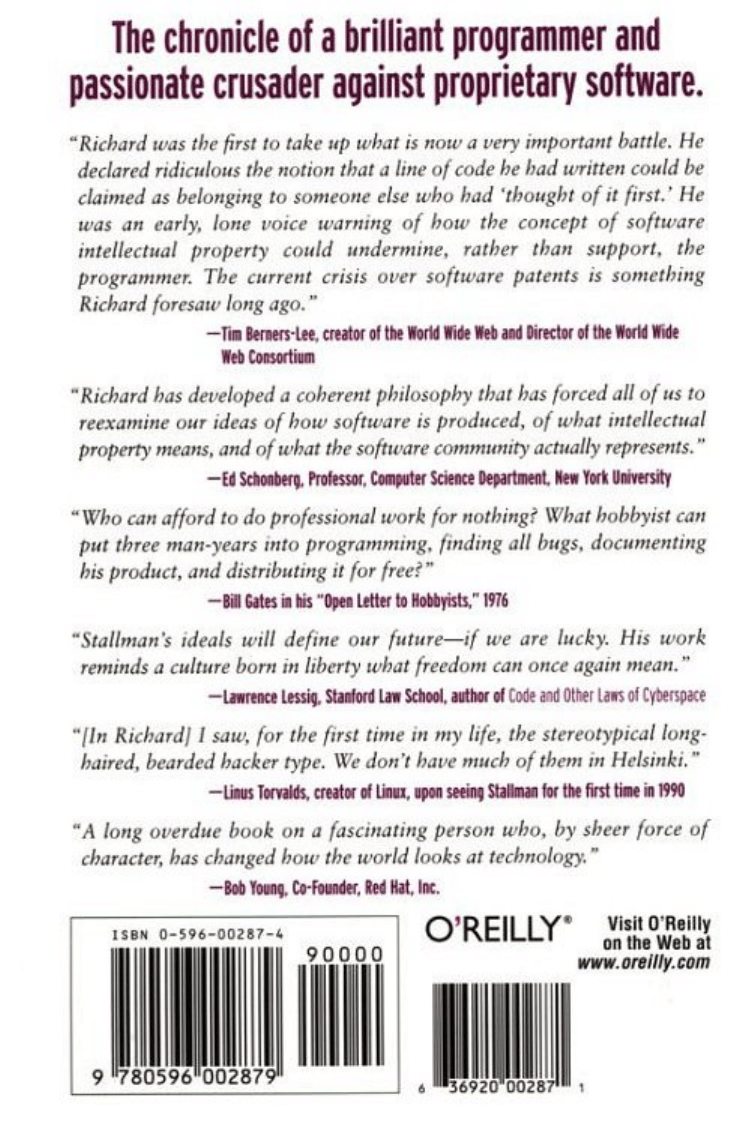
Document Outline
- Cover
- Free as in Freedom: Richard Stallman's Crusade for Free Software
- Table of Contents
- Preface
- Chapter 1-For Want of a Printer
- Chapter 2-2001: A Hacker's Odyssey
- Chapter 3-A Portrait of the Hacker as a Young Man
- Chapter 4-Impeach God
- Chapter 5-Small Puddle of Freedom
- Chapter 6-The Emacs Commune
- Chapter 7-A Stark Moral Choice
- Chapter 8-St. Ignucius
- Chapter 9-The GNU General Public License
- Chapter 10-GNU/Linux
- Chapter 11-Open Source
- Chapter 12-A Brief Journey Through Hacker Hell
- Chapter 13-Continuing the Fight
- Chapter 14-Epilogue: Crushing Loneliness
- Free as in Freedom: Appendix A
- Appendix B-Hack, Hackers, and Hacking
- Appendix C-GNU Free Documentation License (GFDL)
- Backcover
Wyszukiwarka
Podobne podstrony:
Chomsky, Noam Free Speech in a Democracy
Softly as in the morning sunrise
Softly as in a moorning sunrise 1928
Berkeley, George A defence of free thinking in mathematics
Eric Gagnon Free trade in north america
(IV)Relative therapeutic efficacy of the Williams and McKenzie protocols in back pain management
Introductory workbook in Homeopathy Richard J Crews 1979
Free Will In Aquinas
Secrets To Creating Passive Income and becoming financially free even in a slow economy
terrestrial foraging by polar bears during ice free period in hudson bay
free as a bird
western warfare in the age of crusades
JEHOVAH LIVES IN BROOKLYN JEHOVAH S WITNESSES AS A MODEL OF FUNDAMENTALISM by Richard Francis (1999
21 269 287 Effect of Niobium and Vanadium as an Alloying Elements in Tool Steels
Ionic liquids as solvents for polymerization processes Progress and challenges Progress in Polymer
[US 2005] 6864611 Synchronous generator for service in wind power plants, as well as a wind power
Fluorescent proteins as a toolkit for in vivo imaging 2005 Trends in Biotechnology
więcej podobnych podstron