1
MILS and MOA
A Guide to understanding what they are and
How to derive the Range Estimation Equations
By Robert J. Simeone
2
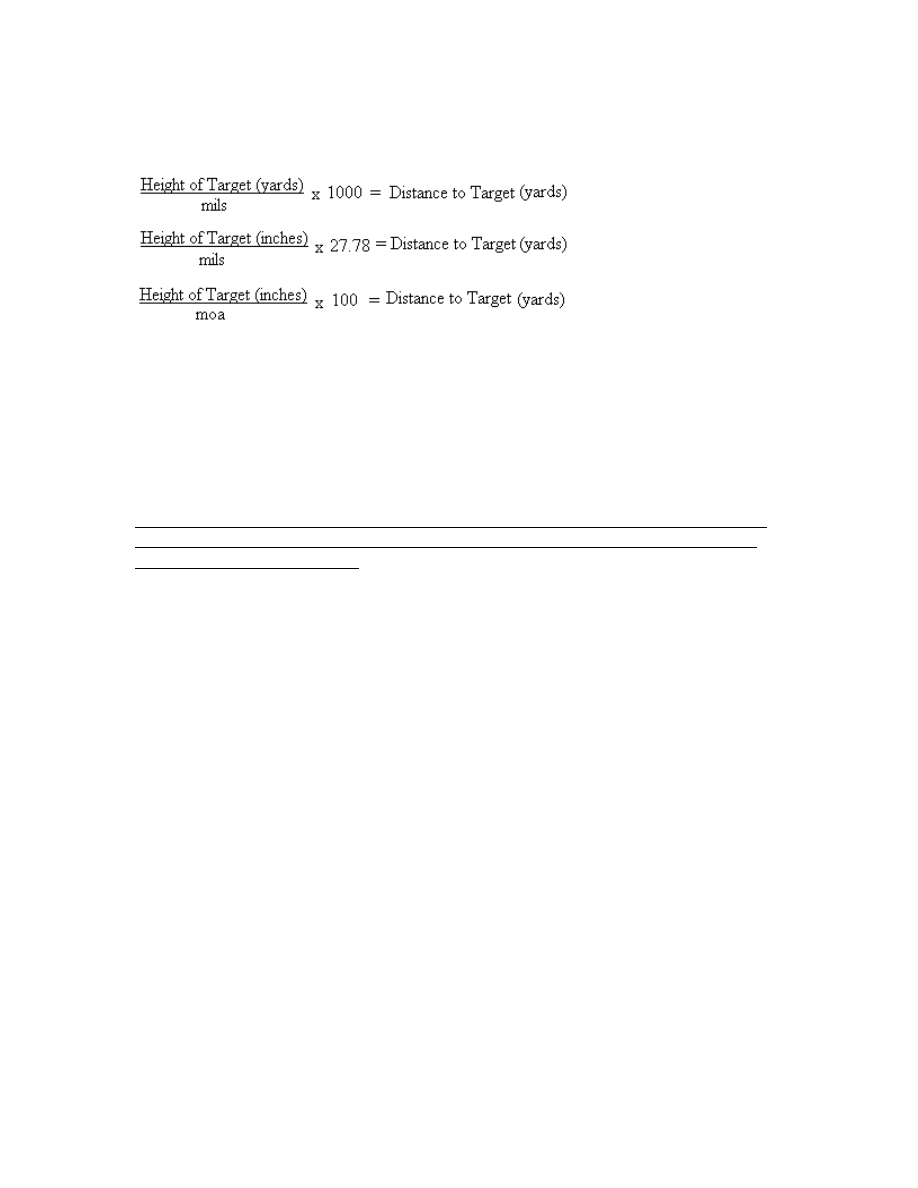
The equations for determining the range to a target using mils, and with some new
scopes, moa, are:
Has anyone ever wondered how they came up with these? Well I’ve wondered. I’ve read
numerous accounts on the internet on “mils”, but none of them explained how to actually
derive these equations. They just seem to pull them out of the air at some point in their
explanation of “mils” without actually showing us how or where they came from. I
searched the internet far and wide, but to no avail. I was starting to wonder if they were
derived so long ago that nobody knew how to do it anymore. So I decided to derive them
on my own.
The reason I wanted to do that is because I feel that if you know how or why something
works, or where it came from, you get a better understanding and appreciation of it, as
well as its uses and limitations.
In this paper I will attempt to explain, in simple English and math, how they came up
with these equations. I will try to keep it, to the best of my ability, simple, methodical
(painfully in some cases), slow and easy to understand. So here it is.
First, a brief history of mils: A “mil” is a unit of angular measurement. The military’s use
of mils, which was used to help direct artillery fire, goes back as far as the late 1800’s.
Its modern form of use by the military for directing fire was developed in the 1950’s. The
modern “mil” is short for milliradian, a trigonometric unit of angular measurement.
It is finer in measurement than degrees, thus more precise. In shooting, we can use mils
to find the distance to a target, which we need to know, to adjust our shot. It is also used
to adjust shots for winds and the movement of a target. (The actual techniques of how to
use mils for shot adjustments are beyond the scope of this paper since this paper only
deals with the math behind the equations). That’s the short….very short….history of why
we have and use mils.
We are also going to talk about and define another term; minute of angle, or moa. It is
another unit of angular measurement and used quite a bit in shooting. It is even smaller
than a “mil”. Usually, we range our targets in mils and adjust our scopes in “minutes of
angle”, or we talk about our “groupings” in moa. For instance, “my rifle shoots 1 moa all
the time” or something like that. Also, some new scopes, like mine, now have reticles
etched in minutes of angle (moa) rather than in mils. Therefore we will also derive the
moa distance equation.
3
Before we can derive the equations, we need to define a few things and establish a few
relations. So just follow along, hang in there, and you will see why we will need these
later.
Radians
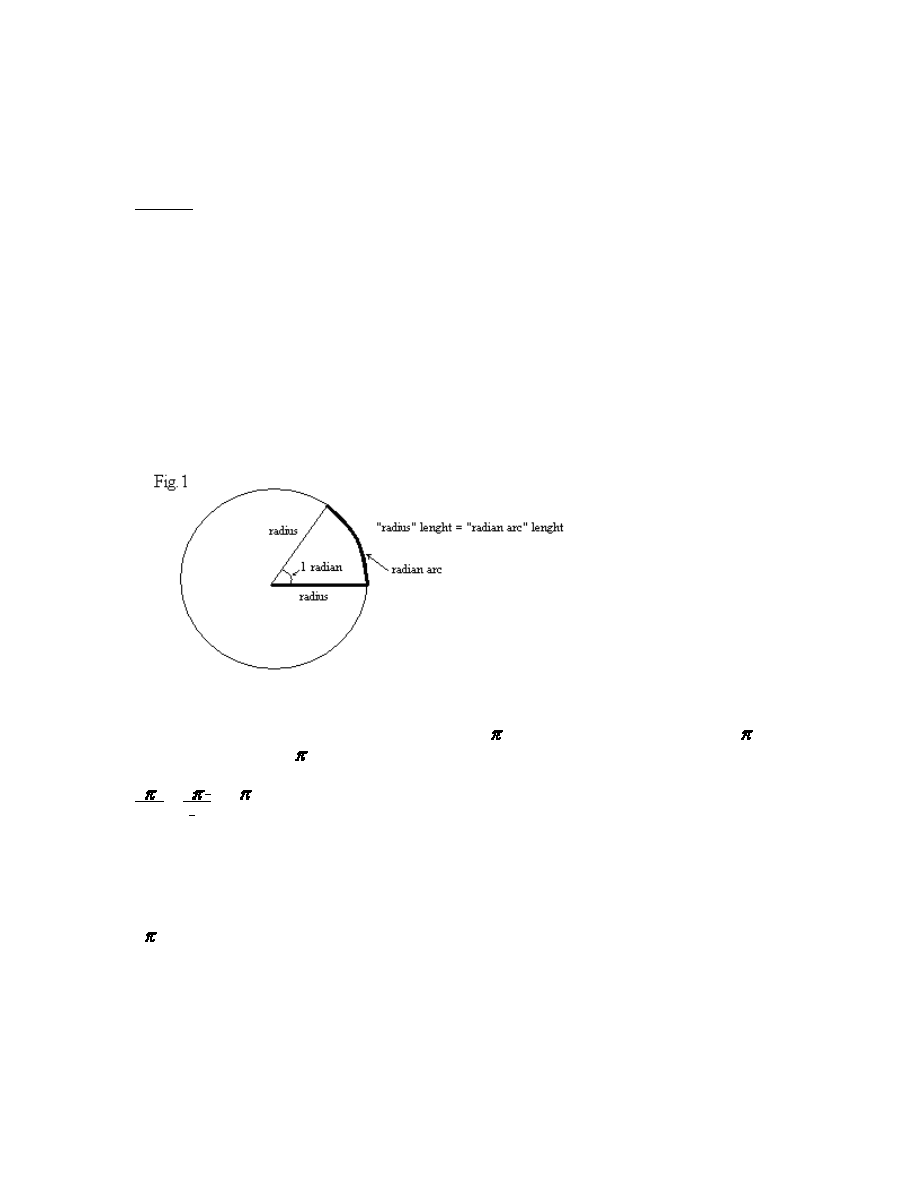
What is a radian? (Warning: you might have to read this paragraph a few times). A radian
is a unit of angular measurement. Officially, one radian subtends an arc equal in length to
the radius of the circle, “r”. (Yeah that helps). How about this. What a radian is it
associates an arc length, called a radian arc, which is equal in length to the radius of the
circle, with an angle at the center of the circle. The angle the arc created is called a
radian. Or, another way, it’s the angle created at the center of a circle by an arc on the
circumference of the circle, and that arc length is equal in length to the radius of the
circle. Think of it as a piece of apple pie, where the two sides of the pie (the radii) are
each equal in length to the curvature part of the pie (the arc). The angle created by the
three sides at the center of the circle equals 1 radian (Fig.1).
To find out how many “radians” (and /or radian arc’s) are in a circle, we use the
circumference formula of a circle, which is C = 2 r, where “r” is the radius. Take 2 r
and divide by r.
(Note: = 3.14159)
2 r = 2 r = 2 = 2 x 3.14159 = 6.2832.
r
r
Therefore, there are 6.2832 radians in a circle (or, 6.2832 radian arc’s that go
around the circumference of a circle).
No matter how long the radius “r” is, there will always be 6.2832 radians in a circle
(because the “r” ’s always get cancelled out in the arithmetic and all you’re left with is
2 ).
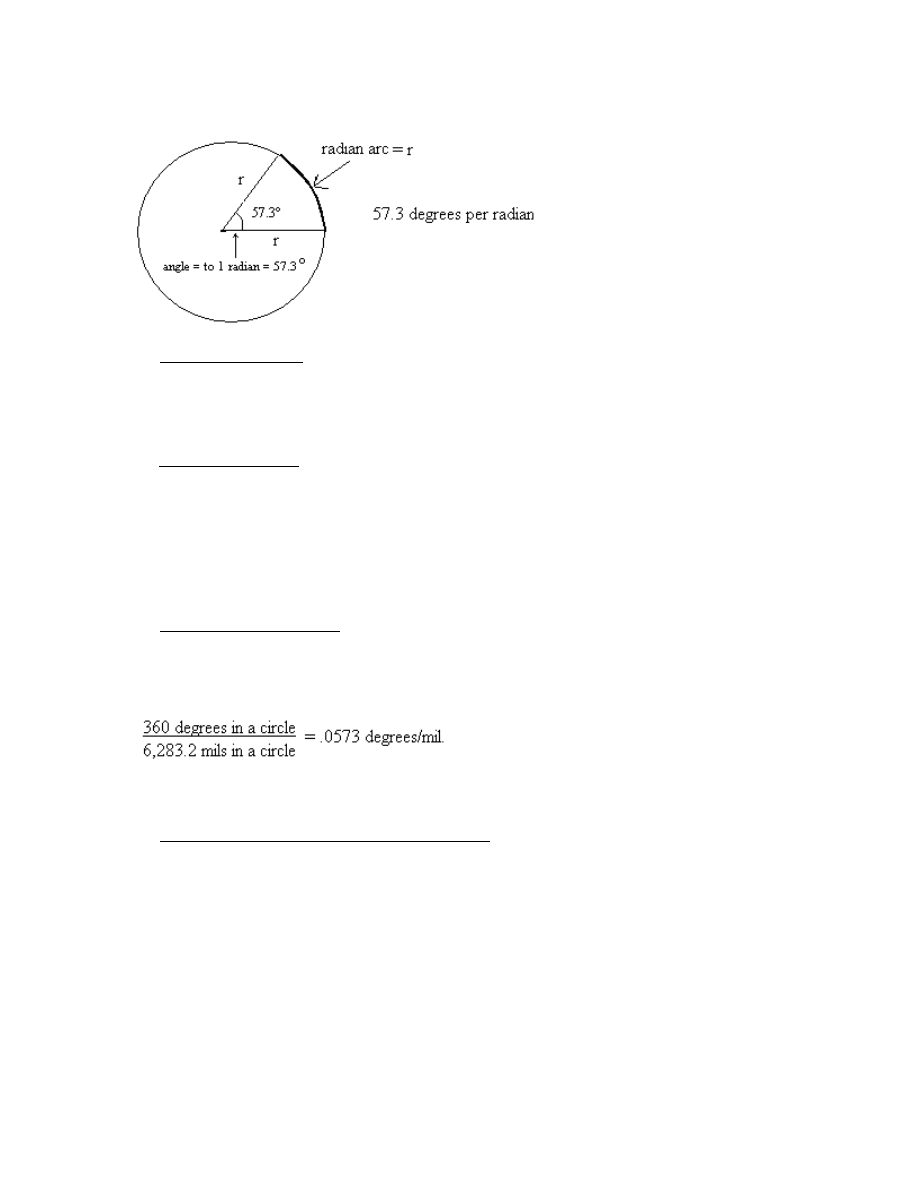
How many degrees are in a radian (or how big is the angle created by the radian arc)?
Since there are 360 degrees in a circle and there are 6.2832 radians in a circle, then there
are: 360/6.2832= 57.3 degrees per radian in all circles no matter how long “r”is. (Fig. 2
below). Since there are 57.3°in each radian, and there are 6.2832 radians in a circle, then
6.2832 x 57.3° = 360° in a circle. Make sense?
4
Fig. 2
(A) Minutes in a Circle
There are 360 degrees in a circle, and each degree is composed of 60 minutes (60’).
Therefore, there are 360 (degrees) x 60 (minutes) = 21,600 minutes in a circle (21,600’).
(B) Milliradians (mils)
What is a milliradian? A “mil” is defined as “one thousandth”, or 1/1000. Therefore, a
millradian is 1/1000 of a radian. Take each of the radians that go around a circle and
chop it up into a thousand pieces. Since there are 6.2832 radians in a circle, and each
radian is chopped up into a thousand pieces, then there are 6.2832 x 1000 = 6,283.2
milliradians in a circle. (Milliradians is usually just shortened to “mils”)
(C) Degrees in a Milliradian (or degrees per mil)
I need to find out how many degrees are in each milliradian. A circle has 360 degrees,
and/or 6,283.2 milliradians that go around it (B above). Therefore:
There are .0573 degrees per mil (degrees/mil)
(D) Minutes in a Milliradian (or minutes per mil)
I also need to find out how many minutes (referred to as minutes of angle, or moa) there
are in each mil. Let’s review. We have 21,600 minutes in a circle (A above). And we
have 6,283.2 mils in a circle (B above). Take 21,600 minutes and divide that by 6,283.2
mils and you will get 3.4377 minutes/mil. Let’s shorten that to just 3.438 minutes/mil.
Hang in there with me, just a few more things to figure out.
5
(E) Inches per Mil at 100 yards.
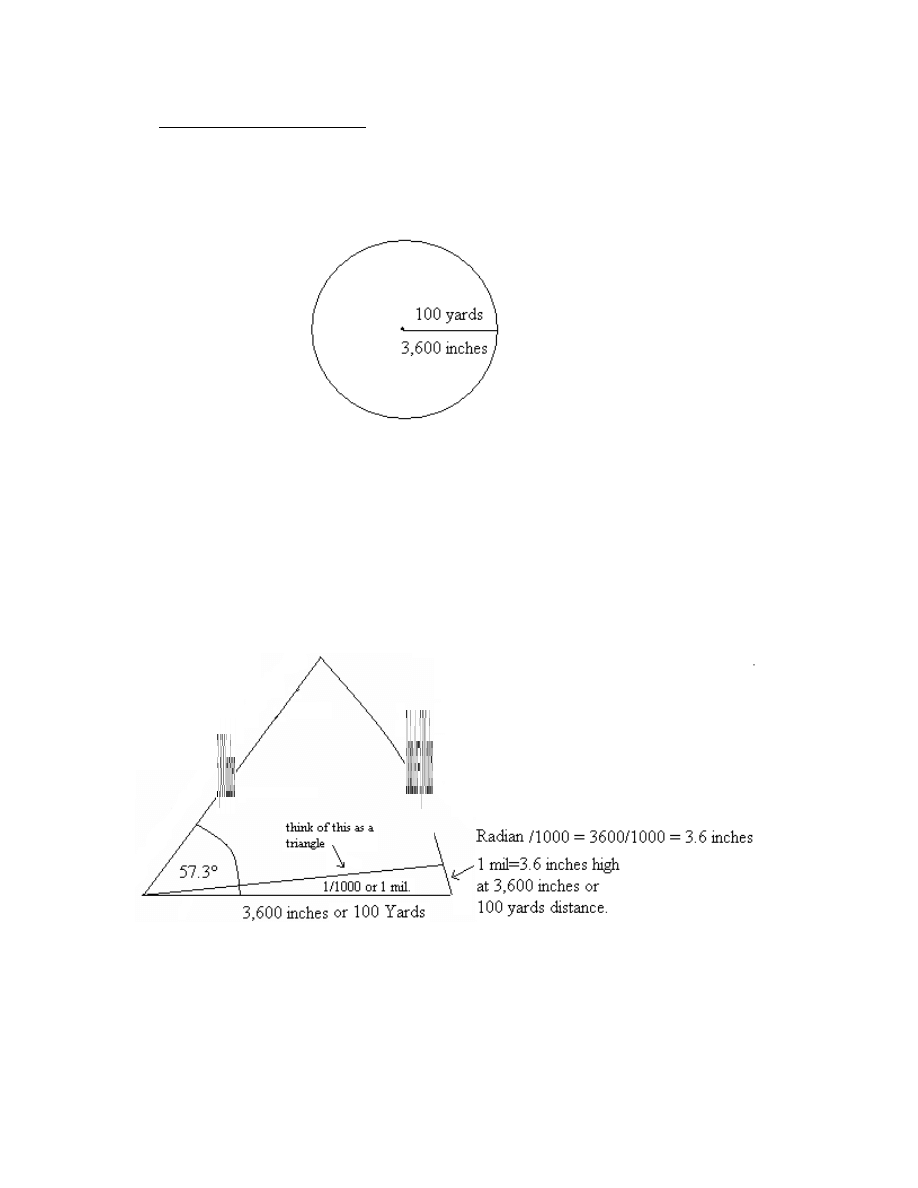
Look at the circle in Fig. 3 below. Make the radius 100 yards, or 3,600 inches long.
(1 yard = 36 inches. 100 yards x 36 inches = 3,600 inches in 100 yards).
Fig. 3
Remember earlier from Fig.1 (page 3) that all the sides of the piece of pie are equal.
Therefore, if one side is 3,600 inches, then all sides of the pie are also 3,600 inches (see
Fig. 4 below). So what is 1/1000 of any of those sides, which would also be 1/1000 of the
radian arc? Essentially, what is 1 mil equal to (remember, 1 mil is defined as 1/1000 of a
radian)? 3,600 inches/1000 = 3.6 inches. (The drawing is not to scale, but you get the
hint). Therefore, at 100 yards, 1 mil = 3.6 inches.
Fig. 4
For you math majors out there, another way to find the answer is to look at the bottom of
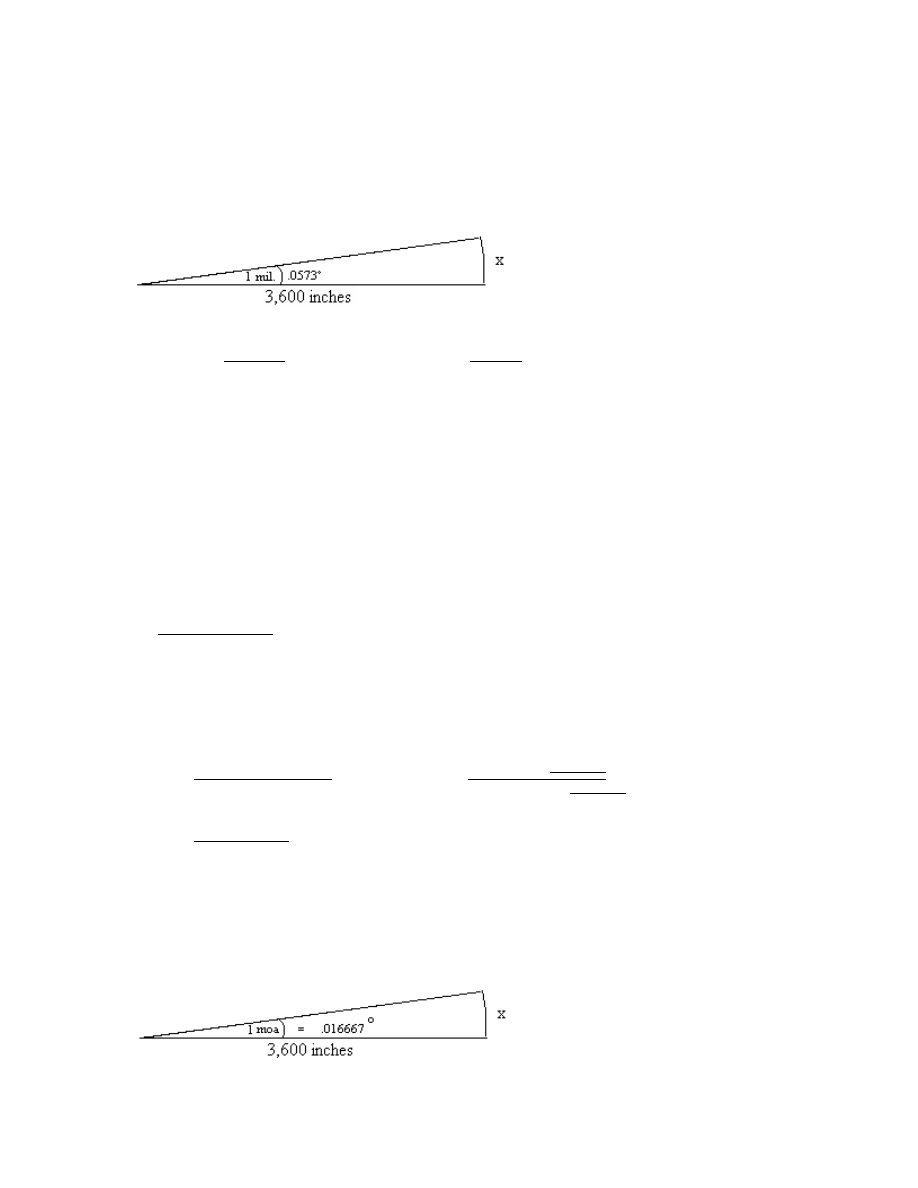
Fig. 4 as a triangle (enlarged in Fig. 5 below). We want to find the value of “x” in Fig. 5.
The way to do this is to use the tangent function of trigonometry.
6
We know the length of one side of the triangle, and the angle. But to use the tangent
function, we need to convert the angle that is expressed in “mils” into an angle that is
expressed in “degrees”. Remember from (C) on page 4, 1 mil = .0573 degrees. Now we
can solve for “x”.
Fig. 5
1) Tan θ = opposite
2) Tan .0573° = x 3) 3,600 (Tan .0573) = x
adjacent
3,600 in.
(NOTE: using your calculator, the tangent of .0573 is .001)
4) 3,600 (.001) = x
5) x = 3.6 inches
So 1 mil at 100 yards equals 3.6 inches.
Note: Even though the opposite side of the triangle “x” in Fig. 5 above is really not a straight line but a
curve because it is actually a part of a circle, it is a very small curve. At this distance and at this small of an
angle, for all practicable purposes we can consider it a straight line and its effects on the math are
negligible.
(F) Inches per moa
This next part could be confusing, so follow the units here. Remember from (D) on page
4, there are 3.438 minutes per mil at 100 yards. Also, from (E) on page 5, there are 3.6
inches per mil at 100 yards. The question here is how many “inches per minute” are there
at 100 yards? (Remember that ‘minute’ is an angular measurement like mils).
1)
3.6 inches per mil.
2)
3.6 inches per mil.
3.438 minutes per mil.
3.438 minutes per mil.
3)
3.6 inches = 1.047 inches/minute
3.438
minutes
There are 1.047 inches per minute of angle at 100 yards (1.047 inches/minute).
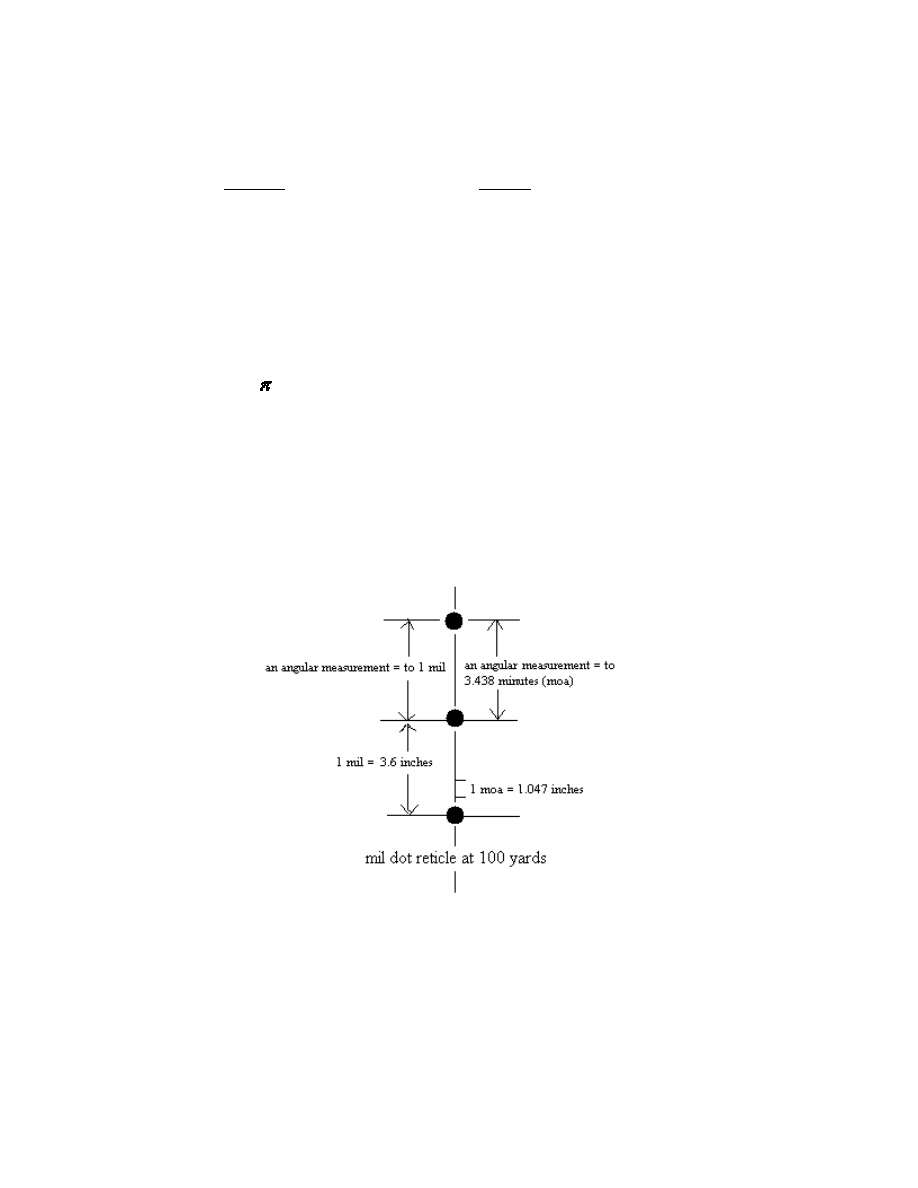
Or another way to figure this out: (Reference Fig.6 below)
Fig. 6
7
1 minute (or 1 moa) equals 1/60 of a degree, which equals 1 divided by 60 = .016667
degrees. Just like the example above:
1) Tan θ = opposite
2) Tan .01667° = x
3) 3,600 (Tan .016667) = x
adjacent
3,600 in.
(Note: the tangent of .016667 is .00029089)
4) 3,600 (.00029089) = x
5) x = 1.047 inches
Or, one other way to figure this out (I promise, this will be the last way):
There are 3,600 inches in the radius of this circle. Therefore, the circumference of this
circle would be 2
3,600 = 22,619.467 inches.
Remember from (A) on page 4, there are 21,600 minutes in a circle.
Therefore, 22,619.467 inches/21,600 minutes = 1.047 inches per minute at 100 yards.
Talk about beating a dead horse!
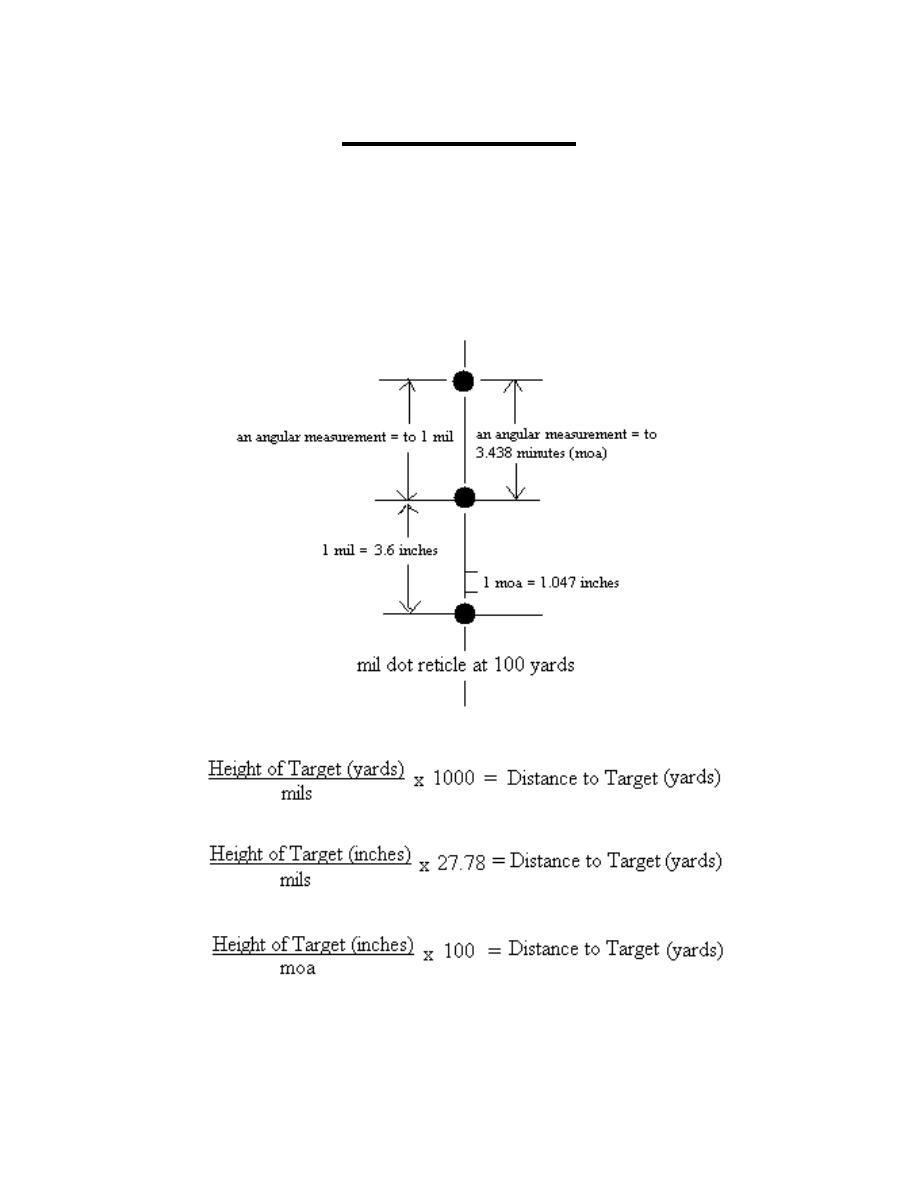
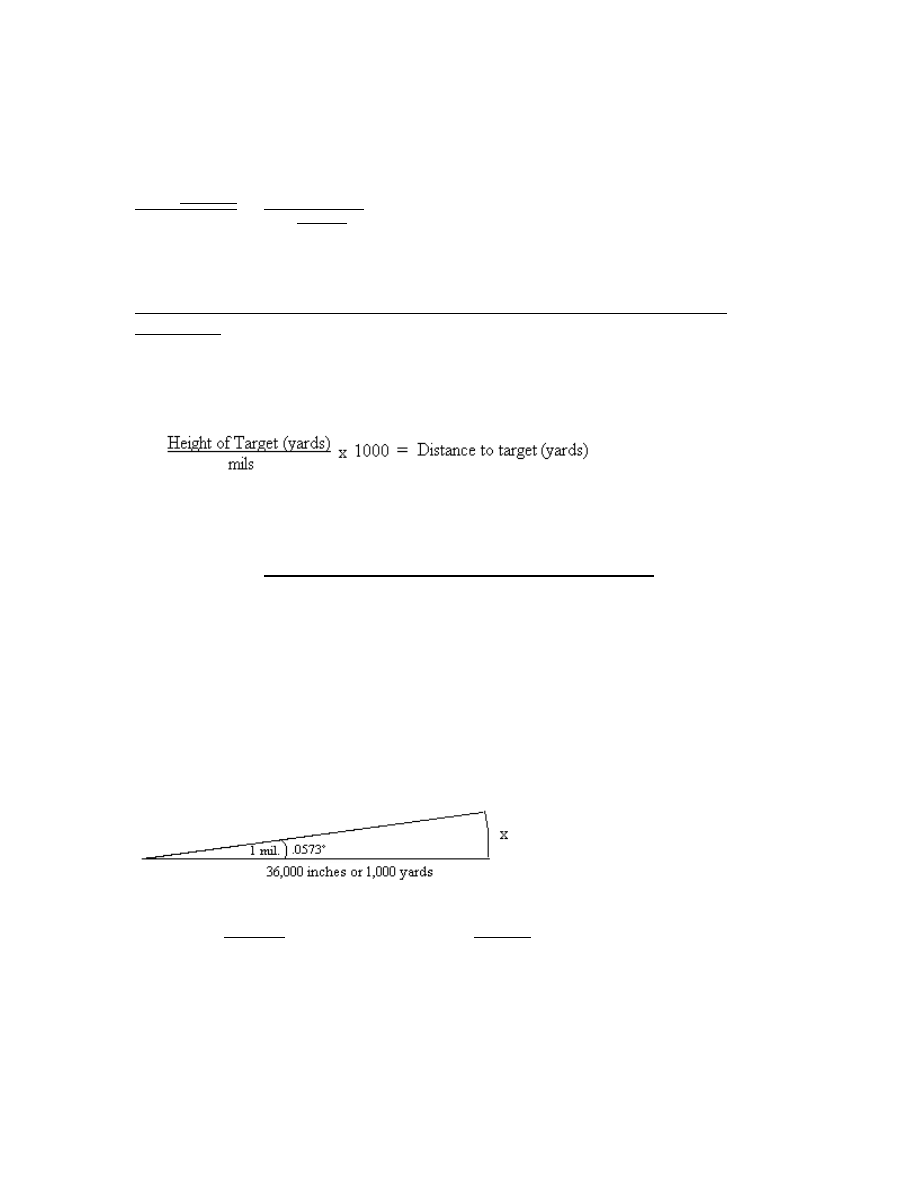
So let’s review. This is what we have while looking through a mil dot rifle scope at 100
yards. Each dot is separated by 1 mil.
Fig. 7
Let’s do a little review here. Keep in mind that when we talk about “mils”, we are talking
about the angular measurement of a circle in “milliradians”. And when we talk “moa”,
we are talking about the angular measurement of a circle in “minutes”, which are a
subset of degrees. They are two different angular measurements, but measuring the same
thing, which in our case are small sections of a circle that look like triangles (see Figures
4, 5 and 6 above).
8
Remember, at 100 yards, each 1 mil angle = 3.438 minutes of angle (moa), and each 1
minute of angle has a length of 1.047 inches (see Fig.7, page 7). Multiply those two
numbers together:
3.438 minutes x 1.047 inches = 3.6 inches = 1 mil at 100 yards
1 1 minute
I hope you’re starting to see the relationship between mils and moa.
Now, in the past when I’ve read about mils, somewhere around here is where they
usually say:
“…and here is the equation that you use to find the distance to the target using mils.”
(G)
Well, where did they come up with this equation? That’s what I wanted to find out.
The Derivation of the Range Estimation Equations
To help derive the equation (G) above, I first want to enlarge the “triangle” that we have
been using. I’m doing this so I can have the height of the target and the distance to it in
yards, which is the form that the most simplified mil equation is usually in (see G above).
Now, if 1 mil = 3.6 inches at 100 yards, then at 10 times that distance, or at 1,000 yards,
1 mil = 36 inches. Don’t believe me? Let’s do our trigonometry again.
Still using 1 mil, but looking out at 36,000 inches or 1000 yards:
Fig. 8
1) Tan θ = opposite
2) Tan .0573° = x
3) 36,000 (Tan .0573) = x
adjacent
36,000 in.
(NOTE: the tangent of .0573 is .001)
4) 36,000 (.0001) = x
5) x = 36 inches

9
(H)
Therefore, 1 mil at 1000 yards equals 36 inches, or 1 yard.
So let’s look at this tangent function without any numbers put in it.
1) Tan (θ in mils) = opposite (height of target)
adjacent (distance to target)
or in another easier to read form:
2) Tan (θ in mils) = height of target
distance to target
(To make it easier in the following math, let’s use “D” equals the “distance to the target” and “H” equals
the “height of the target”. Also, remember that as of right now, the angle “θ” is still measured in “mils”).
I want to cross multiply to solve for “D”, the distance to the target.
3) Tan (θ) = H
D
4) D (Tan θ) = H
5)
(I)
D = H or
(with “D” on the right hand side)
(I)
H = D
Tan (θ)
Tan θ (
in mils)
The Tangent function works easier for things written in degrees, therefore we need to
change the angle “θ” from mils to degrees (which we’ll do later, but for now, just assume
we already converted it). Now the equation (I) above looks like this:
H = D
Tan θ
(in degrees)
Let’s plug in some numbers and watch what happens. Let’s say the height of an object is
1 yard, and we’re reading 1 mil on our scope. What is the distance to the target?
Remember from (C) on page 4, 1 mil is equal to .0573 degrees, so converting mils to
degrees, we can rewrite equation (I) above as:
1. 1 = D rewritten in degrees = 1 = D
Tan (1 mil)
Tan (.0573°)
2. On the calculator, the tangent of .0573 is equal to .001, which can be rewritten as
1/1000.
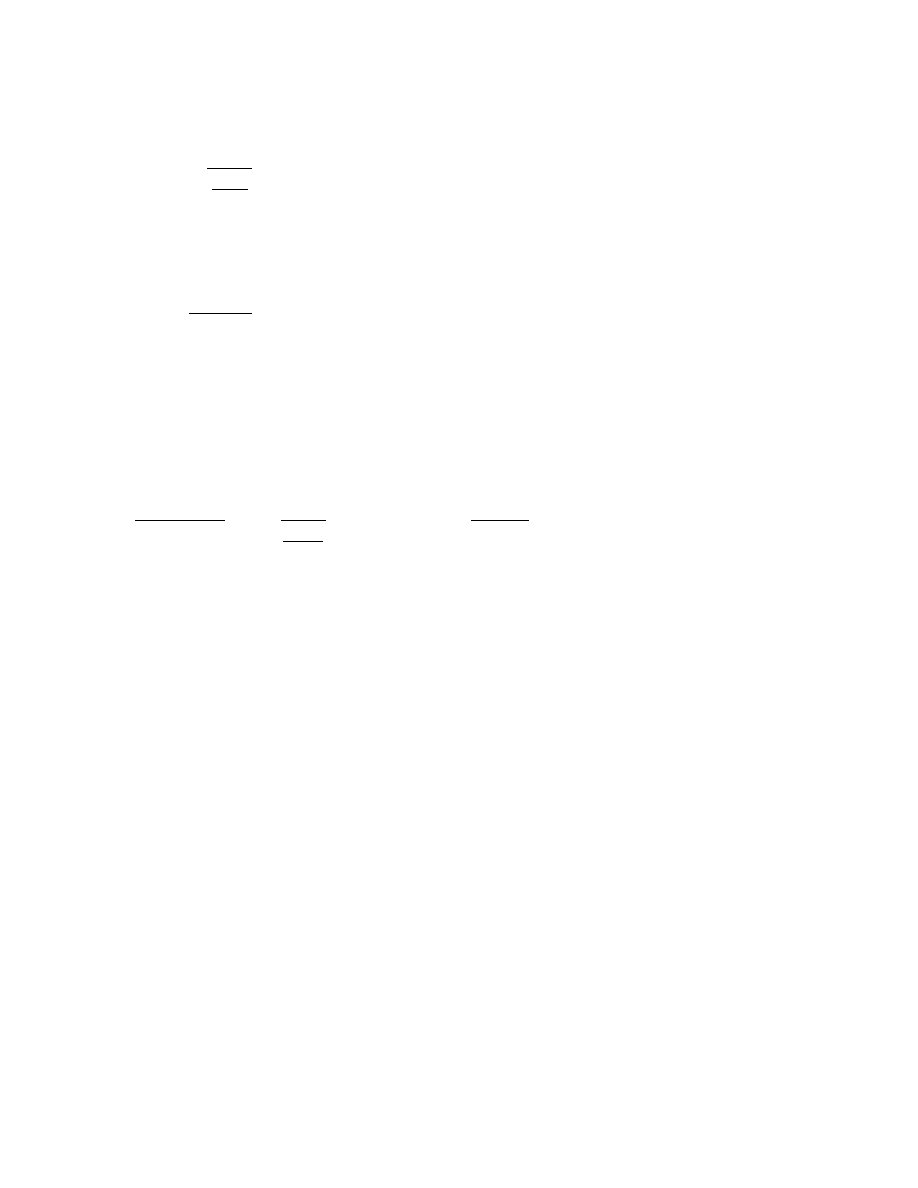
10
3.
Now the equation becomes:
1 = D
1 .
1000
Using algebra, multiplying be the reciprocal of the denominator, this now can be
rewritten as:
1 x 1000 = D, D = 1000 yards
1
Therefore the distance to this target with a height of 1 yard, measured at 1 mil on my
scope is 1000 yards, just like we saw in (H) from the top of page 9.
Now here is where it gets interesting. Guess what would happen if I measured 2 mils on
my scope. 2 mils converted to degrees is 2 x .0573° = .1146°. Guess what the tangent of
(.1146) is? The Tan (.1146°) = .002, or 2/1000. I can now rewrite equation (I) page 9 as:
1 = D = 1 = D which equals 1 x 1000 = D: D = 500 yards to the target
Tan (2 mils) 2 2
1000
So if I measured my 1 yard high target at 2 mils, then the target would be 500 yard away.
Guess what the Tangent of 3 mils equals? Yup, you guessed it: 3/1000. i.e. (3 x .0573) =
.1719. The Tan (.1719) =.003, or 3/1000. Are you starting to see a pattern here?
Even the Tangent of fractions of mils, say 3.25 mils = (3.25 x .0573) = .1862. =
Tan (.1862) = .00325 = 3.25/1000
And it goes on and on like this:
Tan (4 mils) = Tan (4 x .0573) = Tan (.2292) = .004 = 4/1000
Tan (5 mils) = 5/1000
Tan (6 mils) = 6/1000
.
.
.
Tan (25 mils) = 25/1000 etc. etc.
Let’s examine what’s going on. In the examples above, the tangent of the mils i.e. (1 mil,
2 mils, 3.25 mils etc.) turns out be a great, easy to work with, whole fraction, mainly
1/1000, 2/1000, 3.25/1000 etc. So equation (I) on page 9: (1) After converting the “mil”

11
angle to degrees, (2) then taking the tangent of that angle, (3) and putting it in the
denominator of the equation where it belongs, is going to look like this:
H = D
x mils (Whatever mils you’re reading is always over 1000)
1000
(See Appendix A for a different intuitive explanation of why mils is always over 1000)
After simplifying, it will look like this:
H 1000 = D (where x = the number of mils).
x mils
Again, equation (I) on page 9 that was in the form:
H = D
Tan θ (in mils)
First goes to this:
H = D
Tan θ
(converted to degrees
)
Then this after taking the tangent of “θ”:
H = D
x mils
1000
And then this after simplifying:
(J)
H 1000 = D
Which is the
Distance Equation using Mils
(
like “G” on page 8
).
x mils
(Where H = the height of the target in yards; “x mils” = the number of mils read on the
scope; and D = the distance to the target in yards).
Now something interesting here needs to be mentioned. I have been using yards as the
height of the object, but I also could have used inches, meters or whatever units I wanted
to use. If you look at Fig. 9 below, (using the same triangle we used earlier), whatever
units the “distance” portion of the triangle is in (the adjacent part), that is the same units
that the “x” height portion of the triangle will be in (the opposite part). Or to put another
way, whatever units the height “x” is in, the distance to it will be in the same units (i.e.
inches, yards, meters, etc.).
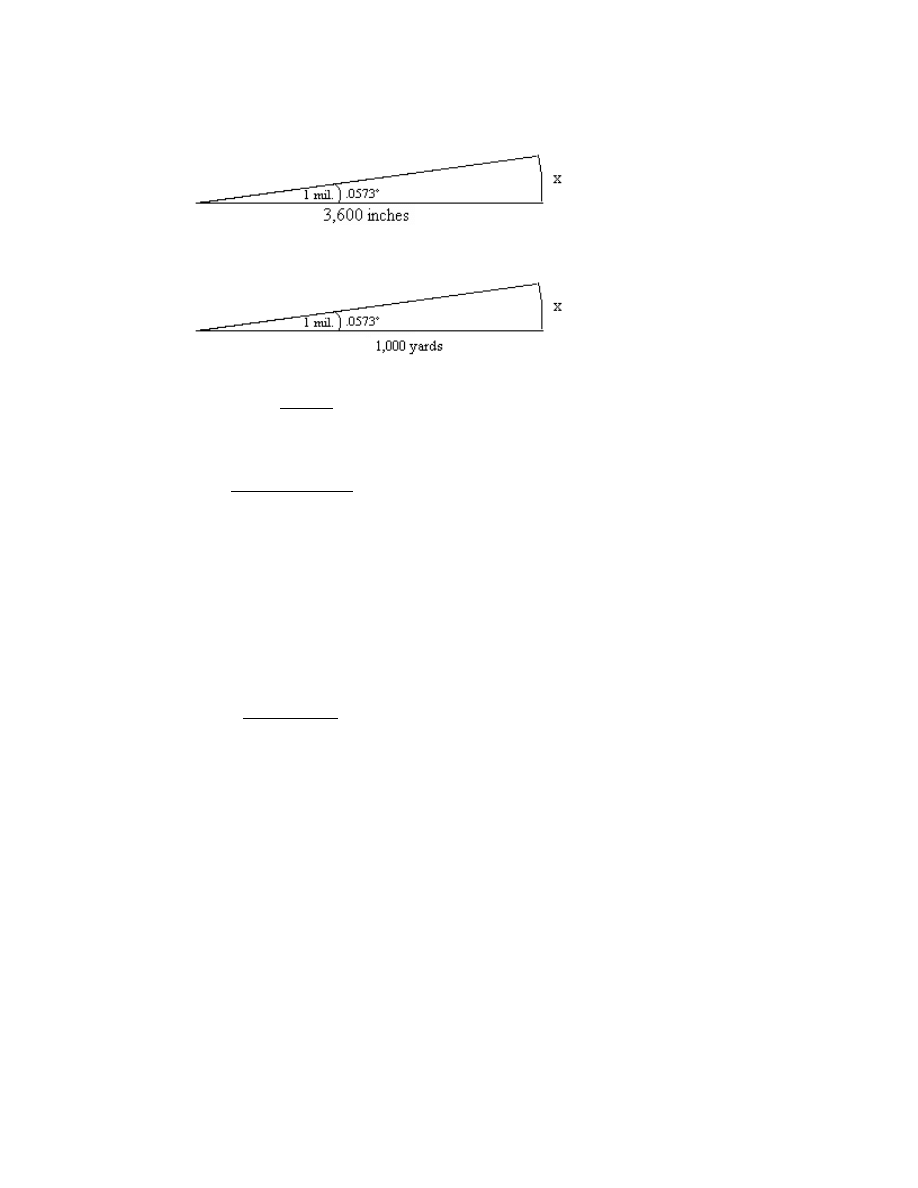
12
Fig. 9
x = inches (above) ↑
x = yards (below) ↓
So in the equation: H 1000 = D, whatever units you are measuring the height “H”
mils
in, (x in the picture above), the distance to the target “D”, will also be in the same units.
Example: H (meters) 1000 = D (meters)
mils
Or, using the equation like we normally do, whatever units you measure the “height”
of the object in, the “distance” to it will be in the same units.
Now, knowing the height of an object in inches might be reasonable, and in fact
preferable, but getting the distance to it also in inches isn’t.
For example: a 29 inch tire measured at 2 mils is by our equation:
29 in. x 1000 = 14,500 inches to the target.
2 mils
How the heck far is that?
Well, 14,500 inches/36 inches per yard = 402 yards. 402 yards is much more
comprehendible than 14,500 inches.
So let’s make the equation more workable for us with units we are comfortable with. It is
sometimes easier and more practicable to know the height of an object in inches, like a
tire, or a head, but it’s not that practicable to get the distance to it also in inch’s, which
our present equation does. So let’s have the equation let us use inches for the height of
an object but have it give us the distance to it in yards.
We need to convert the “H” part of equation (J) from yards to inches. The way we do
that is by dividing by 36. Why? Well, take a 36 inch object and divide by 36. What do
you get? 1…or more accurately, 1 yard. How about a 72 inch object, like a persons

13
height: 72/36 = 2 yards. Get it? H/36 converts inches to yards. So our mil distance
equation (J) on page 11 now becomes (with “H” still measured in inches):
H 1000 H 1000 H 27.78 = D
36 = D = 36 = D = x mils
x mils
x mils
Notice: The left-hand sides of the equations in the steps above are still in yards even
though we are using inches for the height of the object (because we divided “H” by 36).
Like we talked about before, the right hand side of the equation, “D”, will also be in the
same units, which are yards in this case.
Putting labels back on, our equation looks like this:
(K)
H (inches) 27.78 = Dist (yards)
mils
So there it is. The “distance equation using mils” derived and explained.
How to derive the MOA Equation
If you have a scope like I do that has a moa reticle, then I need a “distance to target”
equation that uses “moa” instead of “mils”.
In the distance equation (K) above, I need to
convert mils to moa. Remember from (D) on page 4, 1 mil = 3.438 moa. Just like above
when we converted inches to yards by doing H/36, I want to have the “mils” portion in
the denominator converted to “moa”. So I divide moa by 3.438 to get equation (K)
above expressed with moa in the denominator.
For example:
If I measure a target 3.438 moa on my scope (I know I can’t really measure that, but
we’re talking theoretically here) and then divide by 3.438, I get 1. (You would get 1 mil
measuring the same object if using your mildot scope). If I measured an object 6.876 moa
on my scope, then 6.876/3.438 = 2. (You would be measuring 2 mils on your mildot
scope). So now the “distance equation” looks like this after substituting moa/3.438 for
mils in the denominator of the “mils distance equation” (K) above:
H x 27.78 = D = H x 27.78 x 3.438 = D = H x 95.5 = D
moa moa moa
3.438

14
So the “distance equation using moa” is (with labels back on):
(L)
H (inches) x 95.5 = D (yards)
moa
(
See Appendex B for an alternate way to derive this equation
.)
Some simplify it to: H (inches) x
100
= D (yards), which makes it real easy to use.
moa
Let’s see if it works. Remember from (F) on page 6, there are 1.047 inches per minute of
angle (moa) at 100 yards. If I draw a line on a target at 100 yards that is 1.047 inches
long, then looking through my scope, I should see that 1.047 inch line exactly between
my 1 moa tics on my reticle. Plugging those numbers in the equation, I get:
1.047 (line I drew) x 95.5 = 99.99 yards or (100 yards rounded)
1 moa (on my scope)
Exactly what I should be getting. In the equation above, if I used the constant 100
instead of 95.5, then I would have gotten 104.7 yards. Close enough. We can all multiply
by 100 in our head, but how many can multiply by 95.5. So a lot of shooters just use:
H (inch’s) x 100 = D (yards)
moa
Note: Be careful though, at greater distances, the discrepancy between 95.5 and 100 as the constant could
change the result enough to be critical to the accuracy of your shot.
So there you have it. The mil and moa distance equations explained and derived.
I hope this paper gives you a better understanding of exactly what mils and moa are, and
a better understanding of their distance equations. I also hope that it makes them easier
for you to use and apply. Now, you can brain dump all this math and definition stuff and
just use them like you always did.....but with a little better knowledge.
Good Shooting,
Robert J. Simeone
15
Appendix A
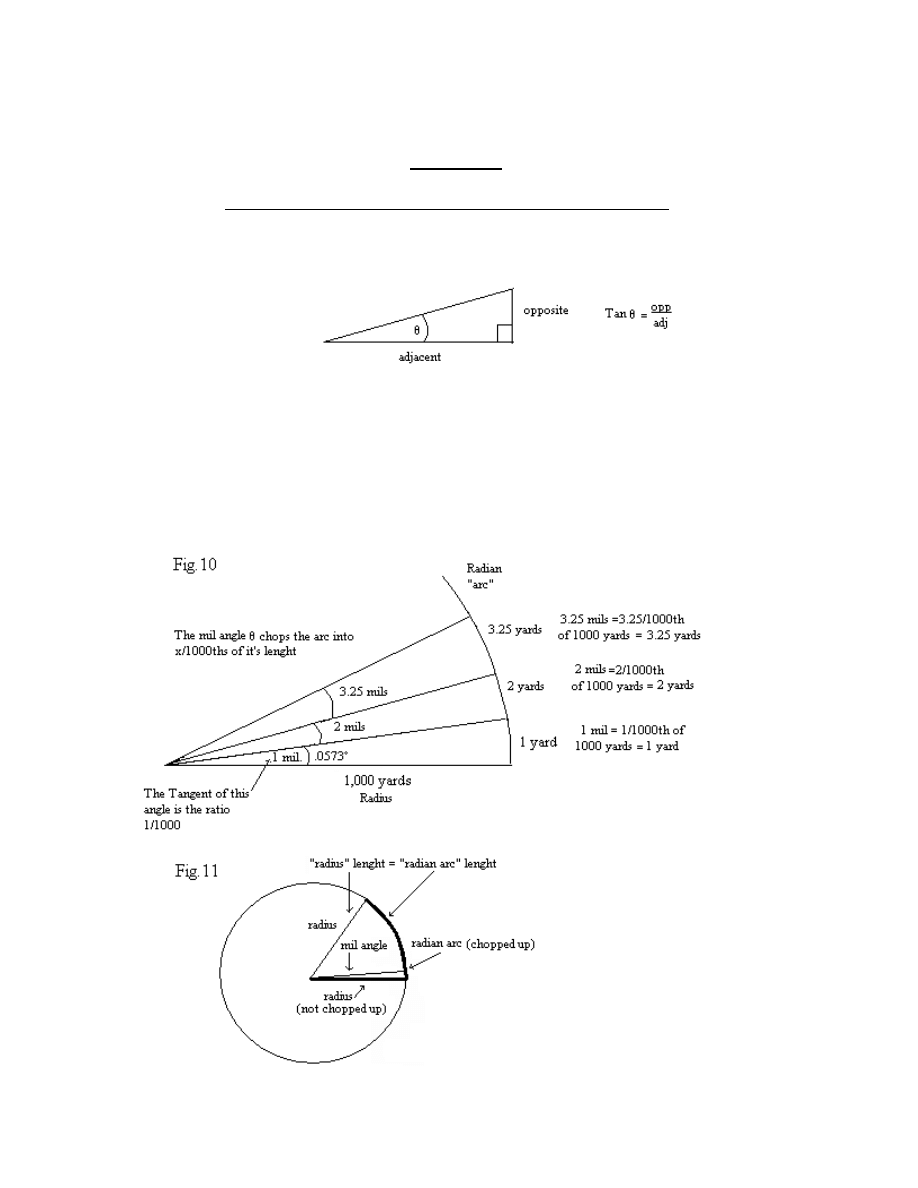
Why is the Tangent of “Mils” always equal to “x”mils/1000?
Intuitively you can see why this must happen. The tangent of an angle of a right triangle
is the ratio of the opposite side divided by the adjacent side i.e. Tan (θ) = opp/adj.
A “mil” is 1/1000
th
of a radian (it can also be thought of as 1/1000
th
of the radian arc).
The angle “θ” (in mils) chops the arc, the opposite part, into parts of 1000. For example,
a 1 mil angle chops the arc into 1/1000
th
of its length; 2 mils chops it into 2/1000
ths
of its
length; 3.25 mils chops it into 3.25/1000
th
of its length and so on and so on (Fig.10
below). The radius, or the adjacent part, is still the same “whole” length (not chopped
up) and equal in length to the “whole” arc length (Fig.11 below).
.
16
Therefore, the ratio of the opposite side to the adjacent side (the definition of
“tangent”) is always in the form:
(M)
Tan (θ in “x” mils) = Opposite side in “x”1000
ths of the adjacent sides length
Adjacent side (whole length “W”)
Where “x” is the number of mils you’re reading and “W” equals the “whole” entire length of the adjacent
side (which is really the radius and/or the distance to the target).
Therefore:
x W = x W 1 = x W 1 = x .
Tan (θ in “x” mils) = 1000 1000 W 1000 W 1000
W
That would mean simply, for example, that: Tan (2 mils) = 2 .
1000
Let’s look at an example to help make this a little easier to understand:
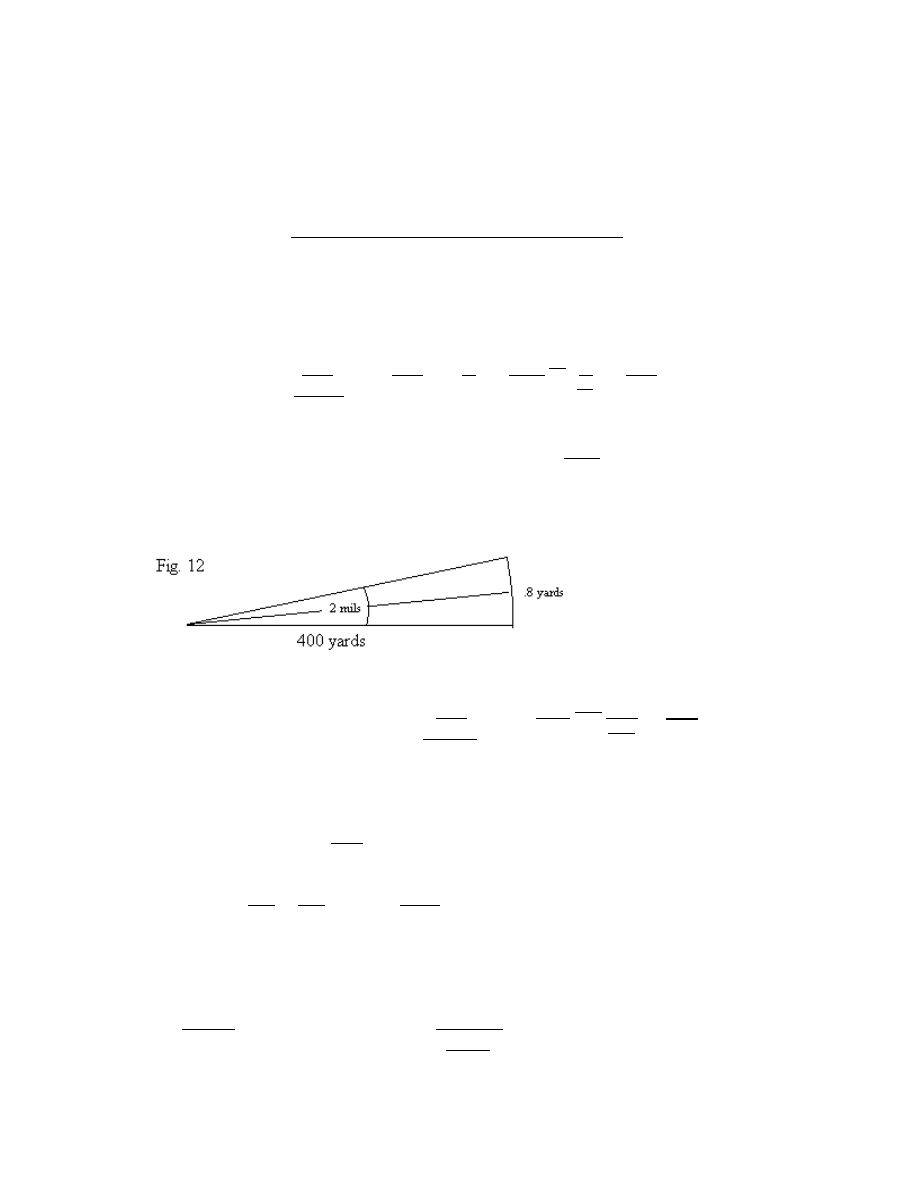
The range to a target is 400 yards, and you’re reading 2 mils (Fig.12 below).
Referencing equation (M) above then, the Tan (2 mils) =
Tan (2 mils) = (
opp. side
in 2/1000ths of adj. side) →
2 x 400
=
2 400 1 = 2 .
1000 1000 400 1000
(
adj. side whole length
) → 400
or, a little easier to visualize, look at Fig.12 again:
2 mils = 2/1000
ths
of 400 = 2 x 400 = .8 yards for the opposite side length.
1000
Tan (2 mils) = opp = .8 = .002 = 2 .
adj 400 1000
As you can see, the Tangent of “x” mils” is always equal to “x” mils over 1000 (where
“x” is the number of mils, i.e.1, 2, 3.25 etc.). Since the tangent of the “mils” is in the
denominator of the equation (see (I) on page 9), the denominator will always be in the
form “x” mils and the equation will be: H = D (just like at the top of page 11).
1000 x mils
1000
17
Simplified it looks like this: H 1000 = D (like (J) on page 11)
x mils
What we did this time was just use a different method to analyze why the equation looks
like it does. We did it without converting mils to degrees and without using the tangent
function of our calculator.
Appendex B
We figured out earlier how to derive the “moa distance” equation by substituting
moa/3.438 for mils in the denominator of the “mil distance” equation (see page 13). Here
we are going to derive the “moa equation” from scratch like we originally did with the
mil distance equation (starting on page 8).
Look at the figure below:
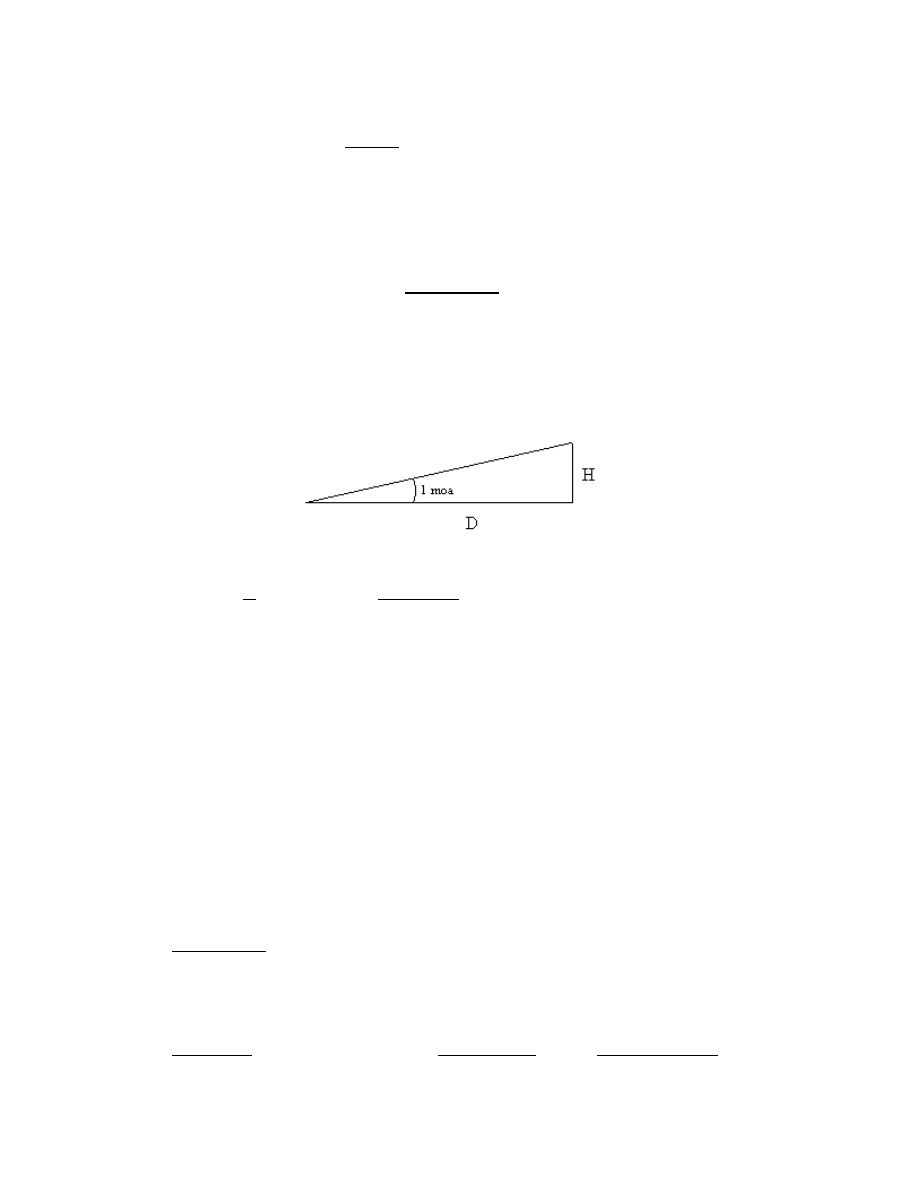
(N)
Tan (1 moa) = H D = H Remember, 1 moa = 1/60
th
of a degree.
D Tan (1 moa)
Tan (1/60°) = Tan (.016667) = .0002908882 = Tan (1 moa).
Let’s start looking for a pattern. What if the angle in the picture above was 2, 3 or 4 moa?
Tan (2 moa) = Tan (2/60°) = Tan (.03333333) = .0005817765
Tan (3 moa) = Tan (3/60°) = Tan (.05000000) = .0008726648
Tan (4 moa) = Tan (4/60°) = Tan (.06666667) = .001163553
At first it might not be obvious, but each of the tangents of the moa’s above (2, 3, and 4)
is really just a multiple of .0002908882, which is the tangent of 1 moa. That is, the
tangent of 2 moa can be thought of as 2 x .0002908882 = .0005817765. The tangent of 3
moa can be thought of as 3 x .0002908882 = .000876647 etc. etc. Therefore we can
rewrite the equation (N) above as:
D = H (where x = some moa value).
x (Tan 1 moa)
For example, if the moa value is 2, then:
D = H can be rewritten as D = H = D = H .
Tan (2 moa) 2 (Tan 1 moa) 2 (.0002908882)

18
Therefore, it follows that equation (N) on page17 can now be rewritten as:
(O)
D = H .
x (.0002908882)
(where “x” is some moa value, and .0002908882 = Tan 1 moa)
Note: .0002908882 can be rewritten as and is equal to 2.908882. Therefore equation
10,000
(O) above can be rewritten as: D = H = H 10,000 = H 3437.75 =
x 2.908882 x (2.908882) x
10,000
(P)
D = H 3437.75 Therefore the distance to a target using moa values is the height
x
of the target multiplied by the constant 3437.75 divided by the moa value “x”.
Remember from before (page 12) that the distance will be in the same units as the height
of the target i.e. if the height is in inches, then the distance to it will also be in inches; if
the height is in yards, then the distance to it will also be in yards. So let’s make this
equation more user friendly like we did earlier with the mil distance equation on pages 12
and 13. In the equation (P) above, let’s use inches for the height “H” of the target, and
let’s get the distance “D” to the target in yards. Remember from page 13, H/36 converts
inches to yards. Therefore our equation (P) above now becomes:
D = H 3437.75 H 3437.75 H 95.5 = D Just like (L) on page 14, where
36 = 36 = x “H” is in inches, “D” is in
x x yards and “x” is a moa value.
There it is, the equation for the “distance to a target using moa”, derived a little
differently from how we did it earlier on pages 13 and 14.
Note: Look at the “3437.75” in equation (P) above. Rounded, it is 3438. Does that
number look familiar? (Look at (D) on page 4). Now look at the mil distance equation,
which is: H 1000 = D. Now compare it to the moa equation (P) above: H 3438 = D
mils moa
They look awfully familiar. The moa equation is exactly the same as the mil equation
except that it is multiplied by 3,438 instead of 1,000. That’s because 1 mil = 3.438 moa
(D, page 4). So it only makes sense that the moa equation is larger than the mil equation
by a factor of 3.438 (1000 x 3.438 = 3438).
Wyszukiwarka
Podobne podstrony:
Rodrigues & Vaz SUBLUMINAL AND SUPERLUMINAL SOLUTIONS IN VACUUM OF THE MAXWELL EQUATIONS AND THE MA
Ibison & Puthoff Relativistic Integro Differential Form Of The Lorentz Dirac Equation In 3D Without
Whittaker E T On the Partial Differential Equations of Mathematical Physics
Home On The Range Cherokee Edition
Marsden J E , Ratiu T S , Scheurle J Reduction theory and the Lagrange Routh equations (2000)(59s)
activity sheet home on the range
How were the Hilbert Einstein equations discovered
122 Rogate ranczo Home on the range, Jay Friedman, Jul 24, 2003
Black T H Derivations of applied mathematics (web draft, 2006)(246s) MCet
Effect of passive range of motion exercises of lower extremity
Linearization of non linear state equation
We have the widest range of equipment and products worldwide
The algorithm of solving differential equations in continuous model of tall buildings subjected to c
94 Development of the Ideal Op Amp Equations
The complete set of the equations of James Clerk MAXWELL
Hotson DiracÆs Equation and the Sea of Negative Energy Part2
Numerical estimation of the internal and external aerodynamic coefficients of a tunnel greenhouse st
The biology and ecology of Betula pendula Roth on post industrial waste dumping grounds the variabil
Jagota, Dani 1982 A New Calorimetric Technique for the Estimation of Vitamin C Using Folin Phenol
więcej podobnych podstron