FIRST
READ IT

song of the vikings
Copyright © Nancy Marie Brown, 2012.
All rights reserved.
First published in 2012 by PALGRAVE MACMILLAN® in the U.S.—a division of St.
Martin’s Press LLC, 175 Fifth Avenue, New York, NY 10010.
Where this book is distributed in the UK, Europe, and the rest of the world, this is
by Palgrave Macmillan, a division of Macmillan Publishers Limited, registered in
England, company number 785998, of Houndmills, Basingstoke, Hampshire RG21
6XS.
Palgrave Macmillan is the global academic imprint of the above companies and has
companies and representatives throughout the world.
Palgrave® and Macmillan® are registered trademarks in the United States, the United
Kingdom, Europe, and other countries.
ISBN: 978-0-230-33884-5
Library of Congress Cataloging-in-Publication Data
Brown, Nancy Marie.
Song of the Vikings : Snorri and the making of Norse myths / Nancy Marie Brown.
pages cm
Includes bibliographical references and index.
ISBN 978-0-230-33884-5 (hardback)
1. Snorri Sturluson, 1179?–1241—Criticism and interpretation. 2. Old Norse
literature—Influence. 3. Literature and society—Scandinavia—History. I. Title.
PT7335.Z5B76 2012
839’.63—dc23
2012012031
A catalogue record of the book is available from the British Library.
Design by Letra Libre
First edition: October 2012
10 9 8 7 6 5 4 3 2 1
Printed in the United States of America.
For
S. Leonard Rubinste in,
Samuel P. B ayard, and Er nst Ebbing haus

Contents
Map of Iceland in Snor r i’s Time
vi
Snor r i’s Family Tree
viii
Pre face
Gandalf ix
Int roduct ion
The Wizard of the North
1
One
Odin’s Eye
9
Two
The Uncrowned King of Iceland
37
Three
On the Quay at Bergen
69
Four
Norse Gods and Giants
103
Five
Independent People
137
Six
The Ring
171
Acknowledg me nts 207
Notes
209
Fur ther Reading 235
Index
238

Introduction
The Wizard of
The NorTh
Odin was the cleverest of all. . . . He talked so glibly and shrewdly that all
who heard him must need take his tale to be wholly true.
—Snorri, Heimskringla
I
n the year 1220 Snor r i Stur lus on sailed home from Nor way. He
was one of the richest men in Iceland, holder of seven chieftaincies, owner
of five profitable estates and a harbor, husband of an heiress, lover of several
mistresses, a fat man soon to go gouty, a hard drinker, a seeker of ease prone to
soaking long hours in his hot tub while sipping stout ale, not a Viking warrior
by any stretch of the imagination, but clever. Crafty, cunning, and ambitious.
A good businessman. So well versed in the law that few other Icelanders could
outargue him. A respectable poet and a lover of books. At age forty-two he was
at the height of his power.
Snorri, son of Sturla, was a contemporary of Saladin, who battled Richard
the Lionheart and his crusaders in Jerusalem. During Snorri’s lifetime, Genghis
Khan and his Mongol horde broke through the Great Wall of China and plun-
dered Beijing, then turned west to conquer Russia, Hungary, and Poland.
Francis of Assisi, charmed by birds and wild beasts, founded the mendicant
order of Franciscan monks at this time. Just before Snorri’s birth, Thomas
Beckett, archbishop of Canterbury, was killed by four knights hoping to win the
favor of King Henry II of England. Three years before Snorri’s visit to Norway,
Henry’s son, King John, signed the Magna Carta, acknowledging that his power
as king was limited by English law. In 1217 John’s ten-year-old successor, Henry

2
Song of the Vikings
III, struck up a friendship with the fourteen-year-old king of Norway, Hakon,
who many years later would order Snorri put to death. The two boy-kings sent
each other presents: From Norway came thirteen Icelandic falcons (three white
and ten gray), walrus ivory and elks’ antlers, a live elk, and, some years later, a
live polar bear. From England came the earliest romances of King Arthur and
his Knights of the Round Table (written in Anglo-Norman French), as well as
an architect who built Hakon a great stone hall modeled on Henry’s palace at
Westminster.
Snorri had spent the years 1218 to 1220 traveling abroad. On the quay at
Bergen, departing for home, he tossed off a praise poem about Earl Skuli, said
to be the handsomest man in Norway for his long red-blond locks. In response
the earl gave Snorri the ship he was to sail in and many other fine gifts. Young
king Hakon honored Snorri with the title of landed man, or baron, one of only
fifteen so named. The king also charged Snorri with a mission: He was to bring
Iceland—then an independent republic of some fifty thousand souls—under
Norwegian rule.
Or so says one version of the story. The other says nothing about a threat
to Iceland’s independence. Snorri was not asked to sell out his country, simply
to sort out a misunderstanding between some Icelandic farmers and a party of
Norwegian traders. A small thing. A few killings to even out. A matter of law.
Iceland was a seven-day sail west of Norway. Tipped on the southern edge
of the Arctic Circle, the island earns its name: It holds the largest glacier in
Europe. The first sight sailors see, as they approach Iceland, is the silvery gleam-
ing arc of the sun reflecting off the ice cap. Closer in, the eye is struck by the
blackness of the shore, the lava sand, the cliffs reaching into the sea in crumpled
stacks and arches, the rocks and crags all shaped by fire. For Iceland is a volca-
nic land. Even when an eruption is not in progress, steam from its hot springs
rises high in the air. Fire and ice have shaped this island. Its central highlands—
half its total area—are desert: ash, ice, moonscapes of rock. Grass grows well
along Iceland’s coasts, but little else thrives. There are no tall trees—and so
no shipbuilding: a dangerous lack for island dwellers. Other natural resources
are equally scarce. Iceland has no gold, no silver, no copper, no tin. The iron is
impure bog iron, difficult to smelt. The first settlers, Vikings emigrating from
Norway and the British Isles between 870 and 930, chose Iceland because they
had nowhere else to go. Nowhere they could live free of a king. At least, that’s
how the story goes.

The Wizard of the North
3
Iceland has many such stories.
The arctic winter nights are long. To while away the dark hours Icelanders
since the time of the settlement told stories, recited poems, and—once the
Christian missionaries taught them the necessary ink-quill-and-parchment
technology in the early eleventh century—wrote and read books aloud to each
other.
Three of those books, including the most influential, are linked to Snorri
Sturluson. Writers of prose in his day did not sign their works, so we can’t be
absolutely certain of his authorship. He was named as author of the Edda in
the early 1300s, of Heimskringla by the 1600s (supposedly based on a now-lost
medieval manuscript), and of Egil’s Saga not until the 1800s. The arguments in
each case are, to me, convincing. The three works chime. Together they create
a world.
No one knows what Edda, the title of Snorri’s first book, means. It could
mean “the book of Oddi,” the name of the farm where Snorri grew up. It could
mean “great-grandmother”; Snorri himself uses the word that way in a list of
poetic synonyms for women. Edda could derive from an Icelandic word mean-
ing “wits, poetry, or song” or from a Latin word meaning “the art of poetry.”
In the hands of a punster, it could mean “the art of great-grandmother’s old-
fashioned songs,” a title that aptly describes Snorri’s Edda, which he wrote to
teach the boy-king of Norway how to appreciate Viking poetry.
Viking poems often allude to legends and myths, so Snorri included many
such tales in his Edda. All the stories we know of the Vikings’ pagan religion, the
Norse myths of Valhalla and the Valkyries, of elves and dwarfs and dragons, of
one-eyed Odin and the well of wisdom, of red-bearded Thor and his hammer
of might, of two-faced Loki and the death of beautiful Baldur, of lovesick Freyr
and lovely Freyja, the rainbow bridge, the great ash tree Yggdrasil, the world-
wrapping Midgard Serpent, Heimdall’s horn, the eight-legged horse Sleipnir,
Ragnarok or the Twilight of the Gods; all the stories we know of the gods whom
we still honor with the names Tuesday, Wednesday, Thursday, and Friday—for
all these stories Snorri is our main, and sometimes our only, source. Introducing
the 1954 translation of Snorri’s Edda, an Icelandic scholar remarked that no
one now read it “as a textbook on mythology.” He was wrong. All textbooks on
Norse mythology rely on Snorri’s creation. There is little else to go on. We have
poems containing cryptic hints. We have rune stones whose blunt images and
few words tantalize. Only Snorri gives us stories, with beginnings and endings
4
Song of the Vikings
and explanations. Our modern understanding of the ancient Scandinavian be-
lief system, and especially what a 1909 translator called its “peculiar grim hu-
mor,” is a product of Snorri’s imagination.
Snorri is the Homer of the North—and also its Herodotus. The title of
his second book, Heimskringla, means “The Round World” or “The Orb of
the Earth” (from its first two words). In it Snorri traces the history of Norway
from its founding in the shadows of time by Odin the wizard-king (who later
was revered as a god, Snorri explains) to 1177 a.d., the year before Snorri’s
birth. Heimskringla is a long and complex book, structured as sixteen indi-
vidual sagas; it fills eight hundred pages in a modern paperback edition. Each
of the sixteen sagas tells the story of a king of Norway and his kinsmen. The
famous phrase, “The history of the world is but the biography of great men,”
was inspired by this book: Snorri is indeed a deft biographer. Through his vivid
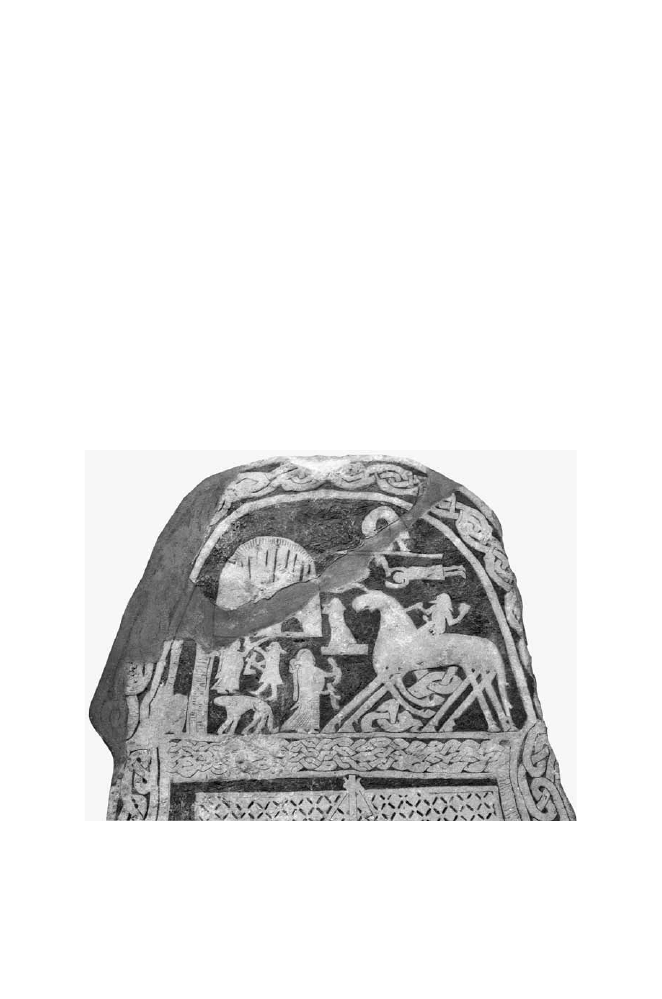
Detail of a runestone from Gotland, Sweden. Because of Snorri’s tales of the eight-legged horse,
Sleipnir, the rider is thought to be Odin. But when art historians interpreted a prehistoric
painting of an eight-legged horse at Chauvet Cave in France, they explained the extra legs as
an attempt to show great speed. Now in the Statens Historiska Museum, Stockholm. Photo by
akg-images.

The Wizard of the North
5
portraits of kings and sea kings, raiders and traders, Snorri created the Viking
image so prevalent today, from the heroes of sports teams to the bloodthirsty
berserks of movies and video games to the chilling neo-Nazi.
In his third book, Egil’s Saga, Snorri expanded that image, creating the two
competing Viking types who would give Norse culture its lasting appeal. Egil’s
Saga may be the first true Icelandic saga, establishing the genre and granting
the word saga the meaning we still use today: a long and detailed novel about
several generations of a family. Egil’s Saga begins with a Viking named Evening-
Wolf (reputed to be a werewolf) and his two sons; one son also had two sons,
one of whom is Egil. In each generation one son is tall, blond, and blue eyed, a
stellar athlete, a courageous fighter, an independent and honorable man who
laughs in the face of danger, dying with a poem or quip on his lips. The other
son is dark and ugly, a werewolf, a wizard, a poet, a berserk who works himself
into a howling frenzy in battle (and is unbeatable), a crafty schemer who knows
every promise is contingent. Both sons, bright and dark, are Vikings.
Snorri not only gave us the Norse gods and kings and Vikings: The modern
perception of Icelanders as a fiercely independent people is also due, in good
part, to him. Tiny Iceland, current population 320,000 (the size of Pittsburgh
or Des Moines), ranks number 175 on the United Nations’ list of the most
populous countries, a little ahead of Barbados and Vanuatu. Yet Iceland has a
permanent representative at the UN, and a few years back it applied for a seat
on the Security Council. Iceland faced down Britain about fishing rights in
the 1970s, became a member of the “coalition of the willing” fighting in Iraq
in 2003, and refused to knuckle under to the demands of the European Union
in 2008 when the Icelandic banks collapsed. In 2011 Iceland stood up to the
United States over WikiLeaks.
The country’s unshakable sense of its own worth is grounded in a speech
Snorri wrote about freedom. Ironically Snorri’s greed and ambition cost
Iceland its independence—no matter what, exactly, he promised the boy-king
of Norway on the quay at Bergen in 1220. In 1262, twenty-one years after his
death, Iceland became a colony of Norway (both Iceland and Norway later
were subsumed by Denmark). The golden age was over. Iceland descended into
its own dark ages of colonial repression. For hundreds of years the island was
known to the rest of the world only for its rich offshore fishing grounds, its bar-
baric people (said to wash in urine and dine on candle wax), and its volcanoes,
one of which was known as the Mouth of Hell.

6
Song of the Vikings
Then in the early 1600s Snorri was resurrected. Translations from Old
Norse appeared throughout Europe. The craze led in one direction to the gothic
novel and ultimately to modern heroic fantasy. Snorri influenced writers as
various as Thomas Gray, William Blake, Sir Walter Scott, the Brothers Grimm,
Thomas Carlyle, Henry Wadsworth Longfellow, Alfred Lord Tennyson, Robert
Browning, Richard Wagner, Matthew Arnold, Henrik Ibsen, William Morris,
Thomas Hardy, J. R. R. Tolkien, Hugh MacDiarmid, Jorge Luis Borges, W. H.
Auden, Poul Anderson, Günther Grass, Gabriel García Márquez, Ursula K.
LeGuin, A. S. Byatt, Seamus Heaney, Jane Smiley, Neil Gaiman, and Michael
Chabon.
In another direction the rediscovery of Snorri’s works led to Hitler’s master
race.
Snorri may be the most influential writer of the Middle Ages: His Edda,
according to the 1909 translator, is “the deep and ancient wellspring of Western
culture.”
The fat poe t s e tt ing sail from Nor way in the fall of 1220 had no idea of
his future importance. He had not yet written any books. Snorri’s ambition was
to rule Iceland. Whether as the leader of a group of more or less equal chieftains
or as the king’s earl made no difference to him, so long as he was rich, respected,
and indulged.
The voyage did not go well. It was late in the year to sail, and the weather in
the North Atlantic was fierce. His new ship lost its mast within sight of Iceland;
it wrecked on the Westman Islands off the southern coast. Snorri had himself
and his bodyguard of a dozen men ferried over to the mainland with their
Norwegian treasures. They borrowed horses and rode—bedecked in bright-
colored cloth like courtiers, wearing gold and jewels and carrying shiny new
weapons and sturdy shields—to the nearby estate of the bishop of Skalholt.
There Baron Snorri’s new title was ridiculed. Some Icelanders even accused
him of treason, of having sold out to the Norwegian king.
From then until his death in 1241, Snorri would fight one battle after an-
other (in the courts or by proxy), double-crossing family and friends to see
who would be earl of Iceland, deputy to Norway’s king. Snorri would die in his
nightshirt, cringing in his cellar, begging for his life before his enemies’ thugs.
He did not live up to his Viking ideals, to the heroes portrayed in his books. He
did not die with a laugh—or a poem—on his lips. His last words were “Don’t

The Wizard of the North
7
strike!” As the poet Jorge Luis Borges sums him up in a beautiful poem, the
writer who “bequeathed a mythology / Of ice and fire” and “violent glory” to
us was a coward: “On / Your head, your sickly face, falls the sword, / As it fell so
often in your book.”
Yet his work remains. Because of Snorri’s wizardry with words, the gods
and heroes of the Vikings live on, and our modern culture is enriched by north-
ern fantasy. In the twenty turbulent years between his Norwegian triumph and
his ignominious death, while scheming and plotting, blustering and fleeing,
Snorri did write his books. He covered hundreds of parchment pages with
world-shaping words, encouraging his friends and kinsmen to cover hundreds
of pages more.
It’s difficult to reconcile this unscrupulous chieftain with the witty story-
teller of the Edda, Heimskringla, and Egil’s Saga. But Snorri never wrote about
himself. We have no letters, only poems and tales. He appears in two sagas by
his nephew, Sturla Thordarson, one written on a king’s commission, the other
presumably for posterity. In neither book does Snorri come off well; no one
knows what grudge the nephew held to portray his uncle so poorly. Unhelpfully,
Sturla’s two sagas also contradict each other. Saga-Sturla, as I will call him to
distinguish him from a cousin of the same name, grew up with Snorri on his
kingly estate of Reykholt in the west of Iceland. Saga-Sturla learned to read
there, in his uncle’s fine library. He met writers and poets who came to copy
Snorri’s books and discuss them, to declaim their own poetry and old poems
they had memorized, and to avail themselves of Snorri’s liberal food and ale
and lounge in his luxurious hot tub. True, Snorri may have stolen his nephew’s
inheritance from his grandmother. And Snorri did leave Saga-Sturla in the
lurch on at least one battlefield. The rest we will never know.
Snorri’s books, however, may reveal how he saw himself. He is captivated
by complex, contradictory characters: the shape-shifter, the man in disguise,
the split or two-faced hero, both good and evil, beautiful and troll-like. He
begins the Edda with an ancient Swedish king going to interview the gods: “He
set out to Asgard and traveled in secret and assumed the form of an old man
and so disguised himself.” But the gods saw him coming and created for him a
vast illusion.
In Egil’s Saga the hero Egil is ugly and troll-like, “never at a loss for words,”
but “a hard one to handle,” while his beloved (and doomed) brother, Thorolf, is
handsome, popular, and “skilled in everything talented men of the time chose

8
Song of the Vikings
to do.” Together they make one complete man. When Thorolf is killed, Egil is
forever scarred and damaged.
Then there is Odin, the one-eyed wizard-king, of whom Snorri writes in
Heimskringla, “When he sat with his friends he was so fair and noble in looks
that all were joyful,” while to his enemies Odin appeared terrifying. Odin was a
human king: Only after death was he deified, Snorri says here, though he’ll give
a different account of Odin’s origins in his Edda. But Odin was a king with the
skills of a wizard. “He could change himself and appear in any form he would,”
Snorri writes, including bird, beast, fish, or dragon. Odin raised the dead and
questioned them. He owned two talking ravens who flew far and wide, gather-
ing news. He worked magic with runes and spoke only in verse or song. With a
word he “slaked fire, stilled the sea, or turned winds in what way he would.” He
knew “such songs that the earth and hills and rocks and howes opened them-
selves for him,” and he entered and stole their treasures. “His foes feared him,
but his friends took pride in him and trusted in his craft.”
Long after King Odin’s death, when he had become a god, Snorri says, the
missionary king Olaf Tryggvason, who forced Norway to become Christian
around the year 1000, held a feast to celebrate Easter. An unknown guest ar-
rived, “an old man of wise words, who had a broad-brimmed hat and was
one-eyed.” The old man told tales of many lands, and the king “found much
fun in his talk.” Only the bishop recognized this dangerous guest. The bishop
convinced the king that it was time to retire, but Odin followed them into the
royal chamber and sat on the king’s bed, continuing his wondrous stories. The
bishop tried again. “It is time for sleep, your majesty.” The king dutifully closed
his eyes. But a little later King Olaf awoke. He asked that the storyteller be called
to him, but the one-eyed old man was nowhere to be found.
Nowhere but in Snorri’s books. And perhaps in his soul. For without Snorri
Sturluson, sitting at our bedsides and chattering glibly along seven hundred
years after his death, we would have no tales of Odin the wanderer, king of the
Viking gods, wizard of the North, who gave up an eye for a single sip from the
well of wisdom.
To understand Snorri Sturluson, we must begin with Odin.

FIRST
READ IT
Song of the VikingS
BUY the Book noW
Amazon
Barnes & noble
indieBound
LeARn MoRe ABoUt the Book
macmillan.com
Wyszukiwarka
Podobne podstrony:
The World of the Vikings
Selby Song of the Silent Snow
Fredric Brown Night of the Jabberwock
Song of the Volga Boatmen
Tamora Pierce The Song of The Lioness 3 The Woman Who Ri
Anne Hampson Song of the Waves [HP 209, MBS 504, MB 1121] (docx)
Song of the Avadhut
Tchaikovsky 3 The Seasons Song of the Lark March Maro Marzo
buddhism dzogchen dalai lama The Song of the Four Mindfulnesses
ROBERTS Nora Song Of The West (Silhouette)
1 Ej uchniem! II Pieśń Wołżańskich Burłaków II Song of the Volga Boatmen II
Gimpel Concert paraphrase on The song of the soldiers of the sea after Offenbach
Shelby Morgen A Sentinel s Secret Song Of The Bear Iii
Stravinsky Song of the Volga Boatmen (full score)
the song of the chanter
Pirates of the Spanish Main Smuggler's Song
Legendary Lives The Song of Harmonia
Pirates of the Spanish Main Smuggler's Song
Sheri S Tepper Mavin 01 The Song of Mavin Manyshaped
więcej podobnych podstron