
Work Smarter with Speed Reading

To Morris Taylor

Work Smarter with
Speed Reading
Tina Konstant

For UK order enquiries: please contact Bookpoint Ltd, 130 Milton Park,
Abingdon, Oxon OX14 4SB. Telephone: +44 (0) 1235 827720.
Fax: +44 (0) 1235 400454. Lines are open 09.00–17.00, Monday to
Saturday, with a 24-hour message answering service. Details about our
titles and how to order are available at www.teachyourself.com
Long renowned as the authoritative source for self-guided learning –
with more than 50 million copies sold worldwide – the Teach Yourself
series includes over 500 titles in the fi elds of languages, crafts, hobbies,
business, computing and education.
British Library Cataloguing in Publication Data: a catalogue record for
this title is available from the British Library.
This edition published 2010.
Previously published as Teach Yourself Speed Reading.
The Teach Yourself name is a registered trade mark of Hodder Headline.
Copyright © 2010 Tina Konstant
In UK: All rights reserved. Apart from any permitted use under UK copyright
law, no part of this publication may be reproduced or transmitted in any form
or by any means, electronic or mechanical, including photocopy, recording, or
any information, storage and retrieval system, without permission in writing
from the publisher or under licence from the Copyright Licensing Agency
Limited. Further details of such licences (for reprographic reproduction) may
be obtained from the Copyright Licensing Agency Limited, of Saffron House,
6–10 Kirby Street, London EC1N 8TS.
Typeset by MPS Limited, A Macmillan Company.
Printed in Great Britain for Hodder Education, an Hachette UK Company,
338 Euston Road, London NW1 3BH, by CPI Cox & Wyman, Reading,
Berkshire RG1 8EX.
The publisher has used its best endeavours to ensure that the URLs for
external websites referred to in this book are correct and active at the time of
going to press. However, the publisher and the author have no responsibility
for the websites and can make no guarantee that a site will remain live or
that the content will remain relevant, decent or appropriate.
Hachette UK’s policy is to use papers that are natural, renewable and
recyclable products and made from wood grown in sustainable forests.
The logging and manufacturing processes are expected to conform to the
environmental regulations of the country of origin.
Impression number
10 9 8 7 6 5 4 3 2 1
Year
2014 2013 2012 2011 2010
Front cover: Comstock Images/Getty Images
Back cover: © Jakub Semeniuk/iStockphoto.com, © Royalty-Free/Corbis,
© agencyby/iStockphoto.com, © Andy Cook/iStockphoto.com,
© Christopher Ewing/iStockphoto.com, © zebicho – Fotolia.com,
© Geoffrey Holman/iStockphoto.com, © Photodisc/Getty Images,
© James C. Pruitt/iStockphoto.com, © Mohamed Saber – Fotolia.com
Any ancillary media packaged with the printed version of this book will not be included in this eBook2

v
Contents
Contents
Meet the author ix
Only got a minute?
x
Only got five minutes? xiv
Only got ten minutes? xviii
Introduction xxiv
1 The five-step reading system
1
Introduction to the fi ve-step system
1
Step 1: Prepare
2
Step 2: Preview
4
Step 3: Passive reading
8
Step 4: Active reading
10
Step 5: Selective reading
12
Reading for levels of meaning
14
Reading with a purpose
18
Ten things to remember
20
2 Speed
reading
21
Factors contributing to speed
22
Where are you now?
24
Increasing your basic reading rate
27
How to use a pacer
28
Skimming and scanning
32
Speed reading and getting the message
36
Bilingual speed readers
37
Exercises to increase your speed reading
rate and fl exibility
39
Speed reading graph
44
Ten things to remember
46
3 It’s all in the words – developing your vocabulary
47
Why increasing your vocabulary speeds up your reading
47
How to increase your vocabulary
48
The source of it all – roots, suffi xes and prefi xes
50
Specialized vocabulary
51
Ten things to remember
53

vi
4 Concentration
54
The importance of concentration
54
Stress and memory
58
Tips for improving your concentration
61
Exercises to increase and improve concentration
65
Ten things to remember
71
5 Memory
72
Memory myths
73
Short-term, intermediate and long-term memory
74
How memory works
75
Techniques for remembering what you read
79
Multi-sensory reading
90
Forgetting 92
Ten things to remember
95
6 A book is a book is a book
96
Reading different types of material for
different reasons
96
Critical reading
104
Ten things to remember
107
7 Your eyes and effective reading
108
Speed reading basics
108
Reading for understanding
110
Reading more than one line at a time
120
How to prevent and cure eyestrain
122
Reading from a PC monitor
126
Eye nutrition
127
Ten things to remember
130
8 Distractions and solutions
131
Lack of concentration
132
Physical distractions
135
Environmental issues
136
Work distractions
137
Clearing your desk of distractions
139
Ten things to remember
140
9 Real-world
reading
141
Information bottleneck
141
Prioritizing and planning
143
Coping with meetings
145

vii
Contents
Finding information fast
147
New jobs, projects and clients
148
A plan for reducing your reading
151
Evaluating your progress
153
Ten things to remember
154
10 Working and studying for a living
155
Before you begin
156
Managing time
159
Ten things to remember
162
11 Useful information and speed practice test
163
The makings of language
163
Critical language for critical reading
167
Establishing your current reading rate
168
Ten things to remember
177
12 What next?
178
Guidelines for your 21-day programme
178
Teach someone else the basics of speed reading
182
The A to Z of effective reading
186
Ten things to remember
190
Taking it further 191
Index 194

This page intentionally left blank

ix
Meet the author
Meet the author
When I first wrote this book, I thought almost entirely in
terms of ’ speed reading ’ : reading faster, getting through
more information more quickly, understanding, remembering
and using information you get from books.
Now that a few years have passed and I ’ ve moved from tertiary
education and into the glorious world of work, bills, mortgages
and a desperate need for sun-seeking winter holidays, I need
to absorb a different type of information from a multitude of
sources and apply it to more than passing exams or submitting
essays.
Speed reading is not just about reading fast, it ’ s about
managing information. That ’ s what this book is all about.
I hope you enjoy the new edition.
Tina Konstant

x
x
Only got a minute?
The main reason most of us read at an average
rate of 150 – 300 words per minute is because that is
approximately the rate at which we speak.
While you are reading this paragraph, listen
to what is going on inside your head. Do you hear a
voice inside your head while you are reading? Are you
‘ saying ’ the words in your mind while you read? This
is happening because of the way you were taught
to read.
When you were taught to read, you learned to
recognize one letter or sound at a time, then, when
you mastered that, you moved on to recognizing one
word at a time. The next step was being able to
read out loud so that your teacher could see that
you had learned to recognize the words accurately.
Then you were left to read ‘ to yourself ’ . That ‘ inner
voice ’ became a habit. Instead of reading out loud

Only got a minute?
xi
xi
you read silently. You learned that you had to hear
the words to understand what you were reading
rather than see them.
So when we talk about reading with your
ears instead of your eyes – that is exactly what is
happening: you are reading/speaking ‘ to yourself ’
at the same rate as when you read/speak out
loud.
When you fi rst learned to read, reading
‘ to yourself ’ was slow because you were still
learning to recognize the words. As you read
more and got further into the education system your
reading rate increased because your vocabulary
increased. But your reading strategy did not
change.
To increase your ‘ word-per-minute ’ reading
rate you must fi rst accelerate, only then can you
eliminate the sound in your head (often referred to
as sub-vocalization).

xii
xii
Two methods for achieving this are:
Method 1: Using a guide
Place a guide (pen, pencil or fi nger) underneath
the fi rst or second word of a line. Move the guide
smoothly across the page from the beginning to the
end of each line. Repeat on each line. Move the
guide a little faster than is comfortable. Make the
movement smooth and swift.
If the guide pauses, then it is likely to be
following (instead of leading) your eye. You will
continue to sub-vocalize and your speed will not
increase. When the guide moves fast and smoothly,
your eyes are forced to follow and your reading
rate will increase. The faster you move your guide,
the less you will sub-vocalize because your inner
voice will be unable to keep up. This technique
eliminates the habit of reading one word at a time,
and stops your attention jumping around the page
unnecessarily.

Only got a minute?
xiii
xiii
Important note!!
Speed reading is a skill. Developing that skill does
not mean you have to read fast all the time. The
technical content of the material, print size, your
mood, familiarity with the subject and your purpose,
are some of the factors that will affect the speed at
which you read. The ability to read quickly allows you
to choose how fast or slow you read.
Method 2: Mostly reading
This technique is good for subject matter with which
you are familiar, but you want to make sure that you
miss nothing out.
Read the fi rst sentence of the paragraph.
Skim the rest of the paragraph for key words and, if
necessary, read the last sentence of the paragraph.

xiv
5
Only got five minutes?
Reading fast is great – but do you remember and apply what you
read and learn? The purpose of this book is to provide you with
the skills you need to extract and use relevant information from the
mass available to you.
Top three most frequently asked questions:
What is the fastest possible reading speed?
If there is a limit on the speed at which people can read, we don ’ t
know what that is. We do know that some people can read a book
the size of War and Peace in less than 20 minutes and retain and
recall enough to answer questions at least as well as those who
read ‘ normally ’ !
How do I remember what I read – when I need to remember it?
The ability to retain and recall is the most relevant outcome. If you do
not plan to remember what you read, why read it in the fi rst place?
Is speed reading easy to learn?
Speed reading is easy to learn, and you can learn it quickly.
Only one part of the Five-Step System presented in this book
requires practice. The rest works just because you use it.
By the time you have used the fi ve-step system you will have:
explored the material at least three times
read what you need to have read
found the information you require

xv
Only got five minutes?
integrated new information with what you already
know
have accurate recall of the information
Moreover, you will have done it quickly without missing material
important to your purpose.
The fi ve-step system
Step 1: Prepare
This step should take no more than a few minutes no matter how
big the book is.
Lack of focus interferes with concentration. It makes reading
frustrating. The preparation stage will give you the focus you
need to get what you want out of the material as quickly
as possible.
To prepare (and establish your purpose), ask yourself three
questions:
What do you already know about the subject you are
reading?
What do you need to know (general information or the answer
to a specifi c question)?
How do you intend to use the new information (write an essay,
exam, report, general interest, give a presentation) and when
(next week, next month, next year, right now … )
Step 2: Structure
For a 200-page book, studying the structure of the book or
document should take between one and ten minutes, depending
on the length of the book and your purpose.

xvi
During Step 2:
Read the front and back covers, inside fl aps, table of contents,
index, and scan the bibliography.
Determine the structure of the book; chapter headings,
sub-headings, pictures, graphs, cartoons and images.
Strike out parts of the book that you are sure you don ’ t
need.
Highlight areas you think you do need.
Re-affi rm your decision about what you want from the
book.
If it becomes clear that the book does not contain what you need,
put it away. You will have saved yourself hours of work.
Step 3: Language
The purpose of step three is to familiarize yourself with the
language in the book. Is it full of jargon? Is the language
complicated? Are there any acronyms?
Becoming familiar with the language of a 200-page book should
take about fi ve to ten minutes.
Scan the pages at about a page every two seconds.
Look for words that stand out and highlight them: names;
long or technical words; bold or italics words linked to
your purpose.
Study the language: Is it technical, non-technical, user-friendly?
Are you familiar with it?
Do you need to refer to a dictionary?
Note the meaning of acronyms as you read.
Your familiarity with the language determines the speed at which
you will be able to read. During this step you might also recognize
recurring themes and concepts. Highlight anything relevant to your
purpose.

xvii
Only got five minutes?
Step 4: Content
Most well-written material outlines the main element of the
chapter in the fi rst paragraph with the main idea of each paragraph
in its fi rst sentence. For more detail read:
the fi rst paragraph of every section
the fi rst sentence of every paragraph (and, if the paragraph is
long, the last).
The more thoroughly you highlight, underline, circle, take notes
and mind-map what you read, the easier Step 5 will be.
Step 5: Selective reading
You will now be in a position to select ‘ intelligently ’ what you need
or want to read.
Insight
You will probably have read this section in less than fi ve
minutes. If you haven ’ t read the one-minute summary, go
back and do that now. These two summaries together will
help you read the ten-minute summary (and the rest of the
book) in a fraction of the time.

xviii
10
Only got ten minutes?
Remember what you read
No matter how fast you read, unless you remember what you read
you will have wasted your time.
The TOP THREE methods for remembering what you read are:
1
Use new information. Explain it to someone, discuss it, write
it, construct arguments for and against it, think about it and
apply it.
2
Have a purpose. Always know why you are reading something
and when you are going to use it.
3
Use the Five-Step Reading System. This system allows you
to select exactly what you need to read therefore avoiding
any unnecessary and distracting material that hinders
concentration and recall.
Other memory techniques
LINEAR
Make notes as you read or after each section. Include your own
thoughts, ideas and cross-references. The more you include your
own ideas the stronger and more reliable your long-term memory
will be.
KEY WORDS
Highlight words that carry the message. If you make notes
separately, ensure that key words are correct. This avoids
creating a list of words that makes no sense when you review
at a later date.

xix
Only got ten minutes?
MARGIN READING
A book is a form of communication from one person to another.
Take ownership of a book by adding your thoughts to the author ’ s.
Underline, circle, highlight essential areas and note whether you
agree or disagree. Make note of your reasoning. Mark what you do
or don ’ t understand. You should only do this if the book belongs
to you. If not, use Post-it notes. All of this will make reviewing
easier and more meaningful.
MIND-MAPPING
Place the key idea in the centre of a horizontal page.
Main ideas form thick branches from the centre.
Secondary ideas fl ow from the main ideas.
Tertiary ideas fl ow from secondary ideas. And so on until you
reach the fi nest detail.
Use colour and symbols.
One word or idea per line.
Improving speed and memory
This quick exercise will help improve your memory and increase
your speed.
Using a guide, read one page as fast as you can. Stop and
summarize what you remember. Read fi ve to ten pages like this
every day, gradually increasing the number of pages before you
stop to recall what you read. Start with a familiar subject. As your
ability, confi dence and comfort increase, take on more challenging
material.
STRETCH YOUR SPEED: THE ‘ ONE-MINUTE TRIP ’
Read for one minute, then count how many lines you have read.
Continue reading for another minute, this time, reading two
lines more than last time.

xx
Then read four more, then six more, then eight, then ten and
so on.
Always read for good comprehension and recall. As soon as
you feel you are not understanding or remembering the text,
stay at that level until you become a little more confi dent before
gradually increasing speed again.
Reading quickly requires concentration. If you don ’ t understand
what you read, then you will not easily remember it and your
concentration will fade. If this happens you will become bored
and disappointed.
With practice, your concentration will improve. As it does,
stretch the ‘ one-minute trip ’ to two minutes, then to four and
six and eight … and so on.
METRONOME PACING
Invest in a small, cheap electronic metronome at any music store.
Practise this for two minutes then relax for fi ve:
Set the metronome at its slowest speed, and read one line
per ‘ tick ’ .
Every half page or so, increase the pace of the metronome by
one beat per minute until you reach the fastest speed.
Then, relax.
The metronome will reach a speed at which you will not be
able to read every word. This exercise ‘ pushes ’ your eye and
brain to see and absorb more than one word at a time without
sub-vocalization. This gradually stretches your ability. When
you reach a rate at which you feel you cannot take in what you
read, maintain that speed. Make sure that even though you may
not take in the content, you see and recognize (but not say)
every word. For instance, if there is a foreign word in the text,
you would recognize it.
Imagine driving down a motorway at 85 miles per hour. As you
approach a town you reduce your speed to 30. You might think
you are travelling at 30 until the police stop you and inform
you that you were travelling at 40 or 50 – much faster than you
thought.

xxi
Only got ten minutes?
The similarity between driving and speed reading doesn ’ t stop
there. Travelling at 70 miles per hour you have to concentrate and
don ’ t have time to look at the scenery. When speed reading you are
reading so fast that your mind can ’ t wander as much as it can at
‘ 30 miles per hour ’ . You are more focused.
Treat your eyes: preventing and curing eyestrain
Your eyes need rest. The more relaxed they are the longer you will
be able to read. Here are a few simple things you can do to prevent
and cure eyestrain:
Palming is an excellent eye-relaxing exercise. Rub your hands
together until they are warm. Then close your eyes and cover
them with your hands so that no light gets in. Do not press
against your eyeballs: if you were to do so you could damage
them. Cover your eyes like this for as long as you have time to.
Many people who have eye problems compound them by not
blinking. If you do not blink your eyes will become dry. While
reading (especially from a PC monitor) be aware of your eyes,
blink often and water them. If it helps, put a sign above your
PC to remind yourself to blink.
If your eyes feel particularly tired there are a number of very
good eyewashes you can get from any pharmacy. Follow the
instructions carefully when you use them and if necessary check
with your optician or your doctor. If you wear contact lenses it
is even more important to take care of your eyes while you are
reading.
When you read, your eyes are limited to how much they move.
An excellent way to relieve stress is to practise eye exercises.
First, look straight ahead, then look up as far as you can, down
as far as you can, then to the left, then to the right. Then, look
to the top left, top right, bottom right and bottom left. Hold
each gaze for only a couple of seconds. Then squeeze your
eyes shut and repeat the exercise. When you have fi nished the
exercise, palm for a few minutes.

xxii
READING FROM A PC MONITOR WITHOUT
STRAINING YOUR EYES
Font size and type. If someone has sent you a document and the
font is diffi cult to read, either due to its size or type, change it.
Serif fonts are easier and quicker to read.
Screen contrast . Make sure the background contrasts the text on
the screen. Keep your screen clear and clutter free.
Screen interference . Have as little around your screen as possible.
Sometimes it is tempting to have all the icons on display. The
more you have around your screen the smaller the screen space.
Only have what is necessary for the work you are doing.
Screen savers . There are screen savers on the market now that
remain active all the time. The one that held my attention for
quite some time was a sheep that ran around my screen while
I worked. Not only does it help to relax your eyes and prevents
you from staring at the screen but a sheep chasing frogs
across the screen is good for your sense of humour. Anything
humorous is good for your stress level, which in turn
is good for concentration. It is important, however,
to maintain the balance between humour and distraction.
Screen position . Keep the screen a comfortable distance away from
you. It should be at least arm ’ s length away. Also, avoid having the
screen directly in front of a window. The contrast in light can be
uncomfortable and the activity outside can be distracting.
Comfort . Working at a PC means that the only parts of your
body that get any exercise are your fi ngers. Stop, stretch your
body and do the eye exercises every 20 to 30 minutes.
Distractions and solutions
Distractions can prevent effective reading and accurate recall.
CONCENTRATION
Take breaks often (approximately fi ve minutes every
30 minutes) to ensure peak concentration.

xxiii
Only got ten minutes?
Have a purpose.
Use a guide, especially if you are feeling tired or if the material is
challenging.
Take notes as you read.
COMFORT
Ensure you have fresh air and adequate light. Make yourself as
comfortable as possible without feeling sleepy.
MENTAL DISTRACTION
The expert at distracting you is you! When your mind wanders you
have often not decided to spend the time on a particular task. So,
before you begin to read, commit to a certain amount of time and
do it. Realize that you are in control.
LIGHT
Daylight is best. If there is none, then there should not be too much
contrast between the light under which you are working and the
rest of the room. This helps prevent eyestrain. The main source of
light should come over the shoulder opposite your writing hand.
VOCABULARY
Underline unfamiliar words. Look up the words at the end of the
paragraph, page, section or as appropriate. This improves your
comprehension and your vocabulary. The better your vocabulary,
the faster your reading will be.
If you want more details, please read the rest of the book! But do
yourself a favour and use the Five-Step System (see Chapter 1).
You ’ ll get through it in a fraction of the time!

xxiv
Introduction
Brief outline of each chapter
CHAPTER 1: THE FIVE-STEP READING SYSTEM
This chapter covers one of the core techniques of the book.
Reading it will give you the skills that will help you:
empty your in-tray quickly
sort through piles of paperwork that have built up over the years
read books that you ’ ve been wanting to read for years
get through your reading at work in a quarter of the time it
currently takes you
CHAPTER 2: SPEED READING
In this chapter you will learn how to take a fl exible approach to
your reading, how to fi nd information fast and how to extract the
message from the document without wasting time.
CHAPTER 3: IT ’ S ALL IN THE WORDS – DEVELOPING
YOUR VOCABULARY
The better your vocabulary is, the faster you will be able to read.
This chapter is especially useful if you are reading a second language
or if the material you are covering is technical or specialized.
CHAPTER 4: CONCENTRATION
Without concentration there will be no memory. This is a practical
chapter with exercises to help you increase your concentration,
wherever you have to work.

xxv
Introduction
CHAPTER 5: MEMORY
If you do not remember what you read, you may as well not
begin reading. This chapter will give you an insight into how your
memory works and what may be happening when it does not.
A selection of approaches to remembering what you are reading
is included in this chapter. Look at them all and choose those
which you could use for the different types of reading you do.
CHAPTER 6: A BOOK IS A BOOK IS A BOOK
Or is it?
Every type of reading should be approached differently. In this
chapter you will fi nd different strategies that will make reading a
newspaper in ten minutes a cinch and reading for work a doddle.
CHAPTER 7: YOUR EYES AND EFFECTIVE READING
Your eyes are your most important reading tool. The chapter will
help you take care of your eyes, prevent eyestrain and improve
your reading rate by increasing what you can perceive within your
visual span. This chapter has exercises and practical ideas to make
your eyes work better for you.
CHAPTER 8: DISTRACTIONS AND SOLUTIONS
Wherever you are, whatever you are doing, there will be something to
distract you. This chapter links closely with Chapter 4 (Concentration)
and Chapter 5 (Memory). The fewer the distractions, the faster and
more productive your reading will be. Solutions to a number of
different distractions are described.
CHAPTER 9: REAL-WORLD READING
Most reading is done under pressure – in one way or another, time
is the critical factor. If people ever give you documents to read
and then stand waiting while you fi nish them, this is the chapter

xxvi
to read. It will also help you prioritize your reading and prevent
yourself from becoming an information bottleneck.
CHAPTER 10: WORKING AND STUDYING FOR A LIVING
If you do any kind of studying and also have a full-time job or look
after a family you will fi nd this chapter very useful. In it you will
fi nd ways to simplify and organize your reading and reduce the risk
of panicking a week before an exam. If, however, you have only
a week to go until the exam there is a strategy in this chapter that
will help you make the best use of that time.
CHAPTER 11: USEFUL INFORMATION AND
SPEED PRACTICE TEST
This is a support and reference chapter with additional
information that will help you increase your vocabulary and
make reading easier. You may want to record in a notebook any
extra information you come across that helps you extend your
vocabulary.
CHAPTER 12: WHAT NEXT?
How will you apply what you have learned? This chapter will help
you design a 21-day programme that will assist you in integrating
what you have learned into your day-to-day activities. Also, there
are ideas on how to teach someone else.

1
1. The five-step reading system
1
The fi ve-step reading system
In this chapter you will learn:
•
about the five steps: prepare, preview, passive, active,
selective
•
how to read for levels of meaning
•
about reading with a purpose
Introduction to the fi ve-step system
By the time you complete the fi ve steps in the system you
will have:
Explored the material at least three times.
Read what you need to have read.
Integrated the new knowledge into what you
already know.
Gained an accurate recall of the information.
Found the information you require.
Most importantly, you will have spent a fraction of the time you
might otherwise have spent learning these skills.
To avoid slipping back into old reading habits, closely follow the
fi ve-step system outlined in this book. Once you are familiar with
it you can adapt it to any type of reading – articles, newspapers,
memos, books, magazines and so on – by combining and
omitting steps.

2
The fi ve-step system has one over-riding rule: Always know why
you are reading something.
Insight
If you glanced over the last sentence, it doesn ’ t matter
because by the end of this book I ’ ll have said it again:
The one over-riding rule of the fi ve-step system is: know
your purpose! It doesn ’ t matter what your reason is for
reading something – as long as you have a reason.
The fi ve steps in the system are as follows:
1
Prepare.
2
Preview.
3
Passive reading.
4
Active reading.
5
Selective reading.
This system is based on a process that simply asks you to highlight
and eliminate . As you use the system, your aim is to highlight areas
for further study and eliminate those that you are certain you do
not need.
Depending on how much you want from the book, Steps 1 to 4
could take between 5 and 40 minutes for a book of 300 pages. The
time that you spend on Step 5 will depend on how much detailed
information you want from the material.
Steps 1 to 5 will now be outlined. Read through this section once,
then using a non-fi ction book on a subject you are interested in try
the system out. For the moment, forget about trying to read fast.
We ’ ll get to that later.
Step 1: Prepare
One of the reasons why reading can be frustrating is a lack
of concentration. This has as much to do with your thoughts

3
1. The five-step reading system
as your surroundings. One of the serious distractions is tension.
When you are approaching a large volume of reading, especially if
the subject is new to you, tension may rise. One way to diminish
initial tension is to establish that you already know something
about the subject. Another, to use if you know that you do not
know very much, is to formulate questions that will help you
improve your knowledge and achieve your objective.
The main purpose of the preparation step is to build the
framework (made up of questions and answers) onto which
you will fi t everything you learn as you read.
Insight
Take a minute to think about what you are about to read and
notice what questions your curiosity demands answers to.
The more questions you ask, the more interested you ’ ll be in
the material. Develop the discipline of doing this even if what
you are reading is a little dull.
Questions are important; without them you will fi nd no answers.
For every piece of information you place on your framework ask
questions – who, what, where, when, why, how. There is no such
thing as a silly question. Questions that are labelled as such are
generally the ones that are diffi cult to answer. Think back to when
you were a child and you asked a perfectly good question. If your
parents could not, or did not want to, answer it, did they say,
‘ Don ’ t ask such silly questions ’ , leaving you feeling bewildered
and ignorant? Always ask questions. It is better not to fi nd the
answer than never to ask the question. The more you know and
the more questions you ask, the more you will be able to make
sense of the subject.
The preparation stage helps you focus on the task:
Write down what you already know about the subject;
key words are suffi cient.
Decide what you want from the book: is it general
information, enough to write a report on or simply the
answer to a specifi c question?

4
Always ask yourself these three questions:
1
Why am I reading this in the fi rst place?
2
What do I already know?
3
What do I need to know?
In other words … what is your purpose?
Getting yourself into a learning state is important.
This will help maximum concentration. Chapter 4, which
deals with concentration, provides a number of methods that
will help you focus on what you have to do, whether you are
surrounded by distractions at home or in the midst of mayhem
at the offi ce.
Insight
This step is essential. Even if you only take 30 seconds
to prepare it will put you in the right frame of mind to
concentrate on what you you ’ re reading. Whether it ’ s your
mail or the Encyclopaedia Britannica , take time to prepare.
Don ’ t miss out the fi rst step.
Step 2: Preview
The purpose of previewing a book is to become familiar with its
structure:
What does it look like?
Are there summaries or conclusions?
Is it all text?
Are there any pictures?
What size is the print?
Does the font selected make it easy to read?
Is the text broken up into sections?
Is it a series of paragraphs?
For a 300-page book, the overview should take about 10 minutes.

5
1. The five-step reading system
Read the front and back covers, the inside fl aps, and the table
of contents and have a look at the index, glossary
and bibliography.
Determine the structure of the book: chapter headings,
sub-headings, pictures, graphs, cartoons and images.
Eliminate the parts of the book that you are sure you
don ’ t need.
Highlight areas you think you do need.
Re-affi rm your decision about what you want from the book.
If it becomes clear that the book does not contain what you
need, put it away. You will have saved yourself hours of work.
There is a vast amount of information you can glean from each of
the stages of your preview. Here are some ideas about what you
should be looking for during this stage:
THE COVER
The cover is the fi rst call for a book. Any picture on the front
is designed to attract your attention; it is therefore important to
look beyond the picture to fi nd out whether the book will be useful
to you.
Back-page blurb
This should give a good indication of what the book contains.
It often contains promises, such as: ‘ If you read this book you
will get … ’ . You may also be able to gauge the book ’ s readability;
if the back-page blurb is written in complex language, the rest
of the book may be the same. If on the other hand it is clear,
straightforward and easy to understand, there is a better chance
of the book being easy reading.
Inside flaps
Most hard-back books and even some soft-backs have information
on the inside of the covers. This usually consists of summaries,
biographical information and a photograph of the author. Reading
this will give you information about the author and what point of
view they might be taking.

6
FOREWORD
The foreword, hardly ever read, is probably the most important
section to cover at the preview stage. Another expert in the
fi eld usually writes it. It will almost always contain information
about the author and their experience in the fi eld they are
writing in.
TABLE OF CONTENTS
The contents table is intended to help you fi nd your way through a
book and is likely to be the section to which you refer most often.
When you make a fi rst pass at the table of contents, make notes
as you go. If you know that you do not need the contents of a
chapter, make a note about why you think you do not need it. For
the chapters that you do want, note what it is you expect to fi nd or
questions you want answers to.
GRAPHICS, PICTURES AND CARTOONS
These may be excellent sources of information. They contain
information about the topic in a pictorial format. Since most of us
remember pictures better than words, they will help you remember
what you are reading. Do not just glance at graphs and pictures;
study them, read the titles and any explanations provided and
work out how they will fi t into the framework you began to build
in Step 1.
TABLES
These are useful but can sometimes be confusing without
background knowledge about what they contain. Look briefl y
at the tables without attempting to memorize or fully understand
what they contain. If a brief explanation is attached to the table
then read that, but without spending much time on it. The
information will become clearer at Step 4 – Active reading.

7
1. The five-step reading system
INDEX
Next to the table of contents, this is the most valuable section
in the book. The index will give you detailed information in a
different format from the contents table:
If you are looking for information on a specifi c aspect of the
subject or an answer to a specifi c question you may fi nd a
reference to it without further reading.
The index will give you a very clear indication of the detail the
book has on your subject.
GLOSSARY
This section is useful to skim during this step and you will certainly
fi nd it most useful in Step 3 – Passive reading, when you are
studying the language of the text. While you are reading the sections
you have selected the glossary will be invaluable – place a marker
at the start of the section so that when you need to determine the
meaning of a word you will be able to fi nd it quickly. If you are
studying from the book, check whether you may photocopy the
glossary so that you can add notes to it easily as you work.
BIBLIOGRAPHY
The bibliography may indicate some of the books the author used
as reference during the development of the book. It will also give
an idea of what level the book is pitched at. If the books listed
in the bibliography are all familiar to you, the book may not be
suffi ciently advanced for your needs. If they are new to you then
it will be a good guide for further study.
On the basis of the information gathered during this step, you will
be able to think more clearly about what the text covers. At this
stage, review your purpose. Is it still the same as you stated before
you previewed the book or has it changed because of what you
have learnt?

8
At this stage you should also begin to be able to stretch your
knowledge and understanding of what the author is trying to say.
If, however, the author ’ s point is still not clear, try to decide what
assumptions the author is making.
All too often, specialists will write on their particular subject
forgetting that many of the people who will be reading it will
not have had the years of training, research and exposure to
the subject that they have had. As a consequence, the language
may be complex and basic explanations may be lacking. If this is
the case, consider what questions you might need to answer before
you can continue with the text. With those questions in mind,
carry on to Step 3.
Insight
In Steps 2, 3 and 4 it will be tempting to read just a little
more than is required for that step. Don ’ t give in! See how
much you can get through as quickly as possible, then select
what you really want to read and take your time on that.
Step 3: Passive reading
Now that you are prepared and know the structure of the
book, this step will familiarize you with the language and the
organization of the book. Is it full of jargon? Is the author a
‘ linguafan ’ ? How is the information organized? Are there a
lot of examples? Does the book take you through a step-by-step
process?
Knowing how a book is organized will help you to identify key
ideas and sentences in Step 4 – Active reading. The information
may be arranged in a number of ways:
Chronological – First, second, third or by date.
Examples – If there seem to be stories in the text, then perhaps

9
1. The five-step reading system
the stories are the evidence for arguments that the author
states elsewhere.
Advantages and disadvantages – To uncover this
structure look for words like ‘ but ’ , ‘ on the other hand ’
and ‘ however ’ .
Process – Activity A leads to activity B and on to activity C.
Most important/least important – Does the author place
the core of the information at the start or at the end?
Most newspaper stories will have the most important
information at the start of the story, followed by the detail
necessary to say more about the actual incident and perhaps
fi nally comment from those involved or the opinion of
the journalist.
The passive reading step works best if you thoroughly completed
Step 1 – Prepare.
It should take only between 10 and 15 minutes to read a 300-page
book passively:
Scan the pages at a rate of about a page every one to
two seconds.
Highlight words that stand out. They may be names,
long or technical words or words in bold or italic .
Decide if the language is technical, non-technical or
user-friendly. Are you familiar with it?
Look out for words that will give you a clue to how the
information is structured. Start looking for key ideas.
Make a note of where the key arguments seem to be.
Insight
Know your purpose! If you don ’ t, then Step 3 will be a waste
of your time because you won ’ t know what you are looking
for. Experiment: Look around and notice everything red.
Now, close your eyes and recall everything blue. What did
you notice? You see what you look for.

10
Step 4: Active reading
The main purpose of active reading is to identify the main ideas of
a text. There are two reasons why this may be a challenge:
You might not know enough about the text or the author to
recognize what the ideas or arguments are. This is like being
asked whether you have any questions about a subject you
know nothing about – you do not know enough to know what
questions to ask. The more thoroughly you carry out Steps 1
to 3 and the clearer your purpose is, the easier it will be to fi nd
main ideas.
The second challenge is that you may not know where
in the text the main ideas are likely to be explained. Although
the main idea of most well-written material is in the fi rst
sentence of the paragraph, it may be in the middle or at the
end instead.
FINDING THE MAIN IDEA
Knowing the type of material you are reading will help you
determine where the main idea is likely to be. A text written to
inform will probably have the key sentence at the start of the
paragraph. If the purpose is to entertain then the key information
will more than likely be at the end (like the punch-line in a joke).
If the text is there to persuade you, you may fi nd key information
at the start or in the middle. During Steps 1 and 3 look for the
location of key information; this will help you to determine the
nature of the text.
FOR MORE DETAIL
This is the fi rst time you will be doing anything resembling reading:
Determine the type of material you are reading.
Read the fi rst paragraph of every chapter and the fi rst and last
(if the paragraph is long) sentence of every paragraph .

11
1. The five-step reading system
As you progress through the text, begin to identify where the
main idea is likely to be and focus more attention on those
sections.
Avoid reading entire paragraphs. This will slow
you down.
The key question to ask during this step is:
What point is the author trying to make?
Cross out, highlight, underline, circle and take notes as you read.
Later in this book you will learn how to mind-map (see pp. 80 – 81).
The more thoroughly you do this, the easier selecting what you
really need to read will be.
ANALYSE YOUR READING
Before you launch into Step 5 (Selective reading), take a little time
to think about what you have read so far:
Did you have any diffi culty with the context, vocabulary or
content of the book?
Did the material you read evoke any thoughts or feelings that
were out of the ordinary?
What was your attitude before you started reading? Has it
changed now?
As you went through Steps 1 to 4 did you become less
interested in the material or more interested?
How much time did you spend? Could you have
reduced it?
Did you get drawn into any particular section?
Did you fi nd what you were looking for?
Are your notes clear?
The third question, on attitude, is very important. If you feel
negative about the task, your motivation and concentration will
diminish and selecting what you need to read accurately may be
more diffi cult to accomplish.

12
Insight
Step 4 is where most people fall down. It ’ s really easy
to get drawn into reading a whole paragraph instead of
sticking to the fi rst and last sentence. If you come to a
particularly interesting or relevant section, mark it and
MOVE ON!
Step 5: Selective reading
Thought experiment (don ’ t actually
do this unless you want to waste a
great deal of time and petrol!)
Imagine you are to take a trip from London to Edinburgh.
You will use country roads as far as possible. Imagine you
have never taken such a trip before, but still you decide
not to take a map. On your arrival in Edinburgh, check your
time, including the time taken by detours and by asking
directions. Make the trip a second time using a map,
and then compare the difference in time between the two
journeys.
The same applies to reading. The first four steps,
from preparation to active reading, create a map for
you to follow. When you know where you are going and
how you are going to get there, the task is much easier
to accomplish.
The purpose of the fi rst four steps is to allow you to
select what you need or want to read and help you read it
intelligently .

13
1. The five-step reading system
During the fi rst four steps you have decided what it is you want
to read, what answers you are looking for and what your interest
in the subject is. You have studied the structure of the book,
you are familiar with its language, you have read some of the
content, giving you an excellent understanding of what the book
contains. You can now select the sections you really need to read
without worrying about whether you have missed anything.
‘ Intelligently ’ refers to your initial purpose. Reading intelligently
will help you distinguish between what you need to know, what
you would like to know and what it would be fun to know.
To select what you need to read to fulfi l the purpose you set for
yourself during your preparation:
Review the notes you made in Step 1.
Add any relevant information you gained as you were
reading.
Answer the question ‘ Do I already have what I was
looking for? ’
If you do, stop .
If you don ’ t, review the key words highlighted during Step 3 –
Passive reading, and repeat the question: ‘ Do I have what
I want? ’
You made notes during Step 4 – Active reading. Review them
and again ask whether you have what you want.
If you decide that you need more information, go through
the book and read the pieces of text you identifi ed as relevant
during the fi rst four steps.
If you decide you need to read the entire book, you will be
able to read it much faster because, having completed the fi rst
four steps of the fi ve-step system, you will know what the
book contains and what to expect.
By now you will be familiar with the layout, language and content
of the book. You will have spent approximately 40 – 50 minutes
with the book and you will have a good idea of what it contains.

14
Think carefully again about what exactly you want from
the material. The length of time you spend on Step 5 depends
on how much you decide you need. Whether you want to read
it all or just one paragraph on one page in one chapter, that
will be an informed decision and you will not have wasted
your time.
Insight
One of the biggest complaints people make about speed
reading books is that they are too big and take too long to
read. Use what you learn as you learn it to increase the rate
at which you read this book.
Did you know?
If you know nothing about a subject before you start it is
almost impossible to remember what you read. The five-
step system helps you build a framework of knowledge,
making retention and recall easier.
Reading for levels of meaning
The purpose of the fi ve-step system is to enable you to gather
as much information as possible before you select what you want
or have to read. Depending on your material, your reasons and
the amount of time you have available, you can use the system in
different ways.
The more you understand the content of what you are reading,
the better your comprehension will be when you read in more
depth. The nature of the meaning you gather from applying the
fi ve-step system will depend on what you are looking for.

15
1. The five-step reading system
You can get different levels of meaning from a text. Each level
requires a different type of reading:
Literal meaning – This is the exact meaning of the text.
It mainly consists of facts, fi gures, dates and names. This
information may have to be memorized and it cannot be
changed or reinterpreted.
Implied meaning – This information is not stated directly. It may
require analysis. If the author says, ‘ It was a hot and beautiful
day ’ , they imply that the sun was shining for some of that day.
Inferred meaning – This takes a little more analysis. It requires
you to question the author and examine more deeply what
they mean.
Take this statement: The human mind is like a computer,
the trouble is that a computer comes with a manual,
our minds don ’ t.
The literal meaning of this sentence is that computers come
with manuals.
The implied meaning is that there is some similarity between
the way a computer system works and the way our minds
seem to function.
The inferred meaning is that we know how a computer works
because we have a manual as a guide but we will never know
how our minds work because we don ’ t have a guide to take us
through the intricacies of its functions. If there were a manual
we wouldn ’ t have a problem at all.
Inferred meaning can be as diverse as your imagination. Literal and
implied meanings are a little more restricted.
To demonstrate how your reading differs when you look for
different levels of meaning, read the following text three times.
First, look only for literal meaning; then for implied meaning.
Finally read it with your mind wide open, for inferred meaning,
giving the text as many different interpretations as you can.

16
‘ A manager needs to understand
that all people are different ’ by
Morris Taylor (printed with the
author ’ s permission)
Those who take psychology at degree level will normally
study (or at least be in the same room as) what little is known
and taught about the topic of Individual Differences – a
hopefully self-explanatory term.
They will also explore variations on the theme of classical
conditioning ( à la Pavlov ’ s Dogs), and they will continue
through to – to name a few – behaviourism, social learning,
and other important theories about how and why humans
behave in particular ways. And perhaps they will learn a
little about personality theory and then about how we
(mis)behave in groups.
Those who study anthropology – in particular, cultural
anthropology – will read about ‘ Human Universals ’ :
those observable (and non-observable) behaviours
that can be proven (can we ever?) as occurring in any
and every human being or, at the very least, in broad
cultural groups.
Could it be that, because of Individual Differences (and,
for that matter, cultural differences), there are not as
many Human Universals as we might at first think?
Immanuel Kant (who, I hope, will pardon my tongue-in-
cheek paraphrasing) said that doing ‘ good ’ was only ‘ good ’
if it was done for the sake of doing ‘ good ’ .
Anton Tolman discussed Haywood: ‘ … true intrinsic
motivation is generated by the psychological and internal
sensation of dealing with a task “ for its own sake … ” ’ .

17
1. The five-step reading system
John Seddon said ‘ … the big thing that worries me is that
when your teacher gives you a gold star, while you might
feel good, the other children in the class might feel that
they lost out ’ .
It used to be the case that when psychologists talked about
independent variables in their experiments they would
discuss among other things ‘ stimulus materials ’ . Now
we hear more of ’ stimulus-in-context ’ .
Shakespeare said ‘ Nothing is good or bad except thinking
makes it so. ’
So could it be that any one out of a set of sticky (?) gold
stars on a sheet has little or no meaning except that which
we as a group (and thus culturally) choose to import to
it? And would that allow me to assert sensibly that the
meaning of a gold star has as much to do with cultural
influences as it has to do with any other theory of human
behaviour? And does whatever meaning we import to a gold
star apply universally to everyone who ever gets one even if
the contexts are not similar?
Or – as Deming said – is everyone different?
And could ‘ being different ’ itself be a behavioural
universal?
And that makes me wonder – is there really any difference
between a gold star and a red bead …
I really do wish I knew … but I don ’ t.
(Source: Morris Taylor (1997),
from discussions on the Deming Electronic Network:
den.list@deming.ces.clemson.edu)

18
Before you carry on, what was the key idea in the text? Was the
author trying to inform, persuade or entertain you? Where was
the key sentence? Did the key sentence change depending on what
meaning you were looking for?
This exercise emphasizes that you will fi nd what you want to fi nd.
It is vital to make sure your purpose is clear.
Insight
It ’ s human nature to seek out information that supports what
we already know and believe. If you really want to challenge
your thinking then actively seek out new, interesting and
contradictory ideas.
Reading with a purpose
The more defi ned your purpose is, the easier your reading will
become. Here are a few things to keep in mind as you read that
will help you maintain and constantly refi ne your purpose:
Application – While you read, think of why you are reading
the text. When are you going to apply it, what will applying
the new information feel like, what will things look like after
you have applied it? How much of your own knowledge will
be included in what you are learning?
Prediction – As you read, predict what you think the author
is going to say. As a line of argument begins, predict what
the outcome might be. You do this naturally when you read
a good detective novel. You can do it just as effectively when
you read non-fi ction. Predict what the author is saying and
check your prediction.
Interaction – Reading is a two-way activity. The author has
a message that you could simply accept, but that would not
necessarily mean you learned anything new. Interacting with the
author is the best way to ensure you learn and are able to apply
what you read. Be critical but open-minded about what you read.

19
1. The five-step reading system
Solution – Many non-fi ction books are written as a solution
to a problem. This particular book is about speed reading.
The problem is ‘ How can people learn how to read any
material they come across easily, quickly and effi ciently? ’ As
you read, try to answer the question without waiting for the
answer to be revealed to you. Pause for a moment now and
ask yourself:
Based on what I have learnt so far, what can I do now to
read faster, more effi ciently and more easily that I didn ’ t
do beforehand?
What can I change about the way I think and read that
will make reading an enjoyable experience?
What is good about the way I read now?
What is ineffective?
What challenges do I face?
How can I solve these problems based on what I have
learnt so far?
Evaluation – Take a few moments to stop and summarize
what you have learnt from each chapter. As you read the
book think how what you learnt in each chapter fi ts in with
the chapter you have just read. The more links you can create
between chapters and ideas the better your understanding and
recall will be.

20
TEN THINGS TO REMEMBER
1
Having a clear purpose is the easiest way to cut out the dross
and fi nd information you really need.
2
Take a minute to prepare your mind and environment before
you start to read.
3
During the preview stage don ’ t get trapped into reading full
paragraphs and sentences all the time.
4
Before you start to passive read, make sure your purpose
is clear.
5
During the active reading stage, avoid getting sucked into
reading entire paragraphs and chapters. Set a time of
20 minutes and aim to get through the entire book by only
reading the fi rst paragraph of every chapter and the fi rst
sentence of every paragraph.
6
During the selective reading stage feel free to jump around the
book. You don ’ t have to read beginning to end.
7
You don ’ t have to fi nish a book just because you ’ ve started it.
8
Before you start to read decide how you ’ re going to use the
information.
9
It ’ s okay to write in books (check that it ’ s yours and that it ’ s
not a priceless antique).
10
Think for yourself. The author isn ’ t always right.

21
2. Speed reading
2
Speed reading
In this chapter you will learn:
•
how to increase your basic reading rate
•
what a pacer is and how to use it
•
how to skim and scan
•
how to get the message
•
what slows down and speeds up your reading
Learning to read fast can be challenging. While you learn this
improved version of speed reading, a lifetime of habit will
constantly interfere with the learning process. You will be
developing and securing new habit patterns. Although this will
require practice it will be easy and enjoyable because you will see
the results immediately.
Speed reading is not just about reading words faster than you did
before. It ’ s about being able to read at a speed appropriate for the
material you are reading. If you read too slowly your mind will
wander, you may become bored and you won ’ t remember anything.
If you read too fast you will reduce the chances of remembering
what you want to remember, you will become frustrated and
stressed and thus even less likely to remember.
The more fl exible you are with your reading, the faster you will be
able to read and the more information you will retain.
If you want to increase your reading rate and increase your
comprehension, then it is important to read often. The more you

22
read, the better you will become at recognizing when you can read
fast and when to slow down.
Factors contributing to speed
Clarity of purpose – Step 1 of the fi ve-step system is
preparation. Always know why you are reading something.
The clearer your purpose, the faster you will be able to read.
Mood – If you are feeling tired, restless, impatient or
irritable you are unlikely to be able to read as quickly as
when you are alert, fresh, happy and relaxed. However,
you may not always be alert, fresh, happy and relaxed
when you have to read. Learning how to recognize and
manage your feelings so that you can concentrate
regardless of how you might be feeling at the time is
not always easy. There are some guidelines in Chapter 4
that may help.
Familiarity with the subject-related terminology – If you are
already familiar with the subject you will have a framework
on which to build. You will not have to stop to think about
what the words might mean and you are more likely to be able
to read quite quickly.
Diffi culty of the text – Some books are diffi cult to read even if
you are familiar with the terminology and content.
Urgency and stress levels – Do you notice that when you
absolutely have to read something immediately, you can ’ t
read quickly? Stress will slow you down. The chapters on
concentration and memory (Chapters 4 and 5) will look at
stress more closely and offer ways for you to reduce your
stress levels.
Insight
If you ’ re in a bad mood don ’ t try to read anything even
remotely important, technical or that you ’ ll have to voice an
opinion on. Your mood will taint that opinion and you might
well say something you ’ ll regret.

23
2. Speed reading
Factors affecting learning to read quickly:
A good attitude towards reading. A desire to learn how you
can improve your reading and consider what it is that you will
get from speed reading.
Familiarity with the language related to the subject and a good
vocabulary.
Good background knowledge of the subject or, if you do
not have that yet, a strategy for building the background
knowledge quickly.
Don ’ t bother setting time aside each day to ‘ practise ’ speed
reading. Just use these techniques on everything you read, all
the time.
Real people
In the middle of an exercise during a speed reading class
one of the students suddenly put down his book, sat back
and folded his arms, annoyed. I asked him what was wrong.
He shrugged, looked at the individual next to him and said,
‘ He ’ s reading faster than I am. ’ For the rest of the session
he sat at the back of the room and read a newspaper.
Speed reading is a very personal practice. Everyone reads
with different levels of knowledge and experience. Even
if you are learning with someone else you will probably
learn at different rates. Avoid comparing your skill with
anyone else ’ s.
There are many ways to pick out information at varying speeds.
Reading every word in a book or article is only necessary if you
have a specifi c reason for doing so. Before you decide whether
you need to do this, you need to know what information the
reading material contains. After you have gone through Steps 1 to
4 of Chapter 1 (preparation, preview, passive reading and active

24
reading), you will be ready to select what you want to read in more
depth. Now is the time to speed read.
Where are you now?
Before you can improve something you need to know your starting
point. That will help you to establish what will be required to take
you where you want to go. One way to do this is to ask yourself
these three questions:
Where am I now?
Where do I want to get to?
How will I know when I have got there?
To put these questions another way:
How fast do you currently read?
How fast do you want to read?
How will you know when you have
reached your goal?
It is not easy to determine accurately how fast you read;
everything you read is different. Each piece of material is
written with varying levels of complexity and you will be
reading each one with a different purpose. To determine an
average reading rate, you need to read more than one type
of text.
For the purpose of this exercise, gather together six different
types of material you might read. The examples should vary in
complexity but you should be familiar with the subjects of each.
If you do not have appropriate material to hand and you would
still like an estimate of your reading speed, note that a piece of
suitable text has been included in Chapter 11 as a speed practice
test. The extract is from The Energy Advantage by Dr Chris Fenn
(see pp. 169 –176 ).

25
2. Speed reading
MEASURING YOUR READING RATE
Read through this procedure before starting to measure your own
rate:
1 Gather all your reading materials or go to Chapter 11.
2 Set a timer for 2 minutes (although you are working out your
reading rate in terms of words per minute, you will need
time to warm up; 1 minute does not give you the time but
2 minutes will).
3 Then, reading as you normally read, without doing anything
differently at all, read for good comprehension for 2 minutes.
4 When the timer stops you:
count the number of words on three full lines of text;
divide the total number by 3;
count the number of lines you read;
multiply the number of lines by the average number of
words per line.
Example: Number of words on 3 full lines = 30
Divided
by
3 for average words/line = 10
If you read 50 lines (50 × 10) = 500
5 Divide that fi gure by 2 (remember you are looking for your
words per minute reading rate; you read for 2 minutes so you
need to divide the number you calculated above by 2).
Example: Divide fi nal fi gure by 2 (500 ÷ 2) = 250
6 That fi gure is your average reading rate for the text you read.
7 If you have chosen your own material, do the same with all
six texts you gathered so that you have a words per minute
(WPM) rate for all six texts.
8 Then add all the fi nal WPMs together and divide the result by 6.
This will give you a refl ection of your current reading rate
across a number of different texts.
9 Plot your reading rate on the graph at the end of this chapter.
10 Finally, check your comprehension. If you read the extract
from The Energy Advantage answer the questions provided.
If you used your own texts, take a few minutes to recall what
you can from each text. Check your information against the
sections you read.

26
Remember to fi ll in the date and, more important, the time of day
you read. At certain times of day you read better than at other
times. When you have charted your speed reading progress for a
week you might begin to notice a pattern. If possible, read material
that requires maximum concentration at one of the times you
identify as being most productive.
Plotting your reading rate will give you an indication of your speed
reading progress. If your reading rate begins to drop at any point,
your progress graph will tell you at what times of the day you are
reading most effectively.
Stop reading this book now and determine your current reading rate,
using either the six texts of your choice or the text in Chapter 11.
Comparison exercise
If you read the extract from The Energy Advantage you can
do a comparison exercise. When you have finished reading
and have answered as many questions as you can, read the
questions you didn ’ t or couldn ’ t answer, then go through
the text again. This time the purpose of reading is to find
the answers to the questions. Remember to time yourself.
After you have done that, consider the following questions:
What strategy did you use?
Were you looking for key words?
Did you read more than was required for each answer?
Were you satisfied that you found the full answer before
moving on?
How much faster did you move through the text the second
time compared to the first time you read it?
Was the reading easier when you had a clearly defined
purpose or did you find you were still tempted to read more
than was required?

27
2. Speed reading
Increasing your basic reading rate
Two of the main reasons we tend to read slowly are that:
We read with our ears instead of with our eyes (more on this
in Chapter 7).
We are easily distracted by what is on the page and by what is
going on around us.
THE PACER
A simple tool that will help you eliminate many of your speed
reading problems is a pacer. A pacer can be your fi nger, a
chopstick, a pencil or pen – anything you can use to help you focus
your attention on the words on the page by moving it as you read.
A pacer helps to eliminate most distractions, and it involves an
extra sense in the reading process. Using a pacer adds a kinaesthetic,
physical dimension to your reading. You are actually doing something
as well as simply reading. You are involving your hands as well.
Using a pacer helps your reading in several ways:
It encourages your eyes to focus on more than one word at a
time – this immediately increases your reading rate.
The pacer focuses you on what you are reading instead of
allowing your eyes to jump around the page at anything that
attracts your attention.
An experiment
Here is an experiment for you to try. Find someone willing
to take part. Ask that person to draw a circle in the air using
their eyes. Notice the eye movements. Are they smooth or
jerky? Do they create a full circle or does it look like they
(Contd)

28
are cutting curves? Next, ask them to draw a circle in the air
with their own finger and this time to follow their finger with
their own eyes. Watch their eyes. This time, do you notice that
their eyes are moving smoothly, quickly and deliberately?
A pacer will also help you:
Move to new lines smoothly and easily.
Prevent you losing your place.
Prevent excessive sub-vocalization (the voice inside your head
caused by reading with your ears) by speeding up the pace at
which you read and allowing you to see more than one word
at a time.
How to use a pacer
Place your pacer on the fi rst word on the line and move it
smoothly across the page to the end of the line, then return it to
the next line.
Use your pacer to read the boxed paragraph. Place the pacer on the
dotted line and move it smoothly along the line across the page.
Re-read this paragraph several times until you feel that you have
the rhythm smooth and fast – also, move the pacer just a little bit
quicker than you think you can read.
What was different about reading with a pacer? How did you feel?
How much faster did you feel you read? How do you feel about
comprehension?

29
2. Speed reading
It is important that the pacer moves smoothly and steadily
across the page.
____________________________________________________
If the movement is hesitant your eyes are dictating the pace at
which you
____________________________________________________
read and your reading rate will not increase. If the pacer moves
smoothly,
______________________________________________________
your eyes, with practice, will learn to keep up and your brain will
learn to
_____________________________________________________
absorb the meaning of groups of words in a new way.
_____________________________________________________
Practise the above at least ten times to get used to the rhythm.
Insight
Are you reading with a pacer? If not, start now. Use a pacer to
read the remainder of this book. By the time you have fi nished
the book, using the pacer will have become a habit and you
will be well on the way to becoming an expert speed reader.
DIFFERENT TYPES OF PACING
The pacing you are using now is one basic method for guiding
your eye across the page. There are different methods of pacing for
different types of material and reader needs.
Technical material with which you are unfamiliar
Place the pacer under every line and move it steadily across the
page from the beginning to the end of each line. This method
ensures that you miss nothing.

30
Technical material that you are familiar with
Place your pacer under every second line. This method encourages
you to read more than one line at a time.
Look at the space in front of you. Notice that your view is quite
wide. When you learned how to read you were taught to focus on
only one thing at a time instead of being encouraged to see what
you are capable of seeing in a single glance. Reading more than
one line at a time comes with practice. In Chapter 7 we explore the
eyes and how they work. You will fi nd an exercise in that chapter
(pp. 120 – 121) that will help you read more than one line at a time.
Very familiar material
If you are very familiar with the reading material, and if you only
need to have a general idea about what you are reading, you can
run the pacer down either the side or the middle of the page.
Ultimately, the more you experiment, the more fl exible your
reading will become and you will develop the ability to change
from one technique to another as you read.
Hints to increase your speed:
Push yourself – It is easy to stay in a comfort zone of
reading slowly. Once you break through the barrier of
believing that you can only remember what you read when
you hear every word, your enjoyment of reading and your
pace will increase.
Practise often – Use everything you read as a practice medium.
Speed read the information on bottle labels or the blurb on
the back of a cereal packet. Instead of just reading as you have
previously, read with the purpose of practising reading as fast
as you can for good comprehension. Use a pacer.
Build the context fi rst – The fi rst four steps of the fi ve-step
system (see Chapter 1) will make it easier to speed read
anything you read, and to do that several times faster than if
you were reading it for the fi rst time.

31
2. Speed reading
The faster you go the less you will vocalize – In the next
section, on skimming and scanning, we shall discuss
building speed and maintaining it. Play with these exercises
daily until you feel that they are a natural part of your
reading strategy.
Eliminate or decrease distractions – In Chapter 8 we shall
discuss distractions and suggest some solutions to them
that will allow you to concentrate more easily. The more
you are able to concentrate, the faster you will be able
to read.
Read actively – The techniques you use during Step 4 (active
reading) should be used while you speed read in Step 5
(selective reading). Take notes, mark and highlight relevant
sections, make comments as you read, build mind-maps
(explained on pp. 80 – 81) and think about the arguments as
you read. If you must do any talking inside your head while
you read, choose to make it a debate or dialogue on aspects
of the topic with the author. The more actively you read, the
better your understanding and long-term comprehension will be.
Important things to remember
about speed reading
Speed reading is not just reading fast all the time. The
technical content of the material, the print size, your
familiarity with the subject and, particularly, your purpose
in reading can affect the speed at which you read. The key
to speed reading is having the choice to read as fast or as
slow as you wish.
Now re-read the instructions for measuring your reading rate
(p. 25) and follow them to take another speed reading
measurement. Use the pacing technique.

32
Skimming and scanning
In this section we consider skimming and scanning:
What are they and what is the difference between them?
When should we use them?
The difference between skimming and scanning is that when you
scan for information you are looking for something very specifi c, for
example a telephone number or an answer to a particular question.
You generally stop once you have it. Skimming is used when you are
seeking more of a general impression of what the text is about. You
could skim a whole text if you wanted to, but you would probably
not skim a whole telephone directory to fi nd your number.
Try this experiment
In the following piece of text there are six Japanese words –
you have 45 seconds to find them:
The history of speed reading dates back to the beginning of
the century when the volume of printed material exploded.
This resulted aiki in the abandonment of the notion of idle
reading. More information engulfed readers of the time far
faster than they could read it.
The first development in speed reading came from the
Royal Air Force, believe it or not! Pilots needed to be trained
to spot enemy planes before they went into battle, training
took place on a barcos device called a tachistoscope. The
machine flashed bugei an image of the plane at the pilot for
a fraction of a second and the time allowed became smaller
and smaller; they found that after a while the pilots were
able to recognize enemy planes from far greater distances

33
2. Speed reading
at far greater speeds than they did before. The technology
was transferred to the study of reading. First a single word
was flashed on the tachistoscope, then two then three
and four remar words were flashed at a time. Reading
rates increased to about 400 words a minute with the aid
of the machine. The great drawback of the tachistoscope
was hyung that it was not portable. Once people stopped
practising dasu on it their reading rates dropped rapidly.
It was believed for a long alquiler time since those first
experiments that 400 w.p.m. was the fastest nekuru
possible reading speed. But we have come to realize that
we are capable of far more than we ever thought possible –
in fact we have no idea what the fastest possible reading
rate is because we still don ’ t understand the zuki infinite
capacity of our minds.
Did you fi nd the six Japanese words in 45 seconds?
Did you fi nd any Spanish words as well? (There are three in
the passage.)
Did you fi nd a word and realize it wasn ’ t English but it wasn ’ t
Japanese either and move on without counting it, or did you
just look for six foreign words?
Did you pick up any meaning from the text?
Did ‘ tachistoscope ’ get your attention?
Did you notice the factual error in the fi rst paragraph?
For your information
Japanese words in the text: aiki , bugei , hyung , dasu , nekuru , zuki
Spanish words in the text: barcos , remar , alquiler

34
What you have just done is scanning . As already explained, this
technique is used when you are looking for specifi c information
such as an answer to a particular question or a telephone number
in a directory. You have to know exactly what you are looking for.
If you don ’ t know Japanese or Spanish it would have been very
diffi cult for you to determine which language the foreign words
belong to. You also probably didn ’ t spot the factual error in the
fi rst paragraph because you weren ’ t looking for it.
Skimming , however, is reading with a different purpose. This time,
spend 45 seconds on the text to fi nd out what it is generally about.
Don ’ t read it word for word, just ‘ skim ’ over the text, reading
enough to get the message .
How did you do?
Did you notice all nine foreign words? You probably glanced
at them and then moved on.
How much of the text did you read and how much did you
drift over?
Are you satisfi ed that you have a general idea of what the text
is about?
What else did you pick up? This time, did you notice the
factual error in the fi rst paragraph?
Did ‘ tachistoscope ’ get your attention?
Skimming is used during Step 3 of the fi ve-step system (passive
reading). You use skimming when you know what you are looking
for and want a general impression of what the text contains.
There are different types of skimming to use depending on what
your purpose is:
Skimming to overview – The purpose of this method is to get
an outline of what the material is about. You will be looking
more at structure than content. This method is used mostly in
Step 2 (preview) of the fi ve-step system.
Skimming to preview – This is used when you know you
are going to re-read the material. Your purpose is to gather

35
2. Speed reading
as much background information as you can on the subject
without spending too much time on it.
Skimming to review – You would use this method when you
have already read the material and your purpose is to
re-familiarize yourself with the content.
SUCCESSFUL SKIMMING
Skimming for information is easier when you know where the
information is likely to be within the overall scheme of the piece
you are reading. While you are speed reading look for the core
information. Once you have clarifi ed your purpose for skimming and
you know what you are looking for, you will be able to identify trigger
words that hold the relevant information, such as the following:
who
what
where
why
when
how.
The following words pre-empt a contradiction or argument against
the case:
but
none the less
however
yet
on the other hand.
Practice box
Practise using these words by going through newspaper or
magazine articles with the purpose of identifying the 5Ws
and how, and any contradictions, as quickly as you can.

36
Insight
Speed reading really is just informed skimming and scanning.
You eyes are unlikely to magically absorb every word you look
at. The trick is having a clear purpose so that while you speed
read (expertly skim and scan) you fi nd the information you need.
Speed reading and getting the message
When you read you convert the information embedded in groups
of words into ideas, images, thoughts, feelings and actions. One
purpose of reading is to get the message from the words. This does
not necessarily mean you have to read all the words. When you
speed read – especially when you start to read more than one line
at a time – you may initially become confused because the words
are presented to you in an order different from that intended.
When you read with your eyes you will fi nd that this does not
present a problem because your brain works out what the sentence
means, regardless of what order the words are in.
Your brain is always trying to make sense of information it
receives. When the information you are reading is not complete
your brain will naturally fi ll in the blanks and organize the
information so that you can make sense of it. First, read the
following sentences out loud and work out what they mean:
We ’ ll twenty minutes in be there.
Let ’ s dinner for tonight go out.
Reading visual activity done slowly is only the.
Now look at the next batch of sentences and get the meaning from
them as quickly as you can by looking at the whole sentence and
identifying the key words:
Speed reading have if you a purpose is easy.
Have yet holiday you been on this year?
The improve is to best way to practise.

37
2. Speed reading
Which was quicker, reading with your ears or reading with your
eyes?
You don ’ t have to have the words in the right order to get the
message.
MAKING SURE YOU GET THE RIGHT MESSAGE
What if you speed read a text using all the skimming and scanning
methods you know and get the message, only to fi nd that you have
missed out one crucial word that changes the entire meaning of the
passage?
In the following sentence:
An effective speed reader never reads without something to
write with, always reads with a purpose and never reads every
word.
If you miss out the word ‘ never ’ , you get:
An effective speed reader reads without something to write
with, always reads with a purpose and reads every word.
The sentence makes sense but the message is contrary to that
intended. Practice, a clear purpose and using the fi ve-step system
will help you understand the meaning.
Bilingual speed readers
One challenge for bilingual readers is wanting to develop speed
reading skills in their new language before they are totally fl uent.
Also the reading they might be required to do may be fairly
complex.

38
I have had foreign students in my classes who could speak their
second language fl uently but had become highly frustrated
with themselves because they were unable to read their second
language as fast as their fi rst language. Speaking a second
language is different from reading. You can choose the words
you use when you speak, but not the words you read in a new
passage.
Speed reading a second language is full of challenges. The fi rst
is vocabulary. Another aspect of reading a second language that
will slow you down is translating into your fi rst language as you
go. As long as you do this you will not be able to reach high
speeds.
There are a few things you can do to begin increasing your reading
rate for a foreign language:
Learn the roots, suffi xes and prefi xes of the new language.
Practise speed reading techniques on very simple books.
Select a few children ’ s books and speed read them
using tools and techniques you are presently
developing.
Avoid moving to another level until you are comfortable
with the speed at which you are reading and sure
that you understand what you are reading without
having to translate it into your fi rst language. When you
can do that you are ready to move on to more complex
material.
For practice, use the fi ve-step system with every book,
even novels. This will give you an overall picture of
what you are reading and will make comprehension
much easier.
Read as many novels as you can. The story will often distract
you from the complexity of the language.
Set out with the intent of enjoying the learning process.
Frustration causes stress and slows you down.

39
2. Speed reading
Exercises to increase your speed reading rate
and fl exibility
For all the following exercises, use books you are looking forward
to reading. Even if the books are on subjects you are unfamiliar
with, make sure you are interested in those subjects.
When you are comfortable with the different exercises, begin
using material that you enjoy reading less. This may include
some material you have to read for work or study that you are
not particularly interested in. While practising on such material
make sure that you set very fi rm time limits. If you don ’ t you
will become bored and want to move on to something else.
Treat these exercises as games and challenges. Don ’ t do them for
any more than 10 minutes at a time unless you really want to.
WARM-UP STRETCHING
This is a short fi ve-minute warm-up exercise:
Read for good comprehension for one minute .
Put a mark at the point you reached.
Add half a page to what you have already read and mark that
point.
Now go back to the beginning and read (for good
comprehension) to the second mark in one minute .
Make sure you make your mark.
Once you are comfortable reaching the second mark add
another half page and read from the beginning to the third
mark in one minute .
Add another half page. Read to the fourth mark in one
minute .
Add another half page. Read to the fi fth mark
in one minute .

40
If at this point you fi nd that you are not ‘ reading ’ , keep in
mind that that is the point of this exercise. Make sure that
you see every word just suffi ciently to recognize that it is an
English word. This exercise will help you get used to seeing/
recognizing more than one word at a time.
STRETCHING SPEED AND COMPREHENSION
This quick exercise will help improve your memory and increase
your speed:
1 Using a pacer, read one page as fast as you can.
2 Stop and write down everything you remember from what you
just read.
3 Read fi ve pages like this every day, gradually increasing the
number of pages you read before you stop to recall what you
read.
4 Start with a subject familiar to you, then – as you notice that
your ability, confi dence and comfort are improving – take on
more challenging material.
The next stage is as follows:
5 Read for one minute and count how many lines you have
read.
6 Continue reading for another minute, reading two lines more
than you did the fi rst time.
7 In the next minute read four lines more than you did in the
fi rst minute, then six, then eight, then ten.
8 Always read for good comprehension and recall . As soon
as you think you don ’ t understand or remember the text,
consolidate at that level until you are comfortable, then speed
up gradually.
Reading quickly requires concentration. If you don ’ t understand
or remember what you read you may fi nd your concentration
drifting because you are becoming disappointed and perhaps
bored.

41
2. Speed reading
As your concentration improves, stretch yourself by extending
the 1-minute trip to 2 minutes, then to 4, and 6, and 8 … and
so on.
FINDING KEY SENTENCES
This technique is good for the parts of the text that you are already
fairly familiar with when you just want to be sure you have missed
nothing out:
Read the fi rst sentence of the paragraph.
Skim the rest of the paragraph for key words and if necessary
read the last sentence of the paragraph.
INCREASING SPEED FLEXIBILITY
To improve your fl exibility:
Select a text on a subject familiar to you.
Start reading slowly at fi rst, almost word for word.
As you fi nish the fi rst paragraph, speed up your reading
rate until you are reading as fast as you can for good
comprehension.
Once you think you are beginning to read faster than you can
comprehend, slow down a bit.
Then begin to practise fl exible reading. To do this,
read the fi rst sentence of the paragraph relatively slowly
and speed up as you go through the paragraph, only
slowing down when you come to sections you are not
familiar with.
When you have read a book on a familiar subject for a
while, change to a book on an unfamiliar subject and start
again.
Compare the two experiences. What did you notice?
Did you fi nd that reading the familiar book was much easier
than reading the unfamiliar book? Did the speed at which you
read the unfamiliar book increase as you began to notice what
was easier or more challenging to read?

42
Practice box – novel exercise
Novels are a good source of practice to develop flexibility in
pacing. At the start of the novel you might find that you pace
under every line; as you get familiar with the plot you might
pace under every two lines. When the story really gets
going and you are looking for the exciting bits in between
the description you might find that you run the pacer down
the middle of the page until you come to the sections of the
book that really carry the story. Your enjoyment of the book
is not lessened in any way at all; in fact you may find that
you actually finish more novels than you used to.
METRONOME PACING
You can buy a small electronic metronome (ideally one with a
‘ tick ’ that is not too loud) at any music store quite cheaply – it will
be a good investment.
Do this exercise for 2 minutes, then relax for 5 minutes:
1 Set the metronome at its slowest speed and read one line per
‘ tick ’ .
2 Every page or half page increase the pace of the metronome by
one tick, or more if you are comfortable about it.
3 Then relax.
4 Repeat this until you reach the fastest speed on the
metronome.

43
2. Speed reading
The metronome will reach a speed at which you will not be able to
read every word. This exercise ‘ pushes ’ your eye and brain to see
and absorb more than one word at a time, and gradually stretches
your ability.
If you drive on a motorway at 70 miles per hour and as you
approach a town you suddenly have to reduce your speed to
30 m.p.h., you might think you are travelling at 30 until the police
stop you and inform you that you were travelling at 40 or 50 –
much faster than you thought. The similarity between driving and
speed reading doesn ’ t stop there. When travelling at 70 m.p.h. you
have to concentrate and don ’ t have time to look at the scenery.
When speed reading you are reading so fast that your mind doesn ’ t
want to wander as much as it can at ‘ 30 m.p.h. ’ .
Insight
This is a great exercise but it might get into your head! You ’ ll
read a novel and the tick will appear. A newspaper … a
tick. The metronome will loom large in your imagination,
so increase the pace of your imaginary ticker and use it to
increase your reading rate accordingly.
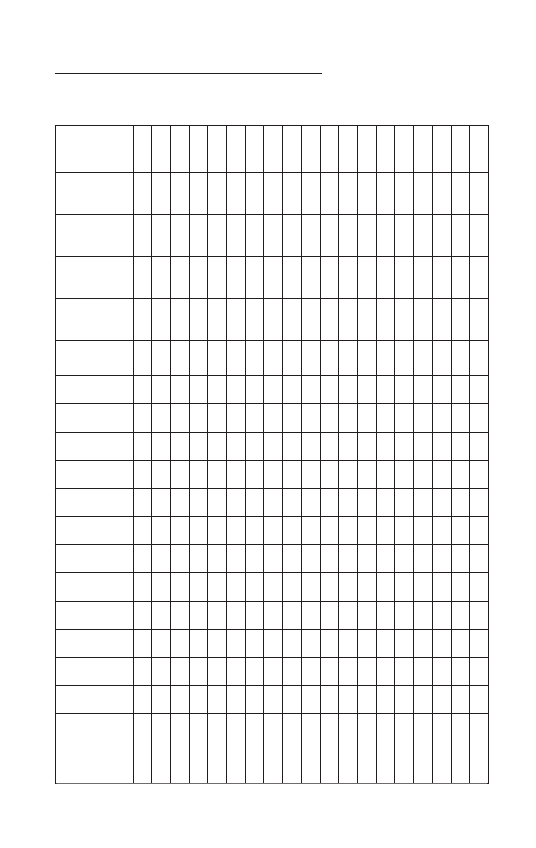
44
Speed reading graph
Reading
speed
1101–1200
1001–1100
901–1000
801–900
701–800
601–700
501–600
401–500
351–400
301–350
251–300
201–250
150–200
Date/time
>

45
2. Speed reading
As well as providing you with information on your speed
reading progress, the speed reading graph will help you to
remain motivated. Put as much information into it as you need.
Measure your reading rate for the duration of your 21-day
programme (see Chapter 12, What next?, pp. 178 – 185).
In the bottom row enter the date and time when measuring
your reading.
Each time you measure how many words per minute you
are reading place a mark in the appropriate box. Add
any thoughts or ideas about your progress in a notebook
specifi cally kept for your reading development.
When your reading rate surpasses 1200, write your own
numbers in the blank spaces above 1101 – 1200 to record it.
Take speed reading measurements at different times of the
day and under different conditions (these include mood, time
pressure and so on).

46
TEN THINGS TO REMEMBER
1 Speed reading takes practice. Getting it right comes from a
combination of knowing your purpose, how you ’ re going to
use information and having faith that you ’ ll spot what you
need.
2 The speed at which you can read is determined by factors
including clarity of purpose, your mood, familiarity with
jargon, deadlines, your environment and how bright the sun
is shining outside.
3 Everyone reads at different speeds. Don ’ t compare your
progress to anyone else.
4 Use a pacer as you read. It keeps your attention on the page
and your eyes moving.
5 For as long as you insist on reading word for word you will
only ever be able to read as fast as you can speak.
6 Speed reading is really only glorifi ed skimming.
7 Knowing your purpose will make sure you fi nd what you
need.
8 Eliminate as many distractions as you can.
9 Speed reading non-fi ction will not ruin your love of fi ction.
10 Speed reading is more about getting what the author is saying
than remembering exactly what he or she has written word for
word.

47
3. It’s all in the words – developing your vocabulary
3
It ’ s all in the words – developing
your vocabulary
In this chapter you will learn:
•
the different types of vocabulary
•
how to increase your vocabulary
•
how words are made up
•
how to deal with specialized vocabulary
Why increasing your vocabulary speeds up
your reading
The bigger your vocabulary, the faster you will be able to read.
Unfamiliar words will slow you down because you ’ ll naturally start
asking yourself questions like, ‘ What does it mean? ’ , ‘ Does it change
the context? ’ , ‘ Is it important to my understanding of the text? ’ .
Although these questions might fl y through your mind, by the time
you ’ ve answered them you would almost certainly have forgotten
what you ’ ve read. As a result, the real time waster will be going back
to the beginning of the text to remind yourself of what you read.
You have three different levels of vocabulary knowledge
available to you; your spoken vocabulary (generally the most
limited of the three), your written vocabulary and your recognized
vocabulary (the largest of the three). Most people use between
2,000 and 12,000 words in speech. Written vocabulary is bigger
than spoken vocabulary because you have more time to think

48
about what you want to say and can go over what you have
written and edit your text until you are happy with it. Most people
use between 2,000 and 25,000 different words in their lifetime
for writing. By far the largest set of vocabulary you have at your
disposal is your recognized vocabulary. This is the words you
recognize within a context but do not ordinarily use. Words you
recognize are sometimes diffi cult to defi ne clearly. You have a sense
that you know what the word means in the context that you read
or heard it, but cannot defi ne it clearly.
Your recognized vocabulary is also known as ‘ passive ’
vocabulary – you know the words but don ’ t use them.
Written and spoken vocabulary is your ‘ active ’ vocabulary.
The aim of this chapter is to help you convert your passive
vocabulary into active vocabulary, not to learn the most obscure
words in the language so that you baffl e or bore your friends and
ever-decreasing audience of listeners. Instead, learn your chosen
language so you can express your ideas and understand others
clearly and precisely.
How to increase your vocabulary
There are several ways to increase your vocabulary. You should
approach them gradually rather than deciding that you want to learn
1,000 new words in one day and locking yourself in a room until you
have. Unless you happen to learn best that way (and have the time and
genuine inclination to do it) there are other, more useful strategies.
A better way of extending your vocabulary may be to break the
exercise up into 30-minute chunks. Picking fi ve words a day from
the dictionary might not work for everyone. The following are a
few different ways of increasing your vocabulary. Your choice will
be determined by how you like to gather information:
If you like reading a lot (and you have the time), then read
books with complicated language. Use a dictionary as you

49
3. It’s all in the words – developing your vocabulary
go but before you look an unfamiliar word up try to fi gure
out what it means yourself. This way you will learn the
language as you go. Make a note of the new words you
learn as you do this.
If reading is not your favourite activity but communicating
and speaking to people is, then aim to meet people who you
know have a good vocabulary and talk to them. You can
pick up a lot in conversation. If you hear a word you do
not understand but don ’ t want to ask the person who says it
what it means, then make a mental note to look it up later.
It is worth remembering that many people use a word because
they know it fi ts the context but do not really know what the
word means. If you hear a particularly obscure word
think twice about asking for a defi nition; the speaker
might feel awkward if they are not entirely sure about its
meaning.
A third way of increasing your vocabulary is to use new
language. Pick a word a day and use it whenever it is
appropriate. Try not to make it obvious that you are trying
out a new word by using it in every sentence unless you are
in an environment where you can relax and play with
language.
A good way to increase your active awareness of language is
to carry a vocabulary notebook with you. Whenever you
hear or read a word that you do not understand or that is
unfamiliar, write down the word, your understanding of it
and the context you heard or read it in. Then, when you have
the chance, look the word up to check whether your guess
was accurate. This is an especially good exercise for turning
passive vocabulary into active vocabulary; it encourages you
to think about the defi nition of a word you think you know
the meaning of.
Relax while you learn. If you get a word wrong, don ’ t worry
about it. The more you practise, read and use new language
in conversation, the better your vocabulary will
become.
Use your imagination while you learn new language. Imagine
yourself using a new word and think about the response you

50
might expect if you used it inappropriately. Imagine what
the word might mean, basing that on your knowledge of
other words. Imagine what the word would mean if you
could give it any defi nition you like. Take time to play with
language.
The source of it all – roots, suffi xes and prefi xes
One of the easiest ways of learning more language and of becoming
able to recognize new words and work out their meaning is by
learning how words are made up.
Did you know?
A quarter of the words in the English language come
directly from other languages. This accounts for the
diverse spelling of many words we use. However, much of
the English language originates in Latin or Greek.
The roots, suffixes and prefixes that form the basis of
our language are almost all Latin and Greek. How much
easier it is to learn a new word if you know the roots of the
word. Here is a fact you might not be aware of: 22 roots and
13 prefixes are found in 100,000 words in an unabridged
dictionary. That means that if you know 22 roots and
13 prefixes you may be able to work out the meaning of
100,000 words.
In Chapter 11 there is a table of roots, suffi xes and prefi xes
(pp. 164 –167 ). Carry the prefi xes/suffi xes and roots table around
with you for a few weeks . Instead of looking up an unfamiliar
word in the dictionary, try to use your knowledge of prefi xes,
suffi xes and roots to work out the meaning of the word.

51
3. It’s all in the words – developing your vocabulary
During Step 3 (passive reading) and Step 4 (active reading) of
the five-step system look for unfamiliar words as part of the
skimming exercise, then look them up before you begin Step 5
(selective reading).
Specialized vocabulary
Developing an understanding of specialized vocabulary needs to be
dealt with in a way different from normal vocabulary. Generally,
words you do not understand in the text make sense within the
context of the sentence. Usually you can read on without knowing
exactly what a word means; you will still understand what the
sentence or paragraph means. Not understanding specialized
language can make it impossible to understand any of the text,
especially if the entire piece revolves around that one word.
The more familiar you are with the specialized text, the faster
you will be able to read. Becoming familiar with the text might
take some time depending on the level of knowledge you already
have. If you follow a few simple steps, the learning process can
become much easier.
During Step 3 (passive reading), highlight all the words you do
not understand especially if they look as if they may be part of
a specialist vocabulary.
If you are allowed, copy the glossary from the book (if there
is one). If there isn ’ t, use a good specialist dictionary (most
subjects have one – if not a hard copy, then on the Internet). If
the dictionary belongs to you, you could highlight each word
you had diffi culty with. Alternatively, when working from
a dictionary you could write the word in a separate book or
place markers on the pages so that you can go back and fi nd
the defi nition quickly again.
Once you are familiar with the vocabulary, take a bit of time
to think how each word fi ts in with any ideas you have on the

52
subject. Think about how else you could use the vocabulary.
Consider how the word is made up. Does the root, suffi x or
prefi x give you an idea of what the meaning could be? In what
other context might you come across the word?
If you have the time, look up the specialist vocabulary
in an ordinary dictionary . You may be surprised by
differences in meaning and interpretation from those in
the specialist dictionary. Do this especially if you do not
understand the defi nition in the specialist dictionary.
Very often, a level of knowledge is assumed in the specialist
dictionary and defi nitions may not be complete. An ordinary
dictionary assumes a bare knowledge of the subject,
so if the word is in one, the defi nition may be more helpful.
Encyclopaedic dictionaries are good because they very often
have pictures next to the defi nition. You can explore and have
fun with these.
Can you fi nd a picture that illustrates the word? If so,
remembering the defi nition will be easier.
The more you read on the subject, the more familiar you will
become with the language of the subject.
If that doesn ’ t work …
… and if you still have problems with specialist language,
attend as many talks and lectures on the subject as you
can. Speak to experts on the subject and, instead of asking
them only what a word means (you will more than likely get
a dictionary definition), ask them how the word fits into the
subject as a whole.

53
3. It’s all in the words – developing your vocabulary
TEN THINGS TO REMEMBER
1
Have a dictionary close by because few things slow you down
more than stumbling over words you don ’ t understand.
2
The bigger your vocabulary the more comfortable you will feel
about reading fast.
3
The best way to increase your vocabulary is to not let a single
word that you don ’ t understand go by without investigation
(in reading, and in conversation).
4
If someone uses technical or specialized terminology, ask them
what they mean.
5
In a work environment, especially if you ’ re new to a company,
always ask the meaning of jargon and acronyms. Keep a note
of them to hand.
6
Build subject specifi c personal dictionaries related to your fi eld
of interest and work.
7
Learn a new language. It will help you examine the structure
of your own language and there are few joys greater than
being able to travel unfettered by linguistic ignorance.
8
Use new words you pick up.
9
Learn the structure of words. It will help you work out what
they mean.
10
To get a good grasp of specialized language immerse
yourself in the subject on all levels: books, Internet,
lectures, conversations.

54
4
Concentration
In this chapter you will learn:
•
the importance of concentration
•
the different types of concentration
•
tips for improving your concentration
•
exercises to increase concentration
The importance of concentration
Insight
Our determination to know everything opens us to massive
quantities of information, most of which we don ’ t need and
is probably untrue, exaggerated or unsubstantiated. The more
you choose the information presented to you, the easier
it will be to sift through the nonsense and concentrate on
what ’ s relevant.
The fi rst rule of acquiring knowledge: Pay attention.
Without concentration there is no memory. Some ideas on how
to concentrate and avoid the distractions that break up your
concentration will be presented in Chapter 8, Distractions and
solutions.
Concentration does not come easily to many, for two reasons:
1
We can be very easily distracted.
2
There can be much to distract us.

55
4. Concentration
Improving concentration isn ’ t easy. We certainly do not always
have either the time or desire to meditate and practise absolute
concentration for several hours each day. Fortunately, there are
other ways to achieve better concentration skills.
FOCUSED ATTENTION
Attention has certain defi nite properties:
It is dynamic . Try focusing on one thing only and notice
how long it is before your mind wanders. The aim of
meditation is to enable you to focus on one element of
something without losing attention. People train and
practise for years to achieve this.
Attention is undivided . If you tried to listen to more than
one conversation at a time or to read a book and drive a car
simultaneously you would fi nd that fairly challenging.
Attention follows interest . Boredom will extinguish
attention in a moment. Always keep in mind ‘ What is in it
for me? ’
Attention is maintained by a series of discoveries . Be aware of
what is new about what you are learning. How often do you
get that ‘ Aha! ’ feeling?
Sometimes we have to force ourselves to pay attention. This can
be unpleasant and ineffective since attention lasts for only a few
seconds in those circumstances and has to be constantly reinforced.
There are several kinds of attention:
Voluntary attention – This is what you display when you are
totally absorbed by what you are doing and distracted by
nothing. When you voluntarily pay attention to something
you do so naturally. You don ’ t have to force yourself to
concentrate; you fi nd yourself absorbed in the task.
Autopilot – This occurs when you fi nd yourself at your
destination but do not know how you got there. It also
happens when you reach the end of a book and realize you

56
have not remembered anything although you know you read
every word.
Dispersed attention – Unfortunately most of us suffer from
this more than we would like. Having too many things going
on simultaneously causes dispersed attention, as does a lack
of interest. When this happens you feel as though you cannot
concentrate at all, everything attracts your attention and you
can ’ t focus on anything for longer than a few moments.
The aim is to be able to control voluntary attention so that even in
situations where you would normally fi nd it diffi cult to concentrate
you are able to focus your attention willingly and fully.
DIVIDED ATTENTION – WHEN IT WORKS AND
WHEN IT DOESN ’ T
Attention is a linear activity. If you are already carrying out a task
using one sense or if you are doing something that requires a high
level of attention, you will be able to do only one thing at a time.
For instance, if you are driving in dangerous conditions you will
notice that your attention to driving is total. If the radio is on, you
will probably not hear it. If, on the other hand, the road is clear
and the conditions are good, you may be able to drive, listen to
the radio and have a conversation at the same time. The moment a
dog runs into the road your attention will shift entirely to driving
within a fraction of a second.
Divided attention does not always work while you are reading.
Reading uses the visual and, for many people, the auditory sense.
It limits conversation, inhibits other auditory activities like listening
to the radio and prevents focusing on other visual activity because
your eyes are focused on a page. One reason we fi nd concentration
while reading challenging is because it is so singly focused. As a
result it can become tedious fairly quickly, especially if what is
being read is uninteresting.
Reading and carrying out another activity at the same time is almost
impossible. If only to demonstrate the point, it is worth an experiment.

57
4. Concentration
Experiment
1 Select a fairly light book to read and an audio book for
you to listen to.
2 Put the audio book on fairly loud, then begin to read
while it ’ s playing.
3 Try to read and listen to the audio book at the same time.
4 After 5 minutes, stop reading and stop the audio book.
5 Write down everything you can remember from both the
‘ books ’ .
6 Count the number of words you read and check how fast
you read. Then skim the book to check how accurately
you remembered what you read.
7 Replay the audio book and check how accurately you
remembered what you heard.
Try this out in several different situations: reading and listening
to a conversation, reading and watching television, reading and
having a conversation. Some combinations will be more diffi cult
than others.
The purpose of this experiment is to notice what distracts your
attention most. If you discover that you can read and complete
another task at the same time, then you will have developed
another skill that, if nothing else, will aid your time
management.
Most importantly, enjoy the game.
INTEREST AND MOTIVATION
The more you are interested in what you are doing, the easier it
is to concentrate. Remember when you were last so engrossed
in what you were doing that you lost track of time. Nothing
distracted your attention. You were totally interested and

58
motivated to reach a goal. There are three words here to take
particular note of: interested , motivated and goal .
When you know what you are after (a goal) and why you are
doing it (motivate), then the desire (interest) to complete the task
successfully makes for total concentration.
If, however, the task is particularly boring and it is hard to fi nd
either motivation or interest, then the process is the challenge.
You will need to make the decision, for example, that:
Your goal is to fi nish this task as quickly as possible.
Your motivation is that you can get home sooner or get on
with a more interesting task.
Your interest is developing a system that will allow you to get
through boring material faster and more effectively every time
you are faced with it.
There are two main ways in which concentration can be
interrupted: by internal distractions and external distractions.
In Chapter 8, Distractions and solutions, we shall discuss external
distractions in detail. Here, we will look at internal distractions
and how to reduce stress – one of the greatest contributory factors
to lack of concentration.
Stress and memory
Remember this
Access to mass information can be stressful; dealing with
mass information by using powerful choosing and reading
strategies reduces stress. Very often the problem is not how
much we have to get through, but the means we have at our
disposal to do it.

59
4. Concentration
One of the biggest destroyers of memory is stress. When you ’ re
stressed you release high levels of cortisol into your bloodstream.
Cortisol is a hormone that affects you in a number of ways,
depending on the amount released into your body at any one time.
Cortisol destroys glucose, your brain ’ s source of food.
If you have ever been in an accident or witnessed something
traumatic you may have got through the experience, wholly or
partly aware of it, but be unable to remember anything about
the incident afterwards. Biologically speaking, you would have
experienced an enormous amount of stress, and your body would
have released large quantities of cortisol that went straight to
your hippocampus and destroyed the glucose. With reduced
food your brain did not have what was necessary to lay the
memory down correctly, so although you saw everything – and
maybe even spoke to people and walked around – the memories
were not laid down in any form that can be recalled or they
were distorted or encoded in what is known as ‘ state-dependent
memory ’ .
Insight
State-dependent memory occurs when you remember
something in a particular state and can only recall it when
you are in a similar state. It ’ s a challenge some people face
when sitting exams in a tense, stuffy hall after studying in the
relaxed comfort of their home.
Another, and less extreme, instance occurs when you are under
a moderate amount of stress. If you are about to give a speech,
meet a large group of people or introduce your partner to your
boss for the fi rst time, you may feel a slight fuzziness in your
brain – you have all the details that you need for the occasion
but you can ’ t quite get the ideas, names or words straight.
Some medical experts believe that cortisol can affect your brain
chronically and do more subtle damage in the long term. Because
of the level of stress in most of our lives we have a constant drip
of cortisol into our bodies. This cortisol goes round our system

60
and into our brains, destroys glucose and turns calcium into free
radicals that destroy brain cells from the inside out. This can
cause age-related memory loss. People between 40 and 50 years
old may feel that they are not thinking as fast and clearly as they
did before. If this situation is left unchecked, it could have serious
consequences.
No matter what age you are, if you take care of your body and
mind by taking regular exercise, eating healthily, exercising your
mind, relaxing and enjoying life, your memory will become more
clear, more creative, more active and more accurate.
Those who adapt their lifestyle will fi nd very little will happen
that they notice overnight, but constant and determined action
will be rewarded. There is no magic pill that can be taken for
instant memory – if one were put on the market you should
approach it warily or even avoid it. You have the natural
capacity to be brilliant if you choose. All it takes is a little effort,
common sense and the knowledge and belief that you have
what it takes.
REACTING TO STRESS
Stress arises when your situation outweighs your perceived ability
to deal with it. Perception of your ability will vary day to day,
moment to moment. ‘ Perception ’ is the operative word here. You
may have no more to do on Tuesday than you had on Monday
but because your mood or your environment is different, what
you have to do may seem more than it really is. The perception
that you cannot cope will increase, regardless of the reality of your
current surroundings.
Insight
Imagine two people walking down a street. Both of them see
a bus narrowly missing a cyclist, or a child crying. When they
reach the end of the street, one is tense and frustrated and the
other shrugs and says, ‘ That ’ s life. ’ Your reality is what you
perceive.

61
4. Concentration
There are a number of stressors that may affect your concentration:
Environment – Noise, chaos and pollution.
Social – People, deadlines, fi nancial problems.
Physiological – Aches, pains, poor nutrition,
lack of exercise.
In some situations we respond to our natural instincts and run
from stressful situations. Most stress comes from situations we
cannot run from or fi ght with, instead we have to sit still and smile
while we boil inside. This is when damage may occur and this
is what we have to deal with if we are to concentrate fully and
effectively.
Tips for improving your concentration
The following are different ways of dealing with and reinterpreting
stressful situations and improving your concentration.
BREAK THE ROUTINE
If you were able to do only one thing to improve your
concentration, then breaking your routine should be the choice.
Taking a break will improve your memory, concentration, mood
and ability and enable you to continue for much longer than you
could without one. A break from what you are doing will give
you the opportunity to reassess your task, think of new ideas and
approaches and will ultimately help you to be more productive and
reduce your stress levels.
Your body is hormone driven and works on a cycle throughout
the day. When you feel that you need a cup of tea or coffee or you
start yawning or making mistakes your body is telling you it is time
to stop and rest. Listen to your body, but don ’ t take the coffee (see
Chris Fenn ’ s book The Energy Advantage ). The longer you put a
break off, the more diffi cult it will be to get back to work after you
fi nally decide to take one. If you have a lot to do it is better to take

62
plenty of little breaks and have small snacks rather than working
through the whole morning and stopping for a full lunch. If you
do that you may have more concentration problems than you
normally do in the afternoon.
CARROT OR STICK
One way to encourage yourself to increase your concentration
is to make sure that you reward yourself well. If you work in a
conventional environment you may not feel that you are fully
recognized or rewarded for your efforts. Instead of waiting for
a reward for your work to come from somewhere else, take the
responsibility of giving yourself a reward. At the beginning of the
day determine what you are going to accomplish and what your
reward to yourself will be. Vary your rewards. Make them things
that are good for you and things that you really want – anything
ranging from an evening at the theatre or in a steam room to
a proper holiday for fi nishing a big project on time. If you fi nd
reading a chore this kind of incentive is especially useful. Make
sure you have plenty of reasons to treat yourself. You will feel
happier, your motivation will increase and your stress levels will
reduce.
RID YOURSELF OF CLUTTER
One environment you can control is your desk. A single piece of
paper on your desk may attract your attention several times a day.
If each piece of paper has a deadline attached to it, you will have
a desk full of alarm clocks going off every fi ve minutes, alerting
you to the pressure you are under, interrupting your concentration,
inducing chronic stress and causing long-term damage to your
capacity to concentrate.
If you have a clear desk, your environment will look and feel under
control. You may have a great deal to do but you will be able to
tackle the tasks one at a time with a clear mind. The perception
that your environment is out of control will diminish if it looks
organized.

63
4. Concentration
Insight
It ’ s important to create an environment that works for you.
While some people need a clear and empty space to work and
think, others seem to live in clutter but know what every scrap of
paper means, where it is and what is supposed to happen with it.
MUSIC AS AN AID TO CONCENTRATION
Sounds that surround you can either make or break your working
environment. Have you ever been in an offi ce and found the silence so
uncomfortable that you felt you must whisper even though you knew
you didn ’ t have to? On the other hand, have you ever entered a room
so full of music and noise that you felt within moments that you had
to leave? These are extremes; there is a great deal of variation between
them. Our response varies as well; a song might come on the radio
one day and without hesitation we switch it off; on another occasion
we feel the urge to turn it up to full blast and sing along.
Music is a phenomenally powerful force – so much so that at one time in
China certain chords and sounds were banned by the rulers of the time
because they feared the effect the sound had on the population (from
The Secret Power of Music by David Tame, Turnstone Press, 1984).
For the purposes of this book we shall look only at music that will
help your levels of concentration. Listed below are a few pieces of
music that have been tested and proved to aid concentration and
learning. These particular pieces will enable you to relax physically
but remain mentally alert.
The important thing about music is that you should enjoy and
appreciate what is playing. If you play music you don ’ t like while
you try to concentrate, all you will achieve will be agitation and
increased stress.
The music you select should have certain properties:
The music should be relatively gentle but not so gentle that it
puts you to sleep.
The music should have no words.

64
The volume should be fairly low and unobtrusive.
There should be plenty of variety.
Some suggestions
Bach – Largo from Harpsichord Concerto in F Minor
Corelli – Largo from Concerto Number 7 in D Minor, Opus 5
Vivaldi – Largo from Concerto in D Major for Guitar and
Strings
Insight
On the other hand, I ’ m reviewing this chapter in a caf é in Aberdeen
and there ’ s a mixture between Take That and Amy Winehouse
playing in the background. The hum and hustle of the place is
perfect for me. Find what works and stick to it.
BRAIN FOOD – EATING FOR MAXIMUM
CONCENTRATION
Every cell and molecule in your body changes and develops
according to what you put into it. This includes the air you
breathe, the liquid you drink and especially the food you eat.
If you have to concentrate for an extended period of time, the ideal
eating pattern to follow is little and often – of the right stuff. In
our fast-food society we tend to pick up what we can on the run.
Snacks often include high-sugar foods that reduce our energy levels.
Keep this in mind
In Chapter 5, Memory, a number of passages to allow
you to practise different memory techniques have been
included. They are about food and energy. Pay particular
attention to them and make sure that the memory
techniques you use work on them because they contain
useful information.

65
4. Concentration
Exercises to increase and improve concentration
There is no one thing you can do to suddenly make concentrating
in any environment easy. Concentration has to be developed
and improved. Here are some exercises you can use to increase
concentration and decrease stress.
BREATHING
Although most of your brain cells would die within 3 – 5 minutes
without oxygen, you can live a whole lifetime without breathing
properly and not be fully aware of the consequences. Your body
uses your breathing as a signal to tell you when something is
wrong. When you are feeling stressed or threatened you notice it
fi rst in your breathing; when you are feeling tired you yawn to take
in more air; when you are in a room with poor ventilation it is not
long before you feel uneasy, get a headache or feel tired. These
signals should not be ignored.
Correct breathing relieves a number of complaints, including
stiffness, tension, irritability, headaches, fatigue and depression.
Good breathing habits contribute considerably to your ability to
concentrate and to reducing your stress levels.
There are several breathing exercises that don ’ t take long to do
and that you can do in any environment, all of which will help you
increase and maintain concentration. These exercises are quick to
learn. Practise them for a few minutes every day.
A good habit to develop is to practise a breathing exercise before
you begin a reading session:
Select one of the exercises outlined below.
Sit for a moment and relax.
Practise the breathing exercise selected.
State what you want to achieve and what your purpose is.
Begin reading.

66
This routine will take only a few moments and your body will very
soon relax naturally when you settle down to read, increasing your
concentration and decreasing tension.
Discreet breathing exercise
If you are in a situation where it can ’ t be obvious that you are
carrying out a breathing exercise:
Take a slow, deep breath.
Hold it for the count of 8 and slowly exhale.
At each in-breath make sure you are breathing into
your abdomen rather than your chest. To check this you
would normally place your hands on your abdomen and
fi nd out whether it is moving or not. When you are in too
public a situation to do this, focus your awareness on your
waist – as you breathe you should feel a tightening of
your clothing.
Take three or four breaths like this and then relax.
Accompany the breathing with a good stretch if you can.
Insight
Sometimes you feel as if only a good stretch will clear your
head. Get some energy by moving, stand up for a while and
stretch. Better still, go for a walk. Get out for a bit. Have a
mini-adventure. It works every time.
Quick breathing exercise
If you have only a few minutes, this yoga breathing exercise is
wonderful for relaxing and focusing. It is especially good if you
have been rushing, and have a time limit to stick to:
Close your eyes for a few moments.
Place your right thumb on your right nostril and
block it.
Breathe in deeply and slowly through your left nostril for
6 seconds.
Block both nostrils and hold for 6 seconds.
Unblock your left nostril only and slowly exhale.
Pause for 6 seconds.

67
4. Concentration
Then continue by breathing in through your right nostril,
closing both, and exhaling through your right nostril.
Continue to do this for as long as you feel comfortable.
Stimulating alertness
If you are becoming tired and you still have much to do,
the following exercise will help increase your alertness and
wake you up. You can do this exercise in public.
Stand or sit up straight.
Breathe in completely and naturally (into your abdomen).
Hold your breath for a count of 6.
Purse your lips and blow out short bursts of air fairly
forcefully until you have totally exhaled.
Breathe in deeply again and repeat the exercise several times.
If that doesn ’ t work …
If breathing exercises don ’ t work for you, don ’ t push at
them. When you feel you need to relax a bit, just sit back
and close your eyes for several moments.
Insight
Look after yourself – no matter how unorthodox your solution;
hiding in the loo, going for a walk, catnapping on your offi ce
fl oor for 20 minutes. Listen to your body and your brain; a loss
of concentration or discomfort is usually a signal to take a break.
BEING PRESENT AND IN PERSPECTIVE
A wandering mind is a symptom of lack of attention and low
concentration. Being present doesn ’ t always come naturally. It is
easy for your mind to wander off to foreign lands and times. The
only way to learn how to remain present is to become aware of
when you are not present. Here is an exercise you can do in public
or in private. It is very relaxing and very effective.

68
Sit or stand still for a moment.
First, close your eyes if you can and notice what you can hear.
How many conversations can you make out? What are people
saying? Can you hear any traffi c? What is the furthest sound
you can hear? What is the closest sound you can hear? What is
the most familiar or the most foreign or unusual sound? What
is the most or least pleasant sound? Identify every sound you
can hear.
Next, notice what you can feel. How close are people to you?
What does the fl oor beneath your feet feel like? What do your
clothes feel like on you? Is there a breeze? If so, what direction
is it coming from?
With your eyes open now, notice the colours. How many
different shades of red or blue or orange can you see? What
is the most common colour in your view? What is the least
common colour in your view? Now notice the shapes you can
see. If you observed your surroundings and had to describe
them in terms of shapes only, and not what the objects really
are, how would you describe them?
Finally, appreciate your surroundings.
You may notice that, no matter how noisy or chaotic your
surroundings might at fi rst seem, when you really pay attention
and become present you are surprised at the level of comfort
and relaxation you generate. This could simply be the result of
knowing your surroundings for what they are instead of making
interpretations of them.
Do this exercise often, especially when you are feeling that your
environment seems to be getting out of control.
DELIBERATE ACTION
This exercise will be useful if you have only a short piece to read
and can ’ t seem to focus your mind on it:
Carry out one of the breathing exercises, giving yourself time
to sit still for a while and gather your thoughts fi rst.

69
4. Concentration
Then, take the material you want to read and for 5 minutes
read as slowly as you can without allowing your mind to
wander. If you feel your mind is drifting, bring it back.
If your mind drifts very much, read out loud for a short time.
After a while your attention will focus. Your natural desire to
get through the material and fi nish what you started will take
over and your reading speed will increase.
MENTAL NUMBERS
You will be surprised how easily you can be distracted
without realizing that it is happening. Try this simple
experiment:
Count from 1 to 26. Notice at what number another thought
comes into your head.
Many people will have another thought in their minds by the
time they reach 5. When you are counting it is easy to think of
other things and still keep going because counting from 1 to 26
is a simple exercise. When you are reading, the mental energy
needed to focus your attention increases and drifting thoughts
can contribute to a lack of concentration.
You might like to use the following experiment to increase your
concentration:
Simultaneously count from 1 to 26 and go through the
alphabet from A to Z: 1 – A – 2 – B – 3 – C – 4 – D – 5 – E
and so on.
Imagine the numbers as being on the right side of your brain
and the letters on the left side.
Then switch sides; imagine the numbers on the left side of
your brain and the letters on the right.
How fast can you go? How far can you go before you realize your
attention has drifted? When you can go through the alphabet
(and up to 26) fl uently going forwards, try this backwards.

70
When you feel your concentration drifting, do one of the earlier
exercises a few times. This can be quite meditative and relaxing.
TIME OUT
The stress reaction prevents concentration and inhibits memory.
When you feel you are reacting to a stressful situation:
Sit back for a moment and do nothing. Just breathe and relax.
Take stock of what needs to be done.
Be aware of the time you have available.
Decide what course of action you are going to take.
Prepare yourself.
Act.
Worrying about how you will do everything you have to do is a
distraction in itself and achieves little.

71
4. Concentration
TEN THINGS TO REMEMBER
1
Take breaks whenever you feel your concentration wandering.
2
Follow the breathing and relaxing exercises.
3
Know your goal and purpose and stay focused on it –
especially if you start to lose concentration.
4
Manage your environment.
5
Be fi rm with people who demand your attention unnecessarily.
6
Develop a routine that includes rest and recovery in your
reading and working.
7
Enjoy what you do – reward yourself often and generously.
8
Practise being present.
9
Consciously decide to focus on the reading you need to do.
Make it a priority.
10
If you ’ re really struggling, stop and come back to it later.

72
5
Memory
In this chapter you will learn:
•
the memory process
•
the different types of memory
•
how memory works and when it doesn ’ t
•
techniques for remembering what you read
•
how to involve your senses as you read
Good concentration is the fi rst step to a good memory. At the
end of a paragraph, chapter or entire book, have you ever had to
go back to the beginning because you could not remember what
you read? No matter how fast your reading speed, unless you
remember what you read you will have wasted your time.
Insight
Don ’ t sacrifi ce memory for speed. Focus instead on reducing
the amount of reading you have to do by applying the fi ve-step
system thoroughly. Then, even if you choose to read slowly
(word at a time), you ’ ll still be getting through it faster than
before.
To remember information for a long time you must revise.
Revision needs to be fast. It would be frustrating to fi nd yourself
spending as much time trying to revise and recall what you read as
you did reading it in the fi rst place.
In this chapter we look at the memory process, how it works and
how to get the best from your memory while you read.

73
5. Memory
Memory myths
There is a danger that modern living is overloading the human
memory system. With mass communication growing, more being
printed than ever before and the emphasis of success moving from
physical strength to mental power, we have to develop skills that
help us keep up – let alone get ahead. The main factor contributing
to overload is not necessarily the amount of information we are
faced with, but rather our attitude towards it.
Normally we only become aware of our memory when we
forget something. This is a big issue in reading because most
people fi nd that remembering what they want from what they
read is challenging. This is mainly because they are not using an
appropriate retention and recall strategy.
There are some basic principles about memory that should be
considered fi rst:
Memory is not a stand-alone system. It relies on perception,
attention and reasoning.
Memory is not a system that is based on isolated facts.
Everything you remember is interconnected to other pieces of
information in your memory.
Memory retrieval relies greatly on association. The more organized
your memory is, the easier it will be to recall information.
New information is not stored separately from old
information. Old knowledge helps make sense of new
information and vice versa, which is one reason why it is
easier to read material you know something about.
Memory is not only designed to store information; it is
designed for use.
We speak about memory as if it were an object. We describe
ourselves as having a good, bad or average memory, like
having good or bad lungs. Your memory is not a thing – at
least, it is certainly not a single thing. It is a series of processes
that are taking place in your brain, all the time.

74
Your memory can be trained. It has been said that there are
no good or bad memories, just trained or untrained. With very
few exceptions, and barring organic damage, everyone is born
with a memory that can be developed.
The more you use your memory, the stronger it will become. Many
of the problems people have with their memories as they age are
due to lack of mental exercise, lack of physical exercise, poor
nutrition, excessive stress and poor coping strategies.
The basic guideline for improving your memory and ability to
concentrate is that what is good for the body is also good for the
mind. Stress is a major factor in memory loss. (You may want to
review the information about stress in Chapter 4, Concentration.)
Short-term, intermediate and long-term memory
Almost all of us at some point feel that our memory is most effective
in the short term. Sometimes, we go through phases or times of the
day when we seem to be unable to retain or recall anything.
SHORT-TERM MEMORY
This part of the memory system holds information for only a few
seconds. If you did not have this facility, every piece of information
you gained by sight, hearing, smell, touch or taste would be
remembered and accessible. This would make gathering new
information very diffi cult because of interference. If you want to
remember what is in your short-term memory you have to pay
attention to it and take action so that you remember it for a longer
period of time.
INTERMEDIATE MEMORY
This information is retained for a matter of hours. Have you ever
done or noticed something, been interested in it and decided that
you were going to remember it because it was interesting, only to

75
5. Memory
fi nd a few hours later that you could not quite remember what it
was? This is the intermediate memory at work. Information that
is necessary for the time being is stored in this process. As soon
as it is no longer required, it is discarded. This is what happens
when you forget people ’ s names. You meet them once, they are
remembered while you see them, but after the event you might not
think about them for a while and when you meet them again you
cannot remember their name. You might recall where you met
them and what they were wearing because your visual memory is
stronger than your auditory memory (more on this later), but you
may well have forgotten their name.
LONG-TERM MEMORY
This is the aim for most reading. Your short-term memory will
retain information long enough for you to make sense of what
you are reading, intermediate memory will retain information
long enough for you to make sense of the chapter, but your long-
term memory will help you remember and make sense of the
whole book and use the information when you need it. Long-term
memory requires revision and application.
Long-term memory works with short-term and intermediate
memory. As you read you are relying on ‘ old ’ knowledge stored
in your long-term memory to enable you to make links and
associations with new information. All three systems are totally
interlinked and gaps or weaknesses in any one of them will prevent
the whole system from working effectively.
How memory works
There are many models of how the memory system works. In its
simplest terms, your memory is divided into three parts:
Acquisition – Absorbing information.
Retention – Keeping information in your head.
Retrieval – Getting information out again.

76
The memory may become unavailable at any point. The trouble is,
you only know it is unavailable when you try to retrieve something –
perhaps when you are standing in front of a person whose name
you have forgotten, trying to introduce them to someone else
whose name you have also forgotten.
There are some basic memory rules to follow at each phase to help
you remember.
MEMORY ACQUISITION
1
The fi rst rule of acquisition is: Pay attention . Most of the time
we forget something because we did not have the opportunity
to remember it in the fi rst place. Have you ever read the
title of a book, only to realize two seconds later that you
have forgotten it? The chances are that your attention was
somewhere else. The same phenomenon occurs when you
read the content. If you have internal talk going on inside
your head, asking yourself whether you are likely to remember
what you are reading or not, you will probably not remember
much at all.
Insight
This goes for remembering people ’ s names as well; we
hear but we don ’ t listen and, three seconds later, we don ’ t
remember what they said. PAY ATTENTION! Be present.
In fact, paying attention and being present are the best ways
to make sure you remember anything.
2
The second rule of acquisition is: Plan . Before you begin,
think of when you are likely to use the information you are
reading. Then, decide which memory tool (discussed later in
the chapter) will help best when the time comes to use the
information in the future.
3
The third rule of acquisition is: Be interested . Even if the
material seems dull, fi nd something in it that interests you.
If you are bored, then parts of your brain will go to sleep and
make paying attention even more diffi cult.

77
5. Memory
4
The fi nal rule of acquisition is: Be active . Read actively.
Think about what you read. When you follow the fi ve-step
system and you prepare to read, spend some time thinking
about what you already know on the subject. As we saw at
the beginning of this chapter, your memory does not work in
isolation. The more connections you make between new and
old information, the easier it will be to understand what you
are reading. Understanding is the key to remembering.
MEMORY RETENTION
Keeping information in your head is one thing; keeping it there in
such a way that you can retrieve it later is a different matter.
Your memory thrives on association and order. The better
organized your memory is, the easier it will be to retrieve information
when you need it. You do not have to keep everything in your
head. You can be just as organized on paper, so that you will know
where to fi nd information when you need it. The simple memory
tools outlined in the next section will help you organize your
reading so that retrieval is easy.
Rehearsal and revision are needed before information can be
effectively retained in the memory. There are several ways you can
achieve this. The least effective is rote rehearsal. Unfortunately,
most of us used this method through school when we attempted
to memorize text for exams or tests. This is ineffective because as
soon as the memory is interfered with in any way the information
disappears. For instance, when someone gives you a telephone
number and then asks you where you put the keys, you will
probably forget the telephone number since the fact that you have
lost the keys will take your mind in several different directions.
Memory interference and forgetting will be discussed later in this
chapter.
The more time you have to think about, understand and work at
what you are trying to remember, the better the chance you will
have of remembering it.

78
MEMORY RETRIEVAL
One reason why we have diffi culty retrieving information is that
the retrieval method used is inappropriate. Memories are stored
in several parts of our brain. When we try to remember what our
front door looks like, several areas of our brain will be activated.
We might:
See an internal picture of the door (visual).
Hear the sound of it closing (auditory).
Recall the last time we walked through it (kinaesthetic and
proprioceptive).
Remember the feeling of the last time we locked ourselves out
(emotional).
Smell the fresh coat of paint when we painted it last (olfactory).
When we try to retrieve information, we often use only one access
point. If you can re-create the whole experience as you remembered
it, it will be easier for you to recall more information.
There are different types of memory retrieval, depending on how
the information is presented to you. The easiest information to
remember is information you can recognize. The multiple-choice
section in an exam may be easier than questions where you have
to provide the answer. Recognizing someone ’ s face is often easier
than remembering their name. You might notice that sometimes
when you are looking for information you know you have read
before, you might know where it is; you can see it on the page
and when you fi nd the page you recognize the text, although you
cannot recall the information itself.
Insight
This book is on reading, not memory. Go to your
local bookstore and glance through books on memory
development. Some of the techniques for remembering
names, numbers, places or events seem a little odd but as
soon as you try them you ’ ll see that they work.

79
5. Memory
Techniques for remembering what you read
There are many ways to remember what you read. Some are
listed below. The aim is to be comfortable with all of them
and be able to use the right one for the material you are
reading. Everyone is different, so experiment with all the
approaches.
LINEAR
Make notes as you read or after each section. These should
include your own thoughts, ideas and cross-references. The more
you include your own ideas, the stronger your long-term memory
will be.
KEY WORDS
Highlight the words that carry the message. If you do make notes
separately, ensure the key words are correct – you do not want
a list of words that make no sense to you when you review the
information in the future.
Insight
Be careful not to overdo it. Try to stick to highlighting only
a few words per sentence and perhaps only one key sentence
per paragraph. If you highlight everything, you will end up
with the same text, but underlined, coloured, circled and
therefore more diffi cult to read.
MARGIN READING
Many people are brought up to believe that books are to be kept
in perfect condition. Unless a book is being presented as a priceless
antique, it is a form of communication from the author to the
reader. You start to take ownership of a book by writing in it
or marking it. As well as underlining, circling and highlighting
essential areas, you can note your opinions, whether you agree

80
or disagree with what is written and mark what you do or
don ’ t understand. Then you can do something about that ‘ not
understanding ’ . This should only be done if the book belongs to
you, of course.
Insight
Margin reading (and reading with a pen or pencil in your
hand) will keep your eyes moving fast, your concentration
on the page and your interest high because you ’ ll be thinking
about what you ’ re reading instead of just reading the
author ’ s words.
CONTEXT-MAPPING
This technique is based on questions and answers. As you go
through the text, look for the answers to the when, what,
where, who, why and how questions. Write the answers on
an index card or on the text itself. You will often discover
that you have all the information you need when you reach
the end of it. In order to recall the information later, all you
have to do is ask the questions again and the answers will be
triggered.
MIND-MAPPING
This is another way to make notes:
Write the key idea in the centre of a horizontal (landscape)
page.
The main ideas form thick branches from the centre.
Secondary ideas fl ow from the main ideas.
Tertiary ideas fl ow from the secondary ideas.
Continue until you reach the fi nest relevant detail.
Use as many colours as possible (with some material you
will need fi ve at least), and use symbols or pictures instead of
words as far as possible.
Use one word or idea per line.
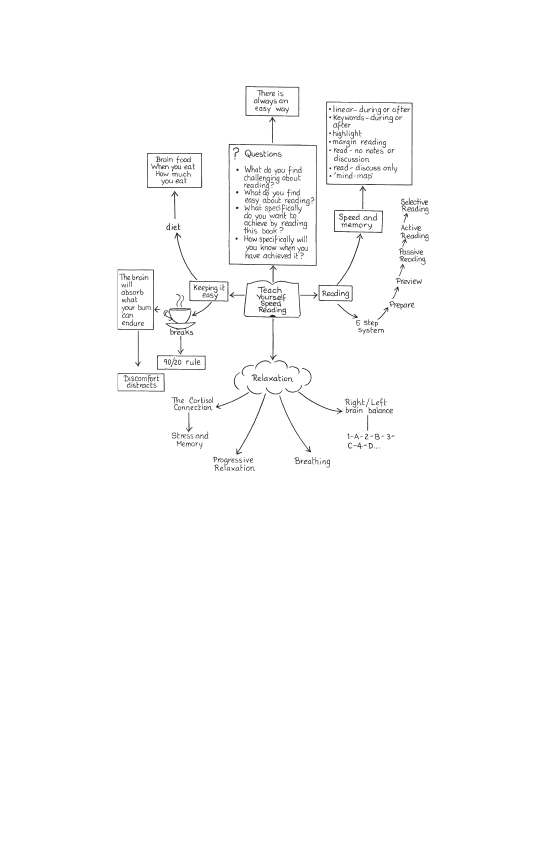
81
5. Memory
INDEXING
This technique is good for research:
Draw a line down the middle of a number of A5 cards.
Write ‘ concept ’ on the left and ‘ defi nition ’ on the right.
As you read and you come across the key concepts, write a
few key words that summarize the concepts or ideas and in the
other column note down any terminology (with defi nitions)
that is new to you.
File the cards under subject headings. When you read
another book on the same subject, use the same cards and
hand-drawn mind-map
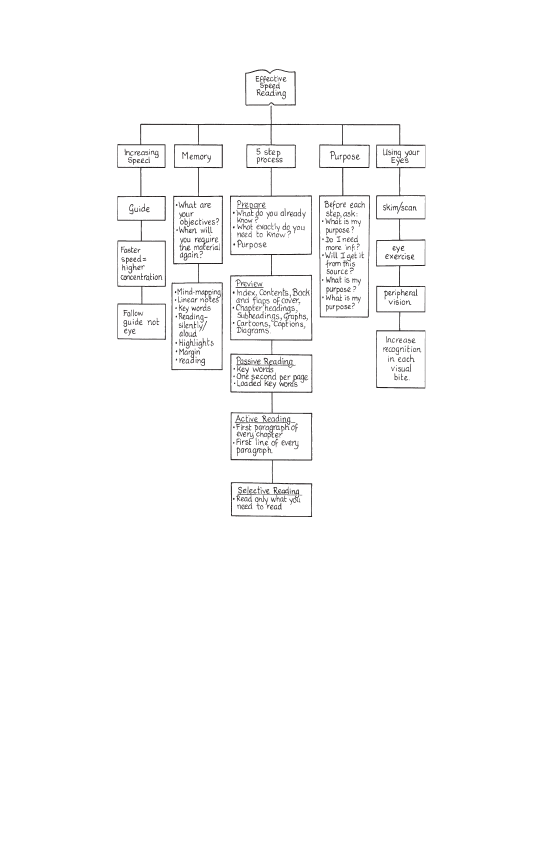
82
add to and expand on the information you have already
gathered.
TESTING MEMORY TECHNIQUES
Four pieces of text follow. Each is approximately 500 words long.
Read each as fast as you can for good comprehension, using any of
the techniques outlined above.
Avoid using a memory strategy you are already familiar with;
you already know how well that works or otherwise.
hand-drawn process-map of same information

83
5. Memory
Apply one technique to each section of text.
Give yourself a maximum of 1 minute to read each piece of text.
When you have completed reading and following the guidelines
for each technique, take some time to write as much as you can
remember about each piece of text. The more details you can
recall, the better. Once you are satisfi ed, move on to the next one.
The most important part of any memory technique is to make sure
that you arrange the knowledge you are gathering into an order that
suits you. The author will structure information in a way that makes
sense to them; you have a different level of knowledge and a different
background. Make sure that the new information is incorporated
into what you already know and is arranged in such a way that later
on, when you want to use it, it still makes sense to you.
The following sections of text have been very carefully selected.
They give you an insight into the body rhythms and cycles that
have an immense effect on your ability to concentrate at different
times of the day. Enjoy the exercise. Remember to read as fast as
you can for good comprehension, and to use a pacer.
EXTRACT FROM THE ENERGY ADVANTAGE BY DR CHRIS
FENN (PRINTED WITH THE AUTHOR ’ S PERMISSION)
Text 1
SYNCHRONIZE YOUR BIOLOGICAL RHYTHMS
It ’ s a familiar pattern. There are times during the day when
you are firing on all cylinders – feeling particularly alive
and focused, coping well with your work and shining at
business meetings, or somehow coping with the demands
of small children that would otherwise leave you frazzled.
Yet there are other times in the same day – when you find
yourself making simple inexplicable errors, and unable to
concentrate or think clearly. The period of fatigue and
(Contd)

84
yawning that can descend around mid-afternoon is a
common occurrence, but a couple of hours later we seem
to have pepped up again and found a second wind. Most
people believe that this spaced-out feeling results from the
large meal they had for lunch. This is true to some extent –
a full stomach does cause a diversion of blood supply to the
intestine, which cuts back on the flow to the brain. But have
you ever noticed that you don ’ t get quite the same effect after
a large breakfast? The mid-afternoon lethargy also occurs if
you only have a small snack for lunch. So what ’ s going on?
What we eat is only partly to blame for the change in our
mood and energy levels throughout the day; our mind and
body activities are also ruled by natural cycles and rhythms.
TUNE IN TO YOUR BIOLOGICAL CLOCK
Since the beginning of time, civilisations have set their routines
and pace of life by the external cycles of the Sun and Moon. Only
recently have we realised that we have our own internal clocks
which also play a vital role in our everyday lives. Our bodies
follow a pre-programmed sequence so that the essential
functions of sleep, wakefulness, growth, repair and metabolism
occur during the most appropriate times of day or night.
You may be familiar with the term circadian rhythm which
refers to the biological cycle that occurs over 24 hours.
Originally it was thought that our circadian rhythm was
simply a daily alternation between being awake and asleep,
but research now shows that there are other rhythms which
have a powerful effect on how we feel and how efficiently we
perform throughout the day. So, to maximise your everyday
performance, you should tune in to your internal clock!
The exact site of the body clock in humans has yet to be
determined, but in rats and other mammals it is located in
two small groups of cells, one on either side of the brain,
called the suprachiasmatic nuclei (SCN). The siting of the
clock in this area is significant because the cells are part
of a larger area known as the hypothalamus, a region of the

85
5. Memory
brain that also controls body temperature, food and water
intake, hormone secretion and sexual drive. When the SCN
were removed, it was found that the rats ’ cycles of feeding,
drinking and sexual activity were destroyed.
Text 2
TUNE IN TO YOUR BIOLOGICAL CLOCK (CONTINUED)
Wherever the clock is located in our bodies, there is no doubt
that it is a sophisticated device, ’ ticking ’ away and controlling
what we feel – and when we feel it. The sleep/wake cycle is
one of the body ’ s most powerful rhythms that makes us feel
alert during the day and sleepy at night. However, a British
study carried out at Manchester University suggests that our
cycle does not exactly coincide with the planet ’ s 24-hour day.
Kept in a room with continuous artificial light, and none of the
daily external cues as a guide, the bodies of the Manchester
test group adjusted to a 25-hour cycle.
This happens to many of us at weekends. Without alarm
clocks, deadlines and appointments, staying up late on Friday
or spending half of Sunday in bed, our rhythms free-run
into the natural 25-hour cycle. People who are particularly
sensitive find themselves feeling sluggish with the ‘ Monday
morning blues ’ as they report to work slightly ‘ jet-lagged ’ .
People suffering from blindness caused by retinal disease
often lose synchrony with their family, friends and colleagues
as their daily rhythm free-runs on a 25-hour cycle.
Research has shown that there are distinct variations,
ruled by the circadian rhythms, in our physical and
mental abilities. This is because during each complete
cycle, body temperature, urine production, levels of
glucose, cholesterol and other substances all rise and
(Contd)

86
fall; our mood, mind and body are constantly changing
throughout the day and night.
Putting it all together – a typical day would begin around
7 a.m. Having sunk to its lowest point some time between
4 a.m. and 6 a.m., our body temperature begins to rise rapidly.
This affects our metabolism, which also starts to speed up
because enzymes (controlling various chemical processes
in the body) work faster when the temperature is higher.
These in turn kick-start the release of the rousing hormone
cortisol, and we reach our peak mental performance some
time between 7 a.m. and 12 noon. This is the best time for
tackling problems – the boss or an important piece of work.
After midday is not a good time for making decisions. Our
body temperature starts to cool off again, levels of adrenaline
and other hormones decrease, and mental ability generally
gets put on the back-burner. This is when most people feel
lethargic and notice a definite drop in efficiency.
People who work in Mediterranean countries have the right
idea when they break off and have a siesta. It happens to
coincide with the hottest part of the day – but it makes sense
to synchronise with your body-cycles rather than fighting
against them. After 3 p.m. our mental ability begins to pick
up again and we can work well. From 4 p.m. to 7 p.m. we
are at our physical peak, thanks to a rise in levels of the
hormones noradrenalin and adrenaline (the new names for
these are norepinephrine and epinephrine). These affect
optimal nerve functioning and muscle co-ordination which
helps manual workers to perform well, but this is the time
to challenge for a game of squash or engage in some form
of exercise. From 7 p.m. onwards, the body cools down along
with the metabolic rate and levels of various hormones until
we are back to our lowest ebb at 3 a.m. With this knowledge
it is possible to schedule important business meetings or
conference calls to take advantage of these peaks. As well as
circadian rhythms, there are other cycles which may have a
more immediate effect on our mood and overall health.

87
5. Memory
Text 3
FORGET THE FAKE FATS
In between indulging in the so-called forbidden foods, many
of us go on the diet treadmill, which, until recently, meant
eating as a penance cardboard-like fat-free foods. A few
years ago, like low-calorie manna from heaven, came the
fake fat revolution. These fake fats are substances (some
are synthesised from sugars or proteins) that can provide
the creamy mouth-feel of fats but without other Calories.
Suddenly the supermarket shelves held no fears and there
were no more forbidden foods. Chocolate, cream cakes,
biscuits, gateaux, ice cream, custards and puddings now
came without the fat. The theory is that these foods would
replace the greasy, Calorie-laden alternatives and we
could indulge in all this guilt free goodness and keep the
bathroom scales in check. The reality is that it hasn ’ t
worked out like this. The food industry has been expanding
on the profits from the low-fat revolution – but unfortunately
so have we. According to UK government statistics,
16 per cent of women and 13 per cent of men are now
obese – double the incidence five years ago – whilst
almost half the population is overweight.
In the last five years, the average UK dress size for women
has increased from 14 to 16. The food industry has done
an excellent job in brain-washing us to accept just one
message; fat is bad. As a result we have ditched every other
health or nutritional consideration in pursuit of the belief
that anything ‘ low fat ’ makes us thin and that fake fats are
somehow ‘ healthy ’ foods. The food industry feeds this belief
by spending a fortune on the research and development of
an ever increasing number of synthetic fats and fat
substitutes with which to produce new foods and add to the
ever expanding range of fat-free delights.
(Contd)

88
The latest and potentially most damaging of the fake fats
is called Olestra. It is made from vegetable oil and sugar,
but the molecules are too large and tightly packed to
be absorbed by the body, so it passes straight through.
Whilst other fake fats can ’ t be heated beyond a certain
point before breaking down, Olestra can be used in frying,
making foods as greasy as you like but with the reassuring
knowledge that fat will pass straight through your body.
Olestra has recently been approved for use only in snack
foods in America (although it may soon be permitted for
a range of other fried foods and a cooking oil for home
use). This approval occurred despite a blaze of controversy
and opposition from health professionals, but is yet to be
sanctioned by the UK Ministry of Agriculture Fisheries and
Food. Why all the furore, you may ask.
Olestra ’ s unique selling point is that it passes straight
through your body, but when eaten in large quantities it
causes what is charmingly described as ‘ anal leakage ’ .
Individuals who have been trying Olestra have complained
that it leaks, leading to stained underwear and an oily
toilet. Nevertheless, the US Food and Drug Administration
has allowed its use provided that Olestra-containing foods
carry the government health warning ‘ Olestra may cause
abdominal cramping and loose stools ’ . What is more, it
takes with it the valuable fat-soluble vitamins A, D, E, and
K as well as the carotenoids which play such a vital role in
protecting the body against free radical damage.
Text 4
FORGET FAKE FATS (CONTINUED)
So, here we have a synthetic substance which, because it is
not absorbed itself, inhibits the absorption of other nutrients

89
5. Memory
which are flushed out of the body and down the toilet.
What a crazy situation! Olestra and other fake fats should
not be seen as the miracle cure for the growing obesity
problem. Synthetic foods are deeply unfulfilling because
they send the wrong signals to the brain. The messages to
our appetite centre get garbled and confused when a food
we associate with fat doesn ’ t contain any. We lose touch
with real hunger because the signals, released after eating,
no longer guide and direct us towards making the best food
choices. We end up eating ‘ mentally ’ , relying on low-fat
labels to guide us through the food maze. Studies have
shown that the ‘ lite ’ and fat-free foods are so dissatisfying
that we end up eating something to compensate. (The same
is true of foods manufactured using artificial sweeteners.
Some people become addicted to them in an effort to satisfy
their need for sweetness. The solution lies not in another
can of diet drink or sugar-free yoghurt, but to reach for real
foods which are naturally sweet.)
Many of the foods containing fake fats are highly processed,
requiring a cocktail of emulsifiers, stabilisers, thickeners
and flavourings to replicate the mouth-feel and taste of the
lost fat – which is another reason not to eat them. It is time
to opt for a quality diet and not displace real foods with poor
imitation of the genuine article.
The best way to control fat intake is to make the naturally
low-fat (but nutrient-rich) foods such as fruits and vegetables,
cereals, breads, pasta and rice the cornerstone of your eating
habits. Then add in and enjoy smaller amounts of foods which
are high in fat but provide as many of those omega-3 fatty
acids as possible. Finally, if you enjoy foods with saturated
fats, there is no need to eliminate them from your diet – or
worse, feel guilty when you do eat them. Simply choose the
best. Why settle for a chemically sweetened reduced fat
chocolate bar which tastes so artificial when you can relish
real, top quality Belgian or Swiss chocolate? Chewing on
(Contd)

90
rubberised, half-fat cheese is an insult to your taste buds
compared with enjoying a really excellent, but small piece
of your favourite – and the finest – Cheddar, Stilton, Brie or
Parmesan. We should be taking care over our food, like the
Italians and French, cooking it with love, appreciating its
quality and eating it for its flavour!
Now answer the following questions:
How did you do?
What difference did you fi nd in effectiveness of the
techniques?
Did you fi nd that you were slipping back to old habits?
Did any of the techniques slow your reading down?
When selecting the best methods for remembering what you
read, it is important to remember that everything you read is
different and each type of reading material needs a different
memory approach – depending on what your purpose is, how
familiar you are with the information and how much time you
have to read it.
It is most important that the techniques you select should facilitate
good recall and high reading speeds. Practise and experiment with
different types of text. Remember that the more involved you
are with your reading the better your recall, understanding and
comprehension will be. The way to do this is to read with more
than just your eyes.
Multi-sensory reading
Do you remember your front door? Do you remember what it
sounds like when you close it? What does fresh paint smell like?
What does it feel like to be locked out? What colour is it?

91
5. Memory
Multi-sensory reading uses as many of your senses as possible to
help you make sense of and absorb information.
Here are some ideas on how to involve your other senses as you
read:
Sight – Imagine what you are reading in your mind, create a
fi lm of the story you are being told.
Hearing – Speak to people about the subject, ask questions
as you read, teach someone else, make up rhymes and
stories.
Touch – Draw pictures and symbols representing the
information. If the information is something you can do, do it
instead of just reading about it.
The more senses you involve in learning new information,
the easier it will be to recall it because the information will be
accessible via more than one function of your brain.
The fi ve-step system and memory-support techniques work if you
simply use them. The more you practise and the more you become
aware of memory, the better you will become at speed reading.
VISUAL AND AUDITORY MEMORY
Most people remember fi lms far more accurately than books.
Visual memory appears to be much stronger than auditory
memory.
To activate your visual memory for what you read, use your
imagination to picture what you are reading in as much detail
as possible. This can be particularly challenging with non-fi ction
material, depending on what the subject is. The more you can
picture what you read, the easier it will be to recall later on.
Also, you will realize as you develop your visual memory that
the picture becomes clearer as your understanding of the subject
grows.

92
Forgetting
Unsurprisingly, forgetting is the most frustrating part of reading.
Your ability to concentrate and the memory technique you choose
will help you remember what you read. But sometimes, forgetting
happens in spite of them.
Our diffi culties in retrieving information give us a very good
idea of how our memories work. Memories are often available
(we know we have read something, or seen it; we can remember
where we were when we encountered it in the fi rst place) but still
they are not accessible (we just cannot quite remember it fully).
This phenomenon is sometimes called ‘ on the tip of the tongue ’ .
The long-term memory is organized in categories, much like a
mind-map; one thing reminds you of the next and so on. If the
links between the associations are broken, the information may
become inaccessible or you may forget it entirely.
FACTORS CONTRIBUTING TO FORGETTING
Lack of attention
Problem – If you don’t hear, see or notice something, you’ll
have no chance of remembering it.
Solution – Increase your concentration. Chapter 4 provided
you with a number of exercises and ideas on how you can
do this. Chapter 9 will give you ideas on how to diminish
distractions.
Interference
Problem – Interference can be retroactive or proactive.
Retroactive interference comes from new information you
are reading. If you think of telephone numbers, retroactive
interference is involved when you cannot remember your
old telephone number because your new one has taken over.

93
5. Memory
Proactive interference is when old information interferes with
new information. Thinking of your telephone number again,
this is involved when you cannot remember your new number
because your old one keeps coming into your mind instead.
Solution – The best way to work around retroactive and
proactive interference is to rest between different pieces
of work. This gives your mind time to consolidate new
information, separate out old and perhaps integrate new
information with current knowledge (unless it is your
telephone number). After you have taken a break, revise the
text to make sure that you have not confused old and new
information.
Lack of interest or motivation
Problem – If you are neither interested nor motivated,
remembering what you read will be almost impossible.
Tiredness contributes to this. Even if you are working on
something you are interested in, that interest will soon fade if
you are tired.
Solution – It is important to fi nd something to motivate you,
no matter how small or seemingly unrelated to the task it is.
There must be something in it for you. And take breaks.
Take them as often as you feel you need them, but for at least
10–15 minutes every hour to hour and a half.
Insufficient links or associations
Problem – If the subject is particularly new to you, making
sense of the ideas may be diffi cult. If you cannot make sense
of the ideas you will fi nd it very diffi cult to remember.
Solution – As you follow the fi ve-step system you will
be building a framework of knowledge. The bigger the
framework becomes, the easier it will be to form links and
associations for new knowledge. Spend as much time as you
need on Step 2 (preview); this step allows you to build a
structure for the material.

94
Insufficient revision
Problem – Memories are made of memory traces. They fade
if they are not reinforced.
Solution – A basic guideline is to revise seven times in ten
days – or develop a very good fi ling system. To remember
what you read in the long term, use the information. As
mentioned under Memory myths, the memory process is
designed for use, not just for storage.

95
5. Memory
TEN THINGS TO REMEMBER
1
Memory is not a stand-alone system. It doesn ’ t mean because
you memorize something that you understand it.
2
The more you understand something the easier it will be to
remember it.
3
Memories are linked by association. Make connections
between new information and what you already know.
4
Use what you learn.
5
Train your memory. Don ’ t use a bad memory as an excuse
not to remember people, conversations, numbers or what you
read.
6
Pay attention! If you don ’ t hear or see or absorb the
information in the fi rst place you ’ ll have no chance of recalling
it when you need it.
7
Books are not sacred. Write in them (unless they ’ re not yours
or priceless antique). Normal books are to be interacted with.
Underline, circle, highlight, scribble in them.
8
Use your imagination while you read.
9
Reinforce what you read by reading a number of books on the
same subject.
10
Choose to remember. Don ’ t assume that information will
stick just because you have understood it the fi rst time you ’ ve
read it.

96
6
A book is a book is a book
In this chapter you will learn:
•
how to read different types of materials
•
how to evaluate text by critical reading
Reading different types of material for
different reasons
You ’ ve looked at the fi ve-step reading system and considered
speed reading and memory development. Now it ’ s time to look at
what you read and how to apply the different reading techniques
to ensure you get the most out of them.
The way you approach a document (book, newspaper, memo or
whatever) should be driven by your purpose. Why are you reading
it? When will you use the information next?
TECHNICAL MATERIAL
This type of reading may be fairly easy because most
technical writing is well structured. Also, you rarely have to
read and remember everything about the text without being
able to refer to it later on when you need it. Apply the fi ve-step
system in its entirety for this type of reading and use a memory
technique that works well for you. Try mind-maps. If you
don ’ t like mind-maps, try a process-map (see Chapter 5, p. 82).
These techniques allow you to see how information, ideas
and practices are linked and what effect they have on
each other.

97
6. A book is a book is a book
NON-FICTION FOR LEISURE
This is perhaps the easiest of all non-fi ction reading simply because
you are already relaxed and interested in the subject (in the ideal
positive learning state). Most non-fi ction, like technical writing, is
fairly well structured so the fi ve-step system can be readily applied.
It is easy to become absorbed in ‘ work-related ’ reading and not put
time aside for leisure reading and knowledge gathering. If you have
a lot of work to do, you may feel uncomfortable or guilty about
taking time out for leisure reading, albeit non-fi ction. A good way
to get around this is to make increasing your reading skill part of
your purpose, with the intention of becoming able to read work
material more effectively. If you only ever read text that is diffi cult
or that bores you, your passion for reading will soon be subdued.
Make time to read what you want to read.
READING FOR RESEARCH
The good thing about reading for research is that your purpose is
normally very clearly defi ned and you are looking for something
quite specifi c. Apply the fi ve-step system and follow the guidelines
for reading for study in Chapter 10, Working and studying for a
living. If you are studying and working at the same time Chapter
10 will give you ways of organizing all your reading from the start
of the course to the end of the exam.
READING FOR WORK
This section is particularly concerned with mail and memos. The rule
here is: Be selective . The trouble with the reading you do for work is
that there may be an activity attached to every document. Before you
read anything – especially if it is long and you think it may take you a
while or if it seems to land on your desk often – ask a few questions:
Who wants you to read it?
Why do they want you to read it?
What are you likely to have to do with the information as a
result of reading?

98
Once you have established that there are good reasons for reading
documents take the following steps:
Decide how much time you will devote to reading in-coming
mail or memos.
Preview the documents with one thing in mind: can this go
in the bin? Then sort them into two piles, one of which goes
straight into the bin and the other requires further attention.
Passive read or skim all of the documents in the further
attention pile and ask one question of each: can this be fi led or
does it require action? Put the pile for fi ling aside ready to fi le.
Actively read the remaining pile. Use Post-it notes or write the
actions that are to be taken directly onto the document.
Finally, plan the actions into your day or week. Then put the
relevant documents into the appropriate fi le so that you can
retrieve them easily when you need them.
Insight
Remember that most work-related writing is done by people
determined to make themselves look good, not by people
who consider how you like to read and what you really need
to know. Don ’ t feel bad about ditching the irrelevant bits!
NEWSPAPERS
Note that this section does not apply to the casual, relaxed read
of the Sunday morning paper unless you want it to.
Reading a newspaper should be approached with the same
preparation as any other reading. The fi ve-step system works very
well for papers; however, it may not be necessary to use all fi ve
steps in order. You can read a paper very quickly by following
three very simple steps:
1
State your purpose – Are you reading to gain an overview of
the whole paper or are you looking for a particular story?
2
Preview and passive read the entire paper by looking at
the headlines and reading the fi rst paragraph of any story

99
6. A book is a book is a book
that looks interesting. Circle the articles you would like to
return to.
3
Actively read the selected articles for the information you
want.
To read newspapers effectively:
Set a time limit and stick to it.
Read story continuations (often on other pages) as you come
to them. This is a good indication of how much attention you
pay to reading a paper. If you come to the second part of a
story several pages later but cannot remember the details of
the fi rst part, take a break.
Since most of the facts are normally in the fi rst few paragraphs
of a story, start reading each story you select fairly thoroughly
at the beginning and then speed up and skim the rest, picking
up information you identify as relevant.
Ask yourself:
What is the position of the paper with respect to political
slant?
Have you previously read articles by specifi c journalists
before? Do you like their style or approach?
Is this the best paper to read for your purpose?
Unlike most other forms of writing, a newspaper story can be
broken into parts quite easily. A narrative takes you from the
beginning of a story to the end and if parts are missed out some
of the meaning goes with it. A newspaper is not as unifi ed as
that. A story can be read with sections missed out of it – you may
lose some detail but the story will remain the same. Very little
interpretation can be made of most newspaper stories; they are real
events involving real people – often given an editorial ‘ fl avour ’ ,
style or angle by the paper and the writer.
MAGAZINES
Magazines (especially special interest or trade magazines) are
slightly different from newspapers. A newspaper is one of many

100
sources of news. If you miss anything from the paper, you will
probably be able to get the story from the television, radio or Internet.
Most magazines come out only once a month or once a quarter.
A magazine should be treated like a short textbook. Follow all
the steps of the fi ve-step reading system to get the best out of it.
If there is information in the magazine that you are likely to need
again there are several things you can do to make it easily accessible:
Read the magazine with Post-it notes to hand. As you fi nd
articles you are interested in, note the page number and title
and write a brief summary (just a sentence or two) on a Post-it
note. Stick the note on the front of the magazine and fi le the
magazine in a fi le dedicated to ‘ interesting articles ’ .
If you don ’ t want to keep the whole magazine, tear out the
relevant pages or photocopy the articles you want, and fi le
those away with a brief summary of what the article is about.
Add why you thought the article might be useful to the Post-it
Note. When you return to articles at a later date you will fi nd
it easier to place them in order of priority. Going through the
fi le to see what you no longer require and can throw away will
also be easier with this extra information on each.
Be picky. Most magazine reading is for interest. You are
unlikely to be tested on it but you may want to talk about it.
Select the articles that interest you and think about how what
you read fi ts into your existing knowledge.
NOVELS
The more you read, the faster you will become. Speed reading skills
will give you the choice to read as slowly or as quickly as you like.
If you enjoy novels and you want to read more of them, you may
fi nd this strategy useful:
Preview the book thoroughly (excluding the actual story) –
look at the front and back covers, read any author ’ s notes,
biography or foreword, take a good look at the author ’ s
photograph if there is one. Do you like the author ’ s style?
Do you like the look of the author? Does the back page

101
6. A book is a book is a book
blurb intrigue you? What you do at this point will shape your
attitude towards the book. Your attitude will affect whether
you are likely to enjoy the book or not.
Next, read the fi rst page. Does it grab your attention?
If it does and the book passed your preview test, then read on and
enjoy the book. If not, then skim the book picking up key words
and reading the fi rst few sentences of each chapter. If the book still
doesn ’ t catch your imagination, you can choose not to read it.
If you do decide to read the novel but you don ’ t have much
time, then practise ‘ fi nding the story ’ (see below). This
technique is for novels or very short pieces of text that don ’ t
require the full fi ve-step treatment.
If you get bored with the story half-way through the book,
give yourself permission to put it down. If the storyteller does
not keep you intrigued, you do not have to carry on.
Find the story …
As you read a novel, look only for the pieces of text that carry
the story. Skim over the description. Most novels carry the
story in conversation between the characters. As you read you
will become familiar with the layout and be able to identify
where the descriptive text starts and ends. If you begin to really
enjoy the novel and want to read everything, you can change
your technique and slow down a bit to enjoy the scenery.
E-MAILS
E-mails are a blessing or a curse, depending on who sends them.
Rule 1 with e-mails is to do to others as you want them to do
to you. If you don ’ t want huge letters and memos and masses of
junk mail, don ’ t send any of these unless absolutely necessary. If
someone repeatedly sends you e-mails you don ’ t want, whether
they are jokes or longer stories, be fi rm and straightforward and
ask them not to. Treat e-mails like traditional mail; if you know
it is junk before you open it up, bin it.

102
A good way to screen your e-mails is to use the feature that allows
you to have your inbox screen split. The top half has a list of all
the messages and the bottom half lets you read the e-mail without
actually opening it. This saves time. Some systems have a preview
function which allows you to view only the fi rst few words, which
is also time-saving.
If there are attachments to an e-mail and you need to read them fast,
it may be best to print them out. If you prefer to read from the screen,
there are some ideas on how to do this without straining your eyes
in Chapter 9, Real-world reading. There are also ideas on how to
prevent eyestrain in Chapter 7, Your eyes and effective reading.
INSTRUCTIONS
In reading instructions, planning is the key. Unlike most other reading,
almost every word counts in instructions. Missing one or two may
mean you never get to build what you set out to build. Also, most
manufacturers write instructions in such a way that they are quick
and easy to follow, but not necessarily quick and easy to understand.
Remember that some instructions are translated from foreign
languages and the translations may not be entirely clear or
accurate.
Here are some tips on reading instructions:
Read through all the instructions before you do anything. Go
from Step 1 to the end; don ’ t miss anything out at all. If it looks
a lot or seems that there is a lot involved in the activity, relax and
gather all the information you need before doing anything else.
The fi rst time you read the instructions, mark off phases of the
job so you break the task into manageable chunks that relate
to how you want to manage your time when you do the job.
If there are any pictures, study them thoroughly.
Once you have read the instructions and have an idea of what
the job entails, make sure you have everything you need.
After you have gathered everything you need to do the
job (tools, equipment, assistant perhaps), go through the

103
6. A book is a book is a book
instructions again, this time focusing on each of the phases
you identifi ed in the fi rst step.
Do things one at a time. But while you are following one step keep
the next one in mind so that you know where you are heading.
As you go, tick off the steps as you fi nish them.
If you come to a step you don ’ t understand, think of
something you did in the past that is similar to the job you
are doing now. Look at any picture related to it and carry on
unless you feel that carrying on will prove to be a disaster.
If you think a disaster may be looming, stop. Contact the
manufacturers or call someone to come and help.
Reward yourself once you have fi nished.
Following instructions is much like following a set of
directions. When you can visualize the fi nished product or
the destination, completing the task will be much easier.
If you still have problems with
some pieces of specialist text
If you find some paragraphs confusing, mark them and
carry on. If the meaning doesn ’ t become clear as you read,
go back to those sections and read them more carefully.
Check other sources if you have to.
If, however, you become more confused as you read the
text, you may have missed the key word or idea in the whole
passage. If this happens:
Stop
Take a short break
Reassess your purpose
Follow the first four steps of the five-step system thoroughly.
Selective reading will be very slow and frustrating if you
miss the point of the text.

104
Critical reading
One of the purposes of reading critically is to evaluate the text.
The aim is to evaluate the whole text or argument, fi nding out
the author ’ s intention and judging at the end whether they were
successful. Here are a few guidelines for critical reading:
Read with an open mind.
Know your own opinion before you begin so that you are
not unduly swayed by the author ’ s argument.
Don ’ t jump to conclusions.
Keep asking questions.
In order to read critically it is useful to understand critical
language fully. In Chapter 11, Useful information and speed
practice test, there is a list of critical language with space to
add defi nitions (see p. xx).
Reading critically and effectively with an open mind involves the
following:
Understand the literal meaning of the text. Be sure you
understand how the names, dates, fi gures and facts all fi t
together.
After that, look for the suggested meaning of words and phrases.
Recognize the tone. Is the author being sarcastic, honest,
factual or whimsical?
Create an image in your mind of what the text is about and
look for any gaps in the story.
Look for any comparisons, metaphors, similes, clich é s or other
fi gures of speech.
Once you have all the information you need, make a value
judgement. Did the author succeed in what they set out to do?
Are you convinced by their argument? If you are not, are you
at least satisfi ed that although you don ’ t agree with the author,
the structure is sound? What would it take to convince you?
If the author failed, why?

105
6. A book is a book is a book
Fiction and non-fi ction are both open to critical evaluation.
The following advice will help you, but it is most important to
bear in mind that each category contains a huge range of different
types of material and the questions suggested will not relate
precisely to everything you read.
Insight
Critical reading is a vital habit to develop. Most people are too
easily suckered into believing something just because it ’ s in print.
This goes for everything in print; from newspapers to religious
texts. Do yourself a favour and THINK while you read.
EVALUATING NON-FICTION
Follow the six steps above and ask yourself additional questions:
What assumptions are being made by the author?
What evidence does the author present?
Is it convincing?
Do any arguments about cause and effect really relate to each
other?
Is the conclusion logical?
Is what the author writes more a matter of opinion than
of research?
Is the writing emotive?
What conclusions can you draw?
EVALUATING FICTION
An evaluation of a fi ctional text is based mostly on how you
feel about the text, not on fact or what you know about a subject.
Fiction may contain factual information but differs from
non-fi ction in containing assumptions and lacking evidence.
Some questions to ask as you read fi ction:
Is the story believable? Even if it is far-fetched and
imaginative, can you believe it could happen?

106
Are the characters and events believable? Do they have a
purpose or do they seem to have no purpose other than get in
the way of the story?
Are confl icts justifi ed or has the story succumbed to violence
for its own sake?
Are the characters superfi cial? Do you get to know them? Has
the author developed them well?
Does the story lead you or do you fi nd yourself wondering
where it is going?
Does the plot fl ow?
Are you gripped and intrigued?
Do you fi nd it easy to put down or not?
Reading critically will give you the insight into the true value of
the text. If you fi nd there is none, save yourself time and put the
book down.

107
6. A book is a book is a book
TEN THINGS TO REMEMBER
1
Not all reading material is the same. Treat everything
you read based on what you need it for.
2
Take time to read what you want to read. Not just what
you have to read.
3
When it comes to non-fi ction (work-related) reading be
selective. Knowing where to fi nd information is often
better than having it all stored in your head.
4
It ’ s up to you to decide how much time you spend on
reading incoming mail. Don ’ t let it control your day.
5
Always ask if reading material (especially work-related)
can go in the bin.
6
When catching up on world news, be curious. Take a
minute to wonder what ’ s going on behind the story.
7
Use the fi ve-step system on newspapers and magazines.
8
Read instructions. Either that or let someone else build
your latest IKEA acquisition.
9
Whenever you read the newspaper or a magazine or
work-related material – read critically.
10
On the fl ip side to number 9, read with an open mind.
You ’ re not going to learn anything if all you look for are
ideas that confi rm your current beliefs. Consider the
possibility that you might be wrong.

108
7
Your eyes and effective reading
In this chapter you will learn:
•
speed reading basics
•
how to read for understanding
•
how to care for your eyes by using exercises and nutrition
•
how to prevent and cure eyestrain
•
how to read from a PC monitor
Your most important reading tools are your eyes. Any discomfort or
strain will affect concentration immediately. If you are tired or if the
lighting is wrong, you are likely to experience discomfort in your eyes
and a headache may follow quickly. Soon after the headache begins
you will begin to lose concentration and reading will become diffi cult.
It is easier to prevent problems with your eyes than it is to have to
treat them when something goes wrong due to bad habits. Those who
have recurring problems with eyestrain should consult an optician if
they have not seen one recently. Some eye problems are linked with
medical conditions; ask your doctor if you think there may be
a connection between your eyesight and your general health.
The explanations and exercises in this chapter will give you an
understanding of what your eyes do while you read.
Speed reading basics
The main reason why most people have an average reading rate of
150 – 250 words per minute is that this is approximately the rate at
which people speak.

109
7. Your eyes and effective reading
As you read this paragraph, listen to what is going on inside your
head. Do you hear a voice inside your head while you read? Are
you saying the words in your mind? This happens because of the
way most people are taught how to read.
When we are taught to read we learn to recognize one letter or
sound at a time; then, when we have mastered that, we progress to
recognizing one word at a time. The next step is being able to read out
loud so that our teacher can see that we have learned to recognize the
words accurately. Then we are left to read to ourselves.
That is how the inner reading voice becomes a habit. Instead of
reading out loud we read silently. So when we talk about reading
with our ears instead of our eyes, that is exactly what happens.
You learn that you have to hear the words to understand what
you are reading rather than understand them by seeing them.
When you read to yourself, you read in your head at the same rate
as when you read out loud. At the beginning, reading to yourself
is quite slow because you are still learning to recognize the words.
Ears or eyes?
As long as you read by saying each word ‘ out loud ’ to
yourself in your mind you will only be able to read as fast as
you can speak. For most people this is between 150 and
250 words per minute.
You can only hear or say one thing at a time but you can see
millions of things simultaneously. Learning to speed read
involves learning to use one of the largest and most important
sections of your brain, your visual system, more effectively.
Learning to read with your eyes instead of your ears will
be the biggest step you take towards making a dramatic
increase in your reading speed.

110
As you read more and go further into the education system your
reading rate increases because your vocabulary increases. But your
reading strategy does not change.
Reading is the slowest visual exercise we do. Look outside the
nearest window for 3 seconds, then close your eyes and describe
(by speaking) what you saw. How long did it take you to see what
you saw and how long did it take you to say what you saw?
Speaking to yourself when you read is the same as looking at
a spectacular view or watching a fi lm and, instead of visually
understanding it, translating what you see into words that take
several times longer to form, communicate and then be understood
by someone else.
Visual memory and auditory memory are located in different
parts of the brain. When you read slowly, giving yourself time
to see every word and read with your ears, you are accessing the
auditory, front-left portion of your brain. This is the least effective
part for storing medium- or long-term memory.
When you fi rst start to learn to read with your eyes instead of
your ears, your comprehension will diminish initially because you
are beginning to use your strong visual memory for something to
which it is not accustomed. Your brain needs time to adjust to this
new activity. This is perfectly normal. After a few hours of practice
(in the beginning) and maybe 15 minutes a day for a few days you
will fi nd comprehension returning to what it was. Your memory
will become longer term and more integrated than before. The process
is similar to what happens, for example, when you learn to touch type
instead of looking at the keyboard and typing with one fi nger.
Reading for understanding
The aim of speed reading is to learn how to read more than one
word at a time, and to do that you have to read with your eyes
instead of your ears. Your comprehension will increase at the same
time as your speed increases because when you read more than

111
7. Your eyes and effective reading
one word at a time you read phrases rather than isolated words.
The meaning the author wants to put across is in the phrase, not
the isolated word. Meaning is in groups of words so the more
words you are able to comprehend at one time, the better your
comprehension, understanding and subsequent recall will be.
You will understand more because you are reading in terms of
ideas, thoughts and images rather than isolated words that mean
nothing by themselves.
An exercise later in this chapter (pp. 117 – 118) will help you increase
your confi dence in reading with your eyes instead of your ears.
THE BIOLOGICAL CHALLENGE
Your eyes move very fast. They can process large amounts of
information rapidly. If you read slowly your eyes will tend to
wander. The pacer will go a long way towards preventing that.
Remember the exercise you did in Chapter 2 (p. 27) that showed
you how differently your eyes moved when they had something to
follow? Go back and refresh your memory if you need to.
There are some eye movements you can do something about and
some you can ’ t:
1
Fixation time – Your eyes need a certain amount of time to
be able to absorb information. Try this experiment next time
you are a passenger in a car. As you travel, keep your eyes
fi xed on one point, not letting them settle on anything fl ying by
the window. Does your view become blurred? Next, as you go
pick out certain parts of the landscape and follow them briefl y.
You might notice that what you look at becomes clear while
the background is blurred. The same applies to reading.
Your eyes need to rest – albeit briefl y – on groups of words to
be able to see them. The more words you can see and recognize
in a single visual ‘ bite ’ , the faster you will be able to read.
2
Peripheral vision – Try an experiment. Place your fi nger
on the middle of the page and look at it. What else can you
see? Where you are sitting? Perhaps the room you are in or

112
other surroundings? Your peripheral vision gives you the
ability to see an enormous amount in a single visual bite.
Now, without moving your eyes from the middle of the page,
try to read the words at the edges of the page.
How did you do?
You will fi nd that although you could see the words, you
may not have been able to ‘ read them ’ . When you were taught
how to read you were taught to focus on one word at a time.
Being able to expand what you can recognize within your
peripheral vision takes practice. There are some exercises
later in this section that will help you increase peripheral
perception – you can do some of them while walking down the
street.
3
Regression and progression – These are visual tics. They are
a result of poor concentration and lack of confi dence in your
memory. Regression refers to the habit of going back to previous
words or paragraphs to make sure you have understood them
or remembered them accurately. Progression refers to the habit
of jumping forwards for no particular reason.
Studies of how people ’ s eyes move when they read have been
done in the USA. Groups of people were given texts to read.
At the bottom of the test piece was the figure $3,000,000.00.
Before they had read half the page the eyes of all the readers
moved to the bottom of the text to see what the $3,000,000.00
was all about.
In terms of wasting time, several things happen when you do
this kind of thing:
You forget what you have just read.
Your comprehension drops because you are reading
something out of context.
Reading with a pacer and following the fi ve-step system will enable
you to change your reading habits for the better. The following
exercises will help you.

113
7. Your eyes and effective reading
INCREASING YOUR SPAN OF RECOGNITION WITHIN
YOUR PERIPHERAL VISION
When we learn to read we learn by recognizing individual parts of
a word. This means that our reading is always fairly fragmented.
If you can remember back to when you fi rst learnt to read, you will
recall that you had to break each word down to make sense of it,
something like this:
Insight
Don ’ t get fi xated on getting rid of the voice in your
head. Focus on the fi ve steps, your purpose, memory and
concentration, and one day the voice, if not totally gone, will
have reduced to the degree that you only hear it when you
read something technical or complicated.
Did you know?
It is thought by some researchers that most eye problems
are caused by lazy eye muscles and strain and that
short-sightedness, long-sightedness, stigmatism and
other visual complaints can be cured by a series of
exercises. William Bates, a New York ophthalmologist,
began to question how vision problems were diagnosed
and treated and developed new ways of dealing with visual
difficulties. He started by curing himself of presbyopia
(far-sightedness). His work is well documented; some of
the exercises he developed are included in this book and
are very good for relieving eyestrain, which according to
Bates is the primary cause of many eye problems.

114
1 2 3 4 5 6 7 8 9 10 11 12 13 14 15 16 17 18 19 20 21 22 23 24 25 26 27 28 29 30 31
R e a d i n g o n e w o r d a t a t i m e w a s t e s t i m e
32 33 34 35 36 37 38 39 40 41 42 43 44 45 46 47 48 49 50 51 52 53 54 55 56 57 58 59 60
a n d
d i m i n i s h e s
c o n c e n t r a t i o n
a n d
61 62 63 64 65 66 67 68 69 70 71 72 73
u n d e r s t a n d i n g
Gradually you learnt how to string the letters together but you still
only focused on one word at a time:
1
2
3
4 5 6
7
8
9
10
Reading one word at a time wastes time and diminishes
11
12
13
concentration and understanding
The aim is to increase our visual span so that we can read more
than one word at a time and increase our reading rate:
1
2
Reading one word at a time
wastes time and diminishes
3
concentration and understanding
The larger the piece of text we can recognize in a single visual bite,
the easier and more visual reading will become:
1
Reading one word at a time wastes time
2
and diminishes concentration and understanding
Ultimately, our aim is to be able to read more than one line at a time.
1
Reading one word at a time wastes time
and diminishes concentration and understanding
An exercise to develop this skill can be found on pages xx – xx.

115
7. Your eyes and effective reading
Exercise 1
Place your pacer on the fi rst hash and move it down the centre of
the pyramid. Keep your eye on the hash marks in the centre. What
can you see on either side of the hash marks without moving your
eyes away from the centre?
S # p
2 E # 7 e
d R 8 # E 5 a
D 2 5 I 5 # n G 5 8 9
6 B 2 9 o 6 3 # R 8 3 4 2 N l
3 9 g 9 2 E 5 4 n # 8 5 2 i 4 u S 7 p
Exercise directions
In the pyramid of numbers and letters in Exercise 1
below, focus on the hash marks (#) down the centre of the
pyramid. The aim is to see how much you can read with
your peripheral perception. Write down what you can see.
Don ’ t move your eyes from the centre of the row. Although
you will be tempted to focus on the end of the row, you must
try to keep your eye on the centre hash for the purpose of
the exercise. You may notice several things:
You may not be able to see some of the letters and
numbers on the longer lines. This is normal. There is a
point where your optic nerve enters your eye, creating a
blind spot.
If your eyes are of equal strength you may find that you
can see more to the right of centre than you can to the
left. This is because we read from left to right and our
eyes are conditioned to look in that direction for new text.
If you were brought up reading Arabic or Hebrew you
would probably find that you could see more to the left
instead of the right of centre.

116
Exercise 2
Follow the instructions for Exercise 1 in the box above. Keep your
eyes on the central column of letters this time. What can you see on
either side?
WG
H
PF
KD
T
OL
VS
K
DA
YO
E
NL
PZ
R
NJ
5S
I
B9
QP
K
BS
MG
T
MK
MO
R
EP
KR
X
KF
Exercise 3
Follow the instructions for Exercise 1 in the box above. This time
keep your eyes on the central words.
only if
armbands
existed but
once a
bee
swam in
a three
legged
race he
got half
way
to the other
end of the
beer glass
but was
drunk
and was
never seen
again
the wasp
won by
default
the fl y
lost the
bet
and nobody
lives for
ever
but
who knows.
Did you fi nd the words any easier to read than the random letters?
The words didn ’ t make much sense in themselves. Try the next
exercise.

117
7. Your eyes and effective reading
Exercise 4
You are now beginning to read more than one word at a time.
Read the text as quickly as possible, keeping your eyes in the
middle of the pyramid.
A
beetle
loved a
certain hare
And wandered with him
everywhere:
They went to fairs
and feasts together,
Took walks in any kind of weather,
Talked of the future
and the past
On sunny days or overcast,
But since their friendship was so pleasant,
Lived for the most part in the present.
(From ‘ The Eagle and the Beetle ’ , by Vikram Seth,
Beastly Tales from Here and There , Phoenix House)
READ WITH YOUR EYES INSTEAD OF YOUR EARS
The next exercise illustrates the difference between reading with
your ears (ear-reading) and with your eyes (eye-reading). The more
you practise eye-reading, the better you will become at trusting
what you see without having to hear it.

118
Exercise 5
Try ear-reading and eye-reading:
1
Cut a piece of thick card, about 2 cm square.
2
Place the card over each set of numbers and/or letters in the
chart on page 119 and ‘ fl ash ’ the letter/number combination to
yourself as quickly as you can.
3
Once you have covered each one up, write what you saw in
the adjacent column.
4
Try to keep the pace at which you reveal the numbers and
letters to yourself constant. If you started by fl ashing the fi rst
column to yourself at a set a second, aim to keep up the same
speed when you reach the fi nal column.
Now check your answers against the printed characters:
Which column was easiest?
Did you sometimes mistake an ‘ S ’ for a ‘ 5 ’ ?
Were the double lines more challenging than the single lines?
Were the letters that most resembled words immediately
recognizable and easy to recall?
Did you get some of the non-words that seemed like words
wrong because you saw the fi rst few letters and made the
rest up? (e.g. Did you write John for Johm?)
Develop your own eye exercises like the ones you have just tried
and practise them as often as time allows. If you want to choose
just one exercise to develop your visual reading for your 21-day
programme (see Chapter 12), Exercise 5 should be the one.
119
7. Your eyes and effective reading
143
146
Heg
37R
63I
53L
Jo4
ThR
2h7
Jon
8Em
Em2
492
hEp
Gep
9UB
PL3
pl3
Tj4
96F
Iy8
iokO
Emc2
Lsp5
wini
rQwg
6The
Hare
M23p
Luck
7play
u89UN
Pking
43Jub
krimb
HatrP
53Mot
buton
82L87
Ep26I
Grand
fa6me
Noma
Meok1
tdp
3Pq
3owm
olp
tap
cim
536
592
per
ith
kin
min
map
43T
yat
wea
mic
857
fiy
u8p
90L
yum
738
kin
mop
j46
moy
86w
824
inki
blt9
286r
wom8
unIw
te4q
wim2
241y
tolp
154r
tosi
90Pp
76yz
jipx
Johm
minz
jut7a
ping
683po
joke
jy97q
jopt
fyfe
york
tunnl
yonks
153tj
mouse
jimbo

120
Reading more than one line at a time
This will take practice. When you read more than one line
at a time you are doing something you may not have
thought of doing before and you are doing something you
may have thought impossible. If so, you may be working
against your belief system. In situations like this, what you
need is evidence. You will be able to provide yourself with
your own evidence once you have taken a little time to practise
the next exercise.
You began to experience what it was like to see more than one line
at a time when you did Exercise 5 above. This can only be done
effectively when you read with your eyes, not your ears. Remember
the exercise on getting the message in Chapter 2 (see pp. 36 – 37).
You found that if you saw the words in the wrong order you were
still able to understand what the message was. This is the technique
to use to practise this new skill.
To encourage your mind to see more than one line at a time, follow
the steps outlined in the box below. When you begin you may fi nd
that your comprehension dips. This is to be expected. The more
you practise, the more comfortable you will become with reading
with your eyes instead of your ears.
EXERCISE TO LEARN HOW TO READ MORE THAN
ONE LINE AT A TIME
Set a timer for 3 minutes. When it goes off, re-set it for
another 3 minutes. Continue until you have fi nished the
exercise.
First
3 minutes
Read one line
at a time.
Read for good comprehension as
fast as you can. Place your pacer
under each line.
121
7. Your eyes and effective reading
Second
3 minutes
Increase your
range to two
lines at a time.
Place your pacer under every
second line. Move the pacer
smoothly under the lines, seeing all
the words. Your aim is to ‘get the
message’ from the lines without
reading all the words.
Third
3 minutes
Increase your
range to three
lines.
Again, take in enough words
to ‘get the message’ but avoid
skimming for information. As you
do this broaden your vision by
looking at the margins on both
sides of the text. Move the pacer at
the same pace as you have been for
one and two lines.
Fourth
3 minutes
Increase your
range to four
lines.
Your aim is still to ‘get the
message’ as fast as you can without
hearing the words in your mind.
Make sure you are seeing all the
words and recognizing them as you
move down the page. Remember to
relax and enjoy the experience of
learning something new.
Fifth
3 minutes
Increase your
reading range
to fi ve lines at
a time.
You may be looking at a whole
paragraph at a time now. Let your
eyes see everything and fi nd out if
you can pick out the message.
Finally
Go back to
reading one
line at a time.
Use your pacer and read as fast as
you can for good comprehension.
What difference do you notice in
your reading now?

122
EXERCISE TO INCREASE PERIPHERAL VISION
AND AWARENESS
Take a short walk. As you walk, look straight ahead.
Try to see as much as you can in your whole visual range.
What is in the extremes of your visual fi eld, left and right,
top and bottom? Articulate what you see as you see it. After
you have done this for a while, sit down and, using a pacer,
read as fast as you can for good comprehension. Notice the
difference in the speed and ease of your reading. This is an
excellent exercise to do while you are walking through town
or in a park.
Making your peripheral vision
work for you
When you read, apply what you learned in your walk
through the park. Remember how much you could see and
make good use of your visual energy. Reading one word
at a time places your focus on the first word of every line,
which means that much of what you see is the empty space
in the margins. So, instead of aiming your eye at the start
of the line, aim it about two words into the line and let your
peripheral perception do the work.
How to prevent and cure eyestrain
Experiment
Here is an experiment to show you how your eyesight
deteriorates through strain.

123
7. Your eyes and effective reading
Stare at a page. Do not blink or move your eyes. How long
is it before your vision begins to blur or your eyes begin to
water? It doesn ’ t take much to strain your eyes.
Resting your eyes, blinking and taking care of yourself will
prevent eyestrain. Your eyes need rest. The more relaxed
they are, the longer you will be able to read.
These few simple procedures will help you prevent and cure eyestrain:
Before you feel tired, rest your eyes by closing them for a few
moments every 10 or 15 minutes.
As often as you remember to, try palming . Palming is an excellent
eye-relaxing exercise. Rub your hands together until they are
warm, then close your eyes and cover them with your hands so
that no light gets in. Do not press against your eyeballs: that could
damage them. Cover your eyes like this for 10 – 15 minutes.
Spend some time in the sun . The natural rays of the sun can
revitalize your eyes and are an excellent source of Vitamin D,
needed by your eyes to remain healthy. All you have to do is
close your eyes and turn them towards the sun. Do not open
your eyes and look directly at the sun. In hot, tropical parts of
the world, do this for only a few minutes. In northern climates
you can face the sun for a little longer. Sunning your eyes will
ease bloodshot eyes and decrease irritability and itchiness. If
there is no sun, use an incandescent source of light (one that
produces some warmth) instead.
Blink . The scratchy feeling in your eyes may be because they are
dry. Many people with eye problems compound them by not
blinking and watering their eyes. While you are reading (especially
from a PC monitor) be aware of your eyes and blink often. If it
helps, put a sign above your PC reminding yourself to blink.
Swinging is an exercise that not only relaxes your eyes but
relaxes your whole body as well. Stand at a window or outside
(anywhere you can get a long-distance view) and swing your
body and head from side to side, moving your eyes across the
whole horizon. Focus in turn on everything that comes into

124
your visual fi eld, no matter how close or far away it is. Relax,
think of something happy and comfortable and enjoy the
break from whatever you were doing.
Change your focus . Stand where you have a long-distance
view. Hold your thumb about 15 cm from your eyes. First
focus on your thumb and then change your focus to look at
the furthest point from you. Do this slowly and gently. If you
have been looking at a PC or reading for a long time, your
eyes will be tired and changing your focus too quickly could
give you a headache. Relax and take your time.
If your eyes feel particularly tired there are various eyewashes
available that you can get from any pharmacy. Follow the
instructions carefully when you use them. Check with your
optician or your doctor if the problem persists.
If you wear contact lenses it is particularly important to take
good care of your eyes while you are reading. If you have a lot
of reading to do it may be advisable to wear spectacles instead.
Always have a pair of glasses with you so that you can take
out your lenses if your eyes get uncomfortable.
While reading, your eyes are limited to how much they move
around the text or screen. An excellent way to relieve the
tension that this causes is by practising eye-robics . First look
straight ahead, then look up as far as you can, down as far
as you can, then to the left and then to the right. Next look
to the top left, top right, bottom right and bottom left. Hold
each gaze for only a second or so. When you have done that,
squeeze your eyes shut and, if you want to, repeat the exercise.
After you have completed the exercise, palm for a few minutes.
Acupressure is very relaxing and very good for your eyes
(see p. 125).
You may fi nd when you try acupressure that the area around your
eyes feels sensitive and sometimes a little painful. This is due to
tension there. You have the same sensitivity when you have a stiff
neck and someone gives you a massage – at some points it is more
pain than pleasure!
Never rub your eyes directly on the eyeball. There is nothing to
protect the eye from damage if you do that.
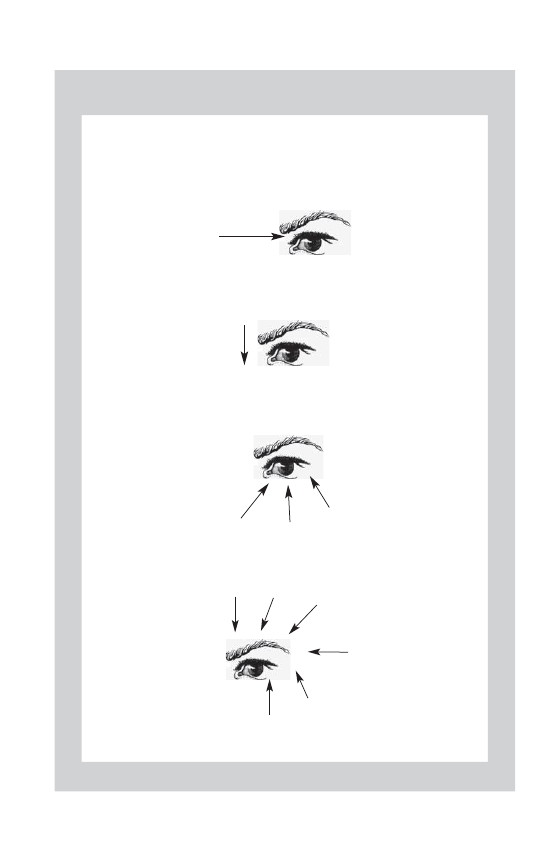
125
7. Your eyes and effective reading
Acupressure
1 Close your eyes and rest your elbows comfortably on a table.
2 Use your thumbs to massage the inside corners of your
eyebrows (8 seconds).
3 Use your thumb and index finger to massage the bridge
of your nose (8 seconds).
4 Massage the area of your cheekbone directly under the
centre of your eye (8 seconds).
5 Using your three middle fingers, press firmly but gently
all around the bony ridge around your eye socket, moving
in a clockwise direction (8 times around your eyes).
6 Keeping your eyes closed, palm for a few minutes,
stretch and carry on with what you were doing.

126
Reading from a PC monitor
AVOID STRAINING YOUR EYES
There is much you can do to make reading from a monitor less
stressful on your eyes. Here are a few tips:
Font type and size – If someone has sent you a document
and the font is diffi cult to read due to either its size or type,
change it.
Screen contrast – Make sure the background is a contrast to
the text on the screen. For some people a white screen may
be too strong and for others a blue one may be too dark.
Experiment with different screen colours. A pale blue or grey
background is worth a try.
Light – There is a misconception that natural light is good
when working at a monitor. Natural light is uneven and
moves as the sun shifts in the sky and shadows change. This
affects your screen and can cause eyestrain. Also, the glare of
the sun on your screen may make reading very diffi cult. If you
don ’ t move your screen when working in natural light you
may begin to suffer from back problems due to shifting about
and sitting in awkward positions to enable you to view the
screen.
Screen interference – Have as little distraction on your screen
as possible. It may be tempting to have all the icons on display.
The more you have on your screen, the smaller the reading
and writing space will be. Only have what is necessary for the
work you are doing.
Screen savers – There are screen savers on the market now
that remain active all the time. One that took my attention
was a sheep that ran around the screen while I worked. Not
only did it help to relax my eyes and prevent me from staring
at the screen, but a sheep chasing frogs across the screen was
good for my sense of humour. Anything good for your sense
of humour is good for your stress levels, which in turn is good
for concentration.

127
7. Your eyes and effective reading
Screen position – Have the screen a comfortable distance away
from you. It should be at least an arm ’ s length away. Avoid
having the screen directly in front of a window – the contrast
in light may be uncomfortable and activity outside can be
distracting.
Comfort – Working at a PC means that the only parts of your
body that get any exercise are your fi ngers. Stop, stretch your
body and do the eye-robics every 20 to 30 minutes.
SPEED READING FROM A MONITOR
Use the arrow as a pacer – Instead of moving it along each
line, which can make it diffi cult to follow, pull the arrow
down the middle of the page or in an ‘ S ’ shape.
Change the margins – If you fi nd it easier to read whole lines
at a time when they are narrower than a full page, change the
margins of the text to make the written text narrower and
easier to read.
Make everything single spaced – Information can be read faster
single spaced than when the text is double or triple spaced.
If you use your ‘ page down ’ key to get from one page to the
next you will waste time by having to fi nd where you were
before the page jumped. Scrolling down not only avoids the
jumps but also provides you with a pacer in the shape of the
bottom of the screen.
Eye nutrition
Like your memory and concentration, your eyes are greatly
affected by what you eat. One rule applies: what is good for your
heart is also good for your eyes. The following supplements have
been shown to have a benefi cial effect on eyesight.

128
Supplement
What it does
Consequence
of a shortage
Sources
Vitamin A,
beta
carotene
The eyes need these
for night vision.
They also help
your eyes to adjust
when exposed to
flickering fluorescent
lights, heat, glare,
computer monitors
and television sets.
Smoking and alcohol
deplete Vitamin A.
Reduced
night vision.
Oranges,
green
vegetables.
Vitamin B
complex
Thiamin (Vitamin
B1) keeps the eye
muscles working.
Riboflavin (B2) keeps
eyes at correct light
sensitivity level.
Vitamin B6 is involved
in emotional balance.
Vitamin B12 may
protect against
some serious eye
conditions.
If you have a
shortage of
Vitamin B2
you may find
that your eyes
burn, you have
a sensitivity to
bright lights
and you feel
unusually
tired. A
shortage of
it is found in
some cataract
patients. A
lack of Vitamin
B12 shows
up in cataract
and glaucoma
sufferers.
Dark green
vegetables,
brewer’s
yeast, eggs,
meat, nuts
and seeds.

129
7. Your eyes and effective reading
Supplement
What it does
Consequence
of a shortage
Sources
Vitamin C,
containing
ascorbic
acid and
bioflavinoids
Good for circulation
in the eyes. Smoking
depletes Vitamin C.
Poor
circulation.
Citrus fruit,
tomatoes,
melons.
Vitamin D
and calcium
Some nutritionists
believe that the
consumption of
excess sugar is a
major cause of near-
sightedness. A lower
sugar intake and an
increase in calcium
intake may help those
with this problem.
Possibly
near-
sightedness,
detached
retina and
glaucoma.
Sunlight,
milk.
Vitamin E
Helps the blood
stream carry oxygen
and nutrition to the
rest of the body.
It also seems to
be important for
maintaining the
elasticity of the eye
muscles.
Near-
sightedness.
Avocado
pear, green/
black olives,
sunflower
seeds,
coconuts,
cold pressed
virgin olive
oil.

130
TEN THINGS TO REMEMBER
1
If you have a lot of web-based material to read, apologize to
the trees and print it out. It will save your eyes (and you a lot
of time).
2
Make sure the lighting is good.
3
Remind yourself to blink, especially if you ’ re reading off a
PC screen.
4
To ease eyestrain close your eyes and cover them with the
palms of your hands.
5
Using a pacer will prevent your eyes bouncing around the
page too much.
6
During a reading session take time to lift your gaze and
look at the horizon or some distant point.
7
If you ’ re reading off the PC screen, change the settings to
increase the font size.
8
Take care of your eyes. Any discomfort is a warning.
Drink plenty of water. Go for a walk. Relax a little.
9
If you ’ ve been working at a PC all day do yourself a favour
and don ’ t watch too much TV at night.
10
Get plenty of quality sleep.

131
8. Distractions and solutions
8
Distractions and solutions
In this chapter you will learn:
•
how to combat external, internal and physical distractions
Insight
All distractions, no matter what their source, only become
distractions when you let them. What goes on around
you is just a series of events. How you let them impact
your attention is up to you and where you place your
priorities.
In an ideal world we would read only what interested us, only
in the right environment, only when we had as much time as we
needed, and only when we wanted to. Life is not like that.
We must often read material we are not particularly interested
in, at a time and place not suited to our reading style and,
all too often, with a deadline.
Distractions are not just what happens around you. Your internal
state can be as distracting as a constantly ringing telephone.
Distractions hamper effective reading and accurate recall.
The more you can reduce them, the more chance you will have
of successfully reading what you need to in the time you have
available.
In this chapter we shall explore a range of distractions and
ways of working around them.

132
Lack of concentration
If your attention drifts easily, seemingly inconsequential things
distract you, and you fi nd it hard to concentrate, there may be an
easy solution.
We discussed concentration in Chapter 4. If you think it may
be helpful to go back to refresh your memory, try one of the
concentration exercises in that chapter (see pp. 65 – 70). The
following tips will also help you increase your concentration
and your ability to focus on one task:
To ensure peak concentration, take breaks often –
approximately 5 minutes every 30 minutes if you are reading
only. If you are reading a number of different texts and
taking notes you could stretch your reading time to between
45 minutes and 1 hour before you take a 5- or 10-minute
break. Pay attention to your body as you read. When you start
yawning, making mistakes or re-reading passages, or if you
develop a headache, it is time for a break. If you work
through the symptoms of tiredness your concentration, and
your ability to remember and understand what you are
reading will diminish rapidly. Taking a break does not mean
lying down and going to sleep for 20 minutes (although that
does help) – you can go for a walk, drink some water,
simply do something different.
Know your reasons for reading. The clearer your purpose, the
easier it will be to concentrate even if you do not really want
to. If you have no reason, you will probably give up fairly
quickly.
Read actively using a pacer, especially if you are feeling tired
or if the material is challenging. The more senses you use, the
more alert you are likely to remain. Imagine having a meal
when all you can do is look at it. You can ’ t smell it, taste
it, feel the texture of the food or hear the sounds of cutting,
slicing and chewing. All you can do is see it and eat it.
How much do you think you would enjoy that meal?

133
8. Distractions and solutions
Eighty per cent of the enjoyment of a meal is in the sensory
appreciation of it: the taste, smell, texture and presentation of
the food. The same applies to reading. Unfortunately we are
taught at a very early age to appreciate reading only through
one sense. When you start building mind-maps, taking notes,
thinking about what you read, discussing and actively reading,
you will fi nd that reading becomes more like the meal you can
see, taste, smell, hear and feel. You almost always remember
a good meal when the company is good and the surroundings
pleasant. Treat reading like a good meal – you ’ ll be surprised
at what happens.
Set a defi nite time limit. Break your reading into 30-minute
chunks. The chunks should be small enough to feel easily
manageable and big enough to feel that you are achieving
your goal. Be realistic. If as you read you fi nd that the size of
chunks is too big or too small, stop and reassess. Be fl exible.
COPING WITH EXTERNAL NOISE
If you are not one of those people who concentrates either because
of, or in spite of, background noise, you need to do everything you
can to minimize the noise around you. Unfortunately, there is always
likely to be some external noise you don ’ t have much control over.
If you work in an open-plan offi ce you may fi nd the noise distracting.
There are several things you can do to minimize distraction from
this kind of noise:
Earplugs – If you get the right type they can be very comfortable
and effective. Most good chemists will supply them. Try out a
few makes, then keep several sets of them in your desk.
Wear earphones and play appropriate music through them –
music without words and not too loud. Baroque music is best
for maximum concentration. Make sure what you listen to is
not too melancholy and only play music you enjoy. Mozart,
Vivaldi and some of Beethoven ’ s works are especially good
for concentration. You can experiment with music. Put one
composer on for 20 minutes, change to another and then

134
compare how you feel or how well you concentrated. (See
p. 64 for some specifi c suggestions.)
If your desk is in a truly open-plan space with no dividers
between the desks, creating a visual barrier between you and
the rest of the space will help cut distraction. You do not have
to build a wall around you – this is not always desirable or
possible. All you need to do is place something on your desk
that reaches eye level. This will provide a psychological barrier
between you and the distracting environment and make it
easier to cope with.
If at all possible, leave the noisy environment and fi nd a quiet
space to read in.
Insight
A delegate in one of my workshops used to go into the
cleaner ’ s cupboard when he had a document to read that
needed all his attention. He would disappear into the
cupboard and emerge when he was done. It need not be a
cupboard... but fi nd yourself a private space.
COPING WITH INTERNAL NOISE
Internal noise is caused by your mind wandering, perhaps because you
have not decided to spend the time on a particular task. The advice on
concentration in Chapter 4 will help you here. What will help most,
however, is the decision to take the time to read.
If you don ’ t make a fi rm decision to sit down and read, the type of
internal talk that goes through your head might sound like this:
‘ I don ’ t have the time for this … X really needs to be done now …
Y will have to move to this afternoon … I should be doing Z … ’
There will be so much noise in your head that you will be unlikely
to remember one word you have read and will be wasting time.
Make a decision to allocate a certain amount of time to read
a set amount of material. If you can plan it into your day,
do so. Some reading cannot be planned for. In this instance,

135
8. Distractions and solutions
instead of diving into the text without thinking, take time to
go through the preparation and preview stages quickly. Then
if you think that the document really does need to be read,
decide when you are going to do it and put the time aside.
After the decision is made, most internal talk will disappear
and you will be able to focus.
Physical distractions
TIREDNESS
When you are tired it will be almost impossible to concentrate.
If you can, take a break and have a short nap or go for a walk
in the park. If you are unable to do that, there are several other
strategies open to you:
Cut the time you spend reading down to 10 – 15-minute
chunks.
Use multi-sensory reading.
Drink plenty of water.
Do aerobic exercises during your breaks – jump up and down
a bit to get the oxygen fl owing.
Breathe deeply and stretch every few minutes.
If you have music playing make it upbeat and energetic.
Make sure you have a very good reason if you read through
your tiredness.
Do not go on longer than you have to – stop when you are
fi nished and have a good rest.
Avoid working through the night.
Avoid excess sugar or starch.
Avoid caffeine. For maximum performance you want to be
alert, not jittery.
As we have seen in Chapter 4, reading at the right time of
day can go a long way to preventing tiredness. You may
notice that you can concentrate better at certain times of day
than others. Your results will be better if you read at those
times.

136
SORE EYES
Any kind of physical discomfort is a distraction. Your eyes are your
primary tool for reading; take care of them. Refresh your memory
about eye care by reading the summary at the end of Chapter 7.
STRESS AND READING
If you are stressed it is better to stop for a short time, even if you
think you don ’ t have the time. Stop, breathe, relax, evaluate the job,
have a caffeine-free drink or some water and carry on. Being stressed
does not make most people read any faster or more effectively.
HUNGER AND THIRST
Hunger is a serious distraction. Conversely, if you eat too much
your concentration will be impaired. If you have a large amount
of reading to do, avoid eating too much at once and avoid excess
sugar and starch.
Another cause of poor concentration is dehydration. Your body is
90 per cent water, and by the time you feel thirsty you are already
dehydrated. Drink plenty of water even if you don ’ t feel you need
any. Avoid tea and coffee – the caffeine in them will dehydrate you
still more.
Environmental issues
COMFORT
Ensure you have fresh air and adequate light. Make yourself as
comfortable as possible without becoming sleepy.
LIGHT
Daylight is best (unless you are using a PC). If there is none, then
there should not be much contrast between the levels of light under

137
8. Distractions and solutions
which you are working and the rest of the room. This helps prevent
eyestrain. A general rule is that the main source of light should
come over the shoulder opposite to your writing hand.
DESK AND CHAIR
Make sure your desk and chair are the right height. When you
sit on the chair you should be able to sit back, supporting your
back with your feet fl at on the fl oor. If you cannot reach the
fl oor place a block at your feet. Your desk should be large
enough to take everything you need for the work you are
undertaking.
Work distractions
Here is some general advice about coping with distractions at
work:
Plan your day – Distractions come easily when you
don ’ t know what you want to achieve. At the start of your
day write down everything you want to achieve, including
the reading you want to do. Set aside time for it. It might also
be useful to put time aside in your plan for leisure reading.
Once you plan it and you can see that reading a novel for
a while isn ’ t going to mean that you will not achieve
everything else in your day, you will fi nd that you enjoy the
time, still get everything done and improve your speed
reading by reading more.
Set ground-rules – Once you start something, don ’ t let
anything distract you from completing it unless there is a
very good reason. Have you ever started mowing the lawn
or doing the dishes, only to get distracted onto something
else and then fi nd you don ’ t really want to go back to what
you started? Once you start something, fi nish it. This will
not only improve the quality of your work, it will increase
the quantity you can achieve. You will also feel more
relaxed and at ease because the job has been done.

138
PEOPLE DEMANDING YOUR ATTENTION
Few people have the luxury of being able to work without
interruption. There will almost always be someone, somewhere
demanding your attention at some point, whether by phone,
in person or by e-mail.
If you can, set aside the time you need to read. Put up
a ‘ Do not disturb ’ notice. If you are unable to do that –
and most of us are – deal with interruptions like phone calls
and people wanting to see you by consciously breaking
off from your reading task and paying attention to the
interruption.
If the phone rings or someone comes up to you while you are
reading:
If possible, fi nish the sentence or paragraph you are on.
Place a mark on the place where you stopped.
Briefl y revise in your mind or on paper your understanding of
the last sentence you read.
Then give attention to the next task.
Once the interruption is over, you can return to your reading:
Sit for a moment and recall your understanding of the last
sentence you read.
Re-affi rm your intention and purpose for reading.
Set the time again for a manageable chunk.
Continue to read.
Habit dictates that when we are interrupted we are very
likely to hop from one task to another. Instead of doing this,
take a brief pause between tasks. Ensure that you don ’ t waste
time trying to fi nd where you left off before the distraction;
doing this will prevent you from having to sort out your ideas
and avoid confusion in your mind when you get back to the
task.

139
8. Distractions and solutions
Clearing your desk of distractions
It is important to avoid distracting yourself with other tasks:
Mail – If you get a lot of mail at the beginning of the day have
a routine of no more than 20 minutes each day to open all
your mail and fi le it, deal with it or bin it. Don ’ t let anything
get in the way of doing that. It might not seem an important
job at the time but when a week ’ s mail piles up on your desk,
undealt with, it can be very distracting. It may make you waste
more time than you spend in dealing with it in a daily session.
E-mail – Try to deal with all your e-mail at one point in the day.
Desk space – Every piece of paper on your desk may distract
you several times every day. To minimize this type of
distraction make sure that the only things on your desk are
those that have something to do with the project in hand.
If you have your In and Out trays on your desk, fi nd another
place for them for a week. At the end of the week, assess how
differently you spent your time. As long as the tray is on your
desk, you only have to look up and you will see everything else
you have to do that day instead of being able to focus on one
job at a time.
Clutter – If your desk tends to be covered with paper, clear it
of everything other than the job at hand for just one day.
Note the difference. At the end of each day, make sure you
leave your desk totally clear. In the morning you will feel far
more relaxed and able to choose what you want to deal with
instead of having to deal with whatever happens to be on the
top of the pile.
Other people ’ s reading – Do not let anyone put anything on
your desk that you haven ’ t seen and agreed to have there,
especially if you have to read it. When someone gives you
something to read ask them to explain clearly why they think
you should read it, then decide if you want to accept it as an
activity in your schedule. If they cannot give you a satisfactory
reason, think carefully before you accept it; once you do,
you will have to commit yourself to the time required to doing it.

140
TEN THINGS TO REMEMBER
1
Determine exactly where the distraction is coming from
(internal or external) and deal with it.
2
Take plenty of breaks.
3
Use earplugs in a noisy environment.
4
If you work in an open-plan offi ce, create a barrier between
you and people around you with fi les and plants.
5
Beat internal noise (you talking to yourself), by focusing on
your purpose and setting a time limit.
6
Be well rested and suitably fed. Tiredness and hunger are great
distracters.
7
Remember to breathe deep.
8
Set ground rules: make the task of reading a priority and don ’ t
let anything else distract you.
9
If the phone rings while you ’ re reading, take a moment to
mark where you stopped reading before you answer it.
Better yet, don ’ t answer it – let them leave a message.
10
Don ’ t let other people dictate where your concentration
should be.

141
9. Real-world reading
9
Real-world reading
In this chapter you will learn:
•
how to read under pressure
•
how to make the most of your available time
•
how to find information fast
•
how to reduce unnecessary reading
•
how to evaluate your progress
How often have you read a book on speed reading and thought that
the ideas outlined would be all very well if you had the luxury of
working in your own environment? Reading in the real world means
that you don ’ t always have peace and solitude to concentrate on
what you are doing. You are almost certain to be interrupted and
you will probably have a deadline that is too close for comfort. This
chapter presents some ideas on how to read under pressure.
Information bottleneck
Sometimes you have more to read than you have time for and you
never seem to get to the end. Two possible explanations are:
You feel you need to know everything.
Procrastination.
NEED TO KNOW
If you fi nd that you have more reading to do than you can
cope with, ask yourself a question: ‘ Do I really need all of this

142
information or am I reading it because I ’ m worried that if I don ’ t
know it all I ’ ll not be able to do my job well or help others do
theirs? ’ Be sure to answer this honestly.
Insight
Fear is the great driver in this behaviour: fear of appearing
ignorant, foolish or out of the loop. Everyone feels this at
some point. Admitting you don ’ t know (but that you can fi nd
out) does your credibility far more good than holding back
because you don ’ t want to seem uninformed.
A number of other attitudes are connected with the urge to know
everything.
Apparent urgency
You may be in the habit of dealing with something as soon as you
receive it, no matter what else has to be done or how important the
latest task really is. If someone gives you a document to read and
says, ‘ This is urgent, you must read it now ’ , don ’ t take their word
for it. According to them it may be urgent, but it might be the
second or third most urgent thing in your day. Take the time
to prioritize.
Nobody does it better
This is an excellent attitude if you want to make sure you have
plenty of work to do every weekend and holiday. Most people are
capable of doing their jobs well. Think positively, have faith in
others, prioritize and delegate.
Generosity
When it comes to your own time, you cannot always afford to be
generous. Often the people who give you something extra to deal
with are doing so to avoid doing it themselves.
PROCRASTINATION
Two causes of procrastination are fear and a lack of interest. If you
have a task to do and it seems big or challenging, you may do other

143
9. Real-world reading
seemingly important things instead of facing the situation and
dealing with it.
The cure for this is straightforward. Determine exactly what the
job entails instead of letting your imagination drive you further
away from it. Once you know what is involved, break the job into
small chunks and deal with it a piece at a time.
Insight
Instead of allowing your in-tray to overfl ow, do the fi ve steps
on every document as soon as it arrives. Even if you don ’ t
read it completely, you will have an accurate evaluation of
what it ’ s about which will prevent your imagination from
turning it into more than it is.
If the cause of the procrastination is lack of interest, fi nd something
in it that will motivate you. If you can fi nd nothing and your desk is
always full of paperwork that needs to be dealt with but you can ’ t be
bothered to do it, then you may want to consider a different job.
Being an information bottleneck does not do anyone any good.
Information should fl ow freely throughout an organization.
Once you enlist the help of others and share information you
will be surprised at how much you can achieve to get things
moving.
Prioritizing and planning
More often than not, a lack of prioritization is the cause of a desk
full of reading that you cannot get through. When the pile gets too
high, you begin to feel that you can ’ t do anything and begin to
suffer from ‘ paper fatigue ’ – you feel exhausted every time you go
near your desk. The better you prioritize your reading, the faster
you will get through it.
When you prioritize, the risk of falling into the trap of becoming
an information bottleneck will decrease. Although it might take

144
you a little time if you are starting from scratch, once you get used
to prioritizing you will do it naturally on a daily basis.
Whether you are starting with a pile of collected paperwork or
dealing with your daily mail, following these simple steps will help
you prioritize effectively:
Gather all your reading or paperwork together.
Sort it into three piles: urgent, important, other.
Go through each pile and determine what the pay-off for
dealing with each bit of paper will be (see next step).
Ask this question to help you determine the nature of the
pay-off. Are you reading the document for profi t, to meet
a deadline or to achieve a goal? If you have a pile full of
documents that seem urgent but don ’ t have much of a pay-off,
consider whether each really is urgent or whether it is in the
pile because someone said it should be there.
Write an action list of everything you need to read in order of
priority. Note down how long each one is likely to take you,
why you think you need to read it and what you are going to
get from or achieve by reading it.
Plan your reading into your day according to when you need
the information. Reading something you are going to use
in a few weeks ’ time may mean that when you are closer to
requiring the information you will have to revise it anyway.
You might as well wait until later (sometimes procrastinating
is the right thing to do).
MAKING THE MOST OF THE TIME YOU HAVE AVAILABLE
The most important thing about reading for work or study (this advice
does not apply to leisure reading unless you want it to) is planning.
These are simple guidelines on how to make the most of your time:
Read when you are feeling alert and refreshed. If you have to read
and you are tired, drink plenty of water and take regular breaks.
Plan what you have to read and set aside a little more time
than you think you will need to do it.

145
9. Real-world reading
When someone puts something on your desk expecting you
to read it, fi nd out whether it is really necessary and whether
someone can summarize it for you so that you do not have to
read the whole document yourself.
Make the bin the fi rst option when you are sorting mail
(including e-mail).
When you are going through your mail decide what you
have to read and put non-urgent documents aside. If you
have time at the end of the day to read them, then
do so.
Coping with meetings
‘ I only have fi ve minutes and I have to sound as if I know
what I ’ m talking about. ’ Have you ever said this? Many of
us fi nd ourselves in the situation where someone gives us a
document and tells us that we are expected at a meeting very
soon to discuss it with others who have had a day or so to
read it.
You could bluff your way through if others know less than you
do, but eventually you would probably be caught out. It ’ s better to
fi nd a reading strategy that gives you a chance of absorbing vital
information than to struggle to look as if you know what you are
talking about.
Do you fi nd that in these circumstances your mind goes blank and
for some reason words and letters don ’ t make sense any more?
This has more to do with stress and a lack of strategy than it does
with time. When this happens:
Ask the person handing you the document what it has to do
with you – get background information.
Ask them why you only have 5 minutes – this gives you an
idea of the purpose and focus.
Ask them to summarize briefl y the text for you – this gives you
the content.

146
Once you have done that, complete Steps 1 to 4 of the fi ve-step
system (prepare, preview, passive and active reading):
Determine your purpose – why do you have to read this?
What are you going to do with the information?
Flip through the text, reading any summaries or conclusions.
Read through it passively, this time looking for key words and
signifi cant fi gures or words in bold or italics.
Read the fi rst and last paragraphs of each section actively.
If there is time, use it to fi ll in the gaps by reading as much as you
can, beginning with the fi rst sentence of each paragraph and any
bullet points.
Very important
As you go through Steps 1 to 4, take notes – preferably on
the document itself. The thoughts you have as you read
will probably be what you would want to contribute to the
meeting. If you don ’ t write them down you may forget and
lose valuable insights.
GOING INTO THE MEETING
Insight
My primary advice is to avoid them. Most are an absolute
waste of time where real issues are hardly ever fully discussed
or resolved. But if you insist on attending meetings …
Before you go into the meeting, stop at the door, stand up straight,
breathe in deeply, smile and relax. Once you are inside:
Don ’ t profess to be an expert on the subject unless
you are!

147
9. Real-world reading
Listen fi rst to what others have to say.
Ask questions before you make statements.
Once you take control you will relax and be able to concentrate
on the meeting.
Finding information fast
There are many occasions when you have to fi nd information fast.
To do this you can use Steps 1, 2 and 3 of the fi ve-step system
(prepare, preview and passive reading). These can be broken down
into the following stages:
1
Be very clear about what you are looking for.
2
Write your purpose down.
3
Begin Step 2 (preview) by highlighting any chapters or sections
that look as if they may contain the answers to your questions.
Use Post-it notes to mark the relevant pages, writing a
comment on them to show what you expect to fi nd there.
4
Once Step 2 is completed, begin Step 3 (passive reading)
by re-stating and re-clarifying your purpose. What exactly are
you looking for and what are the key words that would alert
you to the answer?
5
Passively read (skim or scan) the pieces of text you identifi ed
during the preview stage.
6
Stop as soon as you fi nd your answer – unless you decide
to continue.
RETRIEVING INFORMATION
When you read a document for the fi rst time, read it with the
intention of going back to it to fi nd information at a later date.
Mark relevant pages or take referencing notes. Writing a brief
summary of each section in the margin is an excellent way to help
you access information later. It is also a very good technique for
remembering what you have read.

148
READING UNDER PRESSURE
A deadline can be one of the biggest distractions. Becoming wound
up and stressed only defeats the object. When you have such a
situation:
1
Make a realistic assessment of the time available.
2
Decide what you have to know.
3
Decide what the best and fastest source of information is.
4
If it is something you have to read, complete Steps 1 to 3
of the fi ve-step system (prepare, preview and passive
reading) and be very disciplined about cutting out what is
not essential.
5
Speak to someone who already knows something about the
subject and gather as much information as possible from them.
6
Find out exactly why you have such a tight deadline and see
whether it can be changed.
7
After your questions have been answered, divide your reading
into the amount of time you have. Focus, relax, breathe deeply
and make sure you have a good supply of water.
8
Take plenty of breaks. It is more important to sit back and
take stock when you are under pressure than when you have
all the time in the world. If you are under pressure and not
taking care of yourself, stress will counteract all the work you
are doing.
New jobs, projects and clients
In a new situation – whether you are dealing with a fresh job,
project or client – you need to fi nd out just what you need to
know.
NEW SUBJECT OR PROJECT – FAMILIAR CLIENT
If you are working on a job where the client (who may be your
employer or an external client) has asked you to do work that is
outside your area of expertise, you will still be expected to provide
a professional service. You have a learning curve to go through

149
9. Real-world reading
before you even begin. To make the task easier, here are some
ideas:
Start with Step 1 of the fi ve-step system – prepare . Determine
exactly what the job is. Write down everything you already
know, everything you are expected to know, what questions
you have, where you are likely to fi nd the answers and what
gaps you are aware of in your knowledge.
Then fi nd out the level of expertise required. You may have to
hire the services of an expert to complete the job satisfactorily.
If you determine that the level of expertise is within your
grasp, commit yourself to doing the job well.
When you have done that, speak to your employer, the client
or an expert in the fi eld and fi nd out what the best source of
information is.
Gather together the material that may contain the information
you need and follow the fi ve-step system to get as much
information as possible out of it. Devote a little time to doing
nothing but learning.
Speak to people about the job. This is a good way to make
sure you stay on track and stay motivated.
Subscribe to a specialist magazine and get as many different
views as possible on the subject.
Avoid breaking the job down into ‘ learning ’ and ‘ doing ’
phases (except for the period of time right at the beginning).
Commit yourself to learning all the way through instead.
Keep reference cards for information gained. Divide the cards
into ‘ need to know ’ , ‘ like to know ’ and ‘ interesting but not
vital to know ’ .
Keep a record of your progress and a notebook for questions
you want to fi nd answers to.
Enjoy the exercise and treat it as an exploration . The less
pressure you attach to the job, the easier it will be for you to
learn and perform professionally.
FAMILIAR PROJECT OR SUBJECT – NEW CLIENT
This situation works the other way round when the task is familiar
and the client is not. Instead of your attention being focused on

150
the job, your attention should be focused on the client. You know
what the job you are being asked to do entails. You should be
asking yourself how what you know fi ts into what your client
wants. The research you carry out should be on who your client is
and how they work:
What market are they in?
Have they commissioned work like this before?
Do they know what to expect or is the fi eld totally new to
them?
Are they doing the work because they want to (business
development) or because they have to (business survival)?
This will determine their attitude towards what you do and
the level of detail you have to go into. A business working on
survival will probably ask for the minimum because that may
be all they have the time or budget for. A strong, growing
business may have more time and money to spend.
What do they already know about what you do?
How involved will they be?
Will they want to know how you do it or will the fi nished
product be all they want to see?
Gather all this information together. Go to the client, collect their
literature and read their web site. Speak to the receptionists and
assistants; they almost always know what is going on because they
deal with more than one job or department at a time.
NEW JOB, NEW CLIENT
This is challenging. Not only do you not know what you are doing
but also you don ’ t know who you are doing it for. If you have just
started a new job you may be feeling like this.
To make the transition smooth and successful:
Follow the steps outlined in both of the above sections.
Join professional societies who can provide you with
information and training if you need it.

151
9. Real-world reading
Read Chapter 10, Working and studying for a living. Studying to
get to grips with a new job can be more challenging than studying
to pass an exam; in this case the ‘ exam ’ is continuous and the
stakes are higher. The more you know, the better you will be able
to perform. Read, ask questions and be responsible for your own
professional development.
Insight
Don ’ t assume that just because someone has been working
with a company for a few years that they know what they ’ re
talking about. Be politely suspicious of everyone and get
corroboration on everything.
A plan for reducing your reading
Simply reducing the amount you read will save you an enormous
amount of time.
If you don ’ t need any particular types of report or memo, contact
the sender and ask them not to send these to you any more.
Internal mail that has nothing to do with you can be just as time
consuming as junk mail.
Reduce your reading
1 Collect up all the reports and memos you have on
your desk or that require your attention.
2 Count the number of pages and determine how long it
would take you to read them all (this will give you the
motivation to find a better way of dealing with them).
3 Look at the reports and memos and find out if there
is a pattern to them. Are they coming from the same
person or office? Are they vital to your job? Do you have
any interest in the subject matter? Do they arrive
(Contd)

152
regularly without your asking for them? Have you
requested them? If you have, for what purpose?
4 Carry out the second step (preview) on the reports by
studying their structure. Are they written in such a way
that you can gather the information you need without
having to read the whole document? If you were to read
only the summaries and conclusions, how long would
it take you and would it be sufficient? If you don ’ t read a
whole report, does the person who wrote it know this?
By telling them you may save them some time.
5 Study the pile and determine how many decisions you
have to make in relation to them. If you find that most
of the reports and memos are for your information only
and you don ’ t have to do anything with them afterwards,
the apparent urgency and importance of most of them
will immediately diminish.
6 Ask yourself whether you would be able to get the
information that is in the report or memo just as
effectively by speaking to someone for a few minutes.
7 Another question to ask is whether the information in
the report will be valid by the time you need it. Also ask
if the information it contains is old news to you.
8 If you are not sure whether you need to read a report
or memo, put it aside on a trial basis. If after a while
someone comes in asking you to act on it, you will know
that you have to pay attention to it in the near future.
In future, as soon as a report or memo comes to your attention, go
through it quickly asking yourself whether you need it. Add it to
your reduction pile in the bin if you don ’ t.
Insight
A very successful colleague has a defi nite attitude towards
mail, reports and memos: everything goes straight into the
bin. His philosophy is that if it is important someone will
come and see him or phone him. It is a high-risk strategy,
but it has worked for him!

153
9. Real-world reading
Evaluating your progress
When you learn something new it is easy to get into a routine
of simply doing it and forgetting to evaluate your progress to
make sure that you are going in the right direction. It is fairly
common for old habits and new (bad) habits to creep into
your reading strategies even though you are practising a
new and better way of reading. To make sure that you are
continually improving, occasionally go back to the beginning
to ensure that the foundation of your strategy is correct.
This is the real world, though. We don ’ t always have the time or
the inclination to go back and re-learn what we spent time learning
in the fi rst place. To reinforce the foundations easily:
Spend 5 minutes every few weeks doing a short speed
reading test. Select a number of books or texts, all on
different subjects and of varying diffi culty, and follow the
steps to measure your reading rate, outlined in Chapter 2
(p. 25).
Keep a log of how well you are doing. If your reading
speed or your comprehension is going down, spend some
time that day or during the same week being aware of the
strategies you are using and how you can improve them.
If your reading speed and comprehension are going
down, the most likely reason is that you are falling into
the habit of not being aware while you are reading.
Remember the exercises to increase and improve concentration
(pp. 65 – 70). Do them as often as you can and select one
that you are able to do daily.
At the start of your day, when you plan your activities, make
one of the activities effective and effi cient reading. If you make
yourself aware of your reading at the beginning of the day,
you will notice that you are more aware of it throughout
the day.

154
TEN THINGS TO REMEMBER
1
Don ’ t procrastinate. Just because a document looks daunting
doesn ’ t mean it is.
2
Don ’ t feel under pressure to know everything.
3
Make decisions about information that comes your way.
Don ’ t be a bottleneck. Pass relevant information onto
appropriate people.
4
If you can choose between reading a 50-page document or
speaking to the author, speak to the author fi rst, then read
the document. You ’ ll be in a better position to understand
it quickly.
5
Prioritize your reading.
6
Plan your reading according to when you ’ ll use the
information and how complex it is (read technical information
when you ’ re fresh and alert).
7
Don ’ t be put off by other people ’ s deadlines. Their deadline is
their responsibility. Your stress levels are your responsibility.
8
Take notes during meetings (even if you never read them
again). It will keep you awake.
9
Reduce your reading at work as much as possible by using the
fi ve-step system on everything.
10
Never stop learning. There will always be something new.

155
10. Working and studying for a living
10
Working and studying for
a living
In this chapter you will learn:
•
what taking a study course entails
•
how to prepare for assessments and exams
•
how to manage your time effectively
If you are working and studying at the same time, it is important
that what you want to achieve is achievable and consistent with
your other commitments. It is easy to be so absorbed in the extra
work that you forget the time you need to spend with your family
and friends. If you work and study and don ’ t give yourself enough
quality recovery time (rest and play), your stress levels will increase
and your effectiveness will decrease – thus defeating the entire
object.
In this chapter we shall look at what taking a study course (e.g. an
MBA or Open University course) entails and what you can do to
make life easier, productive and successful when you are working
and studying.
Advice is given on preparing for exams; this will be of value to
those embarking on courses that use formal assessment methods.
Although an increasing number of courses, especially modular
ones, do not involve exams.

156
Insight
The most important factor to consider before you start a
course that will take up your time is whether you have a
good reason for doing it. If you do, then you ’ ll have a better
chance of seeing it through and getting those close to you to
support you.
Before you begin
Whether you are going into the fi rst, second or third year of a
course, there are some crucial things to think about before you
begin.
TIME AVAILABLE
Do you honestly have the time to do the course justice? Some
of us will say ‘ No ’ but do the course anyway. If that applies to
you, make sure that your reasons for doing the course are solid.
Whatever those reasons are, make sure that you can put some time
aside. Try to make study time at a set time of the day. Start putting
that time aside for a month or so before you begin the course.
This will give your family time to adjust to your new routine and
will allow you to become used to spending that time studying. Sit
quietly and focus your mind by doing some preparatory reading.
If there is still a problem
If time is really a problem and you have to do the course, limit
the amount of time you spend on each session. It is better to
study for 30 minutes three or four times a week and several
hours at the weekend than to spend no time at all in studying
during the week and the whole day on Saturday or Sunday.
Little and often is the recipe – like a healthy diet.

157
10. Working and studying for a living
ACCESS TO RESOURCES
Do you have access to all the resources you are going to need?
Are you a member of the nearest library? Do you need to become
a member of a university library? They often have texts that an
ordinary library does not have. Do you know people you could
speak to and discuss issues with? You may be able to make contact
with appropriate lecturers at a local university. Do you have
reliable access to the Internet?
SUPPORT FROM FAMILY AND FRIENDS
Get your family involved. You need their support for two reasons:
1
To give you the space and time to work.
2
To push you along when you are feeling a little demotivated
(which will happen from time to time).
If you have children, teach them to speed read and use pictures,
books or ideas from your course (depending on their ages) to
give them an awareness of what you are doing. Get your partner
involved as well if he/she wants to be. When you get your timetable
for the year ahead, put it on the fridge door so that everyone can
see what you are committed to.
DESIRE AND PURPOSE
Make sure you and your family know exactly why you are doing
this course. What is the pay-off? Is it big enough to compensate for
the weekend reading you will have to do?
PRE-COURSE PREPARATION
There are several ways of preparing for the course:
During the month before you start, gather information that
will help you during the course, revise notes from previous
courses and read other related material.

158
You can also set up a good fi ling system for your assignments
and reading materials.
Build mind-maps or index cards of everything you already
know.
Every day, list at least fi ve questions you want to answer
through taking the course.
On a daily basis, ask yourself why you are taking the course.
If you keep saying, ‘ I don ’ t know ’ , then reassess whether you
should go ahead or not.
BREAKING DOWN A STUDY COURSE
The week you get your fi rst course materials is very important. One
of the mistakes people make is to read what they have to read only
when they are told they should read it. To benefi t fully from every
piece of reading and work you do, follow these steps – they do
work:
Read your list of assignments fi rst. If you can get hold
of any past exam papers at this time in the course,
do so.
Once you have had a look at what assignments you have
to deliver, follow the fi ve-step system and go through the
fi rst four steps from prepare (which you have been doing
in a general sense for the past few weeks) to active
reading. Do this for all the books, articles and papers
you have. As you read, take thorough notes of what
you fi nd interesting, what looks challenging, what
seems to be familiar and what is totally new to you.
Always keep in mind the assignments you will have
to complete.
Next, go through the list of questions you have
built up over the month before the course, answer
those you can and add more to the list if
necessary.
Study your timetable, determine what has to be studied
by when and break down your reading into manageable
chunks.

159
10. Working and studying for a living
Timetabling
When you design your timetable, don ’ t make every day a study
day. Try to keep two days a week free of coursework. These
are for quality recovery time and for use if you miss one of
your designated study days. It is also a good idea to be at least
a week ahead of your course. There may be times when you
miss several reading sessions in a row and catching up will put
pressure on you and increase your stress levels. Take the time
at the start of the course to plan, it will be the best time spent.
Managing time
PREPARING FOR MORE THAN ONE ASSIGNMENT AT A TIME
Although most assignments are on different subjects within your
course, many of these subjects may be somehow related. When you
are doing the research for one assignment, always keep in mind what
the next one or two are about. You will be able to save a lot of time
by doing this. If you come across an idea or section of text that would
be useful for future assignments, write it down, add a note about why
you thought it was a good idea or what made you notice it in the fi rst
place and include the title of the source and the page number. Then
fi le it in the system you developed before the course began.
PREPARING FOR THE EXAM FROM THE START OF
THE COURSE
A mistake many people make is to put off any thought of studying
for exams until they are almost at the end of the course. If you start
preparing at the beginning of the course and keep exams in mind
as you write and submit essays and projects, instead of panicking
about the exam a week before you will have several weeks
available for stress-free revision.

160
Revising
The more revision you do as you go, the better your progress
will be. When you begin to revise for an exam, few things are
more alarming than the discovery that material seems unfamiliar
to you even though you know you have already read it and perhaps
even written an assignment on it.
Make it a habit to revise every day. At the start of each revision
session spend 20 minutes going over past notes, mind-maps
and index cards to refresh your memory. As you do this, link in
different ideas and add new thoughts to your growing collection
of knowledge. The more you can integrate your thinking, the more
natural revision will become. If you revise a little every day all you
need to do for the exam is to review your notes (much like you
have every day since the start of the course) and add new thoughts
or ideas to an already thorough body of knowledge – to make this
easier, double space your notes so that you have the room to add
comments later.
Preparation for an exam if you have managed to structure
your course
If you have managed to structure your course and if you have
revised daily and begun to prepare for the exam at the start of the
course instead of waiting until the end, you will be fully prepared
and ready to sit a successful exam.
Preparing for the exam if you have not structured your course
If you have not had time to structure your course or if you
are halfway through a course already, there is a way to make
sure you are able to sit the exam confi dently. Here is a procedure
to structure your reading so that you succeed without undue
stress:
Determine how many study days you have before the exam or
end of the course. Be realistic about this. If you are working
full-time as well as studying, remember that you will have only
early mornings, evenings and weekends and that you have to
fi t a life in there somewhere.

161
10. Working and studying for a living
Establish exactly what you have to study. Generally
you will have a number of books and perhaps a few CDs,
a few television programmes and notes from lectures. If you
gather all the material together you will see that the amount
of information you have to take in is fi nite. This will help
your morale.
Go through the course timetable and notes and make a list of
all the different areas you have to cover.
Under each heading write down the chapters, CDs, videos and
lectures (all sources) you have to refer to for information.
Organize the headings in an information order. Some areas of
a subject serve as good background for others, so cover those
fi rst. The order in which you study these areas is entirely up to
you and will depend on your current knowledge base.
Once all areas are covered and you have identifi ed the
sources for each, put them in a sequence and create a
realistic and achievable timetable. Do remember QRT
(quality recovery time).
The timetable you create should not have you starting at
4 a.m. and beginning again as soon as you get home – if you
do that you will burn out. Make space in your timetable for
plenty of QRT.
Enjoy the learning process by rewarding yourself for each
accomplishment (at least once a day). Choose ways that
don ’ t run up your dental bills or medical visits – try cycling,
a walk in the countryside or a swim. Avoid chocolate or
coffee if you can, but if coffee is what you want, take
Dr Chris Fenn ’ s advice (see Chapter 11) and make it the
best.
If you are studying and working at the same time the most
important things to have are a clear objective, a clear purpose
and as much support as you can muster. Most important of all,
enjoy yourself and have fun!

162
TEN THINGS TO REMEMBER
1
Make the time in your day (everyday) to study little and often.
It ’ s better than cramming it all in at the last minute.
2
If you have a full-time job and a family and a social life,
be honest about what you can do. Don ’ t sacrifi ce sleep for
study. It ’ ll do damage in the long run.
3
At work, make lunch breaks study breaks. You ’ ll be surprised
how much you can achieve in half an hour.
4
Get support from your family and friends.
5
Use what you learn on the course as quickly as possible.
The more practically useful it is, the more motivated
you ’ ll be to study.
6
Don ’ t rely on course material alone. Expand your reading.
You might not use the additional information to pass your
exam but it will boost your knowledge and enjoyment
of the subject.
7
Plan your work and stick to the plan! But be fl exible.
Modify your schedule if it doesn ’ t work.
8
Know your assignments at the start of the course and angle
your reading and research towards him.
9
Take days off! You need a life.
10
Get learning buddies and attend as many tutorials and
summer schools as the course provides. Interaction with
people going through the same issues might just save
your sanity.

163
11. Useful information and speed practice text
11
Useful information and speed
practice text
In this chapter you will learn:
•
prefix, suffix and root – the makings of a word
•
critical language for critical reading
•
how to establish your present reading rate
The makings of language
The following is information you might fi nd useful. It is
by no means a necessary prerequisite to beginning to practise
speed reading. The more skills and information you have,
however, the faster your reading will become. This information
will be particularly useful if English is your second
language.
EXERCISE 1
This exercise is concerned with what is in a word:
Study the roots, suffi xes and prefi xes below.
Think of your spoken, written and recognized
vocabulary.
Think of a word that comes from each prefi x, suffi x
and root.

164
Roots
Roots
Meaning
Roots
Meaning
aer
air
mort
death
am
love omni
all
ann
year
pat
father
aud
hear
path
suffering, feeling
bio
life
ped
foot
cap
take
photo
light
cap
head
phobe, phobia
fear
chron
time
pneum
air, breath, spirit
cor
heart
pos, posit
place
corp
body
poss, pot, poten
be able
de
god
quaerere
ask, question, seek
dic, dict
say, speak
rog
ask
duc
lead
scrib, scrip
write
ego
I
sence, sent
feel
equi
equal
sol
alone
fac, fic
make, do
soph
wise
frat
brother
spect
look
geo
earth
spir
breathe
graph
write
therm
warm
loc
place
ten
stretch, hold
loqu
speak
utilis
useful
luc
light
ven, vent
come, arrive
man
hand
vers, vert
turn
miss, mit
send
vid, vis
see

165
11. Useful information and speed practice text
Prefixes
Prefix
Meaning
Prefix
Meaning
a-, an-
without, not
equi-
equally
ab-, abs-
away, from, apart
extra-
outside, beyond
ad-, ac-, af- to, towards
for-, fore-
before
aero-
air
hemi-
half
amb-, ambi- both, around
hepta-
seven
amphi-
both, around
hexa-
six
ante-
before
homo-
same
anti-
against
hyper-
above, excessive
apo-
away from
il-
not
arch-
chief, most important in-, im-
not
auto-
self
inter-
among, between
be-
about, make
intra-, intro- inside, within
bene-
well, good
iso-
equal, same
bi-
two
mal-
bad, wrong
by, bye-
added to
meta-
after, beyond
cata-
down
mis-
wrongly
cente-, centi- hundred
mono-
one, single
circum-
around
multi-
many
co-, col-,
together
non-
not
com-, cor-
ob-, oc-, of-, in the way of,
con-
with
op-
resistant to
contra-
against, counter
octa-, octo- eight
de-
remove, down
off-
away, apart
deca-, deci- ten
out-
beyond
demi-
half
over-
above
dia-
through, between
para-
aside, beyond
dis-
not, opposite to
penta-
five
duo-
two
per-
through
dys-
ill, hard
peri-
around, about
e-, ex-
out of
poly-
many
ec-
out of
post-
after
en-, in-,
into, not
pre-
before
em-, im-
prime-, primo- first, important
epi-
upon, at, in addition
pro-
in front of, favouring
(Contd)

166
Prefix
Meaning
Prefix
Meaning
quadri-
four
ter-
three times
re-
again, back
tetra-
four
retro-
backward
trans-
across, through
se-
aside
tri-
three
self-
personalizing
ultra-
beyond
semi-
half
un-
not
sub-
under
under-
below
super-
above, over
uni-
one
syl-
with, together
vice-
in place of
syn-, sym- together
yester-
preceding time
tele-
far, at or to a
distance
Suffixes
Suffixes
Meaning
Suffixes
Meaning
-able, -ible
capable of, fit for -dom
condition or
-acy
state or quality of -en
control small,
-age
action or state of -er
quality belonging
-al, -ial
relating to
-ess
to feminine suffix
-an (ane,
inan)
the nature of
-et, -ette
small
-ance, -ence quality or action
-ferous
producing
-ant
of forming
adjectives
of quality,
nouns
signifying a
personal
agent or
something
-ful
-fy, -ify
-hood
-ia
-ian
full of
make
state or condition of
names or classes,
names of places,
practitioners or
inhabitants
-ic
relating to
-arium,
see -able, -ible
-id
a quality
-orium
place for
-ine
a compound
-ary
place for, deal with -ion
condition or
-ate
cause to be, office
action of
-action
of action or state -ish
a similarity o r
-cle, -icle
of diminutive
relationship

167
11. Useful information and speed practice text
Suffixes
Meaning
Suffixes
Meaning
-ism
quality or doctrine -meter,
of measurement
of
-metry
-ist
one who practises -mony
resulting condition
-itis
inflammation of
-oid
resembling
(medical)
-or
a state or action,
-ity, -ety, -ty state or quality of
a person or
-ive
nature of
thing who
-ize, -ise
make, practise,
-ose, -ous possessing,
act like
resembling
-lent
fullness
-osis
full of
-less
lacking
-some
process or condition of
-logy
indicating a branch
of knowledge
-stable
producing an
effect
-ly
having the quality
of
-tude
-ward
like
quality or degree of
-ment
act or condition
-y
direction, condition
Critical language for critical reading
EXERCISE 2
The following words are essential. Improve your use of
them:
Write down a defi nition of each word.
Look them up if you are not sure about them.
Become familiar with them and enjoy thinking critically
(but with an open mind).
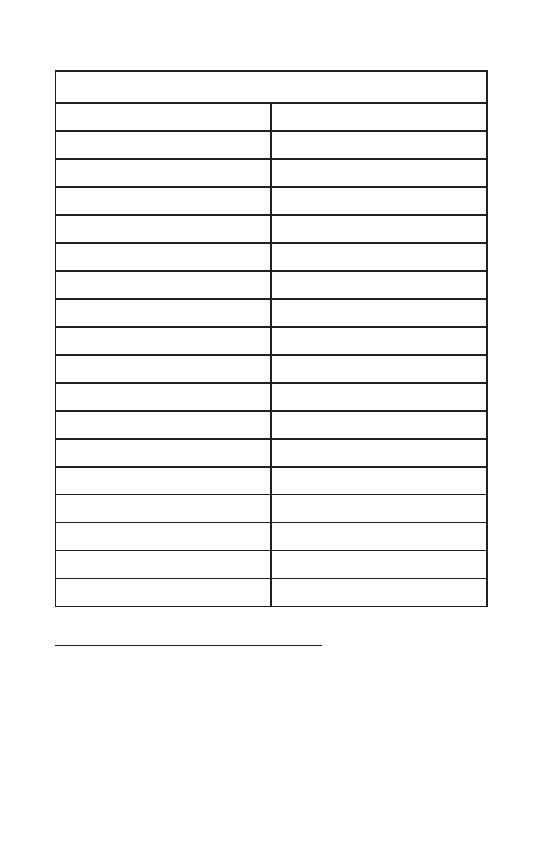
168
Critical language
Analysis
Assumption
Conclusion
Connotation
Denotation
Evaluation
Evidence
Figurative language
Generalization
Interpretation
Inference
Judgement
Metaphor
Opinion
Simile
Symbol
Tone
Valid
Establishing your current reading rate
The method for measuring your reading rate is explained in
Chapter 2 (p. 25). If you choose not to use a selection of books to
establish your reading rate, use the following piece of text from
The Energy Advantage by Dr Chris Fenn (printed with the author’s
permission). The contents are also relevant and useful.

169
11. Useful information and speed practice text
The benefits of giving up caffeine
I found out, from personal experience, the benefits of giving
up the stimulant and not relying on caffeine to get me
through each day. It all began a few years ago when a friend
of mine came to me for advice, complaining that he was
lacking in energy. He had just started a new job in which
he wanted to do well, but each morning he would drag his
38-year-old body out of bed and then struggle through the
rest of the day. Each day he would dash to the station to
catch the early train to work and then sleep for the whole
two-hour journey, thinking that he was tired because of
his early start. When he arrived at the office, he would
immediately reach for the coffee jar before he could even
begin to think about doing anything else. ‘ I needed a cup
of coffee to get me started and then I drank tea and coffee
throughout the day. ’ He also ate chocolate bars, hoping that
they would give him the quick energy boost that he needed.
No matter what he did, he always felt tired, and with crucial
meetings and presentations to give, each day was a real
struggle. He wanted me to give him some new energy pill
or vitaminized drink that would boost his system.
Once I ’ d had a look at the details of what he was eating,
I decided not to put something into his diet to boost his
energy levels, but to take a couple of things out. One of
these was sugar, the other was caffeine. I also realised that
I was drinking a lot of coffee so, four years ago, we both
agreed to give up caffeine. It proved to be a challenge for
us both, especially getting through the initial withdrawal
symptoms. We suffered severe headaches, tension at the
back of the neck and bad temper – it all felt rather like a
dose of flu and lasted for about five days. But, oh was it
worth it; we are now changed people! My friend no longer
feels tired and has to buy two quality newspapers which
he reads from cover to cover on the journey to work. He
doesn ’ t touch the coffee jar and no longer craves chocolate.
(Contd)

170
He feels alive, really enjoys his work and is much more
productive because he feels so well – even though he is still
under a lot of pressure. I, too, feel different and much less
tense without caffeine flooding my system every day. I have
even more energy than I used to (which for a nutritionist
is a good advert!) and I am calmer, even though I run my
own consultancy business, write books and articles for
magazines and newspapers, give seminars and lectures,
design and run my own courses and do television and radio
work! I enjoy the flavour of coffee, but if I drink it now I soon
feel sluggish and develop a headache. I prefer to relish the
aroma when I visit a coffee house, which is much more
pleasant than the effects caffeine has on my system.
Although I was overjoyed at the benefits that two people
found when they gave up caffeine, it got me thinking – I
wonder if other people experience the same benefits. Plenty
of studies have been done to examine the effects of caffeine
on blood pressure or heart rate or kidney function, but not
one, as far as I was aware, had investigated the effects
on personality and general mental performance. I had a
contract with the Lifestyle Health Promotion programme
which was run for the giant oil exploration and production
company, Shell Expro UK. This involved travelling to a
number of production platforms in the North Sea to give
talks and seminars to the offshore teams. Alcohol is banned
offshore – but an awful lot of coffee and other sources
of caffeine are consumed instead. Here was an ideal
opportunity to carry out a small research project on the
effects of giving up (or cutting down) caffeine. It was a very
simple study and involved filling in questionnaires. First,
volunteers were asked questions relating to who they were,
their work schedule, how much caffeine they consumed
each day, and to give a self-assessed rating of their physical
and mental state. They then agreed to take the ‘ Caffeine
Challenge ’ , which was to give up caffeine for a month.
At the end of the four weeks, they were sent a second
questionnaire, again asking them to rate and describe
their mood and mental state. As the questionnaires came

171
11. Useful information and speed practice text
flooding in, it was clear that individuals working offshore
certainly did consume a large amount of caffeine (the average
daily intake was 929 mg). Office workers based on-shore were
also encouraged to take the ‘ Caffeine Challenge ’ and, with a
coffee machine on every floor, they too heavily relied on the
stimulant (average daily intake was 903 mg). A dose of 100
mg (the amount usually found in a single cup of coffee) will
normally produce the stimulating effects we associate with
the drug. An intake over 500 mg per day is considered high,
and is the level at which many individuals begin to experience
the downside of the stimulant ’ s effects: moodiness, anxiety,
restlessness and tension.
I was amazed and surprised at the number of ways many
of the ‘ guinea pigs ’ had benefited from cutting out caffeine
or significantly reducing their intake. Several offshore
engineers reported that they no longer had headaches and
could work much more productively as a team because they
were no longer so tense and wound up. The safety officer
was delighted when his tinnitus (buzzing, thumping, ringing
sound in the ears) was cured. Mike, working in the helicopter
flight control room, announced that he had tried to give up
smoking every year for the past 16 years, but always caved in
after a couple of weeks. Since giving up caffeine, he has gone
for seven months without a cigarette. ‘ I always associated
smoking with drinking coffee, but now I don ’ t miss either! ’
Paul worked as a computer programmer, which he enjoyed,
but every weekend he suffered from headaches and felt
generally depressed, tired and anxious. His wife objected
to his grumpy moods, especially as they soon disappeared
once he was back at work and away from her! Taking part in
the ‘ Caffeine Challenge ’ highlighted the fact that he drank
strong coffee continually throughout the day, which meant
at weekends, when he hardly drank any, he was displaying
withdrawal symptoms. Paul reckoned that changing his
coffee drinking habits at work probably saved his marriage!
I no doubt eased his overworked kidneys too. Caffeine is a
(Contd)

172
diuretic, artificially stimulating the production of urine.
Many of the ‘ Challenge ’ guinea pigs reported not having to
visit the toilet so often (especially during the night), having
cut down their caffeine intake! This has its own practical
advantages, but it also means that the body retains more
of the vital vitamins that are otherwise excreted with the
increased flow of urine every day. Normally the kidneys are
able to selectively excrete the toxic chemicals but retain
other essential nutrients. In particular the B vitamins are
lost when a lot of caffeine is taken. They play a crucial role
in energy metabolism and so, with a high caffeine intake,
the body is losing the very nutrients that are not only in the
mind, but also the body!
CAFFEINE AND SLEEP
The highly subjective reports from individuals who noticed
that they slept much more soundly after taking part in the
‘ Caffeine Challenge ’ confirm the results of a much more
controlled experiment, on the effects of caffeine on sleep,
carried out in Japan. Volunteers who took 150 mg of caffeine
then took an average of 126 minutes to get to sleep, compared
with 29 minutes for those who had not taken caffeine. The
caffeine users slept for a total of 281 minutes in the laboratory
compared with 444 minutes for the non-caffeine users.
Recordings of the electrical activity of the brain showed that
caffeine in all cases significantly altered normal sleep patterns,
and many other similar studies have confirmed these findings.
They also show that caffeine users are more easily aroused by
sudden noises, they move about and are generally a lot less
settled during sleep – and on waking report that they don ’ t feel
as though they have had a good night ’ s sleep.
The sleeping body gives the impression of being totally
switched off; it is not. … [Sleep] is a time when transmitters
and cells are recharged, the brain recovers from the
stresses and strains of the day, and tissues are revitalised.
Overall, it is as vital for subconscious activity as for physical
passivity.

173
11. Useful information and speed practice text
There are two types of sleep: dream sleep, also known as
REM (Rapid Eye Movement); and deep sleep, or non-REM.
Any growth or repair of the body occurs during deep sleep,
but REM (which occurs towards the end of the sleep time)
is for psychological repair. This is the time when the mind
can unwind, and sort through information stacked away in
our sub-conscious during the day.
This is the best time for coming up with solutions to
challenges that you simply couldn ’ t figure out during waking
hours. With inadequate REM sleep we become fretful,
irritable, tense and less able to concentrate. It is thought
that caffeine may affect the quality of REM sleep, and so
contribute to feelings of restlessness at a deeper level.
By now you should be convinced that giving up (or cutting
down) on your caffeine intake is worth a try. At the very
least, you can only discover the benefits. A question I am
often asked is: ‘ What do I drink instead? ’ Remember, it is
important to drink at least three litres of fluid each day.
When you give up coffee, you need to find a replacement
beverage – which doesn ’ t contain coffee – some colas and
soft drinks contain caffeine and this is usually added as a
flavouring and may be listed in the ingredients. …
The exact amount of caffeine in a cup of coffee or tea varies
tremendously. The range for coffee is 30 – 180 mg and for
tea it is 20 – 60 mg. The wide variation is mainly because of
the cup, the quantity and quality of the coffee or tea leaf
used and the method of brew. For example, filter coffee
surprisingly contains more caffeine than percolated coffee
which in turn contains more than instant. This is because
in making filter coffee, although the water passes over
the beans only once, nearly all of the caffeine is dissolved
out of the more finely ground coffee. Repeatedly washing
the coffee, as in the percolated method, only causes more
of the other substances in the bean to go into solution.
Although the actual content of caffeine in tea is greater
(Contd)

174
than in coffee, on average a cup of tea usually contains
less. Caffeine is also released from tea leaves more slowly,
especially if the leaves are in tea bags.
It is possible to cut down your caffeine intake quite
dramatically simply by drinking tea instead of coffee. This
is good news for everyone who really enjoys a good cup of
tea, or who has to choose a drink when only tea or coffee
are on offer. Green China tea is virtually caffeine free and is
best drunk without milk. It has an unusual smokey flavour
and is perhaps an acquired taste. So are many of the new
herb and fruit teas which are streaming onto the market as
alternative caffeine-free drinks. In the past few years, sales
of these in the UK have rocketed, and in 1996, we drank
1,397 million cups of herbal teas alone. This is small brew
compared with other European countries; 70 per cent of
Germans and 50 per cent of French people drink herbal teas
daily. Herb teas are made with flowers, leaves and stems
of all kinds of aromatic plants. Apart from being caffeine-
free, their mild healing properties have been valued for
centuries. If you want to experiment, try the following:
Camomile – to calm your digestion and as a gentle sedative
and relaxant.
Peppermint – to aid digestion and relieve flatulence.
Nettle – as a general tonic, but also to settle nerves.
Lime flowers – to relieve anxiety and nervous tension.
Ginger – an internal antiseptic and anti-inflammatory agent.
Elderflower – a general tonic and mild laxative.
Fruit teas are simply flavoured water. If you read the list
of ingredients you will find that any fruit tea will always
include hibiscus and rose hip. These give what the tea
manufacturers call ‘ body ’ . Flavourings are then added to
the basic mix to create anything from strawberry tea to
more exotic blends such as ‘ Mango and Apple ’ or ‘ Passion
fruit and Pear ’ . They are a good choice if you want a no-
caffeine drink, and with all the varieties on the market,
you won ’ t get bored with the same flavour.

175
11. Useful information and speed practice text
Coffee substitutes, which have never seen a coffee bean, are
also available and popular on the Continent. They usually
contain a mixture of roasted barley, chicory, figs, rye, wheat,
dandelion root or acorns. Make sure you avoid the ones that
contain guarana – a Brazilian herb and a source of caffeine!
WHAT ABOUT DECAFFEINATED TEA AND COFFEE?
If you want to cut down on your caffeine intake, but still
enjoy the flavour of coffee, then choose de-caff. Make
sure that you check the label first because there are two
methods used to decaffeinate the coffee beans; one is
much healthier than the other.
Caffeine is removed from the coffee beans or tea leaves at
the green stage, before roasting or fermentation, by ‘ washing ’
with water or a solvent. The solvent is either methyl chloride
(the basis of paint stripper), or ethyl chloride (better known as
a dry cleaning fluid!). These solvents can leave residues which
are possibly as harmful as the caffeine they are removing. The
other method, known as the Swiss Water Method, involves
water, carbon dioxide and steam to remove the caffeine. It
is more expensive but obviously does not create harmful
residues. Both methods involve heat treatments which can
destroy some of the coffee flavour components.
Most decaffeinated tea is made using the solvent extraction
method, but you need to read the label to check which method
has been used. If the label is vague about the method of
decaffeination, it has probably been done using the solvent
method!
The pure caffeine that is extracted is not wasted. It is ladled back
into soft drinks and also many over-the-counter cold remedies
and headache pills. So, if you suffer from a withdrawal headache
as you cut down on your caffeine intake, remember not to reach
for an alternative source in the form of a headache pill!

176
QUESTIONS
1
What did the author’s friend want from the author?
What did he get instead?
2
What two substances did the author recommend her friend
cut out?
3
The author joined in the exercise. True or false?
4
What symptoms did they suffer from as a result of cutting
those substances out?
5
What effect of caffeine did the author focus on for a study
and which company did she approach?
6
How long did the volunteers have to give up caffeine?
For 3 weeks/1 month/2 months?
7
What were the results from the experiments regarding the
effects of caffeine on sleep?
8
What are the two types of sleep?
9
What happens during each one?
10
Is it important to drink 2, 3, or 4 litres of fl uid per day?
11
What is the difference between herb teas and fruit teas?
12
What are some examples of coffee substitutes?
13
What is guarana?
14 Describe the two different ways of decaffeinating coffee.
15 Where does the caffeine extracted from coffee go?

177
11. Useful information and speed practice text
TEN THINGS TO REMEMBER
1
Understand the language you speak.
2
Explore language patterns and structures.
3
Keep notes of the words you repeatedly trip over. Use them
until you ’ re comfortable with them.
4
Read conclusions and summaries fi rst.
5
Be aware of the pace at which you read. If you get bored
and your mind wanders, increase your reading rate.
6
Reduce your caffeine intake.
7
Get plenty of sleep.
8
If you get headaches when you read, get your eyes tested
(and drink plenty of water).
9
Have fun with language.
10
Actually, just have fun, period.

178
12
What next?
In this chapter you will:
•
receive advice on learning and developing new methods of
reading
•
learn how to turn them into habits
Guidelines for your 21-day programme
When you learn something new you are likely to go through
a phase when you know that you know, but are aware that
you haven ’ t fully assimilated the new information yet. This is
a most fragile time in learning. If you don ’ t follow through
and integrate what you have learned into your way of thinking
and working, your efforts will be wasted. Receiving the
information is easy – you read a book, go to a course, listen
to a CD. When the information is in your head, what happens
next is up to you: Do you use the information or not? Do
you put your course books on the shelf until ‘ later ’ or not?
Do you think ‘ Hmmm, interesting ’ and go back to your old
habits?
Decision and action are needed. The decision takes a split second.
Are you going to become the best you can be?
When you make such a decision, it is important to build a plan.
The problem when you try to change habits is that old habits fi ght
back. One way of making the change process easy is to create
a daily plan. Instead of doing everything in one day and being
overwhelmed, complete the task a bit at a time.

179
12. What next?
Insight
The fi rst time I created one of these programmes I put aside
four hours a day. The programme started at 5 am and
fi nished at 9 am, then I would have breakfast, go for a run
and get on with the day. I didn ’ t even last the week!
The rules for the 21-day programme are generally common sense:
Make your programme not too easy, not too diffi cult – The
programme you create must be easy enough for you to know
it is achievable and challenging enough to excite you.
Select topics that interest you – If you have to read material
that isn ’ t particularly interesting during your normal working
day, then choose other, more interesting material to develop
your speed reading skills.
Build in variety – One day, practise speed reading with a
novel; the next day, try a newspaper; after that a magazine
you ’ ve being wanting to read for a while. Each time the aim is
to read as much as possible, using the most effective technique.
Put aside 20 minutes each day – To practise speed reading,
20 minutes is a guideline. If you have only 10 minutes, that
is fi ne as long as every day you spend that amount of time
working on your new skill. There are exercises in Chapter 3 to
help you. The best time to do your practice is in the morning
because it will act as a reminder to you to pay attention to your
reading as the day goes on. If you can only put 20 minutes aside
in the evening, then remind yourself when you plan your day
in the morning that you have put that time aside and that you
intend to be aware of what you are reading throughout the day.
Integrate your new knowledge – Use your skills during the
day. Practise speed reading every time you read something:
your mail, letters, newspapers, books, e-mails, memos, backs
of cereal boxes – anything.
Keep your purpose clear – If you do not have a purpose you
will quickly lose interest. Keep in mind why you are learning
how to read fast. What else do you want to do with the extra
time you have? What will speed reading do for you?
Practise daily – The more consistent your practice, the better
you will become. If you speed read one day and forget for the

180
next few, the chances are that the number of days between
practising will become more and more.
Teach someone else – When you can teach someone else what
you have learnt, you have learnt it well. If you have children,
teach them – any age is a good time for them to learn. If you
can ’ t answer all their questions use the fi ve-step system to fi nd
the answers.
Read in groups – Developing a reading group is an excellent
way to ensure you practise. Meet once a month or more often
if you like. Make the purpose of the group twofold: fi rstly,
discuss the contents of the book, articles or papers you read; and,
secondly, discuss the reading methods you used or had trouble
with. Also, begin to explore other ways of reading effectively
and bring those to the group. Group motivation will drive your
learning forward. The more people you involve in your learning,
the easier it will be to stay motivated. It helps when there is
someone there to encourage you when you are having diffi culties.
Learn something new every day – No matter how small it is,
add something new to your knowledge. Keep a notebook with
you to record your daily mini-lesson. You will be surprised
how fast your general knowledge grows.
Learn a new word every day – The better your vocabulary is,
the faster you will be able to read.
Be fl exible – If you fi nd your programme is too easy or too
diffi cult, change it.
Don ’ t stop after 21 days – After your fi rst 21 days you will have
integrated the basics of speed reading successfully, provided you
have had suffi cient practice. After that, take your reading to
another level. You have already developed the habit of putting
aside time to practise a new skill. Keep that time available
and use it for developing another skill by applying your speed
reading skills and extending them as you learn something else.
A useful tip is to keep a small notebook in which to write
down comments on the day ’ s reading activities. You could
use the one you keep to record each day ’ s mini-lesson or a
separate one. What did you feel or think as you read? What
was easy? What was diffi cult? What would you change about
the way you read that day? What questions do you have?
181
12. What next?
TIMETABLE TO HELP YOU DESIGN YOUR 21-DAY PROGRAMME
Example
Day
1
Reading material
The morning paper in
less than 20 minutes.
Purpose: practise 5
steps and inform.
Time
20 min.
(6.00–6.20)
What did
I learn?
New developments
in the treatment
of anaemia.
New word
haemoglobin:
protein that gives
red blood cells
their colour.
Day Reading material Time
What did I learn? New word
1
2
3
4
5
6
7
8
9
10
11
12
13
14
15
16
17
18
19
20
21

182
Teach someone else the basics of
speed reading
You may have a child, a friend or a partner who wants to learn.
Here are some steps to follow to teach them effectively and, at the
same time, consolidate your learning:
1
Finish reading this book. Be sure to read the whole book
and check that you fully understand it. If you are going to
teach someone else, you must know what you are talking
about. Have the book handy while you teach so that you can
fi nd answers to any questions that you might not be
sure about. When you look up the answers, look them
up together. That will involve both of you and will make the
learning more of an active process for your student.
2
First, fi nd out what your student already knows or thinks
about speed reading and also what questions they have. Talk
about their learning strategy.
3
Explain in a way that interests them (which may be different
from what you would choose) a little about each aspect of speed
reading that you are going to teach them. The following headings
cover what a person needs to know to understand the basics:
Determine their current reading rate.
How to use a pacer to increase their reading rate.
Different memory techniques.
The fi ve-step system.
Effective use of eyes, including eye exercises.
Flexible reading – reading different types of material.
Problems and solutions.
DETERMINING YOUR STUDENT ’ S CURRENT
READING RATE AND INCREASING IT
1
To determine the reading rate see Chapter 2 (p. 25). Either use
the text by Dr Chris Fenn in Chapter 11 (pp. 169 – 176) or get
your student to select six different pieces of text. Draw up a
speed reading graph for their use (see p. 40).

183
12. What next?
2
Once you have determined their reading rate, talk about the
different factors that may inhibit speed reading and what they
can do to eliminate them.
3
Explain how to use a pacer. Ask them to place a pen or fi nger
at the start of each line and to keep up with your counting.
Count from 1 to 10 fi ve times, starting at approximately one
count every 2 seconds and increasing it to two counts per
second. Ask your student to keep up with you, no matter
how fast you go, at a rate of one line per count. Tell them
that if the pace is getting so fast that they cannot read each
word, that is all right – all they are doing is getting used to
using a pacer.
4
Once they are comfortable using a pacer, invite them to try
some of the exercises outlined in Chapter 2.
5
Then give them a new text to read. Ask them to read as fast
as they can for good comprehension, using a pacer.
6
Plot their speed on the graph. It will have increased.
7
Now, both of you take a break and have a cup of
caffeine-free tea or coffee.
DIFFERENT MEMORY TECHNIQUES
1
Once you have taken a break, ask your student to try to
remember as much as they can from the texts just read.
2
Then fi nd out what strategy they used. Did they just remember
it? Did they write anything down? Did they already know
something about the subject, so they found it easy to recall?
3
Next, to expand your student ’ s skills go through each of the
memory strategies outlined in Chapter 5 (pp. 79 – 90). Allow
your student to experience them all.
4
When they have done that, put this book and any notes aside
and get your student to tell you what they just read in as much
detail as possible. Sometimes we think we understand and
remember what we read, but if we have to tell someone else
about it we fi nd we cannot. If your student can tell you about
the passage in suffi cient detail, then the technique worked. You
just have to determine whether it allowed them to read as fast
as they wanted to.

184
5
Remind your student that the best memory techniques
are those that allow them to remember what they want to
remember when they are reading as fast as they want to read.
6
Also, when they select a memory technique they must think
about when they are going to need to use the information
again; this will determine what method they choose.
THE FIVE-STEP SYSTEM
1
Using the summaries of the fi ve-step system (pp. xv – xvii and
pp. 1 – 20), demonstrate to your student exactly how to use it.
Do this with two different newspapers. Each of you takes one
and goes through the fi ve-step system. The aim of the process
should be to gather as much general news as you can and to
fi nd the one story that interests you most.
2
Once you have selected a story, use the memory technique
each of you thinks suits the story best. Then, in turn, tell
each other in as much detail as possible what the story
was about.
3 Time yourselves. Try to get through an entire newspaper
in less than 15 minutes.
USING THEIR EYES EFFECTIVELY
You can both take part in this.
1
Supply your student with a copy of this book. Both of you
do all the eye exercises in Chapter 8.
2
At the end of each one, discuss what you noticed.
3
Before you carry on, do another speed reading assessment.
FLEXIBLE READING
1
Gather together a collection of very different reading materials:
letters, reports, book, articles, magazines, newspapers.
2
Work with your student to read each one as fast as
possible. Determine what the best approach for each one is
as you go. Remember to state your purpose for reading
the document.

185
12. What next?
PROBLEMS AND SOLUTIONS
1
Spend some time talking about the different environments in
which each of you reads, and what the different challenges
associated with each are. Work out ways to get round them.
2
Finally, to test your long-term memory, both of you should
recall as much as you can without referring to the texts you
have read during this training.
Summary of the five-step system
of effective reading
At the end of each step ask yourself:
What is my purpose? Do I have my answers yet?
Do I need to go further?
Step 1
What do I already know?
What do I still need to know?
Step 2
Overview of the book.
Eliminate unnecessary material and highlight areas
that warrant further study.
Step 3
Familiarize yourself with the level of vocabulary
(technical/layman).
Continue to highlight areas of interest.
Step 4
Read the first paragraph of each chapter and the first
sentence of each paragraph.
Continue to eliminate unnecessary areas.
Step 5
Select what you need or want to read and then read it.

186
The A to Z of effective reading
A Active reading
Take notes, write in margins, circle, highlight,
underline, think, argue, debate your way through whatever
you read.
B Believe
You are capable of phenomenal things. Make what
you learn in this book your fi rst step to effective reading.
Look constantly for a better way of doing what you do.
See the book list that follows for advice about where to
go to reach the next level.
C Comfort
Make sure your environment is as comfortable as
possible. If it is not, then change it or move. If you can do
neither, use multi-sensory reading to help maintain your
attention and concentration and take a break every 15 minutes.
Concentration
Practise concentration techniques. Remember
that without concentration there is no memory, whether you
are reading or whether you are taking in names.
D Determination
Don ’ t give up. Sometimes you might feel
frustrated. This is a natural part of the learning process. In
between your old habit and your new improved skill there
may be a period when you know what you are capable of
but also know that you haven ’ t got it quite right yet. Learn
to enjoy this feeling; it means you are going in the right
direction. Take the time to sit back, re-affi rm your purpose,
relax and carry on.
E Enjoy
The more you enjoy reading, the less stressed you will
be and the better you will remember what you read. When
you state your purpose include enjoyment as part of it.
F Five-step system
Apply it to everything you read.

187
12. What next?
Flexibility
Remember that you don ’ t have to read fast all the
time. Develop the skill of being able to identify when you
can read fast and when you have to slow down.
G Groups
Work with other people. Sometimes a group
of brains is better at staying motivated than one working
alone.
H Harassed
If you are feeling stressed or tired your
effectiveness will diminish. Stop and take a break, especially
if you feel you do not have the time to do that.
I Ideas
Cross-reference, combine and elaborate on ideas
between texts. Play the ‘ What if ’ game with new ideas.
Ask what would happen if X happened instead of Y.
What would happen if you can read a page a second?
J Justify
Make sure you justify doing each piece of reading
someone else asks you to do. Always ask yourself why you
have to read it and what call it will have on your time.
K Knowledge
Make increasing your knowledge of yourself
and the world around you a daily goal.
L Learn
Make it a habit to learn something new from your
reading every day.
M Manageable chunks
Avoid reading for more than 30 minutes
at a time. Break up your reading into chunks that can be
achieved in that period of time. If you have a lot of reading to
do, set a clock to remind you to take a break.
Memory
Improve it by breaking your reading up as advised.
N Novels
Using the fi ve-step system for novels may spoil the
ending. You will fi nd, however, that the speed at which you
can read novels will increase as a result of your speed reading

188
practice. You will not lose any of the enjoyment; in fact, you
may fi nd you fi nish more of the novels that you begin.
O Organized
Clear your desk of everything other than what
you are working on at the time. Create a good fi ling system
of ideas, books, papers and references. Organize your
learning. Decide what you want to learn, where you are
going to fi nd it and how you are going to set about doing so.
P Pacer
Use a pacer to increase your speed whenever you are
reading, especially when you are tired.
Purpose
Have a clear and defi nite purpose whenever you
read anything.
Q Question
Always ask questions. Just because what the
author has said is in print, that does not mean that they are
right.
R Revise
Refer to notes you have made previously whenever
you have the opportunity to do so. Sometimes we only
appreciate something later. Also, revision is vital for recall.
S Stretch
Your body is involved in your reading as well as
your mind. Reading can be a passive activity. When you read
for any length of time your body may become stiff. Stretch
your body whenever you take a break. If you feel that you
are losing concentration make a good stretch the fi rst thing
you do.
T Time
Take time to develop any new skill. Enjoy the gap
between knowing you don ’ t know how to do something and
achieving success. Be patient with yourself.
U Use
The more you use the information you learn, the better
you will remember it and be able to apply it when you need
it. Teach someone else, write a report, an article or a book,
discuss what you read with others.

189
12. What next?
V Vocabulary
Use Steps 2 and 3 (preview and passive reading)
to identify words you don ’ t understand. Look them up before
you continue. If you encounter a word you don ’ t understand
while you are reading, take note, keep going and look it up
at the end of the paragraph or section. You may fi nd that the
meaning becomes clear in the context of the text.
W Work is play with a suit on
Make whatever you do fun
and you will be able to carry on longer and perform more
effectively.
X Explore
Find information from as many different sources as
possible. Sometimes you can get what you are looking for in a
text more quickly from a phone call to an expert or a friend.
Y You
Reading and learning is a personal skill. Often you are
the only one involved when you have to perform. Make sure
that the techniques you use work for you. Try a variety of
different ways of reading and learning and create a set of
tools that suits you.
Z ZZZ
Sleep. Avoid reading and studying at the expense of a
good night ’ s sleep. Take breaks whenever you need them.

190
TEN THINGS TO REMEMBER
1
Design a 21-day programme to help you develop your reading
habits further.
2
Do something different. If you put this book down and go
back to your old habits you will have wasted your time and
will continue to do so by reading ineffectively.
3
Practise on everything from cornfl akes boxes to
encyclopaedias.
4
Talk about what you read.
5
Learn something new every day.
6
Be interested in what you ’ re reading – even if you have to con
yourself into it.
7
Read what you ’ re interested in.
8
Have a clear purpose.
9
In case you missed the last top tip have a clear purpose,
regardless of what you ’ re reading.
10
One more time (just because your memory might need some
help): know why you ’ re reading something.

191
Taking it further
Taking it further
These are only a few of the resources available to you to continue
your development. In some cases, the entire book is excellent; others
will have gems that are worth looking for. Look for new information
everywhere. Attend as many courses as you can. Remember that not
everything has to be read – learn from audio programmes.
www.madaboutbooks.com : Quality information from Hodder and
Stoughton
www.chrisfenn.com : For more information on Dr Chris Fenn.
To obtain Dr Chris Fenn ’ s book, The Energy Advantage , contact
the author at Input Nutrition, 19 Craigton Court, Aberdeen,
Scotland AB15 7PF
Beaver, Diana, Lazy Learning , Element, 1994
Berg and Conyers, Speed Reading the Easy Way , Barron ’ s, 1998
Berg, Howard S., Super Reading Secrets , Warner Books, 1992
Buzan, Tony, The Speed Reading Book , BBC, 1997
Cutler, Wade E., Triple Your Reading Speed , Macmillan, 1993
Coman and Heavers, What You Need to Know About Reading
Comprehension and Speed , Skimming and Scanning , Reading for
Pleasure , National Textbook Company, 1995, 1998
Davis, Eshelman, McKay, The Relaxation and Stress Reduction
Handbook , New Harbinger Publications, 1998
DePorter, Bobbi and Hernacki, Mike, Quantum Learning , Piatkus, 1995

192
Dryden, Gordon and Vos, Jeannette, The Learning Revolution ,
Accelerated Learning, 1994
Dudley, Geoffrey A., Rapid Reading , Thorsons, 1997
Dudley, Geoffrey A., Double your Learning Power , Thorsons, 1986
Fenn, Chris, The Energy Advantage , Thorsons, 1997
Fritz, George, The Open Focus Handbook , Biofeedback
Computers, 1982
Herrmann, J., Raybeck, J., and Gutman, J., Improving Student
Memory , Hogrefe and Huber Publishers, 1996
Hooper, Judith and Teresi, Dick, The Three Pound Universe ,
Tarcher Putnam, 1992
Hunt, D.T., Learning to Learn , Elan, 1993
King, Graham, The Secrets of Speed Reading , Mandarin, 1994
Khalsa, Dharma Singh, Dr, Brain Longevity , Century, 1997
Konstant, Tina, Successful Speed Reading in a Week , Hodder and
Stoughton, 2001
Konstant, Tina and Taylor, Morris, Mental Space , Pearson
Education, 2002
Konstant, Tina and Taylor, Morris, Managing Information
Overload , Hodder Education, 2008
Leo Angart (Presented by), Vision: The Minds Eye , NLP Asia Ltd
Lorayne, Harry, Improve Exam Results in 30 Days , Thorsons, 1992
Luria, A.R., The Mind of a Mnemonist , Harvard, 1968

193
Taking it further
McKim, Robert H., Experiences in Visual Thinking , PWS Publishing
Northledge, The Good Study Guide , The Open University, 1990
Ostrander, S. and Schroeder, L., Superlearning 2000, Souvenir
Press, 1994
Ostrander, S. and Schroeder, L., Cosmic Memory , Simon and
Schuster, 1992
Rose, Colin, Accelerated Learning , Accelerated Learning Systems
Ltd, 1995
Rozakis, Laurie E., 21st Century Guide to Increasing your Reading
Speed , 21st Century Works, 1996
Rozakis, Laurie, Power Reading , Macmillan
Schwartz, David J., Maximise Your Mental Power , Thorsons, 1986
Szantesson, Ingemar, Mind Mapping and Memory , Kogan Page, 1994
Treacy, Declan, Clear Your Desk , Arrow, 1998
Turley, Joyce, Speed Reading in Business , Crisp Publications, 1989
Wenick, Lillian P., Speed Reading Naturally , Prentice Hall
International, 1990

194
21-day programme, 178 – 81
active reading, 10 – 12, 77,
132, 186
acupressure, 124, 125
advice, see hints
alertness, stimulating, 67
application and purpose, 18
associations and memory,
75, 92, 93
attention, 54, 55 – 7
and forgetting, 92
in memory acquisition, 76
attitude, 11, 23
auditory memory, 91, 110
autopilot, 55 – 6
being present and in
perspective, 67 – 8
bibliography of book, 7 – 8
bilingual readers, 37 – 8
blinking and eye-strain, xxi, 123
boredom and attention, 55
breaks, 61 – 2, 132
breathing exercises, 65 – 7
caffeine (book extract), 169 – 76
coffee, 61
cartoons in book, 6
chair and concentration, 137
clutter, 62 – 3, 139
coffee, 61
comfort, xxiii, 186
comprehension, 40 – 1
concentration, xxii – xxiii, xxiv,
54 – 5, 186
and environment, 136 – 7
exercises/tips to
improve, 61 – 70
and food/hunger, 64, 136
lack of, 132 – 5
and music, 63 – 4, 133 – 4
and purpose, 132
contact lenses and eye-strain,
124
context mapping, 80
contradiction words, 35
cortisol, 59 – 60
cover of book, 5
critical reading, 104 – 6
language exercise, 167 – 8
deliberate action exercise,
68 – 9
desk
and concentration, 137
and distractions, 139
dictionaries, 48, 51, 52
difficulty of text, 22
discoveries and attention, 55
dispersed attention, 56
distractions, xxiii, xxv, 4,
131 – 40
divided attention, 56 – 7
earplugs, 133
ears vs eyes, xi, 28, 37, 109 – 11
exercise, 117 – 19
Index

195
Index
e-mails, reading, 101 – 2, 139
evaluation and purpose, 19
eye nutrition, 127 – 9
eye-robics, 124
eyes vs ears, xi, 28, 37, 109 – 11,
117 – 19
exercises for, xxi, 115 – 22,
123
nutrition for, 127 – 9
and reading, xxv, 108 – 30
sore eyes, 136
eye-strain, xxi – xxii, 122 – 7
eyewashes, xxi, 124
exams, 159 – 61
exercises/tests
comparison of
purposeless vs
purposeful reading, 26
for concentration, 65 – 70
eye- vs ear-reading,
117 – 19
for eyes, xxi, 115 – 22, 123
for language, 167 – 8
levels of meaning, 15 – 17
memory techniques,
82 – 90
‘ one-minute trip ’ , xix – xx
peripheral vision, 115 – 17,
122
for reading rate, 24 – 6,
39 – 43, 168 – 76
roots/suffixes/
prefixes, 163 – 7
for speed and
memory, xix – xx
experiments
circles in the air, 27 – 8
divided attention, 57
eye-strain, 122 – 3
Japanese words, 32 – 3
thought experiment, 12
familiar material and
pacing, 30
fiction, evaluating, 105 – 6
five-step reading system, xxiv,
xv – xvii, 1 – 20
active reading step
(content/ideas), xvi, 10 – 12
passive reading step
(language), xvi, 8 – 9
prepare step, xv, 2 – 4
preview step
(structure), xv – xvi, 4 – 8
selective reading step, xvii,
12 – 14
fixation time, 111
flexibility, 41, 187
focus and eye-strain, 124
food and concentration, 64
foreign language, 38
foreword of book, 6
forgetting, 92 – 4
frequently-asked
questions, xiv
glossary of book, 7
graphics in book, 6
hints/tips/advice
improving
concentration, 61 – 4
increasing speed, 31 – 2
peripheral vision, 122
specialist text, 103
hunger and concentration, 136

196
idea, finding main, 10
implied meaning, 15
index of book, 7
indexing technique, 81 – 2
inferred meaning, 15
information, finding, 147 – 8
information bottleneck, 141 – 2
instructions, reading, 102 – 3
interaction and purpose, 18
interest
and attention, 55
and forgetting, 93
in memory acquisition, 76
and motivation, 57 – 8
interference and
forgetting, 92 – 3
intermediate memory, 74 – 5
interruptions, 138
key sentences exercise, 41
keywords technique, xviii, 79
knowledge
acquiring/gathering,
54, 83, 97, 180, 187
old and new, 73, 75, 93, 179
leisure reading, 97
light and concentration,
xxiii, 136
linear technique (notes),
xviii, 79
links and memory, 75, 92, 93
literal meaning, 15
long-term memory, 75
magazines, reading, 99 – 100
mail, 97 – 8, 139
margin reading, xix, 79 – 80
meaning, reading for, 14 – 18
measuring reading rate,
25 – 6
meetings, 145 – 7
memory, xxv, 72 – 95
acquisition, 76 – 7
and cortisol, 59 – 60
retention, 77
retrieval, 78
state-dependent, 59
and stress, 58 – 61
memory techniques, 79 – 91
mental numbers exercise,
69 – 70
message, getting the, 36 – 7
metronome pacing, xx – xxi,
42 – 3
mind-mapping, xix, 80 – 1
mood, 22
monitor, see PC monitor
motivation, 11
and forgetting, 93
and interest, 57 – 8
multisensory reading, 90 – 1
music and concentration, 63 – 4,
133 – 4
need to know, 141 – 2
newspapers, reading, 98 – 9
noise as distraction, 133 – 5
non-fiction
evaluating, 105
reading, 97
novels
and pacing, 42
reading, 100 – 1, 187 – 8
nutrition (food), 64
for eyes, 127 – 9

197
Index
‘ one-minute trip ’ exercise,
xix – xx
open-plan spaces, 134
pacer, 27 – 31, 188
palming (eye exercise), xxi, 123
passive reading, 8 – 9
PC monitor, reading from,
xxii, 126 – 7
peripheral vision, 111 – 12,
113 – 14
exercises for, 115 – 17, 122
pictures in book, 6
planning reading, 76, 143 – 4
prediction and purpose, 18
prefixes, 50, 163, 165 – 6
preparation/planning, xv, 2 – 4, 76
present, being, 67 – 8
pressure, reading under, xxv, 148
previewing, 4 – 8
prioritizing reading, 143 – 4
process-map, 82
procrastination, 142 – 3
progression, 112
purpose
clarity of, 22, 179, 188
and concentration, 132
reading with, 18 – 19
questions to ask
in active reading step, 11
in preparation step, 3, 4
regarding purpose, 21
about where you are
now, 24
reading rate, 24 – 8
exercises for, 24 – 6, 39 – 43,
168 – 76
recognizing and memory, 78
reducing reading, 151 – 2
regression, 112
remembering, xiv, xviii
research, reading for, 97
rewards, 62
revision, 72, 160, 188
and forgetting, 94
roots of words, 50, 163 – 4
scanning, 32 – 5
selective reading, xvii, 12 – 14
short-term memory, 74
skimming, 32 – 6
solution and purpose, 19
sore eyes, 136
specialized vocabulary, 51 – 2
state-dependent memory, 59
story, finding the, 101
stress, 22, 136
and cortisol, 59 – 60
and memory, 58 – 61
time out exercise, 70
studying, xxvi, 155 – 9
sub-vocalization, xi, xx, 28
suffixes, 50, 163, 166 – 7
sun and the eyes, 123
swinging (eye exercise), 123 – 4
table of contents, 6
tables in book, 6
technical material
and pacing, 29 – 30
reading, 96
terminology, 22
tests, see exercises
thirst and concentration, 136
time, making most of, 144 – 5
time management, 57, 159 – 61

198
time out exercise, 70
timetabling, 158 – 9
tips, see hints
tiredness, 135
trigger words, 35
urgency, 22
visual memory, 91, 110
vitamins for eyes, 123, 128 – 9
vocabulary, xxiii, xxiv, 48 –
52, 189
vocalizing, 32
sub-vocalization, xi, xx, 28
voluntary attention, 55
warm-up exercise, 39 – 40
work, 189
distractions, 137 – 8
reading for, 97 – 8
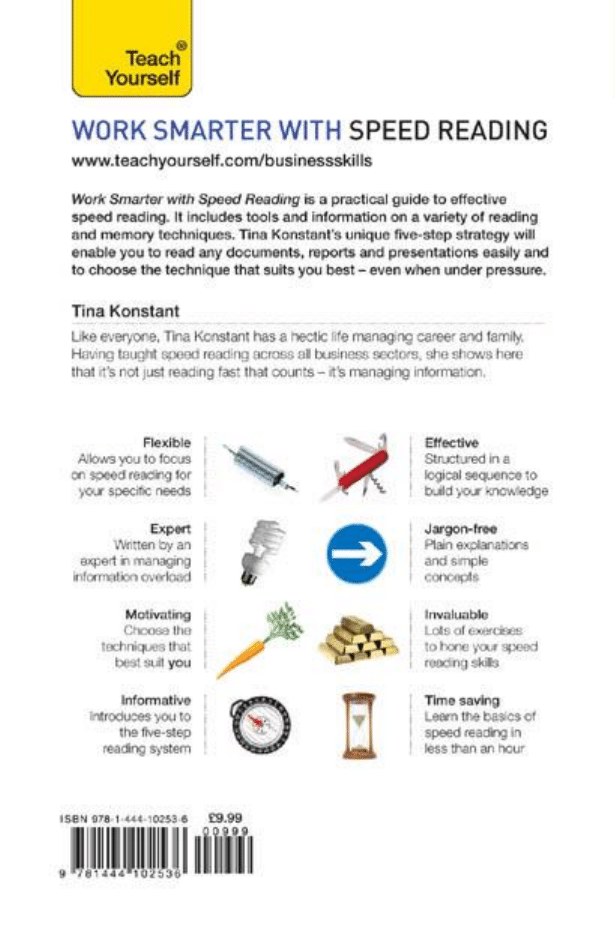
Document Outline
- Cover
- Book title
- Contents
- Meet the author
- Only got a minute?
- Only got five minutes?
- Only got ten minutes?
- Introduction
- 1 The five-step reading system
- 2 Speed reading
- 3 It’s all in the words – developing your vocabulary
- 4 Concentration
- 5 Memory
- 6 A book is a book is a book
- 7 Your eyes and effective reading
- 8 Distractions and solutions
- 9 Real-world reading
- 10 Working and studying for a living
- 11 Useful information and speed practice test
- 12 What next?
- Taking it further
- Index
Wyszukiwarka
Podobne podstrony:
Breakthrough An Amazing Experiment in Electronic Communication with the Dead by Konstantin Raudive
06 Sorani Kurdish A Reference Grammar With Selected Readings
2 17 26 Hot Work Steels with Improved Properties for Die Casting
(Ebook Science) Stephen Covey The Speed Reading Course
Goals to Work on with Your Coach
Lean Excel Top Functions Quick Reference Guide with 500 Examples! by Scott Ratliff
4 body language speed reading
Skills to Work on with a Coach
A Bibliography of Sign Languages, 2008 2017 With an Introduction by Myriam Vermeerbergen and Anna Le
Speed Palmistry by Pt VR Sharma
A Course in Cosmic Consciousness Oneness With The Divine by Karl Hans Welz
What You Really Need to Know About Moving House with Feng Shui by Jane Purr (2000)
Bloom’s Literary Themes The Labyrinth ed and with an intro by Harold Bloom Vol Editor Blake Hobby
ebook Self Help Speed Reading Workbook
The Lord of the World (Le Roi du Monde) by René Guenon with a Biographical Note by Pietro Nutrizio (
101 Things to Work on with Your Coach
Enochian Temples Invoking the Cacodemons with the Temple by Benjamin Rowe
Speed Reading Workbook
więcej podobnych podstron