
THE
GOSPEL OF ST. LUKE
RUDOLF STEINER
Ten lectures given in Basle
15th–26September 1909
Translated by D. S. Osmond with
The assistance of Owen Barfield
RUDOLF STEINER PRESS, LONDON
First English Edition 1929
Made and Printed in Great Britain by
The Garden City Press, Limited
Letchworth, Hertfordshire.

The Gospel of St. Luke
The following lecture-course was given by Rudolf Steiner to an
audience familiar with the general background and
terminology of his anthroposophical teaching. It should be
remembered that in his autobiography, The Course of My
Life, he emphasises the distinction between his written works
on the one hand and, on the other, reports of lectures which
were given as oral communications and were not originally
intended for print. For an intelligent appreciation of the
lectures — and very specially so in the case of those contained
in the present volume — it should be borne in mind that
certain premises were taken for granted when the words were
spoken. ‘These premises,’ Rudolf Steiner writes, ‘include, at
the very least, the anthroposophical knowledge of Man and of
the Cosmos in its spiritual essence; also what may be called
“anthroposophical history”, told as an outcome of research
into the spiritual world.’
On each of the Gospels Rudolf Steiner gave more than one
special course, as well as innumerable lectures on the
mysteries connected with the figure of Christ-Jesus in celestial
and earthly history. All these courses and lectures lead into
the deepest secrets of Christianity and as well as the earlier,
fundamental work, Christianity as Mystical Fact, are
indispensable for reference at every stage of the study of
Spiritual Science.

A list of publications in English translation relevant to the
themes of the following lectures, and a summarised plan of
the Complete Centenary Edition of Rudolf Steiner's works in
the original German will be found at the end of the present
volume.

CONTENTS
Synopsis
Lecture One Initiates and Clairvoyants. The various Aspects
of Initiation. The four Gospels considered in the light of
spiritual-scientific investigation 15th September, 1909
Lecture Two The Gospel of St. Luke: au Expression of the
Principle of Love and Compassion. The Missions of the
Bodhisattvas and of the Buddha 16th September, 1909
Lecture Three The Influx of Buddhistic Conceptions into
the Gospel of St. Luke. The Teaching of Buddha. The Eightfold
Path 17th September 1909
Lecture Four Sanctuaries of Leadership in ancient Atlantis.
The Nirmanakaya of Buddha and the Nathan Jesus-child. The
Adam-soul before the Fall. The Reincarnation of Zarathustra
in the Solomon Jesus-child 18th September, 1909
Lecture Five The great Streams inspired by Buddha and by
Zarathustra converge in Jesus of Nazareth. The Nathan Jesus
and the Solomon Jesus 19th September, 1909
Lecture Six The Mission of the Hebrews. Buddha's Teaching
concerning the Ennoblement of Man's Inner Nature, and
Zarathustra's Teaching concerning the Cosmos. Elijah and
John the Baptist 20th September, 1909

Lecture Seven The two Jesus-Children. The Incarnation of
the Christ in Jesus of Nazareth. Vishva Karman, Ahura
Mazdao, Jahve. The Lodge of the Twelve Bodhisattvas and the
‘Thirteenth’ 21St September 1909
Lecture Eight The Evolution of Consciousness in Humanity
during the post-Atlantean Epoch. The Mission of Spiritual
Science: Mastery of the Physical by the Spiritual. Illness and
Healing. The Influences proceeding from the Christ-Ego 24th
September, 1909
Lecture Nine The Law given on Sinai: the last prophetic
Announcement of the Ego. Buddha's Teaching of Compassion
and Love. The Wheel of the Law. Christ the Bringer of the
living Power of Love 25th September, 1909
Lecture Ten Christianity and the Teaching of Reincarnation
and Karma. Jonah and Solomon: Examples of two modes of
Initiation in olden Times. The Christ Principle and the new
mode of Initiation. The Event of Golgotha: Initiation resented
on the outer Plane of World-History 26th September, 1909

SYNOPSIS
The purpose of the following synopsis is to facilitate reference
to particular subjects dealt with in the several lectures, the
headings being in the order in which the themes occur. Page
numbers have not been included for the reason that the main
themes often weave between the foreground and the
background several times in a lecture and the paragraphs
dealing with them should in every single case be read in their
contexts.
D.S.O.
Lecture One
Initiates and Clairvoyants. Differences in the nature of
experiences at each of the three stages of higher Knowledge:
Imagination, Inspiration, Intuition. The Christ Event depicted
in each Gospel from the standpoints of the different forms of
supersensible Knowledge: e.g. the Gospel of St. John is based
chiefly upon Inspirational and Intuitive cognition, and less
upon pictures derived from the world of Imagination. The
Gospel of St. Luke is founded upon the communications of
‘seers’ (clairvoyants), of those who were ‘servants of the
Word’. The Gospels are not the source of anthroposophical
knowledge — which consists in the results derived from actual
ascent into and investigation of the supersensible world.
Reading the ‘Akashic Chronicle’ in which is recorded
“everything that has ever happened in the evolution of the

world, the earth and humanity”. Investigation of the Akashic
Chronicle is full of complications, especially when concerned
with previous incarnations of a human being; the antecedents
of physical, etheric and astral bodies, as well as of the Ego,
must be traced. This also applies in the case of the Being
known as Jesus of Nazareth, or, after the Baptism, as Christ
Jesus. Differing accounts of the childhood of Jesus in the
Gospels of St. Matthew and St. Luke. The findings of spiritual
investigation in connection with events prior to the Baptism
and the descent of the Christ into the three bodies of Jesus of
Nazareth.
Lecture Two.
The Gospel of St. John, a text for mystics. The Gospel of St.
Luke: a book for the multitude, for simple hearts and souls; a
source of consolation for the oppressed. “Love is revealed to a
greater extent in the Gospel of St. Luke than in any other
Christian text.” Many pictorial representations of Christian
truths in art are inspired by this Gospel. An account of the
appearance of the angel and heavenly host announcing the
birth of the Saviour to the shepherds. Correct rendering of the
words (Luke II, 14) would be: ‘The Divine Beings manifest
themselves from on high, that peace may reign below on the
Earth among men who are filled with good will.’ Convergence
of spiritual streams in the events of Palestine. The picture of
the angelic host portrays one of the spiritual streams that
flowed through the evolution of humanity. This spiritual
stream is Buddhism — the religion of compassion and love.
Description of the nature, the earlier development, the
spiritual powers and the mission of the Bodhisattva who in his
twenty-ninth year became Buddha, six hundred years before
our era. Account of his power of astral vision; his escape from
his father's palace; his experiences in the world and

temptation by the, demon Mara. Legend of the horse,
symbolizing faculties bestowed from above and not yet
developed from a man's own soul. The teaching of compassion
and love, embodied as a human quality, arose when ‘under the
Bodhi tree’ the Bodhisattva became Buddha. He does not
thereafter return to earthly incarnation but from spiritual
worlds participates in happenings on Earth. It was the
glorified Buddha who appeared to the shepherds in vision and
rayed down his power upon the child born to parents
descended from the priestly (Nathan) line of the House of
David. The, prophecy of the sage Asita in India that after his
death the child horn as the Bodhisattva would become
Buddha. Asita was born again as Simeon to whose spiritual
vision the glorified Buddha was revealed above the head of the
Nathan Jesus-child on the occasion of the presentation in the
temple. (Luke II, 25–32. )
Lecture Three
The spiritual achievements of Buddhism stream from the
Gospel of St. Luke but in an even higher form. Compassion
and love in the highest sense of the words are the ideal of
Buddhism. Love transformed into deed is the ideal presented
in the Gospel of St. Luke. Christ Jesus depicted as the
Physician of body and soul. Buddhism appears in this Gospel
as though rejuvenated. The Bodhisattva and his participation
in the evolution of humanity before becoming Buddha in his
final incarnation on Earth. Remembrance of his incarnations.
Knowledge previously possessed must be freshly acquired in
each incarnation according to the needs of the time. The
attainment of Buddha-hood signified the complete descent of
the Bodhisattva into a human physical body. The teachings of
the great Buddha were eventually to become powers
universally possessed by men, arising from within themselves

and from thence streaming back into the cosmos. In Buddha
these powers were incarnate for the first time. This is a fact of
far-reaching importance for the whole evolution of the Earth
and of humanity. The Buddha's inaugural sermon at Benares.
The essentials of Buddha's teaching expressed in the
principles of the Eightfold Path. Legend of the ‘hare in the
moon’. The Buddha's influence continues to work after his
final incarnation on the Earth. The names of the spiritual
sheaths of a Being such as the Bodhisattva who became
Buddha: DHARMAKAYA (before the attainment of Buddha-
hood); SAMBHOGAKAYA (‘body of perfection’);
NIRMANAKAYA (‘body of transformation’). Revelation of the
Nirmanakaya of Buddha to the shepherds and its union with
the astral sheath detached from the twelve-year-old Nathan
Jesus-child. Rejuvenation of Buddhism. The finding of Jesus
in the temple and the change manifest in him.
Lecture Four
The scene in the temple. The unique nature of the Jesus-child
descended from the Nathan line of the House of David.
Preservation of the fresh forces of childhood. Earlier planetary
embodiments of the Earth and of primeval epochs in
evolution. Separation of Sun and Moon from the Earth
(reference should be made to Occult Science — an
Outline,Chapter IV). Separation of Moon was necessary to
enable man to become the bearer of an Ego. Before that
separation, human souls (all but the very strongest) were
obliged to leave the Earth for a time because of its increasing
solidification. Unable to find suitable bodies, these souls were
transferred to the other planets — to Saturn, Jupiter, Mars,
Venus, Mercury — whence at a later time they gradually
returned to the Earth. ‘An ancestral human pair’ — Adam and
Eve. The Atantean Oracles and the task performed by the

Manu, the great Initiate of the Sun Oracle, to ensure the
continuation of civilization in the post-Atlantean epoch. The
Holy Rishis of India. Zarathustra: the inaugurator of ancient
Persian civilization; a later incarnation in ancient Chaldea and
still later as Jesus of the Solomon line of the House of David.
Hermes received the astral body, and Moses the etheric body
of Zarathustra. The Rishis spoke of ‘Vishva Karman’ and
Zarathustra proclaimed as ‘Ahura Mazdao’ the Being who
later appeared as Christ. The Nathan Jesus and the great
‘Mother-Lodge’ of humanity. The effects of the Luciferic
influence. The ‘Tree of Knowledge of Good and Evil’ and the
‘Tree of Life’. The Fall of Man. Certain forces in the ‘Adam-
soul’ were withdrawn and remained guiltless; they were
conducted as a ‘provisional Ego’ to the child described in the
Gospel of St. Luke. Joseph, the father, is therefore given a
lineage extending back to Adam, who is himself ‘born of God’.
This secret was also known to St. Paul and underlies his
reference to the ‘Old Adam’ and the ‘New Adam’. (See I Cor.
XV, 45–7.) The Adam-soul as it was before the Fall was in the
Nathan Jesus-child. Buddhism rejuvenated by the youthful
forces of this child when his astral sheath united with the
Nirmanakaya of Buddha. Two lines of descent from David: the
Nathan (or priestly) line and the Solomon (or kingly) line. The
child Jesus of St. Luke's Gospel descended from the Nathan
line; the child Jesus of St. Matthew's Gospel from the
Solomon line. Both children were horn in Bethlehem.
Reincarnation of Zarathustra in the Solomon Jesus-child.
Lecture Five
Fusion of Buddhism and Zoroastrianism made possible
through the births of the two Jesus-children in Palestine.
Interval of ‘a few months’ between the two births. Both the
Nathan Jesus (Gospel of St. Luke) and John the Baptist were

born after the massacre of the innocents. The Solomon Jesus
(Gospel of St. Matthew) and the flight into Egypt to avoid the
massacre. Contrast between Buddhism and Zoroastrianism.
Through his pupils Hermes and Moses, Zarathustra made
provision for the Egyptian civilization-epoch and also
influenced the civilization of the Hebrews. Hermes bore
within him the astral body of Zarathustra; Moses, bearing the
etheric body of Zarathustra, was able to present in Genesis,
mighty pictures of happenings in Time. Zarathustra born in
Chaldea about 600 B.C. as Zarathas or Nazarathos; his pupils
there were ‘Wise Men’ or ‘Magi’ whose wisdom revealed to
them in a later incarnation that their teacher had been born in
Bethlehem (as the Solomon Jesus). Their gifts of gold,
frankincense and myrrh. Through the flight into Egypt, the
Zarathustra-Ego was able to reunite with the forces once
sacrificed by him to Hermes and Moses. After the return from
Egypt the family of the Solomon Jesus settled in Nazareth
near the family of the Nathan Jesus and the two boys grew up
in close proximity. Qualities transmitted by heredity: will and
power by the paternal element; inwardness by the maternal
element. Annunciation of the birth of the Solomon Jesus was
to tic father, and of the Nathan Jesus to the mother. The birth
and mission of John the Baptist. The relationship between the
soul-being in the Nathan Jesus and the Ego in John the
Baptist. The meeting between Mary and Elisabeth.
Contrasting natures of the two Jesus-children: the Solomon
Jesus gifted with prematurely advanced understanding of the
outer world; the Nathan Jesus with infinite depth of feeling.
The, twelve-year-old boy in the temple, when the Ego of
Zarathustra left the body of the Solomon Jesus and passed
into that of the Nathan Jesus. That was the point of time when
the Nirmanakaya of Buddha united with the castoff astral
sheath of the Nathan Jesus. Deaths of the mother of the
Nathan Jesus, the father of the Solomon Jesus, and the
Solomon Jesus-boy from whom the Ego had departed; later

on, death of the father of the Nathan Jesus. The Zarathustra-
Individuality lived in the body of the Nathan Jesus until the
Baptism by John. Union of the soul of the mother of the.
Nathan Jesus with the mother now remaining to the
Zarathustra-Individuality.
Lecture Six
The significance of the Bodhisattva who became Buddha.
Principles of the Eightfold Path had been revealed from above
before the achievement of Buddha made it possible for men
consciously to discover them within themselves. The body of a
Bodhisattva never encloses the whole of his being. When the
last Bodhisattva became Buddha he descended fully into a
human organism. Beings for whom human embodiment was
too limited to receive the whole Individuality were said to be
“filled with the Holy Spirit”. This can rightly be said of Buddha
in his previous incarnations as Bodhisattva. The “etheric
substance withdrawn from Adam before the Fall” was
preserved and merged into the Nathan Jesus-child. (See also
previous lecture.) Overshadowing by the Nirmanakaya of
Buddha. Influence exercised upon the birth of John the
Baptist. Contrast between the teaching given through Buddha
to the people of India, and through Moses to the ancient
Hebrews. Provision for spiritual streams to fructify each
other: the development of one is held back, to receive at a later
time what the other has achieved. In the Ten Commandments
the ancient Hebrews received Laws from outside, whereas the
Indian people had been taught to recognize the inner Law —
Dharma. Zarathustra's teachings in ancient Persia and
subsequently in Chaldea. His influence, through Moses, upon
Hebrew doctrine. The concept of human guilt. The Book of
Job. The nature of the Prophets — Individualities ‘impelled by
the Spirit’. Elijah reborn as John the Baptist. The visit of Mary

to Elisabeth. The Nirmanakaya of Buddha, hovering above the
embryo of the Nathan Jesus, worked upon Elisabeth and
through her upon the Ego of the child who was the former
Elijah and was to be born as John the Baptist. (See also the
previous lecture.) Blossoming of Buddha's teaching in that
given by John on the banks of the Jordan. Love inherent in
blood-relationship was to be expanded into love that passes
from soul to soul, transcending ties of blood. Abandonment of
all family ties by the Zarathustra-Individuality, first as the
Solomon Jesus and subsequently in the body of the Nathan
Jesus. The proclamation of universal human love.
Lecture Seven
The development of the Nathan Jesus-child. Definite periods
of seven years in normal human life. Importance of the thirty-
fifth year. Development of the Nathan Jesus somewhat
accelerated: puberty took place in the twelfth instead of the
fourteenth year. The Zarathustra-Ego, filled with cosmological
wisdom, passed into the body of the Nathan Jesus in the
twelfth year of life and elaborated the faculties in that soul to
the highest degree of excellence. At the Baptism by John the
Zarathustra-Ego left the body of the Nathan Jesus into which
the Christ then entered. Soon after the Zarathustra-Ego had
passed into the body of the Nathan Jesus, the Solomon Jesus-
boy died; his etheric body was taken by the mother of the
Nathan Jesus with her into the spiritual world when she too
died — at approximately the same time as the Solomon Jesus.
Having left the body of the Nathan Jesus at the Baptism by
John, the Zarathustra-Individuality united with the etheric
body that had originally been his in the body of the Solomon
Jesus. This led to the existence of the Being known as the
“Master Jesus” who in quickly recurring incarnations has
become the Inspirer of the great spiritual figures in

Christianity. The Baptism by John and the descent of the.
Christ into the sheaths of the Nathan Jesus. Christ, the Sun-
Spirit, known to the holy Rishis as Vishva Karman and to
Zarathustra as Ahura Mazdao, descended gradually to the
Earth from the Sun and was revealed to Moses on Sinai as
Jahve — the reflection of Christ. Preparation of a body fit to
receive this Being. The Bodhisattva who became Gautama
Buddha was succeeded by the Bodhisattva who will become
the Maitrcya Buddha. The Lodge of the Twelve Bodhisattvas,
and their missions. The Christ is the ‘Thirteenth’ from whom
the Bodhisattvas receive what they have to carry into Earth
evolution. At the Baptism in the Jordan the heavenly
‘Thirteenth’ apprurd un the Earth. The ‘Fall into Sin’ and the
penetration of the Luciferic forces into the human astral body.
Part of the It hole body withdrawn from the arbitrary control
of man. The four ethers: Life-Ether, Tone- or Number-Ether,
Light-Ether, Fire-Ether, and their correspondences with the
functions of man's life of soul. Zarathustra proclaimed the
future descent to Earth of the Divine-Creative Word,
‘Hanover’. At the Baptism in the Jordan the Word became
flesh.
Lecture Eight
Essential to recognize that great changes have taken place in
the nature and constitution of man through the ages,
particularly from the time of Atlantis onwards. In ancient
Indian civilization the etheric body still projected beyond the
physical body and was much less firmly knit with it than at
present. This made clairvoyant consciousness possible and the
soul-forces were able to exert far greater power over the
processes in the human physical body. Having meanwhile
penetrated deeply into the physical body, the etheric body is
now on the point of emerging again. This is the cause of many
of the semi-psychic, semi-bodily diseases — the so-called
‘nervous’ diseases — of our time. Intense effect produced by

words of love or hatred in very early post-Atlantean times. In
our present age the effects made by spiritual truths will
increase in strength and in the future the soul-and-spirit will
gain great power over the physical. “Spiritual Science is the
great remedy for souls as they live on into the future.” The
process of healing in the primeval Indian epoch: effects made
upon the soul could be transmitted to the etheric body and by
it to the physical. In the Graeco-Latin epoch the power of soul-
and-spirit over the body was about equal to that of the body
over the soul. In our present, fifth post-Atlantean epoch, the
physical has gained predominance over the soul. A new
consciousness must develop. In the sixth epoch, the spiritual
will regain dominion over the physical. The parable of the
Sower. Great spiritual truths can be unveiled only gradually.
In the Graeco-Latin epoch the human organism was still, in
many cases, amenable to spiritual influences; hence that was
the right moment for Christ Jesus to appear. Suitable physical
organisms were essential for Christ and also for the Buddha.
Far-reaching significance of the Eightfold Path and its
connection with the sixteen-petalled lotus-flower in reran.
Christ brought into the world a power of Egohood able to
penetrate the human sheaths so completely that the whole
organism could be affected. By His mere presence Christ
healed diseases that originated in different members of man's
being. Astral body: transgressions manifested in the disease
called ‘possession’ in the Gospel of St. Luke. Etheric body:
defects expressed in paralysis. “Thy sins are forgiven thee!”
Influences able to reach the physical body are the most deeply
hidden of all. The healing of the daughter of Jairus. Her
karmic connection with the woman who had been healed by
touching the hem of Christ's garment. The healings described
in the Gospel of St. Luke are evidences of the mastery of the
Christ-Ego over the astral, etheric and physical bodies.
Attainment of such mastery is the Ideal of human evolution.

Lecture Nine
At the time of Christ Jesus a radical change took place in
humanity; a more gradual change is in process in our own
day. Fallacy of statement that ‘Nature makes no jumps’. The
‘jump’ now taking place is indicated by the fact that the
human heart is longing for the spiritual-scientific explanation
of the Bible. When Christ Jesus appeared, the Ego had long
been membered into man but was not fully self-conscious.
The Law proclaimed from Sinai affected the astral body and
was the last prophetic announcement of the Ego. Had Christ
Jesus not come to the Earth, the Ego would have become
empty of all content, utterly given over to egoistic impulses.
The Deed of Christ on the Earth was so to stimulate the
development of the Ego in man that the power of Love should
stream from it. Christ bade men understand the ‘signs of the
times’ and recognize the transition taking place in humanity,
instead of clinging to the ‘old leaven’ preserved by the Scribes
and Pharisees. The parable of the unjust steward. (Luke XVI,
1–16.) Importance of recognizing those who in the modern age
are the representatives of Mammon, the god of hindrance.
What Buddha brought to mankind was the wisdom, the
teaching of Love; Christ brought Love itself as a living power
which was eventually to flow from the Egos of men themselves
into the world. The ‘power of Faith’ is possessed by one who
receives Christ into himself in such a way that Love overflows
from his Ego. “Out of the abundance of the heart the mouth
speaketh” — a cardinal principle of Christianity. (Matt. XII,
34.) The successor of the Bodhisattva who attained
Buddhahood five or six centuries before our era will become
the Maitreya Buddha in about three thousand years reckoned
from the present time. He will be able to fulfil his mission in
evolution if a sufficient number of human beings have
developed within themselves not only the wisdom of the
Eightfold Path but from whose hearts the living Substance of

Love overflows into the world. The mission of the
Bodhisattvas and of the Buddha: to bring the ‘Wisdom of
Love’ to the Earth. The mission of Christ: the redemption of
souls through the ‘Power of Love’ He brought to the Earth.
Lecture Ten
Great truths must be imparted in a form suitable for the epoch
in which, they are communicated. Humanity has only now
become sufficiently mature to understand the spiritual
content of the laws of Karma and Reincarnation. Instead of
being presented as abstract doctrines, feelings for such truths
were, to begin with, awakened in the human soul. Whereas
before the coming of Christ men had received revelations and
experienced their effects in the astral, etheric and physical
bodies, the Ego was now gradually to become fully conscious.
Having Himself given the impulse, Christ Jesus made
provision for Individualities to appear in later times to meet
the spiritual needs of evolving humanity. The ‘awakening’ of
Lazarus who continued to work as John. Different modes of
Initiation. The ‘awakening’ of the young man of Nain was an
Initiation of a special kind; his soul was transformed but its
powers did not come to fruition until the next incarnation,
when he became a great religious Teacher. Permeation of
Christianity with the teachings of Reincarnation and Karma.
The Law of Sinai was addressed to and worked upon the astral
body in men. The coming of Christ enabled the Ego to work as
an entirely new force. John the Baptist: the last to transmit, in
its purest, noblest form, the teaching belonging to past ages.
Christ's testimony of John. (Luke VII, 24–8.) One part only of
the human being derives from the union of the male and
female parental seeds. “There is in each human being
something that does not arise from the seed but is a ‘virgin
birth’, flowing from another source into the process of

germination.” This is connected with faculties that are not
inherited but derived from the kingdom of Heaven. Two ways
of experiencing the spiritual world in pre-Christian times:
through Initiation while out of the body, symbolized by the
‘Sign of Jonah’, and through revelation from above,
symbolized by the ‘Sign of Solomon’. The Queen of Sheba: the
representative of those possessing the heritage of dim
clairvoyance. Through the new element brought by Christ, the
spiritual world was eventually to become directly manifest to
the Ego, but this could come to pass only gradually. The scene
of the Transfiguration: Christ finds the disciples asleep. “The
Son of Man shall be delivered into the hands of men,” means
that the Ego was to be given over to men for the fulfilment of
their mission on Earth. The Christ-power must unite with
what has remained childlike in man from times before the
Luciferic influence took effect. The old teachings were to be
replaced by new teachings, understood, to begin with, through
the power of Faith. In the Event of Golgotha the old Initiation,
hitherto enacted in the secrecy of the Mysteries was
transferred to the open arena of world-history and enacted for
all humanity. The blood that flowed from the wounds of Christ
Jesus on Golgotha signified the sacrifice of the surplus egoism
in human nature. The outpouring of Infinite Love described in
the Gospel of St. Luke. The truths of Love, Faith, Hope.
Spiritual science an instrument for understanding the
treasures given to humanity. Love and Peace: the most
beautiful mirror-image of Divine Mysteries revealed on Earth
and streaming back from human hearts to the heights of the
spiritual World.

LECTURE ONE
Initiates and Clairvoyants. The various Aspects of Initiation.
The Four Gospels considered in the light of spiritual-scientific
Investigation.
During our last meeting here some time ago we spoke of the
deeper currents of Christianity with particular reference to the
Gospel of St. John and of the great images and ideas
accessible to man when he reflects deeply upon this unique
text. [1] More than once it has been emphasized that the very
depths of Christianity are illuminated by that Gospel and
some of those who have heard lecture-courses on the same
subject might feel inclined to ask: If the viewpoint reached
through studying the Gospel of St. John may truly be called
the most profound, can it be widened or enriched in any way
by study of the other three Gospels of St. Luke, St. Matthew
and St. Mark? Again, those who tend to be mentally lazy might
ask: If the deepest depths of Christianity are to be found in the
Gospel of St. John, is it still necessary to study Christianity as
presented in the other Gospels, especially in the apparently
less profound Gospel of St. Luke?
Anyone who might put this question believing such an
attitude to be worthy of consideration would be labouring
under a complete misapprehension. The scope of Christianity
itself is infinite and light can be shed upon it from the most
diverse standpoints. Furthermore, as the present course of
lectures will show, although the Gospel of St. John is a
document of untold profundity, there are facts which can be
learnt from the Gospel of St. Luke and not from that of St.

John. The ideas which in the lectures on the Gospel of St.
John we came to recognize as among the most profound in
Christianity, do not by any means comprise all its depths. It is
possible to penetrate these depths from another starting-point
altogether, basing our studies on the Gospel of St. Luke
viewed in the light of Anthroposophy.
Let us once again recall facts in support of the statement that
there is something to be gained from the Gospel of St. Luke
even if the depths of the Gospel of St. John have been
exhaustively studied. A fact revealed to the student of
Anthroposophy by every line of the Gospel of St. John is that
records such as the Gospels were composed by individuals
who, as initiates and clairvoyants, possessed deeper insight
than other men into the nature of existence. In everyday
parlance the terms ‘initiate’ and ‘clairvoyant’ may be
synonymous. But if our studies of Anthroposophy are to lead
us into the deeper strata of spiritual life, we must distinguish
between one who is an ‘initiate’ and one who is a ‘clairvoyant’,
for they represent two, distinct categories, of human beings
who have found their way into the spheres of supersensible
existence. There is a difference between an initiate and a
clairvoyant, although an initiate may at the same time be a
clairvoyant, and a clairvoyant an initiate of a certain grade. To
distinguish with exactitude between these two categories of
human beings you must recall the facts described in my book
Knowledge of the Higher Worlds and its Attainment, [2]
remembering that strictly speaking there are three stages on
the path leading beyond ordinary perception of the world.
The first kind of knowledge accessible to man can be
described by saying: he beholds the world through his senses
and assimilates what he perceives by means of his intellect
and the other faculties of his soul. Beyond this, there are three
further stages of knowledge, of cognition: the first is the stage
of Imagination, Imaginative Cognition, the second is the stage

of Inspiration, and the third is the stage of Intuition — but the
term ‘Intuition’ must be understood in its true sense.
The faculty of Imaginative Cognition is possessed by one
before whose eye of spirit all that lies behind the world of the
senses is unfolded in mighty, cosmic pictures — but these
pictures do not in the least resemble anything we call by this
name in everyday life. Apart from the difference that the
pictures revealed by Imaginative Cognition are independent of
the laws of three-dimensional space, other characteristics
make it impossible for them to be compared with anything in
the world of the senses.
An idea of the world of Imagination may be gained in the
following way. Suppose someone were able to extract from a
plant in front of him everything perceptible to the sense of
sight as ‘colour’, so that this hovered freely in the air. If he
were to do nothing more than draw out the colour from the
plant, a lifeless colour-form would hover before him. But to
the clairvoyant such a colour-form is anything but a lifeless
picture, for when he extracts the colour from the objects, then,
through the preparation he has undergone and the exercises
he has practised, this colour-picture begins to be animated by
spirit just as in the physical world it was filled by the living
substance of the plant. He then has before him, not a lifeless
colour-form but freely moving coloured light, glistening,
sparkling, full of inner life; each colour is the expression of the
particular nature of a spiritual being imperceptible in the
world of the physical senses. That is to say, the colour in the
physical plant becomes for the clairvoyant the expression of
spiritual beings. Now imagine a world filled with such colour-
forms, reflected in manifold ways and in perpetual
metamorphosis; your vision must not be confined to the
colours, as it might be when confronting a painting of
glimmering colourreflections, but you must imagine it all as
the expression of beings of soul-and-spirit, so that you can say

to yourselves: ‘When a green colour-picture flashes up it
expresses to me the fact that an intellectual being is behind it;
or when a reddish colour-picture flashes up it is to me the
expression of a being with a fiery, violent nature.’ Now
imagine this whole sea of interweaving colours I might equally
well say a sea of interplaying sensations of tone, taste, or
smell, for all these are the expressions of beings of soul-and-
spirit behind them — and you have what is called the
‘Imaginative’ world, the world of Imagination. It is nothing to
which the word ‘imagination’ (fancy) in its ordinary sense
could be applied; it is a real world, requiring a mode of
comprehension different from that derived from the senses.
Within this world of Imagination you encounter everything
that is behind the sense-world and is imperceptible to the
physical senses — for instance, the etheric and astral bodies. A
man whose knowledge of the world is derived from this
clairvoyant, Imaginative perception, becomes acquainted with
the outward aspect of higher beings, just as you become
acquainted with the outward, physical aspect of a man in the
physical world who, let us say, passes in front of you in the
street. You know more about him when there is an
opportunity of talking with him. His words then give you an
impression differing from the one he makes upon you when
you look at him in the street. In the case of many a man whom
you pass by (to mention this one example only) you cannot
observe whether his soul is moved by inner joy or grief,
sorrow or delight. But you can discover this if you converse
with him. In the one case his outward aspect is conveyed to
you through everything you can perceive without his
assistance; in the other case he expresses his very self to you.
The same applies to the beings of the supersensible world. A
clairvoyant who comes to recognize these beings through
Imaginative Cognition knows only their outward aspect. But
he hears them give expression to their very selves when he

rises from Imaginative Knowledge to Knowledge through
Inspiration. He then has actual intercourse with these beings.
They communicate to him from their inmost selves what and
who they are. Inspiration is therefore a higher stage of
knowledge than Imagination, and more is learnt about the
beings of the world of soul-and-spirit at the stage of
Inspiration than can be learnt through Imagination.
A still higher stage of knowledge is that of Intuition — but the
word must be taken in its spiritual-scientific sense, not in that
of day-to-day parlance, when anything that occurs to one,
however hazy and nebulous, may be called ‘intuition’. In our
sense, Intuition is a form of knowledge thanks to which we not
only listen spiritually to what the beings communicate to us,
but we become one with the very beings themselves. This is a
very lofty stage of spiritual knowledge for it requires, at the
outset, that there shall be in the human being that quality of
universal love which causes him to make no distinction
between himself and the other beings in his spiritual
environment, but to pour forth his very self into the
environment; thus he no longer remains outside but lives
within the beings with whom he has spiritual communion.
Because this can take place only in a spiritual world, the
expression ‘Intuition’, i.e. ‘to dwell in the God’ is entirely
appropriate. Thus there are three stages of knowledge of the
supersensible worlds: Imagination, Inspiration and Intuition.
It is possible, of course, to attain all these three stages of
supersensible knowledge, but it may also be that in some one
incarnation the stage of Imagination only is reached. Then the
spheres of the spiritual world attainable through Inspiration
and Intuition remain hidden from the clairvoyant concerned.
In our present age it is not usual for a person to be led to the
higher stages of spiritual experience before having passed
through the stage of Imagination; it is hardly possible for
anyone to omit the stage of Imagination and be led at once to

the stages of Inspiration and Intuition. But what would not be
appropriate to-day, could happen and actually did happen in
certain other periods of the evolution of man.
There were times when Imagination on the one hand and
Inspiration and Intuition on the other were apportioned to
different individuals. In certain Mystery-centres there were
men whose eyes of spirit were open in such a way that they
were clairvoyant in the sphere of Imagination and that world
of symbolical pictures was accessible to them. Because with
this grade of clairvoyance, such men said: ‘For this
incarnation I renounce the attainment of the higher stages of
Inspiration and Intuition’, they made themselves capable of
seeing clearly and with exactitude in the world of Imagination.
They underwent much training in order to develop vision of
that world. But one thing was essential for them. Anyone who
wants to confine his vision to the world of Imagination and
gives up any attempt to advance to Inspiration and Intuition,
lives in a world of uncertainty. This world of flowing
Imaginations is, so to say, boundless, and if left to its own
resources the soul floats hither and thither without being
really aware of its direction or goal. In those times, therefore,
and among peoples where certain human beings renounced
the higher stages of knowledge, it was necessary for those
whose clairvoyance had reached the stage of Imagination to
attach themselves with utter devotion to leaders whose
capacities of spiritual perception were open to Inspiration and
Intuition. For Inspiration and Intuition alone can give such
certainty in regard to the spiritual world that a man knows
with full assurance: Thither leads the path — towards a
definite goal! Without Inspiration it is not possible to say:
There is the path; I must follow it in order to reach a goal!
Whoever, therefore, cannot say this must entrust himself to
the wise guidance of someone who says it to him. Hence in so
many quarters it is constantly emphasized, and rightly so, that

whoever rises, to begin with, to the stage of Imagination, must
attach himself inwardly to a Guru — a leader who gives both
direction and aim to his experiences. It was also advisable in
certain epochs — but this is no longer the case to-day — to
allow other individuals to omit the stage of Imagination and to
lead them at once to Inspiration or, if possible, to Intuition.
Such men renounced the possibility of perceiving the
Imaginative pictures of the spiritual world around them; they
lent themselves only to such impressions from the spiritual
world as issue from the inner life of the beings there. They
listened with their ears of spirit to the utterances of the beings
of the spiritual world. Suppose there is a screen between you
and another man whom you do not see but only hear him
speaking behind the screen. It is certainly possible to
renounce pictorial vision of the spiritual world in order to be
led more quickly to the stage of hearing the utterances of the
spiritual beings. No matter whether a person sees the pictures
of the world of Imagination or not — if he is able to apprehend
with spiritual ears what the beings in the spiritual world
communicate regarding themselves, we say of him that he is
endowed with the power to hear the ‘inner word’ — in contrast
to the outer word used in the physical world between man and
man.
We can thus conceive that there are people who, without
beholding the world of Imaginations, are endowed with the
power to apprehend the inner word and can hear and
communicate the utterances of spiritual beings. There were
periods in the evolution of humanity when, within the
Mysteries, these two forms of supersensible cognition worked
in co-operation. Each individual who had renounced the
faculty of perception possessed by another, could develop
greater clarity and definition in his own faculty and at certain
periods this resulted in a truly wonderful co-operation within
the Mysteries. There were clairvoyants who had specially

trained themselves to see the world of Imaginative pictures,
and there were others who, having passed over the world of
Imagination, had trained themselves to receive the inner word
into their souls through Inspiration. And so the one could
communicate to the other the experiences made possible by
his particular training. This was possible in times when some
degree of confidence reigned between one man and another;
to-day it is out of the question, simply because of the character
of our age. Nowadays one man has not such strong belief in
another that he would listen to his descriptions of the pictures
of the world of Imagination and then, honestly believing those
descriptions to be accurate, supplement them with what he
himself knows through Inspiration. Nowadays, everyone
wants to see it all himself — and that is natural in our age.
Very few people would be satisfied with a one-sided
development of Imagination such as was taken for granted in
certain epochs. In our present time, therefore, it is necessary
for a man to be led through the three stages of higher
knowledge without omitting any one of them.
At each stage of supersensible knowledge we encounter the
great mysteries connected with the Christ Event, about which
all three forms of cognition — Imaginative, Inspirational,
Intuitive — have infinitely much to say.
If with this in mind we turn our attention to the four Gospels,
we may say that the Gospel of St. John is written from the
vantage-point of one who in the fullest sense was an Initiate,
cognisant at the stage of Intuition of the mysteries of the
supersensible world, and who therefore describes the Christ
Event as revealed by the vision of Intuition. But if close
attention is paid to the distinctive characteristics of St. John's
Gospel it will have to be admitted that the features standing
out most clearly are presented from the standpoint of
Inspiration and Intuition, while everything originating from
the pictures of Imagination is shadowy and lacks definition.

Thus if we disregard what was still revealed to him through
Imagination, we may call the writer of St. John's Gospel the
messenger of everything relating to the Christ Event that is
vouchsafed to one endowed with the power of apprehending
the inner word at the stage of Intuition. Hence he describes
the mysteries of Christ's Kingdom as receiving their character
through the inner Word, or Logos. Knowledge through
Inspiration and Intuition is the source of the Gospel of St.
John.
It is different in the case of the other three Gospels, and not
one of their writers expressed his message as clearly as did the
writer of the Gospel of St. Luke. In a short but remarkable
preface it is said, in effect, that many others had previously
attempted to collect and set forth the stories in circulation
concerning the events in Palestine; but that for the sake of
accuracy and order the writer of this Gospel is now
undertaking to present the things which ... and now come
significant words ... could be understood by those who from
the beginning were ‘eye-witnesses and servants (ministers) of
the Word’ — that is the usual rendering. The aim of the writer
of this Gospel is therefore to communicate what eye-witnesses
— it would be better to say ‘seers’ (Selbstseher) — and servants
of the Word had to say. In the sense of St. Luke's Gospel,
‘seers’ are men who through Imaginative Cognition can
penetrate into the world of pictures and there behold the
Christ Event; people specially trained to perceive these
Imaginations are seers with accurate and clear vision at the
same time as being ‘servants of the Word’ — a significant
phrase — and the writer of St. Luke's Gospel uses their
communications as a foundation. He does not say ‘possessors’
of the Word, because such persons would have reached the
stage of Inspiration in the fullest sense; he says ‘servants’ of
the Word — people who could count less upon Inspirations
than upon Imaginations in their own knowledge but for whom

communications from the world of Inspiration were
nevertheless available. The results of Inspirational Cognition
were communicated to them and they could proclaim what
their inspired teachers had made known to them. They were
‘servants’, not ‘possessors’ of the Word.
Thus the Gospel of St. Luke is founded upon the
communications of seers, themselves knowers of the world of
Imagination; they are those who, having learnt to express
their visions of that world through means made possible by
their inspired teachers, had themselves become ‘servants of
the Word’.
Here again is an example of the exactitude of the Gospel
records and of the need to understand the words in the strictly
literal sense. In texts based upon spiritual knowledge,
everything is exact to a degree often undreamed of by modern
man.
But we must now again remember — as always when such
matters are considered from the anthroposophical standpoint
— that, for spiritual science, the Gospels themselves are not
original sources of knowledge in the actual sense. One who
stands strictly on the ground of spiritual science will not
necessarily take a statement to be the truth simply because it
stands in the Gospels. The spiritual scientist does not draw his
knowledge from written documents but from the yields of
spiritual investigation. Communications made by beings of
the spiritual world to the initiate and the clairvoyant in the
present age — these are the sources of knowledge for spiritual
science. And in a certain respect these sources are the same in
our age as in the times just described to you. Hence in our age
too, those who have insight into the world of Imagination may
be called clairvoyants, but only those who can rise to the
stages of Inspiration and Intuition can be called ‘Initiates’. In
our present age the expressions ‘clairvoyant’ and ‘initiate’ are

not necessarily synonymous.
The content of the Gospel of St. John could be based only
upon knowledge possessed by an Initiate capable of rising to
the stages of Inspiration and Intuition. The’ contents of the
other three Gospels could be based upon the communications
of persons endowed with Imaginative clairvoyance but not yet
able themselves to rise to the stages of Inspiration and
Intuition. If therefore we adhere strictly to this distinction, St.
John's Gospel is based upon Initiation, and the other three,
especially that of St. Luke — according to what the writer
himself says — upon Clairvoyance. Because this is the case,
and because everything that is revealed to the vision of a
highly trained clairvoyant is introduced, this Gospel gives us
well-defined pictures of what is contained in the Gospel of St.
John in faint impressions only. In order to make the
difference even more obvious, let me say the following.
Although it would hardly ever be the case to-day, let us
suppose a man were initiated in such a way that the worlds of
Inspiration and of Intuition were open to him but that he was
not clairvoyant in the world of Imagination. Suppose such a
man met another, perhaps not initiated but to whom the
whole world of Imaginations was open. This man would be
able to communicate a great deal to the first who might
possibly only be able to explain it through Inspiration but
could not himself see it, having no faculty of clairvoyance.
There are many today who are clairvoyant without being
initiates; the reverse is hardly ever the case. Nevertheless it
might conceivably happen that someone who had been
initiated, could not, although possessing the gift of
clairvoyance, for some reason or other perceive the
Imaginations in a particular instance. A clairvoyant would
then be able to tell such a man a great deal as yet unknown to
him.

It must be strongly emphasized that Anthroposophy relies
upon no other source than that of the Initiates, and that the
texts of the Gospels are not the actual sources of its
knowledge. The fount of anthroposophical knowledge is
investigated to-day independently of any historical records.
But then we turn to the records and compare the findings of
spiritual-scientific research with them. What Anthroposophy
can at all times discover about the Christ Event without the
help of any documentary record is found again in the Gospel
of St. John, presented in a most sublime way. Hence its
supreme value, for it shows us that at the time when it was
composed a man was living who wrote as one initiated into
the spiritual world can write to-day. The same voice, as it
were, that can be heard to-day, sounds across to us from the
depths of the centuries.
The same can be said of the other Gospels, including that of
St. Luke. It is not the pictures delineated by the writer of the
Gospel of St. Luke that are for us the source of knowledge of
the higher worlds; the source for us lies in the results of ascent
into the supersensible world. When we speak of the Christ
Event, a source for us is also that great tableau of pictures and
Imaginations appearing when we direct our gaze to the
beginning of our era. We compare what thus reveals itself with
the pictures and Imaginations described in the Gospel of St.
Luke; and this course of lectures will show how the
Imaginative pictures accessible to man to-day compare with
the descriptions given in that Gospel.
The truth is that there is only one source for spiritual
investigation when directed to the events of the past. This
source does not lie in external records; no stones dug out of
the earth, no documents preserved in archives, no treatises
written by historians either with or without insight — none of

these things is the source of spiritual science. What we are
able to read in the imperishable Akashic Chronicle — that is
the source of spiritual science. The possibility exists of
knowing what has happened in the past without reference to
external records. Modern man has thus two ways of acquiring
information about the past. He can take the documents and
the historical records when he wants to learn something about
outer events, or the religious scripts when he wants to learn
something about the conditions of spiritual life. Or else he can
ask: What have those men to say before whose spiritual vision
lies that imperishable Chronicle known as the ‘Akashic
Chronicle’ — that mighty tableau in which there is registered
whatever has at any time come to pass in the evolution of the
world, of the earth and of humanity?
Whoever raises his consciousness into the spiritual world
learns gradually to read this chronicle. It is no ordinary script.
Think of the course of events, just as they happened,
presented to your spiritual vision; think, let us say, of the
Emperor Augustus and all his deeds standing before you in a
cloud-like picture. The picture stands there before the
spiritual-scientific investigator and he can at any time evoke
the experience anew. He requires no external evidence. He
need only direct his gaze to a definite point in cosmic or
human happenings and the events will present themselves to
him in a spiritual picture. In this way the spiritual gaze can
survey the ages of the past, and what is there perceived is
recorded as the findings of spiritual investigation.
What happened at the beginning of our era can be perceived
by spiritual vision and compared, for example, with what is
related in the Gospel of St. Luke. Then the spiritual
investigator recognizes that at that time too there were seers
able to behold the past; and moreover the accounts they give
of happenings in their own times can be compared with what
is revealed today by spiritual investigation of the Akashic

Chronicle.
Again and again it must be realized that we do not have
recourse to outer records but to the actual findings of spiritual
investigation and that we then try to rediscover these results
in the outer records. The value of the records themselves is
thereby enhanced and we can come to a decision about the
truth of their contents on the strength of our own
investigations. They lie before us as, even more faithful
expression of the truth because we ourselves are able to
recognize the truth. But a statement such as this must not be
made without at the same time affirming that this ‘reading in
the Akashic Chronicle’ is by no means as easy as observation
of events in the physical world! With the help of an example I
should like to give you an idea of certain difficulties that may
arise.
We know from elementary Anthroposophy that man consists
of physical body, etheric body, astral body and Ego. The
moment we are no longer observing man on the physical
plane but rise into the spiritual world, the difficulties begin.
When we have a human being physically before us, we see a
unity formed by physical body, etheric body, astral body and
Ego. Whoever observes a human being during waking life has
all this before him as unity, but if it is necessary for some
reason to rise into the higher worlds in order to observe a
human being, the difficulties at once begin. Suppose, for
example, we wish to observe a human being in his totality
while he is asleep during the night, and rise into the world of
Imagination in order, let us say, to perceive his astral body —
which is now outside the physical body. The human being is
now divided into two. What I am describing will seldom occur
in this particular form, for observation of the human being is
comparatively easy, but it will help to convey an idea of the
difficulties in question.

Suppose someone goes into a room where a number of people
are asleep. He sees their physical bodies lying there and, if he
is clairvoyant, their etheric bodies too; at a higher stage of
clairvoyance he sees their astral bodies. But in the astral world
everything interpenetrates — including, of course, the astral
bodies of human beings. Although it would not often happen
to a trained clairvoyant, when looking at a number of sleeping
people he might mistake which astral body belonged to some
particular physical body below. As I said, it is an unlikely
occurrence because this is one of the first stages of actual
vision and because anyone who attains it is well trained in
how to distinguish in such a case. But the difficulties become
very considerable when spiritual beings — not human beings
— are observed in the spiritual world. As a matter of fact the
difficulties are already great if a human being is to be
observed, not as he is at present, but in his totality, as he
passes through incarnations. Thus if you observe a human
being now living and ask yourself: Where was his Ego in his
previous incarnation? you have to go through the Devachanic
world to reach his former incarnation. You must be able to
establish which Ego has always belonged to the preceding
incarnations of the person in question. You must hold
together, in an intricate way, the continuous Ego and the
various stages down on the Earth. Mistakes are very possible
here and error can very easily occur when looking for an Ego
in its earlier bodies. In the higher worlds, therefore, it is not
easy to maintain the connection between everything belonging
to a human personality and his former incarnations as
inscribed in the Akashic Chronicle.
Suppose someone has before him a man — let us call him
John Smith — and as a clairvoyant or initiate he asks: ‘Who
were the physical ancestors of this man?’ — Let us assume
that all external records have been lost and there is only the
Akashic Chronicle upon which to rely. It would be a matter of

having to discover from the Akashic Chronicle the physical
ancestors of the man — the father, mother, grandfather, and
so on, in order to see how the physical body evolved in the line
of physical descent. But then there might be the further
question: ‘What were the earlier incarnations of this man?’ To
answer that question an entirely different path must be taken
than when looking for the physical ancestors. It may be
necessary to go back through long, long ages in order to arrive
at the previous incarnations of the Ego.
Already you have two streams: the physical body as it stands
before you is not a completely new creation, for it springs
from the ancestors in the line of physical heredity; nor is the
Ego a completely new creation, for it is linked with its
previous incarnations. The same holds good for the
intermediate members, the etheric and astral bodies. Most of
you know that the etheric body is not a completely new
creation but that it too may have taken a path leading through
the most diverse forms. The etheric body of Zarathustra
reappeared in Moses. [3] It was the same etheric body. If we
were to seek out the physical ancestors of Moses this would
give us one line; if we were to seek out the ancestors of the
etheric body of Moses we should get another, quite different
line; here we should come to the etheric body of Zarathustra
and to other etheric bodies. Just as we have to trace quite
different lines for the physical body and the etheric body, the
same applies to the astral body. Each separate member of the
human being might lead to very diverse streams. Thus the
etheric body may be the etheric reembodiment of an etheric
body that belonged to a different individuality altogether —
not by any means the same in which the Ego was formerly
incarnated. And the same can be said of the astral body.
When we rise into the higher worlds in order to investigate the
several members of a human being, the individual streams all
take different directions, and in following them we come to

very intricate processes in the spiritual world. Whoever wishes
to understand a human being from the vantage-point of
spiritual investigation, must describe him not merely as a
descendant of his ancestors, not merely as having derived his
etheric body or his astral body from this or that being, but he
must describe the paths taken by all these four members until
they unite in the present individual. This cannot be done all at
once. For instance, we may trace the path followed by the
etheric body and reach important conclusions. Someone else
may trace the path of the astral body. The one may lay more
stress on the etheric body, the other on the astral body, and
frame his descriptions accordingly. To those who do not
notice everything said about an individual by men who are
clairvoyant, it will make no difference whether one says this
and another that; it will seem to them that the same entity is
being described. In their eyes the one who describes the
physical personality only and the other who describes the
etheric body are both speaking of the same being — John
Smith.
All this can give you an idea of the complexity of
circumstances and conditions encountered when it is a
question of describing the nature of any phenomenon in the
world — whether a human or any other being — from the
standpoint of clairvoyant research or Initiation-knowledge. I
was obliged to say the foregoing because it will help you to
understand that only the most extensive investigation in the
Akashic Chronicle can present any being in full clarity to the
eyes of spirit.
The Being who stands before us as the Gospel of St. John
describes Him — no matter whether we speak of Him as Jesus
of Nazareth before the Baptism by John or as Christ after the
Baptism — that Being stands before us with an Ego, an astral
body, an etheric body and physical body. To give a full
description according to the Akashic Chronicle of the Being

who was Christ Jesus, we must trace the paths traversed by
the four members of His nature in the course of the evolution
of humanity. Only then can we rightly understand Him. It is
here a question of grasping the meaning of the information
regarding the Christ Event given by modern spiritual-
scientific investigation, for light must be shed on apparent
contradictions in the four Gospels.
I have often pointed out why purely materialistic research
cannot recognize the supreme value and profundity of the
Gospel of St. John: it is because those who carry out this
research cannot understand that a higher Initiate sees
differently, more deeply, than the others. Those who have
doubts about the Gospel of St. John attempt to establish a
kind of conformity between the three synoptic Gospels. But
conformity will be difficult to establish and sustain if it is
based only upon the external, material happenings. What will
be of particular importance in tomorrow's lecture, namely the
life of Jesus of Nazareth before the Baptism by John, is
described by two Evangelists, by the writers of the Gospels of
St. Matthew and St. Luke, and external, materialistic
observation will find differences there that are in no way less
than those which must be assumed to exist between the
Gospel of St. John and the other three Gospels.
Let us take the facts: The writer of the Gospel of St. Matthew
relates how the birth of the Creator of Christianity was
announced beforehand, how the birth took place, how Magi,
having seen the ‘star’, came from the East, being led by the
star to the place where the Redeemer was born; he describes
how Herod's attention was aroused and how, in order to
escape the massacre of the babes in Bethlehem, the parents of
the Redeemer fled with the child to Egypt; when Herod was
dead it was made known to Joseph, the father of Jesus, that
they might return, but for fear of Herod's successor they went
to Nazareth instead of returning to Bethlehem.

To-day I will leave aside the Baptist's proclamation, but I want
to draw attention to the fact that if we compare the Gospels of
St. Luke and St. Matthew we find the annunciation of Jesus of
Nazareth described quite differently; the one Gospel relates
that it was made to Mary, the other that it was made to
Joseph. From the Gospel of St. Luke we learn that the parents
of Jesus of Nazareth lived at that place and went to Bethlehem
on the occasion of the enrolling. While they were there, Jesus
was born. Then came the circumcision, after eight days —
nothing is said about a flight into Egypt — and a short time
afterwards the child was presented in the temple; the
customary offering having been made, the parents returned
with the child to Nazareth. A remarkable incident is then
described — how on the occasion of a visit with his parents to
Jerusalem the twelve-year-old Jesus remained behind in the
temple, how his parents sought and found him there among
those who expounded the scriptures, how among the learned
doctors of the Law he gave evidence of profound knowledge of
the scriptures. Then it is related how the parents took the
child home with them again, how he grew up ... and we hear
nothing particular about him from that time until the Baptism
by John.
Here we have two accounts of Jesus of Nazareth before the
Christ descended into him. Whoever wishes to reconcile the
accounts must consider how, according to the ordinary
materialistic view, he can reconcile the story in the Gospel of
St. Matthew that directly after the birth of Jesus his parents,
Joseph and Mary, fled with the child into Egypt and
subsequently returned, with the other story of the
presentation in the temple narrated by St. Luke.
In these lectures we shall find that what seems a complete
contradiction to the ordinary mind will be revealed as truth in
the light of spiritual investigation. Both accounts are true! —
although presented as accounts of events in the physical world

they are in apparent contradiction. Precisely the three
synoptic Gospels of St. Matthew, St. Mark and St. Luke ought
to compel people to adopt a spiritual conception of events in
the history of humanity. For it is surely obvious that nothing is
attained by ignoring apparent contradictions in such records
or by speaking of ‘fiction’ when realities prove too great an
obstacle.
We shall have opportunity here to speak of things of which
there was no occasion to speak in detail when we were
studying the Gospel of St. John namely, the events that took
place before the Baptism by john and the descent of the Christ
into the three bodies of Jesus of Nazareth. Many riddles of
vital significance concerning the essence of Christianity will
find their solution when — as the outcome of research into the
Akashic Chronicle — we hear of the being and nature of Jesus
of Nazareth before the Christ took possession of his three
bodies.
Tomorrow we shall begin by considering the nature and the
life of Jesus of Nazareth as revealed in the Akashic Chronicle,
and then ask ourselves: How does the knowledge of Jesus of
Nazareth compare with what is described in the Gospel of St.
Luke as imparted by those who at that time were ‘seers’ or
‘servants’ of the Word, of the Logos?

Notes:
1 This lecture-course was given by Dr. Steiner in Basle,
November 1907. It has not been published in English. Other
lecture-courses on the same subject, published in English,
were given by him in Hamburg, May 1908, and in Cassel,
June–July 1909. (See list of publications at the end of this
volume.)
2 Revised edition, 1963. (Rudolf Steiner Press, London.)
3 See also Lectures Four and Five.

LECTURE TWO
The Gospel of St. Luke: an Expression of the Principle of Love
and Compassion. The Missions of the Bodhisattvas and of the
Buddha.
Throughout the Christian era the Gospel of St. John was the
text that made the strongest impression upon those who were
trying to deepen their understanding of the cosmic mysteries
of Christianity. This was the Gospel used by all the Christian
mystics who were striving to mould their lives in accordance
with its presentation of the personality and nature of Christ
Jesus.
In the course of the centuries a somewhat different attitude
was adopted by Christian humanity to the Gospel of St. Luke
— an attitude altogether in keeping with the indications given
in the last lecture, from another point of view, regarding the
contrast between these two Gospels. Whereas the Gospel of St.
John was in a certain sense a text for mystics, the Gospel of St.
Luke was always a devotional book for humble folk, for those
whose simplicity and innocence of heart enabled them to rise
into the sphere of truly Christian feeling. The Gospel of St.
Luke has been a book of devotion throughout the centuries.
For all those who were bowed down with sorrow or suffering it
was a fount of consolation, speaking with such tenderness of
the great Comforter, the great Benefactor of mankind, the
Saviour of the heavy-laden and oppressed. It was a book to
which especially those who longed to be filled with Christian
love turned their hearts and minds, because the power of love
is revealed more clearly in this Gospel than in any other

Christian document. Those who were in any way conscious —
and strictly speaking this applies to everyone — of having the
burden of some guilt upon their hearts, at all times found
consolation and edification when they turned to the Gospel of
St. Luke and understood its message. They could say to
themselves: Christ Jesus came not only for the righteous but
also for sinners; He sat with publicans and transgressors.
Whereas much preparation is necessary before the full power
of St. John's Gospel can be realized, it may be said of St.
Luke's Gospel that no nature is too immature to be aware of
the warmth streaming from it. From the earliest times this
Gospel was an inspiration to the most childlike of men. All
that remains childlike in the human soul from tenderest youth
to ripest age has always felt drawn to the Gospel of St. Luke.
And as regards pictorial representations of Christian truths
and what art has acquired from these truths, we find that
although much is derived from the other Gospels, the
indications for the most intimate messages conveyed to the
human heart by forms of art, by paintings, are to be found
precisely in the Gospel of St. Luke. The portrayals of the deep
connection between Christ Jesus and John the Baptist have
their source in this imperishable Gospel. Anyone who allows it
to work upon his soul will find that from beginning to end it
gives expression to the principle of love, compassion and
innocence — in a certain sense, childlike innocence. Where
else do we find such a tender portrayal of the childlike nature
as in what is said of the childhood of Jesus of Nazareth in the
Gospel of St. Luke? The reason will become clear as we
penetrate more deeply into the words of this wonderful text.
It will be necessary now to say certain things that may seem
paradoxical to those of you who have heard other lectures or
courses of lectures given by me on the same subject. But if you
will wait for the explanations to be given in the next lectures,
you will realize that what I shall say is in harmony with what

you have previously heard from me about Christ Jesus and
Jesus of Nazareth. The whole complicated range of truth
cannot be presented all at once, and today I shall have to
indicate an aspect of the Christian truths that may seem not to
tally exactly with what has been said on some previous
occasion. Our procedure must be, first to show how the
separate currents of truth have developed and then the mutual
agreement and harmony that finally become apparent. The
Gospel of St. John was deliberately our starting-point, and I
was naturally unable to indicate more than part of the truth in
the various courses of lectures. What was said still holds good,
as we shall see, although our attention to-day must be turned
to an unusual aspect of Christian truths.
A wonderful passage in the Gospel of St. Luke describes how
an Angel appeared to the shepherds in the fields and
announced to them that the Saviour of the world was born.
Then come the words: ‘And suddenly there was with the Angel
a multitude of the heavenly host.’ Picture the scene to
yourselves: as the shepherds look upwards the heavens open
and the Beings of the spiritual world are revealed in sublime
pictures.
What was the proclamation to the shepherds? It was clothed
in momentous words, words that resounded through the
whole of evolution and have become the Christmas message.
Rightly rendered, these words would be as follows: ‘The
Divine Beings manifest themselves from on high, that peace
may reign on the Earth below among men who are filled with
good will!’ The usual expression, ‘glory’ is entirely out of place
here. The sentence is correct in the form I have now given,
and the contrast should be clearly emphasized. What the
shepherds saw was the manifestation of spiritual Beings from
on high, and the revelation occurred when it did in order that
peace might pour into human hearts that were filled with a
good will. As we shall see, many mysteries of Christianity are

embodied in these words, provided only they are rightly
understood. But certain preliminaries are necessary if light is
to be thrown on this momentous proclamation. Above all we
must endeavour to study the accounts available to clairvoyant
faculties from the Akashic Chronicle. With opened eyes of
spirit we must contemplate the epoch when Christ Jesus came
to humanity, and ask ourselves: What was the historical
background and the source of the spiritual impulse poured
into Earth evolution at that time?
Currents of spiritual life from many different sides converged
and flowed into the evolution of humanity at that point. The
very diverse world-conceptions that had arisen in various
regions of the Earth in the course of the ages converged in
Palestine as though into one central point and came to
expression in the events there. We may therefore ask: What
are the sources of these streams?
It was indicated yesterday that in the Gospel of St. Luke we
have the fruits of Imaginative Cognition, and that this
knowledge is gained in the form of pictures. In the events just
mentioned a picture is placed before us of the manifestation to
the shepherds of spiritual Beings from on high: first, the
picture is of a spiritual Being, an Angel, who is followed by a
‘heavenly host’. Here we must ask: What does a clairvoyant
initiated into the mysteries of existence see in this picture —
which he can always evoke again at will — when he gazes into
the Akashic Chronicle? What was it that was revealed to the
shepherds? What was this angelic host, and whence did it
come?
This picture portrays one of the great spiritual streams that
flowed through the process of evolution, gradually rising
higher and higher, until at the time of the events in Palestine
its light could shine down upon the Earth only from spiritual
heights. From the angelic host revealed to the shepherds, we

are led back, in deciphering the Akashic Chronicle, to one of
the greatest streams of spiritual life in the evolution of
humanity, a stream which, several centuries before the
coming of Christ, spread far and wide in the form of
Buddhism. An investigator of the Akashic Chronicle who
traces back into previous ages the origin of the revelation to
the shepherds, is led, strange as it will seem to you, to the
‘Enlightenment’ of the great Buddha. The light that shone out
in India, setting men's hearts and minds astir as the religion of
love and compassion, as a great world-conception, and even
to-day is spiritual nourishment for a very large section of
humanity — that light appeared again in the revelation to the
shepherds! For it too was to stream into the revelation in
Palestine. The account given at the beginning of St. Luke's
Gospel cannot be understood unless we consider (again from
the vantage-point of spiritual-scientific research) the
significance of Buddha and what his revelation actually
brought about in the course of human evolution.
When Buddha was born in the East, five to six centuries
before our era, there appeared in him an Individuality who
had lived many times on Earth and in the course of his
previous incarnations had already reached the very lofty stage
of human development designated by an Oriental expression
as that of a ‘Bodhisattva’. Some of you have heard lectures on
different aspects of the nature of the Bodhisattvas. In the
lecture-course Spiritual Hierarchies and their Reflection in
the physical World, given in Düsseldorf some months ago, I
spoke of how the Bodhisattvas are related to the whole of
cosmic evolution; in Munich, in the lecture-course The East in
the Light of the West [1] they were referred to from a different
point of view. To-day we shall consider the nature of the
Bodhisattvas from still another side and you will gradually
perceive the harmony between the single truths.

He who became a Buddha had first to be a Bodhisattva;
individual development to the rank of Buddhahood is
preceded by the stage of ‘Bodhisattva’. We will now think of
the nature of the Bodhisattvas in relation to the evolution of
humanity considered from the viewpoint of spiritual science.
The capacities and faculties possessed and developed by
human beings in any particular epoch were not always in
existence. To believe that the same faculties possessed by man
to-day were also present in primeval times is due to incapacity
and unwillingness to see beyond the present. Man's faculties,
everything he is able to accomplish and know, vary from
epoch to epoch. His faculties to-day are developed to the point
where with his own power of reasoning he is justified in
saying: ‘I recognize this or that truth by means of my
intelligence and my reason; I can recognize what is, moral or
immoral, logical or illogical in a certain respect. But it would
be a mistake to believe that these capacities for distinguishing
the logical from the illogical or the moral from the immoral,
were always to be found in human nature. They came into
existence and developed gradually. What man can accomplish
to-day by means of his own capacities, he had at one time to
be taught — as a child is taught by its parents or teachers — by
Beings who though incarnated among men were more highly
developed by virtue of their spiritual faculties and could hold
converse in the Mysteries with divine-spiritual Beings even
loftier than themselves. Individualities who, though
themselves incarnated in physical bodies, could have
intercourse with still higher, non-incarnated Individualities,
existed at all times. For example, before men acquired the
faculty of logical thinking by means of which they themselves
are able to think logically to-day, they were obliged to learn
from certain teachers. These teachers themselves were not
able to think logically through faculties developed in the
physical body itself, but only through their intercourse in the

Mysteries with divine-spiritual Beings in higher realms. Such
teachers proclaimed the principles of logic and morality from
revelations they received from higher worlds in times before
men themselves were able, out of their own earthly nature, to
think logically or discover the principles of morality. The
Bodhisattvas are one category of Beings who, though
incarnated in physical bodies, have inter-course with divine-
spiritual Beings in order to bring down and impart to men
what they themselves learn from their divine Teachers. The
Bodhisattva is, a Being incarnated in a human body, whose
faculties enable him to commune with divine-spiritual Beings.
Before Gautama Buddha became a ‘Buddha’, he was a
Bodhisattva, that is to say, an Individuality who, in the
Mysteries, was able to commune with higher, divine-spiritual
Beings. In remote, primeval ages of Earth evolution, a Being
such as the Bodhisattva was entrusted in the higher world
with a definite task, a definite mission, which he continues to
discharge.
When the Earth was still in early stages of development, even
before the Atlantean and Lemurian epochs, the Bodhisattva
who was incarnated and became Buddha six hundred years
before our era, was assigned a task which he never
abandoned. From epoch to epoch, through every age, his work
was to impart to Earth evolution as much as the beings
concerned enabled it to receive. For each Bodhisattva there
comes a time when, with the mission entrusted to him in the
primeval past, he reaches a definite point — the point when
what he has been able to let flow into humanity ‘from above’
can become a faculty of man's own. A human faculty to-day
was once a faculty of divine-spiritual Beings brought down to
man from spiritual heights by the Bodhisattvas. Hence there
comes a time when a spiritual emissary such as a Bodhisattva
can say; ‘I have accomplished my mission. Humanity has now
received that for which it has been prepared through many,

many epochs.’ Having reached this point, the Bodhisattva can
become ‘Buddha’. That is to say, the time has come when he,
as a Being with the particular mission to which I have
referred, need no longer incarnate in a human physical body;
he has incarnated for the last time in such a body and need
not incarnate again as a spiritual emissary in the above sense.
This point of time arrived for Gautama Buddha. The task
assigned to him had led him again and again down to the
Earth; but he appeared in his final incarnation as Bodhisattva
when, after his Enlightenment, he became Buddha. He
incarnated in a human body that had developed to the highest
possible stage those faculties which hitherto had had to be
bestowed from above, but were now gradually to become
human faculties in the fullest sense. When a Bodhisattva has
succeeded through his foregoing development in making a
human body so perfect that it can itself evolve the faculties
connected with his particular mission, he need not incarnate
again. He then hovers in spiritual realms, sending his
influence into humanity, furthering and guiding human
affairs. Henceforth it is the task of men to develop the gifts
formerly bestowed upon them from heavenly heights, saying
to themselves: ‘We must now ourselves develop in a way that
will further elaborate the faculties acquired in full measure for
the first time in the incarnation when the Bodhisattva became
Buddha.’
When the Being who works through successive epochs as
Bodhisattva appears as one into whose human nature every
faculty that previously flowed down from heavenly heights has
been integrated and can now be expressed through him as an
individual — that Being is a ‘Buddha’. All this is revealed by
Gautama Buddha. Had he, as Bodhisattva, withdrawn earlier
from his mission, men could no longer have been blessed by
the bestowal of these faculties from on high. But when
evolution had progressed so far that these faculties could be

present in a single human being on Earth, the seed was laid
that would enable men in the future to develop them in their
own natures. Thus the Individuality who, as long as he was a
Bodhisattva, did not enter fully into the human form but
towered upwards into heavenly heights — this Individuality
now for the first time drew completely into human nature and
was fully embodied in that one incarnation. But then he again
withdrew. For with this incarnation as Buddha a certain
quotum of revelations had been given to humanity, thereafter
to be developed further in men themselves. Hence the
Bodhisattva, having become Buddha, might withdraw from
the Earth to spiritual heights, might abide there and guide the
affairs of humanity from regions where only a certain power of
clairvoyance is able to behold him.
What, then, was the task of that supremely great Individuality
usually called the ‘Buddha’?
If we want to understand the task and mission of this Buddha
in the sense of true esoteriscism, we must realize the
following. The cognitive faculty of mankind has developed
gradually. Attention has repeatedly been drawn to the fact
that in the Atlantean epoch a large proportion of humanity
was clairvoyant and able to gaze into the spiritual worlds, and
that certain remnants of this old clairvoyance were still
present in post-Atlantean times. After the Atlantean epoch, in
the periods of the civilizations of ancient India, Persia, Egypt
and Chaldea — even as late as the Graeco-Latin age — there
were numbers of human beings, many more than modern
man would ever imagine, who possessed the heritage of this
old clairvoyance; the astral plane was open to them and they
could see into the hidden depths of existence. Perception of
man's etheric body was quite usual in the Graeco-Latin age;
numbers of people were able to see the human head
surrounded by an etheric cloud that has gradually become
entirely concealed within the head. But humanity was to

advance to a form of knowledge acquired through the outer
senses and through the spiritual faculties connected with the
senses. Man was gradually to emerge altogether from the
spiritual world and to engage in pure sense-observation, in
intellectual, logical thinking. By degrees he was to make his
way to non-clairvoyant cognition, because he must pass
through this stage in order to regain clairvoyant knowledge in
the future. But such knowledge will then be united with the
fruits of cognition based upon the senses and the intellect.
At the present time we are living in an intermediate period.
We look back to a past when man was clairvoyant, and to a
future when this will again be the case. In our present age the
majority of human beings are dependent upon what they
perceive with their senses and grasp with their intellect. There
are, of course, certain heights even in sensory perception and
in knowledge yielded by the intellect and reasoning mind;
everywhere there are ‘degrees of knowledge’. One person in a
certain incarnation passes through his existence on Earth with
little insight into what is moral, and little compassion for his
fellow-men. We say of him that he is at a low stage of morality.
Another passes through life with very slightly developed
intellectual capacities; we call him a person of low
intelligence. But these powers of intellectual cognition are
capable of rising to a very lofty level. A man whom, in Fichte's
sense, we call a ‘moral genius’ reaches the highest level of
moral Imagination but there are many intermediate stages.
Without possessing clairvoyant faculties we can reach this
height only by ennobling powers that are at the disposal of
ordinary humanity. These stages had to be attained by man in
the course of Earth evolution. What man knows to-day to a
certain extent through his own intelligence and also what he
attains through his own moral strength, namely the
consciousness that he must have compassion with the
sufferings and sorrows of others — this consciousness could

not have been acquired by a human being in primeval times
through his own efforts. It can be said to-day that such insight
is unfolded by a healthy moral sense, even without
clairvoyance, and to an increasing extent men will come to
realize not only that compassion is the very highest virtue but
that without love humanity can make no progress.
Man's moral sense will grow steadily stronger. But there were
epochs in the past when he would never have understood by
himself that compassion and love belong to a very high stage
of development. It was therefore necessary for spiritual Beings
such as the Bodhisattvas to incarnate in human forms.
Revelations of the power of compassion and love came to such
Beings from the higher worlds and they were able to teach
men how to act accordingly. What men have come to
recognize to-day through their own powers as the lofty virtues
of compassion and love — this had to be taught, through
epoch after epoch, from heavenly heights.
The Teacher of love and compassion in times when men
themselves did not yet realize the nature of those virtues was
the Bodhisattva who incarnated for the last time as Gautama
Buddha. Buddha was formerly the Bodhisattva, the Teacher of
love and compassion. He was the Teacher throughout the
epochs just referred to, when men still possessed a certain
natural clairvoyance. As Bodhisattva he incarnated in bodies
endowed with powers of clairvoyance. Then, when he became
Buddha and looked back into these previous incarnations, he
could describe the experiences of his inmost soul when it
gazed into the depths of existence hidden behind sense-
phenomena. He possessed this faculty in previous
embodiments and was born with it into the family of Sakya
from which his father, Suddhodana, descended. When
Gautama was born he was still a Bodhisattva, that is to say he
came at the stage of development reached in his previous
incarnations. He who is usually called the ‘Buddha’ was born

to his father Suddhodana and his mother Mayadevi as a
Bodhisattva and possessed the faculty of clairvoyance in a
high degree even as a child. He was always able to gaze into
the depths of existence.
Let us realize that in the course of human evolution this
capacity to gaze into the depths of existence has assumed very
definite forms. It was the mission of humanity in earthly
evolution to allow the old, dim clairvoyance gradually to die
away; vestiges that persisted did not, therefore, retain the best
elements of that ancient faculty. The best elements were the
first to be lost. What remained was often a lower form of
vision of the astral world, a vision of those demonic forces
which drag man's instincts and passions to a lower level.
Through Initiation we can look into the spiritual world and
perceive forces and beings that are connected with the finest
thoughts and sentiments of men, but we also perceive the
spiritual powers behind unbridled passions, sensuality,
consuming egoism. The vestiges of clairvoyance in the
majority of human beings — it was different, of course, in the
Initiates — led to vision of these wild, demonic powers behind
the lower human passions. Whoever is able to see into the
spiritual world can of course perceive all this himself; true
vision depends upon the development of human faculties. But
the one vision cannot be attained without the other.
As a Bodhisattva the Buddha had been obliged to incarnate in
a body constituted as other human bodies were at that time.
The body in which he incarnated provided him with the power
to look deeply into the astral substrata of existence and even
as a child he was able to perceive all the astral forces
underlying the unbridled passions of men, their consuming
lusts and sensuality. He had been protected from witnessing
physical depravity in the outer world, with its accompanying
sufferings and sorrows. Confined to his father's palace,
shielded from every unpleasant experience, he was indulged

and pampered in a way considered fitting for his rank. But
this seclusion only enhanced his power of vision, and while he
was carefully protected and everything indicative of pain and
sickness hidden from him, his eyes of spirit were able to gaze
at the astral pictures hovering around him of all the wild,
degrading passions of men. Whoever can read the external
biography of Buddha with genuine esoteric insight will
surmise this. It must be emphasized that in exoteric accounts
there is often a great deal that cannot be understood without
knowledge of the esoteric foundations — and this applies very
particularly to the life of Buddha.
It must seem strange to Orientalists and others who study the
life of Buddha to read that he was surrounded in the palace by
‘forty thousand dancing-girls and eighty-four thousand
women’. That statement is to be found in books sold to-day for
a few shillings and the writers are obviously not particularly
astonished at the existence of such a harem! What is the
explanation? It is not realized that this points to the intensity
of the experiences that arose in Buddha through his astral
visions. Guarded from childhood against all knowledge of
sorrow and suffering in the world of physical humanity, he
perceived everything as spiritual forces in the spiritual world.
He saw all this because he was born into a body such as could
be produced at that time; but from the outset he was proof
against the delusive pictures around him, having in his
previous incarnations risen to the height of a Bodhisattva.
Because in this incarnation he was living as the Bodhisattva he
felt impelled to go out into the world in order to see the things
indicated by the pictures appearing in the astral world around
him in the palace. Every picture kindled within him an urge to
go out and see the world, to leave his prison. That was the
impelling urge in his soul, for as Bodhisattva there was in him
the lofty spiritual power connected with the mission of
imparting to mankind the teaching of compassion and love,

with all its implications. Hence it was necessary for him to
become acquainted with humanity in the world in which man
can assimilate this teaching through moral insight. Buddha
was to acquire knowledge of the life of humanity in the
physical world. From Bodhisattva he was to become Buddha
— as a man among men. The only possibility of achieving this
was to abandon all the faculties that had remained to him
from his former incarnations and to turn outwards to the
physical plane in order to live there among men as a model, an
ideal, an example to humanity of the development of these
qualities.
Naturally, many intermediate stages are necessary before an
advance from the stage of Bodhisattva to that of Buddha can
be accomplished in this sense. Such an advance does not take
place from one day to the next.
Buddha felt impelled to leave the palace. The story is that on
one occasion he escaped from his royal prison and came
across an aged man. Hitherto he had been surrounded only by
the spectacle of exuberant youth, in order to induce him to
believe that nothing else existed. Now, in the old man, he
encountered the phenomenon of advanced age on the physical
plane. Then he came across a sick man; then he saw a corpse
— the manifestation of death on the physical plane. All this
came before him. The legend — here once again truer than any
external account — goes on to relate something very indicative
of Buddha's essential nature: that when he left the palace, the
horse by which he was drawn was so saddened by his decision
to forsake everything that had surrounded him since his birth
that it died of grief and was transported as a spiritual being
into the spiritual world. [2] — A profound truth is expressed
here. It would lead too far for me to explain why a horse is
taken as a symbol for a spiritual power of man. I will only
remind you of Plato, who speaks of a horse led by a bridle
when he is using a symbol for certain human capacities that

are still bestowed from above and have not been developed by
man from his own inmost self. When Buddha departed from
the palace he relinquished these faculties, left them in the
spiritual world whence they had always guided him. This is
indicated in the picture of the horse which dies of grief and is
transported into the spiritual world. But it was only gradually
that Buddha could attain the rank he was destined to reach in
his final incarnation on the Earth. He had first to learn on the
physical plane everything that as Bodhisattva he had known
only through spiritual vision.
To begin with he encountered two teachers, the one an
exponent of the ancient Indian world-conception known as
the Sankhya philosophy, the other an exponent of the Yoga
philosophy. Buddha steeped himself in what they expounded
to him. No matter how exalted a being may be, he has to
become acquainted with the external achievements of
humanity and although a Bodhisattva may learn more quickly,
he must learn none the less. If the Bodhisattva who lived six
hundred years before our era were born to-day, he would still,
like a child at school, first have to learn about happenings on
Earth while he was still in spiritual heights. It was essential
that Buddha too, should have knowledge of what had been
accomplished since his previous incarnation.
He learnt the principles of the Sankhya philosophy from the
one teacher and of the Yoga philosophy from the other,
thereby acquiring a certain insight into world-conceptions
which solved the riddles of life for many in those days, and
into their effect upon the souls of men. In the Sankhya
philosophy he was able to assimilate an intricate system of
logical thought, but the more he familiarized himself with it,
the less did it satisfy him, until finally it seemed to him to be
utterly devoid of life. He realized that he must seek elsewhere
than in the traditional Sankhya philosophy for the sources of
what it was his task to achieve in this incarnation.

The second system was the Yoga philosophy of Patanjali,
which sought to establish connection with the Divine through
certain processes in the life of the soul. Buddha devoted deep
study to the Yoga philosophy as well; he assimilated it, made it
part of his very being. But it too left him unsatisfied, for he
perceived that it was something that had simply been handed
down from ancient time. Human beings were meant, however,
to acquire different faculties, to achieve moral development
themselves. Having put the Yoga philosophy to the test in his
own soul, Buddha realized that it could not satisfy the needs of
his mission.
He then came into the neighbourhood of five ascetics who had
striven to approach the mysteries of existence by the path of
severest self-discipline, mortification and privation. Having
tested this path too, Buddha was again obliged to admit that it
would not satisfy the needs of his mission at that time. For a
certain period he underwent all the privations and
mortifications practised by the monks. He starved as they did,
in order to eliminate greed and thereby evoke deeper forces
which come into action when the body is weakened and then,
rising up from the depths of the bodily nature, can lead a man
rapidly into the spiritual world. But the stage of development
he had reached enabled Buddha to perceive the futility of this
mortification, fasting and starvation. Because he was a
Bodhisattva, his development in previous incarnations had
enabled him to bring the physical body to the highest pitch of
perfection possible in that age. Hence he could experience
what any man must experience when he takes this particular
path into the spiritual world. Whoever pursues the Sankhya or
Yoga philosophy to a certain point without having developed
in himself what Buddha had previously acquired, whoever
aspires to scale the pure heights of Divine Spirit through
logical thinking without having first gained the requisite
moral strength, will be subjected to temptation by the demon

Mara. This ordeal was undergone by Buddha as a test. At this
point the human being is beset by all the devils of pride, vanity
and ambition, as was Buddha when Mara stood before him.
But having previously reached the lofty stage of Bodhisattva,
he recognized the demon and was proof against him. Buddha
could say to himself: If men continue to develop along the old
path, without the new impulse contained in the teaching of
compassion and love, they are bound, not being Bodhisattvas,
to fall prey to the demon Mara, who pours all the forces of
pride and vanity into their souls.
This was what Buddha experienced when he had worked
through the Sankhya and Yoga philosophies, following them
to their final conclusions. While he was with the monks,
however, he had had an experience in which the demon
assumed a different form, one in which he arrays before the
human being an abundance of external, physical possessions
— ‘the kingdoms of the world and the glory of them’ — in
order to divert him from the spiritual world. Buddha found
that this temptation comes precisely on the path of
mortification, for the demon Mara approached him, saying:
‘Be not misled into abandoning everything that was yours as a
king's son; return to the royal palace!’ Another man would
have yielded to what was then presented to him, but Buddha's
development was such that he could see through the tempter
and his aim, could perceive what would befall humanity if
men lived on as hitherto and chose the path of hunger and
mortification as the only means of ascent into the spiritual
world. Being himself proof against this temptation he could
disclose to men the great danger that would threaten them if
they chose to penetrate into the spiritual world simply by
means of fasting and external measures of the kind, without
the foundation of an active moral sense.

Thus while still a Bodhisattva, Buddha had advanced to those
two boundary-points in development which a man who is not
a Bodhisattva had better avoid altogether. Translating this
into words of ordinary parlance, we may say: ‘The highest
knowledge is full of glory and of beauty. But see that you
approach this knowledge with a clean heart, noble purpose
and purified soul — otherwise the devil of pride, vanity and
ambition will seize you!’ The second teaching is this: ‘Strive
not to enter the spiritual world by any external path, through
mortification or fasting, until, you have purified your moral
sense — otherwise the tempter will approach you from the
other side!’ — These are the two teachings whose light shines
from Buddha into our own age. While still a Bodhisattva he
revealed the essential purpose of his mission — which was to
impart the moral sense to humanity in an age when men were
not yet capable of unfolding it out of their own hearts. Thus
when he realized the dangers of asceticism for mankind he left
the five monks and went to a place where, by an intense
deepening of those faculties of human nature which can be
developed without the old clairvoyance, without any capacity
inherited from earlier times, he achieved the highest
perfection that it will ever be possible for mankind to achieve
by means of these faculties.
In the twenty-ninth year of his life, after having abandoned
the path of asceticism, there dawned upon Buddha during his
seven days of meditation under the ‘Bodhi-tree’ the great
Truths that can flash up in a man when, in deep
contemplation, he strives to discover what his own faculties
can impart to him. There dawned upon Buddha the great
teachings he then proclaimed as the Four Truths and the
doctrine of compassion and love presented as the Eightfold
Path. We shall be considering these teachings of Buddha later
on. At the moment it will be sufficient to say that they are a
kind of portrayal of the moral sense and of the purest doctrine

of compassion and love. They arose when, under the ‘Bodhi-
tree’, the Bodhisattva of India became Buddha. The teaching
of compassion and love came into existence then for the first
time in the history of mankind in the form of human faculties
which man has since been able to develop from his own very
self. That is the essential point. Therefore shortly before his
death Buddha said to his disciples: ‘Grieve not that the Master
is departing. I am leaving with you the Law of Wisdom and
the Law of Discipline. For the future they will serve as
substitutes for the Master.’ These words mean simply:
Hitherto the Bodhisattva has taught you what is expressed in
the Law; now, having fulfilled his incarnation on Earth, he
may withdraw. For men will absorb into their own hearts the
teaching of the Bodhisattva and from their own hearts will be
able to develop this teaching as the religion of compassion and
love. That was what came to pass in India when, after seven
days of inner contemplation, the Bodhisattva became Buddha;
and that was what he taught in diverse forms to the pupils
who were around him. The actual forms in which he gave his
teaching will still have to be considered.
It was necessary for us to-day to look back to what happened
six hundred years before our era because we shall neither
understand the path of Christianity nor what is indicated
about that path, above all by the writer of the Gospel of St.
Luke, unless we follow evolution backwards from the events in
Palestine to the Sermon at Benares. Since Buddha attained
that rank there was no need for him to return to the Earth;
since then he has been a spiritual Being, living in the spiritual
world and participating in everything that has transpired on
Earth. When the greatest of all happenings on the Earth was
about to come to pass, there appeared to the shepherds in the
fields a Being from spiritual heights who made the
proclamation recorded in the Gospel of St. Luke. Then,
together with the Angel, there suddenly appeared a ‘heavenly

host’. The ‘heavenly host’ was the picture of the glorified
Buddha, seen by the shepherds in vision; he was the
Bodhisattva of ancient times, the Being in his spiritual form
who for thousands and thousands of years had brought to
men the message of compassion and love. Now, after his last
incarnation on the Earth, he soared in spiritual heights and
appeared to the shepherds together with the Angel who had
announced to them the Event of Palestine.
These are the findings of spiritual investigation. It was the
Bodhisattva of old who now, in the glory of Buddhahood,
appeared to the shepherds. From the Akashic Chronicle we
learn that in Palestine, in the ‘City of David’, a child was born
to parents descended from the priestly line of the House of
David. This child — I say it with emphasis — born of parents
of whom the father at any rate was descended from the
priestly line of the House of David, was to be shone upon from
the very day of birth by the power radiating from Buddha in
the spiritual world. We look with the shepherds into the
manger where ‘Jesus of Nazareth’, as he is usually called, was
born, and see the radiance above the little child; we know that
in this picture is expressed the power of the Bodhisattva who
became Buddha — the power that had formerly streamed to
men and, working now upon humanity from the spiritual
world, accomplished its greatest deed by shedding its lustre
upon the child born at Bethlehem.
When the Individuality whose power now rayed down from
spiritual heights upon the child of parents belonging to
David's line was born in India long ago — when the Buddha to
be was born as Bodhisattva — the whole momentous
significance of the events described to-day was revealed to a
sage living at that time, and what he beheld in the spiritual
world caused that sage — Asita was his name — to go to the
royal palace to look for the little Bodhisattva-child. When he
saw the babe he foretold his mighty mission as Buddha,

predicting, to the father's dismay, that the child would not
rule over his kingdom, but would become a Buddha. Then
Asita began to weep, and when asked whether misfortune
threatened the child, he answered: ‘No, I am weeping because
I am so old that I shall not live to see the day when this
Saviour, the Bodhisattva, will walk the Earth as Buddha!’ Asita
did not live to see the Bodhisattva become Buddha and there
was good reason for his grief at that time. But the same Asita
who had seen the Bodhisattva as a babe in the palace of King
Suddhodana, was born again as the personality who, in the
Gospel of St. Luke, is referred to as Simeon in the scene of the
presentation in the temple. We are told that Simeon was
inspired by the Spirit to go into the temple where the child
was brought to him (Luke II, 25–32). Simeon was the same
being who, as Asita, had wept because in that incarnation he
would not be able to see the Bodhisattva attaining
Buddhahood. But it was granted to him to witness the further
stage in the development of this Individuality, and having ‘the
Holy Spirit upon him’ he was able to perceive, at the
presentation in the temple, the radiance of the glorified
Bodhisattva above the head of the Jesus-child of the House of
David. Then he could say to himself: ‘Now you need no longer
grieve, for what you did not live to see at that earlier time, you
now behold: the glory of the Saviour shining above this babe.
Lord, now let thy servant die in peace!’

Notes:
1 These lectures-courses were given in April 1909, and
August 1909, respectively. Both have been translated into
English.
2 See Buddhism in Translation, by Henry Clarke Warren
(Harvard Oriental Series, Vol. III, second issue). This legend
is given in great detail in the chapter entitled The Great
Retirement, pp. 56–67. Difficult passages referring to
"Kanthaka the king of horses" become intelligible in the light
of what Dr. Steiner says here. According to the legend,
Kanthaka came into existence “at the very time that the future
Buddha was born” and died of a broken heart at the final
parting from his master, thereupon to be reborn in heaven as
the "God Kanthaka".

LECTURE THREE
The Influx of Buddhistic Conceptions into the Gospel of St.
Luke. The Teaching of Buddha. The Eightfold Path.
Whoever turns to the Gospel of St. Luke will, to begin with,
only be able to feel dimly something of what it contains; but
an inkling will then dawn on him that whole worlds, vast
spiritual worlds, are revealed by this Gospel. After what was
said in the last lecture, this will be obvious to us, for as we
heard, spiritual research shows how the Buddhistic world-
conception, with everything it was able to give to mankind,
flowed into the Gospel of St. Luke. It may truly be said that
Buddhism radiates from this Gospel, but in a special form,
comprehensible to the simplest and most unsophisticated
mind.
As could be gathered from the last lecture and will become
particularly clear to-day, to understand Buddhism as
presented to the world in the teachings of the great Buddha
demands the application of lofty conceptions and an ascent to
the pure, ethereal heights of the Spirit; a very great deal of
preparation is required to grasp the essence of Buddhism. Its
spiritual substance is contained in the Gospel of St. Luke in a
form that can influence everyone who recognizes concepts and
ideas that are essential for humanity. This will be readily
understood when we get to the root of the mystery underlying
the Gospel of St. Luke. Not only are the spiritual attainments
of Buddhism presented to us through this Gospel; they come
before us in an even nobler form, as though raised to a level
higher than when they were a gift to humanity in India some

six hundred years before our era.
In the lecture yesterday we spoke of Buddhism as the purest
teaching of compassion and love; from the place in the world
where Buddha worked a gospel of love and compassion
streamed into the whole spiritual evolution of the Earth. The
gospel of love and compassion lives in the true Buddhist when
his own heart feels the suffering confronting him in the outer
world from all living creatures. There we encounter
Buddhistic love and compassion in the fullest sense of the
words; but from the Gospel of St. Luke there streams to us
something that is more than this all-embracing love and
compassion. It might be described as the translation of love
and compassion into deed. Compassion in the highest sense of
the word is the ideal of the Buddhist; the aim of one who lives
according to the message of the Gospel of St. Luke is to unfold
love that acts. The true Buddhist can himself share in the
sufferings of the sick; from the Gospel of St. Luke comes the
call to take active steps to do whatever is possible to bring
about healing. Buddhism helps us to understand everything
that stirs the human soul; the Gospel of St. Luke calls upon us
to abstain from passing judgment, to do more than is done to
us, to give more than we receive! Although in this Gospel
there is the purest, most genuine Buddhism, love translated
into deed must be regarded as a progression, a sublimation, of
Buddhism.
This aspect of Christianity — Buddhism raised to a higher
level — could be truly described only by one possessed of the
heart and disposition of the writer of the Gospel of St. Luke. It
was eminently possible for him to portray Christ Jesus as the
Healer of body and soul because having himself worked as a
physician he was able to write in the way that appealed so
deeply to the hearts of men. That he recorded what he had to
say about Christ Jesus from the standpoint of a physician will
become more and more apparent as we penetrate into the

depths of the Gospel.
But something else strikes us when we consider what an
impression this Gospel can make upon even the most childlike
natures. The lofty teachings of Buddhism, to understand
which mature intelligence is required, appear to us in the
Gospel of St. Luke as though rejuvenated, as though born
anew from a fountain of youth. Buddhism is a fruit on the tree
of humanity, and when we find it again in this Gospel it seems
to be like a rejuvenation of what it had previously been. It is
only possible to understand this rejuvenation by paying close
attention to the great Buddha's teachings themselves and
discerning with spiritual eyes the powers working in Buddha's
soul.
In the first place it must be remembered that the Buddha had
been a Bodhisattva, that is to say, a very lofty Being able to
gaze deeply into the mysteries of existence. As a Bodhisattva,
the Buddha had participated in the evolution of humanity
throughout the ages. When in the epoch following Atlantis the
first post-Atlantean civilization was established and
promoted, Buddha was already present as Bodhisattva and,
acting as an intermediary, conveyed to man from the spiritual
worlds the teachings indicated in the lecture yesterday. He
had been present in Atlantean and even in Lemurian times.
And because he had reached such a high stage of
development, he was also able, during the twenty-nine years
of his final existence as Bodhisattva, from his birth to the
moment when he became Buddha, to recollect stage by stage
all the communities in which he had lived before incarnating
for the last time in India. He could look back upon his
participation in the labours of humanity, upon his existence in
the divine-spiritual worlds in order that he might bring down
from there what it was his mission to impart to mankind. It
was indicated yesterday that even an Individuality of this lofty
rank must live through again, briefly at any rate, what he has

already learnt. Thus Buddha describes how while still a
Bodhisattva he gradually rose to higher stages of
consciousness, how his spiritual vision became ever more
perfect and his enlightenment complete.
We are told how he described to his disciples the path his soul
had traversed and how he was able by degrees to recollect his
experiences in the past. He spoke to them somewhat as
follows. ‘There was a time, O ye monks, when an all-pervading
light appeared to me from the spiritual world, but as yet I
could distinguish nothing in it — neither forms, nor pictures:
my enlightenment was not yet pure enough. Then I began to
see not only the light, but single pictures, single forms, within
the light; but I could not distinguish what these forms and
pictures denoted: my enlightenment was not yet pure enough.
Then I began to realize that spiritual beings were expressing
themselves in these forms and pictures; but again I could not
distinguish to what kingdoms of the spiritual world these
beings belonged: my enlightenment was not yet pure enough.
Then I learnt to know to which of the various kingdoms of the
spiritual world these several beings belonged; but I could not
yet distinguish through what actions they had acquired their
place in the spiritual realms, nor what was their condition of
soul: for my enlightenment was not yet pure enough. Then
came the time when I could discern through what actions
these spiritual beings had acquired their place in the spiritual
realms, and what was their condition of soul; but I could not
yet distinguish with which particular spiritual beings I myself
had lived in former times, nor how I was related to them: for
my enlightenment was not yet pure enough. Then came the
time when I was able to know that I was together with certain
beings in particular epochs and was related to them in this
way or in that: I knew what my previous lives had been. Now
my enlightenment was pure!’

In this way Buddha indicated to his disciples how he had
gradually worked his way to knowledge which, although he
had already attained it in an earlier epoch, had nevertheless to
be freshly acquired in accordance with the conditions
prevailing in each successive incarnation. In Buddha's case
this knowledge had necessarily to be in a form in keeping with
his complete descent into a physical human body. If we enter
into these things with the right feeling we shall get an inkling
of the greatness and significance of the Individuality who
incarnated at that time in the King's son of the family of
Sakya. Buddha knew that the world he himself could again
experience and behold would be inaccessible to men's
ordinary faculty of vision in the immediate present and future.
Only ‘Initiates’ — and Buddha himself was an Initiate — could
gaze into the spiritual world; for normal humanity this was no
longer possible. Inherited remains of the old clairvoyance had
become increasingly rare. But Buddha had not come to speak
to men only of what Initiates had to say; his primary mission
was to convey to them knowledge of the forces that must flow
out of the human soul itself. Hence he could not speak only of
the fruits of his own enlightenment, but he said to himself: ‘I
must speak to men of what they can attain through the higher
development of their own inner nature and of the faculties
belonging to this epoch.
In the course of Earth evolution men will gradually come to
recognize the content of Buddha's teaching as something that
their own reason, their own soul, tells them. But long, long
ages will have to pass before all men are mature enough to
produce out of their own souls what Buddha was the first to
bring to expression in the form of pure knowledge. For to
develop certain faculties in later ages is not the same as to
bring them forth for the first time from the depths of the
human soul. Let us take another example. To-day, even the
young are able to assimiliate the principles of logic and unfold

logical thinking. Logical thinking is now one of the general
faculties possessed by man and developed from his own inner
nature. But it was in Aristotle, the great Greek thinker, that
this faculty first arose from a human soul. There is a
difference between bringing forth something for the first time
from the soul and bringing it forth after it has already been
developing for a period in humanity.
Buddha's message to men was among the very greatest of
teachings and will remain so for long, long ages. Hence the
soul of a Bodhisattva, the soul of one enlightened to such a
supreme degree, was needed in order that this teaching
should for the first time become a living power in a human
being. Only the highest degree of enlightenment could enable
the soul to give birth to what was to become a universal
endowment of mankind — namely, the lofty doctrine of
compassion and love. Buddha's message had to be presented
in words familiar to the humanity of that time, especially to
the people of his homeland. Reference has already been made
to the fact that at the time of Buddha the Sankhya and Yoga
philosophies were being taught in India. From them were
derived the terminologies and concepts in use at the time.
Anyone who brought a new message had necessarily to use
current parlance, and Buddha too clothed what was living
within him in concepts familiar to his contemporaries. True,
he re-cast these concepts into completely new forms but he
was obliged to use them. The principle of all evolution must be
that the future is based on the past. And so Buddha clothed
his sublime wisdom in expressions customary in the Indian
teachings of that time.
We must now try to picture what Buddha experienced during
the seven-day period of his ‘Enlightenment’ under the Bodhi-
tree. This teaching was to become the deepest, most intimate
concern of mankind. Let us therefore try to conceive, even if
with thoughts only approximately adequate, what profound

experiences were undergone by Buddha under the Bodhi-tree
and then came to expression in his soul.
He might have said that there were times in the ancient past
when many human beings were dimly clairvoyant and that in
an even more distant past this was the case with everyone.
What does it mean — to be ‘dimly clairvoyant’, or
‘clairvoyant’? To be clairvoyant means to be able to use the
organs of the etheric body. When a man is able to use the
organs of his astral body only, he can, it is true, inwardly feel
and experience profound mysteries, but there can be no actual
vision. Clairvoyance cannot arise until what is experienced in
the astral body makes its ‘impress’ in the etheric body. Even
the old, dim clairvoyance originated from the fact that in the
etheric body, which had not yet passed completely into the
physical body, there were organs which it was still possible for
ancient humanity to use. What, therefore, was it that men lost
in the course of time? They lost the capacity to use the organs
of the etheric body! They were obliged to make use of the
external organs of the physical body only, experiencing in the
astral body, in the form of thoughts, feelings and mental
pictures, what the physical body transmitted. All this passed
through the soul of the great Buddha as the expression of
what he experienced. He said to himself: ‘Men have lost the
capacity to use the organs of their etheric bodies. They
experience in their astral bodies what they learn from the
outer world through the instrumentality of their physical
bodies.’
Buddha now concerned himself with this significant question:
‘When the eye perceives the colour red, when the ear hears a
sound, a tone, when the sense of taste has received some
impression, under normal conditions these impressions
become concepts and ideas, are inwardly experienced in the
astral body. If they were experienced in this way alone, they

could not, in normal circumstances, be accompanied by pain
and suffering. Were man simply to abandon himself to the
impressions of the outer world as the latter with its light,
colours, sounds, and so forth, affects his senses, he would pass
through the world without experiencing pain and suffering
from the impressions made upon him. Only under certain
conditions can pain and suffering be experienced by man.’
Hence the great Buddha sought to discover the conditions
under which man experiences pain, suffering, cares and
afflictions. When and why do the impressions of the outer
world become fraught with suffering? Then he said to himself:
Looking back into ancient times, it is revealed that in men's
earlier incarnations on the Earth certain beings worked into
their astral bodies from two sides. In the course of
incarnations through the epochs of Lemuria and Atlantis, the
Luciferic beings penetrated into human nature, and their
influences took actual effect in the human astral body. Then,
from the Atlantean epoch onwards, man was also worked
upon by beings under the leadership of Ahriman. Thus in the
course of his earlier incarnations, man was subjected to the
influences of both the Luciferic and Ahrimanic beings. Had
these beings not worked upon him, he could have acquired
neither freedom nor the capacity to distinguish between good
and evil, nor free will. From a higher point of view, therefore,
it is fortunate that these influences were exercised upon him,
although it is true that in a certain respect they led him from
divine-spiritual heights more deeply into material existence
than he would otherwise have descended.
The great Buddha could therefore say that man bears within
himself influences due to the invasion of Lucifer on the one
side and Ahriman on the other. These influences have
remained with him from earlier incarnations. When, with his
old clairvoyance, man was still able to gaze into the spiritual
world, he perceived the influences of Lucifer and Ahriman and

could clearly distinguish them. He could say: This particular
influence comes from Lucifer, this other from Ahriman. And
inasmuch as with his vision of the astral world he perceived
the harmful influences of Lucifer and Ahriman, he could
reckon with and protect himself from them. He knew too, how
he had come into contact with these Beings. There was a time
— so said Buddha — when men knew whence came the
influences they had borne within themselves from incarnation
to incarnation since bygone ages. But with the loss of the old
clairvoyance this knowledge was also lost; man is now
ignorant of the influences that have worked upon his soul
through the series of incarnations. The earlier clairvoyant
knowledge has been replaced by ignorance. Darkness now
envelops man; he cannot perceive whence come these
influences of Lucifer and Ahriman, but they are there within
him! He has within him something of which he knows
nothing. It would be folly to deny the reality and effectiveness
of something that exists, even though people are ignorant of it.
The influences that have penetrated into man from
incarnation to incarnation are working in him. They are there
and they work through his whole life — only he is unaware of
them!
What effect have these influences in man? Although he cannot
actually recognize them for what they are, he feels them; there
is a power within him that is the expression of what has
continued from incarnation to incarnation and has entered
into his present form of existence. These forces, the nature of
which man cannot recognize, are represented by his desire for
external life, for experience in the world, by his thirst and
craving for life. Thus the ancient Luciferic and Ahrimanic
influences work within man as the thirst, the craving for
existence. This ‘thirst for existence’ continues from
incarnation to incarnation. This, in effect, is what the great
Buddha said. But to his intimate pupils he gave more detailed

explanations.
How he presented what he thus felt can be understood only if
there has been a certain preparation through Anthroposophy.
We know that when a man dies his astral body and his Ego
leave the physical and etheric bodies. Then he has before him,
for a certain time, the great memory-tableau of his last life in
the form of a vast picture. The main part of his etheric body is
then cast off as a second corpse and something like an extract
or essence of this etheric body remains; he bears this extract
with him through the periods of Kamaloka and Devachan and
brings it back again into his next incarnation. While he is in
Kamaloka there is inscribed into this life-extract everything he
has experienced through his deeds, everything that has been
incurred in the way of human Karma and for which he has to
make compensation. All this unites with the extract of the
etheric body which passes on from one incarnation to another
and man brings it with him when he again comes into
existence through birth. The term in Oriental literature for
what we call ‘etheric body’ is ‘Linga Sharira’. Thus it is an
extract of Linga Sharira that man takes with him from
incarnation to incarnation.
Buddha was able to say: At birth, the human being brings with
him, in his Linga Sharira, everything it contains from his
former incarnations; it is inscribed there everything of which
man, in the present epoch, knows nothing and over which
spreads the darkness of ignorance, although it asserts itself as
the ‘thirst for existence’, the ‘craving for life’. In what is called
the ‘craving for life’, Buddha saw everything that comes from
previous incarnations and drives man to long avidly for
enjoyment in the world, so that he does not merely move
though the world of colours, tones and other impressions, but
yearns for this world. This force exists in man from previous
incarnations. Buddha's pupils called it ‘Samskara’. Buddha
spoke to his intimate pupils to the following effect. — What is

characteristic of man is his ignorance, his ‘non-perception’ of
something very significant that is in him. Because of this
ignorance, this non-perception, everything that confronts man
from the Luciferic and Ahrimanic beings and to which he
might otherwise adopt an effective attitude, is transformed
into the ‘thirst for existence’, into slumbering forces which
rumble darkly within him from previous incarnations. Man's
present thinking has developed from ‘Samskara’ and this is
why, in the present cycle of human evolution, nobody is able,
without further effort, to think objectively.
Mark well the fine distinction made clear by Buddha to his
pupils: the distinction between objective thinking which has
nothing but the ‘object’ in view, and thinking influenced by
the forces arising from the Linga Sharira. Consider how you
acquire your ‘opinions’ about things; ask yourselves how
much you acquire from these things because they please you
and how much because you observe them objectively.
Everything acquired as an apparent truth, not as the result of
objective thinking, but because old inclinations have been
brought from previous incarnations — all this, according to
Buddha, forms an ‘inner organ of thought’. This organ of
thought comprises the sum-total of what a man thinks
because certain experiences in former incarnations remain in
his Linga Sharira as a residue. Buddha saw in the inner being
of man a kind of inner organ of thought formed from
Samskara, and he said: ‘It is this thought-substance that forms
in man what is called his ‘present individuality’ — in
Buddhism, ‘Name and Form’, or ‘Kamarupa’. ‘Ahamkara’ is
the term used in another philosophy.
Buddha spoke to his pupils somewhat as follows. In primeval
times, when men were still clairvoyant and beheld the world
lying behind physical existence, they all, in a certain sense,
saw the same, for the objective world is the same for everyone.
But when the darkness of ignorance spread over the world,

each man brought with him individual capacities which
distinguished him from his fellows. This made him into a
being best described as having a particular form of soul. Each
human being had a name which distinguished him from
another — each had an ‘Ahamkara’. What is thus created in
man's inner nature under the influence of what he has
brought with him from former incarnations and accounts for
his ‘Name and Form’, his individuality — this builds in him,
from within outwards, Manas and the five sense-organs, the
so-called ‘six organs’.
Note well that Buddha did not say: ‘The eye is merely formed
from within outwards’; but he said: ‘Something that was in
Linga Sharira and has been brought over from previous stages
of existence is membered into the eye.’ Hence the eye does not
see with pure, unclouded vision; it would look into the world
of outer existence quite differently if it were not inwardly
permeated with the residue of earlier stages of existence.
Hence the ear does not hear with full clarity but everything is
dimmed by this residue. The result is that there is mingled
into all things the desire to see this or that, to hear this or that,
to taste or perceive in one way or another. Into everything
man encounters in the present cycle of existence there is
insinuated what has remained from earlier incarnations as
‘desire’. If this element of desire were absent — so said
Buddha — man would look out into the world as a divine
being; he would let the world work upon him and no longer
desire anything more than is granted to him, nor wish his
knowledge to exceed what was bestowed upon him by the
divine Powers; he would make no distinction between himself
and the outer world, but would feel himself membered into it.
He feels himself separated from the rest of the world only
because he craves for more and different enjoyment than the
world voluntarily offers him. This leads to the consciousness
that he is different from the world. If he were satisfied with

what is in the world, he would not distinguish himself from it;
he would feel his own existence continuing in the outer world.
He would never experience what is called ‘contact’ with the
outer world, for, not being separate from it, he could not come
into ‘contact’ with it. The forming of the ‘six organs’ was
responsible for the gradual establishment of ‘contact with the
outer world’; contact gave rise to feeling and feeling to the
urge to cling to the outer world. But it is because man tries to
cling to the outer world that pain, suffering, cares and
afflictions arise.
This is what Buddha taught his pupils regarding the ‘inner
man’ as the cause of pain, suffering, cares and afflictions. It
was a delicately woven, sublime theory — but a theory that
sprang directly from life, for an ‘Enlightened One’ had
experienced it as a profound truth concerning the humanity of
his time. Having guided humanity as Bodhisattva for
thousands and thousands of years in accordance with the
principles of love and compassion, there dawned in him when
he became Buddha, knowledge of the true nature and the
causes of suffering. He was able to know why man suffers, and
explained this to his intimate disciples. And when his
development was so advanced that he could experience the
very essence and meaning of human existence in the present
cycle of evolution, he summarized it all in the famous sermon
at Benares with which he inaugurated his work as Buddha.
There he presented in a popular form what he had previously
communicated to his disciples in a more intimate way.
He spoke somewhat as follows. — Whoever knows the causes
of human existence, realizes that life, as it is, must be fraught
with suffering. The first teaching I have to give you concerns
suffering in the world. The second teaching concerns the
causes of suffering. Wherein do these causes lie? They lie in
the fact that the thirst for existence insinuates itself into man
from what has remained in him from previous incarnations.

Thirst for existence is the cause of suffering. The third
teaching concerns the question: How is suffering eliminated
from the world? By eliminating its cause; by extinguishing the
thirst for existence proceeding from ignorance! Men have lost
their former clairvoyant knowledge, have become ignorant,
and it is this ignorance that conceals the spiritual world from
them. Ignorance is to blame for the thirst for existence and
this in turn is the cause of suffering and pain, cares and
afflictions. Thirst for existence must disappear from the world
if suffering is to disappear. The old knowledge has passed
away from the world; men can no longer use the organs of the
etheric body. But a new knowledge is now possible, the
knowledge acquired when man immerses himself completely
in what his astral body, thanks to its deepest forces, can give
him, and with the help of what his outer sense-organs enable
him to observe in the external physical world. What is thus
kindled in the deepest forces, of the astral body and is
developed with the co-operation of the physical body —
although not actually derived from it — this alone can help
man to begin with, and give him knowledge; for this
knowledge is at first bestowed upon him as a gift. It was to
this effect that Buddha spoke in his great inaugural sermon.
He knew that he must transmit to humanity the kind of
knowledge that is attainable through the highest development
of the forces of the astral body. Hence he had to teach that
through deep and penetrating understanding of the forces of
the astral body, man acquires knowledge that is both
appropriate and possible for him but is at the same time
untouched by influences from earlier incarnations. Buddha
wished to impart to men a kind of knowledge that has nothing
to do with what slumbers in the darkness of ignorance within
the human soul as Samskara. Such knowledge is acquired by
waking to life all the forces contained in the astral body in one
incarnation. ‘The cause of suffering in the world’ — so said

Buddha — ‘is that something of which man knows nothing has
remained behind from earlier incarnations. This legacy from
earlier incarnations is the cause of man's ignorance
concerning the world; it is the cause of his suffering and pain.
But when he becomes conscious of the nature of the forces in
his astral body, he can, if he so will, acquire a knowledge that
has remained independent of all influences from earlier times
— a knowledge that is his very own!’
This was the knowledge that the great Buddha wished to
impart to men, and he did so in the form of what is known as
the ‘Eightfold Path’. There he indicates the capacities and
qualities which man must develop in order to attain, in the
present cycle of human evolution, knowledge that is
uninfluenced by the ever-recurring births. Thus by the power
he had himself acquired, Buddha raised his soul to the heights
attainable by means of the strongest forces of the astral body,
and in the ‘Eightfold Path’ he showed humanity the way to a
kind of knowledge uninfluenced by Samskara. He described
the path as follows. —
Man attains this kind of knowledge about the world when he
acquires a right view of things, a view that has nothing to do
with sympathy or antipathy or preference of any sort. He must
strive as best he can to acquire the right view of each thing,
purely according to what presents itself to him outwardly.
That is the first principle: the right view of things. Secondly,
man must become independent of what has remained from
earlier incarnations; he must also endeavour to judge in
accordance with his right view of a thing and not be swayed by
any other influences. Thus right judgment is the second
principle. The third is that he must strive to give true
expression to what he desires to communicate to the world,
having first acquired the right view and right judgment of it;
not only his words but every manifestation of his being must
express his own right view — that and that alone. This is right

speech. The fourth principle is that man must strive to act, not
according to his sympathies and antipathies, not according to
the dark forces of Samskara within him, but in such a way that
he lets his right view, right judgment and right speech become
deed. This is right action. The fifth principle, enabling a man
to liberate himself from what is within him, is that he should
acquire the right vocation and station in the world. We may
best understand what Buddha meant by this, if we remember
how many people are dissatisfied with the tasks devolving
upon them, believing that some other position would be more
advantageous. But a man should be able to derive from the
situation into which he is born or into which fate has placed
him, the best that is possible, i.e. to acquire the right
‘occupation’ or ‘vocation’. Whoever finds no satisfaction in the
situation in which he is placed, will not be able to derive from
it the power to unfold right activity in the world. This is what
Buddha called right vocation. The sixth principle is that a
man should make increasing efforts to ensure that what he
acquires through right views, right judgment and so forth,
shall become habit in him. He is born into the world with
certain habits. A child gives evidence of this or that inclination
or habit. But man's endeavours should be directed, not
towards retaining the habits, proceeding from Samskara but
towards acquiring those that gradually become his own as the
result of right views, right judgment, right speech, and so on.
These are the right habits. The seventh principle is that a man
should bring order into his life through not invariably
forgetting yesterday when he has to act to-day. He would
never accomplish anything if he had to learn his skills anew
each time. He must strive to develop recollectedness,
mindfulness, regarding everything in his life. He must always
turn to account what he has already learnt, he must link the
present with the past. Thus along the Eightfold Path man
must acquire right mindfulness in the sense of Buddha's
teaching. The eighth quality is acquired when, without

partiality for one view or another and without being
influenced by any element remaining in him from former
incarnations, he surrenders himself with pure devotion to the
things of the world, immerses himself in them and lets them
alone speak to him. This is right contemplation.
This is the Eightfold Path, of which Buddha said to his
disciples that if followed it would gradually lead to the
extinction of the thirst for existence with its attendant
suffering, and impart to the soul something that brings
liberation from elements enslaving it from past lives.
We have now been able to grasp something of the spirit and
origin of Buddhism. We know too what significance lies in the
fact that the Bodhisattva of old became Buddha. The
Bodhisattva had always allowed everything connected with his
mission to flow into humanity. In very ancient times, before
Buddha came into the world, men were not able to apply even
their inner forces in such a way that they themselves could
have developed the attributes of the Eightfold Path. Influences
flowing from the spiritual world were necessary to make this
possible, and it was the Bodhisattva of old who enabled these
influences to stream down upon mankind. It was therefore an
event of unique significance when this Bodhisattva became
Buddha and now gave forth in the form of teaching what in
earlier times he had caused to flow down upon men from
above. He had now brought into the world a physical body
able to unfold out of itself, forces that formerly could flow
down from higher realms only. The first body of this kind was
brought into the world by Gautama Buddha. Everything he
had formerly caused to flow down from above became reality
in the physical world at that time. It is a happening of great
and far-reaching importance for the whole of Earth evolution
when forces that have streamed down upon humanity from
epoch to epoch are present one day in the bodily nature of a
human being on Earth. A power that can pass over into all

men is then engendered.
In the body of Gautama Buddha lie the causes enabling men
in all ages to develop in their own being the powers of the
Eightfold Path. Buddha's existence ensured for men the
possibility of right thinking! And whatever comes to pass in
the future in this respect, until the principles of the Eightfold
Path become reality in the whole of mankind, will all be
thanks to that existence. What Buddha bore within himself he
surrendered to men for their spiritual nourishment.
Generally speaking, no science to-day perceives these
significant facts in the evolution of humanity, but they are
often presented in simple fairy-tales and legends. I have
emphasized more than once that fairy-tales and legends are
often wiser and more truly ‘scientific’ than our objective
science itself. In its depths the human soul has always sensed
a certain truth connected with the nature of a Being such as a
Bodhisattva: that, to begin with, something streams down
from above, then becomes by degrees a possession of the soul
and thereafter rays back again into the cosmos from the soul
itself. Men who were able to feel the significance of this either
dimly or clearly said to themselves: like the rays of the sun
from the heavens, so did the Bodhisattva once ray down upon
the Earth the forces of the doctrine of compassion and love,
the forces developed through the principles of the Eightfold
Path. But then the Bodhisattva descended into a human body
and surrendered to men the power that was once his own
possession. This power now lives in humanity and streams
back into the cosmos as the rays of the sun are reflected back
in the moon's light. This was felt to be of special significance
in regions where it was customary to express such a truth in
the form of a fairy-tale or legend. Thus the following
remarkable legend was narrated in the regions where the
Bodhisattva appeared.

Once upon a time the Buddha lived as a hare. It was an age
when other creatures of many different species were looking
for food, but it had all been consumed. The plant food which
the hare itself could eat was not suitable for carnivorous
creatures. The hare, who was in reality the Buddha, saw a
Brahman passing by and resolved to sacrifice himself in order
to provide food. At that moment the God appeared and saw
the noble deed. A chasm opened and swallowed the hare.
Then the God took a tincture and drew the picture of the hare
on the moon. And since that time the picture of Buddha as the
hare is to be seen on the face of the moon. In the West we do
not speak of the ‘hare in the moon’ but of the ‘man in the
moon’.
A Kalmuck fairy-tale expresses this still more cogently. In the
moon lives a hare; it came there because once upon a time the
Buddha sacrificed himself and the Earth-Spirit drew the
picture of the hare on the moon. This expresses the great truth
of the Bodhisattva becoming Buddha and sacrificing the
substance of his very being to mankind for nourishment, so
that his forces now ray out into the world from the hearts of
men.
Of a Being such as the Bodhisattva who became Buddha, we
said — and this is the teaching of all who know: When a Being
passes through this stage he has had his last incarnation on
the Earth, for his whole nature is contained within a human
body. Such a Being never again incarnates in this sense.
Hence when the Buddha became aware of the significance of
his present existence, he could say: ‘This is my last
incarnation; I shall not again incarnate on the Earth!’ — It
would however be erroneous to think that such a Being then
withdraws altogether from Earth-existence. True, he does not
enter directly into a physical body but he assumes another
body — of an astral or etheric nature — and so continues to
send his influences into the world. The way in which such a

Being who has passed through the last incarnation belonging
to his own destiny continues to work in the world, may be
understood by thinking of the following facts.
An ordinary human being, consisting of physical body, etheric
body, astral body and Ego, can be permeated by such a Being.
It is possible for a Being of this rank, who no longer descends
into a physical body but still has an astral body, to be
membered into the astral body of another human being. This
man may well become a personality of importance, for the
forces of a Being who has already passed through his last
incarnation on the Earth are now working in him. Thus an
astral Being unites with the astral nature of some individual
on the Earth. Such a union may take place in a most
complicated way. When the Buddha appeared to the
shepherds in the picture of the ‘heavenly host’, he was not in a
physical body but in an astral body. He had assumed a body in
which he could still send his influences to the Earth. Thus in
the case of a Being who has become a Buddha, we distinguish
three bodies:
The body he has before he attains Buddhahood, when he is
still working from above as a Bodhisattva; it is a body that
does not contain in itself all the powers at his command; he
still lives in spiritual heights and is linked with his earlier
mission as was the Bodhisattva before his mission became the
Buddha's mission. As long as such a Being is living in a body
of this nature, his body is called a ‘Dharmakaya’;
The body which such a Being builds as his own and through
which he brings to expression, in the physical body,
everything he has within him. This body is called the ‘body of
perfection’, ‘Sambhogakaya’.

The body which such a Being assumes, after he has passed
through the stage of perfection and can work from above in
the way described. This body is called a Nirmanakaya’. [1]
We can therefore say that the ‘Nirmanakaya’ of Buddha
appeared to the shepherds in the picture of the angelic host.
Buddha appeared in the radiance of his Nirmanakaya and
revealed himself in this way to the shepherds. But he was to
find further ways of working into the events in Palestine at
this crucial point of time.
To understand this we must briefly recall what is known to us
from other lectures about the nature of man. Spiritual science
speaks of several ‘births’. At what is called ‘physical birth’ the
human being strips off, as it were, the maternal physical
sheath; at the seventh year he strips off the etheric sheath
which envelops him until the change of teeth just as the
maternal physical sheath enveloped him until physical birth.
At puberty — about the fourteenth or fifteenth year in the
modern epoch — the human being strips off the astral sheath
that is around him until then. It is not until the seventh year
that the human etheric body is born outwardly as a free body;
the astral body is born at puberty, when the outer astral
sheath is cast off.
Let us now consider what it is that is discarded at puberty. In
Palestine and the neighbouring regions this point of time
occurs normally at about the twelfth year — rather earlier than
in lands farther to the West. In the ordinary way this
protective astral sheath is cast off and given over to the outer
astral world. In the case of the child who descended from the
priestly line of the House of David, however, something
different happened. At the age of twelve the astral sheath was
cast off but did not dissolve in the universal astral world. Just
as it was, as the protective astral sheath of the young boy, with
all the vitalising forces that had streamed into it between the

change of teeth and puberty, it now united with the
Nirmanakaya of Buddha. The spiritual body that had once
appeared to the shepherds as the radiant angelic host united
with the astral sheath released from the twelve-year-old Jesus,
united with all the forces through which the freshness of youth
is maintained during the period between the second dentition
and puberty. The Nirmanakaya which shone upon the Nathan
Jesus-child from birth onwards united with the astral sheath
detached from this child at puberty; it became one with this
sheath and was thereby rejuvenated. Through this
rejuvenation, what Buddha had formerly given to the world
could be manifest again in the Jesus-child. Hence the boy was
able to speak with all the simplicity of childhood about the
lofty teachings of compassion and love to which we have
referred to-day. When Jesus was found in the temple he was
speaking in a way that astonished those around him, because
he was enveloped by the Nirmanakaya of Buddha, refreshed
as from a fountain of youth by the boy's astral sheath.
These are facts which can become known to the spiritual
investigator and which the writer of the Gospel of St. Luke has
indicated in the remarkable scene when a sudden change
came over the twelve-year-old Jesus in the temple. We must
grasp what it was that had happened and then we shall
understand why the boy no longer spoke as he had formerly
been wont to speak. It so happened that at this very time, King
Kanisha of Tibet summoned a Synod in India and proclaimed
ancient Buddhism to be the orthodox religion. But in the
meantime Buddha himself had advanced! He had absorbed
the forces of the protective astral sheath of the Jesus-child and
was thereby able to speak in a new way to the hearts and souls
of men.
The Gospel of St. Luke contains Buddhism in a new form, as
though springing from a fountain of youth; hence it expresses
the religion of compassion and love in a form comprehensible

to the simplest souls. We can read what the writer of the
Gospel of St. Luke has woven into the text of his Gospel, but
still more is contained in its depths. Only part of what
appertains to the scene of Jesus in the temple could be
described to-day and even greater depths of this mystery have
still to be explained. Light will then be shed upon the earlier
as well as upon the later years of the life of Jesus of Nazareth.
Notes:
1. Also referred to in Buddhist literature as ‘the Body of
Transformation’.

LECTURE FOUR
Sanctuaries of Leadership in ancient Atlantis. The
Nirmanakaya of Buddha and the Nathan Jesus-child. The
Adam-soul before the Fall. The Reincarnation of Zarathustra
in the Solomon Jesus-child.
The facts underlying the Gospels — particularly that of St.
Luke — will become increasingly complicated as we proceed. I
must therefore ask you to bear in mind, especially to-day, that
as the lectures are given as a consecutive series, a single one,
or even several, cannot be understood unless studied in
connection with the rest. This applies particularly to the
present lecture and the one to follow; so you must wait until
to-morrow before asking how the various facts to be presented
are connected with what has already been said on other
occasions.
In the last lecture we heard that the Nirmanakaya of Buddha
manifested itself to the world at the moment when, according
to the writer of the Gospel of St. Luke, the proclamation was
made to the shepherds. Buddhist conceptions that flowed into
Christianity were thereby given to the world in a new form
and were rejuvenated through the circumstance that the
protective astral sheath of the Nathan Jesus-child — the
sheath that is detached from the growing human being at
puberty — was absorbed by the Nirmanakaya of Buddha and
became one with it in the twelfth year of Jesus' life. From that
moment onwards we have to do with a definite entity
consisting of the Nirmanakaya (or spiritual body) of Buddha
and the protective astral sheath that had been detached from

the twelve-year-old Jesus-child.
In ordinary life, when the protective astral sheath is cast off in
the course of development and the astral body is actually
born, the sheath dissolves into the universal astral world. In
the case of an average person of our time, the astral sheath
would not be suitable for incorporation in a higher Being such
as Buddha in his Nirmanakaya. There was something very
special about the astral sheath which was cast off at that time
and through its union with the Nirmanakaya of Buddha
rejuvenated the whole of Buddhism. In other words, a unique
Being must have been incarnated in the body of this Jesus-
child — a Being from whom proceeded the forces that were
absorbed by the astral sheath and contained the rejuvenating
power indicated in the lecture yesterday. It must have been no
ordinary human being but a very special Being who grew up in
the Jesus-child from birth to the twelfth year and was able to
infuse the rejuvenating forces into the discarded astral sheath.
To form an idea of how a child could possibly work upon his
sheaths in a way differing from the normal, the facts must be
approached by means of a comparison.
If we follow the life of the human being evolving under normal
conditions from birth to later stages, to the twentieth, thirtieth
and fortieth years, we can perceive how the various forces that
are present at birth in rudimentary form gradually make their
appearance. The child grows both physically and spiritually;
the forces of soul develop by degrees. (How this takes place
can be read in my book The Education of the Child in the light
of Anthroposophy.) [1] Try to picture to yourselves how the
forces of the mind and intellect develop in the child; how at
the seventh, fourteenth and twenty-first years certain powers
not in operation before make their appearance or are
forthcoming in greater strength. Try to imagine how this
process takes place in the normal course of human life, and

now suppose that we wish to make an experiment with life; we
wish to make it possible for a young human being to develop
in a way that is less normal and less in conformity with the
customs of our present age. We wish to give him a special
opportunity of grasping with a certain freshness, and not in
the ordinary way, the material usually assimilated between the
twelfth and eighteenth years, so that he does not absorb it as
others do, but retains a kind of inventive power, continuing to
work creatively upon it. Suppose we wish to make such a child
into a specially creative human being. In that case we shall not
allow him to grow up as other children normally do.
I say expressly that this is a hypothetical experiment only and
is not meant to be immediately put into practice. I speak of it
by way of comparison only and do not recommend it as an
ideal of education! Thus supposedly we wish to train a human
being to develop an especially creative turn of mind, not only
keeping his thinking very alert but continuing, even at a later
age, to unfold inventive powers. To begin with, we should
have to keep such a child from learning what other children
learn directly after the ages of six or seven; the usual school-
subjects taught to other children would have to be withheld
from him. Until his tenth or eleventh year he would as far as
possible be kept at play and be taught very little in the way of
ordinary school-subjects, so that at the age of nine he would
probably still be unable to add up figures and at the age of
eight still hardly able to read. Then we should have to begin at
the age of eight or nine with all that a child usually learns
when he is six or seven years old. Under these conditions the
faculties of the human being develop quite differently and the
soul makes something altogether different of what is imparted
to it. Such a child would retain the forces of childhood (which
are usually suppressed by current methods of education) until
his tenth or eleventh year; he would tackle his lessons with a
far greater activity of soul and have a much stronger grasp of

the subjects. His faculties would thus become highly
productive. It would be essential to keep such a child in a
childlike state as long as possible, and then a clairvoyant
would perceive that the astral sheath stripped off at puberty
actually contains youthful, vigorous forces, very different from
those usually in evidence. This astral sheath could then be
used by a Being such as Buddha in his Nirmanakaya. Not only
would a prolongation of the years of youth be achieved by
such an experiment but certain childlike, youthful forces
would be able to permeate the astral sheath, so that a Being
who were to descend from spiritual heights could be
nourished and rejuvenated by these forces.
Nobody, however, should attempt to make this experiment; it
is not an ideal for education. Certain things must still be left to
the Gods. Gods can do this kind of thing, but not man. And if
you hear of some personality destined to do creative work in a
particular field that he seemed for a long time to be untalented
and was for years considered a simpleton, that intelligence
developed in him only much later — then you will know that
the Gods instituted this experiment; they guarded the
childhood of such a human being and made him fit to learn
only at a later period what is learnt much earlier in normal
life. This is especially the case when wide-awake children
easily grasp stories told to them, yet when they go to school
learn nothing at all. The Gods are making with them the
experiment of which I have spoken.
Something of the kind — only on a far, far grander scale — had
to happen in the case of the Jesus-child who was then to
deliver to the Nirmanakaya of Buddha such an infinitely
fertile astral sheath. (Here we come to a mysterious fact which
everyone is free to believe or not to believe, but which may
now be communicated to duly prepared Anthroposophists.
Examine all the facts at your disposal in the Gospels or in
history and you will find everything substantiated by the facts

of the physical plane if you approach these facts in the right
way and do not judge too precipitately. The occultist who
presents facts of the higher worlds entrusts them to humanity;
and if they come from the right source he can say: you may
test them as severely as you like, but if you do so fairly, you
will find them all substantiated by what can be learnt in the
physical world from documents and the findings of science.)
It was essential that there should be born of the parents
spoken of in the Gospel of St. Luke a child who brought with
him youthful forces of a very special kind and that these forces
should be preserved in their pristine healthiness and vigour.
Under ordinary circumstances no child could have been found
in whom the forces of childhood and youth were present in
the state of freshness required at that time. In the whole range
of humanity, if normal conditions alone had prevailed,
nowhere could such an Individuality, nowhere could parents
have been found such as were necessary for an incarnation of
that kind. Very special measures were essential. To
understand this we must recall certain facts already known to
us.
Present-day humanity can be traced back through various
epochs to the primeval humanity of ancient Atlantis.
Atlantean humanity in turn leads back to that of ancient
Lemuria. Spiritual science is able to reveal facts concerning
the evolution of humanity very different from those presented
by external science which can have recourse only to data of
the material world. Spiritual science tells us that humanity
passed through a stage of Graeco-Latin civilization which was
preceded by the Egypto-Chaldean, the ancient Persian and the
ancient Indian civilizations. Then we come to the great
catastrophe which entirely changed the face of the Earth.
Before that catastrophe a great continent stretched across the
area now covered by the Atlantic Ocean: this was ancient

Atlantis. The regions occupied to-day by the European, Asiatic
and African peoples were mostly still under water. Through
the great Atlantean catastrophe the whole countenance of the
Earth was changed. Humanity had for the most part settled in
Atlantis and underwent evolution there. The constitution of
the men of Atlantis was, of course, very different from that of
men to-day.
When the time of the catastrophe drew near, the great
clairvoyant leaders and priests, foreseeing what was to
happen, guided men to the East, and also to the West. Those
who were led to the West were the ancestors of the later
American Indians. Our own progenitors too were among the
old Atlanteans. The inhabitants of Atlantis were in their turn
the descendants of an earlier and again very different
humanity living on the continent of ancient Lemuria between
the present continents of Asia, Africa and Australia. (You will
find a detailed account in my book Occult Science [ 2 ] and I
will now select the relevant facts only.)
When we look back in the Akashic Chronicle to very ancient
times the most wonderful corroboration is forthcoming of
what is to be read in the Bible and other religious texts;
indeed, it is only then that we learn to understand their
contents in the right way. The reference in the Bible to a single
pair of human beings, Adam and Eve, from whom all
humanity has descended, was a problem with which men in
the mid-nineteenth century were deeply preoccupied from the
scientific standpoint. The Akashic Chronicle reveals that the
Earth is of immense antiquity and that even the Lemurian
epoch was preceded by another. We learn from the book
Occult Science that the Earth is the re-embodiment of the
earlier planetary embodiments of Old Moon, Old Sun and Old
Saturn. We learn too that the Earth, in the course of its
gradual evolution, was destined to add the Ego, the fourth
principle of human nature, to the other three bodies which

had been developed during the previous embodiments: the
physical body (in rudimentary form) on Old Saturn, the
etheric body on Old Sun, the astral body on Old Moon.
Everything that preceded the Lemurian epoch was merely
preparation for the Earth's mission. During the Lemurian
epoch man assumed a form that made it possible for him to
develop his fourth principle, the Ego. At that time the first
seed began to form for the development of an Ego in the other
three principles. Hence we can say that the changes which
took place on Earth enabled man to become the bearer of an
Ego. Before the Lemurian epoch the Earth was also inhabited,
but by human beings who as yet bore no Ego within them.
They consisted of the principles that had been brought over
from their former development during the planetary
evolutions of Old Saturn, Old Sun and Old Moon. These
human beings consisted of physical body, etheric body, astral
body. We know of the processes in the universe which led to
the next stage in man's evolution. At the beginning of its
present embodiment the Earth was united with Sun and
Moon; then the Sun separated off, leaving behind a planetary
body comprising the present Earth and Moon. If the Earth
had remained united with the Moon, man's whole make-up
would have become hard and ligneous, would have shrivelled.
In order to avert this it was necessary for all the Moon-
substances and beings to be cast out. Thereby the human form
was rescued from the danger of hardening and it became
possible for man to assume his present structure. It was only
after the separation of the Moon that the possibility arose for
him to become the bearer of an Ego. This did not, of course,
take place all at once. After the Sun had slowly separated and
while the Moon was still contained within the Earth, certain
conditions arose which prevented the further evolution of
mankind; physical matter became increasingly dense and a
process of hardening had, in fact, already begun. Human souls
— they were then at a lower stage of development — were

passing through incarnations, through successive
embodiments; in other words, man's in-most being left his
outer form and passed through a spiritual world in order then
to reappear in a new incarnation. But before the separation of
the Moon a difficult period occurred in the evolution of the
Earth. Certain human souls who, having left their bodies, were
living in the spiritual world, wanted to descend again to the
Earth; but the human substance now to be found there was
too hard and ligneous to enable them to incarnate. A time
came when souls wishing to descend found it impossible to
incarnate again because the earthly bodies were unsuitable for
them. Only the very strongest souls were able to master the
hardened matter sufficiently to incarnate on the Earth; the
others were obliged to withdraw again into the spiritual world.
There were periods before the separation of the Moon when
these conditions prevailed. The number of strong souls able to
conquer matter and populate the Earth became steadily less,
with the result that prior to the Lemurian epoch there was a
period when wide areas of the Earth were barren and the
population less and less numerous, because souls desiring to
descend could find no suitable bodies.
What happened to these souls? They were transported to the
other planets which had formed meanwhile out of the
universal substance. Certain souls were transported to Saturn,
others to Jupiter, Mars, Venus or Mercury. There was a period
when only the very strongest souls were able to come to the
Earth during its great winter. The weaker souls had to be
taken into the guardianship of the other planets of our solar
system.
During the Lemurian epoch there was actually a time when it
may be said — with approximate accuracy at any rate — that
there was a single couple in existence, one main pair (Haupt-
paar) which had retained sufficient strength to master the
stubborn substance and to incarnate on the Earth, to ‘hold

out’ as it were through the period when the Moon was
separating from the Earth. This separation made it possible
again for human substance to be refined and rendered
suitable to receive the weaker souls; the descendants of this
one main pair were therefore able to live in more pliable
substance than had been available before the separation of the
Moon. Then, by degrees, all the souls returned to the Earth
from Mars, Jupiter, Venus, Mercury and Saturn; and through
propagation the souls gradually returning to the Earth from
the planets constituted the descendants of the first main pair.
Thus the Earth was re-peopled. And during the latter part of
the Lemurian until far into the Atlantean epoch, an ever-
increasing number of souls descended, having waited on the
other planets until a time came when they were able to
incarnate in earthly bodies. In this way the Earth was re-
populated and the Atlantean peoples came into existence,
guided by the Atlantean Initiates in the ‘Oracles’. [3]
In ancient Atlantis there were great sanctuaries where
Initiates worked. These sanctuaries were organized in such a
way that one might be called the ‘Mars Oracle’, another the
‘Jupiter Oracle’, another the ‘Saturn Oracle’ and so on. The
variety of these Oracle-sanctuaries was due to the differences
among human beings. For those souls who had waited on
Mars, instruction and guidance were provided in the Mars
Oracles; for those who had waited on Jupiter, in the Jupiter
Oracles, and so on. Only a few chosen pupils could be
instructed in the great Sun Oracle. These were the most direct
descendants of the main pair who had lived through the
Earth's critical period — the strong, ancestral couple called in
the Bible ‘Adam and Eve’. There we find something that tallies
exactly with the facts revealed by the Akashic Chronicle, so
that the Bible is substantiated even where its content seems
improbable.

At the head of the Sun Oracle to which the other Oracles were
subordinate was the greatest of the Atlantean Initiates, the
Sun-Initiate, who was also the ‘Manu’, the leader of the
Atlantean peoples. When the time of the great catastrophe was
approaching, the Manu assumed the task of leading to the
East those whom he found suitable for his mission — which
was to establish a starting-point for the civilizations of the
post-Atlantean epoch. This Initiate gathered around him men
who always included the most direct descendants of ‘Adam
and Eve’, the first ancestral pair who had survived the Earth's
winter. These men were brought up and trained in the
immediate environment of the great Initiate. The whole of the
teaching imparted to them was organized in such a way that at
the appropriate point of time in evolution it was always
possible for the right influences to be sent forth from the
sanctuary led by the Manu, the Initiate of the Sun Oracle. Let
us suppose that at a certain point in evolution a rejuvenation
of civilization was necessary; traditions preserved in humanity
had become antiquated and required a new impetus; a new
culture needed to he inaugurated. Provision for this had to be
made — and was actually made, in many different ways — in
the sanctuary under the great Initiate of the Sun Oracle.
During the first period of the post-Atlantean epoch, men
specially prepared were sent to one place or another in order
to carry into the world, as the result of their careful training,
what might be required by the people concerned. This Oracle-
sanctuary which was situated in a hidden region of Asia, never
failed to provide for the right influence to be exercised upon
the particular civilizations.
Five to six centuries after the advent of the great Buddha,
there dawned a very crucial time. Buddhism had become in
need of rejuvenation. The mature and sublime conceptions

taught by Buddha needed to pass through a fountain of youth
in order that they might be revealed to mankind in a new
form, filled with fresh, rejuvenating forces. Very special forces
had to be provided for humanity. These forces were not to be
found in any single individual who had worked in the world
outside. Whoever works for the world wears out his strength,
and this wearing out of strength simply means ‘growing old’.
Civilization after civilization arose at various points of time:
first, the ancient Indian, then the ancient Persian, then the
Egypto-Chaldean, and so on; great and notable leaders of
humanity were at all times present — leaders who devoted
their highest and best forces to humanity and its progress. The
Holy Rishis, Zarathustra who was the inaugurator of the
Persian civilization, Hermes, Moses, the leaders of Chaldean
culture — all devoted their forces to the same end. By virtue of
their achievements they were the best leaders for their times.
Think of some personality in ancient India: he incarnated
again and again, reappeared in this or that incarnation, in the
Persian, in the Egypto-Chaldean epoch — and his soul became
more and more mature; he rose to stages of greater maturity
but thereby lost the fresh force of youth. A man may be
capable of momentous achievements when he has become a
mature soul as the result of efforts made in the course of many
incarnations — but his soul has aged. He may be able to give
splendid teaching, he may achieve a great deal for humanity,
but he would have had to sacrifice his youthful freshness and
vigour while thus evolving to higher stages.
Let us take one of the greatest Individualities who have
worked in the course of human evolution: Zarathustra. It was
he who brought the sublime message of the Sun Spirit from
the profoundest depths of the spiritual world to the humanity
of his time; it was he who directed the souls of men to the
great Spirit who later appeared as Christ; it was he who
proclaimed: ‘In the Sun lives Ahura Mazdao, and He will come

to the Earth!’ Zarathustra spoke words of immense
significance concerning Ahura Mazdao. Only his profound
spiritual knowledge and highly developed clairvoyance could
behold that Being of whom the Holy Rishis said that He,
‘Vishva Karman’, dwelt beyond their sphere. This was the
same Being whom Zarathustra called ‘Ahura Mazdao’ and
whose significance for humanity he proclaimed. A spirit of
great maturity lived in the body of Zarathustra, even in the
days when he founded the ancient Persian civilization.
We can well imagine that this Individuality rose to higher and
higher stages during his subsequent incarnations, becoming
more and more mature, more and more capable of the
greatest sacrifices on behalf of humanity. Those of you who
have heard other lectures of mine will know that Zarathustra
gave up his astral body to Hermes, the leader of the Egyptian
civilization, and his etheric body to Moses, the leader of the
Hebrews. Such deeds can be accomplished only by a soul of
very advanced development. Zarathustra was then reborn in
Chaldea six hundred years before our era (at the time of
Buddha in India) and worked there as the great teacher
‘Nazarathos’ or ‘Zaratas’, who was also the teacher of
Pythagoras. All this was within the power of the former leader
and inaugurator of the ancient Persian civilization. Since the
days of ancient Persia he had become more and more mature,
but when Buddhism needed rejuvenation this task was not
within his powers, as you will understand from the foregoing.
It was not possible for him to provide youthful forces,
developed under childlike conditions until puberty, which
could then be given over to the Nirmanakaya of Buddha.
Precisely because he had reached such a high stage of
development it would not have been possible for Zarathustra
to develop as a child at the beginning of our era in such a way
that the required results would have been forthcoming. Were
we to review all the Individualities whose powers were

unfolded at that time, we should find no single one capable of
furnishing, in his twelfth year, such forces as were needed for
the rejuvenation of Buddhism. Zarathustra was a great and
unique Individuality, an altogether exceptional case. Yet not
even Zarathustra himself could have ensouled the body of
Jesus up to the time of puberty in such a way as to enable the
discarded astral sheath to unite with the Nirmanakaya of
Buddha. Whence, then, came the great vivifying, vitalising
power of the Nathan Jesus-child?
It came from the Mother-Lodge of humanity directed by the
sublime Sun-Initiate, the Manu. A great individualised power
(eine grosse individuelle Kraft) had there been nurtured and
fostered. This individualised power, this ‘Individuality’, was
then sent down into the child born of the parents called
‘Joseph’ and ‘Mary’ in the Gospel of St. Luke. Who was this
Being?
To answer this question we must go back to the time before
the Luciferic influence had penetrated into the astral body of
man. This influence approached humanity at the time when
the ancestral human couple were living on the Earth. This
ancestral couple had been strong enough to master human
substance and to incarnate, but had not been strong enough to
resist the Luciferic influence. The effects of the influence
extended into the astral bodies of this couple too, with the
consequence that it was impossible to allow all the forces that
were in ‘Adam and Eve’ to be transmitted to their
descendants. The physical body had necessarily to be
transmitted through the generations, but the leadership of
humanity held back a portion of the etheric body. This was
expressed by saying: ‘Men have eaten of the Tree of
Knowledge of Good and Evil’ — that is to say, they have
partaken of the Luciferic influence; but it was also said: ‘The
possibility of eating also of the Tree of Life must now be taken
from them.’ This means that certain of the forces of the etheric

body were kept back and did not pass on to the descendants.
Thus after the Fall, certain forces were no longer in ‘Adam’,
and the still guiltless part of his being was nurtured and
fostered in the great Mother-Lodge of humanity. This was, so
to speak, the Adam-soul as yet untouched by human guilt, not
yet entangled in what had actually caused the ‘Fall’ of man.
These pristine forces of the Adam-Individuality were
preserved; they were there and were then led as a provisional
‘Ego’ to the child born to Joseph and Mary. Thus in his early
years this Jesus-child bore within him the power of the
original progenitor of earthly humanity.
This soul had remained young in the truest sense. It had not
been led through incarnations but had been kept at a very
early stage — like the child in our hypothetical educational
experiment. Who, then, was the Being in the child born to
Joseph and Mary of the Nathan line? The progenitor of
humanity, the ‘old Adam’ as a ‘new Adam!’ This secret was
known to St. Paul and lies behind his words. And St. Luke, the
writer of the Gospel — who was a pupil of St. Paul — knew it
too. For this reason he speaks of it in a special way. He knew
that a very definite process was necessary in order that this
spiritual substance might be led down to humanity; he knew
that a blood-relationship reaching back to ‘Adam’ was
necessary. Hence for Joseph he shows a lineage reaching back
to Adam who issued directly from the spiritual world and in
the words of the Gospel was a ‘son of God’. The sequence of
generations is traced back to God himself.
A mystery of great significance is contained in the
genealogical chapter of St. Luke's Gospel, namely that
homogeneous blood had to flow through the generations and
unbroken sequence be maintained until the last descendant,
in order that the spirit too might he led down to the
descendants when the time was fulfilled. And so this infinitely
youthful Being was united with the body born of Joseph and

Mary of the Nathan line — a Being untouched by earthly
destinies, a young soul whose powers, if we wanted to discover
their origin, would have to be traced back to ancient Lemuria.
This Being alone was strong enough to penetrate into the
astral sheath and, when this sheath was detached, to pass over
to it the forces it needed in order to establish a living union
with the Nirmanakaya of Buddha.
We may therefore ask: What is actually described to us in the
Gospel of St. Luke when it speaks of Jesus of Nazareth?
In the first place it describes a human being whose physical
body, in respect of blood-kinship, is to be traced back to Adam
— to the times when, in the period of devastation on the
Earth, humanity was saved through an ancestral pair. It
further describes the incarnation of a soul who had waited the
longest before incarnating. In the Nathan Jesus-child there
was present the Adam-soul as it was before the Fall — the
soul which had waited longest. We may therefore say,
fantastic as it will seem to modern humanity, that the
Individuality who had been led into the Jesus-child by the
great Mother-Lodge had not only descended from the
physically oldest generations of mankind but was also, in a
sense, the incarnation of the very first member of humanity.
We know now who was presented in the temple and shown to
Simeon, and who, according to St. Luke, was the ‘Son of God’.
St. Luke was not speaking of the present human being but was
testifying that this was the reincarnation of a Being who was
the earliest blood-ancestor of all the generations.
And now to summarize what has been said. In the fifth–sixth
century before our era there lived in India the great
Bodhisattva whose mission it was to bring to humanity truths
that were gradually to arise in humanity itself. He gave the
impulse for this and thereby became Buddha. Hence he does

not again appear in an earthly body; he appears in the
Nirmanakaya, the ‘Body of Transformation’, but only as far as
the etheric-astral world. The shepherds, being for the moment
clairvoyant, see him in the form of the angelic host, for they
are meant to behold in vision what is being announced to
them. In his Nirmanakaya the Buddha inclines over the child
born to Joseph and Mary of the Nathan line — for a very
special purpose.
What the Buddha had been able to bring to humanity needed
to be present in a mature form; it was difficult to understand
for it came from great spiritual heights. If what Buddha had
achieved hitherto was to become universally fruitful, it was
necessary for an entirely fresh and youthful force to flow into
it. He had to draw this force from the Earth by inclining over a
human child from whom he could receive all the youthful
forces from the astral sheath when it was detached. Such a
child had been born from the line of generations — a child
whose lineage the one who best understood it could trace back
to the ancestor of humanity, back to the young soul of
humanity during the Lemurian age, a child to whom he (St.
Luke) could point as the reincarnated ‘new Adam’. This child,
whose soul was the mother-soul of humanity — a soul kept
young through the ages — lived in such a way that all his
youthful forces rayed into the astral body, and when the astral
sheath was detached it rose upwards and united with the
Nirmanakaya of Buddha.
These facts do not, however, include everything that helps us
to understand the wonderful Event of Palestine; they present
one aspect only. We now know who was born in Bethlehem
when Joseph and Mary travelled thither from Nazareth, and
we know whose coming had been announced to the
shepherds; but that is not all. Much that is strange and
significant took place at the beginning of our era in order to
bring about the greatest Event in the evolution of humanity.

For a better understanding of what gradually led up to that
Event, we must still consider the following.
In the ancient Hebrew people there was a line of generations
descending from David. We learn from the Bible that David
had two sons, Solomon and Nathan. Thus two lines of
descent, the ‘Solomon line’ and the ‘Nathan line’ stemmed
from David. Leaving aside the intermediate members, we can
say: At the beginning of our era, descendants both of the
Solomon line and of the Nathan line of the House of David
were living in Palestine. In Nazareth there lived a man named
‘Joseph’, a descendant of the Nathan line; he had a wife,
‘Mary’. And in Bethlehem there lived a descendant of the
Solomon line, also named ‘Joseph’. It is not in the least
surprising that there were two men of David's lineage named
Joseph and that each was married to a Mary as the Bible says.
Thus at the beginning of our era there were two couples in
Palestine, both bearing the names of ‘Joseph’ and ‘Mary’. The
Bethlehem couple traced back its origin to the ‘Solomon’ or
kingly line of the House of David, and the other (the Nazareth
couple) to the ‘Nathan’ or priestly line. To this latter couple (of
the Nathan line) was born the child described to you yesterday
and to-day. This child provided an astral sheath that could
eventually be absorbed into the Nirmanakaya of Buddha. At
the time when the child was due to be born, this couple of the
Nathan lineage journeyed from Nazareth to Bethlehem as St.
Luke relates — ‘to be taxed’. The genealogical table is given in
his Gospel.
The other couple did not originally reside in Nazareth but in
Bethlehem; this is related by the writer of the Gospel of St.
Matthew. This couple of the Solomon line also had a child
named ‘Jesus’. In the body of this child too a great
Individuality was living, but the child had a different task to
fulfil. The wisdom of the world is indeed profound! It was not
the function of this child to impart fresh forces of youth to the

astral sheath; his mission was to bring to humanity that which
only a mature soul can bring. Under the guidance of all the
Powers concerned, this child was able to be the reincarnation
of the Individuality who had once taught the mysteries of
Ahura Mazdao to men in ancient Persia; who had once given
up his astral body to Hermes and his etheric body to Moses,
and who had appeared again as Zarathas or Nazarathos, the
great teacher of Pythagoras in ancient Chaldea. This
Individuality was none other than Zarathustra. The Ego of
Zarathustra was reincarnated in the child of whom the Gospel
of St. Matthew relates that he was born of a couple named
Joseph and Mary who descended from the kingly or Solomon
line of the House of David and resided, originally, in
Bethlehem.
Thus we find one part of the truth presented in the Gospel of
St. Matthew and the other part in that of St. Luke. Both
accounts must be taken literally, for truth is complex. We
know now who was born from the priestly line of the House of
David. But we know too that from the kingly line there was
born the Individuality who had once worked in ancient Persia
as Zarathustra and had inaugurated the ‘kingly’ or ‘magic’
science of the ancient Persian kingdom. Thus the two
Individualities lived side by side: the young Adam-
Individuality in the child of the priestly line of the House of
David, and the Zarathustra-Individuality in the child of the
kingly line. How and why all this took place, and how
evolution was further guided — of this we shall say more
tomorrow.

Notes:
1 Many courses of lectures on Education were given by
Dr. Steiner in later years and are available in English
translation. Among them are the following: Study of Man
(1919), The Spiritual Ground of Education (1922), Education
and Modern Spiritual Life (1923), The Kingdom of Childhood
(1924).
2 Occult Science — an Outline. Translated by George
and Mary Adams. See p. 192 et seq. (Rudolf Steiner Press,
1963).
3 Op. Cit., p. 594. “Oraculum — meaning a place where
the intentions of spiritual Beings are perceived.”

LECTURE FIVE
The great Streams inspired by Buddha and by Zarathustra
converge in Jesus of Nazareth. The Nathan Jesus and the
Solomon Jesus.
Every great spiritual stream in the world has its particular
mission. These streams are not isolated and are separated
only during certain epochs; then they merge and mutually
fructify each other. The Event of Palestine is an illustration of
one most significant fusion of the spiritual streams in
humanity.
We have set ourselves the task of understanding the Event of
Palestine with increasing clarity. But conceptions of the world
and of life do not, as some people seem to imagine, move
through the air as pure abstractions and ultimately unite.
They are borne by Beings, by Individualities. When a system
of thought comes into existence for the first time it must be
presented by an Individuality, and when these spiritual
streams unite and fertilize each other, something quite
definite must also happen in the Individualities who are the
bearers of the world-conceptions in question. The concrete
facts connected with the fusion of Buddhism and
Zoroastrianism in the Event of Palestine as described in
yesterday's lecture, may have seemed very complicated. But if
we were content to speak of the happenings in an abstract way
and not in concrete detail, it would only be necessary to show
how these two streams united. As anthroposophists, however,
it is our task to give accounts of the two Individualities who
were the actual bearers of these world-conceptions as well as

to call attention to the contents of the teachings.
Anthroposophists must always endeavour to get away from
abstractions and arrive at concrete realities, so you should not
be surprised to find such complicated facts connected with a
happening as momentous as the fusion of Buddhism and
Zoroastrianism.
This fusion necessarily entailed slow and gradual preparation.
We have heard how Buddhism streamed into and worked in
the personality born as the child of Joseph and Mary of the
Nathan line of the House of David, as related in the Gospel of
St. Luke. Joseph and Mary of the Solomon line of the House of
David resided originally in Bethlehem with their child Jesus,
as recorded in the Gospel of St. Matthew. This child of the
Solomon line bore within him the Individuality who, as
Zarathustra, or Zoroaster, had inaugurated the ancient
Persian civilization. Thus at the beginning of our era, side by
side and represented by actual Individualities, we have the
stream of Buddhism on the one hand (as described in the
Gospel of St. Luke), and on the other the stream of
Zoroastrianism in the Jesus of the Solomon line (as described
in the Gospel of St. Matthew). The births of the two boys did
not occur at exactly the same time.
I shall have to say things to-day that are not found in the
Gospels; but you will understand the Bible all the better if you
learn from investigations of the Akashic Chronicle something
about the consequences and effects of facts indicated in the
Gospels. It must never be forgotten that the words at the end
of the Gospel of St. John hold good for all the Gospels — that
the world itself could not contain the books that would have to
be written if all the facts were presented. The revelations
vouchsafed to humanity through Christianity are not of a kind
that could have been written down and presented to the world
once and for ever as a complete record. Christ's words are
true: ‘I am with you always, until the end of the world!’ He is

there not as a dead but as a living Being, and what He has to
reveal can always be perceived by those whose spiritual eyes
are opened. Christianity is a living stream and its revelations
will endure as long as human beings are able to receive them.
Thus certain facts will be presented to-day, the consequences
of which are indicated in the Gospels, though not the facts
themselves. Nevertheless you can put them to the test and you
will find them substantiated.
The births of the two Jesus children were separated by a
period of a few months. But Jesus of the Gospel of St. Luke
and John the Baptist were both born too late to have been
victims of the so-called ‘massacre of the innocents’. Has the
thought never struck you that those who read about the
Bethlehem massacre must ask themselves: How could there
have been a John? But the facts can be substantiated in all
respects. The Jesus of St. Matthew's Gospel was taken to
Egypt by his parents, and John, supposedly, was born shortly
before or about the same time. According to the usual view,
John remained in Palestine, but in that case he would
certainly have been a victim of Herod's murderous deed. You
see how necessary it is to devote serious thought to these
things; for if all the children of two years old and younger
were actually put to death at that time, John would have been
one of them. But this riddle will become intelligible if, in the
light of the facts disclosed by the Akashic Chronicle, you
realize that the events related in the Gospels of St. Luke and
St. Matthew did not take place at the same time. The Nathan
Jesus was born after the Bethlehem massacre; so too was
John. Although the interval was only a matter of months, it
was long enough to make these facts possible.
You will also learn to understand the Jesus of the Gospel of St.
Matthew in the light of the more intimate facts. In this boy
was reincarnated the Zarathustra-Individuality, from whom
the people of ancient Persia had once received the teaching

concerning Ahura Mazdao, the great Sun Being. We know that
this Sun Being must be regarded as the soul and spirit of the
external, physical sun. Hence Zarathustra was able to say:
‘Behold not only the radiance of the physical sun; behold, too,
the mighty Being who sends down His spiritual blessings as
the physical sun sends down its beneficient light and warmth!’
— Ahura Mazdao, later called the Christ — it was He whom
Zarathustra proclaimed to the people of Persia, but not yet as
a Being who had sojourned on the Earth. Pointing to the sun,
Zarathustra could only say: ‘There is His habitation; He is
gradually drawing near and one day He will live in a body on
the Earth!’
The great differences between Zoroastrianism and Buddhism
are obvious as long as they were separate; but the differences
were resolved through their union and rejuvenation in the
events of Palestine.
Let us once again consider what Buddha gave to the world.
Buddha's teaching was presented in the Eightfold Path — this
being an enumeration of the qualities needed by the human
soul if it is to escape the harsh effects of Karma. In course of
time Buddha's teaching must be developed as compassion and
love by men individually, through their own feelings and sense
of morality. I also told you that when the Bodhisattva became
Buddha, this was a crucial turning-point in evolution. Had the
full revelation of the Bodhisattva in the body of Gautama
Buddha not taken place at that time, it would not have been
possible for the souls of all human beings to unfold what we
call ‘law-abidingness’ — ‘Dharma’ — which a man can only
develop from his own being by expelling the content of his
astral nature in order to liberate himself from all harsh effects
of Karma. The Buddhist legend indicates this in a wonderful
way by saying that Buddha succeeded in ‘turning the Wheel of
the Law’. This means that the enlightenment of the
Bodhisattva and his ascent to Buddhahood enabled a force to

stream through the whole of humanity as the result of which
men could now evolve ‘Dharma’ from their own souls and
gradually fathom the profundities of the Eightfold Path. This
possibility began when Buddha first evolved the teaching
upon which the moral sense of men on Earth was actually to
be based. Such was the task of the Bodhisattva who became
Buddha. We see how individual tasks are allotted to the great
Individualities when we find in Buddhism all that man can
experience in his own soul as his great ideal. The ideal of the
human soul what man is and can become — that is the essence
of Buddha's teaching and it sufficed as far as his particular
mission was concerned.
Everything in Buddhism has to do with inwardness, with
human nature and its inner development; genuine, original
Buddhism contained no ‘cosmology’ — although it was
introduced later on. The essential mission of the Bodhisattva
was to bring to men the teaching of the deep inwardness of
their own souls. Thus in certain sermons Buddha avoids any
definite reference to the Cosmos. Everything is expressed in
such a way that if the human soul allows itself to be influenced
by Buddha's teaching, it can become more and more perfect.
Man is regarded as a self-contained being apart from the great
Universe whence he proceeded. It is because this was
connected with the special mission of the Bodhisattva that
Buddha's teaching, when truly understood, has such a
warming, deepening effect upon the soul; for this reason too
the teaching seems to those who concern themselves with it to
be permeated with such intensity of feeling and such inner
warmth when it appears again, rejuvenated, in the Gospel of
St. Luke.
The task of the Individuality incarnated as Zarathustra in
ancient Persia was altogether different — in point of fact
exactly the opposite. Zarathustra taught of the God without;
he taught men to apprehend the great Cosmos spiritually.

Buddha directed man's attention to his own inner nature,
saying that as the result of development there gradually
appear, out of the previous state of ignorance, the ‘six organs’
of which we have spoken, namely, the five sense-organs and
Manas. But everything within man was originally born out of
the Cosmos. We should have no eye sensitive to light if the
light itself had not brought the eye to birth from out of the
organism. Goethe said: ‘The eye was created by the light for
the light.’ This is a profound truth. The light formed the eye
out of neutral organs once present in the human body. In the
same way, all the spiritual forces in the Universe work
formatively upon man. Everything within him was organized,
to begin with, out of divine-spiritual forces. Hence for every
‘inner’ there is an ‘outer’. The forces that are found within
man stream into him from outside. And it was the task of
Zarathustra to point to the realities that are outside, in man's
environment. Hence, for example, he spoke of the
‘Amshaspands’, the great Genii, of whom he enumerated six —
in reality there are twelve, but the other six are hidden. These
Amshaspands work from outside as the creators and moulders
of the organs of the human being. Zarathustra showed that
behind the human sense-organs stand the Creators of man; he
pointed to the great Genii, to the powers and forces outside
man. Buddha pointed to the forces working within man.
Zarathustra also pointed to forces and beings below the
Amshaspands, calling them the ‘Izards’ or ‘Izeds’. They too
penetrate into man from outside in order to work at the inner
organization of his bodily nature. Here again Zarathustra was
directing attention to spiritual realities in the Cosmos, to
external conditions. And whereas Buddha pointed to the
actual thought-substance out of which the thoughts arise from
the human soul, Zarathustra pointed to the ‘Ferruers’ or
‘Fravashars’, to the ‘world-creative thoughts’ pervading the
Universe and surrounding us everywhere. For the thoughts
that arise in man are everywhere in existence in the world

outside.
Thus it was the mission of Zarathustra to inculcate into men
an attitude of mind particularly concerned with analysing the
phenomena of the external world, to present a view of the
Universe to a people whose task was to labour in the outer
world. This mission was in keeping with the special
characteristics of the ancient Persians and the function of
Zarathustra was to promote energy and efficiency in this
work, although his methods may have taken a form that would
be repellant to modern man. Zarathustra's mission was to
engender vigour, efficiency and certainty of aim in outer
activity through the knowledge that man has not only shelter
and support in his own inner being but rests in the bosom of a
divine-spiritual world and can therefore say to himself:
‘Whatever your place in the world may be, you are not alone.
You live in a Cosmos permeated by Spirit, among cosmic Gods
and spiritual Beings; you are born of the Spirit and rest in the
Spirit; with every indrawn breath you inhale divine Spirit;
with every exhalation you may make an offering to the great
Spirit!’ Because of his special mission, Zarathustra's own
Initiation was necessarily different from that of the other great
missionaries of humanity.
Let us consider what the Individuality incarnated in
Zarathustra was able to achieve. So lofty was his stage of
development that he could make provision in advance for the
next (Egyptian) stream of culture. Zarathustra had two pupils:
the Individualities who appeared again later on as the
Egyptian Hermes and as Moses respectively. When these two
Individualities were again incarnated in order to carry
forward their work for humanity, the astral body sacrificed by
Zarathustra was integrated into the Egyptian Hermes. Hermes
bore within him the astral body of Zarathustra which had been
transmitted to him in order that all the knowledge of the
Universe possessed by Zarathustra might again be made

manifest and take effect in the outer world. The etheric body
of Zarathustra was transmitted to Moses. And because
whatever evolves in Time is connected with the etheric body,
when Moses became conscious of the secrets contained in his
etheric body, he was able to create the mighty pictures of
happenings in Time presented in Genesis. In this way
Zarathustra worked on through the power of his Individuality,
inaugurating and influencing Egyptian culture and the culture
of the ancient Hebrews that issued from it.
Through his Ego too, such an Individuality is destined to fulfil
a great mission. The Ego of Zarathustra incarnated again and
again in other personalities, for an Individuality of such
advanced development can always consecrate an astral body
and strengthen an etheric body for his own use, even when he
has relinquished his original bodies to others. Thus six
hundred years before our era, Zarathustra was born again in
ancient Chaldea as Zarathas or Nazarathos, who became the
teacher of the Chaldean Mystery-schools; he was also the
teacher of Pythagoras and again acquired profound insight
into the phenomena of the outer world.
If we steep ourselves in the wisdom of the Chaldeans with the
help, not of Anthropology but of Anthroposophy, an inkling
will dawn in us of what Zarathustra, as Zarathas or
Nazarathos, taught in the Mystery-schools of ancient Chaldea.
The whole of his teaching, as we have heard, was given with
the aim of bringing about concord and harmony in the outer
world. His mission also included the art of organizing empires
and institutions in keeping with the progress of humanity and
with order in the social life. Hence those who were his pupils
might rightly be called, not only great ‘Magi’, great ‘Initiates’,
but also ‘Kings’, that is to say, mem versed in the art of
establishing social order in the external world.

Deep and fervent attachment to the Individuality (not the
personality) of Zarathustra prevailed in the Mystery-schools
of Chaldea. These Wise Men of the East felt that they were
intimately connected with their great leader. They saw in him
the ‘Star of Humanity’, for ‘Zoroaster’ (Zarathustra) means
‘Golden Star’, or ‘Star of Splendour’. They saw in him a
reflection of the Sun itself. And with their profound wisdom
they could not fail to know when their Master was born again
in Bethlehem. Led by their ‘Star’, they brought as offerings to
him the outer symbols for the most precious gift he had been
able to bestow upon men. This most precious gift was
knowledge of the outer world, of the mysteries of the Cosmos
received into the human astral body in thinking, feeling and
willing; hence the pupils of Zarathustra strove to impregnate
these soul-forces with the wisdom that can be drawn from the
deep foundations of the divine-spiritual world. Symbols for
this knowledge — which can be acquired by mastering the
secrets of the outer world — were gold, frankincense and
myrrh: gold the symbol of thinking, frankincense — the
symbol of the piety which pervades man as feeling, and myrrh
— the symbol of the power of will. Thus by appearing before
their Master when he was born again in Bethlehem the Magi
gave evidence of their union with him. The writer of the
Gospel of St. Matthew relates what is literally true when he
describes how the Wise Men among whom Zarathustra had
once worked knew that he had reappeared among men, and
how they expressed their connection with him through the
three symbols of gold, frankincense and myrrh — the symbols
for the precious gift he had bestowed upon them.
The need now was that Zarathustra, as Jesus of the Solomon
line of the House of David, should be able to work with all
possible power in order to give again to men, in a rejuvenated
form, everything he had already given in earlier times. For this
purpose he had to gather together and concentrate all the

power he had ever possessed. Hence he could not be born in a
body from the priestly line of the House of David but only in
one from the kingly line. In this way the Gospel of St. Matthew
indicates the connection of the kingly name in ancient Persia
with the ancestry of the child in whom Zarathustra was
incarnated.
Indications of these happenings are also contained in ancient
Books of Wisdom originating in the Near East. Whoever really
understands these Books of Wisdom reads them differently
from those who are ignorant of the facts and therefore confuse
everything. In the Old Testament there are, for instance, two
prophecies: one in the apocryphal Books of Enoch pointing
more to the Nathan Messiah of the priestly line, and the other
in the Psalms referring to the Messiah of the kingly line. Every
detail in the scriptures harmonizes with the facts that can be
ascertained from the Akashic Chronicle.
It was necessary for Zarathustra to gather together all the
forces he had formerly possessed. He had surrendered his
astral and etheric bodies to Hermes and Moses respectively,
and through them to Egyptian and Hebraic culture. It was
necessary for him to re-unite with these forces, as it were to
fetch back from Egypt the forces of his etheric body. A
profound mystery is here revealed to us: Jesus of the Solomon
line of the House of David, the reincarnated Zarathustra, was
led to Egypt, for in Egypt were the forces that had streamed
from his astral body and his etheric body when the former had
been bestowed upon Hermes and the latter upon Moses.
Because he had influenced the culture and civilization of
Egypt, he had to gather to himself the forces he had once
relinquished. Hence the ‘Flight into Egypt’ and its spiritual
consequences: the absorption of all the forces he now needed
in order to give again to men in full strength and in a
rejuvenated form, what he had bestowed upon them in past
ages.

Thus the history of the Jesus whose parents resided originally
in Bethlehem is correctly related by St. Matthew. St. Luke
relates only that the parents of the Jesus of whom he is
writing resided in Nazareth, that they went to Bethlehem to be
‘taxed’ and that Jesus was born during that short period. The
parents then returned to Nazareth with the child. In the
Gospel of St. Matthew we are told that Jesus was born in
Bethlehem and that he had to be taken to Egypt. It was after
their return from Egypt that the parents settled in Nazareth,
for the child who was the reincarnation of Zarathustra was
destined to grow up near the child who represented the other
stream — the stream of Buddhism. Thus the two streams were
brought together in actual reality.
The Gospels become especially profound when they are
indicating essential facts. The quality in the human being that
is connected more with will and power, with the ‘kingly’
nature (speaking in the technical sense), is known by those
cognisant of the mysteries of existence to be transmitted by
the paternal element in heredity. On the other hand, the inner
nature that is connected with wisdom and inner mobility of
spirit, is transmitted by the maternal element. With his
profound insight into the mysteries of existence, Goethe hints
at this in the words:
From my father I have my stature
And life's serious conduct;
From my mother a happy nature
And delight in telling fables.
You can find this truth substantiated again and again in the
world. Stature, the outer form, whatever expresses itself
directly in the outer structure, and in ‘life's serious conduct’ —
this is connected with the character of the Ego and is inherited
from the paternal element. For this reason the Solomon Jesus
had to inherit power from the father, because it was his

mission to transmit to the world the divine forces radiating
through the world in Space. This is expressed by the writer of
the Gospel of St. Matthew in the most wonderful way. The
incarnation of an Individuality was announced from the
spiritual world as an event of great significance and it was
announced, not to Mary, but to Joseph, the father. Truths of
immense profundity lie behind all this; such things must
never be regarded as fortuitous. Inner traits and qualities such
as are inherited from the mother, were transmitted to the
Jesus of the Nathan line. Hence the birth of the Jesus of the
Gospel of St. Luke was announced to the mother. Such is the
profundity of the facts narrated in the scriptures! — But let us
continue.
The other facts described are also full of significance. A
forerunner of Jesus of Nazareth was to arise in John the
Baptist. To say more about the Individuality of the Baptist will
only be possible as time goes on. But to begin with we will
consider the picture presented to us — John as the herald of
the Being who was to come in Jesus. John proclaimed this by
gathering together and summarizing with infinite power
everything contained in the old Law. What the Baptist wished
to bring home to men was that there must be olaservance of
what was written in the old Law but had grown old in
civilization and had been forgotten; it was mature, but was no
longer heeded. Therefore what John required above all was
the power possessed by a soul born as a mature — even
overmature — soul into the world. He was born of old parents;
from the very beginning his astral body was pure and cleansed
of all the forces which degrade man, because the aged parents
were unaffected by passion and desire. There again, profound
wisdom is expressed in the Gospel of St. Luke. For such an
Individuality, too, provision is made in the Mother-Lodge of
humanity. Where the great Manu guides and directs the
processes of evolution in the spiritual realm, from thence the

streams are sent whithersoever they are needed. An Ego such
as that of John the Baptist was born into a body under the
immediate guidance and direction of the great Mother-Lodge
of humanity in the central sanctuary of earthly spiritual life.
The John-Ego descended from the same holy region (Stätte)
as that from which the soul-being of the Jesus-child of the
Gospel of St. Luke descended, save that upon Jesus there were
chiefly bestowed qualities not yet permeated by an Ego in
which egoistic traits had developed: that is to say, a young
soul was guided to the place where the reborn Adam was to
incarnate.
It will seem strange to you that a soul without a really
developed Ego could be guided from the great Mother-Lodge
to a certain place. But the same Ego that was withheld from
the Jesus of the Gospel of St. Luke was bestowed upon the
body of John the Baptist; thus the soul-being in Jesus of the
Gospel of St. Luke and the Ego-being in John the Baptist were
inwardly related from the beginning. Now when the human
embryo develops in the body of the mother, the Ego unites
with the other members of the human organism in the third
week, but does not come into operation until the last months
before birth and then only gradually. Not until then does the
Ego become active as an inner force; in a normal case, when
an Ego quickens an embryo, we have to do with an Ego that
has come from earlier incarnations. In the case of John,
however, the Ego in question was inwardly related to the soul-
being of the Nathan Jesus. Hence according to the Gospel of
St. Luke, the mother of Jesus went to the mother of John the
Baptist when the latter was in the sixth month of her
pregnancy, and the embryo that in other cases is quickened by
its own Ego was here quickened through the medium of the
other embryo. The child in the body of Elisabeth begins to
move when the mother bearing the Nathan Jesus-child
approaches; and it is the Ego through which the child in the

other mother (Elisabeth) is quickened. [1] (Luke I, 39–44).
Such was the deep connection between the Being who was to
bring about the fusion of the two spiritual streams and the
other who was to announce His coming!
Events of great sublimity take place at the beginning of our
era. When, as so often happens, people say that truth should
be simple, this is due to indolence and a dislike of having to
wrestle with many concepts; but the greatest truths can be
apprehended only when the spiritual faculties are exerted to
their utmost capacity. If considerable efforts are needed to
describe a machine, it is surely unreasonable to demand that
the greatest truths should also be the simplest! Truth is
inevitably complicated, and the most strenuous efforts must
be made if it is desired to acquire some understanding of the
truths relating to the Events of Palestine. Nobody should lend
himself to the objection that the facts are unduly complicated;
they are complicated because here we have to do with the
greatest of all happenings in the evolution of the Earth.
Thus we see two Jesus-children growing up. The son of
Joseph and Mary of the Nathan line was born of a young
mother (in Hebrew the word ‘Alma’ would have been used),
for a soul of such a nature must necessarily be born of a very
young mother. After their return from Bethlehem this couple
continued to live in Nazareth with their son. They had no
other children; the mother was to he the mother of this Jesus
only. When Joseph and Mary of the Solomon line returned
with their son from Egypt, they settled in Nazareth and, as
related in the Gospel of St. Mark, had several more children:
Simon, Judas, Joseph, James and two sisters. (Mark VI, 3).
The Jesus-child who bore within him the Individuality of
Zarathustra unfolded with extraordinary rapidity powers that
will inevitably be present when such a mighty Ego is working
in a body. The nature of the Individuality in the body of the

Nathan Jesus was altogether different, the most important
factor there being the Nirmanakaya of Buddha overshadowing
this child. Hence when the parents had returned from
Bethlehem, the child is said to have been full of wisdom —
that is, in his etheric body; he was “filled with wisdom and the
grace of God was upon him.” (Luke II, 40 ). But he grew up in
such a way that the ordinary human qualities connected with
understanding and knowledge of the external world developed
in him exceedingly slowly. A superficial observer would have
called this child comparatively backward — if account had
been taken only of his intellectual capacities. But instead there
developed in him the power streaming from the
overshadowing Nirmanakaya of Buddha. He unfolded a depth
of inwardness comparable with nothing of the kind in the
world, a power of feeling that had an extraordinary effect
upon everyone around him. Thus in the Nathan Jesus we see a
Being with infinite depths of feeling, and in the Solomon
Jesus an Individuality of exceptional maturity, having
profound understanding of the world.
Words of great significance had been spoken to the mother of
the Nathan Jesus, the child of deep feeling. When Simeon
stood before the newborn child and beheld above him the
radiance of the Being he had been unable to see in India as the
Buddha, he foretold the momentous events that were now to
take place; but he spoke also of the ‘sword that would pierce
the mother's heart’. These words too refer to something we
shall endeavour to understand.
The parents were in friendly relationship and the children
grew up as near neighbours until they were about twelve years
old. When the Nathan Jesus reached this age his parents went
to Jerusalem ‘after the custom’, to take part in the Feast of the
Passover, and the child went with them, as was usual. We now
find in the Gospel of St. Luke the mysterious narrative of the
twelve-year-old Jesus in the temple. As the parents were

returning from the Feast they suddenly missed the boy; failing
to find him among the company of travellers they turned back
again and found him in the temple conversing with the
learned doctors, all of whom were astonished at his wisdom.
What had happened? We will enquire of the imperishable
Akashic Chronicle.
The facts of existence are by no means simple. What had
happened on this occasion may also happen in a different way
elsewhere in the world. At a certain stage of development
some individuality may need conditions differing from those
that were present at the beginning of his life. Hence it
repeatedly happens that someone lives to a certain age and
then suddenly falls into a state of deathlike unconsciousness.
A transformation takes place: his own Ego leaves him and
another Ego passes into his bodily constitution. Such a change
occurs in other cases too; it is a phenomenon known to every
occultist. In the case of the twelve-year-old Jesus, the
following happened. The Zarathustra-Ego which had lived
hitherto in the body of the Jesus belonging to the kingly or
Solomon line of the House of David in order to reach the
highest level of his epoch, left that body and passed into the
body of the Nathan Jesus who then appeared as one
transformed. His parents did not recognize him; nor did they
understand his words, for now the Zarathustra-Ego was
speaking out of the Nathan Jesus. This was the time when the
Nirmanakaya of Buddha united with the cast-off astral sheath
and when the Zarathustra-Ego passed into him. This child,
now so changed that his parents did not know what to make of
him, was taken home with them.
Not long afterwards the mother of the Nathan Jesus died, so
that the chid into whom the Zarathustra-Ego had now passed
was orphaned on the mother's side. As we shall see, the fact
that the mother died and the child was left an orphan is

especially significant. Nor could the child of the Solomon line
continue to live under ordinary conditions when the
Zarathustra-Ego had gone out of him. Joseph of the Solomon
line had already died, and the mother of the child who had
once been the Solomon Jesus, together with her children
James, Joseph, Simon, Judas and the two daughters, were
taken into the house of the Nathan Joseph; so that
Zarathustra (now in the body of the Nathan Jesus-child) was
again living in the family (with the exception of the father) in
which he had incarnated. In this way the two families were
combined into one, and the mother of the brothers and sisters
— as we may call them, for in respect of the Ego they were
brothers and sisters — lived in the house of Joseph of the
Nathan line with the Jesus whose native town — in the bodily
sense — was Nazareth.
Here we see the actual fusion of Buddhism and
Zoroastrianism. For the body now harbouring the mature
Ego-soul of Zarathustra had been able to assimilate everything
that resulted from the union of the Nirmanakaya of Buddha
with the discarded astral sheath. Thus the Individuality now
growing up as ‘Jesus of Nazareth’ bore within him the Ego of
Zarathustra irradiated and pervaded by the spiritual power of
the rejuvenated Nirmanakaya of Buddha. In this sense
Buddhism and Zoroastrianism united in the soul of Jesus of
Nazareth.
When Joseph of the Nathan line also died, comparatively
soon, the Zarathustra-child was in very fact an orphan and felt
himself as such; he was not the being he appeared to be
according to his bodily descent; in respect of the spirit he was
the reborn Zarathustra; in respect of bodily descent the father
was Joseph of the Nathan line and the external world could
have no other view. St. Luke relates it and we must take his
words exactly:

‘Now when all the people were baptized, it came to pass that
Jesus also being baptized, and praying, the heaven was
opened and the Holy Ghost descended in a bodily shape like a
dove upon him and a voice came from heaven which said,
Thou art my beloved. Son, this day have I begotten Thee. And
Jesus himself, when he began to teach, was about thirty years
of age ...’ and now it is not said simply that he was a ‘son’ of
Joseph, but: ‘being as was supposed the son of Joseph’ (Luke
III, 21–23) — for the Ego had originally incarnated in the
Solomon Jesus and was therefore not connected
fundamentally with the Nathan Joseph.
‘Jesus of Nazareth’ was now a Being, whose inmost nature
comprised all the blessings of Buddhism and Zoroastrianism.
A momentous destiny awaited him — a destiny altogether
different from that of any others baptized by John in the
Jordan. And we shall see that later on, when the Baptism took
place, the Christ was received into the inmost nature of this
Being. Then, too, the immortal part of the original mother of
the Nathan Jesus descended from the spiritual world and
transformed the mother who had been taken into the house of
the Nathan Joseph, making her again virginal. [2] Thus the
soul of the mother whom the Nathan Jesus had lost was
restored to him at the time of the Baptism in the Jordan. The
mother who had remained to him harboured within her the
soul of his original mother, called in the Bible the ‘Blessed
Mary’.

Notes:
1. There is a slight ambiguity in the German text and the
reader will do well to turn to the passage in the next lecture
(p. 119) where Dr. Steiner speaks again of the mysterious
process connected with the birth of John the Baptist and of
the influence of the Nirmanakaya of Buddha hovering above
the Nathan Jesus.
2. The German words are: und machte sie wieder
jungfräulich.

LECTURE SIX
The Mission of the Hebrews. Buddha's Teaching concerning
the Ennoblement of Man's inner Nature and Zarathustra's
Teaching concerning the Cosmos. Elijah and John the
Baptist.
It will be easier for us to understand details in the Gospel of
St. Luke if during our preparatory study the beings and
individualities concerned stand before our mind's eye as living
figures. The need for a good deal of preliminary history must
therefore not discourage us.
First and foremost we must learn to know the great central
Figure of the Gospels in the whole complexity of His nature,
and also certain other facts essential to any real
understanding of the Gospel of St. Luke.
Let us first recall what has already been said about the
Bodhisattva who in the fifth/sixth century before our era
became Buddha. We have described what this most significant
event meant for humanity and we will consider it in detail
once again.
The content of Buddha's teaching had at some given time to
be transmitted to men as their own possession. In none of the
epochs before Buddha could there have existed on the Earth a
human being capable of discovering within himself the
teaching of compassion and love as expressed in the Eightfold
Path. Evolution had not progressed sufficiently to enable any
human being to discover these truths through his own

contemplation and deepened life of feeling. Everything in the
world comes into being and develops; for everything in
existence there must be a cause. How, for example, could men
in earlier times have obeyed the principles subsequently
expressed in the Eightfold Path? They could have done so only
because these principles were handed down as tradition, were
inculcated into them from the occult schools of the initiates
and seers. It was the Bodhisattva who taught in the secret
Mystery-schools, where it was possible to rise to the higher
worlds and receive from those realms knowledge that could
not yet be imparted directly to the human intellect. In ancient
times this teaching had had to be instilled into humanity by
those who were fortunate enough to come into direct contact
with the teachers in the Mystery-schools. It was necessary for
men to be influenced in such a way that their lives were
governed by these principles, although they would not
themselves have been capable of discovering them.
Thus men who lived outside the Mysteries unconsciously
obeyed the principles received from those who had access to
them. As yet there existed on the Earth no human body
constituted in a way that would have enabled a man to
discover the content of the Eightfold Path himself, however
deeply the spirit may have penetrated into him. The principles
had to be revealed from above and then communicated in a
suitable form. Consequently a Being such as the Bodhisattva,
before he became Buddha, was never able to use a human
body on Earth in the fullest sense. He could find no body
capable of incorporating all the faculties through which he
was to influence men. No such body existed. What, then, was
necessary? How did the Bodhisattva incarnate? We must now
ask this question.
What the Bodhisattva was as a spiritual Being did not fully
incarnate. Clairvoyant observation of a body ensouled by a
Bodhisattva would have revealed that the body enclosed only

part of his nature and that his etheric body towered far above
the human sheath; his connection with the spiritual world was
never wholly relinquished; he lived in a spiritual and in a
physical body simultaneously. The transition from
Bodhisattva to Buddha meant that for the first time there
existed a body into which the Bodhisattva could fully descend
and through which his powers could take effect. Thus he
exemplified the ideal human stature which men must strive to
emulate in order that each individual may eventually discover
from within himself the teaching of the Eightfold Path, as the
Bodhisattva himself discovered it under the Bodhi tree. Were
we to examine the previous incarnations of the Bodhisattva
who became Buddha we should find that part of his being was
obliged to remain in the spiritual world; he could send only
part of himself into the physical body. It was not until the
fifth/sixth century B.C. that for the first time there existed a
human organism into which the Bodhisattva could descend in
the fullest sense, thus exemplifying the possibility that the
principles of the Eightfold Path can be discovered by
humanity itself through the moral tenor of the soul.
The fact that some men lived with part of their being in the
spiritual world was known to all religions and cognate modes
of thought. It was known that there were Beings destined to
work on the Earth, for whom human embodiment was too
restricted to contain the whole Individuality. In the religious
thought of Western Asia this kind of union of a higher
Individuality with a physical body was called ‘being filled with
the Holy Spirit’. This is a quite definite, technical expression.
In the language of those regions it would have been said of a
Being such as a Bodhisattva while incarnated on Earth that he
was ‘filled with the Holy Spirit’ — meaning that the forces and
powers possessed by such a Being were not fully contained
within his human organism and that something spiritual must
work from outside. Thus it might with truth be said that the

Buddha, in his previous incarnations, was ‘filled with the Holy
Spirit’.
Having grasped this we shall be able to understand what is
said at the beginning of the Gospel of St. Luke. We know that
in the etheric body of the Jesus-child of the Nathan line of the
House of David there was present the hitherto untouched part
of the etheric body that had been withdrawn from humanity at
the time of the ‘Fall into sin’. The ethnic substance withheld
from Adam had been preserved and was sent down into this
child. This was necessary in order that a being so young and
entirely untouched by any experiences of earthly ° evolution
might be in existence and assimilate all that he was destined
to assimilate. Would an ordinary human being who had
passed through incarnations since the Lemurian age have
been able to receive the overshadowing power of Buddha's
Nirtnanakaya? No indeed! A human body of great perfection
had to be made available, one that could only be produced
through part of the etheric substance of Adam — untouched
by all earthly influences — being united with the etheric body
of this Jesus-child. This etheric substance was imbued with
the forces that had worked upon Earth evolution before the
Fall and now, in the Jesus-child, their power was
immeasurably enhanced. This made it possible for the
mysterious influence referred to in the lecture yesterday to be
exercised by the mother of the Nathan Jesus upon the mother
of the Baptist — that is to say upon John himself before he
was born.
It is also essential to understand the nature of the one known
as John the Baptist. We can understand him only when we
perceive the difference between the teaching given by Buddha
in India and the teaching given to the ancient Hebrew people
through Moses and his successors, the Hebrew prophets.

Buddha imparted to mankind what the human soul can find
as its own law and obey in order to purify itself and thus reach
the highest level of morality attainable on Earth. The ‘Law of
the Soul’ — Dharma — was proclaimed through Buddha in
such a way that at the highest stage of development attainable
by human nature, man can discover it himself, in his own
soul. Buddha was the first to reveal it. But the evolution of
humanity does not by any means proceed in a straight line.
The several streams of culture and civilization must fertilize
each other. The Christ Event was to come to pass in Asia
Minor and this made it necessary that the development of the
people there should remain behind that of the people of India,
in order that men in Asia Minor might receive in greater
freshness, at a later period, what had been imparted to the
people of India in a different form.
Thus a people who developed in a quite different way and
remained at a more backward stage than those living farther
to the East, had to be established in Asia Minor. Whereas the
people of the more distant East were destined by cosmic
wisdom to advance to the stage of being able to behold the
Bodhisattva as Buddha, it was necessary for the people of Asia
Minor — especially the Hebrew people — to be left at a lower,
more childlike stage. The same thing had to happen in the
evolution of humanity on a large scale as might be seen on a
small scale in the case of a human being who develops to a
certain degree of maturity by his twentieth year and has
acquired definite faculties. But acquired faculties are apt also
to become shackles, hindrances. Such faculties tend to become
fixed at the stage they have actually reached and to keep the
person concerned at that stage. They have a firm hold upon
him and later on, perhaps in his thirtieth year, it is not easy
for him to transcend the stage reached when he was twenty.
On the other hand, a second man who has kept himself longer
in a childlike state and because he has acquired only very few

faculties by his twentieth year is obliged to learn from the
other — such a man can more easily attain the required stage
and indeed at the age of thirty may reach a higher level than
the first man who acquired his faculties in his early years.
Anyone who observes life closely will find this to be the case.
Faculties that a man has made his own possession may
become shackles later on; whereas faculties that are not so
intrinsically linked with the soul but have been acquired in a
more external way are less liable to have that effect.
In order that humanity may advance, provision has always to
be made for two streams of civilization, one of which receives
into itself the rudiments of certain faculties and elaborates
them, while the development of the other, adjacent, stream is
as it were held back. The one stream develops certain faculties
to a suitable degree — faculties which are then essentially part
of this stream and of the men belonging to it. Evolution
proceeds, and something new appears; but the first stream
would not be capable of rising to a higher stage through its
own powers. Provision has therefore to be made for another
stream to run side by side with it. This second stream remains
in a certain respect undeveloped, having not nearly reached
the level of the first; nevertheless it continues its course and is
eventually able to benefit from the faculties acquired by the
first. Having in the intervening period remained youthful, it is
able, later on, to rise higher. Thus the one stream has
fertilized the other. Spiritual streams must run their course
side by side in this way in the evolution of humanity and
provision must be made accordingly by the spiritual guidance
of the world.
In what way could it be ensured that side by side with the
stream represented by the great Buddha a second stream
should run its course and at a later time receive what Buddha
had brought to mankind?

This could only be achieved by withholding from the stream
known as the ancient Hebraic, the possibility of producing
human beings capable of developing Dharma out of their own
moral nature, that is to say, capable of finding the teachings of
the Eightfold Path for themselves. In this stream there could
be no Buddha. What Buddha brought to his spiritual stream in
the form of deep inwardness, the other stream had to receive
from outside. As a particularly wise measure, therefore, and
long before the appearance of Buddha, this people of the Near
East was given the ‘Law’, not from within but from outside, in
the Ten Commandments known as the Decalogue. The
teaching imparted to another people as a possession of the
inner life was given to the ancient Hebrew people in the Ten
Commandments — a number of external Laws received from
outside and not yet united with the soul. Hence by reason of
their childlike stage of evolution the ancient Hebrews felt that
the Commandments had been given to them from heaven. The
Indian people had been taught to realize that men evolve
Dharma, the Law of the Soul, from their inmost being; the
Hebrew people were trained to obey the Law given them from
without. In this way they formed a wonderful complement to
what Zarathustra had accomplished for his own civilization
and for all civilizations originating from it.
Emphasis has been laid on the fact that Zarathustra directed
his gaze to the outer world. Whereas Buddha gave deeply
penetrating teachings concerning the ennoblement of man's
inner nature, from Zarathustra came sublime teachings
relating to the Cosmos, in order that men should be
enlightened about the world out of which they are born.
Buddha's gaze was directed inwards, Zarathustra's to the
outer world, with the aim of understanding it through
spiritual insight.

Let us now concern ourselves with what Zarathustra bestowed
upon humanity from the time when he appeared as the
proclaimer of Ahura Mazdao until his life as Nazarathos. The
depth and impressiveness of his teachings about the great
spiritual laws and beings of the Cosmos steadily increased.
What he had given to Persian civilization concerning the Spirit
of the Sun amounted to no more than indications; but then
these indications ware amplified and elaborated into the
wonderful Chaldean knowledge that is so little understood to-
day — knowledge relating to the Cosmos and the spiritual
causes governing birth and existence.
If we study these cosmological teachings we find that they
reveal one particularly significant characteristic. While
teaching the ancient Persian people about the external
spiritual causes of the material world, Zarathustra spoke of
two Powers: Ormuzd and Ahriman or ‘Angra Manyu,’ who
oppose one another throughout the Universe. But what may
be called the element of moral fervour, moral warmth, would
not have been found in this teaching. According to the ancient
Persian view, man is enmeshed in the whole process of cosmic
life. The struggle between Ormuzd and Ahriman is waged in
the human soul, and it is because of the battle between these
two Beings that passions rage in man. There was as yet no
knowledge of the inner nature of the soul; all the teaching
related to the Cosmos. By ‘good’ and ‘evil’ were meant the
beneficial or harmful workings which run counter to each
other in the Cosmos and also come to expression in man.
Moral conceptions were not yet included in teaching that was
concerned essentially with the outer world. Man was made
acquainted with the beings governing the material world, with
everything that prevails in the world as a good, or as a sinister
influence. He felt himself enmeshed in these forces but the
moral element itself in which the soul participates was not yet
inwardly experienced. When, for instance, a man was

confronted by another of apparently ‘evil’ nature, he felt that
forces from the evil beings of the world were streaming
through him, that the other man was ‘possessed’ by these evil
beings and moreover could not be held to blame for it. Human
beings were felt to be entangled in a system of cosmic
existence not yet permeated by moral qualities. That was the
characteristic feature of a teaching primarily concerned with
the outer world — viewed, of course, with the eyes of spirit.
It was for this reason that the Hebrew teachings formed such
a wonderful complement to the cosmological knowledge of the
Persians, for they introduced the element of morality into
revelations given from without, thus making it possible for the
concept of ‘guilt’, of ‘human guilt’ to be imbued with meaning.
Before the introduction of the Hebrew teaching, all that could
be said of an evil man was that he was possessed by evil
forces. The proclamation of the Ten Commandments made it
necessary to distinguish between men who obeyed the Law
and others who did not. Thus there arose the concept of
human guilt. How it was introduced into the evolution of
humanity can he grasped if we consider a record proving what
a tragic uncertainty still prevailed as to the exact meaning of
guilt. Study the Book of Job and you will discern the lack of
clarity about the concept of guilt the uncertainty as to what
attitude a man should adopt when misfortune befalls him;
there you will glimpse the dawning of the new concept of guilt.
Thus the moral code was given to the ancient Hebrew people
as a revelation from without — like the revelations concerning
the kingdoms of Nature. This could only come about because
Zarathustra had made provision for the continuation of his
work, as I explained, by passing on his etheric body to Moses
and his astral body to Hermes. Moses was thereby endowed
with the faculty to perceive, as Zarathustra had perceived, the
forces at work in the external world; but instead of
experiencing neutral forces only, Moses became aware of the

moral power holding sway in the world, the power that can
take the form of commandment. Hence the element of
obedience, submission to the Law, was implicit in the life and
culture of the Hebrew people, whereas the ideal contained in
the stream represented by Buddha was to give direction to
man's inner life in the teachings of the Eightfold Path. But it
was necessary that this Hebrew people should be preserved
until the right time arrived — the time of the advent of the
Christ-principle of which we are about to speak. The Hebrew
people had to be ‘screened’ from Buddha's revelation and kept
at a less mature stage of culture — if we like to call it so. Hence
among the ancient Hebrews there were personalities who
could not themselves, as human beings, be bearers of the full
powers of an Individuality whose mission it was to represent
the ‘Law’. A personality such as Buddha could not have
appeared within the Hebrew people. The Law could be
apprehended only through enlightenment from without —
through the fact that Moses bore the etheric body of
Zarathustra and was able to receive something that was not
born of his own soul. To give birth to the Law from their own
hearts was beyond the power of the Hebrew people. But it was
essential, as in all other such cases, for the work of Moses to
be carried onward and so bear fruit at the right time. Hence it
was inevitable that there should arise among the ancient
Hebrew people Individualities sucIt as the Prophets and
Seers, one of the most important of whom was Elijah. What is
there to be said about a personality such as his?
Elijah was destined to be one of the ruling figures in the
régime inaugurated by Moses. But the folk-substance of the
Hebrews could produce no human being able to represent the
whole content of the Law of Moses — which could be received
only as a revelation from above. What we described as being
necessary in the ancient Indian epoch, also as the special
nature of the Bodhisattva, had to be repeated again and again

in the Hebrew people too: there had to be Individualities who
were not wholly contained in the human personality; one part
of their being was in the earthly personality and the other in
the spiritual world. Elijah was an Individuality of this nature.
Only part of his being was present in his personality on the
physical plane; the Ego-hood of Elijah could not penetrate
fully into his physical body. He must therefore be called a
personality ‘filled with the Spirit’. A figure such as Elijah could
not possibly be brought into existence through the normal
forces by which other men are placed in the world. In the
normal way the human being develops in the mother's body in
such a way that through physical processes the Individuality
who has been incarnated previously simply unites with the
physical embryo. In the case of an ordinary man everything
takes place as it were straightforwardly, without any
intervention by forces outside the normal. This could not be
so in the case of an Individuality such as Elijah. Other forces
had to intervene, concerned with the part of the Individuality
that reached into the spiritual world. His development was
necessarily attended by influences working upon him from
outside. Hence when such Individualities are incarnated they
appear as men who are ‘inspired’, ‘impelled by the Spirit’.
They appear as ecstatic personalities whose utterances far
surpass anything that might issue from their normal
intelligence. All the prophets in the Old Testament are figures
of this kind. They are ‘impelled by the Spirit’; the Ego cannot
always account for its actions. The Spirit lives in the
personality and is sustained from outside. From time to time
such personalities withdraw into solitude; the part of the Ego
needed by the personality withdraws and inspiration comes
from the Spirit. In certain ecstatic, unconscious states such a
being is responsive to the inspirations from above. The man
who lived as ‘Elijah’ was an outstanding example of this. The
words uttered by his mouth and the actions performed by his
hands did not proceed only from the part of his being actually

present in his personality; they were manifestations of divine-
spiritual Beings in the background.
When this Individuality was born again he was to unite with
the body of the child born to Zacharias and Elisabeth. We
know from the Gospel itself that John the Baptist is to be
regarded as the reborn Elijah. But in him we have to do with
an Individuality who in his earlier incarnations had not
habitually developed or brought fully into operation all the
forces present in the normal course of life. In the normal
course of life the inner power or force of the Ego becomes
active while the physical body of the human being is
developing in the mother's womb. The Elijah-Individuality in
earlier times had not descended deeply enough to be involved
in the inner processes operating here. The Ego had not, as in
normal circumstances, been stirred into activity by its own
forces, but from outside. This was now to happen again. But
the Ego was now farther from the spiritual world and nearer
to the Earth, much more closely connected with the Earth
than the Beings who had formerly guided Elijah. The
transition leading to the amalgamation of the Buddha-stream
with the Zarathustra-stream was now to be brought about.
Everything was to be rejuvenated. It was now the Buddha who
had to work from outside — the Being who had linked himself
with the Earth and its affairs and now, in his Nirmanakaya,
was united with the Nathan Jesus. This Being who on the one
side was united with the Earth but on the other withdrawn
from it because he was working only in his Nirmanakaya
which had soared to realms ‘beyond’ the Earth and hovered
above the head of the Nathan Jesus — this Being had now to
work from outside and stimulate the Ego-force of John the
Baptist.

Thus it was the Nirmanakaya of Buddha which now stirred the
Ego-force of John into activity, having the same effect as
spiritual forces that had formerly worked upon Elijah. At
certain times the being known as Elijah had been rapt in
states of ecstasy; then the God spoke, filling his Ego with a
force which could be communicated to the outer world. Now
again a spiritual force was present — the Nirmanakaya of
Buddha hovering above the head of the Nathan Jesus; this
force worked upon Elisabeth when John was to be born,
stimulated within her the embryo of John in the sixth month
of pregnancy, and wakened the Ego. But being nearer to the
Earth this force now worked as more than an inspiration; it
had an actual formative effect upon the Ego of John. Under
the influence of the visit of her who is there called ‘Mary’, the
Ego of John the Baptist awoke into activity. The Nirmanakaya
of Buddha was here working upon the Ego of the former
Elijah — now the Ego of John the Baptist — wakening it and
penetrating right into the physical substance. [1]
What may we now expect?
Even as the words of power once spoken by Elijah in the ninth
century before our era were in truth ‘God's words’, and the
actions performed by his hands ‘God's actions’, it was now to
be the same in the case of John the Baptist, inasmuch as what
had been present in Elijah had come to life again. The
Nirmanakaya of Buddha worked as an inspiration into the Ego
of John the Baptist. That which manifested itself to the
shepherds and hovered above the head of the Nathan Jesus
extended its power into John the Baptist, whose preaching
was primarily the re-awakened preaching of Buddha. This fact
is in the highest degree noteworthy and cannot fail to make a
deep impression upon us when we recall the sermon at
Benares wherein Buddha spoke of the suffering in life and the
release from it through the Eightfold Path. He often expanded
a sermon by saying in effect: ‘Hitherto you have had the

teaching of the Brahmans; they ascribe their origin to Brahma
himself and claim to be superior to other men because of this
noble descent. These Brahmans claim that a man's worth is
determined by his descent, but I say to you: Man's worth is
determined by what he makes of himself, not by what is in
him by virtue of his descent. Judged by the great wisdom of
the world, man's worth lies in whatever he makes of himself as
an individual!’ — Buddha aroused the wrath of the Brahmans
because he emphasized the individual quality in men, saying:
‘Verily it is of no avail to call yourselves Brahmans; what
matters is that each one of you, through his own personal
qualities and efforts should make of himself a purified
individual.’ Although not word for word, such was the gist of
many of Buddha's sermons. And he would often expand this
teaching by showing how, when a man understands the world
of suffering, he can feel compassion, can become a comforter
and a helper, how he shares the lot of others because he
knows that he is feeling the same suffering and the same pain.
The Buddha, now in his Nirmanakaya, shed his radiance upon
the Nathan Jesus-child and continued his preaching inasmuch
as he let the words resound from the mouth of John the
Baptist. These words were spoken under the inspiration of the
Buddha and it is like a continuation of his former preaching
when, for example, John says: ‘You who set so much store by
your descent from those who in the service of the spiritual
powers are called Children of the Serpent, and plead the
Wisdom of the Serpent, who led you to this? You believe that
you bring forth fruits of repentance when you merely say: We
have Abraham to our father’ ... (now, however, John continues
the actual. preaching of Buddha) ... ‘Say not that you have
Abraham to your father, but be good men, whatever your
place in the world. A good man can be raised up from the
stones upon which your feet tread. Verily, God is able of these
stones to raise up children unto Abraham’ ... And then again

he says: ‘He that hath two coats, let him give to him that hath
none!’ Men came to him and asked: ‘Master, what shall we
do?’ — exactly as the monks once came to Buddha. All these
sayings seem to be like utterances of Buddha himself, or a
continuation of them. (See Luke III, 7–12).
Knowing that these Beings appear on the physical plane at
different turning-points of time, we learn to understand the
unity of religions and the spiritual proclamations made to
mankind. We shall not realize who and what Buddha was by
clinging to tradition but by listening to how he actually
speaks. Five to six hundred years before our era, Buddha
preached the Sermon at Benares, but his voice has not been
silenced. He speaks, although no longer incarnated, when he
inspires through the Nirnanakaya. From the mouth of John
the Baptist we hear what the Buddha had to say six hundred
years after he had lived in a physical body.
There we have a real indication of the ‘unity of religions!’ We
must look for each religion at the right point in the evolution
of humanity and seek for what is truly alive in it, not what is
dead — for everything continues to develop. This we must
learn to realize. To refuse to hear Buddha's utterances from
the mouth of John the Baptist is like someone who had seen
the seed of a rose-tree and later on, when the tree has grown
and bears flowers, refuses to believe that the tree grew from
the seed, insisting that it is something different! The truth is
that what was once alive in the seed now blossoms in the rose-
tree. And the living essence of the Sermon at Benares
blossomed in the preaching of John the Baptist by the Jordan.
We now know something of another Individuality of whom
the Gospel of St. Luke speaks so impressively. Only by
endeavouring to understand each word as it is really meant
can knowledge of the Gospel be acquired. St. Luke tells us in
his introduction that he will recount information given by

‘seers’. Such persons were able to perceive the conditions
revealing themselves gradually in the course of the ages; they
did not see merely what was happening on the physical plane
in the immediate present. One who saw only that might say:
In India, five or six hundred years before our era, there lived
one called the ‘Buddha’, the son of King Suddhodana, and
then, later on, there lived a man known as John the Baptist.
Such a person would not, however, find the thread passing
from the one to the other, for that is perceptible only in the
spiritual world. St. Luke says, however, that his account is
based on the evidence of actual ‘seers’. It is not enough merely
to accept the words of these sacred records; we must learn to
understand their true meaning. But for this purpose we must
have clear pictures in our minds of the Individualities in
question and be cognisant of all the elements that streamed
into them.
It has already been said that whatever may be the nature and
rank of an Individuality who descends to the Earth, his
development must be in conformity with the faculties
available in the body in which he incarnates, and he must take
these faculties and their character into account. If a Being of
very lofty rank wished to descend to the Earth at the present
time, he could not count upon finding bodily conditions other
than those pertaining to a human organism of to-day.
Recognition of who this Individuality actually is, is possible
only in the case of a seer who perceives how the delicate
threads of destiny are woven into his inmost nature. Such a
Being, having attained a higher stage of wisdom, must
however bring the body to maturity through childhood and
onwards in such a way that at a particular point of time what
that Being was in earlier incarnations can become manifest. If
a Being is to awaken certain feelings in mankind the
conditions of his earthly incarnation must be such that his
body too is able to endure whatever is the object of his

mission. In the spiritual world things do not present the same
appearance as in the physical world. A Being whose mission it
is to proclaim the possibility of the healing of pain and release
from suffering must himself taste the very depths of suffering
in order to find the right words applicable to it in the human
sense.
The Being who subsequently passed into the body of the
Nathan Jesus was the bearer of a message to the whole of
mankind. It was a message intended to lead men out of the
narrow ties of blood-relationship prevailing hitherto. It was
not to set aside the tie between father and son, brother and
sister, but to add to the love inherent in blood-relationship the
‘universal’ love that flows from soul to soul and transcends all
ties of blood. This deepened love that has nothing to do with
kinship of blood was to be brought by the Being who
manifested Himself later on in the body of the Nathan Jesus.
For this purpose it was necessary that the Individuality who
had dwelt since his twelfth year in the body of the Nathan
Jesus should himself experience on Earth what it means to
feel no ties, no relationship with others through the blood.
Then only could this Being experience in all its purity the link
between man and man. He had first to feel himself free from
all ties of blood — free even front the possibility of such ties.
The Individuality in the Nathan Jesus was to stand before the
world not only as a ‘homeless’ man (like the Buddha who left
his home for unknown domains) but as one liberated from all
family connections and from everything associated with the
tie of blood. He had to experience all the pain that can be felt
when a man must bid farewell to everything that is near him,
and stand alone; he had to speak from the experience of utter
loneliness and the abandonment of all family ties. Who was
this Being?

We know that he was the Being who until about his twelfth
year had lived in the body of the Solomon Jesus, his father
and mother having descended from the Solomon line. His
father had died early, so the boy was orphaned on the father's
side. Besides himself there were brothers and sisters in this
family, and he lived with them as long as he (Zarathustra) was
in the body of the Solomon Jesus. In his twelfth year he left
this family, gave up mother, brothers and sisters, and passed
into the body of the Nathan Jesus. Then the mother of the
Nathan Jesus died and, later on, the father too. Thus when the
Zarathustra-Individuality went out to work in the world he
had parted from everything connected with ties of blood. Not
only was he completely orphaned, not only had he given up
brothers and sisters, but as Zarathustra he had to forgo ever
founding a family and having descendants. For he had
abandoned not only his father and mother, his brothers and
sisters, but even his own body, and had passed into another
body — that of the Nathan Jesus. This Being could then
prepare the way for One still more sublime, who later on, in
the body of the Nathan Jesus, entered upon His great mission
— the proclamation of Universal Love. And when the mother
and brothers came and the people said to Him: ‘Thy mother
and thy brethren are without and seek for thee’, then, from the
depths of His soul and without danger of being misunderstood
or of wronging filial love, He could utter the words: ‘That they
are not!’ ... for Zarathustra had relinquished even the body
that was connected with this family. Then, pointing to those
who were with Him in free community of soul, He could say:
"Whosoever shall do the will of God, the same is my brother,
and my sister, and mother." (See Mark, III, 35.)
The words of the scriptures are to be taken literally! In order
that One Being might proclaim universal love He had actually
to be incarnated in a form wherein He could experience the
abandonment of everything that could be founded upon ties of

blood.
Our feelings go out to this Being as if He were humanly near
us — a Being who, having descended from sublime heights of
spirit underwent human experiences and human suffering.
The more spiritual our conception of Him, the truer it will be,
and the more fervently will our hearts and souls acclaim Him!

Notes:
1. There is a slight ambiguity in the German text and the
reader will do well to turn to the passage in the this lecture (p.
119) where Dr. Steiner speaks again of the mysterious process
connected with the birth of John the Baptist and of the
influence of the Nirmanakaya of Buddha hovering above the
Nathan Jesus.

LECTURE SEVEN
The two Jesus-children. The Incarnation of the Christ in
Jesus of Nazareth. Vishva Karman, Ahura Mazdao, Jahve.
The Lodge of the Twelve Bodhisattvas and the ‘Thirteenth’.
In the foregoing lectures we have tried to gain some idea of
the most important figures in the Gospel of St. Luke. Although
far-reaching conceptions of the facts underlying this Gospel
have been acquired, it still remains for us to follow the further
development of the central Being of our Earth — Christ Jesus
Himself.
To begin with it will be necessary to recall that Christ Jesus, as
He is afterwards described in the Gospel of St. Luke, was born
— or rather His physical body was born — as the Nathan Jesus
of the House of David. At about his twelfth year there passed
into the body of this child the Ego once incarnated in the
Being who had been the inaugurator of the ancient Persian
civilization. Thus from the twelfth year onwards, the Ego of
Zarathustra was living in the body of the Nathan Jesus, and
we must now follow the development of this Being more
closely, bearing in mind something for which our previous
studies have prepared us.
We know that in normal cases the first and second septenaries
of human life are important periods of development; a third
period follows, from puberty (the fourteenth year) to the
twenty-first year; another from the twenty-first to the twenty-
eighth and again another from the twenty-eighth to the thirty-
fifth year. These divisions of time are not, of course, to be

taken so pedantically that they are thought to end exactly at
the ages specified, but when the second dentition takes place
an important transition in the development of the human
being occurs, approximately at the close of the seventh year.
This transition does not come about suddenly, but gradually,
during the period of the change of teeth. During the other
periods too, the process is a gradual one. As is described in
greater detail in my book The Education of the Child in the
light of Anthroposophy, the close of the seventh year is
marked by a spiritual occurrence which in some respects
resembles physical birth: a kind of etheric birth then takes
place. In the fourteenth year, at puberty, there is an astral
birth: the astral body of the human being becomes free. If
followed with close attention and with the eyes of spirit, the
development of the human being shows itself to be a very
complicated process. Ordinary observation fails to notice
many important differences in human life — differences which
also become evident in more advanced years. It is usually
thought that from a certain point of time onwards, few if any
changes take place in the human being, but this idea arises
from very rough and ready observation. The truth is that
closer scrutiny can perceive certain differences taking place
even in the later years of human life.
When the physical environment of the mother's body is
abandoned at birth, the part of the human being then born is
really his physical body only; what comes to the fore during
the first seven years is the physical body. In various lectures
on the education of children the great importance of this
knowledge for the teacher has been emphasized. Then, when
the etheric sheath has been discarded, the etheric body is set
free. Again, in the fourteenth year, when the astral sheath is
discarded, the astral body is set free. Strictly speaking,
however, the constitution of the human being cannot be fully
understood unless the organization indicated in my book

Theosophy is taken as a basis. There you will find that a
further distinction is made in the soul-elements of human
nature. Immediately connected with the life-body (etheric
body) is what is called the sentient (astral) body which does
not become completely free as regards the outer world until
about the twenty-first year. Then what is called the sentient
soul becomes gradually free. At the twenty-eighth year the
intellectual or mind-soul (Gemütseele) becomes free, and later
the spiritual soul (or consciousness-soul). This applies, to the
human being of to-day. Observation of human life guided by
spiritual science clearly reveals these stages of development.
The great leaders and leading figures of humanity have also
known why the thirty-fifth year is so important. Dante was
aware why he made particular mention of his thirty-fifth year
as the time when he had the visions set down in his great
poem. At the very beginning of the Divine Comedy there is an
indication to this effect. At the age of thirty-five man's being
has progressed to the point where the can make full use of the
faculties dependent upon the sentient (astral) body, the
sentient soul and the intellectual or mind-soul.
Those who have spoken of man strictly in accordance with the
process of evolution in the West have always recognized this
classification. In Orientals the periods are not exactly the
same. Hence in the case of Oriental civilization it was quite
correct not to make the same classification as in the West
where it has always been the right one. The Greeks, for
instance, merely used different words to express what now
concerns us. When speaking of the element of soul in man,
they began with what we call the life-body (etheric body) and
called it ‘treptikon’; for what we call the sentient (astral) body
they used the very expressive word ‘aisthetikon’; our sentient
soul they called ‘orektikon’; the intellectual or mind-soul,
‘kinetikon’, and the most precious possession now being
acquired by man, the spiritual soul, they called ‘dianoetikon’.
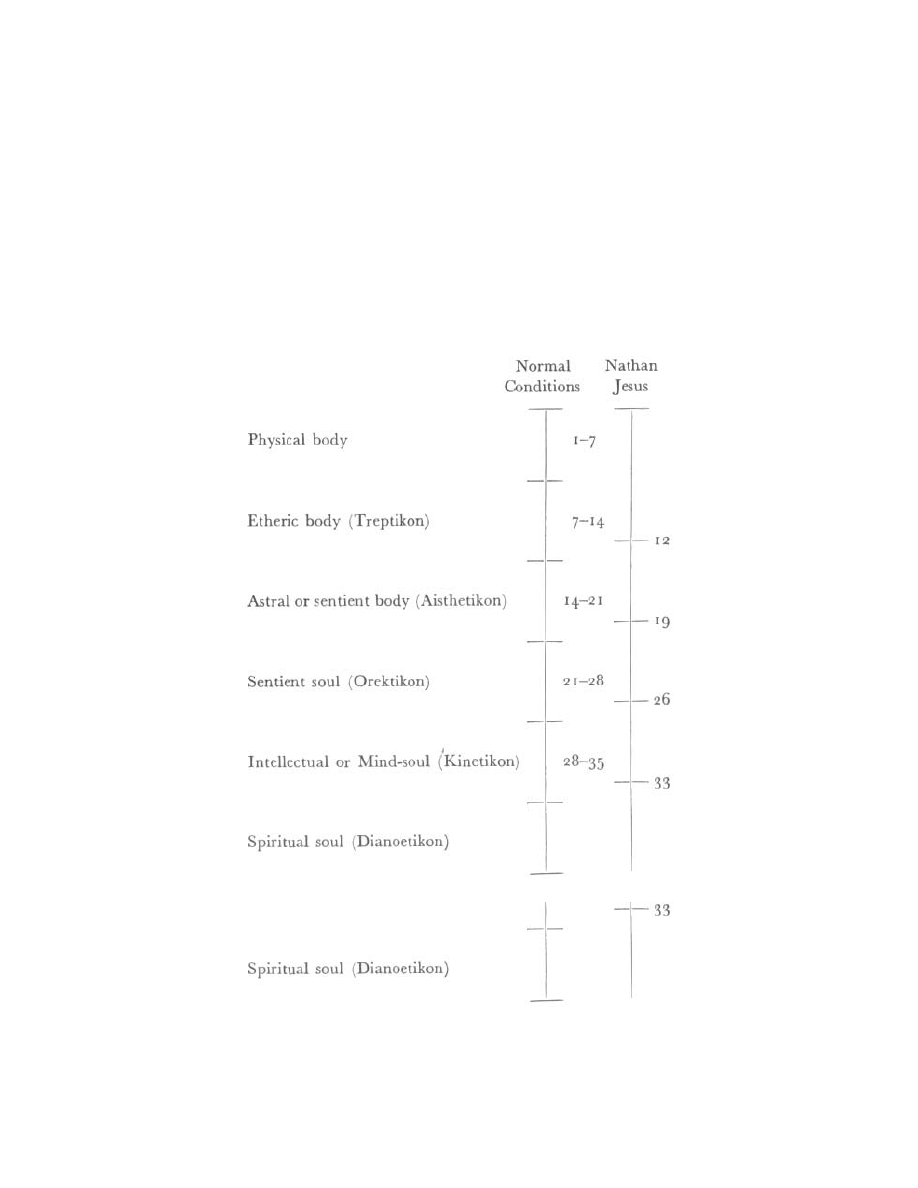
Such is the development of the human being when considered
in detail.
Owing to certain conditions that will become clearer to us to-
day, the development of the Nathan Jesus was somewhat
accelerated — a fact also rendered possible because in those
regions puberty was reached at an earlier age.

Diagram 1
In the case of the Nathan Jesus there were very special
reasons why the change usually occurring in the fourteenth
year should take place in the twelfth. So too the other changes
connected with the twenty-first, twenty-eighth and thirty-fifth
years came about in his nineteenth, twenty-sixth and thirty-
third years respectively. This indicates in broad outline the
development of the central Figure of our Earth. It must be
borne in mind that up to the twelfth year the physical body
was that of the Nathan Jesus, but that after the twelfth year
the Ego of Zarathustra was living in that body. What does this
mean? It means that from the twelfth year onwards, this
mature Ego was working upon the sentient (astral) body, the
sentient soul and the mind-soul of the Nathan Jesus,
elaborating these members in a way possible only to an Ego of
great maturity — an Ego that had undergone the destinies of
the Zarathustra-Individuality through many incarnations. We
therefore meet with the wonderful fact that the Ego of
Zarathustra passed into the body of the Nathan Jesus in the
twelfth year of life and elaborated the faculties of the soul to
the highest degree of excellence. Thus there developed a
sentient body able to gaze into the Cosmos and experience
something of the spiritual nature of Ahura Mazdao; there
developed a sentient soul able to harbour the knowledge and
wisdom based on the teaching concerning Ahura Mazdao; and
there developed a mind-soul able to apprehend, to formulate
in intelligible concepts and words, that which men had
hitherto been able to acquire only through spiritual currents
flowing into them from outside.
The Nathan Jesus, having within him the Zarathustra-Ego,
lived on until his thirtieth year was approaching. The event
that had occurred when he was twelve, when his inmost
nature was filled with a new Egohood, now took place again —

but this time on an infinitely more sublime, more universal
scale. Towards the thirtieth year the Zarathustra-Ego had
accomplished its work in the soul of the Nathan Jesus; the
faculties of this soul had been developed to the highest
possible degree and the mission of the Zarathustra-Ego was
thus fulfilled. Having instilled into the soul all the faculties he
had acquired through his own previous incarnations,
Zarathustra could declare: ‘My task is now accomplished!’ —
and a moment came when his Ego left the body of the Nathan
Jesus.
The Zarathustra-Ego had lived in the body of the Solomon
Jesus until the twelfth year. No further development in earthly
existence would thereafter have been possible for this boy.
Because the Zarathustra-Ego had gone out of him, his
development came to a standstill at the point reached at that
time, although exceptional maturity had been attained owing
to the presence of such a highly advanced Ego. Anyone
observing the Solomon Jesus-child would have found him
prematurely advanced to a conspicuous degree; but from the
moment the Zarathustra-Ego left him he came to a standstill
and could make no further progress. And when —
comparatively soon — the mother of the Nathan Jesus died
and the spiritual part of her being was translated into the
spiritual world, she took with her what was of eternal value
and formative power in the Solomon-Jesus child. This child
also died — at about the same time as the mother of the
Nathan Jesus.
It was an etheric sheath of utmost value which then left the
body of the Solomon Jesus. As we know, the development of
the etheric body takes place mainly between the seventh year
of life and puberty. This was an etheric body that had been
worked upon and elaborated by the forces of the Zarathustra-
Ego. In normal human existence, when the etheric body leaves
the physical body at death, everything that is of no eternal use

is discarded and the human being takes with him a kind of
extract of the etheric body. In the case of the child of the
Solomon line the etheric body was of eternal use in the fullest
possible sense and the whole life-body of this child was taken
by the mother of the Nathan Jesus with her into the spiritual
world.
Now the etheric body forms and shapes the physical body of
man and it is not difficult to realize that there was a very deep
connection between this etheric body of the Solomon Jesus
which had been translated into the spiritual world, and the
Zarathustra-Ego; for this Ego and etheric body had been
united until the twelfth year of earthly life. And when the
Zarathustra-Ego left the body of Jesus of Nazareth, the power
of attraction between this Ego and the original etheric body in
the Solomon Jesus asserted itself. The maturity of the
Zarathustra-Ego was such that a further passage through
Devachan was unnecessary and after a comparatively short
time this Ego was able, in conjunction with his former etheric
body, to build up a new physical body. This resulted in the
birth of the Being who thereafter appeared again and again,
always with relatively short intervals between physical death
and rebirth; whenever this Being left the physical body at
death, he soon appeared again on the Earth in a new
incarnation. Having sought and found the etheric body he had
once relinquished in the circumstances indicated, this Being
went on his way through history as the ‘Master Jesus’,
becoming, as you can well imagine, the great helper of those
who have endeavoured to understand the Event of Palestine.
Thus it was the Zarathustra-Ego, Zarathustra himself, who
having found his etheric body again began to move through
the evolution of mankind as the Master Jesus, incarnating
again and again to give guidance and direction to the spiritual
stream of Christianity. He is the Inspirer of those who strive to
understand Christianity in its living growth and development;

within the esoteric schools he inspired those whose perpetual
duty it was to cultivate the teachings of Christianity. He stands
behind the great spiritual figures of Christianity, ever teaching
what the great Event of Palestine signifies.
Having indwelt the body of the Nathan Jesus from the twelfth
to the thirtieth year, the Zarathustra-Ego was hence-forth
outside that body and another Being descended into it. This
happened, as all the Gospels relate, at the Baptism by John in
the Jordan, when an Ego of untold sublimity entered into the
Nathan Jesus in place of the Zarathustra-Ego. In the lectures
on the Gospel of St. John, [1] attention was drawn to the fact
that ‘baptism’ in those olden days was something very
different from the mere symbol which it became later on. It
was also enacted differently by John the Baptist. The body of
one who was baptized was completely submerged in the water.
You know from preparatory lectures that a definite experience
may be connected with such a happening. Even in everyday
existence it may happen that when a man is in danger of
drowning, or sustains a violent shock, a tableau of his life
hitherto appears before him. This is because something that
otherwise takes place only after death, occurs momentarily:
the etheric body is lifted out of the physical body and is freed
from its power. This happened to most of those who were
baptized by John, and in a very special way to the Nathan
Jesus. His etheric body was drawn out — and during that
moment the sublime Being we call the Christ descended into
his body.
Thus from the time of the Baptism, the Nathan Jesus was
filled with the Christ Being as is indicated in the words
contained in the earlier Gospel records: ‘This is my well-
beloved Son; this day have I begotten Him!’ — meaning: the
Son of Heaven, the Christ, is now begotten — begotten of the
all-pervading Godhead and received into the body and whole
constitution of the Nathan Jesus who had been prepared to

receive the seed from heavenly heights. ‘This is my well-
beloved Son; this day have I begotten Him!’ — These were the
words contained in the earlier manuscripts and this is how
they ought still to stand in the Gospels. (Luke III, 22. )
Who is this Being who united at that time with the etheric
body of the Nathan Jesus?
The Christ Being cannot be understood if we think of Earth
evolution alone. The Christ is the Leader of those spiritual
Beings who left with the Sun when it separated from the Earth
and established for themselves this higher sphere of action in
order to work upon the Earth from outside. If we think back to
the pre-Christian period of Earth evolution, from the time of
the separation of the Sun until the appearance of Christ, we
must say: When men looked up to the Sun with mature
faculties they would have recognized the truth of what
Zarathustra taught, namely that the light and warmth
streaming from the Sun are but the physical vestment of the
spiritual Beings behind the Sun's light; for behind the physical
phenomena are hidden the spiritual rays of power which
stream from the Sun to the Earth. The Leader of all the Beings
who send their beneficent influences from the Sun to the
Earth is He who was later called Christ. In pre-Christian
times, therefore, this Being was not to be sought on Earth but
on the Sun. And Zarathustra rightly called Him ‘Ahura
Mazdao’, saying in effect: ‘On the Earth we do not find the
Light-Spirit; but when we look up to the Sun we behold the
spiritual Being — Ahura Mazdao — who has his habitation
there. The light that streams to us is the body of the Sun-
Spirit, Ahura Mazdao, even as the human physical body is the
body of the human spirit. But in the course of great
happenings in the Cosmos this sublime Being drew ever
nearer to the Earth-sphere; His approach could be perceived
more and more distinctly by clairvoyance, and was
unmistakable when in the flame of lightning on Mount Sinai

the revelations came to Moses, the great forerunner of Christ
Jesus.
What did these revelations to Moses signify? They signified
that the Christ Being, while approaching the Earth, was
revealing Himself — in reflection to begin with — as if in a
mirror-image. Let us consider, in its spiritual aspect, the
process in evidence at every full Moon. When we look at the
full Moon we see the rays of the Sun in reflection. It is sunlight
that streams towards us, only we call it moonlight because we
see it reflected by the Moon. What Being did Moses behold in
the burning bush and in the fire on Sinai? He beheld the
Christ! But just as the sunlight is not seen directly but
reflected from the Moon, so did Moses see the Christ in
reflection. And as we call the sunlight ‘moonlight’ when we see
it reflected from the Moon, Christ was called at that time,
Jahve, or Jehovah. Jahve or Jehovah is the reflection of the
Christ before He Himself appeared on Earth. Christ
announced Himself thus indirectly to a humanity as yet
unable to behold Him in his immediate reality, just as the sun-
light manifests itself through the rays of the Moon in the
otherwise dark night of full Moon. Jahve or Jehovah is the
Christ — but seen as reflected light, not directly.
The faculties of human cognition and perception were to come
within nearer and nearer range of the Christ. Having
previously manifested His presence to the Initiates from the
Cosmos, He was, now Himself to tread the Earth for a season
as a man among men. But this could not come to pass until
the right time had arrived. That Christ is a reality has always
been known wherever men have steeped themselves in the
wisdom of the world, and because He has revealed Himself in
so many different ways He has been called by diverse names.
Zarathustra called Him ‘Ahura Mazdao’ because He revealed
Himself in the raiment of the Sun's light. The great Teachers
of humanity in ancient India during the first period after the

Atlantean catastrophe — the holy Rishis — had known full
well of this Being, for they were Initiates. They knew too that
in their epoch He was beyond the range of earthly wisdom and
would be accessible to it only later on. Hence it was said that
this Being was beyond the sphere of the seven Rishis. ‘Vishva
Karman’ was the name given to Him. The Rishis taught of the
Being whom they called ‘Vishva Karman’ and Zarathustra
called ‘Ahura Mazdao’. Vishva Karman and Ahura Mazdao
were two of the names for this Being who was gradually
approaching the Earth from heights of spirit, from cosmic
realms.
But preparation had to be made in the evolution of humanity
to ensure the existence of a body fit to receive this Being. It
was necessary for a Being such as had lived in Zarathustra to
mature from incarnation to incarnation in order that in a body
as pure as that of Jesus of Nazareth he could bring the
faculties of the sentient body, of the sentient soul and of the
mind-soul to the degree of perfection that would render this
human being fit to receive into himself so sublime a Being.
Such preparation had to be made. Before a sentient soul and a
mind-soul could be adequately developed it was necessary
that an Ego should first have undergone the many experiences
and destinies of Zarathustra and then transform the faculties
present in the Nathan Jesus. This would not have been
possible at any earlier time, for the Nathan Jesus-child had to
be worked upon not only by the Zarathustra-Ego but also by
the lofty spiritual power we have characterized as the
Nirmanakaya of Buddha. From the child's birth until his
twelfth year this power worked chiefly from outside. But the
Bodhisattva himself had had first to become Buddha before he
was able to develop in himself the spiritual body, the
Nirmanakaya, wherewith to work upon the Nathan Jesus
during this period of his life. At the time of the incarnation in
the course of which he was destined to become Buddha he had

not yet acquired this power; the Buddha-life had first to be
lived through.
Some day, when humanity understands what deep wisdom
has been preserved in many ancient legends, it will be found
that everything deciphered from the Akashic Chronicle is
contained in a wonderful way in those legends. We are told,
and rightly told, that in ancient India too, men were taught of
Christ as a cosmic Being beyond the sphere of the seven holy
Rishis. The Rishis knew that He dwelt in lofty spiritual regions
and was only gradually approaching the Earth. Zarathustra
too knew that he must turn his gaze from the Earth to the Sun;
and the ancient Hebrews, because of the faculties and
attributes indicated in the last lecture, were the first people to
whom the proclamation of the Christ Being in His reflection
could be made.
We are also told in a legend how the Bodhisattva, when about
to become Buddha, came into spiritual contact with Vishva
Karman — the Being who was later called Christ. The legend
relates that when his twenty-ninth year was approaching the
Bodhisattva made his famous exit from the palace where he
had been strictly guarded and fostered. Then he saw, first, an
old man, then a sick man, then a corpse, thus becoming
gradually aware of the miseries of life. Then he saw a monk
who had forsaken this life with its accompanying phenomena
of old age, sickness and death. Thereupon — so it is related in
this profoundly true legend — he resolved not to leave the
palace immediately but to return once more. But during this
first departure from the palace — so runs the legend — he was
invested from spiritual heights with the power which the
Divine Artificer, Vishva Karman, who appeared to him, sent
down to the Earth. The Bodhisattva was invested with the
power of Vishva Karman, of Christ. Thus for the Bodhisattva,
Christ was a Being outside — not yet united with him. At that
time the Bodhisattva too had nearly reached his thirtieth year

but he could not then have made it possible for Christ to be
received in the fullest sense into a human body. He had first to
become sufficiently mature, and this stage was attained
through his Buddha-existence. And when, later on, he
appeared in the Nirmanakaya, his task was to make the body
of the Nathan Jesus — in which he was not himself embodied
— fit to receive Vishva Karman, the Christ.
In this way the forces in earthly evolution had worked in
concert to bring about the great Event. It is now on our lips to
ask: What is the relationship of Christ, of Vishva Karman, to
Beings such as the Bodhisattvas, of whom the Bodhisattva
who afterwards became Buddha was one?
This question brings us to the threshold of one of the greatest
mysteries of Earth evolution. Generally speaking, it will be
difficult for the feelings and perceptive faculties of men at the
present time to have even an inkling of what lies behind this
mystery. The mission of the Bodhisattva who became Buddha
was to incorporate into humanity the principle of compassion
and love. Twelve such Beings are connected with the Cosmos
to which the Earth belongs. The Bodhisattva who became
Buddha in the fifth/sixth century B.C. is one of these Twelve,
all of whom have specific missions: Just as the mission of this
particular Bodhisattva was to bring to the Earth the teaching
of compassion and love, the other Bodhisattvas too have their
missions which must be fulfilled in the different epochs of
Earth evolution. Gautama Buddha's connection with the
mission of the Earth is especially close inasmuch as the
development of the moral sense is precisely the task of our
own epoch — from the time when the Bodhisattva appeared
five to six centuries B.C. to the time when the Bodhisattva who
succeeded him in that office will live on Earth as the Maitreya
Buddha. That is how Earth evolution advances; the
Bodhisattvas descend and have to incorporate into evolution
from time to time what constitutes the object of their mission.

A survey of the whole of Earth evolution would reveal that
there are twelve such Bodhisattvas. They belong to that great
community of Spirits which from time to time sends one of
the Bodhisattvas to the Earth as a special emissary, as one of
the great Teachers. A Lodge of twelve Bodhisattvas is to be
regarded as the Lodge directing all Earth evolution. The
concept of ‘Teacher’ familiar to us at lower stages of existence
can be applied, in essentials, to these twelve Bodhisattvas.
They are Teachers, the great Inspirers of one portion or
another of what mankind has to acquire.
Whence do these Bodhisattvas receive what they have to
proclaim from epoch to epoch? — If you were able to look into
the great Spirit-Lodge of the twelve Bodhisattvas you would
find that in the midst of the Twelve there is a Thirteenth —
one who cannot be called a ‘Teacher’ in the same sense as the
Bodhisattvas, but of whom we must say: He is that Being from
whom wisdom itself streams as very substance. It is therefore
quite correct to speak of the twelve Bodhisattvas in the great
Spirit-Lodge grouped around One who is their Centre; they
are wrapt in contemplation of the sublime Being from whom
there streams what they have then to inculcate into Earth
evolution in fulfilment of their missions. Thus there streams
from the Thirteenth what the others have to teach. They are
the ‘Teachers’, the ‘Inspirers’; the Thirteenth is himself the
Being of whom the others teach, whom they proclaim from
epoch to epoch. This Thirteenth is He whom the ancient
Rishis called Vishva Karman, whom Zarathustra called Ahura
Mazdao, whom we call the Christ. He is the Leader and Guide
of the great Lodge of the Bodhisattvas. Hence the content of
the proclamation made through the whole choir of the
Bodhisattvas is the teaching concerning Christ, once called
Vishva Karman. The Bodhisattva who became Buddha five to
six centuries before our era was endowed with the powers of
Vishva Karman. The Nathan Jesus who received the Christ

into himself was not merely ‘endowed’ but ‘anointed’ — that is
to say, permeated through and through by Vishva Karman, by
Christ.
This mystery was portrayed in a symbol or in a picture
wherever men had an inkling of the great secrets of evolution
or acquired knowledge of them through Initiation. In the little
known, enigmatic Trottic Mysteries of Northern Europe
before the coming of Christianity, an earthly symbol of the
spiritual reality of the Lodge of the twelve Bodhisattvas was
created. Those who were Teachers were always associated
with a community of twelve. It was for the Twelve to proclaim
the message and there was a Thirteenth who did not teach but
who through his very presence radiated the wisdom which the
others received. This was the picture on Earth of a heavenly,
spiritual reality. Again, in Goethe's poem Die Geheimnisse [2]
where the poet has given an indication of his Rosicrucian
inspiration, we are reminded how Twelve sit around a
Thirteenth who is not necessarily a great Teacher. Brother
Mark, in his simplicity, is himself to be addressed by the
Twelve as the Thirteenth — when the former Thirteenth shall
have left them. He is to be the bringer, not of teaching, but of
the spiritual substance itself. And it was the same wherever an
inkling or actual knowledge of this lofty spiritual fact existed
among men.
The Baptism by John in the Jordan marked the point of time
in the evolution of humanity when this heavenly ‘Thirteenth’
— as spiritual substance itself — appeared on the Earth. This
was the Being of whom all others — Bodhisattvas and
Buddhas — had had to teach, and for whose descent into a
human body such stupendous preparations had been
necessary. That is the mystery of the Baptism in the Jordan.
The Being is He who is described in the Gospels: Vishva
Karman, Ahura Mazdao, or the Christ as He was called later
on when in the body of the Nathan Jesus. As Christ, this Being

was to tread the Earth in human form for three years, a man
among men, within that purified terrestrial Being who up to
his thirtieth year had undergone all the experiences of which
we have heard in these lectures. The Being formerly hidden in
the light- and warmth-giving rays of the Sun streaming down
from the Cosmos, the Being, that is, who had gone with the
Sun when it separated from the Earth, now descended into the
Nathan Jesus.
We may now ask another question: Why was the union of this
Being with the evolution of humanity on the Earth so long
postponed? Why had He not descended at an earlier time to
the Earth. Why had He not penetrated before into a human
etheric body, as He did at tlhe Baptism by John in the Jordan?
This will be intelligible to us if we grasp the nature of the
happening described in the Old Testament as the ‘Fall into
Sin’. During the epoch of ancient Lemuria, certain beings
insinuated themselves into the human astral body — they
were beings who had remained at the stage of Old Moon
evolution. The human astral body Ivas permeated at that time
by the Luciferic beings and this is presented pictorially as the
Fall into Sin in Paradise. Because these forces penetrated into
his astral body, man became more deeply entangled in the
things of the Earth than would otherwise have been the case.
Had he not been subject to the Luciferic influence he would
have been less deeply entangled in earthly matter.
Consequently he descended to the Earth earlier than was
originally intended. Now if nothing else had intervened, if
nothing had taken place except what has just been indicated,
the Luciferic forces anchored in the human astral body would
have taken effect in the etheric body as well. But it was
essential for the cosmic Powers to take special measures to
prevent this. In the book Occult Science — an Outline [3] the
subject is dealt with from a different aspect. Man might not
remain as he was after the Luciferic forces had penetrated into

his astral body. He had to be protected against the effect of the
forces upon his etheric body. This end was achieved at that
time by making it impossible for him to use the whole of his
etheric body, part of it being removed from his arbitrary
control. If this beneficent deed of the Gods had not been
accomplished, if man had retained power over the whole of
his etheric body, he could never have found his right path
through Earth evolution. Certain parts of the human etheric
body had at that time to be withdrawn in order to be
preserved for later times. Let us try to picture what this
means.
Man's physical body — as everything else that is physical — is
composed of the elements also to be found in the world
outside: the ‘earthy’ or solid, the ‘watery’ or fluid, and the
‘airy’ or gaseous. The etheric realm begins with the first state
of ether — the ‘fire-ether’ or simply ‘fire’. Fire or warmth,
regarded by modern physics merely as motion and non-
substantial, is the first state of the ether. The second is the
‘light-ether’, or simply ‘light’. And the third state — sound,
tone, or number — is one that is not revealed to man in its
original form at all; it is only a reflection, as it were a shadow
of this ether that can be perceived in the physical world as
tone or sound. Behind external ‘sound’, however, there lies
something of a finer etheric nature, something spiritual.
Physical tone or sound is a mere phantom of spiritual tone, of
‘sound-ether’ or also ‘number-ether’. The fourth etheric realm
is the ‘life-ether’ — that which underlies actual ‘life’.
As physical man is constituted to-day, everything that is of the
nature of soul expresses itself in his physical and etheric
constitution, but is also connected with certain etheric
substances. What we call ‘will’ expresses itself etherically in
what we call ‘fire’. Anyone who is at all sensitive to certain
sentient experiences will be aware that there is justification
for saying that the will, which expresses itself physically in the

blood, lives in the fire-element of the etheric; physically, the
will expresses itself in the blood, that is to say in the
movement of the blood. What we call ‘feeling’ expresses itself
in the part of the etheric body that corresponds to the light-
ether. Because this is so, a clairvoyant sees the will-impulses
of a man flashing like flames through his etheric body and
raying into his astral body; and he sees the feelings as forms of
light. But the thinking that is experienced by man in his soul
as his own, and expressed in words, is only a phantom of
thinking — as you will readily believe, because physical sound
too is only a phantom of something higher. Words have their
organ in the sound-ether; our thoughts underlie our words;
words are forms of expression for thoughts. These forms of
expression fill etheric space inasmuch as they send their
vibrations through the sound-ether; ‘tone’ or ‘sound’ is only
the shadow of the actual thought-vibrations. The inner
essence of all our thoughts, that which endows our thoughts
with meaning (Sinn), actually belongs; in respect of its etheric
nature, to the life-ether itself.
Meaning (Sinn) Life-Ether
Thinking Tone- or Sound-Ether
_________________
Feeling Light-Ether
Will Fire-Ether
Air
Water
Earth

In the Lemurian epoch, after the onset of the Luciferic
influence, of these four forms of ether only the two lower
(light-ether and fire-ether) were left at the free, abitrary
disposal of man; the two higher kinds of ether were
withdrawn from him. That is the inner meaning of the passage
where it is said that when, as a result of the Luciferic
influence, men had become able to distinguish between good
and evil (pictorially expressed as eating of the ‘Tree of
Knowledge’), the ‘Tree of Life’ was kept out of their reach.
That is to say, the power freely and arbitrarily to penetrate the
thought-ether and the sense-ether (‘meaning’-ether) was
withdrawn from them.
The conditions of man's development were therefore
necessarily as follows. His will was given into his power to
assert as his ‘personal’ expression; the same applies to his
feelings. Both feeling and will are at man's personal disposal.
Hence the individual character of the world of feeling and the
world of will. This individual character, however, ceases
immediately we pass from feeling to thinking — yes, even to
the expression of thoughts, to the words on the physical plane.
Whereas each mail's feeling and will are personal, we
immediately come into something universal when we rise into
the realm of words and the realm of thoughts. No one
individual can form thoughts that are his alone. If thoughts
were as individual as feelings we should never understand one
another. Thus thought and ‘meaning’ (Sinn) were withheld
from the power of arbitrary human will and preserved for the
time being in the world of the Gods, in order not to be given to
man until a later time. Everywhere on the Earth, therefore, we
can find individual men with individual feelings and
individual impulses of will; but thinking is uniform
everywhere and language is uniform among the several
peoples. Where there is a common language, there reigns a
common Folk-Deity. This sphere is withheld from the

arbitrary power of man, remaining for the time being a field
into which the Gods work.
When Zarathustra, with his pupils around him, spoke of the
realm of spirit, he could say: ‘Out of heaven there streams
down warmth, or fire; out of heaven there streams down light.
These are the vestments of Ahura Mazdao. But behind these
vestments is hidden that which has not yet descended but has
remained above in spiritual heights, casting only a shadow in
the physical thoughts and words of men.’ Behind the warmth
and light of the Sun is hidden that which lives in tone or
sound, in meaning, manifesting itself only to those who are
able to see behind the light that which is related to the earthly
word as the heavenly Word is related to the part of Life that
was withheld for the time being from humanity. Hence
Zarathustra said: ‘Look upwards to Ahura Mazdao; see how
He reveals Himself in the physical raiment of light and
warmth. But behind all that is the Divine, Creative Word —
and it is approaching the Earth!’
What is Vishva Karman? What is Ahura Mazdao? What is
Christ in His true form? The Divine, Creative Word! Hence in
Zarathustra's teaching the momentous communication is
made that he was initiated in order not only to apprehend in
the light the Being he called Ahura Mazdao, but also the
Divine, Creative Word, Honover — which was to descend to
the Earth and for the first time did descend into an individual
etheric body at the Baptism by John. The Divine-Spiritual
Word which had been preserved since the Lemurian epoch
came forth from ethereal heights at the Baptism by John and
entered into the etheric body of the Nathan Jesus. And when
the Baptism was completed, what was it that had happened?
The Word had become Flesh!

What had Zarathustra, or those who had knowledge of his
Mysteries, proclaimed? As seers they had proclaimed the
‘Word’ that is hidden behind the warmth and the light. They
were ‘servants of the Word’. And the writer of the Gospel of St.
Luke recorded what the ‘seers’ proclaimed — those who had
become ‘servants of the Word’.
This example again shows us that the Gospels must be taken
literally. What had been withheld from men for so long
because of the Luciferic influence, became flesh in a single
personality, descended to the Earth and lived on the Earth.
Hence this Being is the great prototype of all those who by
degrees will understand His nature. Our wisdom on Earth
must follow the lead of the Bodhisattvas, whose unceasing
task it is to proclaim the Thirteenth among them. All spiritual
science, all our wisdom, all our knowledge, must be devoted to
understanding the nature of Vishva Karman, of Ahura
Mazdao, of CHRIST.

Notes:
1 Lecture-Course entitled: The Gospel of St. John in
relation to the other Gospels, especially to the
Gospel of St. Luke.
2 See the lecture entitled The Mysteries. Given at Cologne,
25th December 1907.
3. See pp. 185–6 in the 1963 edition.

LECTURE EIGHT
The Evolution of Consciousness in Humanity during the post-
Atlantean Epoch. The Mission of Spiritual Science: Mastery
of the Physical by the Spiritual. Illness and Healing. The
Influences proceeding from the Christ-Ego.
We have been trying to gain some understanding of the
opening chapters of the Gospel of St. Luke. Only through
knowledge of happenings in the evolution of humanity to
which such lengthy study has had to be devoted is it possible
to unravel what the writer of this Gospel has narrated as a
kind of historical prelude to the great Christ Event. But we
now know something about the Being who in the thirtieth year
of his life received the Christ-principle into himself.
To understand what the writer of St. Luke's Gospel tells us
about the personality and the deeds of Christ Jesus — that is,
of the Individuality who worked in the world for three years as
‘Christ’ in a human body — brief reference must be made to
certain aspects of the evolution of humanity of which our age
has only a very inadequate idea. Men to-day are in many
respects extraordinarily short-sighted, believing that the law
of evolution underlying what is happening in humanity at the
present time or happened during the last few centuries, has
remained unchanged, and that conditions not existing
nowadays could never have existed in the past. That is why it
is so difficult at the present time for people to understand and
freely accept narratives of a past epoch such as that during
which Christ was living on the Earth.

The Gospel of St. Luke tells us of the deeds of Christ Jesus on
the Earth in such a way that to get at the real meaning of his
accounts a clear picture of the stage then reached in evolution
is essential.
Attention must again be drawn to what has often been said in
the course of our studies, namely that our ancestors — that is,
our own souls in other bodies — lived in ancient Atlantis, the
continent once stretching between Europe and Africa on the
one side and America on the other. When the face of the globe
was changed by the Atlantean Deluge, the masses of the
people migrated Eastwards and Westwards, and so colonised
the Earth. Then, in the post-Atlantean epoch, the various
civilizations arose: the ancient Indian, ancient Persian,
Egypto-Chaldean, Graeco-Latin, and our own.
It is entirely erroneous to believe that during the post-
Atlantean epoch man was always constituted as he is to-day.
The fact is that human nature has undergone constant and
very great changes. Historical documents cover a few
thousand years only and the one and only source of
information about the earliest periods of civilization after the
Atlantean catastrophe is the imperishable ‘Akashic Chronicle’
— a record inaccessible to external research — the character of
which has again been briefly indicated in the present lecture-
course.
After the Atlantean catastrophe there developed, first, the
ancient Indian civilization. This was an epoch when men still
lived more in the etheric body, not as deeply in the physical
body as was the case later on. Without having developed the
Ego-consciousness of to-day, by far the greater majority of the
people of ancient India were endowed with dim, shadowy
clairvoyance. Their consciousness was dreamlike but they
were able to gaze into the depths of existence, into the
spiritual world. When studying these things it is very

necessary to be aware of the facts connected with the various
forms of knowledge and of cognition through the different
epochs. Thus we constantly lay stress upon the view of the
world held by our ancestors in ancient India and upon the fact
that they were clairvoyant in a far higher degree than the men
of later times. But if we are to understand the Gospel of St.
Luke, attention must be paid to yet another of their
characteristics.
In that early epoch, when man's etheric body still projected on
all sides beyond the physical body and was less firmly knit
with it than is the case to-day, the forces and qualities of the
soul had considerably greater power over the physical body.
The more deeply the etheric body penetrated into the physical
body, the weaker it became and the less power it had over the
physical body. In the ancient Atlanteans the etheric head
extended very considerably beyond the physical body, but to a
certain extent this was still the case in the people of ancient
India too, enabling them on the one hand to have clairvoyant
consciousness and on the other to wield great power over
processes in the physical body.
We can, if we like, make a somewhat remote comparison
between a body belonging to the ancient Indian epoch and one
belonging to our own. In our time the etheric body has
penetrated to the deepest possible extent into the physical
body and is therefore closely bound up with it. But we are now
at the very verge of the turning-point when the etheric body
will emerge again, emancipate itself from the physical body
and become more independent. As humanity advances
towards the future this will take place to an ever-increasing
extent and as a matter of fact the point of closest union has
now already been passed. Comparing the body of an ancient
Indian with that of a modern man, it can be said that in the
Indian body the etheric body was still comparatively free and
the soul was able to exert forces that worked right into the

physical body. Not being so closely bound to the physical
body, the etheric body could immediately take into itself the
forces of the soul; this gave it greater power over the physical
body, with the result that influences brought to bear upon the
soul in that age also had a tremendously strong effect upon
the physical body. In the ancient Indian epoch, if one man
hated another and spoke words charged with hatred, such
words ‘pierced’ the other, penetrated right into the physical
organism. The soul still had an actual effect upon the etheric
body and the etheric body in turn upon the physical body. The
etheric body today lacks this power. In those olden times,
loving words produced in the other man a sense of release, of
warmth, of expansion, affecting his physical body too.
Therefore much depended upon whether words were filled
with love or hatred, for this had an effect upon all the bodily
processes. The strength of such an effect steadily decreased in
humanity the more deeply the etheric body penetrated into
the physical body.
Things are different nowadays. Words spoken to-day have an
effect only upon the soul and people who feel that malicious
words actually make something contract within them or that
loving words bring a sense of release and happiness have
become extremely rare. The peculiar effects we may possibly
still feel in our physical heart to-day when loving or malicious
words are spoken were experienced with tremendous intensity
at the beginning of post-Atlantean evolution. Quite different
effects from those now possible could therefore be produced
in that age when such influences were brought to bear upon
the soul. Words full of the warmth of love may be spoken to-
day, but when they come up against the present human
organism they are constantly repelled and do not penetrate;
for it does not depend only upon how words are spoken, but
also, upon how they can be received.

It is therefore not possible to-day to work so directly upon the
soul of a man that the effect penetrates into his physical
organism. This is not immediately possible, but in a certain
way it will again become so, for a future is approaching when
the spiritual will reacquire its significance. We can, in fact,
already indicate what this will mean in time to come. In our
present evolutionary cycle we can do very little to enable
whatever love, good will and wisdom may be in our soul to
stream directly into the soul of another human being and
there be strong enough to work right down into the physical
body. Such an effect can only very gradually become possible;
nevertheless this spiritual way of working is beginning again
on the soil where the spiritual-scientific conception of the
world takes root, for this actually strengthens the activity of
the soul. Only very rarely to-day is it possible for a word to
produce physical effects; but it is possible for human beings to
come together in order to receive spiritual truths into their
souls. These spiritual truths will gradually gain greater
strength in the souls of men and therewith the power to work
right into the physical organism. Thus in future time the soul-
and-spirit will again acquire great power over the physical and
form it into its own image.
In the days of the very ancient Indian civilization, for example,
what is called ‘healing’ was a very different matter from what
it came to be later on, for all the things are connected with the
facts just referred to. Because by working upon the soul a
tremendously strong effect could at one time be produced
upon the body, it was possible so to impress the soul of
another by means of a word charged with the right impulse of
will that this soul transmitted the effect to the etheric body,
and the latter in turn to the physical body. If there were any
realization of what effect it was desirable to bring about, it was
possible, in a case of illness, to produce this effect upon the
soul and thereby upon the body, resulting in restoration of

health. And now imagine this effect intensified to the
maximum, the Indian physician controlling the influences and
impressions in question, and you will realize that all healing in
the ancient Indian epoch was a far more spiritual process than
it can be to-day — I say expressly, than it can possibly be to-
day. But the time is approaching when such ways of working
will again be effective. What is brought down from spiritual
heights as a world-conception, as a number of truths
corresponding to the great spiritual realities of the Universe
this will flow into the souls of men, and as humanity lives on
into the future will itself be a source of healing, springing from
the inmost being of man himself. Spiritual science is the great
remedy for souls in the life awaiting them in future time. Only
it must be understood that humanity has been on a
descending path of evolution, that the spiritual influences
have steadily lost strength, that the lowest point of the process
has now been reached, and that the ascent to the level at
which we once stood can only be very gradual.
As time went on, effects that were eminently possible in
ancient India ceased to be so. A somewhat similar human
constitution — one enabling soul to work upon soul was still in
existence in Egyptian civilization. The farther back we go in
that civilization-epoch, the more evidence is there that one
soul was able to produce a direct effect upon another — an
effect which could then pass over to the physical organism.
This possibility was much rarer among the ancient Persians,
for theirs was a different function; they were to give the
primary impetus for penetration into the physical world. In
respect of the characteristic just mentioned, Egyptian culture
was related to that of ancient India much more closely than
was the Persian. In ancient Persia the soul began to be
enclosed within itself to an increasing extent and to have less
and less power over the external organism, because it was to
develop self-consciousness. Therefore with the stream of

culture in which the spiritual had maintained mastery over the
physical, another had to converge — one especially concerned
with inner deepening and the development of self-
consciousness. In Graeco-Latin culture these two streams
came, in a sense, into equilibrium. In that fourth post-
Atlantean culture-epoch humanity had already descended just
so far into the physical world as to enable a kind of
equilibrium to be established between the physical and the
soul-and-spirit — in other words, the mastery of soul-and-
spirit over the body was about equal in strength to that of the
body over the soul. A state of equilibrium had been brought
about.
Humanity must however again undergo a kind of ‘cosmic trial’
in order to be able to ascend once more to spiritual heights.
Since the Graeco-Latin epoch, everything in man of a
corporeal, physical nature has descended still more deeply
into materiality. In the age in which we are living, the fifth
post-Atlantean epoch, man has actually been driven below the
line of equilibrium; to begin with it was only in his inner
nature that he could rise to a more theoretical kind of
consciousness of the spiritual world. He had to acquire inner
strength.
Relatively speaking, then, there was a condition of equilibrium
in Graeco-Latin civilization, whereas now, in our epoch, the
physical has gained the mastery and dominates the soul-and-
spirit which has become powerless in a certain respect and is
accepted merely in theory. Man has had to be restricted
through the centuries to the acquisition of inner strength — a
process not revealed to the consciousness. But little by little it
must be possible for a new consciousness to be developed.
And when — it will not be until the sixth post-Atlantean epoch
— such consciousness has acquired a certain strength through
having absorbed more and more spiritual nourishment, man
will no longer derive theoretical wisdom from such

nourishment but living wisdom, living truth. The spiritual will
then be so strong that once again it will have mastery over the
physical — now from the other side.
How then can the mission of spiritual science in humanity be
explained?
If in our age spiritual science becomes more and more alive in
the soul, able not only to stimulate the intellect but to imbue
the soul with greater and greater warmth, then the soul will
become strong enough to dominate the physical. Certain
transitional states are of course inevitable — states which may
at first actually appear to denote deterioration or even harm.
But these states are only transitional and will give way to the
future condition when men will receive spiritual life into their
ideas — the condition that will signify in the whole of
humanity the mastery of the soul and spirit over the physical
and material. Those who are interested in the truths of
spiritual science to-day not merely because they stimulate the
intellect, but who can he enraptured by and derive living
satisfaction from these truths — such men will be the
forerunners of those in whom the mastery of the soul and
spirit over the physical and material has been achieved.
It has been possible in our own time to present great truths
relating to happenings such as we have been studying during
the last few days: the momentous fusion of the Buddha-
stream with the Zarathustra-stream and all that took place in
Palestine at the beginning of our era. We have been able, to
show how wisdom in the world's evolution created the two
figures of the Nathan Jesus-child and the Solomon Jesus-
child and through these stupendous happenings brought
about the union of streams previously flowing in separation
over the Earth.

Different views may be taken of what has been presented in
these lectures. Someone may say: ‘To begin with, all this may
seem fantastic to the modern mind; yet when I lay on the
scales the outer effects of the happenings described,
everything seems plausible; in fact the Gospels become
intelligible to me only when I apply to them what has been
discovered from the Akashic Chronicle.’ Another person may,
for instance, be interested in what is related about the two
Jesus-children, and say: ‘I can now understand a great deal
that hitherto seemed inexplicable.’ Again, someone else may
say: ‘When I review all these happenings and the findings of
occult investigation concerning the manifestation of the
Nirmanakaya of Buddha in the proclamation to the
shepherds, and so on — again, when I think of the other
stream and of how the Star guided the followers of
Zarathustra when their Teacher appeared again on Earth —
when I see there how one great stream flowed into another
and how forms of spiritual life that were previously separate,
united ... when I picture all this I have one outstanding
impression — that everything is indescribably beautiful in the
process of world-evolution!’ We ourselves can have the same
impression of the grandeur and sublimity of it all, and this can
kindle the fire of wonder in our souls at what has come to pass
in the world.
The great truths can bestow upon us no greater boon than
this. The ‘lesser’ truths will satisfy our longing for knowledge;
the ‘great’ truths will warm our very souls and we shall say
that there is supreme beauty in what is thus made manifest
through the happenings of world-existence. If we feel this
beauty and splendour, any purely theoretical understanding
will be transcended.
What are the words of Christ Jesus as related in the Gospel of
St. Luke?

“A sower went out to sow his seed: and as he sowed, some fell
by the wayside; and it was trodden down, and the fowls of the
air devoured it. And some fell upon a rock; and as soon as it
was sprung up, it withered away, because it lacked moisture.
And some fell among thorns; and the thorns sprang up with it
and choked it. And other fell on good ground, and sprang up,
and bare fruit an hundredfold. ...” (Luke, VIII, 5–8.)
This parable of the Sower given by Christ Jesus to His
disciples is applicable to the anthroposophical conception of
the world. The seed is the Kingdom of the Gods, the Kingdom
of Heaven, the Kingdom of the Spirit. This Kingdom of the
Spirit is to pour as seed into the souls of men and take effect
on Earth.
There are people who have in their souls only such forces as
repel the spiritual view of the world and any consciousness of
the realm of the divine-spiritual Beings; such consciousness is
made impossible by hindrances existing in the soul and it is
repelled immediately. This applies to many people in regard to
the words of Christ Jesus; it also frequently applies to what
Anthroposophy has to bring into the world to-day; it is
repelled; the birds devour it, preventing it from ever
penetrating into the soil. Then again, the words of Christ
Jesus or the words of spiritual wisdom may be spoken to a
soul lacking sufficient depth. Such a soul may be able to
understand that these are very plausible truths, but they do
not become part of its very substance and being. It may even
be capable of giving out the wisdom again, but it has not really
become one with the wisdom. This is comparable to the seed
that has fallen on rocky ground and cannot germinate. The
third kind of seed falls among thornbushes; there it does
indeed germinate, but it cannot thrive. The meaning, as Christ
Jesus indicates, is that there are people whose souls are so
filled with the interests and cares of day-to-day life that
although they are capable of understanding the words of

spiritual truth, everything else in the soul acts as a thornbush,
as a continual obstruction. There are also souls to-day — and
they are very numerous — who would willingly assimilate the
truths of spiritual science were it not for the suppression
exercised by external life. Only very few are able to allow the
spiritual truths to unfold in freedom, in the manner of the
fourth kind of seed. These are people who begin to experience
Anthroposophy as living truth, who receive it into their souls
as very life and steep their whole being in it; they are also the
pioneers of the strength with which spiritual truths will work
in future time. No one, however, in whom the right trust and
depth of conviction are not born from his own soul can be
persuaded to-day by any external means to believe in the truth
and the power of spiritual wisdom.
It is no argument against the effectiveness of spiritual wisdom
that in the case of many people to-day the physical organism
is not influenced. On the contrary, it might be taken as proof
of the soundness of spiritual wisdom that it sometimes has a
negative effect upon physical bodies. Someone with poor
physical health — a slum child, for instance — who is ailing as
the result of having breathed nothing but city air from his
earliest years, is not necessarily made healthy by bracing
mountain air; it may even make him really ill. Just as this is
no argument against the health-giving quality of mountain air,
so too the fact that when spiritual wisdom penetrates into
certain physical organisms it may temporarily upset them, is
no argument against its effectiveness. For it encounters what
human bodies have inherited through the course of hundreds
and thousands of years, encounters elements that cannot
possibly harmonize with it.
Proofs of this cannot yet be found in the outer world; we must
penetrate deeply into this wisdom and become firmly
convinced of its truth. However much external evidence may
eventually be forthcoming, we must be able to penetrate to the

inner core of the wisdom and develop conviction in our own
being. We are then able to say: If here or there this
anthroposophical wisdom is found to be too overwhelming, it
is because of unhealthy conditions encountered in human
beings themselves. Spiritual wisdom is intrinsically healthy —
human beings by no means always! Quite obviously, therefore,
it is not possible for all the spiritual wisdom that can become
accessible to mankind as time goes on, to be revealed today.
Care is taken that possible harm shall be avoided just as slum
children are not sent into high mountain air that would be
harmful for them. Hence it is only from time to time that
information appropriate for average human beings can be
communicated. If certain deeper truths were revealed to the
fullest extent, this would be too overwhelming for men with a
particular constitution, having the same effect as high
mountain air upon impaired physical health. The great
spiritual truths can be unveiled only very gradually, but this
will be done in due course and prove to be a universal, health-
bringing factor in humanity.
Men must gradually reacquire that ascendancy of the soul-
and-spirit over the material which they were obliged to lose. It
was being slowly lost from the time of ancient Indian culture
until well into the Graeco-Latin epoch. But during the latter
epoch there were always human beings in whom as a heritage
from olden times the etheric body was still loosened to a
certain extent and whose whole organism was amenable to
psychic and spiritual influences. It was in that age, therefore,
that Christ Jesus appeared. Had He come in our epoch He
would not have been able to work as He did at that time or
become the great Example for mankind. In our epoch He
would have encountered human organisms far more deeply
sunk in physical matter. He Himself would have had to
descend into a physical organism in which the powerful effects
produced by the soul-and-spirit upon the physical would not

have been possible as they were at the time of His coming.
This applies not only to Christ Jesus but to others as well, and
the evolution of humanity can be understood only in the light
of what has been said. It applies, for example, to Buddha and
his mission on the Earth. He was the first to proclaim and
establish the great teaching of compassion and love and
everything connected with that teaching as expressed in the
precepts of the Eightfold Path. Do you imagine that if Buddha
were to appear to-day he would be able to achieve what he
achieved in India? Indeed he would not, for a physical
organism in which he was able to reach that stage of
development could not exist to-day. Man's physical organism
has undergone continual changes in the course of the ages.
Buddha was obliged to descend at exactly the point of time
when it was possible for him to use an organism enabling him
to accomplish the mighty deed of inaugurating the Eightfold
Path. Strange as it may seem, it is nevertheless true that all the
philosophical and moral teachings since produced by
humanity are no more than a feeble beginning of what was
established by Buddha. However greatly people may admire
different philosophies, however fervent their enthusiasm may
be for Kantian thought and other such systems — everything
is elementary compared with the all-embracing principles of
the Eightfold Path. Humanity can only slowly reach the stage
of understanding what lies behind the words of this teaching.
At the right moment something of the kind is established in
the world for the first time; from this point evolution advances
and humanity acquires, but only after long ages, what was first
exemplified in a mighty deed. Thus in his day Buddha brought
to the world the teaching of love and compassion as a token
for coming generations of human beings who must gradually
acquire the capacity to recognize and understand from within
themselves the principles of the Eightfold Path. In the sixth
post-Atlantean epoch of civilization a considerable number of

human beings will be capable of this. But a long path has to be
trodden before men say to themselves: We can now acquire
out of our own souls what Buddha established five or six
centuries before our era; we have now become like Buddha in
our own souls.
Step by step, humanity must climb to the summit. The first
disciples are those who, in the wake of the Individuality
concerned, rise to the heights of a great epoch; the capacity to
understand what has been achieved then remains with them
as a heritage. The rest of humanity ascends slowly and arrives
at the goal very much later. But when a considerable number
of human beings have reached the stage where the principles
of the Eightfold Path can arise as knowledge born of their own
souls, not derived from or taught to them by Buddhism —
these human beings will have made great progress in another
respect as well.
In the book Knowledge of the Higher Worlds and Its
Attainment you can read how the development of the sixteen-
petalled ‘lotus-flower’ is connected with the Eightfold Path. [1]
Those who have insight into the evolution of humanity can
recognize a sign of the extent to which humanity has
succeeded in making progress — the sign being the stage of
development reached by the sixteen-petalled lotus-flower,
which will be one of the chief organs used by men in future
time. But when this organ has been developed a certain
mastery over the physical will have been established by the
soul-and-spirit. Only one who sets out to-day to achieve
spiritual development in the esoteric sense can say that he is
beginning to make the principles of the Eightfold Path part of
his very being. Others ‘study’ them. But of course that too is
very useful as a stimulus.

Fundamentally speaking, therefore, it may be said that the
soul-and-spirit can work effectively only in those human
beings who are beginning to make the spiritual wisdom
presented to them an integral part of their souls. To the extent
to which the Eightfold Path becomes an actual experience in
the soul, to that extent an effect will also be produced upon
the physical.
Of course people who are considered very clever nowadays
and who swear by materialism, may say: ‘We know someone
who followed your advice and tried to develop by making
spiritual wisdom come alive within him; but he died at the age
of fifty, so the wisdom did little towards prolonging his life!’
This kind of sapient remark is frequently made. The only pity
is that contrary instances are not also brought forward. It
should be asked how long the person concerned would have
lived if he had made no attempt to promote spiritual
development and whether in that case he might possibly not
have lived beyond the age of forty. That point would have to
be decided first! But people will look only at what is actually
under their noses!
The mastery wielded by the soul-and-spirit over the physical
gradually fell away from humanity until well into the fourth
civilization-epoch when there were still enough human beings
living in whom the effect of the spiritual upon the physical
could be perceived. It was then that Christ came to the Earth.
Had He come later, none of the things that were then revealed
could have been revealed. Such a stupendous manifestation
had necessarily to appear in the world at exactly the right
time.
What does the coming of Christ into the world signify?

It signifies that when a man rightly understands Christ he
learns to exercise his self-consciousness to the fullest extent
and his Ego eventually gains complete mastery over
everything that is within him. That is what the coming of
Christ signifies. The self-conscious Ego will reconquer
everything that mankind has lost in the course of the ages. But
just as the teaching of the Eightfold Path had to be established
for the first time by Buddha, so too the supremacy of the Ego-
principle over all the bodily processes had to be visibly
established before the expiration of the old era. If the entry of
the Christ-principle into the world had taken place in our
present epoch, it would not have been possible for the mighty
influences of healing to be exercised upon the environment as
they were at that earlier time. Conditions were necessary
when there were still in existence human beings whose etheric
bodies were sufficiently detached to enable drastic effects to
be wrought upon them merely by words or by touch effects of
which to-day there can be only faint echoes. Men began to
develop the Ego in order to be able to understand the Christ,
and through this understanding to re-acquire what they had
lost. Through the last surviving examples of humanity
belonging to the old era, it was to be shown with what power
the Ego worked upon those who were living at that time, for
the Ego was present here in its fulness in one human being, in
Christ Jesus, as will be the case in the rest of mankind at the
end of the Earth period. The Gospel of St. Luke records this in
order to show that with Christ there came into the world an
Ego which penetrated the human physical, etheric and astral
bodies so completely that health-bringing influences could be
brought to bear upon the whole physical organism. This had
to be demonstrated as a proof that when mankind in the
future, after thousands of years, has acquired in full measure
the power that can proceed from the Christ-Ego, it will be
possible for influences such as streamed into humanity from
Christ while He was on Earth, to stream from the Egos of

men. This truth had to be revealed but it was only through the
humanity of that time that it could have been revealed.
It has been said that there are illnesses which originate in the
human astral body. The form these illnesses take is connected
with the whole nature of man. If someone to-day has bad
moral traits, these may, to begin with, be confined to the life
of soul. Because in the modern age the soul does not dominate
the body to the extent that it did at the time of Christ Jesus,
not every sin will come to expression in an external illness. We
are, however, approaching conditions when the etheric body
will again emerge and when the greatest care will have to be
taken lest the bad traits of the soul, both in a moral and
intellectual respect, should manifest physically as illnesses.
Many of those semi-psychic, semi-bodily diseases — the so-
called ‘nervous’ diseases characteristic of our time — are
evidence that this epoch is already beginning. Because in their
desires and their thoughts men have absorbed the
disharmonies reigning in the outer world to-day, such factors
can naturally only express themselves in phenomena such as
hysteria and similar disorders. But this is all connected with
the particular character of the phase of spiritual development
upon which we are now entering, with the loosening and
emergence of etheric body.
At the time of Christ's appearance on the Earth there were
many human beings in His environment in whom sins and
transgressions — but especially defects of character deriving
from former bad traits — were expressing themselves in
disease. The sin that is actually seated in the astral body and
manifests as illness, is called ‘possession’ in the Gospel of St.
Luke. It is the condition that sets in when a man attracts alien
spirits into his astral body and when his better qualities fail to
give him mastery over his whole nature. In human beings in
whom the old state of separation between the etheric and
physical bodies still persisted, the effects of evil qualities and

attributes expressed themselves conspicuously at that time in
forms of illness manifesting as ‘possession’. The Gospel of St.
Luke tells how such people were healed through the mere
proximity and the words of the Individuality now in Christ
Jesus and how the evil power working in them was expelled.
This is a prefigurement of conditions at the end of Earth
evolution, when man's good qualities will exercise a healing
influence upon all his other traits.
People do not generally notice the subtler implications
concealed behind many narratives in the Gospels, nor realize
that reference is often being made to illnesses of a quite
different character when, for example, these are described in
the passage in St. Luke's Gospel telling of the healing of one
sick of the palsy. (Luke V, 17–26). ‘The healing of one
paralysed’ would be the correct rendering, for the Greek text
here has the word ‘paralelymenos’, denoting one whose limbs
are paralysed. It was still known in those times that these
forms of illness are due to qualities of the etheric body. When
it is said that Christ Jesus healed those who were paralysed,
this shows that by the power of his Individuality, effects were
produced not only in astral bodies but in etheric bodies too, so
that it was possible for men with defects in the etheric body
also to be healed. Precisely when Christ speaks of ‘deeper sin’
— sin which reaches into the etheric body — He uses a
particular expression, clearly indicating that the spiritual
factor causing the illness must first be removed. He does not
immediately say to the paralysed man: “Stand up and walk!”
but concerns Himself with the cause that is penetrating as
illness into the etheric body, and says: “Thy sins are forgiven
thee!” — meaning that the sin which had eaten its way right
into the etheric body must first be expelled. Ordinary biblical
research does not enter into these fine distinctions; it does not
perceive that what is here being shown is that this
Individuality had an influence upon the secrets of the astral

body and the etheric body — even upon those of the physical
body.
Why in this connection do we speak of the secrets of the
physical body as though they were the highest? In outer life
itself the effect made by one astral body upon another is quite
obvious. You can, for example, wound a man by a word
charged with hatred. Something then takes place in his astral
body; he hears the word and suffers pain in his astral body.
That is an example of mutual action between one astral body
and another. Mutual action between one etheric body and
another is far more deeply hidden; this involves delicate
influences which play from man to man but are never
perceived to-day. The most deeply hidden of all are the
influences which reach the physical body, because owing to its
dense materiality it conceals the working of the spiritual most
completely. In the Gospel of St. Luke, however, we are also to
be shown that Christ Jesus has power over the physical body.
Here we come to a passage that would be quite
incomprehensible to materialistic thinkers. It is as well that
these lectures are being attended only by people who have
some knowledge of spiritual science, for if by chance someone
were to come in from the street, what is being said to-day
would seem to him pure lunacy, even if he considered the rest
only half or quarter mad!
Christ Jesus shows that He is able to see into the very depths
of the physical corporeality and to work into it. This is
revealed by the fact that His power is also able to have a
healing effect upon illnesses rooted in the physical body. But
for this to be possible there must be knowledge of the
mysterious effects working from the physical body of one
human being upon the physical body of another. When it is a
matter of working spiritually, man cannot be regarded as a
being enclosed in his skin. It has often been said that our
finger is wiser than we are ourselves. Our finger knows that

the blood can flow through it only if the blood is circulating
normally through the whole body; our finger knows that it
would wither away if it were severed from the rest of the
organism. So too, if he would understand the conditions
relating to the physical body, man must know that in respect
of his physical organism he belongs to humanity as a whole,
that influences are continually passing from one human being
to another, and that he can in no way separate his physical
health as an individual from the health of the whole of
humanity. This principle will be admitted to-day in respect of
the coarser influences but not in respect of the finer, because
people cannot know the facts. In the following passage from
the eighth chapter of St. Luke's Gospel it is the finer, more
delicate influences that are indicated.
“And it came to pass, that, when Jesus was returned, the
people gladly received him: for they were all waiting for him.
And behold, there came a man named Jairus, and he was a
ruler of the synagogue: and he fell down at Jesus' feet, and
besought him that he would come into his house: For he had
one only daughter, about twelve years of age, and she lay a-
dying. But as he went the people thronged him. And a woman
having an issue of blood twelve years, which had spent all her
living upon physicians, neither could be healed of any, came
behind him, and touched the border of his garment: and
immediately her issue of blood stanched.“ (Luke VIII, 40–44.)
How can the twelve-year-old daughter of Jairus possibly be
healed, for she is at the very point of death? This can only be
understood if we know that the girl's physical illness was
connected with another phenomenon in another person, and
that she cannot be healed independently of that other
phenomenon. When this, child, now twelve years old, was
born, a certain connection existed with another personality —
a connection deeply grounded in Karma. Hence we are told
that a woman who had suffered from a certain illness for

twelve years, passed behind Christ and touched the border of
His garment. Why is this woman mentioned here? It is
because she was connected karmically with Jairus' child! This
twelve-year-old girl and the woman who had suffered for
twelve years were deeply connected! And it is not without
reason that a secret of number is indicated here: the woman
with an illness suffered for twelve years approaches Jesus and
is healed — and only now could He enter the house of Jairus
and heal the twelve-year-old girl who was believed to be
already dead.
Depths as great as these must be explored in order to
understand the Karma that weaves between one human being
and another! Then we can perceive the third way in which
Christ worked — namely, upon the whole human organism.
This must be especially borne in mind when we are
considering the higher effects produced by Christ as presented
in the Gospel of St. Luke.
Thus we are shown quite clearly how the Christ-Ego worked
upon all the other members of man's being. That is the
essential point. The writer of the Gospel of St. Luke, who gives
special prominence in these parts of the Gospel to
descriptions of the healings, wished to show how the healing
influences proceeding from the Ego indicate the attainment of
a lofty level in the evolutionary process; and he shows how
Christ worked upon the astral body, the etheric body and the
physical body of man. St. Luke has set before us this great
Ideal of evolution: ‘Look towards your future! Your Ego, in the
present stage of its development, is still weak; as yet it has
little mastery. But it will gradually become master of the astral
body, the etheric body and the physical body, and will
transform them. Before you is set the great Ideal of Christ who
reveals to mankind what this mastery can mean!’

It is upon truths such as these that the Gospels are founded —
truths which could be recorded only by those who did not rely
upon outer documents but upon the testimony of men who
were ‘seers’ and ‘servants of the word’. Conviction of what lies
behind the Gospels can be acquired only by degrees. But men
will gradually grasp with such intensity and strength the
nature of the truths upon which the scriptures are founded
that this understanding will have an effect upon all the
members of the human organism.
Notes:
1. See pp. 75–81 in the revised edition of 1963.

LECTURE NINE
The Law given on Mount Sinai: the last prophetic
Announcement of the Ego. Buddha's Teaching of Compassion
and Love. The Wheel of the Law. Christ the Bringer of the
living Power of Love.
You will have gathered from the lecture yesterday that a
record such as the Gospel of St. Luke cannot be understood
unless the evolution of humanity is pictured from the higher
vantage-point of spiritual science — in other words unless the
transformations that have taken place in the whole nature and
constitution of man during the process of evolution are kept in
mind. In order to understand the radical change that came
about in humanity at the time of Christ Jesus — and this it
necessary for elucidation of the Gospel of St. Luke it will be
well to make a comparison with what is happening in our own
age — admittedly less rapidly and more gradually but for all
that clearly perceptible to those possessed of insight.
To begin with we must entirely discard a frequently expressed
idea to which mental laziness gives ready assent, namely, that
Nature, or Evolution, makes no ‘jumps’. In its ordinarily
accepted sense, no statement could be more erroneous than
this. Nature is perpetually making jumps! This very fact is
essential and fundamental. Think, for example, of how the
plant develops from the seed. The appearance of the first
leaflet is evidence of an important jump. Another is made
when the plant advances from leaf to flower; another when its
life passes from the outer to the inner part of the blossom; and
yet another, very important jump has been made when the

fruit appears. Anyone who ignores the fact that such jumps
occur very frequently will entirely fail to understand Nature.
When such a man turns his attention to humanity and
observes that development in some particular century
proceeded at a snail's pace, he will believe that the same will
be the case during other periods. It may very well be that in a
particular period development is slow, as it is in the plant
from the first green leaf to the last. But just as in the plant a
jump occurs when the last leaf has developed and the blossom
appears, so do jumps continually occur in the evolution of
humanity. The jump made when Christ Jesus appeared on
Earth was so decisive that within a comparatively short time
the old clairvoyance and the mastery of the spiritual over the
bodily nature were transformed to such an extent that only
remnants of clairvoyance and of the former power of the soul-
and-spirit over the physical continued to exist. Hence before
that drastic change took place it was essential that whatever of
the ancient heritage survived should once again be gathered
together. It was in this milieu that Christ Jesus was to work.
The new impulse could then be received into mankind and
develop by slow degrees.
In another domain a jump is also taking place in our own
epoch, but not so rapidly. Although a longer period of time is
involved, the parallel will be quite comprehensible to those
who understand the character of the present age. We can most
easily form an idea of this jump by listening to people who
approach spiritual science from one sphere or another of
cultural life. It may happen that the representative of some
religious body comes to a lecture on spiritual science ... what I
am saying is quite understandable and is not meant as
censure. He listens to a lecture let us say on the nature of
Christianity, and says afterwards: ‘It all sounds very beautiful
and fundamentally speaking is not at variance with what we
ourselves preach. But we put it in a way that is intelligible to

everyone, whereas only a few individuals can understand what
is being said here.’ This statement is frequently made. But
whoever says or believes that his is the only right way of
presenting Christianity overlooks one essential, namely that
he must judge according to facts, not according to his personal
inclinations. I once had occasion to reply: ‘No doubt you
believe that you are presenting the truths of Christianity in a
form suitable for everyone. But beliefs prove nothing; only
facts decide. Does everybody go to your Church? Thus facts
prove the contrary. Spiritual Science is not there for people
whose spiritual needs you are able to satisfy; it is there for
people who demand something else.’
We are living in an age when it is becoming impossible for
human hearts to accept the Bible as it has been accepted
during the last four or five centuries of European civilization.
Either mankind will receive spiritual science and through it
learn to understand the Bible in a new way, or, as is now
happening to many who are unacquainted with
Anthroposophy, men will cease to listen to the Bible. In that
case they would lose the Bible altogether and with it untold
spiritual treasures — actually the greatest and most significant
spiritual treasures of our Earth evolution! This must be
realized. We are now at the point where a jump is to take place
in evolution; the human heart is demanding the spiritual-
scientific elucidation of the Bible. Given such elucidation, the
Bible will he preserved, to the infinite blessing of mankind;
without it the Bible will be lost. This should be taken earnestly
by those who believe that they must at all costs adhere to their
personal inclinations and the traditional attitude towards the
Bible. Such, therefore, is the jump now being taken in
evolution. Nothing will divert a man who is aware of this from
cultivating Antroposophy, because he recognizes it as a
necessity for the evolution of humanity.

Considered from a higher point of view, what is happening at
the present time is relatively unimportant compared with
what took place when Christ Jesus came to the Earth. In those
days the stage reached in the evolution of humanity was such
that the last examples were still in existence of its
development since primeval times, actually since the previous
embodiment of the Earth. Man was developing primarily in
his physical, etheric and astral bodies; the Ego had long since
been membered into him but at that time was still playing a
subordinate rôle. Until the coming of Christ Jesus the fully
self-conscious Ego was still obscured by the three sheaths:
physical body, etheric body and astral body.
Let us suppose that Christ Jesus had not come to the Earth.
What would have happened? As evolution progressed the Ego
would have fully emerged; but to the same extent as it
emerged, all earlier outstanding faculties of the astral, etheric
and physical bodies, all the old clairvoyance, all the old
mastery of the soul and spirit over the body would have
vanished. That would have been the inevitable course of
evolution. Man would have become a self-conscious Ego, but
an Ego that would have led him more and more to egoism and
to the disappearance and extinction of love on the Earth. Men
would have become ‘Egos’, but utterly egotistical beings. That
is the point of importance.
When Christ Jesus came to the Earth man was ready for the
development of the Self, the Ego; for this very reason,
however, he was beyond the: stage where it would have been
permissible to work upon him in the old way. In the ancient
Hebrew period, for example, the ‘Law’, the proclamation from
Sinai, was able to take effect because the Ego had not fully
emerged and what the astral body — the highest part of man's
constitution at that time — should do and feel in order to act
rightly in the outer world was instilled, impressed into it. The
Law of Sinai came to men as a last prophetic announcement

in the epoch preceding the full emergence of the Ego. Had the
Ego emerged and nothing else intervened, man would have
heeded nothing except his own Ego. Humanity was ready for
the development of the Ego but it would have been an empty
Ego, concerned with itself alone and having no wish to do
anything for others or for the world.
To give this Ego a real content, so to stimulate its
development that the power of love should stream from it —
that was the Deed of Christ Jesus on the Earth. Without Him
the Ego would have become an empty vessel; through His
coming it can become a vessel filled more and more
completely with love. To those around Him Christ could speak
to the following effect: ‘When you see clouds gathering, you
say: there will be this or that weather; you judge what the
weather will be by the outer signs, but the signs of the times
you do not understand! If you were able to understand and
assess what is going on around you, you would know that the
Godhead must penetrate into the Ego. Then you would not
say: We can be satisfied with traditions handed down from
earlier tunes. It is what comes from earlier times that is
presented to you by the Scribes and Pharisees who wish to
preserve the old and will allow nothing to be added to what
was once given to man. But that is a leaven which will have no
further effect in evolution. Whoever says that he will believe
only in Moses and the Prophets does not understand the signs
of the times, nor does he know what a transition is taking
place in humanity!’ (Cp. Luke XII, 54–57). In memorable
words Christ Jesus said to those around Him that whether or
not an individual will become Christian does not depend upon
his personal inclination but upon the inevitable progress of
evolution. By the words recorded in the Gospel of St. Luke
concerning the ‘signs of the time’, Christ Jesus wished to make
it understood that the old leaven represented by the Scribes
and Pharisees who preserve only what is antiquated, was no

longer sufficient and that belief to the contrary could be
entertained only by those who felt no obligation to put aside
personal inclinations and judge according to the necessity of
the times. Hence Christ Jesus called what the Scribes and
Pharisees desired, ‘Untruth’ — something that does not tally
with reality in the outer world. That would have been the real
meaning of the expression.
We can best realize the forcefulness of these words by
thinking of analogous happenings in our own day. How
should we have to speak if we wished to apply to the present
age what Christ Jesus said of the Scribes and Pharisees? Are
there, in our own times, any who resemble the Scribes? Yes
indeed! They are the people who will not accept the deeper
explanation of the Gospels and refuse to listen to anything
that is beyond the range of their own faculties of
comprehension — faculties that have been unaffected by
spiritual science; these people refuse to keep pace with the
strides in knowledge of the foundations of the Gospels made
through spiritual science. This is really everywhere the case
when efforts — no matter whether of a more progressive or
more reactionary character — are made to interpret the
Gospels, for the fact is that the capacity for such interpretation
can develop only on the soil of spiritual science — there and
there alone. Spiritual science is the only source from which
truth about the Gospels can be derived. That is why all other
contemporary research seems so barren, so unsatisfactory,
wherever there is a genuine desire to seek the truth.
To-day, as well as the ‘Scribes and Pharisees’ there are the
natural scientists — a third type. We may therefore speak of
three categories of men who want to exclude everything that
leads to the spiritual, everything in the way of faculties
attainable by man in order to penetrate to the spiritual
foundations of the phenomena of Nature. And those who,
among others, must be impugned at the present time, if one

speaks in the sense of true Christianity, are very often the
holders of professorships! They have every opportunity for
comparing and collating the phenomena of Nature, but they
entirely reject the spiritual explanations. It is they who hinder
progress; for humanity's progress is hindered wherever there
is refusal to recognize the signs of the times in the sense
indicated.
In our days the only kind of action consistent with
discipleship of Christ Jesus would be to find the courage to
turn — as He turned against those who wished to confine
truth to Moses and the Prophets — against people who retard
progress by rejecting the anthroposophical interpretation of
the scriptures on the one side and the phenomena of Nature
on the other. Now and then there are really well-meaning
people who occasionally would like to bring about a kind of
vague reconciliation. But it would be well if in the hearts of all
such people there were some understanding of the words
spoken by Christ Jesus as related in the Gospel of St. Luke.
Among the most beautiful and impressive parables in that
Gospel is the one usually known as the parable of the unjust
steward. (Luke XVI, 1–13.) A rich man had a steward who was
accused of wasting his goods. He therefore decided to dismiss
the steward. The latter asked himself in dismay: ‘What shall I
do? I cannot support myself as a husbandman for I do not
understand such work, nor can I beg, for I should be
ashamed.’ Then the thought occurred to him: In all my
dealings with the people with whom my stewardship brought
me into contact, I had in mind only the interests of my lord;
therefore they will have no particular liking for me. I have
paid no attention to their interests. I must do something in
order to be received into their houses and so not be utterly
ruined; I will do something to show that I wish them well.
Thereupon he went to one of his lord's debtors and asked him:
‘How much owest thou?’ — and allowed him to cancel half the

debt. He did the same with the others. In this way he tried to
ingratiate himself with the debtors, so that when his lord
dismissed him he might be received by these people and not
die of starvation. That was his object. The Gospel continues —
possibly to the astonishment of some readers: ‘And the lord
commended the unjust steward because he had done wisely.’
Those who set out to elucidate the Gospels to-day have
actually speculated about which ‘lord’ is meant, although it is
absolutely clear that Jesus was praising the steward for his
cleverness. Then the verse continues: ‘For the children of this
world are in their generation wiser than the children of light.’
This is how the sentence has stood for centuries. But has
anyone ever reflected upon what is meant by ‘the children of
this world are in their generation wiser than the children of
light?’ ‘In their generation’ stands in all the different
translations of the Bible, But if someone with only scanty
knowledge were to translate the Greek text correctly, it would
read: ‘for the children of this world in their way are wiser
than the children of light,’ that is to say, in their way the
children of this world are wiser than the children of light,
wiser according to their own understanding — that is what
Christ meant. Translators of this passage have for centuries
confused the expression ‘in their way’ with a word that
actually has a very similar sound in the Greek language; they
have confused it — and do so to this very day — with
‘generations’, because the word was sometimes also used for
the other concept. It hardly seems possible that this kind of
thing should have dragged on for centuries and that modern,
reputedly good translators, who, have endeavoured to convey
the exact meaning of the text, should make no change.
Weizsacker, for example, gives this actual rendering!
Strangely enough, people seem to forget the most elementary
school-knowledge when they set about investigating biblical
records. Spiritual science will have to restore the biblical
records in their true form to the world, for the world to-day

does not, properly speaking, possess the Bible and can have
no real grasp of its contents. It might even be asked: Are these
the genuine texts of the Bible? No, in very important parts
they are not, as I will show you in still greater detail.
What is the meaning of this parable of the unjust steward?
The steward reflected: If I must leave my post I must gain the
affection of the people. He realized that one cannot serve ‘two
masters’. Christ said to those around Him: ‘You too must
realize that you cannot serve two masters; the one who is now
to enter the hearts of men as God, and the one hitherto
proclaimed by the Scribes and the interpreters of the books of
the Prophets. You cannot serve the God who is to draw into
your souls as the Christ-principle and give a mighty impetus
to the evolution of humanity, and the other God who would
hinder this evolution.’ Everything that was right and proper in
a bygone age becomes a hindrance if carried over into a later
stage of evolution. In a certain sense the process of evolution
itself is based upon this principle. The Powers which direct the
‘hindrances’ were called at that time by a technical expression:
Mammon. ‘You cannot serve the God who will progress, and
Mammon, the God of Hindrances. Think of the steward who,
as a child of the world, realized that one cannot serve two
masters, not even with the help of Mammon. So too should
you perceive, in striving to become children of light, that you
cannot serve two masters!’ (Cp. Luke XVI, 11–13.)
Those living in the present age must also realize that no
reconciliation is possible between the God Mammon in our
time — between the modern ‘scribes’ and scientific pundits —
and the direction of thought that must provide human beings
to-day with the nourishment they need. This is spoken in a
truly Christian sense. Clothed in current language, what Christ
Jesus wished to bring home to those around Him in the
parable of the unjust steward was that no man can serve two
masters.

The Gospels must be understood in a really living way.
Spiritual science itself must become a living reality! Under its
influence everything it touches should be imbued with life.
The Gospel itself should be something that streams into our
own spiritual faculties. We should not only chatter about the
Scribes and Pharisees having been repudiated in the days of
Christ Jesus, for then once again we should be thinking only
of an age that is past. We must know where the successor of
the Power described by Christ Jesus for His epoch as the ‘God
Mammon’ is to be found to-day. That is a living kind of
understanding — which is also such a very important factor in
what is related in the Gospel of St. Luke. For with the parable
that is found only in this Gospel there is connected one of the
most significant concepts in all the Gospels: it is a concept we
can engrave into our hearts and souls only if we are able once
again, and from a somewhat different angle, to make it clear
how Buddha, and the impulse he gave, were related to Christ
Jesus.
We have heard that Buddha brought to mankind the great
teaching of compassion and love. Here is one of the instances
where what is said in occultism must be taken exactly as it
stands, for otherwise it might be objected that at one time
Christ is said to have brought love to the Earth, and at another
that Buddha brought the teaching of love. But is that the
same? On one occasion I said that Buddha brought the
teaching of love to the Earth and on another occasion that
Christ brought love itself as a living power to the Earth. That
is the great difference. Close attention is necessary when the
deepest concerns of humanity are being considered; for
otherwise what happens is that information given in one place
is presented somewhere else in a quite different form and then
it is said that in order to be fair to everybody I have
proclaimed two messengers of love! The very closest attention
is essential in occultism. When this enables us really to

understand the words in which the momentous truths are
clothed, they are seen in the right light.
Knowing that the great teaching of compassion and love
brought by Buddha is given expression in the Eightfold Path,
we may ask ourselves: What is the aim of this Eightfold Path?
What does a man attain when from the depths of his soul he
adopts it as his life's ideal, never losing sight of the goal and
asking continually: How can I reach the greatest perfection?
How can I purify my Ego most completely? What must I do to
enable my Ego to fulfil its function in the world as perfectly as
possible? — Such a man will say to himself: If I obey every
precept of the Eightfold Path my Ego will reach the greatest
perfection that it is possible to conceive. Everything is a
matter of the purification and ennoblement of the Ego;
everything that can stream from this wonderful Eightfold Path
must penetrate into us. The point of importance is that it is
work carried out by the Ego, for its own perfecting. If,
therefore, men were to develop to further stages in themselves
that which Buddha set in motion as the ‘Wheel of the Law’
(that is the technical term), their Egos would gradually
become possessed of wisdom at a high level — wisdom in the
form of thought — and they would recognize the signs of
perfection. Buddha brought to humanity the wisdom of love
and compassion, and when we succeed in making the whole
astral body a product of the Eightfold Path, we shall possess
the requisite knowledge of the laws expressed in its teachings.
But there is a difference between wisdom in the form of
thought and wisdom as living power; there is a difference
between knowing what the Ego must become and allowing the
living power to flow into our very being so that it may stream
forth again from the Ego into all the world as it streamed from
Christ, working upon the astral, etheric and physical bodies of
those around Him. The impulse given by the great Buddha
enabled humanity to have knowledge of the teaching of

compassion and love. What Christ brought is first and
foremost a living power, not a teaching. He sacrificed His very
Self, He descended in order to flow not merely into the astral
bodies of men but into the Ego, so that the Ego itself should
have the power to ray out love as substantiality. Christ
brought to the Earth the substantiality, the living essence of
love, not merely the wisdom-filled content of love. That is the
all-important point.
Nineteen centuries and roughly five more have now elapsed
since the great Buddha lived on the Earth; in about three
thousand years from now — this we learn from occultism — a
considerable number of human beings will have reached the
stage of being able to evolve the wisdom of the Buddha, the
Eightfold Path, out of their own moral nature, out of their own
heart and soul. Buddha had once to be on Earth, and the
power that mankind will develop little by little as the wisdom
of the Eightfold Path proceeded from him; after about three
thousand years from now men will be able to unfold its
teaching from within themselves; it will then be their own
possession and they will no longer be obliged to receive it
from outside. Then they will be able to say: This Eightfold
Path springs from our very selves as the wisdom of
compassion and love.
Even if nothing else had happened than the setting in motion
of the Wheel of the Law by the great Buddha, in three
thousand years from now humanity would have become
capable of knowing the doctrine of compassion and love. But
it is a different matter also to have acquired the faculty to
embody it in very life. Not only to know about compassion and
love, but under the influence of an Individuality to unfold it as
living power — there lies the difference. This faculty
proceeded from Christ. He poured love itself into men and it
will grow from strength to strength. When men have reached
the end of their evolution, wisdom will have revealed to them

the content of the doctrine of compassion and love; this they
will owe to Buddha. But at the same time they will possess the
faculty of letting the love stream out from the Ego over
mankind; this they will owe to Christ.
Thus Buddha and Christ worked in co-operation, and the
exposition given has been necessary in order that the Gospel
of St. Luke may be properly understood. We realize this at
once when we know how to interpret correctly the words used
in the Gospel. (Luke II, 13–14.) The great proclamation is to
be made to the shepherds. Above them is the ‘heavenly host’
— this is the spiritual, imaginative expression for the
Nirmanakaya of the Buddha. What is it that is proclaimed to
the shepherds from on high? The ‘manifestation (or
revelation) of the wisdom-filled God from the Heights!’ This,
is the proclamation made to the shepherds by the
Nirmanakaya of Buddha, pictured as the ‘heavenly host’
hovering over the Nathan Jesus-child. But something else is
added: ‘And peace be to men on the Earth below who are filled
with a good will’ — that is, men in whom the living power of
love is germinating. It is this that must gradually become
reality on Earth through the new impulse given by Christ. To
the ‘revelation from the Heights’ He added the living power,
bringing into every human heart and into every human soul
something that can fill the soul to overflowing. He gave the
soul not merely a teaching that could be received in the form
of thought and idea, but a power that can stream forth from,
it. The Christ-bestowed power that can fill the human soul to
overflowing is called in the Gospel of St. Luke, and in the
other Gospels too, the power of Faith. This is what the Gospels
mean by Faith. A man who receives Christ into himself so that
Christ lives in him, a man whose Ego is not an empty vessel
but is filled to overflowing with love — such a man has Faith.

Why could Christ be the supreme illustration of the power of
‘healing through the word?’ Because He was the first to set in
motion the ‘Wheel of Love’ (not the ‘Wheel of the Law’) as a
freely working faculty and power of the human soul; because
love in the very highest measure was within him — love
brimming over in such abundance that it could pour into
those around Him who needed to be healed; because the
words He spoke‘no matter whether ‘Stand up and walk!’ or
‘Thy sins are forgiven thee’, or other words — issued from
over-flowing love. His words were uttered from overflowing
love — love transcending the limits of the Ego. And those who
were able to some extent to experience this were called by
Christ ‘the faithful’. This is the only true interpretation of the
concept of Faith — one of the most fundamental concepts in
the New Testament. Faith is the capacity to transcend the self,
to transcend what the Ego can — for the time being — achieve.
Therefore when he had passed into the body of the Nathan
Jesus and had there united with the power of the Buddha,
Christ's teaching was not concerned with the question: ‘How
shall the Ego achieve the greatest possible perfection?’ but
rather with the question ‘How shall the Ego overflow? How
can the Ego transcend its own limits?’ He often used simple
words, and indeed the Gospel of St. Luke as a whole speaks to
the hearts of the simplest men. Christ said, in effect: It is not
enough to give something only to those of whom you know for
certain that they will give it back to you again, for sinners also
do that. If you know that it will come back to you, your action
has not been prompted by overflowing love. But if you give
something knowing that it will not come back to you, then you
have acted out of pure love; for that is pure love which the Ego
does not keep enclosed but releases as a power that flows
forth from a man. (Luke VI, 33–34.) In many and various
ways Christ speaks of how the Ego must overflow and how the
power overflowing from the Ego, and from feeling
emancipated from self-interest, must work in the world.

The words of greatest warmth in the Gospel of St. Luke are
those which tell of this overflowing love. The Gospel itself will
be found to contain this overflowing love if we let its words
work upon us in such a way that the love pervades all our own
words, enabling them to make their effect in the outer world.
Another Evangelist, who because of his different antecedents
lays less emphasis upon this particular secret of Christianity,
has for all that summarized it in a short sentence. In the Latin
translation of the Gospel of St. Matthew we still have the
genuine, original words which epitomise the many beautiful
passages about love contained in the Gospel of St. Luke: Ex
abundantia cordis os loquitur. ‘Out of the abundance of the
heart the mouth speaketh.’ (Matt. XII, 34.) This expresses one
of the very highest Christian ideals! The mouth speaks from
the overflowing heart, from that which the heart does not
confine within itself. The heart is set in motion by the blood
and the blood is the expression of the Ego. The meaning is
therefore this: ‘Speak from an Ego which overflows and rays
forth power (the power of faith). Then do thy words contain
the Christ-power!’ — ‘Out of the abundance of the heart the
mouth speaketh!’ this is a cardinal principle of Christianity.
In the modern German Bible this passage is rendered: ‘His
mouth overflows whose heart is full!’ [1] These words have for
centuries succeeded in obscuring a cardinal principle of
Christianity. The absurdity of saying that the heart overflows
when it is ‘full’ has not dawned upon people, although things
do not generally overflow unless they are more than full!
Humanity — this is not meant as criticism — has inevitably
become entangled in an idea which obscures an essential
principle of Christianity and has never noticed that the
sentence as it stands here is meaningless. If it is contended
that the German language does not allow of a literal
translation of Ex abundantia cordis os loquitur into ‘Out of
the abundance of the heart the mouth speaketh’ on the ground

that one cannot say ‘The abundance of the stove makes the
room warm’ — that too is senseless. For if the stove is heated
only to the extent that the warmth just reaches its sides, the
room will not be heated, it will be heated only when a
superabundance of warmth comes out of the stove. Here we
light upon a point of great significance: a cardinal principle of
Christianity, one upon which part of the Gospel of St. Luke is
based, has been entirely obscured, with the result that the
meaning of one of the most important passages in the Gospel
has remained hidden from humanity.
The power that can overflow from the human heart is the
Christ-power. ‘Heart’ and ‘Ego’ are here synonymous. What
the Ego is able to create when transcending its own limits
flows forth through the word. Not until the end of Earth
evolution will the Ego be fit to enshrine the nature of Christ in
its fullness. In the present age Christ is a power that brims
over from the heart. A man who is content that his heart shall
merely be ‘full’ does not possess the Christ. Hence an essential
principle of Christianity is obscured if the weight and
significance of this sentence are not realized. Things of infinite
importance, belonging to the very essence of Christianity, will
come to light through what spiritual science is able to say in
elucidation of the sacred records of Christianity. By reading
the Akashic Chronicle, spiritual science is able to discover the
original meanings and thus to read the records in their true
form.
We shall now understand how humanity advances into the
future. The Bodhisattva who became Buddha five or six
centuries before our era, ascended into the spiritual world and
now works in his Nirmanakaya. He has risen to a higher stage
and need not again descend into a physical body. The powers
that were his as Bodhisattva are again present — but in a
different form. When he became Buddha at that time, he
passed over the office of Bodhisattva to another who became

his successor; another became Bodhisattava. A Buddhist
legend speaks of this in words which give expression to a deep
truth of Christianity. It is narrated that the Bodhisattva,
before descending to the incarnation when he became
Buddha, removed his heavenly tiara and placed it upon the
Bodhisattva who was to be his successor. The latter, with his
somewhat different mission, works on. He too is to become a
Buddha. When — in about three thousand years — a number
of human beings have evolved from within themselves the
teachings of the Eightfold Path, the present Bodhisattva will
become Buddha, as did his predecessor. Entrusted with his
mission five or six centuries before our era, he will become
Buddha in about three thousand years, reckoning from our
present time. Oriental wisdom knows him as the Maitreya
Buddha. [2]
Before the present Bodhisattva can become the Maitreya
Buddha a considerable number of human beings must have
developed the precepts of the Eightfold Path out of their own
hearts and by that time many will have become capable of
this. Then he who is now the Bodhisattva will bring a new
power into the world.
If nothing further were to have happened by then, the future
Buddha would, it is true, find human beings capable of
thinking out the teachings of the Eightfold Path through deep
meditation, but not such as have within their inmost soul the
living, overflowing power of love. This living power of love
must stream into mankind in the intervening time in order
that the Maitreya Buddha may find not only human beings
who understand what love is, but those who have within them
the power of love. It was for this purpose that Christ
descended to the Earth. He descended for three years only,
never having been embodied on the Earth before, as you will
have gathered from everything that has been said. The
presence of Christ on the Earth for three years — from the

Baptism by John until the Mystery of Golgotha — meant that
love will flow in ever-increasing measure into the human
heart, into the human soul in other words, into the human
Ego; so that at the end of Earth evolution the Ego will be filled
with the power of Christ. Just as the teaching of compassion
and love had first to be kindled to life through the
Bodhisattva, the substance of love had to be brought down
from heavenly heights to the Earth by the Being who allows it
gradually to become the possession of the human Ego itself.
We may not say that love was not previously in existence.
What was not present before the coming of Christ was the love
that could be the direct possession of the human Ego; it was
love that was inspired that Christ enabled to stream down
from cosmic Heights; it streamed into men unconsciously,
just as previously the Bodhisattva had enabled the teaching of
the Eightfold Path to stream into them unconsciously.
Buddha's relation to the Eightfold Path was analogous to the
status of the Christ-Being before it was possible for Him to
descend in order to take human form. The taking of human
form signified progress for Christ. That is the all-important
point.
Buddha's successor — now a Bodhisattva — is well known to
those versed in spiritual science and the time will cone when
these facts — including the name of the Bodhisattva who will
then become the Maitreya Buddha — will be spoken of
explicitly. For the present, however, when so many factors
unknown to the external world have been presented,
indications must suffice. When this Bodhisattva appears on
Earth and becomes Maitreya. Buddha, he will find on Earth
the seed of Christ, embodied in those human beings who say:
‘Not only is my head filled with the wisdom of the Eightfold
Path; I have not only the teaching, the wisdom of love, but my
heart is filled with the living substance of love which overflows
and streams into the world.’ And then, together with such

human beings, the Maitreya Buddha will be able to carry out
his further mission in the world's evolution.
All these truths are interrelated and only by realizing this are
we able to understand the profundities of the Gospel of St.
Luke. This Gospel does not speak to us of a ‘teaching’, but of
Him who flowed as very substance into the beings of the Earth
and into the constitution of man. This is a truth expressed in
occultism by saying: The Bodhisattvas who become Buddhas
can, through wisdom, redeem earthly man in respect of his
spirit, but they can never redeem the whole man. For the
whole man can be redeemed only when the warm power of
love — not wisdom alone — flows through his whole being.
The redemption of souls through the outpouring of love which
He brought to the Earth — that was the mission of Christ. To
bring the wisdom of love was the mission of the Bodhisattvas
and of the Buddha; to bring to mankind the power of love was
the mission of Christ. This distinction must be made.
Notes:
1 In the English versions of the New Testament the
correct meaning has been preserved. (See Matt. XII, 34, also
Luke VI, 43.)
2 Among countless references to Maitreya Buddha in the
vast literature of Buddhism, special attention may be called to
the chapter entitled ‘Maitreya, the future Buddha’, in Buddhist
Scriptures, translated by Edward Conze (Penguin Classics).
3 Dr. Steiner spoke of Maitreya Buddha in many lecture-
courses and in considerable detail in the following lectures:
Buddha and Christ. The Sphere of the Bodhisattvas, given in
Milan, 21st September 1911; Jeschu ben Pandira, Lecture
1, 4th November 1911, and Jeschu ben Pandira, Lecture
2, 5th November 1911, both lectures given in Leipzig.

LECTURE TEN
Christianity and the Teaching of Reincarnation and Karma.
Jonah and Solomon: Examples of two modes of Initiation in
olden Times. The Christ-principle and the new mode of
Initiation. The Event of Golgotha: Initiation presented on the
outer plane of World-History.
Our task to-day will be to bring the knowledge gained in these
lectures on the Gospel of St. Luke to the culminating point
indicated by spiritual investigation — the culminating point
we know as the Mystery of Golgotha.
Yesterday's lecture endeavoured to convey an idea of what
actually took place at the time when for three years Christ was
on Earth, and the preceding lectures indicated how the
convergence of streams of spiritual life made this event
possible. The writer of the Gospel of St. Luke gives a
wonderful account of the mission of Christ Jesus on the Earth,
as we shall realize if the light of knowledge derived from the
Akashic Chronicle can be brought to bear upon what he
describes.
The following question might be asked: As the stream of
Buddhism is organically woven into Christian teachings, how
is it that in the latter there is no indication of the great Law of
Karma, of the adjustment effected in the course of the
incarnations of an individual human being? It would,
however, be sheer misapprehension to imagine that what the
Law of Karma enables us to understand is not also implicit in
the words of the Gospel of St. Luke. It is indeed there, only we

must realize that the needs of the human soul differ in
different epochs and that it is not always the task of the great
emissaries in world-evolution to impart the absolute truth in
abstract form, because men at different stages of maturity
simply would not understand it; the great pioneers and
missionaries must speak in such a way that men receive what
is right and suitable in a particular epoch. The teaching
received by humanity through the great Buddha contains, in
the form of wisdom, everything that in conjunction with the
teaching of compassion and love and the synthesis of this in
the Eightfold Path, can enable the doctrine of Karma to be
understood. Failure to achieve this understanding only means
that no effort has been made to use faculties in the soul
leading to knowledge of the teaching of Karma and
Reincarnation.
In the lecture yesterday it was said that in about three
thousand years from now, large numbers of human beings will
have progressed sufficiently to unfold from their own souls
the teaching of the Eightfold Path and — we may now add —
that of Karma and Reincarnation. But this must inevitably be
a gradual process. Just as a plant cannot unfold its blossom
immediately the seed has been sown but leaf after leaf must
develop according to definite laws, so too the spiritual
development of humanity must progress stage by stage and
the right knowledge be brought to light at the right time.
Anyone possessed of faculties that can be kindled by spiritual
science will realize from the voice of his own soul that the
teaching of Karma and Reincarnation is indispensable. It
must be remembered however that evolution is not fortuitous
and in point of fact it is only now, in our own time, that
human souls have become sufficiently mature to discover
these truths through their own insight. It would not have been
a good thing to give out the teaching of Karma and
Reincarnations exoterically a few centuries ago; and it would

have been detrimental to evolution if the present content of
spiritual science — for which human souls are longing and
with which research into the foundations of the Gospels is
connected — had been imparted openly to mankind a few
hundred years earlier. It was necessary that human souls
should be yearning for it and should have developed faculties
able to accept such teaching; it was essential that these souls
should have passed through earlier incarnations, even in the
Christian era, and have undergone the available experiences
before reaching a degree of maturity capable of assimilating
the teaching of Karma and Reincarnation. Had this teaching
been proclaimed in the early centuries of Christendom in the
form in which it is proclaimed to-day, this would have meant
demanding of human evolution the equivalent of demanding a
plant to produce the blossom before the green leaves.
Humanity has only now become sufficiently mature to
assimilate the spiritual content of the teaching of Karma and
Reincarnation. It is therefore not surprising that in what has
been imparted to humanity for centuries from the Gospels,
there is much that gives a quite erroneous picture of
Christianity. In a certain respect the Gospel message was
entrusted prematurely to men and it is only to-day that they
are becoming mature enough to develop all the faculties that
could lead to an understanding of the actual content of the
Gospel records. It was absolutely necessary that what was
proclaimed by Christ Jesus should take account of the
conditions and the attitude of soul prevailing in those days.
Therefore Karma and Reincarnation were not taught as
abstract doctrines, but feelings were cultivated through which
human souls would gradually become ready to receive this
teaching. What was needed at that time was to speak in a way
that could lead by degrees to an understanding of Karma and
Reincarnation rather than any enunciation of the teaching
itself.

Did Christ Jesus and those who were around Him speak in
this way? In order to understand this we must study the
Gospel of St. Luke and interpret it rightly. If we do so we shall
realize in what form the Law of Karma could be made known
to men at that time.
“Blessed be ye poor; for yours is the kingdom of God. Blessed
are ye that hunger now; for ye shall be filled. Blessed are ye
that weep now; for ye shall laugh. Blessed are ye when men
shall hate you, and when they shall separate you from their
company, and shall reproach you, and cast out your name as
evil, for the Son of Man's sake. Rejoice ye in that day and leap
for joy; for behold your reward is great in heaven” — i.e. in the
spiritual worlds. (Luke VI, 20–23.)
Here we have the teaching of ‘compensation’. Without going
into the subject of Karma and Reincarnation in an abstract
way, the aim is to let the feeling of assurance flow into the
souls of men that one who for a time is still hungering will
eventually experience the due compensation. It was necessary
that these feelings should flow into the souls of men. The souls
then living, to whom the teaching was given in this form, were
not, until they were again incarnated, ready to receive, as
wisdom, the teaching of Karma and Reincarnation.
What was to ripen in human souls had to flow into these at
that time. For a completely new epoch had begun, an epoch
when men were preparing to develop their Ego, their self-
consciousness, to maturity. Whereas revelations had hitherto
been received and the effects made manifest in the astral,
etheric and physical bodies of men, the Ego was now to
become fully conscious but be filled only gradually with the
forces it was eventually to acquire. Only the one Ego [ 1 ]
which came to the Earth as the Nathan Jesus and into whose
bodily constitution, when this had been duly prepared, the
Individuality of Zarathustra passed this Ego-Being alone

could bring to fulfilment within itself the all-embracing
Christ-principle.
The rest of humanity must now, in imitation of Christ,
gradually develop what was present for three years on the
Earth in the one single Personality. It was only the impulse, as
it were the seed, that Christ Jesus was able to implant into
humanity at that time and the seed must now unfold and
grow. To this end provision was made that at the right times
there shall always appear on Earth individuals able to bring
the truth that humanity will not be ready to assimilate until a
later period. The Being who appeared on Earth as Christ had
to take care that His message would be accessible to men
immediately after His appearance, in a form that they could
understand. He had also to make provision for Individualities
to appear later on and care for the spiritual needs of human
souls at the stage of maturity reached in the course of time.
In what manner Christ made such provision for the ages
following the Event of Golgotha is related by the writer of the
Gospel of St. John. He shows us how, in Lazarus, Christ
Himself ‘raised’, ‘awakened’, that Individuality who continued
to work as ‘John’, from whom the teaching proceeded in the
form described in the lectures on the Gospel of St. John. [ 2 ]
But Christ had also to provide for the appearance, in later
times, of an Individuality who would bring to humanity in a
form compatible with subsequent evolution, that for which
men would by then be ready. How an Individuality was
‘awakened’ by Christ for this purpose is faithfully described by
the writer of the Gospel of St. Luke. Having declared that he
would describe what ‘seers’ endowed with the vision of
Imagination and Inspiration could say about the Event of
Palestine, he also points to what would one day be taught by
another — but only in the future. In order to describe this
mysterious process the writer of St. Luke's Gospel has also
included an ‘awakening’, a ‘raising’, in his account (Luke VII,

11–17.) In what we read concerning the ‘awakening’ of the
young man of Nain lies the mystery of the progress of
Christianity. Whereas in the case of the healing of the
daughter of Jairus, to which brief reference was made in a
previous lecture, the mysteries connected with it were so
profound that Christ admitted only a few to witness the act
and charged them not to speak of it, this other ‘raising’ was
accomplished in such a way that it might immediately be
related. The former healing was an act presupposing in the
healer a profound insight into the processes of physical life;
the latter healing was an ‘awakening’, an Initiation. The
Individuality in the body of the young man of Nain was to
undergo an Initiation of a very special kind.
There are various kinds of Initiation. In one kind, immediately
after the process has been completed, knowledge of the higher
worlds flashes up in the aspirant and the laws and happenings
of the spiritual world are revealed to him. In another kind of
Initiation it is only a seed that is implanted into the soul, and
the individual has to wait until the next incarnation for the
seed to bear fruit; only then does he become an Initiate in the
real sense.
The Initiation of the young man of Nain was of this kind. His
soul was transformed by the event in Palestine but he was not
yet conscious of having risen into the higher worlds. It was not
until his next incarnation that the forces laid in his soul at that
earlier time came to fruition. In an exoteric lecture names
cannot now be given; all that is possible is an indication to the
effect that the Individuality awakened by Christ in the young
man of Nain subsequently appeared as a great teacher of
religion; in later time a new teacher of Christianity arose,
equipped with the powers implanted into his soul in a
previous incarnation.

Thus Christ provided for the subsequent appearance of an
Individuality able to bring Christianity to a further stage of
development. Moreover the mission of the Individuality who
had been awakened in the young man of Nain is destined to
permeate Christianity later on, and to an ever-increasing
extent, with the teachings of Karma and Reincarnation —
teachings which when Christ was on Earth could not be
proclaimed explicitly as wisdom, because the human soul had
first to receive them into the life of feeling.
Christ indicates clearly enough (according to the Gospel of St.
Luke too) that an entirely new factor had now entered into the
evolution of humanity, namely, Ego-consciousness. He shows
— it is only a matter of being able to read the meaning — that
in earlier times the spiritual world did not flow into the self-
conscious Ego, for men received this spiritual stream through
the physical, etheric and astral bodies; a certain degree of
unconsciousness was always present when, as in previous
epochs, divine-spiritual forces flowed into men. In the stream
in which Christ Jesus was actually working, men had had
formerly to receive the Law of Sinai, which could be addressed
only to the astral body. The Law was imparted to man in such
a way that it did indeed work in him, but not directly through
the forces of his Ego. These forces could not operate until the
time of Christ Jesus because it was not until then that man
became conscious of the Ego in the real sense. This is
indicated by Christ in the Gospel of St. Luke when He says
that men must first he made ready to receive an entirely new
principle into their souls. He indicates this when speaking of
His forerunner, John the Baptist. (Luke VII, 18–35.)
How did Christ Himself regard this Individuality? He said that
before His own coming the mission of John was to present in
its purest and noblest form the old teaching of the Prophets
that had been handed down, unadulterated, from bygone
times. He regarded John as being the last to transmit, in its

pure form, the teaching belonging to past ages. The ‘Law and
the Prophets’ held good until the coming of John. His mission
was to set before men once again what the old teaching and
the old constitution of soul had been able to impart. How did
this old constitution of soul function in the times preceding
the advent of the Christ-principle?
Here we come to a subject — incomprehensible as it may seem
at the present time — that will some day become a teaching of
natural science as well, when it allows itself to be inspired to
some extent by spiritual science. I must now refer to a matter
of which I can touch only the very fringe but which will show
you what depths spiritual science is destined to illumine in the
domain of natural science. If you survey the branches of
natural science to-day and perceive the efforts that are made
to penetrate the mysteries of man's existence with the limited
faculties of human thought, you will find it stated that the
whole human being comes into existence through the
intermingling of the male and female seeds. One of the basic
endeavours of modern natural science is to establish this
theory. Searching microscopical examination of substances is
made in order to ascertain which particular attributes proceed
from the male or from the female seed, and the researchers
are satisfied when they believe, it can he proved that the whole
human being is thus produced. But natural science itself will
eventually be compelled to recognize that only one part of the
human being is determined by the intermingling of the male
and female seeds and that however precisely the product of
the one or the other may be known, the whole nature of man
in the present cycle of evolution cannot be explained by this
intermingling.
There is in every human being something that does not arise
from the seed but is, so to speak, a ‘virgin birth’, something
that flows into the process of germination from a quite
different source. Something unites with the seed of the human

being that is not derived from father and mother, yet belongs
to and is destined for him — something that is poured into his
Ego and can be ennobled through the Christ-principle. That in
the human being which unites with the Christ-principle in the
course of evolution is ‘virgin-born’ and — as natural science
will one day come to recognize through its own methods —
this is connected with the momentous transition
accomplished at the time of Christ Jesus. Before the Christ
Event there could be nothing that did not enter into man's
inner being by way of the seed. Something has actually
happened in the course of the ages to bring about a change in
the development of the Ego. Humanity has not been the same
since the Christ Event; but the element that has been added
since then to what is produced by the seeds must be gradually
developed and ennobled by assimilating the Christ-principle.
We are here approaching a very subtle truth. To anyone
conversant with modern natural science it is extremely
interesting that already to-day there are domains where
investigators are faced with the fact that there is something in
man not derived from the seed. The preliminary conditions
for realizing this are already there, only the investigators are
not yet intellectually capable of recognizing what is present in
their own experiments and observations. More is at work in
the experiments than is known to modern natural science and
little progress would be made if it were entirely dependent
upon the ability of the investigators. While one or another is
working in a laboratory, in a clinic, or perhaps in his own
study, there stand behind him the Powers which direct and
guide the world, and these Powers allow that to come to light
which the researcher himself does not understand and for
which he is merely the instrument. It is therefore also true
that even objective investigation is guided by the ‘Masters’,
that is, by higher Individualities. The facts now indicated are
not usually observed; but they certainly will be when the

conscious faculties of researchers are permeated by the
spiritual teachings of Anthroposophy.
As a result of the fact of which I have just spoken, a great
change has taken place in connection with the faculties of the
human being since Christ came to the Earth. Previously, the
only faculties available to man were those derived from the
paternal and maternal seeds, for these faculties alone were
able to develop in him. Between birth and death we develop
through our physical, etheric and astral bodies such faculties
as we possess. Before the time of Christ Jesus the instruments
employed by man for his own life could be developed only
from the seed. After the appearance of Christ Jesus that
element was added which is of ‘virgin birth’ and does not in
any sense arise from the seed. This element can of course be
gravely impaired if a man is entirely given over to materialistic
thought; but it can be sublimated if he lets his being be
suffused by the warmth issuing from the Christ-principle and
he then brings it into his following incarnations in an ever
higher and higher form.
What has now been said necessarily implies that in all the
proclamations made to humanity prior to that of Christ, there
was an element bound up with faculties originating from the
line of descent and from the seed; and it also imparts the
conviction that Christ Jesus addressed himself to faculties
that have nothing to do with the seed arising from the Earth
but from out of the divine worlds unite with the seed.
Teachers before Christ Jesus could speak to men only by using
the faculties transmitted to their earthly nature through the
seed. All the prophets and forerunners, however exalted, even
when they descended as Bodhisattvas, were obliged to use
faculties transmitted by way of the seed. Christ Jesus,
however, spoke to that in man which does not pass through
the seed but comes front the realm of the Divine. He indicates
this when He speaks to His disciples of John the Baptist (Luke

VII, 28): "For I say unto you, among those that are born of
women there is not a greater prophet than John the Baptist"
— that is to say, among those who, as they stand before us, can
be explained as having come into existence through physical
birth from male and female seeds. But then Christ adds words
to the effect that the smallest part of that which is not born of
women and which unites with the man from the kingdom of
God is greater than John. Such are the depths hidden beneath
these words! Some day, when study of the Bible is illumined
by spiritual science, it will be found to contain physiological
truths of far greater significance than any finding of the
blundering thinking applied in modern physiology. Words
such as those just quoted can lead to recognition of one of the
very deepest physiological truths. Profound indeed is the Bible
when it is truly understood!
Christ Jesus exemplifies in manifold ways, and also in a
different form, what I have now told you. His purpose is to
indicate that the element which is to come into the world
through Him is something altogether new, a truth differing
from any hitherto proclaimed, because it is connected with
faculties derived from the kingdoms of Heaven — faculties
that have not been inherited. He points out how difficult it is
for men to learn to understand such a teaching, and that they
will demand to be convinced in the same way as formerly. He
tells them that they cannot be convinced in the old way of the
new truth that has now come; for what could be proof of truth
in the old form could not bring conviction of the new. The old
truth was presented in comprehensible form when symbolized
by the ‘Sign of Jonah’. This symbolized the old way in which
man gradually attained knowledge and penetrated into the
spiritual world, or how — to use biblical terms — he became a
‘Prophet’.

The old way of attaining Initiation was this: first the soul was
brought to maturity and every necessary preparation made;
then a condition lasting for three-and-a-half days was induced
in the candidate, a condition in which he was completely
withdrawn from the outer world and from the organs through
which that world is perceived. Those who were to be led into
the spiritual world were carefully prepared and their souls
trained in knowledge of the spiritual life; then they were
withdrawn from the world for three-and-a-half days, being
taken to a place where they could perceive nothing through
their external senses and where their bodies lay in a deathlike
condition; after three-and-a-half days their souls were
summoned back again into the body and they were awakened.
Such men were then able to remember their vision of the
spiritual worlds and to testify of those worlds. The great secret
of Initiation was that the soul, prepared by long training, was
led out of the body for three-and-a-half days into an entirely
different world, was shut off from the environment and
penetrated into the spiritual world. Men who could bear
witness to the realities of the spiritual world were always to be
found among the peoples; they were men who had undergone
the experience referred to in the Bible in the story of Jonah's
sojourn in the whale. Such a man was made ready to undergo
this experience and then, when he appeared before the people
as an Initiate of the old order, he bore upon him the ‘sign of
Jonah’ the sign of those who were able themselves to testify of
the spiritual world.
This was the one form of Initiation. Christ said, in effect: ‘In
the old sense there is no other sign save the sign of Jonah.’
(Luke XI, 29.) And He expressed Himself even more clearly
according to the meaning of words in the Gospel of St.
Matthew. ‘As a heritage from olden times there remains the
possibility that without effort of his own, without Initiation, a
man can develop a dim, shadowy kind of clairvoyance and

through revelation from above be led into the spiritual world.’
The indication here is that there were also Initiates of a
second kind — men who went about among their fellows and
who, as a result of their particular lineage, were able to receive
revelations from above in a kind of sublimated trance
condition, without having undergone any special Initiation.
Christ indicated that this twofold manner of being transported
into the spiritual world had come down from ancient times.
He bade the people to remember King Solomon — thereby
pointing to an Individuality to whom, without effort on his
own part, the spiritual world was revealed from above. The
‘Queen of Sheba’ who came to King Solomon was also the
bearer of wisdom from above; she was the representative of
those predestined to possess, by inheritance, the dim,
shadowy clairvoyance with which all men were endowed in
the Atlantean epoch. (See Luke XI, 31.)
Thus there were two kinds of Initiates: the one kind typified
by King Solomon and the symbolic visit paid to him by the
Queen of Sheba, the Queen from the South; the other kind
typified by those who bore upon them the ‘sign of Jonah’,
meaning the old Initiation in which the candidate, entirely cut
off from the outer world, passed through the spiritual world
for a period lasting three-and-a-half days. Christ now added:
‘A greater than Solomon, a greater than Jonah is here’ —
indicating thereby that something new had come into the
world. The message was not to be conveyed to the etheric
bodies of men from outside, through revelations, as in the
case of Solomon, nor was it to be conveyed to etheric bodies
from within through revelations imparted by the duly
prepared astral body to the etheric body, as in the case of
those symbolized by the sign of Jonah. ‘Here is something
which enables a man who has made himself ready for it in his
Ego, to unite his being with what belongs to the kingdoms of
Heaven.’ The forces and powers from those kingdoms unite

with the virginal part in the human soul, the part that belongs
to the kingdoms of Heaven and that men can destroy if they
turn away from the Christ-principle, but can cultivate and
nurture if they receive into themselves what streams from the
Christ-principle.
As indicated in the Gospel of St. Luke, Christ's teaching is
imbued with the new element which came to the Earth at that
time, and we see how all the old ways of proclaiming the
kingdom of God were changed through the Event of Palestine.
Christ says to those from whom, because of their preparation,
He could expect some measure of understanding: ‘Of a truth
there are some among you who are able to see the kingdom of
God, not only in the manner of Solomon, through revelation,
or through the Initiation symbolized by the sign of Jonah; if
any among you had attained nothing further than that they
would never see the kingdom of God in this incarnation before
their death.’ The meaning is that before their death they
would not have seen the kingdom of God unless they had
attained Initiation in some form; but then they would also
have had to pass through a condition similar to death. Christ
wished to show that because of the new element now present
in the world there can also be men who, even before they die
are able to behold the kingdom of Heaven. The disciples did
not at first understand what this meant. Christ wanted to
convey to them that they were to be the ones who would come
to know the mysteries of the kingdoms of Heaven before
natural death or the death experienced in the old form of
Initiation. The wonderful passage in the Gospel of St. Luke
where Christ is speaking of a higher revelation, is as follows:
"But I tell you of a truth, there be some standing here, which
shall not taste of death, till they see the kingdom of God."
(Luke IX, 27.) The disciples did not understand that it was
they themselves who, being closely around Him, were chosen
to experience the tremendous power of the Christ principle

which would enable them to penetrate directly into the
spiritual world. The spiritual world was to become visible to
them without the sign of Solomon, and without the sign of
Jonah. Did this actually happen?
Immediately after these words in the Gospel comes the scene
of the Transfiguration, when three disciples — Peter, James
and John — are led up into the spiritual world. The figures of
Moses and Elijah appear before them in that world and,
simultaneously, Christ Jesus in Glory. (Luke IX, 28–36.) The
disciples gaze for a brief moment into the spiritual world — a
testimony that insight into that world is possible without the
faculties designated by the sign of Solomon and the sign of
Jonah. But it is evident that they are still novices, for they fall
asleep immediately after being torn out of their physical and
etheric bodies by the stupendous power of what was
happening. Christ finds them asleep. This account was meant
to indicate the third way of entering the spiritual world, apart
from the ways denoted by the signs of Solomon and of Jonah.
Anyone capable in those days of interpreting the signs of the
times would have known that the Ego itself must develop, that
it must now be directly inspired, that the Divine Powers must
work directly into the Ego.
It was also to be made evident that the men of that time, even
the very best among them, were not capable of taking the
Christ-principle into themselves. The event of the
Transfiguration was to be a beginning but it was also to he
shown that the disciples were not able, at the time, to receive
the Christ-principle in the fullest sense. Hence their powers
fail them immediately afterwards, when they want to apply
the Christ-power to heal one who is possessed by an evil spirit
but are unable to do so. Christ indicates that they are still only
at the beginning, by saying: I shall have to stay a long time
with you before your forces are able also to stream into other
men. (See Luke IX, 41.) Thereupon He heals the one whom

the disciples could not heal. But then He says, again hinting at
the mystery behind these happenings, that the time has come
when “the Son of Man shall be delivered into the hands of
men”. This means: the time has come when the Ego, which is
to be developed by men themselves in the course of their
Earth-mission, is gradually to stream into them, to be given
over to them. This Ego is to be recognized in its highest form
in Christ. “Let these sayings sink down into your ears; for the
Son of Man shall be delivered into the hands of men. But they
understood not this saying; it was hid from them, that they
perceived it not.” (Luke IX, 44–45.)
How many have understood this saying? Greater and greater
numbers will, however, eventually understand that the Ego,
the ‘Son of Man’, was to be given over to men at that time.
And the explanation that was possible in those days, was
added by Christ Jesus. He spoke to the following effect: As he
stands before us, man is a product of the old forces that were
active before the Luciferic beings had laid hold of human
nature; but the Luciferic forces drew man down to a lower
level. The results of all these processes have passed into the
faculties possessed by him to-day. Everything that comes from
the seed, as well as all human consciousness, is permeated by
the influence that dragged man to a lower sphere.
Man is a twofold being. Whatever consciousness he has
developed hitherto is permeated by the Luciferic forces. It is
only the unconscious part of man's being, the last remnant of
his evolution through the Saturn, Sun and Moon periods when
no Luciferic forces were at work — it is only this that streams
into him to-day as a virginal element of his nature; but it
cannot unite with him without the qualities and forces he is
able to develop in himself through the Christ-principle. As he
stands before us, man is primarily a product of heredity, a
confluence of what derives from the male and female seeds.
From the beginning he develops as a duality — a duality

already permeated by Luciferic forces. As long as a man is not
illumined by self-consciousness, as long as out of his own Ego
he cannot fully distinguish between good and evil, he reveals
to us his earlier, original nature through the veil of his later
nature. Only the part of man that is ‘childlike’ still retains a
last remnant of the nature that was his before he succumbed
to the influence of the Luciferic beings.
Hence there is a ‘childlike’ part and also a ‘grown’ part in man.
It is the latter part of his being that is permeated by the
Luciferic forces but its influence asserts itself from the very
earliest embryonic stage onwards. The Luciferic forces also
permeate the child, so that in ordinary life what was already
implanted in the human being before the Luciferic influence,
cannot make itself manifest. The Christ-power must re-
awaken this, must unite with the best forces of the child-
nature in man. The Christ-power may not link itself with the
faculties that man has corrupted, with what derives merely
from the intellect; the link must be with that which has
remained from the child-nature of primeval times. That is
what must be reinvigorated and must thereafter fructify the
other part (of man's nature).
“But there arose a reasoning among them, which of them
should be the greatest,” that is, which of them was most fitted
to receive the Christ-principle into his own being. "But Jesus,
perceiving the thought of their heart, took a child and set it by
them and said unto them. Whosoever shall receive this child
in my name" — that is, whosoever is united in Christ's name
with what has remained from the times before the onset of the
Luciferic influence “receiveth me; and whosoever shall receive
me receiveth him that sent me” (Luke IX, 46–48) — that is,
He who sent this (childlike) part of the human being to the
Earth. Emphasis is there laid upon the great significance of
what has remained ‘childlike’ in man and should be fostered
and nurtured in human nature.

We may say of a human being standing before us that he has
the rudiments of very good qualities. We may try our hardest
to develop those qualities of his so that he makes real
progress, but the methods usually adopted to-day take no
account of what is present in the foundations of man's being.
It is essential to pay heed to what has remained ‘childlike’ in
man, for it is by way of this childlike nature that warmth can
be imparted to the other faculties through the Christ-
principle. The childlike nature must be developed in order
that the other faculties may follow suit. Everyone has the
childlike nature within him and this, when wakened to life,
will also be responsive to union with the Christ-principle. But
forces — of however lofty a kind — that are dominated by the
Luciferic influence will, if they alone work in a man to-day,
repudiate and scoff at what can live on Earth as the Christ
power — as Christ Himself foretold.
The Gospel of St. Luke, brings home very clearly the purport
and meaning of the new proclamation. When a man who bore
on his forehead the sign of Jonah went about the world as an
Initiate of the old order, he was recognized — but only by
those who were knowers — as one who had come to testify of
the spiritual worlds. Special preparation was needed before
the sign of Jonah could be understood. But a new kind of
preparation was now necessary in order to understand what
was greater than anything indicated by the signs of Solomon
and of Jonah — a new preparation which was to pave the way
for a new understanding, a new way of maturing the soul. The
contemporaries of Christ Jesus could at first understand only
the old way, and the way preached by John the Baptist was the
one known to most of them. That Christ was now bringing an
entirely new impulse, that he was seeking for souls among
those who did not in the least resemble men who would
formerly have been considered suitable, was utterly
incomprehensible to them. They had assumed that He would

associate with those who practised the old kind of disciplinary
exercises and would impart His teaching to such men. Hence
they could not understand why He sat among those whom
they regarded as ‘sinners’. But He said to them: If I were to
impart in the old way the entirely new impulse I have come to
give to mankind, if a new form of teaching were not to replace
the old, it would be as if I were to sew a piece of new cloth on
an old garment or pour new wine into old wine-skins. What is
now to be given to humanity and is greater than anything
indicated by the sign of Solomon or the sign of Jonah, this
must be poured into new wine-skins, into new forms. And you
must rouse yourselves sufficiently to understand the new
teaching in a new form! (See Luke V, 36–37. )
Those who were to understand must now do so through the
powerful influence of the Ego — not through what they had
learnt but through what had poured into them from the
spiritual Christ-Being Himself. Hence the chosen ones were
not men who according to the old doctrines were properly
prepared but men who in spite of having passed through
many incarnations, proved to be simple human beings, able to
understand through the power of Faith what had streamed
into them. A ‘sign’ was to be placed before them as well, a sign
now to be enacted before the eyes of all mankind. The
‘mystical death’ that had been a ceremonial act in the Mystery
Temples for hundreds and thousands of years was now to be
presented on the great arena of world-history. Everything that
had taken place in the secrecy of the Temples of Initiation was
brought into the open as a single event on Golgotha. A process
hitherto witnessed only by the Initiates during the three-and-
a-half days of an old Initiation was now enacted before
mankind in concrete reality. Hence those to whom the facts
were known could only describe the Event of Golgotha as
being what in very truth it was: the old Initiation transformed
into historical fact and enacted on the arena of world-history.

That is what took place on Golgotha! In former times the
three-and-a-half days spent in deathlike sleep had brought to
the few Initiates who witnessed it, the conviction that the
spiritual will at all times be victorious over the bodily nature
and that man's soul and spirit belong to a spiritual world. This
was now to be a reality enacted before the eyes of the world.
An Initiation transferred to the outer plane of world-history
such was the Event of Golgotha. Hence this Initiation was not
consummated only for those who witnessed the actual Event,
but for all mankind. What issued from the death on the Cross
streamed into the whole of humanity. A stream of spiritual life
flowed into mankind from the drops of blood which fell from
the wounds of Christ Jesus on Golgotha. For what had been
imparted by other Teachers as ‘wisdom’ was now to pass into
humanity as inner strength, inner power. That is the essential
difference between the Event of Golgotha and the teachings
given by the other Founders of religion.
Deeper understanding than exists to-day is necessary before
there can be any true conception of what came to pass on
Golgotha. When Earth evolution began, the human Ego was
connected physically with the blood. The blood is the outer
expression of the human Ego. Men would have made the Ego
stronger and stronger, and if Christ had not appeared they
would have been entirely engrossed in the development of
egoism. They were protected from this by the Event of
Golgotha. What was it that had to flow? The blood that is the
surplus substantiality of the Ego! The process that began on
the Mount of Olives when the drops of sweat fell from the
Redeemer like drops of blood, was carried further when the
blood flowed from the wounds of Christ Jesus on Golgotha.
The blood flowing from the Cross was the sign of the surplus
egoism in man's nature which had to be sacrificed. The
spiritual significance of the sacrifice on Golgotha requires
deep and penetrating study. The result of what happened

there would not be apparent to a chemist — that is to say to
one with the power of intellectual perception only. If the blood
that flowed on Golgotha had been chemically analysed it
would have been found to contain the same substances as the
blood of other human beings; but occult investigation would
discover it to have been quite different blood. Through the
surplus blood in humanity men would have been engulfed in
egoism if infinite Love had not enabled this blood to flow. As
occult investigation finds, infinite Love is intermingled with
the blood that flowed on Golgotha. The writer of the Gospel of
St. Luke adhered to his purpose, which was to describe how,
through Christ, there came into the world the infinite Love
that would gradually drive out egoism. Each of the Evangelists
describes what it was his particular function to describe.
If these things could be explained in still greater depth we
should find that all contradictions alleged by materialistic
research would be invalidated, as they are in the case of the
antecedents of Jesus of Nazareth when the true facts of his
early childhood are known. Each Evangelist describes what
concerned him most closely from his own standpoint. St. Luke
describes what his informants, who were ‘seers’ and ‘servants
of the Word’ were able to perceive as the result of their special
preparation. The other Evangelists are concerned with
different aspects — the writer of the Gospel of St. Luke
perceives the out-streaming Love which forgives the most
terrible of all wrongs the physical world can inflict. Words
expressing this ideal of Love, words of forgiveness even when
the most terrible of wrongs has been committed, resound
from the Cross on Golgotha: “Father, forgive them, for they
know not what they do!” (Luke XXIII, 34.) Out of His infinite
Love, He who on the Cross on Golgotha accomplishes the
Deed of untold significance, implores forgiveness for those
who have crucified Him.

And now we turn once again to the doctrine of the power of
Faith. Emphasis was to be laid upon the fact that there is
something in human nature that can stream from it and
liberate man from the material world, no matter how firmly he
may he bound to that world. Let us think of a man embroiled
in the material world through every imaginable crime, so that
the forum of that world itself inflicts the punishment; let us
conceive, however, that he has saved for himself something
that the power of Faith can cause to germinate within him.
Such a man will differ from another who has no Faith, just as
the one malefactor differed from the other. The one has no
Faith, and the judgment is fulfilled. In the other, however,
Faith is like a faint light shining into the spiritual world; hence
he cannot lose the link with the spiritual. Therefore to him it is
said: ‘To-day’ — since you know that you are connected with
the spiritual world — ‘you shall be with me in Paradise!’ (See
Luke XXIII, 43.)
Thus do the truths of Faith and Hope, as well as the truth of
Love, resound from the Cross in the account given in the
Gospel of St. Luke.
There is still something else, belonging to the same realm of
the soul's life, upon which the writer of this Gospel wishes to
lay emphasis.
When a man's whole being is pervaded with the Love that
streamed from the Cross on Golgotha he can turn his eyes to
the future and say: Evolution on the Earth must make it
possible for the spirit living within me gradually to transform
the whole of physical existence. We shall in time give back
again to the Father-principle which existed before the onset of
the Luciferic influence, the spirit we have received; we shall let
our whole being be permeated by the Christ-principle and our
hands will bring to expression what is living in our souls as a
faithful picture of that principle. Our hands were not created

by ourselves but by the Father-principle, and the Christ-
principle will stream through them. As men pass through
incarnation after incarnation, the spiritual power flowing from
the Mystery of Golgotha will stream into what they achieve in
their bodies — which are the creations of the Father-principle
— so that the outer world will eventually be imbued with the
Christ-principle. Men will be filled with the confidence that
resounded from the Cross on Golgotha and leads to the
highest Hope for the future, leads to the ideal that can be
expressed by saying: I let Faith germinate within me, I let
Love germinate within me and I know that when they grow
strong enough they will pervade all external life. I know too
that they will pervade everything within me that is the
creation of the Father-principle. Thus Hope for humanity's
future will be added to Faith and Love, and men will
understand that in regard to the future they must acquire firm
confidence, saying: If only I have Faith, if only I have Love I
may entertain the Hope that what has come into me from
Christ Jesus will gradually find its way into the outer world.
And then the words resounding from the Cross as a sublime
ideal will be understood: “Father, into Thy hands I commend
my spirit!” (Luke XXIII, 46 .)
Words of Love, of Faith and of Hope ring out from the Cross
according to the Gospel which indicates how spiritual streams
that had previously been separate united in the soul of Jesus
of Nazareth. What had formerly been received in the form of
wisdom, streamed into men as an actual power of the soul,
exemplified by the sublime ideal of Christ. It is incumbent
upon human beings to acquire deeper and deeper
understanding of what is communicated in a record such as
the Gospel of St. Luke, in order that the three words
resounding from the Cross may become active forces in the
soul. When with the faculties that the truths of spiritual
science can develop in them men come to feel that what

streams down to them from the Cross is not lifeless
exhortation but vital, active force, they will begin to realize
that a truly living message is contained in the Gospel of St.
Luke. It is the mission of spiritual science gradually to unveil
what is enshrined in such records.
In this course of lectures we have tried to penetrate as deeply
as possible into the content of St. Luke's Gospel. In the case of
this Gospel too, one course of lectures cannot possibly unveil
everything and you will realise at once that a very great deal
has inevitably remained unexplained. But if you pursue the
path indicated by lectures such as have been given here you
will be able to penetrate more and more deeply into these
truths and your souls will be better and better fitted to receive
and assimilate the living Word hidden beneath the outer
words.
Spiritual science is not a body of new teaching. It is an
instrument for comprehending what has been given to
humanity. Thus for us it is an instrument for understanding
the Christian revelation if you have this conception of spiritual
science you will no longer say: ‘It is Christian theosophy just
another form of theosophy!’ There is only one spiritual science
and we apply it as an instrument for proclaiming the truth, for
bringing to light the treasures of the spiritual life of mankind.
It is the same spiritual science that we apply in order to
explain the Bhagavad Gita on one occasion and on another the
Gospel of St. Luke. The greatness of spiritual science lies in
the fact that it is able to penetrate into every treasure given to
humanity in the realm of spiritual life; but we should have a
false conception of it if we were to close our ears to any of the
proclamations made to humanity.
It is with this attitude of mind that you should listen to the
proclamation made in the Gospel of St. Luke, realizing that it
is pervaded through and through by the inspiration of Love.

And then the increasing knowledge that can be acquired from
this Gospel with the help of spiritual science will contribute
not only to insight into the mysteries of the surrounding
Universe and of the spiritual ground of existence but to an
understanding of the momentous words in the Gospel of St.
Luke: ‘And peace be in the souls of men in whom there is good
will.’ When thoroughly understood, the Gospel of St. Luke is
able, more than any other religious text, to pour into the
human soul that warmth-giving Love through which peace
reigns on Earth — and that is the most beautiful mirror-image
of divine mysteries revealed on Earth. What can be revealed
must be mirrored on Earth and, as mirror-image, rise up
again to the spiritual Heights. If we learn to understand
spiritual science in this sense it will be able to reveal to us the
mysteries of the divine-spiritual Beings and of spiritual
existence, and the mirror-image of these revelations will live
in our souls. Love and Peace — here is the most beautiful
mirror-image on Earth of what streams down from the
Heights.
In this way we can receive and assimilate the words of the
Gospel of St. Luke which resounded when the forces of the
Nirmanakaya of Buddha streamed down upon the Nathan
Jesus-child. The revelations pour down from the spiritual
worlds upon the Earth and are reflected from human hearts as
Love and Peace to the extent to which men unfold the power,
the ‘good will’, which the Christ-principle enables to flow from
the centre of man's being, from his Ego. The proclamation
rings out clearly and with the glow of warmth when we truly
understand the meaning of these words in the Gospel of St.
Luke:
The revelation of the spiritual worlds from the Heights and its
answering reflection from the hearts of men brings peace to
all whose purpose upon the evolving Earth is to unfold good
will.

Notes:
1 See references to the nature of this Ego in Lectures
Four, Five and Seven.
2 See the lecture-courses given at Hamburg, in May 1908,
and at Cassel, in July 1909; also the book Christianity as
Mystical Fact, Ch. VIII.

List of works by Rudolf Steiner recommended for
study, among others, in connection with the
foregoing lectures:
The Gospel of St. John (12 lectures, Hamburg, 1908).
The Gospel of St. John in relation to the other Gospels (14
lectures, Cassel, 1909).
The Gospel of St. Matthew (12 lectures, Berne, 1910).
Deeper Secrets of Human History in the light of the Gospel of
St. Matthew (3 lectures, Berlin, 1909).
The Gospel of St. Mark (12 lectures, Basle, 1912).
From Jesus to Christ (10 lectures, Carlsruhe, 1911).
Genesis (11 lectures, Munich, 1910).
The Apocalypse (12 lectures, Nuremberg, 1908).
A Turning-Point of Spiritual History (6 lectures, Berlin, 1911–
12).
Festivals and their Meaning:
Vol. I Christmas (8 lectures).
Vol. II Easter (8 lectures).
Vol. III Ascension and Pentecost (6 lectures).
The Spiritual Guidance of the Man and Mankind (3 lectures,
Copenhagen, 1911).
Christianity as Mystical Fact (1902).

Knowledge of the Higher Worlds and Its Attainment (1904).
Occult Science — an Outline. (1910).
Document Outline
- Contents
- Synopsis
- Lecture 1
- Lecture 2
- Lecture 3
- Lecture 4
- Lecture 5
- Lecture 6
- Lecture 7
- Lecture 8
- Lecture 9
- Lecture 10
- Recommended Reading
Wyszukiwarka
Podobne podstrony:
The Gospel of St John in Relation to the Other Gospels esp that of St Luke A Course of Fourteen Lec
Genesis Secrets of the Bible Story of Creation Ten Lectures by Rudolf Steiner
Catena Aurea The Gospel Of Mark A Commentary On The Gospel By St Thomas Aquinas
Aradia or the Gospel of the Witches
Palais R S The geometrization of physics (Tsin Hua lectures, 1981)(107s)
Garipzanov, The Cult of St Nicholas in the Early
The Bhagavad Gita and the Epistles of Paul Five Lectures by Rudolf Steiner
The Gospel of Thomas
Antonsson, The cult of st Olafr
The use of Merit Pay Scales as Incentives in Health?re
the role of interpersonal trust for enterpreneurial exchange in a trnsition economy
The Effect of DNS Delays on Worm Propagation in an IPv6 Internet
Truth and Knowledge Introduction to The Philosophy of Freedom by Rudolf Steiner
Fly tying is the process of producing an artificial fly to be used by anglers to catch fish via mean
Nadelhoffer; On The Importance of Saying Only What You Believe in the Socratic Dialogues
Between Death and Rebirth Ten Lectures by Rudolf Steiner
The pathogenesis of Sh flexneri infection lessons from in vitro and in vivo studies
The Application of Domestication and Foreignization Translation Strategies in English Persian Transl
więcej podobnych podstron