
Captivating Your Class

Also available from Continuum
Teaching in Further Education 6th Edition, L. B. Curzon
Refl ective Teaching in Further and Adult Education, 2nd Edition,
Yvonne Hillier

Captivating Your Class
Effective Teaching Skills
JOANNE PHILPOTT

Continuum International Publishing Group
The Tower Building
80 Maiden Lane
11 York Road
Suite 704
London, SE1 7NX
New York, NY 10038
© Joanne Philpott 2009
All rights reserved. No part of this publication may be reproduced
or transmitted in any form or by any means, electronic or mechanical,
including photocopying, recording, or any information storage or
retrieval system, without prior permission in writing from the publishers.
Joanne Philpott has asserted her right under the Copyright, Designs and
Patents Act, 1988, to be identifi ed as Author of this work.
British Library Cataloguing-in-Publication Data
A catalogue record for this book is available from the British Library.
ISBN: 978-1-84706-267-3 (paperback)
Library of Congress Cataloging-in-Publication Data
Philpott, Joanne.
Captivating your class: effective teaching skills/Joanne Philpott.
p. cm.
Includes bibliographical references.
ISBN 978-1-84706-267-3
1. High school teaching–Great Britain. 2. Effective teaching–Great
Britain. 3. A-level examinations–Great Britain. I. Title.
LB1607.53.G7P45 2009
373.11–dc22
2008039190
Typeset by Newgen Imaging Systems Pvt Ltd, Chennai, India
Printed and bound in Great Britain by Antony Rowe

Enlivening ‘A’ Level teaching and learning
7 Independent learning and its importance
8 Developing independence from the beginning
9 Providing the scaffolds for independent learning
10 Study outside of the classroom
11 Models for independent learning
12 Using Information and Communication Technology
(ICT) to support independent learning
Encouraging refl ective learners
13 Understanding of performance and how to improve
15 Feedback – Feeding back and feeding forward
17 Peer-assessment and self-assessment
18 Preparing for the fi nal examination
19 Who are G&T students at ‘A’ level?
20 G&T students and their individual needs
Contents

21 G&T learning in the classroom
22 G&T enrichment beyond the classroom
23 G&T preparation for examinations
28 Techniques for revising independently
29 Revising in class and in groups
References and further reading
vi
|
CONTENTS

This book is based on classroom practice and is designed as a practi-
cal resource for teachers of Advanced Level teaching and learning.
I began teaching ‘A’ Level when I was a newly qualifi ed teacher and
remember the anxiety induced from planning those lessons. ‘A’ Level
teaching seemed to bear no relation to my 11–16 teaching. I had
been given no specialist training just one session during my Post
Graduate Certifi cate in Education (PGCE) course and a few lessons
on teaching practice. The department I worked in seemed to view
sixth form as a separate entity almost as if this were the ‘icing on the
cake’ or the ‘golden child’ of teaching and you could simply walk
into the classroom and teach. It was simply expected that I could
teach sixth form because I had teaching qualifi cation and a degree in
the subject I was teaching.
When I became a subject leader I wanted to change this view
and make sixth form teaching a part of a bigger 11–19 experience.
I wanted teachers and students to gain a sense of progression in their
learning, as they moved from Key Stage 3 to General Certifi cate
Secondary Education (GCSE) and onto ‘A’ Level. My aim was for the
students and teachers to make connections across their subject
experience and not compartmentalize their studies into boxes deter-
mined by examination. I also felt that teachers deserved opportuni-
ties for professional development in ‘A’ Level teaching beyond that of
subject-content based conferences and examination board training.
As an advanced skills teacher I resolved to make ‘A’ Level teaching
and learning a focus area and began expanding my post-16 teaching
repertoire and developing strategies to help student learning in and
out of their lessons. I made use of learning strategies from 11–16 class-
rooms and talked directly to students about their lessons and their
preferred approaches to learning. Their responses were fascinating
and demonstrated their desire to take greater ownership of the way
they learn. Many students felt that they were told what to do, how to

viii
|
INTRODUCTION
work and even what to think and never really engaged with their
subject and the learning process.
Since delivering In Service Training (INSET) on post-16 teaching
and learning I have worked with many ‘A’ Level teachers who are
proud of their creativity in 11–16 classrooms yet are aware they
revert to didactic and teacher led lesson structures and delivery in
their ‘A’ Level classrooms. They want to change but often are unsure
of how to. More commonly they dare not change for fear results
will suffer if they do not ensure they have provided all the relevant
knowledge for their students. To reassure teachers over this anxiety I
emphasize that the results of my students have consistently improved
since moving to the approaches outlined in this book.
In the period since Curriculum 2000 was introduced the spate of
government-driven initiatives have left many teachers dealing with
what appear to be competing agendas. Due to examination changes
and the introduction of key skills, post-16 education has in some
instances been largely left untouched by education programmes such
as the National Strategy, thinking skills, learning to learn, assessment
for learning and others. Yet this book will argue that in all instances
post-16 students will benefi t from the effective use of the aforemen-
tioned strategies and more importantly to the benefi t not the detri-
ment of subject knowledge and content.
The aim of the book is two fold. First, it offers practical approaches
to teaching in an ‘A’ Level classroom, this includes AS, A2 and all
level 3 equivalents as well as the International Baccalaureate and
other post-16 qualifi cations. The book is primarily designed to give
confi dence to teachers to teach in a way that encourages students to
enjoy learning in their ‘A’ Level lessons in a purposeful way. In all
instances the book refers to teaching in a ‘classroom’; however I am
aware that a classroom for many teachers is a studio, a playing
fi eld or another area that does not meet the traditional defi nition of a
classroom. My defi nition encompasses all these learning spaces and
refers to the physical space in which you teach.
Secondly, it will build on theoretical work where appropriate to
help refl ection and planning by individual teachers for their specifi c
subjects and classes. ‘There is nothing so practical as a good theory,’
[Kurt Lewin (1952)] and it is necessary to explore the theoretical
base of some of the ideas presented in the book. The references
section will guide you to further reading for each of the chapters if
you wish to explore the theory in greater depth. The book is in six
chapters, each with a different focus and is applicable to all teachers

INTRODUCTION
|
ix
of post-16 students. There is no need to start at the beginning but turn
to the chapter that interests you the most fi rst and work on techniques
suggested. Gradually work through the chapters and experiment
with strategies that interest you and develop them in a manner that
supports your subject and your students. There is overlap across all
the chapters and ideas mentioned in one chapter may be developed
in another.
The key messages of the book are two-fold. Personalized planning
of lessons is essential, generic lesson plans will not work at ‘A’ Level
and you will need to be aware of the personalities and individual
strengths and weaknesses of the students in your class to be able to
structure and develop their learning accordingly. Secondly the strate-
gies will be successful when they have been developed in relation to
your subject and consolidated to secure subject knowledge and
understanding. To this end many suggestions are exemplifi ed through
a range of subject examples for both AS and A2.
I would like to formally acknowledge all the teachers and profes-
sionals who have helped my teaching to develop and the many
‘A’ Level students who have shared the classroom with me.
Joanne Philpott 2008

This page intentionally left blank

Children who have are having a good time learn much better than
those who are miserable.
Sue Palmer, Times Educational Supplement 2002
An ‘A’ Level classroom is an exciting place to be; no two experiences
within it will ever be the same and the students within it will bring
out the best in you and occasionally the worst. Students of ‘A’ Level
are different compared to their younger counterparts as they have
actively chosen to be in your subject classroom, playing fi eld, labora-
tory or studio. They spent time making decisions with their family
and friends about taking a course of ‘A’ Levels or level 3 equivalents
and then deliberated over which subjects to take. For many this deci-
sion will not have been taken lightly. The success of their examina-
tions will determine their immediate future and to some extent the
rest of their lives, therefore, they deserve the best learning opportuni-
ties available to them. They are eager to learn more but they will also
need to learn how to study your subject.
In many ways an ‘A’ Level classroom is a unique classroom in
regard to the nature of the learning that takes place there. Due to
examination pressures, ‘A’ Level classrooms are often knowledge
driven with lesson objectives based around syllabus content and
understanding of the subject information. Teachers are very aware
that the students’ understanding will be examined through externally
marked AS and A2 papers and this can place a pressure on teachers
to emphasize syllabus content through their lesson planning rather
than the means by which the knowledge can be learned or conveyed.
In other words the content drives the teaching and the pedagogy
takes a back seat. Many classroom practitioners excel at key stage 3
and key stage 4 yet feel unable to transfer these skills into an ‘A’ Level
classroom for fear of their students’ failing to assimilate enough mate-
rial for the examination. This book seeks to overcome this fear through

2
|
CAPTIVATING YOUR CLASS
considering how an ‘A’ Level classroom can become a captivating
classroom driven by learning and the teacher’s and students’ enjoy-
ment of the learning that takes place there.
This chapter demonstrates a series of more interesting and innova-
tive strategies to create a positive and challenging learning environ-
ment for your students. Some of the techniques will be well-known to
you in your 11–16 teaching; if they are recognizable to you they will
also be familiar to your students and most people enjoy a sense of
security in their learning. Many of the strategies discussed are built
around long-practised ideas of active learning, for those readers unfa-
miliar with this approach to learning this means students have to be
involved in their learning through interaction and physical activity
rather than passive listening and reading. Techniques are discussed
in theoretical and practical terms and exemplifi ed through subject
examples. All the strategies have been tried and tested on a range of
post-16 students and revised and updated accordingly. A particular
practice may not be written for a physics or physical education lesson
but with your specialist expertise and a little creativity, an idea can be
adapted to suit the needs of a laboratory or a playing fi eld rather than
a classroom.
Teachers like to talk; at ‘A’ Level we love to speak as we can indulge
our passion for our subject with a group of students we readily believe
are hanging on our every word. AS and A2 students however can be
reluctant to enter into discussion and this can lead to the classroom
becoming a static environment where learning takes place through
the written and not the oral medium. This section will consider the
nature of classroom discussion and how the students can become
more active participants without losing the necessary depth of knowl-
edge required at post-16 level.
Without question, teacher exposition is a necessary and important
classroom tool. It is arguably of greater value within an ‘A’ Level
classroom, where complex subject knowledge needs to be made clear
to students if they are to move forward with their learning. Effective
teacher explanation requires two key skills; the fi rst to be able to gain
and maintain your audiences attention and second to pitch the expo-
sition at the correct level. This can be challenging in an ‘A’ Level
classroom where you have students who achieved GCSE grades
ranging from C–A* and have predicted AS and A2 grades from E–A*.

ENLIVENING ‘A‘ LEVEL TEACHING AND LEARNING
|
3
It is important to remember how very mixed in ability an ‘A’ Level
classroom is. Post-16 the majority of teacher talk will be for cognitive
rather than procedural or for managerial purposes. The 1992 National
Oracy Project suggested that in an 11–16 environment, two-thirds of
lessons are talk, two-thirds of that talk is teacher talk and two-thirds
of that talk is about management and procedure rather than content.
It therefore follows that if there is less procedural or managerial talk
there should be less teacher talk as a proportion of the lesson. At ‘A’
Level the temptation can be to fi ll the void and talk more about cogni-
tive issues; this can of course be benefi cial to the students but look at
it in a different way; if you do not need to talk as much then save the
most valuable asset you have, that of your voice, and encourage dif-
ferent types of talk between the class as a group and sub-groups
within the class.
Speaking in a classroom should be a participatory event. Evidence
from the KS3 National Literacy Strategy has proven that learning is
increased when students engage in dialogue about their topic or sub-
ject. This poses many questions for the teacher to consider when
planning dialogue in a lesson.
What can student talk appear like?
How do you plan for it?
How do you ensure all students are involved?
How do you keep talk on task?
When should you interrupt or end the discussion?
How do you assess whether the talk has been purposeful and ben-
efi cial to the objectives of the lesson?
Discussion is most effective as a learning process rather than just an
activity and will need to be planned for within the broader frame-
work of the lesson. In addition to this; answers to the previous ques-
tions will need to be formulated in advance of the lesson in order to
maximize the potential of your students. Below are a list of strategies
you can use with your students to help develop talking techniques.
Whole class talk
Talk Tokens. Each individual has a given number of talk tokens that
they have to use within a discussion. These can be as simple as plastic
coins or lollypop sticks or something more creative such as an illus-
trated laminated card. Students have to aim to use all their tokens

4
|
CAPTIVATING YOUR CLASS
within a discussion, they cannot be traded or bargained for, once their
tokens are used up they will have to wait for more tokens to become
available or write down their comment for later use. Providing a pack
of sticky-notes to each group can be helpful to record unheard contri-
butions. For a talkative student who can be prone to dominate the
discussion they will have to think before they talk and use their
tokens wisely. After a few attempts they will quickly realize that
wasting tokens early on in less analytical and cognitive aspects of the
discussion will frustrate and impede their learning. You may choose
to give a more talkative student fewer tokens to really challenge their
use of contributions and listening skills. Handle such an approach
with sensitivity. They will hopefully become wise with their words
and think much more before they talk.
For a quiet student, having to speak can be an intimidating and
overwhelming experience and the teacher needs to be sensitive in
handling these students. In the fi rst instances give these students less
tokens but make sure there are secure, signposted, opportunities for
them to use them. Use directed questioning as an entry route into the
discussion and give praise to the student as often as possible. Over
time, increase the number of their tokens and remove the scaffold
you have provided.
As with any method of learning some students will have their pref-
erences but this approach demonstrates that opting out of discussion
is simply not an option. A student would not be allowed to choose to
not write up their methodology or demonstrate mathematical work-
ing out and equally the benefi ts of discussing their learning are too
great to grant a student the liberty of not contributing to class discus-
sion. A variation of this is to have a talking stick or cuddly toy that is
passed around the group whenever someone wishes to speak but you
are only allowed a limited number of goes and the same person can-
not speak in succession. This can interrupt the fl ow of discussion but
works well in a question and answer style dialogue where the teacher
is posing the questions rather than a free-fl owing debate.
Extended Talk. Extended talk also encourages each member of the
class to contribute and effectively silences the dominant student who
simply loves the sound of his or her own voice. The teacher poses the
opening question for discussion and students are only allowed to
contribute if their response or comment brings a new point to the
deliberations. This means that a student cannot repeat or reiterate a
statement already made; their contribution has to be new and differ-
ent and must either challenge, support or extend a comment already

ENLIVENING ‘A‘ LEVEL TEACHING AND LEARNING
|
5
made. This can be diffi cult for students at fi rst and there are often
long interludes as students pause for thought. The teacher must be
patient and students will get used to this formal style of discussion if
used frequently and regularly. This requires the teacher to prepare
the questions to be posed in advance to ensure they have the neces-
sary challenge. (See Chapter Three for further discussion of
questioning).
A Psychology debate relating to the explanation of criminal behav-
iour could employ an extended talk technique as many students’ may
feel the need to reinforce the same point rather than introduce new
case studies to extend, counter or conclude upon the arguments
raised. Upbringing, cognition and behaviour will all require consid-
eration and extended talk is a way of ensuring coverage and develop-
ment within the topic. Skills of critical thinking clarity, credibility,
accuracy, precision, relevance, depth, breadth, logic, signifi cance and
fairness can also demonstrated and assessed through extended talk
debate.
Audience Talk. Audience talk is a way of getting students to think
about whom they are talking to and who might be listening to their
discussion. Many teachers of ‘A’ Level are used to using audience in
written work but do they identify with a sense of audience during
classroom dialogue? Ask the students to imagine there is someone in
the classroom listening to their dialogue or banter in the lesson and
that they must adjust their speech accordingly. For example, it could
be someone fun like Granny or little brother or it could be a univer-
sity lecturer in their subject or a scribe who needs to take notes from
the class. Ask the class to consider what impact this would have on
the way they talk to you and to each other. Are they speaking in
plainer language for the benefi ts of a younger sibling or using a far
more complex vocabulary in order to impress the expert in the fi eld?
Either way the use of subject-specifi c terminology, level of explana-
tion and depth of synthesis will all need to be accounted for and in
turn this will raise the importance of classroom dialogue in a stu-
dent’s learning process.
Small group talk
Paired Talk. Paired talk has immense benefi t in involving the
student who is less keen on speaking in front of the whole group.
A teacher will need keen ears and a clearly defi ned volume control to
ensure an acceptable working milieu. There are clear advantages to

6
|
CAPTIVATING YOUR CLASS
using small group talk and methods such as ‘think, pair, share’ can
ensure thinking time as well as talking time. With paired talk how-
ever it is important not to force students to repeat or summarize
the fi ndings of their small group discussion. Not only can this be
tedious and time consuming in an ‘A’ Level classroom but consider
what benefi ts it actually brings to the learning of the students? The
teacher should use the time during paired talk to wander around the
classroom listening in to the discussion and posing more challenging
questions to the small groups who require it. The teacher can take this
opportunity to record points of interest that are worthy of whole class
discussion and can move the knowledge and understanding of the
whole class forward. If talk is unnecessarily repetitive it can become
dull and boring and have little value in students’ repertoire of learn-
ing tools.
It is worth considering at this stage how a teacher might group stu-
dents and the merits and demerits of mixing abilities against the
advantages and disadvantages of matching similar abilities together.
Small group discussion is the perfect opportunity for students to
develop their oral skills through working with like-minded students.
Students are exposed to the vast ability range in an ‘A’ Level class-
room every day so it could be argued why replicate this in a small
group discussion environment? Allowing more-able students to
extend their thinking further with the challenging dialogue of like-
minded students can accelerate their subject skills and encourage the
student to think and speak like a mathematician or a geographer
instead of a merely a student of maths or geography. Similarly allow-
ing the less-able student to consolidate their learning and ask their
own questions will provide this less confi dent student with the neces-
sary support framework for their learning.
Summary
Participating in discussion is a vital aspect of an ‘A’ Level
classroom and an essential pre-requisite to advanced learn-
ing. Yet it is an area in which students can often be reluctant
to participate in. Plan a discussion technique into each lesson
in order to build student’s self- esteem and plan for progres-
sion in this area. ‘A’ Level students are slighter older Year 11’s
for their fi rst term yet teachers often expect erudite discourse

ENLIVENING ‘A‘ LEVEL TEACHING AND LEARNING
|
7
Consider a sequence of two ‘A’ Level lessons. The teacher enters the
classroom and informs the students of today’s topic for discussion.
Students are expected to frantically take notes as the teacher indulges
in their monologue with the students having no understanding as to
why they are taking the notes in the fi rst place other than because
they were told to. The lesson ends with the teacher handing out a
resource or text book and asking students to take notes from this for
next lesson.
Next lesson comes and the topic of note taking is under discussion
but the notes themselves are given little value or consideration within
the lesson itself. The lesson continues with further note taking from
the teacher and concludes with students being set an extended exam-
ination based question.
Both lessons are fulfi lling the requirements of the ‘A’ Level specifi -
cations and students’ are assimilating the required knowledge base in
order to pass their exam, so where is the problem? Look again at the
two lesson sequence and consider the following questions:
1. From what medium are the students acquiring knowledge?
2. Will the students retain this knowledge?
3. Do the students see value in the activity they are undertaking?
4. How will their note taking skills improve?
5. Will the students become better in the subject?
‘Captivating your class,’ through note taking may appear to be
a contradiction in terms yet it is a pre-requisite of any ‘A’ Level
student’s learning repertoire and should therefore be taught in as
interesting a way as possible. Through giving thought to which notes
worthy of undergraduate study. In the same way that students
are only able to write at an ‘A’ Level standard through effec-
tive teacher planning of writing in the chosen genre and by
modelling examples of the intended outcome; classroom talk
also needs to be planned for in exactly the same way and by
using a variety of well-chosen techniques. This can be enor-
mously exciting and stimulating for everyone involved.

8
|
CAPTIVATING YOUR CLASS
are most effective for a given purpose or audience, the students will
immediately be involved in the process of note taking thus making it
a more refl ective and interesting activity. It is usual and necessary for
students to take notes in an ‘A’ Level classroom as notes form the
basis of all students work. For an ‘A’ Level student, their notes serve
many purposes. If these purposes can be understood by both teacher
and student, the methodology of note taking can be taught in a more
interesting and ultimately effective way.
In most instances notes are made for short-term and long-term pur-
poses. In the short term they allow students to sort out ideas of a
given topic or methodology and aid planning. Also, in the short term
students may require notes to help them sort out and shape their
ideas and thinking. These notes are unlikely to be used as a record of
learning and their appearance will be radically different to long term
notes. Ideas do not come in neat compartmentalized boxes and stu-
dents’ short-term notes do not need to be either. Short-term notes can
also be used to aid planning; most writers like to plan before they
begin a full draft of an assignment. Each subject will have its own
purpose for the use of notes in the short term. For example, in modern
foreign languages they can be used for simple vocabulary or to explain
a more complex grammatical structure. In Geography they can explain
key features of an environmental feature or for capturing evidence
gathered on a fi eld study. If students are being set an extended piece
of work or assignment they will need to note down key points and
ideas they wish to include in their work. The purpose for note taking
in this form is very different again and it is likely that long-term notes
will be used to support these short-term planning notes. It is unlikely
these notes will be retained for future reference and can take a variety
of forms which are discussed later in this section.
Long-term notes are used as both a record of learning and to aid
understanding. Many of the topics students study in their AS and A2
courses will not be examined until several months after they have
studied them. It is therefore important to retain a record of these
topics for immediate and future use. If notes are for future use they
will be different in appearance from those for immediate use. They
will need to be:
legible;
with clear meaning – especially if to record an argument or
interpretation;

ENLIVENING ‘A‘ LEVEL TEACHING AND LEARNING
|
9
titled and subtitled;
in their own words;
consistent with abbreviations and make sense in the future;
referenced – who is the original author and in what context did
the author write or speak;
fi led – electronically or on paper;
relevant – be prepared to disregard notes as their ideas develop
from further study.
In addition to this, notes are used to aid understanding.
Students’ understanding of a topic will only improve if teachers
challenge students to think about and ask questions of the given
topic. Understanding is not an organic process which occurs simply
because students write something down. Understanding takes place
when an individual thinks about and asks questions of the area of
study, and is a developmental process which requires interaction
with the topic or concept being studied. This may begin with reading,
progress with note taking, advance through discussion, move for-
ward through an assignment, and feel secure after revision. Clearly
notes underpin several of these stages of development and choosing
the appropriate technique will again be crucial to a student’s progres-
sion. The process of note taking remains the same however, irrespec-
tive of the subject they are being used for.
Styles of notes
Everyone learns differently and every learner will have note taking
preferences. In order to make the process more interesting for
students it is essential to teach students a variety of approaches to
taking notes and by occasionally encouraging them to work outside
of their ‘comfort zone’ and experiment with techniques that are
unfamiliar to them so they will be kept alert and focused in the class-
room rather than passive and functional. Enabling students to use a
different technique and introducing a variety of techniques over a
given time period will ensure an element of surprise in the classroom
and ensure students remain attentive and challenged. Content can
still be delivered, however the emphasis is on the note taking tech-
nique thus adding a different dimension to the lesson and a small
element of surprise. Debriefi ng of note taking techniques and their
relative effectiveness will be as central to the lesson as the topic the

10
|
CAPTIVATING YOUR CLASS
notes were on. Before determining which methods to share with
students, consider the following questions:
1. What is the purpose of the notes? See above.
2. From what medium are the notes being taken? See
below.
3. Which method of note taking is going to be used given
the purpose for making them? See below.
4. Have the students used this method before? If yes, how
will you ensure progression? See Chapter Four.
5. Are you going to model the method for the students? If
so, are you going to use a previous student’s work or
your own?
6. How will you help the student improve in this method?
For example, have you planned to revisit this technique
in a future lesson? See Chapter Three.
Below is a description of suggested methods of note taking you can
use with your students.
Summary Notes. These are condensed version of the original text
and are often in prose. They can be easy to write and do not require
much engagement with the original text. They can be useful as a fi rst
set of long-term notes and may benefi t from highlighting the key
words afterwards or listing key words next to them as might appear
on a web page as hyper links.
Bullet Points. Probably the most popular form of notes and possibly
the least inspired. They should encourage students to keyword and
use headings and subheadings. They are effective for speed and when
recording a lecture or discussion. Careful consideration of their use
must be given as students have a tendency to miss out more in-depth
points in their quest to cut information down.
Graphic Organizers. ‘Graphic organizers’ appears to be a growth
industry with a plethora of techniques to organize thinking being
marketed and easily found on the internet. Venn diagrams, KWL
charts (these are charts where a student fi lls in what they already
Know, what they Want to know, and after the task what they have
Learned), mind maps and fi shbone diagrams are just a few. They
are thinking-skills tools and ensure students are processing their
knowledge and understanding effectively.

ENLIVENING ‘A‘ LEVEL TEACHING AND LEARNING
|
11
Pictorial Prompts. For learners with a visual memory, pictorial
prompts can be useful as a trigger to further information. This is
especially useful when creating notes for revision purposes. The
images and symbols that are used need only make sense to the author
and it requires thought to create the images and pictures which aid
such notes. Designing an image which draws together a range of
events and ideas can be an effective front page to a set of notes and
make students examine signifi cance, factors, links and other more
challenging questions within your course.
Taking notes from different media
To keep a classroom interesting and accessible to all students there
must be a variety of stimuli and media from which the students
can learn. The teacher is by defi nition the subject specialist and
should be the students’ fi rst learning resource. Text books often run a
close second and allow students to learn outside of the classroom.
The internet and library can provide information for independent
study and professional lecturers or articles can be a welcome oppor-
tunity for specialist investigation. Each medium is unique and offers
its own benefi ts; furthermore each requires a certain set of skills to
be able to take notes from. An interesting classroom will have a com-
bination of all of the above as well as other subject-specifi c tools for
learning. Use medium-term planning to ensure a range of stimuli and
offer guidance within each lesson for how to take notes from the
medium provided. Below is guidance on how to advise students to
take notes from each medium.
Teacher. This is common practice and should be encouraged from
the outset of an AS course. Students should be guided through the
difference of teacher exposition and class discussion. This can be
modelled for them by the teacher making it explicit at the beginning
of an exposition that this is teacher explanation and students are
expected to take notes. In the beginning students may feel the need to
write down their teacher’s every word and the students’ slow pace
can encourage teachers to dictate information rather than explain
their subject. Do not dictate; students will simply write without any
form of information processing and it only serves to reinforce their
belief that you will spoon-feed them knowledge. Structuring the early
weeks of notes making will pay dividends in the long term. Consider
the following sequence of guidance in taking notes from teacher
exposition and how they can be planned for within your subject area
in the fi rst few weeks of an AS course.

12
|
CAPTIVATING YOUR CLASS
Week 1: Teacher speaks slowly with regular pauses to allow
students to take notes, frequent recap allows stu-
dents to check and add to their notes with teacher
guidance. Teacher does not read, repeat or dictate.
Week 2: Teacher continues to speak slowly but removes the
regular pauses to allow students to take notes, fre-
quent recap allows students to check and add to
their notes with teacher guidance.
Week 3: Teacher speaks slowly to allow students to take
notes. Students check their notes against each other
to ensure coverage.
Week 4: Teacher speaks at a regular pace and students check
their notes against each other to ensure coverage
using a checklist provided by the teacher.
Week 5: Teacher speaks at a regular pace and students
individually check their notes using a checklist
provided by the teacher to ensure coverage.
Week 6: Teacher speaks at a regular pace and students
confi dently take notes and ask questions at the end
to complete any gaps or areas of confusion. This
will become the norm within the classroom.
Book. An ‘A’ Level teacher’s favourite homework activity can be to
set students’ note taking from the course text book. This is necessary
but can be incredibly dull for the student. The teacher can make it live-
lier by setting mini-challenges for the students. These can include:
a word maximum and minimum;
disallowing connectives;
pre-determined keywords which have to be included;
not allowing notes to exceed one side of A4;
using mapping techniques only;
use of symbols and pictures to highlight keywords and phrases.
If the challenge is varied and an element of competition is intro-
duced students can become more engaged with the activity and more
willing to complete their notes ahead of the lesson which can bring

ENLIVENING ‘A‘ LEVEL TEACHING AND LEARNING
|
13
enormous benefi ts to the pace and variety of the lessons. This will be
explored further in Chapter Two.
ICT. Whilst the benefi ts of the information technology revolution to
learning are immense, there is a danger of students cutting and past-
ing downloaded text into their work and gathering information with-
out processing it at any level. If set a research task students can readily
access information without reading it or relating it to the wider topics
being taught and the specifi c syllabus requirements. The following
suggestions can help a teacher determine whether students have
processed downloaded information effectively.
1. Only allow the use of graphic organizer notes when
handing in notes taken from the electronic resources.
2. Complete a search of a string of words used by a sample
of students to ascertain whether material has been cut
and pasted from an easily accessible site.
3. Pair students together for mini-vivas (see Chapter Three)
when handing in their notes to determine if the students
have processed the notes or simply copied them.
4. Get the students to complete summarizing exercises
from their notes prior to handing in to allow the students
to show understanding of the notes they have taken.
Summary
Note taking is another vital aspect of an ‘A’ Level classroom
and an essential pre-requisite to advanced learning. Yet it is
an area in which students can often be disengaged and
learn little from. Move the emphasis from note taking to
note making and vary the experience in each lesson. Build
discussion of the chosen method of notes into the lesson
and raise the importance of the activity through giving each
set of notes a direct purpose. If ‘A’ Level students value
their work and are more involved with the gathering of
knowledge the greater the understanding and the motiva-
tion to learn.

14
|
CAPTIVATING YOUR CLASS
Reading comes as a bit of a shock to many students at AS and A2
level yet can be one of the most pleasurable activities of advanced
study. Irrespective of the subject of study, students are required to
read specialist subject text in order to inform their subject knowledge
as well as encourage enquiry, reasoning and evaluative skills. Read-
ing at GCSE is often based on bite-size pieces of text and suddenly
students are expected to read a variety of types of text, long chapters
and articles. Many students are expected to complete preparatory
reading in advance of their lessons and often do not know where
to begin, resulting in wasted time, scanning pages yet taking very
little in. Reading longer passages of text or whole articles and
chapters requires the same level of planning as the other areas of
learning already discussed. As with note taking and discussion a
ladder of progression is required in order that the teacher knows
where they are aiming for. Inevitably this will vary across subjects;
English reading requirements will be far more sophisticated than
those of a technology student yet both are of equal importance to the
subject area and therefore need to be built into schemes of work.
Work with colleagues in planning for progression in reading within
your subject area. It may be helpful to enlist the help of a literacy
specialist or the librarian who may willingly stock the relevant sub-
ject section with your suggested texts. It is a skill that cannot be
taken for granted and through a carefully stepped approach and
with stimulating choices of text can be truly captivating for both
student and teacher. There are many strategies available to help
students to interact with the text and engage with the writing on
the page. Many of the techniques discussed here may have been
addressed through students’ literacy or English lessons – it can how-
ever be diffi cult for students to transfer these skills across subjects as
well as remembering to use a variety of approaches to reading. The
following suggested techniques, well used by my students, will
require practice and should be used on a regular basis. Through well-
thoughtout teacher planning, techniques can be experimented with
through a variety of genre of text depending on the subject and topic
of study.
The ‘environment’ rules discussed in Chapter Five apply to reading
as well. Students will benefi t from being encouraged to keep an easily
erasable pencil at hand for annotation; pen and highlighters can

ENLIVENING ‘A‘ LEVEL TEACHING AND LEARNING
|
15
distract the reader when they return to the text, whereas light pencil
markings can be helpful to the student whilst easily erased for other
readers. Through encouraging students to read around and beyond
the pages prescribed by their teacher a more scholarly approach to
learning can be encouraged and a student can aim for wider knowl-
edge through independent reading.
A Student guide to reading – stage 1: Skim
(for overall impression)
1. Look at titles.
2. Look at headings.
3. Look at summary box.
4. Look at conclusion.
5. Ask questions.
Look at Titles. Before students read the article or chapter skim over
the titles to give student a fl avour of the focus of the piece student are
about to read. This informs student of the direction the text is taking
and gives student an indication of length and whether students have
prior knowledge of the topic or question.
Look at the Headings. Skimming over the sub-headings will give
students a fuller fl avour of the text ahead. It will give students a
general gist of the nature and argument of the reading and raise any
pertinent issues.
Look at the Summary Box. Student text books often have these and
so do many articles. They are helpful to students both before and
after reading and act as both a taster and reminder of the content and
argument of the text.
Look at the Conclusion. This might feel like cheating and reading
the last page fi rst but with an academic text, knowing where the fi nal
destination is can help steer the reader through often complex text.
Do not be tempted to use this stage as a cheat and stop here, this is not
enough; it is a starting point.
Ask Questions. What are students expecting to get from the text?
This will help keep student reading interactive and not passive. Write
these questions down if it helps to focus students and maintain their
concentration.
This whole process should only take a few minutes.

16
|
CAPTIVATING YOUR CLASS
Stage 2: Scan (to pick out specifi c information
using key words)
1. Read every fourth word.
2. Linger on subject-specifi c words.
3. Look for paragraph signposts and link sentences.
4. Read conclusion.
Read Every Fourth Word. It gives students the idea, but not quite.
Scanning is about searching for specifi c information, for example, a
key word, name, event, and historian. This will need practice, some
people read like this instinctively while others have to labour over
every word. By reading every word students are slowing down their
reading and not actively using their prior knowledge to support the
reading. If this stage is done effectively stage 3 is much easier and
more productive.
Linger on Subject-specifi c Words. Pause on subject-specifi c words
and look them up in another text or dictionary if necessary. If
students fail to do this now they may lose their way or take a wrong
turn and waste the rest of the reading time.
Focus on Paragraph Signposts and Link Sentences. Effective
text will have clearly signposted paragraphs and a conscientious
author will have spent a long time determining the order of their
paragraphs – just as a student will when constructing an extended
written response. They are sometimes known as topic sentences and
will follow with explanation and illustrations of the point and
conclude with a sentence which links back to the topic. Encourage
students to pay attention to these link sentences as they did before
for the conclusion; it will help with their understanding of the rest
of the paragraph when the reader fi nally scrutinizes the text.
Read the Conclusion. The student has skimmed this already so
knows what it is about in general terms. This time scan it looking for
the key words, concepts or themes that have been developed through
the rest of the writing.
Stage 3: Scrutinize (selecting and rejecting the relevant text)
1. Read each paragraph.
2. Reread complex text.
3. Pencil key points or queries.

ENLIVENING ‘A‘ LEVEL TEACHING AND LEARNING
|
17
4. Dwell on key words or argument.
5. Look back to examine the text in more detail.
Read Each Paragraph. By now the student should be ready to read
the whole chapter or article and should feel confi dent to do so. They
already know the direction of each paragraph and need to slow down
their reading and take in the content, concepts and development of
the argument discussed by the author. Encourage them to go beyond
simple location of information and try to interact with the text through
their annotation and later through their notes. Students should not be
afraid to reject ideas and information and counter the arguments in
their own scribblings and thoughts; this is an important aspect of
being a student and essential to the classroom debate which will
follow the reading.
Reread Complex Text. Some sentences and arguments will require
more than one read through and be prepared to reread these parts or
asterix them for later refl ection.
Pencil Key Points or Queries. Underline the key words and con-
cepts and ask the student to add their own questions and queries for
areas that are confusing or contentious – this may have been done in
the earlier stages. Through use of virtual learning environments (see
Chapter Two) students can discuss these points with each other or
pose their thoughts to other students.
Look Back to Examine the Text in More Detail. The fi nal activity
should involve careful study of any aspect of the text which requires
the reader to pause and needs to be looked back and refl ected upon
in detail. This may be on the fi rst read or several days later after much
thought and further research or further investigation.
Reading in class
Ideally reading should take place in advance of the lesson or as
follow up to the lesson but if it is necessary to read in the lesson,
experiment with some of the fi ve strategies suggested below:
Disseminated reading – in small groups; each student begins at a
different page and then shares their fi ndings with the rest of the
group.
Reading agenda – provide a list of specifi c items (an agenda)
students are to look for as they are reading.

18
|
CAPTIVATING YOUR CLASS
Same topic but different genre – offer a range of text to the class
which cover the same information but through different genre
and compare usefulness of text as well as the content gleaned.
Small group reading – less dull and daunting than reading around
the class and allows students time for clarifi cation without the
discomfi ture of doing so in front of the whole class.
Quiet reading – individual and at a student’s own pace but as it is
quiet and not silent students can ask questions of each other in
relation to the text.
Summary
Reading is a key vehicle to knowledge and analysis in and
out of an ‘A’ Level classroom and an essential requirement to
advanced learning. Yet above many other modes of learning
it is a life skill, leisure pursuit and due to many factors a
growth industry. Many students arrive in their ‘A’ Level class-
room disaffected with reading and unable to meet the literacy
challenges expected of them. Reading round the class is a
painful process for many and to be avoided at all costs. Using
the techniques suggested and others inspired by your literacy
experts, reading can be turned to your advantage and be as
rewarding as it is informative.
In Section 1 the role of discussion in the classroom and how to encour-
age students to be involved in classroom talk were considered. This
section develops the area of participation and investigates how to get
the whole class involved in each and every lesson. Trying to create an
inclusive classroom for any age group can be challenging and in post-
16 education it can become immensely frustrating as well. Effective
participation in classrooms is the chalk face reality of the current
national agenda of inclusion is ensuring schools ‘include’ children
from all social, economic and educational spectrums in their provi-
sion. DCSF and corresponding government agencies are doing every-
thing they can to create a state system where all students have the
same chances as others to develop their potential to the full.

ENLIVENING ‘A‘ LEVEL TEACHING AND LEARNING
|
19
High achievement is determined by the school’s commitment to inclu-
sion and the steps it takes to ensure that every pupil does as well as
possible.
Handbook for inspecting secondary schools – Ofsted, 2003
Sixth Form centres and colleges are under equal pressure to ensure
students receive an inclusive curriculum through different curricu-
lum opportunities or pathways as they are commonly labelled.
Although this is arguably quite different at AS and A2 level where
entry requirements to sit different courses are set by the college itself,
this remains an important educational point. All students should be
included in the educational provision made available for them. At a
strategic level this is for college leaders and managers to determine
but at a classroom level it is the role of every to teacher to ensure that
all students feel part of the lesson they are attending and have oppor-
tunity to confi dently participate in the requirements and the demands
of the lesson. This can challenge even the most experienced teacher
and has little to do with the acquisition of subject knowledge.
For a teacher to create a lesson that provides an inclusive environ-
ment, a series of planning considerations will be required. The teacher
must be aware of the potential strengths and limitations of the stu-
dents within the lesson. Furthermore the teacher needs to be clear
of the learning objectives of the lesson and how these can be
achieved by all the students. Additionally the teacher needs an
arsenal of techniques to encourage active participation of all students.
We will assume for the purposes of this section that the teacher is
clear of their lesson objectives, through using methods discussed in
Chapter Three, as well as the students’ strengths and weaknesses.
With these provisos in place this section is able to focus on a range
of strategies to encourage the participation of all students in their
learning and create an inclusive lesson, in other words a lesson where
all students are fully involved in the learning and are able to work
towards meeting the lesson objectives and outcomes in an enthusias-
tic manner.
Getting the whole class involved in the lesson
Class sizes can vary enormously at AS and A2. A Spanish lesson may
have three students whereas a history lesson may have twenty or
more students and vice versa depending on the cohort, tradition of
the subject and the number of specialist teachers available. In a class

20
|
CAPTIVATING YOUR CLASS
of three, it is easier to demand active participation of all students and
the lessons may adopt a more tutorial style approach to learning. This
cannot work in a larger class and different techniques will need to be
employed to ensure all learners are involved in the lesson. A stan-
dardized set of teacher notes and lesson plans will not promote or
come close to achieving an inclusive classroom; on the contrary the
teacher needs to be adaptable to each class and carefully select the
appropriate pedagogic methods to ensure all students have the
opportunity to be involved. Carefully consider when and with whom
the following approaches will work to maximum effect.
Mini Whiteboards. Mini whiteboards are often used as an assess-
ment for learning tool to gauge who has understood a given aspect of
the lesson. They encourage all students to respond to a question or
idea and enable all students to take part as ‘opting out’ is not a choice.
Each student has his/her own mini whiteboard and dry wipe pen
and can use this erasable tool to answer questions as frequently as
required. They are non-threatening due to the temporary format of
the response the student provides, while they allow the teacher to
ensure, at a glance, that all students have provided a response. In a
modern foreign language lesson, responses to listening comprehen-
sion exercises can be noted, shared and corrected by all students. In a
Biology lesson, observations can be noted during a modelled experi-
ment and analysed in practice for students’ individual experiments
where no redrafting of observations are allowed.
Hand-held Interactive. Handsets offer the same involvement as a
mini whiteboard and depending on which software and hardware is
employed. It can allow students to go beyond a ‘yes/no’ response
and transfer their answer or idea directly to the whiteboard for fur-
ther class discussion. If you cannot afford these as a department, the
school or college will often be prepared to spend e-learning credits on
a set of handsets as long as they are shared across departments and
are seen to be actively benefi ting learning. A cheaper way to acquire
such resources is by contacting the interactive whiteboard providers
and offering to pilot or trial their equipment. Most suppliers are
developing such equipment and keen to see how they can be used in
the classroom.
In source analysis work in a History lesson, handsets allow stu-
dents to make inferences and send them directly to the whiteboard.
The teacher can then sort these and ask for further student responses
relating to nature, origin and purpose of the sources being studied.
In a mathematics lesson, students can contribute answers after a set

ENLIVENING ‘A‘ LEVEL TEACHING AND LEARNING
|
21
period of thinking time and debrief working based on the range of
responses.
No Hands Classroom. This is another assessment for learning tech-
nique promoted through the National Strategy. The idea is that stu-
dents do not raise their hands to answer questions; instead the teacher
will ask any student at any time to answer a question posed by the
teacher or another student. The climate for learning needs to be
respectful and non-threatening in order that students, who cannot
answer a question they are struggling with, are able to say ‘I don’t
know’ without fear of recrimination. It is important to allow students
thinking time, a gap of seven to ten seconds from when the question
is asked to when the response is solicited. When employing this
method, make sure you count the seconds in your head; it is an amaz-
ingly long time in a silent classroom. (See Chapter Four – Encouraging
Refl ective Learners for further discussion.)
Small Group Work. Group work is a popular method of encourag-
ing learners to participate in an activity without the pressure of a
large class size or the insecurity of working independently. The size
and dynamics of group work play a major role in the level of success
for both student and teacher in this type of work and I have experi-
mented with different approaches over several years with all age
groups. My research with different groups of GCSE and ‘A’ Level
students over three years in Norfolk schools and colleges, has led me
to conclude that the most successful group sizes for more mature
learners are not only relatively small, between two and three stu-
dents, but also most effective when determined by the students rather
than imposed by the teacher.
Groups larger than three often result in insuffi cient involvement by
all participants or a sub-divide of the original group into smaller
groups thus defeating the original purpose of the group. A group of
three forces collaboration between group members; students will
have to listen and discuss and in order to reach decisions a majority
verdict will have to be debated and in some instances a student will
have to concede their line of argument. A group of four or pair can
result in deadlock and be divisive for the students involved in both
the short term and the long term. A group of three can afford the use
of an observer to record work in progress during a sporting activity,
fi eld study, experiment or problem-solving activity thus allowing
active involvement by the two remaining group members without
the worry of noting down proceedings.

22
|
CAPTIVATING YOUR CLASS
By allowing students to chose their co-workers the teacher is offer-
ing a degree of trust in the students’ choices and helps to support a
more harmonious working environment. If the teacher imposes the
group dynamics there can be social and personal issues within a
group of which the teacher has no knowledge. Such confl ict impedes
the learning and participation of the group and results in a reduction
of motivation and anxiety about issues completely disconnected from
the learning objective.
To counter this argument many teachers may argue that students
who always choose the same group members they will not experi-
ence the benefi ts and challenges of working with other students.
A way of overcoming this problem and allowing students to choose
their co-workers but ensuring group dynamics are varied is by deter-
mining a set of criteria for group membership. For example, a teacher
may wish students to solve a series of mathematical algebraic prob-
lems, in order to differentiate the level of challenge the group criteria
may be as follows:
all group members must have the same target grade;
one group member must be willing to share their methodology
with the rest of the class;
at least two group members must not have worked with each
other before.
Consider the dynamics such criteria would determine. Students
will be working with similar ability students thus allowing the
teacher to set the appropriate level of challenge. The more vocal
members of the class will have to be spread across the different groups
and similarly the quieter members of the class cannot gather together.
Finally the groups will be made up of at least two students who
have not previously worked together. The groups will be chosen by
the students but be diverse in their composition and make-up. As the
teacher gets to know their students better the criteria can be stream-
lined and be specifi c to the requirements of the task the group has
been formed to undertake. Even better the students can begin to
determine their own criteria based on the nature of the task and the
skills it requires.
Presentations. Students are regularly asked to give presentations
for a variety of reasons. As part of their Key Skills Course post-16
students are required to display a variety of communication skills

ENLIVENING ‘A‘ LEVEL TEACHING AND LEARNING
|
23
such as key skills. Key skills are the skills that are commonly needed
for success in a range of activities in education and training, work
and life in general. QCA defi ne key skills as:
application of number;
communication;
information and communication technology;
improving own learning and performance;
problem solving;
working with others.
The key skills documentation exemplifi es standards in all these
areas from levels 1–4 with clearly mapped progression. Students will
welcome opportunities to demonstrate strategies and progress in
these areas and in planning for such occasions more creative app-
roaches to learning can be present in your lessons. As teachers it is
possible to build these opportunities into lessons without it appear-
ing to be ‘bolted on’ to normal classroom practice. Similarly, regular
but not over-frequent use of student presentations can help with stu-
dent participation and involvement in all aspects of the lesson. Not
only are effective communication skills a central aspect of student
learning, they are also a life skill. Many of the students who frequent
AS and A2 classroom will go onto university or to professional jobs
which require them to effectively communicate and present their
ideas to a range of audience. It is helpful for a student therefore to
create a range of presentation opportunities across the school year.
Ideally the teacher or department will build progression into these
presentation techniques; the key skills coordinator may even provide
this framework for a college or Sixth Form. The students themselves
would welcome this and it would help their own awareness of the
importance of communication styles outside of a specialized subject
area. Death by power point is to be avoided as much as possible and
through modelling of examples the teacher can show students how to
engage an audience and appropriately select the most suitable form
of media. An understanding by information and communication
technology (ICT) literate students in this fi eld should not be taken for
granted. When considering how best to share this skill with students,
a teacher is forced to refl ect on their own manner of presentation and
whether the chosen style of presentation is the most fi tting technique
to encourage engagement and active participation of their own class.

24
|
CAPTIVATING YOUR CLASS
Prior sections in this chapter have referred to the need for progres-
sion in all these areas in order that the teacher and the students
know what they are aiming for and more importantly how and with
which opportunities they are going to get there. Presentations are no
exception to this style of progression planning and Table 1.1 suggests
a model of progression for presentations. After consideration of the
model, refl ect upon the variety of presentation opportunities in your
classroom. How might the style and the opportunity operate in your
lesson? Presentations can also be linked to independent learning
activities as discussed in Chapter Two.
Presentations promote an interesting and varied classroom as well
as encouraging all students to participate in the content of the lesson
and the way the content is being conveyed and understood. As a key
skill and a life skill presenting can be fun, challenging, fulfi lling to
both student and teacher and an effective tool of participation, as well
as meeting the demands of the examination. As with other skills it
will require careful management and planning.
Targeting of individual students
The fi nal suggestion for an inclusive classroom is arguably a non-
inclusive technique as it is based upon singling out individual
students and responding to their needs in order to encourage maxi-
mum participation from the targeted student. The goal is that by
using this technique as you are just getting to know your class you
will get to know your students better and thus promote an inclusive
and participatory classroom.
In the early weeks of a teacher–class relationship it can be easy
to allow the more dominant individuals to take centre stage and
let the quieter students step back. They may or may not be participat-
ing in the lesson; can any teacher really judge who is listening and
who is always thinking of an answer irrespective of whether they
are going to be asked or not? Despite research into active listening
techniques is this really possible to do in a class of 20 able 16- and
17-year old students? For some adept and experienced teachers this
may be possible but for others a system of targeting students on
a random basis will ensure that no student goes unnoticed and ‘slips
through the net’. The idea is simple; for each lesson the teacher selects
two or three students who will be closely monitored throughout the
course of the lesson. The teacher then composes a series of questions

ENLIVENING ‘
A‘ LEVEL
TEA
CHING
AND LEARNING
|
25
Table 1.1 A suggested model of progression for presentation
Presentation
style
Presentation
opportunities
Minimum
requirement
Development
stage
Exemplary
standard
Sharing data or
information
1. Main part of lesson
2. Whole class or small
groups
3. Starter
Giving information us-
ing one or two forms
of media.
Giving information
using a variety of
media
Sharing information
in a way that en-
gages the audience
through selection of
relevant media
Supporting/
countering a
hypothesis
1. During a debate
2. Conclusion of a series
of experiments
3. Plenary
Gives point of view and
supports with gener-
alized evidence
Presents prepared
information well
and tries to respond
to comments and
questions
Confidently defends
own argument
through well-
chosen evidence and
counters
opposition in a calm
and well-
reasoned manner
Speaking on a
topic to an
unknown
audience
1. Open evening
2. Celebration event
3. Invited audience
4. Virtual audience
Gives information
which is understood
by the audience
Considers audience in
selection of informa-
tion and method of
presentation
Communicates in a
clear and confi dent
manner using infor-
mation relevant to
the audience

26
|
CAPTIVATING YOUR CLASS
or a checklist to monitor the level of involvement the student is dem-
onstrating within the lesson. These questions could include:
Are they participating in class discussion?
Are they quick on task?
Have they completed their preparation work and homework?
Are they involved in group work by putting forward ideas and
listening to group members’ discussion?
Without the students’ knowledge the teacher keeps a simple log or
tally chart of the targeted students’ involvements throughout the les-
son and action can be taken based on the fi ndings. For example, the
student may score highly on participation on discussion but may fair
less well in group work. To develop the students’ participation in
group work, some of the group work techniques discussed previ-
ously may need to be employed. Conversely a student who refuses to
talk in class discussion but is much happier in a small group may
need to work through some of the active talk strategies (also dis-
cussed previously). A teacher may argue that they do this every les-
son with all students; in reply I would ask that teacher to refl ect how
far they plan each lesson based on the needs of all their students to
create a truly inclusive classroom. Observing a non-participating stu-
dent is the fi rst part; planning to develop the level of participation of
each student is the challenge.
Summary
Participation in an ‘A’ Level classroom is a true sign of a capti-
vated class and an essential requirement to advanced learn-
ing. When managed well, it creates an equitable, confi dent
and intellectually challenging learning environment where
all students will be working towards achieving the objectives
of the lesson. This is a highly desirable position for any teacher
to be in and one the teacher should constantly strive for. The
future success of your ‘A’ Level students in their exam and in
life depends on their involvement in your lessons. With a
positive environment and reciprocated respect students will
want to participate in your lessons and become better learn-
ers as a consequence of it. OfSTED referred to an outstanding

ENLIVENING ‘A‘ LEVEL TEACHING AND LEARNING
|
27
I like it when you introduce a bit of competition Miss! I like winning.
Fraser, 17 years old
I like it when we play those games, there is an element of surprise and
you never quite know what will happen next.
Rebecca, 17 years old
Anything with a sticky note, you know you are going to have to think!
Vicky, 17 years old
At the end of each AS and A2 course I asked my students to feedback
on their ‘A’ Level classroom experiences. I ask them to discuss lessons
they had found challenging, lessons they had found fun and lessons
they believe they had learned in. Their answers are surprisingly simi-
lar and the quotes above refl ect the general consensus of most groups.
They enjoy games and activities which deviated from the normal
classroom practice, the lessons they enjoyed engaged them and con-
sequently they felt they learned more. The challenge comes through
the complexity or surprise within the game itself. Most Year 12s are
around 16 years of age and when a Year 12 student begins their AS
course it is important to remember they little older than when they
left your Year 11 classroom a few months earlier. They have not meta-
morphosized over the summer into erudite academics and it is impor-
tant to remember this when planning lessons. College or Sixth Form
should be a place of learning but surely we want them to enjoy their
learning experience and injecting some fun or competition into les-
sons should add to and enhance their learning experience. This is not
to suggest our Year 12/13 classrooms should degenerate into enter-
tainment zones of endless electronic interactivity and party games;
instead we can use ideas from parlour games and their modern
equivalents to keep students challenged, captivated and a little bit
nervous about what will happen next.
lesson at a Birmingham Sixth Form College as demonstrating
that ‘learners participate effectively in class discussions and
respond well to teachers’ questions’.

28
|
CAPTIVATING YOUR CLASS
Sticky notes
Every teacher should have at least one pack of sticky notes in their
pencil case. They can be used for quick fi re starter activities or a
consolidation plenary, either way they usually raise a smile. Below
are ten suggestions of activities to do with a sticky note.
1. Guess who: Write words, phrases or names of people,
places or topics studied on the sticky note, stick it to a
student’s forehead and the rest of the group have to guess-
who (or what) it is using a set number of questions. These
can be individuals who make up a history, music or psy-
chology syllabus or more abstract mathematical theories
and computer terminology.
2. Secret identities: Guess-who in reverse; hand each
student a secret identity as they enter the classroom,
known only to the student who has the sticky note, the
rest of the class have to determine who or what the
student is based on a series of questions or through clues
revealed during the course of the lesson. Again this can
be applied to theories, formulas and terminology.
3. Homework check: Write three ideas or comments from
homework on the sticky note and stick on the wall for
later checking.
4. Homework feedback: Students write down any anxieties
or questions they have about the homework in order that
the teacher can address them in a discreet way.
5. First to 3/5/10 . . . : Each student has to write the chosen
number of pieces of information they learned in the prior
lesson on the sticky note and stick it on the board.
6. Questions: Each student writes down a question they
have about the topic of the lesson, use for the plenary to
check all questions have been answered.
7. Questions: As above but hand out the questions to the
students and ask the students to answer each other’s
questions as part of the plenary.
8. Guess the lesson objective: Part way through the lesson,
ask the students to write on their sticky what they think
the lesson objective is; reveal the objective only when

ENLIVENING ‘A‘ LEVEL TEACHING AND LEARNING
|
29
All these suggestions will make up a small part of a bigger lesson
but they will keep the lesson varied, provide it with pace and help
smooth sometimes diffi cult transition phases of lessons. Experiment
with a few and use regularly but not frequently as any game played
too often can quickly become dull.
Role play
Highly popular with history and modern foreign language teachers
alike, role play forms a common part of an 11–14 teaching diet but
seems to fade out in post-16 teaching. In discussion with teachers
who chose not to use role play with AS and A2 students, they cited
lack of time, unwillingness of students to take part due to their age,
inappropriate sense of frivolity and lack of academic rigour as the
main reasons for not using role play in ‘A’ Level classrooms. The
value of role play lies in the students’ ability to take on a different
persona and follow an event, make decisions or re-evaluate prior
judgements in character. This is challenging at any level and if the
student is forced to think outside of their own immediate viewpoint
the level of thinking is more than appropriate for an ‘A’ Level stu-
dent. Students will be required to research their character and con-
sider the infl uences that will affect their judgements and interpretations
of events. This will encourage engagement with a knowledge base as
well as more rigorous understanding of the impact of events or theo-
ries on ‘real’ people. In my experience I have rarely met a group who
oppose role play though some have needed more encouragement
absolutely necessary. This may even be as late as the
plenary. It is not compulsory to reveal lesson objectives
at the start of the lesson. They are essential to planning
and should be shared at the appropriate moment in the
lesson.
9. Memory test: Condense reading or notes on to a sticky
note and use only the sticky to answer a question in test
conditions.
10. Speech: Students give a presentation using only a sticky
note as a prompt.

30
|
CAPTIVATING YOUR CLASS
than others. Role play can be based on abstracts as well as people and
simply requires a little creativity. Examples for different subject areas
are suggested below.
A Geography lesson can recreate a council meeting to discuss how
to manage the development of the local coastal area.
Psychology students may use the classroom as a working
controlled experiment with students taking character roles as the
psychologist, the observer and the observed.
A government crisis meeting can be held in an Economics
lesson to discuss a situation of market failure and whether the
government should intervene and if so, to what extent.
A chemical spill has taken place at a chemical plant nearby. In a
Mathematics lesson mathematicians have been summoned to cal-
culate how soon the nearby residences will need to be evacuated
given the container dimensions, the chemical spillage rate, the
location of the residential district and other necessary data.
Demands from the local services for a response can add pressure
to the proceedings.
Summary
Which lesson is a student more likely to remember? Taking
notes from their teacher and answering questions on a sheet
about global warming or attending a global warming confer-
ence to discuss carbon foot prints as a representative of an
invited country. Now ask the following question: which
lesson are you more likely to remember? If you want to truly
captivate your class you will need to be captivating and
through creative approaches to teaching your AS and A2 stu-
dents will be counting the days to their next lesson with you.
Not only will they enjoy the tasks you devise but their engage-
ment with the activity will improve their creative thinking,
help them to learn and motivate them independently. Make
sure time is allocated for consolidation activities to reinforce
the learning.

ENLIVENING ‘A‘ LEVEL TEACHING AND LEARNING
|
31
Writing is a hugely contentious topic of academic debate. The media
regularly send out messages that the next generation of adolescents
are illiterate and cannot spell without a word spell checker. Enter
newspaper quote on failing literacy rates. When Tony Blair repeated
‘Education, education, education!’ to his voting public was he really
referring to ‘Literacy, literacy, literacy’? Vast research has taken place
in seeking to discover how to make our children literate and the
National Literacy Strategy has invested time, money and resources
into seeking to raise the literacy standards of all our children since the
turn of the century. Writing remains the key means for monitoring,
measuring and assessing pupil progress and understanding. Further-
more all ‘A’ Level students are examined through writing. There are
some examinations which take a practical form, for example, in
subjects such as Physical Education and Art but they also have writ-
ten papers to complete as well. In addition to this, teachers expect
their students to keep a written confi rmation of their learning through
notes, charts, tables and other recording tools. In other words, writ-
ing is a necessary and important requisite of AS and A2 students’
learning in a formative and summative sense.
All teachers are responsible for developing the literacy needs
of their students and while some students enjoy the challenge of
writing, other students fi nd it tedious, onerous and a chore. This can
lead to and be the result of a vast range of literacy competency within
any ‘A’ Level classroom and for a non-literacy specialist this can
appear overwhelming. This section will not offer theoretical discus-
sion on the merits and demerits of approaches to teaching literacy;
instead it will offer strategies to engage and motivate your students
in written work and support their written outcomes. These are bro-
ken into two areas, with three broad suggestions for each.
How can the writing be intrinsically interesting?
How can the writing be supported?
How can the writing be intrinsically interesting?
Vary the Audience. Encourage students to write for an audience
other than you or the examiner. This is explored further in Chapter
Four. Possible examples are teacher, examiner, parent, friend, grand-
parent, younger child, GCSE student or an academic.

32
|
CAPTIVATING YOUR CLASS
Write in Different Genre. Again this varies the style of writing and
encourages students to study a range of genre. It is helpful for
the teacher to model examples of different genre and highlight the
key features of different texts. Possible examples are a school book,
exam, magazine or journal, news article, information guide or a set of
instructions. The National Strategy offers an array of exemplar mate-
rials in this area.
Creative Outcomes for Writing. Students can give a sense of pur-
pose to their work by writing for a real audience. Outside agencies
are often pleased to receive students’ work and will offer feedback to
students if possible.
Examples of a real audience include other staff, parents, open
evening literature, magazines and journals, newspaper, local resource
centre, university and other students.
How can the writing be supported?
Scaffolds. Scaffold are discussed in detail in Chapter Two. The main
purpose of a scaffold is to offer an agreed level of support and guid-
ance such as a writing frame; in line with the students’ progress the
scaffold can be dismantled and eventually withdrawn.
Criteria. This is discussed in detail in Chapter Three and is an impor-
tant aspect of assessment for learning to clarify the foci and expecta-
tion of a piece of work.
Model. Another product of the National Strategy and commonly
used in classrooms across the country. Modelling encourages the
teacher to demonstrate a style or method or learning or outcome. In
literacy terms this can be tremendously helpful to an insecure student
and provide and initial framework for their written work. At AS and
A2 level overuse of modelling can limit individuality and lead to for-
mulaic responses.
Summary
Writing is the means by which ‘A’ Level students are summa-
tively assessed and students will require guidance in formal
examination writing. This is explored in Chapter Three. During
their year of study however it is useful to offer students a
range of writing opportunities to explore genre and audience.

ENLIVENING ‘A‘ LEVEL TEACHING AND LEARNING
|
33
Using these techniques can motivate and discipline students
as writers and allow them to explore a range of texts whilst
developing their subject knowledge. Build subject-specifi c
assessment objectives into the written task to ensure subject
rigour remains intact
Chapter summary
Enlivening strategies are not designed to make the classroom
a ‘fun’ place to be for the purpose of entertaining students.
The techniques and strategies suggested are ways of develop-
ing the students’ ability to learn and engage with their sub-
ject. Consider which strategies may work most effectively at
the start of a course and which require greater progress
through the course before they can be introduced. Activities
work most effectively if they are revisited, however too much
of the same can become tedious and the classroom will stag-
nate again. Be prepared for resistance from staff and students;
staff may feel threatened and passive learning requires less
effort from students. Also be prepared to work outside of your
own ‘comfort zone’ and challenge your own practice through
new and different approaches to teaching and learning within
the classroom. Finally allow time to refl ect upon successes
and failures and seek advice where necessary.

This page intentionally left blank

With a little help and structure I could work independently. Most
lessons were started with a basic idea or concept and we built upon it
ourselves.
Becky, Year 12
The pressures of an end of course examination can create a pedagogic
straight-jacket for teachers. Consider for a moment a secondary
school teacher who prides himself on his creativity and ability to
encourage students to explore the subject through a range of learning
styles and research tools. This teacher wishes to employ such an
approach to learning at AS and A2 but feels under immense pressure
from the Head of Sixth Form to get a minimum A–C and A–E grade
pass rate as well as adding ‘value’ to the students minimum target
grade. The teacher begins to make less use of his creative approaches
to learning and moves towards a more didactic style of teaching in
order to ensure that the students have the correct body of knowledge
to be secure in the examination. Lessons become content driven and
lesson objectives are focused around the specifi cation content rather
than the necessary concepts and skills which enable the learner to
become a disciplined student of their subject. Over time this becomes
the normal mode of lesson delivery and the students become accus-
tomed to the teacher ‘spoon-feeding’ them the content. Application,
evaluation and synthesis of the content take place as homework
activities and are rarely discussed in class. The well-intentioned
teacher loses sight of the creativity he originally aimed for and the
students become passive and teacher-dependent learners.
This sequence may at fi rst sight appear extreme but how common a
picture does it paint of teachers in ‘A’ Level classrooms across the
country? How often do lesson plans become driven by content in AS
and A2 classrooms rather than by concepts or processes, in order to
meet the requirements of the specifi cation and allow both the teacher

36
|
CAPTIVATING YOUR CLASS
and student to be assured that the exam content has been covered.
The teacher is well-intentioned and results will most likely be in line
with target grades but consider what is happening to the students’
development as learners during this process. Their dependency on
the teacher restricts their ability to act and think independently about
their subject and their learning. Consequently the students look to
the teacher as a deliverer of knowledge instead of a facilitator of their
learning.
This chapter focuses on the area of independent learning, initially
through discussion of some of the varying interpretations of what
independent learning really means. The chapter will then give con-
sideration to a series of more interesting and innovative strategies to
develop students as self-determining and self-directed learners. As in
Chapter One, some of the techniques will be familiar to you in 11–16
teaching and are discussed in theoretical and practical terms and
exemplifi ed through subject examples.
7. Independent learning and its importance
Have you ever sat with your colleagues in a department meeting and
asked the question: ‘What do you want ‘A’ Level students to be able
to do and to have achieved by the end of their course?’
I regularly use this question as an ice-breaker for ‘A’ Level teacher-
training workshops and unsurprisingly the responses are often
similar. The top ten responses are (in no particular order).
1. be confi dent individuals;
2. capable of making up their own mind;
3. able and wanting to discuss the subject with their teacher and
peers;
4. enthusiastic about the subject;
5. an effective communicator;
6. self-evaluative;
7. an independent learner;
8. get a good grade;
9. equipped with skills for life;
10. open minded.
This is a commendable list and each is a highly desirable quality in
any young adult. Yet the measurable quality of achievement is one
statement within a much less tangible list. Teachers clearly believe

CREATING INDEPENDENT STUDENTS
|
37
good grades are important but most place it within a wider context of
a successful and responsible learner. Furthermore many teachers
readily acknowledge that if the other qualities are in place, students
will be able to meet or exceed their target grades. All this suggests
that many teachers wish to educate young people in a wide-reaching
sense of the term yet due to a result-driven environment they can lose
sight of it in their day-to-day planning.
The ‘cage’ built around learning as a result of the league table cul-
ture often begins much earlier than post-16 education. KS2 and
3 tests, followed by GCSE can create a culture of teacher dependency
that limits the opportunities for students to develop skills of indepen-
dence and more specifi cally independent learning.
The National Curriculum implemented from 2008 is trying to
address this issue with pupils now receiving a statutory entitlement
to personal, learning and thinking skills. This is categorized into six
aspects of learning which are as follows:
self-manager;
creative thinker;
independent learner;
team worker;
refl ective learner;
communicator.
These bear a striking resemblance to the earlier teachers’ list and
represent the national trend to move away from an examination
straight-jacket towards a refl ective approach to learning with an
understanding by teachers and pupils that successful learning is
about more than just achieving high grades. This concept of indepen-
dent learning is not new but it has become buried within the existing
examination driven education system and it is the responsibility of
teachers to liberate it and develop the capacity of our students to
think and act as independent learners.
To ask a group of teachers what independent learning means is a
controversial question. Some regard it as working by themselves,
others regard it as understanding how to learn by themselves and
many regard it as possessing the capacity to set and answer questions
through their own direction. There is a large quantity of academic
writing and discourse as to what an independent learner looks like
and references for further discussion are provided in the reference
section of the book. The question should ideally be addressed by you

38
|
CAPTIVATING YOUR CLASS
as the teacher and by your colleagues. Whatever the defi nition, it
needs to be a coherent one for the student and they need to under-
stand the defi nition in order to be able to work towards it. As a depart-
ment or other group of professionals, it is worth trying to agree a
continuum of independence which recognizes the interactive and
interdependent nature of independent learning as well as the need
for self-reliance. This continuum can refl ect the minimum require-
ment of an independent learner to the most you could reasonably
expect an A2 student to be able to achieve. The aim of each depart-
ment member is to move students along the continuum at their own
pace. What remains of key importance is the professional dialogue
and research which supports this departmental conversation.
Summary
Independent learning is a learning tool and a life skill and it
is a disservice to AS and A2 students, to not strive to develop
it. Its ambiguity as a term can lead to confusion and misrep-
resentation by teachers and therefore in student understand-
ing. Discuss as a department which areas of independence
you value and if possible increase departmental expertise in
this fi eld through academic study or engaging in action
research. Map opportunities for independent learning across
the curriculum and begin at the start of the AS course.
8. Developing independence from the beginning
Teaching ‘independence’ appears to be a paradox. If a teacher pro-
vides a structure for learning, by defi nition they are removing an ele-
ment of independent study yet if a teacher leaves a student to survive
autonomously, the teacher is negating their responsibility to enable
the student to learn. Independent learning is open to interpretation
depending on the level of independence a teacher wishes to instil in
his/her students. The contradiction can become less complex if the
teacher determines that their learning objective is for a student to
govern and accomplish their studies in an autonomous manner. Inde-
pendent learning in other words is the goal not the starting point.

CREATING INDEPENDENT STUDENTS
|
39
This is a commendable objective especially if it is intended for post-16
students who will be expected to work independently in a higher
education institution or prospective employment. To not equip
students with such skills is a grave disservice to their future ability
to engage in independent action and thought. However, while this is
an admirable learning objective it can be regarded as being rather
trite and requires greater consideration and analysis.
Reconsider our original question: ‘What do you want ‘A’ Level
students to be able to do and to have achieved by the end of
their course?’ If this is now determined and independent learning
is an important aspect of your answer, a further question is raised:
‘How are you going to get students to this point by the end of the
course?’
Knowing how to get students to this end point becomes a crucial
part of short, medium and long-term planning and most importantly
planning for progression. It requires a teacher to look beyond their
immediate course of study and at the big picture of AS and
A2 and where learning opportunities fi t together. It can be argued
that knowing where you want students to be by the age of 18 or
19 requires retrospective planning as far back as their entry into
secondary school at age 11. Providing coherence to the curriculum
necessitates progression mapping across three key stages from
ages 11–19.
Table 2.1 offers a suggested model of progression for independent
learning and addresses the characteristics independent learning
might display at three different levels within three different contexts.
Each of these areas is designed to encourage a student to autono-
mously engage in their studies and to think by themselves, albeit
with limited intervention. Some students will master such techniques
very quickly, readily show a preference for this method of working
and operate almost immediately at exemplary level. Other students
may need to attempt each area of independent learning in isolation
with the reassurance of a teacher or mentor to support their learning
journey. With the necessary guidance the student will achieve a
breakthrough in their learning and become equipped to set, solve, or
present a task through self-determining means. A fi nal few will
continue to struggle with the whole process of working indepen-
dently and continually seek instruction in all aspects of their studies
from their teacher. As with all areas of ‘A’ Level study there will be
immense differentiation within a class of post-16 students and a

40
|
C
APTIV
A
TING
Y
OUR CLASS
Table 2.1 A suggested model of progression for independent learning
Area of
independent
learning
Opportunities
Minimum
requirement
Development
stage
Exemplary
standard
Setting a
problem
1. Questioning
2. Setting an hypothesis
Can choose from a
selection of questions
or given hypotheses
the one they would
like to study the most
Can formulate own
questions and
hypothesis based
on prior study and
knowledge
Can formulate differ-
ent types of ques-
tions and hypothesis
to address concep-
tual or skills focus of
study
Solving the
problem
1. Research methodology
2. Recording the findings
3. Identifying gaps
Can use a range of
resources/media to
research and note
taking skills to record
findings
Can select the most
appropriate method
of research and re-
cording techniques
to research and
record findings
Will identify strengths
and limitations of
different record-
ing and research
methods based on
nature of the task
Presenting the
solution
1. Identifying audience
2. Choosing form of
media
3. Next steps for
learning
Can vary style of pre-
sentation based on
nature of audience
Can plan and create a
presentation most
appropriate in style
and content to iden-
tifi ed audience
Can select content
of presentation
based on intended
audience and iden-
tify gaps in learning
based upon this

CREATING INDEPENDENT STUDENTS
|
41
range of teaching strategies will need to be gradually introduced to
promote autonomy in learning. Invariably many of these approaches
to learning would be of greater benefi t if introduced much earlier into
the educational process and were viewed as routine to students.
Unfortunately, the pressures of examination statistics result in teach-
ers becoming reluctant to allocate time to the process of teaching
independent learning. The fear of a students failure to complete an
aspect of their AS or A2 course is regarded as simply to great a risk
and as previously discussed teachers revert to ‘spoon-feeding tech-
niques’. This in turn leads to students missing out on opportunities to
experience and develop an understanding of how to organize and
execute their own learning. By the time students reach an ‘A’ Level
classroom, expectations and perceptions of a teacher’s role are fi xed.
Students share an unwillingness to operate independently of their
subject teacher who they regard as the supplier of subject knowledge
and examination specifi cation.
It may appear futile to move to a new approach to learning so late
in a students educational development but with a carefully managed
transition from GCSE to AS and later to A2, clear expectations can be
shared with students thus removing any preconceived misconcep-
tions by students and teachers of each other’s role in the classroom.
Transfer can be more informed in a high school Sixth Form than in a
further education college, however in both cases the teacher and stu-
dents will benefi t from using techniques from Chapter Three to iden-
tify the level of prior learning and experience in all areas of subject
knowledge and learning skills. As with all learning intentions, the
level of teacher support and autonomy a teacher expects is of greater
benefi t when shared explicitly with students from the very outset of
a course. By sharing the intention to encourage student independence
a teacher is recognizing that he is not simply expecting students to be
able to operate through their own actions; on the contrary the teacher
is clarifying that he will guide them through this process and turn
them into successful students who know how to learn rather than
students who can only pass their chosen exam. Arguably indepen-
dent learning will challenge a teacher’s determination and belief
more than any other area of AS or A2 study. A teacher has to believe
in the short-, medium- and long-term value of developing the ability
and capability to complete their course with skills that go far beyond
those measured by external examiners.

42
|
CAPTIVATING YOUR CLASS
9. Providing the scaffolds for independent learning
The term scaffolding is regularly used in literacy based subjects where
a support is offered to students, often on an examination paper, to help
structure their answer and offer suggestions of information to include
in a response. At GCSE many students value the support the scaffold
can offer and fi nd its absence in an AS or A2 exam nerve wracking and
even isolating. In this section the term scaffolding is used in the
context of a technique designed to support a students transition into
AS or A2 study and assist their progress in becoming independent
learners. As a student becomes more adept in a given area of their
study, the scaffold can be gradually withdrawn and packed away for
use at a later date if support is temporarily required. Four areas in
your students’ teaching diet are desirable as independently driven
activities and may require scaffolding in their early stages. They are
reading, note-taking and researching which are considered below.
Homework and time management are referred to in Section 10.
Reading
Reading comes as a shock to many students at AS and A2 level, yet it
is necessary and of immense value and for some, highly pleasurable.
Summary
Independent learning requires more than token gestures
to ‘working by oneself’. It requires planning, structure and
guidance across a taught course and clearly identifi ed pro-
gression based on the changing cohort of students. Future
learners who are benefi ciaries of the 2008 National Curricu-
lum may be far more adept at independent learning than
the current generation and models of progression will need
constant re-evaluation. Agreed and share routes of progres-
sion crystallize teachers’ thinking and understanding in this
area of learning and will require informed and articulated
teachers’ debate before being accessed to students. Be pre-
pared for students to struggle and fail in the short term but
through informed refl ection and guidance the majority will
succeed in the long term.

CREATING INDEPENDENT STUDENTS
|
43
GCSE is full of bite size pieces of text and suddenly student are
expected to read a variety of types of text, long chapters and articles.
Many students are expected to complete preparatory reading in
advance of their lessons and often do not know where to begin, result-
ing in wasted time turning pages, yet taking very little in. As a teacher
it is important to help students interact with the text and engage with
the writing on the page.
Many of the techniques discussed below are based on ideas from
the National Strategy and will have been addressed through student’s
Literacy or English lessons – some students can fi nd it immensely
diffi cult to transfer these skills across subjects and may need to be
reminded, prompted or taught from scratch. The following tech-
niques will require initial teaching, frequent practice and for maxi-
mum impact should be used on a regular basis both in and out of
class. Advising students to purchase the tools of the trade may seem
infantile but will be of benefi t to teacher and student in the short and
long term. These tools include:
an easily erasable pencil which should be used for annotation;
light pencil markings can be helpful to a student whilst easily
erased for other readers;
Pen and highlighters to embolden photocopied resources, direct-
ing students to key aspects of the text.
Students will struggle to read anything beyond a text book or
prescribed reading in the fi rst few weeks and two strategies will help
in this. First, publish a reading list for the term ahead with relevant
text book chapters, articles and library books. This will encourage a
more mature approach to learning where you are simply expecting
the student to do this. There are no excuses for not completing the
reading and as the teacher you make it clear from the start that excuses
will not be tolerated. If students fail to complete their preparatory
reading exclude them from the lesson; this will not be well received
and I am yet to meet a re-offender after such exclusion. This need not
be a removal from class more of a physical segregation; it often has
greater impact if the student actually witnesses the task the others
students are engaged in and is made aware of the activities they are
missing out on. This can work especially well if the lesson is dynamic
and interesting and it is visible that a lack of subject knowledge would
impede the students progress in that lesson.
Make it clear that a student who is not prepared for their learning
cannot learn and it is therefore not acceptable to expect everyone else

44
|
CAPTIVATING YOUR CLASS
to be held back by one students ineffi ciency. Some would think
that this is too harsh, but if students are expected to be independent
learners they must accept consequences for failing to behave respon-
sibly. Remember to encourage students to read around and beyond
the prescribed pages as you will be recommending the minimum
requirement and students should aim for wider knowledge through
independent reading. The sequence set out below offers a guide to
AS reading and is discussed in full in Chapter One.
How to read
Stage 1: Skim (for overall impression)
1. Look at titles.
2. Look at headings.
3. Look at summary box.
4. Look at conclusion.
Stage 2: Scan (to pick out specifi c information using key
words)
1. Read every fourth word.
2. Linger on subject-specifi c words.
3. Look for paragraph signposts and link sentences.
4. Read conclusion.
Stage 3: Scrutinize (selecting and rejecting the relevant text)
1. Read each paragraph.
2. Reread complex text.
3. Pencil key points or queries.
4. Dwell on key words or argument.
5. Look back to examine the text in more detail.
Note taking
Effective teaching of note taking skills as discussed in Chapter One
will liberate a student’s ability to act and research independently,
especially if taught from the very beginning of the AS course. Note

CREATING INDEPENDENT STUDENTS
|
45
taking in itself is arguably not an independent activity in meta-cogni-
tive terms yet once a student is self-determining the purpose of their
notes and the style in which they should be taken, a student is begin-
ning to operate and make decisions free of your direction and guid-
ance and is thus becoming a truly independent learner.
Research
Often viewed by students as the ‘get on with it on your own’ part
of AS and A2 study it is one of the solitary pursuits of post-16 study.
This does not mean that individual research equates to independent
learning. Is the information gatherer learning or simply ‘doing’?
How can a post-16 student become an effective researcher? Research
assistants are a valued commodity in many areas of adult employ-
ment and their role requires training and expertise. Teachers there-
fore need to equip their students with the tools of research and help
them to use their research time effi ciently and without risk of future
plagiarism. As with the previously mentioned skills areas, guide
students through their fi rst experiences of research and plan for a
gradual personalized withdrawal of support. Below are a list of strat-
egies you can use with students to support their development as
independent researchers.
Introduce students to a range of research resources and data in
class to raise their awareness of possible research avenues.
Ask students to contribute to whole class research on a regular
basis to establish a culture of shared learning.
Create a class research board or use the virtual learning environ-
ment (VLE) (Section 12) to share research fi ndings.
Insist all individually produced work has a minimum of one piece of
information that cannot be derived from whole class work or texts.
Use the reading techniques with a range of research data and
resources.
Encourage fi eld research whenever possible.
Visit libraries (even the college library) and research facilities
together and make use of resident experts.
Use video conferencing for online research at nationally based
sites (e.g. National Archive).
Show an interest in the students individual discoveries.
Invite a local researcher (Media, University, Council) to visit your
school or college and inform students how they work.

46
|
CAPTIVATING YOUR CLASS
Summary
Reading, research and note taking are basic tools of AS and
A2 learning yet is easy to make assumptions regarding
students’ level of competency in these areas. Students cannot
embark upon independent learning without a basic skill set
to help them through. It is worth spending most of the fi rst
half term of an AS course introducing, developing and con-
solidating these basics. Each learner will be at a different
development stage and it is worth undertaking some diagnos-
tic work in the fi rst few weeks of a course to gauge the
capability of each student in these areas and plan accord-
ingly. Six weeks of ground work at the start of the course will
pay long-term dividends for all involved.
10. Study outside of the classroom
Use of study time
Students of AS and A2 are required to complete a large amount of
work outside of the classroom. Time is allocated to them within their
timetables to do so and is often labelled as one of the following: study
period, self-directed time, private study, preparation time or other
college-specifi c phrase. Each label has an expectation that allocated
time will be self-directed and autonomous in nature. A teacher will
most probably set the task required for this private study time but the
allocated time management and the means by which the task is com-
pleted will largely be determined by the student.
The method by which this time is directed, used and refl ected upon
will impact on a student’s ability to become an independent learner.
A student’s capacity to be able to learn on their own can be maxi-
mized through effective co-planning of this time by both teacher and
student. Below are 10 points worthy of consideration in your plan-
ning of out of classroom study to help a student make improved use
of their self-directed study time.
(a) Set tasks for study time together for the fi rst few weeks of a
course.

CREATING INDEPENDENT STUDENTS
|
47
(b) Set tasks a student must complete on their own to develop
autonomy.
(c) Set tasks a student must complete within a small group to
develop self-direction.
(d) Vary the tasks set within a given time frame to maintain
motivation.
(e) Make use of tasks set within lessons to ensure each task has
purpose.
(f) Ask the student to keep a time-log to develop time management
skills.
(g) Return to similar tasks to ensure progression in these areas.
(h) Acknowledge work completed to maintain motivation.
(i) Discuss method of working and levels of independence within
each task with each student or as a class.
(j) Make time for refl ection of study time in and out of the
classroom.
What do all these mean in practical terms for
a post-16 student?
Independent study is arguably both ‘a learning activity and a capac-
ity to be developed’ (Michelle O’Doherty Learn Higher) There now
follow two series of suggested strategies that aim to do just this; the
fi rst deals with independent learning activities and the second with
developing the capacity to learn independently.
To clarify the difference between the two the former deals with
activities a student undertakes independent of the teacher to demon-
strate their autonomy and ability to operate without the structured
direction and involvement of the teacher. The second considers the
processes a student undertakes to advance their understanding of
their own independent learning and how to ‘take the initiative, with
or without the help of others, in diagnosing the learning needs, for-
mulating learning goals, identifying human and material resources
for learning, choosing and implementing appropriate learning strate-
gies, and evaluating outcomes’ [Knowles (1975)].
Independent learning activities
1. Preparatory reading for use in class: For General Studies publish
a half termly reading list using a range of newspaper articles,

48
|
CAPTIVATING YOUR CLASS
web sites and core text. The reading must be completed in advance
of the lesson and the teacher must keep to the intended schedule
or the value of reading will be reduced.
2. Select own reading via a reading list or use of search facilities to enhance
understanding: To complement the published reading list ask stu-
dents to research and add another title to the list, the student will
need to summarize the title and offer a critique on how it can
extend student knowledge and understanding.
3. Selecting a question from a suggested list: When studying business
functions as part of the Business Studies AS syllabus, student
selects a question to investigate and prepares a response to with
a case study example from a range of questions relating to the
marketing function.
4. Formulating own question within a suggested framework: Using
model questions from a suggested AS list, ask A2 students to for-
mulate their own question for investigation, direct their focus to
an area of interest or diffi culty to either motivate or challenge.
5. Selecting an outcome for learning from a suggested list: Create a list of
creative and real outcomes for student work and ask students to
choose the outcome for their work; this can take a written or non-
written form. For example, geographical fi eld study could be pre-
sented as a tourism marketing pitch, geographical association
article, movie-maker fi le, podcast.
6. Formulating own outcome for learning based on intended audience:
Psychology students are expected to become familiar with tech-
niques for analysing and collecting data; encourage their fi nal
report to be presented in an outcome of their choosing based on
range of audiences. For example, lecturers, patients, government
agency or novices.
7. Preparing a starter activity for whole class use: These can be shared
out at the start of a half term to coordinate with the reading list.
The students need to be aware that a starter engages the students
in the topic and is not designed to reveal too much knowledge.
8. Small research based projects for feedback to whole class: Presentations
can be dull and audience learning limited and it is advisable to
use these with caution and spread them out over the course of a
year. A2 Government and politics expects students to be paying
‘close attention to world events via relevant media’ OCR. This is
an ideal opportunity for a research based projects, designed to
connect real events to the taught course and can be interesting to
research as well as informative for the audience.

CREATING INDEPENDENT STUDENTS
|
49
9. Devising revision guidance for use within whole class structure:
A Norfolk school created its own revision DVD which was
subsequently marketed to local schools. The whole class was
onboard with the project and results refl ected the student
motivation.
10. Sharing fi ndings with a person other than the teacher: Local compa-
nies, educational establishments and media organizations are
often intrigued and fascinated by the work of post-16 students.
A local business may fi nd local business studies research of
practical use; in the same way the local council can make use of
home economic, resources management surveys. Encourage
students to share their fi ndings beyond the classroom through
college communication e-shots or actively seeking an interested
audience.
Learning independently
1. Keep a learning log to monitor use of time and nature of study
outside of the classroom.
2. Make use of scaffolds and support to begin with but remove
such structures at own pace not as directed by the teacher.
3. Self-determine when there is a need to return to scaffolds and
structures for support.
4. Action plan for learning through use of a work plan or
schedule.
5. Identify own routes of research and support.
6. Seek peer assessment and feedback to improve work further.
7. Self-refl ect upon areas of strength and set targets for future
improvement.
8. Employ effi cient use of study time and recognize when rest time
is needed.
9. Share fi ndings.
10. Be prepared to ask for help.
Time Management. This is a challenging to all learners irrespective
of age and requires discipline, practice and ultimately experience.
Post-16 students will require support and advice in how to manage
the balance the many facets of their busy academic, social and home
lives. There will be pressure on individual students beyond our
immediate understanding and teachers need to be respectful of the
demands placed upon students outside of our subject remit and

50
|
CAPTIVATING YOUR CLASS
expectations. Helping students plan their busy week often falls into
the remit of the personal tutor or college director and the subject
teacher can only play a small role in helping the student to plan their
time effectively. Student diaries and work schedules can help with
big picture planning but at a subject level there are strategies to sup-
port a student through their working week. A useful set of time man-
agement strategies are suggested below.
1. Give minimum and maximum time allocations to assignments.
2. Provide a time sheet for an extended task to help students coor-
dinate their time planning.
3. Make use of fi xed time allowances for in class activities to pre-
vent over and under use of time allocation.
4. Do not create time pressures through unrealistic deadlines such
as the next day.
5. Publish reading, research and assignment deadlines in advance
to help a student coordinate their work schedule.
6. Agree interim deadlines to prevent later catastrophe.
7. Deal with late submissions sensitively but fi rmly.
8. Exclude students from in class activities if they have not com-
pleted the necessary preparation work.
9. Group work can help students understand the importance of
time management when working as a team.
10. Build refl ection time into lessons to address the use of time
management.
Summary
In conclusion the teacher can support independent learning
and plan for personalized withdrawal of scaffolds throughout
the period of AS and A2 study. A student cannot be expected
to work without such intervention or guidance and greater
long-term damage will be done to a student’s engagement
with their own learning if such structures are not planned
for. To create an independent learner requires a range of
guided activities and allocated time or refl ection of the learn-
ing process in order that the student can evaluate their
own approach to learning and their involvement with it.
Learning is not a solitary activity – it is inter-dependent on

CREATING INDEPENDENT STUDENTS
|
51
11. Models for independent learning
The previous sections suggest that effective independent learning
is, perhaps, too often engendered by teacher-directed structure.
To assist in the process of self-directed learning, a model or initial
framework can provide the necessary structure to prompt student
thinking and planning. Furthermore such a framework can empha-
size the importance of self-review and self-evaluation of student’s
own work thus developing the level of autonomy even further. Vari-
ous independent learning models have been developed with the
intention of ‘facilitating, self-directed, refl ective and critical learning
on the part of individual learners,’ (Jarvis 2003) but research offers
very little evidence that any model has undergone sustained use at
post-16 level.
One of the most commonly used independent learning frameworks
is designed by Belle Wallace and is known as the TASC Framework
(TASC is an acronym for Thinking Actively in a Social Context). This
Framework is designed to ‘accommodate all learners and to be
a universal framework that would allow and encourage differentia-
tion’. (Wallace 2007). The TASC Wheel represents a universal cycle
for developing an ‘expert’ problem-solving process and encourages
learners to begin their task or study by considering what they already
know and to ‘gather and organize’ their existing knowledge in rela-
tion to the task or topic. Learners then ‘identify’ the task and interro-
gate what is being asked of them; this is then followed by generation
of ideas in relation to the task in hand and concludes with a decision
on which idea is the best. Once a decision has been made learners
begin the task by entering the ‘implementing’ part of the TASC Wheel
with the motivational phrase ‘Let’s do it!’ Thereafter follows an
evaluation and subsequently a communication phase where learners
question how well they are doing and share their work with an audi-
ence of choice. The TASC Framework concludes with the question
social, environmental and psychological factors and a stu-
dent’s level of co- dependence will vary with the individual
and accordingly planning for this should be as personalized
as possible.

52
|
CAPTIVATING YOUR CLASS
‘What have I learned?’ in the ‘Learn from Experience’ segment of
the Wheel.
Belle Wallace maintains that the segments of the TASC Wheel take
varying amounts of time and need not be followed in a linear fashion
as learners often fl uctuate between each part of the Wheel. Learners
will determine their journey around the Wheel based on their indi-
vidual progress and self-refl ection, and also after discussion with
their peers or their teacher.
It is important to state here that the TASC Wheel is underpinned by
a broad network of Basic Thinking Skills, Advanced Thinking Skills
and Tools and Strategies for Learning. (See Wallace and Maker 2004
for details of the full TASC structure.)
Teachers may have come into contact with the TASC Framework as
a tool for teaching more-able learners and the National Association
for Able Children in Education (NACE) support TASC on their
website as a tool for developing differentiation opportunities for
more-able pupils. It is popularly used at KS 3 and has been exten-
sively documented in supporting younger learners. The journal Gifted
Education International has published a double issue documenting the
various recent TASC applications (Vol. 24 Nos 2 and 3. (2008) AB
Academic Publishers.) Belle Wallace has also used the TASC Frame-
work to support her own masters and PhD students. In the light of
the extensive applications of the TASC Framework at all phases of
education, TASC would seem to be the ideal framework to support
the development of independent learning for AS and A2 students.
Let us consider the segments of the Wheel again and how they can be
issued in supporting an AS or A2 student. For greater clarifi cation
refer to Figure 2.1 (with kind permission).
1. Gather/Organize (What do I already know?): This stage encour-
ages students to value the knowledge they already have and to
set a research framework based upon what questions they wish
to ask and to answer.
2. Identify (What is my task?): Defi ning the task clearly helps
students to focus on the key questions and to engage with the
conceptual and knowledge foci of the task.
3. Generate (How many ideas can I think if?): This stage encourages
the students to be creative in their thinking. They are generating
the ideas, not the teacher, thus supporting the independent
nature of their own learning. Students are setting their own
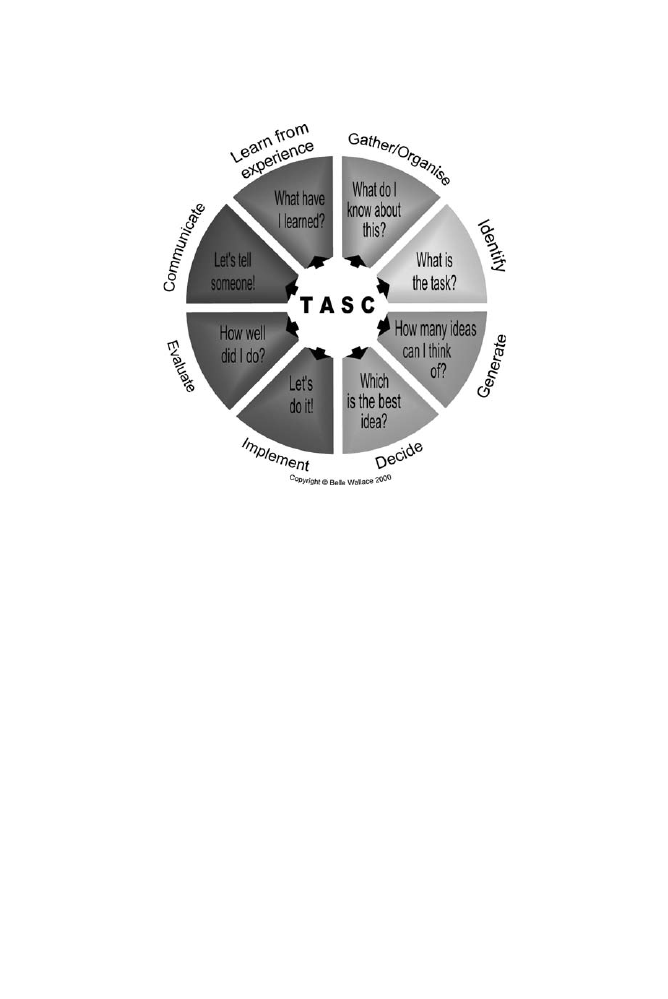
CREATING INDEPENDENT STUDENTS
|
53
learning goals and embarking upon their self-defi ned learning
journey.
4. Decide (Which is the best way?): Decision-making can be individ-
ually completed or agreed in consultation with peers or a teacher.
The connection students develop with the decision-making pro-
cess ensures that they have ownership over the process and fi nal
product of the task. In other words the task has not been imposed
on the students and is not something being ‘done to them’. At
every level the work belongs to the student.
5. Implement (Let’s do it!): This is often the hardest aspect of the
work – to actually get on and do it. How to approach this may
require its own support frameworks to begin with, and this may
be the steepest learning curve for many students, but with the use
of scaffolds, as suggested earlier, the implementing stage will
become more autonomous over time.
6. Evaluate (How well have I done?): Chapter Three explores evalua-
tion scaffolding, and argues that it is desirable to encourage
Figure 2.1 TASC wheel

54
|
CAPTIVATING YOUR CLASS
AS and A2 students to become refl ective learners, and this evalu-
ative stage of the TASC Framework encourages students to
evaluate not only the outcomes of their work but the process by
which they arrived there. This self- and peer-assessment of learn-
ing is a key stepping stone for reaching the goal of independent
learning.
7. Communicate (How can I share?): As discussed in Chapter One,
sharing their fi ndings can be challenging for many students. This
segment of the TASC Wheel is more than just a means of telling
someone what they have learned; it also encourages students to
clarify their learning and to identify any gaps and to return to
other parts of the TASC Wheel for possible ‘re-thinking’. This
encourages the student to further develop their critical learning
and self-awareness.
8. Learn from experience (What have I learned?): This stage is the
refl ective and consolidation section of the whole TASC process.
Next steps can be set for future independent learning tasks based
on the fi nding of this part of the learning process.
A Classics AS topic of the ‘Fall of the Roman Empire 81–31BC’ could
be independently studied using the TASC framework with the task of
assessing the extent of political confl ict in this period. Students may
have already investigated Cicero’s speeches and the teacher wishes
students to extend this to wider political confl ict in the period and the
relationship between Cicero and Caesar. A student schedule using
the TACS framework may appear as under.
1. Gather/Organize: Share prior learning, identify gaps in
knowledge.
2. Identify: Consider the task and what will be required of a study
relating to political confl ict; contextual understanding is
necessary.
3. Generate: Students will ask questions of the task and topic and
determine a fi nal outcome.
4. Decide: A route through the work will be agreed and work plan
devised with agreed tasks, resources and deadlines.
5. Implement: Students begin the work, prepared to ask for help if
required.
6. Evaluate: Regular progress checks and alteration of the work plan
will be required.
7. Communicate: Agree an audience to share fi ndings with.

CREATING INDEPENDENT STUDENTS
|
55
8. Learn from Experience: Refl ect on process and results of learning in
order to improve in both areas next time.
An alternative framework for independent learning is discussed
in the Oxford Brooks PIPAR Case Studies and is referred to as
the TULIP model defi nition. This model appears to offer a greater
level of construction for student planning and thinking with a
hierarchical ladder of ‘stages to thinking’. This model has a greater
clarity for some learners and allows them to plan their learning
journey in a more linear fashion. Learners begin by making a
‘decision’ about the topic of study and its objectives and then
determining what they are going to do and how they are going to
do it. A cyclical route of ‘fi nding’ and ‘organizing’ follows as learners
build the knowledge base and organize their research to support the
decisions made at the outset of the process. Once fi ndings are orga-
nized, learners can ‘develop’ their ideas to exemplify their initial
decision and task foci. After development is complete, learners
are in a position to present their results and fi nally evaluate their
end product and learning journey. For many this is a less complex
framework for independent learning and can serve as an initial
scaffold for independent learning especially at AS level. Consider
the ‘stages in thinking’ again and how they can be used in supporting
AS or A2 students.
1. Deciding: The students are encouraged to examine the facets of
the task from the very outset and determine what is required of
them in regard to content, skills and conceptual understanding.
2. Finding: This research aspect of the task will encourage students
to employ independent reading and research skills using provid-
ing and independently determined material.
3. Organizing: This can be a challenging aspect of individual learn-
ing especially when decision-making is required over what infor-
mation to keep and how to utilize fi ndings. The limitations of
acquired knowledge and understanding will help students to
independently determine where further learning is required.
4. Developing: This encourages the students to process the organized
knowledge and deal with conceptual and skills based learning.
Analysis will take place in this stage of thinking.
5. Presenting: Students will need to consider their intended audi-
ence and how to present their information in an informed and
engaging manner.

56
|
CAPTIVATING YOUR CLASS
6. Evaluating: This will help the students to refl ect on the methodol-
ogy of their work and the learning journey they have embarked
upon. Next steps for independent learning can be set at this stage
as well as in relation to the task and topic being studied.
Both models offer more than a scaffold; they offer an approach
to independent learning that facilitates the steps students need to
follow in order to become independent learners, as well as encourag-
ing opportunities for refl ection on their learning and how they
learned. Experienced independent learners will be able to identify
their learning needs, plan how the learning will take place and evalu-
ate their learning against agreed success criteria. AS and A2 students
will need support, guidance and built-in opportunities for evaluation
of their strengths and target areas in mastering such techniques.
Models such as TULIP and TASC can make that process a more
manageable and achievable one. Through regular evaluation and
comparison of how each framework is working, students are encour-
aged to evaluate their method of working as well as the fi nal product.
It is a good idea to ask students if they have used this approach to
learning in other lessons and to discuss their strengths and weak-
nesses. Discussing how students can improve their independent
learning can lead to them making a personal progression chart to
ensure they are becoming more advanced in their approach to work-
ing independently.
Summary
Independent learning will not occur naturally; it will require
planning and facilitating. This can be structured in a variety
of ways and the two models provided offer a suggested route
for students. Many students will be familiar with working
independently and it is important to ascertain the current
position of each student before embarking upon independent
learning. The earlier occasions of independent learning may
not prove as successful as you may hope and it is important
to not give up at this point but to evaluate why the work did
not succeed and move forward from this point. If ‘failure’ is
brushed aside and the process never revisited the students’
development as independent learners will be damaged in the
long term.

CREATING INDEPENDENT STUDENTS
|
57
12. Using Information and Communication Technology
(ICT) to support independent learning
This section will highlight uses of ICT to promote independent
learning for AS and A2 students. This is not intended as a guide to
ICT but suggests areas of ICT which can help to students to act and
work more independently. Turn to the references section for further
reading in ICT-specifi c teaching and learning books to support this
area of expertise and promote innovative ideas in ICT across all
subjects.
Independent learning can often be misconstrued by students and
teachers as a research based activity with a ‘go away and fi nd out’
approach given to children from as early as KS2. This methodology
is often used with no real guidance or direction of how to do this.
Children as young as six will usually wish to turn to the internet as
their fi rst point of reference for information. They enter key words in
search engines and use the fi rst website presented to them. It is easy
to assume that ‘A’ Level students have the necessary skills to use a
more sophisticated and systematic method of research on the inter-
net, with more precise key words as well as an ability to discriminate
between the uses of websites based on the intended audience of the
website. This belief is reinforced by the 2004 National Curriculum
which asserts that from 11 years of age pupils have a statutory require-
ment to study research skills in their ICT lessons. The National Cur-
riculum KS3 (Revised 2004) Programme of Study for Information and
communication technology 1b states ‘Pupils should be taught how to
obtain information well matched to purpose by selecting appropriate
sources, using and refi ning search methods and questioning the plau-
sibility and value of the information found.’ The National Curricu-
lum 2007 programme of study for Information and Communication
Technology has developed this further and has stipulated that pupils
need to understand ‘capability’ as a concept in ICT, with the require-
ment of 1.1a ‘Using a range of ICT tools in a purposeful way to tackle
questions, solve problems and create ideas of solution and value.’
Further to this, the same document identifi es ‘critical evaluation’ as a
key concept and requires students have an understanding in ‘Recog-
nising that information must not be taken at face value, but must be
analysed and evaluated to take account of its purpose, author,
currency and context.’ The key processes of fi nding information,
developing ideas, communicating information and evaluating are
also being taught to 11-year olds across England and Wales from

58
|
CAPTIVATING YOUR CLASS
September 2008. This is a giant leap forward for all students in terms
of their ICT capabilities as independent learners. However as with
all learning skills, teachers must not take for granted that students
are in possession of such capability and even at AS level they may
make ineffi cient use of the internet as an independent research tool.
If students are being asked to research independently ensure whether
the correct tools are in place for them to do this and as with all inde-
pendent learning structures discussed in this chapter, build a scaffold
into lessons which can be steadily dismantled throughout the year.
It must be clearly stated however that independent learning using
ICT reaches far beyond a research activity on the internet. With many
colleges and Sixth Forms adopting a virtual learning environment
(VLE) the possibilities for learning away from the direction of the
teacher have become much more extensive. Local authorities are
signing up to the principles and practicalities of a VLE with a view to
creating localized e-learning communities and encouraging students
to work beyond the classroom. Consult with your IT technician as to
where your institution is currently at, in terms of adopting a VLE and
access any local training to utilize it to the maximum potential.
The purpose of a VLE is to enable remote and interactive teaching
and learning. A class page can be created to encourage students to
engage in conversation regarding a particular topic or to share their
research fi ndings or test a given hypothesis. All these activities require
the student to be proactive in their learning and to take the initiative
in posting ideas or resources and responding to the suggestions and
comments of others in a very exposed environment. A more indepen-
dent-minded student may seize the moment and launch their own
investigation through the VLE and via the use of blogs and forums
the teacher can fi nd themselves on the outside of a student-led
discussion.
Publishers are well aware of the students’ capacity to work inde-
pendently on their PC and are moving towards CD-ROM support as
an integral part of a text book in many subject areas. Many of these
CD-ROMs encourage students to explore themes and questions
raised in the text books without the prior authorization of their
teacher. Tasks and games aim to make learning ‘fun’ for the student
but more fundamentally encourage them to experiment with their
learning away from the confi nes of the classroom and whilst not
under the teacher lens. Mistakes can be made without repercussion
and topics explored and revisited at leisure. Similar resources such as

CREATING INDEPENDENT STUDENTS
|
59
Summary
Virtual learning environments (VLEs) are an ideal vehicle to
encourage group and independent learning and move respon-
sibility for learning away from the teacher towards the student.
Setting up a virtual classroom may require initial support for
the e-learning coordinator and IT technician but once estab-
lished and mastered uploading and monitoring need not be
onerous. Ask a different student to take responsibility for
aspects of the VLE each month and make use of it within
lessons and for homework to increase its value and purpose.
Chapter summary
Students are often cosseted in the classroom by well-meaning
and experienced teachers who only want the best for their
students. By taking sole responsibility for their learning teach-
ers disengage students from the more stimulating cognitive
and meta-cognitive aspects of the subject and learning. At 16
students are in a position to take responsibility for their own
learning with their teacher to guide and support them. Inde-
pendence can be achieved through a range of strategies. It
will require thought and planning and may take a year to
achieve but the interaction that will result between teacher
and student will create a truly captivated class.
network enabled CD-ROMs and online journals are worth investiga-
tion and will encourage students to take ownership of their learning
and develop the hungry and enquiring mind many teachers aim for
in their students.

This page intentionally left blank

Formative assessment is defi ned as . . . frequent, interactive assess-
ments of student progress and understanding to identify learning
needs and adjust teaching appropriately.
OECD Study, 2005
Assessment is a fundamental aspect of post-16 education. Primarily
assessment takes the form of summative assessment through a rigid
external examination process. Examination processes are rigorously
moderated to ensure consistency across the country in all subjects.
Results are published and Sixth Form centres and colleges are com-
pared against each other via achievement and attainment tables based
on statistical pass rates and student averages. Examination results are
used as a performance indicator for teachers’ performance manage-
ment profi les and parents look to examination results as an indicator
of the quality of education their children are likely to receive in an
education establishment.
The move towards an AS and A2 system of examinations in 2000
increased the frequency of examinations sat by post-16 students
although the recent shift towards fewer examination papers at level 3
qualifi cations including AS and A2 has alleviated the examination
burden to some extent. Due to this emphasis on examination results
Sixth form leaders and teachers are explicitly aware of the impor-
tance of achieving good grades for their students and most teachers
will do everything they can to ensure examination success.
Unfortunately the drive to achieve examination success has argu-
ably had a detrimental affect on the teaching and learning which takes
place in many AS and A2 classrooms. The emphasis on examination
techniques and preparation has led to what is commonly known as
‘spoon-feeding’ students in order that they can pass the exam. The
important consequences of AS and A2 summative assessment has
been shown by Brooks to ‘narrow the curriculum gap and encourage
rote learning; widen the gap between high and low achievers;

62
|
CAPTIVATING YOUR CLASS
promote high anxiety levels and erode self-esteem.’ Teachers view it
as their responsibility to provide students with knowledge, examina-
tion tips and structures that result in formulaic approaches to exami-
nation questions. This can result in a reduced emphasis on subject
discipline as well as a dampened passion for learning. Many teachers
feel trapped by the external pressures placed upon them and wish to
free up their curriculum to explore their subject in greater depth than
a syllabus allows.
In 1998 Paul Black and Dylan Wiliam published Inside the Black
Box a treatise that set out to challenge the use of assessment in
classrooms nationwide. They purported the idea that greater use of
formative assessment in classrooms would improve teaching and
learning and raise standards. Their work became a turning point in
education and since 1998 research, piloting and implementation of
formative assessment has taken place through the KMOFAP project,
the National Strategy and most recently through the personalization
agenda. Assessment for Learning as it has become commonly known
is a process undertaken in partnership with teachers and students to
enable students to understand the learning process they are involved
in and how to get better within that process. This can also be defi ned
as ‘refl ective learning’; developing the skills within students to enable
them to question and determine their own ability, progress and steps
to improvement.
This chapter will seek to explore what assessment for learning
means within a post-16 environment, when the assessment stakes are
regarded as ‘high’ and how teachers can employ and make use of for-
mative assessment techniques in order to captivate their class and
place the ownership of learning fi rmly in the hands of the students.
13. Understanding of performance and how to improve
Assessment in education must, fi rst and foremost, serve the purpose of
supporting learning.
Paul Black and Dylan Wiliam 2006
In 2003 the Assessment Reform Group 2003 published their research
based Principles of Assessment for Learning. They are summarized
below Assessment for learning is most effective when it:
Part of effective planning;
Focuses on how students learn;
Central to classroom practice;

ENCOURAGING REFLECTIVE LEARNERS
|
63
A key professional skill;
Sensitive and constructive;
Fosters motivation;
Promotes understanding of goals and criteria;
Helps learners know how to improve;
Develops the capacity for self-assessment;
Recognizes all educational achievement.
In 2006 the KS3 National Strategy redefi ned Assessment for
Learning key characteristics as:
using effective questioning techniques;
using marking and feedback strategies;
sharing learning goals;
peer and self-assessment.
This is an all encompassing agenda. Schools and colleges could
not ignore the importance of assessment for learning in moving
teaching and learning forward, in England and Wales. More recent
DCSF initiatives of personalized learning have further embraced the
importance of assessment for learning in establishing appropriate
individual pathways for learning. At its conception personalization
was sometimes confused with individualization, where students
work individually or are left to their own devices. This is a misunder-
standing of personalization which Christine Gilbert in the DCSF
2020 Vision paper describes as a ‘highly structured and responsive
approach’. Personalization makes use of the Every Child Matters
agenda to provide a pathway through school that is pertinent and
responsive to the social, emotional and learning needs of every
individual student. Assessment for learning is the most critical tool
in developing and personalizing an individual student’s route
through school, as it takes account of the specifi c learning needs
of each student. Similarly, at the heart of gifted and talented educa-
tion, as explored in Chapter Four, is the use of assessment for learn-
ing to provide insight into the potential and actual needs of more-able
students. It is through assessment for learning that a teacher and
student come to a purposeful understanding of the individual’s
learning needs.
Assessment for learning in schools is not only about ensuring
these aspects of the assessment for learning agenda are taking
place within lessons; it is asking teachers to make use of these foci to
learn more about their students within a class and encourage these

64
|
CAPTIVATING YOUR CLASS
same students to learn more about themselves. Formative assessment
is not to be a bolted on activity that takes place at regular intervals;
instead formative assessment is to be an intrinsic aspect of every
lesson that takes place in every classroom. Across a unit of study
students are to be given clear objectives so that they can understand
and move forward from summative data, make use of criteria and
feedback and engage in peer and self-assessment.
Many teachers have embraced some or all of these assessment for
learning principles yet ‘A’ Level classrooms due to their ‘high stakes’
learning have in many instances lagged behind their primary and
secondary counterparts . This is due in part to the reluctance of many
teachers to experiment with these initiatives for fear of not meeting
syllabus requirements and leaving students ill-prepared for the exam.
Yet it is in ‘high stakes’ learning more than any other that all assess-
ment for learning techniques can actively involve students in their
own learning and motivate their desire to learn as well as prepare
them for the examination. The means to achieving refl ective learners
is through a shift in educators’ mindsets from regarding the teacher
solely as a provider of knowledge and moving towards the acknowl-
edgement of the teacher as also being a facilitator of student learning.
This philosophical shift will take commitment and time and with a
DCSF shift towards greater school partnerships and a potential reduc-
tion in the importance of attainment and achievement tables as a
result of the 14–19 agenda, it is entirely achievable.
The rest of this chapter will set out how assessment for learning
techniques can be effectively employed in ‘A’ Level classrooms to the
benefi t of all involved.
Summary
Assessment for learning can allow teachers to know and
guide all their students as individual learners. It has many
facets and is a complex process that is more than grades and
levels. Assessment for learning is most effective when its
many aspects become integral to everyday teaching and
learning and make up a framework of student classroom pro-
vision. This is not an overnight shift and requires patience,
commitment and professional learning on the part of the
teacher. Figure 3.1 demonstrates how the different aspects of
assessment for learning link together.

ENCOURAGING REFLECTIVE LEARNERS
|
65
Questioning . . . led to richer discourse, in which the teachers evoked
a wealth of information from which to judge the current level of under-
standing of their students. More importantly, they had evidence on
which to plan the next steps in learning so the challenge and pace of
lessons could be directed by formative assessment evidence rather than
simply following a prescribed agenda.
Black, Harrison, Lee, Marshall and Wiliam (2003)
This quote identifi es the central importance of questioning in
assessing and planning for student learning. In an ‘A’ Level class-
room how often can the ‘prescribed agenda’ determine lesson plan-
ning and student learning rather than the needs of the individual
student. Whilst it is acknowledged throughout this book that
teachers of AS and A2 students have a duty to deliver a specifi cation
and syllabus they also have a responsibility to help their students ‘get
better’ at their subject. Questioning serves dual purpose in helping a
teacher meet course requirements and in developing subject mastery
and progress.
Strategies to support student dialogue have been addressed in
Chapter One. Questioning is a means of developing and extending
student dialogue and is an essential tool for both teaching and
learning. Questions can be used orally and in written form but for
Feedback
Classroom
Dialogue
Regular and valued
Teach students
how KS3 KS4
KS5
Own or exam boards but be CLEAR
Use consistently and model examples
Interactive and hierarchical
Wait time
The key to student
progress
Oral and
written
Criteria
Peer- and self-
assessment
Figure 3.1 The different aspects of assessment for learning link together

66
|
CAPTIVATING YOUR CLASS
the purposes of this section and their place in developing refl ective
learning the emphasis will be on oral questioning. Teachers fall into
three categories when refl ecting upon their skills of questioning. The
fi rst and rarest group are able to practice questioning in an instinctive
and intuitive manner and can lead and direct questioning with little
advance consideration. The second and most dominant group believe
they can use questioning instinctively and intuitively and therefore
do not plan for it. The fi nal group recognize that questioning is a sig-
nifi cant feature of a lesson and is of great benefi t to student learning
and accordingly requires advance planning and consideration of
hierarchy and method. It is worth spending a moment to refl ect which
category your ‘A’ Level teaching falls into.
Effective questioning is a skill that cannot be regarded highly
enough and when it is executed well students are able to feel secure
in their subject knowledge, tackle problems with clear expectations
and at a deeper level and develop independence: all qualities a
teacher would look for in effective assessment for learning. Question-
ing is a skill that can be learned and successfully executed through
the use of simple techniques and through a deeper understanding of
lesson objectives and subject progression.
In an ‘A’ Level classroom questioning is arguably of even greater
importance in terms of developing subject knowledge, moving learn-
ing forward and building self-esteem. ‘A’ Level classes can be smaller
than 11–16 classes and provide a more intimate environment to
develop dialogue at a more personalized level. When planned for
within the structure of a lesson and allocated the appropriate amount
of lesson times, all students within the lesson can be involved in
moving their learning forward. Questioning will be considered in
two ways within this section:
1. practical methodology of executing questions;
2. planning a hierarchy of questions to extend student thinking.
Practical methodology of executing questions
Wait Time. There is a wealth of evidence on how teachers use ques-
tioning within the classroom. Some of the most well known is based
around the research of Rowe in 1974. Her study into the elementary
science classes in the USA investigated classroom discourse and
found that the mean time between teachers asking a question and

ENCOURAGING REFLECTIVE LEARNERS
|
67
waiting for an answer was 0.9 seconds. More recently Stahl relabelled
‘wait time’ to ‘think time’ to reinforce the purpose of silence was for
students to be able to complete on task thinking. Research as recent as
2007 reinforces that the average wait time for a teacher in a classroom
between asking a question and moving on is 1–3 seconds. Consider
this within an AS or A2 teaching environment. A student is asked
a question and the expectation is for the student to answer quickly.
The messages that this sends out about learning contradicts expecta-
tions of other learning strategies. The principle goal of questioning
appears to be speed; silence is not acceptable, thinking is not valued
and formulating a coherent response is not given appreciation. Very
few teachers would consider these desirable goals yet they are
enforced across many post-16 classrooms through rapid fi re ques-
tioning techniques with little ‘wait time’ by the teacher for a response.
Rowe went on to look at the effect of increasing ‘wait time’ and found
the following changes in pupil learning took place:
answers were longer;
failure to respond decreased;
responses were more confi dent;
students challenged;
alternative explanations were offered.
These are attractive learning goals and achievable by increasing
the ‘wait time’ between posing a question and accepting an
answer. The length of ‘wait time’ should vary according to the level
of diffi culty the question poses. A comprehension question may
require 1–2 seconds and an evaluative question could require up to
30 seconds (question hierarchies are discussed later). In a post-16
environment anxieties about disruption and student’s switching off
due to a prolonged ‘wait time’ should not be of concern, it will how-
ever take students a little while to adapt to this approach and it is
worth explaining why you are waiting in order that the students use
the time purposefully. ‘Wait time’ also means that it is realistic for the
teacher to expect a response from all students and therefore the ‘no-
hands’ rule can be employed.
No-hands. This is a fi xed rule within my own ‘A’ Level teaching and
students are expected to abide by it from lesson one. At its simplest
level ‘no-hands’ means exactly that – students are not allowed to raise
their hand in answer to a question; they are expected to be prepared

68
|
CAPTIVATING YOUR CLASS
to offer an answer and if they cannot they must say they do not know.
The learning processes which take place within this simple rule are
however far more complex.
No-hands has to become a classroom culture (it must be used all
the time).
It cannot work without ‘wait time’.
Question repetition may be required and does not indicate a
student was not listening simply that they needed question
clarifi cation.
It requires students to feel comfortable in being able to admit they
do not have an answer.
Interaction between teacher-student and student-student needs to
be secure and respectful.
There is nowhere to hide and it becomes mandatory for students
to be actively involved in the questioning process.
It alerts the teacher to the relative progress and understanding of
each student.
It alerts the student to their learning gaps and need for
intervention.
A range of other talking strategies (e.g. think, pair, share) need to
be used to help support student responses (see Chapter One).
Target or Broadcast. This strategy works well alongside no-hands
and is an invaluable assessment for learning tool in terms of the
teacher gauging different levels of students’ understanding. The
teacher either targets the question to a specifi ed individual or
group of individuals or the question is broadcast for all students to
answer. Targeted questioning is effectively used at ‘A’ Level when it
is aimed to consolidate learning and assess who has understood
which aspects of the lesson objectives. It requires sensitivity and
should not be used to catch students out or humiliate them but it can
help the teacher to determine next steps in learning on an individual
basis. The damage to self-esteem could simply be too great to over-
come. Broadcast questions can be used to introduce topics or con-
cepts and move learning forward, they help generate discussion and
responses can be praised, rephrased, corrected or extended by the
student or teacher.
Praise remains an essential form of confi dence building within
an ‘A’ Level classroom but students will not be able to make

ENCOURAGING REFLECTIVE LEARNERS
|
69
progress without also being informed of when have not grasped
the full meaning of the area of study or have completely
misunderstood.
Rephrase does not mean repeating a student’s comment using your
own words; students can rephrase each other’s comments to con-
solidate learning. A different use of language and voca bulary can
improve an answer further and generate further refl ection on the
importance of appropriate and subject-specifi c vocabulary.
Correct inaccurate comments and responses; positive reinforce-
ment of misunderstandings are not helpful and can cause future
cognitive confl ict.
Extend the most helpful type of classroom discourse; the only
response allowed is one which extends another contribution.
Extension can mean contradiction and alternative answers.
Ping Pong Versus Basketball. Consider the following classroom
scenario; the teacher is at the front of the classroom asking questions
of the class, he throws them back and forth to the students using a
range of targeted and broadcast questions. Each answer is directed
back to the teacher and commented upon before the teacher bats
another question to the class. The physical appearance of the ques-
tioning resembles a game of ping pong with the teacher holding
one bat and the rest of the class the other. The teacher is doing every-
thing previously mentioned and hierarchical questions have been
planned yet the class is becoming bored and the teacher is left
exhausted. In the classroom next door a second teacher has also
planned his/her questioning and is using a no-hands approach to
engage as many students as possible. This time the teacher does not
respond to students’ comments; the discourse is open for comment
from all students as praise, rephrasing, correction and extension are
passed back and forth between the teacher and the students. The
teacher intervenes at well-judged moments based on their expertise
and professional judgement. The physical appearance of the ques-
tioning resembles a game of basketball with the teacher passing and
catching the ball as and when his team members pass to him or he
steals the ball from another player. The teacher is part of a whole
class activity in which all students are engaged and responsive. The
teacher is censoring less and probing more thus encouraging devel-
opment of student understanding. It is challenging to adopt a basket-
ball approach to questioning when teachers have traditionally played
ping pong with their class. This can be achieved by emphasizing the

70
|
CAPTIVATING YOUR CLASS
classroom culture with the students, where the class is immersed in
the questioning culture for all the facets to work in unison.
Planning a hierarchy of questions to extend
student thinking
Why does a teacher use questions in the classroom? Does the teacher
always plan to use questions in the classroom and if so, are those
questions prepared in advance? Teachers ask questions for many
reasons, ranging from less demanding comprehension and recall
questions to synthesis and evaluation questions making greater
cognitive demands of the student. The hierarchy of questioning is
often based on a theoretical base such as Bloom’s taxonomy (dis-
cussed in Chapter Four). Bloom wanted to show that thinking worked
on different levels and that by adapting the style and nature of
questions asked, teachers can induce higher levels of thinking.
A teacher can mistakenly believe they need to work though the hier-
archy in a linear fashion every lesson or sequence of lessons but it
would be wasteful of learning time to use a spectrum of hierarchical
questioning as wide ranging as Bloom suggests every lesson. It could
take a student many years to progress into the higher-order domain
and the cognitive range of the questions used should aim to refl ect
the intended learning outcomes. Husband’s (1996) makes this point
in his research by making the point that the emphasis of questioning
should not be on the hierarchy of diffi culty but on using different
types of questions to support different ways of thinking. The empha-
sis in an ‘A’ Level classroom should be on the lesson intentions and
how the questioning used can enable students to meet those objec-
tives. If the lesson emphasis is on acquiring knowledge there will be
greater attention to comprehension style question. If the lesson is
focusing on refl ection different question stems will be employed to
elicit the required outcome from the students. Similarly if the lesson
focus is linked to making judgements a different set of question
types will be employed. Questions need to be prepared in advance
of a lesson in order to ensure that lesson objectives can be met. The
lesson objectives therefore need to go beyond a content based deliv-
ery and focus on the skills and concepts that students are aiming to
develop. When objectives are clearly defi ned effective use of ques-
tioning can be made to secure student understanding in this area.
Planning is essential, as is the strategic use of questioning with

ENCOURAGING REFLECTIVE LEARNERS
|
71
students and fi nally the following consolidation of learning which
follows in subsequent lessons. A range of question stems to support
different phases of learning are suggested below and can be applied
to most subject areas.
Knowledge and Comprehension.
Who . . .? Which . . .?
When . . .? What . . .?
Who put forward a counter-argument in passage C? (Critical
thinking)
Which artists does your work make connections with? (Art
and Design)
When did you notice a reaction between the chemicals in
your experiment? (Chemistry)
What were the conclusions to each investigation?
(Geography)
Application and Analysis.
Why . . .? How else . . .? What
effect . . .?
Why did you choose that material for your fi nal product
design? (Design and technology)
How else might the corporate objectives of M&S plc change
over time? (Business Studies)
What effect does the author use lexis and register to
construct the narrators voice? (English Language and
Literature)
Synthesis and Evaluation.
How far . . .? What if . . .? How
similar . . .?
How far are traditional arguments in the existence of
God valid in the 21
st
century? (Religious Studies)
What would happen if all the world’s computers were
attacked by a super-virus? (Information technology)
How similar are the reactions to the Iraq and Vietnam wars?
(International Relations)

72
|
CAPTIVATING YOUR CLASS
A fi nal note on questioning relates to the use of vocabulary and
clarity of the question. Open and closed questions are well docu-
mented but consider the following.
Are the questions you are asking, steering students into a particu-
lar path of answering or are the questions allowing for the refl ec-
tion you are aiming for?
Is the question using subject-specifi c vocabulary and language
to generate the level of thinking you are aiming for?
Is the question you are asking encouraging students to think of an
answer themselves as opposed to seeking out what they think will
be the ‘right’ answer?
Questions can often be written with a pre-determined answer in
mind especially at ‘A’ Level when mark schemes often defi ne a
‘correct’ answer. Ensure there is scope for individuality in the ques-
tions you ask. Phrasing questions can be time consuming and
diffi cult but when the answer to the question refl ects a student’s own
thinking then the question was a good one.
Summary
Questioning is a vital skill within an AS and A2 classroom
and allows students to explore and articulate their own
understanding as well as challenge others’ thinking. Ques-
tioning can introduce, develop and consolidate areas of study
as well as raise and crush students’ self esteem. There are few
other classroom practices that are so universal in their char-
acteristics. Questions are most effective when planned in
advance and meet the learning objectives of the lesson. In an
‘A’ Level environment this will require thought and deeper
understanding of the foci of your intended outcome. Well-
structured questions in a supportive environment can move
student learning forward at an accelerated pace and create a
culture for learning in which all are involved.

ENCOURAGING REFLECTIVE LEARNERS
|
73
15. Feedback – Feeding back and feeding forward
Feedback to any pupil should be about the particular qualities of his or
her work, with advice on what he or she can do to improve, and should
avoid comparisons with other pupils. Feedback has shown to improve
learning where it gives each pupil specifi c guidance on strengths and
weaknesses, preferably without any overall marks.
Inside the Black Box, Black and Wiliam (1998)
The most powerful single moderator that enhances achievement is
feedback.
Hattie (1992)
Feedback is a highly contentious issue. Many teachers and school
leaders confuse feedback with marking and though the two are inter-
related they can serve quite different purposes. The focus of this
chapter is refl ective learners and it is feedback (in which marking
plays a role), more than any aspect of assessment for learning, that
can enable a student to be refl ective and understand their next steps
for learning.
To clarify these positions consider my own defi nition of both
terms.
Marking students’ work involves passing a judgement on their
work and measuring against an internally or externally imposed
benchmarking system. Marking allows students to gain a sense of
performance against a set criteria and offers a more summative
approach to assessing a student’s progress. If a student is aware of
their target grade they can determine whether they are on target to
meet it and plan their future learning upon their current and pre-
dicted performance. It is an important tool for the student and
teacher and is of greatest benefi t when used sparingly and purpose-
fully, termly assessments and mock examinations, for example.
Feedback is the information communicated to a student in regard
to their understanding of shared learning objectives of a given task
against an agreed set of criteria. This information will include guid-
ance on how to improve. Feedback is the information that is relayed
to the student about their progress and can be based upon a variety
of forms of evidence including: marked work, un-graded teacher
checked worked, oral contribution, practical displays, draft work

74
|
CAPTIVATING YOUR CLASS
and re-drafted work. This information can be relayed to the
student in a written comment or in a face to face discussion. It is
widely agreed to be the single most determining factor in enabling
student to make progress and is recognized as such through the
personalization agenda.
Both are essential yet are regarded very differently. Marking can be
viewed very negatively by teachers and students. Teachers fi nd it
time consuming in terms of the return gains from students. Students
feel an over-emphasis can be placed on grades and marks, reinforcing
failure with little regard to the needs of the individual student.
(Butler 1988, Black and Wiliam 1998, LEARN project 2000).
In schools and colleges, school leaders can become obsessed by the
need for teacher marking to support tracking systems and monitor
student progress, pressure is placed on middle leaders to ensure their
departments are marking and teachers are monitored and become
stressed by the whole experience. Yet few school leaders and teachers
would dispute the value of feedback.
So how can marking become more manageable and be used more
supportively in feeding back information to students that they can
feed forward in their learning? This section will attempt to explore a
range of strategies that will make this achievable.
Shirley Clarke recommends selective marking and a range of
marking strategies to ensure feedback be given promptly and with
clear criteria-driven focus. Her techniques were not initially devised
for use at post-16 but having employed Clarke’s techniques post -16
for several years they have made my marking manageable and my
feedback purposeful. Below are a few of her suggestions.
Grading: Yes but be selective and use when necessary for
example, in summative assessments. For quality assurance ensure
departmental consistency and share grade criteria with the
students.
Acknowledgement marking: At times a straightforward recognition
of work being completed in the form of a simple tick, stamp or
signature is all that is required. This is most likely to be student
notes or work that has been peer or self-marked. At ‘A’ Level
a large bulk of information based work can be acknowledged
this way.
Sampling: The idea of sampling is to improve manageability of
marking work load. It can take the form of marking a few

ENCOURAGING REFLECTIVE LEARNERS
|
75
students’ work in depth and applying general trends from
the sample to assist all students in a peer marking exercise or
using a sample as the basis for a one-to-one feedback tutorial.
OfSTED recognizes this as a successful method of managing
marking. ‘The problem of manageability is being tackled success-
fully in some schools through systems for staggering marking
or sampling’ (OfSTED 2003). In an ‘A’ Level class this could
be based around target grades and focusing on the A/B grades
one week, C grades the next and so on. Alternatively a spread of
work may be marked and then marking modelled for peer
assessment.
Marking together: This can be used effectively to gauge under-
standing when there are clear right and wrong answers such as
in Maths or Modern Foreign Languages. The teacher can feed
forward the results to plan next steps.
Comment only: This technique avoids any grading or scoring of
work and concentrates on the success of the work and the areas
for improvement in both individual pieces and for meeting the
learning objectives over a longer period of time. The comments
are based on specifi c task criteria and not on all aspects of the
work in order to ensure purposeful and manageable marking
for the teacher and to be helpful to the student receiving the com-
ments. Comment only marking can be especially effective when
students embark upon a new AS or A2 course when initially
grades would be meaningless and demoralizing. It also enables
students to gain a more thorough understanding of the particular
skill or concept they are trying to improve in. The nature and
phrasing of the targets set are discussed in Section 16. Comments
need to be delivered promptly and in a language students can
understand and act upon. Comments also need to be specifi cally
related to the task criteria and avoid generalizations. Opportuni-
ties to address the targets set need to be built into the lesson in
which the work is returned and again in future lessons through
revisiting the same learning objective.
Shirley Clarke’s work in this fi eld (2005) suggests a 3:1 approach
of success: improvement comments. Most ‘A’ Level students can
arguably cope with a more even ratio. For example, two or three areas
of the work that have met the pre-determined and shared criteria are
indicated through highlighting or underling with a brief comment as
to how these meet the criteria in order that the student can use these

76
|
CAPTIVATING YOUR CLASS
areas of their work for future modelling. Two or a maximum of
three areas of the work requiring improvement are then indicated
with a stamp or star and a noted with a target for improvement. (See
Section 16 for examples of comments.) Improved work should be
acknowledged and praised at the earliest opportunity.
Feedback is most effective when it is delivered promptly and refl ec-
tion time is planned into the lesson to allow students time to respond
to the comment and if possible act upon it immediately. By delaying
feedback students forget the original purpose of the work and
the challenges they faced when completing it. The pace of learning
depreciates if a student is moving onto another task before receiving
feedback on the former piece of work. Consider a diligent Year 12
student called Kerry who has spent many hours preparing her
chemistry experiment analysis; she is proud of her work and hopes
the teacher is pleased with her efforts; Kerry struggled to explain the
inconsistencies in her experiment; she hands it in on time and awaits
her teacher’s feedback. Three lessons pass and no comment is made
to the Kerry by the teacher, Kerry is too polite to ask as she appreci-
ates that the teacher is busy. In the next lesson the class conducts
a similar experiment to the previous one and in the write up that
follows Kerry yet again fi nds it diffi cult to explain an inconsistency in
her data and begins to worry that she is not very good at this aspect
of chemistry. This is not an unusual story and on the surface not a
very interesting one but on refl ection Kerry is in danger of losing
motivation as her self-esteem is being damaged by a lack of commu-
nication from her teacher. Kerry was pleased with her work yet it was
unacknowledged and not praised, she required help but did not feel
secure enough to ask and by not receiving prompt feedback Kerry
was unable to improve her work when a similar task was undertaken.
By reading Kerry’s work her teacher would have identifi ed the area
Kerry was struggling with and supported her with this aspect of the
second piece of work. Teacher and Kerry would have worked together
on improving her explanation and Kerry’s self-esteem would be
intact. Prompt feedback matters.
The impact of prompt, criteria based feedback on selected pieces
of work will have greater long-term impact on a student’s learning
and their results and is of greater benefi t than an inadequate
attempt to mark everything in detail at irregular intervals. Time
and opportunities for feedback need to be planned into a teacher and
students lesson schedule in order to maximize its impact. Post-16

ENCOURAGING REFLECTIVE LEARNERS
|
77
teachers sometimes remark that they cannot afford to spare lesson
time for students to respond to feedback as there is too much content
to get through. If some of the strategies from Chapter One are
employed and content is not longer the only focus of lesson planning
and objectives then there will be time. The students will make prog-
ress as a consequence of being allocated time to refl ect on how they
need to improve.
Consider which of the following will make a greater impact on
student learning and achievement: thirty minutes spent refl ecting
upon and addressing clearly defi ned targets for improvement or
thirty minutes cramming a lesson with content?
A Summary of the key principles
Comment only marking
Comments are phrased positively.
Comments are subject specifi c, identify success and
ways to improve learning.
Individual targets are set.
Targets are monitored by student and teacher.
Refl ection time is included in feedback lessons.
Written feedback
Focuses on the learning objectives selectively.
Confi rms that students are on the right track.
Stimulates the correction of errors or improvement of a
piece of work.
Scaffolds or supporting students’ next steps.
Provides opportunities for students to think things through
for themselves.
Comments on progress over a number of attempts.
Avoids comparisons with other students.
Provides students with the opportunities to respond.

78
|
CAPTIVATING YOUR CLASS
The suggestions and strategies offered so far are based on
written feedback but ideally feedback will be a combination of
oral and written information and guidance to help a teacher and
student plan the next steps in a student’s learning. Oral feedback
has one advantage above written feedback, primarily the immediacy
of the comment. In oral feedback a student is told immediately
how they need to improve. In a face to face environment body
language and choice of words and phrases will be crucial to how the
student interprets your comment. Teachers should always praise a
student as well as offer specifi c details of ways to move forward.
Questioning can incorporate feedback and the structure of question-
ing (as discussed in Section 15) can feedforward the feedback from
students’ work or a previous lesson. Opportunities to speak one
to one to ‘A’ Level students can be diffi cult; to overcome this problem
a sampling approach can be successful. Allocate part of the lesson,
where students are working independently to discuss feedback
and next steps’ learning with a small group of students with similar
areas for improvement. Peer discussion can also be used for feedback
purposes and is discussed in Section 17.
Summary
To summarize the conventions of oral feedback should
follow those of written and at the heart of the feedback should
be the individual student and what they need to do to become
a better student of your subject. Ideally a college or school
will have a feedback policy and the importance of feedback
for student progress will be acknowledged through whole
college system. An example of a whole school feedback pol-
icy is shown in Table 3.1. How does this compare to your
college or department policy? Are there ideas within this that
can be employed to make your marking manageable and
your feedback worthy of feeding forward into students’
learning?

ENCOURAGING REFLECTIVE LEARNERS
|
79
Table 3.1
An example of a whole school feedback policy
Aims of feedback
for students
Aims of feedback
for teachers
Key principles of
effective feedback
To evaluate their
progress
To monitor progress
Directly links to the
shared outcomes
To work towards
and meet targets
To set work related
and personal targets
Is prompt
To understand
marking criteria
To measure learning
and understanding
Is phrased positively
To maximize their
own potential
To maximize student
potential
Shows next steps
To be rewarded for
their success
To improve literacy
Is built in to refl ection
time
To move students
forward
To mark effectively
and effi ciently
Criteria
Comments
Frequency
1. Criteria for mark-
ing are identified
in planning and
clearly com-
municated to the
students
1. Comments are
phrased positively
1. Student books/folders
are teacher checked
at least every six
lessons
2. Policy is shared
with students in
exercise books
2. Comments are sub-
ject specific, identify
success and ways to
improve learning
2. A minimum of three
formal assessment per
year group per term
3. Subject progres-
sion, level and
grading criteria
are shared with
students
3. Individual targets
are set
3. Homework is
acknowledged
immediately
4. Peer- and self-
assessment
opportunities are
included in each
taught module
4. Targets are moni-
tored by student and
teacher
4. Policy is consis-
tently used across
departments and this
is supported by half-
termly monitoring
procedures
5. Reward policy is
in line with that
agreed at the text
box ‘A Summary of
the Key Principles
5. Refl ection time is
included in feedback
lessons
5. Subject leaders will
discuss departmen-
tal feedback with
their line managers
every half term

80
|
CAPTIVATING YOUR CLASS
Section 15 discusses the benefi ts of comment only marking and the
impact effective feedback can have on AS and A2 students’ learning.
Such strategies will only be successful however if the targets given
to students make sense to the student and are built into a broader
framework of progression shared by students and teachers within a
subject area. Progression charts for different conceptual and skills
based areas within and across a key stage allow a teacher to map
where their students are heading across a course and return the
reader to the concept of backward planning discussed in other
areas of the book. By clearly planning for progression across an AS
course and into the A2 course the process of advising a student of
their next steps for learning becomes easier for student and teacher.
This is not to suggest students will ascend the progression chart like
a ladder at an even and steady pace with a few encouraging words
from their teacher along the way. Students progress at an irregular
pace and strengthen in some areas of their learning before they are
able to move forward in others, some students will never become
adept in all areas of their subject and their will always be a range of
students at different stages of competency within an AS and A2 class.
If the teacher has a clear grasp of where the student is heading then
this can be transferred to the students through clear and achievable
targets which aim to move the student forward at a pace appropriate
to their learning style. If assessment for learning is defi ned as: ‘The
process of seeking and interpreting evidence for use by learners and
their teachers to decide where the learners are in their learning, where
they need to go and how best to get there.’ Assessment for Learning:
10 Principles Assessment Reform Group (2002), then target setting
based on a subject based understanding of progression plays a crucial
role in its achievement.
Targets are most effective when they are simple, clear, achievable
and transferable targets, with refl ection time built into lessons.
Progression charts can be based upon specifi cation assessment crite-
ria as well as teacher’s professional subject expertise. They work most
effectively when discussed as a department and this can also be a
starting point for developing consistency within a subject area.
A comprehensive but not rigid outline of progression can be shared
with students and allows students to build their own next steps as
well as making target setting a much more effi cient process for the

ENCOURAGING REFLECTIVE LEARNERS
|
81
teacher. Ideally such models will not be mechanistic and support the
student and teacher in the learning process.
In 2003 OfSTED published a report on Good Assessment in Second-
ary Schools in which effective target setting was characterized by the
following features:
specifi c to the subject and relate to important aspects of knowl-
edge, understanding and skills in that subject;
derived from teacher’s assessments and not only student
devised.
limited in number and of manageable proportions.
relatively short-term, capable of being monitored and subject to
regular amendment.
accessible to students.
drawn from or relate to, the teaching objectives of a unit of work.
To apply these goals into AS and A2 teaching is desirable and
achievable. For an ‘A’ Level student assessment criteria and progres-
sion within a subject can be relatively narrow and as a student of
fewer subjects greater time and devotion can be given by the student
to meeting the targets set. An average AS student for example, will be
studying four subjects or a combination of two AS’s and a vocational
course. Either way the issues of manageability are made easier by
contact with fewer teachers and less subject variables. This enables
the teacher to have a greater expectation of the student’s ability to
devote time to the meeting of targets and increases the role targets
play in moving a student’s learning forward.
Targets can be set in a variety of ways and returning to the work of
Shirley Clarke, she suggests the following approaches:
Example prompts: These are clearly defi ned targets which show a
model of the intended outcome and then ask the student to do their
own, for example:
Count how many breaths Karen takes between strokes and repeat
in your own front crawl . . .;
Read the sentences below and choose one to start your conclusion
. . .;
Read James’ introduction, how has he gained the readers
attention so quickly? Rewrite your introduction using a similar
technique . . .

82
|
CAPTIVATING YOUR CLASS
Scaffolded prompts: These advise a student on how to structure an
area of their work more effectively to improve it further, for
example:
How could you use X, Y, Z to explain this point further . . .?
Make use of the connectives mat to link your paragraphs more
effectively . . .
Rewrite your opening sentences in order to signpost your
paragraphs . . .
Choose an example from each of the units studied to give the
piece breadth . . .
Reminder prompt: These act as an aide memoir for something a
student could have done but overlooked or disregarded, for
example:
Explain why you think . . .;
What evidence do you have to support this . . .?;
Where else is this applicable . . .?;
Explain this point with more subject specifi c vocabulary . . .
Each of the targets has a common approach. They each ask the
student to do a specifi c action or task to improve their work
immediately.
1. The student is encouraged to return to their original work.
2. The student refl ects upon their original work.
3. The student looks to additional information in the form of an
exemplar or further reading.
4. The student improves their work immediately based on all of the
above.
5. The student resubmits their work for checking or approval.
This work is then acknowledged or marked a second time by the
teacher to look for improvement. If the improvement is made the
work can be praised and it would be benefi cial to ask the student
to refl ect upon what they did to make the step forward and consider
what they will need to do next time they are faced with a similar
task. The target then becomes transferable, the student will hopefully
recognize that they need to again employ the improvement strategy

ENCOURAGING REFLECTIVE LEARNERS
|
83
and produce an improved piece of work which will be ready for
another next steps comment.
Not all students will initially be able to use targets in this way and as
with other assessment for learning strategies they will need reinforc-
ing by the teacher on a regular basis in order that the student becomes
familiar with this style of working. This will require teacher and stu-
dent discipline and a simple target log sheet at the front of a student
planner can assist with the process. This can contain columns for the
target set, a date to mark completion, a comment on how the target
was addressed, a refl ection on the teacher’s subsequent feedback and
where this feedback was reapplied at a later stage of learning.
A by-product of this approach to target setting is that students
are forced to revisit previous work in order to improve the next
stage of learning. A student who has diffi culty with organization
and forgets to fi le work or even keep it will struggle to make the
necessary improvements. If encouraged to refl ect upon this most
students will begin to see relevance in maintaining an organized
folder and place value on both your comments and the need to refer
back to their previous work. It is immensely rewarding and motiva-
tional for a teacher to observe students valuing, responding to and
making progress as a result of their student feedback. Through
adopting the routines and precision of feedback and targets sug-
gested this is possible to do.
Summary
Without feedback students cannot make the progress they
deserve. Feedback can be given in lessons, on the playing
fi eld, in the laboratory and it does not have to be in response
to a marked piece of work. Marking can be overwhelming
and it is important to your well being that the marking load
does not become unmanageable. Select key pieces only to
mark, employ a range of strategies for checking other work
and make time to talk to your class in order to feedback orally.
Encourage student refl ection of feedback and acknowledge
their attempts to improve their work; this is motivating for the
student and importantly for you, their teacher.

84
|
CAPTIVATING YOUR CLASS
17. Peer-assessment and self-assessment
Self-assessment by pupils, far from being a luxury, is in fact an essen-
tial component of formative assessment.
Inside the Black Box, Black and Wiliam
Self-assessment is essential to learning because students can only
achieve a learning goal if they understand that goal and can assess
what they need to do to reach it.
D. R. Sadler 1989
If the aim of this chapter is to demonstrate ways of encouraging
AS and A2 students to become more refl ective about their learning
peer- and self-assessment is integral to achieving this goal. Similarly
if as teachers we wish to develop our students’ ability to become
independent learners they will need to be ‘able to engage in self-
refl ection and to identify the next steps to their learning.’ (Assess-
ment Reform Group, 2002). Students are more likely to make progress
if they understand what their learning intentions are and what they
need to do to meet them. So far we have discussed ways in which the
teacher can drive this process for the students; this section will con-
sider how the responsibility can be shared with the students to create
a partnership of shared ownership of identifying where the student is
currently at in their subject understanding and what they need to do
get better.
Peer assessment provides pupils with opportunities to be involved
in the process of assessment and to engage in questioning, marking
and feedback and be a more active participant within their own learn-
ing environment. Self-assessment takes this process a stage further by
asking a student to be inward looking and self-refl ective of their own
achievements, successes and areas of improvement. This is a chal-
lenge for any learner irrespective of age and highly demanding for a
16–18-year old who will be dealing with a set of physiological, social
and emotional self-awareness related issues. This section will con-
sider the benefi ts of peer- and self-assessment and strategies that can
be employed to make it a powerful assessment for learning tool and
a life-long skill.
Benefi ts of Peer- and Self-Assessment
Peer- and self assessment is a process which requires training and
practice, based upon an agreed set of criteria. It is a developmental

ENCOURAGING REFLECTIVE LEARNERS
|
85
process which requires sensitivity and rigid protocols in order for
every student to benefi t from it. The benefi ts are immense and con-
sidered in more detail below.
Actively engages students in learning goals: If the student is expected
to respond to learning objectives in another student’s work they
will be able to have a greater understanding of them. Through
consideration of to what extent another student has met with
learning criteria the same student may eventually be able to iden-
tify those qualities and gaps in their own learning and act accord-
ingly to reach their target grade or beyond.
Clarifi es learning goals and task criteria for student and teacher: In
order for a student to peer assess they must have clarity in their
understanding of the learning goals. Moreover the teacher must
also have clarity of the learning goals and criteria in order to share
them with the students. If a student is asked to peer assess a writ-
ten piece of work are you asking them to identify learning beyond
knowledge and understanding. Whilst there may be a check list of
content and data required within the criteria, there has to be a
learning goal beyond that of content. What is it? How will it be
expressed to the students? Will the task being peer marked allow
for differentiation either by task or by outcome? Unless the teacher
defi nes these areas in advance of the lesson there can be no learn-
ing. If a student does not understand the learning goals they will
be unable to peer assess and the teacher will be alerted to the
marker’s needs as well as the needs of the student being marked.
Sets clear and achievable targets: Once students become more
sophisticated at peer marking and are familiar with their teacher’s
style of target setting, students will be able to set targets in their
own language. Often such targets refl ect a clearer vocabulary than
teacher written targets and are more achievable. Sometimes the
teacher’s assistance will be required to phrase the target and the
dialogue which occurs through this process can reveal areas of
understanding and gaps in learning that may otherwise have been
missed.
Builds self-esteem: Students who become adept in this area gain a
huge boost to their self-esteem as their purpose in the classroom
has gone beyond that of learner. The student is an active partici-
pant in the functions of the processes of the lesson and has taken
in some part the role of teacher. This is an empowering position
and can help the student believe that they are mastering their
subject.

86
|
CAPTIVATING YOUR CLASS
Develops teacher-student and student-student rapport: Classroom talk
at ‘A’ Level can promote learning in many ways as discussed in
Chapter One and Section 14. Peer marking encourages active
dialogue between students and between teacher and student(s).
Discussion is focused upon the merits and weaknesses of a
student’s work not on the content of the subject or on the student
as a person. Relationships with a class are built through hard
work and mutual respect, offering responsibility to the student’s
for their own learning will engender both these traits. It becomes
a healthy subject focused conversation about how to improve in a
given area of a subject. The more the specifi c the criteria are for
the task the greater the level of cognitive precision there will in the
conversation.
Encourages independence: A student who can refl ect upon their
own work prior to handing it in for marking and feedback and
identify its merits as well as the areas that further guidance or
support is required in, is a student worthy of being labelled inde-
pendent. Peer-and self-assessment can develop this critical aware-
ness and are an attribute of an AS or A2 learner. (See Chapter Two
for more details.)
A Calendar for peer- and self-assessment
Over the course of an academic year a student can become skilled at
the processes of peer marking and reap rewards from the outcomes
but a step-by-step approach such as the one mapped in the peer
marking calendar (Table 3.2) is to be encouraged. This is based upon
a typical AS group who will sit their examination in June. If the group
are sitting an examination in January, a rethinking of timescales and
pace of peer marking will be required. Similarly if it you are taking an
A2 group for the fi rst time, consult with their AS teacher as to how far
they progressed with peer marking and begin from where they fi n-
ished at AS, there is little to be gained by the teacher or student in
starting the process from the beginning again.
On their fi rst attempt at peer marking students will often focus on
the appearance of the work, its length and presentation but rarely the
actual learning criteria. This is understandable as students will feel
uncomfortable critiquing another student’s work and will not really
know, in the fi rst instance, what they are looking for. Personalize the

ENCOURA
GING REFLECTIVE LEARNERS
|
87
Table 3.2 Peer marking calendar
Month
Peer marking activity
Purpose
September
Ask students to look over each other’s notes based
on a simple three part criteria of; layout, use of key-
words, legibility and feedback. Agree protocols for
peer marking based on this first experience. This is
important for establishing ownership of the process
and inter-personal relationships
A non-threatening first activity will introduce students
to peer marking. Working through the process allows
the class to agree protocols, for example, discuss the
work not the author; begin feedback with a positive
remark
October
With target grades established and peer relationships
formed introduce a ‘marking buddy’ system to be
used with all future peer marking. Mark a class
based piece of work using pre-determined subject
criteria not generic skills; identify success only
‘Marking buddies’ help students become familiar
with each other’s work and confidence can grow in
relation to understanding of the buddy’s strengths
and weaknesses. Similar ability students can work
together to support or extend as necessary
November
Buddies mark a homework task using a criteria grid
(this lists the task criteria and has a ‘Yes’ and ‘No’
box next to it with space for comments). Highlight
areas of the work which meet the criteria suc-
cessfully and indicate one area of the work which
does not meet the criteria with a statement as to
why it does not meet it
The criteria grid ensures a student focuses on speci-
fi ed areas of the work and ignores everything else.
Confi dence is being built though positive praise
and the buddy is becoming familiar with his/her
partner’s style of work. There is no expectation for
target setting at this point
(Continued)

88
|
C
APTIV
A
TING
Y
OUR CLASS
Table 3.2 (Continued)
Month
Peer marking activity
Purpose
December
Conduct another piece of marking using a criteria
grid. Set a target for the area for development and
feedback to the buddy immediately. Plan time for
the target to be acted upon and then debrief the
quality of the target based on students’ attempts to
achieve it. The teacher will still be checking peer
marking at this stage
This is the first attempt at target setting and buddies
can base their suggestion on previous targets set by
their teacher. By acting on the target immediately
and then debriefing the activity the targets can be
quality assured and exemplars used as a model for
future target setting
January
Increase the frequency of peer marking and reduce
the teacher checking based on individual pair’s
competencies. Use for small aspects of work rather
than whole pieces to develop a range of opportuni-
ties, for example an introduction, an experiment
write up, an essay plan
By reducing the teacher input greater responsibility is
being passed to the students thus raising their level
of independence while maintaining the security of
the buddy system. Little and often can also work bet-
ter within the framework of a whole lesson
February
Move to acknowledgement marking only of peer
marked work. Withdraw the use of criteria grids if
appropriate. Teacher will mark responses to targets
This is a consolidation period before moving onto self-
assessment.

ENCOURA
GING REFLECTIVE LEARNERS
|
89
March
Using a criteria grid self-assess a piece of work of the
student’s choosing. Link directly to target grades
and what the student needs to do to meet or exceed
their expected target
Exams are approaching and the student will benefit
from directly linking their work to mark schemes ad
grade criteria. Self-assessment at this stage will place
the student firmly in control of their own learning
with support from their marking buddy and teacher
as and when it is required
April
Combine regular use of peer- and self-assessment in
relation to examination assessment objectives. Link
individual target setting to revision schedules.
Examination preparations will now be taking priority
and revision schedules can be built around next step
targets from previously peer and self assessed work.
This aims to engage the student directly with their
exam preparation rather than it being imposed by the
teacher
May
Regularly mark and feedback on exam practice
using examiner’s reports and examination mark
schemes
Encourages prompt feedback within minutes of com-
pleting a question, familiarizes students with exam
mark schemes and criteria.

90
|
CAPTIVATING YOUR CLASS
plan to the needs of the individual group of students; it will be differ-
ent every year.
Strategies for peer- and self-assessment
The calendar suggests a range of peer- and self-assessment strategies
which require greater consideration. Below are the calendar strate-
gies in greater depth and a few alternative strategies to help ‘A’ Level
students become more profi cient in this skill.
Marking buddies: By creating marking partnerships students will
be able to forge a relationship of trust and support with a class-
mate and use them like a teacher would use a mentor or coach. By
waiting to establish the partnerships the teacher will have a more
informed understanding of each student’s strengths, social skills,
friendships and can pair students with due consideration of all
these factors. It would be wise to allow students to speak to you
privately if at any point they are uncomfortable with their mark-
ing buddy but where possible try to avoid swapping as the stu-
dents have to view this as a professional as well as personal
relationship. The benefi ts of placing similar ability students
together are discussed in Chapters One and Four and placing an
‘E’ grade student with an ‘A’ grade student would beg the ques-
tion ‘Who is gaining for the partnership?’
Random selection: In order to ensure that students are exposed to a
wide variety of styles and approaches to a task there is merit in
randomly redistributing work rather than orchestrating who
marks who. However ‘A’ Level students very quickly become
aware of each other’s style and the anonymity of marking in this
way does not last for long. At post-16 a more mature and consis-
tent approach to peer marking may be appropriate.
Use of criteria: Most studies of peer- and self-assessment will sup-
port the belief that it can only be effectual when accompanied by
clearly defi ned criteria. This criteria can be based upon external
examination objectives or be smaller task-specifi c criteria. It may
be accompanied by a level or grade or may simply be on a can/
cannot do basis. There is no suggestion of a preferred system
simply that there must be shared and defi ned criteria for the peer-
assessment to be effectual.
Regular and staged: Students will fi nd peer-assessment challenging
on the fi rst occasions just as teachers found their fi rst ever set of

ENCOURAGING REFLECTIVE LEARNERS
|
91
‘A’ Level marking daunting and terrifying. Minimize the expecta-
tion by using a staged approach to peer- and self-assessment at a
pace that works for the group and the individuals within the
group. As with other refl ective learning strategies it benefi ts for
being planned for within the short and medium term and lesson
time will need to be afforded to it on a regular basis if it to be
successful. An attempt here and there will waste teacher and
learner time and make little or no impact on student learning. As
a teacher you will need to commit yourself to the immense
benefi ts of peer- and self-assessment and be prepared for limited
success to begin with.
Model previous work: A non-threatening entry into peer marking is
through the use of previous student’s work and modelling of a
peer marking activity. Using a range of work by previous students
enables peer markers to be honest about work without the anxiety
that the author is in the room or at next to them. This is an effec-
tive method to employ if you are trying to speed up the pace of
peer marking or if you need to move student on more quickly.
It can also be a useful exercise to undertake each time the class
embarks upon a more challenging aspect of peer or self marking
to reassure the marker and build student confi dence.
Amend promptly: Already discussed in Section 15 but worth rein-
forcing, allow time for feeding forward from peer feedback as you
would do for teacher led feedback.
Viva: This is a common technique used at university to discuss
an undergraduates’ work and their level of understanding in a
particular fi eld. It is often used when a student is a borderline
class of degree and the lecture wishes to determine the degree
they should receive. In an ‘A’ Level lesson a similar approach
can be used between marking buddies or between a small group
of students. Rather than a marking buddy reading and assessing
a student’s work, the author or creator of the work presents it to
the marking buddy and explains what they did and how they
have reached particular fi ndings or conclusions. The marking
buddy then peer marks in a familiar way. This approach has
two clear benefi ts: fi rst the presenter of the work has to have an
understanding of what they have done and they cannot bluff
or plagiarize. Second the dialogue which occurs between the
students is consolidation of prior leaning and allows the students
to explore further themes and ideas presented through the work.
As the teacher you can listen into their conversation and form

92
|
CAPTIVATING YOUR CLASS
your own judgement about student learning and plan next steps
accordingly.
All of these strategies put the student at the centre of assessment.
It is a course of action they are part of not a victim to. Whether used
formatively or summatively peer- and self-assessment are foremost,
revealing about the strengths and needs of a student and engages
them in the learning and assessment process.
Summary
Peer-assessment has many benefi ciaries. The student gains
an ‘insider’s’ view of the assessment and learning process
which they can put to effective use in their own work. The
teacher fi nds that his/her students are more receptive to
feedback and often make progress at an increased rate. The
teacher will also fi nd a diminished marking load in the long
term as their students become more adept and rigorous at the
marking process. The overall winner is the class as a whole,
who form a collaborative and supportive working relation-
ship and understand the relative strengths and targets of each
member of the class. When planned for and strategically
introduced the benefi ts are greater than the fi nal examination
grade.
18. Preparing for the fi nal examination
Most of the discussion so far has been in relation to formative assess-
ment and encouraging students to become more independent and
refl ective learners. External examination is the fi nal measure of
a student’s ability. This fi nal section will consider methods of prepar-
ing students for the fi nal examination through a range of teaching
and learning strategies that maintain student involvement and equip
them with the necessary skills to achieve their potential in their
fi nal examination. These are not techniques that teach to the examina-

ENCOURAGING REFLECTIVE LEARNERS
|
93
tion or enable students to functionally jump through the necessary
hoops, merely a range of methods to prepare students for the exami-
nation and retain their identity as scholars. All the suggestions can be
applied to any examination at AS and A2 and can be used throughout
the taught course, not just in the revision phase of the curriculum.
Chapter Five deals with revision techniques in and out of the class-
room and there is overlap across this section and the Chapter Five.
Exam familiarization: From the very beginning of a course it is
helpful to show students a fi nal examination in order that they
can familiarize themselves with what and how they will be fi nally
assessed. At AS this can be an uplifting process as it removes
the fear factor of the fi nal examination and alerts them to next
stage in education. Often the question style will bear a resem-
blance to GCSE as will the assessment objectives thus removing
the mystery of the fi nal examination. Although the content knowl-
edge will be absent at the start of the course, acquaintance with
the fi nal goal post can be reassuring for future learning.
Exam practice: Chapter One deals with strategies for teaching
and learning which move the learner away from examination
style questions. It is still important however to make use of exami-
nation papers on a regular basis and make formative use of their
results. The key is to use them regularly but infrequently in order
that they do not dominate the teaching schedule. Responses can
be planned together and peer assessed or used as a consolidation
activity at the end of a sequence of lessons.
Examiners reports and mark schemes: This is another exercise
designed to demystify the examination process. Students are often
unaware of an examiner’s wish to mark positively and reward
achievement wherever possible. Examiners’ reports often contain
guidance on how to tackle certain aspects of an examination
paper and offer ‘top tips’ to help teachers equip their students
with the necessary learning tools. Marks schemes will also contain
suggested content appropriate to a specifi c question and when
used as a debriefi ng exercise to a particular question or topic can
be reassuring for students.
Devise own papers or mark schemes: Once familiar with an examina-
tion and its mark scheme students can engage in writing their
own examination papers or mark schemes. This activity can be
made purposeful by actually using the papers for their or another

94
|
CAPTIVATING YOUR CLASS
class. By preparing a question students have to consider which
question style can access the relevant assessment objectives.
Similarly preparing a mark scheme will challenge students to
unpick an assessment objective and the progression within it.
Students can then incorporate their ideas into their own responses.
The extent to which students cope with this activity will provide
the teacher with formative information about the individuals in
their class.
Plan together: This is reassuring for all students and can extend the
thinking of a more-able student. Planning answers is to be encour-
aged in all subjects and when incorporated into everyday lessons
students will become familiar with the practices and benefi ts
of it. Set strict time limits as the examination approaches in order
that students can apply the skill of planning in the fi nal examina-
tion rather than see it as a luxury that cannot be afforded in a
timed environment.
Model: Many Sixth Form colleges and centres take advantage of
the examination board facility to recall papers. This is immensely
useful when trying to gauge exactly what the examiners were
looking for and what constitutes an A, C, E grade. Teachers
often use these papers as part of the professional development
but fewer share them with the students. There are ethical issues
regarding names on papers and scripts must be made anonymous.
Make use of ‘real papers’ when modelling a response or introduc-
ing peer marking strategies. Students are often willing to be
more critical of anonymous work and will be heartened by what a
‘C’ grade looks like.
Practice timing: This is one of the most common hurdles in a fi nal
examination and students can poorly time their responses and not
achieve the grade they deserve. As the examination approaches
reduce the time students have to prepare, plan and execute a
response in order that the fi nal examination feels like a classroom
activity.
Through formative use of the outcomes of these activities students
are being provided with the opportunity to prepare for the examina-
tion and a refl ective understanding of what they will need to do
to secure the very best grade they can, raising educational standards
for all students.

ENCOURAGING REFLECTIVE LEARNERS
|
95
Summary
Examination preparation and an understanding of how the
fi nal summative examination will appear is a necessary part
of ‘A’ Level teaching and learning. It is important to use this as
an aspect of the teaching and learning strategies not the driv-
ing force of all lessons. Pressure on teachers to achieve results
can place an unnecessary emphasis upon examination prac-
tice. Use it when necessary, regularly revisit examination
papers but do not let the examination dominate the class-
room. When they are being used try to incorporate formative
assessment techniques and enlivened ways of approaching
them to maintain your captivating classroom.
Chapter summary
Knowing your students and building a positive working
relationship with them takes an investment of time and
energy. Yet it is these relationships that shape you as a teacher
and infl uence the way you plan, think and work. Students
will give everything for a teacher who they believe cares
about them and their work. Teaching students to be refl ective
develops from these relationships and students being able
to employ the same care and attention to their learning that
you give to theirs. Helping students make progress is not
based on grades and levels it is based on their understanding
of the subject and how to progress within it. By making use of
all or some of the suggested strategies you will gain a better
understanding of the students you teach and in turn they will
appreciate their own learning more successfully.

This page intentionally left blank

As ‘a rising tide lifts all ships’, Gifted and Talented education can raise
the aspirations, achievements, motivation and self-esteem of all pupils.
Neil McIntosh, CfBT 2007
There is a lot of material for pre-16s and it seems to be assumed that it
can be adapted to suit older learners. Post-16 provision seems to be
treated as something of a bolt-on or afterthought.
Mike Bulmer, Aimhigher
Gifted and talented education remains one of the most contentious
areas of the current England and Wales’ comprehensive education
agenda. ‘Its elitist!’ was not an uncommon cry in many staffrooms
when Gifted and Talented (G&T) issues were initially raised. Gradu-
ally through the inclusion agenda and the move towards a more
personalized curriculum the G&T agenda has risen in profi le within
schools. Similarly in many local authorities and institutions, pro-
grammes are in place to meet the needs of 11–16 learners.
Research and theory surrounding the area of G&T education is
plentiful. The DCSF and other agencies have invested time and
resources into ensuring support materials and personnel are avail-
able to help school leaders and teachers move forward in their under-
standing and practice of G&T teaching and learning. Unfortunately,
development and practice in post-16 G&T education is less well-
documented and colleges and Sixth Forms are implementing their
own programmes at their own pace depending upon enthusiasm
of individual leaders and teachers alongside pressure from other
interested groups and stakeholders.
This chapter aims to explore post-16 educational theory and
pedagogic practice in G&T education. It will also endeavour to
show that every lesson and learning activity can aspire to meet the
needs of the most able AS and A2 students. As in previous chapters
the emphasis will be on practical learning strategies and applying

98
|
CAPTIVATING YOUR CLASS
a range of techniques to different subject areas. More than any other
area of the book, this chapter will directly respond to what students
have said about how they wish to learn in a challenging educational
environment.
19. Who are G&T students at ‘A’ Level?
The goal is that fi ve years from now; gifted and talented students
progress in line with their ability rather than their age; schools inform
parents about tailored provision in an annual school profi le; curricula
include a gifted and talented dimension and at 14–19 there is more
stretch and differentiation at the top end, so no matter what your
talent it will be engaged; and the effect of poverty on achievement is
reduced, because support for higher ability students from poorer back-
grounds enables them to thrive.
Speech at National Academy for Gifted and Talented Youth – David
Miliband, Minister of State for School Standards, May 2004
What does it mean to be ‘gifted and talented’?
The DCSF/CfBT Young Gifted and Talented programme defi nes
G&T learners aged 11–19 as ‘those pupils who would fall into the
national top 5 per cent by ability and other pupils who are gifted and
talented, relative to their peers in their own year group in their
school’. The National Association of Children Exceptional (NACE)
does not offer a discreet defi nition of G&T and instead offers ‘support
for teachers in getting the best from able, gifted and talented pupils in
the everyday classroom, whilst enabling all pupils to fl ourish’. The
DCSF spend the largest section of their guidance document ‘Effective
Provision for Gifted and Talented Students in Secondary Education’,
advising schools how to develop their own identifi cation policy and
defi ne their own identifi cation criteria.
Schools are encouraged to make use of various forms of data to
identify their G&T population, examples of which include DCSF Key
to Success data, results from examinations at the end of each key
stage and other external qualifi cations. Teachers and other adults are
encouraged to engage in the identifi cation process to ensure a move
away from a purely academic G&T cohort and ensure ‘Talent’ plays
as important a role as ‘Giftedness’ in the make up of a whole school
G&T register.
In January 2008 it was reported in the CfBT National Register
Annual Report based on School Census statistics, that 92 per cent of

EXTENDING STUDENTS’ THINKING
|
99
secondary schools identify their G&T pupils resulting in a national
primary and secondary register of 780,250 pupils. In statistical terms
schools are advised that a G&T cohort will be between 10–20 per cent
of the school population but will vary, depending upon the diversity
of the student intake. In the aforementioned report of January 2008,
11.8 per cent of secondary students are identifi ed as G&T. In post-16
education this cohort will be multi-dimensional and will not fi t a
nominal percentage medium. Commonly post-16 institutions will
base their register on the principal criteria of a 7+ average GCSE
points score on entry. Increasingly however there will be vocational
G&T learners whose end destination may not be university. Region-
ally and nationally recognized sportsmen and women may not
achieve a high point score average but their athletic ability will require
appreciation, nurture and support from their educational institution
especially in periods of critical competition and arduous training
schedules. Identifi cation at post-16 therefore does not become ‘easier’
as the spotlight shines on the academically bright; it becomes increas-
ingly diverse and non-stereotypical and colleges and Sixth Forms
will need to ensure a fl uid and regularly reworked register to ensure
maximum identifi cation of student needs.
Whole college identifi cation procedures and programmes are
largely out of the hands of individual teachers and it is the role of
each post-16 teacher to make use of the identifi cation procedures, in
order to be attentive to the needs of all their students including the
most-able. Teachers should be making use of the entry data of each
student in order to begin the identifi cation procedure and be vigilant
to the indicators of outstanding ability as and when they begin to
emerge. Teachers who lack confi dence or expertise in this area need
to be willing to ask for and be offered support from department and
school colleagues in this fi eld. Only then can the strategies suggested
in subsequent sections of this chapter be successfully employed and
benefi ted from.
20. G&T students and their individual needs
Many people believe that ‘giftedness will out’ but research shows that
this is not true and that giftedness needs to be ‘coaxed out’ through
access to challenging opportunities, appropriate help and guidance.
General principles for thinking about G&T provision are coherently
laid out in the DCSF document ‘Guidance on Effective Provision for

100
|
CAPTIVATING YOUR CLASS
Gifted and Talented Students in Secondary Education’ coordinated
by Professor Deborah Eyre, former Director of the National Academy
for Gifted and Talented Youth. The document recommends readers
to consider their exit point for students when embarking upon G&T
provision. Eyre suggests teachers ask the question, ‘What do you
want to have achieved for these students prior to their move to
post-school destinations?’ This open ended question encourages
teachers to again refl ect upon where they want students to be at the
end of their AS and A2 courses and engage in backward planning to
ensure intentions are met. An individual teacher or departmental
response may be narrower in focus than a whole school and college
answer but it is likely that most answers will refer to a student’s
learning and emotional behaviours in addition to their examinable
and non-examinable achievement. The guidance attempts to provide
insight into how these overarching aims can be met and the key
points to how to achieve success in 11–19 G&T provision are summa-
rized below. These are also the fi ve components of the personalized
learning agenda.
Effective teaching and learning strategies
Excellent teaching with reference to the classroom quality
standards.
The learning environment.
Task planning.
Questioning.
Individual young people.
Self-esteem and motivation.
Enabling curriculum entitlement and choice.
Assessment for learning.
Organizing the school.
Strong partnerships beyond the school.
Organizing the school, enabling curriculum entitlement and choice
and strong partnerships beyond the school are largely beyond an
individual teacher’s control but other areas of effective teaching and
learning strategies and assessment for learning are widely agreed to

EXTENDING STUDENTS’ THINKING
|
101
be the bedrock of successful pedagogic practice. In turn G&T students
are identifying these two areas as the critical pre-requisites for engag-
ing learning. G&T Update published the fi ndings of one student’s
thoughts on ‘What makes a good teacher for gifted and talented stu-
dents?’ (G&T Update month 2007) The student noted that a good
teacher would attempt to ensure all of the following:
enjoyment in the topic and activity;
provided work which stretched a student’s thinking;
made use of appropriate learning styles to challenge student
comfort zones (see Chapter One);
issued different homework assignments (see Chapter Two);
set higher but realistic targets (see Chapter Three).
Whilst this is a commendable checklist, its contents are arguably
applicable to the teaching of all students, not just those who are
deemed gifted or talented. A series of interviews with post-16 stu-
dents in Norfolk offered a more defi ned selection of criteria for effec-
tive teaching.
G&T student comments on effective teaching
Activities are challenging.
Questions are presented as problems to solve.
Work is personalized and not the same for all students.
Content deviates from the curriculum and animates the
teacher.
Links between and across topics are looked for.
Feedback is prompt and personal.
Work has a point and purpose.
This list is more challenging to a teacher as it requires a teacher to
question what they are teaching; why they are teaching it and
how they are going to engage the most-able learners into the lesson.
Lesson objectives can be driven by the criteria mapped by the
students and Section 21 will explore the means by which objectives
can be achieved. The Norfolk students’ comments are further
endorsed by a manifesto produced by post-16 students at a Villiers

102
|
CAPTIVATING YOUR CLASS
Park Education Trust Conference in 2007. Villiers Park Educational
Trust has been working with able post-16 students for 40 years and
over 10,000 have attended residential courses at their centres. The
students come from all types of schools and colleges and from across
UK. In addition to in-house events they run a wide range of day long
master classes at universities nationwide. They construct most of
their course as a result of listening to what the students say and what
works in practice. The students’ comments are printed below.
Villiers Park Education Trust student manifesto on
‘what makes outstanding learning experiences’
Strong mutual student-teacher relationships.
Appreciation of individual learning styles.
One-to-one student teacher consultation.
Optimized use of lesson time.
Relevant trips and visits.
Up-to-date resources with home access to online
learning.
Links to outside agencies.
Collectively these student voiced comments, provide teachers
with clear guidance on what and how to teach G&T students. They
desire personalized learning in its literal sense of being personal to
their individual learning needs. Christine Gilbert in the DCSF 2020
Vision paper describes personalization as a ‘highly structured and
responsive approach’. At its conception personalization was confused
with individualization, where children work individually or are left
to their own devices. On the contrary personalized learning is
designed to respond to the learning needs of individual students
in their own school or college. At the heart of personalized learning
is assessment for learning, the most critical tool in developing and
personalizing learning for the gifted and talented. In the teaching
of the most-able, lessons which try to incorporate as many of the
student-driven effective learning criteria as possible will enable the
teacher to have a purposeful understanding of the individual’s
learning needs. What this actually looks like in or out of a classroom
will be explored in Section 21.

EXTENDING STUDENTS’ THINKING
|
103
21. G&T learning in the classroom
The most central need is for gifted children to be stretched. This
does not mean working faster, or doing more of the same. Rather, it
means engaging in a higher quality and more stimulating course of
work.
Chris Kyriacou, Effective Teaching in Schools, 1997
Classroom quality standards
The plethora of research on teaching more-able children has been put
to practical use through the publication of the Institutional Quality
Standards and the Classroom Quality Standards by the DCSF. Devised
in conjunction with NAGTY, DCSF and other interest groups, they
are a set of levelled criteria to help schools identify whether their
G&T provision is at entry, developing or exemplary level. They are
organized under fi ve headings designed to overlap with the person-
alized learning agenda discussed earlier in Section 20 and in Chapter
Three. They are initially designed to be used by G&T coordinators
and school leaders and offer limited use to a classroom teacher. To
overcome this drawback, 2007 saw the publication of the Classroom
Summary
You will need to remain alert to your own college or school’s
identifi cation procedures and G&T register in order to be
alert to students in your class who have the potential to be the
most-able learners. Departmental criteria and registers will
make the process more pertinent to your subject area and
allow you to monitor the progress of the potentially able.
Consider the student voice checklists in context of your own
lesson and how many of the desired facets of teaching and
learning take place within your own lesson. Discuss these
criteria with a colleague or as a whole department and share
examples of practice where the criteria have been met. This is
a challenging area of teaching and most schools and colleges
should have a G&T coordinator or leading teacher who will
be able to offer advice and support.

104
|
CAPTIVATING YOUR CLASS
Quality Standards. This excellent document provides the teacher
with a more teaching and learning specifi c tool to assess the level of
provision for gifted and talented taking place within a classroom and
thus in every day lessons. These standards are again at entry, devel-
oping and exemplary level and are organized under the following
headings:
Conditions for Learning.
Development of Learning.
Knowledge of Subjects and Themes.
Understanding Learners Needs.
Planning.
Engagement with Learners and Learning.
Links Beyond the Classroom.
These headings provide an instructional tool for any teacher of any
ability but they can be easily transferred to the needs of an ‘A’ Level
classroom and the more-able students within what is often a very
mixed-ability environment. Whilst designed as an audit tool they can
be a helpful prompt as to how to address the needs of more-able
learners through the opportunity for next steps planning. For exam-
ple, at the entry level of Knowledge of Subjects and Themes, under
the prompt: How well is learning developed through specifi c subject
knowledge and skills. Exemplary practice will possess the following
qualities:
Clear progressions and connections between subjects are identifi ed
and adapted to G&T learners’ needs and interests. G&T learners
have frequent opportunity to demonstrate expert application of spe-
cifi c skills and knowledge, and this is supported through excellent
coaching.
Although wordy there are some excellent suggestions within this
phrase for teaching the more-able student. First, cross curricular
learning and links are encouraged to enhance the demands of a
specifi c subject. Second, the teacher helps the student to identify the
links and then connects with the individual student’s areas of interest
thus making connections for this student rather than any student.
Third, the student is being encouraged to apply their specifi c learning
within a range of teacher-created opportunities, through application
the student can demonstrate their learning and improve upon their

EXTENDING STUDENTS’ THINKING
|
105
performance. Finally the teacher is supporting the student through
coaching thus encouraging an independent learner and further
advancing the student through facilitating their development as
an independent learner. There are 18 more exemplary standards all
as helpful and aspirational as this one. It is helpful to complete the
audit before embarking upon the standards to help a teacher make
one improvement at a time – they can be a bit overwhelming
otherwise.
Do’s and don’ts
Section 20 refers to students’ voice and what students regard as
effective and engaging teaching and learning. Table 4.1 titled ‘Do’s
and Don’ts Student Voice’ provides a detailed summary of students’
comments in relation to their thoughts on effective planning, teach-
ing and learning strategies and learning outside of the classroom. The
awareness that post-16 students display in regard to the different
Table 4.1 ‘Do’s and Don’ts’ – Student voice
Norfolk student
voice/ Villiers
Park student
conference
Teachers ‘please
do . . .’
Teachers ‘please
do not . . .’
Planning
Demonstrate links
across learning in
KS3-GCSE-AS-A2
Pitch to the middle
Give more of the same
Make assumptions
about prior learning
Repeat learning
Force opinions
Create unnecessary
pressure and stress
through unreasonable
homework and
coursework deadlines
Incorporate indepen-
dent learning
Plan work outside the
‘comfort zone’
Let students help plan
Plan with an apprecia-
tion of individual
learning styles
Optimize use of lesson
time
(Continued)

106
|
CAPTIVATING YOUR CLASS
Table 4.1 (Cont’d)
Norfolk student
voice/Villiers
Park student
conference
Teachers ‘please
do . . .’
Teachers ‘please
do not. . .’
Make students aware
of syllabus and long-
term learning
objectives
Plan for opportunities
to work with similarly
motivated students
Delay feedback
Make homework a
repetition of prior
learning
Ignore those consis-
tently achieving
Be unenthusiastic
Spoon-feed
Strategies
Regular analysis of
methods of working
Debate in role – avoid
stereotypes
Create own assess-
ment with response
criteria
Writing in different
genre and for a
different audience
Make use of music in
all subject areas
Problem-solving
activities
Offer a variety of
lesson styles
Let students create a
starter or run the
plenary
Outside the
classroom
Have educational trips
to provide new
experience and the
opportunity to meet
new people
Ensure an accessible
wide range of up-to-
date resources with
access at home to
online parts
Have a lack of
cohesion in the
timetable
Place too much
emphasis on key skills
and general studies

EXTENDING STUDENTS’ THINKING
|
107
aspects of learning demonstrates the importance they place on the
complex number of facets which make up their learning experience.
Planning for learning is regarded with a respect that a younger or
less-able student would struggle to identify. The strategies used to
deliver this planning are placed at the heart of their learning experi-
ence and interest is given by the students to how their learning can be
further developed once they leave the classroom. The common
denominator for all their suggestions is the desire to extend students’
thinking and involvement with each aspect of the learning process.
There now follows greater exploration and explanation of a selection
of their ideas, while others are enhanced and extended.
Planning
Demonstrate links across learning in KS3-GCSE-AS-A2: Students
want to make connections across their learning. By encouraging
G&T students to identify links from prior learning to the
current area of study the level of thinking and challenge are imme-
diately increased. In the 1950s Benjamin Bloom and associates
devised a ranking to refl ect the level of challenge present within
different types of questions and activities. This is commonly
known as Bloom’s taxonomy and moves students from knowl-
edge, comprehension and application focused questions and
tasks to higher order thinking skills of analysis, synthesis and
evaluation. Synthesis requires students to combine old ideas to
create new ones and to generalize from previous knowledge.
Exploring more-able students’ prior learning and challenging
them to combine, integrate, modify, rearrange, substitute, plan,
design, invent, compose, formulate, prepare, generalize or rewrite
in relation to a new area of learning will push them beyond their
regular ‘comfort zone’.
In practice this could be applied to a chemistry lesson. Part of
the AS syllabus for OCR is chains, energy and resources – topics
which will have been covered at a more basic level though the KS3
SAT and GCSE. More-able students will quickly become disen-
gaged with repetition of learning but making use of their exper-
tise and prior learning will increase confi dence and create a high
level of expectation within the lesson. Allow the more-able to use
their prior learning to create a hypothesis linked to hydrocarbons
and defi ne their own practical experiment to prove/disprove their
theory.

108
|
CAPTIVATING YOUR CLASS
Incorporate independent learning: Chapter Two covers this area in
detail and independent learning techniques are often used with
the more-able learners as previously discussed. The freedom to
plan their own learning, outcomes and time frames can be partic-
ularly appealing to the more-able learner and encourage the
student to refl ect upon the method of their learning rather than
simply letting them do the task that is required of them, will prove
interesting and stimulating. At the apex of Bloom’s taxonomy
lies evaluation which requires students to assess, decide, rank,
grade, measure, recommend, convince, select, judge, discriminate,
support, conclude and summarize. Independent learning can
demand all these applications in terms of subject work and in
analysing method of working.
Plan work outside the ‘comfort zone’: This is a by-product of using
the techniques discussed yet it is interesting that more-able stu-
dents want to be challenged to work in this way. By moving away
from familiar techniques and strategies for learning they are being
forced to adapt their learning to new techniques as well as ques-
tion the way they work and confront their own secure approaches
to learning and subject understanding.
Let students help plan: This sounds quite dangerous in an AS and
A2 learning environment. Is it appropriate to involve students in
a pre-determined course and how will colleagues’ respond to
such a potentially risky endeavour? The important aspect of this
strategy is to remember the teacher is planning with G&T students
in mind, not the whole class. G&T students like to see the big
picture of their learning and where the course is taking them and
how it fi ts with previous and other study. An extra assignment
for the G&T students could be to involve them in the planning of
a given aspect of the syllabus or course. Ask the students ques-
tions such as:
How would you approach this topic?
What prior learning is required to appreciate this unit?
Which resources will be most useful in the study of this
area?
Is there a fi eld trip that would enhance the topic or skill
involved?
Through asking G&T students similar questions and others
analysis type questions designed to promote the students’ ability

EXTENDING STUDENTS’ THINKING
|
109
to see patterns or identify components of learning a higher level of
thinking will be induced.
Plan with an appreciation of individual learning styles: There is an
array of contemporary research into the merits and demerits of
different learning styles. It is purported (and countered) that
visual, auditory and kinaesthetic learners respond to learning in
different ways and fi nd it demanding to work in an alternative
learning style. Encouraging G&T students to identify different
learning styles and consider which can work more effectively
than others for different types of learning can be stretching and
have long-term benefi t when they are working independently or
revising. If they are able to make an informed decision regarding
which learning styles to employ when revising different subjects,
and goes beyond being simply helpful, it will also apply in future
academic, vocational or professional life.
Optimize use of lesson time: It has already been identifi ed in previ-
ous chapters how precious learning time can be at AS and A2. The
benefi ts of medium-term planning to ensure adequate coverage of
the syllabus are addressed in Chapter One. For students to raise
the issue of optimizing lesson time implies that some students
do not always regard lesson time as being deployed in the most
effi cient manner to maximize learning. When every minute of
each lesson does not count, the more-able student can become
immensely frustrated and invariably bored. It is a test for every
teacher to make every second of every lesson count and one way
to achieve this is through effective planning with clearly identi-
fi ed and measurable lesson objectives and outcomes as well as
mapped stages within a lesson to ensure students are being moved
forward throughout the lesson.
Make students aware of syllabus and long-term learning objectives: This
has been partially addressed through other planning suggestions
and is explored in Chapter Two. Clear learning goals and direc-
tion can provide the learning structures that all students need,
G&T students can extend this knowledge further and look beyond
the approved curriculum to extend and enhance the prescribed
course.
Plan for opportunities to work with similarly motivated students: It has
been frequently stated in this book that ‘A’ Level teaching can
be incredibly mixed ability. Teaching conventions and strategies
have been suggested to deal with a broad range of abilities and
in Chapter One the value of like-minded students working

110
|
CAPTIVATING YOUR CLASS
together is addressed. Conversations with G&T students have led
me to draw the conclusion that able students enjoy the challenge
of working with other G&T students in and out of the classroom.
A more-able student can be intimidating to a less-able student and
the less-able student will not pose the necessary challenge to force
the more-able student into cognitive confl ict or a tension in their
learning. Neither student is gaining in terms of their learning. The
less-able student loses confi dence in the level of their own learn-
ing and the more-able student becomes over-confi dent or worse
bored by the lack of peer challenge. A teacher should consider
social and emotional aspects of teaching and learning
in planning to ensure neither student is exposed to such outcomes.
If G&T students enjoy the opportunity to work with like-minded
students and it benefi ts their subject understanding it is advisable
to plan for such occasions.
Strategies
Regular analysis of methods of working: For G&T students, refl ecting
upon their process of thinking is crucial. It helps them develop as
refl ective learners and become increasingly self-aware. At AS and
A2 this has multiple benefi ts as they mature into subject special-
ists and what being a student of music, science or English means
in subject-specifi c terms and how their work can vary and improve
depending on the nature of study and what is being asked of
them. As Chapter Five demonstrates the greater the repertoire of
learning techniques the more informed a student can be when
deciding which learning strategy to employ. A G&T student may
be engaged in a range of learning activities such as master classes
or in college projects and informed analysis of their working
methods can only enhance such accomplishments.
Debate in role, avoid stereotypes: Classroom talk has been discussed
at length in Chapter One. Encouraging students to talk in role pro-
motes their awareness of the possible thoughts and actions of
other involved individuals or groups. Such activities can unfortu-
nately lead to stereotyping of groups of people and limit thinking
rather than develop it further. A G&T student will benefi t from the
opportunity to debate in role but the role needs to be clearly
defi ned by the teacher or by the student to avoid becoming one
dimensional. For example, a Biology debate on cloning may
include a scientist, a doctor, an individual carrying an untreatable

EXTENDING STUDENTS’ THINKING
|
111
disease and a tabloid journalist. The G&T student can be encour-
aged to research and build their character based on a series of real
life case studies and independent research thus extending their
knowledge base but also developing evaluative skills through
selecting and judging the most appropriate course of thinking for
their chosen individual.
Create own assessment with response criteria: As Chapter Three
explores, the use of assessment criteria is an essential tool in mov-
ing all AS and A2 students forward. For G&T students the ‘scaf-
fold can appear more of a cage’ and restrict their expression and
individual creativity. While G&T students need to understand
how they will be examined and make use of examination criteria
they can become more involved in the assessment process through
developing their own response criteria. To help G&T students
become more aware of what it means to study a subject and how
to think in subject terms, hand the assessment responsibility over
to them and ask them to consider what a top-level mark scheme
and response in a specifi ed aspect of the subject would look for
and look like. Tell the student to avoid generic comments and ask
them to directly focus on one specifi c concept or process within
the subject. By creating a levelled response the student will begin
to develop their own sense of progression within the subject and
what it means to get better in a specifi c-subject area.
For example, in Religious Studies ask the more-able to prepare
an examination question on religious ethics with levelled marking
criteria and after the class has attempted the question use the stu-
dents who prepared the question as team leaders in a peer mark-
ing exercise. This will enable the students to evaluate the scope
within their question and redraft the mark scheme in light of
actual responses.
Writing in different genre and for a different audience: Adapting to
different audiences is challenging for all writers. Undoubtedly
some audiences are easier to write for than others. This may be
because they require less analysis of subject or learning or because
it is the audience the student typically writes for. At AS and A2
it can be tempting to encourage students to always write for an
examination focused audience to ensure examination results are
of a high standard. With limited time to prepare students for
AS and A2 it can be viewed as time wasting to explore different
genres of writing if they do not actively support the examination
focus. On the contrary, using different genres can encourage

112
|
CAPTIVATING YOUR CLASS
a G&T student to pay closer attention to their choice of content,
language and argument. The variety of task will encourage the
student to rethink subject content and delivery in different ways
and challenge their own assumptions and prior learning.
For example, a student of music will be familiar with critical
and analytical writing relating to the historical study of music.
They may regularly write with their teacher or future examiner
in mind but they could vary their audience without losing their
skills of comparison and historical analysis. Vary the audience by
asking the students to prepare the insert of a CD cover critiquing
the chosen music of study. Alternatively they could prepare a
historical musical journey for use in a GCSE history classroom
utilizing skills of selection as well as exploring change and conti-
nuity over time. Finally the students could write a pitch for an
historical fi lm maker arguing that the chosen pieces would refl ect
the period and required dramatic tension.
Problem-solving activities: A large amount of AS and A2 teaching
revolves around the ensuring the delivery of subject-specifi c
content. As previously discussed, content does not need to be
didactically conveyed to students and one method of achieving
this is through the use of problem-solving activities. Returning to
Bloom’s taxonomy the higher order thinking skills of synthesis
and evaluation require students to relate, predict, verify and
assess their subject knowledge. This requires students to ask
and answer questions based around problems which challenge
their assumptions; look at the unusual or consider material from
an oblique perspective. G&T students often respond to such chal-
lenges with enthusiasm. Lesson time can be spent generating
ideas based on information and issues raised in class and necessi-
tates engagement with the knowledge base without ‘spoon-
feeding’ of facts and data. For example, a PE lesson focusing on
socio-cultural studies relating to participation in physical activity
could pose the following challenge: ‘Using socio-cultural research
write a report for the government of Australia suggesting ways to
increase Aboriginal involvement in national sport?’
Offer a variety of lesson styles: In the same way that learning styles
can be varied within lessons, lesson styles can also be varied across
a unit or a term. A teacher may see their A2 class three times a
week and each lesson can offer a different style or format. Lesson
one may be based around an independent learning technique,

EXTENDING STUDENTS’ THINKING
|
113
lesson two could follow through with an oral focus of the knowl-
edge learned in lesson one and lesson three can consolidate
learning with a fi nal outcome in written or other form. The lessons
are diverse yet have continuity from one to the other; they are
not different for the sake of it but varied to ensure a range of
learning opportunities and will maintain a high level of student
interest, especially that of the most-able who may be able to con-
sider why the teacher has approached the lesson sequence in
their chosen manner. If you are very brave ask the students if the
chosen lesson style was the most appropriate means to meet the
lesson objectives.
Let students create a starter or run the plenary: If the teacher has
chosen to involve students in the lesson planning why not take it
a step further and involve them in the delivery of the lesson as
well. Producing a starting activity or asking them to research some
initial stimulus material can engage the more-able students with
the lesson purpose and develop their knowledge and understand-
ing. By handing the plenary over to the student, plenary style
questions (examples of which are listed below) have to be under-
stood, made accessible and steered by the G&T student toward
other students.
What have you learned?
What gaps are there in your learning?
How did you learn it?
Where else can your learning be applied?
This will challenge their own learning and encourage the
more-able student to consider the learning of others and how they
can support their peers. Teaching others is widely regarded as one
of the most effective ways for an individual to learn.
Each of these strategies has several common factors. They all:
encourage a student to think about what and how they
are learning;
focus on the questioning of knowledge, not the acquiring
of it;
hand over large aspects of the lesson to the student and use
the teacher as a facilitator to learning;
keep lessons interesting and varied.

114
|
CAPTIVATING YOUR CLASS
G&T students want to be motivated and challenged, a teacher can
achieve this through making use a range of the planning techniques
and lesson strategies suggested.
Summary
Post-16 lessons can be personalized and meet the needs of all
learners with careful thought and planning. By varying the
strategies used to access and stimulate the learning within the
AS and A2 course, the most-able students will be able to
derive as much from lessons as their peers. Differentiate the
tasks given to students to raise their level of thinking and try
to think more about your subject than the fi nal examination.
This will liberate your lesson planning and involve students in
the rigours of your subject discipline.
22. G&T enrichment beyond the classroom
potential + opportunities/support + motivation = high achievement
Deborah Eyre, 2003
Sixth Form centres and colleges often seek to enrich their AS and A2
students’ learning experience through the use of educational visits
and trips, yet evidence tends to suggest that learning outside the
classroom is on the decline nationally. Partly because of this national
trend, learning beyond the classroom has in recent years, raised
its national profi le. The Education and Skills Select Committee
published its ‘Learning Outside the Classroom Manifesto’(DCSF
2006) with the intention of encouraging students to work beyond the
confi nes of the classroom and engage them in ‘learning experiences
of agreed high quality’ in the school grounds, the local community
and further a fi eld. The current defi nition of learning outside the
classroom has broadened beyond visits and trips and now refers to
any educational experience which does not take place within the
classroom. This can be characterized as anything from distance
online learning to master classes and residential summer schools.
G&T students interviewed endorsed the view that learning beyond

EXTENDING STUDENTS’ THINKING
|
115
the classroom can be relevant and interesting. They suggest a range
of beyond the classroom activities which are again explored in greater
detail below.
Use educational trips to provide relevant experience: The fear of risks
and bureaucracy have in recent years curtailed the number of
teachers who are willing to embark upon and take responsibility
for educational visits and trips. College staff may object to stu-
dents missing lessons in an exam-dominated calendar and cost
can be seen as a discriminatory factor. These are real concerns for
teachers yet a sense of perspective must be maintained; is one
missed lesson of one subject a fair argument against missing out
on a day of being immersed in another relevant experience? Which
will the student remember more: the visit or an hour of lesson in,
for example, Law?
Local authorities are using online risk assessment packages
such as ‘Evolve’ to make the visit process easier and safer for
teachers and staff. Funding can be available from in-house bud-
gets and local clubs and businesses to support students unable to
fi nance themselves and many organizations who have signed up
to the ‘Manifesto’ are willing to waver some costs for special
circumstances.
For G&T students visits can be used to enrich and extend their
curriculum opportunities and for many to raise their aspirations.
One or two wisely chosen visits within a year are worth far more
than several smaller, less relevant visits. An art and design course
may fi nd it more valuable to conduct a two day visit to the galler-
ies of Paris or London than three part day visits to the local art
collections. When planned as part of the taught course the event
can be published on the college calendar, forewarning other teach-
ers of impending absence as well as being highly motivational
for students and staff.
The opportunity to meet new people: In a world where young people
communicate through a variety of virtual medium it is reassuring
that students still value face-to-face contact with each other and
with new people. To speak and work alongside like-minded
people is an indicator of a maturing mind and post-16 students
enjoy the intellectual and social rewards such activities bring. This
can be achieved at a local level through pairing up with a local
school, club or society or on a regional or national scale through
the use of specifi c programmes designed for AS and A2 students

116
|
CAPTIVATING YOUR CLASS
(see later in this section). Do not neglect the ‘virtual’ world how-
ever; online conferences, blogs, forums and social utility websites,
when safely used, can also provide this opportunity to meet and
communicate with new people.
Ensure an accessible wide range of up-to-date resources: Many G&T
students wish to work in the environment of their choice. This
may be at home, in the school library or with friends at their
house. What they want is the freedom to choose where they work
and not be fi xed to a set environment determined solely by
resource availability. In the working world employers are moving
towards fl exible working to support the demands of modern fam-
ily life. Schools and colleges are also moving towards more fl exi-
ble learning through the development of VLEs as discussed in
Chapter One and extended schools. Work can be checked online
by the teacher rather than waiting for the hand in deadline, ques-
tions can be raised through online forums and resources retrieved
through networked access rather than reading from the text book.
In 2008 YGT launched a range of post 16 support materials for
online learning at home. The materials are designed to comple-
ment examination course material and are designed to promote
independent study and shared discussion. These materials repre-
sent recognition of the need and demand for post-16 extension
material for G&T students.
For the more-able learner the importance lies in their ability
to choose when and how they work and to explore avenues of
personal interest, not be held prisoner by the exam specifi cation.
A post-16 G&T student is able to make the informed decision but
they require the teacher or another adults’ support in doing so.
They are still learners and working outside of the classroom does
not mean abandoning their learning needs; instead it means sup-
porting their learning through different communication medium.
Mentoring: There is a Chinese proverb which relates to the best
way to learn is by teaching someone else. ‘I hear and I forget. I see
and I remember. I do and I understand.’ A Latin proverb similarly
cites, ‘By learning you will teach; by teaching you will under-
stand.’ Many students claim to learn more effectively when they
are asked to teach someone else. Talented young sportsmen and
women have traditionally played a role in coaching their junior
team mates and gradually this practice is being more readily used
in an academic environment. G&T students are often now given
the opportunity to act as mentors to other students and support

EXTENDING STUDENTS’ THINKING
|
117
their learning journey through school. Often this can take the
form of supporting less-able students and helping them ‘get
better’ at a targeted subject or skill. An alternative and arguably
more challenging process is for post-16 G&T students to mentor
younger G&T pupils. This can be more testing for the mentor as
the mentee will often challenge the thinking of the mentor in
contrast to a less-able mentee who is more inclined to accept
the mentor’s help or advice without challenge. A post-16 student
will have to prepare for such session and consider how they will
access the learning and support for their mentee. They will not
want to be caught out intellectually by someone younger and
supposedly less informed than they. An ideal opportunity for
mentoring can be between AS and GCSE students. Subject knowl-
edge will be relatively fresh and the transition process for the
future AS student will be aided by individual relationships being
established.
Extension and enrichment programmes: Summer schools and master
classes have grown in availability in the last ten years due to the
work of NAGTY, YGT, Aimhigher and other supporting bodies.
Single day activities and conference are growing in number often
led by subject organizations, museums or study centres. Whilst
many summer programmes such as Warwick University’s IGGY
Summer U is aimed at 11–16-year olds there are programmes
specifi cally for 16–18-year olds. YGT promote available master
classes and summer schools as should your local university or
Open University provider. The G&T coordinator or Sixth Form or
college leader should be e-mailed or sent the relevant literature
and may need to be prompted to pass it on.
Links with universities: If you are lucky enough to live in a univer-
sity town and have access to the campus, the local university can
be an extremely useful resource. Students can visit the university,
attend lectures as well as access the resources; conversely the
university can visit the students. Undergraduates may welcome
the opportunity to work with AS and A2 G&T students in the
same way the AS student may mentor the G&T GCSE pupil. Lec-
turers and graduates may be willing to share their work with a
small group of interested and capable AS and A2 students. Some
AS and A2 students will be the fi rst in their family to receive fur-
ther education and the notion of higher education can in some cir-
cumstances be alien and unsupported within the family
environment. For a G&T student from this background – to be

118
|
CAPTIVATING YOUR CLASS
able to enter the world of a university undergraduate is an aspira-
tion raising and potentially life-changing experience.
Agencies: Many organizations are worth being aware of simply
to fl ag up with students, their families and the school G&T coor-
dinator. Aim Higher is a DCFS initiative working in partnership
with the Higher Education Funding Council for England (HEFCE)
with the remit to widen participation in UK higher education.
A key student target area is communities where there is no tradi-
tion of young people going to university or college. This may be a
consequence of, for example, economic, ethnic and medical
factors and provision is made to overcome these diffi culties
through mentoring programmes, summer schools and other resi-
dential courses, online information and help for gaining fi nancial
support. In 2008 YGT launched a range of post-16 support materi-
als for online learning at home. The materials are designed to
complement examination course material and are designed to
promote independent study and shared discussion. These materi-
als represent recognition of the need and demand for post-16
extension material for gifted and talented students.
There is a world of opportunity available beyond the classroom for
all students and especially for more-able learners designed to extend
their thinking and understanding of their world and how they can
change it through learning. Teachers can steer their most-able stu-
dents in the right direction and show them opportunities that are
available to them. At post-16 they will also need to take hold of the
initiative themselves and through a simple measure such as a G&T
notice board or message board they can be made aware of what their
community and region can offer their learning.
Summary
Gifted and talented opportunities outside the classroom have
grown signifi cantly over the last few years and there are fi nan-
cial support structures available to support low-income fami-
lies. Ask your G&T coordinator to keep you informed of
subject-specifi c activities and take a regular look at the YGT
website. Many post-16 activities require you as a sponsor but

EXTENDING STUDENTS’ THINKING
|
119
23. G&T preparation for examinations
If you are willing to deal effectively with the needs of the most able
pupils you will raise the achievement of all pupils.
Mike Tomlinson, former director of OfSTED
Preparation for examination at AS and A2 for all students is covered
through ideas in Chapters Three and Five but there are some aspects
of examinations which are more relevant to the needs of the more-
able learner. The increasing range of pathways available to post-16
through the personalization agenda has resulted in a deviation from
the traditional AS and A2 route for many students and an increase
in the range and type of examinations many post-16 students are
entered for. This section is not about the teaching and learning strate-
gies for examinations but instead examination opportunities avail-
able to the most-able learners. Exam achievement does not equate to
knowing and loving a subject or being a master of it but it is an essen-
tial aspect of our education and employment system and students
should not be deprived an opportunity to meet their potential. Over-
emphasis on this area will restrict a student’s development in their
chosen subject area. Below are ten suggestions for extending G&T AS
and A2 students’ examination potential, references to other chapters
are made throughout.
Feedback: Assessment for learning remains at the top of the person-
alization agenda and the G&T agenda. If students have clear tar-
gets and a sense of progression and how to get better at their
subject they will improve. The key to feedback for more-able stu-
dents is to aim straight for the top and do not force the students to
jump through hoops to get there. To clarify this point consider the
way music grading systems work – a student is entered for level
six piano because their teacher recognizes their ability and believes
they can cope with the standard of the examination. Prior learning
not as an attendee so do not feel that you have not got the
time; the emphasis is on the student working independently
not with their teacher.

120
|
CAPTIVATING YOUR CLASS
allows the student to be at that standard. The grading teacher
does not make the student prove they can achieve grades 1–5 dur-
ing the examination, the student simply plays to the best of their
ability and the student either passes or fails. If they pass they are
encouraged to move onto the next grade and if they fail they are
set clear targets for improvement in order that they can achieve
the grade next time. The merits of this system are not for debate
here the important point is that the ability of the student is taken
for granted and they are being shown how to improve further
with clear guidance and direction. To what extent do you feed-
back in this manner to your most-able students? Do they have to
repeatedly jump through the hoops both teacher and student
already know they can do or is the student constantly being
encouraged to aim higher through the use of achievable yet chal-
lenging next step targets. Each student should have targets unique
to their current stage of development and understand how to get
better. It does not make the getting better any easier but the sense
of satisfaction when it is achieved is immeasurable for both
student and teacher.
Use of criteria and level descriptors: Most students need to feel secure
in their learning and move forward at a pace suitable to their
development. A teacher may choose not to share the criteria for
the highest grades with some students as it may damage self-
esteem and make them feel inadequate. A more-able student is
more likely to want to be made aware of what it takes to achieve
a high grade and what they need to do to achieve it. Share the
highest level criteria with your most-able students from the start.
Challenge their learning with the grade descriptors and set them
such goals as a problem to solve. Many able students will have
coasted through their school life up to this point and AS will be
the fi rst examination which has made them think about how they
express their understanding. Many G&T students begin to enjoy
their learning at 16 and the sense of achievement for them is all
the greater when they have really had to work to succeed. The
exam and the grade criteria is not a secret and students should be
encouraged to interpret it and make it their own.
Specifi cations: Share the specifi cations and extend more-able
students knowledge base by encouraging independent reading
and exploration of the specifi cation using techniques discussed in
Chapter Two.
Reading lists: Not all G&T students love to read and for some it
will rapidly switch them off from their passion for the subject.

EXTENDING STUDENTS’ THINKING
|
121
Deviate from the regular list and look for reading material that
will suit the individual student. Magazines, journals, biography,
autobiography, travel writing, manuals, websites, forums and
blogs all require reading and can bring a subject to life in a manner
beyond the classroom text.
Extension papers: New examination specifi cations have been intro-
duced for teaching at AS in 2008 and A2 in 2009, the A* grade is a
real possibility.
Model: Modelling of work to demonstrate to a student what the
teacher wants a student to achieve is a commonly used approach
to learning and can work effectively with most learners. One con-
cern with modelling work for G&T students is that it can make the
intended outcome formulaic and dull thus restricting the individ-
ual student’s creativity and willingness to experiment. This is a
cautionary word to use modelling with the most-able reservedly
and only if they genuinely cannot fi nd a way through the task
independently. Alternatively model work from the next stage of
learning to provide an aspirational model. An undergraduate
piece of work may provide a challenge to the student and moti-
vate them to reach such heights of success.
Seek external advice: Not every Olympic Gold Medallist or Nobel
Prize Winner has been taught by an Olympic Gold Medallist or
Nobel Prize Winner. Teachers will at certain points in their career
meet and teach students far more gifted and talented in the sub-
ject than they are. On these occasions experience and inspiration
become a teacher’s greatest possession and coaching the potential
from the student and motivating them to achieve more become
the role of the teacher. At times a teacher may need to seek advice
on how to best serve the interest of an individual student and this
is to be commended, not seen as a sign of weakness. Academics
and experts in the fi eld are becoming increasingly willing to work
with post-16 students and welcome opportunities to do so enhanc-
ing the learning of the student and the teacher.
International Baccalaureate: In September 2008 AQA introduced the
International Baccalaureate. The examination is designed to work
as a compliment to a student’s other AS courses or as a stand alone
alternative to traditional AS and A2 papers. The extended project
or individual study project or thesis is designed to demonstrate
writing skill and the ability to develop an argument. It can be com-
pleted as part of an AS exam and allows students to produce an
outcome which extends their interest in an area, skill or intellectual
ability. This ideally lends itself to a G&T student by encouraging

122
|
CAPTIVATING YOUR CLASS
them to move onto a higher plane of thinking. Further papers
are available in critical thinking, citizenship or general studies; it
will also highlight community work they have been involved in.
The International Baccalaureate has the potential to engage and
captivate its learners and enhance subject teaching and the breadth
of opportunity subject classrooms can offer. It can free teachers
from the confi nes of a single specifi cation and allow teachers to
educate students to be masters of their subject domain and not
solely prepare them for an examination in their subject.
To complete this chapter it is important to remember that all students
deserve recognition for their achievements however large or small. It
is a complaint of younger G&T pupils that they often feel overlooked
in terms of school rewards. Pupils who make progress or signifi cant
leaps in their learning can be acknowledged but a consistently high
achiever can often be overlooked within the school reward system.
At AS and A2 success is often celebrated through examination
results which usually appear outside of term time and once students
have left their teacher. Most learners enjoy acknowledgment for
their industry however old or young and post-16 students deserve
recognition for their endeavours and achievements on a regular
basis. At post-16 this may need to take a different form from main-
stream reward systems and needs to be meaningful to the student
concerned.
Celebration events can add a whole college or Sixth Form dimen-
sion to the honour of an individual’s learning and provide an exter-
nal audience to everyday learning. Invite parents, governors, local
organizations and the press to share the experiences, achievements
and outcomes generating from young people’s every day learning
opportunities. This can also create a positive home-school link which
can often be lost in post-16 institutions of learning. More-able stu-
dents will benefi t from the acknowledgement such events provide
especially when the processes of their work are as celebrated as the
end product itself.
G&T students can seek recognition for their work away for the
classroom in the shape of competitions and events. Subject associa-
tions and media organizations often run events and competitions
which would hold appeal to a more-able student and add an extra
dimension of challenge to their learning. An event or challenge can

EXTENDING STUDENTS’ THINKING
|
123
provide the audience the teacher may be looking for to add a realism
and sense of purpose to work being undertaken through the exam
course.
Chapter summary
Gifted and talented education is about inclusion not exclu-
sion. It is designed to draw more-able learners into the learn-
ing process and remove any imposed ceiling to their learning.
Many opportunities and activities discussed in this chapter
are not exclusive to G&T students; they will work with many
students but they provide the extended thinking and learning
experiences that more-able students crave. Consider the
group you teach and whether the opportunities to help them
extend their own boundaries are in place and how the curric-
ulum can be opened up for them. Explore some of the sug-
gested strategies within your own subject and seek the advice
of the leading teacher or coordinator if you need clarifi cation
on an idea.

This page intentionally left blank

In the current educational system, the educational success of a
post-16 student is measured by their examination results. These
results in turn allow teachers, school leaders, students, parents and
other stakeholders to measure the exam performance of a school or
college both in terms of the statistical pass rates of the institution or
increasingly through value added performance statistics. Value
added measures have been used in the DCSF Achievement and
Attainment Tables since 2002. They measure the attainment of stu-
dents in comparison to students with similar prior attainment; this is
deemed fairer than using raw outcomes. In 2006 a new model of value
added measures known as Contextual Value Added (CVA) was intro-
duced, aiming to take account of the many other factors that relate to
student progress and achievement. The DCSF Post-16 CVA model of
2006 includes the following attainment and contextual factors:
Student prior attainment;
Student volume of level 3 qualifi cations;
Student qualifi cation route;
Student gender;
Cohort average and range of prior attainment;
Cohort size;
Interaction terms between the previous factors.
The post-16 CVA is measured at the end of Key stage 5 and includes
all level 3 qualifi cations. Through a calculation of factors by their
respective coeffi cients a student is given a prediction of their total
level 3 points score. Each student’s actual outcome is compared with
the prediction provided by the model; if their outcome is higher than
the predicted total, their progress is above expectation and their
contribution to their school or colleges CVA will be positive. A score
below prediction will result in a negative CVA score. Finally all

126
|
CAPTIVATING YOUR CLASS
individual student scores are summed and averaged for each college
or school.
It is the role of college leaders to look at the performance trends of
their educational establishment and development plan accordingly
for the future. Sixth Form leaders are under immense pressure from
their counter-parts at the Local Authority and the DCSF as well as
OfSTED and HMI to meet performance targets. The analysis of
performance indicators occupies vast quantities of school resources
and when used in an informed manner can provide teachers with
insightful and useful student data and information. (For further dis-
cussion of the effective use of summative and formative data refer to
Chapter Three).
Examination performance published through Achievement and
Attainment Tables is central to the perceived reputation of a college
or Sixth Form centre within its local community. Examination results
above the local or national average can result in a strong student
population, with dedicated parental support. The fi nancial implica-
tions of losing this support are immense and can result in the loss of
subject opportunities and ultimately jobs. In turn this reinforces the
general understanding that examination results place schools and
colleges under a great deal of pressure. They matter, not only, to the
student whose future life will be directly affected by them but on the
overall standards within a college or school. As teachers, it is our ulti-
mate responsibility to ensure that we do everything within our con-
trol to enable our students to perform at or beyond their identifi ed
potential.
25. The paradox of examination
Discussion of examination results, corresponding attainment tables
and CVA leads to an apparent paradox: how can teachers create
independent learners and a captivating classroom when they have to
ensure that they are teaching in a way that ensures students achieve
the best possible exam results? Is this not the reality of post-16 educa-
tion? Teachers want to create a more engaging classroom but work in
an environment where they are pressured to achieve results; teachers
will ultimately resort to ‘spoon-feeding’ students and drilling them
for the examination; training them to pass and not to think.
When I found myself following a path of training students for their
examination and not teaching them to be historians, I began to

REVISION
|
127
research and formulate much of the thinking already explored in this
book. I reminded myself to separate my pedagogic thinking between
educating students and preparing them for the exam. The exam
specifi cation drives the content of my lessons in the same way the
assessment objectives as laid out on the syllabus, structure the lesson
progression. Yet the lessons are far removed from spoon-feeding and
exam instruction. I aim to make effective use of a range of teaching
and learning strategies nevertheless throughout the course I try to
maintain an awareness of the students need to feel secure and
prepared for their examination. Fundamental to achieving this is the
key role of revision.
By means of planned, structured and pleasurable revision strate-
gies students can be fully prepared for the momentous examination
while at the same time retaining their independence and motivation.
Therefore while effective teaching and learning remains the driving
force to develop students’ subject passion and motivation to learn,
there is a real need to prepare and equip students for the examination
they will sit. This chapter considers the role revision has to play in
preparing students for an exam and how teachers can provide stu-
dents with the necessary tools to be able to revise and prepare for the
most important days of their educational life thus far.
Students are sometimes taught how to revise but student interviews
(see Chapter Four) indicate that students are less frequently taught
the formal skills of revision. Whose responsibility is it to do this?
A subject teacher is concerned with their subject and the delivery of
the syllabus and beyond, as well as developing subject specifi c con-
cepts and knowledge. A tutor may be looking out for the social and
emotional and future needs of their tutee and not be able to spend
time with more generic learning skills. The key skills programme as
discussed in Chapter One, aims to develop students’ transitional
skills as well as their skills of communication, synthesis and presenta-
tion. Therefore do teachers make assumptions that because the stu-
dents have made it to ‘A’ Level and achieved C grades and above in
most of their GCSEs or level 2 equivalents that they are able to revise
and remember vast quantities of information with relatively little
guidance? A G&T Year 11 student at a Norfolk high school com-
mented that by the end of their high school career they ‘knew lots but
had no idea how to learn or apply it’.
A subject teacher has to take a degree of responsibility for their
students being fully prepared for their examination but simply

128
|
CAPTIVATING YOUR CLASS
revisiting and repeating information already learned is not suffi cient
to teach a student to revise and learn independently. To use revision
techniques in an explicit manner with students when revising
subject content offers a far more helpful balance of knowledge and
learning, which the student can subsequently employ independently.
With encouragement and shared practice amongst teachers, the
student may be able to seize the techniques drawn on and utilize
them outside of the subject they have been delivered in. All students
have a preference for different learning styles and there is no ‘best fi t’
method of revision; it would therefore be helpful to use a range of
revision techniques with students to allow them to choose their own
route through revision with a full armoury of strategies to use at the
appropriate moment in their exam preparation.
When using a particular strategy in the classroom the student will
benefi t from an opportunity to refl ect upon the technique used and
tease out with their teacher an understanding of which aspects of the
particular method did or did not work for them. This meta-cognitive
approach to revision will be helpful for the transferability of the strat-
egy used and help them to identify further, not only which particular
method would work best but why the chosen process specifi cally
enhanced revision of a given topic. Examples of the type of questions
that could be given as student prompts are provided with the sug-
gested revision strategies below.
Summary
Revision skills require teaching. Students have earned a place
on an AS and A2 course because they are able and or hard
working. The move to ‘A’ Level will require application of a
much wider knowledge base than they are used to within a
restricted time scale and immediate recall is an essential
denominator of examination success. Revision is a whole
class as well as independent activity and in both contexts it
will benefi t from a planned and structured approach. Further-
more students will profi t from the opportunity to analyse the
merits and demerits of chosen techniques in order that they
can reuse and reapply preferred strategies.

REVISION
|
129
Preparing students for revision is challenging for most teachers
because it can be an area of learning that falls outside perceived
classroom responsibility. If teachers aim to encourage independence
then over-structuring and helping prepare student revision could
arguably be counter-productive and result in a reversion to a ‘spoon-
fed’ approach to learning. There are methods of effective classroom
practice and smart use of homework that enable students to be
organized and equipped for revision. These suggestions are designed
to encourage both an academically disciplined classroom and to
provide students with an ability to organize their work that will pay
dividends later on, especially during examination revision. Many of
these foundations of learning should not be left until the students are
16, in fact they will be more benefi cial if used from an earlier age and
are part of a students tool-box of learning.
Classwork. This is the basis of all their future work, including revi-
sion, so be thorough from the start. Tell students to:
use a folder;
invest in dividers;
organize your notes into sections;
use the exam specifi cation as a guide and have one section
syllabus section;
clear contents page and any subject specifi c references or formulas
at the front;
place your notes and classwork in behind;
comment and target sheet at the front of the folder for feedback
and next steps targets (see Chapter Three).
Homework. This needs to be organized on the same basis and com-
plement students’ classwork. It needs to be purposeful and meaning-
ful to the topic of study and the work within the classroom. Homework
is an opportunity to build trust with students and encourage their
independence and this is explored further in Chapter Two. Home-
work is not always a visible outcome and although it need not always
be marked or assessed, it must be acknowledged otherwise students
will begin to devalue and lose their motivation to complete it. Place
value on homework by checking it has been done and acknowledg-
ing it immediately, at least verbally or through a classroom activity
that is dependent on homework having been completed. Encourage

130
|
CAPTIVATING YOUR CLASS
students to take the following steps for homework in order that revi-
sion will be straightforward when the time comes.
Log it.
The task has been given for a purpose – DO IT!
Keep it legible for future reference.
Back it up or create a hard copy.
File it in the correct place.
Check it.
Use it.
Targets from feedback. This is discussed in depth in Chapter Three
but is important in setting the tone of classwork and the discipline of
a classroom referred to earlier. It is necessary for students to respond
to their feedback immediately in order that the corrected work is
there for revision and not the un-amended work or worst of all
incorrect work. Promptly responding to targets allows the students to
reprocess their work, this by defi nition is ‘revision’ and will aid mem-
ory based revision later on. Encouraging students to organize; review
and process their work and make use of the advice they have been
given in their feedback is a skill they can easily transfer from subject
to subject. It will also save reworking of notes at the end of the course
and during exam preparation time.
Electronic work. Many students word process their work and keep
fi les on their home computers and Sixth Form profi les rather than
print the end product. Whilst commendable for reducing our carbon-
footprint, this paper free approach can cause problems when it comes
to checking work and particularly for revision as a teacher will not
have hard copies of work to comment on and assess. Systems can be
employed to help with electronic fi les and are to be actively encour-
aged by the Sixth Form centre and colleges themselves. Keep back up
copies of all work on a memory stick, ideally one per subject to aid
organization.
Make use of a school e-mail to encourage students to e-mail their
work to the teacher for comments and feedback, this provides
another form of back up.
Print revised and amended work which has been amended and
improved through use of feedback comments, hard copies are
important to maintain a subject progress fi le of classwork and
independent work.

REVISION
|
131
As discussed in earlier chapters many students will enjoy engaging
with online learning as for many this is a preferred form of commu-
nication. Their frequent use of social utility sites and virtual commu-
nication makes this an effi cient use of their time.
Make use of a school VLE to encourage dialogue between teacher
and student, and student and student, this will reinforce under-
standing and encourage a virtual conversation thus acting as a
method of revision.
Set a forum for revision topics and change the revision topic every
two to three days and set the expectation that students will
contribute.
Planning. Planning revision is essential. January or May can seem a
long way off for students but if they are encouraged to look at the
demands of the whole exam timetable as well as regular school work
and their part time job as well as leisure activities there are very few
hours left in a day, week or term. Joint plan a timetable with your
students so they can determine which areas of the course they wish
to develop with teacher’s help and which areas they wish to pursue
independently. Provide the students with hard copy or electronic
timetables and as far as possible keep to the agreed agenda to model
and reinforce the importance of forward planning and keeping to a
schedule. This joint approach to planning is helpful to you and the
student as it maps the medium-term sequence of lessons and shares
the ownership and responsibility for learning.
Materials
What do students actually need to be able to revise effectively?
Schools and colleges are not usually in a fi nancially advantageous
position to grant each student text books, revision guides and extra
reading. Ethically we cannot expect students to be able to purchase
their own revision guides and materials and it is wise to consider the
value for money such products offer. The VLE offers an amazing
online revision opportunity but accessibility needs to be considered.
Ultimately a set of well-organized and thorough notes and assess-
ments should be all that the student requires but as discussed in
Chapter One the long-term value of notes is questionable and many
students do not take notes with a view to using them for later revi-
sion. If techniques for making notes are delivered using strategies

132
|
CAPTIVATING YOUR CLASS
outlined in Chapter One this diffi culty may be overcome but the issue
of what do they revise from must be addressed. Below is a list of sug-
gested materials to share with students for revision purposes, with
discussion of their respective strengths and limitations.
Strengths
Notes: Use the techniques discussed in Chapter One to create a set
of durable notes which can be used for long-term revision rather
than immediate planning.
Classwork: The main tool for revision and most effective when the
work has been regularly fed back on.
VLE: Post a range of materials to extend student knowledge
and evaluation and encourage students to share their research,
articles, weblinks with their peers.
Websites: A fantastic research tool but can be of less use for revi-
sion, there are some specifi cally designed for revision and these
are helpful for testing knowledge but provide little extension
thinking, it is helpful for the class to create its own recommended
list of websites that aid revision and help to reinforce and consoli-
date learning rather than extend it through a recommended list.
Revision guides: More of a security blanket than an aid to learning,
revision guides are a mass market and many college departments
fi nancially support the purchase of them. They are up-to-date and
directly linked to the exam course and offer helpful tips from
examination offi cers and markers. They are particularly useful for
sample answers and if combined with ‘Assessment for Learning
Techniques’ from Chapter Three can be of immense benefi t to
students.
Limitations
Notes: Notes taken early in the course will be less effective than
those taken later and students will need to be alerted to the limita-
tion and probable weaknesses in this early work.
Classwork: Unless techniques previously discussed are employed
students will devalue their classwork and turn to other quick fi x
solutions; this is their own revision manual and must be respected
as such from the start of the course.
VLE: This requires teacher monitoring and intervention and will
need to be accessible to all to ensure equity and accuracy.

REVISION
|
133
Websites: Students can waste many valuable hours trawling and
discovering new information when the emphasis should be on
reinforcement and consolidation of knowledge; encourage the use
of selected, recommended sites.
Revision guides: These are designed as training manuals and will
show students tricks of the trade through tips from the examiners
and those in the know; they can remove individuality and make a
student lazy in the use of their own work and research.
Summary
Students can view their classwork and homework as distinct
from revision materials. By equipping students with the orga-
nizational tools necessary for advanced learning from the
outset of their course they can make greater use of classwork
and homework when revision looms. Over dependency on
new materials when revision begins can devalue students’
prior learning and homogenize their learning into a stream of
bite-size gobbets of information. Revision can be identifi ed
as an integral part of learning from the beginning of AS and
A2 with regular reinforcement of learning strategies through-
out the course. Supporting students’ organization of learning
will pay dividends in subsequent revision and ultimately their
results.
Many educational institutions are currently undergoing building
programmes and cosmetic make overs in the quest to design an ideal
learning environment. Funding from the private sector through the
Private Funding Initiative (PFI) programme has enabled architects
and school leaders to design ergonomic learning environments to
enhance the scholarly atmosphere for students and staff alike. In
Sixth Form colleges this has meant expanded libraries, improved ICT
facilities and recreational areas for relaxation and socialization. In a
recent conversation with a director of a Sixth Form college that had
undergone such a transformation I asked if he felt the environment
had improved learning, he replied, ‘The environment helps but it

134
|
CAPTIVATING YOUR CLASS
is the guidance the students receive that leads their learning.’ I con-
sidered this in relation to revision and whether the environment or
the guidance is paramount to the student. Consider, for example, a
student called Sam who is the eldest of four children in the family;
Mum works nights and Dad works irregular hours; as the eldest
child, Sam is expected to care for the other children in the family and
help with domestic chores; Sam shares a room with a younger sibling
who enjoys noisy electronic pursuits in the shared bedroom. Where is
Sam; supposed to study? How will Sam’s home environment impact
on his ability to study or revise? Which is of greater importance to
Sam environment or guidance?
Sam will rely on his college environment for a calm atmosphere in
which to complete his studies and his revision. He will fi nd home
study diffi cult and all the guidance the teacher offers him will be
meaningless if there is nowhere to independently put it into practice.
Sam’s situation is not particularly unusual and it is essential as teach-
ers to be aware of the challenges many of our students face in under-
standing or achieving a suitable study environment. The following
advice may be helpful to share with your students and make sure
consideration is given to those who may need to fi nd alternatives.
Revise independently
Your Space. Appreciate with the students that not everyone is lucky
enough to have their own bedroom or study. Reassure them that
this does not matter and what is important is that a student tries to
create his/her own space for revision. Communicate with families
through parents and open evenings the idea of a student using a
room at a set time when they will not be disturbed. If this is not possi-
ble investigate the use a local library or quiet corner of a café.
Reinforce the importance for students to feel calm and focused when
revising and that the environment helps create that.
Free from Interruption. Experiment in class with interruption free
learning and see how challenging students fi nd it to keep on task.
Conversely keep interrupting their study with messages, phone calls,
a piece of gossip or switching the DVD player on to reinforce how
hugely disruptive such interferences can be. Discuss the need for
interruption free learning and how this can easily be achieved by
turning off mobile phones, taking the computer off line, and ignoring
the land line phone. Their reward can be turning the phone back on
and telling someone how pleased they are with what they have
achieved.

REVISION
|
135
Access to Snacks and Drinks. Evidence has shown that our brains
work better if they are hydrated; so advise students to drink lots of
water and keep their sugar levels up with fruit and healthy snacks.
Encourage them to pause for a two minute break every twenty min-
utes to refuel or relax their mind.
Rewards. Remember the mobile phone reward mentioned earlier.
Make rewards charts in class for completing revision tasks and keep-
ing to the plan. Is this too childish or patronizing? Absolutely, but if it
helps this is not a problem? Remember to stress the big rewards come
after the exams and on results day.
Revision in college
To an extent the college or Sixth Form environment is largely out
of a single teacher’s control as is the students’ use of their study
periods. However as a teacher you can set the tone of learning in your
regular environment and you can try to teach lessons outside of the
classroom to show your students the value of different learning
environments. If a teacher were to introduce a new skill, activity or
style or working the teacher may employ a modelling technique to
demonstrate the method to the students. Similarly how to work in
different environments can also be modelled for students. Instead of
telling students to go to the library to research or complete a task take
them there yourself and conduct the lesson in the library or study
centre. This will have two advantages; it will show them the etiquette
of working in a different location by introducing them to the
surroundings in a constructive fashion; second, it will be refreshing
for students to work outside of the confi nes of the usual classroom
setting. If you are lucky enough to be near a public library, college or
even university organize a short visit there with your students to
show them a different place of learning and how the atmosphere can
be conducive to intense and focused study away from the usual com-
forts and distractions.
Summary
Post-16 students no longer learn in a traditional setting at des-
ignated times. Irregular hours and use of mobile technology
enable students to study at times and in places that are suit-
able for them. There is scope however for introducing them to

136
|
CAPTIVATING YOUR CLASS
28. Techniques for revising independently
Techniques for revision have been researched, documented and
often discredited and redesigned based on new educational research.
How students learn occupies vast annals of academic research. This
book is not designed to test educational research and differing theo-
ries of how students most effectively revise. Instead it is designed to
offer a range of techniques and encourage teachers to experiment
with them within the context of their own classrooms with their own
students. It is important for the students that they are exposed to a
range of techniques in order that they can decide the ones that suit
their approach to learning. Visual learning works well for many ‘A’
Level students but not for all and the way we prefer to learn will not
suit all our students. Try to offer students the opportunity to experi-
ment and practice with the different strategies by planning for oppor-
tunities to build them into them into your lessons. In order to help the
students make informed decisions about which methods work most
effectively with different types of information and outcomes a full
debrief of the mode of learning that has taken place is fundamental to
the students’ future application of the given technique.
Use different techniques within the same lesson to offer a compari-
son of learning styles or apply a single revision method for a specifi ed
assessment objective or topic and consider its application in different
circumstances. This still allows the teacher to deliver content as well
as adding a meta-cognitive dimension to the lesson which is of long-
term benefi t to the students.
There now follows a series of revision strategies, each with an
example of how they can be used in different subject areas, where
they can be used within a lesson and fi nally questions for a teacher to
pose to students following use of the revision technique to promote
different learning environments and highlighting the benefi ts
of uninterrupted time. Model different learning environments
in class in order that students can make an informed decision
about when and where they wish to study. This in turn
increases the level of individual responsibility towards their
learning and increases their independence as learners.

REVISION
|
137
consideration of the strengths and weaknesses of that particular
method or approach to revision.
Forums and Blogs
This is designed to encourage interaction with and refl ection of a
given topic of study. Using the VLE or an alternative online forum
students enter into dialogue about the revision they have undertaken
and the knowledge they have acquired with their classmates online.
They can discuss the style of revision they used or the new learning
that has taken place. Either way the student is engaging with the
topic of study and interacting with other students to enhance their
knowledge, understanding and application of their subject.
1. Post a question to the students on the VLE or an online forum
from a past paper or examination board sample assessment
material (SAMs).
2. Set a time limit for the discussion and use the talk rules from
Chapter One to ensure extended not repetitive debate.
3. When the discussion has closed set the same question in class
to ensure immediate follow up.
4. Post feedback from the written responses on the VLE or online
forum and invite students to respond to the feedback or extend
their ideas further.
5. Close the debate shortly afterward and quickly move on to
another topic.
Other ideas for using forums and blogs for revision:
Divide up revision strategies between students in your class
and ask the students to keep a blog of their experience and level of
success they are fi nding with their strategies.
Encourage students to investigate other methods of revision
and post them on the forum or blog for others to make use of.
Link up with another college or Sixth Form to give a broader
experience of the topic and approaches to revision.
Questions to ask:
How did the realization that your knowledge and under-
standing was in a public domain affect the way you posted
your online comment?

138
|
CAPTIVATING YOUR CLASS
Which comments on the forum extended your thinking or
forced you to return to your research?
How did the online dialogue differ from face to face
discussion?
What are the weaknesses of using this approach to learning
and how does it compare to other techniques?
Record/Talk
If a song plays on the radio many people are often able to sing along
having heard it only a few times.
1. If voice recorders are available use audio equipment to create a
podcast of a topic, conceptual analysis, suggested question
response or practical experiment/fi eld study.
2. Listen to it at the start or end of a lesson.
3. Students are to write down all they can remember from the
recording.
4. Ask a question relating to the content of the clip and ask students
to discuss their response in pairs with or without notes.
It can also be used in the following ways:
Stop the recording at regular intervals and ask students to write
down what happens next.
Turn the volume down on key words and phrases and ask
students what the missing words might be.
Encourage students to create their own audio notes using
their condensed notes and play them on the bus on the way to
college.
If the college intranet allows store the podcasts for open access by
other students.
Compile recordings onto a CD and copy for use by all students.
Questions to ask:
Deconstruct the recording and ask what is it about the
recording that helps the listener remember the content of
the recording.
How could this be improved further?
What makes an effective podcast?

REVISION
|
139
What attributes does an effective speaker and listener need
to have?
Movie fi les
This is a variation on the record/talk technique but this time with
visuals as well as commentary. This can be time consuming and the
students can become pre-occupied with the creativity of the task
rather than the content and revision purpose behind it.
1. Pose a question to the students from a past paper or SAMs
2. Using movie maker or storyboarding software and ask students
to create a 60 second movie fi le to answer the question set.
3. Show the fi lm over a series of lessons for reinforcement.
4. Save the fi lm for revision or use the previous year’s group work
in a revision lesson.
5. Use any of the previous strategies to test knowledge.
Other ideas for using movies for revision:
Write a review of the movie focusing on the content.
Answer an examination question using knowledge from the
movie.
Write a narrative to accompany the movie and address any gaps
in content.
Compile movies onto a DVD and copy for use by all students.
Questions to ask:
Deconstruct the movie and ask what is it about the choice
of images that helps the viewer remember the content of
the recording.
Look at fi lms of other groups and ask is this an effective
fi lm to help me remember.
What are the weaknesses of using this approach to learning
and how does it compare to other techniques?
Memory maps
Memory maps are best used when linking topics and creating themes
or ideas. This can be done with or without notes but should be

140
|
CAPTIVATING YOUR CLASS
done without as the exam gets closer. A good tip to give your
students is to use a pencil so they can rub information out and
always write on the line.
1. Pose an examination question from a past paper or SAMs
2. Place the key question in the centre of a page of A3
3. Using the relevant notes and resources create branches on the
mind map.
4. The next layer of branches should be key points to support these
points.
5. As the student moves outwards on their memory map they
should become more specifi c with evidence.
6. Advise the student to look for links and join up connecting
areas.
It can also be used in the following ways:
Rotate the memory maps around the classroom and ask students
to add to each other’s work; pencils are very helpful for this.
For a quicker activity ask students to work on one branch only
and then create a whole class map.
Place a memory map at the front of each unit of work as a sum-
mary of the work ahead and as an ‘at a glance’ guide to the topic.
Add symbols and images to the memory map to act as memory
triggers.
Questions to ask:
What are the benefi ts of this approach to revising compared
to using the condensed notes approach?
Why is it helpful to write on the lines not at the ends like a
traditional spider diagram?
Where can the memory map be displayed to help further
revision?
Re-writing
This is a good starting point for revision and allows students to
refresh their understanding of topics that may have been studied
many months ago.
1. Students re-read their existing notes on a chosen topic, concept,
experiment using a skim reading technique.

REVISION
|
141
2. Re-write 5 points from the notes just read.
3. Check the new notes against the original notes and list any
gaps.
4. Repeat until all key points are learned and there are no gaps.
This is not an exciting approach yet it works for many students.
If used early in the course the activity can reinforce the importance of
effective note taking skills and increase the value of their preparatory
work.
It can be used in the following ways:
At the start of a lesson as a means of stressing the importance
preparation work and note taking itself.
After students have completed their fi rst set of notes to evaluate
the effectiveness of the notes and discuss further strategies for
note taking afterwards.
Repeat at 10 minute intervals rather than complete all stages in
one go.
As a plenary to evaluate the success of a note taking exercise.
Allow a maximum of 10 minutes for the activity.
Questions to ask:
How important was the quality of the original notes to this
exercise?
How many re-writings did it take to learn the required
content?
What changes need to be made to the original notes to
make them easier to learn from?
Condense
This technique shows a student how to cut their notes down into
manageable and memorizable chunks.
1. Students look at their notes on a topic, concept or experiment;
2. Create four headings with no more than four words per
heading;
3. Using their notes condense the original notes into one sentence
for each heading;
4. Now condense into four keywords;
5. Students learn the keywords;
6. Students now rewrite in full prose about each of the keywords in
the context of the syllabus or examination question.

142
|
CAPTIVATING YOUR CLASS
It can also be used in the following ways:
To check the effectiveness of each other’s notes using peer-assess-
ment strategies (see Chapter Three);
As a game to see who has the most effective words;
Put the fi nal words on sticky notes and ask the students to talk for
one minute on the topic using the chosen word only.
Start the next lesson using the fi nal words only and ask the stu-
dents to discuss the topics with each other using the words only.
Questions to ask:
What attributes does an effective keyword need to have?
What other strategies can be used to help remember the
keywords?
Which other subject areas could this strategy be used in?
What changes need to be made to the original notes to
make them easier to learn from?
Test
This is essential to make sure students are retaining knowledge.
Ask students to prepare their own quizzes for revision lessons,
the more interactive the better.
Make use of hand-held decision making technology and the inter-
active whiteboard wherever possible.
Use frequently and quickly and not just at then end of the course
to ensure maximum opportunities for revisiting content in order
that topics from September are not left until the summer for
revision.
29. Revising in class and in groups
Each academic year, I meet my new AS or A2 group with high
hopes and expectations. There is great excitement in the anticipation
of the enthusiasm a new group of students will bring to the course
and the satisfaction they will hopefully derive from their studies.
When they are an enthusiastic group it can be tempting to extend
their subject learning and not leave adequate lesson time for in-class
revision lessons. One particular year I began to panic as the date of

REVISION
|
143
the exam rapidly approached blaming the situation on lost lessons
caused by bank holidays; whereas other years I have berated the
exam board for not providing enough notice of the examination
timetable. Both are poor excuses for a fundamental weakness in my
occasional failure to plan suffi cient group revision time into my
teaching schedule. Most years the problem never actually arises and
somehow we fi nish the syllabus with a few weeks to spare to under-
take whole class revision activities. Usually I summon my class to
attend whole afternoons or mornings of revision during their study
leave, they dutifully attend and usually leave more confi dent about
the impending examination than when they arrived. Over many
years I have experimented with a variety of revision strategies and as
with all learning techniques the nature of the group is a determining
factor in the success of each of the approaches to whole class revision.
Below are my ten favourite techniques for whole class revision. The
majority of students respond to the techniques with great enthusiasm
due in part to the common feature of competition apparent in many
of the strategies coupled with working against the clock (and prizes).
It is worth noting that you will know your group inside out when it
is time for revision and you can pitch tasks perfectly to the ability
range of the group or individuals within the group.
Top ten in class activities for AS and ‘A’ Level revision
1. Photographs: This is a ridiculously easy revision technique that
I discovered by default with my most recent AS class. Whilst
involved in a prior lesson earlier in the year, I had photographed
my class for use in their write up activity and for a class display.
When planning the revision lesson for the same topic I was
reminded of the photographs and decided to use them at the start
of the lesson as an ‘aide memoir’. The group watched the slide
show run through a couple of times and after the initial merri-
ment of ridiculing each other’s appearances they watched the
images with greater sobriety and began discussing the task and
subject matter depicted in the images. A question and answer
session of the topic of study evolved from the slide show and
pushed their memory and thinking in a more gruelling way than
I would otherwise have attempted. The visual stimulus and the
enjoyment of the activity they had previously undertaken trig-
gered a knowledge base that they had buried beyond their imme-
diate recall. Arguably this method can only be successful if the

144
|
CAPTIVATING YOUR CLASS
original activity was worthy of remembering. It can also be
adapted to suit other visual stimuli.
2. Sticky notes: A favourite revision technique for many teachers is
to ask students to condense information down into manageable
and memorizable portions. Using sticky notes can again add
diversity to an otherwise stale activity. Allow the students time to
re-read or discuss the topic for revision using one of the other
suggested strategies. Hand each student a sticky note and ask
them to condense their knowledge into words that will fi t on one
side of the sticky note. Once they have completed this they will
not be allowed to refer to their detailed notes for the remainder of
the lesson or related activity. They must now use the sticky note
in a follow up task such as an examination question or discus-
sion. It is essential the notes on the sticky note are immediately
applied to a task in order that the student can evaluate the useful-
ness of the knowledge they selected. As with all tasks, a full
debrief is essential. This can be extended by exchanging notes
and determining if they are able to use a classmate’s work. In
most instances they will not be able to and this is a useful insight
into the importance of making their own revision notes rather
than relying on manufactured or downloadable guides.
3. Speed dating: The purpose of speed dating is to impress the other
person and hopefully meet someone you wish to have a relation-
ship with. Speed dating for revision is similar in so far as the
students are trying to impress someone they already know with
their subject knowledge and the relationship they form will be
with the subject matter. The students are given time to prepare
notes they may keep with them at the date. They begin by sitting
opposite a classmate and are given a fi xed time period to impress
their partner with their knowledge who is at liberty to ask
questions of their speed dater. On the time signal, the students
reverse questioning or move on to another ‘date’. The value of
this exercise as a revision tool is the repetitive nature of sharing
the information as well as being challenged through informed
questioning. Speed puts the students under pressure and the
dating ensures the students are out to impress. Before the task
begins provide students with a dating card to make comments
about their potential date. At the end of the dating when every-
one has spoken to everyone else ask students to mark their dating
cards with who they would wish to date based on their knowl-
edge and understanding of given questions.

REVISION
|
145
4. Examiners grade review meeting: Students are usually surprised
when informed of the process of examination marking, checking,
moderating and grade review that takes place once their
examinations are complete. The pressure on exam boards to
mark, moderate and grade papers by the published deadlines is
immense and examiners take care and pride in establishing the
correct mark allocation, and grade boundaries. As a revision
activity turn your classroom into an examiners meeting using
students (past or present) practice examination questions. Insist
on a formality to the meeting, photocopy papers in advance and
provide name badges or labels. Organize the room into a confer-
ence room or café style layout and arrange to have pencils, water
and sweets at each table to give the room a different atmosphere.
The teacher plays the role of the Chief Examiner and appoints
a Team Leader to each table who in turn instructs their examiners
on what to do. The meeting could be for the purpose of marking
and moderating examination papers using agreed criteria and
mark schemes or it could be using marked papers to determine
grade boundaries. Try to throw a few poorly marked examina-
tions into the selection to keep markers on their toes and keep a
formal atmosphere throughout the session. Ask the students to
write an examiners report using a recent one as a model, on their
fi ndings with comments on areas of strength and targets for
improvement. This can subsequently be used by teachers and
students.
5. Lesson starters and plenaries: By this stage in their AS or A2 course
students should be familiar with the use of starters and plenaries
and may have already experimented with presenting a few them-
selves using the suggestions from Chapter Three. Revision is not
the appropriate place for students to be delivering their own pre-
sentations as they should be processing previously acquired
knowledge rather than engaging with new learning. It can how-
ever be helpful for a student to start the lesson with a prepared
starter activity which involves all the class and encourages class
revision from the moment the students enter the lesson. Through
the preparation process the student will be revising and by pre-
paring a starter activity the student will engage in a consideration
of revision methods and techniques as well as how to help others
learn. Set a time limit for the activity as students, like trainee
teachers, have a tendency to misjudge how long a task can take to
execute and be prepared as the teacher, to intervene if the other

146
|
CAPTIVATING YOUR CLASS
students are not learning from the planned activity or it is simply
taking too long. A similar activity and equally effective is to ask a
student to conduct the plenary at the end of a topic or lesson. This
does not need to be prepared for in advance and a forewarned
student will remain attentive throughout the lesson if they know
it is their role to summarize the learning from the lesson. By fi lm-
ing the starters and plenaries the teacher has a ready made
resource to upload into the VLE.
6. Past papers: A tried and tested technique and frequently used by
many teachers but worthy of note and when used with refl ective
learning strategies from Chapter Three, it is a very powerful tool.
Past papers can be dull and repetitive however and rapid and
regular use of past examination papers is much more effective
than whole lessons of past papers. Employ an element of compe-
tition or surprise to the lesson, to liven up the use of past papers,
through techniques such as past paper lottery. This involves stu-
dents selecting the year of the past paper from a bag or bingo
machine. Play a version of the classic game show ‘Jeopardy’
where students have to guess the question on the exam paper
based on what would be in the answer or time students to give as
many correct responses to a question in a given time frame.
7. Previous students work: Many of the refl ective learner techniques
discussed in Chapter Three work effectively during revision and
examination practice. Studying student responses to exam ques-
tions provides students with a framework and structure to guide
them when are fi rst preparing for the examination. Using sample
answers can help to make sense of a mark scheme especially if
students are able to visualize what a Grade C or Grade A response
looks like. Students can make more effective use of criteria and
examination mark schemes at the end of the course and are in a
better position to take their knowledge and understanding from
across the syllabus into account rather than a snapshot view, as
would be the case earlier on. Many students are confi dent to have
their examination practice peer assessed and are able to use the
feedback constructively. This can be daunting at the start of a
revision and examination programme however and it can be
more effective to make use of a previous students work for
this purpose. Students will rarely hold back their critique if they
are aware that the author is unknown to them. To facilitate this,
create a portfolio of student work from all grade boundaries to
share with future classes. If this is your fi rst time through a course

REVISION
|
147
consult with colleagues for examples or write a range of model
answers yourself to share with the students, remembering not to
make them too good.
8. Rewrite the revision guide: As previously discussed open market
and downloadable revision guides have their role in a student’s
revision tool kit. A useful group activity is to create a class revi-
sion guide with everyone contributing and printing and distrib-
uting the end product or publishing it on the VLE. To promote
common ownership share out the responsibility of content and
agree a standardized format and layout which everyone has to
stick to. Appointing an editor can be helpful but is by no means
essential. If planned well in advance students can utilize their
fi le notes for their area of the guide and revise them when neces-
sary for the fi nal publication.
9. Memory maps: These have been discussed in detail in Chapter
One and Four and play a very important role in revision. For
whole class revision activities the emphasis moves form the
individual to small groups and students share and debated their
ideas rather than make individual decisions. The process of
small group talk and requests for explanation and further infor-
mation encourage clarity and certainty. By selecting the right
answer with peers and explaining and justifying choices to
someone, information and analysis is more readily fi xed in the
mind. For revision purposes it helps to rotate memory maps
around the room and ask students to add to, develop and amend
each others work. At the centre of each map should be an exami-
nation question in order to avoid a purely knowledge based
approach to revision as it ensures the content is applied to the
requirements of the question as opposed to merely being a
regurgitation of facts. A useful technique is to ask the group to
remove the question from the centre of the memory map before
it is passed to another group and simply ask the group to deter-
mine the original question. This use of memory maps also acts
as a planning aide and with practice students will complete their
maps with suffi cient speed to be able to repeat the process within
the examination itself.
10. Quizzes: Quizzes are always fun and popular especially where
prizes are involved. With a plethora of game shows on the many
digital channels there is no shortage of ideas which can be cop-
ied to make quizzes contemporary and fun. To reduce prepara-
tion time for the teacher, ask the students to prepare the questions

148
|
CAPTIVATING YOUR CLASS
while you get creative by thinking which game show to copy.
This is where interactive handsets as discussed in Chapter One
are a huge asset to a department
Chapter summary
Revision can be captivating especially when the whole class
are involved in working together and supporting each other’s
learning. Using as many revision strategies as possible will
keep students alert and thinking in a potentially dull and
repetitive learning environment. Introducing a new area of
knowledge and content during revision can create a more
engaging atmosphere but the emphasis should remain on
consolidation of learning and application of knowledge and
understanding. Revision will be more straightforward if the
course content was originally taught in a captivating way.

Pupils cannot be taught simply to think. They have to have something
to think about. If this ‘something’ is trivial, irrelevant or out of date
then the education process will be devalued and impoverished. After
the novelty of the initial pedagogic adventure, students will lose inter-
est. And of course formulaic approaches, no matter how active and
engaging, can soon lose that sense of adventure.
David Lambert, Geographical Association, 2008
In Chapter Two and again in Chapter Four you were asked the
question: ‘What do you want ‘A’ Level students to be able to do and
to have achieved by the end of their course?’ Your students will leave
your classroom at the end of their A2 studies having experienced
upto 13 years in the education system. Their time with you may have
been a fraction of their whole schooling experience but hopefully
you will have made an impact on their learning and their lives. Will
students leave your tutelage masters of your subject and able to
accomplish the skills you set out to develop? Do they have the neces-
sary attributes to support them on the next part of their educational
or vocational journey? Are you satisfi ed that you and they have had
a positive learning experience irrespective of the examination
results?
This chapter intends to refl ect upon the main points from the previ-
ous chapters and consider how we can prepare our students for what
lies beyond the educational establishment they have been a part of
for so many years.
Hopefully the perfect student does not exist but some very interest-
ing individual young people come very close to it. Story books are
full of man-made creatures built to refl ect the perfect qualities desire

150
|
CAPTIVATING YOUR CLASS
and usually they become monstrosities of their intended image.
Teachers do not set out to create clones and monsters but they do
hope to prepare young people for adulthood and in the aims of the
2008 National Curriculum develop their ability to be: ‘successful
learners, confi dent individuals and responsible citizens’. These stu-
dents are our future workers, academics, businessmen, professionals
and artistes; their world will be very different to the one we currently
live in and their opportunities for success will be enhanced by an
ability to be able to think and act for themselves. This does mean that
we turn education into a taught set of skills without any knowledge
base, this would create a cultural and ‘intellectual vacuum’ (Lambert
2008). Each worker, academic, businessman and professional requires
a subject base to support their understanding and build a platform of
change. Our ‘A’ Level students deserve an intellectual education and
a tool kit of learning skills to allow them to continue their education
in their own way and at their own pace.
What makes up this intellectual education and a tool kit of learning
skills?
Rigorous subject knowledge and understanding.
Independent learning skills.
Ability to make an informed judgement.
Self-motivation.
Breadth of cultural awareness to compliment and challenge
subject knowledge.
Challenge.
Self-esteem.
Confi dence.
Social and emotional literacy.
Refl ective learning skills.
Communication skills.
This is a vast and incomplete list but it gives a fl avour of the many
agendas under a teachers’ jurisdiction in an ‘A’ Level classroom.
It is possible to strive to achieve all of the qualities on the list as long
as they are viewed as a long-term goal and not a check list of success.
They are aims not objectives and by using a combination of the strate-
gies suggested in the book the list need not be overwhelming.
Enlivened teaching and learning strategies will help students
to enjoy their subject fi rst and the learning process second. As a
history teacher my goal remains to instil in my students a life long

THE NEXT STEPS
|
151
appreciation of their past and a passion for history in the future.
A mathematics teacher will also wish to instil a love of the problem-
atic and infi nite challenge of numbers. If we care for our subject
this enthusiasm will transfer to the classroom; if we jump through
examination built hoops it will destroy any sense of individual
subject relevance and identity.
By making every second in the classroom count the students will
look forward to their time with you and will hold it in their memo-
ries. Give yourself the opportunity to experiment with learning styles
and techniques in the classroom. Select appropriately for your subject
and consider how that approach to learning more than any other will
support the demands of your subject needs. If an activity does not go
as planned; refl ect upon why not with your students; this will engage
students in the learning process and help you and them the next time
you try a similar activity. Use the students’ maturity and ability to
your advantage to make lessons interesting and thought-provoking
without having to dwell too much on issues relating to behaviour
management.
Encouraging students to be independent will be of immense benefi t
to their further education learning needs and in the employment
market. Students will have to make informed and independent deci-
sions as adults as well as manage their own time and if we do not
equip them for this we are failing them. By telling students what to
do, think, say and write, we are reducing their capacity to function on
their own. This route to independence will require signposts and pit
stops but they will get there with your help.
Assessment for learning will underpin most of the previous list
of student attributes. Regular refl ection on progress and how to
improve will arm you and the students with a self-awareness of their
own learning achievements as well as help them to determine
what they need to do to get better. At post-16 their incentive may be
a pre-determined grade but their learning journey along the way will
teach them more than how to reach their target grade. Not only will
the assessment for learning techniques discussed build refl ective
learners they will also make lessons and the production of assign-
ments and tasks interesting and purposeful. So many times we ask
students to complete work without questioning why we are asking
them to do it. The note taking lesson discussed in Chapter One could
be more interesting simply by being given a purpose. Always ask
the question: ‘Why am I asking students to complete a given task?’ If
it is because the scheme of work says so return to your lesson

152
|
CAPTIVATING YOUR CLASS
objectives and ask again: ‘Why am I asking the students to do this
task in this way?’ The answer to this question will give your lesson
a purpose which will be conveyed to the students through your
lesson objectives and make for a more rigorous lesson for all.
Creating an inclusive classroom can be challenging. A point repeat-
edly raised though this book has been the diverse nature of the
students you teach and the issues this presents. Teaching to the
most-able can exclude those who fi nd every lesson diffi cult. Offering
opportunities within and outside your classroom to the most-
able will stimulate and invigorate their enthusiasm for their studies
and engage them in areas they may have otherwise found dull. Know
your class fi rst and present tasks early in the course that will give the
most-able an opportunity to reveal their potential and plan accord-
ingly from this point using ideas from Chapter Four.
Preparing students for their fi nal examination is essential and
students benefi t from familiarity with the examination content and
process. Revision can be made engaging through appealing to their
interests and curiosity. Ask questions and let the students fi nd the
answers. Make the examination non-threatening and an opportunity
to look forward to when students can fi nally show off all they have
learned. With independent learning skills in place students will be in
a position to take full advantage of any study leave that is available to
them.
Summary
The perfect student is a young person who has enjoyed their
AS or A2 course, has a desire to learn, can ask questions
when needing help and gets the grade they are deserve for a
future they are worthy of.
31. Role of parents and carers
In post-16 education fi nding the equilibrium between engendering
independence and involving parent and carer (referred to as parent
for the remainder of the section) support can be problematic.
Students wish to have an increased sense of liberation from their
parents in many aspects of their lives including their academic or

THE NEXT STEPS
|
153
vocational ventures. Yet their parents wish to be involved in their
children’s achievements and progress. In the most part parents wish
to be supportive of their children’s education and do everything they
can to ensure their children receive the opportunities that are avail-
able to them. Parents can often feel they are only contacted if there
is a problem and can feel removed from the daily lives of their
children. They can also feel alienated by the nature of the study and
content itself which may be far removed form their own educational
experiences. This alienation need not be the case and parents
can work in partnership with Sixth Form or college and offer the
external support to help your students meet the goals you have deter-
mined for them as well as reach for the aspiration they have set
themselves.
In a school Sixth Form situation this can be easier to accomplish as
there will be a legacy of a parental involvement and relationships
between the school and home will already have been nurtured. In a
college environment this will be more diffi cult due to the fl uid nature
of a students’ college day and the number of students involved in a
college system. As a teacher it may feel inappropriate or even go
against protocol to contact parents on an individual basis but there
are ways of creating home-class links which can work to the advan-
tage of all involved. Below are a series of suggestions for increased
home-class contact which can work to the benefi t of the student with-
out reducing the autonomy of the student over their school life.
Set an out of class task which has to be completed with parental
involvement. For example, ask the student to teach a new concept
or subject-specifi c phrase to their parent and ask the parent to
feedback on how confi dent they feel in passing on the same infor-
mation to someone else.
Ask the student to share their fi rst set of feedback and target set-
ting with their parent and ask the parent to make a positive com-
ment in regard to the student’s achievements.
Use reward systems to praise individual contributions from stu-
dents and directly inform the parent that their child is ‘global
geographer’ ‘mathematician of the moment’ or other subject-spe-
cifi c award. Students can elect their own ‘student of the month’
based on class agreed criteria.
Invite parents to a class exhibition of work after a parents’ evening.
Use regular work not specially created materials to exemplify
what students do on a regular basis.

154
|
CAPTIVATING YOUR CLASS
Have a parents week on the VLE and ask students to encourage
their parents to make a comment, observation or contribution to
the forum debate.
Ask if parents can contribute anything to the course in terms
of their own experience and knowledge. As courses become
increasingly specialized parents will have their own expertise
they can share with the class. The student may be embarrassed by
Dad turning up to class but if the rest of the class gain from the
experience the discomfort will pass.
Summary
Parental involvement is more than a monitoring exercise that
students are doing their work outside of class and being pun-
ished if they are not. It provides an opportunity for parents to
share in the achievements and growth of their child. Many
parents will be amazed at the range and breadth of their
child’s education and be delighted to receive guidance on
how to support their child’s education further. There is a
wealth of untapped parental talent and expertise available to
teachers and if we recognize the value of outside experts in
advancing students education where better to start than at
home.
Key skills have been briefl y addressed in Chapter One. They are an
area of our students’ education that can be compartmentalized by
staff and students and leave subject teachers unaware of how they
can maximize students’ key skills opportunities. This section will
explore each of the components of key skills in more depth and how
they can be applied into everyday lessons. Key skills are an integral
part of programmes at key stage 4, post-16 and of modern apprentice-
ships. Young people may be working towards key skills qualifi ca-
tions, using the wider key skills units to support their learning, or
developing their key skills without aiming for qualifi cations. Schools
and colleges tend to have their own approach to delivering key skills

THE NEXT STEPS
|
155
and with the introduction of diplomas, are making links with func-
tional skills. Institutions that are most satisfi ed with their approach
have established a clear policy with designated staff responsible for
working alongside subject teachers as well as acting as internal
moderators. Some schools and colleges are linked to key skills centres
to support students with all aspects of key skills.
There are six key skills:
Application of Number: Interpreting information involving num-
bers, carrying out calculations, interpreting results and presenting
fi ndings
Communication: Speaking, listening, reading and writing skills
Information Technology: Finding, exploring, developing and
presenting information including text, images and numbers.
These fi rst three key skills are sometimes referred to as the
‘main’ key skills as they incorporate the basic skills of literacy, numer-
acy and ICT. The remaining three are often referred to as the ‘wider’
or ‘soft’ key skills due to their less tangible and more abstract
nature.
Improving Own Learning and Performance: Developing independent
learners who are clearly focused on what they want to achieve
and able to work towards targets that will improve the quality of
their learning and performance. The standards include process
skills, for example, target-setting, planning, learning, reviewing
and interpersonal skills, for example, communicating own needs,
accepting constructive feedback, negotiating learning opportuni-
ties and support.
Problem Solving: Encouraging learners to develop and demon-
strate their ability to tackle problems systematically, for the pur-
pose of working towards their solution and learning from this
process. Three types or combinations of problems are dealt with:
diagnostic problems that depend primarily on analysis to arrive
at conclusions, design problems that depend mainly on synthesis
to create a product or process, and contingency problems that
typically involve resource planning and gaining the cooperation
of others, for example, when organizing an event
Working with Others: Process and interpersonal skills to support
working cooperatively with others to achieve shared objectives,
work cooperatively and have regard for others.

156
|
CAPTIVATING YOUR CLASS
Some schools and colleges have integrated key skills development
into their schemes of work, and in these institutions inspections
have found that staff and students fi nd the key skills work relevant.
If departments are able to map the key skills requirements against
those of a subject teaching programme, teachers can identify where
key skills teaching will enhance subject teaching. Skills that are not
developed as a natural part of students’ subject learning can be
developed in discrete classes. Students can also use key skills accredi-
tation as part of their UCAS points score but some higher education
institutions are uneasy about their use, so always ask students to
check. For many teachers key skills are imposed and for others they
are not aware of them. As an individual teacher issues relating to
the implementation of key skills are largely out of your control.
An awareness of their role and value can only be benefi cial to the
students on your course. Encourage the class to be proactive in seek-
ing openings in lessons to achieve their levels rather than waiting for
you to present the opportunities to them, reinforcing the importance
of independent learning further.
QCA’s view on helping students to understand the
importance of key skills
To help students understand the value of developing their
key skills and taking key skills qualifi cations, schools and
colleges are:
creating a clear expectation that all students will develop
their key skills;
ensuring that all staff promote the value of key skills;
encouraging staff to develop their own key skills;
assuring students that appropriate key skills acquisition
will support their subject work, improve grades and not
prove an extra burden;
offering a choice of key skills and approach;
pointing out that even when key skills are not stated as a
requirement for an HE course, an applicant with evidence
of key skills may have an advantage;
emphasizing that students who have completed one or
more key skills qualifi cations at the end of Year 12 have

THE NEXT STEPS
|
157
Within months of students embarking upon their AS courses they
have to begin considering not only what they will pursue at A2 level
but what their post-18 options are as well. Colleges and schools have
access to in-house or local authority careers advisers to offer expert
advice on the options available to students. Schools and colleges are
kept informed of reputable websites and information packs can help
students make informed choices about their future. Tutors work with
students to help them write a personal statement and through the
application procedure for employment or higher education. As a sub-
ject teacher you may contribute to their personal statement and refer-
ence through report writing and tracking procedures.
UCAS points to declare on their application forms along-
side AS. (The UCAS tariff recognizes key skills achieve-
ment at levels 2, 3 and 4; level 4 = 30 UCAS points, level
2 = 10 UCAS points);
pointing out that HEIs are also involved in key skills
development.
Summary
Key skills are a means to create greater breadth in all our stu-
dents. The Diploma system being introduced in 2008 rein-
forces this breadth with their own emphasis on functional
skills to extend a student’s numeracy, literacy and ICT capa-
bilities. The expectation by futures analysts is that future
employment will be more highly skilled than ever before and
in a competitive work market students will require ‘higher
level of skills and more qualifi cations’ (LSC). Whether fuelled
by a political agenda or a desire to help students learn there
is a benefi t in key skills for all students and through working
towards level 4 in all components students can make their
own classroom more captivating.

158
|
CAPTIVATING YOUR CLASS
Students may ask your advice on where to study your subject. This
is always very fl attering and for some new teachers fresh from their
own higher education experience relatively easy to answer. However
for some teachers who graduated many years previously this can be
a diffi cult question to answer and expert advice is required. Consult
with younger staff who will have a much greater wealth of knowl-
edge to draw on and if possible ask them to share some of their higher
education experiences with students.
In relation to employment in your own subject area consider
what your undergraduate associates went on to do. Where did their
specialist degrees take them and what attributes did the chosen
degree equip them with? Subject associations often have data and
information relating to their subject post degree and which vocational
or professional route graduates chose to take. Trips and visits can
expose students to a wealth of subject expertise and opportunities
within their chosen subject. Again look to parents and personal
friends to share their professional knowledge and experience in
relation to recruitment.
‘Aimhigher’ provide university access days for students especially
young people who have no tradition of attending university. Local
university open days can provide an early experience of a university
even if is not the one of choice. By providing opportunities to talk
with other adults, hear individual stories and visit work places
you will be raising aspirations and opening new horizons. For many
students their view of the adult world is shaped by their parent’s
experiences and expectations. In a global society the opportunities
available to young people are more exciting than ever and simply
talking about different possibilities and options can trigger an inter-
est in an area previously unbeknown to them.
Summary
You are not expected to be an expert in careers advice but
again as an AS and A2 teacher it is helpful to know where
students can seek advice from. Raising awareness of the world
of higher education and employment within your classroom
can in turn raise students’ aspirations. Merely widening stu-
dents’ horizons is valuable as an end in itself.

THE NEXT STEPS
|
159
All too often we are giving young people cut fl owers when we should
be teaching them to grow their own plants. We are stuffi ng their heads
with the products of earlier innovation rather than teaching them to
innovate. We think of the mind as a storehouse to be fi lled when we
should be thinking of it as an instrument to be used.
John Gardner, 1973
‘A’ level teaching is stimulating, varied, challenging and exciting.
You have the chance to work with young people who are on the brink
of adulthood and looking to their own futures with enthusiasm,
anticipation and trepidation. As their teacher they will look to you for
knowledge, expertise, guidance and support. It may at times become
overwhelming to attempt to meet the many agendas of post-16
education and lesson planning may appear to be a checklist of
initiatives and criteria. It is important to remember that the learning
drives a good lesson and your subject expertise, awareness of the
syllabus and educational beliefs are the agendas that determine how
you teach and your students learn.
An ‘A’ Level classroom can be a captivating place for young people
to discover and learn, a place where they can feel confi dent, secure,
challenged, fascinated and fi lled with curiosity.

This page intentionally left blank

References are cited for their fi rst appearance though they may be
referred to in other chapters.
Chapter one
Brooks V., Abbott I. and Bills L. (2004), Preparing to Teach In Secondary
Schools. Maidenhead: Open University Press.
Ginnis P. (2002), The Teacher’s Toolkit. Carmarthean: Crown House
Publishing.
Graddol D., Maybin J. and Stierer B. (1993), Researching Language and
Literacy In Social Context. Maidenhead: Open University Press.
Norman K. (1992), Thinking Voices: Work of the National Oracy Project.
London: Hodder Arnold H&S.
Offi ce for Standards in Education (OfSTED) (2003), Book for Inspecting
Secondary Schools.
Smith S. and Piele P. (2006), School Leadership: Handbook for Excellence
in Student Learning (Fourth edition). Thousand Oaks, CA: Corwin
Press.
Drapeau P. (2009), Differentiating With Graphic Organizers Tools to
Foster Critical and Creative Thinking. Thousand Oaks, CA: Sage
Publications.
Online references
http://www.standards.dfes.gov.uk/secondary/keystage3/
http://www.ocr.org.uk/qualifi cations/1419changes/alevels/index.
http://www.edexcel.com/gce2008/Pages/Overview.aspx
http://www.aqa.org.uk/qual/gce.php
http://www.qca.org.uk/14-19/11-16-schools/index_s5-3-

162
|
REFERENCES AND FURTHER READING
Chapter two
Culpin C. (2002), Why we must change history at GCSE. Teaching
History, Vol. 109.
Lee P. and Shemilt D. ( 2003), A Scaffold Not a Cage. Teaching History,
Vol. 113.
O’Doherty M. (2006), Learn Higher. Manchester: The University of
Manchester.
Wallace B. (2003), Using History to Develop Thinking Skills at Key
Stage 2.
London: David Fulton Publishers (A NACE-Fulton Pub) ISBN 1 85346
928 9
Wallace B. (2002), Teaching Thinking Skills Across the Early
Years.
London: David Fulton Publishers (A NACE-Fulton Pub) ISBN 1 85346
842 8
Wallace B (2002), Teaching Thinking Skills Across the Middle Years.
London: David Fulton Publishers (A NACE-Fulton Pub) ISBN 1 85346
767 7
Wallace B. (2001), Teaching Thinking Skills Across the Primary
Curriculum.
London: David Fulton Publishers (A NACE-Fulton Pub) ISBN 1 85346
766 9
Wallace B. and Maker J., et al. (2004), Thinking Skills and Problem-
Solving: An Inclusive Approach. London: David Fulton Publishers
(A NACE-Fulton Pub) ISBN 1 84312 107 7
Walker, S. and Chadbourne, J. (2006), TULIP – A Strategy for the
Development of Independent Learning.
Online references
http://www.brookes.ac.uk/schools/education/rescon/case-
studies/birdwellmalinardone.pdf
http://www.nace.co.uk/
http://curriculum.qca.org.uk/key-stages-3-and-4/skills/plts/
index.aspx?return=/key-stages-3-and-4/skills/index.aspxNational
http://www.nationalarchives.gov.uk/
www.dfes.gov.uk/personalisedlearning
www.teachernet.gov.uk/publications/
www.dfes.gov.uk/14-19

REFERENCES AND FURTHER READING
|
163
Chapter three
Stahl R. (1994), Using ‘Think-Time’ and ‘Wait-Time’ Skillfully in the
Classroom. ERIC Digest.
Husbands C. (1996), What is History Teaching? Buckingham: Open
University Press.
Assessment for Learning: 10 Principles Assessment Reform Group
(2002).
OfSTED (2003), Good Assessment in Secondary Schools
Black P. and Wiliam D. (1998), Inside the Black Box Raising Standards
Through Classroom Assessment. London: School of Education, Kings
College.
Black P., Harrison C., Lee C., Marshall B. and Wiliam D. (2003) Assess-
ment for Learning – Putting it into Practice. Maidenhead: Open Uni-
versity Press.
Clarke S. (2005), Formative Assessment in the Secondary Classroom. Lon-
don: Hodder Murray.
Kryiacou C. (1997), Effective Teaching In Schools Theory and Practice.
Cheltonham: Nelson Thornes.
Gardner J. (2006), Assessment and Learning. Sage publications.
Gilbert C. (2007), 2020 Vision – Naace position paper. London: QCA
Secondary Curriculum Review.
Online references
http://www.qca.org.uk/qca_4334.aspxCurriculum 2000
Chapter four
Barnes S. (2007), Meeting the Needs of Your Most Able Pupils. Abingdon,
Oxon: David Fulton.
Leat D. (2000), Thinking Through Series. Cambridge: Chris Kington
Publishing.
Evans L. (January 2008), Gifted and Talented Update. London: Optimus
publishing.
Evans L. (June 2007), Gifted and Talented Update. London: Optimus
publishing.
Evans L. and Bulmer M. (September 2006), Gifted and Talented Update.
Optimus publishing.
DCSF Leading Teacher Handbook.

164
|
REFERENCES AND FURTHER READING
Brooks V., Abbott I. and Bills L. (2004), Preparing to Teach in Secondary
Schools. Maidenhead: Open University Press.
Ginnis P. (2002), The Teacher’s Toolkit. Carmarthean: Crown House
Publishing.
Eyre D. (2005), Expertise in its development phase. Teaching History,
Vol. 124.
DCSF (2006), Learning Outside the Classroom Manifesto.
DCSF Guidance on Effective Provision for Gifted and Talented.
Online references
DCSF Gifted and Talented. http://www.standards.dfes.gov.uk/
CfBT Gifted and Talented. http://www.cfbt.com/teach/localauthor-
ities/giftedtalentededucation.aspx
Young Gifted and Talented. http://ygt.dcsf.gov.uk/?stakeholder=14
Villiers Park Education Trust. http://www.villierspark.org.uk/
Aimhigher. www.aimhigher.ac.uk
NACE. http://www.nace.co.uk/
Key to Success. https://www.keytosuccess.dfes.gov.uk/
Chapter fi ve
See other chapters.
Chapter six
Lambert D. (2008), Opinion Piece – Why Subjects Really Matter,
A Personal View. Sheffi eld: Geographical Association.
Gardner J. (1973), In The Changing Classroom Goodell, C. (ed.),
Versatility and innovation. New York: Ballantine, pp. 117–118.
Online references
LSC. http://inourhands.lsc.gov.uk/aboutus.html
Connexions Careers advice. http://www.connexions-direct.com
Aimhigher. http://www.teachernet.gov.uk/aimhigher/

‘A’ Level classrooms
content-driven lessons in 35–6
enlivening strategies for1–33
questioning in66–72
students in1
acknowledgement marking74
active listening techniques24
agencies118
Aim Higher118
analysis questions71
application of number155
application questions71
assessment61–2
creating own111
examination preparation92–5
formative62, 64
peer84–92
self84–92
target setting and80–3
assessment for learning62, 151–2
principles of62–4
questioning and65–72
Assessment Reform Group62
audience, for writing31, 32, 111–12
audience talk5
autonomy51
backward planning80
basketball questioning69–70
Black, Paul62
blogs137–8
Bloom’s taxonomy70
books, note taking from12–13
broadcast questioning68–9
bullet points10
career advice157–8
carers, role of152–4
CD-ROMs58–9
celebration events122–3
CfBT National Register Annual
Report98–9
Clarke, Shirley74, 81
class, reading in17–18
class activities, for revision
class sizes19–20
classroom discussions2–7
small group talk5–6
whole class talk3–5
classroom participation
Classroom Quality
Standards103–5
classwork129, 132
college, revision in135
college admissions157–8
comment only marking75, 77
communication skills22–3, 155
comprehension questions71
conclusions15, 16
condense141–2
content-driven lessons35
Contextual Value Added
(CVA) 125–6
correct69

166
|
INDEX
course examinations see
examinations
criteria32
DCSF 2020 Vision paper63
debate in role110–11
dialogue see student dialogue
disseminated reading17
downloaded information13
educational trips115
electronic resources13
electronic work130–1
e-mail130
enlivening strategies1–33
games27–30
note taking7–13
participation18–27
reading14–18
talking2–7
writing31–2
enrichment, outside
classroom114–19
enrichment programmes117
environment for learning116,
‘environment’ rules14
evaluation questions71
Every Child Matters agenda63
exam familiarization93
exam practice93
examination preparation92–5,
examination success61, 125–6
examinations61–2
paradox of126–8
pressures of35, 61–2
see also assessment
examiners grade review
meetings145
examiners reports93
example prompts81
extend69
extended talk4–5
extension papers121
extension programmes117
Eyre, Deborah100
feedback73–9
defi ned73–4
effective76–8
for G&T students119–20
oral78
targets from130
whole school feedback
policy79
written77, 78
fi rst to3/5/10 28
fi shbone diagrams10
formative assessment62, 64
forums137–8
games27–30
genres, for writing32, 111–12
Gifted and Talented (G&T)
education97–123
celebrations122–3
in the classroom103–14
classroom quality
standards103–5
contention over97
do’s and don’ts105–7
enrichment beyond the
classroom114–19
examination
preparation119–22
planning107–10
research and theory on97–8
strategies for110–14
teaching and learning strategies
for100
Gifted and Talented (G&T)
students
comments by, on effective
teaching101–2

INDEX
|
167
grading74
graphic organizers10
group members, choosing22
group size21
group work21–2
guess the lesson objective28–9
guess who28
‘Guidance on Effective Provision
for Gifted and Talented
Students in Secondary
Education’ 99–100
hand-held interactives20–1
handsets20–1
headings15
higher education157–8
Higher Education Funding
Council for England
(HEFCE) 118
‘high-stake’ learning64
homework check28
homework feedback28, 129–30
improvement comments75–6
inclusive classrooms18–19, 24, 152
independence86
independent learning
developing, from
beginning38–42
encouraging151
for G&T learning108
importance of36–8
meaning of37–8
model of progression for39–41
models for51–6
scaffolds for42–6
skills155
study time outside of
classroom46–51
TASC Framework for51–4, 56
time management and49–50
TULIP model for55–6
using ICT to support57–9
independent learning
activities47–9
independent students,
creating35–59
independent study46–51
individualization63
information and communication
technology (ICT)
note taking from13
use of, for presentations23
using, to support independent
learning57–9
Inside the Black Box62
Institutional Quality
Standards103
intellectual education150
International Baccalaureate121–2
internet11
note taking from13
using, to support independent
learning57–9
interpersonal skills155
key skills23, 154–7
key words17
KMOFAP project62
knowledge questions71
KS3 National Literacy Strategy3
KS3 National Strategy63
KWL charts10
learning
aspects of37
connections across107
environment for116, 133–6
‘high-stake’ 64
organization for129–33
outside classroom114–19
personalized63
remote58, 116, 131–3
self-directed51
see also independent learning
learning goals85
learning objectives19, 109
‘Learning Outside the Classroom’
learning styles109, 151

168
|
INDEX
lesson planning, questioning
and65–72
lesson starters48, 113, 145–6
lesson styles112–13
lesson time, optimization of109
lessons
content driven35
involving whole class in19–24
level descriptors120
library11
links across learning107
literacy31
long-term notes8–9
managerial talk3
mark schemes93–4
marking73, 74–6
marking buddies90
marking together75
master classes117
materials, for revision131–3
media
for note taking11–13
for presentations23
memory maps139–40, 147
memory test29
mentoring116–17
mind maps10
mini whiteboards20
modelling
movie fi les139
National Association for Able
Children in Education
(NACE) 52, 98
National Curriculum37
Programme of Study for
Information and
Communication
Technology57
National Literacy Strategy31
National Oracy Project3
no hands classrooms21, 67–8
note taking7–13
from different media11–13
independent learning and44–5
notes
bullet points10
condensing141–2
graphic organizers10
pictorial prompts11
for revision132
styles of9–11
summary10
uses of8–9
online journals59
online learning58, 116, 131
online learning resources116,
oral feedback78
organization for learning129–33
outcomes for learning48
paired talk5–6
Palmer, Sue1
paragraph signposts16
parents, role of152–4
participation18–27
involving whole class in
lesson19–24
targeting individual
students24–6
past papers146
peer-assessment84–92
benefi ts of84–6
calendar for86–90
strategies for90–2
perfect student149–52
performance, understanding
of62–4
performance targets126
personalized learning63
photographs143–4
pictorial prompts11
ping pong questioning69–70

INDEX
|
169
planning
backward80
for G&T learning107–10
hierarchy of questions70–2
revision131
plenaries145–6
Post-16 CVA model125–6
praise68–9, 78
preparation, examination92–5,
preparatory reading43–4, 47–8
presentations22–4, 48
Private Funding Initiative (PFI)
programme133
problem solving155
problem-solving activities112
procedural talk3
progression charts80
progression model, for
independent learning39–41
progression planning, for
presentations24, 25
prompts
example81
reminder81
scaffolded81
questioning65–72
broadcast68–9
no-hands67–8
ping pong versus
basketball69–70
planning hierarchy of
questions70–2
practical methodology
for66–70
questions
asking, while reading15
clarity of72
formulating48
on sticky notes28
quiet reading18
rapport building86
reading14–18
in class17–18
independent48
independent learning
and42–4
prepatory43–4, 47–8
progression in14
requirements for42–3
student guide for15–17, 44
reading agenda17
reading lists43, 48, 120–1
refl ective learners/learning62
encouraging61–95
feedback and73–9
target setting and80–3
reminder prompts81
remote learning58, 116, 131–3
rephrase69
research
independent learning and45
strategies for teaching45
research assistants45
research fi ndings, sharing, outside
of classroom49
research projects48
research skills, on internet57–9
revision125–48
in class and in groups142–8
in college135
condense141–2
examination success and126–8
forums and blogs for137–8
independent134–5, 136–42
materials131–3
memory maps for139–40
movies for139
planning131
record/talk138–9
re-writing140–1
teaching skills of127–8

170
|
INDEX
revision (Cont’d)
techniques for
independent136–42
revision guidance49
revision guides132, 133, 147
re-writing140–1
role play29–30
rote learning62
sampling75
scaffolded prompts81
scaffolds32
for independent learning42–6
scanning text16
secret identities28
self-assessment84–92
benefi ts of84–6
calendar for86–90
strategies for90–2
self-directed learning51
see also independent learning
self-esteem85, 120
short-term notes8
Sixth Form centres and
colleges19
small group reading18
small group talk5–6
small group work21–2
specifi cations120
speech29
speed dating144
‘spoon-feeding’ students61, 126
‘stages in thinking’ 55–6
starter activities48, 113, 145–6
stereotypes110–11
sticky notes28–9, 144
student dialogue
planning3
questioning and65–72
whole class talk3–5
student guide, for reading15–17,
student presentations22–4
student progress, monitoring74
student thinking
extending97–123
hierarchy of questions to
extend70–2
students
calling on21
feedback for73–9
independent, creating35–59
of mixed abilities109–10
note taking by7–13
participation by19–24
perfect149–52
planning by108–9
quiet4
targeting individual, for
participation24–6
work of previous146–7
see also Gifted and Talented
(G&T) students
student-student rapport86
study time
outside classroom46–51
use of46–7
subject-specifi c words16
summary box15
summary notes10
summative assessment61
summer schools117
syllabus content, emphasis on1,
synthesis questions71
audience talk5
extended talk4–5
paired talk5–6
small group talk5–6
by teacher2–3
whole class talk3–5
target setting80–3
targeted questioning68–9
TASC Framework51–4, 56
TASC Wheel51–2, 53

INDEX
|
171
teacher exposition2–3
note taking from11–12
teacher-class relationship24
teacher-student rapport86
text
text books11
note taking from12–13
think time67
time management49–50
titles15
TULIP model55–6
universities, links with117–18
university access158
value added performance
statistics125
Venn diagrams10
virtual learning environments
(VLEs) 58, 116, 131–3
viva91–2
vocabulary, for questions72
voice recorders138–9
wait time, for questioning
Wallace, Belle51
websites132, 133
whiteboards, mini20
whole class talk3–5
whole school feedback
policy79
Wiliam, Dylan62, 73, 74, 84
working with others155
writing31–2, 111–12
written feedback77, 78
Document Outline
- Contents
- Introduction
- 1 Enlivening ‘A’ Level teaching and learning
- 2 Creating independent students
- 3 Encouraging reflective learners
- 4 Extending students’ thinking
- 5 Revision
- 6 The next steps
- References and further reading
- Index
Wyszukiwarka
Podobne podstrony:
2 Teaching listening skills
ECP Lost Teachings on Your Higher Self [OCR perfect]
effective learning and teaching in modern languages
Kher, Neelam, Molstad Using humor in the classroom to enhance teaching effectiveness in dread cours
On the Effectiveness of Applying English Poetry to Extensive Reading Teaching Fanmei Kong
9 Ways to Instantly Improve Your Dating Skills
Daniel Coyle the little book of talent 52 tips for improving your skills
How to assess the effectiveness of your anti virus
Boost Your Creative Thinking Skills, Advance Your Career and Improve Your Financial Standing
Teaching Read…ng Skills 4 x
Life Skills Personal Development Useful Articles to Help You in Your Career
Whole Class Teaching Minilessons and More
Develop Your Leadership Skills John Adair
Walterowicz, Łukasz A comparative analysis of the effects of teaching writing in a foreign language
gamify your teaching
Practising your skills with projects
New Main Class Skills
więcej podobnych podstron