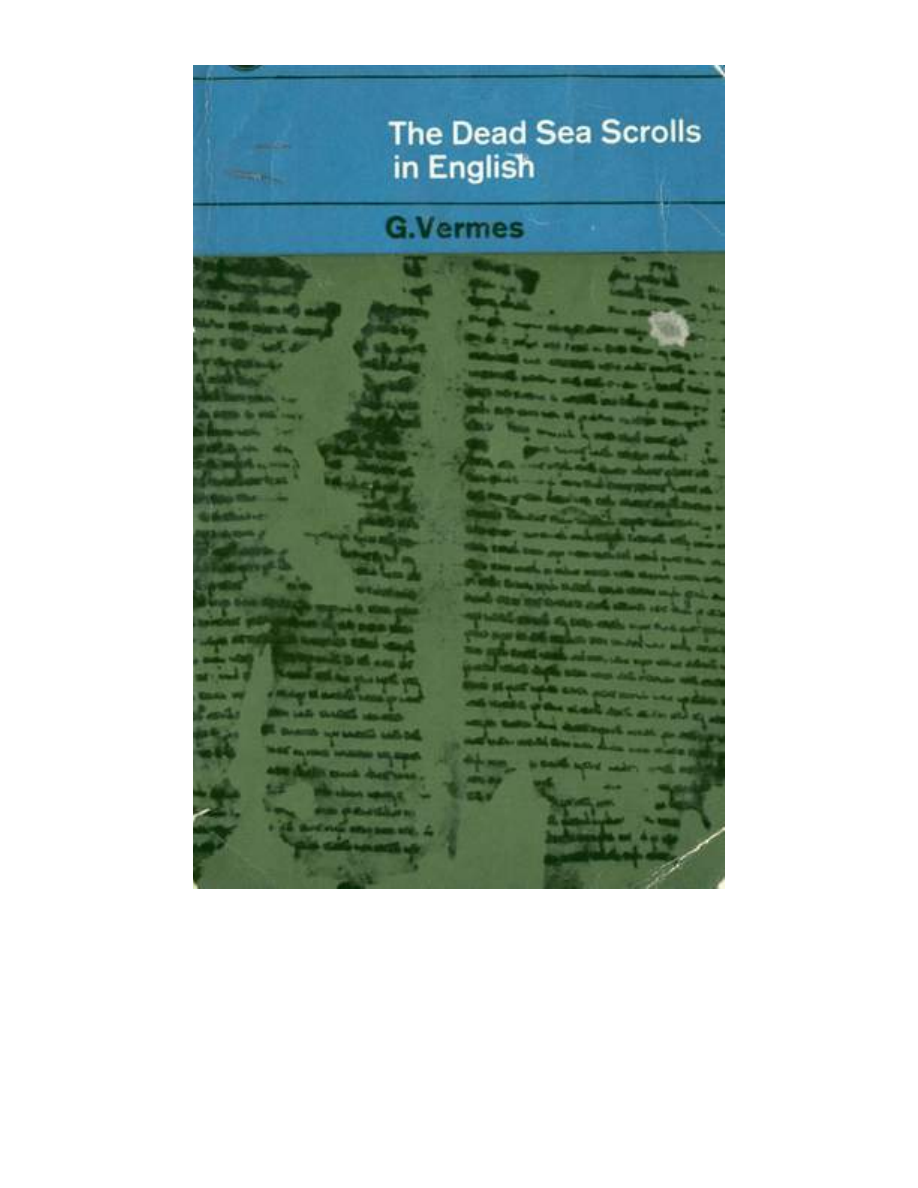
The Dead Sea Scrolls in English
By
G.Vermes
--------------------------
Contents:

About the Author
Abbreviations
Introduction
1. The Community
2. Religious Belief and Practice
3. Persons and Events
3a. Note On The Texts
4. The Community Rule
5. The Damascus Rule
6. The Messianic Rule
7. The War Rule
8. The Hymns
9. Liturgical Fragments
• The Words of the Heavenly Lights
• A Liturgical Prayer
• The Blessings
• The Triumph of Righteousness
• The Angelic Liturgy
10. Bible Interpretation
• The Genesis Apocryphon
• The Blessings of Jacob
• The Words of Moses
• Commentaries on Isaiah
• The Prayer of Nabonidus
• Commentary on Hosea
• Commentary on Micah
• Commentary on Nahum
• Commentary on Habakkuk
• Commentaries on Psalm 37
• A Midrash on the Last Days
• A Messianic Anthology
• A Commentary on Biblical Laws
Appendix - The Copper Scroll
--------------------------
--------------------------
About the author The Author
----
----
Geza Vermes was born in Hungary in 1924. After attending the
University at Budapest he went to Louvain, Belgium, where he
obtained a license in oriental history and philology in 1952 and a
doctorate in theology in 1953. For four years he studied post-
Biblical Judaism in Paris, where for a time he was also employed
at the Center National de la Recherche Scientifique and was joint
editor of Cahiers sinoniens. Since 1957 he has been a divinity
lecturer at King's College, Newcastle-upon-Tyne.
Dr Vermes is one of the pioneers of Qumran studies. His first
book, Les Manuscripts du desert de Juda, appeared in 1953 and was
later translated and published in New York. He has published

Scripture and Tradition in Judaism (Leyden, 1961) and is the
translator of A. Dupont Sommer's The Essene Writings from Qumran
(1961). In addition he has written a number of articles for
journals on the Scrolls and related subjects.
--------------------------
Abbreviations used in the Dead Sea Scrolls Abbreviations
CHab: Commentary on Habakkuk CHOS: Commentary on Hosea CNah:
Commentary on Nahum CPS 37: Commentary on Psalm 37 CR: Community
Rule DR: Damascus Rule DR A: Damascus Rule, first manuscript DR B:
Damascus Rule, second manuscript H: Hymns MA: Messianic Anthology
MR: Messianic Rule WR: War Rule
--------------------------
Introduction
Most educated men and women are by now aware of the discovery of
the Dead Sea writings in the Qumran caves during the course of the
last fifteen years; the story has been Vividly told by J.M.
Allegro, among others, in his work entitled The Dead Sea Scrolls
(Pelican Books, 1956). Altogether they amount to a substantial
body of literature consisting of the Old Testament, other
religious compositions, and works proper to a particular Jewish
sect. The books and articles written on the subject would fill a
large library, but in the main they have been highly technical and
therefore inaccessible to the general reader. In addition, some of
those expressly addressed to him have failed to convey a
sufficiently clear and balanced idea of their significance. On the
one hand there have been sensational and exaggerated statements to
the effect that these two-thousand-year-old manuscripts have
revolutionized our knowledge of the Old Testament and that they
have revealed the existence of a Christ prior to Jesus, thus
depriving his person and teaching of all originality. On the
other, a reactionary tendency to minimize their importance has
over-emphasized the identity of the biblical texts with the
traditional version of Scripture, and underrated the impact of the
sectarian writings on our understanding of the New Testament. The

present work gives the actual text of these writings, so to a
large extent the reader will now be able to judge them for
himself. It may nevertheless be useful if I first do what I can to
dispel confusion by defining the nature of their contribution to
scholarship and to a fuller appreciation of Judaism and
Christianity.
The Qumran biblical documents cover the whole Hebrew Bible, with
the exception of the book of Esther, and are about a thousand
years older than the ancient codices previously extant. With this
newly discovered material at their disposal, experts concerned
with the study of the text and transmission of the Scriptures are
now able to achieve far greater accuracy in their deductions and
can trace the process by which the text of the Bible attained its
final shape. Moreover, they are in a position to prove that it has
remained Virtually unchanged for the last two thousand years.
The Qumran fragments of the Pseudepigrapha (nonbiblical religious
compositions) and Apocrypha (considered non-biblical by Jews and
some Christian bodies, but accepted as secondarily or fully
canonical by other Churches) have also been of vast benefit to
learning. Preserved by the early Church, these books had been
handed down in translation - in Greek, Latin, Syriac, Ethiopian,
etc. but had inevitably suffered some degree of interference at
the hands of interpreters and copyists. Now that several of them
are available in their original language, it is for the first time
possible to assess the fidelity of the translated texts.
It goes without saying, however, that beside the profit to
specialists in textual criticism, paleography, linguistics, and so
on, the major gain has fallen to the student of the history and
religion of Palestinian Judaism in the inter-Testamental period
(150 B.C. to A.D. 70). For him, the sectarian writings, which form
the bulk of the Dead Sea literature and were formerly quite
unknown, have opened new avenues of exploration into the shadowy
era of the preparation and institution of Christianity and of the
establishment of Judaism. Previously, very little of it was known.
First- and second-century Rabbinic teachers had not permitted
religious writings of that epoch to go down to Jewish posterity
unless they fully conformed to orthodoxy, and although, as I have

said, some of them were preserved by the Church, the fact that
they had been used as a vehicle for Christian apologetics caused
their textual reliability to be suspect. But the Scrolls are
unaffected by either Christian or Rabbinic censorship, and once
their evidence is complete a great deal remains to be published
the historian will be thoroughly acquainted, not with just another
aspect of Jewish beliefs or customs, but with the whole
organization, teaching, and aspirations of an inter-Testamental
religious community.
In the following pages I have nowhere applied the title 'Essene'
to this community and have made little reference to the
independent accounts of Essenism appearing in ancient literature;
it has been my intention to allow the Scrolls to speak for
themselves. But as A. Dupont-Sommer was the first to insist, and
as most scholars including myself have come to agree, the Essenes
and the sect responsible for the Scrolls were in all probability
identical. The first century Jewish philosopher Philo of
Alexandria, the historian Flavius Josephus, and the geographer and
naturalist Pliny the Elder have all discoursed on this sect of
ascetics whose common life and severe discipline they seem greatly
to have admired, and any profound study of the Community as a
religious group demands careful scrutiny, not only of its own
compositions, but also of these classical reports.
The foregoing remarks will, I hope, give some idea of the reason
why the Scrolls have awakened such intense interest in the
academic world. But why have they appealed so strongly to the
imagination of the non-specialist? After all, other manuscripts of
biblical significance have been discovered in recent years, such
as the Coptic documents from Chenoboskion, including the Gospel
according to Thomas; yet these have raised comparatively little
stir.
The outstanding characteristic of our age appears to be a desire
to reach back to the greatest attainable purity, to the basic
truth. Affecting the whole of our outlook, it has necessarily
included the domain of religious thought and behaviour, and with
it the whole subject of Judeo-Christian culture and spirituality.
A search is being made for the original meaning of issues with

which we have become almost too familiar and which with the
passing of the centuries have tended to become choked with
inessentials, and it has led not only to a renewed preoccupation
with the primitive but fully developed expression of these issues
in the Scriptures, but also to a desire for knowledge and
understanding of their prehistory.
The Rules, Hymns, biblical Commentaries, and other liturgical
works of the Qumran Community respond to this need in that they
add substance and depth to the historical period in which
Christianity and Rabbinic Judaism originated. They reveal one
facet of the spiritual ferment at work among the various parties
of Palestinian Judaism at that time, a ferment which culminated in
a thorough examination and reinterpretation of the fundamentals of
the Jewish faith. By dwelling in such detail on the intimate
organization of their society, on their interpretation of
Scripture and history, on the role attributed to their Teacher,
and on their ultimate hopes and expectations, the sect of the
Scrolls has exposed its own resulting doctrinal synthesis. This in
its turn has thrown into relief and added a new dimension to its
dissenting contemporaries. Thus; compared with the ultra-
conservatism and rigidity of the Essene Rule, orthodox Judaism
appears progressive and flexible, and beside Essenism and Rabbinic
orthodoxy the Christian revolution stands out invested with
inspired actuality. Yet at the same time, the common ground from
which they all sprang, and their affinities and borrowings, emerge
more clearly than ever before. The faith of each of these three
religious movements was, in fact, a separate and distinct
commentary on the one body of traditional Jewish teaching and -
this is a point which is slowly being realized - neither of them
can properly be understood independently of the others.
Essenism is dead. The brittle structure of its stiff and exclusive
organization was unable to withstand the national catastrophe
which struck Palestinian Judaism in A.D. 70.
Animated by the loftiest ideals and devoted to the observance of
`perfect holiness', it yet lacked the pliant strength which
enabled orthodox Judaism to survive. And although its Teacher of
Righteousness clearly sensed the deeper obligations implicit in

the Mosaic Law, he was without the genius of Christ who laid bare
the inner core of spiritual truth and exposed the essence of
religion as an existential relationship between man and man, and
between man and God.
--------------------------
1 - The Community
The sect of the Scrolls, the followers of the still unidentified
Teacher of Righteousness, flourished in Palestine about two
thousand years ago. Its communities were distributed throughout
the towns and Villages of the land as well as in desert places
such as Qumran, but their precise location is as yet unknown.
These religious schismatics withdrew from the Judaism of their
time, which they considered wicked and corrupt, and vowed
themselves to absolute obedience to the particular interpretation
of the Law of Moses taught within the sect and to the search for
perfection. In their own eyes they constituted the one true
Israel, the Church of God's elect. The revelation of all truth had
been granted to their Teacher, finally and definitively, and they
themselves were ` the minority chosen by God to inherit the
Covenant, the Promise, and ultimate Salvation. They were not only
the faithful `remnant', but also the last in the great line of
God's chosen ones, for they believed that they would, during their
lifetime, participate in the great battles of Light against
Darkness, and that they would see and share with the triumphant
Messiah the fruits of his Victory.
The common life of those who retired to the desert settlements,
`the assemblies of the camps' as they are called in the Damascus
Rule, appears to have been highly organized and self-sufficient.
Archaeologists working at Qumran have discovered the remains of a
scriptorium where manuscripts were copied, a pottery with its
kiln, a kitchen and pantry, various water installations, and at a
short distance from the site, a farm, as well as community halls
proper, such as a large meeting hall which served also as a
refectory, and a council chamber. But the sectaries did not
actually live in these buildings; some of them occupied

neighbouring caves and others doubtless lived in huts or tents in
the Vicinity.
The `assemblies of the towns' (DR), i.e. those members who lived
an urban life, were subject to other rules and were separated
somewhat less rigorously from their fellow Jews, but their hopes
and ideals were identical with those of their desert brethren.
With them, they were convinced that their beliefs and way of life
conformed fully to the will of God and qualified them to claim the
honour of being the only true Israel.
This concept was reflected in the way the sect modelled its
organization on that of the historical Israel. Its members were
distinguished as belonging either to the House of Aaron or to the
House of Israel. They were divided, that is to say, into clergy
and laity; the Priests and Levites had specific rights and duties
which I will discuss presently, and the rest were elders and
simple Israelites. The Damascus Rule (xiv) (*) mentions a third
group of strangers or proselytes, but this reference is purely
incidental. We are told, nothing about them, but in biblical and
post-biblical Judaism a `stranger', was a person of non-Jewish
descent who adopted some of the Jewish religious laws and customs.
----
[*] Except for the Hymns, texts from the Dead Sea literature are
indicated in the following pages by the title of the Scroll in
which each passage appears, together with its column number: e.g.
Community Rule VI, Commentary on Habakkuk VII, etc. The Hymns are
counted differently. Hymn t o, for instance, is the tenth of a
collection of twenty-five poems.
Readers may be puzzled to find that many of the scriptural
quotations given in this volume do not agree with the texts with
which they are familiar. The discrepancy is partly due to variants
in the Scrolls themselves, but mainly to my attempt to render the
Bible in accordance with the sense ascribed to it by the Qumran
writers. Had I not done this, it might often have been impossible
to perceive any coherence between a text and its interpretation.

----
The sect was further divided symbolically into twelve tribes and
into the smaller Israelite units of Thousands, Hundreds, Fifties,
and Tens. As in the New Testament, where the twelve apostles are
the new tribal chiefs and the Letter of James is addressed to the
`twelve tribes of the dispersion', so among the Community the
tribal system corresponded to an ideal. Thus the supreme Council
in the pre-Messianic age appears to have been formed by twelve
laymen and three Priests, the latter no doubt representative of
the three clans of the tribe of Levi. Again, some of the documents
apply the title `House of Judah' to the sect (symbolizing the
tribes of Judah and Benjamin and, of course, the faithful
Levites), whereas Jews remaining outside are called the `House of
Joseph' (symbolizing the tribes of Ephraim and Manasseh and the
north in general which abandoned Jerusalem and the Temple after
the death of Solomon). As regards the lesser units (Thousands,
Hundreds, etc.), they all play a part in the tactics of the great
battles described in the War Rule, but otherwise only the Tens
seem to have been of effective importance, this being the quorum
of an autonomous congregation. Here, the sect followed the general
Jewish custom with regard to public worship.
Authority And Administration
Final authority lay in the hands of the Priests. The phrase
`according to the decision of the multitude of the men of their
Covenant' occurs wherever there is reference in the Scrolls to the
acceptance of new members or to the expulsion and punishment of
offenders; but it is always coupled with, and preceded by, the
obviously more important decision of the `sons of Zadok'. In the
fields of doctrine, justice, and common ownership, it was they who
held the reins; newcomers were to `unite, with respect to the Law
and possessions, under the authority of the sons of Zadok' (CR V)
and, with even more emphasis, `The sons of Aaron alone' were to
`command in matters of justice and property, and every rule
concerning the men of the Community' was to be `determined
according to their word' (CR IX). There is no indication that the
Levites were to be distinguished from the Priests, so it is
reasonable to suppose that both clerical classes are envisaged in

these general statements. But to see how such principles were put
into practice it may be useful to examine first of all the part
played by authority in the smaller groups, and then turn to the
direction of the sect as a whole.
As has been said, the Community Rule (VI) and the Damascus Rule
(XIII) give the quorum of a group - a `camp' according to the
latter document - as ten men. In each of these autonomous
communities both Rules appear to require the presence of two
superiors, one of them a Priest. He was to be `learned in the Book
of Meditation' (the Bible) and all his brethren were to be `ruled
by him' (DR XIII). He was to fulfil all the priestly duties within
the Community such as pronouncing the blessing over the meal (CR
VI), preside over the assemblies, and perform those legal
functions specifically reserved to the priesthood (DR XIII).
Nothing more than this appears in any of the manuscripts about the
part he was expected to play. In particular, no teaching duties
are assigned to him, or anything to do with the administration of
the communities.
These tasks were the responsibility of a person called the
Mebakker or Pakid) in the same two Rules and described in the
Community Rule (VI) (as I hope to show later) as the Doresh ha-
Torah, one who was to "study the Law continually, day and night,
concerning the right conduct of a man with his companion'. In my
translation of the text I have rendered Mebakker as `Guardian'.
Literally, it means 'overseer, someone who looks after the welfare
and spiritual direction of the people in his care. The Greek
synonym is episkops, and its English equivalent, 'bishop'; but
`bishop' of a, Jewish sect seems inapt, and `overseer' smacks more
of a gang of labourers than of a religious community. Hence
`Guardian'.
The chief duty assigned to the Guardian by the Community Rule and
the Damascus Rule lies in the field of instruction. He was to
interview all who sought admission to the sect and teach the Rule
of the Community to the people he judged worthy to enter. But he
was not only to be a sort of novice-master; for the `professed'
also he was to act as final arbiter in all matters concerned with
orthodoxy and right conduct. In the words of the Damascus Rule

(XIII), he was to `instruct the congregation in the works of God'.
He was to `love them as a father loves his children and carry them
in all their distress like a shepherd his sheep'. He was to
`examine every man entering his congregation with regard to his
deeds, understanding, strength, ability, and possessions, and
inscribe him in his place according to his rank'; no member of the
camp was allowed to admit anyone to the congregation `against the
decision of the Guardian of the camp'.
Between them, therefore, the Priest and the Guardian held control
in all matters concerned with ritual and instruction; but of
course there were other necessary tasks to be performed in the
communities. Since they were self-supporting, there had to be
someone to cope with the practical administration of their
activities and revenue, to take charge of the finances of the
Community and provide for its material interests and needs. This
person was the Mebakker `al melekheth ha-rabbim: literally,
`overseer of the work of the congregation'. In the text I have
named him (a little freely) `Bursar of the Congregation'.
Passing now to the organization of the sect as a whole, we find a
situation exactly parallel to that existing in the smaller groups.
In a passage dealing with the `assembly of all the camps', the
Damascus Rule (XIV) describes the superior as `the Priest who
enrolls the Congregation', a man aged `from thirty to sixty years,
learned in the Book of Meditation and in all the judgements of the
Law'. As for the `Guardian of all the camps', he must be `from
thirty to fifty years old, one who has mastered all the secrets of
men and the languages of all their clans. Whoever enters the
Congregation shall do so according to his word, each in his rank.
And whoever has anything to say with regard to any suit or
judgement, let him say it to the Guardian.'
It is difficult to assess the limits and extent of the personal
authority wielded by these two figures, but in the administration
of justice and in the admission and expulsion of members they
enjoyed the collaboration of various bodies such as the college of
ten judges appointed to the city communities, and the Community
Council. These tribunals were required to ratify by a show of
hands the decisions made by the `sons of Zadok', but whether it

was in their power to refuse to confirm the judgements of their
superiors we do not know.
It might seem from this brief summary of the roles of Priest,
Guardian, and Bursar that there can be little room for obscurity
in such an, apparently simple administrative structure. But this
is not so. To begin with, it is not clear whether the Bursar was
distinct from the Guardian, or whether one man dealt with both
tasks. For example, the Damascus Rule (XIII) states that it was
for the Guardian to decide whether members of his congregation
could enter into a business association. It also mentions him
(together with the judges) in connection with the charitable funds
distributed to the poor (XIV). On the other hand, in the Community
Rule (VI) the offices seem to be separate. Those who prefer to
identify the one with the other point out that in the primitive
Church the bishop was entrusted with both the material and the
spiritual well-being of his flock. For myself, I would suggest
that in the smaller communities one man could very well have
performed both functions, but the larger ones may have needed two
men for these different duties.
The next problem concerns the Priest and the Guardian. Were these
two individuals? Scholars are divided in their Views. Those who
use the Community Rule as a basis for their argument incline to
identify the two roles, and it is true that this Scroll tends to
blur the distinction between them. But the Damascus Rule
differentiates quite clearly between the Priest and the Guardian
of the camp, going so far as to describe their offices in two
separate sections. Similarly, there is no ambiguity at all in the
case of `all the camps'. The Priest-Superior and the Guardian of
all the camps are separate individuals and, as we have seen, do
not even belong to the same age-group.
On the strength of the same straightforward statements in the
Damascus Rule it is possible at the same time to place the Doresh
ha-Torah, the Interpreter of the Law, described in the Community
Rule (VI) as officiating in the small communities in conjunction
with the Priest. Since, in this particular passage of the
Community Rule, there is no mention whatever of the Guardian, it
is not unreasonable to suppose that the Guardian and the

Interpreter of the Law were one and the same person.
Finally, we arrive at a difficulty unmentioned as yet: what are
the implications of Maskil, a word recurring throughout the
Scrolls? Once more, it has not been easy to find the correct
equivalent in English. Literally, it could mean `man of
understanding', `man of insight', or `instructor'. In this
translation, however, I have rendered it as a title, `Master',
because I believe that the evidence goes to show that it
corresponds to a particular office in the Community.
This office is defined in a long passage under the heading `These
are the precepts in which the Master shall walk in his commerce
with all the living...', where the Community Rule (ix) observes
that he was to select, instruct, and guide the members of his
community. `He shall separate and weigh the sons of righteousness
according to their spirit ... He shall admit (each man) in
accordance with the cleanness of his hands and advance him in
accordance with his understanding ... He shall impart true
knowledge and righteous judgement to those who have chosen the
Way. He shall guide them...'
But these were the duties of the Guardian, as we have seen.
Furthermore, turning to the Damascus Rule (XIII) a philological
link makes its appearance. It is said of the Guardian that `he
shall instruct', yaskil, `the Congregation': now yaskil and maskil
derive from the same Hebrew root.
Despite the fact that this word maskil plays such an important
part in the Scrolls - many of the documents are addressed to him -
insufficient attention has been paid to its significance. Most
writers are content to leave it vague. Some believe that the
phrase `For the maskil' is a sign that the document or section is
intended for initiates only. Others think that the term applies to
the wise and intelligent man in general. In these pages I would
suggest another interpretation.
In the Bible, (*) and in the Book of Daniel in particular, a
maskil is one who is both endowed with the gift of insight into
divine wisdom and a teacher of that wisdom. `The maskilim (plural

of maskil) of the people shall give understanding to the
multitude' (Dan. 11:33). `The maskilim shall be as bright as the
brightness oft a firmament, and those who bring righteousness to
the multitude, like the stars for ever and ever' (12:3).
----
[*] A note on the Bible translation used in this book is given on
page 17.
----
The verb haskil and its derivatives (to understand, to teach) also
occurs several times in the work of the Chronicler (Chronicles,
Ezra, Nehemiah). For example, we read in Ezra (8:18): `And by the
good hand of our God upon us they brought us ish sekhel, a man of
discretion, of the sons of Mahli the son of Levi.' In Nehemiah
(8:7-8) we find: `The Levites helped the people to understand the
Law ... And they read from the Book, from the Law of God, clearly;
som sekhel, they gave the sense, so that the people understood the
reading'; and in 2 Chronicles (30:32): `And Hezekiah encouraged
all the Levites ha-maskilim, who taught sekhel tob, the good
knowledge, of the Lord.'
The important point to notice in these quotations is the
association of haskil, sekhel, and maskil with the Levites, an
association which receives unexpected confirmation in the Psalms,
where maskil appears in twelve titles, and in the text of Psalm
47, 7. Although the exact meaning of maskil in the Psalms has
never been established, there is little doubt that it describes a
certain type of poem. But the remarkable feature is that eight of
the thirteen psalms in which it figures are ascribed to Levitical
authors: the sons of Korah (42,44,45,47,88), Asaph (74,78), Heman
(joint-author with the sons of Korah of Ps. 88), and Ethan (89).
The reader may be wondering, justifiably, where all this is
leading to. The answer is that as a first step it leads to a
correct understanding of the role of the Levites in postexilic
Judaism. According to the Chronicler (I Chron. VI, 4g), the
priestly duties consisted in the offering of sacrifice, the care

of the most holy things, and atonement. All the other religious
services were assigned to the Levites (VI, 48), in particular,
choir duties and everything connected with liturgical music (VI,
3I), and the instruction of the people (2 Chron. VII, 7-9). This
latter fact emerges clearly from the account given in the Book of
Nehemiah (VIII, I-8) of the promulgation of the Law of Moses. The
ceremony opens with a blessing pronounced by the Priest Ezra; but
then the Levites take over. `The Levites gave the meaning of the
Law to the people .... They read aloud clearly from the Book, the
Law of God; they gave the sense and the people understood the
reading' (Neh. VIII, 7-8). Whereas Ezra, the president of the
Congregation, merely performs his priestly task of offering
blessings to God, the Levites act as the teachers of the people;
in fact, in the following verse they are specifically described as
such, as the `instructors of the people'.
Returning once more to the Scrolls and to the significance there
of maskil, is there any evidence linking the bearers of this title
with the Levites? Study will show that the latter are mentioned
many times in conjunction with the Priests, but it is noteworthy
that no definite tasks are openly allotted to them except in two
passages, one from the Messianic Rule and the other from the
Damascus Rule.
According to the first, the Levites were to be attached to the
various groups of Israelites `to cause all the congregation to go
and come, each man in his rank, under the direction of the heads
of family of the Congregation' (MR I). The second passage (DR
XIII) ordains that every camp containing at least ten men must be
presided over by a Priest `learned in the Book of Meditation', and
then continues: `should he not be experienced in these matters
(the Law), whereas one of the Levites is experienced in them, then
it shall be determined that all the members of the camp shall go
and come according to the latter's word. But should there be a
case of applying the law of leprosy to a man, then the Priest
shall come and shall stand in the camp, and the Guardian shall
instruct him in the exact interpretation of the Law.'
This causing the people `to go and come' obviously alludes to the
spiritual guidance of the members of the Community. Furthermore,

on reading this passage from the Damascus Rule it is difficult to
avoid the conclusion that the Levite and the Guardian were one and
the same person. Since the sect expressly intended to model its
organization as a microcosmic Israel it followed that, as in
Judaism generally, the prime religious duties of worship and
instruction were divided between Priest and Levite.
The solution to this highly involved problem is therefore, I
think, the following. (I) At the head of the whole sect, and at
the head of each dependent community, stood two distinct figures,
the Priest and the Guardian. (2) The Guardian was a Levite. (3) As
the teacher of his congregation, this Guardian-Guardian was also
known by the title Maskil, Master.
Covenant And Council
Despite much research and reflection, there is still a great deal
of uncertainty concerning the exact nature and significance of the
various phases through which the sectaries passed in their
community life.
The first step towards full initiation was entry into the
Covenant, the New Covenant. Candidates for admission to the sect
were required to be native Israelites and were obliged to undergo
a preliminary scrutiny by the Guardian so that he might assess
their mental and moral capacities. If they passed muster, they
were then permitted to enter the Covenant of God in the presence
of the whole Community, freely pledging themselves `by a binding
oath' to return with all their heart and soul `to every
commandment of the Law of Moses in accordance with all that has
been revealed to the sons of Zadok, the Keepers of the Covenant
and Seekers of His will' (CR I, V, VI; DR XV, XVI; MR I).
Many writers imagine that this adherence to the Covenant
constituted a temporary phase, a probationary period during which
`postulants' were put to the test; they think that if they failed
to reach the necessary standard of moral discipline during this
time they were not allowed to continue but ceased altogether to
belong to the Community. In my View, there is little justification
for this theory. With his `binding oath' a man took on himself,

once and for all, the sacred obligation to accept the teachings of
the sons of Zadok and to abide by their Rule. Having done this, he
then submitted himself to the Guardian for further instruction so
that he might be `converted to the truth and depart from all
falsehood'.
Advancement in the Community was quite another matter. Although
every member was party to the Covenant and remained so for the
rest of his life, he could either move up the sect's hierarchical
ladder, with more training and a fresh initiation, or else, for
want of ambition or talent, he could remain a simple `man of the
Covenant'. Those who were able to follow the first course
eventually moved on to the stricter discipline of the Council of
the Community.
There is also a measure of disagreement concerning this Council of
the Community. Some experts consider it to be just another of the
sect's titles, though they are obliged to admit from the evidence
of the texts that within this Council there must have existed
another smaller body, also called `council'. The confusion is
dispelled, I think, once it is accepted that the Council of the
Community was formed by a group of sectaries who had undergone the
training and initiation necessary to qualify them for the highest
ranks in the sect's hierarchy.
Once more, initiation demanded a preliminary examination to
ascertain the candidate's worthiness and ability, and if the
Council found them adequate he had to take instruction for another
two years, submitting himself to further public scrutiny at the
end of each one. During the first year he took no part in the more
sacred activities of the Council, such as its solemn Meals and its
to horah, `purity', by which I understand its daily meals prepared
in accordance with special ritual purity. He also retained his
money and belongings. In the second year, provided he had
satisfied his examiners, he handed over all his possessions to the
Bursar who put them aside until his training was complete. He was
admitted to the refectory, but was still not allowed to
participate in the Meals reserved to the fully initiated. He was
probably able to attend those study meetings at which no secret
matters were discussed, but without taking any active share in

them. If, at the end of all this, he was judged worthy by the
Council, he was then solemnly admitted to full membership. `He
shall be inscribed among his brethren in the order of his rank',
we read in the Community Rule (VI), and `his property shall be
mingled and he shall offer his counsel and judgement to the
Community'. From this time on he was `set apart as holy' and was
entitled to share in all the sect's secret doctrine. It was his
duty and privilege to separate himself `from the habitation of
ungodly men' and to `prepare the way' of the Lord through study
and contemplation of the Scriptures (CR VIII).
No `man of the Covenant' who had committed any deliberate sin
against the commandments was allowed to join this Council of
Holiness. Furthermore, if any member of the Council transgressed
the Law of Moses, either deliberately or through negligence, he
was expelled forthwith and none of his former brethren were
permitted to have any contact with him. `He shall be expelled from
the Council of the Community and shall return no more: no man of
holiness shall be associated with his property or counsel in any
matter at all' (CR VIII). Minor offences against the Community
Rule were punished with a penance lasting from ten days to two
years (CR VI-VII), and even sins of inadvertence against the Law
of Moses entailed two years of probation during which the culprit
was cut off from participation in the common life. But if a member
of the Council lost courage, going so far as to leave it of his
own accord, he was regarded as having committed a most serious
offence. Junior members of less than ten years' standing were
treated with some consideration in that if they repented they
could be re-admitted on condition that they underwent their two
years' training all over again, but the senior members of ten
years' standing and more were sentenced to irrevocable expulsion.
`He shall return no more to the Council of the Community.
Moreover, if any member of the Community share with him his food
or property ... his sentence shall be the same; he shall be
expelled' (CR VII).
It would appear that status within the Community was invested with
particular importance. We meet constantly in the Scrolls the
phrase, `each man according to his rank', as well as the
injunction that every member of lesser rank should show deference

and obedience towards his senior. But as far as the actual
superiors are concerned, we are unfortunately told nothing of how
they obtained their office. On the other hand, it is made clear
that Priests, Guardians, and judges etc. were obliged to
relinquish their posts at the age of sixty. We read in the
Damascus Rule (quoting Jubilees 33:2): `No man over the age of
sixty shall hold office as judge of the Congregation, for "because
man sinned his days have been shortened, and in the heat of His
anger against the inhabitants of the earth God has ordained that
their understanding should depart even before their days are
completed"' (DR X). By imposing an obligatory retiring age on its
dignitaries the sect saved the machinery of its government from an
encumbrance of aged men and allowed for healthy renewal. In fact,
despite the rigidity of its framework, there was in no sense
stasis within the Community, but periodic movement both up and
down the hierarchical ladder.
Property And Marriage
From the point of View of the Community's hierarchical structure
it has been established that the `men of the Covenant' were
distinct from the men of the `Council of the Community'.
The `men of the Covenant' appear to have lived not very
differently from their fellow Jews, except that they were bound by
the stricter religious duties peculiar to the sect. They settled
in towns and Villages, and also in `camps'; but even here,
although their separation from the rest of Jewry was more complete
than in the towns, they were still not subject to the rule of
common ownership of property. Each member retained his private
money and belongings, but they were to be used in a holy manner
and not to be mixed with the `wealth of wickedness'. The Damascus
Rule (XIII; cf. CR V) lays it down that `no member of the Covenant
of God shall give or receive anything from the sons of the Pit
except for payment'. That is to say, all transactions between the
sectaries and the outside world had to be on a commercial footing,
with none of the amicable give and take which might prevail in any
ordinary society. Within limits, they were even able to trade with
the Gentiles (see DR XII).

This freedom to provide for themselves did not, however, absolve
them from the responsibility of supporting their own poor. They
had to hand over to the Guardians and the judges the revenue of
two days out of every month, and from this fund aid was given to
the widows and orphans, the sick and aged, etc., in their midst.
By contrast, the property and income of the members of the Council
was communally owned; everything was placed in the hands of the
Bursar and it was his duty to administer this common property for
the benefit of his companions. An economic system such as this
distinguished them markedly from their Jewish contemporaries,
among whom religious `communism' was unknown, but it bears a close
resemblance to the custom adopted by the primitive Church of
Jerusalem, where the faithful were encouraged to convey all their
possessions to the apostles (cf. Acts 2:44-5; 4:32-5, 2). It may
be remembered too that 'in the Fourth Gospel It is said explicitly
that the community formed by Jesus and the apostles lived out of a
common purse entrusted to the care of Judas (John 12:6; 13:29).
There has been much speculation as to whether the sectaries were
married or celibate. On the face of it, it would seem that
marriage was the general custom since the Damascus Rule, the
Messianic Rule, and the War Rule make open reference to married
members and none of the Qumran writings allude to celibacy as
such. In addition, archaeologists working in the large cemetery at
Qumran (about twelve hundred tombs) have uncovered on the fringes
of the graveyard a few female and child skeletons.
The difficulty arises from the fact that most scholars have now
come to accept that this religious body belonged to the Essene
sect, and that on the evidence of Josephus, Philo, and Pliny the
Elder, the Essenes were noted throughout the ancient world for
their practice of celibacy, a state most unusual in Judaism. But
Josephus adds that some Essenes married and produced children, and
this, I think, describes the true situation. Most of the sectaries
- the `men of the Covenant' - married, but the few who devoted
themselves to the search for, higher perfection and ritual purity
found celibacy more appropriate to their ends. Although argument e
silentio demands delicate handling, the fact that in the Community
Rule there is no mention at all of women and marriage suggests

that the seekers of perfect holiness, like the followers of Jesus,
found it more fitting to be without family ties, without `wife or
brothers or parents or children' (Luke 14:26; 18:29).
Assemblies
Whether or not its members were linked by bonds of kinship, for
the Community to function as a group it was necessary that there
should be some kind of social apparatus to hold it together. This
took the form of periodic assemblies.
It is not as yet possible to define in detail how often the
members of the Covenant were convened among themselves, but it
appears from the Community Rule (II) and the Damascus Rule (XV)
that the whole sect was required to attend a general assembly at
least once a year, on the Feast of the Renewal of the Covenant,
celebrated, as I will show later, on the Feast of Weeks, the Feast
of Pentecost. This was the occasion when new arrivals demanding
entry into the sect solemnly pledged themselves by the oath of the
Covenant, and it was also the time when the status of all the
members was re-assessed. The ritual for the festival is described.
at t e beginning of the Community Rule, but since its importance
resides chiefly in the context of the sect's religious teaching, I
will at this point do no more than quote the concluding paragraph:
"Thus shall they do, year by year, for as long as the dominion of
Satan endures. The Priests shall enter first, ranked one after
another according to the perfection of their spirit; then the
Levites; and thirdly, all the people one after another ... that
every Israelite may know his place in the Community of God
according to the everlasting design" (CR II; cf. DR XIV).
We are better informed about the meetings of the Council of the
Community. The Community Rule (VI) orders its members to assemble
nightly under the supervision of the Priest for the purpose of
Bible reading, study, and prayer. They were to sit before him in
the order of their rank, taking care to speak only where
questioned, and were never .to interrupt each other. Non-members
attended these meetings also, but were forbidden to play any
active part unless they had first obtained the consent of the

Guardian and of the members of the Council.
Some of the assemblies, and perhaps all of them, were followed by
a solemn Meal. The Community Rule (VI) writes of it as follows:
`When the table has been prepared for eating, and the new wine for
drinking, the Priest shall be the first to stretch out his hand to
bless the first-fruits of the bread and new wine.' Mention of the
first-fruits of bread and wine seems to indicate that the Meal was
originally a Pentecostal supper reserved to Priests and Levites
(Exod.23:16; Deut. 16:2; 18:4.) where the first-fruits were holy
offerings set aside for the clergy. But in the Community they were
eaten by the `men of holiness', by the sons of Zadok and the
members of their Council. In short, they lost their exclusive
connection with the Feast of Pentecost in exactly the same way
that the Christian Eucharist has lost its exclusive connection
with Easter.
The remaining type of Council meeting, and one that played a Vital
part in the control and direction of the sect, was the `Community
midrash', which I have called the `Community Court of Inquiry'.
One of the functions of this body was to examine the conduct of
candidates and decide whether or not they should be promoted. The
other duty was to try and pass sentence on members reported for
offending against the Rule or the Law of Moses. Again, we are not
told what circumstances governed the summoning of the Court of
Inquiry, but the Community Rule (VI-VII) dwells at some length on
how it should proceed, and gives a list of offences with their
corresponding sentences. These vary according to the gravity of
the fault. A slight transgression, such as the interruption of a
companion in his speech, entails a penance of ten days, but a
deliberate sin against the Law of Moses results in unequivocal
expulsion from the Community. The Damascus Rule makes no mention
of the Court of Inquiry but refers to a group of ten judges, four
of them Priests and Levites, and six of them Israelites, a
judicial assembly no doubt concerned with the men of the Covenant'
(X). The same Rule (IX-X) also defines the part to be played by
witnesses and its list of sentences includes even the death
penalty.
This inquiry into the hierarchical, economic, and social structure

of the sect has so far done no more than piece together the
skeleton of the Community of the sons of Zadok. To give it
substance and life we need to understand the spiritual ideals and
convictions which animated them and which induced them to seek
truth and holiness apart from the mainstream of Judaism.
--------------------------
2 - Religious Belief And Practice
It is, I hope, no distortion of Old Testament religion to say that
it rests on three fundamental ideas, the concepts of election,
covenant, and salvation. God chose Israel. Faithful to His promise
to Abraham, He singled out the patriarch's descendants to be His
own people, His elect. On Mount Sinai He revealed to them the Way,
the Law of Moses, and ratified His unique relationship with them
by means of a Covenant. The essence of biblical religion is
adherence to that Covenant -to both the spirit and the letter of
the Law- firm trust in God, and the confident expectation that
ultimately He will reign triumphantly over the whole world.
It is also an integral part of Jewish faith that the Covenant is
an eternal one. The sins of the great mass of the people will
never affect it because God, not permitting His promise to be
thwarted, provides that in every age at least a handful of just
Israelites, a 'remnant', hold fast to their faith and heed the
divine message; the Covenant remains valid for their sake. They
are a `remnant' in another sense too, in that by their fidelity
they escape the manifestations of divine anger Visited on the
wicked of the world.
At the time of the Qumran sect, in the period known as 'inter-
Testamental' (roughly between 150 B.C. and A.D. 70) these basic
concepts gave rise to a great deal of controversy among the
various parties of Palestinian Judaism. The Pharisees, Sadducees,
the Community of the Scrolls, etc., all engaged in a process of
doctrinal interpretation, and although the emerging syntheses
never departed from their biblical foundations, each showed a
distinct individuality. Of the first two, no detailed contemporary
evidence has been handed down; Sadducee teaching is mainly known

through its critics, the Pharisees, and for Pharisaic doctrine we
are mainly dependent on documents compiled after A.D. 200. By
contrast, in the Qumran library we are confronted with the beliefs
of a sect recorded by its living members, and we are in
consequence indebted to them not only for information about their
own Views and aspirations, but also, indirectly, for a fuller
appreciation of the stand taken by those who dissented from their
teaching, namely, the parties already mentioned and the Judeo-
Christians of the primitive Church.
The New Covenant
It was, as I have said, the profound conviction of the Community
of the Scrolls that they were the faithful `remnant' of their
time, and indeed the final `remnant' of all time. It governed
their whole religious outlook. God had chosen to reveal knowledge
and understanding of His purpose and will to their Teacher of
Righteousness and to those of the Teacher's followers who trod the
path laid down by him, the Way of Holiness. Only the Teacher was
able to decipher the mysteries concealed in the Scriptures;
consequently, only those who accepted his interpretation of the
written word of God could be sure of living in conformity with His
desire.
From this consciousness of having been chosen by God it followed
that the Community regarded themselves as true heirs to the
eternal Covenant between God and Israel; the first obligation of
those entering the sect was to commit themselves to it anew. As in
the New Testament, the phrase `New Covenant' even became part of
the idiom of the sect, `men of the Community' and `men of the New
Covenant' being employed in their writings as synonyms.
The obligations imposed by the New Covenant were materially the
same as those implicit in the Old; namely, perfect obedience to
the teachings of Moses and the Prophets. The members of the
Community pledged themselves to `seek God with a whole heart and
soul, and do what is good and right before Him as He commanded by
the hand of Moses and all His servants the Prophets' (CR I). But
to this they added the, for them, necessary stipulation that the
`return to the Law of Moses' required of those entering the sect

must be `in accordance with all that has been revealed of it to
the sons of Zadok' (CR V).
As far as the Law itself was concerned, the revelations granted to
these sons of Zadok, the sect's priestly hierarchy, added fresh
severity and rigour to a legal code already strict in itself.
Their marriage laws are an example. Whereas it is written in
Leviticus XVIII, 13, 'You shall not approach your mother's sister,
she is your near kin', in the Damascus Rule (V) this precept is
extended to include a man and his niece within the degrees of
forbidden kinship, with the comment: 'Although the laws against
incest are written for men, they also apply to women', i.e., if a
nephew is forbidden to marry his aunt, so is a niece prohibited
from marrying her uncle. No doubt those Jews who did not subscribe
to the Community's teaching argued against this that if Moses had
wished to forbid the uncle-niece relationship in marriage he would
have said so.
Similarly, according to the Damascus Rule (IV-V), those who live
in polygamy fail to understand the true teaching of Moses and in
`taking a second wife while the first is alive' commit the sin of
fornication. The principle laid down by God since the time of the
creation is one of monogamy: 'Male and female created He them'
(Gen. 1:27). This principle was observed by those who were saved
at the time of the Flood; according to Genesis 7:9, Noah and his
sons had only one wife each and entered the ark `two by two'.
Moreover, Moses forbade even the king to `multiply wives to
himself' (Deut. 17:17). For the ignorant this might seem to imply
that the king must not imitate Solomon whose harem amounted to
seven hundred wives and three hundred concubines (1 Kings 11:3)
but must restrict the number of his wives to a more modest figure
(eighteen according to the Mishnah). In the Community, however, to
'multiply wives' meant to be married to more than one wife, and if
the king was to be bound by such a law, so must every commoner. In
parenthesis, it may be of interest to note that the same text,
'Male and female created He them', is introduced into the New
Testament as an argument for the prohibition of divorce followed
by remarriage (Matt. 19:4; Mark 10:6) and may underlie the early
Christian dislike for the remarriage of widows and widowers (cf 1
Tim 3:2,12: v,9; Titus 1:6).

In addition to its increased severity, the Community's
interpretation of the Law was distinguished by its claim to
infallibility. Whereas traditional Judaism allowed for some
elasticity within orthodoxy itself (Rabbi X declaring lawful an
action forbidden by Rabbi Y), no such latitude was apparent in the
sect. The true meaning of the Law had been revealed to them by God
and since there is only one God and one truth, there can only be
one interpretation of that truth.
Besides the Law, the Community also interpreted the Books of the
Prophets in such a way as to bring them into harmony with their
own convictions. They believed everything foretold there, but held
that the words of the Prophets were concealed in a mystery to
which only their Teacher had been granted the key. It was the
Teacher of Righteousness ` to whom God made known all the
mysteries of His servants the Prophets' (CHab VII) and who
discovered that the end of time was at hand, and that all the
prophecies alluding to the final age referred to the Community of
the Covenant and either had been, or were about to be, fulfilled.
Their attitude may perhaps best be seen in a passage in the
Commentary on Habakkuk (2:14). 'The righteous shall live by his
faith' is interpreted to refer to `all those who observe the Law
in the House of Judah (the Community), whom God will deliver from
the House of judgement because of their suffering and because of
their faith in the Teacher of Righteousness' (CHab VIII).
In short, this Chosen People of the New Covenant, with its claims
to infallible truth, believed that it was to be a 'refuge' for
seekers of righteousness during the age of final wickedness. It
was to be a 'sure House', a 'House of truth', `that tried wall,
that precious corner-stone, whose foundations shall neither rock
nor sway in their place' (CR VIII). The same metaphor appears in
the Hymns, where the psalmist writes of a House of God built on
rock against which the powers of evil would never prevail.
But I shall be as one who enters a fortified city,
as one who seeks refuge behind a high wall
until deliverance comes;
I will lean on Thy truth, O my God.

For Thou wilt set the foundation on rock
and the framework by the measuring-cord of justice;
and the tried stones Thou wilt lay
by the plumb-line of truth,
to build a mighty wall which shall not sway;
and no man entering there shall stagger.
For no enemy shall ever invade it
since its doors shall be doors of protection
through which no man shall pass;
and its bars shall be firm
and no man shall break them.
(Hymn 10)
The Holy Life
For every Jew, consciousness of belonging to a chosen people is
the cause of wonder and thankfulness; but for the members of the
Community it meant something special. Israel's election is that of
a nation. The divine promise of blessing given to Abraham concerns
all his posterity, the Covenant made on Sinai affects the whole
Jewish race. On the eighth day after his birth, every male
Israelite enters the Covenant through the rite of circumcision,
shedding his own blood as the blood of a covenantal sacrifice. But
he shares the exalted destiny of his people as a birthright; even
though he may remain pious and faithful till death, he does not
and cannot experience the personal commitment to God which was,
perhaps, the distinctive hallmark of the Community's spirituality.
For the sectary, election was not an accident of birth, an
inherited privilege. Every individual, even those born into the
Community, was required to take the oath of the Covenant of his
own free will because he had, as a person, been chosen by God from
all eternity to become one of His elect.
In preference to thousands of his fellow Jews, he had been loved
by God from before creation. Whereas the man outside the sect had
been destined to walk in the ways of darkness and to be ruled by
the spirit of falsehood, he, God's elect, had been destined by Him

to walk in the ways of light under the guidance of the spirit of
truth.
'From the God of Knowledge comes all that is and shall be' we read
in the Community Rule (III). 'Before ever they existed He
established their whole design, and when, as ordained for them,
they come into being, it is in accord with His glorious design
that they fulfil their work ... He has created man to govern the
world and has appointed for him two spirits in which to walk until
the time of His Visitation: the spirits of truth and falsehood ...
All the children of righteousness are ruled by the Prince of Light
and walk in the ways of light; but all the children of falsehood
are ruled by the Angel of Darkness and walk in the ways of
darkness' (CR III).
A deep realization of God's personal benevolence towards every
member of the Community, and of the all-pervading reality of His
grace, was accompanied by an equally profound awareness of human
frailty, unworthiness, and nothingness. No note of self-
righteousness sounds in the Qumran writings; on the contrary, the
sectary is amazed by the blessings showered on him and expresses
himself in the Hymns in tones of self-abasement.
Behold, I was taken from dust
and fashioned out of clay
as a source of uncleanness,
and a shameful nakedness,
a heap of dust,
and a kneading with water ...
a creature of clay returning to dust.
(Hymn 19)
On the other hand, he knew that he had been saved from human
misery and sinfulness, and that his final destiny was to be one
with that of the heavenly spirits who stand in the presence of God
for ever.
For the sake of Thy glory
Thou hast purified man of sin

that he may be made holy for Thee
with no abominable uncleanness
and no guilty wickedness;
that he may be one with the children of Thy truth
and partake of the lot of Thy Holy Ones;
that bodies gnawed by worms may be raised from dust
to the counsel of Thy truth,
and that the perverse spirit (may be lifted)
to the understanding which. comes from Thee;
that he may stand before Thee
with the everlasting host
and with Thy Spirits of Holiness,
to be renewed together with all the living
and to rejoice together with them that know.
(Hymn 17)
With this awareness of blessing and salvation, and balancing any
tendency towards arrogance, comes the constant reminder that all
goodness and truth proceed from God and that no act of Virtue can
be accomplished without His help.
As for me,
I belong to wicked mankind,
to the company of ungodly flesh ...
For mankind has no way
and man is unable to establish his steps
since justification is with God
and perfection of way is out of His hand...
He will draw me near by His grace,
and by His mercy will He bring my justification.
(CR XI)
Any strictly organized religious society where the boundaries
between right and wrong are rigidly defined exposes its members to
the danger of feeling pleased with themselves for having conformed
to the rules, of presuming themselves justified by their `works',
and to have acquired merit thereby in the sight of God. Providing
for this pitfall, the sect taught that even the correct observance

of the Rule was an act of divine grace. Besides, since the Rule
itself was known only through the gift of revelation granted to
the Community, its members were doubly beholden for their
salvation; they were indebted to God for their knowledge, the
infinitely valuable gift of gnosis, and also for the divine
succour which permits a man with an inborn tendency to evil to
cling faithfully and unceasingly to truth and justice. This is
emphasized in the final hymn of the Community Rule.
From the source of His righteousness
is my justification,
and from His marvellous mysteries
is the light in my heart.
My eyes have gazed
on that which is eternal,
on wisdom concealed from men,
on knowledge and wise design
(hidden) from the sons of men ...
God has given them to His chosen ones
as an eternal possession,
and has caused them to inherit
the lot of the Holy Ones.
He has joined their assembly
to the Sons of Heaven
to be a Council of the Community,
a foundation of the Building of Holiness,
an eternal Plantation throughout all ages to come.
(CR XI)
Grace and knowledge were the twin foundations of the sect's
spirituality. Knowledge, it taught, proceeding from the God of
knowledge through the mediation of the spirits of `truth' and
`light', directs a man into the Way he must follow and illuminates
the mysteries of God's purpose for mankind; it penetrates the
secrets of the heavenly world and divines the nature and ministry
of the spirits. Even the abode of the Creator Himself was thought
to have been manifested in Visions such as that of the Divine
Throne-Chariot. By means of knowledge and grace the aim of the
Rule was realized. Its rigorous separation from the world of the

wicked and its call for meticulous personal holiness enabled the
Community to withstand the ravages of the devil and his allies,
and so to be part, even in this life, of the fellowship of the
Sons of Heaven.
Worship
According to the Bible, the first duty of the heavenly beings -
the Seraphim of Isaiah, the Cherubim of Ezekiel, and the angels of
Psalm 148 -is the praise and worship of God; and so it was for the
followers of the Teacher of Righteousness. They were to join their
voices to those of the Angels of the Presence raised in prayer and
blessing in the celestial Temple.
Broadly speaking, the sectaries' whole life was one of
uninterrupted adoration. More precisely, however, their Rule
required them to worship God in the correct manner and at set
times, these set times conforming to the eternal and unchanging
laws affecting the rhythm of time itself (the rhythm of day and
night, the seasons, the years, etc.). The moments fixed for daily
prayer - 'at the beginning of the dominion of light' and 'at the
beginning of the dominion of darkness' (CR X) -coincided with the
daily sacrifice at dusk and dawn of the burnt offerings in the
Temple (Exod. 29:39 Num. 28:4) But the other 'appointed times' are
more complex and affect the whole question of the liturgical
calendar.
In Judaism, the reckoning of months and years was governed by the
moon, but because of the absence of correlation between the lunar
year (354 days) and the solar seasons of solstice and equinox, the
orthodox calendar effected a compromise between the two; after
every three-yearly period of thirty-six lunar months it inserted
one supplementary month.
To the Community this was an abomination of the Gentiles and
directly counter to the `certain law from the mouth of God (H 19).
It had itself inherited, probably from priestly circles a solar
calendar based on `the laws of the Great Light of heaven' (H 19)
in which the year was divided into fifty-two weeks exactly: into,
that is to say, four seasons of thirteen weeks. Each season

consisted of three months thirty days long, and a day was added to
every season as a link between one season and the next. This solar
calendar, which figures also in the Book of Jubilees and in the
First Book of Enoch, recommended itself to the sect because of its
belief in the unchanging order of God in the universe. As a French
scholar, Mlle Annie Jaubert, has pointed out, its strict periodic
regularity ensured that the year always began on a Wednesday, the
fourth day of the Jewish week, and thus remained in perfect
conformity with the work of God who created the sun on the fourth
day. Furthermore, not only did the year begin on a Wednesday, but
so also did every season of thirteen weeks. In fact, any date
during the year fell on exactly the same day of the week in every
other year.
For instance, Passover, the fifteenth day of the first month, (*)
fell always on a Wednesday, and the Day of Atonement, the tenth
day of the seventh month, always on a Friday, etc. Of course, this
method of reckoning presents difficulties also, the astronomical
year consisting of 365 1/4 days not 364: but we are not told how,
if at all, the Community dealt with them.
----
[*} Strictly speaking I am unsure if G. Vermes made a mistake (or
my own studies are in error) since it should fall on the 14th day
and not the 15th if one follows the cycle of the moon, in
particualr the new moon etc.
- Salmun
----
The practical result of the adoption of this calendar was that the
Community feast days were celebrated differently from the rest of
Judaism. It is for this reason that the Damascus Rule (VI), for
example, orders that 'the feast and the Day of Fasting' must be
kept 'according to the finding of the members of the New
Covenant'. It also explains how the Wicked Priest was able to
disturb the celebration by the Teacher of Righteousness and his
disciples of the Day of Atonement (CHab IX); for him it was not a

holy day.
It is not as yet possible to write in any detail about the
peculiarities of the Qumran liturgical calendar because material
from cave iv giving a list of the sect's feasts and of its
priestly families is still unpublished. I can only repeat the
scanty information divulged by J.T. Milik, the person responsible
for editing these texts, namely, that the yearly cycle included
seven principal feasts, each following the other at intervals of
seven weeks.
The most important of their festivals was the Feast of Weeks, the
Feast of the Renewal of the Covenant. Its ritual is described at
the beginning of the Community Rule and in an unpublished section
of the Damascus Rule. Opening the ceremony, the Priests and
Levites offer blessings to God and those entering the Covenant
with them reply 'Amen, Amen'. The Priests go on to recall the past
favours of God and the Levites follow them with a recital of
Israel's transgressions. This culminates in a public confession,
'We have strayed! We have disobeyed!' etc., after which the
penitents are blessed by the Priests. Then the Levites pronounce a
long -curse on the 'lot of Satan', and with the Priests they
solemnly adjure all those whose repentance is incomplete not to
enter the Covenant. 'Cursed be the man', they say, `who enters
this Covenant while walking among the idols of his heart ... He
shall be cut off from the midst of the Sons of Light and ... his
lot shall be among them that are cursed for ever' (CR I-II).
Besides public prayer, Jewish worship included other rites and
ceremonies such as circumcision, purification, and the cult of
offerings and sacrifice with, sometimes, a subsequent sacrificial
meal. Studying the Community's attitude towards these liturgical
customs, it seems strange to find no mention of circumcision in
the Scrolls, although it appears more than once in its figurative
sense with respect to circumcision of the tongue and lips.
Doubtless this fundamental Jewish rite commanded by the Law of
Moses was taken for granted.
Ritual bathing was practised in the Community. The Damascus Rule
(XI) devotes a section to purification by water, and the War Rule

(XIV) foresees that the Victorious Sons of Light will so cleanse
themselves after battle before attending the final ceremony of
thanksgiving. The Community Rule Iii. v) refers also to a
purificatory rite in connexion with entry into the Covenant. This
seems to have been a peculiar and solemn act similar to Christian
baptism, and to have symbolized purification by the `spirit of
holiness'. `For it is through the spirit of true counsel
concerning the ways of man that all his sins shall be expiated
that he may contemplate the light of life. He shall be cleansed
from all his sins by the spirit of holiness ... And when his flesh
is sprinkled with purifying water and sanctified by cleansing
water, it shall be made clean by the humble submission of his soul
to all the precepts of God' (CR III).
From the same Rule it may be deduced that this 'baptism' was to
take place in `seas and rivers' (III), like the' baptism of John
and Jesus, and that true conversion was the absolute condition for
the efficacy of the sacrament (V). It may be of interest to note
that the nearest Jewish parallel to this rite was the baptism
administered to proselytes; in the case of women it was the only
ceremony of entry into the Covenant of Israel.
As regards the offering of sacrifice, Jewish law held that this
essential form of worship was valid only in the Temple of
Jerusalem. But the Scrolls demonstrate that the Community regarded
the Priests officiating in the sanctuary as wicked, the Temple
itself profaned by uncleanness, and the orthodox liturgical
calendar unlawful. The sect was consequently faced with a dilemma
which they appear to have solved in the following way: (1)
Sacrificial worship as such was not to be condemned despite the
abuses of the wicked priesthood, but the Community's Priests and
Levites must in no circumstances actively participate in Temple
services (DR VI). The sectaries were nevertheless able to send
their offerings to Jerusalem provided they were carried there by a
person in a state of ritual purity, and that they were not placed
on the altar on the Sabbath day (DR XI). (2) As soon as the
Community conquered Jerusalem, Temple worship would be reorganized
in conformity with the divine statutes relating to it. This event
was expected to take place in the seventh year of the final forty
years' war of the Sons of Light against the Sons of Darkness

(WR11). (3) In the meantime, the Council of the Community
represented and fulfilled the role of sanctuary. Atonement was to
be made by means of prayer, through the `offering of the lips',
`perfection of way', and acceptance of suffering (CR VIII-IX;
Midrash on the Last Days I).
Perhaps the most remarkable aspect of this transformation of
sacrificial worship into an inward spirituality was the way the
Community attributed a sacrificial value to the exercise of Virtue
and to suffering. The pre-exilic Prophets had emphasized the
emptiness of sacrifice without right moral behaviour, but the sect
went further. It taught that, even without the performance of
sacrificial rites, a holy life was endowed with expiatory and
sanctifying value. For them, `perfection of way' was the true
remedy against the disease of sin and guilt, and mortification
(poverty, purity, and self-abnegation) the vehicle of healing and
life. They would, in fact, have found no quarrel with the words of
St Paul appealing to the Christians of Rome to offer spiritual
worship by presenting their bodies ` as a living sacrifice, holy
and acceptable to God' (Rom. 12:1).
The last phenomenon to be discussed in this section on worship is
the sacred Meal. Its holiness is reflected in the high degree of
purity and perfection demanded of the participants who, as I have
said, seem to have been restricted to members of the Council of
the Community. We are told that the Meal followed the Council
meeting, but there is no indication as to how often it was
celebrated: Josephus, writing of the Essenes, refers to a daily
repast, whereas Philo relates of the Therapeutae, or contemplative
Essenes, that they gathered for their supper only on Sabbaths and
great festivals.
The most detailed account of the common Meal, together with an
allusion to its doctrinal significance, appears in the Messianic
Rule (II). Following a description of a Council meeting to be
attended by the Priest-Messiah and the King Messiah, we read:
And when they shall gather for the common table, to eat and to
drink new wine, when the common table shall be set for eating and
the new wine poured for drinking, let no man extend his hand over

the first-fruits of bread and wine before the Priest; for it is he
who shall bless the first-fruits of bread and wine, and shall be
the first to extend his hand over the bread. Thereafter, the
Messiah of Israel shall extend his hand over the bread, and all
the congregation of the Community shall utter a blessing, each man
in the order of his dignity.
It is according to this statute that they shall proceed at every
meal at which at least ten men are gathered together.
It may be assumed from the similarity between the Meal and the
Messianic Banquet that the former was believed to be a ritual
anticipation of the latter. This being so, the Meal was a
liturgical drama expressing the participants' ardent hope of
sharing in the great Communion Supper of the Messianic triumph.
Such a banquet is foretold in the Book of Isaiah (25:6) and is
alluded to in the New Testament when, during the Last Supper,
Jesus tells the apostles that he will not drink wine again `until
the day when I drink it new with you in my Father's house' (Matt.
26:29).
Messianic Expectation
It was the belief in ancient Judaism, as it is in the New
Testament concerning the glorious return of Christ, that the
coming of the Messiah would be preceded by an age of tribulation
and war during which Satan would do his utmost to lead astray the
chosen of God. It was also traditional from biblical times to
represent final salvation as a new exodus. The sect inherited both
these common Jewish teachings and fabricated out of them a highly
original and somewhat complex Messianic synthesis.
According to the Damascus Rule (B II) the Community expected the
Messianic age to begin forty years after the death of the-Teacher-
of Righteousness. At first, this figure must have been accepted as
a real one, but with the passage of time it doubtless came merely
to symbolize the forty years of wandering in the wilderness before
Israel entered the Promised Land. It is apparent in the Messianic
Rule (I) that the sectaries envisaged a large-scale conversion to
the Community on the eve of this new age, but after that moment

there would be 'no more joining the House of Judah', to quote the
Damascus Rule (IV). All the elect would be safely within the fold
under the command of the Prince of Light, and the rest of sinful
mankind, Jews as well as Gentiles, would be irrevocably committed
to the party of the Sons of Darkness under the rule of the Angel
of Darkness. For another forty years a bloody and terrible
struggle would be fought between them, but finally all wickedness
would be wiped from the face of the earth and, with the help of
the mighty hand of God, goodness and truth would triumph for ever.
The world would be renewed; the elect would inherit the glory of
Adam', `every blessing and eternal joy in life without end, a
crown of glory and a garment of majesty in unending light' (CR IV)
All this is quite straightforward and clear; but the same cannot
be said of the various Messianic characters themselves. The
Community Rule, in a passage already quoted, effects them to be
three in number: the Prophet. the Messiah of Aaron and the Messiah
of Israel (CR IX) The Prophet is mentioned nowhere else in the
Qumran writings (except, perhaps, indirectly in the Messianic
Anthology), but the two Messiahs, one a Priest and the other a
King, appear in many other Dead sea texts. The Messianic Rule
introduces the Priest and the Messiah of Israel. The Book of
Blessings writes of two individuals blessed by the Master, one of
them the Prince of the Congregation, described as the final ruler.
Because of lacunae in the manuscript the identity of the other
cannot be determined with absolute certainty, but he seems to be
the priestly companion of the King Messiah. The latter is referred
to in the Midrash on the Last Days as the `Shoot of David' whose
coming is to coincide with the appearance of the Interpreter of
the Law.
It is the Damascus Rule that introduces confusion into the It is
in the Damascus Rule that introduces confusion into the issue. In
several passages it alludes one Messiah, the Messiah of Aaron and
Israeli, and it seems that this singular is no accident since it
appears in the still unpublished fragments of the Damascus Rule
found in cave iv. However, the same Damascus Rule (VII) writes of
the Interpreter of the Law, and of the Sceptre, the `Prince of all
the Congregation'. In short, despite a variance in terminology,
this document too presents the sect's general Messianic belief

that the final leadership of the chosen of God would rest in the
hands of the Priest and the Layman. The King-Messiah was to be the
Prince of the Congregation, and the Priestly Anointed, the Messiah
of Aaron and Israel, was to be the Interpreter of the Law, and
probably also the character described as `he ... who shall teach
righteousness at the end of days' (DR VI)
The respective tasks of the two Messiahs can be determined with
relative ease. The Davidic Prince was to lead the people to
triumph, to defeat the Gentiles, and bring into being the Kingdom
of God. In matters of doctrine he was to obey the Priests; the
first Commentary on Isaiah states expressly that `as they teach
him, so shall he judge'. At the Banquet, also, he was to follow
after the Priest.
The Messiah of Aaron, on the other hand, is represented as the
High Priest of the Kingdom. He was to conduct the liturgy during,
the battle against the ultimate foe, and as the final interpreter
of the Law he was to reveal the significance of the Scriptures and
their relevance to events of the Messianic age and to the endless
time of eternal bliss.
It is not so simple to define the role of the mysterious Prophet
since he is named only once and his duties are not given. But if I
have understood it correctly, the functions ascribed to the person
alluded to in the Community Rule (IV) as geber, `Man', correspond
to those of the expected Prophet: geber was to `instruct the
upright in the knowledge of the Most High' at the end of time, and
` to teach the wisdom of the Sons of Heaven to the perfect of
way'. Geber, however, seems to have been identified with the
Teacher of Righteousness. In the Commentary on Psalm 37, the verse
`The steps of geber are confirmed by the Lord' is interpreted:
"This concerns the Priest, the Teacher of Righteousness, whom He
established to build for Himself the congregation of..."
Are we justified in concluding that the Prophet, geber, and the
Teacher of Righteousness are all one and the same person? If so,
it would seem to lead to the hypothesis that after a certain
moment in its history all mention of the expected Prophet, or
geber, vanished from the sect's writings because it had come to

believe that he had already appeared in the person of the Teacher
of Righteousness.
Although the Messianic beliefs of the sect may at first sight
appear foreign to both Judaism and Christianity, closer
examination reveals that this is not entirely so. The figure of
the Prophet probably evolved from two biblical sources, the first
being Deuteronomy (18:18-19) where Moses announces the coming of a
Prophet similar to himself (this text is included in the Messianic
Anthology from cave IV), and the ,second being Malachi 4:5, where
it is prophesied that Elijah will return before the coming of the
day of the Lord. From these texts, and more precisely from the
latter, Judaism derived the doctrine of the return of Elijah as
the forerunner of the Messiah - a doctrine absorbed into the New
Testament where Elijah redivivus is identified with John the
Baptist the forerunner of Jesus: "He is Elijah who is to come"
(Matt. 11:14)
As regards the Messiah himself, both Judaism and Christianity
invest one person with all the Messianic attributes. Rabbinic
sources may refer to the Messiah of the House of Joseph, but the
Messiah is to be a son of David. Similarly, in Christianity Jesus
combines in his person the role of royal, prophetic, and priestly
Messiah. Nevertheless, it can be said that even here the doctrine
peculiar to the Community was constructed with traditional Jewish
material. In an ancient text very little affected by doctrinal
changes (the Palestinian Targum on Exodus 12:42) we read that on
the day of final salvation, at the Feast of Passover, the King,-
Messiah will appear in the company of Moses: "On the fourth night
the world shall reach its end to be delivered. The bonds of
wickedness shall be destroyed and the iron yokes broken. Moses
shall come out from the wilderness and the King; Messiah from
Rome." This seems to be an exact parallel to the expectation of
the coming of the "Shoot of David" in the company of the
Interpreter of the Law. Incidentally, the same tradition underlies
the association of Jesus with Moses and Elijah in the New
Testament account of the Transfiguration (Matt. 17:3; Mark 9:4;
Luke 9:30).
The doctrine of resurrection does not seem to have been a major

preoccupation in the Community. It may be reflected in a few
passages such as the following:
Hoist a banner,
O you who lie in the dust!
O bodies gnawed by worms raise up an ensign ...
(Hymn 10)
But it is not impossible that the phraseology is metaphorical. On
the other hand, considering the beliefs and expectations of the
sect as a whole, it is difficult to conceive that the members
would have denied their dead brethren and the saints of the past a
full share in the eternal joys of the Messianic Kingdom.
Viewed in the perspective of its hopes and ideals, the common life
of the sect takes on significance and value. Bearing in mind the
history of religion in general and the customary gulf between
belief and conduct, it is not impossible that their convictions
gave rise to rigidity, bigotry, and hatred. But by intention they
were a company of poor and humble men constantly attentive to the
word of God and grateful for His favours. The severity of their
judgement of the wicked was more dogmatic than practical, as
appears from their insistence that vengeance is for God alone. As
in all religious bodies which embrace the doctrine of eternal
predestination, their minds were absorbed by the election of the
holy rather than by the rejection and damnation of the unjust.
Besides, those who refused to join the Community were personally
responsible for their failure to repent. The apparent
contradiction between predestination and free will was never
directly envisaged; in their eyes it was a divine mystery of which
no man has the right to demand an explanation.
It remains now to search for clues to the history of these `men of
holiness'. The Qumran literature is not lacking in innuendoes
concerning persons and events connected with the Community's
origins and ordeals, but as will be seen, they have to be
deciphered.
--------------------------

3 - Persons And Events
Following the pattern set by the book of Daniel composed shortly
before 160 B.C., writers living in the inter-Testamental period,
and convinced that they were seeing the `last days', never alluded
directly to persons and events. As in Daniel xi, where the various
Ptolemaic and Seleucid rulers of the Hellenistic kingdoms are
called simply, `the king of the north', `the king of the south',
etc., and the Romans are named 'Kittam', so in the Scrolls the
term 'Kittam' is applied to the final foe and the identity of
personalities connected with the history of the sect is concealed
under such pseudonyms as `Teacher of Righteousness', `Wicked
Priest', and `Chief of the Kings of Greece'.
To present-day scholars this deliberate avoidance of precision and
clarity is a great handicap, particularly as there are no
chronicles or annals to help them, not even a letter bearing
directly on contemporary events. In all that mass of manuscripts
and fragments representing several hundred works, not a single
document is dated. Fortunately, archaeological discovery has to
some extent remedied this lack of literary evidence, and has
allowed the historian to narrow his field of research before
setting out to interpret the cryptic material contained in the
Qumran writings.
Archaeological Data
Archaeological findings at Qumran have made it possible to situate
the activities of the Community within a chronological framework;
to ascertain, that is to say, the duration of their stay there and
the approximate date of their abandonment of the site. The
following brief survey, largely dependent on the preliminary
reports issued by R.de Vaux, director of the French School of
Archaeology in Jerusalem, presents these data in simple outline.
The Qumran settlement was built some time during the second half
of the second century B.C. on the deserted ruins of a town
belonging to the ancient kings of Judah - perhaps the `City of
Salt' mentioned in the book of Joshua (15:62).

Its occupation covered two main periods. During the earlier part
of period I, represented by - among other things - three Seleucid
silver coins dating from 136-129 B.C. and over a dozen bronze
coins from the time of John Hyrcanus (134-104 B.C.), the place
seems to have been only sparsely inhabited. But later, as
testified by the discovery of eighty-six coins minted during, the
reign of Alexander Jannaeus (103-76 B.C.), it grew into a full-
scale religious establishment and reached what must have been its
golden age. This came to an end as the result of an earthquake
which brought down the buildings and disrupted community life:
Josephus reports that a catastrophe of this nature occurred in the
area in 31 B.C. Subsequently, the monastery lay more or less
deserted, as is shown by the small number of coins - only five -
dating from the long reign of Herod the Great (37-4 B.C.).
Period II began in the final years of the pre-Christian era during
the reign of Archelaus (4 B.C. to A.D. 6). The community buildings
were restored and from then on they were fully occupied until the
third year of the Jewish War which broke out in A.D. 66. J.T.
Milik reports the discovery of seventy-three coins minted by the
Jewish rebels in the second year of the war, but only five coins
have been found dating from the third year. The remains of ashes
and signs of conflagration show that the place was destroyed by
fire, probably in A.D. 68, and probably also as the result of an
attack by the Romans, some of whose arrowheads have been
recovered.
For the next twenty or thirty years, Qumran served as quarters for
the Roman soldiery, and then in the second century A.D. the
followers of Bar Kochba took refuge there and left behind them as
evidence of their stay thirteen coins from the time of the second
Jewish revolt (A.D. 132-5). Since then, Qumran has never been
permanently occupied.
The first conclusion to be drawn from these findings is that, as
the monastery was abandoned in A.D. 68, all the events referred to
in the Scrolls, which were stowed away in the neighbouring caves
immediately prior to the Community's flight, must have happened
before that date. This time limit might be stretched slightly,

were there any strong evidence to justify doing so, but although
it has been suggested that the inhabitants of Qumran were Judeo-
Christian Ebionites or members of the warlike party of Zealots,
both these theories are in themselves far too unlikely to outweigh
the archaeological evidence measured against them. No properly
Judeo-Christian characteristic emerges from the Scrolls, and
unless we are much mistaken, the Zealots were scarcely a company
of ascetics. For the events reported in the Qumran literature it
therefore seems reasonable to turn to the historical period prior
to A.D. 66-70, and more precisely - for various reasons which will
appear later - to the epoch beginning with the accession of
Antiochus Epiphanes (175 B.C.) and ending with fall of Hyrcanus II
(40 B.C.).
~~~~
The chronological table of the inter-Testamental history of
Palestine given below may help the reader to follow the argument
more closely.
B.C.
• 197 -> Judaea became a province of the Seleucid Empire ruled by
the Syrian successors of Alexander The Great.
• 187-175 -> Seleucus IV. Beginning of Hellenistic infiltration,
resisted by the Zadokite High Priest Onias III.
• 175-163 -> Antiochus IV (Epiphanes). Onias deposed and replaced
by his Hellenophile brother Jason.
• 172 -> Jason expelled from office in favour Of Menelaus,
Hellenizing High Priest from 172-162 B.C.
• 171 -> Onias III murdered at the instigation of Menelaus Forced
Hellenization.
• 169 -> Antiochus led by Menelaus profaned and plundered the
Temple of Jerusalem.
• 168 -> Antiochus thwarted by the Romans in his second campaign
against Egypt.
• 167 -> Persecution of those Jews who opposed the unification of
the Seleucid Empire on the basis of Greek culture and religion.
Official abolition of Jewish religion and practice under threat of
death. The Temple transformed into a sanctuary of Olympian Zeus.

• 166 -> Rising of the Maccabees supported by all the traditional
parties under the leadership Of Judas Maccabee.
• 164 -> Truce. Cleansing of the Temple, still held by Menelaus.
• 162-150 -> Demetrius I. Menelaus executed by the Syrians.
Alcimus appointed High Priest by the king.
• 160 -> Judas killed in battle. Jonathan assumed leadership of
the rebels (160-152 B.C.).
• 159 -> Alcimus, the last Hellenizing High Priest, died of a
stroke. End of Syrian military intervention.
• 152-145 -> Alexander Galas usurped the Seleucid throne and
appointed Jonathan High Priest (152-143 B.C.).
• 145-142 -> Antiochus VI, Son of Alexander, raised to the throne
by Tryphon, his father's general. Jonathan named governor of
Syria. Simon, his brother, made military governor of the
Palestinian littoral.
• 143 -> Jonathan arrested by Tryphon.
• 143-134 -> Simon High Priest and ethnarch.
• 142 -> Jonathan executed in prison.
• 140 -> Simon's titles confirmed as hereditary. Foundation of the
Maccabean, or Hasmonean, dynasty.
• 134 -> Simon murdered by his son-in-law.
• 134-104 -> John Hyrcanus I High Priest and ethnarch. Opposed by
the Pharisees.
• 104-103 -> Aristobulus I High Priest and king.
• 103-76 -> Alexander Jannaeus High Priest, king, and conqueror.
Resisted by the Pharisees.
• 76-67 -> Alexandra, widow Of Jannaeus, queen. Friend of the
Pharisees. Hyrcanus II High Priest.
• 67 -> Hyrcanus II king and High Priest. Deposed by his brother
Aristobulus.
• 67-63 -> Aristobulus II king and High Priest. Taken prisoner by
Pompey In 63 B.C. after the fall of Jerusalem. Judaea became a
Roman province.
• 63-40 -> Hyrcanus II reinstated as High Priest without the royal
title.
• 40-37 -> Antigonus, son Of Aristobulus II, occupied the throne
and pontificate with Parthian support. Hyrcanus maimed and exiled.
• 37-4 -> Herod The Great. End of Hasmonean dynasty. Hyrcanus
executed in 30 B.C.
• 27-A.D. 14 -> Augustus emperor.

• 6 B.C. (?) -> Birth Of Jesus Christ.
• 4 B.C.-A.D. 6 -> Archelaus ethnarch of Judaea and Samaria.
A.D.
• 14-37 -> Tiberius emperor.
• 26-36 -> Pontius Pilate procurator of Judaea.
• 27-30(?) -> Ministry and crucifixion Of Christ.
• 66-70 -> First Jewish War ending with the capture of Jerusalem
and the destruction of the Temple by Titus.
~~~~
These then are the persons, events, and dates which the experts
have had to bear in mind when assessing the origins of the sect
and, more particularly, the time of the ministry of the Teacher of
Righteousness. In the main, they have tended to advance three
theories. The first, supported by H. H. Rowley, I. Rabinowitz, H.
Bardtke, M. Black, and others, recognizes that the occurrences
alluded to in the Scrolls took place in the era of the Hellenistic
crisis, i.e., during the reigns of Antiochus Epiphanes and
Demetrius I (c. 175-160 B.C.). The second is the Maccabean theory
proposed by the present writer and adopted with certain
modifications by J.T. Milik, F.M. Cross, P. Winter, E. F.
Sutcliffe, R. de Vaux, etc.; this identifies the Wicked Priest
with Jonathan and/or Simon. The third theory inclines to the
period of the later Hasmoneans (134-40 B.C.), with marked
preference for the reign of either Alexander Jannaeus (M. Delcor,
H.M. Segal, J.M. Allegro, F.F. Bruce, and others) or Hyrcanus II
(A. Dupont-Sommer, K. Elliger).
Whichever of these three periods is adopted, and each holds some
degree of probability, the life and ministry of the Teacher of
Righteousness will fall between the years 175 and 63 B.C.
Doubtless, the fact that the few personalities mentioned by name
in two of the Scroll fragments lived during the same period brings
added support to this general conclusion. Antiochus (most likely
Epiphanes) and Demetrius (probably Demetrius III, contemporary of
Alexander Jannaeus) figure in the Commentary on Nahum, and we are
informed that in an as yet unpublished religious calendar

occasional reference is made to historical persons, among them
Queen Alexandra, Hyrcanus (I or II), and Aemilius (Scaurus,
Pompey's general).
If our only purpose were to place the sect and its doctrine within
the larger frame of the historical evolution of Palestinian
institutions and Jewish religious thought, the most prudent move
would be to rest content with the wider limits of the century and
a quarter covered by all three of the theories just mentioned.
Like this there would be little danger of grave miscalculation.
But the subject is of such interest and importance that it urges
the student to attempt the risky task of placing events and
personalities more exactly. This is bound to lead some distance
into the realm of conjecture, and in presenting my own
interpretation I must make it plain that it in no way pretends to
be infallible, but is only, as it seems to me, the least
unsatisfactory explanation among many others.
Historical Allusions
The concealed references to the Teacher of Righteousness and the
history of his followers are scattered throughout the first
section of the Damascus Rule and the biblical Commentaries. As a
first move it is important to collect them into a coherent whole.
• Damascus Rule. The founder members of the Community were chosen
by God in the 'age of wrath' 390 years after the destruction of
the Temple by Nebuchadnezzar. They repented, and for twenty years
went 'groping for the way'. God then raised up for them the
Teacher of Righteousness to guide them in the way of His heart'
(I) . The Teacher and his disciples encountered opposition and
hostility. Their adversaries, called seekers of `smooth things'
(I), `removers of the bound' (v), and `builders of the wall' (IV,
VIII), were led astray by the `Scoffer' (I), the `Spouter of Lies'
(VIII), the `Liar' (B I), and embraced false doctrine concerning
the laws of purity and impurity, justice and ungodliness, and the
Temple ritual (v); they were lovers of wealth (VIII) and stirred
up civil strife (I). The despised and persecuted Priests and
Levites of the Community abandoned the Temple of Jerusalem
together with the faithful Israelites (IV, VI; B II) and entered a

`New Covenant' in `the land of Damascus' (VI). They were forbidden
to rejoin the Jewish people, who continued to be governed and
misled by the new masters of Jerusalem and its sanctuary even
after the death of the Teacher of Righteousness (B II). Although
God's anger was kindled against them (I) and the `Chief of the
Kings of Greece' came `to wreak vengeance upon them' (VIII), they
persisted in their evil ways. Their rule would be brought to an
end by the `Sceptre', the `Prince of the whole Congregation',
i.e., by the King-Messiah (VII).
The somewhat vague image emerging from this analysis of the
Damascus Rule is brought into sharper focus when set beside the
information provided by the Habakkuk Commentary. This work is not
concerned with the earliest stages of the sect's history, but with
the struggle of the Teacher of Righteousness against his principal
opponent and with the future destiny of the sect's enemies.
• Commentary on Habakkuk. Once again, the Villain is described as
the 'Liar', the 'Spouter of Lies', but chiefly as the `Wicked
Priest'. He was `called by the name of truth' when he first
appeared, but on becoming Israel's ruler he betrayed God for the
sake of riches and defiled himself with wealth amassed by robbing
the `men of Violence who rebelled against God' and the `peoples'
(VIII). He led many astray in order to `build his city of vanity
with blood and raise a congregation on deceit' (x). He defiled
Jerusalem and the Temple (XII). He `plotted to destroy the Poor
(the Community)' (XII), sinned against the Teacher of
Righteousness and his disciples (ix), chastised him whilst the
`House of Absalom' remained dumb (v), `pursued the Teacher of
Righteousness to the house of his exile', and appeared before the
Community on their Day of Atonement ` to confuse them, and to
cause them to stumble' (XI); and he `robbed the Poor of their
possessions' (XII). But God punished him by delivering him `into
the hand of his enemies' so that he should be humbled by a
`destroying scourge, in bitterness of soul'; and they `took
vengeance upon his body of flesh' (IX). His successors, `the last
Priests of Jerusalem', continued to `amass money and wealth', but
finally all their possessions would be seized by the Kittim, the
'remnant of the peoples' (IX). At the time of judgement, the
Wicked Priest would have to drink `the cup of the wrath of God'

(XI) and would suffer punishment 'with fire of brimstone' (X).
Commentary on Psalm 37. Again, it is said that the Wicked Priest
sought to lay hands on the Teacher. In chastisement for this deed
God delivered him `into the hands of the Violent of the nations'
(I).
• Messianic Anthology. A new and rather important detail may be
deduced from the extract of the Psalms of Joshua, quoted at the
end of the Messianic Anthology, mentioning the misdeeds of `two
instruments of Violence', clearly two brothers, who rebuilt and
fortified Jerusalem, committed abominations, spilt blood, and
destroyed their neighbours. That this text follows a series of
Messianic passages from the Bible indicates that the two men were
thought to have played a part of major significance as the chief
enemies of the Community from which the Messiahs were to arise.
• Commentary on Nahum. Although it makes no allusion to the
Teacher or the sect, this Commentary contributes a point of great
historical interest in identifying the `lion's den' with
Jerusalem, into which 'Demetrius king of Greece' tried to enter
`on the counsel of those who seek smooth things'. He failed: the
kings of Greece were unable to take the city `from the time of
Antiochus until the coming of the rulers of the Kittim'. The
sovereign of Jerusalem, `the furious young lion', then took
revenge on `the seekers of smooth things' and crucified them,
thereby adopting a form of execution unknown to the Jewish Law.
War Rule. It appears from this work that the sect expected to
remain in `exile' until the Messianic war, and then to reoccupy
Jerusalem and conquer the world by defeating all the Gentiles,
including the king of the Kittim, the lords of the universe.
Decipherment
The next step is to establish some measure of correlation between
the enigmatic story told in the Scrolls and Jewish history itself.
It is my belief that the ministry of the Teacher of Righteousness
took place during the historical period dominated by the two

Maccabee brothers, Jonathan and Simon, and that the person
described as the sect's principal opponent was the younger
brother, Jonathan. Projected against this background, the various
innuendoes in the Scrolls seem to acquire a greater significance
and intelligibility than when placed within any other historical
setting. To illustrate the point, I will first examine the oblique
references to events which, in addition to their importance to the
Community, were of interest to the Jewish nation as a whole. I
refer to the 'age of wrath' 390 years after Nebuchadnezzar, and to
the career of the Wicked Priest who ruled Israel.
390 years. In the Damascus Rule, as will be recalled, the 'age of
wrath' ago years after the overthrow of Jerusalem by the
Babylonians (587 B.C.) is given as the period in which the sect
was founded. Scholars agree almost unanimously that the date thus
obtained (197 B.C.) should not be taken literally. Some of them -
with no cogent reason - maintain that the figure is purely
symbolical; others argue with greater probability that it may be
approximately right, and that the author of the Damascus Rule had
in mind an eventful epoch during the first half of the second
century B.C. Their caution is due to the fact that no ancient
Jewish historian was correctly informed of the duration of the
Persian period. For example, Demetrius, a Jew living in Alexandria
at the end of the third century B.C., reckoned 338 years and three
months from the deportation of the Jews by Nebuchadnezzar (587
B.C.) to the accession of Ptolemy IV (221 B.C.), whereas the
actual lapse of time was 366 years. Allowing for a similar
misreckoning of from twenty to thirty years in the Damascus Rule,
`ago years' would point to the time of the accession of Antiochus
Epiphanes (175 B.C.) and the Hellenistic crisis, an age well
suited to be dubbed an `age of wrath'. As a matter of fact, even
some of those scholars who ascribe only a figurative value to `ago
years' have come to date the foundation of the Community in the
same period, on the ground that in all historical probability the
founders of the sect were drawn from the religious group called
Hasidim or Pious Ones which, according to 1 Maccabees ii, was
formed during the reign of Antiochus Epiphanes.
These Hasidim, representing conservative Judaism, strongly opposed
the infiltration of Greek culture. When Hellenization became

official policy under the pressure of Jason and Menelaus, and
especially after the edict of Antiochus forbidding the observance
of the Jewish religion, many of them, 'zealous for righteousness
and the Law' flocked into the desert to escape defilement (l Macc
2:29-30). At first, rigid adherence to the Law caused them even to
refuse to defend their lives on the Sabbath day when attacked by
the pro-Greek faction, but later they joined forces with the
Maccabees. Nevertheless, their participation in the rebellion
(1Mac, 2:42) resulted from necessity rather than from whole-
hearted approval of the conduct and Views of the leaders of the
insurrection, and in fact the Hasidim parted company from the
Maccabees as soon as Alcimus was promoted High Priest in 162 B.C.
after the execution of Menelaus. They were ready to recognize this
son of Aaron as pontiff, but for reasons of which we are unaware,
their trust was deceived and he put sixty of them to death (1
Macc. 7:13-16). Compromised with the Maccabees and betrayed by
Alcimus, they no doubt returned to the desert to grope their way
there 'like blind men' until the appearance of the priestly
Teacher of Righteousness.
In short, the 'ago years' lead to the opening decades of dip
second century B.C., when the Hellenistic crisis came to a head
and gave rise, in an 'age of wrath', to the foundation of the
religious party of the Hasidim. From their known history it is
safe to assume that they constituted the nucleus of the Teacher's
first disciples and, as appears from the Scrolls, they must have
included a strong priestly element firmly attached to the Zadokite
pontifical dynasty which held supreme power in the Temple of
Jerusalem from the time of Solomon to that of Antiochus Epiphanes.
• The Wicked Priest. The Teacher of Righteousness made his
appearance twenty years after the sect was founded: that is, if
our chronology is acceptable, in about 155 B.C. By that time the
war against the Seleucids had ended. The pontifical throne had
been unoccupied since the death of Alcimus in 159 B.C. and the
nation was governed by Jonathan, who continued to cleanse the
country of all traces of Hellenism. But in 152 B.C. he was
promoted High Priest by Alexander Balas, the usurper of the
Seleucid throne, and accepted this appointment despite the fact
that he was neither of pontifical descent nor took any real

interest in matters of religion. He was by nature more suited to
be a soldier or a political organizer than a High Priest.
To the Teacher of Righteousness and his followers Jonathan's
claims were worthless and his behaviour objectionable. He was the
Wicked Priest who was `called by the name of truth' (CHab VIII),
i.e., who was a true disciple of Moses, before he assumed the
offices of High Priest and ruler; but when he came to power he
betrayed God for the sake of the riches amassed by plundering both
Hellenophile Jews - the 'men of Violence who rebelled against God'
(CHab VIII) - and the neighbouring Gentiles (cf. I Mace. 12:24-34)
With Simon, the other 'instrument of Violence' (MA), he took it on
himself to fortify Jerusalem and build strongholds throughout
Judaea (cf. I Macc. 12:35-8).
The Teacher's opposition was resented, and eventually eliminated.
He went to live in 'the house of his exile' (CHab XI), perhaps at
Qumran, and there the Wicked Priest Visited him, though it is
impossible to tell with certainty what happened on that famous
occasion. The author of the Commentary on Habakkuk (v) reproaches
the `House of Absalom', a family which played an important part
during the rule of Jonathan and Simon (cf. I Macc. 11:70; 13: II),
for not having intervened on the Teacher's behalf. On the other
hand, we are told that the Wicked Priest was punished by his
foreign enemies who took 'vengeance upon his body of flesh' (CHab
ix; cf. CPS 37). If my interpretation is correct, the person who
carried out this act of revenge was the 'Chief of the Kings of
Greece' (DR VIII).
These allusions refer to Jonathan's arrest by Tryphon, a general
of Alexander Balas and Antiochus VI, who finally proclaimed
himself king and dominated the Seleucid scene for about ten years.
I Maccabees 12:39-48 relates how Tryphon trapped Jonathan in
Ptolemais in 143 B.C. after massacring his escort of one thousand
men. In the following year, Jonathan was put to death by his
captor (I Macc. 13:23).
• The 'last Priests of Jerusalem' and the 'young lion'. The death
of the Wicked Priest did not mark the end of the domination of
Israel by other Priests who continued to lead the nation astray.

They the `last Priests of Jerusalem' (CHab Ix; CNah) - incurred
the same guilt as the Wicked Priest. They are said to have amassed
`money and wealth by plundering the peoples', and accusations of
having taught false doctrine (DR) and of having adopted the
Gentile calendar (CHOS) no doubt refer to them, as well as the
reproach for cruelty (CNah); but they are never mentioned in
connexion with the Community. Their punishment was to be executed
on them by the Kittim (CHab IX; CNah).
In effect, from John Hyrcanus to Aristobulus II, the policy of
Simon's successors, the Hasmonean rulers, was one of conquest and
plunder at the expense of the neighbouring countries of Tran
Jordan, Samaria, Idumea, Iturea, etc. Aristobulus II was even
accused of piracy on the seas. One of these `last Priests of
Jerusalem', Alexander Jannaeus, is no doubt the Villain of the
Commentary on Nahum, the `furious young lion' who crucified as an
act of revenge the `seekers of smooth things' who had called in
'Demetrius king of Greece'. The historian Josephus relates that in
88 B.C. the Pharisees encouraged the Seleucid king, Demetrius III,
to invade Judaea. He was, however, unable to exploit his initial
Victory over Jannaeus, and when he had returned to Syria Jannaeus
ordered eight hundred Pharisees to be executed.
• The 'Kittim'. The rule of the `last Priests of Jerusalem' will
end, according to the Commentary on Habakkuk, with the triumph of
the invincible Kittim. These `quick and valiant' warriors who came
from distant shores and .inspired `all the nations with fear and
dread', whose `commanders' (not kings) laid waste the earth, and
who sacrificed `to their standards' (signa), were the Roman
legions. Under the leadership of Licinius Lucullus and Pompey,
they conquered between 69 and 63 B.C. the powerful states of
Pontus, Armenia, the Seleucid Empire, and finally the Jewish
kingdom. In 63 B.C., Pompey himself entered Jerusalem and deprived
the Hasmonean dynasty of its royal title.
~~
The texts at present available do not allow us to probe any
further into the history of the Community. It is clear that the
sectaries' interest in political events was limited to the

formative period of their society, and the absence in their
literature of all reference to later happenings obliges us to rely
for their subsequent history on archaeological evidence. We know
from this that the Qumran centre continued to flourish, with
possibly an interruption of about thirty years, until the first
Jewish revolt against Rome. And from the accounts of the Essenes
and Therapeutae written by Josephus and Philo we learn that the
sect became a widespread and highly respected religious movement,
not only in Palestine but also in Syria and Egypt. However, the
great crisis of the war against Rome dealt a fatal blow to the
Community. Its settlements must have been ruined, and its members
dispersed. The survivors either rejoined the remnant of
Palestinian Jewry, or were assimilated into Judeo-Christian sects,
or entered the great Church proper.
In this reconstruction of the history of the sect, a modified
version of the theory which I launched several years ago, most of
the allusions contained in the Scrolls have been given concrete
meaning. The founder members of the group have been identified
with the Hasidim, the Wicked Priest with Jonathan, the two
`instruments of Violence' with Jonathan and Simon, the enemy of
the Wicked Priest with Tryphon, the `last Priests of Jerusalem'
with the later Hasmonean rulers, the `young lion' with Alexander
Jannaeus, and the 'Kittim' with the Romans. Yet there are still
two important lacunae in this synthesis: the significance of the
`Damascus' exile, and above all the identity of the Teacher of
Righteousness.
• The 'land of Damascus'. Three theories have so far been
advanced: (1) The `land of Damascus' is to be understood in its
proper geographical sense, i.e., some early members of the sect
migrated from Judaea to the north. (2) `Damascus' is a symbolical
name for Qumran. (3) The Community settled at Qumran, but the area
was under the domination of the Nabatean kings who also ruled over
Damascus, i.e., Qumran was in the `land of Damascus'. It is
impossible to solve this dilemma. Nevertheless, we may assume that
if, as in the first hypothesis, there were settlements in the
Damascus area (or northern Tran Jordan?), they must have
maintained contact with the Qumran centre since early copies of
the Damascus Rule were kept in the Qumran library.

• The Teacher of Righteousness. Turning to the identity of the
Teacher, we are confronted with a mystery. Several suggestions
have, of course, been proposed, and the Teacher has been
identified with various historical characters of the second and
first centuries B.C.: the High Priest Onias III, for example,
murdered in 171 B.C.; the Priest Jose ben Joezer, said to have
been executed in 162 B.C.; Eleazar the Pharisee, an opponent of
John Hyrcanus; the Essene Judas mentioned by Josephus as a diviner
during the reign of Aristobulus I; Onias the Just, a wonder-worker
stoned to death in 65 B.C., etc.
Yet none of these suggestions is entirely satisfactory. The dearth
of concrete detail in the Scrolls in
connection with the Teacher's life, and the complete lack of
information about the opposition to the Maccabees in accounts
written by their sympathizers, makes it at present impossible to
identify the great prophet of the Community.
We know only that he was a Priest, that he began his ministry in
about 155 B.C., that he openly opposed the Wicked Priest and was
scorned, persecuted, and exiled. Several scholars assert that he
was killed during the course of a persecution commanded by the
Wicked Priest, but none of the texts justify anything so
categorical. Indeed, from the expressions used in the Damascus
Rule and the Commentaries on Habakkuk and Psalm 37, it might be
inferred that the Teacher escaped a Violent end. For the moment
the question of both the manner and the date of his death must be
left open.
Though several experts see in him the author of certain of the
Scrolls, the Community Rule for instance, and some of the Hymns,
this theory is not supported by any definite evidence. As a person
the Teacher remains anonymous and appears only through the
writings inspired by him, and through the role which his followers
attributed to him as builder of the Community, guide to truth and
knowledge, and discoverer of the mysteries of God. We know him
through the faith of his disciples whose attitude to him may
perhaps best be expressed by quoting the Scrolls:

All those ... who have listened to the voice of the Teacher of
Righteousness and have not despised the precepts of righteousness
when they heard them, they shall rejoice and their hearts shall be
strong ... God will forgive them and they shall see His salvation
because they took refuge in His holy Name' (DR B II).
The righteous shall live by his faith. Interpreted, this concerns
all those who observe the Law in the House of Judah, whom God will
deliver from the House of judgement because of their suffering and
because of their faith in the Teacher of Righteousness' (CHab
VIII).
--------------------------
3a - Note On The Texts
Translators of the Scrolls are tempted to render them either with
extreme freedom at the expense of fidelity, or else literally,
word for word and line for line. I have tried to avoid both these
pitfalls by providing an interpretation in simple English which is
at the same time faithful and intelligible.
Lacunae impossible to complete with any measure of confidence are
indicated by dots.
Hypothetical but likely reconstructions are placed between [ ] and
glosses necessary for fluency between (.....).
Biblical quotations appearing in the text are printed in italics,
as well as the titles and headings which figure in the
manuscripts.
Each scroll is divided into columns. The beginning of each of
these columns is indicated in the translation by bold Roman
numerals: I, II, III etc. [Scan note - in the text version I will
be using <I>, <II>, <III> etc to indicate bold Roman numerals, the
html version will have the proper bold inserted - Salmun]
I have included only those fragments which are large enough to
convey some meaning and have similarly omitted from the Scrolls

any passage too mutilated to reconstruct.
--------------------------
4 - The Community Rule
Discovered in cave I, the eleven relatively well preserved columns
of this manuscript were first published in 1951 by M. Burrows
under the title, The Manual of Discipline (The Dead Sea Scrolls of
St Mark's Monastery II, New Haven). Important fragments of eleven
other manuscripts of the Rule containing a certain number of
variant readings were also found in caves iv and v. A list of
these has been drawn up by J.T. Milik (Revue Biblique, 1960, pp,
412-15) and some of them have been adopted in the present
translation.
The principal manuscript bears the stamp of editorial
modification. For instance, in column x the original 'I will
conceal knowledge with discretion' is corrected to 'I will impart
knowledge with discretion'. The section covered by columns VIII-IX
was particularly subject to alteration and is considerably
abridged in one of the fragmentary manuscripts.
The Community Rule is probably one of the oldest documents of the
sect; its original composition may date from the latter part of
the second century B.C. It seems to have been intended for the
Community's teachers, for its Masters or Guardians, and contains
extracts from liturgical ceremonies, an outline of a model sermon
on the spirits of truth and falsehood, statutes concerned with
initiation into the sect and with its common life, organization
and discipline, a penal code, and finally a poetic dissertation on
the fundamental religious duties of the Master and his disciples,
and on the sacred seasons proper to the Community.
There are, to my knowledge, no writings in ancient Jewish sources
parallel to the Community Rule, but a similar type of literature
flourished among Christians between the second and fourth
centuries. the so-called `Church Orders' represented by the
Didache, the Didascalia, the Apostolic Constitution, etc.

The contents may be divided into three main sections, but further
sub-headings appear in the text itself:
• 1. Entry into the Covenant, followed by an instruction on the
two spirits (I-IV).
• 2. Statutes relating to the Council of the Community (V-Ix).
• 3. Directives addressed to the Master, and the Master's Hymn (IX-
XI).
<I> [The Master shall teach the sai]nts to live [according to] the
Book of the Community Rule that they may seek God with a whole
heart and soul, and do what is good and right before Him as He
commanded by the hand of Moses and all His servants the Prophets;
that they may love all that He has chosen and hate all that He has
rejected that they may abstain from all evil and hold fast to all
good; that they may practise truth, righteousness, and justice
upon earth and no longer stubbornly follow a sinful heart and
lustful eyes committing all manner of evil. He shall admit into
the Covenant of Grace all those who have freely devoted themselves
to the observance of God's precepts at they may be joined to the
counsel of Go and may live a perfectly before Him in accordance
with al that has been revealed concerning their appointed times,
and that they may love all the sons of light, each according to
his lot in God's design, and hate all the sons of darkness, each
according to his guilt in God's vengeance.
All those who freely devote themselves to His truth shall bring
all their knowledge, powers, and possessions into the Community of
God, that they may purify their knowledge in the truth of God's
precepts and order their powers according to His ways of
perfection and all their possessions according to His righteous
counsel. They shall not depart from any command of God concerning
their times; they shall be neither early nor late for any of their
appointed times, they shall stray neither to right nor to left of
any of His true precepts. All those who embrace the Community Rule
shall enter into the Covenant before God to obey all His
commandments and not to abandon Him during the dominion of Satan
because of fear or terror or affliction.
On entering the Covenant, the Priests and Levites shall bless the

God of salvation and all His faithfulness, and all -hose entering
the Covenant shall say after them, 'Amen, Amen!'
Then the Priests shall recite the favours of God manifested in His
mighty deeds and shall declare all His merciful grace o Israel,
and the Levites shall recite the iniquities of the children of
Israel, all their guilty rebellions and sins during the dominion
of Satan. And after them, all those entering lie Covenant shall
confess and say: ` We have strayed ! We have [disobeyed!] We and
our fathers before us have sinned and done wickedly in walking
[counter to the precepts] of Ruth and righteousness. [And God has]
judged us and our fathers also; <II> but He has bestowed His
bountiful mercy on us from everlasting to everlasting.' And the
Priests shall bless all the men of the lot of God who walk
perfectly in all His ways, saying: "May He bless you with all good
and ,reserve you from all evil! May He lighten your heart with
life-giving wisdom and grant you eternal knowledge! May He raise
His merciful face towards you for everlasting bliss!"
And the Levites shall curse all the men of the lot of Satan,
saying: `Be cursed because of all your guilty wickedness! May He
deliver you up for torture at the hands of the vengeful Avengers!
May He Visit you with destruction by the hand of all the Wreakers
of Revenge! Be cursed without mercy because of the darkness of
your deeds! Be damned in the shadowy place of everlasting fire!
May God not heed when you call on Him, nor pardon you by blotting
out your sin ! May He raise His angry face towards you for
vengeance! May there be no "Peace" for you in the mouth of those
who hold fast to the Fathers!' And after the blessing and the
cursing, all those entering the Covenant shall say, 'Amen, Amen!'
And the Priests and Levites shall continue, saying: 'Cursed be the
man who enters this Covenant while walking among the idols of his
heart, who sets up before himself his stumbling-block of sin so
that he may backslide! Hearing the words of this Covenant, he
blesses himself in his heart and says, "Peace be with me, even
though I walk in the stubbornness of my heart" (Deut. XXIX, 18-
iq), whereas his spirit, parched (for lack of truth) and watered
(with lies), shall be destroyed without pardon. God's wrath and
His zeal for His precepts shall consume him in everlasting

destruction. All the curses of the Covenant shall cling to him and
God will set him apart for evil. He shall be cut off from the
midst of all the sons of light, and because he has turned aside
from God on account of his idols and his stumbling block of sin,
his lot shall be among those who are cursed for ever.' And after
them, all those entering the Covenant shall answer and say, `Amen,
Amen!'
Thus shall they do, year by year, for as long as the dominion of
Satan endures. The Priests shall enter first, ranked one after
another according to the perfection of their spirit; then the
Levites; and thirdly, all the people one after another, in their
Thousands, Hundreds, Fifties, and Tens, that every Israelite may
know his place in the Community of God according to the
everlasting design. No man shall move down from his place nor move
up from his allotted position. For according to the holy design,
they shall all of them be in a Community of truth and Virtuous
humility, of loving kindness and good intent one towards the
other, and (they shall all of them be) sons of the everlasting
Company.
No man [shall remain in the] Community of His truth who refuses to
enter [the ways of] God so that he may walk in the stubbornness of
his heart, for <III> his soul detests the wise teaching of just
laws. He shall not be counted among the upright for he has not
confirmed the conversion of his life. His knowledge, powers, and
possessions shall not enter the Council of the Community, for
whoever ploughs the mud of wickedness returns defiled. He shall
not be justified by that which his stubborn heart declares lawful,
for seeking the ways of light he looks towards darkness. He shall
not be
reckoned among the perfect; he shall neither be purified by
atonement, nor cleansed by purifying waters, nor sanctified by
seas and rivers, nor washed clean with any ablution. Unclean,
unclean shall he be. For as long as he despises the precepts of
God he shall receive no instruction in the Community of His
counsel.
For it is through the spirit of true counsel concerning the ways
of man that all his sins shall be expiated that he may contemplate

the light of life. He shall be cleansed from all his sins by the
spirit of holiness uniting him to His truth, and his iniquity
shall be expiated by the spirit of uprightness and humility. And
when his flesh is sprinkled with purifying water and sanctified by
cleansing water, it shall be made clean by the humble submission
of his soul to all the precepts of God. Let him then order his
steps to walk perfectly in all the ways commanded by God
concerning the times appointed for him, straying neither to right
nor to left and transgressing none of His words, and he shall be
accepted by Virtue of pleasing atonement before God and it shall
be to him a Covenant of the everlasting Community.
The Master shall instruct all the sons of light and shall teach
them the nature of all the children of men according to the kind
of spirit which they possess, the signs identifying their works
during their lifetime, their Visitation for chastisement, and the
time of their reward.
From the God of Knowledge comes all that is and shall be. Before
ever they existed He established their whole design, and when, as
ordained for them, they come into being, it is in accord with His
glorious design that they fulfil their work. The laws of all
things are unchanging in His hand and He provides them with all
their needs.
He has created man to govern the world, and has appointed for him
two spirits in which to walk until the time of His Visitation: the
spirits of truth and falsehood. Those born of truth spring from a
fountain of light, but those born of falsehood spring from a
source of darkness. All the children of righteousness are ruled by
the Prince of Light and walk in the ways of light; but all the
children of falsehood are ruled by the Angel of Darkness and walk
in the ways of darkness.
The Angel of Darkness leads all the children of righteousness
astray, and until his end, all their sin, iniquities, wickedness,
and all their unlawful deeds are caused by his dominion in
accordance with the mysteries of God. Every one of their
chastisements, and every one of the seasons of their distress,
shall be brought about by the rule of his persecution; for all his

allotted spirits seek the overthrow of the sons of light.
But the God of Israel and His Angel of Truth will succour all the
sons of light. For it is He who created the spirits of Light and
Darkness and founded every action upon them and established every
deed [upon] their [ways. And He loves the one <IV> everlastingly
and delights in its works for ever; but the counsel of the other
He loathes and for ever hates its ways.
These are their ways in the world for the enlightenment of the
heart of man, and that all the paths of true righteousness may be
made straight before him, and that fear of the laws of God may be
instilled in his heart: a spirit of humility, patience, abundant
charity, unending goodness, understanding, and intelligence; (a
spirit of) mighty wisdom which trusts in all the deeds of God and
leans on His great loving kindness; a spirit of discernment in
every purpose, of zeal for just laws, of holy intent with
steadfastness of heart, of great charity towards all the sons of
truth, of admirable purity which detests all unclean idols, of
humble conduct sprung from an understanding of all things, and of
faithful concealment of the mysteries of God. These are the
counsels of the spirit to the sons of truth in this world.
And as for the Visitation of all who walk in this spirit, it shall
be healing, great peace in a long life, and fruitfulness, together
with every everlasting blessing and eternal joy in life without
end, a crown of glory and a garment of majesty in unending light.
But the ways of the spirit of falsehood are these: greed, and
slackness in the search for righteousness, wickedness and lies,
haughtiness and pride, falseness and deceit, cruelty and abundant
evil, ill-temper and much folly and brazen insolence, abominable
deeds (committed) in a spirit of lust, and ways of lewdness in the
service of uncleanness, a blaspheming tongue, blindness of eye and
dullness of ear, stiffness of neck and heaviness of heart, so that
man walks in all the ways of darkness and guile.
And the Visitation of all who walk in this spirit shall be a
multitude of plagues by the hand of all the destroying angels,
everlasting damnation by the avenging wrath of the fury of God,

eternal torment and endless disgrace together with shameful
extinction in the fire of the dark regions. The times of all their
generations shall be spent in sorrowful mourning and in bitter
misery and in calamities of darkness until they are destroyed
without remnant or survivor.
The nature of all the children of men is ruled by these (two
spirits), and during their life all the hosts of men have a
portion in their divisions and walk in (both) their ways. And the
whole reward for their deeds shall be, for everlasting ages,
according to whether each man's portion in their two divisions is
great or small. For God has established the spirits in equal
measure until the final age, and has set everlasting hatred
between their divisions. Truth abhors the works of falsehood, and
falsehood hates all the ways of truth. And their struggle is
fierce for they do not walk together.
But in the mysteries of His understanding, and in His glorious
wisdom, God has ordained an end for falsehood, and at the time of
the Visitation He will destroy it for ever. Then truth, which has
wallowed in the ways of wickedness during the dominion of
falsehood until the appointed time of judgement, shall arise in
the world for ever. God will then purify every deed of Man with
his truth; He will refine for Himself the human frame by-rooting
out all spirit of falsehood from the bounds of his flesh. He will
cleanse him of all wicked deeds with the spirit of holiness; like
purifying waters He will shed upon him the spirit of truth (to
cleanse him,) of all abomination and falsehood. And he shall be
plunged into the spirit of purification that he may instruct the
upright in the knowledge of the Most High and teach the wisdom of
the sons of heaven to the perfect of way. For God has chosen them
for an everlasting Covenant and all the glory of Adam shall be
theirs. There shall be no more lies and all the works of falsehood
shall be put to shame.
Until now the spirits of truth and falsehood struggle in the
hearts of men and they walk in both wisdom and folly. According to
his portion of truth so does a man hate falsehood, and according
to his inheritance in the realm of falsehood so is he wicked and
so hates truth. For God has established the two spirits in equal

measure until the determined end, and until the Renewal, and He
knows the reward of their deeds from all eternity. He has allotted
them to the children of men that they may know good [and evil,
and] that the destiny of all the living may be according to the
spirit within [them at the time] of the Visitation.
<V> And this is the Rule, for the men of the Community who have
freely pledged themselves to be converted from all evil and to
cling to all His commandments according to His will.
They shall separate from the congregation of the men of falsehood
and shall unite, with respect to the Law and possessions, under
the authority of the sons of Zadok, the Priests who keep the
Covenant, and of the multitude of the men of the Community who
hold fast to the Covenant. Every decision concerning doctrine,
property, and justice shall be determined by them.
They shall practise truth and humility in common, and justice and
uprightness and charity and modesty in all their ways. No man
shall walk in the stubbornness of his heart so that he strays
after his heart and eyes and evil inclination, but he shall
circumcise in the Community the foreskin of evil inclination and
of stiffness of neck that they may lay a foundation of truth for
Israel, for the Community of the everlasting Covenant. They shall
atone for all those in Aaron who have freely pledged themselves to
holiness, and for those in Israel who have freely pledged
themselves to the House of Truth, and for those who join them to
live in community and to take part in the trial and judgement and
condemnation of all those who transgress the precepts.
On joining the Community, this shall be their code of behaviour
with respect to all these precepts.
Whoever approaches the Council of the Community shall enter the
Covenant of God in the presence of all who have freely pledged
themselves. He shall undertake by a binding oath to return with
all his heart and soul to every commandment of the Law of Moses in
accordance with all that has been revealed of it to the sons of
Zadok, the Keepers of the Covenant and Seekers of His will, and to
the multitude of the men of their Covenant who together have

freely pledged themselves to His truth and to walking in the way
of His delight. And he shall undertake by the Covenant to separate
from all the men of falsehood who walk in the way of wickedness.
For they are not reckoned in His Covenant. They have neither
inquired nor sought after Him concerning His laws that they might
know the hidden things in which they have sinfully erred; and
matters revealed they have treated with insolence. Therefore Wrath
shall rise up to condemn, and Vengeance shall be executed by the
curses of the Covenant, and great chastisements of eternal
destruction shall be Visited on them, leaving no remnant. They
shall not enter the water to partake of the pure Meal of the
saints, for they shall not be cleansed unless they turn from their
wickedness: for all who transgress His word are unclean. Likewise,
no man shall mix with him with regard to his work or property lest
he be burdened with the guilt of his sin. He shall indeed keep
away from him in all things; as it is written, Keep away from all
that is false (Exod. 23:7). No member of the Community shall
follow them in matters of doctrine and justice, or eat or drink
anything of theirs, or take anything from them except for a price;
as it is written, Keep away from the man in whose nostrils is
breath, for wherein is he counted? (Isa. 2:22). For all those not
reckoned in His Covenant are to be set apart, together with all
that is theirs. None of the saints shall lean upon works of
vanity: for they are all vanity who know not His Covenant, and He
will blot from the earth all them that despise His word. All their
deeds are defilement before Him, and all their possessions
unclean.
But when a man enters the Covenant to walk according to all these
precepts that he may join the holy congregation, they shall
examine his spirit in community with respect to his understanding
and practice of the Law, under the authority of the sons of Aaron
who have freely pledged themselves in the Community to restore His
Covenant and to heed all the precepts commanded by Him, and of the
multitude of Israel who have freely pledged themselves in the
Community to return to His Covenant. They shall inscribe them in
the order, one after another, according to their understanding and
their deeds, that every one may obey his companion, the man of
lesser rank obeying his superior. And they shall examine their

spirit and deeds yearly, so that each man may be advanced in
accordance with his understanding and perfection of way, or moved
down in accordance with the offences committed by him.
They shall rebuke one another in truth, humility, and charity. Let
no man address his companion with anger, or ill-temper, or
obduracy, or with envy prompted by the spirit of wickedness. Let
him not hate him [in the wickedness of an uncircumcised] heart,
but let him rebuke him on the very same day lest <VI> he incur
guilt because of him. And furthermore, let no man accuse his
companion before the Congregation without having first admonished
him in the presence of witnesses.
These are the ways in which all of them shall walk, each man with
his companion, wherever they dwell.
The man of lesser rank shall obey the greater in matters of work
and money.
They shall eat in common and pray in common and deliberate in
common.
Wherever there are ten men of the Council of the Community there
shall not lack a Priest among them. And they shall all sit before
him according to their rank and shall be asked their counsel in
all things in that order. And when the table has been prepared for
eating, and the new wine for drinking, the Priest shall be the
first to stretch out his hand to bless the first-fruits of the
bread and new wine.
And where the ten are, there shall never lack a man among them who
shall study the Law continually, day and night, concerning the
right conduct of a man with his companion. And the Congregation
shall watch in community for a third of every night of the year,
to read the Book and to study Law and to pray together.
This is the Rule for an Assembly of the Congregation
Each man shall sit in his place: the Priests shall sit first, and
the elders second, and all the rest of the people according to

their rank. And thus shall they be questioned concerning the Law,
and concerning any counsel or matter coming before the
Congregation, each man bringing his knowledge to the Council of
the Community.
No man shall interrupt a companion before his speech has ended,
nor speak before a man of higher rank; each man shall speak in his
turn. And in an Assembly of the Congregation no man shall speak
without the consent of the Congregation, nor indeed of the
Guardian of the Congregation. Should any man wish to speak to the
Congregation, yet not be in a position to question the Council of
the Community, let him rise to his feet and say: `I have something
to say to the Congregation.' If they command him to speak, he
shall speak.
Every man, born of Israel, who freely pledges himself to join the
Council of the Community, shall be examined by the Guardian at the
head of the Congregation concerning his understanding and his
deeds. If he is fitted to the discipline, he shall admit him into
the Covenant that he may be converted to -the truth and depart
from all falsehood; and he shall instruct him in all the rules of
the Community. And later, when he comes to stand before the
Congregation, they shall all deliberate his case, and according to
the decision of the Council of the Congregation he shall either
enter or depart. After he has entered the Council of the Community
he shall not touch the pure Meal of the Congregation until one
full year is completed, and until he has been examined concerning
his spirit and deeds; nor shall his property be mingled with that
of the Congregation. Then when he has completed one year within
the Community, the Congregation shall deliberate his case with
regard to his understanding and observance of the Law. And if it
be his destiny, according to the judgement of the Priests and the
multitude of the men of their Covenant, to enter the company of
the Community, his property and earnings shall be handed over to
the Bursar of the Congregation who shall register it to his
account and shall not spend it for the Congregation. He shall not
touch the Drink of the Congregation until he has completed a
second year among the men of the Community. But when the second
year has passed, he shall be examined, and if it be his destiny,
according to the judgement of the Congregation, to enter the

Community, then he shall be inscribed among his brethren in the
order of his rank for the Law, and for justice, and for the pure
Meal; his property shall be mingled and he shall offer his counsel
and judgement to the Community.
These are the Rules by which they shall judge at a Community
(Court of) Inquiry
If one of them has lied deliberately in matters of property, he
shall be excluded from the pure Meal of the Congregation for one
year and shall do penance with respect to one quarter of his food.
Whoever has answered his companion with obstinacy, or has
addressed him impatiently, going so far as to take no account of
the dignity of his fellow by disobeying the order of a brother
inscribed before him, he has taken the law into his own hand;
therefore he shall do penance for one year [and shall be
excluded].
Whoever has uttered the Name of the [Most] Venerable Being [shall
be put to death]. <VII> But if he has blasphemed when frightened
by affliction or for any other reason whatever, while reading the
Book or praying, he shall be set apart and shall return to the
Council of the Community no more.
If he has spoken in anger against one of the Priests inscribed in
the Book, he shall do penance for one year and shall be excluded
for his soul's sake from the pure Meal of the Congregation. But if
he has spoken unwittingly, he shall do penance for six months.
Whoever has deliberately lied shall do penance for six months.
Whoever has deliberately insulted his companion unjustly shall do
penance for one year and shall be excluded.
Whoever has deliberately deceived his companion by word or by deed
shall do penance for six months.
If he has been careless with regard to his companion, he shall do
penance for three months. But if he has been careless with regard

to the property of the Community, thereby causing its loss, he
shall restore it in full. And if he be unable to restore it, he
shall do penance for sixty days.
Whoever has borne malice against his companion unjustly shall do
penance for six months/one year; and likewise, whoever has taken
revenge in any matter whatever.
Whoever has spoken foolishly: three months.
Whoever has interrupted his companion whilst speaking: ten days.
Whoever has lain down to sleep during an Assembly of the
Congregation: thirty days. And likewise, whoever has left, without
reason, an Assembly of the Congregation as many as three times
during one Assembly, shall do penance for ten days. But if he has
departed whilst they were standing he shall do penance for thirty
days.
Whoever has gone naked before his companion, without having been
obliged to do so, he shall do penance for six months.
Whoever has spat in an Assembly of the Congregation shall do
penance for thirty days.
Whoever has been so poorly dressed that when drawing his hand from
beneath his garment his nakedness has been seen, he shall do
penance for thirty days.
Whoever has guffawed foolishly shall do penance for thirty days.
Whoever has drawn out his left hand to gesticulate with it shall
do penance for ten days.
Whoever has gone about slandering his companion shall be excluded
from the pure Meal of the Congregation for one year and shall do
penance. But whoever has slandered the Congregation shall be
expelled from among them and shall return no more.
Whoever has murmured against the authority of the Community shall

be expelled and shall not return. But if he has murmured against
his companion unjustly, he shall do penance for six months.
Should a man return whose spirit has so trembled before the
authority of the Community that he has betrayed the truth and
walked in the stubbornness of his heart, he shall do penance for
two years. During the first year he shall not touch the pure Meal
of the Congregation, and during the second year he shall not touch
the Drink of the Congregation and shall sit below all the men of
the Community. Then when his two years are completed, the
Congregation shall consider his case, and if he is admitted he
shall be inscribed in his rank and may then question concerning
the Law.
If, after being in the Council of the Community for ten full
years, the spirit of any man has failed so that he has betrayed
the Community and departed from the Congregation to walk in the
stubbornness of his heart, he shall return no more to the Council
of the Community. Moreover, if any member of the Community has
shared with him his food or property which ... of the
Congregation, his sentence shall be the same; he shall be
ex[pelled].
<VIII> In the Council of the Community there shall be twelve men
and three Priests, perfectly versed in all that is revealed of the
Law, whose works shall be truth, righteousness, justice, loving
kindness, and humility. They shall preserve the faith in the Land
with steadfastness and meekness and shall atone for sin by the
practice of justice and by suffering the sorrows of affliction.
They shall walk with all men according to the standard of truth
and the rule of the time.
When these are in Israel, the Council of the Community shall be
established in truth. It shall be an Everlasting Plantation, a
House of Holiness for Israel, an Assembly of Supreme Holiness for
Aaron. They shall be witnesses to the truth at the judgement, and
shall be the elect of Goodwill who shall atone for the Land and
pay to the wicked their reward. It shall be that tried wall, that
precious corner-stone, whose foundations shall neither rock nor
sway in their place (Isa. 28:16). It shall be a Most Holy Dwelling

for Aaron, with everlasting knowledge of the Covenant of justice,
and shall offer up sweet fragrance. It shall be a House of
Perfection and Truth in Israel that they may establish a Covenant
according to the everlasting precepts. And they shall be an
agreeable offering, atoning for the Land and determining the
judgement of wickedness, and there shall be no more iniquity. When
they have been confirmed for two years in perfection of way by the
authority of the Community, they shall be set apart as holy within
the Council of the men of the Community. And the Interpreter shall
not conceal from them, out of fear of the spirit of apostasy, any
of those things hidden from Israel which have been discovered by
him.
And when these become members of the Community in Israel according
to all these rules, they shall separate from the habitation of
ungodly men and shall go into the wilderness to prepare the way of
Him; as it is written, Prepare in the wilderness the way of...
make straight in the desert a path, for our God (Isa. XL, 3). This
(path) is the study of the Law which He commanded by the hand of
Moses, that they may do according to all that has been revealed
from age to age, and as the Prophets have revealed by His Holy
Spirit.
And no man among the members of the Covenant of the Community who
deliberately, on any point whatever, turns aside from all that is
commanded, shall touch the pure Meal of the men of holiness or
know anything of their counsel until his deeds are purified from
all falsehood and he walks in perfection of way. And then,
according to the judgement of the Congregation, he shall be
admitted to the Council and shall be inscribed in his rank. This
rule shall apply to whoever enters the Community.
And these are the rules which the men of perfect holiness shall
follow in their commerce with one another.
Every man who enters the Council of Holiness, (the Council of
those) who walk in the way of perfection as commanded by God, and
who deliberately or through negligence transgresses one word of
the Law of Moses, on any point whatever, shall be expelled from
the Council of the Community and shall return no more: no man of

holiness shall be associated in his property or counsel in any
matter at all. But if he has acted inadvertently, he shall be
excluded from the pure Meal and the Council and they shall
interpret the rule (as follows). For two years he shall take no
part in judgement or be asked his counsel; but if, during that
time, his way becomes perfect, then he shall return to the (Court
of) Inquiry and the Council, in accordance with the judgement of
the Congregation, provided that he commit no further inadvertent
sin during two full years.
<<IX>> For one sin of inadvertence (alone) he shall do penance for
two years. But as for him who has sinned deliberately, he shall
never return; only the man who has sinned inadvertently shall be
tried for two years that his way and counsel may be made perfect
according to the judgement of the Congregation. And afterwards, he
shall be inscribed in his rank in the Community of Holiness.
When these become members of the Community in Israel according to
all these rules, they shall establish the spirit of holiness
according to everlasting truth. They shall atone for guilty
rebellion and for sins of unfaithfulness that they may obtain
loving kindness for the Land without the flesh of holocausts and
the fat of sacrifice. And prayer rightly offered shall be as an
acceptable fragrance of righteousness, and perfection of way as a
delectable free-will offering. At that time, the men of the
Community shall be set apart as a House of Holiness for Aaron for
the union of supreme holiness, and (as) a House of Community for
Israel, for those who walk in perfection. The sons of Aaron alone
shall command in matters of justice and property, and every rule
concerning the men of the Community shall be determined according
to their word.
As for the property of the men of holiness who walk in perfection,
it shall not be mingled with that of the men of falsehood who have
not purified their life by separating themselves from iniquity and
walking in the way of perfection. They shall depart from none of
the counsels of the Law to walk in the stubbornness of their
hearts, but shall be ruled by the primitive precepts in which the
men of the Community were first instructed until there shall come
the Prophet and the Messiahs of Aaron and Israel.

These are the precepts in which the Master shall walk in his
commerce with all the living, according to the rule proper to
every season and according to the worth of every man.
• He shall do the will of God according to all that has been
revealed from age to age.
• He shall measure out all knowledge discovered throughout the
ages, together with the Precept of the age.
• He shall separate and weigh the sons of righteousness according
to their spirit.
• He shall hold firmly to the elect of the time according to His
will, as He has commanded.
• He shall judge every man according to his spirit.
• He shall admit him in accordance with the cleanness of his hands
and advance him in accordance with his understanding. And he shall
love and hate likewise.
• He shall not rebuke the men of the Pit nor dispute with them.
• He shall conceal the teaching of the Law from men of falsehood,
but shall impart true knowledge and righteous judgement to those
who have chosen the Way. He shall guide them all in knowledge
according to the spirit of each and according to the rule of the
age, and shall thus instruct them in the mysteries of marvellous
truth that in the midst of the men of the Community they may walk
perfectly together in all that has been revealed to them. This is
the time for the preparation of the way into the wilderness, and
he shall teach them to do all that is required at that time and to
separate from all those who have not turned aside from all
ungodliness.
These are the rules of conduct for the Master in those times with
respect to his loving and hating.
Everlasting hatred in a spirit of secrecy for the men of
perdition! He shall leave to them wealth and earnings like a slave
to his lord and like a poor man to his master.
He shall be a man zealous for the Precept whose time is for the
Day of Revenge. He shall perform the will of God in all his deeds,
and in all his dominion as He has commanded. He shall freely

delight in all that befalls him and nothing shall please him save
God's will. He shall delight in all the words of His mouth and
shall desire nothing except His command. He shall watch always
[for] the judgement of God, and shall bless his Maker [for all His
goodness] and declare [His mercies] in all that befalls.
He shall bless Him [with the offering] of the lips <<X>> at the
times ordained by Him: at the beginning of the dominion of light,
and at its end when it retires to its appointed place; at the
beginning of the watches of darkness when He unlocks their
storehouse and spreads them out, and also at their end when they
retire before the light; when the heavenly lights shine out from
the dwelling-place of Holiness, and also when they retire to the
place of Glory; at the entry of the (monthly) seasons on the days
of new moon, and also at their end when they succeed to one
another. Their renewal is a great day for the Holy of Holies, and
a sign for the unlocking of everlasting mercies at the beginning
of seasons in all times to come.
At the beginning of the months of the (yearly) seasons
and on the holy days appointed for remembrance,
in their seasons I will bless Him
with the offering of the lips
according to the Precept engraved for ever:
at the beginning of the years
and at the end of their seasons
when their appointed law is fulfilled,
on the day decreed by Him
that they should pass from one to the other -
the season of early harvest to the summer time,
the season of sowing to the season of grass,
the seasons of years to their weeks (of years) -
and at the beginning of their weeks
for the season of jubilee.
All my life the engraved Precept shall be on my tongue
as the fruit of praise
and the portion of my lips.
I will sing with knowledge and all my music
shall be for the glory of God.

(My) lyre (and) my harp shall sound
for His holy order
and I will tune the pipe of my lips
to His right measure.
With the coming of day and night
I will enter the Covenant of God,
and when evening and morning depart
I will recite His decrees.
I will place in them my bounds without return.
I will declare His judgement concerning my sins,
and my transgressions shall be before my eyes
as an engraved Precept.
I will say to God, 'My Righteousness'
and 'Author of my Goodness' to the Most High,
'Fountain of Knowledge' and 'Source of Holiness',
'Summit of Glory' and 'Almighty Eternal Majesty'.
I will choose that which He teaches me
and will delight in His judgement of me.
Before I move my hands and feet
I will bless His Name.
I will praise Him before I go out or enter,
or sit or rise,
and whilst I lie on the couch of my bed.
I will bless Him with the offering
of that which proceeds from my lips
from the midst of the ranks of men,
and before I lift my hands to eat
of the pleasant fruits of the earth.
I will bless Him for His exceeding wonderful deeds
at the beginning of fear and dread
and in the abode of distress and desolation.
I will meditate on His power
and will lean on His mercies all day long.

I know that judgement of all the living
is in His hand,
and that all His deeds are truth.
I will praise Him when distress is unleashed
and will magnify Him also because of His salvation.
I will pay to no man the reward of evil;
I will pursue him with goodness.
For judgement of all the living is with God
and it is He who will render to man his reward.
I will not envy in a spirit of wickedness,
my soul shall not desire the riches of Violence.
I will not grapple with the men of perdition
until the Day of Revenge,
but my wrath shall not turn from the men of falsehood
and I will not rejoice until judgement is made.
I will bear no rancour
against them that turn from transgression,
but will have no pity
on all who depart from the Way.
I will offer no comfort to the smitten
until their way becomes perfect.
I will not keep satan within my heart,
and in my mouth shall be heard
no folly or sinful deceit,
no cunning or lies shall be found on my lips.
The fruit of holiness shall be on my tongue
and no abominations shall be found upon it.
I will open my mouth
in songs of thanksgiving,

and my tongue shall always proclaim
the goodness of God and the sin of men
until their transgression ends.
I will cause vanities to cease from my lips,
uncleanness and crookedness
from the knowledge of my heart.
I will impart / conceal knowledge with discretion
and will prudently hedge it within a firm bound
to preserve faith and strong judgement
in accordance with the justice of God.
I will distribute the Precept
by the measuring-cord of the times,
and ... righteousness
and loving kindness towards the oppressed,
encouragement to the troubled heart
<<XI>> and discernment to the erring spirit,
teaching understanding to them that murmur
that they may answer meekly before the haughty of spirit
and humbly before men of injustice
who point the finger and speak of iniquity
and who are zealous for wealth.
As for me,
my justification is with God.
In His hand are the perfection of my way
and the uprightness of my heart.
He will wipe out my transgression
through His righteousness.
For my light has sprung
from the source of His knowledge;
my eyes have beheld His marvellous deeds,
and the light of my heart, the mystery to come.

He that is everlasting
is the support of my right hand;
the way of my steps is over stout rock
which nothing shall shake;
for the rock of my steps is the truth of God
and His might is the support of my right hand.
From the source of His righteousness
is my justification,
and from His marvellous mysteries
is the light in my heart.
My eyes have gazed
on that which is eternal,
on wisdom concealed from men,
on knowledge and wise design
(hidden) from the sons of men;
on a fountain of righteousness
and on a storehouse of power,
on a spring of glory
(hidden) from the assembly of flesh.
God has given them to His chosen ones
as an everlasting possession,
and has caused them to inherit
the lot of the Holy Ones.
He has joined their assembly
to the Sons of Heaven
to be a Council of the Community,
a foundation of the Building of Holiness,
an eternal Plantation throughout all ages to come.
As for me,
I belong to wicked mankind,
to the company of ungodly flesh.
My iniquities, rebellions, and sins,

together with the perversity of my heart,
belong to the company of worms
and to those who walk in darkness.
For mankind has no way,
and man is unable to establish his steps
since justification is with God
and perfection of way is out of His hand.
All things come to pass by His knowledge;
He establishes all things by His design
and without Him nothing is done.
As for me,
if I stumble, the mercies of God
shall be my eternal salvation.
If I stagger because of the sin of flesh,
my justification shall be
by the righteousness of God which endures for ever.
When my distress is unleashed
He will deliver my soul from the Pit
and will direct my steps to the way.
He will draw me near by His grace,
and by His mercy will He bring my justification.
He will judge me in the righteousness of His truth
and in the greatness of His goodness He will pardon all my sins.
Through His righteousness He will cleanse me
of the uncleanness of man
and of the sins of the children of men,
that I may confess to God His righteousness,
and His majesty to the Most High.
Blessed art Thou, my God,
who opens the heart of Thy servant to knowledge!

Establish all his deeds in righteousness,
and as it pleases Thee to do for the elect of mankind,
grant that the son of Thy handmaid
may stand before Thee for ever.
For without Thee no way is perfect,
and without Thy will nothing is done.
It is Thou who hast taught all knowledge
and all things come to pass by Thy will.
There is none beside Thee
to dispute Thy counsel
or to understand all Thy holy design,
or to contemplate the depth of Thy mysteries
and the power of Thy might.
Who can contain Thy glory,
and what is the son of man
in the midst of Thy wonderful deeds?
What shall one born of woman
be accounted before Thee?
Kneaded from the dust,
his abode is the nourishment of worms.
He is but a shape, but molded clay,
and inclines towards dust.
What shall hand-molded clay reply?
What counsel shall it understand?
--------------------------
5 - The Damascus Rule
Extensive fragments of the Damascus Rule have been recovered from
three of the Qumran caves, but two incomplete medieval copies of
this document had been found already many years earlier, in 1896-

7, amongst a mass of discarded manuscripts in a store-room
(geniza) of an old Cairo synagogue. Published in 1910 by S.
Schechter (Fragments of a Zadokite work, Cambridge), they were re-
edited by Chaim Rabin in 1954 under the title, The Zadokite
Documents (Oxford).
Dating from the tenth and twelfth centuries respectively, the
manuscripts found in Cairo - Manuscript A and Manuscript B - raise
a certain number of textual problems in that they present two
different versions of the original composition. I have settled the
difficulty as satisfactorily as I can by following Manuscript A,
to which the unpublished Qumran fragments correspond, and by
inserting the Manuscript s variants in brackets or footnotes. At a
certain point, as the reader will see, Manuscript A comes to an
end and we then have to rely entirely on Manuscript s.
Furthermore, following the suggestion made by J.T. Milik in Ten
Years of Discovery in the Wilderness of Judaea (London, 1959, pp.
151-2), I have rearranged the order of the pages and placed pages
XV and XVI before page IX.
The title `Damascus Rule' derives from the references in the
Exhortation to the `New Covenant' made 'in the land of Damascus'.
The significance of this phrase is discussed in Chapter 3 together
with the chronological data included in the manuscript. They
suggest that the document was written in about too B.C. and this
hypothesis is indirectly supported by the absence of any mention
in the historical passages of the Kittim (Romans) whose invasion
of the Orient did not take place until after 70 B.C.
The work is divided into an Exhortation and a list of Statutes. In
the Exhortation, the preacher - probably a Guardian of the
Community addresses his `sons' on the themes of the sect's
teaching, many of which appear also in the Community Rule. His aim
is to encourage the sectaries to remain faithful, and with this
end in view he sets out to demonstrate from the history of Israel
and the Community that fidelity is always rewarded and apostasy
chastised.
During the course of his argument, the author of the Damascus Rule
frequently interprets biblical passages in a most unexpected way.

I have mentioned two of these commentaries on the marriage laws in
Chapter 2, but there is another involved exposition of Amos v, 26-
7 on page VII which may not be easy to understand.
In the Bible these verses convey a divine threat: the Israelites
were to take themselves and their idols into exile. 'You shall
take up Sakkuth your king and Kaiwan your star-god, your images
which you made for yourselves, for I will take you into exile
beyond Damascus.' But the Damascus Rule transforms this threat
into a promise of salvation; by changing certain words in the
biblical text and omitting others its version reads: 'I will exile
the tabernacle of your king and the bases of your statues from my
tent to Damascus.'
In this new text, the three key phrases are interpreted
symbolically as follows: 'tabernacle' = 'Books of the Law'; 'king'
= 'congregation'; 'bases of statues' = 'Books of the Prophets'.
Thus: 'The Books of the Law are the tabernacle of the king; as God
said, I will raise up the tabernacle of David which is fallen
(Amos ix, II). The king is the congregation; and the bases of the
statues are the Books of the Prophets whose sayings Israel
despised.'
The omission of any reference to the 'star-god' is made good by
introducing a very different 'Star', the Messianic 'Interpreter of
the Law' with his companion the 'Prince of the congregation'. 'The
star is the Interpreter of the Law who shall come to Damascus; as
it is written, A star shall come forth out of Jacob and a sceptre
shall rise out of Israel (Num. 24:17). The sceptre is the Prince
of the whole congregation ...'
The second part of the Damascus Rule, the Statutes, consists of a
collection of laws which mostly reflect a sectarian re-
interpretation of the biblical commandments relative to vows and
oaths, tribunals, purification, the Sabbath, and the distinction
between ritual purity and impurity. They are followed by rules
concerned with the institutions and organization of the Community.
Whereas the Exhortation represents a literary genre adopted by
both Jewish and Christian religious teachers (e.g. the Letter to

the Hebrews), the methodical grouping of the Statutes prefigures
that of the Mishnah, the oldest Jewish code extant.
The Statutes as they appear in the Qumran fragments include the
form of the ritual for the Feast of the Renewal of the Covenant,
so it may be assumed that the entire Damascus Rule was originally
connected with that festival.
The Exhortation
I Hear now, all you who know righteousness, and consider the works
of God; for He has a dispute with all flesh and will condemn all
those who despise Him.
For when they were unfaithful and forsook Him, He hid His face
from Israel and His Sanctuary and delivered them up to the sword.
But remembering the Covenant of the forefathers, He left a remnant
to Israel and did not deliver it up to be destroyed. And in the
age of wrath, three hundred and ninety years after He had given
them into the hand of king Nebuchadnezzar of Babylon, He visited
them, and He caused a root of planting to spring from Israel and
Aaron to inherit His Land and to prosper on the good things of His
earth. And they perceived their iniquity and recognized that they
were guilty men, yet for twenty years they were like blind men
groping for the way.
And God observed their deeds, that they sought Him with a whole
heart, and He raised for them a Teacher of Righteousness to guide
them in the way of His heart. And he made known to the latter
generations that which God had done to the latter generation, the
congregation of traitors, to those who departed from the way. This
was the time of which it is written, Like a stubborn heifer thus
was Israel stubborn (Hos. iv, 16), when the Scoffer arose who shed
over Israel the waters of lies. He led them astray in a wilderness
without way by bringing low the everlasting hills, and by causing
them to depart from the paths of righteousness, and by removing
the bound with which the forefathers had marked out their
inheritance, that he might call down on them the curses of His
Covenant and deliver them up to the avenging sword of the
Covenant. For they sought smooth things and preferred illusions

(Isa. xxx, 10) and they watched for breaks (Isa. xxx, 13) and
chose the fair neck; and they justified the wicked and condemned
the just, and they transgressed the Covenant and violated the
Precept. They banded together against the life of the righteous
(Ps. xciv, 21) and loathed all who walked in perfection; they
pursued them with the sword and exulted in the strife of the
people. And the anger of God was kindled against <<II>> their
congregation so that He ravaged all their multitude; and their
deeds were defilement before Him.
Hear now, all you who enter the Covenant, and I will unstop your
ears concerning the ways of the wicked.
God loves knowledge. Wisdom and understanding He has set before
Him, and prudence and knowledge serve Him. Patience and much
forgiveness are with Him towards those who turn from
transgression; but power, might, and great naming wrath by the
hand of all the Angels of Destruction towards those who depart
from the way and abhor the Precept. They shall have no remnant or
survivor. For from the beginning God chose them not; He knew their
deeds before ever they were created and He hated their
generations, and He hid His face from the Land until they were
consumed. For He knew the years of their coming and the length and
exact duration of their times for all ages to come and throughout
eternity. He knew the happenings of their times throughout all the
everlasting years. And in all of them He raised for Himself men
called by name, that a remnant might be left to the Land, and that
the face of the earth might be filled with their seed. And He made
known His Holy Spirit to them by the hand of His anointed ones,
and He proclaimed the truth (to them). But those whom He hated He
led astray.
Hear now, my sons, and I will uncover your eyes that you may see
and understand the works of God, that you choose that which
pleases Him and reject that which He hates, that you may walk
perfectly in all His ways and not follow after thoughts of the
guilty inclination and after eyes of lust. For through them, great
men have gone astray and mighty heroes have stumbled from former
times till now. Because they walked in the stubbornness of their
heart the Heavenly Watchers fell; they were caught because they

did not keep the commandments of God. And their sons also fell who
were tall as cedar trees and whose bodies were like mountains. All
flesh on dry land perished; they were as though they had never
been because they did their own will and did not keep the
commandment of their Maker so that His wrath was kindled against
them. Ill Through it, the children of Noah went astray, together
with their kin, and were cut off. Abraham did not walk in it, and
he was accounted friend of God because he kept the commandments of
God and did not choose his own will. And he handed them down to
Isaac and Jacob, who kept them, and were recorded as friends of
God and party to the Covenant for ever.
The children of Jacob strayed through them and were punished in
accordance with their error. And their sons in Egypt walked in the
stubbornness of their hearts, conspiring against the commandments
of God and each of them doing that which seemed right in his own
eyes. They ate blood, and He cut off their males in the
wilderness.
And at Kadesh He said to them, Go up and possess the land (Deut.
ix, 23). But they chose their own will and did not heed the voice
of their Maker, the commands of their Teacher, but murmured in
their tents; and the anger of God was kindled against their
congregation. Through it their sons perished, and through it their
kings were cut off; through it their mighty heroes perished and
through it their land was ravaged. Through it the first members of
the Covenant sinned and were delivered up to the sword, because
they forsook the Covenant of God and chose their own will and
walked in the stubbornness of their hearts, each of them doing his
own will.
But with the remnant which held fast to the commandments of God,
He made His Covenant with Israel for ever, revealing to them the
hidden things in which all Israel had gone astray. He unfolded
before them His holy Sabbaths and His glorious feasts, the
testimonies of His righteousness and the ways of His truth, and
the desires of His will which a man must do in order to live. And
they dug a well rich in water; and he who despises it shall not
live. Yet they wallowed in the sin of man and in ways of
uncleanness, and they said, 'This is our (way).' But God, in His

wonderful mysteries, forgave them their sin and pardoned their
wickedness; and He built them a sure house in Israel whose like
has never existed from former times till now. Those who hold fast
to it are destined to live for ever and all the glory of Adam
shall be theirs. As God ordained for them by the hand of the
Prophet Ezekiel, saying, The Priests, the Levites, and the sons IV
of Zadok who kept the charge of my sanctuary when the children of
Israel strayed from me, they shall offer me fat and blood (Ezek.
xliv, 15).
The Priests are the converts of Israel who departed from the land
of Judah, and (the Levites are) those who joined them. The sons of
Zadok are the elect of Israel, the men called by name who shall
stand at the end of days. Behold the exact list of their names
according to their generations, and the time when they lived, and
the number of their trials, and the years of their sojourn, and
the exact list of their deeds...
(They were the first men) of holiness whom God forgave, and who
justified the righteous and condemned the wicked. And until the
age is completed, according to the number of those years, all who
enter after them shall do according to that interpretation of the
Law in which the first were instructed. According to the Covenant
which God made with the forefathers, forgiving their sins, so
shall He forgive their sins also. But when the age is completed,
according to the number of those years, there shall be no more
joining the house of Judah, but each man shall stand on his
watchtower: The wall is built, the boundary far removed (Mic. vii,
II).
During all those years Satan shall be unleashed against Israel, as
He spoke by the hand of Isaiah, son of Amoz, ' saying, Terror and
the pit and the snare are upon you, 0 inhabitant of the land (Isa.
xxiv, 17). Interpreted, these are the three nets of Satan with
which Levi son of Jacob said that he catches Israel by setting
them up as three kinds of righteousness. The first is riches, the
second is fornication, and the third is profanation of the Temple.
Whoever escapes the first is caught in the second, and whoever
saves himself from the second is caught in the third (Isa. xxiv,
18).

The builders of the wall (Ezek. xiii, 10) who have followed after
' Precept' - 'Precept' was a spouter of whom it is written, They
shall surely spout (Mic. ii, 6) - shall be caught in fornication
twice by taking a second wife while the first is alive, whereas
the principle of creation is, Male and female created He them
(Gen. i, 27). V Also, those who entered the Ark went in two by
two. And concerning the prince it is written, He shall not
multiply wives to himself (Deut. xvii, 17); but David had not read
the sealed book of the Law which was in the ark (of the Covenant),
for it was not opened in Israel from the death of Eleazar and
Joshua, and the elders who worshipped Ashtoreth. It was hidden and
(was not) revealed until the coming of Zadok. And the deeds of
David rose up, except for the murder of Uriah, and God left them
to him.
Moreover, they profane the Temple because they do not observe the
distinction (between clean and unclean) in accordance with the
Law, but lie with a woman who sees her bloody discharge.
And each man marries the daughter of his brother or sister,
whereas Moses said, You shall not approach your mothers sister;
she is your mother's near kin (Lev. xviii, 13). But although the
laws against incest are written for men, they also apply to women.
When, therefore, a brother's daughter uncovers the nakedness of
her father's brother, she is (also his) near kin.
Furthermore, they defile their holy spirit and open their mouth
with a blaspheming tongue against the laws of the Covenant of God
saying, ' They are not sure.' They speak abominations concerning
them; they are all kindlers of fire and lighters of brands (Isa.
1, 11), their webs are spiders' webs and their eggs are vipers'
eggs (Isa. lix, 5). No man that approaches them shall be free from
guilt; the more he does so, the guiltier shall he be, unless he is
pressed. For (already) in ancient times God visited their deeds
and His anger was kindled against their works; for it is a people
of no discernment (Isa. xxvii, II), it is a nation void of counsel
inasmuch as there is no discernment in them (Deut. xxxii, 28). For
in ancient times, Moses and Aaron arose by the hand of the Prince
of Lights and Satan in his cunning raised up Jannes and his

brother when Israel was first delivered.
And at the time of the desolation of the Land there arose removers
of the bound who led Israel astray. And the land was ravaged
because they preached rebellion against the commandments of God
given by the hand of Moses and VI of His holy anointed ones, and
because they prophesied lies to turn Israel away from following
God. But God remembered the Covenant with the forefathers, and He
raised from Aaron men of discernment and from Israel men of
wisdom, and He caused them to hear. And they dug the Well: the
well which the princes dug, which the nobles of the people delved
with the stave (Num. xxi, 18).
The Well is the Law, and those who dug it were the converts of
Israel who went out of the land of Judah to sojourn in the land of
Damascus. God called them all princes because they sought Him, and
their renown was disputed by no man. The Stave is the Interpreter
of the Law of whom Isaiah said, He makes a tool for His work (Isa.
liv, 16); and the nobles of the people are those who come to dig
the Well with the staves with which the Stave ordained that they
should walk in all the age of wickedness - and without them they
shall find nothing - until he comes who shall teach righteousness
at the end of days.
None of those brought into the Covenant shall enter the Temple to
light His altar in vain. They shall bar the door, forasmuch as God
said, Who among you will bar its door? And, You shall not light my
altar in vain (Mal. 1:10). They shall take care to act according
to the exact interpretation of the Law during the age of
wickedness. They shall separate from the sons of the Pit, and
shall keep away from the unclean riches of wickedness acquired by
vow or anathema or from the Temple treasure; they shall not rob
the poor of His people, to make of widows their prey and of the
fatherless their victim (Isa. 10:2). They shall distinguish
between clean and unclean, and shall proclaim the difference
between holy and profane. They shall keep the Sabbath day
according to its exact interpretation, and the feasts and the Day
of Fasting according to the finding of the members of the New
Covenant in the land of Damascus. They shall set aside the holy
things according to the exact teaching concerning them. They shall

love each man his brother as himself; they shall succour the poor,
the needy, and the stranger.
A man shall seek his brother's well-being VII and shall not sin
against his near kin. They shall keep from fornication according
to the statute. They shall rebuke each man his brother according
to the commandment and shall bear no rancour from one day to the
next. They shall keep apart from every uncleanness according to
the statutes relating to each one, and no man shall defile his
holy spirit since God has set them apart. For all who walk in
these (precepts) in perfect holiness, according to all the
teaching of God, the Covenant of God shall be an assurance that
they shall live for thousands of generations (Ms. B: as it is
written, Keeping the Covenant and grace with those who love me and
keep my commandments, to a thousand generations, Deut. 7:9).
And if they live in camps according to the rule of the Land (Ms.
B: as it was from ancient times), marrying (Ms. B: according to
the custom of the Law) and begetting children, they shall walk
according to the Law and according to the statute concerning
binding vows, according to the rule of the Law which says, Between
a man and his wife and between a father and his son (Num. xxx,
17). And all those who despise (Ms. B: the commandments and the
statutes) shall be rewarded with the retribution of the wicked
when God shall visit the Land, when the saying shall come to pass
which is written (*) among the words of the Prophet Isaiah son of
Amoz: He will bring upon you, and upon your people, and upon your
father's house, days such as have not come since the day that
Ephraim departed from Judah (Isa. vii, 17). When the two houses of
Israel were divided, Ephraim departed from Judah. And all the
apostates were given up to the sword, but those who held fast
escaped to the land of the north; as God said, I will exile the
tabernacle of your king and the bases of your statues from my tent
to Damascus (Amos v, 26-7).
----
[*] Ms. B continues: by the hand of the prophet Zechariah: Awake,
0 Sword, against my shepherd, against my companion, says Cod.
Strike the shepherd that the flock may be scattered and I will

stretch my hand over the little ones (Zech. xiii, 7). The humble
of the flock are those who watch for Him. They shall be saved at
the time of the Visitation whereas the others shall be delivered
up to the sword when the Anointed of Aaron and Israel shall come,
as it came to pass at the time of the former Visitation concerning
which God said by the hand of Ezekiel: They shall put a mark on
the foreheads of those who sigh and groan (Ezek. 9:4). But the
others were delivered up to the avenging sword of the Covenant.
----
The Books of the Law are the tabernacle of the king; as God said,
I will raise up the tabernacle of David which is fallen (Amos ix,
II). The king is the congregation; and the bases of the statues
are the Books of the Prophets whose sayings Israel despised. The
star is the Interpreter of the Law who shall come to Damascus; as
it is written, A star shall come forth out of Jacob and a sceptre
shall rise out of Israel (Num. 24:17). The sceptre is the Prince
of the whole congregation, and when he comes he shall smite all
the children of Seth (Num. 24:17). At the time of the former
Visitation they were saved, whereas the apostates VIII were given
up to the sword; and so shall it be for all the members of His
Covenant who do not hold steadfastly to these (Ms. B: to the curse
of the precepts). They shall be visited for destruction by the
hand of Satan. That shall be the day when God will visit. (Ms. B:
As He said,) The princes of Judah have become (Ms. B: like those
who remove the bound); wrath shall be poured upon them (Hos. v,
10). For they shall hope for healing but He will crush them. They
are all of them rebels, for they (*) have not turned from the way
of traitors but have wallowed in the ways of whoredom and wicked
wealth. They have taken revenge and borne malice, every man
against his brother, and every man has hated his fellow, and every
man has sinned against his near kin, and has approached for un-
chastity, and has acted arrogantly for the sake of riches and
gain. And every man has done that which seemed right in his eyes
and has chosen the stubbornness of his heart. They have not kept
apart from the people (Ms. B: and their sin) and have wilfully
rebelled by walking in the ways of the wicked of whom God said,
Their wine is the venom of serpents, the cruel poison (or head) of
asps (Deut. 32:33).

----
[*] Ms. B inserts: they have entered the Covenant of repentance
but they have not turned etc.
----
The serpents are the kings of the peoples and their wine is their
ways. And the head of asps is the chief of the kings of Greece who
came to wreak vengeance upon them. But all these things the
builders of the wall and those who daub it with plaster (Ezek.
xiii, 10) have not understood because a follower of the wind, one
who raised storms and rained down lies, had preached to them (Mic.
ii, II), against all of whose assembly the anger of God was
kindled.
And as for that which Moses said, You enter to possess these
nations not because of your righteousness or the uprightness of
your hearts (Deut. ix, 5) but because God loved your fathers and
kept the oath (Deut. vii, 8), thus shall it be with the converts
of Israel who depart from the way of the people. Because God loved
the first who (*) testified in His favour, so will He love those
who come after them, for the Covenant of the fathers is theirs.
But He hated the builders of the wall and His anger was kindled
(Ms. B: against them and against all those who followed them); and
so shall it be for all who reject the commandments of God and
abandon them for the stubbornness of their hearts. This is the
word which Jeremiah spoke to Baruch son of Neriah, and which
Elisha spoke to his servant Gehazi.
----
[*] Ms. B adds: bore witness against the people, so will He love,
etc. 106
----
None of the men who enter the New Covenant in the land of
Damascus, (B I) and who again betray it and depart from the

fountain of living waters, shall be reckoned with the Council of
the people or inscribed in its Book from the day of the gathering
in (B 11) of the Teacher of the Community until the coming of the
Messiah out of Aaron and Israel.
And thus shall it be for every man who enters the congregation of
men of perfect holiness but faints in performing the duties of the
upright. He is a man who has melted in the furnace (Ezek. 22:22);
when his deeds are revealed he shall be expelled from the
congregation as though his lot had never fallen among the
disciples of God. The men of knowledge shall rebuke him in
accordance with his sin against the time when he shall stand again
before the Assembly of the men of perfect holiness. But when his
deeds are revealed, according to the interpretation of the Law in
which the men of perfect holiness walk, let no man defer to him
with regard to money or work, for all the Holy Ones of the Most
High have cursed him.
And thus shall it be for all among the first and the last who
reject (the precepts), who set idols upon their hearts and walk in
the stubbornness of their hearts; they shall have no share in the
house of the Law. They shall be judged in the same manner as their
companions were judged who deserted to the Scoffers. For they have
spoken wrongly against the precepts of righteousness, and have
despised the Covenant and the Pact - the New Covenant - which they
made in the land of Damascus. Neither they nor their kin shall
have any part in the house of the Law.
From the day of the gathering in of the Teacher of the Community
until the end of all the men of war who deserted to the Liar there
shall pass about forty years (Deut. 2:14). And during that age the
wrath of God shall be kindled against Israel; as He said, There
shall be no king, no prince, no judge, no man to rebuke with
justice (Hos. iii, 4). But those who turn from the sin of Jacob,
who keep the Covenant of God, shall then speak each man to his
fellow, to justify each man his brother, that their step may take
the way of God. And God will heed their words and will hear, and a
book of reminder shall be written before Him of them that fear God
and worship His Name, against the time when salvation and
righteousness shall be revealed to them that fear God. And then

shall you distinguish once more between the just and the wicked,
between one that serves God and one that serves Him not (Mal.
3:18); and He will show loving-kindness to thousands, to them that
love Him and watch for Him, for a thousand generations (Exod.
20:6).
And every member of the House of Separation who went out of the
Holy City and leaned on God at the time when Israel sinned and
defiled the Temple, but returned again to the way of the people in
small matters, shall be judged according to his spirit in the
Council of Holiness. But when the glory of God is made manifest to
Israel, all those members of the Covenant who have breached the
bound of the Law shall be cut off from the midst of the camp, and
with them all those who condemned Judah in the days of its trials.
But all those who hold fast to these precepts, going and coming in
accordance with the Law, who heed the voice of the Teacher and
confess before God, (saying), ' Truly we have sinned, we and our
fathers, by walking counter to the precepts of the Covenant, Thy
judgements upon us are justice and truth'; who do not lift their
hand against His holy precepts or His righteous statutes or His
true testimonies; who have learned from the former judgements by
which the members of the Community were judged; who have listened
to the voice of the Teacher of Righteousness and have not despised
the precepts of righteousness when they heard them; they shall
rejoice and their hearts shall be strong, and they shall prevail
over all the sons of the earth. God will forgive them and they
shall see His salvation because they took refuge in His holy Name.
The Statutes
... (He shall not) <<XV>> swear by (the Name), nor by Aleph and
Lamed (Elohim), nor by Aleph and Daleth (Adonai), but a binding
oath by the curses of the Covenant.
He shall not mention the Law of Moses for ... were he to swear and
then break (his oath) he would profane the Name.
But if he has sworn an oath by the curses of the Covenant before
the judges and has transgressed it, then he is guilty and shall

confess and make restitution; but he shall not be burdened with a
capital sin.
And when the children of all those who have entered the Covenant,
granted to all Israel for ever, reach the age of enrolment, they
shall swear with an oath of the Covenant.
And thus shall it be during all the age of wickedness for every
man who repents of his corrupted way. On the day that he speaks to
the Guardian of the Congregation, they shall enrol him with the
oath of the Covenant which Moses made with Israel, the Covenant to
return to the Law of Moses with a whole heart and soul, to
whatever is found should be done at that time. No man shall make
known the statutes to him until he has stood before the Guardian,
lest when examining him the Guardian be deceived by him. But if he
transgresses after swearing to return to the Law of Moses with a
whole heart and soul, then retribution shall be exacted from him
... And all that is revealed of the Law ... the Guardian shall
examine him and shall issue directions concerning him ... for a
full year according to ...
No madman, or lunatic, or simpleton, or fool, no blind man, or
maimed, or lame, or deaf man, and no minor, shall enter into the
Community, for the Angels of Holiness are with them ...
(For God made) <<XVI>> a Covenant with you and all Israel;
therefore a man shall bind himself by oath to return to the Law of
Moses, for in it all things are strictly denned.
As for the exact determination of their times to which Israel
turns a blind eye, behold it is strictly defined in the Book of
the Divisions of the Times into their Jubilees and Weeks. And on
the day that a man swears to return to the Law of Moses, the Angel
of Persecution shall cease to follow him provided that he fulfils
his word: for this reason Abraham circumcised himself on the day
that he knew.
And concerning the saying, You shall keep your vow by fulfilling
it (Deut. xxiii, 24), let no man, even at the price of death,
annul any binding oath by which he has sworn to keep a commandment

of the Law.
But even at the price of death, a man shall fulfil no vow by which
he has sworn to depart from the Law.
Concerning the oath of a woman
Inasmuch as He said, It is for her husband to cancel her oath
(Num. xxx, 9), no husband shall cancel an oath without knowing
whether it should be kept or not. Should it be such as to lead to
transgression of the Covenant, he shall cancel it and shall not
let it be kept. The rule for her father is likewise.
Concerning the Statute for free-will offerings
No man shall vow to the altar anything unlawfully acquired. Also,
no Priest shall take from Israel anything unlawfully acquired.
And no man shall consecrate the food of his house to God, for it
is as He said, Each hunts his brother with a net (or votive-
offering: Mic. 7:2).
<<IX>> Every man who vows another to destruction by the laws of
the Gentiles shall himself be put to death.
And concerning the saying, You shall not take vengeance on the
children of your people, nor bear any rancour against them (Lev.
xix, 18), if any member of the Covenant accuses his companion
without first rebuking him before witnesses; if he denounces him
in the heat of his anger or reports him to his elders to make him
look contemptible, he is one that takes vengeance and bears
rancour, although it is expressly written, He takes vengeance upon
His adversaries and bears rancour against His enemies (Nah. i, 2).
If he holds his peace towards him from one day to another, and
thereafter speaks of him in the heat of his anger, he testifies
against himself concerning a capital matter because he has not
fulfilled the commandment of God which tells him: You shall rebuke
your companion and not be burdened with sin because of him (Lev.
19:I7.)

Concerning the oath with reference to that which He said, You
shall not take the law into your own hands (1 Sam. 25:26)
Whoever causes another to swear in the fields instead of before
the Judges, or at their decree, takes the law into his own hands.
When anything is lost, and it is not known who has stolen it from
the property of the camp in which it was stolen, its owner shall
pronounce a curse, and any man who, on hearing (it), knows but
does not tell, shall himself be guilty.
When anything is returned which is without an owner, whoever
returns it shall confess to the Priest, and apart from the ram of
the sin-offering, it shall be his.
And likewise, everything which is found but has no owner shall go
to the Priests, for the finder is ignorant of the rule concerning
it. If no owners are discovered they shall keep it.
Every sin which a man commits against the Law, and which his
companion witnesses, he being alone, if it is a capital matter he
shall report it to the Guardian, rebuking him in his presence, and
the Guardian shall record it against him in case he should commit
it again before one man and he should report it to the Guardian
once more. Should he repeat it and be taken in the act before one
man, his case shall be complete.
And if there are two (witnesses), each testifying to a different
matter, the man shall be excluded from the pure Meal provided that
they are trustworthy and that each informs the Guardian on the day
that they witnessed (the offence). In matters of property, they
shall accept two trustworthy witnesses and shall exclude (the
culprit) from the pure Meal on the word of one witness alone.
No <<X>> Judge shall pass sentence of death on the testimony of a
witness who has not yet attained the age of enrolment and who is
not God-fearing.
No man who has wilfully transgressed any commandment shall be
declared a trustworthy witness against his companion until he is
purified and able to return.

And this is the Rule for the Judges of the Congregation
They shall be elected from the congregation for a definite time,
four from the tribe of Levi and Aaron, and six from Israel. (They
shall be) learned in the Book of Meditation and in the
constitutions of the Covenant, and aged between twenty-five and
sixty years. No man over the age of sixty shall hold office as
Judge of the Congregation, for 'because man sinned his days have
been shortened, and in the heat of His anger against the
inhabitants of the earth God ordained that their understanding
should depart even before their days are completed' (Jubilees,
23:2).
Concerning purification by water
No man shall bathe in dirty water or in an amount too shallow to
cover a man. He shall not purify himself with water contained in a
vessel. And as for the water of every rock-pool too shallow to
cover a man, if an unclean man touches it he renders its water as
unclean as water contained in a vessel.
Concerning the Sabbath to observe it according to its law
No man shall work on the sixth day from the moment when the sun's
orb is distant by its own fulness from the gate (wherein it
sinks); for this is what He said, Observe the Sabbath day to keep
it holy (Deut, 5:12). No man shall speak any vain or idle word on
the Sabbath day. He shall make no loan to his companion. He shall
make no decision in matters of money and gain. He shall say
nothing about work or labour to be done on the morrow.
No man shall walk abroad doing his pleasure on the Sabbath. He
shall not walk more than one thousand cubits beyond his town.
No man shall eat on the Sabbath day except that which is already
prepared. He shall eat nothing lying in the fields. He shall not
drink except in the camp. <<XI>> If he is on a journey and goes
down to bathe, he shall drink where he stands, but he shall not
draw water into a vessel. He shall send no stranger to do his

pleasure on the Sabbath day.
No man shall wear soiled garments, or garments brought to the
store, unless they have been washed with water or rubbed with
incense.
No man shall willingly mingle (with others) on the Sabbath.
No man shall walk more than two thousand cubits after a beast to
pasture it outside his town. He shall not raise his hand to strike
it with his fist. If it is stubborn he shall not take it out of
his house.
No man shall take anything out of the house or bring anything in.
And if he is in a booth, let him neither take anything out nor
bring anything in. He shall not open a sealed vessel on the
Sabbath.
No man shall carry perfumes on himself whilst going and coming on
the Sabbath. He shall lift neither sand nor dust in his dwelling.
No foster-father shall carry a child whilst going and coming on
the Sabbath.
No man shall chide his manservant or maidservant or labourer on
the Sabbath.
No man shall assist a beast to give birth on the Sabbath day. And
if it should fall into a cistern or pit, he shall not lift it out
on the Sabbath.
No man shall spend the Sabbath in a place near to Gentiles on the
Sabbath.
No man shall profane the Sabbath for the sake of riches or gain on
the Sabbath day. But should any man fall into water or fire, let
him be pulled out with the aid of a ladder or rope or (some such)
tool.
No man on the Sabbath shall offer anything on the altar except the
Sabbath burnt-offering; for it is written thus: Except your

Sabbath offerings (Lev. 23:38).
No man shall send to the altar any burnt-offering, or cereal
offering, or incense, or wood, by the hand of one smitten with any
uncleanness, permitting him thus to defile the altar. For it is
written, The sacrifice of the wicked is an abomination, but the
prayer of the just is as an agreeable offering (Prov. 15:8).
No man entering the house of worship shall come unclean and in
need of washing. And at the sounding of the trumpets for assembly,
he shall go there before or after (the meeting), and shall not
cause the whole service to stop, <<XII>> for it is a holy service.
No man shall lie with a woman in the city of the Sanctuary, to
defile the city of the Sanctuary with their uncleanness.
Every man who preaches apostasy under the dominion of the spirits
of Satan shall be judged according to the law relating to those
possessed by a ghost or familiar spirit (Lev. 20:27). But no man
who strays so as to profane the Sabbath and the feasts shall be
put to death; it shall fall to men to keep him in custody. And if
he is healed of his error, they shall keep him in custody for
seven years and he shall afterwards approach the Assembly.
No man shall stretch out his hand to shed the blood of a Gentile
for the sake of riches and gain. Nor shall he carry off anything
of theirs, lest they blaspheme, unless so advised by the company
of Israel.
No man shall sell clean beasts or birds to the Gentiles lest they
offer them in sacrifice. He shall refuse, with all his power, to
sell them anything from his granary or wine-press, and he shall
not sell them his manservant or maidservant inasmuch as they have
been brought by him into the Covenant of Abraham.
No man shall defile himself by eating any live creature or
creeping thing, from the larvae of bees to all creatures which
creep in water. They shall eat no fish unless split alive and
their blood poured out. And as for locusts, according to their
various kinds they shall plunge them alive into fire or water, for

this is what their nature requires.
All wood and stones and dust defiled by the impurity of a man
shall be reckoned like men with regard to conveying defilement;
whoever touches them shall be defiled by their defilement. And
every nail or peg in the wall of a house in which a dead man lies
shall become unclean as any working tool becomes unclean (Lev.
11:32).
The Rule for the assembly of the towns shall be according to these
precepts that they may distinguish between unclean and clean, and
discriminate between the holy and the profane.
And these are the precepts in which the Master shall walk in his
commerce with all the living in accordance with the statute proper
to every age. And in accordance with this statute shall the seed
of Israel walk and they shall not be cursed.
This is the Rule for the assembly of the camps
Those who follow these statutes in the age of wickedness until the
coming of the Messiah of Aaron <<XIII>> and Israel shall form
groups of at least ten men, by Thousands, Hundreds, Fifties, and
Tens (Exod. 18:25). And where the ten are, there shall never be
lacking a Priest learned in the Book of Meditation; they shall all
be ruled by him.
But should he not be experienced in these matters, whereas one of
the Levites is experienced in them, then it shall be determined
that all the members of the camp shall go and come according to
the latter's word.
But should there be a case of applying the law of leprosy to a
man, then the Priest shall come and shall stand in the camp and
the Guardian shall instruct him in the exact interpretation of the
Law.
Even if the Priest is a simpleton, it is he who shall lock up (the
leper); for theirs is the judgement.

This is the Rule for the Guardian
He shall instruct the Congregation in the works of God. He shall
cause them to consider His mighty deeds and shall recount all the
happenings of eternity to them. ... He shall love them as a father
loves his children, and shall carry them in all their distress
like a shepherd his sheep. He shall loosen all the fetters which
bind them that in his Congregation there may be none that are
oppressed or broken.
He shall examine every man entering his Congregation with regard
to his deeds, understanding, strength, ability, and possessions,
and shall inscribe him in his place according to his rank in the
lot of L[ight].
No member of the camp shall have authority to admit a man to the
Congregation against the decision of the Guardian of the camp.
No member of the Covenant of God shall give or receive anything
from the sons of the Pit except for payment.
No man shall form any association for buying and selling without
informing the Guardian of the camp ...
This is the Rule for the assembly of the camps during all [the age
of wickedness, and whoever does not hold fast to] these (statutes)
shall not be fit to dwell in the Land [when the Messiah of Aaron
and Israel shall come at the end of days].
[And] these are the [precepts] in which the Master [shall walk in
his commerce with all the living until God shall visit the earth.
As He said, There shall come upon you, and upon your people, and
upon your father's house, days] <<XIV>> such as have not come
since Ephraim departed from Judah (Isa. vii, 17); but for whoever
shall walk in these (precepts), the Covenant of God shall stand
firm to save him from all the snares of the Pit, whereas the
foolish shall be punished.
The Rule for the assembly of all the camps

They shall all be enrolled by name: first the Priests, second the
Levites, third the Israelites, and fourth the proselytes. And they
shall be inscribed by name, one after the other: the Priests
first, the Levites second, the Israelites third, and the
proselytes fourth. And thus shall they sit and thus be questioned
on all matters. And the Priest who enrols the Congregation shall
be from thirty to sixty years old, learned in the Book of
Meditation and in all the judgements of the Law so as to pronounce
them correctly.
The Guardian of all the camps shall be from thirty to fifty years
old, one who has mastered all the secrets of men and the languages
of all their clans. Whoever enters the Congregation shall do so
according to his word, each in his rank. And whoever has anything
to say with regard to any suit or judgement, let him say it to the
Guardian.
This is the Rule for the Congregation by which it shall provide
for all its needs
They shall place the earnings of at least two days out of every
month into the hands of the Guardian and the Judges, and from it
they shall give to the fatherless, and from it they shall succour
the poor and the needy, the aged sick and the homeless, the
captive taken by a foreign people, the virgin with no near kin,
and the ma[id for] whom no man cares ...
And this is the exact statement of the assembly...
This is the exact statement of the statutes in which [they shall
walk until the coming of the Messia]h of Aaron and Israel who will
pardon their iniquity
[Whoever] deliberately lies in a matter of property ... and shall
do penance for six days ...
[Whoever slanders his companion or bears rancour] unjustly [shall
do penance for one] year ...
--------------------------

6 - The Messianic Rule
The Messianic Rule was published in 1955 by D. Barthelemy in
Qumran Cave I (Oxford, pp. 107-18). Originally included in the
same Scroll as the Community Rule, this short but complete work
presents the translator with great difficulties owing to its bad
state of preservation and to the carelessness of the scribe.
Barthelemy named the work 'The Rule of the Congregation', but I
have given it a new title for the following reasons: (i) it was
intended for 'all the congregation in the last days'; (a) it is a
Rule for a Community adapted to the requirements of the Messianic
war against the nations; (3) it refers to the presence of the
Priest and the Messiah of Israel at the Council, and at the Meal
described in column <<II>>.
In the main, the precepts and doctrinal concepts of the Messianic
Rule correspond to those of the War Rule, and in the absence of
any direct chronological evidence it seems reasonable to assume
that they were both written during the same period, i.e. in the
final decades of the pre-Christian era or at the beginning of the
first century A.D.
<<I>> This is the Rule for all the congregation of Israel in the
last days, when they shall join [the Community to wa]lk according
to the law of the sons of Zadok the Priests and of the men of
their Covenant who have turned aside [from the] way of the people,
the men of His Council who keep His Covenant in the midst of
iniquity, offering expiation [for the Land]
When they come, they shall summon them all, the little children
and the women also, and they shall read into their [ears] the
precepts of the Covenant and shall expound to them all their
statutes that they may no longer stray in their [errors],
And this is the Rule for all the hosts of the congregation, for
every man born in Israel.
From [his] youth they shall instruct him in the Book of Meditation

and shall teach him, according to his age, the precepts of the
Covenant. He [shall be edu]cated in their statutes for ten years
...
At the age of twenty years [he shall be] enrolled, that he may
enter upon his allotted duties in the midst of his family (and) be
joined to the holy congregation. He shall not [approach] a woman
to know her by lying with her before he is fully twenty years old,
when he shall know [good] and evil. And thereafter, he shall be
accepted when he calls to witness the judgements of the Law, and
shall be (allowed) to assist at the hearing of judgements.
At the age of twenty-five years he may take his place among the
foundations (i.e. the lower ranks) of the holy congregation to
work in the service of the congregation.
At the age of thirty years he may approach to participate in
lawsuits and judgements, and may take his place among the chiefs
of the Thousands of Israel, the chiefs of the Hundreds, Fifties,
and Tens, the Judges and the officers of their tribes, in all
their families, [under the authority] of the sons of [Aar]on the
Priests. And every head of family in the congregation who is
chosen to hold office, [to go] and come before the congregation,
shall strengthen his loins that he may perform his tasks among his
brethren in accordance with his understanding and the perfection
of his way. According to whether this is great or little, so shall
one man be honoured more than another.
When a man is advanced in years, he shall be given a duty in the
[ser]vice of the congregation in proportion to his strength.
No simpleton shall be chosen to hold office in the congregation of
Israel with regard to lawsuits or judgement, nor carry any
responsibility in the congregation. Nor shall he hold any office
in the war destined to vanquish the nations; his family shall
merely inscribe him in the army register and he shall do his
service in task-work in proportion to his capacity.
The sons of Levi shall hold office, each in his place, under the
authority of the sons of Aaron. They shall cause all the

congregation to go and come, each man in his rank, under the
direction of the heads of family of the congregation -the leaders,
Judges, and officers, according to the number of all their hosts -
under the authority of the sons of Zadok the Priests, [and] (under
the direction) [of all the] heads of family of the congregation.
And when the whole assembly is summoned for judgement, or for a
Council of the Community, or for war, they shall sanctify them for
three days that every one of its members may be prepared.
These are the men who shall be called to the Council of the
Community ...
All the wi[se men] of the congregation, the learned and the
intelligent, men whose way is perfect and men of ability, together
with the tribal chiefs and all the Judges and officers, and the
chiefs of the Thousands, [Hundreds,] <<II>> Fifties, and Tens, and
the Levites, each man in the [cla]ss of his duty; these are the
men of renown, the members of the assembly summoned to the Council
of the Community in Israel before the sons of Zadok the Priests.
And no man smitten with any human uncleanness shall enter the
assembly of God; no man smitten with any of them shall be
confirmed in his office in the congregation. No man smitten in his
flesh, or paralysed in his feet or hands, or lame, or blind, or
deaf, or dumb, or smitten in his flesh with a visible blemish; no
old and tottery man unable to stand still in the midst of the
congregation; none of these shall come to hold office among the
congregation of the men of renown, for the Angels of Holiness are
[with] their [congregation]. Should [one] of them have something
to say to the Council of Holiness, let [him] be questioned
privately; but let him not enter among [the congregation] for he
is smitten.
[This shall be the ass]embly of the men of renown [called] to the
meeting of the Council of the Community when [the Priest-] Messiah
shall summon them
He shall come [at] the head of the whole congregation of Israel
with all [his brethren, the sons] of Aaron the Priests, [those
called] to the assembly, the men of renown; and they shall sit

[before him, each man] in the order of his dignity. And then [the
Mess]iah of Israel shall [come], and the chiefs of the [clans of
Israel] shall sit before him, [each] in the order of his dignity,
according to [his place] in their camps and marches. And before
them shall sit all the heads of [family of the congregation, and
the wise men of [the holy congregation,] each in the order of his
dignity.
And [when] they shall gather for the common [tab]le, to eat and
[to drink] new wine, when the common table shall be set for eating
and the new wine [poured] for drinking, let no man extend his hand
over the first-fruits of bread and wine before the Priest; for [it
is he] who shall bless the first-fruits of bread and wine, and
shall be the first [to extend] his hand over the bread.
Thereafter, the Messiah of Israel shall extend his hand over the
bread, [and] all the Congregation of the Community [shall utter a]
blessing, [each man in the order] of his dignity.
It is according to this statute that they shall proceed at every
me[al at which] at least ten men are gathered together.
--------------------------
7 - The War Rule
The nineteen badly mutilated columns of this manuscript first
appeared in 1954 in a posthumous work by E.L. Sukenik, and were re-
edited in 1955, with an English introduction, under the title The
Dead Sea Scrolls of the Hebrew University (Jerusalem). The
contents of the War Rule are as follows:
• Proclamation of war against the Kittim (col. I)
• Reorganization of Temple worship (col. II)
• Programme of the forty years' war (col. II)
• The trumpets (col. III)
• The standards (cols, III-IV)
• Disposition and weapons of the front formations (col. v)
• Movements of the attacking infantry (col. VI)
• Disposition and movements of the cavalry (col. VI)
• Age of the soldiers (cols, VI-VII)

• The camp (col. VII)
• Duties of the Priests and Levites (exhortation, trumpet signals)
(cols, VII-IX)
• Addresses and prayers of the battle liturgy (cols, X-XII)
• Prayer recited at the moment of victory (col. XIII)
• Thanksgiving ceremony (col. XIV)
• Battle against the Kittim (cols, XV-XIX)
Since the five last columns are more or less repetitious there has
been some doubt concerning the unity of the composition. Those who
consider all nineteen columns to be the work of one writer find in
column i an introduction, in columns II-XIV general rules, and in
columns xv-xix a 'prophetic' description of the final battle
fought according to those rules. Other experts explain that
columns xv-xix are a Rule annexe dependent on the principal Rule
(cols, II-XIV).
I am myself inclined to follow the theory first advanced by J. van
der Ploeg (Le Rouleau de la guerre, Leiden, 1959, pp. 11-22). The
primitive work, represented in the present composition by columns
I and xv-xix, draws its inspiration from Daniel 11:40-12,3, and
describes the final battle against the Kittim. This account was
later combined with the concept of a holy forty years' war against
the entire Gentile world, and was extended by the addition of a
long series of Rules concerned with the military and religious
preparation and with the conduct of the fighting (cols, ii-xiv).
This appears to me to offer a more satisfactory explanation of the
literary complexities of the manuscript than do the previous
hypotheses.
The only certain pointer to the date of the compilation of the War
Rule is that, since the author made use of the book of Daniel
written in about 160 B.C., his own work must have been started
after that time. But a more accurate dating may be attempted by
studying the military strategy and tactics described in the
Scroll. Scholars are divided in their opinion as to whether the
sons of light modelled them on Greek or Roman custom, or whether
they merely drew their ideas from the Bible. Scripture doubtless
exercised a definite influence on the author of this Rule, but
there is nevertheless a great deal of material completely foreign

to it, and he must have possessed, in addition, at least some
acquaintance with contemporary warfare.
With Y. Yadin and other archaeologists and historians, I believe
that both the weapons and the tactics of the War Rule correspond
to the art of war practised by the Roman legion rather than by the
Greek phalanx. In particular, the square shield (scutum) of the
foot-soldier, and the buckler of the horseman (parma or clipeus),
the battle array of three lines (acies triplex), the openings
between the units, viz. the 'gates of war' (intervalla), seem to
be characteristically Roman. In addition, only the cavalry were to
wear greaves -a custom introduced into the Roman army during the
time of Julius Caesar in the middle of the first century B.C. This
and similar details, as well as the general representation of the
Kittim as masters of the world, lead one to conclude that the War
Rule was written some time after the middle of the first century
B.C., and as the reference to the' king' of the Kittim points to
the Imperial epoch (after 27 B.C.), the date of its composition
should probably be placed in the last decades of the first century
B.C. or at the beginning of the first century A.D.
This work should not be mistaken for a manual of military warfare
pure and simple. It is a theological writing, and the war of which
it treats symbolizes the eternal struggle between the spirits of
Light and Darkness. The phases of its battle are fixed in advance,
its plan established, and its duration predetermined. The opposing
forces are equally matched and only by the intervention of ' the
mighty hand of God' is the balance between them to be disturbed
when He deals an 'everlasting blow' to 'Satan and all the host of
his kingdom".
<<I>> For the M[aster. The Rule of] War on the unleashing of the
attack of the sons of light against the company of the sons of
darkness, the army of Satan: against the band of Edom, Moab, and
the sons of Ammon, and [against the army of the sons of the East
and] the Philistines, and against the bands of the Kittim of
Assyria and their allies the ungodly of the Covenant
The sons of Levi, Judah, and Benjamin, the exiles in the desert,
shall battle against them in ... all their bands when the exiled

sons of light return from the Desert of the Peoples to camp in the
Desert of Jerusalem; and after the battle they shall go up from
there (to Jerusalem?).
[The king] of the Kittim [shall enter] into Egypt, and in his time
he shall set out in great wrath to wage war against the kings of
the north, that his fury may destroy and cut off the horn of [the
nations].
This shall be a time of salvation for the people of God, an age of
dominion for all the members of His company, and of everlasting
destruction for all the company of Satan. The confusion of the
sons of Japheth shall be [great] and Assyria shall fall
unsuccoured. The dominion of the Kittim shall come to an end and
iniquity shall be vanquished, leaving no remnant; [for the sons]
of darkness there shall be no escape. [The seasons of righteous]
ness shall shine over all the ends of the earth; they shall go on
shining until all the seasons of darkness are consumed and, at the
season appointed by God, His exalted greatness shall shine
eternally to the peace, blessing, glory, joy, and long life of all
the sons of light.
On the day when the Kittim fall, there shall be battle and
terrible carnage before the God of Israel, for that shall be the
day appointed from ancient times for the battle of destruction of
the sons of darkness. At that time, the assembly of gods and the
hosts of men shall battle, causing great carnage; on the day of
calamity, the sons of light shall battle with the company of
darkness amid the shouts of a mighty multitude and the clamour of
gods and men to (make manifest) the might of God. And it shall be
a time of [great] tribulation for the people which God shall
redeem; of all its afflictions none shall be as this, from its
sudden beginning until its end in eternal redemption.
On the day of their battle against the Kittim [they shall set out
for] carnage. In three lots shall the sons of light brace
themselves in battle to strike down iniquity, and in three lots
shall Satan's host gird itself to thrust back the company [of God.
And when the hearts of the detach]ments of footsoldiers faint,
then shall the might of God fortify [the heart of the sons of

light]. And with the seventh lot, the mighty hand of God shall
bring down [the army of Satan, and all] the angels of his kingdom,
and all the members [of his company in everlasting destruction]
...
<<II>> the fifty-two heads of family in the congregation.
They shall rank the chief Priests below the High Priest and his
vicar. And the twelve chief Priests shall minister at the daily
sacrifice before God, whereas the twenty-six leaders of the
priestly divisions shall minister in their divisions.
Below them, in perpetual ministry, shall be the chiefs of the
Levites to the number of twelve, one for each tribe. The leaders
of their divisions shall minister each in his place.
Below them shall be the chiefs of the tribes together with the
heads of family of the congregation. They shall attend daily at
the gates of the Sanctuary, whereas the leaders of their
divisions, with their numbered men, shall attend at their
appointed times, on new moons and on Sabbaths and on all the days
of the year, their age being fifty years and over.
These are the men who shall attend at holocausts and sacrifices to
prepare sweet-smelling incense for the good pleasure of God, to
atone for all His congregation, and to satisfy themselves
perpetually before Him at the table of glory. They shall arrange
all these things during the season of the year of Release.
During the remaining thirty-three years of the war, the men of
renown, those summoned to the Assembly, together with all the
heads of family of the congregation, shall choose for themselves
fighting-men for all the lands of the nations. They shall arm for
themselves warriors from all the tribes of Israel to enter the
army year by year when they are summoned to war. But they shall
arm no man for entry into the army during the years of Release,
for they are Sabbaths of rest for Israel. In the thirty-five years
of service, the war shall be prepared during six; the whole
congregation shall prepare for it together.

And during the remaining twenty-nine years the war shall be
divided. During the first year they shall fight against Aram-
Naharaim; during the second, against the sons of Lud; during the
third, against the remnant of the sons of Aram, against Uz and Hul
and Togar and Mesha beyond the Euphrates; during the fourth and
fifth, they shall fight against the sons of Arphakshad; during the
sixth and seventh, against all the sons of Assyria and Persia and
the East as far as the Great Desert; during the eighth year they
shall fight against the sons of Elam; during the ninth, against
the sons of Ishmael and Keturah. In the ten years which follow,
the war shall be divided against all the sons of Ham according to
[their clans and in their habitations; and during the ten years
which remain, the war shall be divided against all [the sons of
Japheth in] their habitations.
[The Rule for the trumpets of Summons and the trumpe]ts of Alarm
according to all their duties
... [the trumpets of Summons shall sound for disposal in] <<III>>
battle formations and to summon the foot-soldiers to advance when
the gates of war shall open; and the trumpets of Alarm shall sound
for massacre, and for ambush, and for pursuit when the enemy shall
be smitten, and for withdrawal from battle.
• On the trumpets calling the congregation they shall write, The
Called of God.
• On the trumpets calling the chiefs they shall write, The Princes
of God.
• On the trumpets of the levies they shall write, The Army of God.
• On the trumpets of the men of renown and of the heads of family
of the congregation gathered in the house of Assembly they shall
write, Summoned by God to the Council of Holiness.
• On the trumpets of the camps they shall write, The Peace of God
in the Camps of His Saints.
• And on the trumpets for breaking camp they shall write, The
mighty Deeds of God shall crush the Enemy, putting to Flight all
those who hate Righteousness and bringing Shame on those who hate
Him.
• On the trumpets for battle formations they shall write,
Formations of the Divisions of God for the Vengeance of His Wrath

on the Sons of Darkness.
• On the trumpets summoning the foot-soldiers to advance towards
the enemy formations when the gates of war are opened they shall
write, Reminder of Vengeance in God's appointed Time.
• On the trumpets of massacre they shall write, The mighty Hand of
God in War shall cause all the ungodly Slain to fall.
• On the trumpets of ambush they shall write, The Mysteries of God
shall undo Wickedness.
• On the trumpets of pursuit they shall write, God has smitten all
the Sons of Darkness; His Fury shall not end until they are
utterly consumed.
• On the trumpets of withdrawal, when they withdraw from battle to
the formation, they shall write, God has reassembled.
• On the trumpets of return from battle against the enemy when
they journey to the congregation in Jerusalem they shall write,
Rejoicings of God in the peaceful Return.
The Rule for the standards of the whole congregation according to
their levies
• On the Great Standard at the head of the people they shall
write, The People of God, together with the names of Israel and
Aaron, and the names of the twelve [tribes of Israel] according to
the order of their precedence.
• On the standards of the camp columns formed by three tribes they
shall write, ... of God, together with the name of the leader of
the camp ...
• On the standard of the tribe they shall write, Banner of God,
together with the name of the leader of [the tribe and the names
of the chiefs of its clans].
[On the standard of the Myriad they shall write, ... of God,
together with] the name of the chief of the Myriad and the names
of the [leaders of its Thousands].
[On the standard of the Thousand they shall write, ... of God,
together with the name of the chief of the Thousand and the names
of the leaders of its Hundreds],
[On the standard of the Hundred] ...

<<IV>> On the standard of Merari they shall write, The Votive-
Offering of God, together with the name of the chief of Merari and
the names of the leaders of its Thousands.
On the standard of the Thousand they shall write, The Wrath of God
is kindled against Satan and against the Men of his Company,
leaving no Remnant, together with the name of the chief of the
Thousand and the names of the leaders of its Hundreds.
On the standard of the Hundred they shall write, From God comes
the Might of War against all sinful Flesh, together with the name
of the chief of the Hundred and the names of the leaders of its
Fifties.
On the standard of the Fifty they shall write, The Stand of the
Ungodly is ended by the Power of God, together with the name of
the chief of the Fifty and the names of the leaders of its Tens.
On the standard of the Ten they shall write, Praised be God on the
ten-stringed Harp, together with the name of the chief of the Ten
and the names of the nine men under his command.
When they march out to battle they shall write on their standards,
Truth of God, Justice of God, Glory of God, Judgement of God,
followed by the whole ordered list of their names.
When they approach for battle they shall write on their standards,
Right Hand of God, Appointed Time of God, Tumult of God, Slain of
God, followed by the whole list of their names.
When they return from battle they shall write on their standards,
Honour of God, Majesty of God, Splendour of God, Glory of God,
together with the whole list of their names.
The Rule for the standards of the congregation
When they set out for battle they shall write, on the first
standard Congregation of God, on the second standard Camps of God,
on the third standard Tribes of God, on the fourth standard Clans

of God, on the fifth standard Divisions of God, on the sixth
standard Assembly of God, on the seventh standard The Called of
God, on the eighth standard Hosts of God; and they shall write the
list of their names with all their order.
When they approach for battle they shall write on their standards,
War of God, Vengeance of God, Trial of God, Reward of God, Power
of God, Retributions of God, Might of God, Extermination of God
for all the Nations of Vanity; and they shall write on them the
whole list of their names.
When they return from battle they shall write on their standards,
Salvation of God, Victory of God, Help of God, Support of God, Joy
of God, Thanksgivings of God, Praise of God, Peace of God.
[The measurements of the standards.] The standard of the whole
congregation shall be fourteen cubits long; the standard [of the
three tribes,] thirteen cubits long; [the standard of the tribe,]
twelve cubits; [the standard of the Myriad,] eleven cubits; [the
standard of the Thousand, ten cubits; the standard of the
Hundred,] nine cubits; [the standard of the Fifty, eight] cubits;
the standard of the Ten, s[even cubits] ...
<<V>> And on the sh[ield of] the Prince of the congregation they
shall write his name, together with the names of Israel, Levi, and
Aaron, and the names of the twelve tribes of Israel according to
the order of their precedence, with the names of their twelve
chiefs.
The Rule for the ordering of the battle divisions to complete a
front formation when their host has reached its full number
The formation shall consist of one thousand men ranked seven lines
deep, each man standing behind the other.
They shall all hold shields of bronze burnished like mirrors. The
shield shall be edged with an interlaced border and with inlaid
ornament, a work of art in pure gold and silver and bronze and
precious stones, a many-coloured design worked by a craftsman. The
length of the shield shall be two and a half cubits and its width

one and a half cubits.
In their hands they shall hold a spear and a sword. The length of
the spear shall be seven cubits, of which the socket and spike
shall measure half a cubit. The socket shall be edged with three
embossed interlaced rings of pure gold and silver and bronze, a
work of art. The inlaid ornaments on both edges of the ring shall
be bordered with precious stones - a many-coloured design worked
by a craftsman -and (embossed) with ears of corn. Between the
rings, the socket shall be embossed with artistry like a pillar.
The spike shall be made of brilliant white iron, the work of a
craftsman; in its centre, pointing towards the tip, shall be ears
of corn in pure gold.
The swords shall be made of pure iron refined by the smelter and
blanched to resemble a mirror, the work of a craftsman; on both
sides (of their blades) pointing towards the tip, figured ears of
corn shall be embossed in pure gold, and they shall have two
straight borders on each side. The length of the sword shall be
one and a half cubits and its width four fingers. The width of the
scabbard shall be four thumbs. There shall be four palms to the
scabbard (from the girdle), and it shall be attached (to the
girdle) on both sides for a length of five palms (?). The hilt of
the sword shall be of pure horn worked by a craftsman, with a many-
coloured design in gold and silver and precious stones. ...
<<VI>> seven times and shall return to their positions.
And after them, three divisions of foot-soldiers shall advance and
shall station themselves between the formations, and the first
division shall hurl seven javelins of war towards the enemy
formation. On the point of the javelins they shall write, Shining
Javelin of the Power of God; and on the darts of the second
division they shall write, Bloody Spikes to bring down the Slain
by the Wrath of God; and on the javelins of the third division
they shall write, Flaming Blade to devour the Wicked struck down
by the Judgement of God. All these shall hurl their javelins seven
times and shall afterwards return to their positions.
Then two divisions of foot-soldiers shall advance and shall

station themselves between the two formations. The first division
shall be armed with a spear and a shield, and the second with a
shield and a sword, to bring down the slain by the judgement of
God, and to bend the enemy formation by the power of God, to pay
the reward of their wickedness to all the nations of vanity. And
sovereignty shall be to the God of Israel, and He shall accomplish
mighty deeds by the saints of His people.
Seven troops of horsemen shall also station themselves to right
and to left of the formation; their troops shall stand on this
(side) and on that, seven hundred horsemen on one flank and seven
hundred horsemen on the other. Two hundred horsemen shall advance
with the thousand men of the formation of foot-soldiers; and they
shall likewise station themselves on both [flanks] of the camp.
Altogether there shall be four thousand six hundred (men), and one
thousand cavalrymen with the men of the army formations, fifty to
each formation. The horsemen, together with the cavalry of the
army, shall number six thousand: five hundred to each tribe.
The horses advancing into battle with the foot-soldiers shall all
be stallions; they shall be swift, sensitive of mouth, and sound
of wind, and of the required age, trained for war, and accustomed
to noise and to every (kind of) sight. Their riders shall be
gallant fighting men and skilled horsemen, and their age shall be
from thirty to forty-five years. The horsemen of the army shall be
from forty to fifty years old. They [and their mounts shall wear
breast-plates,] helmets, and greaves; they shall carry in their
hands bucklers, and a spear [eight cubits] long. [The horsemen
advancing with the foot-soldiers shall carry] bows and arrows and
javelins of war. They shall all hold themselves prepared ... of
God and to spill the blood of the wicked ...
<<VII>> The men of the army shall be from forty to fifty years
old.
The inspectors of the camps shall be from fifty to sixty years
old.
The officers shall be from forty to fifty years old.

The despoilers of the slain, the plunderers of booty, the
cleansers of the land, the keepers of the baggage, and those who
furnish the provisions shall be from twenty-five to thirty years
old.
No boy or woman shall enter their camps, from the time they leave
Jerusalem and march out to war until they return. No man who is
lame, or blind, or crippled, or afflicted with a lasting bodily
blemish, or smitten with a bodily impurity, none of these shall
march out to war with them. They shall all be freely enlisted for
war, perfect in spirit and body and prepared for the Day of
Vengeance. And no man shall go down with them on the day of battle
who is impure because of his 'fount', for the holy angels shall be
with their hosts. And there shall be a space of about two thousand
cubits between all their camps and the place serving as a latrine,
so that no indecent nakedness may be seen in the surroundings of
their camps.
When the battle formations are marshalled facing the
enemy,'formation facing formation, seven Priests of the sons of
Aaron shall advance from the middle gates to the place between the
formations. They shall be clothed in vestments of white cloth of
flax, in a fine linen tunic and fine linen breeches; and they
shall be girdled with fine cloth of flax embroidered with blue,
purple, and scarlet thread, a many-coloured design worked by a
craftsman. And on their heads they shall wear mitred turbans.
These shall be battle raiment ; they shall not take them into the
Sanctuary.
The first Priest shall advance before the men of the formation to
strengthen their hand for battle, and the six other Priests shall
hold in their hands the trumpets of Summons, and the trumpets of
the Reminder, and the trumpets of Alarm (for massacre), and the
trumpets of Pursuit, and the trumpets of Withdrawal. And when the
Priests advance to the place between the formations, seven Levites
shall accompany them bearing in their hands seven rams' horns; and
three officers of the Levites shall walk before the Priests and
Levites. The Priests shall sound the two trumpets of Sum[mons for
the gates of] war to open fifty shields (wide) and the foot-
soldiers shall advance, fifty from one gate [and fifty from the

other. With them shall advance] the officers of the Levites, and
they shall advance with every formation according to all this
R[ule].
[The Priests shall sound the trumpets, and two divisions of foot-]
soldiers [shall advance] from the gates [and shall] station
[themselves] between the two [formations] ... <<VIII>> the
trumpets shall sound to direct the slingers until they have cast
seven times. Afterwards, the Priests shall sound for them the
trumpets of Withdrawal and they shall return to the flank of the
first formation to take up their position.
Then the Priests shall sound the trumpets of Summons and three
divisions of foot-soldiers shall advance from the gates and shall
station themselves between the formations; the horsemen shall be
on their flanks, to right and to left. The Priests shall sound a
sustained blast on the trumpets for battle array, and the columns
shall move to their (battle) array, each man to his place. And
when they have taken up their stand in three arrays, the Priests
shall sound a second signal, soft and sustained, for them to
advance until they are close to the enemy formation. They shall
seize their weapons, and the Priests shall then blow a shrill
staccato blast on the six trumpets of Massacre to direct the
battle, and the Levites and all the blowers of rams' horns shall
sound a mighty alarm to terrify the heart of the enemy, and
therewith the javelins shall fly out to bring down the slain. Then
the sound of the horns shall cease, but the Priests shall continue
to blow a shrill staccato blast on the trumpets to direct the
battle until they have thrown seven times against the enemy
formation. And then they shall sound a soft, a sustained, and a
shrill sound on the trumpets of Withdrawal.
It is according to this Rule that the Priests shall sound the
trumpets for the three divisions. With the first throw, the
[Priests] shall sound [on the trumpets] a mighty alarm to direct
the ba[ttle until they have thrown seven times. Then] the Priests
[shall sound] for them on the trumpets [of Withdrawal a soft,
sustained, and a shrill sound, and they shall return] to their
positions in the formation.

[Then the Priests shall blow the trumpets of Summons and the two
divisions of foot-soldiers shall advance from the gates] and shall
stand [between the formations. And the Priests shall then blow the
trumpets of] Massacre, [and the Levites and all the blowers of
rams' horns shall sound an alarm, a mighty blast, and therewith]
<<IX>> they shall set about to bring down the slain with their
hands. All the people shall cease their clamour but the Priests
shall continue to blow the trumpets of Massacre to direct the
battle until the enemy is smitten and put to flight; and the
Priests shall blow to direct the battle.
And when they are smitten before them, the Priests shall sound the
trumpets of Summons and all the footsoldiers shall rally to them
from the midst of the front formations, and the six divisions,
together with the fighting division, shall take up their stations.
Altogether, they shall be seven formations: twenty-eight thousand
fighting men and six thousand horsemen.
All these shall pursue the enemy to destroy him in an everlasting
destruction in the battle of God. The Priests shall sound for them
the trumpets of Pursuit, and they shall deploy against all the
enemy in a pursuit to destruction; and the horsemen shall thrust
them back on the flanks of the battle until they are utterly
destroyed.
And as the slain men fall, the Priests shall trumpet from afar;
they shall not approach the slain lest they be defiled with
unclean blood. For they are holy, and they shall not profane the
anointing of their priesthood with the blood of nations of vanity.
The Rule for changes in battle order to form the position of a
squa[re with towers,] a concave line with towers, a convex line
with towers, a shallow convex line obtained by the advance of the
centre, or [by the advance of] both flanks to terrify the enemy
The shields of the towers shall be three cubits long and their
spears eight cubits. The tower shall advance from the formation
and shall have one hundred shields to each side; in this [manner,]
the tower shall be surrounded on three sides by three hundred
shields. And it shall also have two gates, [one to the right] and

one to the left.
They shall write on all the shields of the towers: on the first,
Michael, [on the second, Gabriel, on the third,] Sariel, and on
the fourth, Raphael. Michael and Gabriel [shall stand on the
right, and Sariel and Raphael on the left] ... they shall set an
ambush to ...
... <<X>> our camps and to keep us from all that is indecent and
evil.
Furthermore, (Moses) taught us, 'Thou art in the midst of us, a
mighty God and terrible, causing all our enemies to flee before
[us].' He taught our generations in former times saying, 'When you
draw near to battle, the Priest shall rise and speak to the people
saying, "Hear, O Israel! You draw near to battle this day against
your enemies. Do not fear! Do not let your hearts be afraid! Do
not be [terrified], and have no fear! For your God goes with you
to fight for you against your enemies that He may deliver you"'
(Deut, xx, 2-4).
Our officers shall speak to all those prepared for battle. They
shall strengthen by the power of God the freely devoted of heart,
and shall make all the fearful of heart withdraw; they shall
fortify all the mighty men of war. They shall recount that which
Thou [saidst] through Moses: ' When you go to war in your land
against the oppressor who oppresses you, [you] shall blow the
trumpets, and you shall be remembered before your God and shall be
saved from your enemies' (Num. x, 9).
O God of Israel, who is like Thee
in heaven or on earth?
Who accomplishes deeds and mighty works like Thine?
Who is like Thy people Israel
which Thou hast chosen for Thyself
from all the peoples of the lands;
the people of the saints of the Covenant,
instructed in the laws
and learned in wisdom ...
who have heard the voice of Majesty

and have seen the Angels of Holiness,
whose ear has been unstopped,
and who have heard profound things?
[Thou, O God, hast created] the expanse of the heavens
and the host of heavenly lights,
the tasks of the spirits
and the dominion of the Holy Ones,
the treasury of glory
[and the canopy of the] clouds.
(Thou art Creator of) the earth
and of the laws dividing it into desert and grassland;
of all that it brings forth
and of all its fruits [according to their kinds;]
of the circle of the seas
and of the gathering-place of the rivers
and of the divisions of the deeps;
of the beasts and birds
and of the shape of Adam
and of the gene [rations of] his [seed];
of the confusion of tongues
and of the scattering of the peoples,
of the dwelling in clans
and of the inheritance of lands;
... of the sacred seasons
and of the cycles of the years
and of time everlasting.
...
<<XI>> Truly, the battle is Thine! Their bodies are crushed by the
might of Thy hand and there is no man to bury them.
Thou didst deliver Goliath of Gath, the mighty warrior, into the
hands of David Thy servant, because in place of the sword and in
place of the spear he put his trust in Thy great Name; for Thine
is the battle. Many times, by Thy great Name, did he triumph over
the Philistines. Many times hast Thou also delivered us by the
hand of our kings through Thy loving-kindness, and not in
accordance with our works by which we have done evil, nor

according to our rebellious deeds.
Truly the battle is Thine and the power from Thee! It is not ours.
Our strength and the power of our hands accomplish no mighty deeds
except by Thy power and by the might of Thy great valour. This
Thou hast taught us from ancient times, saying, A star shall come
out of Jacob, and a sceptre shall rise out of Israel. He shall
smite the temples of-Moab and destroy all the children of Sheth.
He shall rule out of Jacob and shall cause the survivors of the
city to perish. The enemy shall be his possession and Israel shall
accomplish mighty deeds (Num. 24:17-19).
By the hand of Thine anointed, who discerned Thy testimonies, Thou
hast revealed to us the [times] of the battles of Thy hands that
Thou mayest glorify Thyself in our enemies by levelling the hordes
of Satan, the seven nations of vanity, by the hand of Thy poor
whom Thou hast redeemed [by Thy might] and by the fulness of Thy
marvellous power. (Thou hast opened) the door of hope to the
melting heart: Thou wilt do to them as Thou didst to Pharaoh, and
to the captains of his chariots in the Red Sea. Thou wilt kindle
the downcast of spirit and they shall be a flaming torch in the
straw to consume ungodliness and never to cease till iniquity is
destroyed.
From ancient times Thou hast fore [told the hour] when the might
of Thy hand (would be raised) against the Kittim, saying, Assyria
shall fall by the sword of no man, the sword of no mere man shall
devour him (Isa. xxxi, 8). For Thou wilt deliver into the hands of
the poor the enemies from all the lands, to humble the mighty of
the peoples by the hand of those bent to the dust, to bring upon
the [head of Thine enemies] the reward of the wicked, and to
justify Thy true judgement in the midst of all the sons of men,
and to make for Thyself an everlasting Name among the people [whom
Thou hast redeemed] ... of battles to be magnified and sanctified
in the eyes of the remnant of the peoples, that they may know ...
when Thou chastisest Gog and all his assembly gathered about him
...
For Thou wilt fight with them from heaven ... <<XII>> For the
multitude of the Holy Ones [is with Thee] in heaven, and the host

of the Angels is in Thy holy abode, praising Thy Name. And Thou
hast established in [a community] for Thyself the elect of Thy
holy people. [The list] of the names of all their host is with
Thee in the abode of Thy holiness; [the reckoning of the saints]
is in Thy glorious dwelling-place. Thou hast recorded for them,
with the graving-tool of life, the favours of [Thy] blessings and
the Covenant of Thy peace, that Thou mayest reign [over them] for
ever and ever and throughout all the eternal ages. Thou wilt
muster the [hosts of] Thine [el]ect, in their Thousands and
Myriads, with Thy Holy Ones [and with all] Thine Angels, that they
may be mighty in battle, [and may smite] the rebels of the earth
by Thy great judgements, and that [they may triumph] together with
the elect of heaven.
For Thou art [terrible], O God, in the glory of Thy kingdom, and
the congregation of Thy Holy Ones is among us for everlasting
succour. We will despise kings, we will mock and scorn the mighty;
for our Lord is holy, and the King of Glory is with us together
with the Holy Ones. Valiant [warriors] of the angelic host are
among our numbered men, and the Hero of war is with our
congregation; the host of His spirits is with our foot-soldiers
and horsemen. [They are as] clouds, as clouds of dew (covering)
the earth, as a shower of rain shedding righteousness on all that
grows on the earth.
Rise up, O Hero!
Lead off Thy captives, O Glorious One!
Gather up Thy spoils, O Author of mighty deeds!
Lay Thy hand on the neck of Thine enemies
and Thy feet on the pile of the slain!
Smite the nations, Thine adversaries,
and devour the flesh of the sinner with Thy sword!
Fill Thy land with glory
and Thine inheritance with blessing!
Let there be a multitude of cattle in Thy fields,
and in Thy palaces silver and gold and precious stones!
O Zion, rejoice greatly!
O Jerusalem, show thyself amidst jubilation!

Rejoice, all you cities of Judah;
keep your gates ever open
that the hosts of the nations
may be brought in!
Their kings shall serve you
and all your oppressors shall bow down before you;
[they shall lick] the dust [of your feet].
Shout for joy, [O daughters of] my people!
Deck yourselves with glorious jewels
and rule over [the kingdoms of the nations!
Sovereignty shall be to the Lord]
and everlasting dominion to Israel.
... <<XIII>> (The High Priest) shall come, and his brethren the
Priests and the Levites, and all the elders of the army shall be
with him; and standing, they shall bless the God of Israel and all
His works of truth, and shall execrate Satan there and all the
spirits of his company. Speaking, they shall say:
Blessed be the God of Israel for all His holy purpose and for His
works of truth! Blessed be all those who [serve] Him in
righteousness and who know Him by faith!
Cursed be Satan for his sinful purpose and may he be execrated for
his wicked rule! Cursed be all the spirits of his company for
their ungodly purpose and may they be execrated for all their
service of uncleanness! Truly they are the company of Darkness,
but the company of God is one of [eternal] Light.
[Thou art] the God of our fathers; we bless Thy Name for ever. We
are the people of Thine [inheritance]; Thou didst make a Covenant
with our fathers, and wilt establish it with their children
throughout eternal ages. And in all Thy glorious testimonies there
has been a reminder of Thy mercies among us to succour the
remnant, the survivors of Thy Covenant, that they might [recount]
Thy works of truth and the judgements of Thy marvellous mighty
deeds.
Thou [hast redeemed us] for Thyself, [O God], that we may be an

everlasting people. Thou hast decreed for us a destiny of Light
according to Thy truth. And the Prince of Light Thou hast
appointed from ancient times to come to our support; [all the sons
of righteousness are in his hand], and all the spirits of truth
are under his dominion. But Satan, the Angel of Malevolence, Thou
hast created for the Pit; his [rule] is in Darkness and his
purpose is to bring about wickedness and iniquity. All the spirits
of his company, the Angels of Destruction, walk according to the
precepts of Darkness; towards them is their [inclination].
But let us, the company of Thy truth, rejoice in Thy mighty hand
and be glad for Thy salvation, and exult because of Thy suc[cour
and] peace. O God of Israel, who can compare with Thee in might?
Thy mighty hand is with the poor. Which angel or prince can
compare with Thy [redeeming] succour? [For Thou hast appointed]
the day of battle from ancient times ... [to come to the aid] of
truth and to destroy iniquity, to bring Darkness low and to
magnify Light ... to stand for ever, and to destroy all the sons
of Darkness ...
... <<XIV>> like the fire of His wrath against the idols of Egypt.
And when they have risen from the slain to return to the camp,
they shall all sing the Psalm of Return. And in the morning, they
shall wash their garments, and shall cleanse themselves of the
blood of the bodies of the ungodly. And they shall return to the
positions in which they stood in battle formation before the fall
of the enemy slain, and there they shall all bless the God of
Israel. Rejoicing together, they shall praise His Name, and
speaking they shall say:
Blessed be the God of Israel
who keeps mercy towards His Covenant,
and the appointed times of salvation
with the people He has delivered!
He has called them that staggered
to [marvellous mighty deeds],
and has gathered in the assembly of the nations
to destruction without any remnant.

He has lifted up in judgement the fearful of heart
and has opened the mouth of the dumb
that they might praise [His mighty] works.
He has taught war [to the hand] of the feeble
and steadied the trembling knee;
he has braced the back of the smitten.
By the poor in spirit
... the hard of heart,
and by the perfect of way
all the nations of wickedness have come to an end:
not one of their mighty men stands.
But we, the remnant [of Thy people,
shall praise] Thy Name, O God of mercies,
who hast kept the Covenant with our fathers.
In all our generations Thou hast bestowed
Thy wonderful favours on the remnant [of Thy people]
under the dominion of Satan.
During all the mysteries of his Malevolence
he has not made [us] stray from Thy Covenant;
Thou hast driven his spirits [of destruction]
far from [Thine elect],
Thou hast preserved the soul of Thy redeemed
[from all the snares] of his dominion.
Thou hast raised the fallen by Thy strength,
but hast cut down the great in height
[and hast brought down the lofty].
There is no rescue for all their mighty men
and no refuge for their swift men;
Thou givest to their honoured men a reward of shame,
all their empty existence [hast Thou turned to nothing].
But we, Thy holy people, will praise Thy Name
because of the works of Thy truth.
We will exalt Thy splendour because of Thy mighty deeds
[in all the] seasons and appointed times for ever,
at the coming of day and at nightfall
and at the departure of evening and morning.
For great [is the design of Thy glory]

and of Thy wonderful mysteries on high
that [Thou shouldst raise up] dust before Thee
and lay low the gods.
Rise up, rise up, O God of gods,
rise up in [Thy might] !
... all the sons of Darkness.
The light of Thy greatness [shall shine forth]
<<XV>> For this shall be a time of distress for Israel, [and of
the summons] to war against all the nations. There shall be
eternal deliverance for the company of God, but destruction for
all the nations of wickedness.
All those [who are ready] for battle shall march out and shall
pitch their camp before the king of the Kittim and before all the
host of Satan gathered about him for the Day [of Revenge] by the
Sword of God.
Then the High Priest shall rise, with the [Priests], his brethren,
and the Levites, and all the men of the army, and he shall recite
aloud the Prayer in Time of War [written in the book] of the Rule
concerning this time, and also all their Hymns. He shall marshal
all the formations there, as is [written in the Book of War], and
the priest appointed for the Day of Revenge by the voice of all
his brethren shall go forward to strengthen the [hearts of the
fighting men]. Speaking, he shall say:
Be strong and valiant; be warriors! Fear not! Do not be [confused
and do not let your hearts be afraid!] Do not be fearful; fear
them not! Do not fall back ... for they are a congregation of
wickedness and all their works are in Darkness; they tend toward
Darkness. [They make for themselves] a refuge [in falsehood] and
their power shall vanish like smoke. All the multitudes of their
community ... shall not be found. Damned as they are, all the
substance of their wickedness shall quickly fade, like a flower in
[the summertime] .
[Be brave and] strong for the battle of God! For this day is [the
time of the battle of] God against all the host of Satan, [and of

the judgement of] all flesh. The God of Israel lifts His hand in
His marvellous [might] against all the spirits of wickedness. [The
hosts of] the warrior gods gird themselves for battle, [and the]
formations of the Holy Ones [prepare themselves] for the Day [of
Revenge] ... <<XVI>> ... For the God of Israel has called out the
sword against all the nations, and He will do mighty deeds by the
saints of His people.
And they shall obey all this Rule [on] the [day] when they stand
before the camps of the Kittim
The Priests shall afterwards sound for them the trumpets of the
Reminder, and the gates of war shall open; the footsoldiers shall
advance and the columns shall station themselves between the
formations. The Priests shall sound for them the signal, 'Battle
Array', and at the sound of the trumpets the columns [shall
deploy] until every man is in his place. The Priests shall then
sound a second signal [for them to advance], and when they are
within throwing distance of the formation of the Kittim, each man
shall seize his weapon of war. Then the six [Priests shall blow
on] the trumpets of Massacre a shrill staccato blast to direct the
battle, and the Levites and all the blowers of rams' horns shall
sound [a battle alarm], a mighty clamour; and with this clamour
they shall begin to bring down the slain from among the Kittim.
All the people shall cease their clamour, [but the Priests shall
continue to] sound the trumpets of Massacre, and battle shall be
fought against the Kittim. And when [Satan] girds himself to come
to the aid of the sons of darkness, and when the slain among the
foot-soldiers begin to fall by the mysteries of God, and when all
the men appointed for battle are put to ordeal by them, the
Priests shall sound the trumpets of Summons for another formation
of the reserve to advance into battle; and they shall take up
their stand between the formations. And for those engaged [in
battle] they shall sound the 'Withdrawal'.
Then the High Priest shall draw near, and standing before the
formation, he shall strengthen by the power of God their hearts
[and hands] in His battle. Speaking he shall say:
... <<XVII>> He will pay their reward with burning [fire by the

hand of] those tested in the crucible. He will sharpen His weapons
and will not tire until all the wicked nations are destroyed.
Remember the judgement [of Nadab and Ab]ihu, sons of Aaron, by
whose judgement God showed Himself holy in the eyes [of Israel.
But Eleazar] and Ithamar He confirmed in an everlasting [priestly]
Covenant.
Be strong and fear not; [for they tend] towards chaos and
confusion, and they lean on that which is not and [shall not be.
To the God] of Israel belongs all that is and shall be; [He knows]
all the happenings of eternity. This is the day appointed by Him
for the defeat and overthrow of the Prince of the kingdom of
wickedness, and He will send eternal succour to the company of His
redeemed by the might of the princely Angel of the kingdom of
Michael.
With everlasting light He will enlighten with joy [the children]
of Israel; peace and blessing shall be with the company of God. He
will raise up the kingdom of Michael in the midst of the gods, and
the realm of Israel in the midst of all flesh. Righteousness shall
rejoice on high, and all the children of His truth shall jubilate
in eternal knowledge.
And you, the sons of His Covenant, be strong in the ordeal of God!
His mysteries shall uphold you until He moves His hand for His
trials to come to an end.
After these words, the Priests shall sound to marshal them into
the divisions of the formation; and at the sound of the trumpets
the columns shall deploy until [every man is] in his place. Then
the Priests shall sound a second signal on the trumpets for them
to advance, and when the [foot-] soldiers approach throwing
distance of the formation of the Kittim, every man shall seize his
weapon of war. The Priests shall blow the trumpets of Massacre,
[and the Levites and all] the blowers of rams' horns shall sound a
battle alarm, and the foot-soldiers shall stretch out their hands
against the host of the Kittim; [and at the sound of the alarm]
they shall begin to bring down the slain. All the people shall
cease their clamour, but the Priests shall continue to blow [the
trumpets of Massacre and battle shall be fought against the

Kittim.]
... and in the third lot... that the slain may fall by the
mysteries of God . ..
<<XVIII>> [In the seventh lot] when the great hand of God is
raised in an everlasting blow against Satan and all the hosts of
his kingdom, and when Assyria is pursued [amidst the shouts of
Angels] and the clamour of the Holy Ones, the sons of Japheth
shall fall to rise no more. The Kittim shall be crushed without
[remnant, and no man shall be saved from among them].
[At that time, on the day] when the hand of the God of Israel is
raised against all the multitude of Satan, the Priests shall blow
[the six trumpets] of the Reminder and all the battle formations
shall rally to them and shall divide against all the [camps of
the] Kittim to destroy them utterly. [And as] the sun speeds to
its setting on that day, the High Priest shall stand, together
[with the Levites] who are with him and the [tribal] chiefs [and
the elders] of the army, and they shall bless the God of Israel
there. Speaking they shall say:
Blessed be Thy Name, O God [of gods], for Thou hast worked great
marvels [with Thy people]! Thou hast kept Thy Covenant with us
from of old, and hast opened to us the gates of salvation many
times. For the [sake of Thy Covenant Thou hast removed our misery,
in accordance with] Thy [goodness] towards us. Thou hast acted for
the sake of Thy Name, O God of righteousness ... [Thou hast worked
a marvellous] miracle [for us], and from ancient times there never
was anything like it. For Thou didst know the time appointed for
us and it has appeared [before us] this day ... [Thou hast shown]
us [Thy merciful hand] in everlasting redemption by causing [the
dominion of] the enemy to fall back for ever. (Thou hast shown us)
Thy mighty hand in [a stroke of destruction in the war against
all] our enemies.
And now the day speeds us to the pursuit of their multitude ...
Thou hast delivered up the hearts of the brave so that they stand
no more.

For Thine is the power, and the battle is in Thy hands! ...
<<XIX>> For our Sovereign is holy and the King of Glory is with
us; the [host of his spirits is with our foot-soldiers and
horsemen. They are as clouds, as clouds of dew] covering the
earth, and as a shower of rain shedding righteousness on [all that
grows there].
[Rise up, O Hero!
Lead off Thy captives, O Glorious One!
Gather up] Thy spoils, O Author of mighty deeds!
Lay Thy hand on the neck of Thine enemies
and Thy feet [on the pile of the slain!
Smite the nations, Thine adversaries],
and devour flesh with Thy sword!
Fill Thy land with glory
and Thine inheritance with blessing!
[Let there be a multitude of cattle in Thy fields,
and in] Thy palaces
[silver and gold and precious stones]!
O Zion, rejoice greatly!
Rejoice all you cities of Judah!
[Keep your gates ever open
that the] hosts of the nations
[may be brought in]!
Their kings shall serve you
and all your oppressors shall bow down before you;
[they shall lick the dust of your feet.
Shout for joy, O daughters of] my people!
Deck yourselves with glorious jewels
[and rule over the kingdom of the nations!
Sovereignty shall be to the Lord]
and everlasting dominion to Israel.
... that night to rest until the morning. And in the morning [they
shall go to the place where the formation stood before the]
warriors of the Kittim fell, and the multitudes of Assyria, and
the hosts of all the nations [assembled with them] ... [slain,
for] they fell there under the Sword of God. And the High Priest

shall draw near, [with his vicar, and the chief Priests and the
Levites] ... of battle, and all the chiefs of the formations and
their numbered men; [they shall return to the positions which they
held before the] slain [began to fall] from among the Kittim, and
there they shall praise the God [of Israel] ...
----------------------------
8 - The Hymns
The Hymns Scroll was published by E.L. Sukenik in 1954-5 (The Dead
Sea Scrolls of the Hebrew University, Jerusalem). It has suffered
a good deal of deterioration and the translator has difficulty,
not only in making sense of the poems, but also in determining
where one ends and the other begins.
I have counted twenty-five compositions similar to the biblical
Psalms. They are all hymns of thanksgiving, individual prayers as
opposed to those intended for communal worship, expressing a rich
variety of spiritual and doctrinal detail. But the two fundamental
themes running through the whole collection are those of salvation
and knowledge. The sectary thanks God continually for having been
saved from the ' lot' of the wicked, and for his gift of insight
into the divine mysteries. He, a ' creature of clay', has been
singled out by his Maker to receive favours of which he feels
himself unworthy and he alludes again and again to his frailty and
total dependence on God.
Whereas some of the Hymns give expression to thoughts and
sentiments common to all the members of the sect, others,
particularly nos. 1, 2, and 7-11, appear to refer to the
experiences of a teacher abandoned by his friends and persecuted
by his enemies. Several scholars tend to ascribe the authorship of
these to the Teacher of Righteousness, and even consider that he
may be responsible for all the Hymns. But although this hypothesis
is not improbable, no sure conclusion can yet be reached.
Nor are we in a position to date any particular composition. The
most we can say is that the collection as such probably attained
its final shape during the last century of the sect's history.

Philo's account of the banquet celebrated by the contemplative
Essenes, or Therapeutae, on the Feast of Pentecost may indicate
the use to which the Hymns were put. He reports that when the
President of the meeting had ended his commentary on the
Scriptures, he rose and chanted a hymn, either one of his own
making or an old one, and after him each of his brethren did
likewise (The Contemplative Life, § 80). Similarly, it is probable
that the psalms of this Scroll were recited by the Guardian and
newly initiated members at the Feast of the Renewal of the
Covenant. Hymn 21 expressly refers to the oath of the Covenant,
and Hymn 22 appears to be a poetic commentary on the liturgy of
the entry into the Community. Indeed, the relative poverty of
principal themes may be due to the fact that all this poetry was
intended for a special occasion and its inspirational scope
thereby limited.
1
<<I>> ...
Thou art long-suffering in Thy judgements
and righteous in all Thy deeds.
By Thy wisdom [all things exist from] eternity,
and before creating them Thou knew their works
for ever and ever.
[Nothing] is done [without Thee]
and nothing is known unless Thou desire it.
Thou hast created all the spirits
[and. hast established a statute] and law
for all their works.
Thou hast spread the heavens for Thy glory
and hast [appointed] all [their hosts]
according to Thy will;
the mighty winds according to their laws

before they became angels [of holiness]
... and eternal spirits in their dominions;
the heavenly lights to their mysteries,
the stars to their paths,
[the clouds] to their tasks,
the thunderbolts and lightning's to their duty,
and the perfect treasuries (of snow and hail)
to their purposes,
... to their mysteries.
Thou hast created the earth by Thy power
and the seas and deeps [by Thy might].
Thou hast' fashioned [all] their [inhabi]tants
according to Thy wisdom,
and hast appointed all that is in them
according to Thy will.
[And] to the spirit of man
which Thou hast formed in the world,
[Thou hast given dominion over the works of Thy hands]
for everlasting days and unending generations.
... in their ages
Thou hast allotted to them tasks
during all their generations,
and judgement in their appointed seasons
according to the rule [of the two spirits.
For Thou hast established their ways]
for ever and ever,
[and hast ordained from eternity]
their Visitation for reward and chastisements;
Thou hast allotted it to all their seed
for eternal generations and everlasting years ...
In the wisdom of Thy knowledge
Thou didst establish their destiny before ever they were.
All things [exist] according to [Thy will]
and without Thee nothing is done.
These things I know

by the wisdom which comes from Thee,
for Thou hast unstopped my ears
to marvellous mysteries.
And yet I, a shape of clay
kneaded in water,
a ground of shame
and a source of pollution,
a melting-pot of wickedness
and an edifice of sin,
a straying and perverted spirit
of no understanding,
fearful of righteous judgements,
what can I say that is not foreknown,
and what can I utter that is not foretold?
All things are graven before Thee
on a written Reminder
for everlasting ages,
and for the numbered cycles
of the eternal years
in all their seasons;
they are not hidden or absent from Thee.
What shall a man say
concerning his sin?
And how shall he plead
concerning his iniquities?
And how shall he reply
to righteous judgement?
For Thine, O God of knowledge,
are all righteous deeds
and the counsel of truth;
but to the sons of men is the work of iniquity
and deeds of deceit.
It is Thou who hast created breath for the tongue
and Thou knowest its words;
Thou didst establish the fruit of the lips
before ever they were.

Thou laid words on a measuring-line
and the flow of breath from the lips on a rule.
Thou bring forth sounds
according to their mysteries,
and the flow of breath from the lips
according to its reckoning,
that they may tell of Thy glory
and recount Thy wonders
in all Thy works of truth
and [in all Thy] righteous [judgements];
and that Thy Name may be praised
by the mouth of all men,
and that they may know Thee
according to their understanding
and bless Thee for ever.
By Thy mercies and by Thy great goodness,
Thou hast strengthened the spirit of man
in the face of the scourge,
and hast purified [the erring spirit]
of a multitude of sins,
that it may declare Thy marvels
in the presence of all Thy creatures.
[I will declare to the assembly of the simple]
the judgements by which I was scourged,
and to the sons of men, all Thy wonders
by which Thou hast shown Thyself mighty [in me
in the presence of the sons of Adam].
Hear, O you wise men, and meditate on knowledge;
O you fearful, be steadfast!
Increase in prudence, [O all you simple];
O just men, put away iniquity!
Hold fast [to the Covenant],
O all you perfect of way;
[O all you afflicted with] misery,
be patient and despise no righteous judgement!
...

[but the foo]lish of heart
shall not comprehend these things.
....
<<II>>
.... Upon my [uncircumcised] lips
Thou hast laid a reply.
Thou hast upheld my soul,
strengthening my loins and restoring my power;
my foot has stood in the realm of ungodliness.
I have been a snare to those who rebel,
but healing to those of them who repent,
prudence to the simple,
and steadfastness to the fearful of heart.
To traitors Thou hast made of me
a mockery and scorn,
but a counsel of truth and understanding
to the upright of way.
I have been iniquity for the wicked,
ill-repute on the lips of the fierce,
the scoffers have gnashed their teeth.
I have been a byword to traitors,
the assembly of the wicked has raged against me;
they have roared like turbulent seas
and their towering waves have spat out mud and slime.
But to the elect of righteousness
Thou hast made me a banner,
and a discerning interpreter of wonderful mysteries, to try [those
who practise] truth and to test those who love correction.
To the interpreters of error I have been an opponent,
[but a man of peace] to all those who see truth.

To all those who seek smooth things
I have been a spirit of zeal;
like the sound of the roaring of many waters
so have [all] the deceivers thundered against me;
[all] their thoughts were devilish [schemings].
They have cast towards the Pit the life of the man
whose mouth Thou hast confirmed,
and into whose heart
Thou hast put teaching and understanding,
that he might open a fountain of knowledge
to all men of insight.
They exchanged them for lips of uncircumcision,
and for the foreign tongue
of a people without understanding,
that they might come to ruin in their straying.
2
I thank Thee, O Lord,
for Thou hast placed my soul
in the bundle of the living,
and hast hedged me about
against all the snares of the Pit.
Violent men have sought after my life
because I have clung to Thy Covenant.
For they, an assembly of deceit,
and a horde of Satan,
know not that my stand
is maintained by Thee,
and that in Thy mercy Thou wilt save my soul
since my steps proceed from Thee.
From Thee it is
that they assail my life,
that Thou may be glorified
by the judgement of the wicked,
and manifest Thy might through me

in the presence of the sons of men;
for it is by Thy mercy that I stand.
And I said, Mighty men
have pitched their camps against me,
and have encompassed me
with all their weapons of war.
They have let fly arrows
against which there is no cure,
and the flame of (their) javelins
is like a consuming fire among trees.
The clamour of their shouting
is like the bellowing of many waters,
like a storm of destruction
devouring a multitude of men;
as their waves rear up,
Naught and Vanity spout upward to the stars.
But although my heart melted like water,
my soul held fast to Thy Covenant,
and the net which they spread for me
has taken their own foot;
they have themselves fallen
into the snares which they laid for my life.
But my foot remains upon level ground;
apart from their assembly I will bless Thy Name.
3
I thank Thee, O Lord,
for Thou hast [fastened] Your eye upon me.
Thou hast saved me from the zeal
of lying interpreters,
and from the congregation of those
who seek smooth things.
Thou hast redeemed the soul of the poor one
whom they planned to destroy
by spilling his blood because he served Thee.

Because [they knew not]
that my steps were directed by Thee,
they made me an object of shame and derision
in the mouth of all the seekers of falsehood.
But Thou, O my God, hast succoured
the soul of the poor and the needy
against one stronger than he;
Thou hast redeemed my soul
from the hand of the mighty.
Thou hast not permitted their insults to dismay me
so that I forsook Thy service
for fear of the wickedness of the [ungodly],
or bartered my steadfast heart for folly
...
4
<<III>> ...
They caused [me] to be like a ship on the deeps of the [sea],
and like a fortified city before [the aggressor],
[and] like a woman in travail with her first-born child,
upon whose belly pangs have come and grievous pains,
filling with anguish her child-bearing crucible.
For the children have come to the throes of Death,
and she labours in her pains who bears the Man.
For amid the throes of Death she shall bring forth a man-child,
and amid the pains of Hell
there shall spring from her child-bearing
crucible a Marvellous Mighty Counselor;
and the Man shall be delivered from out of the throes.
When he is conceived all wombs shall quicken,
and the time of their delivery shall be in grievous pains;
they shall be appalled who are with child.

And when he is brought forth
every pang shall come upon the child-bearing crucible.
And they, the conceivers of Vanity,
shall be prey to terrible anguish;
the wombs of the Pit shall be prey to all the works of horror.
The foundations of the wall
shall rock like a ship upon the face of the waters;
the heavens shall roar with a noise of roaring,
and those who dwell in the dust
as well as those who sail the seas
shall be appalled by the roaring of the waters.
All their wise men shall be like sailors on the deeps,
for all their wisdom shall be swallowed up
in the midst of the howling seas.
As the Abysses boil above the fountains of the waters,
the towering waves and billows shall rage
with the voice of their roaring;
and as they rage,
[Hell and Abaddon] shall open
[and all] the flying arrows of the Pit
shall send out their voice to the Abyss.
And the gates [of Hell] shall open
[on all] the works of Vanity;
and the doors of the Pit shall close
on the conceivers of wickedness;
and the everlasting bars shall be bolted
on all the spirits of Naught.
5
I thank Thee, O Lord,
for Thou hast redeemed my soul from the Pit,
and from the Hell of Abaddon
Thou hast raised me up to everlasting height.

I walk on limitless level ground,
and I know there is hope for him
whom Thou hast shaped from dust for the everlasting Council.
Thou hast cleansed a perverse spirit of great sin
that it may stand with the host of the Holy Ones,
and that it may enter into community
with the congregation of the Sons of Heaven.
Thou hast allotted to man
an everlasting destiny amidst the spirits of knowledge,
that he may praise Thy Name
in a common rejoicing
and recount Thy marvels before all Thy works.
And yet I, a creature of clay, what am I?
Kneaded with water, what is my worth and my might?
For I have stood in the realm of wickedness
and my lot was with the damned;
the soul of the poor one was carried away
in the midst of great tribulation.
Miseries of torment dogged my steps
while all the snares of the Pit were opened
and the lures of wickedness were set up
and the nets of the damned (were spread) on the waters;
while all the arrows of the Pit flew out without cease,
and striking, left no hope;
while the rope beat down in judgement
and a destiny of wrath (fell) upon the abandoned
and a venting of fury upon the cunning.
It was a time of the wrath of all Satan
and the bonds of death tightened without any escape.
The torrents of Satan shall reach to all sides of the world.
In all their channels a consuming fire

shall destroy every tree, green and barren, on their banks;
unto the end of their courses
it shall scourge with flames of fire,
and shall consume the foundations of the earth
and the expanse of dry land.
The bases of the mountains shall blaze
and the roots of the rocks shall turn to torrents of pitch;
it shall devour as far as the great Abyss.
The torrents of Satan shall break into Abaddon,
and the deeps of the Abyss shall groan amid the roar of heaving
mud.
The land shall cry out
because of the calamity fallen upon the world,
and all its deeps shall howl.
And all those upon it shall rave
and shall perish amid the great misfortune.
For God shall sound His mighty voice,
and His holy abode shall thunder with the truth of His glory.
The heavenly hosts shall cry out
and the world's foundations shall stagger and sway.
The war of the heavenly warriors
shall scourge the earth;
and it shall not end
before the appointed destruction
which shall be for ever and without compare.
6
I thank Thee, O Lord,
for Thou art as a fortified wall to me,
and as an iron bar against all destroyers
...

Thou hast set my feet upon rock ...
that I may walk in the way of eternity
and in the paths which Thou hast chosen
7
<<IV>> ...
I thank Thee, O Lord,
for Thou hast illumined my face by Thy Covenant.
...
I seek Thee,
and sure as the dawn
Thou appear as [perfect Light] to me.
Teachers of lies [have smoothed] Thy people [with words],
and [false prophets] have led them astray;
they perish without understanding
for their works are in folly.
For I am despised by them
and they have no esteem for me
that Thou may manifest Thy might through me.
They have banished me from my land
like a bird from its nest;
all my friends and brethren
are driven far from me
and hold me for a broken vessel.
And they, teachers of lies and seers of falsehood,
have schemed against me a devilish scheme,
to exchange the Law engraved on my heart by Thee
for the smooth things (which they speak) to Thy people.
And they withhold from the thirsty the drink of Knowledge,
and assuage their thirst with Vinegar,

that they may gaze on their straying,
on their folly concerning their feast-days,
on their fall into their snares.
But Thou, O God, dost despise all Satan's designs;
it is Thy purpose that shall be done
and the design of Thy heart
that shall be established for ever..
As for them, they dissemble,
they plan devilish schemes.
They seek Thee with a double heart
and are not confirmed in Thy truth.
A root bearing poisoned and bitter fruit is in their designs;
they walk in stubbornness of heart and seek Thee among idols,
and they set before them the stumbling-block of their sin.
They come to inquire of Thee
from the mouth of lying prophets
deceived by error who speak [with strange] lips to Thy people,
and an alien tongue,
that they may cunningly turn all their works to folly.
For [they hearken] not [to] Thy [voice],
nor do they give ear to Thy word;
of the Vision of Knowledge they say, 'It is unsure',
and of the way of Thy heart, `It is not (the way)'.
But Thou, O God, wilt reply to them,
chastising them in Thy might because of their idols
and because of the multitude of their sins,
that they who have turned aside from Thy Covenant
may be caught in their own designs.
Thou wilt destroy in judgement all men of lies,
and there shall be no more seers of error;
for in Thy works is no folly,
no guile in the design of Thy heart.

But those who please Thee shall stand before Thee for ever;
those who walk in the way of Thy heart shall be established for
evermore.
Clinging to Thee, I will stand.
I will rise against those who despise me
and my hand shall be turned against those who deride me;
for they have no esteem for me [that Thou may] manifest Thy might
through me.
Thou hast revealed Thyself to me in Thy power as perfect Light,
and Thou hast not covered my face with shame.
All those who are gathered in Thy Covenant inquire of me,
and they hearken to me who walk in the way of Thy heart,
who array themselves for Thee in the Council of the holy.
Thou wilt cause their law to endure for ever
and truth to go forward unhindered,
and Thou wilt not allow them to be led astray
by the hand of the damned when they plot against them.
Thou wilt put the fear of them
into Thy people and (wilt make of them)
a hammer to all the peoples of the lands,
that at the judgement
they may cut off all those who transgress Thy word.
Through me Thou hast illumined the face of the Congregation
and hast shown Your infinite power.
For Thou hast given me knowledge
through Thy marvellous mysteries,
and hast shown Thyself mighty within me
in the midst of Thy marvellous Council.
Thou hast done wonders before the Congregation
for the sake of Thy glory,

that they may make known
Thy mighty deeds to all the living.
But what is flesh (to be worthy) of this?
What is a creature of clay
for such great marvels to be done,
whereas he is in iniquity from the womb
and in guilty unfaithfulness until his old age?
Righteousness, I know, is not of man,
nor is perfection of way of the son of man:
to the Most High God belong all righteous deeds.
The way of man is not established
except by the spirit which God
created for him to make perfect a way for the children of men,
that all His creatures might know the might of His power,
and the abundance of His mercies towards all the sons of His
grace.
As for me, shaking and trembling seize me
and all my bones are broken;
my heart dissolves like wax before fire
and my knees are like water pouring down a steep place.
For I remember my sins
and the unfaithfulness of my fathers.
When the wicked rose against thy Covenant
and the damned against Thy word,
I said in my sinfulness,
'I am forsaken by Thy Covenant.'
But calling to mind the might of Thy hand
and the greatness of Thy compassion,
I rose and stood,
and my spirit was established in face of the scourge.

I lean on Thy grace and on the multitude of Thy mercies,
for Thou wilt pardon iniquity,
and through Thy righteousness [Thou wilt purify man] of his sin.
Not for his sake wilt Thou do it, [but for the sake of Thy glory].
For Thou hast created the just and the wicked
... <<V>> ...
8
I thank Thee, O Lord,
for Thou hast not abandoned me
whilst I sojourned among a people [burdened with sin].
[Thou hast not] judged me according to my guilt,
nor hast Thou abandoned me
because of the designs of my inclination;
but Thou hast saved my life from the Pit.
Thou hast brought [Thy servant deliverance]
in the midst of lions destined to the guilty,
and of lionesses which crush the bones of the mighty
and drink the blood of the brave.
Thou hast caused me to dwell with the many fishers
who spread a net upon the face of the waters,
and with the hunters of the children of iniquity;
Thou hast established me there for justice.
Thou hast confirmed the counsel of truth in my heart
and the waters of the Covenant for those who seek it.
Thou hast closed up the mouth of the young lions
whose teeth are like a sword,
and whose great teeth are like a pointed spear,
like the venom of dragons.
All their design is for robbery
and they have lain in wait;

but they have not opened their mouth against me.
For Thou, O God, hast sheltered me from the children of men,
and hast hidden Thy Law [within me]
against the time when Thou should reveal Thy salvation to me.
For Thou hast not forsaken me in my soul's distress,
and Thou hast heard my cry in the bitterness of my soul;
and when I groaned,
Thou didst consider my sorrowful complaint.
Thou hast preserved the soul
of the poor one in the den of lions
which sharpened their tongue like a sword.
Thou hast closed up their teeth,
O God, lest they rend the soul of the poor and needy.
Thou hast made their tongue go back like a sword
to its scabbard [lest] the soul of Thy servant [be blotted out].
Thou hast dealt wondrously with the poor one
to manifest Thy might within me
in the presence of the sons of men.
Thou hast placed him in the melting-pot,
[like gold] in the fire,
and like silver refined in the melting-pot of the smelters,
to be purified seven times.
The wicked and fierce have stormed against me
with their afflictions; they have pounded my soul all day.
But Thou, O my God,
hast changed the tempest to a breeze;
Thou hast delivered the soul of the poor one
like [a bird from the net and like] prey from the mouth of lions.
9

I thank Thee (corrected: Blessed art Thou) O Lord,
for Thou hast not abandoned the fatherless
or despised the poor.
For Thy might [is boundless]
and Thy glory beyond measure
and wonderful Heroes minister to Thee;
yet [hast Thou done marvels] among the humble
in the mire underfoot,
and among those eager for righteousness,
causing all the well-loved poor
to rise up together from the trampling.
But I have been [iniquity to] those who contend with me,
dispute and quarrelling to my friends,
wrath to the members of my Covenant
and murmuring and protest to all my companions.
[All who have ea]ten my bread
have lifted their heel against me,
and all those joined to my Council
have mocked me with wicked lips.
The members of my [Covenant] have rebelled
and have murmured round about me;
they have gone as talebearers
before the children of mischief
concerning the mystery which Thou hast hidden in me.
And to show Thy great[ness] through me,
and because of their guilt,
Thou hast hidden the fountain of understanding
and the counsel of truth.
They consider but the mischief of their heart;
[with] devilish [schemings] they unsheath a perfidious tongue
from which ever springs the poison of dragons.
And like (serpents) which creep in the dust,
so do they let fly [their poisonous darts],

Vipers' [venom] impossible to charm;
and this has brought incurable pain,
a malignant scourge within the body of Thy servant,
causing [his spirit] to faint
and draining his strength so that he maintains no firm stand.
They have overtaken me in a narrow pass
without escape and there is no [rest for me in my trial].
They sound my censure upon a harp
and their murmuring and storming upon a zither.
Anguish [and sufferings seize me]
like the pangs of a woman in travail,
and my heart is troubled within me.
I am clothed in blackness
and my tongue cleaves to the roof [of my mouth];
[for I fear the mischief of] their heart
and their inclination (towards evil) appears as bitterness before
me.
The light of my face is dimmed to darkness
and my radiance is turned to decay.
For Thou, O God, didst widen my heart,
but they straiten it with affliction
and hedge me about with darkness.
I eat the bread of wailing and drink unceasing tears;
truly, my eyes are dimmed by grief, and my soul by daily
bitterness.
[Groaning] and sorrow encompass me
and ignominy covers my face.
My bread is turned into an adversary
and my drink into an accuser;
it has entered into my bones
causing my spirit to stagger and my strength to fail.

According to the mysteries of sin,
they change the works of God by their transgression.
Truly, I am bound with untearable ropes
and with unbreakable chains.
A thick wall [fences me in],
iron bars and gates [of bronze];
my [prison] is counted with the Abyss
as being without [any escape]
[The torrents of Satan] have encompassed my soul
[leaving me without deliverance]
10
<<VI>> ...
Thou hast unstopped my ears
[to the correction] of those who reprove with justice
...
[Thou hast saved me] from the congregation of iniquity
and from the assembly of Violence;
Thou hast brought me into the Council of ...
[and hast purified me of] sin.
And I know there is hope for those who turn from transgression
and for those who abandon sin
and to walk without wickedness in the way of Thy heart.
I am consoled for the roaring of the peoples,
and for the tumult of k[ing]doms when they assemble;
[for] in a little while, I know,
Thou wilt raise up survivors among Thy people
and a remnant within Your inheritance.
Thou wilt purify and cleanse them of their sin
for all their deeds are in Thy truth.

Thou wilt judge them in Thy great loving kindness
and in the multitude of Thy mercies
and in the abundance of Thy pardon, t
eaching them according to Thy word;
and Thou wilt establish them in Thy Council
according to the uprightness of Thy truth.
Thou wilt do these things for Thy glory
and for Your own sake,
to [magnify] the Law and [the truth and to enlighten]
the members of Thy Council in the midst of the sons of men,
that they may recount Thy marvels for everlasting generations
and [meditate] unceasingly upon Thy mighty deeds.
All the nations shall acknowledge Thy truth,
and all the peoples Thy glory.
For Thou wilt bring Thy glorious [salvation]
to all the men of Thy Council,
to those who share a common lot with the Angels of the Face.
And among them shall be no mediator to [invoke Thee],
and no messenger [to make] reply;
for ...
They shall reply according to Thy glorious word
and shall be Thy princes in the company [of the Angels].
They shall send out a bud [for ever]
like a flower [of the fields],
and shall cause a shoot to grow into the boughs of an everlasting
Planting.
It shall cover the whole [earth]
with its shadow [and its crown] (shall reach) to the [clouds];
its roots (shall go down) to the Abyss
[and all the rivers of Eden shall water its branches].

A source of light shall become an eternal ever-flowing fountain,
and in its bright flames all the [sons of iniquity] shall be
consumed;
[it shall be] a fire to devour all sinful men in utter
destruction.
They who bore the yoke of my testimony
have been led astray [by teachers of lies],
[and have rebelled] against the service of righteousness.
Whereas Thou, O my God, didst command them to mend their ways
[by walking] in the way of [holiness]
where no man goes who is uncircumcised or unclean or Violent,
they have staggered aside from the way of Thy heart
and languish in [great] wretchedness.
A counsel of Satan is in their heart
[and in accordance with] their wicked design they wallow in sin.
[I am] as a sailor in a ship
amid furious seas;
their waves and all their billows roar against me.
[There is no] calm in the whirlwind that I may restore my soul,
no path that I may straighten my way on the face of the waters.
The deeps resound to my groaning
and [my soul has journeyed] to the gates of death.
But I shall be as one who enters a fortified city,
as one who seeks refuge behind a high wall until deliverances
(comes);
I will [lean on] Thy truth, O my God.
For Thou wilt set the foundation on rock
and the framework by the measuring-cord of justice;
and the tried stones [Thou wilt lay] by the plumb-line [of truth],
to [build] a mighty [wall] which shall not sway;
and no man entering there shall stagger.

For no enemy shall ever invade
[it since its doors shall be]
doors of protection through which no man shall pass;
and its bars shall be firm and no man shall break them.
No rabble shall enter in with their weapons of war
until all the [arrows] of the war of wickedness have come to an
end.
And then at the time of judgement,
the Sword of God shall hasten,
and all the sons of His truth shall awake to [overthrow]
wickedness;
all the sons of iniquity shall be no more.
The Hero shall bend his bow;
the fortress shall open on to endless space
and the everlasting gates shall send out weapons of war.
They shall be mighty from end to end [of the earth
and there shall be no escape] for the guilty of heart [in their
battle];
they shall be utterly trampled down
without any [remnant There shall be no] hope in the greatness [of
their might],
no refuge for the mighty warriors;
for [the battle shall be] to the Most High God
Hoist a banner, O you who lie in the dust!
O bodies gnawed by worms,
raise up an ensign for [the destruction of wickedness]!
[The sinful shall] be destroyed in the battles against the
ungodly.
The scourging flood when it advances shall not invade the
stronghold
<<VII>>

... As for me, I am dumb ...
[my arm] is torn from its shoulder
and my foot has sunk into the mire.
My eyes are closed by the spectacle of evil,
and my ears by the crying of blood.
My heart is dismayed by the mischievous design,
for Satan is manifest in their (evil) inclination.
All the foundations of my edifice totter
and my bones are pulled out of joint;
my bowels heave like a ship in a Violent tempest
and my heart is utterly distressed.
A whirlwind engulfs me because of the mischief of their sin.
11
I thank Thee, O Lord,
for Thou hast upheld me by Thy strength.
Thou hast shed Thy Holy Spirit upon me
that I may not stumble.
Thou hast strengthened me
before the battles of wickedness,
and during all their disasters
Thou hast not permitted
that fear should cause me to desert Thy Covenant.
Thou hast made me like a strong tower,
a high wall, and hast established my edifice upon rock;
eternal foundations serve for my ground,
and all my ramparts are a tried wall which shall not sway.
Thou hast placed me, O my God,
among the branches of the Council of Holiness;
Thou hast [established my mouth] in Thy Covenant,

whereas the spirit of disaster is without a mouth
and all the sons of iniquity without a reply;
for the lying lips shall be dumb.
For Thou wilt condemn in judgement all those who assail me,
distinguishing through me between the just and the wicked.
For Thou knowest the whole intent of a creature,
Thou discern every reply,
and Thou hast established my heart
[on] Thy teaching and truth,
directing my steps into the paths of righteousness
that I may walk before Thee in the land [of the living],
into paths of glory and [infinite] peace which shall [never] end.
For thou knowest the inclination of Thy servant,
that I have not relied [upon the works of my hands to raise up [my
heart],
nor have I sought refuge in my own strength.
I have no fleshly refuge,
[and Thy servant has] no righteous deeds
to deliver him from the [Pit of no] forgiveness.
But I lean on the [abundance of Thy mercies]
and hope [for the greatness] of Thy grace,
that Thou wilt bring [salvation] to flower
and the branch to growth,
providing refuge in (Thy) strength [and raising up my heart].
[For in] Thy righteousness
Thou hast appointed me for Thy Covenant,
and I have clung to Thy truth and [gone forward in Thy ways].
Thou hast made me a father to the sons of grace,
and as a foster-father to men of marvel;
they have opened their mouths like little babes ...
like a child playing in the lap of its nurse.
Thou hast lifted my horn above those who insult me,

and those who attack me [sway like the boughs] (of a tree);
my enemies are like chaff before the wind,
and my dominion is over the sons [of iniquity.
For] Thou have succoured my soul, O my God,
and hast lifted my horn on high.
And I shall shine in a seven-fold light
in [the Council appointed by] Thee for Thy glory;
for Thou art an everlasting heavenly light to me
and wilt establish my feet [upon level ground for ever].
12
I [thank Thee, O Lord],
for Thou hast enlightened me through Thy truth.
In Thy marvellous mysteries,
and in Thy loving kindness to a man [of vanity,
and] in the greatness of Thy mercy
to a perverse heart Thou hast granted me knowledge.
Who is like Thee among the gods, O Lord,
and who is according to Thy truth?
Who, when he is judged, shall be righteous before Thee?
For no spirit can reply to Thy rebuke
nor can any withstand Thy wrath.
Yet Thou bring all the sons of Thy truth
in forgiveness before Thee,
[to cleanse] them of their faults
through Thy great goodness,
and to establish them before Thee
through the multitude of Thy mercies for ever and ever.
For Thou art an eternal God;
all Thy ways are determined for ever [and ever]
and there is none other beside Thee.

And what is a man of Naught and Vanity
that he should understand
Thy marvellous mighty deeds?
13
[I thank] Thee, O God,
for Thou hast not cast my lot in the congregation of Vanity,
nor hast Thou placed my portion in the council of the cunning.
[Thou hast] led me to Thy grace and forgiveness
... <<VIII>> ...
14
I [thank Thee, O Lord, for]
Thou hast placed me beside a fountain of streams in an arid land,
and close to a spring of waters in a dry land,
and beside a watered garden [in a wilderness].
[For Thou didst set] a plantation
of cypress, pine, and cedar for Thy glory,
trees of life beside a mysterious fountain
hidden among the trees by the water,
and they put out a shoot of the everlasting Planting.
But before they did so,
they took root and sent out their roots to the watercourse
that its stem might be open to the living waters
and be one with the everlasting spring.
And all [the beasts] of the forest fed on its leafy boughs;
its stem was trodden by all who passed on the way
and its branches by all the birds.
And all the [trees] by the water rose above it
for they grew in their planting;
but they sent out no root to the watercourse.

And the bud of the shoot of holiness
for the Planting of truth was hidden
and was not esteemed;
and being unperceived,
its mystery was sealed.
Thou didst hedge in its fruit, [O God],
with the mystery of mighty Heroes
and of spirits of holiness
and of the whirling flame of fire.
No [man shall approach] the well-spring of life
or drink the waters of holiness with the everlasting trees,
or bear fruit with [the Planting] of heaven,
who seeing has not discerned,
and considering has not believed in the fountain of life,
who has turned [his hand against] the everlasting [bud].
And I was despised by tumultuous rivers
for they cast up their slime upon me.
But Thou, O my God,
hast put into my mouth as it were rain for all [those who thirst]
and a fount of living waters which shall not fail.
When they are opened they shall not run dry;
they shall be a torrent [overflowing its banks]
and like the [bottom]less seas.
They shall suddenly gush forth which were hidden in secret,
[and shall be like the waters of the Flood to every tree],
both the green and the barren;
to every beast and bird [they shall be an abyss.
The trees shall sink like] lead in the mighty waters,
fire [shall burn among them]
and they shall be dried up;
but the fruitful Planting
[by the] everlasting [spring shall be] an Eden
of glory [bearing] fruits [of life].

By my hand Thou hast opened for them a well-spring and ditches,
[that all their channels] may be laid out according to a certain
measuring-cord,
and the planting of their trees according to the plumb-line of the
sun,
that [their boughs may become a beautiful] Branch of glory.
When I lift my hand to dig its ditches
its roots shall run deep into hardest rock and its stem ... in the
earth;
in the season of heat it shall keep its strength.
But if I take away my hand
it shall be like a thistle [in the wilderness];
its stem shall be like nettles in a salty land,
and thistles and thorns shall grow from its ditches,
and brambles and briars.
Its border [trees] shall be like the wild grapevine
whose foliage withers before the heat,
and its stem shall not be open to [the spring].
[Behold, I am] carried away with the sick;
[I am acquainted] with scourges.
I am forsaken in [my sorrow] ... and without any strength.
For my sore breaks out in bitter pains
and in incurable sickness impossible to stay;
[my heart laments] within me as in those who go down to Hell.
My spirit is imprisoned with the dead
for [my life] has reached the Pit;
my soul languishes [within me] day and night without rest.
My wound breaks out like burning fire shut up in [my bones],
whose flames devour me for days on end,
diminishing my strength for times on end
and destroying my flesh for seasons on end.

The pains fly out [towards me]
and my soul within me languishes even to death.
My strength has gone from my body
and my heart runs out like water;
my flesh is dissolved like wax
and the strength of my loins is turned to fear.
My arm is torn from its socket
[and I can] lift my hand [no more];
My [foot] is held by fetters
and my knees slide like water;
I can no longer walk.
I cannot step forward lightly,
[for my legs and arms] are bound by shackles
which cause me to stumble.
The tongue has gone back
which Thou didst make marvelously mighty within my mouth;
it can no longer give voice.
[I have no word] for my disciples to revive
the spirit of those who stumble
and to speak words of support to the weary.
My circumcised lips are dumb
...
<<IX>>
...
[For] the throes of death [encompass me]
and Hell is upon my bed;
my couch utters a lamentation
[and my pallet] the sound of a complaint.

My eyes are like fire in the furnace
and my tears like rivers of water;
my eyes grow dim with waiting,
[for my salvation] is far from me
and my life is apart from me.
But behold, from desolation to ruin,
and from the pain to the sore,
and from the travail to the throes,
my soul meditates on Thy marvellous works.
In Thy mercies Thou hast not cast me aside;
season by season, my soul shall delight in the abundance of mercy.
I will reply to him who swallows me up
and I will rebuke my oppressor;
I will declare his sentence unjust
and declare Thy judgement righteous.
For I know by Thy truth,
and I choose Thy judgement upon me;
I delight in my scourges
for I hope for Thy loving kindness.
Thou hast put a supplication in the mouth of Thy servant,
and Thou hast not threatened my life nor rejected my peace.
Thou hast not failed my expectation,
but hast upheld my spirit in face of the scourge.
For it is Thou who hast founded my spirit
and Thou knowest my intent;
in my distress Thou hast comforted me.
I delight in forgiveness,
and am consoled for the former transgression;
for I know there is hope in Thy grace
and expectation in Thy great power.
For no man can be just in Thy judgement

or [righteous in] Thy trial.
Though one man be more just than another,
one person [more] wise [than another],
one mortal more glorious than another creature [of clay],
yet is there no power to compare with Thy might.
There is no [bound] to Thy glory,
and to Thy wisdom, no measure;
[to Thy truth] there is no ... and all who forsake it ...
and my oppressor shall [not] prevail against me.
I will be a stumbling-block to
[those who swallow me up,
and a snare to] all those who battle against me;
[I will be for my enemies a] cause of shame,
and a cause of disgrace to those who murmur against me.
For Thou, O my God ... Thou wilt plead my cause;
for it is according to the mystery of Thy wisdom
that Thou hast rebuked me.
Thou wilt conceal the truth until [its] time,
[and righteousness] until its appointed moment.
Thy rebuke shall become my joy and gladness,
and my scourges shall turn to [eternal] healing
and everlasting [peace].
The scorn of my enemies shall become a crown of glory,
and my stumbling (shall change) to everlasting might.
For in Thy ... and my light shall shine forth in Thy glory.
For as a light from out of the darkness,
so wilt Thou enlighten me.
[Thou wilt bring healing to] my wound,
and marvellous might in place of my stumbling,
and everlasting space to my straitened soul.

For Thou art my refuge,
my high mountain,
my stout rock and my fortress;
in Thee will I shelter from all the [designs of ungodliness,
for Thou wilt succour me] with eternal deliverance.
For Thou hast known me from (the time of) my father,
[and hast chosen me] from the womb.
[From the belly of] my mother
Thou hast dealt kindly with me,
and from the breast of her who conceived me
have Thy mercies been with me.
[Thy grace was with me] in the lap of her who reared me,
and from my youth
Thou hast illumined me with the wisdom of Thy judgement.
Thou hast upheld me with certain truth;
Thou hast delighted me with Thy Holy Spirit
and [hast opened my heart] till this day.
Thy just rebuke accompanies my [faults]
and Thy safeguarding peace delivers my soul.
The abundance of (Thy) forgiveness
is with my steps and infinite mercy
accompanies Thy judgement of me.
Until I am old
Thou wilt care for me;
for my father knew me not
and my mother abandoned me to Thee.
For Thou art a father to all [the sons] of Thy truth,
and as a woman who tenderly loves her babe,
so dost Thou rejoice in them;
and as a foster-father bearing a child in his lap,
so care Thou for all Thy creatures.

15
[I thank Thee, O Lord]
...
<<X>>
... and nothing exists except by Thy will;
none can consider [Thy deep secrets] or contemplate Thy
[mysteries].
What then is man that is earth,
that is shaped [from clay] and returns to the dust,
that Thou should give him to understand such marvels
and make known to him the counsel of [Thy truth]?
Clay and dust that I am,
what can I devise unless Thou wish it,
and what contrive unless Thou desire it?
What strength shall I have unless Thou keep me upright,
and how shall I understand
unless by (the spirit) which Thou hast shaped for me?
What can I say
unless Thou open my mouth
and how can I answer unless Thou enlighten me?
Behold, Thou art Prince of gods and King of majesties,
Lord of all spirits, and Ruler of all creatures;
nothing is done without Thee,
and nothing is known without Thy will.
Beside Thee there is nothing,
and nothing can compare with Thee in strength;
in the presence of Thy glory there is nothing,
and Thy might is without price.

Who among Thy-great and marvellous creatures
can stand in the presence of Thy glory?
How then can he who returns to his dust?
For Thy glory's sake alone hast Thou made all these things.
16
Blessed art Thou,
O Lord, God of mercy [and abundant] grace,
for Thou hast made known
[Thy wisdom to me that I should recount] Thy marvellous deeds,
keeping silence neither by day nor [by night]!
[For I have trusted] in Thy grace.
In Thy great goodness,
and in [the multitude of Thy mercies]
For I have leaned on Thy truth
[And unless] Thou rebuke, there is no stumbling;
unless Thou foreknow it, [there is no] scourge;
[nothing is done without] Thy [will].
[I will cling to Thy ways]
according to my knowledge [of Thy] truth;
contemplating Thy glory
I will recount Thy wonderful works,
and understanding [Thy goodness
I will lean on the] multitude of Thy mercies
and hope for Thy forgiveness.
For Thou Thyself hast shaped [my spirit]
and established me [according to Thy will];
and Thou hast not placed my support in gain,
[nor does] my [heart delight in riches];
Thou hast given me no fleshly refuge.
The might of warriors (rests) on abundant delights,
[and on plenty of corn] and wine and oil;
they pride themselves in possessions and wealth.

[But the righteous is like a] green [tree] beside streams of
water,
bringing forth leaves and multiplying its branches;
for [Thou hast chosen them from among the children of] men
that they may all grow fat from the land.
Thou wilt give to the children of Thy truth
[unending joy and] everlasting [gladness],
and according to the measure of their knowledge,
so shall they be honoured one more than another.
And likewise for the son of man ...
Thou wilt increase his portion in the knowledge of Thy truth,
and according to the measure of his knowledge, so shall he be
honoured ...
[For the soul] of Thy servant has loathed [riches]
and gain, and he has not [desired] exquisite delights.
My heart rejoices in Thy Covenant
and Thy truth delights my soul.
I shall flower [like the lily]
and my heart shall be open to the everlasting fountain;
my support shall be in the might from on high.
But ...
and withers like a flower before [the heat].
My heart is stricken with terror,
and my loins with trembling;
my groaning goes down to the Abyss,
and is shut up in the chambers of Hell.
I am greatly afraid
when I hear of Thy judgement of the mighty Heroes,
and of Thy trial of the host of Thy Holy Ones
... <<XI>> ...

17
I thank Thee, my God,
for Thou hast dealt wondrously to dust,
and mightily towards a creature of clay!
I thank Thee, I thank Thee!
What am I,
that Thou should [teach] me the counsel of Thy truth,
and give me understanding of Thy marvellous works;
that Thou should lay hymns of thanksgiving within my mouth
and [praise] upon my tongue,
and that of my circumcised lips
(Thou should make) a seat of rejoicing?
I will sing Thy mercies,
and on Thy might I will meditate all day long.
I will bless Thy Name evermore.
I will declare Thy glory
in the midst of the sons of men
and my soul shall delight in Thy great goodness.
I know that Thy word is truth,
and that righteousness is in Thy hand;
that all knowledge is in Thy purpose,
and that all power is in Thy might,
and that every glory is Yours.
In Thy wrath are all chastisements,
but in Thy goodness is much forgiveness
and Thy mercy is towards the sons of Thy goodwill.
For Thou hast made known to them
the counsel of Thy truth,
and hast taught them Thy marvellous mysteries.
For the sake of Thy glory

Thou hast purified man of sin
that he may be made holy for Thee,
with no abominable uncleanness and no guilty wickedness;
that he may be one [with] the children of Thy truth
and partake of the lot of Thy Holy Ones;
that bodies gnawed by worms may be raised from the dust
to the counsel [of Thy truth],
and that the perverse spirit (may be lifted)
to the understanding [which comes from Thee];
that he may stand before Thee with the everlasting host
and with [Thy] spirits [of holiness],
to be renewed together with all the living
and to rejoice together with them that know.
18
I thank Thee, my God!
I praise Thee, my Rock!
...
For Thou hast made known to me the counsel of Thy truth
[and hast taught me Thy marvellous mysteries;]
...
and hast revealed Thy [wonders] to me.
I have beheld [Thy deeds towards the children] of grace,
and I know [that] righteousness is Your,
that in Thy mercies there is [hope for me],
but without Thy grace [destruction] without end.
But a fountain of bitter mourning opens for me,
[and my tears fall down].
Distress is not hidden from my eyes
when I think of the (evil) inclinations of man,
of his return [to dust, and of his leaning]
towards sin and the sorrow of guilt.

They enter my heart and reach into my bones to
... and to meditate in sorrowful meditation.
I will groan with the zither of lamentation
in all grief-stricken mourning and bitter complaint
until iniquity and [wickedness] are consumed
and the disease-bringing scourge is no more.
Then will I play on the zither of deliverance
and the harp of joy,
[on the tabors of prayer]
and the pipe of praise without end.
Who among all Thy creatures is able to recount [Thy wonders]?
May Thy Name be praised by the mouth of all men!
May they bless Thee for ever in accordance with [their
understanding],
and proclaim Thee with the voice of praise in the company of [the
Sons of Heaven]!
There shall be neither groaning nor complaint
and wickedness [shall be destroyed for ever];
Thy truth shall be revealed in eternal glory
and in everlasting peace.
Blessed art [Thou, O my Lord],
who hast given to [Thy servant] the knowledge of wisdom
that he may comprehend Thy wonders,
and recount Thy ... in Thy abundant grace!
Blessed art Thou, O God of mercy and compassion,
for the might of Thy [power] and the greatness of Thy truth,
and for the multitude of Thy favours in all Thy works!
Rejoice the soul of Thy servant
with Thy truth and cleanse me by Thy righteousness.
Even as I have hoped in Thy goodness,

and waited for Thy grace,
so hast Thou freed me from my calamities
in accordance with Thy forgiveness;
and in my distress
Thou hast comforted me for I have leaned on Thy mercy.
Blessed art Thou, O Lord,
for it is Thou who hast done these things!
Thou hast set [hymns of praise]
within the mouth of Thy servant,
and hast established for me a response of the tongue.
...
19
<<XII>>
... I will praise Thy Name among them that fear Thee.
Bowing down in prayer
I will beg Thy favours [from generation to generation]
and from season to season without end:
when light emerges from [its dwelling-place],
and when the day reaches its appointed end
in accordance with the laws of the Great Light of heaven;
when evening falls and light departs
at the beginning of the dominion of darkness,
at the hour appointed for night,
and at its end when morning returns
and (the shadows) retire to their dwelling-place
before the approach of light;
always,
at the genesis of every period
and at the beginning of every age
and at the end of every season,
according to the statute and signs appointed
to every dominion
by the certain law from the mouth of God,
by the precept which is and shall be
for ever and ever without end.

Without it nothing is nor shall be,
for the God of knowledge established it
and there is no other beside Him.
I, the Master, know Thee O my God,
by the spirit which Thou hast given to me,
and by Thy Holy Spirit I have faithfully hearkened
to Thy marvellous counsel.
In the mystery of Thy wisdom
Thou hast opened knowledge to me,
and in Thy mercies [Thou hast unlocked for me] the fountain of Thy
might.
Before Thee no man is just ...
[that he may] understand all Thy mysteries
or give answer [to Thy rebuke.
But the children of Thy grace
shall delight in] Thy correction
and watch for Thy goodness,
for in Thy mercies [Thou wilt show Thyself to them]
and they shall know Thee;
at the time of Thy glory they shall rejoice.
[Thou hast caused them to draw near]
in accordance [with their knowledge],
and hast admitted them
in accordance with their understanding,
and in their divisions they shall serve Thee
throughout their dominion
[without ever turning aside] from Thee or transgressing Thy word.
Behold, [I was taken] from dust
[and] fashioned [out of clay]
as a source of uncleanness,
and a shameful nakedness,
a heap of dust, and a kneading [with water,]

...
and a house of darkness,
a creature of clay returning to dust,
returning [at the appointed time
to dwell] in the dust whence it was taken.
How then shall dust reply [to its Maker,
and how] understand His [works]?
How shall it stand before Him who reproves it?
...
[and the Spring of] Eternity,
the Well of Glory
and the Fountain of Knowledge.
Not even [the wonderful] Heroes [can] declare all Thy glory
or stand in face of Thy wrath,
and there is none among them that can answer Thy rebuke;
for Thou art just and none can oppose Thee.
How then can (man) who returns to his dust?
I hold my peace; what more shall I say than this?
I have spoken in accordance with my knowledge,
out of the righteousness given to a creature of clay.
And how shall I speak unless Thou open my mouth;
how understand unless Thou teach me?
How shall I seek Thee unless Thou uncover my heart,
and how follow the way that is straight
unless [Thou guide me?
How shall my foot] stay on [the path unless Thou] give it
strength;
and how shall I rise ...

20
<<XIII>>
...
All these things [Thou didst establish in Thy wisdom.
Thou didst appoint] all Thy works before ever creating them:
the host of Thy spirits and the Congregation [of Thy Holy Ones,
the heavens and all] their hosts and the earth and all it brings
forth.
In the seas and deeps ...... and an everlasting task;
for Thou hast established them from before eternity.
And the work of ...
and they shall recount Thy glory
throughout all Thy dominion.
For Thou hast shown them that which they had not [seen
by removing all] ancient things and creating new ones,
by breaking asunder things anciently established,
and raising up the things of eternity.
For [Thou art from the beginning]
and shall endure for ages without end.
And Thou hast [appointed] all these things
in the mysteries of Thy wisdom
to make known Thy glory [to all].
[But what is] the spirit of flesh
that it should understand all this,
and that it should comprehend
the great [design of Thy wisdom]?
What is he that is born of woman
in the midst of all Thy terrible [works]?

He is but an edifice of dust,
and a thing kneaded with water,
whose beginning [is sinful iniquity],
and shameful nakedness, [and a fount of uncleanness],
and over whom a spirit of straying rules.
If he is wicked he shall become [a sign for] ever,
and a wonder to (every) generation,
[and an object of horror to all] flesh.
By Thy goodness alone is man righteous,
and with Thy many mercies [Thou strengthen him].
Thou wilt adorn him with Thy splendour
and wilt [cause him to reign amid] many delights
with everlasting peace and length of days.
[For Thou hast spoken],
and Thou wilt not take back Thy word.
And I, Thy servant,
I know by the spirit which Thou hast given to me
[that Thy words are truth],
and that all Thy works are righteousness,
and that Thou wilt not take back Thy word
... <<XIV>> ...
21
[Blessed art Thou,] O Lord,
who hast given understanding to the heart of [Thy] servant
that he may ... and resist [the works] of wickedness
and bless [Thy Name always,
and that he may choose all] that Thou love
and loathe all that Thou [hate]
[For Thou hast divided men] into good and evil
in accordance with the spirits of their lot;
[in accordance with] their [divisions do they accomplish] their

work.
And I know through the understanding which comes from Thee,
that in Thy goodwill towards [ashes Thou hast shed]
Thy Holy Spirit [upon me]
and thus drawn me near to understanding of Thee.
And the closer I approach,
the more am I filled with zeal
against all the workers of iniquity and the men of deceit.
For none of those who approach Thee rebels against Thy command,
nor do any of those who know Thee alter Thy words;
for Thou art just, and all Your elect are truth.
Thou wilt blot out all wickedness [and sin] for ever,
and Thy righteousness shall be revealed
before the eyes of all Thy creatures.
I know through Thy great goodness;
and with an oath I have undertaken never to sin against Thee,
nor to do anything evil in Your eyes.
And thus do I bring into community all the men of my Council.
I will cause each man to draw near in accordance with his
understanding,
and according to the greatness of his portion so will I love him.
I will not honour an evil man,
nor consider [the bribes of the wicked];
I will [not] barter Thy truth for riches,
nor one of Thy precepts for bribes.
But according as [Thou draw a man near to Thee, so will I love]
him,
and according as Thou remove him far from Thee, so will I hate
him;
and none of those who have turned [from] Thy [Covenant]
will I bring into the Council [of Thy truth].

22
[I thank] Thee, O Lord,
as befits the greatness of Thy power
and the multitude of Thy marvels for ever and ever.
[Thou art a merciful God]
and rich in [favours],
pardoning those who repent of their sin
and Visiting the iniquity of the wicked.
[Thou delight in] the free-will offering [of the righteous]
but iniquity Thou hate always.
Thou hast favoured me,
Thy servant, with a spirit of knowledge,
[that I may choose] truth [and goodness]
and loathe all the ways of iniquity.
And I have loved Thee freely
and with all my heart;
[contemplating the mysteries of] Thy wisdom
[I have sought Thee].
For this is from Thy hand
and [nothing is done] without [Thy will] .
... <<XV>> ...
I have loved Thee freely
and with all my heart and soul.
I have purified ...
[that I might not] turn aside from any of Thy commands.
I have clung to the Congregation ...
that I might not be separated from any of Thy laws.
I know through the understanding which comes from Thee,

that righteousness is not in a hand of flesh,
[that] man [is not master of] his way
and that it is not in mortals to direct their step.
I know that the inclination
of every spirit [is in Thy hand];
Thou didst establish [all]
its [ways] before ever creating it,
and how can any man change Thy words?
Thou alone didst [create] the just
and establish him from the womb for the time of goodwill,
that he might hearken to Thy Covenant
and walk in all (Thy ways),
and that [Thou might show Thyself great] to him
in the multitude of Thy mercies,
and enlarge his straitened soul to eternal salvation,
to perpetual and unfailing peace.
Thou wilt raise up his glory from among flesh.
But the wicked Thou didst create for [the time] of Thy [wrath],
Thou didst vow them from the womb for the Day of Massacre,
for they walk in the way which is not good.
They have despised [Thy Covenant]
and their souls have loathed Thy [truth];
they have taken no delight in all Thy commandments
and have chosen that which Thou hate.
[For according to the mysteries] of Thy [wisdom],
Thou hast ordained them for great chastisements
before the eyes of all Thy creatures,
that [for all] eternity they may serve as a sign [and a wonder],
and that [all men] may know Thy glory and Thy tremendous power.
But what is flesh that it should understand [these things]?
And how should [a creature of] dust direct his steps?
It is Thou who didst shape the spirit

and establish its work [from the beginning];
the way of all the living proceeds from Thee.
I know that no riches equal Thy truth,
and [have therefore desired to enter the Council of] Thy holiness.
I know that Thou hast chosen them before all others
and that they shall serve Thee for ever.
Thou wilt [take no bribe for the deeds of iniquity],
nor ransom for the works of wickedness;
for Thou art a God of truth
and [wilt destroy] all iniquity [for ever, and]
no [wickedness] shall exist before Thee.
... <<XVI>> ...
Because I know all these things my tongue shall utter a reply.
Bowing down and [confessing all] my transgressions,
I will seek [Thy] spirit [of knowledge];
cleaving to Thy spirit of [holiness],
I will hold fast to the truth of Thy Covenant,
that [I may serve] Thee in truth and wholeness of heart,
and that I may love [Thy Name].
Blessed art Thou, O Lord,
Maker [of all things and mighty in] deeds:
all things are Thy work!
Behold, Thou art pleased to favour [Thy servant],
and hast graced me with Thy spirit of mercy
and [with the radiance] of Thy glory.
Thine, Thine is righteousness,
for it is Thou who hast done all [these things]!
I know that Thou hast marked the spirit of the just;
and therefore I have chosen to keep my hands clean
in accordance with [Thy] will;

the soul of Thy servant [has loathed] every work of iniquity.
And I know that man is not righteous except through Thee,
and therefore I implore Thee by the spirit which Thou hast given
[me]
to perfect Thy [favours] to Thy servant [for ever],
purifying me by Thy Holy Spirit,
and drawing me near to Thee by Thy grace
according to the abundance of Thy mercies
...
[Grant me] the place [of Thy loving kindness]
which [Thou hast] chosen for them that love Thee
and keep [Thy commandments,
that they may stand] in Thy presence [for] ever.
Let no scourge [come] near him
lest he stagger aside from the laws of Thy Covenant.
I [know, O Lord, that Thou art merciful]
and compassionate,
[long]-suffering and [rich] in grace and truth,
pardoning transgression [and sin].
Thou repent of [evil against them that love Thee]
and keep [Thy] commandments,
[that] return to Thee with faith and wholeness of heart
... to serve Thee [and to do that which is] good in Your eyes.
Reject not the face of Thy servant
... <<XVII>> ...
23
As Thou hast said by the hand of Moses,
Thou forgive transgression, iniquity, and sin,
and pardon rebellion and unfaithfulness.

For the bases of the mountains shall melt
and fire shall consume the deep places of Hell,
but Thou wilt deliver all those
that are corrected by Thy judgements,
that they may serve Thee faithfully
and that their seed may be before Thee for ever.
Thou wilt keep Your oath
and wilt pardon their transgression;
Thou wilt cast away all their sins.
Thou wilt cause them
to inherit all the glory of Adam and abundance of days.
24
[I give Thee thanks]
because of the spirits which Thou hast given to me!
I [will bring forth]
a reply of the tongue to recount Thy righteous deeds,
and the forbearance ...
and the works of Thy mighty right hand,
and [the pardon] of the sins of the forefathers.
[I will bow down] and implore Thy mercy
[on my sins and wicked] deeds,
and on the perversity of [my heart],
for I have wallowed in uncleanness,
and have [turned aside] from the counsel [of Thy truth],'
and I have not laboured ...
[For] Thine, Thine is righteousness,
and an everlasting blessing be upon Thy Name!
[According to] Thy righteousness,
let [Thy servant] be redeemed
[and] the wicked be brought to an end.

For I have understood that
[it is Thou who dost establish] the path of whomsoever Thou
choose;
Thou dost hedge him in with [true] discernment
that he may not sin against Thee,
and that his humility [may bear fruit] through Thy chastisement.
[Thou dost purify] his heart in [Thy trials].
[Preserve] Thy servant, [O God],
lest he sin against Thee,
or stagger aside from any word of Thy will.
Strengthen the [loins of Thy servant
that he may] resist the spirits [of falsehood,
that] he may walk in all that Thou love,
and despise all that Thou loath,
[that he may do] that which is good in Your eyes.
[Destroy] their [dominion] in my bowels,
for [within] Thy servant is a spirit of [flesh].
25
[I thank Thee, O Lord, for] Thou didst shed [Thy] Holy Spirit upon
Thy Servant
<<XVIII>>
they are confirmed in [the ears] of Thy servant for ever
... [to announce] Thy marvellous tidings
Withdraw not Thy hand...
that he may be confirmed in Thy Covenant
and stand before Thee [for ever].
[For Thou, O my God,] didst open a [fountain]
in the mouth of Thy Servant.
Thou didst engrave by the measuring-cord [Thy mysteries] upon his
tongue,
[that] out of his understanding [he might] preach to a creature,

and interpret these things to dust like myself.
Thou didst open [his fountain]
that he might rebuke the creature of clay for his way,
and him who is born of woman
for the guilt of his deeds; t
hat he might open [the fount of] Thy truth
to a creature whom Thou uphold by Thy might;
[that he might be], according to Thy truth,
a messenger [in the season] of Thy goodness;
that to the humble
he might bring glad tidings of Thy great mercy, [proclaiming
salvation]
from out of the fountain' [of holiness to the contrite] of spirit,
and everlasting joy to those who mourn.
[How] shall I look, unless Thou open my eyes?
Or hear, [unless Thou unstop my ears]?
My heart is astounded,
for to the uncircumcised ear a word has been disclosed,
and a heart [of stone has understood the right precepts].
I know it is for Thyself that Thou hast done these things, O God;
for what is flesh [that Thou should act] marvelously [towards it]?
It is Thy purpose to do mightily and to establish all things for
Thy glory.
[Thou hast created] the host of knowledge
to declare (Thy) mighty deeds to flesh,
and the right precepts to him that is born [of woman].
Thou hast [caused the perverse heart to enter]
into a Covenant with Thee,
and hast uncovered the heart of dust
that it may be preserved from evil,
and saved from the snares of judgement
in accordance with Thy mercies.

And I, a creature [of clay kneaded with water,
a heap of dust and a heart of stone,
for what am I reckoned to be worthy of this?
For into an ear of dust [Thou hast put a new word]
and hast engraved on a heart of [stone] things everlasting.
Thou hast caused [the straying spirit] to return
that it may enter into a Covenant with Thee,
and stand [before Thee for ever] in the everlasting abode,
illumined with perfect Light for ever,
with [no more] darkness,
[for un]ending [seasons of joy] and un[numbered] ages of peace.
--------------------------
9 - Liturgical Fragments
The Words of the Heavenly Lights
In 1961 M. Baillet published in Revue Biblique two long fragments
of a liturgical composition (Un recueil liturgique de Qumran,
Grotte 4: 'Les paroles des luminaires', pp. 195-250). The precise
significance of the mysterious title, `The Words of the Heavenly
Lights', is so far uncertain, but the prayers and hymns included
under this heading were apparently intended for various days of
the week. One of the unpublished fragments mentions `the fourth
day' (Wednesday) and column VII contains the rubric `Hymns for the
Sabbath Day'. It is reasonable to assume, therefore, that the long
penitential prayer immediately preceding the Sabbath Hymns was
meant for recital on a Friday. Each section appears to conclude
with the old liturgical formula `Amen! Amen!'
Baillet, on paleographical grounds, dates the manuscript from the
middle of the second century B.C. and draws attention to the
complete absence of any sectarian bias. 'The Words of the Heavenly
Lights' may consequently be ascribed to the earliest, pre-Essene,
stage of Qumran literature.

<<I>>
... Amen! Amen!
... <<II>> ... We pray Thee, O Lord, act in accordance with
Thyself, in accordance with the greatness of Thy might, Thou who
didst on our fathers when they rebelled against Thy word. Thou
were angry with them so as to wish to destroy them, but because of
Thy love for them and for the sake of Thy Covenant - for Moses had
atoned for their sin - and in order that Thy great might and the
abundance of Thy mercy might be known to everlasting generations,
Thou didst take pity on the them. So let Your anger and wrath
against all [their] sin turn away from Thy people Israel.
Remember Thy marvels which Thou didst in the sight of the nations.
For we were called by Thy Name ... to [cause] us [to repent] with
all (our) heart and soul and to plant Thy Law in our heart [that
we might never depart from it, straying neither] to right nor to
left. For Thou wilt heal us of foolishness and of blindness and
confusion [of heart ... Behold] we were sold because of our
iniquities but despite our offences Thou didst call us ... Thou
wilt save us from sinning against Thee ...
<<III>> ... Behold, all the nations are as nothing beside Thee,
they are counted as void and naught before Thee. We have called on
Thy Name alone. Thou hast created us for Thy glory and made us Thy
children in the sight of all the nations. For Thou hast named
Israel `My son, m firstborn', and hast chastised us as a man
chastises his son. Thou hast caused us to grow throughout the
years of our generations [by means of] evil diseases, famine,
thirst, pestilence, and the sword ... of Thy Covenant. Because
Thou hast chosen us [from all] the earth [to be Thy people,]
therefore hast Thou poured out Your anger [and jealousy] upon us
together with all the fury of Thy wrath. Thou hast caused [the
scourge] of Thy [plagues] to cleave to us of which Moses wrote,
and Thy servants the Prophets, that Thou wouldst send evil against
us in the last days ...
<<IV>> ... Thy dwelling-place ... a resting-place in Jerusalem,
the city which] Thou hast [chosen] from a the earth that Thy

[Name] might remain there for ever. For Thou hast loved Israel
above all the peoples. Thou hast chosen the tribe of Judah and
hast established Thy Covenant with David that he might be as a
princely shepherd over Thy people and sit before Thee on the
throne of Israel for ever. All the nations have seen Thy glory,
Thou who hast sanctified Thyself in the midst of Thy people
Israel. They brought their offering to Thy great Name, silver and
gold and precious stones together with all the treasures of their
lands, that they might glorify Thy people, and Zion Thy holy city,
and the House of Thy majesty. And there was neither adversary nor
misfortune, but peace and blessing ... and they ate and were
satisfied and grew fat ...
<<V>> ... [they forsook] the fount of living waters and served a
strange god in their land ... Also, their land was ravaged by
their enemies; for Thy fury and the heat of Thy wrath overflowed,
together with the fire of Thy jealousy, making of it a desert
where no man came nor went. Yet notwithstanding all this, Thou
didst not reject the seed of Jacob neither didst Thou cast away-
Israel to destruction, breaking Thy Covenant with them. For Thou
alone art a living God and there is none beside Thee. Thou were
gracious towards Thy people Israel in all the lands to which Thou
didst banish them, that they might remember to return to Thee and
to hearken to Thy voice [according to] all Thou had commanded by
the hand of Moses Thy servant.
For Thou hast shed Thy Holy Spirit upon us, bringing upon us Thy
blessings, that we might seek Thee in our distress [and mur]mur
(prayers) in the ordeal of Thy chastisement. We have entered into
distress, have been [stri]cken and tried by the fury of the
oppressor. For we also have tired God with our iniquity, we have
wearied the Rock with [our] sins. [But] in order that we may
profit, Thou hast not wearied us who lead [us] in the way in
[which we must walk. But] we have not heeded ...
<<VI>> ... [Thou hast taken away] all our transgressions and hast
purified us of our sin for Your own sake. Your, Your is
righteousness, O Lord, for it is Thou who hast done all this! Now,
on the day when our heart is humbled, we expiate our iniquity and
the iniquity of our fathers, together with our unfaithfulness and

rebellion. We have not rejected Thy trials and scourges; our soul
has not despised them to the point of breaking Thy Covenant
despite all the distress of our soul. For Thou, who hast sent our
enemies against us, strengthen our heart that we may recount Thy
mighty deeds to everlasting generations. We pray Thee O Lord,
since Thou work marvels from everlasting to everlasting, to let
Your anger and wrath turn away from us. Look on [our affliction]
and trouble and distress, and deliver Thy people Israel [from all]
the lands, near and far, [to which Thou hast banished them], every
man who is inscribed in the Book of Life .. . serve Thee and give
thanks to [Thy holy Name] ...
<<VII>> ... who delivers us from all distress. Amen! [Amen!]
~~~~
Hymns For The Sabbath Day
Give thanks ...
[Bless] His holy Name unceasingly
... all the angels of the holy firmament
... [above] the heavens,
the earth and all its deep places,
the great [Abyss] and Abaddon
and the waters and all that is [in them.]
[Let] all His creatures [bless Him] unceasingly
for everlasting [ages. Amen! Amen!]
~~~~
A Liturgical Prayer
The following fragments, published by J.T. Milik (Qumran Cave 1,
Oxford, 1955, pp. 153-5), belong to a collection of prayers for
Jewish festivals. The title of the present section is lost, but
reference to the Renewal of the Covenant seems to indicate that we
have here another part of the sect's Pentecostal liturgy.
<<I>> ... Thou wilt cause the wicked to be our ransom and the
unfaithful to be our redemption. [Thou wilt] blot out all our

oppressors and we shall praise Thy Name for ever [and ever]. For
this hast Thou created us and [to say to Thee] this: Blessed art
Thou ...
<<II>> ... the Great Light (of heaven) for the [day]time, [and the
Little Light (of heaven) for the night] ... without transgressing
their laws; ... and their dominion is over all the world.
But the seed of man did not understand all that Thou caused them
to inherit; they did not discern Thee in all Thy words and
wickedly turned aside from every one. They heeded not Thy great
power and therefore Thou didst reject them. For wickedness pleases
Thee not, and the ungodly shall not be established before Thee.
But in the time of Thy goodwill Thou didst choose for Thyself a
people. Thou didst remember Thy Covenant and [granted] that they
should be set apart for Thyself from among all the peoples as a
holy thing. And Thou didst renew for them Thy Covenant (founded)
on a glorious Vision and the words of Thy Holy [Spirit], on the
works of Thy hands and the writing of Thy Right Hand, that they
might know the foundations of glory and the steps towards eternity
... [Thou didst raise up] for them a faithful shepherd ...
~~~~
The Blessings
These fragments from a collection of blessings were originally
attached to the Scroll of the Community Rule and the Messianic
Rule. They have been skillfully pieced together by J.T. Milik
(Qumran Cave 1, Oxford, 1955, PP. I I8-29).
The Blessings were to be recited by the Master or Guardian, and
were, as it seems, intended for the Messianic age, and perhaps for
the ceremony of the institution of the new Community. It is
however possible that they were actually used during the course of
some liturgy anticipating and symbolizing the coming of the
Messianic era. All the members of the Covenant are blessed first,
followed by someone who seems to be the priestly head of the
Community, the Messiah of Aaron. The next blessing is addressed to

the sons of Zadok, the Priests (and Levites?), and finally the
Prince of the Congregation, the. Messiah-of Israel, is blessed.
The rest of the document is lost.
The Blessing Of The Faithul.
<<1>> Words of blessing. The Master shall bless them that fear God
and do] His will, that keep His commandments, and hold fast to His
holy [Covenant], and walk perfectly [in all the ways of] His
[truth]; whom He has chosen for an eternal Covenant which shall
endure for ever.
May the [Lord bless you from the Abode of His holiness]; may He
open for you from heaven an eternal fountain which [shall not
fail]!
...
May. He [favour] you with every [heavenly] blessing;
[may He teach you] the knowledge of the Holy Ones!
[May He unlock for you the] everlasting [fountain;
may He not withhold the waters of life from] them that thirst!
...
The Blessing Of The High Priest
<<II>> ...
<<III>> ... May the Lord lift His countenance towards you;
[may He delight in the] sweet odour [of your sacrifices]!
May He choose [all] them that sit in your pries[tly college];
may He store up all your sacred offerings, and in the [season of]
... all your seed!
May He [lift] His countenance towards all your congregation!
May He place upon your head [a diadem] ... in [everlasting] glory;
may He sanctify your seed in glory without end!

May He grant you everlasting [peace] ...
May He fight [at the head of] your Thousands [until the generation
of falsehood is ended]
... [to bend] many peoples before you ... all the riches of the
world ...
For God has established all the foundations of ...
may He lay the foundation of your peace for ever!
The Blessing Of The Priests
Words of blessing. The M[aster shall bless] the sons of Zadok the
Priests, whom God has chosen to confirm His Covenant for [ever,
and to inquire] into all His precepts in the midst of His people,
and to instruct them as He commanded; who have established [His
Covenant] on truth and watched over all His laws with
righteousness and walked according to the way of His choice.
May the Lord bless you from His holy [Abode]; may He set you as a
splendid jewel in the midst of the congregation of the saints!
May He [renew] for you the Covenant of the everlasting]
priesthood;
may He sanctify you [for the House] of Holiness!
May He [judge all] the leaders by your works, and all [the
princes] of the peoples by the words from out of your lips!
May He give you as your portion the first-fruits of [all
delectable things]; may He bless by your hand the counsel of all
flesh!
<<IV>> ... may everlasting blessings be the crown upon your head!
...
[For] He has chosen you [to] ... and to number the saints and to
[bless] your people ... the men of the Council of God by your
hand, and not by the hand of a prince ...

... May you be as an Angel of the Presence in the Abode of
Holiness to the glory of the God of [hosts] .
May you attend upon the service in the Temple of the Kingdom and
decree destiny in company with the Angels of the Presence, in
common council [with the Holy Ones] for everlasting ages and time
without end; for [all] His judgements are [truth]!
May He make you holy among His people, and an [eternal] light [to
illumine] the world with knowledge and to enlighten the face of
the Congregation [with wisdom]!
[May He] consecrate you to the Holy of Holies! For [you are made]
holy for Him and you shall glorify His Name and His holiness ...
...
The Blessing Of The Prince Of The Congregation
The Master shall bless the Prince of the Congregation ... and
shall renew for him the Covenant of the Community that he may
establish the kingdom of His people for ever, [that he may judge
the poor with righteousness and] dispense justice with [equity to
the oppressed] of the land, and that he may walk perfectly before
Him in all the ways [of truth], and that he may establish His holy
Covenant at the time of the affliction of those who seek God.
May the Lord raise you up to everlasting heights, and as a
fortified tower upon a high wall!
[May you smite the peoples] with the might of your hand and ravage
the earth with your scepter; may you bring death to the ungodly
with the breath of your lips!
[May He shed upon you the spirit of counsel] and everlasting
might, the spirit of knowledge and of the fear of God; may
righteousness be the girdle [of your loins] and may your reins be
girdled [with faithfulness] !

May He make your horns of iron and your hooves of bronze; may you
toss like a young bull [and trample the peoples] like the mire of
the streets!
For God has established you as the scepter. The rulers ... [and
all the kings of the] nations shall serve you. He shall strengthen
you with His holy Name and you shall be as a [lion; and you shall
not lie down until you have devoured the] prey which naught shall
deliver ...
~~~~
The Triumph of Righteousness
Originally entitled The Book of Mysteries by J. T. Milik (Qumran
Cave 1, pp. 102-5), these fragments expound the familiar theme of
the struggle between good and evil but their nature is difficult
to determine. Perhaps they derive from a sermon, or from an
apocalyptical writing.
<<I>> ... the mysteries of sin ... They know not the mystery to
come, nor do they understand the things of the past. They know not
that which shall befall them, nor do they save their soul from the
mystery to come.
And this shall be the sign for you that these things shall come to
pass.
When the breed of iniquity is shut up, wickedness shall then be
banished by righteousness as darkness is banished by the light. As
smoke clears and is no more, so shall wickedness perish for ever
and righteousness be revealed like a sun governing the world. All
who cleave to the mysteries of sin shall be no more; knowledge
shall fill the world and folly shall exist no longer.
This word shall surely come to pass; this prophecy is true. And by
this may it be known to you that it shall not be taken back.
Do not all the peoples loathe iniquity? And yet it is spread by
them all. Does not the fame of truth issue from the mouth of all

the nations? Yet is there a lip or tongue which holds to it? Which
nation likes to be oppressed by another stronger than itself, or
likes its wealth to be wickedly seized? And yet which nation has
not oppressed another, and where is there a people which has not
seized [another]'s wealth?
~~~~
The Angelic Liturgy
Two fragments of a strange and important document concerned with
angelic worship were published by J. Strugnell in 1960 under-. the
title, The Angelic Liturgy at Qumran (Congress Volume, Oxford,
Supplements to Vetus Testamentum VII, Leiden, pp. 318-45).
In fragment I, the seven 'sovereign Princes' are the seven chief
angels, and the object of their blessings appears to be the
community of the saints, earthly and heavenly. Its original title,
Songs of the Sabbath Sacrifice, seems to indicate that this
angelic liturgy was thought to coincide with the Sabbath offering.
If so, it testifies to the Community's belief in the union of
heavenly and terrestrial worship.
The second fragment, The Divine Throne-Chariot, draws its
inspiration from Ezekiel (I, x) and is related to the book of
Revelation (iv). It depicts the appearance and movement of the
Merkabah, the divine Chariot supported and drawn by the Cherubim,
which is at the same time a throne and a vehicle. The 'small
voice' of blessing is drawn from I Kings (XIX, 12): it was in a
'still small voice' that God manifested Himself to Elijah. In our
Qumran text this voice is uttered by the Cherubim and it is
interesting to note that although the Bible does not define the
source of the voice, the ancient Aramaic translation of I Kings
(Targum of Jonathan) ascribes it to angelic beings called 'they
who bless silently'.
The Throne-Chariot was a central subject of meditation in ancient
as well as in medieval Jewish esotericism and mysticism, but the
guardians of Rabbinic orthodoxy tended to discourage such
speculation. The liturgical use of Ezekiel's chapter on the

Chariot is expressly forbidden in the Mishnah; it even lays down
that no wise man is to share his understanding of the Merkabah
with a person less enlightened than himself. As a result, there is
very little ancient literary material extant on the subject, and
the Qumran text is therefore of great importance to the study of
the origins of Jewish mysticism.
The Angelic Blessings
In the name of the King's majesty,
[the fourth sovereign] Prince shall bless
with seven [majestic] words
[all who] walk [up]rightly.
He shall bless all who lay the foundations of [truth]
with seven [marvellous] words.
He shall bless all the gods [who exalt] true knowledge
[with seven] righteous words
(that they may obtain) His glorious favours.
In the name of His marvellous deeds,
the fifth [sovereign] Prince shall bless
with seven [words] of His exalted truth
[all who walk in] purity.
[He shall bless] all who eagerly do His will
with seven [marvellous words.
He shall bless] all who glorify Him
with seven majestic words that they may praise [Him for ever].
In the name [of the might of the God] of gods,
the sixth sovereign Prince shall bless
with seven words of His marvellous mighty deeds
all who are mighty in wisdom.
He shall bless all the perfect of way
with seven marvellous words
that they may stand with them that live for [ever].
He shall bless all who wait for Him
with seven marvellous words
that they may obtain the return

of the [grace] of His favours.
In the name of His holiness,
the seventh sovereign Prince shall bless
with seven words of His marvellous holiness
all the holy founders [of knowledge.
He shall bless] all who exalt His Statutes
with seven marvellous words
that they may be for them stout shields.
He shall bless all the [companions] of righteousness
who endlessly [praise] His glorious kingship
with seven [marvellous words]
(that they may obtain) everlasting peace.
In the name of ...
all the [sovereign] Princes [shall bless] the God of gods
...
The Divine Throne-Chariot
... the [ministers] of the Glorious Face in the abode of [the
gods] of knowledge fall down before Him, [and the Cherubim utter
blessings. And as they rise up, there is a divine small voice ...
and loud praise; (there is) a divine [small] voice as they fold
their wings.
The Cherubim bless the image of the Throne-Chariot above the
firmament, and they praise the [majesty] of the fiery firmament
beneath the seat of His glory. And between the turning wheels,
Angels of Holiness come and go, as it were a fiery Vision of most
holy spirits; and about them (flow) seeming rivulets of fire, like
gleaming bronze, a radiance of many gorgeous colours, of
marvellous pigments magnificently mingled.
The spirits of the Living God move perpetually with the glory of
the wonderful Chariot. The small voice of blessing accompanies the
tumult as they depart, and on the path of their return they
worship the Holy One. Ascending, they rise marvelously; settling,

they [stay] still. The sound of joyful praise is silenced and
there is a small voice of blessing in all the camp of God. And a
voice of praise [resounds] from the midst of all their divisions
in [worship of] ... and each one in his place, all their numbered
ones sing hymns of praise.
--------------------------
10 - Bible Interpretation
Three types of biblical Commentary have been recovered from the
Qumran caves.
The first, represented by Genesis Apocryphon, sets out to render
the Bible story more intelligible 'and attractive by giving it
more substance, by reconciling conflicting statements, and also by
reinterpreting in the light of contemporary standards and beliefs
any passages which might seem to give offence.
The second type of Commentary departs from the biblical text and,
relying on one or several passages, creates a new story. The Words
of Moses and the Prayer of Nabonidus, inspired by Deuteronomy and
Daniel, come into this category.
The third and most characteristic form of exegesis applies
prophetic texts to the past, present, and future of the sect.
Normally the commentator expounds a biblical book verse by verse,
but one work - A Midrash on the Last Days - follows the
traditional Jewish example and assembles passages from different
parts of Scripture in order to develop a common theme.
The following is a list of the Qumran Commentaries as originally
published.
1. The Genesis Apocryphon: N. Avigad and Y. Yadin, A Genesis
Apocryphon (Jerusalem, 1956).
2. The Blessings Of Jacob: J.M. Allegro, 'Further Messianic
References in Qumran Literature' (journal of Biblical Literature,
1956), PP. 174-6.

3. The Words Of Moses: J.T. Milik, Qumran Carne 1 (Oxford, 1955)
PP- 91-7.
4. Isaiah: J.M. Allegro, art. cit., pp. I 80-2.
5. The Prayer Of Nabonidus: J. T. Milik, `Priere de Nabonide'
(Revue Biblique, 1956), pp. 407-11.
6. Hosea: J.M. Allegro, 'A recently discovered Fragment of a
Commentary on Hosea from Qumran's Fourth Cave' (journal of
Biblical Literature, t 959) , PP. 142-7.
7. Micah: J.T. Milik, Qumran Cave 1 (Oxford, 1955) P. 78.
8. Nahum: J.M. Allegro, `Further Light on the History of the
Qumran Sect' (journal of Biblical Literature, 1956), pp. 87-93.
9. Habakkuk: M. Burrows, The Dead Sea Scrolls of St Mark's
Monastery, 1 (New Haven, 1950).
10. Psalm 37: J. M. Allegro, 'A newly discovered Fragment of a
Commentary on Psalm 37 from Qumran' (Palestine Exploration
Quarterly, 1954), pp. 69-75; journal of Biblical Literature
(1956), pp. 94-5.
11. A Midrash On The Last Days: J.M. Allegro, `Fragments of a
Qumran Scroll of Eschatological Midrasim' (journal of Biblical
Literature, 1958), PP- 350-4.
12. A Messianic Anthology: J.M. Allegro, `Further Messianic
References' (journal of Biblical Literature, 1956), pp. 182-7.
13. Biblical Laws: J.M. Allegro, `An unpublished Fragment of
Essene Halakhah (4 Q Ordinances)' (journal of Semitic Studies,
1961), PP. 71-3.
~~~~
The Genesis Apocryphon

The first section (col. II), refers to the miraculous birth of
Noah.
His father, Lamech, suspects that his wife has consorted with one
of the angels who descended from heaven and married the `daughters
of men' (Gen. VI, 1-4). Her emphatic denial does not convince him
and he asks his father, Methuselah, to find his own father, the
omniscient Enoch who lives at Parwain, the site of Paradise, in
order to discover the truth from him. A story parallel to this
appears in the Book of Enoch.
The second section (cols. XIX-XXII) develops Genesis (xii-xv) with
its account of Abraham's journey to Egypt, his return to Canaan,
the war against the Mesopotamian kings, and the renewal of the
divine promise. This lively and delightful narrative, devoid of
sectarian bias, throws valuable light on the Bible interpretation
current in Palestine during the inter-Testamental period.
Although this Aramaic work was discovered in cave I fifteen years
ago, so far only five of its twenty-two columns have been
published, mainly because of its poor state of preservation.
... <<II>> Behold, I thought then within my heart that conception
was (due) to the Watchers and the Holy Ones. .. and to the Giants
... and my heart was troubled within me because of this child.
Then I, Lamech, approached Bath. enosh [my] wife in haste and said
to her, '... by the Most High, the Great Lord, the King of all the
worlds and Ruler of the Sons of Heaven, until you tell me all
things truthfully, if ... Tell me [this truthfully] and not
falsely ... by the King of all the worlds until you tell me
truthfully and not falsely.'
Then Bathenosh my wife spoke to me with much heat [and] ... and
said, 'O my brother, O my lord, remember my pleasure ... the
lying together and my soul within its body. [And I tell you] all
things truthfully.'
My heart was then greatly troubled within me, and when Bathenosh
my wife saw that my countenance had changed ... Then she mastered

her anger and spoke to me saying, 'O my lord, O my [brother,
remember] my pleasure! I swear to you by the Holy Great One, the
King of [the heavens] . .. that this seed is yours and that [this]
conception is from you. This fruit was planted by you ... and by
no stranger or Watcher or Son of Heaven ... [Why] is your
countenance thus changed and dismayed, and why is your spirit thus
distressed ... I speak to you truthfully.'
Then I, Lamech, ran to Methuselah my father, and [I told] him all
these things. [And I asked him to go to Enoch] his father for he
would surely learn all things from him. For he was beloved, and he
shared the lot [of the angels], who taught him all things. And
when Methuselah heard [my words ... he went to] Enoch his father
to learn all things truthfully from him ... his will.
He went at once to Parwain and he found him there ... [and] he
said to Enoch his father, `O my father, O my lord, to whom I ...
And I say to you, lest you be angry with me because I come here
...
<<XIX>> ... And I said, 'Thou art ...' ... '... until now you have
not come to the Holy Mountain.'
And I departed ... and I traveled towards the south' ... until I
came to Hebron [at the time when Hebron] was being built; and I
dwelt there [two years].
Now there was famine in all this land, and hearing that there was
prosperity in Egypt I went ... to the land of Egypt ... I [came
to] the river Karmon, one of the branches of the River ... and I
crossed the seven branches of the River ... We passed through our
land and entered the land of the sons of Ham, into the land of
Egypt.
And on the night of our entry into Egypt, I, Abram, dreamt a
dream; [and behold], I saw in my dream a cedar tree and a palm
tree ... men came and they sought .to cut down the cedar tree and
to pull up its roots, leaving the palm tree (standing) alone. But
the palm tree cried out saying, `Do not cut down this cedar tree,
for cursed be he who shall fell [it].' And the cedar tree was

spared because of the palm tree and [was] not felled.
And during the night I woke from my dream, and I said to Sarai my
wife, 'I have dreamt a dream ... [and I am] fearful [because of]
this dream.' She said to me, 'Tell me your dream that I may know
it.' So I began to tell her this dream .. . [the interpretation]
of the dream ...' ... that they will seek to kill me, but will
spare you ... [Say to them] of me, He is my brother, and because
of you I shall live, and because of you my life shall be saved
...'
And Sarai wept that night on account of my words ... Then we
journeyed towards Zoan, I and Sarai ... by her life that none
should see her ...
And when those five years had passed, three men from among the
princes of Egypt [came at the command] of Pharaoh of Zoan to
inquire after [my] business and after my wife and they gave . ..
goodness, wisdom, and truth. And I exclaimed before them ...
because of the famine ... And they came to ascertain ... with
much food and drink ... the wine ...
(During the party, the Egyptians must have seen Sarai, and on
their return they praised her to the king.)
<<XX>> ... '... and beautiful is her face! How ... fine are the
hairs of her head! How lovely are her eyes ! How desirable her
nose and all the radiance of her countenance ... How fair are her
breasts and how beautiful all her whiteness! How pleasing are her
arms and how perfect her hands, and how [desirable] all the
appearance of her hands! How fair are her palms and how long and
slender are her fingers! How comely are her feet, how perfect her
thighs ! No Virgin or bride led into the marriage chamber is more
beautiful than she; she is fairer than all other women. Truly, her
beauty is greater than theirs. Yet together with all this grace
she possesses abundant wisdom, so that whatever she does is
perfect (?).'
When the king heard the words of Harkenosh and his two companions,
for all three spoke as with one voice, he desired her greatly and

sent out at once to take her. And seeing her, he was amazed by all
her beauty and took her to be his wife, but me he sought to kill.
Sarai said to the king, 'He is my brother,' that I might benefit
from her, and I, Abram, was spared because of her and I was not
slain.
And I, Abram, wept aloud that night, I and my nephew Lot, because
Sarai had been taken from me by force. I prayed that night and I
begged and implored, and I said in my sorrow while my tears ran
down: `Blessed art Thou, O Most High God, Lord of all the worlds,
Thou who art Lord and King of all things and who rulest over all
the kings of the earth and judgest them all! I cry now before
Thee, my Lord, against Pharaoh of Zoan the king of Egypt, because
of my wife who has been taken from me by force. judge him for me
that I may see Thy mighty hand raised against him and against all
his household, and that he may not be able to defile my wife this
night (separating her) from me, and that they may know Thee, my
Lord, that Thou art Lord of all the kings of the earth.' And I
wept and was sorrowful.
And during that night the Most High God sent a spirit to scourge
him, an evil spirit to all his household; and it scourged him and
all his household. And he was unable to approach her, and although
he was with her for two years he knew her not.
At the end of those two years the scourges and afflictions grew
greater and more grievous upon him and all his household, so he
sent for all [the sages] of Egypt, for all the magicians, together
with all the healers of Egypt, that they might heal him and all
his household of this scourge. But not one healer or magician or
sage could stay to cure him, for the spirit scourged them all and
they fled.
Then Harkenosh came to me, beseeching me to go to the king and to
pray for him and to lay my hands upon him that he might live, for
the king had dreamt a dream ... But Lot said to him, 'Abram my
uncle cannot pray for the king while Sarai his wife is with him.
Go, therefore, and tell the king to restore his wife to her
husband; then he will pray for him and he shall live.'

When Harkenosh had heard the words of Lot, he went to the king and
said, 'All these scourges and afflictions with which my lord the
king is scourged and afflicted are because of Sarai the wife of
Abram. Let Sarai be restored to Abram her husband, and this
scourge and the spirit of festering shall vanish from you.'
And he called me and said, 'What have you done to me with regard
to [Sarai]? You said to me, She is my sister, whereas she is your
wife; and I took her to be my wife.
Behold your wife who is with me; depart and go hence from all the
land of Egypt! And now pray for me and my house that this evil
spirit may be expelled from it.'
So I prayed [for him] ... and I laid my hands on his [head]; and
the scourge departed from him and the evil [spirit] was expelled
[from him], and he lived. And the king rose to tell me ... and the
king swore an oath to me that ... and the king gave her much
[silver and gold] and much raiment of fine linen and purple ...
And Hagar also ... and he appointed men to lead [me] out [of all
the land of Egypt]. And I, Abram, departed with very great flocks
and with silver and gold, and I went up from [Egypt] together with
my nephew [Lot]. Lot had great flocks also, and he took a wife for
himself from among [the daughters of Egypt. I pitched my camp]
<<XXI>> [in] every place in which I had formerly camped until I
came to Bethel, the place where I had built an altar. And I built
a second altar and laid on it a sacrifice and an offering to the
Most High God. And there I called on the name of the Lord of
worlds and praised the Name of God and blessed God, and I gave
thanks before God for all the riches and favours which He had
bestowed on me. For He had dealt kindly towards me and had led me
back in peace into this land.
After that day, Lot departed from me on account of the deeds of
our shepherds. He went away and settled in the valley of the
Jordan, together with all his flocks; and I myself added more to
them. He kept his sheep and journeyed as far as Sodom, and he
bought a house for himself in Sodom and dwelt in it. But I dwelt
on the mountain of Bethel and it grieved me that my nephew Lot had

departed from me.
And God appeared to me in a Vision at night and said to me, 'Go to
Ramath Hazor which is north of Bethel, the place where you dwell,
and lift up your eyes and look to the east and to the west and to
the south and to the north; and behold all this land which I give
to you and your seed for ever.'
The next morning, I went up to Ramath Hazor and from that high
place I beheld the land from the River of Egypt to Lebanon and
Senir, and from the Great Sea to Hauran, and all the land of Gebal
as far as Kadesh, and all the Great Desert to the east of Hauran
and Senir as far as Euphrates. And He said to me, `I will give all
this land to your seed and they shall possess it for ever. And I
will multiply your seed like the dust of the earth which no man
can number; neither shall any man number your seed. Rise and go!
Behold the length and breadth of the land for it is yours; and
after you, I will give it to your seed for ever.'
And I, Abram, departed to travel about and see the land. I began
my journey at the river Gihon and traveled along the coast of the
Sea until I came to the Mountain of the Bull (Taurus). Then I
traveled from the coast of the Great Salt Sea and journeyed
towards the east by the Mountain of the Bull, across the breadth
of the land, until I came to the river Euphrates. I journeyed
along the Euphrates until I came to the Red Sea (Persian Gulf) in
the east, and I traveled along the coast of the Red Sea until I
came to the tongue of the Sea of Reeds (the modern Red Sea) which
flows out from the Red Sea. Then I pursued my way in the south
until I came to the river Gihon, and returning, I came to my house
in peace and found all things prosperous there. I went to dwell at
the Oaks of Mamre, which is at Hebron, north-east of Hebron; and I
built an altar there, and laid on it a sacrifice and an oblation
to the Most High God. I ate and drank there, I and all the men of
my household, and I sent for Mamre, Ornam, and Eshkol, the three
Amorite brothers, my friends, and they ate and drank with me.
Before these days, Kedorlaomer king of Elam had set out with
Amrafel king of Babylon, Ariok king of Kaptok, and Tidal king of
the nations which lie between the rivers; and they had waged war

against Bera king of Sodom, Birsha king of Gomorrah, Shinab king
of Admah, Shemiabad king of Zeboim, and against the king of Bela.
All these had made ready for battle in the valley of Siddim, and
the king of Elam and the other kings with him had prevailed over
the king of Sodom and his companions and had imposed a tribute
upon them.
For twelve years they had paid their tribute to the king of Elam,
but in the thirteenth year they rebelled against him. And in the
fourteenth year, the king of Elam placed himself at the head of
all his allies and went up by the Way of the Wilderness; and they
smote and pillaged from the river Euphrates onward. They smote the
Refaim who were at Ashteroth Karnaim, the Zumzamim who were at
Ammon, the Emim [who were at] Shaveh ha-Keriyyoth, and the Horites
who were in the mountains of Gebal, until they came to El Paran
which is in the Wilderness. And they returned ... at Hazazon
Tamar.
The king of Sodom went out to meet them, together with the king
[of Gomorrah], the king of Admah, the king of Zeboim, and the king
of Bela, [and they fought] a battle in the valley [of Siddim]
against Kedorlaomer [king of Elam and the kings] who were with
him. But the king of Sodom was vanquished and fled, and the king
of Gomorrah fell into the pits ... [And] the king of Elam
[carried off] all the riches of Sodom and [Gomorrah] ... and they
took Lot the nephew
<<XXII>> of Abram who dwelt with them in Sodom, together with all
his possessions.
Now one of the shepherds of the flocks which Abram had given to
Lot escaped from captivity and came to Abram: at that time Abram
dwelt in Hebron. He told him that Lot his nephew had been taken,
together with all his possessions, and that he had not been slain,
and that the kings had gone by the Way of the Great Valley (of the
Jordan) in the direction of their land, taking captives and
plundering and smiting and slaying, and that they were journeying
towards the land of Damascus.
Abram wept because of Lot his nephew. Then he braced himself; he

rose up and chose from among his servants three hundred and
eighteen fighting men trained for war, and Ornam and Eshkol and
Mamre went with him also.
He pursued them until he came to Dan, and came on them while they
were camped in the valley of Dan. He fell on them at night from
four sides and during the night he slew them; he crushed them and
put them to flight, and all of them fled before him until they
came to Helbon which is north of Damascus. He rescued from them
all their captives, and all their booty and possessions. He also
delivered Lot his nephew, together with all his possessions, and
he brought back all the captives which they had taken.
When the king of Sodom learned that Abram had brought back all the
captives and all the booty, he came out to meet him; and he went
to Salem, which is Jerusalem.
Abram camped in the valley of Shaveh, which is the valley of the
king, the valley of Beth-ha-Kerem; and Melchizedek king of Salem
brought out food and drink to Abram and to all the men who were
with him. He was the Priest of the Most High God. And he blessed
Abram and said, `Blessed be Abram by the Most High God, Lord of
heaven and earth! And blessed be the Most High God who has
delivered your enemies into your hand!' And Abram gave him the
tithe of all the possessions of the king of Elam and his
companions.
Then the king of Sodom approached and said to Abram, 'My lord
Abram, give me the souls which are mine, which you have delivered
from the king of Elam and taken captive, and you may have all the
possessions.'
Then said Abram to the king of Sodom, 'I raise my hand this day to
the Most High God, Lord of heaven and earth ! 1 will take nothing
of yours, not even a shoe-lace or shoe strap, lest you say,
Abram's riches come from my possessions! I will take nothing but
that which the young men with me have eaten already, and the
portion of the three men who have come with me. They shall decide
whether they will give you their portion.' And Abram returned all
the possessions and all the captives and gave them to the king of

Sodom; he freed all the captives from this land who were with him,
and sent them all back.
After these things, God appeared to Abram in a Vision and said to
him, 'Behold, ten years have passed since you departed from Haran.
For two years you dwelt here and you spent seven years in Egypt,
and one year has passed since you returned from Egypt. And now
examine and count all you have, and see how it has grown to be
double that which came out with you from Haran. And now do not
fear, I am with you; I am your help and your strength. I am a
shield above you and a mighty safeguard round about you. Your
wealth and possessions shall multiply greatly.' But Abram said,
'My Lord God, I have great wealth and possessions but what good
shall they do to me? I shall die naked, childless shall I go
hence. A child from my household shall inherit from me. Eliezer
son ... shall inherit from me.' And He said to him, 'He shall not
be your heir, but one who shall spring [from your body shall
inherit from you].' ...
~~~~
The Blessings of Jacob
The subject of this interpretation is the blessing of Judah, i.e.
of the tribe from which David was born. The commentator emphasizes
that the royal power will belong for ever to the descendants of
David, thereby implying that all non-Davidic rulers, such as the
contemporary Hasmonean priest-kings, occupy the throne unlawfully.
The scepter shall not depart from the tribe of Judah, nor the
ruler's staff from between his feet, until he comes to whom it
belongs. And the peoples shall be in obedience to him (Gen. XLIX,
10)
Whenever Israel rules there shall [not] fail to be a descendant of
David upon the throne. For the ruler's staff is the Covenant of
kingship, [and the clans] of Israel are the feet, until the
Messiah of Righteousness comes, the Branch of David. For to him
and to his seed was granted the Covenant of kingship over his
people for everlasting generations ...

~~~~
The Words of Moses
This farewell discourse takes its inspiration from various
passages of Deuteronomy and is chiefly remarkable for the emphasis
laid on the appointment of special teachers, or interpreters, of
the Law (Levites and Priests).
[God spoke] to Moses in the [fortieth] year after [the children
of] Israel had come [out of the land of] Egypt, in the eleventh
month, on the first day of the month, saying:
'[Gather together] all the congregation and go up to [Mount Nebo]
and stand [there], you and Eleazar son of Aaron. Inter[pret to the
heads] of family of the Levites and to all the [Priests], and
proclaim to the children of Israel the words of the Law which I
proclaimed [to you] on Mount Sinai. Proclaim care[fully] into
their ears all that I [require] of them. And [call] heaven and
[earth to witness against] them; for they will not love what I
have commanded [them to do], neither [they] nor their children,
[during all] the days they shall [live upon the earth].
[For] I say that they will abandon [me, and will choose the
abominations of the nations,] their horrors [and their idols. They
will serve] false gods which shall be for them a snare and a
pitfall. [They will sin against the] holy [days], and against the
Sabbath and the Covenant, [and against the commandments] which I
command you to keep this day.
[Therefore I will smite] them with a mighty [blow] in the midst of
the land [which they] cross the Jordan [to possess]. And when all
the curses come upon them and catch up with them to destroy them
and [blot] them out, then shall they know that the truth has been
[fulfilled] with regard to them.'
Then Moses called Eleazar son of [Aaron] and Joshua [son of Nun
and said to them,] `Speak [all these words to the people ...

[Be still] <<II>>
O Israel, and hear! This [day shall you become the people] of God,
your [God. You shall keep m laws] and my testimonies [and my
commandments which -I command you to [keep this] day. [And when
you] cross the [Jordan so that I may give] you great [and good
cities and houses filled with all [pleasant things, and Vines an,
olives] which [you have not planted, and] wells which you: have
not dug, [beware,] when you have eaten and are full that your
hearts be not lifted up, and that [you do not forget what I have
commanded you to do this day. For] it is this, that will bring you
life and length of [days].'
And Moses [spoke to the children] of Israel [and said to them]
'[Behold,] forty [years have passed since] the day we came out of
the land [of Egypt, and today has God], our God, [uttered these
words] from out of His mouth: [all; His [precepts and] all [His]
precepts.
'[But how shall I carry] your loads [and burdens ant disputes
alone]? When I have [established] the Covenant and commanded [the
way] in which you shall walk, [appoint wise men whose] work it
shall be to expound [to you and your children] all these words of
the Law. [Watch carefully] for your own sakes [that you keep them,
lest] the wrath [of your God] kindle and burn against you, and He
stop the heavens above from shedding rain [upon you], and [the
water beneath the earth from] giving you [harvest].'
And Moses [spoke further] to the children of Israel.
'Behold the commandments [which God has] commanded you to keep
...'
~~~~
Commentaries on Isaiah
Fragments I and IV are of particular interest. The former expounds
the celebrated Messianic passage from chapter XI; the latter

applies to the Community the prophetic Vision of the new
Jerusalem. A similar bias appears in the New Testament (Rev. 21:9-
27).
(1)
[And there shall come forth a rod from the stem of Jesse and a
Branch shall grow out of its roots. And the spirit of the Lord
shall rest upon him, the spirit of wisdom and understanding, the
spirit of counsel and might, the spirit of knowledge and of the
fear of the Lord. And his delight shall be in the fear of the
Lord. He shall not judge by what his eyes see, or pass sentence by
what his ears hear; he shall judge the poor righteously and shall
pass sentence justly on the humble of the earth] (11:1-3).
[Interpreted, this concerns the Branch] of David who shall arise
at the end [of days] ... God will uphold him with [the spirit of
might, and will give him] a throne of glory and a crown of
[holiness] and many-coloured garments ... [He will put a scepter]
in his hand and he shall rule over all the [nations]. And Magog
... and his sword shall judge [all] the peoples.
And as for that which He said, He shall not [judge by what his
eyes see] or pass sentence by what his ears hear; interpreted,
this means that ... [the Priests] ... As they teach him, so will
he judge; and as they order, [so will he pass sentence]. One of
the Priests of renown shall go out, and garments of ... shall be
in his hands ...
(II)
[For ten acres of Vineyard shall produce only one bath, and an
omer of seed shall yield but one ephah] (v,10).
Interpreted, this saying concerns the last days, the devastation
of the land by sword and famine. At the time of the Visitation of
the land there shall be Woe to those who rise early in the morning
to run after strong drink, to those who linger in the evening
until wine inflames them. They have zither and harp and timbrel
and flute and wine at their feasts, but they do not regard the

work of the Lord or see the deeds of His hand. Therefore my people
go into exile for want of knowledge, and their noblemen die of
hunger and their multitude is parched with thirst. Therefore Hell
has widened its gullet and opened its mouth beyond measure, and
the nobility of Jerusalem and her multitude go down, her tumult
and he who rejoices in her (5:11-I4).
These are the Scoffers in Jerusalem who have despised the Law of
the Lord and scorned the word of the Holy One of Israel. Therefore
the wrath of the Lord was kindled against His people. He stretched
out His hand against them and smote them; the mountains trembled
and their corpses were like sweepings in the middle of the
streets. And [His wrath] has not relented for all these things
[and His hand is stretched out still] (5:24-25).
This is the congregation of Scoffers in Jerusalem ...
(III)
Thus said the Lord, the Holy One of Israel, 'You shall be saved by
returning and resting; your strength shall be in silence and
trust.' But you would not. You [said], `No. We will flee upon
horses and will ride on swift steeds.' Therefore your pursuers
shall be speedy also. A thousand shall flee [before] the threat of
one; at the threat of five you shall flee [till] you are left like
a flagstaff on top of a mountain and like a signal on top of a
hill. Therefore the Lord waits to be [gracious to] you; therefore
He exalts Himself to have mercy on you. For the Lord is a God of
justice. How blessed are all those who wait for Him! (30:15-18)
Referring to the last days, this saying concerns the congregation
of those who seek smooth things in Jerusalem ... [who despise the]
Law and do not [trust in God] ... As robbers lie in wait for a man
... they have despised [the words of] the Law ...
O people of Zion [who live in Jerusalem, you shall weep no more.
At the sound of] your crying [He will be gracious to you; He will
answer you] when He [hears it. Although the Lord give you bread of
oppression and water of distress, your Teacher] shall be hidden
[no more and your eyes shall see your Teacher] ... (30:19-20).

(IV)
Behold, I will set your stones in antimony (LIV, 11b).
[Interpreted, this saying concerns] . .. all Israel sought Thee
according to Thy command.
And I will lay your foundations with sapphires (LIV, 11C).
Interpreted, this concerns the Priests and the people who laid the
foundations of the Council of the Community ... the congregation
of His elect (shall sparkle) like a sapphire among stones.
[And I will make] all your pinnacles [of agate] (LIV, 12a).
Interpreted, this concerns the twelve [chief Priests] who shall
enlighten by judgement of the Urim and Tummim ... which are absent
from them, like the sun with all its light, and like the moon ...
[And all your gates of carbuncles] (LIV, 12b).
Interpreted, this concerns the chiefs of the tribes of Israel ...
~~~~
The Prayer of Nabonidus
Whilst the book of Daniel (iv) writes of the miraculous recovery
of Nebuchadnezzar after an illness which lasted seven years, this
interesting composition tells a similar story about the last king
of Babylon, Nabonidus. The principal difference between the two is
that Nebuchadnezzar was cured by God Himself when he recognized
His sovereignty, whereas a Jewish exorcist healed Nabonidus by
teaching him the truth and forgiving his sins.
The words of the prayer uttered by Nabunai king of Babylon, [the
great] king, [when he was afflicted] with an evil ulcer in Teiman
by decree of the [Most High God].

I was afflicted [with an evil ulcer] for seven years ... and an
exorcist pardoned my sins. He was a Jew from among the [children
of the exile of Judah, and he said], 'Recount this in writing to
[glorify and exalt] the Name of the, [Most High God'. And I wrote
this]:
'I was afflicted with an [evil] ulcer in Teiman [by decree of the
Most High God]. For seven years [I] prayed to the gods of silver
and gold, [bronze and iron], wood and stone and clay, because [I
believed] that they were gods ...'
~~~~
Commentary on Hosea
In this interpretation, the unfaithful wife is the Jewish people,
and her lovers are the Gentiles who have led the nation astray.
[She knew not that] it was I who gave her [the new wine and oil],
who lavished [upon her silver] and gold which they [used for Baal]
(2:8).
Interpreted, this means that [they ate and] were filled, but they
forgot God who ... They cast His commandments behind them which He
had sent [by the hand of] His servants the Prophets, and they
listened to those who led them astray. They revered them, and in
their blindness they feared them as though they were gods.
Therefore I will take back my corn in its time and my wine [in its
season]. I will take away my wool and my flax lest they cover [her
nakedness]. I will uncover her shame before the eyes of [her]
lovers [and] no man shall deliver her from out of my hand (2:9-
10).
Interpreted, this means that He smote them with hunger and
nakedness that they might be shamed and disgraced in the sight of
the nations on which they relied. They will not deliver them from
their miseries.
I will put an end to her rejoicing, [her feasts], her [new] moons,

her Sabbaths, and all her festivals (2:11).
Interpreted, this means that [they have rejected the ruling of the
law, and have] followed the festivals of the nations. But [their
rejoicing shall come to an end and] shall be changed into
mourning.
I will ravage [her Vines and her fig trees], of which she said,
'They are my wage [which my lovers have given me'.] I will make of
them a thicket and the [wild beasts] shall eat them ... (ii, 12).
~~~~
Commentary on Micah
Although the prophet's words are intended to castigate Samaria and
Jerusalem, the Qumran commentator interprets the final phrase
favourably and relates it to the Teacher of Righteousness.
[All this is] for the transgression [of Jacob and for the sins of
the House of Israel. What is the transgression of Jacob?] Is it
not [Samaria? And what is the high place of Judah? Is it not
Jerusalem? I will make of Samaria a ruin in the fields, and of
Jerusalem a plantation of Vines] (1:5-6).
Interpreted, this concerns the Spouter of Lies [who led the]
Simple [astray].
And what is the high place of Judah? [Is it not Jerusalem?] (1:5)
[Interpreted, this concerns] the Teacher of Righteousness who
[expounded the Law to] his [Council] and to all who freely pledged
themselves to join the elect of [God to keep the Law] in the
Council of the Community; who shall be saved on the Day [of
judgement] ...
~~~~
Commentary on Nahum

The historical significance of this fragment is discussed in
Chapter 3.
For a correct understanding of the interpretation of Nahum 2:12,
the reader should bear in mind the biblical order that only the
corpses of executed criminals should be hanged (Deut. 21:21).
Hanging men alive, i.e. crucifixion, was a sacrilegious novelty.
Some translators consider the mutilated final sentence unfinished,
and render it: `For a man hanged alive on a tree shall be called
...' The version given here seems more reasonable.
[Where is the lions' den and the cave of the young lions?] (2:11).
[Interpreted, this concerns] ... a dwelling-place for the ungodly
of the nations.
Whither the lion goes, there is the lion's cub, [with none to
disturb it] (2:11b).
[Interpreted, this concerns Deme]trius king of Greece who sought,
on the counsel of those who seek smooth things, to enter
Jerusalem. [But God did not permit the city to be delivered] into
the hands of the kings of Greece, from the time of Antiochus until
the coming of the rulers of the Kittim. But then she shall be
trampled under their feet ...
The lion tears enough for its cubs and it chokes prey for its
lionesses (2:12a).
[Interpreted, this] concerns the furious young lion who strikes by
means of his great men, and by means of the men of his council.
[And chokes prey for its lionesses; and it fills] its caves [with
prey] and its dens with Victims (2:12a-b).
Interpreted, this concerns the furious young lion [who executes
revenge] on those who seek smooth things and hangs men alive, [a
thing never done] formerly in Israel. Because of a man hanged
alive on [the] tree, he, shall read, `Behold 1 am against [you,
says the Lord of Hosts'].

[I will burn up your multitude in smoke], and the sword shall
devour your young lions. I will [cut off] your prey [from the
earth]
(2:13).
[Interpreted] ... your multitudes are the bands of his army ...
and his young lions are ... his prey is the wealth which [the
Priests] of Jerusalem have [amassed], which ... Israel shall be
delivered ...
~~~~
Commentary on Habakkuk
The doctrinal and historical references contained in this detailed
interpretation of Habakkuk are analysed in Chapters 2 and 3.
<<I>> [Oracle of Habakkuk the prophet. How long, 0 Lord, shall I
cry] for help and Thou wilt not [hear]? (1:1-2).
[Interpreted, this concerns the beginning] of the [final]
generation ...
[Or shout to Thee `Violence', and Thou wilt not deliver?] (1:2b)
...
[Why dost Thou cause me to see iniquity and to look upon trouble?
Desolation and Violence are before me] (1:3).
God with oppression and unfaithfulness ... they rob riches.
[There is quarrelling and contention] (1:3b).
...
So the law is weak [and justice never goes forth] (1:4a-b).
[Interpreted] this concerns those who have despised the Law of God

...
[For the wicked encompasses] the righteous (1:4c).
[The wicked is the Wicked Priest, and the righteous] is the
Teacher of Righteousness ...
[So] justice goes forth [perverted] (1:4d).
[Behold the nations and see, marvel and be astonished; for I
accomplish a deed in your days but you will not believe it when]
<<II>> told (1:5).
[Interpreted, this concerns] those who were unfaithful together
with the Liar, in that they [did] not [listen to the word received
by] the Teacher of Righteousness from the mouth of God. And it
concerns the unfaithful of the New [Covenant] in that they have
not believed in the Covenant of God [and have profaned] His holy
Name. And likewise, this saying is to be interpreted [as
concerning those who] will be unfaithful at the end of days. They,
the men of Violence and the breakers of the Covenant, will not
believe when they hear all that [is to happen to] the final
generation from the Priest [in whose heart] God set
[understanding] that he might interpret all the words of His
servants the Prophets, through whom He foretold all that would
happen to His people and [His land].
For behold, 1 rouse the Chaldeans, that [bitter and hasty] nation
(1:6a).
Interpreted, this concerns the Kittim [who are] quick and valiant
in war, causing many to perish. [All the world shall fall] under
the dominion of the Kittim, and the [wicked ...] they shall not
believe in the laws of [God ...]
[Who march through the breadth of the earth to take possession of
dwellings which are not their own] (1:6b).
<<III>> they shall march across the plain, smiting and plundering

the cities of the earth. For it is as He said, To take possession
of dwellings which are not their own.
They are fearsome and terrible; their justice and grandeur proceed
from themselves (1:7).
Interpreted, this concerns the Kittim who inspire all the nations
with fear [and dread]. All their evil plotting is done with
intention and they deal with all the nations in cunning and
trickery.
Their horses are swifter than leopards and fleeter than evening
wolves. Their horses step forward proudly and spread their wings;
they fly from afar like an eagle avid to devour. All of them come
for Violence; the look on their faces is like the east wind (1:8-
9a).
[Interpreted, this] concerns the Kittim who trample the earth with
their horses and beasts. They come from afar, from the islands of
the sea, to devour all the peoples like an eagle which cannot be
satisfied, and they address [all the peoples] with anger and
[wrath and fury] and indignation. For it is as He said, The look
on their faces is like the east wind.
[They heap up] captives [like sand] (1:9b).
<<IV>> They scoff [at kings], and princes are their laughing-stock
(1:10a).
Interpreted, this means that they mock the great and despise the
venerable; they ridicule kings and princes and scoff at the mighty
host.
They laugh at every fortress; they pile up earth and take it
(1:10b).
Interpreted, this concerns the commanders of the Kittim who
despise the fortresses of the peoples and laugh at them in
derision. To capture them, they encircle them with a mighty host,
and out of fear and terror they deliver themselves into their

hands. They destroy them because of the sins of their inhabitants.
The wind then sweeps on and passes; and they make of their
strength their god (1:11).
Interpreted, [this concerns] the commanders of the Kittim who, on
the counsel of [the] House of Guilt, pass one in front of the
other; one after another [their] commanders come to lay waste the
earth. [And they make] of their strength their god: interpreted,
this concerns [... all] the peoples ...
[Art Thou not from everlasting, O Lord, my God, my Holy One? We
shall not die.] Thou hast ordained them, [O Lord], <<V>> for
judgement; Thou hast established them, O Rock, for chastisement.
Their eyes are too pure to behold evil; and Thou canst not look on
distress (1:12-13a).
Interpreted, this saying means that God will not destroy His
people by the hand of the nations; God will execute the judgement
of the nations by the hand of His elect. And through their
chastisement all the wicked of His people shall expiate their
guilt who keep His commandments in their distress. For it is as He
said, Too pure of eyes to behold evil: interpreted, this means
that they have not lusted after their eyes during the age of
wickedness.
O traitors, why do you stare and stay silent when the wicked
swallows up one more righteous than he? (1:13b).
Interpreted, this concerns the House of Absalom and the members of
its council who were dumb at the time of the chastisement of the
Teacher of Righteousness and gave him no help against the Liar who
flouted the Law in the midst of their whole [congregation].
Thou deal with men like the fish of the sea, like crawling
creatures, to rule over them. They draw [them all up with a
fishhook], and drag them out with their net, and gather them in
[their seine. Therefore they sacrifice] to their net. Therefore
they rejoice [and exult and burn incense to their seine; for by
them] their portion is fat [and their sustenance rich] (1:14-16).

... <<VI>> the Kittim. And they shall gather in their riches,
together with all their booty, like the fish of the sea. And as
for that which He said, Therefore they sacrifice to their net and
burn incense to their seine: interpreted, this means that they
sacrifice to their standards and worship their weapons of war. For
through them their portion is fat and their sustenance rich:
interpreted, this means that they divide their yoke and their
tribute - their sustenance - over all the peoples year by year,
ravaging many lands.
Therefore their sword is ever drawn to massacre nations
mercilessly (1:17).
Interpreted, this concerns the Kittim who cause many to perish by
the sword - youths, grown men, the aged, women and children - and
who even take no pity on the fruit of the womb.
I will take my stand to watch and will station myself upon my
fortress. I will watch to see what He will say to me and how [He
will answer] my complaint. And the Lord answered [and said to me,
` Write down the Vision and make it plain] upon the tablets, that
[he who reads] may read it speedily (2:1-2) .
... <<VII>> and God told Habakkuk to write down that which would
happen to the final generation, but He did not make known to him
when time would come to an end. And as for that which He said,
That he who reads may read it speedily, interpreted this concerns
the Teacher of Righteousness, to whom God made known all the
mysteries of the words of His servants the Prophets.
For there shall be yet another Vision concerning the appointed
time. It shall tell of the end and shall not lie (2:3a).
Interpreted, this means that the final age shall be prolonged, and
shall exceed all that the Prophets have said; for the mysteries of
God are astounding.
If it tarries, wait for it, for it shall surely come and shall not
be late (2:3b).

Interpreted, this concerns the men of truth who keep the Law,
whose hands shall not slacken in the service of truth when the
final age is prolonged. For all the ages of God reach their
appointed end as He determines for them in the mysteries of His
wisdom.
Behold, [his soul] is puffed up and is not upright (2:4a).
Interpreted, this means that [the wicked] shall double their guilt
upon themselves [and it shall not be forgiven] when they are
judged ...
[But the righteous shall live by his faith] (2:4b).
<<VIII>> Interpreted, this concerns all those who observe the Law
in the House of Judah, whom God will deliver from the House of
judgement because of their suffering and because of their faith in
the Teacher of Righteousness.
Moreover, the arrogant man seizes wealth without halting. He
widens his gullet like Hell and like Death he has never enough.
All the nations are gathered to him and all the peoples are
assembled to him. Will they not all of them taunt him and jeer at
him saying, `Woe to him who amasses what does not belong to him!
How long will he load himself up with pledges?' (2:5-6).
Interpreted, this concerns the Wicked Priest who was called by the
name of truth when he first arose. But when he ruled over Israel
his heart became proud, and he forsook God and betrayed the
precepts for the sake of riches. He robbed and amassed the riches
of the men of Violence who rebelled against God, and he took the
wealth of the peoples, heaping sinful iniquity upon himself. And
he lived in the ways of abominations amidst every unclean
defilement.
Shall not your oppressors suddenly arise and your torturers
awaken; and shall you not become their prey? Because you have
plundered many nations, all the remnant of the peoples shall
plunder you (2:7-8a).

[Interpreted, this concerns] the Priest who rebelled [and
Violated] the precepts [of God ... to command] <<IX>> his
chastisement by means of the judgements of wickedness. And they
inflicted horrors of evil diseases and took vengeance upon his
body of flesh. And as for that which He said, Because you have
plundered many nations, all the remnant of the peoples shall
plunder you, interpreted this concerns the last Priests of
Jerusalem, who shall amass money and wealth by plundering the
peoples. But in the last days, their riches and booty shall be
delivered into the hands of the army of the Kittim, for it is they
who shall be the remnant of the peoples.
Because of the blood of men and the Violence done to the land, to
the city, and to all its inhabitants (2:8b).
Interpreted, this concerns the Wicked Priest whom God delivered
into the hands of his enemies because of the iniquity committed
against the Teacher of Righteousness and the men of his Council,
that he might be humbled by means of a destroying scourge, in
bitterness of soul, because he had done wickedly to His elect.
Woe to him who gets evil profit for his house; who perches his
nest high to be safe from the hand of evil! You have devised shame
to your house; by cutting off many peoples you have forfeited your
own soul. For the [stone] cries out [from] the wall [and] the beam
from the woodwork replies (2:9-11).
[Interpreted, this] concerns the [Priest] who ... <<X>> that its
stones might be laid in oppression and the beam of its woodwork in
robbery. And as for that which He said, By cutting of many peoples
you have forfeited your own soul, interpreted this concerns the
condemned House whose judgement God will pronounce in the midst of
many peoples. He will bring him thence for judgement and will
declare him guilty in the midst of them, and will chastise him
with fire of brimstone.
Woe to him who builds a city with blood and founds a town upon
falsehood! Behold, is it not from the Lord of Hosts that the
peoples shall labour for fire and the nations shall strive for

naught? (2:12-13).
Interpreted, this concerns the Spouter of Lies who led many astray
that he might build his city of vanity with blood and raise a
congregation on deceit, causing many thereby to perform a service
of vanity for the sake of its glory, and to be pregnant with
[works] of deceit, that their labour might be for nothing and that
they might be punished with fire who Vilified and outraged the
elect of God.
For as the waters cover the sea, so shall the earth be filled with
the knowledge of the glory of the Lord (2:14).
Interpreted, [this means that] when they return ... <<XI>> the
lies. And afterwards, knowledge shall be revealed to them
abundantly, like the waters of the sea.
Woe to him who causes his neighbours to drink; who pours out his
venom to make them drunk that he may gaze on their feasts! (2:15).
Interpreted, this concerns the Wicked Priest who pursued the
Teacher of Righteousness to the house of his exile that he might
confuse him with his venomous fury. And at the time appointed for
rest, for the Day of Atonement, he appeared before them to confuse
them, and to cause them to stumble on the Day of Fasting, their
Sabbath of repose.
You have filled yourself with ignominy more than with glory. Drink
also, and stagger! The cup of the Lord's right hand shall come
round to you and shame shall come on your glory (2:16).
Interpreted, this concerns the Priest whose ignominy was greater
than his glory. For he did not circumcise the foreskin of his
heart, and he walked in the ways of drunkenness that he might
quench his thirst. But the cup of the wrath of God shall confuse
him, multiplying his ... and the pain of ...
[For the Violence done to Lebanon shall overwhelm you, and the
destruction of the beasts] <<XII>> shall terrify you, because of
the blood of men and the Violence done to the land, the city, and

all its inhabitants (2:17).
Interpreted, this saying concerns the Wicked Prier. inasmuch as he
shall be paid the reward which he himself tendered to the Poor.
For Lebanon is the Council of the Community; and the beasts are
the Simple of Judah w1 keep the Law. As he himself plotted the
destruction of the Poor, so will God condemn him to destruction.
And as f that which He said, Because of the blood of the city and
t Violence done to the land: interpreted, the city is Jerusalem:
where the Wicked Priest committed abominable deeds and defiled the
Temple of God. The Violence done to the land: the are the cities
of Judah where he robbed the Poor of the possessions.
Of what use is an idol that its maker should shape it, a molt,
image, a fading of lies? For the craftsman puts his trust in his
oz( creation when he makes dumb idols (2:18).
Interpreted, this saying concerns all the idols of the nations
which they make so that they may serve and worship them. But they
shall not deliver them on the Day Judgement.
Woe [to him who says] to wood, `Awake', and to dumb [stone
'Arise'! Can such a thing give guidance? Behold, it is covered
with gold and silver but there is no spirit within it. But the
Lord is in His holy Temple]: let all the earth be silent before
Him! (2:19-20)
Interpreted, this concerns all the nations which sere. stone and
wood. But on the Day of Judgement, God will destroy from the earth
all idolatrous and wicked men.
~~~~
Commentaries on Psalm 37
The Psalm's description of the destiny of the righteous and the
wicked is applied to that of the sect and its enemies, and more
particularly to the struggle of the Teacher of Righteousness
against the Wicked Priest.

The author introduces an important change into the text of verse
gob, rendering it `those who love the Lord' instead of `those who
hate the Lord'. The artificiality of this alteration is evident
from the broken context.
(1)
[Do not be angry against the man who prospers, against him who
carries out evil devices] (7).
... they shall perish by the sword and famine and plague.
Relent from anger and abandon wrath. Do not be angry, it tends
only to evil; for the wicked shall be cut off (8-9a).
Interpreted, this concerns all those who return to the Law, to
those who do not refuse to turn away from their evil. For all
those who are stubborn in turning away from their iniquity shall
be cut off.
But those who wait for the Lord shall possess the land (9b).
Interpreted, this is the congregation of His elect who do His
will.
A little while and the wicked shall be no more; 1 will look
towards his place but he shall not be there (10).
Interpreted, this concerns all the wicked. At the end of the forty
years they shall be blotted out and not an [evil man shall be
found on the earth.
But the humble shall possess the land and delight in abundant
peace (11).
Interpreted, this concerns [the congregation of the] Poor who
shall accept the season of penance and shall be delivered from all
the snares [of Satan ...]
[The Lord knows the days of the perfect and their portion shall be
for ever. In evil times they shall not be shamed] (18-19a).

... to the penitents of the desert who shall live for a thousand
generations ... [and to whom all the glory] of Adam [shall
belong], as also to their seed for ever.
And in the days of famine they shall be [satisfied, but the
wicked] shall perish (19b-20a).
Interpreted, this [means that] He will keep them alive during the
famine and the time [of trial, whereas the wicked] shall perish
from famine and plague, all those who have not departed [from the
land of Judah].
And those who love the Lord shall be like the pride of pastures
(20b).
Interpreted, [this concerns] the congregation of His elect, who
shall be leaders and princes ... of the flock among their herds.
Like smoke they shall all of them vanish away (20c).
Interpreted, [this] concerns the princes [of wickedness] who have
oppressed His holy people, and who shall perish like smoke [blown
away by the wind].
The wicked borrows and does not repay, but the righteous is
generous and gives. Truly, those whom He [blesses shall possess]
the land, but those whom He curses [shall be cut of] (21-22).
Interpreted, this concerns the congregation of the Poor, who
[shall possess] the portion of all . . . They shall possess the
High Mountain of Israel [for ever], and shall enjoy [everlasting]
delights in His Sanctuary. [But those who] shall be cut of, they
are the Violent [of the nations and] the wicked of Israel; they
shall be cut off and blotted out for ever.
The steps of the Man are confirmed by the Lord and He delights in
all his ways; though [he stumble, he shall not fall, for the Lord
shall support his hand] (23-24).

Interpreted, this concerns the Priest, the Teacher of
[Righteousness ... whom] He established to build for Himself the
congregation of ...
The wicked watches out for the righteous and seeks [to slay him.
The Lord will not abandon him into his hand or] let him be
condemned when he is tried (32-33)
Interpreted, this concerns the Wicked [Priest] who [rose up
against the Teacher of Righteousness] that he might put him to
death [because he served the truth] and the Law, [for which
reason] he laid hands upon him. But God will not abandon [him into
his hand and will not let him be condemned when he is] tried. And
[God] will pay him his reward by delivering him into the hand of
the Violent of the nations, that they may execute upon him [the
judgements of wickedness].
The wicked draw the sword and bend their bow to bring down the
poor and needy and to slay the upright of way. Their sword shall
enter their own heart and their bows shall be broken (14-15).
Interpreted, this concerns the wicked of Ephraim and Manasseh, who
shall seek to lay hands on the Priest and the men of his Council
at the time of trial which shall come upon them. But God will
redeem them from out of their hand. And afterwards, they shall be
delivered into the hand of the Violent among the nations for
judgement ...
~~~~
A Midrash on the Last Days
This collection of texts assembled from 2 Samuel and the Psalter,
and combined with other scriptural passages, serves to present the
sectarian doctrine identifying the Community with the Temple, and
to announce the coming of the two Messiahs, the `Branch of David'
and the `Interpreter of the Law'.
<<I>> ... [I will appoint a place for my people Israel and will
plant them that they may dwell there and be troubled no more by

their] enemies. No son of iniquity [shall afflict them again] as
formerly, from the day that [I set judges] over my people Israel
(2 Sam. 7:10).
This is the House which [He will build for them in the] last days,
as it is written in the book of Moses, In the sanctuary which Thy
hands have established, O Lord, the Lord shall reign for ever and
ever (Exod. 15:17-18). This is the House into which [the unclean
shall] never [enter, nor the uncircumcised,] nor the Ammonite, nor
the Moabite, nor the half-breed, nor the foreigner, nor the
stranger, ever;, for there shall My Holy Ones be. [Its glory shall
endure] forever; it shall appear above it perpetually. And
strangers shall lay it waste no more, as they formerly laid waste
the Sanctuary of Israel because of its sin. He has commanded that
a Sanctuary of men be built for Himself, that there they may send
up, like the smoke of incense, the works of the Law.
And concerning His words to David, And I [will give] you
[rest],from all your enemies (2 Sam. 7:2), this means that He will
give them rest from all the children of Satan who cause them to
stumble so that they may be destroyed [by their errors,] just as
they came with a [devilish] plan to cause the [sons] of light to
stumble and to devise against them a wicked plot, that [they might
become subject] to Satan in their [wicked] straying.
The Lord declares to you that He will build you a House (2 Sam.
7:2c). 1 will raise up your seed after you (2 Sam. VII, 12).1 will
establish the throne of his kingdom [for ever] (2 Sam. 7:13). I
[will be] his father and he shall be my son (2 Sam. 7:14). He is
the Branch of David who shall arise with the Interpreter of the
Law [to rule] in Zion [at the end] of time. As it is written, 1
will raise up the tent of David that is fallen (Amos 9:2). That is
to say, the fallen tent of David is he who shall arise to save
Israel.
Explanation of How blessed is the man who does not walk in the
counsel of the wicked (Ps. 1:1). Interpreted, this saying
[concerns] those who turn aside from the way [of the people]; as
it is written in the book of Isaiah the Prophet concerning the
last days, It came to pass that [the Lord turned me aside, as with

a mighty hand, from walking in the way of] this people (Isa. 8:2).
They are those of whom it is written in the book of Ezekiel the
Prophet, The Levites [strayed far from me, following] their idols
(Ezek. XLIV, 10). They are the sons of Zadok who [seek their own]
counsel and follow [their own inclination] apart from the Council
of the Community.
[Why] do the nations [rage] and the peoples meditate [vanity, the
kings of the earth] rise up, [and the] princes take counsel
together against the Lord and against [His Messiah]? (Ps. 2:1).
Interpreted, this saying concerns [the kings of the nations] who
shall [rage against] the elect of Israel in the last days.
<<II>> This shall be the time of the trial to come ...
~~~~
Messianic Anthology
This short document, similar in literary style to the Christian
Testimonia, or collection of Messianic proof-texts, includes five
quotations arranged in four groups, the last being followed by
particular interpretation.
The first group consists of two texts from Deuteronomy referring
to the Prophet similar to Moses; the second is an extract from a
prophecy of Balaam about the royal Messiah; the third is a
blessing of the Levites and, implicitly, of the Priest-Messiah.
The last group opens with a verse from Joshua which is then.
expounded by means of a quotation from the sectarian Psalms of
Joshua. Most experts hold that the commentator, bearing in mind
the biblical passage, is alluding to three characters, a father (`
an. accursed man') and his two sons. However, the verb `arose' in
the second sentence is in the singular, and it would seem correct
to interpret this text as referring to the two brothers only.
The Lord spoke to Moses saying:
You have heard the words which this people have spoken to you; all

they have said is right. 0 that their heart were always like this,
to fear me and to keep my commandments always, that it might be
well with them and their children for ever! (Deut. 5:28-9). 1 will
raise up for them a Prophet like you from among their brethren. I
will put my words into his mouth and he shall tell them all that I
command him. And I will require a reckoning of whoever will no"
listen to the words which the Prophet shall speak in my Name
(Deut. 18:18-19).
He took up his discourse and said:
Oracle of Balaam son of Beor. Oracle of the man whose eye is
penetrating. Oracle of him who has heard the words of God, who
knows the wisdom of the Most High and sees the Vision of the
Almighty, who falls and his eyes are opened. I see him but not
now. I behold him but not near. A star shall come out of Jacob and
a scepter shall rise out of Israel; he shall crush the temples of
Moab and destroy all the children of Seth (Num. 24:15-17).
And of Levi he said:
Give Thy Tummim to Levi, and Thy Urim to Thy pious one whom Thou
didst test at Massah, and with whom Thou didst quarrel at the
waters of Meribah; who said to his father and mother, `1 know you
not', and who did not acknowledge his brother, or know his sons.
For they observed Thy word and kept Thy Covenant. They shall cause
Thy precepts to shine before Jacob and Thy Law before Israel. They
shall send up incense towards Thy nostrils and place a burnt
offering upon Your altar. Bless his power, 0 Lord, and delight in
the work of his hands. Smite the loins of his adversaries and let
his enemies rise no more (Deut. 33:8-11).
When Joshua had finished offering praise and thanksgiving, he
said:
Cursed be the man who rebuilds this city! May he lay its
foundation on his first-born, and set its gate upon his youngest
son (Josh. 6:26). Behold, an accursed man, a man of Satan, has
risen to become a fowler's net to his people, and a cause of
destruction to all his neighbours. And [his brother] arose [and

ruled], both being instruments of Violence. They have rebuilt
[Jerusalem and have set up] a wall and towers to make of it a
stronghold of ungodliness ... in Israel, and a horror in Ephraim,
and in Judah ... They have committed an abomination in the land,
and a great blasphemy among the children [of Israel. They have
shed blood] like water upon the ramparts of the daughter of Zion
and within the precincts of Jerusalem.
~~~~
Commentary on Biblical Laws
Although the general context of the document is not clear, two
statutes can be recognized relating to Deuteronomy 23:25-6 and to
Exodus 30:11-16 (38:25-6) respectively.
In the first, the Bible allows a man crossing another person's
field to pluck the ears of corn and to eat them, but forbids him
to cut the grain with his sickle. Applying this law to the case of
a man who is destitute, the Qumran interpreter stipulates that
although he may eat while in the field, nothing must be taken
home. On the other hand, he may both eat and gather provisions for
his family from the threshing floor.
The second statute refers to the tax of half a shekel to be
contributed to the upkeep of the place of worship by every
Israelite aged twenty. Later Jewish tradition interpreted this
passage as instituting a yearly tax to be paid by every male
Israelite (cf. Neh. 10:32; Matt. 17:24-7; see also the treatise
Shekalim or Shekel Dues in the Mishnah). The Qumran ordinance,
however, insists on one single payment, thereby complying with the
scriptural rule and at the same time refusing regular support to
the Temple of Jerusalem.
<<II>> ... Any destitute [Israelite] who goes into a threshing
floor may eat there and gather for himself and for [his]
hou[sehold. But should he walk among corn standing in] the field,
he may eat but may not bring it to his house to store it.
Concerning ... the money of valuation that a man gives as ransom

for his life, it shall be half [a shekel ...] He shall give it
only once in his life. Twenty gerahs make one shekel according to
[the shekel of the Temple (cf. Exod. 30:12-13) ...] For the
600,000, one hundred talents; for the 3,000, half a talent (= 30
minahs); [for the 500, five minahs;] and for the 50, half a minah,
(which is) twenty-five shekels (cf. Exod. 38:25-6) ...
--------------------------
Appendix
The Copper Scroll
The Copper Scroll from cave III is a remarkable document from more
than one point of view. First, it is one of the few Qumran
discoveries made by the archaeologists themselves and not by the
Bedouin. Next, it is the only text engraved on metal, a fact which
caused a delay of four years between the actual finding of the
Scroll and the revelation of its contents. During the course of
the centuries the copper sheets had become so badly oxidized and
frail that it was no longer possible to unroll them; they had
instead to be divided into longitudinal strips. This was finally
achieved in 1956 by Professor H. Wright Baker of Manchester
University. In the meantime, however, there was a good deal of
speculation as to the nature of the work. What important message
had the people of Qumran recorded on such enduring material? The
answer, when it came, caused some surprise. This was a list of
hidden treasure, the only non-religious composition recovered from
Qumran.
So far, at the start of 1962, the official edition of the Copper
Scroll has still not made its appearance. Nevertheless, two
scholars have anticipated its publication with studies of their
own. J. T. Milik was the first, with a French translation of the
text (Revue Biblique, 1959, pp. 321-57). This was followed in 1960
by The Treasure of the Copper Scroll, in which J. M. Allegro gives
a transcription of the Hebrew (as he reads it) and a copy of the
text drawn by an artist. He was not allowed to publish the
photographs.

Unfortunately, these two translations differ so vastly that it is
difficult to believe that Milik and Allegro were working on the
same document, and since there is as yet no means of checking them
I have regretfully decided not to discuss the Scroll in any detail
in the present book, but to restrict my remarks to the few
ascertainable facts and to the principal questions raised by this
most baffling document.
The inscription lists over sixty hiding-places (sixty-four
according to Milik, against Allegro's sixty-one) where gold,
silver, aromatics, scrolls, etc., are said to have been deposited.
These are located as being in, or in the neighbourhood of, tombs,
cisterns, canals, underground passages, and so on, most of them in
Judaea, but such ancient clues, many of them vanished long ago,
are not going to be easy to trace. The following excerpts from the
beginning and the end of the Scroll, set out in parallel columns,
illustrate both the characteristic flatness of the text and the
startling discrepancies between Milik's interpretation and that of
Allegro.
----
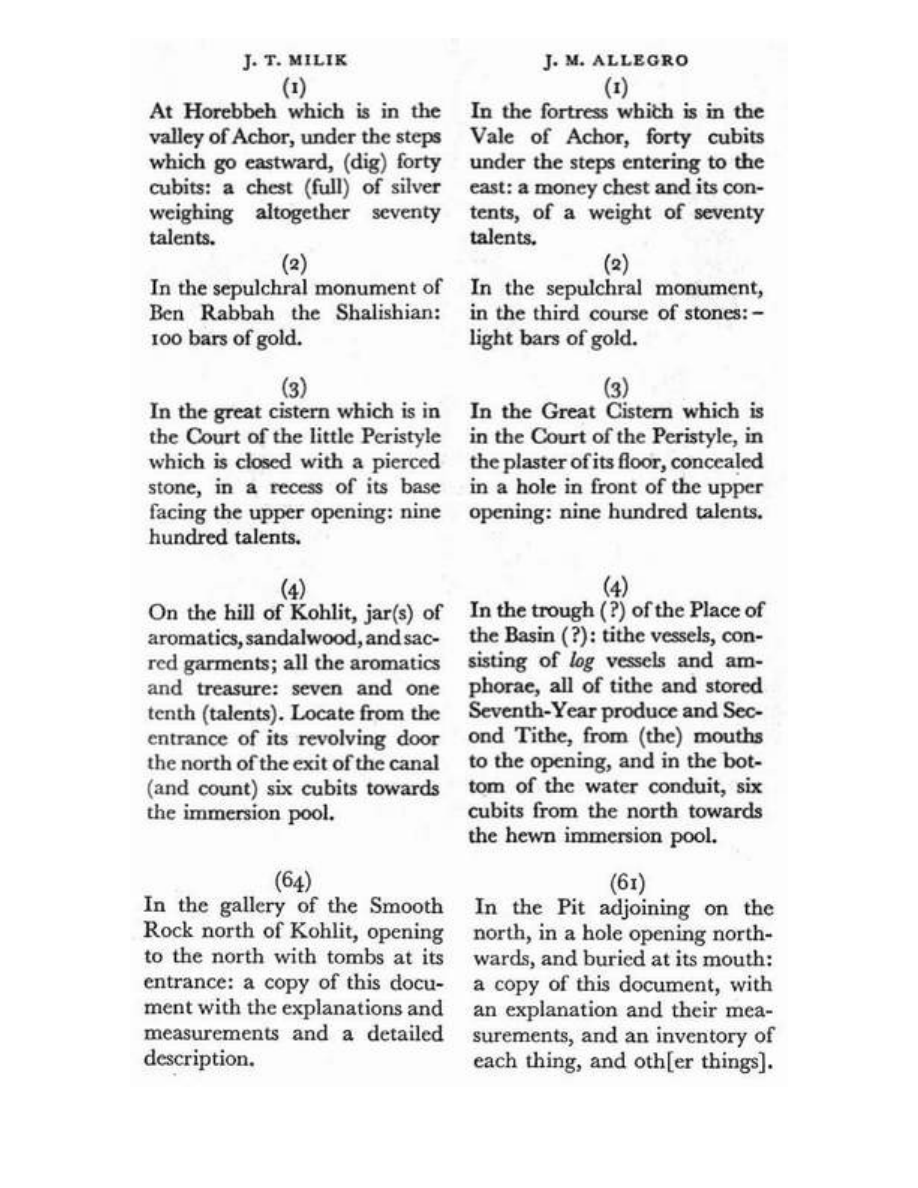

Table of differences (side by side) in translation.
----
This strange document refers, according to Allegro's reckoning, to
over three thousand talents of silver, nearly one thousand three
hundred talents of gold, sixty-five bars of gold, six hundred and
eight pitchers containing silver, and six hundred and nineteen
silver and gold vessels. In other words, using the post-biblical
value of the talent as a yardstick, the total of precious metal
involved would amount to sixty-five tons of silver and twenty-six
tons of gold.
But was this treasure a real one, and is the assessment of the
talent correct? Who could have possessed such a fortune, and when
and by whom was it concealed? These are the questions exercising
the minds of scholars, and it will amaze no one to learn that
although the Scroll itself is barely known to all but two of them,
already three solutions have been advanced.
The first of these, proposed by J.T. Milik, defines the work as
fiction and as falling into the category of legends about hidden
treasure. He believes that this is indicated by the exaggerated
sum of the riches, and maintains that the chief interest of the
Scroll lies in the fields of linguistics and topography. He dates
it from about A.D. 100, thus ruling out any connexion with the
rest of the Qumran documents deposited in the caves not later than
A.D. 68.
The remaining two arguments hold that the treasure was indeed real
and that it represented either the fortune of the Essene sect,
hidden no doubt in A.D. 68 (A. Dupont-Sommer), or that of the
Temple of Jerusalem (K. G. Kuhn, Chaim Rabin). J. M. Allegro
belongs to the same school of thought, but adds that it was the
Zealots who were responsible for concealing the gold and silver
and for writing the Scroll. According to him, these Zealots, a
fanatical band of Jewish rebels who fought against Rome from A.D.
66 to 70, occupied the Qumran area (already abandoned by the
Essenes) in A.D. 68, and unsuccessfully defended it against the

Romans in the summer of the same year.
As far as Milik's theory is concerned, it would certainly dispose
of the difficulty arising from the colossal quantity of treasure.
On the other hand, it is unable to account for two striking
characteristics of the Scroll, namely its dry realism, very
different from that of ancient legends, and the fact that it is
recorded on copper, an expensive material, instead of on leather
or papyrus. If the author is right in assuming that the
composition was intended as a sort of fairy-story, the present
text can only represent a sketch or outline of such a work. But
would anyone in their senses have engraved their literary notes on
copper?
The contention that the treasure was a real one is, of course,
supported by the very arguments which undermine Milik's. The
business-like style, and the enduring material on which the
catalogue is inscribed, would seem to suggest that the writer was
not indulging in some frivolous dream. Again, Dupont-Sommer's
allocation of the fortune to the Essenes appears sensible in view
of the. fact that the Copper Scroll was found among documents
known to derive from Qumran. By comparison, it requires a strong
feat of the imagination to accept that it belonged originally to
the treasure chambers of the Temple and was placed in hiding, in a
hostile environment, in A.D. 68 - before, that is to say, there
was any immediate danger to the capital city of Jerusalem. Allegro
bypasses part of this objection by presuming that at that time
Qumran was no longer unfriendly to the Jerusalem authorities,
being by then in the hands of the Zealots. But there is, as yet,
no satisfactory explanation as to why the sack of Temple and city
should have been foreseen, and provided for, so early.
However, in favour of Kuhn, Rabin, and Allegro, it is feasible to
envisage a fortune of this size as belonging to the Temple,
whereas, despite Dupont-Sommer's undoubtedly true remarks
concerning the apparent compatibility of religious poverty and fat
revenues, it is still hard to believe that the Essenes, a
relatively small community, should have amassed such
disproportionate riches.

So much for the initial skirmishing. No doubt, once the Copper
Scroll makes its official debut, even more varied arguments will
be stoutly defended and as briskly opposed.
Unfortunately, it seems as though the key to the mystery, 'the
copy of this document with the explanations, measurements, and
detailed description', may continue to lie in the 'Gallery of the
Smooth Rock north of Kohlit'. Or is it in the ' Pit adjoining on
the north, in a hole opening northwards'?
--------------------
END.
Document Outline
- Local Disk
Wyszukiwarka
Podobne podstrony:
Strugnell& Qimron;The Dead Sea Scrolls Translated
The Structure of DP in English and Polish (MA)
Elizabeth Peters The Dead Sea Cipher (pdf)
The Language of Architecture in English and in Polish Jacek Rachfał
Some Oceanographic Applications of Recent Determinations of the Solubility of Oxygen in Sea Water
Breakthrough An Amazing Experiment in Electronic Communication with the Dead by Konstantin Raudive
The Study of Solomonic Magic in English
Deep water Archaeological Survey in the Black Sea 2000 Season
1942 Hope For the Dead For the Survivors In a Righteous World (Nadzieja dla zmarłych, dla ocalałych
Russia in the Baltic Sea Region
Geoffrey A Landis Ripples in the Dirac Sea
Edmund Cooper Sea Horse in the sky
Kaisse (1983) The Syntax of Auxiliary Reduction in English
Finster Defnition of the Dirac Sea in the Presence of External Fields
The Application of Domestication and Foreignization Translation Strategies in English Persian Transl
Notes on the Zohar in English by Don Karr
The Spectre of Shakespeare in Rosencrantz and Guildenstern are Dead
Beyond the Sea inst in B
Beyond the Sea inst in C
więcej podobnych podstron