
Msoffe and Mbilu Afr. J. Trad. CAM (2009) 6 (4): 592 - 595
592
Short Communication
THE EFFICACY OF CRUDE EXTRACT OF ALOE SECUNDIFLORA ON CANDIDA ALBICANS
Peter L. M. Msoffe
1*
and Mbilu, Z. M
2
1
Department of Veterinary Medicine and Public Health, Sokoine University of Agriculture, P. O. Box
3021, Chuo Kikuu, Morogoro.
3
Graduate student, Department of Food Science and Technology, Sokoine
University of Agriculture, P. O. Box 3007, Chuo Kikuu, Morogoro.
* E-mail:
msoffepl@suanet.ac.tz
Abstract
In- vitro studies on the efficacy of crude extracts of Aloe secundiflora on Candida albicans was conducted.
Five mature leaves of Aloe secundiflora were collected and the crude extract was prepared, then autoclaved. The
extract was then tested on Candida albicans grown on solid media. The results from these studies revealed complete
inhibition of Candida albicans growth caused by Aloe secundiflora crude extract on solid media. The findings from
this study suggest that the crude extract of Aloe secundiflora can inhibit the growth of Candida albicans. Further
studies are required to establish the in-vivo activity of the crude extract, the active ingredient, dosage and safety of
Aloe secundiflora, before recommending for clinical use.
Keywords: Aloe secundiflora, alternative medicine, opportunistic infections, crude extract
Introduction
Medicinal plants in many African countries including Tanzania play a crucial role in provision of primary
health care including treating people living with incurable diseases such as cancer and HIV/AIDS opportunistic
diseases. HIV/AIDS pandemic is currently among the highest socio-economic challenges that face Tanzania and
other developing countries, as it affects mostly the young and most economically productive population. This
translates to loss of skills, talents, expertise and man-hours (TACAIDS, 2006). Majority of people living with
HIV/AIDS are susceptible to fungal and bacterial opportunistic infections that result from immunosuppression
(UNAIDS, 2006). World Health Organization (WHO) reported that, people with advanced HIV infection are
vulnerable to infections and malignancies that are called 'opportunistic infections' because they take advantage of the
opportunity offered by a weakened immune system. Candidiasis is the second most common cause of vaginal
irritation, or vaginitis, and can also occur on the male genital organ. In immunocompromised patients, the Candida
infection can involve the esophagus and can become systemic, causing a much more serious condition called
fungemias. The drugs required in treatment of Candidiasis (HIV/AIDS opportunistic infection) are very expensive
and majority of the suffers are poor and are unable to meet the high costs of medications. There is therefore the need
to search for some alternative treatment of Candidiasis through the potential use of Aloe secundiflora which are
readily available and.
Previous studies have shown some antibacterial activity of crude extract of A. secundiflora (Waihenya et al.,
2002). The aim of this study therefore is to establish the bioactivity of crude extract of Aloe secundiflora in the
growth inhibition of Candida albicans.
Materials and Methods
Preparation of plant extracts
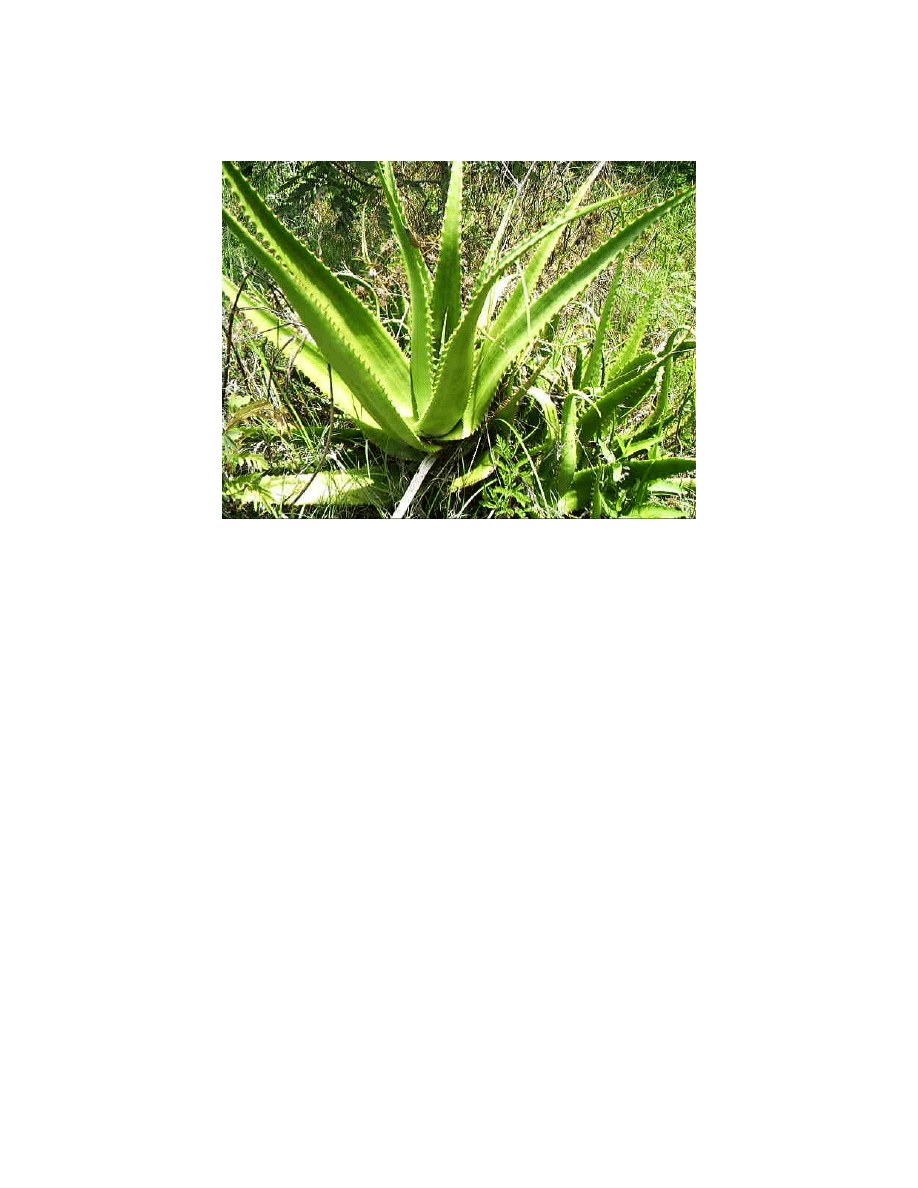
Aloe secundiflora (BJH 4828 i.e. B. J. Harris 24.6.1970) leaves were collected from Sokoine University of
Agriculture Aloe garden (Figure 1). The sap was collected after five mature leaves were transversely cut using a
knife and the leaves were arranged in container with 100 ml of distilled water to hasten the process of extraction. The
Afr. J. Traditional,
Complementary and
Alternative Medicines
www.africanethnomedicines.net
Msoffe and Mbilu Afr. J. Trad. CAM (2009) 6 (4): 592 - 595
593
extraction was done for 30 minutes. The extracted sap was kept in refrigerator at 4 ºC in sterile screw capped
containers until use.
Figure 1: Aloe secundiflora plant at the Sokoine University of Agriculture.
Test microorganism
Candida albicans was acquired from the Department of Molecular Biology and Biotechnology, University
of Dar-es salaam in Malt Extract Agar slant (Courtesy of Dr. Kenneth Hosea).
Procedures of culturing the organism on fresh media
Work surface was sterilized with 70% ethanol, 500ml of Medium (Malt extract agar) was prepared
according to manufacture’s instructions, autoclaved at 121 °C, 15 minutes, medium was poured into sterile Petri dish
up to a level of approximately 4mm that is about 20 ml of molten agar and left to solidify. Dishes with solidified
agar was incubated for 24 hrs for sterility check up, Candida albicans from slant was streaked on media by using
sterile wire loop and the streaked, dish incubated for 24 hrs at 37 °C. Formed colonies were identified culturally and
stored in the refrigerator at 4 °C to stop further growth of Candida albicans.
Antimicrobial susceptibility testing.
A loopful of Candida albicans from a Petri dish was inoculated into 100ml of prepared sterile malt extract
broth (in flask), then incubated at 37 °C for 24 hrs. On the agar media, four equidistant wells of 5mm in diameter and
4mm in depth were prepared using a sterile cock borer. To each five petri dishes contains about 15-20ml of sterile
Malt extract agar, 0.2 ml of inoculum was poured on agar and plate tilted and distributed inoculum evenly on agar
surface. Wells were labeled to correspond with the volume (20 , 80 µl and 100 µl respectively) of the crude extracts
of Aloe secundiflora and standard (Ketoconazole, 40µl and Fluconazole 40 µl ). Wells was filled with the plant
extracts and control, and kept in the refrigerator to allow extract to diffuse in agar for 8 hrs, then sealed and
incubated at 37 °C for 24 hrs.
Msoffe and Mbilu Afr. J. Trad. CAM (2009) 6 (4): 592 - 595
594
Data analysis
Data on zones of inhibition (in mm) was analyzed using Statistix® 9 (Analytical software 2008). Analysis
of variance (ANOVA) and comparison of means was conducted.
Results and Discussion
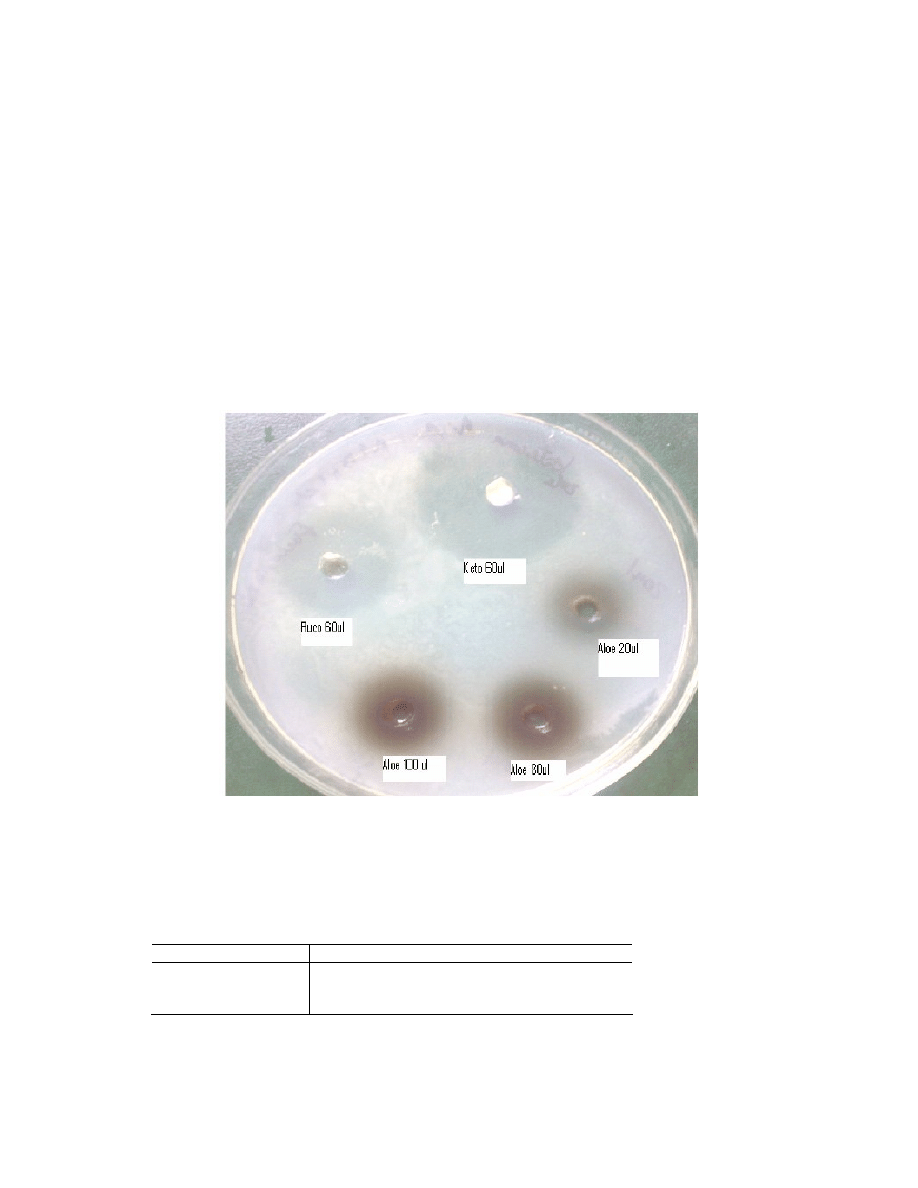
It was observed that Aloe crude extract obtained from five mature leaves showed antimicrobial effects on
Candida albicans by complete zones of inhibition on the growth medium (Figure 2).
Figure 2: Zones of inhibition caused by various volumes of Aloe secundiflora and standard drugs.
Key:Keto = Ketokonazole
Aloe 20µl, 80µl, 100µl = Different volumes for crude Aloe secundiflora sap.
Fluc = Fluconazole
Table 1: Analysis of variance for volume of Aloe secundiflora and zone of inhibition
Volume used (µl)
Mean zone of inhibition ± Std deviation
20
11.46 ± 0.69
a
***
80
15.24 ± 0.72
b
**
100
16.66 ± 1.09
c
***
Means in a column not sharing the same superscript are significantly different at **P<0.001; ***P<0.0001

Msoffe and Mbilu Afr. J. Trad. CAM (2009) 6 (4): 592 - 595
595
There was a significant variation in the zone of inhibition at the different treatment volume level from each
other at (P<0.001 to 0.0001). There was an increase of the zone of inhibition with increase in the volume of the crude
extract. The highest zone of inhibition of 16.66 ± 1.09 was recorded at a maximum volume of 100µl, followed by
80µl and 20µl respectively The results from this experiment indicate that Aloe secundiflora has antifungal effect on
Candida albicans that was tested under the experiment. This antifungal effect has been shown by complete inhibition
of the area diffused by the Aloe sap (Figure 2).
This study is the first preliminary investigation so far in Tanzania, on the in vitro studies of Aloe
secundiflora crude extract on Candida albicans. Most previous reports have been on bacteria and viruses Waihenya
(2002). In this study, crude sap from five leaves of A. secundiflora exhibited clear zones of inhibition against C.
albicans indicating a growth inhibition on the fungi. Waihenya (2002) found A. secundiflora crude extract to be
effective against various numbers of bacteria such as Pseudomonas species, Escherichia coli, Staphylococcus
aureus, Proteus species, Pasteurella species, and Streptococcus species. Rajabu (2004-Unpublished report) revealed
that sap obtained from 4-5 mature leaves of A. secundiflora inhibited the growth of Bacillus subtilis and Salmonella
gallinarum.
In- vivo studies involving patients with oral thrush would be useful in determining the usefulness of the
crude Aloe extract in treatment of Candidiasis. In a study conducted to determine the effect of aloe in chickens
infected with Salmonella gallinarum, it was revealed that there was a delay of clinical signs and lowered severity of
the disease (fowl typhoid) among the aloe treated group as compared to untreated group (Waihenya et al., 2002).
Bland (1985) investigated the effect of Aloe when consumed orally in patient suffering from an inflammatory bowels
disease. The Aloe was given at the rate twice ounces three times daily for a week and able to rebalance the regulating
gastrointestinal motility, increase stool specific gravity to 0.37 and decrease stool transit leading to curing diarrhea.
From these finding it was suggested that Aloe could inhibit diarrhea and hence effective against some disease causing
agents.
Further research should be directed in determining the active ingredients present in Aloe crude extract and
various concentrations to determine which concentration may give excellent response. This would be a pre-requisite
before clinical trials on human patients is attempted.
Acknowledgements
This study was supported by a loan from the Higher Education Students Loans Board of Tanzania the
authors are thankful to the board. Dr. Kenneth Hosea is thanked for providing the Candida albicans strains.
Technical assistance of Mr. Ndaki Lukiko and Philemon Mkuchu is appreciated.
References
1. Analytical software (2008). Statistix Version 9, Analytical software, Tallahassee, Florida, USA.
2. Bland, Jefrey (1985). Effect of orally consumed Aloe vera juice on gastrointestinal function in normal
humans. Preventive Veterinary Medicine 14, 152-154.
3. Rajabu S. (2004). Optimization of crude extract of Aloe secundiflora for use in controlling various bacterial
diseases, Unpublished Special project, Sokoine University of Agriculture.
4. Tanzania Commission for AIDS (TACAIDS) (2006). Report: Follow-Up to the Declaration of Commitment
on HIV/AIDS (UNGASS). TACAIDS, Dar es salaam, Tanzania.
5. Joint United Nations Programme on HIV/AIDS (UNAIDS) (2006). Report on the Global AIDS epidemic.
http://www.unaids.org/en/KnowledgeCentre/HIVData/GlobalReport
, accessed April 2007.
6. Waihenya R K, (2002) Investigation on the Bioactivities of Aloe secundiflora (Aloeceae) on the Newcastle
disease and Fowl typhoid in local chickens (Gallus domesticus) thesis in Tanzania. Unpublished PhD Thesis,
Sokoine University of Agriculture.
7. Waihenya R K, Mtambo M M A. Nkwengalila G., Minga U.M. (2002). Efficacy of crude extracts of Aloe
secundiflora against Salmonella gallinarum in experimentally infected
Wyszukiwarka
Podobne podstrony:
76 1075 1088 The Effect of a Nitride Layer on the Texturability of Steels for Plastic Moulds
The Wanderer conveys the meditations of a solitary exile on his past glories as a warrior in his lor
5 49 62 The Influence of Tramp Elements on The Spalling Resistance of 1 2343
Li Yadav Lin Exploring the role of privacy programs on initial online trust formation
Em Ashcroft [The Tigers of Texas 01] On the Prowl [Siren Menage Everlasting] (pdf)
The Effect of DNS Delays on Worm Propagation in an IPv6 Internet
Żakowski, Karol New Parties in Japan – In the Search of a “Third Pole” on the Political Scene (2013
the effect of interorganizational trust on make or cooperate decisions deisentangling opportunism de
Modeling the Effects of Timing Parameters on Virus Propagation
Latour The Impact of Science Studies on Political Philosophy
The Path Of Love, Talks On Songs Of Kabir
The Effects of Performance Monitoring on Emotional Labor and Well Being in Call Centers
Unravelling the influence of Weber s sociology on Theravada studies since
The Impact of Countermeasure Spreading on the Prevalence of Computer Viruses
The Impact of Countermeasure Propagation on the Prevalence of Computer Viruses
The Effects of Probiotic Supplementation on Markers of Blood Lipids, and Blood Pressure in Patients
Catena Aurea The Gospel Of Mark A Commentary On The Gospel By St Thomas Aquinas
więcej podobnych podstron