
MEPC 52/24/Add.1
I:\MEPC\52\24-ADD-1.DOC
ANNEX 6
RESOLUTION MEPC.118(52)
Adopted on 15 October 2004
AMENDMENTS TO THE ANNEX OF THE PROTOCOL OF 1978
RELATING TO THE INTERNATIONAL CONVENTION FOR THE PREVENTION
OF POLLUTION FROM SHIPS, 1973
(Revised Annex II of MARPOL 73/78)
THE MARINE ENVIRONMENT PROTECTION COMMITTEE,
RECALLING article 38(a) of the Convention on the International Maritime Organization
concerning the functions of the Marine Environment Protection Committee (the Committee)
conferred upon it by international conventions for the prevention and control of marine pollution,
NOTING article 16 of the International Convention for the Prevention of Pollution from
Ships, 1973 (hereinafter referred to as the “1973 Convention”) and article VI of the Protocol of
1978 relating to the International Convention for the Prevention of Pollution from Ships, 1973
(hereinafter referred to as the “1978 Protocol”) which together specify the amendment procedure
of the 1978 Protocol and confer upon the appropriate body of the Organization the function of
considering and adopting amendments to the 1973 Convention, as modified by the 1978 Protocol
(MARPOL 73/78),
HAVING CONSIDERED the text of the revised Annex II of MARPOL 73/78,
1.
ADOPTS, in accordance with article 16(2)(b), (c) and (d) of the 1973 Convention, the
revised Annex II of MARPOL 73/78, the text of which is set out at the annex to the present
resolution;
2.
DETERMINES, in accordance with article 16(2)(f)(iii) of the 1973 Convention, that the
revised Annex II of MARPOL 73/78 shall be deemed to have been accepted on 1 July 2006
unless, prior to that date, not less than one-third of the Parties or Parties, the combined merchant
fleets of which constitute not less than 50 per cent of the gross tonnage of the world’s merchant
fleet, have communicated to the Organization their objection to the amendments;
3.
INVITES the Parties to note that, in accordance with article 16(2)(g)(ii) of the
1973 Convention, the revised Annex II of MARPOL 73/78 shall enter into force on
1 January 2007 upon its acceptance in accordance with paragraph 2 above;
4.
REQUESTS the Secretary-General, in conformity with article 16(2)(e) of the
1973 Convention, to transmit to all Parties to MARPOL 73/78 certified copies of the present
resolution and the text of the revised Annex II of MARPOL 73/78 contained in the annex; and
5.
REQUESTS FURTHER the Secretary-General to transmit copies of the present
resolution and its annex to the Members of the Organization which are not Parties to
MARPOL 73/78.

MEPC 52/24/Add.1
ANNEX 6
Page 2
I:\MEPC\52\24-ADD-1.DOC
CHAPTER 1 - GENERAL
Regulation 1
Definitions
For the purposes of this Annex:
1
Anniversary date means the day and the month of each year which will correspond to the
date of expiry of the International Pollution Prevention Certificate for the Carriage of Noxious
Liquid Substances in Bulk.
2 Associated
piping means the pipeline from the suction point in a cargo tank to the shore
connection used for unloading the cargo and includes all ship’s piping, pumps and filters which
are in open connection with the cargo unloading line.
3 Ballast
water
Clean
ballast means ballast water carried in a tank which, since it was last used to carry a
cargo containing a substance in Category X, Y or Z, has been thoroughly cleaned and the
residues resulting there from have been discharged and the tank emptied in accordance with the
appropriate requirements of this Annex.
Segregated
ballast means ballast water introduced into a tank permanently allocated to
the carriage of ballast or cargoes other than oil or Noxious Liquid Substances as variously
defined in the Annexes of the present Convention, and which is completely separated from the
cargo and oil fuel system.
4
Chemical Codes
Bulk Chemical Code means the Code for the Construction and Equipment of Ships
carrying Dangerous Chemicals in Bulk adopted by the Marine Environment Protection
Committee of the Organization by resolution MEPC.20(22), as amended by the Organization,
provided that such amendments are adopted and brought into force in accordance with the
provisions of article 16 of the present Convention concerning amendment procedures applicable
to an appendix to an Annex.
International Bulk Chemical Code means the International Code for the Construction and
Equipment of Ships Carrying Dangerous Chemicals in Bulk adopted by the Marine Environment
Protection Committee of the Organization by resolution MEPC.19(22), as amended by the
Organization, provided that such amendments are adopted and brought into force in accordance
with the provisions of article 16 of the present Convention concerning amendment procedures
applicable to an appendix to an Annex.
5
Depth of water means the charted depth.
6 En
route means that the ship is under way at sea on a course or courses, including
deviation from the shortest direct route, which as far as practicable for navigational purposes,
will cause any discharge to be spread over as great an area of the sea as is reasonable and
practicable.

MEPC 52/24/Add.1
ANNEX 6
Page 3
I:\MEPC\52\24-ADD-1.DOC
7 Liquid
substances are those having a vapour pressure not exceeding 0.28 MPa absolute at
a temperature of 37.8°C.
8 Manual means Procedures and Arrangements Manual in accordance with the model given
in appendix 6 of this Annex.
9
Nearest land. The term “from the nearest land” means from the baseline from which the
territorial sea in question is established in accordance with international law, except that, for the
purposes of the present Convention “from the nearest land” off the north-eastern coast of
Australia shall mean from the line drawn from a point on the coast of Australia in:
latitude 11°00' S, longitude 142°08' E
to a point in latitude 10°35' S, longitude 141°55' E,
thence to a point latitude 10°00' S, longitude 142°00' E,
thence to a point latitude 9°10' S, longitude 143°52' E,
thence to a point latitude 9°00' S, longitude 144°30' E,
thence to a point latitude 10°41' S, longitude 145°00' E,
thence to a point latitude 13°00' S, longitude 145°00' E,
thence to a point latitude 15°00' S, longitude 146°00' E,
thence to a point latitude 17°30' S, longitude 147°00' E,
thence to a point latitude 21°00' S, longitude 152°55' E,
thence to a point latitude 24°30' S, longitude 154°00' E,
thence to a point on the coast of Australia
in latitude 24°42' S, longitude 153°15' E.
10
Noxious Liquid Substance means any substance indicated in the Pollution Category
column of chapter 17 or 18 of the International Bulk Chemical Code or provisionally assessed
under the provisions of regulation 6.3 as falling into Category X, Y or Z.
11
PPM means ml/m
3
.
12 Residue means any noxious liquid substance which remains for disposal.
13 Residue/water
mixture means residue to which water has been added for any purpose
(e.g. tank cleaning, ballasting, bilge slops).
14
Ship construction
14.1 Ship
constructed means a ship the keel of which is laid or which is at a similar stage of
construction. A ship converted to a chemical tanker, irrespective of the date of construction, shall
be treated as a chemical tanker constructed on the date on which such conversion commenced.
This conversion provision shall not apply to the modification of a ship, which complies with all
of the following conditions:

MEPC 52/24/Add.1
ANNEX 6
Page 4
I:\MEPC\52\24-ADD-1.DOC
.1
the ship is constructed before 1 July 1986; and
.2
the ship is certified under the Bulk Chemical Code to carry only those products
identified by the Code as substances with pollution hazards only.
14.2 Similar stage of construction means the stage at which:
.1
construction identifiable with a specific ship begins; and
.2
assembly of that ship has commenced comprising at least 50 tons or one per cent
of the estimated mass of all structural material, whichever is less.
15 Solidifying/non-solidifying
15.1 Solidifying
Substance means a noxious liquid substance which:
.1
in the case of a substance with a melting point of less than 15°C which is at a
temperature of less than 5°C above its melting point at the time of unloading; or
.2
in the case of a substances with a melting point of equal to or greater than 15°C
which is at a temperature of less than 10°C above its melting point at the time of
unloading.
15.2 Non-solidifying
Substance means a noxious liquid substance, which is not a Solidifying
Substance.
16 Tanker
.1
Chemical tanker means a ship constructed or adapted for the carriage in bulk of
any liquid product listed in chapter 17 of the International Bulk Chemical Code;
.2
NLS
tanker means a ship constructed or adapted to carry a cargo of Noxious
Liquid Substances in bulk and includes an “oil tanker” as defined in Annex I of
the present Convention when certified to carry a cargo or part cargo of Noxious
Liquid Substances in bulk.
17 Viscosity
.1 High-Viscosity
Substance
means a noxious liquid substance in Category X or Y
with a viscosity equal to or greater than 50 mPa.s at the unloading temperature.
.2 Low-Viscosity
Substance means a noxious liquid substance, which is not a
High-Viscosity Substance.
Regulation 2
Application
1
Unless expressly provided otherwise the provisions of this Annex shall apply to all ships
certified to carry Noxious Liquid Substances in bulk.

MEPC 52/24/Add.1
ANNEX 6
Page 5
I:\MEPC\52\24-ADD-1.DOC
2
Where a cargo subject to the provisions of Annex I of the present Convention is carried in
a cargo space of an NLS tanker, the appropriate requirements of Annex I of the present
Convention shall also apply.
Regulation 3
Exceptions
1
The discharge requirements of this Annex shall not apply to the discharge into the sea of
Noxious Liquid Substances or mixtures containing such substances when such a discharge:
.1
is necessary for the purpose of securing the safety of a ship or saving life at sea; or
.2
results from damage to a ship or its equipment:
.1
provided that all reasonable precautions have been taken after the
occurrence of the damage or discovery of the discharge for the purpose of
preventing or minimizing the discharge; and
.2
except if the owner or the master acted either with intent to cause damage,
or recklessly and with knowledge that damage would probably result; or
.3
is approved by the Administration, when being used for the purpose of combating
specific pollution incidents in order to minimize the damage from pollution. Any
such discharge shall be subject to the approval of any Government in whose
jurisdiction it is contemplated the discharge will occur.
Regulation 4
Exemptions
1
With respect to amendments to carriage requirements due to the upgrading of the
categorization of a substance, the following shall apply:
.1
where an amendment to this Annex and the International Bulk Chemical Code and
Bulk Chemical Code involves changes to the structure or equipment and fittings
due to the upgrading of the requirements for the carriage of certain substances, the
Administration may modify or delay for a specified period the application of such
an amendment to ships constructed before the date of entry into force of that
amendment, if the immediate application of such an amendment is considered
unreasonable or impracticable. Such relaxation shall be determined with respect
to each substance;
.2
the Administration allowing a relaxation of the application of an amendment
under this paragraph shall submit to the Organization a report giving details of the
ship or ships concerned, the cargoes certified to carry, the trade in which each ship
is engaged and the justification for the relaxation, for circulation to the Parties to
the Convention for their information and appropriate action, if any and reflect the
exemption on the Certificate as referred to in regulation 7 or 9 of this Annex;

MEPC 52/24/Add.1
ANNEX 6
Page 6
I:\MEPC\52\24-ADD-1.DOC
.3
Notwithstanding the above, an Administration may exempt ships from the
carriage requirements under regulation 11 for ships certified to carry individually
identified vegetable oils identified by the relevant footnote in chapter 17 of the
IBC Code, provided the ship complies with the following conditions:
.1
Subject to this regulation, the NLS tanker shall meet all requirements for
ship type 3 as identified in the IBC Code except for cargo tank location;
.2
under this regulation, cargo tanks shall be located at the following
distances inboard. The entire cargo tank length shall be protected by
ballast tanks or spaces other than tanks that carry oil as follows:
.1
wing tanks or spaces shall be arranged such that cargo tanks are
located inboard of the moulded line of the side shell plating
nowhere less than 760 mm;
.2
double bottom tanks or spaces shall be arranged such that the
distance between the bottom of the cargo tanks and the moulded
line of the bottom shell plating measured at right angles to the
bottom shell plating is not less than B/15 (m) or 2.0 m at the
centreline, whichever is the lesser. The minimum distance shall be
1.0 metre; and
.3
the relevant certificate shall indicate the exemption granted.
2
Subject to the provisions of paragraph 3 of this regulation, the provisions of
regulation 12.1 need not apply to a ship constructed before 1 July 1986 which is engaged in
restricted voyages as determined by the Administration between:
.1
ports or terminals within a State Party to the present Convention; or
.2
ports or terminals of States Parties to the present Convention.
3
The provisions of paragraph 2 of this regulation shall only apply to a ship constructed
before 1 July 1986 if:
.1
each time a tank containing Category X, Y or Z substances or mixtures is to be
washed or ballasted, the tank is washed in accordance with a prewash procedure
approved by the Administration in compliance with appendix 6 of this Annex, and
the tank washings are discharged to a reception facility;
.2
subsequent washings or ballast water are discharged to a reception facility or at
sea in accordance with other provisions of this Annex;
.3
the adequacy of the reception facilities at the ports or terminals referred to above,
for the purpose of this paragraph, is approved by the Governments of the States
Parties to the present Convention within which such ports or terminals are
situated;

MEPC 52/24/Add.1
ANNEX 6
Page 7
I:\MEPC\52\24-ADD-1.DOC
.4
in the case of ships engaged in voyages to ports or terminals under the jurisdiction
of other States Parties to the present Convention, the Administration
communicates to the Organization, for circulation to the Parties to the Convention,
particulars of the exemption, for their information and appropriate action, if any;
and
.5
the certificate required under this Annex is endorsed to the effect that the ship is
solely engaged in such restricted voyages.
4
For a ship whose constructional and operational features are such that ballasting of cargo
tanks is not required and cargo tank washing is only required for repair or dry-docking, the
Administration may allow exemption from the provisions of regulation 12, provided that all of
the following conditions are complied with:
.1
the design, construction and equipment of the ship are approved by the
Administration, having regard to the service for which it is intended;
.2
any effluent from tank washings which may be carried out before a repair or
dry-docking is discharged to a reception facility, the adequacy of which is
ascertained by the Administration;
.3
the certificate required under this Annex indicates:
.1
that each cargo tank is certified for the carriage of a restricted number of
substances which are comparable and can be carried alternately in the
same tank without intermediate cleaning; and
.2
the particulars of the exemption;
.4
the ship carries a Manual approved by the Administration; and
.5
in the case of ships engaged in voyages to ports or terminals under the jurisdiction
of other States Parties to the present Convention, the Administration
communicates to the Organization, for circulation to the Parties to the Convention,
particulars of the exemption, for their information and appropriate action, if any.
Regulation 5
Equivalents
1
The Administration may allow any fitting, material, appliance or apparatus to be fitted in
a ship as an alternative to that required by this Annex if such fitting, material, appliance or
apparatus is at least as effective as that required by this Annex. This authority of the
Administration shall not extend to the substitution of operational methods to effect the control of
discharge of Noxious Liquid Substances as equivalent to those design and construction features
which are prescribed by regulations in this Annex.
2
The Administration, which allows a fitting, material, appliance or apparatus as alternative
to that required by this Annex, under paragraph 1 of this regulation, shall communicate to the
Organization for circulation to the Parties to the Convention, particulars thereof, for their
information and appropriate action, if any.

MEPC 52/24/Add.1
ANNEX 6
Page 8
I:\MEPC\52\24-ADD-1.DOC
3
Notwithstanding the provisions of paragraphs 1 and 2 of this regulation, the construction
and equipment of liquefied gas carriers certified to carry Noxious Liquid Substances listed in the
applicable Gas Carrier Code, shall be deemed to be equivalent to the construction and equipment
requirements contained in regulations 11 and 12 of this Annex, provided that the gas carrier
meets all following conditions:
.1
hold a Certificate of Fitness in accordance with the appropriate Gas Carrier Code
for ships certified to carry liquefied gases in bulk;
.2
hold an International Pollution Prevention Certificate for the Carriage of Noxious
Liquid Substances in Bulk, in which it is certified that the gas carrier may carry
only those Noxious Liquid Substances identified and listed in the appropriate Gas
Carrier Code;
.3
be provided with segregated ballast arrangements;
.4
be provided with pumping and piping arrangements, which, to the satisfaction of
the Administration, ensure that the quantity of cargo residue remaining in the tank
and its associated piping after unloading does not exceed the applicable quantity
of residue as required by regulation 12.1, 12.2 or 12.3; and
.5
be provided with a Manual, approved by the Administration, ensuring that no
operational mixing of cargo residues and water will occur and that no cargo
residues will remain in the tank after applying the ventilation procedures
prescribed in the Manual.

MEPC 52/24/Add.1
ANNEX 6
Page 9
I:\MEPC\52\24-ADD-1.DOC
CHAPTER 2 - CATEGORIZATION OF NOXIOUS LIQUID SUBSTANCES
Regulation 6
Categorization and listing of Noxious Liquid Substances and other substances
1
For the purpose of the regulations of this Annex, Noxious Liquid Substances shall be
divided into four categories as follows:
.1
Category X: Noxious Liquid Substances which, if discharged into the sea from
tank cleaning or deballasting operations, are deemed to present a major hazard to
either marine resources or human health and, therefore, justify the prohibition of
the discharge into the marine environment;
.2
Category Y: Noxious Liquid Substances which, if discharged into the sea from
tank cleaning or deballasting operations, are deemed to present a hazard to either
marine resources or human health or cause harm to amenities or other legitimate
uses of the sea and therefore justify a limitation on the quality and quantity of the
discharge into the marine environment;
.3
Category Z: Noxious Liquid Substances which, if discharged into the sea from
tank cleaning or deballasting operations, are deemed to present a minor hazard to
either marine resources or human health and therefore justify less stringent
restrictions on the quality and quantity of the discharge into the marine
environment;
.4
Other Substances: substances indicated as OS (Other Substances) in the pollution
category column of chapter 18 of the International Bulk Chemical Code which
have been evaluated and found to fall outside Category X, Y or Z as defined in
regulation 6.1 of this Annex because they are, at present, considered to present no
harm to marine resources, human health, amenities or other legitimate uses of the
sea when discharged into the sea from tank cleaning of deballasting operations.
The discharge of bilge or ballast water or other residues or mixtures containing
only substances referred to as “Other Substances” shall not be subject to any
requirements of the Annex.
2
Guidelines for use in the categorization of Noxious Liquid Substances are given in
appendix 1 to this Annex.
3
Where it is proposed to carry a liquid substance in bulk which has not been categorized
under paragraph 1 of this regulation, the Governments of Parties to the Convention involved in
the proposed operation shall establish and agree on a provisional assessment for the proposed
operation on the basis of the guidelines referred to in paragraph 2 of this regulation. Until full
agreement among the Governments involved has been reached, the substance shall not be carried.
As soon as possible, but not later than 30 days after the agreement has been reached, the
Government of the producing or shipping country, initiating the agreement
concerned, shall
notify the Organization and provide details of the substance and the provisional assessment for
annual circulation to all Parties for their information. The Organization shall maintain a register
of all such substances and their provisional assessment until such time as the substances are
formally included in the IBC Code.

MEPC 52/24/Add.1
ANNEX 6
Page 10
I:\MEPC\52\24-ADD-1.DOC
CHAPTER 3 - SURVEYS AND CERTIFICATION
Regulation 7
Survey and certification of chemical tankers
Notwithstanding the provisions of regulations 8, 9, and 10
of this Annex, chemical tankers which
have been surveyed and certified by States Parties to the present Convention in accordance with
the provisions of the International Bulk Chemical Code or the Bulk Chemical Code, as
applicable, shall be deemed to have complied with the provisions of the said regulations, and the
certificate issued under that Code shall have the same force and receive the same recognition as
the certificate issued under regulation 9 of this Annex.
Regulation 8
Surveys
1
Ships carrying Noxious Liquid Substances in bulk shall be subject to the surveys
specified below:
.1
An initial survey before the ship is put in service or before the Certificate required
under regulation 9 of this Annex is issued for the first time, and which shall
include a complete survey of its structure, equipment, systems, fittings,
arrangements and material in so far as the ship is covered by this Annex. This
survey shall be such as to ensure that the structure, equipment, systems, fittings,
arrangements and material fully comply with the applicable requirements of this
Annex.
.2
A renewal survey at intervals specified by the Administration, but not exceeding
5 years, except where regulation 10.2, 10.5, 10.6, 10.7 of this Annex is applicable.
The renewal survey shall be such as to ensure that the structure, equipment,
systems, fittings, arrangements and material fully comply with applicable
requirements of this Annex.
.3
An intermediate survey within 3 months before or after the second anniversary
date or within 3 months before or after the third anniversary date of the Certificate
which shall take the place of one of the annual surveys specified in paragraph 1.4
of this regulation. The intermediate survey shall be such as to ensure that the
equipment and associated pump and piping systems fully comply with the
applicable requirements of this Annex and are in good working order. Such
intermediate surveys shall be endorsed on the Certificate issued under regulation 9
of this Annex.
.4
An annual survey within 3 months before or after each anniversary date of the
Certificate including a general inspection of the structure, equipment, systems,
fittings, arrangements and material referred to in paragraph 1.1 of this regulation
to ensure that they have been maintained in accordance with paragraph 3 of this
regulation and that they remain satisfactory for the service for which the ship is
intended. Such annual surveys shall be endorsed on the Certificate issued under
regulation 9 of this Annex.

MEPC 52/24/Add.1
ANNEX 6
Page 11
I:\MEPC\52\24-ADD-1.DOC
.5
An additional survey either general or partial, according to the circumstances,
shall be made after a repair resulting from investigations prescribed in paragraph 3
of this regulation, or whenever any important repairs or renewals are made. The
survey shall be such as to ensure that the necessary repairs or renewals have been
effectively made, that the material and workmanship of such repairs or renewals
are in all respects satisfactory and that the ship complies in all respects with the
requirements of this Annex.
2.1
Surveys of ships, as regards the enforcement of the provisions of this Annex, shall be
carried out by officers of the Administration. The Administration may, however, entrust the
surveys either to surveyors nominated for the purpose or to organizations recognized by it.
2.2
The recognized organization, referred to in paragraph 2.1 of this paragraph shall comply
with the Guidelines adopted by the Organization by resolution A.739(18), as may be amended by
the Organization, and the specification adopted by the Organization by resolution A.789(19), as
may be amended by the Organization, provided that such amendments are adopted, brought into
force and take effect in accordance with the provisions of article 16 of the present Convention
concerning the amendment procedures applicable to this Annex.
2.3
An Administration nominating surveyors or recognizing organizations to conduct surveys
as set forth in paragraph 2.1 of this regulation shall, as a minimum, empower any nominated
surveyor or recognized organization to:
.1
require repairs to a ship; and
.2
carry out surveys if requested by the appropriate authorities of a port State.
2.4
The Administration shall notify the Organization of the specific responsibilities and
conditions of the authority delegated to the nominated surveyors or recognized organizations, for
circulation to Parties to the present Convention for the information of their officers.
2.5
When a nominated surveyor or recognized organization determines that the condition of
the ship or its equipment does not correspond substantially with the particulars of the Certificate,
or is such that the ship is not fit to proceed to sea without presenting an unreasonable threat of
harm to the marine environment, such surveyor or organization shall immediately ensure that
corrective action is taken and shall in due course notify the Administration. If such corrective
action is not taken the Certificate should be withdrawn and the Administration shall be notified
immediately, and if the ship is in a port of another Party, the appropriate authorities of the port
State shall also be notified immediately. When an officer of the Administration, a nominated
surveyor or a recognized organization has notified the appropriate authorities of the port State,
the Government of the port State concerned shall give such officer, surveyor or organization any
necessary assistance to carry out their obligations under this regulation. When applicable, the
Government of the port State concerned shall take such steps as will ensure that the ship shall not
sail until it can proceed to sea or leave the port for the purpose of proceeding to the nearest
appropriate repair yard available without presenting an unreasonable threat of harm to the marine
environment.
2.6
In every case, the Administration concerned shall fully guarantee the completeness and
efficiency of the survey and shall undertake to ensure the necessary arrangements to satisfy this
obligation.

MEPC 52/24/Add.1
ANNEX 6
Page 12
I:\MEPC\52\24-ADD-1.DOC
3.1
The condition of the ship and its equipment shall be maintained to conform with the
provisions of the present Convention to ensure that the ship in all respects will remain fit to
proceed to sea without presenting an unreasonable threat of harm to the marine environment.
3.2
After any survey of the ship required under paragraph 1 of this regulation has been
completed, no change shall be made in the structure, equipment, systems, fittings, arrangements
or material covered by the survey, without the sanction of the Administration, except the direct
replacement of such equipment and fittings.
3.3
Whenever an accident occurs to a ship or a defect is discovered which substantially
affects the integrity of the ship or the efficiency or completeness of its equipment covered by this
Annex, the master or owner of the ship shall report at the earliest opportunity to the
Administration, the recognized organization or the nominated surveyor responsible for issuing
the relevant Certificate, who shall cause investigations to be initiated to determine whether a
survey as required by paragraph 1 of this regulation is necessary. If the ship is in a port of
another Party, the master or owner shall also report immediately to the appropriate authorities of
the port State and the nominated surveyor or recognized organization shall ascertain that such
report has been made.”
Regulation 9
Issue or endorsement of Certificate
1
An International Pollution Prevention Certificate for the Carriage of Noxious Liquid
Substances in Bulk shall be issued, after an initial or renewal survey in accordance with the
provisions of regulation 8 of this Annex, to any ship intended to carry Noxious Liquid
Substances in bulk and which is engaged in voyages to ports or terminals under the jurisdiction
of other Parties to the Convention.
2
Such Certificate shall be issued or endorsed either by the Administration or by any person
or organization duly authorized by it. In every case, the Administration assumes full
responsibility for the Certificate.
3.1
The Government of a Party to the Convention may, at the request of the Administration,
cause a ship to be surveyed and, if satisfied that the provisions of this Annex are complied with,
shall issue or authorize the issue of an International Pollution Prevention Certificate for the
Carriage of Noxious Liquid Substances in Bulk to the ship and, where appropriate, endorse or
authorize the endorsement of that Certificate on the ship, in accordance with this Annex.
3.2
A copy of the Certificate and a copy of the survey report shall be transmitted as soon as
possible to the requesting Administration.
3.3
A Certificate so issued shall contain a statement to the effect that it has been issued at the
request of the Administration and it shall have the same force and receive the same recognition as
the Certificate issued under paragraph 1 of this regulation.
3.4
No International Pollution Prevention Certificate for the Carriage of Noxious Liquid
Substances in Bulk shall be issued to a ship, which is entitled to fly the flag of a State which is
not a party.

MEPC 52/24/Add.1
ANNEX 6
Page 13
I:\MEPC\52\24-ADD-1.DOC
4
The International Pollution Prevention Certificate for the Carriage of Noxious Liquid
Substances in Bulk shall be drawn up in the form corresponding to the model given in appendix 3
to this Annex and shall be at least in English, French or Spanish. Where entries in an official
national language of the State whose flag the ship is entitled to fly are also used, this shall prevail
in the case of a dispute or discrepancy.
Regulation 10
Duration and validity of Certificate
1
An International Pollution Prevention Certificate for the Carriage of Noxious Liquid
Substances in Bulk shall be issued for a period specified by the Administration which shall not
exceed 5 years.
2.1
Notwithstanding the requirements of paragraph 1 of this regulation, when the renewal
survey is completed within 3 months before the expiry date of the existing Certificate, the new
Certificate shall be valid from the date of completion of the renewal survey to a date not
exceeding 5 years from the date of expiry of the existing Certificate.
2.2
When the renewal survey is completed after the expiry date of the existing Certificate, the
new Certificate shall be valid from the date of completion of the renewal survey to a date not
exceeding 5 years from the date of expiry of the existing Certificate.
2.3
When the renewal survey is completed more than 3 months before the expiry date of the
existing Certificate, the new Certificate shall be valid from the date of completion of the renewal
survey to a date not exceeding 5 years from the date of completion of the renewal survey.
3
If a Certificate is issued for a period of less than 5 years, the Administration may extend
the validity of the Certificate beyond the expiry date to the maximum period specified in
paragraph 1 of this regulation, provided that the surveys referred to in regulation 8.1.3 and 8.1.4
of this Annex applicable when a Certificate is issued for a period of 5 years are carried out as
appropriate.
4
If a renewal survey has been completed and a new Certificate cannot be issued or placed
on board the ship before the expiry date of the existing Certificate, the person or organization
authorized by the Administration may endorse the existing Certificate and such a Certificate shall
be accepted as valid for a further period which shall not exceed 5 months from the expiry date.
5
If a ship at the time when a Certificate expires is not in a port in which it is to be
surveyed, the Administration may extend the period of validity of the Certificate but this
extension shall be granted only for the purpose of allowing the ship to complete its voyage to the
port in which it is to be surveyed, and then only in cases where it appears proper and reasonable
to do so. No Certificates shall be extended for a period longer than 3 months, and a ship to which
an extension is granted shall not, on its arrival in the port in which it is to be surveyed, be entitled
by virtue of such extension to leave that port without having a new Certificate. When the
renewal survey is completed, the new Certificate shall be valid to a date not exceeding 5 years
from the date of expiry of the existing Certificate before the extension was granted.

MEPC 52/24/Add.1
ANNEX 6
Page 14
I:\MEPC\52\24-ADD-1.DOC
6
A Certificate issued to a ship engaged on short voyages which has not been extended
under the foregoing provisions of this regulation may be extended by the Administration for a
period of grace of up to one month from the date of expiry stated on it. When the renewal survey
is completed, the new Certificate shall be valid to a date not exceeding 5 years from the date of
expiry of the existing Certificate before the extension was granted.
7
In special circumstances, as determined by the Administration, a new Certificate need not
be dated from the date of expiry of the existing Certificate as required by paragraph 2.2, 5 or 6 of
this regulation. In these special circumstances, the new Certificate shall be valid to a date not
exceeding 5 years from the date of completion of the renewal survey.
8
If an annual or intermediate survey is completed before the period specified in
regulation 8 of this Annex, then:
.1
the anniversary date shown on the Certificate shall be amended by endorsement to
a date which shall not be more than 3 months later than the date on which the
survey was completed;
.2
the subsequent annual or intermediate survey required by regulation 8 of this
Annex shall be completed at the intervals prescribed by that regulation using the
new anniversary date;
.3
the expiry date may remain unchanged provided one or more annual or
intermediate surveys, as appropriate, are carried out so that the maximum intervals
between the surveys prescribed by regulation 8 of this Annex are not exceeded.
9
A Certificate issued under regulation 9 of this Annex shall cease to be valid in any of the
following cases:
.1
if the relevant surveys are not completed within the periods specified under
regulation 8.1 of this Annex;
.2
if the Certificate is not endorsed in accordance with regulation 8.1.3 or 8.1.4 of
this Annex;
.3
upon transfer of the ship to the flag of another State. A new Certificate shall only
be issued when the Government issuing the new Certificate is fully satisfied that
the ship is in compliance with the requirements of regulation 8.3.1 and 8.3.2 of
this Annex. In the case of a transfer between Parties, if requested within 3 months
after the transfer has taken place, the Government of the Party whose flag the ship
was formerly entitled to fly shall, as soon as possible, transmit to the
Administration copies of the Certificate carried by the ship before the transfer and,
if available, copies of the relevant survey reports.

MEPC 52/24/Add.1
ANNEX 6
Page 15
I:\MEPC\52\24-ADD-1.DOC
CHAPTER 4 - DESIGN, CONSTRUCTION, ARRANGEMENT AND EQUIPMENT
Regulation 11
Design, construction, equipment and operations
1
The design, construction, equipment and operation of ships certified to carry Noxious
Liquid Substances in bulk identified in chapter 17 of the International Bulk Chemical Code, shall
be in compliance with the following provisions to minimize the uncontrolled discharge into the
sea of such substances:
.1
the International Bulk Chemical Code when the chemical tanker is constructed on
or after 1 July 1986; or
.2
the Bulk Chemical Code as referred to in paragraph 1.7.2 of that Code for:
.1
ships for which the building contract is placed on or after 2 November
1973 but constructed before 1 July 1986, and which are engaged on
voyages to ports or terminals under the jurisdiction of other States Parties
to the Convention; and
.2
ships constructed on or after 1 July 1983 but before 1 July 1986, which are
engaged solely on voyages between ports or terminals within the State the
flag of which the ship is entitled to fly.
.3
The Bulk Chemical Code as referred to in paragraph 1.7.3 of that Code for:
.1
ships for which the building contract is placed before 2 November 1973
and which are engaged on voyages to ports or terminals under the
jurisdiction of other States Parties to the Convention; and
.2
ships constructed before 1 July 1983, which are solely engaged on,
voyages between ports or terminals within the State the flag of which the
ship is entitled to fly.
2
In respect of ships other than chemical tankers or liquefied gas carriers certified to carry
Noxious Liquid Substances in bulk identified in chapter 17 of the International Bulk Chemical
Code, the Administration shall establish appropriate measures based on the Guidelines
*
developed by the Organization in order to ensure that the provisions shall be such as to minimize
the uncontrolled discharge into the sea of such substances.
Regulation 12
Pumping, piping, unloading arrangements and slop tanks
1
Every ship constructed before 1 July 1986 shall be provided with a pumping and piping
arrangement to ensure that each tank certified for the carriage of substances in Category X or Y
does not retain a quantity of residue in excess of 300 litres in the tank and its associated piping
and that each tank certified for the carriage of substances in Category Z does not retain a quantity
of residue in excess of 900 litres in the tank and its associated piping. A performance test shall be
carried out in accordance with appendix 5 of this Annex.
*
Reference is made to resolutions A.673(16) and MEPC.120(52).

MEPC 52/24/Add.1
ANNEX 6
Page 16
I:\MEPC\52\24-ADD-1.DOC
2
Every ship constructed on or after 1 July 1986 but before 1 January 2007 shall be
provided with a pumping and piping arrangement to ensure that each tank certified for the
carriage of substances in Category X or Y does not retain a quantity of residue in excess of
100 litres in the tank and its associated piping and that each tank certified for the carriage of
substances in Category Z does not retain a quantity of residue in excess of 300 litres in the tank
and its associated piping. A performance test shall be carried out in accordance with appendix 5
of this Annex.
3
Every ship constructed on or after 1 January 2007 shall be provided with a pumping and
piping arrangement to ensure that each tank certified for the carriage of substances in
Category X, Y or Z does not retain a quantity of residue in excess of 75 litres in the tank and its
associated piping. A performance test shall be carried out in accordance with appendix 5 of
this Annex.
4
For a ship other than a chemical tanker constructed before 1 January 2007 which cannot
meet the requirements for the pumping and piping arrangements for substances in Category Z
referred to in paragraphs 1 and 2 of this regulation no quantity requirement shall apply.
Compliance is deemed to be reached if the tank is emptied to the most practicable extent.
5
Pumping performance tests referred to in paragraphs 1, 2 and 3 of this regulation shall be
approved by the Administration. Pumping performance tests shall use water as the test medium.
6
Ships certified to carry substances of Category X, Y or Z shall have an underwater
discharge outlet (or outlets).
7
For ships constructed before 1 January 2007 and certified to carry substances in
Category Z an underwater discharge outlet as required under paragraph 6 of this regulation is not
mandatory.
8
The underwater discharge outlet (or outlets) shall be located within the cargo area in the
vicinity of the turn of the bilge and shall be so arranged as to avoid the re-intake of residue/water
mixtures by the ship’s seawater intakes.
9
The underwater discharge outlet arrangement shall be such that the residue/water mixture
discharged into the sea will not pass through the ship’s boundary layer. To this end, when the
discharge is made normal to the ship’s shell plating, the minimum diameter of the discharge
outlet is governed by the following equation:
L
5
Q
d
d
d
=
where:
d
=
minimum diameter of the discharge outlet (m)
L
d
=
distance from the forward perpendicular to the discharge outlet (m)
Q
d
=
the maximum rate selected at which the ship may discharge a
residue/water mixture through the outlet (m
3
/h).
10
When the discharge is directed at an angle to the ship’s shell plating, the above
relationship shall be modified by substituting for Q
d
the component of Q
d
which is normal to the
ship’s shell plating.

MEPC 52/24/Add.1
ANNEX 6
Page 17
I:\MEPC\52\24-ADD-1.DOC
11 Slop
tanks
Although this Annex does not require the fitting of dedicated slop tanks, slop tanks may be
needed for certain washing procedures. Cargo tanks may be used as slop tanks.

MEPC 52/24/Add.1
ANNEX 6
Page 18
I:\MEPC\52\24-ADD-1.DOC
CHAPTER 5 - OPERATIONAL DISCHARGES OF RESIDUES
OF NOXIOUS LIQUID SUBSTANCES
Regulation 13
Control of discharges of residues of Noxious Liquid Substances
Subject to the provisions of regulation 3 of this Annex the control of discharges of residues of
Noxious Liquid Substances or ballast water, tank washings or other mixtures containing such
substances shall be in compliance with the following requirements.
1
Discharge provisions
1.1
The discharge into the sea of residues of substances assigned to Category X, Y or Z or of
those provisionally assessed as such or ballast water, tank washings or other mixtures containing
such substances shall be prohibited unless such discharges are made in full compliance with the
applicable operational requirements contained in this Annex.
1.2
Before any prewash or discharge procedure is carried out in accordance with this
regulation, the relevant tank shall be emptied to the maximum extent in accordance with the
procedures prescribed in the Manual.
1.3
The carriage of substances which have not been categorized, provisionally assessed or
evaluated as referred to in regulation 6 of this Annex or of ballast water, tank washings or other
mixtures containing such residues shall be prohibited along with any consequential discharge of
such substances into the sea.
2
Discharge standards
2.1
Where the provisions in this regulation allow the discharge into the sea of residues of
substances in Category X, Y or Z or of those provisionally assessed as such or ballast water, tank
washings or other mixtures containing such substances the following discharge standards shall
apply:
.1
the ship is proceeding en route at a speed of at least 7 knots in the case
of self-propelled ships or at least 4 knots in the case of ships which are not
self-propelled;
.2
the discharge is made below the waterline through the underwater discharge
outlet(s) not exceeding the maximum rate for which the underwater discharge
outlet(s) is (are) designed; and
.3
the discharge is made at a distance of not less than 12 nautical miles from the
nearest land in a depth of water of not less than 25 metres.
2.2
For ships constructed before 1 January 2007 the discharge into the sea of residues of
substances in Category Z or of those provisionally assessed as such or ballast water, tank
washings or other mixtures containing such substances below the waterline is not mandatory.
2.3
The Administration may waive the requirements of paragraph 2.1.3 for substances in
Category Z, regarding the distance of not less than 12 nautical miles from the nearest land for

MEPC 52/24/Add.1
ANNEX 6
Page 19
I:\MEPC\52\24-ADD-1.DOC
ships solely engaged in voyages within waters subject to the sovereignty or jurisdiction of the
State the flag, of which, the ship is entitled to fly. In addition, the Administration may waive the
same requirement regarding the discharge distance of not less than 12 nautical miles from the
nearest land for a particular ship entitled to fly the flag of their State, when engaged in voyages
within waters subject to the sovereignty or jurisdiction of one adjacent state after the
establishment of an agreement, in writing, of a waiver between the two coastal States involved
provided that no third party will be affected. Information on such agreement shall be
communicated to the Organization within 30 days for further circulation to the Parties to the
Convention for their information and appropriate action if any.
3
Ventilation of cargo residues
Ventilation procedures approved by the Administration may be used to remove cargo residues
from a tank. Such procedures shall be in accordance with appendix 7 of this Annex. Any water
subsequently introduced into the tank shall be regarded as clean and shall not be subject to the
discharge requirements in this Annex.
4
Exemption for a prewash
On request of the ship’s master an exemption for a prewash may be granted by the Government
of the receiving Party, where it is satisfied that:
.1
the unloaded tank is to be reloaded with the same substance or another substance
compatible with the previous one and that the tank will not be washed or
ballasted prior to loading; or
.2
the unloaded tank is neither washed nor ballasted at sea. The prewash in
accordance with the applicable paragraph of this regulation shall be carried out at
another port provided that it has been confirmed in writing that a reception
facility at that port is available and is adequate for such a purpose; or
.3
the cargo residues will be removed by a ventilation procedure approved by the
Administration in accordance with appendix 7 of this Annex.
5
The use of cleaning agents or additives
5.1
When a washing medium other than water, such as mineral oil or chlorinated solvent, is
used instead of water to wash a tank, its discharge shall be governed by the provisions of either
Annex I or Annex II, which would apply to the medium had it been carried as cargo. Tank
washing procedures involving the use of such a medium shall be set out in the Manual and be
approved by the Administration.
5.2
When small amounts of cleaning additives (detergent products) are added to water in
order to facilitate tank washing, no additives containing Pollution Category X components shall
be used except those components that are readily biodegradable and present in a total
concentration of less than 10% of the cleaning additive. No restrictions additional to those
applicable to the tank due to the previous cargo shall apply.

MEPC 52/24/Add.1
ANNEX 6
Page 20
I:\MEPC\52\24-ADD-1.DOC
6
Discharge of residues of Category X
6.1
Subject to the provision of paragraph 1, the following provisions shall apply:
.1
A tank from which a substance in Category X has been unloaded, shall be
prewashed before the ship leaves the port of unloading. The resulting residues
shall be discharged to a reception facility until the concentration of the substance
in the effluent to such facility, as indicated by analyses of samples of the effluent
taken by the surveyor, is at or below 0.1% by weight. When the required
concentration level has been achieved, remaining tank washings shall continue to
be discharged to the reception facility until the tank is empty. Appropriate entries
of these operations shall be made in the Cargo Record Book and endorsed by the
surveyor referred to in regulation 16.1.
.2
Any water subsequently introduced into the tank may be discharged into the sea in
accordance with the discharge standards in regulation 13.2.
.3
Where the Government of the receiving party is satisfied that it is impracticable to
measure the concentration of the substance in the effluent without causing undue
delay to the ship, that Party may accept an alternative procedure as being
equivalent to obtain the required concentration in regulation 13.6.1.1 provided
that:
.1
the tank is prewashed in accordance with a procedure approved by the
Administration in compliance with appendix 6 of this Annex; and
.2
appropriate entries shall be made in the Cargo Record Book and endorsed
by the surveyor referred to in regulation 16.1.
7
Discharge of residues of Category Y and Z
7.1
Subject to the provision of paragraph 1, the following provisions shall apply:
.1
With respect to the residue discharge procedures for substances in Category Y
or Z the discharge standards in regulation 13.2 shall apply.
.2
If the unloading of a substance of Category Y or Z is not carried out in accordance
with the Manual, a prewash shall be carried out before the ship leaves the port of
unloading, unless alternative measures are taken to the satisfaction of the surveyor
referred to in regulation 16. 1 of this Annex to remove the cargo residues from the
ship to quantities specified in this Annex. The resulting tank washings of the
prewash shall be discharged to a reception facility at the port of unloading or
another port with a suitable reception facility provided that it has been confirmed
in writing that a reception facility at that port is available and is adequate for such
a purpose.
.3
For High-Viscosity or Solidifying Substances in Category Y the following shall
apply:

MEPC 52/24/Add.1
ANNEX 6
Page 21
I:\MEPC\52\24-ADD-1.DOC
.1
a prewash procedure as specified in appendix 6 shall be applied;
.2
the residue/water mixture generated during the prewash shall be
discharged to a reception facility until the tank is empty; and
.3 any
water
subsequently
introduced into the tank may be discharged into
the sea in accordance with the discharge standards in regulation 13.2.
7.2
Operational requirements for ballasting and deballasting
7.2.1 After unloading, and, if required, after a prewash, a cargo tank may be ballasted.
Procedures for the discharge of such ballast are set out in regulation 13.2.
7.2.2 Ballast introduced into a cargo tank which has been washed to such an extent that the
ballast contains less than 1 ppm of the substance previously carried, may be discharged into the
sea without regard to the discharge rate, ship’s speed and discharge outlet location, provided that
the ship is not less than 12 miles from the nearest land and in water that is not less than 25 metres
deep. The required degree of cleanliness has been achieved when a prewash as specified in
appendix 6 has been carried out and the tank has been subsequently washed with a complete
cycle of the cleaning machine for ships built before 1 July 1994 or with a water quantity not less
than that calculated with k=1.0.
7.2.3 The discharge into the sea of clean or segregated ballast shall not be subject to the
requirements of this Annex.
8
Discharges in the Antarctic Area
8.1
Antarctic Area means the sea area south of latitude 60°S.
8.2
In the Antarctic area any discharge into the sea of Noxious Liquid Substances or mixtures
containing such substances is prohibited.
Regulation 14
Procedures and Arrangements Manual
1
Every ship certified to carry substances of Category X, Y or Z shall have on board a
Manual approved by the Administration. The Manual shall have a standard format in compliance
with appendix 4 to this Annex. In the case of a ship engaged in international voyages on which
the language used is not English, French or Spanish, the text shall include a translation into one
of these languages.
2
The main purpose of the Manual is to identify for the ship’s officers the physical
arrangements and all the operational procedures with respect to cargo handling, tank cleaning,
slops handling and cargo tank ballasting and deballasting which must be followed in order to
comply with the requirements of this Annex.

MEPC 52/24/Add.1
ANNEX 6
Page 22
I:\MEPC\52\24-ADD-1.DOC
Regulation 15
Cargo record book
1
Every ship to which this Annex applies shall be provided with a Cargo Record Book,
whether as part of the ship’s official logbook or otherwise, in the form specified in appendix 2 to
this Annex.
2
After completion of any operation specified in appendix 2 to this Annex, the operation
shall be promptly recorded in the Cargo Record Book.
3
In the event of an accidental discharge of a noxious liquid substance or a mixture
containing such a substance or a discharge under the provisions of regulation 3 of this Annex, an
entry shall be made in the Cargo Record Book stating the circumstances of, and the reason for,
the discharge.
4
Each entry shall be signed by the officer or officers in charge of the operation concerned
and each page shall be signed by the master of the ship. The entries in the Cargo Record Book,
for ships holding an International Pollution Prevention Certificate for the Carriage of Noxious
Liquid Substances in Bulk or a certificate referred to in regulation 7 of this Annex shall be at
least in English, French or Spanish. Where entries in an official national language of the State
whose flag the ship is entitled to fly are also used, this shall prevail in case of a dispute or
discrepancy.
5
The Cargo Record Book shall be kept in such a place as to be readily available for
inspection and, except in the case of unmanned ships under tow, shall be kept on board the ship.
It shall be retained for a period of three years after the last entry has been made.
6
The competent authority of the Government of a Party may inspect the Cargo Record
Book on board any ship to which this Annex applies while the ship is in its port, and may make a
copy of any entry in that book and may require the master of the ship to certify that the copy is a
true copy of such entry. Any copy so made which has been certified by the master of the ship as
a true copy of an entry in the ship’s Cargo Record Book shall be made admissible in any judicial
proceedings as evidence of the facts stated in the entry. The inspection of a Cargo Record Book
and the taking of a certified copy by the competent authority under this paragraph shall be
performed as expeditiously as possible without causing the ship to be unduly delayed.

MEPC 52/24/Add.1
ANNEX 6
Page 23
I:\MEPC\52\24-ADD-1.DOC
CHAPTER 6 – MEASURES OF CONTROL BY PORT STATES
Regulation 16
Measures of control
1
The Government of each Party to the Convention shall appoint or authorize surveyors for
the purpose of implementing this regulation. The surveyors shall execute control in accordance
with control procedures developed by the Organization.
∗
2
When a surveyor appointed or authorized by the Government of the Party to the
Convention has verified that an operation has been carried out in accordance with the
requirements of the Manual, or has granted an exemption for a prewash, then that surveyor shall
make an appropriate entry in the Cargo Record Book.
3
The master of a ship certified to carry Noxious Liquid Substances in bulk shall ensure
that the provisions of regulation 13 and of this regulation have been complied with and that the
Cargo Record Book is completed in accordance with regulation 15 whenever operations as
referred to in that regulation take place.
4
A tank which has carried a Category X substance shall be prewashed in accordance with
regulation 13.6. The appropriate entries of these operations shall be made in the Cargo Record
Book and endorsed by the surveyor referred to under paragraph 1 of this regulation.
5
Where the Government of the receiving party is satisfied that it is impracticable to
measure the concentration of the substance in the effluent without causing undue delay to the
ship, that Party may accept the alternative procedure referred to in regulation 13.6.3
provided that
the surveyor referred to under paragraph 1 of this regulation certifies in the Cargo Record Book
that:
.1
the tank, its pump and piping systems have been emptied; and
.2
the prewash has been carried out in accordance with the provisions of appendix 6
of this Annex; and
.3
the tank washing resulting from such prewash have been discharged to a
reception facility and the tank is empty.
6
At the request of the ship’s master, the Government of the receiving Party may exempt
the ship from the requirements for a prewash referred to in the applicable paragraphs of
regulation 13, when one of the conditions of regulation 13.4 is met.
7
An exemption referred to in paragraph 6 of this regulation may only be granted by the
Government of the receiving Party to a ship engaged in voyages to ports or terminals under the
jurisdiction of other States Parties to the present Convention. When such an exemption has been
granted, the appropriate entry made in the Cargo Record Book shall be endorsed by the surveyor
referred to in paragraph 1 of this regulation.
∗
Refer to the Procedures for port State control adopted by the Organization by resolution A.787(19) as amended
by A.882(21).

MEPC 52/24/Add.1
ANNEX 6
Page 24
I:\MEPC\52\24-ADD-1.DOC
8
If the unloading is not carried out in accordance with the pumping conditions for the tank
approved by the Administrations and based on appendix 5 of this Annex, alternative measures
may be taken to the satisfaction of the surveyor referred to in paragraph 1 of this regulation to
remove the cargo residues from the ship to quantities specified in regulation 12 as applicable.
The appropriate entries shall be made in the Cargo Record Book.
9
Port State control on operational requirements
*
9.1
A ship when in a port of another Party is subject to inspection by officers duly authorized
by such Party concerning operational requirements under this Annex, where there are clear
grounds for believing that the master or crew are not familiar with essential shipboard procedures
relating to the prevention of pollution by Noxious Liquid Substances.
9.2
In the circumstances given in paragraph 9.1 of this regulation, the Party shall take such
steps as will ensure that the ship shall not sail until the situation has been brought to order in
accordance with the requirements of this Annex.
9.3 Procedures relating to the port State control prescribed in article 5 of the present
Convention shall apply to this regulation.
9.4
Nothing in this regulation shall be construed to limit the rights and obligations of a Party
carrying out control over operational requirements specifically provided for in the present
Convention.
*
Refer to the Procedures for port State control adopted by the Organization by resolution A.787(19) as amended by
A.882(21)

MEPC 52/24/Add.1
ANNEX 6
Page 25
I:\MEPC\52\24-ADD-1.DOC
CHAPTER 7 - PREVENTION OF POLLUTION ARISING FROM AN
INCIDENT INVOLVING NOXIOUS LIQUID SUBSTANCES
Regulation 17
Shipboard marine pollution emergency plan for Noxious Liquid Substances
1
Every ship of 150 gross tonnage and above certified to carry Noxious Liquid Substances
in bulk shall carry on board a shipboard marine pollution emergency plan for Noxious Liquid
Substances approved by the Administration.
2
Such a plan shall be based on the Guidelines
*
developed by the Organization and written
in a working language or languages understood by the master and officers. The plan shall consist
at least of:
.1
the procedure to be followed by the master or other persons having charge of the
ship to report a Noxious Liquid Substances pollution incident, as required in
article 8 and Protocol I of the present Convention, based on the Guidelines
developed by the Organization
**
;
.2
the list of authorities or persons to be contacted in the event of a Noxious Liquid
Substances pollution incident;
.3
a detailed description of the action to be taken immediately by persons on board to
reduce or control the discharge of Noxious Liquid Substances following the
incident; and
.4
the procedures and point of contact on the ship for co-ordinating shipboard action
with national and local authorities in combating the pollution.
3
In the case of ships to which regulation 37 of Annex I of the Convention also applies,
such a plan may be combined with the shipboard oil pollution emergency plan required under
regulation 37 of Annex I of the Convention. In this case, the title of such a plan shall be
“Shipboard marine pollution emergency plan”.
*
Refer to “Guidelines for the development of shipboard marine pollution emergency plans for oil and/or Noxious
Liquid Substances” adopted by the Marine Environment Protection Committee of the Organization by
resolution MEPC.85(44), as amended by resolution MEPC. …….(53).
**
Refer to General Principles for Ship Reporting Systems and Ship Reporting Requirements, including Guidelines
for Reporting Incidents Involving Dangerous Goods, Harmful Substances and/or Marine Pollutants adopted by
the Organization by resolution A.851(20).

MEPC 52/24/Add.1
ANNEX 6
Page 26
I:\MEPC\52\24-ADD-1.DOC
CHAPTER 8 - RECEPTION FACILITIES
Regulation 18
Reception facilities and cargo unloading terminal arrangements
1
The Government of each Party to the Convention undertakes to ensure the provision of
reception facilities according to the needs of ships using its ports, terminals or repair ports as
follows:
.1
ports and terminals involved in ships’ cargo handling shall have adequate facilities
for the reception of residues and mixtures containing such residues of Noxious
Liquid Substances resulting from compliance with this Annex, without undue
delay for the ships involved.
.2
ship repair ports undertaking repairs to NLS tankers shall provide facilities
adequate for the reception of residues and mixtures containing Noxious Liquid
Substances for ships calling at that port.
2
The Government of each Party shall determine the types of facilities provided for the
purpose of paragraph 1 of this regulation at each cargo loading and unloading port, terminal and
ship repair port in its territories and notify the Organization thereof.
3
The Governments of Parties to the Convention, the coastlines of which border on any
given special area, shall collectively agree and establish a date by which time the requirement of
paragraph 1 of this regulation will be fulfilled and from which the requirements of the applicable
paragraphs of regulation 13 in respect of that area shall take effect and notify the Organization of
the date so established at least six months in advance of that date. The Organization shall then
promptly notify all Parties of that date.
4
The Government of each Party to the Convention shall undertake to ensure that cargo
unloading terminals shall provide arrangements to facilitate stripping of cargo tanks of ships
unloading Noxious Liquid Substances at these terminals. Cargo hoses and piping systems of the
terminal, containing Noxious Liquid Substances received from ships unloading these substances
at the terminal, shall not be drained back to the ship.
5
Each Party shall notify the Organization, for transmission to the Parties concerned, of any
case where facilities required under paragraph 1 or arrangements required under paragraph 3 of
this regulation are alleged to be inadequate.
MEPC 52/24/Add.1
ANNEX 6
Page 27
I:\MEPC\52\24-ADD-1.DOC
APPENDICES TO ANNEX II
APPENDIX 1
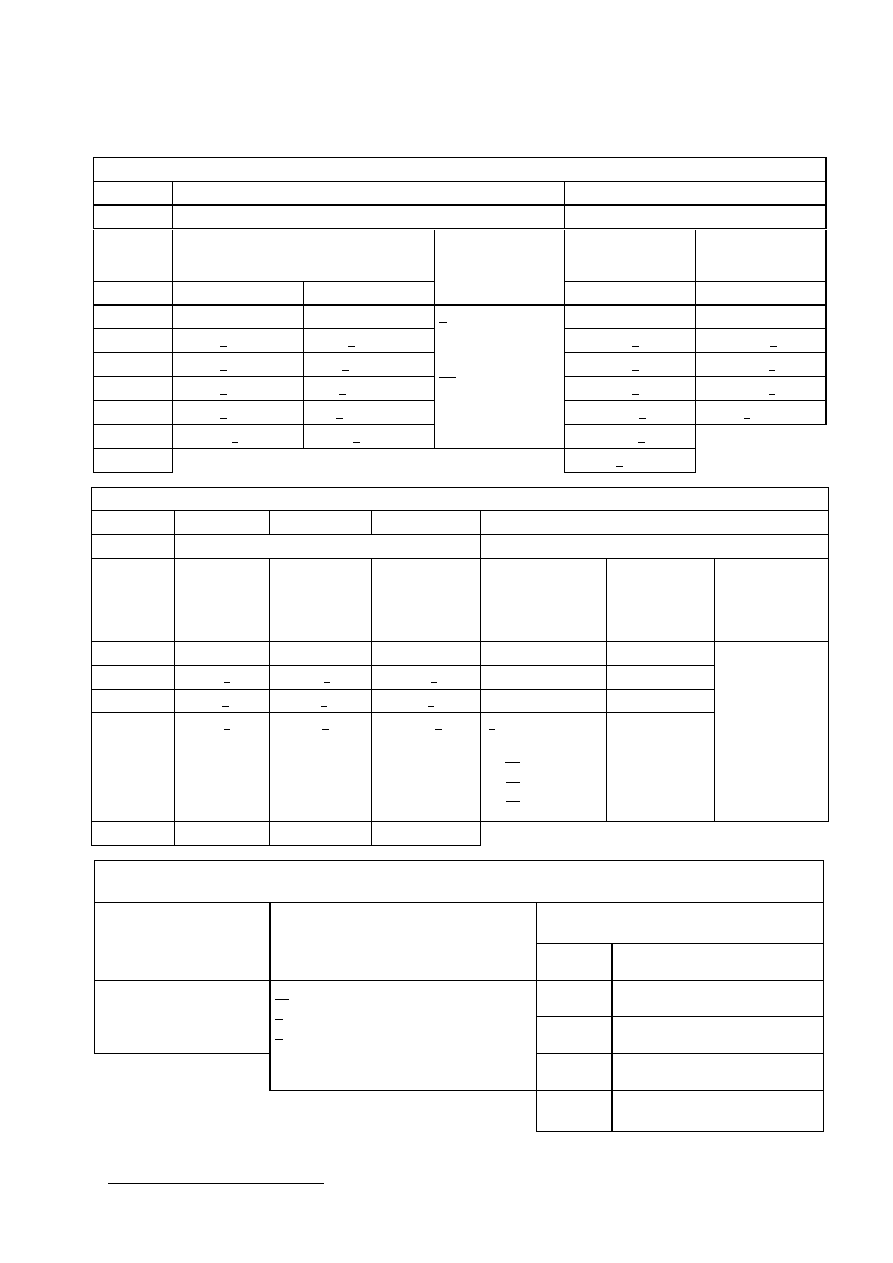
GUIDELINES FOR THE CATEGORIZATION OF NOXIOUS LIQUID SUBSTANCES
*
Products are assigned to Pollution Categories based on an evaluation of their properties as
reflected in the resultant GESAMP Hazard Profile as shown in the table below:
Rule
A1
Bio-
accumulation
A2
Bio-
degradation
B1
Acute
toxicity
B2
Chronic
toxicity
D3
Long-term
health
effects
E2
Effects on
marine
wildlife and
on benthic
habitats
Cat
1
> 5
2 > 4
4
3
NR 4
4 >
4 NR
CMRTNI
X
5
4
6
3
7
2
8 > 4
NR
Not 0
9
> 1
10
Fp,F or S
If not
Inorganic
11
CMRTNI
Y
12
Any product not meeting the criteria of rules 1 to 11 and 13
Z
13
All products identified as: <2 in column A1; R in column A2; blank in column D3; not Fp,
F or S (if not organic) in column E2; and 0 (zero) in all other columns of the GESAMP
Hazard Profile
OS
*
Reference is made to the Guidelines for provisional assessment of chemicals, MEPC/Circ.265 as amended.
MEPC 52/24/Add.1
ANNEX 6
Page 28
I:\MEPC\52\24-ADD-1.DOC
Abbreviated legend to the revised GESAMP Hazard Evaluation Procedure
Columns A and B - Aquatic Environment
A
B
Bioaccumulation and Biodegradation Aquatic
Toxicity
Numerical
Rating
A 1
*
Bioaccumulation
B 1
*
Acute Toxicity
B 2
*
Chronic Toxicity
log Pow
BCF
A 2
*
Biodegradation
LC/EC/IC
50
(mg/l)
NOEC (mg/l)
0
<1 or > ca. 7
not measurable
>1000
>1
1
>1 - <2
>1 - <10
>100 - <1000
>0.1 - <1
2
>2 - <3
>10 - <100
>10 - <100
>0.01 - <0.1
3
>3 - >4
>100 - <500
>1 - <10
>0.001 - <0.01
4
>4 - <5
>500 - <4000
>0.1 - <1 <0.001
5
>5 >4000
R: readily
biodegradable
NR: not readily
Biodegradable
>0.01 - <0.1
6
<0.01
Columns C and D - Human Health (Toxic effects to mammals)
C
D
Acute Mammalian Toxicity
Irritation, Corrosion & Long term health effects
Numerical
Ratings
C 1
Oral Toxicity
LD
50
(mg/kg)
C 2
Percutaneous
Toxicity
LD
50
(mg/kg)
C 3
Inhalation Toxicity
LC
50
(mg/l)
D 1
Skin irritation &
corrosion
D 2
Eye irritation &
corrosion
D3
*
Long term health
effects
0
>2000 >2000
>20 not
irritating not
irritating
1
>300 - <2000 >1000
-<2000
>10 - <20
mildly irritating
mildly irritating
2
>50 -<300 >200
-<1000
>2 - <10 irritating irritating
3
>5 - <50
>50 - <200
>0.5 - <2 3 Severely irritating or
corrosive
3A Corr. (
≤4hr)
3B Corr. (
≤1hr)
3C Corr. (
≤3m)
severely irritating
C - Carcinogen
M - Mutagenic
R - Reprotoxic
S - Sensitizing
A -Aspiration haz.
T - Target organ
systemic toxicity
L - Lung injury
N - Neurotoxic
I - Immunotoxic
4
≤5
≤50
≤0.5
Column E
Interferences with other Uses of the Sea
E 3
Interference with Coastal Amenities
E 1
Tainting
E 2
*
Physical effects on Wildlife & benthic habitats
Numerical
Rating
Description & Action
0 no
interference
no warning
NT:not tainting (tested)
T: tainting test positive
1 slightly
objectionable
warning, no closure of amenity
Fp: Persistent Floater
F: Floater
S: Sinking Substances
2 moderately
objectionable
possible closure of amenity
3
highly
objectionable
closure of amenity
*
These columns are used to define Pollution Categories

MEPC 52/24/Add.1
ANNEX 6
Page 29
I:\MEPC\52\24-ADD-1.DOC
APPENDIX 2
FORM OF CARGO RECORD BOOK FOR SHIPS CARRYING
NOXIOUS LIQUID SUBSTANCES IN BULK
CARGO RECORD BOOK FOR SHIPS
CARRYING NOXIOUS LIQUID SUBSTANCES IN BULK
Name of ship…………………………………………………………………………….
Distinctive number or letters…………………………………………………………….
IMO Number…………………………………………………………………………….
Gross tonnage……………………………………………………………………………
Period from…………………………..to………………………………………………..
MEPC 52/24/Add.1
ANNEX 6
Page 30
I:\MEPC\52\24-ADD-1.DOC
Name of ship…………………………………………………………………………………
Distinctive number or letters…………………………………………………………………
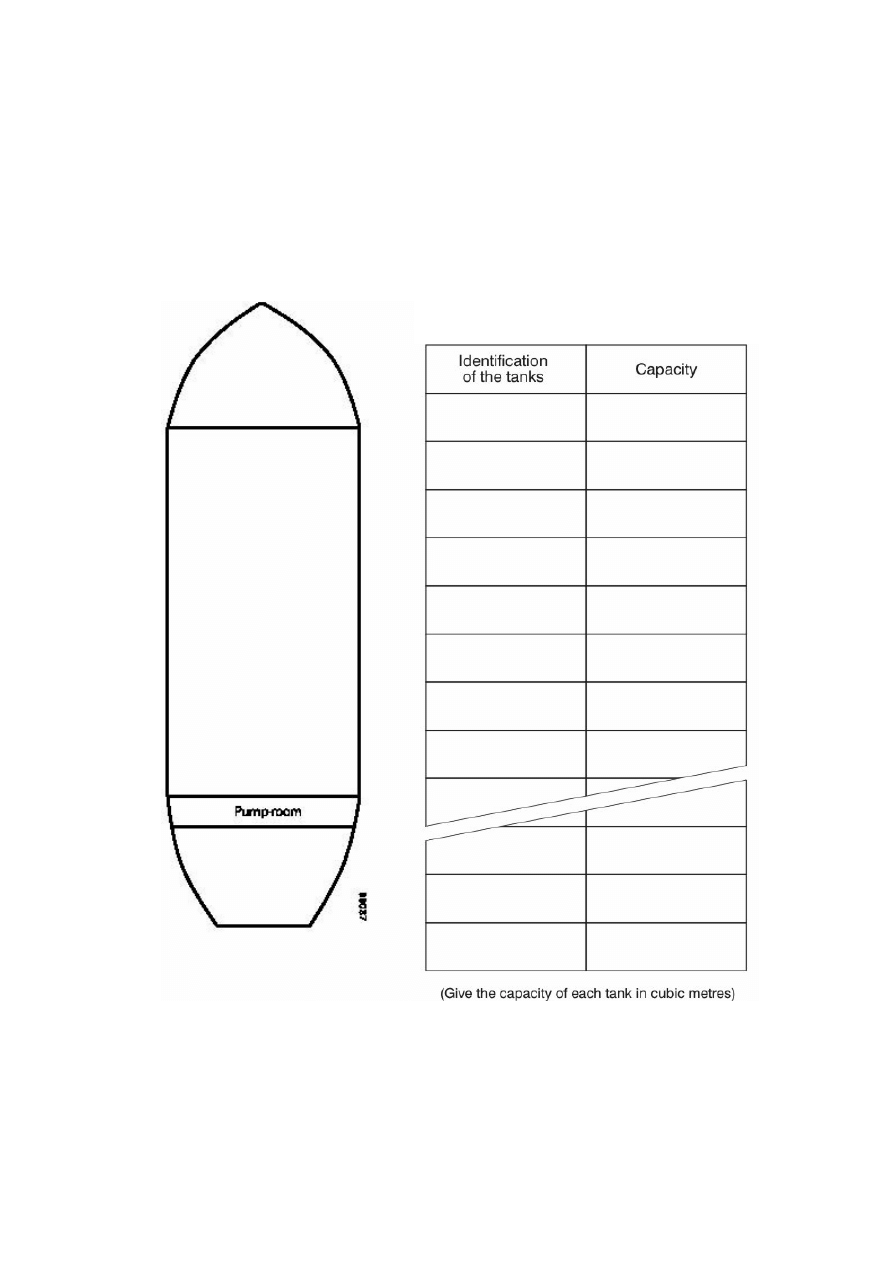
PLAN VIEW OF CARGO AND SLOP TANKS
(to be completed on board)

MEPC 52/24/Add.1
ANNEX 6
Page 31
I:\MEPC\52\24-ADD-1.DOC
INTRODUCTION
The following pages show a comprehensive list of items of cargo and ballast operations which
are, when appropriate, to be recorded in the Cargo Record Book on a tank to tank basis in
accordance with regulation 15.2 of Annex II of the International Convention for the Prevention
of Pollution from Ships, 1973, as modified by the Protocol of 1978 relating thereto
(MARPOL 73/78), as amended. The items have been grouped into operational sections, each of
which is denoted by a letter.
When making entries in the Cargo Record Book, the date, operational code and item number
shall be inserted in the appropriate columns and the required particulars shall be recorded
chronologically in the blank spaces.
Each completed operation shall be signed for and dated by the officer or officers in charge and, if
applicable, by a surveyor authorized by the competent authority of the State in which the ship is
unloading. Each completed page shall be countersigned by the master of the ship.

MEPC 52/24/Add.1
ANNEX 6
Page 32
I:\MEPC\52\24-ADD-1.DOC
List of items to be recorded
Entries are required for operations involving all Categories of substances.
(A)
Loading of cargo
1
Place of loading.
2
Identify tank(s), name of substance(s) and Category(ies).
(B)
Internal transfer of cargo
3
Name and Category of cargo(es) transferred.
4
Identity of tanks:
.1
from
:
.2
to
:
5
Was (were) tank(s) in 4.1 emptied?
6
If not, quantity remaining in tank(s).
(C)
Unloading of cargo
7
Place of unloading.
8
Identity of tank(s) unloaded.
9
Was (were) tank(s) emptied?
.1
If yes, confirm that the procedure for emptying and stripping has been
performed in accordance with the ship’s Procedures and Arrangements
Manual (i.e. list, trim, stripping temperature).
.2
If not, quantity remaining in tank(s).
10
Does the ship’s Procedures and Arrangements Manual require a prewash with
subsequent disposal to reception facilities?
11
Failure of pumping and/or stripping system:
.1
time and nature of failure;
.2
reasons
for
failure;
.3
time when system has been made operational.

MEPC 52/24/Add.1
ANNEX 6
Page 33
I:\MEPC\52\24-ADD-1.DOC
(D)
Mandatory prewash in accordance with the ship’s Procedures and Arrangements
Manual
12
Identify tank(s), substance(s) and Category(ies).
13 Washing
method:
.1
number of cleaning machines per tank;
.2
duration of wash/washing cycles;
.3
hot/cold
wash.
14
Prewash slops transferred to:
.1
reception facility in unloading port (identify port)
*
;
.2
reception facility otherwise (identify port)
*
.
(E)
Cleaning of cargo tanks except mandatory prewash (other prewash operations, final
wash, ventilation etc.)
15
State time, identify tank(s), substance(s) and Category(ies) and state:
.1
washing
procedure
used;
.2
cleaning
agent(s)
(identify agent(s) and quantities);
.3
ventilation
procedure
used
(state number of fans used, duration of
ventilation).
16
Tank washings transferred:
.1
into
the
sea;
.2
to reception facility (identify port)
*
;
.3
to
slops
collecting tank (identify tank).
(F)
Discharge into the sea of tank washings
17 Identify
tank(s):
.1
Were tank washings discharged during cleaning of tank(s)? If so at what
rate?
*
Ship’s masters should obtain from the operator of the reception facilities, which include barges and tank trucks, a
receipt or certificate specifying the quantity of tank washings transferred, together with the time and date of the
transfer. The receipt or certificate should be kept together with the cargo record book.

MEPC 52/24/Add.1
ANNEX 6
Page 34
I:\MEPC\52\24-ADD-1.DOC
.2
Were tank washing(s) discharged from a slops collecting tank? If so, state
quantity and rate of discharge.
18
Time pumping commenced and stopped.
19
Ship’s speed during discharge.
(G)
Ballasting of cargo tanks
20
Identity of tank(s) ballasted.
21
Time at start of ballasting.
(H)
Discharge of ballast water from cargo tanks
22
Identity of tank(s).
23
Discharge of ballast:
.1
into
the
sea;
.2
to
reception
facilities
(identify
port)
*
.
24
Time ballast discharge commenced and stopped.
25
Ship’s speed during discharge.
(I)
Accidental or other exceptional discharge
26
Time of occurrence.
27
Approximate quantity, substance(s) and Category(ies).
28
Circumstances of discharge or escape and general remarks.
(J)
Control by authorized surveyors
29
Identify
port.
30
Identify tank(s), substance(s), Category(ies) discharged ashore.
31
Have tank(s), pump(s), and piping system(s) been emptied?
32
Has a prewash in accordance with the ship’s Procedures and Arrangements
Manual been carried out?
33
Have tank washings resulting from the prewash been discharged ashore and is the
tank empty?
*
Ship’s masters should obtain from the operator of the reception facilities, which include barges and tank trucks, a
receipt or certificate specifying the quantity of tank washings transferred, together with the time and date of the
transfer. The receipt or certificate should be kept together with the cargo record book.

MEPC 52/24/Add.1
ANNEX 6
Page 35
I:\MEPC\52\24-ADD-1.DOC
34
An exemption has been granted from mandatory prewash.
35
Reasons for exemption.
36
Name and signature of authorized surveyor.
37
Organization, company, government agency for which surveyor works.
(K) Additional
operational procedures and remarks

MEPC 52/24/Add.1
ANNEX 6
Page 36
I:\MEPC\52\24-ADD-1.DOC
Name of ship………………………………………………………………………………….
Distinctive number or letters………………………………………………………………….
IMO Number………………………………………………………………………………….
CARGO/BALLAST OPERATIONS
Date Code
(letter)
Item
(number)
Record of operations/signature of officer in
charge/name of and signature of authorized
surveyor
Signature of master………………………………………………..

MEPC 52/24/Add.1
ANNEX 6
Page 37
I:\MEPC\52\24-ADD-1.DOC
APPENDIX 3
FORM OF INTERNATIONAL POLLUTION PREVENTION CERTIFICATE FOR THE
CARRIAGE OF NOXIOUS LIQUID SUBSTANCES IN BULK
INTERNATIONAL POLLUTION PREVENTION CERTIFICATE FOR
THE CARRIAGE OF NOXIOUS LIQUID SUBSTANCES IN BULK
Issued under the provisions of the International Convention for the Prevention of Pollution from
Ships, 1973, as modified by the Protocol of 1978 relating thereto, as amended (hereinafter
referred to as “the Convention”) under the authority of the Government of:
…………………………………………………………………………………………………
(full designation of the country)
by………………………………………………………………………………………………
(full designation of the competent person or organization authorized under
the provisions of the Convention)
Particulars of ship
*
Name of ship …………………………………………………………………………………
Distinctive number or letters….………………………………………………………………
IMO Number…………………………………………………………………………………
Port of registry……………………………………………………………………………….
Gross tonnage…………………………………………………………………………………
*
Alternatively, the particulars of the ship may be placed horizontally in boxes.

MEPC 52/24/Add.1
ANNEX 6
Page 38
I:\MEPC\52\24-ADD-1.DOC
THIS IS TO CERTIFY:
1
That the ship has been surveyed in accordance with regulation 8 of Annex II of the
Convention.
2
That the survey showed that the structure, equipment, systems, fitting, arrangements and
material of the ship and the condition thereof are in all respects satisfactory and that the
ship complies with the applicable requirements of Annex II of the Convention.
3
That the ship has been provided with a Procedures and Arrangements Manual as required
by regulation 14 of Annex II of the Convention, and that the arrangements and equipment
of the ship prescribed in the Manual are in all respects satisfactory
4
That the ship complies with the requirements of Annex II to MARPOL 73/78 for the
carriage in bulk of the following Noxious Liquid Substances, provided that all relevant
provisions of Annex II are observed.
Noxious Liquid Substances Conditions
of
carriage
(tank numbers etc.)
Pollution
Category
Continued on additional signed and dated sheets
This certificate is valid until ……….… subject to surveys in accordance with regulation 8 of
Annex II of the Convention.
Completion date of the survey on which this certificate is based (dd/mm/yyyy): …………….
Issued at………………………………………………………………………………………..
(Place of issue of certificate)
………………. ……………….………….……….…………………….
(Date of issue)
(Signature of authorized official issuing the certificate)
(Seal or stamp of the authority, as appropriate)

MEPC 52/24/Add.1
ANNEX 6
Page 39
I:\MEPC\52\24-ADD-1.DOC
ENDORSEMENT FOR ANNUAL AND INTERMEDIATE SURVEYS
THIS IS TO CERTIFY that, at a survey required by regulation 8 of Annex II of the Convention,
the ship was found to comply with the relevant provisions of the Convention:
Annual
survey: Signed………………………………….
(Signature
of
authorized
official)
Place……………………………………
Date…dd/mm/yyyy………………….…
(Seal or stamp of the authority, as appropriate)
Annual/Intermediate
survey:
Signed………………………………….
(Signature
of
authorized
official)
Place……………………………………
Date…dd/mm/yyyy…………………….
(Seal or stamp of the authority, as appropriate)
Annual/Intermediate
survey:
Signed………………………………….
(Signature
of
authorized
official)
Place……………………………………
Date…dd/mm/yyyy…………………….
(Seal or stamp of the authority, as appropriate)
Annual
survey:
Signed………………………………….
(Signature
of
authorized
official)
Place……………………………………
Date…dd/mm/yyyy……………………
(Seal or stamp of the authority, as appropriate)

MEPC 52/24/Add.1
ANNEX 6
Page 40
I:\MEPC\52\24-ADD-1.DOC
ANNUAL/INTERMEDIATE SURVEY IN ACCORDANCE WITH REGULATION 10.8.3
THIS IS TO CERTIFY that, at an annual/intermediate survey in accordance with
regulation 10.8.3 of Annex II of the Convention, the ship was found to comply with the relevant
provisions of the Convention:
Signed………………………………….
(Signature
of
authorized
official)
Place……………………………………
Date…dd/mm/yyyy…………………….
(Seal or stamp of the authority, as appropriate)
ENDORSEMENT TO EXTEND THE CERTIFICATE IF VALID
FOR LESS THAN 5 YEARS WHERE REGULATION 10.3 APPLIES
The ship complies with the relevant provisions of the Convention, and this Certificate shall, in
accordance with regulation 10.3 of Annex II of the Convention, be accepted as valid until
Signed………………………………….
(Signature
of
authorized
official)
Place……………………………………
Date…dd/mm/yyyy…………………….
(Seal or stamp of the authority, as appropriate)
ENDORSEMENT WHERE THE RENEWAL SURVEY HAS BEEN
COMPLETED AND REGULATION 10.4 APPLIES
The ship complies with the relevant provisions of the Convention, and this Certificate shall, in
accordance with regulation 10.4 of Annex II of the Convention, be accepted as valid until
Signed………………………………….
(Signature
of
authorized
official)
Place……………………………………
Date…dd/mm/yyyy…………………….
(Seal or stamp of the authority, as appropriate)

MEPC 52/24/Add.1
ANNEX 6
Page 41
I:\MEPC\52\24-ADD-1.DOC
ENDORSEMENT TO EXTEND THE VALIDITY OF THE CERTIFICATE
UNTIL REACHING THE PORT OF SURVEY OR FOR A PERIOD
OF GRACE WHERE REGULATION 10.5 OR 10.6 APPLIES
This Certificate shall, in accordance with regulation 10.5 or 10.6 of Annex II of the Convention,
be accepted as valid until …………………………………………………….
Signed…………………………………………
(Signature
of
authorized
official)
Place……………………………………………
Date…dd/mm/yyyy…………………………….
(Seal or stamp of the authority, as appropriate)
ENDORSEMENT FOR ADVANCEMENT OF ANNIVERSARY DATE WHERE
REGULATION 10.8 APPLIES
In accordance with regulation 10.8 of Annex II of the Convention, the new anniversary date is
…………………………………
Signed………………………………….
(Signature
of
authorized
official)
Place……………………………………
Date…dd/mm/yyyy…………………….
(Seal or stamp of the authority, as appropriate)
In accordance with regulation 10.8 of Annex II of the Convention, the new anniversary date is
…………………………………
Signed………………………………….
(Signature
of
authorized
official)
Place……………………………………
Date…dd/mm/yyyy…………………….
(Seal or stamp of the authority, as appropriate)

MEPC 52/24/Add.1
ANNEX 6
Page 42
I:\MEPC\52\24-ADD-1.DOC
APPENDIX 4
STANDARD FORMAT FOR THE PROCEDURES AND ARRANGEMENTS MANUAL
Note 1:
The format consists of a standardized introduction and index of the leading
paragraphs to each section. This standardized part shall be reproduced in the
Manual of each ship. It shall be followed by the contents of each section as
prepared for the particular ship. When a section is not applicable, “NA” shall be
entered, so as not to lead to any disruption of the numbering as required by the
standard format. Where the paragraphs of the standard format are printed in
italics, the required information shall be described for that particular ship. The
contents will vary from ship to ship because of design, trade and intended cargoes.
Where the text is not in italics, that text of the standard format shall be copied into
the Manual without any modification.
Note 2:
If the Administration requires or accepts information and operational instructions
in addition to those outlined in this Standard Format, they shall be included in
Addendum D of the Manual.

MEPC 52/24/Add.1
ANNEX 6
Page 43
I:\MEPC\52\24-ADD-1.DOC
STANDARD FORMAT
MARPOL 73/78 ANNEX II PROCEDURES AND ARRANGEMENTS MANUAL
Name of ship: ………………………………………………………………………………
Distinctive number or letters: ………………………………………………………………
IMO Number………………………………………………………………………………..
Port of registry: …………………………………………………………………….……....
Approval stamp of Administration:

MEPC 52/24/Add.1
ANNEX 6
Page 44
I:\MEPC\52\24-ADD-1.DOC
INTRODUCTION
1
The International Convention for the Prevention of Pollution from Ships, 1973, as
modified by the Protocol of 1978 relating thereto (hereinafter referred to as MARPOL 73/78)
was established in order to prevent the pollution of the marine environment by discharges into
the sea from ships of harmful substances or effluents containing such substances. In order to
achieve its aim, MARPOL 73/78 contains six Annexes in which detailed regulations are given
with respect to the handling on board ships and the discharge into the sea or release into the
atmosphere of six main groups of harmful substances, i.e. Annex I (Mineral oils), Annex II
(Noxious Liquid Substances carried in bulk), Annex III (Harmful substances carried in packaged
forms), Annex IV (Sewage), Annex V (Garbage) and Annex VI (Air Pollution).
2
Regulation 13 of Annex II of MARPOL 73/78 (hereinafter referred to as Annex II)
prohibits the discharge into the sea of Noxious Liquid Substances of Categories X, Y or Z or of
ballast water, tank washings or other residues or mixtures containing such substances, except in
compliance with specified conditions including procedures and arrangements based upon
standards developed by the International Maritime Organization (IMO) to ensure that the criteria
specified for each Category will be met.
3
Annex II requires that each ship which is certified for the carriage of Noxious Liquid
Substances in bulk shall be provided with a Procedures and Arrangements Manual, hereinafter
referred to as the Manual.
4
This Manual has been written in accordance with Appendix 4 of Annex II and is
concerned with the marine environmental aspects of the cleaning of cargo tanks and the
discharge of residues and mixtures from these operations. The Manual is not a safety guide and
reference shall be made to other publications specifically to evaluate safety hazards.
5
The purpose of the Manual is to identify the arrangements and equipment required to
enable compliance with Annex II and to identify for the ship’s officers all operational procedures
with respect to cargo handling, tank cleaning, slops handling, residue discharging, ballasting and
deballasting, which must be followed in order to comply with the requirements of Annex II.
6
In addition, this Manual, together with the ship’s Cargo Record Book and the Certificate
issued under Annex II
*
, will be used by Administrations for control purposes in order to ensure
full compliance with the requirements of Annex II by this ship.
7
The master shall ensure that no discharges into the sea of cargo residues or residue/water
mixtures containing Category X, Y or Z substances shall take place, unless such discharges are
made in full compliance with the operational procedures contained in this Manual.
8
This Manual has been approved by the Administration and no alteration or revision shall
be made to any part of it without the prior approval of the Administration.
*
Include only the Certificate issued to the particular ship: i.e. The International Pollution Prevention Certificate for
the carriage of Noxious Liquid Substances in bulk or the Certificate of Fitness for the Carriage of Dangerous
Chemicals in Bulk or the International Certificate of Fitness for the Carriage of Dangerous Chemicals in Bulk.

MEPC 52/24/Add.1
ANNEX 6
Page 45
I:\MEPC\52\24-ADD-1.DOC
INDEX OF SECTIONS
1
Main features of MARPOL 73/78, Annex II
2
Description of the ship’s equipment and arrangements
3
Cargo unloading procedures and tank stripping
4
Procedures relating to the cleaning of cargo tanks, the discharge of residues, ballasting
and deballasting
5
Information and Procedures

MEPC 52/24/Add.1
ANNEX 6
Page 46
I:\MEPC\52\24-ADD-1.DOC
SECTION 1 Main features of MARPOL 73/78, Annex II
1.1
The requirements of Annex II apply to all ships carrying Noxious Liquid Substances in
bulk. Substances posing a threat of harm to the marine environment are divided into three
categories, X, Y and Z. Category X substances are those posing the greatest threat to the marine
environment, whilst Category Z substances are those posing the smallest threat.
1.2
Annex II prohibits the discharge into the sea of any effluent containing substances falling
under these categories, except when the discharge is made under conditions which are specified
in detail for each Category. These conditions include, where applicable, such parameters as:
.1
the maximum quantity of substances per tank which may be discharged into the
sea;
.2
the speed of the ship during the discharge;
.3
the minimum distance from the nearest land during discharge;
.4
the minimum depth of water at sea during discharge; and
.5
the need to effect the discharge below the waterline.
1.3
For certain sea areas identified as “special area” more stringent discharge criteria apply.
Under Annex II the special area is the Antarctic area.
1.4
Annex II requires that every ship is provided with pumping and piping arrangements to
ensure that each tank designated for the carriage of Category X, Y and Z substances does not
retain after unloading a quantity of residue in excess of the quantity given in the Annex. For each
tank intended for the carriage of such substances an assessment of the residue quantity has to be
made. Only when the residue quantity as assessed is less than the quantity prescribed by the
Annex a tank may be approved for the carriage of a Category X, Y or Z
substances.
1.5
In addition to the conditions referred to above, an important requirement contained in
Annex II is that the discharge operations of certain cargo residues and certain tank cleaning and
ventilation operations may only be carried out in accordance with approved procedures and
arrangements.
1.6
To enable the requirement of paragraph 1.5 to be met, this Manual contains in section 2
all particulars of the ship’s equipment and arrangements, in section 3 operational procedures for
cargo unloading and tank stripping and in section 4 procedures for discharge of cargo residues,
tank washing, slops collection, ballasting and deballasting as may be applicable to the substances
the ship is certified to carry.
1.7
By following the procedures as set out in this Manual, it will be ensured that the ship
complies with all relevant requirements of Annex II to MARPOL 73/78.

MEPC 52/24/Add.1
ANNEX 6
Page 47
I:\MEPC\52\24-ADD-1.DOC
SECTION 2 Description of the ship’s equipment and arrangements
2.1
This section contains all particulars of the ship’s equipment and arrangements necessary
to enable the crew to follow the operational procedures set out in sections 3 and 4.
2.2
General arrangement of ship and description of cargo tanks
This section shall contain a brief description of the cargo area of the ship with the main
features of the cargo tanks and their positions.
Line or schematic drawings showing the general arrangement of the ship and indicating
the position and numbering of the cargo tanks and heating arrangements shall be
included.
2.3
Description of cargo pumping and piping arrangements and stripping system
This section shall contain a description of the cargo pumping and piping arrangements
and of the stripping system. Line or schematic drawings shall be provided showing the
following and be supported by textual explanation where necessary:
.1
cargo piping arrangements with diameters;
.2
cargo pumping arrangements with pump capacities;
.3
piping arrangements of stripping system with diameters;
.4
pumping arrangements of stripping system with pump capacities;
.5
location of suction points of cargo lines and stripping lines inside every cargo
tank;
.6
if a suction well is fitted, the location and cubic capacity thereof;
.7
line draining and stripping or blowing arrangements; and
.8
quantity and pressure of nitrogen or air required for line blowing if applicable.
2.4
Description of ballast tanks and ballast pumping and piping arrangements
This section shall contain a description of the ballast tanks and ballast pumping and
piping arrangements.
Line or schematic drawings and tables shall be provided showing the following:
.1
a general arrangement showing the segregated ballast tanks and cargo tanks to
be used as ballast tanks together with their capacities (cubic metres);
.2
ballast piping arrangement;
.3
pumping capacity for those cargo tanks which may also be used as ballast tanks;
and

MEPC 52/24/Add.1
ANNEX 6
Page 48
I:\MEPC\52\24-ADD-1.DOC
.4
any interconnection between the ballast piping arrangements and the underwater
outlet system.
2.5
Description of dedicated slop tanks with associated pumping and piping
arrangements
This section shall contain a description of the dedicated slop tank(s), if
any, with the
associated pumping and piping arrangements. Line or schematic drawings shall be
provided showing the following:
.1
which dedicated slop tanks are provided together with the capacities of such
tanks;
.2
pumping and piping arrangements of dedicated slop tanks with piping diameters
and their connection with the underwater discharge outlet.
2.6
Description of underwater discharge outlet for effluents containing Noxious Liquid
Substances
This section shall contain information on position and maximum flow capacity of the
underwater discharge outlet (or outlets) and the connections to this outlet from the cargo
tanks and slop tanks. Line or schematic drawings shall be provided showing the
following:
.1
location and number of underwater discharge outlets;
.2
connections to underwater discharge outlet;
.3
location of all seawater intakes in relation to underwater discharge outlets.
2.7
Description of flow rate indicating and recording devices
Deleted
2.8
Description of cargo tank ventilation system
This section shall contain a description of the cargo tank ventilation system.
Line or schematic drawings and tables shall be provided showing the following and
supported by textual explanation if necessary:
.1
the Noxious Liquid Substances the ship is certified fit to carry having a vapour
pressure over 5 kPa at 20°C suitable for cleaning by ventilation to be listed in
paragraph 4.4.10 of the Manual;
.2
ventilation piping and fans;
.3
position of the ventilation openings;
.4
the minimum flow rate of the ventilation system to adequately ventilate the bottom
and all parts of the cargo tank;

MEPC 52/24/Add.1
ANNEX 6
Page 49
I:\MEPC\52\24-ADD-1.DOC
.5
the location of structures inside the tank affecting ventilation;
.6
the method of ventilating the cargo pipeline system, pumps, filters, etc; and
.7
means for ensuring that the tank is dry.
2.9
Description of tank washing arrangements and wash water heating system
This section shall contain a description of the cargo tank washing arrangements, wash
water heating system and all necessary tank washing equipment.
Line or schematic drawings and tables or charts showing the following:
.1
arrangements of piping dedicated for tank washing with pipeline diameters;
.2
type of tank cleaning machines with capacities and pressure rating;
.3
maximum number of tank cleaning machines which can operate simultaneously;
.4
position of deck openings for cargo tank washing;
.5
the number of cleaning machines and their location required for ensuring
complete coverage of the cargo tank walls;
.6
maximum capacity of wash water which can be heated to 60°C by the installed
heating equipment; and
.7
maximum number of tank cleaning machines which can be operated
simultaneously at 60°C.
SECTION 3 Cargo unloading procedures and tank stripping
3.1
This section contains operational procedures in respect of cargo unloading and tank
stripping which must be followed in order to ensure compliance with the requirements of
Annex II.
3.2
Cargo unloading
This section shall contain procedures to be followed including the pump and cargo
unloading and suction line to be used for each tank. Alternative methods may be given.
The method of operation of the pump or pumps and the sequence of operation of all
valves shall be given.
The basic requirement is to unload the cargo to the maximum extent.

MEPC 52/24/Add.1
ANNEX 6
Page 50
I:\MEPC\52\24-ADD-1.DOC
3.3
Cargo tank stripping
This section shall contain procedures to be followed during the stripping of each cargo
tank.
The procedures shall include the following:
.1
operation of stripping system;
.2
list
and
trim
requirements;
.3
line draining and stripping or blowing arrangements if applicable; and
.4
duration of the stripping time of the water test.
3.4
Cargo temperature
This section shall contain information on the heating requirements of cargoes which have
been identified as being required to be at a certain minimum temperature during
unloading.
Information shall be given on control of the heating system and the method of
temperature measurement.
3.5
Procedures to be followed when a cargo tank cannot be unloaded in accordance with
the required procedures
This section shall contain information on the procedures to be followed in the event that
the requirements contained in sections 3.3 and/or 3.4 cannot be met due to circumstances
such as the following:
.1
failure of cargo tank stripping system; and
.2
failure of cargo tank heating system.
3.6
Cargo Record Book
The Cargo Record Book shall be completed in the appropriate places on completion of any cargo
operation.
SECTION 4 Procedures relating to the cleaning of cargo tanks, the discharge of residues,
ballasting and deballasting
4.1
This section contains operational procedures in respect of tank cleaning, ballast and slops
handling which must be followed in order to ensure compliance with the requirements of
Annex II.
4.2
The following paragraphs outline the sequence of actions to be taken and contain the
information essential to ensure that Noxious Liquid Substances are discharged without posing a
threat of harm to the marine environment.
4.3 Deleted
4.4
The information necessary to establish the procedures for discharging the residue of the
cargo, cleaning, ballasting and deballasting the tank, shall take into account the following:

MEPC 52/24/Add.1
ANNEX 6
Page 51
I:\MEPC\52\24-ADD-1.DOC
.1
Category of substance
The Category of the substance should be obtained from the relevant Certificate.
.2 Stripping
efficiency
of tank pumping system
The contents of this section will depend on the design of the ship and whether it is a new
ship or existing ship (See flow diagram and pumping/stripping requirements).
.3
Vessel within or outside Special Area
This section shall contain instructions on whether the tank washings can be discharged
into the sea within a special area (as defined in section 1.3) or outside a special area. The
different requirements shall be made clear and will depend on the design and trade of the
ship.
No discharges into the sea of residues of Noxious Liquid Substances, or mixtures
containing such substances, are allowed within the Antarctic area (the sea area south of
latitude 60°S).
.4
Solidifying or High-Viscosity Substance
The properties of the substance should be obtained from the shipping document.
.5 Miscibility
with
water
Deleted
.6
Compatibility with slops containing other substances
This section shall contain instructions on the permissible and non-permissible mixing of
cargo slops. Reference should be made to compatibility guides.
.7
Discharge to reception facility
This section shall identify those substances the residues of which are required to be
prewashed and discharged to a reception facility.
.8
Discharging into the sea
This section shall contain information on the factors to be considered in order to identify
whether the residue/water mixtures are permitted to be discharged into the sea.

MEPC 52/24/Add.1
ANNEX 6
Page 52
I:\MEPC\52\24-ADD-1.DOC
.9
Use of cleaning agents or additives
This section shall contain information on the use and disposal of cleaning agents
(e.g.
solvents used for tank cleaning) and additives
∗
to tank washing water
(e.g. detergents).
.10
Use of ventilation procedures for tank cleaning
This section shall make reference to all substances suitable for the use of ventilation
procedures.
4.5
Having assessed the above information, the correct operational procedures to be followed
should be identified using the instructions and flow diagram of section 5. Appropriate entries
shall be made in the Cargo Record Book indicating the procedure adopted.
SECTION 5 Information and procedures
This section shall contain procedures, which will depend on the age of the ship and pumping
efficiency. Examples of flow diagram referred to in this section are given at addendum A and
incorporate comprehensive requirements applicable to both new and existing ships. The Manual
for a particular ship shall only contain those requirements specifically applicable to that ship.
Information relating to melting point and viscosity, for those substances which have a melting
point equal to or greater than 0°C or a viscosity equal or greater than 50 mPa.s at 20°C, shall be
obtained from the shipping document.
For substances allowed to be carried, reference is made to the relevant Certificate.
The Manual shall contain:
Table
1 : Deleted
Table 2
:
Cargo tank information.
Addendum
A
: Flow
diagram.
Addendum
B
: Prewash
procedures.
Addendum
C
: Ventilation
procedures.
Addendum
D
: Additional
information and operational instructions when
required or accepted by the Administration.
Outlines of the above table and addenda are shown below.
*
See the latest edition of MEPC.2 circular (issued annually in December).

MEPC 52/24/Add.1
ANNEX 6
Page 53
I:\MEPC\52\24-ADD-1.DOC
Table 2 - Cargo tank information
Tank no.
Capacity
(m
3
)
Stripping
quantity
(litres)
MEPC 52/24/Add.1
ANNEX 6
Page 54
I:\MEPC\52\24-ADD-1.DOC
ADDENDUM A
FLOW DIAGRAMS -- CLEANING OF CARGO TANKS AND DISPOSAL OF TANK
WASHINGS/BALLAST CONTAINING RESIDUES OF CATEGORY X,Y,
AND Z SUBSTANCES
Note 1 :
This flow diagram shows the basic requirements applicable to all age groups of
ships and is for guidance only.
Note 2 :
All discharges into the sea are regulated by Annex II.
Note 3 :
Within the Antarctic area, any discharge into the sea of Noxious Liquid
Substances or mixtures containing such substances is prohibited.
Discharge tank and
piping to maximum
extent possible
Residue is Cat. X
Apply
CDP 1(a) or 3
Yes
Residue is Cat. Y
No
Yes
Solidifying or
Highly Viscous
Apply
CDP 1(a) or 1(b)
Yes
Apply
CDP 2(a) or 3
No
No
Ship keel laid
after 01/01/2007
Yes
Apply
CDP 2(a) or 3
Yes
Apply
CDP 2(a), 2(b) or 3
No
No discharge
requirements
No
Residue is Cat. Z
Residue is OS
Yes
No transport allowed
No

MEPC 52/24/Add.1
ANNEX 6
Page 55
I:\MEPC\52\24-ADD-1.DOC
Stripping requirements (in litres)
Ship details
Category X
Category Y
Category Z
New Ships: keel laid after 01/01/2007
75 75
75
IBC ships until 01/01/2007
100 +50
tolerance
100 + 50
tolerance
300 + 50 tolerance
BCH ships
300 + 50
tolerance
300 + 50
tolerance
900 + 50 tolerance
Other ships: keel-laid before 01/01/2007
N/A
N/A
Empty to the most
possible extent
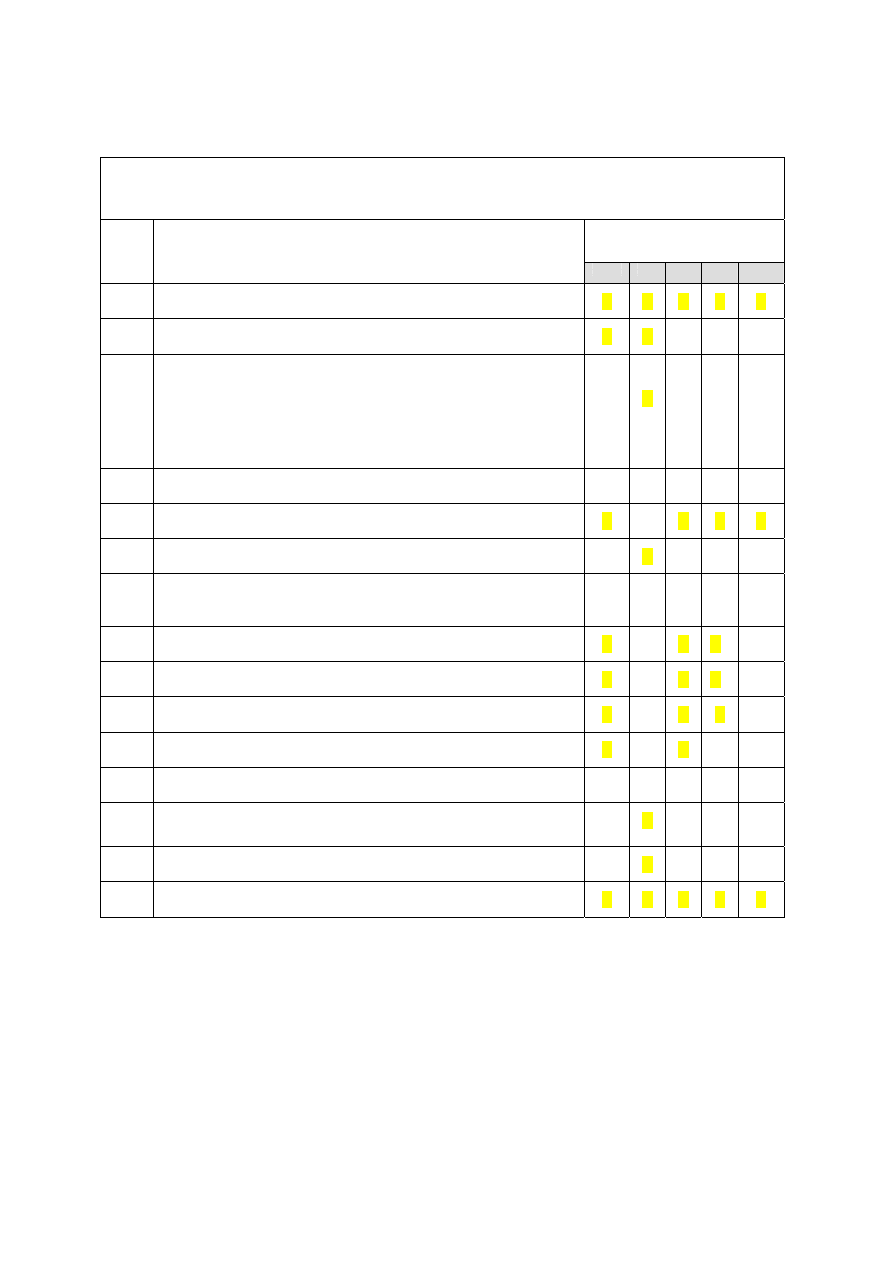
MEPC 52/24/Add.1
ANNEX 6
Page 56
I:\MEPC\52\24-ADD-1.DOC
Cleaning and disposal procedures (CDP)
(Start at the top of the column under the CDP number specified and complete each item
procedure in the sequence where marked)
No.
Operation
Procedure Number
1(a)
1(b)
2(a)
2(b)
3
1
Strip tank and piping to maximum extent, at least in compliance with
the procedures in section 3 of this Manual
X
X
X
X
X
2
Apply prewash in accordance with Addendum B of this Manual and
discharge residue to reception facility
X
X
3
Apply subsequent wash, additional to the prewash, with:
a complete cycle of the cleaning machine(s)
for ships built before 1 July 1994
a water quantity not less than calculated with “k”=1.0
for ships built on or after 1 July 1994
X
4
Apply ventilation procedure in accordance with Addendum C of this
Manual
X
5
Ballast tanks or wash tank to commercial standards
X
X
X
X
6
Ballast added to tank
X
7
Conditions for discharge of ballast/residue/water mixtures other than
prewash:
.1 distance from land > 12 nautical miles
X
X
X
.2 ship’s speed > 7 knots
X
X
X
.3 water depth > 25 metres
X
X
X
.4 Using underwater discharge (not exceeding permissible
discharge rate)
X
X
8
Conditions for discharge of ballast:
.1 distance from land > 12 nautical miles
X
.2 water depth > 25 metres
X
9
Any water subsequently introduced into a tank may be discharged
into the sea without restrictions
X
X
X
X
X

MEPC 52/24/Add.1
ANNEX 6
Page 57
I:\MEPC\52\24-ADD-1.DOC
ADDENDUM B
PREWASH PROCEDURES
This addendum to the Manual shall contain prewash procedures based on appendix 6 of
Annex II. These procedures shall contain specific requirements for the use of the tank washing
arrangements and equipment provided on the particular ship and include the following:
.1
cleaning machine positions to be used;
.2
slops pumping out procedure;
.3
requirements for hot washing;
.4
number of cycles of cleaning machine (or time); and
.5
minimum operating pressures.
ADDENDUM C
VENTILATION PROCEDURES
This addendum to the Manual shall contain ventilation procedures based on appendix 7 of
Annex II. The procedures shall contain specific requirements for the use of the cargo tank
ventilation system, or equipment, fitted on the particular ship and shall include the following:
.1
ventilation positions to be used;
.2
minimum flow or speed of fans;
.3
procedures for ventilating cargo pipeline, pumps, filters, etc.; and
.4
procedures for ensuring that tanks are dry on completion.
ADDENDUM D - ADDITIONAL INFORMATION AND OPERATIONAL
INSTRUCTIONS REQUIRED OR ACCEPTED
BY THE ADMINISTRATION

MEPC 52/24/Add.1
ANNEX 6
Page 58
I:\MEPC\52\24-ADD-1.DOC
APPENDIX 5
ASSESSMENT OF RESIDUE QUANTITIES IN CARGO TANKS,
PUMPS AND ASSOCIATED PIPING
1 Introduction
1.1 Purpose
1.1.1 The purpose of this appendix is to provide the procedure for testing the efficiency of
cargo pumping systems.
1.2 Background
1.2.1 The ability of the pumping system of a tank to comply with regulation 12.1, 12.2 or 12.3
is determined by performing a test in accordance with the procedure set out in section 3 of this
appendix. The quantity measured is termed the “stripping quantity”. The stripping quantity of
each tank shall be recorded in the ship’s Manual.
1.2.2 After having determined the stripping quantity of one tank, the Administration may use
the determined quantities for a similar tank, provided the Administration is satisfied that the
pumping system in that tank is similar and operating properly.
2
Design criteria and performance test
2.1
The cargo pumping systems should be designed to meet the required maximum amount of
residue per tank and associated piping as specified in regulation 12 of Annex II to the satisfaction
of the Administration.
2.2
In accordance with regulation 12.5 the cargo pumping systems shall be tested with water
to prove their performance. Such water tests shall, by measurement, show that the system meets
the requirements of regulation 12. In respect of regulations 12.1 and 12.2 a tolerance of 50 litres
per tank is acceptable.
3
Water performance test
3.1 Test
condition
3.1.1 The ship’s trim and list shall be such as to provide favourable drainage to the suction
point. During the water test the ship’s trim shall not exceed 3° by the stern, and the ship’s list
shall not exceed 1°.
3.1.2 The trim and list chosen for the water test shall be recorded. This shall be the minimum
favourable trim and list used during the water test.
3.1.3 During the water test means shall be provided to maintain a back-pressure of not less than
100 kPa
at the cargo tank’s unloading manifold (see figures 5-1 and 5-2).

MEPC 52/24/Add.1
ANNEX 6
Page 59
I:\MEPC\52\24-ADD-1.DOC
3.1.4 The time taken to complete the water test shall be recorded for each tank, recognizing that
this may need to be amended as a result of subsequent tests.
3.2 Test
procedure
3.2.1 Ensure that the cargo tank to be tested and its associated piping have been cleaned and
that the cargo tank is safe for entry.
3.2.2 Fill the cargo tank with water to a depth necessary to carry out normal end of unloading
procedures.
3.2.3 Discharge and strip water from the cargo tank and its associated piping in accordance
with the proposed procedures.
3.2.4 Collect all water remaining in the cargo tank and its associated piping into a calibrated
container for measurement. Water residues shall be collected, inter alia, from the following
points:
.1
the cargo tank suction and its vicinity;
.2
any entrapped areas on the cargo tank bottom;
.3
the low point drain of the cargo pump; and
.4
all low point drains of piping associated with the cargo tank up to the manifold
valve.
3.2.5 The total water volumes collected above determine the stripping quantity for the cargo
tank.
3.2.6 Where a group of tanks is served by a common pump or piping, the water test residues
associated with the common system(s) may be apportioned equally among the tanks provided
that the following operational restriction is included in the ship’s approved Manual: “For
sequential unloading of tanks in this group, the pump or piping is not to be washed until all tanks
in the group have been unloaded.”
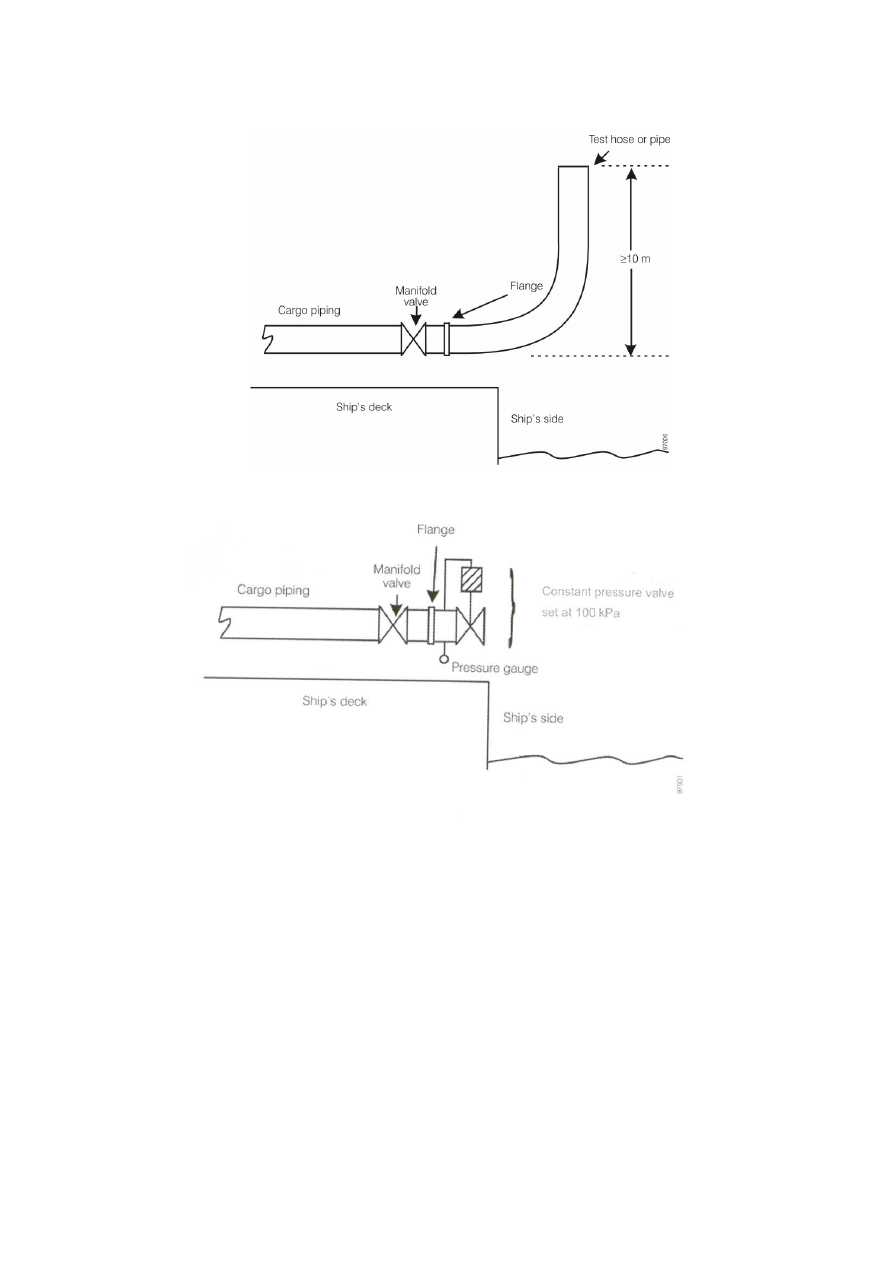
MEPC 52/24/Add.1
ANNEX 6
Page 60
I:\MEPC\52\24-ADD-1.DOC
Figure 5-1
Figure 5-2
The above figures illustrate test arrangements that would provide a backpressure of not less than
100 kPa at the cargo tank’s unloading manifold.

MEPC 52/24/Add.1
ANNEX 6
Page 61
I:\MEPC\52\24-ADD-1.DOC
APPENDIX 6
PREWASH PROCEDURES
A
For ships built before 1 July 1994
A prewash procedure is required in order to meet certain Annex II requirements. This appendix
explains how these prewash procedures shall be performed.
Prewash procedures for non-Solidifying Substances
1
Tanks shall be washed by means of a rotary water jet, operated at sufficiently high water
pressure. In the case of Category X substances cleaning machines shall be operated in such
locations that all tank surfaces are washed. In the case of Category Y substances only one
location need be used.
2
During washing the amount of water in the tank shall be minimized by continuously
pumping out slops and promoting flow to the suction point (positive list and trim). If this
condition cannot be met the washing procedure shall be repeated three times, with thorough
stripping of the tank between washings.
3
Those substances which have a viscosity equal to or greater than 50 mPa.s at 20°C shall
be washed with hot water (temperature at least 60°C), unless the properties of such substances
make the washing less effective.
4
The number of cycles of the cleaning machine used shall not be less than that specified in
table 6-1. A cleaning machine cycle is defined as the period between two consecutive identical
orientations of the tank cleaning machine (rotation through 360°).
5
After washing, the tank cleaning machine(s) shall be kept operating long enough to flush
the pipeline, pump and filter, and discharge to shore reception facilities shall be continued until
the tank is empty.
Prewash procedures for Solidifying Substances
1
Tanks shall be washed as soon as possible after unloading. If possible tanks shall be
heated prior to washing.
2
Residues in hatches and manholes shall preferably be removed prior to the prewash.
3
Tanks shall be washed by means of a rotary water jet operated at sufficiently high water
pressure and in locations to ensure that all tank surfaces are washed.
4
During washing the amount of water in the tank shall be minimized by pumping out slops
continuously and promoting flow to the suction point (positive list and trim). If this condition
cannot be met, the washing procedure shall be repeated three times with thorough stripping of the
tank between washings.
5
Tanks shall be washed with hot water (temperature at least 60°C) unless the properties of
such substances make the washing less effective.

MEPC 52/24/Add.1
ANNEX 6
Page 62
I:\MEPC\52\24-ADD-1.DOC
6
The number of cycles of the cleaning machine used shall not be less than that specified in
table 6-1. A cleaning machine cycle is defined as the period between two consecutive identical
orientations of the machine (rotation through 360°).
7
After washing, the cleaning machine(s) shall be kept operating long enough to flush the
pipeline, pump and filter,and discharge to shore reception facilities shall be continues until the
tank is empty.
Table 6-1 -- Number of cleaning machine cycles to be used in each location
Number of cleaning machine cycles
Category of substance
Non-Solidifying
Substances
Solidifying
Substances
Category X
1 2
Category Y
1/2
1
B
For ships built on or after 1 July 1994 and recommendatory for ships built before
1 July 1994
A prewash procedure is required in order to meet certain Annex II requirements. This appendix
explains how these prewash procedures shall be performed and how the minimum volumes of
washing media to be used shall be determined. Smaller volumes of washing media may be used
based on actual verification testing to the satisfaction of the Administration. Where reduced
volumes are approved an entry to that effect must be recorded in the Manual.
If a medium other than water is used for the prewash, the provisions regulation 13.5.1 apply.
Prewash procedures for non-Solidifying Substances without recycling
1
Tanks shall be washed by means of a rotary jet(s), operated at sufficiently high water
pressure. In the case of Category X substances cleaning machines shall be operated in such
locations that all tank surfaces are washed. In the case of Category Y substances only one
location need be used.
2
During washing the amount of liquid in the tank shall be minimized by continuously
pumping out slops and promoting flow to the suction point. If this condition cannot be met, the
washing procedure shall be repeated three times, with thorough stripping of the tank between
washings.
3
Those substances which have a viscosity equal to or greater than 50 mPa.s at 20°C shall
be washed with hot water (temperature at least 60°C), unless the properties of such substances
make the washing less effective.
4
The quantities of wash water used shall not be less than those specified in paragraph 20 or
determined according to paragraph 21.
5
After prewashing the tanks and lines shall be thoroughly stripped.

MEPC 52/24/Add.1
ANNEX 6
Page 63
I:\MEPC\52\24-ADD-1.DOC
Prewash procedures for Solidifying Substances without recycling
6
Tanks shall be washed as soon as possible after unloading. If possible, tanks should be
heated prior to washing.
7
Residues in hatches and manholes should preferably be removed prior to the prewash.
8
Tanks shall be washed by means of a rotary jet(s) operated at sufficiently high water
pressure and in locations to ensure that all tank surfaces are washed.
9
During washing the amount of liquid in the tank shall be minimized by pumping out slops
continuously and promoting flow to the suction point. If this condition cannot be met, the
washing procedure shall be repeated three times with thorough stripping of the tank between
washings.
10
Tanks shall be washed with hot water (temperature at least 60°C), unless the properties of
such substances make the washing less effective.
11
The quantities of wash water used shall not be less than those specified in paragraph 20 or
determined according to paragraph 21.
12
After prewashing the tanks and lines shall be thoroughly stripped.
Prewash procedures with recycling of washing medium
13
Washing with a recycled washing medium may be adopted for the purpose of washing
more than one cargo tank. In determining the quantity, due regard must be given to the expected
amount of residues in the tanks and the properties of the washing medium and whether any initial
rinse or flushing is employed. Unless sufficient data are provided, the calculated end
concentration of cargo residues in the washing medium shall not exceed 5% based on nominal
stripping quantities.
14
The recycled washing medium shall only be used for washing tanks having contained the
same or similar substance.
15
A quantity of washing medium sufficient to allow continuous washing shall be added to
the tank or tanks to be washed.
16
All tank surfaces shall be washed by means of a rotary jet(s) operated at sufficiently high
pressure. The recycling of the washing medium may either be within the tank to be washed or via
another tank, e.g. a slop tank.
17
The washing shall be continued until the accumulated throughput is not less than that
corresponding to the relevant quantities given in paragraph 20 or determined according to
paragraph 21.
18
Solidifying Substances and substances with viscosity equal to or greater than 50 mPa.s at
20°C shall be washed with hot water (temperature at least 60°C) when water is used as the
washing medium, unless the properties of such substances make the washing less effective.

MEPC 52/24/Add.1
ANNEX 6
Page 64
I:\MEPC\52\24-ADD-1.DOC
19
After completing the tank washing with recycling to the extent specified in paragraph 17,
the washing medium shall be discharged and the tank thoroughly stripped. Thereafter, the tank
shall be subjected to a rinse, using clean washing medium, with continuous drainage and
discharged to a reception facility. The rinse shall as a minimum cover the tank bottom and be
sufficient to flush the pipelines, pump and filter.
Minimum quantity of water to be used in a prewash
20
The minimum quantity of water to be used in a prewash is determined by the residual
quantity of noxious liquid substance in the tank, the tank size, the cargo properties, the permitted
concentration in any subsequent wash water effluent, and the area of operation. The minimum
quantity is given by the following formula:
Q=k(15r
0.8
+ 5r
0.7
x V/1000)
where
Q
=
the required minimum quantity in m
3
r
=
the residual quantity per tank in m
3
. The value of r shall be the value
demonstrated in the actual stripping efficiency test, but shall not be taken
lower than 0.100 m
3
for a tank volume of 500 m
3
and above and 0.040 m
3
for a tank volume of 100 m
3
and below. For tank sizes between 100 m
3
and
500 m
3
the minimum value of r allowed to be used in the calculations is
obtained by linear interpolation.
For Category X substances the value of r shall either be determined based on stripping tests
according to the Manual, observing the lower limits as given above, or be taken to be 0.9 m
3
.
V
=
tank volume in m
3
k
=
a factor having values as follows:
Category X, non-Solidifying, Low-Viscosity Substance,
k = 1.2
Category X, Solidifying or High-Viscosity Substance,
k = 2.4
Category Y, non-Solidifying, Low-Viscosity Substance
k = 0.5
Category Y, Solidifying or High-Viscosity Substance
k = 1.0

MEPC 52/24/Add.1
ANNEX 6
Page 65
I:\MEPC\52\24-ADD-1.DOC
The table below is calculated using the formula with a k factor of 1 and may be used as an easy
reference.
Tank volume (m
3
)
Stripping quantity
(m
3
)
100 500 3000
<0.04 1.2 2.9 5.4
.10 2.5 2.9 5.4
.30 5.9 6.8 12.2
.90 14.3 16.1 27.7
21
Verification testing for approval of prewash volumes lower than those given in
paragraph 20 may be carried out to the satisfaction of the Administration to prove that the
requirements of regulation 13 are met, taking into account the substances the ship is certified to
carry. The prewash volume so verified shall be adjusted for other prewash conditions by
application of the factor k as defined in paragraph 20.

MEPC 52/24/Add.1
ANNEX 6
Page 66
I:\MEPC\52\24-ADD-1.DOC
APPENDIX 7
VENTILATION PROCEDURES
1
Cargo residues of substances with a vapour pressure greater than 5 KPa at 20°C may be
removed from a cargo tank by ventilation.
2
Before residues of Noxious Liquid Substances are ventilated from a tank the safety
hazards relating to cargo flammability and toxicity shall be considered. With regard to safety
aspects, the operational requirements for openings in cargo tanks in SOLAS 74, as amended, the
International Bulk Chemical Code, the Bulk Chemical Code, and the ventilation procedures in
the International Chamber of Shipping (ICS) Tanker Safety Guide (Chemicals) should be
consulted.
3
Port authorities may also have regulations on cargo tank ventilation.
4
The procedures for ventilation of cargo residues from a tank are as follows:
.1
the pipelines shall be drained and further cleared of liquid by means of ventilation
equipment;
.2
the list and trim shall be adjusted to the minimum levels possible so that
evaporation of residues in the tank is enhanced;
.3
ventilation equipment producing an airjet which can reach the tank bottom shall
be used. Figure 7-1 could be used to evaluate the adequacy of ventilation
equipment used for ventilating a tank of a given depth;
.4
ventilation equipment shall be placed in the tank opening closest to the tank sump
or suction point;
.5
ventilation equipment shall, when practicable, be positioned so that the airjet is
directed at the tank sump or suction point and impingement of the airjet on tank
structural members is to be avoided as much as possible; and
.6
ventilation shall continue until no visible remains of liquid can be observed in the
tank. This shall be verified by a visual examination or an equivalent method.
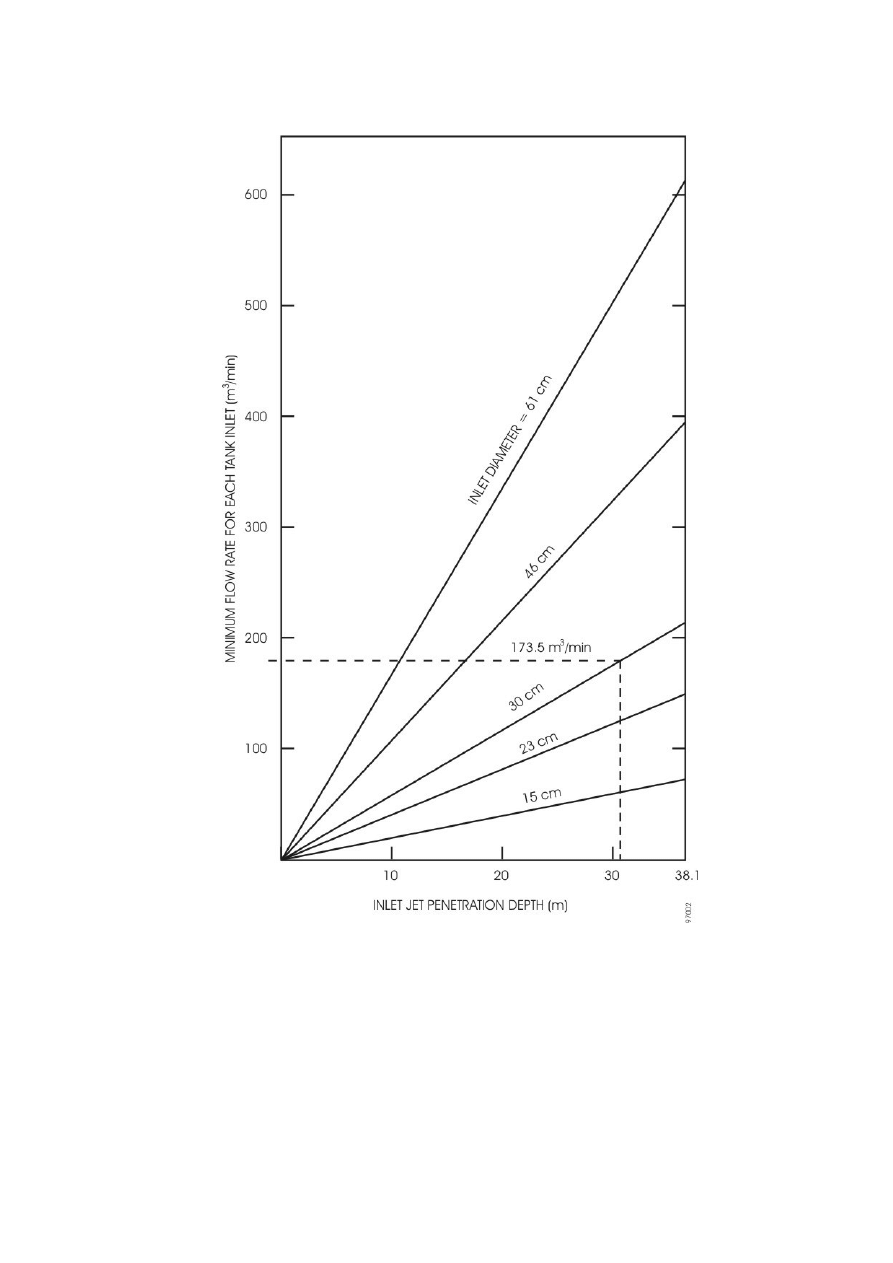
MEPC 52/24/Add.1
ANNEX 6
Page 67
I:\MEPC\52\24-ADD-1.DOC
Figure 7-1. Minimum flow rate as a function of jet penetration depth.
Jet penetration depth shall be compared against tank height.
***
Wyszukiwarka
Podobne podstrony:
MEPC 117(52) Text of Annex I of MARPOL as at 1 January 2007
MEPC 58(33) Text of Annex III of MARPOL as at 28 February 1994
MEPC 115(51) Text of Annex IV of MARPOL as at 1 August 2005
MEPC 156(55) Text of revised Annex III of MARPOL entry into force 1 January 2010
MEPC 89(45) Amendments to Annex V of MARPOL entry into force 1 March 2002
MEPC 116(51) Amendments to Annex V of MARPOL entry into force 1 August 2005
MEPC 65(37) Amendments to Annex V of MARPOL entry into force 1 January 1997
MEPC 154(55) Designation of the Southern South African waters as a Special Area
Bradley, Manuscript Evidence for the Text of the Getica of Jordanes (I)
Congressional Research Services, 'NATO in Afghanistan, A Test of the Transatlantic Alliance', July 2
52 Olimpiada chemiczna Etap II Zadania teoretyczne id (2)
A chemical analog of curcumin as an improved inhibitor of amyloid abetaoligomerization
Dane Rudhyar THE PRACTICE OF ASTROLOGY AS A TECHNIQUE IN HUMAN UNDERSTANDING
Lucius Shepard The End of Life as We Know It
The Masque Of The Red?ath (2)
Chairman of the board at 14
Adolf Hitler vs Henry Ford; The Volkswagen, the Role of America as a Model, and the Failure of a Naz
więcej podobnych podstron