
The Sound of
Stevie Wonder
His Words and Music
James E. Perone
PRAEGER

The Sound of
The Sound of
Stevie Wonder
Stevie Wonder


T
HE
P
RAEGER
S
INGER
-S
ONGWRITER
C
OLLECTION
The Sound of
The Sound of
Stevie Wonder
Stevie Wonder
His Words and Music
James E. Perone

Library of Congress Cataloging-in-Publication Data
Perone, James E.
The sound of Stevie Wonder : his words and music / by James E. Perone.
p. cm.—(The Praeger singer-songwriter collection, ISSN 1553–3484)
Includes bibliographical references, discography, and indexes.
ISBN 0–275–98723–X
1. Wonder, Stevie—Criticism and interpretation. I. Title. II. Series.
ML410.W836P47 2006
782.421644092—dc22 2005034611
British Library Cataloguing in Publication Data is available.
Copyright © 2006 by James E. Perone
All rights reserved. No portion of this book may be
reproduced, by any process or technique, without the
express written consent of the publisher.
Library of Congress Catalog Card Number: 2005034611
ISBN: 0–275–98723–X
ISSN: 1553–3484
First published in 2006
Praeger Publishers, 88 Post Road West, Westport, CT 06881
An imprint of Greenwood Publishing Group, Inc.
www.praeger.com
Printed in the United States of America
∞
TM
The paper used in this book complies with the
Permanent Paper Standard issued by the National
Information Standards Organization (Z39.48–1984).
10 9 8 7 6 5 4 3 2

Contents
Series Foreword by James E. Perone
1. The Young Virtuoso, 1962–1964
With a Song in My Heart and Stevie at the Beach
2. The Soul Shouter, 1965–1967
3. The Middle of the Road, 1968–1970 13

Journey Through the Secret Life of Plants
6. The Musician with a Cause, 1981–2005 85
Stevie Wonder’s Original Musiquarium I
Conclusion: Stevie Wonder’s Songs as Recorded by Other
Performers 117
vi The Sound of Stevie Wonder

Series Foreword
Although the term, “Singer-songwriters,” might most frequently be associ-
ated with a cadre of musicians of the early 1970s such as Paul Simon, James
Taylor, Carly Simon, Joni Mitchell, and Carole King, the Praeger Singer-
Songwriter Collection defi nes singer-songwriters more broadly, both in terms
of style and in terms of time period. The series includes volumes on musicians
who have been active from approximately the 1960s through the present.
Musicians who write and record in folk, rock, soul, hip-hop, country, and
various hybrids of these styles will be represented. Therefore, some of the
early 1970s introspective singer-songwriters named above will be included.
What do the individuals included in this series have in common? Some
have never collaborated as writers. But, while some have done so, they’ve all
written and recorded commercially successful and/or historically important
music and lyrics.
The authors who contribute to the series also exhibit diversity. Some are
scholars who are trained primarily as musicians, while others have specialized
knowledge in such areas as American studies, history, sociology, popular culture
studies, literature, and rhetoric. The authors share a high level of scholarship,
accessibility in their writing, and a true insight into the work of the artists they
study. The authors are also focused on the output of their subjects and how
it relates to their subject’s biography and the society around them; however,
biography in and of itself will not be a major focus of the books in this series.
Given the diversity of the musicians who are the subjects of books in this series,
and given the diversity of viewpoints of the authors, volumes in the series will
differ from book to book. All, however, will primarily be organized chronologi-
cally around the compositions and recorded performances of their subjects. All of
the books in the series should also serve as listeners’ guides to the music of their
subjects, making them companions to the artists’ recorded output.
James E. Perone
Series Editor


Acknowledgments
This book could not have been written without the valuable assistance of a
number of people. I wish fi rst to thank Karen Perone for offering moral support
throughout this and all of my book projects for Greenwood Press and Praeger
Press, and for offering much-needed input at every stage of every project.
Over the course of writing several books, the entire staff of the Greenwood
Publishing Group has been most helpful and cooperative. I wish to extend spe-
cial thanks to acquisitions editor Daniel Harmon, and to Carmel Huestis, copy
editor, respectively, for helping me in the fi ne-tuning of this book. I also wish
to thank Eric Levy and Rob Kirkpatrick for their assistance in getting both this
book and the Praeger Singer-Songwriter Collection off the ground.
I also wish to thank Ron Mandelbaum and the rest of the helpful staff
of Photofest for their assistance in locating and granting the rights to use a
number of publicity photographs of Stevie Wonder for this book, as well as
photographer Chris Walter of PhotoFeatures for the rights to use six of his
photographs of Wonder.
Over the course of several book projects I have found that when I couldn ’ t
fi nd the information anywhere else, I was bound to fi nd it at the Music
Library and Sound Recordings Archives at Bowling Green State University.
I wish to extend thanks to William Schurk, Sound Recordings Archivist, for
his assistance in tracking down several diffi cult-to-fi nd songwriter credits on
several of Stevie Wonder ’ s lesser-known releases. I also wish to thank Mount
Union College Music Librarian Suzanne Moushey for help in locating several
tricky citations.
Despite my own best efforts and the assistance of those named above,
there are bound to be errors in this book: they are solely my responsibility.


Introduction
S
TEVIE
W
ONDER
AS
A
M
USICIAN
AND
A
CTIVIST
Born May 13, 1950, in Saginaw, Michigan, Stevland Hardaway Judkins (later
Stevland Morris)
1
became known to the world as Little Stevie Wonder when his
debut single, “Fingertips, Part 2,” went to No. 1 on the Billboard pop charts in
1963.
2
Wonder had become blind as an infant as a result of an accident in his
incubator; however, as a child he became profi cient as a singer, and on drums,
keyboards, and harmonica. He came to the attention of Motown Records, which
signed Wonder to its Tamla label in 1961. Because of his unique musical talents,
Stevie Wonder—he eventually outgrew the “Little” moniker—became one of
the fi rst and only Motown artists who could exercise complete artistic control
over the writing, arranging, performance, and production of his studio work.
After his initial success with “Fingertips, Part 2,” Wonder released singles
that made the Billboard pop charts in every year between 1963 and 1988.
In total, 64 of his singles made the top 100, with 10 of them reaching No. 1.
Most of these recordings were of songs Wonder wrote or co-wrote, including
such well-known compositions as “You Are the Sunshine of My Life,” “My
Cherie Amour,” “I Just Called to Say I Love You,” “Living for the City,”
“Higher Ground,” “Superstition,” “Signed, Sealed, Delivered (I’m Yours),”
and “Sir Duke.” Wonder’s 1982 duet with Paul McCartney, “Ebony and
Ivory,” held the No. 1 position in the Billboard pop charts for seven weeks and
was among the 50 top-selling singles of the period 1955–2000. According
to Joel Whitburn’s book Top Pop Singles, 1955–1996, Stevie Wonder was the
fourth most successful singles artist of the period, trailing only Elvis Presley,
the Beatles, and Elton John.
3
In addition to writing most of his best-known
hits, Wonder has also written or co-written songs for other performers, with
one of the best remembered of these songs being the Smokey Robinson and
the Miracles’ No. 1 pop hit “The Tears of a Clown.”
Throughout his career Stevie Wonder has also garnered critical success.
He received praise in particular as a keyboardist in the fi rst half of the 1970s,

in which he virtually defi ned the new funk synthesizer-clavinet–based style
that was in vogue at the time. Wonder was also praised for his composi-
tions and performances on albums such as Talking Book (1972), Innervi-
sions (1973), Fulfi llingness ’ First Finale (1974), and Songs in the Key of Life
(1976), a period of time in which he dealt with subjects such as racism,
ghetto life, and spirituality. As a singer on these albums and on his albums
of the 1980s, Stevie Wonder has been compared with some of the great jazz
singers of the past in his subtle phrasing. Noted rock critic Robert Christgau
wrote of Wonder, “Overlaying track after track in the studio, he’s a font of
melody, a wellspring of rhythm, a major modern composer.”
4
Wonder’s albums of the 1972–1980 period were particularly notable for their
displays of political and social consciousness. Songs such as “Living for the City,”
“Big Brother,” “You Haven’t Done Nothin’,” “Village Ghetto Land,” and
“Happy Birthday” deal with such topics as the struggle for racial equality, urban
poverty, and political corruption. Because of his well-established mainstream
appeal as an artist, Wonder brought these issues, as well as the spiritual topics he
addressed in his work of the 1970s, to a wider audience than any other musician.
In 1991, Wonder resumed his socially conscious work when he wrote and
recorded the soundtrack for Spike Lee’s fi lm Jungle Fever, a movie about inter-
racial dating. Wonder addressed poverty and genocide (among other, more
pleasant topics) in songs on the 1995 album Conversation Peace. In addition
to addressing social issues through his music, Stevie Wonder lobbied for the
creation of a national holiday to honor Dr. Martin Luther King, Jr., during
the 1970s and early 1980s. He has also been active in the struggle against
apartheid in South Africa, and for AIDS awareness and handgun control in the
United States. He has been active in the fi ght against world hunger.
Stevie Wonder has received numerous awards, including 22 Grammy awards
over the years and Grammy’s Lifetime Achievement Award in 1996. He was
elected to the Rock and Roll Hall of Fame in 1989, and in 1999, received
the prestigious Kennedy Center Honors. As a singer, songwriter, record pro-
ducer, and instrumentalist, Wonder’s infl uence can be heard in the music of
Prince, Usher, Michael Jackson, Maxwell, and others. Wonder’s composi-
tions and recordings continue to be sampled by hip-hop and contemporary
rhythm and blues artists on a regular basis. Stevie Wonder continues to per-
form at benefi t concerts into the twenty-fi rst century and his latest album,
A Time 2 Love, was released by Motown in October 2005.
T
HE
S
COPE
AND
O
RGANIZATION
OF
T
HIS
B
OOK
The focus of this volume is on the music, lyrics, and recordings of Stevie
Wonder; therefore, the book is arranged chronologically and has biographi-
cal information woven into the discussion of Wonder’s songs and recordings.
I have also included a chapter devoted to discussion of other artists’ record-
ings of the works of Stevie Wonder.
xii Introduction

With more than 300 copyrighted songs, some written in collaboration with
others and some written solo, a detailed analysis of the collected composi-
tions of Stevie Wonder is a daunting task. Because of the nature of the Praeger
Singer-Songwriter Collection, I have focused on Wonder compositions that
he himself has recorded, and on particularly notable songs from each of his
albums. Wonder began acting as his own lyricist more frequently from 1971
on; therefore, I will deal more extensively with the songs on the post-1970
albums than those on the Stevie Wonder recordings of the 1960s.
Given the recent wranglings between Paul McCartney and the estate of John
Lennon over the published order of names in songwriting credits, it is worth
explaining the apparently inconsistent credits in the discography in this book.
I have used, for the most part, the order of names as given on the various
albums. Motown and Tamla have not been consistent with these listings for one
reason or another. In other words, the same song issued on three albums, for
example, might have as many as three different orderings to the writing credits.
To further complicate matters, the Web databases maintained by the American
Society of Composers, Authors, and Publishers (ASCAP) and Broadcast Music
Incorporated (BMI) generally list songwriters’ names in alphabetical order.
Although Wonder’s name sometimes appears at the beginning of some of the
published credits and sometimes at the end, generally it does not appear to be
related to a particular type of contribution (i.e., lyrics and/or music). In most
of his songs of the 1960s, Wonder wrote the music or at least part of the music;
Motown staff writers, who often worked around Wonder’s music, generally
were the contributors of a good part of the lyrics.
In my discussion of Stevie Wonder as a singer, instrumentalist, and song-
writer, the reader should be aware of the emphasis I place on the arrangements
of the songs. In his recordings from the 1970s to the present, Wonder has most
frequently worked as his own arranger, orchestrator, and producer. This has
given him an unusually high level of artistic control over the fi nal product. I
consider the arrangements and production style of these post-1960s recordings
to be part of the overall composition and frequently address them as such.
Whereas the aim of this volume is to provide a guide to the recordings and
compositions of Stevie Wonder, I have provided a Discography of Wonder’s
recordings and a Composition Title Index. The Composition Title Index lists
all of the songs mentioned in the text, including those written, co-written
and/or recorded by Wonder; songs he recorded but did not write; and songs
that Wonder neither wrote nor recorded, but that I have discussed in the text
in comparison with Stevie Wonder’s compositions. I hope that it will assist
the reader in locating discussion of particular songs as well as comparisons of
songs across the chapter boundaries.
Introduction xiii


The Young Virtuoso,
1962–1964
August 16, 1962 was an auspicious day in American music, although the record
sales charts of the time failed to register so much as a blip. On that date, Tamla,
one of Motown Records’ several labels, released Stevie Wonder’s fi rst single:
“I Call It Pretty Music, But the Old People Call It the Blues” (Tamla 54061).
Although Wonder’s second single did not fare better, the A-side, “Little Water
Boy” (Tamla 54070), a collaborative composition of Wonder and Clarence
Paul, showed unrealized potential. No one may have realized it at the time,
but the pairing of Wonder and Paul, who was 34 years old then, was most
fortunate, for this experienced gospel singer, songwriter, and record producer
became a father fi gure to the young Wonder. And, more than that, Paul intro-
duced Wonder to several musical styles, most notably to gospel, which was one
of the essential elements of late 1950s and early 1960s black popular music.
This would be an essential ingredient in Wonder’s mature vocal and compo-
sitional style, but one that was not a part of his early experience on a fi rsthand
basis, as it would be for singers such as Aretha Franklin, James Brown, and
Marvin Gaye. In the cases of Franklin and Gaye, it is important to note that at
the age at which they were just beginning to hone their musical skills in black
churches led by their minister fathers, Stevie Wonder was already becoming
part of the secular popular music establishment.
Like his fi rst two singles, Wonder’s fi rst two albums, The Jazz-Soul of Little
Stevie (Tamla 233) and Tribute to Uncle Ray (Tamla 232), also failed to
break into the charts when they were released in September and October
1962, respectively. Wonder’s third single release, on December 26, 1962,
“Contract on Love,” backed by “Sunset” (Tamla 54074), also failed to make
the pop and R&B charts. At this point, Motown’s owner, Berry Gordy, Jr.,
could easily have given up on Stevie Wonder as a solo artist. Gordy, how-
ever, stuck with the young virtuoso harmonica player, keyboardist, percus-
sionist, and singer, and included his considerable talents on Motown live
1
1

2 The Sound of Stevie Wonder
revues that played in some of the most signifi cant venues in America in the
early 1960s. It was at one of these live shows that the 12-year-old Wonder
performed Clarence Paul and Henry Cosby’s “Fingertips,” a track from his
fi rst album, singing and playing harmonica when the tape was rolling. An
album, Recorded Live—The 12 Year Old Genius, and a single, “Fingertips,
Parts 1 and 2,”
1
were issued in 1963. The album hit No. 1 on the Billboard
pop charts (there was no Billboard R&B chart for albums in 1963), and the
B-side of the single hit No. 1 on both the Billboard pop and R&B charts.
This was the real start of the words and music of Stevie Wonder.
T
HE
F
IRST
T
HREE
A
LBUMS
Stevie Wonder’s fi rst album, The Jazz-Soul of Little Stevie, highlighted the
singing and instrumental (on drums and harmonica) talents of a young virtu-
oso performing primarily songs written by Motown’s highly esteemed stable
of songwriters, of which he was already a member. While the album con-
tained a version of Clarence Paul and Henry Cosby’s “Fingertips,” it was not
this version that made an impact on the public consciousness. The album’s
chief distinguishing feature was the pure talent that Wonder exhibited: The
Jazz-Soul of Little Stevie made few commercial inroads, but it proved how
exceptional Wonder was as a performer and suggested that he might be des-
tined for greater achievements as he continued to mature.
If Stevie Wonder’s fi rst album provided a hint at the musician’s virtuosity,
Tribute to Uncle Ray was something of a step backward. The second album
features Wonder only as a singer, and even then essentially imitating the style
of Ray Charles. Ray Charles was still very much a hot artist in October 1962
when Wonder’s tribute album appeared. The Wonder album occupies a curi-
ous place in his output. On one hand, it can be seen as a corporate exploita-
tion of the fact that Charles and Wonder both happened to be blind soul
musicians. And even if the album is not viewed as an exploitation of the two
musicians’ shared blindness, it can be seen as a Motown exploitation of the
popularity of the non-Motown recording artist Ray Charles.
2
On the other
hand, it does provide something of a showcase for Wonder’s stylistic adapt-
ability, a feature of his work that would be increasingly highlighted by the
1970s. Given the nature of the album, however, Tribute to Uncle Ray fails on
one serious level: it really does not give Stevie Wonder a full chance to really
be Stevie Wonder by almost relegating him to the role of a mimic.
In early 1963 Tamla released Wonder’s breakthrough album, Recorded Live—
The 12 Year Old Genius. Although the sales of the album were impressive—it
reached No. 1 on the Billboard pop charts—chart and sales data alone do not
show the importance of this album. For when the success of the live album and
the “Fingertips, Part 2” single led to television and fi lm appearances, Wonder
suddenly found himself an American popular culture icon.

The Young Virtuoso, 1962–1964 3
It is especially interesting to consider Wonder’s sudden emergence as a pop
culture icon in light of American popular culture of the nineteenth century.
Back in 1857, at the age of eight, Thomas Bethune (1849–1908), a blind,
black pianist, composer, and slave had created an immediate sensation when
he was taken on a concert tour of Georgia by his owner. Under the moniker
“Blind Tom,” Bethune continued to study music and toured slave states. Dur-
ing the Civil War, his owner, politician James N. Bethune, took the young
virtuoso on a tour of the South to raise money for the Confederacy. “Blind
Tom” was a sensation and appealed widely to white audiences. Little Stevie
Wonder also appealed widely to white audiences, including those that ordinar-
ily would not choose to listen to music by African American performers. Such
were the times and the state of American society in the late nineteenth century
and early twentieth century that Thomas Bethune had diffi culty overcom-
ing being a novelty act (he performed on the vaudeville circuit, never really
making it to the concert hall). On the other hand, Stevie Wonder, whose fi rst
public exposure would paint him as something of a novelty, would eventually
make a powerful transition to the status of a mature, socially and politically
relevant artist, and build a career on his own terms, transcending the fi rst
impressions the public may have had as a result of “Fingertips.”
Because Stevie Wonder, the instrumentalist, has been defi ned since the
very beginning of his career by the harmonica (an instrument that he contin-
ued to feature on his recordings into the 1980s and again on his 2005 album
A Time to Love ), it is worth discussing his use of the instrument. First of all, it
is important to note that Wonder has focused not on the dime-store-variety
harmonica, nor on the blues harp, but on the chromatic harmonica, a more
diffi cult instrument to play, but also one that can be adapted to a far greater
range of musical styles because of both its melodic nature and its ability to
play pitches that are absent from the simpler types of harmonicas. This is the
type of harmonica used by famous soloists such as Larry Adler and Toots
Thielmans. It was Thielmans, incidentally, who really established the chro-
matic harmonica as a legitimate vehicle for jazz improvisation, and as such,
was an important infl uence on Wonder’s use of the instrument.
After the initial success of Wonder’s live album and single, his career
again stagnated, although his singles “Workout Stevie, Workout” and “Hey
Harmonica Man” did make the Billboard pop top 40. This time, however,
the lull was created at least in part by his voice change. Wonder continued to
make preparations for a resumption of his career by studying classical piano
at the Michigan School for the Blind.
W
ITH
A
S
ONG
IN
M
Y
H
EART
AND
S
TEVIE
AT
THE
B
EACH
As it would turn out years later, one of the best defi nitions of the mature
Stevie Wonder style, once he had established near-total control over the writing,

4 The Sound of Stevie Wonder
singing, instrumental performance, arranging, and production of his record-
ings, was that it resisted narrow defi nition. Initially, Little Stevie Wonder had
been defi ned as a child prodigy who could sing, write, and play the harmonica,
drums, and piano in a soulful, jazz-inspired style. The late 1963 album With
a Song in My Heart and the 1964 album Stevie at the Beach found Motown
unsuccessfully trying to reach a broader (and perhaps more white audience) by
defi ning his work far too narrowly and in somewhat scattered and improbable
directions.
The collection of standards on With a Song in My Heart seems to be cal-
culated to establish the young prodigy as a sort of Sammy Davis, Jr., Las
Vegas–style, middle-of-the-road lounge singer. The album did not make the
charts, and, needless to say, the material has not found its way into reissues
in the compact disc era.
Stevie Wonder himself has described the With a Song in My Heart and Stevie
at the Beach period as “embarrassing.”
3
Lest the latter album’s title cause con-
fusion, it should be noted that it (fortunately) was not an attempt to cast
Wonder as a sort of Motown Beach Boy. Well, not exactly. The album ties in
with Stevie Wonder’s guest appearances in such movies as Bikini Beach and
Muscle Beach Party alongside the fi lms’ stars such as Annette Funicello, Frankie
Avalon, and Michael Nadir. Although the album’s title does seem to capitalize
on the immense popularity of the Beach Boys and other white “surf” groups,
musically it is more Motown than surf. The songs revolve around the theme
of the beach and the ocean, and include some obvious popular standards such
as “Ebb Tide.” Like With a Song in My Heart, the focus here is too restrictive
to allow Wonder to be fully himself: an artist of great range and diversity of
expression, at least to the extent that a 13-year-old virtuoso could be. Also,
like With a Song in My Heart, the songs of Stevie at the Beach did not enjoy
much in the way of popular success at the time of their release and have not
found their way into compact disc reissues of Wonder’s early material.

The Soul Shouter,
1965–1967
U
PTIGHT
Despite the overwhelming success of “Fingertips, Part 2,” by 1965 there
were reasons for serious concern at Motown about the commercial viability
of Stevie Wonder as a performer. A total of seven singles had been released
between September 1963 and August 1965, and none of them came even
close to equaling the success of “Fingertips.” In fact, the most successful was
“Hey Harmonica Man,” which topped out at No. 29 on the Billboard pop
charts. Somehow it seemed that the songs that Motown staff writers were
providing for Wonder either did not make a connection with the performer,
or Wonder’s performance just was not connecting with a wide enough audi-
ence. As almost a last resort, songwriter Sylvia Moy turned to an instrumen-
tal riff that she had heard Wonder playing and fashioned a song that not
only probably saved Stevie Wonder’s career, but put him back on top again:
1
“Uptight (Everything’s Alright)” hit No. 1 on the Billboard R&B charts
and No. 3 on the pop charts after its November 1965 release.
2
The song
became the centerpiece of the 1966 album Uptight. Moy, who had train-
ing and performing experience as a classical and jazz musician, continued to
collaborate with Wonder, often fl eshing out his instrumental riffs to create
fi nished songs, and—like Clarence Paul before her—continued to broaden
Stevie Wonder’s knowledge of the vast world of musical styles. Sylvia Moy
was easily the most highly acclaimed songwriter with whom Wonder worked
during the 1960s: she earned a half-dozen Grammy nominations, a score of
BMI (Broadcast Music International) awards, and was eventually elected to
the National Songwriters Hall of Fame. Although Wonder later studied tra-
ditional classical music theory in his 21st year, his real training as a pop/R&B
songwriter came from working day after day with Moy, Cosby, and Paul.
It is diffi cult to determine exactly what lessons Wonder took with him
from these Motown regulars from the 1960s into the 1970s and beyond,
2
2

6 The Sound of Stevie Wonder
as his songwriting style became more and more eclectic and moved gradu-
ally farther away from the style of his 1960s collaborations like “Uptight
(Everything’s Alright).” Whereas mid-1960s songs like this were musically
more sophisticated than material usually written by teenagers, the craftsman-
ship of Wonder’s collaborators certainly seems to have set a high standard for
the young man, just as working with a masterful instrumental ensemble like
the Funk Brothers, Motown’s house band, seems to have done. It is probably
this overall standard of excellence—more than anything else—that Wonder
took with him into the not very distant future, when he would write all the
music and all the lyrics, and sing and play all the instruments on his albums.
As suggested by “Uptight (Everything’s Alright),” Wonder’s contribu-
tions to his mid-1960s collaborations generally were more musical, and not
lyrical, in nature. The combination of Wonder’s driving Motown soul music
with the lyrics of Henry Cosby, Sylvia Moy, and others (and some of his
own), however, worked well, and certainly much better than the earlier mate-
rial that did not have Wonder’s compositional input. “Uptight (Everything’s
Alright)” is a song about a poor boy from “the wrong side of the tracks” who
is in love with a girl who is considerably better off. Although Wonder did not
write the lyrics of this song, he would return to this theme (the attraction
of apparent opposites) time and time again throughout his career when he
was his own lyricist.
3
Musically, “Uptight (Everything’s Alright)” features
an easily recognizable and catchy chorus hook. Here, Wonder sings in the
upper part of his range, although the entire chorus section traverses a fairly
wide melodic range. The lyrics of this chorus feature an expansion of the
title of the song—basically just an all-out expression that everything is going
to be alright because of love, despite the inherent diffi culties of a relation-
ship between a couple from the proverbial opposite sides of the track. The
verses, in which the story of the opposites is expounded, are musically more
subdued, in a lower part of Wonder’s range, and use such a narrow melodic
range as to verge on a monotone.
Of the songs on Uptight that were co-written by Wonder, “Uptight (Every-
thing’s Alright)” was clearly the most distinguished. Others, though, deserve
at least brief mention. “Music Talk,” a collaborative effort with Wonder, Ted
Hull, and Clarence Paul, deals lyrically with the universality of the language
of music. While serious students of music in world cultures would have a bone
to pick with Wonder, Hull, and Paul about cultural universalities in music,
the sentiments have more than a little bit of validity in the context of Ameri-
can pop culture in the 1960s, a time during which the sounds of Hindustani
and African music made it into pop songs. And certainly the music—or love—
conquers-all theme would fi nd its way into other Stevie Wonder recordings
for the rest of his career. “Music Talk” is one of those songs (like the well-
known Sly Stone piece “Dance to the Music” in the late 1960s, or a couple
of different songs by James Brown) in which the singer names several musical
instruments that in turn then play a solo lick. The real kicker here is that the

The Soul Shouter, 1965–1967 7
instruments that play short solo fi gures, the piano and drums, happen to be
instruments associated with Stevie Wonder as an instrumentalist.
Wonder, Sylvia Moy, and Clarence Paul’s “Ain’t That Asking for Trouble”
is catchy and danceable. Although to twenty-fi rst-century ears, it may sound
like generic up-tempo soul, it is worth noting that later soul or soul- infl uenced
songs sound as though they could have been inspired by (or at least relate
back to) the 1965 Wonder, Moy, and Paul opus, or at least to its style. The
1966 Temptations hit “Ain’t Too Proud to Beg” seems to support this pos-
sibility, as does (strange as it may sound) the British new wave/pop singer-
songwriter Nick Lowe’s late 1970s song “When I Write the Book,” a song
that uses the same type of chromatic, gospel-inspired harmonic motion.
“Hold Me,” a collaboration by Wonder, Morris Broadnax, and Clarence
Paul, is another song that tends to have something of a generic sound to it.
This quality largely comes about because the arrangement sounds very simi-
lar to other contemporary Motown products. In particular, the Four Tops’
hits “Reach Out I’ll Be There” of 1966 and “Bernadette” of 1967 each make
use of the same type of orchestration—the fl ute lines of the No. 1 pop hit
“Reach Out I’ll Be There” and “Bernadette” are particularly close to what is
heard in the arrangement of this Wonder recording. Even the backing vocals
resemble the contemporary work of the Four Tops. The problem, however, is
that “Hold Me,” although a pleasant song, is simply not as catchy or memo-
rable as “Reach Out I’ll Be There” or “Bernadette.” The teenaged Stevie
Wonder was collaborating in writing many songs at the time, but he had not
yet developed the consistency and facility he would exhibit in maturity.
Uptight included several songs in which Wonder played no part in the
compositional process. As might be expected, Motown’s staff songwriters
contributed a number of these. The best-known Motown-provided album
track was that of Sylvia Moy, Henry Cosby, and William “Mickey” Stevenson,
“Nothing’s Too Good for My Baby,” which was also a successful single.
Interestingly, however, the best-known non-Wonder song on the album was
Bob Dylan’s “Blowin’ in the Wind.” The single release of “Blowin’ in the
Wind” made it into both the pop and R&B top 10 in summer 1966. The
song, of course, had been around for several years, having reached No. 2 on
the Billboard pop charts for Peter, Paul, and Mary in 1963.
Of all of Wonder’s recordings of the period, “Blowin’ in the Wind” stands
out as a recording that is effective as much because of who Stevie Wonder
was as for how he performed it in the studio. Bob Dylan’s rhetorical question
about how many years some people will exist before they are permitted to
be free, for example, is especially poignant when it is sung by a young black
man. In the voices of Peter, Paul, and Mary, or even in the voice of the song’s
composer, the line was widely interpreted as pertaining to the civil rights
movement; however, in the soulful voice of Stevie Wonder backed by the
Motown-style swing of the accompanying band, the lyric becomes entirely
more personalized. The teenaged Wonder, who as an adult would prove to

8 The Sound of Stevie Wonder
be one of the strongest and most infl uential voices in moving forward the
creation of a U.S. national holiday to celebrate the birthday of Dr. Martin
Luther King, Jr., established a public concern with racism with his recording
of the Dylan song. While this time the words and music were not his own,
by the 1970s Stevie Wonder was recording some important metaphorical and
some very direct songs about racism, for almost all of which he alone would
provide words, music, arrangement, and vocal and instrumental performance.
Wonder’s own compositions dealing with the theme of racism continued into
the 1990s, with albums such as Jungle Fever and Conversation Peace.
The one feature of Stevie Wonder’s recording of “Blowin’ in the Wind”
that is not entirely effective is the arrangement. In Wonder’s defense, though,
he was not entirely responsible for his own arrangements at this point in his
career. The problem stems from the loping swing rhythm, which tends to
make the listener want to tap his or her feet. In turning Dylan’s song into
something of a “toe-tapper,” some of the seriousness of the text is lost and
the listener tends to focus on the overall effect of the music, rather than the
message. This effect, however, is tempered by the soulful feeling with which
Wonder sings the song and by the sung and spoken lines anonymously per-
formed by Clarence Paul.
Not only was Wonder’s recording of “Blowin’ in the Wind” important in
anticipating his later musical statements about racism, it was also important
in defi ning Wonder’s standing at Motown. This was one of the conspicuously
few Motown recordings of the era that made any sort of social or political
commentary. In fact, it would be several years before Motown staff writers
Norman Whitfi eld and Barrett Strong would pen songs like “Ball of Confu-
sion (That’s What the World Is Today),” “War,” and “Stop the War” for the
Temptations and Edwin Starr, and before Marvin Gaye would produce his
famed social activism concept album What ’ s Going On. This lack of social
and political commentary in the mid-1960s, despite the ever-growing size
and vehemence of the antiwar movement and the civil rights movement, was
part of the overall corporate strategy at Motown. In fact, historians Kenneth
Bindas and Craig Houston attribute both Motown’s hands-off approach
to social and political protest and the company’s later embracing of protest
in the form of the aforementioned songs “War,” “Ball of Confusion,” and
“Stop the War” to the profi t motive. They write, “between 1970 and 1971
a majority [56%] of Americans viewed the war [in Vietnam] as a mistake and
sixty-one percent advocated early withdrawal. Motown Records, the General
Motors of rock, decided to cash in on the public’s new outlook toward war
and society.”
4
In the mid-1960s Stevie Wonder would turn to more non-
Motown-written material than most artists signed to one of the company’s
labels. That he was able to do so, and that he was able to record a song of
social commentary at a time at which the label was still loath to offend any
potential customers, suggests the extent to which he stood apart from many
of the company’s artists.

The Soul Shouter, 1965–1967 9
D
OWN
TO
E
ARTH
The November 16, 1966 release of Down to Earth must have been some-
thing of an ironically titled disappointment to executives at Motown Records:
the collection only made it to No. 8 on the Billboard R&B charts ( Uptight
had hit No. 2) and only No. 72 on the Billboard pop charts ( Uptight had
climbed as high as No. 33). Down to Earth was also about the only Wonder
album after Uptight not to include a major hit single, for although the Ron
Miller and Bryan Wells composition “A Place in the Sun” did make it to
No. 3 on the Billboard R&B charts, it just barely entered the top 10 on the
magazine’s pop singles charts.
Given the relative lack of commercial success of Down to Earth, especially
among pop music fans, many of the songs have failed to reappear on various
compact disc compilations in the 1990s and early twenty-fi rst century. One
such song is the Stevie Wonder, Henry Cosby, and Sylvia Moy composi-
tion “Thank You Love.” The most interesting feature of this song is how it
points the way to some of Wonder’s more memorable hits of the late 1960s
and early 1970s. Beginning with the instrumental introduction, Clarence
Paul and Henry Cosby’s arrangement and record production anticipates the
1968 hit “For Once in My Life”—the rhythmic feel of the two recordings
is remarkably similar. So pervasive is the use of the sunshine metaphor in
describing the way in which his love and lover make the singer feel that
Wonder, Cosby, and Moy’s lyrics also anticipate Wonder’s 1972 composition
“You Are the Sunshine of My Life.” Harmonically, the piece wanders a bit,
but it does include the subtle chord changes based on common-tone connec-
tions that Wonder would develop in the early 1970s, as well as jazz-oriented,
added-note chords (providing yet another direct connection with “You Are
the Sunshine of My Life”). Melodically, too, the piece is not as strong as the
Wonder compositions of even the near future—it lacks an easily recognizable
chorus hook—but it does anticipate Wonder’s late 1960s and early 1970s
pop hits to a greater extent than some of the nearly monothematic soul songs
that were soon to become his trademark. Interestingly, and unfortunately,
composers and arrangers try to make up for the lack of a memorable chorus
hook by using abrupt upward modulations and ever-increasing brass in the
instrumentation as the song progresses. Within a few years, Motown arrang-
ers who worked with Wonder—not to mention Wonder himself when he
took over producing and arranging duties in the 1970s—would be able to
use instrumentation and key changes to enhance the structure and substance
of songs rather than using them, in a sense, to cover up what a song lacked.
The best-known of the Down to Earth songs in which Wonder had a hand
in the compositional process was “Hey Love.” The song was the B-side of the
single release of “Travelin’ Man,” but also appeared on the Billboard singles
charts on its own merits, reaching No. 9 in the R&B category but only No. 90
in the pop category. “Hey Love,” a collaboration of Wonder, Clarence Paul,

10 The Sound of Stevie Wonder
and Morris Broadnax, is a soulful ballad. The lyrics fi nd Wonder expressing his
love to a girl-woman who doesn’t know of his feelings—he has been in love
with her from a distance. He also does not know if she feels the same way about
him. The lyrics present nothing too dramatic or noteworthy. What is notable
is Wonder’s developing melodic sense over what is a fairly simple harmonic
scheme that involves just the tonic, subdominant, and dominant chords. These
are the most basic chords in tonal music and are based on the fi rst, fourth, and
fi fth notes of the scale, respectively. Even the apparent simplicity of the har-
mony is somewhat deceptive: the use of added sixths and sevenths in the piano
part and in the vocal lines gives the piece a touch of jazz feel. This is not the
mature jazz ballad style of Stevie Wonder—for one thing, his voice still has not
developed its full resonance—but “Hey Love” presents a hint of what was to
come in his compositions and performances in the 1970s. The recording also
underscores the extent to which Wonder, even as a teenager, was less indebted
to the black gospel infl uence in his brand of soul (as opposed, say, to the Ray
Charles, Aretha Franklin, or James Brown soul styles) than he was indebted
to jazz. It should also be noted that “Hey Love” is one of the earliest Stevie
Wonder compositions to be covered by other artists: R&B singer, producer,
keyboardist R. Kelly would record the song in 1992.
I W
AS
M
ADE
TO
L
OVE
H
ER
Released in 1967, the album I Was Made to Love Her is a mix of originals,
Motown staff-composed songs, and covers of what already were or were in
the process of becoming soul standards. In all of these there seemed to be an
almost conscious move to avoid duplicating the style of the Down to Earth
album of the previous year.
The album’s title track was a highly successful single, reaching No. 1 on
the Billboard R&B charts and No. 2 on the magazine’s pop charts. In sharp
contrast to the 1965 song “Uptight (Everything’s Alright)” in which there
was quite a lot of contrast between the melodic contours and range of verses
and chorus, “I Was Made to Love Her” tends to be nearly monothematic
and, from a production viewpoint, monolithic, using large blocks of sound.
In fact, in this regard the song stands in sharp contrast to most of Wonder’s
co-written works of the mid- and late 1960s.
Wonder’s harmonica solo in “I Was Made to Love Her” shows how pop
music was developing a harder edge by 1967: it is more bluesy in nature than
earlier Wonder solos tended to be. The recording also presents Stevie Won-
der as a maturing young man: the move toward funk in the accompaniment,
the bluesy nature of the harmonica solo, and the passion with which Wonder
sings his tale of yet another relationship between two lovers from the prover-
bial opposite sides of the tracks make the story sound entirely believable—he
just doesn’t sound like “Little” Stevie Wonder anymore. The basic story line
resembles that of “Uptight (Everything’s Alright),” but the monothematic

The Soul Shouter, 1965–1967 11
nature of the music, the rhythmic and stylistic edge, as well as the increasingly
mature sound of Wonder’s voice, seem more appropriate than in the earlier
song. What “I Was Made to Love Her” lacks in relationship to its predecessor
is a short, strong, memorable melodic and lyrical hook for a chorus. Despite
this, the single release of the song reached No. 1 on the Billboard R&B charts
and No. 2 on the Billboard pop charts.
A good deal of the credit for the musical drive of the song “I Was Made to
Love Her,” as well as the other up-tempo recordings of the mid-1960s Stevie
Wonder, should be given to the so-called Funk Brothers, that “brilliant but
anonymous studio band responsible for the instrumental backing on count-
less Motown records from 1959 up to the company’s move to Los Angeles
in 1972.”
5
In this group of contract musicians, Wonder had the opportunity
to record and perform live with some of the top musicians of the day. Per-
haps just as important, he had an excellent example of a solidly cohesive band
sound to emulate on his later recordings, on which he would perform all or
nearly all of the instruments.
“Every Time I See You I Go Wild,” a collaborative composition of Stevie
Wonder and the seemingly ever-present Sylvia Moy, and Henry Cosby, makes
heavy use of a descending accompaniment line in the verses, a structural trait
that Wonder would turn to in numerous later compositions. He does the
same sort of thing in “You Are the Sunshine of My Life,” for example, when
he drops one of the voices from the root of a minor chord down a half-step
to the major seventh, and then down another half-step to the minor seventh.
Wonder’s harmonic scheme and the accompaniment instruments and back-
ground vocals are essentially riff-oriented in the song. It causes considerable
surprise, then, when in the chorus section he writes an unexpected chromatic
harmonic shift (a move to a chord outside of the traditional harmonies asso-
ciated with a simple major or minor scale). Like the descending inner-voice
motion, this too became a defi ning feature of later Wonder compositions,
both in up-tempo pieces and in ballads.
I Was Made to Love Her contained a fair number of cover songs. One of the
Motown covers, Smokey Robinson and Ronald White’s “My Girl,” deserves
special mention, not so much because of any special merits of Wonder’s
recording, but because of the relationship between Robinson and Wonder
that it symbolizes. Readers may recognize the song as one of the biggest
hits by the Temptations. It was back in 1965 when their recording of the
song, which was produced by Robinson, went to No. 1 on the pop and R&B
charts. Then in 1967, this album features Wonder performing one of Smokey
Robinson’s best-known compositions—a song with which the writer himself
was not associated as performer. This was at the very time that Robinson—
with his group, the Miracles—recorded a song on which he collaborated with
Stevie Wonder and Henry Cosby, “The Tears of a Clown.” Like Wonder’s
recording of “My Girl,” the Miracles’ recording of “The Tears of a Clown”
was not intended as the A-side of a single. When the Wonder, Cosby, and

12 The Sound of Stevie Wonder
Robinson song fi nally was issued as a single—in 1970—it became Smokey
Robinson and the Miracles’ biggest hit single.
Although they are not Stevie Wonder compositions, it is worth noting two
particular non-Motown cover songs on I Was Made to Love Her: “Please,
Please, Please” and “Respect.” These songs came from writer-performers
whose Southern approach to soul was fundamentally different from that of
the Great Lakes–area Motown performers—James Brown and Otis Redding,
respectively. Although the overall effect of the two recordings does not reach
the classic status of the Brown and Redding recordings—not to mention
the Aretha Franklin 1967 recording of “Respect,” which became far more
famous than Redding’s own 1965 rendition—the arrangements and perfor-
mances produce an unusual blending of divergent approaches to soul. Inci-
dentally, Wonder’s version of “Respect” does not include one of the most
memorable parts of Aretha Franklin’s recording: the part in which she spells
out the word, “R-E-S-P-E-C-T.” The harmonica solo that Wonder plays at
that point in the song just cannot compare. The performance of the two non-
Motown songs on I Was Made to Love Her would be Stevie Wonder’s last
covers of soul standards—the next phase of his career would fi nd him veering
toward the middle of the road. Even before this move toward mainstream
pop, however, Stevie Wonder’s material was somewhat out of touch with the
undercurrents of protest—mostly aimed at the still-growing confl ict in Viet-
nam—and with the hippie subculture that was sweeping young America in
1967. Stevie Wonder, though, was not alone in this regard, as the same thing
could be said for all of the artists recording for Berry Gordy’s Motown.
S
OMEDAY
AT
C
HRISTMAS
Stevie Wonder’s move toward the middle was signaled quite suddenly and
sharply by his last album release of 1967: Someday at Christmas. This album
was a collection of Christmas standards, from Franz Schubert’s “Ave Maria,”
to Mel Tormé’s “The Christmas Song” and Harry Simeone’s “The Little
Drummer Boy,” as well as Christmas songs by Motown staff songwriters such
as Ron Miller, Orlando Murden, and Bryan Wells. The orchestrations and
performances are far less soulful than anything Wonder had ever recorded,
going so far as to suggest the easy listening style of the day. To his credit as
a vocalist, however, the 17-year-old Wonder handles the challenges of the
Schubert “Ave Maria” impressively. But Someday at Christmas , in trying to
appeal to everyone, becomes almost completely generic. Unlike some of
Wonder’s early albums, Someday at Christmas was reissued on compact disc,
probably due more to its seasonal sales potential than to its overall strength
as an album.

The Middle of the Road
1968–1970
The 1968–1970 period was especially important in terms of defi ning just
who Stevie Wonder would become as a performer as he reached adulthood.
Largely defi ned as a soul shouter in the previous two years, Wonder recorded
more mainstream cover material in 1968 and 1969, which led some writers
to ask the rhetorical question, “Will Stevie Wonder become another Sammy
Davis, Jr.?”
1
To be fair to Wonder and to Motown (which still exercised a
great deal of control over what material Wonder recorded, particularly in
1968 and 1969), songs from the albums For Once in My Life and My Cherie
Amour did help Wonder reach a wider, and whiter, audience, helping him
to secure a stronger hold on the pop charts. This three-year period ended,
however, with Stevie Wonder recording the album Signed, Sealed & Deliv-
ered, which, although not quite under his total control as writer, performer,
arranger, and producer, found Wonder exerting much greater control over
his product. The 1970 album steered away from the middle of the road
toward jazz ballads on one hand and funk on the other hand, setting the
stage for the sometimes wildly eclectic, mature Stevie Wonder productions of
the 1970s. Even though Wonder would move musically away from so-called
safe material, however, he did not begin writing and recording songs of social
and political relevance until the next phase of his career.
E
IVETS
R
EDNOW
This period of Wonder’s artistic development actually began much as the
previous period had ended: with something of a one-off album. In this case,
it was the instrumental, harmonica-focused album Eivets Rednow
(Stevie
Wonder spelled in retrograde). Here, Wonder records typical pop songs of
the day, as well as older standards. Although Eivets Rednow was not particu-
larly successful commercially at the time of its release—save the moderate suc-
cess of the single “Alfi e”—it did showcase Wonder’s harmonica playing to a
3
3

14 The Sound of Stevie Wonder
greater extent than the usually short solos on his more typical releases before
and after Eivets Rednow. Aside from “Alfi e,” which has appeared on several
Stevie Wonder greatest hits collections over the years, this material is among
the most diffi cult Wonder products to fi nd for any music collector today.
F
OR
O
NCE
IN
M
Y
L
IFE
The late 1960s found Wonder co-writing and recording several songs that
were in the “I Was Made to Love Her” monothematic, monolithic, block-
structured mold. These songs were based on one primary melodic idea and
tended to be arranged in such a way as to emphasize massive blocks of sound.
Although several of Wonder’s recordings from the period (“For Once in My
Life,” most notably) have remained staples of compact disc compilations and
oldies radio into the twenty-fi rst century, the monolithic, monothematic songs,
despite their popularity at the time of their initial release, have fared less well.
“I Don’t Know Why,” which was released as a single in addition to appear-
ing on For Once in My Life, is perhaps the clearest example of this style. This
song, much like “I Was Made to Love Her” from the previous year, is almost
entirely monothematic. Here, however, Wonder is backed by a large brass sec-
tion in addition to the standard Motown house band. The block chord struc-
tures played by the brass add signifi cantly to the fanfarelike monolithic feel of
the piece. Another difference between the two songs can be traced to Henry
Cosby’s production style. Cosby places Wonder’s lead vocals more forward in
the mix on the For Once in My Life material than he had in his production work
on Wonder’s pre-1968 albums. Because of this change and a perceptible use of
less studio echo on Wonder’s voice, lyrics are much easier to understand in the
verses of some of the songs—especially the more pop-oriented ones.
To a large extent, the 1966–1968 riff-based or monothematic compositions
of Stevie Wonder rely heavily on rhythmic interest, the soulful vocal stylings
of Wonder, and a diffi cult-to-defi ne “feel” in order to succeed. Melodically,
many of Wonder’s singles of the period, including “I Was Made to Love
Her,” “I Don’t Know Why,” “I’m Wondering,” and to a certain extent
“Shoo-Be-Doo-Be-Doo-Da-Day,” tend to wander somewhat. Harmonically
and structurally, they do not have the same level of sophistication as some of
Wonder’s more mature, jazz-oriented material from the 1970s. In “I Don’t
Know Why,” the listener fi nds a song that is a series of verses without a
chorus—or perhaps an oft-repeated chorus with ever-varying lyrics, but no
verses. Whereas this kind of construction was in 1970, and remains today,
fairly commonplace in gospel music (a repeated chorus with extemporizing
from a soloist), it is not something that one would expect from a pop song.
“I Don’t Know Why” is saved from being too repetitious by the gradual
buildup in the orchestration. As in some other late 1960s Stevie Wonder
recordings, though, this use of orchestration tends to cover up some of the
song’s weaknesses rather than enhancing its strengths.

The Middle of the Road, 1968–1970 15
Although record producer Henry Cosby favored a clearer presentation of
Wonder’s voice on the pop covers, several of the songs on For Once in My Life
that Stevie Wonder co-wrote suffer as recordings from the use of old, 1960s
Motown-style echo on the lead vocal. This renders the lyrics of the verses of
songs such as “You Met Your Match” and “I Wanna Make Her Love Me”
almost indecipherable. “Shoo-Be-Doo-Be-Doo-Da-Day” suffers from this as
well. But, as mentioned earlier, these are essential “groove” pieces and, with
the exception of “Shoo-Be-Doo-Be-Doo-Da-Day,” which was also a success-
ful single, most of the Wonder-composed songs are album material that was
not the focal point of the package. The other producers with whom Stevie
Wonder often worked—Ron Miller and Clarence Paul—also obscured the
lead vocal on faster, groove-oriented tracks.
The other effect of Cosby’s use of more than a slight touch of reverberation
on Wonder’s voice and the placement of the voice in the mix is that the gasps,
inhalations, and vocables that Wonder performs on his up-tempo, funkier songs
are obscured. A song such as Wonder, Don Hunter, and Lula Hardaway’s
“You Met Your Match,” for example, includes some of these effects, but they
tend to be deemphasized through Henry Cosby’s production. Once Wonder
became his own producer on albums such as Signed, Sealed & Delivered, Where
I ’ m Coming From, Music of My Mind, and the subsequent megahit albums of
1972–1974, he could actively exploit this vocal technique: he would place the
voice front and center, use close microphone placement, and eliminate much of
the stereotypical Motown sound echo/reverb. While the use of artifi cial echo
and reverberation simulated the sound of performing in a large auditorium,
it obscured the clarity of the vocals. Study of the sound of various Motown
recordings of the early 1970s suggests that the new standard at the company
was to allow singer-songwriter-producers such as Stevie Wonder to establish
their own easily identifi able sound—a sound that could be quite different from
that of any other artist on the label. Marvin Gaye’s album What ’ s Going On,
for example, is infused with a clarity in the lead vocal, but has an overall feeling
of acoustical spaciousness that is quite different from anything Stevie Wonder
or any other Motown producer was doing at the time.
Although Wonder co-wrote most of the songs on For Once in My Life, it
was the title track—a composition by Ron Miller and Orlando Murden—that
quickly became the best-known song on the album. In fact, the single release
of the song was No. 2 on the Billboard pop charts for two weeks, which
equaled the success of the 1967 single “I Was Made to Love Her.” The only
other Stevie Wonder single that had done as well or better on the pop charts
was his 1963 breakthrough “Fingertips, Part 2,” which sat atop the charts
for three weeks. The next Wonder single that would best “For Once in My
Life” with the pop audience would be the 1972 No. 1 hit “Superstition.”
The important difference between Wonder’s earlier No. 1 and No. 2 pop
hits, “Superstition,” and “For Once in My Life” is that this song was geared
to the pop (as opposed to the R&B) audience. It is anything but hard-core

16 The Sound of Stevie Wonder
soul material because whatever soulfulness can be heard in Wonder’s lead
vocal and in the piano licks is balanced by a decidedly pop-oriented orches-
tration. Although the totally pop nature of the song and recording might
not fi nd immediate favor with some critics or some members of Wonder’s
audience, “For Once in My Life” simply is a strong song. In fact, this is prob-
ably the strongest song Stevie Wonder has ever recorded in which he did not
play a role in the compositional process. Likewise, “Sunny” is strictly pop,
with the arrangement veering more toward something that one might have
heard in a Las Vegas–style show.
Covers of pop material such as these songs are really what started speculation
about the direction Wonder’s career would take as he reached maturity. Even
the cover of jazz vocal great Billie Holiday’s “God Bless the Child” is stylisti-
cally closer to lounge music than jazz or soul, not so much because of what
Wonder does but because of the orchestration. Wonder’s next album added
more fuel to the speculation about the direction Wonder would take musically:
the Vegas lounge music of an older audience, or the music more closely associ-
ated with his own generation, especially the youth counterculture.
M
Y
C
HERIE
A
MOUR
Stevie Wonder’s 1969 album My Cherie Amour occupies a curious place in
his output. On one hand, there are some nice jazz-inspired touches on some
of the compositions, arrangements, and performances, and some forward
motion toward the funk that would start to defi ne more of Wonder’s work
in the 1970s. On the other hand, some of the covers continued to suggest
the kind of material a middle-aged Las Vegas act might include instead of
the work of a vital, creative 19-year-old. Stevie Wonder’s best-remembered
albums of the 1970s, works such as Songs in the Key of Life, Innervisions, and
Talking Book, featured a wide range of styles, but within that diversity there
was a greater sense of artistic integrity than on My Cherie Amour. Wonder
was still under the infl uence of the Motown corporate structure—although
he was at this point getting more artistic freedom than some of the label’s
artists—and the questions about just where his career would head when he
became a voting-age (21 at that time) adult still had not been answered.
The song “My Cherie Amour” is the best-known track on the album.
Curiously, when it was issued on a single, this collaborative effort of Henry
Cosby, Sylvia Moy, and Wonder appeared as the B-side to “I Don’t Know
Why,” a song that had appeared on Wonder’s previous album. “My Cherie
Amour” refl ects Wonder’s growing maturity as a composer, particularly in
terms of the contrast evident within the melody, the development of melodic
motives, and the chromaticism (the use of notes outside of the traditional
pitches of the major scale) of both the melody and the harmony.
“My Cherie Amour” opens with a simple introductory phrase (a short,
self-contained section of the melody) consisting of the pitches A-fl at, B-fl at,

The Middle of the Road, 1968–1970 17
F, E-fl at, and D-fl at, which then returns to B-fl at, the key center. The answer
phrase uses the same collection of notes, from the B-fl at minor pentatonic
scale, but settles on the pitch F. This note, the dominant, leads naturally
back to the B-fl at. Henry Cosby’s scoring of these parallel phrases (phrases
that begin with the same melody) at fi rst for guitar and fl ute—Wonder joins
in with his voice on the repeat—provides a vivid, unusual tone color: an
orchestrational hook, as it were. Wonder’s use of the minor pentatonic scale
(a fi ve-note scale sounds like a blues scale missing one note) was nothing
new, and he would turn to it again in several other compositions. Of his
uses of the scale, incidentally, probably the most memorable is the clavinet
riff of “Superstition.” The real melodic genius of “My Cherie Amour” lies
in the way in which the melody of the verses almost immediately enriches
the gamut of pitches to include the notes B-natural and C. Later in the mel-
ody, Wonder enriches the gamut further while using chromatically shifting
harmonies that stand in sharp contrast to the introductory fi gure. Also, he
moves to a cadence in the key of D-fl at major at the end of each of the fi rst
two verses. Because that famous introduction occurs later in the piece, the
two contrasting forces—the folklike minor pentatonic of the introductory
hook and the rich, Tin Pan Alley–like, slightly chromatic, major-key nature
of the principal melodic material—provide a high level of interest throughout
the song. Adding to the pitch saturation of “My Cherie Amour” is the fact
that it modulates up a half-step for the last stanza. Musicians often criticize
this type of upward modulation (heard to great effect in Wonder’s “I Just
Called to Say I Love You,” in which he changes key several times) as being a
somewhat cheap way to maintain or increase intensity, but it works fairly well
for Stevie Wonder, probably because he has used the technique so sparingly
throughout his career. “My Cherie Amour,” “You Are the Sunshine of My
Life,” and “I Just Called to Say I Love You,” all of which are among his most
commercially oriented pop compositions, are the most notable examples of
Wonder’s upward half-step shifts.
The other notable collaboration between Sylvia Moy, Henry Cosby, and
Wonder on the My Cherie Amour album, “Angie Girl,” is another simple expres-
sion of romantic love. On this song the Motown house band and supplemen-
tary brass and strings back Wonder. Although the soaring violins steer far too
much in the direction of what one might expect from late 1960s, middle-aged
pop singers, the song does have a few notable—and redeeming—features.
In particular, Wonder’s melody is pleasant and it and the harmony contain
a nice touch of the unexpected chromatic shifts that defi ne some of his best
compositional work. One particular orchestrational touch is also worth not-
ing: “Angie Girl” is one of the few Stevie Wonder songs that is guitar-based
as opposed to keyboard-based. Because the accompaniment is largely string-
based—with the electric guitar and orchestral strings—it is natural that the
piece is written in a “sharp” key, the key of G major (considered a sharp key
because of the presence of F-sharp in the scale). This is, however, unusual for

18 The Sound of Stevie Wonder
a Stevie Wonder composition. Probably due in part to Wonder’s voice and
his keyboard work, a large number of his songs are in fl at keys, such as E-fl at
minor, A-fl at major, and D-fl at major.
Johnny Mandel and Paul Francis Webster’s “The Shadow of Your Smile,”
featured in the fi lm The Sandpiper, was covered by virtually every pop and
easy listening performer of the era, including Perry Como, Frank Sinatra,
and the Boston Pops Orchestra, as well as by jazz instrumentalists as diverse
as Ron Carter, Pete Fountain, and Dizzy Gillespie. The song found its way
onto My Cherie Amour, as did other improbable covers such as the Doors’
“Light My Fire” and the Broadway song “Hello Young Lovers.” The pres-
ence of these songs, as well as the defi nitely poppish “My Cherie Amour,”
confl icted with Motown’s earlier presentation of Stevie Wonder as a forceful
soul singer.
Wonder’s two end-of-the-1960s albums, For Once in My Life and My Cherie
Amour, established him more securely as a pop culture icon than his less com-
mercially successful material of the earlier 1960s had. He had become a very
visible performer—one who had achieved a great deal despite the odds. To
acknowledge Wonder’s achievements, U.S. President Richard Nixon presented
him with a Distinguished Service Award from the President’s Committee on
Employment of Handicapped People in 1969. Despite, or perhaps because of
his greater level of fame and public recognition, though, some music critics
had reservations about the path Stevie Wonder’s career was taking.
Even the title of an April 1969 Melody Maker article about the almost-19-year-
old prodigy speaks volumes about the great debate that some of Wonder’s
late 1960s recordings was prompting: “Will Stevie Wonder Become Another
Sammy Davis?”
2
Davis, who had been a child star as a singer, a drummer,
and a dancer, was widely viewed as having long before turned toward main-
stream material and performance venues in an attempt to reach the largest
(and therefore, the whitest) audience. Some saw Davis as a performer who
had given up relevance in the black community in order not to offend whites.
One example of Davis’s catering to the tastes of white audiences could be
seen in his concert performances, in which he tamed down his material and
included stereotypical black vaudeville genres such as tap dancing when he
performed for whites.
3
In his fi lmed and televised performances, which were
geared largely toward a white audience, Davis naturally did his “white” show
rather than his “black” show. It was this style of performance that became
the best-known Sammy Davis style and increasingly defi ned him as an artist.
In a sense, Sammy Davis, Jr., had given up the chance to be a cutting-edge
musician in order to be a popular all-around performer. Certainly, Wonder’s
inclusion of somewhat bland Broadway songs (“Hello Young Lovers”) and
pop songs that seemed to be aimed at an older white audience (“For Once
in My Life,” “My Cherie Amour,” and “The Shadow of Your Smile,” for
example) suggested that he was veering in the direction of Sammy Davis, Jr.,
in the late 1960s.

The Middle of the Road, 1968–1970 19
Ultimately, Stevie Wonder would make a decisive turn as he reached his 21st
birthday and took total artistic control of his recordings: instead of follow-
ing the lead of a Sammy Davis, Jr., Wonder increasingly incorporated stylistic
extremes in his compositions and performances, although not necessarily to
appeal to two different audiences. Gone would be Broadway show tunes and
pop songs written by others. Stevie Wonder would not be a funk musician; he
would not be a pop balladeer; he would not be a top-40, middle-of-the-road
singer; he would not be a jazz stylist; he would not be a rock musician; he
would not be a social/political activist protest singer; he would not be a soul
musician. He would incorporate (and indeed, master) all of these disparate
styles; he would do so as well as, if not better than, the strict adherents to
each of the individual styles, and he would do so by composing, writing lyr-
ics, singing, producing, and playing nearly all of the instruments on his post-
1970 recordings. And in taking these musical chances, Stevie Wonder would
become one of the more socially relevant, eclectic, and popular musicians of
the coming decade, far eclipsing his popularity during the 1960s. Interest-
ingly, Wonder’s recordings would continue to fare better on the R&B charts
than on the pop charts, proving that he did not have to lose relevance among
blacks in order to achieve huge sales numbers.
S
IGNED
, S
EALED
& D
ELIVERED
The 1970 album Signed, Sealed & Delivered was Wonder’s next record-
ing after the British magazine Melody Maker raised the question about what
direction the singer-songwriter-multi-instrumentalist’s career might take.
This album was the fi rst to be produced primarily by Wonder, but did not yet
fi nd him writing all of the material. As such, it can be seen as an important
transitional record—one that would answer Melody Maker ’s rhetorical ques-
tion with a resounding, “No.” In another sense, the album represents a sort
of “senior thesis” for Stevie Wonder. The musician who had literally grown
up in the recording studio doing things the Motown way proves on this
record just what he has learned and how he intends to move once he “gradu-
ates” to total control. Signed, Sealed & Delivered is also important as the fi rst
collaborative effort between Wonder and lyricist Syreeta Wright, to whom he
would be married from 1970–1972.
Signed, Sealed & Delivered begins with the Wonder, Henry Cosby, and
Sylvia Moy composition “Never Had a Dream Come True,”
4
which had actu-
ally been released as a single a number of months before the song appeared
on the album. Although the single was not nearly as successful as “Signed,
Sealed, Delivered (I’m Yours),” “Never Had a Dream Come True” has been
reissued on various “Greatest Hits” packages from the early 1970s through
the early twenty-fi rst century. The piece stands out from other Wonder songs
because of the touches of country and gospel that can be heard in the har-
monic progressions and in the piano and guitar accompaniment fi gures.

20 The Sound of Stevie Wonder
The lyrical theme of “Never Had a Dream Come True” refl ects back to
numerous songs in which Wonder plays a lovable loser character that he
had recorded in the 1960s. Although this theme could grow old, in 1970
it still had the power to paint Wonder as a fully sympathetic character, much
the same way that “Signed, Sealed, Delivered (I’m Yours)” did. And like
“Signed, Sealed Delivered (I’m Yours),” it stood in sharp contrast to some of
the more lyrically aggressive material that would appear on the 1972 album
Music of My Mind.
The song “Signed, Sealed, Delivered (I’m Yours)” is credited to Wonder,
Lee Garrett, Syreeta Wright, and Wonder’s mother, Lula Hardaway. Despite
the fact that the compositional credits make it sound as though the song is
2 minutes and 40 seconds worth of music by committee, the piece sounds
thoroughly coherent, and it establishes Stevie Wonder as a mature soul art-
ist. Perhaps because he was acting as his own producer on the track and had
a vision for how his voice should be presented to its best effect, Wonder the
singer sounds very different on this track than he had on earlier high-energy
songs. He sings here with a gospel-like feeling—even doing some throaty
octave-jumping screams—sounding more like a Philadelphia-style soul singer
than a Motown product. Further, every breath and every emotional gasp he
takes is audible. He would continue to make heavy use of close-miked voca-
bles in his even more funk-oriented recordings of the next couple of years.
This recorded vocal style clearly infl uenced Michael Jackson in the “Billie
Jean” years of the early 1980s when Jackson was the acknowledged “King of
Pop.” This aspect of Wonder’s vocal production and performance style also
can be heard in some of Prince’s 1980s recordings.
Paul Riser, one of Motown’s most talented arrangers and orchestrators,
arranged the track. The use of the brass, in particular, greatly enhances the
recording. The other interesting feature of the arrangement that instantly
makes “Signed, Sealed, Delivered (I’m Yours)” stand out from other records
on the radio airwaves of 1970 is the ingenious use of a sitar-guitar in the
introduction. No, this is not the pure sitar music of the Indian subcontinent
or of George Harrison or other Ravi Shankar devotees—it sounds more like
an instrument that was popular in the late 1960s, a guitar-based instrument
that played with the timbre of the pure-bred Indian instrument.
The lyrics of “Signed, Sealed, Delivered (I’m Yours)” present Wonder as
a more mature character than many of his earlier recordings did. No lon-
ger is he the child-man who has been wronged. In this song, he is the one
who has rejected his lover and is now back to beg for forgiveness. Although
this description might make it sound like a lyrical remake of the Tempta-
tions’ 1966 hit “Ain’t Too Proud to Beg,” composed by Brian Holland and
Norman Whitfi eld, it is in theme only. The two Motown songs are so funda-
mentally different in musical approach that any thematic similarities between
the two songs in terms of basic premise probably would not occur to the
casual listener. An important feature that the two songs do share with regard

The Middle of the Road, 1968–1970 21
to lyrics, however, is worth noting. That is, the utter contriteness of the
character who sings the song. Both the Holland-Whitfi eld song and “Signed,
Sealed, Delivered (I’m Yours)” were highly successful commercially and both
continue to be heard on oldies radio even today. Contrast this to some of
the material Wonder was to write and record within two years—specifi cally
several of the songs on his self-produced album Music of My Mind —material
that would present the singer’s character as anything but contrite. Songs with
a simple moral premise—I realize the wrong I’ve done, and now I’m begging
for your forgiveness—such as “Ain’t Too Proud to Beg” and “Signed, Sealed,
Delivered (I’m Yours)” made a greater connection with audiences (as mea-
sured by record sales) than the “superbad” material Wonder was to record for
a fortunately very brief period.
“I Gotta Have a Song,” a collaboration of Stevie Wonder, Don Hunter,
Lula Hardaway, and Paul Riser, fi nds the singer having lost at love; however,
if he has music, he just might get by. The premise of the lyrics certainly is
nothing new. Wonder’s melody and harmony are pretty but are not par-
ticularly memorable. As a matter of fact, the average person would be hard
pressed to whistle or sing the tune after having heard the song even a few
times. Even though “I Gotta Have a Song” is essentially album-fi ller mate-
rial, it is not without merit. For one thing, the music-conquers-all theme is
congruent with the public persona of Stevie Wonder, whom the American
public had seen growing up for eight years as an icon in the world of popular
music. And the song’s harmony suggests the later “Golden Lady,” which is a
far superior song melodically. Although “Golden Lady,” a track on the 1973
Innervisions album, was written in its entirety by Wonder, the overall fl ow,
harmonic progression, and sunny feel of the lyrics owe more than a small
debt to “I Gotta Have a Song.”
Signed, Sealed & Delivered featured two notable tracks in which Stevie
Wonder did not play a compositional role, but that show just what direc-
tion he was taking in pulling away from the mainstream and in establish-
ing themes for some of his later compositions: “We Can Work It Out” and
“Heaven Help Us.” John Lennon and Paul McCartney’s “We Can Work It
Out” had been a No. 1 pop hit for the Beatles at the tail end of 1965. Stevie
Wonder’s 1970 version of the song begins with a distorted keyboard intro-
duction that serves to place the soulful arrangement squarely at the close of
the 1960s and the start of a new decade. Arranger and producer Wonder
squares out the quadruple-to-triple meter changes of the Beatles’ original
version of the song. But, this step was necessary to turn “We Can Work It
Out” into a soul-Motown song. The amazing thing about Wonder’s version
of the song is that it is fundamentally different from the original to the extent
that it becomes his own. In other words, if a listener did not know that this
was not a song composed by Motown staff or Stevie Wonder, the listener’s
assumption would be that it was written especially for or by Wonder. In the
overall progression of Wonder’s history of cover material by non-Motown

22 The Sound of Stevie Wonder
songwriters, “We Can Work It Out” stands out as being particularly impor-
tant. The rocking soul of Wonder’s arrangement, the extemporization in his
vocal performance, his harmonica solo, and, yes, that keyboard lick, tackle
head on questions about what direction his career would be taking. No, he
was not destined to become another Sammy Davis, Jr.
The other song not composed by Wonder on Signed, Sealed & Delivered
that deserves special attention is Ron Miller’s “Heaven Help Us.” Before
discussing the song and its place in Wonder’s ongoing development as an art-
ist, it should be noted that the song’s recording for the album was produced
by Ron Miller and Tom Baird and not by Wonder. This is important to note
when listening to the recording because it explains why the production style
differs so much from the Wonder-produced tracks on Signed, Sealed & Deliv-
ered. For one thing, Miller and Baird chose to use a huge orchestration, but
even more important, they bathe Wonder’s lead vocal in studio reverbera-
tion. In short, it resembles the 1970 Motown production standards and not
the close-miked, no-studio-reverb vocal presentation preferred by Wonder in
his productions of the same time period. In short, some of the immediacy of
Stevie Wonder’s voice is lost. This, however, detracts only a little from the
overall effect of the song. Certainly, the listener can hear Ron Miller’s text
that “Heaven help us” if black men continue to be treated unequally, and
“Heaven help” the young man who has been sent off to die in a foreign war
and will never see the age of 19, etc. Miller places the multitudinous social
and political problems of the early 1970s squarely in the hands of God. This
religious theme would guide the work of Stevie Wonder in his own composi-
tions beginning in 1972 with “Evil,” a collaboration between Wonder and
lyricist Yvonne Wright, and even more overtly in songs on the Talking Book,
Innervisions, and Fullfi llingness ’ First Finale albums in late 1972–1974. The
theme, in fact, continues even into Stevie Wonder’s work in the twenty-fi rst
century.
Among the other songs on Signed, Sealed & Delivered, “You Can’t Judge
a Book by It’s [ sic ] Cover,” a collaborative composition of Henry Cosby,
Sylvia Moy, and Wonder, hints at the turn toward more hard-core funk that
is evident in other 1970 Motown products, like Edwin Starr’s recording of
“War,” and the Temptations’ recording of “Ball of Confusion (That’s What
the World Is Today).” Wonder, his mother Lula Hardaway, Paul Riser, and
Don Hunter collaborated on “Something to Say.” This song is one of the
more pleasant fi ller songs on the album, although the descending bass guitar
line sounds uncomfortably similar to that in Creedence Clearwater Revival’s
“Have You Ever Seen the Rain,” and, as in a couple of other songs on Signed,
Sealed & Delivered, tends to sound overproduced in a way that is uncomfort-
ably reminiscent of the “Sammy Davis, Jr.,” Stevie Wonder.
Despite the occasional overproduction, sometimes heavy-handed arrange-
ments,
5
and presence of some substandard fi ller material, Signed, Sealed &
Delivered succeeded on several counts: (1) it found Wonder moving away

The Middle of the Road, 1968–1970 23
from “Las Vegas” in the material he recorded, (2) it hinted at the way in
which he would more fully develop within a few years as a record producer,
and (3) it contained a few truly potent performances (“Signed, Sealed, Deliv-
ered [I’m Yours],” “We Can Work It Out,” and “Heaven Help Us”) that
stand with the very best of his pre– Talking Book recordings. The album set
the stage for Wonder to take complete control of the composition, vocal and
instrumental performance, and production of his material in the next phase of
his career. What Signed, Sealed & Delivered did not accomplish, however, was
to place Stevie Wonder into a position of social relevance at a time period in
which political activism—and indeed, sometimes political radicalism—ruled
the day. The next phase of his recording career would fi nd him increasingly
turning toward politically and socially relevant topics, once he took the step
of becoming not only a composer, but also a lyricist.


The Independent Artist,
1971–1973
Upon his 21st birthday, at which time his contract with Motown Records
expired, Stevie Wonder initially did not renew his attachment to the label,
but then again, he did not sign with any other label. Instead, he enrolled in
music theory classes at the University of Southern California in 1971. Wonder
eventually did sign another contract with Motown, one that lasted until 1974.
The new Stevie Wonder—now totally in control of his product—wrote, per-
formed, and produced two albums that heralded his newfound freedom:
Where I ’ m Coming From and Music of My Mind, both released by Motown’s
Tamla label . Because of the somewhat experimental nature of these albums
and the general lack of material with a focus on immediate commercial appeal,
the albums were not as widely accepted as some of his earlier work. Perhaps
the biggest boost to Wonder’s career, especially in securing a greater place of
prominence with white fans of rock music, was his opening for the Rolling
Stones on their 1972 U.S. tour. In the wake of tremendous success on the
Stones tour, Wonder’s most commercially successful album to date, Talking
Book, appeared and moved Wonder to the level of superstar through its songs
of social and political consciousness and broad commercial appeal.
W
HERE
I’
M
C
OMING
F
ROM
He had practically been raised in the recording studio, and now in 1971, he
really was out on his own. So, the album Where I ’ m Coming From found Ste-
vie Wonder experimenting with orchestrations, electronic sounds, and even
with song forms. Despite this, Wonder was still searching to fully defi ne him-
self as a mature star on the album. In particular, two tracks, “I Wanna Talk to
You” and “Take Up a Course in Happiness,” represented stylistic anomalies
in that these styles dropped out of the eclectic mix that would represent the
mature Stevie Wonder by late 1972 and beyond. But, then the exploration of
4
4

26 The Sound of Stevie Wonder
stylistic extremes has always been one of Wonder’s strengths—the mid-1980s
album In Square Circle is one of his few projects that suffers from too much
of a sameness throughout—and even the more “out there” tracks on Where
I ’ m Coming From succeed on some level. One of the contributing factors to
the overall success of the album is the work of lyricist Syreeta Wright who, for
the only time in the Wonder-Wright partnership, contributed to every song
on the album.
Where I ’ m Coming From begins with the sound of an electronically syn-
thesized harpsichord. If there was ever an opening instrumental introduction
that screams out, “This is not your father’s Motown,” then this timbre at the
opening of “Look Around” is it. This moderate-tempo piece, which includes
some of the most impressionistic lyrics Stevie Wonder would ever set to music
and record, sounds completely unlike anything Wonder had ever recorded up
to that time.
“Do Yourself a Favor” sounds suspiciously like Stevie Wonder imitating
Sly and the Family Stone, with the Hammond organ sound of a Billy Preston
thrown in. Musically, it is heavier than even most hard-core Wonder funk to
come in his best-known albums of the 1970s, especially with the insistent
organ licks. The resemblance to the Sly Stone recordings of the period is
clear in the overall feel of the song, and even more specifi cally, in the childlike
melodic fi gures that appear at the very end of the song—think of Sly Stone’s
“Everyday People.” Syreeta Wright’s lyrics once again exude impressionism.
The overall theme is that of using education to improve one’s life and pull
oneself out of the ghetto. This is evident in the chorus, although the verses
throw widely scattered images of a sort of hell on earth, all of which easily fi t
the ghetto metaphorically. Thematically and musically, it could certainly fi t
right in with the socially conscious non-Motown African American popular
music of the day. It is, interestingly, the only truly potent funky workout on
Where I ’ m Coming From —the album is the most heavily weighted album
toward ballads that Stevie Wonder would ever write and record. One can only
speculate how a single release of “Do Yourself a Favor” might have fared; it is
easy to imagine that it might have hastened Wonder’s breakout as one of the
strongest musical forces of the fi rst half of the 1970s, such is the degree of Sly
Stone–like social consciousness and funkiness of the track.
“Think of Me as Your Soldier” fi nds Wonder accompanied by the sounds
of guitar, bass, drums, solo English horn, and other woodwinds in the fi rst
verse; the orchestration is expanded to include the orchestral strings in the
chorus and subsequent verses. The moderately slow, gentle ballad features
straightforward lyrics by Syreeta Wright, the basic premise of which is that
the woman to whom Wonder is singing should think of himself “as her sol-
dier,” whose life is given to present “an endless love” to her.
The next track, “Something Out of the Blue,” continues the guitar and
woodwind-dominated ballad feel. Wright’s lyrics describe the love that
Wonder’s character has found for the woman to whom he sings as “something

The Independent Artist, 1971–1973 27
out of the blue,” while Wonder’s music closely resembles that of “Think of
Me as Your Soldier,” not just in orchestration, but also in melodic shapes and
melodic motives. The song’s harmonies include more chromatic shifts than
do those of the previous song, but so close is the overall resemblance that they
seem a minitheme and variation in the middle of Where I ’ m Coming From.
The classical chamber music feel of “Something Out of the Blue” is some-
thing of a one-off for Stevie Wonder: this type of orchestration would not be
heard on his megahit albums of 1972–1976, although more fully integrated
but synthesized references to traditional European classical music would be
heard on a couple of tracks on Songs in the Key of Life. He would return to
this type of classically inspired texture, however, more fully in the synthesizer-
based orchestrations he would do for his Journey Through the Secret Life of
Plants soundtrack at the end of the 1970s. The thematic linking of songs and
the classically inspired orchestrations show the range of Wonder’s musical
interests as he reached maturity; however, this was quite unusual in 1971 pop
music and probably went well beyond what Wonder’s audience was ready to
accept, not to mention what they were ready to get behind and fully support.
I believe that the incredible width over which he cast his net on Where I ’ m
Coming From was, unfortunately, at least partially to blame for the relatively
poor sales of the album.
Where I ’ m Coming From featured two songs that would fi nd their way into
the twenty-fi rst century via “Greatest Hits” reissues, despite the fact that the
original album had become very diffi cult to come by (even in its compact
disc reissue, which seems to be available in the United States only as a 1993
German import). The fi rst of the two songs, “If You Really Love Me,” is one
of Stevie Wonder’s fi rst great experiments in song form.
“If You Really Love Me” opens with the catchy chorus hook, which is
supported by a small horn section and vocal and instrumental harmonies sug-
gesting something midway between the brassy style of the popular jazz-rock
of groups of the day such as Blood, Sweat, and Tears and Chicago, to name
the two best-remembered such bands, and the thinner jazz-pop sound that
Walter Becker and Donald Fagen would popularize with their studio band
Steely Dan within a year or so. The verses are based more on the texture
of Wonder’s solo voice and acoustic piano and are in a slower tempo, in an
almost lounge-singer or torch song–infl uenced style. This stylistic disconnect
fi ts Syreeta Wright’s lyrics perfectly. Here is a contrast between the straight-
forward snappy jazz-rock request that the woman to whom Wonder’s char-
acter is singing let him know if she really loves him, so that he will know that
he “won’t have to be playin’ around,” and the free rubato rhythm (slightly
speeding up and slowing down as it suits the mood) of the verses in which
Wonder sings about the various mixed signals the object of his affections is
sending him.
That a song with the unusual construction and jazzy arrangement and har-
mony of “If You Really Love Me” made both the pop and the R&B top 10

28 The Sound of Stevie Wonder
is testimony to the strength of the song and—especially—the chorus hook.
It was a bold move to include a slow, acoustic section in the middle of what
was essentially a danceable, upbeat song, but a move that Stevie Wonder,
with the new freedom from following the tried-and-true Motown formula,
fortunately was willing to make.
“If You Really Love Me” is followed by one of Stevie Wonder’s most
bizarre songs, “I Wanna Talk to You.” This song begins with Wonder play-
ing the role of what sounds to be an aging black, blues piano player/singer;
in fact, it sounds like an exaggerated version or parody of Fats Domino. This
New Orleans piano professor character sings the blues about how rough his
life has been and how he has never found anyone who truly understands
him. In between this character’s laments, a second character emerges with
the leering “I wanna talk to you” refrain. This is Wonder portraying a dirty-
old-man sort of fellow. “I Wanna Talk to You” presents such a strange kind
of exaggerated humor that it works, in a sense. At least the leering dirty old
man can generate a smile here, unlike the leering, smarmy, almost totally
unlovable characters Wonder portrayed in the songs “Sweet Little Girl” and
“Keep On Running” on Music of My Mind, his next album. In a sense,
“I Wanna Talk to You” is like the Beatles’ “You Know My Name (Look Up
the Number),” the bizarre, out there, humor-infused B-side of the popular
“Let It Be” single. Unlike “You Know My Name (Look Up the Number),”
though, the Wonder song is only funny the fi rst couple of times you hear
it—it does not wear particularly well. Strangely enough, as they share so
little stylistically, “I Wanna Talk to You” also resembles some of the rather
bizarre humorous songs of Frank Zappa and some of the curious experimen-
tal work of Brian Wilson in 1967.
“Take Up a Course in Happiness” is an odd sort of combination of the styles
of Sammy Davis, Jr. (as has been noted by several commentators),
1
the vocal
groups the 5th Dimension and the Mamas and the Papas, and some of the
loping, music hall–styled songs sung in the mid-1960s by Davy Jones of the
Monkees. In light of what Wonder had recorded before the time of Where I ’ m
Coming From and—especially—in light of Wonder’s post– Where I ’ m Coming
From compositions and arrangements, the musical style of “Take Up a Course
in Happiness” is yet another example of a Where I ’ m Coming From anomaly.
Although one can feel hints of this when listening to songs like “I Wanna Talk
to You,” “Think of Me as Your Soldier,” and “Something Out of the Blue,”
the song “Take Up a Course in Happiness” suggests that a major part of the
motivation behind Where I ’ m Coming From could have been to highlight the
diversity of Wonder’s compositional abilities so that his tunes might be covered
by a wide variety of other artists. “Take Up a Course in Happiness” could have
been a well-placed album track for any one of a number of performers (includ-
ing those named above), and possibly could have been a commercially viable
single for them as well. It is such a stylistic anomaly for a Stevie Wonder perfor-
mance, however, that is just does not sound “true” in this performance.

The Independent Artist, 1971–1973 29
“Never Dreamed You’d Leave in Summer” is a lovely ballad and a record-
ing that for a reason that completely resists defi nition sounds more like a
Stevie Wonder composition and arrangement meant for Stevie Wonder to sing
than most of the other songs on Where I ’ m Coming From. The melodic twists
of the song, however, sound as if they presented something of a challenge to
Wonder: his intonation is not quite as solid as it is on other songs on the album.
It would have been interesting to hear how Wonder would have recorded it
again in a couple of years when his ballad interpretation and his vocal tech-
nique were even better. The lyrics fi nd Wonder expressing the heartache he
feels at having been unexpectedly left by his lover during the summer. Because
of the seasonal nature of the lyrics, as well as the ballad musical style, the song
bears a superfi cial resemblance to “Superwoman (Where Were You When
I Needed You Most),” which would become the best-remembered song on
Wonder’s next album, Music of My Mind. In fact, All Music critic John Bush
describes the present song as having been “slightly reworked” in order to pro-
duce “Superwoman.”
2
The problem with Bush’s description is that it fails to
acknowledge the very real, basic differences exposed in the psyche of the lead
character in each of the songs. “Never Dreamed You’d Leave in Summer”
refl ects heartache and loss and dismay, while “Superwoman (Where Were You
When I Needed You Most)” fi nds Wonder’s character expressing true bitter-
ness at the woman who left him, before he expresses his sense of heartache and
loss.
3
This bitterness does not go so far as to exhibit signs of misogyny, but it
is decidedly patronizing and condescending. The songs simply come from two
very different viewpoints. A listener who could sympathize with the character
singing “Never Dreamed You’d Leave in Summer” could easily consider the
character singing “Superwoman” to be—in the words of the era—something
of a male chauvinist pig.
Where I ’ m Coming From concludes with yet another ballad, “Sunshine in
Their Eyes.” This song fi nds Wonder singing that he cannot wait until the
day when there is sunshine in the eyes of all the children of the world, espe-
cially those who are among the forgotten poor. A children’s chorus joins with
him. The song includes an up-tempo section that refl ects the future when
“everything is happy.” The quick cuts between the two tempi and the two
stylistic feels work nearly as well as the cuts between sections in “If You Really
Love Me.” And Wonder includes some tasty chromatic harmonic motion—
including the use of an augmented tonic chord as a passing harmony between
the major tonic and the major subdominant—in each section. The fast, happy
section may have sounded very much au courant in 1971, but it wears less
well more than three decades after the fact: today it sounds like another pos-
sible 5th Dimension outtake.
As mentioned earlier, Where I ’ m Coming From has not fared well in the
compact disc era. Even at the time of its initial release, it was not one of Stevie
Wonder’s better-selling albums. In fact, of all of Wonder’s studio albums after
he made his initial commercial impact with “Fingertips” back in the early

30 The Sound of Stevie Wonder
1960s, Where I ’ m Coming From enjoyed the least amount of chart success,
despite the fact that it is in some respects superior to his next album, Music in
My Mind. It was probably because Where I ’ m Coming From was in competi-
tion with other 1971 albums of social commentary such as Marvin Gaye’s
highly acclaimed Tamla Records release What ’ s Going On and Sly & the Fam-
ily Stone’s Greatest Hits (which preceded the Wonder release) and There ’ s a
Riot Goin ’ On (which followed Wonder’s Where I ’ m Coming From ). And the
wild eclecticism, experimentation, and unusual humor of the album make it
reminiscent at times of Brian Wilson of the Smile and Smiley Smile era, or of
other more poppish singers, and certainly also helped to make the audience
for Where I ’ m Coming From, shall we say, more select than that of any other
Stevie Wonder album. This kind of wild eclecticism, however, would emerge
in the 1980s and 1990s recordings of Prince. It is diffi cult to imagine Prince’s
eclecticism without the early 1970s recordings of Stevie Wonder.
M
USIC
OF
M
Y
M
IND
Released March 3, 1972, Stevie Wonder’s album Music of My Mind failed
to connect in a massive way with both black audiences (No. 6 on the Bill-
board R&B charts) and white audiences (No. 69 on the Billboard pop charts),
unlike his October 1972 breakthrough album Talking Book . Music of My Mind
largely continues many of the trends of Where I ’ m Coming From, although,
interestingly, it did not contain the successful single material of the 1971
album. The lack of commercial success for the album does not necessarily
refl ect on the quality of the songs overall; it is attributed to the relative lack of
commerciality of the songs—few of them approach the instantly recognizable
nature of, say, Talking Book ’s songs. Several of the tracks, in fact, are funky
jams that show off Wonder as an instrumentalist, arranger, and producer far
more than they highlight his voice, and vocal music is what sells in the record
industry. One might even say that Music of My Mind represents what Stevie
Wonder the musician had always wanted to do in the studio, had he not had
to deal with the stylistic and time constraints of 2–1/2 minute, mass market,
R&B/Motown pop. As one travels through the tracks on the album, it is
worthwhile to consider just what the package’s title means: are these songs
from Wonder’s heart and soul, or literally songs from his mind—his imagi-
nation? The answers to this question form both the genius of the album as
well as Music of My Mind ’s fundamental structural problem. I will discuss this
theme in connection with several songs in particular.
Music of My Mind begins with one of only two songs on the package that
include an instrumentalist other than Stevie Wonder, the Wonder and Syreeta
Wright collaborative composition “Love Having You Around.” This record-
ing includes a trombone solo by Art Baron. The piece is a funky, clavinet-
based jam in which Wright’s lyrics present a simple, free expression of love.
Wonder’s vocals (which include a touch of vocoder—an electronic device,

The Independent Artist, 1971–1973 31
popular at the time, that was used to manipulate sounds to give them a mys-
terious, computerlike quality—processing in one of the backing vocal tracks)
and his work on keyboards and drums exhibit a spontaneity that belie the
way the recording of this album was done. Wonder was no longer backed
by the Motown house band in 1972; except for Baron’s short trombone
solo, all of the components of this recording were put together by Wonder
through the tedious process of studio overdubbing. It is remarkable, then,
that piece sounds for all the world like a studio jam of a band, lead vocal-
ist, and backup singers. The song degenerates at the end—after more than
7 minutes of music—just as a real studio jam might do when the band had
not quite worked out a proper ending, or before the record producer had
constructed the song’s fade out.
Possibly because of its very modest success as a single release, the best-
known song on Music of My Mind was “Superwoman (Where Were You When
I Needed You Most).” The success of this song is surprising, considering what
the sociopolitical tone of the United States was at the time of its release. For,
“Superwoman” appeared just as the women’s movement was gaining steam.
In the world of Carole King’s Tapestry album, not to mention Helen Reddy’s
song “I Am Woman,” and other overtly political popular songs of women’s
liberation, “Superwoman (Where Were You When I Needed You Most)”
seemed out of place. In particular, the differences between the overall lyrical
sentiment of the Stevie Wonder song and some of the more radical songs of
women’s liberation—John Lennon and Yoko Ono’s ill-titled “Woman Is the
Nigger of the World” is perhaps the most extreme example—is absolutely
striking. Although the sentiments of some of the songs of the early 1970s
women’s movement have not worn well (especially the aforementioned
Lennon-Ono song and the often-parodied Helen Reddy song), the plight of
women in American society generally has been acknowledged as one of the
primary areas in which signifi cant political and social change has been seen in
the past several decades. Because of that, “Superwoman” perhaps has fared
worse than just about any other Stevie Wonder composition in terms of last-
ing acceptance.
Basically, “Superwoman (Where Were You When I Needed You Most)”
is a juxtaposition of what easily could have been two separate songs. The
fi rst section, the one that deals directly with the dreams of the Superwoman
character, is what can really make feminists angry. Wonder’s lyrics describe
the hopes, dreams, and visions for the future of the woman who wants to
have it all. The problem lies in the fact that Wonder—or the character he
is portraying as he sings the song—downplays these dreams: they are just
things that are “really in her mind.” He continues by suggesting that these
dreams of “what she wants to be” are the things “she needs to leave behind.”
Because Mary, the Superwoman character, wants “to boss the bull around,”
and because Wonder’s character indicates that he simply is not going to allow
this to happen in this relationship, he makes it clear who is boss—at least in

32 The Sound of Stevie Wonder
his mind. The dismissal of Mary’s hopes and dreams and the pointing out of
who in this relationship ultimately will win being placed in male versus female
terms comes off as condescending and patronizing. Mary’s hopes and dreams
are to take second place to the dreams of Wonder’s character, for he is the
“bull” not to be bossed around.
The tone of Mary’s partner’s putdown of her dreams in “Superwoman”
causes the listener to deal with a basic rhetorical problem as he or she digests
the song: “Are the words and attitudes coming from the heart and soul of
Stevland Morris/Stevie Wonder or from a character he has invented for
the song?” As I mentioned before, this is the real dilemma of Music of My
Mind —the listener is not given adequate direction by the liner notes or by
the lyrics alone. For example, on one hand, the listener hears the male fi gure
described as the “bull.” Stevie Wonder fans might know that his astrological
sign is Taurus, the bull, and that his publishing company was called Black
Bull Music. However, the kind of self-serving “love” expressed by that char-
acter goes against the forms of love espoused by Wonder in virtually every
other song he had recorded up to that point. It also contradicts the notions
of universal love without hidden agendas and a lifelong purpose of building
others up that forms the basis of his post– Music of My Mind corpus. So, just
who is singing “Superwoman?”
The second part of the song, which features some tasteful jazz-based guitar
work by Buzzy Feiton, might provide some clues as to the true identity of
the singer of “Superwoman.” In this part of the song, which harmonically,
melodically, and even tempo-wise, contrasts with the fi rst half, Wonder’s char-
acter asks his lost lover just where she was when he needed her most, “last
winter.” It seems as though some time has gone by and Wonder’s character is
refl ecting on how “bitter words” came between the couple and dissolved the
relationship. The lyrics imply that Wonder’s former lover, however, was really
the one to blame, as she tells him that she “has changed.” He reiterates that
he needs her. So, why don’t the two get back together? Pride? The listener
never gets an answer.
Why do I suggest that “Superwoman” is even more embarrassing today
than when Music of My Mind was fi rst released in 1972? Didn’t the main male
character get what he deserved? To the extent that the song seems to sug-
gest that he lost at love because his attempts to control the heart, mind, and
even the very life, of Mary failed, one could argue that he did get what he
deserved. The problem with this character and his just reward is that the basis
of his question, “Where were you when I needed you, last winter,” suggests
that he just doesn’t get it. He simply does not realize why Mary left him. He
also continues to frame literally everything around himself. For example, he
even seems to get Mary to admit that she was wrong to have dreams of her
own. Despite the beautiful major-seventh chords that suggest the commer-
cial contemporary jazz of the time, and despite the soaring melodic material
and how well Stevie Wonder handles it as a vocalist, his character remains

The Independent Artist, 1971–1973 33
a fellow who is only too ready to put a woman under his thumb, where
he feels she belongs, to bring fulfi llment to him. He is not lovable; he is
regrettable. The problem for the listener is that it is not necessarily clear how
he or she is supposed to react: both the lyrics and the relationship of the
music and the lyrics send mixed signals. The beauty of the musical setting of
the second half of the song paints the main male character as someone with
whom Stevie Wonder would have us empathize. Music of My Mind overall
presents more mixed signals of this type than any other Wonder album. Inci-
dentally, the single release of “Superwoman” was not particularly successful:
the song reached No. 13 on the Billboard R&B charts and only No. 33 on
the Billboard pop charts.
The song “I Love Every Little Thing about You” follows “Superwoman.”
Here, Wonder the lyricist expresses a love that is considerably more focused
on the recipient. In fact, he puts the woman to whom the song is addressed
above everything, except God. Again, however, the listener does not neces-
sarily know if these sentiments come from the heart of Stevie Wonder, or from
a character he is portraying. Either way, the singer is a far more sympathetic
fi gure. One of the most notable features of the recording is Wonder’s heavy
use of vocables. This is the kind of Stevie Wonder vocal performance and pro-
duction that found its way into the work of Michael Jackson a decade later.
As I mention elsewhere as well, the emphasis on this can be directly attribut-
able to Wonder’s work as a producer: he went beyond allowing “extraneous”
vocal sounds, he exploits the close-miking technique, making it an essential
part of the “Stevie Wonder sound.”
“Sweet Little Girl,” which critic John Bush has characterized as “an awk-
ward song,”
4
fi nds Wonder providing more mixed signals with regard to just
which character is singing. The song fi nds the singer begging a girl for her
affections. The odd, spoken parts of the song make it clear that he needs
her mostly because they “ain’t made love in so long.” It is a song of lust,
not love. The challenge for the listener and interpreter is that the character
refers to himself as “Stevie,” and makes reference to his harmonica and clavi-
net: the two instruments with which the real-life Stevie Wonder was most
closely associated. Should the listener’s reaction be, “Whatever you do, girl,
lose this creep,” or perhaps, “Gee, we knew that you weren’t ‘Little’ Stevie
anymore, but we didn’t think you’d turn out like this”? This character, the
one who says, “Don’t make me get made and act like a nigger,” could not
really be Stevie Wonder, could it? Musically, “Sweet Little Girl” is something
of a throwaway track, although it does support the bluesy, leering nature of
Wonder’s character.
The sunny, public persona of the Stevie Wonder of the 1960s returns in the
song “Happier Than the Morning Sun.” It is a heartfelt tribute to a newfound
lover, the new “star” in the singer’s life. This expression of love exhibits inno-
cence and wonder in proportion to some of the leering and self-serving senti-
ments of some of the album’s other tracks. Musically, it is highly unusual for a

34 The Sound of Stevie Wonder
Stevie Wonder composition in that it sounds to be guitar-based. What Wonder
did in this piece was to emulate the sparse-sounding accompaniment of the
then-emerging early 1970s introspective singer-songwriters—James Taylor and
his “Carolina in My Mind,” for example—by accompanying his multitracked
voice with a keyboard part that closely resembles the type of fi nger-picked gui-
tar fi gures encountered in the singer-songwriter folk style of the period. The
inner voice leading in the “guitar” part comes right out of the style of these
acoustic musicians. “Happier Than the Morning Sun” is an excellent mood
piece, although its musical style is an anomaly within Stevie Wonder’s output.
“Girl Blue,” a collaboration between Wonder and lyricist Yvonne Wright,
is a song that has not worn particularly well. Harmonically and melodically,
it smacks of jazz, and Wright’s lyrics gently console a girl who has lost at love
and needs to know that another love will come. Wonder’s voice is treated
electronically and the synthesizer parts (including synthesized-sounding per-
cussion playing quirky rhythmic patterns) sound “electronic” enough—this
was recorded back in the time before digital sampling, back when some musi-
cians favored novelty of timbre over true substance—that the overall effect
is that of a tender love song presented by a machine! It just does not work.
Technology changes rapidly, and within a short time, synthesizers would be
capable of considerably more subtlety of timbre and dynamic expression.
Stevie Wonder, too, would better balance acoustic and electronic timbres on
his subsequent albums. In fact, it was Stevie Wonder who, perhaps more than
anyone else, made electronic synthesizers an integral part of popular music
in the 1970s. Fortunately, this was one of the few recordings that he made
on which the electronics sound contrived and oddly incongruent with the
sentiments of the lyrics.
Wonder wrote both the words and music of “Seems So Long.” The song
fi nds Wonder’s character having lost at love and feeling that “it’s not fair for
me to fall in love.” The lyrics are somewhat indirect and impressionistic—
they make more sense within the context of the song than they do as an inde-
pendent poem—but fi nd Wonder’s character fi nally coming to the realization
that, indeed, he can love again and that the person to whom he sings is the
one to whom he can give his heart. Wonder’s music reinforces his connec-
tion to jazz standards. “Seems So Long” is not the sort of instant standard
that “All in Love Is Fair,” a song from the following year, would be, but the
stylistic ties to the best of Tin Pan Alley are clear.
“Keep On Running” is another of those Music of My Mind tracks that
causes the listener to question whether the album refl ects Stevie Wonder/
Stevland Morris’s true inner feelings and thoughts, or those of some fi ctional
character he has created. Wonder’s text begins by suggesting to the recipient
of the song that something is going to jump out of the bushes and grab her.
He then makes it clear that it is his love that will be doing the jumping out
and grabbing, and warns her to “keep on running” from his love. The open-
ing is supported by a single repeated pitch in the synthesizer and piano along

The Independent Artist, 1971–1973 35
with unpredictable percussion accentuations. Music and lyrics set up a rather
scary mood, in a slyly humorous sort of way. After the introduction, “Keep
On Running” breaks into a rock-funk groove that highlights Wonder’s key-
boards and drum playing.
The “I’m gonna get you” text combined with the hard-edged funk instru-
mental style combine to create an almost leering view of love to the extent that
it makes the song uncomfortable to listen to—not because of the music, but
because of the very nature of the character Wonder has created for himself. In
a way, it refl ects one of the superbad guys in those early 1970s so-called blax-
ploitation fi lms such as Shaft and Superfl y more than the characters Wonder
usually portrays in his songs. A song like “Keep On Running” certainly fi nds
Stevie Wonder expanding his expressive range, but it also paints him as a bit
of an unsympathetic fi gure. If the song comes from the rhetorical voice of
a character that Wonder has created, then it is interesting to note that this
type of fi ctional fi gure would quickly disappear from his range of characters.
The character is in keeping with a macho male persona that would later be
found in rap music. Interestingly, this type of exaggerated persona—the scary,
macho, Superfl y-like sex machine—is something that scholars have traced
through the African Diaspora—the traditional folk storytelling of western
Africa as dispersed as the people of the area were dispersed through slavery.
5
The point is that Wonder’s character, whose apparent outlook approaches
that of a stalker—although, again, with an element of humor coming from
the exaggeration—in his pursuit of his (wished to be) lover in “Keep On
Running,” is part of a grand folk tradition of the macho “bad” man. That
doesn’t make the character any more endearing, but it does explain the roots
of the persona. Certainly, other African American male singer-songwriters
were incorporating the same type of persona into their early 1970s songs.
Wonder was not particularly successful in projecting a “superbad” persona,
which almost certainly is one of the reasons he turned to other types of char-
acters in his later work (even later in 1972). Actually, it was probably a no-
win attempt by Wonder as a singer-songwriter for two reasons: (1) his young
white audience just wouldn’t get it and might even see the character as little
more than a stereotype of black males left over from the minstrel shows of
the nineteenth century; and (2) his young black audience, which might get it,
might not give a whole lot of street credibility to the man who only a couple
of years before had been covering songs such as “The Shadow of Your Smile”
and “Hello Young Lovers.”
Musically, “Keep On Running” anticipates the popular funk, clavinet-
based works that would generate huge record sales for Stevie Wonder later in
1972 and through 1973, specifi cally such well-known songs as “Superstition”
and “Higher Ground.” “Keep On Running,” however, presents a some-
what harder-edged version of keyboard-based funk, particularly because of
Wonder’s synthesized version of pedal-laden electric rhythm guitar—another
tip of the hat to contemporaries such as Curtis Mayfi eld. Wonder’s dissonant

36 The Sound of Stevie Wonder
piano licks at the end of the stanzas add signifi cantly to the “scary” nature of
the song. Some of the synthesizer licks are more technically showy than what
Wonder would later allow himself in his more commercial funk pieces. The
piece dies down approximately 4–1/2 minutes into the 6-minute-40-second
performance. The subsequent re-crescendo on the repetitions of the “Keep
on running, running from my love” chorus sound like what a fi ne funky soul
band might do in a live concert performance, or in a studio jam. The applause
that breaks out, possibly among the backup singers, at the conclusion of the
piece also adds to the live jam quality of the recording. This essentially wraps
up the jamming theme that was established on the album’s fi rst track: “Love
Having You Around.” It also effectively sets off the fi nal track on Music of My
Mind, “Evil,” from the other songs.
None of this discussion of “Keep On Running” is meant to suggest that it
is not an effective song; it is effective as a piece of music. Wonder also turns in
a virtuosic instrumental performance, and a strong vocal characterization of
his text. The arrangement and the production also work quite well, especially
considering that, despite his years of experience in the recording industry,
Wonder was something of a novice as a producer. The problem with the song
is that the lead character is so foreign to anything Wonder had done before (or
after, for that matter) that it stretches the limits of believability for the listener.
“Keep On Running” is almost like a song that was written and arranged for
some other singer. This song is considerably stronger than the other Music
of My Mind song on which the lead character is not believable because he is
so unlike Stevie Wonder: “Sweet Little Girl.” That Wonder was the wrong
personality to sing the song is substantiated by the poor sales of the single
release of “Keep On Running”: it made it only to No. 36 on the Billboard
R&B charts and a decidedly cool No. 90 on the Billboard pop charts. It was
one of the least well-received singles of his career. Eventually, Stevie Wonder
would become more masterful at creating and depicting fi ctional characters in
his songs—the early 1980s song “Front Line” is one example—but some of
the characters Wonder imagined in Music of My Mind just were too extreme,
too divorced from the soul of Stevland Morris to work.
The song “Evil” was one of the few Music of My Mind tracks that was
covered by other performers. Notably, the soulful jazz tenor saxophonist
Stanley Turrentine included the song on his 1974 album Pieces of Dreams,
and other jazz musicians have also performed the song. Yvonne Wright’s lyr-
ics are directed at “Evil,” who—or what—is asked such things as, “Why have
you engulfed so many hearts,” “Why have you stolen so much love,” and
“Why have you taken over God’s children’s eyes.” This work of Evil has left
“sweet love, all alone, an outcast of the world.” This is the only overtly reli-
gious text on Music of My Mind, but it should be noted that the general idea
of including a religious piece on the album was a carryover from Wonder’s
fi rst self-produced album, Signed, Sealed & Delivered, which included Ron
Miller’s song “Heaven Help Us.” In some ways “Evil” resembles the Miller

The Independent Artist, 1971–1973 37
song, except that in this case Wonder’s character is actively taking on Evil,
acting as a sort of instrument of the Almighty. Religion would play an even
greater role on some subsequent Stevie Wonder albums, particularly as he
increasingly wrote just about all of the words and music on those albums.
Certainly, the tradition of “Heaven Help Us” and “Evil” continued on songs
such as “Higher Ground” and “Heaven Is 10 Zillion Light Years Away,” just
to mention two that were wholly Stevie Wonder products.
Wonder’s musical setting of the Yvonne Wright text of “Evil,” as one
might reasonably assume, was what attracted instrumentalists like Stanley
Turrentine to the song. The music, however, fi ts very well with the text and
the complete song package—words and music—is stronger than the sum of
the individual components. Melodically, Wonder bases the song on easily
identifi able motives. The harmonic progression owes a debt to black gospel
music, particularly in some of the chromatic harmonies of the chorus sec-
tion.
6
Wonder arranged the track, and his arrangement also resembles black
gospel music, especially with the use of acoustic piano and a large backing
choir.
The piece is one of the most striking of Wonder’s compositional career
up to that point because of the ending. Wonder leaves Wright’s closing line
about Evil’s work having left “sweet love, all alone, an outcast of the world”
unresolved harmonically. In fact, the song ends quite abruptly on that line,
almost as though the recording is simply cut off by accident. Of course, it is
no accident. The effect is that Evil has silenced the singer just as he reaches
the high point—it is the high point pitchwise—of his inquisition of Evil. As
Stevie Wonder would move into his next several albums, he would provide the
resolution in the form of his love-conquers-all-possible-evils songs. Despite
the gospel twinges in the piano and the backing choir, Wonder’s synthesizer-
based orchestration on “Evil” has not worn well (it smacks of the early days
of the use of synthesizers in pop music, with the distinctive timbres of the
Moog and Arp synthesizers painting the piece into the proverbial corner as a
late 1960s–early 1970s piece). Early 1970s synthesizers aside, the gospel-like
nature of Wonder and Yvonne Wright’s brave face-off with Evil, not to men-
tion the startling ending and the richness of Wonder’s voice, is so strong that
it is surprising that the song has not been better represented on Motown’s
turn-of-the-millennium compilations of the best of Stevie Wonder.
In Where I ’ m Coming From and Music of My Mind, Stevie Wonder fi nally
broke free of many of the constraints of Motown hit making. In doing so,
he proved himself to be a more talented instrumentalist, producer, arranger,
and overall musician than the public at large may have imagined, for he had
been cast as a singer and harmonica player for so long. The bittersweet irony
of these two albums was that the record-buying public did not latch onto the
new, fi nally-on-his-own musician. Music of My Mind, in particular, seemed
to suffer from a diffuse theme—just who were these characters, manifesta-
tions of the heart and soul of Stevland Morris/Stevie Wonder, or theatrical

38 The Sound of Stevie Wonder
constructs? The question that remained to be answered was, “What would
happen if this 22-year-old newly liberated talent with a decade of experience
in American popular music would write, arrange, sing, play, and produce
songs that were focused on making a connection with the emotions and
social concerns of the record-buying public?” A further question was, “What
would happen if that musician would also adopt a more consistent literary
voice, one that would allow the public to perceive an album as a collection of
statements from the experience of one clearly defi ned main character?” Those
questions would be answered a little more than half a year after the release of
Music of My Mind.
T
ALKING
B
OOK
The 1972 album Talking Book was and remains a favorite of music critics.
7
The collection certainly contains striking songs, each of which achieves a
clear individual identity. The album suffers in part, though, from too much
contrast from song to song, causing a sense of disconnection as a package.
In large part, Wonder’s arrangements and record production account for
this, for no two consecutive songs share a common sound. For example,
Wonder’s lead vocals are recorded quite differently in each of the songs on
side 1: “You Are the Sunshine of My Life,” “Maybe Your Baby,” “You and
I (We Can Conquer the World),” “Tuesday Heartbreak,” and “You’ve Got
It Bad Girl.” Curiously, the album is more thematically cohesive than it
seems, given the arrangements and production. With Wonder writing all of
the album’s music, Wonder, Syreeta Wright, and Yvonne Wright authored
lyrics that dealt with various aspects of love—from exuberance (Wonder’s
“You Are the Sunshine”), to suspicion and dejection from being trampled in
a relationship (Wonder’s “Maybe Your Baby”) to the hope that a new rela-
tionship might take the place of the ended one (Syreeta Wright’s “Lookin’
for Another Pure Love”) to a vision of what the nature of that new relation-
ship might be (Yvonne Wright’s “I Believe [When I Fall in Love It Will Be
Forever]”). Unlike the views of love expressed on Wonder’s previous album,
Music of My Mind, however, the lyrics of Talking Book are considerably more
autobiographical, believable, and capable of making emotional connections
with a wide audience. And even if the songs are not strictly autobiographi-
cal, the characters Wonder, the singer, portray share at least part of Stevie
Wonder/Stevland Morris’s soul.
The other two songs, “Superstition” and “Big Brother” (both with lyrics
by Wonder), deal with social concerns. “Big Brother,” in particular, was topi-
cal at the time of the album’s October 27, 1972, release, less than a month
before the November election. In a musical setting that suggests a some-
what twisted take on blues form, Wonder creates a song that predicts doom
for an America run by politicians who ignore the poor and disenfranchised,
except when they are campaigning for election. Wonder’s text is pointed and

The Independent Artist, 1971–1973 39
suggests some of the vehemence of early 1960s protest songs such as Bob
Dylan’s “Masters of War,” themselves based on a folk tradition of “in your
face” protest songs that date to the early days of the U.S. labor movement in
the nineteenth century. Stevie Wonder’s use of a twisted blues form and the
basic harmonies of blues music stand in sharp contrast to the jazz-standard
chromaticism and lush harmonies and straightforward form of “You Are the
Sunshine in My Life” and the album’s lyrical ballad, “You and I.” Interest-
ingly, it also stands in contrast to most of Wonder’s compositions in the
1970s: clear-cut, textbook blues form was largely absent from his composi-
tional palette throughout the decade.
“Superstition,” which happened to be Talking Book ’s fi rst big hit single,
8
stands apart from the rest of the album, both musically and lyrically. Musi-
cally, its closest earlier relative in the Stevie Wonder canon is “Keep On
Running” from Music of My Mind. It was, however, the only overtly funk-
fashioned piece on Talking Book, and the only song on the album that dealt
with religion (in this case the occult and—as the title suggests—superstitions)
head on.
Despite the production and stylistic disconnect from song to song, how-
ever, there are a few thematic links from song to song in the music of Talking
Book. The clearest example is an instrumental phrase in “Maybe Your Baby”
(side 1, track 2) that is echoed in “Superstition” (side 2, track 1). But, the
most important thing that links the songs on Talking Book is that here Stevie
Wonder was writing from the heart. The compact disc reissue of the album,
in fact, includes the following statement from Wonder: “Here is my music.
It is all I have to tell you how I feel. Know that your love keeps my love
strong.”
9
Although this note from Wonder was not included in the notes
to the original vinyl version of the album in 1972, Talking Book clearly is a
“heart,” or “belief ” album, whereas its immediate predecessors, Where I ’ m
Coming From and Music of My Mind, had been “head” or “theatrical imagi-
nation” albums. The Stevie Wonder who expresses his feelings and beliefs was
an infi nitely more loveable character than the imaginary characters—some of
whom had dubious views and lifestyles—of Music of My Mind, in particular.
It would be almost impossible to single out one of Wonder’s 1970s albums
as an example of the extent to which he transcended even very good pop
music as a composer, but Talking Book cannot be overlooked in that regard.
For one thing, “You Are the Sunshine of My Life” quickly became a bona
fi de standard, embraced by jazz and pop instrumentalists and vocalists. Har-
monically, the song transcends typical early 1970s pop music with the use of
added minor ninths, minor triads with added major sevenths, and the striking
whole-tone scale material in the introduction, all of which create a rich palette
of sounds. “You and I (We Can Conquer the World)” managed to sound cur-
rent at the time (the combination of Wonder’s expressive dynamic shadings
on piano, the electronic reverb of the vocals, and the slightly-other-worldly
synthesizer melodic phrases) and yet tied to the great American popular song

40 The Sound of Stevie Wonder
styles of the fi rst half of the twentieth century. Let us now take a detailed look
at the words and music of this fascinating album in the order in which they
appeared in the original vinyl release.
Talking Book begins with what probably is Stevie Wonder’s best-known,
most frequently covered song: “You Are the Sunshine of My Life.” Several
features of the introduction and fi rst stanza of the recording stand out as
examples of the bold steps Wonder was taking as a writer, arranger, and pro-
ducer at the time. The opening electronic keyboard introduction, for exam-
ple, makes use of whole-tone scale material. Although this particular scale
had been used by the French Impressionist composers of the later nineteenth
century and early twentieth century—Claude Debussy most notably—it was
quite rare in pop songs. Rarer still was the use of the whole-tone scale in
R&B and soul music. Wonder the producer also took the unusual step of
having backing vocalists Jim Gilstrap and Gloria Barley sing the fi rst verse of
the song. At fi rst listening, then, unless the listener knew that “You Are the
Sunshine of My Life” was supposed to be a Stevie Wonder recording, he or
she would not realize that fact until Wonder took over the lead vocals in the
second stanza. For the “owner” of a solo album not to sing the fi rst verse of
the fi rst song on the album was unheard of—the effect is to force the listener
to pay close attention to the rest of the track, and to the vocal work on the
rest of the album.
The lyrics of “You Are the Sunshine of My Life” express the exuberance
of a new love. Wonder the lyricist makes use of just about every hackneyed
cliché—“the sunshine of my life,” “the apple of my eye,” “drowning in my
own tears”—used by pop songwriters from throughout the Tin Pan Alley–era
and beyond .
10
Wonder gets away with it in this case because the simple inno-
cence of the newfound love fi nds perfect expression in these cliché sentiments:
the character that Wonder the performer assumes simply could not express
these feelings any other way. In large part, the lyrics can work only in conjunc-
tion with the music to which Wonder the composer has set them. As a mood
piece, this music is not meant to fi t with profound lyrical sentiments.
The music of “You Are the Sunshine of My Life” became a near-instant
standard among jazz musicians. In fact, very shortly after the enormous com-
mercial success of Talking Book and the single release of the song, “You Are
the Sunshine of My Life” began appearing in editions of the infamous fake
book known as The Real Book.
11
Despite the whole-tone nature of the intro-
duction, the melodic and harmonic material of the rest of the song is fairly
conventional; however, not within the world of early 1970s rock and R&B
music. Wonder’s music incorporates the seventh chords, including the very
rare (in pop music) minor chord with an added major seventh, of jazz. The
sophisticated harmonic scheme, coupled with an easily identifi able melody,
made the song ideal for the jazz musicians of the day: not only could they do
a tune at a gig that the audience would instantly recognize as a hit by Stevie
Wonder, they also could improvise over chord changes that transcended most

The Independent Artist, 1971–1973 41
of the pop material out there, and indeed that seemed more like the harmonic
changes jazz composers wrote than those composed by a pop/R&B musi-
cian. In this way, jazz musicians could satisfy the audience and themselves.
“Maybe Your Baby,” with words and music by Wonder, immediately fol-
lows “You Are the Sunshine of My Life.” With Wonder’s clavinet-based funk
and funk/disco star Ray Parker, Jr.’s bluesy electric guitar playing, the piece
begins with riffs that closely resemble “Keep On Running” from Music of My
Mind. The song also resembles late 1960s and early 1970s work by Sly & the
Family Stone. Wonder sings the text with a tortured blues phrasing, which is
perfectly in keeping with his lyrics of betrayal and cheating. Wonder’s charac-
ter’s “baby” has left him alone, and he becomes increasingly suspicious that
she is cheating on him. One of the masterful touches of Wonder’s perfor-
mance and production can be found in his background vocals, which sound
just like a female backing chorus due to the tessitura (or predominant range)
of Wonder’s voice and the way in which his voice is processed in the studio.
This treatment adds to the Sly & the Family Stone sound of the track. Ulti-
mately, “Maybe Your Baby” is one of the least substantial songs on Talk-
ing Book, despite the fact that it is the longest, clocking in at nearly seven
minutes—most of it is a funk workout.
“You and I (We Can Conquer the World)” follows “Maybe Your Baby,”
and therein lies part of the problem with Talking Book as what at fi rst appears
to be a concept album. The album revolves so fully around love relationships
in their various stages—the exuberance of new love, developing plans for a
life together, coming to grips with the relationship falling apart, and antici-
pating that maybe the next relationship will be with “the one.” However, the
logical progression that one might typically experience in real life is broken
by the order of the songs. The illogical progression of “You Are the Sunshine
of My Life,” “Maybe Your Baby,” and then “You and I,” which essentially is
a song of thanks for a beautiful past and an expression of hope for a beautiful
future, exposes the fact that Talking Book is not really a concept album at all.
Maybe it is in part, but it is more a collection of individual songs, most of
which revolve around a common general theme. There really is no other way
to explain the sentiments of thanks and an only slightly muted hope immedi-
ately following the suspicion of “Maybe Your Baby.” In this respect, Talking
Book contrasts sharply with Wonder’s next album, Innervisions, which would
be the closest collection Stevie Wonder would produce to a fully integrated
concept album.
But, let us return to “You and I (We Can Conquer the World).” With both
words and music by Wonder, this song exposes him as a student of Tin Pan
Alley pop song classics of the jazz era. Wonder’s lyrics fi nd him telling his lover
that “God has made us fall in love,” and that although she “may not be here
forever to see” him through, she currently is and has been the source of his
strength. Wonder’s character also tells his beloved that no matter what the
future may hold, he hopes that he has shown her “a brighter day.” Perhaps they

42 The Sound of Stevie Wonder
are not the most profound lyrics ever written, but they are an open expression
of pure love, thanks, and hope, tempered by a nod to the fact that people really
do not know exactly what the future will hold. Wonder’s lyrics are fully in keep-
ing with the American pop songwriting tradition.
Several features of Stevie Wonder’s music for “You and I” stand out. The
dated synthesizer fi gures notwithstanding, Wonder’s music uses and expands
upon short, easily identifi able melodic motives that are supported by lush
harmonies and chromatic harmonic shifts suggested both by jazz standards
and gospel music. The song starts out with an AABA structure (two verses,
chorus, another verse). This is followed by an extended statement of the cho-
rus in which Wonder reaches into the upper part of his vocal range for the
lines, “You and I, You and I, In my mind we can conquer the world.”
Although the use of what were high-tech synthesizers in 1972 help Won-
der make “You and I” a song that, at the time, sounded both contemporary
and connected to the past, his use of the instruments makes the song sound
dated in the twenty-fi rst century: they sound overly machinelike and rela-
tively void of nuance compared with today’s electronic musical instruments.
In this regard, it is especially enlightening to compare “You and I” with the
slow, standard-styled ballad on Innervisions, “All in Love Is Fair.” Less than
a year after Talking Book, Wonder would incorporate synthesizer timbres that
more closely resembled acoustic instruments and would, as an arranger and
producer, focus on acoustic instruments such as the piano. When all is said
and done, however, the composition “You and I” is a very positive one in
Wonder’s development as a singer-songwriter, especially in the way in which
Wonder the singer exhibits his growing maturity as a ballad singer.
“Tuesday Heartbreak,” with its David Sanborn saxophone obbligato (solo
fi gures played behind the vocals), chromaticism, and use of major-seventh
chords, also suggests a connection to jazz standards. The kind of harmonic
sophistication of songs like this and “You Are the Sunshine of My Life” is one
of Talking Book ’s features that distinguished it from just about everything
else that was around in the pop and R&B music of 1972. That being said,
“Tuesday Heartbreak” is a curious song in the lyrics-musical setting depart-
ment. Wonder expresses his feeling that “Tuesday heartbreaks” are “unfair”
and a “drag,” but most of the lyrics deal with how he wants to be with the
one who (presumably) caused the Tuesday heartbreak. The quick tempo,
the emphasis on major chords, the happy-sounding Sanborn sax obbligato
and female background chorus—actually Shirley Brewer and Denise Williams
overdubbed—give the listener the impression that the last thing on Wonder’s
mind is the heartbreak. The overall effect is a suspension of reality because
of the lyrical-musical confl ict, and it relegates “Tuesday Heartbreak” to the
unfortunate category of album fi ller. It is pleasant enough, but not particu-
larly memorable.
Wonder and Yvonne Wright’s “You’ve Got It Bad Girl” follows “Tues-
day Heartbreak.” This song espouses the general theme of love. In this case,

The Independent Artist, 1971–1973 43
Wonder’s character tells his lover—or rather, his potential lover—the fact that
she is so resistant to him indicates that she has it bad (for him, colloquially).
Ultimately, he tells her that when she allows herself to feel his love, then she
will have it good. The music continues the jazz connection felt in “You and
I,” and “Tuesday Heartbreak,” and “You Are the Sunshine of My Life,” and
which will return at the end of the album. Wonder’s electric piano and synthe-
sizer here sound more like a big band orchestration. The timbres he uses, as
well as the pitch bends he incorporates into the obbligato solo lines, resemble
traditional instruments more so than the way in which he used the synthesiz-
ers in “You and I.” In fact, his “synthestration” could easily be converted to
the instrumentation of a jazz band. Although it would seem like a natural fi t,
the song was not picked up en masse by jazz band arrangers: it simply did not
have a strong enough melodic hook to generate much interest in cover ver-
sions. In fact, all the other overtly jazz-oriented material on Talking Book pales
somewhat in comparison to “You Are the Sunshine of My Life.”
One of the more interesting features of “You’ve Got It Bad Girl” can be
found in Wonder’s drum set work. Although he places the drums some-
what back in the mix, Wonder’s playing shows his command of jazz rhythmic
vocabulary. His drum playing on both Talking Book and Innervisions, in gen-
eral, shows Wonder to be much more than a time keeper. On “You’ve Got It
Bad Girl,” the fi lls show his inventiveness: he never gets caught in the trap of
repeating fi ll patterns, much the way his early 1970s keyboard playing might
use riffs, but ever slightly varying riffs.
The second side of Talking Book in its original 33–1/3 rpm vinyl form
kicks off with the album’s other (besides “You Are the Sunshine of My Life”)
megahit: “Superstition.” The song fi nds Wonder in nearly the ideal musical
mix: him playing keyboards, synthesizers, and drums, accompanied by a horn
section. Wonder the lyricist deals with the problems that various unsubstanti-
ated superstitions can cause in one’s life. In this regard, the song can be con-
sidered one of Wonder’s early 1970s religious statements; however, unlike
songs such as “Higher Ground” and “Jesus Children of America,” which
would appear within a year, here Wonder does not so much deal with what he
believes, as he exposes what he sees as the false beliefs around him. Wonder
the composer uses an E-fl at minor pentatonic clavinet riff as the basis of the
song. The compositional genius of the song, however, lies in the way in which
he sets up the chromatic shifts that take place on the line, “When you believe
in things that you don’t understand, then you suffer,” by studiously avoid-
ing chromaticism in the E-fl at minor pentatonic material up to that point.
It makes that particular line, which sums up the overall theme of the song’s
text, stand out sharply. And speaking of the E-fl at minor pentatonic melodic
material and clavinet riff, it is worth noting that Wonder used the same key
for his next religious funk piece, “Higher Ground,” on Innervisions.
“Superstition” is also an important milestone in Stevie Wonder’s develop-
ment as an instrumentalist. Yes, the multitracked clavinet parts are among

44 The Sound of Stevie Wonder
the funkiest recorded keyboard parts of the early 1970s, but the real develop-
ment here is in the total package and in the drum playing. Although Wonder
as record producer placed the drums farther back in the mix than he would
on the forthcoming Innervisions album, Talking Book, and “Superstition” in
particular, show his inventiveness as a percussionist. Wonder would most fully
expose this talent on Innervisions. Even in “Superstition,” though, one can
hear the work of an infl uential percussionist: Stevie Wonder’s drumming on
this track hints at some of the double-time rhythms that would later defi ne
hip-hop. Although his synthesizer bass sounds so unlike what a “real” bass
player would perform that Wonder doesn’t quite achieve the Wonder-as-
total-band sound he would perfect the following year, he was well on his way
in “Superstition” to creating a convincing ensemble sound. In fact, on Talk-
ing Book, Wonder already achieved a more realistic sound as a one-man band
than Paul McCartney or John Fogerty—two prominent rock musicians who
tried to do the same thing to varying degrees—ever did.
“Big Brother” is the sole overtly political song on Talking Book. It is a curi-
ous mix. Wonder the lyricist takes on politicians who come into the ’hood,
promising the world, only to have the people of the ’hood/ghetto disappear
from their minds (and their legislative work) until the next election cycle rolls
around. Wonder the record producer takes the step of using an immediate
segue from “Superstition” into “Big Brother.” He is able to accomplish this
because the well-known clavinet riff from the former song very closely resem-
bles the synthesized imitation of a fi nger-picked electric guitar that forms the
basis of the accompaniment in “Big Brother.” By linking the songs in this
way musically, Wonder links the themes of unfounded beliefs in superstitions
with beliefs in politicians who can be counted on just about as much as a
lucky rabbit’s foot.
“Big Brother” resembles an updated version of the down-home rural blues
of the early twentieth century, particularly in the faux fi nger picking and
Wonder’s ongoing bluesy harmonica obbligato. In fact, Wonder probably
bends more pitches in this harmonica solo than he did in the rest of his
recorded harmonica output combined. It is completely out of character for
Stevie Wonder, insofar as it is the most rural blues–sounding piece he ever
wrote and recorded, but “Big Brother” is a powerful statement when viewed
as a music-and-lyrics whole. Simply because it is such a stylistic change of
pace, the song stands out dramatically. Even though his later “You Haven’t
Done Nothin’” is much better known, “Big Brother” is also a very effec-
tive politically motivated song. And this is an important song in the Stevie
Wonder canon in that it takes him out of the strictly defi ned world of the
apolitical pop musician, and places him into the world of the social and politi-
cal activist for the fi rst time in his songwriting career. After Talking Book,
every subsequent Stevie Wonder album except for The Woman in Red would
contain at least one potent song of social and/or political commentary. The
political and social commentary of these songs was enhanced by the fact that

The Independent Artist, 1971–1973 45
Stevie Wonder was by this point a well-established musician of wide popular
appeal: he was not some new, unproven, radical politico with a small core
of followers. Because of this, he was able to carry his messages to a wider
range of people than most songwriters: this is the real social signifi cance of
Wonder’s embracing of political and social causes.
The theme of love in its various stages, anticipated, lost, etc . , is explored
to great effect in the fi nal three songs on Talking Book. Signifi cantly, “Blame
It On the Sun” and “Lookin’ for Another Pure Love” both have lyrics by
Syreeta Wright, whose marriage to Wonder was crumbling around this time.
In “Blame It On the Sun,” Wright deals with the responsibility for lost love,
ultimately deciding that instead of blaming the failure of the relationship on
one person or the other, or on a particular event, she (as writer)/Wonder (as
performer) will “blame it on the sun.” She uses the sun as a metaphor for
fate. “Lookin’ for Another Pure Love” fi nds Wright (as lyricist)/Wonder (as
singer) declaring that after a failed relationship, the singer’s character is now
looking for another love. Yvonne Wright’s lyrics for “I Believe (When I Fall
in Love It Will Be Forever)” speaks of hope that the new lover the singer has
found will be “the woman I’ve been waiting for,” the one who will be his
love forever. Wonder’s musical setting of the lyrics reinforces the hopefulness.
The three songs form a sort of minisuite to conclude the album. Although
none of the individual songs is as memorable as “You Are the Sunshine of
My Life,” the three work together in thematic harmony much better than
the fi rst fi ve songs on Talking Book —the entire fi rst side of the vinyl release—
which seem to jump around aspects of a love relationship almost randomly.
Although “Blame It On the Sun,” “Lookin’ for Another Pure Love,” and
“I Believe” work best when listened to as a minisuite, let us examine some of
the various aspects of the individual songs.
“Blame It On the Sun” differs fundamentally from the album’s earlier ballad
“You and I (We Can Conquer the World)” in that it is not really jazz-oriented.
There are small hints at black gospel music, especially in the organlike keyboard
timbres Wonder uses, as well as in some of the piano fi lls he plays at the ends of
a few of the phrases. All in all, however, it is purely a pop ballad, and it is fairly
short and understated—all of which is right in keeping with Syreeta Wright’s
text of loss of love.
“Blame It On the Sun” makes a direct segue into “Lookin’ for Another Pure
Love,” a song that suggests the moderate tempo, pop jazz of singer-guitarist
George Benson and other related artists who enjoyed a run of popularity on
Creed Taylor’s CTI Records in the 1970s and 1980s. This expression of hope
for a new relationship—one that will (hopefully, this time . . .) stand the test
of time—is enhanced by jazz-based lead guitar parts played by Jeff Beck and
Buzzy Feton.
12
Wonder’s melody is heavily syncopated, which also plays into
the optimistic feel of the song. The tune generally has a consistent rise and
fall without a strong hook such as in “You Are the Sunshine of My Life.” The
shifting harmonies unfold leisurely rather than offer a clear direction toward

46 The Sound of Stevie Wonder
a cadence, which creates a feeling of meandering. As a mood piece within
the minilove suite at the end of the album, it works; however, “Lookin’ for
Another Pure Love” is not one of Wonder’s strongest or most memorable
compositions.
Stevie Wonder’s music for “I Believe (When I Fall in Love It Will Be For-
ever)” calls to mind some of the popular, massive, anthem rock ballads of the
1960s through the 1980s: the Beatles’ 1968 “Hey Jude,” Chicago’s 1974
“(I’ve Been) Searchin’ So Long,” Prince’s famous 1983 live recording of
“Purple Rain,” and Foreigner’s “I Want to Know What Love Is,” a huge
1984 hit. The comparison comes naturally because of the enormity of the
sound and production in the song’s fade out, as well as the song’s strong,
memorable hook. This chorus hook stands in sharp contrast stylistically to
the verses, and in fact, tends to overshadow them. In part, it is because of
this imbalance that “I Believe (When I Fall in Love It Will Be Forever)” does
not achieve the level of greatness of the aforementioned songs by others,
although in some respects it’s at least in the same ballpark. And this despite
the fact that it was not released as a single. It was an album track, but in no
way should it be considered mere fi ller material.
Talking Book ’s two best-known songs, “You Are the Sunshine of My Life”
and “Superstition,” were released as highly successful singles. These songs
present a sharp contrast in Wonder’s output of the period in terms of what
I will call (for want of a better term) standardness. Although both songs
were highly successful as singles and received signifi cant amounts of radio
airplay, “You Are the Sunshine of My Life,” with its jazz-oriented harmonies
and light, airy arrangement, almost immediately achieved standard status,
while the funky “Superstition” did not. The reason for this, in part, may be
that “Superstition,” the song, was so closely linked with “Superstition,” the
recording.
Wonder’s use of synthesizers, his distinctive jazzy funk drumming,
13
in
particular, too fully defi ned the sound of “Superstition”: a different arrange-
ment just would not work, and copying Wonder’s arrangement undoubtedly
would seem too much like plagiarism. There is support for this view in the
2003 Motown album Conception: An Interpretation of Stevie Wonder ’ s Songs.
In this collection, which includes contributions from Eric Clapton (“Higher
Ground”), Glenn Lewis (“Superstition”), Mary J. Blige (“Overjoyed”), and
others, the out-and-out funk numbers such as “Higher Ground” and “Super-
stition,” songs that might most logically lend themselves to more improvisa-
tion than the ballads, are presented in arrangements that closely resemble
Wonder’s original versions. The casual listener might not fi nd anything out of
the ordinary in this, but I fi nd it signifi cant. It points out the extent to which
a song like “Superstition” is not just a lead sheet-format “song,” a collection
of melody and chords open to interpretation, but is instead a fully realized
studio composition. The arrangement and instrumental performance—not
to mention the use of vocables—is simply too distinctive for a remake to

The Independent Artist, 1971–1973 47
achieve quite the same effect. This stands as a testament to Wonder’s signifi -
cance as a multi-instrumentalist, arranger, and singer as much as it speaks to
his signifi cance as a writer of songs.
Of course, another factor that contributes to the standard nature of “You
Are the Sunshine of My Life” is the fact that the subject matter of the song
is so much brighter (no pun intended)—and therefore has more commercial
appeal—than Wonder’s warnings against living one’s life based on unsubstan-
tiated superstitions.
The record-buying public loved Talking Book and the singles it spawned.
The album itself reached No. 1 on the Billboard R&B charts and No. 3
on the magazine’s pop charts—the fi rst time Wonder had hit No. 1 on the
R&B album charts, and the fi rst time since 1963 he had reached the top 10
on the pop album charts. “Superstition” hit No. 1 on both the Billboard
R&B and pop charts. Because of its style, it is probably no surprise that “You
Are the Sunshine of My Life” was more successful on the pop charts (No. 1)
than on R&B charts (No. 3). The album’s success and the singles’ success are
interesting in light of the relative quiet with which the record-buying public
had greeted Stevie Wonder’s Music of My Mind of only half a year before.
Music of My Mind only works lyrically if the listener keeps shifting from Stevie
persona No. 1 to Stevie persona No. 2, etc . , while the lyrics of the songs on
Talking Book could all be coming from the same character at different points
along a relationship’s timeline. The more commercial nature of the music of
Talking Book, combined with a greater consistency of literary voice, broad-
ened Wonder’s appeal on this album.
I
NNERVISIONS
The 1973 album Innervisions was a far more cohesive package than Talk-
ing Book. The theme of the album, apparent from its title, was that of Stevie
Wonder as a kind of visionary who looks at societal problems in contempo-
rary America and proposes solutions to those problems. Visual metaphors
abound, thereby linking all the songs. Even though there is still stylistic
eclecticism, from the synthesizer-driven funk of “Higher Ground” and “Liv-
ing for the City” to the acoustically accompanied ballad style of “All in Love
Is Fair,” Wonder uses instrumental panning (sometimes in the keyboards
and sometimes in the drums and percussion), with his solo voice front and
center, to achieve a more consistent production style. Also notable is the
fact that, unlike Talking Book, Innervisions featured only lyrics by Wonder,
perhaps another reason that the latter package achieves more of a concept-
album level of cohesion. With its unifying themes, which deal with social
problems of the early 1970s, Innervisions seems to have been infl uenced by
Marvin Gaye’s What ’ s Going On. More than just exhibiting infl uences from
the 1971 Gaye concept album, however, Wonder’s Innervisions is a most
worthy successor.

48 The Sound of Stevie Wonder
The album begins with “Too High,” a jazz-oriented number that tells
the story of a woman who eases the pain of having failed to make it big,
despite having had the chance to do so “once or twice,” through drugs. In
the end, she succumbs to the drugs, passing away. Instrumentally, the track
highlights Wonder’s harmonica playing with a polyphonic pair of indepen-
dent solos that fi nally come together in unison at the end of the stanza.
Wonder also provides some tasty jazz-inspired drum set. In fact, Wonder’s
virtuosity as a drummer provides continuity between all of the faster-paced
songs on Innervisions. Unlike some studio drummers, and certainly in sharp
contrast to the drum machines Wonder used in the 1980s, Stevie Wonder
the Innervisions drummer takes a jazz musician’s approach to percussion,
avoiding time keeping and focusing on continual development and varia-
tion. And if one compares Innervisions with its two immediate predeces-
sors, 1972’s Talking Book and Music of My Mind, one can hear that Wonder
the record producer places the drums increasingly more prominently in the
mix. Among his albums, Innervisions was Stevie Wonder’s greatest achieve-
ment as a drummer
.14
Wonder did record his own drum parts on subsequent
albums—although he did use other drummers just as frequently—however,
in keeping with later R&B styles, including disco and hip-hop, his drum
playing lost some of its jazzy improvisation after Innervisions. Wonder would
reiterate the antidrug message of “Too High” later in his career from time to
time, this becoming one of his social causes.
The album’s second song, “Visions,” articulates the overarching theme
of Innervisions. Using a slow tempo and accompanied by Malcolm Cecil’s
bass, Dean Parks’s acoustic guitar, and David “T” Walker’s impressionistic
and fl uttering electric guitar—an exceptionally rare emphasis on traditional
pop music stringed instruments in a Stevie Wonder song—Wonder presents
a utopian view of the world, asking if a world of universal understanding
and love is reality or “just a vision in my mind.” Wonder’s mental vision of
utopia in the song is heartfelt and never comes close to the naïve sappiness
some critics have claimed to fi nd in his work from the 1980s.
15
The dreamlike
nature of the piece is supported by both the impressionistic soundscape pro-
vided by the guest instrumentalists and the understated vocal line. “Visions,”
in fact, fi nds Wonder singing in the lower part of his range far more than
virtually any other song he has composed for himself and recorded. This is
worth noting as Wonder frequently uses melodic extensions into his upper
register at points of dramatic tension or for emotional effect. That he does
so very little in “Visions,” and then only in the chorus, helps to reinforce the
dreamlike, mental-vision nature of the text. Wonder also makes use of space in
“Visions” in a way rarely used in contemporary pop or R&B music of the day:
by incorporating extended silences.
Like other Wonder albums from the fi rst half of the 1970s, Innervisions
spawned several highly successful singles. “Living for the City,” which hit
No. 8 on the Billboard pop charts and No. 1 on the Billboard R&B charts,

The Independent Artist, 1971–1973 49
was one such Innervision spin off. The track, more than 7 minutes long in
its album version, might at fi rst seem to be a song of limited commercial
appeal: it documents the birth and early life of a poor black man from “hard
town Mississippi,” and the unfortunate events that transpire when he makes
his way to New York City after becoming an adult. The themes of economic
deprivation, the harshness of urban ghetto life, and personal and institutional
racism—the audio vérité spoken drama in the middle of the composition fi nds
a white-sounding police offi cer addressing the main character as “ nigger”—as
well as the heavy four-beat funk style of the music (as opposed to the typi-
cal emphasis on beats two and four of much Motown product), might help
to explain the single’s relatively greater success on the R&B charts, which
emphasized sales among African Americans as opposed to a broader cross
section of American record buyers.
Getting into more of the detail of the composition and Wonder’s per-
formance of it—he sings all of the vocal lines and plays all the instruments
on “Living for the City”—reveals a richness that goes beyond most of the
popular hits of 1973. Wonder sets up the protagonist’s story in a fairly con-
ventional way: the fi rst stanza places his birth in “hard town Mississippi” and
establishes that his parents are trying to bring him up on the straight and
narrow path. The second stanza further establishes the themes of poverty
and righteous living by describing the low incomes the protagonist’s father
and mother earn from their respective jobs—he as a laborer who works
“some days for fourteen hours,” and she as a domestic who “goes to scrub
the fl oors for many.”
It is the third stanza that exposes Stevie Wonder the lyricist as a wordsmith
who can go beyond the naiveté of which music critics frequently accuse him.
Here, Wonder focuses on the protagonist’s sister. When Wonder sings that,
“Her clothes are old, but never are they dirty,” he clearly gets at the sense of
pride that survives in the young woman, in spite of her poverty.
Metrically, too, “Living in the City” is actually more complex and sophis-
ticated than it might at fi rst appear. For, even though the verses feature
the heavy four-beat feel of funk (and hint at the disco that was to overtake
American popular music in a few years), the instrumental, fanfarelike sections
in the piece move smoothly into triple meter. Wonder handles the move into
the decidedly not funk triple meter of the waltz so seamlessly that it seems
entirely right and appropriate in the composition.
Even with the bleak picture of what ultimately has happened to the one
who was “born in hard town Mississippi” at the start of the song (he is home-
less, unkempt, and spends his time walking the streets of New York City by
the fi fth stanza), supported by Wonder’s gritty, Satchmo- cum -Miles Davis
voice near the end of the song, “Living for the City” is not ultimately a song
of desperation: it is a song of warning. This is in keeping with the visionary
theme of the entire album. Wonder concludes the song by singing, “If we
don’t change the world will soon be over . . . stop giving just enough for

50 The Sound of Stevie Wonder
the city.” The text allows that it is still possible to change the situation, in a
way suggesting that throughout the song Wonder is playing the role of the
Ghosts of Christmas Past, Present, and Future in a late-twentieth- century
American musical adaptation of Charles Dickens’s A Christmas Carol. But, it
is not the glimmer of possibility supplied by the text alone that turns “Living
for the City” into a song of hope; this feeling is supported by the counter-
point between a multitracked Stevie Wonder choir (he sings all the backing
vocals) and fanfarelike synthesizer lines that emerge near the end of the song.
Although more than 30 years after Wonder recorded the song, the synthe-
sizer fanfares sound a bit dated and uncomfortably reminiscent of Disney
World and Disneyland’s “Electric Parade,” they manage to retain their effec-
tiveness even though sound-synthesis technology has evolved so much in the
intervening years.
Although “Living for the City” might not be as well remembered in the
twenty-fi rst century as some of Stevie Wonder’s other recordings from the
period (despite the song’s popularity at the time of its release), Wonder’s
vocal stylings on the song and his record production style on the recording
have been highly infl uential. In particular, Wonder’s close vocal microphone
placement and his use of gasps, breaths, and vocables—in short, his use of the
voice as a percussion instrument—found its way into Michael Jackson’s work
of a decade later, especially on the “King of Pop’s” 1982 song “Billie Jean.”
Wonder had hinted at this technique earlier in the song “Signed, Sealed,
Delivered (I’m Yours),” which he also produced. Because this close- vocal-
microphone recording style is not found nearly to this degree in Wonder’s
recordings with other producers, the presence of this technique in Wonder’s
work as a producer, and his exploitation of the close miking in his singing
technique, seems to be quite deliberate. It should also be noted that many of
Prince’s self-produced recordings fi nd him exploiting the same techniques.
“Golden Lady,” a fast jazz-infl uenced love song follows “Living for the
City.” It is too good a song to relegate to the category of fi ller, but “Golden
Lady” is the closest thing to pop fi ller on Innervisions. The song’s one obvi-
ous connection to the album’s overarching theme is found in the visual refer-
ences that begin the track. “Golden Lady” was never issued on a single, and
it is not necessarily the best-known Innervisions album cut to the average lis-
tener, but the song has remained a favorite of some Wonder fans and has thus
found its way onto some of the turn-of-the-millennium compact disc reissues
of Wonder’s best twentieth-century recordings. The relatively straightfor-
ward theme of love and the pop-fl avored melody probably account for the
fact that “Golden Lady” has been covered by a number of artists. The fact
that Wonder’s arrangement of the song could be easily adapted into several
other pop and jazz-related styles probably also contributed to the relatively
large number of cover versions. Wonder himself has kept this song in his rep-
ertoire and performed it at the spring 2005 Tiger Jam, a charity concert that
raised money for the Tiger Woods Foundation.

The Independent Artist, 1971–1973 51
Innervision ’s middle tracks establish religion as an important secondary
theme, which provides something of a carryover from the Talking Book track
“Superstition.” The well-known “Higher Ground,” which, when issued as a
single, hit No. 4 on the Billboard pop charts and No. 1 on the R&B charts,
is the fi rst of these religious songs.
Here, we fi nd Wonder evoking the ideas of reincarnation found in Hinduism.
Wonder implores a variety of people, including “teachers,” “powers,” “believ-
ers,” “sleepers,” and others to keep on doing what it is that they do, as he
keeps on trying until he reaches the “highest ground,” a metaphor for the
Nirvana of the eastern religion. His message to others seems to be that they
should continue to do all the diverse things that they do because they are
called to do so. Besides, Wonder suggests that it “won’t be too long” until the
next step in the voyage takes place: perhaps one will reach the higher ground,
or perhaps one will be reincarnated to take the journey on the path toward
spiritual enlightenment once again.
Not only did the religious references of “Superstition” carry over into
“Higher Ground,” so did the funkiness and the instrumental emphasis on
the sound of the clavinet. One of the major sonic differences between the
two songs, however, is in the way in which Wonder the record producer
places the drums as much up front in the audio mix as the vocals and key-
boards. This allows Wonder’s inventiveness as a drummer to shine forth in
“Higher Ground.”
Another interesting similarity between “Superstition” and “Higher
Ground” is the shared tonal center of E-fl at. Indeed, the keys of E-fl at major
and minor, and the use of references to the E-fl at blues scale, lend themselves
to Wonder’s voice, particularly when he wants to sing in the high register.
Incidentally, other keyboard-based funky pieces of the period fi nd Wonder
using other tonal centers. “Jesus Children of America,” for example, revolves
around A-fl at. The song has the same sort of blues-based keyboard licks as
“Higher Ground” and the earlier “Superstition,” but in “Jesus Children of
America,” Wonder makes liberal and very calculated use of the lower tessitura
of his voice in the lead vocal line—this simply would not be possible with a
tonal center like E-fl at. Wonder seems to be drawn to fl at keys more than
most pop songwriters. I believe that this is directly attributable to his work
as an instrumentalist, and particularly as a keyboard player. Pop musicians
who are primarily guitarists tend to be drawn to the so-called sharp keys
because of the regular tuning of the open strings of the guitar—sharp keys
sound better in tune and generally are more suitable for guitar technique. As
an unsighted keyboard player, Wonder may have found that the black keys
of the piano/synthesizer keyboard provide a more reliable tactile reference
point than do the white keys. As a result, keys such as A-fl at, D-fl at, and E-fl at
logically would be more suitable to Wonder’s keyboard technique. Seemingly
not coincidentally, they are more highly represented in his keyboard-focused
works than sharp keys.

52 The Sound of Stevie Wonder
“Higher Ground,” which is performed completely by Wonder himself,
succeeds instrumentally in several important respects. For one thing, despite
the heavy four-on-the-fl oor bass drum in Wonder’s drum set playing, as men-
tioned earlier, his drum work is thoroughly inventive—a sort of perpetual
variation—and as such it is perfectly matched to his keyboard work on the
recording. In this respect, “Higher Ground” remains one of his greatest
recorded performances as a funk drummer. Likewise, Wonder’s several syn-
thesizer lines evoke inventive rhythm guitar, funk keyboard, and improvised-
sounding pseudoelectric bass lines. One of the dangers inherent in Wonder’s
I’m-the-whole-band approach is the potential for the music to sound unin-
tentionally mechanical. Somehow, however, he managed in up-tempo, funky
pieces such as “Higher Ground” to avoid any hint of a mechanical sound,
due in large part to his use of improvisation in all of the instrumental and
vocal parts.
One of the curious things about “Higher Ground” is that the principal
riff of the piece (E-fl at, G-fl at, A-fl at, E-fl at) closely resembles the riff upon
which the late 1960s rock classic “On the Road Again” by the band Canned
Heat is based. This riff comes up in other blues-oriented songs as well: it
certainly is not unique to Canned Heat and Stevie Wonder. Although its
fairly common occurrence in this blues-based type of repertoire could make
the fi gure’s presence in “Higher Ground” sound like a cliché, Wonder uses a
distinctive enough touch in the pedal-enhanced clavinet parts that his com-
position transcends blues-lick cliché.
Innervision ’s specifi cally religious (as opposed to spiritual) subtheme con-
tinues in the album’s next track: “Jesus Children of America.” The lyrical
focus of the song is on the saving power of Jesus of Nazareth, despite some
references in the text to Transcendental Meditation, which according to
Wonder, “gives you peace of mind.” Wonder specifi cally addresses the need
that the junkie has for saving his soul by turning away from the needle and to
Jesus. This represents yet another carryover subtheme on Innervisions: that
of the dangers of drug abuse, which Wonder fi rst explored on “Too High.”
Stevie Wonder the singer takes on several different vocal styles in “Jesus
Children of America,” in particular exploring the lower tessitura of his voice.
The musical arrangement includes generally darker timbres and lower-pitched
instrumental accompaniment than the other songs on the album. Musically,
the composition is in a somewhat gospel-infl uenced up-tempo groove. It is
not a song that would fi nd its way into any black church, however, because
of the eclectic range of religious philosophy the song includes: Jesus of
Nazareth and the Transcendental Mediation espoused by the Hindu holy
man Maharishi Mahesh Yogi would be at doctrinal odds in the traditional
black Christian denominations.
Wonder next turns to the style of the great American pop standards in
“All in Love Is Fair.” This song owes more to the torch songs of the past
than to any style that was around in the early 1970s. One could imagine one

The Independent Artist, 1971–1973 53
of the great jazz singers of the 1940s performing this song: the message of
the blamelessness of the inevitable breakup of a relationship is timeless, and
Wonder’s soaring melody and chromatic harmonic motion, which includes
rich-sounding seventh and ninth chords, is perfectly in keeping with the very
best of Tin Pan Alley. Throughout the 1970s, there were very few examples
of such a devotion to recreating the spirit of the great songs of the twentieth
century before rock and roll. Sure, there was the odd example, like Elvis
Costello’s fi lm-noir infl uenced “Shot with His Own Gun” from the near
end of the decade, but Stevie Wonder in “All in Love Is Fair” not only pays
tribute to the past, he makes a musical statement that rivals those old torch
songs in quality. Such was the jazz-standard character of the song that “All in
Love Is Fair” quickly found its way into the most infamous, and widely used,
jazz fake book of the 1970s and 1980s, The Real Book. Incidentally, the only
other Stevie Wonder composition typically found in this sort of lead sheet
16
collection, designed for jazz musicians to use on small group gigs, was his
instant classic “You Are the Sunshine of My Life.”
Wonder’s lyrics in “All in Love Is Fair” recycle cliché lines about the end-
ing of a relationship; however, the song never sounds like just a collection of
these clichés, as it is always clear that he is intentionally using them. Wonder
weaves his way through the break-up clichés as he demonstrates that when
one fi nds oneself in that situation, all the clichés really do prove true.
Wonder’s performance of “All in Love Is Fair” is also notable. The promi-
nent rock music critic Robert Christgau labeled the ballad singing of the
Stevie Wonder of 1970 as “immature.”
17
Here, Wonder is in 1973 singing a
very mature-sounding composition in a voice that is as good as the material.
As a pure, autobiographical-sounding vocal showpiece for Stevie Wonder,
there is no better example.
The next track on Innervisions, “Don’t You Worry ’bout a Thing” can
easily be interpreted as a friendly farewell to Wonder’s former wife Syreeta
Wright, with whom he remained a friend and off-and-on again musical col-
laborator despite the breakup of their marriage. Wonder’s lyrics fi nd him “on
the sidelines” encouraging his former lover-turned-friend to get on with her
love life. The energetic Latin nature of the piece’s rhythms, combined with
a catchy and easily identifi able hook in the “Don’t you worry ’bout at thing,
pretty mama” chorus caught the attention of the record-buying public to
some extent: the single release of the song went to No. 2 on the Billboard
R&B charts, but, curiously, only No. 16 on the Billboard pop charts. It
did, however, capture the attention of jazz musicians, as a number of art-
ists, including big-band legend Woody Herman, issued cover recordings of
“Don’t You Worry ’bout a Thing.” One of the more interesting features of
the song is how deeply personal the events were that precipitated the song—
the breakup of Wonder and Wright’s marriage—yet how unbridled the song
is in encouraging the former lover. It succeeds better than its less-than-stellar
pop chart activity would suggest.

54 The Sound of Stevie Wonder
One of the challenges of an album like Innervisions, which tends to focus
so heavily on themes that are anything but lightweight—religion, spiritual-
ity, drug abuse, politics, and lost love—is to achieve a sense of balance of
mood. Wonder’s musical eclecticism and funkiness help the album to avoid
becoming overly heavy, but the way in which he constructed the introduc-
tion to “Don’t You Worry ’bout a Thing” plays an important role as well.
Over the instrumental introduction Wonder provides a minidrama that fi nds
him delivering pick-up lines to a young woman. Wonder makes a segue into
the song proper just as his character’s lines are exposed for the jive they truly
are. This touch of unexpected humor might seem not to fi t the song itself,
but it serves to humanize the overall album experience. It also suggests that
perhaps one reason that he encourages his former lover in her new love life is
because he is also actively seeking a new relationship.
Speaking of jive talking, Stevie Wonder has over the years had more than
a word or two to say about what he has perceived as hypocritical politicians,
both in public statements and in song lyrics. “He’s Misstra Know-It-All”
is one of the latter. In sharp contrast to the politician-as-crook-liar-and-
hypocrite song of Talking Book “Big Brother,” the Richard Nixon-focused
“He’s Misstra Know-It-All” does not include direct mention of politicians at
all. Rather, the song’s antihero seems on the surface as if he could be a man
who is particularly adept at lying to and using women. Critics have, however,
universally acknowledged the connection of this character to Nixon,
18
one
particular politician of whom Wonder had nothing good to say. Not only
do Wonder’s lyrics take a softer, more oblique approach to the “man with
a plan” than do his lyrics for “You Haven’t Done Nothin’,” another Nixon
song, or “Big Brother,” which focuses more on hypocritical local politicians,
the music of “He’s Misstra Know-It-All” uses the soft sell to an even greater
extent. If anything, the song’s music resembles that of a medium-tempo bal-
lad. One can almost be lulled into humming along with the tune without
thinking about just how shady, if not despicable, the main character is as
human being, and in doing so, completely miss the use of “Misstra Know-
It-All” as a metaphor for someone who to Stevie Wonder was a particularly
despised politician. The harmonic voice-leading of the song is lovely, as is
Wonder’s arrangement, and the tune truly is catchy, especially on the line,
“He’s misstra know it all.” As a political statement, though, it is not as effec-
tive as the funky “You Haven’t Done Nothin’”: the music is just too pretty
sounding, and the lyrics too vague to identify the real subject of Wonder’s
fi nger pointing. If the song is understood strictly on the surface level, the
prettiness of the music casts the antihero as someone who, although pretty
despicable, is also someone for whom the listener can feel sorry. If taken
strictly on the surface, the song seems somewhat out of place on Innervisions.
It is probably best, then, for the listener to try to catch the metaphor and
accept it as one of the hazier “visions” on the album.

The Independent Artist, 1971–1973 55
Each track on Innervisions has its own strengths, and several rank among
Stevie Wonder’s best-ever compositions, productions, and performances as
an instrumentalist and as a vocalist. As a thematic whole, and in consistency
of production and consistency of poetic voice, however, the album is even
stronger than the individual songs. It was not Wonder’s most successful
album on the charts—his next two albums would do better—but it remains
arguably Wonder’s best album, and is numbered among the top albums of
the rock era by critics.
19
Wonder’s life took a dramatic turn when on August 6, 1973, on the way
to a concert, the car in which he was riding was involved in a serious accident
with a logging truck. Stevie Wonder sustained head injuries serious enough
to cause him to lapse into a coma. Although Wonder’s condition was quite
serious, he recovered completely, thanks in part to the care given to him by
his many friends and business associates. The oft-repeated story of Wonder’s
emergence from the coma is that his friend and publicist Ira Tucker was sing-
ing “Higher Ground” to the comatose Wonder when Tucker noticed that
Wonder was moving his fi ngers in time to the song, fi ngering the “Higher
Ground” keyboard licks on the hospital bed.
20
Some of his most commer-
cially successful work was still to come.


The Mature Superstar,
1974–1980
The period 1974–1980 saw Stevie Wonder return after his near-fatal
automobile accident to produce some of his most popular work ever. He
produced the 1974 album Fulfi llingness ’ First Finale, a collection that pales
somewhat in Wonder’s 1970s output only because of the albums that pre-
ceded and followed it. In the 1976 double album (plus an extended play
bonus disc) Songs in the Key of Life, Wonder dealt with politics, social causes,
and religion in his lyrics, and used elements of big-band jazz, funk, rock,
classical music, disco, and ballads. Songs in the Key of Life was widely heralded
as one of the most important albums of the rock era. In 1979, Wonder pro-
duced the soundtrack for a completely obscure documentary fi lm Journey
Through the Secret Life of Plants —a collection of mostly classically oriented
instrumentals that would confound critics and fans. The period ended with
the 1980 album Hotter Than July, which found Wonder incorporating some
of the new rhythms and styles of the time and working for the creation of a
national holiday to honor Dr. Martin Luther King, Jr.
F
ULFILLINGNESS
’ F
IRST
F
INALE
Fulfi llingness ’ First Finale marked Stevie Wonder’s return after his near-
fatal automobile accident. The very title of the album suggests the ending of
one part of his life and the opening of a new era. The album’s cover art, too,
paints the collection as a wrap-up to the past: there are pictures of a younger
Stevie Wonder, and pictures of his fallen heroes of the past, Rev. Dr. Martin
Luther King, Jr., and John F. Kennedy. Generally, though, this is not a som-
ber album—there is perhaps a greater sense of seriousness in some of the
songs, but it is balanced by the playfulness of other tracks, such as “Boogie
On Reggae Woman.”
The album begins with the light Latin-jazz medium-tempo ballad “Smile
Please.” The lyrics of the verses speak of the smile that love will bring to one’s
5
5

58 The Sound of Stevie Wonder
face, while the chorus consists of “nonsense” lines, “Bum bum di ti bum
bum.” “Smile Please,” though, is a mood piece pure and simple. The music
itself suggests a nod to the popular bossa nova style of the early 1960s by
Brazilian composer Antonio Carlos Jobim. In form, however, Wonder’s piece
is a standard verse, verse, chorus, verse, verse, chorus (repeated) structure,
and not the long form peculiar to the true bossa nova.
The album’s second song, “Heaven Is 10 Zillion Light Years Away,” con-
tinues the theme of religion that Wonder explored in various ways on his
previous albums in songs such as “Higher Ground,” “Jesus Children of the
World,” and others. As with these earlier songs, “Heaven Is 10 Zillion Light
Years Away” is one of the strongest album tracks in this collection. The lyrics
fi nd Wonder stating that his friends ask him where God is in light of the prob-
lems (he mentions racial injustice specifi cally) in the world. Wonder explains
that it has taken God “so long [to fi x the problems] because we’ve got so far
to come.” In other words, it is humankind’s duty to reach to God to effect
positive change. Despite the fact that “his color Black” makes him “a lesser
man” in the eyes of some, Wonder sees God’s spirit alive all around him.
The moving gospel-oriented chorus, which features the vocal talents of Paul
Anka, Syreeta Wright, Shirley Brewer, and Larry “Nastyee” Latimer, repeats
the idea, “Feel it, you can feel His spirit.”
Wonder the composer comes to the fore, however, in “Heaven Is 10 Zillion
Light Years Away.” Considering the restrictions under which he cut his teeth
as a composer—2–1/2-minute songs in the Motown mold—works such as this
one are important to note. Here, Wonder begins by using a very standard four-
bar phrase structure and a simple chord progression in the key of G-fl at major,
consisting of tonic (a chord built on the fi rst scale degree), submediant (a chord
built on the sixth scale degree), supertonic (a chord built on the second scale
degree), and dominant (a chord built on the fi fth scale degree), which sounds
at fi rst listening as though it will simply repeat for each stanza. As Wonder enu-
merates the criticisms of God and religion that he hears from those around him,
he uses some daring harmonic motion while extending the musical phrases.
So unexpected is this that it fully pulls the listener into putting his or her full
attention on the song. Ultimately, this provides a satisfying sense of completion
with the coming of the symmetrically structured chorus with its affi rmation that
God does provide the answers, provided that humans make the effort to fi nd
Him. The fi rst several times I listened to the song with a writer’s (as opposed
to a fan’s) focus, I found the harmonic daring and the phrase extensions to be
awkward; however, with subsequent hearings and after the initial shock, I have
come to rank the song as among Wonder’s fi nest compositions.
“Heaven Is 10 Zillion Light Years Away” unfolds too slowly, is too spiri-
tually focused, and requires that the listener pay too much attention to ever
have made it as a successful single. Therefore, it is not as well known to the
general public as it should be. Not only is it among the best of Wonder’s
spiritual songs, but it is also among the best in his entire output.

The Mature Superstar, 1974–1980 59
The next song on the album, “Too Shy to Say,” develops motivically like
some of the best compositions of the Tin Pan Alley tradition. Wonder takes
short musical motives (easily identifi able melodic fragments) and expands
them and repeats them starting on different pitch levels to build the com-
plete melody. Unlike the earlier “All in Love Is Fair,” however, it just doesn’t
have “instant classic” stamped on it. Part of the problem is that Wonder had
become increasing self-assured in his lyrics, doing such things as tackling dif-
fi cult social issues with a voice of increasing authority. “Too Shy to Say” is
too much of a stretch as a character piece: no matter how hard Stevie Wonder
tried to develop the character singing the song, he did not come across as a
man who was “too shy to say I love you” at this point in his career. It is not
a bad song by any means. The problem is that Wonder’s best ballads have a
sense of autobiographical believability, regardless of whether or not they are
truly autobiographical. For this reason, in that it is probably better suited
to another performer, this is a rare Stevie Wonder composition of this time
period.
The album’s next track, “Boogie On Reggae Woman,” however, is a clas-
sic Stevie Wonder composition, performance, and production. Although this
one has no inherent autobiographical connection, it succeeds, but then, it
is certainly not a ballad either. As the song stylist/aural actor, Wonder has
always been more successful at developing non-Stevie characters in his up-
tempo songs than in his ballads. Despite the song’s title, it bears only slight
musical resemblance to genuine reggae. Sure, Wonder includes the easily rec-
ognizable rhythm guitar–like
1
accentuations on beats two and four, but the
tempo is way too fast for Bob Marley–style reggae (and it’s even a little quick
for the Jimmy Smith style); further, the gospel-inspired piano licks that Won-
der plays bring to mind the black church more than a reggae bar somewhere
in Jamaica. In fact, these short piano solos are one of the best features of what
is an excellent piece. Too often, the full extent of Wonder’s keyboard talents
is hidden by his use of electronic instruments. The synthesizers he was using
in his early 1970s recordings lack the expressive touch of the acoustic piano.
His dynamic shadings and sense of phrasing come through more on the short
piano solos from “Boogie On Reggae Woman” than on anything he ever
recorded on synthesizer.
Wonder’s lyrics are a playful nod to some of the sexually suggestive lyrics of
reggae masters such as Bob Marley. In the fi rst stanza, Wonder acknowledges
that he likes “to do it to” the woman to whom he is singing until she hollers
for more. The beginning of the stanza clearly refers to watching the woman
dance, but the end of the stanza leaves the meaning of “it” up in the air. The
sexual suggestiveness continues in the second stanza. When Wonder repeats
the line, “I’d like to see you under the stars above,” he inserts the phrase “in
the raw” almost under his breath after singing, “I’d like to see you. . .” In
contrast to the sometimes-explicit sexuality of some of Marley’s songs, Won-
der’s line, “I’d like to see you (in the raw) under the stars above,” takes on

60 The Sound of Stevie Wonder
the air of sly mischievousness, almost a schoolboy naughtiness. If anything, it
paints Wonder’s character as a sort of innocent who is trying to get away with
a slightly wicked reference to nudity. He seems very much to be doing a Bob
Marley impression, from affecting a Jamaican accent to adopting the slurred
style of delivery of some of Marley’s recordings.
If “Boogie On Reggae Woman” had not been such a commercial suc-
cess as a single—in the top fi ve of both the pop and R&B charts—the track
could easily be taken as a noncommercially oriented example of Wonder at
play in the studio. He seems to be having way too much fun, from imitat-
ing the sexual suggestiveness of Bob Marley (as well as the reggae great’s
accent/idiosyncratic Jamaican pronunciation in the choruses), to the gospel-
infl uenced piano, to the way in which Stevie the harmonica soloist verbally
communicates with the Stevie band (he plays all the instruments on the
track), asking “Can I play it” as he begins the solo, giving the impression that
he’s not altogether sure if this is his chorus to play. Even the song’s intro-
duction extends the opening riff for more repetitions than usual if one were
consciously trying to produce the most commercially viable single possible.
Ultimately, “Boogie On Reggae Woman” is perfectly balanced in every way,
as a composition, and as an instrumental and vocal performance and record
production. The recording shouts—in an intimate, playful way—to anyone
who wondered about Stevie Wonder’s health after he had been in a coma,
“Yeah, I’m back!” But the effect is not that Wonder is deliberately making
such a statement. “Boogie On Reggae Woman” sounds more like the listener
caught Stevie Wonder at play in the studio with all his musical facilities intact,
almost as though he had never had any intention of releasing this as a record.
Even though this is not the case, he is absolutely convincing. As a recording
in which the lyrics, music, arrangement, performance, and production align
so perfectly (and coming at the point in Wonder’s life during which it was
recorded), it is one of Wonder’s greatest achievements.
“Creepin’,” a song that has been covered by several jazz artists, includ-
ing saxophonist Stanley Turrentine, fi nds Wonder telling a fantasy lover that
every night she creeps into his dreams, and wondering if he creeps into hers.
The rich harmonies of the piece do not resolve in the expected way, which
lends a dreamlike feel to the song, thereby supporting the theme of the lyr-
ics. Although it seems like a minor detail because it takes such a short time,
Wonder’s use of metric modulation— a la twentieth-century American art
music composer Elliott Carter—in the brief percussion transition from the
introduction to the fi rst stanza is a nice, although unexpected, touch. Minnie
Riperton, who had been a member of Wonder’s live backing band, joins
Wonder on the vocals. Unfortunately, the arrangement does not make full
use of the unique qualities of her voice (which are heard to great effect on
her 1975 No. 1 hit “Loving You”).
“You Haven’t Done Nothin’,” the one overtly politically motivated song
on Fulfi llingness ’ First Finale,
immediately follows “Creepin’.” Wonder

The Mature Superstar, 1974–1980 61
enlists the aid of fellow Motown artists the Jackson 5 for backing vocals, as
well as electric bass player Reggie McBride for this piece, which is another
example of a Stevie Wonder keyboard-based funk piece in the key of E-fl at.
In sharp contrast to Wonder’s fairly anonymous use of Minnie Riperton on
“Creepin’,” McBride and the brothers Jackson are essential components of
“You Haven’t Done Nothin’.” One of the minor faults of Stevie Wonder’s
funky recordings of the 1971–1973 period was that his use of a synthesizer
to play the bass line often seemed to come up a little bit short on the side of
power. This can easily be heard by comparing his funkier recordings (“Super-
stition” and “Higher Ground,” to name two) with contemporary works by
other funk-oriented artists such as James Brown, George Clinton, and Sly
Stone. The synthesizer bass tended to be more amorphous on its attacks than
an electric bass guitar. Booking a musician such as Reggie McBride solved the
problem on “You Haven’t Done Nothin’.” Michael, Tito, Jermaine, Marlon,
and Jackie Jackson sing modifi ed doo-wop vocal harmonies. Wonder had
great success on recordings on which he sang all the vocal parts (his work
on “Living for the City” near the end of the song is stellar, for example);
however, the Jackson 5 provide a greater vocal richness and depth (and lower
range) than an overdubbed chorus of Stevie Wonders could. The track is a
clear demonstration of the extent to which Wonder had—at the ripe old age
of 24—matured as an arranger and producer.
Wonder’s lyrics for “You Haven’t Done Nothin’” resemble those of the
earlier song “Big Brother,” except that instead of taking on all politicians
who promise the world to the downtrodden of the ghetto and provide noth-
ing, here Wonder takes on one politician. Although not named, given the his-
torical context, the song seems to be directed squarely at President Richard
Nixon. The heavy, moderately slow-paced funk of the instrumental tracks,
combined with the vocal depth of the Jackson brothers and the urgent-
sounding lead vocal melody with its expressive upward leaps, heightens this
indictment of Nixon.
When issued as a single, the song was paired with “Big Brother,” creat-
ing a doubly powerful political statement. Such was the strength of “You
Haven’t Done Nothin’” as a composition and recording, and such was the
post-Watergate mood of the United States that the single went to No. 1 not
only on the Billboard R&B charts (where it might have been expected to
have hit the top spot, based on its musical style), but it also hit the top spot
on the pop charts (where Wonder’s funk numbers generally did not fare quite
as well). The single also remained on the charts a week or two longer than
Wonder’s big hits generally had up to that time. It is not a record that one is
likely to hear on oldies radio today, because of the topical nature of the lyrics,
but it was a bigger hit when it was fi rst released than such long-remembered
and still-heard singles as “You Are the Sunshine of My Life” and “Supersti-
tion,” not to mention all of Wonder’s pre-1970s hit singles, save “Fingertips,
Part 2.”
2

62 The Sound of Stevie Wonder
“It Ain’t No Use” fi nds Stevie Wonder the lyricist addressing a former
lover as the two come to grips with the fact that their relationship has ended.
Musically, it is a moderate-paced R&B ballad that makes good use of a back-
ing chorus of Minnie Riperton, Lani Groves, and Denise Williams. The tune-
ful melody, “Bye, bye baby” chorus, and Wonder’s backing vocal obbligati all
call to mind popular Motown hits of the 1960s. As such, “It Ain’t No Use” is
an example of an album-construction procedure Wonder had used in his fi rst
few albums as a producer and that he would continue to use into his 1990s
productions—that of using musical styles of the past, without resorting to
mere nostalgia. Not often, though, would these retro pieces refl ect back to
1960s Motown.
“They Won’t Go When I Go,” a product of Wonder and Yvonne Wright, is
an entirely different sort of retro composition. The song begins with a lengthy
piano introduction by Wonder that suggests the slow movements of piano
works by Beethoven and Chopin. Wright’s text deals with “lying friends” who
end up committing near-emotional torture by their actions. She seems to sug-
gest that through death and rebirth in a better world, these deceivers can
be escaped. Wonder’s minor key music that brings to mind a funeral march,
complete with dramatic downward spiraling chromatic voice leading in his
backing vocals (in a multitracked male chorus of Stevie Wonders), is stark, and
perfectly matched to Yvonne Wright’s tortured poetry. This song has such
dramatic power that it is diffi cult to sit through, much less try to dance to;
however, it shows off Wonder’s knowledge of the European art music tradi-
tion and his still-increasing range as a composer. One could imagine a hushed
house listening intently to a performance of “They Won’t Go When I Go” in
a formal vocal recital, unable to break the dark mood of words and music with
applause at the conclusion of the performance until several seconds of silence
had elapsed. Wright and Wonder completely break free of the expressive and
musical limitations of pop song in this composition.
From the very fi rst sound of guest artist Bobbye Hall playing the quica,
“Bird of Beauty” establishes a mood of Brazil at Carnival. It is a mood piece
and mostly serves to bring the listener back to more pleasant thoughts after
the previous song.
“Please Don’t Go” fi nds Wonder the composer and lyricist hearkening
back to the pop/R&B blend of such songs as “You Are the Sunshine of
My Life” and “For Once in My Life.” From the start of the song, however,
Wonder displays a more fully soul-oriented vocal approach, and as the track
continues, the vocal backgrounds of the Persuasions, Shirley Brewer, and
Denise Williams turn the song into a fully realized soul number, with the very
obvious infl uence of gospel music. As Wonder pleads with his lover not to
leave him, he highlights his own musical progression from 1968 (“For Once
in My Life”) to 1974 (now an arguably bona fi de soul singer). Instrumentally,
too, he suggests this musical progression by following his harmonica obbli-
gato with a synthesizer-based obbligato. As the fi nal track on the album that

The Mature Superstar, 1974–1980 63
heralded his return from a coma, it is entirely fi tting to celebrate the musical
changes he had undergone during the previous years.
Fulfi llingness ’ First Finale was a highly successful album, both commer-
cially and artistically. Wonder jumps among so many different lyrical themes
and among so many different musical styles and moods that the album does
not feel like a cohesive whole quite the way Innervisions does. It very clearly,
however, proved to the world that Stevie Wonder was back, and it showed
that he was continuing to expand his range as a composer, singer, instrumen-
talist, arranger, and producer.
Such was the strength of Wonder’s compositions and performances on
Fulfi llingness ’ First Finale and its two immediate predecessors, Innervisions
and Talking Book, that one could very easily construct a “Stevie Wonder’s
Greatest Hits” compact disc from just the three albums. Thus, one might
naturally pick the hit singles from the albums, along with favorite album
tracks. A 50-minute album consisting of, say, “You Are the Sunshine of My
Life,” “Superstition,” “Visions,” “Living for the City,” “Higher Ground,”
“Jesus Children of America,” “All in Love Is Fair,” “Don’t You Worry ’bout
a Thing,” “Heaven Is 10 Zillion Light Years Away,” “Boogie On Reggae
Woman,” and “You Haven’t Done Nothin’” would be quite an impressive
representation of a few years’ worth of work, especially considering that part
of the period was spent recovering from a near-fatal automobile accident.
3
Although they had split as a couple, Wonder and Syreeta Wright still
worked together. In fact, Wonder produced the 1974 album Stevie Wonder
Presents Syreeta, a package that contained much Wonder-composed mate-
rial. On Fulfi llingness ’ First Finale, Wonder and Wright, who had chronicled
their breakup and their feelings of needing to fi nd new soul mates on several
songs on Talking Book, did not co-write, although Syreeta’s sister, Yvonne,
did supply the lyrics for “They Won’t Go When I Go.” Syreeta Wright, how-
ever, participated on “Heaven Is 10 Zillion Light Years Away” as one of the
background singers.
The title of the Wonder album Fulfi llingness ’ First Finale might have been
at least a passing reference to Wonder’s near-fatal car crash of 1973, but
it probably also referred to the album as the fulfi llment of Wonder’s latest
contract with Motown. In 1975, he signed a new $13-million contract with
Motown. The year 1975 was also notable for the birth of Stevie Wonder’s
daughter, Aisha. She inspired one of the most popular tracks on Songs in the
Key of Life, Wonder’s next album.
S
ONGS
IN
THE
K
EY
OF
L
IFE
Curiously, only two Stevie Wonder albums ever made it all the way to
No. 1 on both the Billboard R&B and pop charts. That Fulfi llingness ’ First
Finale did so can probably be attributed more to the fact that Wonder had
developed a huge fan base with his 1972 and 1973 work and that the album

64 The Sound of Stevie Wonder
marked his return after many fans feared he would never record again rather
than to its necessarily having been his strongest album to date.
4
That Songs
in the Key of Life was his second album to hit No. 1 on both charts can be
attributed directly to the strength of the material: there literally is some-
thing for everyone in the massive package. Indeed, this double album—plus
a bonus extended play disc—is in many respects Stevie Wonder’s greatest
achievement as an artist: if Talking Book, Innervisions, and Fulfi llingness ’ First
Finale proved that Wonder was one of the most important singer- songwriter-
instrumentalists of the 1970s, then Songs in the Key of Life put him in an
entirely different class from any of his contemporaries. Even though this
Wonder album had none of the structural unity of Innervisions and perhaps
lacked the kind of instant classics that could compete for airplay decades later
in the form of Talking Book ’s “You Are the Sunshine of My Life” and “Super-
stition,” Songs in the Key of Life was by far Stevie Wonder’s most exuberant
album—his greatest display of keyboard, harmonica, percussion, and vocal
performances, as well as possibly his best work as an arranger willing to bring
in guest artists with a purpose. But a package like this one can be a double-
edged sword. It certainly was for Wonder; for no album he would record
into the twenty-fi rst century would ever meet with the broad commercial
and critical appeal of Songs in the Key of Life. Likewise, this outpouring of
creativity, particularly as a performer without peer, would be followed by
several years of silence. When that silence was broken in 1979 by Wonder’s
fi lm soundtrack for Journey Through the Secret Life of Plants, it was broken by
music that was very different in character and style from Songs in the Key of
Life. It almost seemed that Stevie Wonder himself knew that he had done the
performance of his life as a jazz-based R&B/pop singer and instrumentalist
at the ripe old age of 26.
Songs in the Key of Life opens with “Love’s in Need of Love Today.” Won-
der’s lyrics speak of the need for love in the turbulent world of the mid-1970s.
Wonder performed this song to great effect on the America: A Tribute to
Heroes telethon shortly after the September 11, 2001, terrorist attacks on
the World Trade Center and the Pentagon.
5
This message that love will over-
come all evil is one that Wonder has turned to many times since he began
writing his own lyrics in the early 1970s. The anthemlike song (more than 7
minutes long) has a sparser accompaniment than many of Wonder’s arrange-
ments on Songs in the Key of Life, which places the emphasis squarely on the
lyrics. Musically, “Love’s in Need of Love Today” is in an easygoing R&B
ballad style. Wonder’s melody incorporates some interesting contrasts from
phrase to phrase, involving the use of an upward leap in the fi rst, anteced-
ent phrase of each stanza, a leap that is contrasted with a more consistently
downward stepwise motion in the consequent phrases. The harmony of the
oft-repeated choruses includes some jazz-oriented added-note chords and
some meandering harmonic motion. These harmonic features paint the song
as an out-of-the-ordinary example of Wonder’s sophistication; however, they

The Mature Superstar, 1974–1980 65
also make it a bit diffi cult for the casual listener to instantly relate to the musi-
cal subtleties of the song.
“Love’s in Need of Love Today” is followed by the mildly funky, short
song “Have a Talk with God,” a collaboration of Wonder and Calvin Hard-
away. The lyrics suggest that prayer to “the only free psychiatrist that’s known
throughout the world” can help one through any problem. Although musi-
cally “Have a Talk with God” contrasts with the album’s fi rst track, lyrically it
continues what will become established as one of the primary themes of Songs
in the Key of Life: the need for love in its many manifestations.
If the fi rst two songs on the album did not establish the fact that Wonder the
composer, arranger, and producer would be using extreme stylistic contrasts
from song to song in order to hold the listener’s attention, then the next couple
of tracks certainly would make this attribute of Songs in the Key of Life crystal
clear. “Village Ghetto Land” fi nds Wonder and collaborator Gary Byrd explor-
ing the late-eighteenth-century European classical court musical style aligned
with graphic lyrics describing the harshness of life in the late-twentieth-century
American ghetto. This creates an eerie, haunting mood that is as effective as the
well-known “Living for the City,” but framed in a musical world that is about
as far away from the funk of “Living for the City” as possible. Wonder accom-
panies his voice solely by orchestral string parts that he plays on the synthesizer.
Fortunately, synthesizer technology had advanced enough by 1976 that the
sound is very natural. In fact, there is very little difference in arrangement or in
timbre between Wonder’s Songs in the Key of Life recording of “Village Ghetto
Land” and the performance of the song on the 1995 Natural Wonder album,
in which Wonder is accompanied by the strings of the Tokyo Philharmonic
Orchestra in an orchestration by conductor Dr. Henry Panion III.
Given Stevie Wonder’s excellent credentials as an instrumentalist and his use
of jazz harmonic styles and rhythms in his songs, it is unfortunate that he has
recorded so little straight-ahead instrumental jazz. “Contusion” is an example
of such a work. Filled with metrical changes and tight ensemble work from
Wonder, lead guitarist Mike Sembello, and members of Wonderlove (Raymond
Pounds, drums; Nathan Watts, bass; Ben Bridges, rhythm guitar; and Gregory
Phillinganes, keyboards), “Contusion” is representative of the type of rock/
jazz fusion that was quite popular in the mid-1970s. The problem, however,
with a piece like this—and quite possibly the reason that Stevie Wonder gen-
erally refrained from jazz instrumentals—is that absent Wonder’s voice (or
his trademark harmonica), it sounds rather generic: good straight-ahead jazz
fusion that could have come from any one of several artists of the era.
By the early 1980s, Stevie Wonder had written and recorded a few trib-
ute songs, exemplifi ed especially well by Hotter Than July ’s Bob Marley
tribute “Master Blaster (Jammin’).” The fi rst of these songs, however, was
“Sir Duke,” a tribute to Wonder’s musical heroes of the big band swing era,
“Basie, Miller, Satchimo [ sic ], and the king of all Sir Duke [Ellington].”
Unlike Wonder’s 1980 tribute to reggae pioneer Marley, “Sir Duke” does

66 The Sound of Stevie Wonder
not actually incorporate the style of the subject of the tribute. Sure, there is
the superfi cially big-band sound of a horn section that supplements Wonder’s
live backing band Wonderlove, but the musical style of “Sir Duke” owes
more to R&B, a tinge of funk, reggae, and disco than it does to 1930s and
1940s swing. This is particularly apparent in the overall rhythmic feel and in
the unison horn lines. Although it is not as obvious as in some of the other
songs on the album, “Sir Duke” carries on the album’s theme of spirituality
and love conquering all obstacles. The difference is that here it is nostalgic,
innocent, rhythmic dance music that effects a positive psychological change
on humankind. When Motown issued the song as a single in spring 1977, it
hit No. 1 on both the Billboard R&B and pop charts.
The next track on Songs in the Key of Life, “I Wish,” similarly was a No. 1
R&B and pop single. Musically, the song is in a direct continuum from “Sir
Duke,” although with the funk/disco quotient ratcheted up a couple of
notches. It is a thoroughly danceable song, but the real analytical interest lies
in its lyrics. Throughout his lyrics-writing career—essentially from the 1970s
on—Stevie Wonder has rarely been overtly autobiographical. In fact, it could
be argued that by retaining the moniker “Stevie Wonder” instead of his given
name, Stevland Morris has maintained a healthy distance from the real world
in other ways. The song “I Wish,” however, contains much autobiography.
On one level, the song seems to be a simple paean to the composer’s
childhood—the days before Stevland Morris became Stevie Wonder. Stevie
Wonder was, after all, a child star from the age of 12 onward; therefore, he did
not have the opportunity to grow up as a normal teenager. Wonder includes
one particular turn of phrase, however, that raises questions of a more com-
plex nature. This comes at the start of the song when Wonder sets up the time
frame of his reminiscences by singing, “Thinking back to when I was a little
nappy-headed boy.” At fi rst hearing, the line seems simply meant to place the
time as childhood. But why does Wonder defi ne himself as a “nappy-headed
boy”? In the 1990s, one noted African American children’s author—Carolivia
Herron—ran into problems with her audience by using the term nappy in the
title of her book Nappy Hair, because it was viewed as a derogatory term.
Although the term did not generate the same level of consternation in the
mid-1970s, it was still used to defi ne a particular physical trait of blacks. Could
Wonder’s use of the term have come from the desire to paint Stevland Morris
as just another anonymous black youth facing an uncertain future in a world
in which blacks had considerable diffi culty surviving, let alone getting ahead?
Perhaps. Could Wonder’s use of the term have come from his personal experi-
ence of texture, as a person without the sense of sight—that is, someone who
could relate better to texture through the sense of touch than to color? Per-
haps. The point is, no matter what Stevie Wonder’s intentions were in using a
particular turn of phrase that lends itself to multiple interpretations, he did use
it. Opening up his lyrics to a variety of possibilities of understanding—whether
by design or by fortunate accident—enriches the overall effect of the song.

The Mature Superstar, 1974–1980 67
One of the notable features of some of Wonder’s compositions and record-
ings is his ability to play roles, much like an actor. Certainly, a song like “Front
Line,” in which songwriter-singer Wonder portrays a returned Vietnam vet-
eran, relies completely on Wonder’s ability to portray convincingly someone
his audience knows he never could have been. As mentioned previously, in
“I Wish,” Wonder takes on an unusual role for him: the mature Stevie Won-
der reminiscing about the young Stevland Morris. Wonder’s audience might
fi nd the picture of Morris to be quite different from what it assumed the early
life of a blind boy might be like. By all accounts, however, Stevland Morris
really did get in trouble for playing doctor with a neighborhood girl, and
he really did climb trees, run and jump, and hang around with the young
neighborhood hoodlums writing profanities on the walls of buildings, just as
Morris’s alter ego, Stevie Wonder, documents in “I Wish.”
As Wonder sings that he wishes those days of childhood mischief and inno-
cence had not passed so quickly and, indeed, that they could return again,
one cannot help but hear the song as an expression of the plight of the child
star. That Wonder speaks so little of his own childhood in his songs and in
interviews adds to the importance of “I Wish” as a documentary of his pre-
fame days. It is simultaneously one of his funkiest and most touching com-
positions. “I Wish” gives Wonder fans and would-be biographers a reason to
consider just how much childhood the musician had to leave behind when
he became a star at such an early age; however, it also causes one to consider
just how different Wonder the public adult is from some of the considerably
more tragic child stars of the past and some of the idiosyncratic former child
stars (including those who at one time recorded for the same record label as
Wonder) who came along after Wonder.
Given the thematic focus on spirituality and love on Songs in the Key of Life,
one can question how a song that essentially praises childhood mischief could
possibly fi t on the album. The best way to explain what might be behind the
song is to quote some lines from the Northern Exposure television program of
the early 1990s spoken by the character Chris Stevens. When the disc jockey/
preacher/biker Stevens is caught stealing radios, he explains his behavior to
his discoverer, Ed Chigliak, as follows:
Wildness, Ed. We’re running out of it. Even up here in Alaska. People need to
be reminded that the world is unsafe and unpredictable. And at a moment’s
notice, they could lose everything. Like that.
I do it to remind them that chaos is always out there, lurking beyond the
horizon. That plus, sometimes, Ed, sometimes you have to do something
bad—just to know you’re alive.
6
I think it is the belief that one needs to participate occasionally in innocent
mischief in order to feel alive that drives “I Wish.” In the background of
Wonder’s explorations of love in various forms (romantic, agape, etc . ) and

68 The Sound of Stevie Wonder
spirituality on Songs in the Key of Life is the even more overarching theme
of healing. What Wonder does in “I Wish” is to place that badness into the
mix because of its healing power, its ability to make one feel, as the Northern
Exposure character Chris Stevens puts it, “alive.”
Fortunately, Stevie Wonder the record producer and arranger recog-
nized the need for a real bass player and horn section on “I Wish.” One of
the minor problems that plagued his otherwise-superb work of late 1972
through 1974 was the fact that the bass sound Wonder achieved on the syn-
thesizer just did not capture the timbre or the spontaneity and power of a
real bass player. Part of the problem resulted from the somewhat pedestrian
bass lines in some of the funkier early 1970s pieces. Even in the pieces in
which Wonder obviously tried to create a feeling of improvisatory spontane-
ity, like “Jesus Children of America,” however, the timbre of the synthesizer
sounds today like a dated imitation of the electric bass. In a very real sense,
it was not entirely Wonder’s fault, but that of the technology of the day. His
goal seemed to be to have total control of his product not just as a writer,
arranger, singer, and producer, but also as a multi-instrumentalist, so he was
forced to rely on a technology in its infancy. But, percussion is another thing
altogether— Wonder had recorded as a drummer since he was barely into
his teens. One of my personal laments about Wonder’s work after Fulfi lling-
ness ’ First Finale is his reliance on studio percussionists and drum machines.
At times, this would lead to rather pedestrian percussion tracks. On Wonder’s
recording of “I Wish,” however, drummer Raymond Pounds plays with the
kind of inventiveness heard in the best of Wonder’s own drum playing on
the early 1970s albums. Incidentally, “I Wish” fi gures indirectly into one
of Stevie Wonder’s more curious achievements as a composer. According to
Billboard magazine, Wonder achieved “second place among songwriters with
the longest span of chart-toppers in the rock era” in 1999 when Will Smith’s
rap song “Wild Wild West,” which was based on Wonder’s “I Wish,” hit No.
1 on the singles charts. Wonder’s fi rst No. 1 single as a composer was Smokey
Robinson and the Miracles’ 1970 hit “Tears of a Clown.”
7
The album’s next track, “Knocks Me Off My Feet,” is a gentle moderate
tempo love ballad. Wonder, who wrote both music and words for this song—
as well as playing all the instruments and providing all the vocal parts—does a
nice job recapturing the spirit of the great Motown love songs of the 1960s.
A large part of the secret to the song’s success lies in Wonder’s text painting.
He sets the lines “There’s sumptin ’bout your love, That makes me weak
and Knocks my off my feet” with a deliberate rhythmic stumble during the
“Knocks me off my feet” line. As the song progresses, Wonder the drummer
also adds a tom-tom roll to capture the spirit of the fall. The melodic hook is
also strong in the spirit of earlier Motown hits.
“Pastime Paradise” explores an entirely different subject and an entirely
different musical style. Wonder’s lyrics speak of the way in which some people
waste their lives living in the past, dedicated to the “evils of the world,” when

The Mature Superstar, 1974–1980 69
they should be living for “the future paradise” of a world of peace. He sets
these lyrics to an interesting mixture of Latin dance and Spanish classical
sounds. The synthesized, classically oriented strings recall the album’s earlier
track, “Village Ghetto Land.” The text, too, deals with similar issues, espe-
cially with a focus on how improving race relations and equality can help to
bring about “the peace of the world.” Wonder’s somewhat stark minor key
melody is haunting, and is well supported by the repeated percussion and
synthesized string fi gures. The repetitive nature of the string writing antici-
pates further steps Stevie Wonder would take in exploring the contemporary
classical technique of minimalism at the end of the 1970s in his soundtrack
for Journey Through the Secret Life of Plants. Although “Pastime Paradise”
was not necessarily the best-known song or the best-remembered song from
Songs in the Key of Life, it was to emerge as a No. 1 hit single in the form of
rapper Coolio’s version, “Gangsta’s Paradise,” which hit the top of the charts
in 1995.
“Summer Soft” is, as the title suggests, an ode to summer. Here, we
fi nd Wonder discovering a kind of spirituality in nature, thereby comple-
menting Songs in the Key of Life ’s pieces of fi nding spirituality in God, in
music, and in romantic love and agape-type love. Both “Summer Soft,”
which turns into a kind of rock jam by its end, and “Ordinary Pain” sug-
gest the style of Stevie Wonder’s songs just before his career really broke
out with the 1972 album Talking Book. Musically, the two share a rhyth-
mic feel, the use of chromatic voice leading within jazz-oriented harmonic
motion, and the spirit of instrumental jamming that pervaded much of the
1970–1972 albums Music of My Mind, Where I ’ m Coming From, and even
a little of Signed, Sealed & Delivered. The major difference is that these are
more consistent songs: Wonder had by 1976 mastered the art of the melodic
hook, and his harmony generally was more goal-focused and less meandering
than on some of his songs of a half-decade before. The lyrics, with “Summer
Soft” focused on nature and “Ordinary Pain” focused on the emotional pain
that comes from struggling and broken relationships, are more populist in
nature: presumably nearly anyone can relate to these poems, unlike some of
the bizarre humor and unbelievable characterizations in some of Wonder’s
lyrics from Music of My Mind and Where I ’ m Coming From. The end result
is that a song like “Ordinary Pain,” which is not the most profound lyrical
piece Wonder had written, nor the best music he had written, stands as a fully
workable and pleasant pop song.
For some strange reason, the song that begins side 3 of Songs in the Key
of Life, “Isn’t She Lovely,” was never released as a single. I say “strange”
because the song rivaled “Sir Duke” as the best-known track on the album.
It still receives airplay today on oldies radio stations. The highlight of the
6–1/2-minute song, which is a tribute to Wonder’s young daughter Aisha
(who can be heard in the background of the recording), is Wonder’s unchar-
acteristically extended harmonica solo. Throughout the improvisation,

70 The Sound of Stevie Wonder
Wonder references the main melody of the song, but remains constantly
inventive. In fact, there is a discernable chorus-to-chorus shape and con-
nection and an overall shape to the entire solo. Maybe this is not quite the
same sort of overall shaping of an extended improvised jazz solo for which
tenor saxophonist Sonny Rollins became famous in the 1950s and 1960s,
but Wonder does exhibit attention to motivic shaping beyond the phrase
and even beyond the chorus. In doing so, he places himself well above the
level of most pop stars as an instrumentalist. The song’s relatively simple
and goal-oriented harmonic scheme lends itself to the kind of improvisation
treatment Wonder gives it. And, although the lyrics of “Isn’t She Lovely”
consist of three short stanzas of poetry, they serve an important purpose in
relation to the focus of Songs in the Key of Life. By including this song on the
album, Wonder expands the spirituality he fi nds in love to love of, and love
within, a family, especially when it involves the miracle of children. Those
who are musicians or afi cionados of instrumental improvisations might fi nd
the sounds of Aisha and Wonder playing with Aisha, which tend to cover the
harmonica solo at times, to be an intrusion, but this documentation of inter-
generational interplay fi ts right in with the overarching theme of the album.
“Isn’t She Lovely” is followed by the 6–1/2-minute ballad “Joy Inside My
Tears.” Unlike the similarly anthemlike “Love’s in Need of Love Today,” this
song unfortunately seems like it might be as long as it is because Songs in the
Key of Life is a double album and there was time to fi ll. In other words, it is
not one of Wonder’s most interesting compositions, nor is it one of his most
distinctive vocal performances.
The same criticism cannot be leveled at “Black Man.” Here, Stevie Wonder
sounds like a man who truly stands committed to everything about which he
is singing. His lyrics work through history, providing a chronicle of human
achievements and attributing each to the person of a particular race who made
the discovery, pioneered the procedure, or created the invention. His point
is that all of humanity is creative and fully worthy of equal treatment. The
one very obvious downside to Wonder and collaborator Gary Byrd’s histori-
cal choices is that they are not nearly as gender-inclusive as they are racially
inclusive: Sacagawea’s assistance to Lewis and Clark is the sole example the
songwriters cite of a woman, at least until the mention of Harriet Tubman in
the song’s fade out. Musically, “Black Man” is up-tempo funk, and it features
Wonder playing all of the instruments, save the horns.
Wonder maintains the multicultural theme in the album’s next song,
“Ngiculela—Es Una Historia—I Am Singing.” Through these lyrics, Wonder
is singing of love, of tomorrow, and from his heart. He sings in English,
Spanish, and Zulu, and his musical setting manages to suggest both African
and Hispanic pop music styles.
“If It’s Magic” presents Wonder in a most unusual texture: voice, harp, and
just a touch of harmonica. Although he never actually uses the word love, it
seems that the “it” to which he refers is love. Wonder’s lyrics ask why we do

The Mature Superstar, 1974–1980 71
not act as carefully as we might and “make it everlasting,” “if it’s special” and
“if it’s magic.” Despite the classical sound of the voice and harp setting, har-
monically and melodically, the song resembles the Tin Pan Alley/jazz ballad
style of Wonder’s earlier “All in Love Is Fair.”
Like “Contusion,” “As” fi ts right into the contemporary popular jazz
idiom of the mid-1970s. However, unlike the harder-edged jazz-rock fusion
style of the earlier Songs in the Key of Life track with its tight unison lines
and Mahavishnu Orchestra–like metrical changes, “As” represents the lighter
CTI jazz of Hubert Laws, George Benson, and others. In fact, the song, with
its ostinato groove, would be covered by a number of jazz musicians after
the song’s appearance on Songs in the Key of Life, including trumpeter Blue
Mitchell on his 1977 album African Violet, and jazz-rock fusion violinist Jean
Luc Ponty on his 1982 album Mystical Adventures.
Songs in the Key of Life proper concludes with “Another Star,” an up-tempo
song of unrequited love. As a fast energetic song about Stevie having been
wronged in love, it resembles some of the material he was recording back
in the mid- and late 1960s. Musically, however, this is a thoroughly con-
temporary jazz-pop-disco song. In fact, the pop-jazz sound is confi rmed by
the presence of guest musicians Bobbi Humphrey on fl ute and George Ben-
son on guitar and background vocals. The 8–1/2-minute song has excellent
potential as a disco dance track, but somehow does not fi t the overall theme
of the album: that love conquers all. In fact, this is part of the problem with
Songs in the Key of Life as a concept album: there is simply too much material
and in too many different styles, for it to hold together as a unifi ed artistic
statement in the same way Innervisions does.
The songs on the bonus disc originally issued with Songs in the Key of Life
(they are contained as tracks 8–11 on disc 2 of Motown’s 2000 2-compact
disc reissue of the album) similarly are not necessarily focused on the album’s
theme, at least as it was developed fairly clearly over the fi rst three sides. For
example, “Saturn,” while a musically grand and thoroughly engaging collabo-
ration between Wonder and Mike Sembello—recalling if anything the space-
themed anthems of the Canadian studio rock/classical band Klaatu—fi nds
Wonder escaping from the problems of Earth by “going to Saturn where the
rings all glow.” Throughout the bulk of Songs in the Key of Life, Wonder the
lyricist deals head on with personal, political, and social issues, so the escap-
ism of “Saturn” seems incongruous. “Ebony Eyes” is a gospel-infl uenced
tribute to “Miss Black Supreme,” the “pretty girl with ebony eyes,” while
“All Day Sucker” with its funkiness, synthesizer effects, and oft-repeated lyri-
cal expression of being a “sucker for your love,” recalls Music of My Mind and
Where I ’ m Coming From. The bonus record concludes with the instrumental
track “Easy Goin’ Evening (My Mama’s Call).” This piece is slow, and fea-
tures Wonder playing a nostalgic melody on the harmonica. The harmonica
tune features short, sequential motives within a fairly narrow range, which
suggests Wonder’s vocal works. The nostalgic nature of the music and the

72 The Sound of Stevie Wonder
tune’s title recalls the album’s funky tribute to the days of Stevland Morris’s
childhood, “I Wish.”
Containing elements of nostalgia, social consciousness, spirituality, and a
wide range of musical styles and textures, Songs in the Key of Life captured the
American public’s imagination: it was very successful on the R&B and pop
charts, and it spawned highly successful singles (“Sir Duke” and “I Wish”).
As a fully developed artistic statement, however, there was just too much
material and too much variety in musical style, arrangement, and production
to match the cohesiveness of Wonder’s work of a few years before. But if
viewed as a collection of individual songs, Songs in the Key of Life was a for-
midable achievement, and continues to stand as one of the greatest albums
of the rock era. This is not entirely because of the compositional strength
of the songs, but also because of the tightness of the instrumental ensemble
work, both in the tracks that were recorded entirely by Wonder and in those
in which he was accompanied by Wonderlove and other assisting musicians.
J
OURNEY
T
HROUGH
THE
S
ECRET
L
IFE
OF
P
LANTS
According to music critic Stephen Holden, “Synthetic instrumentation
became an integral textural ingredient of works structured like sweeping murals
which bore a humanitarian message in the 1970s work of Wonder.”
8
Holden
writes that in Journey Through the Secret Life of Plants, the use of synthesizers
“conjures up a magic garden, in which the notes unfurl like tendrils.”
9
Because
the fi lm was never released, Wonder’s soundtrack must be evaluated entirely
as a musical construct, absent any tie-ins with the visuals of the movie. As a
double album, featuring mostly instrumental pieces, it is an incredible mix of
styles and moods. As I was studying the soundtrack, my thoughts kept coming
back to the 2004 release of Brian Wilson’s Smile album (originally composed
in 1966 and 1967). Both Wilson’s Smile and Wonder’s Journey Through the
Secret Life of Plants contain beautiful music, incredibly naïve music, profundity
through simplicity, and some simple, and fully intentional, silliness.
Another noteworthy feature of many of the instrumental pieces on Journey
Through the Secret Life of Plants is how they demonstrate Wonder’s use of
what would become in the 1980s a frequently heard sequencing technique:
that of additive composition. The basic idea is that the composer begins
with one track, often a repetitive ostinato track, and then adds new layers of
material over the top. The technical and aesthetic roots of this compositional
technique come from the growing prominence of multitrack recording (the
technical) and from the birth of the minimalist style of composers such as
Terry Riley and Steve Reich, both of which occurred in the 1960s. Once
sequencers were built into synthesizers, and with the all-important develop-
ment of MIDI (Musical Instrument Digital Interface), and the development
of sequencing software for computers, this layering, additive composition
became more commonplace, especially for pop musicians.
10

The Mature Superstar, 1974–1980 73
Because of Stevie Wonder’s exploration of new compositional techniques,
the emphasis on instrumental tracks of an almost classical nature, and the
sometimes-obscure references to things that apparently were taking place in
a movie that nobody saw, this album confounded his customary audience.
Let us examine some of the individual pieces that make up the soundtrack
to explore just what Wonder did that, for him at least, was so new, and so
perplexing for his fans.
Stevie Wonder’s journey begins, appropriately enough, with “Earth’s Cre-
ation.” Here, he uses a mysterious, and somewhat ominous, ostinato of the
pitches E, A-sharp, B as the framework for the “verses” of the piece. The
slightly ominous sound of the piece comes both from Wonder’s emphasis of
the tritone (E to A-sharp) in the ostinato, as well as from the heavy use of
distortion and synthesized thunder. The “verses”—and I use the terms verses
and chorus in describing the piece because, even though this is an instrumen-
tal piece, “Earth’s Creation” essentially is in pop song structure—feature
reliance on the ostinato that contrasts with the highly chromatic chorus sec-
tions. Throughout Journey Through the Secret Life of Plants, Wonder segues
from one song to the next. Presumably, this suggests the fade outs, fade ins,
and dissolves of the motion picture. It does tend to give an overall fl ow to
the double album, although the music strongly suggests a succession of indi-
vidual pieces, because there is not a great deal of thematic development over
the course of the soundtrack as a whole.
Indeed, “Earth’s Creation” makes a direct segue into “The First Garden,”
another instrumental piece. In this composition, synthesized birds, insects,
thunder, rain, metal percussion, and strings accompany a simple and some-
what nostalgic harmony and melody. Presumably, this depicts the Garden
of Eden before Adam and Eve’s fall, or perhaps even before there were
an Adam and Eve (or Adam and Lilith, depending upon one’s religious
background). Wonder uses the synthesized insects (crickets), panning from
channel to channel, to create a background rhythmic pulse that contin-
ues to the end of the piece, after the other instruments have stopped. In
other words, the rhythm of nature establishes the piece, and continues to
be heard after the rhythm of humans has ceased. Perhaps this is reading too
much into the piece, but Wonder’s music could suggest that no matter what
humans do—
intentionally or unintentionally—to upset God’s creation,
nature ultimately will win out.
The music that links “The First Garden” and “Voyage to India” proper is
the most overtly classical sounding of the opening pieces on the album, due in
large part to the nineteenth-century-style chromatic harmony and the coun-
terpoint of the synthesized string parts. The real beginning of the depiction
of India, however, is signaled by the appearance of the sitar, played on the
recording by Ben Bridges. Although Stevie Wonder evokes the basic sound
of Hindustani music by using a traditional Indian scale ( rag ), and by hav-
ing the music gradually accelerate, there are important distinctions between

74 The Sound of Stevie Wonder
“Voyage to India” and authentic Hindustani music. Most important, a piece
by a musician like Ravi Shankar, to cite one well-known example, typically
would feature melodic improvisation by the sitar player. Bridges’s role in the
Wonder piece is limited to ostinato-like material (the role that the tambura
typically would take in authentic Hindustani music). Another distinction
between authentic Hindustani music and Wonder’s composition is the way
in which the acceleration is handled, as well as the role of the tabla, the tra-
ditional Indian drums. Ultimately, this all adds up to the fact that Wonder’s
“Voyage to India” succeeds as a mood piece because of the way in which it
captures the general fl avor—one might go so far as to say the stereotype—of
Indian music; the subtleties are not there, nor are they necessary to create an
atmosphere of India. The casual listener (or documentary fi lmgoer) might
not fi nd this to be a problem, but it highlights one of the complaints classi-
cally trained musicians have with pop musicians who branch off into classi-
cal music: much of what these composers do is classical on the surface only.
This complaint could be leveled not only at Journey Through the Secret Life of
Plants, but also at works like Paul McCartney’s Liverpool Oratorio, and the
classical instrumental compositions of Billy Joel. Such things as real thematic
development, demonstrating the ability to move outside of the traditional
pop music tonal system, and, yes, recognizing the subtle differences between
writing Indian-sounding music and music that truly owes a debt of gratitude
to the whole gestalt of Hindustani music theory are examples of this. This
is one reason why the classically trained musician might be less than totally
receptive to the classical writing of a Stevie Wonder. Wonder’s longtime fans,
however, probably found this music challenging because a piece like “Voyage
to India” has nothing to do with what they had come to expect from—and
to love about—the music of Stevie Wonder.
The George Washington Carver tribute song, “Same Old Story,” follows
“Voyage to India.” In a gentle pop ballad, Wonder recounts the achieve-
ments of the great botanist and the resistance he encountered from the sci-
entifi c establishment, both because of his race and because of the novelty of
some of his theories. Of Stevie Wonder’s tribute songs—“Sir Duke,” “Master
Blaster (Jammin’),” and “Happy Birthday”—“Same Old Story” is the least
well known and the weakest. It succeeds in the context of Wonder’s Journey
mostly because of the botanical reference.
The same sense of humor that graced a couple of the quirkier songs on Won-
der’s 1972 album Music of My Mind returns in the Journey Through the Secret
Life of Plants offering “Venus’ Flytrap and the Bug.” The smarmy-sounding
bug that is stalking the plant, only to be eaten by it, is considerably more
successful than Wonder’s portrayal of an equally smarmy stalker on the 1972
album, mostly because the humorous context is clear in the present song.
The fi rst side of Journey Through the Secret Life of Plants concludes with “Ai
No, Sono,” a piece in the Japanese Haiku style sung by a children’s chorus.
As with “Voyage to India,” this is not necessarily the best example of World

The Mature Superstar, 1974–1980 75
Music, although Wonder does capture the musical essence of the Asian cul-
ture that inspired the song. “Ai No, Sono” is stylistically so different from
Wonder’s R&B/pop style, though, that it would be most interesting to expe-
rience it in the visual context of the Secret Life of Plants documentary.
“Seasons,” a fairly brief instrumental number that begins with a windswept,
frosty sounding introduction, sounds like the backing tracks for a possible
vocal number that never was. Aside from the stereotypical portrayal of win-
ter in the introduction, there is nothing about the music itself that suggests
any particular season or change of seasons. It is followed on the soundtrack
album by “Power Flower,” a song that Wonder sings in falsetto, playing the
role of the mythical character Pan. Michael Sembello contributed the lyrics
to the song that, although pleasant, certainly is not one of Wonder’s more
substantial works. “Race Babbling,” which closes side 2, is a far more inter-
esting composition. Here, Wonder is supported by trumpeter Larry Gittens,
saxophonist Hank Redd, and vocalist Josie James, although the bulk of the
instrumental and vocal material in the recording comes from Wonder him-
self. Wonder’s lyrics deal with the havoc that humankind’s environmental
degradation is wreaking on the plant world and with the fact that humans
need the plants in order to survive. All of this is presented from the plants’
point of view, which is accomplished by electronically manipulating the vocals
and through Wonder’s use of unusual harmonic progressions. The song has
something of a brisk disco/funk sound to it, suggesting at times a very crisp
and clean version of Stevie Wonder meets George Clinton meets Sly Stone.
As long as the listener can read the lyrics—they are obscured almost beyond
recognition by the electronic processing—it works as an effective statement of
environmentalism. Presumably in the fi lm, in which viewers obviously would
not have the benefi t of the gatefold album’s printed lyrics, “Race Babbling”
would accompany appropriate environmentally related visual images. If it
did not, it would not make a whole lot of sense. Compared with anything
that Wonder had released commercially up to this time, the song is quite
unusual and experimental harmonically and melodically. Although it does
not approach the out there nature of the classical avant-garde or experimental
jazz musicians of the late 1970s such as Anthony Braxton, it does suggest the
extent to which Stevie Wonder’s expressive range as a composer went, well
beyond what the public generally heard from him.
Easily the best-known song from Wonder’s soundtrack album, “Send One
Your Love,” was also released as a successful single, making it halfway up the
top 10 R&B and pop charts. This gentle ballad fi nds Wonder suggesting a
return to the romanticism of the past: a time in which love was expressed both
by the giving and receiving of fl owers and the metaphorical fl owers of the heart.
Although “Send One Your Love” works as a romantic love song—undoubtedly
there were couples at the time for which it was “our song”—the jaded listener
might describe it as too sappy. In fact, this song, with its romantic, commercial
pop appeal, was the fi rst such Wonder song that tended to defi ne his musical

76 The Sound of Stevie Wonder
output of the late 1970s and early 1980s for some critics as lightweight, overly
commercial, and overly naïve. It is, however, unfair to characterize Wonder’s
output of this half-decade this way because of a few songs like “Send One Your
Love,” “That Girl,” and “I Just Called to Say I Love You.” There certainly
was enough power and social and political commentary in some of the songs
on Hotter Than July and other early 1980s tracks (such as the superb, but not
particularly well known “Front Line”) to balance the ballads. The problem
might be that Wonder’s music of the time period tended to polarize between
two stylistic and expressive extremes: the breadth and the depth of the musi-
cal and expressive range of his work starting with the vocal compositions from
Journey Through the Secret Life of Plants became less richly chromatic than what
listeners had experienced with the great 1972–1976 albums.
When “Outside My Window” was released as a single, the public did not
respond as positively as it had for the “Send One Your Love” single: the
recording did not even make the top 40 on any of the Billboard charts. “Out-
side My Window,” which immediately follows “Send One Your Love” on
the soundtrack album, however, is in many respects a much more interest-
ing song. Certainly, it lacks the overly commercial feel of “Send One Your
Love,” and it features some very tight, very beautiful vocal harmony by the
multitracked Wonder. The guitar-based accompaniment provided by Michael
Sembello works beautifully as well, but is so far removed from what Stevie
Wonder fans probably expected to hear that this texture might account for at
least part of the lack of success for the song in the sales arena. “Outside My
Window” is a strong enough song that it probably could have been a com-
mercially successful single in the hands of an artist for whom the style would
be a more natural fi t. If the listener tosses out any preconceived notions he
or she may have of what a Stevie Wonder song should sound like, the listener
will realize that this is one of the strongest pop songs of this soundtrack.
Yvonne Wright wrote the lyrics for “Black Orchid.” Her collaborations
with Wonder earlier in the 1970s had produced some of the best poetic
images Wonder would set to music. Here, she writes of the beauty of a rare
and delicate fl ower, the black orchid. The fl ower can be understood as a met-
aphor for a beautiful, both inside and out, black woman. The only problem
is that the plant side—the literal side—of the double meaning is explored so
much that some listeners could miss the deeper subtext. Wonder’s setting is
in a moderate-tempo ballad style. His chorus features a memorable melodic
hook, although the piece mostly succeeds as a mood piece.
“Ecclesiastes” is an altogether different kind of mood piece. This elec-
tronic organ-based instrumental number seems to be modeled on the famous
“Adagio” of the Italian Baroque composer Tomaso Albinoni. Stevie Wonder
had demonstrated his familiarity with the music of the eighteenth-century
European court in “Village Ghetto Land” a few years before. Here, music
and synthesizer-based orchestration are entirely appropriate for creating the
feel of the Italian Baroque.

The Mature Superstar, 1974–1980 77
Without the context of the fi lm, it is somewhat dizzying for the listener
to experience the soundtrack sequentially. This is probably most challenging
in moving from the contemporary ballad style of “Black Orchid” to “Eccle-
siastes” to “Kesse Ye Lola De Ye,” a song that refl ects African folk song and
that incorporates African instruments. Wonder’s oft-repeated Bambara text
translates to “A Seed’s a Star, A Star’s a Seed, Peace and More Peace.” The
song functions as a mood piece, but the English version of the text (which is
never actually heard in the recording) anticipates the later song “A Seed’s a
Star and Tree Medley.”
The fi nal track on the third side of Wonder’s soundtrack album, “Come
Back as a Flower,” features the lyrics and lead vocals of Syreeta Wright. Wright
sings her text about wanting to be reincarnated as a fl ower with a childlike
innocence and purity that is the perfect fi t both for the text and for Wonder’s
music. And, this just happens to be one of Stevie Wonder’s most engaging
ballad melodies from the late 1970s and early 1980s, making “Come Back as
a Flower” a real gem. In a sense, it is too bad that this song is so tied to the
soundtrack for a fi lm that no one saw, as it really should have received more
exposure.
“A Seed’s a Star and Tree Medley” is a funky disco piece based on the same
chromatic bass inner-voice accompaniment line as the instrumental theme
music from the old James Bond 007 movies of the 1960s, and in Henry
Mancini’s “Charade,” from the same time period. Wonder’s text equates
celestial stars with tiny plant seeds as the roots of life. Stylistically, it is the
kind of piece that could have had great commercial potential—in fact, it
resembles the overall style of Wonder’s Hotter Than July album of the next
year more closely than anything else in the documentary soundtrack. The lyr-
ical theme, especially the electronically manipulated spoken text that is sup-
posed to represent the voice of the Tree, however, places the song squarely
into the context of this fi lm, and thereby limits any out-of-context popular
accessibility. Still, it is powerful musically and benefi ts from some tasty elec-
tric bass playing by Nathan Watts.
The fi nal three tracks on the Journey Through the Secret Life of Plants
soundtrack collection are “The Secret Life of Plants,” a ballad of environ-
mental awareness, and the instrumental pieces “Tree” and “Finale.” “Tree”
is a mood piece that not so much resembles contemporary classical music as
much as it is an instrumental version of a pop song. “Finale,” however, fi nds
Wonder exploring several styles and using a much wider harmonic vocabu-
lary than one would ever fi nd in a pop or R&B song. Although arranged
by Wonder to sound orchestral, he produces all the sounds on synthesiz-
ers. The tempo and stylistic changes of “Finale” are extreme and probably
coordinate with visual images at the conclusion of the fi lm. Out of context,
though, the piece is striking in its power and contrast and strangely calls to
mind some of the orchestral works of Frank Zappa in which abstract Edgard
Varèse–inspired sections might abruptly give way to 1950s style doo-wop.

78 The Sound of Stevie Wonder
Wonder’s “Finale” shifts from dense, tense, and dramatic classical music to
funk. It suggests that, had he pursued the style, Stevie Wonder might have
gone well beyond what pop musicians turned classicists Billy Joel and Paul
McCartney did in their classical compositions of the 1990s and beginning of
the twenty-fi rst century.
Wonder’s soundtrack for The Secret Life of Plants found him exploring new
compositional ground. This is especially evident when one listens to Journey
Through the Secret Life of Plants and Hotter Than July in close proximity—
although the albums were products of 1979 and 1980, respectively, they could
not be any more different in style. Some of the more atypical Stevie Wonder
pieces of the soundtrack album, such as “Ai No, Sono” and “Voyage to India,”
work fairly well, but would probably be better served by being experienced in
the context of the fi lm. The collection might not include a bona fi de classic,
but “Come Back as a Flower” and “Outside My Window” are both songs
that deserve to be better known. Ultimately, the reason that this material has
slipped into obscurity is that Wonder’s work here is so context driven. Unlike
the score he would write a little more than a decade later for Spike Lee’s fi lm
Jungle Fever, a movie built around more universally human themes, the songs
of Journey Through the Secret Life of Plants just cannot make an immediate con-
nection with a wide audience because of the focus of the subject matter.
H
OTTER
T
HAN
J
ULY
This period of Stevie Wonder’s career was capped off with the 1980 album
Hotter Than July. With the exception of “All I Do (Is Think about You),”
11
which was nearly a decade old and had originally been written for Tammi
Terrell by Wonder and his co-lyricists Morris Broadnax and Clarence Paul,
Wonder wrote all the words and music for the album. Because it had been
four years since Wonder’s huge Songs in the Key of Life collection, his most
recent non-soundtrack album of new material, Hotter Than July makes for
some interesting study. Certainly, the second half of the twentieth century
was notable for the quick rate at which so-called in musical styles would
change. So, then, how did Stevie Wonder change with the fl uctuations in
popular tastes that had occurred in pop music between 1976 and 1980?
The lyrics and general musical styles of Stevie Wonder actually did not
change all that much in the years between Songs in the Key of Life and Hotter
Than July. Unfortunately, what did change was the way in which Wonder
adopted some of the trappings of disco and other techno-based dance music
on the album. The master drummer of Innervisions and even Songs in the Key
of Life is replaced by studio drummers and even drum machines on some of
the tracks. This is not to say that the studio drummers were not fi ne musi-
cians, they just did not display the kind of jazz-infl uenced variation style that
Wonder used so effectively in the early 1970s. Even Wonder’s own approach
to percussion and keyboard playing is more predictable. Wonder moved from

The Mature Superstar, 1974–1980 79
improvisational-sounding backing keyboard tracks on recordings such as
“Living for the City” and “Higher Ground” to a less creative, and certainly
more predictable, sounding accompaniment on some of the Hotter Than July
material. And the material is more fully arranged with guest electric guitar-
ists and horn sections. Yes, it was closer to late 1970s popular aesthetics than
early 1970s Stevie Wonder arrangements and performances may have been,
but it was also less interesting and a touch less personal sounding. This was
not so much Wonder’s fault as it was indicative of what had happened in
popular music by the end of the decade.
The album kicks off with “Did I Hear You Say You Love Me,” which is a
funky dance song that bears some resemblance to the work of Ray Parker, Jr.,
and his group Raydio. Curiously, the phrasing of the verses of Wonder’s mel-
ody bears at least a passing resemblance to one phrase-ending melodic lick
in Richard Berry’s recording of his famous R&B song “Louie Louie.” With
an 11-voice backing chorus and a 4-part horn section, and with Wonder per-
forming only as a lead singer and on keyboards, the recording suggests the
sound of Wonder’s live band. This aspect of Hotter Than July represents a sig-
nifi cant change from most of Wonder’s albums of the 1970s, works in which
he more frequently played all of the instruments and sometimes provided all
of the backing vocals. Wonder’s lyrics, which fi nd him asking a woman from
whom he seems to have been receiving mixed signals, to tell him whether or
not she is love with him, are not the focus. The groove and the overall texture
and arrangement are. As an example of the 30-year-old Stevie Wonder adapt-
ing to the dance styles of 1980, it is a success. As an example of an album
track that will endure like some of the album tracks of the 1970s, it is less
successful.
There is an immediate cut directly into “All I Do,” the 1966 song Won-
der, Clarence Paul, and Morris Broadnax had originally written for the late
Tammi Terrell. It is another, although slightly slower, danceable love song,
and basically matches the late 1970s/early 1980s feel of “Did I Hear You Say
You Love Me.” The reason that the song does not sound like a product of
1966 can be found in Wonder’s arrangement and the rhythmic references to
mid-1970s disco in his high-hat cymbal work on the drum set (Wonder plays
all the instruments on the track, save the saxophone solo). Wonder is joined
on the track by a backing chorus that includes a young Michael Jackson and
members of TSOP, a group that represented Philadelphia, as opposed to
Motown, soul.
The pace slows down even more for “Rocket Love,” a song in which
Wonder compares his lover to “symphonies by Bach or Brahms,” and “a
female Shakespeare of [her] time.” The title of the song comes from the cho-
rus, in which Wonder tells her that she took him on a ride on a rocket with
her love. Paul Riser provided a technically challenging string arrangement,
but the real musical highlights come from Wonder’s easy soulful melody and
his chromatic harmonies in the introduction and the verses. The chromatic

80 The Sound of Stevie Wonder
harmonic shifts, incidentally, resemble the opening title theme from the old
James Bond spy fi lms. It really doesn’t sound derivative, however, because
this involves one fi gure from a melody and harmonic progression that is
not at all like the music that Monty Norman composed for the Bond fi lms.
Wonder had used this type of harmonic pattern the year before in “A Seed’s a
Star and Tree Medley” in his soundtrack for The Secret Life of Plants.
Over the years, Stevie Wonder has recorded a number of songs in which he
has obviously portrayed “non-Stevie” characters. “I Ain’t Gonna Stand for
It” certainly falls into this category. Not because of the song’s theme, which
is the statement that Wonder’s character “ain’t gonna stand for” someone
fooling around with his lover, but because of the vocal timbre and Southern-
soul-singer pronunciation he affects for the song. In addition, the start of the
melodic phrases of the verses is at the very bottom of his vocal range, pur-
posefully causing him to barely croak out the fi rst note. It is as if the song is
meant to be a vaguely Al Green parody. There certainly is more than just a lit-
tle humor in the way in which Wonder phrases his suspicions. A fi ne example
is the line, “someone’s been diggin’ round in my cake.” Yes, it is decidedly
vernacular—certainly more so than the vast majority of Wonder’s lyrics. The
best part of the song is that it proves that Stevie Wonder can and does take
himself less than seriously at times—he enjoys and provides a laugh.
One of the problems of cohesion on Hotter Than July is caused by the way
in which Wonder the producer ordered the love-related songs. For example,
the suspicion of “I Ain’t Gonna Stand for It” does an abrupt segue into the
“let’s get high on our love” sentiments of “As If You Read My Mind.” The
organization of the album sounds as if it was established more for musical
reasons (generally on the basis of tempo) than according to any sort of rhe-
torical scheme as suggested by the lyrics. Contrast this with Talking Book and
that album’s clear progression from establishment of a love relationship, sus-
picion, betrayal, loss, and fi nally, the search for a new relationship. The other
curious feature of Hotter Than July regarding song order is how the fi rst part
of the album deals entirely with the love theme, while the end of the album
is almost exclusively devoted to politics. Except that “Lately,” another love
song, is stuck right in the middle of the political material.
Let us return to discussion of “As If You Read My Mind,” an up-tempo
love song. The melodic range on the verses is quite narrow and limited to the
lowest register of Wonder’s voice. This sets off the slightly higher tessitura of
the chorus. Melodically, however, it is not Wonder’s most memorable song.
As an example of a pleasant album track, however, it is a nice, entirely appro-
priate piece. And it fi nds Stevie Wonder’s harmonica making a rare return to
the studio; it is allotted a soulful, technically exciting solo.
Wonder’s exploration of reggae and ska in “Master Blaster (Jammin’)”
follows on the heels of various British musicians, including Elvis Costello,
the Police, and the Clash, as well as mixed-race bands like the Specials, in
bringing these 1960s Jamaican styles into a new (and second- and thirdhand)

The Mature Superstar, 1974–1980 81
prominence during the late 1970s. So in a sense Wonder was joining in a cur-
rent musical craze of sorts. Unlike the work of those mentioned, however,
Wonder’s composition is a tribute to Bob Marley (who would die of cancer
the following year at age 36) and the Pan-African politics expressed in some
of Marley’s songs. In this respect, “Master Blaster (Jammin’)” bears some
resemblance to “Sir Duke,” Wonder’s big band–era tribute song from Songs
in the Key of Life. Wonder’s music and arrangement is appropriately stripped
down to the sound of a ska band. The vocal echo Wonder (as the record
producer) adds to the lead vocal also refl ects the style of Jamaican record
making. When “Master Blaster (Jammin’)” was issued as a single, it hit No. 5
on the Billboard pop charts and No. 1 on the magazine’s R&B charts. The
song, with Wonder’s instrumental and vocal arrangement and his fi ne vocal
performance, proves that he had thoroughly absorbed the Jamaican genre. It
ranks as one of the best recordings in which Wonder explores a style that is
not usually associated with him.
One of the important themes of the entire Hotter Than July album, includ-
ing the artwork that graces the package, concerns the freedom to live out
one’s dreams. This is part of the Bob Marley tribute, as well as several of the
subsequent songs and Wonder’s expressions of his dream to see the United
States adopt Rev. Dr. Martin Luther King, Jr.’s birthday as a national holi-
day. Certainly, the theme is at the center of the song “Do Like You.” Here,
however, the dream is that of a young boy who wants to become “the bad-
dest dancer” around, and would too, with the help and encouragement of
his sister. The problem for the boy, however, is that his parents do not take
his dream seriously and refuse to allow him to practice so that he can com-
pete in the school’s dance contest. Ah, but he does compete, and he wins,
proving that he can boogie better than anyone else. Some might complain
that Wonder’s premise and the outcome are far too obvious, but the song is
highly effective. Partially, this is because of the catchy dance music to which
the story is set (it is a perfect match), and partially to the fact that Wonder
the performer allows the story (of Wonder the lyricist) to unfold on its own
in the listener’s ear and mind. He does not do the hard sell, as he does with
less successful results in “Cash in Your Face.”
The social consciousness that touches “Master Blaster (Jammin’)” returns
with a vengeance in “Cash in Your Face.” Wonder plays the role of three very
distinctive characters in the song, and does so convincingly. The fi rst character
begins by describing how long he has been trying to move into a particular
apartment complex. Now that there is a vacancy, and he has the cash required
to rent the apartment, he is turned away because the complex does not allow
“his kind.” Wonder tells us that this character is black, by mentioning that he
holds a degree from Howard University, one of America’s historically black
colleges.
12
The presumption, then, is that the young man is rejected because
of his race. The rejection itself fi nds Wonder in a rare show of being some-
what over the top, to use the colloquial phrase. He affects an edgy, menacing,

82 The Sound of Stevie Wonder
“white” voice as he sings the landlord/building superintendent’s rejection.
Although doing so clearly paints the relationship between the characters in
a (pardon the pun) black-and-white manner, it suggests that race-based dis-
crimination might be stated in clear terms: subtle discriminatory wording in
rejecting a potential renter would not exist given the way in which Wonder
exaggerates the characters.
The third character portrayed by Wonder in “Cash in Your Face” is
another potential renter. This person—who is of gender not defi ned by the
lyrics themselves—is rejected because he or she has a baby on the way, and
no children are allowed in this particular apartment complex. The presump-
tion is that here Wonder’s character is a woman—and possibly an unwed
mother (although that may be reading more into the lyrics than Wonder ever
intended)—who is being rejected not because of the baby per se, but because
of who “she” is. Wonder takes on very real social issues in the song. It is
less effective than it could be—in my judgment—in particular, because the
landlord/superintendent is more a caricature than a true-to-life character.
Whether or not the characters as Wonder vocally portrays them are entirely
believable, “Cash in Your Face” is a socially relevant song. Discrimination in
housing and so-called redlining by fi nancial institutions were very much in
the news in the late 1970s.
“Lately” stands alone on the album as a musical look back to the Tin Pan
Alley torch song. The texture consists of acoustic piano, synthesized bass,
and Wonder’s voice, which is treated with some reverb that brings to mind a
lounge setting. Although a pleasant enough song, and a reminder of some of
the material of this type that he recorded in the fi rst half of the 1970s, it is not
of classic nature such as “All in Love Is Fair.” The melody and harmony, as
well as the lyrics, clearly refl ect back to the past like “All in Love Is Fair,” but
“Lately” is not as immediately memorable, and the sentiments do not ring
quite as true, despite the fact that the earlier song was far more fi lled with
clichés than this one. One of the most notable features of the recording, in
fact, is Wonder’s use of a bass synthesizer. It illustrates just how far sound syn-
thesis had come from the time of Wonder’s classic albums of 1972–1974, on
which if one could make one consistent criticism of the overall soundscape,
it would be that the bass sounded very fake. The synthesizer here matches
the quality of an acoustic bass ;
13
however, Wonder does not really think like a
bass player, so the bass tends to be far more out-front and soloistic than what
one would expect from a real acoustic bass player. The lyrics fi nd Wonder’s
character noticing that his lover has been wearing perfume when she goes out
and questioning the strength of their relationship. He receives several other
hints that she has been cheating on him, and, therefore, fi nds that his eyes are
crying more and more because, “this time could mean goodbye.” It is a very
commendable album track, just not a classic composition nor recording.
The fact that “Lately” stands alone stylistically on Hotter Than July to the
extent that it does highlights a trend in Wonder’s writing and recording in

The Mature Superstar, 1974–1980 83
the late 1970s and fi rst half of the 1980s: he was turning increasingly to pop-
pish (as opposed to jazz-oriented) ballads on one hand and potent funk on
the other. The breadth of musical styles is somewhat thinner in this period
than it was in the early 1970s.
Probably the best-known Hotter Than July track that was not released as a
single, and possibly even better remembered today than the album’s relatively
successful singles, “Happy Birthday” was notable as part of Stevie Wonder’s
campaign to establish a national holiday to honor Rev. Dr. Martin Luther
King, Jr. As a matter of fact, between the time of the album’s release in Sep-
tember 1980 and the eventual congressional vote to establish the holiday,
Wonder used every opportunity to campaign for the legislation, both musi-
cally and by appearing at rallies and special hearings. Wonder’s activities on
behalf of the King Holiday generated considerable coverage by the popular
African American press, including feature articles in Sepia, Jet, and Ebony.
14
Hotter Than July ’s artwork included various photographs from the civil rights
movement, as well as a tribute to Dr. King. The album’s notes also include
the message, “Join me in the observation of January 15, 1981 as a national
holiday. Stevland Morris a/k/a Stevie Wonder.”
15
The King tribute song closes Hotter Than July, so the album ends with a
political and social message and with a musically strong closer. In the song,
Wonder praises Dr. King’s activities to bring peace to all people’s hearts and
expresses his dismay that the United States has not yet devoted a holiday
to honor the civil rights leader. The song’s verses are memorable, largely
because of the catchy melodic and harmonic sequence Wonder composed,
but the chorus features a truly classic melodic hook that even outshines the
verses.
All in all, Hotter Than July was a very good album when compared with
contemporary pop and R&B product from 1980. Stevie Wonder’s lyrics
addressed both timeless themes (love, for example) and topical issues (the
push for a national holiday to honor Dr. Martin Luther King, Jr., and hous-
ing discrimination, for example). His music, too, refl ects back to the past a
little bit (“Lately”), but mostly sounds like it fi ts into the late 1970s/early
1980s mainstream. However, because it refl ects the musical tastes of the time
(and some of the social issues) so well, Hotter Than July does not transcend
the times in which it was conceived, as do Innervisions and Songs in the Key
of Life.

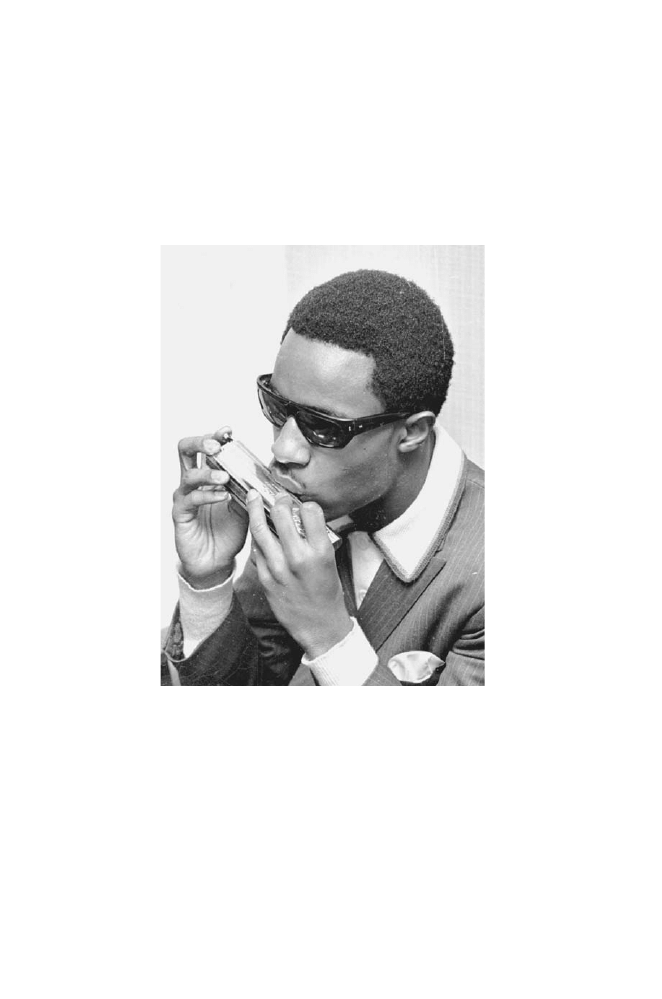
Early in his career, Stevie Wonder established himself as a
virtuoso harmonica player. He continues to incorporate jazz-
inspired harmonica playing into his recordings and concert
appearances right up to the present. © Chris Walter.
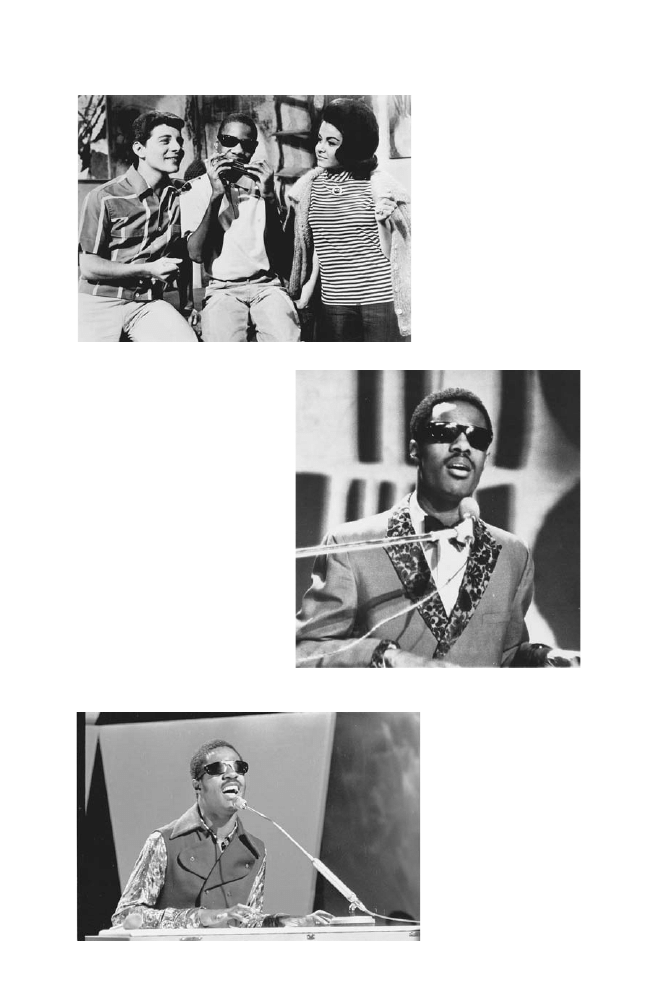
As suggested here, Wonder
was one of the more pas-
sionate, soulful singers of the
1960s and 1970s. © Chris
Walter.
As the 1960s came to close, Won-
der turned increasingly to the lat-
est technological innovations in
electronic keyboards, including the
clavinet, which he plays in this pho-
tograph. This instrument was heard
in Wonder’s funk recordings of the
late 1960s and early 1970s. © Chris
Walter.
As a teenaged star, Stevie Wonder
appeared in Muscle Beach Party with
Frankie Avalon (left) and Annette Funi-
cello (right). Photofest.
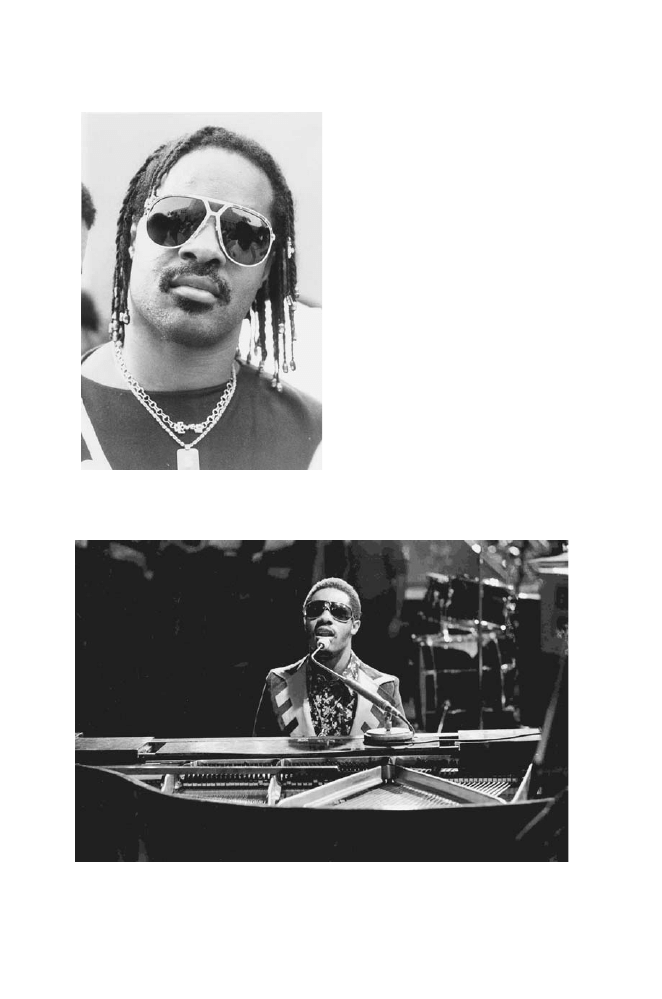
In each phase of his career, Stevie Wonder
was an iconic fi gure, not just musically but
also visually. His sunglasses and dreadlocks
of the 1970s and 1980s were well known
to his audience. © Chris Walter.
This photograph calls to mind Stevie Wonder the composer, pianist, and singer of jazz-
infl uenced ballads. © Chris Walter.
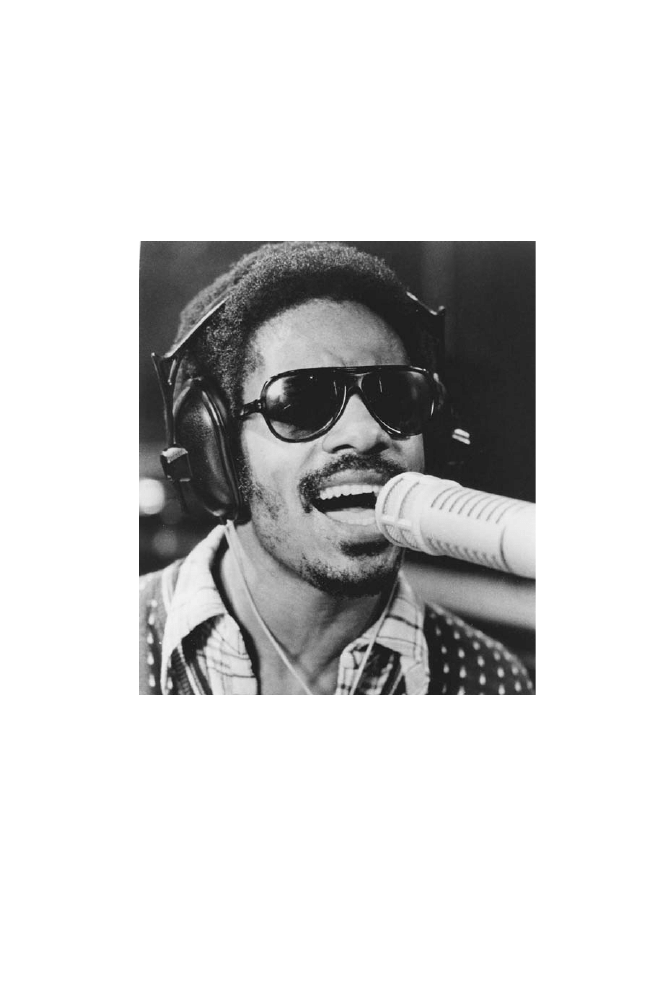
The headphones Wonder wears in this publicity photograph suggest his
signifi cant work as a recording artist. Stevie Wonder was one of the fi rst
recording artists to write his own material, play all the instruments on his
recordings, and control record production. Photofest.
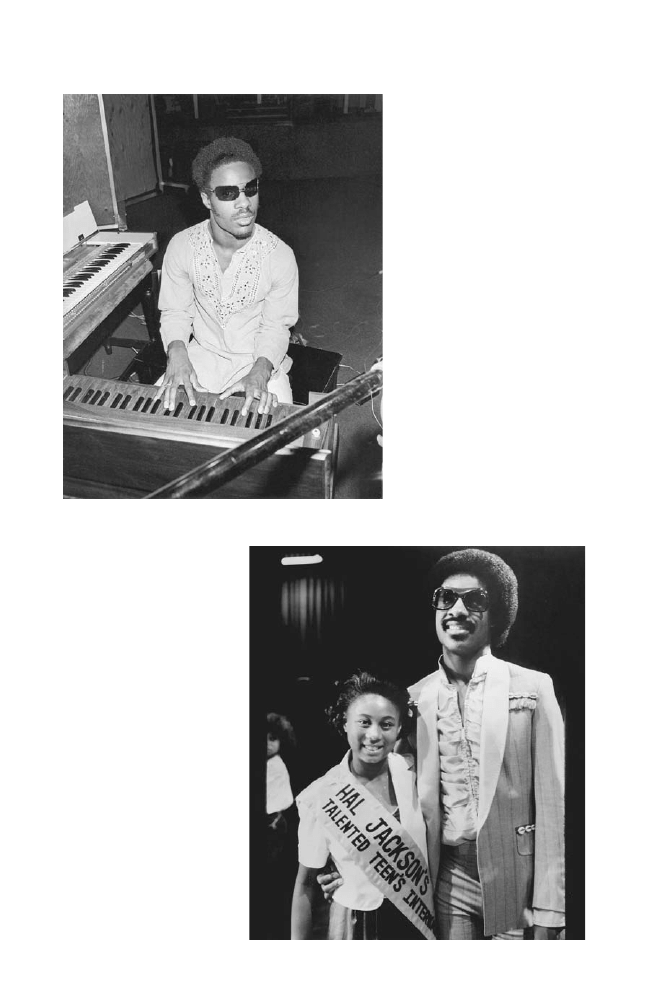
Stevie Wonder, the former child
star, has been a champion of chil-
dren throughout his adult life.
Here he is seen with Angela Pol-
lock, the winner of the 1979–1980
Hal Jackson’s Talented Teens
International Contest. Photofest.
One of the most talented and rec-
ognizable R&B and pop keyboard
players of the 1970s, Stevie Wonder
is in his natural surroundings in this
photo. Photofest.
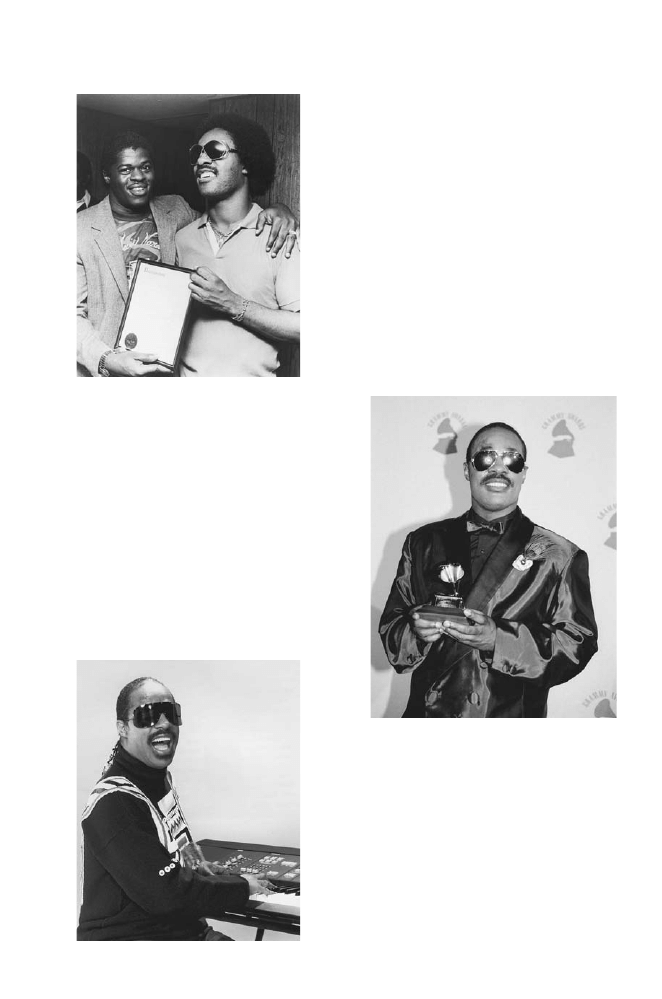
In 1982, the mayor of Wonder’s
birthplace of Saginaw, Michigan, pro-
claimed a “Stevie Wonder Day” to
mark Wonder’s performance at the
Michigan State Fair. He is seen here
receiving the proclamation from the
mayor’s special envoy Nate Calhoun.
Photofest.
A familiar scene: Stevie Wonder holding a Grammy
Award. He has won more than 20 Grammys
throughout his career. © Chris Walter.
In this publicity picture, Stevie Wonder is
seen doing what he does best: singing and
playing the keyboards. Photofest.
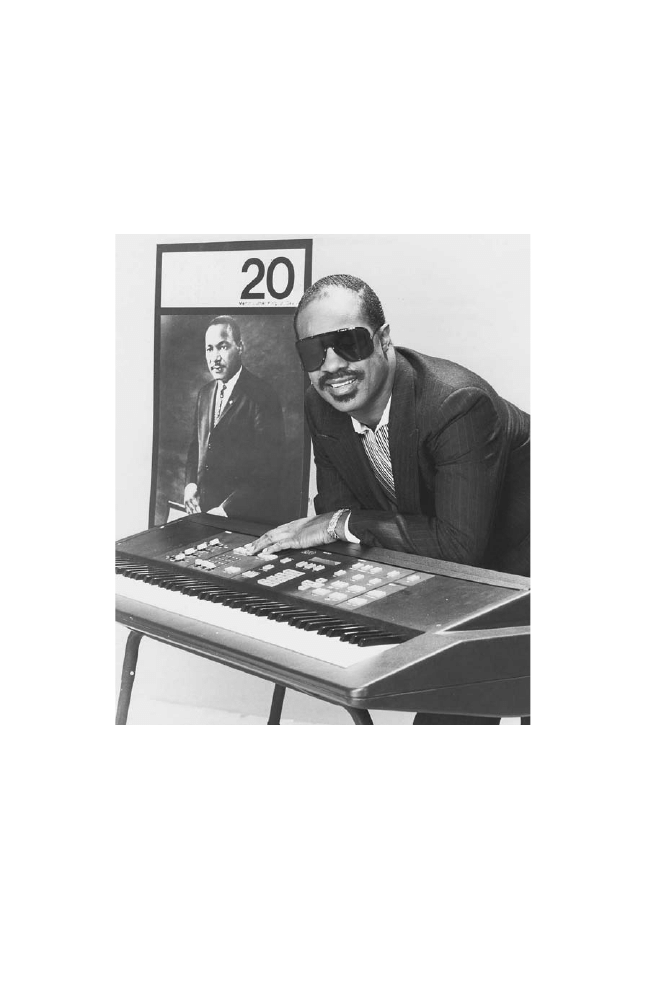
From the 1970s onward, Stevie Wonder has championed social causes. One
of his main focuses was the establishment of a national holiday to celebrate
the birth and work of the Rev. Dr. Martin Luther King, Jr. Photofest.


The Musician with a Cause,
1981–2005
As All Music Guide critic Rob Theakston puts it, Stevie Wonder’s 1980
album Hotter Than July “is the portrait of an artist who still had the Midas
touch, but stood at the crossroads of an illustrious career.”
1
Wonder had been
a major fi gure in American popular music in the 1960s and even more so in
the 1970s, but what would a new decade hold?
S
TEVIE
W
ONDER
’
S
O
RIGINAL
M
USIQUARIUM
I
Much of Stevie Wonder’s work of the 1980s has been dismissed by critics as
inferior to the work of 1970–1976, with the critics expressing a particular dislike
of the 1984 soundtrack to The Woman in Red, and Wonder’s hit single from
the fi lm, “I Just Called to Say I Love You.” But that was to happen in 1984.
Although it was more of a greatest hits compilation than a proper follow-up to
Hotter Than July, Wonder’s 1982 album Original Musiquarium I —certainly
one of his most unusually titled collections—did contain a few signifi cant new
tracks. And unlike the work to come, the album met with critical praise.
“That Girl,” “Front Line,” and “Do I Do” were the new tracks on Stevie
Wonder ’ s Original Musiquarium I, having not previously appeared on a
Stevie Wonder album. “That Girl” was issued as a single at the end of 1981
and reached No. 1 on the Billboard R&B charts and No. 4 on the magazine’s
pop charts. Despite the record’s popularity, it sounds tired, with Wonder’s
harmonica solo not quite capturing the level of excitement or expression of
his early work. The solo also sounds out of tune, which is surprising consid-
ering Wonder’s usually strong sense of intonation as a singer and as a har-
monica player. The one feature of the recording that sounds contemporary
and alive is the percussion track, which resembles some of the rhythm tracks
from younger artists of the times, such as Prince.
6
6

86 The Sound of Stevie Wonder
“Do I Do” was a somewhat less successful single than “That Girl,” reach-
ing No. 2 on the Billboard R&B charts but making it to No. 13 on the
magazine’s pop charts. Although it is a stronger performance than “That
Girl,” the song sounds less uniquely Stevie Wonder and more like the prevail-
ing pop/light-jazz/R&B dance music of the day. Perhaps the most notable
feature of “Do I Do” is the presence of jazz trumpet legend Dizzy Gillespie.
It is a delight to hear Wonder on harmonica trading licks with Gillespie,
although Gillespie is not featured to the extent that he might have been
on this recording, which is more than 10 minutes long. As a matter of fact,
Wonder’s harmonica licks have more coherence and generate more interest
than Gillespie’s sparse trumpet playing, which resembles the spare phrases
of Miles Davis on his album You ’ re under Arrest more than anything else.
It is unlikely, however, that this was because Gillespie was aging (he was in
his mid-60s at the time), as he was continuing to record and perform, and
would even win a Grammy a number of years after his guest appearance with
Stevie Wonder. Wonder’s inclusion of Dizzy Gillespie was meant as a tribute
to the jazz legend and his place in music, and it stands as an entirely appro-
priate acknowledgment; however, it is too bad that nothing approaching the
spark of Gillespie’s trumpet on his 1940s recordings of “Shaw ’Nuff ” or
“Night in Tunisia” is heard. Despite the fact that his appearance is meant as
a tribute, the real problem is that Gillespie is not given room to stretch out
and play. The piece is melodically and harmonically interesting, but, despite
being a so-called song, it is basically instrumental and rhythmic in nature: it
is a record that one could dance to, but one would not walk around hum-
ming it like “You Are the Sunshine of My Life” or one of Stevie Wonder’s
other strong vocally oriented pieces. Wonder might have done better to use
the approach taken by the Rolling Stones on their 1981 record “Waiting On
a Friend.” The Rolling Stones’ song featured noted jazz tenor saxophonist
Sonny Rollins, who was given plenty of space to stretch out and play; indeed,
Rollins’s contribution to “Waiting On a Friend” is an essential part of the
song—Gillespie’s contribution to “Do I Do” is far less essential.
Of the newer material on the Musiquarium I album, perhaps the most
interesting song was “Front Line.” After the end of the involvement of U.S.
troops in the Vietnam confl ict in 1974 and the subsequent fall of Saigon, few
pop musicians dealt with the war in recordings until 1982.
2
Between 1982
and 1985, several songs appeared that refl ected back on the unpopular war
and, in particular, on the war’s effect on Vietnam veterans. These included
Bruce Springsteen’s well-known, but widely misinterpreted, “Born in the
U.S.A.,” the Charlie Daniels Band’s “Still in Saigon,” Paul Hardcastle’s “19,”
Billy Joel’s “Goodnight Saigon,” and Stevie Wonder’s “Front Line.”
“Front Line” fi nds Wonder portraying a Vietnam veteran who has returned
home a broken man, physically, psychologically, emotionally, and economi-
cally. This character, who served on the front line, and had one of his legs
shot off in action, now stands “at the back of the line when it comes to gettin’

The Musician with a Cause, 1981–2005 87
ahead.” Wonder’s character suffers from posttraumatic stress syndrome, reliv-
ing the horrors of Vietnam in fl ashbacks and nightmares as a result of poison-
ing by the defoliant Agent Orange. The character also fi nds that his standing
in the community and within his extended family has suffered dramatically
because of his participation in the war. He laments that his “nephew’s a
junkie” and his “niece is a hooker.” He fi nds himself powerless, however, to
effect positive change in the lives of his relatives because they view him not
as a hero, but as someone with a lesser moral standing for having served in a
war to which he (in their minds) never should have gone.
Not only is “Front Line” unyielding in its funkiness, it is also one of
Wonder’s strongest lyrical statements in a song. Unlike “Living for the City,”
which offers a ray of hope for positive change, “Front Line” portrays the
veteran’s plight as one of total desperation and bitterness.
Exactly what makes a singer believable in a characterization is diffi cult to
defi ne in some cases, and in the case of “Front Line,” it is especially so. Any-
one familiar with Wonder knows that the character has nothing to do directly
with the musician’s own life experience. The main difference between “Front
Line” and, say, “Keep On Running” from Wonder’s 1972 Music of My Mind
album (another song in which Wonder obviously portrays someone other
than himself ) is that the dismembered, alienated, paranoid veteran of “Front
Line” represented real people who Wonder’s audience members either knew
or at least had heard of. The listener, therefore, feels a connection—in the
vernacular, they get where Stevie is coming from. The lover who jumps out
of the bushes on “Keep On Running” might represent someone that listeners
know or have heard of, but he elicits absolutely no empathy or sympathy.
Wonder also made a guest appearance on Paul McCartney’s album Tug
of War, in a 1982 project entirely separate from Stevie Wonder ’ s Original
Musiquarium I. The two co-wrote and traded lead vocals on the song “What’s
That You’re Doing,” with McCartney playing bass, drums, and electric guitar
and Wonder contributing synthesizers.
3
The song, an exercise in funk with
a basic and completely nonprofound lyrical message of, “What’s that you’re
doing? Girl I like what you do to me . . . Do it some more,” sounds more like
a Stevie Wonder track from Hotter Than July than a Paul McCartney song.
The two lead singers obviously have a good time (and McCartney gets in
some nice bass and electric guitar lines): it is almost a contest to see who can
outfunk the other, though again with McCartney seeming to adopt Wonder’s
style rather than the other way around.
The best-known collaboration between Paul McCartney and Stevie
Wonder, however, is on McCartney’s composition “Ebony and Ivory.” On
the track, Wonder and McCartney provide both lead and backing vocals,
with Wonder playing electric piano, synthesizers, drums, and percussion, and
McCartney playing bass, guitar, piano, synthesizers, and percussion. Despite
the awkward phrasing of some of the lines in the lyrics and the naïveté of the
sentiments, the single release of this song of racial harmony stayed at No. 1 on

88 The Sound of Stevie Wonder
the Billboard pop charts for seven weeks; it was easily both McCartney’s and
Wonder’s most commercially successful single. Paul McCartney’s Tug of War
album received mixed reviews, probably because of the overall organization
of the collection rather than because of any individual song. The commercial
success of “Ebony and Ivory” and the sheer fun these two major fi gures have
on “What’s That You’re Doing,” however, suggests that Paul McCartney
and Stevie Wonder could have made a great album as collaborators if they
had chosen to work more extensively with each other at the time.
T
HE
W
OMAN
IN
R
ED
The 1984 release of the soundtrack album for The Woman in Red led to
some of the harshest reviews of Wonder’s career, with critics in particular
dismissing “I Just Called to Say I Love You” as “saccharine.”
4
Prominent
Rolling Stone critic Christopher Connelly also gave the soundtrack a less-
than-enthusiastic review.
5
Despite the way in which critics vilifi ed “I Just Called to Say I Love You,”
6
the single release of the song reached No. 1 on both the Billboard R&B and
pop charts (where it held that coveted position for three weeks). In fact, the
record was Stevie Wonder’s most commercially successful solo single ever,
outsold only by his collaborative singles “Ebony and Ivory” and “That’s
What Friends Are For.” In response to the critical blasts aimed at “I Just
Called to Say I Love You,” I offer an alternative reading of the song. The
recording fi rst and foremost represents a sort of character piece for the fi lm; it
serves a cinematic function. Even if one were to separate “I Just Called to Say
I Love You” from its context in The Woman in Red, I believe that the song
and Wonder’s recording of it succeed as well on a certain artistic level.
Melodically, “I Just Called to Say I Love You” is almost an exercise in
simplicity. The harmony subtly shifts and revolves around common-tone
connections and simple voice-leading from chord to chord. In fact, on the
surface the music is so basic that the only thing about it that comes as much
of a surprise is the abrupt upward key modulations. Behind the foreground
simplicity, however, it is worth noting that the slow stepwise voice leading in
the chordal keyboard parts mirrors the faster lines in Wonder’s vocal melody.
It is as if he is using the same basic melodic motive on two different levels
of structure—something that happens in highly sophisticated classically ori-
ented compositions, but something that is rare in pop songs.
The lyrics are just as much an exercise in foreground simplicity: the entire
premise being that Wonder’s character needed no reason to call the person
on the other end of the line except to say, “I love you.” There is no ulterior
motive; there literally is no special reason for this expression of emotion. The
verses serve only to enumerate all the holiday-related and other traditionally
celebratory reasons that were not behind the telephone call. About the only
thing lyricist Wonder leaves out is Groundhog Day.

The Musician with a Cause, 1981–2005 89
Wonder’s arrangement and production of “I Just Called to Say I Love
You” is about the closest he has ever come to composing a totally generic—
even artifi cial sounding—backing track. The master percussionist eschews
drums for a simplistic and very obvious drum machine, for example. Even
Wonder’s backing vocal tracks sound as if they are mildly electronically pro-
cessed. The sudden, unprepared upward key modulations also sound thor-
oughly artifi cial, almost as though someone suddenly fl ipped the transposer
switch on the keyboard. Indeed, the only touch of humanity is in Wonder’s
lead vocal.
The brilliance of the recording is in the total focus on simplicity and on
the solitary humanity of Stevie Wonder’s lead vocal: the match of words and
music, arrangement and performance is complete. Typically, though, delib-
erately simplistic songs that observe the realities of day-to-day life have met
with severe critical reaction, especially when well-known songwriters who
have previously tackled challenging topics write them. Witness, for exam-
ple, the scathing reactions to Paul McCartney’s fi rst post-Beatles solo single,
“Another Day,” not only by critics but also by McCartney’s former band
mate John Lennon in the latter’s song “How Do You Sleep?”
7
In a way, “I Just
Called to Say I Love You,” like the McCartney song, presents the same type
of critical dilemma as the mid-nineteenth-century sentimental parlor ballads
of Stephen Foster. Generally dismissed during and immediately after Foster’s
lifetime, songs such as “Jeanie with the Light Brown Hair” are now viewed
as excellent representations of the popular public taste of the day, and are
valued critically as such. “I Just Called to Say I Love You” is hardly a work
of lyrical or musical profundity, but then again, it is not supposed to be. As
a well-crafted and quite deliberate statement of simple, no-strings-attached
love, and as a representative of mid-1980s American public taste, the record
succeeds. The extent to which the song defi ned American pop culture of the
time is suggested by Wonder’s appearance on the popular daytime drama All
My Children. He appeared as himself singing “I Just Called to Say I Love
You” after being introduced by his “friend,” the character Erica Kane. Noted
critic Robert Christgau, one of the prominent rock critics to have anything
positive to say about the song, wrote at the time of Wonder’s 1999 Kennedy
Center Award that it was “a broad-spectrum shout-out that spoke to the
shared experience of more potential listeners than anything Irving Berlin ever
wrote.”
8
Yes, the simplicity of the piece and its artifi ciality in production is
out of character for Stevie Wonder, but these traits—the traits that numerous
critics have jumped upon—are what make the entire piece work as a composi-
tion. And to the extent that it refl ects the inner feelings of Stevie Wonder,
“I Just Called to Say I Love You” presents him as a considerably more selfl ess
character than his regrettable 1972 composition “Superwoman (Where Were
You When I Needed You).”
The public controversy over “I Just Called to Say I Love You” did not
end with music critics. Songwriter Lloyd Chiate brought suit against Stevie

90 The Sound of Stevie Wonder
Wonder in early 1990, charging that Wonder stole the song from Chiate.
When the plagiarism charges were dismissed, Chiate eventually appealed the
decision, charging that the earlier trial was biased. In August 1992, the U.S.
Ninth Circuit Court of Appeals in San Francisco, California, found that there
was no basis to Chiate’s charges of bias in the original plagiarism trial and
let stand the original verdict of innocence for Wonder. The two trials were
closely followed by the black popular press, especially Jet magazine, which
provided readers with updates (and which, incidentally, has given Wonder’s
career more than a small amount of coverage).
9
Naturally, the soundtrack to The Woman in Red is not just about one song,
although “I Just Called to Say I Love You” certainly received most of the
attention in terms of sales, airplay, critical comment, and the Chiate law-
suit. Of the remaining tracks, all of the vocal numbers were composed by
Wonder—the other track is Ben Bridges’s instrumental composition “It’s
More Than You.” Dionne Warwick sings the Wonder composition “Moments
Aren’t Moments,” Warwick and Wonder duet on “It’s You” and “Weak-
ness,” and Wonder provides the lead vocals on “The Woman in Red,” “Love
Light in Flight,” and “Don’t Drive Drunk.”
Let us take a brief look at these songs. “The Woman in Red” is a pop dance
number that suggests the dance tracks of Michael Jackson’s work at the time.
And that really is at the heart of some of the issues that critics have had with
the early and mid-1980s recordings of Stevie Wonder: some of them seem to
be too anonymous. This particular song establishes the theme of the fi lm, but
it also is a good dance track—the problem is that it could be just about any-
one’s good dance track. “It’s You” is a pop love song that, again, is a good,
memorable song, but it cannot be considered a classic. Likewise, “Love Light
in Flight” fi lls a cinematic need and is a pleasant love song that returns to the
synthesizer-based dance style of “The Woman in Red,” although with a more
relaxed feel. Overall, the soundtrack project did not offer Wonder a wide
enough range of moods and emotions to explore, so, compared with just
about every one of his so-called real albums, The Woman in Red soundtrack
album seems thin. Fortunately, Stevie Wonder’s next major soundtrack proj-
ect, Spike Lee’s Jungle Fever, would offer him the opportunity to explore
a wider range of musical styles and emotions. Unfortunately, Jungle Fever
would be seven years in the future.
After The Woman in Red had pretty much run its course, Wonder began
making headlines for his social activism. He was arrested for protesting against
apartheid in front of the South African embassy in February 1985. The
United Nations Special Committee Against Apartheid honored Wonder later
that spring for his work against the South African system of racial inequality.
Wonder was also one of the vocal soloists on the USA for Africa record-
ing of the Michael Jackson–Lionel Richie composition “We Are the World.”
This collaboration of more than 40 top musicians helped to raise money for
impoverished people of Africa and the United States.

The Musician with a Cause, 1981–2005 91
Throughout the 1980s and into the twenty-fi rst century, Stevie Wonder
has been active performing duets with a number of well-known perform-
ers, including Julio Iglesias, Frank Sinatra, Tony Bennett, Paul McCartney,
and others. Among the lesser-known of these pairings, but a very intriguing
one, was a performance with Julian Lennon, son of the former Beatle John
Lennon, on the song “Time Will Teach Us All,” from the 1985 musical
Time. The musical itself was written by Dave Clark, the former drummer and
leader of one of the best-loved of the “British Invasion” bands of the 1960s,
the Dave Clark Five.
I
N
S
QUARE
C
IRCLE
Hot on the heels of his commercial success with The Woman in Red,
Wonder recorded and released the 1985 album In Square Circle. All in all,
the album was another commercial success; it reached No. 1 on the Billboard
R&B charts and was Wonder’s last top 10 pop album to date. As noted by
All Music ’s Ron Wynn, many listeners equated the hit single “Part-Time
Lover” with the album, even though a few of the album tracks were, at least
in Wynn’s eyes, better compositions and performances than “Part-Time
Lover.”
10
Despite the commercial success of In Square Circle, overall the
album suffers from a uniform, nearly generic, mid-1980s production style
that obscures Wonder’s customary creativeness to an extent not heard on any
of his other mature albums. In short, the drum machines, sequencers, and
pop dance sound could have come from any one of a large number of 1980s
musicians (like The Woman in Red all over again, but even more so). The sty-
listic, melodic, harmonic, and rhythmic eclecticism of Wonder’s best-written,
best-arranged, and best-produced albums of the 1972–1976 period ( Talking
Book, Innervisions, Fulfi llingness ’ First Finale, and Songs in the Key of Life )
is regretfully absent; there is no clear reference to the great torch songs of
the 1940s, no sense of true funkiness, and not much outside of “Part-Time
Lover” that even smacks of top 40 pop. The album also pales in comparison
with Wonder’s 1990s albums Music from the Movie “ Jungle Fever ” and Con-
versation Peace. Generic-sounding dance tracks simply do not make a great
Stevie Wonder album. What In Square Circle does have in its favor—besides
the big hit single—is the political song “It’s Wrong (Apartheid),” and some
very interesting melodic connections between songs—a unifying factor that
becomes clearer with repeated hearings of the album.
In Square Circle begins with “Part-Time Lover,” the big hit single, and
the song with arguably the strongest melodic hook of any of the 10 songs
on the album. One can tell, however, that there was a basic problem with
American popular music in the mid-1980s when the best-remembered song
on this album by one of the most important American singer-songwriters of
the second half of the twentieth century is a fl uffy little pop dance ditty about
married people having affairs. Of course, the problem was not just in the

92 The Sound of Stevie Wonder
popular taste of the time period, but also in the way in which Stevie Wonder
indulged in it on In Square Circle.
Although the story of deceit of “Part-Time Lover” is at odds with the
snappy music of the piece, the music itself is an example of good pop music:
the melody of each section is logical and memorable; the harmonies are
standard for pop songs; and Wonder’s performance shows off his voice
to good effect. The recording also benefi ts from the guest appearance of
singer Luther Vandross. But there is something odd about the disconnection
between music and lyrics. Certainly, pop singers have made material work
that is even more confl icted in this regard than “Part-Time Lover.” Bobby
Darin’s famous recording of Brecht and Weill’s “Mack the Knife” is perhaps
the ultimate example. Maybe Darin’s recording works better because it is so
extreme, so over the top. The Darin fi nger-snapping, big-band take on the
Brecht and Weill song serves to heighten the irony already built into the
song by the writers. Wonder’s pop tale of part-time lovers sneaking around
only to fi nd that they have themselves been cheated on falls a bit fl at. The
other, unsettling thing about the song is how the line “part-time lover” can
be misunderstood, in part because of the way in which Wonder places the
lead vocal into the mix and his use of 1980s artifi cial studio reverb. As with
John Fogerty’s oft-misunderstood line, “There’s a bad moon on the rise”
(often misheard as “There’s a bathroom on the right”) from the song “Bad
Moon Rising,” if one is not paying particularly close attention, one might
think that Wonder is singing about an “apartheid lover”—truly eerie consider-
ing Wonder’s public statements and demonstrations against the racist South
African institution.
11
With all that, if the listener tunes out the words, the
song works wonderfully.
“I Love You Too Much” follows “Part-Time Lover.” This 5–1/2-minute
dance track features some of the interesting chromatic harmonic shifts that
had been a staple of Stevie Wonder’s compositional style since the 1960s.
Melodically, though, the chorus section meanders a little too much, and
fi nds Wonder sounding a little forced in the upper part of his singing range,
thereby negating some of the strength of the melody of the verses. Wonder’s
inventive vocal improvisations on the long run-out coda, along with his mul-
titracked backing vocal harmonies, are the high points of the recording. As is
typical on the up-tempo songs on In Square Circle, however, the reverb and
rhythm-forward production make some of the lyrics of the verses diffi cult to
understand. The listener is left with many easily discernable repetitions of the
main idea of the song in the coda section, but a fair chunk of the detail of
Wonder’s poetry is lost along the way.
“Whereabouts” is one of two slow songs on the album. The other, “Over-
joyed,” plays the role of the traditional ballad. “Whereabouts,” however,
fi nds Wonder in search of the “missing person that [he has] just got to fi nd.”
It turns out the missing person is himself, or at least the part of his soul that
was lost when he lost the person to whom the song is addressed. The theme

The Musician with a Cause, 1981–2005 93
is not new, but Wonder succeeds in framing it in an unusual way, using a
serious form of wordplay that is not all that common in his songs. What he
does is to describes this missing person in the abstract and gradually narrow
the focus until it becomes clear that he is the missing person. It effectively
communicates the feeling, and the lyrics fi nd themselves wrapped in some
lovely musical writing. Perhaps part of the self-alienation Wonder expresses
in the song comes from the fact that the styles that defi ned his earlier mas-
terpieces of the 1970s are lacking in some of his work of the mid-1980s. Be
that as it may, “Whereabouts” comes off as thoroughly sincere without being
self- pitying; The beauty and clarity of Wonder’s musical setting balances the
potential for self-pity that the lyrical theme suggests.
The vaguely Caribbean-sounding “Stranger on the Shore of Love” fol-
lows. Even though the keyboards and percussion sound a tad electronic (read
“unnatural”), it is a pleasant enough song in which Wonder’s exclamation
that he does not want to be a broken-hearted stranger on the shore of love
sums up the basic message. The really intriguing thing about “Stranger on
the Shore of Love” is found in the arrangement, and in the harmonic and
melodic motivic connections it shares with the album’s next track, “Never in
Your Sun.”
“Never in Your Sun” is a moderately fast-paced pop song in which much of
the poetic detail is obscured by the electronic processing of Wonder’s voice.
He dusts off the harmonica for a solo. It is effective, making up for the list-
less effort in “That Girl” from a few years before, but it is not an extended
outpouring of inventiveness like Wonder’s harmonica work on “Isn’t She
Lovely” in Songs in the Key of Life. “Never in Your Sun” also fi nds Wonder
approaching this earlier style, constructing the melody through a sequential
treatment of motives, and through the somewhat quirky upward melodic
skips and rhythm of the chorus. These traits also make the song easily identi-
fi able and move it far beyond the generic.
“Spiritual Walkers” does not stand alongside the more memorable songs
on In Square Circle. For one thing, the rhythmic match of words and music is
a little awkward at times: in particular, the phrase “spiritual walkers,” which is
unusual enough when spoken, seems as though it is forced into a melody that
does not quite fi t it. The song also suffers more than most from the produc-
tion treatment of the vocal track.
“Land of La La” calls to mind the 1980s new wave/techno music of Oingo
Boingo and some of David Bowie’s dance music. Wonder’s lyrics deal with
what happens when young people from small towns move to Los Angeles,
the “Land of La La” of the song’s title, and discover the reality of urban life.
Compared with the graphic story and more fully developed characters of
“Living for the City,” however, this song is considerably more lightweight
in nature.
Musically, “Go Home” is one of the more interesting songs on In Square
Circle. Here, Wonder returns to a procedure he had used effectively in the

94 The Sound of Stevie Wonder
1970s: that of blending acoustic and electronic-sounding instruments to give
a greater richness of texture. The brass lines are not particularly complicated,
but they help to balance some of the other more electronic-sounding tim-
bres that pervade the album. The album’s ballad, “Overjoyed,” also includes
an interesting mix of timbres and sound effects. Wonder includes some of
the tasty harmonic shifts for which he was famous in this straightforward
love song. Compared with the best of his ballads, however, “Overjoyed” suf-
fers from the production techniques Wonder employs throughout In Square
Circle. Here, the reverberation of the entire soundscape makes Wonder’s lead
vocal lose the sense that this is a song directed at one character from one
other character. Wonder becomes a ballad singer in a cabaret, singing the
song to an audience instead of to the one who has brought him such joy.
A greater sense of intimacy and of rhetorical focus would have been possible
with a clearer, drier treatment of the lead vocal.
Wonder had been quite vocal in his protests of South Africa’s system of
apartheid earlier in the year 1985. His song “It’s Wrong (Apartheid),” on In
Square Circle carries on the anti-apartheid theme. Wonder combines a very
sequenced techno-sounding backing track with his pseudo–South African lead
vocal and backing vocals that sound as if they came right out of the South
African townships of the mid-1980s. Although Paul Simon, with Graceland,
became possibly the best-known American pop singer-songwriter to merge
American and South African styles in an attempt to expose the richness of black
South African culture (as manifested in its music and lyrics), Stevie Wonder’s
“It’s Wrong (Apartheid)” predated the songs of Simon’s album.
C
HARACTERS
The 1987 album Characters represented something of a musical hybrid for
Wonder: on one hand, the dance rhythms and sometimes synthetic percus-
sion and sequencer sounds of In Square Circle were still around, albeit in
thankfully muted form, but on the other hand, the funkiness and bluesy emo-
tion that largely had been missing since the 1980 album Hotter Than July
made a welcome return. Although Characters did well enough commercially
on the R&B charts—it hit No. 1—it only reached No. 17 on the Billboard
pop charts. The less overtly pop-dance feel of the album may be to blame,
but I suspect that it had at least as much to do with the disappointment long-
time Wonder fans may have felt as a result of its immediate predecessor, and
indeed with some of Wonder’s other recordings of the fi rst half of the 1980s.
Another contributing factor, however, certainly was the lack of a major hit
pop single to support and draw attention to the album.
12
And although sev-
eral of the songs are successful to superb in their own right, and although
Wonder develops two main themes throughout the album, Characters does
not hold together as a unifi ed album to quite the same extent as the megahits
of 1972–1974.

The Musician with a Cause, 1981–2005 95
Characters leads off with “You Will Know,” a pleasant ballad that seems to
anticipate the ballad-oriented songs to come out of the group Boyz II Men a
few years later. The song has a fairly pedestrian melody (except for the memo-
rable chorus) with a fairly anonymous instrumental backing. In fact, the most
notable feature is Wonder’s interesting use of truncated phrases that end up
suggesting an occasional shift from quadruple meter (four pulses per mea-
sure) to duple meter (two pulses per measure) at the end of each stanza just
as the chorus section begins. Also of interest is his use of deceptive cadences
in the harmonies near the end of the chorus sections. In these places, Wonder
builds up the expectation that a musical phrase will end on the tonic chord
(built on the fi rst scale degree), and then he ends the phrase on a non-tonic
built on the sixth scale degree. Wonder’s lyrics address the problems of those
who are chemically dependent and those who are single parents by suggest-
ing that through prayer they will fi nd the answers. Wonder takes up these
themes of societal/political problems and spirituality again in later songs on
the album, sometimes by themselves, but more often in tandem.
“Dark ’n’ Lovely” is a rare collaboration between Wonder and Gary Byrd.
Wonder and Byrd deal with terrible tragedies of war, ethnic cleansing, star-
vation, and terrorism in South Africa under apartheid. The basic premise
is that the white South African political structure (South African President
P. W. Botha is mentioned by name) is effecting this violence against people
simply because they are “dark ’n’ lovely.” The Characters subtheme of spiri-
tuality returns as Wonder and Byrd assure those who are being tortured,
starved, and killed that God will “stop this reign.” The melody of “Dark
’n’ Lovely” is remarkable for its simplicity: each of the three main sections
features its own tune, but each of the tunes is built on repetitions of one
unique short phrase. The accompaniment is also very focused on an almost
ostinato-like effect. Ultimately, this enables the message—the lyrics—to
shine through. In the hands of lesser writers this could become very dull very
quickly; however, the short phrases that generate the three melodic sections
contrast with each other enough and are engaging enough that the song
never becomes boring. The accompaniment lends a somber tone to the song,
but the tempo suggests that good will ultimately triumph over evil in this
politically charged situation. “Dark ’n’ Lovely” is not one of Stevie Wonder’s
better-known songs, but it ranks among his better political songs, and is very
effective in this context.
Despite all that Stevie Wonder had achieved after his 21st birthday ( Talking
Book, Songs in the Key of Life, Innervisions, etc.), the next track on Characters,
“In Your Corner,” suggests that he still held a place in his heart for the mate-
rial he co-wrote with his old Motown staff collaborators and recorded back in
the 1960s. In fact, as with some of the work that Billy Joel has done over the
years, there even are hints at the musical styles of the 1950s. Although some
of the specifi c lyrical images are more the product of the 1980s, the overall
theme of a guy who is part of the “in crowd” (Wonder’s character) taking one

96 The Sound of Stevie Wonder
of his buddies who is not part of the in crowd to his favorite hangout to enjoy
“fi ne women” and “lots of liquor” would not be out of place in the world of
the late 1950s or early 1960s. The shuffl e rhythmic style of the song—and
particularly the early Motown-infl uenced baritone saxophone solo—set the
time period. It is a wonderful character piece that sounds like it should have
been in a fi lm soundtrack set in the Happy Days / American Graffi ti era. It
counterbalances the love ballads and the serious songs of Characters, but in
standing so far away in temperament and musical style from the rest of the
songs on the album, also somehow seems out of place. The really ironic part
of this sense of disconnection is that “In Your Corner” is one of the few songs
on the album in which Stevie Wonder is clearly playing an actor’s role. There-
fore, it is one of the few songs on Characters that actually completely jibes
with the title of the package and the cover art, which shows Wonder standing
in front of busts holding an actor’s mask.
The lyrics of “With Each Beat of My Heart” express, purely and simply, a
proposal of marriage. It is a pretty ballad, and although not one of Wonder’s
classic love songs, it serves as a reminder of just how effortlessly he seems to
be able to write and perform this type of song. The next track on Characters,
“One of a Kind,” continues the theme, but with lyrics that move even more
in the direction of the cliché. “With Each Beat of My Heart” is more interest-
ing musically and conceptually.
“Skeletons” concerns the proverbial “skeletons in the closet” that everyone
has. For one of his songs of social and personal consciousness, Wonder is
uncharacteristically oblique about the exact nature of these skeletons, except
that in the end, they all amount to, in his word, “lies.” Musically, “Skeletons”
owes a debt of gratitude to “You Haven’t Done Nothin’,” Wonder’s anti-
Nixon funk track from Fulfi llingness ’ First Finale. The track features one of
Wonder’s most soulful funk vocals and was a highly successful song on the
various R&B charts when it was released as a single. Despite its stylistic resem-
blance to “You Haven’t Done Nothin’,” “Superstition,” and maybe even
“Living for the City,” the song manages to sound contemporary, especially
because of Wonder’s vocals and the arrangement of the synthesizer parts.
“Get It,” a duet with Michael Jackson, follows “Skeletons.” The lyrics are
about “Miss Lady Girl” who refuses to love any man. Wonder and Jackson,
however, are convinced that she will love each of them; well, really “him,”
because the two singers essentially take turns acting out the role of the
same character. Jackson is superfl uous—Wonder gets the best melodic lines
to sing—and the song does not add much to the album. The song might
have made more sense had it been a product of 1982, when duets were the
rage, with Paul McCartney and Wonder recording “Ebony and Ivory,” and
McCartney and Michael Jackson recording “Say, Say, Say” and the unfor-
tunate “The Girl Is Mine.” “Get It” is more distinguished than the latter
Jackson/McCartney project, but it is about half a decade too late to be part
of the heyday of the male superstar duet.

The Musician with a Cause, 1981–2005 97
After a few seconds of pseudo-galactic electronic noise, the next track on
Characters begins: “Galaxy Paradise.” This is anything but the typical Stevie
Wonder love song; rather, it’s more along the lines of “men are from Earth,
women are from UFOs.” Wonder’s lyrics express the fact that she is unpre-
dictable, while he is not. Musically, it is little more than fi ller, nearly 4 min-
utes’ worth. Given that Characters was an all-digital recording in the early
days of the compact disc, when, in order to compete, albums suddenly had
to be approximately 25 percent longer than they could comfortably be in the
vinyl/analog age, it is perhaps understandable that there might be more fi ller
on Wonder’s albums of the day than on his big-hit, single-vinyl-disc, 40-minute
albums of the 1970s. Unfortunately, this song is so out of character for the
album in lyrical content, and of so little musical interest, that it seems clearly
there just to be there.
“Cryin’ through the Night” does not offer much in the way of lyrical inter-
est, but—and this is a big “but”—it is a tuneful, danceable track. Wonder’s
character has discovered that his lover has left him for his best friend, and his
vocal performance is replete with bluesy melodic licks that refl ect the pain his
character feels.
“Free” is one of the rare examples of the infl uence of Hispanic music in
Stevie Wonder’s output. There has been the occasional “Don’t You Worry
’bout a Thing,” but “Free” sounds not so much like Wonder doing Latino
music as it does Wonder more fully integrating Latin American infl uences.
The fact that it is such a good piece makes up in part for the less-inspired
examples of fi ller material that precede it. Wonder’s lyrics express the feeling
of freedom his character has found in his life (the reason for this feeling is
never directly divulged, though). He rekindles the album’s subtheme of spiri-
tuality by acknowledging that this freedom can only exist, however, until his
“father God has called.” Clearly, this is a song in which Wonder is playing the
role of a character: the singer of the song has found this freedom despite the
fact that he has few if any possessions. Wonder’s use of minor tonality with a
chord progression and melodic shape is appropriate within the historical His-
panic popular song tradition. From a conceptual standpoint, the accompani-
ment sounds to be guitar-based, which fi ts entirely within the Latin American
musical framework.
One of the maddening things about Characters is that printed liner mate-
rial is so sparse. It would be nice to be able to read Wonder’s lyrics, especially
because the old 1960s Motown and mid-1980s In Square Circle echo returns
on some of the tracks. It also would be nice to know what guest artists joined
Wonder on the album (besides Michael Jackson, whose guest appearance
on “Get It” appears in type as large as the song’s title itself). So the listener
must rely on Wonder’s mention of B. B. King in the lyrics of “Come Let Me
Make Your Love Come Down” to fi gure out that the blues legend must be
the guest electric guitar soloist on the song. Or is he? In any case, the song is
a sort of funky, bluesy love song about a woman who is “about 4'10''” and

98 The Sound of Stevie Wonder
who keeps him satisfi ed in every way. It is enjoyable lyrically and musically,
although not one of Wonder’s greatest songs.
In terms of its memorable melodic hook and its hints of some of the funki-
ness of mid-1970s Stevie Wonder, the fi nal track on Characters, “My Eyes
Don’t Cry,” is a true highlight. It is an up-tempo dance track, but sounds
more like a band jam than some of the highly programmed (on a sequencer,
that is) dance music of Wonder’s previous couple of recordings. In short,
“My Eyes Don’t Cry” maybe the best example of the great Stevie Wonder
single that never was. It should have been released as a single, as it is at least
as good as other successful 1987 singles by other artists, and it is a better
song with more probable commercial appeal than the Characters singles that
actually were issued: “You Will Know” and “Skeletons.” Musically, “My Eyes
Don’t Cry” has a thoroughly memorable melody, just enough of the old
Wonder chromatic harmony quirks, and some tasty open-interval vocal har-
monies to make it both a clear part of the Wonder tradition of 1970s funky
standards and a convincingly contemporary 1980s dance track. One of the
things that makes the song so memorable is the way in which the verse starts
away from the tonal center of the song—with the effect that the verse has a
strong, choruslike hook all its own. Although the songs are quite different
in rhythmic style, the effect is similar to that achieved in “If You Really Love
Me,” a song that actually starts with the chorus. The lyrics speak of an exu-
berance Wonder feels with a new love that caused his eyes to cease their tears,
and the music fi ts them perfectly. To top it off, Wonder’s lead vocal is fi lled
with more energy than that shown in many of the rest of the album’s tracks.
Interestingly, “My Eyes Don’t Cry” is one of the few Stevie Wonder lyrics
that is clearly autobiographical as it alludes to the singer’s (or his character’s)
blindness. Although this might add a degree of poignancy to the text, the
lyric’s reference could also be understood as a metaphorical blindness. The
beauty of this text is that it is so straight to the point. This brings up one of
the features of Wonder’s lyrics that is often not acknowledged: he has the abil-
ity to write equally well from a variety of viewpoints, and can use the English
language in a wide variety of styles effectively. For example, the text of “My
Eyes Don’t Cry” is entirely different in character from the Tin Pan Alley use
of clichés in “All In Love Is Fair,” but both are highly effective. Throughout
the years, he has written not only in these styles, but has written using the
language of the street, the King’s English, and every style in between. About
the only thing that Wonder could possibly have done to propel this song to
an even higher level would have been to record a scorching harmonica solo.
Everything else about the composition and the recording says “classic.”
All in all, Characters seems to fall into place as the logical follow-up album
to Wonder’s 1980 opus Hotter Than July. Rather than focusing on pop mate-
rial and overly synthesized dance material as he had through the fi rst two-
thirds of the 1980s, Wonder returned to the eclecticism that had brought
about his breakthrough as an album artist back in 1972. There was some

The Musician with a Cause, 1981–2005 99
obvious fi ller, but this, the fi rst of Wonder’s fully digital, made-for-compact
disc albums, found him clearly back on course.
A native of Michigan, Wonder considered running for mayor of the heav-
ily African American city of Detroit in 1988. Although he did not run, the
fact that he mentioned publicly that he was considering it suggests his com-
mitment to enacting social change from within the system. He continued
to be associated with various political and social causes into the twenty-fi rst
century.
Because Stevie Wonder had made his fi rst impact as a recording artist in
1962 and had been one of the most important recording artists in popular
music in the 1970s, it was appropriate that he would be one of the fairly
early inductees into the Rock and Roll Hall of Fame. His induction came in
1989. The accolades continued the following year when the National Urban
League honored Wonder at its April 1990 gala in Los Angeles.
Wonder had been interested in and active in addressing international social
and political issues for years. In 1990, he appeared in the Nelson Mandela:
70th Birthday Tribute video. Unfortunately, the video did not garner par-
ticularly great reviews, particularly from Rolling Stone critic Jim Farber.
13
Wonder’s international concern was also highlighted by his October 1990
announcement that he planned to donate proceeds from his next recording
to UNICEF.
J
UNGLE
F
EVER
Film director Spike Lee has been known for tackling important and fre-
quently controversial social issues in his movies. His 1991 fi lm Jungle Fever
dealt with the topic of interracial relationships. Stevie Wonder provided a
soundtrack for the fi lm that renewed his longstanding pattern of writing
and performing music of highly diverse styles, an eclecticism that had been
absent from some of his albums of the 1980s. In the Jungle Fever soundtrack,
Wonder was able to combine early 1990s styles such as hip-hop with jazz,
funk, and ballads. In short, Stevie Wonder was fully back from the techno and
dance craziness of the mid-1980s.
The Jungle Fever
soundtrack album opens with “Fun Day,” which is
regretfully one of Wonder’s few straightforward jazz compositions and per-
formances. The lyrics tell of a fun day, a day of celebration—while not exactly
the stuff of great consequence, these lyrics set a celebratory mood. The real
meat of the piece is in Wonder’s arrangement in the style of CTI Records, his
performance, and his production. Creed Taylor’s CTI label came into promi-
nence in the 1970s with pop-jazz artists such as Hubert Laws, Dave Grusin,
Bob James, and Grover Washington, Jr. The music associated with CTI was
highly accessible, rhythmically refl ective of the pop music of the period, and
usually featured improvisations that stayed clearly in a key (as opposed to the
free jazz of the 1960s avant-garde). The Wonder song resembles a mix of

100 The Sound of Stevie Wonder
the CTI style and that of jazz guitarist-singer George Benson, whose vocal
style, incidentally, has been compared with that of Wonder. For someone
who is as gifted an instrumentalist as Wonder, it is curious that the bulk of
the extended improvised solos he has recorded have been on the harmonica.
“Fun Day” includes a harmonica solo, but signifi cantly, also features Wonder
on a piano solo. Wonder proves that he is a fi rst-rate jazz piano stylist. His
singing, too, includes a touch of 1990s jazz scat. All this is entirely in keeping
with the carefree nature of the lyrics.
“Queen in the Black” is a hip-hop-oriented celebration of a black woman
about whom Wonder’s character fantasizes. Wonder refers to her as a queen
and “Miss Ebony.” Lyrically, this song represents something of a depar-
ture for Wonder, who generally does not dwell on the race or ethnicity of
the object of his (or the character he is portraying) desire in love songs. Of
course, given the focus of the fi lm on interracial relationships and the place-
ment of the song in the fi lm’s context, the focus on the racial-ethnic identity
of the woman is entirely appropriate. Curiously, Wonder does not defi ne his
character in the lyrics: he might be white or black. There is nothing in the
lyrics to suggest whether this is a black man celebrating a black woman about
whom he fantasizes or a white man fantasizing about “the other.” Musically,
“Queen in the Black” represents one of Wonder’s fi rst forays into the world
of hip-hop. And this is strictly found in his drum playing. The rest of the
composition and arrangement sounds like good contemporary (for 1991)
R&B. Notable, however, is the fact that unlike some of Wonder’s 1980s
up-tempo songs, here Stevie Wonder the producer puts the lead vocal well
forward in the mix: the lyrics are never obscured by 1980s-style production.
“These Three Words” is a pop ballad piece in which Wonder sings of the
importance of verbally expressing love. He mentions that parents and chil-
dren, husbands and wives, and siblings need to tell each other “I love you,”
and his chorus mentions the power of “these three words” in cementing
relationships and in healing wounds. Outside of the context of the fi lm, this
is the sort of ballad about which Wonder’s critics have complained since the
1980s. The simple love-conquers-all philosophy may not succeed with crit-
ics, but it has remained a staple of pop music for decades. In the context of
the Spike Lee fi lm, in which the love of generations of family members and
of lovers is severely challenged by racism on several levels, the song’s lyrical
statement is poignant. The song’s harmonies feature the type of chromatic
voice leading and shifts that set the best of Stevie Wonder’s 1970s ballads
apart from the bulk of top 40 pop material. The melody generally is strong,
although curiously the verses are more distinctive than the somewhat mean-
dering chorus and “middle eight.”
14
Wonder’s jazz- and gospel-infl uenced
vocal extemporizations serve to prove that Wonder, the master interpretative
singer, is also back from the disco/techno 1980s.
“Make Sure You’re Sure” is the soundtrack’s jazz-oriented ballad. Although
the song is thoroughly contemporary, as a composition and as a vocal and

The Musician with a Cause, 1981–2005 101
instrumental performance it owes a huge debt of gratitude to the types of
ballads sung by such jazz performers as Billie Holiday and Nat “King” Cole.
It is more sophisticated perhaps than the more poppish ballad “These Three
Words.” The earlier song, however, makes much better use of the strongest
qualities of Wonder’s voice and is also more melodically memorable than
“Make Sure You’re Sure.”
Jazz and pop ballads, however, are just two of the styles Wonder explores in
his Jungle Fever soundtrack. Notable is his latching onto and making his own
a somewhat muted version of hip-hop style. Although there are elements of
this early 1990s R&B style in Wonder’s drum performance on “Queen in the
Black,” “Each Other’s Throats” incorporates the style more thoroughly. This
denouncement of the evil that people work against each other even contains
a three-stanza rap by Wonder. The song is an especially interesting one to
review in the twenty-fi rst century. The 1990s eventually saw the explosion
of gangsta rap, a hip-hop style that glorifi es the very sort of violence that
Wonder dismisses in “Each Other’s Throats.” The song is a breath of fresh
air amid the direction some, if not most, of rap turned in the years after the
release of Jungle Fever. It also, with its fast tempo and a fair amount of syn-
copation and rhythmic intensity in the instrumental and vocal lines, defi es
stereotypes of what songs that dismiss hate and violence “should” sound like.
Because of how it defi es these stereotypes—unlike some of Wonder’s other
material in the soundtrack—it is also an especially effective setting of its mes-
sage: it resists complacent listening.
One who has not heard the track “Each Other’s Throats” might wonder
about Stevie Wonder’s ability to incorporate the new hip-hop style, especially
his ability to rap. Granted, given his age (40 at the time of the recording of
Jungle Fever ) and his long association with styles that did not have street cred-
ibility in the 1990s, one could dismiss a song like “Each Other’s Throats”
as a curiosity—a desperate attempt to be “hip.” The song, however, is not
that—it is authentic, somewhat youthful, and in hindsight, it set the stage for
additional hip-hop work on the 1995 album Conversation Peace.
Guest artist Kimberly Brewer provides lead vocals on Wonder’s composi-
tion “If She Breaks Your Heart.” It is a song that fi ts a cinematic situation
and is not one of the strongest efforts on the soundtrack album. In particular,
Wonder’s use of hip-hop rhythms in this ballad context sound labored, and
the singsong nature of the melody also made it diffi cult for the work to hold
much interest independently from the fi lm. “If She Breaks Your Heart” is,
however, typical of the prevailing pop R&B/top 40 crossover material of the
early 1990s.
The majority of the songs on the Jungle Fever soundtrack album are lon-
ger than 4 minutes. As Stevie Wonder worked into the compact disc age,
he adjusted his arrangements to add increasing amounts of musical space,
generally in the form of extended instrumental introductions, instrumen-
tal interludes that establish rhythmic grooves, and longer coda sections. In

102 The Sound of Stevie Wonder
these respects, “Gotta Have You,” which exceeds 6 minutes, is something
of a look into the future: it anticipates the regularly 6-minutes-plus songs
of his next album, Conversation Peace.
15
“Gotta Have You” is not one of
Wonder’s best-remembered compositions and recordings, but it does feature
a fi ne funky, blues-infused lead vocal melody in the verses, recalling his songs
of two decades earlier, such as “Superstition.”
“Jungle Fever” is one of the catchiest songs on the soundtrack album.
This song, in which Wonder’s character has gone “white-girl hazy” while the
object of his desire has gone “black-boy crazy,” makes for interesting study
in the way that it deals with a long-held taboo in American society: interracial
relationships. In the 1960s the subject was treated with intense seriousness,
as in the fi lm Guess Who ’ s Coming to Dinner, in which there is little hope of
the relationship surviving, and in Janis Ian’s song “Society’s Child (Baby, I’ve
Been Thinking).” Or it’s been handled in a humorous mock shock manner,
as in the songs “Black Boys” and “White Boys” from the musical Hair . In
contrast to these approaches, Wonder’s song is playful and optimistic, while
thumbing its nose at the “ignorant people” who are fi lled with prejudice on
both sides of the racial divide. Speaking of thumbing his nose, Wonder does
so by using some mildly explicit language of the street, telling those who dis-
approve of the relationship purely on the basis of race that they “don’t know
jack shit.” The street speak might not be even close to the level of gangsta
rap, or Prince’s “Sexy M.F.,” in which the singer-songwriter’s description
of himself as a “sexy motherfucker” fl ows like the most natural phrase in
the world, but in the context of the entire corpus of the compositions of
Stevie Wonder, the street speak of “Jungle Fever” is unique. In a clear show
of decorum, the expletive used by Wonder is not included in the lyrics in
the compact disc’s program notes: it is replaced with a dashed line. And
it is not even the expletive itself that seems most unnatural coming from
Stevie Wonder; it is the thumbing-his-nose-at-the-ignorant negativism that
seems most strange coming from an artist who has devoted practically his
entire lyrics-writing career to delivering optimistic, positive messages. But
then, there was a cinematic context within which Wonder was working for
this entire collection of songs. The playful part of the “Jungle Fever” equa-
tion also comes from the deliberately singsong chorus and from Wonder’s
unexpected spoken acknowledgments of the percussionists on the recording,
which actually happens twice.
“I Go Sailing” follows the title track. This gentle ballad fi nds Wonder’s
heartbroken character trying to fi nd “a way to smile again” and coming to
the conclusion that he will heed a wise man’s advice that he fi nd his happiness
within himself—he does this by going sailing in his mind. This is a melodi-
cally pleasant song with some of Wonder’s expectedly (from having done
it now in four different decades) unexpected harmonic shifts. Ultimately,
however, it is a mood piece for the fi lm soundtrack and not one of his most
memorable compositions. The performance is likewise low-key.

The Musician with a Cause, 1981–2005 103
“Chemical Love” perhaps is one of the better-known songs from Jungle
Fever and is the one soundtrack song with lyrics by someone other than
Wonder: Stephanie Andrews wrote them. Her lyrics speak of drug addiction
as a “chemical love.” She concludes that the only way to achieve a true high
is from “spiritual love,” which she describes as a “natural miracle drug.”
Wonder’s musical setting is an understated, moderate-tempo piece in a mild
techno style. Wonder the producer treats Wonder the singer’s voice to an
effective artifi cial-sounding reverb and electronic timbre alteration. The osti-
nato nature of the backing instrumental tracks is unusual in the Wonder cor-
pus, but works well in the context of this warning to the drug abuser. The
reason for the effectiveness of the backing tracks and the mild electronic pro-
cessing of Wonder’s voice is that it creates the impression of a kind of soulless
detachment—the kind of lack of human spirit or soul that might come from
chemical addiction.
Stevie Wonder’s natural voice returns for the fi nal song on the Jungle
Fever soundtrack album, “Lighting Up the Candles.” This rock ballad about
“lighting up the candles” of “our love” resembles the other ballads on the
album in being pleasant enough, but not as memorable as Wonder’s classic
ballads. The mood of the song is consistent, however, and fi ts into its cin-
ematic context (as a celebration of a love that will overcome all odds) perhaps
better than it works as a purely aural experience.
Wonder’s soundtrack for Spike Lee’s Jungle Fever was an important piece
of work for the musician for a number of reasons. First, Wonder proved
himself capable of scoring a commercial fi lm. His CD liner notes thank Lee
for this. Wonder writes to the fi lmmaker, “I was able to see this project well
enough to write the songs, even though you gave me the rough version in
black & white!!!”
16
Second, and more important, Wonder proved that he
could again be relevant, taking up the new rhythmic and structural styles of
early 1990s popular music and merging them into his always-growing bag
of tricks. Perhaps his fi rst steps into the inclusion of hip-hop infl uence into
his overall style were not as well realized as they would be on 1995’s Con-
versation Peace, but these steps were mostly successful in the Jungle Fever
soundtrack. The other important feature of the soundtrack was that it found
Wonder exploring a wider range of emotions and musical styles than he had
through the 1980s.
C
ONVERSATION
P
EACE
With a few exceptions, once he took total control of his recordings, by
writing or co-writing all of the songs, singing all or nearly all of the vocal
tracks, playing all or nearly all of the instruments, and producing, Stevie
Wonder took a few years to release each new studio album. Wonder had
mentioned the upcoming Conversation Peace album in interviews for several
years leading up to 1995; however, it was fi nally released only in March of

104 The Sound of Stevie Wonder
that year, nearly four years after his soundtrack to Jungle Fever. He had not
been entirely absent from the music industry—Wonder appeared on Frank
Sinatra’s album Duets II (Capitol CDP 8281932) in 1994, singing his old hit
from the 1960s “For Once in My Life” with Sinatra and Gladys Knight.
Conversation Peace is an album dedicated to fi nding peace in a world
full of mistrust, hate, and violence. This theme, in one form or another,
can be found on virtually all of Wonder’s albums, even going back to the
early 1960s. Never, though, had the focus been so strong, nor the result so
much like a concept album. By focusing on an important social and political
issue, Wonder met with more critical approval than he had in a decade and
a half. For example, the Wall Street Journal ’s critic Jim Fusilli gave Conver-
sation Peace a favorable review,
17
and All Music Guide ’s Stephen Thomas
Erlewine praised Wonder’s attempts at integrating the contemporary hip-
hop style more thoroughly in the album.
18
The critics, however, were not
unanimous in their praise of Wonder’s adoption of hip-hop rhythms. People
Weekly ’s Andrew Abrahams, for example, complained that on Conversation
Peace, Wonder “too often winds up slamming out pedestrian songs lacking
his usual celebratory bounce” because of his attempt “to sound au courant”
by incorporating hip-hop style.
19
Contrary to Abrahams’s assessment, how-
ever, the lack of bounce was probably attributable more to the weightiness
of the social, spiritual, and political commentary of the album than to the
incorporation of hip-hop per se .
Conversation Peace hit No. 2 on the Billboard R&B album charts and
No. 16 on the magazine’s pop album charts. Although Wonder had not
recaptured his tremendous sales appeal of the fi rst half of the 1970s, he had
returned to relevance (especially, if the sales statistics fi gures are any indica-
tion, among black listeners) after the uncertain 1980s. The words and music
of Conversation Peace and the Jungle Fever soundtrack were more eclectic
and interesting than anything Wonder had produced since Hotter Than July
more than a decade earlier (even if Characters had shown that Wonder was
no longer In Square Circle, as it were, in 1987).
Conversation Peace opens with the sound of a thunderstorm, which does
an immediate segue into “Rain Down Your Love,” a completely contempo-
rary mid-1990s hip-hop infused R&B track. Except that, unlike the stereo-
type of the hip-hop genre, this song is a prayer asking God to rain his love
down to wash our minds and our spirits. The reasons that this prayer—which
makes up the song’s chorus—and this cleansing is needed are enumerated
in the verses, in which Wonder talks about the psychological illness that
causes humanity to ignore the Creator’s master plan. Wonder provides all
of the song’s instrumental and vocal parts, thereby demonstrating that he
has thoroughly absorbed the contemporary R&B style of the mid-1990s as
writer, producer, instrumentalist, and singer. The change in his rhythmic
approach as a drummer is especially remarkable: he no longer is the heavily
jazz- infl uenced improviser of Talking Book and Innervisions, as he now lays

The Musician with a Cause, 1981–2005 105
down an unrelenting hip-hop beat. This is something of a double-edged
sword: on one hand it shows Wonder’s creativity in being able to keep cur-
rent; on the other hand, it means that the measure-by-measure and phrase-
by-phrase creative jamming of Wonder’s instrumental work of 20 years prior
is almost entirely absent not only on this song but throughout Conversation
Peace. Given the seriousness of the subject matter, and the heartfelt way in
which Wonder’s lyrics address those subjects, perhaps it is only appropriate
that he forsakes musical virtuosity—for the style of a song like “Rain Down
Your Love” and the bulk of Conversation Peace places the listener’s attention
more squarely on the lyrics. The hip-hop drum track cuts out before the last
repetitions of the chorus. This textural change is unexpected and brings the
listener’s attention back to the music, where it belongs.
The song “Taboo to Love” is the fi rst recorded example of the collabora-
tion between Stevie Wonder and Dr. Henry Panion III, a music professor
associated with the University of Alabama, Birmingham.
20
Wonder had never
done his own string arrangements, even though some of his recordings con-
tained decidedly stringlike synthesizer arrangements, and thus, he contacted
this conductor, composer, arranger, and orchestrator, based on his knowledge
of Panion’s previous work for other artists. Panion provides a full orchestral
treatment to “Taboo to Love,” a song that fi nds Wonder and his would-
be companion concluding that the taboo to their love—the exact nature of
which is not fully explained—can ultimately be overcome. In fact, the orches-
tration is one of the most interesting features of the composition. On his
past recordings, Wonder had had the assistance of Motown stalwarts such as
Paul Riser to do orchestral arrangements—they worked well enough—but
Panion’s mixture of classical and pop actually works better in some respects
than the work of Wonder’s previous orchestrators: it is lush without being
heavy handed (though some might fi nd it somewhat “schmaltzy”). As for the
lyrics, this is a love ballad; however, the nature of the story (love overcoming
the artifi cial taboos society places on certain relationships—interracial, per-
haps?) fi ts right into the overall concept of Conversation Peace.
Throughout his songwriting career—or more appropriately, throughout his
lyrics-writing career—Stevie Wonder has returned to the theme of a univer-
sal, agape-type love time after time. “Take the Time Out” is such a song, and
in some respects is reminiscent lyrically of the 1970 Diana Ross hit “Reach
Out and Touch (Somebody’s Hand).” Wonder here urges the listener to
“take the time out to love someone,” and especially the poor, the lonely, and
the homeless. He emphasizes that “we are all one underneath the sun,” and
to underscore the message, Wonder is joined on the background vocals by
the famed South African vocal group Ladysmith Black Mambazo. Although
the relatively low-energy level of the arrangement and tempo makes the song
seem overly long and repetitious—it is, after all, one of the 10 (out of 13)
songs on the album to clock in at more than 5 minutes, and the chorus does
repeat quite a few times—Wonder’s melody is catchy and memorable, and

106 The
Sound
of
Stevie
Wonder
the verse and chorus melody stand in an appealingly stark contrast to each
other. In fact, this melodic contrast is notable for its text painting: the verses,
which enumerate all the people with serious problems who are in need of
help and love, are set to short melodic phrases in a narrow range, while the
chorus, which requests that the listener show his or her love, is set to a wider
range, a higher vocal tessitura, and features a few more skips than the verses.
Wonder plays all the instruments on “Take the Time Out,” and that is
worth noting. Further, careful listening to his synthesized bass and other
synthesizer parts reveals the extent to which technology had evolved from his
fi rst “all-Stevie” recordings of 1971 to 1995. The synth bass sounds like an
authentic electric bass, and the guitarlike lines certainly do not have the kind
of fake sound that was evident in some of Wonder’s early 1970s recordings.
It is also important to note that Wonder plays the synthesized bass lines like
a fi ne electric bass player would: he has absorbed the electric bass idiom, as
evidenced by his melodic approach on the track.
“I’m New” is a love song with a twist, and it is with that twist that the song
fi ts squarely into the programmatic theme of Conversation Peace ’s emphasis
on spirituality. Here, Wonder sings that his newfound love—for which gift
Wonder’s character thanks “him” (God)—makes him feel completely new. He
goes so far as to compare this feeling to the sense of newness felt by a born-
again Christian. It is, then, a song that explores the notion of romantic love
as a spiritual gift that itself has a deeply spiritual (in addition to physical and
emotional) nature. A later album track, “Sensuous Whisper,” celebrates the
physical, sensuous side of love with an appropriately funkier rhythmic groove.
Wonder’s piano playing and the sax/trumpet horn lines suggest the contem-
porary popular jazz of the era. The track that follows “Sensuous Whisper,”
“For Your Love,” is a gentle ballad that celebrates the emotional, romantic
side of love. By looking at love in these decidedly contrasting ways—lyrically
and musically—Wonder presents a more fully rounded-out view of love than
on many of his albums. Incidentally, “For Your Love,” not be confused with
the 1960s Yardbirds hit of the same title, is the closest song on Conversation
Peace to Wonder’s great ballads of the 1970s: there is a touch of soul, a slight
touch of Tin Pan Alley, and a touch of the old jazz infl uence in Wonder’s
piano and drum playing.
In an interesting turn of rhetorical style, “My Love Is with You” fi nds
Wonder portraying two separate characters that have been murdered with
handguns. As might be expected, the entire point of the song is to make a
plea for the banning of handguns and to strengthen the message by provid-
ing the two concrete examples of the result of their use. Wonder uses the
hip-hop musical style of the ’hood, as well as the musique concrète sounds
of the killings. The concrète recordings that come after the music itself fades
out add signifi cantly to the chilling effect of the song, and had Wonder not
included that surprise, the song would have seemed too pedestrian to be
completely effective. “My Love Is with You” serves an important function

The Musician with a Cause, 1981–2005 107
on Conversation Peace by dealing with the real everyday violence of the
American city streets.
Stephanie Andrews, who had collaborated with Wonder on the song
“Chemical Love” from the Jungle Fever soundtrack, provided the lyrics for
“Treat Myself.” Interestingly, her lyrics are considerably more sparse than
any of the others on Conversation Peace. In a sense, one of the immedi-
ate commercial weaknesses of the album is that, aside from this song and
“Conversation Peace,” the majority of the songs are so densely packed lyri-
cally that it is a real challenge for the listener to take them all in. Wonder
was addressing societal issues that had meant—and continue to mean—the
world to him over the years, and he seems to have wanted to address them
from every possible angle over the course of the one-hour-plus album. Con-
sequently, Stephanie Andrews’s poetry ends up having a more focused feel
than some of the other songs. The lyrics suggest that one should conjure
up “pretty places” in his or her head when his or her “life’s in a place” that
is unbearable. Without saying it directly, she suggests that one’s emotional
state is basically under one’s control. Wonder’s musical setting highlights
the sharp distinctions between the world as the character actually experi-
ences it and the world of imagination through his high degree of melodic-
shape and harmonic contrast between the verses (the cruelty of the world)
and the chorus (the sunny world of the imagination). Also highlighting the
lyrical contrast are Wonder’s harmonica solos over the top of the numerous
repetitions of the chorus.
“Tomorrow Robins Will Sing” is a Jamaican-groove love song featuring
“chatting” by Edley Shine. It is a pleasant mood piece, but in the larger the-
matic context of Conversation Peace, it is less than essential. In a way, it comes
off as something of a reversion back to the occasionally anonymous Wonder
songs of the 1980s.
After the twin celebrations of love that come approximately two-thirds of
the way through Conversation Peace —“Sensuous Whisper” and “For Your
Love”—Wonder explores the theme of broken relationships. The fi rst of
these two songs, “Cold Chill,” is a funky piece that keeps the subwoofer
thumping. This sonic effect, along with the background vocal arrangement,
and the melodic and harmonic style resemble some of Prince’s music of the
1980s and 1990s, and to some extent, Michael Jackson’s recordings of the
same period as well. The main difference is that, in contrast to the lusti-
ness of some of Prince’s lyrics, the lust is more implicit here. And ultimately,
Wonder’s character never has the chance to act on his fantasies, as the object
of his desire gives him a “cold chill” of rejection.
Although Stevie Wonder managed to integrate newer pop and R&B rhyth-
mic and structural styles into his songs of the 1990s, and particularly those
with muted hip-hop references on Conversation Peace, not all of his musical
focus was on sounding completely new and contemporary just for the sake
of doing so. “Sorry” provides ample evidence of this. Curiously, this song

108 The Sound of Stevie Wonder
incorporates musical elements that are reminiscent of Wonder’s work from
the 1960s through the 1990s. Harmonically and (particularly) melodically—
both in the “written” melody and in Wonder’s extemporizations—“Sorry”
sounds like one of the easily recognizable, strong hook–focused Wonder sin-
gles of the 1960s and pre– Talking Book 1970s (“Signed, Sealed, Delivered
[I’m Yours]” or “Uptight [Everything’s Alright],” for example). Once the
lead vocal line enters, the song’s structure also reads like a page from the
1960s; however, like virtually every song on Conversation Peace, “Sorry”
begins with a long introduction, something rarely found in Wonder’s record-
ings of 20 or 30 years earlier. Of course, back in the mid-1960s, the primary
form of expression in the world of popular music was the 2–1/2-minute sin-
gle record. Wonder’s backing instrumental tracks—he plays all of the instru-
ments on this song—contain just a twinge of 1990s hip-hop, but a little
bit more than just a twinge of early 1980s British new wave/techno, a la
Orchestral Manoeuvers in the Dark or the Human League. This may sound
like a strange mix of stylistic references, but “Sorry,” the second Conversation
Peace song to deal with a troubled love relationship, works very well. The
reason is that Wonder fully integrates all of the stylistic references in such a
way that the recording becomes just a Stevie Wonder song, and not a deriva-
tive work nor a chaotic mixture of sounds. The lyrical theme could have been
a product of the 1960s: Wonder told his lover lies; she left him; now he is
expressing his sorrow and begging for forgiveness. Although this is not the
sort of higher philosophy that Wonder explores on other Conversation Peace
songs, and although the situation is a pop song cliché, it is an everyday occur-
rence around the world, and fi ts entirely within the album’s grand scheme
of exploring the things that tear people apart and the need for healing and
peace on many levels.
The lyrical treatment in both the verses and in the chorus of “Conversation
Peace” has a somewhat parlando (speechlike rhythms) feel, in part because of
the asymmetrical lengths of the lines of text. Given that this happens within
an easygoing pop/hip-hop/gospel feel—and given the upfront placement of
the lead vocal line in the recording’s mix—it focuses the listener’s attention
right in on the words. Wonder’s message of “all for one, one for all” as the
only way to avoid repeating the atrocities of the past (such as the “holocaust
of six million Jews and a hundred and fi fty million blacks during slavery”)
is greatly enhanced by the rich background vocal harmonies of the group
Sounds of Blackness. This is a millennial song: a call to allow conversation
and remembrance of the past to usher in a new age of the global connection
of all humanity. Although this theme has been at the background of more
than a few past Wonder songs and certainly at the background of his social
activism throughout the years, “Conversation Peace” is perhaps the clearest,
most focused, and concise single statement of Wonder’s overall life philoso-
phy. Not necessarily among his best-known compositions or recordings, it is
nonetheless one of his most effective philosophical/spiritual songs.

The Musician with a Cause, 1981–2005 109
Conversation Peace was a remarkable achievement for Stevie Wonder. Of
all of the musicians who had made their recording debuts back in 1962, only
a very few were still active in 1995. But the most impressive aspect of the
album and how it defi nes Wonder’s work is that he is pretty close to being
alone among musicians who had debuted in 1962 but whose mid-1990s
work had evolved along with prevailing stylistic trends. And for the most
part, Conversation Peace does indeed sound like a very good, topical (though
a little bit muted) mid-1990s R&B album, done by a contemporary musician
fl uent in the styles, issues, and language of the day.
Perhaps even more important than the fact that Conversation Peace is a
very good example of mid-1990s R&B is that it provided an opportunity for
Stevie Wonder to focus as a lyricist on weightier subjects over the course of
an hour-and-a-quarter-length piece. It becomes, in this way, his most com-
plete testament to the social, political, and spiritual concerns of his work as
a musician.
Perhaps as natural a follow-up to the Conversation Peace album as any of
Wonder’s philanthropic activities was his 1995 establishment of an annual
series of concerts to benefi t needy children. The Annual House Full of Toys
Benefi t Concerts raised money to purchase toys so that underprivileged chil-
dren would be able to enjoy the same holiday cheer as children from more
affl uent homes. The concerts have continued into the twenty-fi rst century. The
sixth annual event, held December 15, 2001, was notable for its sponsorship by
Yahoo!, which made possible a live broadcast on the World Wide Web.
N
ATURAL
W
ONDER
Dr. Henry Panion, III, who had orchestrated “Taboo to Love” on the
May 1995 album Conversation Peace, was contracted to orchestrate Wonder’s
music for the subsequent 1995 album and concert tour project Natural
Wonder. Because the project involved working with symphony orchestras and
Wonder had not done string arrangements in the past, he sought out some-
one whose work he respected. As a skilled conductor, Panion, in addition
to the arrangements and orchestrations
21
that he did for the project, also
directed the Tokyo Philharmonic Orchestra for the recording.
More than anything else, what Panion did when it came to some of
Wonder’s older songs, was to take Wonder’s arrangements and translate them
into a full symphonic context. For example, the Natural Wonder version of
“Village Ghetto Land,” a Stevie Wonder–Gary Byrd composition from Songs
in the Key of Life, uses real orchestral strings in place of the 1976 record-
ings synthesized strings. The eighteenth-century chamber orchestra style of
Wonder’s original arrangement is further enhanced by the use of the orches-
tral instruments, creating a heightening of the striking sense of ironic discon-
nection between the lyrics’ description of scenes from a poverty-stricken slum
and the musical settings’ association with late eighteenth-century European

110 The Sound of Stevie Wonder
aristocracy. Panion’s orchestration of this song makes use of the resources
of live stringed instruments, but the arrangement itself (just exactly what
melodic lines the instruments play) is remarkably similar to Wonder’s earlier
“synthestration.”
This is true not just on “Village Ghetto Land” but also on the other older
material on Natural Wonder. The arrangements are not all that different from
the defi nitive Wonder recordings of the past. There is a reason for the reten-
tion of Wonder’s original arrangements even within the broader symphony
orchestra context of this particular recording. As rock guitarist-composer
Frank Zappa wrote:
On a record, the overall timbre of the piece (determined by equalization of
individual parts and their proportions in the mix) tells you, in a subtle way,
WHAT the song is about. The orchestration provides important informa-
tion about what the composition IS and, in some instances, assumes a greater
importance than the composition itself.
22
Although Zappa uses the term orchestration, one could substitute arrange-
ment in the context of Stevie Wonder’s music. Musicologist Albin J. Zak III,
in a spring 2005 article in American Music, quotes Zappa and goes even
farther in essentially defi ning the “text” of a pop song—the artifact itself—as
the defi nitive recording of the song. In other words, a song is not the melody,
harmony, instrumentation, arrangement, but also includes the studio mixing,
and the entire vinyl or compact disc experience.
23
If one is to accept Zappa
and Zak’s defi nition in its strictest form, then re-arranging, re-orchestrating,
or even just re-recording a “song” results in a new “song.” In that he was the
one to make the contact with Panion, Stevie Wonder apparently did not think
of the new orchestrations of the original arrangements as creating fundamen-
tally different, new “songs.” It is entirely legitimate to defi ne Wonder’s com-
positions in terms of the defi nitive recordings. And Natural Wonder seems in
a sense to confi rm this: Henry Panion basically took what were almost totally
studio-conceived pieces and adapted them for live performance while retain-
ing the essential character of the original versions.
The late 1990s and early twenty-fi rst century saw Stevie Wonder receiv-
ing more awards and accolades. In 1996, he not only received two Grammy
Awards, but was also the recipient of Grammy’s Lifetime Achievement Award.
In 1999, Wonder became the youngest honoree up to that time to be rec-
ognized by the Kennedy Center for the Performing Arts. The Dr. Martin
Luther King, Jr. Center for Nonviolent Social Change, Inc., honored Wonder
at its January 13, 2001, “Salute to Greatness Awards” dinner. Wonder became
only the third-ever recipient of the Ivor Novello Awards’ Special International
Prize; he traveled to London to accept this major award for composers. And,
in 2002, Wonder was elected to the Songwriters Hall of Fame. The hall also
presented him with the Sammy Cahn Lifetime Achievement Award.

The Musician with a Cause, 1981–2005 111
The twentieth century ended with Motown issuing the 4-compact disc
set At the Close of a Century. The collection consists of most of Wonder’s hit
singles (although “Workout Stevie, Workout” and “Hey Harmonica Man,”
both pop top 40 singles, are absent) along with some well-chosen album
tracks (“Isn’t She Lovely,” for example, is a particularly well-known Wonder
song that strangely was never released as a single). Motown would release
a couple of additional Stevie Wonder compilations in the early twenty-fi rst
century, each with a focus on presenting Wonder as a writer and performer
who excelled in many diverse styles. Although the company could have easily
issued a funk album or a ballad collection, fortunately it has not done so—for
to compartmentalize Wonder is to do his career a disservice.
Wonder’s guest appearances to raise money for philanthropic causes also
continued into the twenty-fi rst century. For example, he appeared in Septem-
ber 2000 at School Night ’00, an event that raised more than $6 million for
scholarships to enable underprivileged Washington, D.C.–area children to
attend private or parochial schools. In April 2001, Wonder performed at the
Eighth Annual RACE To Erase MS. In addition to performing at benefi ts
to fi ght multiple sclerosis, he has also performed at numerous events to raise
AIDS awareness and to raise funds to combat the disease.
In 2001, Wonder appeared on Tony Bennett’s album Playin ’ with My
Friends (RPM Records CK85833). The two musicians with excellent jazz
credentials performed “Everyday (I Have the Blues).” Wonder was also one
of the featured performers in July 2001 during the celebrations of the 300th
birthday of the city of Detroit, Michigan.
The early twenty-fi rst century has not been entirely bright for Stevie
Wonder, however. In October 2001, his longtime girlfriend, Angela McAfee
sued the musician, claiming that he had broken his promise to maintain her
in his Los Angeles home for the rest of her life, even if the couple broke up.
According to the $30-million lawsuit, Wonder transmitted herpes to her,
moved out, and stopped paying rent. Wonder countersued, claiming that
McAfee had taken more than $160,000 worth of furniture, exercise equip-
ment, musical instruments, and other property that belonged to Wonder
from the house.
Adding to the turmoil of Wonder’s personal life in 2002 was the release of
Dennis Love and Stacy Brown’s book Blind Faith: The Miraculous Journey of
Lula Hardaway. This biography of Wonder’s mother has created controversy
on several levels. First, some critics have questioned the book’s focus on Wonder
himself at the expense of the purported subject of the book, Lula Hardaway.
Second, Stevie Wonder has questioned the book’s details on his mother being
forced into prostitution. Regarding Wonder’s concerns, it should be noted that
Lula Hardaway has cooperated fully with the authors of Blind Faith by appear-
ing in radio and television interviews to promote the book.
Despite the acrimony between Wonder and McAfee and controversy cre-
ated by the details of the early life of Lula Hardaway, the years 2002 through

112 The Sound of Stevie Wonder
the present have for the most part seen Wonder coming back into the fore-
front of American pop and R&B music through important compact disc com-
pilations from Motown, and his appearances at benefi ts, and his receiving and
presenting prestigious awards. Motown released Stevie Wonder: The Defi ni-
tive Collection, a single CD, in 2002. Although this collection is more limited
than the massive 4-disc At the Close of a Century collection that Motown had
issued in 1999, The Defi nitive Collection was the fi rst single-disc greatest hits
collection that covered what looked to be his entire career. The year 2003
found Wonder presenting the 2003 Century Award to Sting, with the two
musicians seeming to form a mutual admiration society with their onstage
banter.
On June 10, 2004, Stevie Wonder received the prestigious Johnny Mercer
Award from the National Academy of Popular Music/Songwriters Hall of
Fame. The Chairman of the Hall of Fame, famed lyricist Hal David, referred to
Wonder as “a ‘songwriters’ songwriter,’” acknowledging that Stevie Wonder’s
“music is known and loved around the world and has made a difference in the
lives of so many.”
24
On the subject of great American popular songs, Wonder performed on
the 2004 album Stardust: The Great American Songbook III. He sang the
song “What a Wonderful World” in a version that pays tribute to the famous
Louis Armstrong recording of the 1960s, but that included some highly
virtuosic harmonica fi gures. Wonder’s harmonica solos emphasize that the
melody of “What a Wonderful World” essentially is a reworking/expansion
of the children’s song “Twinkle, Twinkle Little Star.” As one might imagine,
the fact that the song is based on visual images makes the choice of Stevie
Wonder as the performer ironic, and the fact that the musician’s pseudonym
is part of the title is also ironic. Far from being some sort of joke, though, the
recording truly is a fi tting tribute to Armstrong, even though the easy listen-
ing material is not something that one might ordinarily associate with Stevie
Wonder. And the harmonica solo, despite its technical brilliance, strips this
very naïve song of some of its heartfelt sincerity because of Wonder’s insistence
on emphasizing the childlike nature of the song’s “Twinkle, Twinkle”–based
melody. Those little matters aside, listeners who liked Louis Armstrong’s ver-
sion of “What a Wonderful World” will appreciate Stevie Wonder’s version as
well. Hard-core Wonder fans, though, probably will not. Even so, Wonder’s
emphasis on “Twinkle, Twinkle, Little Star” recalls his incorporation of
“Mary Had a Little Lamb” on his fi rst smash recording—the live recording
of “Fingertips” more than four decades earlier.
Unfortunately, Wonder had to endure some personal losses in 2004. Inter-
views with Ray Charles and with Stevie Wonder suggest that the two blind
singer-songwriter-keyboard players were never particularly close—they were,
after all, of completely different generations and ultimately created music that
had only the most surface similarities—but it must be remembered that one
of the early attempts by Motown to defi ne Little Stevie Wonder was as a sort

The Musician with a Cause, 1981–2005 113
of new Ray Charles. Wonder not only commented favorably on the music of
Charles with the musician’s passing in 2004, he also led a jam session at the
Radisson Hotel in Los Angeles to celebrate the life and music of Charles. The
performers who joined Wonder included members of Charles’s recording
and road bands, the Raylettes, Ellis Hall, and several other musicians.
Undoubtedly, Stevie Wonder suffered an even greater personal loss with
the death of his former wife and writing partner Syreeta Wright, who passed
away from bone cancer on July 6, 2004. In addition to being married from
1970–1972, Wright and Wonder co-wrote several songs that appeared on
Wonder’s albums and on Wright’s 1972 album Syreeta. Wonder and Wright
continued to compose together, including the material on Wright’s 1974
album Stevie Wonder Presents Syreeta, which as the title implies, was produced
by Wonder. Wright and Wonder had remained friends in later years.
The end of 2004 and the beginning of 2005 found Stevie Wonder in the
news once again. This time, he expressed his support for his legally embattled
friend Michael Jackson by criticizing the latest music video by white rapper
Eminem, who appears in the video dressed like Jackson, with young boys
cavorting with him on a bed. Wonder took the rapper to task for making
money off of an African American music style, while mocking the important
African American artist Jackson and failing to give the former King of Pop,
one of the commercially successful musicians of the 1980s, the presumption
of innocence.
On a totally unrelated front, Wonder was back in the media spotlight with
his appearance at the January 15, 2005 Tsunami Relief Telethon, which
involved not only longtime important musicians such as Wonder and Elton
John, but also many well-known fi lm and television actors. His charity work
continued through spring 2005 with a performance at Tiger Jam, a fund-
raiser for the Tiger Woods Foundation.
A T
IME
TO
L
OVE
Because he is a perfectionist, and because on his post-1970 albums Stevie
Wonder typically plays all or nearly all of the instruments, he has been notori-
ously slow at releasing new material. The 10 years that have elapsed between
the 1995 album Conversation Peace and the 2005 album A Time to Love,
however, are a dubious record for Stevie Wonder. Considerable expectation
was built throughout 2004 and the fi rst half of 2005 as both unoffi cial and
offi cial release dates were publicized, canceled, and changed. The question
on the minds of both reviewers and fans was, “Would it be worth the wait?”
The fi rst hints of the potential impact of Wonder’s new material were
impressive enough. In early May 2005, it was announced that Wonder’s new
song, “So What the Fuss,” would be issued as the fi rst-ever music video for
the blind. The song, with vocals by Wonder and En Vogue, and an appear-
ance by guest guitarist Prince, features narration that will be accessible on

114 The Sound of Stevie Wonder
the secondary audio track of modern televisions. This narration, performed
by rapper Busta Rhymes, describes what is taking place in the visual action
of the video so that blind individuals can better experience the medium of
music video.
25
Finally, in October 2005, A Time to Love made it to record stores, both vir-
tual and actual. Critics have praised the album, making it and Paul McCartney’s
Chaos and Creation in the Backyard close competitors for comeback album
of the year. Perhaps signifi cantly, McCartney makes a guest appearance on
A Time to Love as a guitarist, as does the aforementioned Prince, singers
India.Arie, Kim Burrell, and Aisha Morris (Wonder’s daughter of “Isn’t
She Lovely” fame), as well as the well-known jazz fl utist Hubert Laws. Add
to that Doug E. Fresh performing as human beatbox, Bonnie Raitt, Busta
Rhymes, G. Patrick Gandy and Paul Riser’s orchestral arrangements, and a
host of highly skilled instrumentalists and background singers, and A Time to
Love certainly boasts the personnel capable of producing one Wonder’s best
albums in decades. And Wonder’s singing, songwriting, arranging, instru-
mental, and production skills are more than up to the task.
These songs are not the catchy, instantly infectious tunes common to
Stevie Wonder’s work up to the mid-1970s. And, as Allmusic.com critic Rob
Theakston notes, they also are not the middle-of-the-road ballads of the
1980s.
26
Nor are the songs of A Time to Love the nearly anonymous dance
pieces of In Square Circle. They are solid, contemporary sounding, and show
that Wonder has aged very well, especially as a lyricist.
The one not-so-obvious area in which A Time to Love exhibits Stevie
Wonder’s continuing growth as a composer is in his use of space and pro-
portion. Wonder’s longer songs of the late 1960s and early 1970s often
were extended funk workouts; the length was largely a result of an extended
instrumental groove. As the music industry moved from the vinyl age into
the compact disc age through the 1980s, Stevie Wonder adapted by increas-
ing the average length of his songs, usually through extended introductions
and fadeouts. Even to a greater extent than on his previous album (1995’s
Conversation Peace ) Wonder’s twenty-fi rst-century work includes even lon-
ger songs. Unlike his extended-length album cuts of the 1970s and 1980s,
however, a song like “A Time to Love,” which clocks in at over nine minutes,
owes its length to both the use of instrumental space and a more sophisti-
cated, larger-scale song structure. One senses the presence of an ongoing
variation technique in “A Time to Love,” something that takes the song
beyond the customary limits of pop song construction.
Another important feature on this album is the increased naturalness of
Wonder’s use of the parlando rhythms of hip-hop in delivering his texts.
Critics have given Wonder’s lyrics mixed reviews from the time he started
to write his own lyrics in the early 1970s. This response seems to have been
prompted by factors such as Wonder’s use of soft rhymes instead of the hard
rhymes of the Tin Pan Alley songwriters, the unusual turns of phrase that

The Musician with a Cause, 1981–2005 115
Wonder sometimes employed to create a rhyme, his tendency to rely on
cliché expressions (particularly in his love songs), and his tendency to write
very long political and social commentaries into the texts of his songs. While
he has been using the parlando rhythmic approach of hip-hop since his 1991
soundtrack to the fi lm Jungle Fever, he seems to have fully integrated the
approach on A Time to Love. This style allows him freedom from both the
need to create artifi cial-sounding rhyme schemes and from the rather stricter
syllable counts of traditional pop song structure. In addition, it provides him
with a vehicle perfectly suited to his longer texts dealing with social issues.
Also, the ease with which Wonder moves into the style on A Time to Love
gives several of the songs a convincing, thoroughly contemporary sound.
Perhaps the one part of the overall texture that does not wear well is the
approach to the incorporation of the strings. Wonder and Riser arrangements,
and Riser and Gandy’s orchestrations are generally presented in the mix in
such a way as to sound artifi cially placed in the background. It is an approach
that can be heard in some of the mid-1970s recordings of jazz saxophon-
ist Stanley Turrentine. I much prefer Wonder’s presentation of synthesized
strings and acoustic orchestral strings in earlier albums like the studio mas-
terpiece Songs in the Key of Life and the live recording Natural Wonder . One
track, however, on which Wonder’s string arrangement succeeds completely
is “If Your Love Cannot Be Moved,” but here (unlike a song such as “Sweet-
est Somebody I Know”) the strings are in the forefront of the texture, sort
of like a “Pastime Paradise” for the twenty-fi rst century. Another area on
A Time to Love that is something of a double-edged sword is Wonder’s
approach as an instrumentalist. His keyboard and percussion virtuosity of the
1970s is largely absent from this album, which helps him place greater empha-
sis on the lyrics but can be a little disappointing to fans of Stevie Wonder the
former instrumental wizard. Because the lyrics (both his own and those of
his collaborators) stand up quite well, this approach succeeds; it would have
been nice, nonetheless, to hear a bit more instrumental funk and jamming.


Conclusion: Stevie Wonder’s
Songs as Recorded by
Other Performers
Throughout the years, a wide variety of musicians has performed Stevie
Wonder’s compositions. Jazz musicians, in particular, have been drawn to his
more harmonically adventuresome works of the 1970s. Although the focus
of this book is on the recordings of Stevie Wonder, the singer-songwriter-
multi-instrumentalist, it is also important to study Stevie Wonder, the songwriter
who provided material for other recording artists. Most of these are cover
versions of songs that Wonder himself made famous—such as the standard
“You Are the Sunshine of My Life”—but one notable song—“The Tears of
a Clown”—was a Wonder composition that was made famous by Smokey
Robinson and the Miracles. Among the popular songwriters of the second
half of the twentieth century, Stevie Wonder is notable for the enormous
stylistic range of artists who have recorded his work.
Stevie Wonder’s earliest collaborative compositions were not commercially
successful enough to generate a great deal of interest among other artists.
Even though Wonder had made a signifi cant impression as a performer as
early as 1962, many artists probably thought of him strictly as Little Stevie
Wonder, the child prodigy, and not necessarily as a signifi cant pop musician
with whom a connection (through performances or recording of his compo-
sitions) might generate increased record sales.
Although he was only 16 at the time, Stevie Wonder’s fi rst “mature” smash
hit was “Uptight (Everything’s Alright).” Several well-known artists covered
the song, including Brenda Lee, who recorded it in 1966, the same year in
which Wonder’s version hit the charts. Lee had herself been a recording artist
since she was 13 years old and was a major star by 1966, having racked up a
dozen pop top 10 hits.
1
She recorded “Uptight” on her album Coming On
Strong (Decca DL 74825).
Another intriguing recording of “Uptight (Everything’s Alright)” took
place in 1968 when soul vocalist Jackie Wilson joined with the Count Basie
Orchestra to record Benny Carter’s arrangement of the song on the album

118 Conclusion
Manufacturers of Soul (Brunswick BL 54134). Wilson and Basie’s band also
included the song “I Was Made to Love Her” on the same album. Basie
had long supported musical genres that were not strictly swing jazz. For
example, the blues-based pieces he recorded with vocalist Joe Williams were
certainly closer to roots blues music than blues form pieces recorded by many
of the big bands. However, there is an undeniable tie between urban blues
and jazz. The Manufacturers of Soul album highlights the fact that—in part
through blues style—there is also a relationship between soul, and even the
Motown version of soul, and jazz. That two songs associated with Stevie
Wonder appeared on the album was not an accident: the infl uence of jazz can
be heard in the vocal and instrumental work of Wonder more so than in the
work of just about any 1960s soul musician.
Unquestionably, the most important 1960s recording of a Stevie Wonder
composition by someone other than Wonder himself was done by Motown
legends Smokey Robinson and the Miracles. Ironically, this was not even
a cover of a Wonder recording, but rather, a song that was never com-
mercially released by Wonder: “The Tears of a Clown.” The song, a musi-
cal collaboration of Wonder and Henry Cosby, with lyrics by Robinson,
2
is based upon a very old premise, that of the tragic clown. For exam-
ple, Ruggiero Leoncavallo’s opera I Pagliacci (“The Clowns”), a popu-
lar work from the late nineteenth century, was based on a true story of
tragic clowns, as was Austrian composer Arnold Schönberg’s famous 1912
atonal chamber song cycle Pierrot lunaire. Incidentally, both Leoncavallo
and Schönberg based their compositions on clowns that were considerably
more tragic than the clown of the Wonder, Cosby, and Robinson song.
Robinson’s text mentions “Pagliacci,” in reference to the character Canio
in the Leoncavallo opera. This operatic character is best known for his
soliloquy, “Vesti la giubba,” a tune that might be familiar to baby boomers
as a result of its use a couple of decades ago in a television commercial for
Rice Krispies cereal.
Given the rocking Motown soul nature of many of Wonder’s up-tempo
songs of the 1967 period, it is diffi cult to imagine how his version of “The
Tears of a Clown” might have sounded, had he actually released a recording
of the song. The 1967 recording by Robinson and the Miracles was issued on
their album Make It Happen. The recording was eventually issued as a single
by Tamla (the Motown imprint used by the Miracles and Wonder) in 1970,
but only after a Motown executive in the United Kingdom convinced the
company’s American executives of the commercial potential of the recording.
It went very quickly to the top of the pop and R&B charts. And it sounded
nothing like a Stevie Wonder recording, with the circus band orchestration
(the only example of a combined soul piccolo and soul bassoon timbre the
listener is likely to experience in his or her lifetime!), added to the omnipres-
ent Motown backing band, and topped off with Smokey Robinson’s vulner-
able, falsetto vocal.
3

Conclusion 119
Musically, “The Tears of a Clown” features a riff-oriented verse, which
sounds much like many of Wonder’s compositions of the period, and
especially the songs he wrote in 1968. The chorus begins with a chromatic
harmonic shift using a secondary dominant chord, creating almost a gospel-
like harmonic motion. The real genius of the piece, however, is in the
arrangement—especially the thinning of the instrumental texture to the cir-
cuslike instrumentation on the last line of the chorus when Robinson explains
just what one of the saddest things known to man is: “The tears of a clown
when there’s no one around”—and in Smokey Robinson’s text. Robinson’s
words fi t the music perfectly and exhibit a higher level of thematic and poetic
sophistication than that typically found in Stevie Wonder’s collaborative com-
positions of the period. Admittedly, the song has nothing of the depth of
feeling and pathos of Canio’s soliloquy in I Pagliacci —Wonder and Cosby’s
music is far too upbeat for that—however, Robinson’s text does rise above
much of what Wonder was setting to music (or what was being set to Wonder’s
music) at the time.
There is a touch of irony in that Smokey Robinson’s text and his falsetto
delivery paints the singer—the clown—as such a vulnerable and pathetic fi g-
ure, while the music is so upbeat. In a very real sense, this apparent confl ict
between the materials of the song gets at the very heart of the confl ict within
Canio between his public smile and his inner frown. Perhaps the ultimate
irony of this rare collaboration between Robinson and Wonder, however,
is that what started out as album fi ller became master composer Smokey
Robinson’s biggest hit and Stevie Wonder’s fi rst No. 1 song as a composer.
It was not until Wonder recorded his album masterpieces Talking Book,
Innervisions, and Fulfi llingness ’ First Finale in 1972–1974 that his composi-
tions began to be covered in earnest. “You Are the Sunshine of My Life,”
in particular, became a favorite of jazz instrumentalists and mainstream pop
singers. Some of the musicians who recorded Wonder’s best-known composi-
tion over the years include pianist Lincoln Mayorga; pianist George Shearing;
a small group that included Gerald Wiggins, Major Holley, Ed Thigpen, and
Oliver Jackson; Rob McConnell and the Boss Brass; and guitarist Joe Pass
and his Trio. “You Are the Sunshine of My Life” has an interesting enough
melody and jazz-styled harmonic changes that it has been a near-ideal piece
for instrumentalists. The song became so well known, both through record
sales and through heavy radio airplay, that it instantly became part of American
popular culture. It was also ideal cover material for mainstream singers because
it sounded contemporary, yet it was solidly pop (as opposed to soul) and
harmonically tied to the sophistication of older jazz styles.
Although Wonder exhibited fewer overt ties to the black church as a singer
than did performers such as James Brown and Aretha Franklin, by the early
1970s, he was incorporating religious references—and sometimes specifi cally
Christian references—in his lyrics in addition to musical references to black
gospel music. It could, therefore, be argued that one of the fi nest tributes to

120 Conclusion
the success of Wonder’s relatively late assumption of elements of the gospel
style was the fact that the Dixie Hummingbirds recorded his song “Jesus
Children of America” in 1973, shortly after the release of the song on Wonder’s
Innervisions. The Dixie Hummingbirds also included their recording of the
song on their 2002 greatest hits album; this was signifi cant because this black
male gospel quartet had been around since the late 1930s. They had per-
formed for sold-out houses in the 1940s and 1950s and had been particularly
well received at the 1966 Newport Folk Festival. In addition to recording
“Jesus Children of America” in 1973, they were also heard in that year on
radio stations across the country as backing singers on Paul Simon’s song
“Loves Me Like a Rock.” This was in many respects the cream of the crop of
black gospel vocal groups, and they chose to record Wonder’s song.
Wonder also received other forms of tribute in 1973. Among the most
touching, and in some respects, the strangest, was that from Paul McCartney.
When McCartney’s fans purchased his band Wings’ latest album, Red Rose
Speedway, upon its release in early May 1973, they were probably initially
baffl ed by the raised dots on the back of the gatefold album cover. Those
bumps actually formed the expression “We love you” in Braille. McCartney
has been widely quoted as saying that he did it as a tribute to Stevie Wonder.
Of course, Wonder and McCartney became collaborators in the 1980s when
the two recorded McCartney’s “Ebony and Ivory” and their joint composi-
tion “What’s That You’re Doing.”
Stevie Wonder’s Music of My Mind had not been a package that yielded
much in the way of commercially successful material. In fact, the album itself
had not sold particularly well, especially compared to some of Wonder’s
1960s material and his two successive albums: Talking Book and Innervi-
sions. There was, however, some good music to be found on the album. In
1974, jazz tenor saxophonist Stanley Turrentine recorded Wonder’s “Evil”
on his Pieces of Dreams album. Turrentine enjoyed a run of commercial suc-
cess in the mid-1970s with covers of R&B, gospel, funk, and pop material.
He captured the gospel-fl avored intensity of “Evil” well, including the sur-
prise ending. Although a fair number of notable jazz albums from the 1960s
and 1970s did not fi nd their way into the digital era, Turrentine’s Pieces
of Dreams has been reissued by Fantasy Records on compact disc. Stanley
Turrentine’s 1975 album In the Pocket, incidentally, included Wonder and Ivy
Hunter’s song “Loving You Is Sweeter Than Ever.”
The year 1975 was the real breakthrough year in terms of covers of Stevie
Wonder material. The impressive commercial success of his 1972–1974
albums Talking Book, Innervisions, and Fulfi llingness ’ First Finale contributed
to this, but possibly his recovery from a near-death experience contributed as
well. Another factor was that Wonder himself did not release an album of new
material in 1975. Not only were a variety of artists recording cover versions
of Wonder songs, but some were even incorporating Wonder medleys into
their concerts. Such was the case with the Osmonds, who, on their fi rst world

Conclusion 121
tour, included “Uptight (Everything’s Alright)” “Higher Ground,” “Signed,
Sealed, Delivered (I’m Yours),” “Superstition,” and “For Once in My Life.”
This popular brother act included their Stevie Wonder medley on the 1975
live album Around the World, Live in Concert.
Bert DeCoteaux recorded an entire album of Wonder material for his
1975 package Bert DeCoteaux Plays a Stevie Wonder Songbook. This RCA
album was heavily weighted toward up-tempo material from 1970 through
1974 and included the following tracks: “Superstition,” “Boogie On Reggae
Woman,” “If You Really Love Me,” “My Cherie Amour,” “You Are the Sun-
shine of My Life,” “Girl Blue,” “Signed, Sealed, Delivered (I’m Yours),”
“You Haven’t Done Nothin’,” “Don’t Worry ’bout a Thing,” and “Living
for the City.”
Perhaps the most intriguing cover of Wonder material from 1975—and,
indeed possibly the most intriguing cover of Wonder’s songs ever—was
Jack Mullane’s Educational Activities release Keep On Steppin ’. This album
included a number of Wonder’s up-tempo songs in which the lyrics were
changed to better accompany physical fi tness activities!
On the more serious side was well-known folksinger Joan Baez’s record-
ing of “Never Dreamed You’d Leave in Summer.” The track was included
on the Baez album Diamonds and Rust, one of her best-known collections
of the 1970s.
The song “Visions” had originally set the thematic stage for Wonder’s
Innervisions album. However, an arrangement of the song by John Howell
found its way into 1976 performances by the Belles of Indiana, a women’s
vocal ensemble at Indiana University. A live recording of the group’s perfor-
mance, which was conducted by Howell, is archived at Indiana University.
The almost classical nature of the song is also highlighted by the fact that it
appeared as a vocal solo on at least one Bachelor of Music degree recital: that
of Devin Sanders at the University of Oregon in 2002.
Stevie Wonder’s 1976 album Songs in the Key of Life ratcheted up the inter-
est in covering his songs to a still higher level. The album contained several
hugely successful singles and well-known album tracks. Given the near-epic
size of the album—two albums, plus a “bonus” extended-play disc—the col-
lection included more stylistic diversity than even Wonder’s albums from ear-
lier in the 1970s.
Although the song was never released as a single—perhaps one of Motown’s
greatest missed commercial opportunities—Wonder’s “Isn’t She Lovely”
generated a great deal of airplay and was one of the best-known songs on
Songs in the Key of Life. One of the notable features of this album track was
Wonder’s inventive, extended harmonica solo at the end of the recording,
and as the song became an instant hit, it was a natural selection for instru-
mental jazz musicians. The popular jazz guitarist Lee Ritenour, who had
been doing some recording work with Stanley Turrentine, included “Isn’t
She Lovely” on his 1977 album Captain Fingers. That same year, keyboardist

122 Conclusion
Victor Feldman and his ensemble included the song on the album The Artful
Dodger. Larger jazz big bands have also turned to “Isn’t She Lovely.” Famed
clarinetist and saxophonist Woody Herman’s band included the song on the
1978 album Fatha Herman & His Thundering Herd and the well-known
jazz arranger/bandleader Bill Holman included “Isn’t She Lovely” on the
1987 JVC album The Bill Holman Band.
It was not just “Isn’t She Lovely,” however, that generated interest among
musicians in the late 1970s and into the 1980s. Trumpeter Blue Mitchell
performed “As,” a popular Songs in the Key of Life album track, on his 1977
album African Violet. Motown eventually released Wonder’s own recording
of “As” as a single in November 1977, more than a year after the Songs in
the Key of Life album had fi rst hit the charts. The year 1977 also found the
Michigan State University Spartan Marching Band performing a “Music of
Stevie Wonder” halftime show.
After the commercial impact of Wonder’s Songs in the Key of Life, several
artists returned to his slightly earlier material. Among the bigger names to
do so were Diana Ross and Stan Kenton. Ross recorded “Too Shy to Say,”
a song from Wonder’s Fulfi llingness ’ First Finale, as the B-side to her 1977
single “You Got It” and also included the track on her album Baby It ’ s Me.
Although he had made his strongest impact in the 1950s, big band leader
Stan Kenton was still recording in the late 1970s. He also turned to “Too
Shy to Say,” and included an arrangement of the song on his 1979 album
Street of Dreams.
Because Wonder’s recording career was considerably more sporadic in the
late 1970s through the 1980s, and because his releases from the period were
not as well received by critics or by fans as his 1972–1976 recordings, cover
versions of Wonder’s material trailed off a bit through the period. Jazz musi-
cians continued to be the primary musicians to include Wonder’s songs. For
example, the Joe Pass Trio recorded “You Are the Sunshine of My Life”
on their 1981 album The Joe Pass Trio Live at Donte ’ s, and vibraphonist Cal
Tjader and singer Carmen McRae included “All in Love Is Fair” on their
1982 album Heat Wave. Pianist Marian McPartland also recorded “All in
Love Is Fair” on her 1985 album Willow Creek and Other Ballads.
Certainly, one of the most intriguing jazz covers of Stevie Wonder material
in the 1980s was the jazz-rock fusion violinist Jean Luc Ponty’s recording
of “As” on his Mystical Adventures album in 1982. It is a testimony to the
importance of Wonder as a composer that this is the only piece on the album
not composed by Ponty himself. Nigel Kennedy, another unconventional
violinist, recorded “Isn’t She Lovely” for his 1984 classical-jazz crossover
album with pianist Peter Pettinger, Strad Jazz.
After Wonder had made a comeback with his work on the soundtrack of
The Woman in Red in 1984, several musicians covered “I Just Called to Say
I Love You.” The stylistic range of these musicians attests to the purely pop
nature of the song. For example, Mr. Acker Bilk, the British clarinetist best

Conclusion 123
known for his No. 1 1962 easy listening instrumental hit “Stranger on the
Shore,” released “I Just Called to Say I Love You” on his 1986 album Magic
Serenade. The ultimate indication that the song became an easy listening
standard was its appearance on orchestra leader Mantovani’s 1988 album
Incomparable (LaserLight 15 082).
Jazz guitar virtuoso Stanley Jordan enjoyed a great deal of popularity in the
1980s, including an appearance in the Bruce Willis fi lm Blind Date. Jordan
recorded “Send One Your Love” for his 1986 Standards, Vol. 1 album (Jazz
Heritage 513368X). That a major jazz fi gure like Jordan would label “Send
One Your Love” as a standard is signifi cant. It is not Stevie Wonder’s best-
known composition, but Jordan’s choice of the song for the album suggests
the esteem in which he held the song, and it also underscores the stylistic
connection of the song with the great American songbook of the fi rst half of
the twentieth century.
Some of Wonder’s compositions translated more easily into the style of
diverse performers than others. The funkier pieces, such as “Superstition,”
were covered less frequently than more pop-oriented songs such as “You Are
the Sunshine of My Life.” One of the rare, and very fortunate, exceptions
was blues-rock guitarist Stevie Ray Vaughan’s recording of “Superstition” on
the 1986 album Stevie Ray Vaughan and Double Trouble Live. Its intensity
has rarely been matched, and it continues to rank as one of the best cov-
ers of a Stevie Wonder composition ever. One recording (again by a blues-
rock musician) that matched the Vaughan recording was Eric Clapton’s early
twenty-fi rst century recording of “Higher Ground” on the album Conception:
An Interpretation of Stevie Wonder ’ s Songs, which will be discussed later.
Jazz tenor saxophonist Stanley Turrentine enjoyed popularity in the 1970s
and 1980s, largely through the funkiness of both his playing and the material
he performed, as well as the romantic string arrangements that sweetened
the funk on his recordings. In 1987, Turrentine issued an entire album of
Stevie Wonder material. Wonderland (Blue Note BT-85140) included “Bird
of Beauty,” “Creepin’,” “You and I (We Can Conquer the World),” “Living
for the City,” “Boogie On Reggae Woman,” “Rocket Love,” “Don’t You
Worry ’bout a Thing,” and “Sir Duke.”
Contrasting jazz vocal infl ections of Wonder’s songs could be heard in
Abbey Lincoln’s performance of “Golden Lady” on the 1987 album Painted
Lady (Intercord 1987) and disco diva/jazz singer Chaka Khan’s recording of
“Signed, Sealed, Delivered (I’m Yours)” on her 1988 album C.K. (Warner
Brothers 9 25707–1). Abbey Lincoln’s combo on Painted Lady included
noted avant-garde jazz saxophonist Archie Shepp.
Many different artists covered Stevie Wonder songs in the 1990s, but
those years also found Wonder’s own recordings of his songs appearing in
the soundtracks to popular Hollywood fi lms. Among the soundtracks that
used at least one Stevie Wonder composition and/or Stevie Wonder per-
formance from the past were High Fidelity, Get On the Bus, Wild Wild West,

124 Conclusion
Writer ’ s Block, You ’ ve Got Mail, Bamboozled, Mulan, Now and Then, A Smile
Like Yours, Dead Presidents, The Adventures of Pinocchio, and Mr. Holland ’ s
Opus. In addition to fi lms, Wonder’s recordings appeared in the soundtracks
of some television programs, including The Wonder Years
and Northern
Exposure.
The diversity of performers who turned to the Stevie Wonder songbook
in the 1990s and early twenty-fi rst century was at least as wide as it had been
in the 1980s. For example, conductor/arranger Peter Nero and the Fort
Worth Symphony Pops included “Isn’t She Lovely” on their My Way album
(Intersound Entertainment CDS 3455, 1993); Jodeci released “Lately” as a
single in 1993; the Red Hot Chili Peppers included “Higher Ground” on
their album Mother’s Milk (EMI E2–2152, 1989); jazz fl utist Najee covered a
number of Wonder selections on Najee Plays Songs from the Key of Life (EMI
E2–35704, 1995); an all-star jazz combo consisting of Herbie Hancock,
Michael Brecker, John Scofi eld, Dave Holland, Jack DeJohnette, and Don
Alias recorded “You’ve Got It Bad Girl” on the album The New Standard
(Jazz Heritage 514518Z, 1997); Keb Mo’ recorded “Isn’t She Lovely” on
the 2001 children’s album Big Wide Grin; and BeBe Winans (with an assist
from guest performers Marvin L. Winans and Stevie Wonder) covered “Jesus
Children of America” on the 2002 EMI album WOW Gospel.
It was not just established acts that turned to the Stevie Wonder songbook
in the 1990s. R. Kelly & Public Announcement covered Wonder’s “Hey
Love” on their new jack swing debut album Born into the 90 ’ s in 1992. Kelly
and company’s recording brought Wonder’s old 1960s material squarely into
a youth-oriented, urban, 1990s context. In fact, because of his huge early
success in the record industry, Kelly’s recording of “Hey Love” probably
brought the sound of Stevie Wonder’s compositions into the ears of more
young people than Wonder’s own soundtrack to Jungle Fever of the year
before.
Even musical ensembles associated with the U.S. military covered Wonder’s
compositions. The 2000 compact disc Listen to the Music by the U.S. Air Force
Band of Flight and their rock music ensemble Systems Go included “I Wish,”
and the 2000 compact disc Choices, an anti–drug abuse album by the Band of
the U.S. Air Force Reserve, included “Higher Ground.”
One of the more intriguing albums of recent years that focused on the Won-
der songbook was Nnenna Freelon’s 2002 album Tales of Wonder (Concord
CCD-2107–2). Music critic Steve Eddy described Freelon’s Tales of Wonder
as “consistently inventive.” Interestingly, Freelon is quoted in Eddy’s review
as saying that she “tried to alter the chords” in some of the songs, but that
they “fell apart in my hands. It seemed like he wrote those songs with the
intention of that’s the way it’s going to be.”
4
Freelon’s statement suggests—
as I have tried to make the case elsewhere in this study—that Wonder’s works
truly are fully realized compositions—they are not “jazz tunes” that can be
altered with substitute chords as many jazz performers are wont to do.

Conclusion 125
The second half of the 1990s and the beginning of the twenty-fi rst cen-
tury saw no releases of new material from Stevie Wonder; however, Motown
issued major, multi–compact disc compilations of Wonder’s great recordings
of the past. In 2003, Wonder’s record label released Conception: An Inter-
pretation of Stevie Wonder ’ s Songs (Motown 440 067 314–2), a collection of
performances by a diverse group of rock, R&B, and hip-hop artists. Despite
the disparate styles of artists such as Eric Clapton (who is assisted by well-
known keyboardist Billy Preston, well-known studio percussionist Jim Keltner,
and others), Mary J. Blige, Musiq, Marc Anthony, and Joe (featuring rapper
Mr. Cheeks), and all the others, the arrangements and performances remain
remarkably true to the Stevie Wonder originals. Some of the recordings, such
as Black Coffey’s performance of “Rocket Love,” and Mary J. Blige’s perfor-
mance of “Overjoyed,”
5
thump the stereo system’s subwoofer to a far greater
extent than Wonder’s original recordings. Angie Stone and Jonathan Rich-
mond’s arrangement of “You Will Know” for Stone’s performance places
a greater emphasis on spoken text than Wonder’s original, but the “meta-fl avor”
(to coin an expression) of the entire compact disc is that of other singers
doing slightly updated versions of not only Stevie Wonder’s songs, but of his
classic recorded versions of the songs.
Ultimately, what the arrangements of Conception suggest is the extent to
which Stevie Wonder is a composer rather than a songwriter. By this I mean
that Wonder’s songs are not words, melody, rhythm, and harmony like a
musician might see on a jazz lead sheet, or like one might fi nd in a popu-
lar piano-vocal collection of songs at a music store. The arrangements—and
Wonder’s recordings of those arrangements—are a key part of the overall
effect of virtually all of Stevie Wonder’s songs. In part, this may be the result
of Wonder’s distinctive voice and vocal style, but it is also because of the
highly distinctive nature of his post-1970 arrangements.
One of the highlights of Conception: An Interpretation of Stevie Wonder ’ s
Songs is Stephen, Julian, Damian “Jr. Gong,” and Kymani Marley’s perfor-
mance of “Master Blaster (Jammin’).” The signifi cance of this performance
is that the Wonder song was based on a tribute to Bob Marley. Another high-
light is Eric Clapton’s blistering, bluesy performance of “Higher Ground.”
None of the renditions, however, can be labeled as clear-cut improvements
on Wonder’s original performances, and in several cases, the singing frankly
is not as good as what Wonder committed to tape years before. The sole
non-Wonder composition on the album is India.Arie’s song “Wonderful.”
Arie’s song is a tribute to Wonder and incorporates lines from Wonder’s
songs. Harmonically and melodically, her song also vaguely resembles the
Wonder style, minus the strong pop hook of the most commercially suc-
cessful of Wonder’s works. However, this heartfelt tribute presents a bit of a
problem: given that Stevie Wonder (the object of the tribute) happens to be
one of the co-producers of the CD, the inclusion of the track comes off as
being self-serving. Almost certainly, this was not the intent of co-producers

126 Conclusion
Kedar Massenburg and Wonder, but some listeners may get the uncomfort-
able feeling that “this is me celebrating me” when they hear the song in this
context.
One of the most recently released covers of a Stevie Wonder song is Celine
Dion’s recording of “I Wish” on her 2004 album A New Day: Live in Las
Vegas (Sony 92680). This is also one of the most curious Stevie Wonder cov-
ers ever, given the highly autobiographical nature of Wonder’s lyrics. Dion
does not change the lyrics either, beginning the song with the line, “Think-
ing back to when I was a little nappy headed boy,” just as Wonder had done
nearly 20 years before. Although Wonder’s song may provide a funky, rhyth-
mically interesting showcase for Dion’s voice in her popular Las Vegas show,
her performance of the song as is completely strips it of its most interesting
lyrical feature: its autobiographical tale of growing up poor, black, and male
in the ghetto. The longing for the simplicity of life before fame rings true
when the song is sung by Celine Dion, but that is only a small part of the
overall signifi cance of “I Wish.”
All of the covers mentioned in this chapter were of Wonder compositions
that Stevie Wonder the performer made popular, with the exception of “The
Tears of a Clown.” Over the years, Wonder actually wrote many songs that he
never recorded: songs that were really meant for others. Among the acts who
benefi ted from Stevie Wonder the independent songwriter were jazz musicians
George Benson, Ramsey Lewis, Lionel Hampton, and Quincy Jones; Motown
legends Smokey Robinson, Jermaine Jackson, Michael Jackson, the Supremes,
Martha Reeves & the Vandellas, Marvin Gaye, and the Four Tops; rock musi-
cians Jeff Beck and the Beach Boys; and other artists as diverse as Syreeta
Wright, Dionne Warwick, the Flying Burrito Brothers, and John Denver.
C
ONCLUSION
For more than 40 years, Stevland Morris has been a professional musician
using the moniker Stevie Wonder. And he has been and remains a wonder.
There are but a handful of pop music artists who have made a commercial
and social impact in every decade from the 1960s to the present, and perhaps
less than a handful who have the iconic status of Stevie Wonder. Even in
2005, when I mention a pop or R&B musician from the 1960s in my college
classes on music in America or music and the Vietnam Confl ict, some of the
students will know the musician’s songs—or at least a couple of them—and
some students can identify the musician from a photograph without prompt-
ing. When it comes to Stevie Wonder, however, a musician who made his fi rst
commercial impact as early as 1963, twenty-fi rst-century college students can
name several of the songs, they can pick him out from a photograph, and
many have even seen him performing live on television.
Perhaps many years from now history will recall that Stevie Wonder was an
incredibly gifted singer, harmonica player, keyboard player, and a composer

Conclusion 127
without peer. Perhaps recordings such as “You Are the Sunshine of My Life,”
“Superstition,” “Living for the City,” “Happy Birthday,” “Signed, Sealed,
Delivered (I’m Yours),” “Sir Duke,” “Higher Ground,” and “My Cherie
Amour” will still grace radio airwaves and will still be available in some yet-
to-be-invented audio fi le format. Even so, future generations should also
recall that Stevie Wonder was one of the fi rst Motown artists to record songs
of social commentary, and that he was one of the strongest proponents of a
national holiday to honor the Rev. Dr. Martin Luther King, Jr. They should
recall that Stevie Wonder was one of the fi rst musicians ever to control every
note of a song on a recording by writing the music and lyrics, singing all the
vocal lines, playing all the instruments, and producing the session, and that he
was perhaps the most adaptable musician of his time, fully integrating rock,
R&B, blues, pop, gospel, hip-hop, and jazz in recording after recording.
Further, they should know that Stevie Wonder was among the most highly
respected composers and performers by his peers, having had an usually wide
range of recording artists cover his songs; and winning an Academy Award,
more than 20 Grammy Awards, as well as Grammy’s Lifetime Achievement
Award, the National Academy of Popular Music/Songwriters Hall of Fame’s
prestigious Johnny Mercer Award, the Ivor Novello Awards’ Special Interna-
tional Prize, and election to the Rock and Roll Hall of Fame and Songwriters
Hall of Fame. Perhaps most important, they should know that Stevie Wonder
was a tireless champion of equal rights for all human beings, and a champion
for the economically disadvantaged and the ill, in the songs he wrote and
recorded, in his public statements, and in the dozens of benefi t concerts at
which he performed. The musician who began his career under the name
“Little” Stevie Wonder became one of the biggest fi gures ever in American
popular culture.


Discography
T
HE
A
LBUMS
OF
S
TEVIE
W
ONDER
The Jazz-Soul of Little Stevie. Stevie Wonder, vocals, harmonica, drums; various assist-
ing instrumentalists and vocalists. “Fingertips” (Clarence Paul, Henry Cosby);
“Square” (Nettie Glynn, Clarence Paul); “Soul Bongo” (Clarence Paul, Marvin
Gaye); “Manhattan at Six” (Clarence Paul, Henry Cosby); “Paulsby” ( Clarence
Paul, Henry Cosby); “Some Other Time” (Clarence Paul, Henry Cosby);
“Wondering” (Clarence Paul, Joey DiBenedetto); “Session No. 112” (Stephen
Judkins, Clarence Paul); “Bam” (Berry Gordy, Jr.). 33–1/3 rpm phonodisc.
Tamla 233, 1962.
Tribute to Uncle Ray. Stevie Wonder, vocals; various assisting instrumentalists and
vocalists. “Hallelujah I Love Her So” (Ray Charles); “Ain’t That Love” (Ray
Charles); “Don’t You Know” (Ray Charles); “(I’m Afraid) The Masquerade Is
Over” (Herbert Magidson, Allie Wrubel); “Frankie and Johnny” ( Clarence Paul);
“Drown in My Own Tears” (Henry Glover); “Come Back Baby” (Ray Charles);
“Mary Ann” (Ray Charles); “Sunset” (Clarence Paul, Stephen Judkins); “My
Baby’s Gone” (Berry Gordy, Jr.). 33–1/3 rpm phonodisc. Tamla 232, 1962.
Recorded Live—The 12 Year Old Genius. Stevie Wonder, vocals, harmonica, piano,
drums, bongos, organ; various assisting instrumentalists and vocalists. “Fingertips”
(Clarence Paul, Henry Cosby); “Soul Bongo” (Clarence Paul, Marvin Gaye); “La
La La La La” (Clarence Paul); “(I’m Afraid) The Masquerade Is Over” (Herbert
Magidson, Allie Wrubel); “Hallelujah I Lover Her So” (Ray Charles); “Drown in
My Own Tears” (Henry Glover); “Don’t You Know” (Ray Charles). 33–1/3 rpm
phonodisc. Tamla 240, 1963.
With a Song in My Heart. Stevie Wonder, vocals; various assisting instrumentalists and
vocalists. “With a Song in My Heart” (Richard Rodgers, Lorenz Hart); “When
You Wish Upon a Star” (Leigh Harline, Ned Washington); “Smile” (Charlie
Chaplin); “Make Someone Happy” (Betty Comden, Adolph Green, Jule Styne);
“Dream” (Johnny Mercer); “Put On a Happy Face” (Lee Adams, Charles
Strouse); “On the Sunny Side of the Street” (Dorothy Fields, Jimmy McHugh);
“Get Happy” (Harold Arlen, Ted Koehler); “Give Your Heart a Chance” (Ron

130 Discography
Miller, Orlando Murden); “Without a Song” (Billy Rose, Edward Eliscu, Vincent
Youmans). 33–1/3 rpm phonodisc. Tamla 250, 1963.
Stevie at the Beach. Stevie Wonder, vocals, harmonica; various assisting instrumental-
ists and vocalists. “Castles in the Sand” (Hal Davis, Frank Wilson, Marc Gordon,
Mary M. O’Brien); “Ebb Tide” (Robert Maxwell, Carl Sigman); “Sad Boy”
(Dorsey Burnette, Gerald Nelson); “Red Sails in the Sunset” (Wilhelm Grosz,
James B. Kennedy); “The Beachcomber” (Bobby Darin); “Castles in the Sand”
[instrumental version] (Hal Davis, Frank Wilson, Marc Gordon, Mary M.
O’Brien); “Happy Street” (Ben Peters); “The Party at the Beach House” (Frank
Wilson); “Hey Harmonica Man” (Marty Cooper, Lou Josie); “Beach Stomp”
(Hal Davis, Frank Wilson); “Beyond the Sea” (Jack Lawrence, Charles Trenet).
33–1/3 rpm phonodisc. Tamla 255, 1964.
Uptight. Stevie Wonder, vocals, piano, harmonica; various assisting instrumentalists and
vocalists. “Love a Go Go” (Beth Beatty, Ernie Shelby); “Hold Me” (Morris Broad-
nax, Wonder, Clarence Paul); “Blowin’ in the Wind” (Bob Dylan); “Nothing’s
Too Good for My Baby” (Sylvia Moy, Henry Cosby, William Stevenson); “Teach
Me Tonight” (Sammy Cahn, Gene De Paul); “Uptight (Everything’s Alright)”
(Sylvia Moy, Henry Cosby, Wonder); “Ain’t That Asking for Trouble” (Sylvia
Moy, Wonder, Clarence Paul); “I Want My Baby Back” (Cornelius Grant, Eddie
Kendricks, Norman Whitfi eld); “Pretty Little Angel” (Clarence Paul, Mike
Valvano, Wonder); “Music Talk” (Ted Hull, Wonder, Clarence Paul); “Contract
on Love” (Janie Bradford, Lamont Dozier, Brian Holland); “With a Child’s
Heart” (Vicki Basemore, Henry Cosby, Sylvia Moy). 33–1/3 rpm phonodisc.
Tamla 268, 1966. Reissued on compact disc with For Once in My Life, Tamla
TCD08025TD, 1986.
Down to Earth. Stevie Wonder, vocals; various assisting instrumentalists and vocalists.
“A Place in the Sun” (Ron Miller, Bryan Wells); “Bang Bang” (Sonny Bono);
“Down to Earth” (Ron Miller, William O’Malley, Avery Vandenberg); “Thank
You Love” (Wonder, Henry Cosby, Sylvia Moy); “Be Cool, Be Calm (and Keep
Yourself Together)” (Sylvia Moy, Henry Cosby, Wonder); “Sylvia” (Sylvia Moy,
Henry Cosby, Wonder); “My World Is Empty without You” (Brian Holland,
Lamont Dozier, Eddie Holland, Jr.); “The Lonesome Road” (Gene Austin, Nat
Shilkret); “Angel Baby (Don’t You Ever Leave Me)” (Henry Cosby, Sylvia Moy,
Angelica Moy); “Mr. Tambourine Man” (Bob Dylan); “Sixteen Tons” (Merle
Travis); “Hey Love” (Wonder, Clarence Paul, Morris Broadnax). 33–1/3 rpm
phonodisc. Tamla 272, 1966.
I Was Made to Love Her. Stevie Wonder, vocals, keyboards, harmonica; various assist-
ing instrumentalists and vocalists. “I Was Made to Love Her” (Lula Hardaway,
Sylvia Moy, Wonder, Henry Cosby); “Send Me Some Lovin’” (John Marascalco,
Leo Price); “I’d Cry” (Sylvia Moy, Wonder); “Everybody Needs Somebody
(I Need You)” (Morris Broadnax, Clarence Paul, Wonder); “Respect” (Otis
Redding); “My Girl” (William [“Smokey”] Robinson, Jr., Ronald White); “Baby
Don’t You Do It” (Brian Holland, Lamont Dozier, Eddie Holland, Jr.); “A Fool
for You” (Ray Charles); “Can I Get a Witness” (Brian Holland, Lamont Dozier,
Eddie Holland, Jr.); “I Pity the Fool” (Don Robey); “Please, Please, Please”
(James Brown, Johnny Terry); “Every Time I See You I Go Wild” (Sylvia Moy,
Wonder, Henry Cosby). 33–1/3 rpm phonodisc. Tamla 279, 1967.

Annotated
Bibliography 131
Someday at Christmas. Stevie Wonder, vocals; various assisting instrumentalists and
vocalists. “Someday at Christmas” (Ron Miller, Bryan Wells); “Silver Bells” (Ray
Evans, Jay Livingston); “Ave Maria” (Franz Schubert); “The Little Drummer
Boy” (Katherine Davis, Henry Onorati, Harry Simeone); “One Little Christmas
Tree” (Ron Miller, Bryan Wells); “The Day That Love Began” (Ron Miller,
Deborah Miller); “The Christmas Song” (Mel Tormé, Robert Wells); “Bed-
time for Toys” (Ron Miller, Orlando Murden); “Christmastime” (Sol Selegna);
“Twinkle Twinkle Little Me” (Ron Miller, William O’Malley); “A Warm Little
Home on a Hill” (Ron Miller, Bryan Wells); “What Christmas Means to Me”
(Anna Gordy Gaye, Horgay Gordy, Allen Story). 33–1/3 rpm phonodisc. Tamla
281, 1967. Reissued on compact disc as The Best of Stevie Wonder: The Christmas
Collection, Motown 80002831–02, 2004. Note:
The compact disc reissue
includes the bonus tracks “The Miracles of Christmas” (Ron Miller, Aurora
Miller) and “Everyone’s a Kid at Christmas Time” (Ron Miller, Aurora Miller).
Stevie Wonder ’ s Greatest Hits. Stevie Wonder, vocals, harmonica, piano; various assist-
ing instrumentalists and vocalists. “Uptight (Everything’s Alright)” (Sylvia Moy,
Henry Cosby, Wonder); “I’m Wondering” (Sylvia Moy, Wonder, Henry Cosby);
“I Was Made to Love Her” (Henry Cosby, Lula Hardaway, Wonder, Sylvia
Moy); “Hey Love” (Wonder, Clarence Paul, Morris Broadnax); “Blowin’ in the
Wind” (Bob Dylan); “A Place in the Sun” (Ron Miller, Bryan Wells); “Contract
on Love” (Janie Bradford, Lamont Dozier, Brian Holland); “Workout Stevie,
Workout” (Clarence Paul, Henry Cosby); “Fingertips, Part 2” (Henry Cosby,
Clarence Paul); “Castles in the Sand” (Hal Davis, Frank Wilson, Marc Gordon,
Mary M. O’Brien); “Hey Harmonica Man” (Marty Cooper, Lou Josie);
“Nothing’s Too Good for My Baby” (Sylvia Moy, Henry Cosby, William Steven-
son). 33–1/3 rpm phonodisc. Tamla 282, 1968. Contains previously released
material.
Eivets Rednow. Stevie Wonder, harmonica; various assisting instrumentalists. “Alfi e”
(Burt Bacharach, Hal David); “More Than a Dream” (Henry Cosby, Wonder);
“A House Is Not a Home” (Burt Bacharach, Hal David); “How Can You
Believe” (Wonder); “Never My Love” (Don Addrisi, Dick Addrisi); “Ask the
Lonely” (Ivy Hunter, William Stevenson); “Ruby” (Michell Parish, Heinz
Roemheld); “Which Way the Wind” (Wonder); “Bye Bye World” (Wonder);
“Grazing in the Grass” (Harry J. Elston, Philemon Hou). 33–1/3 rpm phono-
disc. Gordy 932, 1968.
For Once in My Life. Stevie Wonder, vocals, keyboards, harmonica; various assisting
instrumentalists and vocalists. “For Once in My Life” (Ron Miller, Orlando
Murden); “Shoo-Be-Doo-Be-Doo-Da-Day” (Henry Cosby, Sylvia Moy, Wonder);
“You Met Your Match” (Don Hunter, Wonder, Lula Hardaway); “I Wanna
Make Her Love Me” (Henry Cosby, Lula Hardaway, Sylvia Moy, Wonder); “I’m
More Than Happy (I’m Satisfi ed)” (Henry Cosby, Cornelius Grant, Sylvia Moy,
Wonder); “I Don’t Know Why” (Don Hunter, Lula Hardaway, Wonder, Paul
Riser); “Sunny” (Bobby Hebb); “I’d Be a Fool Right Now” (Henry Cosby,
Wonder, Sylvia Moy); “Ain’t No Lovin’” (Paul Riser, Don Hunter, Wonder,
Lula Hardaway); “God Bless the Child” (Arthur Herzog, Jr., Billie Holiday);
“Do I Love Her” (Wonder, Sylvia Moy); “The House on the Hill” (Allen Story,
Horgay Gordy, Lawrence Brown). 33–1/3 rpm phonodisc. Tamla 291, 1968.
Discography 131

132 Discography
Reissued on compact disc with Uptight, Tamla TCD08025TD, 1986. Reissued
on compact disc, Motown 3746352342.
My Cherie Amour. Stevie Wonder, vocals, harmonica, keyboards; various assisting
instrumentalists and vocalists. “My Cherie Amour” (Wonder, Henry Cosby,
Sylvia Moy); “Hello Young Lovers” (Richard Rodgers, Oscar Hammerstein);
“At Last” (Henry Cosby); “Light My Fire” (John Densmore, Robbie Krieger,
Ray Manzarek, Jim Morrison); “The Shadow of Your Smile” (Johnny Mandel,
Paul Francis Webster); “You and Me” (Henry Cosby); “Pearl” (Richard Morris);
“Somebody Knows, Somebody Cares” (Henry Cosby, Lula Hardaway, Sylvia
Moy, Wonder); “Yester-Me, Yester-You, Yesterday” (Ron Miller, Bryan Wells);
“Angie Girl” (Henry Cosby, Sylvia Moy, Wonder); “Give Your Love” (Henry
Cosby); “I’ve Got You” (Sylvia Moy, Wonder). 33–1/3 rpm phonodisc. Tamla
296, 1969. Reissued on compact disc, Motown MOTD-5179, 1990.
Stevie Wonder Live at the Talk of the Town. Stevie Wonder, vocals, harmonica, keyboards;
various assisting instrumentalists and vocalists. “Pretty World” (Antonio Adolfo,
Tiberio Gasper, Alan Bergman, Marilyn Bergman); “Sunny” (Bobby Hebb);
“Love Theme from Romeo and Juliet (A Time for Us)” (Larry Kusik, Nino Rota,
Rinaldi Rota, Eddie Snyder); “Shoo-Be-Doo-Be-Doo-Da-Day” (Henry Cosby,
Sylvia Moy, Wonder); “Everybody’s Talking” (Fred Neil); “My Cherie Amour”
(Henry Cosby, Sylvia Moy, Wonder); “Yester-Me, Yester-You, Yesterday” (Ron
Miller, Bryan Wells); “I’ve Gotta Be Me” (Walter Marks); “A Place in the Sun”
(Ron Miller, Bryan Wells); “Down to Earth” (Ron Miller, William O’Malley,
Avery Vandenberg); “Blowin’ in the Wind” (Bob Dylan); “By the Time I Get to
Phoenix” (Jimmy Webb); “Ca’ purange” (Mussapere); “Alfi e” (Burt Bacharach,
Hal David); “For Once in My Life” (Ron Miller, Orlando Murden); “Thank You
Love” (Wonder, Henry Cosby, Sylvia Moy). Tamla 298, 1970.
Signed, Sealed & Delivered. Stevie Wonder, vocals, harmonica, keyboards; various
assisting instrumentalists and vocalists. “Never Had a Dream Come True” (Bryan
Wells, Ron Miller); “We Can Work It Out” (John Lennon, Paul McCartney);
“Signed, Sealed, Delivered (I’m Yours)” (Wonder, Lee Garrett, Syreeta Wright,
Lula Hardaway); “Heaven Help Us All” (Ron Miller); “You Can’t Judge a Book
by Its Cover” (Henry Cosby, Sylvia Moy, Wonder); “Sugar” (Don Hunter,
Wonder); “Don’t Wonder Why” (Leonard Caston); “Anything You Want Me
to Do” (Lula Hardaway, Don Hunter, Paul Riser, Wonder); “I Can’t Let My
Heaven Walk Away” (Joe Hinton, Pamela Sawyer); “Joy (Takes Over Me)” (B.
Browner); “I Gotta Have a Song” (Wonder, Don Hunter, Lula Hardaway, Paul
Riser); “Something to Say” (Lula Hardaway, Don Hunter, Paul Riser, Wonder).
33–1/3 rpm phonodisc. Tamla 304, 1970. Reissued on compact disc, Motown
3746351762, 1990.
Where I ’ m Coming From. Stevie Wonder, vocals, keyboards, harmonica; various assist-
ing instrumentalists and vocalists. “Look Around” (Wonder, Syreeta Wright);
“Do Yourself a Favor” (Syreeta Wright, Wonder); “Think of Me as Your Soldier”
(Wonder, Syreeta Wright); “Something Out of the Blue” (Wonder, Syreeta
Wright); “If You Really Love Me” (Wonder, Syreeta Wright); “I Wanna Talk to
You” (Wonder, Syreeta Wright); “Take a Course in Happiness” (Wonder, Syreeta
Wright); “Never Dreamed You’d Leave in Summer” (Wonder, Syreeta Wright);
“Sunshine in Their Eyes” (Wonder, Syreeta Wright). 33–1/3 rpm phonodisc.
Tamla 308, 1971. Reissued on compact disc, Motown 530 223–2, 1993.

Annotated
Bibliography 133
Stevie Wonder ’ s Greatest Hits, Vol. 2. Stevie Wonder, vocals, keyboards, harmonica;
various assisting instrumentalists and vocalists. “Shoo-Be-Doo-Be-Doo-Da-
Day” (Sylvia Moy, Wonder, Henry Cosby); “Signed, Sealed, Delivered (I’m
Yours)” (Wonder, Lee Garrett, Syreeta Wright, Lula Hardaway); “If You Really
Love Me” (Wonder, Syreeta Wright); “For Once in My Life” (Ron Miller,
Orlando Murden); “We Can Work It Out” (John Lennon, Paul McCartney);
“You Met Your Match” (Don Hunter, Wonder, Lula Hardaway); “Never Had
a Dream Come True” (Bryan Wells, Ron Miller); “Yester-Me, Yester-You, Yes-
terday” (Ron Miller, Bryan Wells); “My Cherie Amour” (Henry Cosby, Sylvia
Moy, Wonder); “Never Dreamed You’d Leave in Summer” (Syreeta Wright,
Wonder); “Travelin’ Man” (Ron Miller, Bryan Wells); “Heaven Help Us All”
(Ron Miller). 33–1/3 rpm phonodisc. Tamla 313, 1971.
Music of My Mind. Stevie Wonder, vocals, keyboards, harmonica, synthesizers, drums,
percussion; various assisting instrumentalists and vocalists. “Love Having You
Around” (Wonder, Syreeta Wright); “Superwoman (Where Were You When
I Needed You)” (Wonder); “I Love Every Little Thing about You” (Wonder);
“Sweet Little Girl” (Wonder); “Happier Than the Morning Sun” (Wonder); “Girl
Blue” (Wonder, Yvonne Wright); “Seems So Long” (Wonder); “Keep On Run-
ning” (Wonder); “Evil” (Wonder, Yvonne Wright). 33–1/3 rpm phonodisc. Tamla
314, 1972. Reissued on compact disc, Motown 012 157 353–2, 2000.
Talking Book. Stevie Wonder, vocals, keyboards, harmonica, synthesizers, drums, per-
cussion; various assisting instrumentalists and vocalists. “You Are the Sunshine
of My Life” (Wonder); “Maybe Your Baby” (Wonder); “You and I (We Can
Conquer the World)” (Wonder); “Tuesday Heartbreak” (Wonder); “You’ve Got
It Bad Girl” (Yvonne Wright, Wonder); “Superstition” (Wonder); “Big Brother”
(Wonder); “Blame It On the Sun” (Syreeta Wright, Wonder); “Lookin’ for
Another Pure Love” (Syreeta Wright, Wonder); “I Believe (When I Fall in Love
It Will Be Forever)” (Yvonne Wright, Wonder).
1
33–1/3 rpm phonodisc. Tamla
319, 1972. Reissued on compact disc, Motown 012 157 354–2, 2000.
Innervisions. Stevie Wonder, vocals, piano, keyboards, harmonica, synthesizers, drums,
percussion; various assisting instrumentalists and vocalists. “Too High” (Wonder);
“Visions” (Wonder); “Living for the City” (Wonder); “Golden Lady” (Wonder);
“Higher Ground” (Wonder); “Jesus Children of America” (Wonder); “All in Love
Is Fair” (Wonder); “Don’t You Worry ‘bout a Thing” (Wonder); “He’s Misstra
Know-It-All” (Wonder). 33–1/3 rpm phonodisc. Tamla 326, 1973. Reissued on
compact disc, Motown 3746303262, 1992; Motown 012 157 355–2, 2000.
Fulfi llingness ’ First Finale. Stevie Wonder, vocals, keyboards, synthesizers, harmonica,
drums, and percussion; various assisting instrumentalists and vocalists. “Smile
Please” (Wonder); “Heaven Is 10 Zillion Light Years Away” (Wonder); “Too
Shy to Say” (Wonder); “Boogie On Reggae Woman” (Wonder); “Creepin’”
(Wonder); “You Haven’t Done Nothin’” (Wonder); “It Ain’t No Use” (Wonder);
“They Won’t Go When I Go” (Wonder, Yvonne Wright); “Bird of Beauty”
(Wonder); “Please Don’t Go” (Wonder). 33–1/3 rpm phonodisc. Tamla 332,
1974. Reissued on compact disc, Motown 012 157 581–2, 2000.
Songs in the Key of Life. Stevie Wonder, vocals, keyboards, synthesizers, harmonica,
drums, and percussion; various assisting instrumentalists and vocalists. “Love’s
in Need of Love Today” (Wonder); “Have a Talk with God” (Wonder, Calvin
Hardaway); “Village Ghetto Land” (Wonder, Gary Byrd); “Contusion” (Wonder);
Discography 133

134 Discography
“Sir Duke” (Wonder); “I Wish” (Wonder); “Knocks Me Off My Feet” (Wonder);
“Pastime Paradise” (Wonder); “Summer Soft” (Wonder); “Ordinary Pain” (Wonder);
“Isn’t She Lovely” (Wonder); “Joy Inside My Fears” (Wonder); “Black Man”
(Wonder, Gary Byrd); “Ngiculela—Es Una Historia—I Am Singing” (Wonder);
“If It’s Magic” (Wonder); “As” (Wonder); “Another Star” (Wonder). The fol-
lowing tracks were included on a special bonus record: “Saturn” (Wonder, Mike
Sembello); “Ebony Eyes” (Wonder); “All Day Sucker” (Wonder); “Easy Goin’
Evening (My Mama’s Call)” (Wonder). 2 33–1/3 rpm phonodiscs (plus bonus
extended-play disc). Tamla 340, 1976. Reissued on 2 compact discs, Motown 012
157 357–2, 2000.
Looking Back. Stevie Wonder, vocals, harmonica, keyboards, piano, drums, percus-
sion; various assisting instrumentals and vocalists. “Thank You (For Loving Me
All the Way)” (Clarence Paul, Eddie Holland, Jr., William Stevenson); “Con-
tract on Love” (Janie Bradford, Lamont Dozier, Brian Holland); “Fingertips
(Part 2)” (Henry Cosby, Clarence Paul); “Workout Stevie, Workout” (Clarence
Paul, Henry Cosby); “Castles in the Sand” (Hal Davis, Frank Wilson, Marc
Gordon, Mary M. O’Brien); “Hey Harmonica Man” (Marty Cooper, Lou
Josie); “High Heel Sneakers” (Robert Higginbotham); “Uptight (Everything’s
Alright)” (Sylvia Moy, Henry Cosby, Wonder); “Nothing’s Too Good for My
Baby” (Sylvia Moy, Henry Cosby, William Stevenson); “Blowin’ in the Wind”
(Bob Dylan); “Ain’t That Asking for Trouble” (Clarence Paul, Wonder, Sylvia
Moy); “I’d Cry” (Sylvia Moy, Wonder); “A Place in the Sun” (Ron Miller,
Bryan Wells); “Sylvia” (Sylvia Moy, Henry Cosby, Wonder); “Down to Earth”
(Ron Miller, William O’Malley, Avery Vandenberg); “Thank You Love”
(Wonder, Henry Cosby, Sylvia Moy); “Hey Love” (Clarence Paul, Morris Broad-
nax, Wonder); “Travelin’ Man” (Ron Miller, Bryan Wells); “Until You Come
Back to Me (That’s What I’m Gonna Do)” (Wonder, Clarence Paul, Morris
Broadnax); “I Was Made to Love Her” (Henry Cosby, Lula Hardaway, Wonder,
Sylvia Moy); “I’m Wondering” (Sylvia Moy, Wonder, Henry Cosby); “Shoo-Be-
Doo-Be-Doo-Da-Day” (Sylvia Moy, Wonder, Henry Cosby); “You Met Your
Match” (Don Hunter, Wonder, Lula Hardaway); “I’d Be a Fool Right Now”
(Sylvia Moy, Wonder, Henry Cosby); “Alfi e” (Hal David, Burt Bacharach);
“More Than a Dream” (Wonder, Henry Cosby); “For Once in My Life” (Ron
Miller, Orlando Murden); “Angie Girl” (Sylvia Moy, Wonder, Henry Cosby);
“My Cherie Amour” (Henry Cosby, Sylvia Moy, Wonder); “Don’t Know Why
I Love You” (Paul Riser, Don Hunter, Wonder, Lula Hardaway); “If I Ruled
the World” (Leslie Bricusse, Syral Ornadel); “Yester-Me, Yester-You, Yesterday”
(Ron Miller, Bryan Wells); “Never Had a Dream Come True” (Wonder, Henry
Cosby, Sylvia Moy); “Signed, Sealed, Delivered (I’m Yours)” (Lula Hardaway,
Wonder, Syreeta Wright, Lee Garrett); “Heaven Help Us All” (Ron Miller);
“I Gotta Have a Song” (Wonder, Don Hunter, Lula Hardaway, Paul Riser);
“Never Dreamed You’d Leave in Summer” (Syreeta Wright, Wonder); “If You
Really Love Me” (Syreeta Wright, Wonder); “Something Out of the Blue”
(Syreeta Wright, Wonder); “Do Yourself a Favor” (Syreeta Wright, Wonder).
3 33–1/3 rpm phonodiscs. Motown M804-LP3, 1977. Consists of previously
released material (all pre-1972).
Journey Through the Secret Life of Plants. “Earth’s Creation” (Wonder); “The First Garden”
(Wonder); “Voyage to India” (Wonder); “Same Old Story” (Wonder); “Venus’
Flytrap and the Bug” (Wonder); “Ai No, Sono” (Wonder); “Seasons” (Wonder);

Annotated
Bibliography 135
“Power Flower” (Wonder, Michael Sembello); “Send One Your Love” [instru-
mental version] (Wonder); “Race Babbling” (Wonder); “Send One Your Love”
(Wonder); “Outside My Window” (Wonder); Black Orchid (Wonder, Yvonne
Wright); “Ecclesiastes” (Wonder); “Kesse Ye Lolo De Ye (Wonder); “Come Back
as a Flower” (Wonder, Syreeta Wright); “A Seed’s a Star and Tree Medley” (Wonder,
Stephanie Andrews); “The Secret Life of Plants” (Wonder); “Tree” (Wonder);
“Finale” (Wonder). 2 33–1/3 rpm phonodiscs. Tamla T13–371C2, 1979. Reis-
sued on compact disc, Motown 374636127, 1992.
Hotter Than July. Stevie Wonder, vocals, keyboards, synthesizers, harmonic, drums,
percussion; various assisting instrumentalists and vocalists. “Did I Hear You Say
You Love Me” (Wonder); “All I Do (Is Think about You)” (Wonder, Morris
Broadnax, Clarence Paul); “Rocket Love” (Wonder); “I Ain’t Gonna Stand for
It” (Wonder); “As If You Read My Mind” (Wonder); “Master Blaster (Jammin’)”
(Wonder); “Do Like You” (Wonder); “Cash in Your Face” (Wonder); “Lately”
(Wonder); “Happy Birthday” (Wonder). 33–1/3 rpm phonodisc. Tamla 373,
1980. Reissued on compact disc, Tamla 012 157 363–2, 2000.
Stevie Wonder ’ s Original Musiquarium I. Stevie Wonder, vocals, keyboards, synthesiz-
ers, harmonica, drums, percussion; various assisting instrumentalists and vocal-
ists. “Superstition” (Wonder); “You Haven’t Done Nothin’” (Wonder); “Living
for the City” (Wonder); “Front Line” (Wonder); “Superwoman (Where Were
You When I Needed You)” (Wonder); “Send One Your Love” (Wonder); “You
Are the Sunshine of My Life” (Wonder); “Ribbon in the Sky” (Wonder); “Higher
Ground” (Wonder); “Sir Duke” (Wonder); “Master Blaster (Jammin’)”
(Wonder); “Boogie On Reggae Woman” (Wonder); “That Girl” (Wonder);
“I Wish” (Wonder); “Isn’t She Lovely” (Wonder); “Do I Do” (Wonder).
2 33–1/3 rpm phonodiscs. Tamla 6002, 1982. Contains principally previously
released material. Reissued on 2 compact discs (available separately), Tamla
61113TD2 1990, and reissued as Motown 37463–6002–2, 2000.
The Woman in Red. Stevie Wonder, vocals, piano, keyboards, harmonica, drums, per-
cussion; Dionne Warwick, vocals; various assisting instrumentalists and vocalists.
“The Woman in Red” (Wonder); “It’s You” (Wonder); “It’s More Than You”
(Ben Bridges); “I Just Called to Say I Love You” (Wonder); “Love Light in Flight”
(Wonder); “Moments Aren’t Moments” (Wonder); “Weakness” (Wonder); “Don’t
Drive Drunk” (Wonder). 33–1/3 rpm phonodisc. Motown 6108, 1984. Reissued
on compact disc, Motown 3746361082, 1992.
In Square Circle. Stevie Wonder, vocals, keyboards, synthesizers, percussion; various
assisting instrumentalists and vocalists. “Part-Time Lover” (Wonder); “I Love
You Too Much” (Wonder); “Whereabouts” (Wonder); “Stranger on the Shore of
Love” (Wonder); “Never in Your Sun” (Wonder); “Spiritual Walkers” (Wonder);
“Land of La La” (Wonder); “Go Home” (Wonder); “Overjoyed” (Wonder);
“It’s Wrong (Apartheid)” (Wonder). Compact disc. Tamla 3746361342, 1985.
Love Songs: 20 Classic Hits. Stevie Wonder, vocals, harmonica, piano, keyboards, drums,
percussion; various assisting instrumentalists and vocalists. “Contract on Love”
(Janie Bradford, Lamont Dozier, Brian Holland); “My Cherie Amour” (Henry
Cosby, Sylvia Moy, Wonder); “Until You Come Back to Me” (Wonder,
Morris
Broadnax, Clarence Paul); “Yester-Me, Yester-You, Yesterday” (Ron Miller,
Bryan Wells); “Never Had a Dream Come True” (Wonder, Henry Cosby, Sylvia
Moy); “If You Really Love Me” (Wonder, Syreeta Wright); “Heaven Help Us
All” (Ron Miller); “Never Dreamed You’d Leave in Summer” (Wonder, Syreeta
Discography 135

136 Discography
Wright); “A Place in the Sun” (Ron Miller, Bryan Wells); “Alfi e” (Hal David,
Burt Bacharach); “Hey Love” (Morris Broadnax, Clarence Paul, Wonder); “For
Once in My Love” (Ron Miller, Orlando Murden); “We Can Work It Out” (John
Lennon, Paul McCartney); “I Was Made to Love Her” (Lula Hardaway, Sylvia
Moy, Wonder, Henry Cosby); “Don’t Know Why I Love You” (Paul Riser, Don
Hunter, Wonder, Lula Hardaway); “Blowin’ in the Wind” (Bob Dylan); “Shoo-
Be-Doo-Be-Doo-Da-Day” (Sylvia Moy, Wonder, Henry Cosby); “I’m Wonder-
ing” (Sylvia Moy, Wonder, Henry Cosby); “Nothing’s Too Good for My Baby”
(Sylvia Moy, Henry Cosby, William Stevenson); “Signed, Sealed, Delivered (I’m
Yours)” (Wonder, Lee Garrett, Syreeta Wright, Lula Hardaway). Compact disc.
Tamla MCD 0950MD, 1985. Contains previously issued material.
Essential Stevie Wonder. Stevie Wonder, vocals, harmonica, piano, keyboards, drums,
percussion; various assisting instrumentalists and vocalists. “I Was Made to Love
Her” (Lula Hardaway, Sylvia Moy, Wonder, Henry Cosby); “Thank You Love”
(Wonder, Henry Cosby, Sylvia Moy); “Until You Come Back to Me (That’s What
I’m Gonna Do)” (Wonder, Clarence Paul, Morris Broadnax); “I’m Wondering”
(Sylvia Moy, Wonder, Henry Cosby); “Shoo-Be-Doo-Be-Doo-Da-Day” (Sylvia
Moy, Wonder, Henry Cosby); “Angie Girl” (Henry Cosby, Sylvia Moy, Wonder);
“More Than a Dream” (Henry Cosby, Wonder); “For Once in My Life” (Ron
Miller, Orlando Murden); “You Met Your Match” (Don Hunter, Wonder, Lula
Hardaway); “Don’t Know Why I Love You” (Paul Riser, Don Hunter, Wonder,
Lula Hardaway); “Yester-Me, Yester-You, Yesterday” (Ron Miller, Bryan Wells);
“My Cherie Amour” (Henry Cosby, Sylvia Moy, Wonder); “If You Really Love
Me” (Wonder, Syreeta Wright); “We Can Work It Out” (John Lennon, Paul
McCartney); “Signed, Sealed, Delivered (I’m Yours)” (Wonder, Lee Garrett,
Syreeta Wright, Lula Hardaway); “Never Had a Dream Come True” (Wonder,
Henry Cosby, Sylvia Moy); “Something Out of the Blue” (Wonder, Syreeta
Wright); “Heaven Help Us All” (Ron Miller); “Do Yourself a Favor” (Syreeta
Wright, Wonder); “Fingertips” (Clarence Paul, Henry Cosby); “Workout
Stevie, Workout” (Clarence Paul, Henry Cosby); “Hey Harmonica Man” (Marty
Cooper, Lou Josie); “Kiss Me Baby” (Clarence Paul, Stevie Judkins); “High
Heel Sneakers” (Robert Higginbotham); “Happy Street” (Ben Peters); “ Castles
in the Sand” (Hal Davis, Frank Wilson, Marc Gordon, Mary M. O’Brien);
“Contract on Love” (Janie Bradford, Lamont Dozier, Brian Holland); “I Call
It Pretty Music, but the Old People Call It the Blues, Part 1” (Berry Gordy, Jr.,
Clarence Paul); “Uptight (Everything’s Alright)” (Sylvia Moy, Henry Cosby,
Wonder); “Music Talk” (Ted Hull, Wonder, Clarence Paul); “Ain’t That Ask-
ing for Trouble” (Clarence Paul, Wonder, Sylvia Moy); “Love a Go Go” (Beth
Beatty, Ernie Shelby); “Be Cool, Be Calm (and Keep Yourself Together)” (Sylvia
Moy, Henry Cosby, Wonder); “Nothing’s Too Good for My Baby” (Sylvia Moy,
Henry Cosby, William “Mickey” Stevenson); “I’d Cry” (Sylvia Moy, Wonder);
“Travelin’ Man” (Ron Miller, Bryan Wells); “A Place in the Sun” (Ron Miller,
Bryan Wells); “Blowin’ in the Wind” (Bob Dylan). 2 compact discs. Motown
530 047–2, 1987. Contains previously released material.
Characters. Stevie Wonder, vocals, keyboards, drums, percussion; various assisting
instrumentalists and vocalists. “You Will Know” (Wonder); “Dark ’n’ Lovely”
(Wonder, Gary Byrd); “In Your Corner” (Wonder); “With Each Beat of My

Annotated
Bibliography 137
Heart” (Wonder); “One of a Kind” (Wonder); “Skeletons” (Wonder); “Get It”
(Wonder); “Galaxy Paradise” (Wonder); “Cryin’ Through the Night” ( Wonder);
“Free” (Wonder). Compact disc. Motown 6248, 1987.
Music from the Movie “ Jungle Fever. ” Stevie Wonder, vocals, piano, keyboards, drums,
percussion; various assisting instrumentalists and vocalists. “Fun Day” (Wonder);
“Queen in the Black” (Wonder); “These Three Words” (Wonder); “Each Other’s
Throat” (Wonder); “If She Breaks Your Heart” (Wonder); “Gotta Have You”
(Wonder); “Make Sure You’re Sure” (Wonder); “Jungle Fever” (Wonder); “I Go
Sailing” (Wonder); “Chemical Love” (Wonder, Stephanie Andrews); “Lighting
Up the Candles” (Wonder). Compact disc. Motown 374636291–2, 1991.
Conversation Peace. Stevie Wonder, vocals, keyboards, drums, percussion. “Rain Your
Love Down” (Wonder); “Edge of Eternity” (Wonder); “Taboo to Love”
(Wonder); “Take the Time Out” (Wonder); “I’m New” (Wonder); “My Love Is
with You” (Wonder); “Treat Myself” (Wonder, Stephanie Andrews); “Tomorrow
Robins Will Sing” (Wonder, Edley Shine [rap]); “Sensuous Whisper” (Wonder);
“For Your Love” (Wonder); “Cold Chill” (Wonder); “Sorry” (Wonder); “Con-
versation Peace” (Wonder). Compact disc. Motown 314530238–2, 1995.
Natural Wonder. Stevie Wonder, vocals, harmonica, keyboards; Tokyo Philharmonic
Orchestra; Henry Panion III, conductor; various assisting instrumentalists and
vocalists. “Dancing to the Rhythm” (Wonder); “Love’s in Need of Love Today”
(Wonder); “Master Blaster (Jammin’)” (Wonder); “Stevie Ray Blues” (Wonder);
“Higher Ground” (Wonder); “Rocket Love” (Wonder); “Stay Gold” (Wonder,
Carmine Coppola); “Ribbon in the Sky” (Wonder); “Pastime Paradise”
(Wonder); “If It’s Magic” (Wonder); “Ms. & Mr. Little Ones” (Wonder);
“Village Ghetto Land” (Wonder, Gary Byrd); “Tomorrow Robins Will Sing”
(Wonder); “Overjoyed” (Wonder); “My Cherie Amour” (Henry Cosby, Sylvia
Moy, Wonder); “Signed, Sealed, Delivered (I’m Yours)” (Wonder, Lee Garrett,
Syreeta Wright, Lula Hardaway); “Living for the City” (Wonder); “Sir Duke”
(Wonder); “I Wish” (Wonder); “You Are the Sunshine of My Life” (Wonder);
“Superstition” (Wonder); “I Just Called to Say I Love You” (Wonder); “For
Your Love” (Wonder); “Another Star” (Wonder). 2 compact discs. Motown
314530546–2, 1995. Recorded live in concert in Osaka and Tel Aviv.
Song Review: A Greatest Hits Collection. Stevie Wonder, vocals, harmonica, piano,
keyboards, drums, percussion; various assisting instrumentalists and vocalists.
“Part-Time Lover” (Wonder); “I Just Called to Say I Love You” (Wonder);
“Superstition” (Wonder); “Sir Duke” (Wonder); “My Cherie Amour” (Henry
Cosby, Sylvia Moy, Wonder); “I Was Made to Love Her” (Lula Hardaway, Sylvia
Moy, Wonder, Henry Cosby); “Overjoyed” (Wonder); “Hey Love” (
Morris
Broadnax, Clarence Paul, Wonder); “Signed, Sealed, Delivered (I’m Yours)”
(Wonder, Lee Garrett, Syreeta Wright, Lula Hardaway); “You Are the Sunshine of
My Life” (Wonder); “Ribbon in the Sky” (Wonder); “Master Blaster (Jammin’)”
( Wonder); “Living for the City” (Wonder); “Uptight (Everything’s Alright)”
(Sylvia Moy, Henry Cosby, Wonder); “Lately” (Wonder); “Do I Do” (Wonder);
“Send One Your Love” (Wonder); “Ebony and Ivory” (Paul McCartney); “All
I Do” (Morris Broadnax, Clarence Paul, Wonder); “That Girl” (Wonder); “For
Your Love” (Wonder); “I Wish” (Wonder); “You Will Know” (Wonder); “ Boogie
On Reggae Woman” (Wonder); “Higher Ground” (Wonder); “These Three
Discography 137

138 Discography
Words” (Wonder); “Stay Gold” (Wonder, Carmine Coppola); “Love Light in
Flight” (Wonder); “Kiss Lonely Good-Bye” (two versions) (Wonder); “Redemp-
tion Song” (Bob Marley). 2 compact discs. Motown 530767, 1996.
At the Close of a Century.
Stevie Wonder, vocals, harmonica, piano, keyboards,
drums, percussion; various assisting instrumentalists and vocalists. “Finger-
tips” ( Clarence Paul, Henry Cosby); “Uptight (Everything’s Alright)” (Sylvia
Moy, Henry Cosby, Wonder); “Nothing’s Too Good for My Baby” (Sylvia
Moy, Henry Cosby, William “Mickey” Stevenson); “Blowin’ in the Wind” (Bob
Dylan); “A Place in the Sun” (Ron Miller, Bryan Wells); “Hey Love” (Wonder,
Clarence Paul, Morris Broadnax); “I Was Made to Love Her” (Sylvia Moy,
Henry Cosby, Wonder, Lula Hardaway); “Until You Come Back to Me (That’s
What I’m Gonna Do)” (Wonder, Morris Broadnax, Clarence Paul); “I’m Won-
dering” (Sylvia Moy, Henry Cosby, Wonder); “Shoo-Be-Doo-Be-Doo-Da-
Day” (Sylvia Moy, Wonder, Henry Cosby); “You Met Your Match” (Wonder,
Don Hunter, Lula Hardaway); “For Once in My Life” (Ron Miller, Orlando
Murden); “I Don’t Know Why” (Don Hunter, Lula Hardaway, Wonder, Paul
Riser); “My Cherie Amour” (Henry Cosby, Sylvia Moy, Wonder); “Yester-me
Yester-you, Yesterday” (Ron Miller, Bryan Wells); “Never Had a Dream Come
True” (Bryan Wells, Ron Miller),
2
“Signed, Sealed, Delivered (I’m Yours)”
(Wonder, Lee Garrett, Syreeta Wright, Lula Hardaway); “Heaven Help Us All”
(Ron Miller); “We Can Work It Out” (John Lennon, Paul McCartney); “If You
Really Love Me” (Wonder, Syreeta Wright); “Never Dreamed You’d Leave in
Summer” (Wonder, Syreeta Wright); “Superwoman (Where Were You When I
Needed You)” (Wonder); “I Love Every Little Thing about You” (Wonder);
“Superstition” (Wonder); “You Are the Sunshine of My Life” (Wonder); “You
and I (We Can Conquer the World)” (Wonder); “I Believe (When I Fall in
Love It Will Be Forever)” (Yvonne Wright, Wonder); “Too High” (Wonder);
“Visions” (Wonder); “Living for the City” (Wonder); “Golden Lady” (Wonder);
“Higher Ground” (Wonder); “All in Love Is Fair” (Wonder); “Don’t You Worry
’bout a Thing” (Wonder); “He’s Misstra Know-It-All” (Wonder); “You Haven’t
Done Nothin’” (Wonder); “Heaven Is 10 Zillion Miles Away” (Wonder);
“Too Shy to Say” (Wonder); “Boogie On Reggae Woman” (Wonder); “Creepin’”
(Wonder); “Sir Duke” (Wonder); “I Wish” (Wonder); “Knocks Me Off My
Feet” (Wonder); “Pastime Paradise” (Wonder); “Isn’t She Lovely” (Wonder);
“Ngiculela—Es una Historia—I Am Singing” (Wonder); “If It’s Magic” (Won-
der); “As” (Wonder); “Another Star” (Wonder); “Send One Your Love” (Won-
der); “All I Do (Is Think about You)” (Wonder, Clarence Paul, Morris Broadnax);
“Rocket Love” (Wonder); “I Ain’t Gonna Stand for It” (Wonder); “Master Blaster
(Jammin’)” (Wonder); “Lately” (Wonder); “Happy Birthday” (Wonder); “That
Girl” (Wonder); “Ribbon in the Sky” (Wonder); “Do I Do” (Wonder); “Love
Light in Flight” (Wonder); “I Just Called to Say I Love You” (Wonder); “Over-
joyed” (Wonder); “Part-Time Lover” (Wonder); “Go Home” (Wonder); “You
Will Know” (Wonder); “Skeletons” (Wonder); “Gotta Have You” (Wonder);
“These Three Words” (Wonder); “For Your Love” (Wonder); “How Come, How
Long” (Babyface, Wonder). 4 compact discs. Motown 012 153 992–2, 1999.
Contains previously released material.
The Defi nitive Collection. Stevie Wonder, vocals, harmonica, piano, keyboards, drums,
percussion; various assisting instrumentalists and vocalists. “
Superstition”

Annotated
Bibliography 139
( Wonder); “Sir Duke” (Wonder); “I Wish” (Wonder); “Master Blaster ( Jammin’)”
(Wonder); “Isn’t She Lovely” (Wonder); “I Just Called to Say I Love You” (Wonder);
“Ebony and Ivory” (Paul McCartney); “As” (Wonder); “Never Had a Dream
Come True” (Wonder, Henry Cosby, Sylvia Moy); “I Was Made to Love Her”
(Henry Cosby, Lula Hardaway, Wonder, Sylvia Moy); “Heaven Help Us All” (Ron
Miller); “Overjoyed” (Wonder); “Lately” (Wonder); “For Your Love” (Wonder);
“If You Really Love Me” (Wonder, Syreeta Wright); “Higher Ground” (Wonder);
“Do I Do” (Wonder); “Living for the City” (Wonder); “Part-Time Lover”
(Wonder); “For Once in My Life” (Ron Miller, Orlando Murden); “Uptight
(Everything’s Alright)” (Sylvia Moy, Henry Cosby, Wonder); “We Can Work It
Out” (John Lennon, Paul McCartney); “Signed, Sealed, Delivered (I’m Yours)”
(Wonder, Lee Garrett, Syreeta Wright, Lula Hardaway); “Yester-Me, Yester-You,
Yesterday” (Ron Miller, Bryan Wells); “I’m Wondering” (Sylvia Moy, Wonder,
Henry Cosby); “My Cherie Amour” (Henry Cosby, Sylvia Moy, Wonder); “You
Are the Sunshine of My Life” (Wonder); “Don’t Know Why I Love You” (Paul
Riser, Don Hunter, Wonder, Lula Hardaway); “A Place in the Sun” (Ron Miller,
Bryan Wells); “Blowin’ in the Wind” (Bob Dylan); “Send One Your Love”
(Wonder); “Pastime Paradise” (Wonder); “I Ain’t Gonna Stand for It” (Wonder);
“Fingertips” (Henry Cosby, Clarence Paul); “Boogie On Reggae Woman”
(Wonder); “You Haven’t Done Nothin’” (Wonder); “He’s Misstra Know-It-All”
(Wonder); “Happy Birthday” (Wonder). 2 compact discs. UTV Records/Motown
066503–2 and 066504–2, 2002. Contains previously released material.
A Time to Love. Stevie Wonder, vocals, keyboards, harmonica, drums, percussion; various
assisting vocalists and instrumentalists. “If Your Love Cannot Be Moved” (Won-
der); “Sweetest Somebody I Know” (Wonder); “Moon Blue” (Wonder, Akosua
Busia); “From the Bottom of My Heart” (Wonder); “Please Don’t Hurt My Baby”
(Wonder); “How Will I Know” (Wonder); “My Love Is on Fire” (Wonder); “Pas-
sionate Relationships” (Wonder); “Tell Your Heart I Love You” (Wonder); “True
Love” (Wonder); “Shelter in the Rain” (Wonder); “So What the Fuss” (Wonder);
“Can’t Imagine Love Without You” (Wonder); “Positivity” (Wonder); “A Time to
Love” (Wonder, India.Arie). Compact disc. Motown B0002402–2, 2005.
T
HE
S
INGLES
OF
S
TEVIE
W
ONDER
“I Call It Pretty Music, but the Old People Call It the Blues, Parts 1 and 2” (Berry
Gordy, Jr., Clarence Paul). 45 rpm phonodisc. Tamla 54061, 1962.
“Little Water Boy” (Clarence Paul, Stephen Judkins); “La La La La La” (Clarence
Paul). 45 rpm phonodisc. Tamla 54070, 1962.
“Contract on Love” (Janie Bradford, Lamont Dozier, Brian Holland); “Sunset”
(Clarence Paul, Stephen Judkins). 45 rpm phonodisc. Tamla 54074, 1962.
3
“Fingertips, Parts 1 and 2” (Clarence Paul, Henry Cosby). 45 rpm phonodisc. Tamla
54080, 1963.
“Workout Stevie, Workout” (Clarence Paul, Henry Cosby); “Monkey Talk” ( Clarence
Paul). 45 rpm phonodisc. Tamla 54086, 1963.
“Castles in the Sand” (Hal Davis, Frank Wilson, Marc Gordon, Mary M. O’Brien);
“Thank You (for Loving Me All the Way)” (Clarence Paul, Eddie Holland,
Jr., William Stevenson). 45 rpm phonodisc. Tamla 54090, 1964.
Discography 139

140 Discography
“Hey Harmonica Man” (Marty Cooper, Lou Josie); “This Little Girl” (Henry Cosby,
Eddie Holland, Jr., William Stevenson). 45 rpm phonodisc. Tamla 54096,
1964.
“Happy Street” (Ben Peters); “Sad Boy” (Dorsey Burnette, Gerald Nelson). 45 rpm
phonodisc. Tamla 54103, 1964.
“Kiss Me Baby” (Clarence Paul, Stevie Judkins); “Tears in Vain” (Clarence Paul). 45
rpm phonodisc. Tamla 54114, 1965.
“High Heel Sneakers” (Robert Higginbotham); “Funny How Time Slips Away”
(Willie Nelson). 45 rpm phonodisc. Tamla 54119, 1965. Some copies include
“Music Talk” as the B-side.
“Uptight (Everything’s Alright)” (Sylvia Moy, Henry Cosby, Wonder); “Purple Rain
Drops” (Ted Hull). 45 rpm phonodisc. Tamla 54124, 1965.
“Nothing’s Too Good for My Baby” (Sylvia Moy, Henry Cosby, William Stevenson);
“With a Child’s Heart” (Vicki Basemore, Henry Cosby, Sylvia Moy). 45 rpm
phonodisc. Tamla 54130, 1966.
“Blowin’ in the Wind” (Bob Dylan); “Ain’t That Asking for Trouble” (Clarence Paul,
Wonder, Sylvia Moy). 45 rpm phonodisc. Tamla 54136, 1966.
“A Place in the Sun” (Ron Miller, Bryan Wells); “Sylvia” (Sylvia Moy, Henry Cosby,
Wonder). 45 rpm phonodisc. Tamla 54139, 1966.
“Someday at Christmas” (Ron Miller, Bryan Wells); “The Miracles of Christmas”
(Aurora Miller, Ron Miller). 45 rpm phonodisc. Tamla 54142, 1966.
“Travelin’ Man” (Ron Miller, Bryan Wells); “Hey Love” (Clarence Paul, Morris
Broadnax, Wonder). 45 rpm phonodisc. Tamla 54147, 1967.
“I Was Made to Love Her” (Henry Cosby, Lula Hardaway, Wonder, Sylvia Moy);
“Hold Me” (Morris Broadnax, Wonder, Clarence Paul). 45 rpm phonodisc.
Tamla 54151, 1967.
“I’m Wondering” (Sylvia Moy, Wonder, Henry Cosby); “Every Time I See You I Go
Wild” (Henry Cosby, Sylvia Moy, Wonder). 45 rpm phonodisc. Tamla 54157,
1967.
“Shoo-Be-Doo-Be-Doo-Da-Day” (Sylvia Moy, Wonder, Henry Cosby); “Why Don’t
You Lead Me to Love” (Henry Cosby, Lula Hardaway, Sylvia Moy, Wonder). 45
rpm phonodisc. Tamla 54165, 1968.
“You Met Your Match” (Don Hunter, Wonder, Lula Hardaway); “My Girl” (William
[“Smokey”] Robinson, Jr., Ronald White). 45 rpm phonodisc. Tamla 54168,
1968.
“Alfi e” (Hal David, Burt Bacharach); “More Than a Dream” (Henry Cosby, Wonder).
45 rpm phonodisc. Gordy 7076, 1968. Wonder’s name is given as Eivets Rednow
(Stevie Wonder backward) on this single release.
“For Once in My Life” (Ron Miller, Orlando Murden); “Angie Girl” (Sylvia Moy,
Wonder, Henry Cosby). 45 rpm phonodisc. Tamla 54174, 1968.
“I Don’t Know Why” (Don Hunter, Lula Hardaway, Wonder, Paul Riser); “My Cherie
Amour” (Henry Cosby, Sylvia Moy, Wonder). 45 rpm phonodisc. Tamla 54180,
1969.
“Yester-Me, Yester-You, Yesterday” (Ron Miller, Bryan Wells); “I’d Be a Fool Right
Now” (Henry Cosby, Wonder, Sylvia Moy). 45 rpm phonodisc. Tamla 54188,
1969.
“Never Had a Dream Come True” (Wonder, Henry Cosby, Sylvia Moy); “Somebody
Knows, Somebody Cares” (Henry Cosby, Lula Hardaway, Sylvia Moy, Wonder).
45 rpm phonodisc. Tamla 54191, 1970.

Annotated
Bibliography 141
“Signed, Sealed, Delivered (I’m Yours)” (Wonder, Lee Garrett, Syreeta Wright, Lula
Hardaway); “I’m More Than Happy (I’m Satisfi ed)” (Henry Cosby, Cornelius
Grant, Sylvia Moy, Wonder). 45 rpm phonodisc. Tamla 54196.
“Heaven Help Us All” (Ron Miller); “I Gotta Have a Song” (Wonder, Don Hunter,
Lula Hardaway, Paul Riser). 45 rpm phonodisc. Tamla 54200, 1970.
“We Can Work It Out” (John Lennon, Paul McCartney); “Never Dreamed You’d
Leave in Summer” (Syreeta Wright, Wonder). 45 rpm phonodisc. Tamla 54202,
1971.
“If You Really Love Me” (Wonder, Syreeta Wright); “Think of Me as Your Soldier”
(Wonder, Syreeta Wright). 45 rpm phonodisc. Tamla 54208, 1971.
“What Christmas Means to Me” (Anna Gaye, Horgay Gordy, Shadee Hasan);
“ Bedtime for Toys” (Ron Miller, Orlando Murden). 45 rpm phonodisc. Tamla
54214, 1971.
“Superwoman (Where Were You When I Needed You)” (Wonder); “I Love Every
Little Thing about You” (Wonder). 45 rpm phonodisc. Tamla 54216, 1972.
“Keep On Running” (Wonder); “Evil” (Wonder, Yvonne Wright). 45 rpm phonodisc.
Tamla 54223, 1972.
“Superstition” (Wonder); “You’ve Got It Bad Girl” (Yvonne Wright, Wonder). 45 rpm
phonodisc. Tamla 54226, 1972.
“You Are the Sunshine of My Life” (Wonder); “Tuesday Heartbreak” (Wonder). 45 rpm
phonodisc. Tamla 54232, 1973.
“Higher Ground” (Wonder); “Too High” (Wonder). 45 rpm phonodisc. Tamla
54235, 1973.
“Living for the City” (Wonder); “Visions” (Wonder). 45 rpm phonodisc. Tamla
54242, 1973.
“Don’t You Worry ’bout a Thing” (Wonder); “Blame It On the Sun” (Syreeta Wright,
Wonder). 45 rpm phonodisc. Tamla 54245, 1974.
“You Haven’t Done Nothin’” (Wonder); “Big Brother” (Wonder). 45 rpm phonodisc.
Tamla 54252, 1974.
“Boogie On Reggae Woman” (Wonder); “Seems So Long” (Wonder). 45 rpm phono-
disc. Tamla 54254, 1974.
“I Wish” (Wonder); “You and I” (Wonder). 45 rpm phonodisc. Tamla 54274, 1976.
“Sir Duke” (Wonder); “He’s Misstra Know-It-All” (Wonder). 45 rpm phonodisc.
Tamla 54281, 1977.
“Another Star” (Wonder); “Creepin’” (Wonder). 45 rpm phonodisc. Tamla 54286,
1977.
“As” (Wonder); “Contusion” (Wonder). 45 rpm phonodisc. Tamla 54291, 1977.
“Pops, We Love You” (Marilyn McLeod, Pamela Sawyer); Pops, We Love You”
[instrumental version] (Marilyn McLeod, Pamela Sawyer). 45 rpm phonodisc.
Motown 1455, 1978. This recording is by Diana Ross, Marvin Gaye, Smokey
Robinson, and Wonder.
“Send One Your Love” (Wonder); Send One Your Love” [instrumental version]
(Wonder). 45 rpm phonodisc. Tamla 54303, 1979.
“Outside My Window” (Wonder); “Same Old Story” (Wonder). 45 rpm phonodisc.
Tamla 54308, 1980.
“Master Blaster (Jammin’)” (Wonder); “Master Blaster (Dub)” (Wonder). 45 rpm
phonodisc. Tamla 54317, 1980.
“I Ain’t Gonna Stand for It” (Wonder); “Knocks Me Off My Feet” (Wonder). 45 rpm
phonodisc. Tamla 54320, 1980.
Discography 141

142 Discography
“Lately” (Wonder); “If It’s Magic” (Wonder). 45 rpm phonodisc. Tamla 54323,
1981.
“Did I Hear You Say You Love Me” (Wonder); “As If You Read My Mind” (Wonder).
45 rpm phonodisc. Tamla 54328, 1981.
“That Girl” (Wonder); “All I Do (Is Think about You)” (Wonder, Morris Broadnax,
Clarence Paul). 45 rpm phonodisc. Tamla 1602, 1981.
“Ebony and Ivory” (Paul McCartney); “Rainclouds” (Paul McCartney). Paul McCartney
with Stevie Wonder. 45 rpm phonodisc. Parlophone 12R 6054/Columbia 02860,
1982. The B-side is performed by Paul McCartney.
“Do I Do” (Wonder); “Rocket Love” (Wonder). 45 rpm phonodisc. Tamla 1612,
1982.
“Ribbon in the Sky” (Wonder); “Black Orchid” (Wonder, Yvonne Wright). 45 rpm
phonodisc. Tamla 1639, 1982.
“Used to Be” (Ron Miller, Ken Hirsch); “I Want to Come Back as a Song” (Ron Miller).
45 rpm phonodisc. Motown 1650, 1982. The A-side is performed by Charlene
and Stevie Wonder. and the B-side is performed by Charlene.
“I Just Called to Say I Love You” (Wonder); “I Just Called to Say I Love You”
[instrumental version] (Wonder). 45 rpm phonodisc. Motown 1745, 1984.
“Love Light in Flight” (Wonder); “It’s More Than You” (Ben Bridges). 45 rpm pho-
nodisc. Motown 1769, 1984.
“Don’t Drive Drunk” (two versions) (Wonder); “Did I Hear You Say You Love
Me” (Wonder). 12-inch 33–1/3 rpm extended-play single. Motown 4527MG,
1984.
“We Are the World” (Michael Jackson, Lionel Richie); “Grace” (Quincy Jones, Jeremy
Lubbock). 45 rpm phonodisc. Columbia 04839, 1985. Wonder is the second of
21 solo singers on the A-side. The B-side of the recording is by Quincy Jones.
“Part-Time Lover” (Wonder); “Part-Time Lover” [instrumental version] (Wonder).
45 rpm phonodisc. Tamla 1808, 1985. Also released as a 12-inch 33–1/3 rpm
extended-play phonodisc, Tamla 4548TG, 1985.
“That’s What Friends Are For” (Burt Bacharach, Carole Bayer Sager); “Two Ships
Passing in the Night” (Dionne Warwick). 45 rpm phonodisc. Arista 9422, 1985.
The A-side is by Dionne [Warwick] & Friends (which includes Stevie Wonder),
and the B-side is by Dionne Warwick.
“Go Home” (Wonder); “Go Home” [instrumental version] (Wonder). 45 rpm phono-
disc. Tamla 1817, 1985.
“Overjoyed” (Wonder); “Overjoyed” [instrumental version] (Wonder). 45 rpm phono-
disc. Tamla 1832, 1986.
“Land of La La” (Wonder); “Land of La La” [instrumental version] (Wonder). 45 rpm
phonodisc. Tamla 1846, 1986.
“Skeletons” (Wonder); “Skeletons” [instrumental version] (Wonder). 45 rpm phono-
disc. Motown 1907, 1987.
“You Will Know” (Wonder); “You Will Know” [instrumental version] (Wonder).
45 rpm phonodisc. Motown 1919, 1987.
“Get It” (Wonder); “Get It” [instrumental version] (Wonder). Stevie Wonder and
Michael Jackson. 12-inch 33–1/3 rpm extended-play phonodisc. Motown
4604, 1988.
“Get It” (Wonder); “Get It” [instrumental version] (Wonder). Stevie Wonder and
Michael Jackson. 45 rpm phonodisc. Motown 1930, 1988.

“My Love” (Wonder); “Words and Music” (Clifton Magness, Mark Edward Vieha).
Julio Iglesias, featuring Stevie Wonder. 45 rpm phonodisc. Columbia 07781,
1988. Wonder performs only on the A-side.
“My Eyes Don’t Cry” (Wonder); “My Eyes Don’t Cry” [instrumental version]
(Wonder). 45 rpm phonodisc. Motown 1946, 1988.
“With Each Beat of My Heart” (Wonder); “With Each Beat of My Heart” [instru-
mental version] (Wonder). 45 rpm phonodisc. Motown 1953, 1989.
“Keep Our Love Alive” (Wonder); “Keep Our Love Alive” [instrumental version]
(Wonder). 45 rpm phonodisc. Motown 1990, 1990.
“Gotta Have You” (Wonder); “Feeding Off the Love of the Land” (Wonder). 45 rpm
phonodisc. Motown 2081, 1991.
“Fun Day” (Wonder); “Fun Day” [instrumental version] (Wonder). 45 rpm phonodisc.
Motown 2127, 1991.
“These Three Words” (Wonder); “These Three Words” [instrumental version]
(Wonder). 45 rpm phonodisc. Motown 2143, 1991.
“We Didn’t Know” (Wonder); “Lover for Life” (Sam L. Dees). The A-side is per-
formed by Whitney Houston with Stevie Wonder, and the B-side is performed
by Whitney Houston. Arista 12420, 1992.
“For Your Love” (Wonder); “For Your Love” [instrumental version] (Wonder). CD
single. Motown 0290, 1995.
“Tomorrow Robins Will Sing” (Wonder, Edley Shine). CD single. Motown 0356,
1995.
“Treat Myself ” (Wonder, Stephanie Andrews). CD single. Motown 0436, 1995.
“Kiss Lonely Goodbye” (Wonder). CD single. Motown 0476, 1996.
Discography 143


Notes
I
NTRODUCTION
1 . Wonder’s birth name is sometimes given as Steveland; he actually uses Stevland.
2 . All chart data in this book has been checked in several sources, including
the following: Liner notes to Stevie Wonder: At the Close of a Century, 4 compact
discs, Motown 012 153 992–2, 1999; Joel Whitburn, The Billboard Book of Top 40
Hits, 6th ed. (New York: Billboard Books, 1996); Joel Whitburn, Top Pop Singles,
1955–1996 (Menomonee Falls, Wis.: Record Research, Inc., 1997).
3 . Whitburn, Top Pop Singles, 1955–1996, p. 840.
4 . Robert Christgau’s Web site, “Consumer Guide: Stevie Wonder,” http://
robertchristgau.com/get_artist.php?id=1328&name=Stevie+Wonder (accessed Janu-
ary 3, 2005).
C
HAPTER
1
1 . The recording was too long to be released on one side of a 45 rpm record,
given the technology of the day; therefore, Motown split it between the two sides of
the record.
2 . In the early 1960s, Ray Charles recorded for Atlantic and then for ABC-
Paramount.
3 . Vladimir Bogdanov, John Bush, and Stephen Thomas Erlewine, eds., All Music
Guide to Soul (Ann Arbor, Mich.: Backbeat Books, 2003), p. 764.
C
HAPTER
2
1 . Leonard Pitts, Jr., “Stevie Wonder,” in liner notes to At the Close of a Century,
4 compact discs, Motown 012 153 992–2, 1999, p. 26.
2 . “Uptight” was not Stevie Wonder’s fi rst published composition. He had col-
laborated with Clarence Paul for the 1962 songs “Little Water Boy” (a single
A-side) and “Sunset” (a single B-side), and in 1965 he recorded another Clarence

146 Notes
Paul/ Stevie Judkins collaboration, “Kiss Me Baby”; Judkins was Wonder’s legal last
name at the time.
3 . Wonder’s most notable work on this theme was his soundtrack for the Spike
Lee fi lm Jungle Fever, a movie about interracial relationships.
4 . Kenneth J. Bindas and Craig Houston, “‘Takin’ Care of Business’: Rock
Music, Vietnam and the Protest Myth,” Historian 52, November 1989, p. 16.
5 . Steve Huey, “The Funk Brothers,” in All Music Guide to Soul, ed. Vladimir
Bogdanov, John Bush, and Stephen Thomas Erlewine (Ann Arbor, Mich.: Backbeat
Books, 2003), p. 262.
C
HAPTER
3
1 . R. Eldridge, “Will Stevie Wonder Become Another Sammy Davis?” Melody
Maker 44, 5 April 1969, p. 7.
2 . Ibid.
3 . By the 1960s, tap dancing was seen by some in the civil rights and Black Power
movements as hearkening back to the embarrassing days of minstrelry.
4 . The Motown 4–compact disc set At the Close of a Century (Motown 012 153
992–2, 1999) lists the songwriters as Bryan Wells and Ron Miller. Motown releases
of the track also disagree on the arranger and the producer for the recording ses-
sion. The offi cial registration for the song with the American Society of Composers,
Authors, and Publishers (ASCAP) confi rms the credit to Wonder, Cosby, and Moy.
5 . One might even say that the listing of fi ve different arrangers on the back of the
album cover suggests that all were in competition to see who could write the biggest
“charts.”
C
HAPTER
4
1 . John Bush, “ Where I’m Coming From, ” in All Music Guide to Soul, ed. Vladimir
Bogdanov, John Bush, and Stephen Thomas Erlewine (Ann Arbor, Mich.: Backbeat
Books, 2003), p. 764.
2 . Ibid.
3 . “Superwoman (Where Were You When I Needed You Most)” is structured
essentially like two disparate songs that have been combined, and not to particularly
great effect.
4 . John Bush, “ Music of My Mind, ” in Bogdanov, Bush, and Erlewine, All Music
Guide to Soul, p. 765.
5 . Gail Hilson Woldu, “Contextualizing Rap,” in American Popular Music: New
Approaches to the Twentieth Century, ed. Rachel Rubin and Jeffry Melnick (Amherst:
University of Massachusetts Press, 2001), pp. 173–91. Dr. Woldu has also presented
papers on the historical contexts of rap at several regional conferences of the College
Music Society.
6 . The lyrics-music relationship in this song is unusual in that the chorus does not
use the same text each time as is conventionally done. The chorus lyrics function like
the second half of each stanza.
7 . All Music Guide critic John Bush, for example, refers to it as “the fi rst smash
album of [Wonder’s] career,” and gives Talking Book the highest rating, fi ve stars, in
“ Talking Book, ” Bogdanov, Bush, and Erlewine, All Music Guide to Soul, p. 765.

Annotated
Bibliography 147
8 . “Superstition” reached No. 1 on both Billboard magazine’s pop and R&B
charts. “You Are the Sunshine of My Life,” which was released as a single later,
reached No. 1 on the Billboard pop charts and No. 3 on the R&B charts.
9 . Stevie Wonder, liner notes to Talking Book, compact disc reissue, Motown 012
157 354–2, 2000.
10 . Tin Pan Alley is the name given to the grand American popular songwriting tra-
dition that was centered largely in New York City from the 1880s through the start of
the rock era in the early 1950s. Cole Porter, Irving Berlin, George and Ira Gershwin,
and Sammy Cahn are among the best-known songwriters in this tradition.
11 . Fake books are designed for the use of jazz musicians performing gigs. The
arrangements are pared down to a melody and chord symbols so that a jazz combo can
fake an arrangement on the spur of the moment. The Real Book , one of the best-known
fake books of the 1970s and 1980s, was available in bootleg form; the composers, lyri-
cists, and publishers of the songs contained in it were not paid royalties. The Real Book
is now a legitimate publication of the Hal Leonard Publishing Company.
12 . Note that the guitarist’s name is given as Buzzy Feiton on other Stevie Wonder
recordings on which he appeared.
13 . I deal more with Wonder as a drummer in chapters 3 and 5 of this book. His
work on “Superstition” shares traits with great jazz drummers of the past and with a
few rock drummers (Keith Moon, for example) who treat the drum set as much more
than a time keeper. A master of subtleties of improvisation in his singing and keyboard
and harmonica playing, Wonder plays each drum fi ll in “Superstition” slightly differ-
ently and adds embellishments so that no two phrases are exactly alike.
14 . An especially telling comparison is among the funk-based songs “Keep On
Running” ( Music of My Mind ), “Superstition” and “Maybe Your Baby” ( Talking
Book ), and “Higher Ground” and “Living for the City” ( Innervisions ). From the fi rst
of these to the last, Wonder exhibits an increased virtuosity, and the drums become
increasingly prominent in the mix.
15 . In discussing some of these heavily criticized songs in chapter 6, I will present an
alternative view of the motivation behind and the effectiveness of Wonder’s supposed
naïve sappiness.
16 . Unlike conventional sheet music publications of songs, which usually include
a piano arrangement, the lead vocal line, lyrics, and guitar chord symbols, lead sheets
include just the melody and chord symbols.
17 . Robert Christgau’s Web site, “Consumer Guide: Stevie Wonder,” http://
robertchristgau.com/get_artist.php?id=1328&name=Stevie+Wonder (accessed January
5, 2005).
18 . See, for example, John Bush, “ Innervisions, ” in Bogdanov, Bush, and Erlewine.
19 . See, for example, “The Vibe 100: Innervisions, ” Vibe 7, December 1999–
January 2000, p. 158; “Five Star Record,” Goldmine 27, 9 February 2001, p. 77; and
“The Rolling Stone 200: Innervisions, ” Rolling Stone 15 May 1997, p. 82.
20 . Leonard Pitts, Jr., “Stevie Wonder,” in liner notes to At the Close of a Century,
4 compact discs, Motown 012 153 992–2, 1999, p. 41.
C
HAPTER
5
1 . Wonder, in fact, plays these parts on synthesizer.
2 . Based on data in Joel Whitburn, Top Pop Singles, 1955–1996 (Menomonee
Falls, Wisc.: Record Research, Inc., 1997), p. 840.
Notes 147

148 Notes
3 . In fact, one of the best iTunes folders I enjoy on my home computer consists
of this impressive collection of songs.
4 . I would argue that, on a song-by-song basis and as a unifi ed package, Innervi-
sions is superior to any other Stevie Wonder album to date.
5 . Ben Wener, “Stevie Wonder Offers Songs in the Key of Healing,” Knight
Ridder/Tribune News Service, 28 September 2001. Wener heaps praise on Wonder for
his appearance on the America: A Tribute to Heroes telethon, especially for his emotional
performance of “Love’s in Need of Love Today.” In particular, he praises Wonder for
proving that his music is still relevant and that he is more than a “Professional Legend.”
6 . Louis Chunovic, ed., Chris-in-the-Morning: Love, Life, and the Whole Karmic
Enchilada (Chicago: Contemporary Books, 1993), p. 33.
7 . Fred Bronson, “No One-Hit Wonder, Wonder Hits One,” Billboard 111, 24
July 1999, p. 94.
8 . Stephen Holden, “Machines as Collaborators,” The Atlantic 253, June 1984,
p. 102.
9 . Ibid.
10 . Sequencers are, essentially, digital multitrack recording devices. Sequencing
software for the computer can be used to turn a computer into a multitrack recording
studio for inputs from synthesizers.
11 . The title is given on several Stevie Wonder collections as “All I Do”; however,
the legally registered title with BMI is “All I Do Is Think About You.”
12 . Actually, Wonder does not mention the nature of Howard University’s histori-
cal standing or the demographics of its student body; he leaves it up to the listener to
know these facts.
13 . The attacks of this synthesized bass, however, lack some of the punch of the
acoustic pizzicato double bass.
14 . See, for example, Bill Lane, “Stevie Wonder Tells Why Nation Needs MLK
Holiday,” Sepia 29, December 1980, p. 39ff.; “Birthday Celebration for M.L.K.:
Stevie Wonder and More Than 100,000 Persons Rally for a National King Holiday,”
Ebony 36, March 1981, p. 126ff.; “Ambassador of Peace,” Sepia 31, June 1982,
p. 82; and “King ‘Birthday Bill’ Gains Strength as Date Nears,” Jet 59 (January 15,
1981): 14.
15 . Stevie Wonder, liner notes to Hotter Than July, Tamla 373, 1980.
C
HAPTER
6
1 . Rob Theakston, “ Hotter Than July, ” in All Music Guide to Soul, ed. Vladimir
Bogdanov, John Bush, and Stephen Thomas Erlewine (Ann Arbor, Mich.: Backbeat
Books, 2003), p. 766.
2 . There were a few mid- to late 1970s exceptions, such as Tom Paxton’s “Born
on the Fourth of July,” a song that chronicled the life of Vietnam veteran Ron
Kovic.
3 . Woodwind player Andy Mackay played lyricon on the track and Paul
McCartney, Linda McCartney, and Eric Stewart sang backing vocals.
4 . “ The Woman in Red, ” People Weekly 23, 25 February 1985, p. 23.
5 . Christopher Connelly, “ The Woman in Red,
” Rolling Stone, 8 November
1984, p. 73.

Annotated
Bibliography 149
6 . All Music Guide critic Stephen Thomas Erlewine referred to the song/record-
ing as “sickening” in his 2003 comparison of Wonder’s 1991 soundtrack to Spike
Lee’s fi lm Jungle Fever with Wonder’s mid-1980s work. “Jungle Fever” in Bogdanov,
Bush, and Erlewine, All Music Guide to Soul, p. 766.
7 . The McCartney song, credited to Mr. and Mrs. Paul McCartney, describes a
female character’s mundane daily existence in a musical setting that is just as generic
as the character herself.
8 . Robert Christgau’s Web Site, “Never That Simple: Stevie Wonder,” http://
robertchristgau.com/xg/music/wonder-kc.php (accessed January 3, 2005).
9 . See “Suit Says Wonder Stole Oscar-Winning Tune,” Jet 77, 26 February 1990,
p. 59; “Wonder Cleared in Recent Song Plagiarism Lawsuit,” Jet 77, 12 March 1990,
p. 61; and “Stevie Wonder Didn’t Steal Song, Appeals Court Rules,” Jet 82, 7 September
1992, p. 27, as examples of Jet ’s coverage of the lawsuits over “I Just Called to Say
I Love You.”
10 . Ron Wynn, “ In Square Circle, ” in Bogdanov, Bush, and Erlewine, All Music
Guide to Soul, p. 766.
11 . In fact, this mishearing of the lyrics of “Part-Time Lover” is included in sev-
eral Internet sites devoted to the subject of misunderstood popular song lyrics; see
The Octopus ’ s Garden — Misinterpreted Music Lyrics, http://www.rareexception.com/
Garden/Misinterpreted/Lyrics.php, and Am I Right — Misheard Lyrics, http://www.
amiright.com/misheard (both accessed February 27, 2005).
12 . The two most successful singles from Characters, “Skeletons” and “You Will
Know,” hit No. 1 on the Billboard R&B charts but enjoyed far less success on the pop
charts.
13 . Jim Farber, “ Nelson Mandela: 70th Birthday Tribute, ” Rolling Stone, , 6 April
1989, p. 75.
14 . The “middle eight” is an eight-measure phrase that generally occurs only one
time in a song.
15 . Although some of Stevie Wonder’s early songs had timed out at the 5- or
6-minute mark, the longer tracks on Songs in the Key of Life were structurally dif-
ferent from the long songs on Jungle Fever and Conversation Peace. For example,
the songs “As” and “Isn’t She Lovely” owe their length to instrumental solo sec-
tions, much like one might fi nd in jazz pieces. Some of Wonder’s longer songs
of the 1970s owed their length to extended, nonsoloistic groove passages, but
their presence was balanced by a higher percentage of songs in the 3- to 4-minute
range than is found on Conversation Peace. The relatively high percentage of long
songs on Songs in the Key of Life (as compared with Wonder’s early 1970s albums)
that did feature extended groove passages is possibly attributable to the nature
of the double-album package: its temporal demands—like that of the compact
disc—required a different kind of overall compositional approach than did the
40-minute LP.
16 . Stevland Morris, liner notes to Music from the Movie “ Jungle Fever, ” compact
disc, Motown 374636291–2, 1991.
17 . Jim Fusilli, “ Conversation Peace, ” Wall Street Journal, 19 April 1995, p. A12.
18 . Stephen Thomas Erlewine, “ Conversation Peace, ” in Bogdanov, Bush, and
Erlewine, All Music Guide to Soul, p. 766.
19 . Andrew Abrahams, “ Conversation Peace,
” People Weekly
43, 10 April
1995, p. 17.
Notes 149

150 Notes
20 . Henry Panion III, “Do You Hear What They Hear?” Keynote address given
at the Great Lakes Chapter Meeting of the College Music Society, Western Kentucky
University, Bowling Green, Kentucky, 2 April 2005.
21 . I make a fundamental distinction between arrangements and orchestrations in
this discussion. Arrangements include vocal and instrumental details insofar as they
include pitches, rhythms, and basic timbres. Orchestrations are herein defi ned as the
assignment of specifi c instruments and/or groups of instruments in order to assign
more specifi c timbres to an arrangement. For the Natural Wonder project, Henry
Panion was called upon to provide some of each.
22 . Frank Zappa, with Peter Occhiogrosso, The Real Frank Zappa Book (New York:
Poseidon Press, 1989), p. 188 (capitalization and italics in the original). Quoted in
Albin J. Zak III, “‘Edition-ing’ Rock,” American Music 23, Spring 2005, p. 96.
23 . Zak, “‘Edition-ing’ Rock,” pp. 95–107.
24 . Catherine Seifert, “Wonder to Receive Songwriting Award,” America’s
Intelligence Wire, 16 April 2004.
25 . “Busta Rhymes Narrates Stevie Wonder Video for Blind Fans,” MTV.
com, http://www.mtv.com/news/articles/1501542/20050509/wonder_stevie.
jhtml?headlines=true (accessed May 12, 2005).
26 . Rob Theakston, “A Time to Love,” Allmusic.com,
http://www.allmusic.
com/cg/amg.dll?p=amg&sql=10:a96htr7tk16x (accessed October 25, 2005).
C
ONCLUSION
1 . Brenda Lee was one of, if not the, most commercially successful solo female
artist of the 1960s. For her to record a Stevie Wonder composition was an important
outside validation of the worth of his songs as compositions and not just as vehicles
for Wonder’s vocal performances.
2 . John Morthland, liner notes to Sounds of the Seventies: 1970, Time-Life Music
SOO-01, 1989.
3 . In fact, Smokey Robinson’s voice is by far the biggest vocal contribution on
the recording; the rest of the Miracles become little more than backing vocalists on
“The Tears of a Clown.”
4 . Steve Eddy, “Nnenna Freelon’s Latest CD Is a Labor of Love and a Tribute to
a Hero,” Knight-Ridder/Tribune News Service, 20 June 2002.
5 . The heavy bass drum of the Blige recording can be directly attributed to the
arranger of the track—none other than Stevie Wonder.
D
ISCOGRAPHY
1 . The song is credited to Stevie Wonder alone on the 2000 compact disc reissue of
Talking Book . It is credited to Yvonne Wright and Wonder on the original vinyl release
and on other reissues, such as the multidisc collection At the Close of a Century .
2 . Other releases of this song list the writers as Stevie Wonder, Henry Cosby,
and Sylvia Moy. Registration information on the Web site of the American Society
of Composers, Authors, and Publishers (ASCAP.com) confi rms Wonder, Cosby, and
Moy as the writers.
3 . This single represents the fi rst recording of a Stevie Wonder composition; note
that Judkins was Wonder’s legal last name at the time.

Annotated Bibliography
Abbott, Kingsley, ed. Callin ’ Out around the World: A Motown Reader. London:
Helter Skelter, 2001.
This collection of essays contains a piece by John Rockwell on Stevie Wonder.
Abrahams, Andrew. “ Conversation Peace. ” People Weekly 43, 10 April 1995, p. 17.
A lukewarm review of Conversation Peace, an album on which Wonder “too
often winds up slamming out pedestrian songs lacking his usual celebratory
bounce” because he is trying “to sound au courant” by using hip-hop beats.
Abrahams, however, praises “I’m New” and “Sensuous Whisper.”
———. “ Natural Wonder. ” People Weekly 45, 22 January 1996, p. 23.
A highly favorable review of Wonder’s live album. “Ribbon in the Sky” and
the new song “Dancing to the Rhythm” receive special praise.
Albertson, Chris. “The Extraordinary Stevie Wonder.” Stereo Review 38, January
1977, p. 94.
A favorable review of Songs in the Key of Life.
“Albums: Anthology.” Melody Maker 52, 17 December 1977, p. 23.
A review of Wonder’s Looking Back album.
“Albums: Hotter Than July. ” Melody Maker 55, 1 November 1980, p. 19.
A review of Wonder’s Hotter Than July album.
“Albums: Stevie Wonder ’ s Journey Through the Secret Life of Plants. ” Melody Maker 54,
3 November 1979, p. 27.
A review of Wonder’s soundtrack album.
Aletti, V. “Riffs & Licks: Spiritual Walker.” The Village Voice 30, 29 October
1985, p. 69.
———. “Signed, Sealed & Delivered.” Rolling Stone no. 74, 21 January 1971, p. 48.
———. “ Where I ’ m Coming From. ” Rolling Stone no. 88, 5 August 1971, pp. 43–44.
A review of Wonder’s Where I ’ m Coming From album.
Am I Right—Misheard Lyrics
. http://www.amiright.com/misheard (accessed
February 27, 2005).
Contains references to “Part Time Lover.”
“An All-Star Celebration Honoring Martin Luther King, Jr.” Variety 322, 29 January
1986, p. 64.
A highly favorable review of the television special that Wonder hosted.

152 Annotated
Bibliography
Allen, Zita. “ Hotter Than July. ” Stereo Review 46, January 1981, p. 104.
A favorable review of Wonder’s Hotter Than July album.
———. “ Journey Through the Secret Life of Plants. ” Stereo Review 44, February
1980, p. 86.
A favorable review of Wonder’s soundtrack album.
———. “Steve Wonder.” Stereo Review 44, May 1980, pp. 56–60.
A feature biography of and interview with the mature Stevie Wonder.
———. “Wonder’s Flourishing Plants.” Stereo Review 44, February 1980, p. 86.
A review of Journey Through the Secret Life of Plants.
Altman, Billy. “ Natural Wonder. ” Rolling Stone no. 726, 25 January 1996, p. 72.
A favorable review of the Natural Wonder album.
Altman, Linda Jacobs. Stevie Wonder: Sunshine in the Shadow. St. Paul, Minn.: EMC
Corp., 1976.
A biography of Wonder for young readers.
“Ambassador of Peace.” Sepia 31, June 1982, p. 82.
A report on Wonder’s political activities, particularly his work toward the
establishment of a national holiday to honor Dr. Martin Luther King, Jr.
“American Express.” Advertising Age 64, 29 November 1993, p. 33.
An announcement that Stevie Wonder will appear in an advertisement pro-
moting American Express’ Charge Against Hunger campaign.
“Anomaly Unearthed in Ban on Wonder’s Music.” Variety 319, 19 June 1985, p. 89.
A report on South African Broadcasting’s ban on Stevie Wonder’s music as a
result of his anti-apartheid activity.
Arrington, Carl. “Airplay and Airports: For Stevie, It’s a Wonderful Life.” People
Weekly 25, 3 March 1986, pp. 88ff.
A feature-length article on Wonder’s daily life, including his work in the stu-
dio and how he handles his blindness.
“ASCAP Honors Most-Performed Songs: Lionel Richie, Stevie Wonder Are Big Win-
ners.” Billboard 98, 14 June 1986, pp. 3–4.
This article serves as a reminder at how pervasive Wonder was in the record
industry in 1985, composing and/or performing on three singles that hit No. 1
on the Billboard pop and R&B charts: “Part-Time Lover,” “We Are the World,”
and “That’s What Friends Are For.”
“ At the Close of the [ sic ] Century. ” Goldmine 26, 11 February 2000, p. 58.
A favorable review of Wonder’s At the Close of a Century 4-disc set.
“Backbeat: Characters. ” High Fidelity 38, March 1988, pp. 72–73.
A retrospective review of Wonder’s Characters album.
“Backside: Remembering Ella Fitzgerald (1918–1996).” Musician no. 215, October
1996, p. 98.
Stevie Wonder and Tony Bennett share their remembrances of the recently
deceased jazz singer Ella Fitzgerald.
Barker, Karlyn. “Stevie Wonder Arrested in Apartheid Protest.” Washington Post,
15 February 1985, p. A8.
A brief article about Wonder’s arrest at the South African embassy.
Bauers, Sandy. “ Blind Faith Surprisingly Well-Written for a Celebrity Biography.”
Philadelphia Inquirer, 18 November 2002.
Bauers gives Dennis Love and Stacy Brown’s book Blind Faith a favorable
review.

Annotated
Bibliography 153
Beyer, Mark T. Stevie Wonder. New York: Rosen Publishing Group, 2002.
A biography of Wonder intended for juvenile readers.
Bindas, Kenneth J., and Craig Houston. “‘Takin’ Care of Business’: Rock Music,
Vietnam and the Protest Myth.” Historian 52, November 1989, pp. 1–23.
The article deals in part with the way in which songs of political and social
protest were handled at Motown Records in the 1960s and the early 1970s.
“Birthday Celebration for M.L.K.: Stevie Wonder and More Than 100,000 Persons
Rally for a National King Holiday.” Ebony 36, March 1981, pp. 126ff.
Wonder’s contributions to the movement for a national holiday honoring
Dr. Martin Luther King, Jr., are highlighted.
“Black Tie, Gloves Off at R’n’R Hall of Fame.” Musician no. 126, April 1989, p. 11.
A brief report that includes information on Wonder’s induction into the Rock
and Roll Hall of Fame.
“Blacks, Whites Unite to Fight for Beliefs King Lived and Died for.” Jet 61, 4 February
1982, p. 4ff.
Wonder’s work toward securing a national holiday to celebrate the birthday of
Dr. Martin Luther King, Jr., is discussed.
“Blind Piano Player, 3, Visits Stevie Wonder.” Jet 72, 22 June 1987, p. 18.
This is a brief report on blind pianist Jermaine Gardner’s visit with Stevie
Wonder.
Bloom, Pamela. “ Characters. ” High Fidelity 38, March 1988, pp. 72ff.
A favorable review of Wonder’s album Characters.
Bogdanov, Vladimir, John Bush, and Stephen Thomas Erlewine, eds. All Music Guide
to Soul. Ann Arbor, Mich.: Backbeat Books, 2003.
“Break Through: Stevie Wonder.” Crawdaddy no. 83, April 1978, p. 27.
An interview with Wonder.
Bronson, Fred. “No One-Hit Wonder, Wonder Hits One.” Billboard 111, 24 July
1999, p. 94.
A report on one of Stevie Wonder’s more interesting achievements as a song-
writer: he is in “second place among songwriters with the longest span of chart-
toppers in the rock era.” His fi rst No. 1 hit on the Billboard singles charts was
“The Tears of a Clown,” which he co-wrote for Smokey Robinson and the Mir-
acles in 1970, and his latest was Will Smith’s “Wild Wild West,” which was based
on Wonder’s “I Wish,” in 1999.
———. “Wonder Years: The Story So Far.” Billboard 107, 13 May 1995, pp. 26–27.
A feature-length profi le of Wonder that praises his latest album, Conversation
Peace.
Brower, W. A. “Soul Music Comes of Age: Stevie Wonder.” Down Beat 48, May
1981, pp. 15–17ff.
A feature on Wonder’s maturation and that of the soul music genre.
Brown, Geoff. “ Innervisions. ” Melody Maker 49, 2 February 1974, pp. 36–37ff.
A review of the Innervisions album.
Brown, Joe. “Stevie Wonder.” Washington Post, 16 January 1984, p. B11.
A favorable review of Wonder’s appearance at the Capital Centre, in
Washington, D.C.
“Busta Rhymes Narrates Stevie Wonder Video for Blind Fans.” MTV.com. http://www.
mtv.com/news/articles/1501542/20050509/wonder_stevie.jhtml?headlines=
true (accessed May 12, 2005).

154 Annotated
Bibliography
A feature report on rapper Busta Rhymes’s narration of Wonder’s music video
for the blind. Wonder discusses the genesis of the song “So What the Fuss,”
including guest guitarist Prince’s impact on the arrangement.
Cain, Joy Duckett. “Stevie Wonder: Still Reaching for Higher Ground.” Essence 15,
December 1984, p. 66ff.
A feature biographical profi le of Wonder.
Carrizosa, Philip. “Stevie Wonder Song Survives Appellate Test.” Los Angeles Daily
Journal 105, 18 August 1992, p. 1.
A brief report that the 9th Circuit Court found that the judge at Wonder’s
earlier plagiarism trial was not biased. Both trials revolved around charges that
Wonder stole the song “I Just Called to Say I Love You.”
Castellanos, Joaquín. Stevie Wonder. Barcelona: Edicomunicación, 1987.
A Spanish-language biography of Wonder.
“ Characters. ” Creem 19, March 1988, p. 29.
A review of Wonder’s Characters album.
“ Characters. ” Down Beat 55, March 1988, p. 29.
A review of Wonder’s Characters album.
“ Characters. ” Musician no. 112, February 1988, p. 114.
A review of Wonder’s Characters album.
“ Characters. ” Rolling Stone no. 518, 28 January 1988, p. 47.
A review of Wonder’s Characters album.
Chenault, Julie. “Black Music Month: Salute to Stevie Wonder.” Jet 62, 14 June
1982, pp. 56ff.
A feature-length profi le of Wonder.
Christgau, Robert. “Consumer Guide: Stevie Wonder.” Robert Christgau ’ s Web Site.
http://robertchristgau.com/get_artist.php?id=1328&name=Stevie+Wonder
(accessed January 3, 2005).
Christgau, a noted rock critic, provides reviews for Wonder’s albums from
1967 to the present.
Christgau, Robert. “Never That Simple: Stevie Wonder.” Robert Christgau ’ s Web Site.
http://robertchristgau.com/xg/music/wonder-kc.php (accessed January 3,
2005).
This article, by the dean of rock critics, was written for Stevie Wonder’s
Kennedy Center induction in 1999.
Chunovic, Louis, ed. Chris-in-the-Morning: Love, Life, and the Whole Karmic Enchilada.
Chicago: Contemporary Books, 1993.
Contains quotations from the television program Northern Exposure.
Cioe, Crispin. “Stevie Wonder’s Journey Through the Secret Life of Plants. ” High
Fidelity/Musical America 30, February 1980, p. 118.
A favorable review of Wonder’s soundtrack album.
“Classic Album.” Europe Intelligence Wire, 3 July 2003.
On the 30th anniversary of the release of Talking Book, the package receives a
highly favorable review. This wire service review was originally published in the
Bristol Evening Post in Great Britain.
“Cleffers Sue Wonder for Allegedly Stealing Song.” Variety 320, 9 October 1985,
p. 117.
A brief report on the lawsuit over the authorship of “I Just Called to Say
I Love You.”

Annotated
Bibliography 155
“Close-Up.” Melody Maker 51, 25 December 1976, p. 19.
A report that Songs in the Key of Life was chosen as one of the magazine’s
albums of the year.
Cocks, Jay. “ Hotter Than July. ” Time 116, 22 December 1980, p. 90.
A favorable review of Wonder’s Hotter Than July album.
“ Conception: An Interpretation of Stevie Wonder ’ s Songs. ” Goldmine 29, 27 June
2003, pp. 46–47.
A report on the release of the album of covers of Wonder’s songs.
Connelly, Christopher. “ The Woman in Red. ” Rolling Stone, 8 November 1984, p. 73.
A lukewarm review of Wonder’s contribution to the soundtrack of the fi lm
The Woman in Red.
———, Andrew Slater, and Debby Miller. “Give Peace a Chance.” Rolling Stone, 22
July 1982, pp. 12ff.
The antinuclear activism of Wonder, Bob Dylan, Graham Nash, Linda
Ronstadt, Jackson Browne, and Joan Baez is detailed.
“ Conversation Peace. ” Musician no. 198, May 1995, pp. 86–87.
A review of Wonder’s Conversation Peace album.
“ Conversation Peace. ” Stereo Review 60, August 1995, pp. 78–79.
A review of Wonder’s Conversation Peace album.
“ Conversation Peace. ” Stereoplay no. 5, May 1995, p. 122.
A review of Wonder’s Conversation Peace album.
Daniels, Robert. “Comin’ Home to Harlem.” Daily Variety 275, 23 May 2002, p. 10.
Daniels’s review of a May 20, 2002, concert at the Apollo Theater in Harlem,
New York, notes one particular aspect of Wonder’s musicianship not often
noted: his skill as a jazz pianist. Daniels refers to Wonder’s piano work on the
John Coltrane composition “Giant Steps” as “dazzling.”
Darling, Cary. “Closeup.” Billboard 91, 1 December 1979, p. 49.
A review of Wonder’s Journey Through the Secret Life of Plants album.
———. “Third World Is Spreading Reggae; Latest Columbia LP Features Wonder
Collaborations.” Billboard 94, 3 April 1982, pp. 34ff.
Includes a report on Paul McCartney’s Tug of War album.
Davis, Sharon. Stevie Wonder: The Biography. London: Robson, 2003.
Davis, Thulani. “Riffs: Stevie Wonder Beyond Naivite.” Village Voice 25, 19 November
1980, p. 73.
A review of a Wonder concert and the Hotter Than July album.
DiMartino, Dave. “Motown Sets Long Life for Wonder’s Characters. ” Billboard 99,
14 November 1987, p. 22.
A brief report on the marketing of Wonder’s Characters album.
Doerschuk, R. L. “Milestones: The Top 20 Keyboard Albums of the Past 20 Years.”
Keyboard 21, September 1995, pp. 61–62ff.
———. “Stevie.” Keyboard 21, July 1995, pp. 28–32ff.
On the heels of his comeback album, Conversation Peace, Wonder is profi led
in this feature article.
Dowling, Claudia. “Stevie Wonder’s World.” Life 9, October 1986, p. 66ff.
A feature-length article on Wonder, his health and exercise regimen, and his
then-current work on the Characters album.
Dr. Gloster Weeps as He Awards Wonder Last Degree as President of Morehouse.”
Jet 72, 8 June 1987, p. 24.

156 Annotated
Bibliography
A report on Morehouse College’s awarding of an honorary degree to Stevie
Wonder.
Dragonwagon, Crescent. Stevie Wonder. New York: Flash Books, 1977.
A biography of Wonder.
Driscoll, O’Connell. “Growing Up Stevie Wonder.” Rolling Stone no. 189, 19 January
1975, pp. 44–46ff. Reprinted in Paul Scanlon, Reporting: The Rolling Stone Style.
New York: Anchor Press/Doubleday, 1977.
East, Kevin. “Carousel Corner.” Sensible Sound, December 1999, p. 71.
According to the author, the best music of the 1970s was not pop, nor
so-called classic rock, but soul. Wonder’s recordings of the decade, in particular,
are featured and given generally high praise.
Eddy, Steve. “Nnenna Freelon’s Latest CD Is a Labor of Love and a Tribute to a
Hero.” Knight Ridder/Tribune News Service, 20 June 2002.
This is a report on jazz singer Nnenna Freelon’s recording Tales of Wonder.
Edwards, Audrey, and Gary Wohl. The Picture Life of Stevie Wonder. New York: Avon
Books, 1978.
A young reader’s biography of Wonder.
Effenberger, Don. “Song from Target Ad Gets Surprise Nod for Grammy.” Knight
Ridder/Tribune Business News, 14 January 2003.
A report that India.Arie and Wonder’s recording of “Christmas Song,” which
was used by Target stores in its commercials, has been nominated for a Grammy
Award.
Eldridge, R. “Stevie Gets His Number 1.” Melody Maker 44, 20 December 1969, p. 7.
———. “Stevie’s a Big Star Now.” Melody Maker 44, 15 March 1969, p. 6.
———. “Will Stevie Wonder Become Another Sammy Davis?” Melody Maker 44, 5 April
1969, p. 7.
Elsner, Constanze. Stevie Wonder. New York: Popular Library, 1977.
A biography of Wonder.
Erlewine, Stephen Thomas. “ Conversation Peace. ” In All Music Guide to Soul, ed.
Vladimir Bogdanov, John Bush, and Stephen Thomas Erlewine. Ann Arbor,
Mich.: Backbeat Books, 2003, p. 766.
Escamilla, Brian. Contemporary Musicians: Profi les of the People in Music. Vol. 15.
Detroit: Gale Research, 1997.
Wonder’s biography is included.
Ewen, David, ed. American Songwriters: An H. W. Wilson Biographical Dictionary.
New York: H. W. Wilson, 1987.
Wonder’s biographical profi le is included.
“Experts’ Choices.” U.S. News & World Report 100, 27 January 1986, p. 74.
Wonder reveals that albums he is currently listening to include Whitney
Houston’s self-titled album, King Sunny Ade’s Aura, Freddy Jackson’s Rock Me
Tonight, and Doug E. Fresh’s The Show.
Farber, Jim. “ Nelson Mandela: 70th Birthday Tribute. ” Rolling Stone no. 549, 6 April
1989, p. 75.
An unfavorable review of the video on which Stevie Wonder appears.
Farley, Christopher John. “ Conversation Peace. ” Time 145, 10 April 1995, p. 88.
A generally favorable review of Wonder’s Conversation Peace,
which,
although “not a slam dunk,” is “another winner.” Farley complains about
“Sorry” and “Cold Chill” sounding artifi cial because of Wonder’s overuse of

Annotated
Bibliography 157
synthesizers, but emphasizes that the album takes on the serious issue of vio-
lence and is not just a collection of naïve commercial love songs like “I Just
Called to Say I Love You.”
———. “ Rent. ” Time 148, 26 August 1996, p. 60.
In this brief review of the recording of songs from the show Rent, Wonder’s
rendition of the song “Seasons of Love” is singled out for praise.
“Five Star Record.” Goldmine 27, 9 February 2001, p. 77.
Wonder’s Innervisions is mentioned as one of the top albums ever.
Fong-Torres, Ben. “The Formerly Little Stevie Wonder.” Rolling Stone no. 133, 26
April 1973, pp. 48–50ff.
A feature article on Wonder in the wake of the unprecedented success of
his self-written and self-produced Talking Book album, and the hit singles it
spawned.
“For the First Time, Stevie Wonder’s Biggest Hits from Throughout His Career
Compiled on One CD: Stevie Wonder: The Defi nitive Collection. ” Business Wire,
4 October 2002.
A brief report on the single compact disc greatest hits collection.
Fox-Cumming, Ray. Stevie Wonder. London: Mandabrook Books, 1977.
A biography of Stevie Wonder.
Frei, C. E. “Seeing with the Heart.” The Exceptional Parent, November 1998, p. 22.
A feature article on Wonder with a focus on his blindness and his advice to the
parents of children with exceptional needs.
“ Fullingness ’ First Finale. ” Crawdaddy no. 42, November 1974, pp. 71–72.
A review of the album.
“ Fulfi llingness ’ First Finale. ” Creem 6, November 1974, p. 66.
A review of the album.
“ Fulfi llingness ’ First Finale. ” Rolling Stone no. 170, 26 September 1974, p. 98.
A review of the album.
Fusilli, Jim. “ Conversation Peace. ” Wall Street Journal, 19 April 1995, p. A12.
Fusilli gives the Wonder recording a favorable review.
Gabel, Lars. “ Hotter Than July. ” Down Beat 48, February 1981, p. 29.
Wonder’s Hotter Than July album receives a generally favorable review.
Gambaccini, Paul. “Stevie Wonder Returns with a Synthesized Howl.” Rolling Stone
no. 155, 28 February 1974, p. 14.
“Gear Guru Mick Parish: Front & Center with Stevie Wonder.” Keyboard 21, July
1995, pp. 31–32ff.
Wonder’s use of various synthesizers and samplers is detailed.
George, Nelson. “Stevie Wonder Led Drive for King Holiday.” Billboard 101, 28
January 1989, p. 22.
———. “The Word from Byrd on Stevie.” Billboard 96, 31 March 1984, pp. 48–49.
A recollection of working with Stevie Wonder from Gary Byrd, who collabo-
rated with Wonder on Songs in the Key of Life.
Gersten, Russell. “Looking Back to When Stevie Was Little.” Village Voice 23,
6 February 1978, p. 40.
A review of Looking Back, Wonder’s 1977 greatest hits package.
———. Records: Stevie Wonder ’ s Greatest Hits. ” Rolling Stone no. 99, 6 January
1972, p. 70.
Gibbs, V. “Soul, Man.” Crawdaddy no. 12, 28 May 1972, pp. 6–7.

158 Annotated
Bibliography
Givens, Ron. “ Conversation Peace. ” Stereo Review 60, August 1995, pp. 78ff.
Wonder’s Conversation Peace album receives a grade of approximately B in
this review.
Gleeson, M. “S. African B’casting’s Ban on Stevie Wonder Draws Legislators’ Fire.”
Variety 319, 15 May 1985, pp. 1ff.
A report on South African Broadcasting’s ban on Stevie Wonder’s music as a
result of his anti-apartheid activities.
Goaty, F. “Stevie Wonder.” Jazz Magazine (France) no. 417, July–August 1992, p. 8.
Goldberg, Michael. “Stevie Wonder.” Rolling Stone no. 512, 5 November 1987,
pp. 153–54.
———. “The Timeless World of Wonder.” Rolling Stone no. 471, 10 April 1986,
pp. 38–40ff.
A feature article on Wonder.
Gonzalez, Fernando, et al. “Reviews of Releases by Elton John, Stevie Wonder, Tanya
Tucker, and More.” Knight Ridder/Tribune News Service, 21 March 1995.
This article includes a review of Wonder’s Conversation Peace.
Wonder’s
melodic sense is praised, although, according to the author, as a lyricist he
“barely rises above banality.” The songs “I’m New,” “Edge of Eternity,” and
“Sensuous Whisper” receive praise.
Graff, Gary. “Stevie Wonder’s Tuned and Ready for New Approach to Love and
Peace.” Knight-Ridder/Tribune News Service, 4 January 1995.
A preview of Wonder’s Conversation Peace album and a report on Wonder’s
recent activities.
Grein, Paul. “Wonder Score a Rarity in Films.” Billboard 91, 15 December
1979, p. 43.
A report on Wonder’s Journey Through the Secret Life of Plants.
Hamilton, Stephanie Renfrow. “ Musiquarium I. ” Essence 13, September 1982, p. 21.
Hamilton gives Wonder’s Musiquarium I recording a generally favorable review.
Hasegawa, Sam, and Dick Brude. Stevie Wonder. Mankato, Minn.: Creative Educa-
tion, 1974.
A biography of Wonder aimed at young readers.
Haskins, James. The Story of Stevie Wonder. New York: Lothrop, Lee & Shepard,
1976; London: Panther, 1978.
A biography of Wonder aimed at young readers. The author won the Coretta
Scott King Award in 1977.
———, and Kathleen Benson. The Stevie Wonder Scrapbook. New York: Grosset &
Dunlop, 1978.
A biography of Wonder.
Hemming, Roy. “ The Envelope Please: Academy Award Winning Songs. ” Stereo Review
60, March 1995, pp. 90ff.
Hemming gives the compilation album, which includes Wonder’s “I Just
Called to Say I Love You,” a favorable review.
Henschen, Robert. “ Hotter Than July. ” Consumers ’ Research Magazine 64, February
1981, p. 36.
Henschen gives the Wonder album a generally favorable review.
Herbst, Peter. The Rolling Stone Interviews: Talking with the Legends of Rock & Roll.
New York: St. Martin’s Press/Rolling Stone Press, 1981.
An extensive 1974 interview with Wonder is included.

Annotated
Bibliography 159
Herrington, Richard. “ In Square Circle. ” Washington Post, 10 September 1985,
p. E1.
A favorable review of Wonder’s album.
Hilburn, Robert. “Behind the Scene of a Pop Miracle.” Los Angeles Times, 24 March
1985, p. C70.
A feature article on the song “We Are the World.”
———. “ Stevie Wonder ’ s Original Musiquarium I. ” Los Angeles Times, 20 October
1985, p. 58.
A favorable review of Wonder’s compilation album.
———. “Stevie Wonder’s Renewed Ambition.” Los Angeles Times,
8 September
1985, p. 58.
A feature article on Wonder’s return to the recording industry with his album
In Square Circle.
Hill, George H. Black Studies: The Arts. Westport, Conn.: Meckler, 1985.
This book includes a chapter on Stevie Wonder.
Hiltbrand, David. “Characters.” People Weekly 29, 11 January 1988, p. 21.
A favorable review of Wonder’s Characters album, “perhaps his best since
Songs in the Key of Life in 1976.”
———. Conversation Peace. Entertainment Weekly no. 268, 31 March 1995, p. 61.
Although this brief review of Conversation Peace praises Wonder’s voice and
vocal arrangements, it fi nds the song selection “thin.”
———. Jungle Fever. People Weekly 36, 15 July 1991, p. 17.
According to Hiltbrand, many fi lm soundtracks are “sloppily hacked together
to cross-promote a movie,” but Wonder did not do that in the case of Jungle
Fever. Hiltbrand praises “Fun Day,” “I Go Sailing,” “Each Other’s Throat,”
while dismissing “Queen in the Black” as “relatively clumsy.” Although the
album may not be among Wonder’s best, because of “cluttered” arrangements,
it does well for a soundtrack.
Hoban, Phoebe. “The Well-Tempered Computer: Play It Again, Kurzweil.” New York
18, 8 April 1985, p. 19.
Wonder lends his endorsement to the use of synthesizers in music in this
article about Raymond Kurzweil’s latest developments in digital sound
synthesis.
Holden, Stephen. “ Hotter Than July. ” Rolling Stone, 5 February 1981, p. 54.
A generally favorable review of Wonder’s album.
———. “ In Square Circle. ” New York Times, 15 September 1985, p. H19.
A favorable review of Wonder’s album.
———. “Machines as Collaborators.” Atlantic 253, June 1984, pp. 102ff.
A retrospective on the use of computers and synthesizers in popular music.
———. “Music from the Movie Jungle Fever. ” New York Times, 30 June 1991, p. H24.
A brief, generally favorable review of Wonder’s Jungle Fever soundtrack.
———. “The Pop Life: Wonder Back on Charts.” New York Times, 7 November
1984, p. 26.
A brief report on Wonder’s 1984 releases.
———. “Riffs: The Last Flower Child.” Village Voice 24, 3 December 1979, p. 53.
A review of Wonder’s Journey Through the Secret Life of Plants.
———. “Stevie Wonder.” New York Times, 20 October 1983, Los Angeles edition,
p. C14.

160 Annotated
Bibliography
A favorable review of Wonder’s concert at Radio City Music Hall, New
York City.
———. “Stevie Wonder.” Rolling Stone, 7 February 1980, p. 92.
A generally favorable review of Wonder’s performance at the Metropolitan
Opera House in New York City.
———. “ Stevie Wonder ’ s Original Musiquarium I. Rolling Stone no. 373, 8 July
1982, pp. 45ff.
A highly favorable review of Wonder’s greatest hits package.
Holland, B., and D. DiMartino. “Stevie Wonder to Congress: I Like My DAT.”
Billboard 99, 4 July 1987, pp. 79ff.
In testimony to the U.S. Congress regarding consideration of legislation on
digital audio tape, Wonder supported the technology and its availability.
Holsey, Steve. “ Journey Through the Secret Life of Plants. ” Sepia 29, February 1980,
p. 10.
A highly favorable review of Wonder’s soundtrack album.
Hoover, Kent. “Stevie Wonder.” Washington Business Journal 19, 29 September
2000, p. 2.
A brief report on Wonder’s appearance at School Night ’00, an event that
raised more than $6 million for scholarships that enable Washington, D.C.–area
children to attend private or parochial schools.
Horn, Martin E. Innervisions: The Music of Stevie Wonder.
Bloomington, Ind.:
1stBooks Library, 2000.
A biography of Wonder.
“ Hotter Than July. ” Down Beat 48, February 1981, p. 29.
A review of Wonder’s album.
“ Hotter Than July. ” High Fidelity/Musical America 31, January 1981, pp. 99–100.
A review of Wonder’s album.
“ Hotter Than July. ” Los Angeles Magazine 25, December 1980, p. 311.
A generally favorable review of Wonder’s album.
“ Hotter Than July. ” Melody Maker 55, 1 November 1980, p. 19.
A generally favorable review of Wonder’s album.
“ Hotter Than July. ” Musician, Player & Listener no. 30, February 1981, pp. 82–83.
A review of Wonder’s album.
“ Hotter Than July. ” People Weekly 14, 15 December 1980, pp. 22–23.
A generally favorable review of Wonder’s album.
“ Hotter Than July. ” Rolling Stone no. 336, 5 February 1981, p. 54.
A review of Wonder’s album.
Hughes, Timothy Stephen. “Groove and Flow: Six Analytical Essays on the Music
of Stevie Wonder.” PhD diss., University of Washington, 2003. Abstract in Dis-
sertation Abstracts International 64, May 2004, p. 3898A.
Hunter, J. “Riffs: Mere Wonder.” Village Voice 30, 12 February 1985, pp. 74ff.
“ In Square Circle. ” Creem 17, February 1986, p. 25.
A review of Wonder’s album.
“ In Square Circle. ” Down Beat 53, February 1986, p. 29.
A review of Wonder’s album.
“ In Square Circle. ” High Fidelity/Musical America 35, December 1985, pp. 76–77.
A review of Wonder’s album.
“ In Square Circle. ” Melody Maker 60, 28 September 1985, p. 33.
A review of Wonder’s album.

Annotated
Bibliography 161
“ In Square Circle. ” Rolling Stone no. 459, 24 October 1985, pp. 63–64.
A review of Wonder’s album.
“ Innervisions. ” Crawdaddy no. 29, October 1973, pp. 67–68.
A review of Wonder’s album.
“ Innervisions. ” Rolling Stone, 27 August 1987, p. 101.
A review of the compact disc reissue of the album Innervisions, in which the
recording receives a grade of A.
“ Innervisions. ” Rolling Stone no. 144, 27 September 1973, p. 98.
A review of Wonder’s album.
“ Innervisions. ” Stereoplay no. 3, March 1992, p. 180.
A review of Wonder’s album.
Jacobs, Linda. Stevie Wonder: Sunshine in the Shadow.
St. Paul, Minn.: EMC
Corp., 1976.
This book and audiocassette presents Wonder’s biography for juvenile readers.
Jaffe, Cyrisse. Review of The Story of Stevie Wonder, by James Haskins. School Library
Journal 26, August 1980, p. 39.
A highly favorable review.
“James Brown Voted No. 1 Black Recording Star.” Jet 68, 22 July 1985, p. 65.
Although James Brown was voted the top black recording star in a newspaper
poll, Stevie Wonder, Michael Jackson, Aretha Franklin, and Marvin Gaye also
scored well.
Japenga, Ann. “Pop Star’s Song Fuels Anti-Drunk Driving Campaign.” Los Angeles
Times, 14 December 1984, p. V1.
A brief article on Wonder’s contribution of a song for the cause of preventing
drunk driving.
Jarvis, Jeff. “An All-Star Celebration Honoring Martin Luther King, Jr.” People Weekly
25, 20 January 1986, p. 11.
A brief report on the television program starring Wonder, Joan Baez, Bill
Cosby, Elizabeth Taylor, and Eddie Murphy, to celebrate the fi rst national
holiday to honor the slain civil rights leader.
———. “ Stevie Wonder Comes Home. ” People Weekly 21, 18 June 1984, p. 9.
A highly positive review of Wonder’s Showtime television concert special.
———. “Stevie Wonder’s Characters.” People Weekly 29, 2 May 1988, p. 11.
A generally positive review of Wonder’s Characters program on MTV.
Jennings, Nicholas. “ Conversation Peace. ” Maclean ’ s 108, 17 April 1995, p. 83.
A generally favorable review of Conversation Peace, although the author pro-
nounces Wonder “sometimes guilty of adding too much saccharin to his songs.”
Jennings wishes that Wonder would balance his optimism with “a little more
bracing realism.”
Jewell, Thomas N. “ Hotter Than July. ” Library Journal 106, 15 February 1981,
p. 426.
A generally favorable review of Wonder’s album Hotter Than July.
———. “ Journey Through the Secret Life of Plants. ” Library Journal 106, 15 February
1981, p. 426.
A decidedly lukewarm review of Wonder’s soundtrack album.
———. “ The Original Musiquarium I. Library Journal 108, 1 May 1983, p. 878.
A favorable review of Wonder’s compilation album.
Johnson, Robert E. “Stevie Wonder Returns with Conversation Peace, His First Album
in Four Years.” Jet 87, 8 May 1995, pp. 56ff.

162 Annotated
Bibliography
Johnson gives Wonder’s album a highly positive review, singling out the songs
“Rain Your Love Down,” “For Your Love,” “My Love Is with You,” “Take the
Time Out,” “Sensuous Whisper,” “Edge of Eternity,” and “Taboo to Love” for
special mention.
———. “Stevie Wonder Talks about New Record Label, Career Changes, Being
Blind, How He Tells If a Woman Is Beautiful or Ugly, His Home Paul Robeson
Owned.” Jet 64, 4 July 1983, pp. 60ff.
A feature-length profi le of Wonder.
Jones, James T., IV. “Stevie’s Jungle Adventure.” Down Beat 58, September 1991,
pp. 16ff.
A feature article on Wonder’s compositional and musical production work for
the Spike Lee fi lm Jungle Fever.
Jones, Nic. “It’s Not Such a Drag Being Blind.” Melody Maker 42, 14 October 1967,
p. 11.
A report on Wonder’s blindness and how he deals with it.
Jones, Patricia. “ Hotter Than July. ” Essence 11, April 1981, p. 16.
A favorable review of Wonder’s album.
“ Journey Through the Secret Life of Plants. ” Creem 11, February 1980, p. 52.
A review of Wonder’s soundtrack album.
“ Journey Through the Secret Life of Plants. ” Down Beat 47, January 1980, pp. 31ff.
A generally negative review of Wonder’s soundtrack album.
“ Journey Through the Secret Life of Plants.
” High Fidelity/Musical America
30,
February 1980, p. 118.
A review of Wonder’s soundtrack album.
“ Journey Through the Secret Life of Plants. ” Melody Maker 54, 3 November 1979, p. 27.
A review of Wonder’s soundtrack album.
“ Journey Through the Secret Life of Plants. ” People Weekly 13, 7 January 1980, p. 13.
Favorable review of Wonder’s soundtrack album.
“ Journey Through the Secret Life of Plants. ” Rolling Stone no. 309, 24 January 1980,
pp. 62–63.
A review of Wonder’s soundtrack album.
“King ‘Birthday Bill’ Gains Strength as Date Nears.” Jet 59, 15 January 1981, p. 14.
Stevie Wonder’s advocacy of a national holiday to honor Dr. Martin Luther King,
Jr., is noted in this article on the eve of the congressional vote on the matter.
Kurtchik, B. “Stevie Wonder: Jungle Fever & Funk.” Musician no. 154, August 1991,
pp. 21–22.
A feature article on Wonder’s Jungle Fever soundtrack.
Lambert, Pam. “In a Square Circle.” Wall Street Journal, 9 October 1985, East Coast
edition, p. 30.
A favorable review of Wonder’s In Square Circle album.
Landau, Jon. “A Whiter Shade of Black.” Crawdaddy no. 11, September–October
1967, pp. 35–40.
A report on Wonder’s middle-of-the-road recordings that were aimed at a
white audience.
Lane, Bill. “Stevie Wonder Tells Why Nation Needs MLK Holiday.” Sepia 29, December
1980, pp. 39ff.
A feature article on Wonder’s push to establish a national holiday honoring
Dr. Martin Luther King, Jr.

Annotated
Bibliography 163
“Lately.” Variety 302, 1 April 1981, p. 72.
Despite its modest success on the sales charts, Wonder’s single “Lately”
receives a favorable review.
Lewis, Randy. “Wonder Leads Energetic Benefi t at the Forum.” Los Angeles Times,
18 December 2000, p. F8.
A favorable review of Wonder’s Los Angeles performance.
Light, Alan. “Music from the Movie Jungle Fever. ” Rolling Stone no. 610, 8 August
1991, pp. 83ff.
A favorable review of Wonder’s soundtrack album from the Spike Lee fi lm.
Linden, Amy. “Stevie Wonder.” Us no. 208, May 1995, p. 85.
Among Wonder’s revelations in this interview are that country singer Garth
Brooks is among Wonder’s favorite contemporary artists and that Wonder would
like to record a country album himself.
Loupien, S. “Stevie Wonder.” Jazz Magazine (France) no. 290, October 1980, p. 14.
Love, Dennis, and Stacy Brown. Blind Faith: The Miraculous Journey of Lula Hard-
away. New York: Simon & Schuster, 2002.
This is a controversial biography of Stevie Wonder’s mother. Wonder himself
objected to the material on Hardaway turning to prostitution in order to earn
money for the family. Some critics have questioned the book’s focus on Wonder
himself at the expense of the purported subject of the book.
Lovitt, Chip. “Stevie Wonder: From Boy Wonder to Master Musician.” Co-Ed 26,
March 1981, pp. 35ff.
A feature biographical profi le on Wonder.
Mandel, Howard. “Stevie Wonder.” Down Beat 47, March 1980, pp. 56–57.
A generally favorable review of Wonder’s performance with the National
Afro-American Philharmonic Orchestra at the Auditorium Theatre in Chicago.
Marcus, Greil. “We Are the World.” Artforum International 31, March 1993, p. 8.
Noted rock critic Marcus gives the “We Are the World” single a lukewarm
review, suggesting that the song may be little more than idle propaganda for
an administration (Bill Clinton) that only “means to leave the country as it
found it.”
McAdams, Janine. “Stevie Wonder Tells Musical Tale of Jungle Fever. ” Billboard 103,
8 June 1991, p. 30.
This article includes several quotes from Wonder on his working relationship
with Jungle Fever director Spike Lee.
———. “Stevie Wonder 35th Anniversary Salute: A Songbook in the Key of Life.”
Billboard 107, 13 May 1995, p. 30.
Includes tributes to Wonder on the occasion of his 35th year in the music
business.
“The Melody Maker Albums of the Year: Hotter Than July. ” Melody Maker 55,
20 December 1980, p. 12.
Wonder’s Hotter Than July is numbered among the top albums of 1980.
Mewborn, Brant. “Marley Tributes Draw 20,000 to Montego Bay.” Rolling Stone,
1 October 1981, p. 91.
Wonder’s performance is noted.
Milkowski, Bill. “ In Square Circle. ” Down Beat 53, February 1986, p. 29.
Jazz critic Milkowski gives Wonder’s album In Square Circle a highly favor-
able review.

164 Annotated
Bibliography
Miller, Edwin. “ Hotter Than July. ” Seventeen 40, January 1981, p. 77.
A generally favorable review of Wonder’s album.
———. “ Stevie Wonder ’ s Original Musiquarium. ” Seventeen 41, September 1982,
p. 120.
A generally favorable review of Wonder’s greatest hits album.
Miller, Michael. “Musical Wonders.” Pittsburgh Business Times 19, 14 January
2000, p. 8.
The reviewer describes Wonder’s At the Close of a Century collection as “a
forceful reminder of Wonder’s prowess,” especially in light of the fact that most
younger listeners remember him for “latter-day treacle like ‘I Just Called to Say
I Love You.’”
Milward, John. “ Conversation Peace. ” Rolling Stone no. 704, 23 March 1995,
pp. 121ff.
A favorable review of Wonder’s Conversation Peace album.
Mitchell, Gail. “Add Another 2004 ‘Event’ to a List That Includes Prince’s Triumphant
Return and Usher’s Confessions. ” Billboard 116, 5 June 2004, p. 18.
A brief report on Wonder’s upcoming album A Time 2 Love.
Molotsky, Irvin. “Kennedy Center Lauds 5 in the Performing Arts.” New York Times,
15 September 1999, p. B3.
A report on the awarding of Kennedy Center honors to Wonder, Victor
Borge, Judith Jamison, Jason Robards, and Sean Connery.
“More Gold for Stevie.” Jet 60, 9 July 1981, p. 21.
A report on the strong sales of Hotter Than July that generated a gold disc
for the album.
Morris, C. “ Beast Gets 3 Oscar Song Nominations; Motown Fumes as Academy
Snubs Stevie Wonder.” Billboard 104, 7 March 1992, p. 16.
A report on Motown Records’ dismay that Wonder received no Academy
Award nominations for his score for the Spike Lee fi lm Jungle Fever.
Morthland, John. Liner notes to Sounds of the Seventies: 1970. Compact disc. Time-Life
Music SOO-01, 1989.
Included are notes on the song “The Tears of a Clown,” of which Wonder
was one of the writers.
Moses, Mark. “ In Square Circle. ” High Fidelity 35, December 1985, pp. 76–77.
A mixed review of Wonder’s album.
“ Motown Returns to the Apollo. ” Variety 319, 22 May 1985, p. 59.
A highly favorable of the television program on which Stevie Wonder appeared.
“Motown 25: Yesterday, Today, Forever.” People Weekly 19, 16 May 1983, p. 9.
A favorable review of the television program that celebrated the 25th anniver-
sary of Motown Records. Wonder performed.
“Moved by King’s Spirit: Thousands March to Make King Day a National Holiday.”
Jet 59, 5 February 1981, pp. 36ff.
Wonder’s contributions to the movement to establish a national holiday to
honor Dr. Martin Luther King, Jr., are noted in this feature article on the Wash-
ington, D.C., demonstrations.
“ Music from the Movie ‘ Jungle Fever. ’” Melody Maker 67, 15 June 1991, p. 40.
A review of Wonder’s Jungle Fever soundtrack album.
“ Music from the Movie ‘ Jungle Fever. ’” Musician no. 154, August 1991, p. 94.
A review of Wonder’s Jungle Fever soundtrack album.

Annotated
Bibliography 165
“ Music from the Movie
‘ Jungle Fever.
’” Rolling Stone
no. 610, 8 August 1991,
pp. 83–84.
A review of Wonder’s Jungle Fever soundtrack album.
“ Music of My Mind. ” Rolling Stone no. 107, 27 April 1972, p. 8.
A review of Wonder’s Music of My Mind album.
“Music Publishing: The Top R&B Songwriters of the Year.” Billboard 104, 16 May
1992, p. M6ff.
Wonder is included in the list on the strength of his soundtrack for the Spike
Lee fi lm Jungle Fever.
“N.J. Governor Tomas H. Kean Kicks Off Drunk Driving Campaign with Stevie
Wonder Video.” PR Newswire, 23 October 1985.
A brief report on Wonder’s donation to the cause of preventing drunk driving.
Nashawaty, Chris. “Playlist.” Fortune 141, 15 May 2000, p. 528.
According to the author, the remastered CD release of Innervisions is a must-
purchase item.
Nathan, David. “Freelon Honors Wonder on Latest Concord Set.” Billboard 114,
May 2002, p. 17.
A report on jazz artist Nnenna Freelon’s album Tales of Wonder.
———. “Stevie Wonder 35th Anniversary Salute: The Billboard Interview.” Billboard
107, 13 May 1995, pp. 27ff.
A feature-length interview with Wonder, who talks about his relationship with
Motown Records, his songs and their role in society, his start in music, and the
state of music in the mid-1990s.
“ Natural Wonder. ” Popular Music and Society 20, no. 1, 1996, pp. 203–4.
A review of the Natural Wonder album.
“New Albums: Songs in the Key of Life. ” Melody Maker 51, 9 October 1976, p. 33.
A review of Songs in the Key of Life.
“New Record to Benefi t AIDS Study.” New York Times, 26 October 1985, p. 14.
A report that Dionne Warwick, Stevie Wonder, Elton John, Gladys Knight,
and Carol Bayer Sager will donate proceeds from the sale of the single “That’s
What Friends Are For” to the American Foundation for AIDS Research.
Norment, Lynn. “ Conversation Peace. ” Ebony 50, June 1995, p. 20.
A brief, yet favorable review of Wonder’s Conversation Peace album, a record-
ing on which “Stevie demonstrates that he is still a master at his craft.”
———. “Stevie Wonder Returns!” Ebony 59, July 2004, pp. 24–25.
An overview of Wonder’s career and report on his recent activities.
Novak, Ralph. “Dreamland Express.” People Weekly 24, 26 August 1985, p. 26.
A generally positive review of John Denver’s album Dreamland Express.
“If Ever,” a song written by Wonder and Stephanie Andrews, is noted for the
musical exchanges between guest harmonica player Wonder and saxophonist
Jim Horn.
———. “ In Square Circle. ” People Weekly 24, 28 October 1985, pp. 27ff.
A favorable review of Wonder’s In Square Circle album. In response to some
of the naive lyrics of “Spiritual Walkers,” Novak writes that, “Wonder has such
an unfl agging sense of melody that the words often don’t matter.”
The Octopus’s Garden—Misinterpreted Music Lyrics . http://www.rareexception.com/
Garden/Misinterpreted/Lyrics.php (accessed February 27, 2005).
Contains references to Wonder’s “Part Time Lover.”

166 Annotated
Bibliography
“100 Classic Album Covers: Journey Through the Secret Life of Plants. ” Rolling Stone
no. 617, 14 November 1991, p. 137.
Although Wonder’s late 1970s soundtrack album was less than universally
acclaimed, Rolling Stone recognized it as one of the most memorable examples
of album cover art.
Palmer, Robert. “Stevie Wonder.” New York Times, 14 November 1980, p. 19.
A somewhat favorable review of Wonder’s performance at Madison Square Gar-
den in New York.
———. “Stevie Wonder Message of Love and Protest.” New York Times, 7 October
1985, p. 13.
A feature article on Wonder’s social activism.
———. “Stevie Wonder Takes a Long Look Back.” New York Times, 6 June 1982,
p. H25.
A report on Stevie Wonder ’ s Original Musiquarium I.
Panion, Henry III. “Do You Hear What I Hear?” Keynote address, Great Lakes
Chapter Meeting of the College Music Society, Western Kentucky University,
Bowling Green, Kentucky, April 2, 2005.
Panion discussed his work as an orchestrator and conductor for Wonder.
Pareles, Jon. “ Characters. ” New York Times, 22 November 1987, p. H27.
A favorable review of Wonder’s Characters album.
———. “ In Square Circle. ” Rolling Stone, 24 October 1985, pp. 63–64.
A favorable review of Wonder’s album.
———. “Stevie Wonder.” New York Times, 28 September 1986, Los Angeles edi-
tion, p. 74.
A favorable review of Wonder’s concert at New York’s Madison Square Garden.
———. “Stevie Wonder.” New York Times, 26 January 1995, p. B1.
A favorable review of Wonder’s performance at New York’s Radio City
Music Hall.
———. “Stevie Wonder Plays His Own Keys of Life.” New York Times, 13 July
1984, p. 19.
An unfavorable review of Wonder’s television program.
“Pop 100: 17—Stevie Wonder: ‘Superstition.’” Rolling Stone no. 855, 7 December
2000, p. 73.
Wonder’s “Superstition” is rated by Rolling Stone as one of the top singles
ever released.
“Pop 100: 59—Stevie Wonder: ‘You Are the Sunshine of My Life.’” Rolling Stone
no. 855, 7 December 2000, p. 94.
Wonder’s “You Are the Sunshine of My Life” is rated by Rolling Stone as one
of the top singles ever released.
“Pop Albums: Where I ’ m Coming From. ” Melody Maker 46, 19 June 1971, p. 40.
A review of the Wonder album.
Powers, Ann. “A Hip-Hop Master Invokes Cultural Deities.” New York Times,
22 January 2001, p. B1.
Stevie Wonder is acknowledged as one of the important infl uences on hip-hop
music.
Pride, Dominic. “Bennett and Wonder among World Music Award Winners.” Billboard
107, 13 May 1995, pp. 16–17.

Annotated
Bibliography 167
A report that Princess Stephanie of Monaco presented Wonder with a special
award for outstanding contribution to the pop music industry for his work to
promote musical and racial harmony.
“Prince, Stevie Wonder Spice up Oscar Awards as Top Music Winners.” Jet 68,
15 April 1985, pp. 14ff.
Wonder’s Academy Award for “I Just Called to Say I Love You” is
mentioned.
“Prince, Wonder Honored by Motion Picture Academy.” Billboard 97, 6 April
1985, p. 6.
Wonder’s Academy Award for “I Just Called to Say I Love You” is mentioned.
“The Prophetic Character of Black Secular Music: Stevie Wonder.” Black Sacred Music
3, no. 2, 1989, pp. 75–84.
The prophetic, religious references in Wonder’s music are explored.
Puterbaugh, Parke. “ Songs in the Key of Life. ” Rolling Stone no. 587, September
1990, p. S4.
A favorable review of one of Rolling Stone ’s top 25 albums of the 1970s.
———. “Stevie Wonder (Coliseum, Greensboro, North Carolina).” Rolling Stone,
9 October 1986, p. 34.
Wonder’s performance receives a grade of B.
“ Q Review—Re-Releases: At the Close of a Century. ” Q no. 164, May 2000, p. 123.
A favorable review of the 4-CD set.
“Ray Charles Tribute Rocks L.A.” Pro Sound News, 1 July 2004, p. 5.
A report on the jam session honoring the late Ray Charles that Stevie
Wonder led.
“Records: Looking Back. ” High Fidelity/Musical America 28, March 1978, pp. 129–30.
A review of Wonder’s Looking Back collection.
“Reissues: Music of My Mind, Talking Book, Innervisions, Fulfi llingness ’ First Finale. ”
Goldmine 26, 16 June 2000, p. 128.
A report on the compact disc reissue of four of Wonder’s most signifi cant
albums of the 1970s.
“Reissues: Songs in the Key of Life, Hotter Than July.
” Goldmine 26, 28 July
2000, p. 95.
A report on the compact disc reissue of the two albums.
Ressner, Jeffrey. “Stevie Wonder Releases Characters. ” Rolling Stone, 19 November
1987, p. 15.
A brief report on the release of the album Characters.
Review of The Wonder of Stevie. Music Week, 19 June 2004, p. 27.
Reynolds, J. R. “Stevie Wonder 35th Anniversary Salute: ‘Inspiration to a Generation.’”
Billboard 107, 13 May 1995, p. 34.
A collection of testimonials about Wonder’s importance as a musical fi gure,
particularly in the 1960s and 1970s.
Reynolds, J. R. “Uptight and More Than All Right: Back-Catalog Sales Move Three
Decades of Wonder on Disc.” Billboard 107, 13 May 1995, p. 36.
A report on compact disc reissues of Stevie Wonder material by Polygram, the
then-owners of the Motown catalog.
“The Rhythm and the Blues: Wonder Speaks Out on South Africa.” Billboard 97, 25
May 1985, p. 62.

168 Annotated
Bibliography
A brief report on Wonder’s anti-apartheid statements at the Academy Awards
ceremony, as well as his subsequent statements on the subject.
“Rhythm & Blues Foundation Announces Details for Eleventh Annual R&B Foun-
dation Pioneer Awards.” Business Wire, 20 June 2000.
Includes information related to the Foundation’s selection of Wonder to
receive the Lifetime Achievement Award.
Ritz, David. “In a Gangsta-Rap World Stevie Wonder Still Believes in the Healing
Power of Music.” Rolling Stone no. 712–713, 13 July 1995, pp. 80ff.
A feature article in which Wonder discusses his belief in God and his belief
that music can heal many of the wounds in individuals’ personal lives and in
society. He also discusses the social signifi cance of rap music. The article revolves
around Wonder’s new album Conversation Peace.
———, and Leonard Pitts, Jr. Biographical and Program Notes for At the Close of a
Century. 4 compact discs. Motown 012 153 992–2, 1999.
Includes valuable biographical information and information about the writing
and recording of Wonder’s hits.
Roberts, Roxanne. “For BET and Stevie, It’s a Wonder-ful Life.” Washington Post,
21 October 2002, p. C1.
A report on Black Entertainment Television’s plans to produce a BET Walk of
Fame celebration honoring Stevie Wonder, and starring, among others, Mariah
Carey, India.Arie, Eric Clapton, and Louis Farrakhan.
Robins, W. “Further Fulfi llingness.” Melody Maker 49, 9 November 1974, p. 59.
A follow-up report on Fulfi llingness’ First Finale,
which won the 1974
Grammy for album of the year.
“Rock Star Stevie Wonder Honoured for Work Against Apartheid.” UN Chronicle 22,
May 1985, pp. 60–61.
A report on Wonder’s anti-apartheid work and the fact that he was honored
for this work on May 13, 1985 (his 35th birthday) by the Special Committee
Against Apartheid of the United Nations for his work.
Rockwell, John. “ Hotter Than July. ” New York Times, 9 November 1980, p. A33.
A lukewarm review of Wonder’s Hotter Than July album.
“The Rolling Stone 200: Innervisions. ” Rolling Stone no. 760, 15 May 1997, p. 82.
Wonder’s Innervisions is included among Rolling Stone ’s top 200 albums of
the rock era.
“The Rolling Stone 200: Talking Book. ” Rolling Stone no. 760, 15 May 1997, p. 82.
Wonder’s Talking Book is included among Rolling Stone ’s top 200 albums of
the rock era.
Rosenbluth, Jean. “Testimony May Cost Stevie Wonder His Academy Award.” Variety
338, 14 March 1990, p. 48.
A report on the copyright infringement case concerning authorship of “I Just
Called to Say I Love You” and how the outcome of the case could affect the
Oscar Wonder received for the song.
Ruuth, Marianne. Stevie Wonder. Los Angeles: Holloway House, 1980.
A biography of Wonder.
Sandler, A. “Peers Sing Wonder’s Praises.” Variety 374, 1 March 1999, p. 100.
Sanford, William R., and Carl R. Green. Stevie Wonder. Mankato, Minn.: Crestwood
House, 1986.

Annotated
Bibliography 169
A biography of Wonder intended for children.
Santoro, Gene. “ Characters. ” Down Beat 55, March 1988, p. 29.
A favorable review of Wonder’s Characters album.
Scheck, Frank. “Stevie Wonder.” The Christian Science Monitor 87, 8 February
1995, p. 12.
A favorable review of Wonder’s performance at Radio City Music Hall,
New York City.
Schruers, Fred. “ In Square Circle. ” Rolling Stone, 19 December 1985, pp. 156–57.
Wonder’s album In Square Circle receives a mediocre review from Schruers.
“The Secret Dreams of Stevie Wonder.” Ebony 42, December 1986: 152ff.
This interview with Wonder deals with the psychological aspects of his
blindness.
Segers, Frank. “Politics Put a Damper on 1982 ChicagoFest—PUSH Asks Blacks to
Boycott, Wonder Backs Out.” Variety 308, 4 August 1982, p. 57.
When Operation PUSH requested that black performers boycott the annual
ChicagoFest to protest racial inequalities, Wonder pulled out of a scheduled
performance.
Seifert, Catherine. “Wonder to Receive Songwriting Award.” The America’s Intel-
ligence Wire, 16 April 2004.
A report that Wonder will receive the National Academy of Popular Music/
Songwriters Hall of Fame Johnny Mercer Award on June 10, 2004.
Serpick, Evan, and Rob Brunner. “Hear & Now: This Week on the Music Beat.”
Entertainment Weekly no. 684, 29 November 2002, p. 102.
Included in this report is a note that Wonder objected to passages in the book
Blind Faith that detailed how his father forced his mother to prostitute herself
to earn money for the family.
Sessions, Laura. “Stevie Wonder: Black Music’s Champion.” Sepia 30, June 1981,
pp. 22ff.
Wonder’s work, including his “Sir Duke,” which honored Duke Ellington
and other important swing-era musicians, is heralded in this article.
Shaw, Rufus. “The Next Black Leader: Who Will Be King?” Sepia 30, October 1981,
pp. 17–18.
A discussion of the contributions of several prominent black leaders includ-
ing Wonder, Muhammad Ali, Jesse Jackson, Richard Pryor, Andrew Young, and
others.
“ Signed, Sealed, Delivered, A Celebration of Music & Wonder to Open May 25 at The
Showroom in the Venetian Resort-Hotel-Casino.” Business Wire, 3 April 2002.
A report on the Vegas-style show, which was created and directed by
Billy Porter.
Slater, Jack. “The Secret Life of Stevie Wonder.” Ebony 35, April 1980, pp. 31ff.
A feature-length interview with and profi le of Wonder.
Smith, Ethan. “ Natural Wonder. ” Entertainment Weekly no. 303, 1 December 1995,
p. 74.
A brief, favorable review of the album Natural Wonder.
Smith, Giles. “Realms of Wonder.” The New Yorker 71, 13 March 1995, pp. 78ff.
A biographical profi le of Stevie Wonder to coincide with the release of Con-
versation Peace.

170 Annotated
Bibliography
Songs in the Key of Life. VHS video recording. 75 minutes. Los Angeles: Rhino Home
Video R3 2383, 1998.
Also issued on DVD. This documentary includes Wonder’s reminiscences
about the making of the Songs in the Key of Life album. Berry Gordy, Jr., Quincy
Jones, Herbie Hancock, and Gary Byrd also discuss the album. The musicians
who performed on the album also appear in a reunion.
“ Songs in the Key of Life. ” Crawdaddy no. 67, December 1976, pp. 65–66.
A review of Songs in the Key of Life.
“ Songs in the Key of Life. ” Creem 8, January 1977, p. 57.
A review of Songs in the Key of Life.
“ Songs in the Key of Life. ” Down Beat 43, 16 December 1976, p. 24.
A review of Songs in the Key of Life.
“ Songs in the Key of Life.
” High Fidelity/Musical America
27, February 1977,
pp. 141–42.
A review of Songs in the Key of Life.
“ Songs in the Key of Life. ” Jazz Hot no. 332, November 1976, pp. 18ff.
A review of Songs in the Key of Life.
“ Songs in the Key of Life. ” Rolling Stone no. 228, 16 December 1976), pp. 74ff.
A review of Songs in the Key of Life.
“S. Africa May End Stevie Wonder Ban.” Variety 319, 17 July 1985, p. 46.
Stevens, Mark. “‘Whiz Kid’ Stevie Wonder’s Latest.” Christian Science Monitor 69, 3
January 1977, p. 22.
A report on Songs in the Key of Life.
“Stevie Wonder.” Variety 323, 9 July 1986, pp. 78–79.
A favorable review of Wonder’s concert at the Inglewood Forum in Los Angeles.
“Stevie Wonder.” Variety 332, 31 August 1988, p. 78.
A generally favorable review of Wonder’s performance at Radio City Music
Hall in New York City.
“ Stevie Wonder: The Defi nitive Collection. ” Ebony 58, January 2003, p. 32.
A brief review of the 21-song collection, which is labeled a “must have.”
“Stevie Wonder: Jungle Fever & Funk.” Musician no. 154, August 1991, pp. 21–22.
A review of Wonder’s Jungle Fever soundtrack album.
“Stevie Wonder: Neverending Song of Peace.” Rolling Stone no. 712–713, 13–27
July 1995, pp. 80–82ff.
A review of Wonder’s Conversation Peace album in the context of his social
and political activism.
“Stevie Wonder and Kodak Batteries Join Forces in Concern for Cancer.” PR Newswire,
3 March 1989.
A report that Wonder is being honored with Eastman Kodak’s Ultra Technolo-
gies’ Humanitarian Award. Wonder’s work in raising funds for the American Can-
cer Society is noted.
“Stevie Wonder Appears at Benefi t Concert for Indians.” Jet 70, 21 July 1986, p. 32.
A brief report that Wonder performed at a benefi t concert for Native Ameri-
cans who had been evicted from land in Arizona.
“Stevie Wonder Arrested in Anti-Apartheid Protest.” Jet 67, 4 March 1985, p. 54.
A brief report on Wonder’s arrest after protesting at the South African embassy.
“Stevie Wonder Auctions Rare Items on eBay to Benefi t House Full of Toys.” PR
Newswire, 24 December 2003.

Annotated
Bibliography 171
A report that Wonder is auctioning off harmonicas and some of his personal
compact discs to benefi t his House Full of Toys charity.
“ Stevie Wonder Comes Home. ” Variety 315, 20 June 1984, p. 52.
A lukewarm review of Wonder’s television special.
“Stevie Wonder Denies Charges by Woman in $30 Mil. Palimony Suit.” Jet 100,
22 October 2001, p. 64.
I have included this news item to show the extent to which both Wonder’s
professional and private lives have been documented by Jet magazine, a leading
African American publication.
“Stevie Wonder Didn’t Steal Song, Appeals Court Rules.” Jet 82, 7 September
1992, p. 27.
A brief report on the fi nding of the U.S. Circuit Court of Appeals in
San Francisco, California, dismissing charges against Wonder that he stole
the song “I Just Called to Say I Love You” from songwriter Lloyd Chiate.
“Stevie Wonder Discusses Car Crash.” Rolling Stone no. 144, 27 September 1973, p. 14.
“Stevie Wonder, Gil Scott-Heron (Madison Square Garden, New York).” Variety
301, 19 November 1980, p. 6.
A highly favorable review of Wonder and Gil Scott-Heron’s concert appear-
ance at Madison Square Garden.
“Stevie Wonder Honored at TransAfrica Forum Dinner.” Jet 80, 8 July 1991, p. 33.
A report on Wonder receiving the Nelson Mandela Courage Award from the
TransAfrica Forum.
“Stevie Wonder Not Offended By Murphy’s Blind Jokes.” Jet 67, 24 December
1984, p. 37.
A brief report on Wonder’s reaction to jokes at the expense of his blindness
made by comedian Eddie Murphy.
“Stevie Wonder Performance to Benefi t Garment Workers.” PR Newswire, 10 June 1999.
A report on Wonder’s performance to raise money for Stitches Technology,
a nonprofi t agency that helps unemployed and underemployed workers in the
apparel industry.
“Stevie Wonder Rejects White House Invitation for Keys to Motown.” Variety 321,
25 December 1985, p. 1ff.
A report on Wonder declining an honor from the Reagan administration.
“Stevie Wonder Reveals Why He Idolizes King.” Jet 60, 3 September 1981, p. 24.
Wonder discusses the reasons he supports a national holiday to honor
Dr. Martin Luther King, Jr.
“Stevie Wonder Signs New Motown Record Contract.” Jet 62, 26 April 1982, p. 61.
Includes details about Wonder’s new contract with Motown.
“Stevie Wonder Tells Musical Tale of Jungle Fever. ” Billboard 103, 8 June 1991, p. 30.
A report on Wonder’s work on the soundtrack to the Spike Lee fi lm Jungle Fever.
“Stevie Wonder Tells Why He Takes Risks in Fight to Destroy South Africa’s Racism.”
Jet 68, 9 September 1985, pp. 14ff.
“Stevie Wonder 35th Anniversary Salute: Uptight and More Than All Right— Back-
Catalog Sales Move Three Decades of Wonder on Disc.” Billboard 107, 13 May
1995, p. 36.
A report on Motown’s reissue of Wonder’s material on compact disc.
“Stevie Wonder to Receive Special Award of Merit.” Jet 61, 14 January 1982, p. 58.
A brief report on one of the many honors Wonder received in the 1980s.

172 Annotated
Bibliography
“Stevie Wonder Turns Down $1 Mil. Offer for Japan Gig.” Jet 76, 31 July 1989, p. 26.
Describes Wonder’s rejection of an offer for a potentially lucrative perfor-
mance in Japan.
“Stevie Wonder Uses Fame in Campaign for King Holiday.” Jet 59, 4 December
1980, pp. 20ff.
A feature article on Wonder’s work toward the establishment of a national
holiday to honor Dr. Martin Luther King, Jr.
“Stevie Wonder Visits Girl with Brain Tumor.” Jet 76, 28 August 1989, p. 59.
I have included this and several other brief reports from Jet to show the extent
to which Stevie Wonder’s professional and private lives have been documented
by this leading African American publication.
“Stevie Wonder Welcomes S. African Ban on Music.” Jet 68, 15 April 1985, p. 56.
A report on Wonder’s ongoing battle with the nation of South Africa over
apartheid.
“Stevie Wonder, Wynonna, and Bill Maher Take the Stage at Larry King Cardiac
Foundation Gala.” PR Newswire, 22 September 2000.
A report on performers who will be appearing at the “Evening with
Larry King and Friends” on November 3, 2000, to raise funds for King’s
foundation, which provides funding for individuals who need, but cannot
afford, cardiac care.
“Stevie Wonder’s Award.” Variety 254, 23 April 1969, p. 61.
A report of President Nixon presenting Wonder with a Distinguished Service
Award from the President’s Committee on the Employment of Handicapped
People.
“ Stevie Wonder ’ s Original Musiquarium I. ” Creem 14, October 1982, p. 58.
A review of Wonder’s greatest hits collection.
“ Stevie Wonder ’ s Original Musiquarium I. ” Melody Maker 57, 22 May 1982, p. 17.
A favorable review of the compilation album.
“ Stevie Wonder ’ s Original Musiquarium I. ” People Weekly 18, 5 July 1982, pp. 14ff.
A favorable review of Wonder’s greatest hits package.
“ Stevie Wonder ’ s Original Musiquarium I. ” Rolling Stone no. 373, 8 July 1982, pp.
45–46.
A favorable review of Wonder’s compilation album.
“ Stevie Wonder ’ s Original Musiquarium I. ” Rolling Stone, 23 December 1982, p. 108.
A highly favorable of Wonder’s compilation album.
“ Stevie Wonder ’ s Original Musiquarium I. ” Variety 307, 19 May 1982, p. 106.
A favorable review of Wonder’s compilation album.
“Stevie Wonder’s Talents Highlight Black Music Month.” Jet 60, 18 June 1981,
pp. 60ff.
A feature on various concerts planned to celebrate Black Music Month in the
United States. It is interesting to note that Stevie Wonder’s concert appearances
are singled out as the month’s highlight. This suggests the impact that he had in
1981, both politically—through his successful campaign to establish a national
holiday to honor Dr. Martin Luther King, Jr.—and musically, through his Hotter
Than July album and concerts supporting the recording.
Strauss, Neil. “Stevie Wonder’s Politics.” New York Times, 25 January 1995, p. B5.
This article concerns Wonder’s integration of social and political concerns
into his compositions.

Annotated
Bibliography 173
Streiber, Art. “Oprah Talks to Stevie Wonder.” O: The Oprah Magazine 5, May 2004,
pp. 223ff.
A feature-length article on Wonder.
“Suit Says Wonder Stole Oscar-Winning Tune.” Jet 77, 26 February 1990, p. 59.
A report on the lawsuit brought by Lloyd Chiate claiming authorship of the
song “I Just Called to Say I Love You.”
Sutherland, Sam. “ Hotter Than July. ” High Fidelity/Musical America 31, January
1981, pp. 99–100.
A favorable review of Wonder’s album.
———. “Motown Debuts History Special.” Billboard 93, 31 October 1981, pp. 23ff.
Wonder’s appearance in a television program on Motown records is noted.
Swenson, John. “The Boy Wonder Comes of Age.” Crawdaddy no. 18, November
1972, pp. 26–30.
A major article about Wonder and the musical maturity he exhibited on Talk-
ing Book .
———. Stevie Wonder. New York: Perennial Library, 1986.
A biography of Wonder that includes a discography.
———. “ The Woman in Red. ” Saturday Review 10, December 1984, p. 74.
A somewhat favorable review of Wonder’s soundtrack recording for the fi lm
The Woman in Red.
Tabor, L. “Rock On.” International Musician 84, November 1985, p. 6.
Wonder’s recent activities are mentioned in the offi cial magazine of the Inter-
national Federation of Musicians.
“Talent in Action.” Billboard 90, 22 April 1978, p. 65.
A brief report on Wonder’s performances.
“ Talking Book. ” Rolling Stone no. 125, 4 January 1973, pp. 61–62.
A highly favorable review of Wonder’s Talking Book album.
“ Talking Book. ” Rolling Stone, 27 August 1987, p. 129.
A highly favorable review of the CD reissue of Wonder’s album Talking Book.
Taylor, Rick. Stevie Wonder. London and New York: Omnibus Press, 1985.
A biography of Wonder.
Tearson, Michael. “Sound Recording Review: Hotter Than July. ” Audio 65, April
1981, pp. 62–63.
A favorable review of Wonder’s Hotter Than July album.
——. “ In Square Circle. ” Audio 70, January 1986, pp. 138ff.
A generally favorable review of Wonder’s In Square Circle album.
Terry, Wallace. “Love Is the Key.” Parade, 28 June 1992, pp. 4–5.
Of primary importance in this article is Wonder’s assertion that his blindness
has caused him to concentrate on the theme of love more in his songs than other
songwriters, because of love’s healing power.
“That Girl.” Variety 305, 6 January 1982, p. 63.
A favorable review of Wonder’s single recording.
Theakston, Rob. “ Hotter Than July .” In All Music Guide to Soul, ed. Vladimir Bogdanov,
John Bush, and Stephen Thomas Erlewine. Ann Arbor, Mich.: Backbeat Books,
2003, pp. 765–766.
Thomas, J. N. “Stevie Wonder.” Down Beat 51, May 1984, p. 60.
A favorable review of Wonder’s concert at the Circle Star Theater, San
Francisco.

174 Annotated
Bibliography
Tiven, Sally, and John Tiven. Characters. Audio 72, February 1988, p. 114.
This is a brief review of Wonder’s album Characters.
“Top Black Artists of the Year.” Billboard 94, 25 December 1982, p. TIA12.
Wonder is included in the list.
Torgoff, Martin. “Stevie Wonder.” Interview 16, June 1986, pp. 43ff.
A feature-length interview with Wonder.
“ A Tribute to Martin Luther King, Jr.: A Celebration of Life. ” Variety 313, 18 January
1984, p. 70.
A mixed review of the television program on which Wonder appeared.
Tucker, Ken. “Stevie Wonder’s Journey Through the Secret Life of Plants. ” Rolling
Stone no. 309, 24 January 1980, pp. 62–63.
A decidedly negative review of Wonder’s soundtrack album.
———, et al . “The Joy of Sets.” Entertainment Weekly no. 517, 17 December 1999,
pp. 81ff.
At the Close of a Century is one of the featured box sets praised in this review.
“ Tug of War. ” People Weekly 17, 7 June 1982, pp. 18–19.
A mixed review of Paul McCartney’s album Tug of War, on which Wonder
appeared.
“25 Giants of Keyboard Music.” Keyboard 26, January 2000, p. 32.
Stevie Wonder is included among Keyboard magazine’s most infl uential
keyboard artists.
“22nd Annual Gala Celebrates Kennedy Center Honorees.” New York Times,
6 December 1999, p. A16.
A report on Wonder and four other performers being honored by the Kennedy
Center for the Performing Arts.
Underwood, Lee. “Stevie Wonder Grows Up.” Down Beat no. 41, 12 September
1974, pp. 14–15ff.
An interview that focuses on Wonder’s new creative control and his social
concerns.
Vail, M. “Vintage Synths: The E-Mu Emulator: First Affordable Digital Sampler.”
Keyboard 19, 18 June 1994, pp. 108–111.
Wonder’s work with synthesizers is mentioned.
“The Vibe 100: Innervisions. ” Vibe 7, December 1999–January 2000, p. 158.
Wonder’s 1973 album Innervisions is included in this close-of-the-millennium
listing of the magazine’s selection of the top 100 albums.
Warren, Kate. “Re-Born Stevie Wonder.” Songwriters Review 32, Winter no. 1,
1977, p. 7.
A report on Songs in the Key of Life .
Warwick, Knight, “Wonder Song Proceeds Go to AIDS.” Jet 69, 23 December
1985, p. 59.
A brief report on Wonder, Dionne Warwick, and Gladys Knight donating
receipts from the recording of “That’s What Friends Are For” to efforts for the
prevention of AIDS.
Wells, Chris. “The Wonder Stuff.” The Guardian, 24 February 1995, p. 2.
Wonder discusses cover versions of his compositions and his love of the
country of Ghana in this interview.
Wener, Ben. “Stevie Wonder Offers Songs in the Key of Healing.” Knight Ridder/
Tribune News Service, 28 September 2001.

Annotated
Bibliography 175
Wener heaps praise on Wonder for his appearance on the America: A Tribute
to Heroes telethon, especially for his emotional performance of the song “Love’s
in Need of Love Today.”
Werner, Craig. “Stevie Wonder: Singing in the Key of Life.” Goldmine 25, 8 October
1999), pp. 14–20ff.
A feature-length retrospective on Wonder’s career and life.
Werner, Craig Hansen. Higher Ground: Stevie Wonder, Aretha Franklin, Curtis Mayfi eld,
and the Rise and Fall of American Soul. New York: Crown Publishers, 2004.
A thorough analysis of Wonder’s place in the history of the soul genre.
Whitburn, Joel. Top Pop Singles, 1955–1996.
Menomonee Falls, Wisc.: Record Research,
Inc., 1997.
Includes information on Wonder’s pop singles.
White, A. “Berry Gordy: Gordy Speaks—The Billboard Interview.” Billboard 106, 5
November 1994, pp. 63–64ff.
White, Ronald D. “Stevie Wonder Changes Tactics in Campaign for King’s Birthday.”
Washington Post, 7 January 1983, p. B2.
A brief report on Wonder’s ongoing campaign to establish a national holiday
to honor Dr. Martin Luther King, Jr.
White, T. “ In Square Circle. ” Musician no. 86, December 1985, p. 98.
A review of Wonder’s In Square Circle album.
Wild, David. “ Characters. ” Rolling Stone no. 518, 28 January 1988, p. 47.
A generally favorable review of Wonder’s album .
Williams, Tenley. Stevie Wonder. Philadelphia: Chelsea House, 2002.
A biography of Wonder intended for junior and senior high school students.
Willis, Ellen. “Rock, etc.: The Importance of Stevie Wonder.” New Yorker 50, 30
December 1974, pp. 56–57.
An analysis of the career and signifi cance of Wonder in light of his huge com-
mercial and critical successes of 1972–1974.
Wilson, Beth P., and James Calvin. Stevie Wonder. New York: Putnam, 1979.
A biography of Stevie Wonder for young readers.
Woldu, Gail Hilson. “Contextualizing Rap.” In American Popular Music: New
Approaches to the Twentieth Century, ed. Rachel Rubin and Jeffry Melnick.
Amherst: University of Massachusetts Press, 2001, pp. 173–91.
Deals with the place of rap in the continuum of African American cultural
expression.
“ The Woman in Red. ” Melody Maker 59, 22 September 1984, p. 28.
A review of Wonder’s soundtrack.
“ The Woman in Red. ” Musician no. 75, January 1985, p. 81.
A review of Wonder’s soundtrack album.
“ The Woman in Red. ” People Weekly 23, 25 February 25, 1985, p. 23.
According to this unfavorable review of the soundtrack of The Woman in Red,
“Wonder will not be remembered in history for the saccharine ‘I Just Called to Say I
Love You’ or for ‘Don’t Drive Drunk,’ which resembles a jingle more than a song.”
“ The Woman in Red. ” Saturday Review 10, November–December 1984, p. 74.
A review of Wonder’s soundtrack.
“Wonder Arrested.” Jet 67, 4 March 1985, p. 41.
A report on Wonder’s arrest for demonstrating against apartheid in front of
the South African embassy.

176 Annotated
Bibliography
“Wonder Asks $1.5-mil in Truck Crash Suit.” Variety 284, 18 August 1976, p. 66.
A report on Wonder’s civil suit against the driver who caused his near-fatal
1973 automobile accident.
“Wonder Called Plagiarist.” Billboard 97, 26 October 1985, p. 6.
A brief report on charges that Wonder stole the song “I Just Called to Say I
Love You” from songwriter Lloyd Chiate.
“Wonder Cleared in Recent Song Plagiarism Lawsuit.” Jet 77, 12 March 1990, p. 61.
A brief report on dismissal of charges against Stevie Wonder that he stole the
song “I Just Called to Say I Love You” from songwriter Lloyd Chiate.
“Wonder Copyright Suit to Continue.” Variety 329, 18 November 1987, p. 91.
A report on the continuing lawsuit against Wonder over charges that he stole
the song “I Just Called to Say I Love You” from songwriter Lloyd Chiate.
“Wonder Gives Recording Gear to Ellington School.” Jet 84, 25 October 1993, p. 24.
A brief report on Wonder’s donation of sound recording equipment to the
Duke Ellington School of the Arts in Washington, D.C.
“Wonder Has Fan Mail Transcribed to Braille.” Jet 58, 20 March 1980, p. 62.
A report that Wonder has his fan letters transcribed into Braille so that he can
read them.
“Wonder Honored at U.N.” Jet 68, 27 May 1985, p. 13.
This article deals with Wonder being honored for his work against apartheid
by the United Nations Special Committee Against Apartheid.
“Wonder Look-a-like Causes Double Take.” Jet 60, 6 August 1981, p. 22.
A brief report on Stevie Wonder impersonator Alturo Shelton.
“Wonder, McCartney Soon Making Album Together.” Jet 61, 24 September 1981,
p. 60.
A brief report on Paul McCartney’s album Tug of War, which eventually
included two contributions by Wonder.
“Wonder Offers Song of Caution to Drunken Drivers.” Jet 68, 17 June 1985, p. 30.
A brief report on Wonder’s song “Don’t Drive Drunk” which he has offered
for public service use.
“Wonder Plagiarism Suit Bounced after One Plaintiff Splits, But…” Variety 324, 27
August 1986, p. 95.
A report on the ongoing lawsuit over the authorship of “I Just Called to Say
I Love You.”
“Wonder Re-Signs with Motown for Multi-Million $$.” Variety 306, 14 April 1982,
pp. 79ff.
A report on Wonder’s latest contract extension with Motown Records.
“Wonder Tells Why He Has Stuck with Motown.” Jet 70, 1 September 1986, p. 60.
“Wonder Wins.” Hollywood Reporter, 22 March 2002, p. 3.
This is a brief report on the 6th U.S. Circuit Court of Appeals ruling that
Stevie Wonder did not violate a copyright with his recordings of the song “For
Your Love.” Songwriter Derrick Coles had claimed that he owned the copyright
for the song.
“Wonder’s Oscar Speech Riles S. African Radio.” Variety 318, 3 April 1985, p. 70.
A brief report on South African Broadcasting’s decision to ban Wonder’s work
after he spoke out against apartheid at the Academy Awards ceremony.
Wonder’s Records Back on S. African Radio.” Variety 320, 2 October 1985, p. 143.

Annotated
Bibliography 177
After receiving international pressure, South African radio lifted the ban it
placed on Stevie Wonder’s work after he spoke out in spring 1985 against apart-
heid.
“Wonderful World.” Stereoplay no. 7, July 1995, pp. 128–30.
A review of Wonder’s Conversation Peace album.
Wynn, Ron. “ In Square Circle .” In All Music Guide to Soul, ed. Vladimir Bogdanov,
John Bush, and Stephen Thomas Erlewine. Ann Arbor, Mich.: Backbeat Books,
2003, p. 766.
“The Year in Records 1985: In Square Circle. ” Rolling Stone no. 463–464, 19 Decem-
ber 1985–2 January 1986, pp. 156ff.
The Wonder album is included in the magazine’s wrap-up of the albums of
1985.
Zak, Albin J., III. “‘Edition-ing’ Rock.” American Music 23, Spring 2005, pp. 95– 107.
This article includes discussion on the importance of arrangements and
orchestration in popular recordings.
Zappa, Frank, with Peter Occhiogrosso. The Real Frank Zappa Book. New York:
Poseidon Press, 1989.
Zappa discusses the importance of arrangement and orchestration in compo-
sitions of the rock era. The importance of Stevie Wonder has placed on arrange-
ment and orchestration refl ects Zappa’s statements about the extent to which
these features defi ne a composition.
Zimmerman, K. “Films Supply Sounds of Summer.” Variety 343, 13 May 1991,
pp. 126ff.
The author includes discussion of Wonder’s music for the Spike Lee fi lm
Jungle Fever.


Index
Adler, Larry, 3
“Ai No Sono,” 74–75, 78
“Ain’t That Asking for Trouble,” 7
“Ain’t Too Proud to Beg,” 7, 20–21
Albinoni, Tomaso, 76
“Alfi e,” 13–14
Alias, Don, 124
“All Day Sucker,” 71
“All I Do (Is Think about You),” 78, 79
“All in Love Is Fair,” 34, 42, 47, 52–
53, 59, 63, 71, 82, 98
Andrews, Stephanie, 103, 107
“Angie Girl,” 17–18
Anka, Paul, 58
“Another Day,” 89
“Another Star,” 71
Anthony, Marc, 125
Armstrong, Louis “Satchmo,” 49, 65,
112
“As,” 71, 122
“As If You Read My Mind,” 80
Avalon, Frankie, 4
“Ave Maria,” 12
“Bad Moon Rising,” 92
Baez, Joan, 121
Baird, Tom, 22
“Ball of Confusion (That’s What the
World Is Today),” 8, 22
Band of the U.S. Air Force Reserve,
124
Barley, Gloria, 40
Baron, Art, 30, 31
Basie, William “Count,” 65, 117–18
Beach Boys, the, 4, 126
Beatles, the, 28, 46
Beck, Jeff, 45, 126
Becker, Walter, 27
Beethoven, Ludwig van, 62
Belles of Indiana, the, 121
Bennett, Tony, 91, 111
Benson, George, 45, 71, 100, 126
Berlin, Irving, 89
“Bernadette,” 7
Berry, Richard, 79
Bethune, James N., 3
Bethune, Thomas (“Blind Tom”), 3
“Big Brother,” 38–39, 44–45, 54, 61
Bilk, Acker, 122
“Billie Jean,” 20, 50
“Bird of Beauty,” 123
“Black Boys,” 102
Black Bull Music, 32
Black Coffey, 125
“Black Man,” 70
“Black Orchid,” 76, 77
“Blame It On the Sun,” 45
Blige, Mary J., 46, 125
Blood, Sweat, and Tears, 26
“Blowin’ in the Wind,” 7–8
“Boogie On Reggae Woman,” 57,
59–60, 63, 121, 123

180 Index
“Born in the U.S.A.,” 86
Boston Pops Orchestra, 18
Botha, Pieter Willem, 95
Bowie, David, 93
Boyz II Men, 95
Braxton, Anthony, 75
Brecht, Bertold, 92
Brecker, Michael, 124
Brewer, Kimberly, 101
Brewer, Shirley, 42, 58, 62
Bridges, Ben, 65, 73–74, 90. See also
Wonderlove
Broadnax, Morris, 7, 10, 78, 79
Brown, James, 1, 6, 12, 61, 119
Brown, Stacy, 111
Burrell, Kim, 114
Busta Rhymes, 114
Byrd, Gary, 65, 70, 95, 109
Canned Heat, 52
“Carolina in My Mind,” 34
Carter, Benny, 117–18
Carter, Elliott, 60
Carter, Ron, 18
Carver, George Washington, 74
“Cash in Your Face,” 81–82
Cecil, Malcolm, 48
“Charade,” 77
Charles, Ray, 2, 112–13
Charlie Daniels Band, the, 86
“Chemical Love,” 103
Chiate, Lloyd, 89–90
Chicago, 26, 46
Chopin, Frédéric, 62
“Christmas Song, The,” 12
Clapton, Eric, 46, 123, 125
Clark, Dave, 91
Clash, the, 80
Clinton, George, 61, 75
“Cold Chill,” 107
Cole, Nat “King,” 101
“Come Back as a Flower,” 77, 78
“Come Let Me Make Your Love Come
Down,” 97–98
Como, Perry, 18
“Contract on Love,” 1
“Contusion,” 65, 71
“Conversation Peace,” 107, 108
Coolio, 69
Cosby, Henry, 2, 7, 9, 11, 14–15,
16–17, 19, 22, 118
Costello, Elvis, 53, 80
Creedence Clearwater Revival, 22
“Creepin’,” 60, 123
“Cryin’ through the Night,” 97
CTI Records, 45, 71, 99
“Dance to the Music,” 6
Darin, Bobby, 92
“Dark ‘N’ Lovely,” 95
David, Hal, 112
Davis, Miles, 49, 86
Davis, Sammy, Jr., 4, 13, 18–19, 22, 28
Debussy, Claude, 40
DeCoteaux, Bert, 121
DeJohnette, Jack, 124
Denver, John, 126
“Did I Hear You Say You Love Me,”
79
Dion, Celine, 126
Dixie Hummingbirds, the, 120
“Do I Do,” 85–86
“Do Like You,” 81
Domino, Fats, 28
“Don’t Drive Drunk,” 90
“Don’t You Worry ‘bout a Thing,”
53–54, 63, 121, 123
Doors, the, 18
“Do Yourself a Favor,” 26
Dylan, Bob, 7–8
“Each Other’s Throats,” 101
“Earth’s Creation,” 73
“Easy Goin’ Evening (My Mama’s
Call),” 71
“Ebb Tide,” 4
“Ebony and Ivory,” 87–88, 96, 120
“Ebony Eyes,” 71
“Ecclesiastes,” 76, 77
Ellington, Edward Kennedy “Duke,”
65
Eminem, 113
En Vogue, 113
“Every Time I See You I Go Wild,” 11

Index 181
“Everyday (I Have the Blues),” 111
“Everyday People,” 26
“Evil,” 22, 36–37, 120
Fagen, Donald, 27
Feton, Buzzy, 32, 45
Feldman, Victor, 122
5th Dimension, the, 28, 29
“Finale,” 77–78
“Fingertips,” 2, 5, 15, 61, 112
“First Garden, The,” 73
Flying Burrito Brothers, the, 126
Fogerty, John, 44, 92. See also
Creedence Clearwater Revival
Foreigner, 46
“For Once in My Life,” 9, 14, 15–16,
18, 62, 104, 121
Fort Worth Symphony Pops Orchestra,
124
“For Your Love,” 106, 107
Foster, Stephen, 89
Fountain, Pete, 18
Four Tops, the, 7, 126
Franklin, Aretha, 1, 12, 119
“Free,” 97
Freelon, Nnenna, 124
Fresh, Doug E., 114
“Front Line,” 36, 67, 76, 85, 86–87
“Fun Day,” 99–100
Funicello, Annette, 4
Funk Brothers, the, 6, 11
“Galaxy Paradise,” 97
Gandy, G. Patrick, 114, 115
“Gangsta’s Paradise,” 69
Garrett, Lee, 20
Gaye, Marvin, 1, 8, 15, 30, 47, 126
“Get It,” 96
Gillespie, Dizzy, 18, 86
Gilstrap, Jim, 40
“Girl Blue,” 34, 121
“Girl Is Mine, The,” 96
Gittens, Larry, 75
“God Bless the Child,” 16
“Go Home,” 93–94
“Golden Lady,” 21, 50, 123
“Goodnight Saigon,” 86
Gordy, Berry, Jr., 1–2
“Gotta Have You,” 102
Green, Al, 80
Groves, Lani, 62
Grusin, Dave, 99
Hall, Bobbye, 62
Hall, Ellis, 113
Hampton, Lionel, 126
Hancock, Herbie, 124
“Happier Than the Morning Sun,”
33–34
“Happy Birthday,” 74, 83, 127
Hardaway, Calvin, 65
Hardaway, Lula, 15, 20, 21, 22, 111
Hardcastle, Paul, 86
Harrison, George, 20
“Have a Talk with God,” 65
“Have You Ever Seen the Rain,” 22
“Heaven Help Us,” 21–22, 23, 36–37
“Heaven Is 10 Zillion Light Years
Away,” 37, 58, 63
“Hello Young Lovers,” 18, 35
Herman, Woody, 53, 122
Herron, Carolivia, 66
“He’s Misstra Know It All,” 54
“Hey Harmonica Man,” 3, 5, 111
“Hey Jude,” 46
“Hey Love,” 9–10, 124
“Higher Ground,” 35, 37, 43, 46, 47,
51–52, 55, 58, 61, 63, 121, 123,
124, 125, 127
“Hold Me,” 7
Holiday, Billie, 16, 101
Holland, Brian, 20
Holland, Dave, 124
Holley, Major, 119
House Full of Toys Benefi t Concerts,
109
Howard University, 81
“How Do You Sleep?,” 89
Howell, John, 121
Hull, Ted, 6
Human League, the, 108
Humphrey, Bobbi, 71
Hunter, Don, 15, 21, 22
Hunter, Ivy, 120

182 Index
“I Ain’t Gonna Stand for It,” 80
“I Am Woman,” 31
Ian, Janis, 102
“I Believe (When I Fall in Love It Will
Be Forever),” 38, 45–46
“I Call It Pretty Music, But the Old
People Call It the Blues,” 1
“I Don’t Know Why,” 14, 16
“If It’s Magic,” 70–71
“If She Breaks Your Heart,” 101
“If You Really Love Me,” 27–28, 29,
98, 121
“If Your Love Cannot Be Moved,” 115
Iglesias, Julio, 91
“I Go Sailing,” 102
“I Gotta Have a Song,” 21
“I Just Called to Say I Love You,” 17,
76, 85, 88–90, 122–23
“I Love Every Little Thing about You,”
33
“I Love You Too Much,” 92
“I’m New,” 106
“I’m Wondering,” 14
India.Arie, 114, 125–26
Indiana University, 121
“In Your Corner,” 95–96
“Isn’t She Lovely,” 69–70, 93, 111,
121–22, 124
“It Ain’t No Use,” 62
“It’s More Than You,” 90
“It’s Wrong (Apartheid),” 91, 94
“It’s You,” 90
“(I’ve Been) Searchin’ So Long,” 46
“I Wanna Make Her Love Me,” 15
“I Wanna Talk to You,” 25, 28
“I Want to Know What Love Is,” 46
“I Was Made to Love Her,” 10–11, 14,
15, 118
“I Wish,” 66–68, 72, 124, 126
Jackson 5, the, 61
Jackson, Jermaine, 126. See also Jackson
5, the
Jackson, Michael, 20, 33, 50, 79, 90,
96, 107, 113, 126. See also Jackson
5, the
Jackson, Oliver, 119
James, Bob, 99
James, Josie, 75
“Jeanie with the Light Brown Hair,” 89
“Jesus Children of America,” 43, 51,
52, 63, 68, 120, 124
Jesus of Nazareth, 52
Jet, 90
Jobim, Antonio Carlos, 58
Jodeci, 124
Joe, 125
Joel, Billy, 74, 78, 86, 95
John, Elton, 113
Jones, David (Davy), 28. See also Mon-
kees, the
Jones, Quincy, 126
Jordan, Stanley, 123
“Joy Inside My Tears,” 70
“Jungle Fever,” 102
Keb Mo’, 124
“Keep on Running,” 28, 34–36, 39,
41, 87
Kelly, R. & Public Announcement, 10,
124
Keltner, Jim, 125
Kennedy, John F., 57
Kennedy, Nigel, 122
Kennedy Center for the Performing
Arts, 110
Kenton, Stan, 122
“Kesse Ye Lolo De Ye,” 77
Khan, Chaka, 123
King, B. B., 97
King, Carole, 31
King, Rev. Dr. Martin Luther, Jr., 8,
57, 81, 83, 127
Klaatu, 71
Knight, Gladys, 104
“Knocks Me off My Feet,” 68
Ladysmith Black Mambazo, 105
“Land of La La,” 93
“Lately,” 80, 82, 83, 124
Latimer, Larry “Nastyee,” 58
Laws, Hubert, 71, 99, 114
Lee, Brenda, 117

Index 183
Lee, Spike, 78, 99–100, 103
Lennon, John, 21, 31, 89
Lennon, Julian, 91
Leoncavallo, Ruggiero, 118
Lewis, Glenn, 46
Lewis, Ramsey, 126
“Light My Fire,” 18
“Lighting Up the Candles,” 103
Lincoln, Abbey, 123
“Little Drummer Boy, The,” 12
“Little Water Boy,” 1
Liverpool Oratorio, 74
“Living for the City,” 47, 48–50, 61,
63, 65, 87, 93, 96, 121, 123, 127
“Look Around,” 26
“Lookin’ for Another Pure Love,” 38,
45–46
“Louie Louie,” 79
Love, Dennis, 111
“Love Having You Around,” 30, 36
“Love Light in Flight,” 90
“Love’s in Need of Love Today,”
64–65, 70
“Loves Me Like a Rock,” 120
“Loving You,” 60
“Loving You Is Sweeter Than Ever,”
120
Lowe, Nick, 7
“Mack the Knife,” 92
Mahavishnu Orchestra, 71
Mahesh Yogi, Maharishi, 52
“Make Sure You’re Sure,” 100–101
Mamas and the Papas, the, 28
Mancini, Henry, 77
Mandel, Johnny, 18
Mantovani, 123
Marley, Bob, 59–60, 65, 81, 125
Marley, Damian “Jr. Gong,” 125
Marley, Julian, 125
Marley, Kymani, 125
Marley, Stephen, 125
Massenburg, Kedar, 126
“Master Blaster (Jammin’),” 65, 74,
80–81, 125
“Masters of War,” 39
“Maybe Your Baby,” 38, 39, 41
Mayfi eld, Curtis, 35
Mayorga, Lincoln, 119
McAfee, Angela, 111
McBride, Reggie, 61
McCartney, Linda, 89. See also Wings
McCartney, Paul, 21, 44, 74, 78,
87–88, 89, 91, 96, 114, 120. See also
Beatles, the; Wings
McConnell, Rob and the Boss Brass,
119
McPartland, Marian, 122
McRae, Carmen, 122
Michigan School for the Blind, 3
Michigan State University Spartan
Marching Band, the, 122
Miller, Glenn, 65
Miller, Ron, 9, 12, 15, 22, 36
Mitchell, Blue, 71, 122
“Moments Aren’t Moments,” 90
Monkees, the, 28
Morris, Aisha, 69, 114
Motown Records, 1–2, 5, 8, 25
Moy, Sylvia, 5–7, 9, 11, 16, 17, 19, 22
Mr. Cheeks, 125
Mullane, Jack, 121
Murden, Orlando, 12, 15
“Music Talk,” 6
Musiq, 125
“My Cherie Amour,” 16–18, 121, 127
“My Eyes Don’t Cry,” 98
“My Girl,” 11
“My Love Is with You,” 106–7
Nadir, Michael, 4
Najee, 124
National Academy of Popular Music,
112, 127
National Urban League, 99
Nero, Peter, 124
“Never Dreamed You’d Leave in Sum-
mer,” 29, 121
“Never Had a Dream Come True,”
19–20
“Never in Your Sun,” 93
“Ngiculela —Es Una Historia—I Am
Singing,” 70
“Night in Tunisia,” 86

184 Index
“19,” 86
Nixon, Richard M., 18, 54, 61
Norman, Monty, 80
“Nothing’s Too Good for My Baby,” 7
Oingo Boingo, 93
“One of a Kind,” 96
Ono, Yoko, 31
Orchestral Manoeuvers in the Dark,
108
“Ordinary Pain,” 69
Osmonds, the, 120–21
“Outside My Window,” 76, 78
“Overjoyed,” 92, 94, 125
Pagliacci, I, 118–19
Panion, Henry III, 65, 105, 109
Parker, Ray, Jr., 41, 79
“Part-Time Lover,” 91–92
Pass, Joe, 119, 122
“Pastime Paradise,” 68–69, 115
Paul, Clarence: as arranger and pro-
ducer, 9, 15; as singer, 8; as song-
writer, 1, 2, 5–7, 78, 79
Persuasions, the, 62
Peter, Paul and Mary, 7
Pettinger, Peter, 122
Phillinganes, Gregory, 65. See also
Wonderlove
Pierrot lunaire, 118
“Place in the Sun, A,” 9
“Please Don’t Go,” 62
“Please, Please, Please,” 12
Police, the, 80
Ponty, Jean Luc, 71, 122
Pounds, Raymond, 65, 68. See also
Wonderlove
“Power Flower,” 75
Preston, Billy, 26, 125
Prince, 20, 30, 46, 85, 102, 107, 113,
114
“Purple Rain,” 46
“Queen in the Black,” 100, 101
“Race Babbling,” 75
“Rain Your Love Down,” 104–5
Raitt, Bonnie, 114
Raylettes, the, 113
“Reach Out and Touch (Somebody’s
Hand),” 105
“Reach Out I’ll Be There,” 7
Red Hot Chili Peppers, the, 124
Redd, Hank, 75
Redding, Otis, 12
Reddy, Helen, 31
Reeves, Martha and the Vandellas, 126
Reich, Steve, 72
“Respect,” 12
Richie, Lionel, 90
Richmond, Jonathan, 125
Riley, Terry, 72
Riperton, Minnie, 60–61, 62
Riser, Paul, 20, 21, 22, 79, 105, 114,
115
Ritenour, Lee, 121
Robinson, William “Smokey,” 11, 118,
126. See also Smokey Robinson and
the Miracles
Rock and Roll Hall of Fame, 99, 127
“Rocket Love,” 79–80, 123, 125
Rolling Stones, the, 25, 86
Rollins, Sonny, 70, 86
Ross, Diana, 122
Sacagawea, 70
“Same Old Story,” 74
Sanborn, David, 42
Sanders, Devin, 121
“Saturn,” 71
“Say, Say, Say,” 96
Schönberg, Arnold, 118
Schubert, Franz, 12
Scofi eld, John, 124
“Seasons,” 75
“Secret Life of Plants, The,” 77
“Seed’s a Star and Tree Medley, A,”
77, 80
“Seems So Long,” 34
Sembello, Mike, 65, 71, 75, 76
“Send One Your Love,” 75–76, 123
“Sensuous Whisper,” 106, 107
“Sexy M.F.,” 102
“Shadow of Your Smile, The,” 18, 35

Index 185
Shankar, Ravi, 20, 74
“Shaw ‘Nuff,” 86
Shearing, George, 119
Shepp, Archie, 123
Shines, Edley, 107
“Shoo-Be-Doo-Be-Doo-Da-Day,”
14–15
“Shot with His Own Gun,” 53
“Signed, Sealed, Delivered (I’m
Yours),” 19–21, 23, 50, 108, 121,
123, 127
Simeone, Harry, 12
Simon, Paul, 94, 120
Sinatra, Frank, 18, 91, 104
“Sir Duke,” 65–66, 72, 74, 81, 123,
127
“Skeletons,” 96, 98
Sly & the Family Stone, 26, 30, 41
“Smile Please,” 57–58
Smith, Jimmy, 59
Smith, Will, 68
Smokey Robinson and the Miracles, xi,
11–12, 68, 118
“Society’s Child (Baby I’ve Been
Thinking),” 102
“Something Out of the Blue,” 26–27,
28
Songwriters Hall of Fame, 110, 112,
127
“Sorry,” 107–8
Sounds of Blackness, 108
“So What the Fuss,” 113
Specials, the, 80
“Spiritual Walkers,” 93
Springsteen, Bruce, 86
Starr, Edwin, 8, 22
Steely Dan, 27
Stevenson, William “Mickey,” 7
“Still in Saigon,” 86
Sting, 112
Stone, Angie, 125
Stone, Sly, 6, 26, 61, 75. See also Sly &
the Family Stone
“Stop the War,” 8
“Stranger on the Shore,” 123
“Stranger on the Shore of Love,” 93
Strong, Barrett, 8
“Summer Soft,” 69
“Sunny,” 16
“Sunset,” 1
“Sunshine in Their Eyes,” 29
“Superstition,” 15, 17, 35, 38, 39,
43–44, 46–47, 51, 61, 63, 64, 96,
102, 121, 123, 127
“Superwoman (Where Were You When
I Needed You Most),” 29, 31–33,
89
Supremes, the, 126
“Sweetest Somebody I Know,” 115
“Sweet Little Girl,” 28, 33, 36
“Taboo to Love,” 105
“Take the Time Out,” 105–6
“Take Up a Course in Happiness,” 25,
28
Taylor, Creed, 99. See also CTI Records
Taylor, James, 34
“Tears of a Clown, The,” 11–12, 68,
117, 118–19, 126
Temptations, the, 7, 8, 11, 20, 22
Terrell, Tammi, 78, 79
“Thank You Love,” 9
“That Girl,” 76, 85–86, 93
“That’s What Friends Are For,” 88
“These Three Words,” 100
“They Won’t Go When I Go,” 62, 63
Thielmans, Toots, 3
Thigpen, Ed, 119
“Think of Me as Your Soldier,” 26–27
Tiger Woods Foundation, 50, 113
“Time to Love, A,” 114
“Time Will Teach Us All,” 91
Tjader, Cal, 122
Tokyo Philharmonic Orchestra, 65,
109
“Tomorrow Robins Will Sing,” 107
“Too High,” 48
“Too Shy to Say,” 59, 122
Tormé, Mel, 12
“Travelin’ Man,” 9
“Treat Myself,” 107
“Tree,” 77
TSOP (The Sound of Philadelphia), 79
Tubman, Harriet, 70

186 Index
Tucker, Ira, 55
“Tuesday Heartbreak,” 38, 42, 43
Turrentine, Stanley, 36, 60, 115, 120,
121, 123
UNICEF, 99
United Nations Special Committee
Against Apartheid, 90
University of Oregon, 121
University of Southern California, 25
“Uptight (Everything’s Alright),” 5–6,
10, 108, 117–18, 121
USA for Africa, 90
U.S. Air Force Band of Flight, 124
U.S. Ninth Circuit Court of Appeals,
90
Vandross, Luther, 92
Varèse, Edgard, 77
Vaughan, Stevie Ray, 123
“Venus’ Flytrap and the Bug,” 74
“Vesti la giubba,” 118
“Village Ghetto Land,” 65, 76, 109–10
“Visions,” 48, 63, 121
“Voyage to India,” 73–74, 78
“Waiting on a Friend,” 86
Walker, David T., 48
“War,” 8, 22
Warwick, Dionne, 90, 126
Washington, Grover, Jr., 99
Watts, Nathan, 65, 77. See also Won-
derlove
“Weakness,” 90
“We Are the World,” 90
Webster, Paul Francis, 18
“We Can Work It Out,” 21–22, 23
Weill, Kurt, 92
Wells, Bryan, 9, 12
“What a Wonderful World,” 112
“What’s That You’re Doing,” 87–88,
120
“When I Write the Book,” 7
“Whereabouts,” 92–93
White, Ronald, 11
“White Boys,” 102
Whitfi eld, Norman, 8, 20
Wiggins, Gerald, 119
“Wild Wild West,” 68
Williams, Denise, 42, 62
Williams, Joe, 118
Wilson, Brian, 28, 30, 72. See also
Beach Boys, the
Wilson, Jackie, 117–18
Winans, BeBe, 124
Winans, Marvin L., 124
Wings, 120
“With Each Beat of My Heart,” 96
“Woman in Red, The,” 90
“Woman Is the Nigger of the World,”
31
Wonder, Stevie: awards presented to,
18, 99, 110, 112, 127; as composer,
1, 5–6, 9, 11, 16–17, 29, 37, 40–41,
43, 48, 51, 58, 60, 62, 69, 72–74,
88–89, 95, 97, 98, 104, 108, 114,
124, 125; as drummer, 43–44, 48,
78, 104–5; as harmonica player, 3,
10, 44, 69–70; as humanitarian, 99,
109, 111, 113; jazz style in the music
of, 10, 34, 43, 53, 65–66, 99–100; as
keyboard player, 34, 37, 43–44, 59,
78–79, 100, 106; as lyricist, 34–35,
40, 49–50, 53, 66–67, 86–87, 98,
102, 114–15; movie and televi-
sion appearances of, 2, 4, 64, 89;
orchestration in the music of, 26, 65,
109–10, 115; as pop culture icon,
2–3; as record producer, 15, 31, 33,
38, 40, 44, 47–48, 50, 61, 89, 100;
as singer, 2, 10–11, 15, 20, 29, 53; as
social and political activist, 8, 44–45,
90, 99, 127; spiritual and religious
references in the music of, 36–37,
51–52, 58, 65, 95, 97, 104, 106
“Wonderful,” 125–26
Wonderlove, 65, 66, 72
“Workout Stevie, Workout,” 3, 111
Wright, Syreeta, 19, 20, 26–28, 38, 45,
53, 58, 63, 113, 126
Wright, Yvonne, 22, 34, 36–37, 38,
42–43, 45, 62, 63, 76
Yahoo!, 109
“You and I (We Can Conquer the
World),” 38, 39, 41–42, 123

Index 187
“You Are the Sunshine of My Life,”
9, 11, 17, 38, 39–41, 42, 43, 45,
46–47, 53, 61, 62, 63, 64, 86, 117,
119, 121, 122, 123, 127
“You Can’t Judge a Book by It’s
Cover,” 22
“You Got It,” 122
“You Haven’t Done Nothin’,” 44,
60–61, 63, 96, 121
“You Know My Name (Look Up the
Number),” 28
“You Met Your Match,” 15
“You’ve Got It Bad Girl,” 38, 42–43,
124
“You Will Know,” 95, 98, 125
Zappa, Frank, 28, 77, 110


About the Author
JAMES E. PERONE is Associate Professor of Music at Mount Union Col-
lege, Ohio. He is the author of nearly a dozen books, including Woodstock: An
Encyclopedia of the Music and Art Fair (2005), Music of the Counterculture
Era (2004), and Songs of the Vietnam Confl ict (2001). He currently serves as
the series editor for the Praeger Singer-Songwriter Collection series.
Wyszukiwarka
Podobne podstrony:
The Sound of His Horn Sarban
(Sheet Music) The Great Songs Of Stevie Wonder
Howard, Robert E James Allison The Valley of the Worm
James Horner The Mask Of Zorro I Want To Spend My Lifetime Loving You
Ankh The Sound of Ancient Egypt
barrie james matthiew the adventures of peter pan
237 The Sound of Music
James H Schmitz The Winds of Time
James H Schmitz The Witches of Karres
Besotted The Sound of Silence
6 3 YPC The Sound of an Orchestra
James Dawes The Language of War, Literature and Culture in the U S from the Civil War through World
The Sound Of Silence (Unspoken Heart) Wood, N(1)
Bradbury, Ray The Sound of Thunder()
THE SOUND OF SILENCE
The sound of music Edelweiss
A Comparison of the Status of Women in Classical Athens and E
więcej podobnych podstron