
Improving Malware Detection by Applying
Multi-Inducer Ensemble
Eitan Menahem, Asaf Shabtai, Lior Rokach, and Yuval Elovici
Duetsche Telekom Laboratories at Ben-Gurion University of the Negev,
Be’er Sheva, 84105 Israel
{eitanme, shabtaia, liorrk, elovici}@bgu.ac.il
Abstract. Detection of malicious software (malware) using machine learning
methods has been explored extensively to enable fast detection of new released
malware. The performance of these classifiers depends on the induction
algorithms being used. In order to benefit from multiple different classifiers,
and exploit their strengths we suggest using an ensemble method that will
combine the results of the individual classifiers into one final result to achieve
overall higher detection accuracy. In this paper we evaluate several combining
methods using five different base inducers (C4.5 Decision Tree, Naïve Bayes,
KNN, VFI and OneR) on five malware datasets. The main goal is to find the
best combining method for the task of detecting malicious files in terms of
accuracy, AUC and execution time.
Keywords: Classification Algorithms, Malicious Code, Ensemble learning,
Decision Tree, Naıve Bayes classifier
1 Introduction
Modern computer and communication infrastructure are highly susceptible to various
types of attacks. A common way of launching these attacks is using malware
(malicious software) such as worm, virus, Trojan or spyware [Kienzle et al., 2003;
Heidrai, 2004]. A spreading malicious software might generate great damage to
private users, commercial companies and governments. A single malware in a
computer, which is a part of a computer network, can result in the loss, or
unauthorized utilization or modification, of large amounts of data and cause users to
question the reliability of all of the information on the network.
Detection of known malware is commonly performed by anti-virus tools. These
tools detect the known malware using signature detection methods [White, 1999;
Dikinson, 2005]. When a new malware is released, the anti-virus vendors need to
catch an instance of the new malware, analyze it, create a new signature and update
their clients. During the period between the appearance of a new unknown malware
and the update of the signature-base of the anti-virus clients, millions of computers
are vulnerable to the new malware. Therefore, although signature-based detection
methods eventually yield high detection rate, they cannot cope with new, unseen
before, malware [White, 1998]. High-speed communication channels enable malware

to propagate and infect hosts quickly and so it is essential to detect and eliminate new
(unknown) spreading malware at early stages of the attack.
Recent studies have proposed methods for detecting malicious executables using
Machine Learning (ML) techniques [Kabiri et al., 2005]. Given a training set of
malicious and benign executables binary code, a classifier is trained to identify and
classify unknown malicious executables as being malicious. Some of the methods are
inspired by text categorization techniques, in which words are analogous to sequences
in the binary code. Malicious and benign files are represented by a vector of features,
extracted from the PE-header and the binary code of the executable. These files are
used to train a classifier. During the detection phase, based on the generalization
capability of the classifier, an unknown file can be classified as malicious or benign.
Some of the studies applying machine learning methods on content-based features are
mentioned below.
In [Schultz et al., 2001], ML techniques were applied for detection of unknown
malicious code based on binary code content. Three different feature extraction
methods are used: program header, printable strings features and byte Sequences
features, on which they applied four classifiers: Signature-based method (anti-virus),
Ripper – a rule based learner, Naïve Bayes and Multi Naïve Bayes. The experiments
conducted using 4,301 programs in Win32 PE format (3,301 malicious programs and
1000 benign programs) and the results show that all ML methods outperform the
signature-based classifier.
The study in [Abou-Assaleh et al., 2004] used n-gram features extracted from the
binary code of the file. The L most frequent n-grams of each class in the training set
are chosen and represent the profile of the class. A new instance is associated to a
class with the closest profile using KNN algorithm. The experiment conducted on a
small set of 65 malicious and benign files achieved 98% accuracy. Caia et al. (2007)
and Moskovitch et al. (2008) have compared different feature selection methods for
building a single classifier.
Kolter and Maloof (2006) extracted n-grams from the executables. Most relevant
n-gram attributes were chosen using Info-Grain ratio and the data-sets were evaluated
using several inducers: IBK, Naive Bayes, Support Vector Machines (SVMs),
Decision Trees, Boosted Naive Bayes, Boosted SVMs, and Boosted Decision Trees
algorithms. Since costs of misclassification error are usually unknown, the methods
were evaluated using receiver operating characteristic (ROC) analysis. When
classifying new instances into two optional classes 'Benign' and 'Malicious', Boosted
decision trees outperformed other methods with an area under the ROC curve of
0.996. When classifying new instances into multi-class (such as Virus, Backdoor
etc.), the area under the ROC curve reaches an average of 0.9.
By its nature, the measured performance (e.g., accuracy) of a machine learning
classifier is influenced by two main factors: (1) the inducer algorithm that is used to
generate the classifier (e.g., Artificial Neural Network, Decision Tree, Naïve Bayes);
and (2) the type of features that are used to represent the instances. Thus, various
types of classifiers have different “inductive biases”. When generating multiple
classifiers using different inducers and various features (that are extracted from the
same set of instances) each classifier will perform differently. It might be the case that
a certain classifier will specialized in classifying instances into a sub-set of classes
(for example, a classifier that classifies an executable file as benign or Worm with

high accuracy but with low accuracy when classifying into other malicious classes
such as Trojan and Virus).
The outcome of this observation is that one should use multiple different classifiers
that will classify a new instance predicting its real class (like a group of experts) and
then combining all the results, using an intelligent combination method, into one final
result. Hopefully, this “super-classifier” will outperform each of the individual
classifiers and classify new instances with higher accuracy by learning the strength
and weakness of each classifier.
In this paper we introduce three main contributions: (1) we show that multi-inducer
ensembles are capable to detect malwares; (2) we introduce an innovative combining
method, called Troika [Menahem, 2008] which extends Stacking and show it
superiority in the malware detection tasks; and (3) we present empirical results from
an extensive real world study of various malwares using different types of features.
The rest of the paper is organized as follows. In section 2 we describe related work
in the field of ensemble application in the security domain. Section 3 presents the
experimental setup and in section 4 we present the evaluation results. Conclusions and
future work are discussed in section 5.
2 Related Work
In this section we present studies in which ensemble methods are used to aid in
malicious code detection and in intrusion detection. We also describe the six
ensemble methods used in our experiments.
2.1 Malware Detection Using Ensemble Methods
The main idea of an ensemble methodology is to combine a set of classifiers in order
to obtain a better composite global classifier. Ensemble methodology imitates our
second nature to seek several opinions before making any crucial decision. We weigh
the individual opinions, and combine them to reach a final decision. Recent studies
evaluated the improvement in performance (in terms of accuracy, false positive rate
and area under the ROC graph) when using ensemble algorithms to combine the
individual classifiers.
Several researchers examined the applicability of ensemble methods in detecting
malicious code. Zhang et. al., (2007) classifies new malicious code based on n-gram
features extracted from binary code of the file. First, n-gram based features are
extracted and the best n-grams are chosen by applying the Information-Gain feature
selection method. Then, probabilistic neural network (PNN) is used to construct
several classifiers for detection. Finally, the individual decisions of the PNN
classifiers are combined by using the Dempster-Shafer theory to create the combining
rules. The method was evaluated on a set of malicious executables that were
downloaded from the website VX Heavens (http://www.vx.netlux.org) and clean
programs gathered from a Windows 2000 server machine: total of 423 benign
programs and 450 malicious executable files (150 Viruses, 150 Trojans and 150
Worms) all in Windows PE format. The results show a better ROC curve for the

ensemble of PNNs when compared to the individual best PNN of each of the three
malware classes.
Ensemble of classifiers was evaluated on intrusion detection tasks as well.
Mukkamalaa et al., (2005) used the Majority Voting schema to ensemble the results
of multiple classifiers trained to detected intrusions within network traffic. The
performance of the ensemble results were compared to the performance of the
individual classifiers: SVM, MARS and three types of ANNs (RP, SCG and OSS) and
it was evaluated using DARPA data-set which is considered as an IDS evaluation
benchmark. The classifiers were trained to detect normal traffic as well as four classes
of attacks (probing, DOS, user to root and remote to user). It is shown that the simple
majority voting schema improves the accuracy of the detection.
The ensemble approach in [Kelly et al., 2006] was evaluated using two anomaly
network intrusion detection systems, LERAD [Mahoney, 2003] and PAYL [Wang
and Stolfo, 2004]. LERAD's normal behavior is composed of rule sets of expected
(normal) user behavior, and PAYL uses byte distributions derived from normal
packets. Based on the classification of the two systems as produced on a training-set,
an ensemble probability classification matrix (EPCM) is generated using conditional
probability. The method was evaluated on DARPA data-set and results show an
increase in the rate of detecting attacks and the accuracy in determining their exact
classes.
In order to make the ensemble more effective, there should be some sort of
diversity between the classifiers [Kuncheva, 2005]. In Multi-Inducer strategy,
diversity is obtained by using different types of inducers. Each inducer contains an
explicit or implicit bias that leads it to prefer certain generalizations over others.
Ideally, this multi-inducer strategy would always perform as well as the best of its
ingredients. Even more ambitiously, there is hope that this combination of paradigms
might produce synergistic effects, leading to levels of accuracy that neither atomic
approach by itself would be able to achieve.
In this study we compare several methods for combining various classifiers in
order to understand which of these methods (if any) best improves the detection
accuracy.
2.2 Methods for Combining Ensemble’s Members
In the Majority Voting combining scheme [Kittler et al., 1998], a classification of
an unlabeled instance is performed according to the class that obtains the highest
number of votes (the most frequent vote). This method is also known as the plurality
vote (PV) or the basic ensemble method (BEM). This approach has frequently been
used as a combining method for comparing to newly proposed methods.
Mathematically it can be written as:
=
∑
∈
k
i
k
y
dom
c
c
x
y
g
x
class
i
)
),
(
(
max
arg
)
(
)
(
(1)
where y
k
(x) is the classification of the k
th
classifier and g(y,c) is an indicator function
defined as:

≠
=
=
c
y
c
y
c
y
g
,
0
,
1
)
,
(
(2)
Note that in case of a probabilistic classifier, the crisp classification y
k
(x) is usually
obtained as follows:
)
|
(
ˆ
max
arg
)
(
)
(
x
c
y
P
x
y
i
k
M
y
dom
c
k
i
=
=
∈
(3)
where M
k
denotes classifier k and denotes the probability of y obtaining
the value c given an instance x.
In Performance Weighting, the weight of each classifier is set proportional to its
accuracy performance on a validation set [Opitz and Shavlik, 1996]:
∑
=
−
−
=
t
j
i
i
i
E
E
1
)
1
(
)
1
(
α
(4)
where E
i
is a normalization factor which is based on the performance evaluation of
classifier i on a validation set.
The idea of Distribution Summation combining method is to sum up the
conditional probability vector obtained from each classifier [Clark and Boswell,
1991]. The selected class is chosen according to the highest value in the total vector.
Mathematically, it can be written as:
∑
=
=
∈
k
i
k
M
y
dom
c
x
c
y
P
x
Class
i
)
|
(
ˆ
max
arg
)
(
)
(
(5)
In the Bayesian Combination method the weight associated with each classifier is
the posterior probability of the classifier given the training set [Buntine, 1990].
∑
=
⋅
=
∈
k
i
k
M
k
y
dom
c
x
c
y
P
S
M
P
x
Class
i
)
|
(
ˆ
)
|
(
max
arg
)
(
)
(
(6)
where P(M
k
|S) denotes the probability that the classifier M
k
is correct given the
training set S. The estimation of P(M
k
|S) depends on the classifier's representation. To
estimate this value for decision trees the reader is referred to [Buntine, 1990].
Using Bayes' rule, one can extend the Naive Bayes idea for combining various
classifiers [John and Langley, 1995]:
∏
=
>
=
∈
=
=
⋅
=
=
1
0
)
(
ˆ
)
(
)
(
ˆ
)
|
(
ˆ
)
(
ˆ
max
arg
)
(
k
j
j
k
M
j
c
y
P
y
dom
c
c
y
P
x
c
y
P
c
y
P
x
Class
j
j
(
7)
Stacking is a technique whose purpose is to achieve the highest generalization
accuracy [Wolpert, 1992]. By using a meta-learner, this method tries to induce which
classifiers are reliable and which are not. Stacking is usually employed to combine
models built by different inducers. The idea is to create a meta-dataset containing a
tuple for each tuple in the original dataset. However, instead of using the original
input attributes, it uses the predicted classifications by the classifiers as the input
attributes. The target attribute remains as in the original training set. A test instance is
)
|
(
ˆ
x
c
y
P
i
k
M
=

first classified by each of the base classifiers. These classifications are fed into a
meta-level training set from which a meta-classifier is produced.
This classifier (Meta-classifier) combines the different predictions into a final one.
It is recommended that the original dataset should be partitioned into two subsets. The
first subset is reserved to form the meta-dataset and the second subset is used to build
the base-level classifiers. Consequently the meta-classifier predications reflect the
true performance of base-level learning algorithms. Stacking performance can be
improved by using output probabilities for every class label from the base-level
classifiers. It has been shown that with stacking the ensemble performs (at best)
comparably to selecting the best classifier from the ensemble by cross validation
[Dzeroski and Zenko, 2004].
Troika [Menahem, 2008] was designed to address Stacking problems, namely, the
poor performs on multi-class problems [Seewald, 2003]. Troika's ensemble scheme is
general purpose which may be used to combine any type of classifiers which were
trained on any subgroup of possible classes of a problem’s domain. In other words, it
is possible with Troika to combine models (classifiers) that were trained on, and
therefore may later predict, non congruent datasets, in terms of instances classes.
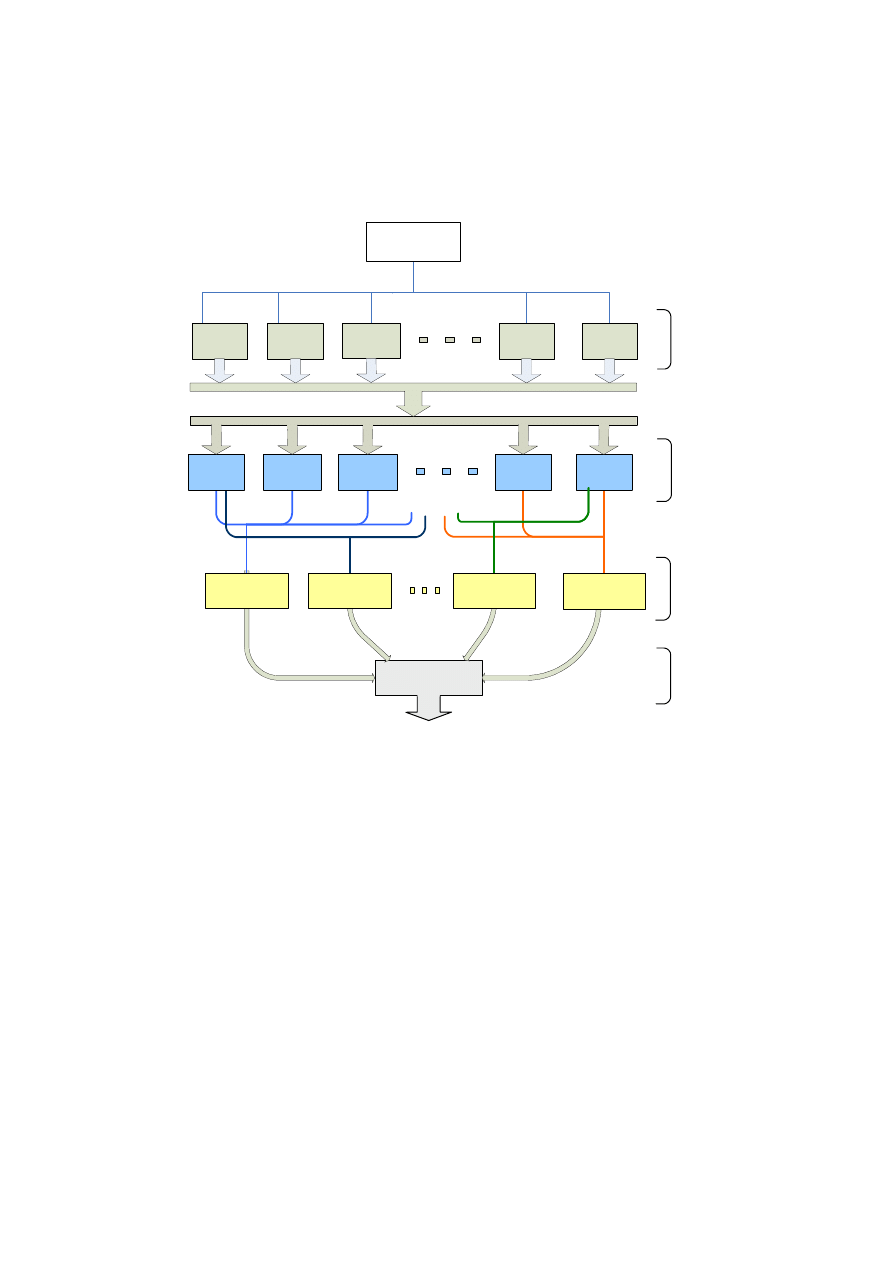
Troika uses three layers of combining classifiers (Figure 1), rather than one, as with
Stacking. The result is a better ensemble scheme, usually with multi-class problems
where there are enough instances [Menahem, 2008]. In [Menahem, 2008] the writer
shows that Troika, in average, is better than using the best classifier selected using
cross-validation.
Super Classifier
Base
Classifier
Instance
Final Decision
(classification)
P(C
0
)
Base
Classifier
L
e
v
e
l-
0
: B
a
s
e
c
la
s
s
if
ie
rs
Base
Classifier
Specialist
classifier
0-1
Specialist
classifier
0-2
Specialist
classifier
0-3
Specialist
classifier
(k-3)-(k-1)
Specialist
classifier
(k-2)-(k-1)
Meta Classifier for
Class C
0
Meta Classifier for
Class C
1
Meta Classifier for
Class C
k-1
P(C
1
)
P(C
k-2
)
P(C
k-1
)
Meta Classifier for
Class C
k-2
Base
Classifier
Base
Classifier
L
e
v
e
l-
1
: S
p
e
c
ia
lis
ts
L
e
v
e
l-
2
: M
e
ta
c
la
s
s
if
ie
rs
L
e
v
e
l-
3
: S
u
p
e
r
c
la
s
s
if
ie
r
Fig. 1. Troika Architecture reveals three layers of combining classifiers; the Specialists
classifiers, combine the outputs of the base-classifiers, Meta classifiers combine the Specialists
classifiers outputs, and finally, the Super-classifier, combine all Meta-classifiers outputs. The
Super classifiers is responsible of output Troika’s prediction.
3 Evaluation Description
In this section we specify the conditions in which all combination methods had been
tested. Our goal was to create a ground on which all combination methods could be
correctly compared. First we indicate the algorithms compared. Then we describe the
training process and the datasets we had used. Next, we show the metrics we used to

measure the performance of the ensemble schemes, and finally, we display and
review the results of the experiments in details.
3.1 Base Classifiers and Combination Methods
In the experiment we had used five different inducers as our base classifiers: C4.5
[Quinlan, 1993], KNN [Kibler, 1991], VFI [Guvenir, 1997], OneR [Holte, 1993] and
Naïve-Bayes [John and Langley, 1995]. Each inducer belongs to different family of
classifiers. For example, C4.5 related to Decision Trees, KNN belong to Lazy
classifiers, OneR to Rules, Naïve-Bayes to Bayes classifiers and VFI to general. We
have chosen those five inducers because (1) they are from different classifiers family,
therefore, may yield different models that eventually will classify differently on some
inputs. In an ensemble, the combination of the output of several classifiers is only
useful if they disagree about some inputs [Tumer and Ghosh, 1996], and (2) there is a
difference in classification accuracy among the inducers; preliminary experiments on
our datasets show that C4.5 and KNN are relatively accurate (have better than 80%
accuracy) while OneR and Naïve-Bayes are not. This property may differentiate
between good ensemble and a bad one, because we expect good ensemble will mostly
use the information made by the good induces, while ignoring most of the poor
inducers.
In this study, we compared the following combination methods: best classifier
(classifier which out-performs all the others, selected using cross validation), Majority
Voting, Performance Weighting, Distribution Summation, Bayesian Combination,
Naive Bayes, Stacking and Troika. The examined ensemble schemes were
implemented in WEKA (Witten and Frank, 2005) in JAVA programming language.
3.2 Datasets
We collected a large set of 22,735 benign files and 7690 malware that were identified
as Win32 executable and DLLs. For each file three types of features were extracted:
n-grams, Portable Executable (PE) features and Function-based features as described
bellow.
We developed a tool that extracts n-grams from the binary representation of a file.
The tool parsed the files using a sliding window producing n-grams of varying lengths
(denoted by n). We extracted vocabularies of 16,777,216, 1,084,793,035,
1,575,804,954 and 1,936,342,220, for 3-gram, 4-gram, 5-gram and 6-gram
respectively. Next, each n-gram term was represented using its Term Frequency (TF)
and its Inverse Document Frequency (TF-IDF). The TF measure is the number of its
appearances in the file, divided by the term with the maximal appearances. IDF is the
log value of the number of files in the all repository, divided by the number of files
that includes the term. The TF-IDF measure is obtained by multiplying TF by IDF.
In ML applications, the large number of features in many domains presents a huge
problem in that some features might not contribute (possibly even harm) the
classification accuracy. Moreover, in our case, trimming the number of features is
crucial; however, this should be done without diminishing classification accuracy.

The reason for this constraint is that, as shown above, the vocabulary size may exceed
billions of features, far more than the processing capacity of any abundant feature
selection tool. Moreover, it is important to identify those terms that appear most
frequently in files in order to avoid vectors that contain many zeros. Thus, we first
extracted the top features based on the Document Frequency (DF) measure, which is
the number of files the term was found in. We selected the top 0 - 5,500 features
which appear in most of the files, (those with highest DF scores) and the top 1,000 -
6,500 features. Finally, we used three methods of feature selection: Document
Frequency, Fisher Score [Golub et al., 1999], and Gain Ratio [Mitchell, 1997] in
order to choose the top 50, top 100, top 200 and top 300 n-grams, out of the 5,500 n-
grams, to be used for the evaluation.
After performing rigorous experiments in which we evaluated several inducers on
the 192 different n-gram datasets, we chose the top 300 5-grams with TF-IDF values,
top 300 6-grams with TF-IDF and top 300 6-grams, with TF datasets providing the
best results.
Certain parts of EXE files might indicate that a file is affected by a virus. This may
be an inconsistency between different parts of version numbers or internal/external
name of a file; some patterns in imported DLLs may be typical for a virus. To verify
our hypothesis, we statically extracted different Portable Executable (PE) format
features that represented information contained within each Win32 PE binary (EXE or
DLL). For this purpose, the tool named PE Feature Extractor was implemented in
C++. Feature Extractor parses an EXE\DLL file according to PE Format rules. The
information extracted by this tool is as follows (total of 88 attributes):
-
Information extracted from the PE Header that describes the details about physical
structure of a PE binary (e.g., creation\modification time, machine type, file size)
-
Optional PE Header information describing the logical structure of a PE binary
(e.g., linker version, section alignment, code size, debug flags)
-
Import Section: which DLLs were imported and which functions from which
imported DLLs were used
-
Exports Section: which functions were exported (if the file being examined is a
DLL)
-
Resource Directory: resources used by a given file (e.g., dialogs, cursors)
-
Version Information (e.g., internal and external name of a file, version number)
A new method for extracting features from the binary code of the files was
implemented and extracted for the experiment. In this method (hereby Function
Detector method) we use a J48 decision tree classifier in order to mark beginnings
and endings of functions resides in the binary representation of the files. Using those
marks we extract function from each file and generate the following attributes (total
of 17 attributes):
-
Size of file
-
File's entropy value
-
Total number of detected functions
-
Size of the longest function that was detected
-
Size of the shortest function that was detected
-
Average size of detected functions
-
Standard deviation of the size of detected functions

-
Number of functions divided into fuzzy groups by its length in bytes (16, 24, 40,
64, 90, 128 and 256 bytes)
-
Functions ratio- the proportion of number of detected functions from the overall
size of the file
-
Code ratio- the proportion of the size (in bytes) of detected functions from the
overall size of the file
Unfortunately, due to processing power and memory limitations we could not run
our ensemble experiments on the entire datasets and we had to reduce the datasets in
order to complete the experiments in reasonable time.
Therefore, for the evaluation process we had produced a new dataset from the original
dataset by choosing randomly 33% of the instances (i.e., files) in the original datasets
and we applied the Gain Ratio feature selection method [Mitchell, 1997] on the n-
gram based and PE datasets.
As a result, each ensemble scheme in our experiment was tested upon 10 datasets.
We had 5 different datasets, and each dataset had two versions. First version
contained binary classification (each instance has a ‘benign’ or ‘malicious’ labels) and
the second, which contained the same instances and attributes, had 8 classes since we
had split up the class ‘malicious’ into 7 sub-classes: ‘Virus’, ‘Worm’, ‘ Flooder’,
‘Trojan’, ‘Backdoor’, ‘Constructor’ and ‘Nuker’. The instances that got the ‘Benign’
label in the first version had the same labels in the second version.
Table 1. Properties of the data-sets we used in our experiment.
Dataset
#Classes #Instances #Attributes
6-grams TF-2C
2
9914
31
6-grams TFIDF-2C
2
9914
31
5-grams TFIDF-2C
2
9914
31
PE-2C
2
8247
30
FD-2C
2
9914
17
6-grmas TF-8C
8
9914
31
6-grams TFIDF-8C
8
9914
31
5-grams TFIDF-8C
8
9914
31
PE-8C
2
8247
30
FD-8C
2
9914
17
3.3 The Training Process
The training process includes the training of the base-classifiers (the classifiers we
later combine) and may include the training of the meta-data set if required. Figure 2
shows the dataset partitioning for each ensemble method. Troika and Stacking
training sets have more partitions due to their inner k-fold cross-validation training
process. Troika and Stacking train their base classifiers using same percentage of
dataset instances, which is 80% of the original train-set (which is 72% of the entire
dataset) while the rest 20% of the training instances are reserved for the training of the
combining classifier(s). Weighting methods, like voting and Distribution summation,
on the other hand, use 100% of the train-set (which is 90% of the original dataset) for
the training of the base-classifiers.
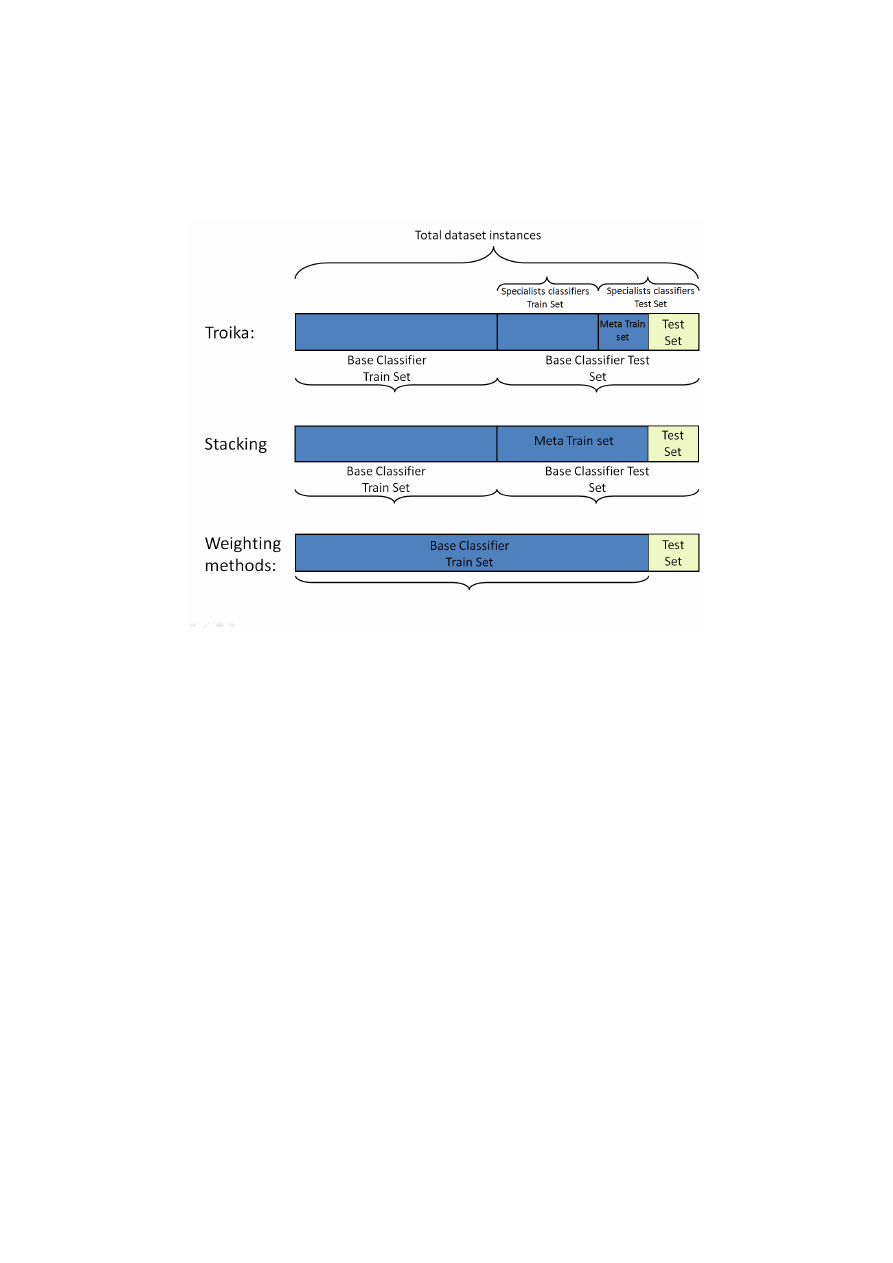
Fig. 2. Cross validation scheme for training and testing ensembles methods.
In order to estimate the generalized accuracy, a 10-fold cross-validation procedure
was repeated 5 times. In each of the cross-validation iteration, the training set was
randomly partitioned into 10 disjoint instance subsets. Each subset was utilized once
in a test set and nine times in a training set. The same cross-validation folds were
implemented for all algorithms.
3.4 Measured Metrics
In order to evaluate the performance of individual classifiers and ensemble
combination methods, we used the following common metrics: Accuracy, Area Under
the ROC curve, and Training time.
Accuracy is the rate of correct (incorrect) predictions made by a model over a data
set. Since the mean accuracy is a random variable, the confidence interval was
estimated by using the normal approximation of the binomial distribution.
Furthermore, the one-tailed paired t-test with a confidence level of 95% verified
whether the differences in accuracy between a tested ensemble pair were statistically
significant. In order to conclude which ensemble performs best over multiple datasets,
we followed the procedure proposed in [Demsar, 2006]. In the case of multiple
ensemble of classifiers we first used the adjusted Friedman test in order to reject the

null hypothesis and then the Bonferroni–Dunn test to examine whether a specific
ensemble performs significantly better than other ensembles.
The ROC (Receiver Operating Characteristic) curve is a graph produced by
plotting the fraction of true positives (TPR = True Positive Rate) versus the fraction
of false positives (FPR = False Positive Rate) for a binary classifier as its
discrimination threshold varies. The best possible classifier would thus yield a point
in the upper left corner or coordinate (0,1) of the ROC space, representing 0% false
positives and 100% true positives. We will use the Area Under the ROC Curve
(AUC) measure in the evaluation process. The AUC value of the best possible
classifier will be equal to 1, which means that we can find a discrimination threshold
under which the classifier will obtain 0% false positives and 100% true positives. A
higher AUC value means that the ROC graph is closer to the optimal threshold. ROC
analysis provides tools to select possibly optimal models and to discard suboptimal
ones independently from (and prior to specifying) the cost context or the class
distribution. ROC analysis is related in a direct and natural way to cost/benefit
analysis of diagnostic decision making. Widely used in medicine, radiology,
psychology and other areas for many decades, it has been introduced relatively
recently in other areas such as machine learning and data mining.
The Execution time (Training time) measure is an applicative one. It has two
significances; first, and most logical, heavy time consumption is bad. We would
prefer a fast learning ensemble that will yield the best accuracy or area under ROC.
Second, the longer time the training of an ensemble takes, the more CPU time it
requires, and thus, the more energy it consumes. This is very important on mobile
platforms that may be using an ensemble for various reasons.
4 Evaluation Results and Analysis
Tables 2-4, present the results obtained using 9 inducers. The 10-fold cross-validation
procedure which was repeated five times.
Table 2. Comparing the Accuracies of the ensemble algorithms using C4.5, OneR, VFI, KNN
and Naïve-Bayes inducers.
Dataset
Voting
Distribution
Summation
Naïve-Bayes
Combination
Bayesian
Combination
Performance
Weighting
Stacking
Troika
Best B.C.
B.C.
Name
FD-8C
80.13 ± 0.88 81.53 ± 0.93 12.42 ± 1.45 81.71 ± 0.75 39.72 ± 3.73 81.27 ± 1.16 82.20 ± 0.81 79.87 ± 0.85
C4.5
FD-2C
83.12 ± 0.81 84.43 ± 0.81 78.60 ± 1.25 84.55 ± 0.96 81.33 ± 0.87 85.83 ± 1.09 83.70 ± 0.96 84.63 ± 1.09
C4.5
PE-8C
89.96 ± 1.44 90.44 ± 1.52 79.39 ± 1.66 90.51 ± 1.56 88.58 ± 1.73 90.87 ± 1.52 91.56 ± 1.38 91.82 ± 1.46
KNN
PE-2C
93.89 ± 0.82 94.01 ± 0.73 94.82 ± 0.75 94.83 ± 0.67 87.79 ± 1.53 95.99 ± 0.76 96.30 ± 0.61 96.10 ± 0.59
KNN
6gram tf-8C
81.15 ± 0.93 83.35 ± 0.88 42.17 ± 1.46 83.13 ± 0.82 70.64 ± 1.93 83.08 ± 1.02 83.42 ± 1.03 83.48 ± 1.03
KNN
6gram tf-2C
91.57 ± 0.93 91.19 ± 0.93 67.12 ± 1.57 91.39 ± 0.87 67.57 ± 1.67 93.26 ± 0.81 93.31 ± 0.76 93.26 ± 0.77
KNN
5gram tfidf-8C 81.39 ± 0.89 83.90 ± 0.86 36.09 ± 1.55 83.81 ± 0.80 45.23 ± 3.65 83.40 ± 0.97 84.16 ± 0.96 84.12 ± 0.97
KNN
5gram tfidf-2C 94.00 ± 0.78 92.13 ± 0.83 64.28 ± 1.36 93.96 ± 0.88 64.43 ± 1.36 94.03 ± 0.86 94.10 ± 0.78 94.08 ± 0.82
KNN
6gram tfidf-8C 80.48 ± 0.96 83.29 ± 0.89 59.86± 1.38
83.11 ± 0.91 46.64 ± 4.47 82.27 ± 1.09 83.08 ± 0.97 83.00 ± 0.98
KNN
6gram tfidf-2C 94.24 ± 0.69 92.73 ± 0.83 53.47 ± 1.97 94.63 ± 0.65 60.54 ± 1.93 94.53 ± 0.65 94.55 ± 0.66 94.53 ± 0.66
KNN
Average
87.76 ± 0.92 88.38 ± 0.92 53.47 ± 1.3
88.16 ± 0.89 65.25 ± 2.29 89.25 ± 0.97 89.35 ± 0.9 88.49 ± 0.92

Table 3. Comparing the Area Under the ROC curve (AUC) of the ensemble algorithms using
C4.5, OneR, VFI, KNN and Naïve-Bayes inducers.
Dataset
Voting
Distribution
Summation
Naïve-Bayes
Combination
Bayesian
Combination
Performance
Weighting
Stacking
Troika
Best B.C.
B.C.
Name
FD-8C
0.83 ± 0.01 0.85 ± 0.02
0.55 ± 0.01
0.85 ± 0.02
0.79 ± 0.02
0.86 ± 0.01 0.86 ± 0.01 0.79 ± 0.02
C4.5
FD-2C
0.82 ± 0.01 0.84 ± 0.02
0.76 ± 0.02
0.83 ± 0.02
0.81 ± 0.02
0.86 ± 0.02 0.86 ± 0.02 0.8 ± 0.02
C4.5
PE-8C
0.99 ± 0.01 0.99 ± 0.01
0.95 ± 0.02
0.99 ± 0.01
0.99 ± 0.01
0.98 ± 0.01 0.99 ± 0.01 0.95 ± 0.01
C4.5
PE-2C
0.98 ± 0.01 0.98 ± 0.00
0.94 ± 0.01
0.98 ± 0.00
0.96 ± 0.01
0.99 ± 0.01 0.99 ± 0.00 0.98 ± 0.0
C4.5
6gram tf-8C
0.97 ± 0.01 0.97 ± 0.01
0.77 ± 0.01
0.97 ± 0.01
0.97 ± 0.01
0.94 ± 0.01 0.95 ± 0.02 0.95 ± 0.01
KNN
6gram tf-2C
0.97 ± 0.01 0.97 ± 0.01
0.77 ± 0.01
0.97 ± 0.01
0.95 ± 0.01
0.96 ± 0.01 0.97 ± 0.01 0.96 ± 0.01
C4.5
5gram tfidf-8C 0.97 ± 0.01 0.97 ± 0.01
0.73 ± 0.01
0.97 ± 0.01
0.96 ± 0.01
0.94 ± 0.01 0.96 ± 0.01 0.96 ± 0.01
C4.5
5gram tfidf-2C 0.97 ± 0.01 0.97 ± 0.01
0.75 ± 0.01
0.97 ± 0.01
0.95 ± 0.01
0.96 ± 0.02 0.98 ± 0.01 0.95 ± 0.01
C4.5
6gram tfidf-8C 0.96 ± 0.01 0.97 ± 0.01
0.50 ± 0.00
0.97 ± 0.01
0.95 ± 0.01
0.95 ± 0.01 0.95 ± 0.02 0.94 ± 0.01
C4.5
6gram tfidf-2C 0.97 ± 0.01 0.97 ± 0.01
0.80 ± 0.02
0.97 ± 0.01
0.94 ± 0.01
0.97 ± 0.01 0.98 ± 0.01 0.95 ± 0.01
C4.5
Average
0.95 ± 0.01 0.96 ± 0.01
0.75 ± 0.01
0.95 ± 0.01
0.93 ± 0.01
0.95 ± 0.01 0.96 ± 0.01 0.92 ± 0.01
Table 4. Comparing the execution (training) time of the ensemble algorithms using C4.5,
OneR, VFI, KNN and Naïve-Bayes inducers.
Dataset
Voting
Distribution
Summation
Naïve-Bayes
Combination
Bayesian
Combination
Performance
Weighting
Stacking
Troika
FD-8C
8.3 ± 0.2
8.3 ± 0.2
2.1 ± 0.1
24.7 ± 0.2
24.6 ± 0.3
278.6 ± 1.8
4693.1 ± 96.4
FD-2C
0.4 ± 0.0
0.4 ± 0.1
1.4 ± 0.1
21.8 ± 0.8
22.1 ± 1.7
285.4 ± 48.4
170.6 ± 1.5
PE-8C
5.6 ± 0.7
5.7 ± 0.7
1.2 ± 0.1
10.6 ± 0.3
10.8 ± 0.4
273.3 ± 8.6
1676.7 ± 94.1
PE-2C
0.9 ± 0.1
0.9 ± 0.1
0.2 ± 0.0
18.8 ± 0.2
18.7 ± 0.4
160.7 ± 3.8
403.9 ± 4.0
6gram tf-8C
0.9 ± 0.2
0.9 ± 0.2
2.3 ± 0.1
26.7 ± 0.8
27.0 ± 1.1
179.3 ± 3.3
5136.6 ± 165.0
6gram tf-2C
0.6 ± 0.1
0.7 ± 0.1
1.3 ± 0.1
23.3 ± 1.0
23.4 ± 2.2
162.9 ± 3.2
353.9 ± 12.0
5gram tfidf-8C
0.9 ± 0.1
0.8 ± 0.1
2.4 ± 0.1
31.3 ± 0.4
31.3 ± 0.7
190.8 ± 16.5
5805.2 ± 141.2
5gram tfidf-2C
0.7 ± 0.1
0.7 ± 0.1
1.5 ± 0.1
25.3 ± 0.4
25.3 ± 0.7
175.2 ± 1.7
409.9 ± 5.3
6gram tfidf-8C
0.9 ± 0.2
0.9 ± 0.1
3.2 ± 0.1
35.8 ± 1.0
37.2 ± 1.2
183.5 ± 3.2
19267.7 ± 331.8
6gram tfidf-2C
0.6 ± 0.1
0.6 ± 0.1
1.6 ± 0.1
25.0 ± 0.3
26.0 ± 0.6
162.3 ± 3.1
388.4 ± 2.2
Average
2.0 ± 0.2
2.0 ± 0.2
1.7 ± 0.1
24.3 ± 0.5
24.6 ± 0.9
205.2 ± 9.4
3830.6 ± 85.3
4.1 Results Analysis - Accuracy
As can be seen from Table 2, there are some variability among the ensembles mean
predictive accuracy. We can see that two ensembles (Troika and Stacking) excels best
base-classifier by cross-validation, two other ensembles (Distribution summation and
Bayesian combination) are close to best base-classifier from below and the rest three
(Voting, Naïve-Bayes and Performance weighting) got the lowest results, away below
best base-classifier. A question arises: does this accuracy variability is statistically
significant? If the answer is positive, then we would like to know which of the
ensembles is better than the others.
We had used the adjusted non-parametric Friedman test in order to check the first
hypothesis, that all combination methods perform the same, and the results was that
the null-hypothesis could be rejected with a confidence level of 95%. The next step,
than, is to decide which of the ensembles, if any, performs best. To that purpose we
used the Bonferroni-Dunn test on each pair of ensembles. Below, in Table 5 we show
the results of the pairs test results.

Table 5. Showing the significance of the difference of the ensembles' accuracies. The "
▲
"
symbol indicates that the degree of accuracy of the row’s ensemble scheme was significantly
higher than the Column’s ensemble scheme at a confidence level of 95%. For example, as can
be seen in the table below, Troika’s accuracy is higher than Performance-Weighting. The "
◄
"
symbol, on the contrary, indicates the accuracy of the row’s ensemble scheme was significantly
lower and the "
" symbol indicates no significant difference.
Ensemble
Method
Stacking
Performance
Weighting
Bayesian
Combination
Naïve-Bayes
Combination
Distribution
Summation
Voting
Best Base-
classifier
Troika
▲
▲
▲
Stacking
▲
▲
Performance Weighting
◄
◄
◄
Bayesian Combination
▲
Naïve-Bayes Combination
◄
◄
Distribution summation
Voting
◄
In order to identify the ensemble method that predicts with best accuracy we
summarized the result of Table 5 in yet another table, Table 6. This time we
calculated a score to each ensemble scheme:
ε
+
=
worse
better
score
#
#
(8)
where #better is the number of cases where the ensemble was better than other
ensemble and #worse is the number of cases where the ensemble was worse than
other ensemble.
Equation (8) ensures that the ensemble with maximum #better and minimum #worse
will get highest score.
Table 6. Score of each ensemble scheme ordered from most successful at top, to worse at
bottom. For the score calculation we added a small number (ε=0.001) to the denominator in
order to avoid cases of division by zero.
Ensemble Method
#Worse
#Better
Score
Rank
Troika
0
3
3001
1
Best base-classifier
0
3
3001
1
Stacking
0
2
2001
2
Bayesian Combination
0
2
2001
2
Distribution Summation
1
2
1.999
3
Voting
2
0
0.0005
4
Performance Weighting
5
0
0.0002
5
Naive-Bayes combination
5
0
0.0002
5
4.2 Results Analysis - AUC
Table 3 shows the AUC results of all examined ensembles. We can see that all
ensembles except Naïve-Bayes excel Best base-classifier by cross-validation. Two
ensembles (Distribution summation and Troika) got the best result, which seems
significantly better than best-classifier’s. All other ensembles AUC results are in the

area of 93% to 95%. Again, we would like to check if the change in ensembles’ AUC
is significant and if it is, then we would like to know who the best ensemble is.
We had used the adjusted non-parametric Friedman test in order to check the first
hypothesis, that all ensemble AUCs are the same, and the results was that the null-
hypothesis could be rejected with a confidence level of 95%. Next, we used the
Bonferroni-Dunn test on each pair of ensembles to check which ensemble AUC
significantly is better. Below, in Table 7 we show the results of this pairs test results.
Table 7. Showing the significance of the difference of the ensembles' AUCs. The "
▲
" symbol
indicates that the degree of AUC of the row’s ensemble scheme was significantly higher than
the Column’s ensemble scheme at a confidence level of 95%. he "
◄
" symbol, on the contrary,
indicates the AUC of the row’s ensemble scheme was significantly lower and the "
" symbol
indicates no significant difference.
Ensemble
Method
Stacking
Performance
Weighting
Bayesian
Combination
Naïve-Bayes
Combination
Distribution
Summation
Voting
Best Base-
classifier
Troika
▲
▲
▲
Stacking
▲
Performance Weighting
◄
◄
Bayesian Combination
▲
▲
Naïve-Bayes Combination
◄
◄
Distribution summation
▲
Voting
We had summarized the result of Table 7 in table 8 in order to check who has the best
AUC. We calculated a score of each ensemble scheme using equation (8).
Table 8. Score of each ensemble scheme ordered from most successful at top, to worse at
bottom. For the score calculation we added a small number (ε=0.001) to the denominator in
order to avoid cases of division by zero.
Ensemble Method
#Worse
#Better
Score
Rank
Troika
0
3
3001
1
Bayesian Combination
0
3
3001
1
Distribution Summation
0
3
3001
1
Stacking
0
1
1001
2
Voting
0
1
1001
2
Best base-classifier
3
1
0.3333
3
Performance Weighting
3
0
0.0003
4
Naive-Bayes combination
5
0
0.0001
5
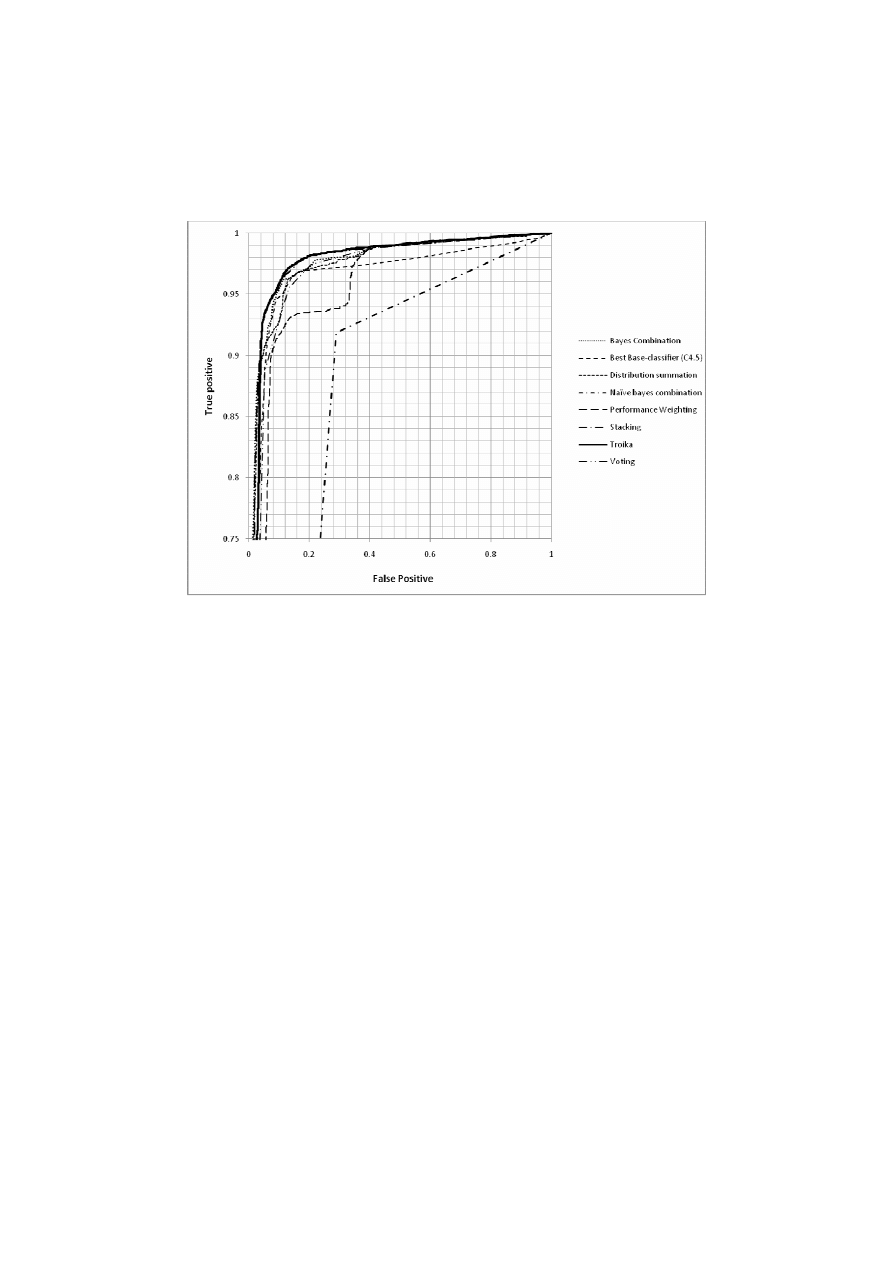
Fig. 3. ROC graphs of all eight competitive ensemble combination methods. In spite of the load
in the graph above, it still can be easily seen that Troika, in the strong line, excels its opponents
when false positive is higher than 0.1. For producing this graph, we tested all ensemble
combination methods on “5-gram TFIDF-2C”.
4.3 Results Analysis – Execution Time
Table 4 shows the Execution time results of the examined ensembles. We can spot
two groups of ensembles. The first group consists of all weighing ensembles (Naive-
Bayes combination, Performance Weighting, Voting, Distribution Summation and
Bayesian Combination) and the common character of this group is execution time of
coupe single seconds in average. Second group composed from the meta-combiner
ensembles (Troika and Stacking) in which the common character is execution time
(training time) of more than 1000 seconds in average. Meta-combiner ensembles
consume more time during their training phase due to the fact that they need to train
their combiner classifier, usually in a k-fold cross-validation manner. The difference
in the results of the two groups is bold and no statistical examination is required.

4.4 Results Analysis – Summary
In Table 9 we summarize the accuracy, AUC and execution time scores of all
ensemble combination methods. The ranking is from 1 to 5 where ‘1’ is worse and ‘5’
is best.
Table 9. Summarizing the accuracy, AUC and execution time rank assigned to each of the
ensemble combination methods.
Ensemble Method
Accuracy
AUC
Execution
Time
Troika
5
5
1
Stacking
4
4
2
Best base classifier
4
3
5
Bayesian Combination
4
5
4
Distribution Summation
3
5
4
Voting
2
4
4
Performance Weighting
1
2
4
Naive-Bayes combination
1
1
4
The table shows that Troika has best accuracy and AUC but suffers from worse
execution time. Stacking has a disadvantage of accuracy and AUC, but its execution
time is somewhat better than Troika’s. Choosing Best classifier using cross-validation
is not too bad option; in fact, it is a better option than using several other ensemble
combination methods like Naïve-Bayes for example. Its accuracy and AUC are
mediocre, but it is the fastest to execute. Bayesian Combination is probably the best
of its family of weighting ensembles. Its accuracy is almost comparable to Troika, its
AUC is a top class and its execution time is very good. Distribution Summation
accuracy is average, but it belong to group of ensembles that has best AUC. Its
execution time is same as all weighting methods. Voting, Performance Weighting and
Naive-Bayes combination have a medium-low accuracy and AUC. Their execution
time is as all other weighting methods.
4.5 Results Analysis – Dataset Class Labeling
In this experiment, we had 5 different datasets each had two versions. First version
contained two classes (‘Benign’ and ‘Malware’) and the second contained eight
classes (‘Benign’, ‘Virus’, Worm’ etc.). To remind, the two versions contained the
same instances in same order. The only difference was that the instances labeled
‘Malware’ in the two-class version had been given a more specific label in the multi-
class version of the dataset. The purpose of producing second and multi-class version
of each dataset was to check if this conversion will yield better ensemble
performance. It is sometimes important in the Security domain to discriminate
between files of different malware types. For example, it may be important to the
security officer to know that a particular threat his organization had encounter was
Worm rather than Trojan, because the implication and countermeasures might be
completely different. Another important parameter is the FPR which is very important

to reduce to minimal acceptable value. The meaning of FPR in security domain is the
proportion of benign files that were classified as malware (an erroneous classification)
to the total classified files.
In this part of the work we had examined the hypothesis that using a multi-class
datasets will help minimizing the FPR of the tested ensemble. The idea was that since
there are more benign files compare to any specific malware family files, than the
base-classifiers will be biased towards the Benign files which eventually will yield a
lower False-positive cases, on the account of possibly producing more False-negative.
The examined parameter is AUC of class benign, since, to our belief, AUC reflects
the successfulness of the classifier (the ensemble, in this case) better than that of
Accuracy.
The results in Table 10 show that only four ensembles benefit from the transition to
multi-class dataset – Distribution-summation, voting, performance weighting and
Troika. While the while each of the first three improvements is less than 2 percent
Troika manage to improve in about 8 percents, which is not negligible. On the other
hand, there are few ensembles that got worse; Naïve-Bayes Combination, for
example, suffers from more than 4 percent decrease in AUC due to this transition.
Table 10. AUC of ensemble combination methods for the ‘Benign’ class. The table is divided
into two sections. In first section we present the AUC results of multi-class datasets. In the
second section we present AUC results of binary-class datasets. In the last row of the table we
summarize the improvement in FPR (False-positive rate) of each ensemble when using multi-
class instead of using binary-class datasets. The improvement is specified in percents. Negative
improvement indicates that using multi-class dataset had worsened FPR.
Dataset
Bayesian
Combination
Distribution
Summation
Stacking
Voting
Naive Bayes
Combination
Performance
Weighting
Troika
C4.5
FD-8C
0.800±0.028
0.850±0.017
0.799±0.030
0.844±0.01
0.825±0.056
0.844±0.018
0.820±0.022 0.687±0.040
PE-8C
0.990±0.007
0.990±0.007
0.975±0.008 0.984 ±0.009
0.798±0.030
0.988±0.007
0.988±0.007 0.959±0.011
6gram tf-8C
0.969±0.007
0.968±0.007
0.966±0.010 0.965±0.007
0.779±0.021
0.965±0.008
0.968±0.008 0.952±0.010
5gram tfidf-8C
0.971±0.002
0.970±0.005
0.966±0.002 0.807±0.057
0.941±0.063
0.972±0.007
0.959±0.008 0.972±0.005
6gram tfidf-8C
0.968±0.015
0.967±0.008
0.965±0.011 0.961±0.010
0.863±0.034
0.946±0.029
0.970±0.012 0.949±0.016
Average 8C
0.940±0.07
0.949±0.03
0.93±0.03
0.912±0.04
0.841±0.04
0.943±0.03
0.941±0.04
0.904±0.03
FD-2C
0.843±0.017
0.795±0.025
0.837±0.014 0.829±0.018
0.823±0.074
0.809±0.018
0.644±0.072 0.814±0.017
PE-2C
0.983±0.005
0.983±0.007
0.977±0.008 0.795±0.064
0.942±0.067
0.984±0.009
0.967±0.012 0.983±0.005
6gram tf-2C
0.971±0.008
0.960±0.009
0.969±0.008 0.966±0.010
0.955±0.055
0.963±0.012
0.808±0.058 0.950±0.010
5gram tfidf-2C
0.971±0.012
0.971±0.007
0.967±0.011 0.965±0.007
0.829±0.062
0.949±0.014
0.974±0.007 0.941±0.046
6gram tfidf-2C
0.967±0.012
0.953±0.042
0.969±0.016 0.959±0.015
0.836±0.051
0.939±0.016
0.972±0.009 0.952±0.016
Average 2C
0.947±0.01
0.932±0.02
0.944±0.01
0.903±0.02
0.877±0.06
0.929±0.01
0.873±0.03
0.928±0.02
%improvement
using 8C
-0.752%
1.783%
-1.026%
1.006%
-4.100%
1.535%
7.779%
-2.594%
5 Conclusions and Future Work
In this paper we had examined seven different combination methods plus one
alternative for ensemble (selecting best classifier using cross-validation) in the
security domain. The goal was to identify the best combination method. We had used
5 different datasets that were produced using various techniques and we had made
two versions of each. The first version was binary-classed and second copy was
multi-classed. Three interesting parameters where measured; accuracy, AUC and

execution-time. We find it most interesting that each ensemble had its own characters
and no two where alike.
From the results we learn that in terms of accuracy, and AUC, Troika is probably
the best choice; it is better than Stacking, the only other ensemble in the group of
Meta-classifier ensemble. It is also better than best classifier chosen using cross-
validation. The benefit of using Troika is double; first, its AUC and accuracy are very
high. Second, when using multi-class dataset, it’s AUC getting improved in about 8%,
producing a model with lower FPR and a nice capability of identifying the malware’s
specific class. Bayesian-combination, for instance, being second best in accuracy and
AUC, had had a fall of 1% in its AUC performance when tested on multi-class
dataset. If Execution time is a big concern, than Bayesian Combination will be the
best choice, being only second only to Troika in terms of accuracy and AUC.
We do not recommend using Naïve-Bayes ensemble method.
We can also see that the Naïve-Bayes ensemble method only good property is its
fast execution time which is the same as all weighting methods. Its accuracy and AUC
are fairly bad compare to all other ensembles. One explanation to its poor
performance is the fact that its assumptions are probably not taking place; for
example, the assumption of independent base-classifier does not exist in practice.
Future work may include the involvement of more inducers for base-classifiers (we
had only used 5, while there are plenty more to choose from), some different methods
of training the base classifiers – in this research we had used only the trivial training
method while there are many other methods that uses binarization of datasets (for
example - One against One or One against All) which may yield better accuracy and
AUC performance. In addition, in the hereby described experiment, we evaluated
different inducers on the same datasets. In future experiments we would like to
evaluate the performance of inducers that are trained on different features.
Acknowledgments. This research is supported by Deutsche Telecom AG.
References
1.
Abou-Assaleh, T., Cercone, N., Keselj, V., and Sweidan, R., 2004. N-gram based Detection
of New Malicious Code. Proc. of the Annual International Computer Software and
Applications Conference (COMPSAC'04).
2.
Buntine, W., 1990. A Theory of Learning Classification Rules. Doctoral dissertation.
School of computing Science, University of Technology, Sydney.
3.
Caia D. M., Gokhaleb M., Theilerc J., 2007. Comparison of Feature Selection and
Classification Algorithms in Identifying Malicious Executables. Computational Statistics
and Data Analysis vol. 51, pp. 3156 – 3172.
4.
Clark, P., and Boswell, R., 1991. Rule induction with CN2: Some recent improvements.
Proc. of the European Working Session on Learning, pp. 151-163.
5.
Demsar, J., 2006. Statistical Comparisons of Classifiers over Multiple Data Sets. Journal of
Machine Learning Research, vol. 7, pp. 1-30.
6.
Dikinson, J., 2005. The new anti-virus formula. http://www.solunet.com/wp/security/How-
to-use-multrd-security.pdf.
7.
Dzeroski, S., and Zenko, B., 2004. Is Combining Classifiers with Stacking Better than
Selecting the Best One?. Machine Learning, 54(3) 255-273.

8.
John, G. H., and Langley, P., 1995. Estimating Continuous Distributions in Bayesian
Classifiers. In Proc. of the Conference on Uncertainty in Artificial Intelligence, pp. 338-
345.
9.
John, G. H., and Langley, P., 1995. Estimating Continuous Distributions in Bayesian
Classifiers. Proc. of the Conference on Uncertainty in Artificial Intelligence, San Mateo, pp.
338-345.
10.
Golub, T. et al., 1999. Molecular classification of cancer: Class discovery and class
prediction by gene expression monitoring. Science, vol. 286, pp. 531-537.
11.
Guvenir, G. D., 1997. Classification by Voting Feature Intervals. Proc. of the European
Conference on Machine Learning, pp. 85-92.
12.
Heidari, M., 2004. Malicious Codes in Depth. http://www.securitydocs.com/pdf/2742.pdf.
13.
Holte, R., 1993. Very Simple Classification Rules Perform Well on Most Commonly Used
Datasets. Machine Learning, vol. 11, pp. 63-91.
14.
Kabiri, P., and Ghorbani, A. A., 2005. Research on Intrusion Detection and Response: A
Survey. International Journal of Network Security, 1(2) 84-102.
15.
Kelly, C., Spears, D., Karlsson, C., and Polyakov, P., 2006. An Ensemble of Anomaly
Classifiers for Identifying Cyber Attacks. Proc. of the International SIAM Workshop on
Feature Selection for Data Mining.
16.
Kibler, D. A., 1991. Instance-based learning algorithms. Machine Learning, pp. 37-66.
17.
Kienzle, D.M., and Elder, M.C., 2003. Internet WORMS: past, present, and future: Recent
worms: a survey and trends. ACM workshop on Rapid malcode (WORM03).
18.
Kittler, J., Hatef, M., Duin, R., and Matas, J., 1998. On Combining Classifiers. IEEE
Transactions on Pattern Analysis and Machine Intelligence, 20(3) 226-239.
19.
Kolter, J., Maloof, M., 2006. Learning to Detect and Classify Malicious Executables in the
Wild. Journal of Machine Learning Research, vol. 7, pp. 2721-2744.
20.
Kuncheva L.I., 2005. Diversity in Multiple Classifier Systems (Editorial), Information
Fusion, 6 (1) 3-4.
21.
Mahoney, M.V., 2003 A machine learning approach to detecting attacks by identifying
anomalies in network traffic. Ph.D. dissertation, Florida Tech.
22.
Menahem, E., 2008. Troika - An Improved Stacking Schema for Classification Tasks. MSc.
Thesis in Information System Engineering dep., Ben-Gurion University of the Negev,
Israel.
23.
Mitchell, T., 1997. Machine Learning. McGraw-Hill.
24.
Moskovitch, R., Elovici,Y., and Rokach, L., 2008. Detection of Unknown Computer
Worms based on Behavioral Classification of the Host. Computational Statistics and Data
Analysis, 52(9) 4544-4566.
25.
Mukkamalaa, S., Sunga A.H., and Abrahamb, A., 2005. Intrusion Detection Using an
Ensemble of Intelligent Paradigms. Journal of Network and Computer Applications, vol.
28, pp. 167-182.
26.
Opitz D. and Shavlik, J., 1996. Generating Accurate and Diverse Members of a Neural
Network Ensemble. Advances in Neural Information Processing Systems, vol. 8, pp. 535-
541.
27.
Quinlan, R., 1993. C4.5: Programs for Machine Learning. Morgan Kaufmann Publishers.
28.
Schultz, M., Eskin, E., Zadok, E., and Stolfo, S., 2001. Data Mining Methods for Detection
of New Malicious Executables. Proc. of the IEEE Symposium on Security and Privacy, pp.
178-184.
29.
Seewald, A. K., 2003. Towards understanding stacking - Studies of a general ensemble
learning scheme. PhD Thesis, TU Wien.
30.
Tumer, K. and Ghosh, J., 1996. Error Correlation and Error Reduction in Ensemble
Classifiers. Connection Science, vol. 8, pp. 385-404.

31.
Wang, K., and Stolfo, S.J., 2004. Anomalous Payload-Based Network Intrusion Detection.
Proc. of International Symposium on Recent Advances in Intrusion Detection (RAID), pp.
1-12.
32.
White, S., 1998. Open problems in computer virus research. IBM Research Center.
33.
White, S., 1999. Anatomy of a commercial-grade immune system. IBM Research Center.
34.
Wolpert, D. H., 1992. Stacked Generalization. Neural Networks, vol. 5, pp. 241-259.
35.
Zhang, B., Yin, J., Hao, J., Zhang D., and Wang, S., 2007. Malicious Codes Detection
Based on Ensemble Learning. Autonomic and Trusted Computing, pp. 468-277.
Wyszukiwarka
Podobne podstrony:
Software Transformations to Improve Malware Detection
SBMDS an interpretable string based malware detection system using SVM ensemble with bagging
New or improved vaccines anticipated by 15
Are Evolutionary Rule Learning Algorithms Appropriate for Malware Detection
Fast virus detection by using high speed time delay neural networks
Testing Malware Detectors
A Semantics Based Approach to Malware Detection
Malware Detection using Attribute Automata to parse Abstract Behavioral Descriptions
Improve Fraud Detection Through Data Mining
High Performance Context Free Parser for Polymorphic Malware Detection
Malware Detection using Statistical Analysis of Byte Level File Content
Towards Stealthy Malware Detection
Semantics Aware Malware Detection
Architecture of a Morphological Malware Detector
Fileprint analysis for Malware Detection
Using Qualia and Hierarchical Models in Malware Detection
Survey on Malware Detection Methods
Approaches to Integrated Malware Detection and Avoidance
Applications of Genetic Algorithms to Malware Detection and Creation
więcej podobnych podstron