
1
Motivations of Play in MMORPGs
Results from a Factor Analytic Approach
by Nick Yee
Available at http://www.nickyee.com/daedalus/motivations.pdf
Introduction
Asking MMORPG players why they play reveals a dazzling array of varied motivations. Indeed, this wide
variation illustrates why MMORPGs are so appealing - because they are able to attract people with very
different motivations for playing.
After many weeks of watching I found myself interested in the interactions between people in
the game, it was totally absorbing!!!! The fact that I was able to immerse myself in the game and
relate to other people or just listen in to the 'chatter' was appealing. [DAoC, F, 34]
I play MMORPGs with my husband as a source of entertainment. Overall it can be a cheaper
form of entertainment where you can spend quite a bit of time with a significant other. To play
well you end up developing more ways of communicating. [DAoC, F, 31]
I like the whole progression, advancement thing ... gradually getting better and better as a player,
being able to handle situations that previously I wouldn’t have been able to. [EQ, M, 48]
No one complains about jobs or other meaningless things. It's a great stress reducer. I like that I
can be someone else for a couple hours. [SWG, M, 28]
Currently, I am trying to establish a working corporation within the economic boundaries of the
virtual world. Primarily, to learn more about how real world social theories play out in a virtual
economy. [EVE Online, M, 30]
Being able to articulate and build an empirical model of these underlying motivations provides an
important foundation to several other avenues of research. First, it gives us a meaningful way to

2
differentiate players from one another as well as allowing us to explore, for example, how older gamers
are different from younger gamers. Second, a model of player motivations provides a tool to explore in-
game preferences and behaviors. For example, which players are most likely to become guild leaders or
which players are most likely to exhibit problematic usage?
Bartle’s Player Types
Bartle’s Player Types (
http://www.mud.co.uk/richard/hcds.htm
) are a well-known model of player
motivations. In that paper, Bartle provides important insight into how players may differ from one
another and he suggests a categorization of 4 Types (Socializer, Achievers, Killers and Explorers) based
on two underlying axes. Recently, Bartle further developed this model into a model of 8 Player Types (see
Designing Virtual Worlds by Bartle, 2004).
Bartle’s theoretical model, while providing important insight, suffers from several limitations.
1) Proposed components of each Type may not be related. For example, Bartle proposes that role-
playing and socialization both fall under the same Type, but they may not be highly-correlated.
2) Proposed Types may overlap with each other. For example, aren’t members of raid-oriented
guilds both Achievers and Socializers? But in Bartle’s Types, they are on opposite corners of the
model.
3) The purely theoretical model provides no means to assess players as to what Type they are.
But more importantly, without resolving the problem in (1), any attempted assessment of players
based on this model might be creating player types rather than measuring them.
In essence, it would be hard to use Bartle’s model on a practical basis unless it was validated with and
grounded in empirical data. For example, Bartle suggested that different Player Types influenced each
other in certain ways. But unless we have a way of assessing and identifying players of different Types,
theories built on top of Bartle’s model are inherently unfalsifiable. While a “Bartle Test” (not made by
Bartle) does exist, the dichotomous, forced-choice nature of that assessment tool merely perpetuates the
assumptions of Bartle’s Types rather than validating them. In this article, I present a methodology used to
validate Bartle’s model and how the results are similar and different from Bartle’s proposed model.

3
A Factor Analytic Approach
I used an iterative process to validate, expand and refine a player motivation model empirically over the
past few years. First, a list of possible motivations for playing an MMORPG was generated from existing
literature (such as Bartle’s Types) or open-ended responses from earlier surveys:
-
http://www.nickyee.com/everquest/mgame.html
-
http://www.nickyee.com/daedalus/archives/000777.php
These motivations were then converted into survey questions, such as:
How important is it you to level up as fast as possible?
- Not Important At All
- Slightly Important
- Moderately Important
- Very Important
- Tremendously Important
The full list of questions used and information on administering the assessment tool is provided at the
end of the paper.
Respondents then rated each statement on an online survey. In the current data set, 3200 respondents
completed an inventory of 39 items. A factor analysis was then performed on this data to separate the
statements into clusters where items within each cluster were as highly correlated as possible while
clusters themselves were as uncorrelated as possible. This methodology achieved three goals:
1) Ensured that components of each motivation are indeed related.
2) Ensured that different motivations are indeed different.
3) Provided a way to assess these motivations.
I’d like to stress the iterative nature of this endeavor. The open-ended responses and brainstorming hint
at the boundaries of the territory, tested by the factor analysis, at which point I return to open-ended
responses to better explore the areas the factor analysis identified as coherent constructs. Respondent
responses then inevitably shed light on nuances of motivations that I generate further statements to
explore.
The current data set revealed 10 factors that then neatly factored into 3 overarching factors. We can think
of these as subcomponents and main components respectively.

4
A principal components analysis was performed to arrive at a parsimonious representation of the
associations among the 39 items. 10 factors were extracted with eigenvalues greater than 1. Together,
these factors accounted for 60% of the overall variance. The chart below shows the factor loadings of the
survey items used.
Subcomponent
Inventory Item
Factor
Loading
Advancement Leveling up your character as fast as possible.
.68
α = .79 Acquiring rare items that most players will never have.
.77
Becoming powerful.
.81
Accumulating resources, items or money.
.69
How important is it to you to be well-known in the game?
.53
Being part of a serious, raid/loot-oriented guild.
.60
Mechanics How interested are you in the precise numbers and percentages
underlying the game mechanics?
.78
α = .68 How important is it to you that your character is as optimized as
possible for their profession / role?
.65
How often do you use a character builder or a template to plan out
your character's advancement at an early level?
.67
Knowing as much about the game mechanics and rules as possible.
.69
Competition Competing with other players.
.64
α = .75 How often do you purposefully try to provoke or irritate other players?
.81
Dominating/killing other players.
.72
Doing things that annoy other players.
.82
Socializing Getting to know other players.
.82
α = .74 Helping other players.
.65
Chatting with other players.
.77
Being part of a friendly, casual guild.
.63
Relationship How often do you find yourself having meaningful conversations with
other players?
.71
α = .80 How often do you talk to your online friends about your personal
issues?
.88
How often have your online friends offered you support when you had
a real life problem?
.86
Teamwork Would you rather be grouped or soloing?
.79
α = .71 How important is it to you that your character can solo well?
.77
How much do you enjoy working with others in a group?
.60
Having a self-sufficient character.
.63
Discovery How much do you enjoy exploring the world just for the sake of
exploring it?
.82
α = .73 How much do you enjoy finding quests, NPCs or locations that most
people do not know about?
.77
How much do you enjoy collecting distinctive objects or clothing that
have no functional value in the game?
.55
Exploring every map or zone in the world.
.80
Role-Playing Trying out new roles and personalities with your characters.
.66
α = .87 Being immersed in a fantasy world.
.62
5
How often do you make up stories and histories for your characters?
.83
How often do you role-play your character?
.85
Customization How much time do you spend customizing your character during
character creation?
.73
α = .74 How important is it to you that your character's armor / outfit matches
in color and style?
.81
How important is it to you that your character looks different from
other characters?
.80
Escapism How often do you play so you can avoid thinking about some of your
real-life problems or worries?
.81
α = .65 How often do you play to relax from the day's work?
.62
Escaping from the real world.
.83
The scores for all subcomponents were generated for each of the 3200 respondents using a regression
method. Another principal components was performed on the 10 subcomponent scores. 3 factors were
extracted with eigenvalues greater than 1. Together, these 3 factors accounted for 54% of the overall
variance. These 3 factors are largely uncorrelated (r’s ~ .10). The chart below shows the factor loadings of
the subcomponents on the 3 main components.
Main
Component
Subcomponents
Factor
Loading
Achievement
Advancement .85
Mechanics
.77
Competition
.68
Social
Socializing
.74
Relationship
.62
Teamwork
.76
Immersion
Discovery .72
Role-Play
.70
Customization
.66
Escapism
.53

6
Components & Subcomponents
The 3 main components are presented here with their subcomponents.
Achievement
Social
Immersion
Advancement
Progress, Power,
Accumulation, Status
Socializing
Casual Chat, Helping Others,
Making Friends
Discovery
Exploration, Lore,
Finding Hidden Things
Mechanics
Numbers, Optimization,
Templating, Analysis
Relationship
Personal, Self-Disclosure,
Find and Give Support
Role-Playing
Story Line, Character History,
Roles, Fantasy
Competition
Challenging Others,
Provocation, Domination
Teamwork
Collaboration, Groups,
Group Achievements
Customization
Appearances, Accessories,
Style, Color Schemes
Escapism
Relax, Escape from RL,
Avoid RL Problems
The descriptions below emphasize what it means to score high on the subcomponents. Scoring low on
these subcomponents is just as revealing. For example, a player who scores low in the Socializing
subcomponent would prefer game mechanics that don’t force them to interact with others (i.e., character
dependencies in EQ - binds, teleports, rezzes). For the sake of brevity, the “flip side” of every
subcomponent is not explicitly stated.
The Achievement Component:
Advancement:
Gamers who score high on this subcomponent derive satisfaction from reaching
goals, leveling quickly and accumulating in-game resources such as gold. They enjoy making
constant progress and gaining power in the forms offered by the game - combat prowess, social
recognition, or financial/industrial superiority. Gamers who score high on this subcomponent are
typically drawn to serious, hard-core guilds that can facilitate their advancement.
Mechanics:
Gamers who score high on Mechanics derive satisfaction from analyzing and
understanding the underlying numerical mechanics of the system. For example, they may be
interested in calculating the precise damage difference between dual-wielding one-handed
swords vs. using a two-handed sword, or figuring out the resolution order of dodges, misses, and
evasions. Their goal in understanding the underlying system is typically to facilitate templating
or optimizing a character that excels in a particular domain.
Competition:
Gamers who score high on this subcomponent enjoy the rush and experience of
competing with other gamers on the battlefield or economy. This includes both fair, constrained
challenges - such as dueling or structured PvP/RvR, as well as unprovoked acts - such as

7
scamming or griefing. Gamers who score high on this subcomponent enjoy the power of beating
or dominating other players.
The Social Component:
Socializing:
Gamers who score high on this subcomponent enjoy meeting and getting to know
other gamers. They like to chit-chat and gossip with other players as well as helping out others in
general - whether these be less-experienced players or existing friends. Gamers who score high
on this subcomponent are typically drawn to casual, friendly guilds.
Relationship:
Gamers who score high on this subcomponent are looking to form sustained,
meaningful relationships with others. They do not mind having personal and meaningful
conversations with others that touch on RL issues or problems. They typically seek out close
online friends when they need support and give support when others are dealing with RL crises
or problems.
Teamwork:
Gamers who score high on Teamwork enjoy working and collaborating with others.
They would rather group than solo, and derive more satisfaction from group achievements than
from individual achievements. Gamers who score low on this subcomponent prefer to solo and
find it extremely important to be self-sufficient and not have to rely on other gamers. They
typically group only when it is absolutely necessary.
The Immersion Component:
Discovery:
Players who score high on Discovery enjoy exploring the world and discovering
locations, quests or artifacts that others may not know about. They enjoy traveling just to see
different parts of the world as well as investigating physical locations (such as dungeons and
caves). They enjoy collecting information, artifacts or trinkets that few others have.
Role-Playing:
Players who score high on Role-Playing enjoy being immersed in a story through
the eyes of a character that they designed. These players typically take time to read or understand
the back-story of the world as well as taking time to create a history and story for their
characters. Also, they enjoy role-playing their characters as a way of integrating their character
into the larger ongoing story of the world.
Customization:
Players who score high on this subcomponent enjoy customizing the
appearance of their characters. It is very important to them that their character has a unique style
or appearance. They like it when games offer a breadth of customization options and take time to
make sure that their character has a coherent color scheme and style.

8
Escapism:
Gamers who score high on Escapism use the environment as a place to relax or relieve
their stress from the real world. These players may use the game as a way to avoid thinking about
their RL problems or in general as a way to escape RL.
Revisiting Bartle’s Types
The subcomponents generated by the factor analysis are NOT player types. It is NOT the case that we
have come up with 10 boxes that we can put players in, but rather, we have revealed 10 subcomponents
that co-exist and together reveal the motivations of a player. Bartle assumed that your underlying
motivations “suppressed” each other. In other words, the more of an Achiever you were, the less of a
Socializer, Explorer and Killer you could be, but just because you like ice-cream doesn’t mean you will
hate pasta. The assumption of polarized motivations is also not supported by the correlations of the
current data set. The Achievement component is not negatively correlated with the Socializing
component as Bartle’s model would predict. In fact, it is mildly positively correlated (r = .10, p < .001). A
more detailed comparison between the Types vs. Components approach is presented later in the paper.
The factor analysis also revealed several important ways where the data differed from Bartle’s theoretical
model:
1) Socializing and Role-Playing:
Bartle proposed that people who like to chat and make friends are
also the people who like to role-play. These are in fact two independent motivations
2) Achieving and Competing:
While Bartle proposed that Achievers and Griefers were separate
Types, they are in fact fairly correlated with each other. The Advancement and Competition
subcomponents are correlated at r = .41, p < .001.
3) The Explorer Type:
Bartle construed Explorer’s as people who enjoyed both exploring the world,
gathering information as well as enjoying tinkering with the underlying system and mechanics.
These are also in fact two different kinds of people. My earlier attempts to find the Bartle
Explorer failed until I tried to look for those two constructs separately. In other words, there is a
Discovery subcomponent that revolves around finding and accumulating knowledge that is
separate from the Mechanics subcomponent that is interested at unraveling and tinkering with
the game mechanics.
4) Immersion.
There is also a separate set of motivations that didn’t exist in Bartle’s Types. The
Immersion subcomponents revolve around story-line, role-playing, fantasy, customization and
escapism and are independent of the Socializing motivations.
In his book, Designing Virtual Worlds (2004), Bartle critiqued an earlier model of player motivations also
derived from factor analyses. Here I present and respond to some of those critiques.

9
1) The motivations suggested by the survey are implicit in the questions. While that is true, the
survey doesn’t implicitly presume a grouping of statements and that was the more important
goal of the survey - to understand what statements did correlate to form a “subcomponent”
rather than simply assuming such. For example, we found that socializing and role-playing are
independent constructs.
2) Brainstorming motivations is as subjective as brainstorming player types. The important
difference though is that the brainstormed motivations are then empirically tested to find
validated constructs. The data showing discrepancies with Bartle’s original Types illustrate how
player motivations can’t simply be brainstormed. They must be tested.
3) The labeling of the facets is not provided by the factor analysis. Nor are the labels of the
Player Types inherent in any way. The Player Type labels suffer from the more serious problem of
labeling a cluster of motivations that are not really correlated.
4) Some of the facets overlap, but some don’t. And the only way we can know this is by having a
validated tool for assessment and then observing the underlying correlations. And in fact, the
Player Types also overlap, but this was not apparent until we had a way of measuring those
motivations. More importantly, the current model of 3 main components is largely uncorrelated
with each other (all around r = .10).
10
The Bigger Picture
A series of t-tests were used to explore gender differences while correlations were used to explore age
differences and how motivation subcomponents might be related to hours of game play per week.
Gender and Age Differences in Motivations and
Correlations with Hours Played Per Week
(N male = 2769, N female = 431)
Gender
Differences
r*
Age Correlation
Coefficients
(M / F)
Hours Correlation
Coefficients
(M / F)
ACHIEVEMENT
Male > Female
.26
-.35 / -.26
.22 / .12
Advancement
Male > Female
.19
-.30 / -.24
.20 / .10
Mechanics
Male > Female
.24
-.15 / -.08
.17 / .12
Competition
Male > Female
.17
-.34 / -.27
.06 / -.02
SOCIAL
Female > Male
.12
-.16 / -.02
.05 / .11
Socializing
Female > Male
- .07
-.08 / -.04
.05 / .07
Relationship
Female > Male
- .25
-.08 / -.01
.11 / .15
Teamwork
---
---
-.14 / -.02
.01 / .05
IMMERSION
Female > Male
.15
-.02 / -.13
.09 / .05
Discovery
---
---
-.02 / -.16
.05 / -.01
Role-Play
Female > Male
- .06
.02 / -.02
-.02 / .00
Customization
Female > Male
- .18
-.13 / -.12
.04 / .03
Escapism
Female > Male
- .04
.02 / -.08
.11 / .11
Note. All reported gender differences are significant at the p < .001 level. r is a measure of the effect
size of the gender differences (t-tests), and thus an approximation of how much the overall variance
in the subcomponent can be explained by gender alone. Effect sizes over .15 are highlighted.
Because standardized scores and effect sizes (based on continuous variables) are less-interpretable than
percentages (based on categorical variables), a different way of understanding this data is presented here.
The “primary motivation” for each player was inferred from their scores. A respondent was assigned a
primary motivation if there was no close secondary motivation (primary * .75 > secondary). 57% of
players were assigned a primary motivation based on this criteria. This is a somewhat lax criteria but
serves the purpose of providing an easier interpretation of the data.
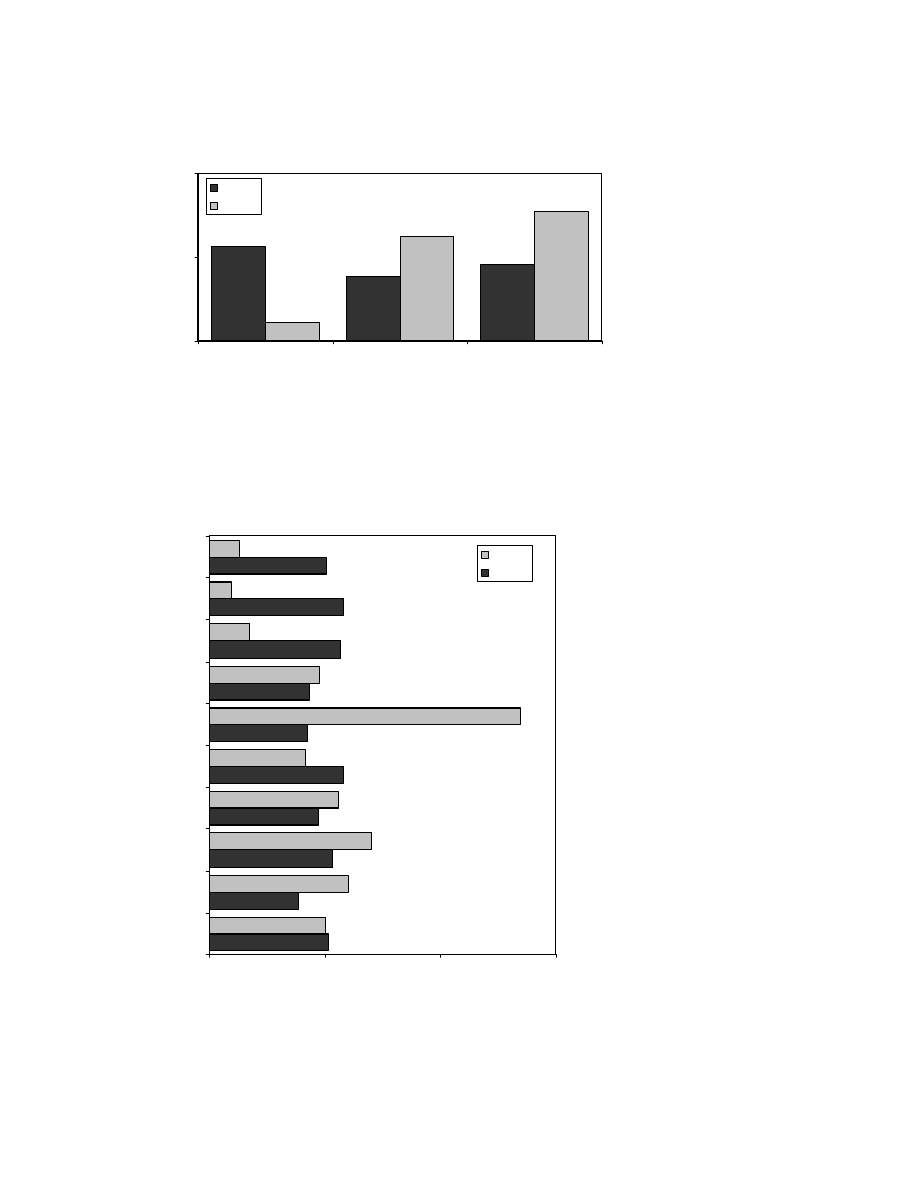
The results from the main components are presented first. Overall, 43% of players did not have a primary
motivations using the above-stated criteria. Of those players who did, 20% had Achievement as their
primary motivation, 20% had Immersion as their primary motivation, and 17% had the Social component
as their primary motivation. The underlying gender and age differences are far more striking when
presented using categorical data.
11
Gender Differences in Primary Motivations
N male = 2769, N female = 430
22.6%
15.4%
18.3%
4.2%
25.1%
30.9%
0.0%
20.0%
40.0%
Achievement
Social
Immersion
P
e
rc
e
n
ta
g
e
of
R
e
sp
on
d
e
n
ts
male
female
The primary subcomponent was inferred from the largest subcomponent score to preserve enough cases
to show the data across the 10 subcomponents.
Gender Differences in Subcomponents
N male = 2769, N female = 430
10.3%
7.7%
10.7%
9.4%
11.6%
8.5%
8.7%
11.4%
11.6%
10.1%
10.0%
12.1%
14.0%
11.2%
8.4%
27.0%
9.5%
3.5%
1.9%
2.6%
0.0%
10.0%
20.0%
30.0%
Ecapism
Customization
Role-Play
Discovery
Teamwork
Relationship
Socializing
Competition
Mechanics
Advancement
Percentage of Respondents
female
male
Male players tend to be more driven by the Achievement subcomponents than female players, while
female players tend to be more driven by the relationship and customization subcomponents. Both male

12
and female players are equally likely to be driven by the socializing, teamwork, discovery, role-playing
and escapism subcomponents. Worth noting is that there is a gender difference in the relationship
subcomponent but not in the socializing subcomponent although these two subcomponents may seem
highly interconnected. In other words, male players socialize just as much as female players but are
looking for very different things in those relationships.
Older players are most unlike younger players in the Achievement subcomponents for both male and
female players. Younger players are more likely to be driven by advancement, competition and
understanding the underlying mechanics. Older players and younger players are not significantly
different in terms of the Socializing or Immersion subcomponents.
The best correlates with hours played per week were the advancement and mechanics subcomponents
for male players, and the relationship component for female players. In other words, the reasons why men
spend a lot of time in the game are different from the reasons why women spend a lot of time in the game.
Men who spend a lot of time in the game are using that time to gain levels, get rare items and understand
the game mechanics, whereas women who spend a lot of time in the game are using that time to build
personal relationships.
The best predictors of hours played per week were explored using a multiple regression with gender, age
and the 10 subcomponents as predictors. The model was significant at p < .001 with an adjusted R
2
of .06
(not very good model, weak predictors). The best predictor was the advancement subcomponent (Beta
= .13, p < .001) followed by the relationship subcomponent (Beta = .10, p < .001). However, none of the
subcomponents turned out to be good predictors of hours played per week.
The best predictors of problematic usage were explored using a multiple regression with gender, age,
hours per week and the 10 subcomponents as factors. A survey scale for problematic usage was developed
using the following items (on a fully-labeled 5-point scale using construct-specific response options).
These items are based on Ian Danforth’s work that teased apart Engagement items from Addiction items.
(
http://iandanforth.net/pdfs/addiction.pdf
)
• Do you spend more time than you think you should playing the game?
• How difficult would it be for you to limit your playing time?
• How agitated do you get if the servers go down unexpectedly?
• How often do your friends or family members complain about your game play behavior?
• Has your work/school performance suffered because of your game play?
• How much of your happiness in life currently is derived from playing the game?
• Have your personal relationships suffered because of your game-play?
A principal components analysis revealed a single factor with an eigenvalue greater than 1 that accounted
for 47% of the overall variance. All items loaded onto this factor with a factor loading between .52 and .79.

13
The multiple regression was significant at p < .001 with an adjusted R
2
of .33 (a good model with strong
predictors). The best predictor of problematic usage was the escapism subcomponent (Beta = .31, p < .001),
followed by hours played per week (Beta = .27, p < .001) and then the advancement subcomponent (Beta
= .18, p < .001).
The results of this multiple regression are interesting in that it shows the escapism subcomponent to be
the best predictor of problematic usage. In other words, it is the players who use the online environment
as an escape from RL problems that are most likely to develop problematic usage patterns. This is in
contrast with claims that it is something inherent in online games that cause addiction and problematic
usage. Now, the advancement subcomponent is also a good predictor but not as strong as the escapism
subcomponent. The data show that the primary cause of problematic usage are pre-existing RL problems
rather than something inherent to online games, and that the game mechanics (often claimed to be
strongly addictive) are in fact weaker predictors of problematic usage than the state-of-mind of the
player.
Respondents also answered (yes / no) whether they had:
- Been on a raid for at least 8 hours
- Ever used a third-party macro or app
- Bought a virtual item / currency
- Ever had an opposite gender character as their main
A series of logistic regressions were used to see which of the 10 subcomponents, in addition to gender
and age, might be good predictors for the above 4 statements.
The best predictor for “8 hour raids” was the relationship subcomponent (B = .66, p < .001) followed by
the teamwork subcomponent (B = .39, p < .001). While this may seem unintuitive, it does make sense that
it is the people who are most interested in serious sustained relationships that would end up in raids of
significant duration. And in fact, female players are more likely to have been in an 8 hour raid than male
players (35% vs. 26%).
The best predictor for “3
rd
party macro” was the competition subcomponent (B = .28, p < .001) followed by
the mechanics subcomponent (B = .22, p < .001). In other words, third party macros are a way for players
to gain an edge over the competition and “optimize” their characters.
The best predictor for “bought virtual item” was age (B = .32, p < .001) followed by the relationship
subcomponent (B = .28, p < .001). Age is a significant predictor because of disposable income, but I have
no good explanation for why the relationship subcomponent would be a good predictor.
The best predictor for “gender-bending” was the role-playing subcomponent (B = .26, p < .001) followed
by the customization subcomponent (B = .24, p < .001).
14
Types vs. Components
While there are taxonomical differences between Bartle’s Type and the Components mentioned in this
presentation (i.e., Socializing and Role-Playing are not highly-correlated), I would argue that there are
more important underlying theoretical differences in terms of how the two models conceptualize player
motivations. I describe these differences in detail here.
People Don’t Fit in Boxes
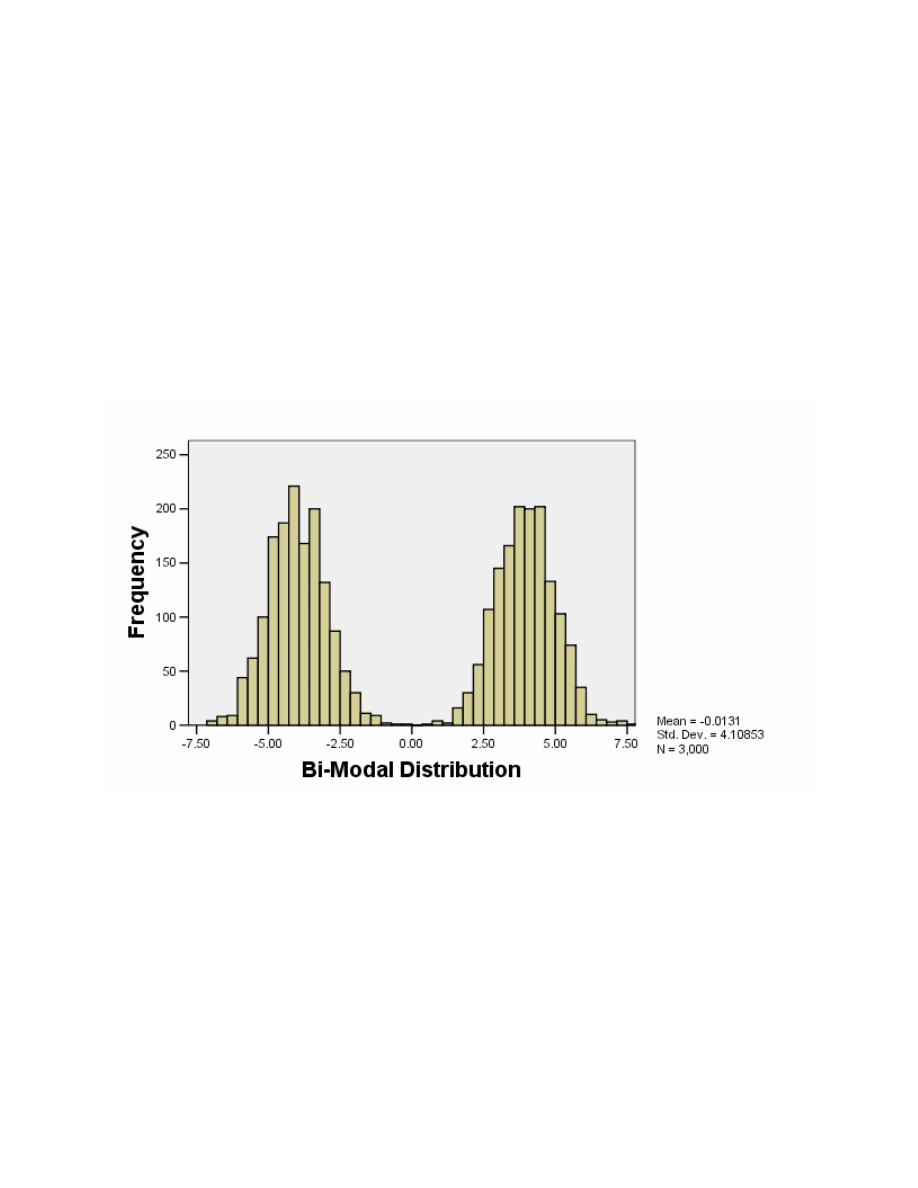
It only makes sense to have a Type called an Achiever if your population shows a bi-modal distribution of
high Achievers and low Achievers. The following graph shows a hypothetical bi-modal distribution.
The problem is that bi-modal distributions seldom occur in personality, attitude or ability assessments.
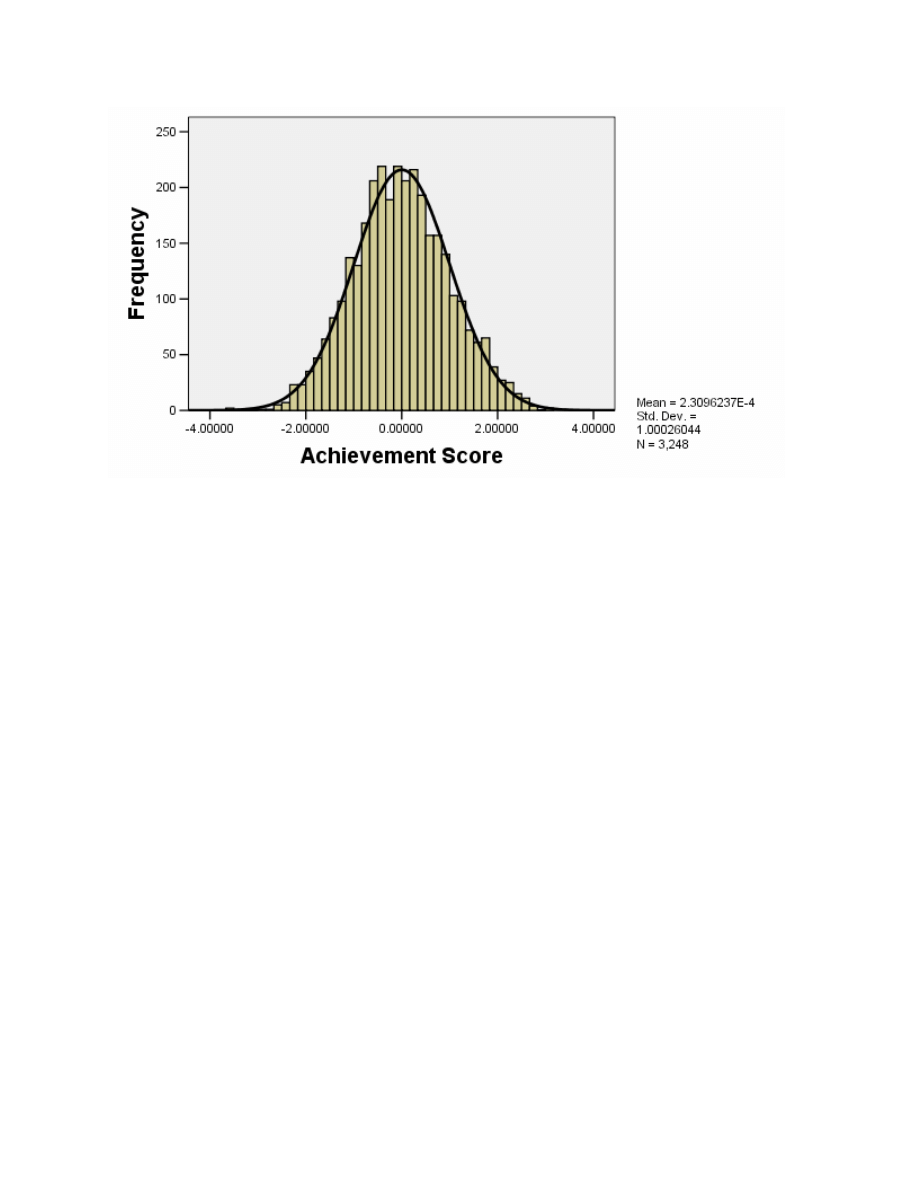
Almost all psychometric assessments follow a normal distribution (the bell curve). For example, the
graph below is the histogram of the scores on the Achievement Component in the current data set of
3200 respondents. In other words, most people fall along the mean and there are few individuals who fall
along the ends of the spectrum. It only makes sense to classify people into Types when there are clear
distinctions in the distribution of the population. This is not the case with player motivations.
15
Note that Bartle’s model doesn’t propose an Achievement axis, but the same argument applies to the two
underlying axes in his model. The 4 quadrants in his model only makes sense if most people do not all fall
near the origin. Bartle’s model is a classification model. A player fits in 1 of 4 boxes. The Components
model is an assessment model. Every player has a score on each of the components.
Motivations Do Not Suppress Each Other
Bartle argues that players have a primary motivation and typically fall clearly into one of the 4 Types. The
2 underlying axes of his model suggest that an Achiever cannot be a Socializer. More importantly, this
assumes that motivations suppress each other. The more of an Achiever you are, the less of a Socializer
(or Explorer or Killer) you can be.
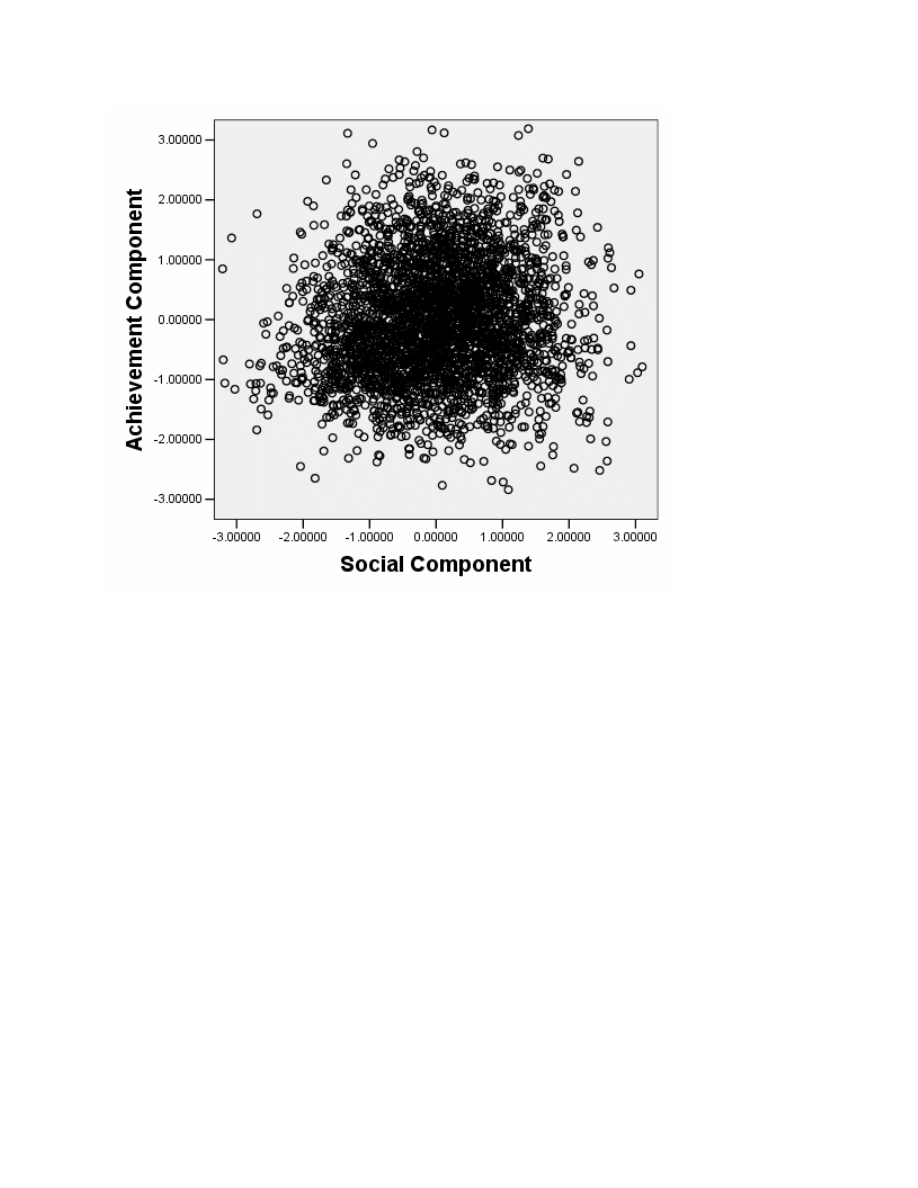
If this were the case, then we would expect that the 3 main components (Achievement, Social and
Immersion) to be highly negatively correlated. In other words, if you score high on Achievement, then
you should score low on the Social component (and Immersion component). This is not the case. The 3
main components are largely uncorrelated (r’s ~ .10). The following scatterplot with the Achievement and
Social components show that motivations are largely independent of each other rather than following an
inverse pattern. Your score in Achievement has nothing to do with your score in the Social component.
16
It’s Configural
Bartle’s Types puts people in one of 4 boxes and argues that the other 3 boxes say nothing about you. The
Components model says the opposite. Your scores on all the components matter. A player who scores
high on Achievement and low on Socializing (solo grinder) is a very different kind of player from a player
who scores high on Achievement and high on Socializing (raid guild officer) and the more you know
about their scores, the more you know about their preferences.
More importantly, the Components model shows that low scores are just as interesting as high scores.
When you score low on Socializing, it’s not the case we simply discard the Socializing component and
say it doesn’t matter to you. Your low score on Socializing means you don’t like games that force you to
interact with other people (i.e., dependencies in EQ - bindings, teleports, rezzes). In other words, low
scores are just as revealing as high scores.
The key point is that the components are configural. People do not fall into simplistic Types. There are
many different kinds of people with high scores on Achievement, and knowing what their other scores
are is meaningful. In Bartle’s model, all Achievers are the same. In fact, this shortcoming in the Types
model is why it became necessary for Bartle to create 4 additional Types (8 Types altogether) in his
recent book in an attempt to cover those nuances. The problem is that subdivision is not the answer.

17
People are never just one thing. The answer is not subdivision but understanding that people don’t fit
into boxes. Motivations are configural. If it’s ok for me to like both ice-cream and French onion soup in
real life at the same time, why can’t I be both an Achiever and Socializer in an MMORPG at the same
time? Players can never be understood if they are assumed to be defined by a single preference. Players are
multi-faceted and most people like and dislike many things at the same time. The core problem with the
Types mode is that it says that people can only like one thing at a time.
Overview
Types
Components
Distribution
Assumption
Motivation distribution are bi-
modal
Motivation distributions fall along
a normal distribution
Goal of Model
Classify players into one of four
types
Assess players on multiple
dimensions
Motivations
Suppress each other
Complement each other and are
configural
Non-Primary
Motivations
Are unimportant
Low scores are just as interesting
as high scores
Players
Are defined by a single
preference
Are defined by a cluster of
preferences and aversions
Differentiation
Is difficult because one Achiever
cannot be differentiated from
another
Is part of the model. Nuances
between players can be
differentiated.
In Their Own Words
Over the past 5 years, I have asked MMORPG players hundreds of different questions. The one that
inevitably provides the most interesting responses is this one - “Why do you play?”. The following
narratives show how multi-faceted every player is and how motivations intersect and influence each
other. Together, these narratives provide the foundation to any other discourse about MMORPGs. After
all, if we don’t understand why players are in these online worlds to begin with, then we can never truly
appreciate the more complex phenomena that emerge from these environments.
Oftentimes, we project our motivations onto others and we fail to appreciate what “fun” is to someone
else. The following narratives show how relative fun can be and the sheer diversity of ways of deriving
satisfaction from the same construct. “Fun” means something different to different people.
The narratives are framed by the 3 main components, thereby illustrating how the different
subcomponents can combine, but more importantly, shedding light on where more work still needs to be
done. The presentation below extracts parts of long responses submitted by players and might create the

18
illusion that players are more single-dimensional than they really are. This was done to make it easier to
understand the spectrum of motivations. Most players in fact described their preferences along several
motivations.
The Achievement Component
While many players describe a desire to achieve in the game, there appear to be two different threads of
where the satisfaction lies. One group of players derive satisfaction from the constant progress offered by
the game mechanisms, while the other group of players are driven mainly to reach a goal (typically the
end-game).
Progress / Advancement
It gives me the illusion of progress, I know that. I hate the level of frustrated progress in the r/w
so I play the game and lvl up instead. It is *crack* for the achievement center of the brain, like
cocaine affects the pleasure center. They need to regulate this industry, or many frustrated
children will ruin their school progress. [WoW, M, 34]
As soon as the effort required by the treadmill from me no longer is rewarded with and equally
significant reward, I lose interest and stop playing. Thus I rarely hit the max level because when I
get close the cost/benefit ratio usually takes a nosedive and it feels like work. [WoW, M, 25]
Also, it is difficult to stop playing if I am very near the next character level. I feel achievement is
my greatest motivation for playing. I can't wait to level again and get that new ability or skill or
awesome weapon, but I never want to hit max level ... World of Warcraft does provide a lot of
interesting 'end game' content that max level players can enjoy and I look forward to that.
[WoW, M, 28]
The Seduction of Achievement
Other players elaborate on how achievement is structured differently in MMORPGs than from real life,
and it is this difference that makes advancement seductive in MMORPGs.
http://www.nickyee.com/daedalus/archives/000780.php
It's encouraging because in an MMORPG you can see a consistent progression of development in
your skills...you are getting better at a steady rate...In RL you don't level up when you get ahead,
it isn't as obvious. [WoW, M, 31]

19
Part of the reason I play online games is to experience a sense of achievement. When I put a good
deal of time and effort into an in-game task, I am rewarded in a way that's meaningful and
measurable: I gain a new item, I finish a difficult quest and get experience points or money, I gain
a higher level of proficiency in a skill or ability, or I gain notoriety in the virtual game community.
The real world isn't like that. In the real world, there are few quantitative rewards for the effort
one puts out merely 'to live'. In the real world, you have to run errands, shop at the grocery store,
clean your house, do your taxes, keep all your papers organized, do the laundry, etc. etc.. There is
no sense of 'achievement' or forward progression in these things -- they are merely daily must
do's. There is no sparkly new item or new skill waiting for me after I do my 6th load of laundry in
a week.
Then there's work: you go to work and do your job. You may be lucky and have a job that's
incredibly rewarding and offers you a sense of achievment, but I'd bet that most folks do what
they do out of necessity for an income, and not because the work fulfills them in a spiritual or
emotional sense. Your reward for doing your job well is the occaisional promotion or raise. But
it's never guaranteed. There are many factors involved in progressing in a career that make it
much more complicated than 'to achieve y, I have to do x'.
As children, we are taught to 'achieve' by being given milestones with specific goals. 'If you eat
your green beans, you can have ice cream.' 'If you get an A in biology, you can get your driver's
license.' 'If you work hard at school, you will get into a good college.' 'If you get a 90 on a test,
that is an A-'. We are graded in school, critiqued by coaches, evaluated by theatre and musical
directors, sized up by our peers and family: we are always being judged both quantitatively and
qualitatively as we make our way slowly and methodically to 'adulthood'. There are direct
relationships between 'doing' and 'accomplishing' that I think disappear to an extent after we
enter the 'real world'. Achieving becomes much harder, especially if you're not sure what goals
you want to set for yourself to begin with. There is no structure anymore - the world is more
freeform, and less supportive. There are no rewards hanging out there waiting for you to pluck
them. You have to go out and create them, then strive to achieve them, and it takes a lot of effort,
and a lot of time. While I personally own and run a successful small business, and have enjoyed
reaching milestones and goals I've set for myself, they come fewer and farther between than i
NEED, and so, playing online games allows me to find a positive outlet for that need to achieve
on a regular basis. [WoW, F, 37]
The Grind
In fact, that sense of constant progress engineered by the behavioral conditioning of the game is so
powerful that several players described the pleasure they derive from the grind.
http://www.nickyee.com/eqt/skinner.html

20
When I became GM taming, after 7 months of constant taming (we're talking about several
hours a day.. 10+ hours every single day almost 5 years ago). After I finally Grandmastered my
animal taming, I was clueless as to what to do. I wound up creating a second tamer just to GM
the skill over again (which I did). Now I'm working with a power scroll to become level 120
taming. [UO, F, 23]
There's a certain satisfaction to be had from levelling, I find. While there ARE things much more
enriching and rewarding than mindless levelling, there's a certain.... feeling of zen to be found in
the grind. I've spent hours on end in the same area, doing the same thing over and over, watching
the exp bar creep slowly upwards... Just soloing, just me and the monsters. Strangely, it can be a
nice way to unwind after a long day at work. Stock up on potions, set up the hotkeys, plan out
the route you'll take, and go at it. A lot of people complain about hitting that bar to get the pellet,
and I've done my share of complaining, too. I sometimes wish I could go faster, to get to the skills
and areas and accolades that come with a high level... But the voyage is often just as important as
the journey, no? And not every step is going to be fun and games. One has to make the most of it.
[CoH, F 22]
Goal-Driven
Notice that in several narratives above players explicitly talk about never wanting to reach the end-game
because they consciously realize it is the constant progress they enjoy. Now contrast that theme with the
following narratives that describe the opposite desire.
I hate leveling. That’s why getting to the top is probably the most important factor. It's not that I
enjoy being higher than everyone else, I just hate leveling. In WOW, the leveling is just training
for post-level cap PVP, which is a great Idea. Quick Leveling and END GAME CONTENT! I also
like to be able to play a good/niche roll in groups, but I like to be able solo as well. If I can't do
both reasonably well, there's no point in playing. [WoW, M, 18]
I do level fast. When my guild played SWG I was known as the master power-leveler. It actually
has little to do with my need to be Uber or powerful, I think it has almost nothing to do with
being Uber. I most enjoy the Endgame. I rather hate grinding so I try and grind out as fast as
possible so I can enjoy my character fully at its highest level. WoW is the first game I have found
where 'leveling' has been enjoyable. In SWG I was a huge collector. I even manage a Loot Drop
fan-site www.questloot.com in WoW collecting is not that important to me as there is no house
to decor. [WoW, M, 31]
Power brings Recognition
Now, while some players desire to reach the end-game for their own enjoyment, others want to reach the
end-game for a slightly different goal.

21
I basically play these games to become the most powerful force the game can allow. I want the
best of the best items and people to truly respect my play style. I want to become a legend among
players within the virtual mmorpg world! [DAoC, M, 25]
This player describes an achievement motivation that interacts with the community. It’s not the case he
wants to become powerful for its own sake, but he desires power because power is respected and
recognized by others.
Competition
The Achievement components in one way or another are centered over the underlying theme of power
and different ways of harnessing and deriving satisfaction from power. Players who enjoy advancement
and progress for its own sake derive satisfaction from gaining power over time. Others enjoy power
because it is respected. The following players enjoy the derivation of power that results from competing
with other players.
My primary goal is to be competitive in player vs. player combat; this doesn't include griefing,
though I'm not afraid to use such tactics to dispense justice as I see fit. My desire to stay
competitive drives me to want to level fast, min-max, and gain rare drops. Those things in
themselves aren't important to me, and I'd really rather it weren't important to the game, but if I
intend to be competitive I've got to do the work to have the fun. [WoW, M, 19]
People sometimes mention it's just a game and the point of it is to have fun, I reply that to me
being the best is most fun. I have always been extremely competitive, i grew up with a brother
who is very competitive, so i have been used to competition since birth. I am also a sportsman, i
train Judo for a local club which pays me to keep training as long as I am winning. I have learned
to find satisfaction in winning and love all games, board, sports and electronic games, because in
all games u have winners and losers, when i win I have lots of fun, when i lose i am motivated to
improve myself, and when i improve myself i have a lot of fun too. [WoW, M, 18]
Self-Sufficiency
For other players, power is desired because it allows for self-sufficiency. Power for these players is not
sought for social recognition, but rather, because it grants independence.
I don't like to be powerful, so much as self-sufficient/independent. I find the main drive of my
leveling is so that I can go anywhere in the game, anytime I see fit, and not be too weak to survive
there. That way my ability to hang with friends, or to explore the worlds, is not limited by my
weakness. [Other, F, 26]

22
The important aspect of achievement to me is being able to complete tasks on my own when I so
choose. I like to be able to complete a quest or gather raw materials without having to ask my
guildmates for help all the time. I don't really care how fast I level but it is very important to me
to have a large degree of self-sufficiency with regard to task completion, problem solving and
resource gathering. [WoW, F, 25]
Optimization
For many who choose this path of power, understanding the underlying game mechanics is crucial
because power is derived from charts and rules, and thus knowing those rules becomes a form of power.
Well, when you prefer to solo, like I do, since I play at odd hours of the day, you need to get your
character to minimize their weaknesses. So, min/maxing and getting good armor/weapons/spells
is a big part of solo play. [EQ2, M, 19]
It took me forever to get my Shadowblade to 50 in DAOC. Over years of playing because the class
was so gimpy. However I never gave up and I wound up with a really great template. Rare drops
and leveling fast were never important to me - but making sure I found myself at the endgame
with a playable character - that was everything. I had created 30+ templates and spent literally
40+ spare hours creating templates at catacombs and other sites to make sure I had the best
build. Then when I finally got there and it all fit into place - that made it all worth it. [WoW, M,
25]
At lower levels, I didn't get too caught up in min-maxing. Spending lots of money or time to get
the absolute best armor and jewelry seemed a bit pointless since the levels went by so quickly
anyway. But as I got to the higher levels, I found myself getting more careful with optimizing my
character - because whatever I went with I'd be stuck with for quite a while, and also to give
myself as much of an advantage as possible in PvP. Just recently, I spent three days working out a
jewelry/armor template that would allow me to max as many things as possible for my last set of
armor when I hit max level. [DAoC, F, 23]
It’s Not About Achievement
Of course, there are also players who don’t find achievement fun, and some of these narratives are
presented here.
For me, I play one main character. I have been playing her for years, and am still only level 25.
Level isn't important to me, nor are riches. I feel a sense of achievement when I develop all the
skills that are available to her. I like to be able to kick some serious butt, make some absolutely
adorable armor, make a nice dinner, etc. Sometimes I will go on just to practice trade skills, and

23
not do anything but, for example, buy batwings from newbies and make batwing crunchies, then
give the food away to people who want it. [EQ, F, 34]
I'm not much of the achiever, I'm usually one of the middle to low levels in guilds/pas that I play
with, because I' prefer to enjoy the game itself, instead of mindlessly leveling. I don't understand
the desire to powergame where every little trick and location are mapped out so that you can run
from a to b to c, but never take a second to read what the mission is or listen to what the NPCs
say after you deliver whatever it was you stole, killed for, found, delivered. [WoW, M, 26]
It's not important to me at all, I just play to have fun. For example, it took me to 6 months to
master pistols in Star Wars Galaxies, which can take only a few days for a determined person.
[SWG, M, 37]
The Social Component
The Ultimate Chat Room
Socializing in MMORPGs means different things to different people. For some, the fun lies in being able
to log on to a world where there’s always someone to chat with.
Making friends and having people to chat with is so important to me. When I was in the WoW
beta, I didn't play much because none of my friends were in it, and when I did play, I was always
looking for someone to chit chat with. In fact, the only thing lacking for me in the release of
WoW is that so many of my guildies from EQ didn't make the switch. I miss them literally every
day, everytime I logon, I wish that I could have moved my guild as a whole over to WoW. We all
still keep in touch through the message boards, and people who have left the guild have even
asked to be requilded in the Iksarian Broods (my guild) before they quit the game. My guild has
had several RL meets, and many of the guildies are close, close friends now that talk on the
phones etc. [WoW, F, 26]
I like interacting with other people, chatting, etc., but for me the game world is a game world and
I have a pretty low desire to make what I consider 'good friends' as that would involve a real-life
component I'd rather keep separate from my game playing. [EQ2, M, 39]
I love to talk to people, all of the time. I generally am talking to several people at a time, and feel
slightly uncomfortable in silent groups. My friends list grows often. When I played EQ1, I maxed
my friends list (100 players) at one point and had to delete a few alts of friends. [EQ2, M, 17]

24
There is an underlying tension that the following narrative foregrounds - that oftentimes the desire to
chat with other people doesn’t translate into a desire to actually form significant relationships with other
players.
I greatly enjoy socializing in-game. One of my on-line pals says that I see Everquest/Everquest2 as
my pretty little chat room with avatars, which is an accurate description. I have cultivated a
group of online friends that I greatly enjoy talking to and have even gone so far as to meet them at
the Everquest conventions where I found I still greatly enjoyed their company. The down side of
these online relationships is that on the one hand, where people who may have social or physical
difficulties can express themselves in an unprejudiced environment, you still don't 'know' a
person until you meet them. I have found that while most people are seemingly fairly stable, there
are still those that desperately need help.
For whatever reason, people really open up to me (or my avatar as it were) and there have been a
few occasions where someone has expressed suicidal urges or told a story that is deeply
disturbing. While I can 'listen', I am not trained in counseling and in that regard online
relationships can be difficult if not emotionally draining. So, while I can say I deeply enjoy many
of my relationships, for the most part I prefer my relationships to be a bit shallow or superficial.
It's the only way I can protect myself emotionally.
I want to get on these games and have fun not play pseudo-counselor to folks who have big
problems - bigger than I'm equipped to deal with and that I'm definitely not trained to deal with.
I wish them all the best, but I like it when our conversations are limited to joking, light stories
and accomplishing things. Apologies for the ramblings. [EQ, F, 37]
Forming Relationships
Now contrast that thread with the following narratives that illustrate the desire to form personal
relationships with other players.
I probably play mostly to meet new people and make new friends. It's fun having friends all over
the world, you can learn from the way they live and do things.. That’s what i mostly enjoy about
meeting others in game.. To befriend people and get to know them, hopefully building a lasting
friendship even when one of us does end up giving up on whatever game we're playing [EQ2, F,
19]
I'm currently sitting in Las Vegas typing this using the network of a friend I met via EQ... we met
IRL last summer when she had reason to visit Boston (I live in Connecticut), and now I'm
visiting her for several days. My dearest female friend I also met via EQ; she and her husband and
my then signif other (also met via EQ then continued IRL) and two other people (Now also RL
friends of mine with whom I exchange visits periodically) grouped every night for about a year

25
before she finally convinced us all to visit her IRL. Since then I not only spend every Xmas with
her and her husband (4 times so far) but also visit her for a week every couple of months. They
don't even EQ any more but the friendship continues strong and growing :) Via Guild of course I
have a world of virtual friends and comrades. We help each other and help each other's friends.
[EQ, F, 61]
When i was playing SWG I met a group of ex UO players in a forum and they all knew each
other. I jumped in and got to know them quite well and within a matter of a few weeks we had
our own player town, guild, in-game chat channel and had even arranged to meet up in real-life.
A year later I am still in touch with these guys and consider them to be good friends, meeting up
with many of them at least every month. I even went to the wedding of one of them. I also have a
very good 'friend' that I met from SWG and have now converted her to an EQ2 player. I helped
her out one night and we have been inseparable in game ever since. There is even a bit of a
romance blossoming IRL. I have been over to Greece to meet her and her family last October, and
she is coming to England to stay with me at Easter. I initially was always Mr Cynical when I read
or heard about internet based romance, but I have been pleasantly surprised ;) [EQ2, M, 33]
A related theme are players who are open to developing a romantic relationship in these environments.
I believe I am a lucky man, as I married a woman who also has a great love of gaming. We met
from different countries in an online gaming guild, played together, and eventually fell in love. I
obtained a spousal visa and we have been happily married for 5 years now. We game side-by-side,
literally, on new machines at a desk custom-built by my dad. Just goes to show: there are real
people behind their own monitors out there and this is certainly a viable medium of
communication. Our old guild had gone too far into the realm of powergaming, we felt. The guild
leaders loosened their admission policy and allowed obnoxious and rude players into the guild.
We felt this compromised the spirit of our guild, so we broke off with our friends and formed our
own guild once Everquest II was launched. There is very little structure to our current guild and
we do not censor topics nor bad language. The only exception is the need to respect your fellow
guildmates. [EQ, M, 27]
i just started playing warcraft, prior to that i played FFXI for nearly a year. the thing i enjoyed
most about mmorpg games is the socialization ... the friends you make on line. i have met many
people on line, especially when i played FFXI. In fact, that is where i met my fiancee ... we gamed
together and spent hours upon hours together for nearly six months. i ended up moving from
california to indiana after being constantly together for six months so we could be together in
real life. We are very much in love and have plans to get married in real life this summer. [WoW,
F, 30]
Socializing is my favorite part of the game. I have played EQ for about 3 years, and in the course
of that time I have met many good people, a few of whom I still talk to through email. I met my

26
RL fiance in EQ, we spent 2 years adventuring together in the game, and that in-game
relationship led to our RL romance and eventually we moved in together and plan to marry. Some
people don't understand how I could meet someone in a game and end up loving them and
trusting them RL, to them I can only smile and know they are not gamers. Because gamers know
that the characters are real people and in general most people play their characters as a reflection
of their RL personalities. Anyways, in EQ my most enjoyable times were socializing. I was always
part of a guild for this reason, to have a constant network of friends and comrades. I led a guild
for about 1 year, and it was fairly successful, though small, we were all very good friends. Often in
the game I spend time and money helping new players just because I want to. [EQ, F, 22]
A Helping Hand
Altruism is highly correlated with socializing and forming relationships. Perhaps this is because helping
someone else is the easiest way to meet someone new in the game and strike up a conversation. The more
ways in which players can and are encouraged to help each other, the easier it is for players to meet each
other.
http://www.nickyee.com/daedalus/archives/000892.php
years back, when i was playing the Beta of Neocron and was one of the 5 best players on the
server, i stood in an area where a lot of people met. At that point i had played for 54 Hours
straight and was pretty much exhausted. All i did was 'poking' other people (helping them to
insert there implants). So in other words i just helped some fellow players and my only reward
for doing so was there thanks. But i found that experience to be very rewarding and did that
again on several occasions. I would call that socializing just for the fun of it, not for any other
measurable reward! [WoW, M, 28]
I am always helpful to new players when I have the time and help protect them when fighting or
by making armour for them when I have that skill. Often I keep some of my old equipment
around just so I can give it to a new player, and I don't accept money for it in return. Sometimes I
will ask for resources they can easily gather, but mostly I just ask that when they outgrow the
equipment to do the same and give it to another. Sometimes I have seen people I have helped
many levels later and many remember me. Just hearing a 'Hey, you're the nice lady who helped
me out as a newb. Thanks a lot.' is enough to make my day. My choice in guilds is along the same
lines. I look for friends who are willing to help each other out where they can (with tradeskills,
equipment, or hints and tips on how to do things). I don't care about uber equipment or fighting
special mobs. I prefer a friendly guildchat where the people don't compare their equipment just
like they compare cars in real life. [UO, F, 30]
I have many real life and Online friends, and they are my main reason for continuing to play the
game. I enjoy helping others and having help. I enjoy talking about in game and real life
happenings. I am still in contact with friends I made over a year ago. [FFXI, F, 23]

27
Playing with RL Friends / Family
For others, socializing in the game means socializing with friends and family rather than meeting new
people. The game becomes a way to keep in touch, collaborate, and learn about each other.
I play to have fun with my RL friends who play with me. I rarely group with people I don't
know...in fact, I usually despise doing so. But now and then I'll meet someone and become online
friends with them. I don't discuss deeply personal things with them, like I would with my RL
friends online. I do enjoy levelling, getting good equipment/items, becoming more powerful...but
that's not the 'be all, end all' of my reason for gaming. Often, I'm behind my friends in
level/experience. I also love exploring or finding that quest that some don't know about. But
again, it's not the raison d'etre of my play. It's a combination of all of this. I currently play WoW,
instead of CoH, because the majority of my RL friends play it. We move from MMO to MMO
with each other. Rarely do we have some playing one and others playing another. We started in
EQ. For a small time, many went to DAoC, but they quickly returned to EQ. Many years passed,
and then we moved to CoH. We were all in CoH until WoW came out. I hadn't expected to
change from CoH to WoW with my friends, mainly because I usually don't like Blizzard
products. But w/o my friends, MMOs just aren't as much fun. So I tried WoW and loved it
instantly. So, once again, we are all together...in WoW. [WoW, M, 30]
My husband, son and I play. It's a wonderful family experience that we can share all the exciting
moments with each other...even if we don't actually group together. Sometimes we play more
than we should, but to me it's no different than going out and partying more than you should. I
find it nice that I can stay safely at home, with my family and enjoy our time together. [WoW, F,
45]
My girlfriend lives some distance away, and due to flight costs, we do not get to spend a lot of
time together. We speak on the phone everyday for hours, and we found an MMORPG is just
another great way to spend time together. I think it is much more social than people give credit.
Neither of us are adjusting our glasses and are sitting on the edge of our seats when we play, she's
normally a swimmer and i'm a bass player--we just enjoy spending time together. [WoW, M, 18]
The Guild
It makes sense for players who enjoy socializing to be part of casual, friendly guilds because these groups
provide a constant source of structured chatting and relationships.
Making part in a guild will most definitely enhance the experience for any player I think. The
social part of the game itself is often (at least for me) almost as big as the gaming part. It has
become a substitute for those late-night D&D times with a couple of friends around a table in

28
someone’s dirty basement. I often find myself being way more honest and open to players over
the net cause I can relate to them in a way that i mostly cannot IRL. [AO, M, 18]
As in my case, many members of my guild have known each other online for well over 9 years of
gaming and it adds a certain flavor to everything. It's more like a 2nd family. We have new
grandfathers, newlyweds, college students, a handful of high schoolers (we're 18yrs+ minimum),
and many in between. For us, it's more than just a club to go hang out at, it's a comfortable
environment wherein we can be who we want to be. We can be ourselves, we can be our
characters, or we can blend the two, and any way we go, we'll always be accepted. We're all
friends here. [WoW, M, 25]
In fact, stories of guild migrations show how the guild itself becomes a motivation for playing.
Due to my experience with guilding in this and one other MMORPG (DAOC), I can't imagine
playing without the support of a guild. In fact, that is the main reason why I left DAOC for
WOW. The members of my guild on DAOC migrated to WOW. We have reestablished the guild
in WOW and very often play together again. It gives me a sense of belonging, and I enjoy the
interaction during the game. I still mourn lost friends that have left the MMORPG arena. [WoW,
M, 52]
I'm playing World of Warcraft with a guild I've played with for a couple years, starting with
Planetside. I like a lot of the guys, the structure, and the focus of the guild. Over-all my guild is a
very important part of my gaming experience, and others would agree as well. Many of us
planned ahead of time to all play on the same server so that we could open a WoW chapter.
[WoW, M, 19]
Teamwork
A related theme is the satisfaction derived from working and collaborating with others in a structured
way. For some, the rush of a team victory is what keeps them coming back to the game.
When World of Warcraft came out we were absolutely thrilled to have something besides EQ to
play. We were fed up with EQ and the way it treated its players and the way the game had
become completely unbalanced in areas. So, we moved into WoW with several friends from EQ
and it's worked well. The skills we developed in EQ and the teamwork and group dynamic
transferred well to WoW and has allowed us to do some hard stuff we would have been hard
pressed to accomplish otherwise. [WoW, M, 30]
While i enjoy all of the above, that is strictly a byproduct of the fact that thats really what
mmorpgs are designed to do, and thus doing anything in an mmorpg would result in one of the
above things being done. A strong motivation for me, and what has most likely contributed the

29
most to my addiction is working with other people and existing within a perfect and efficient
group. The aims of this group are not important, we could be grinding or camping a spawn to get
an item for someone, when everything goes perfect, no communication is needed, and everyone
just does what they should exactly as it should be done, i just feel great. While i would much
prefer to follow a good group leader, most the time, as i usually play classes that are able to
control the flow of a fight and thus require greater situational awareness to even play than more
straight forward classes(that is, a bad warrior can still kinda function in their role if played
badly), i end up being the leader. It just makes me feel wonderful when my group does something
other groups are not able to do. Back when i was playing daoc me and my friend had made a
pally/minstrel duo and took out things that most people said you couldn’t do with even a full
group... it made me feel good. This has been a great source of joy and frustration for me, because
even if things go well when a group member is not doing something right i get agitated and an
argument is likely to break out... people just don’t understand what im upset about. Conversely if
we wipe but everyone was playing at the best of their ability and every little trick had been done,
while im sitting there waiting for a rez i still feel just grand. Interacting with people and being
able to depend on them, and be depended on by them... that’s why i play. [WoW, M, 20]
As Therapy or Outlet
Several players described how these online environments provided social outlets that they do not have
access to in real life. For them, MMORPGs served a much needed social function.
Making friends is great, you meet people from all over with whom you would normally have no
contact, as I am disabled and am stuck at home most of the time, the ability to get out and meet
people and have fun together goes a long way in lessening the trapped in stuck 24/7 feeling that
people expect you to feel [EQ2, M, 36]
In real life I'm very shy, but behind a computer screen I feel I can talk freely, partially because of
the fact that I don't have any personal connections and obligations to people. Also, I feel more
secure talking to in-game friends about personal problems than people I know in real life. [FFXI,
M, 18]
I like meeting new people and socializing - at least, I do in game. Socialization has always been
something I felt I was terrible at in real life. Inside the game all the visual cues handed down
through society are lost - we're reduced to verbal communication only - I've found that medium
far easier to handle. I feel far less afraid when I'm dealing with people in this kind of environment.
When I was younger, I was very quiet and reserved. Games like these helped me learn how to
talk to people and how to interact -- more importantly, they've also helped me learn how to be a
leader. I've grown up playing games where social interaction was a major component. At 15 I
would have been shy and awkward, unable to speak around people I didn't know well. At 25, I'm
in command of a team at work and I have no difficulty talking to new people. I still feel shy, but

30
I've learned to hide it better. Making friends has always been something I loved to do, but due to
my difficulty being comfortable with socialization it was something I could not do easily.
Gaming has helped me learn what goes into making friends, and some of my best I first met in-
game. In addition to being a team lead out in real life, I run a guild of approximately 80 people in-
game. In the game I feel like one of the popular kids must have in high school; everyone knows
me, people are happy to see me, I have a community that is happy when I'm around. I have these
things offline, now, also, but the online communities are there 24/7. I can't explain why it's so
nice. [FFXI, M, 25]
I started playing DAOC while I was recovering from two devastating years of depression. I was
once a very confident and social person, but I felt like I'd forgotten how to interact normally with
others, and had lost a lot of my social self-confidence. I thought that role-playing a character
would be a good way to 'practice' my social skills. It worked very well! My DAOC character met
a wonderful guild of people, and I became very popular with other people in the game just by
being the friendly and fun-loving person I am. Being one step removed from my 'real' self gave me
the distance I needed to discover who I actually am again, and helped me recover my confidence
('People do like me!') and my sense of humor. [WoW, F, 28]
It’s Not About the Social Things
And before we leave this section on Social components, I want to include narratives from players who are
largely not interested in socializing with others in the game.
I generally don't talk to people I don't know. I play with random people but I am not focused on
meeting people. [Guild Wars, M, 14]
I don't play well with others. I tend to stick to killing the highest leveled monsters with my pets,
by myself and ONE dragon/hiryu/white wyrm, vetting all the way. It gives me pleasure being able
to solo otherwise almost unkillable monsters to others, and many times to others attempting the
same thing I am. When in my guild (which I rejoined recently after being out of it for 2 YEARS!!)
I help others, resurrect when needed, but otherwise I just mope and complain and donate all my
gold to the guild fund. [UO, F, 23]
I don't socialize well voluntarily in MMORPGs. I will usually only form a group if necessary for a
quest or if a real life personal friend is playing also. That said, I do enjoy most of the groups (and
the guild) I am part of. Socialization can be an enjoyable part of the game for me, but I don't
normally initiate it. [WoW, M, 28]

31
The Immersion Component
My Story
A prevalent theme among players who enjoy being immersed in a game centers on developing a back-
story or history for their characters. For them, it is crucial that their character makes sense and is rooted
in the lore and mythos of the world.
Each one of my characters has a story, each one of them have different motivations. I've played
everything from a fratricidal zealot to an elf who trades in human slaves to machiavellian
manipulators. I always enjoy creating characters, because coming up with something different is
such an enjoyable challenge. [DAoC, F, 23]
My tauren druid, Jionania, is quite a complex character as the main idea of her story is that she
was born into a tribe of druids, but is fascinated by engineering to the point where engineering is
more like her class now than druid is. The important details to the following event are that
Odelisque is a Undead girl who was my character's best friend and that Toorsk is the tauren she
planned on marrying. Since Toorsk wasn't a druid, Jio needed to take him to Moonglade to meet
her tribe. Since we were nowhere near strong enough to make the journey, Toorsk went out into
the wilderness to train, while Jio continued her studies in engineering. A week passed and Jio
began to worry, constantly sending letters to him. All she got in the mail was a letter from
Odelisque saying that she was feeling the call of the scourge and that Jio best stay away from her
since she had no idea what would become of her. Needless to say Jio broke down. Toorsk still
hadn't written (it seems he just stopped playing the game) and it wasn't long before she went
out to search for him and ending up dieing alot. It eventually an orc named Morkris calmed her
down, and she is beginning to get over Toorsk and is falling for a guy who she just found up is
already married. This is also making her worry that she is just addicted to attention and will fall
for whatever Tauren is giving her attention at the moment. She has a lot of issues she needs to
work out so she's a bit messed up emotionally. [WoW, M, 17]
I'm not a hard-core role-player or on a role-playing server, but the two characters I play now have
very distinct personalities. It's important for me to have backstories for my characters before I
really enjoy playing them. For example, I know that Trigger, my dwarven rogue, is the younger
sister of my husband's character's (Hawthorne) best friend. Thus when Trigger plays, it's with a
great deal of enthusiasm and not necessarily a great deal of sense. When Trig and Hawthorne
group together, there's a great deal of friendly bickering and /bonk going on. I think it's a
replacement for the acting I did in school, which is so hard to fit into my life as an adult. [WoW,
F, 36]

32
When we first started, I voted for an RP server, but was outvoted by the rest of my friends, who
didn't want to have to deal with the RP snob types, and were willing to put up with more b-net
kiddies not to. At the earliest opportunity, however, I started an alt on one of the RP servers to
play when my main server was down or I just wanted to get away from the dumbasses. This has
been a lot of fun; I've been playing as a Night Elf Druid who's older than dirt, but has been
hibernating for milennia. It's been fun to play out her first encounters with humans, gnomes, and
orcs, none of whom existed when she went to sleep. I've been playing her as the type that's
incredibly wise, formerly very powerful, but somewhat confused about the modern world.
Combined with some friends of mine, playing VERY different characters (an innocent, childlike
priest and a bloodthirsty, sarcastic rogue), it's been a blast, and made me wish we'd rolled on one
from the start; I know my holy undead priest would be a lot of fun to RP. [WoW, M, 23]
The Story of the World
It is also important to them to learn the story of why the state of the world is the way it is. They go out of
their ways to read up on the histories of different key characters or races / tribes in order to learn the
story of their world. A world that has a solid, sustained story is what allows them to do what they enjoy -
creating characters that fit into and become part of the larger story.
I love the stories around the new Everquest. I went from zone to zone talking to people trying to
figure out how we arrived where we are in the story - 500 years later and the moon of Luclin now
gone. Where are those frogloks? I am anxious about getting through certain zones because I
want to see/do more. You can 'mark' items in the game that lets people know you were there, so
I'm always deeply envious when someone beats me to the punch. I've yet to get my name on an
item whereas my boyfriend has. I think I'll trip him next time he's racing off to mark something.
[EQ, F, 37]
I'll almost always shy away from classes without some sort of improved method of travel because
I love to travel, explore, and learn the story, not necessarily so that I can be a part of it, but so
that I have a grip on the story and where it's going. This area ties in greatly with roleplaying if
you choose to explore for story rather than explore for superiority. I guess I focus on mechanics
over roleplaying, but I do explore more for roleplaying reasons than I do for achievement. [WoW,
M, 20]
Of the reasons you give, this best fits why I enjoy playing....but not exactly. I do enjoy exploring,
but what I enjoy even more is the creation and participation in a story. Exploring the world is a
large part of that. I'm a big reader....fantasy, sci-fi, and interesting biography. When I'm having
my 'best times' in game is when I'm pursuing a quest or participating in some grand adventure.
Grinding, as a whole, doesn't interest me one bit. And I don't need to be the central figure in the
storyline, like you are in Single Player RPG's. [EQ2, M, 30]

33
Quests
Quests are an important way in which the story of the character can weave into the story of the world.
This is because players find themselves invited to become a part of the history.
I love to role play. Not so much in a group (as good roleplay groups are hard to come by) but
when I play solo I love to put myself in the game. I really immerse myself into the quest that I am
doing. Listening/reading the text and story line and really feel like I am doing something for the
world or someone in game. It's a great way to tune out the real world and de-stress. To simply
play the game and let a story come out of the actions I am doing, is the best way of playing in my
experience. [EQ2, F, 22]
I absolutely love exploring the world. I'm playing World of Warcraft and will often complete
quests in which I'll get no experience simply because I enjoy the story. [WoW, M, 27]
Role-Playing
A related motivation is social role-playing - sharing the story of your character with the stories of others
in a structured way.
A web of friends and friends of friends, we often come up with a concept and build a small team
of coordinated characters and costumes and play together in character. Often this will last only a
week or two, but usually at least one player becomes enamored of a particular concept and keeps
playing, even as the group will move on. This is in addition to playing our mains. All my cross
gender characters come from this setup. I do have character concept for every character, and they
do act differently, according to their nature. I generally have a set of characteristics I decide at
character generation. In COH it involves which Hero to initially visit, which travel power to take,
whether the character dances or not, rp social style, etc. [CoH, M, 50]
We created a clan named 'The Party', and we roleplayed this silly mix of
communist/totalitarian/fascist regime, we talked about how we must do 'Father's' bidding, and it
was quite fun. We killed members of our own faction who were not part of 'The Party' citing
them as unloyal and guilty of putting The Party in jeopardy. It was a laugh and we ended up
getting fairly organized and powerful. Before the coming of The Party, the faction was full of in-
fighting anyway. [WoW, M, 19]
If I didn't roleplay, I probably wouldn't still be playing UO. RP has been the chief source of
enjoyment for the last two years. My main character isn't really too much different from me, but
the world is very different, and RP really sucks you in. It's very seductive. I know a lot of RPers
who have had problems during their lives - physical illness, depression, family troubles - and in-

34
depth roleplay is very good way of not dealing with the real world for a while. It's as dangerous
and addictive as any drug, in all honesty. But I enjoy it, so I will continue to do it. [UO, F, 37]
Identity Exploration
Oftentimes, identity exploration and role-playing are seen as the same thing, but they are in fact different
phenomena with some overlap. Role-players are focused on stories and becoming a part of the world.
Players who use the game as a tool for identity exploration are less concerned with stories and more
interested in trying out different personality traits as a means of introspection.
I'm a casual role-player but enjoy trying out new roles with my characters, especially exploring
aspects of my personality that are not dominant in real life. I tend to be more out-going and
adventurous than I generally am in real life. At the same time, I'm not really interested in
escaping from the real world. [WoW, F, 25]
I don't use MMORPG's to try out 'new' identities, but to indulge the parts of my identity that I
want to spend more time with. Largely this is an exploration of my desire to be useful, to be
helpful, and above all, to be competent at what I do. As an EQ enchanter, this equated not to
getting uber drops, but to being the person who understood mezzing and aggro well enough to
save the group when things got bad. [CoH, F, 35]
I also tend to play MMORPGs simply to be someone else. Whether it's an athletic warrior
(which I'm not in RL), studious wizard (I have been called 'smart' but never 'studious'), or even
going so far as to try playing a female character, each one gives me different perspective on how
the virtual world and our own operate. [WoW, M, 29]
Exploration
Many players derive satisfaction from exploring the world for the sake of exploring it. They enjoy
adventuring in order to see the world.
I read a lot about the games i play, love to go to sites and places no one visits. I enjoy playing
alone while i am exploring new horizons. Its great to feel the atmosphere the game builders put
into a game when there is no rush on my character. [EQ, M, 51]
Just walking in a direction and seeing where it will lead and what is around is something I have
done in nearly every MMORPG. Even when traveling between two points I have been to often, I
sometimes walk instead of using whatever instant travel option there is. It's not the destination,
but the journey that makes things interesting. Many game designers have put little 'gems' in the
environment, sometimes just pretty locations begging for a screenshot but often you can also find
little inside jokes or homage to other games or things from television or even history. [UO, F, 30]

35
I detest games that limit where I can go. Don't make an island that I can see on my screen but
that my char can't get to. Well, if it is a level restriction, that is different. But I am talking scenery.
And I want to be able to go where ever I want. If it is too hard for my char and my char dies, well,
then it is a learning experience. I won't play games that will not allow me to explore every nook
and cranny. [AC1, F, 54]
Others commented that it wasn’t exploring in and of itself that was fun, but instead what was rewarding
was finding out-of-the-way caves, dungeons or secret locations.
I have always loved exploring the world around me. I love to search through everything just to
see what's out there. I wish that I could just run off and explore as easilly as it is done in
EverQuest or anything else like it. I just like the feeling of finding the small cave entrance or
narrow corridor that you never noticed before, what's in it? where does it go? The sense of
adventure truly lies in exploration. [EQ, M, 26]
I have walked off of hundreds or thousands of cliffs looking for hidden ledges. [WoW, M, 35]
Discovery
We see the same notion of exploration and discovery in other players but focused on non-geographical
elements of the game. For example, centered on quests, NPCs or obscure knowledge.
I like to search every corner and stairwell. I greet every NPC that I can. I read the text for the
quest givers. I try to start and finish every quest available to me at a given level. I voraciously
gather knowledge, tips, facts, and seek to unlock that which no one has found to date. I take my
time when others rush through. I like to cover as much of an area as possible. My inquisitive
nature has earned me several deaths, but you can never know what lurks around the corner! I
have spent up to an hour just running around, looking, observing, noticing, collecting, harvesting.
A bit neurotic? I wholeheartedly agree. [EQ2, F, 25]
I enjoy finding the 'easter eggs' in a game. Recently on WoW I was in Booty Bay and was
checking out the rings one of the vendors was selling, I had to replace my keyboard because I
sprayed coke all over the damn thing when I read the descriptions. For instance one was for a
cubic zirconia gem, and it said 'Trust us, she'll know'. The other was for a 'tiny diamond ring' and
the write up said something like, 'Hey, at least it's a diamond'. [WoW, M, 26]
Knowledge
What becomes clear is that for some players, the accumulation of knowledge is in and of itself deeply
rewarding.

36
I take pride in knowing places and things, having a good knowledge of what level mobs in this
area where, what they where weak against, strong against, good dropps that could come off of
them. In fact i was even promoted to officer in a guild i was in simply because i was always
telling people where they should solo or where their party should go to. This sort of thing
requires alot of work and play, people who just go to the highest levle miss alot of the game. Only
people who take several characters through can really understand the entire game world. [WoW,
M, 20]
I am honestly a knowledge seeker. I love reading the in-game letters, books, manuals and other
written materials and listening to NPCs go on about their lives. The more I know about the
world, the better the picture I get of it and it's inhabitants' motivations. Exploring is, for me,
much like gathering other knowlege and also is important when seeking it. Exploring the world
around my character is also practical -- if there is an attack on the area, or someone needs help, I
would know where to find them and the best route to get there. [WoW, M, 22]
Oftentimes, this knowledge acquisition is rewarding because it can be shared with others. It’s now about
knowing something as much as being able to share that knowledge with others.
I like recognition - not for being the most powerful player, not for having the most money or the
best equipment, but simply for being the best at what I do. I am a research-monkey at heart and
enjoy finding new things, cataloging them, and discovering the unknown. Even more than that, I
like writing about the things I've found, creating guides and FAQs to help other players learn,
and trying to make knowledge freely accessible. That such things bring me a measure of fame and
name-recognition plays no small part in why I enjoy this work; I like being stroked as much as
any other person. I'm very good at what I do, and I like being known for it. I participate in online
communities where I can share information, both on a server level (our default 'world' unit) and
on the universal forums for my game. I suppose I just like being well-thought-of. [FFXI, M, 25]
I like to explore. I love learning things that weren't previously known -- where an enemy spawns,
where an item drops, what the actual underlying mechanics of a game effect are. I like writing
guides and FAQs to help other players; exploring helps me satisfy that particular aim. I get a kick
out of being weeks or months ahead of the latest published gaming guides, and a bigger kick
when I'm rapidly making them dated and irrelevant. [FFXI, M, 25]
Fantasy
Immersion also refers to the more basic sense of “being somewhere else”, of being immersed in a
compelling fantasy world.

37
I was playing World of Warcraft and puttering around Brill (still my favorite Undead city at
level 30). I glanced at the clock and it was just coming up on 8pm. I heard an odd, rhythmic
clanging sound. I hadn't noticed the sound before so I did some investigating. The sound was
loudest closer to the Town Hall. When it stopped, I realized that it had sounded eight times and
it was Brill's clock tower chiming the hour. The quality of the sound absolutely perfect for an
Undead town ; disjointed, clangy and broken. And the attention to detail! Someone made the
effort to get that in to the game. I found that absolutely delighted. [WoW, F, 26]
Immersion is an important part as far as feeling like I'm really part of the game world. I don't
necessarily Role-Play a lot, but feeling like I'm 'in' the game is really fun. For example, in EQ, I felt
like I was just playing a random computer game. Whereas with WoW I really feel like I'm
involved because there's a rich history and I know a lot of the history about it. WoW has more
depth and immersion than EQ in my opinion because of this. My friend and I agree that
Everquest should be renamed Elfquest because the 'plot/history' seems to revolve around being
an elf, or not being an elf. [WoW, M, 18]
Escapism
The flip side of fantasy immersion is escapism - a desire to leave a world behind together with its
problems.
Escape is the main reason I got into these games in the first place. An argument at home or a
problem with a girl or difficult school work, for me, can be easily forgotten or put aside if I can
log into my character for a while and perform whatever that characters job is with finesse. It feels
good to succeed, and for some people like myself it feels good to succeed in a virtual world too.
[EQ2, M, 22]
I have a high-stress technical job. I've been a gamer since I was five years old (thanks to my dad
being an arcade manager for awhile). Gaming has always, /always/ been a source of stress-relief
for me. It was when I was young and it has continued as I've grown older. I have used gaming to
avoid thinking about real-life problems before, but that's just an avoidant behavior - putting
things off doesn't make a problem go away. In many ways it's the same kind of escapism that
alcoholics engage in, albeit without the propensity for chemical dependancy (though perhaps a
very similar addictive effect). More often than not, I will still game when I've got a lot on my
mind -- at the least I can ask my social network of fellow gamers to help me work out a problem
that I may not be able to handle on my own. [FFXI, M, 25]
i started playing mmorpg games (primairly FFXI) as an escape.. a way to deal with the stress i
was having. I don't do drugs, i don't smoke, i don't drink... so gaming was my method of escape... i
loved being immersed in the virtual world and playing a role (i was a white mage ... level 67). i

38
loved playing the role of a magician/healer ... working together as a team and having everyone
involved play the very best they could.... it was so much fun! [WoW, F, 30]
Who Needs Fantasy?
We conclude with players who feel that fantasy and immersion have no real impact on their enjoyment of
a game.
I enjoy playing the game, but it is not any more of an escape than a good book or watching the
Discovery channel. I don't have the time nor the energy for role-playing. [WoW, M, 27]
I never really 'immerse' myself in the game. I do not role play, and I play my character the same
way I act in real life. I am not the type of person who feels comfortable with 'roles' and am best at
being myself. [EQ, F, 22]
Meh. Its more a number crunching game to me. How can you roleplay when its on the internet?
It pales in comparison to real roleplaying with friends. [WoW, M, 25]
Unique Components
There were a handful of responses that were unique and did not clearly fit into the components
mentioned.
The Nurturance Motivation
There is a specific genre of Asian video games that focus on nurturance - raising a pet / plant / son /
daughter. We seldom see that theme in Western games, but it’s clear that it’s a powerful motivator for
players.
Pets. I won't play a game if I can't tame fun creatures and I can level THEM up, not just me. that's
why I play both Ultima Online as well as World of Warcraft. I tried City of Heroes and didn't
like it. Tried Final Fantasy but it took too long to get a fun creature (that I couldn't even KEEP!!)
[UO, F, 23]
Making a Difference
Some of the narratives were incredibly intriguing because they express how MMORPGs are fulfilling an
important function in the lives of people who play them. For example, the following narrative illustrates
how the online environment provides a space where people who want to make a difference can do so.

39
I enjoy the opportunity to make a difference in the world. Having been a teacher for almost 4
decades, I'm used to the helping role and also the leading role. I was president of my 'union' 3
different times and negotiated at least 10 contracts. I've chaired uncounted committees, written
curriculum, and I still do staff development, training teachers to work with novices and novices
to improve their teaching skills. Now that I'm retired I find that being a guild officer and now a
guild leader of a major raiding guild gives me purpose in the game, and to an extent even in the
real world. I'm not a game-strategist or an uberraid leader; I delegate those jobs to officers more
skilled than I. But I'm a strong organizer, I have ' leadership' skills, I know how to implement,
cajole, discipline, etc etc etc. And because I believe strongly in a collaborative model rather than a
coercive or dictatorial style, I am running the guild in the same way. [EQ, F, 61]
The Search for Self
Others describe how virtual worlds in general are a tool in the search for the self.
The major motivations are covered, but , for me, the motivations are symptomatic of a greater
need. Ultimately, I'm searching for a simulation of life that allows for comparable complexity and
depth but also providing a safe environment to explore my own personality socially,
intellectually, and even spiritually. Each of the major motivations are just as much a part of real
life as they are virtual. Except in the virtual world, one can start over if the persona doesn't fit
right, or even respawn after an error in judgment proves fatal to the avatar. [DAoC, M, 34]
The Search for Youth
And most intriguing of all, the following player articulates how the online environment provided a means
to become young again.
Being in a world apart from RL where I am only responsible for me...like when I was single. Its
very liberating to be 45 and an adventurer again...while I am not 'new' any longer I can buy a
game and the world is new...like when I was young. It sort of recapitulates my youth.... I play
with my son for last 5 years ..he is 15 and we talk about how useful his play has been to his
practicing of social skills, risk taking, learning about racism (in EQ when some races wont sell to
you)...I think it has been a useful exp for him to learn to budget his money, to buy and sell items
for his own support....with me nearby (we are 2 boxers) but he is able to create life without
me....its been a motivator for my play also...as a learning tool for him that’s fun for us both.
[WoW]

40
Implementing the Assessment Tool
One of the primary goals of creating a model of player motivations using factor analysis was to produce
an assessment tool. The questions and response options used are presented here. The following design
issues with surveys are also listed to explain the design of the assessment tool.
1) Use 5 points for uni-polar scales and 7 points for bi-polar scales. Middle (neutral) response
options help.
Birkett, N. J. (1986). Selecting the number of response categories for a Likert-type scale.
Proceedings of the American Statistical Association 1987 Annual Meetings, Section on Survey
Research Methods.
Cox, E. P. (1980). The optimal number of response alternatives for a scale: A review. Journal of
Marketing Research, 17, 407-422.
Komorita, S. S., & Graham, W. K. (1965). Number of scale points and the reliability of scales.
Educational and Psychological Measurement, 25, 897-995.
2) Fully label rating points. Extreme options help anchor scale. Use magnitude scaling studies to
label options.
Albaum, G., & Murphy, B. D. (1988). Extreme response on a Likert scale. Psychological Reports,
63, 501-502.
Bass, B. M., Cascio, W. F., & O'Connor, E. J. (1974). Magnitude estimations of expressions of
frequency and amount. Journal of Applied Psychology, 59, 313-320.
Bendig, A. W. (1953). The reliability of self-ratings as a function of amount of verbal anchoring
and of the number of categories on the scale. Journal of Applied Psychology, 37, 38-41.
Lichtenstein, S., & Newman, J. R. (1967). Empirical scaling of common verbal phrases
associated with numerical probabilities. Bulletin of the Psychonomic Society, 9, 563-564.
3) Use construct specific response options to combat acquiescence and vagueness of “strongly
agree” - “strongly disagree” type options.
Blankenship, A. B. (1940). The influence of the question form upon the response in a public
opinion poll. Psychological Record, 3, 345-422.

41
Couch, A., & Keniston, K. (1961). Agreeing response set and social desirability. Journal of
Abnormal and Social Psychology, 62, 175-179.
Hitlin, R. (1976). On question wording and stability of response. Social Science Research, 5, 39-
41.
McClendon, M. J. (1989). Acquiescence: A test of the cognitive limitations and question
ambiguity hypotheses. Paper presented at the 1989 meetings of the American Association for
Public Opinion Research, St. Petersburg, Florida.

42
How interested are you in the precise numbers
and percentages underlying the game mechanics?
(i.e, chance of dodging an attack, the math
comparing dual-wield to two-handed weapons,
etc.)
Not Interested At All
Slightly Interested
Somewhat Interested
Very Interested
Extremely Interested
How important is it to you that your character is
as optimized as possible for their profession / role?
Not Important At All
Slightly Important
Somewhat Important
Very Important
Extremely Important
How often do you use a character builder or a
template to plan out your character's
advancement at an early level?
Never
Seldom
Sometimes
Often
Always
Would you rather be grouped or soloing?
Much Rather Group
Rather Group
In-Between
Rather Solo
Much Rather Solo
How important is it to you that your character can
solo well?
Not Important At All
Slightly Important
Somewhat Important
Very Important
Extremely Important
How much do you enjoy working with others in a
group?
Not At All
A Little
Some
A Lot
A Great Deal
How much do you enjoy leading a group?
Not At All
A Little
Some
A Lot
A Great Deal
How often do you take charge of things when
grouped?
Never
Seldom
Sometimes
Often
Always
How important is it to you to be well-known in
the game?
Not Important At All
Slightly Important
Somewhat Important
Very Important
Extremely Important

43
How much time do you spend customizing your
character during character creation?
Not At All
A Little
Some
A Lot
A Great Deal
How important is it to you that your character's
armor / outfit matches in color and style?
Not Important At All
Slightly Important
Somewhat Important
Very Important
Extremely Important
How important is it to you that your character
looks different from other characters?
Not Important At All
Slightly Important
Somewhat Important
Very Important
Extremely Important
How much do you enjoy exploring the world just
for the sake of exploring it?
Not At All
A Little
Some
A Lot
A Great Deal
How much do you enjoy finding quests, NPCs or
locations that most people do not know about?
Not At All
A Little
Some
A Lot
A Great Deal
How much do you enjoy collecting distinctive
objects or clothing that have no functional value in
the game?
Not At All
A Little
Some
A Lot
A Great Deal
How important are the following things to you in
the game?
1) Leveling up your character as fast as possible.
Not Important At All
Slightly Important
Moderately Important
Very Important
Tremendously Important
2) Acquiring rare items that most players will
never have.
Not Important At All
Slightly Important
Moderately Important
Very Important
Tremendously Important
3) Becoming powerful.
Not Important At All
Slightly Important
Moderately Important
Very Important
Tremendously Important
4) Accumulating resources, items or money.
Not Important At All
Slightly Important
Moderately Important
Very Important
Tremendously Important

44
5) Knowing as much about the game mechanics
and rules as possible.
Not Important At All
Slightly Important
Moderately Important
Very Important
Tremendously Important
6) Having a self-sufficient character.
Not Important At All
Slightly Important
Moderately Important
Very Important
Tremendously Important
7) Being immersed in a fantasy world.
Not Important At All
Slightly Important
Moderately Important
Very Important
Tremendously Important
8) Escaping from the real world.
Not Important At All
Slightly Important
Moderately Important
Very Important
Tremendously Important
How enjoyable are the following things to you in
the game?
1) Helping other players.
Not Enjoyable At All
Slightly Enjoyable
Moderately Enjoyable
Very Enjoyable
Tremendously Enjoyable
2) Getting to know other players.
Not Enjoyable At All
Slightly Enjoyable
Moderately Enjoyable
Very Enjoyable
Tremendously Enjoyable
3) Chatting with other players.
Not Enjoyable At All
Slightly Enjoyable
Moderately Enjoyable
Very Enjoyable
Tremendously Enjoyable
4) Competing with other players.
Not Enjoyable At All
Slightly Enjoyable
Moderately Enjoyable
Very Enjoyable
Tremendously Enjoyable
5) Dominating/killing other players.
Not Enjoyable At All
Slightly Enjoyable
Moderately Enjoyable
Very Enjoyable
Tremendously Enjoyable
6) Exploring every map or zone in the world.
Not Enjoyable At All
Slightly Enjoyable
Moderately Enjoyable
Very Enjoyable
Tremendously Enjoyable

45
7) Being part of a friendly, casual guild.
Not Enjoyable At All
Slightly Enjoyable
Moderately Enjoyable
Very Enjoyable
Tremendously Enjoyable
8) Being part of a serious, raid/loot-oriented guild.
Not Enjoyable At All
Slightly Enjoyable
Moderately Enjoyable
Very Enjoyable
Tremendously Enjoyable
9) Trying out new roles and personalities with
your characters.
Not Enjoyable At All
Slightly Enjoyable
Moderately Enjoyable
Very Enjoyable
Tremendously Enjoyable
10) Doing things that annoy other players.
Not Enjoyable At All
Slightly Enjoyable
Moderately Enjoyable
Very Enjoyable
Tremendously Enjoyable
How often do you do the following things in the
game?
1) How often do you find yourself having
meaningful conversations with other players?
Never
Seldom
Sometimes
Often
Always
2) How often do you talk to your online friends
about your personal issues?
Never
Seldom
Sometimes
Often
Always
3) How often have your online friends offered you
support when you had a real life problem?
Never
Seldom
Sometimes
Often
Always
4) How often do you make up stories and
histories for your characters?
Never
Seldom
Sometimes
Often
Always
5) How often do you role-play your character?
Never
Seldom
Sometimes
Often
Always
6) How often do you play so you can avoid
thinking about some of your real-life problems or
worries?
Never
Seldom
Sometimes
Often
Always

46
7) How often do you play to relax from the day's
work?
Never
Seldom
Sometimes
Often
Always
8) How often do you purposefully try to provoke
or irritate other players?
Never
Seldom
Sometimes
Often
Always
Wyszukiwarka
Podobne podstrony:
Yee Motivations for Play in Online Games
Glass Menagerie, The The Theme of Escape in the Play
Explanation and examination of hit and run play in?seball
Derrida, Jacques Structure, Sign And Play In The Discourse Of The Human Sciences
Crucible, The Analysis of Struggles in the Play
Chapter 3 Tactical play in all stages of the game
adventages of watching a play in the theatre
Cahill, The play of skin in The Changeling
Han, Z H & Odlin, T Studies of Fossilization in Second Language Acquisition
Jacobsson G A Rare Variant of the Name of Smolensk in Old Russian 1964
Chirurgia wyk. 8, In Search of Sunrise 1 - 9, In Search of Sunrise 10 Australia, Od Aśki, [rat 2 pos
Nadczynno i niezynno kory nadnerczy, In Search of Sunrise 1 - 9, In Search of Sunrise 10 Austral
5 03 14, Plitcl cltrl scial cntxts of Rnssnce in England
Guide to the properties and uses of detergents in biology and biochemistry
Newell, Shanks On the Role of Recognition in Decision Making
więcej podobnych podstron