
271
APPENDIX III: THE PROTO-INDO-EUROPEANS
III.1. PEOPLE
The Proto-Indo-Europeans are the speakers of the reconstructed Proto-Indo-European language, a
prehistoric people of the Chalcolithic and early Bronze Age. They are a group of people whose existence
from around 4000 BCE is inferred from their language, Proto-Indo-European.
Some things about their culture can be determined with confidence, based on the words reconstructed
for their language:
They used a kinship system based on relationships between men.
The chief of their pantheon was djḗus patḗr (lit. ―sky father‖) and an earth god.
They composed and recited heroic poetry or song lyrics, that used stock phrases like undying fame.
The climate they lived in had snow.
They were both pastoral and nomadic, domesticating cattle and horses.
They had carts, with solid wheels, but not yet chariots, with spoked wheels.
What is known about the Proto-Indo-Europeans with any certainty is the result of comparative
linguistics, partly seconded by archaeology. The following traits are widely agreed-upon, but it should
be understood that they are hypothetical by their reconstructed nature.
The Proto-Indo-Europeans were a patrilineal society, probably semi-nomadic, relying on animal
husbandry (notably cattle and sheep). They had domesticated the horse (ékwos). The cow (cṓus)
played a central role, in religion and mythology as well as in daily life. A man's wealth would have
been measured by the number of his animals (péku, the word for small livestock, acquired a meaning
of ―value‖ in both English fee and in Latin pecunia).
They practiced a polytheistic religion centered on sacrificial rites, probably administered by a
priestly caste. The Kurgan hypothesis suggests burials in barrows or tomb chambers. Important
leaders would have been buried with their belongings, and possibly also with members of their
household or wives.
There is evidence for sacral kingship, suggesting the tribal king at the same time assumed the role
of high priest. Many Indo-European societies know a threefold division of a clerical class, a warrior
class and a class of peasants or husbandmen. Such a division was suggested for the Proto-Indo-
European society by Georges Dumézil.
If there had been a separate class of warriors, then it would probably have consisted of single young
men. They would have followed a separate warrior code unacceptable in the society outside their peer-

A GRAMMAR OF MODERN INDO-EUROPEAN
Indo-European Revival Association – http://dnghu.org/
group. Traces of initiation rites in several Indo-European societies suggest that this group identified
itself with wolves or dogs (cf. Berserker, werewolf).
Technologically, reconstruction suggests a culture of the early Bronze Age: Bronze was used to
make tools and weapons. Silver and gold were known. Sheep were kept for wool, and weaving was
practiced for textile production. The wheel was known, certainly for ox-drawn carts, and late Proto-
Indo European warfare may also have made use of horse-drawn chariots.
The native name of this people cannot be reconstructed with certainty. Aryo-, sometimes upheld as
a self-identification of the Indo-Europeans, is attested as an ethnic designation only in the Indo-
Iranian subfamily, while téuta, ―people‖, seems to have been lost in some dialects.
The scholars of the 19
th
century that originally tackled the question of the original homeland of the
Indo-Europeans (also called Urheimat after the German term), were essentially confined to linguistic
evidence. A rough localization was attempted by reconstructing the names of plants and animals
(importantly the beech and the salmon) as well as the culture and technology (a Bronze Age culture
centered on animal husbandry and having domesticated the horse). The scholarly opinions became
basically divided between a European hypothesis, positing migration from Europe to Asia, and an
Asian hypothesis, holding that the migration took place in the opposite direction.
NOTE. However, from its early days, the controversy was tainted by romantic, nationalistic notions of heroic
invaders at best and by imperialist and racist agendas at worst. It was often naturally assumed that the spread of
the language was due to the invasions by some superior Aryan race. Such hypotheses suffered a particularly severe
distortion for purposes of political propaganda by the Nazis. The question is still the source of much contention.
Typically, nationalistic schools of thought either claim their respective territories for the original homeland, or
maintain that their own culture and language have always been present in their area, dismissing the concept of
Proto-Indo-Europeans altogether.
III.1.1. ARCHAEOLOGY
There have been many attempts to claim that particular prehistorical cultures can be identified with
the PIE-speaking peoples, but all have been speculative. All attempts to identify an actual people with
an unattested language depend on a sound reconstruction of that language that allows identification of
cultural concepts and environmental factors which may be associated with particular cultures (such as
the use of metals, agriculture vs. pastoralism, geographically distinctive plants and animals, etc).
In the twentieth century Marija Gimbutas created a modern variation on the traditional invasion
theory, the Kurgan hypothesis, after the Kurgans (burial mounds) of the Eurasian steppes, in which the
Indo-Europeans were a nomadic tribe in Eastern Ukraine and southern Russia and expanded on
horseback in several waves during the 3
rd
millennium BC. Their expansion coincided with the taming of
the horse. Leaving archaeological signs of their presence, they subjugated the peaceful European

Appendix III: The Proto-Indo-Europeans
273
Neolithic farmers of Gimbutas's Old Europe. As Gimbutas's beliefs evolved, she put increasing
emphasis on the patriarchal, patrilinear nature of the invading culture, sharply contrasting it with the
supposedly egalitarian, if not matrilinear culture of the invaded, to a point of formulating essentially
feminist archaeology.
Her theory has found genetic support in remains from the Neolithic culture of Scandinavia, where
bone remains in Neolithic graves indicated that the megalith culture was either matrilocal or matrilineal
as the people buried in the same grave were related through the women. Likewise there is evidence of
remaining matrilineal traditions among the Picts. A modified form of this theory by JP Mallory, dating
the migrations earlier to around 4000 BC and putting less insistence on their violent or quasi-military
nature, is still widely held.
Colin Renfrew is the leading propagator the ―Anatolian hypothesis‖, according to which the Indo-
European languages spread peacefully into Europe from Asia Minor from around 7000 BC with the
advance of farming (wave of advance). That theory is contradicted by the fact that ancient Anatolia is
known to be inhabited by non-Indo-European people, namely the Hattians, Khalib/Karub, and
Khaldi/Kardi. However, that does not preclude the possibility that those people in some way
contributed to the proto-Indo-Europeans, especially since they were in close proximity to the early
Kurgan cultures.
Yet another theory is connected with the Black Sea deluge theory, suggesting that PIE originated as
the language of trade between early Neolithic Black Sea tribes. Under this hypothesis University of
Pennsylvania archaeologist Fredrik T. Hiebert hypothesizes that the transition from PIE to IE
dispersion occurred during an inundation of the Black Sea in the mid 6
th
millennium BC.
III.1.2. GENETICS
The rise of Archaeogenetic evidence which uses genetic analysis to trace migration patterns also added
new elements to the puzzle. Luigi Luca Cavalli-Sforza, one of the first in this field, in the 1990s used
genetic evidence to combine, in some ways, Gimbutas's and Colin Renfrew's theories together. Here
Renfrew's agricultural settlers, moving north and west, partially split off eventually to become
Gimbutas's Kurgan culture which moves into Europe.
In any case, developments in genetics take away much of the edge of the sometimes heated
controversies about invasions. They indicate a strong genetic continuity in Europe; specifically, studies
by Bryan Sykes show that about 80% of the genetic stock of Europeans goes back to the Paleolithic,
suggesting that languages tend to spread geographically by cultural contact rather than by invasion and
extermination, i.e. much more peacefully than was described in some invasion scenarios, and thus the
genetic record does not rule out the historically much more common type of invasions where a new

A GRAMMAR OF MODERN INDO-EUROPEAN
Indo-European Revival Association – http://dnghu.org/
group assimilates the earlier inhabitants. This very common scenario of successive small scale invasions
where a ruling nation imposed its language and culture on a larger indigenous population was what
Gimbutas had in mind:
The Process of Indo-Europeanization was a cultural, not a physical transformation. It must be
understood as a military victory in terms of imposing a new administrative system, language and
religion upon the indigenous groups.
On the other hand, such results also gave rise to a new incarnation of the ―European hypothesis‖
suggesting the Indo-European languages to have existed in Europe since the Paleolithic (the so-called
Paleolithic Continuity Theory).
A component of about 28% may be attributed to the Neolithic revolution, deriving from Anatolia
about 10,000 BCE. A third component of about 11% derives from Pontic steppe. While these findings
confirm that there were population movements both related to the beginning Neolithic and the
beginning Bronze Age, corresponding to Renfrew's and Gimbutas's Indo-Europeans, respectively, the
genetic record obviously cannot yield any information as to the language spoken by these groups.
The spread of Y-chromosome DNA haplogroup R1a1 is associated with the spread of the Indo-
European languages. Its defining mutation (M17) occurred about 10,000 years ago, before the PIE
stage, so that its presence cannot be taken as a certain sign of Indo-European admixture.
III.1.3. GLOTTOCHRONOLOGY
Even more recently, a study of the presence/absence of different words across Indo-European using
stochastic models of word evolution (Gray and Atkinson, 2003) suggests that the origin of Indo-
European goes back about 8500 years, the first split being that of Hittite from the rest (the so-called
Indo-Hittite hypothesis). Gray and Atkinson go to great lengths to avoid the problems associated with
traditional approaches to glottochronology. However, it must be noted that the calculations of Gray and
Atkinson rely entirely on Swadesh lists, and while the results are quite robust for well attested branches,
their calculation of the age of Hittite, which is crucial for the Anatolian claim, rests on a 200 word
Swadesh list of one single language and are regarded as contentious. Interestingly, a more recent paper
(Atkinson et al, 2005) of 24 mostly ancient languages, including three Anatolian languages, produced
the same time estimates and early Anatolian split.
A scenario that could reconcile Renfrew's beliefs with the Kurgan hypothesis suggests that Indo-
European migrations are somehow related to the submersion of the northeastern part of the Black Sea
around 5600 BC: while a splinter group who became the proto-Hittite speakers moved into
northeastern Anatolia around 7000 BC, the remaining population would have gone northward, evolving

Appendix III: The Proto-Indo-Europeans
275
into the Kurgan culture, while others may have escaped far to the northeast (Tocharians) and the
southeast (Indo-Iranians). While the time-frame of this scenario is consistent with Renfrew, it is
incompatible with his core assumption that Indo-European spread with the advance of agriculture.
III.1.4. GEOGRAPHY
The Proto-Indo-European homeland north-east of the Black Sea has a distinctive climate, which
largely results from the area being inland. The region has low precipitation, but not low enough to be a
desert. It gets about 38 cms (15 inches) of rain per year. The region has a high temperature difference
between summer and winter of about 33°C (60°F).
III.2. SOCIETY
The society of the Proto-Indo-Europeans has been reconstructed through analyses of modern Indo-
European societies as well as archaeological evidence. PIE society was most likely patrilineal, and
probably semi-nomadic, relying on animal husbandry.
The native name with which these people referred to themselves as a linguistic community, or as an
ethnic unity of related tribes cannot be reconstructed with certainty.
There is evidence for sacral kingship, suggesting the tribal chief at the same time assumed the role of
high priest. Many Indo-European societies still show signs of an earlier threefold division of a clerical
class, a warrior class and a class of farmers or husbandmen. Such a division was suggested for the
Proto-Indo-European society by Georges Dumézil.
If there was a separate class of warriors, it probably consisted of single young men. They would have
followed a separate warrior code unacceptable in the society outside their peer-group. Traces of
initiation rites in several Indo-European societies suggest that this group identified itself with wolves or
dogs.
The people were organized in settlements (IE wéiks, English -wick ―village‖), probably each with its
chief (IE rēgs). These settlements or villages were further divided in households (IE dṓmos), each
headed by a patriarch, IE dems-póts, ―house-master‖, cf. Gk. despotes, Skr. dampati, also found as IE
weiks-póts, ―clan-master‖, landlord, both compounds similar to IE ghos-póts, ―guest-master‖, host,
in turn similar to the term ―aryan‖, IE alienós, originally ―stranger‖, hence ―guest‖, later used (with a
semantic evolution) for ―host, master‖, by Indo-Iranians to refer to themselves.

A GRAMMAR OF MODERN INDO-EUROPEAN
Indo-European Revival Association – http://dnghu.org/
III.2.1. TECHNOLOGY
Technologically, reconstruction suggests a culture of the Bronze Age: Words for Bronze can be
reconstructed (ájos) from Germanic, Italic and Indo-Iranian, while no word for Iron can be dated to
the proto-language. Gold and Silver were known.
An n
̥sis was a bladed weapon, originally a dagger of Bronze or in earliest times of bone. An íkmos
was a spear or similar pointed weapon. Words for axe are ácsī (Germanic, Greek, Italic) and pélekus
(Greek, Indo-Iranian); these could have been either of ston or of bronze.
The wheel, qéqlos or rótā, was known, certainly for ox-drawn carts. Horse-drawn chariots developed
after the breakup of the proto-language, originating with the Proto-Indo-Iranians around 2000 BC.
Judging by the vocabulary, techniques of weaving, plaiting, tying knots etc. were important and well-
developed and used for textile production as well as for baskets, fences, walls etc. Weaving and binding
also had a strong magical connotation, and magic is often expressed by such metaphors. The bodies of
the deceased seem to have been literally tied to their graves to prevent their return.
III.2.2. SUBSISTENCE
Proto-Indo-European society depended on animal husbandry. Cattle (cṓus, stáuros) were the most
important animals to them, and a man's wealth would be measured by the number of cows he owned.
Sheep (ówis) and goats (gháidos) were also kept, presumably by the less wealthy. Agriculture and
catching fish (pískos) were also practiced.
The domestication of the horse may have been an innovation of this people and is sometimes invoked
as a factor contributing to their rapid expansion.
III.2.3. RITUAL AND SACRIFICE
They practiced a polytheistic religion centered on sacrificial rites, probably administered by a class of
priests or shamans.
Animals were slaughtered (chn
̥tós) and dedicated to the gods (djḗus) in the hope of winning their
favour. The king as the high priest would have been the central figure in establishing favourable
relations with the other world.
The Kurgan hypothesis suggests burials in barrows or tomb chambers. Important leaders would have
been buried with their belongings, and possibly also with members of their household or wives (human
sacrifice, sati).

Appendix III: The Proto-Indo-Europeans
277
III.2.4. NAMES
The use of two-word compound words for personal names, typically but not always ascribing some
noble or heroic feat to their bearer, is so common in Indo-European languages that it seems certainly
inherited. These names are often of the class of compound words that in Sanskrit are called bahuvrihis,
already explained.
They are found in in Ger. Alf-red, ―elf-counsel‖, O.H.G. Hlude-rīch, ―rich in glory‖, O.Eng. God-gifu,
―gift of God‖ (Eng. Godiva), Gaul. Orgeto-rix, ―king who harms‖, Gaul. Dumno-rix, ―king of the
world‖, Gaul. Epo-pennus, ―horse‟s head‖, O.Ir. Cin-néide (Eng. Kennedy) ―ugly head‖, O.Ind. Asva-
ghosa, ―tamer of horses‖, O.Ind. Asvá-medhas, ―who has done the horse sacrifice‖, O.Pers. Xša-yāršā
(Gk. Xérxēs) “ruler of heroes”, O.Pers. Arta-xšacā, ―whose reign is through truth/law‖, Gk. Sō-krátēs,
―good ruler‖, Gk. Mene-ptólemos, ―who faces war‖, Gk. Hipp-archus, ―horse master‖, Gk. Cleo-patra,
―from famous lineage‖, Gk. Arkhé-laos, ―who governs the people‖, O.Sla. Bogu-milŭ, ―loved by god‖,
Sla. Vladi-mir, ―peaceful ruler‖, from volodi-mirom, ―possess the world‖.
Patronymics such as Germanic Gustafson, ―son of Gustav‖, Romance Gonzales, ―(son) of Gonzalo‖,
Gaelic McCool, Slavic Mazurkiewicz, etc. are also frequently encountered in Indo-European languages.
III.2.5. POETRY
Only small fragments of Proto-Indo-European poetry may be recovered. What survives of their poetry
are stock phrases of two or three words, like undying fame and immortal gods, that are found in
diverse ancient sources. These seem to have been standard building blocks for song lyrics.
Inferring chiefly from the Vedas, there would have been sacrificial hymns, creation myths, such as the
common myths of a world tree, and hero tales, like the slaying of a serpent or a dragon (qr
̥mis) by a
heroic man or god.
Probably of the greatest importance to the Indo-Europeans themselves were songs extolling great
deeds by heroic warriors. In addition to perpetuating their glory (kléwos), such songs would also
temper the warriors' behavior, since each needed to consider whether his undying fame would be
honorable or shameful.
A GRAMMAR OF MODERN INDO-EUROPEAN
Indo-European Revival Association – http://dnghu.org/
III.2.6. PHILOSOPHY
Some words connected with PIE world-view:
ghosti-, concerned mutual obligations between people and between worshipers and gods,
and from which guest and host are derived. Cf. also alieno-, foreigner and host, in Ind.-Ira.
‗arya-‗.
r
̥
-tu-, r
̥
-to-, ―fitting, right, ordered‖, also ―right time, ritually correct‖, related to the order
of the world (Avestan asha, Vedic rta-, rtu-), cf. reg-tó-, as in Germanic right, Lat. (de-)rectus.
ap-, aqa- and wodr-, pawr- and egní-, reveal a diffrentiated concept of water as an
inanimated substance and as an animated being.
III.3. RELIGION
The existence of similarities among the deities and
religious practices of the Indo-European peoples allows
glimpses of a common Proto-Indo-European religion and
mythology. This hypothetical religion would have been the
ancestor of the majority of the religions of pre-Christian
Europe, of the Dharmic religions in India, and of
Zoroastrianism in Iran.
Indications of the existence of this ancestral religion can
be detected in commonalities between languages and
religious customs of Indo-European peoples. To presuppose
this ancestral religion did exist, though, any details must
remain conjectural. While similar religious customs among
Indo-European peoples can provide evidence for a shared
religious heritage, a shared custom does not necessarily
indicate a common source for such a custom; some of these
practices may well have evolved in a process of parallel
evolution. Archaeological evidence, where any can be found,
is difficult to match to a specific culture. The best evidence is
therefore the existence of cognate words and names in the
Indo-European languages.
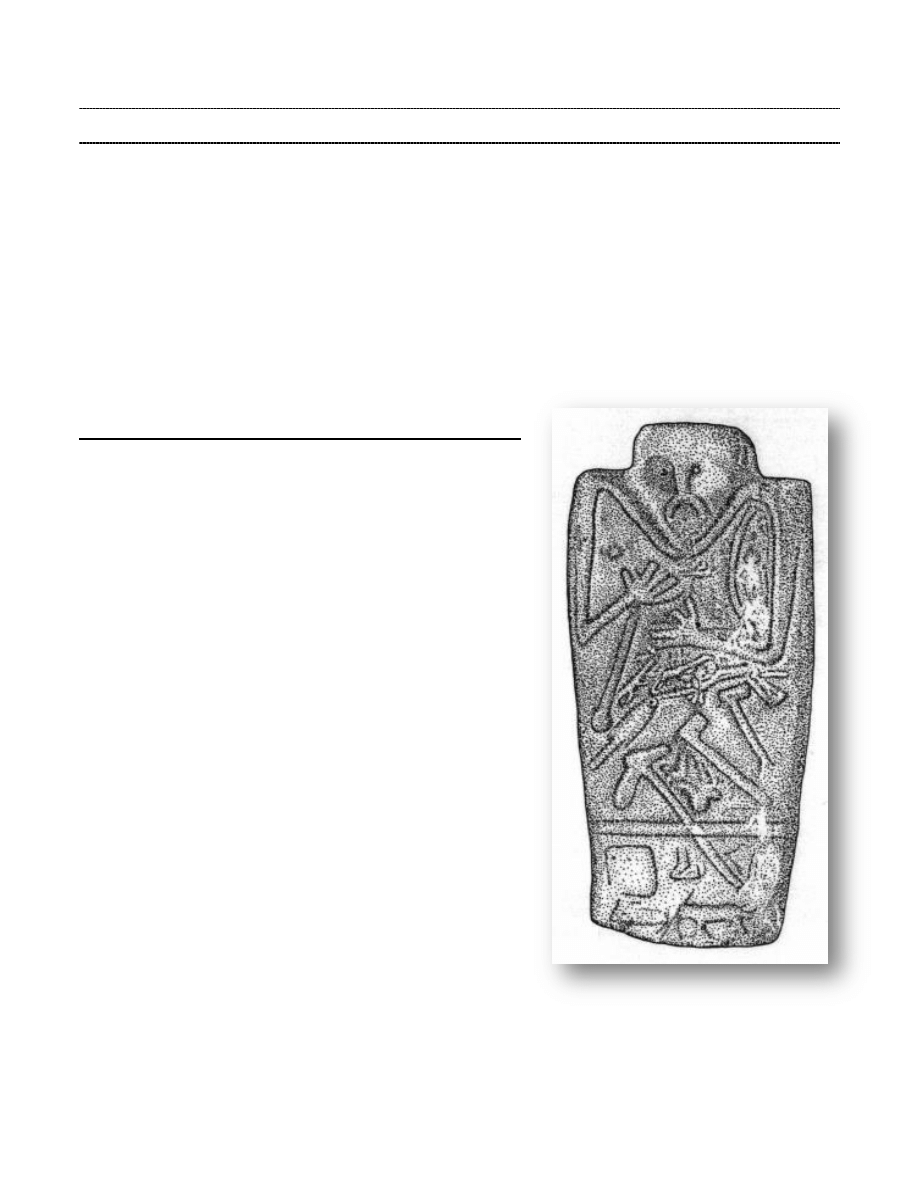
Figure 54. Ancient anthropomorphic
Ukrainian stone stela (Kernosovka
stela), possibly depicting a Late PIE
god, most likely Djeus

Appendix III: The Proto-Indo-Europeans
279
III.3.1. PRIESTS
The main functionaries of the hypothetical Proto-Indo-European religion would have been
maintained by a class of priests or shamans. There is evidence for sacral kingship, suggesting the tribal
king at the same time assumed the role of high priest. This function would have survived as late as 11
th
century Scandinavia, when kings could still be dethroned for refusing to serve as priests. Many Indo-
European societies know a threefold division of a clerical class, a warrior class and a class of peasants or
husbandmen. Such a division was suggested for the Proto-Indo-European society by Georges Dumézil.
Divination was performed by priests, e.g. from parts of slaughtered animals (for animal sacrifice, cf.
Lat. haruspex). Birds also played a role in divination, as Lat. augur, language of the birds.
Examples of the descendants of this class in historical Indo-European societies would be the Celtic
Druids, the Indian Brahmins, the Latin Flamines and the Persian Magi. Historical Indo-European
religions also had priestesses, either hierodoules (temple prostitutes), dedicated virgins, or oracles, e.g.
the Roman Vestal Virgins, the Greek Sibyls or the Germanic Völvas.
III.3.2. PANTHEON
Linguists are able to reconstruct the names of some deities in Proto-Indo-European language (PIE)
from names occurring in widely spread, old mythologies. Some of the proposed deities are more readily
accepted among scholars than others.
The Proto-Indo-Europeans may have distinguished between different races of gods, like the Aesir, and
Vanir of Norse mythology and the Titans and Olympians of Greek mythology. Possibly, these were the
Djeus, literally ―celestial, those of the sky/daylight‖ (cf. Deus, Zeus, Deva, Tiw) and the Ansu-,
literally ―spirits, those with vital force‖ (cf. Aesir, Asura, Ahura).
WIDELY ACCEPTED DEITIES
Djḗus Patḗr is believed to have been the original name of God of the Daylight Sky and the chief
god of the Indo-European pantheon. He survives in Greek Zeus (genitive case Diòs), Latin Jupiter,
Sanskrit Dyaus/Dyaus Pita, Baltic Dievas, Germanic Tiwaz (ON Tyr, OHG Ziu), Armenian Astwatz,
and the Gaulish Dispater (c.f. also deus pater in the Vulgate, e. g. Jude 1:1).
Pltaw Mātḗr (Dhghōm) is believed to have been the name of an Earth Mother goddess, Skr.
Prthivi. Another name of the Indo-European Mother-Earth would be Dhghōm Mātḗr, as in
Albanian Dhe Motë, Avestan Zamyat, Slavic Mati Zemlja, Lithuanian Ţemyna, Latvian Zemes Mate,
maybe Greek Dēmēter.

A GRAMMAR OF MODERN INDO-EUROPEAN
Indo-European Revival Association – http://dnghu.org/
A Thunder God, possibly associated with the oak, and in some traditions syncretized with Djḗus.
A name Pérqunos root per-q- or per-g- is suggested by Balto-Slavic *Perkúnos, Norse Fjörgyn,
Albanian Perëndi and Vedic Parjanya. An onomatopoeic root tar is continued in Gaulish Taranis
and Hittite Tarhunt. A word for ―thunder‖ itself was (s)tene-, continued in Germanic *Þunraz
(thunder personified), and became Thor.
Áusōs is believed to have been the goddess of dawn, continued in Greek mythology as Eos, in
Rome as Auror-a, in Vedic as Ushas, in Lithuanian mythology as Aušra or Auštaras, in Armenian as
Astghik and possibly also in Germanic mythology as Eastre.
SPECULATIVE PROPOSALS
Additional gods may include:
Greek Poseidon was originally a chthonic god, either a god of the earth or the underworld, from
poti daon ―lord of Da‖, cf. Demeter from Da mater ―Mother Da‖. Another etymology may be
proposed, don referring to ―the waters‖, as the Vedic goddess of the rivers, Danu, who shares a
name with the Celtic mother god. Poseidon being ―the master of the waters‖, more conform to the
functions of a god of the sea (and possibly also the supposed celestial ocean or watery abyss).
Wélṇos, maybe a god of the night sky, or of the underworld, continued in Sanskrit Varuna,
Greek Uranos (which is also a word for sky), Slavic Veles, Armenian Aray and Lithuanian Velnias.
Divine twins, brothers of the Sun Maiden or Dawn goddess, sons of the Sky god.
There may have been a sea-god, in Persian and Vedic known as Apam Napat, in Celtic as
Nechtan, in Etruscan as Nethuns, in Germanic as Njord and in Latin as Neptune, possibly called
Néptonos (originally from neq-t-?). This god may be related to the Germanic water spirit, the Nix.
The Sun, Swel, and the Moon Ménōts/Men- deities, possibly twin children of the supreme
sky-god Djḗus, continued in Hindu religion as Surya and Mas, in Iranian religion as Hvar and
Mah, in Greek as Helios and Selene (these were later pushed out by imported Anatolian deities
Apollo and Artemis), in Latin mythology as Sol and Luna, in German mythology as Sol and Mani, in
Baltic mythology as *Saulē and *Mēnō. The usual scheme is that one of these celestial deities is male
and the other female, though the exact gender of the Sun or Moon tend to vary among subsequent
Indo-European mythologies.

Appendix III: The Proto-Indo-Europeans
281
FANTALOV'S REDUCTION
According to the Russian scholar Alex Fantalov, there are only five main archetypes for all gods and
goddesses of all Indo-European mythologies.
He also proposes that these five archetypes were possibly
the original deities of the pre-PIE pantheon. These, according to Fantalov, are:
God of the Sky
God of Thunder
God of the Earth/Underworld
Cultural hero
Great goddess
The sky and thunder gods were heavenly deities, representing the ruling class of society, and in
subsequent cultures they were often merged into a single supreme god. On the other hand, the Earth
god and the Cultural Hero were earthly gods, tied to nature, agriculture and crafts, and in subsequent
cultures they were often split into more deities as societies grew more complex. And while it seems
there existed some enmity between the Thunderer and the God of the Earth (which may be echoed in
myths about battle of various thunder gods and a serpentine enemy, v.i.), the Cultural Hero seems to be
a sort of demigod son of either the sky god or the thunder god, and was considered to be the ancestor of
the human race, and the psychopomp. Together with the character of Great goddess, who was a wife of
the ruling sky god, the cultural hero thus balanced between the heavenly god of the sky/thunder and the
more chthonic god of the earth/underworld.
III.3.3. MYTHOLOGY
There seems to have been a belief in a world tree, which in Germanic mythology was an ash tree
(Norse Yggdrasil; Irminsul), in Hinduism a banyan tree, in Lithuanian mythology Jievaras, and an oak
tree in Slavic mythology, and a hazel tree in Celtic mythology. In classical Greek mythology, the closest
analogue of this concept is Mount Olympus; however, there is also a later folk tradition about the World
Tree, which is being sawed by the Kallikantzaroi (Greek goblins), perhaps borrowed from other peoples.
One common myth which can be found among almost all Indo-European mythologies is a battle
ending with the slaying of a serpent, usually a dragon of some sort: examples include Thor vs.
Jörmungandr, Sigurd vs. Fafnir in Scandinavian mythology; Zeus vs. Typhon, Kronos vs. Ophion,
Apollo vs. Python, Heracles vs. the Hydra and Ladon, Perseus vs. Ceto in Greek mythology; Indra vs.
Vritra in the Vedas; Perun vs. Veles, Dobrynya Nikitich vs. Zmey in Slavic mythology; Teshub vs.
Illuyanka of Hittite mythology; Θraētaona, and later Kərəsāspa, vs. Aži Dahāka in Zoroastrianism and
Persian mythology.

A GRAMMAR OF MODERN INDO-EUROPEAN
Indo-European Revival Association – http://dnghu.org/
There are also analogous stories in other neighbouring mythologies:
o
Anu or Marduk vs. Tiamat in Mesopotamian mythology;
o
Baal or El vs. Lotan or Yam-Nahar in Levantine mythology;
o
Yahweh or Gabriel vs. Leviathan or Rahab or Tannin in Jewish mythology;
o
Michael the Archangel and, Christ vs. Satan (in the form of a seven-headed dragon),
o
Virgin Mary crushing a serpent in Roman Catholic iconography,
o
Saint George vs. the dragon in Christian mythology.
The myth symbolized a clash between forces of order and chaos (represented by the serpent), and the
god or hero would always win. It is therefore most probable that there existed some kind of dragon or
serpent, possibly multi-headed (cf. Śeṣa, the hydra and Typhon) and likely linked with the god of
underworld and/or waters, as serpentine aspects can be found in many chthonic and/or aquatic Indo-
European deities, such as for example the many Greek aquatic deities, most notably Poseidon, Oceanus,
Triton, Typhon (who carries many chthonic attributes while not specifically linked with the sea),
Ophion, and also the Slavic Veles. Possibly called qr
̥mis, or some name cognate with Welṇos or the
root wel- (cf. Skr. Varuna, who is associated with the serpentine naga, Vala and Vṛtra, Sla. Veles, Bal.
velnias), or ―serpent‖ (Hittite Illuyanka, Skr. Ahis, Ira. azhi, Gk. ophis and Ophion, and Lat. anguis), or
the root dheubh- (Greek Typhon and Python).
Related to the dragon-slaying myth is the ―Sun in the rock‖ myth, of a heroic warrior deity splitting a
rock where the Sun or Dawn was imprisoned. Such a myth is preserved in Rigvedic Vala, where Ushas
and the cows, stolen by the Panis were imprisoned, connected with other myths of abductions into the
netherworld such as the mysteries of Eleusis connected with Persephone, Dionysus and Triptolemus.
There may have been a sort of nature spirit or god akin to the Greek god Pan and the Satyrs, the
Roman god Faunus and the Fauns, the Celtic god Cernunnos and the Dusii, Slavic Veles and the Leszi,
Vedic Pashupati, Prajapati and Pushan, the Germanic Woodwose, elves and dwarves.
There may also have been a female cognate akin to the Greco-Roman nymphs, Slavic vilas, the Huldra
of Germanic folklore, the Hindu Apsaras, the Persian Peri. A possibly similar type of spirit may be
found in Jewish mythology, Azazel and the Se'irim, as well as in Arabic mythology, the Jinn.
There may have been a savage dog or wolf guarding the underworld, as Greek Kerberos, Norse Garm.
It is also likely that they had three fate goddesses, see the Norns in Norse mythology, Moirae in Greek
mythology, Sudjenice of Slavic folklore and Deivės Valdytojos in Lithuanian mythology.
The first ancestor of men was called Mánus, cf. Germanic Mannus, Hindu Manu.
The Sun was represented as riding in a chariot.



Wyszukiwarka
Podobne podstrony:
Frederik Kortlandt An outline of Proto Indo European
Alexander Lubotsky Against a Proto Indo European phoneme a
PRESENT THE MAIN GROUPS OF INDO – EUROPEAN LANGUAGE?VISION
Andrew Garrett Convergence in the formation of Indo European subgroups
TESTART the case of dowry in the indo european area
CREOLES NOUVELLES VARIETES INDO EUROPEENNES
Juan Antonio Álvarez Pedrosa Krakow’s Foundation Myth An Indo European theme through the eyes of me
Frederik Kortlandt General Linguistics And Indo European Reconstruction
Frederik Kortlandt The Spread Of The Indo Europeans
Word order tendencies in mediaeval English against the Indo European background
Indo European tekp
EUROPEJSKA WSPÓLNOTA GOSPODARCZA
Unia Europejska 2
OPIEKA DLUGOTERMINOWA W KRAJACH UNII EUROPEJSKIEJ
download Prawo PrawoAW Prawo A W sem I rok akadem 2008 2009 Prezentacja prawo europejskie, A W ppt
europejski system energetyczny doc
Europejski Bank Centralny
więcej podobnych podstron