

T h e Dawn of T a n t r a
Herbert V. Guenther
and Chogyam Trungpa
e d i t e d b y M i c h a e l K o h n
illustrated by Glen Eddy
and Terris Temple
S h a m b h a l a
Boston & London
2 0 0 I

S H A M B H A L A P U B L I C A T I O N S , I N C .
Horticultural Hall
300 Massachusetts Avenue
Boston, Massachusetts 02115
© 1975 by Herbert V. Guenther and Chogyam Trungpa
All rights reserved. No part of this book may be reproduced in any
form or by any means, electronic or mechanical, including photocopying,
recording, or by any information storage and retrieval system, without
permission in writing from the publisher.
9
8
7
6
5
4
3
2
1
Printed in the United States of America
©This edition is printed on acid-free paper that meets
the American National Standards Institute z39.48 Standard.
Distributed in the United States by Random House, Inc.,
and in Canada by Random House of Canada Ltd
The Library of Congress catalogues the previous
edition of this book as follows:
Guenther, Herbert V.
The dawn of tantra
1. Tantric Buddhism - Addresses, essays, lecturers.
I. Chogyam Trungpa, Trungpa Tulku, 1939 - . II. Title.
BQ8916.G83 294.5'92 74-10250
ISBN 0-87773-059-8 (pbk.)
ISBN 1-57062-896-3 (pbk.)

Contents
ONE Tantra: Its Origin and Presentation 1
T W O Laying the Foundation 6
T H R E E
Yogacara and the Primacy of Experience 12
FOUR
The Mandala Principle and the
Meditative Process 21
F I V E
The Indivisibility of Openness
and Compassion 26
SIX
The Development of Shunyata 34
SEVEN
The Guru-Disciple Relationship 41
E I G H T
Visualization 47
N I N E
Empowerment and Initiations 53
T E N Questions and Answers: Guenther 63
E L E V E N
Questions and Answers: Rinpoche 78
Chapters One, Three, Five, Seven,
Nine and Ten are by Herbert V. Guenther
Chapters Two, Four, Six, Eight
and Eleven are by Chogyam Trungpa

Illustrations
page x
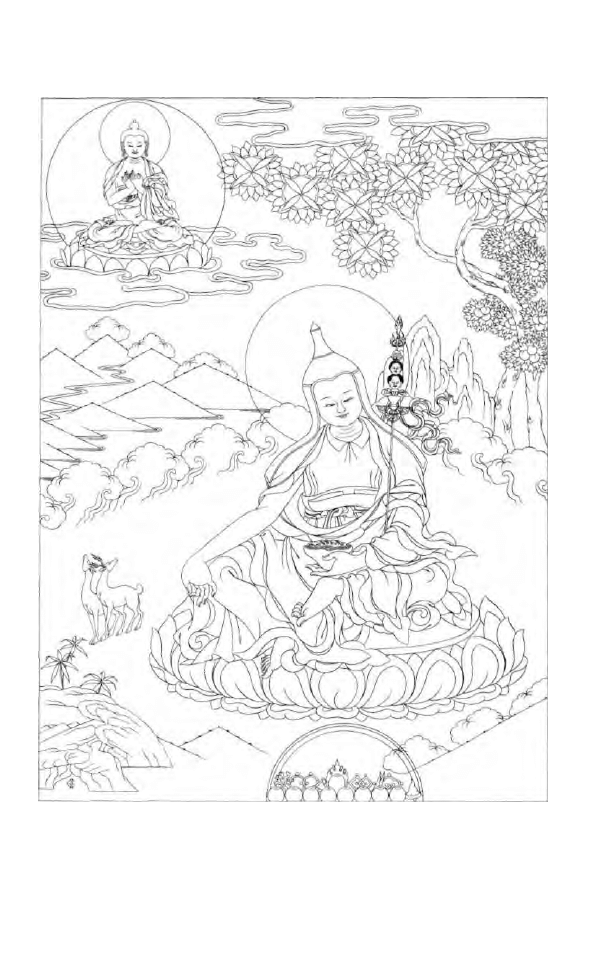
PADMA SAMBHAVA
(central figure), dGa'-Rab-rDo-
rje (upper figure). Glen Eddy
page 20
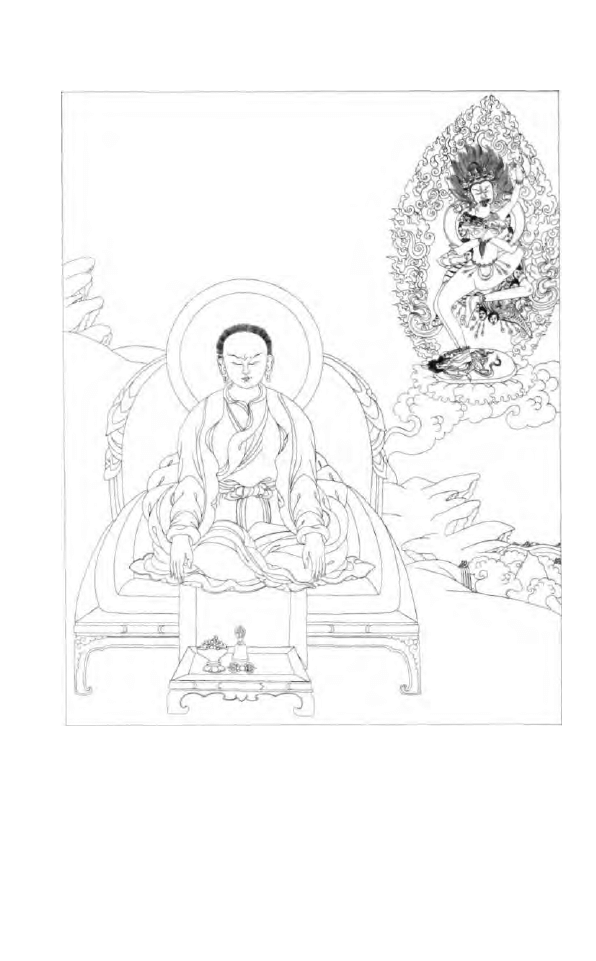
M A R P A
(central figure), Two-armed Hevajra (upper
figure). Terris Temple
page 40
NAROPA.
Glen Eddy,
page 46
MAHAVAIROCANA
(central figure), Vajradhara (upper
figure). Terris Temple
page 93 mGON-PO-LEGS-lDAN (the 'Grandfather' Mahakala).
Glen Eddy

Introduction
W E S T E R N E R S wanting to know about tantra, particularly the
Buddhist tantra of Tibet, have had to work with speculation
and fancy. Tibet has been shrouded in mystery; " t a n t r a " has
been called upon to name every kind of esoteric fantasy;
Buddhism has been left either vague or inaccessible. Academic
treatments have been of little help, being in the main inaccu-
rate or remote, failing either to comprehend or to convey.
In The Dawn of Tantra the reader meets a Tibetan and a
Westerner whose grasp of Buddhist tantra is real and unques-
tionable. Dr. Guenther holds Ph.D. degrees from the Univer-
sities of Munich and Vienna. In 1950, he went to India to teach
at Lucknow University and, in 1958, became Head of the
Department of Comparative Philosophy and Buddhist Studies
at the Sanskrit University in Varanasi. Since 1964, he has been
Head of the Department of Far Eastern Studies at the Univer-
sity of Saskatchewan in Canada. Because of his tremendous
intellectual energy and scholarly discipline, knowledge of
Tibetan, Sanskrit and Chinese, and his years of collaboration
with native Tibetans, he has become one of the few Westerners
to penetrate to a deeper understanding of Tibetan tantric
texts. His books, such as The Life and Teaching of Naropa and
the Tantric View of Life, bring us nearly the only accurate
translations and commentaries from the Tibetan Buddhist
tradition.
Chogyam Trungpa was born in the heart of the Buddhist

INTRODUCTION
tantra tradition. As the eleventh incarnation of the Trungpa
line of spiritual teachers, he was enthroned at the age of
eighteen months as abbot of a group of monasteries in eastern
Tibet. Beginning at three, he underwent intensive training in
the intellectual and meditative disciplines of Buddhism. He
had completely assumed his responsibilities, both spiritual
and temporal, by the age of fourteen and went on to become a
master of tantric Buddhist meditation. His journey towards
the West began in 1959 when he fled the Chinese Communist
invasion of Tibet. He first experienced the modern world in
India, where he spent four years studying English. Since then
he has traversed the West. He studied comparative religion at
Oxford and founded a meditation center in Scotland. He
arrived in the United States in 1970, where he has pub-
lished several books, among them Cutting Through Spiritual
Materialism, founded a number of meditation centers, a com-
munity working in art and theatre, and another for helping the
mentally disturbed, based on tantric principles. He has not
remained cloistered, but has fully and frankly encountered the
Western mind on the learned and gut levels. He has mastered
English to the level of poetry.
Having worked towards each other, so to speak, for years,
Dr. Guenther and Chogyam Trungpa met in Berkeley,
California, in 1972, where together they gave a public seminar
on Buddhist tantra. Dawn of Tantra is the edited record of that
seminar including part of the general discussion. T h e "Vis-
ualization" chapter is from a seminar given by Trungpa in San
Francisco in 1973. T h e "Empowerment and Initiation" chap-
ter is from a talk given by Dr. Guenther when he visited
Trungpa's meditation center in Boulder, Colorado, in 1973.
Dr. Guenther has also since lectured at Naropa Institute, a
university founded by Trungpa in Boulder, Colorado.
Guenther and Trungpa are an interface very much alive to
the Tibetan tradition of Buddhist tantra and very much alive
to the current everyday world of America. They communicate
warmly and freely in both directions and give no quarter to
wishful thinking.
Michael H. Kohn

The Dawn of Tantra

CHAPTER ONE
Tantra: Its Origin and
Presentation
THE term tantra, from the time of its first appearance in the
West up to the present day, has been subject to serious
misunderstandings. T h e term was introduced into the English
language in 1799 when tantric works were discovered by
missionaries in India. These were not Buddhist works. In fact
at that time it was hardly known in the West that such a thing
as Buddhism existed. T h e term tantra was then known only as
the title of these works, the contents of which was quite
different from what people expected in books dealing with
philosophy and religion. T h e missionaries were for the most
part quite shocked that other people had religious and
philosophical ideas so different from their own. To them the
word tantra meant no more than these expanded treatises; but
since the subject matter dealt with in these treatises was so
unusual from their point of view, the term began to acquire
quite a peculiar connotation, a connotation which proper study
of the texts has not borne out. Unfortunately, in this case as in
so many others, once a false conception has been formed, a
nearly superhuman effort is required to root out and set right
all the wrong ideas and odd connotations that have grown up
1

2 T H E DAWN OF TANTRA
around it. I am going to try to tell you what the term tantra
actually means in a technical sense.
First of all, one must distinguish between the tantra of the
Hinduist tradition and the tantra of the Buddhist tradition.
These two traditions, both indigenous to India, for a long
period of time used the same language - Sanskrit. But each
tradition stipulated particular uses for its terms. What one
tradition understood by a specific term was not necessarily
what the other tradition understood by it. When Buddhist
studies originated in the West, which was only comparatively
recently, it was assumed by the first investigators that since
the Buddhists used the same Sanskrit terms as the Hindus,
they would mean the same thing by them. This was the first of
many wrong conclusions that they drew.
Let us apply ourselves to an understanding of tantra as it
developed in the Buddhist tradition. A term that has been
used from the beginning in close association with the term
tantra is the Sanskrit prabandha. Prabandha means continuity.
This is a continuity of being, which divides into two grounds:
we have to start somewhere, and then go a certain way (and
perhaps arrive at a goal). This is the way tantra was presented.
It refers to an immediate h u m a n situation which arises out of
the question of how we are going to be. Tantra also sees the
question of how we are going to be in terms of relationship,
realizing that man is always related to something or someone.
Tantra approaches the question of being in various ways;
thus there is more than one presentation of it. T h e first
approach is called Kriyatantra. In the Kriyatantra the emphasis
is on how a person acts. Kriya means "action." Action is here
seen symbolically and dealt with in terms of ritual. We need
not be mystified by the idea of ritual. An example of ritual is
the custom of a man's removing his hat when he meets a lady.
It is a kind of formalized gesture. It is also a way of going about
a human relationship. T h e emphasis in the Kriyatantra is on
relationship as expressed in this kind of formalized gesture. In
this case the emphasis is far-reaching and covers many aspects
of relationship. T h e Kriyatantra is further particularized in its
approach to h u m a n relationship in that it deals with the
simplest and earliest stages of it.

Tantra: Its Origin and Presentation 3
The earliest form of relationship is that of a child with his
parents. There is a kind of dominance involved here. Someone
has to tell the child what and what not to do. When this
relational situation is transferred into a religious context it
becomes the idea that man is subject to a transcendental
entity. This is perhaps the generally accepted idea and it is
also the framework in the Kriyatantra. Here the practitioner
tries to gain favor with the one with whom he is interrelated.
This and the strong ritualistic emphasis are two main charac-
teristics of the Kriyatantra. This tantra also stresses purifica-
tion. The ritual includes various ablutions. Some of them are
purely symbolic in importance and perhaps the sense of
cleanliness involved might seem somewhat exaggerated. We
must realize, however, that the sense of being clean can
become extremely important in an emotional context such as
this one. It has a much more profound significance than in
ordinary circumstances when someone says: "Now before you
eat, wash your hands." So this emphasis on purity is another
characteristic of Kriyatantra.
But man is not content with merely being told what to do.
He is also a thinking being and will ask questions. And here is
where a further approach to tantra, known as the Caryatantra
comes in. Again here, tantra refers to a relational situation.
But here the emphasis has shifted. We are no longer only
concerned with following certain accepted rules of relation-
ship, but also to a certain extent with understanding the
implications of them. This marks the entry of a certain ques-
tioning of ourselves. Why are we doing these things? Why do
we behave in such-and-such a way? Certainly we do not
discard our behavior at this point, but we ask about its
significance. And this we do by thinking more about it. We try
to gain insight into it and this can be a kind of meditation.
Here there begins to be a balance between thought and
action. This change from the previous mere acceptance of
authority corresponds to a change in the character of our
relationship with the one to whom we are relating. It is no
longer a question of a master telling his servant or slave what
to do. There is now more of a feeling of intimacy, of comrade-
ship, more of an equal status. The one is still willing to learn,

4 T H E DAWN OF TANTRA
but the other now realizes that he is in the same situation as
the first. It is a relationship of friendship and friendship can
only be based on an acceptance of the other person in his or her
own right. Servitude makes friendship impossible.
But friendship can be developed still further than this first
intimacy. Friendship often entails our trying to find out more
about the relationship. What is valuable about this relation-
ship that compels us to cultivate it? This questioning process
leads to the further development of insight. T h e emphasis has
shifted again. This new aspect of the total situation of how we
are together brings us into the Yogatantra.
T h e term yoga has many meanings. In the Buddhist context,
it means "to harness." It is etymologically related to the
English word yoke. It means to harness everything in us in
order to gain more insight. T h u s the situation, the tantra, in
which this is the emphasis is called the Yogatantra. Here there
is a teamwork which is even better than that between two
friends. But there is still room for further development be-
cause we still consider the other slightly different from
ourselves. This is where the fourth division, the Mahayogatan-
tra, comes in.
Maha basically means "great," but here it is used not so
much to mean great as opposed to small, but with the sense
that there could be nothing greater. It is used in an absolute
sense. T h e Mahayogatantra partakes of this sense of absolute-
ness in its approach to the situation of relationship. We no
longer make any distinctions; we j u s t are, spontaneous, free.
The question of whether or not the other is my friend no longer
arises. T h e r e is a complete unity - we are j u s t one.
So there is a progression in the tantras, beginning from the
level of a child related to its parents and developing to the
level of complete maturity. T h u s when we use the term tantra,
we not only refer to a particular situation, but we also describe
a process of growth, a process of inner development which
takes place when we try to understand what there is. This
process goes on until we come to the proper assessment of
experience, the proper way of seeing. There is a dialectical
relationship between action, the way in which we behave, and
the insight we have attained. T h e more we know, the more we
learn about another person, the more responsive we become to

Tantra: Its Origin and Presentation 5
that person. We begin to realize what he needs and stop
imposing the idea of what we think he should need. We begin
to be able to help that person find his own way.
This leads us to the practical significance of tantra. Tantra,
as a way of inner growth, makes us see more, so that we really
become individuals rather than mere entities in an amorphous
context. But tantra goes still further. It goes beyond the idea of
a growth or a progress. T h e r e are further stages and subdivi-
sions within the tradition, which deal with the fact that even
after we have learned to relate properly to our problems, life
still goes on. The idea here is that spiritual practice is a
continual movement. It is only from the point of view of
discursive thought that we begin somewhere, progress or
develop, and then reach a certain goal. It is not as though,
having found enlightenment, the process is completed and
everything comes to an end. Rather, the fact is that we
continue to live, so we must continually start anew. Neverthe-
less, through the previous stages, we have found a way, a way
of relating, a certain continuity. This continuity of a way of
relating is the basic meaning of tantra. In a sense this is an
extremely simple point. In general, however, we find that
there is scarcely anything more difficult than this kind of
simplicity.

CHAPTER TWO
Laying the Foundation
PROFESSOR
Guenther and I decided that the best way for us to
approach the subject of tantra together is for him to deal with
the prajna or knowledge aspect of it and for me to deal with the
upaya, the skillful means or actual application aspect of it.
From the practical side then, the basic idea of tantra is, like
any other teaching of Buddhism, the attainment of enlighten-
ment. But in tantra the approach to enlightenment is some-
what different. Rather than aiming at the attainment of the
enlightened state, the tantric approach is to see the continuity
of enlightened mind in all situations, as well as the constant
discontinuity of it.
Experience on the tantric level corresponds to the utmost
and most complete state of being that can be attained. On the
other hand, tantra is not a question of attainment, but rather
the actual work of relating to situations properly.
All kinds of emphasis has been laid on the various colorful
attributes of tantra. One speaks of its ten special aspects.
There is the sadhana, that is, the method or practice; there are
the practices of meditation; there is the realization of one's
innate nature through identifying with various deities; and so
on. T h e basic nature of tantra can be defined in terms of ten
such ways in which it differs from sutra teachings.
6

Laying the Foundation 7
The tantric teaching is divided into the three categories of
dharmakaya, sambhogakaya and nimanakaya. All tantric teach-
ings have these three aspects. T h e teaching of tantra in terms
of the three kayas can also be related to the three main vehicles
of Buddhism. The nirmanakaya aspect of tantra is associated
with the Hinayana, the way of monastic discipline. T h e
sambhogakaya aspect of tantra could be said to be its
Mahayana aspect; it is concerned with various yogic practices
dealing with prana, bindu, nadis and so on. T h e dharmakaya or
Vajrayana aspect of tantra is concerned with pure being or
suchness. In Tibetan this is referred to as de-kho-na-nyid, "that
which is, that which j u s t simply is." This is the ultimate
aspect of the tantric teaching. Nevertheless, the basic quality
of continuity continues even beyond this.
The Tibetan names for sutra and tantra give some insight
into the difference between the two kinds of teaching. T h e
Tibetan for sutra is mdo, which means "confluence" or "junc-
tion." It is a point where things can meet, coincide, conclude
together. Most simply, it is the place where the teachings can
come together with the problems of everyday life. Take the
conclusions of the Four Noble T r u t h s : suffering, the origin of
suffering, the cessation of suffering and the path. These are
conclusions that coincide with all kinds of human conflicts of
mind. Tantra, as we know, means "continuity," which is
something more than j u s t junction. From the tantric view-
point, the junction of the sutras is not important. Junction is
just the sparkling experience of insight, a sudden glimpse of
something that comes together because two aspects of all
experience suddenly are in a chaotic relationship from the
point of view of the ordinary ego-oriented set-up. Hate and
love, to take the example of emotions, come together. T h e
solidity of hate, which depends on ego's set-up, encounters the
ego quality of love. Suddenly, both hate and love are there
together and suddenly love does not exist and hate does not
exist. The ego ground of the situation is exploded. So aspects of
the situation come together and there is a flow. At the moment
of coming together, there is an explosion, which is actually the
discovery of truth.
Tantra does not lay strong emphasis on this moment of the
discovery of truth, because it is not so interested in truth as

8 T H E DAWN OF TANTRA
opposed to confusion. Rather the principle of tantra is the
continuity which runs through both t r u t h and confusion. In
Tibetan tantra is called rgyud, which is like the thread which
runs through beads. It continues from the beginning through
the middle and the end. One speaks of the basic ground of
tantra as continuity, the continuity as the path of tantra, and
the continuity as the fruition of tantra. So tantra starts at the
beginning, continues on the path and ends at the goal or
fruition. But it does not exactly end at that point. In terms of
the practice it ends; in terms of attainment it does not end.
There is still the play of what is called Buddha-activity. T h e
general picture is that you attain the experiences first of
nirmanakaya, then sambhogakaya, then dharmakaya. Then
having mastered the ultimate experiences, Buddha-activity
begins and you work back down from dharmakaya to sam-
bhogakaya to nirmanakaya. Having achieved the peak experi-
ences, you come back down in order to relate with sentient
beings, people who are confused, relate with them through
speech or through body or whatever may be appropriate. You
speak the same language as they do. So tantra goes beyond the
fruition level.
In the tantric tradition, ego or confusion or ignorance is
personified as Rudra. All the tantric traditions of Buddhism
are concerned with the taming of Rudra, the Rudra of ego. T h e
Rudra principle is divided, especially in the Atiyoga tradition,
into the ego of the body, the ego of the speech and the ego of the
mind. This means the fixation or appropriation of the elements
of body, speech and mind by the ego in relation to its security
or expansion. In speaking of the fixation of the body, we are not
referring to purely physical attachment - lust, let's say - as a
purely physical matter. We are talking about the mind-body
situation, the body aspect of our mind, the solidity aspect of it
which needs constant feeding, reinforcement. It needs con-
tinual reassurance that it is solid. T h a t is the Rudra of the
body.
T h e Rudra of speech is the fixation of the element which is
related with both the body and the mind but at the same time
is uncertain which. This is a fickleness or wavering quality,
uncertain whether one's foundation is the fixed aspect of the
body - the physical level of the textures and colors of life - or
perhaps the emotional situation of whether to love or to hate.

Laying the Foundation 9
This uncertain wavering back and forth, this fickleness qual-
ity, is speech (or mantra, if you prefer), the voice. T h e fixation
of this is the Rudra of speech.
The Rudra of mind is fundamentally believing that, if a
higher state of spiritual development is to be attained, it has to
be manufactured rather than uncovered. Rangjung Dorje, a
great teacher of the Kagyu tradition, in his commentary on
the Hevajra Tantra, says that the ultimate materialism is
believing that Buddha-nature can be manufactured by mental
effort, spiritual gymnastics. So that is psychological and
spiritual materialism - the Rudra of the mind.
These three principles - the fixation and solidification of the
security of the body; the fixation on the emotional level of
being uncertain but still hanging onto something; the fixation
on the mental level of believing in some ultimate savior
principle, some principle outside one's own nature that, so to
speak, can do the trick - these three principles of Rudra
constitute one of the prime occupations of tantra, which is
concerned with overcoming them.
The three Rudra principles also correspond to the threefold
division of tantra. At the beginning, in order to relate to the
Rudra of body, the student must begin tantric study on the
Hinayana level. This includes practices such as the satipat-
ihana practices, which the Hinayana developed for training
the mind. These practices concentrate on breathing, walking
and other bodily movements. They simplify the basic nature of
solidity. This can be understood if we realize that this kind of
solidifying by the ego of its space is based on an attitude which
trusts complexity. It places its trust on very complicated
answers, complicated logic. Satipatthana is a way of simplify-
ing the logical mind, which is body in this case, because it
relates to something very solid and definite. T h e logical mind
attempts to fixate, hold onto, grasp and thus is continually
projecting something definite and solid. So the basic Hinayana
practice of simplifying every activity of the mind into just
breathing or bodily movement reduces the intensity of the
Rudra of body. It does not particularly transcend it or free one
from it, but at least it reduces the intensity of it.
The next stage, dealing with the Rudra of speech, is on the
sambhogakaya level. All kinds of practices have developed for
this in the Tibetan tradition. Notably, there is what is known

10 T H E DAWN OF TANTRA
as the four foundation practices: one hundred thousand pros-
trations, one h u n d r e d thousand repetitions of the refuge
formula, one h u n d r e d thousand repetitions of the hundred-
syllable Vajrasattva mantra, and one h u n d r e d thousand offer-
ings of one's body, speech and mind as the whole universe.
These preliminary tantric practices oh the sambhogakaya level
are related with prana, nadis, and bindu. They are based on
making use of the speed, the movement, the rhythm of con-
fused mind. At the same time, there is something very uncon-
fused about these practices. One cannot go through them all
without relating to the true nature of body, speech and mind.
They occupy a sort of intermediary place between confusion
and clarity. And the basic continuity principle of tantra
underlies the whole thing.
Having gone through the satipatthana of the Hinayana or
nirmanakaya level (which includes the samatha and vipassana
practices), having completed the four foundation practices on
the Mahayana or sambhogakaya level, the student is now just
ready to have a glimpse of the guru, of real relationship and
practice with the guru, real commitment to the guru. This is
where the guru yoga practice for attaining union with the guru
comes in. When that has been completed, then comes what is
called abhisheka, which could be translated as "initiation" or
"confirmation." This is the entry to the dharmakaya level.
There are four levels of abhisheka and all take place within a
realm of space in which the student and teacher meet in some
basic understanding. This understanding is the result of the
previous practices. T h e student has related to his body,
learned to slow down the speed of muscles, veins, emotions,
blood. Circulations of all kinds have been slowed down al-
together. Now the student is finally able to relate to the
ultimate space through his relationship and union with the
teacher. In the Zen tradition this is known as transmission. It
seems to be the same meeting of two minds as is found in
tantra.
We can see from this brief look that the practice of tantra is
not easy. T h e student has to begin at the beginning. He has to
acquire an understanding of the principle of taming the mind.
Understanding of the Rudra principle brings egolessness or
Rudralessness. He has to get to know his own bodily situation

Laying the Foundation 11
through the preliminary tantric practices. T h e n he can
achieve the final surrendering through abhisheka. Looked at as
a whole, the practice of tantra is like building a house. First
you put down the foundation, then you build the first story,
then the second. T h e n you can put a gold roof on it if you like.
We have looked at the sutra or Hinayana aspect within tantra,
the Mahayana aspect within tantra, then the final subtleties of
tantra within itself. Looked at in this way, the whole of the
practice of Buddhism can be regarded as tantra, although all
Buddhists outside the historical tradition of tantra might not
agree with this.

C H A P T E R T H R E E
Yogacara and the Primacy of
Experience
THE idea of tantra as continuity connects this inquiry with
the philosophy of the Yogacara since this early Indian school of
Buddhist philosophy was instrumental in developing the idea
of tantra.
T h e Yogacara school was so named because its philosophy
leads to application, working on oneself - yoga, harnessing. It
has been called by various names in the West, one of the most
common (also known in Japan) being cittamatra, which is
usually translated "mind-only." Now the word " m i n d " is very
nebulous in meaning, different people understanding differ-
ent things by it. Let us try to understand how the Yogacara
school understood this term.
T h e Yogacara system is not, strictly speaking, a single
system, but embraces a number of philosophical trends which
are in certain ways quite distinct from one another. They are
lumped together under this title in virtue of the main tenet
which they hold in common; the idea that all the three worlds
(the world of sensuousness, the world of form, the world of
formlessness) are cittamatra, mind only.
The word citta (mind), from early times was used to mean,
not so much a container of thoughts, as perhaps we tend to
12

Yogacara and the Primacy of Experience 13
understand it, but rather something like a clearinghouse that
could both store and transmit impressions. It was thought of as
something like a battery. It could be charged and then when it
was charged it would do something. It had this double function
which must be borne in mind if we wish to understand the
idea of cittamatra. In the first place, since the concept of citta
revolves around the storing and transmission of experience, it
would be more precise to translate the idea of cittamatra as
"experience alone counts."
Buddhism has always placed great emphasis on experience.
The four basic axioms of Buddhism are highly experiential in
character. The first is that everything is transitory; the second
that everything is frustrating; the third that everything is
without essence; the fourth that nirvana is bliss. These first
three axioms relate very much to our actual way of going
through life. We observe life and see that nothing lasts; we feel
that being faced with trying to build something on this basis is
very frustrating. T h e n we think and we ask ourselves, "How is
this? Why is t h i s ? " We get the answer that if everything is
transitory it cannot have an essence; because an essence is by
definition the principle by which something is what it is. If we
started reasoning from the idea of an essence, we could not
account for transitoriness, nor could we account for the
constant frustration which we experience.
Now the continual frustration makes us feel that some other
mode of being must be possible. This is where we come to the
fourth basic axiom, which says that nirvana is bliss. Buddha's
disciple Ananda asked him how he could make such a state-
ment, having said that feelings and all such forms are transi-
tory. The Buddha replied that he had qualified nirvana as bliss
only by way of language, that he did not thereby mean a
judgment of feeling, such as when we call something pleasant.
The term he used for bliss was sukha, which is very close to
what we have referred to as the peak experience. This seems to
be an experience in which all conceptions and judgments, even
the idea of oneself, completely pass away. So what is referred
to as bliss can be understood to transcend transitoriness or
permanence or any other form. In later Buddhist philosophical
systems, especially the tantra, we find that further develop-
ments concerning this state have taken place to the point

14 T H E DAWN OF TANTRA
where even the last trace of experience as such has disap-
peared. Even the possibility of saying, "I had thus-and-such an
experience" has evaporated. This view was developed directly
from the idea of the Yogacaras that "experience alone counts."
But the question still remains of how it comes about that we
are always in the realm of frustration. Also, how can we
understand the fact that our sense of continual frustration
leads us to feel that there is some other mode of experience
which gets rid of this frustration? To see the answers to these
questions, we must go still further in our understanding of the
term citta.
The Yogacaras developed an understanding of citta involv-
ing eight aspects. What they were actually trying to do was to
describe the process in which citta emerges from its primor-
dial, unqualified and unconditioned state and glides into our
ordinary way of thinking. If we understood this process
thoroughly, we would be able to do away with it and let our
minds remain in the primordial state. This would be the peak
experience.
In describing this process, the Yogacaras used the concept of
the alayavijnana, a concept which has been used differently by
different Buddhist schools and which is very important in the
tantric tradition. The alayavijnana is already different from
the alaya or basic foundation. T h e latter we assume for the
purposes of communication, without affirming that it is an
ontological entity. T h e alayavijnana is already a trend develop-
ing into the split we usually describe as subject and object. We
see here that the citta is a dynamic factor rather than a static
conception. In the function of the alayavijnana it is in constant
transformation, developing into further dualistic forms.
Here we can see the influence of the old conception of citta
as something which stores something up and, once this storage
has reached its high point, must be discharged. This idea of
stored potentialities of experience that must at some point be
actualized is constantly present in Buddhist philosophy. The
precise forms which cause the alayavijnana to function in this
way are called vasanas. These are deposits that are poten-
tialities. They develop according to two principles, the one a
principle of intrinsic similarity, the other a principle of taking
on various specific forms in accordance with conditions. For

Yogacara and the Primacy of Experience 15
instance, a scientist, by way of experiment, might take some
kidney cells and plant them on some other part of the body, say
an arm. They will not develop as skin cells, but will continue
to develop as kidney cells. This is the first principle. But the
way in which these kidney cells develop as kidney cells will
vary according to a multiplicity of conditions. Some people
have kidney trouble and others do not. This illustrates the
second principle.
As we have said, what develops in the course of the
transformation of citta is a split. As the initial step in the
genesis of experience from the process known as the alayavi-
jnana, there develops something else, which is known as manas
in Sanskrit and yid in Tibetan. This aspect of citta now looks
back and takes the original unity out of which it developed as
its real self. This original unity is what is taken as an
ontologically real self by the Hindus.
The Hindus described the original unity as the transcenden-
tal ego and the manas as the empirical ego. T h e Buddhists
rejected the reification of these aspects, having seen that they
all belonged to the unity of a transformational process. Accord-
ing to the Yogacara, the split that occurs merely contrasts a
limited form with a vital primordial form. The manas or yid
then becomes the source of all subsequent mental functions in
the way indicated by common speech when we say "I see" or
"I think." But all these mental functions are part of the total
process of transformation.
According to the Yogacara view, the original source (the
alayavijnana) is undifferentiated and ethically or karmically
neutral. When the split occurs it becomes tainted, but still the
particular mental movement in question is not determined as
ethically positive or negative. This determination takes place
through elaborations of the movement which further specify
it. This elaboration takes the form of our perceiving with the
five senses, and also with the traditional Buddhist sixth sense,
which we might loosely call consciousness; that is, the categor-
ical perception which brings categories into sense data with-
out abstracting them from it. T h u s the alayavijnana, the manas
and the six senses are the eight aspects of citta.
This process of transformation we have described is one of
growing narrowness and frozenness. We are somehow tied

16 T H E DAWN OF TANTRA
down to our senses, to the ordinary mode of perception. We
dimly feel that something else might have been possible. If we
try to express this situation in traditional religious terms, we
might say that man is a fallen being. But here he has not fallen
because he has sinned or transgressed some commandment
coming from outside him, but by the very fact that he has
moved in a certain direction. This is technically known in
Buddhism as bhranti in Sanskrit or 'khrul-pa in Tibetan, and is
usually translated as "error." But error implies, in Western
thinking, culpability; and there is absolutely no culpability
involved. We might tend to feel that we could have done
otherwise, but this attitude simply does not apply here. T h e
process is a kind of going astray which just happens. T h e idea
of sin is irrelevant.
Still we have the feeling of something gone wrong. If we
accept our ordinary experience as error, then we ask the
question "Is true knowledge possible?" Now the very question
already implies that it is possible. T h a t is to say, the sense of
error implies the sense of truth. We could not know error
without unerring knowledge. So there is this oscillation back
and forth between error and knowledge; and this oscillation
presents the possibility of returning to what we have referred
to as the original or primordial state.
Here original does not have the sense of "beginning." We
speak of it as the original state because we feel that our charge
of creative power came from there. We experienced an energy
which we felt to be of the highest value, quite distinct from the
tone of our ordinary experience. T h e existential apprehension
of this original state is technically known in the tantric
tradition as the mahasukhakaya.
In the ordinary Buddhist tradition there is the nirmanakaya,
sambhogakaya and dharmakaya. T h e n if it is wished to em-
phasize the unity of the three and avoid any tendency to
concretize them as separate, we speak of the whole as the
svabhavikakaya. This is not a fourth kaya, but the unity of the
three. The mahasukhakaya is a significant addition to this
picture which came in with tantra. Sukha means "bliss"; maha
means "than which there could be none greater." So we have
the peak experience again; and this is always felt as being,
which gives kaya.

Yogacara and the Primacy of Experience 17
Kaya is translated as "body," but not in the sense of the
purely physical abstraction which is often made in defining
"body," where we say that one thing is the mental aspect of us
and the other thing is the physical aspect. This is a misconcep-
tion. There is no such thing as a body without a mind. If we
have a body without a mind, it is not a body, it is a corpse. It is
a mere object to be disposed of. If we speak properly of a body,
we mean something which is alive; and we cannot have a live
body without a mind. So the two cannot be separated - they go
together.
Thus the mahasukhakaya is an existential factor, which is of
the highest value. This is not an arbitrary assignment of value
that is made here. It is j u s t felt that this is the only absolute
value. This absolute value can be retrieved by reversing the
process of error, of going astray; by reverting the energy that
flows in one direction and becomes frozen, less active. It is this
process of freezing which causes us to feel imprisoned and
tied down. We are no longer free agents, as it were, but are in
samsara.
So in answer to the question of whether or not there is some
alternative to the continual frustration in which we live, the
answer is, yes. Let us find the initial, original, primordial, or
whatever word you want to use - language is so limited - as a
value. This is the mahasukhakaya.
The possibility of returning to the origin has been rendered
manifest in the form of certain symbols of transformation,
such as the mandala. Transformation from ordinary percep-
tion to primordial intrinsic awareness can take place when we
try to see things differently, perhaps somewhat as an artist
does. Every artist knows that he can see in two different ways.
The ordinary way is characterized by the fact that perception
is always related to accomplishing some end other than the
perception itself. It is treated as a means rather than some-
thing in itself. But we can also look at things and enjoy their
presence aesthetically.
If we look at a beautiful sunset, we can look at it as a
physicist does and see it as a system of wavelengths. We lose
the feeling of it completely. We can also look at it as a poignant
symbol of the impermanence of all things and be moved to
sadness. But this also is not j u s t the sunset itself. T h e r e is a

18 T H E DAWN OF TANTRA
definite difference when we j u s t look at it as it is and enjoy the
vast play of colors that is there in tremendous vividness. When
we look like this, we will immediately notice how free we
become. The entire network of mental factors in which we
usually labor j u s t drops off. Everyone can do this but, of
course, it requires work.
The art of the mandala has been developed to help us see
things in their intrinsic vividness. Although all mandalas are
fundamentally similar, each is also unique. T h e colors used in
them, for instance, vary greatly according to the basic make-up
of the practitioners. T h e character of a particular mandala is
known as the dhatu-tathagatagarbha. Dhatu here refers to the
factor of the particular individual make-up. Tathagatagarbha
refers to the awakened state of mind or Buddhahood. So a
particular mandala could be seen as a specific index of the
awakened state of mind. Care is taken to relate to individual
characteristics because, although each person is capable of
total Buddhahood, he must start from the aspect of it that is
most strongly present in him.
There is a Zen saying that even a blade of grass can become a
Buddha. How are we to understand this? Usually we consider
that a blade of grass simply belongs to the physical world; it is
not even a sentient being, since it has no feelings, makes no
judgments, has no perceptions. T h e explanation is that every-
thing is of the nature of Buddha, so grass is also of this nature.
It is not that it in some way contains Buddha-nature, that we
can nibble away analytically at the various attributes of the
blade of grass until there is nothing left but some vague
leftover factor that we then pigeonhole as Buddha-nature.
Rather, the blade of grass actually constitutes what we call
Buddhahood or an ultimate value.
It is in this sense that a blade of grass or any other object can
be a symbol of transformation. T h e whole idea of symbols of
transformation is made possible by the philosophical de-
velopment of the Yogacaras, who saw that what comes to us in
earthly vessels, as it were, the elements of our ordinary
experience, is the fundamental mind, the ultimate value. The
ultimate value comes in forms intelligible to us. T h u s certain
symbols such as mandalas, already partially intelligible to us,
can be used as gateways to the peak experience.

Yogacara and the Primacy of Experience 19
So these symbols exist, differing according to the needs of
individuals. We can slip into the world of running around in
circles - that is what samsara literally means - or we can also,
through such symbols, find our way out of it. But the way out is
nowhere else but in the world where we are. T h e r e is no other
world besides the world we live in. This is one of the main
purports of Buddhist philosophy and one which Westerners
often find hard to grasp. Buddhist philosophy does not make
the distinction between the phenomenal and the noumenal.
The phenomenon is the noumenon and the noumenon is the
phenomenon; not in the sense of mathematical equation, but in
the sense that you cannot have one without the other. T h e
technical statement of this is that there is appearance and
there is also shunyata; but shunyata is not somewhere else, it is
in the appearance. It is its open dimension. T h e appearance
never really implies any restriction or limitation. If there were
such a limitation, we could never get out of it.

CHAPTER FOUR
The Mandala Principle
and the Meditative Process
TANTRA cannot be understood apart from experience arising
out of the practice of meditation. Tantra, as we have said, can
be regarded as the golden roof of the house. Before we can put
on a roof, we have first to have built a house, and before that
even, to have laid a foundation. I have already mentioned the
four foundation practices. But such practices by themselves
are not enough; we have to do the basic work of relating to
ourselves. T h e work we must do to have a complete under-
standing of the symbolism of tantra and of the mandala
principle begins at a very rudimentary level.
A mandala consists of a center and the fringe area of a circle.
On the basic level, it consists of the practitioner and his
relationship to the phenomenal world. T h e study of the
mandala principle is that of the student in his life situation.
In a sense spiritual practice in Buddhism in the beginning
stages could be said to be very intellectual. It is intellectual in
the sense of being precise. It could also be seen as intellectual
because of the nature of the dialogue which has to take place
between the student and the teacher, the student and the
21

22 T H E DAWN OF TANTRA
teaching. A certain questioning process has to take place. It is
not a matter of memorizing texts or merely applying a variety
of techniques. Rather it is necessary that situations be created
in which the student can relate to himself as a potential
Buddha, as a dharma-body - he relates his whole psyche or
whole make-up to the Dharma. He must begin with a precise
study of himself and his situation.
Traditionally there are twelve types of teaching styles
proper to a Buddha. The sutras can be divided into twelve
categories according to which of the twelve styles the Buddha
has employed in it. One of the twelve styles is that of creating
a situation in which the teaching can transpire. Take the
example of the Prajnaparamitahridaya or Heart Sutra. In the
original Sanskrit version of this sutra, Buddha does not say a
word; but it was Buddha who created the dialogue between
Avalokiteshvara and Shariputra. Buddha created the situation
in which Shariputra could act as the receiver or audience and
Avalokiteshvara as the propounder of the analysis.
So creating the situation in which the student can relate to
the teaching is the initial creation of the mandala principle.
There is the hungry questioning, the thirsty mind which
examines all possibilities. T h e questions are inspired by the
basic suffering of the student's situation, the basic chaos of it.
It is uncertainty, dissatisfaction, which brings out the ques-
tions.
Seen in the tantric perspective, the first stages of the
creation of the mandala principle are the basic Buddhist
practices on the Hinayana level. T h e starting point is samatha
practice, which is the development of peace or dwelling on
peace. This practice does not, however, involve dwelling or
fixing one's attention on a particular thing. Fixation or con-
centration tends to develop trance-like states. But from the
Buddhist point of view, the point of meditation is not to
develop trance-like states; rather it is to sharpen perceptions,
to see things as they are. Meditation at this level is relating
with the conflicts of our life situations, like using a stone to
sharpen a knife, the situation being the stone. The samatha
meditation, the beginning point of the practice, could be
described as sharpening one's knife. It is a way of relating to
bodily sensations and thought processes of all kinds; just

The Mandala Principle 23
relating with them rather than dwelling on them or fixing on
them in any way.
Dwelling or fixing comes from an attitude of trying to prove
something, trying to maintain the " m e " and " m y " of ego's
territory. One needs to prove that ego's thesis is secure. This is
an attempt to ignore the samsaric circle, the samsaric
whirlpool. This vicious circle is too painful a t r u t h to accept,
so one is seeking something else to replace it with. One seeks to
replace the basic irritation or pain with the pleasure of a fixed
belief in oneself by dwelling on something, a certain spiritual
effort or j u s t worldly things. It seems that, as something to be
dwelled on, conceptualized ideas of religion or spiritual teach-
ings or the domestic situations of life are extensions of the ego.
One does not simply see tables and chairs as they are; one sees
my manifestation of table, my manifestation of chair. One sees
constantly the " m e " or " m y " in these things; they are seen
constantly in relationship to me and my security.
It is in relation to this world of my projections that the
precision of samatha is extremely powerful. It is a kind of
scientific research, relating to the experiences of life as sub-
stances and putting them under the microscope of meditative
practice. One does not dwell on them, one examines them,
works with them. Here the curiosity of one's mind acts as
potential prajna, potential transcendental knowledge. T h e
attitude of this practice is not one of seeking to attain nirvana,
but rather of seeing the mechanism of samsara, how it works,
how it relates to us. At the point of having seen the complete
picture of samsara, of having completely understood its
mechanism, nirvana becomes redundant. In what is called the
enlightened state, both samsara and nirvana are freed.
In order to see thought processes (sensations and percep-
tions that occur during the practice of samatha) as they are, a
certain sense of openness and precision has to be developed.
This precise study of what we are, what our make-up is, is
closely related with the practice of tantra. In the tantric
tradition it is said that the discovery of the vajra body - that is,
the innate nature of vajra (indestructible being) - within one's
physical system and within one's psychological system is the
ultimate experience. In the samatha practice of the Hinayana
tradition, there is also this element of looking for one's basic

2 4 T H E DAWN O F TANTRA
innate nature as it is, simply and precisely, without being
concerned over the absence of " m e " and "my."
From the basis of the samatha practice, the student next
develops what is known as vipassana practice. This is the
practice of insight, seeing clearly, seeing absolutely, pre-
cisely - transcendental insight. One begins to realize that
spending one's whole time on the details of life, as in the
samatha practice, does not work. It is still somehow an
adolescent approach. It is necessary to begin to have a sense of
the totality. This is an expansion process. It is parallel with
the tantric practice of the mandala. Having started with what
is called the bija mantra, the seed syllable in the middle of the
mandala, there is then the expanding process of discovering
the four quarters of the mandala. Working with the seed
syllable has the samatha quality of precision, looking at the
definite qualities of things as they are. Having established the
seed syllable, one puts other symbols around it in the four
quarters, one expands one's mandala. Similarly in the vipas-
sana practice, having established the precision of details, one
begins to experience the space around them. In other words, in
making a pot, the importance is not so m u c h on making the pot
itself, but on shaping the space. Just so, in the vipassana
practice the process is one of trying to feel the space around
the pot. If one has a sense of the space one is going to create by
producing a pot, one makes a good potter. But if one is purely
concerned w i t h making a shape out of clay without having a
sense of the space, one does not make a good potter; or a good
sculptor either, for that matter. In this way of beginning to
relate with the space, vipassana is gradually letting go, a
releasing and expanding.
From this point it is then possible to get a glimpse of the
shunyata experience. T h e obstacle to the shunyata experience
is the split between basic being and one's concept of it, be-
tween one's being and one's projections. All kinds of questions,
problems and obstacles arise in relation to this division. T h e
reason that the first glimpse of shunyata becomes possible at
this point is that, having seen the details of things as they are
through samatha practice and experienced the space around
them through vipassana, one begins to relax. One begins to

The Mandala Principle 25
experience the needlessness of defending or asserting oneself.
At this point shunyata emerges as the simple absence of those
walls and barricades of defense and assertion. One begins to
develop the clear and precise experience of seeing a tree as j u s t
a tree; not one's version of a tree, not a tree called such-and-
such, but a tree j u s t as it is. T h e culmination of the experien-
tial process of the development of intellect is the experience of
shunyata, which is the experience of the non-existence of
duality. The research work is already accomplished; the pro-
cess of searching for something has been laid to rest. This is
the attainment of prajna.
From this point the intellect begins to turn towards jnana or
intuition. Up until now the learning process has been regarded
as receiving teaching; it has been an experimental course of
study with the object of finding out who, what and where we
are. In that sense the practices of both the Hinayana and
Mahayana levels are a step towards the understanding of the
mandala within the body, the mandala within consciousness
and the mandala within the environmental situation of one's
life. According to the tantric tradition, three levels of experi-
ence are always necessary - outer, inner and secret. T h e outer
experience is relating with form; the inner experience is
relating with the subtleties of form. T h e subtleties of form are
the space, in the sense we have referred to of a pot and the
space around it. T h e secret experience is that the form and the
space are the same, that there is no difference between form
and space.
On the level of the secret experience the subtleties are no
longer an object of concern. If one keeps attending to the
subtleties, then that itself becomes a veil - one is still relating
to the situation as a learning process, rather than the actual
process of experience. But it is not possible to arrive at the
level of direct experience without going through the learning
process of understanding scientifically. T h e practice of medi-
tation in Buddhism begins with scientific research in which
one learns to make friends with oneself and learns what one is.
Having completely and thoroughly understood that, then one
can expand into the further dimension of understanding
which is the level of direct experience without any props.

CHAPTER FIVE
The Indivisibility of Openness
and Compassion
1 would like to discuss the implications of the following
Sanskrit verse:
sunyatakarunabhinnam bodhicittam iti smrtam
" T h e indivisibility of shunyata and karuna is termed
bodhicitta."
Here we have two terms which are of key significance in
tantra, shunyata and karuna. T h e terms are not restricted to
the tantric level, but appear fairly early on in the development
of the Buddhist tradition. Shunyata was originally an elabora-
tion of the concept of anatman. T h e meaning of anatman was
that there is no abiding principle in things. Later on, shunyata
became one of the central concepts of the Mahayana. For the
student of tantra, it remains a sort of objective reference of
which he must be aware in order to pursue his practice onto
further levels of subtlety.
Shunyata is usually translated "emptiness" or "void."
These translations are thoroughly misleading, because
shunyata is a highly positive term. Unfortunately, the early
translators were not very sophisticated and allowed them-
26

Openness and Compassion 27
selves to be misled by the sense of shunya in ordinary everyday
language. In this popular language, if a glass had no water in it,
it could be called shunya. But this is not at all the sense of
shunyata in Buddhist philosophy.
Shunyata can be explained in a very simple way. When we
perceive, we usually attend to the delimited forms of objects.
But these objects are perceived within a field. Attention can be
directed either to the concrete, limited forms or to the field in
which these forms are situated. In the shunyata experience,
the attention is on the field rather than on its contents. By
"contents," we mean here those forms which are the outstand-
ing features of the field itself. We also might notice that when
we have an idea before our mind, the territory, as it were,
delimited by the idea is blurred; it fades into something which
is quite open. This open dimension is the basic meaning of
shunyata.
This openness is present in and actually presupposed by
every determinate form. Every determinate entity evolves out
of something indeterminate and to a certain extent also main-
tains its connection with this indeterminacy; it is never
completely isolated from it. Because the determinate entity is
not isolated from the indeterminacy and because nevertheless
there is no bridge between the two, our attention can shift back
and forth between one and the other.
The perception of shunyata as openness is connected with
the development of what is known as prajna. Because there are
some very fantastic translations in vogue of this term prajna, it
is worthwhile having a good look at what the term means.
There are various words in Sanskrit which refer to the
cognitive process. T w o most frequently used ones are prajna
and jnana. If we look at the words, we immediately notice that
both contain the root jna, which signifies the cognitive poten-
tiality. Jnana is the primary formation from this root in the
Sanskrit language; in prajna, the same root jha is there with
the prefix pra.
If we look at the Tibetan translations for these terms, we
find that the very same root connection has been preserved.
T h e Tibetan for prajna is shes-rab, and for jnana it is ye-shes. In
both cases the shes, the cognitive potentiality, is there. Ye
means "primordial" or "original." Thus ye-shes refers to

2 8 T H E DAWN O F TANTRA
primordial awareness. T h e Sanskrit prefix pra and the Tibetan
particle rab have the sense of "heightening" or "intensifica-
tion." Therefore, shes-rab or prajna refers to an intensification
or heightening of the cognitive processes. The cognitive poten-
tiality that is present in everyone is to be developed, inten-
sified, and brought to its highest pitch. To bring this potential-
ity to its highest pitch means to release it, to free it from all the
extraneous material that has accumulated.
What does it mean to free something? In the Western world,
freedom has usually been used as a negative term: we speak of
freedom from this, freedom from that. T h e logical conclusion
from this usage, a conclusion which nobody likes to draw, is
that we must also reach the point of getting rid of freedom
from freedom. It does not help to have recourse to the con-
struction of "freedom-to," freedom to do this, freedom to be
that. Freedom-to implies subordination to some transcenden-
tal hocus-pocus and that makes freedom disappear as quickly
as the negative proposition does. We see, then, that freedom
cannot be considered as a separate thing relative to something
else. It must be itself an existential fact. In this sense, freedom
is not something that has to be achieved - it is basic to
everything.
Freedom is inherent in all the cognitive processes. Here it
helps to see that the opposite of freedom is not determination
but compulsion. One is quite free to determine one's way of
life, free to determine whether to look at things in a categorical
way or an aesthetic way. T h a t is, we can look at things relative
to a set of goals to be achieved, or can simply appreciate them,
and recognize their intrinsic value. So we must understand
that freedom is a basic phenomenon and not some end-product
of getting rid of something or subjecting oneself to some
transcendental nebulosity, as it would seem that Western
philosophy has generally approached it.
Prajna or shes-rab as the heightening of the cognitive capaci-
ty, also means a weakening of the network of relative consider-
ations in which, ordinarily, it is embedded. T h e weakening of
this network permits the emergence of the cognitive capacity
in its original freedom.
Prajna operates on different levels. It is operative when we
listen to someone merely on a rudimentary level, when we

Openness and Compassion 29
merely hear something that the person we are listening to says.
Just to hear what someone is saying, some understanding must
be there. Prajna can be present on a more significant level. For
instance, we can go beyond the mere momentary taking in of
what someone says, to the point where we retain it and think
about it. This may lead us to weigh seriously what we have
heard and to try implementing our conclusions such that we
embody them in our lives.
Prajna can operate on a still further level. Instead of attend-
ing to what we perceive, hear or think about, in terms of
categories related to the narrow limits of self-preservation or
personal ends, we can come to appreciate things as values in
themselves. When we come to this point there is a sort of a
release, since there is no longer a need to manipulate our
perceptions - we can let things be as they are. In speaking of
arriving at this point it is possible to speak of freedom as an
achievement, but we must see that this freedom has been there
all the time. However, we have lost sight of this freedom
through being involved with all sorts of unnecessary con-
structions - constantly seeing things as means in relation to
our personal orientation. Having come to this basic apprecia-
tion and openness, we have the possibility of staying with it
and seeing things as valuable, or we can fall back to seeing
things as means for further means ad infinitum.
It is at this crucial point that shunyata comes in. Shunyata is
the objective correlate of this heightened or opened state of
awareness. In this state, we do not see different things but we
do see things differently. When I meet someone, I can im-
mediately snap into a state of mind where I am asking myself
what I have to gain or lose from meeting this person and I can
then involve myself in the appropriate strategy. Or, I can
merely take in the impression of this person and relate to him
without preconception. Very likely if I do the latter, a very
satisfactory meeting will ensue. I have related to this open
dimension of my impression. Now this is a very simple thing,
there is nothing special about it and anybody can do it. But, as
I have said, the simplest things are often the most difficult.
Probably one of the most difficult things is for a person to do
without his fixations and preconceptions. They seem to pro-
vide so much security; yet a person who follows his fixations

30 T H E DAWN OF TANTRA
always suffers from a sense of lack or loss - as if something
were missing.
When we speak of shunyata, we are speaking of the open
dimension of being. We can be aware of this open dimension,
but in order to perceive it our perceptive faculty must be open,
without a bias of any kind. If our way of perceiving is tainted
by any sort of predisposition or reservation, we are right then
out of the openness. We have already narrowed our view, and
this, in the end, will be quite unsatisfying.
We must be very careful not to regard openness as an entity.
If we do that, we shall have made a concept of it, which
automatically fixes it and makes it something definite. It is
precisely this that we have had to break out of in order to
perceive it. This is where past mistakes have been made in the
history of Buddhism. Someone tried to say that prajna is
shunyata. But prajna is not shunyata. Shunyata is the objec-
tive pole of prajna, the open quality of things which the
cognitive process relates to when it reaches the level of true
prajna.
We cannot predicate anything of prajna except to say that
when it is properly prajna it must be as open as that which it
perceives. In this sense we might say that subjective and
objective poles, (prajna and shunyata) coincide. With this
understanding, rather than saying that prajna is shunyata, we
can try to describe the experience by saying that it has gone
beyond the dualism of subject and object. But we must not get
too carried away by these descriptions and lose sight of the fact
that they are only trying to bring home to us this simple
experience that any of us can relate to directly if we so wish.
We are free to do it. It is up to us.
We have now seen that shunyata is always a reference of
perception. All action is based on perception, since, naturally,
we always act in the light of our awareness. This is true on
every level. T h e less I am aware of another person, the less
able I am to act appropriately in my relationship with him. We
have the example of certain types of people with so-called
"good intentions" who do not take the trouble to become aware
of what the people they are being "good to" really need. They
are so involved in their preconceptions and biases that they
think whatever they like must be good for everybody. Such a

Openness and Compassion 31
person might like milk and exert himself to get everybody to
drink milk. But what about people who are allergic to milk?
Such a thought would never make any impact on such a
person's good intentions. T h e example may appear ridiculous,
but it is precisely this sort of ridiculous action that we
encounter constantly in life. We act on the basis of our
understanding, our awareness, and if this is not open and
alive, then our actions are necessarily clumsy and inappro-
priate.
This leads us to the subject of karuna. It seems that aware-
ness is not j u s t there for the fun of the thing, but it implies
action. Action carried out in the light of the awareness of
shunyata, that is, the action of prajna, is karuna. Karuna is
usually translated as "compassion" and in many cases that
may be correct. But the word itself derives from the Sanskrit
root kr, which denotes action. Just as with prajna, we can
speak of karuna on many levels. On the highest level, on the
level of the Buddha, we speak of mahakaruna, "the greatest
karuna." Buddha's awareness was that of the awakened state
of mind. He could not act otherwise than in the light of that
complete awareness. This complete awareness is the funda-
mental example of the indivisibility of shunyata and karuna.
According to Buddhism there are three basic emotional
complexes: passion-lust, aversion-hatred, and infatuation-
bewilderment. These are named in terms of their ordinary or
samsaric manifestations but they have latent possibilities of
transformation. They are related to each other in a particular
way. Bewilderment concerning the nature of what is going on
can exist without entailing the extremes of passion or aversion.
Passion or aversion, however, cannot come into play without
the presence of basic bewilderment. Passion and aversion are
emotional energies that have been distorted by an absence of
precision which is this basic bewilderment.
Now in order to understand the nature of compassion, we
can ask ourselves to which of these three basic emotional
complexes compassion belongs. T h e usual response would be
passion, since one ordinarily thinks that passion is related to
love and love is not so different from compassion. But the
Buddhist texts say the opposite: compassion belongs to hatred.
The connection can be seen in the process that sometimes

32 T H E DAWN OF TANTRA
takes place when through enmity one person cuts another
down and renders him helpless; then the one who has the
power can aid the helpless one and feel himself a good person.
This is the usual version of compassion and philanthropy.
But compassion is possible without aggression to create the
original intimacy. On this level, the level of openness or
shunyata, compassion is far more than the visceral emotion or
sentimental urging that we ordinarily experience. On this
level, we may speak of mahakaruna, which is based on the
undistorted awareness of the awakened state of mind. There is
a Sanskrit expression which runs as follows:
sunyatakarunabhinnam yatra cittam prabhavyate
sa hi buddhasya dharmasya sanghasyapi hi desana
"Where an attitude in which shunyata and karuna are
indivisible is developed, there is the message of the Buddha,
the Dharma, and the Sangha."
Where the mind is such that it is able to perceive the
openness in being, then its action is consonant with this
openness because it takes into account what is real. If, on the
other hand, awareness is tainted, the mind will manifest in all
the emotional forms which are distortions of the real.
Ordinarily a distinction is made between jnana and klesha,
primordial awareness and distorted emotional mind. We see
here that they are not two different things - the one is a
distortion of the other. Because klesha is a distortion of jnana
it can be, so to say, rectified and returned to its source. This
comes as a result of the development of prajna which, when
heightened, can cut through the potentiality for distortion.
This was the emphasis of the Prajnaparamita literature.
Through prajna a person is led out of the narrow confines of
his fictions, led not into some realm beyond, but into the actual
world that is right here. Again, the awareness of the awakened
mind is not of some new realm of objects; we do not see
different things, we see things differently.
When, through prajna, the point is reached where shunyata
and karuna are indivisible, there emerges bodhicitta (the
bodhi-mind). Bodhicitta is that in which all that has been a
limit has fallen away and all the positive qualities of mind

Openness and Compassion 33
have become active. This active aspect of the bodhicitta is
what is meant by karuna. On this level, karuna is compassion
in the true sense of that word - con-passio, "to feel with." This
means to feel with what is real. It goes with the recognition of
what is real and valuable in itself, not by virtue of some
assigned or projected value which is basically subjective in
character.
We have such a strong tendency to approach our experience
only as a possible confirmation of the conceptions we already
have. If we are able to be open, we grow. If we seek to relate
everything to our preconceptions, then we are narrowing
ourselves, narrowing being and we become lifeless. If we fail to
see the vividness of life and try to pigeonhole it, we ourselves
become pigeonholed, trapped. We must attempt to relate to
this innate capacity for openness that is there, this self-
existing freedom. If we are aware in this way, we will act
accordingly. If we see things as valuable in themselves, then
we will act productively so that value is retained and aug-
mented rather than destroyed and reduced.
If we constantly relate to and defend our preconceived
ideas, everything is automatically reduced to what is known as
vikalpa, concept, which means something that is cut off from
the whole. T h e n we have j u s t the fragmentary world in which
we are usually involved.
The foundation of the creative approach is openness,
shunyata. It is more than the "nothing," by which it is usually
translated. According to Buddhist tradition, this openness is
the basis on which we can enrich our lives. It is the basis of the
various tantric practices.

C H A P T E R SIX
The Development of Shunyata
We have discussed the meditation practices of samatha and
vipassana. T h e union of the samatha experience with the
vipassana experience leads to a further meditation practice,
known as mahavipassana. T h e mahavipassana practice corre-
sponds to the birth of the shunyata experience. T h e intensive
experience of form of samatha and the intensive experience of
totality, total environment, of vipassana combine to give birth
to the experience of shunyata. This experience produces a
new dimension - one finds one doesn't have to defend oneself
any longer. T h e experience of shunyata brings a sense of
independence, a sense of freedom.
This is not a matter only of sitting meditation practice; daily
living situations are very much a part of these experiences.
T h e six transcendental qualities of a Bodhisattva - generosity,
discipline, patience, exertion, meditation and prajna or tran-
scendental knowledge - all these together contribute to the
development of the shunyata experience.
The experience of shunyata is a by-product of the process of
letting-go. This process consists in the application of the five
transcendental qualities of a bodhisattva combined with the
precision and clarity of prajna. T h e five qualities act as
auxiliaries, which prajna directs. It is said that when the
universal monarch goes to war he is accompanied by his army
34

The Development of Shunyata 35
composed of five different kinds of forces - cavalry, elephant,
chariots and so on. So the birth of shunyata takes place through
the application of the skillful action of these five qualities with
the guidance of prajna providing the basic strength.
Being related with these active characteristics, shunyata is
clearly not a state of trance or an absorption of some kind. It is
a fearless state. Because of this fearlessness, one can afford to
be generous. One can afford to acknowledge a space which
does not contain any conflicts of that and this or how and why.
No questions of any kind exist at this point. But within this
state there is a tremendous sense of freedom. It is an experi-
ence, I suppose one could say, of having gone beyond. But this
does not mean that one has gone beyond in the sense of having
abandoned " h e r e " and therefore having gotten beyond to
"there." Rather it's that one is here, or one is there, already.
So a tremendous sense of conviction begins to develop with
the shunyata experience. Shunyata provides the basic inspira-
tion for developing the ideal, so to speak, of bodhisattva-like
behavior.
But there is a further level of experience beyond that of
bodhisattva, which is that of a yogi. It has been said that
ordinary people should not try to act as bodhisattvas,
bodhisattvas as yogis, yogis as siddhas, and siddhas should not
try to act as Buddhas. T h e r e are these different levels of
experience. T h e shunyata experience corresponds to the level
of a bodhisattva. But the shunyata experience is in a sense
incomplete from the point of view of the next stage, which is
the experience of prabhasvara, luminosity. Prabhasvara is the
ultimate positive experience. Shunyata is like the sky. T h a t
space of the sky being there, it becomes possible for cosmic
functions to take place within it. It becomes possible for there
to develop sunrise and sunset. In the same way, within the
space of shunyata, of openness and freedom, it becomes
possible for students to begin to deal with the actual experi-
ences of non-duality, rather than celebrating the achievement
of non-duality. This is the prabhasvara experience, which is a
way of acknowledging the Buddha-nature that exists within
one. One is now so positive and so definite that one no longer
has the fear that dualistic notions and ego-clingings might
reinstate themselves.

36 T H E DAWN OF TANTRA
Prabhasvara is another kind of space within which all kinds
of perspectives of the positive quality of spiritual development
present themselves. Finally actually realizing that one is
impregnated with Buddha, one no longer has to look for
external situations through which to create or build up en-
lightened experience. One acknowleges the enlightened being
that is part of one's make-up, part of one's whole being.
From the prabhasvara experience, gradually a further de-
velopment takes place, which leads to the mahamudra
experience - still a further space. T h e space of mahamudra is
even much more positive than that of prabhasvara. Frequent-
ly, explanations of mahamudra speak in terms of symbolism,
since mudra means symbol. But on this level, symbols do not
exist as such; the sense of experience ceases to exist. What one
perceives is actual reality. T h a t is why it is called mahamudra,
the great symbol. It is the symbol born within, wisdom born
within.
In Tibetan, this wisdom born within is referred to by the
terms ku (sku) and ye-she (ye-shes). In this context ku means
"body" - that aspect of the experience of the universe that is
definite and solid, composed of forms. In the mahamudra
experience forms become solid and definite forms, colors
become bright and definite colors, sounds become definite
sounds. Thought processes also become, in some sense, real,
because at this point there is no longer any reason to condemn
thoughts or try to mold them into a different pattern. It is just
a spontaneous thinking of thoughts. Here spiritual develop-
ment is not a matter of destroying anything but of rediscover-
ing what is there through a process of unlearning
preconceptions - constantly unlearning and unmasking. As a
result of this constant unlearning, one begins to discover
further details, further beauties in every area of one's being.
So ku, or body, is the direct experience of the living
situation of the mandala spectrum, the whole range of life
situations seen in terms of the mandala. And ye-she, or
wisdom, has the same quality as ku - it is direct actual
experience. It has nothing to do any longer with the spiritual
learning process. It is complete and actual self-existing under-
standing.

The Development of Shunyata 37
The practice of mahamudra is to appreciate both positive
and negative experiences as subtle symbolism, subtle expres-
sions of basic being, to see the subtle basic situation, so to
speak. The tantrism of mahamudra is very positive and spon-
taneous. Directly relating to the play of situations, energy
develops through a movement of spontaneity that never be-
comes frivolous. The mahamudra experiences function natur-
ally so that they lead us to destroy whatever needs to be
destroyed and foster whatever needs to be fostered. T h e
maturing process of mahamudra is one of extremely natural
growth. One no longer has to try to struggle along the path.
The notion of struggling along the path has dropped away at
the level of shunyata.
Q: You say that having experienced shunyata, one no longer
feels driven to struggle on the path?
R: Yes, that's right. You don't have to uncover any longer;
you've uncovered already. At that point your innate nature
begins to pick you up, and from then on spiritual development
is a continually growing thing. It is as though you have reached
the experience of the new moon; beyond that there is j u s t a
process of waxing. So the full moon begins to pick you up at the
point of the shunyata experience.
Q: Could you say more about the difference between a yogi
and a bodhisattva?
R: A yogi is one who has experienced the energy of the
cosmos, the energy of the whole thing. He transmutes energies
rather than trying to reform them, mold them into particular
shapes. I wouldn't quite say the spirituality of the bodhisattva
is molding energy into particular shapes, but still there is a
constant note of gentleness in the bodhisattva practice, which
suggests a subtle molding of some kind. T h e yogi's practice is
more direct and rugged. Traditionally, the beginning of the
yogi's practice is the understanding of symbolism, but not as
symbolism. "Symbol" is really a rather inadequate word. The
practice involves relating to the images that arise in living
situations as decisive indications of one's psychological state.
The bodhisattva experience has much less of this subtle

3 8 T H E DAWN O F TANTRA
moment-to-moment insight. It is much more of a general
lifestyle, a question of general behavior, rather than a con-
tinual relating to vivid details.
Q: Somehow it seems that this distinction between
bodhisattva and yogi is artificial, like an article of religious
dogma.
R: It's a progress. You begin as a bodhisattva, then you
become a yogi. T h e dogma of religion drops away right at the
beginning when you become a bodhisattva. As a yogi you pick
up further on the non-dogmatic quality, but you also begin to
enjoy the spiritual implication of things much more.
Q: Could you explain what you meant by the phrase "man-
dala spectrum"?
R: Actually, that's quite simple. At that stage you have
developed very keen perception - sense of smell, of touch, of
vision, of hearing - all these have developed to a very keen and
acute level, a very precise level. We are speaking here of true
perceptions, devoid of concepts. Nothing gets in the way.
Having developed that ability, having entered this new dimen-
sion in which you are able to deal with situations directly, you
see the world as it is; and this world-as-it-is becomes more and
more complex. So many branches are branching out
everywhere. At the same time, within this complex set-up of
the world, simplicity presents itself as well: all these elements
of the complexity branch out from one root, so to speak. T h e
appreciation of this is the perception of the mandala spectrum.
This appreciation, one might say, is curiosity in the funda-
mental sense - the actual, true curiosity; absolute curiosity.
When you're absolutely curious about things, you lose yourself.
You become completely part of the object. That's part of what
is meant by letting-go.
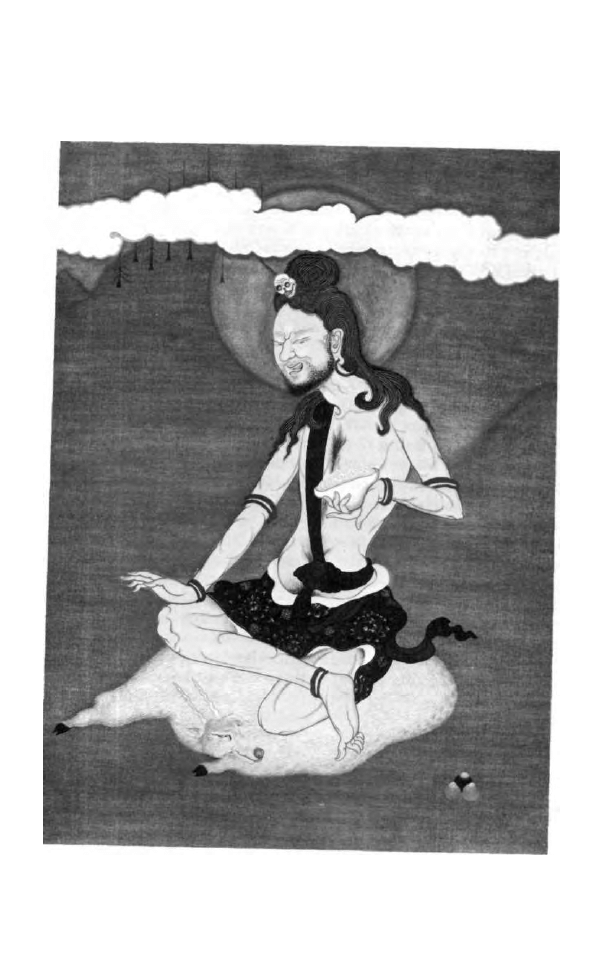

CHAPTER SEVEN
The Guru-Disciple Relationship
ONE of the most important figures in the history of Indian
and Tibetan Buddhism is Naropa. Unlike some others whose
names figure in the lineages of Buddhist spiritual transmis-
sion, Naropa was certainly a historical figure. Naropa is part
of the Kagyu lineage of Tibetan Buddhism, being with his
teacher Tilopa and his disciple Marpa the spiritual founder of
that order. He is also recognized and venerated by all the
Tibetan schools as the exemplary disciple.
The relationship between guru and disciple is of tremen-
dous importance in Buddhist spiritual transmission. The rela-
tionship is not merely a matter of historical interest; it
continues as an important factor up to the present day. This
relationship is based on trust. But before such trust can be
developed, there must be a period during which the guru tests
his disciple. This process of testing is seen in a very complete
way in the trials and difficulties Naropa was put through by
his teacher Tilopa. A long time passed before Tilopa was
willing to impart his knowledge to his disciple.
The testing of a disciple by the guru is, in a way, quite
simple. A student comes to a teacher and asks for instruction.
The teacher might well say, "Well, I don't know very much.
You'd better try some one else." This is an excellent way of
beginning the testing. T h e student might well go away, which
would be a sign that he is not really very serious.
41

42 T H E DAWN OF TANTRA
Because of the intimacy of the relationship between teacher
and disciple, whatever happens between the two is vital to the
teacher as well as the disciple. If something goes wrong, it
reflects on the teacher as well as the disciple. T h e teacher
must know better than to accept a student who is not ready to
receive the teaching he has to offer. T h a t is why before giving
instruction, he will test the readiness, willingness and capac-
ity of the student to receive it. This means the student must
become, to use the traditional image, a worthy vessel. And
because of the intimacy of the prospective relationship, the
student must also in his way test the teacher. He must
scrutinize him to see if he is really able to transmit the
teaching, if his actions tally with his words. If the conditions
are not fulfilled on both sides the relationship is not worthy to
be engaged.
The tradition of the guru-disciple relationship has been
handed down from ancient times in India as we see from the
texts. The Tibetans took over this practice from the Indians
and to this very day they enact it in the traditional manner.
This close relationship has not only the work of passing on the
oral teachings, but also of preserving the continuity of personal
example.
Naropa was a worthy vessel. He was willing to undergo
every kind of hardship in order to receive teaching. His
hardships began with his search for a teacher. Naropa spent
years in his search. And this search was actually part of the
teaching his teacher imparted to him. Before Naropa saw
Tilopa in his own form, he encountered him in a succession of
strange guises. He saw him as a leprous woman, a butcher, and
in many other forms. All these forms were reflections of
Naropa's own tendencies working within him, which pre-
vented him from seeing Tilopa in his true nature, from seeing
the true n a t u r e of the guru.
The term guru is an Indian word, which has now almost
become part of the English language. Properly used, this term
does not refer so much to a h u m a n person as to the object of a
shift in attention which takes place from the human person
who imparts the teaching to the teaching itself. T h e human
person might more properly be called the halyanamitra, or
"spiritual friend." " G u r u " has a more universal sense. T h e

The Guru-Disciple Relationship 43
kalyanamitra is one who is able to impart spiritual guidance
because he has been through the process himself. He under-
stands the problem of the student, and why the student has
come to him. He understands what guidance he needs and how
to give it.
To begin with, spiritual guidance can only be imparted in
the context of our physical existence by a person who shares
with us the situation of physically existing in this world. So
the teacher first appears in the form of the kalyanamitra.
Then, gradually, as his teaching takes root within us and
grows, its character changes and it comes to be reflected in the
teacher himself. In this way an identification of the guru and
the kalyanamitra takes place. But it is important that the guru
be recognized and accepted as the guru and not confounded
with the kalyanamitra in the manner of a mere personality
cult. It is not a simple equation between the guru and the
kalyanamitra. Still the kalyanamitra must be recognized as one
able to give the knowledge which the student desires, which
he needs, in fact, as a vital factor in his growth.
Here again we can refer to the example of Naropa. In the
beginning, Naropa failed to understand the process in which
he was involved. T h e inner growth that was already being
prepared and taking root in him was still obscured by the
many preconceptions he had. He continued to see the manifes-
tations of his guru in the light of his ordinary conceptions,
rather than understanding that they were symbols presenting
the opportunity of breaking through preconceptions. These
manifestations gave him the opportunity to be himself, rather
than his idea of himself as a highly capable person.
We must remember that Naropa came from a royal family.
His social prestige was great and he had become, in addition, a
renowned pandit. And so in the process of trying to relate to
his guru, his pride came into play. He felt that, as a person
already renowned for his understanding, he should have all
the answers already. But this was not the case. Only after the
testing period did any real answers begin to emerge. This
testing process actually effected the removal of his preconcep-
tions. It was actually the teaching itself in the most concrete
terms. No amount of words would have achieved the result
that came about through his exposure to the rough treatment,

44 T H E DAWN OF TANTRA
the shock treatment, to which Tilopa subjected him. At the
very moment in which he would think that at last he had
understood, that at last these endless trials were over - at that
very moment he would realize that he had again failed to see.
In the whole process of learning that is involved here, and
one can say that the Buddhist way is a way of learning, there is
a continual oscillation between success and failure. Sometimes
things go smoothly. This is a fine thing; but it may also be a
very great danger. We may become too self-sure, too confident
that everything is going to come out as we would like it.
Complacency builds up. So sometimes the failures that arise
are very important in that they make us realize where we went
wrong and give us a chance to start over again. Out of this
experience of failure, we come to see things anew and afresh.
This oscillation between success and failure brings the sense
of a way, a path; and here we touch upon the importance of the
Buddhist tradition of the way. Buddhism has never claimed to
be other than a way. The Buddha himself was only the teacher
who showed other people the way which he himself had to
travel, whatever the vicissitudes of success and failure. But
it is always true that if a person fails, he can start again. If the
person is intelligent, he will learn from the mistakes he has
made. T h e n these mistakes will become ways of helping him
along, as happened in the case of Naropa. Quite often Tilopa
asked him to do things which were quite out of the question
from Naropa's ordinary point of view, which quite went
against the grain of his conventional frame of reference. But
this was very m u c h to the point. Conformity to the accepted
way of looking at things would bring nothing. The point was to
gain a new vision.
If we come to a new vision, a new way of looking at things, its
mode of application may quite well be different from what is
commonly accepted. This has always been the case with the
great spiritual leaders of mankind, wherever we look. These
people have broadened and widened our horizon. Through
their action we have experienced the satisfaction of growing
out of the narrowness of the ordinary world into which we
happen to have been born.
When Naropa had shown that he was a person worthy of
receiving instruction, the whole pattern we have been describ-

The Guru-Disciple Relationship 45
ing changed. Tilopa then showed himself the kindest person
that could be imagined. He withheld nothing that Naropa
wished of him. There is a Sanskrit expression, acarya musti,
which means the "closed fist." This is an expression that has
often been applied to gurus who withold the teaching. At a
certain point, if the teacher withholds instruction, it is a sign
that he is unsure of himself. But this was certainly not now the
case with Tilopa. He gave everything that he had to his
disciple.
This is the manner of continuing the teacher-disciple rela-
tionship. At a certain point the teacher transmits the entirety
of his understanding to a disciple. But that the disciple must
be worthy and brought to a state of complete receptivity is one
of the messages of Naropa's life. And so, in his turn, Naropa
led his disciple Marpa through the same preparatory process,
and Marpa led his disciple Milarepa. Milarepa's biography
tells us that Marpa had him build a house out of stone. He had
hardly finished the house when Marpa told him to tear the
house down and begin over again. This happened again and
again. We need not ask ourselves whether this is a historical
fact. The symbolic message is quite plain. Marpa asked him to
do something and Milarepa reacted with pride, feeling that he
could do it. Milarepa did it his way without waiting for the
instruction. Naturally, the results were not satisfactory and
there was no alternative but to have him tear it down and build
again from the beginning.
Here we see another aspect of the guru-disciple relationship.
The disciple must start at the beginning. And this comes
almost inevitably as a blow to his pride, because he almost
always feels that he understands something already. It is
usually a very long time before this pride is broken down and
real receptivity begins to develop.
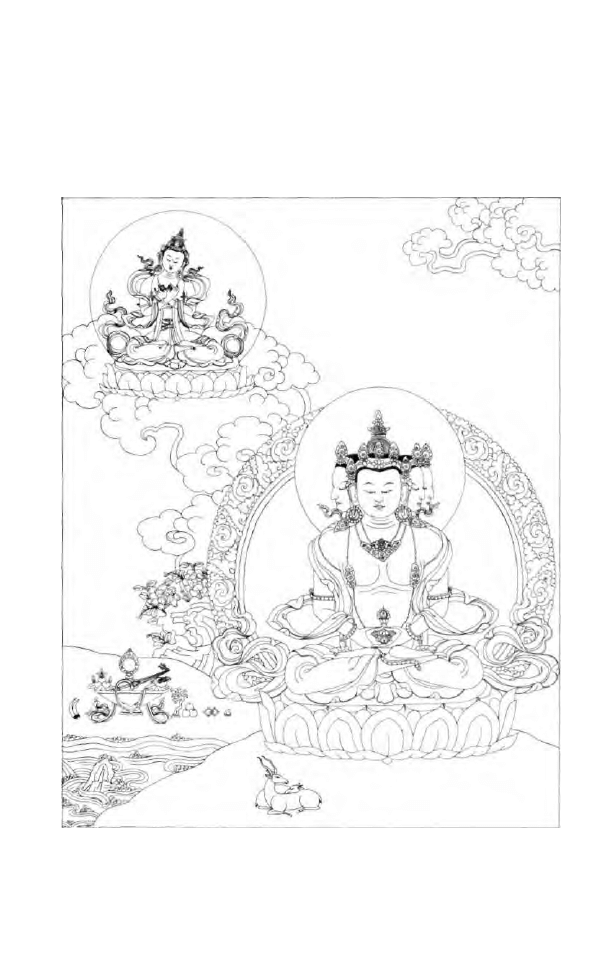

CHAPTER E I G H T
Visualization
ON the disc of the autumn moon, clear and pure, you place a
seed syllable. T h e cool blue rays of the seed syllable emanate
immense cooling compassion that radiates beyond the limits of
sky or space. It fulfills the needs and desires of sentient beings,
bringing basic warmth so that confusions may be clarified.
Then from the seed syllable you create a Mahavairocana
Buddha, white in color, with the features of an aristrocrat - an
eight-year-old child with a beautiful, innocent, pure, power-
ful, royal gaze. He is dressed in the costume of a medieval king
of India. He wears a glittering gold crown inlaid with wish-
fulfilling jewels. Part of his long black hair floats over his
shoulders and back; the rest is made into a topknot sur-
mounted by a glittering blue diamond. He is seated crosslegged
on the lunar disc with his hands in the meditation mudra
holding a vajra carved from pure white crystal.
Now what are we going to do with that}
The picture is uncomplicated; at the same time it is im-
mensely rich. There is a sense of dignity and also a sense of
infanthood. There is a purity that is irritatingly pure, irritat-
ingly cool. As we follow the description of Mahavairocana,
perhaps his presence seems real in our minds. Such a being
could actually exist: a royal prince, eight years of age, who was
born from a seed syllable. One feels good j u s t to think about
such a being.
47

4 8 T H E DAWN O F TANTRA
Mahavairocana is the central symbol in the first tantric
yana, the kriyayogayana. He evokes the basic principle of
kriyayoga - immaculateness, purity. He is visualized by the
practitioner as part of his meditation.
In the kriyayogayana, since one has already discovered the
transmutation of energy, discovered all-pervading delight,
there is no room for impurity, no room for darkness. The
reason is that there is no doubt. The rugged, confused, un-
clean, impure elements of the struggle with samsara have been
left far behind. Finally we are able to associate with that
which is pure, clean, perfect, absolutely immaculate. At last
we have managed to actualize tathagatagarbha, Buddha-nature.
We have managed to visualize, to actualize, to formulate a most
immaculate, p u r e , clean, beautiful, white, spotless principle.
There is a widespread misunderstanding of tantra, which
sees tantra as pop art. People have heard that the tantric
approach is to accept samsara fully. T h e idea has developed
that therefore we are declaring everything - sexuality, aggres-
sion, ignorance - as legitimate and p u r e ; that we accept the
crudeness as a big joke. " T h e crudeness is the fun." Therefore,
the idea runs, we can j u m p into tantra by being crude and
dirty: "Since we have to live with the crudeness, let's consider
it beautiful." But visualizing Mahavairocana is far different
from the gesture of stealing a "Rue Royale" streetsign in Paris
and sticking it up on our wall. T h e whole idea of tantra is very
different from joining a club formed by tantric teachers in
which it has been agreed to regard the mess of confusion as
something liveable and workable, to pretend that our pile of
shit is nice, fresh, earthy soil that we are sitting on. This is a
great misunderstanding.
The misunderstanding seems to be that tantra comes into
being out of some kind of desperation; that since we cannot
handle the confusion, we accept the convention of tantra as a
saving grace. T h e n the shit of our confusion becomes pictorial,
artistic - pop art. Supposedly tantra acknowledges this view
eagerly and formally. But there is something very crude about
this idea. If tantra merely acknowledged that samsara had to
be put up with, without seeing the absolute purity and
cleanness of it, tantra would be j u s t another form of depres-
sion, and devoid of compassion.
Actually, far from beginning by exalting crudeness, the

Visualization 49
introduction to tantra is fantastically precise and pure, clean
and artful. It could be said that the kriyayogayana is to the
Vajrayana what the Yogacara approach, which underlies Zen,
is to the Mahayana. T h e r e is a pronounced artful quality, a
great appreciation of purity and cleanness.
Just as bodhisattvas embodying the magnificent vision of the
Mahayana are good citizens, tantric yogis are also extremely
good citizens. Tantric practitioners are the good mechanics in
garages, who know the infinite details of the functioning of
machines with clean and precise mind. Tantric practitioners
are good artists, who paint good pictures that do not try to con
one. Tantric practitioners are good lovers, who do not take
advantage of their partners' energy and emotion, but make love
precisely, accurately, purely. Tantric practitioners are good
musicians, who do not fool around banging away at random,
but play precisely, musically. T a n t r a is by no means to be
associated with marginal lifestyles, Bohemianism, where one
is intensely critical of convention and takes pride in being
rugged and dirty.
T h e right understanding of tantra is crucial for the practice
of visualization. One Nyingma teacher said that undertak-
ing the practice of visualization is like going to bed with a
pregnant tigress. She might get hungry in the middle of the
night and decide to eat you. On the other hand, she might
begin to nurse you, creating the furry w a r m t h and texture of
basic space. Certainly practicing visualization without the
proper understanding is extremely destructive. A kriyayoga
text, the Vajramala, says that the practitioner of wrong visuali-
zation, instead of attaining the complete openness of Vaj-
rasattva attains, the complete egohood of Rudra, the ultimate
spiritual ape. T h e tantric scriptures abound with warnings
about wrong visualization.
Generally, wrong visualization takes the form of intensify-
ing ordinary mental objects. One creates an image out of
wishful thinking. For example, in the middle of one's medita-
tion practice a sexual fantasy arises and one decides to carry it
out in complete detail - stage one, stage two, stage three and so
on. This same approach can apply to visualizations of tantric
material. Even in visualizing Mahavairocana, a child sitting on
a lunar disc, one might be recreating one's ego projection. T h e
result is the ultimate ape: "I am Mahavairocana, I am one with

50 T H E DAWN OF TANTRA
him; let no one challenge this." There is a sense of the beast, a
great powerful chest, the cosmic gorilla.
There is a precise attitude and understanding of visualiza-
tion corresponding to each level of tantra - kriyayoga, upayo-
ga, yoga, mahayoga, anuyoga and maha ati. T h e student's
understanding evolves organically from one stage of tantra to
the next. But for the student to arrive at any proper under-
standing of visualization at all, it is absolutely necessary to
have gone through all the previous stages of the path. He has to
have developed the Hinayana understanding of suffering,
impermanence and egolessness and insight into the structure
of ego. He must have attained the understanding on the
Mahayana level of the shunyata principle and its application
in the paramitas, the six transcendental actions of the
bodhisattva. It is not necessary to have completely mastered
all of these experiences, but the student must have had some
glimpse of their significance. He has to have used up his
mental gossip or at least taken out a corner of it. Their must be
some sense of having trod on the path of Hinayana and
Mahayana before embarking on the Tantrayana.
If one has done this, then rather than coming as a reinforce-
ment of ego's deception, visualization will be inspired by a
sense of hopelessness or, to say the same thing, egolessness.
One can no longer deceive oneself. There is the despair of
having lost one's territory; the carpet has been pulled out from
under one's feet. One is suspended in nowhere or able at least
to flash his non-existence, his egolessness. Only then can one
visualize. This is extremely important.
According to tradition, one of the principal masters who
brought the Vajrayana teachings to Tibet from India was
Atisha Dipankara. Atisha prepared the ground for Vajrayana
by teaching surrendering. In fact he was known as the "re-
fuge" teacher because of the extent to which he emphasized
taking refuge in the Buddha, the Dharma and the Sangha.
Taking refuge in the Buddha, the Dharma and the Sangha is a
process of surrendering. Tremendous emphasis was laid by
Atisha on surrendering, giving, opening, not holding onto
something.
People who live in New York City have very vivid and
definite impressions of that city - the yellow cabs, the police

Visualization 51
cars, the street scene. Imagine, for example, trying to convey
this to a Tibetan living in Lhasa. If you wanted to teach him
about America starting with New York, you could say: " N e w
York City goes like this. T h e r e are streets, skyscrapers, yellow
cabs. Visualize all that. Pretend you are in it." You could
expound Newyorkcityness on and on and on, explain it in
the minutest detail; but he would have tremendous difficulty
visualizing it, actually having the feeling of being in N e w York
City. He would relate to New York City as being some kind of
mystery land. There would be a sense of novelty.
Teaching Americans to visualize Mahavairocana is like
teaching Tibetans to visualize N e w York City. Americans
simply have not had that kind of experience. So how is it
possible to bridge such a gap? Precisely by going through the
three levels of Buddhist practice. Without the basic mindful-
ness practices and the development of awareness, there is no
way at all of beginning the visualization practice of tantra.
It is through these fundamental practices that one can begin
to see why such emphasis is placed on purity and cleanness, on
the immaculate quality of the Mahavairocana visualization.
Because of those preparatory experiences, the infant born
from a seed syllable, sitting on the lunar disc, becomes impres-
sive, highly impressive. This sambhogakaya Buddha becomes
beautiful because one has developed the possibility of un-
biased experience. One can relate directly, egolessly; then a
principle arising out of this unbiased level of experience,
Mahavairocana, for example, becomes fantastically expressive.
This is complete purity, purity that never had to be washed. If
one tried to produce this kind of purity by using Ajax to clean
up one's dirty image, one would simply create a further mess.
The purity of tantric experience is real beyond question. T h e
practitioner does not have to think twice: "Is this really
happening or am I imagining it." T h e experience beggars
uncertainty.
Visualization is a prominent part of tantric practice. One
identifies with various iconographical figures - sambhogakaya
Buddhas, herukas, dakinis. This is done to develop vajra pride.
Vajra pride is different from ordinary stupid pride. It is
enlightened pride. You do have the potentialities of the deity;
you are him already. T h e magic is not particularly in the

52 T H E DAWN OF TANTRA
visualization, but there is magic in your pride, your inspira-
tion. You are Mahavairocana. You are absolutely clean, im-
maculate and pure. Therefore you can identify with your own
purity, your purity rather than that of an external god who is
pure, rather than some kind of foreign element coming into
you. You are awakening yourself.
So tantra is not magic in the sense of conjuring or involving
oneself in a myth. T a n t r a is the highest level of a process of
personal evolution. It is the ultimate development of the logic
that runs through the entire Buddhist path.
Kriyayoga places particular emphasis on mudras, or hand
gestures, as well as on visualization. In these practices you are,
in a sense, competing with the Buddhas and deities. You are
making their hand gestures, behaving like them, trying to
become one. But again, it is not really a question of trying, but
of thinking that you are one. Vajra pride is the pride that you
are Buddha.
That one is the deities, one is the Buddhas is a big point for
beginners in tantra. T h e problem may arise that one does not
think one actually is. So one thinks: "I am supposed to think
that I am Samantabhadra Buddha, I am Mahavairocana.
Therefore I had better crank myself into that role." This
remote approach, instead of the directness of actually being
that deity, is considered cowardice or stupidity. In order to
develop vajra pride, one has to relate directly to the pain of
situations, in this case the pain of actually being the deity, and
see the value of it. T h e n that pride has something valid to be
proud of.
It is in connection with the development of vajra pride that
kriyayoga makes its strong emphasis on purity. You are spot-
lessly p u r e because there is no room for doubt. This is
associated with the view of the phenomenal world in
mahamudra. T h e phenomenal world is seen as completely
colorful, precisely beautiful as it is, beyond acceptance and
rejection, without any problems. You have seen things in this
way because you have already cut through your concep-
tualized notion of a self and you have seen through its
projections. Since that is the case, there is nothing that could
come up that could be an obstacle in your handling the
situation. It is totally precise and clear. As it is.

CHAPTER N I N E
Empowerment and Initiations
1 would like to speak about the initiations or abhishekas, to p u t
them in proper perspective in terms of how they apply, when
they come and what is meant by them. In order to understand
this intricate pattern, we must have a picture of the whole
gradual process of spiritual development in Buddhism.
The situation in which spiritual development takes place is
represented visually in the Tantrayana as a mandala. A
mandala is understood as a center which is beautiful because
of its surroundings which are present with it. It represents a
whole situation in graphic form. There is the center which
stands for the teacher, or more esoterically, for the guru. T h e
guru is never alone, but exists in relation to his surroundings.
T h e surroundings are seen as the expression of a new orienta-
tion in relation to this center. T h e mandala is set up in terms
of the four cardinal points of the compass. These points
symbolize an orientation in which all aspects (directions) of
the situation are seen in relation to the guru and therefore
have their message. T h e whole situation becomes, then, a
communication on the part of the guru or teacher. It depends
on our level of spiritual growth whether we see the guru only
concretely as a person or can also see him symbolically.
T h e mandala has a certain specific quality in that each
situation is unique and cannot be repeated. Only similarities
can obtain. T h e mandala also has its own time factor which
53

54 T H E DAWN OF TANTRA
cannot be equated with the passage of time as we ordinarily
understand it. It has a quality of simultaneity of all aspects
which goes beyond our ordinary understanding of sequence. If
properly understood, the mandala leads us back to seeing what
the spiritual path is, back to the possibility of becoming more
related to our own being without identifying it with this or
that. Even the understanding embodied in the mandala is
traditionally surrendered and offered up as a guard against
reification.
The Buddhist path, which leads to seeing one's situation as a
mandala, begins with taking refuge. We take refuge in the
three jewels - the Buddha, the Dharma, the Sangha. This can
happen on various levels. There is the ordinary physical level
of j u s t repeating the formula. But this also involves a process
happening within us. Regarding this inner level, we have the
instruction to take refuge in something which is abiding,
something which can actually offer refuge. We can only take
refuge in something certain; otherwise taking refuge would be
a pure fiction and would not provide the security we want. So,
on the inner level, taking refuge means surrendering to those
forces of which we ourselves are, so to speak, the last trans-
formation. These forces have, in a way, become frozen in us.
Taking refuge thus means to commit ourselves to a process of
unfreezing, so that life's energy, or whatever we want to call
these forces that operate through us and somehow get blocked,
can flow freely.
Beyond this, taking refuge can relate to still deeper layers,
until we come to the point where the distinctions, differentia-
tions, and separations that are introduced by our ordinary
thinking no longer apply. At this level, when we speak of
taking refuge in the three jewels, it means taking refuge in
something which is unitary in character. We only speak in
terms of three aspects in an effort to describe it.
So the first step in tantric discipline is to take refuge and
understand it properly, not j u s t as an outer performance
which may in some way be beneficial, but as a ceremony that is
meant to awaken the basic forces which are dormant within
us. T h e ceremony can only be effective in this way if there is
also present in us something known technically as an attitude.
This means here an attitude we have developed which has as

Empowerment and Initiations 55
its aim to permit all that is within us to reach its fullest range
of play.
There also comes into play something of a highly practical
character which we might refer to as friendliness or compas-
sion. This means taking account of the fact that the realm we
are coming into contact with through taking refuge is a broader
one than that in which we ordinarily operate. T h i s automati-
cally brings in a sense of openness.
The next step after taking refuge is training the mind. This
does not mean intellectual training. It means seeing our very
being in a different light. T h e movement has several stages.
First, it is necessary to see our mental processes clearly. T h e n
we will see that they must be cleansed of the presuppositions
with which we ordinarily approach things. T h e n we must
understand what the nature of this cleansing or purifying
process is. The whole movement is one that goes deeper and
deeper within, towards our hidden depths in which the
energies are now being made to flow again.
The abhishekas in the Tantrayana are the further develop-
ments of what was begun by taking refuge. This can be
understood as a process of purification, which allows us more
and more to see our situation as a mandala of the guru.
Purification means overcoming what are technically known as
the various Maras. Maras are what we refer to in modern
terminology as overevaluated ideas. They are a force of death
that keeps us from growing. Overcoming them is part of the
tantric discipline.
Of these Maras one of the main ones is the ideas we have
about our body. We unconsciously form and analyze it to the
point where we no longer relate to it as a living structure. Our
ideas about it have no use - they are only a limitation of the
potentiality that is there. But even this limiting construct is
never separated from its living source. Seeing this is a devel-
opment which leads us more and more into the presence of
the guru.
We may look at the relationship with the guru in terms of
external and internal aspects. We may even see that the guru
has appeared to us in various forms. Taking this broader view
of the nature of the guru, we understand that there is always
someone who points us towards or challenges us into spiritual

56 T H E DAWN OF TANTRA
growth. T h e relationship with the guru is always there - this
is the point of view of tantra.
T h e process of seeing our life more and more directly also
involves demolishing our fortress of conceptions about our-
selves and the world. In this process there is a need for the
so-called initiations or abhishekas. Abhisheka is derived from
a Sanskrit root which means "to anoint." Its symbology is
taken from the traditional Indian ceremony of the investiture
of a ruler. Investiture takes place through the conferring of a
certain power. This idea of power is taken up in the Tibetan
translation of abhisheka as wangkur (dbang-skur). Wang means
something like "power", but not in the sense of power politics
or domination. Wangkur is an empowerment in the sense that
henceforth the person so invested is enabled to give the
greatest scope to the forces operating within him, forces which
are of a fundamentally wholesome nature.
T h e first or jar empowerment is connected with the observa-
ble fact we have been discussing, namely, that we are attached
to the conception we have of our body. In the Western world
we are conditioned to think that the mind is superior to the
body - we look down on the body. Now this is very naive. If the
body were such a debased thing, then people should be only too
happy to have it mutilated or weakened. But nobody would
submit voluntarily to such a process, which in itself means
that the body is very valuable. Our body is a most important
orientation point. Everything we do is related to our body. You
are situated in relation to me in terms of my body and in no
other way. To realize the creative potential of this embodi-
ment purification must take place.
The image of the first empowerment is purification. Essen-
tially it is a symbolic bathing. A gesture is made of pouring
water from a jar over the person receiving the empowerment.
This is actually quite close to the normal Indian way of
bathing, in the absence of modern plumbing facilities. It seems
to mean j u s t getting rid of dirt, in this case the conceptual
structure we have with regard to our bodies. But this cleansing
is also a confirmation of power, because it means that hence-
forth we will make better and more appropriate use of our
being-a-body. It means we are on the way to realization of the
nirmanakaya, realization of embodiment as ultimately valu-

Empowerment and Initiations 57
able. This means being alive in certain measured-out and
limited circumstances to which we relate as the working basis
of our creativity.
These empowerments or abhishekas are stages in a unitary
process. Once what was implied by the first empowerment has
come to its maturity in us, there is a second. In some way these
stages are actually simultaneous, since all aspects of experi-
ence are interconnected. Nevertheless, we are obliged to take
them one after another.
The second abhisheka, the secret or mystery empowerment, has
to do with speech and language - our mode of communication.
It has to do with communication not only externally (with
others), but also with communication in our own inner world.
We scarcely realize that mentally we are constantly acting out
to ourselves our particular melodrama, our version of what is
happening to us. And we actually talk to ourselves about it. So
there are certain predispositions and neurotic patterns in our
way of communicating. On the level of the second empower-
ment we work with this material. We have to come to another,
a more wholesome level of communication. Talk can go on
endlessly without communicating anything. Many people talk
and talk and talk and never have anything to say. In fact, the
general run of our mental life is on this level of empty chatter.
We use words as tacks to pin things down and lose the open
dimension of communication. Our use of words in this way
kills the very thing that makes life worthwhile. And it reflects
back on the physical level and reinforces our limited way of
being on that level.
But communication can go on in quite a different way. It
need not take place even through the normal verbal forms.
This is where mantra comes in. Mantra is communication on
quite another level than the ordinary. It opens the way to the
manifestation of our inner strengths and at the same time it
prevents our minds from going astray into the mode of empty
talk. The second abhisheka is an empowerment to live on this
superior level of communication.
Our presence involves not only our embodiment and an
activity of communication, b u t also a pattern of thinking.
Ordinarily we think in concepts, and certainly for the practi-
cal purposes of life we must use concepts. But, on the other

5 8 T H E DAWN O F TANTRA
hand, concepts are also images that we impose on things.
Concepts are forms that we present to ourselves concerning
the living forces that we are in order to give them a label. Our
mental life then goes on in terms of these labels. Here we see
that this way of limiting things in advance, so to speak, takes
place on the thinking level as well.
What we have been looking at on all three levels of body,
speech, and thinking is an interlocking pattern of limitation. If
we live, as we ordinarily do, in this pattern of limitation, we
are stuck in a situation in which everything tends to get
narrower and narrower. We are trapped in a web of decreasing
possibilities. We are in a world where we can talk about less
than we can think of, and do less than we can talk about.
T h e process of spiritual growth is about unfreezing this
situation. And what a tremendous experience when life can
flow freely again; when the buds bloom forth, when the rivers
break up and the waters come flowing through in all their
purity. T h e abhishekas are an opening into a new dimension,
which one ordinarily never experiences. Suddenly one is
introduced to something of which one has never been aware. In
such a situation there is a great danger that the experience
may be misunderstood. T h e r e will be a strong tendency to
reduce it to our habitual frame of reference. If this happens,
the experience can be quite harmful, especially in the case of
the third abhisheka, on the level of thought.
Whether the third abhisheka is properly understood or not
depends very much on the accurate interpretation of the
symbols that come into play at this point. These symbols are
the karmamudra, jnanamudra, mahamudra, and samayamudra.
The functioning of the process of spiritual growth depends on
our seeing them in another mode than our ordinary one.
T h e term mudra, literally translated, means "seal." But
what is a seal? It is something that makes a very deep
impression on what it comes in contact with. So it might be
better to understand m u d r a in this context as a tremendous
encounter in which two forces come together and make a very
deep impression.
Karma comes from the Sanskrit root meaning "action," what
one does in encountering the world. Usually, our major en-
counters are with other people; and people are both male and

Empowerment and Initiations 59
female. Symbolically, the most potent form is our encounter
with the opposite sex. Now we can look at this situation
reductively and literally and think, in encountering a person
of the opposite sex, of taking the other person as a kind of
utensil. In that way we reduce the encounter to a very dead
item. True, sex is fun, but if it continues very long we get
bored with it. Here we have to understand the encounter on an
entirely different level than the one usually seen. A charac-
teristic of the sexual encounter is that we are never at rest;
there is constant action and reaction. This by its very nature
can create an opening of awareness beyond the normal level.
An expanded awareness tinged with delight can arise.
If we have perceived the karmamudra in this constructive
way, rather than reductively, there is automatically a ten-
dency to go further in the direction of open awareness. This
leads to the relationship with the jnanamudra. Suddenly the
whole picture has changed. T h e relationship is no longer
merely on the physical level, but there is an image involved
here, a visualization which mediates a complete degree of
appreciation and understanding. This opens up entirely new
vistas.
The inspirational quality is much stronger and more far-
reaching than with the karmamudra. We can reach a very
profound level of awareness in which we become fused with
the partner in a unitary experience. T h e distinction between
oneself and the other simply no longer holds. T h e r e is a sense
of tremendous immediacy, which also brings a sense of great
power. Again there is a danger of taking the experience
reductively and thinking that "Now I have achieved great
power." But if we are able to relate to this moment as an open
experience, we are then at the level of mahamudra or, in this
context, the greatest encounter.
When we have had this peak experience, we wish to retain it
or at least to make it manifest to ourselves again. T h i s is done
through the samayamudra. T h e samayamudra involves the
various figures we see represented in the Tibetan thangkas or
scroll paintings. These forms are expressions of the deep
impressions that have come out of the encounters we have had
with the forces working within us. It is not as though we were,
so to speak, containers of these forces - rather, we are like

6 0 T H E DAWN O F TANTRA
partial manifestations of them. In these encounters our sepa-
rateness and secludedness are momentarily abolished. At the
same time, our deadening reductive tendencies are overcome.
In the samayamudra we commit ourselves to the implications
of this great experience of openness through the symbology of
the tantric path.
After the abhishekas relevant to body, speech and thought,
there is still a fourth. As I have pointed out, these stages are
part of a unitary situation which we approach sequentially
only because of the limitations of our mode of experience. But
it is much more sensible to see them as a part of a great tableau
in which all the aspects are interrelated and fuse with one
another. It is on the level of the fourth abhisheka that we see
the previous experiences as aspects of a totality. These experi-
ences fuse into an integrated pattern which cannot be de-
stroyed. Through the empowerment their indivisibility is
clearly established.
At this point we cannot quite say that we have become one,
because even the idea of unity or oneness now no longer
applies. T h e term one is only meaningful if we have a two or a
three. Unity implies plurality as something else. But what we
are dealing with here is a unity which includes plurality.
Unity and plurality only seem contradictory when we con-
ceive of them as isolated terms. T h e r e can never be isolation
when everything is part of the whole pattern. Isolation is an
abstraction, but plurality is whatever we happen to find in the
world wherever we are. Not disrupting the unitary quality by
isolating units is the basic meaning of unity. And this comes
here as a deep inner experience.
This deep inner experience is the guru operating, and
through such profound experiences he has his tremendous
influence on the pattern of our spiritual growth. For in the
ultimate sense, the guru is none other than the Buddha - not
the historical Buddha but Buddhahood itself. In this way all
the empowerments are developments of the guruyoga. In the
guruyoga we attempt to come closer to our basic nature
through coming closer to the guru. In the empowerments we
are actually in connection with him. We are also in connection
with his lineage, those who have preceded him in the direct

Empowerment and Initiations 61
transmission of the teaching and in connection with whom he
remains.
Like the refuge formula and the empowerment ceremonies,
the guruyoga practice has an outward form betokening a
deeper experience. In this case the outward form is a kind of
litany. But if, in reciting this litany, there is awareness of
where in us these words come from, they follow back to the
person whom we have chosen as our spiritual guide. T h e litany
itself is not the ultimate thing, but it involves us in the fact
that throughout human history there have been persons who
have awakened. The presence of their example challenges us
to look into ourselves and awaken to our own being. And in the
process of coming closer to what is meant by their example, the
nature of the guru as we relate to him again changes and
becomes deeper. It increasingly reveals itself as a principle
which is much more attuned to the real than our habitual
sham.
T h e various ceremonies - the refuge, the guruyoga, and the
empowerments are all established in an outward form so as to
be repeatable. But it is of the greatest importance to be aware
of the highly symbolical character of tantra as expressed in
these forms. We must distinguish between a symbol and a sign.
A sign can be put on anything and acts as an identification tag.
A symbol always points beyond itself. It is only a pointer to, in
this case, what cannot be said.
A great deal of harm has been done by abusing the repeatable
character of these rituals and using the texts indiscriminately,
without being aware of the different levels of the symbology.
Only when a person has grown up to the point where he no
longer confuses a symbol with a sign does he begin to come into
real contact with the guru. Only then does the pattern of
development available in the tantric tradition, beginning with
taking refuge and leading through the various traditional
practices and the four empowerments, have the effect of
awakening the power that is within us. It makes us more and
more alive and brings us to a new perception of our situation in
which we see that we are never alone, never isolated ends-in-
ourselves.
We see that we are always in a force-field, so to speak, in

6 2 T H E DAWN O F TANTRA
which every act of ours has its effect on others and the whole
field constantly has its effect on us. The empowerments
introduce us progressively into the dimension of this vision.
Once we have glimpsed it, the guru is always present, al-
though he may not be clearly perceived. When one's vision
begins to mature, one perceives the guru as the great chal-
lenger in the quest to be true to oneself.

CHAPTER T E N
Questions and Answers: Guenther
Q: Can you say something about mantra?
G: The word mantra comes from the noun manas and the
verbal root tra ("to protect") according to the Indian explana-
tion. T h e full explanation runs as follows:
manastranabhutatvad mantram ity ucyate
"Since it has become a protection of mind it is called
mantra." Mantra is usually associated with certain syllables or
combinations of syllables. It is completely wrong to try to read
a meaning into these syllables as with ordinary words. This
goes exactly counter to the purpose of mantra, which is to
protect the mind from straying away into habitual fictions.
These fictions are very much tied up with words. T h e function
of mantra is to preclude the tendency of the mind to, so to
speak, flow downward. We are forced here to use this spatial
metaphor; we might also speak of the tendency of the mind to
glide off into something, or to fall.
We encounter this same metaphor in Western religious
thought, where it is said that man is a fallen being. Our mental
process tends always to run to the lowest level, j u s t like water.
With water rushing downwards, once it has reached the
bottom, it has lost its potential and there is practically nothing
more that can be done. Well, it works the same way with our
minds, going off into this system of fictions we have developed.
63

6 4 T H E DAWN O F TANTRA
To give an example of mantra, I might use the word "love."
This word can be used in an everyday way so that it is
meaningless or in a way that renders it full of meaning. In the
latter case, it keeps something alive; in the former it's just a
piece of dead language. When a young man is courting a girl, he
may say "I love you" or address her as "my love." So saying, he
expresses something that no other word could better convey.
Some time later the couple goes to the divorce court, and he
says, "Well, my love, let us separate." In one case, the word
"love" is a mantra; in the other case, it's j u s t an ordinary figure
of speech. So there is nothing mysterious about mantras.
Q: Dr. Guenther, could you give an idea of the sense of the
word svabhava in svabhavikakaya; it seems to be different than
elsewhere.
G: In the term svabhavikakaya, kaya is derived from the other
terms (dharmakaya, sambhogakaya, nirmanakaya). T h e n in
order to emphasize that existentially kaya is not dependent
upon anything else, you say svabhava. Here svabhava has a
sense something like "self-existing." T h e svabhavikakaya is
not different therefore from the dharmakaya, being that which
is not existentially dependent on anything else. The nir-
manakaya and sambhogakaya are, however, dependent on the
dharmakaya.
Q: So it could not be said that the svabhavikakaya is depen-
dent on the dharmakaya.
G: That's right. T h e term svabhavikakaya obviously evolved
in the clarification of what was meant by dharmakaya. Dhar-
makaya had two meanings. On the one hand, there is the usual
sense in which it is associated with the very nature of
Buddhahood. On the other hand, it also meant the sum total of
all the entities of reality. T h e latter sense is the early
Hinayana view of dharmakaya. T h i s is still the meaning it has
as late as in the Hua Yen or Avatamsaka school. In later
Mahayana Buddhism the two senses always go together. Even
though they are both dharmakaya, there cannot be two dhar-
makayas. So we say that the absolute is dharmakaya and that
all things, seen as constituting and representing the absolute
are also dharmakaya. This insight presenting the rapproche-

Questions and Answers: Guenther 65
ment of these two senses of dharmakaya was a contribution of
the Avatamsaka Sutra. This sutra, incidentally, has never been
found in any Sanskrit version.
Q: Can you explain sambhogakaya?
G: Kaya refers to the existential fact of being and sambhoga to
being in communication with dharmakaya. T h e sambhogakaya
is between the dharmakaya and the nirmanakaya. It is depen-
dent upon and in communion with the dharmakaya. It is the
level on which, as it is said, the teaching of the Buddha goes on
uninterruptedly in that the person tuned in to this level
always hears the Dharma taught. This is, of course, a figurative
way of speaking.
Then from the sambhogakaya there is a further condensa-
tion which is the nirmanakaya, in which what was seen or felt
on the sambhogakaya level is now made more concrete. Nir-
mana means "to measure out." On this level, the whole thing is
put into a limited framework, which is understandable to us
because, of course, our mind works within limitations.
Q: You've spoken quite a bit about the Yogacara. What about
the role of the Madhyamika in the development of tantra?
G: The philosophical systems that developed in Buddhist
India, the Vaibhashikas, the Sautrantikas and the Yogacaras
(the mentalistic trends), were all lumped together in the
traditional Tibetan surveys as reductive philosophies. They
all try to subsume the whole of reality under particular
existents, one under a particular existent of a physical kind,
another under a particular existent called "mind." But in all
cases they are reductive systems. Not to say that there wasn't a
progress in the development of these systems.
The earliest, the Vaibhashikas, assumed mind and mental
events, citta and caitta. Wherever there is mind there are also
mental events. T h e Sautrantikas challenged this, showing that
the mind is the mental events, so that there was no reason for
this double principle. So they simplified it to saying a cognitive
event was j u s t mind. Still the Sautrantikas continued to speak
of external objects corresponding to the objective pole of our
cognitive experience, even though they regarded these exter-
nal objects as only hypothetical causes of our cognitive experi-

66 T H E DAWN OF TANTRA
ence. But further investigation showed that there was very
little reason for assuming realities outside our experiencing of
them. T h e realist formula would be x = x + n, where x is mind
or experience and n is external realities. Now this is a
nonsensical formula unless n = 0, which the realist will not
accept. So if we analyze the situation in this mathematical
form the realist hasn't got a leg to stand on.
T h e uncertainty over the status of n (external reality) had
already been initiated by the Sautrantikas. T h e n the Yogacar-
cas drew the logical conclusion that there is only x, which
appears as x + n. In reducing the whole epistemological for-
mula to mind or experience alone, the Yogacaras still held on
to this x. This is exactly what the Madhyamika critique of the
Yogacaras undermined, showing, in effect, that holding to the
principle of mind was still reducing reality to some particular
existent.
So, for the subsequent development of tantra, the Yogacaras
and Madhyamikas were of equal importance. The Yogacaras
with their principle of mind provided something to deal with.
After all, you must have something in hand to deal with. The
Madhyamikas contributed the insight that one cannot believe
in this what-you-have-in-hand as an ultimate answer. This
criticism of the reductionist tendency which had character-
ized all previous Buddhist philosophy was a very important
one indeed.
Q: Is dharmadhatu in the Vajrayana connected with the
skandhas?
G: The skandhas are subdivisions of the dharmadhatu. This
has always been accepted by all schools. Since the earliest
times there has never been the slightest disagreement over the
division that was made into the skandhas, the dhatus and the
ayatanas, all of which together compose the dharmadhatu. The
schools differed only over the logical status of these elements.
T h e earliest classification was made by the Vaibhashikas in
the Abhidharmakosha. All the following schools adopted this
classification. Even the Yogacaras, who would accept only
mind as ultimate took it u p ; in fact they divided it up even
more intricately than their predecessors.
As the first to attempt a systematization of what had been
given by Buddha in the sutras, the Vaibhashikas based them-

Questions and Answers: Guenther 67
selves on the Abhidharmapitaka, which itself originated from
certain word lists. These word lists seem to have come about
when, after the Buddha had died, his followers wanted to set
up some kind of easy reference to the body of his teachings. It
was to be something like an index. This began as word lists,
almost like sets of synonyms and antonyms. In this way
Buddha's followers began to organize the teaching. They
would approach the whole of reality from the point of view of a
single category they had under examination.
For instance, considering impermanence they noted that
there were certain things that were impermanent and other
phenomena to Which the term impermanence did not apply.
Thus they came to make a great division between that which is
impermanent and that which is permanent. Everything in the
transitory category were particular existents, divided into
physical, mental, and others which were neither physical nor
mental. Particular existents which were neither physical nor
mental were, for example, attainment, aging or letters. Words
are made up of letters - are these letters physical or mental?
On the permanent side of this great division of reality was
akasha, usually translated as space. We must be clear that in
Buddhist philosophy the notion of space never indicates
mathematical or locational space. It is more like lifespace or
lived space. This space is irreducible and not transitory; it is
there as long as one is alive (and after that one can enunciate
no philosophical theories).
This great division into permanent and impermanent was
adopted by later schools, but the way of looking at it was
subject to continual criticism and revision. Vasubandhu, for
instance, criticized some of the earlier statements from the
Sautrantika point of view. Some of the criticisms were quite
simple and purely linguistic. T h e Vaibhashikas had said, " T h e
eye sees." This seems legitimate; probably none of us can find
any reason to object to such a formulation. But the Sautran-
tikas said, "No, we see with our eyes." T h e Sautrantikas began
criticizing the Vaibhashikas in this manner.
Eventually they wanted to know exactly what was meant by
what they themselves were saying. This led them into a
thorough analysis of perception. They became quite involved
in what differentiated veridical from delusive perceptual
situations. What could the criteria be? They found that the

68 T H E DAWN OF TANTRA
inquiry can be shifted from one level of absoluteness-relativity
to another and that what was veridical on one level might be
delusive on another. In this way the epistemological inquiry
was greatly expanded. T h e Sautrantikas tried to keep their
criteria consonant with common sense; but in the analysis of
perception common sense is not a very reliable touchstone.
T h u s there was room for the Yogacaras to come in, make their
critique and draw their conclusions.
But the Yogacaras' view, for all its sophistication in relation
to the earlier schools, remained naive. In dealing with mind,
they concretized and affirmed it as a particular existent. The
odd thing is that when we make positive statements, we
exclude. If we want to be inclusive, we must make negative
statements; we must continuously say "not this, not that." If I
say "horse," I exclude everything that isn't a horse. But
certainly there are also cows. So in affirming as ultimate a
particular existent we fall into this trap. This is precisely the
point at which the idea of shunyata as openness enters.
Shunyata is an absolutely positive term in a negative form.
Q: Could you give an idea of the significance of dakim?
G: T h e Tibetan word is khandroma (mkha'-'gro-ma). Liter-
ally it means "walking over space." Again here space, akasha,
refers not to mathematical or locational space but to lifespace.
"Walking over" signifies a kind of appreciation. This apprecia-
tion of space is inspiration which is depicted symbolically in
female form. This inspiration is the dakini; it is the inspiration
of the openness of the space. T h e rich symbolism of the dance
of the dakinis indicates that the inspiration of openness comes
not in one form but in many. This dance, a series of graceful
movements, also expresses the fact that each moment is a new
situation. T h e pattern changes constantly and each moment
presents a new occasion for appreciation, a new sense of
significance.
Q: What is lalita?
G: Lalita is the graceful movement of the dance. There is
never a state of rest. Lalita also has a strong connotation of
beauty. Beauty here is not different from the valuable; and the
valuable is not different from what is. When we try to catch it
or grasp it, it is destroyed.

Questions and Answers: Guenther 69
Q: It has been said that the Hindu and Buddhist tantras
arose simultaneously, that one did not precede the other. Do
you think that is accurate?
G: I think that is correct, yes. They are quite different and
probably one could not be derived from the other. T h e em-
phasis in the Hindu tantra is on a way of doing, creating. T h e
Buddhist tantra with its theory of prajna,appreciative dis-
crimination, having equal status with upaya, action, has quite
a different emphasis. For one thing, the Hindu term shakti
never appears in Buddhist texts. Those who say it does can
never have seen the actual texts. But the idea of shakti is of
paramount importance in the Hindu tantra.
The Hindu tantra took over the Samkhya system of
philosophy, which is based on the dualism of purusha, the male
factor, and prakrti, the female or shakti factor. Purusha is
usually translated as " p u r e m i n d " and prakrti as "matter."
This is not to be understood in terms of the Western division
between mind and matter. Mind and matter as conceived of in
the West are both in the prakrti. Purusha is a fairly useless
term; the concept corresponding to it fits nicely into a male
dominance psychology. T h e purusha, according to the Sam-
khya system, throws its light on the prakrti, and this starts a
process of evolution.
There are some definite difficulties in this conception. T h e
purusha is defined as being everpresent. If this is the case,
liberation can never take place - the everpresence of the
purusha means that he throws his light, irritates the prakrti,
continuously. Since there is this dominance of the male over
the female and at the same time everything takes place within
the prakrti - all cognition, all action, everything - the system
is logically untenable.
Still it has certain good points. T h e analysis of the prakrti
into the three strands or gunas - sattvas, tamas, rajas - can
account well for the psychological differences in individuals.
Some people are more intelligent, lazy, temperamental than
others. This is well accounted for. Metaphysically, however,
the system is complete nonsense. It cannot do what it sets out
to do, which is provide for the possibility of liberation. It says
if a separation between p u r u s h a and prakrti takes place there
is liberation; but this is impossible if the purusha is everpre-
sent. This was later understood by the followers of the yoga

7 0 T H E DAWN O F TANTRA
system of Patanjali. They tried to get out of the difficulty by
postulating a super-purusha, an ishvara, a god. But this merely
opens the way to an infinite regress. If one is not enough and a
second is supposed to be, why not a third, a fourth, a fifth?
Such a set of improbable conceived principles was bound to
present such difficulties. T h e prakrti is said to be unintelli-
gent, but all intelligent processes occur in it. The purusha is
said to be pure intelligence, but it doesn't cognize. This is like
saying, "Look, I have a very special book; but this book has no
pages, no print, no binding, no cover - but it is a book!"
Q: What is the movement of this relationship between
purusha and prakrti supposed to be and how is it supposed to
come to an end?
G: T h e prakrti or shakti is utilized by the purusha. The
simile is that he asks her to dance and to perform various
antics. T h e n he says, "Now I am fed up with this so stop it."
Then he says, "Now we are free." This is a bit primitive.
Q: It is true that the Buddha's actual words were never
recorded?
G: Yes.
Q: Would you be able to say anything, then, about how the
sutras came about?
G: After the Buddha died an effort was made to collect what
the Buddha had said. But all the sutras begin with the form,
" T h u s have I h e a r d . . . ." Certainly there must be passages
that were remembered correctly, but there are no means of
verifying where the texts represent exact words, because none
of the material was reported as direct quotation.
Q: It seems they could never have been the exact words,
then.
G: The tremendous capacity for memory that existed in
Eastern culture could counteract the likelihood that all the
exact words were lost. T h e time when they codified and wrote
down the Buddha' teaching was not necessarily the beginning
of its preservation. It might have been decided at that point
that it was a good idea to write it all down because the oral
tradition might become disturbed. But up until that point the

Questions and Answers: Guenther 71
oral tradition can be said to have been highly exact. Since the
words were rehearsed after the death of the Buddha, this is
not very doubtful. The words were precious at that point since
the Buddha himself was no longer there. It is true that,
whereas in some passages the reciter might give the exact
words, in other parts he might recite only as he had under-
stood. But this became accepted.
Another point is that the Pali sutras do not contain every-
thing that was preserved in the tradition. T h e Sanskrit version
preserved in the agamas has sections that were left out in the
Pali. The Theravada canon definitely reflects a vested interest.
Q: What would you say is the basic point in the Buddhist
view?
G: One basic thing that must be learned is what is meant by
the I or the ego. We must understand this because the ego is
the great stumbling block, a kind of frozenness in our being,
which hinders us from any authentic being. Traditionally, the
Buddhists ask what such an entity could consist of. Is it what
we would call our physical aspect? Our feelings, motivations,
our thought processes? These are the things we try to identify
as ourselves, as " I . " But there are many things that can be
pointed out with regard to each one of these identifications to
show that it is spurious.
T h e word "1" has very special peculiarities. We generally
assume that this word is like any other; but actually it is
unique in that the noise " I " can only issue in a way that makes
sense from a person who uses it signifying himself. It has a
peculiar groundless quality. " I " cannot apply to anything
other than this act of signifying. There is no ontological object
which corresponds to it. Nevertheless, philosophies, Oriental
as well as Western, have continually fallen into the trap of
assuming there is something corresponding to it, j u s t as there
is to the word "table." But the word " I " is quite different from
other nouns and pronouns. It can never refer to anyone but the
subject. It is actually a shortcut term which refers to a
complicated system of interlocking forces, which can be iden-
tified and separated, b u t which we should not identify with.
To undermine the naive persistence of the ego notion is one
of the first steps in Buddhism, a prerequisite for all further
study. Furthermore, we have to see that the various aspects of

72 THE DAWN OF TANTRA
ourselves that we tend to identify with from moment to
moment as " I " - the mind, the heart, the body - are only
abstractions from a unitary process. Getting this back into
perspective is also a basic step. Once these steps have been
taken, a foundation is laid; although in fact for a very long time
we must continue to fall back into spurious identification.
This identification also has its objective pole. When we
perceive something, we automatically believe that there is
something real corresponding to the perception. But if we
analyze what is going on when we perceive something, we
learn that the actual case is quite different. What is actually
given in the perceptual situation are constitutive elements of
an object. For example, we perceive a certain colored patch
and we say we have a tablecloth. This tablecloth is what is
called the epistemological object. But automatically we believe
that we have not only an epistemological object, an object for
our knowledge, but also an ontological object corresponding to
it, which we believe to be an actual constitutive element of
being.
But then, on the other hand, we have certain other percep-
tions, and we say, "Oh, well, there is certainly nothing like
this." If some one has delirium tremens and he sees pink rats,
we certainly say there are no pink rats. But here he goes ahead
anyhow and tries to catch them - and he behaves towards
them as we do towards ordinary objects. In a certain sense,
from the Buddhist point of view, we are constantly chasing
about trying to catch pink rats. So here the question arises: if
one perception is adjudged delusive and the other veridical,
what could be the criterion used to make the distinction? All
that can be said is that any object before the mind is an object
in the mind. Any belief in ontologically authentic objects is
based on an assumption which cannot withstand critical
analysis.
What we have, then is a phenomenon which appears as
having some reference beyond itself. But our analysis has
shown us that this reference is only an apparent one on which
we cannot rely as valid. Now this analysis is extremely
valuable because it brings us back to our immediate experi-
ence, before it is split into subjective and objective poles.
There is a strong tendency at this point to objectify this

Questions and Answers: Guenther 73
immediate experience and say that this fundamental and
unassailable thing we have got back to is the mind. But there is
absolutely no reason to posit such an entity as the mind;
moreover, postulating this entity again shifts the attention out
of the immediacy of experience back onto a hypothetical level.
It puts us back into the same old concatenation of fictions that
we were trying to get away from.
So there is a constant analysis, a constant observation that
must go on, applied to all phases of our experience, to bring us
back to this complete immediacy. This immediacy is the most
potent creative field that can exist. T h e creative potential of
this field is referred to in the tantric texts as bindu, or in
Tibetan, thig-le.
Q: Is it possible, if one already has a certain experience of
life, to start directly on the tantric path?
G: There's a certain danger involved in trying to do ad-
vanced practices without having the proper foundation. Un-
less one has actually gone through the preliminary experi-
ences, conclusions may be drawn on the basis of insufficient
information. And they may produce j u s t the opposite effect of
the one which is intended. Throughout Buddhist history there
has been an emphasis placed on learning, learning more from
the philosophical point of view. And this begins with seeing.
In traditional Buddhism what is usually learned at the
beginning is the Four Noble T r u t h s . But even these basic
truths are the product of a long, long process gone through by
the Buddha. It was after Buddha had already gone through all
the traditionally accepted practices that the moment came
which made him the Enlightened One. It was only after this
moment that he formulated these four truths.
The Buddha formulated these truths in the inverse order of
cause and effect. Usually we think in terms of cause then
effect, but these truths are presented here in the order of
effect then cause.
This order of presentation is educationally oriented. First
we have to be brought face to face with what is there. Then,
when we are willing to accept this, we can ask how it comes
about. The third Dalai Lama wrote a very beautiful book on the
stages of the spiritual path in which he uses an excellent

74 T H E DAWN OF TANTRA
simile to illustrate the nature of this learning process. A man is
walking along, very contentedly, complacently, happily. He
hasn't got a worry in the world. Suddenly there comes a great
shock and he finds he has been hit by a torrent of cold water.
This really gives him a jolt, and he looks right away to see what
has happened. Having been brought face to face with a certain
situation, his intelligence is entirely aroused. And he sees:
" O h yes, the waterpipe broke!" So he has seen the effect, de-
termined the cause, and already he is at the point of the third
t r u t h - that there is a way to stop this. T h e third Dalai Lama
goes on to apply this analogy on a much profounder level. First
we must see what is there. In order to do this we need constant
study. When we have really learned something about it, we
automatically come to the point of beginning to practice in
relation to what we have learned. T h e r e is a long process
between my deciding I must be kind to others and the point
where I actually am kind to others. Before such kindness
becomes a part of us, we must learn a great deal about what
there is.
In English there is the saying, "to see eye to eye." But
perhaps more indicative of the actual attitude that exists in
the West as the accumulated result of our tradition would be
the saying, "to see I to I." Even if we had the tantric practices,
they would be completely useless as long as we maintained
this ego-oriented attitude.
In the tantric tradition we have the description of the
experience of a brilliant light. It is a sort of formless energy
which appears to us as a brilliant light. Now we cannot have
this experience of light as long as we are involved with our
ego's escaping the darkness. In fact it is this very ego involve-
ment which blocks the light. So to begin with we must find out
about this " I " which enters into and distorts our being. When
we have understood what this is and how it has come about,
then we can set those energies free which lead to transforma-
tion. T h e transformation to selflessness does not make us
merely an amorphous entity, but leads directly to what the late
Abraham Maslow called the "peak experience." Maslow also
coined the term "plateau experience," which can be under-
stood as the continuous extension of the peak experience. I
think the plateau experience could be equated with Buddha-

Questions and Answers: Guenther 75
hood, while recurrent peak experiences could be associated
with the bodhisattva or arhat.
But as Maslow also pointed out, before we reach these
experiences, there is a lot of work to be done. A solid founda-
tion must be laid; otherwise any extraordinary experience we
have will be extremely precarious and without ground and the
next blast of wind will simply blow it away. We will be right
back where we were, except worse off because the rubble of
this extraordinary experience will now be in the way. So
although there is a great tendency to try some shortcut,
unfortunately it simply does not work.
Q: Is the concept of the alayavijnana somewhat analogous to
Jung's idea of archetypes as potential roots of death, decay and
rebirth?
G: It is close in some ways, but one should not directly
equate the two. Jung comes quite close with certain of the
archetypes, but being in the Western tradition, he falls into the
idea that there is a someone, an entity, to whom the archetypes
are related. This is where Jung was tied down by his Aris-
totelianism. I do not mean to demean Aristotelianism - after
all, it is one of the finest systems produced by Western
thought - but it definitely has its shortcomings.
To be more precise, Aristotle spoke of the psyche as an
object of investigation. With this approach, we are already in a
framework which presumes the division between subject and
object. In this framework subject and object, rather than being
complementary, different aspects of the same unity, are sepa-
rate entities which are opposed to each other. T h e word
"object" means "thrown against." T h e Indian terms do not
have this dualistic character. T h e Indians spoke of the "ap-
prehendable" and the "apprehender," which are very much on
the same level, aspects of the same process. T h e r e cannot be
one without the other.
Q: Is the process described through which the original split
between the transcendental ego and the empirical ego takes
place?
G: To try to put it on the level of ordinary experience, it
seems to be similar to the process in which a person, feeling

76 T H E DAWN OF TANTRA
himself handicapped, frustrated, incomplete, projects the idea
of what he would wish to be the case as his real self. This
would be the projection of the transcendental ego. Strangely
enough, in the Kantian tradition, this transcendental ego was
viewed as something that the person never could reach; he was
more or less condemned to the level of incomplete or inauthen-
tic experience. It was only to the extent that he was able to
submit himself to the dictates of the transcendental ego that
he became a human being. Kant's very high conception of
freedom, as modern philosophy developed, ceased to be at-
tended to and developed, involving as it did this total submis-
sion to a fiction.
According to the Nyingmapa tradition of Tibetan Bud-
dhism, when this split occurs, there is j u s t the basic unknow-
ing, avidya {ma-rig-pa in Tibetan) which is taken as the trans-
cendental self by the empirical self. T h e empirical self, feeling
incomplete or frustrated, mistakes the unknowing for its
authentic self. T h e very clearly thought-out Nyingmapa
analysis thus contains an implicit critique of the egoistic
philosophy which actually glorifies this unknowing as the
ultimate self. According to this analysis, once the positing of
the transcendental self occurs, all the further processes of
experience involving bodily awareness, etc., are related to this
fictitious center.
Q: Can you relate tantra to advaitism?
G: T h e term advaita, as we use it, stems from Shankara's
Vedanta. T h e Buddhists never used this term, but used rather
the termadvaya. Advaya means "not-two"; advaita means "one
without a second." T h e conception of "one without a second"
puts us at once into the realm of dualistic fictions. Rather than
remaining in immediate experience, with the idea of "one" we
posit a definite object. This would then necessarily be over
against a definite subject, which is the implication Shankara
wanted to deny with the "without a second." By saying
"not-two" you remain on solid ground, because "not-two" does
not mean "one." T h a t conclusion does not follow.
In the works of Saraha and other Buddhist teachers, it is
said that it is impossible to say "one" without prejudgment of
experience. But Shankara and his followers were forced by the

Questions and Answers: Guenther 77
scriptural authority of the Vedas to posit this One and so were
then forced to add the idea "without a second." What they
wanted to say was that only Atman is real. Now the logic of
their position should force them to then say that everything
else is unreal. But Shankara himself is not clear on this point.
He re-introduced the idea of illusion which had previously
been rejected by him. Now if only Atman is real, then even
illusion apart from it is impossible. But he was forced into
accepting the idea of illusion. So he was forced into a
philosophical position which, if it were to be expressed in a
mathematical formula, would make absolute nonsense. So
intellectually, in this way, it could be said that the Vedanta is
nonsense. But it had tremendous impact; and, as we know, the
intellect is not everything. But as the Madhyamika analysis
showed, the Vedanta formula simply does not hold water. And
Shankara himself, as I said, was not completely clear on this
point.
In translating Buddhist texts, it is necessary to take great
care with the word "illusion." Sometimes it appears in what is
almost an apodictic or judgmental sense. T h i s happens espe-
cially in poetry, where one cannot destroy the pattern of the
flow of words to make specific philosophical qualifications. But
the basic Buddhist position concerning illusion, as prose works
are careful to point out, is not the apodictic statement made by
the followers of Shankara that the world is illusion. T h e
Buddhist position is that the world may be like an illusion.
There is a huge logical difference between saying the world is
an illusion and saying the world may be like an illusion. T h e
Buddhist position suspends judgment.
So while it has been suggested that Shankara was a crypto-
Buddhist, because, in fact, he took over almost the entire
epistemological and metaphysical conception of the Bud-
dhists, there remains this very crucial difference.

CHAPTER ELEVEN
Questions and Answers: Rinpoche
Q: What is abhisheka?
R: T h e literal meaning of abhisheka is "anointment."
Etymologically it means "sprinkle and pour." It is a sort of
emergence into validity, the confirmation of your existence as
a valid person as a result of having acknowledged your basic
make-up as it is. But abhisheka cannot take place unless the
student's training has brought him to a full understanding of
the surrendering which is involved in it. He has related his
body with the ground by prostrating. He has repeated over and
over again the formula: "I take refuge in the Buddha; I take
refuge in the Dharma; I take refuge in the Sangha." He has
taken refuge in the Buddha as an example; taken refuge in the
Dharma as the Path; taken refuge in the Sangha as his
companionship on the Path. In that way he has accepted the
whole universe as part of his security, warded off the paranoia
that comes from the situation of maintaining the ego. In that
way he has prepared the space of abhisheka. Having prepared
the space, he can relax; he can afford to relax.
Then, the abhisheka takes place as the meeting of two
minds. T h e guru identifies himself with the deity of a particu-
lar mandala and encourages the student to do the same. Then
the student is crowned and enthroned with all the attributes
of that particular symbolism. For instance, the particular deity
78

Questions and Answers: Rinpoche 79
in question might hold a bell and a vajra in his hands. T h e guru
gives the student a bell and a vajra in order to help him
identify himself with the deity. This is the development of
what is known in tantric language as vajra pride, indestructi-
ble pride. You develop this because you are the deity. You have
been acknowledged as such by your colleague. He also has
accepted you - you are sharing the same space together, so to
speak.
Q: Do the various yanas and vehicles intermingle? Are they
all part of the Vajrayana?
R: It seems that basically the whole practice is part of the
Vajrayana, because you cannot have discontinuity in your
practice. You start on the rudimentary level of samsaric ego
and use that as the foundation of tantra; then you have the
path, then the fruition. But unless you begin with some stuff,
something, no matter how apparently crude it is, the process
cannot take place. Because you begin with something, that
starting point or stepping stone is on the continuity of your
path.
Still, however, as I see it, Westerners are largely unprepared
for the practices of the Vajrayana at this point, because they
have not yet assimilated the basic understanding of Buddhism.
In general they do not even have the beginning notions of
suffering as explained by the Four Noble T r u t h s . So at this
point, the introduction of Buddhism into the West has to be
very much on the Hinayana level. People have to relate with
the pain of sitting down and meditating and churning out all
kinds of material from their minds. This is the truth of
suffering, that you are still questioning whether or not the
world is the ultimate truth. If the world is the truth, then is
pain the truth or is pleasure the truth? People first have to sort
out these questions through the use of beginner's practices.
Hopefully, in the next twenty to thirty years Vajrayana
principles dealing with the creation of mandalas and iden-
tification with deities can be properly introduced. At this
point it would be extremely premature. As Professor Guenther
said, tantra has been misunderstood from the beginning. So
this fundamental misunderstanding has to be corrected first.
Having been corrected, then you begin to feel something, then

8 0 T H E DAWN O F TANTRA
you begin to chew it, swallow it; then you begin to digest it.
This whole process will take quite a bit of time.
Q: Can you say something about experiencing deities?
R: Different types of mandalas with different types of
deities exist in the iconographical symbolism of tantra. They
are associated with all kinds of psychological states. When a
person is involved with this symoblism, there is no problem in
identifying himself with such deities. T h e r e are many diffe-
rent kinds. T h e r e is the Father Tantra, the Mother Tantra and
the Non-dual Tantra. There is symbolism relating to the five
Buddha families: the family of anger, the family of pride, the
family of passion, the family of envy and the family of
ignorance. When a person has prepared the ground and is able
to relax, then he is able to see the highlights of his basic being
in terms of these five energies. These energies are not regarded
as bad, such that you have to abandon them. Rather, you begin
to respect these seeds that you have in yourself. You begin to
relate with them as all kinds of deities that are part of your
nature. In other words they constitute a psychological picture
of you. All this requires a long process.
Q: Could you explain the difference between vajra pride and
spiritual pride based on ego? I see numbers of young people
involved with spirituality who j u s t seem to be swollen with
self-righteousness.
R: Well that seems to be a crucial point. It is the difference,
speaking in terms of tantric practice, between the actual faith
of identifying with a certain aspect of oneself as a deity and
j u s t relating with those deities as one's dream of the future,
what one would like to be. Actually, the two situations are very
close in some sense because even in the first case one would
like to attain enlightenment. Now here the possibility is
presented of relating with an enlightened being, or better, of
identifying with the enlightened attitude. T h i s brings it home
to one that there is such a thing as enlightenment and that,
therefore, one can afford to give up one's clingings and
graspings. T h e r e could quite easily be quite a thin line be-
tween this situation and j u s t considering self-righteously that
one is already there.

Questions and Answers: Rinpoche 81
I think ego's version of spiritual pride is based on blind faith,
or what is colloquially known as a "love and light trip." This is
having blind faith that since one would like to be thus-and-
such one already is. In this way one could become Rudra,
achieve Rudrahood. On the other hand, vajra pride comes
from facing the reality of one's nature. It is not a question of
becoming what one would like to be, but rather of bringing
one's actual energies to full blossom. T h e confused ego pride is
the indulgence of wishful thinking; it is trying to become
something else, rather than being willing to be what one is.
Q: Can you relate the tendency to speed from one thing to
the next to the fixity that is central to ego?
R: Fixation could be said to be self-consciousness, which is
related with dwelling on something or, in other words, perch-
ing on something. T h a t is, you are afraid that you are not
secure in your seat, therefore you have to grasp onto some-
thing, perch on something. It is something like a bird perching
in a tree: the wind might blow the tree, so the bird has to hold
on. This perching process, this holding-onto-something pro-
cess goes on all the time. It is not at all restricted to conscious
action, but it goes on inadvertently as well. If the bird falls
asleep in the tree, it still perches, still holds on. Like the bird,
you develop that extraordinary talent to be able to perch in
your sleep. T h e speed comes in when you are looking con-
stantly for something to perch on, or you feel you have to keep
up with something in order to maintain your perch. Speed is
the same idea as samsara, going around and around chasing
one's own tail. In order to grasp, in order to perch, in order to
dwell on something, you need speed to catch up with yourself.
So, strangely enough, in regard to ego's game, speed and fixity
seem to be complementary.
Q: Is dwelling connected with the lack of perception of
impermanence?
R: Yes, that could be said. In Buddhism there is tremendous
stress laid on understanding the notion of impermanence. To
realize impermanence is to realize that death is taking place
constantly and birth is taking place constantly; so there really
is nothing fixed. If one begins to realize this and does not push

82 T H E DAWN OF TANTRA
against the natural course of events, it is no longer necessary to
re-create samsara at every moment. Samsara, or the samsaric
mentality, is based on solidifying your existence, making
yourself permanent, everlasting. In order to do that, since
there actually is nothing to grasp onto or sit on, you have to
re-create the grasping, the perching, the speeding constantly.
Q: What is the difference between prajna and jnana?
R: Prajna is precision. It is often symbolized as the sword of
Manjushri, which severs the root of duality. It is the precision
or sharpness of intelligence that cuts off the samsaric flow,
severs the aorta of samsara. It is a process of creating chaos in
the smooth circulation of maintaining the ego or samsaric
mind. This is still a direction, an experience, a learning
process, still trying to get at something.
Jnana transcends the learning process, transcends a struggle
of any kind; it j u s t is. Jnana is a kind of a self-satisfied
samurai - it does not have to fight any more. An analogy used
to describe jnana by the Tibetan teacher Petrul Rinpoche is
that of an old cow grazing in the meadow quite happily - there
is total involvement, total completion. T h e r e is no longer any
need to sever anything. So jnana is a higher state. It is
Buddha-level, whereas prajna is bodhisattva-level.
Q: Does prajna include both intuitional insight and the
knowledge that comes out of the rational mind?
R: You see, from the Buddhist point of view, intuition and
rationality are something quite different from what is gene-
rally understood. Intuition and intellect can only come from
the absence of ego. Here it is actually the intuition, the
intellect. They do not relate with the back-and-forth of com-
parative thinking, which comes from the checking-up process
of ego. While you are making the comparative journey, you get
confused half-way through so that you lose track of whether
you are coming or going. Real intellect skips this entire
process. So the ultimate idea of intellect, from the Buddhist
point of view, is the absence of ego, which is prajna. But here,
in contrast to jnana, there is still a delight in understanding.
Q: Would visualization be on the sambhogakaya level of
teaching, since it is based on the experience of shunyata?

Questions and Answers: Rinpoche 83
R: The practice of visualization is on the dharmakaya level,
because until you have reached that level you have not yet
worked with the play of phenomena. You have not yet encoun-
tered the reality of phenomena as what it is. Up until the
shunyata level, you are making a relationship with the pheno-
menal world; after that, you begin to see the colors, tempera-
tures, textures within the shunyata experience. This is the
first glimpse of the possible seed of visualization. Without this
foundational development, the practice of visualization could
lead to making use of the past and the future, fantasies and
memories of shapes and colors. T h e romantic qualities and
desirable aspects of the deities could be focused upon to the
extent of losing contact with your basic being. Visualization
then becomes a sort of re-creation of the ego.
Q: Is it good practice to meditate while listening to someone
speak, you or someone else? Is meditating while listening a
contradiction? How should one listen?
R: The traditional literature describes three types of lis-
teners. In one case, one's mind is wandering so much that
there's no room at all for anything that's being said. One is just
there physically. This type is said to be like a pot turned
upside-down. In another case, one's mind is relating somewhat
to what's being said, but basically it is still wandering. T h e
analogy is a pot with a hole in the bottom. Whatever you pour
in leaks out underneath. In the third case, the listener's mind
contains aggression, jealousy, destruction of all kinds. One has
mixed feelings about what is being said and cannot really
understand it. T h e pot is not turned upside-down, it doesn't
have a hole in the bottom, but it has not been cleaned properly.
It has poison in it.
The general recommendation for listening is to try to com-
municate with the intelligence of the speaker; you relate to the
situation as the meeting of two minds. One doesn't particu-
larly have to meditate at that point in the sense that medita-
tion would become an extra occupation. But the speaker can
become the meditation technique, taking the place of, let's say,
identifying with the breath in sitting meditation. T h e voice of
the speaker would be part of the identifying process, so one
should be very close to it as a way of identifying with what the
speaker is saying.

84 T H E DAWN OF TANTRA
Q: Sometimes I have the strange experience in meeting
someone, supposedly for the first time, that I've known that
person before - a kind of deja vu experience. And even, in some
cases, that person will say that it seems to him the same way.
It's as though, even though we've never seen each other in this
particular life, that we've known each other somewhere be-
fore. How do you explain these phenomena?
R: It seems that successive incidents take place and that
each incident in the process has a relationship with the past.
The process j u s t develops that way. It seems quite simple.
Q: Is it that you bring with you some sort of hangover from
the past, some sort of preconception, and it's that that makes
you think you've seen that person before?
R: You do that in any case. You bring some energy with you
that makes you able to relate to situations as they are. Without
that, you wouldn't be here anyway. But there doesn't seem to
be anything the matter with that. T h a t energy of being here in
the way that we're here is something we have to accept. Partial
realization of this might provide you some inspiration. But it
doesn't exempt you from having to go through your situation.
Q: It seems very mysterious.
R: If you see the situation completely, somehow that mystery
isn't a mystery anymore. It seems mysterious because we don't
perceive all the subtleties of things as they are. If you accept
the situation it ceases to be a mystery.
Q: You begin to cease in some way to see other people as
being completely different people, separate from yourself. At
times it seems almost like yourself looking at yourself. Almost,
but not quite.
R: At that moment there seems to be a direct contradiction.
You see people as separate, but at the same time you see them
as part of your innate nature. Somehow the validity of the
situation doesn't lie in the logic, but in the perceptions
themselves. If there is an actual happening which goes directly
against logic, there's nothing wrong with that.
Q: Can you give an example of things going against logic?
I've never encountered that.

Questions and Answers: Rinpoche 85
R: There are all kinds of things like that. You're trying to be
an ideal person, trying to bring about ideal karma for yourself,
to be good to everybody, etc. Suddenly, you're struck with a
tremendous punishment. This kind of thing happens all the
time. This is one of the problems unsolved by Christianity.
"My people are good Christians, how come they were killed in
the war? How does that fit with the divine law of j u s t i c e ? "
Q: I wouldn't say that's a question of logic. Logic doesn't
reveal anything about what ought to h a p p e n in the world. It
has nothing to do with that.
R: Logic comes from expectations. If I fall down I should
hurt. We think we should feel pain because if we fall down we
expect to h u r t ourselves. We have set patterns of mind that
we've followed all along. We've been conditioned by our
culture, our traditions, whatever. This thing is regarded as
bad; that thing is regarded as good. If you consider yourself
good, then, by this logic, you consider yourself foolproof good.
All kinds of good things should happen to you. But there is no
fixed doctrine of anything, no kind of exemplary case history of
what should be, no manual, no dictionary of what should take
place in the universe. Things don't happen according to our
conceptualized expectations. T h a t is the very reason why we
hasten to make rules for all kinds of things. So if you have an
accident, that might be good. It might bespeak something else
besides disaster.
Q: You mean that if we have suffering in our lives, that can
be a good thing because it provides us with the opportunity to
meet the challenge of it and transcend it? T h a t it could stand
us in good stead in terms of rebirth?
R: I don't mean to say that things are always for the best.
There could be eternally terrifying things. You could be
endlessly condemned: since you are suffering in this life, that
could cause you to suffer in the next as well. The whole thing
is not particularly geared towards goodness. All kinds of things
might happen.
Q: When you have partial experiences of non-duality, do you
think it's in any way harmful to talk about those experiences?
Do you think labeling them can be destructive?

8 6 T H E DAWN O F TANTRA
R: I don't think it's particularly destructive or unhealthy,
but it might delay the process of development to some extent
because it gives you something to keep up with. It makes you
try to keep up all the corners and areas of your experiences. It
makes you try to keep up with your analysis of the situation;
without being poisonous, it is a delaying process. It sort of
makes you n u m b towards relating directly with actual experi-
ences. You don't relate directly because you're wearing a suit
of armor. T h e n you act in accordance with the balance of
comfort inherent in the suit of armor. "In accordance with my
suit of armor, this experience has to be this way or this way."
Q: How do you take off your armor?
R: It's not exactly a question of taking it off. It is a question of
seeing the possibility of nakedness, seeing that you can relate
with things nakedly. T h a t way the padding that you wear
around your body becomes superfluous at some stage. It's not
so much a question of giving up the mask; rather the mask
begins to give you up because it has no function for you any
more.
Q: Is the urge to explain somehow a function of the ego's
wanting to freeze the situation? Establishing where I'm now at
rather than j u s t going on and experiencing? What is that? Why
is it happening?
R: Essentially because you're relating w i t h some landmark.
As long as you're relating to any landmark, any point of
reference for comparative study, you're obviously going to be
uncomfortable. Because either you're too far from it or you're
not too close to it.
Q: A lot of problems in dealing with other people seem to be
emotional. Sometimes feelings that are not appropriate to the
immediate situation - that are appropriate to something
else - j u s t won't disappear. You can know intellectually that
they are not appropriate to the situation, but still . . .
R: "Appropriate to the situation" is a questionable idea. To
begin with you have to relate to the situation as you see it. You
might see that you're surrounded by a hostile environment.
T h e first thing necessary is to study the hostile environement;

Questions and Answers: Rinpoche 87
see how hostile, how intensive it is. T h e n you will be able to
relate with things.
When you talk about situations, it's quite tricky. We have
situations as we would like them to be, as they might be, as
they seem to be. It's very up-in-the-air. Situations are not
really certain. So before you dance on the ground, you have to
check to see if it's safe to dance on, whether it's better to wear
shoes or whether you can dance barefoot.
Q: About speaking about one's experiences - if it were in any
way harmful to you, would it also be harmful to the person you
were talking to? In some circumstances, might it not be a
generous thing? It might be useful to them even though it gets
you unnecessarily into words. Or would it be harmful to them
at the same time?
R: Basically the situation is that there are no separate
realities, yours and his, for instance. There's only one reality.
If you're able to deal with one end of reality, you're dealing
with the whole thing. You don't have to strategize in terms of
the two ends. It's one reality. T h a t might make us very
uncomfortable, because we would like to be in a position to
manipulate and balance various factors so that everything is
safe and stable, with things neatly territorialized - his end of
the stick, my end of the stick. But basically it's necessary to
give up the idea of territory. You are not really dealing with
the whole territory anyway, but with one end, not with the
peripheries but j u s t with one spot in the middle. But with that
one spot in the middle the whole territory is covered. So one
doesn't have to try to maintain two sides all the time. Just
work on the one thing. Reality becomes one reality. There's no
such thing as separate realities.
Q: Would you say something about developing mandala in
the living situation?
R: That's really what we've been discussing. T h e com-
plexities of life situations are really not as complicated as we
tend to experience them. T h e complexities and confusions all
have their one root somewhere, some unifying factor. Situa-
tions couldn't happen without a medium, without space.
Situations occur because there's fertile oxygen, so to speak, in

8 8 T H E DAWN O F TANTRA
the environment to make things happen. This is the unifying
factor, the root perspective of the mandala; by virtue of this,
chaos is methodically chaotic. For example, we are here and
there are many people, a crowd. But each person is coming to
some conclusion methodically in relation to the whole thing.
That's why we are here. But if an outsider were to pass by and
look at the spectacle, it would look like too many people, too
complicated. He wouldn't see that there is one situation that
we're all interested in, that we're all related to. This is the way
it is with everything that happens in life situations. The chaos
is methodically chaotic.
Q: You mean it's a matter of different perspectives? Each
person has a different reason for being here; if a person looked
at it from the outside, he'd see us all sitting here and maybe
wouldn't know why. And then . . .
R: I mean we are trying to unify ourselves through confu-
sion.
Q: The more confusion, the more unity?
R: That's what tantric people say.
Q: You mean the more confusion there is, the more difficult
it is to stamp a system on reality?
R: You see, chaos has an order by virtue of which it isn't
really chaos. But when there's no chaos, no confusion, there's
luxury, comfort. Comfort and luxury lead you more into
samsara because you are in a position to create more kinds of
luxurious possibilities, psychologically, philosophically, phys-
ically. You can stretch your legs and invent more gadgets to
entertain yourself with. But strangely enough, looking at it
scientifically, at the chemistry of it, creating more luxurious
situations adds further to your collection of chaos. That is,
finally all these luxurious conclusions come back on you and
you begin to question them. So you are not happy after all.
Which leads you to the further understanding that, after all,
this discomfort has order to it.
Q: Is this what you mean when you talk about working with
negativity?

Questions and Answers: Rinpoche 89
R: That's exactly what that is. T h e tantric tradition talks
about transmutation - changing lead into gold.
Q: When you meditate, are you j u s t supposed to space out as
much as you can, or ought you to go over your past experi-
ences? It seems more interesting in the direction of spacing
out.
R: T h e basic chemistry of experience, the cosmic law (or
whatever you'd like to call it), has its own natural balance to it.
You space out, you dream extensively; but the dreaming on
and on has no message in it. This is because you failed to relate
to the actuality of dreaming, the actuality of spacing out. T h e
point is that you can't reach any sort of infinite point by
spacing out, unless you experience the space of earth, which
accommodates the actual, solid earthy facts. So the basic
chemistry of experience brings you back altogether, brings you
down. Buddha's experience is an example of this. Having
studied for a long time with mystical teachers, he came to the
conclusion that there is no way out. He began to work his own
way inward and found there was a way in. Enlightenment is
more a way inward than a way out. I don't mean to suggest
cultivating a sense of inwardness, but rather relating with the
solid, earthy aspect of your experience.
Q: I used to think that there was a way out of conflict. But
time went on and it was still there, so I figured there must be a
way to live in the midst of conflict. But sometimes it's
exhausting trying to keep up with it.
R: But what do you do if there's no conflict?
Q: I can't imagine what it would be like without it. I guess it
might not be very alive.
R: It would be deadly. Working with conflict is precisely the
idea of walking on the spiritual path. T h e path is a wild,
winding mountain road with all kinds of curves; there are wild
animals, attacks by bandits, all kinds of situations cropping up.
As far as the occupation of our mind is concerned, the chaos of
the path is the fun.
Q: Since Buddhism is starting to be taught here in America,

9 0 T H E DAWN O F TANTRA
and it's going to go through interpretations and changes, that
being its nature, what pitfalls do you foresee for us in relation
to it?
R: There's a danger that people might relate to various
expressions about it they encounter rather than to their own
experiences of the path. Commentaries and interpretations
tend to be colored by sidetracks of all kinds. There is a
tremendous danger of people relating to the views around the
path rather than the path itself. This is because in the West
the teaching is not seen as an understandable thing. It is seen
as having some special mystery to it and people are frustrated
feeling they're not able to understand it. T h a t frustration looks
in all directions trying to find interpretations. When we look
somewhere else for a way of interpreting our frustration, when
we try to look around it, then the view of the path becomes
very much a matter of the roadside scenery rather than the
road itself. In the tradition of Buddhism in the past, the path
has not been regarded as a sociological or archaeological study
of any kind. It has been very much a matter of one's own
psychological portrait, one's own psychological geography. If
the path is approached in this manner, then one can draw on
one's own inspiration, even including the inspiration of one's
own cultural background. This does not, however, mean that
one should involve oneself with elaborate interpretations re-
lating one's psychology to one's cultural background. This
would be another sidetrip. One has to keep to the straight and
narrow, keep to the path. Having done that, then one can
interpret, because at this point the teaching is no longer a
foreign language; it's a very familiar psychological portrait of
oneself. T h e whole process becomes very obvious, very direct,
very natural.
Q: Then once you know the strict rules and laws and have
the experience, you can start to branch out a little?
R: You can start to branch out in terms of your experiences
in daily living, rather than in terms of philosophy or other
theoretical constructions. Philosophy or theoretical extrapola-
tions of any kind have no personal relation with you at all.
Dealing in terms of these is j u s t collecting further fantasies.

Questions and Answers: Rinpoche 91
Q: Would you speak about laziness?
R: Laziness is an extremely valuable steppingstone. Laziness
is not j u s t lazy, it is extraordinarily intelligent. It can think up
all kinds of excuses. It looks for all kinds of ways of manipulat-
ing the general situation, the domestic situation, the emotional
situation; it invokes your health, your budget; it thinks around
all kinds of corners j u s t to justify itself.
At the same time there is a deep sense of self-deception. The
application of the logic of laziness is constantly going on in
one's own mind. One is constantly having a conversation with
oneself, a conversation between one's basic being and one's
sense of laziness, setting up the logic which make things seem
complete, easy and smooth. But there is a tacit understanding
in yourself that, as a matter of fact, this logic is self-deception.
This under-the-surface knowledge that it is self-deception,
this guilt or discomfort, can be used as a steppingstone to get
beyond laziness. If one is willing to do this, what it requires is
just acknowledgment of the self-deception. Such acknowl-
edgment very easily becomes a steppingstone.
Q: Do we know what we're doing most of the time?
R: We always know. When we say we don't know what we're
doing, it's a big self-deception. We know. As I said earlier, a
bird can perch on a tree while he's asleep. We know very well
what we are doing, actually.
Q: Awareness is always there, no matter what?
R: There's always ego's awareness, yes. It's always there, a
meditative state of its own.
Q: Why is it so hard to face up to that?
R: Because that is our inmost secret, our ultimate treasure. It
is that which makes us feel comfortable and vindicated.
Q: Is what we need, then, to take responsibility?
R: Self-deception doesn't relate to the long-term scale on
which responsibility is usually seen. It's very limited; it's
related to current happenings, actual, small-scale situations.
We still maintain our schoolboy qualities, even as grownups.

9 2 T H E DAWN O F TANTRA
There is that naughtiness in us always, a kind of shiftiness
which is happening all the time, which completely pervades
our experience.
Q: In meditation, can it be beneficial to try to relax?
R: From the Buddhist point of view, meditation is not
intended to create relaxation or any other pleasurable condi-
tion, for that matter. Meditation is meant to be provocative.
You sit and let things come up through you - tension, passion
or aggression - all kinds of things come up. So Buddhist
meditation is not the sort of mental gymnastic involved in
getting yourself into a state of relaxation. It is quite a different
attitude because there is no particular aim and object, no
immediate demand to achieve something. It's more a question
of being open.


Shambhala Dragon Editions
The Art of War, by Sun Tzu. Translated by T h o m a s Cleary.
The Awakened One: A Life of the Buddha, by Sherab Chodzin Kohn.
The Awakening of Zen, by D. T. Suzuki.
Bodhisattva of Compassion: The Mystical Tradition of Kuan Yin, by
John Blofeld.
The Buddhist 1-Ching. Translated by Thomas Cleary.
The Compass of Zen, by Zen Master Seung Sahn. Foreword by
Stephen Mitchell.
Cutting Through Spiritual Materialism, by Chogyam Trungpa.
The Dawn of Tantra, by Herbert V. Guenther and Chogyam Trungpa.
The Diamond Sutra and The Sutra of Hui-neng. Translated by A. F.
Price and Wong Mou-lam. Forewords by W. Y. Evans-Wentz and
Christmas Humphreys.
The Essence of Buddhism: An Introduction to Its Philosophy and
Practice, by Traleg Kyabgon.
The Experience of Insight: A Simple and Direct Guide to Buddhist
Meditation, by Joseph Goldstein.
A Flash of Lightning in the Dark of Night: A Guide to the Bod-
hisattva's Way of Life, by Tenzin Gyatso, the Fourteenth Dalai Lama.
Glimpses of Abhidharma, by Chogyam Trungpa.
Great Eastern Sun: The Wisdom of Shambhala, by Chogyam
Trungpa.
The Heart of Awareness: A Translation of the Ashtavakra Gita, trans-
lated by Thomas Byrom.
Insight Meditation: The Practice of Freedom, by Joseph Goldstein.
Lieh-tzu: A Taoist Guide to Practical Living, by Eva Wong.
Living with Kundalini: The Autobiography of Gopi Krishna, by Gopi
Krishna.

The Lotus-Born: The Life Story of Padmasambhava, by Yeshe Tsogyal.
Translated by Erik Pema Kunsang.
Mastering the Art of War, by Zhuge Liang and Liu Ji. Translated and
edited by Thomas Cleary.
The Mysticism of Sound and Music, by Hazrat Inayat Khan.
The Myth of Freedom and the Way of Meditation, by Chogyam Trungpa.
Nine-Headed Dragon River: Zen Journals 1969 - 1982, by Peter
Matthiessen.
Returning to Silence: Zen Practice in Daily Life, by Dainin Katagiri.
Foreword by Robert Thurman.
Rumi's World: The Life and Work of the Great Sufi Poet, by Anne-
marie Schimmel.
Shambhala: The Sacred Path of the Warrior, by Chogyam Trungpa.
The Shambhala Dictionary of Buddhism and Zen. Translated by
Michael H. Kohn.
The Spiritual Teaching of Ramana Maharshi, by Ramana Maharshi.
Foreword by C. G. Jung.
The Sutra of Hui-neng, Grand Master of Zen: With Hui-neng's
Commentary on the Diamond Sutra. Translated by Thomas Cleary.
Tao Teh Ching, by Lao Tzu. Translated by John C. H. Wu.
Teachings of the Buddha, revised and expanded edition. Edited by Jack
Kornfield.
Vitality Energy, Spirit: A Taoist Sourcebook. Translated and edited by
Thomas Cleary.
The Way of the Bodhisattva: A Translation of the Bodhicharyavatara.
Translated by the Padmakara Translation Group.
Wen-tzu: Understanding the Mysteries, by Lao-tzu. Translated by
Thomas Cleary.
Zen Essence: The Science of Freedom. Translated and edited by
Thomas Cleary.
Wyszukiwarka
Podobne podstrony:
John Gregory Betancourt New Amber Trilogy 01 The Dawn Of Amber
Betancourt, John Gregory Dawn of Amber 1 The Dawn of Amber
hatha yoga and the meaning of tantra
Popol Vuh The Mayan Book of the Dawn of Life tr by Dennis Tedlock
Herbert R Southworth Conspiracy and the Spanish Civil War, The Brainwashing of Francisco Franco (20
[2001] State of the Art of Variable Speed Wind turbines
Gayatri Chakravorty Spivak The Politics of Translation
K Srilata Women's Writing, Self Respect Movement And The Politics Of Feminist Translation
Classical Translation and the Location of Cultural Authority
The Power of Film Translation, do pracy
The Landscapes of Audiovisual Translation
[2001] State of the Art of Variable Speed Wind turbines
Zbigniew Herbert The Power of Taste
2005 10 Dawn of the Uber Distro
Irlenbusch Reynard, Translations at the Court of Hákon
Ferreira Are They Dying1 The Case of Some French lexifier Creoles Holbrook 2001 IIB4 paper
Dawn of the Demigods Raymond Z Gallun
[2001] State of the Art of Variable Speed Wind turbines
więcej podobnych podstron