
Central European Forum
For Migration Research
Środkowoeuropejskie Forum
Badań Migracyjnych
International Organization
For Migration
Foundation for Population,
Migration and Environment
Institute of Geography and Spatial Organisation,
Polish Academy of Sciences
DIMENSIONS OF INTEGRATION:
MIGRANT YOUTH IN POLAND
Izabela Koryś
CEFMR Working Paper
3/2005
ul. T
w
ard
a
51/55, 00-818 W
arsa
w
,
Po
la
nd
tel. +48
22
697
88
34, fax
+48
22 6
97 8
8
43
e-mail: cefmr@cefm
r.
p
an.pl
Internet: www
.cefmr
.pan.pl
Central European Forum for Migration Research (CEFMR) is a research partnership of the Foundation for Population, Migration and Environment,
Institute of Geography and Spatial Organization of the Polish Academy of Sciences and the International Organization for Migration
CEFMR Working Paper
3/2005
DIMENSIONS OF INTEGRATION:
MIGRANT YOUTH IN POLAND
Izabela Koryś
*
*
Central European Forum for Migration Research in Warsaw
Abstract: This paper presents major findings on actual stock of migrant youth residing in
Poland and prospects f their integration with the Polish society. On the base of interviews
conducted with educational counsellors, teachers and representatives of migrant
communities, basic factors promoting the integration of migrant youth in Poland (with
particular stress put on their access to the education system) have been identified and
discussed. The analysis is supplemented with detailed overview of legal regulations that
influence the status of different migrant groups in Poland and cultural factors that proved
to play and important role in the integration patterns of different migrant groups.
Keywords: integration, migrant youth, 1,5
th
and 2
nd
generation, migrant groups,
education system
The report was published in the series “Dimensions of Integration: Migrant Youth in
Austria, Poland, Germany and the Czech Republic”, as a part of a research project
granted by the European Commission’s European Social fund to the International
Organization for Migration (IOM) Mission in Vienna. The research in Poland was
subcontracted to the Central European Forum for Migration Research.
Reprinted with the kind permission of IOM Vienna
Editor
ul. Twarda 51/55, 00-818 Warsaw, Poland
tel. +48 22 697 88 34, fax +48 22 697 88 43
e-mail: cefmr@cefmr.pan.pl
Internet: www.cefmr.pan.pl
© Copyright by International Organization for Migration
This edition: Central European Forum for Migration Research
Warsaw, November 2005
ISSN 1732-0631
ISBN 83-921915-2-8

1
Contents
3. IDENTIFICATION OF FACTORS AND INDICATORS RELEVANT TO THE INTEGRATION OF
3.4.1. The Extent to Which Human Capital can be Transferred From the Country of Origin to the Host


3
1. General Overview
1
Although successive waves of settlers from various ethnic groups have, throughout the
country's long history, made a home for themselves in the Republic of Poland (Ihnatowicz et
al., 1996), in more recent times Poland has been regarded as a clear supplier of emigrants.
Only since 1989, when significant socio-economic changes took place in Poland, have
conditions become attractive enough to encourage influxes of different categories of migrants,
including: highly-qualified specialists and managers assigned to Poland by multinational
corporations or institutions, petty traders, Asian entrepreneurs and illegal workers employed
in the secondary labour market (Iglicka 2000; Iglicka 2003; Iglicka, Weinar 2002; Grzymała-
Kazłowska 2002; Okólski 1998; Stola 1997). While the number of emigrants leaving Poland
continues to outstrip the number of immigrants, temporary and settlement immigration has
now become a constant phenomenon of social life, to the point of rooting itself both in the
people's social consciousness and in the institutions, which have been forced to acknowledge
the need for legal solutions to respond to this and associated phenomena.
The growth of immigration fluxes to Poland has raised many challenges in need of
confrontation. First and foremost, adequate infrastructures and procedures for protecting
large numbers of asylum-seekers have had to be established and developed; national borders
have been sealed and a lot of effort has been put into curbing the trafficking of human beings
and drug smuggling. Poland has also worked to harmonise its laws with EU regulations (inter
alia, through the introduction of visas for Ukrainian, Belarussian, and Russian citizens) and
with international law. Despite all these problems, the issue of the integration of immigrants
is still treated as one of limited urgency that can be postponed to a later date. This low
interest in integration matters is favoured by the relatively small scale of settlement migration
into Poland: most migrants treat their stay in Poland as temporary, their main goals being
economic (i.e. the immediate gathering of financial resources and their subsequent transfer
back to the country of origin); alternatively, Poland is seen as a stepping stone on the way to
further migration into Western European countries. Rarely is the country perceived as a final
destination, which means that immigrants tend to avoid making "unnecessary" investments
(for example, through the acquisition of language) into their stay in Poland (Koryś, 2002). As
a consequence, the integration of first-generation migrants is often hindered.
Another issue that has, so far, been sidestepped due to the limited scale of immigration and to
the lack of any spectacular problems winning the interest of public opinion, is the integration
of the so-called "second generation" (immigrants' children born in the host country) or of the
"1.5 generation" (immigrants' children born in the country of origin, but raised in the host
1
The author gives her greatest thanks and acknowledgments to Tadeusz Isakowicz-Zaleski, Piotr Kruszko,
Paweł Korczewski, Nguyen Duc Ha, Tomasz Marciniak, and Prof. Joanna Kurczewska and her research team for
their great help in conducting this study.

4
country cf. Rumbaut, 2000). The importance of these groups is expected to grow, as
statistical evidence suggests that more and more immigrants will settle in Poland with their
children over the next few years. For example, it would seem that some illegal migrants from
the former Soviet Union who have been circulating between Poland and their country of
origin are now seeking to regularize their residence in Poland
2
; the decision to bring their
children and family with them would probably be the next step towards a definitive transition
of their migrant status.
Luckily, attitudes towards immigrants in Polish society are generally neutral, something that
is also reflected in the ways migrants are depicted in public discourse (Mrozowski, 2003). To
date, there have been no serious social frictions or any other conflicts between the native and
foreign populations; this means that, in the general population's consciousness, immigrants
are not defined in terms of the problems that their presence could be associated with. This is,
therefore, an ideal time to systematize and describe the adaptation strategies that are taking
shape among different categories of immigrants. It is also a great time to analyse the actions
that the authorities have taken towards immigrants to date so as to assess prospects for
integration and to identify potential barriers to that process.
1.1. Statistical Overview
It is difficult to know the exact number of immigrants currently residing in Poland because
different sources give different data: they tend to either underestimate the actual number of
foreign residents (which is what happened with the 2002 census) or to refer to numbers
quoted in administrative decisions, e.g. the number of temporary settlement or residency
permissions issued by the Office for Repatriation and Aliens, which does not, of course, have
to correspond to the real number of migrants present in Poland (for more on sources of data
on migration in Poland, cf. Koryś, 2004; Sakson, 2002). Despite its shortcomings, the data
provided by the census is relatively useful for analysing the number of immigrants and their
integration prospects. While it is hereby assumed that some of the foreigners residing in
Poland were not enumerated in the census, and that many of these were in an illegal position
and therefore afraid of contacts with representatives of state institutions, it is equally clear that
those who were recorded fall within a group of more or less integrated foreigners, at least as
far as the institutions are concerned: they were in the country legally, grasped the purpose of
the census, and were able to make themselves understood by the census-takers, etc.
2
Ukrainians, Belorussians, and Russians outnumber other migrant groups applying for fixed term residence
permits (which is the first step in obtaining permanent residency and settle in Poland) cf. Table , Section 2.

5
Table 1: Total Number of Foreigners Resident in Poland, by Sex and Place of Origin
Foreign Residents
(residents without Polish citizenship)
Country of Origin
Total Males
Females
Share of
women
Total number of Foreign Residents
49,221
24,562
24,659 50%
Born in Poland
5,079
2,591
2,488
49%
Born Abroad
43,435
21,628
21,807
50%
Born in:
Europe
28,463
12,649
15,814
56%
of which selected countries:
Ukraine
9,339
2,933
6,406
69%
Belarus
2,685
827
1,858
69%
Russian Federation
4,264
1,221
3,043
71%
Germany
2,096
1,334
762
36%
France
887
604
283
32%
United Kingdom
904
697
207
23%
Italy
635
513
122
19%
Netherlands
422
339
83
20%
Asia
7,200
4,458
2,742
38%
North America
1,172
767
405
35%
South America
310
207
103
33%
Africa
1,274
1,077
197
15%
Oceania
74
52
22
30%
Unknown Country
4,942
2,418
2,524 51%
Unknown Place of Birth
707
343
364 51%
Source: Census 2002
According to the census data (cf. Table 1), the total number of foreign citizens (i.e. persons
without Polish citizenship) was 49,221; of these, 5,079 were Polish-born
3
. When set against
the overall national population of 37.6 million, the proportion of foreigners (c.0.1%) is
perceived as vanishingly small. The data also shows that, except in the cases of Ukraine,
Belarus and the Russian Federation, men, who are often the "pioneers" of migration chains,
generally prevail among migrants (Sakson, 2001).
Almost 25% of all enumerated foreigners (22% of permanent residents and 30% of residents
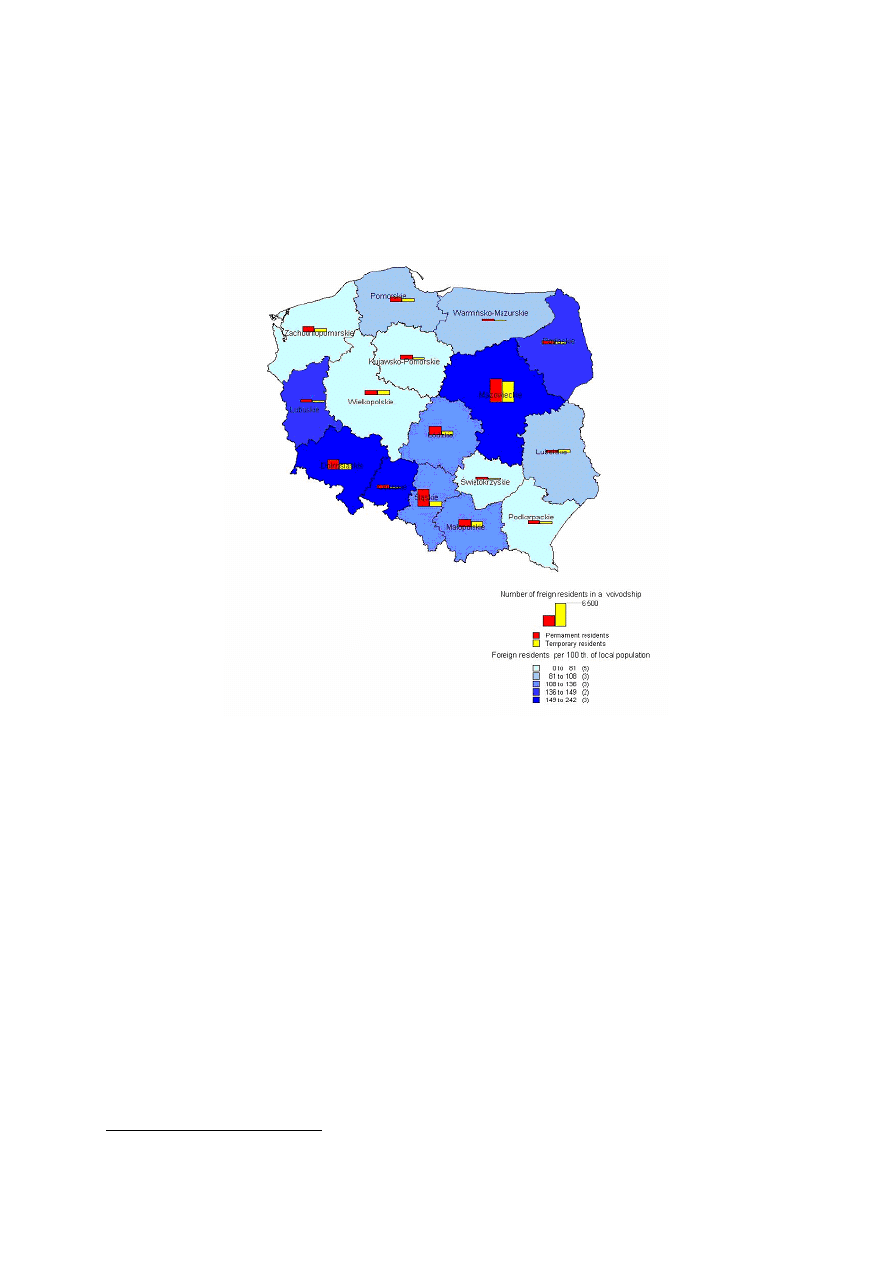
with a restricted permit) live in Mazowieckie (Mazowsze) voivodship (cf. Table 2, Map 1)
and most of them are within the greater Warsaw area. Several factors contribute to this
degree of concentration: first, Mazowieckie voivodship provides an absorbing labour market
that offers employment opportunities to both highly-qualified experts and unqualified
domestic and blue- collar workers; second, transnational environments and migrant networks
are already well-established in the city; third, the area offers migrants better access to
3
Among foreign citizens born in Poland there are those of the so-called second generation, i.e. the children of
immigrants settled in Poland. Equally there may be Polish citizens whose emigrations led them to renounce
Polish citizenship but are now in Poland once again.

6
institutions such as embassies, international schools for children, places of worship for
various faiths and religious persuasions, and a better service infrastructure. It is for similar
reasons that refugees also choose to settle specifically within the confined of Warsaw, even
though the costs of living are markedly higher than in other regions of the country. Apart
from Mazowsze, it is the Opole, Lower Silesian, Western Pomeranian, Lubuskie and Silesian
regions that report the highest shares of foreign residents in Poland.
Table 2: Foreign Residents in Total Population in Poland (by Voivodship), 2002
Foreign Residents
Voivodship
Total
Resident
Population
Total
Per 100th. of
Total
Resident
Population
Permanent
Residents
Temporary
Residents (12
months and
more)
POLAND 37,620,085
49,221
130.8
29,782
19,439
Dolnośląskie 2,856,862
4,261
149.1
2,650
1,611
Kujawsko-pomorskie
2,052,650
1,660
80.9
1,164
496
Lubelskie
2,191,019
2,069
94.4
965
1,104
Lubuskie
998,007
1,421
142.4
849
572
Łódzkie 2,600,883
3,366
129.4
2,250
1,116
Małopolskie 3,157,057
3,478
110.2
1,965
1,513
Mazowieckie
5,069,524
12,262
241.9
6,481
5,781
Opolskie
971,930
1,616
166.3
1,220
396
Podkarpackie
2,061,005
1,624
78.8
952
672
Podlaskie
1,173,125
1,608
137.1
900
708
Pomorskie
2,137,476
2,303
107.7
1,376
927
Śląskie 4,630,323
6,278
135.6
4840
1,438
Świętokrzyskie 1,295,813
1,030
79.5
690
340
Warmińsko-mazurskie 1,411,139
1,403
99.4
802
601
Wielkopolskie
3,331,459
2,352
70.6
1,198
1,154
Zachodniopomorskie
1,681,813
2,490
148.1
1,480
1,010
Source: Census 2002
Where age structure is concerned, it is obvious that the majority of immigrants fall within the
most economically productive age bracket (25-55), thereby confirming the already-mentioned
thesis that foreigners are motivated to migrate for work reasons. The largest groups of
migrants aged 0-14 are from Ukraine, the Russian Federation, Germany, Belarus, Vietnam,
Armenia, and the United States. Knowledge about the direction that emigration flows took in
the past -- from Poland to countries like Germany, the United States, the United Kingdom,
France, and Austria -- calls for treating data on foreign residents coming from these same
countries with great caution. In fact, some individuals recorded by the census as immigrants
and foreign residents may actually be former Polish citizens who were born and raised in
Poland but who subsequently emigrated, renounced Polish citizenship, and adopted another
citizenship before returning to Poland later on in life. Moreover, they may now be in Poland
7
with their foreign-born children
4
. Return migration might also account for the decidedly
above-average proportion of foreign residents from these countries of post-productive age (55
years and over).
Map 1: Number of Foreigners by Residence Permit and Share of Foreign Residents per
100,000 of Native Population
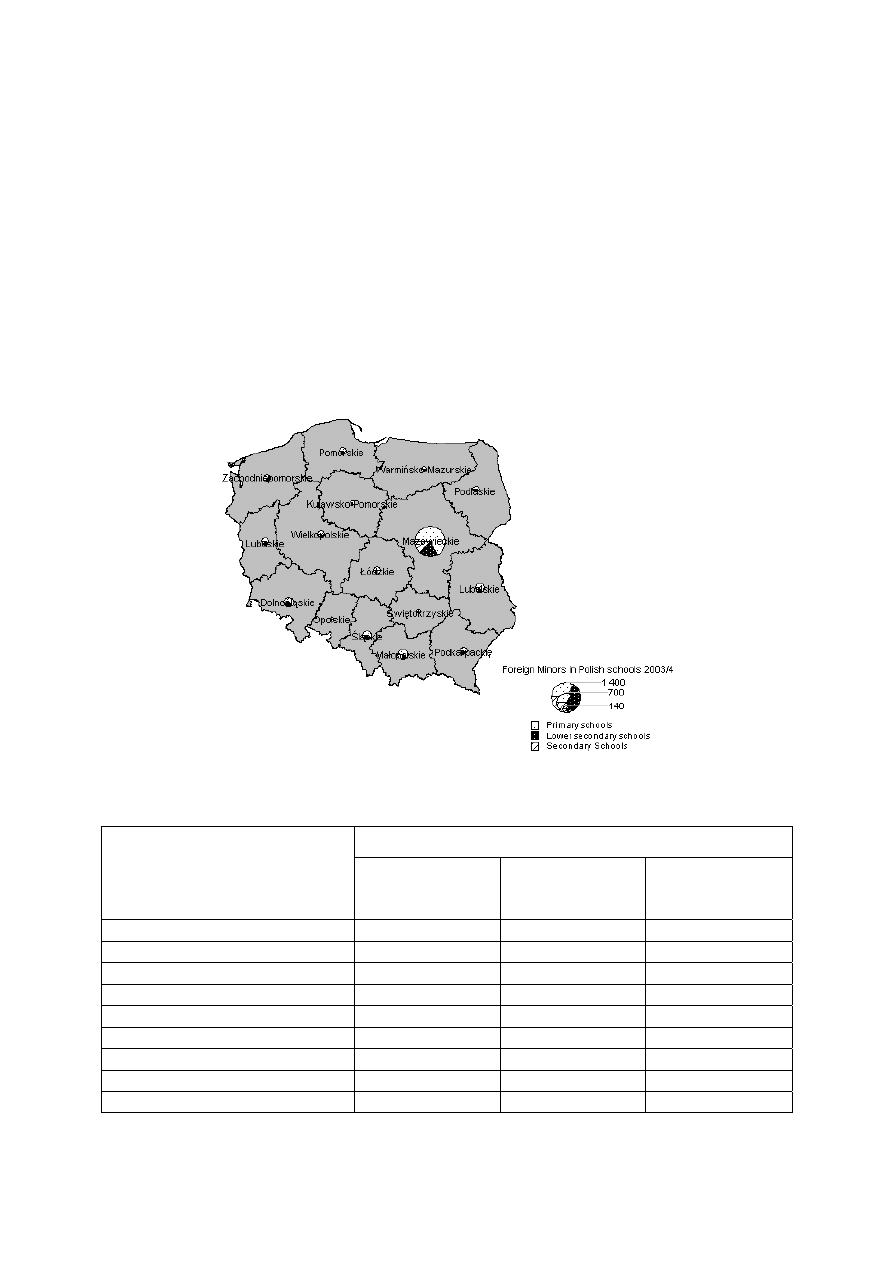
The small number of immigrant children in Poland revealed by the census is confirmed by
data from the Ministry of National Education (MEN) (cf. Table 4). The total number of
children of foreign residents attending school in Poland in the 2003/2004 school year was
3,437, of which 60% were at primary schools, 20% at lower secondary schools and the
remaining 20% at secondary schools or in further education. As with the overall population
of foreign residents, these children are also concentrated in the area of Mazowsze. Ministry
of National Education data indicates that relatively few children from one of the 15 EU
Member States (before the accession of 10 additional countries on 1 May 2004) are enrolled
in one of the schools subordinated to that Ministry: there were only 191 such children in
primary school, 90 in junior high, and 53 in secondary and post-secondary school – while the
stock of EU citizens calculated by the 2002 Census data amounted to 9,091 (of which at least
1,300 were children aged 0-14; cf. Table 3). The absence of EU citizens' children in Polish
schools may reflect either the fact that most of the children are still of pre-school age or that
their parents are striving to place their children within embassy-run schools (which are not
taken into account by the MEN statistics.
4
For more on the current return migration to Poland, see Iglicka, 2002.

8
Table 3: Foreign Residents by Age and Citizenship, 2002
Age Bracket
Country of
Citizenship
Total
of whom
born in
Poland*
0-14 lat
15-24
25-34
35-44
45-54
55-64
65+
TOTAL 49,221
5,079
6,414
6,751
11,685
10,095 6,525 3,555
4,177
Selected countries:
Ukraine
9,881
542
1,15
1,682
3,156
2,048
1,053
383
409
Russian Federation
4,325
61
500
518
895
966
528
305
613
Germany
3,711
1,615
633
232
361
594
511
595
784
Belarus
2,852
167
323
587
908
467
264
140
163
Vietnam
2,093
226
366
302
507
545
315
45
12
Armenia
1,642
15
319
217
496
334
207
54
15
United States
1,321
426
295
94
193
254
160
83
240
Bulgaria
1,058
35
76
141
219
213
237
107
64
United Kingdom
1,025
121
126
46
250
298
150
92
63
France
989
102
166
69
250
195
154
67
88
Lithuania
860
18
56
258
273
110
63
44
54
Czech Republic
831
5
91
142
220
119
139
73
47
Italy
719
84
90
31
120
159
128
107
84
Greece **
532
121
24
11
31
100
119
78
169
Kazakhstan
508
0
39
206
108
75
51
15
14
Netherlands
490
68
75
17
95
129
80
57
36
Slovakia
482
53
56
97
156
89
59
20
5
Sweden 475
276
33
44
54
67
109
102
66
Serbia and Montenegro
452
0
38
36
96
126
80
48
28
Hungary
452
65
50
85
69
81
89
54
24
Mongolia
348
13
69
82
62
97
35
2
1
Austria
328
139
62
34
41
72
68
24
27
Turkey
312
28
16
29
120
107
27
12
1
China
296
43
37
24
82
99
30
14
10
India
289
10
29
21
132
73
21
11
2
Romania
275
2
31
48
99
47
23
16
10
Syria
258
0
14
23
83
104
22
10
2
Algeria
231
0
4
4
64
96
48
14
1
Spain
225
61
25
29
62
44
29
14
22
Belgium
215
30
27
8
41
41
35
31
30
Moldova
205
0
22
49
74
35
18
2
5
Japan
204
8
22
8
52
54
51
10
7
Norway
198
27
13
62
43
29
17
24
10
Croatia
189
30
7
14
51
49
36
21
11
Canada
177
38
38
7
21
39
25
8
39
Denmark
173
0
33
6
29
48
25
25
7
Georgia
168
0
15
29
44
42
27
6
5
Libya
141
11
43
8
26
56
7
1
-
Nigeria
130
3
3
21
47
50
9
-
-
Jordan
125
47
4
12
65
30
10
3
1
Yemen
117
8
21
6
59
30
1
-
-
Latvia
116
0
9
28
42
25
5
2
5
Macedonia
115
15
4
11
30
37
22
6
4
Azerbaijan
106
0
14
15
29
27
14
3
4
Iraq
105
0
7
8
16
33
27
12
2
Others
9,477 566
1,339
1,35
1,814
1,762
1,397
815
993
* Own calculation based on Census 2002
** Greek residents also include the offspring of political refugees who settled in Poland in the 1950s.
Source: Census 2002
9
Although the stock of migrants (children and young people included) is relatively small, the
years 2000-2003 brought a marked increase in the number of permanent and restricted
residence permits issued to minors (c.f. Table 5). The best-represented group in this regard
were immigrants from the former Soviet republics (Ukraine, Belarus, Armenia, and the
Russian Federation), which seems to confirm the above-mentioned hypothesis that these
groups are tending towards a greater degree of stability and permanence in the host country:
the pioneers of immigration are moving away from the initial phase of the migration process -
- which is subordinated mostly to the need to accumulate economic, social and cultural capital
(Portes, 1998) -- towards phases associated with settlement and family reunion.
Map 2. Number of Foreign pupils by Voivodship and Level of Education
Table 4: Foreign Pupils in Polish Schools in 2002/2003 and 2003/2004 Academic Years
Foreigners
Type of school
Total Number
Of which
Permanent
Residents
Of which
Foreigners of EU
Member States*
Primary schools
2,028
973
191
Gymnasium (Lower secondary school) I
714
378
90
General Secondary school
439
257
45
Basic vocational School
19
14
1
Vocational secondary schools
89
55
5
Post-secondary schools
133
51
2
Of which in Teacher training college
12
6
1
Fine Art Schools
15
9
0
Total
3,437
1,737
334
* EU Member States before 1 May 2004.
Source: Ministry of National Education

10
Table 5: Number and Percentage of Minors Accompanying Foreign Adults Claiming
Permanent and Temporary Residence Permits by Age and Selected Country of Origin
2001 2002 2003
No. % No. % No. %
Permanent Residence Permit by Age
Total 0-17
49
100
40
100
115
100
0-4
9
18
6
15
10
9
5-9
18
37
13
33
38
33
10-14
16
33
17
43
50
43
15-17
6
12
4
10
17
15
Permanent Residence Permit by Country of Origin -- selected countries
Ukraine
16
33
7
18
31
27
Russian Federation
9
18
10
25
10
9
Belarus
4
8
0
0
14
12
Armenia
8
16
8
20
18
16
Vietnam
5
10 9
23 18 16
Temporary Residence Permit by Age
Total 0-17
1,667
100
1,807
100
1,823
100
0-4
526
32
537
30
478
26
5-9
567
34
623
34
661
36
10-14
461
28
511
28
512
28
15-17
113
7
136
8
172
9
Temporary Residence Permit by Country of Origin -- selected countries
Ukraine
511
31
643
30
716
39
Russian Federation
259
16
249
14
221
12
Belarus
57
3
86
5
119
7
Armenia
52
3
77
4
110
6
Vietnam
81
5
73
4
62
3
France
86
5
119
7
94
5
Germany
38
2
23
1
29
2
Source: Office for Repatriation and Aliens
Available data also points to an increase in the proportion of young asylum seekers, both in
absolute numbers (cf. Table 6) and in proportion to the total number of applicants. The
majority of asylum seekers who are minors are citizens of the Russian Federation, and most of
them are Chechens fleeing the civil war in the region. It should be noted that refugees'
children are in a special situation because they have often been through harrowing
experiences and, therefore, usually require a greater amount of care from school teachers and
pedagogues. As the size of this special population increases, it is inevitable that there will
also be a greater need for adjustments within the country's education system.

11
Table 6: Number and Percentage of Minors Among Asylum Seekers, by Country of
Origin and Age
2001 2002 2003
No. % No. % No. %
Total Asylum Applications
4,529 100 5,170 100 6,909 100
Minors Among Asylum Seekers
897 20 1,646 32 2,610 38
SELECTED COUNTRIES OF ORIGIN
Russian Federation
606
68
1,340
81
2,501
96
Afghanistan 114
13
88
5
22
1
Armenia
76
8
37
2
26
1
Ukraine
32 4 21 1 16 0.6
Vietnam
16
2
3
0.2
0
0
Belarus
8
1
17
1
7
0.3
AGE
0-4 413
46
608
37
1,012
39
5-9
344
38
502
30
802
31
10-14
60
6
402
24
622
24
15-17
80
9
134
8
174
7
Source: Office for Repatriation and Aliens
1.2. Relevant Migrant Groups
Legal status and the reason for migrating are the two most important criteria for
differentiating groups of migrants in Poland. In reference to these two dimensions, the
following groups may be listed:
1.2.1.Humanitarian Migrants: asylum seekers, refugees, and persons granted
tolerated stay
The number of asylum seekers applying for refugee status in Poland is growing
systematically, as is the number of children accompanying them. And although the overall
number of successful applicants is fairly small, the number of acknowledged refugees or
persons granted tolerated stay has also increased. The most numerous and distinctive group
of refugees is composed by Chechens; this group is followed by citizens of Bosnia and
Herzegovina (most of whom returned to their home country or left for yet another other
country following the resolution of the Kosovo conflict), Afghanistan, Somalia, Georgia, Sri
Lanka, and Sudan. It is worth mentioning that the integration process of asylum seekers
encounters many difficulties, particularly as many refugees typically prefer to leave Poland
for even richer countries in Western Europe. Furthermore, very little is done to promote
asylum seekers' integration into Polish society during the lengthy procedure of granting
successful applicants refugee status (e.g., by teaching the Polish language). Finally, empirical
evidence provided by interviewees have underscored that the quality of education offered to
the children of asylum seekers requires improvement.

12
1.2.2 Economic Migrants
The European Union's enlargement on 1 May 2004 to 10 additional Member States has
granted EU citizens residing in Poland much greater benefits and legal entitlement than other
economic migrants who work or reside in Poland. EU citizens, as well as citizens of the
United States and Canada, usually enjoy high economic status since they are commonly
employed as experts, managers, or run their own enterprises. This group of migrants rarely
becomes an object of social research despite some evidence (Szwąder, 2002) that it integrates
poorly and does not mix very much with the local population; this situation does not seem to
be influenced by the relatively favourable conditions provided by easy access to crucial
institutions of public life, large amounts of transferable human and financial capital, and the
positive attitudes of the host society.
Although the number of all sorts of economic migrants from the former Soviet republics
(especially Ukraine, Belarus, and the Russian Federation) is estimated at approximately
100,000 (Iglicka, 2003), only a tiny portion of these may be described as residents or settlers:
most of them are seasonal or circular migrants who come to Poland on tourist visas and then
undertake short-term or irregular employment (in construction, agriculture or domestic
services). Since lots of them keep coming every year, they learn Polish language quickly and
establish good personal relations with their Polish employees, landlords, etc. All of this
facilitates a kind of 'spontaneous' (i.e. unstructured) integration into Polish society. While the
children of these economic migrants are usually left in the home country to be looked after by
spouses or older relatives, they are certainly affected by their parents' seasonal migration to
Poland, in both positive and negative ways.
Vietnamese and Armenians residing in Poland constitute the most integrated and visible
diasporas of third country nationals. The Vietnamese community is estimated at 20-50,000
individuals (Halik, Nowicka, 2002), while it has been estimated that there are approximately
50,000 Armenians (Miecik 2004). Both of these ethnic groups have managed to carve out
economic niches, with the Vietnamese specializing in gastronomy and the textile trade and the
Armenians monopolizing the (mostly pirate) CD-market and dealing in general trade. Both
groups also have in common a serious concern for giving their children a proper education
5
,
they loyally support their community's members, and are given to developing so-called
"parallel societies"
6
. Interestingly, Armenians are one of oldest ethnic minorities to have
settled on Polish territory (in the 14th Century). They constitute a historical example of
"successful integration" long before the concept of integration was even conceived: numerous
Armenians were included into the Polish gentry, successfully climbed the social ladder, and
held high offices within the structures of the Polish Kingdom while also retaining their
cultural identity and religion, at least until more recent times (Pełczyński, 1997). The so-
called "new" wave of Armenian immigrants that arrived in Poland (and Central Europe) in the
5
Considerable respect towards education is deeply rooted in ancient and contemporary Vietnamese culture
(Halik, 2004)
6
In-depth interview with the Officer of the Office for Repatriation and Aliens.

13
early 1990s (mostly as asylum seekers fleeing the Caucasian conflicts) now benefits from the
assistance of "old" diaspora members who, for example, substantially help in the running of
ethnic school for the children of Armenian immigrants in Warsaw. Since a number of
Vietnamese and Armenian migrants were known to be living in Poland illegally (either
because they overstayed their visas or because they were smuggled into Poland), the Polish
government launched a regularization programme in 2003 with the aim of fully integrating
those persons (and other foreigners in a similar position) who were resident in Poland since at
least 1997 (Iglicka, Okólski 2003) .
1.2.3. Repatriates
Although not numerous (ca. 5,000 persons
7
), this group constitutes an interesting case study
for analyzing factors contributing to integration processes. Repatriates are the offspring of
Polish citizens who stayed in the Soviet Union after World War II or who were forcibly
deported to one of the Asian Republics of the former Soviet Union and were not able to return
during previous repatriation waves. Facilitating the "return" of repatriates is regarded as a
"moral obligation" of the Polish nation towards those members who were "left aside" during
World War II; for this reason, sentimental motives often became intertwined with economic
ones when decisions on resettlement were taken (Najda, 2003). However, many repatriates
felt disappointed and embittered when they returned to Poland, for the living conditions and
the requirements of a capitalist economy appeared not to have matched their expectations.
Despite the relatively substantial economic assistance provided by the Polish state to
repatriates, their reintegration into Polish society has proven to be difficult in many cases
(Weinar, 2003; Hut, 2002, Kozłowski, 1999).
7
Data of the Office for Repatriation and Aliens: http://www.uric.gov.pl/index.php?page=1090103000

14
2. Legal and Policy Framework
According to Friedrich Heckmann and Dominique Schnapper, no European country has ever
developed a "pro-active" and consciously planned "national integration strategy," or a
"systematic and goal-minded action undertaken on a national level". Integration policies
implemented in European countries usually take the shape of a "politically promoted process"
that "sets conditions and gives opportunities and incentives for individual choices and
decisions" to individuals who, in struggling to improve their social situation, adapt to the
explicit and implicit rules of the "social order" (Heckmann and Schnapper, 2003:10-11). In
order to achieve upward social and economic mobility (in a legal and acceptable way),
individuals must comply with the host society's institutions and, at the same time, be granted
the possibility of accessing and participating in existing social structures. In other words,
integration is about guaranteeing rights to migrants as much as it is about their duties as
responsible members of their adopted country.
In the case of Poland, the scope of the incentives and opportunities provided to immigrants
differs significantly depending on their legal status. Officially, integration policies
implemented by the Ministry of Social Affairs are still aimed at only one group of migrants, a
group that is, moreover, small in absolute terms: the refugees acknowledged by the Geneva
Conventions
8
. In practice, however, certain legislative norms that have been enacted in
Poland might be regarded as "indirect integration measures" (Hammar, 1985), for they do
influence the scope of opportunities available to all migrants (and to his/her descendants) and,
by the same token, can either facilitate or impede their inclusion in the host society's key
institutions. For this reason, a reconstruction of the logic that determines the degree of access
that immigrants have to public goods commonly available to Polish citizens will help to
identify the "general integration praxis" that has been developed alongside the "official"
integration policy addressed to refugees only.
2.1.
Migrants and Their Legal Entitlements
Polish law distinguishes between different categories of migrants, with each group being
entitled to different rights. The categories are the following: humanitarian migrants (refugees
and tolerated stay), economic migrants (EU nationals and third country nationals), and
repatriates. In line with EU directives, the legal entitlements of refugees and holders of
tolerated stay permits are similar to those offered to migrants with a permanent residence
permit.
8
Hopefully, this position will change in the very near future, as the new concept of complex integration policy is
being prepared by the Ministry of Social Policy.

15
2.1.1.Humanitarian Migrants
As already mentioned, refugees are the group of migrants officially entitled to the largest
amounts of benefits from the Polish state; the most significant of these benefits is the so-
called "integration programme". Assistance provided through the integration programme,
which can last up to 12 months and is implemented by the Powiatowe Centrum Pomocy
Rodzinie
9
(PCPR), includes "expert counselling", reimbursement for health insurance, and
direct financial support
10
in the form of a monthly allowance
11
(for 12 months) that covers
basic expenses (like accommodation, food, and clothing) and classes in Polish. The head of
the PCPR assigns a social worker, charged with providing individual assistance and
"mentorship", to a refugee; the social worker is expected to "cooperate with the refugee and
support him/her in relating to the local social environment", help in securing appropriate
accommodation, and undertake individually-designed actions aimed at the economic
activation and social orientation of the refugee. In turn, the newly-arrived refugee is obliged
to register as unemployed with the Labour Office and to then seek employment. Besides,
he/she should attend Polish language classes and fulfil certain commitments agreed upon, on
an individual basis, with the social worker, and meet with him/her at least twice a month.
Should refugees not meet their obligations or leave the region where the integration program
was implemented, they run the risk of forfeiting their right to receive individual help or/ and
financial assistance
12
.
Although integration programmes were invented and proclaimed as personalized and custom-
designed schemes based on a careful assessment of migrants' needs, skills, and qualifications,
the outcomes remain less than satisfactory in some cases. Inclusion in the labour market, a
crucial factor for promoting integration, is proving to be the most problematic element. The
main barrier to finding a job is refugees' weak proficiency in the Polish language and their
inability to meet the qualifications required by local employers. Some challenges (for
example, illiteracy or chronic illness), simply cannot be confronted adequately within a 12-
month period. Those refugees who do not manage to find employment usually become
regular beneficiaries of state social security services (c.f. Koryś, 2004: 54-57).
In fact, asylum seekers who have been granted refugee status have access to a wide range of
rights and privileges, including the right to social and unemployment benefits
13
, the right to
run a business on the same terms as Polish citizens
14
, as well as other entitlements, some of
9
County Centers for Family Assistance
10
The amount of financial allowance depends on the size of a refugee household. It ranges from 1,149 PLN (for
a one-person household), to 420 PLN per month (Social Security Act of 12 March 2004, Art 92).
11
The mutual obligations of a Powiatowe Centrum Pomocy Rodzinie and a refugee participating in integration
programs, as well as the regulations concerning the size of financial allowances, are as listed in the Ordinance of
the Minister of Labour and Social Affairs dated 1 December 2000.
12
The Social Security Act of 12 March 2004, , Art. 93-95.
13
The Act on the Promotion of Employment and Labour Market Institutions of 20 April 2004.
14
The Act on the Freedom of Entrepreneurship of 2 July2004.

16
which cover their offspring (free education at any level
15
and health insurance). Another
important advantage of having refugee status is that it opens up the chance of being offered a
cheap, council-owned apartment (currently, this is a scarce commodity rarely available even
to Polish citizens), thus significantly improving living conditions and alleviating pressures on
the household budget
16
.
However, the number of immigrants enjoying such privileged integration conditions is
relatively small: between 1991 (when the Polish government signed the Geneva Conventions)
and the end of 2003, only 1,764 people were granted refugee status in Poland
17
, and 901 of
them only became refugees after 1 January 1998.
Polish law offers asylum seekers two other forms of migrant protection. The first one, known
as "tolerated stay", was introduced as a means to safeguard that relatively large group of
migrants who were denied refugee status (because they failed to meet the criteria set out by
the Geneva Conventions), but whose right to life, freedom, and personal security might be
endangered in their country of origin. Some of these may also risk being subjected to torture
or to inhuman and degrading treatment or to some other form of unacceptably harsh
punishment
18
. Currently, this form of protection is granted mostly to Chechens who have fled
to Poland.
The second form is called "temporary protection" and was intended as an immediate solution
for foreigners "coming to Poland en masse" after having left their country of origin or a
particular geographical region because "of alien invasion, war, civil war, ethnic conflicts, or
serious human rights violations"
19
. Since its introduction in 2003, however, "temporary
protection" status has not yet been granted to any asylum-seeker.
Recent changes in Polish law have broadened the entitlements available to "tolerated stay"
holders so that this group of persons now enjoys almost the same privileges as refugees.
However, tolerated stay holders are not guaranteed freedom of movement within the
European Union and receive smaller financial contributions from state or local authorities.
The maximum financial allowance available to migrants with "tolerated stay" status without
other forms of economic resources amounts to approximately 100€ per month (420 PLN)
20
.
Moreover, although this group of migrants does have free access to the Polish labour market,
it cannot register as unemployed with the local Labour Office/ job centre (they can register as
"employment seekers", which gives them access to a rather narrow range of services,
traineeships, and other forms of relevant assistance programmes). On the other hand, these
15
The Act on the Education System of 7 September 1991 and The Act on Higher Education of 12 September
1990.
16
As the number of available council flats is far below demand, some refugees must rent their apartment on the
free market.
17
Approximately 30,000 asylum seekers submitted applications between 1993-2003.
18
Act on the Protection of Aliens on the Territory of Poland issued 13 June 2003, Art. 97.
19
Ibidem (Art. 106).
20
The Ordinance of the Minister of Labour and Social Affairs, 16 April 2003

17
"protected" migrants are given free access to the Polish labour market (they do not need to
apply for a work permit and are able to establish and run a business on the same terms as
Poles and refugees) and their children can attend school under the same conditions as Polish
citizens
21
(this is something that is offered to permanent residents and nationals of EU
Member States working in Poland and their families, as well as to humanitarian migrants).
Another privilege granted to all types of humanitarian migrants (and permanent residents) is
the right to social welfare and all types of social benefits (as long as the predefined criteria are
met). The importance of this entitlement stems from the fact that customary beneficiaries of
social security are covered by health insurance while other migrant groups, including
permanent residents, are only entitled to health insurance if they are working or studying in
Poland. Additionally, migrants with "temporary protection" status are to be provided with
accommodation and board
22
.
2.1.2. Economic Migrants
Among migrants arriving in Poland for reasons other than humanitarian ones, a particularly
privileged group are EU nationals as well as the citizens of countries in the European
Economic Area (EEA)
23
. Not only are they given access to social benefits, but they are also
entitled to assistance in entering the labour market
24
and the education system (including
university-level programmes).
The situation of third country nationals in Poland is more disadvantaged. First of all, in order
to receive a restricted visa (issued with a restricted residence permit and valid for a maximum
of two years), these individuals are required to prove that they are either: "engaged in [a]
business activity […] profitable to the national economy"; in the process of gaining a work
permit (something that is quite complicated, c.f. section on the Labour Market); be a
"recognised, established artist" intending to "continue […] artistic activities on the territory of
Poland"; or in Poland on the grounds of family reunification. Needless to say, only a few
labour migrants from the former Soviet Union can meet these criteria, for they are usually
employed in badly-paid jobs in the secondary labour market. For this reason, they sometimes
resort to other means of legalising their residence: for example, by seeking admission into
public and non-public universities (Koryś, 2004) or by marrying a Polish citizen (Kępińska,
2001).
21
The Act on Higher Education does not grant recipients of a "tolerated stay" status to free university education
(while it does to refugees and "temporary protection" immigrants). What looks, at first sight, like a loophole,
might in fact be a conscious decision (prompted by the fact that migrants residing in Poland on the grounds of a
"tolerated stay" status are likely to be much more numerous than those granted "temporary protection").
22
Act on the Protection of Aliens on the Territory of Poland (Art. 111)
23
These include all EU countries, as well as Iceland, Norway, and Switzerland.
24
EU nationals can register as unemployed and are entitled to unemployment allowance if they have worked in
Poland for 18 months before becoming unemployed.

18
In applying for restricted residency, migrants must show proof of possessing sufficient
financial means to cover living expenses in Poland. If applicants are so much as suspected of
becoming a burden on the Polish welfare state, their requests are liable to be refused, which
means that, until the necessary conditions are met, they must "rely on their own resources"
while seeking employment, for example, and pay for services, like secondary and higher
education, that are available to Polish citizens free of charge. As before, these requirements
are not demanded of EU and EEA nationals. The acquisition of a permanent residence permit
(in Polish law termed a "permission for settlement") marks a turning point in the legal status
of foreigners and their access to key institutions in Polish society, for permanent residents
enjoy the same rights as Polish citizens (and refugees), except for in the realm of voting
rights.
Immigrants can apply for a permanent residence permit if they have lived on Polish territory
for at least three years (as residents) or for at least five years (in the case of refugees or
appropriate visa holders) and if they are able to point to the "existence of durable family
bonds or economic ties with the Republic of Poland"; they must also document the possession
of "accommodation and economic means" (in other words, they must prove that they are
earning a fixed income and have secure lodging)
25
. The outcome of this regulation is quite
paradoxical: migrants only gain legal access to social security and/or unemployment benefits
once they can prove that they do not need it
26
. The criteria that must be met for applying for
permanent residency are demanding. In fact, only about two thirds of applications for a
permanent residence permit were accepted in 2001-2003; in the case of restricted residence
permits, however, only one out of twenty applications were refused (the ratio of refusals
varied according to nationality -- c.f. Table 7)
27
.
2.1.3. Naturalized citizens
The acquisition of citizenship might be regarded as the final stage on the path to social
inclusion. Although the Polish legal system complies with the principle of ius sanguinis
(whereby citizenship is granted on the basis of family ties as opposed to place of birth), Polish
citizenship is also available to foreigners who are in no way related to Poles, as long as they
fulfil some prerequisite: applicants must have lived in Poland for at least five years with a
permanent residence permit
28
and, in some cases, must renounce their previous (foreign)
citizenship. Under very special circumstances, the President of the Republic of Poland has
the power to grant citizenship regardless of non-compliance with these requirements.
Although detailed data on the granting of Polish citizenship to foreigners is not published
annually, it is possible to estimate that approximately 10,000 people became Polish citizens in
the years 1990-2003 (most probably, this number also includes the restoration of Polish
25
The Act on Aliens of 13 June 2003, Art.65
26
Witnessing the moral panic of "scroungers who are seeking social benefits" and "living at the taxpayer's
expense" that burst out in the UK after the EU enlargement, this regulation might be regarded as a far-sighted.
27
Own calculations based on statistics of the Office for Repatriation and Aliens.
28
An exception is made for the foreign spouses of Polish citizens – they can apply for citizenship after three
years of living in Poland with a permanent residence permit.

19
citizenship to individuals who had previously lost their citizenship as children or who had
given it up through marriage to a foreigner).
Table 7: Decisions on Permanent Residence Permits and Restricted Residence Permits
Issued by The Office for Repatriation and Aliens, 2000-2003 (selected countries)
Permanent
Restricted
Country of Citizenship
Po
sitiv
e
Neg
ativ
e
Di
sco
nt
in
ued
To
ta
l
Po
sitiv
e
Neg
ativ
e
Di
sco
nt
in
ued
To
ta
l
Armenia 198
163
27
388
2,127 425 81 2,633
Belarus 183
75
15
273
6,316 151 61 6,528
China 100
32
2
134
1,177 48 24
1,249
Czech Republic
23
8
2
33
660
3
11
674
Denmark 5
7
1
13
706 4 7 717
France 23
6
1
30
3,492 16 65
3,573
Georgia 25
13
0
38
268 28 4 300
Germany 68
22
7
97
4,086 74 69
4,229
Hungary 8
2
0
10
291 1 5 297
India 58
21
0
79
1,469 68 23
1,560
Iraq 7
8
0
15
117 14 2 133
Italy 36
8
2
46
1,238 12 24
1,274
Japan 10
3
0
13
758 3 20 781
Jordan 15
8
0
23
224 13 3 240
Kazakhstan 32
12
1
45
1,358 17 32
1,407
Latvia 2
2
1
5
203 5 2 210
Lebanon 12
6
1
19
129
8
5
142
Lithuania 26
6
1
33
886 12 13 911
Moldova 16
2
0
18
697 25 6 728
Mongolia 41
48
7
96
776 81 20 876
Netherlands 21
5
2
28
1,029 10 17
1,056
Nigeria 10
5
3
18
332 28 9 369
Russian Federation
305
87
11
403
5,367
240
82 5,689
Serbia and Montenegro
32
22
1
55
672 13 22 707
Slovak Republic
10
1
0
11
547 3 10 587
South Africa
2
4
0
6
135 0 1 136
Spain 7
1
0
8
436 1 6 443
Sudan 9
10
0
19
56 4 1 61
Sweden 19
5
2
26
1,086
6
10 1,102
Syrian Arab Republic
24
16
3
43
439
37
7
438
Tajikistan 6
7
1
14
32
1 1
34
Turkey 31
18
4
53
1,454 106 40 1,600
Ukraine 686
229
39
954
19,461 709 237
20,407
United Kingdom
41
19
3
63
2,809 21 66
2,896
United States of America
45
15
6
66
2,875 11 65
2,951
Vietnam 436
210
14
660
3,141 402 69 3,612
TOTAL
3,016 1,253 172 4,441
79,002 3,095 1,376 83,473
Source: Office for Repatriation and Aliens

20
2.1.4. Repatriates
Unlike the other groups of migrants discussed in this chapter, repatriates
29
(descendants of
Polish citizens who were forcibly resettled to one of the Asian republics of the former Soviet
Union under Stalin's rule) can acquire Polish citizenship (and all rights and privileges linked
to this status) at the very beginning of their integration process. Once they obtain an entry
visa for repatriation issued by a Polish consulate and have arrived in Poland, they
automatically acquire Polish citizenship (foreign spouses who of non-Polish origin are
granted permanent residency); at the same time, they are defined as a separate group from
other Polish citizens and are thereby entitled to certain extra benefits.
Although it is essential to maintain a certain degree of "Polish-ness" is one of the prerequisites
for obtaining a repatriation visa (for example through the preservation of the Polish language,
of traditions and folk customs), almost all repatriates suffer from serious acculturative stress
30
and need some assistance to help them reintegrate into the host society. In recognition of
this "particularity", legal regulations
31
setting conditions for repatriation also define the scope
and various forms of institutional assistance available to repatriates. By virtue of these,
repatriates are provided with Polish language courses and orientation training (basic
information on Polish culture, the legal system, employment and living conditions). Even
more advantageous for repatriates is a guarantee of accommodation and maintenance (for at
least 12 months) by the local authority of the gmina (commune) that issued an invitation to
the repatriate's family. Repatriates are the only immigrants who are provided with their own
apartment upon arrival in Poland, who can apply reimbursement of travel expenses, who may
receive a special "settlement allowance" (up to 1,000€ per family member, for undertaking
necessary renovations and equipping the apartment), and who are also entitled to a "school
allowance" (equal to the average wage) for each child of school age.
Compared to those regulations that concern other groups of migrants (and, indeed, even
Polish citizens), the set of norms that deals with promoting individuals' entrance into the
workforce is very well developed. In accordance with these norms, the number of years of
employment in the previous country of stay are taken into account when calculating the right
to unemployment benefits and pension entitlements
32
. In addition, if a repatriate "has no
possibility of taking up work independently", the starosta (the County Governor) of a given
powiat (county-level administration) may refund part of the costs borne by a repatriate who
seeks to raise his or her professional qualifications, as well as the costs incurred by employers
who create job opportunities, offer appropriate re-training and "remuneration, awards and
social insurance contributions"
33
.
29
The current repatriation wave concerns those Polish citizens (or their descendants) whose repatriation was not
possible under the previous waves in 1944-1949 and 1955-1959.
30
Psychological, sociological and physical health consequences of acculturation (see Berry 1992).
31
The Act on Repatriation was passed in 2000 and amended in 2003.
32
Act on the Promotion of Employment and Labour Market Institutions, Arts. 72.4 and 86.2
33
Act on Repatriation – consolidated text, Art. 23

21
A consequence of the very favourable integration measures offered to repatriates (above all,
the fact that they are ensured a place to live and means of upkeep as soon as they enter
Poland) has been that the number of individuals waiting to be repatriated exceeds the
willingness of gminas to invite them (Kozłowski, 1999). In 2003, the 2000 Repatriation Act
was amended to include the allocation of special grants from the central budget to local
authorities as compensation for the cost of accommodating repatriates. However, a lack of
data makes it difficult to assess whether this amendment has or will exert a significant
influence in increasing the numbers of gminas willing to invite and then reintegrate the
families of repatriates into their communities.
2.2. Social Institutions of the Host Society
As the above review of entitlements extended to different categories of immigrant makes
clear, there are basically two main kinds of integration policy. The first ensures that
repatriates, refugees, and EU nationals are given access to all (or most) municipal services
during the initial phase of their integration. In contrast, the remaining migrant groups only
earn the right to participate in certain social institutions, as well as to take advantage of
certain services (like welfare payments and unemployment benefit), at an advanced stage of
their integration process. Not only are the latter groups expected to demonstrate the
"existence of durable family bonds or economic ties with the Republic of Poland", but they
are also required to possess a considerable ability to "adapt" in the field of legal employment.
In general, immigrants' access to certain social institutions and to the scarce common goods
distributed among the Polish population is limited. Notable exceptions to this rule are those
groups of migrants that enjoy a "special" status because of their historical ties to Poland (as
with repatriates), because of international law provisions (such as humanitarian migrants and
refugees), or because of EU legal norms (affecting EU citizens). This somewhat "selective"
approach has been adopted in most Central European countries: due to a limited resources and
a high number of competing priorities, specific groups of immigrants are targeted so that
assistance can be granted on a small scale and at relatively low cost (Iglicka, Okólski, 2004).
Principles that affect access to the labour market, the education system, welfare payments,
and political participation are discussed in the sections below.
2.2.1 The Labour Market
Access to the labour market is one of the most highly protected and regulated privileges, and,
for most immigrants, an essential means for legalising their residence status and for obtaining
assistance from the social services (for education, health insurance, etc.). A foreigner wishing
to work in Poland is obliged to obtain a work permit
34
, which is issued by the voivod in which
34
Exempt from this obligation are: refugees, those with the "tolerated stay" and "temporary protection" statuses,
permanent residents, foreign spouses of Polish citizens, citizens of the United Kingdom, Republic of Ireland and
Sweden (i.e. those EU countries that have opened their labour markets to Polish citizens) and their relatives,

22
the employer is located. In fact, it is the employer who applies for the permit, not the
immigrant (it does not matter whether the employer is Polish or foreign, for the same
principle applies to foreigners employed in foreign firms operating on Polish territory). There
is a two-stage procedure by which an employer first obtains a pledge regarding the issue of a
permit, on the basis of which the potential employee applies for a work visa or for a fixed-
term residence permit
35
. In deciding whether to then issue a permit, the voivod (Governor of a
Province) is bound to evaluating the situation of the local labour market -- in other words, to
assessing whether there are other people among the registered unemployed who meet the
qualifications of the foreigner in question. Only after the foreigner has obtained all the
relevant documentation necessary for legalising his/her status can the voivod finally issue the
work permit. It should be noted that these permits are issued for a set period of time, to a
particular individual foreigner, for a defined post and type of work. The permit is valid for a
maximum period of two years (i.e. the same amount of time as a one-off restricted residence
permit). The cost of issuing the permit – borne by the employer – corresponds to the
minimum work wage
36
or to half of that in the case of a permit's extension.
Confronted with a stubbornly high unemployment rate (c.20%) and relatively ineffective
employment promotion programmes, most immigrants find it impossible to obtain
unemployment and other welfare benefits. Unemployment benefits are set aside for
repatriates, refugees, "permanent residents", EU nationals, and foreign relatives of Poles – on
condition that they have worked for at least 18 months prior to application at an income level
equal to or above the minimum wage and that they have made the necessary payments to the
Labour Fund
37
. These, relatively privileged immigrants, may also register as unemployed and
thereby gain access to job offers collected at employment centres, to training sessions run by
the centres (with a view to improving professional qualifications), and to on-the-job training.
Other groups of legal migrants (i.e. migrants granted "tolerated stay" and "temporary
protection" status, holders of temporary residence permits, and relatives of EU nationals) can
register as "jobseekers", which also allows them to take advantage of job offers at
employment centres and to access different kinds of support services.
The situation for young people (including young migrants) entering the labour market is
exceptionally difficult. Suffice it to note that youths aged 25 or under account for 25.4%
38
of
the registered unemployed. In principle, no school-leaver or recent graduate is entitled to
unemployment benefits (unless he or she has somehow worked for the required 18-month
period – which is unlikely in the case of pupils and students). Although job centres and
employers are prohibited from discriminating against anyone on the grounds of gender, age,
disability, race, nationality, sexual orientation, political conviction, religious faith, or trade-
union allegiances, it would seem that – in the face of such high levels of unemployment and
foreign students undertaking professional training, and members of certain professions like medical staff and
athletics or football coaches.
35
The Act on the Promotion of Employment and Labour Market Institutions of 20 April 2004, Art. 88
36
As of October 2004: 820 PLN (ca. 200 €).
37
Act on the Promotion of Employment and Labour Market Institutions, Art. 77 par. 2.
38
Data of Central Statistical Office October 2004
23
fierce competition for posts – young migrants are going to find it very difficult to gain access
to the primary labour market. And it is very likely that youths from certain well-defined
ethnic groups are going to face even greater obstacles.
2.2.2 The Education System
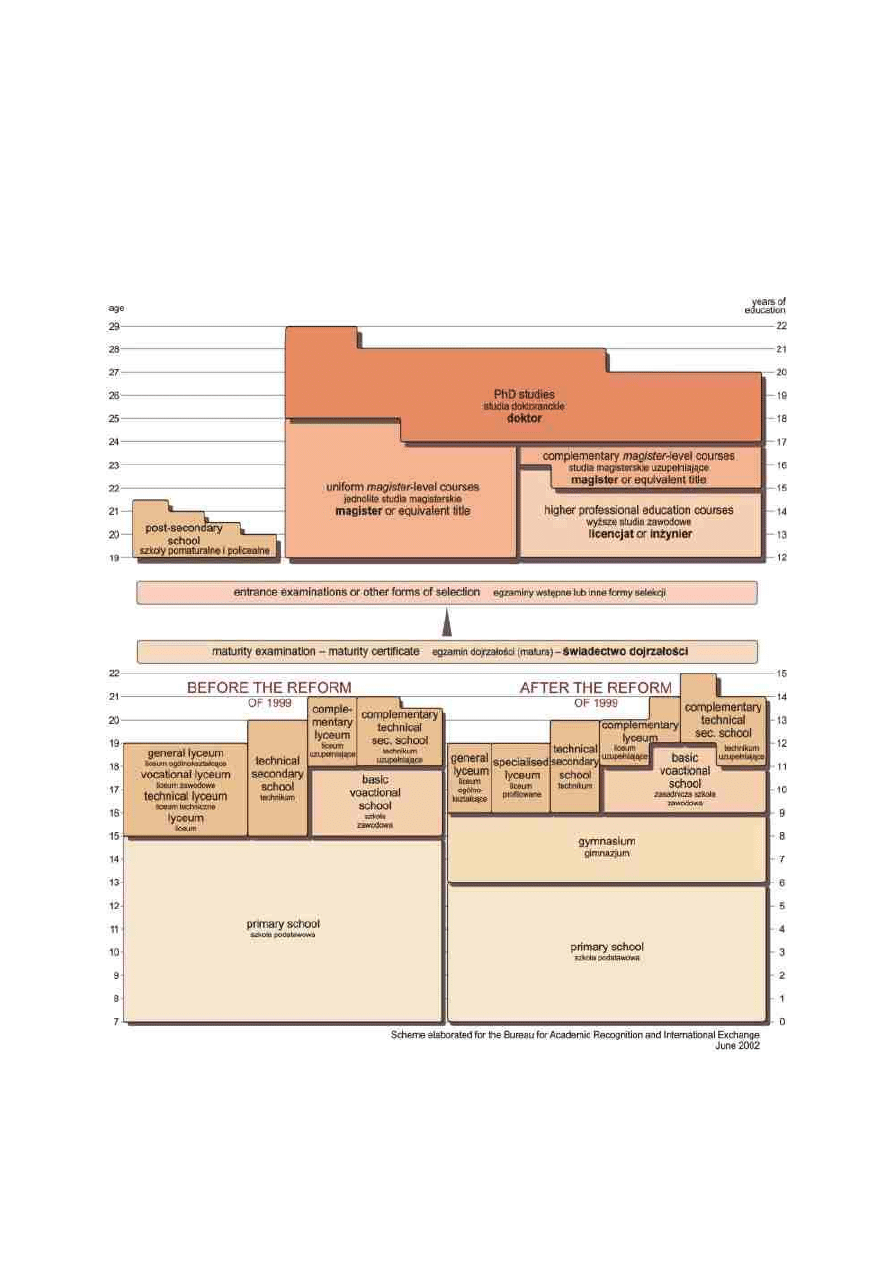
Graphic 1: The Education System in Poland
Source: Ministry of Education

24
2.2.2.1.Primary Education
Gaining access to the Polish education system is of great importance when it comes to the
integration of migrants' children, and is bound to gain even more importance when the time
comes for these children to confront an extremely competitive labour market (as discussed
above). In order to fulfil the so-called "educational obligation"
39
, all children who remain on
Polish territory are obliged to attend an educational institution regardless of their legal status.
This legal provision is significant on account of the considerable role that educational
institutions play in integrating foreign children (especially through the procurement of
linguistic and cultural competence), and because of the negative effects on the development of
children's intellect and personality occasioned by their non-attendance in school. Therefore,
even the children of parents whose status has become "irregular" (for example through the
overstaying of visas, or a failure to prolong a permit, or overdue tax payments, etc.) are able
to enrol in public primary schools without any obstacles.
Despite these regulations, recent evidence suggests that some heads of schools have been
reluctant to enrol immigrant children -- in particular, the children of refugees and of irregular
migrants -- because, whether due to educational gaps, traumatic experiences, or a poor
command of the Polish language, they probably require a lot of additional effort from
teachers. To solve this problem, special funding has been secured at the local level for
supplementary lessons in the Polish language. Following an Ordinance of the Ministry of
Education
40
, foreign pupils are now entitled to two hours of additional language courses per
week (for a maximum period of one year); these are to be provided by the schools but funded
by the local authority. Interestingly, the situation of immigrant children in schools has also
improved due to current demographic shifts: the dropping birth rate and the movement of
people away from the city-centre to the suburbs has meant that classes have been reduced and
full-time teaching positions have been cut; consequently, schools in Warsaw have become
very willing to take in foreigners' children
41
. A similar process is probably taking place in
other urban agglomerations.
2.2.2.2. Secondary Education
Attendance in primary school and in the gymnasium (lower secondary school) is free of
charge. In addition, humanitarian migrants, EU nationals, and permanent residents can
choose to attend any other level or type of educational institution, while other kinds of
residents are required to pay a tuition fee of 1,200€ per year for attending public secondary
schools and 1,500€ per year for post-secondary schools. Some types of school (like art
schools, for example) charge higher rates: 3,000€ per year
42
. These fees are defined by the
Minister of Education, as are the charges for attending public secondary and post-secondary
39
The Act on the Education System issued 7 September 1991
40
The Ordinance of the Minister of a National Education issued 4
th
October 2001, Art. 6.
41
Interview with the head of a city-centre Warsaw primary school.
42
cf. the Ordinance of The Minister of Education, Art. 3.

25
schools. It is important to note that migrants are also permitted to attend private schools but
that, should they choose to do so, they must pay the same fee as everyone else.
In theory, economic hardship should not constitute a barrier to education for immigrant
children. In fact, migrant households that cannot afford the annual school fees may submit a
claim for a waiver. Upon receipt of such a request, a school's governing authority (in most
cases, a local authority) decides on whether to reduce the tuition fee, to split it into two
payments, to allow for the payment to be deferred, or whether to waive the fee entirely
43
. In
case of need, foreign and migrant pupils can also apply for a scholarship that is paid out
monthly by the Ministry of Education
44
.
Despite these possibilities, legal criteria for determining who is entitled to receive financial
aid (whether in the form of fee reductions or scholarships) have not been defined clearly.
Therefore, the kind of help granted (or denied) to applicants often depends on the decision of
individual local authority officials, who may be influenced by unforeseen external factors like
personal prejudice or budget shortages. Furthermore, immigrants might not be able to access
financial aid either because they lack information (not all migrants are aware that they can ask
for tuition fees to be reduced or waived) or because they lack "institutional competences"
such as the ability to fill in the appropriate documents and deal with public administrative
procedures. Unfortunately, no statistical data is available on the numbers of foreign pupils
entitled to free secondary education, on those who do pay tuition fees, or on those who take
part in additional language lessons
45
.
2.2.2.3.Tertiary Education
Access to tertiary education is available to the following categories of immigrants under the
same conditions as it is to Polish citizens: refugees; holders of "temporary protection" status;
permanent residents; EU nationals (and their children) who are employed and pay taxes in
Poland; and EU nationals studying in Poland, as long as they are able to cover their living
expenses for the duration of their stay. Other kinds of foreigners can undertake university
education in Poland if they have been awarded an inter-governmental scholarship (the yearly
quota for this category is determined by the Ministry of Education), if they can pay for their
own tuition fees, or, as for secondary schools, if their fees have been waived by the Ministry
of Education, the dean of a university, or the head of an academic department.
The first group's right to study on the same legal basis as Polish citizens does not necessarily
mean that education at public universities is free. In fact, only those students who pass the
entrance exams with high grades are entitled to attend so-called "day studies"; students with
less satisfactory academic achievements, on the other hand, are offered so-called "evening
studies". Although the curricula available via these two educational routes are usually
43
Ibidem, Art. 5.
44
Ibidem, Art.8.
45
Although these data should be reported to the Ministry of Education (under Art. 10 of the Ordinance)

26
similar, the latter must be paid for by all students, regardless of nationality, and might be
regarded as less prestigious -- a detail that is important when the time comes to look for a job.
Given that large numbers of students compete for "day studies" (which have the double
advantage of being free and more prestigious), criteria for entrance is highly selective. With
regards to migrant children, especially those who arrive in Poland as teenagers with
considerable educational gaps and linguistic insufficiencies, such competition may deny them
the opportunity to pass exams and thus take actual advantage of the entitlement to free tertiary
education (unless special measures like the granting of individual scholarships or free tuition
are instituted). Interestingly, it is not only immigrants who face disadvantages in gaining free
access to university courses: even prospective students from the Polish provinces encounter
the same kinds of problems when it comes to finding a place in the prestigious, better-known
academic centres. This situation is not really an indicator of discrimination, but, rather, it
uncovers the severity of selection criteria applied (Bourdieu, Passeron, 1990) as well as
differences in performance levels between the best secondary schools, usually located in
large, academic urban centres, and those in the rest of the country.
Additional options are available in the wide and diverse range of tertiary education offered by
private establishments. Notwithstanding the fact that these courses have to be paid for,
private universities do provide some advantages to certain groups of foreign students: notably,
through the provision of classes in English.
Teaching the Language and Culture of the Country of Origin The children of immigrants
residing in Poland have the right to be taught the language and culture of their country of
origin, as long as these courses are organised by a diplomatic institution or cultural/
educational association. If 15 or more children wish to attend these courses, then school
directors are obliged, by law, to make classrooms available free of charge
46
and to designate a
time and a day for the language/ culture lessons to take place (for a total of no more than five
45-minute lessons per week)
47
. Since the law only obliges schools to provide the premises, it
is up to the relevant ethnic/ minority communities and/ or diplomatic missions to organise the
actual teaching of the classes.
In this sense, immigrants from Ukraine, Belarus, Lithuania, and Germany are in a relatively
favourable situation because the law states that Polish citizens who are at the same time
representatives of ethnic minorities
48
are entitled to keep up their language, culture and
national identity, including through classes in primary and secondary schools. The children
46
The Act on the Education System, Art. 5.
47
The Ordinance of the Minister of Education, Art. 7.
48
Ethnic minority status is afforded to those ethnic groups who have lived on the territory of present-day Poland
for at least 200 years. By law, therefore, Polish citizens of Vietnamese origin, for example, do not enjoy the
entitlements connected to ethnic minority status.

27
of immigrants who settled in Poland in the 1990s may also attend these schools
49
, although
there are only a few such schools and they are not spread evenly throughout the country.
2.3. Social Benefits
Compared to the more developed countries of Western Europe, Poland is able to offer only a
relatively modest range of benefits and resources to both Polish citizens and resident
foreigners. The Polish welfare state's rarest and most desirable prize is the council-owned
flat, something that is difficult even for Poles to obtain; thus, in the great majority of cases,
citizens and foreigners alike are forced to compete for housing in the free market. As
mentioned above, repatriates are the only group that is guaranteed such accommodation,
although in practice they are often also made available to refugees (depending on whether the
gmina in question has such housing resources at its disposal).
The right to health insurance and free medical care is extended to refugees, to asylum-seekers,
to legally employed migrants and to migrants who are entitled to register as unemployed
50
and
receive welfare benefits
51
. Welfare benefits (quite often the only livelihood resources
available to refugees, repatriates, or individuals on "tolerated stay" who have failed to find
employment) are very meagre and only barely sufficient to cover basic needs.
2.4. Political Participation
Only repatriates (on account of their being Polish citizens) enjoy the right to vote in
presidential elections, in elections for the two houses of parliament (the Sejm and the Senate),
and in local elections. Unfortunately, there is not enough data to establish the extent to which
these rights are taken advantage of. All other migrants are denied voting rights until they
assume Polish citizenship. Since 1 May 2004, EU citizens resident in Poland have been
entitled to vote in elections for the European Parliament.
Like all citizens of the Republic of Poland, migrants enjoy the legal right to freedom of
conscience, association, establishment, and peaceful assembly
52
. The degree to which
different ethnic groups organise themselves, participate in civil society, and get involved in
political activities varies quite markedly. The Vietnamese and Armenian diasporas are
considered to be the best-organised groups, while also being the most closed to the host
society. Of the other migrants, political refugees have, unsurprisingly, demonstrated the
keenest interest in political activity (often by keeping up the "dissident" activity that forced
them to leave their country of origin in the first place
53
). Some migrant organisations take
49
Interview with a Ukrainian parish priest in Warsaw.
50
Permanent residents, refugees, EU nationals and foreign relatives of Polish citizens.
51
Refugees, holders of "tolerated stay" or "temporary protection" status, and permanent residents.
52
As stated in the 1997 Constitution of the Republic of Poland
53
Two examples are: the Association of Belarussian Political Refugees and the Chechen Government in Exile.

28
advantage of the assistance and backup provided by Polish political organisations and
political parties
54
; some of them even include Polish sympathisers among their ranks
55
.
2.5. Bodies Engaged in Activities for the Promotion of Integration
Measures for the promotion of integration (i.e. the range of entitlements and financial
resources made available to particular groups of migrants) are determined at the central level.
The actual implementation of these measures, however, is carried out at the local level and is,
in some cases, subsidized by local authority budgets. The scope and quality of benefits
available to migrants may exceed the minimum requirements set out by the law: for example,
some gminas may – at the request of schools – provide psychotherapy for the children of
migrants from Chechnya, buy additional equipment for schools, or supply warm winter
clothing in addition to merely giving language classes
56
.
Assistance and integration activities carried out by Non Governmental Organisations (NGOs)
are, in general, limited to humanitarian migrants and repatriates, although this approach has
changed and other migrants groups are being gradually included
57
; they too are usually
commissioned and funded by local authorities. The help they give is, first and foremost,
connected to the provision of free legal assistance
58
and moral support, the organisation of
Polish-language courses, the supply of accommodation, and the issuing of brochures and
guides in a variety of languages aimed at improving living conditions by explaining the
institutional setup and legal framework in Poland
59
.
Another type of integration initiative is addressed at Polish citizens, the assumption being that
a positive influence can be exerted on Polish attitudes towards immigrants, thereby
facilitating foreigners' acceptance into the host society. Often, these initiatives take the shape
of open-air "celebratory" events (for example: Refugee Day or Multi-cultural Week) where a
certain culture or the traditions of a given group of migrants residing in Poland are exposed.
These events typically include musical performances, samples of traditional dishes, and panel
discussions on migration-related issues. They generally take place in large cities and
academic centres, in part because NGOs working in favour of migrants' integration are
located in big urban areas; migrants who live in more provincial regions, on the other hand,
are mainly left to find their own way to integrate into the local community.
54
Political Party Prawo i Sprawiedliwość is known for its support to Chechen Government in Exile.
55
Fore example, the Polish-Vietnamese Friendship Society
56
In interview with a worker of NGO running refugee shelter.
57
Caritas Poland offer its assistance to all migrants who address its Information Centres. The newly-established
NGO ‘Proxenia’ also claims to undertake initiatives aimed at the integration of all migrant groups.
Provided by Helsinki Watch Foundation and the Halina Nieć Foundation
59
Polish Humanitarian Organisation

29
3. Identification of Factors and Indicators Relevant to the
Integration of Migrant Youths
3.1. Methodological Limitations of Empirical Research on Migrant Youths
Certain difficulties and limitations were encountered in the course of this research project, due
to the early stage of settlement of immigrants in Poland. The fact that most migrants have not
been in the country on a permanent basis for very long has meant that it is difficult to
seriously speak of, let alone study, the 1.5 and 2nd generations of migrants: foreign children
born in Poland are, at most, only 10-12 years old at the time of writing, while most of the
children born prior to the family's migration to Poland are only just completing their
education and entering the labour market. Thus, it will be difficult to make an objective
assessment of the degree of these youths' structural integration (or lack thereof) before they
have been working for a few years. It is equally problematic, in the case of children, to
measure their integration in terms of cultural and social dimensions since cultural adjustment
and linguistic competence, as well as intensity of contacts with representatives of the host
society may depend less on the children than on the actions of their parents. Finally, it is even
more difficult to draw conclusions about the identificational dimension, since the period of
most intensive identity formation and definition still lies ahead for many members of the
group in question. A separate but connected issue concerns the ethical dimensions of
studying children: there is, in fact, the danger that psychological 'wounds' may be reopened by
questions that refer to traumatic past experiences.
A further barrier to research results from the need to conduct research from the standpoint of
'outsiders' (cf. Gans, 1999) since immigrant groups in Poland do not yet have their 'own'
researchers: in other words, researchers whose ties to the community might allow them to
better describe and analyse the group's specific behaviour (as has happened in the United
States and in Western European countries). The picture that an 'outsider' is able to draw of a
given group's functioning and integration is necessarily very different from the one that an
'insider', who has access to additional insight, is able to give. Unsurprisingly, the two
perspectives may give very disparate images. The existing difficulties of studying immigrants
from the standpoint of 'outsiders' is often exacerbated by the language barrier and/or by the
interviewees' poor comprehension of the idea of social studies; unfortunately, this results in
distrust in the researcher.
Despite all these obstacles, a methodology was devised that aimed at interviewing 'key
experts' (adults in daily contact with migrant children, such as teachers, education counsellors,
and parents) instead of the children themselves (see methodological note at the end of the
report).

30
3.2. Indicators of Migrants' Integration
It is commonly agreed that the integration of migrants requires providing them with an equal
chance to fully participate in the economic, social, and political life of the country, offering
them the opportunity to benefit from the same living standards as the native population, and
guaranteeing them the same freedoms, including the freedom to retain and develop their
cultural and religious identity. The concept of full (or at last fair) participation presumes that
if immigrants were not discriminated against and if they did not suffer the burden of
additional disadvantages (such as a lack of fluency in the receiving country's language or
inadequate education/ training), the degree of their access to crucial areas like the labour
market, education, housing, benefits and services would reflect their presence in the
population (Coussey, Christensen, 1997).
It is surprisingly difficult to assess the success and effectiveness of various integration
policies and implemented measures. Despite numerous attempts at formulating a
comprehensive list of integration indicators (see, for example: European Commission, 2004;
Council of Europe, 1997; Cagiano de Azevedo et al., 1992), the results of such efforts remain
questionable, both in terms of content and objectivity, mainly because even seemingly
obvious indicators pose certain problems. For example: can the high unemployment rates
recorded among migrants in many European countries really be considered as indicators of
poor integration? Could this data not be considered merely as an indicator of insufficient
qualifications? In other words, it is not wholly clear whether the high unemployment rate of
immigrants is due to inadequate integration efforts or to poor skills (Werth et al., 1997).
Bauböck (1994) claims that it is almost impossible to identify truly objective measures of
integration because as any such assessment involves "normative background assumptions"
about a desirable social order. As a result, discussion on integration usually dwells on
"clashes about different political norms" rather than on the straightforward interpretation of
social facts.
It has proven even more problematic to accurately assess the progress of integration and to
identify factors that hinder and/ or promote that process in Poland because of the relatively
small number of immigrants registered in statistical records and because of the "freshness" of
the immigration phenomenon in the country. In particular, there is a clear lack of longitudinal
data. Nevertheless, existing resources do allow for some comparisons between immigrants
and the native population to be made; these concern employment, school enrolment, and
crime rates.
Employment The few data sources that are available, like the 2002 Census, show that
although immigrants' education level is, in general, much higher than that of the Polish
population (35% of foreign residents have completed tertiary education, compared to only
9.9% of the general population), their ratio of economic activity was lower (38%) than that of
Poles (54.8%). This source also reveals that the employment rate (36%) of long-term

31
immigrants (i.e. foreigners who have resided in Poland 12 months or more) is higher than
that of short-term immigrants (21%) (i.e. foreigners who have resided in Poland 2-12 months)
(Kostrzewa et al., 2003);and that the employment rate of the total Polish population is higher
than that of either of these two groups (c. 44%) (Central Statistical Office, MRS, 2003). The
2002 Census also recorded that while over 64% of employed migrants were males, in the total
population the male employment rate was of 50% and the female employment rate 38%.
Almost 19% of migrants declared a source of income that was not work-related and 42% of
them claimed they were sustained by other family members (approximately one third of males
and one half of females in immigrant households claimed they did not participate in the
labour market and were supported by another member of the household). The overall picture
concerning the economic activities of immigrants in Poland would probably be different if a
larger group of resident foreigners has been reached by the census officers (Kostrzewa et al.,
2003). Unfortunately, data on the average income or on the housing and health conditions of
immigrants compared to the total population has not been gathered or published yet.
Education An analysis of the educational choices made by immigrant parents for their
children points to a relatively good economic situation among foreign families (c.f. Table 4,
Section 1) : the vast majority (80%) of children eligible for secondary education attend
general secondary schools (compared to 49% among the general population), which also
means that they are more likely to continue their education to the tertiary level. Basic
vocational schools were chosen by 3% of all immigrant children and by 13% of the total
population, while secondary vocational schools were picked by 16% of immigrant youths and
38% of youths in the total population. Since both socio-economic position and average
income are positively correlated with educational achievements, the overrepresentation of
immigrant children in general secondary schools (assuming they will continue their
education) means that for many of them upward mobility is possible and that they have good
chances of becoming active in the Polish economy.
Crime Rate Existing sources on crime rates indicate that although the there has been an
increase in the share of crimes committed by foreigners in the 1990s, this figure continues to
remain below 2% of the all crimes committed in Poland (Rzeplińska, 2000). Moreover, it
should be kept in mind that the increase in crimes that was registered in 1990s is mostly due
to the rapid growth of cross-border traffic in the form of tourism, not to immigration. In fact,
over 40% of all registered offences involved the smuggling of alcohol and cigarettes into
Polish territory and almost 80% of all foreigners apprehended for such activities came from
the neighbouring countries of Ukraine, Belarus, the Russian Federation, and Lithuania. In
line with this trend, Ukrainians, Belarussians, Russians, and Armenians also feature
prominently among foreigners convicted for more serious crimes like robbery or theft. Thus,
it should be emphasized that the majority of foreigners who commit crimes in Poland are not
immigrants but rather "visitors" who stay for only a few days (rarely do they remain for more
that 30 days). The extent of criminal activities committed by foreigners in Poland should also
be evaluated in a broader context: in Germany, for example, as many as 35% of all people

32
suspected of having committed a crime are foreigners (Albreht, 1997) in Sweden, the crime
rate for immigrants is 2.5 times higher that in the whole population (Matrens, 1997)
60
.
3.3. Dimensions of Migrants' Integration
According to the theoretical structure devised by Friedrich Heckmann (Heckmann, 1999), the
process of integration that individuals and groups undergo can be analysed through four basic
dimensions: institutional, cultural, social, and identificational. Although these dimensions can
be clearly identified and concern different facets of life, they are also inextricably intertwined.
This means that progress in one dimension can be either promoted or hindered by progress (or
lack thereof) in another dimension: for example, obtaining a job in the primary labour market
(institutional dimension) depends on language competencies (cultural dimension), which may,
in turn, depend on the scope of an individual's social contacts and on the available
opportunities to learn and practice the host society's language (social dimension). By the
same token, insufficient language skills limit social contacts and may contribute to increasing
one's sense of isolation and lead to ghettoisation and marginalization within an ethnic niche
(identificational dimension).
3.3.1. The Institutional Dimension
As mentioned in Section 2, it is very difficult for the majority of migrants (asylum seekers
and EU nationals being exempt) to prove that they possess the sufficient means of
subsistence, in other words employment and accommodation, that is the basic prerequisite for
legal residence in Poland. This requirement limits the number of non-humanitarian migrants
who can cope with the host society's basic institutions (like the labour market) or who might
seek assistance from Poland's welfare state structure as soon as they arrive. Such a policy
also overlooks the existence of a vast group of irregular workers who are, in fact, self-
sufficient and who often integrate into Polish society spontaneously. Since obtaining a labour
permit requires the direct involvement of a future employer, migrants who do not have the
support of a migrant-based network (as the Vietnamese do, for example), or who are not
recruited by international enterprises, have little chance of getting legal employment in
Poland upon arrival in the country. Which is why migrants who come to Poland looking for
unskilled work usually undertake these posts illegally; this then excludes them from
participating in the key institutions of Polish society.
Once they are illegal, it is difficult for people like domestic servants to regularise their
residence status by seeking a legal work permit with an appropriate visa or a temporary
residence permit. The Ukrainian women who were interviewed for this research reported that
they were engaged in irregular employment for an average of three years before they found a
family that was ready to arrange a work permit for them or before they had gained sufficient
"institutional competence" and had generated enough savings to enable them to undertake
60
Both references quoted in Rzeplińska, 2000.

33
self-employment in Poland. Since arranging legal employment for a foreign baby sitter or
nurse is quite costly (in addition to the wage, employers must pay a monthly social security
fee), there are very few chances of finding legal employment, even despite the considerable
demand for this type of services.
Unlike economic migrants, refugees and repatriates have shown a tendency to remain
dependant on assistance provided by the host society for a long time, with some of them
becoming customary "clients" with few opportunities to overcome their difficulties and regain
self-sufficiency. One reason why so many of them encounter serious problems in finding
regular employment in Poland is that they do not have transferable skills (c.f. following
sections). Another is that a high national unemployment rate results in an extremely
competitive labour market. While it is true that seasonal irregular migrants also lack
transferable skills, they are more competitive than refugees and repatriates because they tend
to be more flexible and to work for lower wages; understandably, this "unfair competition"
creates a situation that does not satisfy refugees and repatriates. Income gained from jobs
typically offered to temporary/ seasonal immigrants might be attractive to Ukrainians and
Belarussians because of the difference in purchasing power parity between Poland and their
own countries, but they are hardly sufficient to cover basic expenses for someone living in
Poland.
3.3.2.The Cultural Dimension
Gaining linguistic competence is crucial for progress in this dimension. Given the difficulties
that many foreigners have in learning the Polish language, migrants from the neighbouring
countries to the east -- Ukraine, Belarus, the Russia Federation -- are in favourable position:
the similarity between Slavonic languages means that citizens of these countries find it
relatively easy to achieve passive understanding of Polish. Migrants from this group usually
learn Polish easily, and some of them may know the basics of the language and may be
acquainted with Polish reality even before their first visit in Poland through Polish TV
Channels. In addition, oral communication is often possible because older generations of
Poles were taught Russian in public schools and still remember basic vocabulary. As the
priest of a Greek Catholic Parish in Warsaw attended by Ukrainian migrants testified:
Usually, those who come from western Ukraine understand pretty well. And
they are able to get into close contact [with Poles]. They do not speak
impeccable Polish, they make many mistakes while speaking, but they
understand correctly and do not encounter serious communication problems
61
.
Predictably, Russian citizens whose mother tongue belongs to another language group do not
enjoy the same advantages: refugees and migrants from Chechnya, Georgia, or Armenia, for
61
From an in-depth interview with the priest of a Greek Catholic Parish in Warsaw attended by Ukrainian
migrants.

34
example, encounter greater difficulties in learning and understanding Polish, despite the fact
that many of them also know Russian
62
.
Knowledge of Polish sharply differentiates the Vietnamese diaspora in Poland. Usually,
Vietnamese immigrants who posses a good command of Polish have studied at Polish
universities and belong to a first wave of Vietnamese migration to Poland (Halik, Nowicka,
2003). Regarded as an 'elite' among their community, many of them have been able to
establish legal enterprises and often represent their compatriots who do not speak Polish in
relations between the Vietnamese community and Polish authorities and society. There are
also many Vietnamese in Poland who have not acquired a working knowledge of Polish and
who are able to make a living and survive in the new country thanks to the support provided
by the Vietnamese diaspora. For example, there are Vietnamese-language presses printed and
distributed in Poland that serve the community by informing them of important events and
instructing them on how to deal with Polish regulations. Despite this support mechanism, a
lack of linguistic competence (often combined with illegality) does marginalize some
Vietnamese migrants in Poland and makes them more vulnerable to abuse by both their fellow
citizens and by Poles
63
.
Interestingly, the degree of linguistic competence achieved by men and women within the
Vietnamese community in Poland (this is probably true of other migrant groups too) differs
significantly: since women tend to work within households and Vietnamese-owned firms,
they have fewer opportunities to practice Polish than men; consequently, women tend to have
a weaker grasp of the language. Competency also varies according to age and,
unsurprisingly, length of stay in Poland: Vietnamese children who were raised in Poland and
attend Polish schools speak Polish fluently and often become interpreters for their parents in
relations with members of the host society (for example, with school teachers). As the head
of a lower secondary school in Warsaw commented, this can raise some difficulties:
We tried to reach Vietnamese parents to discuss their children's problems, but
those contacts were difficult. In many cases, the only possible interpreter was
the Vietnamese child who was directly interested in the content of our
conversation. It has sometimes happened that the Vietnamese community has
come in support of the parents by providing an adult interpreter, but it is
uncomfortable to talk about family problems in the presence of a third party. In
general, it is difficult to talk about this with interpreters.
The existence of these kinds of problems were confirmed by the observations of an expert on
the Vietnamese diaspora in Poland who was interviewed for this study:
62
Poor knowledge and comprehension of Polish among Chechen refugees is often mentioned by Polish social
workers implementing individual integration programmes.
63
Vietnamese representatives often complain that their compatriots are harassed by Polish officials like
policemen, public transport controllers, etc. but due to lack of communication skills are not able to submit any
claims.

35
Teachers complain that Vietnamese parents rarely contact them. In theory,
there are few problems with children, so there is no urgent need for frequent
contacts, but … teachers find Vietnamese parents to be unwilling to maintain
the contact. Of course, they are ready to help, to provide class events with
Vietnamese foods, etc, but there are problems with their personal involvement,
with direct contact… The Vietnamese themselves see it in a different way. For
sure, the language barrier is a problem: Vietnamese mothers come to parents'
evenings with their children as interpreters, which is a source of difficulties, but
they also often feel disrespected by teachers, treated as if "There is no point in
explaining anything to her, she would not understand anyhow". This is not only
simply a communication problem…
Similarly, migrants from Western countries (especially those who do not intend to stay in
Poland permanently) have not shown much interest in investing time and effort into learning
Polish or in getting acquainted with Polish culture (Szwąder, 2002) . Hence, they tend to send
their children to private schools where classes are taught in English or French, thus limiting
contacts with Polish society and language.
3.3.3. The Social Dimension
There is no doubt that insufficient language competencies seriously limit the scope and
intensity of relationships between immigrants (and refugees) and host society members. The
distance that this creates between the communities can be passed on from generation to
generation: teachers and educational councillors who were interviewed in the framework of
this research confirmed that Vietnamese and Polish children often interact only within the
school environment and that this might be due to Vietnamese parents' wishes:
A: In fact, Vietnamese children do not invite Polish peers to their homes.
Q: But are they invited by Polish children?
A: Yes
Q: Do they accept these invitations?
A: It depends. I realised some time ago that there is a ‘secret line [of
behaviour]’, and that this line is set by parents (…) but, probably, as they grow
roots here, peer groups will become increasingly important, more important
even than [the line of behaviour demanded by] a mother or a father...
Low economic status may also affect the frequency and extent of personal contacts between
members of a given ethnic community and people outside this community. One school
psychologist, for example, described the case of a Ukrainian girl who joined the last class of
primary school: since the girl's mother was working as a cleaner and could only afford basic
necessities, the girl was not able to participate in a classroom 'vanity fair', where pupils
showed off with trendy clothes and gadgets. Consequently, the girl's sense of isolation
increased. With regard to difficulties in compensating for academic differences between the

36
Ukrainian curriculum (which she had been following before coming to Poland) and the Polish
curriculum (which she was obliged to adapt to), and in overcoming communication problems,
the girl's classmates found her socially unattractive and excluded her from informal social life.
Other teachers have noticed, however, that some Vietnamese pupils have tried to restore out-
of-school contacts with their Polish classmates as their families achieve a better financial
position:
That is a new phenomenon [among] the Vietnamese who have settled here, who
no longer rent one studio per two families, are starting to drive nice cars, are
doing well, have achieved something, have large comfortable apartments or
houses in the suburbs; that is when the mutual contacts, the invitations begin
(…) at the begging they are probably ashamed of their poverty, of improvised
arrangements, of cardboard boxes instead of furniture, but once their economic
situation improves, then it changes…
The tendency towards collective living and forming large networks, typical of the Vietnamese
and Armenians, have had a double-edged effect on the social functioning of these migrants.
On the one hand, these networks provide the kind of support and resources that facilitate
cultural orientation and adaptation in the host country; for example, they impart knowledge of
legal regulations or the availability of financial loans (Portes and Sensenbrenner, 1993).
Moreover, migrant organisations formally and informally animate various forms of social life
by providing multiple opportunities for meetings among compatriots, information exchange,
the maintenance of a collective identity and cultural heritage, the celebration of national
holidays etc. Obviously, immigrants from officially acknowledged ethnic minorities like the
Ukrainians and Armenians are in a particularly privileged position because, although contacts
between 'old' and 'new' diaspora members are rarely close and intense, newcomers can take
advantage of the ethnic community's structures and institutions. For example, Ukrainian
migrants may attend the social meetings organised by the Warsaw Greek Catholic Parish, as
well as profit from the 'institutional competences' gained by compatriots who have been in
Poland some time. And then there is the case of the Polish Armenians who, upon request of
their newly-arrived fellow citizens, organised an ethnic school for Armenian pupils. As
respected Polish citizens who were well-acquainted with Polish law and local institutional
procedures, they were able to negotiate more favourable terms (such as free classroom space)
than the Vietnamese ethnic school.
37
Charity football match between Polish actors and Vietnamese residents in
Poland organized in Warsaw to celebrate the Vietnamese Independence Day.
Photo by Izabela Koryś
On the other hand, the existence of well-developed networks decreases new immigrants'
motivation to establish relations with host society members and often 'punishes' community
members who try to emancipate themselves from the network's influence:
Vietnamese, Armenians, and Chechens start to develop something like… [to
call it a] ghetto would be too much, but they do develop a closed social
structure. […] This closed social structure is ruled by its own internal
regulations. Within the structure, especially the Vietnamese and Chechen ones,
there is an informal judiciary system, an informal leadership, an informal socio-
political life. […] These groups are not aiming to integrate quickly into Polish
society. Within these groups, there have even been cases of persecution of
those countrymen who did not subordinate to dominant behaviour patterns or
who started to integrate into Polish society. […] We are aware of such cases,
we know about murders that have been committed within these groups, but it is
very hard, practically impossible, to identify the killer. The group is so
hermetic that, beside the corpses, nothing could be found
64
.
3.3.4. The Identificational Dimension
Because this dimension is the most 'subjective', it is also the most difficult to assess.
However, it can be said that, in general, immigrants do not neatly change from identifying
with their country of origin to identifying with their adopted country: rather, with time, they
develop a new, dynamic, multi-cultural identity. A similar tendency has been observed in
other European countries: here too, the children of immigrants develop bicultural, hybrid
identities instead of adopting the majority identity (Curl, Vermeulen, 2003). This is all the
more true for children and adolescents, who, precisely because of their young age, feel the
influences of both countries in the process of self-construction most acutely. One Vietnamese
teacher described a group of Vietnamese pupils as follows:
64
Interview with a High Official of the Office for Repatriation and Aliens.

38
I call them ‘banana children’ because they have yellow skin but are white
inside. […] Vietnamese children must not be treated as Vietnamese nationals
but as Polish children of Vietnamese origin. Above all, because they speak
Polish and think in Polish. They speak Polish with their Polish baby sitters.
They prefer to communicate in Polish because it is easier for them […] And
they see Aleje Jerozolimskie and Marszałkowska [main streets in Warsaw] as
more friendly places than a meadow in Hanoi. They consider visiting their
homeland just as they would a trip to Venice or Tunisia: [Vietnam is] just
another exotic place…
65
Polish teachers have also confirmed that Vietnamese children
66
and youths who were raised in
Poland seem to incorporate Polish elements into their identificational structure. Nonetheless,
the extent to which these children include elements of Polish culture into their identity differs
widely among various groups and depends greatly on the orientations and attitudes of their
parents:
As a community, they [the Vietnamese] have to struggle to maintain their
children's national identity. […] I have observed those slant-eyed toddlers run
down corridors and play in Polish, even though their companions are also
Vietnamese. All these children have Vietnamese parents but they play among
themselves in Polish. You cannot tell the difference between the way a nine or
10-year-old Pole plays and the way Vietnamese children play. So I think that
the problem of their integration will be secondary to the problem of preserving
their Vietnamese identity.
[…]
I think that much depends on the atmosphere at home. [In other words, on]
whether Poland is regarded as a transit country, a country for making money, or
as a new homeland. That's the main factor that impinges on their identification.
There are children who function perfectly in society, are fluent in Polish
language, but [who continue to] say "that is yours, ours is different". Those
children who have great ambitions and plan their future in other countries, or
are going to study abroad, function completely differently…
67
An important factor that influences the identificational process is the level of inclusiveness
and the attitudes held by the host society and its members towards immigrants. If immigrants
are constantly reminded by host society members that they are "different" from the rest of
society (and that their "otherness" is regarded as a social stigma), or if they are persecuted or
insulted because of visible minority racial features, it is much less likely that they will take on
a new identity. For example, almost half (42.4%) of repatriates participating in orientation
trainings have complained that they were rudely "reminded" that they were "second-class
Polish citizens" by their acquaintances or employers. It comes as no surprise, then, that only
65
Interview with a head of a Vietnamese ethnic school in Warsaw.
66
Since Vietnamese children are the only relatively large and visible group of immigrants in Polish schools,
teachers were not able to provide general observations concerning the assumed identificational affiliations of
other ethnic groups.
67
Interview with a teacher of lower secondary schools attended by numerous Vietnamese students

39
44.4% identified strongly as Poles and that 45.1 % felt they were "somewhat" Polish, while
others claimed other identifications (Sochocki, 2003).
Although cases of racial persecution in Poland have, so far, been sporadic and involved
relatively few people
68
, non-European migrants, especially Vietnamese migrants or African
refugees, are sometimes exposed to mistreatment by Polish citizens. On the contrary,
migrants who can easily disguise themselves among the majority population because they
lack distinctive racial traits are less likely to be targeted by xenophobic prejudices; the
identificational shift towards the host society is thus facilitated. This mainly concerns
migrants from the neighbouring countries of Ukraine, Belarus, and the Russian Federation).
I think that the Ukrainians who settle down here and who get married with
Polish citizens end up integrating into Polish society so well that they lose
contact with their Ukrainian roots… Last year, I received a call from the
Warsaw Catholic parish about some Ukrainian parents who wanted their child
to do his or her First Communion in a Catholic church, with other children, but
who did not know the rules of the Greek Catholic Church. I answered that,
according to Church law, the child should do the First Communion here, but the
parents did not agreed to that: they wanted to immerse [themselves into Polish
society] to the greatest extent possible, to lose their distinctive features, to no
longer be described as Ukrainians…
69
Although, in some cases, it may be impossible to rid oneself of these 'distinctive features'
completely, research shows that immigrant youths do try to adjust to the majority:
Why do Vietnamese pupils fit perfectly into the Polish education system?
Because they do not ask questions, are polite, say good morning, wear neat
clothes, obey teachers' orders, do not raise any questions or doubts. Given that
Vietnamese children do not have any questions or doubts -- but this is just my
own interpretation -- I think that they simply do not want to make themselves
visible. Their anthropological characteristics are strong enough to discourage
them from emphasizing [additional] differences. They do not want this. They
avoid speaking about their homeland culture or language, they do this really
reluctantly
70
.
Another widespread method adopted by Vietnamese children to 'melt into' the majority group
is that of adopting a typically Polish first name, a practice that is also picked up by Polish
teachers and classmates because they often have problems pronouncing the Vietnamese name
correctly. Interestingly, however, the head of one of Warsaw's secondary lower schools
prohibited this practice by insisting that all immigrant children be called by their legal names.
68
Hillman (2001) reports that in the 1990s Vietnamese migrants living in former East Germany "stopped using
public transport and had to fear racist attacks when in public or searching for housing". In 1995, half of this
Vietnamese community stated that it had had contacts with hostile natives and that they had met with
discrimination in housing and employment matters. In Poland, the scale of racist attacks has never reached such
levels; in fact, the UNHCR (United Nations High Commission for Refugees) and officials from the Office for
Repatriation and Aliens have confirmed that Polish rates are lower that in other CEE countries.
69
Interview with the priest of a Greek Catholic Parish in Warsaw
70
Interview with an expert on the Vietnamese ethnic group residing in Poland

40
Hopefully, this kind of regulation will become more popular as the number of migrant
children in Polish schools grows.
Migrants from EU countries do not have to struggle to lose their 'distinctive features' because
Poles do not, in general, regard these features to be inferior to their own.
3.4. Factors Relevant to the Integration of Migrants
Integration is a complex and long-lasting process that requires commitment and effort from
both immigrants and the receiving society. Therefore, the outcome and the timing of that
process depend on factors related immigrants' personal and group characteristics as much as
they are on factors related to the institutional and social environment of the host country.
Concerning immigrants' personal characteristics and the particular features of the group she/
he belongs to, the following factors can be identified:
3.4.1. The Extent to Which Human Capital can be Transferred From the
Country of Origin to the Host Country
According to economic approaches to migration theories, integration (hereby measured in
terms of labour market adjustments in the receiving country and the wage gap between the
native and immigrant populations) depends on the international transferability of human
capital. The extent to which human capital can be transferred between two countries depends
on the types of skills possessed by individuals, on the similarities between the sending and
receiving countries (with regards to language, culture, labour market structure, and
institutional setting), and the reason for migration (i.e. economic or non-economic).
This theory assumes that economic migrants plan their movement and invest, in advance, in
the transferability of their human capital by adjusting it to the specific needs of the receiving
country's labour market. On the other hand, it is assumed that non-economic migrants such as
asylum seekers and refugees do not, typically, plan their migration and therefore do not invest
in advance in the transferability of their human capital. Consequently, asylum seekers and
refugees are likely to exhibit greater earnings disparities than economic migrants do in
comparison to natives (Bauer, Lofstrom Zimmerman, 2000). This theoretical assumption is
confirmed in Poland, where refugees seem to suffer from the greatest 'devaluation' of human
capital: educated refugees encounter considerable difficulties in having their professional
qualifications acknowledged and few of them ever manage to find employment in their field.
As a result, at least at the beginning of their occupational career in Poland, they tend to earn
considerably less than Poles. Similar difficulties are encountered by repatriates: some of them
have had to accept posts far below their previous occupational position (Najda, 2003;
Sochocki, 2003) because no vacancies matching their skills and professional qualifications
were available in the gminas where they settled.

41
3.4.2. Age of Immigrants
Another factor that influences the economic integration of immigrants is their age. As the
economic theory outlined above predicts, older immigrants tend to invest less in honing their
skills to meet the human capital needs of a specific country than younger immigrants do,
primarily because they have a shorter working lifespan in which to collect the returns from
these investments (Bauer, Lofstrom Zimmerman, 2000). As mentioned in Part One (c.f.
statistical overview), most migrants coming to Poland are between 25-55 years old. The
influx of older migrants usually results from family reunification, return migration, and
repatriation. It is worthwhile mentioning that, due repatriates' severe difficulties in adapting
socially and, above all, economically, into Polish life (Hut, 2002), some academics have
suggested limiting repatriation possibilities to younger people and assisting older would-be
repatriates in their country of residence instead of resettling them (Okólski, 1998).
3.4.3. Planned Length of Stay
This theoretical model also assumes that temporary migrants will have fewer incentives to
make human capital investments in the receiving country than permanent migrants, because
their expected life-time returns from these investments will be lower due to a shorter stay
(Dustman, 1993). This assumption holds true for refugees and asylum seekers in Poland, a
majority of whom would like to move to Western European countries, whether legally or
illegally. Since they plan on continuing their journey, most of them do not 'waste' their time,
money, and energy on learning Polish or even on monitoring their children's education in
Polish schools.
As mentioned in previous sections, some migrants might find temporary, circular migration to
be the only way of entering and working in a given country. Although circular forms of
migration may appear as 'an easy and accessible option' for economic migrants from
neighbouring countries, in the long run this usually leads to social marginalization in both the
sending and receiving communities (Osipowicz, 2001).
3.4.4. The Existence of Ethnic Enclaves
Theoretical and empirical evidence collected in a number of countries confirms the negative
effect on integration of large ethnic enclaves: the larger the ethnic enclave in the receiving
country, the lower the returns from country-specific human capital investments and the lower
the level of assimilation with the natives (Borjas, 2000). The inclusion of immigrant children
and youths into the local education system seems to counterbalance the 'isolationist' effect
caused by large ethnic enclaves.
3.4.5. Cultural Patterns
Cultural patterns that identify which values are desirable and which goals are to be achieved
by an individual within a certain immigrant group necessarily also shape interpersonal
relations between the 'in-group' and the 'out-group' and influence economic performance and
integration level. The tendency for a group to privilege individualistic over collective values,

42
for example, affect all areas of social and economic life; similarly, social rules regarding the
acceptability (or non-acceptability) of certain interpersonal relations may either facilitate or
impede the establishment of contacts between the two groups:
I observed one Ukrainian family [in a refugee reception centre] that
immediately established personal contacts [with Poles]. They went somewhere
and instantly made friends with the people they met, while the refugees from
Chechnya did not. Chechens stick to one other and prefer their own
companionship. They do not exhibit the same ease in approaching unknown
people and in establishing personal relations that Ukrainians do
71
.
Also, culturally-determined attitudes towards children's education profoundly influence young
migrants' educational achievements:
We had a Chechen girl, [she was] a very bright pupil. One day, she came to me
and announced that she would not go to school because her parents were
expecting guests and she had to clean up the house. This means that, since she
was the oldest girl in the family, her mother was using her as an assistant for
doing the house work. It is part of the tradition and culture of this nation for
girls to help at home, it is considered more important to bake cakes and to cook
some dishes than it is to attend school. […] Residents in our reception centres
give different excuses for staying off school. For example, that they do not
have proper shoes, or that it is raining. For them, these are sufficient reasons
not to send their children to school
72
.
The most influential factors currently affecting the integration process of immigrants into
Polish society seem to be: the education system and the host society's dominant attitudes
towards immigrants.
3.4.6. The Education System
The extreme importance of effectively incorporating immigrants' children into the education
systems is obvious: by attending schools, children learn Polish, gain cultural competencies,
and obtain skills that they will later be able to utilise in the labour market. Moreover, going to
school enables immigrant children to establish direct personal contacts with members of the
host society. And, last but not least, it should be stressed that good academic results are
strongly correlated with economic self-sufficiency and generational upward mobility.
Perhaps due to the small proportion of migrant children compared to the native population, no
problems have emerged from the presence of foreign children in schools. Since there are
rarely more that 20 foreign children enrolled in any one school (on average, there are 0-5
foreign students enrolled per school in the Warsaw area), the danger of the informal
segregation of schools attended by immigrants from those targeted exclusively to the native
71
Interview with the worker of the refugee shelter.
72
Interview with the worker of refugee shelter.

43
population is low. Quite to the contrary, it would seem that a higher concentration of migrant
students promotes the development of good practices that facilitate migrant pupils'
integration. As a result, immigrant parents tend to send their children to schools known for
their friendly and welcoming environment and for their active promotion of tolerant attitudes
towards immigrants by teachers and native students alike
73
.
It is common practice to assign one migrant child per class. Although this may prove
stressful for children with poor Polish-language communication skills, the dispersion of
migrant children does fasten the establishment of personal relations between all classmates
and accelerates the learning of Polish.
This latter aspect is all the more important in the light of the widely-recognised fact that poor
language skills severely and negatively affects academic performance in all fields. While
migrant children from mixed marriages who have been brought up in Poland or have attended
Polish primary schools rarely face any problems in following the curriculum, students who
join the education system at an advanced stage without good command of Polish encounter
serious difficulties in keeping up with the rest of the class. For this latter group of students,
the initial language barrier limits their comprehension and participation in lessons, thus
obstructing their process of adjustment to the new environment. Even when provided with
additional language lessons, these children are not able to make up for their insufficiencies
quickly enough to keep up with the curriculum. While teachers are often more lenient
because they are aware of the difficulties, final scores in standardized tests at the end of
primary school, in the gymnasium (secondary lower school), and in entrance tests to the
lyceum (secondary upper school) are lower. It should be noted that since Polish schools are
rated according to their pupils' final test results, some headmasters might avoid enrolling
'potentially troublesome' children into their schools.
From the perspective of local education staff, the children of refugees and asylum seekers are
the most 'troublesome', which is why they may encounter the most problems in successfully
incorporating into the education system. Apart from the language barrier and the sometimes
vast educational gaps occasioned by travels and lengthy asylum application procedures, the
children of asylum seekers located in reception shelters can hardly afford all the expenses
connected with school, including textbooks and stationary items. Given that many asylum-
seeking parents are only vaguely interested in their children's academic progress (especially
for as long as their applications are still being processed), it is hardly surprising that refugee
pupils experience an uncommonly high dropout rate. In some schools, teachers who
'anticipating' a low level of interest by children and their parents in school attendance do not
pay much attention to those children's achievements and even write down their names in
pencil, so they can be easily removed from official documents if the children abandon the
school.
73
Interview with the head of a consortium of private lower and upper secondary schools in Warsaw

44
Additional challenges are raised by the distressing experiences that refugee children have
often been through: children who have suffered through shock and trauma require a proper
diagnosis and the kind of psychological therapy that often overextends the capacities of an
average public school:
We had a girl from Chechnya, she had been through some nerve-racking
experiences. She witnessed terrible things over there in Chechnya, so she was
seriously ill, she was losing weight - it was apparently post-traumatic stress
disorder, a common problem. The whole family was affected by the same
stress. She had looked on, with her own eyes, as Russian soldiers swung a boy
her age and thrown him into a burning school.
Ahmed did not attend primary school in Chechnya because his parents were
wealthy and were afraid that Russians would kidnap the children of Chechens
for ransom. So, in fact, he did not know what it meant 'to go to school' and he
is still unable to concentrate during a lesson. He and his brother are so
careless… They have changed a little, but when they were in their first year of
gymnasium they behaved as if they were in their first year of primary school.
They were just physically unable to sit at a desk for 45 minutes
74
.
Even when municipal authorities are ready, upon the request of the school, to cover additional
psychological therapy costs, children's parents sometimes neglect its importance and do not
cooperate with the assigned therapist, or even fail to take their children to the appointments
75
.
3.4.7. Attitudes of the Host Society
Both sociological research studies (Nowicka, Łodziński, 2004) and polls carried out in Poland
document a gradual change in the way in which Polish citizens think of foreigners and
immigrants. This shift towards less xenophobic and more tolerant attitudes results, most
probably, from a growth in the number of direct personal contacts between Poles and
immigrants, and from the positive portrayal of immigrants in the media
76
. As an expert in
press discourse noticed in 2002, foreigners who received coverage in the media were largely
presented in a very positive light (this was true in 63% of all articles): they were depicted as
"ambitious", "creative" people whose contributions to society were deemed valuable. This
study showed that, in describing immigrants, journalists tended to emphasise personal
features and qualifications that are highly appreciated by Poles and that they omitted
characteristics or facts that might be disapproved of by readers (Mrozowski, 2002: 231;
Mrozowski, 1996).
Concerning the increase in personal contacts between the "native" and the "foreign"
population: in 2004, almost one third of all Poles (30%) declared that they personally knew at
least one foreigner residing in Poland, while only one quarter (25%) could say the same in
1999. The level of contacts is most intense in the country's large cities and among young,
74
Interview with the teacher of the private lower secondary school in Warsaw.
75
Interview with the employee of an NGO running a shelter for asylum seekers.
76
For discussion see: Grzymała Kazłowaska, Okólski, 2003.

45
highly educated persons (CBOS, 2004). Despite an overall increase in tolerance, however, it
is clear that not all nationalities are treated with equal amounts of sympathy. Poles
demonstrate the greatest degree of acceptance towards foreign residents who are perceived as
benefiting their economy, in other words citizens of 'developed' countries and, to some extent,
citizens of the Czech Republic and Lithuania. Nonetheless, the percentage of Poles who
consider economic factors -- above all, foreign investments and job creation -- as important in
evaluating the benefits brought by foreigners has decreased in recent years, from 59% in 1999
to 46% in 2004. Interviewed Poles declared that they appreciated the wide range of cheap
goods available thanks to migrant trading and that they valued the positive role played by
foreign specialists in modernising the Polish economy, in transferring know-how, and in
improving the country's corporate culture. Some recognized the value of cash inflows and of
a competitive supply of foreign labour. Notable is the increase in the percentage of Poles who
welcome foreigners' cultural input (27% in 2004 compared to 13% in 1999), particularly in
the areas of tradition, cooking, and customs. More and more Poles also value diversity as a
chance to open up to other cultures and nations, and as "an opportunity to learn tolerance and
overcome prejudices" (CBOS, 2004).
As for the major threat associated with the inflow of immigrants, 36% of interviewees
identified the increase in competition on the labour market caused by irregular workers, 20%
pointed to the spread of organised international criminal networks (including drug dealing but
also begging, etc.), and 5% were worried by the additional expense to the state budget
associated with welfare benefits (CBOS 2004).
Table 8: Acceptance of Foreign Workers in the Polish Labour Market, Selected Years
Should foreigners be allowed to take up employment
in Poland?
Oct. 1992
(%)
Sep. 1999
(%)
Aug. 2004
(%)
Yes, they should be allowed to take up any type of
employment.
9 18 31
Yes, but they should only be allowed to take up certain
types of employment.
39 46 42
No, they should be forbidden from taking up
employment in Poland.
42 31 22
I do not know.
10
5
5
Source: CBOS 2004
With regard to the first point, i.e. to the fear of increased competition for employment, Poles
appear to have become more accepting of foreigners finding work in their country over the
last 12 years. As Table 8 demonstrates, in 1992 only 9% of the population agreed that all
foreigners should be allowed to work in Poland, 39% accepted the presence of foreigners in a
limited range of occupations, and as many as 42% called for a complete ban on the
employment of foreigners. By 2004, this situation had changed: 31% of Poles accepted the

46
unrestricted employment of foreigners in the Polish economy, 42% would prefer some
restrictions to be imposed on migrants' access to work, and only 22% said they would like to
deny migrants employment. Interestingly, despite the fact that migrant workers may compete
with the native labour force, acceptance of their employment is higher among Polish
employees than it is in the overall population (c.f. Table 9).
Table 9: Acceptance of Foreign Workers in the Polish Labour Market in 2004, by
Occupational Status of Respondents
Should foreigners be allowed to take up employment
in Poland?
Whole Sample
(%)
Employees Only
(%)
Yes, they should be allowed to take up any type of
employment. 31
43
Yes, but they should only be allowed to take up certain
types of employment.
42
41
No, they should be forbidden from taking up employment
in Poland.
22 11
I do not know.
5
5
Source: CBOS 2004

47
4. The Impact of Migrant Youths on the Host Society and Vice Versa
Undoubtedly, the temporary and circular migration of Polish citizens to Western countries
constitutes the most important channel for the international exchange of money (mainly
through remittances); of know-how and technological/ expert knowledge; as well as of
cultural patterns. It is mainly through such exchanges that Poles have been exposed to the
capitalist work ethos needed to strengthen a market-based economy and democratic
institutions in Poland.
Although the number of immigrants who have settled in Poland is still too small to have made
a systematic and visible impact on Polish society, the recent introduction of new foods, of
oriental sports, of meditation practices, and of the use of natural medicines may well be due to
the presence of foreigners. In actual fact, however, it is impossible to accurately state whether
these new factors come from an influx of Asian immigrants or whether they result from a
global trend that is receptive to oriental philosophies and lifestyles.
4.1. The Impact of Migrants on the Host Society
Although not the most numerous, the group of migrants that has been most influential in
bringing about socio-economic changes to Poland is the one composed by highly qualified
Western specialists (most of whom are either managers or technical experts). These
specialists have brought with them the principles of a new, global, economic order as well as
practical knowledge on how to implement relevant policies. Proof of the fact that Western
experts have managed to transfer economic knowledge and corporate culture to the Polish
labour force lies in the decision taken by some global concerns to locate their Central
European offices in Poland, having found Polish branches to be the most productive in the
region. Moreover, as demanding consumers, EU migrants contribute to the constant
development of services and the improvement of standards. As the teacher of a lower
secondary school in Warsaw testified:
The people who come to work here are often well educated and very
demanding, so they are sometimes troublesome for the education system.
Public education may not meet their expectations. My friend from Zabrze [a
medium-sized town in Silesia] told me of a Japanese man who managed a large
enterprise there and who brought his daughter to the kindergarten she [the
friend] worked in. She was surprised at what an incredibly demanding parent
he appeared to be. He visited the kindergarten every day; he walked through
the kindergarten and watched everything; he was very nice and polite, but he
asked about everything. "Why," he asked, "do children not talk to one another
when they play together? Children should be taught how to enter into a
dialogue." None of the Polish parents ever visited the classrooms or
complained that the children were not talking to each other. His suggestions

48
were reasonable but he was a very difficult client, and the Polish education
system will have more and more clients of this type. In fact, the education
system should take advantage of them, since there are so many things one can
learn from a parent like him.
The supply of a cheap migrant labour force has changed the shape of households in large
cities: migrant domestic workers now make up for an insufficient number of nurseries,
kindergartens, and elderly care centres while seasonal agriculture workers improve the
competitiveness of farms. In many cases, migrants and their Polish employees establish long-
lasting relationships that can lead to the legalization of the immigrants' status in Poland and to
receiving substantial help in meeting all official requirements for the acquisition of necessary
permits.
The temporary migration of language teachers has undoubtedly improved the knowledge of
foreign languages among Poles: for example, the presence of language teachers from Ukraine
in rural and small-city schools makes it possible for students who would otherwise be
deprived of this opportunity to learn Western languages, thus also helping somewhat to
assuage the imbalance in the quality of education provided in urban and rural regions.
Other migrant groups have found and expanded other economic niches: for example, the
Asian and Turkish communities have become known for their cheap fast-food joints and
restaurants, or for importing cheap textiles etc. What is worth noticing is that, by operating in
ethnic niches, these migrants do not compete for regular positions on the primary labour
market, but create additional jobs and contribute to the enlargement of the whole market.
While the influence of immigrants on the Polish economy is relatively easy to identify, it is a
little harder to gauge the extent to which culture has been affected. While it is true that, ever
since World War II Poland has been a rather homogeneous nation with regards to language
and religion, the influx and settlement of Vietnamese and Chechen migrants (among others)
will certainly contribute to diversifying Polish society.
4.2. The Impact of the Host Society on migrants
Temporary and circulatory migration flows to Poland probably play a similar role to that of
Polish migrations to Western countries: through remittances, they improve the living
conditions of households in the country of origin; they allow migrants to gain know-how and
accumulate the capital necessary for the establishment of an enterprise in the country of
origin; they substitute or assist underdeveloped banking systems. At the same time,
Ukrainian and Belarussian migrants are able to see Poland as a country that has made the
change from socialism to a capitalist, free-market economy; this may, in turn, promote the
idea of democratization in Ukraine and Belarus. In fact (although it is rather impossible to
prove without the shadow of a doubt), the temporary migration of Ukrainian citizens to

49
Poland, which will have exposed them directly to the advantages of living in a free-market
economy, may have contributed to the spread of pro-European and pro-democratic attitudes
that have played such an important role in the so-called 'Orange Revolution' that led to the
election of pro-democratic and Western-oriented president Victor Yushchenko.
The impact that the host society has on migrants is bound to be multidimensional and to
involve both disadvantages and benefits. For example, Vietnamese youths who have been
raised and socialized in Poland run the serious risk of being marginalized when and should
they return to their country of origin. Language is a clear problem area: children must learn
Vietnamese very young (some Vietnamese teachers claim they must do so before they are
seven years old), or they will not lose their foreigner's accent. Immigrant children, however,
are often looked after by Polish caregivers and therefore learn Polish as their first language.
Furthermore, Vietnamese children who are raised away from their country of origin are not
able to benefit from the social network that is so important for social integration into
Vietnamese society and that is absolutely essential in looking for employment. Since
migration breaks this net of informal connections, Vietnamese migrant youths brought up in
Poland have little chance of finding satisfactory, well-paid jobs in Vietnam or of achieving
high social standing.
Life in Vietnam is tough; because of the climate but, above all, because of the
different interpersonal relations: you need personal connections, like in China.
If you do not have proper connections, you will not achieve considerable
success, because the finding of a good job depends primarily on your
connections. The country is poor and [rates of] foreign investment are
insignificant. Besides, there are so many young, talented people over there. I
would have great difficulties in finding a job there. I mean a good job: I could
find just any job, but I am not interested in washing dishes at a restaurant. It is
very difficult for a person from abroad to find a position, especially without the
support of relatives or parents' acquaintances. And those who left Vietnam
have already lost their social connections
77
…
With regard to the high rate of unemployment in Poland and the still limited chances that
Vietnamese youth have of entering the primary labour market, it is highly probable that the
next generation of Vietnamese youth will try to migrate to Western countries, after having
been 'pushed out' by the 'glass ceiling' encountered in Poland. As a Vietnamese migrant who
graduated from university but then failed to find a job in Polish firms or public sector stated:
You know, Polish society does not accept strangers. And if they really have to
choose, they prefer a German over a Vietnamese. […] Vietnamese parents pay
large amounts of money to send their children to the United States, to the
United Kingdom, or to Denmark because they [the children] are not able to find
a job here. I also had big problems in finding a job here.
77
Interview with a head of a Vietnamese ethnic school in Warsaw.

50
The difficulties encountered by Vietnamese youths who wish to operate outside their ethnic
community's economic niche and enter the primary labour sector do not, however, result
purely from race discrimination or ethnic prejudices in Polish society (although these might,
of course, play a role). The fact is that a constantly high unemployment rate, especially
among educated youths, makes competition for attractive positions extremely intense; worse-
paid and less prestigious jobs, on the other hand, tend not to meet the aspirations of
Vietnamese youths or their parents. This sentiment of relative deprivation that is felt by the
Vietnamese (and by other migrant youths who are socialised and educated in Polish schools
but whose upward mobility is then blocked) might be a significant "push" factor for
motivating further migration to other countries (like the United States or "old" European
Union countries) in subsequent generations.
The future problems of migrant youths currently entering the labour market and of migrant
children entering the public school system will certainly grow in importance, even if it is now
largely overlooked by social scientists and policy-makers in Poland and, probably, in other
CEE countries. As Alejandro Portes (1999: 29-30) noted, "The long-term effects of
immigration for the host society depend less on the fate of first generation immigrants than on
their descendants. Patterns of adaptation of the first generation set the stage for what is to
come, but issues such as the continuing dominance [of a host society's language], the growth
of a welfare-dependent population, the resilience or disappearance of culturally distinct
enclaves, and the decline or growth of ethnic intermarriages will be decided among its
children and grandchildren."

51
5. Recommendations
Because settlement migration to Poland is still in an initial phase and relatively few migrant
youths are growing up in the country, no serious challenges have been met yet. Thus, at this
stage, recommendations refer primarily to: the improvement of statistical data collection;
initiatives to facilitate the structural integration of particular groups of migrants; the
promotion of multicultural education; and the recognition of migrant youths' participation in
the Polish education system.
5.1. Data Collection
Reliable data is a prerequisite for analyzing the dynamics of integration (especially in its long-
term, cross-generational aspects) and for objectively evaluating the outcomes of policies and
initiatives that are implemented to facilitate the process. One way of building on the data
resources would be to include a sub-sample of immigrant households into existing panel
studies like the BAEL (Labour Force Survey) or the PGSS (Polish General Social Survey):
doing so would provide valuable insight without having to allocate large amounts of
additional funding. Moreover, the already-mentioned panel studies and other surveys should
include questions to identify immigrants (ideally, by generational status), find out how long
they have been in Poland and whether there have been any changes in their migrant status (for
example, from restricted residency to naturalisation).
Another means of gaining additional information could be to take advantage of the data
gathered by administrative bodies during their official activities. This data that relates, among
other things, to the number of: implemented integration programmes, the share of long-term
unemployed persons and beneficiaries of the social welfare system among migrants, and
foreign students whose fees are waived by public schools should be reported to the Central
Statistical Office and made widely available to researchers.
5.2. Structural Integration
The possession of legal residency and employment permits is a key aspect of migrants'
structural integration that greatly facilitates further integration. However, since the
unemployment rate among the native Polish population remains alarmingly high (up to 28%
among 25-35 year-olds
78
), any attempts to increase the share of immigrants in the primary
labour market through administrative decisions or quotas might provoke social conflict and
cause host society members to adopt hostile attitude towards foreigners and immigrants.
78
Central Statistical Office: http://www.stat.gov.pl/dane_spol-
gosp/praca_ludnosc/mies_inf_bezrobocie/2004/1204.htm

52
Given these dangers, more attention should be paid to promoting forms of self-employment
and the expansion of the SME
79
sector among immigrants (especially among humanitarian
migrants and repatriates). For example, the vast number of immigrant babysitters and
domestic sector workers currently working in Poland should be permitted to exit the shadow
economy and enter the regular market as self-employed individuals; this would allow them to
legalise their residence, increase their chances of integrating into the host society, and also
reunify with their spouses and children, which might even contribute to improving the age
structure of the Polish population. With regards to expanding the SME sector, other forms of
economic mobilisation should include training courses in Polish legal and tax procedures and
in the basics of accounting, as well as the provision of assistance and/ or consultancy during
the initial phases of business development. Since repatriates, refugees, and people with
"tolerated stay" status are rarely eligible for bank loans, there should be greater flexibility in
awarding start-up loans to small businesses. In fact, the promotion of entrepreneurship, in all
its forms, might well contribute to the creation of new jobs and alleviate competition for
existing ones.
5.3. Raising Awareness of Growing Cultural Diversity
As this study has already mentioned, Poland is a culturally and ethnically homogenous
country. Due to a relative lack of knowledge about ‘exotic’ cultures, the recent increase in
diversity might lead to confusion and misunderstandings between the foreign and host
societies and, eventually, to the social isolation of the "alien group". One group that could,
potentially, risk such isolation is the Chechen one, for the general level of awareness of
Islamic culture and religion is rather superficial and largely driven by stereotypes.
Clearly, greater efforts are needed to avoid the build-up of negative social tensions. Besides
"orientation training courses" and the development of bilingual guides with basic information
on Polish law, society, and culture (which should certainly be made available to migrants in
need), professional assistance on cross-cultural competences should be extended to experts
(social workers, teachers, police officers, public administration employees, etc.) who work
directly with immigrants. The general public should also be targeted by awareness-raising
initiatives.
5.4. Mulitculturalism in the Education System
Special curricula promoting ideas of tolerance and multiculturalism have already been
prepared, but they have not been sufficiently propagated due to a lack of interest among
teachers. In fact, interviews with teachers have proven that only in a few schools have foreign
pupils been regarded as individuals who "enrich" the whole class and whose different cultural
79
Small and Medium Enterprises

53
background is used to stimulate other pupils interested in learning about cultural diversity. It
would therefore be useful to create incentives that promote the inclusion of multiculturalism
in classes and the exchange of best-practices in dealing with foreign students in public schools
(including on how to introduce them appropriately into the school environment); this would
help teachers and educational counsellors to better understand the importance of the issue.
The school attendance and educational achievements of the children of refugees and of people
with the "tolerated stay" status should be ensured by the social welfare system that assists
them. Therefore, they should be supervised by social workers charged with the individual
integration programs or with managing the allowances paid by the Social Assistance
authorities. It would also be strongly advisable to secure the funds to purchase school books
and the necessary equipment for the children of the poorest migrants and for asylum seekers
in refugees shelters.

54
6. A Note on Methodology
As already mentioned in the report (see Section 3.1), the fact that there is only a small number
of immigrant children residing in Poland with their parents
80
, coupled with the fact that they
are widely dispersed in schools throughout the country, constituted a serious methodological
challenge. A further problem lay in the fact that most migrant youths are very young (they
are only now entering the first classes of elementary school) and interviewing them raised
many doubts: for example, young children lack the necessary reflective ability to asses their
own position relative to "in-groups or "out-groups", and questions concerning experiences of
social exclusion or racial discrimination may be more psychologically unsettling for them
than for adults.
To interview migrant parents instead of children presented other problems and was not really
feasible. From a logistical point of view, it should be noted that addresses (including those of
migrants) are protected by regulations on the privacy of personal data. Moreover, school staff
were very reluctant to arrange interviews with migrant parents because many immigrants
confuse scientific research methods with interrogations carried out by the police and other
administrative bodies. Teachers and school directors felt that involving parents in the
research might lead to increased distrust in the schools. Besides, it appeared that in most
cases migrant parents only had occasional contacts with the school authorities.
Because of these difficulties, the main focus of the empirical research shifted to interviews
with "key informants" like teachers and school counselors, as well as with other adult
"contacts" such as priests, heads of ethnic schools, and social workers. These people are in a
position to observe migrant children's relations with native children, assess their educational
achievements, and identify factors hindering integration, among other things.
The interviews were semi-structured and in-depth. Although they resembled spontaneous
conversation and were open to all issues and problems introduced by the interviewee, a
common set of topics (slightly different for different groups of experts) was discussed during
the talk. In most cases, the interviews were recorded and transcribed, but if the respondent
did not allow for recording, detailed notes were taken shortly after the conversation.
As a methodological experiment, Vietnamese youths were asked to fill in a specially-designed
online questionnaire; in fact, interviews had confirmed that the Internet is very popular among
Vietnamese youth in Poland, as supported by the existence of a number of portals serving
Vietnamese residents in Poland and of ethnic Internet cafes/ stations. The questionnaire
included a number of open-ended questions (intended, in part, to evaluate written Polish
80
The categories of unaccompanied minors and of foreign students enrolled in Polish universities were excluded
from the study because their situation differs substantially from that of second generation migrant youth who are
socialized in Polish society and attend educational institutions.

55
skills) that dealt with many issues, such as school, relationships with Polish classmates,
leisure time, employment prospects in Polish firms, and even questions that referred to
respondents' ethnic/ cultural identification and future projections. Unfortunately, Vietnamese
internet portals and Vietnamese magazines refused to disseminate information on the online
questionnaire either by establishing a link on their webpage or by publishing the web address.
Similar difficulties were encountered in attempting to arrange in-depth interviews. Although
names, phone numbers and email addresses were provided by two Vietnamese youths who
were interviewed (in accordance with the "snow-ball method"), the Vietnamese youth
contacted by the researcher refused to participate in the study.
6.1. Interviews
Ukrainians Two priests of the Greek-Catholic parish in Warsaw were interviewed and a
focus group interview was conducted with Ukrainian immigrants at the Greek-Catholic Parish
Social Club (10 participants).
Armenians Two Armenian teachers were interviewed, as was the head of an Armenian
ethnic school. A questionnaire was filled in by 12 Armenian children.
Vietnamese The head of a Vietnamese ethnic school in Warsaw was interviewed, as were
two Vietnamese students (both girls). These interviews were supported by field observation
activities at the Vietnamese Independence Day celebrations and at the Charity Football Match
between Polish actors and Vietnamese migrants living in Poland. In addition, an online
questionnaire was filled in by two Vietnamese youths.
The Educational Sector The following interviews were conducted: two interviews with
elementary-school educational counselors; one interview with an educational counselor in
lower secondary school; three interviews with heads of elementary schools; two interviews
with the heads of lower secondary schools; and one interview with an officer from the
Mazovian Education Office.
Other interviews The worker of an NGO that runs a shelter for asylum seekers was
interviewed, as was a return migrant enrolled in secondary school.
6.2. Other Primary Data Sources
Use was made of four in-depth interviews on a similar subject conducted, at the same time, by
the research team of Prof. Joanna Kurczewska. These interviews were with: a teacher from a
private lower secondary school in Warsaw; a worker in a refugee shelter; an expert from a
Vietnamese ethnic group; and an officer from the Office for Repatriation and Aliens.

56
The current country study also relied on the information that was gathered through expert
interviews conducted by the author during the previous European Commission project entitled
Sharing Experience: Migration Trends in Selected Applicant Countries and Lessons Learned
from the 'New Countries of Immigration' in the EU and Austria (Koryś, 2004).

57
References
Albreht H. (1997) Ethnic Minorities, Crime and Criminal Justice in Germany, in: Tonry M
(ed.) Ethnicity, Crime and Immigration. Comparative and Cross-National Perspectives,
Chicago & London: The University of Chicago Press.
Bauböck, Rainer (1994): The Integration of Immigrants. Social Cohesion and Quality of Life,
Strasbourg: COE, http://www.coe.int/en/cohesion/action/publi/migrants/intgcont.html.
Bauer, T.K., and M. Lofstrom, K.F. Zimmerman (2000) Immigration Policy, the Assimilation
of Immigrants and Natives' Sentiments towards Immigrants : Evidence from 12 OECD-
Countries, Bonn: IZA DP No. 187.
Berry, J.W. (1992) Acculturation and Adaptation in a New Society, International Migration,
30: 69-83.
Borias, G.J. (1994) The Economics of Immigration, Journal of Economic Literature, 32:
1667-1717.
Bourdieu, P. and J.C. Passeon (1990) Reprodukcja: elementy teorii systemu nauczania [La
reproduction; éléments pour une théorie du systeme d'enseignement], translated from
French into Polish by Neyman E., Warsaw: Państwowe Wydawnictwa Naukowe.
Cagiano de Azevedo, R. and R. Prospero, P. Santo, eds. (1992) Measuring Migrants'
Integration, Rome: Universita Degli Studi di Roma "La Sapienza"
CBOS (2004) Obcokrajowcy w Polsce [Foreigners in Poland], Komunikat z badań
BS/141/2004, Warsaw: CBOS.
Central Statistical Office (2003) Mały Rocznik Statystyczny [The Small Statistical Yearbook],
Warsaw: GUS.
Council of Europe (1997) Measurement and Indicators of Integration, Strasbourg: Directorate
of Social and Economic Affairs.
Coussey, M., and E.S. Christensen (1997) Indicators of integration, in: Council of Europe,
Measurement and Indicators of Integration, Strasbourg: Directorate of Social and
Economic Affairs.
Curl, M. and H. Vermeulen (2003) The Second Generation in Europe, International
Migration Review, vol. 37 No. 4: 965-986.
Dustman, C. (1993) Earnings Adjustment of Temporary Migrants, Journal of Population
Economics, 6: 153-168.
European Commission (2004) Handbook on Integration for Policy-Makers and Practitioners,
http://europa.eu.int/comm/justice_home/.
Gans, H. (1999) Toward a Reconciliation of 'Assimilation' and 'Pluralism': the Interplay of
Acculturation and Ethnic Retention, in: Hirschman, Ch. and P. Kasinitz, J. DeWind, eds.
The Handbook of International Migration: The American Experience, New York: Russell
Sage Foundation .
Grzymała-Kazłowska, A. (2002) Cudzoziemcy z krajów słabiej rozwiniętych w Warszawie
[Foreigners of Less-Developed Countries in Warsaw], in: Grzymała-Kazłowska et al.
Wpływ migracji zagranicznych w Warszawie na sytuację na stołecznym rynku pracy [The
Influence of International Migrations on Warsaw's Labour Market]" Working Papers ISS
UW Seria: Prace Migracyjne, No. 44.
Grzymała-Kazłowska, A. and M. Okólski (2003) The Influx and Integration of Migrants in
Poland in the Early XXI Century, Working Papers ISS UW Seria: Prace Migracyjne, No.
50.

58
Grzymała-Moszczyńska, H. and E. Nowicka (1998) Goście i gospodarze: Problem adaptacji
kulturowej w obozach dla uchodźców oraz otaczających je społecznościach lokalnych,
[Guests and Aliens: the Problem of Cultural Adaptation in Refugee Shelters and
Surrounding Local Communities], Krakow: Nomos.
Halik, T. (2004) Nowe podejście do starych wartości [A New Approach to Old Values] in:
Jelonek A. (ed.) Wietnamczycy: systemy wartości stereotypy zachodu [The Vietnamese:
Value-System and Western Stereotypes], Warsaw: Scholar.
Halik, T. and E. Nowicka (2002) Integracja czy izolacja: Wietnamczycy w Polsce [Integration
or Isolation: Vietnamese Migrants in Poland], Instytut Orientalistyczny Wydział
Neofilologii UW, Warsaw.
Hammar, T., ed. (1985) European Immigration Policy: A Comparative Study, Cambridge:
Cambridge University Press.
Heckmann, F. and D. Schnapper, eds. (2003) The Integration of Immigrants in European
Societies: National Differences and Trends of Convergence, Stuttgart: Lucius & Lucius.
Hillman, F. (2001) Riders in the Storm: The Vietnamese in Germany's Two Migration
Systems, Paper prepared for the ESF workshop on Asian Immigrants and Entrepreneurs in
Europe, 11/12 May 2001 in Nijmegen.
Hut, P. (2002) Warunki życia i proces adaptacji repatriantów w Polsce [Living Conditions
and the Process of Adaptation of Repatriates in Poland], Warsaw: IPS.
Iglicka, K. and A. Weinar (2002) Cudzoziemscy specjaliści w aglomeracji warszawskiej
[Foreign Experts in the Warsaw Agglomeration], in: Grzymała-Kazłowska et al. Wpływ
migracji zagranicznych w Warszawie na sytuację na stołecznym rynku pracy [The
Influence of International Migrations on Warsaw's Labour Market]. Working Papers ISS
UW Seria: Prace Migracyjne, No. 44.
Iglicka, K. (2000) Ethnic Division on Emerging Foreign Labour Markets in Poland During
the Transition Period, Europe-Asia Studies, vol. 52 No. 7: 1237-1255.
Iglicka, K. (2003) The Foreign Labour Market in Poland in Iglicka K. (ed.) Migration and
Labour Markets in Poland and Ukraine, Warsaw: ISP.
Iglicka, K. and M. Okólski (2004) Conceptual and political approaches to integration: the
Central European Perspective, in Weidenfeld, W. and Suessmuth R., eds., Gütersloh:
Verlag Bertelsmann Stiftung.
Ihnatowicz, I. and A. Maczak, B. Zientara, J. Żarnowski (1988) Społeczeństwo Polskie od X
do XX wieku [Polish Society Between the 10th and 20th Centuries] Warsaw: Książka i
Wiedza.
Kępińska, E. (2001) Mechanizmy migracji osiedleńczych na przykładzie małżeństw polsko-
ukraińskich [Mechanisms of Settlement Migrations: the Case of Polish-Ukrainian Mixed
Marriages], Working Papers ISS UW Seria: Prace Migracyjne, No. 40.
Koryś, I. (2002) Rola czynników strukturalnych w funkcjonowaniu imigrantów o
nieuregulowanym statusie: analiza wywiadów pogłębionych [Structural Factors Influencing
Irregular Migrants in a Receiving Country: an Analysis of Semi-Structured In-Depth
Interviews] in: Antoniewski R., Korys I. Imigranci o nieuregulowanym statusie: społeczne
i ekonomiczne aspekty funkcjonowania w Polsce, [Irregular Migrants: Socioeconomic
Aspects of their Functioning in Poland], Working Papers ISS UW Seria: Prace Migracyjne,
No. 47.
Koryś, I. (2004) Poland: Dilemmas of a Sending and Receiving Country, Migration trends in
Selected EU Applicant Countries, Vol. III, Vienna: IOM.

59
Kostrzewa, Z. and J. Stańczak, P. Kaczorowski (2003) Migracje zagraniczne ludności 2002,
Warsaw: GUS.
Kozłowski, B. (1999) Repatriacja polskich rodzin z Kazachstanu. Raport z badań
socjologicznych [Repatriation of Polish families from Kazakhstan. Report on Sociological
Research]; Warsaw: Biuro Studiów i Ekspertyz Kancelarii Sejmu, No. 187.
Matrens, P. (1997) Immigrants, Crime and Criminal Justice in Sweden, in Tonry, M., ed.
Ethnicity, Crime and Immigration. Comparative and Cross-National Perspectives, Chicago
– London: The University of Chicago Press.
Miecik, I.T. (2003) Wsyscy nasi Ormianie [All our Armenians], Polityka 06/2004: 2438.
Mrozowski, M. (2003) Obrazy cudzoziemców i imigrantów w Polsce w prasie polskiej
[Representations of Foreigners and Immigrants in the Polish Press], in: Iglicka K. (ed.)
Integracja czy dyskryminacja? Polskie wyzwania i dylematy u progu wielokulturowości
[Integration or Discrimination? Polish Dilemmas and Challenges on the Eve of
Multiculturalism], Warsaw: ISP.
Mrozozwski, M. (1997) Obraz imigranta na łamach prasy polskiej, [The Representation of an
Immigrant in the Polish Press] Working Papers ISS UW Seria: Prace Migracyjne, No. 1.
Najda, Z. (2003) O integracji i adaptacji repatriantów – niektóre wnioski z realizacji treningu
psychologicznego [On the Integration and Adaptation of Repatriates – Some Conclusions
after Psychological Training], in: Gryczyńska, A. and Z. Najda., A. Podlewski, M.
Sochocki, eds. Stara nowa ojczyzna. Rodziny repatriantów – pierwsze miesiące pobytu
[Old-new Homeland. The Families of Repatriates – First Months of their Residence in
Poland], Warsaw: Pracowania Profilaktyki Problemowej.
Nalewajko, M. (1997) Różnice etniczne a procesy integracji społeczności imigranckich
[Ethnic Differences and the Integration of Migrant Groups], in: Zamojski J (ed.) Migracje i
społeczeństwo, Vol. 2, Warsaw: Instytut Historii PAN.
Nowicka, E. and S. Łodziński (2004) Zmieniajacy się stosunek Polaków do obcych – czy w
stronę nowego świata? [The Changing Attitude of Poles Towards Aliens – Is This a New
World?] in: Marody M. (ed.) Zmiana czy stagnacja? Społeczeństwo polskie po 14 latach
transformacji [Change or Stagnation?: Polish Society after 14 Years of Transformation],
Warsaw: Scholar.
Nyri, P. (2003) Chinese Migration to Eastern Europe, International Migration, Vol. 41, No. 3.
Okólski, M. (1998) Imigranci: przyczyny napływu, cechy demograficzno-społeczne,
funkcjonowanie w społeczeństwie polskim [Immigrants: Causes of their Inflow, their Socio-
Demographic Characteristics, and their Functioning in Polish society] Working Papers ISS
UW Seria: Prace Migracyjne, No. 17.
Okólski, M. (1998) Refleksje na temat kształtowania polityki migracyjnej w Polsce
[Reflection on the Framework of Migration Policy in Poland], in: Głąbicka K., Okólski M.,
Stola D. (eds.) Polityka migracyjna Polaki [Polish Migration Policy], Working Papers ISS
UW Seria: Prace Migracyjne, No. 18.
Osipowicz, D. (2001) Marginalizacja społeczna migrantów [The Social Marginalisation of
Migrants], in.: Jadźwińska, E. and M. Okólski, eds. Ludzie na huśtawce. Migracje miedzy
peryferiami Polski i Zachodu [People on the Swing. Migrations Between Polish and
Western Peripheries], Warsaw: Scholar.
Pełczyński, G. (1997) Świadomość etniczna Ormian polskich w wieku XX [An Ethnic
Identity of Polish Armenians], in: Kurcz Z. (ed.) Mniejszości Narodowe w Polsce [Ethnic
Minorities in Poland], Wrocław: Wydawnictwo Uniwersytetu Warszawskiego.

60
Portes, A. (1999) Immigration Theory for a New Century: Some Problems and Opportunities
in: Hirschman, Ch. and P. Kasinitz, J. DeWind, eds. The Handbook of International
Migration: The American Experience, New York: Russell Sage Foundation.
Portes, A. (1998) Social Capital: Its Origins and Applications in Modern Sociology, Annual
Review of Sociology, 24: 1-24
Portes, A. and J. Sensenbrenner (1993) Embededness and Immigration: Notes on Social
Determinants of Economic Actions, The American Journal of Sociology, Vol. 98, No. 6:
1320-1350.
Rumbaut, R. (1999) Assimilation and Its Discontents: Ironies and Paradoxes in: Hirschman,
Ch. and P. Kasinitz, J. DeWind, eds. The Handbook of International Migration: The
American Experience, New York: Russell Sage Foundation.
Rzepińska, I. (2000) Przestępczość cudzoziemców w Polsce [Crimes Committed by
Foreigners in Poland], Warsaw: Instytut Nauk Prawnych Polskiej Akademii Nauk.
Sakson, B. (2001) Źródła pionierskiego łańcucha migracyjnego [The Origins of Migration
Chains] in: Okólski, M. and E. Jadźwińska, eds. Ludzie na huśtawce: Migracje miedzy
peryferiami Polski i Zachodu, Warsaw: Scholar.
Sakson, B. (2002) Wpływ 'niewidzialnych' migracji zagranicznych lat osiemdziesiatych na
struktury demografczne Polski [The Influence of the 'Invisisble' Migration of 1980 on the
Demographic Structure of Poland], Warsaw: SGH, seria: Monografie i Opracowania, No.
481.
Sawicka, T. (1998) "Integracja cudzoziemców w Polsce: analiza wybranych przypadków"
[Integration of Immigrants: the Case-Studies Analysis], Kultura i Społeczeństwo, Vol. 42
No. 3.
Sochocki, M. (2003) Procesy adaptacji rodzin repatriantów i ewaluacja programu
szkoleniowego - wyniki badań ankietowych [The Process of the Adaptation of Repatriates
and Evaluation of Orientation Training - Survey Results] in: Gryczyńska, A. and Z. Najda,
A. Podlewski, M. Sochocki, eds. Stara nowa ojczyzna. Rodziny repatriantów – pierwsze
miesiące pobytu [Old-New Homeland. The Families of Repatriates – First Months of Their
Residence in Poland], Warsaw: Pracowania Profilaktyki Problemowej.
Stola, D. (1997) Rodzaje i mechanizmy migracji zarobkowych do Polski [Types and
Mechanisms of Economic Migrations to Poland] Working Papers ISS UW Seria: Prace
Migracyjne, No. 11.
Szwąder, A. (2002) Migracje menedżerskie [The Migration of Managers] in: Ziółek, M. (ed.)
Miedzy piekłem a rajem: problemy adaptacji kulturowej uchodźców i imigrantów w Polsce
[Between Heaven and Hell: The Problem of the Cultural Adaptation of Refugees and
Immigrants in Poland], Warsaw: Wydawnictwo Trio, Instytut Etnologii i Antropologii
Kulturowej Wydziału Historycznego UW.
Weinar, A. (2003) Tak daleko stąd, tak blisko – europeizacja a integracja legalnych
imigrantów, uchodźców i repatriantów w rzeczpospolitej Polskiej [So Close and Yet So
Far… the Process of "Europeanization" and Integration of Legal Immigrants, Refugees and
Repatriates in Poland] in: Iglicka, K. (ed.) Integracja czy dyskryminacja? Polskie
wyzwania i dylematy u progu wielokulturowości [Integration or Discrimination? Polish
Dilemmas and Challenges on the Eve of Multiculturalism], Warsaw: ISP.
Werth, M., S. Delfs, and W. Stevens (1997) Introduction, in: Council of Europe:
Measurement and Indicators of Integration, Strasbourg: Directorate of Social and
Economic Affairs.


ISSN 1732-0631
ISBN 83-921915-2-8
Printed in Poland
Document Outline
- Title page
- Abstract
- Contents
- 1. General Overview
- 2. Legal and Policy Framework
- 3. Identification of Factors and Indicators Relevant to the Integration of Migrant Youths
- 4. The Impact of Migrant Youths on the Host Society and Vice Versa
- 5. Recommendations
- 6. A Note on Methodology
- References
Wyszukiwarka
Podobne podstrony:
DIMENSIONS OF INTEGRATION MIGRANT YOUTH IN POLAND
DIMENSIONS OF INTEGRATION MIGRANT YOUTH IN POLAND
The Ideology of the Hitler Youth in the Kampfzeit
Development of financial markets in poland 1999
Development of organic agriculture in Poland, Technologie
NEW PERSPECTIVES OF HASIDISM IN POLAND
Changes in the quality of bank credit in Poland 2010
Kwiek, Marek Social Perceptions versus Economic Returns of the Higher Education The Bologna Process
Kruczkowska, Joanna Who Gets Translated and Why Anthologies of Twentieth Century Greek Poetry in Po
Wójcik, Marcin; Suliborski, Andrzej The Origin And Development Of Social Geography In Poland, With
Barwiński, Marek Changes in the Social, Political and Legal Situation of National and Ethnic Minori
[Open Life Sciences] Genetic diversity and population structure of wild pear (Pyrus pyraster (L ) Bu
An agro economic analysis of willow cultivation in Poland 2006
Rykała, Andrzej; Baranowska, Magdalena Does the Islamic “problem” exist in Poland Polish Muslims in
Rykała, Andrzej Origin and geopolitical determinants of Protestantism in Poland in relation to its
Maniecka Bryła, Irena; Bryła, Marek; Bryła, Paweł; Pikala, Małgorzata The burden of premature morta
więcej podobnych podstron