
MI VIDA LOCA
Spanish for beginners
21. Episodio veintiuno - En la costa
Online video transcript
_________________________________________________________________________________________________________
bbc.co.uk/mividaloca
© 2008
Page 1 of 11
As your journey ends, you start to find out more about Merche's article and why she's been writing it. You'll learn
how to comment on the weather, the environment and to give your opinion.
PREVIAMENTE...
PREVIOUSLY...
Cuando llegaste a Gran Canaria, Merche ya se sentía más animada.
By the time you arrived in Gran Canaria, Merche was feeling much more cheerful.
MERCHE
¿Qué tal?
How are you?
Después de disfrutar de las fiestas locales, se dirigió al sur a investigar complejos turísticos para su reportaje.
After enjoying a local fiesta, she headed south to research tourist developments for her article.
Íbais a su encuentro cuando Raúl reconoció una cara familiar.
You were on your way to meet her when Raúl recognised a familiar face.
RAÚL
¡Creo que es él!
I think it's him!
Él había estado persiguiendo a Merche desde que os conocisteis pero nunca consiguió alcanzarla.
He had been pursuing Merche ever since you met but never managed to get to her.
RAÚL
¡Merche!
Merche!
Hasta ahora...
Until now...
MERCHE
¡Raúl!
Raúl!
Para no comprometer su investigación, no fuisteis a la policía
In order not to compromise her investigation you didn't go to the police
sino que les seguisteis la pista hasta un valle remoto.
and eventually tracked them down in a remote valley.
Vuestro osado intento de rescate terminó con éxito, pero dejó a Merche afectada.
Your daring rescue attempt ended successfully but took its toll on Merche.

MI VIDA LOCA
Spanish for beginners
21. Episodio veintiuno - En la costa
Online video transcript
_________________________________________________________________________________________________________
bbc.co.uk/mividaloca
© 2008
Page 2 of 11
MERCHE
¡Raúl, para el coche! ¡Para!
Raúl, stop the car! Stop!
Comprobando que nadie os seguía de vuelta a Las Palmas, Raúl os dejó en vuestro hoteI.
Making sure no one had followed you back to Las Palmas, Raúl dropped you off at your hotel.
VOICE IN THE LIFT
Cierre de puertas.
Doors closing.
MERCHE
Me encuentro muy mal.
I feel very ill.
VOICE IN THE LIFT
Subiendo.
Going up.
MERCHE
Pero son los nervios, ¿eh? Mañana voy a estar mejor.
But it's nerves, huh? Tomorrow I'll be fine.
EN EL COCHE DE RAÚL
IN RAÚLS CAR
MERCHE AND RAÚL
Hola.
Hello.
RAÚL
¿Qué tal Merche? ¿Cómo estás hoy? ¿Mejor?
How are you Merche? How are you feeling today? Better?
MERCHE
Sí. Hoy estoy mucho mejor.
Yes. Today I feel much better.
RAÚL
Bueno.
Good.
RAÚL
Pues vamos para Maspalomas.
Then let's go to Maspalomas.
MI VIDA LOCA
Spanish for beginners
21. Episodio veintiuno - En la costa
Online video transcript
_________________________________________________________________________________________________________
bbc.co.uk/mividaloca
© 2008
Page 3 of 11
MERCHE
Voy a mirar cómo está el tiempo. Hoy vamos a hacer fotos.
I'm going to see what the weather's like. Today we're going to take pictures.
Vamos a tomar fotos para su reportaje, por lo que está comprobando el tiempo. Un arco iris.
We're going to take pictures for her article, so she's checking the weather 'el tiempo'. 'Un arco iris', a rainbow.
MERCHE
Mira. En el norte de las islas va a estar nublado, pero en el sur va a hacer sol.
Look. In the north of the islands it's going to be cloudy, but in the south it's going to be
sunny.
RAÚL
¡Vaya novedad!
That's nothing new!
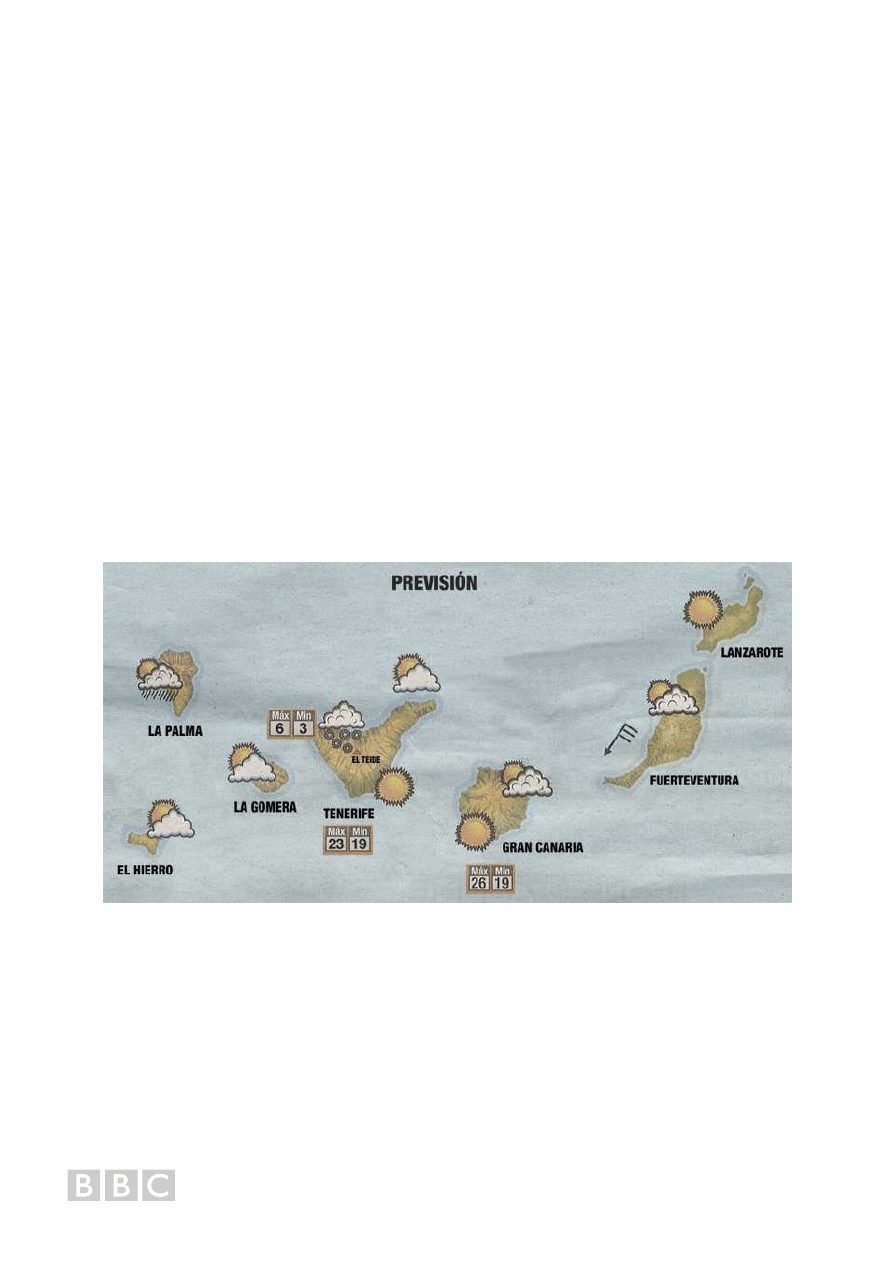
Bien, echemos un vistazo. El tiempo puede ser muy distinto dependiendo de donde estés en las Islas Canarias.
Right, let's have a look. 'El tiempo' can be quite different depending on where you are in the Canary Islands.
En La Palma llueve, está lloviendo.
En La Gomera está parcialmente nublado.
En el Teide, en Tenerife, está nevando.
Hace 6 grados de máxima, 3 de mínima. Hace frío.
En el sur de Tenerife hace sol.
Hace 23 grados de temperatura máxima, 19 de mínima. Hace calor.
En el norte de Gran Canaria está nublado.
En el sur de Gran Canaria hace sol.
Hace 26 grados de máxima, 19 de mínima. Hace calor.

MI VIDA LOCA
Spanish for beginners
21. Episodio veintiuno - En la costa
Online video transcript
_________________________________________________________________________________________________________
bbc.co.uk/mividaloca
© 2008
Page 4 of 11
RAÚL
En el norte y el centro tienen un clima distinto, más fresco.
In the north and the centre the climate is different, fresher.
Es la zona de montaña.
It's the mountainous area.
MERCHE
¿Ah, sí? ¿En las montañas?
Oh yes? The mountainous part?
RAÚL
Sí, pero bueno, para nosotros, con quince grados ya hace frío.
Yes, but well, but for us 15 degrees is already cold.
MERCHE
¿Qué tiempo hace en tu país ahora?
What's the weather like in your country now?
Puedes contestar:
You can reply:
Hace buen tiempo.
There is good weather.
Eso significaría:
That would mean:
Hace sol.
It´s sunny.
Llueve.
It´s raining.
Hace frío.
It´s cold.
Hace mal tiempo.
There´s bad weather.
Intenta decirlo en voz alta.
Try saying it out loud.
MERCHE
¿Llueve mucho?
Does it rain a lot?

MI VIDA LOCA
Spanish for beginners
21. Episodio veintiuno - En la costa
Online video transcript
_________________________________________________________________________________________________________
bbc.co.uk/mividaloca
© 2008
Page 5 of 11
YOU
Sí. / No.
Yes. / No.
Maspalomas. Playa del Inglés. ¿Vamos a tomar fotos de la playa?
Maspalomas. Playa del Inglés. Are we taking pictures of the beach?
MERCHE
Pero, hace un poco de viento. ¿Seguro que va a hacer buen tiempo?
But, it's a little bit windy. Are you sure it's going to be good weather?
RAÚL
No te preocupes. El tiempo va y viene.
Don't worry. The weather's always changing.
EN LA RESERVA NATURAL
AT THE NATURE RESERVE
MERCHE
Buenos días, Miguel Ángel.
Good morning, Miguel Ángel.
MIGUEL ÁNGEL
Hola, buenos días.
Hello, good morning.
MERCHE
Miguel Ángel es el director de la reserva. Le presento a Raúl, mi fotógrafo.
Miguel Ángel is the director of the reserve. This is Raúl, my photographer.
MIGUEL ÁNGEL
Buenos días.
Good morning.
RAÚL
¿Qué tal? ¿Cómo está?
How are you?
MERCHE
Y un buen amigo. / Y una buena amiga. Está de visita en la isla.
And a good friend. He's / She’s visiting the island.
YOU
Buenos días. ¿Cómo está?
Good morning. How are you?

MI VIDA LOCA
Spanish for beginners
21. Episodio veintiuno - En la costa
Online video transcript
_________________________________________________________________________________________________________
bbc.co.uk/mividaloca
© 2008
Page 6 of 11
MIGUEL ÁNGEL
Hola, buenos días. Bienvenidos a la reserva. Si les parece pasamos al mirador.
Hello, good morning. Welcome to the reserve. If you like let's go to the viewing area.
Hay una reserva natural justo al lado de la playa.
There is a nature reserve, 'una reserva natural' right next to the beach.
MERCHE
¿Cuántas especies de animales hay en la reserva?
How many species of animals are there in the reserve?
MIGUEL ÁNGEL
Aves, hay unas cincuenta especies. Peces, unas once species.
Birds, there are around 50 species. Fish, around 11 species.
MERCHE
¿Y ése de ahí, qué es?
And that one there, what is it?
MIGUEL ÁNGEL
Ésa es una gallineta común. Cría en vegetación acuática y es muy territorial.
That's a water coot. It nests in aquatic vegetation and it's very territorial.
MERCHE
¿Y ése? ¿Qué es?
And that one? What is it?
MIGUEL ÁNGEL
Ése es un pato moscovita.
That's a Muscovy duck.
Es una especie invasora que procede de liberaciones del medio urbano.
It's an invasive species which originates from the urban environment.
MERCHE
¿Y aquél?
And that one over there?
MIGUEL ÁNGEL
Aquélla es una especie migradora. Se llama combatiente.
That's a migratory species. It's called ruff.
De hecho durante el período de reproducción en el norte de Europa
In fact during its reproductive period in the North of Europe
tiene un plumaje espectacular. Parece una especie distinta.
it has spectacular plumage. It looks like a different species.

MI VIDA LOCA
Spanish for beginners
21. Episodio veintiuno - En la costa
Online video transcript
_________________________________________________________________________________________________________
bbc.co.uk/mividaloca
© 2008
Page 7 of 11
GUÍA DE CONVERSACIÓN
PHRASEBOOK
Merche ha señalado un ave diciendo: 'ése', que significa eso mismo.
Merche pointed out a bird by saying: 'ése' which means 'that one'
y se usa con palabras masculinas, 'ésa' con las femeninas.
and is used with masculine words, 'ésa' with feminine ones.
ése, ésa
that one (there)
Si lo que señalas está más lejos dices: 'aquél' o 'aquélla'.
If what you're pointing at is further away you say 'aquél' or 'aquélla'.
aquél, aquélla
that one (over there)
Aquélla es una especie migradora.
That one over there is a migratory species.
Si algo está más cerca di: 'éste', o 'ésta', que significa eso mismo.
If something is close by say: 'éste', or 'ésta' which means 'this one'.
éste, ésta
this one
MIGUEL ÁNGEL
Vamos a buscar lagartos. Pero tenemos que ir lentamente.
We're going to look for lizards. But we have to go slowly.
MERCHE
Lagartos, ¡qué asco!
Lizards, how disgusting!
MIGUEL ÁNGEL
Es una especie endémica de Gran Canaria.
This is a species native to Gran Canaria.
Es una especie que no vive en ninguna otra parte del mundo,
It's a species which doesn't live anywhere else in the world,
solamente in Gran Canaria.
only in Gran Canaria.
¿Es su primera visita a Gran Canaria?
Is this your first visit to Gran Canaria?

MI VIDA LOCA
Spanish for beginners
21. Episodio veintiuno - En la costa
Online video transcript
_________________________________________________________________________________________________________
bbc.co.uk/mividaloca
© 2008
Page 8 of 11
Puedes contestar:
You can reply:
Sí, es mi primera visita.
Yes, it’s my first visit.
No, he estado aquí antes.
No, I’ve been here before.
MIGUEL ÁNGEL
¿Ha estado en otras partes de la isla? ¿Las montañas, la ciudad, el Norte?
Have you been elsewhere on the island? The mountains, the city, the North?
Diría que hemos visto las montañas y que hemos estado en la ciudad.
I'd say we've seen the mountains, 'las montañas'. And we've been to the city 'la ciudad'
Me figuro que la respuesta es 'sí'.
So I guess the answer is yes, 'sí'.
YOU
Sí, he estado en la ciudad
Yes, I’ve been to the city
MIGUEL ÁNGEL
¿Le gusta?
Do you like it?
YOU
Sí me gusta. / No. No me gusta.
Yes, I like it. / No. I don’t like it.
MIGUEL ÁNGEL (POINTING AT PALM GROVE)
Aquí tenemos un ejemplo de desarrollo sostenible.
Here we've an example of sustainable development.
Es un complejo turístico que ha respetado el paisaje del palmeral.
It's a tourist complex which has been built in harmony with the landscape of the palm
groves.
Detrás de las palmeras hay un ejemplo de desarrollo sostenible.
Behind the palm trees there's an example of sustainable development, 'desarrollo sostenible'.
MERCHE
Como ése hay pocos. Como ése otro, desafortunadamente,
There aren't many like that one. Unfortunately,
hay muchos por toda la costa de nuestro país.
there are lots like that other one all along the coast of our country.

MI VIDA LOCA
Spanish for beginners
21. Episodio veintiuno - En la costa
Online video transcript
_________________________________________________________________________________________________________
bbc.co.uk/mividaloca
© 2008
Page 9 of 11
MERCHE
¿Cuántas personas visitan la reserva?
How many people visit the reserve?
MIGUEL ÁNGEL
Las playas atraen turistas durante todo el año.
The beaches attract tourists throughout the year.
Al día pasan unas veinte mil personas por la reserva.
Every day 20,000 people go through the reserve.
MERCHE
¡Veinte mil personas al día!
20,000 people a day!
MIGUEL ÁNGEL
Efectivamente.
Yes, that's right.
MERCHE
Pero eso tiene que causar un fuerte impacto ecológico.
But that has to have a major environmental impact.
MIGUEL ÁNGEL
Sí.
Yes.
MERCHE
Bueno, Miguel Ángel. Muchas gracias por su colaboración.
Well, Miguel Ángel. Thanks very much for your help.
Ha sido muy interesante.
It's been very interesting.
MIGUEL ÁNGEL
Muchas gracias por venir.
Thank you for coming.

MI VIDA LOCA
Spanish for beginners
21. Episodio veintiuno - En la costa
Online video transcript
_________________________________________________________________________________________________________
bbc.co.uk/mividaloca
© 2008
Page 10 of 11
EN EL COCHE
IN THE CAR
MERCHE
Así es la costa de nuestro país.
This is what the coast of our country's like.
Mi reportaje investiga a un constructor muy importante de España.
My article investigates a developer who's very important in Spain.
Importante, pero también corrupto. El hombre de Madrid trabaja para él.
Important, but corrupt too. The man from Madrid works for him.
¡Así que ése es quien es! La mano derecha de un constructor corrupto
So that's who he is! The right-hand man of a corrupt developer
que quería intimidar a Merche para que no publicara su artículo.
who wanted to intimidate Merche so she wouldn't publish her article.
MERCHE
No te puedo decir más. Pero en mi reportaje vas a ver por qué.
I can't tell you anymore. But in my article you're going to see why.
Tendrás que leer su reportaje para averiguar más.
You'll have to read her article to find out more.
EN EL MIRADOR
AT THE VIEWING AREA
MERCHE
Más hoteles, más apartamentos...
More hotels, more holiday apartments...
Raúl, tú eres de aquí. ¿Qué opinas?
Raúl, you're from here. What's your opinion?
RAÚL
Es una relación amor-odio. Por una parte, es bueno para la economía.
It's a love-hate relationship. On the one hand, it's good for the economy.
Pero por otra, es malo por el impacto ecológico.
But on the other hand, it's bad because of the environmental impact.
Por eso es bueno educar a la gente.
That's why it's good to educate people.

MI VIDA LOCA
Spanish for beginners
21. Episodio veintiuno - En la costa
Online video transcript
_________________________________________________________________________________________________________
bbc.co.uk/mividaloca
© 2008
Page 11 of 11
MERCHE
¿Tú qué opinas?
What´s your opinion?
GUÍA DE CONVERSACIÓN
PHRASEBOOK
Raúl dijo:
Raúl said:
Por una parte, es bueno...
On the one hand it´s good…
... para la economía
… for the economy
Por otra parte, es malo...
On the other hand it´s bad…
... por el impacto ecológico.
…because of the environmental impact.
O simplemente:
Or simply:
Está bien. Está mal.
It´s ok. It´s not ok.
RAÚL
Ahora vamos a ir a un sitio muy interesante.
Now we're going to a very interesting place.
Mira, Merche. Ésa es la fábrica de cemento.
Look, Merche. That's the concrete factory.
MERCHE
¡Qué simbólico!
How symbolic!
RAÚL
Bueno, ésta es la última foto de mi reportaje.
Well, this is the last picture for my article.
MERCHE
Gracias. Gracias por todo.
Thanks. Thanks for everything.
Wyszukiwarka
Podobne podstrony:
bbc mvl 22 la vuelta a casa[1]
bbc mvl 11 la familia de esther[1]
bbc mvl 16 la habitacion 320[1]
bbc mvl 7 la oficina de turismo[1]
bbc mvl 19 la inmobiliaria[1]
bbc mvl 1 en madrid[1]
Lovecraft, HP En la Cripta
La costa mas lejana
12 10 31 La?n nace en la Iglesia
en la tienda
Lista 06, rozdzial 21 EN
Miedo en la Scala
AMPARANOIA en la ciudad
Células Madre y su Función en la Recuperación? Tejidos?r
Andahazi Errante en la sombra
Los Mitos en la Biblia
Profecías ocultas en la sagrada biblia
Leiser Eckart Cómo saber El positivismo y sus críticos en la filosofía de las ciencias
ESTRATEGIAS PARA FOMENTAR LA COMPETITIVIDAD EN LA INDUSTRIA
więcej podobnych podstron