SIPRI Research Reports
This series of reports examines urgent arms control and security subjects. The
reports are concise, timely and authoritative sources of information. SIPRI
researchers and commissioned experts present new findings as well as easily
accessible collections of official documents and data.
Terrorism in Asymmetrical Conflict: Ideological and Structural Aspects
This thought-provoking book challenges the conventional discourse on—and
responses to—contemporary terrorism. It examines the synergy between the
extremist ideologies and the organizational models of non-state actors that
use terrorist means in asymmetrical conflict. This synergy is what makes these
terrorist groups so resilient in the face of the counterterrorist efforts of their main
opponents—the state and the international system—which are conventionally
far more powerful.
The book argues that the high mobilization potential of the supra-national
extremist ideology inspired by al-Qaeda cannot be effectively counterbalanced
at the global level by either the mainstream secular ideologies or moderate Islam.
Instead, it is more likely to be affected and transformed by radical nationalism.
Unless the political transformation of violent Islamist movements in specific
national contexts is encouraged and the transnational ideology of violent
Islamism is ‘nationalized’, it is unlikely to be amenable to external influence
or to be destroyed by repression.
About the author
Dr Ekaterina Stepanova (Russia) has led the SIPRI Armed Conflicts and Conflict
Management Project since 2007. She has led a research group on non-traditional
security threats at the Institute of World Economy and International Relations
(IMEMO), Moscow, since 2001 and prior to that she worked at the Moscow Center
of the Carnegie Endowment for International Peace. She is the author of Rol'
narkobiznesa v politekonomii konfliktov i terrorizma [The role of the illicit drug
business in the political economy of conflicts and terrorism] (Ves Mir, 2005), Anti-
terrorism and Peace-building During and After Conflict, SIPRI Policy Paper no. 2
(2003), and Voenno–grazhdanskie otnosheniya v operatsiyakh nevoennogo tipa
[Civil–military relations in operations other than war] (Prava Cheloveka, 2001). She
serves on the editorial boards of Terrorism and Political Violence and Security Index.
2
SIPRI Research Report No. 23
TERRORISM IN
ASYMMETRICAL
CONFLICT
IDEOLOGICAL AND
STRUCTURAL ASPECTS
EKATERINA STEPANOVA
1
23
S
T
E
P
A
N
O
V
A
TE
RR
OR
ISM
IN
AS
YM
M
ET
RIC
AL
CO
NF
LIC
T
SIPRI Research Reports
This series of reports examines urgent arms control and security subjects. The
reports are concise, timely and authoritative sources of information. SIPRI
researchers and commissioned experts present new findings as well as easily
accessible collections of official documents and data.
Terrorism in Asymmetrical Conflict: Ideological and Structural Aspects
This thought-provoking book challenges the conventional discourse on—and
responses to—contemporary terrorism. It examines the synergy between the
extremist ideologies and the organizational models of non-state actors that
use terrorist means in asymmetrical conflict. This synergy is what makes these
terrorist groups so resilient in the face of the counterterrorist efforts of their main
opponents—the state and the international system—which are conventionally
far more powerful.
The book argues that the high mobilization potential of the supra-national
extremist ideology inspired by al-Qaeda cannot be effectively counterbalanced
at the global level by either the mainstream secular ideologies or moderate Islam.
Instead, it is more likely to be affected and transformed by radical nationalism.
Unless the political transformation of violent Islamist movements in specific
national contexts is encouraged and the transnational ideology of violent
Islamism is ‘nationalized’, it is unlikely to be amenable to external influence
or to be destroyed by repression.
About the author
Dr Ekaterina Stepanova (Russia) has led the SIPRI Armed Conflicts and Conflict
Management Project since 2007. She has led a research group on non-traditional
security threats at the Institute of World Economy and International Relations
(IMEMO), Moscow, since 2001 and prior to that she worked at the Moscow Center
of the Carnegie Endowment for International Peace. She is the author of Rol'
narkobiznesa v politekonomii konfliktov i terrorizma [The role of the illicit drug
business in the political economy of conflicts and terrorism] (Ves Mir, 2005), Anti-
terrorism and Peace-building During and After Conflict, SIPRI Policy Paper no. 2
(2003), and Voenno–grazhdanskie otnosheniya v operatsiyakh nevoennogo tipa
[Civil–military relations in operations other than war] (Prava Cheloveka, 2001). She
serves on the editorial boards of Terrorism and Political Violence and Security Index.
2
SIPRI Research Report No. 23
TERRORISM IN
ASYMMETRICAL
CONFLICT
IDEOLOGICAL AND
STRUCTURAL ASPECTS
EKATERINA STEPANOVA
1
23
S
T
E
P
A
N
O
V
A
TE
RR
OR
ISM
IN
AS
YM
M
ET
RIC
AL
CO
NF
LIC
T

TERRORISM IN ASYMMETRICAL CONFLICT
IDEOLOGICAL AND STRUCTURAL ASPECTS
SIPRI Research Report No. 23
EKATERINA STEPANOVA
1
This PDF file was downloaded from the SIPRI Publications
website,
.
The Stockholm International Peace Research Institute is an
independent institution whose task is to conduct research on
questions of conflict and cooperation of importance for
international peace and security. SIPRI’s aim is to contribute to
an understanding of the conditions for peaceful solutions of
international conflicts and for a stable peace.
More information on SIPRI is available at
A printed edition of this book is also available.
How to order
From OUP in the UK
Online:
http://www.oup.com/uk/catalogue/?ci=
9780199533558
http://www.oup.com/uk/catalogue/?ci=
9780199533565
By telephone: +44 1536 741 727
By fax:
+44 1536 746 337
By email:
From OUP in the USA
Online:
http://www.oup.com/us/catalog/general/?ci=
9780199533558
http://www.oup.com/us/catalog/general/?ci=
9780199533565
By telephone: +1-800-451-7556 (USA) or +1-919-677-0977
By fax:
+1-919-677-1303

Other SIPRI Research Reports from OUP
No. 22
Reforming Nuclear Export Controls: The Future of the Nuclear
Suppliers Group
, by Ian Anthony, Christer Ahlström and
Vitaly Fedchenko (2007)
No. 21
Europe and Iran: Perspectives on Non-proliferation
edited by Shannon N. Kile (2005)
No. 20
Technology and Security in the 21st Century: A Demand-side
Perspective
No. 19
Reducing Threats at the Source: A European Perspective on
Cooperative Threat Reduction
No. 18
Confidence- and Security-Building Measures in the New
Europe
, by Zdzislaw Lachowski (2004)
No. 17
by Wuyi Omitoogun (2003)
No. 16
Executive Policing: Enforcing the Law in Peace Operations
No. 15
Russian Arms Transfers to East Asia in the 1990s
by Alexander A. Sergounin and Sergey V. Subbotin (1999)
No. 14
Nuclear Weapons and Arms Control in South Asia after the
Test Ban
, edited by Eric Arnett (1998)
No. 13
Arms, Transparency and Security in South-East Asia
edited by Bates Gill and J. N. Mak (1997)
No. 12
Challenges for the New Peacekeepers
edited by Trevor Findlay (1996)
No. 11
China’s Arms Acquisitions from Abroad: A Quest for ‘Superb
and Secret Weapons’
, by Bates Gill and Taeho Kim (1995)
No. 10
The Soviet Nuclear Weapon Legacy
No. 9
Cambodia: The Legacy and Lessons of UNTAC
No. 8
Implementing the Comprehensive Test Ban: New Aspects of
Definition, Organization and Verification
No. 7
The Future of Defence Industries in Central and Eastern
Europe
, edited by Ian Anthony (1994)
No. 6
Arms Watch: SIPRI Report on the First Year of the UN
Register of Conventional Arms
Siemon T. Wezeman and Herbert Wulf (1993)
No. 5
Nationalism and Ethnic Conflict: Threats to European
Security
, by Stephen Iwan Griffiths (1993)

Terrorism in Asymmetrical Conflict
Ideological and Structural Aspects

Stockholm International Peace Research Institute
SIPRI is an independent international institute for research into
problems of peace and conflict, especially those of arms control
and disarmament. It was established in 1966 to commemorate
Sweden’s 150 years of unbroken peace.
The Institute is financed mainly by a grant proposed by the
Swedish Government and subsequently approved by the
Swedish Parliament. The staff and the Governing Board are
international. The Institute also has an Advisory Committee as
an international consultative body.
The Governing Board is not responsible for the views expressed
in the publications of the Institute.
Governing Board
Ambassador Rolf Ekéus, Chairman (Sweden)
Dr Willem F. van Eekelen, Vice-Chairman (Netherlands)
Dr Alexei G. Arbatov (Russia)
Jayantha Dhanapala (Sri Lanka)
Dr Nabil Elaraby (Egypt)
Rose E. Gottemoeller (United States)
Professor Mary Kaldor (United Kingdom)
Professor Ronald G. Sutherland (Canada)
The Director
Director
Bates Gill (United States)
Stockholm International Peace Research Institute
Signalistgatan 9, SE-169 70 Solna, Sweden
Telephone: 46 8/655 97 00
Fax: 46 8/655 97 33
Email: sipri@sipri.org
Internet URL: http://www.sipri.org

Terrorism in Asymmetrical
Conflict
Ideological and Structural Aspects
SIPRI Research Report No. 23
Ekaterina Stepanova
OXFORD UNIVERSITY PRESS
2008

1
Great Clarendon Street, Oxford OX2 6DP
Oxford University Press is a department of the University of Oxford.
It furthers the University’s objective of excellence in research, scholarship,
and education by publishing worldwide in
Oxford New York
Auckland Cape Town Dar es Salaam Hong Kong Karachi
Kuala Lumpur Madrid Melbourne Mexico City Nairobi
New Delhi Shanghai Taipei Toronto
With offices in
Argentina Austria Brazil Chile Czech Republic France Greece
Guatemala Hungary Italy Japan Poland Portugal Singapore
South Korea Switzerland Thailand Turkey Ukraine Vietnam
Oxford is a registered trade mark of Oxford University Press
in the UK and in certain other countries
Published in the United States
by Oxford University Press Inc., New York
©
SIPRI 2008
First published 2008
All rights reserved. No part of this publication may be reproduced, stored
in a retrieval system, or transmitted, in any form or by any means, without the
prior permission in writing of SIPRI, or as expressly permitted by law, or under
terms agreed with the appropriate reprographics rights organizations. Enquiries
concerning reproduction outside the scope of the above should be sent to
SIPRI, Signalistgatan 9, SE-169 70 Solna, Sweden
You must not circulate this book in any other binding or cover
and you must impose the same condition on any acquirer
British Library Cataloguing in Publication Data
Data available
Library of Congress Cataloging in Publication Data
Data available
Typeset and originated by Stockholm International Peace Research Institute
Printed and bound in Great Britain on acid-free paper by
Biddles Ltd, King’s Lynn, Norfolk
This book is also available in electronic format at
http://books.sipri.org/
ISBN 978–0–19–953355–8
ISBN 978–0–19–953356–5 (pbk)

Contents
Preface vii
Abbreviations and acronyms
ix
1. Introduction: terrorism and asymmetry
1
I. Terrorism: typology and definition
5
II. Asymmetry and asymmetrical conflict
14
III. Ideological and structural prerequisites for terrorism 23
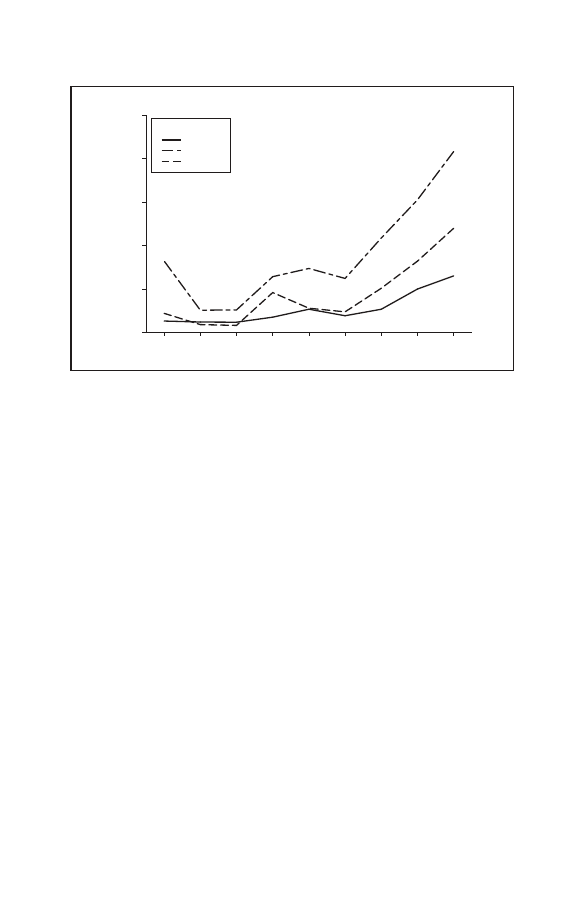
Figure 1.1. Domestic and international terrorism incidents,
2
injuries and fatalities, 1998–2006
2. Ideological patterns of terrorism: radical nationalism 28
I. Introduction: the role of ideology in terrorism
28
II. Radical nationalism from anti-colonial movements
35
to the rise of ethno-separatism
III. The ‘banality’ of ethno-political conflict and the
41
‘non-banality’ of terrorism
IV. Real grievances, unrealistic goals: bridging the gap
48
V.
Conclusions
52
Figure 2.1. International terrorism incidents by communist/
32
leftist, nationalist/separatist and religious groups,
1968–97
Figure 2.2. International terrorism fatalities caused by
33
communist/leftist, nationalist/separatist and religious
groups, 1968–97
Figure 2.3. Domestic and international terrorism incidents,
34
injuries and fatalities caused by communist/leftist
groups, 1998–2006
3. Ideological patterns of terrorism: religious and 54
quasi-religious extremism
I.
Introduction
54
II. Similarities and differences among violent religious 63
and quasi-religious groups
III. Terrorism and religion: manipulation, reaction and
68
the quasi-religious framework
IV. The rise of modern violent Islamism
75
V. Violent Islamism as an ideological basis for
84
terrorism
VI.
Conclusions
97

vi
T E R RO RI S M I N A S Y M M E T RI CA L CO N F L I C T
Figure 3.1. International terrorism incidents by nationalist/
56
separatist and religious groups, 1968–2006
Figure 3.2. International terrorism fatalities caused by
57
nationalist/separatist and religious groups,
1968–2006
Figure 3.3. Domestic terrorism incidents by nationalist/
58
separatist and religious groups, 1998–2006
Figure 3.4. Domestic terrorism injuries caused by nationalist/
59
separatist and religious groups, 1998–2006
Figure 3.5. Domestic terrorism fatalities caused by nationalist/
60
separatist and religious groups, 1998–2006
4. Organizational forms of terrorism at the local and 100
regional levels
I. Introduction: terrorism and organization theory
100
II. Emerging networks: before and beyond al-Qaeda
102
III. Organizational patterns of Islamist groups
112
employing terrorism at the local and regional levels
IV.
Conclusions
125
Figure 4.1. International terrorism incidents, 1968–2006
110
Figure 4.2. International terrorism injuries, 1968–2006
111
Figure 4.3. International terrorism fatalities, 1968–2006
112
5. Organizational forms of the violent Islamist movement at 127
the transnational level
I.
Introduction
127
II. Transnational networks and hybrids: combinations 128
and disparities
III. Beyond network tribalism
133
IV. Strategic guidelines at the macro level and social
140
bonds at the micro level
V.
Conclusions
149
6. Conclusions 151
I. Nationalizing Islamist supranational and supra-state 152
ideology
II. Politicization as a tool of structural transformation
161
III.
Closing
remarks
163
Select bibliography 165
I.
Sources
165
II.
Literature
169
Index 178

Preface
Despite the growing scope of terrorism literature, especially since
11 September 2001, some of the toughest questions concerning secur-
ity threats posed by terrorism remain unanswered. What does asym-
metry in conflict mean for terrorism and anti-terrorism efforts? Why is
terrorism used as a tactic in some armed conflicts but not others?
What are the anti-terrorism implications of dealing with broad armed
movements that may selectively resort to terrorist means but, in con-
trast to some marginal splinter groups, are mass-based and often out-
match in popularity and social activity the weak states where they
operate? Why at the same time have relatively small, al-Qaeda-
inspired groups challenged and altered the international system so
effectively through high-profile terrorism? How is it possible that
these small and dispersed cells that are only linked by their shared
ideology manage to act as if they were parts of a more structured and
coordinated transnational movement?
Breaking new ground, this Research Report provides original
insights into these and many other difficult questions. It builds on over
a decade of Dr Stepanova’s research on terrorism, political violence
and armed conflicts. The report looks at the two main ideologies of
militant groups that use terrorist means—radical nationalism and reli-
gious extremism—and at organizational forms of terrorism at local
and global levels, exploring the interrelationship between these
ideologies and structures.
Dr Stepanova convincingly concludes that, despite the state’s con-
tinuing conventional superiority—in terms of power and status—over
non-state actors, the critical combination of extremist ideologies and
dispersed organizational structures gives terrorist groups many com-
parative advantages in their confrontation with states. She is also
sceptical about current national and international capacities to counter-
balance the main ideology of contemporary transnational terrorism—
violent Islamism inspired by al-Qaeda. She stresses the quasi-religious
nature of this ideology that merges radical political, social and cultural
protest with the passion of belief in the possibility of a new global
order.
The report argues that the mobilizing power of radical nationalism
may be an alternative to transnational quasi-religious extremism at the

viii
T E R RO RI S M I N A S Y M M E T RI CA L C O N F L I C T
national level. The main recommendation is that the major radical
actors that combine nationalism with religious extremism be actively
stimulated to further nationalize their agendas. While not a panacea,
this strategy could encourage—or force—them to operate within the
same frameworks as those shared by the less radical non-state actors
and the states themselves.
I congratulate the author on the completion of this sharp and
thought-provoking study intended for the broader public as much as
for analysts and practitioners. Special thanks are also due to Dr David
Cruickshank, head of the SIPRI Editorial and Publications Depart-
ment, for his editing of the book, to Peter Rea for the index and to
Gunnie Boman of the SIPRI Library.
Dr Bates Gill
Director, SIPRI
January 2008

Abbreviations and acronyms
CIDCM
Center for International Development and Conflict
Management
ETA
Euskadi Ta Askatasuna (Basque Homeland and Freedom)
FLN
Front de libération nationale (National Liberation Front)
Hamas
Harakat al-Muqawama al-Islamiya (Islamic Resistance
Movement)
IRA
Irish Republican Army
JI
Jemaah Islamiah (Islamic Group)
MIPT
Memorial Institute for the Prevention of Terrorism
PFLP
Popular Front for the Liberation of Palestine
PLO
Palestine Liberation Organization
SPIN
Segmented polycentric ideologically integrated network


1. Introduction: terrorism and asymmetry
Not all armed conflicts involve the use of terrorist means. At the same
time, incidents of terrorism or even sustained terrorist campaigns can
occur in the absence of open armed conflict, in an environment that
would otherwise be classified as ‘peacetime’. Nonetheless, in recent
decades terrorism has been most commonly and systematically
employed as a tactic in broader armed confrontations. However,
although terrorism and armed conflict are not separate phenomena,
they do not merely overlap, especially if they are carried out by the
same actors.
Terrorism is integral to many contemporary conflicts and should be
studied in the broader context of armed violence. The number of state-
based armed conflicts gradually and significantly decreased between
the early 1990s and the mid-2000s, as has the number of battle-related
deaths in state-based conflicts since the 1950s.
1
However, these posi-
tive trends are counterbalanced by worrying developments and poten-
tial reversals.
2
Some of the worst trends in armed violence are related
to the use of terrorism as a standard tactic in many modern armed con-
flicts.
First, while the numbers of state-based armed conflicts and of
battle-related deaths have declined, the available data have not yet
shown a comparable, major decrease in violence that is not initiated
by the state—that is, in violence by non-state actors. The good news is
1
State-based conflicts involve the state as at least one of the parties to the conflict.
According to the data set of the Uppsala Conflict Data Program (UCDP) and the International
Peace Research Institute, Oslo (PRIO), which covers the period since 1946, the number of
armed conflicts in 2003 was 40% lower than in 1993. University of British Columbia, Human
Security Centre, Human Security Report 2005: War and Peace in the 21st Century (Oxford
University Press: New York, 2005), <http://www.humansecurityreport.info/>; and University
of British Columbia, Human Security Centre, Human Security Brief 2006 (Human Security
Centre: Vancouver, 2006), <http://www.humansecuritybrief.info/>.
2
The continuous decline in state-based conflicts since the 1990s may have stopped in the
mid-2000s, as the number of such conflict remained constant at 32 for 3 years (2004–2006),
following the post-cold war period low of 29 conflicts in 2003. Harbom, L. and Wallensteen,
P., ‘Armed conflict, 1989–2006’, Journal of Peace Research, vol. 44, no. 5 (Sep. 2007),
p. 623. Other data show that the number of states engaged in armed conflicts continues to rise
and that new armed conflicts have been erupting at roughly the same pace for the past
60 years. Hewitt, J. J., Wilkenfeld, J. and Gurr, T. R., University of Maryland, Center for
International Development and Conflict Management (CIDCM), Peace and Conflict 2008
(CIDCM: College Park, Md., 2008), p. 1. Starting from the 2008 report, the CIDCM over-
view of trends in global conflict is also based on the UCDP–PRIO data set.
2
T E RR O RI S M I N A S Y M M E T RI CA L CO N F L I C T
that this type of violence is generally less lethal than major wars; the
bad news is that it is primarily and increasingly directed against civil-
ians.
3
Terrorism is the form of violence that most closely integrates
one-sided violence against civilians with asymmetrical violent con-
frontation against a stronger opponent, be it a state or a group of
states.
Second, in this age of information and mass communications, of
critical importance is not just the scale of armed terrorist violence and
its direct human and material costs, but also its destabilizing effect on
national, international, human and public security and its ability to
affect politics. A series of high-profile, mass-casualty terrorist attacks
of the early 21st century carried out in various parts of the world
demonstrate that it no longer takes hundreds of thousands of battle-
related deaths to dramatically affect or destabilize international secur-
ity and significantly alter the security agenda of major states and inter-
national organizations. While the number of deaths caused by the
3
On patterns of violence against civilians in armed conflicts see e.g. Eck, K. and Hultman,
L., ‘One-sided violence against civilians in war: insights from new fatality data’, Journal of
Peace Research, vol. 44, no. 2 (Mar. 2007), pp. 233–46.
0
5 000
10 000
15 000
20 000
25 000
2006
2005
2004
2003
2002
2001
2000
1999
1998
Number of:
incidents
injuries
fatalities
Figure 1.1. Domestic and international terrorism incidents, injuries and
fatalities, 1998–2006
Source: MIPT Terrorism Knowledge Base, <http://www.tkb.org>.

I N T RO D U CT I O N 3
11 September 2001 terrorist attacks on the United States (almost 3000
fatalities, most of them civilians) is not comparable to the huge mili-
tary and civilian death tolls of the major post-World War II wars such
as those in Korea or Viet Nam, the political impact of the 2001 attacks
and their repercussions for global security are comparable.
This destabilizing effect is the hallmark of terrorism and far exceeds
its actual damage. It also helps explain why mere numbers do not suf-
fice to assess the real scale, scope and political and security impli-
cations of terrorism. This characteristic makes terrorism perhaps the
most asymmetrical of all forms of political violence.
Third, while many forms of armed political violence appear to be
declining or stabilizing, terrorism has been clearly on the rise.
4
The
year 2001 by no means marked a peak of terrorist activity over the
period since 1998 (for which comprehensive data are available).
5
Since 1998, the main indicators of global terrorist activity (i.e. num-
bers of incidents, injuries and fatalities) have increased significantly.
The annual number of terrorist incidents—both domestic and inter-
national—rose less sharply and more steadily than the number of
casualties (injuries and fatalities) over the period 1998–2006, but they
still grew fivefold (rising from 1286 to 6659 attacks; see figure 1.1).
Following a decline in the annual number of casualties in the late
1990s, a sharp rise caused by the high death toll of the 11 September
2001 attacks and a slight decrease in the following 18 months, cas-
ualty figures started to rise rapidly in 2003. As a result, over the
period 1998–2006, the number of annual terrorism-related fatalities
increased 5.6-fold (from 2172 to 12 070 fatalities), aggravated by a
more than 2.6-fold increase in annual rates of terrorism-related injur-
ies (from 8202 in 1998 to 20 991 in 2006).
4
The main data set on terrorism used in this study is the MIPT Terrorism Knowledge
Base, <http://www.tkb.org/>, compiled by the Memorial Institute for the Prevention of
Terrorism (MIPT), Oklahoma City. It integrates data from the RAND Terrorism Chronology
and the RAND–MIPT Terrorism Incident Database. Unless otherwise noted, all calculations
made and graphs presented in this volume are based on the MIPT data.
5
While the MIPT Terrorism Knowledge Base provides continuous statistical data on
‘international’ terrorism for the period since 1968, it only provides complete data, including
statistics on ‘domestic’ terrorism, for the period since 1998. A first attempt to fill this gap in
domestic terrorism data for the pre-1998 period is the Global Terrorism Database, which is
being developed by the University of Maryland Center for International Development and
Conflict Management (CIDCM) and covers both domestic and international terrorism (ini-
tially, for the period 1970–97). However, this database is likely to have a bias towards over-
stating the main indicators of terrorist activity as it employs too broad a definition of terror-
ism (that includes e.g. economically motivated acts of violence).

4
T E RR O RI S M I N A S Y M M E T RI CA L CO N F L I C T
Not surprisingly, the most dramatic increase in terrorist activity
worldwide occurred after 2001. At 6659, the number of terrorist inci-
dents in 2006 was the largest ever recorded. This figure is a 33 per
cent increase over the 4995 terrorist incidents in 2005 and a near four-
fold increase since 2001 (1732 incidents). Similarly, the 2006 death
toll of 12 070 showed a 47 per cent increase from the previous year
and exceeded the high fatalities total for 2001 (4571 deaths) by
164 per cent.
6
While the interim peak of terrorist activity in 2001 was primarily
linked to the 11 September attacks and their immediate impact, start-
ing from 2003, the main indicators of terrorist activity owe much of
their sharp increase to the conflict in Iraq. In 2003 the 147 terrorist
incidents in Iraq comprised just 8 per cent of the global total of 1899;
in 2004 that share rose to 32 per cent (850 out of 2647), and in 2005
to 47 per cent (2349 out of 4995). In 2006 the conflict in Iraq
accounted for a clear majority (60 per cent) of all terrorist incidents
worldwide (3968 out of the global total of 6659). Similar dynamics
can be traced in the growing proportion of overall terrorism-related
deaths that occur in Iraq: from 23 per cent of all fatalities in 2003 (539
out of 2349) to 79 per cent in 2006 (9497 out of 12 070).
7
As is clear from this statistical overview, one of the main stated
goals of the US-led ‘global war on terrorism’—to curb or diminish the
terrorist threat worldwide—has largely failed. All major indicators of
terrorism activity show that the overall situation has gravely deterior-
ated since 2001, partly as a consequence of the ‘global war on terror-
ism’ itself. A fresh look at the role of terrorism in asymmetrical con-
flict in needed. Before a new approach to addressing this problem can
be formulated, the basic prerequisites for—and advantages of—the
use of terrorism by militant non-state actors at levels from the local to
the global need to be explored.
This introduction continues by proposing a new typology of terror-
ism, by outlining the definition of terrorism used in this report, by
examining the meaning of the term ‘asymmetrical conflict’ and by
considering the main prerequisites of terrorism in armed conflict.
6
While in 2007 the numbers of terrorist attacks, fatalities and injuries decreased compared
with the peak years of 2005–2006, all these indicators were still higher than the annual totals
for 2001–2004. As of Jan. 2008, the data for Jan.–Nov. 2007 recorded 2747 incidents, 14 629
injuries and 6927 fatalities. MIPT Terrorism Knowledge Base (note 4).
7
In the first 11 months of 2007 Iraq accounted for 69% of the world’s terrorist incidents,
86% of fatalities and 86% of injuries. MIPT Terrorism Knowledge Base (note 4).

I N T RO D U CT I O N 5
Chapters 2 and 3 analyse the ideological patterns of the two main
forms of modern terrorism—radical nationalism and religious extrem-
ism. Chapters 4 and 5 address the organizational forms of terrorism in
asymmetrical conflict at the more localized levels and the trans-
national level. The concluding chapter outlines strategic directions for
dealing with the combination of ideologies and structures found in
contemporary terrorist groups and movements.
I. Terrorism: typology and definition
Terrorism is a much debated notion. The lack of a universally recog-
nized definition of the term is to some extent predetermined by its
highly politicized, rather than purely academic, nature and origin. This
allows for different interpretations depending on the purpose of the
interpreter and on the political demands of the moment. However,
apart from these subjective factors, there are objective reasons for the
lack of agreement on a definition of terrorism—namely, the diversity
and multiplicity of its forms, types and manifestations.
Traditional typologies of terrorism
This multiplicity of forms explains why the definition of terrorism
cannot be separated from it typology. The two most basic, traditional
and commonly used typologies of terrorism are that of domestic
versus international terrorism and typology by motivation.
8
Whether
these traditional classifications adequately reflect terrorism in its
modern forms needs to be assessed.
A first basic distinction has traditionally been made between
domestic and international terrorism. This distinction appears to have
become increasingly blurred, especially if ‘international terrorism’ is
defined as terrorist activities conducted on the territory of more than
one state or involving citizens of more than one state (as victims or
perpetrators). Major data sets on terrorism and the anti-terrorism
legislation of many states still use this definition.
9
Few analysts and
8
These traditional typologies are both widely employed for analytical and data-collection
purposes. See e.g. the MIPT Terrorism Knowledge Base (note 4).
9
E.g. according to the methodology of the RAND–MIPT Terrorism Incident Database,
international terrorism is defined as ‘Incidents in which terrorists go abroad to strike their
targets, select domestic targets associated with a foreign state, or create an international inci-

6
T E RR O RI S M I N A S Y M M E T RI CA L CO N F L I C T
data sets have devised more nuanced and adequate definitions of
domestic terrorism.
10
Even in the past, the distinction between international and purely
domestic (home-grown or internal) terrorism was never strict and
separating one from the other was not entirely accurate, because the
two have always been intimately interconnected. Terrorist activity,
especially when perpetrated on a regular, systematic basis, was rarely
fully self-sufficient and contained within the borders of one state. The
internationalist ideology of a terrorist group often required it to extend
its actions beyond a national context (as exemplified by the assassin-
ations of leaders of several European states by Italian anarchists in the
late 19th century). In addition, terrorists have often had to internation-
alize financial, technical, propaganda and other aspects of their activ-
ity. For instance, in the early 1900s Russian Socialist Revolutionaries
(the SRs or Esers) found refuge, planned terrorist attacks and pro-
duced explosives in France and Switzerland. Terrorism employed by
anti-colonial and other national liberation movements in the late 19th
and 20th centuries (e.g. against British rule in India) was internation-
alized de facto, if not de jure. The high degree of internationalization
was also one of the main characteristics of leftist terrorism in Western
Europe and elsewhere in the 1970s and 1980s, when terrorists from
several European states mounted joint operations or trained together,
for example in Palestinian training camps in the Middle East. At this
time Japanese Red Army members were frequently relocating from
one country to another.
By the end of the 20th century, the distinction between domestic
and international terrorism had become more blurred than ever.
11
dent by attacking airline passengers, personnel or equipment’. Domestic terrorism is defined
as ‘Incidents perpetrated by local nationals against a purely domestic target’. MIPT Terrorism
Knowledge Base, ‘TBK: data methodologies: RAND Terrorism Chronology 1968–1997 and
RAND–MIPT Terrorism Incident database (1998–present)’, <http://www.tkb.org/Rand
Summary.jsp?page=method>. The US legislation defines international terrorism as ‘terrorism
involving citizens or the territory of more than one country’. United States Code, Title 22,
Section 2656f(d).
10
E.g. according to the Terrorism in Western Europe: Event Data (TWEED) data set
methodology, terrorism is internal when terrorists originate and act within their own political
systems. See Engene, J. O., ‘Five decades of terrorism in Europe: the TWEED dataset’, Jour-
nal of Peace Research, vol. 44, no. 1 (Jan. 2007), pp. 109–10.
11
Against this background, it is not surprising that Europol, the European Police Office,
has decided to no longer use the distinction between domestic and international terrorism in
its analytical assessments of the terrorist threat. Europol, EU Terrorism Situation and Trend
Report 2007 (Europol: The Hague, 2007), <http://www.europol.europa.eu/index.asp?page=
publications>, p. 10.

I N T RO D U CT I O N 7
Those terrorist groups whose political agenda remained localized to a
certain political or national context tended to increasingly internation-
alize some or most of their logistics, fund-raising, propaganda and
even planning activities, sometimes extending them to regions far
from their main areas of operation. Even terrorist groups with local-
ized goals are now likely to be partly based and operate from abroad.
12
In fact, in the modern world there are few groups that have employed
terrorist tactics that rely on domestic resources and means alone.
Groups engaged in armed conflicts in very remote locations (e.g. the
Maoists in Nepal) who relied primarily on internal resources still build
ideological links with like-minded movements (in the case of the
Nepalese Maoists, with the Naxalite movement in India, among
others) and obtained some financial or logistical support from abroad.
In a peacetime environment, acts of purely domestic terrorism are
usually limited to isolated terrorist attacks by left- or right-wing
extremists (e.g. the April 1995 Oklahoma City bombing in the USA).
It should be stressed that the high degree of internationalization of
terrorist activities by both communist and other leftist groups and the
more recent violent Islamist networks has been rarely driven by prag-
matic logistical needs alone. It is also a natural progression of their
internationalist (transnationalist, supranational) ideologies and world
views. Thus, for instance, some of the semi- or fully autonomous
Islamist terrorist cells in Europe, comprising radical Muslims who
may be citizens of European states, may have limited—or no—direct
operational guidance, financial support or other logistical links with
the rest of the transnational violent Islamist movement. However,
these cells’ terrorist activities should still be viewed as manifestations
of transnational terrorism as long as they are guided by a universalist,
quasi-religious ideology and are carried out in the name of the entire
umma and in reaction to Western interventions in Afghanistan, Iraq or
elsewhere.
13
This is transnational terrorism, even if it results in civil-
ian casualties primarily among the perpetrators’ fellow citizens.
It is important to distinguish between the different forms, levels and
stages of the gradual erosion of a strict divide between international
and domestic terrorism. The erosion may, for instance, be limited to a
12
E.g. the Liberation Tigers of Tamil Eelam (LTTE), whose political goals do not go
beyond intra-state, ethno-political conflict in Sri Lanka, have one of the most widespread
logistics and support networks in the world.
13
The term umma is mainly used here to mean the entire Muslim world or community. On
the meaning of the term ‘quasi-religious’ see chapter 3 in this volume.

8
T E RR O RI S M I N A S Y M M E T RI CA L CO N F L I C T
simple internationalization of a terrorist group’s activities: conducting
terrorist acts abroad or extending logistics and fund-raising activities
to foreign countries. It may also take a more advanced form of
transnationalization: ranging from more active interaction between
independent groups in different countries to the formation of fully
fledged inter-organizational networks or even, ultimately, to the emer-
gence of transnational terrorist networks. In sum, of primary import-
ance today is not the mechanical distinction between domestic and
international terrorism, but whether a group’s overall goals and
agenda are confined to the local and national levels or are truly trans-
national or even global. In this Research Report, the term ‘internation-
alized’ is applied to terrorism and groups engaged in terrorist activity
at levels from the local to the regional that prioritize goals within a
national context. The term ‘transnational’ is reserved for terrorist net-
works operating and advancing an agenda at an inter-regional or even
global level.
The second traditional typology of terrorism addressed here is based
on a group’s dominant motivation. According to this criterion, terror-
ist groups are normally allocated to one of three broad categories:
(a) socio-political (or secular ideological) terrorism of a revolutionary
leftist, anarchist, right-wing or other bent; (b) nationalist terrorism,
ranging from that practised by national liberation movements fighting
colonial or foreign occupation to that employed by ethno-separatist
organizations against central governments; and (c) religious terrorism,
practised by groups ranging from totalitarian sects and cults to broader
movements whose ideology is dominated by religious imperatives.
Since the early 1990s, following the end of the cold war, inter-
national terrorist activity by socio-political, particularly communist or
leftist groups, has understandably declined, in terms of both incidents
and casualties (see figures 2.1 and 2.2 in chapter 2). While the com-
bined dynamics of international and domestic terrorism of this type
have shown some increase in absolute numbers since 1998 (see
figure 2.3 below), in relative terms, terrorist activities by communist
or leftist groups have been conducted at a lower level than those by
nationalist and religious groups, especially in terms of casualties. The
annual global totals of injuries and fatalities due to communist or left-
ist groups number hundreds, as compared to thousands for the other
two motivational types. In contrast, the overall dynamics of nationalist
and, especially, religious (mostly Islamist) terrorism, while highly

I N T RO D U CT I O N 9
uneven, indicate that terrorism of both types has been sharply rising in
both absolute and relative terms, particularly since the late 1990s.
The main problem with the motivational typology is that in practice
few groups have a ‘pure’ motivation formulated in accordance with its
ideology. Many militant–terrorist groups are driven by more than one
motivation (and more than one ideology).
14
It may not always be clear
which motivation is dominant; one motivation may replace another
with time or they can gradually merge. Some of the most common
combinations have included: (a) a synthesis of right-wing extremism
and religious fundamentalism; (b) a mix of nationalism and left-wing
radicalism; and (c) religious extremism merged with radical national-
ism (e.g. the Palestinian groups Hamas and Islamic Jihad and the
Islamicized nationalist groups of the Iraqi resistance movement) or
with ethno-separatism (e.g. the Sikh, Kashmiri and Chechen separat-
ists). Thus, while motivational typology remains important, it does not
always adequately and accurately reflect the complex, dialectic nature
of terrorist groups’ motivations and ideologies.
The functional typology of terrorism
The need to revise and supplement traditional typologies of terrorism
has led the present author to suggest what may be called the ‘func-
tional’ typology of terrorism. It is centred on the function that terrorist
tactics play for a non-state actor depending on its level of activity and
in relation to an armed conflict. Consequently, this typology is based
on two criteria: (a) the level and scale of a group’s ultimate goals and
agenda (i.e. whether global or more localized); and (b) the extent to
which terrorist activities are related to or are part of a broader armed
confrontation and are combined with other forms of armed violence.
On the basis of these two criteria, three functional types of modern
terrorism can be distinguished.
1. The ‘classic’ terrorism of peacetime. Examples of this include
communist and other leftist terrorism in Western Europe in the 1970s
and the 1980s; right-wing terrorism when it is not a tactic used by
loyalist and other anti-insurgency groups in armed conflict; and eco-
14
The term ‘militant–terrorist’ is used in this study to refer to militant groups that employ
terrorist means alongside other violent tactics. In most conflict settings, it is a more accurate
term than either ‘militant’ or ‘terrorist’. On groups using more that one violent tactic see
below.

10
T E R R O R I S M I N A S Y M M E T RI CA L C O N F L I C T
logical or other special interest terrorism. Regardless of its motivation,
terrorism of this type is independent of any broader armed conflict
and, as such, is not a subject of this Research Report.
15
2. Conflict-related terrorism. Such terrorism is systematically
employed as a tactic in asymmetrical local or regional armed conflicts
(e.g. by Chechen, Kashmiri, Palestinian, Tamil and other militants).
Conflict-related terrorism is tied to the concrete agenda of a particular
armed conflict and terrorists identify themselves with a particular
political cause (or causes)—the incompatibility over which the con-
flict is fought. This cause may be quite ambitious (e.g. to seize power
in a state, to create a new state or to fight against foreign occupation),
but it normally does not extend beyond a local or regional context. In
this sense, the terrorists’ goals are limited, as are the technical means
they normally use. Conflict-related terrorism is practised by groups
that enjoy at least some local popular support and tend to use more
than one form of violence. For example, they frequently combine
terrorist means with guerrilla attacks against regular army and other
security targets or with symmetrical inter-communal, sectarian and
other violence against other non-state actors.
3. Superterrorism. While the other two types of terrorism are more
traditional, superterrorism is a relatively new phenomenon (also
known as mega-terrorism, macro-terrorism or global terrorism).
16
Superterrorism is by definition global or at least seeks global outreach
and, as such, does not have to be tied to any particular local or
national context or armed conflict. Superterrorism ultimately pursues
existential, non-negotiable, global and in this sense unlimited goals—
such as that of challenging and changing the entire world order, as in
the case of al-Qaeda and the broader, post-al-Qaeda transnational
violent Islamist movement.
17
15
See also note 51.
16
See e.g. Freedman, L. (ed.), Superterrorism: Policy Responses (Blackwell: Oxford,
2002); and Fedorov, A. V. (ed.), Superterrorizm: novyi vyzov novogo veka [Superterrorism: a
new challenge of the new century] (Prava Cheloveka: Moscow, 2002). Prior to 11 Sep. 2001,
the term superterrorism was primarily used as a synonym for terrorism employing unconven-
tional (chemical, biological, radiological and nuclear) means. In contrast, in this Research
Report, the ultimate level of the goals, rather than the nature of the technical means
employed, serves as the main criteria for defining this type of terrorism.
17
In this study, the term ‘post-al-Qaeda’ refers to the broader transnational violent Islamist
movement that evolved after the 11 Sep. 2001 attacks on the USA, was inspired and insti-
gated by the original al-Qaeda but represents a different—and dynamic—type of organiza-
tion. While the term ‘post-al-Qaeda’ points towards the original al-Qaeda as the main inspirer

I N T RO D U CT I O N 11
While these three types of terrorism are functionally different and
retain specific features of their own, they share some characteristics,
may be interconnected, interact and, in some cases, even merge. For
example, home-grown conflict-related terrorist activity in the armed
conflicts in Afghanistan or Iraq can be inspired by the actions of cells
of transnational superterrorist networks and can adopt or imitate their
tactics, and vice versa.
Despite the emergence and rise of superterrorism and the fact that it
dominates anti-terrorism agendas in the West, especially since the
unprecedented superterrorist attacks of 11 September 2001, terrorism
systematically employed as a tactic in local or regional asymmetrical
armed conflicts remains the most widespread form of terrorism. This
is the most basic and common form of modern terrorism and it con-
tinues to result in the largest total numbers of terrorist incidents and
terrorism-related injuries and fatalities. At the end of the 19th century,
the same role was played by left-wing, revolutionary terrorism, which
was mostly carried out in otherwise peacetime settings.
18
It remains to
be seen if superterrorism, with its transnational, global outreach and
agenda, will assume that role in the not too distant future.
The main definitional criteria of terrorism
The definition of terrorism used in this Research Report is the inten-
tional use or threat to use violence against civilians and non-combat-
ants by a non-state (trans- or sub-national) actor in an asymmetrical
confrontation, in order to achieve political goals.
19
This definition narrows the scope of activities in the category of
‘terrorism’ to the maximum possible extent. At least three main cri-
teria may be used to distinguish terrorism from the other forms of
violence with which it is often confused, especially in the context of a
and the ideological and organizational origin of this much broader movement, it more accur-
ately reflects the fact that the movement is no longer confined to the jihadi veteran networks
that emerged in the course of the anti-Soviet jihad in Afghanistan and formed the core of al-
Qaeda. Structurally, this broader movement represents a new type of organization; see chap-
ter 5 in this volume. On the ideology of the movement see chapter 3 in this volume. This
movement is also frequently referred to, particularly in Western literature, as ‘global jihad’,
‘global Salafi jihad’ or ‘the jihadi–Salafi current of global jihad’.
18
Exceptions are the few cases where it was employed as one of several violent tactics in
revolutions or revolts (such as the first Russian revolution of 1905–1907).
19
In terrorist incidents, civilians may be specifically targeted or they may be the inevitable
victims of indiscriminate violence.

12
T E R R O R I S M I N A S Y M M E T RI CA L C O N F L I C T
broader armed confrontation. If a certain act or threat of violence fits
all three criteria, it can be characterized as a terrorist act.
20
The first criterion—a political goal—distinguishes terrorism from
crime that is motivated by economic gain, including organized
crime.
21
The political goal can range from the concrete to the abstract.
While such a goal may include ideological or religious motivations or
be formulated in ideological or religious terms, it always has a polit-
ical dimension. For groups engaged in terrorism, a political goal is an
end in itself, not a secondary instrument or a cover for advancement
of other interests, such as illegal accumulation of wealth. Terrorists
may imitate or employ criminal means of generating money for self-
financing and may interact with organized crime for the same aim.
However, whereas for criminals gaining the greatest material profit is
the ultimate goal, for terrorists it is primarily the means to advance
their main political, religious or ideological goals. In some cases
terrorist attacks may be partly motivated by economic gain, but this is
not these groups’ sole or dominant raison d’être.
It should also be stressed that terrorism is not the political goal
itself, but a specific tactic to achieve that goal (thus, it makes sense to
refer to ‘terrorist means’, rather than ‘terrorist goals’). Different
groups may have the same political goal but may use different forms
of violence, combine different tactics and even use non-violent means
to achieve that goal. The important implication is that if a group
chooses terrorism as a means to achieve a political goal, the aim of its
struggle, however benign, cannot be used to justify its actions. How-
ever, the fact that a group uses terrorist means in the name of a polit-
ical goal does not necessarily delegitimize the goal itself.
The second criterion—civilians as the direct target of violence—
helps distinguish terrorism from some other forms of politically
motivated violence, particularly those used in the course of armed
conflicts. The most notable of these is guerrilla warfare, which implies
the use of force against governmental military and security forces by
20
On definitional issues see Stepanova, E., Anti-terrorism and Peace-building During and
After Conflict, SIPRI Policy Paper no. 2 (SIPRI: Stockholm, June 2003), <http://books.sipri.
org/>, pp. 3–8; and Stepanova, E., ‘Terrorism as a tactic of spoilers in peace processes’, eds
E. Newmann and O. Richards, Challenges to Peacebuilding: Managing Spoilers during Con-
flict Resolution (United Nations University Press: Tokyo, 2006), pp. 83–89.
21
This has been noted as a defining characteristic of terrorism by many, if not most, schol-
ars who had specialized in terrorism studies before and after 11 Sep. 2001. E.g. most notably
in Hoffman, B., Inside Terrorism, revised edn (Columbia University Press: New York, 2006),
pp. 2, 40.

I N T RO D U CT I O N 13
the rebels who presumably enjoy the support of at least part of the
local population in whose name they claim to fight. In contrast, terror-
ism is specifically directed against the civilian population and civilian
objects or is intentionally indiscriminate. This does not mean that a
certain armed movement cannot simultaneously use different modes
of operation, including both guerrilla and terrorist tactics, or switch
between these tactics. Accordingly, this Research Report uses such
terms as ‘militant–terrorist groups’, ‘organizations involved in terror-
ist activities’ or ‘groups using terrorist means’, rather than ‘terrorist
organizations’, for groups that use more than one violent tactic.
This criterion is not absolute, as in some cases it might be difficult
to identify a target as civilian, to prove that civilians were intention-
ally targeted or to distinguish between combatants and non-combat-
ants in a conflict area. However, it is still useful. The target of vio-
lence also has serious implications in international humanitarian law.
Guerrilla attacks against government military and security targets are
not internationally criminalized (although domestically they usually
are). However, deliberate attacks against civilians committed in the
context of either inter- or intra-state armed conflict, including terrorist
attacks, are direct violations of international humanitarian law.
22
While terrorism is a specific tactic that necessitates victims, and
while civilians remain the most immediate targets of terrorism, those
victims are not the intended end recipients of the terrorists’ message.
Terrorism is a performance that involves the use or threat to use vio-
lence against civilians, but which is staged specifically for someone
else to watch. Most commonly, the intended audience is a state (or a
group or community of states) and the terrorist act is meant to black-
mail the state into doing or abstaining from doing something. The
state as the ultimate recipient of the terrorists’ message leads to the
third defining criterion—the asymmetrical nature of terrorism.
There are several forms of politically motivated violence against
civilians, particularly in the context of an ongoing armed conflict.
22
‘[T]he Parties to the conflict shall at all times distinguish between the civilian popu-
lation and combatants and between civilian objects and military objectives and accordingly
shall direct their operations only against military objectives’. Article 48 of the Protocol Add-
itional to the 1949 Geneva Conventions, and relating to the Protection of Victims of Inter-
national Armed Conflicts (Protocol I), opened for signature on 12 Dec. 1977 and entered into
force on 7 Dec. 1978. The international law regulating non-international armed conflict
(Protocol II) does not prohibit members of rebel forces from using force against government
soldiers or property provided that the basic tenets governing such use of force are respected.
The texts of the 2 protocols are available at <http://www.icrc.org/ihl.nsf/CONVPRES>.

14
T E R R O R I S M I N A S Y M M E T RI CA L C O N F L I C T
Repressive actions by the state against its own or foreign civilians or
symmetrical inter-communal violence on an ethnic, sectarian or other
basis may also meet the first two criteria mentioned above. What dis-
tinguishes terrorist activity from these and some other forms of polit-
ically motivated violence against civilians and non-combatants is the
asymmetrical aspect of terrorism. It is used as a weapon of ‘the weak’
against ‘the strong’. Furthermore, it is a tactic of the side that is not
only physically and technically weaker but also has a lower formal
status in an asymmetrical confrontation (‘status asymmetry’).
23
It is the asymmetrical nature of terrorism that explains the terrorists’
perceived need to attack civilians or non-combatants. They perceive it
as serving as a force multiplier that compensates for conventional
military weakness and as a public relations tool to exert pressure on
the state and society at large. A terrorist group tries to strike at the
strong where it hurts most, by mounting or threatening attacks against
civilians and civil infrastructure. Terrorism is a weapon of the weak
(non-state actors) to be employed against the strong (states and groups
of states). It is neither a weapon of the weak to be symmetrically
employed against the weak, nor a weapon of the strong.
24
II. Asymmetry and asymmetrical conflict
One of the implications of the asymmetrical nature of terrorism is that
it cannot be employed as a mode of operation in all armed conflicts. It
is used only in those conflicts that have some asymmetrical aspect.
Asymmetry in armed conflict has been most often interpreted as a
wide disparity between the parties, primarily in military and economic
23
On status asymmetry see below.
24
Repressive actions and deliberate use of force by the state against its own or foreign
civilians and non-combatants are not included in the definition of terrorism used in this study
because they are not applied by a weaker actor of a lower status in an asymmetrical armed
confrontation. This definition does not prevent the use of the term ‘terror’ (instead of terror-
ism) to describe state repression. Nor does it exclude state support to non-state (trans- or sub-
national) groups engaged in terrorist activity. However, in cases where this support amounts
to or transforms into full and direct control and strategic guidance over a clandestine group, it
makes sense to refer to this group’s activities as being ‘covert’, ‘secret’, ‘sabotage’ or other
state-directed operations in the classic sense rather than terrorism as such. The need to inter-
nationally criminalize those repressive actions against civilians that are committed by states
on a massive scale in a situation short of armed conflict of either international or non-inter-
national nature (and are thus not covered by the international humanitarian law, protocols I
and II (note 22)) is still pressing. However, this is not a sufficient reason to extend the notion
of terrorism to cover these actions.

I N T RO D U CT I O N 15
power, potential and resources. As well as being overly militarized,
this approach is both too broad and too narrow to adequately describe
the nature of terrorism in asymmetrical conflicts.
Demilitarizing asymmetry
The standard and in many ways outdated definition of asymmetry in
armed conflict is narrowed by its excessively militarized nature. How-
ever, it is still broad enough to suggest that most armed conflicts
worldwide are fully or partly asymmetrical, with the exception of the
few symmetrical interstate confrontations (i.e. conflicts between
regional powers with relatively similar military and economic poten-
tial, such as the 1980–88 Iran–Iraq War) or conflicts between non-
state actors. Such a broad definition encompasses a wide spectrum of
armed confrontations. At one end of this spectrum are internal con-
flicts between a state and a sub- or non-state opponent at home or
abroad. At the other are conflicts between states with radically differ-
ent levels of military and economic potential, most of which take the
form of military interventions of the incomparably ‘stronger’ side
against the ‘weaker’ one. According to this approach, the absolute
military–technological superiority of the USA over any other actual or
potential opponent means that nearly every armed conflict in which
the USA may be engaged is by definition asymmetrical. At the inter-
state level, recent examples of asymmetric conflict include the US-led
military interventions in Iraq in 1991 and 2003. It is not surprising
that, within this militarized framework, the term ‘asymmetrical war-
fare’ is preferred to ‘asymmetrical conflict’. It is used to denote a
military tactic (or mode of operation) that exploits the opponent’s
weaknesses and vulnerabilities and emphasizes differences in forces,
technologies, weapons and rules of engagement.
25
This view is one-sided in its military focus and strikingly straight-
forward in its vagueness. However, this does not mean that Western
military or politico-military thought has not generated anything more
nuanced and better tailored to the main type of contemporary armed
conflict—intra-state conflicts that may be internationalized to a vary-
ing extent—and the threats that it poses. It suffices to mention that
25
US Department of the Army, Headquarters, Operational Terms and Symbols, Field
Manual no. 1-02/Marine Corps Reference Publication no. 5-2A (Department of the Army:
Washington, DC, 2002), p. 21.

16
T E R R O R I S M I N A S Y M M E T RI CA L C O N F L I C T
even before the end of the cold war, the USA was the only state that
had at its disposal a doctrine for participation in sub-conventional, or
‘low intensity’, conflicts. That doctrine emerged in the wake of the
USA’s military failure in Viet Nam (1965–73) and reflected the type
of conflict in which the USA found itself increasingly involved during
the last decade of the cold war.
26
These conflicts appeared to be quite
different from conventional interstate wars of medium intensity and
were far short of a high-intensity global confrontation involving the
use of nuclear arms. The strategy for fighting low-intensity conflicts
was both well developed in doctrinal terms and applied by the USA in
practice (e.g. in El Salvador).
For this Research Report, of special interest is not so much the
intensity aspect of this theory as the growing attention it paid to the
asymmetrical character of the forms of violence most typical for these
conflicts (i.e. insurgency, terrorism etc.). Of particular importance is
the limited but remarkable extent to which the USA’s low-intensity
conflict doctrine went beyond a purely military outlook in interpreting
the nature of asymmetry in conflict. Among other things, this theory
was the first of its kind in the post-World War II period to focus on
the protagonists’ different political and psychological capacity to
accept human losses. It also noted the moral superiority of an ‘enemy’
which is otherwise incomparably weaker in the conventional (mili-
tary, technological and economic) sense. The doctrine was the first
attempt to combine the political, economic, information and military
tools required for an asymmetrical low-intensity confrontation of this
type.
In the following decades of the late 20th and early 21st centuries
some US military analysts effectively developed and revised this trad-
ition within various conceptual frameworks. They insisted on the need
to extend the notion of asymmetry from just acting differently to
‘organizing, and thinking differently than opponents’ and for the term
to imply not just standard differences in methods and technologies,
26
For the doctrinal principles and specifics of US participation in asymmetrical, ‘low-
intensity’ conflicts see e.g. US Department of the Army, Headquarters, Low-Intensity Con-
flict, Field Manual no. 100-20 (Government Printing Office: Washington, DC, 1981). For an
updated version see US Department of the Army, Headquarters, Operations in a Low-
Intensity Conflict, Field Manual no. 7-98 (Government Printing Office: Washington, DC,
1992).

I N T RO D U CT I O N 17
but also disparities in ‘values, organizations, time perspectives’.
27
Some of the most up-to-date and advanced counter-insurgency mili-
tary doctrines—strategic thinking that is by default required to priori-
tize threats from opponents taking asymmetrical approaches—
describe terrorist and guerrilla attacks employed by insurgents as
asymmetrical threats ‘by nature’, ‘planned to achieve the greatest
political and informational impact’ and requiring commanders to
understand how a non-state opponent ‘uses violence to achieve its
goals and how violent actions are linked to political and informational
operations’.
28
With the wide and quick proliferation of asymmetrical threats, the
need to further demilitarize the definition and understanding of
asymmetry in conflict has become more urgent than ever. This
Research Report uses the terms ‘asymmetrical confrontation’ and
‘asymmetrical conflict’, rather than the term ‘asymmetrical warfare’.
The latter term is a narrow one because it is still mainly defined by
military power criteria. It is also an excessively broad one to the
extent that it applies to conflicts between states, conflicts within states
and conflicts that go beyond state borders but involve actors of differ-
ent statuses. Indeed, the notion of ‘asymmetrical confrontation’ should
be further extended to go beyond the gaps in military potential or
military power. Counter-intuitively, this is exactly what permits the
limiting and narrowing down of the range of conflicts that this term
may be applied to, primarily due to the different ‘status’ character-
istics of the main protagonists.
Power asymmetry
So-called power asymmetry is the core component of most trad-
itional—and excessively militarized—definitions of asymmetry in
conflict. It remains an important component of the definition of
asymmetrical conflict used here. It is particularly relevant in view of
27
Metz, S. and Johnson, D. V., Asymmetry and U.S. Military Strategy: Definition, Back-
ground, and Strategic Concepts (US Army War College, Strategic Studies Institute: Carlisle,
Pa., Jan. 2001), pp. 5–6. For a discussion of this broader version of asymmetry see also Rey-
nolds, J. W., Deterring and Responding to Asymmetrical Threats (US Army Command and
General Staff College, School of Advanced Military Studies: Fort Leavenworth, Kans.,
2003).
28
US Department of the Army, Headquarters, Counterinsurgency, Field Manual no. 3-24/
Marine Corps Warfighting Publication no. 3-33.5 (Department of the Army: Washington,
DC, Dec. 2006), p. 3-18.

18
T E R R O R I S M I N A S Y M M E T RI CA L C O N F L I C T
the terrorists’ need for a form of violence that serves as a force multi-
plier in confrontation with an incomparably stronger opponent that
they cannot effectively challenge by conventional means. This need
conditions the terrorist mode of operation that attacks the enemy’s
weakest points: its civilians and non-combatants. However, the power
gap should be viewed as only one of the two essential characteristics
that favour the conventionally stronger side and, overall, just one of
four key characteristics of a two-way asymmetry (discussed in the
following sections).
Three additional points in relation to power asymmetry between the
parties are often overlooked.
First, the power disparities discussed here are not marginal or rela-
tive, but extreme. This is the case even if the interpretation of the
notion of ‘power’ is not extended indefinitely to embrace all spheres
of life and is sufficiently well covered by focusing on conventional
(i.e. economic, military and technological) aspects.
Second, the extreme imbalance in resources available to parties to
an asymmetrical confrontation is partly, although not decisively, com-
pensated for by the reverse imbalance in resources that each side
needs in order to effectively confront the opponent. In other words,
terrorism always requires far fewer financial, technical and other con-
ventional resources than counterterrorism.
Third, the enormously higher power resources of the stronger side
in an asymmetrical conflict by definition lead to asymmetrically high
conventional damage and high numbers of victims for its opponents.
In other words, the weaker side always suffers incomparably higher
total conventional losses in an armed conflict (both battle-related and
civilian). Of all asymmetrical ways to strike back that are available to
a weaker party, terrorism is perhaps the most effective way to balance
this asymmetry by making enemy civilians suffer as much as those in
whose name the terrorist claim to act.
Status asymmetry
As noted above, most definitions of asymmetrical conflict prioritize
‘power’ disparities based on quantifiable parameters (military
budgets, weapons arsenals, technological superiority etc.). To these
some may add other, mainly politico-military, dimensions of power,

I N T RO D U CT I O N 19
such as asymmetry of purpose or a sharp contrast between the two
sides in their overall understanding and interpretation of security.
The first step needed to go beyond the ‘power’ factor is to recognize
that asymmetry has a qualitative, as well as a quantitative, dimension.
The best way to embrace most of the non-quantifiable aspects of
power is to introduce an additional qualitative criterion—the party’s
formal status in the existing system, at both the national and the inter-
national levels. In other words, the conflict is fully asymmetrical when
the notion of power is extended to include a status imbalance, that is,
when the conflict is between actors of different status. The most basic
form of such conflict is a confrontation between a non-state actor and
a state, or states.
29
This double asymmetry (power plus status) has the additional
advantage of limiting the range of actual armed conflicts studied to
those where terrorism can be employed as a tactic of non-state actors.
Adding the status dimension to the notion of asymmetrical conflict
does not mean that such a conflict has to be confined within the
borders of one state. Nor does it mean that a non-state actor is neces-
sarily a sub-state one. In this context, a non-state actor may well be a
transnational non-state network with a global outreach. However, its
confrontation with a group or community of states would still qualify
as asymmetrical in terms of the gap in the protagonists’ formal status
within the international system as well as in terms of the traditional
interpretation of power as primarily military power.
Conventional power and formal status remain the key asymmetrical
assets of the state, even though both these assets may be slowly
eroding—for some states more than for others—in the modern world.
In this Research Report, an asymmetrical conflict is treated as conflict
in which extreme imbalance of military, economic and technological
power is supplemented and aggravated by status inequality; specifi-
cally, the inequality between a non- or sub-state actor and a state.
29
One of several reasons why the status dimension has not been emphasized or has been
ignored in much of the military and security thinking on asymmetrical threats such as terror-
ism (especially ‘ideological’, or ‘socio-political’ terrorism) was that for a long time, espe-
cially during the last decades of the cold war, this threat was often viewed primarily as a
state-sponsored activity and was not fully recognized as a non-state phenomenon. In contrast,
most contemporary definitions view terrorism as an activity that may get some state support
but is not initiated by a state and is essentially a tactic employed by increasingly autonomous
non-state actors.

20
T E R R O R I S M I N A S Y M M E T RI CA L C O N F L I C T
Two-way asymmetry
Asymmetry in conflict is not just, and not even mainly, about the
stronger side making use of its advantages. The asymmetry does not
work in just one direction. If that were the case, then the stronger side
could easily use its superior military force, technology and economic
potential to decisively crush its weaker opponent.
However, alongside its multiple superiorities, a conventionally
stronger side has its own inherent, organic, generic vulnerabilities that
are often inevitable by-products of its main strengths and are not
minor, temporary flaws that can be quickly fixed. It is these objective
weaknesses that allow a conventionally weaker opponent that enjoys a
lower formal status to turn a direct, top-down one-way asymmetry
into a two-way one which includes a reverse, bottom-up asymmetry.
In this kind of asymmetry, the protagonists differ in their strengths
and weaknesses. A common way to address the two-way nature of
asymmetry has been to make a distinction between positive asym-
metry (the use of superior resources by the conventionally stronger
side) and negative asymmetry (the resources that a weaker opponent
can use to exploit the protagonist’s vulnerabilities). In this context,
both power and status criteria are positive or, on a vertical scale, top-
down advantages of the state. What then are the weaker side’s reverse,
bottom-up advantages that could qualify as negative asymmetry?
Unable to effectively fight on the enemy’s own ground and to chal-
lenge a stronger opponent on equal terms, the weaker, lower status
side has to find some other ground and to rely on other resources to
establish a two-way asymmetry. It is important to stress that the spe-
cific strengths of the weaker party cannot be simplified, as is often
done with the militarized interpretation of asymmetry, to a mere reac-
tion and conscious, opportunistic exploitation of the opponent’s
vulnerabilities. This approach fails to recognize that the convention-
ally weaker non-state actor may also have genuine advantages and
strengths that, even if they are not as easily quantifiable, are not just
reactive in nature and cannot be reduced to a distorted mirror image of
the stronger party.

I N T RO D U CT I O N 21
Ideological disparity
The first advantage that anti-state armed actors, especially those that
systematically employ terrorist means, have at their disposal is the
very high power of mobilization and indoctrination that their radical,
extremist ideologies have in certain segments of society. These
ideologies, and the specific goals and agendas formulated in line with
them, will have their greatest power in parts of the ethnic or religious
community, social group or class in whose name the militant–terrorist
actors claim to speak and whose interests they claim to defend. In
other words, if there is one area where a reverse asymmetry strongly
favours the weak, it is the ideological front. As summed up by Carlos
Marighella, a Brazilian theorist and practitioner of ‘urban guerrilla’
warfare, the conventionally weaker side’s ‘arms are inferior to the
enemy’s’, but ‘from a moral point of view’ the former enjoys ‘an
undeniable superiority’.
30
That does not imply that the radical ideologies of non-state actors
ready to take arms or to employ terrorist means are superior or more
powerful than the mainstream ideologies of nation states or those of
other, less radical non-state actors. On the contrary, the more radical
an ideology is, the more utopian and unrealistic is its vision of the pre-
sent and especially of the future world. However, precisely because of
its radical nature, an anti-system ideology has a massive comparative
advantage over any moderate one as a mobilization and indoctrination
force in specific circumstances and in a specific framework (i.e. in the
framework of asymmetrical confrontation at the localized or trans-
national levels). The forces and actors ready to take up arms to oppose
the dominant system (the political, social, national or international
order) are by definition far more ideologically zealous, more strongly
motivated and display a much higher level of resolve and commitment
to their ideological goals than their mainstream opponents.
As argued in this Research Report, bottom-up, reverse ideological
asymmetry is a key characteristic of the systematic use of terrorist
means in an asymmetrical confrontation.
31
It is just as important an
30
Marighella, C., Minimanual of the Urban Guerrilla (Paladin Press: Boulder, Colo.,
1975), p. 5. The text is also available at <http://www.marxists.org/archive/marighella-carlos/
1969/06/minimanual-urban-guerrilla/>.
31
This is not to be confused with the ideological asymmetry hypothesis as a specific fea-
ture of social dominance theory. This latter hypothesis asserts that the relationship between
attitudes towards hierarchy-maintaining social practices and anti-egalitarian social values is

22
T E R R O R I S M I N A S Y M M E T RI CA L C O N F L I C T
element of this asymmetry as the top-down power and status advan-
tages of the conventionally stronger side. Sharp ideological disparity
is the main condition for turning what may seem a one-way asym-
metry into a two-way one. It is also the basis for a host of other quali-
tative imbalances and dissimilarities, such as the disparities in purpose
and in understanding and interpretation of ‘security’, ‘victory’,
‘defeat’ and so on.
Structural disparity
While such a radical ideological disparity is a sine qua non for a two-
way asymmetrical confrontation, structural disparity—sharp dissimi-
larities in organizational forms and patterns employed by protagon-
ists—although significant, is not essential as long as the three other
criteria (of power, status and ideology) are met. The structural, or
organizational, patterns of militant non-state actors challenging the
status quo and the extent to which they may or may not imitate the
organizational forms typical of their main opponent vary significantly.
These patterns range from the strict hierarchies of apocalyptic reli-
gious cults to extremely loose networks of semi- or fully autonomous
cells directed by general ideological and strategic guidelines from
several leaders.
Against this background, two things must be stressed. First, special
attention should be paid to the extent to which the radical ideology of
an armed non-state actor dictates and shapes its organizational forms.
Second, while the organizational patterns of militant–terrorist groups
may vary, the basic assumption is that the more different these struc-
tures are from those most typical of their main protagonist (the state),
the harder it is to counter the respective non-state actors in an asym-
metrical confrontation.
Overall, demilitarizing the notion of asymmetry both allows the
broadening of its interpretation to include disparities in formal polit-
ical status, ideologies and possibly organizational patterns, and sug-
gests a more focused definition of asymmetry in armed conflict. This
definition implies a two-way asymmetry where the state has superior
power and enjoys a higher formal status while a non-state actor pos-
sesses certain ideological advantages that may also be reinforced by
more positive among members of high-status groups than among members of low-status
groups.

I N T RO D U CT I O N 23
structural disparities. This definition appears to be comprehensive and
better tailored for the specific purposes of this Research Report
because it takes into account asymmetry in all respects and from all
sides.
Finally, it should be kept in mind that not all asymmetrical threats
are related to or generated by armed conflicts. Threats posed by
organized crime groups, especially transnational organized crime, are
also commonly characterized as ‘asymmetrical’. Nor is terrorism the
only method employed by weaker opponents in asymmetrical con-
frontation: insurgency or guerrilla warfare remains the most common
of the other asymmetrical tactics. The main difference between terror-
ism and insurgency, in terms of their asymmetrical nature, is that
terrorism is an even more unconventional and asymmetrical form of
violence that produces an effective and deadly combination: one-sided
violence against unarmed civilians employed against a conventionally
much stronger opponent that also enjoys a higher formal status.
III. Ideological and structural prerequisites for terrorism
Of the three types of terrorism identified in line with the functional
typology proposed in this Research Report, the one most directly con-
nected to violent conflict is conflict-related terrorism. Any search for
the fundamental, political, socio-economic and other drivers—the root
causes
32
—of this type of terrorism inevitably boils down to analysis of
the basic causes of violent conflict as such. In this context, conflict-
related terrorism is just one specific tactic of violence, secondary to
the broader phenomenon of armed conflict itself. It is not surprising
then that the underlying, ‘structural’ causes of terrorism as a mode of
operation in a violent conflict are generally the same as the underlying
causes of the armed conflict as a whole.
33
It would be easy to conclude
from this, in a rather simplistic way, that in order to effectively
counter terrorism generated by, related to and used as a tactic in an
asymmetrical conflict, it is not only necessary, but also sufficient to
32
For a comprehensive and critical discussion of the notion of ‘root causes’ as applied to
terrorism see e.g. Bjørgo, T., ‘Introduction’, ed. T. Bjørgo, Root Causes of Terrorism: Myths,
Reality and Ways Forward (Routledge: Abingdon, 2005), pp. 1–6.
33
This does not apply to the other types of terrorism identified by the functional typ-
ology—terrorism of peacetime and transnational superterrorism.

24
T E R R O R I S M I N A S Y M M E T RI CA L C O N F L I C T
address the fundamental causes of the conflict itself and to solve or
reconcile the basic incompatibilities between the parties.
The structural causes (such as incomplete, particularly uneven and
‘traumatic’ modernization
34
) and their more concrete manifestations
(i.e. the main incompatibilities between the parties to an armed con-
flict) may well help to explain why the conflict has become violent.
However, they do not suffice to explain why in a particular conflict-
related context the violence takes the form of terrorism. The mere fact
of an asymmetrical armed confrontation between a non-state actor and
a state or states does not automatically imply the use of terrorist
means, as bluntly demonstrated by the 2006 conflict between Israel
and Lebanon-based Hezbollah. Even when terrorism is employed as a
tactic in an asymmetrical confrontation, not all armed non-state
groups operating in the same conflict necessarily resort to terrorist
means.
In addition, when applied to the link between armed conflict and
terrorism, the ‘root causes’ approach alone may be too static to grasp
the dynamic nature of conflict itself and of terrorism used as a tactic
in that conflict. Looked at from a more actor-centred perspective, over
time terrorist means may start to be used by violent non-state actors
for purposes other than initially planned. Their use may extend
beyond the main incompatibility with the state, or they may even
develop a momentum of their own and cease to remain just a function
of the armed conflict. A group may also feel a growing need to resort
to increasingly asymmetrical forms of violence towards the end of a
conflict, as the range of other options for resistance becomes limited
due to harsh suppression by a state opponent or to a peace process
gaining momentum.
In sum, in addition to the fundamental root causes of violent con-
flict, there must be some more specific prerequisites for a non-state
actor to resort to terrorism. While not necessarily as broad as the root
causes of the armed conflict itself, these prerequisites are what make
terrorism a viable and effective mode of operation in an asymmetrical
confrontation.
As terrorism is perhaps the most asymmetrical form of political
violence, it can be posited that these more specific prerequisites for
the systematic and effective use of terrorist means in an armed con-
34
On modernization as a ‘traumatic experience’ see Sztompka, P., The Sociology of Social
Change (Blackwell: Oxford, 1993).

I N T RO D U CT I O N 25
flict are directly related to the nature of the asymmetry between the
main protagonists and especially to the characteristics of the armed
non-state actors themselves. Even an explosive combination of
extreme socio-political, economic and cultural imbalances with more
tangible grievances (such as deep feelings of injustice, violations or
lack of civil and political rights, or brutal government repression) does
not necessarily provoke a non-state actor to confront the state by
making politically motivated attacks against civilians. For that to
happen, the state’s opponent must be able to combine ideological
determination with structural capability in a way that maximizes the
group’s comparative advantage if it chooses to resort to terrorism.
The degree of ideological commitment and indoctrination needed to
‘justify’ the use or threat of violence against civilians in a confron-
tation with a more powerful protagonist is significantly higher than for
most other forms of violence widely practised by non-state actors.
This high degree of indoctrination and the necessary ‘justification’
can only be provided by an extremist ideology. However, the fact that
the ideological basis for terrorism may be provided by extremist
ideologies of all types and origins—be it Maoism, anarchism, radical
nationalism or Islamism—does not mean that any such ideology is
inherently linked to terrorism or automatically produces it.
In the 19th century and throughout much of the 20th century terror-
ist means were most often used by adepts of various socio-revolution-
ary, anarchist and other radical left-wing ideologies. By the end of the
20th century, radical nationalism and religious extremism had
emerged as the most influential ideological currents for groups
employing terrorist means. At the global level, transnational terrorism
is dominated by heavily politicized quasi-religious Islamist extrem-
ism. In many local and regional contexts, radical nationalism and
religious extremism have merged, a combination that has sometimes
been supported by local social norms and cultural traditions, such as
the blood feud or remnants of slavery in clan-based societies.
In the modern complex, hybrid organizational structures of anti-
system non-state actors (which increasingly display network features),
the role of radical ideology as the glue holding together informally
connected cells and elements has also become more important. To
complement and reinforce ideological determination, a group that
systematically uses terrorist means must also possess certain structural

26
T E R R O R I S M I N A S Y M M E T RI CA L C O N F L I C T
capabilities.
35
These capabilities extend beyond financial resources,
technological skills and assets, access to arms and materials, the avail-
ability of trained professionals and so on. Rather, they refer to the
specifics of the group’s organizational model.
The structural development of many modern terrorist groups from
the local to the transnational levels is marked by the spread of the
features of network organizational forms. The more informal, flexible
and fragmented is the organizational structure of such a group and the
more network elements it incorporates, the greater are its comparative
advantages in an asymmetrical confrontation with a state, with its
more hierarchical structure. For some of the most advanced and novel
organizational patterns, the network effect is being increasingly
amplified by a unique phenomenon—the effective, multi-level coord-
ination of multiple cells’ activities exercised through generally formu-
lated strategic guidelines. This phenomenon, which is not typical for
either standard networks or classic hierarchies, is demonstrated by the
multiple-cell, transnational post-al-Qaeda movement. These cells lack
direct operational links but still manage to act and see themselves as
parts of the same global movement.
In social sciences, the ideologies and the organizational forms of
political violence have normally been addressed separately, by differ-
ent schools of thought and within different theoretical frameworks.
While the relationship between ideology and political violence has
rarely been denied, purely instrumentalist, rationalist interpretations of
ideology and of its role as a mere instrument in generating violence
have become sidelined by the various schools of social constructiv-
ism, cultural anthropology and other disciplines that emphasize iden-
tity and beliefs. The focus on the role of ‘agency’ (which ranges from
structure and organization to leadership and elites) in generating,
stimulating and promoting violence and violent conflict mainly devel-
oped within the instrumentalist and rational choice tradition.
36
In con-
trast, this Research Report opts for a synthetic methodological
approach that focuses on both ideological and structural aspects as the
two most important, closely intertwined and mutually reinforcing
characteristics of terrorism and terrorist actors.
35
In this context, the term ‘structural’ refers to the way in which these groups are struc-
tured. Thus, this use is to be distinguished from the term’s use as a synonym for ‘funda-
mental’, e.g. in ‘structural causes’.
36
For a more detailed discussion see chapters 2 and 3 (on ideology) and chapters 4 and 5
(on structures of terrorist organizations) in this volume.

I N T RO D U CT I O N 27
The unique combination of extremist ideologies with certain struc-
tural capabilities and organizational patterns is the main precondition
for the use of terrorist activities by militant non-state actors as a sys-
tematic tactic in asymmetrical confrontation. This combination is also
their main comparative advantage vis-à-vis the principal protagonist.
This precondition is more characteristic of terrorism than the broader
structural and other fundamental causes of political violence in gen-
eral.
A number of questions about the proper identification and categor-
ization of the specific preconditions for terrorist activity could be
asked in this context. One such question is whether resolving the vio-
lent conflict by addressing its main incompatibilities would automatic-
ally end the use of terrorist tactics. Finding a solution to the key issues
and incompatibilities of the broader violent conflict is essential for
undermining the foundations of terrorism as a tactic used in that con-
flict. However, even this may be insufficient to root out terrorism
related to or generated by conflict. That will not happen unless the
structural capabilities of militant groups employing terrorist means are
fully disrupted and the role of extremist ideologies in driving their
terrorist activities is effectively neutralized.

2. Ideological patterns of terrorism:
radical nationalism
I. Introduction: the role of ideology in terrorism
In this Research Report, ideology is defined as a set of ideas, doctrines
and beliefs that characterizes the thinking of an individual or group
and may transform into political and social plans, actions or systems.
While the ideological views and beliefs of those involved in terrorist
activities are extremist by definition, this is probably the only aspect
of the ideological basis and support of terrorism that is not disputed by
analysts. All other issues related to the role of ideology for violent
groups involved in terrorist activity remain unclear and are endlessly
debated. There is no agreement even on the basic issue of whether
there is any specific ‘terrorism ideology’ (i.e. whether terrorism itself
is an ideology) or whether terrorists are, instead, driven by various
extremist ideologies and exploit them to provide grounds for the use
of terrorist means.
The idea of terrorism having its own, specific ideology is still rela-
tively widespread in political and legal circles.
37
It also has its
supporters in academia.
38
However, most scholars are sceptical about
the idea. Their discussions on the subject are dominated by the alter-
native point of view that terrorism does not have a separate, specific
ideology and is not itself an ideology in the way that socialism, fas-
cism and anarchism are.
It must be kept in mind that the role of ideology in terrorism is a
specific question which is part of the broader problem of the role of
ideology in armed violence in general. When reviewing the concepts
employed by anti-system actors to provide ideological grounds for the
37
E.g. the Russian counterterrorism law defines terrorism as ‘the ideology of violence and
the practice of exerting pressure on decision making by state bodies, local government or
international organizations, related to terrorizing the population and/or to other forms of vio-
lent action’ (author’s translation, emphasis added). Article 3 of Federal law of the Russian
Federation of 6 March 2006 no. 35-FZ ‘On countering terrorism’, which entered into force on
10 Mar. 2006, published in Rossiiskaya gazeta, 10 Mar. 2006, <http://www.rg.ru/2006/03/10/
borba-terrorizm.html> (in Russian).
38
See e.g. Herman, E. S. and O’Sullivan, G., ‘ “Terrorism” as ideology and cultural indus-
try’, ed. A. George, Western State Terrorism (Routledge: New York, 1991), pp. 39–75; and
Soares, J., ‘Terrorism as ideology in international relations’, Peace Review, vol. 19, no. 1
(Jan. 2007), pp. 113–18.

RA D I C A L N A T I O N A L I S M 29
use of violence in general and of terrorist means in particular it should
be kept in mind that mere expressions of political support (e.g. for
violence in the form of terrorism) do not amount to its ideological
justification. Another basic starting point is that the use of violent,
including terrorist, means by a certain group is not necessarily
imposed on it by the nature of its final goals or by the principal ideol-
ogy that it holds or claims to hold. The use of terrorist means by a
group that considers itself to be, for example, Marxist does not mean
that Marxism as an ideology calls for terrorism or should be associ-
ated with it in any way.
Terrorism is not an ideology; rather, it is a specific, hyper-extreme
tactic of using or threatening violence. This tactic can be justified by
terrorists within different ideological frameworks. Terrorists may sin-
cerely believe in their guiding ideology, may be highly indoctrinated
and may even be ready to sacrifice their own lives in a terrorist attack.
However, in most cases they are not advanced or sophisticated ideo-
logues. They may not even have a strong grasp of ideological nuances
and may only vaguely understand the basic tenets of their extremist
ideology. In other words, they are not so much people of the word as
people of the deed.
The fact that terrorists do not have to be refined intellectuals—or, in
the case of religious terrorists, advanced theologists—does not mean
that terrorism is not ideologically driven. The definition of ideology
used here goes beyond its narrow interpretation as ‘abstract theoret-
izing’. Ideology is not just a scripture or a set of theoretical pam-
phlets; it is a socio-political phenomenon associated with a socio-
political context. It is not only a way of thinking that shapes a world
view; it also provides the narrative and the means for translating indi-
vidual and group grievances and experiences into socio-political
action. Only the interconnection of ideological belief and politics in a
particular political context explains how a radical ideology may serve
as a basis for terrorist activity.
The evolving influences of ideologies
As terrorism in its various forms has evolved over time, the need to
justify the use of terrorist means—and, consequently, the role of
ideology as a provider of this justification—has grown. In the second
half of the 19th century, political terrorism was still largely selective,

30
T E R R O R I S M I N A S Y M M E T RI CA L C O N F L I C T
with terrorists preferring to target specific individuals. Most com-
monly these were high-profile political or security figures, such as
government ministers, or the ‘tyrants’—kings and presidents—them-
selves. At that stage, terrorism was even partly justified by its advo-
cates and perpetrators in ‘humanitarian’ terms: it was viewed as
causing fewer innocent and accidental victims than, for instance, mass
uprisings. Later, especially from the early 20th century, terrorism
became less and less selective and eventually became a form of vio-
lence dominated by indiscriminate attacks on civilians. This made it
even more pressing for terrorist groups and their leaders to provide
ideological justification of their actions.
39
In recent decades, the role of ideology for terrorist groups has also
been growing due to their changing structural patterns, especially the
rapid spread of network features. For complex network structures, the
role of common ideological beliefs and goals as an organizing prin-
ciple tends to be considerably more significant than for hierarchically
structured entities. This common ideology acts as a structural glue that
helps to connect often fragmented, informally linked elements and
enables them to act as one movement.
Naturally, the ideologies that terrorist groups claim to use as a basis
for their terrorist activities are related to their socio-political, national-
ist or religious motivations, often employed in various combinations.
However, regardless of a terrorist group’s specific motivations and
ideologies, their politico-ideological beliefs tend to display some
common features. Among them is an idea that it is primarily the state
which practises violence and terror. This argument has long been
employed by terrorists of all sorts as a type of moral alibi. Another
leitmotif common among terrorist groups can be summarized as ‘the
worse, the better’. In other words, the more disastrous and devastating
the effects of terrorist attacks are and the more violent the reprisals
from state authorities are, the better it is for the terrorists’ cause.
While all types of terrorist employ such arguments, the latter do not
amount to a separate, specific ideology of terrorism.
39
On the history of terrorism in the 19th and 20th centuries see e.g. Budnitsky, O. V.,
Terrorizm v rossiiskom osvoboditel’nom dvizhenii: ideologiya, etika, psikhologiya (vtoraya
polovina XIX–nachalo XX v.) [Terrorism in the Russian liberation movement: ideology,
ethics, psychology (the first half of the 19th–early 20th century)] (ROSSPEN: Moscow,
2000); and Laqueur, W., A History of Terrorism (Transaction: New Brunswick, N.J., 2001);
and Hoffman (note 21).

RA D I C A L N A T I O N A L I S M 31
In the 19th and much of the 20th centuries the ideologies of groups
involved in terrorist activities were dominated by various radical
socio-revolutionary, leftist and anarchist concepts. The ideologues of
many left-wing terrorist groups, including socio-revolutionary organ-
izations, often had eclectic views, integrating elements from different
concepts and ideologies. These ranged from the anarchist motto of
‘propaganda by deed’, doctrines of the 19th century groups such as
the Blanquists and revolutionary narodniki,
40
and radical Marxism,
Stalinism, Trotskyism and Maoism to theories of anti-colonial strug-
gle and the concepts of ‘classic’ rural or mountain and ‘new’ urban
guerrilla activity. The ideologies of left-wing terrorists of the second
half of the 20th century (such as the West German Red Army Faction
and the Italian Red Brigades) did not include many motives and ideas
beyond the ‘classic’ ideologies of radical revolutionary and anarchist
groups of the 19th century. Among the few innovations were the
Maoist concept of protracted civil war and, consequently, that of the
use of terrorist means on a long-term, systematic basis rather than as a
temporary tactic.
Over the 30-year period 1968–97,
41
communist/leftist groups were
together responsible for the largest number of international terrorist
incidents: 1869 in total.
42
In terms of the overall number of incidents,
they were closely followed by nationalist/separatist groups, respon-
sible for 1723 terrorist incidents. In contrast, the total of 497 terrorist
40
Blanquism was a current in the 19th century revolutionary movement in France named
after Louis-August Blanqui. He argued that a revolutionary movement can succeed without
the broad armed support of the masses, primarily as a result of activity by conspiratorial
groups of revolutionaries that resort to terrorism against authorities. In a broad sense, Blan-
quism may be a synonym for conspiratorial, rather than mass-based, revolutionary struggle.
The narodniki were a socio-political movement in Russia in the 1870s–90s that advanced the
concept of ‘peasant socialism’ and opposed tsarist autocracy. A small part of the movement,
the organization Narodnaya volya (1879–84), prioritized political struggle and political vio-
lence and used terrorist means.
41
For the period 1968–97, the MIPT Terrorism Knowledge Base provides data on inter-
national terrorist incidents only. See note 5. Some groups are categorized by the MIPT as
both communist and nationalist (e.g. ETA) or as both religious and nationalist (e.g. Hamas or
Lashkar e Toiba). The incidents, injuries and fatailites of such groups are thus included in the
totals for 2 categories.
42
The MIPT Terrorism Knowledge Base provides separate statistics for ‘communist/
socialist’ and ‘leftist’ groups, relying on DeticaDFI group taxonomy. See MIPT Terrorism
Knowledge Base, ‘TKB data methodologies’, <http://www.tkb.org/DFI.jsp?page=method>.
For the purposes of this study, data for these 2 types of group can be combined into 1 broad
category—‘communist/leftist’. The other categories of the Terrorism Knowledge Base used
here are ‘nationalist/separatist’ and ‘religious’.
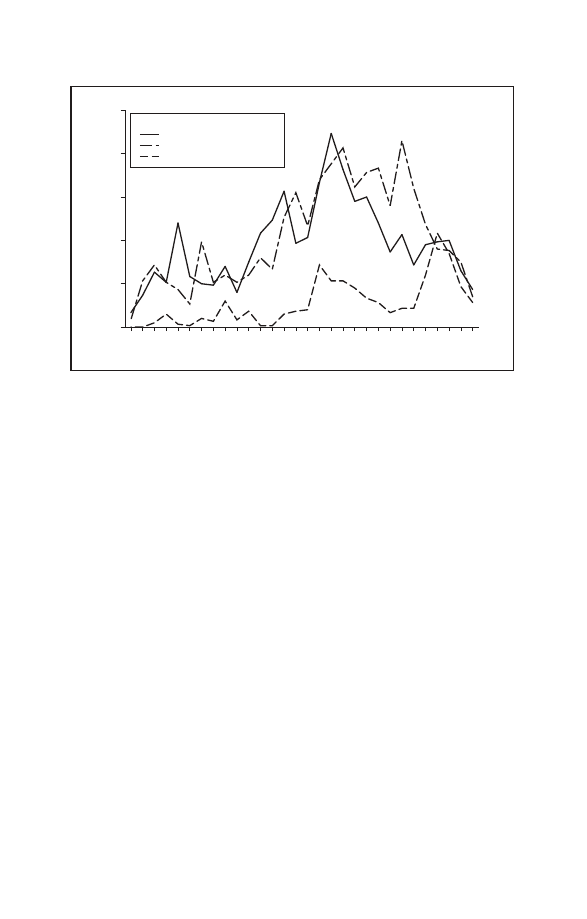
32
T E R R O R I S M I N A S Y M M E T RI CA L C O N F L I C T
acts committed by religious groups was less than a third of that of
either other category (see figure 2.1).
Despite secular leftist terrorism’s responsibility for the highest
number of international terrorist incidents at its second historical peak
(from the 1960s to the 1980s),
43
the situation in terms of numbers of
deaths is very different. Nationalist/separatist groups were responsible
for the highest number of international terrorism-related deaths (3015)
in the period 1968–97, almost twice as many as caused by religious
terrorists (1640), while communist/leftist groups lagged far behind,
with 829 deaths (see figure 2.2).
At the end of the 20th century some socio-revolutionary leftist
groups whose ideology did not have a clear nationalist, let alone reli-
gious, aspect continued or started armed activity, including terrorism,
especially in developing countries. Cases range from the Fuerzas
Armadas Revolucionarias de Colombia (FARC, Revolutionary Armed
Forces of Colombia) and Ejército de Liberación Nacional (ELN,
National Liberation Army) in Colombia, who have been fighting con-
43
The rise of socio-revolutionary and anarchist terrorism in the late 19th and early 20th
centuries may be seen as the first historical peak of left-wing terrorism.
Number of incidents by:
nationalist/separatist groups
communist/leftist groups
religious groups
0
30
60
90
120
150
1997
1996
1995
1994
1993
1992
1991
1990
1989
1988
1987
1986
1985
1984
1983
1982
1981
1980
1979
1978
1977
1976
1975
1974
1973
1972
1971
1970
1969
1968
Figure 2.1. International terrorism incidents by communist/leftist,
nationalist/separatist and religious groups, 1968–97
Source: MIPT Terrorism Knowledge Base, <http://www.tkb.org/>.
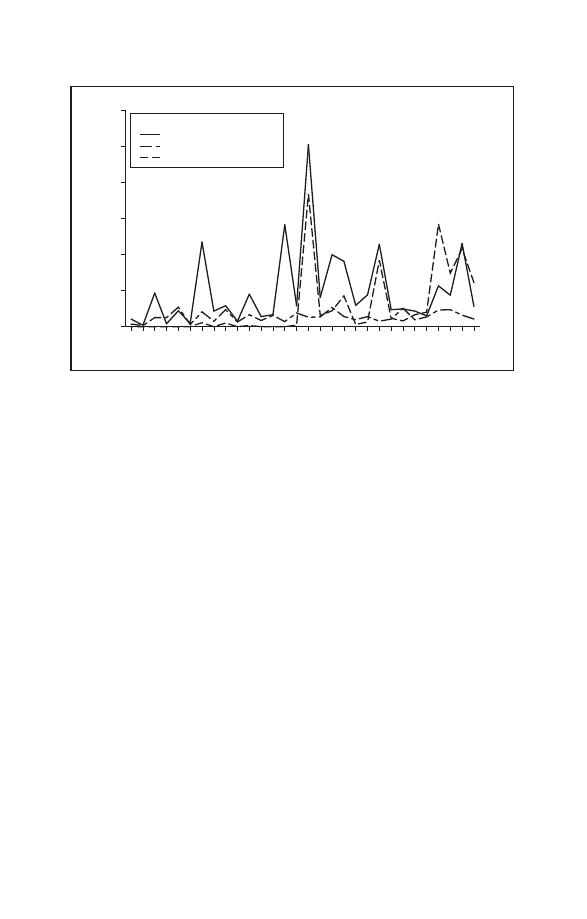
RA D I C A L N A T I O N A L I S M 33
tinuously for several decades, to the Communist Party of Nepal
(Maoist) militants, who took up arms against the state in 1996.
Throughout the 1990s some marginal leftist terrorist groups resur-
faced in the developed world too, sporadically committing classic acts
of ‘peacetime’ terrorism.
In the last decade of the 20th century, following the end of the cold
war, communist, radical socialist and other leftist ideologies suffered
an overall decline. This was mainly a result of the disintegration of the
Soviet bloc, the end of the East–West ideological confrontation and
the collapse of the bipolar world system. The role of these ideologies
as a basis for groups involved in terrorist activity decreased. While
communist and other leftist terrorism remained significant and even
increased in 1998–2006 (see figure 2.3), its overall importance
declined relative to the sharply rising nationalist and religious terror-
ism. This relative decline coincided in time and was connected with
the gradual decline in state support for terrorism in line with the
bipolar division. For much of the cold war period, many radical
groups driven by communist and other leftist ideologies had enjoyed
Number of fatalities by:
nationalist/separatist groups
communist/leftist groups
religious groups
0
100
200
300
400
500
600
1997
1996
1995
1994
1993
1992
1991
1990
1989
1988
1987
1986
1985
1984
1983
1982
1981
1980
1979
1978
1977
1976
1975
1974
1973
1972
1971
1970
1969
1968
Figure 2.2. International terrorism fatalities caused by communist/leftist,
nationalist/separatist and religious groups, 1968–97
Source: MIPT Terrorism Knowledge Base, <http://www.tkb.org/>.
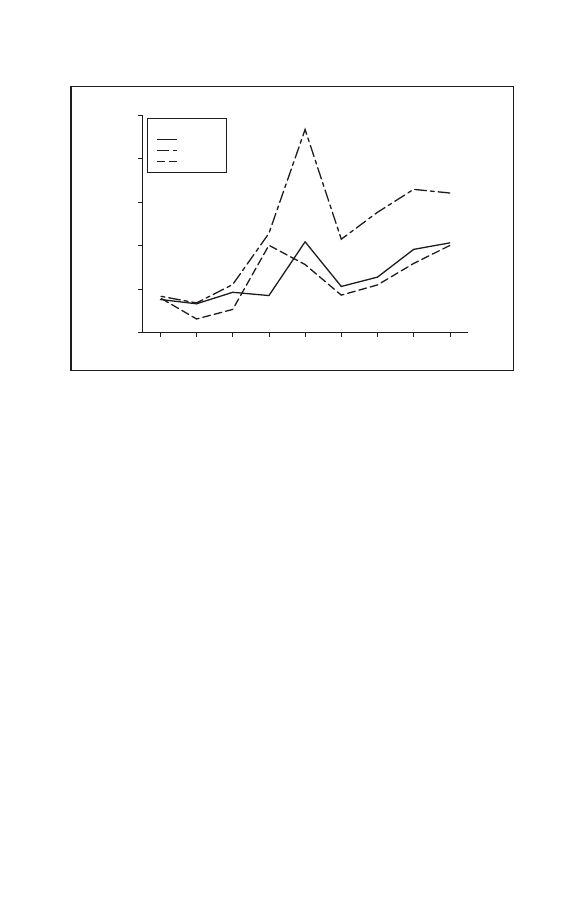
34
T E R R O R I S M I N A S Y M M E T RI CA L C O N F L I C T
some political and financial support from the states where those
ideologies were dominant.
44
In the 1990s, the ideological currents of radical leftism were
increasingly replaced by radical nationalism, especially separatist
ethno-nationalism, and by religious extremism, which became the two
most influential ideological pillars of terrorism.
45
As noted above,
even before the end of the 20th century the gap between nationalist
and religious terrorism in terms of international terrorism fatalities
was much narrower than in terms of incidents. In other words, even if
religious terrorism resulted in much fewer international terrorist inci-
dents, it appeared to have been more lethal than nationalist terrorism.
44
In contrast, state support of religious and nationalist terrorism, e.g. in the Middle East
and South West Asia, often continued. On state support of terrorism see e.g. Murphy, J. F.,
State Support of International Terrorism: Legal, Political, and Economic Dimensions (West-
view: Boulder, Colo., 1989); and Byman, D., Deadly Connections: States that Sponsor
Terrorism (Cambridge University Press: Cambridge, 2005).
45
On ethno-nationalism and its distinction from civic nationalism see section II below.
0
200
400
600
800
1000
2006
2005
2004
2003
2002
2001
2000
1999
1998
Number of:
incidents
injuries
fatalities
Figure 2.3. Domestic and international terrorism incidents, injuries and
fatalities caused by communist/leftist groups, 1998–2006
Source: MIPT Terrorism Knowledge Base, <http://www.tkb.org/>.

RA D I C A L N A T I O N A L I S M 35
In terms of international terrorism-related injuries, religious terrorism
was even slightly ahead of nationalist/separatist terrorism.
46
It can be tentatively argued that ideologies incorporating radical
nationalism (including ethno-separatism) or religious extremism form
a more favourable basis for inducing and ‘justifying’ the use of terror-
ist means than purely secular socio-political ideologies. In addition, an
almost regular pattern can be observed: radical groups that systematic-
ally employed terrorism in an asymmetrical socio-political struggle
that was not primarily driven by ethno-nationalist, national liberation
or religious motives never succeeded in gaining and holding on to
state power. This failure by, for example, Western anarchist and Rus-
sian socio-revolutionary terrorists is in contrast to the success of:
(a) leftist and extreme right-wing opposition groups (revolutionary
Marxists or social democrats in the late 19th and early 20th centuries
and European fascists in the 1930s), which either did not employ
terrorist means or did not use them systematically; and (b) nationalist,
religious and ethno-religious groups that actively used terrorism as
one of the main tactics in their armed struggle.
II. Radical nationalism from anti-colonial movements to
the rise of ethno-separatism
The 19th and 20th centuries
As noted above, as terrorism emerged in the last third of the 19th
century as a systematically employed asymmetrical tactic of political
violence, it took no single form. Instead it was used by organizations
of many political orientations in the name of many goals formulated
in accordance with their various ideologies. Even at this early stage,
terrorism was employed not only by socio-revolutionary groups, such
as the Russian revolutionary narodniki or European and North Ameri-
can anarchists, but also by national liberation movements in the
Balkans, India, Ireland and Poland.
In both the 19th and 20th centuries, most anti-colonial national
liberation movements employed armed violence at some stage and in
more than one form. Mahatma Gandhi’s movement, which managed
46
Religious groups were responsible for 10 863 injured victims in the period 1968–97 as
opposed to 10 098 for nationalist/separatist groups. MIPT Terrorism Knowledge Base
(note 4).

36
T E R R O R I S M I N A S Y M M E T RI CA L C O N F L I C T
to achieve its goal of independence for India through non-violent
means, was a rare exception. Broad national liberation movements
often had extremist factions that, alongside other tactics, employed
terrorist means, both against the colonizers and against the more
moderate nationalists. In the mid-20th century, both prior to World
War II and in the first post-war decades, terrorism was widely
employed by anti-colonial and other national liberation movements in
the Middle East, North Africa and parts of Asia. At that stage, several
national liberation and nationalist groups that combined terrorist
means with other violent tactics managed to achieve all or most of
their declared goals. Some even came to power in their newly estab-
lished states. The best known example of this period is the Algerian
Front de libération nationale (FLN, National Liberation Front). The
FLN led the armed struggle for independence from France after 1954
and at a certain point decided to turn to terrorist tactics in urban areas.
It became the ruling party after Algeria’s independence in 1962.
47
Between 1968 and 1977—the first decade for which international
terrorism statistics are available—the number of anti-colonial, other
national liberation and ethno-separatist groups that used terrorist
means in an international context (49 groups) was still slightly
lower than the number of communist and other left-wing groups
(58 groups).
48
However, nationalist terrorists were already responsible
for 11 per cent more international terrorist incidents, 1.5 times more
injuries and 2.2 times more fatalities than all communist and leftist
groups.
49
The six deadliest nationalist groups of this period were all
Palestinian organizations. The resort to terrorist means, including
47
Terrorist means were also used by: the underground Jewish organization Irgun (Irgun
Tseva’i Le’umi, National Military Organization, also known at Etzel), which fought for
almost 2 decades for the creation of the state of Israel; and the Greek Cypriot insurgency
movement Ethniki Organosis Kyprion Agoniston (EOKA, National Organization of Cypriot
Fighters), which fought British rule in Cyprus in the mid-1950s and gained independence in
1960. Puerto Rican nationalist terrorist groups were also active in the years following World
War II—launching terrorist attacks against US officials in the early 1950s and attempting to
assassinate US President Harry S. Truman in 1950—but were not successful in advancing the
goal of independence.
48
Even if small anarchist groups are included, the total number of left-wing groups would
not have exceeded 61. The number of terrorist groups with religious motives active in the
same period did not exceed 5 and most of them (such as the Pattani United Liberation Organ-
ization in Thailand or the Moro National Liberation Front in the Philippines) combined reli-
gious and nationalist motivations and are also listed as nationalist/separatist groups. MIPT
Terrorism Knowledge Base (note 4). On the MIPT definition of international terrorism see
note 9.
49
Calculation based on data from the MIPT Terrorism Knowledge Base (note 4).

RA D I C A L N A T I O N A L I S M 37
international terrorism, by the Palestine Liberation Organization
(PLO) and other Palestinian militant groups from the late 1960s until
the 1980s demonstrated how to internationalize—and draw inter-
national attention to—a local asymmetrical armed struggle.
In sum, radical nationalism came to the fore alongside extreme left-
wing ideologies as an ideology of groups that employed terrorist
tactics. Even so, until the early 1980s various forms of radical
left-wing internationalized socio-political ideology—ranging from
Maoism to anarchism—still played a significant part as an ideological
basis for groups engaged in terrorist activity. This was the case pri-
marily in Europe, especially in France, West Germany, Greece and
Italy, but also in other regions, from Latin America to Japan. In add-
ition, many nationalist groups (e.g. the FLN in Algeria, the PLO and
Euskadi Ta Askatasuna (ETA, Basque Homeland and Freedom) in
Spain) effectively combined radical nationalism with leftist ideolo-
gies.
50
In the 19th and much of the 20th centuries such a combination
was the rule rather than the exception. It was facilitated by the
ambiguous approach to nationalism on the part of most socio-revolu-
tionary ideologies, including Marxism. The only left-wing ideology
that rejected nationalism was anarchism. Anarchists remained the
most consistent and committed internationalists, proposing to replace
nation states with cooperative communities based on free association
and mutual assistance of people regardless of their ethnic and national
origin.
Finally, radical nationalism, especially in its racist forms, was often
an essential part of the ideologies of extreme right-wing socio-
political organizations, including those that used terrorist means, such
as the Ku Klux Klan movement in the USA.
51
50
E.g. ETA is categorized as both ‘nationalist’ and ‘communist/socialist’ in the MIPT
Terrorism Knowledge Base (note 4).
51
As noted in chapter 1 in this volume, section I, socio-political peacetime terrorism in
general and right-wing terrorism in particular are not subjects of this study. As shown by the
MIPT data for the period since 1998, right-wing terrorism has resulted in far fewer terrorist
incidents, injuries and fatalities than nationalist, religious and left-wing terrorism. Right-wing
terrorism is only mentioned here when combined with radical nationalism or religious
extremism.

38
T E R R O R I S M I N A S Y M M E T RI CA L C O N F L I C T
Into the 21st century
In the late 20th century this pattern changed. National liberation,
especially anti-colonial, movements were replaced by radical ethno-
nationalist movements, often with separatist aims. This new kind of
ethno-nationalism was now rarely tied to left-wing ideology. Instead,
it was more and more often linked to religious extremism. Along with
the latter, radical ethno-nationalism and ethno-separatism moved to
the fore as the ideologies most commonly employed by terrorist
organizations. Ethno-separatist groups usually displayed a higher
degree of intra-organizational coherence, continuity and resolve than,
for instance, groups of a purely left-wing character. Ethno-separatist
movements also proved able to remain active for decades without
even changing their leaders.
In the early 21st century radical ethno-nationalism, and especially
ethno-separatism, has retained its importance as one of the most wide-
spread ideologies of groups employing terrorist means. However, it
has gradually yielded primacy to religious, especially Islamist,
extremism. Religious extremism has more and more often served as
an ideological basis for terrorist groups active in more localized set-
tings and, above all, for the emerging transnational violent Islamist
movement. Sometimes, as in the case of the Islamic Movement of
Uzbekistan (IMU), violent Islamism has served as a counterbalance
and an alternative to nationalism; in other cases, as in Kashmir or
Chechnya, it has been employed in combination with radical ethno-
separatism.
Nationalism is a very powerful ideology that may provide the ideol-
ogical framework for all kinds of ambitious political goals, including
the break-up or formation of states.
52
It is also one of the most wide-
spread ideologies in the world and takes many forms. These range
from the more common passive forms to the more active ones that
52
For some of the main interpretations of nationalism see: on modernization theory of
nationalism—and nations—as a product of the emergence of the industrial society, Gellner,
E., Nations and Nationalism (Blackwell: Oxford, 1981); on traditionalist explanations
interpreting nation and nationalism as pre-existing (primordial) phenomena based on inherent
cultural difference, Hobsbaum, E. and Ranger, T. (eds), The Invention of Tradition (Cam-
bridge University Press: Cambridge, 1983); and on concepts that build on both traditionalist
and modernist theories, but go beyond them (constructivist theories), Anderson, B., Imagined
Communities: Reflections on the Origin and Spread of Nationalism (Verso: London, 1991)
for a concept of nations as ‘imagined political communities’ and Smith, A. D., Nationalism:
Theory, Ideology, History (Polity: Cambridge, 2001) on ‘ethnosymbolism’.

RA D I C A L N A T I O N A L I S M 39
imply political action in support of nationalist goals. These goals may
range from cultural autonomy to separatism or irredentism.
It is critic-
ally important to distinguish between such different forms of national-
ism, and between its more moderate types and the more radical ver-
sions that may serve as an ideological basis for sustained political
action. The latter may, under certain conditions, transform into the use
of armed political violence.
53
Terrorism is just one—and not the most
widespread—form of such violence.
This chapter mainly addresses ethnic (or ethno-political) national-
ism as the most widespread—but not the only—type of nationalism
advanced by armed non-state groups and movements. In contrast to
civic nationalism, which views the nation as a voluntary and rational
political association of citizens of a state bound by shared territory
and institutions, ethno-nationalism emphasizes a common ethnic
background as a basis for an organic nation.
54
According to ethno-
nationalists, an ethnic group in a cultural and historical sense is iden-
tical to a nation as a political and state unit, and a common ethnic
background is a necessary and sufficient basis for the formation of a
separate state. The ultimate goal of ethno-nationalism is the creation
of a separate state or quasi-state entity which is either mono-ethnic or
in which the given ethnic group dominates.
In the post-colonial era, ethno-nationalism has largely replaced
national liberation anti-colonial movements as the most evident and
widespread version of radical nationalism. In multi-ethnic states,
ethno-political movements have started to put forward more active
demands that range from the redistribution of functions of governance
and control over resources to the creation of separate states.
55
Exclud-
ing national liberation movements that fought against the colonial rule
of European powers in the post-World War II period, over the period
1951–2005 a total of 79 ethno-nationalist movements representing
53
On the relationships between nationalism and violence in general see Brubaker, R. and
Laitin, D. D., ‘Ethnic and nationalist violence’, Annual Review of Sociology, vol. 24 (1998),
pp. 423–52; and Beissinger, M., ‘Violence’, ed. A. J. Motyl, Encyclopedia of Nationalism,
vol. 1, Fundamental Themes (Academic Press: San Diego, Calif., 2000), pp. 849–67.
54
On civic and ethnic nationalism see Smith (note 52), pp. 39–42.
55
See Tilly, C., ‘National self-determination as a problem for all of us’, Daedalus,
vol. 122, no. 3 (summer 1993), pp. 29–36; Simpson, G. J., ‘The diffusion of sovereignty: self-
determination in the post-colonial age’, Stanford Journal of International Law, vol. 32
(1996), pp. 255–86; De Vries, H. and Weber, S. (eds), Violence, Identity, and Self-Determin-
ation (Stanford University Press: Palo Alto, Calif., 1997); and Moore, M. (ed.), National Self-
Determination and Secession (Oxford University Press: Oxford, 1998).

40
T E R R O R I S M I N A S Y M M E T RI CA L C O N F L I C T
territorially concentrated ethnic groups were engaged in armed strug-
gle for autonomy or independence from central governments.
56
At the
end of 2006, such ‘self-determination’ movements were engaged in 26
active armed conflicts.
57
Among other tactics, these movements—in
Chechnya, Kashmir, Mindanao or Sri Lanka—have increasingly
started to use terrorist means to achieve their goals.
This does not mean that civic nationalism cannot be radicalized to
the point where it turns to violence or even terrorism. On the contrary,
civic nationalism in its radical forms, particularly on the part of the
state, has a long history of deadly and mass violence both against
other states and against ethnic minorities. Among non-state actors, the
notion of nascent civic nationalism was more appropriate than ethno-
nationalism to largely secularized anti-colonial movements, including
those that employed terrorist means.
In the post-colonial era, in addition to narrowly ethno-nationalist
and ethno-separatist movements, another form of armed nationalism
has been national liberation from foreign occupation. While some
such movements may be dominated by the prevailing ethnic group in
the ‘occupied’ state, in contrast to radical ethno-nationalists they are
usually multi-ethnic (and inter-confessional). However, the supra-
ethnic nature of most modern armed national liberation movements,
especially in Muslim-populated regions, is not civic in nature and is
increasingly tied to their Islamicized character. Ongoing armed
national liberation movements have either continued from the 20th
century after having undergone some changes (e.g. Islamicization in
the case of the Palestinian armed resistance) or have newly emerged
in the early 21st century (such as the post-2003 resistance in Iraq).
56
Hewitt, Wilkenfeld and Gurr (note 2), p. 33. The CIDCM data sets on peace and conflict
issues are the primary sources of data used in this chapter.
57
Hewitt, Wilkenfeld and Gurr (note 2), p. 33. ‘Self-determination movement’ is the term
used to denote ethno-nationalist movements in reports by the Center for International
Development and Conflict Management (CIDCM). See also the previous CIDCM report
Marshall, M. G. and Gurr, T. R., Center for International Development and Conflict Manage-
ment (CIDCM), Peace and Conflict 2005: A Global Survey of Armed Conflicts, Self-
Determination Movements, and Democracy (CIDCM: College Park, Md., 2005), <http://
www.cidcm.umd.edu/publications/publication.asp?pubType=paper&id=15>.

RA D I C A L N A T I O N A L I S M 41
III. The ‘banality’ of ethno-political conflict and the
‘non-banality’ of terrorism
Any analysis of the ideological basis of ethno-nationalist terrorism
must focus on the most radical separatist forms of ethno-nationalism
that involve—and require—the sharp polarization of ethnic identities.
However, ethno-political extremism per se does not necessarily imply
or require the use of organized armed violence. The role of ideology
in the processes of radicalization of an ethno-nationalist movement,
and its resort to armed violence in general and terrorism in particular,
needs to be further clarified.
Exploring the process of mobilization of violence and identifying
the point where, for example, ethnic polarization, inter-ethnic tensions
and hostility turn into armed violence is one of the most complicated
analytical problems in conflict studies. It is also one that remains
largely unresolved. Any analytical calculation that includes national-
ism, an ‘ethnic factor’ and associated violence requires a great deal of
caution. This is particularly so when trying to generalize about nation-
alist violence, with its multiplicity of forms and manifestations. These
range from genocides, riots and inter-communal crowd violence to
acts of terrorism, which is far from being the most common and mass-
based form. It also needs to be recalled that, unlike some other types
of nationalist violence, such as genocide, terrorism as it is defined
here can only be carried out by non-state actors.
Despite frequent references to ethno-political terrorism in political
and public discourse, there is surprisingly little research on the
phenomenon. Most serious work on terrorism as a tactic of violent
ethno-nationalist movements has taken the form of specific case stud-
ies.
58
Attempts to conceptualize this form of violence have been few
and superficial.
59
This gap in research can only partly be explained by
the lack of attention paid by many political scientists and experts in
conflict studies to the specifics of terrorism as compared to other
forms of violence. It is also a good illustration of the more generic
problem of explaining the relationship between nationalism and vio-
58
In the European context see e.g. Reinares, F., Patriotas de la Muerte: Quiénes han mili-
tado en ETA y por qué [Patriots of death: who joined ETA and why] (Taurus: Madrid, 2001);
and Alonso, R., The IRA and Armed Struggle (Routledge: London, 2006).
59
See e.g. Byman, D., ‘The logic of ethnic terrorism’, Studies in Conflict and Terrorism,
vol. 21, no. 2 (Apr.–June 1998), pp. 149–70.

42
T E R R O R I S M I N A S Y M M E T RI CA L C O N F L I C T
lence and identifying specific mechanisms for the mobilization of
nationalist violence.
Naturally, in the Western literature most attention has been paid to
ethno-political terrorism of West European origin, such as has been
practised for decades by ETA and the Irish Republican Army (IRA)
and its many offshoots. In both cases, an ethno-nationalist motiv-
ation—aggravated by irredentist and confessional motives in the case
of the IRA—has prevailed over other, socio-political, motivations and
goals, such as the leftist and anti-fascist motives that formed an inte-
gral part of ETA’s ideology. However, most explanations of the
phenomenon of ethno-political terrorism by these and some other
Western groups have hinged on the extent of ethnic, or ethno-confes-
sional, polarization and the ways in which it was exploited for polit-
ical purposes. The most that appears to have been concluded regard-
ing the nature of the link between ethnic factors and terrorism is that,
the sharper the societal divide along ethnic lines is, the more fierce
and bitter is the resulting armed ethno-political confrontation and the
more it is likely to take the form of terrorism.
These explanations are hardly sufficient: the analytical problem
being addressed here cannot be solved by references to the particular
brutality of ethno-political conflicts alone or the allegedly more
aggressive nature of ethno-nationalism compared to other radical
ideologies. Extreme ethno-nationalism may, indeed, be seen as a more
powerful and sustainable radical ideology than some socio-political
‘internationalist’ left-wing currents, especially in the late 20th and
early 21st centuries. However, the ‘superior’ nature of the mobilizing
and persuasive powers of radical nationalism is less evident if it is
compared to religious extremism, especially at the transnational level.
Terrorism is not, in fact, a natural outgrowth or a necessary attribute
of the extreme bitterness of an ethno-political conflict. Terrorist
means were rarely used during the conflicts in the Balkans during the
1990s and have not been employed in cases of genocide in the Great
Lakes region of Africa. Rather, terrorist means have been systematic-
ally used by ethno-separatist movements engaged in protracted,
chronic conflicts. This has been the case in Chechnya, Kashmir, Sri
Lanka and elsewhere. As noted above, the only other type of modern
conflict where nationalist terrorism is employed systematically is the
armed national liberation struggles (e.g. by groups of the Palestinian
and Iraqi resistances).

RA D I C A L N A T I O N A L I S M 43
The role of the ethnic factor in armed violence
As noted above, the analysis of different forms of nationalist violence,
including terrorism, remains one of the least explored areas in the
study of nationalism and violence. It seems that the best way to
explain the specifics of nationalist terrorism is through comparison
with—and contrast to—other, more widespread forms of nationalist
violence.
Since the closing years of the cold war there has been a generally
stronger emphasis on ethno-nationalism and ethnic factors as drivers
of contemporary armed conflicts.
60
With the proliferation of ethno-
political conflicts in the early post-cold war period, the ethnic factor
came to be viewed as a force that inherently directs an ethnic group
towards aggression against other ethnic groups. This approach is
rooted in the much criticized and relatively marginalized primordialist
‘cultural difference’ school of the 1970s and 1980s, which argued that
nationalist violence is inherent in—and a natural progression of—
cultural difference.
61
However, the unique role of an ethnic factor and
ethno-nationalist ideology in causing armed violence, including terror-
ism, should not be overemphasized for a number of reasons.
First, the combination of ethno-nationalism and non-violence
appears far more common than that of ethno-nationalism and vio-
lence. The best efforts of researchers to compare the numbers of real
(i.e. active) and potential inter-ethnic and inter-communal conflicts
show that most ethnic groups manage to live in peace with one
another, despite frequent tensions between them. For instance, studies
by James Fearon and David Laitin based on evidence from Africa
since 1979 show that only 0.28 per cent of real and potential inter-
ethnic tensions resulted in armed conflict.
62
The available data show that most nationalist conflicts do not result
in large-scale violence. In most conflicts, only a part—usually
small—of a nation or an ethnic group partakes in violence. An even
60
The advocates of this approach range from scholars such as Donald Horowitz and
Michael Ignatieff to publicists such as Robert Kaplan. See Horowitz, D. L., Ethnic Groups in
Conflict (University of California Press: Berkeley, Calif., 1985); Ignatieff, M., Blood and
Belonging: Journeys into the New Nationalism (Farrar, Straus and Giroux: New York, 1993);
and Kaplan, R. D., The Ends of the Earth: A Journey to the Frontiers of Anarchy (Random
House: New York, 1996).
61
On primordialism see also note 52.
62
Fearon, J. D. and Laitin, D. D., ‘Explaining interethnic cooperation’, American Political
Science Review, vol. 90, no. 4 (Dec. 1996), pp. 715–35.

44
T E R R O R I S M I N A S Y M M E T RI CA L C O N F L I C T
smaller proportion of ethno-nationalist movements, including ethno-
separatist or ‘self-determination’ movements, chooses to resort to
armed violence. According to data from the University of Maryland
Center for International Development and Conflict Management
(CIDCM), by 2005 only 25 such movements were involved in armed
conflicts. In 54 other cases organizations that claimed to represent
territorially concentrated ethnic groups tried to acquire a greater level
of autonomy or self-determination for their groups through peaceful
political means. Another 23 movements combined non-violent
means—such as building a mass support base, identifying and pub-
licly defending group interests, taking part in election campaigns or
launching peaceful protest actions—with sporadic, isolated acts of
violence that fell short of armed confrontation. Most such movements
were active in democratic Western countries (e.g. Flemings and Wal-
loons in Belgium and Catalans in Spain). However, some were ethno-
nationalist movements using or advocating sporadic acts of violence
against more rigid and authoritarian regimes. Examples of the latter
include Mongols, Tibetans and Uighurs in China and Pashtuns and
Sindhis in Pakistan.
63
Even if ethno-political movements resort to violence, terrorism is
not the most common and widespread form of such violence. It also
usually enjoys less public support than, for instance, rebel attacks
against government military and security targets. While an ethno-
political insurgency movement as a whole may enjoy broad support
among its ethnic base, those radical parts that systematically employ
terrorist means usually do not have the same level of support.
Second, findings about ethno-political groups in conflict hint at the
extremely complicated nature and multiple causes of those conflicts
that are commonly—and often simplistically—identified as ‘ethno-
political’. Such conflicts usually result from a combination of inter-
related socio-political, economic and cultural factors, issues of iden-
tity, and so on. Ethno-nationalism is not necessarily the only, or even
the most important, driver.
64
63
Marshall and Gurr (note 57), pp. 21–22, 25, 27.
64
See e.g. Hardin, R., One for All: The Logic of Group Conflict (Princeton University
Press: Princeton, N.J., 1995); Reno, W., Warlord Politics and African States (Lynne Rienner:
Boulder, Colo., 1998); Mueller, J., ‘The banality of “ethnic war” ’, International Security,
vol. 25, no. 1 (summer 2000), pp. 42–70; and Fearon, J. D. and Laitin, D. D., ‘Ethnicity,
insurgency and civil war’, American Political Science Review, vol. 97, no. 1 (Feb. 2003),
pp. 75–90.

RA D I C A L N A T I O N A L I S M 45
The notion of ‘purely ethnic’ violence is therefore something of an
abstraction. If an ethno-nationalist group is engaged in armed strug-
gle, that does not necessarily mean that the violent conflict has no
other causes, motivations and participants. So-called ethnic violence is
often an integral part of the broader, complex mix of different forms
of political and profit-driven, organized and unorganized, direct and
structural violence. This phenomenon has been best captured by John
Mueller’s theory of the relative banality—that is, the unexceptional
nature—of armed conflicts with an ethno-political form.
65
The idea of
the banality of ethnic conflict effectively challenges the thesis of
ancient ethnic hostility as the driving force of armed conflicts—a
primordialist explanation that resurfaced in the post-cold war era.
66
Even long historical experience of confrontation, reinforced by
systematic propaganda by ethno-political elites and leaders, does not
guarantee support for violent ethno-nationalism, especially in the form
of terrorism, by the broader population. This may be true even at the
peak of the fiercest of armed conflicts, especially if explicit discrimin-
ation on an ethnic basis was not the main, direct motivational cause of
that conflict.
Another argument in favour of the thesis of the banality of ethnic
violence is that in complex multi-causal and multi-level armed con-
frontations it is often intimately intertwined with other forms of vio-
lence. For instance, the widespread combination of ethnic strife with
criminal violence has become typical for many conflict and post-
conflict areas. It may develop to a point where acts of violence driven
by ethnic hatred are often mistaken for or cannot be distinguished
from violent crimes committed by people of one ethnic group against
those of another primarily for material gain, as often happened in the
Balkans in the 1990s and early 2000s.
Finally, the very idea that armed violence in an ethno-political form
is a kind of aberration or a radical deviation from a presumed norm of
peace raises some questions. The rise of ethno-separatism in the so-
called Third World in the post-World War II period, especially in
post-colonial Africa and Asia, should have surprised no one. The vast
65
Mueller (note 64). This banality of ethno-political violence should not be confused with
or be reduced to ‘rationality’, i.e. the instrumentalist, rational-choice interpretation of such
violence as nothing more than a rationally employed instrument to achieve a group’s goals.
66
On the primordialist explanation see e.g. Hobsbaum, E., Nations and Nationalism since
1780: Programme, Myth, Reality (Cambridge University Press: Cambridge, 1990). See also
note 52.

46
T E R R O R I S M I N A S Y M M E T RI CA L C O N F L I C T
majority of the new states were artificial entities with borders arbi-
trarily drawn by their former European colonial rulers. Despite this,
the conceptual thinking on the subject, undertaken mostly in the West,
was for a long time dominated by the thesis of ethno-political violence
as something exceptional and specific to these local contexts. The
popularity of this thesis may be partly explained by perceptions of the
relatively atypical nature of large-scale ethno-nationalist violence for
many developed states themselves, as compared to many less devel-
oped and more ethnically diverse countries affected by ethno-political
conflicts.
67
The perception that large-scale ethno-nationalist violence
is mostly restricted to underdeveloped regions may not be very accu-
rate, but it has some basis in the much lower levels of ethno-political
violence in Western countries.
Terrorism as extreme violence within violent extremism
While radical ethno-nationalism, and especially ethno-separatism,
may well serve as an ideology for groups that employ violent means
to achieve their political goals, it does not necessarily lead to violence.
Even if it does, not all of the violent ethno-political groups in regions
such as Central and East Africa, Central, South and South East Asia,
and Eastern Europe necessarily use terrorism. In addition, so-called
ethnic violence is most often a mixture of many socio-political, eco-
nomic, cultural and identity factors and influences.
Given that ethno-nationalist movements are not intrinsically violent,
the question arises of why some of these movements resort to terror-
ism. The need to answer this question leads back to the thesis of the
banality of ethno-political violence, especially outside the Western
world. In contrast to most Western states, for many of the mostly
multi-ethnic states in other regions of the world ethno-political vio-
lence is not seen as an exceptional phenomenon but rather as just one
of the common, chronic and recurring manifestations of broader pat-
tern of protracted, complex violence.
Against this background, the key to understanding why some rad-
ical ethno-nationalists resort to terrorism may be summarized as
follows. If there are grounds to assert the relative banality of ethno-
political violence, then the main characteristic of terrorism is precisely
its non-banality, even within the broader cycle of violence. In order to
67
See e.g. Horowitz (note 60).

RA D I C A L N A T I O N A L I S M 47
play its role for the violent actors, terrorism must be perceived as
excessive, an aberration. A terrorist act must be a spectacular event
that goes far beyond routine practices, politics, behavioural patterns
and even routine violence.
Nonetheless, the dividing line between the banality of ethnic vio-
lence and non-banality of terrorism may be very thin. Despite this, the
main distinguishing feature and comparative advantage of terrorist
tactics is precisely its extraordinary nature. It is event-centred in the
sense that it aims at causing a spectacular and shocking political event
whose impact goes far beyond its direct human and material damage.
This non-banality manifests itself through a set of characteristics of
terrorist tactics. They include implacable ruthlessness, a readiness to
mount indiscriminate attacks and target innocent civilians, often in
large numbers, the unconventional use of conventional means, and the
demonstrative and communicative nature of terrorist acts. The impres-
sion that terrorism is non-banal should be strong enough to contrast
with other forms of violence that are more common, widespread and
mass-based and could be perceived as more acceptable. Whenever
terrorism becomes customary and banal, it loses much of its political
effect. Terrorism is ‘abnormal’ violence; it makes sense for the
perpetrators inasmuch as it can be perceived as extreme violence
within violent extremism.
In the situation of relative civil peace, general state functionality
and more or less effective accommodation of ethnic minorities that is
inherent to most developed Western countries, terrorism as a tactic of
violent ethno-political movements is perceived as an aberration by
default. This partly explains why ethno-nationalists in those few
Western state that still face militant separatism often choose terrorism
over other forms of violence.
68
However, in the other parts of the
world, where the bulk of global terrorist activity occurs, violence is
chronic, institutionalized and often perceived as a norm. This is par-
ticularly the case in conflict and post-conflict areas in developing,
underdeveloped, weak, failed and dysfunctional states. In some areas
68
Of the 221 nationalist/separatist groups that used terrorist means in 1998–2006, 37 were
groups in Western countries, mostly tied to 3 separatist causes—in Corsica, Basque-populated
regions of Spain and France, and Northern Ireland). Twelve of these groups were responsible
for terrorist attacks that caused deaths, usually within the range of 1 to 3 fatalities. The
2 groups that have killed a larger number of civilians in terrorist attacks were ETA (respon-
sible for 54 fatalities) and the Real IRA (30 fatalities). Calculations are based on the MIPT
Terrorism Knowledge Database (note 4).

48
T E R R O R I S M I N A S Y M M E T RI CA L C O N F L I C T
affected by protracted armed conflict, the more general distinction
between normal and abnormal social and political behaviour, both
violent and non-violent, becomes blurred and what was perceived as
normal may become distorted beyond recognition.
In these areas, the use of terrorist means cannot, by definition,
guarantee the same impression of non-banality and excess. Depending
on the ruthlessness of a particular armed conflict, terrorism may not
necessarily be perceived as extraordinary or extreme violence. It may,
in fact, be outmatched in terms of cruelty, deadliness, the number of
people affected and even the broader public effect by other forms of
ethno-political violence such as mass ethnic cleansings or genocide.
The boundaries between asymmetrical terrorism and symmetrical
violence, such as inter-communal and sectarian violence, may also
become increasingly blurred.
69
In these parts of the world, terrorism
has a better chance of retaining its non-banal nature where there is a
sharp contrast between the two co-located but radically different
socio-political and cultural systems or communities—for instance,
more modernized (and Westernized) and more traditional com-
munities.
70
The conclusion that follows is that nationalist terrorism in general,
and ethno-nationalist terrorism in particular, is likely to be more
effectively employed wherever it retains the effect of non-banal vio-
lence, going beyond the limits normally applied to the more custom-
ary and banal forms of violence.
IV. Real grievances, unrealistic goals: bridging the gap
The above explanation of violent ethno-nationalists’ resort to terrorist
means is not the only one and it is not the one most directly related to
ethno-nationalist ideology as such. It should be supplemented with a
second explanation. This starts from an assumption that the prospects
for the final and complete achievement of radical ethno-nationalist
goals—ultimately centred on separatism and the creation of a new
state—are limited. In the modern world, most ethnic groups have not
69
This has happened e.g. in post-2003 Iraq, where terrorism has become increasingly
intertwined with, and indistinguishable from, inter-communal sectarian strife. See also chap-
ter 3 in this volume, section V.
70
Examples include the divide between the francophone parts of Algeria, which were
colonized by citizens of metropolitan France, and the rest of the country; and that between the
Israelis and Palestinians.

RA D I C A L N A T I O N A L I S M 49
formed their own states. A situation in which every ethnic group
would be entitled to a separate state is simply inconceivable. Despite
the relatively high mobilization potential of ethno-separatism, the
formation of an independent state on the basis of a separatist move-
ment has generally remained the exception, rather than the rule in the
post-colonial era. Any such case is handled separately, and at length,
by the international community and is rightly viewed as a potentially
destabilizing precedent. Against this background, even if radical
ethno-nationalism is backed by sustained armed violence, it does not
guarantee the formation of a separate, mono-ethnic state.
According to the CIDCM data, of the 71 self-determination con-
flicts in 1951–2005, ethno-separatist movements managed to gain an
internationally recognized independent state as a result of armed vio-
lence in only five cases: the Bengalis in Pakistan (Bangladesh was
formed in 1971), the Slovenes and the Croats, whose successions from
Yugoslavia were recognized in 1991–92; the Eritreans in Ethiopia in
1993; and the East Timorese in Indonesia (Timor-Leste became
independent in 2002).
71
Several quasi-state entities that were formed
by separatist and irredentist movements and enjoy de facto, but not
internationally recognized, independence could be added to this list.
These include Abkhazia and South Ossetia (in Georgia), Kosovo (in
Serbia), Nagorno-Karabakh (in Azerbaijan), Somaliland (in Somalia),
Trans-Dniester (in Moldova) and the Turkish Republic of Northern
Cyprus. It should also be noted that in some of these cases—in
Somaliland and Trans-Dniester—separatism was primarily driven by
factors of socio-politics, economics and historical regionalism, rather
than of ethnicity.
In most other cases the most that a radical ethno-nationalist group
with separatist aims may realistically hope to achieve is some form of
redistribution of power within a state. The resulting settlement often
takes the form of a federal power-sharing arrangement or regional
autonomy. While no multi-ethnic state can guarantee the absolute
equality of all ethnic groups, more equitable federal arrangements are
increasingly widespread, not only in the developed world but also in
developing countries. They can provide for the peaceful coexistence
of various groups and deprive extremists of opportunities to mobilize
violence on an ethnic basis. These frameworks allow ethno-nationalist
movements, including those that once took up arms to fight for their
71
Marshall and Gurr (note 57), p. 23–24.

50
T E R R O R I S M I N A S Y M M E T RI CA L C O N F L I C T
cause, better access to the central government’s decision-making
processes and the chance to gain greater regional autonomy. In sum,
despite a number of highly publicized post-cold war cases of sustained
ethno-separatism (such as in Kosovo and Abkhazia), ethno-nationalist
movements with separatist goals rarely achieve a revision of inter-
nationally recognized borders.
72
Research shows that terrorism is most closely connected to political
factors and conditions such as chronic discrimination, including dis-
crimination on an ethnic basis or the violations or absence of civil and
political rights.
73
While the ultimate political goals and motivations of
radical ethno-nationalist movements are at least to some extent based
on these and other real grievances, this does not mean that these goals
are realistic. If, for instance, the goal is to achieve a broader and more
equitable representation in state structures or a greater degree of
autonomy for an ethnic group, then that goal is usually achievable in
some way. It may even have relatively high chances of being realized,
whether through the normal political process or an armed struggle. If,
however, the goal is the creation of an independent state, then in most
cases its chances of being achieved are much lower, regardless of the
methods that are used to advance it. It is thus unsurprising that many
ethno-separatist conflicts are protracted confrontations that can last for
decades without any realistic prospects of the separatists achieving
their ultimate goal of independent statehood. The average duration of
the 25 such conflicts that were active in the early 21st century was
27 years.
74
Even though the number of ethno-separatist conflicts has
declined since the early 1990s,
75
few can be seen as finally resolved.
On the one hand, real grievances such as foreign occupation or
repressive actions by the state or dominant ethnic group create the
necessary conditions for mobilization of ethno-political violence.
They can be effectively seized on by ethno-nationalists leaders and
ideologues. On the other hand, this strong mobilization potential col-
lides with the inherently low chances of ethno-nationalists’ ultimate
72
This pattern is confirmed by the CIDCM data. See e.g. Hewitt, Wilkenfeld and Gurr
(note 2), p. 38.
73
See Lia, B. and Skjølberg, K., Causes of Terrorism: An Expanded and Updated Review
of the Literature (Norwegian Defence Research Establishment: Kjeller, 2005), <http://
rapporter.ffi.no/rapporter/2004/04307.pdf>.
74
Marshall and Gurr (note 57), pp. 26–27.
75
Marshall and Gurr (note 57). This trend was already clear by the end of the 1990s. See
also Gurr, T. R., ‘Ethnic warfare on the wane’, Foreign Affairs, vol. 79, no. 3 (May/June
2000), pp. 52–64.

RA D I C A L N A T I O N A L I S M 51
stated goal—independence—being achieved, even through the use of
violent means. This collision is a recipe for further radicalization of
violence, at least by the extremes of the ethno-nationalist movement,
and explains the need for the violence to assume increasingly asym-
metrical forms such as terrorism. In other words, the more realistic are
the ethno-nationalist movement’s political goals, the less is the need
for it to resort to terrorist means and the lower are the chances that
terrorism will become one of the main tactics employed by ethno-
nationalists.
Of critical importance is how realistically ethno-separatists perceive
their final goals, regardless of which specific factors appear to them to
make the achievement of their ultimate goals more or less realistic.
International support is one of several factors that may affect these
groups’ proclivity to employ terrorist means. Two examples illustrate
the diametrically opposite influences that this factor may have on
separatists’ perceptions of their chances of gaining international
recognition of an new independent state.
An unusual characteristic of the situation in Kosovo from the late
1990s was the high level of direct international support for armed
separatists, primarily from the USA and some other leading Western
states, as well as its partners in the North Atlantic Treaty Organization
(NATO). Naturally, such high levels of external support increased the
likelihood of the Albanian Kosovar ethno-separatists’ achieving their
goal of independence, at least in their eyes. It should then not be sur-
prising that, despite the many forms that armed violence has taken in
Kosovo (guerrilla tactics, ethnic cleansing and inter-communal war-
fare), the armed ethno-separatist movement saw no need to resort to
the ‘extraordinary’ tactics of terrorism.
That same factor of external support can also play an opposite role,
even in cases where nationalist movements have a broader national
liberation, rather than narrowly ethno-separatist, character. There is
broad international recognition of the right of the Palestinian people to
a sovereign state that is to include some of the territories still occupied
by Israel.
76
Despite this, the continuing resistance to the Israeli occu-
pation of Palestinian territories, which involves the systematic use of
terrorist means, has little chance of achieving that goal—at least as
76
This right had been repeatedly confirmed by United Nations Security Council resolu-
tions. E.g. UN Security Council Resolution 242, 22 Nov. 1967; and UN Security Council
Resolution 338, 22 Oct. 1973.

52
T E R R O R I S M I N A S Y M M E T RI CA L C O N F L I C T
long as Israel enjoys the support of the USA. In a situation such as
this, where there is a wide gap between a high nationalist mobilization
potential among the Palestinians and a low chance of the nationalists’
ultimate goal being realized, the systematic employment of terrorist
means is not surprising. In the Palestinian case, the use of terrorism
means by the more radical parts of the nationalist resistance, both the
secular and the Islamist, is likely to continue as long as this gap per-
sists.
V. Conclusions
One of the main prerequisites for a radical section of an ethno-nation-
alist movement to resort to terrorism is a significant gap between, on
the one hand, the objective chances of achieving its final goal of an
independent state and, on the other, its own unrealistic perception of
how likely that goal is to be met. The main task of the extremist
ethno-nationalist ideology is to ‘virtually’ bridge that gap.
However, it would be an exaggeration to attribute ethno-nationalist
terrorism mainly to the effects of systematic radical nationalist propa-
ganda. Such an oversimplification overlooks the roles of real socio-
political grievances as the most direct causes of political discontent
that takes ethno-nationalist form and of real (or perceived) threats to
the well-being, identity or even survival of a certain ethnic group. The
most critical role of radical ethno-nationalist ideology is to avert or
disguise this fundamental collision between real grievances that cause
conflict of an ethno-political form and the final, and probably
unachievable, goals of the radical ethno-separatists.
In this way, ideological extremism in the form of radical nationalism
provides the mechanism for the gradual further radicalization of the
movement and its resort to terrorist tactics. The use of terrorist means
can be particularly effective if, compared to other forms of violence in
the context of the same ethno-political conflict, terrorism is perceived
as a non-banal, ‘extreme’, ‘abnormal’ violence.
As noted above, the problem does not boil down to any single, spe-
cific ideology. Rather, a set of certain ideological postulates and char-
acteristics is required, some of which may be easily formulated and
defended within the framework of radical ethno-nationalist discourse.
These characteristics include the infamous postulate that ‘the worse,
the better’; the tendency to encourage destructive self-expression; and

RA D I C A L N A T I O N A L I S M 53
the tendency to blame the state for all forms of violence and to view it
as the source of all ‘evils’. While these characteristics can often be
separately identified in the ideologies of radical organizations that do
not use terrorist means, their combination is usually an ideological
recipe for terrorism.
Finally, even if the real underlying causes for ethno-nationalist dis-
content are effectively removed and the state’s policy or a peace pro-
cess accommodates most of the ethno-nationalists’ demands, it does
not guarantee an end of terrorist activity by the most radical ethno-
separatists. These policies also cannot prevent the emergence of
splinter groups that may continue to use terrorist means. However,
ideologically the state has something in common with even the most
radical and violent ethno-separatists, including those that employ
terrorist means—the central focus on the state itself as the main point
of reference. On the one hand, this turns violent ethno-nationalists into
some of the worst enemies of many existing states and societies, espe-
cially the multiethnic ones. On the other hand, it also makes radical
ethno-nationalism a recognizable enemy for the state. This enemy
exists in the same dimension, or framework, as the state itself: violent
ethno-nationalists see themselves as part of the same state-based
world which they eventually aspire to join on equal terms. They oper-
ate within the same discourse as the state itself and accept and even
glorify the very notion of the nation state. All that ethno-nationalists
ultimately aspire is to form a state that could be on equal status terms
with other states. This is in sharp contrast to the transnational versions
of some of the radical religious and quasi-religious ideologies dis-
cussed in the next chapter.

3. Ideological patterns of terrorism:
religious and quasi-religious extremism
I. Introduction
In the 1990s, following the collapse of the Soviet bloc, the end of the
cold war and the decline of leftist movements, a global vacuum in
secular protest ideology emerged. This vacuum quickly started to be
filled with radical currents—the explicitly extremist ethno-nationalist
or religious ideologies.
Much has been written about the ‘sharp’ rise of ‘religious terrorism’
during the last decades of the 20th century and about its growing
internationalization and international impact. However, to back this
thesis most analysts choose not to look at the available data directly.
The same few pieces of quantitative evidence are usually quoted,
covering the same period of time (from the late 1960s until the mid-
1990s) and derived from the same sources—most commonly from
terrorism experts Bruce Hoffman and Magnus Ranstorp. For example,
these experts’ reference to the fact that over the 30-year period until
the mid-1990s the number of radical fundamentalist religious groups
professing various confessions tripled has been reproduced in a
number of analyses. These analyses also note that there was an
increase in terrorist groups of an ‘explicitly religious’ character from
virtually no such groups in 1968 to a quarter of all terrorist organiza-
tions by the early 1990s (somewhat declining to 20 per cent of
approximately 50 active terrorist groups in the mid-1990s).
77
Nevertheless, the number of groups using terrorist means is just one
of several indicators of terrorist activity. It is not the most important,
is one of the most ambiguous and should only be considered in con-
77
E.g. Hoffman, B., ‘ “Holy terror”: the implications of terrorism motivated by a religious
imperative’, Studies in Conflict and Terrorism, vol. 18, no. 4 (Oct.–Dec. 1995), p. 272—for
an earlier version see Hoffman, B., ‘Holy Terror’: The Implications of Terrorism Motivated
by a Religious Imperative (RAND: Santa Monica, Calif., 1993), <http://www.rand.org/pubs/
papers/P7834/>, p. 2; Ranstorp, M., ‘Terrorism in the name of religion’, Journal of Inter-
national Affairs, vol. 50, no. 1 (summer 1996), pp. 41–62; Hoffman, B., ‘Terrorism trends
and prospects’, I. O. Lesser et al., Countering the New Terrorism (RAND: Santa Monica,
Calif., 1999), <http://www.rand.org/pubs/monograph_reports/MR989/>, pp. 16–17; and
Hoffman, B., ‘Old madness, new methods: revival of religious terrorism begs for broader
U.S. policy’, RAND Review, vol. 22, no. 2 (winter 1998/99), pp. 12–17.

R E L I G I O U S E X T R E MI S M 55
junction with the other main indicators of terrorism and in a specific
national and political context. The number (or size) of groups may not
be in direct relation to the overall level of terrorist activity of a certain
type in a certain context. The nature, level of organization, ideological
consolidation, militant proficiency, and public relations and propa-
ganda sophistication of these groups may be of greater importance for
the effective and systematic use of terrorist violence.
78
As far as
terrorism in concerned, it is not quantitative indicators alone that
matter, but it is still worth considering a combination of all available
indicators, especially as the overall picture obtained from analysing
these data is somewhat more complex and nuanced.
For example, over the period of almost four decades (1968–2006)
for which continuous data on international terrorist incidents are
available at the time of writing, there were only four years in which
the number of such incidents carried out by religious groups world-
wide exceeded those committed by nationalist/separatist groups. What
is most worrying is that three of these four years are the most recent
ones, 2004–2006, with 1994 as the fourth (see figure 3.1). In terms of
international terrorism-related casualties, it was only in 1993 that reli-
gious terrorism first accounted for more fatalities than nationalist
terrorism. This pattern has continued since 1993 with the exception of
only two years—1996 and 1999—when nationalist terrorism resulted
in higher numbers of deaths (see figure 3.2).
In contrast, at the domestic level, over the period 1998–2006 nation-
alist/separatist terrorism resulted in a significantly higher number of
attacks than religious terrorism: 2808 as opposed to 1824, or 54 per
cent more.
79
This is unsurprising, given the primarily domestic focus
of nationalism. However, even at the domestic level, religious terror-
ism was somewhat more deadly than nationalist/separatist terrorism.
Nationalist/separatist groups accounted for almost the same total
number of injuries—12 812 as opposed to 12 863 by religious
groups—but for a lower number of fatalities—5648 as opposed to
6607 by religious groups (or 15 per cent fewer).
78
E.g. the transition from a large number of chaotic and relatively small groups at the
early stages of post-invasion resistance in Iraq since 2003 to fewer (but more consolidated
ideologically and better organized) larger groups, mainly of the Islamicized nationalist bent,
did not lead to less terrorism but resulted in more, better organized and more systemic terror-
ist activity.
79
The period 1998–2006 is the only one for which the MIPT data on domestic terrorist
incidents were available at the time of writing.
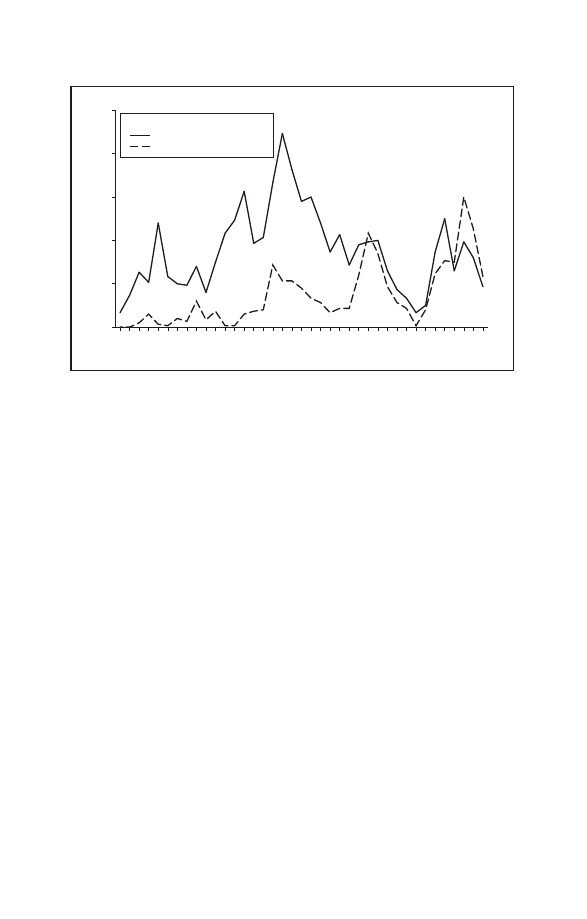
56
T E R R O R I S M I N A S Y M M E T RI CA L C O N F L I C T
The comparative dynamics of key indicators—incidents, injuries
and fatalities—for religious and nationalist/separatist terrorism at the
domestic level over the period 1998–2006 are illustrated by fig-
ures 3.3–3.5. For all years of this period there were significantly more
incidents by nationalist/separatist groups than by religious groups.
The gap between the two only became narrower towards the end of
the period. While in 1998 nationalist/separatist groups accounted for
3.7 times more domestic incidents than religious extremists, in 2006 it
accounted for just 1.2 times more. Religious terrorism resulted in
more injuries in domestic incidents in only three years (2003–2005) of
the nine for which data are available. While religious terrorist groups
caused more fatalities over the period than nationalist/separatist
organizations, the latter accounted for more deaths in four years
(1999–2002) out of the nine.
Thus, in terms of frequency of attacks, nationalist terrorism is
understandably more widespread at the domestic level than religious
terrorism. In terms of direct human costs—injuries and fatalities—the
gap between religious and nationalist groups is narrower domestically
Number of incidents by:
nationalist/separatist groups
religious groups
120
90
60
30
150
0
2005
2004
2003
2002
2001
2000
1999
1997
1998
1996
1994
1995
1993
1991
1992
1990
1988
1989
1987
1985
1986
1984
1981
1982
1983
1980
1978
1979
1977
1975
1976
1974
1973
1972
1970
1971
1969
1968
2006
Figure 3.1. International terrorism incidents by nationalist/separatist and
religious groups, 1968–2006
Source: MIPT Terrorism Knowledge Base, <http://www.tkb.org/>.
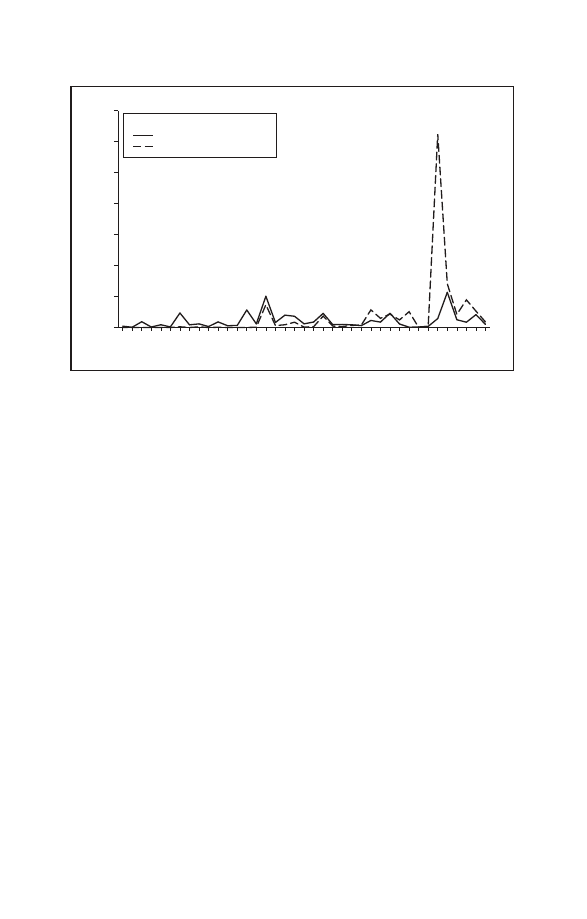
R E L I G I O U S E X T R E MI S M 57
than internationally, but religious terrorism in the early 21st century is
generally more lethal, including at the domestic level.
As noted above, in terrorism research, sound conclusions cannot be
reached on the basis of quantitative data alone and the rest of this
chapter focuses on qualitative analysis. Nevertheless, it may be pre-
liminary concluded from the analysis of quantitative data that, inter-
nationally, religious extremism has indeed become the most powerful
motivational and ideological basis for groups engaged in terrorist
activity. At the same time, the available data show not only that inter-
national terrorism lags behind domestic terrorism, in terms of both
incidents and casualties, but also that, domestically, radical national-
ism remains as powerful a mobilization tool for armed non-state
actors as religious extremism.
Examples of violent extremism can be found in all large religions
and in smaller confessions, religious currents and sects. Religious
(and quasi-religious) terrorism may be associated with any religion
and confession, and religious categories have been used to justify
terrorist activity by groups of different religious or ethno-confessional
orientations. These groups include the pseudo-Shinto Japanese sect
Number of fatalities by:
nationalist/separatist groups
religious groups
3000
2500
2000
1500
1000
500
3500
0
2005
2004
2003
2002
2001
2000
1999
1997
1998
1996
1994
1995
1993
1991
1992
1990
1988
1989
1987
1985
1986
1984
1981
1982
1983
1980
1978
1979
1977
1975
1976
1974
1973
1972
1970
1971
1969
1968
2006
Figure 3.2. International terrorism fatalities caused by nationalist/separatist
and religious groups, 1968–2006
Source: MIPT Terrorism Knowledge Base, <http://www.tkb.org/>.
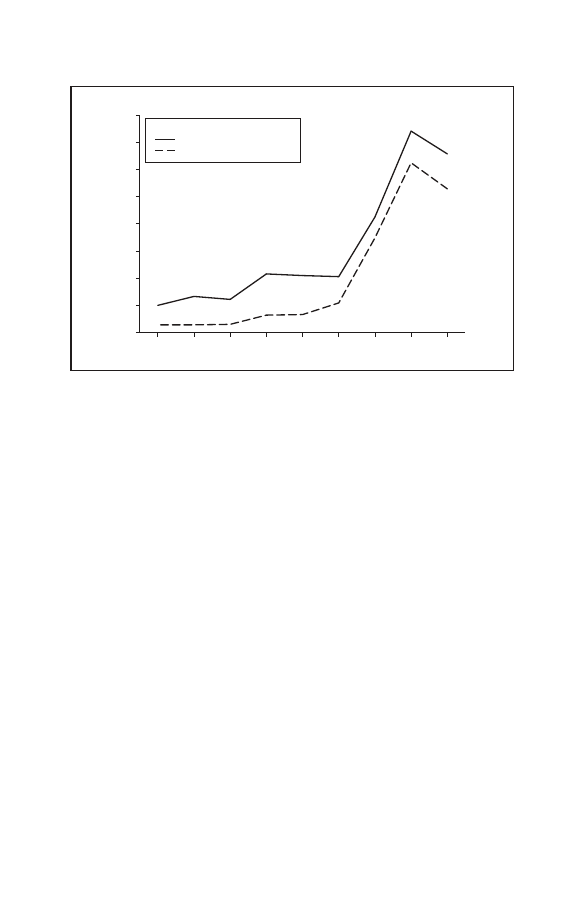
58
T E R R O R I S M I N A S Y M M E T RI CA L C O N F L I C T
Aum Shinrikyo and radical Judaic, Hindu and Sikh extremists. How-
ever, in the late 20th and early 21st centuries the main terrorist threat
to international security and to the security of many states—such as
the USA and its Western allies, India, Russia, China and many
Muslim countries—has been posed either by Islamist terrorism or by
ethno-nationalist terrorism that has been Islamicized to varying
degrees.
80
80
Almost half of the 42 organizations on the US State Department’s list of foreign terrorist
organizations (as of Oct. 2005) are Islamist groups. On the equivalent British list the propor-
tion of Islamist groups is even higher, at 32 of the 43 international terrorist organizations
proscribed as of July 2007. Russia’s official list of terrorist organizations includes only
groups that are either Islamist or Islamicized to some extent and all 4 groups on China’s first
list of terrorist organizations, published in Dec. 2003, are Islamicized ‘Eastern Turkestan’
separatist groups. US Department of State, Office of Counterterrorism, ‘Foreign terrorist
organizations (FTOs)’, Fact sheet, Washington, DC, 11 Oct. 2005, <http://www.state.gov/s/
ct/rls/fs/37191.htm>; British Home Office, ‘Proscribed terrorist groups’, <http://security.
homeoffice.gov.uk/legislation/current-legislation/terrorism-act-2000/proscribed-terrorist-groups>;
Borisov, T., ‘17 osobo opasnykh: publikuem spisok organizatsii, priznannykh Verkhovnym
sudom Rossii terroristicheskimi’ [17 most dangerous: groups listed as terrorist organizations
by the Russian Supreme Court], Rossiiskaya gazeta, 28 July 2006, <http://www.rg.ru/2006/
07/28/terror-organizacii.html>; and Xinhua, ‘China identifies Eastern Turkistan terrorists’,
Beijing, 15 Dec. 2003, <http://news.xinhuanet.com/english/2003-12/15/content_1231167.htm>.
0
100
200
300
400
500
600
700
800
2006
2005
2004
2003
2002
2001
2000
1999
1998
Number of incidents by:
nationalist/separatist groups
religious groups
Figure 3.3. Domestic terrorism incidents by nationalist/separatist and
religious groups, 1998–2006
Source: MIPT Terrorism Knowledge Base, <http://www.tkb.org>.
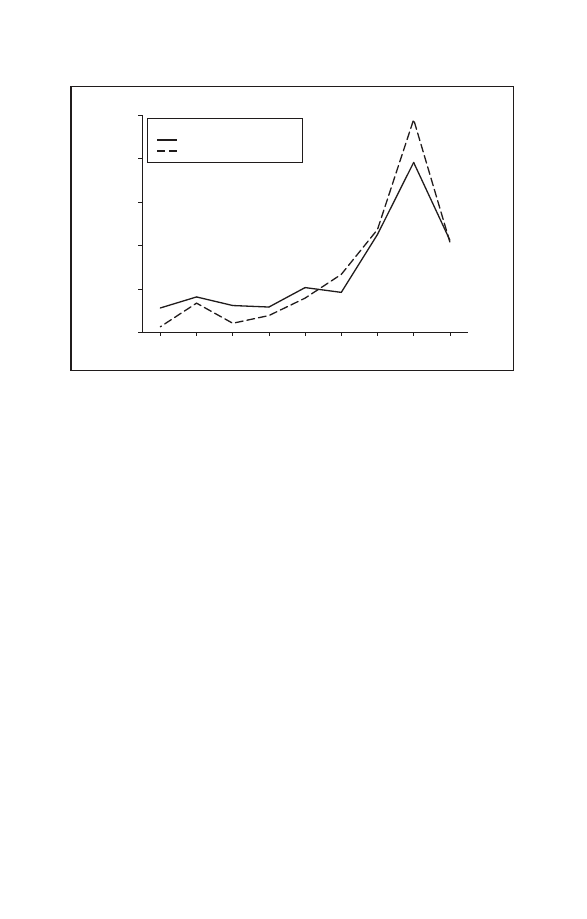
R E L I G I O U S E X T R E MI S M 59
When discussing the ideology of violent Islamism it is imperative to
distinguish between religious and quasi-religious extremism. While
the distinction may not always be strict and clear, it is most pertinent
to the central issues of this Research Report. ‘Purely’ religious terror-
ism has been mainly practised by a limited number of marginal,
closed religious groups and totalitarian sects. The religious extremism
that provides the ideological basis for many broader movements usu-
ally goes far beyond religion and theology as such to encompass
socio-political and socio-economic protest and issues of culture and
identity.
Nowhere is this pattern more evident than in the case of violent
Islamist extremism, including Islamist terrorism. Its quasi-religious
character stems partly from the quasi-religious nature of Islam in its
fundamentalist forms. Fundamentalist Islam provides a comprehen-
sive concept of a social, political, ideological and religious order—a
way of life and societal organization where religion, politics, state and
society are inseparable. At the transnational level, the quasi-religious
nature of radical Islamism is highlighted by the role it plays as an
ideology of globalized violent anti-system protest. In playing that role,
0
1000
2000
3000
4000
5000
2006
2005
2004
2003
2002
2001
2000
1999
1998
Number of injuries by:
nationalist/separatist groups
religious groups
Figure 3.4. Domestic terrorism injuries caused by nationalist/separatist and
religious groups, 1998–2006
Source: MIPT Terrorism Knowledge Base, <http://www.tkb.org/>.
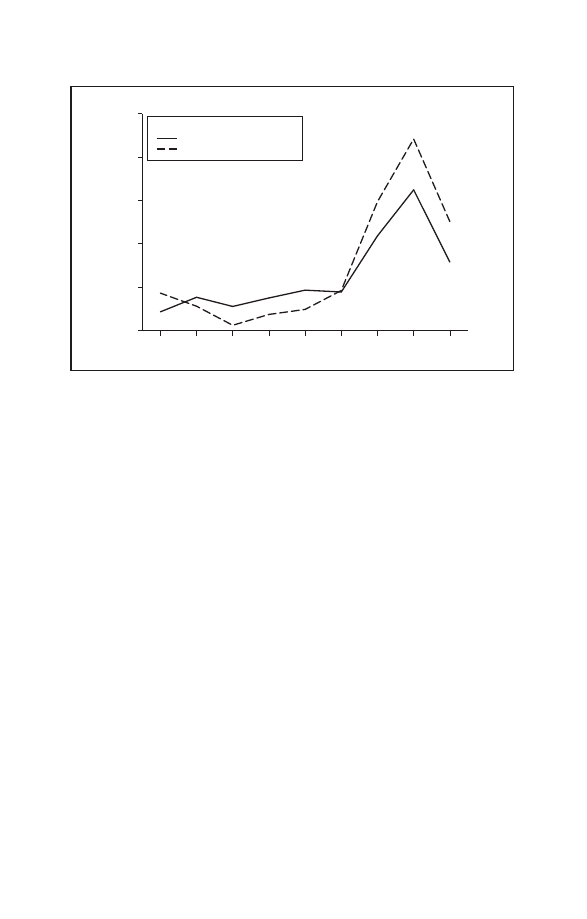
60
T E R R O R I S M I N A S Y M M E T RI CA L C O N F L I C T
transnational violent Islamism has largely replaced the secular inter-
nationalist communist and leftist ideologies of the past. At a more
localized level, the widespread combination of violent Islamism with
various forms of nationalism and ethno-separatism also underscores,
albeit in a different way, its quasi-religious character.
The links between religious radicalism and terrorism
The first major problem in studying the role played by religious rad-
icalism in motivating, supporting, attempting to justify and guiding a
certain group’s terrorist activity is similar to the main theoretical issue
raised in chapter 2 in relation to radical ethno-nationalism. The prob-
lem is that, while religious extremism may serve as a powerful driving
force and may also be effectively instrumentalized to guide and justify
terrorist activity, it does not necessarily or automatically lead to
terrorism or, indeed, to violence.
In some national orientalist and Islamologist traditions a basic dis-
tinction is made between Islamic fundamentalism, primarily in its
theological sense, and political Islamism. According to this interpret-
0
500
1000
1500
2000
2500
2006
2005
2004
2003
2002
2001
2000
1999
1998
Number of fatalities by:
nationalist/separatist groups
religious groups
Figure 3.5. Domestic terrorism fatalities caused by nationalist/separatist and
religious groups, 1998–2006
Source: MIPT Terrorism Knowledge Base, <http://www.tkb.org/>.

R E L I G I O U S E X T R E MI S M 61
ation, Islamic fundamentalism is practised by groups and individuals
that may be very strict in scriptural terms but do not engage in polit-
ical activism.
81
Political Islamism implies direct political action taken
to advance fundamentalist goals. The prevailing view, however,
seems to question this distinction as artificial. The term ‘Islamic fun-
damentalism’ is frequently used interchangeably with ‘Islamism’,
with the latter being the preferable term to denote politically active
and resurgent Islam.
82
Whatever it is called, modern Islamism is a complex and multi-
faceted phenomenon. Most commonly, it takes the form of broad
reformist socio-political movements (often referred to as legalist
Islamism). Despite their harsh criticism of and reservations about the
existing order, movements such as most national branches of the
Muslim Brotherhood or the Pakistan-based Jamaat-e-Islami are by and
large ready to work within the system, principally in their own states,
in order to change it.
83
More radical Islamism is represented by a set
of extremist currents that are most commonly and directly associated
with ‘violent jihad’ and are often—although not necessarily—engaged
in violent activity. Thus, while in the late 20th and early 21st centuries
Islamist terrorism has become the main form of transnational terror-
ism, Islamist movements and networks engage in a variety of activ-
ities dominated by different priorities. These may range from the
socio-political to the missionary, with jihad (interpreted as a holy war
against enemies of Islam) serving as the main priority for compara-
tively few groups.
The general distinction between mainstream (or legalist) and
extremist Islamist actors is certainly useful, but the way in which it is
commonly applied to the issues of violence and non-violence is a
simplification. Mainstream Islamists are commonly associated with
generally non-violent approaches, while all Islamist extremists at all
levels are automatically linked to violence and especially to terrorism.
The phrase ‘extremists and terrorists’ (as if these are always the two
81
The distinction between theological fundamentalism and political Islamism has often
been made by scholars of fundamentalist movements and is the prevailing approach in some
national orientalist schools, notably in the Russian Islamologist tradition. See e.g. Mala-
shenko, A., Islamskoe vozrozhdenie v sovremennoi Rossii [The Islamic renaissance in con-
temporary Russia] (Carnegie Moscow Center: Moscow, 1998).
82
See e.g. the articles ‘Fundamentalism’ and ‘Islamist’ in Esposito, J. L. (ed.), The Oxford
Dictionary of Islam (Oxford University Press: Oxford, 2003), pp. 88, 151.
83
For more detail see section III below.

62
T E R R O R I S M I N A S Y M M E T RI CA L C O N F L I C T
sides of the same coin), which has become common in all sorts of
reporting and writing on the subject, is not fully accurate either. While
all terrorists are extremists, extremists are not necessarily terrorists.
Even some of the most professedly extremist, anti-system Islamist
movements do not include armed jihad against their opponents as one
of their main priorities and are not willing to use violence, especially
against civilians. For instance, the Hizb ut-Tahrir movement in Cen-
tral Asia, which originated from the broader, strongly extremist and
transnationally active Hizb ut-Tahrir movement, has not just con-
sciously opted to abstain from the use of terrorist means but has
chosen non-violence in general.
The second problem in exploring the role of religious extremism in
the instigation and ideological justification of terrorism is that groups
using terrorist means in the name of religion do not necessarily repre-
sent some heretical, totalitarian ‘deviant sects’ or cults. Instead, they
are often guided by a radical interpretation of their religion’s basic
concepts, such as the radical militant interpretation of the essential
Islamic notion of jihad. The ideologues of such groups tend to argue
that, on the contrary, it is the moderate majority of the clergy and
ordinary believers that has deviated from the basic tenets of the faith
and call for a return to what they see as its untainted beliefs, values
and practices. The long road of ‘return’, or revival, would imply
stricter observance of the ‘original’ religious rules (which is precisely
what most religious fundamentalists opt for). Extremists, however,
tend to promote and follow a much shorter road of ‘purification’
though violence and self-sacrifice (i.e. suicide) in the course of the
‘holy war’.
Third, while some generalizations are possible in the analysis of the
relationship between religious extremism and terrorism, they should
be applied with extreme care. This care is required in view of the spe-
cific features of terrorism supported and inspired by different versions
of religious extremism. It is also dictated by the wide variety of
groups, movements and currents that may be associated with the
‘radical’ wing of the same confession. While these may be covered by
the same term, such as ‘Islamism’, only a few resort to violence, let
alone terrorism.

R E L I G I O U S E X T R E MI S M 63
II. Similarities and differences among violent religious
and quasi-religious groups
Certain general features are shared by most terrorist groups that are
guided by an ideology with a strong religious imperative.
First, for such organizations and movements the use of terrorist
means (and especially significant, large-scale or mass-casualty
attacks) usually necessitates formal blessing by some spiritual author-
ity or guide. These spiritual leaders may hold a senior or leading pos-
ition in the organization or may be independent of it.
84
For Islamist
terrorists, the formal blessing usually takes the form of a special reli-
gious and legal pronouncement (fatwa
85
), which legitimizes the use of
terrorist means and may either precede or follow the act of terrorism.
86
In fact, one of the main formal criteria for identifying an armed
group as the one whose ideological basis is predominantly religious is
precisely the presence of clerical figures in a group’s leadership. This
is especially so if this presence is combined with the consistent use of
religious rituals or sacred texts for the inspiration and justification of
violence, including terrorism, and for activities such as attracting and
recruiting new members. This extends to movements with multiple
leaders and networks with an even more dispersed, diversified or even
‘virtual’ leadership—a pattern that characterizes the post-al-Qaeda
transnational violent Islamist movement. Such a movement may be
associated with different types of religious leaders, scholars and
clerics; for example, the old generation of al-Qaeda scholars and the
new Internet generation of ‘jihadi scholars’.
The more politicized a group and the broader the range of its func-
tions are, the more likely it is that at least some of its spiritual guides
are based outside its formal organizational framework. For example,
when taking important decisions, including those concerning terrorist
84
Examples of spiritual guides with a leading position within their group include the late
Ahmed Yassin, founder of Hamas, Muhammad Hussein Fadlullah and Hassan Nasrallah of
Hezbollah, the Sikh leader Jarnail Singh Bhindranvale and the pseudo-Shinto ‘messiah’
Shoko Asahara of Aum Shinrikyo.
85
A fatwa is an opinion or ruling on Islamic law (sharia), traditionally made by highly
esteemed Islamic scholars to settle difficult or unclear cases.
86
See e.g. Lakhdar, L., ‘The role of fatwas in incitement to terrorism’, Special Dispatch
Series no. 333, Middle East Media Research Institute (MEMRI), 18 Jan. 2002, <http://memri.
org/bin/articles.cgi?Page=archives&Area=sd&ID=SP33302>.

64
T E R R O R I S M I N A S Y M M E T RI CA L C O N F L I C T
activity, the Hamas leadership may specifically consult Islamist the-
ologists and spiritual authorities outside the Palestinian territories.
87
In some cases, the spiritual leaders of a group do not have solid
theological credentials or clerical education. This usually points to the
group’s quasi-religious, rather than purely religious, character—that
is, to its goals and agenda being highly politicized. The best-know
example is, of course, bin Laden, who lacks any proper theological
credentials, education or reputation but effectively poses as a spiritual
leader and an oracle for the Muslim world. By issuing fatwas, he has
used an Islamic religious and legal instrument to convey what are
essentially political manifestos.
Second, groups that are indeed guided by a strong religious impera-
tive, as opposed to organizations that are merely formed on an ethno-
confessional or sectarian basis, tend to explicitly justify armed vio-
lence, including terrorism, by making direct references to sacred texts.
These texts are not necessarily apocryphal or heterodox but may
include the holy books or traditional writings that are fundamental to a
certain religion or confession, such as the Quran or the Hadith for
Islam.
88
Not surprisingly, different extracts from the same texts may
be employed by more moderate forces to justify exactly the opposite
point.
Third, both religious and quasi-religious terrorist groups do not
limit themselves to the use of sacred texts. They actively employ and
adjust religious and quasi-religious rituals and cults, such as self-sacri-
fice and the cult of martyrdom, for their purposes. In this way, those
who carry out a terrorist act see themselves and are perceived by their
group and its supporters as martyrs for faith. In contrast to many
secular militant organizations, for terrorist groups whose ideology is
strongly influenced by religious extremism, the upgrading of a terror-
ist attack to an act of faith (especially when carried out as an act of
self-sacrifice) effectively removes some of the basic constraints on
incurring mass casualties. It thus facilitates the perpetration of dead-
lier, large-scale attacks.
87
E.g. Hamas frequently uses the fatwas of Qatar-based Yusuf al-Qaradawi as source of
religious authority and posts them on its website. See e.g. Middle East Media Research Insti-
tute (MEMRI), ‘Sheikh al-Qaradhawi on Hamas Jerusalem Day online’, Special Dispatch
Series no. 1051, MEMRI, 18 Dec. 2005, <http://memri.org/bin/articles.cgi?Page=archives&
Area=sd&ID=SP105105>.
88
The Hadith are narrations about the life, actions and sayings of the Prophet Muhammad.

R E L I G I O U S E X T R E MI S M 65
No less important is the active use of religious symbols and images
and the interpretation of political reality through these symbols. While
religious symbols and images employed by violent groups may be as
basic and archetypal as are those used by nationalists in their myths,
they tend to be even more abstract and generalized. Even if they are
personalized—that is, associated with some specific political or reli-
gious figures—these images become symbolic of the ‘heroes’ or
‘enemies’ of faith and by definition become universalized by acquir-
ing sacred meaning.
In particular, religious extremists identify, interpret and see ‘the
enemy’ in much broader, almost universal terms than do secular
groups or ethno-confessional groups that do not emphasize religion.
The enemies may be personalized to some extent by certain key fig-
ures, but they are used as examples of the more generalized notion.
For instance, the standard calls by radical Islamist scholars associated
with the post-al-Qaeda movement are to ‘fight all the infidels, whether
apostates or Crusaders, nationals or foreigners, Arabs or non-Arabs’.
But they may specify the enemies: ‘their names be Abd al-Aziz
Bouteflika, Abdallah bin Abd al-Aziz, Abdallah bin Hussein,
Mu’ammar Qadhafi, or George Bush, Tony Blair, Sarkozy, or
Olmert’.
89
Ultimately, however, the enemy cannot be reduced to a
handful of individuals (as used to be the case for socio-revolutionary
terrorists of the late 19th century). Nor is it limited to a certain social
class or ethnic group (as is often the case for modern leftist or ethno-
nationalist radicals). Rather, the ultimate enemy is likely to represent
some generalized and impersonalized evil, a ubiquitous Satan. In
other words, for terrorists guided by a strong religious imperative, the
main protagonist can only be defined in very broad and rather blurred
religious (political, ideological, politico-geographic) categories. The
enemy may, for example, range from the West to the entire world of
unbelief, ignorance and materialism (jahiliyyah in Islam) or ‘all injus-
tice on earth’.
90
89
Quoted from a July 2007 statement by radical Islamist Internet generation scholar Abu
Yahya al-Libi as translated by the Global Research in International Affairs (GLORIA)
Center, Project for the Research of Islamist movements (PRISM) in Paz, R., ‘Catch as much
as you can: Hasan al-Qaed (Abu Yahya al-Libi) on Jihadi terrorism against Muslims in
Muslim countries’, PRISM Occasional Papers, vol. 5, no. 2 (Aug. 2007), <http://www.
e-prism.org/projectsandproducts.html>, p. 4.
90
Jahiliyyah is a traditional Islamic notion referring to the state of lawlessness and ignor-
ance in the pre-Islamic period; it literally means ‘ignorance’ in Arabic and is used to denote
ignorance of divine guidance. It is also employed by radical Islamists to denote the current

66
T E R R O R I S M I N A S Y M M E T RI CA L C O N F L I C T
Against this background, it is unsurprising that quasi-religious
Islamist ideology has emerged as the replacement for the secular rad-
ical socio-revolutionary ideas of the past as the main justification of
the type of modern terrorism that goes beyond localized contexts.
Transnational Islamist ideology is most effective at playing this role
for superterrorism with a global reach and agenda.
Fourth, while the demonstrative effect of a terrorist attack and
terrorism in general on a particular state, a group of states, or domestic
or international public is important, the main audience for terrorists
guided by strong religious imperative tends to be a witness of a much
higher order. For Islamist terrorists in particular, ‘Allah sufficeth as a
Witness’.
91
A terrorist act, especially one that involves self-sacrifice is
also important for the religious or quasi-religious terrorist himself.
Such an individual or collective ritual act is directed to the terrorist
himself and his religious associates to no less an extent than to the
enemy that is to be impressed and terrorized.
Finally, most religious, and especially quasi-religious, armed
extremist groups (regardless of their confession) do not as a rule draw
a clear distinction between religion and politics. This trend is most
developed in Islamist organizations, both those that do not use vio-
lence and those that engage in violent activity. This is in large part due
to the holistic, all-embracing nature of Islam, where legal and nor-
mative aspects of life are developed in far greater detail than in other
religions. In that sense, Islam, especially in its fundamentalist forms,
is more of a comprehensive concept of social order and organization,
at both the national and supranational levels, than other religions and
confessions. Islamist opposition groups, in particular—both legalist
movements and more radical violent organizations—have long used
religious discourse to embrace a broad range of essentially political,
social and economic demands.
A combination of all these characteristics helps to distinguish
between, on the one hand, groups for whom religion is nothing more
than an essential part of their ethno-confessional background and, on
state of unbelief, ignorance and materialism in the world that is not governed by norms of
fundamentalist Islam. See e.g. Qutb, S., Milestones (Unity Publishing Co.: Cedar Rapids,
Iowa, 1980), pp. 11–12, 19–22, 56 etc. See also section IV below.
91
Quran, sura 48, verse 28, transl. Muhammad Pickthall. This can also be translated as
‘Allah is enough for a Witness’ (transl. M. H. Shakir). Translations of the Quran by these
2 translators and by A. Yusufali are taken from The Noble Qur’an, University of South Cali-
fornia, Muslim Student Association, Compendium of Muslim Texts, <http://www.usc.edu/
dept/MSA/quran/>.

R E L I G I O U S E X T R E MI S M 67
the other hand, genuinely religious extremist groups. In this context, a
dictum by François Burgat, a leading French expert on Islam, stating
that ‘The Quran can “explain” Osama bin Laden no more than the
Bible can “explain” the IRA’ is, with due respect, not very accurate.
92
While all IRA members are Catholic, the group (in contrast, for
instance, to Hamas or al-Qaeda) did not systematically employ reli-
gious sermons or quote from sacred texts to justify armed violence.
Nor did the IRA require clerical authorities to sanctify violence and,
specifically, the use of terrorist means.
Along with the above common features shared by most terrorist
groups with a strong religious imperative, there are multiple and
major differences among them in terms of structure, scope and types
of activity. The most basic distinction can be made between totali-
tarian religious sects (such as the pseudo-Shinto Aum Shinrikyo or the
US-based radical Christian movements) and religious and quasi-
religious groups of all other types.
For instance, while totalitarian messianic sects and cults have very
strict hierarchies, religious and quasi-religious groups of other types
are very diverse in their organizational forms. The latter groups may
range from broad religious, social and political grass roots movements
to small radicalized cells that have split off from larger, usually more
moderate, movements and communities. Other than the strictly hier-
archical totalitarian sects, most groups guided by a religious impera-
tive tend to be more loosely structured than, for instance, ethno-
nationalist organizations. Violent Islamist groups and movements,
especially those active at the transnational level, appear to have the
most flexible, fragmented, networked yet surprisingly well coordin-
ated structures. Their semi-autonomous multiple cells constantly adapt
themselves to the environment, resurface and interact in various com-
binations and reorganize themselves.
93
It should also be kept in mind that, in contrast to al-Qaeda and the
post-al-Qaeda transnational Islamist movement, most groups that
operate locally and are Islamist or have become Islamicized effect-
ively combine religious extremism with radical nationalism. This is
the case in Chechnya, Iraq, Kashmir or Mindanao. This means that
both the ideologies and structures of such groups are affected by the
specific local contexts, multiple—ethnic, tribal, regional and
92
Burgat, F., Face to Face with Political Islam (I. B.Taurus: London, 1997), p. xv.
93
On organizational patterns of terrorist groups see chapters 4 and 5 in this volume.

68
T E R R O R I S M I N A S Y M M E T RI CA L C O N F L I C T
national—cultures and identities and other characteristics. This makes
the range of groups that employ religion as an ideological basis for
terrorist activity even less homogeneous.
The ideological and structural diversity of these violent groups may
also be demonstrated by their different degrees of involvement in
politics or social and humanitarian work. In addition, there are differ-
ent approaches towards apostates who used to be active members of a
militant organization but have left or split from it. While in totalitarian
religious sects such a betrayal is often punished by death, for Islam-
ists, for instance, it does not necessarily pose a major problem from an
organizational point of view. Despite multiple splits and feuds, the
high degree of structural flexibility and fragmentation in Islamist net-
works, such as the Jemaah Islamiah (JI) network in South East Asia,
enables them to form new alliances with the splinter groups and gives
the former apostates a chance to rejoin the movement. This is in line
with the principle that the best way to repent for someone who has
betrayed ‘jihad’ is to wage ‘jihad’.
94
These ideological and structural
principles help maintain overall organizational stability and sustain-
ability despite constant splits, regroupings and transformations.
III. Terrorism and religion: manipulation, reaction and
the quasi-religious framework
There are different analytical approaches to the role that the ideology
of religious extremism plays in the justification, sanctification, motiv-
ation and ideological support of terrorism. Most of them can be
categorized by their emphasis on either pragmatic manipulation or
broader reaction to social, political, identity and other factors. While
the first approach is focused on the terrorists’ manipulation of religion
for political purposes, the second approach views religious extremism
itself as a form of genuine socio-political protest.
94
On how this principle is applied in the case of JI see International Crisis Group (ICG),
Recycling Militants in Indonesia: Darul Islam and the Australian Embassy Bombing, ICG
Asia Report no. 92 (ICG: Brussels, 22 Feb. 2005), <http://www.crisisgroup.org/home/index.
cfm?id=3280>, p. 7.

R E L I G I O U S E X T R E MI S M 69
Manipulation
Those analysts who emphasize various manipulative and instrument-
alist interpretations try to address the problem in a more applied sense.
These are mostly analysts or political commentators who specialize in
security issues, including terrorism, but lack expertise in Islam and
Islamism per se. They argue that Islamist and other religious extrem-
ism is simply manipulated for political purposes by terrorist groups
and especially by their leaders and ideologues.
95
Indeed, it should be
recognized that religious extremism can be effectively instrumental-
ized to some extent in terrorism-related contexts for several reasons.
First, religious extremism provides both a convenient means to
communicate a political message and a ready-made information
system. This system of well-established channels of communication is
formed by a network of religious study groups, associations, institu-
tions, publications, websites, Internet blogs and forums and so on. It
enables a terrorist group to convey its message in a religious form,
including by formal religious legal rulings. This communicative
advantage of framing a message in religious form and discourse
allowed bin Laden and some other leaders of the transnational violent
Islamist movement, who were not recognized clerical figures, to issue
essentially politico-military manifestos in the form of fatwas.
96
This
approach can be summed up as follows. The terrorists’ message may
not necessarily be explicitly religious, but they skilfully use a reli-
gious form to deliver this message both to ‘the enemy’ and to as broad
an audience as possible and to give it additional power of persuasion.
Second, socio-political, ethno-nationalist and other resentment may
often be channelled into religious discontent. This resentment is then
articulated in religious categories and discourse. An additional advan-
tage of channelling socio-political and especially ethno-nationalist
resentment into religious form is that it may effectively help to trans-
nationalize a group’s agenda and broaden its constituency. In the vac-
uum that results from a lack of equally powerful secular ideologies in
95
In the early 21st century, one of the most prominent proponents of this view has been
Bruce Hoffman. See e.g. ‘Religion and terrorism: interview with Dr. Bruce Hoffman’,
Religioscope, 22 Feb. 2002, <http://www.religioscope.com/info/articles/003_Hoffman_terror
ism.htm>. This is in contrast to his earlier views of ‘religious terrorism’ interpreted as vio-
lence that is first and foremost a ‘sacramental act or divine duty executed in direct response to
some theological demand or imperative’. Hoffman, ‘ “Holy terror” ’ (note 77), p. 272.
96
See also section II above.

70
T E R R O R I S M I N A S Y M M E T RI CA L C O N F L I C T
the early 21st century, resort to religious extremism allows terrorists
to extend their constituency far beyond, for instance, members of a
certain ethnic group. Instead, they can appeal to an audience of many
millions within a broader religious community. There their message
can receive much broader support, even if their tactics are rejected by
the majority of that community.
It cannot be denied that a certain degree of manipulation of the reli-
gious factor by modern terrorists and especially by their leaders and
ideologues along the lines described above does take place. Overall,
however, this approach tends to significantly simplify the link of
terrorism with religion and, more specifically, religious extremism. It
ignores or downplays a set of objective socio-political and cultural
changes in the Muslim world that are going on under the multiple
pressures of modernization, globalization and Westernization. These
pressures reinforce (and are themselves aggravated by) the perception
among many Muslims of the essentially anti-Islamic nature of the
policies of the USA, other Western states and ‘impure’, corrupt,
Westernized and elitist regimes in many Muslim countries. This
vision is also reinforced by the perceived long history of repression
and suppression of Muslims by colonial powers, secular nationalist
regimes, and so on. Finally, the serious problem with the approach
that emphasizes a manipulative connection between terrorism and reli-
gion is that it almost by definition denies terrorist groups and their
leaders genuine religiousness and religious conviction.
Reaction
In contrast, such prominent scholars as François Burgat and John
Esposito, while they differ in their explanations of Islamism, agree
that it has more fundamental roots and a broader role to play. The role
of religious radicalism is seen by these and other scholars of Islam as
a reaction of part of the disillusioned elites and societies in the
Muslim world to some painful social and socio-political realities
associated with traumatic modernization, secularization and Western-
ization.
97
More specifically, it is also a reaction to the dominant pat-
97
This includes the prevalence of ‘corrupt authoritarian governments and a wealthy elite
. . . concerned only with its own economic prosperity, rather than national development, a
world awash in Western culture and values’. Esposito, J. L., Unholy War: Terror in the Name
of Islam (Oxford University Press: Oxford, 2002), p. 27.

R E L I G I O U S E X T R E MI S M 71
terns of political violence in their own societies and to certain policies
of international actors, who are perceived as meddling, aggressive and
anti-Muslim. Some authors go even further, arguing that Islamist
activism in particular is not merely a reactive force but incorporates
elements of genuine socio-political protest that are more in line than
in conflict with the drive toward modernization.
98
It may be added by the present author that Islamism as a reaction to
these broad social, political and cultural processes is to some extent
inevitable and in this sense is close to being a reflex or symptom.
Even if some of the ideologues of violent Islamism refuse to see their
own actions as defensive and reactive, all Islamist terrorist groups
tend to become active in an environment that they perceive as a crisis,
or even as catastrophic. They see these crisis conditions as threatening
the identity or physical survival of their social or ethno-confessional
group or of a much broader community, such as the entire Muslim
umma. They also effectively build on real grievances based on past
and present injustices (such as the US-led interventions in Afghani-
stan and Iraq) committed by Westernized ‘modernists’, ‘aliens’ or
‘non-believers’ against a community in whose name terrorists claim to
speak and act.
The reactive character of violent Islamist extremism, especially
when it reaches the point of resort to terrorism, is most evident wher-
ever there is something against which to react. The rise, radicalization
and militarization of Islamist groups and movements is most common
in areas of the closest contact with different political, governance,
socio-economic and value systems. Those points of contact range
from Muslim diasporas in Western countries to areas of visible West-
ern presence in the Muslim world. Some of the most problematic
cases are those of the US-led interventions in Afghanistan and Iraq,
the US military presence in the Arab states of the Gulf and the Israeli
occupation of Palestinian territories. The points of contact may also
include those Muslim states that have themselves been most affected
by rapid, uneven, particularly painful and traumatic modernization
and secularization (e.g. Egypt). These trends further widen the gaps
between the bulk of the population in those countries and the rela-
tively secularized elites and between modern and traditional ways of
life.
98
According to Burgat, Islamism may thus even pose as a progressive force in conserva-
tive Islamist clothing. See e.g. Burgat (note 92), pp. xiii, xvi, 165–166, 179.

72
T E R R O R I S M I N A S Y M M E T RI CA L C O N F L I C T
Needless to say, analytical approaches that follow this general
direction and are rooted in Islamic and orientalist studies, socio-
ideological analysis or political sociology are more accurate and ade-
quate in their analysis of Islamism. Unfortunately, they too fail to
provide a full explanation of the phenomenon of Islamist terrorism. It
even seems that the more the world’s leading academic experts on
Islam are interested in broader social, political, cultural and identity
aspects of Islamism, the less specific interest they show in Islamist
violence, including terrorism. They seem to be more likely to dismiss
different forms of such violence, especially terrorism, as mere
excesses of an extremist fringe and to disregard the entire phenom-
enon as simply marginal.
99
Also, their vast knowledge of Islam and
Islamism in broad comparative national and cultural contexts is rarely
matched by an equal degree of familiarity with terrorism as a specific
tactic of political violence. For example, terrorism is often confused
with other modes of operation or with violence in general.
100
In other
words, those academics who are best at explaining Islamism have
problems with, or show little interest in, explaining Islamist terrorism.
However, the phenomenon of Islamist terrorism, especially in its
transnational forms that are not confined to any specific local context,
needs to be explained. It cannot simply be dismissed or ignored, if
only because this ‘extremist fringe’ has managed to attract dispropor-
tionately high political attention to its programme and goals. In media
and public discourse it has effectively managed to outmatch the mul-
tiple varieties of mainstream political Islam. As a result, in terms of
political impact, cells of the transnational Islamist movement employ-
ing terrorist means can be more accurately described as an ‘over-
whelming minority’ than as a ‘marginalized minority’. Also, while it
is not just the Islamist fringe that uses violence in Muslim states and
regions, the kind of violence that is the focus of this Research
Report—asymmetrical, mostly indiscriminate terrorism against civil-
ians—is the tactic dominated by fringe actors.
99
Burgat (note 92), pp. xvi, 167, 178.
100
Most Islamologists tend not to define terrorism and many often use ‘terrorism’ as a
synonym for ‘violence’. This leads them to all sorts of confusion, such as references made to
‘terrorism in early Islam’. E.g. Esposito (note 97), pp. 29, 36, 41. In contrast, experts special-
izing in terrorism attribute the emergence of ‘terrorism’ as a specific tactic of politically moti-
vated violence to the second half of the 19th century at the earliest and usually distinguish it
from the broader term ‘terror’, which has a longer history.

R E L I G I O U S E X T R E MI S M 73
The quasi-religious framework
If the world’s most sophisticated scholars of Islam keep under-
estimating or de-emphasizing Islamist violence in the form of terror-
ism, there should be no surprise that the vacuum is filled by studies of
a speculative nature and unsatisfactory quality. If serious Islam-
ologists, political sociologists and cultural anthropologists do not
come up with a thorough explanation for Islamist terrorism, the field
will continue to be dominated by security experts.
One way to overcome this problem is to supplement the broader
socio-ideological and politico-sociological approach to Islamism and
Islamist violence with an emphasis on the quasi-religious nature of
modern violent Islamism. There are two possible extremes—both of
which should be avoided—in interpreting the quasi-religious nature of
Islamism in general and violent Islamism in particular.
One extreme is to stress the ‘religious’ part of the term ‘quasi-
religious. This approach, which largely reduces Islamist terrorism to
purely religious terrorism, is still popular among Western analysts.
This view de-emphasizes the fact that the violent Islamists’ demands
are never just theological and are equally, if not more, political. Nor
does it sufficiently take into account the radical Islamist interpretation
of religion itself, according to which ‘Religion means the system and
way of life that brings under its fold human life with all its details’.
101
This interpretation goes beyond the standard contemporary Western
understanding of religion and its role in society.
In this context, it is important to note that the end state of Islamism,
both violent and non-violent—an Islamic Caliphate that is ultimately
to spread all around the world
102
—is by no means an analogue of a
theocratic state in its Western interpretation. The global Islamic
Caliphate is not an Islamist version of the Roman Catholic Vatican.
Rather than the rule of a clerical hierarchy, the Caliphate is supposed
to embody the ‘direct rule of God’. Finally, even the most radical
Islamist ideologues advocating violence in the name of ‘jihad’ concur
that, while an Islamic order can be imposed by force, this is not the
same as imposing Islam as a religion by force. It is accepted that Islam
101
Qutb, S., ‘War, peace, and Islamic Jihad’, eds M. Moaddel and K. Talattof, Contemp-
orary Debates in Islam: An Anthology of Modernist and Fundamentalist Thought (Mac-
millan: Basingstoke, 2000), p. 231.
102
Caliphate is the Islamic form of government based on the ‘direct rule of God’ and
uniting all Muslims. The Ottoman Empire is considered to be the ‘last Caliphate’.

74
T E R R O R I S M I N A S Y M M E T RI CA L C O N F L I C T
‘forbids imposition of belief by force, as is clear from the [Quranic]
verse, “There is no compulsion in religion”’.
103
In the Islamist trad-
ition, the mere fact of someone having a different belief has generally
not been seen as a sufficient cause for violent jihad. As stated by
Sayyid Abul Ala Maududi, founder of Jamaat-e-Islami, ‘the objective
[of jihad] is not to coerce the opponent to relinquish his principles but
to abolish the government which sustains these principles’.
104
An opposite extreme is to stress the ‘quasi’ element in violent quasi-
religious Islamic extremism. This view stresses the essentially polit-
ical anti-Western, anti-imperialist and anti-neocolonialist goals of
violent Islamism while de-emphasizing any specific religious motiv-
ation and mobilization power. This bias is not limited to those who
emphasize the manipulative aspect of quasi-religious extremism and
deny its religious aspects any more significant role than that of a form
or communication channel. It may also be shared by some of those
scholars who focus on the reactive nature of the link between religious
extremism and violence but underestimate the power of ideology and
religious doctrine and belief to influence ‘the forms of action favoured
by Islamist movements’. These forms of action are seen as ‘directly
inspired by dominant political actors at both local and international
levels’. At the transnational level, violent Islamism is interpreted as
little more that a protest against ‘the current impasse in relations
between a large part of the Muslim world and the West—especially
the US’.
105
In fact, as shown in the rest of this chapter, the dialectic nature of
modern violent Islamism implies a combination of genuine religious-
ness with the use of a religious framework for communication and to
justify and legitimize political–militant action and goals. The central
importance of a high degree of religious conviction and of the notion
of faith (imaan) as an ultimate test, goal and standard of armed strug-
gle should not be underestimated.
103
Qutb (note 101), p. 227. The quote from the Quran is sura 2, verse 256.
104
Maududi, S. A. A., ‘Jihad in Islam’, Lecture given in Lahore, 13 Apr. 1939, reproduced
in Laqueur, W. (ed.), Voices of Terror: Manifestos, Writing and Manuals of Al-Qaeda,
Hamas, and Other Terrorists from around the World and throughout the Ages (Reed Press:
New York, 2004), p. 400.
105
Burgat (note 92), pp. xiii, xv. This view is summarized by Burgat’s call to rely on
‘political sociology’, rather than ‘holy books’, in trying to understand Islamism, including
violent Islamism. Burgat (note 92), p. 8. In contrast, the argument made in this study can be
summarized as ‘both are essential’.

R E L I G I O U S E X T R E MI S M 75
IV. The rise of modern violent Islamism
An analysis of contemporary violent Islamism requires at least a brief
historical overview. There is no need to retell the history and pre-
history of modern Islamism in great detail, as it has been done well
elsewhere by orientalist and Islamic studies scholars.
106
However, sev-
eral landmark developments should be mentioned.
The Islamic fundamentalist movement (Salafism) has its roots in the
painful reaction of the Muslim world, and especially of its Sunni part,
to the fall of the ‘last Caliphate’—the Ottoman Empire—following
the end of World War I.
107
Over the following decades, the theory and
practice of Islamism—political activity to advance the fundamentalist
agenda, with the re-establishment of the Islamic Caliphate as the rhet-
orically ultimate goal—started to develop. It is important to stress that
the early Islamist movements were non-violent. They gave rise to a
moderate current in Islamism (now often referred to as legalist), while
the more radical current took longer to form.
The reactive nature of Islamic fundamentalism and Islamism in
response to painful, ineffective and elitist modernization (which is
primarily blamed by Islamists on Westernization) should be kept in
mind. At the same time, the power of secularized modernization in the
post-World War II period—and of nationalist, left-wing and other
ideologies associated with it—in socio-political, economic and cul-
tural spheres should not be underestimated. Throughout the 20th cen-
tury most anti-colonial movements in the Arab world were guided by
secular nationalist ideologies. Examples include Nasserism in Egypt,
106
In addition to works cited above, suggested background texts include: Ayoob, M. (ed.),
The Politics of Islamic Reassertion (St. Martin’s Press: New York, 1981); Ayubi, N. N.,
Political Islam: Religion and Politics in the Arab World (Routledge: London, 1991); Roy, O.,
The Failure of Political Islam (Harvard University Press: Cambridge, Mass.,1994); Esposito,
J. L. (ed.), Political Islam: Revolution, Radicalism or Reform (Lynne Rienner: Boulder,
Colo., 1997); Tibi, B., The Challenge of Fundamentalism: Political Islam and the New World
Disorder (University of California Press: Berkeley, Calif., 1998); Rubin, B. (ed.), Revolution-
aries and Reformers: Contemporary Islamist Movements in the Middle East (State University
of New York Press: Albany, N.Y., 2003); Wiktorowicz, Q. (ed.), Islamic Activism: A Social
Movement Theory Approach (Indiana University Press: Bloomington, Ind., 2004); and
Keppel, G., The Roots of Radical Islam (Saqi: London, 2005).
107
The Ottoman Caliphate was formally abolished by Turkish President Mustafa Kemal
Atatürk in 1924.

76
T E R R O R I S M I N A S Y M M E T RI CA L C O N F L I C T
Baathism in Iraq and Syria, the Neo-Destour movement (or Bourguib-
ism) in Tunisia, as well as the FLN in Algeria and the PLO.
108
The moderate, legalist current in modern Islamism can be traced
back to the emergence of two organizational networks. One is the
Jamaat-e-Islami movement, founded in 1941 in British-ruled India by
Maududi and now based in Pakistan. The other is the Muslim Brother-
hood movement that was established by Hassan al-Banna in Egypt in
the late 1920s and early 1930s and was actively opposed to secular
Nasserism in the post-World War II period. Subsequently, many other
Islamist groups were formed within these broad movements or in
association with them. Jamaat-e-Islami and the Muslim Brotherhood
called for the gradual transition to Islamic rule and the creation of
Islamic states through peaceful means as an alternative to secular,
Western-style socio-political development and modernization. In
theological terms, these moderate Islamists were in many ways close
to Saudi Wahhabism, which forms the basis for the Islamic state in
Saudi Arabia and its structures such as the Council of Senior
Ulema.
109
Jamaat-e-Islami and most branches of the Muslim Brother-
hood, which are active in many countries, have effectively combined
religious reformism with political mobilization. In modern Egypt, for
instance, legalist Islamists represent the only mass-based political
movement.
108
Nasserism is a secular pan-Arab socialist nationalist ideology (Arab socialism) associ-
ated with the name of Egyptian President Gamal Abdel Nasser (president, 1954–70).
Baathism is another version of a pan-Arab nationalist, Arab socialist ideology. The Baath
Party was founded in Syria in 1947 and a branch was established in Iraq in 1954. It came to
power in both countries in 1963. Baathists remain in power in Syria but were deposed in Iraq
in 2003 by the US-led invasion.
The Tunisian Neo-Destour (New Constitution) Party succeeded the nationalist Destour
Party in 1934 as a secular, modernist national liberation movement against French colonial
rule. It was founded and led by Habib Bourguiba, who became the first president of independ-
ent Tunisia in 1957. For a brief period, from the mid-1960s until the early 1970s, the move-
ment experimented with socialism.
On the FLN see chapter 2 in this volume, section II.
The PLO—a multi-party Palestinian political confederation of a nationalist and mostly
secular character—was founded in 1964 as a national liberation resistance movement. See
also chapter 2, section II.
109
Wahhabism is the movement of followers of Muhammad ibn Abd al-Wahhab
(1703–92), who called for the ‘purification’ of Islam and the revival of its ‘original’ version
that should strictly replicate the way of life of the Prophet Muhammad and the first gener-
ations of Muslims. Wahhabism has been the official form of Islam in Saudi Arabia since the
kingdom’s creation in 1932. The Council of Senior Ulema (or Higher Council of Ulema) is a
body for regular consultations between the monarch and Saudi religious leaders (ulema)
created in 1971.

R E L I G I O U S E X T R E MI S M 77
Sayyid Qutb, an Egyptian school inspector who was one of the
founders of modern radical Islamism,
110
not only developed but also
revised some of al-Banna’s ideas. Qutb became one of the main ideo-
logues of contemporary violent Islamism (commonly, but not entirely
correctly, referred to as ‘jihadi Islamism’).
111
While other radical
thinkers contributed to developing this trend, he stands out as the
author of the most comprehensive, intellectually coherent and profess-
edly extremist interprêtation of violent jihad. His powerful message
inspired many radicals in his own time, but has truly resonated
decades later with the emergence of al-Qaeda and the post-al-Qaeda
movement of the late 20th and early 21st centuries.
Qutb characterized modern society as being ‘steeped in Jahiliyyah’
that, like a ‘vast ocean’, ‘has encompassed the entire world’.
112
He
considered the new jahiliyyah of the modern age to be much worse
than ‘the simple and primitive form of the ancient Jahiliyyah’ that
preceded the coming of the Prophet Muhammad.
113
Qutb regarded any
society as being part of jahiliyyah as long as it ‘does not dedicate
itself to submission to God alone, in its beliefs and ideas, in its obser-
vances of worship, and in its legal regulations’. Not surprisingly, no
existing societies met this definition, which for Qutb meant that they
were all jahili.
114
Qutb’s earlier interest in socialism was reflected in a clear social
connotation to his interpretation of jahiliyyah. Among its essential
characteristics he listed exploitation, social injustice, oppression of the
poor majority by the rich minority and tyranny. According to Qutb,
jahiliyyah rots morale and spreads like a disease so that the people
may not even suspect that they are ‘infected’.
Qutb regarded Western society in particular as materially prosper-
ous but morally rotten, ‘unable to present any healthy values for the
guidance of mankind’ and possessing nothing that ‘will satisfy its own
110
The historical roots of radical Islamism date back to the 13th and early 14th centuries,
with Ahmad ibn Taymiyyah (1263–1328) considered to be one of its spiritual fathers. See e.g.
Esposito (note 97), pp. 45–46.
111
On Qutb’s return from a trip to the USA, where he studied in the late 1940s, he joined
the Muslim Brotherhood, was arrested for his opposition to the Nasser regime and was exe-
cuted in 1966 on charges of attempting to overthrow the secular Egyptian Government.
112
Qutb (note 90), pp. 10, 12.
113
Qutb (note 90), p. 11.
114
Qutb (note 90), p. 80.

78
T E R R O R I S M I N A S Y M M E T RI CA L C O N F L I C T
conscience and justify its existence’.
115
However, what distinguished
Qutb is that he not only fully recognized the power of modernization
but was also quite rational in supposing that jahiliyyah might prevail
over Islam. Qutb saw people as being slaves to material benefits and
animal instincts, which form the main essence of the modern unspirit-
ual world, and as having no intention or motivation to counter or
restrain these instincts.
According to Qutb, this problem can only be solved by creating a
society of a new type that under the leadership of Islamists will be
able to establish and sustain the moral framework required to success-
fully confront jahiliyyah. The powerful moral imperative and social
accent in Qutb’s conceptual thinking are further reinforced by ideas
that may even appear to be reminiscent of anarchism, especially inas-
much as he rejects state power. In this interpretation, Islam is viewed
as ‘a universal declaration of man’s freedom from the servitude to
other men’.
116
It strives ‘to annihilate all . . . systems and governments
that establish the hegemony of human beings over their fellow beings
and relegate them to their servitude’, and for an ‘all-embracing and
total revolution against the sovereignty of man in all its types, shapes,
systems, and states’.
117
Remarkably, well before the debates on globalization emerged,
Qutb’s Islamism in many ways had already presented an alternative
version of globalization. Essentially, it advanced its own vision of
supranational globalism. This type of globalism is based on and ruled
by Islam but provides for cultural and ethno-confessional pluralism
(on condition that their adherents recognize the primacy of the ‘One
God’). All this has made Qutb’s Islamism not just an extremist theory,
but also a powerful and a surprisingly modern ideology that gives a
radical, fundamentalist response to the challenges of the modern
world.
While rejecting any possibility of a compromise between Islam and
jahiliyyah, or between God and Satan, Qutb was fully aware of the
difficulties that the fight against jahiliyyah entails. He was particularly
115
Qutb (note 90), p. 7. It is interesting to note that Qutb also denounced the Marxist
ideology of the Communist states. While recognizing that many people were attracted to
Marxism as ‘a way of life based on a creed’, he argued that ‘This ideology prospers only in a
degenerate society or in a society which has become cowed as a result of some form of pro-
longed dictatorship’. Qutb (note 90), p. 7.
116
Qutb (note 101), p. 227; see also p. 231.
117
Qutb (note 101), pp. 228, 231.

R E L I G I O U S E X T R E MI S M 79
sceptical about the chances for getting any significant support from
the ‘passive public masses’ in this undertaking. Thus, he put forward
an idea of a vanguard elite protest movement. It should lead the
masses to realization of the ‘Supreme Truth’ through the ‘revolution
from above’, carried out through a variety of means, including armed
jihad.
118
In many ways, this vision forestalled the emergence of the
loosely organized al-Qaeda movement over the 1990s. It can even
more accurately describe the more fragmented and looser network of
semi-autonomous or fully autonomous cells of the post-al-Qaeda
movement of the early 21st century.
In Qutb’s opinion, this vanguard takes on the mission of reviving
Islam, ending the power of man over other men and establishing the
rule of God. In order to achieve its mission, it should separate itself
from the ‘impure’ environment, ‘become independent and distinct
from the active and organized jahili society whose aim is to block
Islam’.
119
It is in line with this principle that the multiple autonomous
cells of the contemporary transnational violent Islamist movement are
formed. It is striking that even if the members of the modern Islamist
cells inspired by al-Qaeda are not necessarily familiar with Qutb’s
writings, the cell-formation process tends to follow the precepts that
he laid out.
The rise of violent Islamism, in both theory and practice, was also
prompted and facilitated by a set of political and politico-military
developments of the late 1970s and early 1980s. The anti-Shah revo-
lution in Iran in 1979–80 for the first time proved that a mass-based
Islamist movement could come to power through violent means.
Following the anti-Soviet ‘jihad’ in Afghanistan in the 1980s, the
Salafi militants who returned to their countries maintained trans-
national links among themselves and formed links with various local
Islamist groups. In this way, they created the first vanguard-type cells
that Qutb had dreamt of and stimulated the new rise of radical Islam-
ism, now in their own countries. The victory by the Islamic Salvation
Front in the first round of general elections in Algeria in December
1991 demonstrated the possibility of Islamists coming to power by
peaceful means. The cancellation of the second round of the elections
led to the rapid radicalization of Algerian Islamists and prompted
them to turn to armed struggle.
118
Qutb (note 101), p. 231; and Qutb (note 90), pp. 12, 79–80.
119
Qutb (note 90), pp. 20, 47.

80
T E R R O R I S M I N A S Y M M E T RI CA L C O N F L I C T
Despite many tactical differences between the followers of the
moderate and the more radical currents in modern Islamism, in theory
they ultimately seek to advance the same goals. Both the moderates
and the radicals seek to spread the Islamist ideology among the
masses and to build Islamic states. At least in rhetorical terms, the
moderates also ultimately aspire to create, or restore, the supra-
national, quasi-religious Islamic Caliphate and spread its power to the
rest of the world. Both associate socio-economic and political
modernization with Westernization and perceive it to be a ‘conspiracy
against Islam’. For both, religion not only fully dictates the way of life
but is also inseparable from the state.
The difference then is primarily in the methods used to achieve
these goals and in a different order of priorities. Some Islamist move-
ments stand for building an Islamic state and society by peaceful
means only, through persuasion and propaganda. In contrast, the vio-
lent Islamists opt for the use of all possible means, including armed
struggle, to advance towards the Caliphate.
An inherent political advantage of the Salafi movement, in both its
passive fundamentalist and active Islamist forms, is its supra-political
character. It is most evident and becomes particularly important in a
those Muslim-dominated societies that are split along socio-political,
ethnic, clan or any other lines. The all-encompassing nature of the
Caliphate as the final goal allows Salafism to bring together groups
that otherwise have little in common with one another in political
terms. An extremely blurred and distant nature of Salafists’ declared
ultimate goal is far enough from a concrete political programme to
allow very different forces to unite under its banner. The violent
Islamists further expedite matters by considering direct participation
in jihad to be the main requirement and the shortest way to come
closer to the first generations of coverts to Islam.
It is this radical tradition that al-Qaeda, as the core of the broader
transnational militant Islamist movement of the late 20th and early
21st centuries, has fed on. In this case the further development of
violent Islamism from Qutb to his present followers and interpreters
took a very concrete form of personalized succession. Under the
strong influence of Qutb and under the deep impression made by his

R E L I G I O U S E X T R E MI S M 81
execution, a young Egyptian from a noble family,
120
Ayman
al-Zawahiri, the future spiritual mentor and closest associate of bin
Laden, founded his own radical Islamist vanguard cell—Islamic Jihad.
This group split from the Muslim Brotherhood movement alongside
another radical organization, Gamaat al-Islamiya. The Qutbist inter-
pretation of jahiliyyah can be clearly traced in all of bin Laden’s
statements on the West in general and the USA in particular—in bin
Laden’s words, it is ‘the worst civilization witnessed by the history of
mankind’.
121
An even more direct ideological influence on bin Laden
was provided by the Palestinian-born Islamic scholar-militant Abdul-
lah Azzam, who participated in armed struggle against Israel and in
anti-Soviet jihad in Afghanistan. In his time at al-Azhar University in
Egypt in the early 1970s, Azzam became acquainted with the Qutb
family and al-Zawahiri. He later met with bin Laden when lecturing at
King Abdulaziz University in Saudi Arabia and became his ideo-
logical mentor. The Soviet intervention in Afghanistan prompted
Azzam to revive the 13th–14th century scholar Ahmad ibn Tay-
miyyah’s interpretation of ‘the repulsion of the enemy aggressor who
assaults the religion and the worldly affairs’ as ‘the first obligation
after Iman’ (i.e. after faith itself).
122
Some moderate Islamist movements have evolved to become more
radical and extremist forms and to use violence instead of or, more
commonly, in addition to non-violent means. This is the path that
Hamas has taken. It developed from a non-violent fundamentalist
social movement originating from a Gaza branch of the Muslim
Brotherhood network. This branch, which was established well before
Israel occupied the Gaza Strip in 1967, suffered repression from
Nasser’s secular regime in Egypt. For the first two decades of Israeli
occupation, the movement devoted itself to religious, social and
humanitarian work. It was only in 1987 that it formally established
itself as Palestinian resistance movement and joined the armed strug-
120
While in terms of social background, most radical Islamists represented the lower
middle class (officers, lower-level officials, clerks, school teachers, traders), some of their
leaders and ideologues came from the upper classes or even had aristocratic background.
121
‘Full text: bin Laden’s “letter to America” ’, The Observer, 24 Nov. 2002.
122
Azzam, A., Defence of the Muslim Lands: The First Obligation after Iman, English
translation of Arabic text (Religioscope: Fribourg, Feb. 2002), <http://www.religioscope.com/
info/doc/jihad/azzam_defence_1_table.htm>, chapter 1. The original text was written in the
early 1980s. On Azzam’s contribution to the radical interpretation of ‘jihad’ see section V
below.

82
T E R R O R I S M I N A S Y M M E T RI CA L C O N F L I C T
gle against Israel. Throughout the 1990s and early 2000s Hamas com-
bined violence and terrorism with non-violent protest tactics.
123
The very possibility of such a transformation does not, however,
make the moderate, legalist current that is dominant in modern Islam-
ism less popular or widespread. Nor do radicalization and the resort to
violence occur for religious and ideological reasons alone—a decision
to switch to violent means may well be dictated by pragmatic social,
political and military considerations. Nor is such a transformation into
a more radical and militarized organization irreversible. This is exem-
plified by Hamas, which gradually became a more politicized move-
ment and was capable of winning general elections to the Palestinian
Legislative Council in early 2006.
Like many groups of this type, Hamas exists in two dimensions and
its goals lie on two levels. At the quasi-religious, ideological level, the
movement puts forward fundamentalist goals focused on the ultimate
creation of an Islamic state for which ‘Allah is its target, the Prophet
is its example and the Koran is its constitution’.
124
Ideologically,
Islamist groups are not just radical; they aspire to exist in another
social, political, religious and ideological dimension, that is, to return
to the imagined analogue of the society of the first generations of
Muslims. This is a distant goal, which is difficult to achieve and not a
concrete political project. While, as they believe, slowly advancing
towards that distant goal, Islamist groups such as Hamas have to
somehow continue their activities in the meantime. They tend to con-
centrate their activities on society itself, from the most impoverished
sectors of the population to the frustrated parts of the elites.
125
Hamas
is a clear example of such a combination of declared religious and
ideological goals that have little chance of being realized with far
more pragmatic socio-religious and socio-political tasks. The move-
ment’s socio-humanitarian work has for years significantly out-
matched similar activities by the (secular) Palestinian Authority in
terms of their scope, variety and effectiveness. This daily social work
with the population and extensive alternative network of socio-
123
On the origin and evolution of Hamas see e.g. Mishal, S. and Sela, A., The Palestinian
Hamas: Vision, Violence, and Coexistence (Columbia University Press: New York, 2000),
pp. 16–26.
124
Covenant of the Islamic Resistance Movement [Hamas], 18 Aug. 1988, Article 5, Eng-
lish translation from <http://www.yale.edu/lawweb/avalon/mideast/hamas.htm>.
125
See Stepanova, Anti-terrorism and Peace-building During and After Conflict (note 20),
p. 46.

R E L I G I O U S E X T R E MI S M 83
religious relief centres, schools and hospitals has become the main
strategic resource of the movement. It helped Hamas gain the support
of many Palestinians, especially in the Gaza Strip that brought the
movement into the Palestinian Government in 2006.
It is interesting to analyse in more detail the transition to armed
violence by Hamas and other groups of this type. The very lack of
immediate progress towards their declared ultimate, and unobtainable,
quasi-religious goals make these movements particularly dependent
on local public support. In contrast to small, marginal political
extremist groups in the West, including terrorist groups, these local-
ized Islamist movements cannot exist without popular support and
cannot allow themselves to lose this support. It is the vital need for
this support that provides a more pragmatic explanation of Islamist
groups’ extensive social and humanitarian activities. It is also the
imperative to keep pace with the prevailing popular mood that often
leads them to turn to armed struggle in the first place, as happened to
Hamas in the early 1990s.
126
Remarkably, under different conditions
the same imperative—to keep pace with the popular mood—may be
equally effective in making Islamist pragmatics suspend or halt armed
violence, including terrorism. In the early 21st century, armed vio-
lence, including terrorism, comprised only a relatively small fraction
of Hamas’s overall activities. Approximately 90 per cent of these
activities continued to be based on social, humanitarian and religious
work and, by the middle of the decade, increasingly drifted towards
political engagement.
127
To sum up, in dealing with a relatively large and mass-based
movement functioning in a conflict or a post-conflict context, of crit-
ical importance is not necessarily whether it employs violence, even if
some of this violence takes the form of terrorism. Just as important is
whether the movement’s ideology and practice can embrace and be
integrated with nationalism. If that is the case, then even if a group
has employed violent tactics, including terrorism, the option of it
joining or returning to the mainstream legalist course of the followers
of al-Banna and Maududi is still valid. Its rejection of terrorist means
thus remains at least a negotiable scenario in this case.
126
Stepanova, Anti-terrorism and Peace-building During and After Conflict (note 20),
p. 46.
127
Council on Foreign Relations, ‘Hamas’, Backgrounder, 8 June 2007, <http://www.cfr.
org/publication/8968>.

84
T E R R O R I S M I N A S Y M M E T RI CA L C O N F L I C T
However, the ideology of a violent quasi-religious movement (such
as the al-Qaeda inspired violent Islamist movement) may be so trans-
national, even supranational, that it explicitly rejects nationalism.
Such an ideology cannot be integrated with nationalism without
undergoing a profound change. In that case, the option of such a
movement ever abandoning its terrorist tactics is unrealistic. While the
gap between ideological rhetoric and practical behaviour may be quite
significant for nationalized Islamist actors such as Hamas, for the cells
of a supranational post-al-Qaeda movement it is minimal—they are
more coherent in matching their actions to their ideology.
In the early 21st century the gravest terrorist threat to international
security is not posed by Islamist organizations that effectively com-
bine quasi-religious extremism with nationalism. Nor is it posed by
groups that combine violence with a broad range of non-violent func-
tions in their communities and, perhaps most importantly, represent
relatively large, territorially-based and mass-based movements. As far
as Islamist terrorism is concerned, the main focus of analysis should
be on cells and networks functioning in line with the idea of elitist
revolutionary Islamist vanguard units composed of the few ‘chosen’.
It is these cells and networks pursuing an essentially transnational
agenda that are most predisposed to emphasize terrorism as their main
violent tactic and even as the main form of their activity.
V. Violent Islamism as an ideological basis for
terrorism
The Islamic Jihad is a different reality, and has no relationship whatsoever
with the modern warfare, neither in respect of the causes of war, nor the
obvious manner in which it is conducted.
128
The victory of the Muslim, which he celebrates and for which he is thankful
to God, is not a military victory.
129
The closest link between radical quasi-religious Islamist ideology and
terrorism is provided by extremist interpretations of one of the essen-
tial tenets of Islam—the concept of jihad. As noted by one of its earli-
est and most passionate interpreters, ibn Taymiyyah, jihad ‘is a vast
128
Qutb (note 101), p. 227.
129
Qutb (note 90), p. 124.

R E L I G I O U S E X T R E MI S M 85
subject’.
130
As centuries had been spent on interpretive discussions of
the concept by Muslim authors and there is no shortage of recent basic
overviews by Western scholars, only introductory remarks are needed
here.
131
According to the moderate interpretations, holy war may take sev-
eral forms. The principal distinction is between internal (or greater)
jihad—religious and spiritual self-perfection and self-purification—
and external (or lesser) jihad—armed struggle against aggressors and
tyrants. In these interpretations, external jihad is not necessarily the
most important, is defensive in nature and is a means of last resort. In
contrast, the ideologues of violent Islamism believe armed jihad to be
the main weapon in countering the multiple threats and challenges to
‘the rule of God’ on earth. These threats are posed by forces of
secularism (non-believers) and modernization active both from the
outside and within the Muslim communities themselves. This extrem-
ist view has gained some public following in certain segments of both
elites and other social strata of Muslim societies and diasporas. It is
supported by the belief in both historical and more recent injustices,
ranging from political suppression and direct occupation of Muslim
lands to socio-economic marginalization of Muslims by the West. The
strongest dissatisfaction is expressed with regard to the policies of the
USA, the United Kingdom and Israel. Extremists also build on the
lack of legitimacy of the ruling elites and governments in their own
countries and have a record of undermining secular nationalist
regimes (e.g. in many Arab states).
The distinction between external and internal jihad is not the only
one made by moderate Islamic scholars. Another common way to
categorize violent (‘jihadi’) Islamism, which is readily reproduced by
Western analysis, is to identify some of its main types, such as liber-
ation, anti-apostate and global jihad.
132
Liberation jihad is armed
struggle to drive ‘occupiers’ and ‘non-believers’ from the ‘native’
Muslim lands, be it in Afghanistan, Kashmir, Mindanao or Palestine.
130
Taymiyyah, A. ibn, ‘The religious and moral doctrine of jihad’, ed. Laqueur (note 104),
p. 393. For the complete text in English see <http://www.islamistwatch.org/texts/taymiyyah/
moral/moral.html>. On ibn Taymiyyah see also note 110.
131
For a Western reader, a good basic review of the concept and its historical evolution is
provided in the chapter ‘Jihad and the struggle for Islam’ in Esposito (note 97), pp. 26–70.
132
See e.g. International Crisis Group (ICG), Understanding Islamism, Middle East/North
Africa Report no. 37 (ICG: Brussels, 2 Mar. 2005), <http://www.crisisgroup.org/home/index.
cfm?id=3301>, p. 14.

86
T E R R O R I S M I N A S Y M M E T RI CA L C O N F L I C T
This type of jihad is often waged as part of, in combination with or
parallel to a broadly nationalist or ethno-separatist insurgency move-
ment that may involve religious or secular groups (e.g. as in the Pales-
tinian territories). Anti-apostate (or internal) jihad targets ‘impious’
Muslim regimes, for instance in Algeria or Egypt (and is not to be
confused with the greater jihad for personal, internal self-perfection).
The demarcation between the two is important inasmuch as it is
employed by the moderates or even by some of the older generation of
Islamic scholars advocating global jihad to distinguish between just
and unjust armed struggle. It also helps them rule on the acceptability
of civilian deaths, especially among fellow-Muslims when armed
struggle takes place within a Muslim country.
These two types of jihad are normally distinguished by the moder-
ates from global jihad. The latter is a transnational (or, more precisely,
supranational) movement founded by bin Laden and al-Qaeda with an
ultimate goal of establishing Islamic rule worldwide. A series of sub-
goals to be achieved along the way includes the support for various
liberation and anti-apostate jihads and the global confrontation with
the West, especially the USA and its closest allies. As noted in chap-
ter 1, unlike most terrorist actions undertaken by groups waging jihad
of the first two types, the use of terrorist means in global jihad quali-
fies as superterrorism. This categorization is dictated by the unlimited,
universalist nature of its ultimate goals and agenda.
133
Thus, if the
categorization of jihad into liberation, internal and global is to be
accepted, global jihad is the most radical and poses the greatest chal-
lenge to international security.
These distinctions are, of course, refuted by the radical Islamic
scholars who serve as the main ideologues for the post-al-Qaeda
movement. They call for the ‘unity of jihad’, from the local to the
global. In their view, jihad waged against Arab Muslim regimes is
legitimate, and there is no restriction on targeting Muslim civilians.
134
It should be stressed that violent jihad, regardless of its type, level
and exact motivations, is by no means a synonym for terrorism and
can take different forms and involve different methods and tactics of
armed struggle. For instance, a number of Islamist militant groups
engaged in fierce fighting in armed conflicts (such as in post-2003
Iraq) do not support indiscriminate attacks against civilians. Issues of
133
See chapter 1 in this volume, section I.
134
See e.g. al-Libi quoted in Paz (note 89), p. 5.

R E L I G I O U S E X T R E MI S M 87
‘legitimacy’ of various forms of warfare and methods of armed strug-
gle and of their ‘defensive’ or ‘offensive’ nature are regulated by an
entire section of Islamic law known as the ethics of jihad (adb-al-
Jihad).
135
More recently, the so-called law of jihad ( fiqh al-Jihad) has
started to actively develop. At times there may be serious disagree-
ments within the violent Islamist movement on which violent methods
are ‘legitimate’ and which abd-al-Jihad is to be followed. A case in
point is Algeria since 1992, where sharp disagreements on these
issues have become the main driving force behind the major splits and
tensions within the violent Islamist opposition.
136
The most comprehensive and thoroughly developed modern inter-
pretation and justification of jihad as an armed struggle of the second
half of the 20th century was put forward by Qutb, who built on all
earlier interpreters. It is based on the following basic premises.
1. The goals of jihad are unlimited and universal. They are centred
on establishing ‘the Sovereignty and Authority of God on earth’. This
authority is seen as ‘the true system revealed by God for addressing
the human life’, extermination of ‘all the Satanic forces and their ways
of life’ and abolition of ‘the lordship of man over other human
beings’.
137
In this radical interpretation, these goals are a logical
progression of the unlimited goals of Islam itself.
2. Islam’s ultimate goals cannot be achieved without jihad. On the
one hand, it is recognized that Islam can resort to methods of
‘preaching and persuasion for reforming the ideas and beliefs’ while it
‘invokes Jihad for eliminating the Jahili order’. Both these tactics are
declared to be of ‘equal importance’. On the other hand, ‘the way of
Jihad’ is seen as an essential and fundamental requirement for bring-
ing their revolutionary ideas to life.
138
3. Jihad is interpreted as an active and offensive strategy, rather than
being defensive. It is argued that, by viewing jihad as a defensive war
only, Muslims deprive their religion of ‘its method, which is to abol-
ish all injustice from the earth, to bring people to the worship of God
135
See e.g. the extremist website Electronic Jihad, [Ethics of jihad], <http://www.jehad
akmatloob.jeeran.com/fekeh.al-jehad/adab_al-jehad.html> (in Arabic).
136
International Crisis Group (ICG), Islamism, Violence and Reform in Algeria: Turning
the Page, Middle East Report no. 29 (ICG: Brussels, 30 July 2004), <http://www.crisisgroup.
org/home/index.cfm?id=2884>.
137
Qutb (note 101), p. 240.
138
Qutb (note 101), pp. 225–26.

88
T E R R O R I S M I N A S Y M M E T RI CA L C O N F L I C T
alone’.
139
In this, Qutb apparently draws on teachings by some of his
predecessors, particularly Maududi, who considered terms ‘offensive’
and ‘defensive’ to be only relevant ‘in the context of wars between
nations and countries’. They were thus seen as inappropriate for ‘an
international party’ rising ‘with a universal faith and ideology’ and
launching ‘an assault on the principles of the opponent’ and ‘not at all
applicable to Islamic jihad’.
140
4. Armed jihad is interpreted not as a temporary phase, but as a
‘natural struggle’, ‘a perpetual and permanent war’ that ‘cannot cease
until the satanic forces are put to an end and the religion is purified for
God in toto’.
141
5. Finally, the total, all-out nature of jihad is underscored by the
rejection of any possibility of a ceasefire, let alone reconciliation, with
the jahiliyyah. Even if the opponents of Islam consider aggression
against it unnecessary, ‘Islam cannot declare a “cease-fire” with [the
opponents] unless they surrender before the authority of Islam’.
142
In addition to these core theses, the following, more specific char-
acteristics of jihad as armed violence have crystallized since Qutb’s
times, particularly in the context of the Palestinian–Israeli conflict, the
anti-Soviet jihad in Afghanistan and the ‘global jihad’ of the late 20th
and early 21st centuries.
1. There had been previous challenges to the moderate interpret-
ation of jihad as a collective obligation ( fard kifaya) of the umma that
in most cases can be delegated to a few within the Muslim com-
munity. However, Azzam’s call to reinterpret jihad as an individual
obligation ( fard ayn)—‘a compulsory duty on every single Muslim to
perform’—marked a critical conceptual shift in modern violent Islam-
ism. An understanding that ‘jihad by your person is Fard Ayn upon
every Muslim’ was central to both al-Qaeda and the post-al-Qaeda
transnational violent Islamist movement.
143
2. An explicit understanding has solidified that armed jihad can be
waged against civilians of the ‘non-believers’ (e.g. Osama bin Laden
139
Qutb (note 90), p. 56.
140
Maududi (note 104), p. 400.
141
Qutb (note 101), pp. 234, 235, 242.
142
Qutb (note 101), p. 243.
143
Azzam (note 122), chapter 3.

R E L I G I O U S E X T R E MI S M 89
called in his February 1998 fatwa for the killing of ‘the Americans
and their allies—civilians and military’
144
).
3. There is no need to abide by certain rules of war that are well-
established in Islam and are recognized and emphasized by moderate
Islamic scholars and theologists. Among other things, violent Islam-
ists tend to ignore a ban on killing people who are not directly
involved in the hostilities, including Muslim civilians and non-
combatants.
145
4. The extremist interpretation of jihad encourages self-sacrifice
(suicidal actions) in the course of jihad, extending the centuries-old
tradition of martyrdom for faith in Islam to apply to their suicidal
tactics, including indiscriminate attacks against civilians.
146
The followers of the extremist interpretation of jihad that allows for
the use of terrorist means are of course very selective in their refer-
ences to the sacred texts. Much like their opponents, they select only
those extracts from the religious texts that justify their ‘holy war’,
often taking them out of context, and tend to ignore those that, for
instance, forbid the killing of the innocent. From the Quran, sura 2,
verses 190–94 and 216–17, sura 9, verses 5 and 29, and sura 22,
verses 39–40, which call for Muslims to fight ‘non-believers’ in the
name of Islam, are some of the most popular and widespread as a reli-
gious justification of the use of terrorist means. These selected verses
are actively employed by violent Islamist extremists at both the local
and global levels. Islamist militants frequently mention, for instance,
the call to ‘slay them [those who fight you, oppressors, non-believers
etc.] wherever ye catch them, and turn them out from where they have
Turned you out; for tumult and oppression are worse than slaugh-
ter’.
147
Other frequently cited Quranic verses include: ‘Fighting is pre-
scribed for you, and ye dislike it. But it is possible that ye dislike a
144
Laden, O. bin, [World Islamic Front for jihad against Jews and crusaders: initial
‘fatwa’ statement], al-Quds al-Arabi, 23 Feb. 1998, p. 3, available at <http://www.library.
cornell.edu/colldev/mideast/fatw2.htm> and in English translation at <http://www.pbs.org/
newshour/terrorism/international/fatwa_1998.html>.
145
See below in this section.
146
According to the well-established tradition dating back to the Quran, self-sacrifice in
the name of God absolves the martyrs from all sins and secures them a privileged place in
heaven: ‘And if ye are slain, or die, in the way of Allah, forgiveness and mercy from Allah
are far better than all they could amass’. Sura 3, verse 157, transl. Yusufali (note 91); see also
sura 3, verses 158 and 169.
147
Sura 2, verse 191, transl. Yusufali (note 91).

90
T E R R O R I S M I N A S Y M M E T RI CA L C O N F L I C T
thing which is good for you’;
148
and ‘when the sacred months have
passed, slay the idolaters wherever ye find them, and take them (cap-
tive), and besiege them, and prepare for them each ambush’.
149
At the same time the violent extremists tend to ignore, dispute or
reject a well-established religious and legal tradition in Islam that
forbids the killing of the innocent and emphasizes the defensive nature
of jihad. The following are some of the main premises of this trad-
ition.
1. A general preference for peace over war (against ‘non-believ-
ers’). As stated in the Quran, ‘if the enemy incline towards peace, do
thou (also) incline towards peace, and trust in Allah’.
150
2. A general ban on fighting jihad by excessive, or unlawful, means.
This is most clearly articulated in the Quran as: ‘fight in the way of
Allah with those who fight with you, and do not exceed the limits,
surely Allah does not love those who exceed the limits’.
151
3. A general ban on the killing of the innocent (regardless of the
state of war or peace). The Quran equates the killing of one innocent
person with the killing of all mankind.
152
It also puts it on a par with
another grave offence, polytheism, for which the punishment ‘on the
day of resurrection’ ‘shall be doubled’.
153
It is also explicit about the
imperative to ‘slay not the life which Allah hath made sacred, save in
the course of justice’.
154
4. The rejection of the killing of Muslims (‘believers’). The Quran
threatens anyone who commits such an act with a ‘dreadful penalty’.
‘If a man kills a believer intentionally, his recompense is Hell, to
abide therein (For ever): And the wrath and the curse of Allah are
upon him, and a dreadful penalty is prepared for him.’
155
5. The centuries-old religious–legal ban on the killing of women
and children of the enemy, as well as the elderly, the handicapped and
so on. While some roots of this tradition may be traced back to the
148
Sura 2, verse 216, transl. Yusufali (note 91).
149
Sura 9, verse 5, transl. Pickthall (note 91).
150
Sura 8, verse 61, transl. Yusufali (note 91).
151
Sura 2, verse 190, transl. Shakir (note 91).
152
Sura 5, verse 32, transl. Pickthall (note 91).
153
Sura 25, verses 68–69, transl. Shakir (note 91).
154
Sura 6, verse 151, transl. Pickthall (note 91).
155
Sura 4, verse 93, transl. Yusufali (note 91).

R E L I G I O U S E X T R E MI S M 91
Quran itself,
156
it is more firmly rooted in the Hadith. According to
tradition, when the Prophet Muhammad saw the body of a woman
who had been killed, he said ‘This is not one with whom fighting
should have taken place’.
157
This imperative is repeated in the Prophet
Muhammad’s statements on several occasions when he is reported as
saying ‘Do not kill a decrepit old man, or a young infant, or a child, or
a woman’.
158
For the earlier fathers of the concept of violent jihad,
such as ibn Taymiyyah, who said ‘only fight those who fight us’, this
tradition was still inviolable.
159
This Islamic religious–legal tradition is so important that some of
the most violent Islamist terrorist movements and their ideologues
often feel the need to give additional specific explanations of their
actions against these categories of civilians. For instance, the Palestin-
ian groups that employ terrorist means insist that all residents of Israel
should be treated as potential combatants, as they are allegedly either
active servicemen, reservists or are involved in combat support activ-
ities. As stated by Yusuf al-Qaradawi, who issued a fatwa on suicidal
attacks in the Palestinian context, ‘Israeli society is militaristic in
nature. Both men and women serve in the army and can be drafted at
any moment. . . . if a child or an elderly [person] is killed in such an
operation, he is not killed on purpose, but by mistake, and as a result
of military necessity. Necessity justifies the forbidden.’
160
An example of a more general argument is one of the Islamist
justifications of the targeting of civilians in the July 2005 London
bombings. It was argued that ‘the division between civilians and sol-
156
‘There is no harm in the blind, nor is there any harm in the lame, nor is there any harm
in the sick (if they do not go forth [to fight])’. Sura 48, verse 17, transl. Shakir (note 91).
157
Sunan Abu-Dawud, University of South California, Muslim Student Association, Com-
pendium of Muslim Texts, <http://www.usc.edu/dept/MSA/fundamentals/hadithsunnah/abu
dawud/>, book 14, no. 2663.
158
Sunan Abu-Dawud (note 157), book 14, no. 2608. The only exceptions to this rule are
when women, children and others who are traditionally not expected to take direct part in the
hostilities take up arms and thus lose their non-combatant status or when they are so closely
intermixed with the armed enemy that they would inevitably fall as ‘collateral damage’ to the
battle.
159
‘As for those who cannot offer resistance or cannot fight, such as women, children,
monks, old people, the blind, handicapped and the like, they shall not be killed, unless they
actually fight with words and acts.’ Ibn Taymiyyah (note 130), p. 393.
160
al-Qaradawi, Y., interview in the Egyptian newspaper Al-Ahram Al-Arabi (3 Feb.
2001), quoted in Feldner, Y., ‘Debating the religious, political and moral legitimacy of sui-
cide bombings, part 1: the debate over religious legitimacy’, Inquiry and Analysis Series
no. 53, Middle East Media Research Institute (MEMRI), 2 May 2001, <http://memri.org/bin/
articles.cgi?Page=archives&Area=ia&ID=IA5301>.

92
T E R R O R I S M I N A S Y M M E T RI CA L C O N F L I C T
diers is a modern one, and has no basis in Islamic law . . . where every
healthy male above 15 years old is a potential soldier’.
161
Other examples of the early 21st century included attempts to lower
the age under which hostages could be regarded as children. Such
attempts were made by both the Barayev terrorist group responsible
for the seizure of hostages at the Dubrovka theatre in Moscow in
October 2002 and, reportedly, by Huchbarov’s terrorist group during
the September 2004 Beslan school hostage crisis.
162
6. A ban on destroying buildings and other property not directly
related to an actual battle.
7. The inadmissibility of suicidal actions. This is the interpretation
of the Quranic verse ‘Nor kill (or destroy) yourselves: for verily Allah
hath been to you Most Merciful!’.
163
This is easily superseded in the
violent extremists’ quasi-religious discourse by the reference to a
well-established tradition of martyrdom. In other words, suicidal
action is only allowed if it is ‘martyrdom’ for faith.
There are many disagreements among Muslims themselves, includ-
ing radical Islamist scholars, on the broader conceptual issues raised
by these verses. Whichever interpretation of armed jihad is chosen, in
practice the radicalization of Islam among the opposition groups in
Muslim-populated regions, especially in conflict areas, often provides
these groups with exactly the kind of additional ideological backing
needed to use violence. This extends to some of the tactics that may
qualify as terrorism—indiscriminate attacks against ‘enemy civilians’,
as well as fellow Muslims (both those perceived as apostates and the
innocent). A similar additional ideological backing is often provided
161
[The base of the legitimacy of the London bombings and response to the shameful
statement by Abu Basir al-Tartusi], 12 July 2005, transl. and quoted in Paz, R., ‘Islamic
legitimacy for the London bombings’, PRISM Occasional Papers, vol. 3, no. 4 (July 2005),
<http://www.e-prism.org/projectsandproducts.html>, p. 5. The original Arabic version is
available at <http://www.e-prism.org/>.
162
Apparently, only those younger than 12 qualified as ‘children’ for the Barayev group,
as only those children were released by the terrorists. E.g. Burban, L. et al., ‘Nord-Ost’: neo-
konchennoe rassledovanie . . . sobytiya, fakty, vyvody [‘Nord-Ost’: unfinished investigation
. . . events, facts, findings] (Regional Public Organization in Support of the Victims of the
‘Nord-Ost’ Terrorist Attacks: Moscow, 26 Apr. 2006), <http://www.pravdabeslana.ru/nord
ost/sod.htm>, Annex 6. See also e.g. ‘Khronika terakta: poslednie novosti!’ [Chronicle of the
terrorist act: latest news!], ROL, 25 Oct. 2002, <http://www.rol.ru/news/misc/news/02/10/25_
017.htm>.
163
Sura 4, verse 29, transl. Yusufali (note 91).

R E L I G I O U S E X T R E MI S M 93
by the Islamicization of relatively secular—most commonly, broadly
nationalist or ethno-separatist—movements.
In post-Baathist Iraq, for instance, it was the Islamicization of the
resistance to the US-led occupation that helped the rebels find an
ideological, moral and propaganda solution to the increasingly con-
tentious issue of the many civilian Iraqi deaths resulting from their
violent attacks. This was not the only way in which the rebels in Iraq
were strengthened by the Islamicization of the resistance and the
radicalization of Islam among their ranks. Among other things, their
appeal to the Salafi religious authorities (ulema) in search of moral
and legal justification of jihad helped consolidate the resistance
movement in 2004–2005 and became the underlying ideological pillar
behind the propaganda strategy of its many groups.
In post-invasion Iraq, as well as in a number of other conflict areas,
mass casualties among the local population as a result of a combin-
ation of anti-state terrorist actions and inter-communal, sectarian or
inter-ethnic violence have become daily occurrences. Armed resist-
ance groups have certainly not been the only actors responsible for
carrying out such attacks. There have been other perpetrators, includ-
ing militias affiliated with parties loyal to the foreign presence or
even, since 2005, participating in the new Iraqi Government. How-
ever, a good deal of such attacks have been blamed on the rebels
themselves. In post-2003 Iraq the presence of ‘enemy’ civilians and
civilian objects (the ‘natural’ targets of terrorist attacks in the context
of an ongoing armed conflict) was minimal. It was primarily limited
to the employees and property of oil, engineering, communications
and other foreign companies, international humanitarian organiza-
tions’ personnel and diplomats. The overwhelming majority of
victims of most forms of violence, including terrorism, were Iraqis
themselves.
164
They fall into three broad categories. First are the
victims of so-called collateral damage. These are civilians who had
been killed or wounded ‘by accident’, having been caught between the
two sides in the course of rebel attacks on military targets and security
forces. Second are the frequent intentional victims of terrorist attacks,
who are collaborationists of all sorts. They could be the represen-
tatives of the government at all levels, including the parties that have
joined or support the government. Also, those who try to get employ-
164
Iraq Body Count, ‘Year four: simply the worst’, Press release, 18 Mar. 2007, <http://
www.iraqbodycount.org/analysis/numbers/year-four>.

94
T E R R O R I S M I N A S Y M M E T RI CA L C O N F L I C T
ment as police or army personnel are often seen by insurgents as col-
laborating with the occupiers and their proxy regime. Finally, simply
the members of a sectarian or ethnic community perceived as rela-
tively loyal to the occupying forces and the new government (espe-
cially parts of the Shia community and the Kurds) have been targeted.
In sum, it was the Iraqis themselves that comprised the majority of
the victims of both asymmetrical terrorism and symmetrical sectarian
and inter-communal strife in Iraq. From the first terrorist attacks on
the occupying forces and their Iraqi allies, the armed opposition felt
pressured to come up with a convincing ideological justification of the
killings of Iraqi civilians and of incurring physical and material
damage to civilian objects and infrastructure.
The need for such a justification is by no means equally urgent or
pressing for armed non-state actors in all conflict areas. For instance,
in the Israeli–Palestinian conflict, the main target of terrorist attacks—
the civilian population of Israel (within its pre-1967 borders) and the
Israeli settlers on the occupied territories—does not reside thousands
of miles away, overseas or on another continent. The enemy civilian
targets have been based in the conflict area itself, literally live in the
vicinity and have been directly associated by the militant Palestinian
groups with their main protagonist—the State of Israel. While the
Palestinian terrorist attacks have sometimes resulted in deaths and
injuries among Israeli Arabs or Palestinians, the bulk of terrorism
victims have been among the ‘enemy’ civilian population. That fact
made the task of political, religious and ideological justification of
such actions much easier for the groups responsible.
Another similar example is provided by the struggle for the
independence of Algeria (1954–62), which was dominated by secular
groups. In the 1950s, the French colonists (some in the third or fourth
generation) living in compact, territorially integrated areas comprised
up to one million of the Algerian population of nine million.
165
By the
autumn of 1955, the anti-colonial resistance movement started to sup-
plement rural and mountain guerrilla warfare tactics with the use of
terrorist means in the cities. It was the Algerians of European descent
(the so-called pieds-noirs) that became the main intentional civilian
165
Galula, D., Pacification in Algeria, 1956–1958, new edn (RAND: Santa Monica, Calif.,
2006), <http://www.rand.org/pubs/monographs/MG478-1/>, p. xviii. On the pied-noirs in
Algeria see e.g. Horne, A., A Savage War of Peace: Algeria 1954–1962 (Macmillan: London,
1977).

R E L I G I O U S E X T R E MI S M 95
targets of terrorist attacks. While hundreds of thousands of Muslim
civilians died in the course of the Algerian war of independence, the
overwhelming majority of those fatalities were attributed to forms of
violence other than terrorism.
166
In other words, the more accessible, geographically closer and com-
pact is the civilian population of the enemy, the more likely it is to
become the main target of terrorist attacks by the local (indigenous)
militant non-state actors. For terrorists, violence against the alien or
enemy civilians is always easier to justify in the eyes of the com-
munity in whose name they claim to act than terrorist attacks that
systematically result in casualties among fellow nationals or members
of the same population group.
167
Following the 2003 invasion of Iraq, the extremist interpretation of
jihad provided the rebels with a solution to the moral and political
dilemma raised by high casualties among the local civilians as a result
of terrorist acts. In particular, a call to judge violent actions by their
intent, not their actual results was evoked to justify terrorist attacks
with mass Iraqi civilian casualties as long as the main target was the
enemy. Such a call is typical for the radical interpretations of jihad.
According to this approach, ‘collateral’ or ‘casual’ victims among the
civilian population are seen as acceptable and are justified on con-
dition that the main target was the enemy forces. If the enemy inter-
mingles with civilians, its attempts to use the local population as a
cover should not become an insurmountable obstacle to armed jihad.
In that case, indiscriminate actions that may result in (mass) civilian
casualties among Muslims has still been justified on the grounds that
the perpetrators cannot tell the ‘innocent’ from the ‘guilty’. The inno-
cent Muslim victims of indiscriminate terrorist attacks are auto-
matically granted the status of martyr. The only difference with the
suicidal militants responsible for killing them is that, while the latter
voluntary choose to die in the course of jihad, the former are not con-
sulted on the matter and martyrdom is simply forced on them.
In sum, regardless of the specific justification of terrorist attacks,
for Iraqi resistance groups such justification always implied that civil-
166
On casualties in the Algerian war of independence see Clodfelter, M., Warfare and
Armed Conflict: A Statistical Reference to Casualty and Other Figures, 1618–1991 (McFar-
land: Jefferson, N.C., 1992).
167
However, even in the course of the Israeli–Palestinian confrontation and during the
anti-colonial struggle in Algeria the armed groups felt some need to justify terrorist attacks
specifically targeting civilian populations. On such justification see above in this section.

96
T E R R O R I S M I N A S Y M M E T RI CA L C O N F L I C T
ian casualties were either accidental collateral damage or inevitable
losses in a situation where the targeted military and security person-
nel—foreign or Iraqi—are surrounded by civilians (e.g. during reli-
gious ceremonies, festivities, public events etc.).
In contrast, as far as the acts of ‘pure’ terrorism—attacks that spe-
cifically and intentionally target civilian population—are concerned,
groups in the Iraqi resistance movement usually have not claimed
responsibility for committing them (in a way that can be credibly veri-
fied). Among the few exceptions were statements made by the late
Abu Musab al-Zarqawi. It is no coincidence that he publicly pledged
loyalty to bin Laden and al-Qaeda in October 2004 and merged his
militant group with al-Qaeda (renaming it Tanzim al-Qa’idat fi Bilad
al-Rafidayn, also known as al-Qaeda in Mesopotamia and al-Qaeda in
Iraq).
168
Al-Zarqawi endorsed, for instance, the nearly simultaneous
bomb attacks in Baghdad and Karbala in March 2004 at the time of
the Shia religious festival of Ashura, which resulted in the death of
more than 180 people.
169
His statements could also be interpreted as
suggesting his group’s responsibility for the attack on the head-
quarters of one of the main Shia organizations, the Supreme Council
of the Islamic Revolution in Iraq, and an attempt on the life of its
leader Abdul Aziz al-Hakim in December 2004. Al-Zarqawi’s oper-
ational doctrine in Iraq combined resistance against occupation with
indiscriminate attacks against all ‘non-believers’ and apostates and an
anti-Shia focus.
170
While this method had been approved by a number
of younger Islamist clerics, it has faced criticism from some of the
radical older ideologues of the post-al-Qaeda global jihad such as Abu
Basir al-Tartusi and Abu Muhammad al-Maqdesi.
171
The Iraqi case also shows that for Islamist groups the justification of
attacks against civilians may be greatly facilitated by the blending of
terrorism and sectarian violence. The new Iraqi state itself has been
formed along sectarian and ethnic lines. It has moved close to becom-
ing a sectarian entity, with some sectarian militias, such as the Kurd-
168
See ‘Zarqawi’s pledge of allegiance to al-Qaeda: from Mu’asker al-Battar, issue 21’,
transl. J. Pool, Terrorism Monitor, vol. 2, no. 24 (16 Dec. 2004), pp. 4–6.
169
US Department of State, Office of the Coordinator for Counterterrorism, Country
Reports on Terrorism 2004 (US State Department: Washington, DC, Apr. 2005), <http://
www.state.gov/s/ct/rls/crt/>, p. 61.
170
However, even al-Zarqawi refused to take credit for the December 2004 terrorist
attacks in the sacred Shia towns of Karbala and Najaf, as well as a number of subsequent
attacks of an increasingly sectarian nature. US Department of State (note 169).
171
For more detail on these debates see Paz (note 89), p. 5; and Paz (note 161), pp. 3, 8.

R E L I G I O U S E X T R E MI S M 97
ish peshmerga or the Shia Badr Corps, turning into state-affiliated
actors. With the state perceived both as having a strong sectarian bias
and as being an agent of the ‘occupying forces’, the blending of
asymmetrical terrorism directed against the state with symmetrical
sectarian strife is inevitable. The increasingly sectarian character of
terrorism in Iraq has not only made it more deadly. Violence against
civilian Muslims has also become easier to justify by emphasizing
narrow sectarian or ethno-confessional differences over the more gen-
eral fellow-Muslim identity. Such justification is further facilitated by
emphasizing the links of certain sectarian groups to the ‘impure’
regime associated with the occupying forces.
172
While often reinforced by other drivers, as in Iraq, the extremist
interpretations of jihad can effectively play the main role in providing
specific justifications of armed violence against civilians, including
Muslims, whenever there is a need for such ideological justification.
The asymmetrical nature of terrorism, whose ultimate target lies
beyond its immediate civilian victims, is well understood by Islamist
terrorists, their leaders and ideologues. Accordingly, even acts of
‘pure’ terrorism, intentionally directed against civilians, especially
Muslims, may not need any additional or specific justification within
the radical interpretation of jihad. These actions can always be inter-
preted as actions ultimately directed against the main enemy, in one
way or another. Of course, there is no need for violent Islamists to go
to such extensive lengths in justifying the attacks against enemy civil-
ians. This applies especially to Western civilians, who are believed by
violent Islamists to share full responsibility for actions by their demo-
cratically elected governments in Afghanistan, Iraq and elsewhere.
VI. Conclusions
Quotations will not suffice, because the perception of the truth relies on the
enlightenment of the heart.
173
The rise of militant Islamism, including Islamist terrorism, at the turn
of the 21st century shows the full power of quasi-religious extremism
172
On the blending of terrorism and sectarianism see Stepanova, E., ‘Trends in armed con-
flicts’, SIPRI Yearbook 2008: Armaments, Disarmament and International Security (Oxford
University Press: Oxford, forthcoming 2008).
173
Azzam (note 122), Final word.

98
T E R R O R I S M I N A S Y M M E T RI CA L C O N F L I C T
as an ideological basis for terrorism at both the transnational and more
localized levels. However, the link between terrorism and religious
extremism is not a binding and all-embracing one.
Furthermore, the ideology of militant Islamist groups, including
those that employ terrorist means, goes beyond the radical interpret-
ation of the concept of jihad. It is focused on a combination of extrem-
ist interpretations of several basic concepts and tenets of Islam.
174
Of
these, the basic notion of imaan (faith) is perhaps the most important.
Jihad, as stressed by radicals from ibn Taymiyyah to Azzam, only
comes ‘after imaan’. The notion of imaan is something that provokes
scepticism on the part of advocates of the manipulative interpretation
of the linkage between religious extremism and terrorism. It is also a
stumbling block for those analysts who, in an attempt to rationalize
Islamist violence, de-emphasize or disregard the power of religious
imperative and conviction for the leaders and rank-and-file members
of both local Islamist militant groups and the post-al-Qaeda trans-
national movement.
Imaan has little to do with theology in the strict sense of the word. It
is the power of faith that glorifies acts of violence, including mass-
casualty terrorism, for the perpetrators. It is the power of belief that
helps explain why for the violent Islamic extremists, the alternative to
victory in jihad is not defeat. For militant Islamists, the alternative to
victory is either a temporary retreat to consolidate forces (whether it is
masked as hijra or as a ceasefire), or the ever-present option of dying
as a ‘martyr’.
175
This distinguishes violent Islamists from their oppon-
ents—ranging from moderate Muslims and Muslim regimes to the
West—and from secular armed opposition actors.
Among other things, the notion of imaan means not only that Islam-
ist terrorists do not accept defeat, but also that they cannot be defeated
in principle, at least in their own eyes and in the conventional sense of
174
These, for instance, include extremist interpretation of the basic Islamic concepts of
sabr (or ‘perseverance’ in Arabic) which may be summed up as ‘Never give up!’ and hijra
(or ‘withdrawal’ in Arabic). Hijra refers to the departure of the Prophet Muhammad from the
city of Mecca to Medina in
AD
622 (the Hijra). For Islamists, it may mean everything from a
complete break with the world of jahiliyyah to the possibility of relocation to more secure
areas under heavy pressure from a stronger enemy. Hijra can also imply temporary suspen-
sion of resistance in order to be able to consolidate in exile before continuing jihad with
renewed energy.
175
As noted by ibn Taymiyyah, jihad is generally ‘the best voluntary act that man can per-
form’ and anyone who participates in it finds ‘either victory and triumph or martyrdom and
Paradise’. Ibn Taymiyyah (note 130), pp. 392, 393.

R E L I G I O U S E X T R E MI S M 99
the word. Their ideology allows them to turn even an actual defeat
into a spiritual victory, a triumph in the religious sense. As summar-
ized by Qutb, ‘When a Muslim embarks upon Jihad and enters the
battlefield, he has already won a great encounter of the Jihad’.
176
Furthermore, it is not entirely clear which of two options is more
desirable for them. Is it an unrealistic, mythical ultimate victory over
the conventionally superior, broadly defined enemy (be it the USA,
the West, Muslim regimes corrupted by traumatic modernization or
jahiliyyah in general)? Or is it an immediate, far more tangible and
incomparably more easily achievable death through martyrdom
which, they believe, guarantees the shortest and most direct way to
God and a distinguished place in heaven?
176
Qutb (note 101), p. 241.

4. Organizational forms of terrorism at
the local and regional levels
I. Introduction: terrorism and organization theory
Identifying forms and constructing models of organizations and
organizational behaviour are the main tasks of organization theory.
Building on Max Weber’s classic organization theory of the turn of
the 20th century,
177
organizational studies originally focused primarily
on the spheres of business, economics and political economy. Until
the 1970s theorists devoted their main attention to the analysis of
markets as an organizational form and to their relation with and con-
trast to hierarchies. Gradually, organization theory expanded its atten-
tion beyond economics and started to attract social and political scien-
tists with broader interests.
178
The classification of organizational
forms and models was extended to include clans, associations and
networks, along with markets and hierarchies. Currently, the main
focus of theoretical discussions in the field is on the spread of network
forms of organization and on the structural shift from hierarchies to
networks.
In the case of terrorism, this general shift towards networked forms
of organization is often interpreted as implying a sharp contrast
between the ‘old’ and the ‘new’ terrorisms. According to this sim-
plistic view, old, pre-11 September 2001 terrorism of ethno-political,
leftist and other traditional types is associated with hierarchical
models, while the new transnational superterrorism is a synonym for
network terrorism.
The analysis of ideological forms of modern terrorism undertaken in
chapters 2 and 3 shows that a tendency to draw a sharp line between
old and new terrorism has not been very successful, even when
applied to the ideological aspects of terrorism in asymmetrical con-
flict.
179
Over the final decades of the 20th century there was indeed a
177
Weber, M., The Theory of Social and Economic Organization, transl. A. M. Henderson
and T. Parsons (Free Press: Glencoe, Ill., 1947).
178
For a good review see e.g. Tsoukas, H. and Knudsen, C. (eds), The Oxford Handbook
of Organization Theory (Oxford University Press: Oxford, 2005).
179
See e.g. Lesser et al. (note 77); and Gunaratna, R., Inside Al Qaeda: Global Network of
Terror (Columbia University Press: New York, 2002).

O RG A N I Z A T I O N A T T H E L O CA L L E V E L 101
gradual shift from secular socio-political terrorism to ethno-political
and religious or quasi-religious terrorism, or to some combination of
the two. Nevertheless, important ideological parallels can be drawn
between new transnational terrorist networks and old localized
conflict-related terrorism, especially in the case of Islamist terrorism.
It would be more accurate to describe the dynamics of con-
temporary terrorism not so much in terms of the new–old dichotomy,
with the new terrorism sidelining the old, but in terms of ideological
and structural developments at different levels of terrorist activity.
The most important distinction is thus between terrorism at the trans-
national (or even global) level and at the more localized levels. The
former is a means of struggle that ultimately pursues unlimited goals
formulated in accordance with a universalist, globalist ideology. It is
not confined by any geographical, national or context-specific limits.
Terrorism at the more localized levels is a tactic of asymmetrical con-
frontation employed by groups and movements that prioritize local,
national or, at most, regional agendas.
In the late 20th and early 21st centuries the prevailing type of terror-
ism practised by organizations with a localized agenda was terrorism
by nationalist groups, including ethno-confessional groups. For rad-
ical nationalists, a local or, at most, regional context is the most nat-
ural level of activity. By definition, radical nationalist groups cannot
be universalist or pursue global goals, regardless of the extent of their
external links or their additional socio-political or confessional fla-
vour. Meanwhile, at the global level, the main ideology of trans-
national terrorism of the past—the revolutionary universalism of the
radical leftists—has been effectively replaced by quasi-religious vio-
lent Islamism as the main ideology of modern superterrorism.
In structural terms, a tendency to view the new network terrorism as
a radical departure from the old terrorism of the more traditional hier-
archical types is also questionable. Over recent decades the spread of
network features has increasingly affected groups at different levels
and with varying degrees of centralization and hierarchization. It has
produced more hybrid structures that combine elements and features
associated with more than one organizational form. Militant groups
that employ terrorist means at the local or regional level may also dis-
play some new organizational patterns that may not be typical of any
of the main known organizational forms (hierarchies, networks, clans
etc.).

102
T E R RO RI S M I N A S Y M M E T RI CA L CO N F L I C T
These structural patterns are reinforced by the rapidly improving
and increasingly sophisticated communications capacities of terrorist
groups. These upgraded capacities have allowed them to expand their
audience and to amplify the demonstrative effect of terrorist attacks
(despite the use of otherwise generally standard and not particularly
sophisticated technologies, weapons, explosives and other materials).
The growing financial autonomy or full financial independence of
such groups adds to the complexity of the general picture. A greater
degree of financial self-sufficiency has been achieved both by their
increasing involvement in criminal activities and by licit means and
has been paralleled by the general decrease in state support to terror-
ism.
At the more localized (i.e. local, national and regional) levels of
contemporary terrorism, there are many types of terrorist group, mul-
tiple structural models and many patterns combining elements of sev-
eral organizational forms. It is not the task of this Research Report to
produce a thorough review of all these forms and patterns. Rather, this
chapter and the next explore whether, in terms of structure, there are
any general parallels or sharp contrasts between localized, conflict-
related terrorism and transnational terrorism at the global level. A
related objective is to assess the impact of the prevailing ideologies of
militant non-state actors employing terrorist means on their structural
forms and the extent to which their ideologies and structures reinforce
each other. It is also important to identify those organizational
developments at levels short of the fully transnationalized super-
terrorism that best highlight patterns of continuity and change.
II. Emerging networks: before and beyond al-Qaeda
For much of the second half of the 20th century, at least since the
1960s, terrorist means were primarily employed by leftist groups and
nationalist (or national liberation) movements. In fact, many of these
groups often combined elements of both leftist and nationalist ideolo-
gies. The combinations ranged from the prevalence of left-wing or
nationalist elements in a group’s ideology to the full integration or
merger of these elements in the ideology and agenda of a group.
In structural terms, during the last decades of the cold war the most
typical type of group to combine conflict-related guerrilla and terrorist
activities was a nationalist organization with some degree of left-wing

O RG A N I Z A T I O N A T T H E L O CA L L E V E L 103
orientation (such as the PLO). A similar widespread combination was
a left-wing organization of a nationalist bent (such as the Popular
Front for the Liberation of Palestine, PFLP). Such groups, especially
radical Marxist or Maoist organizations, tended to have relatively
streamlined vertical chains of command and structures that were
either fully or significantly centralized.
At a certain point, some of these nationalist left-wing groups started
to introduce and increasingly employ network elements, especially at
the lower structural levels. An example is the cell-type active service
units developed by the IRA from 1977. The purpose of the IRA’s
structural reorganization was to move away from a strictly hier-
archical organization. The hierarchical structure in many ways
mirrored the conventional military structure—from the IRA Army
Council, via regional brigades and battalions to companies—with a
leadership structure at lower levels mirroring that of the higher levels.
A set of smaller, more tightly integrated and more autonomous cells—
active service units—was introduced to engage in actual attacks,
alongside more conventional battalions retained primarily for support
activity.
180
In the IRA’s case, this structural adjustment was part of a
broader shift to a ‘long war’ strategy. This strategic readjustment was
seen as a way out of the stalemate that had resulted from the inability
of each side of the armed confrontation to achieve a decisive military
success. In this situation, the IRA had to turn to increasingly asym-
metrical forms of struggle and patterns of organization. Notably,
while the overall organizational shift of the IRA also involved greater
emphasis on political and public activity, the introduction of network
elements primarily affected and was focused on active militant units
carrying out attacks. The introduction of network elements at some
lower organizational levels did not, however, radically change the
overall hierarchical structure of the IRA and other similar groups and
movements and did not turn them into fully fledged hierarchized net-
works. In sum, hierarchical features and more or less formalized intra-
organizational links continued to prevail.
180
The South Armagh regional brigade retained its traditional battalion structure. On the
IRA structure and organizational transformation see e.g. O’Brien, B., Long War: IRA and
Sinn Fein 1985 to Today (Syracuse University Press: Syracuse, N.Y., 1999).

104
T E R RO RI S M I N A S Y M M E T RI CA L CO N F L I C T
The urban guerrilla: the early network concept
Remarkably, by the time militant–terrorist groups such as the IRA
started to integrate the first network elements into their structures, this
process not only reflected organic organizational adaptation but
already had its own powerful conceptual underpinning. The first
modern conceptualization of segmented network resistance through
the use of various violent tactics, including terrorism, was made by
Carlos Marighella when he formulated his ‘urban guerrilla’ concept in
the late 1960s.
181
Marighella’s radical left-wing ideology was an inter-
nationalist one. His organizational and tactical recommendations were
later widely applied around the world, even though he did not
specifically address the international or transnational dimensions of
the organizational forms of urban guerrilla warfare. He described a
model for the organization of a revolutionary war primarily at the
national and regional levels (i.e. in the Brazilian and the broader Latin
American contexts).
Marighella was acutely aware of the asymmetrical nature of the
armed confrontations fought by insurgents, including those employing
terrorist means, and of their enemy’s significant, or even absolute,
superiority in military force, arms and other resources. The realization
of this asymmetry led him to make most of his recommendations in
terms of both organizational development and tactics. He perceived a
militant non-state actor as doomed to failure if it tried to defend itself
against the conventionally superior state on the state’s own terms and
on its ground, where any non-state actor is weaker by definition. In
Marighella’s words, ‘defensive action means death for us’ since ‘we
are inferior to the enemy’.
182
Instead, according to Marighella, priority should be given to various
innovative types of offensive operations that are not focused on
defending a fixed base: ‘The paradox is that the urban guerrilla,
although weaker, is nevertheless the attacker’.
183
Such a ‘technique to
attack and retreat’, which can ‘never be permanent’, would be very
difficult for the state to counter and could only be effectively carried
out by a new type of organization. This organization has to be differ-
ent from both the centralized hierarchies of many Marxist and Maoist
181
Marighella (note 30).
182
Marighella (note 30), p. 16.
183
Marighella (note 30), p. 16.

O RG A N I Z A T I O N A T T H E L O CA L L E V E L 105
political parties and the structural patterns of classic ‘rural’ guerrillas
defending a fixed base. Terrorism was seen by Marighella as just one
of several forms of such ‘offensive action’, but the one that is most
asymmetrical in its nature and requires the strongest will and resolve
to carry it out. According to him, ‘It is an action the urban guerrilla
must execute with the greatest cold bloodedness, calmness, and deci-
sion’.
184
The main asymmetrical organizational solution suggested by
Marighella is to avoid excessive centralization and hierarchization.
This would be a way of denying ‘the dictatorship the opportunity to
concentrate its forces of repression on the destruction of one tightly
organized system operating throughout the country’.
185
This could be
achieved through creation of autonomous groups connected to one
another and to the ‘centre’ by shared ideology and direct action rather
than through strictly formalized vertical command links. While the
centre is still viewed as the main coordinator, the autonomous activity
of separate cells—referred to as the ‘free initiative’—implies ‘mobil-
ity, and flexibility, as well as versatility and a command of any situ-
ation’. Marighella’s urban guerrilla ‘cannot let himself . . . wait for
orders’.
186
Conceptually, Marighella managed to go much further in terms of
organizational change and adjustment than most of his leftist
comrades-in-arms and militant–terrorist groups of other types actually
achieved in practice over the next few decades. As early as the late
1960s, his vision of an urban guerrilla movement was already closer
to that of a multi-level, hybrid, hierarchized network than to a hier-
archical organization employing some network elements (such as the
post-1977 IRA).
At the micro level, the urban guerrilla is seen as ‘organized in small
groups . . . of no more that four or five’ (called firing groups). While
each guerrilla within a group must be able ‘to take care of himself’,
group cohesion is a critical requirement: ‘Within the firing group there
must be complete confidence among the comrades’.
187
For Marighella,
this requirement was as important as it is now for contemporary cells
184
Marighella (note 30), p. 32.
185
Marighella (note 30), p. 22.
186
Marighella (note 30), p. 5.
187
Marighella (note 30), pp. 11, 13. ‘No firing group can remain inactive waiting for
orders from above.’ Marighella (note 30), p. 14.

106
T E R RO RI S M I N A S Y M M E T RI CA L CO N F L I C T
of the transnational post-al-Qaeda violent Islamist movement.
188
At
the intermediate level, ‘A minimum of two firing groups, separated
and sealed off from other firing groups, directed and coordinated by
one or two persons’ makes a firing team. Finally, at the macro level,
general tasks are planned by the ‘strategic command’ and, for dis-
persed units at lower levels, these tasks take preference. However, the
ties linking the strategic command to the rest of the organization
should not be too strict or formalized. It is essential to avoid any ‘old-
type hierarchy, the style of the traditional left’ and to avoid ‘rigidity in
the organization in order to permit the greatest possible initiative on
the part of the firing group’.
189
The result is ‘an indestructible network
of firing groups, and of coordinations among them, that functions
simply and practically with a general command that also participates
in the attacks’.
190
The parallels between Marighella’s urban guerrilla network and
contemporary transnational networks guided by a different inter-
nationalist and supranational radical Islamist ideology do not end
here. According to Marighella, one of the key conditions for such an
‘indestructible network’ to be effectively coordinated by the strategic
command is the extremely general nature and simplicity of its broadly
stated goal. An organization should ‘exist for no purpose other than
pure and simple revolutionary action’.
191
Perhaps most importantly, Marighella recognized that, to become
part of the network, it is not sufficient to share the movement’s gen-
eral ideology. An individual as well as a cell can only become an inte-
gral part of the network through direct militant action, including
terrorist attack: ‘Any single urban guerrilla who wants to establish a
firing group and begin action can do so and thus become part of the
organization.’
192
Like this purely network method of cell formation,
the emphasis on action as the most direct way to join and be accepted
by the movement bears a strong resemblance to the way in which cells
of the contemporary transnational post-al-Qaeda movement emerge. It
is often through direct action that they try to be associated with and be
‘legitimized’ as part of the broader movement.
188
See chapter 5 in this volume, section IV.
189
Marighella (note 30), p. 13.
190
Marighella (note 30), p. 14 (emphasis added).
191
Marighella (note 30), p. 14.
192
Marighella (note 30), p. 14.

O RG A N I Z A T I O N A T T H E L O CA L L E V E L 107
There are many other striking parallels between this early network
vision of the late 1960s and the organizational and tactical dynamics
of contemporary, especially transnational, terrorism, with its remark-
able spread of network elements. These parallels include an emphasis
on the anonymity of action for the network structures,
193
as well as the
network cells’ ability to adapt to their environment—‘to know how to
live among the people’ and ‘be careful not to appear strange and
separated from ordinary city life’.
194
There are also references to one
of the most effective network fighting techniques that would later
become known as the swarming technique. Marighella described it as
‘attack on every side with many different armed groups, few in
number, each self-contained and operating separately, to disperse the
government forces in their pursuit of a thoroughly fragmented organ-
ization’.
195
In sum, it would almost suffice to replace Marighella’s notion of an
urban guerrilla firing group with a bombing or a suicide-bombing cell
for many other organizational and tactical features of his concept to
apply to the organizational design of the contemporary violent Islam-
ist movement. In fact, surprisingly few present-day accounts of the
transnational violent Islamist movement are as accurate in summar-
izing some of the main strengths and characteristics of its organiza-
tional forms as this early network vision formulated in line with
Marighella’s concept of the urban guerrilla. This is despite the fact
that it dates back some decades before the events of 11 September
2001, was guided by a secular revolutionary ideology and was formu-
lated in a very different context.
193
According to this vision, the network ‘method of action eliminates the need for know-
ing who is carrying out which actions, since there is free initiative and the only important
point is to increase substantially the volume of urban guerrilla activity’. Marighella (note 30),
p. 14.
194
Marighella (note 30), p. 6.
195
Marighella (note 30), p. 22. Swarming is a convergent, breakthrough attack by several
autonomous or semi-autonomous, relatively small, dispersed units and cells striking from all
direction on the same target. See e.g. Arquilla, J. and Ronfeldt, D., Swarming and The Future
of Conflict, RAND Documented Briefing (RAND: Santa Monica, Calif., 2000), <http://www.
rand.org/pubs/documented_briefings/DB311/>. These authors view swarming as the infor-
mation-based tactic to apply ‘across the entire spectrum of conflicts’ and to be employed by
state’s regular military forces in ‘combat operations on land, at sea, and in the air’ as much as
by the state’s opponents (p. iii). More generally, however, the use of the swarming tactic in
asymmetrical confrontation against the state appears to be much better tailored for—and to
give maximum advantage to—non-state actors. See also chapter 5 in this volume, section II.

108
T E R RO RI S M I N A S Y M M E T RI CA L CO N F L I C T
These similarities by no means imply that, in structural and tactical
terms, nothing new has been introduced by the modern violent Islam-
ists waging ‘global jihad’ with the use of terrorist means or that little
distinguishes them from their secular predecessors. Not surprisingly,
most of the major differences are dictated by their differing ideolo-
gies—the quasi-religious Islamist universalism of today’s post-
al-Qaeda terrorist cells and the internationalist secular leftist radical-
ism of revolutionary groups of Marighella’s times. An example is the
difference between the indiscriminate nature of attacks by Islamist
terrorist cells and Marighella’s class-based criterion for target selec-
tion. Other examples include the wide use of suicide tactics as
opposed to Marighella’s emphasis on the need to ‘retreat in safety’,
and the issue of reliance on a broader public movement and mass sup-
port.
It is noteworthy that both ideologies that appear to be more favour-
able to adopting network forms—internationalist left-wing radicalism
and modern supranational Islamism—are transnational ideologies.
The early network urban guerrilla concept was most popular among,
and most actively employed by, internationalist leftist terrorists in
Western Europe in the 1970s and 1980s.
196
In contrast, groups and
movements in whose ideology nationalism prevailed over internation-
alist left-wing orientation (such as the PLO) employed many of
Marighella’s tactical recommendations but showed less interest in his
suggested organizational patterns.
Network features and the internationalization of terrorism
Even prior to the ‘rise of networks’ in the late 20th century,
197
some
network elements could be effectively employed by non-state actors
of different types and ideological orientations. These actors included
militant–terrorist organizations with nationalist, separatist and ethno-
confessional motivations and goals that did not go beyond a certain
conflict area or local or national context. However, movements that
are guided by truly internationalist, even universalist, ideologies
196
Despite this, the spread of network elements in the organization patterns of leftist
terrorists in Western Europe was simultaneous with the display of far more hierarchized and
centralized models by some of these groups, most typically by Maoists such as the Italian Red
Brigades.
197
Castells, M., The Information Age: Economy, Society and Culture, vol. 1, The Rise of
the Network Society, 2nd edn (Blackwell: Oxford, 2000).

O RG A N I Z A T I O N A T T H E L O CA L L E V E L 109
(whether purely ideological or quasi-religious) appear to be most
susceptible to the spread of networks. They are better suited for organ-
ically developing and operating as network-dominated structures,
rather than simply integrating selected network elements into their
organizational design.
A related issue is how a group’s structural pattern in general, and
the extent of integration of its network elements in particular, affects
its ability to internationalize its activities. This issue should be
addressed against the background of the more general trend towards
further internationalization of terrorist activity at the end of the 20th
century and in the early 21st century—a process that has taken many
forms. This trend is evident, even though the world totals for incidents
and casualties for international terrorism, at least for the period since
1998 for which complete data are available, have significantly
exceeded by the same indicators for domestic terrorism. In addition,
the data show rather uneven dynamics in the internationalization of
terrorism, with a number of peaks and troughs (see figures 4.1–4.3).
198
The level of ‘internationalization’ also varies significantly from one
indicator to another and from one type of terrorism to another.
199
At first glance, it may seem pointless to ask whether it is easier for
more strictly structured and heavily centralized groups or organiza-
tions with significant network elements and characteristics to inter-
nationalize terrorist activity. The immediate answer is apparently in
favour of the more networked organizational patterns. However, this
question may require a more nuanced answer. It would be more accur-
ate to say that the answer depends on which level of internationaliza-
tion of a group’s activities is being talked about. This level, in turn, is
198
In absolute terms, the main peaks of international terrorist incidents have been in the
second half of the 1980s and in the early to mid-2000s (see figure 4.1). International fatality
rates also peaked in the late 1980s and early 2000s, but with the latter peak incomparably
higher than the former (see figure 4.3). The annual number of injuries in international terrorist
incidents has peaked several times since the mid-1990s (see figure 4.2).
199
Over the last 3 decades of the 20th century, international activity by both left-wing
(communist and other leftist) and nationalist groups reached their peaks, in terms of incidents,
almost at the same time (during the 1980s; for left-wing terrorism this peak lasted into the
early 1990s); while international incidents by religious groups showed first a moderate
increase in the mid-1990s and then a major and sharp rise from 1999 until the mid-2000s (see
figure 2.1 in chapter 2). Left-wing terrorism consistently caused fewer international fatalities
throughout the period (falling to almost nothing since the early 2000s). The first significant
peak of international fatalities by nationalist and religious groups dates back to the early
1980s, while the second and far more significant peak can be observed in the first half of the
2000s, especially in the case of religious terrorism (see figure 2.2 in chapter 2).
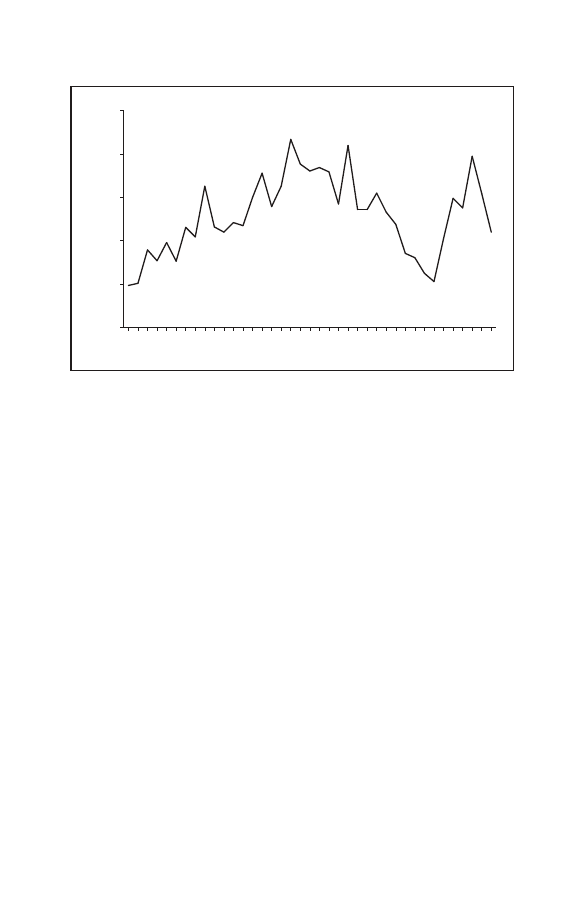
110
T E R RO RI S M I N A S Y M M E T RI CA L CO N F L I C T
primarily dictated by the overall level of the group’s goals and agenda
that are shaped in accordance with its dominant ideology. Separate
consolidated localized groups based in different countries or regions
may be tied by ideological proximity, such as the solidarity among
left-wing nationalist groups or among Islamicized separatists chal-
lenging central authorities in their respective countries. If the inter-
nationalization in these cases is merely the establishment of contacts
between such separate groups, then their relatively centralized and
consolidated organizational patterns cannot impede this limited
cooperation. Their more streamlined decision-making processes may
even aid this cooperation.
It could be argued that the limited internationalization of the terror-
ist and other activities of radical nationalists of the past decades, espe-
cially in the cold war period, was facilitated by the partial embrace of
leftist ideology. More recently, a similar role for ethno-separatists in
Muslim-populated regions has been played by the growing Islamiciza-
tion of their ideologies (see below for more detail).
In contrast, superterrorist organizations pursue goals and agendas at
a qualitatively higher, transnational, or supranational, level and have a
global outlook. It would then be fair to say that ideologically shaped
Number of incidents
2005
2004
2003
2002
2001
2000
1999
1997
1998
1996
1994
1995
1993
1991
1992
1990
1988
1989
1987
1985
1986
1984
1981
1982
1983
1980
1978
1979
1977
1975
1976
1974
1973
1972
1970
1971
1969
1968
2006
400
300
200
100
500
0
Figure 4.1. International terrorism incidents, 1968–2006
Source: MIPT Terrorism Knowledge Base, <http://www.tkb.org/>.
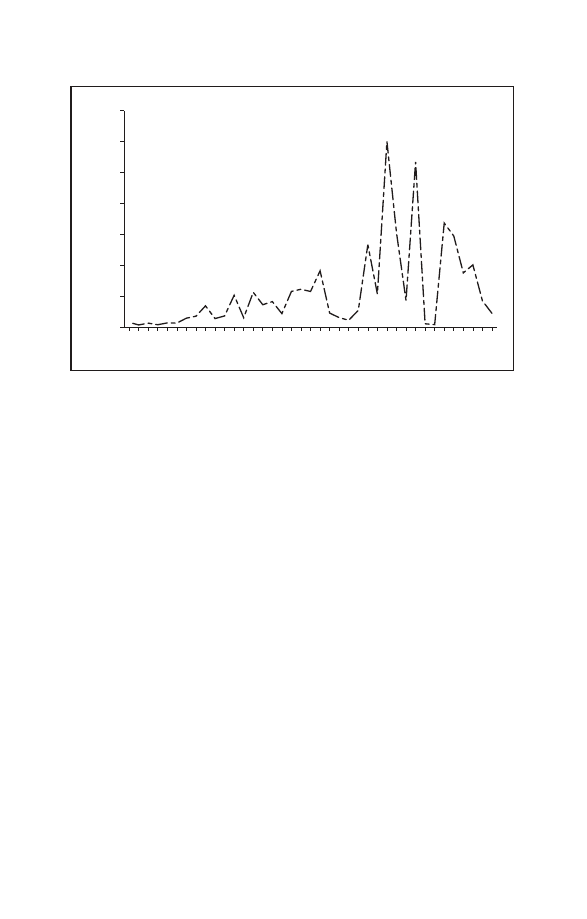
O RG A N I Z A T I O N A T T H E L O CA L L E V E L 111
goals of this type are best suited for organizational patterns dominated
by network features,
200
although not necessarily for pure, completely
horizontal networks. A typical example may well involve a multi-
level network structure that integrates some hierarchical features.
201
In sum, in shaping a militant group’s ability to internationalize its
activities, including its ability to effectively carry out international
terrorist attacks, organizational patterns are an important, but not
decisive, factor. They are of less importance than the overall level of
the group’s goals and agenda shaped, first and foremost, by its ideol-
ogy. This dependence closes the circle and further underscores the
need to view the two parameters—the ideology and the structure—of
non-state actors involved in terrorist activities as interconnected, inter-
dependent and decisively important aspects of terrorism in asym-
metrical conflict.
200
This excludes the apocalyptic goals of closed totalitarian religious cults such as Aum
Shinrikyo.
201
In practice, ‘pure’ horizontal networks are rare and are generally overwhelmed by
hybrid structures with a varying degree of network elements and features. See chapter 5 in
this volume.
Number of injuries
2005
2004
2003
2002
2001
2000
1999
1997
1998
1996
1994
1995
1993
1991
1992
1990
1988
1989
1987
1985
1986
1984
1981
1982
1983
1980
1978
1979
1977
1975
1976
1974
1973
1972
1970
1971
1969
1968
2006
7000
6000
5000
4000
3000
2000
1000
0
Figure 4.2. International terrorism injuries, 1968–2006
Source: MIPT Terrorism Knowledge Base, <http://www.tkb.org/>.
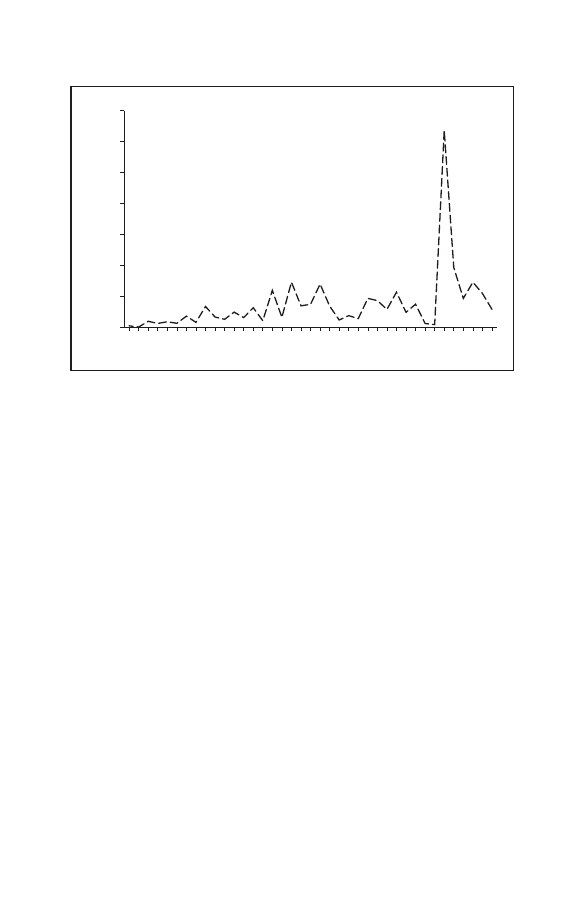
112
T E R RO RI S M I N A S Y M M E T RI CA L CO N F L I C T
III. Organizational patterns of Islamist groups
employing terrorism at the local and regional levels
Nowhere is the link between a militant–terrorist group’s ideology and
its structure more direct than in the case of violent Islamist non-state
actors. The structures of these groups and movements in general and
their decision-making processes in particular are not very transparent,
to say the least. Some general observations can still be made regarding
the main types, elements and features of their organizational patterns.
Militant Islamist organizations that are active at a local or regional
level are very diverse and the way in which extremist Islamist ideol-
ogy affects their organizational development varies from one type of
group to another. It depends on multiple factors ranging from the
group’s origin to the way it combines Islamism with other ideologies
and motivations (most notably with radical nationalism, including
ethno-separatism) and the overall degree of its Islamicization. The
latter, for instance, may affect the functions that a group performs,
Number of fatalities
2005
2004
2003
2002
2001
2000
1999
1997
1998
1996
1994
1995
1993
1991
1992
1990
1988
1989
1987
1985
1986
1984
1981
1982
1983
1980
1978
1979
1977
1975
1976
1974
1973
1972
1970
1971
1969
1968
2006
3500
3000
2500
2000
1500
1000
500
0
Figure 4.3. International terrorism fatalities, 1968–2006
Source: MIPT Terrorism Knowledge Base, <http://www.tkb.org/>.

O RG A N I Z A T I O N A T T H E L O CA L L E V E L 113
which in turn would be reflected in its organizational structure.
202
On
the basis of these criteria, at least four types of organization can be
distinguished: (a) cross-national Islamist movements that became
increasingly nationalist and nationalized (e.g. Hamas in the Pales-
tinian territories and Hezbollah in Lebanon); (b) non-nationalist,
transnational Islamist movements active in a regional context (e.g.
Jemaah Islamiah in South East Asia); (c) Islamicized ethno-separatist
groups (e.g. in the North Caucasus); and (d) Islamicized national
liberation groups (e.g. the Iraq insurgency since 2003).
Nationalized Islamists and non-nationalized regional Islamist
networks
Both Hamas in the Palestinian territories and Hezbollah in Lebanon
emerged as radical transnational Islamic movements. The Sunni
Islamist group Hamas grew out of the Gaza branch of the Muslim
Brotherhood, that is, it emerged as an autonomous part of a cross-
national Islamist network. The radical Shia group Hezbollah (Party of
God) emerged in response to Israel’s invasion of Lebanon in 1982
203
as a transnationally oriented movement inspired—and sponsored—by
Ayatollah Ruhollah Khomeini’s revolutionary Iran.
204
The gradual
nationalization of these movements has been a long-term process that
took decades and has not yet been fully completed. Nor has it neces-
sarily implied a decrease in external support for both movements from
Muslim states. The nationalization of these radical Islamic groups has
not only been an important development in political and ideological
terms but has also had an impact on their organizational evolution.
Both movements perform multiple functions and are engaged in
diverse activities. Hamas’s initial focus on social and religious work
has been supplemented by armed struggle and, increasingly, political
202
The movements formed on the basis of Islamist ideology are, for instance, more likely
to be engaged in social and humanitarian work than their secular (e.g. nationalist) counter-
parts based in the same area.
203
Israel occupied southern Lebanon in 1982–85 and a smaller border region in 1985–
2000.
204
The origins of Shia Islamism in Lebanon can be traced to the influence of Ayatollah
Mohammad Baqir al-Sadr, who founded a revivalist movement in the Shia sacred city of
Najaf, Iraq, in the 1960s. Hezbollah derived its ideology from the works of Khomeini and of
Musa al-Sadr, the charismatic Iranian cleric who gained a mass following in Lebanon and
mysteriously disappeared in 1978. See Hamzeh, A. N., ‘Islamism in Lebanon: a guide to the
groups’, Middle East Quarterly, vol. 4, no. 3 (Sep. 1997), pp. 47–54.

114
T E R RO RI S M I N A S Y M M E T RI CA L CO N F L I C T
activism. In the case of Hezbollah, the original task of armed resist-
ance was later reinforced by socio-religious and political functions. It
is thus hardly surprising that the movements’ respective structures are
quite complex, reflecting their multifaceted (religious, militant, social
and political) nature and combining elements of several organizational
forms. For instance, the organizational structure of Hamas had dis-
played many network features since the time when it was a local
branch of the Muslim Brotherhood, well before it turned to violence.
Hezbollah, which was formed as an armed insurgent movement,
originally emerged as a more centralized organization. Its structural
model in many ways resembled that of many left-wing national liber-
ation movements of the time, with the main decision-making Con-
sultative Council headed by the secretary-general, supported by the
General Convention, Executive Council, Advisory Board and so on.
However, it was not a classic hierarchy and actively employed net-
work elements, especially at the movement’s lower levels.
The process of nationalization and politicization of the pro-Iranian
Shia movement was actively promoted by Hassan Nasrullah after he
became Hezbollah’s secretary-general in 1992.
205
This process has had
a clear impact on the structural development of Hezbollah. It origin-
ally emerged as a militant insurgency group guided by imported
religio-political radicalism and trying to mirror the ideological and
organizational forms of the Iranian model. Gradual ideological and
structural transformation has turned it into an increasingly politicized
militant movement, with a growing political and social profile. Hez-
bollah’s military organization became a separate and increasingly pro-
fessionalized component (a quasi-army). Hezbollah has been repre-
sented in the Lebanese Parliament since 1992 and the movement has
gradually became an essential part of the Lebanese political land-
scape. It has evolved as a fully fledged multi-level structure based on
broad grass roots support, performing basic quasi-state functions for
the Lebanese Shia community and being politically active at the
national level.
205
In the case of Hezbollah, the term ‘Lebanonization’ is sometimes used instead of
‘nationalization’. On Hezbollah’s foundation and evolution see e.g. Hamzeh, A. N., ‘Leba-
non’s Hizbullah: from Islamic revolution to parliamentary accommodation’, Third World
Quarterly, vol. 14, no. 2 (Apr. 1993), pp. 321–37; Ranstorp, M., Hizb’Allah in Lebanon: The
Politics of the Western Hostage Crisis (St Martin’s Press: New York, 1997); and Saad-
Ghorayeb, A., Hizbu’llah: Politics and Religion (Pluto Press: London, 2002).

O RG A N I Z A T I O N A T T H E L O CA L L E V E L 115
For Hamas—an organization that grew out of a set of Islamic social
and religious networks—social welfare, humanitarian, educational,
religious and other functions continued to amount to a very significant
proportion (up to 90 per cent) of the movement’s overall activities.
206
The growing nationalization and politicization of the movement
required a more streamlined, consolidated and identifiable structure. It
has also led Hamas to form an identifiable, collegial political leader-
ship, even though that leadership has remained split between the
Palestinian territories and Damascus. The political leadership
advances a nationalist agenda, operates on the basis of support pro-
vided by the movement’s bottom-up socio-religious networks and
exercises control over its military branch (the Ezzedeen al-Qassam
Brigades). A combination of a strongly nationalist platform with the
Islamists’ reputation as a relatively incorruptible force and their exten-
sive grass roots social networks is what allowed Hamas to win the
Palestinian elections for the first time in 2006.
207
The nationalization of a cross-national Islamist movement that pre-
viously had not tied itself to a nationalist agenda entails a transform-
ation process that may take a variety of forms. It may lead to progres-
sively more active participation in municipal and national elections
and the creation of fully legalized and politically well-integrated
branches and parliamentary factions. Ultimately, it may even result in
the inclusion of an Islamist movement in the national governing
structures or its participation in a national power-sharing arrangement
as a quasi-state actor.
In other words, resort to nationalism and a significant degree of
nationalization play an essential, or even decisive, role in leading
radical semi-underground movements to a point where they start
acting as political representatives of their ethno-confessional or social
communities. Operating in weak, fragile or embryonic states, these
movements may fill the vacuum of state power and increasingly and
effectively assume some quasi-state functions. Both Hamas and Hez-
bollah pose as quasi-state actors. They may be ready, if necessary, to
join the state and try to transform it from within, as in the case of the
206
Council on Foreign Relations (note 127).
207
Among other things, the nationalization and politicization of the movement has
increased its cross-confessional appeal. In the Jan. 2006 elections, Christian as well as
Muslim voters supported Hamas, which also included a Christian candidate on its list.
Dalloul, M., ‘Christian candidate on Hamas ticket’, Aljazeera.net, 25 Jan. 2006, <http://
english.aljazeera.net/English/archive/archive?ArchiveId=18115>.

116
T E R RO RI S M I N A S Y M M E T RI CA L CO N F L I C T
Hamas-led Palestinian Government of March 2006–February 2007
and the Hamas–Fatah ‘unity government’ of March–June 2007. They
can also act as a substitute for the government, claiming to be a more
coherent, consolidated, efficient, nation-minded and mass-based force
(as in the case of Hamas taking de facto control of the Gaza Strip in
June 2007).
The quasi-state functions assumed by such non-state actors pose
significant political and security challenges in the respective national
contexts. While these functions may have controversial effects in
terms of a movement’s participation in the mainstream political pro-
cess, they also imply a degree of normalization of its structural forms
and its evolution towards more conventional organizational patterns.
These structural developments prompted by and related to the
ideological and political evolution of both Hamas and Hezbollah do
not yet imply their rejection of armed violence or of an autonomous
military role and capabilities. This has been demonstrated both by the
continuing militant activity of Hamas after it won the Palestinian
parliamentary elections in early 2006 and by the role played by Hez-
bollah in its asymmetrical armed conflict with Israel in the summer of
2006. What it may help to achieve is a significantly reduced level, or
even cessation, of terrorist activity.
208
For Hezbollah in particular, the
parallel and interrelated processes of nationalization and politicization
have played a decisive role in its turning to forms of violence other
than terrorism, ranging from the more traditional guerrilla warfare to
the innovative fully fledged asymmetrical confrontation with Israel. In
the latter case, a non-state sectarian actor claimed to represent the only
genuinely nationalist, effective and efficient military force fighting in
the name of the whole of Lebanon and as a substitute for the state due
to the latter’s supposed ineptness.
209
208
While Hezbollah was responsible for a series of high-profile terrorist bombings and
hostage-taking operations in the 1980s, since its formation it has been primarily engaged in
guerrilla warfare against Israeli forces.
209
Both Hezbollah and Israel insist, although for different reasons, on the ineptness and
weakness of the Lebanese state. From Hezbollah’s perspective, the sectarian, inefficient and
corrupt nature of the Lebanese political system is the main explanation of its inability to
defend itself against external enemies, the key disincentive for Hezbollah itself to become
fully integrated into this system and the major reason to retain the movement’s armed
capabilities. From Israel’s perspective, the weakness of the central government is the main
cause of its inability to prevent the rise of quasi-state actors that pose a significant security
risk for Israel.

O RG A N I Z A T I O N A T T H E L O CA L L E V E L 117
In the Palestinian case, Hamas was responsible for some of the
worst suicide terrorist attacks in the course of the second intifada.
210
However, it restrained its terrorist activity in 2005 and stopped terror-
ist attacks once it won the parliamentary election in January 2006.
While the movement’s militants continued to attack Israeli soldiers
and launch rocket and mortar attacks against Israel in the summer of
2006 and engaged in violent intra-Palestinian clashes with a rival
Fatah movement (e.g. in January 2007), terrorist activity was only
conducted by the more radical groups such as Palestinian Islamic
Jihad and the al-Aqsa Martyrs Brigades.
211
What is perhaps more
important is that the nationalized Sunni Islamists in the Palestinian
territories have not been directly associated with the transnational
violent Islamist movement inspired by al-Qaeda’s example. They
have not engaged in any interaction and cooperation with that move-
ment to speak of and generally tend to follow a different organiza-
tional, political and tactical path.
The closest example of a militant Islamist movement’s evolution in
the direction opposite to the processes of nationalization and politi-
cization described above is given by the transnational Jemaah Islam-
iah network in South East Asia. When the movement emerged in the
mid-20th century, it primarily focused on establishing an Islamist state
in Indonesia.
212
However, by the end of the century, JI had evolved
into a regional network that was no longer tied to any particular terri-
tory or any single specific political or national context. Systematic
repression by authorities had succeeded in making the JI presence and
activities in Indonesia unfeasible for more than a decade. This
‘retreat’ at the national level played its role in the group’s gradual,
although highly uneven, transformation into a decentralized regional
network since as early as the 1960s. This regionalized movement
appears to be unlikely to be transformed, both ideologically and
210
The second intifada refers to the new round of conflict between the Palestinians and
Israel that started on 28 Sep. 2000. Examples of suicide attacks include the Mar. 2002 ‘Pass-
over massacre’. ‘Deadly suicide bomb hits Israeli hotel’, BBC News, 28 Mar. 2002, <http://
news.bbc.co.uk/2/1897522.stm>.
211
According to the MIPT Terrorism Knowledge Database (note 4), Palestinian Islamic
Jihad alone was responsible for 112 attacks in 2006.
212
On Jemaah Islamiyah see Barton, G., Jemaah Islamiyah: Radical Islam in Indonesia
(Singapore University Press: Singapore, 2005); and International Crisis Group (ICG), Indo-
nesia Backgrounder: How the Jemaah Islamiyah Terrorist Network Operates, Asia Report
no. 43 (ICG: Brussels, 11 Dec. 2002), <http://www.crisisgroup.org/home/index.cfm?id=
1397>.

118
T E R RO RI S M I N A S Y M M E T RI CA L CO N F L I C T
organizationally, by being drawn into any national political context.
Not surprisingly, after the post-al-Qaeda transnational Islamist move-
ment, JI is one of the most networked violent Islamist movements and
one of the hardest to deal with.
Islamicized ethno-separatist groups: North Caucasus
The genuine Islamist movements described above are those that were
originally formed on the basis of Islamist ideology. In addition to
them, attention should also be paid to the structural patterns of groups
that emerged as ethno-separatist, radical nationalist or national liber-
ation movements that at first were not associated with religious
extremism but later became Islamicized to varying degrees. Groups
that always displayed a significant confessional element but were
from the start dominated by a nationalist agenda are also of special
interest. Islamicized movements of this type are found in Kashmir and
Mindanao, but the Islamicized ethno-nationalist resistance in the
North Caucasus deserves special attention, primarily due to the strong
presence of network characteristics in its structure.
The significant role of network features in the Chechen insurgency,
which effectively employed terrorism as one of its violent tactics, is
undeniable. However, there has been a tendency in some of the litera-
ture to somewhat overestimate either the movement’s network char-
acter or the degree of its archaization—that is, the extent to which it is
dominated by taip (clan) structures—or both.
213
Also, in the Chechen
and the broader North Caucasian context, attempts to present the
insurgency’s network features and tactics as an entirely innovative
approach are ahistorical. The asymmetrical tactic of fighting against
the incomparably superior Russian conventional military forces dates
back at least to the Chechen armed resistance to the Russian Empire
throughout much of the 19th century. This tactic involved the use of
small, tightly knit, dispersed cells that enjoy a great degree of auton-
omy in both sporadic hit-and-run raids and rudimentary swarming
operations.
214
213
See e.g. Arquilla, J. and Karasik, T., ‘Chechnya: a glimpse of future conflict?’, Studies
in Conflict and Terrorism, vol. 22, no. 3 (July–Sep. 1999), pp. 207–29.
214
On the tactics of the Chechen resistance in the 19th century see the excellent historical
account Baddeley, J. F., The Russian Conquest of the Caucasus (Longmans, Green, and Co.:
London, 1908), pp. 361–64. See also Gammer, M., The Lone Wolf and the Bear: Three Cen-

O RG A N I Z A T I O N A T T H E L O CA L L E V E L 119
In structural terms, it would be more accurate to describe the Che-
chen separatist movement of the 1990s and early 2000s as a ‘layer
cake’ of hybrid, hierarchized networks. Along with its many groups,
divisions and cells and plenty of semi-autonomous field commanders,
it always had an identifiable central command and military–political
leadership. As well as some segmented fighting cells, it also had more
integrated and consolidated formations, including those that special-
ized in certain kinds of violent activity. These formations ranged from
special reconnaissance or support units to the late Shamil Basayev’s
own detachment, Riyadh-as-Salihin,
215
which was more specialized in
terrorist activity. The movement’s network characteristics have been
supported and reinforced by elements of clan organization. However,
as a whole it cannot be reduced to a form of ‘network tribalism’ and
has evolved as a more advanced structure, especially at its latest
stages when it became increasingly regionalized.
The post-Soviet demodernization of Chechnya that resulted from
the collapse of the state and the economy and was stimulated and
aggravated by the armed conflict itself can best explain parallels
between organizational models of post-Soviet rebels and those of the
resistance campaigns of the past. However, compared with those
campaigns, at the different stages of the post-Soviet rebel movement’s
evolution, the greatest influence on its organizational formation, trans-
formation and modernization was exerted by two quite disparate
factors. At the earlier stage, the command, organizational and battle
experience previously gained by some of its founding leaders in the
Soviet armed forces and reinforced by the availability of arms stocks
left from the Soviet Army played a major role. At the later stages,
their influence was succeeded by the growing Islamicization of the
movement.
The tactical and strategic thinking and practice of the movement’s
first generation of commanders and fighters were to a large extent
shaped by their military service in the Soviet Army. This experience
was not necessarily gained in the most conventional settings (there
were veterans of the Soviet intervention in Afghanistan among the
rebels). These first generation ethno-nationalists were initially still
relatively secularized fighters, many with decades of military experi-
turies of Chechen Defiance of Russian Rule (University of Pittsburgh Press: Pittsburgh, Pa.,
2006).
215
‘Riyadh-as-Salihin’ means ‘gardens of the righteous’ in Arabic.

120
T E R RO RI S M I N A S Y M M E T RI CA L CO N F L I C T
ence. What they brought to the traditional tribal network model of
resistance was a higher degree of discipline, coordination and com-
mand. They turned the movement into a more hybrid and better organ-
ized structure able to go beyond relatively minor hit-and-run attacks
against government forces.
216
This may provide a better explanation
than that of a combination of clans and networks for some of the
separatists’ innovative tactics that are not typical of traditional low-
scale mountain guerrilla warfare. An example is provided by the
rebels’ ability to take on massive enemy forces in the course of the
1994–96 First Chechen War, particularly during the ‘battle for
Grozny’ in early 1995 and the Grozny counteroffensive in August
1996.
217
The increasingly chaotic period of quasi-independence followed the
1996 Khasav-Yurt Agreement that led the Russian Federal Govern-
ment to temporarily withdraw its forces from Chechnya. While the
Islamic revival in the region may be traced back to the late 1980s,
since the First Chechen War the radicalization of Islam and the Islam-
icization of an ethno-separatist insurgency were among the most not-
able developments in Chechnya—and in the broader region.
218
In
organizational terms, its impact went beyond stimulating the inter-
nationalization of the movement in general and facilitating the influx
of foreign Islamist fighters in particular.
On the one hand, Islamicization has led to further fragmentation,
rather than formal consolidation and centralization, of the resistance.
It has also resulted in several major splits within the movement. The
rise of radical Islam in the movement’s ranks made some local war-
lords concerned about conceding power to Islamists. Instead, these
militant actors opted for a mix of Chechen nationalism with a trad-
itional Sufi Islam (such as that of the Qadiriya order). Islamicization
was one of the factors that prompted some local armed groups that
had joined the separatist insurgency in the First Chechen War to
switch sides.
216
See e.g. Kulikov, S. A. and Love, R. R., ‘Insurgent groups in Chechnya’, Military
Review, vol. 83, no. 6 (Nov.–Dec. 2003), pp. 21–29.
217
See Thomas, T. L., ‘The battle of Grozny: deadly classroom for urban combat’, Para-
meters, vol. 29, no. 2 (summer 1999), pp. 87–102.
218
See e.g. Malashenko, A., Islamskie orientiry Severnogo Kavkaza [Islamic factor in the
North Caucasus] (Carnegie Moscow Center/Gendalf: Moscow, 2001); and Tishkov, V., Che-
chnya: Life in a War-Torn Society (University of California Press: Berkeley, Calif., 2004),
pp. 164–79.

O RG A N I Z A T I O N A T T H E L O CA L L E V E L 121
On the other hand and perhaps more importantly, radicalization
along Islamist lines has greatly facilitated the movement’s regional-
ization and significantly reinforced its ability to build cross-ethnic, or
even supra-ethnic, networks at the regional rather than the more local-
ized level. These Islamicized networks have emerged as qualitatively
different from, and more advanced than, those still permeated by clan
and kinship ties and confined to the Chechen ethnic group.
219
In sum, even for the Chechen insurgency movement, whose struc-
ture has traditionally (and exceptionally) been highly networked, fur-
ther radicalization in the form of Islamicization led to a more net-
worked structure. It has emerged as a qualitatively more advanced
structure than the narrow network tribalism and has operated in the
regional, inter-, cross- and supra-ethnic contexts. This phenomenon
may threaten further transformation of what emerged as the Chechen
ethno-separatist movement into a multi-level region-wide set of mili-
tant networks—as happened to JI, but in a region far more geo-
graphically compact than South East Asia. While armed resistance of
this type is more diffuse, it may cause as much trouble in terms of
asymmetrical militant and terrorist activity as—and be even more elu-
sive and harder to confront than—a separatist insurgency.
Islamicized national liberation movements: Iraq
In contrast to the separatist movements in the North Caucasus, Kash-
mir and Mindanao, in post-2003 Iraq anti-occupation and anti-govern-
ment insurgents have fought for their country to remain a united state
and nation. Despite the gradual blending of insurgency with sectarian
strife, the fragmentation of violence and the different course and
forms that it has taken in different parts of Iraq, the removal of foreign
forces from Iraq has continued to be the main goal of the Sunni-
dominated resistance and some of the armed Shia groups. While
nationalist resistance against the occupation did not in itself lead to
coordination of activities by Sunni insurgents and anti-coalition Shia
elements, it remained the main characteristic common to both Sunni
and Shia radicals.
220
In the four years following the start of the US-led
219
E.g. this is illustrated by the textbook network swarming attack by multiple supra-
ethnic Islamicized cells on Nalchik in Oct. 2005.
220
In 2004 the Shia group Jaysh al-Mahdi (the Mahdi Army) led by Muqtada al-Sadr also
fought against the coalition forces. In the mid-2000s insurgent activity by some radical Shia
units intensified.

122
T E R RO RI S M I N A S Y M M E T RI CA L CO N F L I C T
invasion of Iraq in March 2003, most attacks continued to be directed
against the coalition, while most casualties were among the Iraqi civil-
ians.
221
The insurgents have also been fighting against the Iraqi
Government, which they have seen as being imposed and backed by
foreign forces, and against state-affiliated actors of all sectarian iden-
tities, but especially the Shia ones.
Since 2003 the Iraqi resistance has become a large-scale, major
urban insurgency, a type which is not common for modern armed con-
flicts. It has been dynamic in terms of its organizational patterns and
has developed and changed form almost as fast as the violent Islamist
movement at the transnational level has.
222
In structural terms, the
Iraqi resistance has not displayed pure network forms. At its earlier
stages it manifested itself in separate, uncoordinated, chaotic actions
by a number of smaller groups. These first groups, which were prim-
arily motivated by nationalism, did not act as parts of a network, had
not yet formed networks and were diverse in their origin. They ranged
from remnants of Baathist units to spontaneous protests of groups and
individuals that had no Baathist background and emerged ‘organic-
ally’ on the basis of neighbourhood, clan and family, regional and
other ties.
By late 2004 the anti-coalition insurgency gradually emerged as a
more consolidated set of fewer but larger hybrid, hierarchized network
organizations. They combined network characteristics with varying
degree of centralization and increasingly resorted to terrorist means,
especially suicidal attacks, along with other violent and political
tactics, including propaganda.
223
The key role in these organizational
and tactical developments was played by the rapid Islamicization of
221
US Department of Defense, Measuring Stability and Security in Iraq, Report to Con-
gress (Department of Defense: Washington, DC, Mar. 2007), <http://www.defenselink.mil/
home/features/Iraq_Reports/>, pp. 14, 18. For a more detailed explanation of high Iraqi civil-
ian casualties see chapter 3 in this volume, section V.
222
On the latter see chapter 5 in this volume.
223
The MIPT Terrorism Knowledge Base (note 4) lists 46 militant–terrorist Sunni insur-
gent groups—and only 6 Shia groups—in Iraq since 2003 (excluding 2 post-Baath secular
groups, some groups that are likely to be criminals masquerading as militants and units that
may be part of larger groups). While many of these groups have only claimed responsibility
for 1 or 2 terrorist attacks or kidnappings, the largest and most active militant–terrorist groups
include Jaish Ansar-al Sunna (Guerrillas of the Army of the Sunna), al-Jaish al-Islami fil-Iraq
(Islamic Army in Iraq), and Tanzim al-Qa’idat fi Bilad al-Rafidayn (al-Qaeda in Mesopo-
tamia, which is also known as al-Qaeda in Iraq and by several other names).

O RG A N I Z A T I O N A T T H E L O CA L L E V E L 123
the resistance on the basis of radical Sunni Islamism.
224
This gradual
ideological consolidation of the resistance movement was based on
the merger of militant Islamism and radical nationalism. This process
effectively blurred the ideological and structural differences between
the foreign Islamist fighters with transnational connections and Iraqi
Islamist nationalist Sunni groups engaged in anti-coalition violence
and, increasingly, in sectarian strife.
This convergence between radical Islamism and nationalism had
dramatic impact on the insurgents’ resolve and tactics, including
growing emphasis on terrorism and suicidal attacks.
225
Tanzim al-
Qa’idat fi Bilad al-Rafidayn (al-Qaeda in Iraq) has remained one of
the larger groups of the resistance even after Abu Musab al-Zarqawi’s
death in 2006 and has continued to use foreign fighters, although the
majority of the group’s members are Iraqis.
226
In early 2006 this group
formed the core of the Mujahideen Shura Council—an umbrella coali-
tion that later declared the ‘the foundation of the righteous state, the
Islamic state’ in Iraq based on sharia.
227
Although the influence of transnational terrorist networks on the
dynamics of violence in Iraq appears to be exaggerated, the rise of
violent Islamism and its convergence with nationalism in Iraq has
played a role of a broader international significance. Since the attacks
of 11 September 2001, the Islamicized Iraqi ‘national liberation’
resistance has become perhaps the most powerful political and quasi-
religious symbol for transnational violent Islamism. It has provided a
powerful motivational impulse and mobilizing influence for the exist-
ing and new cells of the post-al-Qaeda violent Islamist movement
operating in different parts of the world and guided by a global vision.
224
For an analysis of this transformation see International Crisis Group (ICG), In Their
Own Word: Reading the Iraqi Insurgency, Middle East Report no. 50 (ICG: Brussels, 15 Feb.
2006), <http://www.crisisgroup.org/home/index.cfm?id=3953>.
225
See chapter 3 in this volume, section V.
226
This fact is recognized by the US Government, as well as the fact that foreign militants
in general made up just 4–10% of the approximately 20 000 rebels in Iraq in 2006. US
Department of State, Office of the Coordinator for Counterterrorism, Country Reports on
Terrorism 2005 (US State Department: Washington, DC, Apr. 2006), <http://www.state.gov/
s/ct/rls/crt/>, p. 131. The US bipartisan Iraq Study Group report estimated the number of for-
eign ‘jihadists’ in Iraq in 2006 at 1300. Baker, J. A. III and Hamilton, L. H. (co-chairs), The
Iraq Study Group Report (Iraq Study Group: 2006), <http://www.bakerinstitute.org/Publi
cation_List.cfm>, p. 10.
227
See MIPT Terrorism Knowledge Base (note 4); and Mujahideen Shura Council in Iraq,
‘The announcement of the establishment of the Islamic State of Iraq’, 15 Oct. 2006.

124
T E R RO RI S M I N A S Y M M E T RI CA L CO N F L I C T
The only major factor that has acted against the Islamist–nationalist
convergence along the lines described above has been the further
fragmentation of violence in Iraq and especially the rise of intra-sect-
arian (including intra-Sunni) tensions in 2006–2007. US governmental
sources have consistently tended to exaggerate the differences
between ‘Iraqi insurgents’ and ‘foreign mujahideen’.
228
Both the coali-
tion powers and the Iraqi Government have done their best to encour-
age any divisions between Sunni tribal groups and the more radical
al-Qaeda in Iraq and other strongly Islamist groups.
229
However, the divide-and-rule approach also has major negative
security repercussions contributing to further instability and fragmen-
tation of violence on the ground. It cannot provide a lasting solution to
the problem. A more constructive and fundamental way to weaken
both the ideological link and organizational ties between the Iraqi
insurgency and transnational Islamism would be to promote an ideol-
ogy that is at least as powerful and appealing at the national level as
Islamism. It would imply supporting and encouraging Iraqi cross-
sectarian Arab nationalism, instead of suppressing it. In other words,
the optimal strategy would have been almost exactly the opposite to
the one that has been followed by the international interveners in Iraq
and which has contributed to both sectarianism and inter-ethnic ten-
sions. Iraqi Arab nationalism, even in its radical forms, appears to be
the only ideology that can unite Iraqi’s main Sunni and Shia com-
munities. It is the main force that could keep the country together and
act as a counterbalance to both transnational Islamism in Iraq and the
symbolic meaning of Iraq for violent Islamist cells throughout the
world. Only genuine home-grown groups and movements that come
closest to Iraqi Arab nationalism and may have some cross-sectarian
appeal could form the basis for meeting this challenge. While these
forces, such as the Muqtada al-Sadr’s Mahdi Army, may be very rad-
ical and non-secular and are strongly defiant of the foreign occu-
pation, they may remain the only ones who have not discredited their
nationalist credentials.
228
See e.g. US Department of State (note 226), p. 130.
229
See e.g. Knights, M., ‘Struggle for control: the uncertain future of Iraq’s Sunni Arabs’,
Jane’s Intelligence Review, vol. 19, no. 1 (Jan. 2007), pp. 18–23. See also Stepanova
(note 172).

O RG A N I Z A T I O N A T T H E L O CA L L E V E L 125
IV. Conclusions
Attempts to draw a precise dividing line between ‘new’, post-
11 September 2001, loosely organized, transnational network terror-
ism and ‘old’ terrorism of the more traditional organizational types
have not been conclusive. This approach views the new network
forms of terrorism as a radical departure from the old localized and
hierarchized forms, as if the latter had not been structurally evolving
over recent decades. Instead, it appears that network elements and
features have been and are increasingly employed by terrorist groups
of different types at all levels from the local to the global. At least in
this sense, an organizational difference between terrorism at the trans-
national and the more localized levels may be more gradual than sub-
stantial.
Similarly, strict hierarchical forms can manifest themselves in both
the structures of groups with a more localized agenda and, for
instance, the organizational patterns displayed by superterrorist
apocalyptic religious sects with a universalist agenda. Naturally, more
centralized and hierarchical forms are more widespread at the local-
ized levels.
Nationalism—whether of ethnic, ethno-confessional or a broader,
civic or cross-ethnic or cross-confessional type—is the strongest force
that can tie a militant organization to a certain location, territory or
national context and streamline and conventionalize its structure. The
closer that such an organization is tied to a territory and to a localized
context, the stronger is the pressures on it to take on quasi-governance
functions and the more it ultimately sees itself as a new, revised or
better analogue of the state it is fighting. The more that such a group
sees itself in that way and structures itself in line with this vision, the
easier it is to identify, deal with and transform. This is particularly
important when dealing with mass-based and popular Islamicized and
Islamist armed movements that may employ terrorism as one of their
tactics but cannot be defeated by conventional military means. The
more that such a movement is nationalized and immersed in a national
political context, the more realistic are the chances that its militant
hardliners will gradually become marginalized. The movement may
also be more willing to reject the militant tactics that are most deadly
for the civilian population. Finally, any links of such a nationalist–

126
T E R RO RI S M I N A S Y M M E T RI CA L CO N F L I C T
Islamist movements with transnational violent Islamism of the post-
al-Qaeda type are more likely to erode.
However, the growing organizational divisions between the radicals
and the more moderate, pragmatic and nationally focused forces
within such a movement are not sufficient to effectively co-opt its
more pragmatic leaders and forces into the mainstream political
system. These efforts can only succeed if they are integrated into the
broader process of transformation of the state that these Islamist
nationalists have been fighting against. In contexts as different as
post-2003 Iraq and Lebanon, the functionality or legitimacy of the
state itself and its deeply divisive and sectarian character both dis-
courages the violent Islamist non-state actors to associate with it and
allows them to claim to pose as the more genuine and nationally
oriented forces.

5. Organizational forms of the violent
Islamist movement at the
transnational level
I. Introduction
It has become a commonplace to refer to the general spread and evo-
lution of network structures and, more specifically, to their employ-
ment by and impact on anti-system actors such as terrorist groups. In
particular, since 11 September 2001, al-Qaeda and the broader post-
al-Qaeda transnational violent Islamist movement have often been
described as ‘model’ or ‘pure’ terrorist networks. They have been
commonly viewed as a radical departure from the ‘old’ terrorism
practised by groups of the more traditional hierarchical type.
230
As time continues to pass since 11 September 2001, this simplified
interpretation is becoming ever more superficial. In particular, it is no
longer sufficient to refer to al-Qaeda and the post-al-Qaeda movement
as standard networks, described in the most general terms. The prob-
lem is not simply that analysts find it hard to keep pace with the rapid
changes in organizational forms of the transnational violent Islamist
movement. Years after the dramatic terrorist attacks of September
2001, the time for simplistic explanations is over. There is a pressing
need for a more nuanced approach by experts in organization theory
in their study of the structures of underground terrorist and other anti-
system actors. It is also required from analysts specializing in various
aspects of political (ideological, religious and quasi-religious) extrem-
ism and violence, including terrorism, and other challenges to national
and international security. These challenges are commonly known as
unconventional or non-traditional threats, but it is more accurate to
refer to them as recently securitized threats, given that they are no
longer peripheral issues.
Much has been said and written about the network characteristics
that allow transnational actors—ranging from socio-political activist
associations to militant movements that employ terrorist means—to
230
See Gunaratna (note 179), pp. 54–58, 95–101 etc.

128
T E R RO RI S M I N A S Y M M E T RI CA L CO N F L I C T
‘think globally, act locally’.
231
But which of these network features are
most typical of the transnational violent Islamist movement? In what
way does its organization resemble other standard modern social net-
works and what makes it different? In which direction do its network
organizational forms and elements evolve? How do they interact and
integrate with elements and features of other organizational forms
within the movement’s structural framework? What impact does the
movement’s ideology have on its structural patterns? What other
factors have an impact on its organizational development? These are
some of the questions about the structures of contemporary trans-
national terrorism—and especially the post-al-Qaeda movement as its
most advanced and dynamic form—addressed in this chapter.
II. Transnational networks and hybrids: combinations
and disparities
Analysis of the structural patterns of modern terrorism, especially of
its transnational forms, has been dominated by ‘organizational net-
work’ theory. According to this theory, a network is a specific, separ-
ate organizational form that has gained force in an age of rapid
development of information and communication technologies.
232
In
this information age, network structures appear to have some import-
ant advantages over other organizational forms. For instance, com-
pared to hierarchical structures, network organizations are more flex-
ible, more mobile, better adapt to changing circumstances and are
more stable during system shocks and at times of crisis. For a certain
structure to function as a network it is not sufficient for its main ele-
ments to be linked by horizontal ties (as opposed to the prevalence of
vertical ties in hierarchies). For it to be a network, all of its elements
must both view themselves as parts of a broader network and be ready
to act as a network. From the organization theory perspective, the
231
This is a slogan of Friends of the Earth, an international environmentalist movement
founded in the USA in 1969 and structured as a network of autonomous grass roots groups.
Authorship of the slogan is disputed and attributed to several people, including the network’s
founder, David Brower.
232
Castells (note 197); Arquilla, J. and Ronfeldt, D. (eds), Networks and Netwars: The
Future of Terror, Crime, and Militancy (RAND: Santa Monica, Calif., 2001), <http://www.
rand.org/pubs/monograph_reports/MR1382/>; and Arquilla, J. and Ronfeldt, D. F., ‘Netwar
revisited: the fight for the future continues’, Low Intensity Conflict & Law Enforcement,
vol. 11, nos 2–3 (winter 2002), pp. 178–89.

O RG A N I Z A T I O N A T T H E T RA N S N A T I O N A L L E V E L 129
main characteristic of any network is its non-hierarchical, decentral-
ized character, which explains the primary focus of this theory on the
conflicts, correlations and interactions between networks and hier-
archies.
In contrast to organizational network theory, ‘social network’ theory
explores all sorts of interlinkages between social actors and the social
structures that stem from and are based on these interlinkages.
233
Rather than viewing the network as a specific, separate organizational
form, this theory views it as a system of interrelations in society that
characterize all forms of social life. For social network theorists, a
more general distinction between an informal network and a formal
organization is more important than the contrast between network and
hierarchical organizational forms.
234
Any organization, especially a
relatively large one, even if it is decentralized to a significant extent,
requires at least a minimal set of hierarchical features. In contrast, a
network in principle lacks a central leadership presiding over a strict
hierarchy. While the elements of a network are interconnected, they
are autonomous and are not subject to direct, formal orders ‘from
above’.
General trends in the development of networks
While keeping in mind these two broad theoretical approaches, it is
useful to consider the four broadly acknowledged general trends in the
development of the network characteristics of modern non-state
organizations, including anti-system actors such as terrorist groups.
The first trend is the general spread of network forms, especially
among non-state actors. Groups that display the key network features
gain considerable advantages in asymmetrical confrontation against
the less flexible and less mobile state structures. The lack of a strict
hierarchy and of a single structured central leadership exercising
direct control over subordinate units complicates the task of destroy-
ing these movements. The spread of network features can be traced in
the organizational development of groups of different types, goals and
orientation ranging from criminal or militant–terrorist armed anti-
233
See e.g. Scott, J., Social Network Analysis: A Handbook, 2nd edn (Sage: London,
2000).
234
See e.g. Nohria, N. and Eccles, R. G. (eds), Networks and Organizations: Structure,
Form, and Action (Harvard Business School Press: Boston, Mass., 1992).

130
T E R RO RI S M I N A S Y M M E T RI CA L CO N F L I C T
system actors to environmental and civil society groups and move-
ments. Transnational non-state activist networks and associations
range from anti-globalists to grass roots movements against the use of
landmines or against ‘blood diamonds’.
235
These are standard exam-
ples of modern networks that are actively challenging states or trying
to engage them in addressing the movement’s main issues of concern.
These examples may in fact be far more typical for networks as an
organizational form—and are certainly far more transparent—than the
violent transnational Islamist movement inspired by al-Qaeda whose
structure is more than just a standard network and is much more dif-
ficult to study. More generally, excessive attention to the use of net-
work forms of organization by terrorist, criminal and other under-
ground structures presents a somewhat distorted picture. It under-
estimates the positive potential of network structures in the infor-
mation age.
236
Second, whichever theoretical approach is applied, in practice nei-
ther the contrast between networks and hierarchies nor the distinctions
between informal decentralized networks and formal organizations are
strict dichotomies. Nor do they adequately reflect the complex dia-
lectic nature of modern organizational models, most of which are
mixed, hybrid structures. The basic distinctions between networks and
hierarchies do not mean that there is no space for a broad range of
intermediate structures. In the spectrum of structural models, most
organizations—including terrorist groups—fit somewhere between
the two extremes of a pure network and a pure hierarchy. Most dis-
play both network and hierarchical elements, sometimes in combin-
ation with elements of other organizational forms, such as clans. In a
dynamic process of organizational development, this combination
235
The anti-globalization movement (also known as the Global Justice movement) is an
umbrella term for a number of social movements that oppose some of the controversial
aspects of globalization, which is seen as deepening or even generating social injustice and
inequality, such as ‘corporate globalization’, free-trade agreements etc. From 1999 to mid-
2007, the anti-globalization movement has organized up to 50 large-scale transnational
actions, mostly at the time of large international summits. The International Campaign to Ban
Land-Mines is a network of more than 1400 NGOs in 90 countries. See <http://www.icbl.
org/>. The movement against ‘blood diamonds’ led to the establishment of the Kimberley
Process Certification Scheme in Nov. 2002, setting up an internationally recognized certifi-
cation system for rough diamonds and national import–export standards adopted by 52 gov-
ernments.
236
An attempt to challenge this simplistic view and to highlight both positive and negative
implications of the ‘rise of networks’ among non-state actors was one of the central themes of
the landmark study eds Arquilla and Ronfeldt (note 232).

O RG A N I Z A T I O N A T T H E T RA N S N A T I O N A L L E V E L 131
may change from, for example, a relatively loose organization bal-
ancing hierarchical and network features, such as in al-Qaeda, to a
more decentralized movement. This more decentralized organization
pattern employed by the post-al-Qaeda transnational violent Islamist
movement retains multi-level coordination and some informal vertical
ties but is dominated by network forms.
Third, with all the attention that has been paid to the network char-
acteristics of the modern superterrorist networks (i.e. primarily the
transnational violent Islamist movement), it would be a mistake to say
that network models are found only in the relatively recent phenom-
enon of superterrorism. As discussed in chapter 4, some basic network
characteristics are also to be found in more traditional types of terror-
ist group. To a certain—and growing—extent, these characteristics
have been an essential part of organizational design for a number of
groups that were engaged in violent activity at a more localized level.
These groups’ agendas have not gone beyond a national framework or
a particular armed conflict. Examples range from the IRA in Northern
Ireland and Sendero Luminoso in Peru to the Islamist Hamas or the
more secularized al-Aqsa Martyrs Brigades (Arafat Brigades) in the
Palestinian territories.
In recent years, analysts as well as practitioners have paid much
attention to ‘the rise of networks’ in general, and the spread of net-
work structures among anti-system actors in particular. However, they
have often forgotten that the first attempts to conceptualize segmented
network urban guerrilla and terrorism structures and tactics date back
to the late 1960s.
237
In addition, many of the tactics typical of modern
network warfare, such as swarming, are no less popular among the
localized militant groups combining guerrilla and terrorist means than
among the cells of the post-al-Qaeda movement.
238
While network forms prevail in the structural models of super-
terrorism, they do not do so absolutely. The Japanese cult Aum Shin-
rikyo, which fully qualifies as a superterrorist group due to the global
nature of its goals and agenda and its readiness to use unlimited means
to achieve those goals, was structured as a strict vertical hierarchy.
239
237
See chapter 4 in this volume.
238
On swarming see note 195.
239
Aum Shinrikyo launched 17 attacks using chemical or biological weapons. In the most
deadly of these, on 20 Mar. 1995 the chemical nerve agent sarin was released on Tokyo
underground trains, killing 12 people and injuring more than 1000. Monterey Institute of

132
T E R RO RI S M I N A S Y M M E T RI CA L CO N F L I C T
In this context, it is worth recalling that the main defining criterion of
a superterrorist group is not its network structures (as opposed to the
more hierarchical organizational forms of the traditional types of
terrorism), but the level and scope of its goals and agenda. Of critical
importance is whether these goals are global (and unlimited) or are
limited to a more localized context.
The spread of network elements gives tangible comparative advan-
tages to terrorist groups at all levels. If there is any major difference
between the more traditional terrorism at the local and regional levels
and superterrorism in terms of organization, it is in the varying
degrees of correlation of network and hierarchical elements. Natur-
ally, for a transnational violent Islamist movement with a virtually
global outreach and unlimited goals, the role played by network char-
acteristics is much higher than it is for a more localized group. As this
chapter shows, any more substantial disparities in the way these
groups function cannot be explained in terms of organizational forms
alone—factors of an ideological and social nature need to be drawn in.
Fourth, the issue of concern is not just the network character of the
transnational violent Islamist movement. Its organizational patterns go
beyond those of a standard modern anti-system network that, for in-
stance, characterizes the anti-globalist movement. The advantages
given by the standard network features in asymmetrical confrontation
against the less flexible and less mobile state structures are detailed
above. Nonetheless, ‘classic’ networks also have serious drawbacks
and weaknesses. First and foremost is the difficulties they can experi-
ence when faced with the need to make strategic political–military
decisions and to put them into effect. They also lack purely organiza-
tional mechanisms to ensure that these decisions are followed by all
the main elements within the network and to exercise control over the
implementation process. The informal and ulterior nature of the links
between various network elements allows such an organizational
system to function effectively only under certain conditions.
240
The
mere fact that multiple cells form a network and even their basic
ideological proximity may not suffice to impose upon them strong and
stable mutual obligations to engage in violent activity, especially in
the form of terrorism against civilians.
International Studies, Center for Non-Proliferation Studies (CNS), ‘Chronology of Aum Shin-
rikyo’s CBW activities’, 2001, <http://cns.miis.edu/pubs/reports/aum_chrn.htm>.
240
In specialized literature these informal links are commonly referred to as ‘latent’ links.

O RG A N I Z A T I O N A T T H E T RA N S N A T I O N A L L E V E L 133
In sum, modern transnational terrorist networks such as the post-
al-Qaeda movement display an amorphous, multi-layered structure
and loose and ulterior links between different elements. A lack of a
strict vertical chain of command and informal leadership patterns at
the macro level is coupled with multiple and diverse cell patterns dis-
playing varying combinations of network and hierarchic features at
the micro level. The main question then is why, despite all these char-
acteristics, this movement manages to act effectively and seems to
function as one organism. How does a structural model that displays
the main network characteristics—even if they are combined with
elements of other organizational forms—manage to effectively neu-
tralize its inherent weaknesses?
III. Beyond network tribalism
Functional–ideological networks
According to organizational network theory, the structural develop-
ment of al-Qaeda into the broader, more fragmented and dispersed
post-al-Qaeda movement displays a transitional organizational pat-
tern. It has evolved from a more formalized organization to a more
amorphous, decentralized network of cells that spread and multiply in
a way that, in terms of organizational form, closely resembles fran-
chise business schemes. These cells share the movement’s trans-
national violent Islamist ideology, follow general strategic guidelines
formulated by its leaders and ideologues and use the name of
‘al-Qaeda’ as a ‘brand’ but are not necessarily formally linked to it in
structural terms.
This creeping network displays at least some of the main character-
istics of a segmented polycentric ideologically integrated network
(a SPIN structure)—one of the most advanced types of network
described and studied to date.
241
The segmented nature of a SPIN
241
The concept of a SPIN structure was formulated by anthropologist Luther Gerlach and
sociologist Virginia Hine in the early 1970s on the basis of their studies of civil rights groups
and social protest movements in the USA in the 1960s and early 1970s. See Gerlach, L. P.
and Hine, V. H., People, Power, Change: Movements of Social Transformation (Bobbs-
Merril: New York, 1970); Gerlach, L., ‘Protest movements and the construction of risk’, eds
B. B. Johnson and V. T. Covello, The Social and Cultural Construction of Risk: Essays on
Risk Selection and Perception (D. Reidel: Boston, Mass., 1987), pp. 103–45; and Gerlach,
L. P., ‘The structure of social movements: environmental activism and its opponents’, eds
Arquilla and Ronfeldt (note 232), pp. 289–310.

134
T E R RO RI S M I N A S Y M M E T RI CA L CO N F L I C T
structure means that it is made of many cells. Its polycentric character
implies that it lacks single central leadership, but has several leaders
and central nodes. Its network structure indicates that its various seg-
ments, leaders and central nodes are integrated into a network by
means of structural, ideological and personal links. SPIN structures
demonstrate a very high level of structural flexibility and adaptability.
The model allows, for instance, social protest movements to effect-
ively resist suppressive measures by states, to penetrate all strata of
society, and to promptly and effectively adapt to the rapidly changing
political and social environment.
The main integrating force for a network that approximates the
SPIN structure is its shared ideology. To emphasize this connection,
in this Research Report the term used to refer to most networks of this
type—including both violent and non-violent activist movements—is
‘functional–ideological network’. Using modern means of communi-
cation, shared ideology helps connect the fragmented, dispersed, iso-
lated or informally interlinked elements of modern networks. This
organizational form dominates many social protest movements in the
West, as well as some broader campaigns such as the anti-globalist
movement. As noted above, for modern functional–ideological net-
works, common ideological beliefs and values play an even higher
role as the main connecting and binding principle than they do for
more traditional types of anti-system group.
242
The post-al-Qaeda movement is often seen as a network embodi-
ment of the ideology of ‘global Salafi jihad’. However, even some of
the strongest advocates of this view have come to understand that the
transnational violent Islamist movement cannot be reduced to a stan-
dard impersonalized functional–ideological network. The trans-
national violent Islamist movement’s underground cells emerge in
different political contexts and are dispersed in many parts of the
world. If they are tied into a broader decentralized network, it is
through some informal, hidden links. These characteristics do not
appear to match the active, effective and seemingly well-coordinated
manner in which these cells carry out their terrorist activities. Indeed,
the scope and level of the post-al-Qaeda movement’s operational
activities require a much higher level of intra-organizational coher-
ence and trust than can be provided by religious and ideological
beliefs and goals alone, especially if the latter are formulated in a very
242
See e.g. chapter 1 in this volume, section III.

O RG A N I Z A T I O N A T T H E T RA N S N A T I O N A L L E V E L 135
general way. Against this background, some analysts have started to
doubt whether ideological, including religious and quasi-religious,
goals and beliefs suffice to explain how the transnational violent
Islamist movement functions so effectively, at least at the micro level
of individual cells. This underscores the need to supplement the ideol-
ogy-centred perspective with more nuanced approaches. The approach
that focuses excessively on militant Islamism as the single driving and
organizing force of the transnational violent Islamist movement needs
to be corrected and adjusted, if not radically revised.
Network tribalism: a critique
One way to revise the approach centred on functional–ideological
networks is based on the following assumption. It argues that the lack
of a single central leadership and the multiplicity of real and ‘virtual’
leaders that is typical of many modern transnational networks forces
the network elements to resort to various consultative and consensus-
building mechanisms in the decision-making process. Such mech-
anisms were typical for many pre-hierarchical clan and tribal organ-
izational forms and social systems. From that, some analysts immedi-
ately—and somewhat hastily—concluded that the post-al-Qaeda
movement points to the revival of elements of tribalism at a new, net-
work level. In other words, it provides an example of the integration
of modern post-hierarchical elements into a structure that is closer to
archaic, pre-hierarchical forms. This approach could be traced in the
evolution of the views of one of the leading network theorists, David
Ronfeldt. He turned from an interpretation of al-Qaeda as a super-
modern transnational network to a description of a network of
al-Qaeda-affiliated groups as a semi-archaic ‘global clan waging seg-
mental warfare’.
243
According to this network tribalism approach, the
transnational violent Islamist movement is both a reaction to the infor-
mation revolution and other aspects of globalization and a force that
makes full use of the achievements of the information age in order to
revive aggressive clan-based tribalism on a global scale.
In contrast to hierarchies, networks and markets, the clan form of
organization is based on the family or broader kin relationships, both
nuclear and linear. They are usually reinforced by the idea of a
243
Ronfeldt, D., ‘Al Qaeda and its affiliates: a global tribe waging segmental warfare?’,
First Monday, vol. 10, no. 3 (Mar. 2005), <http://firstmonday.org/issues/issue10_3/>.

136
T E R RO RI S M I N A S Y M M E T RI CA L CO N F L I C T
common origin often traced back to some mythological ancestor. In
terms of structure, clans are egalitarian, segmented entities that have
no power-based leaders in the hierarchical sense and no strict vertical
links of subordination. Everything is decided by consensus through
consultation upon advice from the most respected and experienced
clan members (usually, the ‘elders’). For clans, the prevailing mood is
that of collective responsibility and intra-clan solidarity, which does
not, however, extend to those who are not clan members. Tensions
and conflicts are resolved by means of compensation or revenge. The
main goal and value for the clan is not so much power (as in hier-
archies) or profit (as in markets) as honour and respect by other
members of the clan.
244
The network tribalism concept insists that individual cells of the
transnational violent Islamist movement are not built as impersonal-
ized network elements. Rather, they are created on the basis of family,
kinship and clan ties and form what at first sight may resemble a trad-
itional extended family. From the point of view of both organizational
network and social network theories, clans and networks do indeed
have something in common—the absence of a formally institutional-
ized hierarchy. Clan and network features may thus overlap to some
extent. However, clans and networks are not identical and are not
driven by exactly the same dynamics.
According to Ronfeldt, the focus on the clan model is more ade-
quate than the emphasis on the network paradigm. He points to such
inherent clan characteristics as infinite loyalty to one’s own clan,
sharp distinctions made between the notions of ‘them’ and ‘us’ and
revenge as a ‘natural’ form of violence. He claims that these char-
acteristics all create more favourable conditions for religious extrem-
ism than standard network organizational patterns. He also argues that
religious fanaticism in most cases simply serves as a cover for deeper
and more fundamental clan-based hatred. The all-out, total nature of
the transnational violent Islamist movement is explained primarily by
violent tribalism, rather than by religious extremism per se.
However, it could also be argued that certain elements of network
tribalism are more easily traced in the organizational forms of some
localized militant–terrorist groups than at the level of transnational
superterrorist networks. Indeed, in ethnic groups that are still under
244
On the clan as an organizational form see e.g. Ouchi, W. G., ‘Markets, bureaucracies
and clans’, Administrative Science Quarterly, vol. 25, no. 1 (Mar. 1980), pp. 129–41.

O RG A N I Z A T I O N A T T H E T RA N S N A T I O N A L L E V E L 137
the influence of clan traditions (such as Chechens in the North Cau-
casus), clan affinity is often intertwined with ethnic affinity. Together,
they may prove to be more effective than religion as an instrument for
mobilizing violence, especially at the early stages of the conflict.
245
Nonetheless, in the organizational patterns, tactics and cultures of the
armed ethno-separatist movements active in those regions, elements
or remnants of pure traditionalism are much less evident than
manifestations of distorted or traumatic modernization. In societies
that are dominated by tribal structures (for instance, in the ‘tribal belt’
across the Afghanistan–Pakistan border), tribalism may directly merge
with religious affinity and religious extremism, as in the case of
Deobandi Pashtun tribal militias.
In sum, while elements of network tribalism are more likely to be
found at the localized level, they are not sufficient to explain the
organizational patterns of violence even at this level. It would be an
even greater simplification, if not a mistake, to reduce the trans-
national violent Islamist movement active at the global level to net-
work tribalism. The post-al-Qaeda movement cannot be simply inter-
preted as an essentially archaic, traditionalist structure based on
family–kin clan relationship that skilfully and selectively exploits
possibilities offered by postmodern network organizational forms.
First, the concept of network tribalism does not pay full credit to the
important role of a common ideology as the main integrating force
that ties various cells into a transnational network, even in the absence
of formal organizational links. According to the network tribalism
concept, clan provides a more solid basis for network links and rela-
tionships. Advocates of the concept have even argued that, for
instance, the vision of ‘jihad’ propagated by al-Qaeda and its fol-
lowers is more in line with aggressive tribalism than with Islamic
extremism. This view underestimates the role of Islamist quasi-reli-
gious ideology as a driving force for the post-al-Qaeda movement and
degrades the ideological imperative to secondary importance. Modern
or, to be more precise, postmodern networks do not just imply a high
degree of ideological integration, they require it. In contrast, the
members of a clan structure do not even have to be ideologically like-
minded. Clans are based on ties of a different nature. Another specific
feature of all—both violent and non-violent—radical Islamic groups
245
This is true even though religious extremism can rapidly gain force in the course of the
armed confrontation.

138
T E R RO RI S M I N A S Y M M E T RI CA L CO N F L I C T
and movements is the extent to which the Islamist ideology affects all
aspects of their activities, including their organizational forms. In
other words, the structures of such groups are in many ways a
progression and projection of their ideology.
Second, an argument often invoked in defence of network tribalism
being the organizational basis for the transnational violent Islamist
movement is the fact that some of al-Qaeda’s leaders found refuge in
areas dominated by clan and tribal relations. The areas most com-
monly mentioned are the Taliban-controlled parts of Afghanistan and
areas along Pakistan’s border with Afghanistan (including the Feder-
ally Administered Tribal Areas and parts of the North-West Frontier
Province). A counter-argument can be easily made that Osama bin
Laden and some of his close associates were not necessarily based in
Afghanistan and, prior to that, in Sudan because of the spread of clan
forms of social organization there. Instead, the leaders of al-Qaeda
found refuge in Sudan and Afghanistan primarily because radical
Islamist regimes were in power in both countries at the time. Further-
more, in contrast to the times of anti-Soviet ‘jihad’ in Afghanistan, the
modern transnational post-al-Qaeda movement appears to find it
easier to recruit volunteers in Muslim diasporas in the West than in
remote tribal areas.
246
Third, an excessive focus on network tribalism may be an attempt to
artificially archaize the post-al-Qaeda movement. It ignores the fact
that, unlike classic clan structures, modern transnational terrorist net-
works are not tied to a specific, strictly defined territory. Bin Laden
and his closest associates—such as the late Abu Musab al-Zarqawi or
Ayman al-Zawahiri—do not resemble clan sheikhs. Nor are they
military commanders or political leaders in the traditional sense.
Above all, they are typical, almost archetypal, network inspirers.
‘Segmental warfare’ as described by Ronfeldt
247
—that is, a tactic of
loosely coordinated attacks by multiple cells, or segments—is not an
exclusive prerogative of traditionalist clans either. It is also effectively
waged by modern functional–ideological networks such as certain
radical environmentalist movements.
246
In Western Muslim diasporas of various ethnic and national backgrounds the people
closely integrated into either relatively archaic, non-modernized clan structures or the main-
stream, established religious communities rarely make active members of the post-al-Qaeda
movement’s cells. See section IV below.
247
Ronfeldt (note 243).

O RG A N I Z A T I O N A T T H E T RA N S N A T I O N A L L E V E L 139
In the end, an impression may be left that attempts to reduce the
post-al-Qaeda movement to network tribalism are at least to some
extent dictated by political imperatives. The network tribalism con-
cept apparently builds on experience of Western interventions in the
post-11 September 2001 world and, in particular, involvement in
Afghanistan since 2001 and Iraq since 2003. After September 2001
there was a disproportionate rise in anti-Islamic rhetoric in the USA
and some other Western states.
248
Deteriorating relations with the
Muslim world were further aggravated by the war in Iraq. The shift of
focus in the studies of organizational forms of superterrorism from
ideologically driven networks to network tribalism may have reflected
a trend within the US expert community towards a certain strategic
adjustment. Part of the US politico-security establishment became
increasingly concerned about the negative implications and mislead-
ing nature of policy explicitly or implicitly directed towards confron-
tation with significant parts of the Muslim world.
249
This has stimu-
lated a desire in these circles to temper anti-Islamic rhetoric, ‘replace’
the threat of Islamic extremism with the threat of clan atavism and
attribute the growing level of global terrorist activity primarily to bar-
baric, archaic and aggressive tribalism. This spirit permeates most of
the practical, policy-relevant recommendations made by network
tribalism theorists to the US Government and to the USA’s allies. One
suggestion is, for instance, to draw a strict distinction between the
strategy to fight radical Islam and the strategy to confront tribal and
clan extremism.
250
The transnational violent Islamist movement with a global agenda
cannot, however, be artificially degraded to the level of tribal clashes
in Afghanistan or inter-communal tensions in Iraq. The post-al-Qaeda
movement is a far more modernized phenomenon. The most active
violent Islamists that form semi-autonomous or self-generating cells
with a transnational agenda not limited to any localized context are
248
For an overview see e.g. Human Rights Watch, ‘United States— “We are not the
enemy”: hate crimes against Arabs, Muslims, and those perceived to be Arab or Muslim after
September 11’, vol. 14, no. 6 (G) (Nov. 2002), <http://www.hrw.org/reports/2002/usahate/>.
For a typical example of post-11 September 2001 anti-Islamic rhetoric and a critique of it,
see, respectively, Emerson, S., American Jihad: The Terrorists Living Among Us (Free Press:
New York, 2002); and Muslim Public Affairs Council, ‘Counterproductive counterterrorism:
how anti-Islamic rhetoric is impeding America’s homeland security’, Dec. 2004, <http://
www.mpac.org/article.php?id=354>.
249
Of course, ‘the Muslim world’ cannot be seen as a single entity.
250
See ‘Preliminary implications for policy and strategy’ in Ronfeldt (note 243).

140
T E R RO RI S M I N A S Y M M E T RI CA L CO N F L I C T
not tribal leaders—most of them are educated Muslims with a middle
class background. In sum, the main terrorist threat to the West origin-
ates not so much in the heart of backward, unmodernized societies
with the remnants of tribal and clan structures. Rather, it comes from
the most rapidly modernizing areas with the closest contact with the
West and from radical segments of Muslim diasporas in the Western
states themselves.
IV. Strategic guidelines at the macro level and social
bonds at the micro level
Clearly, network characteristics alone are important but insufficient
for an organization to be able to wage an effective asymmetrical con-
frontation at the global level. Attempts to revise network theory as
applied to the transnational violent Islamist movement by reducing it
to network tribalism are not satisfactory either.
The post-al-Qaeda transnational violent Islamist movement is not a
pure network. Like most structures, it also displays certain elements of
hierarchy. For instance, it has some leaders—even if they are not
necessarily leaders in the classic sense of the word. It both displays
informal horizontal links between some of its multiple cells and is a
multi-level system that requires at least some vertical links to connect
its different levels. This hybrid form allows network and hierarchical
elements to reinforce their comparative strengths and compensate for
their mutual weaknesses. However, even this hybrid form cannot
explain why autonomous cells manage to act in an effective and
seemingly coordinated manner in line with the general strategic
guidelines formulated by the movement’s leaders and ideologues.
An alternative explanation—the concept of leaderless resistance—
does not accurately describe the transnational violent Islamist move-
ment either. This concept was developed in the 1980s and 1990s by
the US right-wing white-power extremist Louis Beam.
251
Leaderless
resistance, which is employed by many right-wing extremists and
radical environmentalists, is by definition quite unstable and is not
necessarily an effective organizational principle. Leaderless resistance
251
Beam, L., ‘Leaderless resistance’, The Seditionist, no. 12 (Feb. 1992), <http://www.
louisbeam.com/leaderless.htm>, pp. 1–7. For an analysis of the concept see Kaplan, J.,
‘Leaderless resistance’, Terrorism and Political Violence, vol. 9, no. 3 (autumn 1997),
pp. 80–95.

O RG A N I Z A T I O N A T T H E T RA N S N A T I O N A L L E V E L 141
often serves as a tool of last resort to sustain terrorist activity in the
absence of any public support for a radical political programme. It
may easily degrade to sporadic, semi-anarchist violence.
252
How can
unity of action and strict implementation of generally formulated
goals be ensured in a fragmented, dispersed structure? How can they
be provided in the absence of a centralized system of direct control
and subordination and in a way that prevents them from slipping into
meaningless, sporadic and diffuse violence?
Ideological–strategic guidelines at the macro level
The questions put above are not easy to answer. The task is compli-
cated by constraints imposed on analysts working within the organiza-
tional network or social network theoretical frameworks by their
respective theoretical approaches. As is often the case, a synthesis of
the two approaches appears to be more productive and promising from
an analytical point of view, particularly as they have both generated
valuable insights into the issue of concern.
This need to mix the two approaches is reinforced by the fact that
some of the characteristics of modern hybrid terrorist networks, espe-
cially transnational networks, are not typical of either pure network or
pure hierarchical organizational forms. One of the main specific fea-
tures of the post-al-Qaeda multi-level network is its ability to ensure
effective coordination of actions undertaken by lower-level semi- or
fully autonomous cells. This coordination is carried out neither by
means of centralized control (as in hierarchies) nor through mutual
agreements, compromises and consultations (as in networks).
253
Rather, the movement’s activities are coordinated directly by means
of strategic guidelines formulated by its leaders and ideologues in a
very general way. Among other characteristics that do not exactly fit
into either network or hierarchical form is the informal nature of both
horizontal links between various units operating at the same level and
the vertical links between the different levels. Remarkably, despite the
252
See e.g. Garfinkel, S. L., ‘Leaderless resistance today’, First Monday, vol. 8, no. 3
(Mar. 2003), <http://firstmonday.org/issues/issue8_3/>. This type of violence was known as
‘motiveless’ terrorism in late 19th century Russia.
253
On the non-network and non-hierarchical characteristics of modern terrorism see
Mayntz, R., Organizational Forms of Terrorism: Hierarchy, Network, or a Type Sui
Generis?, Max Planck Institute for the Study of Societies (MPIfG) Discussion Paper no. 04/4
(MPIfG: Cologne, 2004), <http://edoc.mpg.de/230590>.

142
T E R RO RI S M I N A S Y M M E T RI CA L CO N F L I C T
ulterior nature of these links, it appears that they can be effectively
and promptly operationalized as required—for instance, to carry out a
terrorist attack that involves more than one cell.
Clearly, such effective coordination is only possible if the move-
ment’s units, cells, leaders, and rank and file not only support its
ideological goals but fully identify themselves with these goals. How-
ever, even in that case, within a system where cells are informally
interlinked or completely autonomous, strategic coordination through
generally formulated guidelines can only be effective provided that
the ideology that ties the system together meets certain conditions.
A unity of ideology and strategy may only be achieved if the ideol-
ogy itself serves as a set of direct strategic guidelines and already
contains specific tactical instructions or recommendations. For this to
occur, at least two requirements must be met. First, the movement’s
ideological goals should be formulated in such a way that they may be
implemented through various means, in different contexts and circum-
stances. Whenever an opportunity to undertake violent activities in the
name of these goals presents itself, these actions would still qualify as
being directed towards the achievement of the ultimate goals. Second,
despite the multiplicity of leaders, varying ideological guidance and
diversity of organizational forms, a consolidated ideological–strategic
discourse needs to be developed within the movement. The overall
level of consolidation of the movement’s ideology and strategy should
thus be unusually high.
Violent Islamist extremism in its most ambitious, globalized form
and with its main ideological pillar—the concept of ‘global jihad’—is
unique in that it manages to meet all of the above requirements. The
ideology of radical Islamism that encourages the use of violence
through ‘jihad’ for the sake of its ultimate goals already contains
detailed recommendations for practical action. An example is pro-
vided by Qutb’s recommendations on the formation and activities of
the vanguard Islamic revolutionary groups that are—knowingly or
unknowingly—followed by the emerging cells of the modern trans-
national Islamist movement.
254
The more crude popularizers of this
ideology, such as bin Laden, have gone further in emphasizing the
ideology’s encouragement, advance approval of and blessing for any
context-specific violent actions, including terrorist attacks. An illus-
tration is provided by bin Laden’s 1998 fatwa that prescribed a course
254
See chapter 3 in this volume.

O RG A N I Z A T I O N A T T H E T RA N S N A T I O N A L L E V E L 143
of action that, regardless of the exact context, circumstance or pretext,
would qualify as being directed towards the same ‘general goal’. In
this fatwa, bin Laden stressed the need ‘to kill Americans and their
allies’ as ‘an individual duty for every Muslim who can do it in any
country in which it is possible to do it’.
255
The second requirement for the consolidation of ideology and strat-
egy to the point where they can serve as an effective coordination
mechanism for a loosely structured movement is the standardization
and unification of strategic discourse. For the post-al-Qaeda move-
ment, with its multiple leaders, ideologues and hybrid, diverse and
multi-level organizational patterns, the key role in meeting this
requirement has been played by information and propaganda activ-
ities. These activities build on—and further develop—the original
al-Qaeda ideology. They are increasingly—almost overwhelmingly—
conducted through electronic information and communications
systems, especially the Internet. Since the mid-2000s, the information
providers associated with the transnational violent Islamist movement
have qualitatively upgraded and intensified their activities in what
appears as an increasingly coordinated way.
256
Intensive online dis-
cussions and propaganda have become the main means for ideo-
logical–strategic unification for the radical Islamist ‘Internet scholars’,
who range from the first-generation Afghan veteran Abu Yahya
al-Libi to many younger clerics, such as the Kuwaiti Hamed bin
Abdallah al-Ali. In an attempt to speak as a voice of the collective dis-
course of ‘global jihad’ and to reinforce the movement’s doctrinal
unity, al-Ali, for instance, published the Covenant of the Supreme
Council of Jihad Groups in January 2007.
257
However, even these ideological and doctrinal characteristics of the
transnational violent Islamist ideology and strategic discourse cannot
dispel the remaining doubts. The question is whether this quasi-
religious ideology—even in unity with strategy—could suffice to
ensure effective coordination of the movement’s activities at the
micro level of individual semi- or fully autonomous cells.
255
Bin Laden (note 144).
256
Examples of these providers include the Al-Fajr Media Center, the Al-Sahab Foun-
dation for Islamic Media Publication (an al-Qaeda-affiliated media house), the Global Islamic
Media Front and a number of personal websites of the leading radical Islamist clerics and
ideologues of the movement and the affiliated Internet blogs and forums.
257
al-Ali, H. bin A., [Covenant of the Supreme Council of Jihad Groups], 13 Jan. 2007,
<http://www.h-alali.net/m_open.php?id=991da3ae-f492-1029-a701-0010dc91cf69> (in Arabic).

144
T E R RO RI S M I N A S Y M M E T RI CA L CO N F L I C T
Radicalization and group cohesion at the micro level
In order to systematically engage in an asymmetrical armed struggle
on a long-term basis in pursuit of common goals and regardless of a
particular area of operation, a very high level of mutual—and highly
personalized—social obligation is required. This is something that
neither network nor hybrid hierarchized network structure can be
expected to provide. Generally, the more network elements that a
hybrid movement displays, the greater is the impact of social—indi-
vidual and group—dynamics on the effectiveness of the activities of
its individual cells and on their ability to function as part of a broader
network. In order to function effectively, a network requires a higher
level of interpersonal trust at the micro level of its units than a hier-
archy. At the same time, attempts to consolidate and reinforce a net-
work by formalizing its links and streamlining its structure may not
only be futile but may also weaken its main comparative advantages.
It is unlikely that the leaders of al-Qaeda and the post-al-Qaeda
movement deliberately masterminded an organizational model that
would allow them to make up for the structural weaknesses of the
network model without undermining its main strengths. Instead, it was
an organic process of organizational evolution and adjustment. As a
result, a dynamic system evolved. It both displays a high degree of
ideological indoctrination and is characterized by much stronger intra-
cell social cohesion, interpersonal trust, commitment and obligations
at the micro level than any standard impersonalized functional–
ideological network. In order to explore the nature of these mutual
obligations at the micro level of individual cells, the sociological
paradigm and social network theory have to be considered.
Addressing the problem from this angle has its advantages and
drawbacks. The main advantage is the specific attention that this
approach pays to the sociological and psycho-sociological aspects of
the process of gradual radicalization of Muslims into potential
members of radical Islamist cells. It also focuses on further radicaliza-
tion of the cells themselves through intra-group social dynamics.
Indeed, the cells of the post-al-Qaeda movement are united not only
by ideological proximity, the feeling of being a part of the same net-
work of semi- or fully autonomous units or informal network-type
ties. The best available psycho-sociological accounts of modern trans-
national violent Islamist networks show that some cells and especially

O RG A N I Z A T I O N A T T H E T RA N S N A T I O N A L L E V E L 145
members of the same cell are usually also linked by closer personal
and intra-group relations.
258
These close social and personal ties are
often established before a group or cell joins the transnational move-
ment. These links are not primarily of the clan or family type; they are
more often ties based on friendship, shared regional or national back-
ground, or common professional, educational and other experience.
This common experience may be acquired not only, or even not prim-
arily, in established places of religious worship—such as mosques and
religious schools—but in secular universities, engineering and tech-
nical schools, through social activities and so on. According to ana-
lysis by Marc Sageman, who was the first to put together the available
information on the psycho-sociological characteristics and personal
background of 150 active ‘jihadists’, friendship played an important
role for 68 per cent of them. Kinship and family links played the same
role for about 14 per cent.
259
As noted above, the most favourable environment for breeding
potential volunteers to join or form cells of the transnational violent
Islamist movement appears to form where there is the closest and
most intensive contact with ‘aliens’. This occurs both in the areas of
extended Western economic, military, political and cultural presence
and influence in the Muslim world and in parts of Muslim diasporas
and communities in the West. With the rise of the Islamist terrorist
threat of the post-al-Qaeda type in the West, particularly in Europe,
growing attention has been paid by Western analysts to how violent
Islamist cells with a transnational agenda emerge. Of particular inter-
est is what factors radicalize Muslims to join this movement. Much of
this analysis is dominated by a sociological and psycho-sociological
perspective. It appears to be an attempt to rationalize the problem by
emphasizing socialization, social integration and intra-group social
dynamics as the main factors in terrorism radicalization and recruit-
ment.
258
See e.g. Sageman, M., Understanding Terror Networks (University of Pennsylvania
Press: Philadelphia, Pa., 2004).
259
Sageman (note 258), pp. 111–12. Friendship or family ties were an important factor in
joining armed jihad for 75% of all the individuals reviewed by Sageman (p. 113). These
findings were supported and developed by a broader and more detailed study of the personal
background of almost 500 ‘jihadists’. See Sageman, M., ‘Understanding terror networks’,
Foreign Policy Research Institute E-Notes, 1 Nov. 2004, <http://www.fpri.org/enotes/past
enotes.html>; and Sageman, M., Leaderless Jihad: Terror Networks in the Twenty-First Cen-
tury (University of Pennsylvania Press: Philadelphia, Pa., 2007).

146
T E R RO RI S M I N A S Y M M E T RI CA L CO N F L I C T
There is no need to reproduce in detail the specific mechanisms of
cell formation of the transnational Islamist movement. They are con-
text specific, do not conform to a single pattern and have been
addressed in other studies (most of which, however, either replicate
Sageman’s analysis or do not go beyond it in terms of precision and
originality).
260
In the most general terms, a group of Muslims of any
ethnic and national background get together, establish close friendly
relations and form a tightly integrated group. They may range from
childhood friends and people originating from the same area in their
home countries to Western-born people of the same neighbourhood,
university friends or colleagues. This relatively narrow brotherhood of
like-minded friends and comrades linked by closely personalized
social network ties gradually becomes increasingly politicized. It
becomes radicalized under a combination of external—political, psy-
chological or socio-cultural—pressures and internal group dynamics,
and finds natural guidance and ready answers to many of its concerns
in the radical Islamist ideology. At some point, group members realize
the futility of mere talk and the need to turn to active propaganda by
deed. The group is then ready to become an integral, semi- or fully
autonomous part of the transnational Islamist movement, often joining
it as a cell.
As for the more specific radicalization and cell-formation mech-
anisms, they may be significantly nuanced even for different kinds of
diaspora Muslims in the West. Islamist cell members range from
visitors and first-generation immigrants to second- and third-
generation European-born citizens or even, in some cases, Western
converts. The same applies to how they finally join the transnational
movement. For some cells the direct link to ‘jihad’ through a contact
with an active, preferably veteran ‘jihadist’ is necessary. Some ana-
lysts, especially in early post-11 September 2001 years, even saw ‘the
accessibility of the link to jihad’ as the most critical element in the
entire chain.
261
There is not one single pattern, however. Some cells
now appear to see direct action itself as the quickest and most access-
260
See e.g. Taarnby, M., ‘Understanding recruitment of Islamist terrorists in Europe’, ed.
M. Ranstorp, Mapping Terrorism Research: State of the Art, Gaps and Future Direction
(Routledge: London, 2007), pp. 164–86; and Bokhari, L. et al., Paths to Global Jihad:
Radicalisation and Recruitment to Terror Networks, Norwegian Defence Research Establish-
ment (FFI) Report no. 2006/00935 (Norwegian Defence Research Establishment: Kjeller,
2006), pp. 7–21.
261
Sageman (note 258), pp. 120–21.

O RG A N I Z A T I O N A T T H E T RA N S N A T I O N A L L E V E L 147
ible way to become part of the broader movement, find ways and
means to organize terrorist activity on their own, and carry out terror-
ist acts. In other words, while a direct link to existing cells or the
leaders of the transnational violent Islamist movement may be an
important condition for an individual cell to engage in terrorist activ-
ity, it is not critical. The duration of the radicalization and cell for-
mation process may also vary. Radicalization patterns also change
over time. Earlier analyses described it as a long and gradual process
requiring personal intercommunication.
262
More recent sources point
to an increasingly rapid radicalization of Islamist terrorist cells in, for
example, Europe.
263
Much of this increasingly rapid radicalization is
enabled and facilitated by the growing role of online communication
through electronic information providers and Internet blogs and
forums.
264
At the same time, the excessive focus on sociological aspects of
Islamist radicalization in the West and on social alienation and group
dynamics as the main explanation of the formation of Islamist terrorist
cells has its drawbacks. Intentionally or unintentionally, it tends to
depoliticize terrorism—perhaps, the most politicized of all forms of
violence. It downgrades the importance of broader international polit-
ical agendas and their quasi-religious interpretations for violent Islam-
ists in Europe and around the world. By prioritizing the mechanisms
of radicalization, this approach often overlooks or de-emphasizes the
more important motivations and driving factors behind the formation
of post-al-Qaeda Islamist terrorist cells. These factors may have little
to do with problems of socialization, lack of social integration,
immediate social circumstances and social group dynamics. This is
particularly true for those Islamist terrorists who, unlike some of the
poorly integrated recent immigrants, may be well-integrated second-
generation citizens of European countries or even European converts
to Islam.
265
In contrast, the radicalization process of visitors and first-
262
See e.g. Sageman (note 258), p. 108; and Taarnby (note 260), p. 181.
263
See e.g. Europol (note 11), pp. 1, 18–19.
264
See e.g. Sageman, M., ‘Radicalization of global Islamist terrorists’, Testimony before
the US Senate Committee on Homeland Security and Governmental Affairs, 27 June 2007,
<http://hsgac.senate.gov/index.cfm?Fuseaction=Hearings.Detail&HearingID=460>, p. 4.
265
E.g. no second-generation citizen could be better integrated than Mohammed Sidique
Khan, the leader of the Leeds group responsible for the London bombings of 7 July 2005.
According to the available official data, the members of this group had ‘largely unexcep-
tional’ backgrounds, with little to distinguish their formative experiences from those of many
others of the same generation, ethnic origin and social background. All this points to the

148
T E R RO RI S M I N A S Y M M E T RI CA L CO N F L I C T
generation migrants may involve a considerable degree of social iso-
lation and identity crisis resulting directly from a sharp socio-cultural
shift, such as immigration.
In sum, there is no single or simple social or radicalization pattern
for members and cells of the transnational violent Islamist movement
in the West and elsewhere. The nature of their quasi-religious,
politico-ideological radicalization and cell organization is not always
and not necessarily a product of their own poor social integration. For
example, their negative formative socio-cultural experiences in the
West may be reinforced by social group network dynamics. This
combination may play a role in preparing them to turn to violent
actions against civilians in what they believe is the cause of fellow-
Muslims suffering around the world. However, they primarily frame
their actions in quasi-religious, political, almost neo-anti-imperialist
discourse driven by what they see happening in Afghanistan, Iraq and
elsewhere. It is always a combination of a feeling of alienation from
the ‘imperfect’, ‘immoral’, ‘corrupt’ (jahiliyyah) society that sur-
rounds them with the strong mobilizing impact of international polit-
ical and military developments, such as those in Afghanistan and Iraq.
The impact of these events, seen as injustices and crimes against ‘all
fellow-Muslims’, is reinforced by and reinterpreted through the prism
of radical Islamist ideology.
266
As is always the case with violent Islamism in general, and cells of
the post-al-Qaeda transnational movement in particular, an analysis of
their organizational patterns must return to their quasi-religious ideol-
ogy. As has been noted by other observers, the movement appears to
‘potential diversity of those who can become radicalised’. British House of Commons, Report
of the Official Account of the Bombings in London on 7th July 2005 (The Stationery Office:
London, May 2006), <http://www.official-documents.gov.uk/document/hc0506/hc10/1087/
1087.asp>, pp. 13–18 etc.; and British Intelligence and Security Committee, Report into the
London Terrorist Attacks on 7 July 2005, Cm 6785 (The Stationery Office: London, May
2006), <http://www.official-documents.gov.uk/document/cm67/6785/6785.asp>, p. 43.
European converts to Islam are a small minority among terrorists of this type but their
existence shows that not all Islamist terrorists in the West are migrants or their descendants.
266
As noted in Khan’s ‘suicide bomber farewell videotape’, ‘until we feel security, you
will be our targets’ and ‘until you stop the bombing, gassing, imprisonment, and torture of my
people we will not stop this fight’. The video was broadcast on the Al-Jazeera television
channel on 1 Sep. 2005 and is quoted in British House of Commons (note 265), p. 19. In the
words of another of the Leeds group of suicide bombers, Shehzad Tanweer, attacks ‘will
intensify and continue, until you [the USA and allies] pull all your troops out of Afghanistan
and Iraq’. Middle East Media Research Institute (MEMRI), ‘Al-Qaeda film on the first anni-
versary of the London bombings’, Clip transcript no. 1186, 8 July 2006, <http://www.
memritv.org/clip_transcript/en/1186.htm>.

O RG A N I Z A T I O N A T T H E T RA N S N A T I O N A L L E V E L 149
grow and its cells reproduce themselves less through recruitment than
though volunteering and the self-generation of cells. What role then
do the movement’s main leaders and ideologues play in this process?
Compared to the anti-Soviet ‘jihad’ in Afghanistan of the 1980s, this
is a largely innovative and effective pattern that involves the spread
and use of the extremist ideology as an organizing principle.
The movement’s upper-level leaders concentrate their energy and
resources on spreading and popularizing the movement’s ideology.
This quasi-religious ideology already contains a direct recipe for vio-
lent action among potential sympathizes, some of which—a small
minority—later become volunteers to join the movement’s cells. A
series of dramatic and politically divisive international developments,
such as the armed conflicts in Afghanistan and Iraq, provide a favour-
able context for the spread of violent Islamism and up-to-date illus-
trations of the main theses of this extremist ideology. These political
developments create an atmosphere in which the message of the vio-
lent extremists appeals to enough Muslims to provide more than
enough volunteers to fight.
V. Conclusions
As shown in this Research Report, an analysis of any aspect of the
organizational development of terrorist cells of the transnational
Islamist network either involves or ends up with the movement’s uni-
versalist quasi-religious extremist ideology. This interdependence of
ideological and structural aspects is striking and further underscores
their inseparability in the analysis of the post-al-Qaeda transnational
violent Islamist movement.
This movement’s ideology does not in principle favour strictly hier-
archichal organizational forms, which it perceives as instruments of
the ‘enslavement of men by other men’ and a manifestation of jahili-
yyah.
267
The movement retains a strong egalitarian element and gives
267
The same, of course, applies to ‘markets’ as another classic organizational form. It may
be noted that while, for instance, the followers of various left-wing revolutionary ideologies
in theory also strongly opposed all forms of exploitation and subordination, that did not pre-
vent them from establishing some of the most highly centralized and the strictest hierarchical
systems in the world, at both the state and non-state levels. Against this background, violent
anti-system Islamists, at least at the transnational level, appear to have been more consistent
in matching their stated beliefs and values with the prevailing organizational forms of their
movement.

150
T E R RO RI S M I N A S Y M M E T RI CA L CO N F L I C T
a general preference to networks over hierarchies. However, it goes
far beyond the standard modern ideologically integrated network of
the functional type (such as the anti-globalist campaign). It can be
more accurately described as a mixed, or hybrid, multi-level structure.
Displaying many key network characteristics, as well as some hier-
archical elements, it also has several specific features that are not
typical of the main known organizational forms. The high degree of
informal coordination of this multi-level network’s activities out-
matches the coordination mechanisms of many far more formalized
structures. What makes this possible is a combination of the extremist
ideology of violent Islamism at the macro level and the unusually
tight group cohesion provided by strong social bonds and obligations
at the micro level of individual cells. The latter are not so much trad-
itionalist clan-based entities as they are close associations (or brother-
hoods) of like-minded friends and comrades.
Perhaps most importantly, the movement’s extremist quasi-religious
ideology and increasingly consolidated strategic discourse serve not
only as its structural glue but as an organizing principle. It allows
individual cells to engage in whatever violent activity they can master
at the micro level—regardless of their area of operation—in a way
that still makes the perpetrators and the global audience see these
activities as coordinated at the macro level and ultimately directed
towards the same goal.

6. Conclusions
In the early 21st century, violent Islamism has become the main ideol-
ogical basis for terrorist activity at the transnational level. It is also
one of the main extremist ideologies of groups that use terrorist means
in a number of more localized, national contexts. In various academic,
political and security quarters much has been said and written about
the need to counter Islamic extremism by ideological methods, par-
ticularly by using Islam in its moderate version against Islamic
extremism. The author of this Research Report has herself faithfully
contributed to these well-intentioned but, it now appears, largely futile
efforts.
Most proposals of this kind boil down to a set of standard recom-
mendations. For example, they include calls to encourage mainstream
Islamic groups, madrasas, charities and foundations both in their
practical social, humanitarian and reconstruction activities and in their
political, ideological and religious debates with Islamic radicals.
268
These debates are centred on such issues of critical relevance and
importance to anti-terrorism as the concepts of martyrdom and jihad.
For instance, they encourage the efforts by the moderate Muslim
clergy to promote the traditional religious bans on targeting the
enemy’s women and children (as long as they do not take up arms)
and on destroying buildings that are not directly related to a battle.
So far the efforts to use moderate Islam against Islamist terrorism
have generally failed to moderate the extremist ideology of violent
Islamists. Nor have they helped to curb terrorist activity worldwide,
which continues at a dangerous level. Part of the problem is that these
well-intentioned efforts are based on an understanding of Islamist
terrorist threats at levels from the local to the global that emphasizes
their religious nature, rather than their quasi-religious nature. This
approach thus overestimates, for instance, the power of theological
arguments and the role of moderate clergy in confronting the violent
radicals.
More generally, in contrast to radical movements at the more local-
ized level that combine elements of nationalism and Islamism and
display varying degrees of pragmatism in their social and political
268
Stepanova, Anti-terrorism and Peace-building During and After Conflict (note 20),
pp. 45–48.

152
T E R RO RI S M I N A S Y M M E T RI CA L CO N F L I C T
behaviour, the extremist ideology of the supranational violent post-
al-Qaeda movement is in principle unlikely to be moderated. This is a
reality that many analysts and practitioners are reluctant to recognize,
even though some of the most critically minded may well sense it.
Moreover, this universalist Islamist ideology with unlimited goals and
transnational outreach will persist. One reason for the ideology’s
persistence is that it is, in part, a global reflex reaction to, or a symp-
tom of, objective socio-political, socio-economic and socio-cultural
processes of the contemporary world—first and foremost, ‘traumatic’
globalization and uneven modernization. So long as this quasi-
religious ideology continues to reflect the radical reflex reaction to
these processes, it will continue to spread. In addition, the reflex
function of universalist Islamist ideology is reinforced by its role as a
more specific reaction to the political realities of the early 21st cen-
tury. International political developments—such as the conflicts in
Afghanistan and Iraq and the continuous impasse in the Israeli–
Palestinian conflict—all appear to conform to and reinforce the rad-
ical Islamists’ alarmist world view.
Against this background, the most that the use of moderate Islam
against violent Islamic extremism can achieve—even under the most
favourable circumstances and in combination with other socio-
economic and political tools—is a limited influence on the radicals’
broader support base. It cannot impede or effectively constrain the
process of ideological radicalization—at best, it can merely compli-
cate the process.
I. Nationalizing Islamist supranational and supra-state
ideology
It is worth recalling that the asymmetry dealt with here is a two-way
asymmetry. One party to this asymmetrical confrontation is the state
(and the international system in which states, despite the gradual ero-
sion of some of their powers, remain key units). The state is faced
with the toughest of its violent non-state anti-system opponents—the
supranational, supra-state resurgent Islamist movement of the multi-
level, hybrid network type. While the movement’s ultimate utopian,
universalist goals are unlikely to be realized, it can still spread havoc
through its use of radical violent means, such as terrorism and espe-
cially mass-casualty terrorism.

CO N C L U S I O N S 153
Within this asymmetrical framework, the state and the international
community of states are incomparably more powerful in the conven-
tional sense—in terms of their aggregate military, political and socio-
economic potential. States also enjoy a much higher formal status
within the existing world system and remain its key formative units.
However, the transnational violent Islamist movement inspired by
al-Qaeda has its own strengths and comparative advantages in waging
an asymmetrical confrontation. This Research Report argues that
these asymmetrical advantages of violent anti-system non-state actors
employing terrorist means are their extremist ideologies and struc-
tures. These comparative advantages are most evident at the trans-
national, or even globalized, level. This thesis by no means implies
that such radical ideologies are generally superior to the mainstream,
more moderate ideological frameworks. Nor does it suggest that
organizational forms employed by transnational militant–terrorist
actors are in any way better than state-based organizational structures
dominated by hierarchical forms. It only means that these non-state
actors may be better ideologically and organizationally tailored for an
asymmetrical confrontation with an otherwise incomparably more
powerful opponent.
It follows that, if the international system of states tries to engage in
a full-scale conflict of ideologies in the framework of asymmetrical
confrontation with violent Islamists (and within this framework
alone), then by definition it puts itself at a disadvantage. It is precisely
because of the modernized, moderate, relatively passive nature of the
mainstream ideologies of state actors that they cannot compete with a
radical quasi-religious ideology. They can offer little to compete with
Islamist extremism as a mobilizing force in asymmetrical confron-
tation at the transnational level. In other words, on the ideological
front the state and the international system may be faced with a
reverse (negative) asymmetry that favours their radical opponents.
It is self-delusional to think that quasi-religious extremism in the
form of violent Islamism can be neutralized by using modern West-
ern-style democratic secularism. It cannot even be undermined by the
moderate, mainstream currents operating within the same religious
and ideological discourse, that is, by moderate Islam. While such
efforts do no harm, they simply do not work. They are unlikely them-
selves to produce the intended result of moderating the ideology of the
violent extremists, especially those employing terrorist means.

154
T E R RO RI S M I N A S Y M M E T RI CA L CO N F L I C T
An ideology, including a highly extremist one, needs to be coun-
tered first and foremost at the ideological level: as the Hamas Coven-
ant justly notes, ‘a creed could not be fought except by a creed’.
269
This is true, but only as long as the two creeds are at least comparable
(or symmetrical) in terms of the power of appeal and mobilization,
and perhaps even the degree of radicalism. The radical quasi-religious
ideology dealt with here is much more than a marginal religious
cult—it has a worldwide spread and appeal. It inspires enough people
in different parts of the world to volunteer to join the cells of the
transnational Islamist movement and ultimately become part of the
larger movement through violence (including self-sacrifice). The
weakening, erosion or undermining of such an extremist ideology
requires an ideology of comparable strength, coherence and power of
persuasion.
In the absence of any equally coherent, mobilizing, universalist and
all-embracing moderate ideology to counter supranational violent
Islamism on its own terms and at the global level, what conclusions
does this reverse ideological asymmetry lead to?
270
The logical con-
clusion is that the current negative ideological asymmetry that bene-
fits the radical anti-system actors should be adjusted, stimulated or
forced to develop in a more symmetrical direction. If that goal cannot
be achieved by means of the direct involvement of the state actors that
form the international system and their dominant ideologies, then
could it be done by others? To put it simply, if a moderate ideology
does not work as an effective counterbalance to violent Islamism, then
perhaps a more radical one will do better.
The challenge of transnational violent Islamism
To explore potential alternatives, the first question to address is what
makes radical Islamism such a powerful ideology in asymmetrical
confrontation with ‘the system’, especially at the transnational level.
First, as repeatedly stressed in this Research Report, Islam in its
fundamentalist forms, and especially in its more politicized Islamist
versions, is more than a typical religion. Much of this Research
Report and other, more specialized works have been devoted to
exploring and revealing Islam’s dialectic, quasi-religious nature.
269
Covenant of the Islamic Resistance Movement [Hamas] (note 124), Article 34.
270
On reverse ideological asymmetry see chapter 1 in this volume, section II.

CO N C L U S I O N S 155
Applying a standard, modern, Western-centred interpretation of reli-
gion to Islamist thinking and practice (where religion means ‘the
system and way of life’ in ‘all its details’
271
) is questionable. The
system and way of life that radical Islamists aspire to build, either by
violence or through peaceful means, is not a theocracy. It is not
limited to confessional issues and does not aim at forcing people of
other confessions to become Muslims against their will. Rather, imaan
(faith) is viewed as the fundamental mainstay of a holistic concept of
a global order that ties together all its inseparable socio-ideological
and political aspects and manifestations. Imaan is seen as the source
of divine laws and rules that provide for a far more just and fair
system than ‘the rule of men’.
Second, as is clear from the above, supranational Islamism pursues
unlimited goals—it is nothing less than a concept of a global system
based on God’s direct rule. Among other things, this means that its
appeal is truly global and its focus is not limited to the West as the
main challenge to be overcome on the way to the global Caliphate. It
is a widespread delusion among the governments and other insti-
tutions of the Euro-Atlantic community, most evident in the USA, that
they are themselves the ultimate target of the Islamists. The West is
certainly an important opponent of Islamists and, in their discourse, a
powerful pathogenic source of jahiliyyah of all kinds, but it is not
their main or ultimate enemy. The quasi-religious ideological cat-
egories with which transnational Islamists operate and their ultimate
goals, as well as the more specific reasons for waging violent ‘jihad’,
go far beyond mere confrontation with the West. The need ‘To estab-
lish the Sovereignty and Authority of God on earth, to establish the
true system revealed by God’ is seen by radical Islamists as reason
‘enough to declare Jihad’.
272
The global and universal nature of these
goals is fully realized and acknowledged by Islamist ideologues: ‘the
subject matter of this religion is “Mankind” and its sphere of activity
is the entire universe’.
273
At this supranational level violent Islamism is at the utmost of its
strength. At least since the decay of Marxism and other leftist inter-
nationalist ideologies, there has been no other equally coherent protest
ideology with an alternative globalist vision (which, for instance, the
271
Qutb (note 101), p. 231.
272
Qutb (note 101), p. 240.
273
Qutb (note 101), p. 242.

156
T E R RO RI S M I N A S Y M M E T RI CA L CO N F L I C T
modern anti-globalist movement fails to provide). At this level the
violent transnational Islamist movement is hardest to counter.
The contrast between this hyper-globalist vision and radical nation-
alism, no matter how extreme or how narrowly focused on ethnicity,
could not be sharper. The violent Islamist movement with micro-cells
active in different parts of the world is not simply an internationalist
phenomenon or even a transnational or supra-state one. It pursues a
truly universalist agenda that does not respect geographical bound-
aries or bind itself with ethnic, national, state or even confessional
limitations. The ideology of this movement can be more accurately
described as non-state. It does not simply aspire to control most exist-
ing states—it rejects and devalues the very notion of the modern
nation state, the beginning and end of all types of nationalism. In its
most ambitious form, this movement exists, dreams and operates in a
dimension that lies outside the state framework. In that dimension,
people are characterized and distinguished not by their ethnicity,
nationality, origin and so on, but on the basis of whether or not they
share the faith in the one God. For radical Islamism, God is the only
lord on earth and no nation state, including all existing Muslim states,
can substitute for the God-given system of rules and laws. These rules
should apply to everyone, regardless of their national, racial or con-
fessional background.
At the global level, such a quasi-religious ideology cannot in prin-
ciple be reconciled with nationalism of any kind. This is one of the
main reasons why modern global superterrorism is dominated by
supranational, quasi-religious post-al-Qaeda Islamist networks.
Radical nationalism and religious extremism
Clearly, no other kind of religious extremism contrasts so sharply with
radical nationalism and ethno-separatism as the supranational, al-
Qaeda-inspired vision does. However, radical nationalism and less
transnationalized forms of religious extremism are not necessarily
mutually exclusive in a localized context. Islamism may be effectively
employed as an additional justification and ideological basis for
terrorism as a tactic of armed resistance in national liberation (e.g. as
in Iraq and the Palestinian territories) or ethno-political, separatist
conflicts (e.g. as in Chechnya, Kashmir and Mindanao). Nonetheless,
when employed in these contexts, Islamism as an essentially trans-

CO N C L U S I O N S 157
national, quasi-religious ideology of a universalist type has to adjust,
transform and nationalize itself. This is the only way in which it can
bridge the gap between its supranational vision and the radical nation-
alists’ obsession with the nation state.
Furthermore, under certain circumstances a resort to violent Islam-
ism can reinforce radical nationalist, national liberation or ethno-
nationalist movements in Muslim-populated areas. An Islamicization
of what originally emerged as a broadly nationalist or ethno-separatist
movement can serve as an additional source of public mobilization
and legitimization for an armed non-state actor. It can also effectively
back a nationalist agenda with one of the Islamists’ key assets and
strongest advantages—their broad networks of social–humanitarian
support for the population. Perhaps more importantly, Islamicization
allows a localized armed group to extend its audience and its potential
support base by appealing, theoretically, to the entire umma. In a more
practical sense, it can at least reach out to similar-minded Islamist
extremist groups and networks around the world. This is in contrast to
secular ethno-nationalists, who cannot count on any major public sup-
port beyond the ethnic group in whose name they claim to act and
whose interests they claim to defend.
274
A minor exception are their
links to like-minded armed ethno-separatist groups in the breakaway
regions of other countries.
However, from the point of view of using ideological means to
weaken, or even neutralize, the ideological basis of terrorist activities,
special attention should be paid to the ways in which religious extrem-
ism and ethno-nationalism may also weaken one another.
First and foremost, a combination of Islamism with nationalism
may narrow the transnational Islamist agenda by tying it to a national
context. This would make it more focused on concrete, pragmatic and
far more achievable goals in specific regional, national or local polit-
ical contexts. Such a nationalization of transnational Islamist move-
ments is not an uncommon phenomenon. It normally occurs for prag-
matic, rather than purely ideological, reasons. Examples include Hez-
bollah and the former Gaza branch of the Muslim brotherhood that
became Hamas. Hamas has become almost synonymous with Pales-
tinian nationalism and effectively competes with secular Palestinian
organizations on that count. The growing nationalization of such
274
See Stepanova, Anti-terrorism and Peace-building During and After Conflict (note 20),
pp. 46–47.

158
T E R RO RI S M I N A S Y M M E T RI CA L CO N F L I C T
Islamist groups is a way for them to gain more solid public legitimiza-
tion, to develop a stake in national politics and to increasingly and
progressively rationalize their agenda by entering into the mainstream
political process. The greater the role of pragmatism in the strategies
and practices of such nationalized, or nationalizing, Islamist move-
ments, the greater the gap between their activities and their ultimate
(and unrealistic) quasi-religious, transnational goals. This gap makes
them more amenable to the rational influences, pressures and con-
straints that remain the main instruments at the disposal of states and
international organizations.
Second, Islamicization of what was previously a predominantly
nationalist movement may often be counterproductive from the per-
spective of achieving the movement’s ethno-nationalist, including
separatist, goals. By associating themselves with violent Islamism,
especially of an explicitly transnational nature, ethno-nationalists run
the risk of eroding the support for their main original goals. These
goals, such as autonomy, self-government or independence, were
what originally earned them support from the ethnic group in whose
name they claimed to act and use violence. Not all of the supporters,
sympathizers or those who are indifferent to the movement’s original
nationalist agenda, but make no effort to oppose it, would be ready to
back a broader, transnational agenda of violent Islamism.
This has been demonstrated by the evolution of radical ethno-
nationalism in the North Caucasus region of Russia in the late 20th
and early 21st centuries. During the 1990s it evolved from a national-
ist movement to a movement combining radical nationalism with vio-
lent Islamism. On the one hand, the radicalization of Islam and the
Islamization of the Chechen resistance served as additional mobiliza-
tion tools. Islamization also helped the rebels to regionalize the con-
flict (to reach across ethnic barriers) and allowed them to appeal for
financial and political assistance from foreign Islamist organizations.
On the other hand, Islamic extremism not only failed to gain a mass
popular following in Chechnya but might have reduced the appeal of
the ethno-nationalist separatist cause among some Chechens. In par-
ticular, some were dismayed by the militants’ attempts to impose ele-
ments of sharia and did not want to live in a Taliban-style Islamic
state. The rise of radical Islam in Chechnya has also weakened the
resistance by provoking a series of violent splits within the armed
movement between radical Islamists and the more traditional national-

CO N C L U S I O N S 159
ists following moderate Sufi Islam. It may also have been a factor in
the decrease in financial support from the Chechen diaspora elsewhere
in Russia to the movement as it became increasingly Islamist and
transnationalized its agenda.
275
In order to erode the strengths of Islamist supranationalism at a
national level, there are few workable alternatives to using national-
ism. The nationalization of transnational violent Islamism can at least
make the latter more pragmatic and, thus, easier to deal with. Radical
nationalism in its different forms seems to be the only ideology that is
radical enough for this purpose, especially in the context of an
ongoing or recently ended armed confrontation. This role can be
effectively played by both the more narrow ethno-separatist move-
ments and the broader nationalist resistance movements, including
cross-ethnic and cross-sectarian ones (such as in the Iraq and Israeli–
Arab conflicts).
In sum, nationalism, especially cross-confessional or multi-ethnic
nationalism, is no less powerful an ideology in a local or national
context as supranational quasi-religious extremism. It can be
employed as a way to weaken some of the most dangerous character-
istics and erode some of the main comparative advantages of trans-
national violent Islamism with a global outreach. It can be particularly
effective in helping degrade and refocus the terrorists’ agenda by
regionalizing or localizing it.
From secular civic nationalism to confessional nationalism
The mainstream modern state ideologies in Western and some
developing non-Western states are based on liberal, market-oriented
democracy, sometimes with a moderate socialist bent. In much of the
rest of the world, mainstream ideologies are also represented in the
varying forms of national modernism, whether of a more secular or a
moderate religious bent. More radical ideologies with a strong cap-
acity to mobilize socio-political protest are more commonly employed
by non-state actors, especially in times of conflict. Of these ideolo-
gies, radical nationalism, whether confessional or cross-confessional,
275
This is not to mention that the adoption of transnational Islamist rhetoric by Chechen
terrorist groups (including slogans borrowed word for word from Osama bin Laden, such as
‘we want to die more than you want to live’) greatly facilitated Russia’s effort to integrate the
war in Chechnya into the US-led ‘global war on terrorism’.

160
T E R RO RI S M I N A S Y M M E T RI CA L CO N F L I C T
appears to be powerful enough to effectively match quasi-religious
violent Islamist extremism at and below the level of the nation state.
Nationalism by default lacks transnational, let alone global, appeal.
However, in a localized context, such as local and regional armed
conflicts involving Muslim populations, it can outmatch religious
extremism—especially in its purely transnational forms—in its mobil-
ization power and capacity. While radical nationalism may also effect-
ively play the role of protest ideology and may oppose the status quo
through violent means, it is not an irreconcilable anti-system ideology
at the transnational level. Its protest role is by definition limited to a
national context. Radical nationalists do not pretend to exist in an
entirely different, parallel dimension. Instead, they are determined,
while challenging particular states, to not only recognize but even
prioritize the state as one of the central elements of the world system
and to focus their agenda on the creation, restoration or liberation of a
state.
A word of caution is needed here to warn against simplistic inter-
pretations, such as a picture of an ideological ‘front’, or ‘battle-
ground’, where the lesser of the two evils must be chosen. Nor is this
a call to revive types of nationalism that may not be relevant in the
context of many modern armed conflicts. Attempts to artificially con-
struct modern civic nationalism from the outside in areas where it has
little domestic foundation (such as Afghanistan) are inadequate.
Efforts to revive the outdated models of the left-wing secularized,
often anti-colonial, nationalism that was the driving force of many of
the violent protest movements of the 20th century would not work
either. Today’s radical nationalism is a nationalism of a different kind.
It is less secularized and is more reliant on confessional elements as
an additional, and powerful, way of reinforcing national and cultural
identity in an increasingly globalizing and less ideological world. In a
multi-ethnic and multi-confessional environment, this role should
ideally be played by cross-confessional nationalism.
In sum, the news about the end or retreat of nationalism, both in
general and as one of the main ideologies of armed non-state actors in
particular, may not even have been premature. It may simply be
inaccurate. Nationalism is not gone—it is simply changing form. The
present era is characterized by the dynamic interaction of conflict-
ing—and interdependent—trends of globalization and fragmentation,
of universalism and the rise of identity politics. In this context, radical

CO N C L U S I O N S 161
nationalism as a protest ideology is not a replication or a distorted
mirror image of a Western-style secular nationalism. Nationalism of
that type was associated with a certain period of anti-colonial struggle,
has in many ways discredited itself in many parts of the Muslim world
in particular and has been perceived, especially by Islamists, as an
‘alien’ phenomenon. The new type of nationalism is a more indigen-
ous and less secular one and is more closely and intimately tied to—
and shaped by—specific local, national and regional contexts.
II. Politicization as a tool of structural transformation
As noted above, extremist ideology as a mobilizing, indoctrinating
power is not the sole comparative advantage of terrorism, including
transnational Islamist terrorism. Other important advantages of non-
state actors employing terrorist means usually include their structural
models and organizational forms. The two main comparative advan-
tages of non-state actors waging asymmetrical confrontation at either
sub-state or transnational level—their ideologies and structures—are
interconnected. They should be analysed and addressed in concert.
It should be noted that, in the case of violent Islamist movements,
the interdependence between extremist ideology and the organiza-
tional forms tailored to advancing its goals is a particularly unequal
one. The impact of Islamist ideology on the movement’s structure is
far greater than that of the structure on the ideology. The more radical
is the Islamist ideology of a movement, the higher the degree to which
every aspect of its structure and activity, including its organizational
forms, is subordinated to its ideology. This interdependence is not a
one-sided relationship, however. The organizational system of the
transnational violent Islamist movement also develops as an organic
multi-level hybrid network. This development is coordinated by gen-
eral strategic guidelines formulated by the movement’s leaders and
ideologues but is also reinforced by close personalized brotherhood
ties at the level of its micro-cells.
A state that wishes to effectively normalize and streamline the
structural capabilities of violent movements that it cannot defeat mili-
tarily must also adjust its own organizational forms in response to this
challenge. Such an adaptation may help to neutralize some of the
comparative structural advantages of non-state actors in asymmetrical
confrontation. This task requires a range of strategies and approaches

162
T E R RO RI S M I N A S Y M M E T RI CA L CO N F L I C T
including, for example, the introduction of some elements of network
organizational design into relevant state security structures (e.g. by
means of more active inter-agency cooperation). However, in making
these changes, the state must make sure that it does not lose its own
comparative structural advantages.
However, in some states—usually weak or not fully functional—a
more politically controversial option is apparently being followed:
making a symmetrical response to an asymmetrical terrorist threat.
Such a response involves non-state groups that are loosely affiliated
with the state or act in its support without its formal approval. While
some of their goals may differ from those of the state, they also usu-
ally have a strong self-interest in acting in line with the state’s inter-
ests. These state-affiliated and pro-state actors follow organizational
patterns similar to those of the state’s main asymmetrical protagonists,
thus depriving the latter of one of their key advantages.
A second task that a state should undertake in order to normalize the
structure of a violent movement is to try to formalize the informal
links within the opponent’s organization. This is no less important and
is more challenging than the first task of the state adapting itself, and
the two should ideally be coordinated. All possible efforts must be
made to turn relatively decentralized terrorist networks into more
formal, more streamlined and more hierarchized hybrids.
276
This goal
can be best achieved by encouraging the politicization and political
transformation of the major armed groups that employ terrorist means
and the general demilitarization of politics, especially in post-conflict
areas. That implies stimulating the armed groups to become increas-
ingly politicized and involved in non-militant activities. They should
be encouraged to form distinctive and fully fledged political wings
(rather then merely civilian ‘front organizations’ for fund-raising and
propaganda purposes). These political wings could then gradually
develop a stake in increasing their legitimization, and so develop into
or join political parties and eventually be incorporated into the polit-
ical process. The evolution of Hezbollah provides an example of the
transformation of a radical armed Shia group. Having been created for
the purposes of armed resistance to the Israeli occupation of southern
276
At the national level and in the context of more localized asymmetrical armed conflicts,
this imperative becomes all the more pressing at the stage of peace negotiations, as the struc-
tural model typical for many of these groups complicates centralized strategic decision
making and coordination of actions by their different elements, calling into question their
adherence to any formal or informal agreements that could be achieved.

CO N C L U S I O N S 163
Lebanon by all possible means, including terrorism, it gradually
became increasingly involved in social work and political activities
and became the main political representative of Lebanon’s Shia
Muslims, the country’s largest—and growing—community.
277
Such an evolution of a violent non-state group into a legal political
party could be extremely difficult and may be preceded by or lead to
violent splits and the intensification of internal and sectarian violence.
It may even drive more radical factions to more actively resort to
terrorist means, in an increasingly irrational manner. Despite this, it is
the best way to widen the gap between the more moderate elements
within an armed opposition movement, who can be demilitarized and
included in the political process, and the more radical underground
hardliners. It allows the most extreme hardliners to be more easily
isolated, marginalized, delegitimized and, ultimately, forced to stop
fighting or relocate to other countries (as was the case for many off-
shoot groups of the PLO and the PFLP). The dissolution or destruc-
tion of the hardliners could then be more easily achieved through a
combination of more specialized counterterrorist techniques and mili-
tary means. In sum, while the process of political transformation
would not necessarily result in a group’s rejection of violence once
and for all, it could stimulate it to abandon the most extreme violent
tactics such as terrorism and facilitate and contribute to the marginal-
ization of its most radical elements.
III. Closing remarks
There appear to be very few effective ways to deprive the trans-
national violent Islamist movement of its most dangerous and far-
reaching ideological advantages (such as its globalist, all-embracing,
supranational nature, goals and agenda). One of these ways is a polit-
ically costly, relatively unorthodox and extremely time- and energy-
consuming strategy aimed at openly or tacitly encouraging the nation-
alization of its ideology. At the very least, this transformation process
should not be hampered when it occurs in a natural and organic
manner.
This approach should be supplemented with and paralleled by
efforts aimed at the politicization and political transformation of vio-
277
See also notes 208 and 209.

164
T E R RO RI S M I N A S Y M M E T RI CA L CO N F L I C T
lent Islamist movements in a specific national context. These efforts
should be seen as a way of making violent Islamists normalize their
organizational and structural forms around a more concrete, specific
and nationalized political programme. This in turn should help formal-
ize informal or semi-formal links within the organization and create
an identifiable leadership and political bodies that could be focused on
and dealt with. This seems to be the most direct and realistic way of
dealing with an elusive multi-level network of semi- or fully auton-
omous cells, effectively coordinated through general, quasi-religious
guidelines by dispersed leaders and ideologues. The goal should be to
turn it into a more normal organizational system that loses some of it
key network and other structural advantages in an asymmetrical con-
frontation.
Unless transnational violent Islamism is first nationalized and then
transformed in both ideological and organizational terms through its
co-optation into the mainstream political process, it is highly unlikely
to become amenable to persuasion. It is, indeed, unlikely to be suscep-
tible to any external influence. It is even less likely to be crushed by
repression, which it actually thrives on. In this sense, the most radical
and the most perilous supranational al-Qaeda-inspired breed of violent
Islamism is practically invincible, as its converts do not defend a terri-
tory, nation or state. They fight for an all-embracing mode of exist-
ence, a way of life, a holistic and global system through the establish-
ment of the ‘direct rule of God on earth’ which, as they genuinely
believe, would guarantee the freedom of human beings from any other
form of governance.

Select bibliography
I. Sources
Data collections
University of Maryland, Center for International Development and Conflict
Management (CIDCM) data resources on peace and conflict:
CIDCM Minorities at Risk Project database, <http://www.cidcm.umd.edu/
mar/data.asp> .
Hewitt, J. J., Wilkenfeld, J. and Gurr, T. R., CIDCM, Peace and Conflict
2008 (CIDCM: College Park, Md., 2008); the executive summary is
available at <http://www.cidcm.umd.edu/pc/>.
Marshall, M. G. and Gurr, T. R., CIDCM, Peace and Conflict 2005: A
Global Survey of Armed Conflicts, Self-Determination Movements, and
Democracy (CIDCM: College Park, Md., 2005), <http://www.cidcm.
umd.edu/publications/publication.asp?pubType=paper&id=15>.
Federation of American Scientists (FAS), ‘Liberation movements, terrorist
organizations, substance cartels, and other para-state entities’, <http://
www.fas.org/irp/world/para/>.
Iraq Body Count, <http://www.iraqbodycount.org/>.
Jane’s Terrorism and Insurgency Centre, <http://jtic.janes.com/>.
Memorial Institute for the Prevention of Terrorism (MIPT), Terrorism
Knowledge Base, <http://www.tkb.org/>, including data from the RAND
Terrorism Chronology and the RAND–MIPT Terrorism Incident Data-
base.
Monterey Institute of International Studies, Center for Non-Proliferation
Studies (CNS), WMD Terrorism Chronology and Conventional Terrorism
Chronology, <http://cns.miis.edu/research/terror.htm>.
United Nations Security Council, 1267 Committee, Consolidated list of indi-
viduals and entities belonging to or associated with the Taliban and
al-Qaida organisation, <http://www.un.org/sc/committees/1267/consolist.
shtml>.
University of Bergen, Terrorism in Western Europe: Event Data (TWEED)
data set; see Engene, J. O., ‘Five decades of terrorism in Europe: the
TWEED dataset’, Journal of Peace Research, vol. 44, no. 1 (Jan. 2007),
pp. 109–21.
Uppsala University, Uppsala Conflict Data Project, Global Conflict Data-
base, <http://www.pcr.uu.se/database/>.

166
T E R RO RI S M I N A S Y M M E T RI CA L CO N F L I C T
US Department of State, Office of the Coordinator for Counterterrorism,
Patterns of Global Terrorism (annual, until 2003) and Country Reports on
Terrorism (annual, since 2004), <http://www.state.gov/s/ct/rls/>.
Sacred texts
The Noble Qur’an, University of South California, Muslim Student Associ-
ation, Compendium of Muslim Texts, <http://www.usc.edu/dept/MSA/
quran/>.
University of South California, Muslim Student Association, Hadith Data-
base, including the collections Sahih Bukhari, Sahih Muslim, Sunan Abu-
Dawud and Malik’s Muwatta, <http://www.usc.edu/dept/MSA/reference/
searchhadith.html>.
Official documents and covenants
Baker, J. A. III and Hamilton, L. H. (co-chairs), The Iraq Study Group
Report (Iraq Study Group: 2006).
Borisov, T., ‘17 osobo opasnykh: publikuem spisok organizatsii, priznan-
nykh Verkhovnym sudom Rossii terroristicheskimi’ [17 most dangerous:
groups listed as terrorist organizations by the Russian Supreme Court],
Rossiiskaya gazeta, 28 July 2006.
British Home Office, ‘Proscribed terrorist groups’, <http://security.home
office.gov.uk/legislation/current-legislation/terrorism-act-2000/proscribed-
terrorist-groups>.
British House of Commons, Report of the Official Account of the Bombings
in London on 7th July 2005 (The Stationery Office: London, May 2006).
British Intelligence and Security Committee, Report into the London Terror-
ist Attacks on 7 July 2005, Cm 6785 (The Stationery Office: London, May
2006).
Covenant of the Islamic Resistance Movement [Hamas], 18 Aug. 1988, Eng-
lish translation available at <http://www.yale.edu/lawweb/avalon/mideast/
hamas.htm>.
Europol, EU Terrorism Situation and Trend Report 2007 (Europol: The
Hague, 2007).
Sageman, M., ‘Radicalization of global Islamist terrorists’, Testimony
before the US Senate Committee on Homeland Security and Govern-
mental Affairs, 27 June 2007, <http://hsgac.senate.gov/index.cfm?Fuse
action=Hearings.Detail&HearingID=460>.
US Department of the Army, Headquarters, Counterinsurgency, Field
Manual no. 3-24/Marine Corps Warfighting Publication no. 3-33.5
(Department of the Army: Washington, DC, Dec. 2006).

S E L E C T BI B L I O G R A P H Y 167
—, Low-Intensity Conflict, Field Manual no. 100 20 (Government Printing
Office: Washington, DC, 1981).
—, Operational Terms and Symbols, Field Manual no. 1 02/Marine Corps
Reference Publication no. 5-2A (Department of the Army: Washington,
DC, 2002).
—, Operations in a Low-Intensity Conflict, Field Manual no. 7-98 (Govern-
ment Printing Office: Washington, DC, 1992).
US Department of Defense, Measuring Stability and Security in Iraq, Report
to Congress (Department of Defense: Washington, DC, Mar. 2007),
<http://www.defenselink.mil/home/features/Iraq_Reports/>.
US Department of State, Office of Counterterrorism, ‘Foreign terrorist
organizations (FTOs)’, Fact sheet, Washington, DC, 11 Oct. 2005, <http://
www.state.gov/s/ct/rls/fs/37191.htm>.
Fatwas, theoretical writings, reports and pamphlets
al-Ali, H. bin A., [Covenant of the Supreme Council of Jihad Groups],
13 Jan. 2007, <http://www.h-alali.net/m_open.php?id=991da3ae-f492-
1029-a701-0010dc91cf69> (in Arabic).
Azzam, A., Defence of the Muslim Lands: The First Obligation after Iman,
English translation of Arabic text (Religioscope: Fribourg, Feb. 2002),
<http://www.religioscope.com/info/doc/jihad/azzam_defence_1_table.htm>.
Beam, L., ‘Leaderless resistance’, The Seditionist, no. 12 (Feb. 1992),
<http://www.louisbeam.com/leaderless.htm>.
Feldner, Y., ‘Debating the religious, political and moral legitimacy of sui-
cide bombings, part 1: the debate over religious legitimacy’, Inquiry and
Analysis Series no. 53, Middle East Media Research Institute (MEMRI),
2 May 2001, <http://memri.org/bin/articles.cgi?Page=archives&Area=ia&
ID=IA5301>.
Guevara, E. C., Guerrilla Warfare (Penguin: London, 1969).
Human Rights Watch, ‘United States—“We are not the enemy”: hate crimes
against Arabs, Muslims, and those perceived to be Arab or Muslim after
September 11’, vol. 14, no. 6 (G) (Nov. 2002), <http://www.hrw.org/
reports/2002/usahate/>.
Laden, O. bin, ‘Full text: bin Laden’s “letter to America”’, The Observer, 24
Nov. 2002.
—, [World Islamic Front for jihad against Jews and crusaders: initial ‘fatwa’
statement], al-Quds al-Arabi, 23 Feb. 1998, p. 3, available at <http://
www.library.cornell.edu/colldev/mideast/fatw2.htm> and in English trans-
lation at <http://www.pbs.org/newshour/terrorism/international/fatwa_19
98.html>.

168
T E R RO RI S M I N A S Y M M E T RI CA L CO N F L I C T
Laqueur, W. (ed.), Voices of Terror: Manifestos, Writing and Manuals of
Al-Qaeda, Hamas, and Other Terrorists from around the World and
throughout the Ages (Reed Press: New York, 2004).
Lawrence, B. (ed.), Messages to the World: The Statements of Osama bin
Laden (Verso: London, 2005).
Mao Tse-tung, On Guerrilla Warfare (University of Illinois Press: Cham-
paign, Ill., 2000).
Marighella, C., Minimanual of the Urban Guerrilla (Paladin Press: Boulder,
Colo., 1975); the text is also available at <http://www.marxists.org/
archive/marighella-carlos/1969/06/minimanual-urban-guerrilla/>.
Maududi, S. A. A., ‘The political theory of Islam’, eds Moaddel and
Talattof, pp. 263–71.
—, ‘Self-destructiveness of Western civilization’, eds Moaddel and Talattof,
pp. 325–32.
Middle East Media Research Institute (MEMRI), ‘Sheikh Al-Qaradhawi on
Hamas Jerusalem Day online’, Special Dispatch Series no. 1051, MEMRI,
18 Dec. 2005, <http://memri.org/bin/articles.cgi?Page=archives&Area=sd
&ID=SP105105>.
Moaddel, M. and Talattof, K. (eds), Contemporary Debates in Islam: An
Anthology of Modernist and Fundamentalist Thought (Macmillan: Basing-
stoke, 2000)
Mujahideen Shura Council in Iraq, ‘The announcement of the establishment
of the Islamic State of Iraq’, 15 Oct. 2006.
Muslim Public Affairs Council, ‘Counterproductive counterterrorism: how
anti-Islamic rhetoric is impeding America’s homeland security’, Dec.
2004, <http://www.mpac.org/article.php?id=354>.
Project for the Research of Islamist Movements (PRISM), New Islamist
Rulings on Jihad and Terrorism, <http://www.e-prism.org/>.
Qutb, S., Milestones (Unity Publishing Co.: Cedar Rapids, Iowa, 1980).
—, ‘War, peace, and Islamic Jihad’, eds Moaddel and Talattof,
pp. 223–45.
Taymiyyah, A. ibn, ‘The religious and moral doctrine of jihad’, reproduced
in ed. Laqueur, pp. 391–93; for the complete text in English see <http://
www.islamistwatch.org/texts/taymiyyah/moral/moral.html>.
‘Zarqawi’s pledge of allegiance to al-Qaeda: from Mu’asker al-Battar,
issue 21’, transl. J. Pool, Terrorism Monitor, vol. 2, no. 24 (16 Dec. 2004),
pp. 4–6.

S E L E C T BI B L I O G R A P H Y 169
II. Literature
General
Bjørgo, T. (ed.), Root Causes of Terrorism: Myths, Reality and Ways For-
ward (Routledge: Abingdon, 2005)
Budnitsky, O. V., Terrorizm v rossiiskom osvoboditel’nom dvizhenii:
ideologiya, etika, psikhologiya (vtoraya polovina XIX–nachalo XX v.)
[Terrorism in the Russian liberation movement: ideology, ethics, psych-
ology (the first half of the 19th–early 20th century)] (ROSSPEN:
Moscow, 2000).
Byman, D., Deadly Connections: States that Sponsor Terrorism (Cambridge
University Press: Cambridge, 2005).
Clodfelter, M., Warfare and Armed Conflict: A Statistical Reference to
Casualty and Other Figures, 1618–1991 (McFarland: Jefferson, N.C.,
1992).
Crenshaw, M., ‘The causes of terrorism’, Comparative Politics, vol. 13,
no. 4 (July 1981), pp. 379–99.
Eck, K. and Hultman, L., ‘One-sided violence against civilians in war:
insights from new fatality data’, Journal of Peace Research, vol. 44, no. 2
(Mar. 2007), pp. 233–46.
Fedorov, A. V. (ed.), Superterrorizm: novyi vyzov novogo veka [Super-
terrorism: a new challenge of the new century] (Prava Cheloveka:
Moscow, 2002).
Freedman, L. (ed.), Superterrorism: Policy Responses (Blackwell: Oxford,
2002).
Gurr, T. R., Why Men Rebel (Princeton University Press: Princeton, N.J.,
1971).
Harbom, L. and Wallensteen, P., ‘Armed conflict, 1989–2006’, Journal of
Peace Research, vol. 44, no. 5 (Sep. 2007), pp. 623–34.
Hardin, R., One for All: The Logic of Group Conflict (Princeton University
Press: Princeton, N.J., 1995).
Herman, E. S. and O’Sullivan, G., ‘“Terrorism” as ideology and cultural
industry’, ed. A. George, Western State Terrorism (Routledge: New York,
1991), pp. 39–75.
Hoffman, B., Inside Terrorism, revised edn (Columbia University Press:
New York, 2006).
Horne, A., A Savage War of Peace: Algeria 1954–1962 (Macmillan:
London, 1977).
Laqueur, W., A History of Terrorism (Transaction: New Brunswick, N.J.,
2001).

170
T E R RO RI S M I N A S Y M M E T RI CA L CO N F L I C T
Lia, B. and Skjølberg, K., Causes of Terrorism: An Expanded and Updated
Review of the Literature (Norwegian Defence Research Establishment:
Kjeller, 2005), <http://rapporter.ffi.no/rapporter/2004/04307.pdf>.
Murphy, J. F., State Support of International Terrorism: Legal, Political,
and Economic Dimensions (Westview: Boulder, Colo., 1989).
Reno, W., Warlord Politics and African States (Lynne Rienner: Boulder,
Colo., 1998).
Schmid, A. P. and Jongman, A. J., Political Terrorism: A New Guide to
Actors, Authors, Concepts, Data Bases, Theories, and Literature (North-
Holland: Amsterdam, 1988).
Soares, J., ‘Terrorism as ideology in international relations’, Peace Review,
vol. 19, no. 1 (Jan. 2007), pp. 113–18.
Stepanova, E., Anti-terrorism and Peace-building During and After Conflict,
SIPRI Policy Paper no. 2 (SIPRI: Stockholm, June 2003), <http://books.
sipri.org/product_info?c_product_id=187>.
—, ‘Trends in armed conflicts’, SIPRI Yearbook 2008: Armaments, Dis-
armament and International Security (Oxford University Press: Oxford,
forthcoming 2008).
Stohl, M. and Lopez G. A., The State as Terrorist: The Dynamics of Govern-
mental Violence and Repression (Greenwood Press: Westport, Conn.,
1984).
Sztompka, P., The Sociology of Social Change (Blackwell: Oxford, 1993).
University of British Columbia, Human Security Centre, Human Security
Brief 2006 (Human Security Centre: Vancouver, 2006), <http://www.
humansecuritybrief.info/>.
—, Human Security Report 2005: War and Peace in the 21st Century
(Oxford University Press: New York, 2005), <http://www.humansecurity
report.info/>.
Walker, I. and Smith H. J., Relative Deprivation: Specification, Develop-
ment, and Integration (Cambridge University Press: Cambridge, 2001).
Terrorism, conflict and asymmetry
Aggestam, K., ‘Mediating asymmetrical conflict’, Mediterranean Politics,
vol. 7, no. 1 (spring 2002), pp. 69–91.
Arreguín-Toft, I., How the Weak Win Wars: A Theory of Asymmetric Con-
flict, Cambridge Studies in International Relations no. 99 (Cambridge
University Press: Cambridge, 2005).
Metz, S. and Johnson, D. V., Asymmetry and U.S. Military Strategy: Defin-
ition, Background, and Strategic Concepts (US Army War College, Stra-
tegic Studies Institute: Carlisle, Pa., Jan. 2001).

S E L E C T BI B L I O G R A P H Y 171
O’Connor, T., ‘International terrorism as asymmetric warfare’, 16 Dec.
2006, <http://www.apsu.edu/oconnort/3420/3420lect02.htm>.
Reynolds, J. W., Deterring and Responding to Asymmetrical Threats (US
Army Command and General Staff College, School of Advanced Military
Studies: Fort Leavenworth, Kans., 2003).
Stepanova, E., ‘Terrorism as a tactic of spoilers in peace processes’, eds E.
Newmann and O. Richards, Challenges to Peacebuilding: Managing
Spoilers during Conflict Resolution (United Nations University Press:
Tokyo, 2006), pp. 78–104.
—, ‘Terrorizm i asimmetrichnyi konflikt: problemy opredeleniya i tip-
ologiya’ [Terrorism and asymmetric conflict: problems of definition and
typology], Sovremennyi terrorizm: istoki, tendentsii, problemy pre-
odoleniya [Modern terrorism: sources, trends and the problems of counter-
ing], Notes of the International University in Moscow no. 6 (International
University Press: Moscow, 2006), pp. 177–90.
Waldmann, P., Terrorismus und Bürgerkrieg: der Staat in Bedrängnis
[Terrorism and civil war: the state in distress] (Gerling Akademie Verlag:
Munich, 2003).
Terrorism and radical nationalism
Alonso, R., The IRA and Armed Struggle (Routledge: London, 2006).
Anderson, B., Imagined Communities: Reflections on the Origin and Spread
of Nationalism (Verso: London, 1991).
Brubaker, R., Ethnicity Without Groups (Harvard University Press: Cam-
bridge, Mass., 2004).
— and Laitin, D. D., ‘Ethnic and nationalist violence’, Annual Review of
Sociology, vol. 24 (1998), pp. 423–52
Byman, D., ‘The logic of ethnic terrorism’, Studies in Conflict and Terror-
ism, vol. 21, no. 2 (Apr.–June 1998), pp. 149–70.
Chirot, D. and Seligman, M. E. P. (eds), Ethnopolitical Warfare: Causes,
Consequences, and Possible Solutions (American Psychological Associ-
ation: Washington, DC, 2000).
Coakley, J., The Territorial Management of Ethnic Conflict, 2nd edn (Frank
Cass: London, 2003).
Connor, W., Ethnonationalism: The Quest for Understanding (Princeton
University Press: Princeton, N.J., 1994).
De Vries, H. and Weber, S. (eds), Violence, Identity, and Self-Determination
(Stanford University Press: Palo Alto, Calif., 1997).
Fearon, J. D. and Laitin, D. D., ‘Ethnicity, insurgency and civil war’, Ameri-
can Political Science Review, vol. 97, no. 1 (Feb. 2003), pp. 75–90.

172
T E R RO RI S M I N A S Y M M E T RI CA L CO N F L I C T
— and —, ‘Explaining interethnic cooperation’, American Political Science
Review, vol. 90, no. 4 (Dec. 1996), pp. 715–35.
Galula, D., Pacification in Algeria, 1956–1958, new edn (RAND: Santa
Monica, Calif., 2006).
Gellner, E., Nations and Nationalism (Blackwell: Oxford, 1981).
Gurr, T. R., ‘Ethnic warfare on the wane’, Foreign Affairs, vol. 79, no. 3
(May/June 2000), pp. 52–64.
Hobsbaum, E., Nations and Nationalism Since 1780: Programme, Myth,
Reality (Cambridge University Press: Cambridge, 1990).
— and Ranger, T. (eds), The Invention of Tradition (Cambridge University
Press: Cambridge, 1983).
Horowitz, D. L., Ethnic Groups in Conflict (University of California Press:
Berkeley, Calif., 1985).
Ignatieff, M., Blood and Belonging: Journeys into the New Nationalism
(Farrar, Straus and Giroux: New York, 1993).
Irvin, C. L., Militant Nationalism: Between Movement and Party in Ireland
and the Basque Country (University of Minnesota Press: Minneapolis,
Minn.,1999).
Kaplan, R. D., The Ends of the Earth: A Journey to the Frontiers of Anarchy
(Random House: New York, 1996).
Lefebvre, S., Perspectives on Ethno-nationalist/Separatist Terrorism
(Defence Academy of the United Kingdom, Conflict Studies Research
Centre: Camberley, May 2003).
McGarry, J. and O’Leary, B., ‘Eliminating and managing ethnic differ-
ences’, eds J. Hutchinson and A. D. Smith, Ethnicity (Oxford University
Press: Oxford, 1996), pp. 333–40.
— and — (eds), The Politics of Ethnic Conflict Regulation: Case Studies of
Protracted Ethnic Conflicts (Routledge: London, 1993).
Moore, M. (ed.), National Self-Determination and Secession (Oxford Uni-
versity Press: Oxford, 1998).
Motyl, A. J. (ed.), Encyclopedia of Nationalism (Academic Press: San
Diego, Calif., 2000).
Mueller, J., ‘The banality of “ethnic war”’, International Security, vol. 25,
no. 1 (summer 2000), pp. 42–70.
Reinares, F., Patriotas de la Muerte: Quiénes han militado en ETA y por qué
[Patriots of death: who joined ETA and why] (Taurus: Madrid, 2001).
Sambanis, N., ‘Do ethnic and nonethnic civil wars have the same causes? A
theoretical and empirical inquiry (part 1)’, Journal of Conflict Resolution,
vol. 45, no. 3 (June 2001), pp. 259–82.
Schaeffer, R. K., Severed States: Dilemmas of Democracy in a Divided
World (Rowman & Littlefield: Lanham, Md., 1999).

S E L E C T BI B L I O G R A P H Y 173
Simpson, G. J., ‘The diffusion of sovereignty: self-determination in the post-
colonial age’, Stanford Journal of International Law, vol. 32 (1996),
pp. 255–86.
Smith, A.D., The Ethnic Origins of Nations (Blackwell: Oxford, 1988).
—, Nationalism: Theory, Ideology, History (Polity: Cambridge, 2001).
Strmiska, M., ‘Political radicalism, subversion and terrorist violence in
democratic systems’, Stedoevropské politické studie/Central European
Political Studies Review, vol. 2, no. 3 (summer 2000), pp. 50–59.
Tilly, C., ‘National self-determination as a problem for all of us’, Daedalus,
vol. 122, no. 3 (summer 1993), pp. 29–36.
—, The Politics of Collective Violence (Cambridge University Press: Cam-
bridge, 2003).
Tishkov, V., Chechnya: Life in a War-Torn Society (University of California
Press: Berkeley, Calif., 2004).
Volkan, V., Bloodlines: From Ethnic Pride to Ethnic Terrorism (Westview
Press: Boulder, Colo., 1997).
Waldmann, P., Ethnischer Radikalismus: Ursachen und Folgen gewaltsamer
Minderheitenkonflikte am Beispiel des Baskenlandes, Nordirlands und
Quebecs [Ethnic radicalism: causes and consequences of violent minority
conflicts through the examples of the Basque country, Northern Ireland
and Quebec] (Westdeutscher Verlag: Opladen, 1992).
Terrorism and religious and quasi-religious extremism
Ayoob, M. (ed.), The Politics of Islamic Reassertion (St. Martin’s Press:
New York, 1981).
Ayubi, N. N., Political Islam: Religion and Politics in the Arab World
(Routledge: London, 1991).
Barton, G., Jemaah Islamiyah: Radical Islam in Indonesia (Singapore Uni-
versity Press: Singapore, 2005).
Benjamin, D. and Simon, S., The Age of Sacred Terror (Random House:
New York, 2002).
Blanchard, C. M., US Congress, Congressional Research Service (CRS),
Al-Qaeda: Statements and Evolving Ideology, CRS Report for Congress
RL32759 (CRS: Washington, DC, 9 July 2007).
Bokhari, L. et al., Paths to Global Jihad: Radicalisation and Recruitment to
Terror Networks, Norwegian Defence Research Establishment (FFI)
Report no. 2006/00935 (Norwegian Defence Research Establishment:
Kjeller, 2006).
Burgat, F., Face to Face with Political Islam (I. B.Taurus: London, 1997).
Council on Foreign Relations, ‘Hamas’, Backgrounder, 8 June 2007, <http://
www.cfr.org/publication/8968>.

174
T E R RO RI S M I N A S Y M M E T RI CA L CO N F L I C T
Esposito, J. L. (ed.), The Oxford Dictionary of Islam (Oxford University
Press: Oxford, 2003).
— (ed.), Political Islam: Revolution, Radicalism or Reform (Lynne Rienner:
Boulder, Colo., 1997).
—, Unholy War: Terror in the Name of Islam (Oxford University Press:
Oxford, 2002).
Hall, J., Schuyler, P. D. and Trin, S., Apocalypse Observed: Religious Move-
ments and Violence in North America, Europe, and Japan (Routledge:
London, 2000).
Hamzeh, A. N., ‘Islamism in Lebanon: a guide to the groups’, Middle East
Quarterly, vol. 4, no. 3 (Sep. 1997), pp. 47–54.
—, ‘Lebanon’s Hizbullah: from Islamic revolution to parliamentary accom-
modation’, Third World Quarterly, vol. 14, no. 2 (Apr. 1993), pp. 321–37.
Hoffman, B., ‘“Holy terror”: the implications of terrorism motivated by a
religious imperative’, Studies in Conflict and Terrorism, vol. 18, no. 4
(Oct.–Dec. 1995), pp. 271–84.
—, ‘Old madness, new methods: revival of religious terrorism begs for
broader U.S. policy’, RAND Review, vol. 22, no. 2 (winter 1998/99).
International Crisis Group (ICG), Islamism, Violence and Reform in Algeria:
Turning the Page, Middle East Report no. 29 (ICG: Brussels, 30 July
2004), <http://www.crisisgroup.org/home/index.cfm?id=2884>.
—, Recycling Militants in Indonesia: Darul Islam and the Australian
Embassy Bombing, ICG Asia Report no. 92 (ICG: Brussels, 22 Feb.
2005), <http://www.crisisgroup.org/home/index.cfm?id=3280>.
—, Understanding Islamism, Middle East/North Africa Report no. 37 (ICG:
Brussels, 2 Mar. 2005), <http://www.crisisgroup.org/home/index.cfm?id=
3301>.
Juergensmeyer, M., Terror in the Mind of God: The Global Rise of Religious
Violence (University of California Press: Berkeley, Calif., 2000).
Kepel, G., Jihad: The Trail of Political Islam (I. B. Tauris: London, 2004).
—, The Prophet and the Pharaoh: Muslim Extremism in Egypt (Saqi:
London, 1985).
—, The Roots of Radical Islam (Saqi: London, 2005).
Lakhdar, L., ‘The role of fatwas in incitement to terrorism’, Special Dis-
patch Series no. 333, Middle East Media Research Institute (MEMRI),
18 Jan. 2002, <http://memri.org/bin/articles.cgi?Page=archives&Area=sd
&ID=SP33302>.
Malashenko, A., ‘Brodit li prizrak “islamskoi ugrozy”?’ [Is the spectre of
‘Islamic threat’ roaming?], Carnegie Moscow Center Working Paper
no. 2/2004, Moscow, 2004, <http://www.carnegie.ru/ru/pubs/workpapers/
70269.htm>.

S E L E C T BI B L I O G R A P H Y 175
—, Islamskie orientiry Severnogo Kavkaza [Islamic factor in the North
Caucasus] (Carnegie Moscow Center/Gendalf: Moscow, 2001).
—, Islamskoe vozrozhdenie v sovremennoi Rossii [The Islamic renaissance
in contemporary Russia] (Carnegie Moscow Center: Moscow, 1998).
Mishal, S. and Sela, A., The Palestinian Hamas: Vision, Violence, and
Coexistence (Columbia University Press: New York, 2000).
Moussalli, A. S., Radical Islamic Fundamentalism: The Ideological and
Political Discourse of Sayyid Qutb (American University of Beirut:
Beirut, 1992).
Naumkin, V. V., Militant Islam in Central Asia: The Case of the Islamic
Movement of Uzbekistan (University of California, Berkeley, Berkeley
Institute of Slavic, East European and Eurasian Studies: Berkeley, Calif.,
2003), <http://repositories.cdlib.org/iseees/bps/2003_06-naum/>.
Paz, R., ‘Catch as much as you can: Hasan al-Qaed (Abu Yahya al-Libi) on
Jihadi terrorism against Muslims in Muslim countries’, PRISM Occa-
sional Papers, vol. 5, no. 2 (Aug. 2007), <http://www.e-prism.org/projects
andproducts.html>.
—, ‘Islamic legitimacy for the London bombings’, PRISM Occasional
Papers, vol. 3, no. 4 (July 2005), <http://www.e-prism.org/projectsand
products.html>.
Ranstorp, M., Hizb’Allah in Lebanon: The Politics of the Western Hostage
Crisis (St Martin’s Press: New York, 1997).
—, ‘Terrorism in the name of religion’, Journal of International Affairs,
vol. 50, no. 1 (summer 1996), pp. 41–62.
Rapoport, D. C., ‘Fear and trembling: terrorism in three religious traditions’,
American Political Science Review, vol. 78, no. 3 (Sep. 1984),
pp. 658–77.
‘Religion and terrorism: interview with Dr. Bruce Hoffman’, Religioscope,
22 Feb. 2002, <http://www.religioscope.com/info/articles/003_Hoffman_
terrorism.htm>.
Roy, O., The Failure of Political Islam (Harvard University Press: Cam-
bridge, Mass.,1994).
Rubin, B. (ed.), Revolutionaries and Reformers: Contemporary Islamist
Movements in the Middle East (State University of New York Press:
Albany, N.Y., 2003).
Saad-Ghorayeb, A., Hizbu’llah: Politics and Religion (Pluto Press: London,
2002).
Tibi, B., The Challenge of Fundamentalism: Political Islam and the New
World Disorder (University of California Press: Berkeley, Calif., 1998).
Wiktorowicz, Q. (ed.), Islamic Activism: A Social Movement Theory
Approach (Indiana University Press: Bloomington, Ind., 2004).

176
T E R RO RI S M I N A S Y M M E T RI CA L CO N F L I C T
Structures of terrorist groups
Arquilla, J. and Karasik, T., ‘Chechnya: a glimpse of future conflict?’, Stud-
ies in Conflict and Terrorism, vol. 22, no. 3 (July–Sep. 1999), pp. 207–29.
— and Ronfeldt, D., ‘Netwar revisited: the fight for the future continues’,
Low Intensity Conflict & Law Enforcement, vol. 11, nos 2–3 (winter
2002), pp. 178–89.
— and — (eds), Networks and Netwars: The Future of Terror, Crime, and
Militancy (RAND: Santa Monica, Calif., 2001).
— and —, Swarming and The Future of Conflict, RAND Documented Brief-
ing (RAND: Santa Monica, Calif., 2000).
Baddeley, J. F., The Russian Conquest of the Caucasus (Longmans, Green,
and Co.: London, 1908).
Castells, M., The Information Age: Economy, Society and Culture, vol. 1,
The Rise of the Network Society, and vol. 2, The Power of Identity, 2nd
edn (Blackwell: Oxford, 2000).
Galeotti, M., ‘“Brotherhoods” and “associates”: Chechen networks of crime
and resistance’, Low Intensity Conflict & Law Enforcement, vol. 11,
no. 2/3 (winter 2002), pp. 340–52.
Gammer, M., The Lone Wolf and the Bear: Three Centuries of Chechen
Defiance of Russian Rule (University of Pittsburgh Press: Pittsburgh, Pa.,
2006).
Garfinkel, S. L., ‘Leaderless resistance today’, First Monday, vol. 8, no. 3
(Mar. 2003), <http://firstmonday.org/issues/issue8_3/>.
Gerlach, L., ‘Protest movements and the construction of risk’, eds B. B.
Johnson and V. T. Covello, The Social and Cultural Construction of Risk:
Essays on Risk Selection and Perception (D. Reidel: Boston, Mass.,
1987), pp. 103–45.
— and Hine, V., People, Power, Change: Movements of Social Transform-
ation (Bobbs-Merril Co.: New York, 1970).
Gunaratna, R., Inside Al Qaeda: Global Network of Terror (Columbia Uni-
versity Press: New York, 2002).
International Crisis Group (ICG), Indonesia Backgrounder: How the Jemaah
Islamiyah Terrorist Network Operates, Asia Report no. 43 (ICG: Brussels,
11 Dec. 2002), <http://www.crisisgroup.org/home/index.cfm?id=1397>.
Kaplan, J., ‘Leaderless resistance’, Terrorism and Political Violence, vol. 9,
no. 3 (autumn 1997), pp. 80–95.
Kulikov, S. A. and Love, R. R., ‘Insurgent groups in Chechnya’, Military
Review, vol. 83, no. 6 (Nov./Dec. 2003), pp. 21–29.
Lesser, I. O. et al., Countering the New Terrorism (RAND: Santa Monica,
Calif., 1999).

S E L E C T BI B L I O G R A P H Y 177
McCalister, W. S., ‘The Iraq insurgency: anatomy of a tribal rebellion’, First
Monday, vol. 10, no. 3 (Mar. 2005), <http://firstmonday.org/issues/issue
10_3/>.
Mayntz, R., Organizational Forms of Terrorism: Hierarchy, Network, or a
Type Sui Generis?, Max Planck Institute for the Study of Societies
(MPIfG) Discussion Paper no. 04/4 (MPIfG: Cologne, 2004), <http://
edoc.mpg.de/230590>.
Nohria, N. and Eccles, R. G. (eds), Networks and Organizations: Structure,
Form, and Action (Harvard Business School Press: Boston, Mass., 1992).
O’Brien, B., Long War: IRA and Sinn Fein 1985 to Today (Syracuse Uni-
versity Press: Syracuse, N.Y., 1999).
Ouchi, W. G., ‘Markets, bureaucracies and clans’, Administrative Science
Quarterly, vol. 25, no. 1 (Mar. 1980), pp. 129–41.
Paz, R., ‘A global jihadi umbrella for strategy and ideology: the Covenant of
the Supreme Council of Jihad Groups’, PRISM Occasional Papers, vol. 5,
no. 1 (Jan. 2007), <http://www.e-prism.org/projectsandproducts.html>.
Ronfeldt, D., ‘Al Qaeda and its affiliates: a global tribe waging segmental
warfare?’, First Monday, vol. 10, no. 3 (Mar. 2005), <http://firstmonday.
org/issues/issue10_3/>.
Sageman, M., Leaderless Jihad: Terror Networks in the Twenty-First Cen-
tury (University of Pennsylvania Press: Philadelphia, Pa., 2007).
—, ‘Understanding terror networks’, Foreign Policy Research Institute
E-Notes, 1 Nov. 2004, <http://www.fpri.org/enotes/pastenotes.html>.
—, Understanding Terror Networks (University of Pennsylvania Press: Phil-
adelphia, Pa., 2004).
Scott, J., Social Network Analysis: A Handbook, 2nd edn (Sage: London,
2000).
Stepanova, E., ‘Organizatsionnyie formy global’nogo dzhikhada’ [Organ-
izational forms of global jihad], Mezhdunarodnye protsessy, vol. 4, no. 1
(10) (Jan.-Apr. 2006), <http://www.intertrends.ru/tenth.htm>.
Taarnby, M., ‘Understanding recruitment of Islamist terrorists in Europe’,
ed. M. Ranstorp, Mapping Terrorism Research: State of the Art, Gaps and
Future Direction (Routledge: London, 2007), pp. 164–86.
Thomas, T. L., ‘The battle of Grozny: deadly classroom for urban combat’,
Parameters, vol. 29, no. 2 (summer 1999), pp. 87–102.
Tsoukas, H. and Knudsen, C. (eds), The Oxford Handbook of Organization
Theory (Oxford University Press: Oxford, 2005).
Weber, M., The Theory of Social and Economic Organization, transl. A. M.
Henderson and T. Parsons (Free Press: Glencoe, Ill., 1947).

Index
Abkhazia 49
Afghanistan 7, 11, 97, 148, 152:
jihad 85, 88, 138, 149
Pakistan border 137, 138
Taliban 138
tribal belt 137
USA and 71
USSR and 79, 81, 88, 119, 138, 149
Western involvement 71, 139
Africa:
ethno-separatism in 45
Great Lakes region 42
Algeria 36, 37, 76, 79, 86, 87:
terrorism in 94–95
al-Ali, Hamed bin Abdallah 143
anarchism 25, 28, 31, 35, 37
anti-colonial movements 6, 31, 35–36,
38, 39, 40, 75
anti-globalism 130, 132, 134, 156
al-Aqsa Martyrs Brigades 117, 131
armed conflicts:
asymmetry and 15
causes of 24
deaths in 1
low-intensity 16
state-based 1
armed violence:
ethnic factors’ role 43–46
ideology and 28–29
Asia 45
Asia, South East 46, 68, 113, 117, 121
‘asymmetrical confrontation’ 17–18 see
also following entry
asymmetry:
definition 15, 17–18
demilitarizing 15–17, 22–23
ideological disparity 21–22
losses 18
moral superiority of weaker side 16,
21
organization 22
power 17–18
status 18–19, 22
stronger side’s weaknesses 20
structural disparity 22
two-way 20–23
weaker side’s advantages 21–22
Aum Shinrikyo 58, 67, 131
Azzam, Abdullah 81, 88, 98
Balkans 35, 42, 45
Bangladesh 49
al-Banna, Hassan 76, 77, 83
Barayev group 92
Basayev, Shamil 119
Beam, Louis 140
Belgium 44
Blanquism 31
Bourguibism 76
Burgat, François 67, 70
Caliphate, global 73, 75, 80, 155
Caucasus, North 113, 118–21, 158 see
also Chechnya
cells 7, 84, 103, 105–106, 134, 136,
161:
coordination 25–26, 137, 140, 141,
142, 143–49, 150
formation 79, 146, 147, 148
radicalization of 67, 144, 147
Center for International Development
and Conflict Management (CIDCM)
44, 49
Central Asia 62
Chechnya:
historical resistance 118
Islamicization 119, 120, 121, 158–59
separatist insurgency 42, 118–21
terrorism in 10, 40, 42, 67
violent Islamism in 38, 156
leadership 119
networks 118, 119, 121
organization 119
China 44, 58

I N D E X 179
civic nationalism 39, 40, 160
civilians, terrorist attacks on 2, 12–13,
18, 25, 30, 88–89, 94–95
counter-insurgency doctrines 17
Covenant of the Supreme Council of
Jihad Groups 143
criminal violence 12, 45
Croatia 49
Cyprus, Northern 49
developing countries 32, 49
Egypt 75, 76, 81, 86
ELN (Ejército de Liberación Nacional)
32
Esposito, John 70
ETA (Euskadi Ta Askatasuna) 37, 42
Ethiopa 49
ethnic cleansing 48
ethno-nationalist movements 38:
goal of 39
growth of 39
ideology 52
Islam and 118, 157
meaning of 39
non-violence and 43–44
numbers of 39–40
radicalization of 41, 42
religious extremism and 157
violence and 41, 43–46
see also following entries and
nationalism; radical nationalism
ethno-nationalist terrorism:
compared to religious terrorism
55–56
countering 53
deaths 56, 57
goals 48–52
grievances and 50, 52
ideology and 41
incidents 56
Islamization of 58
politics and 51
ethno-political conflict:
‘banality’ of 41, 45–46
complex nature of 45
conceptualizing 41
duration of 50
non-banality of 46–48, 52
research into lacking 41
ethno-separatist groups 35, 36, 38:
coherence 38
goals 49–52
international support 51–52
Islamicization 93, 112, 113, 118–21,
157
jihad and 86
modernization and 137
rise of 45
successes 49
Europe:
Islamist cells in 7, 47
leftist terrorism, 6, 9, 108
Ezzedeen al-Qassam Brigades 115
FARC (Fuerzas Armadas
Revolucionarias de Colombia) 32
Fatah movement 116, 117
fatwas 63, 64, 69, 89, 91, 142–43
Fearon, James 43
finances 102
FLN (Front de libération nationale) 36,
37, 76
France 6, 37
Gamaat al-Islamiya 81
Gandhi, Mahatma 35
Gaza 81, 83, 113, 116, 157
genocide 41, 42, 48
Georgia 49
Germany, West 37
global terrorism see jihad, global;
superterrorism
globalization 70, 78, 135, 152
Greece 37
guerrillas 13, 17, 23:
mountain 31, 94, 120
urban 21, 31, 104–108
Gulf, US presence in 71
Hadith 64, 91
al-Hakim, Abdul Aziz 96

180
T E R RO RI S M I N A S Y M M E T RI CA L CO N F L I C T
Hamas 9, 64, 81–83, 113–14, 157:
Covenant 154
leadership 115
network elements 114, 131
quasi-state functions 114–16
suicide attacks 117
terrorism, reducing 116, 117
Hezbollah 24, 113, 114, 115–16, 157:
evolution of 162–63
terrorism, reducing 116
transformation 162–63
Hindus 58
Hizb ut-Tahrir 62
Hoffman, Bruce 54
Huchbarov group 92
humanitarian law 13
ideology of terrorism:
cell cohesion and 25–26
concept of 28
definition 28
features common 30
imaan 98–99
influences of 29–35
nationalizing 152–61
political violence and 27, 28
role of 28–35, 41
as socio-political phenomenon 29
structure and 25–26, 27, 30
IMU (Islamic Movement of Uzbekistan)
38
India 35, 36, 58, 76:
British rule 6
Naxalite movement 7
Indonesia 49, 117
information technology 135 see also
Internet
insurgency 23, 121:
urban 122
Internet 63, 143
IRA (Irish Republican Army) 42, 67:
network elements 103, 131
Iran:
Hezbollah and 113, 114
Revolution 79, 113
Iran–Iraq War (1980–88) 15
Iraq:
Baathism 76, 122
Badr Corps 97
civilian casualties 93, 122
‘enemy’ civilians 93
insurgency in 121–24, 156:
foreign fighters 123
Islamization 122–23
organization 122–23
see also terrorist incidents
invasions of 15
Kurds 94, 97
Mujahideed Shura Council 123
nationalism 121–24
occupation 121, 123
radical nationalism in 67, 123
Shias in 94, 96, 121
Sunnis in 121, 123, 124
terrorist incidents 4, 9, 86, 93–94, 96,
113:
justification of 95, 97
sectarianism and 96–97
USA and 15, 71, 124
Western involvement 7, 139
Ireland 35
Ireland, Northern 131
Islam:
imposing by force 73–74
moderate 151, 153
nature of 90–91, 154–55
peaceful nature of 90–91
scholars 86
see also following entries
Islam, fundamentalist 59–60, 75:
political Islamism and 61, 66–67
Islamic extremism:
ethno-nationalism and 38
grievances and 71, 85, 152
Internet scholars 143
mainstream Islam and 61–62
organizational forms and 161
as reaction 70–72, 152
religion and politics undistinguished
66–67
role of 62, 70–71
suicide and 62

I N D E X 181
terrorism and 60–62
violence and 62, 75–97
see also Islamism
Islamic Jihad 9, 81, 117
Islamic Salvation Front 79
Islamism:
complexity of 61
definition of 75
development of 75
goals of 80, 82, 155, 156
impious Muslim regimes and 86
legal 61, 66, 75, 76, 80
mainstream 61–62, 81
moderate and legalist 75–84
nationalism and 156
West as target of 155
see also following entries
Islamist terrorism:
analysis of 72, 73, 74
audience for 66
explanation of 72, 73
leftist terrorism replaced by 59–60
political motives 73, 74
quasi-religious character 59, 73–75
religion, interpretation of 73
threat from 58
Islamist violence, history of 75–84
Israel 24, 82, 85, 116:
Lebanon invaded by 113, 116
Palestinian territories occupied by 51,
71, 81
terrorism in 94
terrorists’s view of 91
Italy 37
Jahiliyyah 65, 77–78, 79, 81, 88, 99,
149, 155
Jamaat-e-Islami 61, 74, 76
Japan 37:
Red Army 6
Jemaah Islamiah (JI) 68, 113, 117–18,
121
jihad 61, 62, 77, 79, 80, 84–89:
characteristics 87–89
defensiveness 90
global 85, 86, 87, 88
goals of 87
interpretation and justification 87–89,
97, 98, 99
law of 87
martyrdom and 98
as offensive strategy 87
terrorism and 86
tribalism and 137
types of 85–86
victory, alternative to 98–99
jihadi scholars 63
Kashmir 9, 10, 38, 40, 42, 67, 85, 118,
121, 156
Khomeini, Ruhollah 113
Kosovo 49, 50, 51
Ku Klux Klan 37
Laden, Osama bin 64, 67, 69, 81, 86,
88–89, 96:
base 138
killing Americans, need for 142–43
leadership, nature of 138
statements 81, 142
Laitin, David 43
Latin America 37, 104
Leaderless resistance 140–41
Lebanon 24, 113, 114, 162–63:
Israeli invasion 113
state weakness 116
al-Libi, Abu Yahya 65fn., 143
Mahdi Army 123fn., 124
Maoism 31, 37, 103, 104–105
Marighella, Carlos 21, 104–108
martyrdom 64, 89, 92, 151
Marxism 37, 103, 104, 155
Maududi, Sayyid Abul Ala 74, 76, 83,
88
Memorial Institute for the Prevention of
Terrorism (MIPT) 3fn.
Middle East 36
Mindanao 40, 67, 85, 118, 156
Moldova 49
Mueller, John 45
Muhammad, Prophet 77, 91

182
T E R RO RI S M I N A S Y M M E T RI CA L CO N F L I C T
Muslim Brotherhood 61, 76, 81, 113,
114, 157
Muslim world:
changes forced on 70, 71
diasporas 70, 71, 138, 140, 145
modernization 70, 71, 75
Westernization 71, 75
see also umma
Nagorno-Karabakh 49
narodniki 31, 35
Nasrullah, Hassan 114
Nasserism 75–76
national liberation movements 6, 8,
35–36, 39, 40, 157
nationalism 37, 38, 113–18, 125:
politics and 151–64
power of 38
types of 37, 38–39
violence and 43–46
see also ethno-nationalist
movements; radical nationalism
NATO (North Atlantic Treaty
Organization) 51
Neo-Destour movement 76
Nepal, Maoists 7, 33
networks:
advantages of 128, 130, 161
aims of 130
cell coordination 141, 142, 143–49
clans and 135–40
combating 129
decentralized nature 129
development of 129–33
evolution into 117
formalizing 162, 164
franchise business schemes and 133
functional–ideological 133–35, 138
hierarchical structures and 128, 129,
130, 162
history of 102–12
hybrid 130, 141, 162
ideological–strategic guidelines 141
ideology and 30, 108, 134, 142, 144
integrating force 134
internationalization of terrorism and
108–12
links 141–42, 162, 164
localized level and 131
politicization of 162
radicalization 144–49
spread of 26, 30, 100, 101, 129, 131
strategic decisions and 132
strategic guidelines 26, 140–48
swarming 131
theories about 127–28
traditional terrorist groups and 131
tribalism and 135–40
weaknesses 132
see also cells; transnational terrorist
networks
non-state actors, violence by 1, 12
organization of terrorist groups:
hierarchical 125
ideology and 112, 161
internationalization and 109
local/regional levels 112–24
types of 113
see also networks
organization theory 100–102, 127, 133
organized crime groups 23
Ottoman Empire 75
Pakistan 44, 49, 61, 76:
Afghanistan border 137, 138
tribal belt 137, 138
Palestinian territories 10, 36, 40, 51–52,
64, 81–82, 86, 91, 94, 113, 115, 156:
elections 82–83, 115, 116, 117
Hamas government 115–16
Israeli occupation 71, 81–82
Legislative Council 82
Palestinian Authority 82
see also Hamas
Palestinian–Israeli conflict 88, 91, 94
Peru 131
PFLP (Popular Front for the Liberation
of Palestine) 103, 163
PLO (Palestine Liberation Movement)
37, 76, 103, 163

I N D E X 183
Poland 35
post-al-Qaeda movement 10:
cell coordination 140, 141, 143–45,
150
cell formation 147
cellular structure 106
clans 135–40
enemy 65
hierarchical elements 140, 150
hybrid form 140, 150
ideology 86, 134, 137, 144, 148–49,
151–52, 152–61
ideology/structure 149–50
interpretation 138–39
Iraq and 123
leaderless resistance and 140–41
leaders 63
motivations 10
nationalist–Islamist movements and
125–26
network forms 26, 106, 131, 150
organization 79, 132, 133
recruitment 149
revolutionary leftist groups and 108
strategic guidelines 140–48
tribalism and 135–40
see also transnational violent Islamist
movement
al-Qaeda:
Afghanistan and 138
clans and 138
emergence of 79
global jihad and 86
in Iraq 123, 124
merger 96
motivations 10
organization 79, 131, 133
as ‘pure’ terrorist network 127
Sudan and 138
tribalism and 138
see also post-al-Qaeda movement
al-Qaeda scholars 63
al-Qaradawi, Yusuf 91
quasi-religious Islamist extremism 25:
appeal of 154
combating 153, 154
democratic secularism and 153
manipulative aspect 74
nationalism and 156
political goals 74, 156
religion and politics undistinguished
66–67
see also religious extremist groups
quasi-religious terrorism:
cults 64–65
religious terrorism and 59–60, 97–98
replaced revolutionary universalism
101
rituals 64–65
similarities among groups 63–68
spiritual guidance 64
symbols 65
see also religious terrorism
Quran 64, 67, 89–92
Qutb, Sayyid 77–79, 80, 87–88, 99, 142
radical nationalism:
emergence of 25
form of changing 160
global vision and 156, 156–59
goals 48–52
growth of 35, 36
history 35–40
Islamicization of 157
justification and 35
leftist ideology and 37
localized nature 101
organization and 113
religious extremism and 25, 156–61
transformation of groups 162–63
see also ethno-nationalist
movements; nationalism
Ranstorp, Magnus 54
Red Army Faction 31
Red Brigades 31
religious extremist groups:
clan-based hatreds and 136
confessions and 57–58
emergence of 25
ethno-nationalist resentment and 69
justification and 35, 68, 74

184
T E R RO RI S M I N A S Y M M E T RI CA L CO N F L I C T
radical nationalism and 67, 156–59
socio-political resentment and 69
see also religious extremism; quasi-
religious Islamic extremism
religious terrorism:
compared to ethno-nationalist
terrorism 55–56
cults 64–65
deaths 55, 56–57
differences among groups 67–68
‘enemy’ 65–66
incidence of 55, 56
manipulation of religion 68–70
‘pure’ 59
quasi-religious terrorism and 59–60
religion and politics undistinguished
66
rise in 54, 55
rituals 64–65
similarities among groups 63–67
spiritual guidance 63–64
symbols 65
totalitarian sects 59, 67
see also quasi-religious terrorism
Riyadh-as-Salihin 119
Ronfeldt, David 135, 136, 138
Russia:
Beslan school hostages 92
Chechen diaspora 159
Chechen resistance 118
Moscow hostages 92
Socialist Revolutionaries 6
terrorists 6, 35
see also Caucasus, North; Chechnya
al-Sadr, Muqtada 124
Sageman, Marc 145, 146
Salafism 75, 79, 80, 134
Saudi Arabia 76
‘segmental warfare’ 135, 138
self-sacrifice see suicide
Sendero Luminoso 131
Serbia 49
Sikhs 9, 58
Slovenia 49
social network theory 129, 144
social protest movements 134
Somalia 49
South Ossetia 49
Spain 37, 44
SPIN (segmented polycentric
ideologically integrated network)
133–34
Sri Lanka 40, 42
state security, network structures in 162
states:
functionality/legitimacy 126
repressive action by 14
Sudan 138
suicide 62, 89, 91, 108:
inadmissability of 92
superterrorism:
defining 131–33
global nature of 10–11, 86, 110–11,
132
goals of 132
ideology and 66, 101
network nature of 100, 125, 131
organization of 125, 139
see also post-al-Qaeda movement;
transnational violent Islamist
movement
Switzerland 6
Syria 76
Taymiyyah, Ahmad ibn 81, 84, 91
terrorism:
as aberration 47
agenda 7, 9
armed conflict and 1, 9, 10
asymmetry and 14, 15, 17
audience of 14
casualties 2, 3, 4
causes of conflict 24
centralized/hierarchical 103
characteristics 47
combating 27, 125, 129, 161–62
criminals and 12
deaths, number of 2, 4, 32, 33, 34,
56, 112
declines in 8
definition 5, 11–14

I N D E X 185
destabilizing effect of 2, 3
domestic 56, 57, 58, 59, 60
domestic vs international 5–8
emergence of 35
‘enemy’ civilians 95
ethnic factors and 41–42
extraordinary nature 46–48
as extreme violence 47
extremism and 62
force multiplier 18
functional typology 9–11
ideology and 68
ideology and organizational structure
23–27, 112
incidents, number of 2, 3, 4, 9, 32,
34, 55–56
increase in 3–4, 9, 54–55, 151
injuries, number of 2, 111
insurgency and 23
intellect and 29
internationalization of 6–7, 8, 110,
111, 112
justifying 29, 30, 68, 89, 92, 95, 97
leftist groups 25, 31, 32, 33, 34, 35,
36–37, 102:
decline of 8, 9, 60
local 101, 102, 112–24
main threat 139–40
mass-casualty attacks 2–3
moderate Islam against 52, 151–52,
153
most widespread form 11
motivations 8–9, 12:
merging of 9
nationalist 8, 9, 33
nationalist/separatist groups 31, 32,
34
nationalizing 125
‘new’ 100–101, 125
nineteenth-century 29–30
non-state nature 41
‘old’ 100–101, 125
organization 26, 27
peacetime and 1, 10
political 29–30
political effects of 2, 3
political goal 12
prerequisites for 23–27, 52
quasi-governmental functions 125
regional 112–24
religious groups 8, 9, 31, 32, 33, 34,
38, 40, 98
resources needed 18
right-wing groups 35, 37
role of in asymmetrical conflict 4–5,
10
security implications 3
selectivity declines 30
socio-political 8
state reprisals 30, 52
state support 33
structural prerequisites for 23–27
as tactic 12, 24, 29
transnational 25, 101
typology 5–11
violent regions and 47
war on 4
worsening 4–5
see also ideology of terrorism;
Islamist terrorism; post-al-Qaeda
movement; superterrorism;
transnational violent Islamist
movement
Timor-Leste 49
Trans-Dniester 49
‘transnational’, term 8
transnational terrorism 26:
clans 135–40
incidents of 110
local terrorism and 102, 125
network forms and 108–109
structures of 128, 132–33, 161
tribalism 135–40
see also following entries
transnational terrorist networks 8, 100,
101, 106, 107, 125:
advantages 153
alienation and 148
cell formation 146, 148
efficacy, explaining 133, 134, 135
emergence of 145
ideology 142, 149, 151, 152–61

186
T E R RO RI S M I N A S Y M M E T RI CA L CO N F L I C T
quasi-religious ideology 149, 150
recruitment 145, 149
strategic guidelines 140–48
structural patterns 128–33, 161
theories about 127
tribalism and 139–40
urban guerrillas and 107–108
transnational violent Islamist movement
38, 113–14, 117, 126, 130:
challenge of 154–56
nationalization of 159, 164
networks 131
organizational forms 127, 131
politicizing 162–63
religious manipulation 69
see also preceding entry and post-
al-Qaeda movement
Tunisia 76
umma 7, 88, 157
United Kingdom 85
United States of America:
anti-Islamic perceptions 70, 85
anti-Islamic rhetoric in 139
conflict and 15, 16, 51
Islamism’s global confrontation with
86
Israel and 51
low-intensity conflict and 16
Oklahoma City bombing 7
radical Christian movements 67
terrorist attacks of September 2001
3–4, 11
Viet Nam War (1965–73) 3, 16
Wahhabism 76
Weber, Max 100
Western countries:
nationalist conflicts in 44, 46
Muslim diaspora in 71, 138, 140, 145
as targets of violent Islamists 155
Western society, Islamist attitudes to 77
al-Zarqawi, Abu Musab 96, 123, 138
al-Zawahiri, Ayman 81, 138
Document Outline
- Contents
- Preface
- Abbreviations and acronyms
- 1. Introduction: terrorism and asymmetry
- 2. Ideological patterns of terrorism: radical nationalism
- I. Introduction: the role of ideology in terrorism
- II. Radical nationalism from anti-colonial movements to the rise of ethno-separatism
- III. The ‘banality’ of ethno-political conflict and the ‘non-banality’ of terrorism
- IV. Real grievances, unrealistic goals: bridging the gap
- V. Conclusions
- Figure 2.1. International terrorism incidents by communist/leftist, nationalist/separatist and religious groups, 1968–97
- Figure 2.2. International terrorism fatalities caused by communist/leftist, nationalist/separatist and religious groups, 1968–97
- Figure 2.3. Domestic and international terrorism incidents, injuries and fatalities caused by communist/leftist groups, 1998–2006
- 3. Ideological patterns of terrorism: religious and quasi-religious extremism
- I. Introduction
- II. Similarities and differences among violent religiousand quasi-religious groups
- III. Terrorism and religion: manipulation, reaction and the quasi-religious framework
- IV. The rise of modern violent Islamism
- V. Violent Islamism as an ideological basis for terrorism
- VI. Conclusions
- Figure 3.1. International terrorism incidents by nationalist/separatist and religious groups, 1968–2006
- Figure 3.2. International terrorism fatalities caused by nationalist/separatist and religious groups, 1968–2006
- Figure 3.3. Domestic terrorism incidents by nationalist/separatist and religious groups, 1998–2006
- Figure 3.4. Domestic terrorism injuries caused by nationalist/separatist and religious groups, 1998–2006
- Figure 3.5. Domestic terrorism fatalities caused by nationalist/separatist and religious groups, 1998–2006
- 4. Organizational forms of terrorism at the local and regional levels
- I. Introduction: terrorism and organization theory
- II. Emerging networks: before and beyond al-Qaeda
- III. Organizational patterns of Islamist groups employing terrorism at the local and regional levels
- IV. Conclusions
- Figure 4.1. International terrorism incidents, 1968–2006
- Figure 4.2. International terrorism injuries, 1968–2006
- Figure 4.3. International terrorism fatalities, 1968–2006
- 5. Organizational forms of the violent Islamist movement at the transnational level
- 6. Conclusions
- Select bibliography
- Index
Wyszukiwarka
Podobne podstrony:
Civilian Victims in an Asymmetrical Conflict Operation Enduring Freedom, Afghanistan Aldo A Benini,
Combating Terrorism in the Transport Section
Chambers, Baron Misperceptions in Intergroup Conflict
Five Decades of Terrorism in Europe The TWEED Dataset Jan Oskar Engene
terrorism in america 2
Terrorism in the US
Donald A Wollheim Terror in the Modern Vein
Coleman i in Intractable Conflict as Attractor
Recent advences in Asymmetric Transfer Hydrogenation
Terrorists as Enemy Combatants An Analysis of How the United States Applies the Law of Armed Conflic
CEREBRAL VENTICULAR ASYMMETRY IN SCHIZOPHRENIA A HIGH RESOLUTION 3D MR IMAGING STUDY
Summaries of the Four Arab Israeli Conflicts in the th?n
Antigone Conflicting Values in the Play
History of the Conflict in the?lkans
Notto R Thelle Buddhism and Christianity in Japan From Conflict to Dialogue, 1854 1899, 1987
INCUBATED IN TERROR
CEREBRAL VENTICULAR ASYMMETRY IN SCHIZOPHRENIA A HIGH RESOLUTION 3D MR IMAGING STUDY
democracy and ethno religious conflict in Iraq
więcej podobnych podstron