
A Corpus Linguistic Investigation of Vocabulary-based
Discourse Units in University Registers
1
Douglas Biber
Northern Arizona University
Eniko Csomay
San Diego State University
James K. Jones and Casey Keck
Northern Arizona University
Abstract
The present study introduces an approach that combines corpus-linguistic and discourse-
analytic perspectives to analyze the discourse patterns in a large multi-register corpus.
The primary goals of the study were to identify Vocabulary-Based Discourse Units
(VBDUs) using computational techniques, and to describe the basic types of VBDUs as
distinguished by their primary linguistic characteristics, using Multi-Dimensional
analytical techniques. The secondary goals were to compare the distributional patterns of
spoken and written academic registers in their reliance on the different VBDU types, and
to illustrate the analysis of the internal organization of a text as sequences of VBDUs. The
three major registers analyzed in this study – university classroom teaching, university
textbooks, and academic research articles – represent a continuum in the extent to which
VBDUs are explicitly marked by surface/textual features.
1 Introduction
Over the past 30 years, there has been considerable interest in the linguistic
characteristics of texts and discourse. Research in this area has been carried out
from two major perspectives: one focusing on the surface linguistic
characteristics of texts and registers, and the other focusing on the internal
discourse organization of texts. Studies of the first type have usually been
quantitative, and in more recent years, they have been carried out on large text
corpora using the techniques of corpus linguistics; these studies often compare
the linguistic characteristics of texts from different spoken and written registers
(e.g., Prince 1978; Schiffrin 1981; Thompson and Mulac 1991; Fox and
Thompson 1990; Granger 1983; Collins 1991, 1995; Tottie 1991; Mair 1990;
Meyer 1992; Biber et al. 1999; Kennedy 1998; Biber et al. 1998). Studies of the
second type have usually been qualitative and based on detailed analyses of a

Douglas Biber et al.
54
small number of texts; these studies usually focus on the internal structure of texts
from a single register, such as written narratives or scientific research articles
(e.g., Mann et al. 1992; Hoey 2001; Bhatia 1993; Swales 1990; Paltridge 1997).
Surprisingly, few studies have attempted to combine these two research
perspectives (though see, for example, Henry and Roseberry 2001; Upton and
Connor 2001; Csomay 2002, forthcoming; Kanoksilapatham 2003). On the one
hand, most quantitative studies of text corpora have focused on lexical and
grammatical features, generally ignoring higher-level discourse structures or
other aspects of discourse organization. On the other hand, most qualitative
discourse analyses have focused on the analysis of discourse patterns in a small
number of texts from a single register, but they have not provided tools for
empirical analyses that can be applied on a large scale across a number of
registers. As a result, we know little at present about the general patterns of
discourse organization across spoken and written registers:
In comparison with the impressive strides corpus linguistics has made in
the fields of lexicography, grammatical description, register studies etc,
it has had relatively little to say in describing features of discourse [and]
the rhetorical aspects of texts. [Call for papers; Camerino conference on
Corpora and Discourse; September 2002]
One analytical issue for any attempt to combine corpus-linguistic and discourse-
analytic research perspectives is to decide on a unit of analysis with a linguistic
basis. In previous corpus-based studies, the unit of analysis has been the 'text',
such as a complete book, research article, or newspaper article. However, there is
often extensive linguistic variation within a text, associated with internal shifts in
communicative task, purpose, and topic. In some cases, text-internal topic/task
units can be readily identified, because they are marked by sections (in academic
articles) or chapter breaks (in textbooks). In other cases, though, it is difficult to
identify topic/task units, especially in spoken texts.
In the present study, the unit of analysis is the Vocabulary-based
Discourse Units (VBDUs), a topically coherent stretch of discourse identified on
a linguistic basis. In particular, we adapt previously established techniques from
computational linguistics (TextTiling; see Section 3 below) to automatically
identify VBDUs, based on the word use patterns within a text. In brief, TextTiling
is a technique that identifies stretches of discourse that are maximally dissimilar
in their vocabulary, based on the assumption that a shared set of words is used
repeatedly within a VBDU, while different sets of words are used from one
VBDU to the next.
The primary goals of the study are to: 1) identify and describe the basic
types of VBDUs, as distinguished by their primary linguistic characteristics; 2) to
compare spoken and written academic registers in their reliance on the different
VBDU types; and 3) to explore the internal organization of texts, as sequences of
VBDUs. To achieve these goals, we identify the VBDUs in a large multi-register
corpus of texts using TextTiling techniques. We then analyze the linguistic

Vocabulary-based Discourse Units in University Registers
55
characteristics of each VBDU, using Multi-dimensional Analysis (see Biber
1988, 1995, 2003). In the present paper, we briefly describe the analytical
techniques and illustrate the kinds of research findings that result from this
approach, based on analysis of three university registers: classroom teaching,
textbooks, and academic research articles.
2
Overview of Analytical Steps
To achieve the major goals listed above, five analytical steps are required:
(1) Identify all Vocabulary-based Discourse Units (VBDUs) in a large,
multi-register corpus, using TextTiling
(2) Analyze the linguistic characteristics of each VBDU, using Multi-
Dimensional Analysis
(3) Identify and interpret the basic VBDU Types, using Cluster Analysis
(4) Analyze the preferred VBDU types in each register
(5) Analyze the structure of particular texts as sequences of VBDU Types
The study reported here is based on analysis of texts from two major corpora: the
T2K-SWAL Corpus (TOEFL 2000 Spoken and Written Academic Language
Corpus; see Biber et al. 2002; Biber, Conrad et al. forthcoming), and the LSWE
Corpus (Longman Spoken and Written English Corpus; see Biber et al. 1999,
Chapter 1). Specifically, we focused on three registers: classroom teaching,
textbooks, and academic research articles (see Section 3 below for more details
on the sub-corpora used for analysis).
These registers represent three of the most important kinds of language
that students encounter in normal university life, ranging from the spoken
presentation of information in classroom contexts, to the highly edited and
specialized presentation of information in academic research articles. For our
purposes here, these registers also represent important differences in the explicit
marking of discourse units, ranging from formally marked sections in research
articles (e.g., ‘Introduction’, ‘Methods’, ‘Results’, ‘Discussion’) to more gradual
transitions between topics in classroom teaching. For this reason, we expected
that these three registers would provide an excellent test of the usefulness of this
analytical approach for large-scale corpus-based analyses of discourse structure.
3 Automatic
Identification
of
Vocabulary-based Discourse Units:
TextTiling
In the present study, we adapt Hearst’s (1994, 1997) TextTiling procedure to
automatically identify Vocabulary-Based Discourse Units. Conceptually, this is a
quantitative procedure that compares the words used in adjacent segments of a
text. If the two segments use the same vocabulary to a large extent, we conclude
that they belong to a single discourse unit. In contrast, when the two segments are

Douglas Biber et al.
56
maximally different in their vocabulary, we conclude that they are from different
Vocabulary-based Discourse Units (VBDUs). VBDU boundaries are marked
between text segments that are maximally different in their use of vocabulary.
For the present study, VBDUs were automatically identified in the
corpus with a computer program. The program processed texts through a 100-
word “window.” As the window moves through the text one word at a time, the
program compares the first 50 words in the window with the second 50 words.
For example, we first compared the vocabulary in the text segment with words 1-
50 to the segment with words 51-100. The window would then advance one
word, comparing the text segment with words 2-51 to the segment with words 52-
101. Each comparison produced a similarity value – the TextTiling score – that
represented the extent to which the vocabulary in the two 50-word segments is
the same or different. A valley in the TextTiling score represents the point where
the two adjacent segments are maximally different in their vocabulary. For the
present analysis, we treated a 25% difference between the peak and valley of the
TextTiling score as a VBDU boundary.
To illustrate, the following text extract from a classroom session shows
the location of a VBDU boundary, corresponding to a shift in topic and purpose.
Each of these two VBDUs contains many words not found in the adjacent stretch
of discourse. For example, the first VBDU discusses culture and subculture, the
extent to which cultures are homogeneous, and issues and standards of right and
wrong. In contrast, in the adjacent VBDU, the instructor shifts to a summary
statement about radical individualism, the general beliefs of social commentators
and philosophy professors, and the overall goals that they are interested in this
semester. The TextTiling methodology simply compares the words in adjacent
stretches of discourse, automatically locating a VBDU boundary where discourse
segments are maximally different in the words that they use. Extract 1 below
illustrates how such shifts in vocabulary correspond to shifts in topic and/or
purpose.
Extract 1: Text extract from classroom teaching, showing the location of
VBDU boundaries. (The distinctive words in each VBDU are shown in
bold.)
Teacher:
Æ VBDU BOUNDARY
it's all relative to the individual culture. of course our culture today is
breaking apart. it's really very difficult to say we have a culture today.
we have just the collection of some cultures. so really we ought to say
that what's right is relative to the subculture. but then subcultures
probably are not as homogeneous as we tend to think we are. we're all
individuals and so even if I am a member of a subculture I'm probably
going to disagree on certain issues. so where does that put us? whether
it's right or wrong is relative too. there are no standards that are valid
beyond the individual person. if I think something is right, then it is
right for me. if I think something is wrong, it is wrong for me. if I think

Vocabulary-based Discourse Units in University Registers
57
it's right and you think it's wrong, then for you it is wrong, for me it is
right.
Æ VBDU BOUNDARY
and that's as far as we can go. that's radical individual relativism. and
many social commentators in the United States these days see such
radical individual relativism as a rampant disease that's about to destroy
our society and is usually thought by philosophy professors.… or people
in cultural studies any more. uh somehow we've survived, but uh we're not
really interested in that we're interested whether it's a correct theory or not.
and we're not really this semester interested whether it's a correct theory,
talk about that next semester. uh this semester we're interested in whether
or not Sartre should be called a relativist. and it certainly looks like it.
Æ VBDU BOUNDARY
Based on these techniques, we segmented all texts in our corpus into Vocabulary-
based Discourse Units. Table 1 shows the composition of the original corpus and the
number of VBDUs identified in each register.
Table 1: Corpus used for the analysis
Register
# of texts
# of Words
# of VBDUS
Classroom teaching
176
1,130,000
5,675
Textbooks
87
713,000
3,033
Research articles
256
657,000
3,002
Table 2 shows that VBDUs are on average around 200 words long in each
register, with the longest VBDUs being around 1,000 words. VBDUs in
classroom teaching and research articles are very similar in length, while some
textbook VBDUs are slightly longer. (We excluded all VBDUs shorter than 100
words from the quantitative analyses, because the quantitative distribution of
linguistic features cannot be reliably measured in short texts. Thus, the shortest
VBDUs in Table 2 are 101 words.)
Table 2: Descriptive statistics for VBDU length in each register
Register
N Mean
Std
Dev
Min
Max
Classroom teaching
5,675
198.8
82.6
101
775
Textbooks
3,033 234.5 108.7 101
1,084
Research articles
3,002
218.7
95.9
101
831

Douglas Biber et al.
58
4
Analyzing the Linguistic Characteristics of Each VBDU: Multi-
Dimensional Analysis
After the corpus had been segmented into VBDUs, it was necessary to undertake
a comprehensive linguistic analysis of each of these units. For this purpose, we
used Multi-Dimensional (MD) analysis. The MD analytical approach was
developed to identify and interpret the underlying patterns of linguistic variation
among registers in a corpus of texts (Biber 1988, 1995). The dimensions
identified in MD analysis have a linguistic/statistical basis, but they are
interpreted functionally. The linguistic content of each dimension is a group of
features (e.g., nouns, attributive adjectives, prepositional phrases) that co-occur
with a markedly high frequency in texts; these co-occurrence patterns are
identified statistically using factor analysis. The co-occurrence patterns are then
interpreted to assess their underlying situational, social, and cognitive functions.
In the present study, we applied the dimensions identified in an earlier
MD analysis of the T2K-SWAL Corpus. Table 3 summarizes the co-occurring
linguistic features that are grouped on each of the four dimensions in that
analysis. A full description of this MD analysis, and the interpretation of these
dimensions, is given in Biber (2003; see also Biber, Csomay et al. forthcoming).
For our analysis here, we computed ‘dimension scores’ for each VBDU
in our corpus (by summing the standardized frequencies for the features
comprising each of the four dimensions given in Table 3). Table 4 summarizes
the descriptive statistics for each register included in the study, with respect to
each of the four dimensions. For example, classroom teaching has a relatively
large positive score on Dimension 1 (mean dimension score of 2.1), reflecting a
dense use of the positive features on that dimension (contractions, demonstrative
pronouns, 1st person pronouns, present tense verbs, etc.) combined with the
relative absence of the negative features on Dimension 1 (nominalizations, longer
words, moderately common nouns, prepositional phrases, abstract nouns, etc.). In
addition, classroom teaching has moderately large positive scores for Dimension
3 (mean score of .3; ‘narrative orientation’) and Dimension 4 (mean score of .4;
‘academic stance’).
In contrast, textbooks and research articles have relatively large negative
scores for Dimension 1 (‘literate discourse’) and moderate negative scores for
Dimension 3 (non-narrative). These registers also have negative scores for
Dimension 2 (‘content-focused discourse’), with the research articles being more
marked on this dimension than textbooks.

Vocabulary-based Discourse Units in University Registers
59
Table 3: Summary of the four dimensions from the T2K-SWAL analysis
Dimension 1: Oral vs. literate discourse
Selected features with positive loadings:
demonstrative pronouns, pronoun it, 1st person pronouns, 2nd person
pronouns
present tense verbs, progressive aspect verbs, phrasal verbs,
activity verbs, mental verbs, communication verbs,
lexical bundles (pronoun-initial, WH-initial, verb-initial),
contractions, WH questions, clause coordination,
adverbial clauses, WH clauses, that-clauses, that-omission,
Selected features with negative loadings:
nominalizations, nouns, attributive adjectives, prepositional phrases,
agentless passives, by-passives, postnominal passives,
long words, type/token ratio, phrasal coordination,
WH relative clauses, to-clauses controlled by stance nouns
Dimension 2: Procedural vs. content-focused discourse
Selected features with positive loadings:
modal verbs (necessity, future), causative verbs, 2nd person pronouns,
to-clauses controlled by verbs of desire, conditional adverbial clauses
Selected features with negative loadings:
rare adjectives, rare nouns, rare adverbs, rare verbs,
simple occurrence verbs, to-clauses controlled by probability verbs
Dimension 3: Narrative orientation
Selected features with positive loadings:
pronouns: 3rd person, human nouns,
that-clauses controlled by non-factual verbs
communication verbs, past tense verbs
that-omission, that-clauses controlled by likelihood verbs
Dimension 4: Academic stance
Selected features with positive loadings:
that relative clauses, that-clauses controlled by stance nouns, adverbial
clauses
lexical bundles: preposition-initial, noun initial
adverbials: factual, attitudinal, likelihood

Douglas Biber et al.
60
Table 4: Dimension scores for VBDUs from each register
DIMENSION SCORES
Mean Std Dev
Min.
Max.
Classroom teaching:
Dim. 1: 'Oral vs. literate'
2.1
1.9
-6.2
10.8
Dim. 2: 'Procedural vs. content-
focused'
0.0 0.8 -5.2 3.7
Dim. 3: 'Narrative orientation'
0.3
1.4
-3.5
9.7
Dim. 4: 'Academic stance'
0.4
1.2
-4.2
10.0
Textbooks:
Dim. 1: 'Oral vs. literate'
-2.8
1.5
-9.9
5.1
Dim. 2: 'Procedural vs. content-
focused'
-0.7 1.0 -8.2 2.9
Dim. 3: 'Narrative orientation'
-0.3
1.2
-3.8
6.2
Dim. 4: 'Academic stance'
0.0
0.9
-3.3
8.9
Research articles:
Dim. 1: 'Oral vs. literate'
-3.2
0.9
-6.6
0.4
Dim. 2: 'Procedural vs. content-
focused'
-2.7 1.2 -10.4 1.0
Dim. 3: 'Narrative orientation'
-0.6
0.8
-3.4
5.0
Dim. 4: 'Academic stance'
-0.5
0.7
-1.9
4.7
5
The Basic VBDU Types: Cluster Analysis
The next step in the study is to identify the VBDU types that are well defined
linguistically. A second multivariate statistical technique – Cluster Analysis – is
used to group VBDUs into 'clusters' on the basis of shared linguistic
characteristics: the VBDUs grouped in a cluster are maximally similar
linguistically, while the different clusters are maximally distinguished. The
dimensions of variation (see Section 4 above) are used as linguistic predictors for
the clustering of VBDUs. These clusters are then interpreted as 'VBDU types'
(see also Biber 1989, 1995).
The methodology in this analytical step can be illustrated conceptually
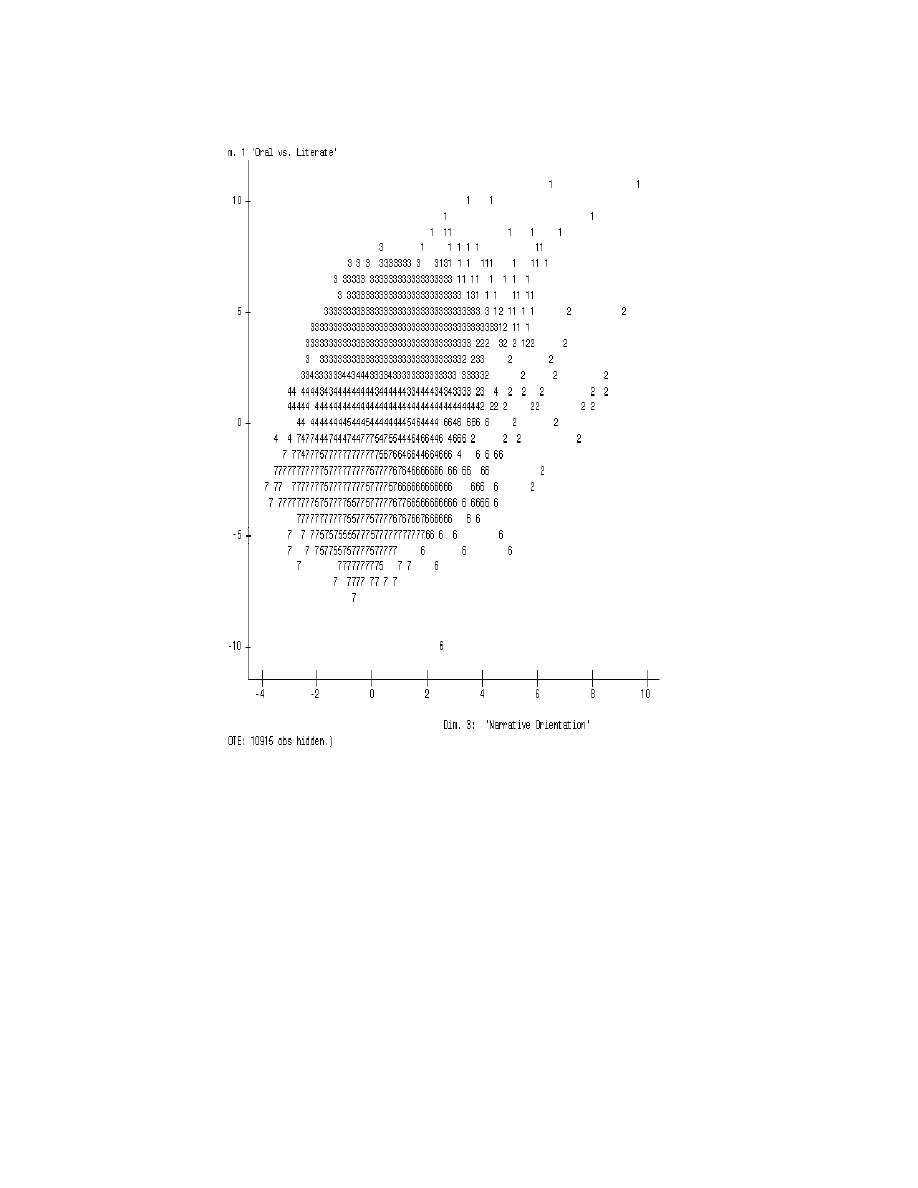
by the 2-dimensional plot in Figure 1. Each point on Figure 1 represents a VBDU,
plotting the scores for that VBDU on two dimensions: 1 and 3. The numbers in
the figure show the cluster number for each VBDU, based on the results of the
cluster analysis. VBDUs can be grouped together based on dimension scores. For
example, the VBDUs labelled with a '1' on Figure 1 all have large positive scores
on Dimension 1 (the vertical axis) and large positive scores on Dimension 3 (the
Vocabulary-based Discourse Units in University Registers
61
horizontal axis). Note that the grouping process here is based on the dimension
scores, regardless of register category.
Figure 1: Distribution of VBDUs along Dimensions 1 and 3, by cluster

Douglas Biber et al.
62
Cluster analysis performs this grouping statistically, based on the scores
for all four dimensions in a VBDU. Figure 1 shows the distribution across only
two dimensions (1 and 3); these two dimensions were chosen because they
provide a good visual display of how the VBDUs within each cluster are grouped
based on their dimension scores. However, the actual cluster analysis uses all four
dimension scores to identify the groupings of VBDUs that are maximally similar
in their linguistic characteristics.
Seven clusters were identified based on the groupings of the cluster
analysis produced by our statistical package (SAS).
2
Figure 1 shows the
distribution of clusters in only a 2-dimensional space, whereas the cluster analysis
actually considered a 4-dimensional space. It turns out that the other two
dimensions are important in defining some clusters. For example, Cluster 5 is not
sharply delimited in terms Dimensions 1 and 3, but all VBDUs in this cluster
have large negative scores on Dimension 2 ('content-focused').
Table 5: Cluster mean scores for each dimension
Cluster Frequency Dim. 1 Dim. 2 Dim. 3 Dim. 4
'Oral vs. 'Procedural vs. 'Narrative'
'Academic
Literate' Content-focused' Stance'
1: Extremely oral + narrative
77 6.8
-0.2
4.4
0.0
2: Oral + narrative + academic stance
60 1.9
-0.3
4.8
4.5
3: Oral
3059 3.3
0.1
0.5
0.4
4: Unmarked
2814 0.4
-0.1
-0.1
0.2
5: Literate + extreme content-focused
446 -3.2
-4.7
-0.6
-0.6
6: Literate + moderate content-focused + moderate narrative + moderate
academic stance
369 -2.5
-1.3
1.8
1.9
7: Literate + moderate content-focused
4885 -3.2
-1.5
-0.7
-0.3
Table 5 provides a descriptive summary of the cluster analysis results. This table
shows the number of VBDUs grouped into each cluster, and the mean score for
each cluster for each dimension. The clusters differ notably in their
distinctiveness: the smaller clusters are more specialized and more sharply
distinguished linguistically. For example, Cluster 2 has only 60 VBDUs;
linguistically, the VBDUs grouped in Cluster 2 have moderate positive scores on
Dimension 1 ('oral'); large positive scores on Dimension 3 ('narrative'); and large
Vocabulary-based Discourse Units in University Registers
63
positive scores on Dimension 4 ('academic stance'). Clusters 1, 2, 5, and 6 are all
small, 'specialized' clusters. In contrast, Cluster 3, 4, and 7 are very large,
'general' clusters. For example, Cluster 4 has 2,814 VBDUs and is unmarked on
all four dimensions.
The clusters can be regarded as Discourse Unit Types (VBDU Types),
because each cluster represents a grouping of VBDUs with similar linguistic
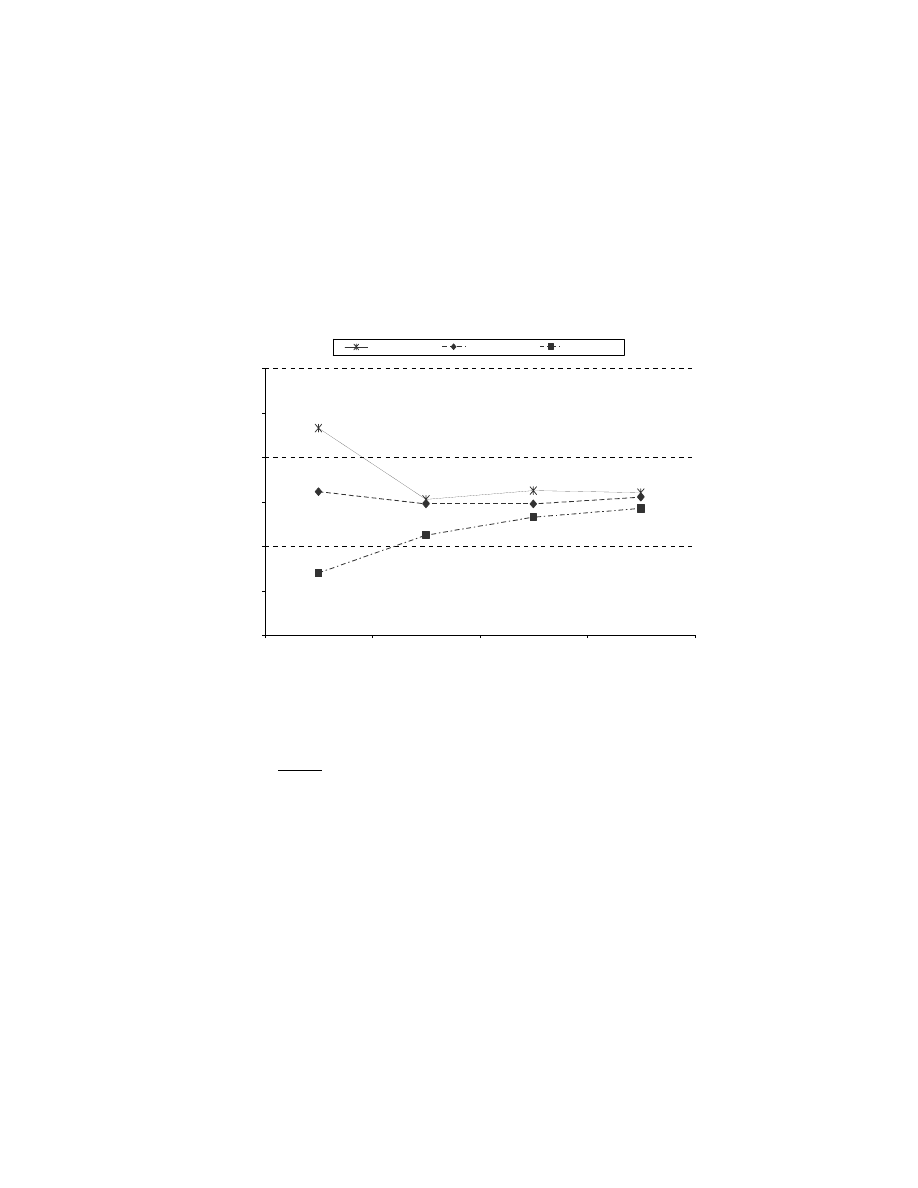
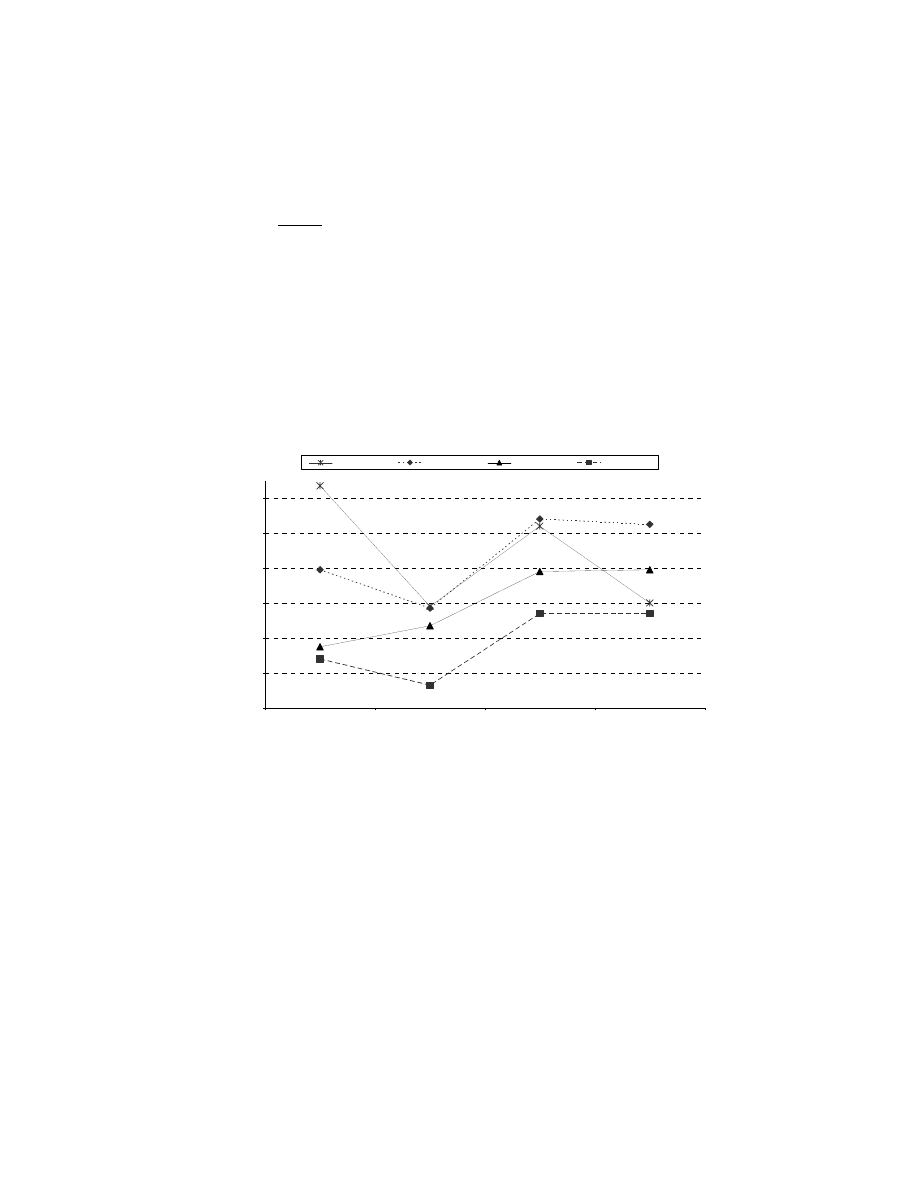
profiles. Figures 2 and 3 compare the linguistic characteristics of the seven types,
plotting their mean dimension scores. The 'general' VBDU types – 3, 4, and 7 –
are plotted in Figure 2. These three types are very large but not distinctive
linguistically: Figure 2 shows that these types are distinguished along Dimension
1, but they all have scores near 0.0 along Dimensions 2, 3, and 4. The following
text extracts show examples of a VBDU Types 3 and 4.
Multi-Dimensional profile for the general VBDU types
-6
-4
-2
0
2
4
6
1
2
3
4
Dimensions
Di
m
ens
ion S
cor
e
VBDU Type 3
VBDU Type 4
VBDU Type 7
Figure 2: Multi-Dimensional profile for the general VBDU Types
Extract 2: VBDU Type 3 ‘Oral’
Teacher: many perhaps would appeal to things like the ten commandments.
well those are principles. “thou shalt not lie, thou shalt not uh kill”, these
are principles that tell you not to do certain sorts of things. and then if
people will appeal to them uh because they say these are the commands of
Douglas Biber et al.
64
God. Sartre would very much agree with (Kirky's) argue uh “thou shalt not
kill”, never? under no circumstances? under what circumstances? who
decides? what are the exceptions? what are not? it's not enough to know
that “thou shalt not kill”, you got to know when, where, to whom, etcetera.
and those details aren't supplied by the principle.
Extract 3: VBDU Type 4 ‘Unmarked’
Teacher: uh I've given you all a handout [unclear words] in her discussion,
some very brief descriptions of uh ethical principles that have been famous
throughout uh Western History. and I've raised the sorts of questions that
can be raised about them very briefly, so as to kind of give you the flavor of
why Sartre would claim that these principles really don't work, they are
failed ethical principles as it were. and I wont go into the detail of that any
more. I want to come quickly to the bottom line. Sartre thinks that the case
of the young Frenchman is typical not just of young Frenchmen during the
war, but of human reality. that this is not a special case, it's just a dramatic
case, which bares uh drives home the point. all of us are in the predicament
of making decisions everyday about what we should do. and most of us
probably think there is a right and a wrong (only). some ethical principle
out there which will tell us what to do.
Multi-Dimensional profile for the specialized VBDU types
-6
-4
-2
0
2
4
6
1
2
3
4
Dimensions
D
im
ens
ion S
cor
e
VBDU Type 1
VBDU Type 2
VBDU Type 6
VBDU Type 5
Figure 3: Multi-Dimensional profile for the specialized VBDU Types

Vocabulary-based Discourse Units in University Registers
65
In contrast, the specialized VBDU types, plotted in Figure 3, are much
more distinctive linguistically. Type 1 is extremely 'oral' (Dim. 1), and has a
strong narrative orientation (Dim 3). Type 2 is moderately 'oral' (Dim. 1) with a
strong narrative orientation (Dim. 3) and a strong emphasis on academic stance
(Dim. 3). Type 5 is strongly 'literate' (Dim. 1) and very strongly content-focused
(Dim. 2). Finally, Type 6 is 'literate' (Dim. 1) with a moderate content-focus
(Dim. 2), narrative orientation (Dim. 3) and emphasis on academic stance (Dim.
4).
The text extracts below show examples of three of the specialized
VBDU Types (1, 5, and 6).
Extract 4: VBDU Type 1 ‘Extreme oral, narrative’ from a class session
Teacher: and I suppose that would be the case here, it's permissible for him
to stay home with his mother no one would say he did the wrong thing, it's
permissible for him to go and fight the Nazis, no one would say he did the
wrong thing if he did that. But now our young man is faced with the fact
that OK it's permissible to this, it's permissible to do that, but what do I do?
knowing it's permissible is not telling me to do it. I have to choose. I have
to decide between those options, both of which are permissible.
Student: well many times one has to decide on grounds [unclear words]
right or wrong, it's what one prefers or what you know I don't know
[unclear words]
Teacher: well
Student: [unclear words] ethics should always have a clear answer to every
situation?
Teacher: one would hope, but uh probably in vain. let's move on and see
what Sartre has to say about this.
The positive Dimension 1 and Dimension 3 features are underlined.
Extract 5: VBDU Type 5 ‘Literate, extreme content-focused’ from
academic prose
…. PCNA is an acidic nuclear protein, expression of which is directly
correlated with rates of cell proliferation and DNA synthesis. The
monoclonal antibody PC10 will "recognise"PCNA in conventionally fixed
and processed histological material. The tissue sample of the excised
pancreas was placed in buffered formalin for two to four hours and
transferred to 75% ethanol. Tissue was processed in chloroform and
embedded in wax before 4 m sections were cut. Sections were dewaxed
and taken down through graded alcohols; endogenous peroxidase activity
was blocked by incubating the sections in 3% hydrogen peroxide and
methanol for one hour. After washing in PBS, pH 7.4, each section was
treated with a drop of primary antibody (1:20 dilution in PBS). After
overnight incubation at 4C, the sections were washed in PBS,0.1% bovine

Douglas Biber et al.
66
serum albumin (BSA), and Tris-BSA. The second layer antibody,
biotinylatd goat anti-mouse IgG (Vector Laboratories, Burlingame, CA,
USA) was applied at a dilution of 1:50 and incubated for two hours at room
temperature. After washing in PBS, streptavidin-peroxidase (Jackson
Immunonuclear Laboratories, Westgrove, PA, USA) was applied to the
sections at a 1:5000 dilution in PBS with 1% BSA for 30 minutes at room
temperature. Diamino-benzidine-hydrogen peroxide was employed at a
chromogen, and a light haematoxylin counterstain was used. The PCNA
labelling index was estimated from a count of 2000 exocrine acinar cells …
The negative Dimension 1 features are underlined.
Extract 6: VBDU Type 6 ‘Literate, content-focused, narrative, academic
stance’ from a textbook
Given the cultural differences in the world and the tendency of all of us to
view our own way of life as "natural," it is no wonder that travellers often
feel culture shock, personal disorientation that comes from experiencing an
unfamiliar way of life. The box on page 64 presents one researcher's
encounter with culture shock.
December 1, 1994, Istanbul, Turkey.
‘Harbors everywhere, it seems, have two things in common: ships and cats.
Istanbul, the tenth port on our voyage, is awash with felines, prowling
about in search of an easy meal. People may change from place to place,
but cats do not. No cultural trait is inherently "natural" to humanity, even
though most people around the world view their own way of life that way.
What is natural to our species is the capacity to create culture. Every other
form of life - from ants to zebras - behaves in uniform, species-specific
ways. To a world traveller, the enormous diversity of human life stands out
in contrast to the behaviour of, say, cats, which is the same everywhere.
This uniformity follows from the fact that most living creatures are guided
by instincts, biological programming over which animals have no control.
A few animals - notably chimpanzees and related primates - have the
capacity for limited culture; they can use tools and teach simple skills to
their offspring.’
6
The Distribution of VBDU Types across Registers
Table 6 shows how the VBDU types cut across registers: the three registers in our
study utilize each of the seven types to differing extents. Research articles never
use Types 1-3, and they rarely use Type 4, but Types 5-7 are all relatively
common in this register. However, classroom teaching and textbooks use all
seven types. Classroom teaching rarely uses Type 5, but the remaining six types
are all used to some extent in this register. (The single Type 5 text in classroom
teaching is actually an instructor reading a passage from a written text.)

Vocabulary-based Discourse Units in University Registers
67
Textbooks are similar in using the full range of types, but they show different
preferences: Types 1 and 2 are rare in this register, while Types 3-7 all occur to
some extent. These patterns show that the VBDU type categories reflect different
topical and rhetorical considerations, which cut across the register categories. For
example, classroom teaching can include interactive, conversational Vocabulary-
based Discourse Units (Type 1) as well as monologues with a dense informational
purpose (Type 6). A full interpretation of the VBDU Types requires detailed
consideration of the functions of each type in each register.
7
Sequences of VBDU Types
Finally, it is possible to analyze the discourse structure of individual texts as
sequences of VBDUs, taking into account the VBDU Type of each unit. For
example, Figure 4 shows the progression of VBDUs in a classroom teaching text.
As the distribution across registers showed (Table 6), the majority of the class
sessions tend to rely on two general VBDU Types: ‘Oral’ (Type 3) and
‘Unmarked’ (Type 4). However, the other five VBDU Types are also present in
classroom talk.
The VBDU Type profile in Figure 4 demonstrates the distribution
pattern within a Philosophy class session. Besides the general VBDU Types
mentioned above, this class also uses VBDU Type 1 (‘Extremely oral narrative’),
as in VBDU Number 32, and Type 7 (‘Literate, content focused’), as in VBDU
Number 33. The variation in the VDBU Type reflects a change in linguistic
characteristics, and relates to a change in the communicative purposes of these
topically coherent discourse units.
Table 6: Distribution of VBDUs across DU Types (Clusters) and Registers
Register DU
type
1 2 3 4 5 6 7
Total
Academic
Freq.
0
0
0
26
430
115
2,431
3,002
Percent 0.00 0.00
0.00
0.22 3.67 0.98 20.76
25.64
Row % 0.00 0.00
0.00
0.92 96.41 31.17 49.76
Col % 0.00 0.00
0.00
0.87 14.32 3.83 80.98
Classroom
Freq.
75
57
3,030
2,349
1
59
104 5,675
Percent 0.64 0.49 25.88 20.06 0.01 0.50
0.89
48.46
Row % 97.40 95.00 99.05
83.48 0.22 15.99
2.13
Col % 1.32 1.00 53.39
41.39 0.02 1.04
1.83
Textbooks
Freq.
2
3
29
439
15
195
2,350
3,033
Percent 0.02 0.03
0.25
3.75 0.13 1.67 20.07
25.90
Row % 2.60 5.00
0.95
15.60 3.36 52.85 48.11
Col % 0.07 0.10
0.96
14.47 0.49 6.43 77.48
Total
Freq.
77
60
3,059
2,814
446
369
4,485
11,710
Percent
0.66
0.51
26.12
24.03
3.81
3.15
41.72
100.00

Douglas Biber et al.
68
Figure 4: VBDU Type profile for a class lecture
The text extract below corresponds to the VBDU Numbers 32 to 35
illustrated in Figure 4. This text segment contains four consecutive VBDUs,
where each is a different type. VBDUs 32 and 33 are the same two discourse
units that we used to illustrate the TextTiling methodology in Section 3 above
(Extract 1).
Extract 7: Selected VBDUs from a class teaching session:
VBDU 32 = VBDU Type 1: Extremely oral + narrative
Teacher: it's all relative to the individual culture. of course our culture today
is breaking apart. it's really very difficult to say we have a culture today. we
have just the collection of some cultures. so really we ought to say that
what's right is relative to the sub-culture. but then subcultures probably are
not as homogeneous as we tend to think we are. we're all individuals and so
even if I am a member of a subculture I'm probably going to disagree on
certain issues. so where does that put us? whether it's right or wrong is
relative too. there are no standards that are valid beyond the individual
person. if I think something is right, then it is right for me. if I think
something is wrong, it is wrong for me. if I think it's right and you think it's
wrong, then for you it is wrong, for me it is right.
VBDU Type Profile for a class lecture
0
1
2
3
4
5
6
7
1
2
3
4
5
6
9
11 13 14 15 17 19 20 21 22 23 24 25 27 29 32 33 34 35 36 38 40
VBDU Number
V
BDU T
yp
e

Vocabulary-based Discourse Units in University Registers
69
VBDU 33 = VBDU Type 7: Literate + content-focused
Teacher: and that's as far as we can go. that's radical individual relativism.
and many social commentators in the United States these days see such
radical individual relativism as a rampant disease that's about to destroy our
society and is usually thought by philosophy professors. … or people in
cultural studies any more. uh somehow we've survived, but uh we're not
really interested in that we're interested whether it's a correct theory or not.
and we're not really this semester interested whether it's a correct theory,
talk about that next semester. uh this semester we're interested in whether
or not Sartre should be called a relativist. and it certainly looks like it.
VBDU 34 = VBDU Type 4: Unmarked
Teacher: after all, values are the result of my choices. my values are the
result of my choices. your values are the result of your choices. if that's not
relativism what is ? sounds like subjectivism. values are simply the result of
my choices, my preferences that sort of thing and makes values relative to
the individual person. so you could certainly argue the case that Sartre is
both a subjectivist and a relativist. at the end of the handout I raise a couple
of questions that I'd like you to think about. I'm not going to say what the
answer to these questions should be, but I would like you to consider
[unclear words]. is Sartre a subjectivist? what about his insistence that our
choices define for us a world and that we are totally responsible for this
world ? for Sartre choice is a very serious thing. when you choose a way of
life, a relationship to your life as he (would) put it
VBDU 35 = VBDU Type 3: Oral
Teacher: you're defining who you are and you're defining the world you
live in. you know when I go to what's the name of the ice cream store that
has fifty-five flavors?
Students: Baskin Robbins
Teacher: Baskin Robbins. when I go to Baskin Robbins and ask for the
strawberry, I'm not defining myself. I'm certainly not defining (them) the
world. When I make a Sartrian like choice of the world and of the self, it's
not a trivial matter such as taste for ice cream is trivial. It's ontologically
serious in that it shapes the nature of the world I see myself (in). When we
think of subjectivism we think that you know values are just like tastes.
The discourse structure of a text can be interpreted as sequences of VBDU types.
In the Philosophy class session in Extract 7, all VBDUs stay within the same
overall theme while each VBDU is different not only their linguistic features but,
correspondingly, in their communicative purposes.
VBDU 32 has features that had been associated with extremely oral,
narrative discourse. In this unit the teacher brings in a seemingly unrelated topic
to the overall theme. However, this ‘aside’ provides background to the main idea
presented in the next VBDU (33). By the extensive use of first and third person

Douglas Biber et al.
70
pronouns, and present tense, the teacher creates a shared space for discussion,
making the theme both more personable (narrative), and maybe more accessible
to the students. Hence, VBDU 32 serves as a niche for VBDU 33, where the
teacher puts the main proposition forward: “… that's radical individual relativism
… this semester we’re interested in whether or not Sartre should be called a
relativist ...”
In VBDU 34, the teacher elaborates on the notion proposed further,
providing definitions and explanations to the main idea presented in the previous
unit (VBDU 33, linguistically ‘Unmarked’). Finally, in VBDU 35, the linguistic
characteristics indicate oral discourse – quite similar to VBDU 32. Not
surprisingly, in this discourse unit, the teacher is not creating the background for
a proposition next but instead, he gives further support to the notions presented
and discussed earlier; hence, this unit functions as a follow up. He brings in
another real-life example, and as a conclusion to the topic, draws parallels
between the example and the notions presented and supported in the previous
units.
8 Conclusion
The present paper has introduced an approach to integrating the strengths and
goals of corpus analysis and discourse analysis. This approach allows the
consideration of the internal discourse structure of individual texts, but based on
generalizable units of analysis identified through empirical analysis of a large
corpus. We have outlined the kinds of findings possible through this approach,
considering three university registers: classroom teaching, textbooks, and
research articles.
In our on-going research, we are extending this research approach in
several ways. First, we have undertaken perceptual analyses to investigate
whether human raters reliably identify Vocabulary-based Discourse Units in texts
from different registers, and whether VBDUs correspond to the Vocabulary-based
Discourse Units identified by human raters. Second, we are extending the
computational techniques for segmenting texts to incorporate a range of linguistic
indicators in addition to vocabulary distributions. We are undertaking much more
detailed interpretations of the discourse unit types in each register. And finally,
we are studying how sequences of VBDU-types work together in different
registers, supporting different major rhetorical patterns.
Notes
1. An earlier version of this paper was presented at the Camerino
conference on ‘Corpora and Discourse’ (September 2002), published in
the conference proceedings (Biber, Csomay et al. forthcoming).

Vocabulary-based Discourse Units in University Registers
71
2. The number of clusters is determined by peaks in the cubic clustering
criterion and the Pseudo-F statistic produced by SAS.
References
Bhatia, V.K. (1993), Analysing genre: Language use in professional settings,
New York: Longman.
Biber, D. (1988), Variation across speech and writing, Cambridge: Cambridge
University Press.
Biber, D. (1989), The typology of English texts, Linguistics, 27: 3-43.
Biber, D. (1995), Dimensions of register variation: A cross-linguistic perspective,
Cambridge: Cambridge University Press.
Biber, D. (2003), Variation among university spoken and written registers: A new
multi-dimensional analysis, in P. Leistyna and C. Meyer (eds), Corpus
analysis: Language structure and language use, Amsterdam: Rodopi,
pp. 47-70.
Biber, D., S. Conrad, and R. Reppen (1998), Corpus linguistics: Investigating
language structure and use, Cambridge: Cambridge University Press.
Biber, D., S. Johansson, G. Leech, S. Conrad, and E. Finegan (1999), Longman
grammar of spoken and written English, London: Longman.
Biber, D., S. Conrad, R. Reppen, P. Byrd, and M. Helt (2002), Speaking and
writing in the university: A Multidimensional comparison, TESOL
Quarterly, 36: 9-48.
Biber, D., S. Conrad, R. Reppen, P. Byrd, M. Helt, V. Clark, V. Cortes, E.
Csomay, and A. Urzua (forthcoming), Representing language use in the
university: Analysis of the TOEFL 2000 Spoken and Written Academic
Language corpus, TOEFL Monograph Series, Princeton, NJ:
Educational Testing Service.
Biber, D., E. Csomay, J.K. Jones and C. Keck (forthcoming), Vocabulary-based
discourse units in university registers, in A. Partington, J. Morley, and L.
Haarman (eds), Corpora and discourse, Bern: Peter Lang.
Collins, P. (1991), Cleft and pseudo-cleft constructions in English, London:
Routledge.
Collins, P. (1995), The indirect object construction in English: An informational
approach, Linguistics, 33: 35-49.
Csomay, E. (2002), Episodes in university classrooms: A corpus-linguistic
investigation, Unpublished Ph.D. Dissertation, Flagstaff, AZ: Northern
Arizona University.
Csomay, E. (forthcoming), A Multi-dimensional analysis of discourse segments
in university classroom talk, in A. Partington, J. Morley, and L.
Haarman (eds), Corpora and discourse, Bern: Peter Lang.
Fox, B.A. and S.A. Thompson (1990), A discourse explanation of the grammar of
relative clauses in English conversation, Language, 66: 297-316.
Granger, S. (1983), The 'be' + past participle construction in spoken English,
with special emphasis on the passive, Amsterdam: North Holland.

Douglas Biber et al.
72
Hearst, M.A. (1994), Multi-paragraph segmentation of expository texts,
Technical Report 94/790, Computer Science Division (EECS),
University of California, Berkeley.
Hearst, M.A. (1997), TextTiling: Segmenting text into multi-paragraph subtopic
passages, Computational Linguistics, 23 (1): 33-64.
Henry, A. and R.L. Roseberry (2001), A narrow-angled corpus analysis of moves
and strategies of the genre Letter of Application, English for Specific
Purposes, 20 (2): 153-167.
Hoey, M. (2001), Textual interaction, London: Routledge.
Kanoksilapatham, B. (2003), A Corpus-based investigation of biochemistry
research articles: Linking move analysis with multidimensional analysis,
Unpublished Ph.D. Dissertation, Georgetown University: Washington,
DC.
Kennedy, G. (1998), An introduction to corpus linguistics, New York: Longman.
Mair, C. (1990), Infinitival complement clauses in English, New York:
Cambridge University Press.
Mann, W.C., C. Matthiessen, and S.A. Thompson (1992), Rhetorical structure
theory and text analysis, in W. Mann and S.A. Thompson (eds),
Discourse description: Diverse linguistic analyses of a fund-raising text,
Amsterdam: John Benjamins, pp.
39-78.
Meyer, C. (1992), Apposition in contemporary English, Cambridge: Cambridge
University Press.
Paltridge, B. (1997), Genre, frames, and writing in research settings,
Philadelphia: John Benjamins.
Prince, E.F. (1978), A comparison of Wh-clefts and It-clefts in discourse,
Schiffrin, D. (1981), Tense variation in narrative, Language, 57: 45-62.
Swales, J. (1990), Genre analysis, Cambridge: Cambridge University Press.
Thompson, S.A. and A. Mulac (1991), A quantitative perspective on the
grammaticization of epistemic parentheticals in English, in E.C.
Traugott and B. Heine (eds), Approaches to grammaticalization,
Volume II, Amsterdam: John Benjamins, pp. 313-329.
Tottie, G. (1991), Negation in English speech and writing: A study in variation,
San Diego: Academic Press.
Upton, T.A. and U. Connor (2001), Using computerized corpus analysis to
investigate the text linguistic discourse moves of a genre, English for
Specific Purposes, 20 (4): 313-329.
Wyszukiwarka
Podobne podstrony:
Investigations of White Layer Formation During Machining of Powder Metallurgical Ni Based ME 16 S
Partington A linguistic account of wordplay
[Mises org]Boetie,Etienne de la The Politics of Obedience The Discourse On Voluntary Servitud
a probalilistic investigation of c f slope stability
The Language of Internet 8 The linguistic future of the Internet
Endoscopic investigation of the Nieznany
13 161 172 Investigation of Soldiering Reaction in Magnesium High Pressure Die Casting Dies
8 95 111 Investigation of Friction and Wear Mechanism of Hot Forging Steels
Fundamnentals of dosimetry based on absorbed dose standards
End of the book TestB Units 1 14
Investigation of Barite Sag in Weighted Drilling Fluids in Highly Deviated Wells
Middle of the book TestA Units 1 7
Investigation Of Economic Crimes Attention Of Dr J P Mutonyi
Middle of the book TestA Units 1 7
End of the book TestA Units 1 14
Investigation of bioactive compounds
3 T Proton MRS Investigation of Glutamate and Glutamine in Adolescents at High Genetic Risk for Schi
więcej podobnych podstron