
Marion Zimmer Bradley
ACE BOOKS, INC.
1120 Avenue of the Americas
New York, N.Y. 10036
T H E D A R K I N T R U D E R A N D O T H E R S T O R I E S
Copyright ©, 1964, by Ace Books, Inc.
All Rights Reserved Cover art and illustrations by Jack Gaughan
TABLE OF CONTENTS
Introduction
The Dark Intruder
Jackie Sees a Star
Exiles of Tomorrow
Death Between the Stars
The Crime Therapist
The Stars Are Waiting
Black & White
INTRODUCTION
A writer's life—glamorous tales to the contrary—consists mostly of long sessions at a typewriter, alternating with
long sessions of staring at the blank paper in the typewriter. But there are landmarks where the grind does seem to
have a few sparks of glamour about it, after all. The first check from an editor. The first novel to appear on the stands.
For me, this collection marks a giant step—the first assembling, under one cover, of my short stories.
The contents of this book range, in time, from 1952 to 1962. (I only hope it won't be too painfully evident which is
which.) Ten years is a sizable hunk of a lifetime, and in a science-fiction writer's lifetime, those were about the most
eventful ten years I could have chosen to write in. When that period of time began, people were just getting used to
the idea that television belonged in the living room, instead of in Buck Rogers' space ship, under the 'name of a
"televisor." A bare ten years later, the space ship itself is history, rather than fiction.
Which begs the question; if life today is so full of event and history, why escape into the future by means of the
science-fiction story? In fixing his eyes on the distant stars, does the science-fiction writer lose his perspective on the

exciting present?
I don't think so. Every step into the unknown future opens up a thousand new unknown futures—and only by the
free play of the imagination can we guess, perhaps, where our dreams may be leading us.
-M. Z. B.
THE DARK INTRUDER
Andrew slayton snapped the dusty leather notebook shut, and tossed it into his blanket roll. He stood up, ducking to
avoid the ridgepole of the tent—Andrew, who had grown up on low-gravity Mars, was just over seven feet tall—and stood up, his
head a little bent, looking at the other men who shared this miniature outpost against the greatest desert ever known to man.
The flaps of the tent were tightly pegged against the fierce and unpredictable sandstorms of the Martian night. In the glow of a
portable electric lamp, the four roughnecks who would do the actual digging squatted around an up-ended packing box, intent on
tonight's installment of their perpetual poker game.
A dark oblong in the corner of the tent rose and fell with regular snores. John Reade, temporary leader of this expedition, was
not young, and the day's work had been exhausting.
The men glanced up from their cards as Slayton approached them. "Want to sit in, kid?" Mike Fairbanks asked, "Kater's losing
his shirt. We could use a new dealer."
"No, thanks. Not tonight."
Fat Kater shook with laughter, and jeered "The kid'ud rather read about Kingslander's men, and how they all went nuts and shot
each other up!"
Spade Hansen flung down his cards, with a gesture of annoyance. "That's nothing to joke about, Kater." He lowered his gruff
voice. "Find anything in the logs, Andy?"
Andrew squatted, elbows on thighs, beside the big foreman. "Nothing but what we know already, Spade. It beats me. As near as
I can figure out, Jack Norton's expedition—he only had ten men—was washed up inside a week. Their rations are still cached over
there. And, according to Kings-lander's notebook, his outfit went the same way. They reached here safely, made camp, did a little
exploring—they found the bodies of Norton's men and buried them—then, one by one, they all went insane and shot each other.
Twenty men—and within ten days, they were just twenty-corpses."
"Pleasant prospect," Kater glowered, slapping down his cards on the improvised table and scowling as Rick Webber raked in the
pot. "What about us?"
Rick Webber meticulously stacked his winnings and scaled his cards at Hensen. "Quit your worrying. Third time lucky—
maybe we'll get through, all right."
"And maybe we won't," Fairbanks grunted, raking the cards together and shuffling them with huge fists, "You know what they
call this outfit back in Mount Denver? Reade's Folly."
"I'd hate to tell you what they called the first men who actually tried living on Mars," said a sleepy, pleasant voice from the
corner, and John Reade thrust up his shock of white hair. "But •we're here." The old man turned to Andrew. "Wasn't there even a
clue in the logs, some notion of what might have happened to them?"
Andrew swivelled to face him. "Not a word, sir. Kings-lander kept the log himself until he was shot, then one of his men—Ford
Benton—kept it. The last couple of pages are the most awful gibberish—not even in English. Look for yourself—he was
obviously but of his head for days." Andrew unfolded his long legs, hauled up a corner of the tent flap, and stood, staring
morosely across the dark wasteland of rocks and bare bushes, toward the looming mass of Xanadu.
Xanadu. Not the Xanadu of Coleridge's poem, but—to the half-forgotten space drifter who discovered the place thirty years
ago—a reasonable facsimile. It was a cloistered nun of a city, hidden behind a wide skirt of the most impassable mountains on
Mars. And the city was more impassable than the mountains. No human being had ever entered it—yet.
They'd tried. Two expeditions, twelve years apart, had vanished without trace, without explanation other than the dusty
notebook Andrew had unearthed, today, from the rotted shreds of a skeleton's clothing.
Archaeological expeditions., on Mars, all start the same way. You argue, wheedle, beg, borrow and steal until you have the
necessary authority and a little less than the necessary funds. Earth, torn with internecine wars and slammed down under currency

restrictions, does not send much money to Mars at any time. All but the barest lifeline of supplies was choked off when it was
finally verified that Mars had no heavy metals, very little worth mining. The chronically-bankrupt Geographical Society had
abandoned Mars even before Xanadu was discovered. The thronging ruins of
Venus, the strange surviving culture of subterranean
men on Titan, the odd temples of the inner moons of Jupiter, are more rewarding than the desert barrens of Mars and its
inaccessible Xanadu—the solitary remnant of a Martian society which must have vanished before mankind, on Earth, had
discovered fire.
For all practical purposes, Mars is a military frontier, patrolled by the U.N. to keep any one country from using it as a base for
developing secret weapons. It's also a good place to test new atomic engines, since there isn't much of a fallout problem and no
worry about a large population getting fallout jitters. John Reade, retired Major in the Space Service, had good military contacts,
and had managed to get a clearance for the third—only the third—attempt to conquer Xanadu.
Private expeditions on Mars are simple to the point of being primitive. No private citizen or foundation could possibly pay
freight charges for machinery to Mars. Private citizens travel on foot, taking with them only what they can carry on their backs.
Besides, no one could take a car, a plane or a rocketship over the mountains and still find a safe place to land. Pack animals are out
of the question; horses and burros cannot adapt to the thin air—thicker than pre-space theorists had dared to hope, but still pretty
thin—and dogs and chimpanzees, which can, aren't- much good for pack-work. The Geographic Society is still debating about
importing yaks and llamas from high-altitude Peru and Tibet; meanwhile, it's a good thing that gravity on Mars is low enough to
permit tremendous packloads of necessities.
The prime necessity is good lungs and a sackful of guts, while you scramble, scratch and curse your way over the mountains.
Then a long, open valley, treacherously lined with needles of rock, and Xanadu lying—the bait in the mouth of the trap—at the
top.
And then—what?
Kater and Hansen and the rest were grumbling over the cards again. "This place is jinxed," Mike complained, turning up a deuce.
"We'll be lucky if we get a cent out of it Now if we were working on Venus—but Mars, nyaahl Even if we find something, which I
doubt, and live to tell about it—who cares?"
"Yeah," Spade muttered. "Reade, how much did you spend for dynamite to blast the walls?"
"You didn't pay for it," Reade said cheerfully.
Andrew stooped, shrugging on his leather jacket; thumbed the inside heating-units. "I'm going for a walk."
"Alone?" Reade asked sharply.
"Sure, unless someone wants to come along," Andrew said, then suddenly understood. He pulled his pistol from his pocket, and
handed it, butt-first, to Reade. "Sorry, I should have remembered. This is about where the shooting started, with the others."
Reade laughed, but he didn't return the gun.
"Don't go too far."
It was one of the rare, clear nights which sometimes did penance for the usual sandstorms. Andrew drew down the tent flap
behind him, walked away into the darkness. At his foot he felt a little scurrying, stooped and caught up one of the blunt-nosed
sand-mice. It squirmed on his palm, kicking hard with all six puny legs; then felt the comforting heat of his hand and yeep-yeeped
with pleasure; he walked on, idly scratching the scaly little beast.
The two small moons were high overhead, and there was a purplish, shimmery light over the valley, with its grotesque floor of
rock spires, fuzzed between with blackish patches of prickle-bushes—spinosa martts—matted in a close tangle between each little
peak.
Downwind he heard the long screaming of a banshee;
then he saw it, running blindly, a huge bird with its head down between trailing, functionless wings. Andrew held his breath and
stood still. The banshees had no intelligence to speak of, but by some peculiar tropism, they would rush toward anything that
moved; the very heat of his body might attract them, and their huge clawed feet could disembowel a man at one stroke. And he had
no pistol!
This one failed to sense him; it ran, trailing its wings and screaming eerily, like a cloaked girl, blindly into the dusk. Andrew let
out his breath violently in relief. Suddenly he realized that he was not sure just which way the tent lay. He turned, crowding against
"one of the rockspires. A little hollow gleamed pallidly in the moonlight. He remembered climbing a rise; he must have come this
way-
He slid down roughly, a trailing pricker raking his hand. The sand-mouse leaped from his palm with a squeal and scuffled away.
Andrew, sucking his bleeding palm, looked up and saw the walls of Xanadu lifting serried edges just over his head. How could he
possibly have come so near in just a few minutes? Everything looked different-
He spun around, trying to scramble up the way he had come. He fell. His head struck rock, and the universe went dark.
"Take it easy." John Reade's voice sounded disembodied over his head, "Just lie still. You've got a bad bump, Andy."
He opened his eyes to the glare of stars and a bitter wind on his face. Reade caught at his hand ~as he moved it exploringly
toward his face. "Let it alone, the bleeding's stopped. What happened? The banshee get you?"
"No, I fell. I lost my way, and I must have hit my head." Andrew let his eyes fall shut again. "I'm sorry, sir; I know you told us
not to go near the city alone. But I didn't realize I'd come so close."
Reade frowned and leaned closer. "Lost your way? What
are you talking about? I followed you—brought your pistol. I was
afraid you'd meet a banshee. You hadn't gone two hundred yards from the tent, Andy. When I caught up with you, you were
stumbling around, and then you rolled down on the ground into that little hollow. You kept muttering No, no, no—I thought the
banshee had got you."
Andrew pushed himself upright. "I don't think so, sir. I looked up and saw the city right over my head. That's what made me

fall. That's when it started."
"When what started?"
"I—don't know." Andrew put up his hand to rub his forehead, wincing as he touched the bruise. Suddenly he asked "John, did
you ever wonder what the old Martians—the ones who built Xanadu—called the place?"
"Who hasn't?" The old man nodded, impatiently. "I guess we'll never know, though. That's a fool question to ask me right now!"
"It's something I felt," Andrew said, groping for words. "When I got up, after I stumbled, everything looked different. It was
like seeing double; one part was just rocks, and bushes, and ruins, and the other part was—well, it wasn't like anything I'd ever
seen before. I felt—" he hesitated, searching for words to define something strange, then said with an air of surprise, "Homesick.
Yes, that's it. And the most awful—desolation. The way I'd feel, I guess, if I went back to Mount Denver and found it burned
down flat. And then for just a second I knew what the city was called, and why it was dead, and why we couldn't get into it, and
why tie other men went crazy. And it scared me, and I started to run—and that's when I slipped, and hit my head."
Reade's worried face relaxed in a grin.
"Rubbish! The bump on your head mixed up your timesense a little, that's all. Your hallucination, or whatever it was, came after
the bump, not before."
"No," Andrew said quietly, but with absolute conviction. "I wasn't hurt that bad, John."
Reade's face changed; held concern again, "All right," he said gently, "Tell me what you think you know."
Andrew dropped his face in his hands. "Whatever it was, it's gone! The bump knocked it right out of my head. I remember that
I knew—" he raised a drawn face, "but I can't remember what!"
Reade put his hand on the younger man's shoulder. "Let's get back to the tent, Andy, I'm freezing out here. Look, son, the
whole thing is just your mind working overtime from that bump you got. Or—"
Andrew said bitterly, "You think I'm going crazy."
"I didn't say that, son. Come on. We can talk it over in the morning." He hoisted Andrew to his feet. "I told Spade that if we
weren't back in half an hour, he'd better come looking for us."
The men looked up from their cards, staring at the blood on Andrew's face, but the set of Reade's mouth silenced any
comments. Andrew didn't want to talk. He quickly shucked jacket and trousers, crawled into his sleeping bag, thumbed the
heat-unit and immediately fell asleep.
When he woke, the tent was empty. Wondering why he had been allowed to sleep—Spade usually meted out rough treatment to
blanket-huggers—Andrew dressed quickly, gulped a mug of the bitter coffee that stood on the hot-box, and went out to look for
the others.
He had to walk some distance to find them. Armed with shovels, the four roughnecks were digging up the thorny prickle-bushes
near the hollow where Andrew had fallen, while Reade, in the lee of a rock, was scowling over the fine print of an Army manual of
Martio-biology.
"Sorry I overslept, John. Where do I go to work?"
"You don't. I've got another job for you." Reade turned to
bark a command at Fairbanks. "Careful with the damned plant! I told
you to wear gloves! Now get them on, and don't touch those things with your bare hands." He glanced back at Andrew. "I had an
idea overnight," he said. "What do we really know about spinosa martis? And this doesn't quite look like the species that grows
around Mount Denver. I think maybe this variety gives off some kind of gas—or poison." He pointed at the long scratch on
Andrew's hand. "Your trouble started after you grabbed one of them. You know, there's locoweed on Earth that drives cattle
crazy-mushrooms and other plants that secrete hallucinogens. If these things give off some sort of volatile mist, it could have
dispersed in that little hollow down there—there wasn't much wind last night."
"What shall I do?" he asked.
"I'd rather not discuss that here. Come on, 111 walk back to the tent with you." He scrambled stiffly to his feet. "I want you to
go back to Mount Denver, Andy."
Andrew stopped; turned to Reade accusingly.
"You do think I've gone crazy!"
Reade shook his head. "I just think you'll be better off in Mount Denver. -I've got a job for you there—one man would have to
go, anyhow, and you've had one—well, call it a hallucination—already. If it's a poison, the stuff might be cumulative. We may just
wind up having to wear gas masks." He put a hand on the thick leather of Andrew's jacket sleeve. "I know how you feel about this
place, Andy. But personal feelings aren't important in this kind of work."
"John—" half hesitant, Andrew looked back at him, "I had an idea overnight, too."
"Let's hear it."
"It sounds crazy, I guess," Andrew said diffidently, "but it just came to me. Suppose the old Martians were beings without
bodies—discarnate intelligences? And they're trying
to make contact with us? Men aren't used to that kind of contact, and it
drives them insane."
Reade scowled. "Ingenious," he admitted,, "as a theory, but there's a hole in it. If they're discarnate, how did they build—" he
jerked his thumb at the squat, fortress-like mass of Xanadu behind them.
"I don't know, sir. I don't know how the drive units of a spaceship work, either. But I'm here." He looked up. "I think one of
them was trying to get in touch with me, last night. And maybe if I was trying, too—maybe if I understood, and tried to open my
mind to it, too—"
Reade looked disturbed. "Andy, do you realize what you're suggesting? Suppose this is all your imagination—"
"It isn't, John."
"Wait, now. Just suppose, for a minute; try to see it my way."

"Well?" Andrew was impatient.
"By trying to 'open your mind', as you put it, you'd just be surrendering your sane consciousness to a brooding insanity. The
human mind is pretty complex, son. About nine-tenths of your brain is dark, shadowy, all animal instinct. Only the conscious
fraction can evaluate—use logic. The balance between the two is pretty tricky at best. I wouldn't fool around with it, if I were you.
Listen, Andy, I know you were born on Mars, I know how you feel. You feel at home here, don't you?"
"Yes, but that doesn't mean—"
"You resent men like Spade and Kater, coming here for the money that's in it, don't you?"
"Not really. Well, yes, but-"
"There was a Mars-born kid with Kingslander, Andy. Remember the log? He was the first to go. In a place like this, imagination
is worse than smallpox. You're the focal point where trouble would start, if it started. That's why I picked
men like Spade and Kater—insensitive, unimaginative—for the first groundwork here. I've had my eye on you from the beginning,
Andy, and you reacted just about the way I expected. I'm sorry, but you'll have to go."
Andrew clenched his fists in his pocket, speaking dry-mouthed. "But if I was right—wouldn't it be easier for them to contact
someone like me? Won't you try to see it my way?" He made a final, hopeless appeal. "Won't you let me stay? I know I'm safe
here—I know they won't hurt me, whatever happens to the others. Take my gun if you want to—keep me in handcuffs,
even—but don't send me back!"
Reade's voice •was flat and final. "If I had any doubts, I wouldn't have them after that. Every word you say is just making it
worse. Leave while you still can, Andy."
Andrew gave up. "All right. I'll start back now, if you insist."
"I do." Reade turned away and hurried back toward the crew, and Andrew went into the tent and started packing rations in his
blanket-roll for the march. The pack was clumsy, but not a tenth as heavy as the load he'd packed on the way up here. He jerked
the straps angrily tight, hoisted the roll to his shoulder, and went out.
Reade was waiting for him. He had Andrew's pistol.
"You'll need this." He gave it to him; hauled out his notebook and stabbed a finger at the sketchy map he had drawn on their
way over the mountains. "You've got your compass? Okay, look; this is the place where our route crossed the mailcar track from
Mount Denver to the South Encampment. If you camp there for a few hours, you can hitch a ride on the mail-car—there's one
every other day—into Mount Denver. When you get there, look up Montray. He's getting the expedition together back there."
Reade tore the leaf from his notebook, scribbling the address on the back. Andrew lifted an eyebrow; he knew Reade had planned
the expedition
in two sections, to prevent the possibility that they, trap would vanish without even a search-party sent after them.
"He won't have things ready, of course, but tell him to hurry it up, and give him all the help you can. Tell him what
we're up against."
"You mean what you're up against. Are you sure you can trust me to run your errands in Mount Denver?"
"Don't be so grim about it," Reade said gently. "I know you want to stay, but I'm only doing my duty the way I see
it. I have to think of everybody, not just you—or myself." He gripped Andrew's shoulder. "If things turn out all right,
you can come back when they're all under control. Good luck, Andy."
"And if they don't?" Andrew asked, but Reade had turned away.
It had been a rough day. Andrew sat with his back against a boulder, watching the sun drop swiftly toward the
reddish range of rock he had climbed that afternoon. Around him the night wind was beginning to build up, but he had
found a sheltered spot between two boulders; and in his heated sleeping-bag, could spend a comfortable night even at
sixty-below temperatures.
He thought ahead while he chewed the tasteless Mar-beef—Reade had outfitted the expedition with Space Service
surplus—and swallowed hot coffee made from ice painstakingly scraped from the rocks. It had taken Reade, and five
men, four days to cross the ridge. Travelling light, Andrew hoped to do it in three. The distance was less than thirty
miles by air, but the only practicable trail wound in and out over ninety miles, mostly perpendicular. If a bad sandstorm
built up, he might not make it at all, but anyone who spent more than one season on Mars took that kind of risk for
granted.
The sun dropped, and all at once the sky was ablaze
with stars. Andrew swallowed the last of his coffee, looking up to
pick out the Heavenly Twins on the horizon—the topaz glimmer of Venus, the blue star-sapphire that was Earth. Andrew had
lived on Earth for a few years in his teens, and hated it; the thick moist air, the dragging feel of too much gravity. The close-packed
cities nauseated him with their smell of smoke and grease and human sweat. Mars air was thin and cold and scentless. His parents
had hated Mars the same way he had hated Earth—they were biologists in the Xenozoology division, long since transferred to
Venus. He had never felt quite at home anywhere, except for the few days he had spent at Xanadu. Now he was being kicked out of
that too.
Suddenly, he swore. The hell with it, sitting here, feeling sorry for himself! He'd have a long day tomorrow, and a rough climb.
As he unrolled his sleeping-bag, waiting for the blankets to warm, he wondered; how old was Xanadu?
Did it matter? Surely, if men could throw a bridge between the planets, they could build a bridge across the greater gap of time
that separated them from these who had once lived on Mars. And if any man could do that, Andy admitted ungrudgingly, that man
was John Reade. He pulled off his boots, anchored them carefully with his pack, weighted the whole thing down with rock, and
crawled into the sack.
In the comforting warmth, relaxing, a new thought crossed his mind.
Whatever it was that had happened to him at Xanadu, he wasn't quite sure. The bump had confused him. But certainly

something had happened. He did not seriously consider Reade's warning. He knew, as Reade could not be expected to know, that
he had not suffered from a hallucination; had not been touched by the fringes of insanity. But he had certainly undergone a very
strange experience. Whether it
had been subjective or objective, lie did not know; but he intended to find out.
How? He tried to remember a little desultory reading he had once done about telepathy. Although he had spoken
glibly to Reade about 'opening his mind,' he really had not the faintest idea of what he had meant by the phrase. He
grinned in the dark.
"Well, whoever and whatever you are," he said aloud, "I'm all ready and waiting. If you can figure out a way to
communicate with me, come right ahead."
And the alien came.
"I am Kamellin," it said.
I am Kamellin..
That was all Andrew could think. It was all his tortured brain could encompass. His head hurt, and the dragging
sense of some actual, tangible force seemed to pull and twist at him. I AM KAMELLIN . . . KAMELLIN . . .
KAMELLIN . . . it was like a tide that sucked at him, crowding out his own thoughts, dragging him under and
drowning him. Andrew panicked; he fought it, thrashing in sudden frenzy, feeling arms and legs hit the sides of the
sleeping-bag, the blankets twisted around him like an enemy's grappling hands.
Then the surge relaxed and he lay still, his breath loud in the darkness, and with fumbling fingers untangling the
blankets. The sweat of fear was cold on his face, but the panic was gone.
For the force had not been hostile. It had only been— eager. Pathetically eager; eager as a friendly puppy is eager,
as a friendly dog may jump up and knock a man down.
"Kamellin," Andrew said the alien word aloud, thinking that the name was not particularly outlandish. He hoped the
words would focus his thoughts sufficiently for the alien to understand.
"Kamellin, come ahead, okay, but this time take it easy,
take it slow and easy. Understand?" Guardedly, he relaxed, hoping
he would be able to take it if some unusual force were thrust at him; He could understand now why men had gone insane. If
this—Kamellin—had hit him like that the first time-Even now, when he understood and partly expected what was happening, it
was an overwhelming flood, flowing through his mind like water running into a bottle. He lay helpless, sweating. The stars were
gone, blanked out, and the howling wind was quiet—or was it that he no longer saw or heard? He hung alone in a universe of
emptiness, and then, to his disembodied consciousness, came the beginning of— what? Not speech. Not even a mental picture. It
was simply contact, and quite indescribable. And it said, approximately;
Greetings. At last. At last it has happened and we are both sane. I am Kamellin.
The wind was howling again, the stars a million flame-bright flares in the sky. Huddled in his blankets, Andrew felt the dark
intruder in his brain ebb and flow with faint pressure as, their thoughts raced in swift question and answer. He whispered his own
question aloud; otherwise Kamellin's thoughts flowed into his and intermingled with them until he found himself speaking
Kamellin's thoughts.
"What are you? Was I right, then? Are you Martians discarnate intelligences?"
Not discarnate, we have always had bodies, or rather— we lived in bodies. But our minds and bodies were wholly
separate. Nothing but our will tied them together. When one body died, we simply passed into another newborn
body.
A spasm of claustrophobic terror grabbed at Andrew, and his flesh crawled. "You wanted—"
Kamellin's reassurance was immediate;
I do not want your body. You have, Kamellin fumbled for
a concept to express what he meant, you are a mature individual with a personality, a reasoning intelligence of your own. I would
have to destroy that before your body could join with me in symbiosis. His thoughts flared indignation; That would not be
honorable!
"I hope all your people are as honorable as you are, then. What happened to the other expedition?"
He felt black anger, sorrow and desolation, breaking like tidal waves in his brain. My people were maddened—I could not hold
them back. They were not stable, what you would call, not sane. The time interval had been too long. There was much killing and
death which I could not prevent.
"If I could only find some way to tell Reade—"
It would be of no use. A time ago, I tried that. I attempted to make contact, easily, with a young mind that was particularly
receptive to my thought. He did not go insane, and we, together, tried to tell Captain Kingslander what had happened to the others.
But he believed it was more insanity, and when the young man was killed by one of the others, I had to dissipate again. I tried to
reach Captain Kingslander himself, but the thought drove him insane—he was already near madness with his own fear.
Andrew shuddered. "God!" he whispered. "What can we do?"
1 do not know. I will leave you, if you wish it. Our race is finally dying. In a few mare years we will be gone, and our planet will
be safe for you.
"Kamellin, no!" Andrew's protest was immediate and genuine. "Maybe, together, we can think of some way to convince them."
The alien seemed hesitant now;
Would you be willing, then, to—share your body for a time? It will not be easy, it is never easy for two personalities to co-inhabit
one body. I could not do it without your complete consent. Kamellin seemed to be thinking
thoughts which were so alien that
Andrew could grasp them only vaguely; only the concept of a meticulous honor remained to color his belief in Kamellin.
"What happened to your original host-race?"

He lay shivering beneath his heated blankets as the story unfolded in his mind. Kamellin's race, he gathered, had been
humanoid—as that concept expressed itself, he sensed Kamellin's amusement; Rather, your race is martianoid! Yes, they had built
the city the Earthmen called Xanadu, it was their one technological accomplishment which had been built to withstand time. Built in
the hope that one day we might return and reclaim it from the sand again, Kamellin's soundless voice whispered, The last refuge of
our dying race.
"What did you call the city?"
Kamellin tried to express the phonetic equivalent and a curious sound formed on Andrew's lips. He said it aloud, exploringly;
"Shein-la Mahari." His tongue lingered on the liquid syllables. "What does it mean?"
The city of Mahari—Mahari, the little moon. Andrew found his eyes resting on the satellite Earthmen called Deimos. "Shein-la
Mahari," he repeated. He would never call it Xanadu again.
Kamellin continued his story.
The host-race, Andrew gathered, had been long-lived and hardy, though by no means immortal. The minds and bodies—"minds,"
he impressed on Andrew, was not exactly the right concept—were actually two separate, wholly individual components. When a
body died, the "mind" simply transferred, without any appreciable interval, into a newborn host; memory, although slightly
impaired and blurred by such a transition, was largely retained. So that the consciousness of any one individual might extend,
though dimly, over an almost incredible period of time.
The dual civilization had been a simple, highly mentalized
one, systems of ethics and philosophy superseding one another in
place of the rise and fall of governments. The physical life of the hosts was not highly technological. Xanadu had been almost their
only such accomplishment, last desperate expedient of a dying race against the growing inhospitality of a planet gripped in
recurrent, ever-worsening ice ages. They might have survived the ice alone, but a virus struck and decimated the hosts, eliminating
most of the food animals as well. The birth-rate sank almost to nothing; many of the freed minds dissipated for lack of a host-body
in which to incarnate.
Kamellin had a hard time explaining the next step. His kind could inhabit the body of anything which "had life, animal or plant.
But they were subject to the physical limitations of the hosts. The only animals which 'survived disease and ice were the sand-mice
and the moronic banshees; both so poorly organized, with nervous systems so faulty, that even when vitalized by the intelligence
of Kamellin's race, they were incapable of any development. It was similar, Kamellin explained, to a genius who is imprisoned in
the body of a helpless paralytic; his mind undamaged, but his body wholly unable to respond.
A few of Kamellin's people tried it anyhow, in desperation. But after a few generations of the animal hosts, they had
degenerated terribly, and were in a state of complete nonsanity, unable even to leave the life-form to which they had bound
themselves. For all Kamellin knew, some of his people still inhabited the banshees, making transition after transition by the faint,
dim flicker of an instinct still alive, but hopelessly buried in generations of non-rational life.
The few sane survivors had decided, in the end, to enter the prickle-bushes; spinosa mortis. This was possible, although it, too,
had drawbacks; the sacrifice of consciousness was the main factor in life as a plant. In the darkness of
the Martian night, Andrew
shuddered at Kamellin's whisper;
Immortality—without hope. An endless, dreamless sleep. We live, somnolent, in the darkness, and the wind, and
wait—and forget. We had hoped that some day a new race might evolve on this world. But evolution here reached a
dead end with the banshees and sand-mice. They are perfectly adapted to their environment and they have no
struggle to survive: hence they need not evolve and change. When the Earthmen came, we had hope. Not that we
might take their bodies. Only that we might seek help from them. But we were too eager, and my people drove out—
killed-
The flow of thoughts ebbed away into silence.
Andrew spoke at last, gently.
"Stay with me for a while, at least. Maybe we can find a way."
It won't be easy, Kamellin warned.
"We'll try it, anyhow. How long ago—how long have you, well, been a plant?"
I do not know. Many, many generations—there is no consciousness of time. Many seasons. There is much
blurring, Let me look at the stars with your eyes.
"Sure," Andrew consented.
The sudden blackness took him by surprise, sent a spasm of shock and terror through his mind; then sight came back and he
found himself sitting upright, staring wide-eyed at the stars, and heard Kamellin's agonized thoughts;
It has been long—again the desperate, disturbing fumbling for some concept. It has been nine hundred thousand
of your years!
Then silence; such abysmal grieved silence that Andrew was almost shamed before the naked grief of this man—he could not
think of Kamellin except as a man—mourning for a
dead world. He lay down, quietly, not wanting to intrude on the sorrow of his curious companion.
Physical exhaustion suddenly overcame him, and he fell asleep.
"Was Mars like this in your day, Kamellin?" Andrew tossed the question cynically into the silence in his brain. Around him a
freezing wind shifted and tossed at the crags, assailing the grip of his gauntleted hands on rock. He didn't expect any answer. The
dark intruder had been dormant all day; Andrew, when he woke, had almost dismissed the whole thing as a bizarre fantasy, born of
thin air and impending madness.
But now the strange presence, like a whisper in the dark, was with him again.
Our planet was never hospitable. But why have you never discovered the roadway through the mountains?

"Give us time," Andrew said cynically. "We've only been on Mars a minute or two by your standards. What roadway?" We cut a
roadway through the mountains when we built Shein-la Mahari.
"What about erosion? Would it still be there?" Kamellin had trouble grasping the concept of erosion. Rain and snow were foreign
to his immediate experience. Unless the roadway had been blocked by a sandstorm, it should be there, as in Kamellin's day.
Andrew pulled himself to a ledge. He couldn't climb with Kamellin using part of his mind; the inner voice was distracting. He
edged himself backward on a flat slab of rock, unstrapping his pack. The remnant of his morning coffee was hot in his canteen; he
drank it while Kamellin's thoughts flowed through his. Finally he asked, "Where's this roadway?" Andrew's head reeled in vertigo.
He lay flat on the ledge, dizzily grasping rock, while Kamellin tried to demonstrate his sense of direction. The whirl slowly
quieted, but all he
could get from the brain-shaking experience was that Kamellin’s race had oriented themselves by at least eleven
major compass points in what felt like four dimensions to Andrew's experience, oriented on fixed stars—his original host-race
could see the stars even by daylight.
"But I can't, and anyway, the stars have moved."
I have thought of that Kamellin answered. But this part: of the mountains is familiar to me. We are not far from the place. I will
lead you there.
"Lead on, MacDufl
7
."
The concept is unfamiliar. Elucidate.
Andrew chuckled. "I mean, which way do we go from here?"
The vertigo began to overcome him once more.
"No, no—not that again!"
Then I will have to take over all your senses—
Andrew's mental recoil was as instinctive as survival. The terror of that moment last night, when Kamellin forced him into
nothingness, was still too vivid. "No! I suppose you could take over forcibly, you did once, but not without half killing me!
Because this time I'd fight—I'd fight you like hell!"
Kamellin's .rage was a palpable pain in his mind. Have you no honor of your own, fool from a mad world? How could I lie to you
when my mind is part of your own? Wander as you please, I do not suffer and I am not impatient. I thought that you were weary of
these rocky paths, no more!
Andrew felt bitterly ashamed. "Kamellin—I'm sorry."
Silence, a trace of alien anger remaining.
Andrew suddenly laughed aloud. Alien or human, there were correspondences; Kamellin was sulking. "For goodness sake," he
said aloud, "if we're going to share one body, let's not quarrel. I'm sorry if I hurt your feelings; this is all new to me. But you don't
have to sit in the corner and turn up your nose, either!"
The situation suddenly struck him as too ridiculous to take seriously; he laughed aloud, and like a slow, pleasant ripple, he felt
Kamellin's slow amusement strike through his own.
Forgive me if I offended. I am accustomed to doing as I please in a body I inhabit. 1 am here at your sufferance,
and I offer apologies.
Andrew laughed again, in a curious doubled amusement, somehow eager to make amends. "Okay, Kamellin, take over. You
know where I want to go—if you can get us there faster, hop to it."
But for the rest of his life he remembered the next hour with terror. His only memory was of swaying darkness and dizziness,
feeling his legs take steps he had not ordered, feeling his hands slide on rock and being unable to clutch and save himself, walking
blind and deaf and a prisoner in his own skull; and ready to go mad with the horror of it. Curiously enough, the saving thought had
been; Kamellin's able to stand it. He isn't going to hurt us.
When sight and sense and hearing came back, and full orientation with it, he found himself at the mouth of a long, low canyon
which stretched away for about twelve miles, perfectly straight. It was narrow, less than fifteen feet wide. On either side, high
dizzy cliffs were cut sharply away; he marvelled at the technology that had built this turnpike road.
The entrances were narrow, concealed between rock, and deeply drifted with sand; the hardest part had been descending, and
later ascending, the steep, worn-away steps that led down into the floor of the canyon. He had struggled and cursed his way down
the two-foot steps, wishing that the old Martians had had shorter legs; but once down, he had walked the whole length in less than
two hours—travelling a distance, which Reade had covered in three weary days of rock-climbing.
And beside the steps was a ramp down which vehicles could be driven; had it been less covered with sand, Andrew could have
slid down!
When he finally came to the end of the canyon road, the nearly-impassible double ridge of mountains lay behind him. From there
it was a simple matter to strike due west and intersect the road from Mount Denver to the spaceport. There he camped overnight,
awaiting the mailcar. He was awake with the first faint light, and lost no time in gulping a quick breakfast and strapping on his
pack; for the mail-cars were rocket-driven (in the thin air of Mars, this was practical) and travelled at terrific velocities along the
sandy barren flats; he'd have to be alert to flag it down.
He saw it long before it reached him, a tiny cloud of dust; he hauled off his jacket and, shivering in the freezing air, flagged
furiously. The speck grew immensely, roared, braked to a stop; the driver thrust out a head that was only two goggled eyes over a
heavy dustkerchief.
"Need a ride?"
Protocol on Mars demanded immediate identification.
"Andrew Slayton—I'm with the Geographic Society-— Reade's outfit back in the mountains at Xanadu. Going back to Mount
Denver for the rest of the expedition."
The driver gestured. "Climb on and hang on. I've heard about that gang. Reade's Folly, huh?"

"That's what they call it." He settled himself on the seatless floor—like all Martian vehicles, the rocket-car was a bare chassis
without doors, seats or sidebars, stripped ,to lower freight costs—and gripped the rail. The driver looked down at him, curiously;
"I heard about that place Xanadu. Jinxed, they say. You must be the first man since old Torchevsky, to go there and get back
safe. Reade's men all right?"
"They were fine when I left," Andrew said.
"Okay. Hang on," the driver warned, and at Andrew's
nod, cut in the rockets and the sand-car leaped forward, eating up the
desert.
Mount Denver was dirty and smelly after the clean coldness of the mountains. Andrew found his way through the maze of
army barracks and waited in the officers' Rec quarters while a call-system located Colonel Reese Montray.
He hadn't been surprised to find out that the head of the other half of the expedition was a Colonel in active service; after all,
within the limits imposed by regulations, the Army was genuinely anxious for Reade to find something at Xanadu. A genuine
discovery might make some impression on the bureaucrats back on Earth; they might be able to revive public interest in Mars, get
"some more money and supplies instead of seeing everything diverted to Venus and Europa.
Montray was a tall thin man with a heavy Lunar Colony accent, the tiny stars of the Space Service glimmering above the Army
chevrons on his sleeve. He gestured Andrew into a private office and Listened, with a bored look, up to the point where he left
Reade; then began to shoot questions at him.
"Has he proper chemical testing equipment for the business? Protection against gas—chemicals?"
"I don't think so," Andrew said. He'd forgotten Reade's theory about hallucinogens in spinosa mortis; so much had happened
since that it didn't seem to make much difference.
"Maybe we'd better get it to him. I can wind things up here in an hour or so, if I have to, I've only got to tell the Commander
what's going on. He'll put me on detached duty. You can attend to things here at the Geographic Society Headquarters, can't you,
Slayton?"
Andrew said quietly, "I'm going back with you, Colonel Montray. And you won't need gas equipment. I did make contact with
one of the old Martians."
Montray sighed and reached for the telephone. "You can tell Dr. Cranston all about it, over at the hospital."
"I knew you'd think I was crazy," Andrew said in resignation, "but I can show you a pass that will take you through the
Double Ridge in three hours, not three days—less, if you have a sand-car."
The Colonel's hand was actually on the telephone, but he didn't pick it up. He leaned back and looked at Andrew curiously.
"You discovered this pass?"
"Well, yes and no, sir." He told his story quickly, skipping over the parts about Kamellin, concentrating on the fact of the
roadway. Montray heard him out in silence, then picked up the telephone, but he didn't call the hospital. Instead he called an
employment bureau in the poorer part of Mount Denver. While he waited for the connection he looked uncertainly at Andrew and
muttered, "I'd have to go out there in a few weeks anyhow. They said, if Reade got well started, he could use Army equipment—"
he broke off and spoke into the clicking phone.
"Montray here for the Geographic. I want twenty roughnecks for desert work. Have them here in two hours." He held down the
contact button, dialed again, this time to call Dupont, Mars Limited, and requisition a first-class staff chemist, top priority. The
third call, while Andrew waited— admiring, yet resenting the smoothness with which Montray could pull strings, was to the
Martian Geographic Society headquarters; then he heaved himself up out of his chair and said, "So that's that. I'll buy your story,
Slayton. You go down—" he scrawled on a pink form, "and commandeer an Army sand-bus that will hold twenty roughnecks and
equipment. If you've told the truth, the Reade expedition is already a success and the Army will take over. And if you haven't—"
he made a curt gesture of dismissal, and Andrew knew that if anything went wrong, he'd be better off in
the psycho ward than anywhere Montray could get at him.
When Army wheels started to go round, they ran smoothly. Within five hours they were out of Mount Denver with an ease and
speed which made Andrew—accustomed to the penny-pinching of Martian Geographic—gape in amazement. He wondered if this
much string-pulling could have saved Kingslander. Crammed in the front seat of the sand-bus, between Montray and the Dupont
chemist, Andrew reflected gloomily on the military mind and its effect on Reade. What would Reade say when he saw Andrew
back again?
The wind was rising. A sandstorm on Mars makes the worst earthly wind look like a breeze to fly kites; the Army driver swore
helplessly as he tried to see through the blinding sand, and the roughnecks huddled under a tarpaulin, coarse bandanas over their
eyes, swearing in seven languages. The chemist braced his kit on his knees—he'd refused to trust it to the baggage-bins slung under
the chassis next to the turbines—and pulled his dustkerchief over his eyes as the hurricane wind buffeted the sand-bus. Montray
shouted above the roar, "Doesn't that road of yours come out somewhere along here?"
Shielding his eyes, Andrew peered over the low windbreak and crouched again, wiping sand from his face. "Half a mile more."
Montray tapped the driver on the shoulder. "Here."
The bus roared to a stop and the wind, unchallenged by the turbine noise, took over in their ears.
Montray gripped his wrist. "Crawl back under the canvas and we'll look at the map."
Heads low, they crawled in among the roughnecks; Montray flashed a pocket light on the "map", which was no more than a
rough aerial photo taken by a low flier over the ridge. At one edge were a group of black dots which might or might not have been
Xanadu, and the ridge itself was a
confusing series of blobs; Andrew rubbed a gritty finger over the photo.
"Look, this is the route we followed; Reade's Pass, we named it. Kingslander went this way; a thousand feet lower,
but too much loose rock. The canyon is about here—that dark line could be it."
"Funny the flier who took the picture didn't see it." Montray raised his voice. "All out—let's march!"

"In'a dees' weather?" protested a gloomy voice, touching off a chorus of protest. Montray was_ inflexible. "Reade
might be in bad trouble. Packs, everybody."
Grumbling, the roughnecks tumbled out and adjusted packs and dust-bandanas. Montray waved the map-photo at
Andrew; "Want this?"
"I can find my way without it."
A straggling disorderly line, they began, Andrew leading, He felt strong and confident. In his mind Kamellin lay
dormant and that pleased him too; he needed every scrap of his mind to fight the screaming torment of the wind. It
sifted its way through his bandana and ate into his skin, though he had greased his face heavily with lanolin before
leaving the barracks. It worked, a gritty nuisance, through his jacket and his gloves. But it was his own kind of
weather; Mars weather. It suited him, even though he swore as loud as anyone else.
Montray swore too, and spat grit from his throat.
"Where is this canyon of yours?"
A little break in the hillocky terrain led northward, then the trail angled sharply, turned into the lee of a bleak canyon
wall. "Around there." Andrew fell back, letting Montray lead, while he gave a hand to the old man from DuPont.
Montray's angry grip jerked at his elbow; Andrew's bandana slid down and sailed away on the storm, and the
chemist stumbled and fell to his knees. Andrew bent and helped the old fellow to his feet before he thrust his head
around to Montray and demanded, "What the hell is the big idea?"
"That's what I'm asking you!" Montray's furious voice shouted the storm down. Andrew half fell around the turn, hauled by
Montray's grip; then gulped, swallowing sand, while the wind bit unheeded at his naked cheeks. For there was now no trail
through the ridge. Only a steep slope of rock lay before them, blank and bare, every crevice filled to the brim with deep-drifted
sand.
Andrew turned to Montray, his jaw dropping. "I don't understand this at all, sir," he" gulped, and went toward the edge. There
was no sign of ramp or steps.
"I do." Montray bit his words off and spat them at Andrew. "You're coming back to Mount Denver—under arrest!"
"Sir, I came through here yesterday! There was a wide track, a ramp, about eleven feet wide, and at one side there were steps,
deep steps—" he moved toward the edge, seeking signs of the vanished trailway. Montray's grip on his arm did not loosen. "Yeah,
and a big lake full of pink lemonade down at the bottom. Okay, back to the bus."
The roughnecks crowded behind 'them, close to the deep-deep-drifted sand near the spires of rock Andrew had sighted as
landmarks on either side of the canyon. One of them stepped past Montray, glaring at the mountain of sand.
"All the way out here for a looney!" he said in disgust.
He took another step—then suddenly started sinking-stumbled, flailed and went up to his waist in the loose-piled dust.
"Careful—get back—" Andrew yelled. "You'll go in over your heads!" The words came without volition.
The man in the sand stopped in mid-yell, and his kicking arms stopped throwing up dust. He looked thoughtfully up at the
other roughnecks. "Colonel", he said slowly, "I don't think Slayton's so crazy. I'm standing on a step, and there's
another one under my knee. Here, dig me out." He began to brush sand away with his two hands. "Big steps—"
Andrew let out a yell of exultation, bending to haul the man free. "That's IT," he shouted. "The sandstorm last night
just blew a big drift into the mouth of the canyon, that's all! If we could get through this drift, the rest lies between
rock walls and around the next angle, the sand can't blow!"
Montray pulled binoculars from his pocket and focused them carefully. "In farther, I do see a break in the slope that
looks like a canyon," he said. "If you look at it quick, it seems to be just a flat patch; but with the glasses, you can see
that it goes down between walls . . . but there's a hundred feet of sand, at least, drifted into the entrance, and it might
as well be a hundred miles. We can't wade through that." He frowned, looking around at the sandbus. "How wide did
you say this canyon was?"
"About fifteen feet. The ramp's about eleven feet wide."
Montray's brow ridged. "These busses are supposed to cross drifts up to eighty feet We'll chance it. Though if I
take an army sandbus in there, and get it stuck in a drift, we might as well pack for space."
Andrew felt grim as they piled back into the bus. Montray displaced the driver and took the controls himself. He
gave the mail} rocket high power; the bus shot forward, its quickly-extruded glider units sliding lightly, without
traction, over the drifted sand. It skidded a little as Montray gunned it for the turn;, the chassis hit the drift like a ton
of lead. Swearing prayerfully, Montray slammed on the auxiliary rockets, and it roared—whined—sprayed up sand like
a miniature sirocco, then, mercifully, the traction lessened, the gliders began to function, and the sandbus skied lightly
across the drift and down the surface of the monster ramp, into the canyon.
It seemed hours, but actually it was less than four minutes
before the glider units scraped rock and Montray shut off the
power and called two men to help him wind up the retractors . . . The gliders could be shot out at a moment's notice, because on
Mars when they were needed, they were needed fast, but retracting them again was a long, slow business. He craned his neck over
the windbreak, looking up at the towering walls, leaning at a dizzy angle over them. He whistled sharply. "This is no natural
formation!"
"I told you it wasn't," Andrew said.
The man from Dupont scowled. "Almost anything can be a natural formation, in rock," he contradicted. "You say you
discovered this pass, Slayton?"
Andrew caught Montray's eye and said meekly, "Yes, sir."
The sandbus cruised easily along the canyon floor, and up the great ramp at the other end; Montray drove stubbornly, his chin
thrust out. Once he said, "Well, at least the Double Ridge- isn't a barricade any more," and once he muttered, "You could have

discovered this by accident—delirious—and then rationalized it. . . ."
The Martian night was hanging, ready to fall, when the squat towers of the city reared up, fat and brown, against the horizon.
From that distance they could see nothing of Reade's camp except a thin trail of smoke, clear against the purplish twilight. Vague
unease stirred Andrew's mind and for the first time in hours, Kamellin's thoughts flickered dimly alive in the corridors of his brain.
I am fearful. There is trouble.
Montray shouted, and Andrew jerked up his head in dismay, then leaped headlong from the still-moving sandbus. He ran across
the sand. Reade's tent lay in a smoking ruin on the red sand. His throat tight with dread, Andrew knelt and gently turned up the
heavy form that lay, unmoving, beside the charred ruin.
Fat Kater had lost more than his shirt.
Montray finally stood up and beckoned three of the roughnecks. "Better bury him here," he said heavily, "and see if
there's anything left unburned."
One of the men had turned aside and was noisily getting rid of everything he'd eaten for a week. Andrew felt like
doing the same, but Montray's hand was heavy on his shoulder.
"Easy," he said. "No, I don't suspect you. He hasn't been dead more than an hour. Reade sent you away before it
started, evidently." He gave commands; "No one else seems to have died in the fire. Spread out, two arid two, and look
for Reade's men." He glanced at the sun, hovering too close to the horizon; half an hour of sunlight, and Phobos
would give light for another couple of hours—he said grimly, "After that, we get back to the bus and get out of here,
fast. We can come back tomorrow, but we're not going to wander around here by Deimos-light." He unholstered his
pistol.
Don't, said the eerie mentor in Andrew's brain, no weapons.
Andrew said urgently, "Colonel, have the roughnecks turn in their pistols! Kingslander's men killed each other
pretty much like this!"
"And suppose someone meets a banshee? And Reade's men all have pistols, and if they're wandering around,
raving mad—"
The next hour was nightmarish, dark phantoms moving shoulder to shoulder across the rock-needled ground;
muttered words, far away the distant screams of a banshee somewhere. Once the crack of a pistol cut the night; it
developed—after the roughnecks had all come running in, and half a dozen random shots had been fired, fortunately
wounding no one—that one man had mistaken a rock-spire for a banshee. Montray cursed the man and sent him back
to the sandbus with blistered ears. The sun dropped out of sight. Phobos, a vast purple balloon, sketched the towers
of the
city in faint shadows on the sand. The wind wailed and flung sand at the crags.
An abrupt shout of masculine hysteria cut the darkness; Montray jumped, stumbled and swore. "If this is another false
alarm—"
It wasn't. Somebody flashed an electric torch on the sand; Mike Fairbanks, a bullet hole cleanly through his temple, lay on the
sand that was only a little redder than his blood.
That left Hansen, Webber—and John Reade.
I can find them: let me find them! Before something worse happens—
"Sir, I think I can find the others. I told you about Kamellin. This proves—"
"Proves nothing," grunted Montray. "But go ahead." Andrew felt coldly certain that inside the pocket of his leathers, Montray's
finger was crooked around a trigger trained on his heart. Tense and terrified, Andrew let Kamellin lead him. How did he know that
this was not an elaborate trap for the Earthmen? For Kamellin led them straight beneath the walls of the city and to an open
door—an open door, and three expeditions had blasted without success!
One of my people has taken over one of your men. He must have found the hidden door. If only he is still sane, we
have a bare chance. ...
"Stop there," Montray ordered curtly.
"Stop there," echoed a harsh wild voice, and the disheveled figure of John Reade, hatless, his jacket charred, appeared in the
doorway. "Andrew!" His distorted shout broke into a sobbing gasp of relief, and he pitched headlong into Andrew's arms. "Andy,
thank God you're here! They—shot me—"
Andrew eased him gently to the ground. Montray bent over the old man, urging, "Tell us what happened, John." "Shot in the
side—Andy you were right—something got
Spade first, then Kater fired the tent—Spade rushed him, shot Mike
Fairbanks—then—then, Andy, it got me, it sneaked inside me, inside my head when I wasn't looking, inside my
head—"
His" head lolled on Andrew's shoulder.
Montray let go his wrist with a futile gesture. "He's hurt pretty bad. Delirious."
"His head's as clear as mine. He's fainted, that's all," Andrew protested. "If we bring him around, he can tell us—"
"He'll be in no shape to answer questions," said the scientist from Dupont, very definitely, "not for a long time.
Montray, round up the men; we've got to get out of here in a hurry—"
"Look out!" shouted somebody. A pistol shot crashed and the scream of an injured man raised wild echoes.
Andrew felt his heart suck and turn over; then he suddenly sank into blindness and felt himself leap to his feet and
run toward the voices. Kamellin had taken over!
Spade Hansen, tottering on his feet, stumbled toward them. His shirt hung raggedly in charred fragments. Through
some alien set of senses, like seeing double, Andrew sensed the presence of another, one of Kamellin's kind.
If I can get through to him—. ...
Montray cocked, levelled his pistol.

"Hansen!" His voice cracked a whip, "stand where you are!"
Spade yelled something.
"Po'ki hai marrai nic Mahari—"
"You fool! They are afraid of us! Stand back!
Spade flung himself forward and threw his pistol to the ground at Andrew's feet. "Kamellin!" .he screamed, but the
voice was not his own. Andrew's heart thudded. He stepped forward, letting the dark intruder in his mind take over all
his senses again. A prisoner, he heard the alien voice shouting, felt his throat spewing forth alien syllables. There were
shouts, a despairing howl, then somewhere two pistols cracked together and Andrew flickered back to full consciousness to see
Hansen reel, stumble and fall inert. Andrew sagged, swayed; Montray held him upright, and Andrew whispered incredulously,
"You shot him!"
"I didn't," Montray insisted. "Rick Webber burst out of that doorway—fired into the crowd. Then—"
"Is Rick dead too?"
"As a doornail." Montray gently lowered the younger man to the sand beside Reade. "You were raving yourself, for a minute,
young Slayton." He shouted angrily at the roughneck who had shot, "You didn't have to kill Webber! A bullet in the leg would have
stopped him!"
"He ran right on me with the gun—"
Montray sighed and struck his forehead with his clenched hands. "Somebody made a stretcher for Reade and one for the kid
here."
"I'm all right." Andrew shoved Montray's hand aside; bent to look at Reade.
"He's in a bad way," the man from Dupont said "We'd better get them both back to Mount Denver while there's time." He
looked sharply at Andrew. "You had better take it easy, too. You went shouting mad yourself, for a minute." He stood up, turning
to Montray.
"I think my theory is correct. Virus strains can live almost indefinitely where the air is dry. If such a plague killed off the people
who built the city, it would explain why everyone who's come up here has caught it—homicidal and suicidal."
"That isn't it-"
Montray checked him forcibly. "Slayton, you're a sick man too. You'll have to trust our judgment," he said. He tucked his own
coat around Reade and stood up, his face gray in the fading moonlight. "I'm going to the governor," he said, "and have this place put
off limits. Forty-two men
dead of an unknown Martian virus, that's too much. Until we get the money and the men to
launch a full-scale medical project and knock it out, there won't be any more private expeditions—or public ones,
either. The hell with Xanadu." He cocked his pistol and fired the four-shot signal to summon any stragglers.
Two of the men improvised a stretcher and began to carry Reade's inert Body toward the sandbus. Andrew -walked
close, steadying the old man's limp form with his hands. He was beginning to doubt himself. Under the setting moon,
the sand biting his face, he began to ask himself if Montray had been right. Had he dreamed, then rationalized? Had he
dreamed Kamellin? Kamellin? he asked.
There was no answer from the darkness in his mind. Andrew smiled grimly, his arm easing Reade's head in the rude
litter. If Kamellin had ever been there, he was gone, and there was no way to prove any of it—and it didn't matter any
more.
"... therefore, with regret, I am forced to move that project Xanadu be shelved indefinitely," Reade concluded. His
face was grim and resigned, still thin from his long illness. "The Army's attitude is inflexible, and lacking men, medics
and money, it seems that the only thing to do with Xanadu is to stay away from it."
"It goes without saying," said the man at the head of the table, "that we all appreciate what Major Reade and Mr.
Slayton have been through. Gentlemen, no one likes to quit. But in the face of this, I have no alternative but to second
Major Reade's suggestion. Gentlemen, I move that the Martian chapter of the Geographic Society be closed out, and
all equipment and personnel transferred to Aphrodite Base Twelve, South Venus."
The vote was carried without dissent, and Reade and Andrew, escaping the bombardment of questions, drifted into
the cold sunlight of the streets. They walked for a long time without speaking. Reade said at last:
"Andy, we did everything we could. Montray put his own commission in jeopardy for us. But this project has cost millions
already. We've just hit the bottom of the barrel, that's all."
Andrew hunched his shoulders. "I could be there in three days."
"I'd like to try it, too." Reade sounded grim. " But forget it, Andy. Shein-la Mahara is madness and death. Forget it. Go home—"
"Home? Home where? To Earth?" Andrew broke off, staring. What had Reade said?
"Say that again. The name of the city.*"
"Shein-la Mahari, the city of—" Reade gulped. "What in the hell—" he looked at Andy in despair. "I thought I could forget,
convince myself it never happened. It left me when Hansen shot me. We've got to forget it, Andy—at least until we're on the ship
going home."
"Ship, hell! We're not going back to Earth, Reade!"
"Here, here," said Reade, irritably, '"Who's not going?"
Andrew subsided, thinking deeply. Then, with a flash of inspiration, he turned to Reade. "John, who owns the Society's test
animals?"
Reade rubbed his forehead. "Nobody, I guess. They sure won't bother shipping a few dogs and chimps out to Venus! I've got
authority to release them—I guess I'll turn them over to Medic. Why? You want a dog? A monkey? What for?" He stopped in his
tracks, glaring. "What bug have you got in your brain now?"
"Never mind. You're going back to Earth by the next ship."

"Don't be in such a rush," Reade grumbled, "The Erden-luft won't blast for a week."
Andrew grinned. "John, those animals are pretty highly organized. I wonder—"
Reade's eyes met his in sudden comprehension. "Good lord, I never thought of that! Come on, let's hurry!"
At the deserted shack where the Society's animals were kept, a solitary keeper glanced indifferently at Reade's credentials and let
them in. Reade and Andrew passed the dogs without comment, glanced at and rejected the one surviving goat, and passed on to the
caged chimpanzees.
"Well, either I'm crazy or this is it," he said, and listened for that inner answer, the secret intruder in his brain. And after a long
time, dimly, it came as if Kamellin could not at once reestablish lapsed contact.
I should have left you. There is no hope now, and I would rather die with my people than survive as a prisoner in
your mind.
"No!" Andrew swung to face the chimpanzee. "Could you enter that living creature without his consent?"
There was a tightness across his diaphragm, as if it were his own fate, not Kamellin's, that was being decided.
That creature could not give consent.
"I'm sorry, I tried—"
Kamellin's excitement almost burst into speech. No, no, he is perfectly suited, for he is highly organized, but
lacking intelligence—
"A chimp's intelligent—"
A shade of impatience, as if Kamellin were explaining to a dull child; A brain, yes, but he lacks something—will, spirit, soul,
volition—
"A chimp can be taught to do almost anything a man can—"
Except talk, communicate, use real reason. Yo« cannot entirely grasp this either, I know. It was the first time
Andrew had been allowed to glimpse the notion that Kamellin did not consider Andrew his complete equal. The
banshees are the first stage: A physical brain, consciousness, but no intelligence. They cannot be organized. Then
your creature,
your primate mammal, intelligence but no soul. However, when vitalized by true reason. . . . Kamellin's thought-stream cut off
abruptly, but not before Andrew had caught the concept, What does the Earthman think he is, anyhow?
Kamellin's thoughts were troubled; Forgive me, I had no right to give you that. . .
"Inferiority complex?" Andrew laughed.
You do not function on the level of your soul. 'You're aware almost exclusively in your five senses and your
reasoning intelligence. But your immortal mind is somehow stunted: You humans have slid into a differed time-track
somehow, and you live only in three dimensions, losing memory—
"I don't believe in the soul, Kamellin."
That is the point I am trying to make, Andrew.
Reade touched his shoulder. "You give me the creeps, talking to yourself. What now?"
They picked out a large male chimp and sat looking at it while it grimaced at them with idiotic mildness. Andrew felt faint
distaste. "Kamellin in that thing?"
Reade chuckled. "Quit being anthropomorphic. That thing is a heck of a lot better adapted to We on Mars than you are—look at
the size of the chest—and Kamellin will know it, if you don't!" He paused. "After the switch, how can we communicate with
Kamellin?"
Andrew relayed the question, puzzled. Finally he said, "I'm not sure. We're using straight thoughts and he can't get any notion of
the -form of our language, any more than I can of his. Reade, can a chimp learn to talk?"
"No chimp ever has."
"I mean, if a chimp did have the intelligence, the reasoning power, the drive to communicate in symbols or language, would its
vocal cords and the shape of his mouth permit it!"
"I wouldn't bet on it," Reade said, "I'm no expert on
monkey anatomy, though. I wouldn't bet against it either. Why? Going to teach Kamellin English?"
"Once he leaves me, there won't be any way to communicate except the roughest sort of sign language!"
"Andy, we've got to figure out some way! We can't let that knowledge be lost to us! Here we have a chance at direct contact
with a mind that was alive when the city was built-"
"That's not the important part," Andrew said. "Ready, Kamellin?"
Yes. And I thank you eternally. Your world and mine lie apart, but we have been brothers. I salute you, my friend. The voice went
still. The room reeled, went into a sick bluer—
"Are you all right?" Reade peered anxiously down at Andrew. Past him, they both realized that the big chimpanzee—no,
Kamellin!—was looking over Reade's shoulder. Not the idiot stare of the monkey. Not human, either. Even the posture of the
animal was different.
Andrew—recognized—Kamellin.
And the—difference—in his mind, was gone.
Reade was staring; "Andy, when you fell, he jumped forward and caught you! No monkey would do that!"
Kamellin made an expressive movement of his hands.
Andrew said, "A chimp's motor reflexes are marvelous, with a human—no, a better than human intelligence, there's practically no
limit to what he can do." He said, tentatively, "Kamellin?"
"Will the chimp recognize that?"
"Look, Reade—will you remember something, as a favor to me? He—the chimp—is not a freak monkey! He is Kamellin—my

close personal friend—and a damned sight more intelligent than either of us!"
Reade dropped his eyes. "I'll try."
"Kamellin?"
And Kamellin spoke. Tentatively, hoarsely, mouthily, as if with unfamiliar vocal equipment, he spoke. "An—drew," he said
slowly. "Shein. La. Mahari." They had each reached the extent of their vocabulary in the other's language. Kamellin walked to the
other cages, with the chimpanzee's rolling scamper which somehow had, at the same time, a controlled and fluid dignity that was
absolutely new. Reade dropped on a bench. "I'll be damned," he said. "But do you realize what you've done, Andrew? A talking
monkey. At best, they'd call us a fraud. At. worst the scientists would end up dissecting him. Well never be able to prove anything
or tell anyone!"
"I saw that all along," Andrew said bitterly, and dropped to the bench. Kamellin came and squatted beside them, alert, with an
easy stillness.
Suddenly Andrew looked up. "There are about twenty chimps. Not enough. But there's a good balance, male to female, and they
can keep up a good birth rate—"
"What in the-"
"Look," Andrew said excitedly, "it's more important to preserve the Martian race—the last few sane ones—than to try
convincing the Society—; we probably couldn't anyhow. We'll take the chimps to Shein-la Mahari. Earthmen never go there, so
they won't be molested for a while, anyhow— probably not for a hundred years or so! By that time, they'll have been able to—to
reclaim their race a little, gain back their culture, and there'll be a colony of intelligent beings, monkeylike in form but not
monkeyish. We can leave records of this. In a hundred years or so—"
Reade looked at him hesitantly, his imagination gripped, against his will, by Andrew's vision. "Could they survive?"
"Kamellin told me that the city was—time-sealed, he called it, and in perfect order." He looked down at the listening stillness of
Kamellin and was convinced that the
Martian understood; certainly Kamellin's reception of telepathy must be excellent, even if
Andrew's was not.
"It was left that way—waiting for a race they could use, if one evolved. Chimps have terrific dexterity, once they're guided by
intelligence. They made their food chemically, by solar power, and there are heat units, records—just waiting."
Reade stood up and started counting the chimpanzees. "We'll probably lose our jobs and our shirts—but well try it, Andy. Go
borrow a sandbus—I've still got good contacts." He scribbled a note on a scrap of paper he found in his pocket, then added grimly,
"But don't forget; we've still got to be on the Erdenluft when it lifts off."
"We'll be on it."
Once again Andrew Slayton stood on the needled desert for a last look at the squat towers of Shein-la Mahari. He knew he
would never come back.
Reade, his white shock of hair bent, stood beside him. Around them the crowd of Martians stood motionless, with a staid
dignity greater than human, quietly waiting.
"No," Reade said half to himself, "it wouldn't work, Andy. Kamellin might take a chance on you, but you'd both regret it."
Andrew did not move or answer, still looking hungrily up at the glareless ramparts. If I could only write a book about it, he was
thinking. The day they had spent had been what every inter-planetary archaeologist dreams about in his most fantastic
conjectures. The newly-incarnate Martians had been gratefully receptive to Reade's expressive sign-language and the tour of the
city was a thing past all their wildest imagination.
Beneath the sand of centuries Shein-la Mahari was more than a city; it was a world. Never would they forget the heart-stopping
thrill when a re-inhabited Martian, working with skill and inhuman awareness, had uncovered the ancient
machinery of the water
supply, connected to the miles-deep underground lakes, and turned great jets of water into hydroponic gardens; seeds long in
storage had instantly bubbled into Sprouting life. A careful engineer, her monkeylike paws working with incredible skill, had set
sealed power units to humming. Rations, carefully time-sealed against emergency, were still edible. Reade and Andrew had shared
the strangest meal of their lives with twenty-odd Martians—and it was not the suddenly-controlled chimpanzees whose table
manners had seemed odd. Martian conventions were a cultural pat-' tern of unbelievable stability.
Nor would he ever forget the great library of glyphs inscribed on flexible sheets of Vanadium, the power-room of throbbing
machinery—
"Forget it," Reade said roughly, "they'll probably send us to Titan—and who knows what we'll find there?"
"Yeah. We've got a spaceship to catch." Andrew climbed into the sandcar, leaning out to grasp Kamellin's paw—sensing that
the Martian would understand the gesture, if not the words. "Goodbye, Kamellin. Good luck to all of you." He cut the rockets in
and shot away in a thunderstorm of sand. He drove fast and dangerously. He would never see Shein-la Mahari again. He would
leave Mars, probably forever. And forever he would be alone. ...
"They'll make out," said -Reade gruffly, and put an arm around his shoulders. To his intense horror, Andrew discovered that he
was blinking back scalding tears.
"Sure," he made himself say. "In a few hundred years they'll be way ahead of Earth. Look what seventy-odd pilgrims did in North
America, on our own planet! Synthetics-power—maybe even interstellar travel. They'd visited Earth once, before the plagues
that killed them, Kamellin told me." The sandcar roared around the rock-wall and Shein-la Mahari was gone. Behind them Andrew
heard a rumble and a dull, groundshaking thunder. The pass behind them
crashed in ruin; the Ridge was impassable again. Kamellin and his Martians would have their chance, unmolested by Earthmen, for
at least a few years—
"I wonder," Reade mused, "which race will discover the other first... ?'

JACKIE SEES A STAR
So you want to hear about the Edwards child? Oh, no, you don't get by with that one! You can just put on your hat again, and walk
right back down those stairs, Mister, We've had too many psychologists and debunkers around here, and we don't want any more.
Oh—you're from the University? Excuse me, professor. I'm sorry. But if you knew what we've put up with, from reporters, and
all kinds of crackpots . . . and it isn't good for Jackie, either. He's getting awfully spoiled. If you knew how many paddlings I've had
to give that kid in just this past week.
His mother? Me? Oh, no! No, I'm just Jackie's aunt. His mother, my sister Beth, works at the Tax Bureau. Jackie's father died
when he was only a week old. You know . . . he'd been in the Big Bombings in '64, and he never really got over it. It was pretty
awful.
Anyhow, I look after Jackie while my sister works. He's £| good little kid—spoiled, but what kid isn't, these days?
It was I who heard it first, as a matter of fact. You see I’m around Jackie a lot more than his mother is.
I was making Jackie's bed one morning when he came up behind me, and grabbed me round the waist, and asked,
real serious, "Aunt Dorothy, are the stars really other suns like this one, and do they have planets too?"
I said, "Why, sure, Jackie. I thought you knew that."
He gave me a hug. "Thanks, Aunt Dorothy. I thought Mig was kidding me."
"Who's Mig?" I asked. I knew most of the kids on the block, you see, but there was a new little girl on the corner. I
asked, "Is she the little Jackson girl?"
Jackie said, "Mig isn't a. girl!" And did he sound disgusted! "Besides," he said, "Mig doesn't live 'round here at all.
His name is really Migardolon Domier, but I call him Mig. He doesn't really talk to me. I mean, just inside my head."
I said, "Oh." I laughed a little bit, too, because Jackie isn't really an imaginative kid. But I guess most kids go
through the imaginary-playmate stage. I had one when I was a kid. I called her Bitsy—but anyway, Jackie just ran out
to play, and I didn't think about it again until one day he asked me what a spaceship looked like.
So I took him to see that movie—you know the one Paul Douglas played in about the trip to Mars—but would you
believe it, the kid just stuck up his nose.
"I mean a real spaceship!" he said. "Mig showed me a lot better one than that!"
'• So I spoke kind of sharp. You know, I didn't like him to be rude. And he said, "Well, Mig's father is building a
spaceship. It goes all the way across the Gal—the gallazzy, I guess, and goes through—Aunt Dorothy, what's
hyperspace?"
"Oh, ask Mig what it is," I said, real cross with him. You know how it is when kids act smart.
The next day was Saturday, so Beth was at home with Jackie, and I stayed with Mother. But when I came over Monday
morning, she asked me, "Dorrie, where on earth did Jack pick up all this rocketship lingo? And what kind of a phase is this Mig
business?"
I told her I'd taken him to see socket mars, and she was quite provoked. Beth still thinks rockets are kind of comicbook stuff,
and she gave me a long talk about trashy movies, and getting him too excited, and overstimulating his imagination, and so forth.
Then she gave me the latest developments on this Mig affair. It seemed that Jackie had given with the details. Mig was a little
fellow who lived on a planet halfway across the "gallazzy," and his father was a rocketship engineer.
Well, you know how kids are about spaceships. Jackie wasn't quite six, but he's always been kind of old for his age. That
afternoon he started teasing me to take him to the Planetarium. He kept on about it until I finally took him, that evening, after Beth
got home.
It was quite late when we left. The stars had all come out, and while we were walking home, I asked him which one of the stars
Mig lived on. And, professor, do you know what that child said? He said, "You can't live on a star, dummy! You'd burn up! He
lives on a planet around the star!"
He pointed off toward the north, fidgeted around for a few minutes, and finally said, "Well, the sky kind of looks different
where Mig lives. But I think it's up there somewhere," and he pointed into the Big Dipper.
I didn't encourage the Mig business, but, good gosh, it didn't need encouraging, I guess it was two or three days later when
Jackie told me that Mig's sun was going to blow up, so his father was building a spaceship, and they were coming here to live.
I kept a straight face. But I couldn't help wondering what would happen when Jackie got his Mig, so to speak,
down to earth.
Probably it would just ease the fantasy off into a more normal phase, and it would gradually disappear.
One night in August, Beth wanted to go to a movie with some girls from her office, so I stayed with Jackie. I was
reading downstairs when I suddenly heard him bawling upstairs—not very loud, but real unhappy and pitiful.
I ran upstairs and took him up, thinking he'd had a bad dream, and held him, just shaking and trembling, until he
finally quieted down to a hiccup now and then.
And then he said, in the unhappiest little voice, "Mig has to leave his—his erling on the planet, to get blowed up
with the sun! It's a little bitty thing like a puppy, but his Daddy says there isn't any room on the spaceship for it! But
he got it for his—well, I guess it was kind of like a birthday—and he wanted to show it to me when he got here!"
Well!
I guess the lecture I gave him about imagination had something to do with it, because I didn't hear any more about
Mig for quite some time. He kept Beth posted, though. He even told her when the spaceship was going to take off and
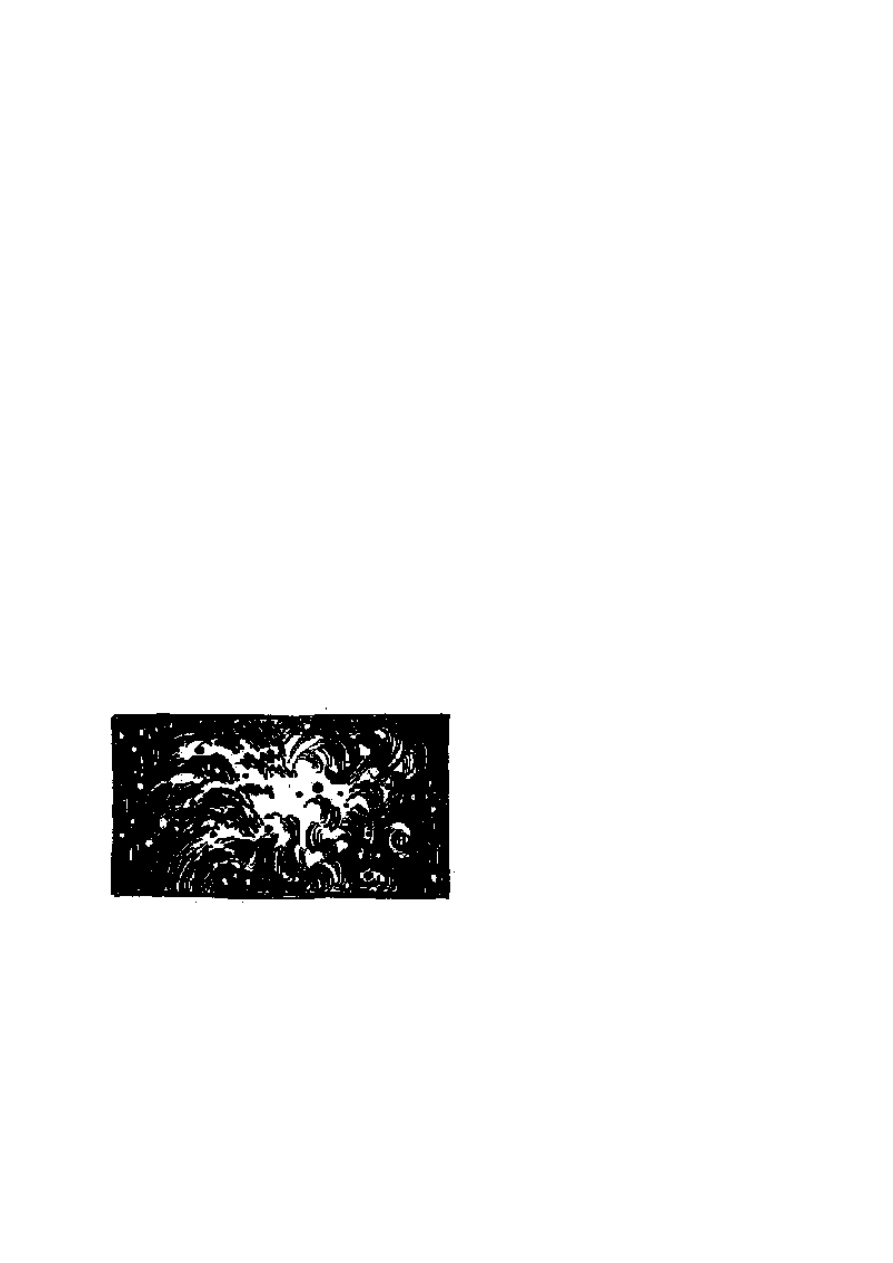
when Mig's sun was going to blow up, or else where we'd see it. I don't know which. But anyway, he made her mark it
down on the Calendar. The fifth of November, it was.
Well, in September I went back to college, and—well, I don't just talk about- things outside of the family, but my
boy friend, Dave, he was almost like one of the family, and this year he'd got a job working with Professor Milliken at
the Observatory.
You know Professor Milliken, don't you? I thought so. I told Dave about this Mig phase of Jackie's, and one night
when Dave was over at Beth's with me, he got the kid talking about it. He humored the kid a lot. He even took him over
to the Observatory and let Jackie look through the big teles
cope there. And of course Jackie gave Dave all the latest details
on Mig.
It seems that this spaceship had already taken off—that was why he hadn't heard much from Mig lately, because—"Mig's
Daddy sealed him up in a little capsule, so he won't wake up till they are 'way out in hyperspace. Because the spaceship will go
faster and faster and awful fast, and unless he is sealed up, and asleep, it will hurt him something awful!" And Dave humored
Jackie, and talked about acceleration and hyperspace and shortcuts across the Galaxy, and I don't know what all, and Jackie just sat
there and drank it all in as if he understood every word. Dave even wrote down the day when Mig's sun was supposed to blow up,
and promised to keep an eye on it.
Jackie started to kindergarten, of course, about then, and I thought he'd forgotten all about Mig. I didn't hear anything more for at
least six weeks. But one night—I was babysitting for Beth again—the telephone rang, and it was Dave.
"Dorothy! Remember Jackie's little Galactic citizen whose world was supposed to go up in smoke tonight?"
I glanced at the calendar. It was November fifth. "Now, look here, Dave," I said firmly. "You are not going to disillusion the kid
like that. He's forgotten all about the silly business. Besides, he's in bed."
"Well, get him up!" said Dave. "Dorrie, get a load of this. The biggest supernova I ever saw just exploded in the North. Get
Jackie over here! I want to ask him some questions!"
He meant it. I could tell that he meant it. I ran upstairs and bundled Jackie up in a blanket—I didn't even bother to put his
clothes on, just a blanket over his pajamas—and took him down to the Observatory in a taxi.
I wish you could have seen the place. Jackie sitting on a
table, in his pajamas, telling Professor Milliken all about Mig
and the spaceship and the little sealed capsule and the erling
and all the rest of it.
x
I guess you can imagine what a week we went through. Scientists, and reporters, and psychologists and parapsychologists and
just plain debunkers. And the crackpots. Oh yes, the crackpots. And then they dug up the records about Jackie's father.
They couldn't even let the poor man rest quiet in his grave, and when they found out about the Bombing, they talked about hard
radiations and mutations until I darn' near went crazy, and Beth had to quit her job.
They even talked about telepathy. Just as if Jackie was some kind of a freak. We had to take the poor kid out of kindergarten.
He hated that—he was getting so much good out of it. And he enjoyed it so much, having the other children to play with, and
painting, and making those cute little baskets, and he'd learned to tell time, and everything.
And then the spaceship landed, and I tell you, we haven't had a minute's peace since.
Oh, that's all right! I was going to call them in for lunch in a few minutes, anyway. "Jackie! Jackie—will you and Mig come in
here for a few minutes? A friend of your uncle Dave's wants to talk to you two boys."
EXILES OF TOMORROW
"A very strange thing happened when I was born," Carey Kennaird told me.
He paused and refilled his wine glass, looking at me with a curious appraisal in his young and very blue eyes. I returned his
glance as casually as I could, wondering why he had suddenly decided to confide in me.
I had known Carey Kennaird for only a few weeks. We were the most casual of acquaintances; a word in the lobby of our hotel,
a cup of coffee in a lunchroom he liked, mugs of beer in the quiet back room of the corner bar. He was intelligent and I had enjoyed
his conversation. But until now it had consisted entirely of surface commonplaces. Today, he seemed to be opening up a trifle.
He had volunteered the information, unasked, that he was the son of a well-known research physicist, and that he was in
Chicago to look for his father who had disappeared mysteriously a week or so before. Young Kennaird seemed
oddly unworried

about his father's plight. But I was pleased at the way his reserve appeared to be dropping.
As I say, Carey Kennaird had a casual way with him, and he puzzled me. He did not, somehow, seem emotionally in sympathy
with the hectic tempo of the rushed age in which he had grown up.
"Well," I told him noncommitally, "childhood memories often make quite normal events seem strange. What was it?"
The appraisal in his eyes was franker now. "Mr. Grayne, do you ever read science-fiction?"
"I'm afraid not," I told him. "At least, only very occasionally."
He looked a little crestfallen. "Oh—well, do you know anything about the familiar science-fiction concept of traveling in time?"
"A little," I finished my drink, wishing the waiter would bring us another bottle of wine. "It's supposed to involve some quite
staggering paradoxes, I believe. I'm thinking of the man who goes back in time and kills his own grandfather?"
He looked disgusted. "That's at best a trite layman's idea!"
"Well, I'm a layman," I said genially. The arrogance of young people always strikes me as being pathetic rather than insulting. I
did not think young Kennaird could have been more than nineteen. Twenty, perhaps. "Now then, young fellow, don't tell me
you've actually invented a time machine!"
"Good Lord, no!" The denial was so laughingly spontaneous that I had to laugh with him, "No, just an idea that interests me. I
don't really believe there's much paradox involved in time-travel at all."
He paused, his eyes still on my face. "See here, Mr. Grayne, I'd like to—well, do you mind listening to something rather
fantastic? I'm not drunk, but I've got a good reason for wanting to confide in you. You see, I know a great deal about you, really."
I wasn't surprised. In fact, I'd been prepared for just such a statement. I grinned a strained grin at the boy. "No, go
ahead," I told him. "I'm interested." I leaned back in my chair, preparing to listen.
You see, I knew what he was going to say.
II
Ryn Kenner sat in his cell, his head buried in his hands.
"Oh, God—" he muttered to himself, over and over.
There were so many unpredictable risks involved. Even though he had spent three years coaching Cara, teaching
her to guard against every possible contingency, he still might fail. If only he could have eliminated the psychic block.
But that, of course, was the most necessary risk of all.
Sometimes, in spite of his humanitarian training, Ryn Kenner thought the old, primitive safeguards had been better.
Executing murderers, locking maniacs up in cells was certainly better than exiling men in this horrible new way. Ryn
Kenner knew that he would have preferred to die. Two or three times he had even thought of slashing his wrists with a
razor before the Exile. Once he had actually set a razor against his right wrist, but his early training had been too strong
for him. Even the word suicide could set off a mental complex of quivering nerve reactions impossible to control.
The tragedy, Kenner thought despondently, resided in the paradox that civilization had become too enlightened.
There had been a time when men had thought that traveling backward in time would upset the framework of events
and change the future. But it had been a manifestly mistaken
idea, for in this year, 2543 a.d., the whole past had already
occurred, and the present moment contained within itself the entire past, including whatever rectifying attempts time-travelers had
made in that past.
Kenner shivered as he realized that his own acts had all occurred in the past. He, Ryn Kenner, had already died— six centuries
before.
Time-travel—the perfect, 'the most humane way of banishing criminals! He had heard all the arguments which sophistry could
muster. The strong individualists were clearly misfits in the enlightened twenty-sixth century. For their own good, they should be
exiled to eras psychologically congenial to them. A good many of them had been sent to California in the year 1849. They thus
took a one-way trip to an era where murder was not a crime, but a social necessity, the respectable business of a gentleman.
Religious fanatics were exiled to the First Dark Ages, where they could not disturb the tranquil materialism of the present century;
too aggressive atheists, to the twenty-third century.
Kenner rose and began to pace his cell, which was a prison in fact, if not in appearance. Outside the wide window spread a
spacious view of Nyor Harbor, and the room was luxuriously furnished. He knew, however, that if he stepped a foot past the lines
which had been drawn around the door, he would be instantly overpowered by a powerful sleeping gas. He had tried it once, with
almost disastrous results.
This hour of high decision was his last in the twenty-sixth century. In fifty minutes, in his own personal, subjective time from
now, he would be somewhere in the twentieth century, the era to which his rashness had condemned him when he had been
apprehended by the psycho police while attempting to re-discover the fabulous atomic isotopes. And he wouldn't remember
enough to get back. He would be permitted to keep all his training—all his knowledge, and memory—but there would be a fatal
reservation.
Never, for the rest of his life, would Kenner be able to remember that he had come from the past. For the three weeks during
which he had been confined to the cell the radiant suggestor had been steadily beaming at his brain. No defense his mind could
devise had sufficed to stay its slow inroads into his thought.
Already his brain was beginning to grow fuzzy and he knew that the time was short. He drew a long breath, hearing steps in the
corridor, and the whistle which meant the hypnotic gas was being momentarily turned off.

He stopped pacing.
. Abruptly the door opened, and a psycho-supervisor entered the cell. Framed in the radiance behind him—
"Cara!" Kenner almost sobbed, and ran forward to catch his wife in his arms, and hold her with hungry violence. She cried
softly against him. "Rhy, Ryn, it won't be long—"
The supervisor’s face was compassionate. "Kenner," he said, "you may have twenty minutes alone with your wife. You will be
unsupervised." The door closed softly behind him.
Kenner led Cara to a seat. She tried to hold back her tears, looking at him with wide, frightened eyes. "Ryh, darling, I thought
you might have—"
"Hush, Cara," he whispered. "They may be listening. Just remember everything I've told you. You mustn't risk being sent to a
different year. You already know what to do."
"I'll—find you," she promised.
"Let's not talk about it," Kenner urged gently. "We haven't long. Grayne promised he'd look after you until—"
"I know. He's been good to me while you were here."
The twenty minutes didn't seem long. The supervisor pretended not to notice while Cara clung to Kenner in a last agony of
farewell. Ryn brushed the tears away from her eyes, softly.
"See you in nineteen forty-five, Cara," he whispered, and let her go.
"It's a date darling," were her last words before she followed the supervisor out of the prison. Kenner, in the last few moments
remaining to him, before he sank into sleep again, desperately tried to marshal what little knowledge he possessed about the
twentieth century.
His brain felt dark now, and oppressed, as if someone had wrapped his mind in smothering folds of wool. Dimly he knew that
when he woke, his prison would be yet unbuilt. And yet, all the rest of his life he would be in prison— the prison of a mind that
would never let him speak the truth.
III
"—and of course, this hypothetical psychic block would also contain provision prohibiting marriage with anyone from the
past," Carey Kennaird finished. "It would naturally be inconvenient for children to be born of the time exiles. But if my
hypothetical man from the future should actually find the wife he'd arranged to have exiled with him, there'd be no psychic block
against marrying her." He paused, staring at me steadily. "Now, what would happen to the kid?"
My own glass stood empty. I signalled to the waiter, but Kennaird shook his head. "Thanks, I've had enough."
I paid for the wine. "Suppose we walk to the hotel together, Kennaird?" I said. "You've got a fascinating theory there, my boy.
It would make a fine plot for a science-fiction novel. Are you a writer? Of course, what happened to the
boy—" we passed
together into the blinding sunlight of the Chicago Loop, "—would be the climax of your story."
"It would," Kennaird agreed.
We crossed the street beneath the thundering El trains, and stood in front of Marshall Fields while Carey lit a cigarette.
"Smoke?" he asked.
I shook my head. "No thanks. You said you had a reason for confiding in me, young man. What is it?"
He looked at me curiously. "I think you know, Mr. Grayne. You weren't born in the Twentieth Century. I was, of course. But
you're like Dad and Cara. You're a time exile, too, aren't you?
"I know you can't say anything, because of the psychic block. But you don't have to deny it. That's how Dad told me. He made
me read science-fiction. Then he made me ask him leading questions—and just answered yes or no." Young Kennaird paused. "I
don't have the psychic block. Dad was trying to help me discover the time-travel device. He came up to Chicago, and disappeared.
But I'm on the right track now. I'm sure of it. I think Dad got back somehow."
Even though I'd known what he was going to say, I swallowed hard.
"Something very strange did happen when you were born," I said. "You put a peculiar strain on the whole framework of time. It
was something that never should have happened, because of—" my voice faltered, "the psychic block against marrying anyone
from the past."
Carey Kennaird looked at me intently. "Hard to talk about the psychic block, isn't it? Dad never could."
I nodded without speaking. We climbed the hotel steps together. "Come up to my room," I urged. "We'll talk it over. You see,
Carey—I'm going to call you that—Kenner used to be my friend."
"I wonder," Carey said, "If Dad-got home to the twenty-sixth century."
"He did."
Carey stared. "Mr. Grayne! Is he all right?"
Regretfully, I shook my head. The elevator boy let us off on the fourth floor. I wondered if he, too, were an exile. I wondered
how many people in Chicago were exiles, sullen behind the mask of a mental block which clamped a gag on their lips when they
tried to speak the truth.
I wondered how many men, and how many women, were living such a lie, day in, and day out, lonely, miserable exiles from
their own tomorrow, victims of a fate literally worse than death. Small wonder they would do anything to avoid such a fate.
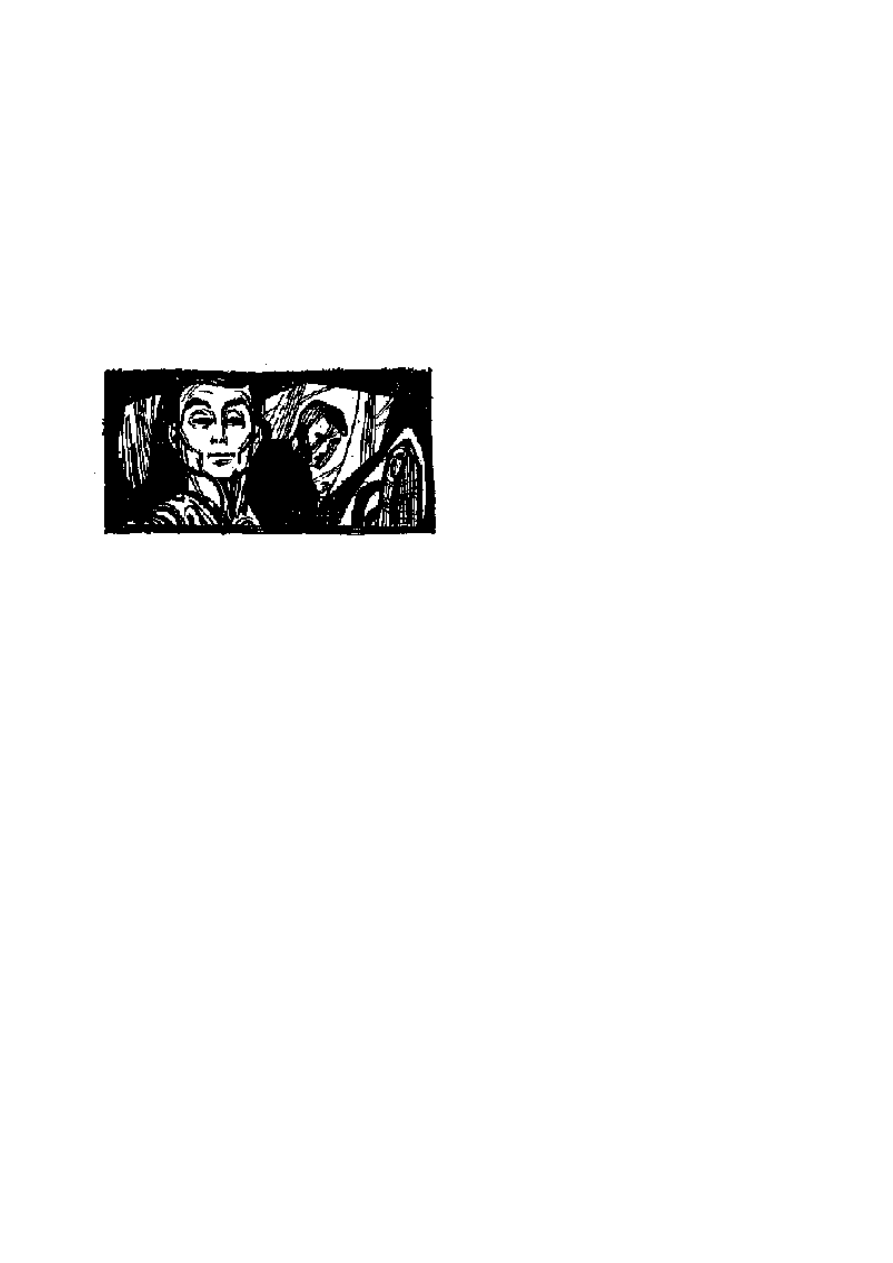
My door closed behind us. While Carey stared, wide-eyed, at the device which loomed darkly in one corner of the room, I went
to my desk, and removed the shining disk. I walked straight up to him. "This is from your father," I told him. "Look at it
carefully."
He accepted it eagerly, his eyes blazing with excitement, sensing at once that it had come from the twenty-sixth century.
He died instantly.
Hating my work, hating time-travel, hating the whole chain of events, which had made me an instrument of justice, I stepped
into the device that would return me to the twenty-sixth century.
Carey Kennaird had told the truth. A very strange thing had happened at his birth. Like an extra electron bombarding an unstable
isotope, he had broken the link that held the framework of time together. His birth had started a chain reaction that had ended, for
me, a week before in 2556, when Kenner and Cara had reappeared in the twenty-sixth century and been murdered in a panic by the
psycho-supervisors. I, already condemned to time exile, had won a
free pardon for my work, a commutation of my sentence
to a light reprimand and the loss of my position. It was ugly work and I hated it, for Kenner and Cara had been my
friends. But I had no freedom of choice. Anything was better than exile into time.
Anything, anything.
Besides, it had been necessary.
It isn't lawful for children to be born before their parents.
DEATH BETWEEN THE STARS
they asked me about it, of course, before I boarded the starship. All through the Western sector of the Galaxy, few rules are
stricter than the one dividing human from non-human, and the little Captain of the Vesta—he was Terran, too, and proud in the
black leather of the Empire's merchantman forces—hemmed and hawed about it, as much as was consistent with a spaceman's
dignity.
"You see, Miss Vargas," he explained, not once but as often as I would listen to him, "this is not, strictly speaking, a passenger
ship at all. Our charter is only to carry cargo. But, under the terms of our franchise, we are required to transport an occasional
passenger, from the more isolated planets where there is no regular passenger service. Our rules simply don't permit us to
discriminate, and the Theradin reserved a place on this ship for our last voyage."
He paused, and re-emphasized, "We have only the one passenger cabin, you see. We're a cargo ship and. we are
not allowed to make any discrimination between our passengers."
He looked angry about it. Unfortunately, I'd run up against that attitude before. Some Terrans won't travel on the
same ship with nonhumans even when they're isolated in separate ends of the ship.
I understood his predicament, better than he thought. The Theradin seldom travel in space. No one could have
fore-. seen that Haalvordhen, the Theradin from - Samarra, who had lived on the forsaken planet of Deneb for eighteen
of its cycles, would have chosen this particular flight to go back to its own world.
At the same time, I had no choice. I had to get back to an Empire planet—any planet—where I could take a starship
for Terra. With war about to explode in the Procyon sector, I had to get home before communications were knocked
out altogether. Otherwise—well, a Galactic war can last up to eight hundred years. By the time regular transport
service was re-established, I wouldn't be worrying about getting home.
The Vesta could take me well out of the dangerous sector, and all the way to Samarra—Sirius Seven—which was,
figuratively speaking, just across the street from the Solar System and Terra. Still, it was a questionable solution. The
rules about segregation are strict, the anti-discriminatory laws are stricter, and the Theradin had made a prior
reservation.
The captain of the Vesta couldn't have refused him transportation, even if fifty human, Terran women had been left
stranded on Deneb IV. And sharing a cabin with the Theradin was ethically, morally and socially out of the question.
Haalvordhen was a nonhuman telepath; and no human in his right senses will get any closer than necessary even to a
human telepath. As for a nonhuman one—
And yet, what other way was there?
The captain said tentatively, "We might be able to squeeze you into the crewmen's quarters—" he paused
uneasily, and glanced up at me.

I bit my lip, frowning. That was worse yet. "I understand," I said slowly, "that this Theradin—Haalvordhen—has
offered to allow me to share its quarters."
"That's right. But, Miss Vargas—"
I made up my mind in a rush. "I'll do it," I said. "It's the best way, all around."
At the sight of his scandalized face, I almost regretted my decision. It was going to cause an interplanetary scandal,
I thought wryly. A human woman—and a Terran citizen-spending forty days in space and sharing a cabin with a
nonhuman!
The Theradin, although male in form, had no single attribute which one could remotely refer to as sex. But of course
that wasn't the problem. The nonhuman were specifically prohibited from mingling with the human races. Terran
custom and taboo were binding, and I faced, resolutely, the knowledge that by the time I got to Terra, the planet might
be made too hot to hold me.
Still, I told myself defiantly, it was a big Galaxy. And conditions weren't normal just now and that made a big
difference. I signed a substantial check for my transportation, and made arrangements for the shipping and stowing of
what few possessions I could safely transship across space.
But I still felt uneasy when I went aboard the next day— so uneasy that I tried to bolster up my flagging spirits
with all sorts of minor comforts. Fortunately the Theradin were oxygen-breathers, so I knew there would be no trouble
about atmosphere-mixtures, or the air pressure to be maintained in the cabin. And the Theradin were Type Two
nonhumans, which meant that the acceleration of a hyperspeed ship would knock my shipmate into complete
prostration without special drugs. In fact, he would probably stay drugged in his skyhook during most of the trip.
The single cabin was far up toward the nose of the starship. It was a queer little spherical cubbyhole, a nest. The
walls were foam-padded all around the sphere, for passengers never develop a spaceman's skill at maneuvering their
bodies in free-fall, and cabins had to be designed so that an occupant, moving unguardedly, would not dash out his
or her brains against an unpadded surface. Spaced at random on the inside of the sphere were three
skyhooks—nested cradles on swinging pivots—into which the passenger was snugged during blastoff in
shock-absorbing foam and a complicated Garensen pressure-apparatus and was thus enabled to sleep secure without
floating away.
._ A few screw-down doors were marked LUGGAGE. I immediately unscrewed one door and stowed my personal
belongings in the bin. Then I screwed the top down securely and carefully fastened the padding over it. Finally, I
climbed around the small cubbyhole, seeking to familiarize myself with it before my unusual roommate arrived.
It was about fourteen feet in diameter. A sphincter lock opened from .the narrow corridor to cargo bays and
crewmen's quarters, while a second led into the cabin's functional equivalent of a bathroom. Planetbound men and
women are always surprised and a little shocked when they see the sanitary arrangements on a spaceship. But once
they've tried to perform normal bodily functions in free-fall, they understand the peculiar equipment very well.
I've made six trips across the Galaxy in as many cycles. I'm practically an old hand, and can even wash my face in
free-fall without drowning. The trick is to use a sponge and suction. But, by and large, I understand perfectly why
spacemen, between planets, usually look a bit unkempt.
I stretched out on the padding of the main cabin, and waited with' growing uneasiness for the nonhuman to show
up. Fortunately, it wasn't long before the diaphragm on the outer sphincter-lock expanded, and a curious, peaked face
peered through.
"Vargas Miss Hel-len?" said the Theradin in a sibilant whisper.
"That's my name," I replied instantly. I pulled myself upward, and added, quite unnecessarily, "You are
Haalvordhen, of course."
"Such is my identification," confirmed the alien, and the long, lean, oddly-muscled body squirmed through after the
peaked head. "It is kind,' Vargas Miss, to share accommodation under this necessity."
"It's kind of you," I said vigorously. "We've all got to get home before this war breaks out!"
"That war may be prevented, I have all hope," the non-human said. He spoke comprehensibly in Galactic Standard,
but expressionlessly, for the vocal chords of the Theradins are located in an auxiliary pair of inner lips, and their
voices seem reedy and-la eking in resonance to human ears.
"Yet know you, Vargas Miss, they would have hurled me from this ship to make room for an Empire citizen, had you
not been heart-kind to share."
"Good heavens!" I exclaimed, shocked, "I didn't know that!"
I stared at him, disbelieving. The captain couldn't have legally done such a thing—or even seriously have
entertained the thought. Had he been trying to intimidate the Theradin into giving up his reserved place?
"I—I was meaning to thank you," I said, to cover my confusion.
"Let us thank we-other, then, and be in accord," the reedy voice mouthed.
I looked the nonhuman over, unable to hide completely my curiosity. In form the Theradin was vaguely
humanoid— but only vaguely—for, the squat arms terminated in mittened "hands" and the long sharp face was elfin,
and perpetually grimacing.
The Theradin have no facial muscles to speak of, and no change of expression or of vocal inflection is possible to
them. Of course, being telepathic, such subtleties of visible or auditory expression would be superfluous on the face
of it.
I felt—as yet—none of the revulsion which the mere presence of the Theradin was supposed to inspire. It was not
much different from being in the presence of a large humanoid animal. There was nothing inherently fearful about the
alien. Yet he was a telepath—and of a nonhuman breed my species had feared for a thousand years.

Could he read my mind?
"Yes," said the Theradin from across the cabin. "You must forgive me. I try to put up barrier, but it is hard. You
broadcast your thought so strong it is impossible to shut it out." The alien paused. "Try not to be embarrass. It bother
me too."
Before I could think of anything to say to that a crew member in black leather thrust his head, unannounced,
through the sphincter, and said with an air of authority, "In skyhooks, please." He moved confidently into the cabin.
"Miss Vargas, can I help you strap down?" he asked.
"Thanks, but I can manage," I told him.
Hastily I clambered into the skyhook, buckling the inner straps, and fastening the suction tubes of the complicated
Garensen apparatus across my chest and stomach. The non-human was awkwardly drawing his hands from their
protective mittens and struggling with the Garensens.
Unhappily the Theradin have a double thumb, and handling the small-size Terran equipment is an almost
impossibly delicate task. It is made more difficult by the fact that the flesh of their "hands" is mostly thin mucus mem-
~brane which tears easily on contact with leather and raw metal.
"Give Haalvordhen a hand," I urged the crewman. "I've done this dozens of times!"
I - might as well have saved my breath. The crewman came and assured himself that my straps and tubes and
cushions were meticulously tightened. He took what seemed to me a long time, and used his hands somewhat
excessively. I lay under the heavy Garensen equipment, too inwardly furious to even give him the satisfaction of
protest.
It was far too long before he finally straightened and moved toward Haalvordhen's skyhook. He gave the alien's
outer straps only a perfunctory tug or two, and then turned his head to grin at me with a totally uncalled-for familiarity.
"Blastoff in ninety seconds," he said, and wriggled himself rapidly out through the lock.
Haalvordhen exploded in a flood of Samarran which I could not follow. The vehemence of his voice, however, was
better than a dictionary. For some strange reason I found myself sharing his fury. The unfairness of the whole
procedure was shameful. The Theradin had paid passage money, and deserved in any case the prescribed minimum of
decent attention.
I said forthrightly, "Never mind the fool, Haalvordhen. Are you strapped down all right?"
"I don't know," he replied despairfully. "The equipment is unfamiliar—"
"Look—" I hesitated, but in common decency I had to make the gesture. "If I examine carefully my own Garensens,
can you read my mind and see how they should be adjusted?"
He mouthed, "I'll try," and immediately I fixed my gaze steadily on the apparatus.
After a moment, I felt a curious sensation. It was something like the faint, sickening feeling of being touched and
pushed about, against my will, by a distasteful stranger.
I tried to control the surge of almost physical revulsion. No wonder that humans kept as far as possible from the
telepathic races . . .
And then I saw—did I see,-I wondered, or was it a direct telepathic interference with my perceptions?—a second
image superimpose itself on the Garensens into which I was strapped. And the realization was so disturbing that I
forgot the discomfort of the mental rapport completely.
"You aren't nearly fastened in," I warned. "You haven't begun to fasten the suction tubes—oh, damn the man. He
must have seen in common humanity—" I broke off abruptly, and fumbled in grim desperation with my own straps. "I
think there's just time—"
But there wasn't. With appalling suddenness a violent clamor—the final warning—hit my ears. I clenched my teeth
and urged frantically: "Hang on! Here we go!"
And then the blast hit us! Under the sudden sickening pressure I felt my lungs collapse, and struggled to remain
upright, choking for breath. I heard a queer, gagging grunt from the alien, and it was far more disturbing than a human
scream would have been. Then the second shockwave struck with such violence that I screamed aloud in completely
human terror. Screamed—and blacked out.
I wasn't unconscious very long. I'd never collapsed during takeoff before, and my first fuzzy emotion when I felt the
touch of familiar things around me again was one of embarrassment. What had happened? Then, almost
simultaneously, I became reassuringly aware that we were in free fall and that the crewman who had warned us to alert
ourselves was stretched out on the empty air near my skyhook. He looked worried.
"Are you all right, Miss Vargas?" he asked, solicitously. "The blastoff wasn't any rougher than usual—"
"I'm all right," I assured him woozily. My shoulders jerked and the Garensens shrieked as I pressed upward, undoing
the apparatus with tremulous fingers. "What about the Theradin?" I asked urgently. "His Garensens weren't fastened.
You barely glanced at them."
The crewman spoke slowly and steadily, with a deliberation I could not mistake. "Just a minute, Miss Vargas," he
said. "Have you forgotten? I spent every moment of the time I was in here fastening the Theradin's belts and pressure
equipment."
He gave me a hand to assist me up, but I shook it off so fiercely that I flung myself against the padding on the
opposite side of the cabin. I caught apprehensively at a handhold, and looked down at the Theradin.
Haalvordhen lay flattened beneath the complex apparatus. His peaked pixie face was shrunken and ghastly, and his
mouth looked badly bruised. I bent closer, then jerked upright with a violence that sent me cascading back across the
cabin, almost into the arms of the crewman.
"You must have fixed those belts just now" I said accusingly. "They were not fastened before blastoff! It's

malicious criminal negligence, and if Haalvordhen dies—"
The crewman gave me a slow, contemptuous smile. "It's my word against yours, sister," he reminded me.
"In common decency, in common humanity—" I found that my voice was hoarse and shaking, and could not go on.
The crewman said humorlessly, "I should think you'd be glad if the geek died in blastoff. You're awfully concerned
about the geek—and you know how that sounds?"
I caught the frame of the skyhook and anchored myself against it. I was almost too faint to speak. "What were you
trying to do?" I brought out at last. "Murder the Theradin?"
The crewman's baleful gaze did not shift from my. face. "Suppose you close your mouth," he said, without malice,
but with an even inflection that was far more frightening. "If you don't, we may have to close it for you. I don't think
much of humans who fraternize with geeks."
I opened and shut my mouth several times before I could force myself to reply. All I finally said was, "You know, of
course, that I intend to speak to the captain?"
"Suit yourself." He turned and strode contemptuously toward the door. "We'd have been doing you a favor if the
geek had died in blastoff. But, as I say, suit yourself. I think your geek's alive, anyhow. They're hard to kill."
I clutched the skyhook, unable to move, while he dragged his body through the sphincter lock and it contracted
behind him.
Well, I thought bleakly, I had known what I would be letting myself in for when I'd made the arrangement. And
since I was already committed, I might as well see if Haalvordhen were alive or dead. Resolutely I bent over his
skyhook, angling sharply to brace myself in free-fall.
He wasn't dead. While I looked I saw the bruised and bleeding "hands" flutter spasmodically. Then, abruptly, the
alien made a queer, rasping noise. I felt helpless and for some reason I was stirred to compassion.
I bent and laid a hesitant hand on the Garensen apparatus which was now neatly and expertly fastened. I was bitter
about the fact that for the first time in my life I had lost consciousness! Had I not done so the crewman could not have
so adroitly covered his negligence. But it was important to remember that the circumstance would not have helped
Haalvordhen much either.
"Your feelings do you nothing but credit!" The reedy flat voice was almost a whisper. "If I may trespass once more
on your kindness—can you unfasten these instruments again?"
I bent to comply, asking helplessly as I did so,, "Are you sure you're all right?"
"Very far from all right," the alien mouthed, slowly and without expression.
I had the feeling that he resented being compelled to speak aloud, but I didn't think I could stand that telepath
touch again. The alien's flat, slitted eyes watched' me while I carefully unfastened the suction tubes and cushioning
devices,
At this distance I could see that the eyes had lost their color, and that the raw "hands" were flaccid and limp. There
were also heavily discolored patches about the alien's throat and head. He pronounced, with a terribly thick effort.
"I should have—been drugged. Now it's too late. Argha mad—" the words trailed off into blurred Samarran but the
discolored patch in his neck still "throbbed sharply, and the hands twitched in an agony which, being dumb, seemed
the more fearful.
I clung to the skyhook, dismayed at the intensity of my own emotion. I thought that Haalvordhen had spoken again
when the sharp jolt of command sounded, clear and imperative, in my' brain.
"Procalamine!" For an instant the shock was all I could feel—the shock, and the overwhelming revulsion at the
telepathic touch. There was no hesitation or apology in it now, for the Theradin was fighting for his life. Again the
sharp, furious command came: "Give me procalamine!"
And with a start of dismay I realized that most non-humans needed the drug, which was kept on all spaceships to
enable them to live in free-fall.
Few nonhuman races have the stubbornly persistent heart of the Terrans, which beats by muscular contraction
alone. The circulation of the Theradin, and similar races, is dependent on gravity to keep the vital fluid pulsing.
Procalamine gives their main blood organ just enough artificial muscular spasm to keep the blood moving and working.
Hastily I propelled myself into the "bathroom"—wiggled hastily through the diaphragm, and unscrewed the top of
the bin marked FIRST AID. Neatly pigeonholed beneath transparent plastic were sterile bandages, antiseptics clearly
marked HUMAN and—separately, for the three main types of nonhuman races, in one deep bin—the small plastic
globules of vital stimulants.
I sorted out two purple fluorescent ones—little globes marked procalamine—and looked at the warning, in raised
characters on the globule. It read: FOR ADMINISTRATION BY QUALIFIED SPACE PERSONNEL ONLY. A touch of
panic made my diaphragm catch. Should I call the Vestas captain, or one of the crew?
Then a cold certainty grew in me. If I did, Haalvordhen wouldn't get the stimulant he needed. I sorted out a
fluorescent needle for nonhuman integument, pricked the globule and sucked the dose into the needle. Then, with its
tip still enclosed in the plastic globe, I wriggled myself back to where the alien still lay loosely confined by one of the
inner straps.
Panic touched me again, with the almost humorous knowledge that I didn't know where to inject the stimulant, and
that a hypodermic injection, in space presents problems which only space-trained men are able to cope with. But I
reached out notwithstanding and gingerly picked up one of the unmittened "hands". I didn't stop to think how I knew
that this was the proper site for the injection. I was too overcome with strong physical loathing*
Instinct from man's remote past on Earth told me to drop the nonhuman flesh and cower, gibbering and howling as
my simian antecedents would have done. The raw membrane was feverishly hot and unpleasantly slimy to touch. I

fought rising queasiness as I tried to think how to steady him for the injection.
In free-fall there is no steadiness, no direction. The hypodermic needle, of course, worked by suction, but piercing
the skin would be the big problem. Also, I was myself succumbing to the dizziness of no-gravity flight, and realized
coldly that if I couldn't make the injection in the next few minutes I wouldn't be able to accomplish it at all.
For a minute I didn't care, a primitive part of myself reminding me that if the alien died I'd be rid of a detestable
cabinmate, and have a decent trip between planets.
Then, stubbornly, I threw off the temptation. I steadied the needle in my hand, trying to conquer the disorientation
which convinced me that I was looking both up and down at the Theradin.
My own center of gravity seemed to be located in the pit of my stomach, and I fought the familiar space voyaging
instinct to curl up in the foetal position and float. I moved slightly closer to the Theradin. I knew that if I could get
close enough, our two masses would establish a common center of gravity, and I would have at least a temporary
orientation while I made the injection.
The maneuver was unpleasant, for the alien seemed unconscious, flaccid and "Still, and mere physical closeness to
the creature was repellent. The feel of the thick wettish "hand" pulsing feebly in my own was almost sickeningly
intimate. But at last I managed to maneuver myself close enough to establish a common center of gravity between
us—an axis on which I seemed to hover briefly suspended.
I pulled Haalvordhen's "hand" into this weight-center in the bare inches of space between us, braced the needle,
and resolutely stabbed with it.
The movement disturbed the brief artificial gravity, and Haalvordhen floated and bounced a little weightlessly in his
skyhook. The "hand" went sailing back, the needle recoiling harmlessly. I swore out loud, now quite foolishly angry,
and my own jerky movement of annoyance flung me partially across the cabin.
Inching slowly back, I tried to grit my teeth, but only succeeded with a snap that jarred my skull. In terse anger, I
seized Haalvordhen's "hand," which had almost stopped its feverish pulsing, and with a painfully slow effort—any
quick or sudden movement would have thrown me, in recoil, across
the cabin again—I wedged Haalvordhen's "hand" under
the strap and anchored it there.
It twitched faintly—the Theradin was apparently still sensible to pain—and my stomach rose at that sick pulsing. But I hooked
my feet under the skyhook's frame, and flung my free arm down and across the alien, holding tight to the straps that confined him.
Still holding him thus wedged down securely, I jabbed again -with the needle. It touched, pricked—and then, in despair, I
realized it could not penetrate the Theradin integument without weight and .pressure behind it.
I was too absorbed now in what had to be done to care just how I did it. So I wrenched forward with a convulsive movement
that threw me, full-length, across the alien's body. Although I still had no weight, the momentum of the movement drove the
hypodermic needle deeply into the flesh of the "hand."
I pressed the catch, then picked myself up slowly, and looked around to see the crewman who had jeered at me with his head
thrust through the lock again, regarding me with the distaste he had displayed toward the Theradin from the first. To him I was
lower than the Theradin, having degraded myself by close contact with a nonhuman.
Under that frigid, contemptuous stare, I was unable to speak. I could only silently withdraw the needle and hold it up. The rigid
look of condemnation altered just a little, but not much. He remained silent, looking at me with something halfway between horror
and accusation.
It seemed years, centuries, eternities that he clung there, just looking at me, his face an elongated ellipse above the tight collar of
his black leathers. Then, without even speaking, he slowly withdrew his head and the lock contacted behind him, leaving me alone
with my sickening feel of contamination and an almost hysterical guilt.
I hung the needle up on the air, curled myself into a ball, and, entirely unstrung, started sobbing like a fool,
It must have been a long time before I managed to pull myself together, because before I even looked to see whether
Haalvordhen was still alive, I heard the slight buzzing noise which meant it was a meal-period and that food had been
sent through the chute to our cabin. I pushed the padding listlessly aside, and withdrew the heat-sealed
containers—one set colorless, the other set nonhuman fluorescent.
Tardily conscious of what a fool I'd been making of myself, I hauled my rations over to the skyhook, and tucked
them into a special slot, so that they wouldn't float away. Then, with a glance at the figure stretched out motionless
beneath the safety-strap of the other skyhook, I shrugged, pushed myself across the cabin again, and brought the
fluorescent containers to Haalvordhen.
He made a weary, courteous noise which I took for acknowledgment. By now heartily sick of the whole business, I
set them before him with a bare minimum of politeness and withdrew to my own skyhook, occupying myself with the
always-ticklish problem of eating in free-fall.
At last I drew myself up to return the containers to the chute
s
knowing we wouldn't leave the cabin during the entire
trip. Space, on a starship, is held to a rigid minimum. There is simply no room for untrained outsiders moving around in
the cramped ship, perhaps getting dangerously close to critically delicate equipment, and the crew is far too busy to
stop and keep an eye on rubbernecking tourists.
In an emergency, passengers can summon a crewman by pressing a call-button. Otherwise, as far as the crew was
concerned, we were in another world.
I paused in midair to Haalvordhen's skyhook. His containers were untouched and I felt moved to say, "Shouldn't
you try to eat something?"
The flat voice had become even weaker and more rasping now, and the nonhuman's careful enunciation was slurred.
Words of his native Samarran intermingled with queer turns of phrase which I expected were literally rendered from
mental concepts.

"Heart-kind of you, thakkava Vargas Miss, but late. Haalvordhen-I deep in grateful wishing—" A long spate of
Samarran, thickly blurred followed, then as if to himself, "Theradin-we, die nowhere only on Samarra, and only a little
time ago Haalvordhen-I knowing must die, and must returning to home planet. Saata. Knowing to return and die there
where Theradin-we around dying—" The jumble of words blurred again, and the limp "hands" clutched
spasmodically, in and out.
Then, in a queer, careful tone, the nonhuman said, "But I am not living to return where I can stop-die. Not so long
Haalvordhen-I be lasting, although Vargas-you Miss be helping most like real instead of alien. Sorry your people be
most you unhelping—" he stopped again, and with a queer little grunting noise, continued, "Now Haalvordhen-I be
giving Vargas-you stop-gift of heritage, be needful it is."
The flaccid form of the nonhuman suddenly stiffened, went rigid. The drooping lids over the Theradin's eyes
seemed to unhood themselves, and in a spasm of fright I tried to fling myself backward. But I did not succeed. I
remained motionless, held in a dumb fascination.
I felt a sudden, icy cold, and the sharp physical nausea crawled over me again at the harsh and sickening touch of
the alien on my mind, not in words this time, but in a rapport even closer—a hateful touch so intimate that I felt my
body go limp in helpless fits and spasms of convulsive shuddering under the deep, hypnotic contact.
Then a wave of darkness almost palpable surged up in my brain. I tried to scream, "Stop it, stop it!" And a panicky
terror flitted in my last conscious thought through my head.
This is why, this is the reason humans and telepaths don't mix—
And then a great dark door opened under my senses and I plunged again into unconsciousness.
It was not more than a few seconds, I suppose, before the blackness swayed and lifted and I found myself floating,
curled helplessly in mid-air, and seeing, with a curious detachment, the Theradin's skyhook below me. Something in
the horrid limpness of that form stirred me wide awake.
With a tight band constricting my breathing, I arrowed downward. I had never seen a dead Theradin before, but I
needed no one to tell me that I saw one now. The constricting band still squeezed my throat in dry gasps, and in a
frenzy of hysteria I threw myself wildly across the cabin, beating and battering on the emergency button, shrieking
and sobbing and screaming . . .
They kept me drugged all the rest of the trip. Twice I remember waking and shrieking out things I did not
understand myself, before the stab of needles in my arm sent me down into comforting dreams again. Near the end of
the flight, while my brain was still fuzzy, they made me sign a paper, something to do with witnessing that the crew
held no responsibility for the Theradin's death.
It didn't matter. There was something clear and cold and shrewd in my mind, behind the surface fuzziness, which
told me I must do exactly what they wanted, or I would find myself in serious trouble with the Terran authorities. At
the time I didn't even care about that, and supposed it was the drugs. Now, of course, I know the truth.
When the ship made planetfall at Samarra, I had to leave the Vesta and trans-ship for Terra. The Vestas little captain
shook me by the hand and carefully avoided my eyes, without mentioning the dead Theradin. I had the
feeling-strange, how clear it was to my perceptions—that he regarded me in the same way he would regard a loaded
time bomb that might explode at any moment.
I knew he was anxious to hurry me aboard a ship for Terra. He offered me special reservations on a linocruiser at a
nominal price, with the obvious lie that he owned a part interest in it. Detachedly I listened to his floundering lies,
ignored the hand he offered again, and told a lie or two of my own. He was angry. I knew he didn't want me to linger
on Samarra.
Even so, he was glad to be rid of me.
Descending at last from the eternal formalities of the Ter-ran landing zone, I struck out quickly across the port city
and hailed a Theradin ground-car. The Theradin driving it looked at me curiously, and in a buzzing voice informed me
that I could find a human conveyance at the opposite corner. Surprised at myself, I stopped to wonder what I was
doing. And then—
And then I identified myself in a way the Theradin could not mistake. He was nearly as surprised as I was. I
clambered into the car, and he drove me to the queer, block-shaped building which my eyes had never seen before, but
which I now knew as intimately as the blue sky of Terra.
Twice, as I crossed the twisting ramp, I was challenged. Twice,' with the same shock of internal surprise, I answered
the challenge correctly.
At last I came before a Theradin whose challenge crossed mine like a sure, sharp lance, and the result was startling.
The Theradin Haalvamphrenan leaned backward twice in acknowledgment, and said—not in words—"Haalvordhen!"
I answered in the same fashion. "Yes. Due to certain blunders, I could not return to our home planet, and was forced
to use the body of this alien. Having made the transfer unwillingly, under necessity, I now see certain advantages.
Once within this body, it does not seem at all repulsive, and the host is highly intelligent and sympathetic.
"I regret the feeling that I am distasteful to you, dear friend. But, consider. I can now contribute my services as
messenger and courier, without discrimination by these mind-blind Terrans. The law which prevents Theradin from
dying on any other planet should now be changed."
"Yes, yes," the other acquiesced, quickly grasping my meaning. "But now to personal matters, my dear
Haalvordhen. Of course your possessions are held intact for you."
I became aware that I possessed five fine residences upon the planet, a private lake, a grove of Theirry-trees, and
four hattel-boats. Inheritance among the Theradin, of course, is dependent upon continuity of the mental personality,
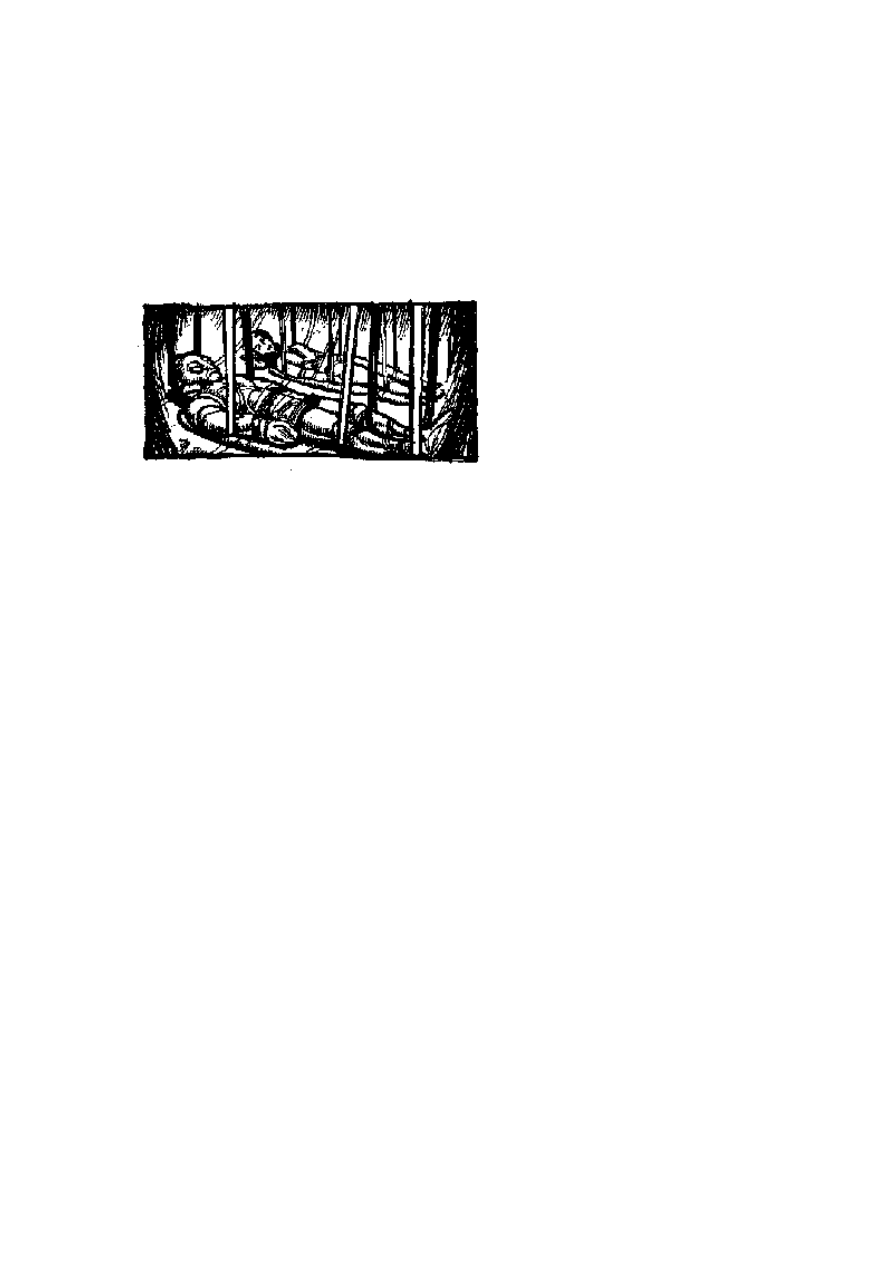
regardless of the source of the young. When any Theradin died, transferring his mind into a new and younger host,
the new host at once possessed all of those things which had belonged to the former personality. Two Theradin,
unsatisfied with their individual wealth, sometimes pooled their personalities into a single host-body, thus
accumulating modest fortunes.
Continuity of memory, of course, was perfect. As Helen Vargas, I had certain rights and privileges as a Terran
citizen, certain possessions, certain family rights, certain Empire privileges. And as Haalvordhen, I was made free of
Samarra as well.
In a sense of strict justice, I "told" Haalvamphrenan how the original host had died. I gave him the captain's name. I
didn't envy him, when the Vesta docked again at Samarra.
"On second thought," Haalvamphrenan said reflectively, "I shall merely commit suicide in his presence."
Evidently Helen-Haalvordhen-I had a very long and interesting life ahead of me.
So did all the other Theradin.
THE CRIME THERAPIST
the rigellian named Rhoum murmured sibilantly, "You realize, Mr. Colby, that this operation is illegal?"
Colby furtively mopped his brow. "Yes. I thought we'd been all over that before."
It seemed incredible that this place actually existed, here on a modern Earth, where you could have shrimp in
California and twenty minutes later, for a fifty-cent traffic-token, have coffee in Boston; where two weeks passage on a
dionite-drive spaceship would take you to Theta Centaurus, and two months to the fourth planet of Antares. Here,
where children were carefully conditioned for social adjustment, and crime simply was not.
Yet, that this office was here. The sign on the door said simply:
Dr. Rhoum (Ex- T.), M.D. Licensed Crime Therapist.
"I just wanted it to be understood, completely," the little Extra-terrestrial breathed hissily, and looked at the puny man in the
relaxit. "Unfortunately, your psychotherapeutic authorities do not yet recognize the criminal impulses to be a form of insanity as
normal, if I may make a minor paradox, as any other. They treat criminals as socially maladjusted individuals, not as
psychoneurotics. And they fail to realize that, in the one type of individual, these impulses cannot be discharged by ordinary
rehabilitation methods. Nor can they be sublimated; they need satisfaction."
Rhoum paused. Colby leaned forward, sweating a little with anticipation.
Rhoum continued smoothly, "I had a patient, several -weeks ago, who was an arsonist. Or rather, he should have been an
arsonist. Most unfortunately, your compulsory childhood social conditioning had sent him into a state of continual sublimation and
frustration. Conditioning told him, and he believed it consciously, that arson was an antisocial impulse, besides, most houses today
are flameproof. He was on the verge of total breakdown; fortunately, he was referred to us for treatment—in time."
"I thought you said you weren't legal," growled Colby.
"We are not inside Terran law," Rhoum smiled. "The Terran Empire provisions permit us to carry on our business. It is illegal
for citizens of Earth to patronize our therapies. But," he smiled, again, "it is to our client's best advantage not to talk. And—the
word gets around. Oh, yes; it gets around."
A brief pause, then Rhoum continued, "But I was telling you about my client. At our therapy center, we erected a large building
of highly-inflammable material. At his leisure,
he burned it down. It made a beautiful blaze—beautiful. Very successful therapy."
". . . Where is he now?" Colby asked, his small, close-set eyes gleaming with excitement.
Rhoum drew his smooth brows together in a little frown. "Well, the case was a peculiar one, Mr. Colby. As a direct result, he
contracted severe burns and died. But he died sane—and happy, Mr. Colby."
Colby rubbed his scrawny hands. "I see," he murmured, chuckling. "The operation was a success, but the patient died."
Rhoum concealed a look of violent dislike. "You might put it that way, sir."
Colby suddenly sat bolt upright in the relaxit, pushing his feet to the pneumatic carpet. His tongue slid over thin lips.
"That—there wouldn't be any—any danger of anything like that, happening to me, would there?" he whispered, looking around
furtively.

"Oh, dear me, no, sir! The nature of your ailment is altogether different, if you will allow me to say so. I understand quite well.
Arsonists are fanatics; murderers are really a relatively mild form of psychotic, you might say. The arsonist— or pyromaniac, you
might say—committed suicide, in an elaborate way. He really wanted to die, you see; his antisocial neurosis built itself up to a
self-destruction complex. In immolating the building, he really immolated himself."
"I see." Colby was bored now; he tapped his foot impatiently. "Er—do you handle murderers very often?"
"Oh, yes. Homicidal mania is very common—especially since it has been possible to construct such lifelike android robots
within a period of three to four weeks. Until the previous decade, you know, it often took several months to make a single model,
and the results were often uncertain. The new Centaurian process is most effective. Before, when
we had to wait so long for the
delivery of androids, the— well, the delay in therapy -was often disastrous to the patient. In a case of murder, you see,
immediate therapy is often imperative. Why, just last week—but I am boring you now, Mr. Colby."
Colby leaned forward, the small eyes glowing expectantly. "Oh, no, really I'm not bored, Doctor Rhoum. Really.
Please go on," he murmured emphatically. Rhoum's cool, nonhuman eyes surveyed him quizzically.
"Very well. You—we had a patient, last week, a confirmed sadist, and psychiatric examination showed that beneath
his conditioning he was a seriously-frustrated potential murderer. Fortunately, another client had just cancelled his
appointment for mayhem therapy—oh, yes, we sometimes have spontaneous cures where therapy becomes
unnecessary—and we had six young-girl androids on hand, quite perfect models—a few of them had been made for
assault therapy. Only one was a standard murder model. They were quite expensive, too—not these assembly-line
robot affairs which are just one notch better than the old steeloid frame jobs. They were genuine female androids, with
all the details complete—you follow me?"
Colby smirked. "Nice work!"
Rhoum's professionally lifted eyebrow cut him off. "Within a week of therapy, Mr. Colby, he had murdered them all.
His methods—but I fear I must spare you the details." The Rigellian ignored Colby's disappointed frown.
"Professional ethics, you will understand."
"What—what happened to him?"
"He was discharged yesterday morning, completely sane, my dear sir. Completely sane."
Colby could not keep back a sigh of relieved satisfaction. "Of course," he said, smirking again, "I'm not really
insane, Dr. Rhoum, you understand. But I feel it would be better to get it out of my system. These minor frustrations,
you know; they take it out of my nerves."
"Ah, yes," Rhoum 'was professional and serene. "Now, in your case, sir. A serious hate complex—"
"Oh, hardly serious—" protested Colby deprecatingly.
Rhoum only smiled. "I understand, Mr. Colby, that you want to kill your wife."
"Well, er, yes. She—you see, she's such a sloppy dresser. And she wears those old fashioned neonylon
housecoats. Then, she will wear an earring-alarm to bed, and five times in the past month, it's gone off and waked me
before ten o'clock. Then when I slapped her—just a little knock—she threatened to leave me. We have only a
five-year marriage, you see. But it isn't fair. And, er, well, I understand that after—after this, you make arrangements
so I don't have to meet her again. And, er, there's this girl at the Sky Harbor Hotel-"
"I quite understand," Rhoum murmured in his hissing voice. "But why murder, Mr. Colby? Surely that is drastic
treatment. A little mayhem therapy—slapping around one of our substitutes for a few hours every day for a week or
so—or you could simply apply for a divorce—"
"Well, er, you see," Colby smirked again, "well, I'm not really insane, but I feel frustrated over it. Besides, I've tried
to choke her once or twice, and—well, she made me promise to come here. So I decided, if I was going to do the thing
at all, I'd do it up right, and kill her properly!" He glared at Rhoum, then suddenly shouted, "Blast it, what do you
care? I've got the money! If I want to kill my wife, what business is it of yours? You don't have to try to reform me, do
you?"
Rhoum said calmly, "Of course not. But we dislike employing drastic therapy, if a cure can be carried out with milder
treatment. It is my professional duty to try to per-
suade you to employ the simplest therapy. But if you feel you must kill your wife, well—"
, "It's the only thing that will make me a sane man again!" Colby said dramatically.
Rhoum's sharp eyes glanced at him, blinking back. "I fear you are right," he murmured. "I can see you are in a
serious condition. Of course. We can arrange it at once." He paused to consult a calendar, and asked, "Will the third
of Einstein suit you? This is only the fifth of Freud, but Einstein third is only five weeks from now. You can wait five
weeks, can't you?"
"Oh, I think so," Colby murmured.
"Well, we might be able to squeeze you in toward the end of this month, but these hurry-up jobs never effect a
complete cure. Of course, if you decide to change your mind, and take it out in a simple mayhem therapy, it would only
be three or four days—"
Modestly, Colby waved the suggestion away.
Rhoum nodded gravely. "Do you have a recent three-dim photograph of your wife?"
Colby tugged it out of his pocket. "As a matter of fact—"
"Hmmm, yes, she's very pretty. Well, Mr. Colby, you understand that until your appointment you must be a guest
at our therapy center. That is to prevent a—well, a normal and a pleasant anticipation from getting uncontrollable."
He paused, "I trust you won't find it unpleasant. I think our facilities for the entertainment of patients are fairly
complete. And now—to get down to business—"

The talk became definite. A very large check changed hands.
"Sign here, Mr. Colby."
Colby signed the form which said that he was committing himself voluntarily for treatment. Rhoum pushed a buzzit;
an exquisite Centaurian girl in a wisp of neonylon appeared.
"Nurse, take Mr. Colby to his apartments. I hope you will be quite content here, Mr. Colby, just ask Demella for anything you
want."
When the smirking little man had gone, quite willingly, Dr. Rhoum selected a stylus and made a careful entry in his casebook.
Then he reached for the telephone.
The therapist said, "Hello. Mrs. Helen Colby? Dr. Rhoum speaking."
The light feminine voice at the end of the telephone sounded disturbed. "Oh! Frank told me he was going there." A pause. "Tell
me, doctor. Is it serious?"
Dr. Rhoum made his voice professionally serene, but grave. "I'm afraid so, Mrs. Colby, quite serious. You must try to be brave.
You see, he decided on the murder therapy. I suppose you have no objection to being murdered?"
"None whatever, but—oh, that's so drastic!"
"Drastic diseases, you know, Mrs. Colby. Let me see, when can you come down for an appointment? Are you free tomorrow
afternoon? We will need samples of blood, hair, and so forth, to make the android—as soon as possible. It's serious."
The appointment was made.
The fifth of Einstein dawned bright and clear. Colby woke up, switching off the all-night hypnotic learner, and ate with a hearty
appetite the breakfast that the blue-haired girl from Aldebaran VI brought him. Last week, at his request, Dr. Rhoum had removed
him from Demella's charge; she had been insufferably insubordinate. Besides, he had never cared for those Centaurians—too
skinny. Hamilda, now, she was something.
Dr. Rhoum came for him punctually at nine. His face looked stern and terribly grave. "You are certain that you
want to go
through with this?" he asked quietly. "There is still time to change your mind, you know. We can convert you to a
simpler therapy—mayhem, or simply abusive treatment—or you can go home this morning, get a divorce and forget
the whole matter. We're quite prepared to give you a refund on the murder fee."
Colby stared at him between tight-squeezed small eyes. "I'm going through with it," he snarled furiously. "Didn't
you say you weren't going to try to rehabilitate or reform me?"
Dr. Rhoum shrugged. "Very well," he remarked quietly. "First, remember this: When you murder your wife, you
will murder her; we are very thorough. When you leave here -this morning," he smiled faintly, "she will, to you,
be dead. You will never see her again, or she you. We are very thorough about that—since it would, of course,
invalidate the entire therapy, and perhaps drive you into severe psychosis for you to meet the woman you had
murdered. That is , one reason why the murder therapy is so expensive."
Colby smiled quietly. "It's worth it," he remarked.
Rhoum only shrugged again. "Go down the hall, and into that room," he told him. "And—I'll see you in the office
afterward."
Colby stood still for a moment, and Rhoum, watching closely, saw his hands tremble a little, saw his lips thin and
set tightly. Then Colby turned and walked down the hall. The door closed behind him, and Rhoum walked into his
own office.
The television cameras had been carefully placed, so that Rhoum and the woman could see, on the wide screen,
every corner of the room which Colby had just entered, even the young and lovely woman who sat, dressed in a
loose neo-nylon robe, on the divan. Mrs. Colby shuddered as she looked at the woman-image.
"It's—it's terrible—" she breathed in low horror, "she's— why, she's me, Doctor—"
"You don't have to watch if it's too painful, Mrs. Colby, but there is a catharsis-therapy in this for you, too. After all, you will
never see him again. If you watch him murder you in cold blood, you won't grieve for him," said Rhoum gently. "Remember, he is
insane. A man who could murder in cold blood—even when he knows it is a robot—a man who could come here, knowing it to be
illusory, and who, after five weeks of waiting, clings to the need to release by killing—he is a very sick man, Mrs. Colby."
"I—I know—oh!" Mrs. Colby gave a low scream as the two images on the screen coalesced in terrible Conflict. "Oh! Oh!" and
covered her eyes with her hands.
Rhoum's voice was low and soothing. "Please try and watch this, Mrs. Colby—"
"Will it—will it cure him?" she faltered. "Perfectly, madam. He will be discharged, completely cured, sane, this evening."
Helen Colby squeezed her eyes tight shut. "Oh no—" she moaned, "Frank—Frank—don't—did I drive you to this—" Rhoum's
smooth cold eyes watched the screen in professional detachment. "A bad case, Mrs. Colby, a bad case. Sadistic and wild—you
were very wise to send him to me when you did. He might have broken down, and—" his voice grew suddenly hard. "It would be
you lying there now!" He touched a button on his desk. To the two heavy male nurses who came in, he said curtly, gesturing
toward the screen, "Take the patient out of there—the murder cubicle— and clean up the android. And send Demella with a
sedative for Mrs. Colby," he added, glancing at the sobbing girl.
He rose from his desk and walked around the divan to Helen Colby, placing a light hand on her shoulder. "Try to be brave," he
said. "I'm ordering you a sedative. The .nurse will take you upstairs. Lie down there until you feel better,
and then any of the staff will call you a cab and take you home."
He nodded at the Centaurian girl who came in carrying a drinking-glass and a couple of capsules; then left the
office and walked down the hall toward the murder cubicle.
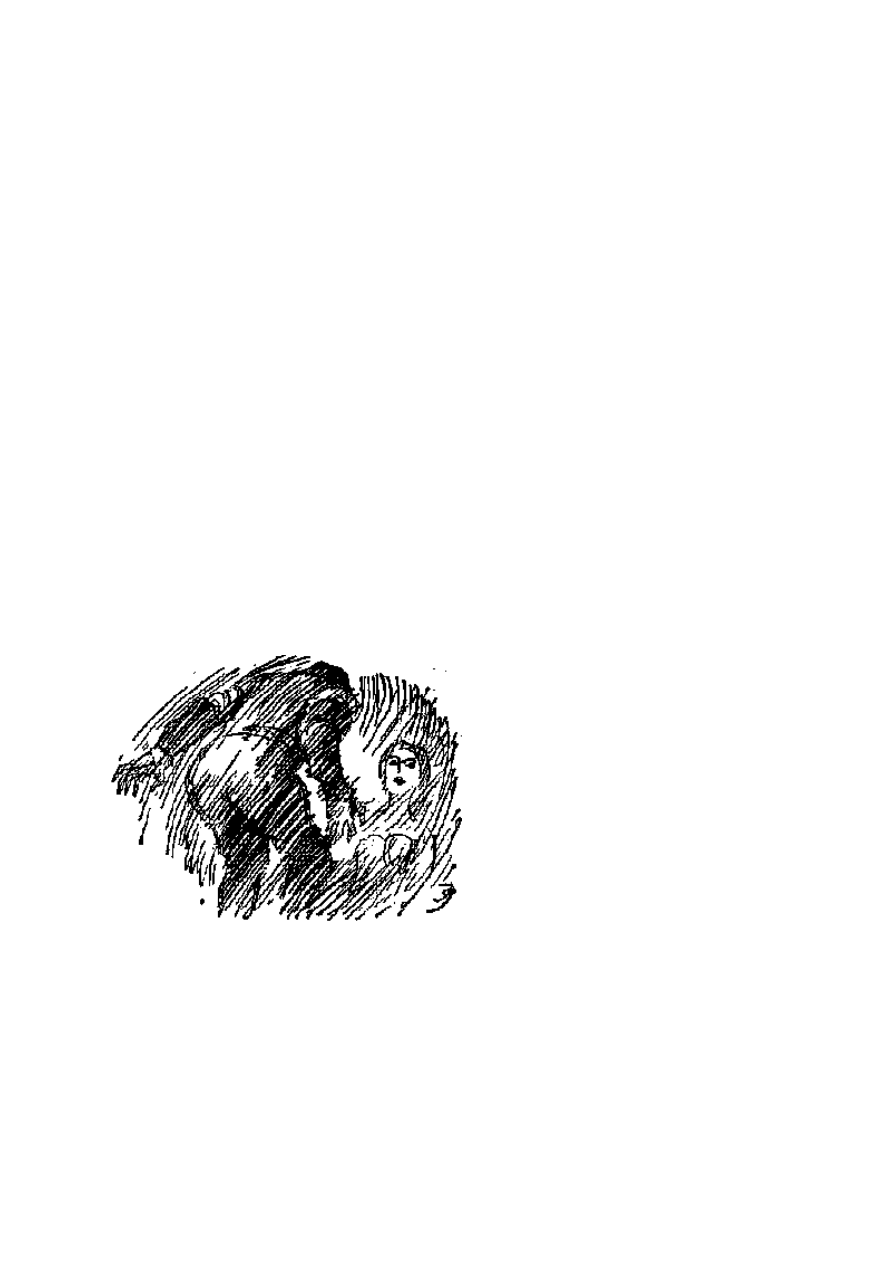
Colby hung, limp and loose, between the male nurses. There was blood on his hands; he was sweating, slack-limbed
and slack-mouthed, breathing in little panting sobs. But his eyes were shrewd and alight.
He understood the technique. Complete catharsis of the impulses. He felt cool and clean and released, ready for
anything . . . sane again. He glanced up at Rhoum, who stood, tall in his white garments, before him. And he marvelled
that his voice was so steady. "Well, Doctor?"
Rhoum's voice was hard. "Excellent, Mr. Colby. You will very soon be discharged as cured."
Colby glanced down at his stained garments. "Can I—get cleaned up a little?"
"After a bit, Mr. Colby," Rhoum's voice was smooth and soothing. "Just come with me, now. Just come with me."
Colby hung back; was dragged, suddenly resisting, between the male nurses. "What's this—where are you taking
me? The treatment's over, isn't it? I'm a sane man again—"
Rhoum shoved open a door; the male nurses hauled Colby bodily through it. Colby knew at once where he had
been brought. Hard, real and anachronistic in the streamlined, crime-less world—an electric chair is unmistakable
anywhere.
"Not quite," said Rhoum softly, to the slumped and helpless Colby. "Murder, sir, carries the death penalty." He
paused. "You see, your therapy isn't quite finished yet. You can't commit a crime without punishment; and the
punishment fits the crime."
Colby suddenly began to struggle wildly. "But I didn't—I didn't—it was only an android robot, a duplicate—"
Rhoum came- and knelt beside the chair, fastening the final electrodes in place. "A test, sir; a test of your aberration. You might
say, a final test. The intention, the means and the method of committing a fatal murder. Were we to leave you
without—" he smiled,
"without this final therapy, you could not be cured. Either your temperament would demand that you commit more murders, or
else you would develop an intense guilt complex, and would, in the end, be more seriously insane than you are now." He stood up,
moving to the great switch. "There is only one cure for a murderer, Mr. Colby."
"But you can't do this . . ." Colby yelled, his voice hoarse, harsh, unrecognizable. "It was a robot—I signed—it's
murder—murder—murder—"
Rhoum threw the switch.
He glanced only briefly at the body as they carried it past his office door.
"Yes," he said to Mrs. Colby, as he finished signing his name, "he died sane." He handed her the check with a ceremonious little
bow. "Here you are, madam, minus the cost of the robot, and a few other expenses."
Her voice almost failed, and she left the office with a choked, quiet farewell. Rhoum gazed after her for a moment, smiling
faintly; then chose a stylus, and wrote in his logbook, "Colby, Frank. 'Discharged cured—" he glanced at his watch, "11:52, 5th of
Einstein, 2467"
Then he picked up the telephone to make his report to the police psychologists.
THE STARS ARE WAITING
on a certain street in Washington, there is a certain building which makes the Pentagon, by comparison, look like Open
House. I'm not going to tell you even what street the building is on. If I did, a certain very secret division of the FBI
would be breathing down my neck before you could say "Security." So; on this certain street, in this certain building,
is a certain room, and I sleep in that room.
My name is David Rohrer, and I am an M.D. with certain other qualifications. If you're getting bored with these
equivocations, read on; I'll be specific enough in a minute or two.
It was on a Tuesday night in 1964; that's close enough to the actual date. If you're curious, it was six months to the

day after India closed all her frontiers. Of course, you didn't read about that in the newspapers, but if you were a
tourist or a missionary going to India, you found out about it the hard way.
As I say, on a Tuesday night in 1964, about eleven-thirty, the phone in my room suddenly rang. I swore, sat up,
grabbed the thing and put it to my ear. I knew it would be important; there are no outside lines in the building, except
a specially sealed off and scrambled wire which goes to the White House, and another one to a room on the top floor
of the Pentagon. The room telephones are all inside communication, easier, and more private, than a public address
system.
"Rohrer," I said curtly.
I recognized the voice that answered. You would too; you've heard it often enough, telecast from the floor of the
Senate. "Get down here, Doc," right away. Flanders is back!"
I didn't even waste time answering. I dropped the phone cradle, shoved feet into my shoes, hauled on trousers over
my pajamas, grabbed my bag and ran downstairs.
The Senator's room was on the second floor. I could see lights around the crack beneath his door and heard muted
voices coming from inside. I shoved the door open.
"It's the Doc!" someone said as I pushed my way through the crowd.
The Senator, in striped pajamas that would have looked
better on a film star, was sitting on the edge of the bed, and
a group of men whom even the president wouldn't recognize
were gathered around. In the bed which had obviously
been occupied, not long ago, by the Senator, a man was
lying. •
.
He was fully clad—socks, overcoat, but someone had pulled off his shoes, which were filthy with mud. His head
lolled back on the pillow. I could see at that distance that he wasn't dead; his chest rose and fell heavily, and his
breathing was a stertorous noise in the room. I pushed some of the police aside and took up his lax hand.
"What happened here? What's the matter?" I asked to nobody in particular. I didn't actually expect an answer, but
curiously enough I got it from the Senator, of all people.
"Nothing. He just walked tip the front steps and in. Bagley, in the hall, recognized him and sent him up to my room. He
knocked—the regular code knock—so I got up and let him in, and he collapsed."
I glanced at his overcoat while I felt the thumping pulse. "He's bone-dry. It's pouring rain outdoors. Even if he came
in a cab, how did he get here without so much as his hair getting wet?"
"That's what I'd like to know," one of the men growled.
"There's something funny going on . . ." someone murmured.
"Damned funny." I let the man's hand drop and opened my bag.
After a brief examination, I straightened up. "There isn't a wound anywhere on him. Not even a bump or concussion
on his head. Either he's fainted from shock—which, judging from his pulse and heartbeat, seems unlikely, or at least a
typical—or he'd doped. And I don't know of any drug that would do that." I pushed up his eyelid. The eye seemed
normal, the pupils neither dilated nor contracted.
As I frowned in puzzlement, the man's eyes suddenly opened. He stared around rationally for a moment, and his
eyes came to rest on me. I asked quietly, "How do you feel now?"
"I—don't know."
"Do you know where you are?"
"Certainly." He seemed to make an attempt to sit up; gave it up.
"What is your name?" I asked him quietly.
"Julian Flanders." He smiled, and added, "Of course."
The Senator interceded with a question, "How did you get here without getting wet?"
A faint look of distress came over his face.
"I don't know."
Another man, who was in at least temporary authority, put in, "When did you leave India, Flanders?"
"I don't know."
"Amnesia," I said low-toned, "partial aphasia."
The man in authority grabbed my arm. "Rohrer, listen! Can you bring him out of it? You've got to bring him out of
it!"
I answered, "I don't know. Certainly not now. The man's in no condition—"
"He's got to be in condition."
I said with some sternness, "His heartbeat is so far above normal that it's dangerous even to try to make him talk.
I'm going to give him a sedative," bending over my bag, I began to load a hypodermic, "and he must rest in quiet for,
some hours. After that, perhaps we can question him. He may, of course, come out of it with memory completely
restored, if his heart doesn't fail."
I gave the injection. Flanders' heavy breathing gradually stilled a little; the heartbeat diminished infinitesimally, but
went on thud-thudding at a dangerous rate.
A doctor has privileges. I managed to clear everybody out of the room except the top man of the secret police, and
told the Senator to go upstairs and climb into my bed; I'd stay with Flanders. Eventually, the building quieted down.
To make a long story short, I sat by Flanders, smoking and thinking, until dawn. He slept, breathing heavily, without
moving even a finger or foot, until morning. I knew how odd that in itself was; a normal sleeper, even the one who
vows that he sleeps like a log, turns over some eighteen times in a normal night. Flanders did not stir. It would have
been like watching a corpse, except for the rasping breaths, and the steady thump-thump of his heart when I bent and

put a stethoscope to his chest.
It would be both foolish and futile to write down the events of the next few days. Important faces came and went,
on Wednesday, Thursday, Friday. I had to report; No Change. Flanders woke now and then. He knew his name,
answered ordinary questions, about his early life, recognized his wife when a plainclothesman brought her secretly
into the building, asked about his children. But whenever anyone asked a question about anything which had
happened since the day he had left this house with a secret pass which would smuggle him into India, the answer was
always the same; the look of acute distress, the quickened breathing, and the muttered, disturbed "I—don't know—"
On Saturday morning, the Senator called me out of the room. "The Chief wants to see you downstairs, Rohrer," he
told me, and I scowled. "I can't leave my patient—"
The Senator looked disgusted. "You know as well as I do, there won't be any reason you'd have to stay. I'll baby-sit
with him myself." He gave me a little shove, "Go on, Doc. I think this is important."
The conference room downstairs •was so elaborately soundproofed that it might have been on the moon. There
were good reasons for that, of course. But it always made me nervous.
Secrets have been told in that room for which twenty governments would give anything short of their plutonium
stockpiles. After I came in, a guard at the door went through a careful ritual of locking it again, and I turned to look
around the table.
Some of the men I knew by name. Others I knew by reputation or because their faces were familiar to the news
papers. The man at the head of the table, who seemed to
be in charge, was one of the top men in the FBI, and it
was he who spoke first.
"Sit down, Dr. Rohrer," he said courteously, "Can you tell us anything about Mr. Flanders?"
I took a seat and told them briefly what I knew of the case. I was perfectly candid about admitting that the
circumstances baffled me. When I had finished, the Chief cleared his throat and looked around the table. "I just
wanted to add," he put in unobtrusively, "that there is no use in suggesting that we summon other medical advice."
He coughed, "Dr. Rohrer is probably better qualified than any man presently in the United States, and everyone at this
table will realize the impossibility of calling in anyone from outside."
He looked back at me, "Is there any chance of restoring Mr. Flanders' memory and his ability to speak within a few
days?" he asked me bluntly. "I-may as well add now, Doctor, that for these purposes we must consider Flanders as
expendable. Provided that you can restore his memory and powers of speech in time to avert what we believe will be a
major military catastrophe, you need not worry about the eventual consequences in the terms of Flanders' health."
I didn't like that. No medical man would. At the same time, I realized that the Chief meant exactly what he said. The
cold war which America has been fighting, on and off, for the past twenty-two years, was in a stage of minor
retrenchment. Our soldiers were not wearing uniforms and carrying bazookas and badger-jets; they were dodging, like
Flanders, in and out of the nets of intrigue. Flanders was not a private in this hierarchy of strategy; in
(
fact, he
probably ranked as a brigadier general had there been any way to evaluate worth. I knew, then, how desperate the
situation must be.
I told them slowly, "We can try narcosynthsis, hypnosis, electric shock if that fails. I must warn you, however, that
Flanders' heart may fail at any moment."
"It mustn't!" one man barked, "Not until we know what happened!" He stood up and pounded on the table with
something which could have been mere irritation or actual hysteria, "Chief, can't you tell Rohrer why we have to wring
out what's inside Flanders' head before he conks out?"
The man at the head of the table turned toward him and spoke placatingly, "Of course. I have already said that Dr.
Rohrer is to be trusted implicitly."
There were a few minutes of silence; then the Chief began to talk.
I had known, of course, when India closed her frontiers. In this certain house in Washington that kind of news
comes in as a matter of course, although not a whisper of it gets into the papers or even reaches-the Pentagon. I had
not known that India's first move had been to, cancel all her munitions orders.
I learned it now for the first time. Nearly eight months ago, India had quite suddenly cancelled all orders
outstanding, in England and in the United States, for munitions, armaments and the flood of war supplies which the
United States has poured out in the name of a prepared Free World united against a sudden move from the other side
of the Steel Curtain. With the exception of a sudden recession in the Wall Street tickers, this had had little effect on the
world. One of the Indian representatives in the United Nations had made one of the perennial Disarmament Speeches
which come from India. This resolution had been shouted down without a vote. Then India had just quietly closed her
frontiers.
Americans, Englishmen, all foreign citizens, were asked politely to leave the country. At first, we had been fearful
that this heralded a sudden shifting of the Indian influence to the Russo-Chinese coalition; however, angry radio
messages filtering out, announced that Russian, Chinese and Korean nationals had been expelled even less politely
from India.
Then the news blackout had begun.
India did not withdraw from the U. N., although all outstanding Indian troops were withdrawn from the world's
various fronts. To angry questions, Hindu and Moslem diplomats returned equivocal answers; they had decided that
disarmament was the only way to world peace. Naturally, for the sake of morale, this had been kept out of the

newspapers; fake speeches and photographs were concocted to keep any hint of the true situation from filtering down
to the restless public. Planes which crossed the frontier into India were challenged and turned back, without violence
but with unquestionable menace. The sea harbors were closed, and from the north came word that the northern
entrances to India had all been closed by dynamiting the rocky and treacherous passes of the Himalayas.
To all intents and purposes, India had simply seceded from the planet Earth.
It was apparent to any politician, the Chief continued, what really had happened. India had simply discovered some
great secret weapon and was working for world domination in one great master stroke. If the brainless fools in the U.
N. had any sense, he continued, they would have made terms with Russia, to unite and wipe out this menace to Free
World and Russo-Chinese coalition both. India, he ranted on, was obviously a traitor to the Free World, and must
suffer a traitor's punishment. He glowered around the table and went on in a little more muted mutter; public opinion
still had a few fools who kept contending, in loud-mouthed idiocy, that India had simply been seized by some sort of
Hindu revival of non-violence and Neo-Gandhiism, and was actually disarming behind its curtain of silence. And while
we were stalling, he shouted, Norway had suddenly cut off all munitions orders. Her frontiers would be closed any
day, and already the slump in the armament industries was threatening a serious world depression!
After a ferocious scowl, he continued, directly at me, not orating now but talking like a badly scared man, "So you
can understand, perhaps, Doctor, why we have to know what has happened to Flanders. We sent him secretly to
India to find out what's really been happening. He managed to radio back a code message that he was on the trail,
only a week ago Monday. This is Sunday. They tell me that he turned up on the steps here Tuesday night. Flanders
knows about what's been happening in India!"
He rose in dismissal. I sat still, staring in dismay, I hadn't believed that anything like this was possible!
I said hoarsely, "I'll do my best, Chief."
I tried everything I dared. There wouldn't be much point in detailing the things we tried, because the details
wouldn't mean much to a layman, and besides, most of them are still marked Classified. Things like that may not
mean much now, but I want to stay on the outside of the Federal prison until the day comes.
Anyhow, eventually, on a Tuesday night—another rainy Tuesday, almost exactly a month after the night when
Flanders appeared in dry clothing and muddy shoes in the Senator's bedroom, I knew that he was going to talk, I
signalled to the Chief and the Senator, who had been present at all tests, to switch on a dictaphone. There might not
be time for much questioning, and there certainly was no margin for recovering ground which Flanders might go over
sketchily. We'd have to get it down, word for word,™ just as he said it, while his strength lasted.
The dictaphone began to .hum. I gave Flanders the shot, and asked him a few preliminary test questions. Almost
abruptly, his stertorous breathing stopped; he began to breathe normally and quietly, although the pounding
heartbeat continued, on and on, a thunder in my stethoscope. He wouldn't last long under this dosage. But he'd
remember, and we might be able to get his story down. He began to talk. ...
The room was silent. There was only the heavy pounding in the stethoscopes and the occasional rasp as
one of the listeners shifted his weight. Flanders was a tall, lean man, normally, and he had lost so much weight
that he resembled a skeleton. His face was a death-mask molded in yellow wax, and his lips barely moved while
his voice was a racking whisper in the stillness.
"Chief—Senator—Doc. I've got something to say—don't interrupt me—important I say it. I won't last long.
I'm a— kind of booby-trap. A puzzle. They sent me back—a locked puzzle—if you could unlock me, then you're
fit to have the answer. Sort of a final test."
The whisper receded for a moment, and he took up the story as if there had been no interval, ". . . . went to
India, like I was sent, and found out where they kept the government now. Chief, there isn't any government
any more. Just a lot of happy people. No government. No famine. Bright colors . . . food you never tasted, and
the ships that come and go every day . . . ships—"
I thought he was delirious, and felt for his pulse. He jerked his hand away in irritation, and I said gently,
"What ships, Flanders? All the sea harbors are closed."
And the man smiled, a curiously sweet smile, and murmured, "Not those harbors. I mean the ships from the
stars."
The Senator muttered, "He's mad as a Hatter!"
"No, Doc, Chief—listen," Flanders' broken whisper went on, "I seen them. Big ships, whooshing down in the
plains. Big spaceport—north of Delhi. I saw one of the men from the stairs. I'm a—" he paused and sighed
wearily, "God, I'm tired—I'm a volunteer. He asked me if I felt like dying to bring the message back. He said I
couldn't go out and live,
because if they didn't believe me—I mean if you folks didn't believe me—then they couldn't
have anybody spreading stories. Can I give you the message? Will you make a record of it? Then I can—quit—and I'm so
tired—"
The Chief started to rise. Imperatively, with the authority of a medical man, I gestured him sharply back. "Sit still!" I said
humoringly to Flanders, "Tell us. We've got a dictaphone."
He muttered in that terrible racked whisper, "Show me— got to see it—hooked up—my own words—"
Over the Chief's angry gesture, I showed Flanders the dictaphone.
He leaned back on his pillows, smiling. I have never seen a happier smile on the face of a child. He stirred a little and put out his
hand, and incredibly I felt the terrible racked heartbeats slowing and easing. And abruptly the emaciated body heaved itself
.upright, and Flanders suddenly spoke in a new, a strong and sharp voice.
"Men of America, of the planet which you call Earth," he said strongly, "This man Flanders is a volunteer whom we are using to
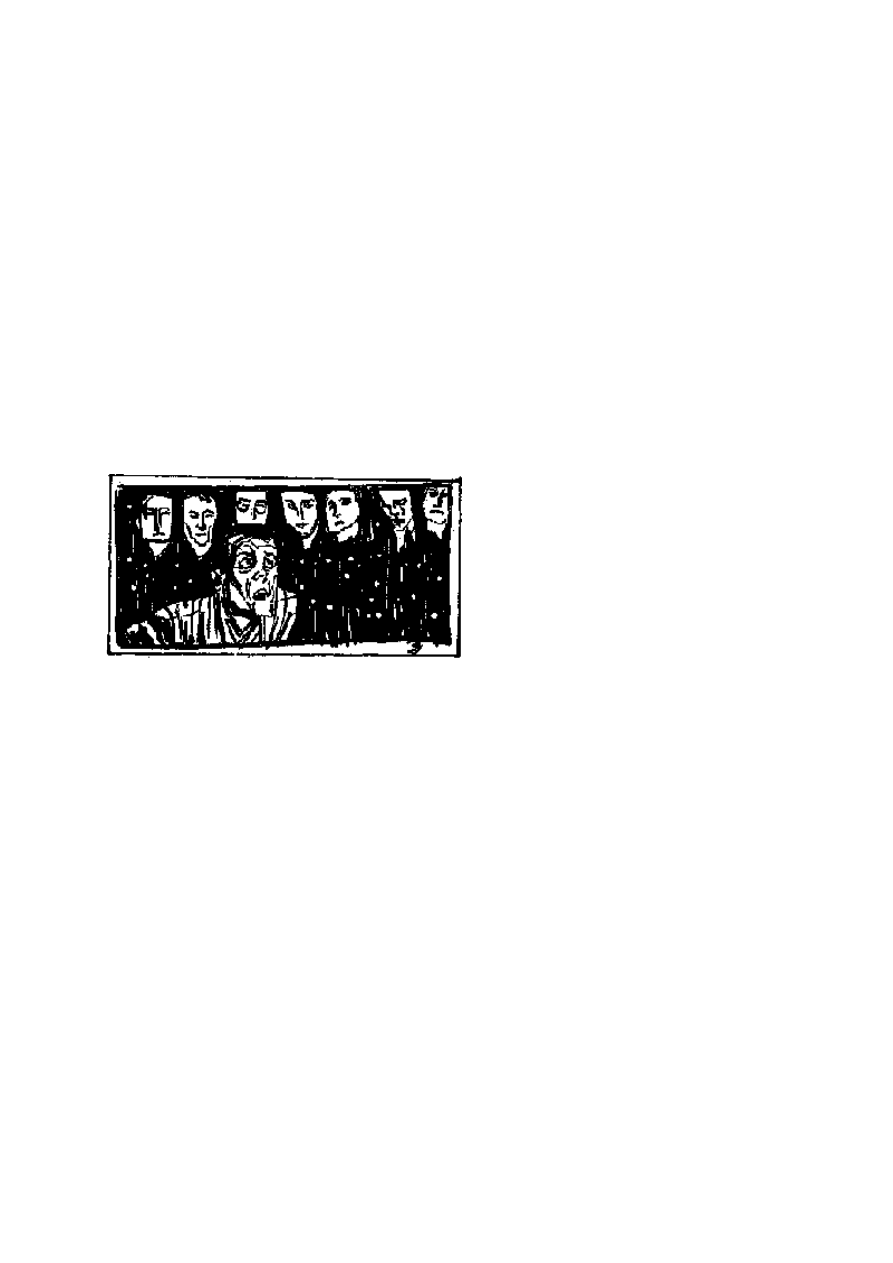
bring you our message. And this is what we have to say. The stars are waiting for you. The stars are waiting."
A moment's pause; then that sharp, strong inflexible voice continued, "A hundred thousand years ago, men's ancestors lived on
this world and were a part of the great empire which stretches from sun to sun and has so stretched since before your planet was
born out of the womb of your little yellow star. Great catacylsms of nature wrecked your planet. Many were evacuated, but many
chose to stay with their home world, with the floods, the sunken continents, the deluges and tidal waves. For this they paid a
price. They reverted to savagery. And savages know no space."
Another, long, quiet pause, while the Senator said in the sharp stillness, "Impossible! This is—"
"Shut up!" the chief snapped, for Flanders, or rather, the curiously alien voice through Flanders, was speaking again.
". . . assume that you have reclimbed most of the distance from savagery, and the stars are waiting for you. We have been
watching. We are ready to reclaim your world. We make only one condition; there is no war in space. We insist upon trust and
sufferance. We insist. We do not show ourselves until we know that you are ready.
"Whatever country will totally remove and destroy all weapons of disaster, whatever country will close off their frontiers and
withdraw completely from a world torn by war, that nation and that people will be received into the Commonwealth of the Stars.
It is so with the state you call India. It is so with the state you call Norway, which today has closed its frontiers.
"The invitation is extended equally to all. Lay down your arms. You will be protected in ways you cannot even imagine. You
need not fear that your enemies on this Earth will Be permitted to harm you, for they, _and not you, are the truly isolated.
"Display your trust and your will to nonagression. Disarm yourselves. Lay down your arms. The stars are waiting."
The voice trailed off, was silent. The thunder in the stethoscopes began again. Flanders slumped; the rattling breath, tortured,
tore through the room, stopped.
I let my hand drop from his wrist.
"He's dead, sir," I said.
Before the words were out of my mouth, the Senator was clawing at the telephone.
"Get me the President!"
BLACK & WHITE
this has been an old story since Cain killed Abel," the man said quietly. "Brother against brother, city against city, nation against
nation. But at least it will never be old-again."
"Never again," the woman repeated, "at least, not on Earth."
"Not on Earth."
In the ruin of what had been—when cities still were dignified by names—lower Harlem, a man and a woman were sitting in the
only building left intact on The Day. It had once been a beer-hall. The walls were still gaudy with lascivious poses of women that
no longer had meaning, and the glass over the bar had been so thoroughly shattered that even now neither the man nor the woman
dared cross the floor barefoot; the splintered glass from long-gone bottles was still working in fragments out of the wood floor.
They-had been living there for three months—since they had found each other and realized they were the last man and woman
in New York—probably, on the North American continent—almost certainly, in the world.-
"All the Adam-and-Eve stories I ever read—" the woman said, with a hard little" laugh. "Never thought I'd end up as the
protagonist of one, It's ludicrous."
"Easy now!" The man's voice was soothing. He caught the edge of hysteria, easier to abort than to stop after it got going.
"You're not."
"No," her voice brooded now; "I'm not."
"Kathy," he said gently, "have you heard the old saying, I wouldn't marry her if she was the last woman in the world?"
"Oh, Jeff-"
"For the love of God!" the man exploded, and stood up, the muscles running in ridges under the dark skin of his jaw. "Kathy,
don't say it! For the love of God! Hand me a mirror, if you can find one in this empty rathole! But don't say it!"
Then he spoke with a bitterness so deep that he himself did not recognize it as bitter. "Kathy, I'd leave here ten
morrow—except I'd be so lonely I'd shoot myself."

"So would I."
"But you've got to use your head, Kathy. I thought this was permanently settled. I thought our ancestors settled it for us about
three hundred years ago. And—we're both reasonably civilized. It's a good thing, or I'd—" he broke off unclenched his fists and
made himself lounge in a chair again.
"Is it really such a good thing?" Kathy asked softly. The garish red lights over the bar—somehow unbroken, the power plant
out here hadn't run down yet—gave a lustre to her fair hair as she leaned forward and looked at him. The man saw the play of the
red light on her blonde hair—cut short like his—and briefly shut his eyes.
"AH I know is—we're both the products of our respective civilizations, Kathy. Good or bad—I don't know. Who cares? Girl,
go to bed! It's after midnight, and I thought we promised each other we weren't going to hash this over any more!"
The girl nodded. "I'm sorry." She rose, shading her eyes. "Jeff, tomorrow let's see if we can't find some other light bulbs
somewhere. These red things are going to drive me nuts!"
He laughed. "Talk about needles and haystacks! New York of the bright lights and I have to look for a light-bulb. Okay, Kathy,
I'll find one if I have to shinny up a light pole."
"Good night, Jeff."
" 'Night, Kathy."
The man sat quite still until he heard the Yale lock snap shut on the inside of the door; an old sign—this had once been a
wellknown night club-said NO STAGS, PLEASE. Jeff slid something out of his pocket and sat looking at it. It was a key, the key
that belonged to the Yale lock.
He opened the street door and went out. The hunks of jammed cars, partially smashed, still blocked the sidewalks, and many of
the light-poles were down, but here and there a solitary street lamp would burn until some day the power went off at the central
station. One, near the corner, spilled a puddle of brilliance into the shadows of broken concrete and brickwork. Slinking figures a
foot long made eerie shadows around the old bones that lay in the street. The man barely glanced their way. Once they had made
him so sick that he could not walk in a street where they lay. Now he kicked them carelessly aside. Deconditioning, he thought.
Too many of the dead to worry about them.
Could other taboos go the same way?
Grass would come back some day and cover the bones. He wouldn't live to see it. Grass, in Harlem!
He still held the key in his hand. Did Kathy know he had it? Two weeks ago, she had told him that she had lost it,
but since she could lock the door on the inside with a turn of her wrist, he hadn't worried—until he found the key, the
next day, lying almost in plain sight by the bar. Had she lost it—on purpose?
Jeff scowled. What if she had? They'd have it to live with for the rest of their lives.
Their children would never know or care. . . .
"Oh, Jesus," the man .muttered, and put his face in his hands, almost a childhood reflex. "Oh sweet Jesus . . ."
The new awareness of Kathy was almost that; a crucifixion. Kathy's face swam before his eyes. He did not think it
was a pretty face. He never had. A fair-haired, blue-eyed woman, an object forbidden, forever taboo, beyond desire.
Doubly taboo, doubly beyond desire.
He scrambled to the summit of a pile of smashed concrete and looked down at the river. The water was clean, now,
freed of the dead fish that Had clogged it for a month. The river, like the city, had its own scavengers that ate the
corruption away.
A question of sin? But is there a clean-cut question of sin in these days? Morality used to be a matter of black or
white, right or wrong, not all shades of—of brown, he said with his teeth clenched. He fished in his pocket for the key
and sent it flying in. a high arch far out over the waters. He didn't even hear the tiny splash.
"Well, that's that," he said aloud. "Clear cut. Black or white."
That was that, even before Kathy and I talked it over that one time. You know that, Father.
Father, lead us not into temptation . . . Oh my God, I am heartily sorry for having offended thee . . . and I detest all my sins ...
He put his hands to his temples, feeling the black crisped
hair there. Who are you trying to kid—Father? He turned and
walked back to their home. He spread his blankets, shucked shirt and pants. Under his pillow lay a curious white object Kathy had
never seen. It was the one thing he concealed from her since they had come to share joint loneliness. He held it musingly a minute.
Did it mean anything now? You've lost everything else that goes with it.
Be honest now. Did it ever mean anything? It couldn't prevent this from happening—this, the end of the world!
He glanced up at the fragment of unbroken mirror over the bar and in a sudden rage raised his hand to shatter it. It only
accentuated the difference between himself and Kathy. Then he stayed his hand. Mirrors meant a lot to a woman.
His own face looked grimly back at him. Neither handsome nor ugly to his eyes. Just an ordinary, brown-skinned face, the face
of a Negro man about thirty years old. He swallowed, then did a curious thing. He raised the white thing in his hand and started to
put it around his neck—then crumpled it furiously in his fist. He started to throw it away, then thrust the Roman collar back
beneath the pillow. Father Thomas Jefferson Brown, a priest without a parish, glared at his own image, turned suddenly away
from the mirror, laughed softly, crawled into his blankets and went to sleep.
Jeff said, "Maybe it would have been easier on you if you'd been brought up in the south, Kathy. You wouldn't even have been
thinking this way."
Kathy smiled and shook her head. "It wouldn't have changed much. Be honest, Jeff. What you're really thinking is—the human
race isn't worth much, if it can end this way."
He laughed out loud. "At least it's not worth starting the whole bloody mess all over again," he said.
She spoke with a seriousness rare for her. "Did it ever occur to you, Jeff, that it might have been meant—our finding each other,
from such a distance apart?"

He chuckled grimly. "Like Lot and his daughters, you mean? Frankly, no."
She rarely spoke of the thing which was so much in the forefront of their minds that it was almost never on their tongues. But
now she said "It's rather terrible, in a way. It took a cataclysm to make me realize that the problem even existed. If you'd ever
asked me, I'd have said that civilization was just a veneer—take a man, and a woman, right out of society, and they'll revert to
primitive man, and primitive woman."
Against thy last temptations, O Father ...
Should I tell her I was a priest? No. She wasn't a Catholic, she made that clear. And, with all my apologies, dear Lord, I'm not
going to fight for one last soul. You made your clean sweep of the fields, and left no gleanings in the corners, and I'm not going to
try to convert her. But I'm not going to tell her and let her try to make me override my vows either. A priest forever. If you wanted
Adam and Eve, Lord, you should have picked a couple of other people. I don't mind letting her think it's because I'm colored and
she's white, but I'm not going to have her call me a fool because with the world ending I count on the next one more than this. Amen.
After a stretched silence he said "Aren't you getting tired of canned foods? I am. Let's take the boat and go across the river.
There are plenty of wild rabbits—well shoot a few for supper. It will be a welcome change."
The breeze over the lower Hudson blew, with a clean freshness, down from the hills. They were both hardened now to the sight
of the ruined city, but Jeff found himself toying,
again, with the notion of striking upriver again. The few things they had—lights, a few caches of food and clothing-could be
weighed against the immense good of not having to look at the ruins every time they moved.
Then he laughed, shortly. Only the memory of what the last civilization had done to itself, kept his resolve firm. . . .
Above the city, grass was beginning to grow down to the water's edge, and rabbits hopped on the overgrown fields without
shyness. "Look how tame they are!" Kathy said in wonder. She had been loading her pistol; now she dropped it back into her
windbreaker.
"Oh, Jeff, let's not shoot .them! They're such cute little fellows, and now there's nobody to scare them!"
"I could sure go for some rabbit stew," the man said doubtfully, then chuckled. "But have it your way, Kathy. Why should the
last humans make themselves obnoxious to the new dominant species?"
"You—really don't mind?" She looked at him with the look he had seen so often these last days, half imploring, half concealed.
He shook his head. "Not a bit. Maybe we'll' find a pig-some of them must have gotten loose and run wild. Anyway, we're sure
to find something—"
"Jeff!" The woman froze. "What was that noise?"
"A shot," the man said huskily, "A shot—a rifle! Kathy, there's someone else here!"
"Were they—shooting at us?" the woman faltered.
"I doubt it. Rabbits, probably, but—"
"I'll fire a signal!"
Jeff was already heading the boat to shore. He said quietly "No. Kathy, it's rotten to sound suspicious, but there could be
trouble. Men, running wild—well, you're a woman."
And all men aren't like me . . . instinct tamed so long ago it doesn't matter. ...
She frowned at him "Oh, surely—there wouldn't be
trouble? After all this time? Remember how—bow glad we were
just to find out we weren't alone in the world—"
"Just the same, keep the gun out of sight," Jeff urged gently. "They'll probably take to us better if we're not armed. Put it away
until we're sure we're safe with friends—or until we know we'll have to fight."
Obediently, the woman put the pistol back into the pocket of her windbreaker. Jeff stood up and shouted in his ringing basso,
"Hello! Hello! Anybody there?"
Silence. After a long time, a thin echo rang back, "Hello!"
"That was no echo," Jeff muttered, "took too long. Hello! Hey there! Can you hear us?"
Three rifle shots in rapid succession answered them; after a little, a man topped the brow of the hill, stood looking down for a
minute, then yelled and broke into a run toward them.
"Hello!" he gasped breathlessly when we got to them. "Well, I'll be damned, a few others made it too! You fellers been here
long? I been—well, hell! It's a girl!" His eyes rested on Kathy. "Seeing you so far off, in them slacks— and with you—" his eyes,
now strangely altered, rested on Jeff. The newcomer was a thickset man, bearded, his clothes in tatters, and Jeff held himself by
force from distaste. A man alone in the wilds would not feel the same obligation as a man living with a fellow human being—to
maintain some semblance of normalcy.
He said quietly, "I'm Jeff Brown, and this is Kathy Morgan."
"I'm Hank Nichols," the man said. "Glad to see ya'll, Miss Morgan. Jeff."
Jeff held out his hand, but the man ignored it and after a moment Jeff let it fall to his side. Social gestures were a little
incongruous now, anyway. Nichols' eyes were still fixed on Kathy-, but Jeff, remembering how, after his own long isola-
tion, he bad wept for joy, just to see another human thought tolerantly; half mad with loneliness. Poor devil!
Nichols asked, "Any more of you in the city? I hoped—"
It was Jeff who answered, though he had spoken to Kathy; "No. I travelled all over the Midwest, looking, and
finally gave it up. Katherine travelled all over New England. There was an old man—he died just before she found
me."
"Katherine, eh? I ain't seen ary soul either. Guess we're all that's left." His gaze at Katherine was open now and his
side glances at Jeff more frequent. "I just caught me a mess of rabbits. Ya'll might as well come eat with me, they's
plenty more."

Kathy was looking at the man with dismay; bearded, slouching, not exactly filthy but certainly not clean. His eyes,
which followed her, made her feel strange. She caught Jeff's arm and murmured.
He smiled and said reassuringly, "Steady, girl. He may not be a very prepossessing specimen, but he's one of God's
creatures, after all. We're not in a position to be—" he smiled at her, winningly, "segregationists."
She nodded, hesitantly, but clung to Jeff's arm. Nichols, turning, saw the gesture, and his eyes narrowed, an odd
light behind them.
In a small clearing not far away, he had pitched a tent, and the embers of a cookfire smoldered, smoke hanging over
the untidy campsite. He squatted on his heels, skinning the rabbits deftly.
"Sure is nice here. I never got to see the country before-worked in a garage down in Kentucky. Only thing, I miss
the movies. Some day I'm going to find me a movie projector someplace, must be one around. Sure lonesome, too." -
"It is," Jeff agreed. "But there may be others somewhere— in Europe, Africa—we just don't know. We've no way of
knowing."
Nichols tossed away a rabbit skin. Kathy took up the skinned animal. "Can't I help you?"
"Sure, baby." He handed her his knife, holding her small hand for a moment in his great paw. "Sure been missing someone to cut
up my rabbits." He laughed and leered, picked up a second rabbit from the pile and began expertly trimming off the paws and
stripping away the pelt. "Jeff, why don't you hunt up some more brushwood?"
The tone, casual and commanding, made Jeff seethe; but he stood up, said mildly, "Right you are," and walked away. His
thoughts were confused. Oh Lord, thy practical jokes are beyond human understanding. A man and a woman, and even a priest to
marry them. Kathy had been afraid of the man—yet she was laughing with him, offering to help him. Instinct. Each after his own
.kind, male and female . . . rough and dirty and unsavory as Nichols looked, he was a man; and he could, and would recognize the
instincts in himself, and in Kathy.
The thought made sickness rise in Jeff's throat; he swallowed, trying not to gag. Kathy—and that creature!
Be sensible. He'll give -her what she wants and you can't—or won't. Damned fool . . . clinging to a remnant of superstition, a
vow made for a world that's ended . . .
You protected Kathy from a dozen dangers. A pack of starving dogs. Falling walls. Rats. Savage, homeless cats, turned
predatory-wild. . . .
But are you going to turn her over to a man who's worse than any of these?
He clenched his fists and his teeth, shaking, sick, fighting the need to run back to the clearing, to fight Nichols, if need be,
savagely, hand to hand, for his woman. But she's not yours . . . oh God, oh my dear God . . . blessed Mother of Mercy, Mary have
pity on me . . .
Kathy screamed. And screamed again, horribly. "No! No!
Jeff—help! Help! Jeff! Oh, no-o-o—!" and the cry was choked off as if a rough hand had stifled the screamer's throat.
Jeff cast thought, prayer and compunction aside; the last remnant of civilization dropped from him and he ran. "Kathy! Kathy!"
he shouted. "Easy, darling, I'm coming—"
Nichols bullet struck him broadside in the lung and he toppled headlong into the little gully.
Kathy, her hands to her mouth, stared in crazy horror at the bearded man. "You—shot him! You—shot him!"
"Yeah, I shot the dam—," he said, but Kathy understood nothing of the rest of the sentence except that it was unbelievably foul.
"Anyway, that's all over. Figured you'd be damn glad to get rid of him. What'd he do—catch you when you were alone? Anyhow,
now we got rid of him. Come on, babe, c'mere—hey! What you doing?"
Kathy fumbled in her windbreaker pocket. She had become expert at shooting the swift-moving, starving rats. Just another rat,
she told herself, and her hand was steady on the trigger; the slug tore away his smile, wiped the sickening memory of his leer from
her mind forever. Not until she found herself kicking his limp body again and again did she realize that she was crying. She ran to
Jeff, kneeling at his side, babbling.
His eyes opened painfully. "Kathy—"
"I shot him," she wept, "I killed him, I—"
"You shouldn't have," he whispered. His mind strayed. "Say—an act of contrition—"
She stared down in horror and sudden wild surmise as the man clawed slowly at the deep agony in his chest. Then he muttered,
his eyes and his brain quite clear, "I was—right all along. As long as we—feel this way—we might as well-end it here. Good thing
he—came along, or I would have given in . . ." he choked on bloody spit.
"Don't talk! Oh, Jeff, darling, darling—don't talk—" Sob
bing, she cradled his head on her knees. His eyes, already
unseeing, sought vainly to find her in the closing darkness. He muttered incoherently in Latin for a moment, then
suddenly, softly, "Kathy—darling—bend down and tell me— did you lose that key on purpose?"
Sobbing, the woman bent to whisper her answer, but he was already beyond hearing. Father Thomas Jefferson
Brown said clearly, loudly, "Sorry, Lord, you'll have to start from a fresh batch of clay," and died. After a minute,
Kathy straightened, letting his limp body fall.
"He was right all along," she said to nobody, put the pistol in her pocket, picked up the two skinned rabbits with a
grim smile, and went back to the boat alone.
Wyszukiwarka
Podobne podstrony:
Year of the Big Thaw Marion Zimmer Bradley
The Forbidden Tower Marion Zimmer Bradley
The Spell Sword Marion Zimmer Bradley
The Winds of Darkover Marion Zimmer Bradley
The Shattered Chain Marion Zimmer Bradley
The Door Through Space Marion Zimmer Bradley
The Heritage of Hastur Marion Zimmer Bradley
Marion Zimmer Bradley Darkover 13 Die Winde Von Darkover
Marion Zimmer Bradley Darkover 14 Die Blutige Sonne
Rediscovery Marion Zimmer Bradley
Marion Zimmer Bradley Terra Astra 075 Die Weltenzerstörer
Marion Zimmer Bradley Darkover 01 Landung Auf Darkover
Marion Zimmer Bradley Darkover 05 Die Erben Von Hammerfell
Andre Norton & Marion Zimmer Bradley & Julian May Trillium 01 Czarne Trillium
Witch Hill Marion Zimmer Bradley
Marion Zimmer Bradley Darkover 16 Retter eines Planeten(2)
Terra Astra 013 Marion Zimmer Bradley Die Winde von Darkover (ohne Cover)
TA 210 Marion Zimmer Bradley Die Jäger vom Roten Mond
Marion Zimmer Bradley Darkover 18 Die Weltenzerstörer
więcej podobnych podstron