
Abysssec Research
1) Advisory information
Title : Adobe Acrobat and Reader 'newfunction' Remote Code Execution Vulnerability
Version : Adobe Reader 9.3.2
Analysis :
Impact : Critical
Contact : shahin [at] abysssec.com , info [at] abysssec.com
Twitter : @abysssec
CVE : CVE-2010-2168
2) Vulnerable version
S.u.S.E. SUSE Linux Enterprise Desktop 11 SP1
+ Linux kernel 2.6.5
S.u.S.E. SUSE Linux Enterprise Desktop 11
S.u.S.E. SUSE Linux Enterprise Desktop 10 SP3
S.u.S.E. openSUSE 11.2
S.u.S.E. openSUSE 11.1
S.u.S.E. openSUSE 11.0
RedHat Enterprise Linux WS Extras 4
RedHat Enterprise Linux Supplementary 5 server
RedHat Enterprise Linux Extras 4
RedHat Enterprise Linux ES Extras 4
RedHat Enterprise Linux Desktop Supplementary 5 client
RedHat Enterprise Linux AS Extras 4
RedHat Desktop Extras 4
Adobe Reader 9.3.2
Adobe Reader 9.3.1
Adobe Reader 9.1.3
Adobe Reader 9.1.2
Adobe Reader 9.1.1

Adobe Reader 8.2.2
Adobe Reader 8.2.1
Adobe Reader 8.1.7
Adobe Reader 8.1.6
Adobe Reader 8.1.5
Adobe Reader 8.1.4
Adobe Reader 8.1.3
Adobe Reader 8.1.2
Adobe Reader 8.1.1
Adobe Reader 7.1.4
Adobe Reader 7.1.3
Adobe Reader 7.1.2
Adobe Reader 7.1.1
Adobe Reader 7.0.9
Adobe Reader 7.0.8
Adobe Reader 7.0.7
Adobe Reader 7.0.6
Adobe Reader 7.0.5
Adobe Reader 7.0.4
Adobe Reader 7.0.3
Adobe Reader 7.0.2
Adobe Reader 7.0.1
Adobe Reader 7.0
Adobe Reader 9.3
Adobe Reader 9.2
Adobe Reader 9.1
Adobe Reader 9
Adobe Reader 8.2
Adobe Reader 8.1.2 Security Update
Adobe Reader 8.1
Adobe Reader 8.0
Adobe Reader 7.1
Adobe Acrobat Standard 9.3.2
Adobe Acrobat Standard 9.3.1
Adobe Acrobat Standard 9.1.3
Adobe Acrobat Standard 9.1.2
Adobe Acrobat Standard 8.2.2
Adobe Acrobat Standard 8.2.1
Adobe Acrobat Standard 8.1.7
Adobe Acrobat Standard 8.1.6
Adobe Acrobat Standard 8.1.4
Adobe Acrobat Standard 8.1.3
Adobe Acrobat Standard 8.1.2
Adobe Acrobat Standard 8.1.1
Adobe Acrobat Standard 7.1.4
Adobe Acrobat Standard 7.1.3
Adobe Acrobat Standard 7.1.1
Adobe Acrobat Standard 7.0.8

Adobe Acrobat Standard 7.0.7
Adobe Acrobat Standard 7.0.6
Adobe Acrobat Standard 7.0.5
Adobe Acrobat Standard 7.0.4
Adobe Acrobat Standard 7.0.3
Adobe Acrobat Standard 7.0.2
Adobe Acrobat Standard 7.0.1
Adobe Acrobat Standard 7.0
Adobe Acrobat Standard 9.3
Adobe Acrobat Standard 9.2
Adobe Acrobat Standard 9.1
Adobe Acrobat Standard 9
Adobe Acrobat Standard 8.2
Adobe Acrobat Standard 8.1
Adobe Acrobat Standard 8.0
Adobe Acrobat Standard 7.1
Adobe Acrobat Professional 9.3.2
Adobe Acrobat Professional 9.3.1
Adobe Acrobat Professional 9.1.3
Adobe Acrobat Professional 9.1.2
Adobe Acrobat Professional 8.2.2
Adobe Acrobat Professional 8.2.1
Adobe Acrobat Professional 8.1.7
Adobe Acrobat Professional 8.1.6
Adobe Acrobat Professional 8.1.4
Adobe Acrobat Professional 8.1.3
Adobe Acrobat Professional 8.1.2
Adobe Acrobat Professional 8.1.1
Adobe Acrobat Professional 7.1.4
Adobe Acrobat Professional 7.1.3
Adobe Acrobat Professional 7.1.1
Adobe Acrobat Professional 7.0.9
Adobe Acrobat Professional 7.0.8
Adobe Acrobat Professional 7.0.7
Adobe Acrobat Professional 7.0.6
Adobe Acrobat Professional 7.0.5
Adobe Acrobat Professional 7.0.4
Adobe Acrobat Professional 7.0.3
Adobe Acrobat Professional 7.0.2
Adobe Acrobat Professional 7.0.1
Adobe Acrobat Professional 7.0
Adobe Acrobat Professional 9.3
Adobe Acrobat Professional 9.2
Adobe Acrobat Professional 9.1
Adobe Acrobat Professional 9
Adobe Acrobat Professional 8.2
Adobe Acrobat Professional 8.1.2 Security Updat
Adobe Acrobat Professional 8.1

Adobe Acrobat Professional 8.0
Adobe Acrobat Professional 7.1
Adobe Acrobat Professional 6.0
Adobe Acrobat 9.3.2
Adobe Acrobat 9.3.1
Adobe Acrobat 9.1.1
Adobe Acrobat 8.2.2
Adobe Acrobat 7.0.9
Adobe Acrobat 7.0.3
Adobe Acrobat 7.0.2
Adobe Acrobat 7.0.1
Adobe Acrobat 7.0
Adobe Acrobat 6.0.5
Adobe Acrobat 6.0.4
Adobe Acrobat 6.0.3
Adobe Acrobat 6.0.2
Adobe Acrobat 6.0.1
Adobe Acrobat 6.0
Adobe Acrobat 9.3
Adobe Acrobat 9.2
3) Vulnerability information
Class
1- Code execution
Impact
Attackers can exploit this issue to execute arbitrary code or cause denial-of-
service conditions.
Remotely Exploitable
Yes
Locally Exploitable
Yes

4) Vulnerabilities detail
authplay.dll is responsible for processing flash contents in pdf files. Through processing of the
newfunction(bytecode 0x40) command it faces some problem because of memory corruption error.
By running newfunction command, an object of the new function is created. This command takes an
argument. The value of this argument is an index from method_info structure.(for further information
about this command refer to ActionScript Virtual Machine 2 (AVM2) Overview.
Here is part of the code in the sub_30292F10 function that process this command:
.text:30242D54 lea eax, [esp+18h+arg_4] ; jumptable 30242ACB cases 60,64
.text:30242D58 push eax
.text:30242D59 call sub_301C82B0
.text:30242D5E mov ecx, [esp+1Ch+arg_10]
.text:30242D62 mov edx, [ecx+78h]
.text:30242D65 mov ebx, [edx+eax*4]
.text:30242D68 mov edi, [esp+1Ch+arg_0]
.text:30242D6C add esp, 4
At the beginning of this code sub_301C82B0 is called. This function takes a pointer to the buffer that
contains newfunction command as an argument:
.text:301C82B0 push esi
.text:301C82B1 mov esi, [esp+4+arg_0]
.text:301C82B5 mov ecx, [esi]
.text:301C82B7 movzx eax, byte ptr [ecx]
.text:301C82BA test al, al
.text:301C82BC js short loc_301C82C3
.text:301C82BE inc ecx
.text:301C82BF mov [esi], ecx
.text:301C82C1 pop esi
.text:301C82C2 retn
.text:301C82C3
.text:301C82C3 loc_301C82C3: ; CODE XREF: sub_301C82B0+Cj
.text:301C82C3 movzx edx, byte ptr [ecx+1]
.text:301C82C7 shl edx, 7

.text:301C82CA and eax, 7Fh
.text:301C82CD or edx, eax
.text:301C82CF test edx, 4000h
.text:301C82D5 jnz short loc_301C82E0
.text:301C82D7 add ecx, 2
.text:301C82DA mov [esi], ecx
.text:301C82DC mov eax, edx
.text:301C82DE pop esi
.text:301C82DF retn
....
In this function the first byte after bytecode 40 which is equal to newfunction command is read. If it is
greater than zero the next bytes also will be read. The value of the second byte is multiplied by 128 and
added with the value of the first byte. If the result is greater than 16384 it will go on the third byte. This
process is continued until the fifth bye after bytecode 0x40.
There problem here is not properly checking the value. sub_301C82B0 function return the above result.
After executing the sub_301C82B0 function remaining code will be followed in sub_30292F10 function.
then value of edx is added to the return value of sub_301C82B0 function and is stored in a buffer.
The value that is stored in the buffer and is under our control is used in the next instructions that can
cause memory corruption.
...
.text:30242D92 cmp esi, 44h
.text:30242D95 jnz short loc_30242DB8
.text:30242D97 lea ecx, [esp+18h+arg_4]
.text:30242D9B push ecx
.text:30242D9C call sub_301C82B0
.text:30242DB8 mov eax, [ebx+38h]
.text:30242DBB mov ecx, edi
.text:30242DBD test eax, eax
.text:30242DBF jz short loc_30242DDD
.text:30242DC1 push eax
.text:30242DC2 push offset asc_30362C14 ; " "
.text:30242DC7 call sub_3025BF20
.text:30242DCC mov ecx, eax
.text:30242DCE call sub_3025C210
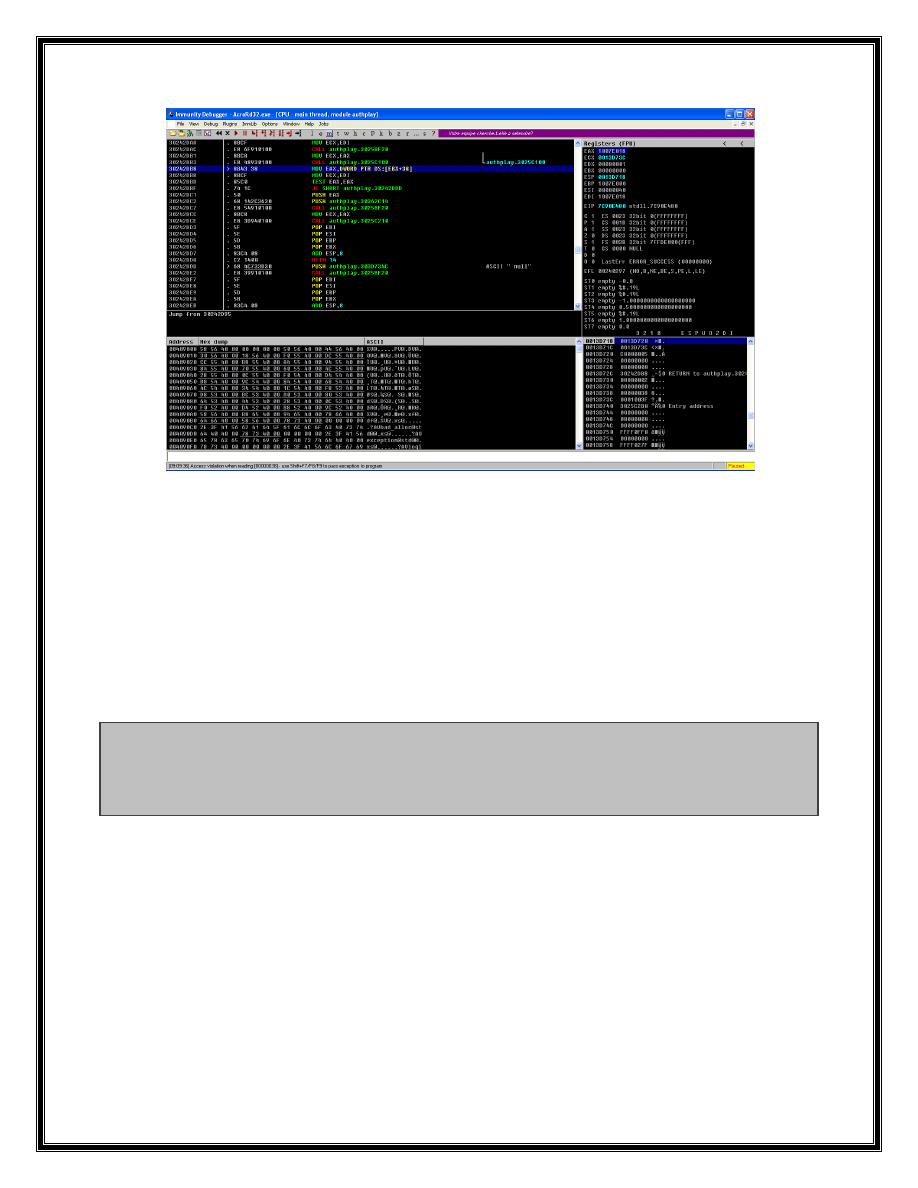
Exploit
Exploiting this bug is difficult but possible because the DEP (permanent) in Adobe Reader. According to
the above explanation I will present the way of exploitation.
As we discussed sub_301C82B0 function return some controllable value:
.text:30242DF5 push edx
.text:30242DF6 call sub_301C82B0
.text:30242DFB mov ecx, [esp+1Ch+arg_10]
.text:30242DFF mov edx, [ecx+9Ch]
.text:30242E05 mov eax, [edx+eax*4]
We should set values after bytecode 0x40 which in result the return value of sub_301C82B0 and finally
result of [edx+eax*4] expression direct us to our controllable code. Then take the advantages of other
codes that use this value to gain control of the program. After gaining control of the execution we
should take the stack and bypassing the DEP by implementing the ROP method to execute the shellcode.
Wyszukiwarka
Podobne podstrony:
Adobe Acrobat and Reader newclass invalid pointer vulnerability
Adobe Acrobat and Reader pushstring Memory Corruption
Mozilla Firefox CSS font face Remote Code Execution Vulnerability
Apple QuickTime FlashPix NumberOfTiles Remote Code Execution Vulnerability
Apple QuickTime FLI LinePacket Remote Code Execution Vulnerability
Microsoft Excel HFPicture Record Parsing Remote Code Execution Vulnerability
Mozilla Firefox XSLT Sort Remote Code Execution Vulnerability
HP OpenView NNM webappmon exe execvp nc Remote Code Execution
Firefox Plugin Parameter EnsureCachedAttrParamArrays Remote Code Execution
Movie Maker Remote Code Execution (MS10 ‐016)
Trend Micro Internet Security Pro 2010 ActiveX extSetOwner Remote Code Execution
System and method for detecting malicious executable code
Adobe Acrobat 9 9 PL Oficjalny podręcznik
więcej podobnych podstron