
The Other 1492:
Ferdinand, Isabella,
and the
Making of an Empire
Professor Teofilo Ruiz
T
HE
T
EACHING
C
OMPANY
®

Teofilo Ruiz, Ph.D.
Professor of History, University of California, Los Angeles
A student of Joseph R. Strayer, Teofilo F. Ruiz received his Ph.D. from Princeton in 1974 and taught at Brooklyn
College, the CUNY Graduate Center, the University of Michigan, the École des Hautes Études en Sciences Sociales
(Paris), and Princeton (as 250
th
Anniversary Visiting Professor for Distinguished Teaching) before joining the
History Department at UCLA in 1998. He has been a frequent lecturer in the United States, Spain, Italy, France,
England, Mexico, Brazil, and Argentina.
Professor Ruiz has received fellowships from the National Endowment for the Humanities, the Andrew W. Mellon
Foundation, the Institute for Advanced Study at Princeton, and the American Council of Learned Societies. In
1994–1995, he was selected as one of four outstanding teachers of the year in the United States by the Carnegie
Foundation. He has published six books and more than forty articles in national and international scholarly journals,
plus hundreds of reviews and smaller articles. His Crisis and Continuity: Land and Town in Late Medieval Castile
(Philadelphia: University of Pennsylvania Press, 1994) was awarded the Premio del Rey prize by the American
Historical Association as the best book in Spanish history before 1580 in a two-year period, 1994–1995. His latest
book, Spanish Society, 1400–1600, was published by Longman in 2001. Another book, From Heaven to Earth: The
Reordering of Late Medieval Castilian Society, is forthcoming from Princeton.
©2002 The Teaching Company Limited Partnership
i

Table of Contents
The Other 1492:
Ferdinand, Isabella, and the Making of an Empire
Professor Biography............................................................................................i
Course Scope.......................................................................................................1
Lecture One
Europe and the New World in 1492 ..........................2
Lecture Two
Reconquest, Pilgrimage, Crusade,
Repopulation..............................................................4
Lecture Three
The Transformation of Values...................................6
Lecture Four
An Age of Crisis ........................................................8
Lecture Five
Isabella and Ferdinand: An Age of Reform.............11
Lecture Six
Iberian Culture in the Fifteenth Century..................13
Lecture Seven
The Conquest of Granada: Muslim Life
in Iberia....................................................................15
Lecture Eight
The Edict of Expulsion: Jewish Life in Iberia .........17
Lecture Nine
Jews,
Conversos, and the Inquisition.......................19
Lecture Ten
The World of Christopher Columbus ......................22
Lecture Eleven
The Shock of the New .............................................24
Lecture Twelve
Spain and Its Empire: The Aftermath of 1492.........27
Map……………………………………………………………………………...29
Timeline .............................................................................................................30
Glossary.............................................................................................................33
Bibliography......................................................................................................34
©2002 The Teaching Company Limited Partnership
ii

The Other 1492
Scope:
The year 1492 has long been seen as an important historical watershed, marking not only Christopher Columbus’s
epoch-making voyage to the New World, but a boundary between the medieval and the early modern world. In
Spain, 1492, from the perspective of contemporaries, was vested with a multitude of meanings: the conquest of
Granada and the formal closing of the Reconquest; the expulsion of the Jews from the Spanish realms after a
millennium and a half of life in Iberia; the triumph of the Catholic Monarchs’ reforms and the growing political
centralization of Castile; and, yes, even the discovery of the New World or what was seen then as a new way to the
Indies.
Focusing on 1492, the pivotal year in the history of the Spanish realms, this set of twelve lectures will examine in
detail the historical developments leading to 1492 and the diverse and longstanding consequences of the events that
took place that year. The course seeks to reassess and revise the historical meanings usually associated with that
date and the privileging of certain historical phenomena to the detriment of others. Thus, 1492 will be examined
from the perspective of a victorious Castilian and Christian society, but also from the perspective of Jews, Muslims,
and the indigenous people of the New World.
Our first lecture lays out the main themes and historiographical direction of the course. It also outlines briefly the
broad European, Iberian, and New World context to the events of 1492 in Spain, attempting to answer the question
of what Europe and the New World were like in 1492. Lectures Two and Three provide a historical narrative of the
evolution of the different Spanish realms (Castile, the kingdoms of the Crown of Aragon, Granada, and Navarre)
from 1212, a crucial year in peninsular history, to the ascent of Isabella I to the throne of Castile in 1474. Special
attention will be placed on the impact of the late medieval crises on Spanish life and culture. Lectures Four and Five
carefully explore the wide-ranging reforms and political, economic, social, religious, and cultural restructuring of
Castile under Isabella and Ferdinand, highlighting those reforms that made Castile and, by implication, Spain
become a great world power in the sixteenth century.
Lecture Six, presents a nuanced view of Iberian culture
high and popular alikein the late fifteenth century, as
Spain laid the foundations of its Golden Age. Lecture Seven turns from a broad discussion of cultural themes to a
close examination of the conquest of Granada, as it reconstructs Muslim life in Iberia from its inception in 711 to its
final defeat on 1 January 1492. Emphasis here and in subsequent lectures is on the multicultural character of
Spanish society. From Muslims, we turn, in Lectures Eight and Nine, to the tenor of life for Jews and Conversos
(those Jews who had converted to Christianity). Beginning with the Edict of Expulsion of the Jews in 1492, we go
back in time to explore the history of the Jews in Iberia, their trials, and tribulations. Christian antagonism to the
Jews led to the pogroms of 1391 and to massive conversions of Jews to Christianity in the following years. These
lectures trace the successes and reverses of Conversos in the fifteenth century and the coming of the Inquisition in
the early 1480s.
In Lecture Ten, we turn to the world of Christopher Columbus, offering a description of the European maritime and
geographical developments that led to the momentous voyages across the Ocean Sea (the Atlantic). Lecture Eleven
focuses on Columbus’s first two voyages, the encounter between the Old World and the New, the conquest of the
valley of Mexico, and the emergence of discourses of “otherness” and colonialism in this period. Our final
presentation, Lecture Twelve, explores the making of the Spanish Empire, the rebellions that swept Spain at the
ascent of Charles I to the throne, and the cultural climate of the peninsula on the eve of the Golden Age.
©2002 The Teaching Company Limited Partnership
1

Lecture One
Europe and the New World in 1492
Scope: This first lecture lays out the main themes of the course and raises questions about how to examine
historical events from diverse perspectives. From a discussion of methodology, the lecture proceeds to
explore the broad European and New World political, social, economic, and cultural contexts of 1492.
Special attention is given to the Iberian peninsula in the late fifteenth century. Emphasis is placed on the
roles of language, geography, and climate in the making of particular Spanish identities and on the political
fragmentation of the peninsula on the eve of the marriage of Isabella and Ferdinand in 1469.
Outline
I. This introductory lecture has three main aims.
A. The lecture begins by raising questions about how we write history and from which perspectives we see
and reconstruct the past.
B. We then consider how 1492 has always been seen as a mythical year in Spanish and world history.
C. Finally, we examine the consequences of 1492 as seen “from below.”
II. History is always in tension and filled with ambiguities. Ideology always shapes the manner in which events are
depicted and interpreted.
A. Walter Benjamin’s moving description of the “Angel of History” provides a new and challenging way in
which to write and study history.
1. Benjamin questions our deep-seated belief in progress and in historical development as an
uninterrupted rise into a promising future.
2. History is seen from the perspective of the defeated and the outsider. History is written from below, as
well as from above.
B. Late medieval Spain was a multicultural and multilingual society. Toleration of religious minorities and
respect for other linguistic groups were practiced (even if these were not as widespread as has been argued
in the past) until the mid-fourteenth century. By then, conflict between different groups increased
dramatically.
C. By the early sixteenth century, this plurality had been erased from Spanish society, and Castilian emerged
as the dominant language. The questions are why and how did this happen?
III. Western Europe in the late fifteenth century was a world in transition, marking the transformation from
medieval to modern.
A. Europe’s economic, social, and political structures changed dramatically after the onset of the late medieval
crises.
B. In several areas of the late medieval West--Castile, England, and France--power began to be centralized.
C. New forms of taxation and economic organization, including government bureaucracies, paralleled the
centralizing policies of kings.
1. In terms of economic transformations, the collapse of the village community and the emergence of
social classes in the rural world had a lasting impact on European society.
2. The world of feudal orders was transformed by the power of money.
3. Income from more sophisticated forms of taxation allowed for standing armies and new forms of
government coercion.
D. New forms of spirituality and ways to articulate one’s faith, what is often described as new forms of lay
piety, transformed the religious landscape of most European countries.
E. Culturally, the late fifteenth century witnessed the high point of Renaissance art and letters in Italy and the
spread of Renaissance and humanistic cultural forms to other parts of Europe. These developments
coincided with the last manifestations of medieval culture so brilliantly described by Huizinga in The
Autumn of the Middle Ages.
©2002 The Teaching Company Limited Partnership
2

F. The capture of Constantinople by the Ottoman Turks in 1453 forced Europeans to seek new ways to travel
to eastern markets.
IV. On the eve of 1492, the New World, what we know today as America, was also undergoing significant
political, economic, and social transformations.
A. In the Valley of Mexico, the Aztecs, or Mexica, had established a powerful centralized empire by 1492.
B. The Inca Empire of Peru was powerful and immense.
C. In the Antilles, the Caribs were slowly moving up the chains of islands of the Lesser Antilles and
threatening the Arawak culture and people.
V. In 1492, there was not yet a Spain. “Spain,” in fact, is a geographical term inherited from the Romans. The
union of the Crowns in 1479 did not lead to a united Spain.
A. Geography and language played a significant role in fostering political diversity. Spain is a hard land
dominated by high mesetas, a country of drought and harshness.
B. The peninsula was divided into a series of distinctive political entities that remained fairly independent
until the eighteenth century.
C. Before 1492, the distinct political entities (and their competing languages) sharing the Iberian peninsula
were the kingdom of Castile, the Crown of Aragon (composed of the kingdom of Aragon, the kingdom of
Valencia, and the County of Barcelona or Catalonia), the kingdom of Navarre, the kingdom of Portugal,
and the Muslim kingdom of Granada.
D. Each entity jealously guarded its identity on a peninsula that was politically and linguistically fragmented.
Supplementary Reading:
Huizinga, The Autumn of the Middle Ages.
O’Callaghan, A History of Medieval Spain, chapters 21–25.
Ruiz, Spanish Society, 1400–1600, chapter 1.
For further background on European history before the end of the Middle Ages, please see The Teaching Company
course Medieval Europe: Crisis and Renewal, also by Dr. Teofilo F. Ruiz.
Questions to Consider:
1. What were the social, economic, cultural, and political conditions in Europe at the end of the Middle Ages?
How did they lead to the important mental shifts that signaled the transition from medieval to modern?
2. How did geography, language, and climate shape the evolution of Spain in the late Middle Ages? To what
extent are these forces at work to this very day in Spain and elsewhere in the world?
©2002 The Teaching Company Limited Partnership
3

Lecture Two
Reconquest, Pilgrimage, Crusade,
Repopulation
Scope: This second lecture focuses on the great themes of Spanish history: reconquest, pilgrimage, crusade, and
repopulation. This discussion is followed by a close look at the battle of Las Navas de Tolosa (1212), when
a large international Christian army, led by Alfonso VIII, king of Castile, inflicted a crushing defeat on a
formidable Muslim army. The lecture explores the role of this battle and the subsequent Christian
expansion into southern Spain. Among the consequences of this dramatic shift in the balance of power
between Muslims and Christians, we will explore the concomitant transformation of the relations between
the dominant Christians and religious minorities and the beginnings of the so-called late medieval crisis.
Outline
I. Lecture Two presents a narrative of Spanish history from 1212 to Isabella’s ascent to the throne of Castile in
1474. The lecture focuses on four distinct ideas:
A. We first examine the manner in which several overarching themes in Spanish history shaped the long
historical development of Spain and the Iberian world.
B. The lecture then explores the significant political shifts that occurred after the decisive victory at Las
Navas de Tolosa.
C. Lecture Two continues by examining the rapid Christian expansion into Andalusia and the immediate
social and economic consequences of this expansion.
D. The lecture concludes with an overview of how the crises triggered by Christian expansion transformed the
structure of Spanish society and mentality, above all, in the changing relationship of Christians to religious
minorities.
II. Before 1492, Spanish society was shaped by several concurrent historical developments that date back to the
origins of medieval Iberia. This lecture looks at these developments as the foundations for the events of 1492.
A. The first important historical phenomenon was the so-called Reconquest, or Reconquista.
1. A clear distinction exists between historical representations and distortions of the Reconquest and its
historical reality.
2. Muslim lands were slowly resettled by peasants, then gave way to being under the jurisdiction of
monasteries, and finally, were claimed by lords. The Reconquest wasn’t an ideological process but a
social one.
B. The second significant development was the growth of the pilgrimage to Compostela and the insertion of
Iberia into the Western medieval European world.
1. The Cluniac foundations controlled the pilgrimage road to Compostela, which played a significant role
in the cultural and economic transformation of the peninsula.
2. The Reconquest, influenced by new ideas coming from Northern Europe, turned into an ideological
conflict in the late eleventh century, and the idea of the Crusade transformed the political map of the
Spanish realms.
C. The third historical development was the repopulation of the lands conquered from Islam. The movement
and settlement of Christians on the ever-expanding frontier had several important consequences.
1. Christian and Muslim opponents had long shared an understanding: “If you conquer us, we are free to
leave with our possessions.”
2. The repopulation created new economic, social, and political structures that defined the Iberian realms,
most of all, Castile.
3. By the twelfth century, there was no servile labor in Castile, a further attraction to settlers.
4. The resettlement of a large Christian population in Andalusia in the mid-thirteenth century and
afterward led to important demographic dislocations in the northern regions of Castile.
5. Between the tenth and early thirteenth centuries, however, issues between Christianity and Islam were
not fundamentally resolved.
©2002 The Teaching Company Limited Partnership
4

III. In this part of the lecture, we return briefly to the events at Las Navas de Tolosa (1212) and examine the nature
of Christian expansion in Andalusia, in the region of Valencia, and in the Mediterranean.
A. The lecture seeks to draw distinctions between the geographical expansion of the kingdom of Castile and
that of the Crown of Aragon, focusing on several discrete themes.
1. The treatment of conquered people (Muslims) differed radically from one kingdom to another. In
Valencia, for example, Muslims remained on the land as semi-servile labor. Elsewhere in southern
Spain, they were expelled after 1264.
2. After the conquest of Valencia, the kings of the Crown of Aragon abandoned the Reconquest in the
peninsula to the rulers of Castile.
3. The consequences of Aragonese and Catalan concentration on Mediterranean politics and expansion
were the rise of Castile as the premier power on the peninsula (after doubling in geographic size) and
the intrusion of the Crown of Aragon into Italian affairs, with concomitant cultural and social
influences coming from Italy.
B. The second set of consequences of the Christian victory at Las Navas de Tolosa and the conquest of
Andalusia that followed was the onset of the late medieval crisis.
1. The crisis was, most of all, manifested in economic change, affecting patterns of land holding, grain
production, and royal income. A new distribution of land created the large latifundias, or landholdings,
now dominated by the nobility, a legacy later bequeathed to Spanish possessions in the Americas.
2. Population decline and demographic dislocations throughout Spain had a deleterious effect on political
order.
C. The lecture concludes with an exploration of political change over the next two centuries following the
Christian expansion into the south.
1. One of these political changes was the redrawing of Castile’s political map, with the alliance between
the Crown and the urban oligarchies of the realm united against the nobility.
2. A second important consequence was the rash of civil wars and widespread violence that plagued most
of Spain from the mid-thirteenth century to the eve of the ascent of the Catholic Monarchs to the
throne.
D. The late medieval crises, punctuated by the coming of the plague and endless conflicts between the high
nobility and the Crown, shaped the institutional and cultural landscape of the Iberian kingdoms in this
period.
Supplementary Reading:
O’Callaghan, A History of Medieval Spain, chapters 14–25; The Cortes of Castile-León, 1188–1350, chapter 2; and
The Learned King: The Reign of Alfonso X of Castile.
Bisson, The Medieval Crown of Aragon: A Short History.
Ruiz, Crisis and Continuity, chapters 10–11.
Questions to Consider:
1. What led to the shifts in attitudes toward religious minorities in mid-thirteenth-century Spain?
2. How would you describe the nature of the crises that plagued Spain from the 1240s onward?
3. Why and how do you think the Reconquest, the pilgrimage to Santiago de Compostela, and the resettlement of
the Christian population in the south shaped historical developments in Spain and the New World?
©2002 The Teaching Company Limited Partnership
5

Lecture Three
The Transformation of Values
Scope: Lecture Three continues to provide a narrative to serve as context for a close examination of the historical
meaning of 1492. While the previous lecture concentrated on the political and economic transformations
that took place in the early thirteenth century, here we see those developments from the perspective of
cultural and social history. The lecture focuses on significant shifts in the mental outlook of Spaniards,
including new ways of conceiving landed property as physical space, of organizing the family, and of
bargaining for salvation. We also examine the manner in which Spanish rulers used symbols and rituals to
articulate power and what these symbolic codes tell us about new perceptions of themselves and the
material world.
Outline
I. In thirteenth-century Spain, territorial expansion and economic change were paralleled by more significant
shifts in the system of values. These changes manifested themselves along a complex range of cultural and
social manifestations.
A. After the early thirteenth century, Castilians above all, but other Spaniards as well, began to think of
property in different ways.
1. First was the new conception of property as physical space that could be measured or fenced.
2. Together with this awareness of property as measurable rather than as part of a complex system of
rights and jurisdictions, land began to acquire elaborate systems of boundaries and landmarks.
3. Rights of entry and exit also began to play an important role in the definitions of property. Access to
public ways became important.
4. The recognition of local boundaries may even have eventually contributed to a greater sense of
national ones.
B. Another significant transformation was signaled by the manner in which Spaniards began to bargain for
salvation in their wills and donations. Some people fragmented their legacies by giving to many different
churches. The immense majority of the property, however, was retained by the family.
C. This attempt to negotiate for salvation indicates a new awareness of purgatory and a new understanding of
salvation and the relationship between the secular (property) and the sacred (salvation).
D. New spiritual sensitivities and the monetary transformations of the early thirteenth century led to new
attitudes toward charity and the poor. Clear distinctions between voluntary and involuntary poverty came
into play. The poor were now reconstructed as an “other”—no longer in the image of Christ but as a
conduit for personal salvation.
II. Another important shift in the mental and social world of late medieval Spain was the transformation in family
structure and the rise of lineages.
A. The new perceptions of property were reflected in the manner in which wills were written. Testaments,
from the early 1200s onward, became the preferred instrument to retain property in the family.
B. The laws enacted after the 1220s encouraged the preservation of property in the family, resulting in a
drastic diminution of bequests to the Church.
C. Around this same period lineages began to be constituted.
1. Aristocratic lineages emerged in the late twelfth and early thirteenth centuries. Combining ownership
or jurisdiction over vast contiguous estates with a new sense of the family’s history and place in the
realm, these aristocratic lineages began to wield their power and challenge royal authority.
2. A parallel development occurred in Spanish cities. There, important bourgeois oligarchical families
monopolized municipal offices and controlled economic urban structures.
D. One important outcome of these transformations and shifts in values was the growing differences between
social groups or orders, what we may call the beginnings of class distinctions.
1. In the countryside, these mental shifts led to the slow breakdown of the village community and to a
parallel stratification of the villages’ social life.
©2002 The Teaching Company Limited Partnership
6

2. In urban centers, these social distinctions were manifest in the growth of the urban poor and in
repressive legislation against begging and the poor.
III. Another important result of these shifts in values was the manner in which Spaniards began to represent
themselves and others.
A. Around the mid-thirteenth century and in the intervening period leading to the rule of Ferdinand and
Isabella, Spaniards began to incorporate a new sense of their own regional and national identities in literary
texts and iconographical representations, a process repeated elsewhere in Western Europe.
1. These representations of self were geographical in nature, that is, “Our land is better than any other
land.” This attitude led to panegyrics about the different regions of Spain, explaining why they were
superior to other regions in Northern Europe.
2. These representations were also ethnic, describing the superiority of one group (Christians) over
another (Jews, Muslims, French, and so on).
B. These discourses of identity or representational strategies were also part of complex discourses of
exclusion and inclusion. All representations of self are, essentially, representations against others.
C. These developments coincided with other historical events and led to the changed perceptions of religious
minorities.
D. This period established distinct attitudes toward those who could not or would not be incorporated into
national projects and community identity and had tragic consequences for the future of Iberia.
IV. Finally, the shifts in values or mentality had its counterpart in the political realm.
A. In this last part of Lecture Three, we examine a case study of new ways of representing power.
B. In the kingdom of Castile from the late twelfth century onward, the rulers abandoned all the symbolic and
liturgical trappings of kingship. Unlike their counterparts in England, France, or other parts of the medieval
West, the kings of Castile were neither crowned nor anointed with holy oil.
C. Instead, the kings of Castile, with a few notable exceptions, developed a “secular” representation of
themselves and lay ceremonies to articulate their power.
1. These “secular” representations of power included an emphasis on the military role of the Castilian
monarchs.
2. The contractual nature of the monarchy was emphasized.
3. These representations also involved the use of a series of “secular” ceremonials: girding of one’s own
sword, acclamation, dubbing by a mechanical statue of Saint James, an exchange of oaths, the act of
being raised on a shield, and so on.
D. This non-sacral monarchy had a lasting impact on the manner in which power was to be constituted and
exercised in late medieval and early modern Spain.
Supplementary Reading:
Linehan, History and Historians of Medieval Spain.
Ruiz, “The Business of Salvation,” and “Unsacred Monarchy: The Kings of Castile in the Late Middle Ages.”
Baer, A History of the Jews in Christian Spain.
Glick, Islamic and Christian Spain in the Early Middle Ages: Comparative Perspectives on Social and Cultural
Formation.
Freedman, The Origins of Peasant Servitude in Medieval Catalonia.
Questions to Consider:
1. How do you think economic and social changes in Spain in the late twelfth and early thirteenth centuries were
related to shifts in mentality and the development of new attitudes toward property, space, and religious
minorities?
2. How did the Reconquest, the resettlement of the lands taken from the Muslims, and the turning of the
Reconquest into a Crusade shape the course of Spanish history? What other factors were influential in the
development of particular institutions and the mental outlook in late medieval Iberia?
©2002 The Teaching Company Limited Partnership
7

Lecture Four
An Age of Crisis
Scope: In this lecture, we continue to draw a map of Spanish society from the mid-fifteenth century to the ascent
of the Catholic Monarchs. The focus is on the ten-year period preceding the ascent of Isabella to the throne
of Castile in 1474, the civil war that resulted from her claims to the throne, and the first reforms carried out
by the Catholic Monarchs and their impact on Castilian society. The lecture emphasizes the distinct
character of the different Iberian realms on the eve of the union of the Crowns and the impact of the
reforms on Castilian and, to a lesser extent, Spanish society.
Outline
I. Lecture Four explores four distinct themes and establishes a context for the rise of the Catholic Monarchs to
power and the important transformations that occurred in late fifteenth-century Spain.
A. The lecture seeks to highlight the different history of the Crown of Aragon from that of Castile. We also
look at other smaller peninsula kingdoms and how they stood on the eve of 1492.
B. In the same manner, Lecture Four focuses on the political conflicts that preceded Isabella’s rise to the
throne and the endless political crises that sank Castile and, to a lesser extent, Aragon into dangerous
turmoil.
C. At the same time, the lecture follows the events that led to Isabella’s securing of the throne; her relation
with her consort, Ferdinand of Aragon; and the slow and painful restoration of peace in Castile.
D. Finally, the lecture concludes with an examination of the first wave of reforms undertaken by the Catholic
Monarchs between 1474 and 1480.
II. In the fifteenth century, although ruled by the same family (the Trastámaras), Castile and the Crown of Aragon
were quite different in terms of their political institutions, language, and aims.
A. From the early fifteenth century onward, Castile was the site of endless conflicts between the Crown and
the high nobility. The reigns of John II (1406–1454), incompetent and corrupt, and Henry IV (1454–1474)
saw a continuous erosion of royal power and royal income. High nobles (the magnates) challenged royal
authority and sought to become independent of royal control. The period between the 1420s and the 1470s
was one of unending violence.
1. In some cases, these challenges, such as those mounted by the Infantes of Aragon (the children of the
king of Aragon), threatened the survival of the dynasty itself.
2. The Infantes of Aragon, Don Juan and Don Enrique, were members of the Aragonese branch of the
Trastámaras, members of the Aragonese royal house, cousins of the king of Castile, and the greatest
magnates and landholders in Castile proper.
3. John II’s favorite, Don Alvaro de Luna, was able to thwart most of the attacks from the Infantes of
Aragon, to neutralize them, and to allow
though serving his own intereststhe Castilian monarchy
to survive.
B. Henry IV’s troubled reign further weakened the Castilian monarchy and allowed for the pillaging of the
royal domain.
C. The Crown of Aragon was the other important peninsular realm. It consisted of three distinct political
units: Aragon proper, Catalonia, and the kingdom of Valencia.
1. The conquest of Valencia and its rise as an independent kingdom marked the end of Aragonese
expansion in Iberia.
2. Led by Barcelona’s commercial elite, the Catalans embarked on a program of far-flung Mediterranean
expansion.
3. The taking of Sicily and the establishment of an Aragonese ruler in southern Italy led the Crown of
Aragon to play a significant role in Italian affairs.
D. The decline of Barcelona in the fifteenth century played a significant part in the diminished position of
Aragon and Catalonia in Spanish politics.
©2002 The Teaching Company Limited Partnership
8

1. Political antagonisms in Barcelona (the Busca and the Biga) were symptomatic of widespread violence
in the kingdom.
2. The war of the remancas (the servile peasants) against their lords, the only successful peasant
rebellion in Europe, was part of the political restructuring of the Crown of Aragon.
III. By 1469, in the Pact of the Toros de Guisando, Isabella gained recognition of her rights to the Castilian throne.
A. By her marriage to her cousin Ferdinand of Aragon, heir to the throne of the Crown of Aragon, Isabella
antagonized her half-brother Henry IV.
B. The lowest point during this restless period was the so-called farsa de Avila. At the “farce of Avila,” the
nobility ritualistically deposed the king and replaced him with his half-brother Alfonso (d. 1467).
C. Henry IV disinherited Isabella and named her daughter, who was rumored to be the daughter of Henry’s
favorite, Beltrán de la Cueva, heir to the throne of Castile.
D. At the death of Henry IV (in 1474), a civil war broke out between the supporters of Juana, mostly the great
noble houses and the king of Portugal, on the one side and some noble houses, the majority of the urban
centers in Castile, and some Aragonese support, on the other.
E. With the crucial support of the Castilian municipalities, Isabella and Ferdinand defeated the young Juana
and her supporters, beginning the arduous process of restoring order to Castile and royal authority
throughout the land.
IV. After their victory over the rebellious nobility, the Catholic Monarchs embarked on an ambitious program to
restore order to Castile and to strengthen royal power.
A. Isabella was a woman of great determination, ability, courage, and heightened religiosity.
B. One of Isabella and Ferdinand’s first actions was to restore order throughout the land.
1. The central aspect of the Catholic Monarchs’ attempt to restore order was their policy of reducing the
political role of the high nobility.
2. Although Ferdinand and Isabella’s attacks against noble violence encompassed all the realm, their
most salient successes took place in Galicia, the northwestern region of the kingdom, and in the south,
in Seville.
3. Noble castles were razed; some nobles were executed, and a good number of them were exiled.
4. By 1477, the country had been restored to order.
C. The Catholic Monarchs’ instrument for restoring order and taming the nobility was the Santa Hermandad
(1476). At the Cortes of Madrigal (1476), Isabella and Ferdinand revived the old medieval hermandad as
the arm to enforce royal law and authority.
D. The Santa Hermandad also served later on as the vanguard of the armed assault against Granada, the last
outpost of Islam in the peninsula.
E. The result of this “taming of the nobility” was an unwritten pact between the Crown and the high nobility.
From this point forward, the nobility ceased to play the role of kingmaker or to threaten the stability of the
throne. In return, the Crown guaranteed the social and economic primacy of the nobility in the realm. In
fact, the high nobility became, after 1476, loyal servants of the Crown.
Supplementary Reading:
O’Callaghan, A History of Medieval Spain, chapters 21–25.
Elliott, Imperial Spain, 1469–1716, chapters 1–3.
Lunnenfeld, The Council of the Santa Hermandad.
Questions to Consider:
1. Why do you think Castile and the Crown of Aragon developed in such different ways? To what extent did these
differences affect the later development of Spain as a unified nation? What role did language play in the
peculiar distinctive courses each of these regions followed after 1212?
2. How did Isabella and Ferdinand secure the Castilian throne? What political forces made their success possible?
What obstacles did they overcome to restore order in Castile?
©2002 The Teaching Company Limited Partnership
9

3. Why do you think the Santa Hermandad was successful in combating noble violence? How different was the
Santa Hermandad from its medieval predecessors, and why did these differences signal a fundamental change
in royal power?
©2002 The Teaching Company Limited Partnership
10

Lecture Five
Isabella and Ferdinand: An Age of Reform
Scope: Lecture Five continues to describe and explain the reforms of Isabella and Ferdinand and the impact of
these reforms on the political, economic, social, religious, and cultural structures of Castile at the end of the
fifteenth century. In addition to outlining the most important reforms, dealing with the governing of the
cities, the role of the cortes (parliament), the army, the Church, and education, this lecture also explores the
long-term consequences of political centralization in Castile and the unequal relationship among different
realms in the peninsula.
Outline
I. Once order had been restored and the Santa Hermandad was able to maintain a semblance of civic peace, the
Catholic Monarchs turned their attention to other important reforms. This transformation of the Castilian
kingdom can be divided into the following categories:
A. The Catholic Monarchs sought to restore the economy of Castile and to find new sources of income.
1. New taxes were enacted that provided additional income for the Crown. These taxes were closely
associated with transhumance and meant royal support for specific types of economic activity. This
income freed the Catholic Monarchs from the need to ask subsidies from the cortes (parliament).
2. The Crown forced the nobility to return a great part of the lands and income alienated from it during
the disturbances of the mid- and late fifteenth century.
3. Isabella and Ferdinand gained control of the military orders and their fabulous wealth.
B. What the Crown achieved in individual cities, it also achieved in the realm as a whole. By reducing the
number of cities that could send representatives to the meetings of the cortes, the Crown ensured its easy
control. The Castilian Cortes became a rubber-stamp body, unable to check the growing royal authority.
C. The Catholic Monarchs sought to reform the moral climate and the religious and secular cultures of Castile.
By the time of the Reformation, Spain’s was the only reformed church in Western Europe, which led to its
taking a leadership role in the Counter-Reformation of the sixteenth century. The Monarchs’ efforts
advanced on two different but closely interrelated courses.
1. The Catholic Monarchs sought to reform the Church and to combat clerical excesses.
2. The queen and king engaged in active patronage of the arts and university education, as well as in
recruitment of university-trained bureaucrats. We will explore this topic in the next lecture in some
detail.
D. Isabella and Ferdinand also sought to restore the political authority of the Crown and to centralize power in
Castile.
1. These goals were accomplished in two ways: by gaining control of the Castilian municipalities through
the imposition of the corregidores, or royal officials, and by limiting the number of cities represented
in the Castilian Cortes.
2. By the 1480s, the king and queen had access to the financial resources of the cities.
II. The Catholic Monarchs’ successful restoration of order in Castile meant a growing centralization of power.
A. Under Isabella and Ferdinand, Castile became one of the so-called “New Monarchies,” that is, places in
which power was increasingly concentrated at the top.
1. This situation was most evident in what Max Weber has described as “the legalized monopoly of
violence” by the state.
2. In this period, Castile also underwent a thorough administrative reform, signaled by the creation of the
councils of state.
3. At the same time, the Catholic Monarchs, by putting an end to factional struggles, gained immense
political capital, evident in the good will of the people.
B. Ferdinand and Isabella set up a series of councils in Castile that created a new bureaucratic structure,
furthered the centralization of power, and increased the effective administration of the realm.
©2002 The Teaching Company Limited Partnership
11

III. Among the important reforms carried out by the Catholic Monarchs were the reform of the Church and the
establishment of the Inquisition.
A. On the eve of 1492, the Castilian and Aragonese churches were plagued by excesses and vices. Using
strong measures, the Catholic Monarchs reformed the Church and imposed new codes of conduct on the
clergy.
1. These reforms prepared the Catholic Church in Spain for its unique and important role in the religious
conflicts that were to beset Europe in the wake of the Reformation.
2. A new reformed Church legitimized and served as a bulwark for the growing power of the Castilian
monarchy.
B. Isabella and Ferdinand established the Inquisition in Castile. Although the Inquisition dated from the early
thirteenth century, it had never been allowed to operate in Castile. It did so now under direct royal control.
1. The Inquisition also became an important component of the new strategies of power. It buttressed
royal power and was used to finance the campaigns against Granada.
2. Most people in other realms (Aragon, Catalonia) saw the Inquisition as a threat to their autonomy and
resisted its presence and work, sometimes by the force of arms, as an encroachment on their liberties.
IV. These reforms, enacted and carried out essentially in the kingdom of Castile, allowed the later kingdom, which
had a larger population and better financial resources than any other realm in the peninsula, to emerge as the
dominant political and cultural power in Spain.
A. The reign of Ferdinand and Isabella witnessed a renewal of the campaigns against Granada and the
reorganization of the Castilian army.
B. One of the most significant reforms was that of the Castilian army. Under Gonzalo Fernández de Cordoba,
the Great Captain, the Spanish armies were reorganized along new lines (the tercios) and became the
premier army in Europe until the mid-seventeenth century.
C. These changes and the new centralized power of Castile led to an unequal relationship with other
peninsular kingdoms.
D. This situation, in turn, led to growing neglect of Aragon and growing resentment of the Aragonese and
Catalans against Castile and Castilian royal officials.
E. As part of the new political strategy of the Catholic Monarchs, Castile began to flex its muscles in Italy,
North Africa, and eventually, the New World. From realms that were separate and often in conflict, Spain,
led by Castile, emerged by 1492 as the greatest European power.
Supplementary Reading:
Elliott, Imperial Spain, 1469–1716, chapters 1–3.
Lynch, Spain under the Habsburg, vol. 1, chapter 1.
Kamen, Inquisition and Society in Spain.
Questions to Consider:
1. What was the nature of Ferdinand and Isabella’s reforms? Did they represent a radical departure from medieval
precedents, or did they, in fact, constitute a shrewd adaptation of structures already in place?
2. What were the consequences of the rise of Castile for Spain’s long-term development? Was this development
unavoidable? What would have had to be different for Spain to develop as a truly unified realm?
©2002 The Teaching Company Limited Partnership
12

Lecture Six
Iberian Culture in the Fifteenth Century
Scope: This lecture highlights the culture of Iberia on the eve of 1492. The fifteenth century witnessed dramatic
changes in cultural forms. The impact of Italian Renaissance culture early in the century transformed
Iberian literary and representational forms. The century also saw the strengthening of the vernacular as the
language of literary output. The year 1492 marked the publication of the first Castilian grammar
the first
grammar in any European vernacular language
and the hegemony of Castilian over other peninsular
languages. Lecture Six also examines specific aspects of popular and elite culture, with special emphasis
on romances and the birth of new literary forms as preludes for the great cultural achievements of the
Golden Age.
Outline
I. From the late fourteenth century into the fifteenth, the nature of Castilian and Aragonese culture changed
dramatically.
A. Through the Aragonese rulers of Naples, the culture of the Italian Renaissance entered Spain.
B. This culture spread first through the Crown of Aragon, mostly through Barcelona and Valencia; it then
expanded to the kingdom of Castile.
II. We focus on some specific works of the early and mid-fifteenth century and explore the different genres of
literary production: lyrical poetry, chronicles, and essays.
A. In the early and mid-fifteenth century, lyrical poetry in Castilian led the way in the new culture. Great
nobles joined in the cultural revival, leading to the so-called debate between “arms and letters.” In reality,
there was no such debate. To be a great nobleman in Castile or the Crown of Aragon meant not only the
exercise of arms, that is, courtly and knightly activities, but also to have an education.
B. Nobles, above all such magnates as the Marquis of Santillana and Jorge Manrique, collected libraries and
wrote important works.
C. Jorge Manrique, one of the greatest Castilian poets, wrote his extraordinarily moving “Ode to the Death of
my Father,” which summarizes most of the culture and mentality of the period.
III. We now look in greater detail at the university-trained letrados and their role in expanding culture and
administrative centralization.
A. Who went to the universities, what social class did they represent, and what was their mental outlook?
B. The role of Conversos in the cultural transformation of Spanish society, particularly in Castile, was an
important factor in the rise of the letrados.
C. The role of these university-trained men in the debate between “arms” and “letters” was also significant.
IV. One important aspect of fifteenth- and early sixteenth-century culture was the writing and reading of romances.
Romances were a throwback to the courtly literature of the twelfth century. They were revived with great gusto
in Spain and throughout the rest of Europe in the fifteenth century.
A. Romances became popular throughout Spain. They reflected the chivalrous life of the upper nobility and
served, at the same time, as a model for such a life.
B. After printing came to the peninsula in the late fifteenth century, romances became the most popular form
of writing for the upper and middling classes.
C. Some romances inspired eyewitness histories, such as Bernal Díaz del Castillo’s narrative on Mexico. The
fiction of romance was translated into the actions of the conquistadors.
D. In the great Spanish literary work Don Quixote, we find both a mockery of these romances and the last
great romance itself.
E. Two of the most important romances of the period were Amadis of Gaul and Tirant LoBlanch; they
influenced later writings and the lives of the Spaniards who explored and conquered the New World.
©2002 The Teaching Company Limited Partnership
13

V. The reign of the Catholic Monarchs marked a signal transformation of Castilian culture and its formalization as
the hegemonic culture in Spain.
A. In 1492, Antonio de Nebrija published the first grammar of the Castilian language. It was the first grammar
of a vernacular language written or published in Western Europe. Nebrija argued that “language was the
instrument of empire.” His words proved to be true in the half century after 1492.
B. Another of the towering achievements of Isabella and Ferdinand’s court was the publication of the polyglot
Bible, an edition showing several ancient and modern languages in parallel columns. These types of
philological and literary works propelled Spain, but above all, Castile, to the forefront of culture in Europe.
C. Ferdinand de Rojas’s classical work La Celestina was written and published in 1500. La Celestina is one
of the most revealing works about the moral economy of Spain and the social turmoil created by shifting
social categories. It was never censored by the Inquisition.
VI. The popular culture of the day included elite festivals, knight-errantry, Corpus Christi, and carnival.
A. In fifteenth-century Spain, festivals, calendrical and non-calendrical, came to play a larger role in the ludic
life of the Iberian realms.
1. Calendrical festivals were celebrated during the great liturgical holidays: Christmas, Epiphany, Lent,
Easter, and Saint John’s Day. By the fifteenth century, however, the religious significance of these
festivals was overwhelmed by secular pageantry.
2. Non-calendrical festivals commemorated specific events associated with the life cycle: birth, marriage,
death. Others, such as royal entries, or ascension to the throne, reaffirmed royal power.
3. The royal entry of Henry IV (1460s) at Jaén, for example, was didactic in purpose, part of the
negotiation of political power between city and countryside. The king gave to the city certain rights
and charters; the city gave him money in return.
B. These festivals were used for hegemonic purposes, and they articulated discourses of inclusion and
exclusion, social distance, and hierarchy.
C. Knight-errantry and pas d’armes played an important role in the Spanish imagination and festive cycles.
The most famous example of this was the paso honroso of Suero de Quiñones.
Supplementary Reading:
Green, Spain and the Western Tradition: The Castilian Mind in Literature from El Cid to Calderón.
Huizinga, The Autumn of the Middle Ages.
Kagan, Students and Society in Early Modern Spain.
Nader, The Mendoza Family in the Spanish Renaissance, 1350–1550.
Ruiz, Spanish Society, 1400–1600, chapters 1, 5, 6.
Questions to Consider:
1. How would you explain the autonomous development of Castilian and Catalan cultures? What factors led to the
primacy of Castilian culture in Spain? How did this linguistic and cultural supremacy bring about endless
conflicts between the two cultures?
2. Why do you think festivals played such an important role in the political and cultural discourses of late
fifteenth-century Spain? What kind of symbols and messages were used by those on top? For what purpose?
Can you think of festivals in the modern world that may parallel the political role of Spanish late-medieval
displays?
©2002 The Teaching Company Limited Partnership
14

Lecture Seven
The Conquest of Granada:
Muslim Life in Iberia
Scope: In Lecture Seven, we begin to look at the specific events of 1492. The first of these significant
developments and the most important in terms of contemporary Spanish society was the conquest of
Granada on 1–2 January 1492. This lecture traces the events and conflicts that led to the surrender of the
city and the impact of the conquest on Spanish society. More significantly, the lecture seeks to outline the
course of Muslim life in the peninsula since 711 until the conquest and to examine the lives of Muslims
after their final defeat in 1492, their forced conversion in the early sixteenth century, and their expulsion
from Spain in the first two decades of the seventeenth century. In addition, this lecture examines the
cultural and material contributions of the Muslims to Spanish society.
Outline
I. Lecture Seven begins with a narrative of the final conquest of Granada and an attempt to explain what this
event meant for both Christians and Muslims. Rather than seeing the event from the Spaniards’ triumphant
perspective, the lecture seeks to present the two points of view and perceptions of the surrender of the city. In
this period, the kingdom and the city achieved dazzling cultural achievements.
A. The kingdom of Granada survived for more than 200 years after the conquests of the south in the mid-
thirteenth century. There were important reasons for Granada’s resilience and for its Nasrid rulers’
survival.
1. After 1248, the Christian realms faced a number of crises that effectively prevented them from
mounting a serious offensive against the last Muslim outpost.
2. The kingdom of Granada was a prosperous realm. Trade with North Africa, silk production, and
agriculture made Muslim Granada an important economic power, capable of successfully defending
itself against Christian attacks.
3. The substantial tribute that the rulers of Granada paid to the Spanish kings served as a disincentive for
an attack.
B. After the reforms of the Catholic Monarchs, the Christians began to plan and carry out a full attack on the
kingdom of Granada. This was seen as the culmination of the vaunted Reconquest and as a way to rally
Castilians and Aragonese in a common “national cause.”
C. Political factionalism and family feuds just around 1492 made Granada an easy target.
D. The war was difficult and trying and lasted for more than a decade. The taking of small mountain garrisons
required great effort and financial outlay.
E. On 1–2 January 1492, Granada’s last ruler surrendered the city to Isabella and Ferdinand. Many high
Muslim officials left Spain for permanent exile in North Africa.
II. Using the conquest of Granada as a lens, we explore the Muslim past and its significant place in the history of a
multicultural and multiethnic Spain.
A. Islam arose in the seventh century, expanded to the southern shores of the Mediterranean after 630, and
conquered Iberia in 711–716. Most of the population of southern Spain eventually converted to Islam.
B. Thus began the period of the Golden Age of Muslim Iberia; the rise of Cordoba; and the cultural,
economic, and political supremacy of the Cordoba Caliphate in the peninsula. Spain became a crossroads
of learning and knowledge that linked Northern Europe with North Africa.
C. Cordoba’s power declined and the Caliphate (1008–1031) collapsed. This situation led to the emergence of
fragmented Muslim political entities, the so-called “kingdoms of taifas.” The waning of Cordoba meant
also the rise of Christian power and a reversal of the power relationship between Christians and Muslims.
III. We examine ethnicity, religion, and cultural exchanges between Muslims and Christians.
A. Islam was a tolerant religion. In Iberia, the three great religions of the West coexisted peacefully. In reality,
there was little physical difference among Christians, Muslims, and Jews.
©2002 The Teaching Company Limited Partnership
15

B. By 1085, Alfonso VI’s conquest of Toledo marked a watershed in the relations between Muslims and
Christians. Threatened by the Christians, Muslim rulers called for help from North Africa.
C. In the period between c. 1050 and 1130, a group of North African Muslims, the Almoravids, were able to
challenge the rising Christian power. Spanish Muslims, caught between Christian attacks and the harsh rule
of their North African brethren, faced many difficulties.
D. After the demise of the Almoravids, a new North African group, the Almohads (1130–1248) imposed their
rule on al-Andalus, the region of southern Spain still under Islam. The Almohads were soundly defeated at
Las Navas de Tolosa (1212), and all of the south was opened to easy Christian conquest.
E. Different terminologies were used to describe Muslims in Christian Spain, and different political, social,
and cultural connotations were attached to such terms.
1. The first term was Moors (Moros), a word used by Christians in Spain to describe Muslims who were
politically independent, that is, those Muslims living under Muslim rule. It was a pejorative term with
racial connotations.
2. Mudejar was the term used to describe Muslims who, while still keeping their religion, lived under
Christian rule. They lived a semi-segregated life, residing not in ghettoes but on the margins of
society.
3. Morisco referred to those Muslims who had converted to Christianity
though in most cases the
conversion was feigned—and lived in Christian Spain.
4. From 1200 onward, Muslim civilization in Iberia was on the wane. Many of the elite fled elsewhere,
and those who remained in Spain were mostly of the lower classes.
IV. This concluding part of Lecture Seven looks at the tragic life of Muslims after the conquest of Granada and
their resistance to assimilation and conversion.
A. The treaty leading to the surrender of Granada included provisions that guaranteed the religious freedom
and property of the Muslims. These terms were ignored, and the Muslims were forced to convert in 1502.
Though nominally converted to Christianity, many former Muslims continued to practice their ancestral
religion, dress and eat as Muslims, and speak Arabic.
B. Christian demands on Muslims to behave like Christians led to a violent revolt in the mountains around
Granada in 1499. Although defeated, the Muslims (now known as Moriscos) refused to assimilate.
C. In such places as Aragon and Valencia, most of the agricultural work was carried out by Moriscos.
Although in almost semi-servile conditions, the Moriscos thrived and reproduced, to the discomfort of their
Christian neighbors.
D. In the 1560s, a series of punitive measures against the Moriscos in Granada led to a second revolt, a violent
affair that almost exhausted the Spanish monarchy. Defeated, the Granada Moriscos were dispersed
throughout Castile; their lands were confiscated and given to Christian settlers.
E. After the 1560s, mistrust and violence against the Moriscos continued unabated. In the end, the Moriscos,
after almost a millennium of life in Iberia, were expelled in the early seventeenth century.
Supplementary Reading:
Burns, Moors and Crusaders in Mediterranean Spain.
Chejne,. Muslim Spain: Its History and Culture.
Fletcher, Moorish Spain.
Glick, Islamic and Christian Spain: Comparative Perspectives on Social and Cultural Formation.
Kennedy, Muslim Spain and Portugal.
Questions to Consider:
1. What were the most important factors leading to the surrender of Granada in 1492? How did Muslims and
Christians react to the event? What do their reactions tell you about the mentality of each of these groups?
2. What do you think were the most salient Muslim contributions to Spanish culture? Traveling through Spain,
looking at books about Spain, what are the visible signs of that culture? How is it reflected in the people, food,
and ways of life?
3. Can you think of any contemporary examples that parallel the Spanish Muslims’ fate in the sixteenth century?
©2002 The Teaching Company Limited Partnership
16

Lecture Eight
The Edict of Expulsion: Jewish Life in Iberia
Scope: In Lecture Eight, we continue to examine the landmark events of 1492. In March of that year, the Catholic
Monarchs decreed that all the Jews in their respective realms (Castile and the Crown of Aragon) had three
months in which to convert to Christianity or leave Spain. This lecture looks in detail at the context and
circumstances that led to such a momentous decision. We then go back in time to present an overview of
Jewish life in the peninsula until the tragic pogroms of 1391. We examine the role and contributions of the
Jews to Spanish culture and society and the changing attitudes toward, and representations of, Jews and
Judaism from the early thirteenth century onward. Specifically, we seek to answer the question of how
those increasingly pejorative representations set the stage for persecution and expulsion.
Outline
I. On 31 March 1492, Isabella and Ferdinand’s royal edict gave their Jewish subjects three months in which to
convert to Christianity or leave Spain.
II. One important component of the historical context of the promulgation of the Edict of Expulsion is the reaction
of Jews to this great catastrophe. Jews reacted in different ways to these events.
A. One significant issue is the question of numbers. How many Jews lived in Spain in 1492?
1. Historians have advanced all sort of preposterous figures, ranging from the unacceptable 1 million
Jews to the most recent, and by far more reliable, estimate of 80,000 Jews in all of Spain in 1492.
2. Shortly before 1492, most Jews (except for those at court) lived in small towns and had become quite
impoverished.
B. Some Jews converted rather than face bitter exile. Others, even though the Catholic Monarchs pleaded
with them to convert and promised them great rewards, remained true to their faith.
C. According to a recent study, around 40,000 Jews left Spain in 1492. Because they could take with them
only what they could carry, their houses and properties were sold at below market price or left with friends
to liquidate.
1. According to the same study, a good number of the Jews who left (as many as half of them) returned
to Spain, converted to Christianity, and reclaimed their property.
2. The Spanish archives are filled with manuscripts recording such claims.
III. What were the motivations behind the Edict of Expulsion, and what was the meaning of the expulsion for Jews
and Christians alike?
A. The conquest of Granada and the formal closing of the frontier with Islam created a widespread feeling of
euphoria throughout the Spanish realms and a sense of a triumphant Christianity.
1. Some historians claim that this euphoria and the desire for religious unity was one of the driving forces
behind the edict.
2. Religious unity, however, does not seem a feasible explanation given that Muslims were not forced to
convert until the early sixteenth century and, even then, monitoring of Muslim orthodoxy remained
quite lax.
B. Isabella’s piety and her commitment to religious reform have been seen as important factors in her decision
to give Jews the choice of conversion or exile. Ferdinand and Isabella depended on Jewish advisors and
financiers. In some instances, the Catholic Monarchs had personal relations with prominent Jews at the
court. Whether religious fanaticism was an important component in the decision is, therefore, unclear.
C. Other historians have argued that the Conversos, Jews who had converted to Christianity and whose
families had been Christians, in many cases, for close to a century, played a significant role in lobbying
with the Catholic Monarchs for expulsion or forced conversion.
1. Historians have argued that Conversos, feeling their positions threatened by the Inquisition and by the
presence of Jews in their midst (a continuous reminder of their ancestral ties) petitioned the Crown for
such measures.
©2002 The Teaching Company Limited Partnership
17

2. Others argued that as Conversos entered the ranks of the urban patriciate, they adopted the anti-
Judaism policies of the urban oligarchies. Still others claimed that the Jews, having been racialized,
were a hated people who made for easy stereotypical targets.
3. These urban oligarchs were involved in fierce competition with the Jews over tax collecting, trade, and
money lending. Those Conversos who joined their ranks simply adopted the same program, a set of
policies that dated back to the early thirteenth century.
4. Looking ahead to the next lecture, we must note that in the first wave of exile, the Spanish Jews sought
refuge nearby in Portugal, North Africa, and Italy.
IV. In many respects, the Edict of Expulsion was a symptom of the inability of the Spanish realms to carry out
inclusive policies. In some respects, as was the case with the Muslims, the answer lies with the intertwined
history of Jews, Muslims, and Christians in the peninsula.
A. We explore the first references to Jewish life in Iberia (those of the Council of Elvira, fourth century
C.E
.),
and glimpse a brief account of Jewish life under the Visigoths.
1. Of significance is the Visigothic anti-Jewish legislation that served as a model for later medieval anti-
Jewish edicts passed by the cortes after the mid-thirteenth century.
2. After the fall of the Visigothic empire, a myth was constructed that implicated the Jews in the defeat of
711 and sought to shift blame, at least partially, to Jewish betrayal of the Christian empire to the
invading Muslims.
B. Jewish life under Islam experienced a period of great prosperity and cultural achievements. Solomon ibn
Gabirol (c. 1020–58), the author of the Fons Vitae and Keter Malkhut, and Moses Maimonides were
among the great thinkers who were either born or lived and worked under the protection of Islam. This
period was the Golden Age of medieval Jewish literature (mostly written in Arabic).
C. We consider the tenor of Jewish life under Christian rule in the period between the collapse of the
Caliphate and the eve of the violent pogroms of 1391.
1. The lecture debunks many of the stereotypes about Jewish life in Iberia. The Jews were not restricted
to certain economic niches, nor were they physically segregated.
2. A close link developed between economic decline and the rise of anti-Semitism. Changes in attitudes
toward Jews, vitriolic anti-Jewish legislation in the proceedings of the cortes, and a discourse of
difference emerged in the late twelfth and early thirteenth centuries.
3. Eventually, laws came to forbid sexual intercourse between Christians and Jews. With time, the
situation worsened, and violence, some of it ritualized, rose to a crescendo.
Supplementary Reading:
Baer, A History of the Jews in Christian Spain, 2 vols.
Freund and Ruiz, “Jews, Conversos, and the Inquisition in Spain, 1391–1492: The Ambiguities of History.”
Haliczer, Inquisition and Society in the Kingdom of Valencia, 1478–1834, and “The Castilian Urban Patriciate and
the Jewish Expulsion of 1490–92.”
Kamen, Inquisition and Society in Spain in the Sixteenth and Seventeenth Centuries, and “The Mediterranean and
the Expulsion of Spanish Jews in 1492.”
Questions to Consider:
1. Why do you think the Catholic Monarchs decided to expel the Jews from their kingdoms? Which factor do you
think played the most important role in their decision? Kamen has argued that the edict was intended to
encourage conversion rather than to expel the Jews; do you agree with that opinion?
2. Do you think that convivencia ever existed in medieval Iberia? Even if relations were not as harmonious as
some historians have portrayed them, did the relations between the Christian majority and a religious minority
differ from the experiences of other medieval realms in Northern Europe?
©2002 The Teaching Company Limited Partnership
18

Lecture Nine
Jews, Conversos, and the Inquisition
Scope: Lecture Nine picks up the narrative from the previous lecture in 1391 and examines the impact on Jewish
life of that year’s pogroms and the wave of conversions that followed in the next two decades. Next, the
lecture explores the bifurcation of Jewish life and the rise of the Conversos in Spain. This is followed by an
examination of the growing hostility toward Conversos, or New Christians, which led eventually to the rise
of the Inquisition in the early 1480s. The lecture examines the role of the Inquisition in Spanish society and
its dealings with New Christians. Finally, we conclude with an assessment of the role of New Christians in
Spanish society in the decades after 1492 and the fate of the Jews forced to leave their beloved Sefarad.
Outline
I. Lecture Nine begins by examining the background of the pogroms of 1391 and explores the different
interpretations of the pogrom, its causes, and outcome.
A. In 1391, a royal minority in Castile, a serious economic crisis, social unrest, and the preaching against the
Jews by some friars led to a wave of violence throughout the peninsula.
1. Periods of royal minority, in this case that of Henry III, always led to civil upheavals and, often, to
attacks against Jews. Nonetheless, the violence of 1391 against the Jews was unprecedented in Spanish
history.
2. Social and economic causes played an important role in the violence. Many historians argue that the
attacks against Jews formed part of a broader attack against royal authority and property.
3. Clergymen, such as Ferrán Martínez de Ecija in Seville and Vincent Ferrer in the Crown of Aragon,
aroused popular fury against the Jews.
4. The pogroms took place in an uneven fashion. Some cities, such as Seville, Barcelona, and Burgos
experienced a high level of violence. Others, such as Avila, witnessed no attacks against Jews.
B. One of the consequences of the pogroms was massive conversions of Jews to Christianity. Some converted
to avoid death; others, for financial and social gain; and yet others, out of true conviction of the superiority
of Christianity. About 200,000 Jews were living in Castile and Aragon, of whom perhaps as many as
120,000 converted.
C. As a result of the pogroms, the Jewish population of some cities was completely wiped out, through death,
conversion, or exile. Many Jews abandoned the cities and sought refuge in small towns under the lordship
of great magnates who were able to protect them from the violence of civil conflict.
II. Of the consequences of 1391, none was as dramatic as the large number of Jews who converted to Christianity
in that year and over the course of the next two decades.
A. Not all the conversions took place under violent circumstances.
1. Conversions occurred sporadically after 1391.
2. In 1413–1414, a great religious dispute took place at Tortosa. Some recent converts argued with
Jewish rabbis and, after an indecisive outcome, declared themselves the victors.
3. The Disputation of Tortosa led to another large wave of conversions. By the 1420s, the Jewish
community was very much diminished and marginalized. Conversos now played a vital role in Spanish
social, cultural, economic, and religious life.
B. Converts fell into different categories. Those in the upper level of society had no difficulty in crossing over
into the higher ranks of Spanish society. Those in the middle were often successful in beginning new lives
as Christians and in assimilating in Christian society. Those at the bottom remained in their old
neighborhoods, married endogamously, and became quite vulnerable to charges of retaining Jewish
practices.
1. Many prominent Jews entered the ranks of the nobility or the Church, and their families acquired lofty
titles and positions. The best example is that of Selomah ha-Levi, the learned rabbi of Burgos who
converted to Christianity in 1390
before the violencewent to Paris to study theology, returned to
©2002 The Teaching Company Limited Partnership
19

Burgos, and became the bishop of the city. His children and grandchildren became bishops and great
lords in the land.
2. Converts of the middling sorts joined the ranks of the urban oligarchies, became royal officials, and
entered the Church and the universities in large numbers.
3. Poor Jews, the largest group, who had converted under duress, remained at their trades as artisans or
petty traders; they would soon become the target of persecution.
III. What happened to the Jewish communities after the Disputation of Tortosa?
A. New Christians and Jews kept amicable relations in the early decades of the fifteenth century, but by the
1450s and 1460s, animosity was growing between the two communities.
B. Many of the new converts were successful in integrating into Christian life and rose to positions of power
in the royal bureaucracy and the Church.
C. By the mid-fifteenth century, growing resentment among Old Christians (those who claimed not to descend
from Jews) against New Christians led to discriminating legislation in an attempt to create distinctions
between converts and those who had always been Christians.
1. These discriminatory edicts were most evident in attempts to restrict the access of Conversos to
profitable Church dignities.
2. From the mid 1440s on, anti-Converso riots broke out across Spain, creating a climate of uncertainty
and fear among the new converts, particularly those converts in the lower levels of society.
IV. The creation of the Inquisition in Spain in the 1480s had a significant impact on Spanish society.
A. By the 1460s, the growing hatred of Conversos led to inflammatory writings that accused the new converts
of practicing Judaism in secret. One of the most important works was Alfonso de Espina’s Fortalitium
fidei.
B. In the early 1480s, the Inquisition was founded in Spain.
1. The organization of the Inquisition, its structure, and workings, were unique.
2. Some Conversos were instrumental in the foundation and running of the Inquisition.
3. Who were the Conversos? One school in Jewish history says that they remained Jews and practiced
their beliefs secretly; another school maintains that their conversion was genuine, but they were
persecuted nonetheless.
4. More than 5,000 Conversos were killed between 1484 and 1525.
5. The truth is that many of them were probably in a state of religious confusion.
C. We conclude with a glance at the opposition that some segments of Spanish society mounted against the
establishment of the Inquisition and their correct perception that the institution was, in fact, another
political tool deployed by the Catholic Monarchs to centralize power. Did the Inquisition function as a way
to control social mobility, or did its actions have a true religious purpose?
V. We conclude with a review of Jewish and Converso life after the Edict of Expulsion.
A. The directions of Jewish migration out of Spain can be followed to Portugal, Italy, and North Africa. A
second wave of migration brought Jews to the Middle East, the Netherlands, and Northern Europe.
B. The Conversos assimilated into the Christian world after the conclusion of intense Inquisitorial activity
against the New Christians in the 1520s.
Supplementary Reading:
Gampel, The Last Jews on Iberian Soil: Navarrese Jewry, 1479–1498.
Lea, A History of the Inquisition in Spain.
Mackay, “Popular Movements and Pogroms in Fifteenth-Century Castile.”
Netanyahu, The Origins of the Inquisition in Fifteenth-Century Spain.
Yerushalmi, From Spanish Court to Italian Ghetto. Isaac Cardoso: A Study in Seventeenth-Century Marranism and
Jewish Apologetics.
©2002 The Teaching Company Limited Partnership
20

Questions to Consider:
1. Why did the 1391 pogroms occur? How do you explain the fact that some towns did not experience any
violence while others suffered extraordinary upheavals?
2. What made the Spanish Inquisition different from other European Inquisitions? What were the differences?
What do you think was the long-term impact of the Inquisition on Spanish society?
3. How do you think we can determine whether the conversions were really meant or not? How would you
compare the fate of the Jewish converts to that of the Moriscos? What was different? What was similar?
©2002 The Teaching Company Limited Partnership
21

Lecture Ten
The World of Christopher Columbus
Scope: In Lecture Ten, we turn to another of the significant landmarks of 1492, that is, Columbus’s first voyage to
the New World. The lecture begins by contextualizing Columbus’s voyage in the geographical and
seafaring culture of late medieval Europe. The lecture emphasizes the role of the Portuguese in opening the
Atlantic to European exploration and in finding a way to India by their circumnavigation of Africa. The
lecture continues by exploring the political, cultural, and religious circumstances that led Columbus to plan
a westward voyage to the Indies and for the Catholic Monarchs to support such an enterprise. The lecture
also examines Columbus’s life and his place in history and the heated debates over his origins, personality,
and contributions to European history.
Outline
I. European knowledge of geography and seafaring developed from the late fourteenth century to the eve of
Columbus’s first voyage across the Ocean Sea.
A. European society had expanded in the late Middle Ages into the Atlantic and along the African coast. From
Iceland to the China of Marco Polo, Europe developed an abundant travel literature.
B. The spice trade and other commodity networks made this an integrated world.
C. Meanwhile, the military and religious rivalry between Christendom and Islam had existed for seven
centuries.
D. The fall of Constantinople in 1453 meant that the spice trade would be controlled by the Turks.
E. The search for a new route to the Indies was spearheaded by the Portuguese. The role of Prince Henry the
Navigator in the development of new sailing techniques was critical, allowing Europe to circumnavigate
the Muslim-controlled trade routes.
II. We consider the knowledge of seafaring that Columbus and others before him may have had before he
conceived of his voyage westward in search of a route to the Indies.
A. The lecture examines the first sailings of the Portuguese along the west coast of Africa, their settlement of
trading stations along the coast, and the beginnings of the slave trade.
B. We follow the Portuguese to their momentous sailing to the Cape of Good Hope and the awareness that
they had found a way to the Indies. We also explore the consequences of the Portuguese monopoly of
sailing along the coast of Africa and what this monopoly meant for Spain.
C. This part of the lecture concludes with a description of Vasco da Gama’s signal sea voyage to India and his
return to Europe in 1494. We look at this event from the perspective of contemporaries and compare it to
Columbus’s unsuccessful expeditions.
III. Geography and seafaring: What did the Europeans know?
A. Those who lived near the sea knew full well that the earth wasn’t flat.
B. Knowledge of geography and astronomy increased greatly with the recovery of classical texts. Pierre
d’Ailly’s Imago Mundi (1410) summarized a great deal of the classical knowledge of the world. Columbus
read Imago Mundi avidly, and the book influenced his thoughts on the western sea voyage.
C. New knowledge of cartography, as well as the use of the compass and the astrolabe, allowed for sailing
into the open sea.
D. New types of ships, such as the caravela redonda, which combined square rigging with lateen sails, were
the type of seagoing vessels that allowed for sailing in the Atlantic.
E. The Portuguese introduction of broadside artillery in their ships gave them supremacy in the Indian Ocean.
F. Without these developments, Columbus would not have been able to mount his expeditions.
IV. We assess Columbus and the historiographical controversies about his origins and place in history.
A. Columbus was born in Genoa and remained, throughout his life, closely connected with the city.
©2002 The Teaching Company Limited Partnership
22

B. In spite of affirmations to the contrary, Columbus was not a convert. Rather, he shared in the particular
religious culture of his age.
C. Columbus’s place in history has been downgraded over the last decade. His expedition was not as
innovative as once believed; his actions in the Indies are open to question. He was an incompetent
administrator, a superior sailor, a religious fanatic, and a man filled with ambitions.
D. Columbus was also motivated by an almost apocalyptic religious fervor, and the lecture explores the
ambiguities of a man who collected prophetic utterances, while proving to be a shrewd negotiator in his
dealings with the Catholic Monarchs.
1. Columbus’s interest in finding a way to Jerusalem by sailing westward played a significant role in his
plans.
2. Columbus was deeply interested in apocalyptic writings and may have seen himself and his voyages as
ushering in a new age.
3. This exalted religiosity led him to believe that he had discovered the site of the earthly paradise when
he gazed on the delta of the Orinoco River.
V. The preparation for Columbus’s voyage
A. Columbus had practical and theoretical knowledge of the Atlantic and the resources he had to work with.
B. Gradually, Columbus developed his ideas about a westward sailing to the Indies.
C. In his first dealings with the Catholic Monarchs, Columbus encountered opposition to his plans. Despite
many myths to the contrary, the king and queen eventually decided to finance the expedition out of
practical business considerations.
D. In the end, this was not a Spanish enterprise, but a Castilian one.
Supplementary Reading:
Fernández-Armesto, Before Columbus: Exploration and Colonization from the Mediterranean to the Atlantic,
1229–1492, and Columbus.
Parry, The Age of the Reconnaissance.
Russell, Prince Henry the Navigator.
Questions to Consider:
1. What role did technical innovations play in the discovery of the New World? What do you think motivated
Europeans in this search for new ways to the Indies? Do any contemporary voyages of exploration compare to
those of the fifteenth century?
2. How should we assess Columbus’s contribution to our own history from what you have learned? Is it fair to
judge him by twenty-first–century standards? Where would you place him and how would you judge him?
©2002 The Teaching Company Limited Partnership
23

Lecture Eleven
The Shock of the New
Scope: Lecture Eleven details Columbus’s first two voyages and his and other Europeans’ encounters with the
New World. The lecture explores the ambiguous representations of the New World natives in the first two
voyages and, concentrating on the second voyage, the manner in which the Spaniards (Castilians) began
the process of settling the islands of the Caribbean. The lecture continues by describing the initial failure of
the settlers and the slow awareness that they were not in the “Indies” but in a new world. The lecture
concludes by discussing four different themes: first, the growing protest by a small group of Spanish friars
of the treatment of natives and the injustice of Spanish conquest; second, the origins of New World slavery
and its consequences; third, the Spanish conquest of the Valley of Mexico; and fourth, the shock European
society experienced with the realization that this was, indeed, a New World.
Outline
I. This lecture focuses on the texts that describe Columbus’s first two voyages to the New World and mines them
for information about Christian attitudes toward, and representations of, the New World natives.
A. Columbus’s first voyage made landfall on 12 October 1492. The narrative of the first voyage (written
second-hand by Bartolomé de las Casas) was constructed to create a positive image of Columbus and the
New World natives.
B. The account of the first voyage reflected a vision of the Caribbean islands (those first visited by Columbus
in 1492) as paradisiacal, and the people of the islands as the “natural man.”
C. Columbus returned to the Old World. His skillful public relations ploys made his voyage appear far more
profitable than it was in reality. The printed announcement of Columbus’s voyage to the Indies circulated
widely through Europe.
II. The second voyage of Columbus was the critical one, as described in the texts that detail the crossing and first
arrival in the Caribbean.
A. The account of the second voyage (written by Dr. Chanca) is a far more nuanced and important text than
the narrative of the first voyage. The second expedition to the New World was a large enterprise with many
ships and more than 1,500 men, and it involved a determined commitment to settle the islands of the
Caribbean with Castilians.
B. Dr. Chanca’s account is revealing in his description of the flora and fauna of the Antilles and in his
representations of the natives as “beastly.” Chanca’s opinion became even more evident in his description
of the Caribs, whom he represented as cannibals.
C. The narrative of the second voyage also depicts the behavior of Spaniards in Hispaniola, their murder by
angry natives, and the first serious attempts at creating a permanent European presence in the New World.
D. The conquest of the New World was also a conquest of women—a male appropriation of the land and
often the raping and taking of indigenous women.
III. Ecological and human catastrophes swiftly followed the coming of the Europeans.
A. The Castilians (or Spaniards) introduced a series of institutions, borrowed almost in toto from the Spanish
experiences with the Reconquest, to allow them to exploit the natives and to secure work in return for the
promise of Christianization.
B. The Spaniards unwittingly introduced contagious diseases that quickly began to decimate the native
population. In time, almost the entire native population of the larger islands in the Caribbean would be
exterminated.
C. The native population was unable to work in the manner expected by the Spaniards. Those who did not die
of diseases died of overwork and abuses.
D. The Spaniards introduced certain domestic animals, including pigs, sheep, and cows, which radically
transformed the ecology of the Caribbean.
E. In many ways, the early encounter with the islands resulted in a human and ecological catastrophe.
©2002 The Teaching Company Limited Partnership
24

IV. In the first two decades of the sixteenth century, the Spanish colonies in the New World, or the “Indies,” did
not appear to have any political importance or economic significance. In many respects, the Spanish
colonization of some the major Caribbean islands, such as Hispaniola, Cuba, and Puerto Rico, seemed to be a
failure. Nonetheless, the Caribbean islands played an important role in the future of the Spanish colonial
empire.
A. The Spanish settlements in the Caribbean islands served as testing grounds for the implementation of
colonial institutions and practices. A number of the administrative, social, and economic structures of the
empire in the New World were first tested in the Caribbean.
B. Mexico and Central America were explored and conquered, not from Europe but from the Caribbean
islands. The supplies and manpower for these enterprises came from the Caribbean. Without these
convenient bases from which to launch an invasion and supply troops, the conquest of the continent would
have been impossible.
V. The impact of the early conquests on Spanish and European societies was significant.
A. The excesses against the natives led to a wave of protests in the Caribbean islands themselves and in Spain.
Led by friars, such as Montesinos and de las Casas, a campaign was mounted to mitigate the ill treatment
of the natives and to define their status as humans. Though many of these protests had little effect, they led
to legislation that protected natives from extreme abuses and confirmed their disputed humanity.
1. The first encounters between Europeans and natives followed formal procedures
the
requerimiento
used by Columbus to claim these islands for the kingdom of Castile.
2. In fact, the Indians could not understand a word of this legalistic document, written and read as it was
in Spanish.
B. Slavery soon came to the New World.
1. Columbus proposed financing expeditions by enslaving Indians.
2. The Crown, however, repeatedly affirmed the humanity of the native people.
3. Given that natives could not be legally enslaved, slavery was transformed by the linkage of the
importation of African slaves, economies of scale, and the evolution of sugar cane plantations in the
Caribbean islands. The birth of capitalism played a significant role in new types of bondage.
C. In the 1510s, the Spaniards began to explore the coasts of Mexico and Central America, establishing
contacts with cultures that were far more sophisticated than those of the Caribbean islands.
1. By the late 1510s, the Spaniards began to move inland from the coast. One of the boldest leaders in
this enterprise was Hernán Cortés. Cortés disregarded his orders and launched, with a few men and
even fewer resources, an expedition to the very heart of the powerful Aztec Empire.
2. The Spaniards marched from the coast to the Valley of Mexico and the great city of Tenochtitlán.
Cortés forged an alliance with native groups, such as the Tlaxcalans; these allies played a crucial role
in the ultimate success of the Spanish.
3. The conquest of America wasn’t forged by Castilians alone, but could have occurred only with the
help of thousands of Indian allies.
4. Inga Clendinnen’s work has showed that the Aztec mentality played an important role in the
civilization’s eventual defeat. Only fifty years after the conquest, people would find it hard to believe
that such a downtrodden people could have built such a magnificent city as Tenochtitlán (Mexico
City).
D. As time went by, the realization that this was a New World and not the Indies spread throughout Europe’s
learned circles. The awareness of this fact had a profound impact on European culture and life.
1. Although in the early stages of colonization, Europeans sought to see the New World through the lens
of classical writings and medieval travel accounts (Pliny, John of Mandeville, and others), by the
1520s, these ancient paradigms about the world were no longer tenable.
2. Ultimately, the shock of the New World transformed not only Iberia but all of Europe.
Supplementary Reading:
Crosby, The Columbus Voyages: The Columbian Exchange and Their Historians.
Curtin, The Rise and Fall of the Plantation Complex: Essays in Atlantic History.
©2002 The Teaching Company Limited Partnership
25

Hanke, The Spanish Struggle for Justice in the Conquest of America.
Jane, ed., Select Documents Illustrating the Four Voyages of Columbus.
Clendinnen, Aztecs.
Díaz del Castillo, The Discovery and Conquest of Mexico.
León-Portilla, The Broken Spears: The Aztec Account of the Conquest of Mexico.
Questions to Consider:
1. Why did the first explorers have such ambivalent views of New World natives? What do you think were the
source or sources of that ambivalence? How was that ambivalence articulated and to what extent was there a
gulf between religious duties and economic greed?
2. How should we judge Spanish policies in the Caribbean today? Could these policies have been different,
considering the context in which Europeans lived in the late fifteenth century? Was this colonial experience
different from other European colonial enterprises and, if so, how and why?
3. Why were the Spaniards able to succeed in Mexico in spite of extraordinary odds against them? What
conditions and mentality existed in the Aztec Empire that made its people so vulnerable? What made the
Spanish successful? Can you think of any modern examples that compare to the experiences of the conquest of
Mexico?
©2002 The Teaching Company Limited Partnership
26

Lecture Twelve
Spain and Its Empire: The Aftermath of 1492
Scope: In Lecture Twelve, we shift to the Old World for a concluding review of developments in Spain proper in
the aftermath of 1492. The lecture reviews the policies of the Catholic Monarchs and the unforeseen results
of their efforts to unify Spain. We then look at the breakdown of Spanish unity after the death of Isabella in
1504 and the growing involvement of peninsular kingdoms in affairs across Europe. We then turn to the
rise of Charles I as King of Castile and Aragon and his election as Holy Roman Emperor. This discussion
leads us to Spain’s assumption of its imperial role, a role already foreshadowed in the events of 1492, and
the consequences of its European policies. We follow the waves of revolt that swept the peninsula, the
Habsburg ascendancy in Spain and the world, and the beginnings of the great cultural achievements of the
Golden Age.
Outline
I. Several political events followed 1492 on the peninsula and in Spain’s relations with its European neighbors at
the onset of the early modern period.
A. After 1492, Spain became deeply involved in European affairs. In 1494, the Spaniards invaded Italy and
became, in time, the dominant foreign power in the Italian peninsula.
B. Conflicts in Italy led Spain into a sustained confrontation with France, as these two powers, recently
emerged from a long period of crises, began to flex their muscles after the reforms of the Catholic
Monarchs in Castile and Louis XI in France.
C. Because of the new political realities of the late fifteenth century, the Catholic Monarchs entered into a
series of marriage alliances aimed either at isolating France or building a coalition against that country.
Matrimonial alliances with the ruling houses of Portugal, England, and Flanders also sought to unify all of
Iberia under one king.
1. The first alliance was between the oldest daughter and heir to the throne after the death of the Infante
Don Juan, the Infanta Isabella, and the King of Portugal. A child of that union would have inherited, in
theory, all the peninsular kingdoms.
2. The second alliance matched another daughter, Catalina (Catherine of Aragon), with the English king.
This alliance ended in the famous divorce that placed England in the ranks of the Reformation.
3. The third marriage alliance led to the wedding of the Infanta Juana to Philip the Handsome, the heir to
Flanders.
II. Death and other circumstances thwarted the Catholic Monarchs’ best-laid plans and inexorably changed the
history of Spain and the Americas.
A. The premature death of the Infanta Isabella and her infant son put an end to the Portuguese gambit.
B. Similarly, when Catherine of Aragon did not bear a male child to inherit the throne of England, Henry VIII
set her aside and married his young mistress, driving a wedge between Spain and England for centuries to
come.
C. The third marriage, between the Infanta Juana (Joanna) and Philip the Handsome, had an immediate impact
on Spanish life.
III. When Isabella died in 1504, Ferdinand was asked to remove himself from Castile, and the Crowns were, once
again, separated. Cardinal Ximénez de Cisneros became the regent for Castile until Juana and her consort came
to Castile. Juana became queen with Philip as her consort.
A. Ferdinand the Catholic returned to his kingdoms (the Crown of Aragon) and remarried. If he would have
had an heir from this marriage, that child would have inherited the Crown of Aragon, and Spain would
have been fragmented once again. Ferdinand died in 1516 without an heir, and the crown reverted to his
daughter Juana.
B. By then, however, Philip the Handsome had died and the queen had gone mad. She was confined to a
castle, and the Kingdom of Castile was again under the regency of Cisneros, as he waited for Juana’s son
to come of age and claim his inheritance.
©2002 The Teaching Company Limited Partnership
27

C. Through a series of fateful developments, the son of Juana (daughter of Isabella and Ferdinand) and Philip
the Handsome (son of Mary of Flanders and Maximilian, Emperor of the Holy Roman Empire and king of
Bohemia) inherited the Spanish kingdoms and all their possessions in Italy, the New World, Flanders, and
Bohemia and the rights to the imperial title. This young heir, born in 1500 in Ghent and named Charles,
became the most powerful ruler in European history.
IV. Charles I (Charles V in Germany) ruled until 1521. We finish by summing up the main themes of the course.
A. The ascent of Charles I to the throne in 1517, after his mother, Juana, had been officially declared mad and
secluded in a castle, prompted strong protests among his Castilian and Aragonese subjects.
1. Charles spoke neither Castilian nor Aragonese, and his subjects demanded that he learn to speak the
peninsular languages and live among them.
2. Charles came to Spain in 1519 surrounded by a bevy of Flemish advisers who were resented by the
Spaniards as money-grabbing foreigners.
B. As Cortés was entering the city of Tenochtitlán and gaining a great and wealthy empire for his king, Castile
and Valencia erupted in rebellion. The Castilian revolt, that of the Comuneros, ended with the crushing
defeat of the rebels and the imposition of absolutism in Castile.
C. In Valencia, the lower social groups (artisans, laborers) rose up in arms against the Crown and those in
power. These rebellions, the Germanías, also involved fierce attacks against, and killing of, Moriscos.
D. The year 1492 and the events that preceded and followed it shaped not only Spain but the world at large.
1. Spain saw the end of religious and ethnic plurality, including the expulsion, conversion, and repression
of Moors, Jews, and Gypsies.
2. This period saw the growth of absolutism in Castile and the marginalization of the peripheral
kingdoms in Spain. The result of this marginalization would be the collapse of Spain in the mid-
seventeenth century.
3. Spain was drawn unwillingly into European affairs and, later on, under Charles V, into endless
religious wars in Central Europe that sapped the financial resources and manpower of Castile.
4. Finally, this period saw the wholesale transfer of language and institutions from the Old World to the
New. This development also meant the importation of New World goods, especially silver, which led
to a high rate of inflation in Europe.
V. The course concludes with a look forward to the great achievements of Spanish culture in the sixteenth century
and a summation of the themes explored in the last eleven lectures.
A. This period marked the beginning of the intellectual achievements of the Golden Age. In the 1550s, the
foundations for the great Castilian creative outburst were laid.
B. Nonetheless, whatever its achievements, 1492 and its legacy must also be seen as tragic.
Supplementary Reading:
Casey, Early Modern Spain: A Social History.
Elliott, Spain and Its World, 1500–1700.
Lynch, Spain under the Habsburgs, vol. 1, chapters 1–3.
Ruiz, Spanish Society, 1400–1600.
Questions to Consider:
1. Why do you think Charles I faced so many difficulties in establishing his rule in Spain? What were the reasons
that led to an opposition that cut across social classes? What was the nature of the revolts?
2. Were the consequences of 1492 and the reign of the Catholic Monarchs to the benefit of Spain, or did they
throw the kingdom into a worldwide role for which it was not suited? To what extent do you think the imperial
experiences of Spain have been replicated by modern empires?
©2002 The Teaching Company Limited Partnership
28
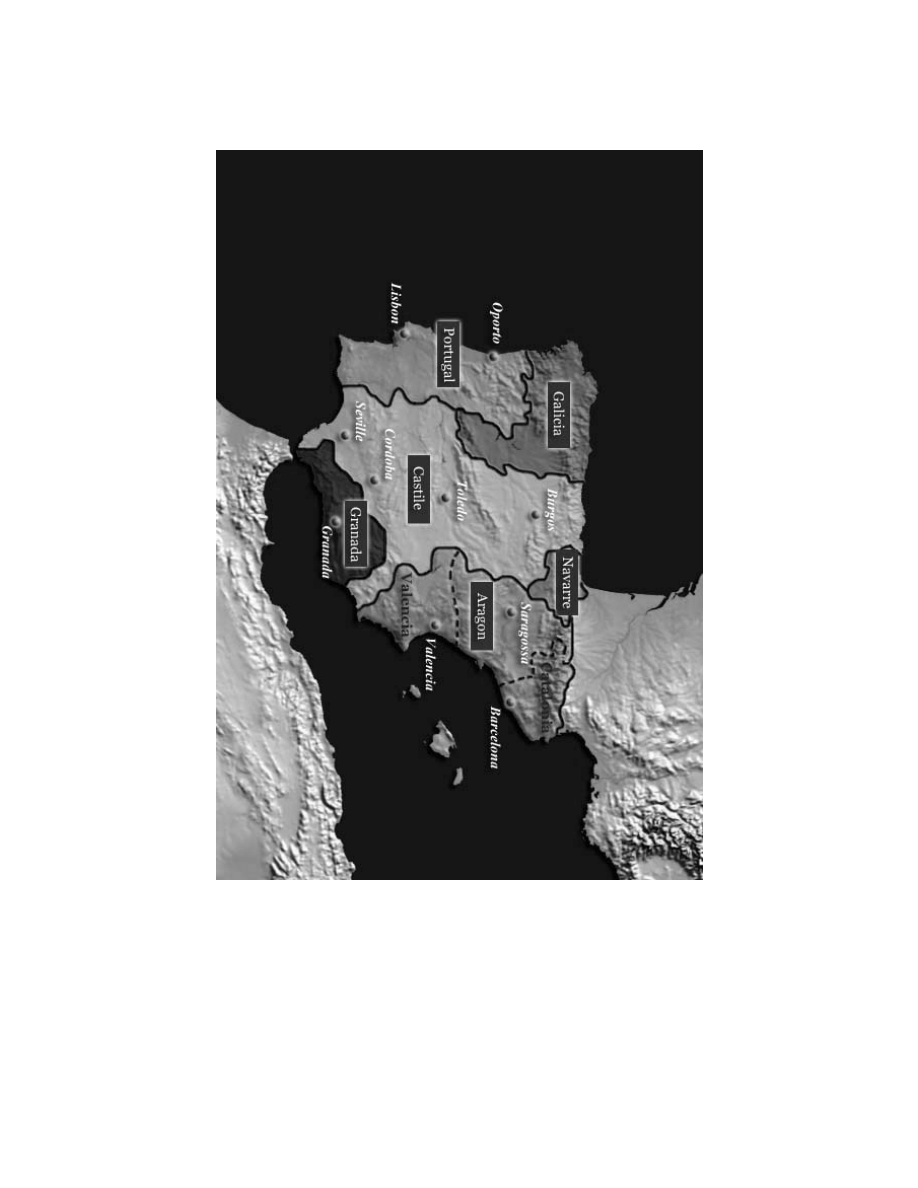
The Iberian Peninsula, 1491
©2002 The Teaching Company Limited Partnership
29

Timeline
Late Medieval and Early Modern Spain
1390–1550
1390–1406 ........................Henry III, King of Castile.
1390 ..................................Selomah ha-Levi, the great rabbi of Burgos, converts to Christianity.
1391 .................................Anti-Jewish pogroms throughout the peninsula. Most notable locations: Seville,
Cordoba, Baeza, Jaén, Burgos, and Toledo in Castile, and Valencia, Barcelona, Lérida,
and Gerona in the Crown of Aragon.
1395–1410 ........................Martin the Humane, King of the Crown of Aragon.
1398–1458 ........................Iñigo López de Mendoza, Marquis of Santillana, poet and book collector.
1406–1454 ........................John II, King of Castile.
1411–1456 ........................Juan de Mena, poet and author of the Laberinto de fortuna.
1412 ..................................Compromise of Caspe; the regent of Castile, Fernando de Antequera, becomes King of
the Crown of Aragon (1412–1416).
1412–1413 ........................Disputation of Tortosa leads to further Jewish conversions.
1415 ..................................Ceuta is taken by the Portuguese.
1416–1458 ........................Alfonso V, King of the Crown of Aragon.
1438 ..................................Writing of El Corbacho by the Archpriest of Talavera (Alfonso Martínez de Toledo).
1440?–1479 ......................Jorge Manrique, poet.
1442–1443 ........................Alfonso V of Aragon gains control of Naples.
1449 ..................................Anti-Converso riots in Toledo.
1453 ..................................Execution of Alvaro de Luna, favorite of John II of Castile.
1453–1515 ........................Gonzalo Fernández de Cordoba, the “Great Captain,” reformer of the Castilian army.
1454–1474 ........................Henry IV, King of Castile.
1458–1479 ........................John II (Aragon), King of the Crown of Aragon and Navarre.
1459–1464 ........................Attacks against Conversos in Burgos.
1461 ..................................Attacks against Jews and French merchants in Medina del Campo (Castile).
1462–1472 .......................Civil and Remença wars in Catalonia.
c. 1465 ..............................Writing of Cárcel de amor by Diego de San Pedro (printed in 1492).
1469 ..................................The marriage of Ferdinand and Isabella.
1469–1529 ........................Juan de Encina, playwright, first Castilian plays.
1473 ..................................Massacre of Conversos throughout the peninsula.
1474 ..................................First book, a collection of Catalan poems to the Virgin, printed in Spain (Valencia).
1474–1566 ........................Bartolomé de las Casas, protector of the Indians.
1474–1504 ........................Isabella I, the Catholic, Queen of Castile.
1476–1541 ........................Francisco Pizarro, conqueror of Peru.
1476 ..................................The Santa Hermandad is organized in Castile.
©2002 The Teaching Company Limited Partnership
30

1478 .................................Establishment of the Inquisition.
1479–1516 ........................Ferdinand the Catholic, King of the Crown of Aragon.
1479 ..................................Dynastic union of Castile and Aragon.
1480 ..................................Legislation of the cortes reorganizes the governance of Castile.
1480?–1546 ......................Francisco de Vitoria, theologian and philosopher.
1483 ..................................Creation of the Supreme Council of the Inquisition.
1485–1547 ........................Hernán Cortés, conqueror of Mexico.
1491–1556 ........................Ignatius of Loyola, founder of the Jesuits.
1492–1540 ........................Juan Luis Vives, noted humanist and philosopher.
1–2 January 1492..............Conquest of Granada.
31 March 1492..................Edict of Expulsion of the Jews.
1492..................................Antonio de Nebrija publishes Arte de la lengua castellana, first grammar in a modern
European language.
August 1492 .....................Columbus sails into the Atlantic Ocean on his way to the “Indies.”
12 October 1492 ...............First landfall in the New World.
1492 ..................................Amadís of Gaula, the most popular chivalrous novel in Spain, is compiled by Garcí
Rodríguez de Montalvo in Valladolid.
1493 ..................................Columbus’s second voyage; first permanent European settlement in the New World;
beginning of the colonization of the Caribbean.
1494 ..................................Treaty of Tordesillas, dividing the New World between Spain and Portugal.
1495–1497 ........................Spanish Intervention and War in Italy.
1499 ..................................First Alpujarras Rebellion.
1499 ..................................First publication of Fernando de Rojas’s La Celestina.
1501–1504 ........................War in Italy.
1501?–1536 ......................Garcilaso de la Vega, poet. The publication of his poetry by Juan Boscán’s widow in
1543 marked the beginnings of the Golden Age.
1502 .................................Muslims in Granada forced to choose between baptism and expulsion.
1504–1555 ........................Juana the Mad, Queen of Castile.
1506 ..................................Death of Philip the Handsome, consort of Juana the Mad.
1506 ..................................Francisco Jiménez de Cisneros, Regent in Castile.
1508 ..................................Cisneros founds the university of Alcala de Henares; preparation of the polyglot Bible.
1512 ..................................Occupation and integration of Navarre into the Spanish Crown.
1516–1556 ........................Charles I, King of Castile and the Crown of Aragon; Emperor (1519–1556) as Charles V.
1515–1582 ........................Saint Teresa of Avila, reformer and mystic.
1519–1540 ........................Conquest of Mexico and Peru.
1520–1521 ........................Revolt of the Comuneros in Castile.
1520–1521 ........................Revolt of the Germanías in Valencia.
1530?–1597 ......................Juan de Herrera, one of the architects of El Escorial.
©2002 The Teaching Company Limited Partnership
31

1535–1624 ........................Juan de Mariana, Jesuit historian.
1540–1611 ........................Antonio Pérez, secretary to Philip II.
1541–1614 ........................El Greco, painter.
1542 ..................................Leyes Nuevas, a new legal compilation of Castilian law.
1542–1591 ........................John of the Cross, poet and mystic.
1545 ..................................First Spanish index of forbidden books.
1547–1614? ......................Mateo Alemán, author of La vida de Guzmán de Alfarache, a picaresque novel published
in two parts (1599 and 1604).
1547–1616 ........................Miguel de Cervantes y Saavedra, author of Don Quixote and many other works.
1550 ..................................Debate between Las Casas and Sepúlveda at Valladolid on whether it was lawful to wage
war on the natives of the New World and to enslave them.
1554 ..................................Publication of El Lazarillo de Tormes, first picaresque novel.
1556–1598........................Philip II, King of Spain.
1557 ..................................Philip II suspends payment to bankers; Spain’s bankruptcy.
©2002 The Teaching Company Limited Partnership
32

Glossary
auto de fe. The great trials held by the Inquisition. Differing in size, duration, theatricality, and number of victims,
autos de fe were performances enacted by the Holy Office, bonding the witnesses in powerful spectacles of
punishment of heretics.
caballero. A rank of nobility above that of hidalgo.
Converso. Literally, anyone who converted from one religion to another. In Spain, it usually meant conversion
from Judaism to Christianity. The term “New Christians” was also used to describe Jewish converts.
Corona de Aragón, Crown of Aragon. The union of three distinctive political units
Aragon, Catalonia, and
Valencia
into a political entity ruled by one king. Each of the constituents retained its parliament, political
institutions, culture, and language.
cortes, corts. Parliament; assemblies of representatives of the nobility, the clergy, and a selected number of cities;
cortes in Castile and corts in Catalonia and Valencia. In the latter two regions, there were four branches, with lower
nobility and ennobled bourgeois constituting a separate branch.
Don, Doña. Titles denoting social and economic standing. Often associated with noble rank but also used as an
appellative among rich farmers, well-to-do artisans, and merchants.
fidalgo, hidalgo. Literally, the son of someone who owned something. The terms were used to describe the lowest
rank of the nobility.
Infante(a). The title of the heir to the throne and immediate members of the royal family.
Inquisition. The Holy Office or Supreme Council of the Inquisition. Introduced in Spain in the 1480s, the Spanish
Inquisition was different from the papal or diocesan inquisitions. In Spain, the Inquisition was under the direct
control of the Crown. Though its main purpose was to ferret out heretics, bring them to trial, and punish them, the
Inquisition in Spain came to play a significant political, social, and economic role.
maravedí. A type of coin or monetary unit that fluctuated widely in the fifteenth and sixteenth centuries.
Mesta. The sheepherder’s guild, which controlled the transhumance: the movement of livestock from summer to
winter pastures.
Moriscos. The name given to Muslims who converted to Christianity, but who were perceived to practice their
ancestral religion (and often did). The Moriscos kept their forms of dress, diet, and the use of the Arabic language.
Mudejares, Mudejars. Muslims living under Christian rule and still practicing Islam.
pureza de sangre (purity/cleanliness of blood). A series of statutes enacted in late fifteenth- and sixteenth-century
Spain restricting or denying those of Jewish or Moorish descent access to endowed colleges, military orders, and
other privileges.
Reconquest. The name given to the process of recovering most of Iberia from the Muslims. The Reconquista came
to underpin most of the political ideology of medieval Spain and shaped subsequent historiography. The meaning,
origins, and use of the term have provoked endless controversies.
Remenças, War of the. The successful war waged in the late fifteenth century by Catalan serfs to gain their
freedom.
©2002 The Teaching Company Limited Partnership
33

Bibliography
Essential Reading:
Note: Most of the most important books on this subject are in Spanish or Catalan. The bibliography contains only
books in English. For some references to books in Spanish see the bibliography in my Spanish Society, 1400–1600.
Bisson, Thomas N. The Medieval Crown of Aragon: A Short History. Oxford: Oxford University Press, 1987. The
best history in English of the Crown of Aragon and a necessary counterbalance to the emphasis placed on Castile by
most historical narratives.
Constable, Olivia R., ed. Medieval Iberia: Readings from Christian, Muslim, and Jewish Sources. Philadelphia:
University of Pennsylvania Press, 1997. The only comprehensive collection of sources available in English,
including texts representative of the culture and history of the three religious groups that inhabited Spain.
Elliott, John H. Imperial Spain, 1469–1716. London: St. Martin’s Press, 1963. The best general history of Spain in
the late Middle Ages and the early modern period. Almost forty years after the publication of its first edition, it
remains the most insightful treatment of Spanish history.
MacKay, Angus. Spain in the Middle Ages: From Frontier to Empire, 1000–1500. London: MacMillan Press, 1977.
An intelligent and interpretative history of late medieval Spain. An excellent introduction to the themes discussed
here.
Supplementary Reading:
Alcalá, Angel, ed. The Spanish Inquisition and the Inquisitorial Mind. Highland Lake, NJ.: Brooklyn College Press,
1987. An important collection of essays examining the Inquisition and its work from a variety of scholarly
perspectives.
Baer, Yitzhak. A History of the Jews in Christian Spain, 2 vols. Philadelphia: Jewish Publication Society, 1966. A
comprehensive and insightful description of Jewish life in the Iberian peninsula from the early centuries of the
Christian era until the expulsion of the Jews in 1492.
Barton, Simon. The Aristocracy in Twelfth-Century León and Castile. Cambridge: Cambridge University Press,
1997. An excellent study of the Castilian-Leonese aristocracy in the twelfth century. The first attempt in English at a
monographic study of the nobility.
Bensch, Stephen P. Barcelona and Its Rulers. Cambridge: Cambridge University Press, 1995. The best history of
medieval Barcelona in English. Bensch’s book provides valuable information on Barcelona’s ruling families.
Braudel, Fernand. The Mediterranean and the Mediterranean World in the Age of Philip II. Trans. S. Reynolds, 2
vols. New York: Harper and Row, 1975. A monumental achievement, this selection presents an exhaustive
description of the Iberian Peninsula and the geographical and ecological context of the unfolding political history.
Casey, James. Early Modern Spain: A Social History. London: Routledge, 1999. A thorough and insightful
depiction of Spanish social life, although most of the book discusses developments after 1500.
Chejne, Anwar G. Islam and The West: The Moriscos, A Cultural History. Albany: State University of New York
Press, 1983. An examination of the lives, religion, and education of Muslims living under Christian rule in the
aftermath of the conquest of Granada.
Clendinnen, Inga. Aztecs. Cambridge: Cambridge University Press, 1991. The most vivid account of Aztec
civilization ever written. If you are going to read one single book from this list, this is it.
Crosby, Alfred W. The Columbian Voyages: The Columbian Exchange and Their Historians. Washington, DC:
American Historical Association, 1987. This short pamphlet sets Columbus’s voyages in a worldwide context.
Díaz del Castillo, Bernal. The Discovery and Conquest of Mexico. Trans. A. P. Maudslay. New York: Farrar, Straus
and Giroux, 1981. A rousing eyewitness account of the arrival of the Spaniards in Mexico and the conquest of
Mexico.
Fernández-Armesto, Felipe. Before Columbus: Exploration and Colonization from the Mediterranean to the
Atlantic, 1229–1492. Philadelphia: University of Pennsylvania Press, 1987. A valuable history of the explorations
and conquests of Europeans before Columbus. It offers revealing insights into the Spanish and Portuguese strategies
in the Canaries and on the coast of Africa before the discovery of the New World.
©2002 The Teaching Company Limited Partnership
34

. Columbus. Oxford: Oxford University Press, 1991. A study of the life of Columbus, the enterprise of the
Indies, Columbus’s demise, and the ways in which historians have viewed him in succeeding centuries.
Fletcher, Richard. Moorish Spain. New York: Henry Holt and Co., 1992. Fletcher has written an elegant and
fascinating summary of Muslim life in Iberia until the fall of Granada.
Freedman, Paul H. The Origins of Peasant Servitude in Medieval Catalonia. Cambridge: Cambridge University
Press, 1991. A brilliant treatment of the condition of the peasants in late medieval Catalonia and of the great war
that these servile peasants successfully waged against their masters on the eve of 1492.
Freund, S., and T. F. Ruiz. “Jews, Conversos, and the Inquisition in Spain, 1391–1492: The Ambiguities of
History.” In Jewish-Christian Encounters over the Centuries: Symbiosis, Prejudice, Holocaust, Dialogue, edited by
J. M. Perry and F. M. Schweitzer. New York: Peter Lang, 1994. A brief account of Jewish life in the peninsula and
of the historiographical controversies surrounding the nature of conversion in fifteenth-century Spain.
Gampel, Benjamin R. The Last Jews on Iberian Soil: Navarrese Jewry, 1479–1498. Berkeley: University of
California Press, 1989. A thoughtful account of the last years of the Jewish community in Navarre before the
expulsion of the Jews. A first-rate exploration of the life of the Jewish Navarrese community.
Glick, Thomas F. Islamic and Christian Spain in the Early Middle Ages: Comparative Perspectives on Social and
Cultural Formation. Princeton: Princeton University Press, 1979. Glick’s book is one of the most intelligent
discussions of the connections between Muslim and Christian cultures in medieval Spain.
Green, Otis H. Spain in the Western Tradition: The Castilian Mind in Literature from El Cid to Calderón. 4 vols.
Madison: University of Wisconsin Press, 1968. A comprehensive and interpretative survey of Castilian literature
from its first masterpiece to the culmination of the Golden Age.
Haliczer, Stephen. “The Castilian Urban Patriciate and the Jewish Expulsion of 1480–92,” American Historical
Review, 78 (1973): 35–62. An interesting and controversial article about the reasons behind the proclamation of the
Edict of Expulsion.
. Inquisition and Society in the Kingdom of Valencia, 1478–1834. Berkeley: University of California Press,
1990. A study of the Inquisition in Valencia; superb in its treatment of the workings of the Holy Office in one of the
most important cities in Spain.
Huizinga, Johan. The Autumn of the Middle Ages. Chicago: University of Chicago Press, 1997. A magisterial
depiction of the tenor of life in the late Middle Ages. A must read!
Kagan, Richard L. Students and Society in Early Modern Spain. Baltimore: Johns Hopkins University Press, 1974.
An excellent account of student life and the educational institutions of late medieval and early modern Spain.
Kamen, Henry. Inquisition and Society in Spain in the Sixteenth and Seventeenth Centuries. Bloomington, IN:
Indiana University Press, 1985. The best modern history of the Inquisition, its origins, organization, and impact on
Spanish society available in English.
. “The Mediterranean and the Expulsion of Spanish Jews in 1492,” Past & Present, 119 (1988): 30–55. An
important and controversial article about the number of Jews who lived in Spain in 1492, their social standing, the
number that left the peninsula, and the number that returned.
Kennedy, Hugh. Muslim Spain and Portugal: A Political History. Harlow (Essex): Longman, 1996. A good history
of the political life of the Islamic kingdoms in Iberia.
Lea, Henry C. A History of the Inquisition in Spain. 4 vols. New York: Harper, 1906–1907. The greatest of all the
works on the Inquisition. Almost 100 years old, it is still one of the most evocative accounts of the Inquisition in
Spain.
León-Portilla, Miguel. The Broken Spears: The Aztec Account of the Conquest of Mexico. Boston: Beacon Press,
1992. A translation from Nahuatl sources of the Aztec’s view of the Spanish conquest.
Linehan, Peter. The Spanish Church and the Papacy in the Thirteenth Century. Cambridge: Cambridge University
Press, 1971. An extraordinarily erudite and compelling study of the Spanish Church in the Middle Ages. One of the
best books on the subject written in any language.
. History and the Historians of Medieval Spain. Oxford: Clarendon Press, 1993. A monumental and
magisterial account of the construction of the Spanish medieval past. Written in a lucid and engaging style, this is
one of the great works about the Spanish Middle Ages.
©2002 The Teaching Company Limited Partnership
35

©2002 The Teaching Company Limited Partnership
36
Lunnenfeld, Marvin. Keepers of the City: The “Corregidores” of Isabella I of Castile (1474–1504). Cambridge:
Cambridge University Press, 1987. An important study of how the cities were governed during the reforms of the
Catholic Monarchs.
Lynch, John. Spain under the Habsburgs, 2
nd
ed., 2 vols. New York: New York University Press, 1984. A thorough
and lively history of Habsburg rule in Iberia and of their American possessions.
Nader, Helen. The Mendoza Family in the Spanish Renaissance, 1350 to 1550. New Brunswick: Rutgers University
Press, 1979. A study of one of the most important families of late fifteenth-century Castile; a thorough and lively
picture of the reception of Renaissance knowledge in the peninsula.
Netanyahu, Benzion. The Origins of the Inquisition in Fifteenth-Century Spain. New York: Random House, 1995.
A controversial and massive study of the origins of the Inquisition and of the life and beliefs of Conversos in late
fifteenth-century Spain.
Nirenberg, David. Communities of Violence: Persecution of Minorities in the Middle Ages. Princeton, NJ: Princeton
University Press, 1996. A brilliant and influential book that has radically transformed how we think about the
relations between religious minorities and the dominant Christian groups in medieval Spain.
O’Callaghan, Joseph F. A History of Medieval Spain. Ithaca: Cornell University Press, 1975. The best general
survey in English of Spanish medieval history. It provides a comprehensive examination of social, economic, and
political developments from the Muslim conquest to the reign of the Catholic Monarchs.
Phillips, William D., and Carla Rahn Phillips. The Worlds of Christopher Columbus. Cambridge: Cambridge
University Press, 1992. An excellent and thoughtful description of the context to Columbus’s life and activities, as
well as a sensible biography of the Admiral of the Ocean Sea.
Powers, James F. A Society Organized for War: The Iberian Municipal Militias in the Central Middle Ages, 1000–
1284. Berkeley: University of California Press, 1988. The only book-length work in English that examines the role
of war in the making of Castile and Spain. An important contribution toward our understanding of Spain.
Ruiz, Teofilo F. Crisis and Continuity: Land and Town in Late Medieval Castile. Philadelphia: University of
Pennsylvania Press, 1994. A study of the social and economic structures of northern Castile during the late medieval
crisis. The book emphasizes the relationship between urban centers and their hinterlands.
. “Elite and Popular Culture in Late Fifteenth-Century Castilian Festivals: The Case of Jaén.” In City and
Spectacle in Medieval Europe, edited by B. A. Hanawalt and K. L. Reyerson. Minneapolis: University of Minnesota
Press, 1994. A study of the role of festivals and spectacle in the political culture of late fifteenth-century Spain.
. Spanish Society, 1400–1600. London: Longman, 2001. A history of Spanish social orders, festivals,
violence, and daily life in the transition between the Middle Ages to the early modern period. The book provides an
inside look at Spanish social structures and popular culture.
. “Unsacred Monarchy; The Kings of Castile in the Late Middle Ages.” In Rites of Power, edited by Sean
Wilentz. Philadelphia: University of Pennsylvania Press, 1985. The first discussion of the absence of anointing and
crowning in Castile.
. “The Business of Salvation: Castilian Wills in the Late Middle Ages.” In On the Social Origins of Medieval
Institutions: Essays in Honor of Joseph F. O’Callaghan, edited by D. J. Kagay and T. M. Vann. Leiden: Brill, 1998.
A study of mental attitudes toward property, salvation, and charity in medieval northern Castile.
Vicens Vives, Jaime. An Economic History of Spain. Trans. F. M. López-Morillas. Princeton: Princeton University
Press, 1969. A first-rate study of Spanish economic history by one of the most notable historians of Spain.
Way, Ruth. A Geography of Spain and Portugal. London: Methuen, 1962. A brief but excellent historical
geography of Spain.
Yerushalmi, Yosef H. From Spanish Court to Italian Ghetto. Isaac Cardoso: A Study in Seventeenth-Century
Marranism and Jewish Apologetics. New York: Columbia University Press, 1971. Yerushalmi’s book is one of the
classical accounts of how Jews dealt with their exile from Spain.
Document Outline
- The Other 1492:
- Ferdinand, Isabella,
- and the
- Making of an Empire
- Professor Teofilo Ruiz
- Teofilo Ruiz, Ph.D.
- Table of Contents
- The Other 1492:
- Ferdinand, Isabella, and the Making of an Empire
- The Other 1492
- Lecture One
- Europe and the New World in 1492
- Outline
- Lecture Two
- Reconquest, Pilgrimage, Crusade,
- Repopulation
- Outline
- Lecture Three
- The Transformation of Values
- Outline
- Lecture Four
- An Age of Crisis
- Outline
- Lecture Five
- Isabella and Ferdinand: An Age of Reform
- Outline
- Lecture Six
- Iberian Culture in the Fifteenth Century
- Outline
- Lecture Seven
- The Conquest of Granada:
- Muslim Life in Iberia
- Outline
- Lecture Eight
- The Edict of Expulsion: Jewish Life in Iberia
- Outline
- Lecture Nine
- Jews, Conversos, and the Inquisition
- Outline
- Lecture Ten
- The World of Christopher Columbus
- Outline
- Lecture Eleven
- The Shock of the New
- Outline
- Lecture Twelve
- Spain and Its Empire: The Aftermath of 1492
- Outline
- Timeline
- Late Medieval and Early Modern Spain
- 1390–1550
- Glossary
- Bibliography
Wyszukiwarka
Podobne podstrony:
Anne Norton Leo Strauss and the Politics of American Empire (2004)
The Problem Of Order In Society, And The Program Of An Analytical Sociology Talcott Parsons,
Isabelle Rousset A Behind the Scenes Report on the Making of the Show Visuals and Delivery Systems
The Making of a Counter Culture Reflections on the Technocratic Society and Its Youthful Opposition
pacyfic century and the rise of China
Pragmatics and the Philosophy of Language
Haruki Murakami HardBoiled Wonderland and the End of the World
drugs for youth via internet and the example of mephedrone tox lett 2011 j toxlet 2010 12 014
Osho (text) Zen, The Mystery and The Poetry of the?yon
Locke and the Rights of Children
Concentration and the Acquirement of Personal Magnetism O Hashnu Hara
K Srilata Women's Writing, Self Respect Movement And The Politics Of Feminist Translation
86 1225 1236 Machinability of Martensitic Steels in Milling and the Role of Hardness
Becker The quantity and quality of life and the evolution of world inequality
The World War II Air War and the?fects of the P 51 Mustang
The Manhattan Project and the?fects of the Atomic Bomb
The making of a hero?? u4
All the Way with Gauss Bonnet and the Sociology of Mathematics
więcej podobnych podstron