1 of 8
J O U R N A L
A R T I C L E S
Copyright © 2009 CrossFit, Inc. All Rights Reserved.
CrossFit is a registered trademark ‰ of CrossFit, Inc.
Subscription info at
Feedback to
Visit
Learning How to Do Full Cleans
Bill Starr
Full cleans can get complicated, but Bill Starr simplifies the movement into
a power clean and a front squat. Get comfortable with the movements,
then start refining the clean by adding speed and power.
Full cleans are one of the very best exercises for any strength athlete.
They are beneficial because they involve so many of the large muscles of the body in a dynamic fashion.
When performed correctly, full cleans work the hips, legs, back, shoulders and arms. And while these
groups can be strengthened with other exercises, none do so in the same manner. Primarily, full cleans
force the nervous system to work much harder than any other exercise—except for full snatches. Snatches
will be the topic of an upcoming article in the CrossFit Journal.
Su
sa
nn
ah
D
y/
C
ro
ss
Fi
t J
ou
rn
al
2 of 8
Full Cleans ...
(continued)
Copyright © 2009 CrossFit, Inc. All Rights Reserved.
CrossFit is a registered trademark ‰ of CrossFit, Inc.
Subscription info at
Feedback to
Visit
Start Simple
An athlete needs a high degree of concentration when
he does full cleans, and this process of having to think
intently through each phase of the lift means that the
nervous system ends up getting as much of a workout
as the muscles and attachments. After a strenuous
session of full cleans, most athletes are completely worn
out. That’s because tapping into the nervous system is
much more fatiguing than just stimulating the muscular
system.
Another reason I include full cleans in my strength
programs for athletes is that they require not only
undivided focus but also a large measure of coordi-
nation, timing and foot speed. It’s a high-skill movement,
and when done with demanding amounts of weight, it
enhances skills that are then available for a wide range
of sports. Full cleans are certainly helpful to those in
contact sports because they build lots of strength in the
hips, legs and lower back, but they’re also most useful to
those who participate in sports such as tennis, volleyball
and baseball. And, of course, they’re really beneficial to
throwers in the field events.
Combo exercises seem to be big in strength training right
now, and full cleans are the ultimate combo movement:
a heavy pull followed by a front squat. So why isn’t this
exercise included in a great many programs? Basically,
because whoever is in charge doesn’t know how to do it
and is therefore unable to teach it to the athletes.
Many shun it since they believe it’s far too compli-
cated. In fact, it isn’t complicated at all. It’s no more
than a power clean and a front squat done in a smooth
manner. It really is a natural movement. Young athletes
pick up the form right away. I think humans have been
performing full cleans ever since one of them found that
the mastodon bone he was trying to lift to his shoulders
was heavier than he thought, so he simply squatted
down under it.
I’ve also watched coaches give the athlete far too many
things to think about when doing full cleans, and this
does nothing but confuse him. A great many coaching
points are not necessary to learn how to do the lift. As
the numbers start to climb, form has to be constantly
refined, but in the beginning simplicity is the ticket.
As the numbers start to climb,
form has to be constantly refined,
but in the beginning simplicity is
the ticket.
jo
C
The clean is the ultimate combo movement,
and it doesn’t have to be complicated
if you break it down into pieces.
3 of 8
Full Cleans ...
(continued)
Copyright © 2009 CrossFit, Inc. All Rights Reserved.
CrossFit is a registered trademark ‰ of CrossFit, Inc.
Subscription info at
Feedback to
Visit
Rack It Right
Simplicity is the key, but there is one prerequisite to
full cleans: the athlete must have enough flexibility in
his shoulders to enable him to rack the bar across his
frontal deltoids so that his triceps are parallel to the floor.
Otherwise, he’s not going to be able to do a front squat,
and if he can’t front squat correctly, there’s no way he’s
going to be able to do full cleans.
This is not an insurmountable problem. Tight shoulders
can be made flexible, usually in a short period of time.
Naturally, an older athlete will have more difficulty than
his younger counterpart, but if a person is willing to
spend the time enhancing the flexibility in his shoulders,
he can usually do so.
This, then, is the first step in the process of learning how
to do full cleans. You can do it alone, although having
a training mate assist you is more effective. Load up a
bar in a squat or power rack. Rest the bar across your
frontal deltoids. Don’t let it lie across your collarbones.
Not only does that hurt like hell, but if you repeatedly
rack a clean on the clavicles, you will damage them. Grip
the bar firmly with one hand and elevate your elbow
upward as high as you can, then have a training partner
apply pressure to extend it even higher. Once it reaches
the point where it can go no further, keep it there for a
count of 10. Now do the same thing for the other arm.
Relax a bit, then grip the bar with both hands and have
your helper push up against both arms at the same time.
Again, hold at the apex for a count of 10 (longer if you
can handle it).
Be sure to keep your torso upright throughout these
stretching moves. The tendency is to curl the hips
forward to ease the discomfort, but this does nothing to
help your cause. In addition to these stretches, you can
spend time just lifting your elbow up by using your other
hand and holding it there for as long as you can. This
can be done while watching TV or waiting in line at the
grocery store. Sure, you may get a few odd stares, but
that’s a small price to pay for better shoulder flexibility.
Once you’ve achieved sufficient flexibility to rack the bar
firmly across your frontal delts, you can do front squats.
Because the wrists are placed under a great deal of stress
in both the front squat and clean, I suggest you wrap
them using trainer’s tape. If you can find leather wrist
straps, use them as well. The wrists are small joints and
can be easily dinged. When they are, it takes long rehab
to get them back to normal, so it’s smart to protect them
from the very onset. With improved shoulder flexibility
and wrapped wrists, you’re ready to learn how to do full
cleans.
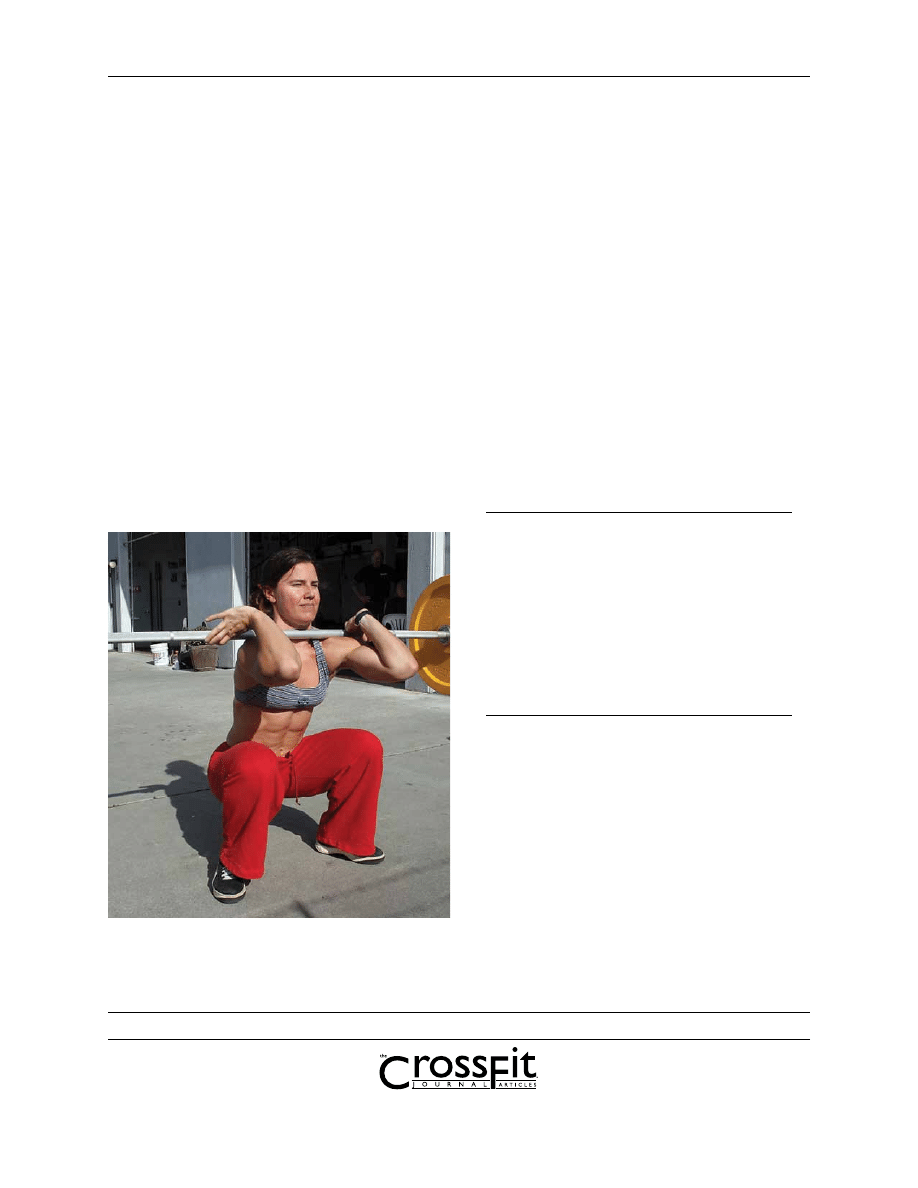
Whether performing a clean or a front squat, it’s critical to lead with the elbows when moving out of the bottom.
Su
sa
nn
ah
D
y/
C
ro
ss
Fi
t J
ou
rn
al
4 of 8
Full Cleans ...
(continued)
Copyright © 2009 CrossFit, Inc. All Rights Reserved.
CrossFit is a registered trademark ‰ of CrossFit, Inc.
Subscription info at
Feedback to
Visit
Start With the Front Squat
Start by power-cleaning a weight, then front-squatting
it. Concentrate on finding the correct line of pull on the
power clean—which is extremely close to your body—
and giving the bar a snap at the finish. A strong top
pull is essential when cleaning a heavy weight. At the
completion of the pull, skip your feet from their starting
position to a slightly wider stance. They need to be
wider than shoulder width to allow you to go into a deep
front squat. Plus, you will need to move your feet when
performing a full clean, so get used to it.
Make sure your rack is solid, with the bar squeezed down
into your frontal deltoids. If you feel the bar touching your
clavicles, elevate your entire shoulder girdle until you’re
able to move the bar off the bones. Keep your elbows up
so that your triceps are parallel with the floor, and ensure
they stay that way throughout the front squat. Pull
yourself to the deep bottom position in the squat. Stay
very tight and go down rather quickly. If you attempt to
lower yourself slowly, when you get to the middle, you
will invariably lean forward, and you don’t want that.
Your torso has to remain perfectly erect throughout the
movement. Any leaning, no matter how slight, puts a
huge amount of additional stress on your wrists. Should
it be excessive, the bar will crash to the floor.
Your first move out of the bottom is quite different in
the front squat than it is in the back squat. In the back
squat, your hips drive up and back, but in the front squat,
this same move would cause you to lean forward and
carry the bar far out of the proper line. When you start
out of the bottom in the front squat, think “elbows up.”
That allows you to stay in an upright position and keeps
the weight over your power pack. As soon as you drive
upward, stand right up. No hesitation at all. You need
to explode upward and glide right through the sticking
point. Should the bar stall, once again think “elbows” and
lift them skyward to keep the weight over your powerful
hips and legs. Lower the bar back to the floor, take a
deep breath and repeat the sequence: power clean, front
squat.
In the back squat, your hips drive
up and back, but in the front squat,
this same move would cause you
to lean forward and carry the bar
far out of the proper line. When
you start out of the bottom in the
front squat, think “elbows up.”
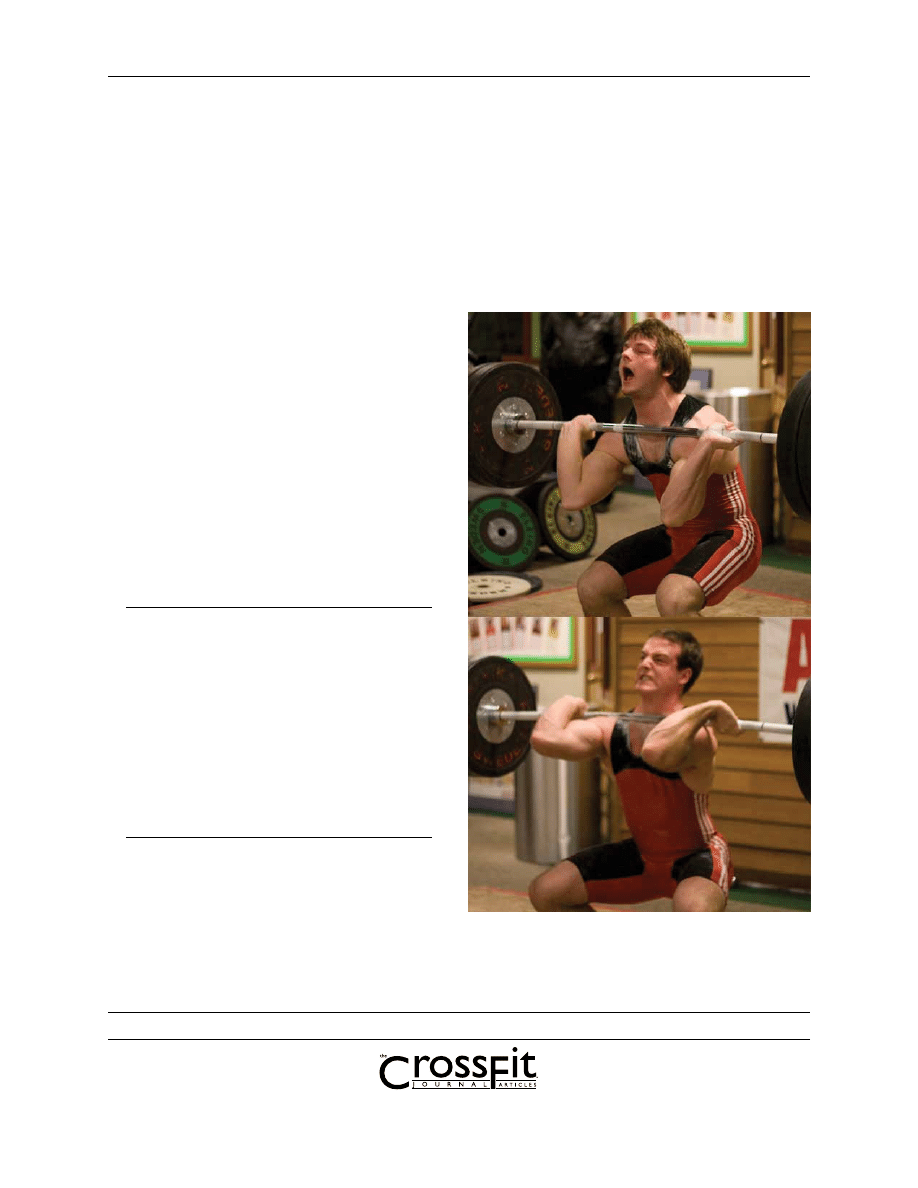
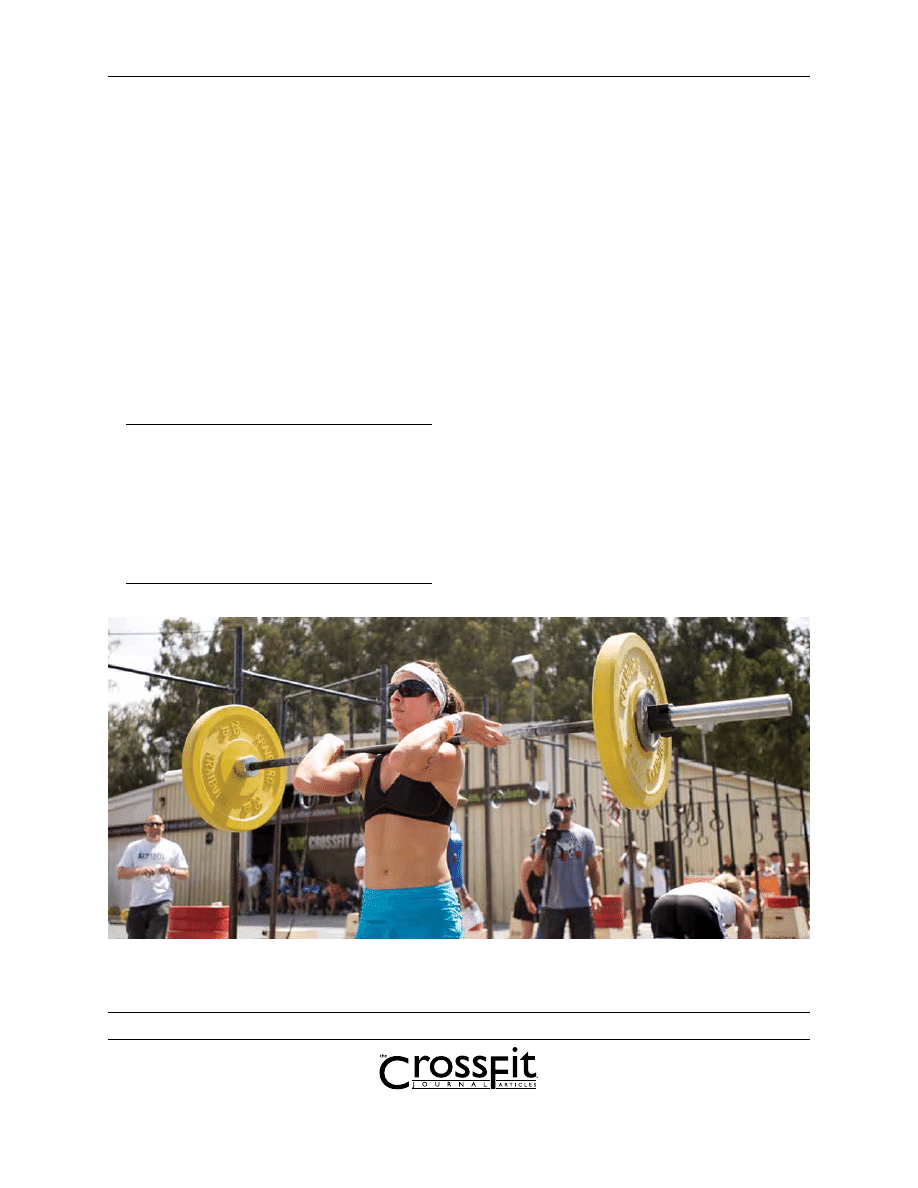
Low elbows are sometimes the result of a poor line of pull. If the
bar is too far away from you, it’s hard to get the elbows around.
If you keep the elbows high throughout the lift, your chances of
success increase dramatically.
jo
C
5 of 8
Full Cleans ...
(continued)
Copyright © 2009 CrossFit, Inc. All Rights Reserved.
CrossFit is a registered trademark ‰ of CrossFit, Inc.
Subscription info at
Feedback to
Visit
Learning the Drill
Once you’re comfortable with these moves, you’re
ready to do full cleans by using the Drill. I learned this
from Morris Weissbrot, the long-time coach of the
Lost Battalion Hall in New York City and one of the top
officials in AAU Olympic Weightlifting in the ‘60s. We
worked a clinic together at Rutgers University, and he
demonstrated this technique. Within a very short time,
he taught a group of football players how to do full
cleans, a lift none of them had ever tried before. I was
duly impressed and have utilized the Drill since then. It’s
extremely simple and effective—two reasons why I like
it.
My version isn’t identical to how Morris taught it, yet he
deserves the credit nonetheless.
Before teaching the Drill, I make sure the athlete has
warmed up his abs and lower back and spent some time
stretching out his shoulders in preparation for racking
the bar. Then I have him do some light power cleans to
warm up the muscles that are going to be called upon
presently, and also to establish the line of pull in the
clean.
The Drill consists of three parts performed in succession.
Most find this a tad confusing at first because they aren’t
accustomed to doing multiple steps in a single set, but
they usually get the hang of it rather quickly. Obviously,
the more athleticism one possesses, the faster he will
learn the Drill.
The first part is the easiest because the athlete has
already been doing it: a power clean quickly followed
by a front squat. Step 2 is a bit harder. It’s a hang clean,
which is immediately followed by a deep front squat.
This is really the most important step in learning how to
do full cleans. Lower the bar to just above your knees and
clean it. As soon as it’s racked on your shoulders, lower
into the bottom of a front squat. It needs to be done in
a fluid motion, not with hesitation at any phase. Fluid
motion isn’t going to happen right away. That’s why it’s
called the Drill. You must work the three segments until
they all flow together smoothly.
You’ll quickly find out that when
you give a nice pop to the top of
the pull, it’s much easier to slip
under the bar.
Su
sa
nn
ah
D
y/
C
ro
ss
Fi
t J
ou
rn
al
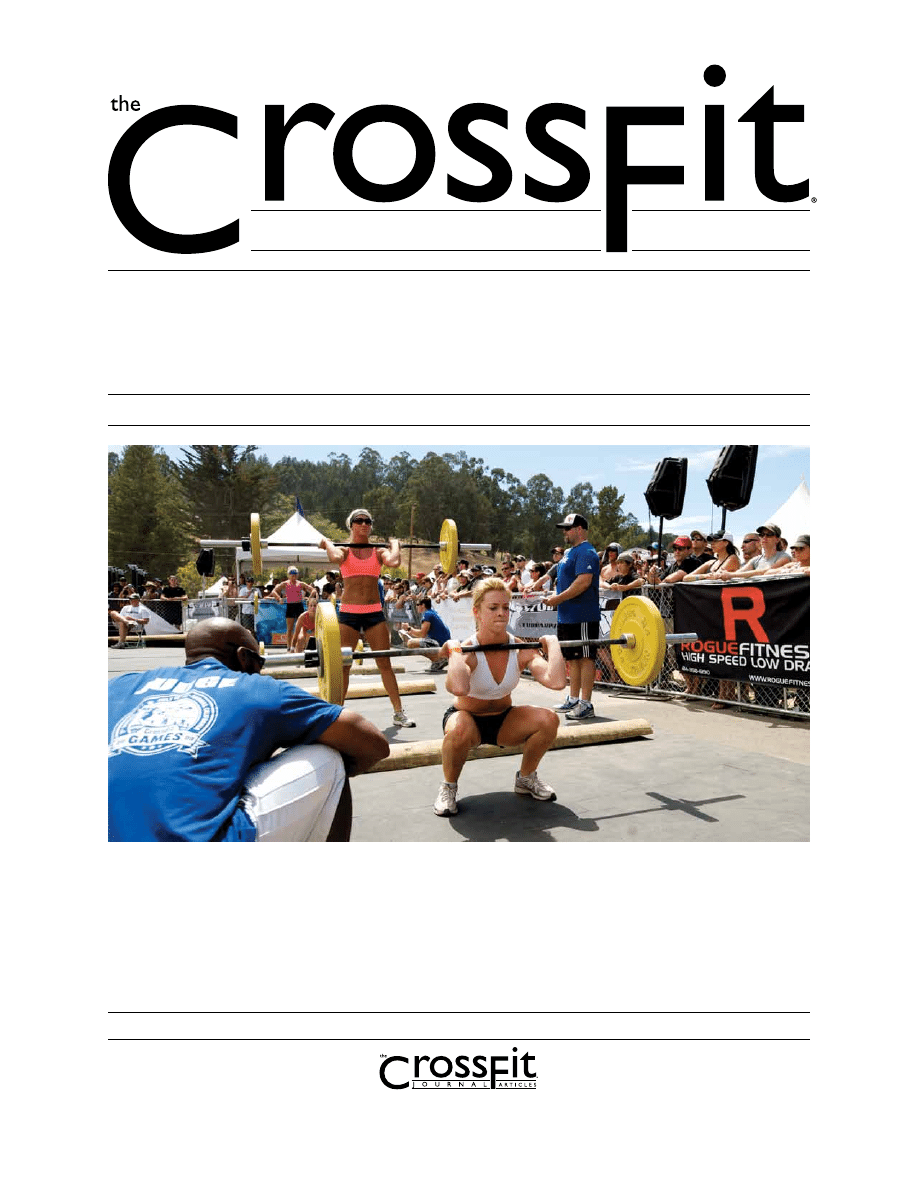
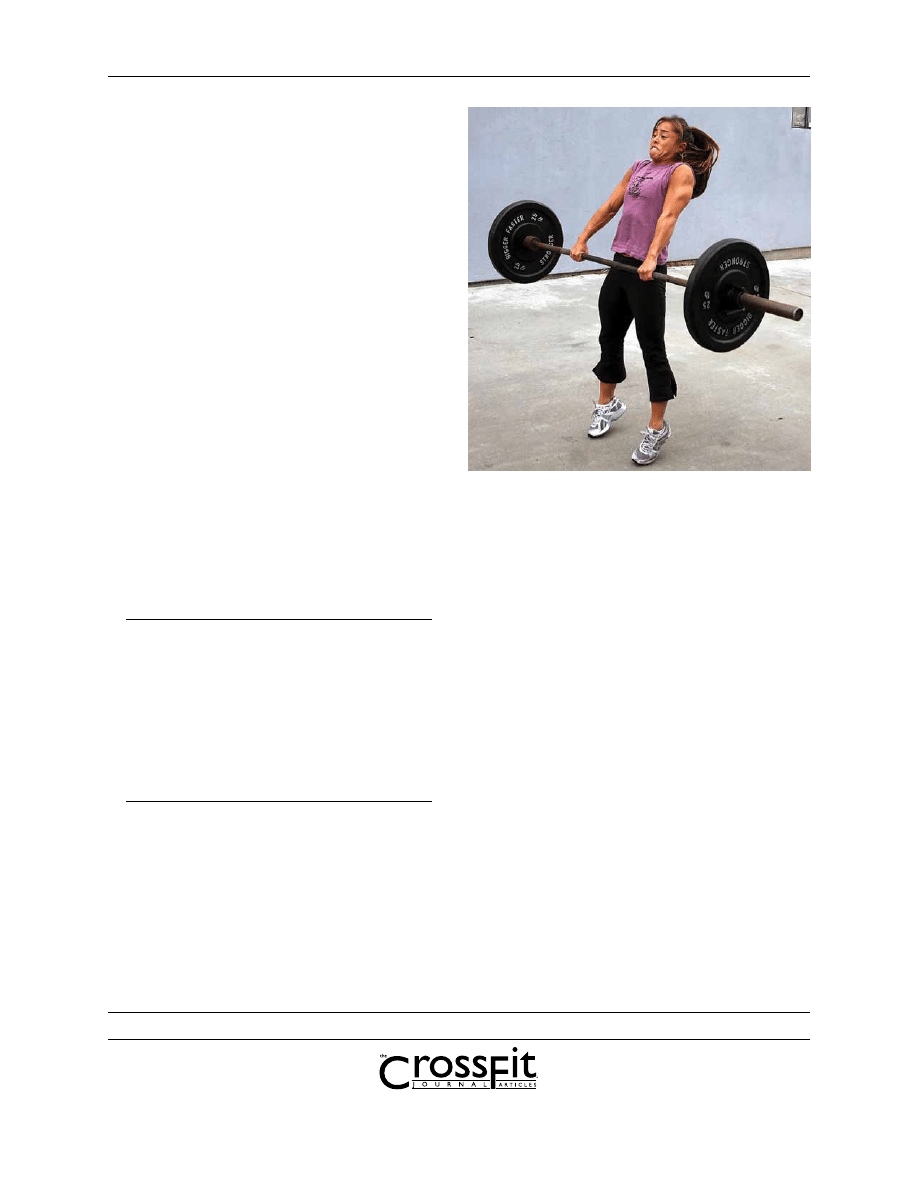
Maintaining good form on cleans during a chipper is tough, but experienced athletes know good technique makes for efficient
movement. Jolie Gentry keeps the elbows high during the final WOD at the 2009 CrossFit Games.
6 of 8
Full Cleans ...
(continued)
Copyright © 2009 CrossFit, Inc. All Rights Reserved.
CrossFit is a registered trademark ‰ of CrossFit, Inc.
Subscription info at
Feedback to
Visit
You’ll quickly find out that when you give a nice pop to
the top of the pull, it’s much easier to slip under the bar.
With the short stroke of the hang clean, you are forced
to move fast in order to rack the weight and get to the
bottom of the squat. That’s exactly the point. When you
attempt to clean a maximum poundage, the final snap
at the top of the pull has to be strong so the bar jumps,
allowing you the time to drive to the bottom and rack
the weight.
The final step is to place the bar on the floor, pull it as
high as you normally do in power cleaning, then drive to
the bottom once again. By starting from the floor, you’re
going to have a much stronger pull than you did from
the hang, and this gives you more time to jump to the
bottom and rack the weight. In other words, the final
stage of the Drill is a full clean. The first two moves are
merely set-ups for the final one.
The fact that you have to do three different movements
back-to-back with no break in between forces you to
focus intently on what you’re doing, which is good
because that’s what you must do when performing a full
clean with a taxing poundage. Plus, the hardest part of
the Drill is at the end. This means you’re going to have to
lean into the pull more and really drive into the hole with
determination. Again, what this teaches you is directly
transferable to a heavy full clean.
When an athlete gets the feel of what he’s trying to
accomplish, he masters the Drill, sticking that third
segment solidly. Once this is done, he can cease using
the Drill and move on to just doing full cleans. However,
I’ve had several lifters who continued to use the Drill
even after they were winning medals at competitions.
Some used it as a warm-up before proceeding to a full
clean workout.
Keep in mind that the weight used on the Drill has to be
light enough so the various moves can be learned, yet
heavy enough so that the athlete has to extend himself
fully. In order to handle much weight in the Drill and in
the full clean itself, you must learn to use the hook grip.
You cannot use straps because you have to be able to
release the bar if you fail during the execution of the
Drill or a full clean. Being locked onto the bar would spell
disaster with a large load.
Be forewarned: initially using the hook grip is painful.
Oddly enough, you soon get used to it. When I was
still competing in Olympic meets, I would find myself
hooking the steering wheel in my car. It had become
second nature. To ease the discomfort, wrap strips of
training tape around your thumbs at the joints below the
ones with nails. A half strip is about right for most, and
only wrap it around twice. More than that causes the
tape to bunch up, which only makes matters worse.
Bring your thumbs under the bar and lock them down
with your index and middle fingers. Some who possess
chubby fingers can only manage to hook with their index
fingers. That’s better than nothing. Start hooking right
away so that you get used to it before attempting to
clean anything heavy. If you’re serious about cleaning a
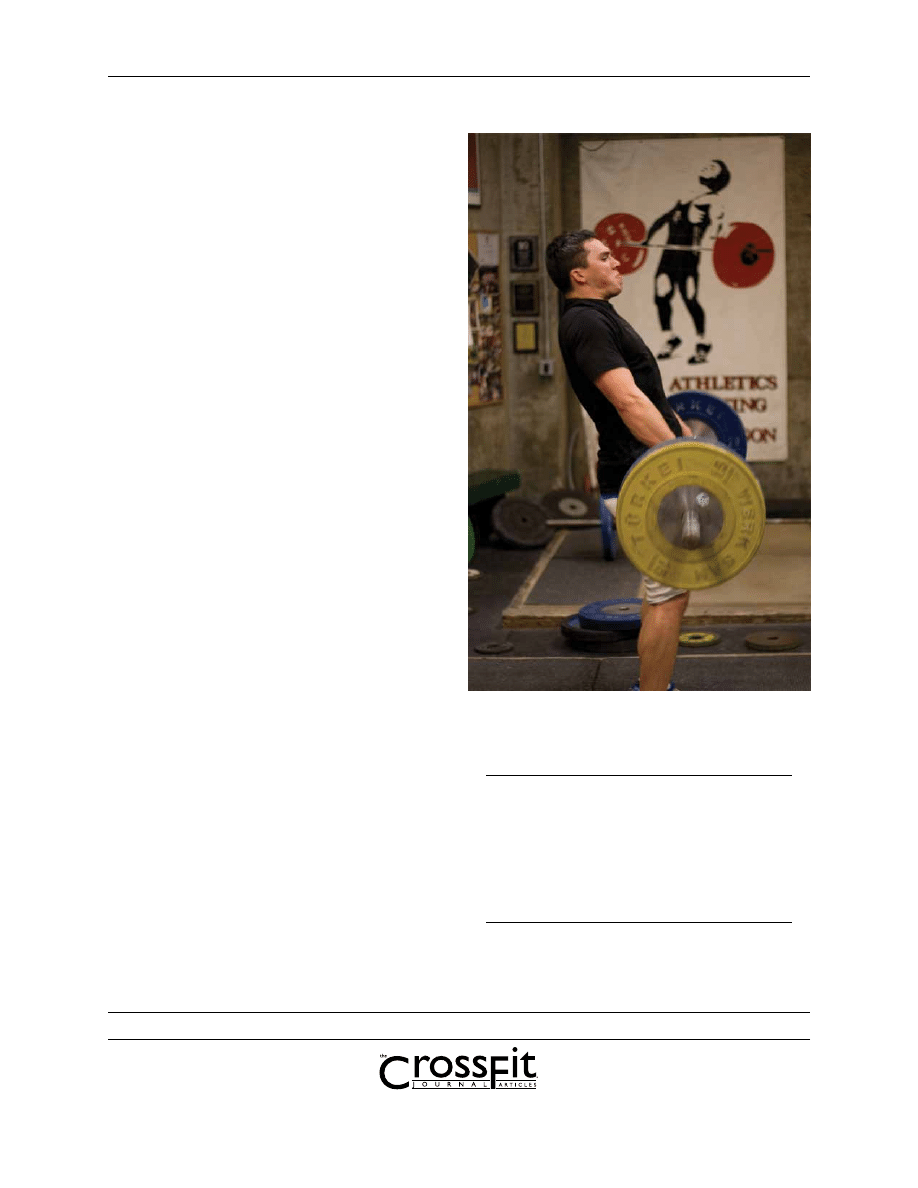
As you reverse your keys from
pulling to moving down into the
hole, pull the bar down with you
and guide it into the proper rack
on your shoulders.
Full extension is critical to getting under a heavy load.
Sta
ff/
C
ro
ssF
it J
ou
rn
al
7 of 8
Full Cleans ...
(continued)
Copyright © 2009 CrossFit, Inc. All Rights Reserved.
CrossFit is a registered trademark ‰ of CrossFit, Inc.
Subscription info at
Feedback to
Visit
considerable amount of weight, you have to hook. I also
found it more beneficial to hook than to use the reverse
grip when deadlifting. With the hook, I was able to bring
my traps into the mix much more readily. The hook
grip is only bothersome for the first few weeks, then it
becomes a matter of course.
The Finer Points
Now that you understand the fundamentals of doing
a full clean, you have to start paying attention to the
various form points.
No. 1 on the list is line of pull. If the bar is pulled too far
away from your body, you’re not going to be able to rack
it properly, and in most cases it will crash to the floor. If
you pull it too far back, you’ll find yourself on your butt.
The biggest concern most beginners have about doing
a full clean is that it will knock them back and the bar
will fall on them. As it so happens, this will most likely
occur. It’s like learning to ride a bike: you’re going to fall.
The thing to know is if you find you’re going to end up
on your backside, relax and don’t fight the descending
weight. You will fit easily under an Olympic bar.
Do full cleans in sets of three reps in the beginning. As
you become more advanced, the reps can be lowered
to twos and even singles, but triples work nicely early
on. The sequence of the pull must be precise in the full
clean. Mistakes can be overcome in the power clean, but
not in the full movement. In order to help accomplish
this, start the bar off the floor slowly, then pick up speed
through the middle and have the bar flying at the top. All
the while, it’s snug to your body. Once you feel the ideal
line of pull, try to hit it on every rep.
Most beginners fail to fully extend before moving to the
bottom, fearful that they aren’t going to get there in time
to rack the weight. But because they don’t fully extend,
they don’t provide that final, critical jolt to the bar, and
that jolt is needed to allow them time to jump into the
bottom. In addition, when the pull is cut short, the body
is leaning forward slightly, and this is not what you want.
It costs time for you to return to the upright position.
Otherwise, you’ll be leaning forward when you rack the
bar, and this usually results in the bar being bumped.
Knowing when to bring the traps into play and when to
bend the arms are the two most difficult parts of the pull.
Bring the bar off the floor smoothly in a tight, controlled
line. When the bar passed your knees, drive your hips
forward forcefully and immediately contract your traps.
All the while, your elbows are locked and arms are
straight. But once you activate your traps, bend your
arms and drive your elbows up and out to provide that
final bit of impetus to the upward-moving bar.
At that same instant, you should be high on your toes.
This latter point is extremely important for a couple of
reasons. The calves help to elevate the bar a bit higher,
At the very instant you provide
that final bit of power to the bar
at the top of the pull, you must
move. Any hesitation will give
the bar the edge—and it will beat
you to the bottom.
St
af
f/
C
ro
ss
Fi
t J
ou
rn
al
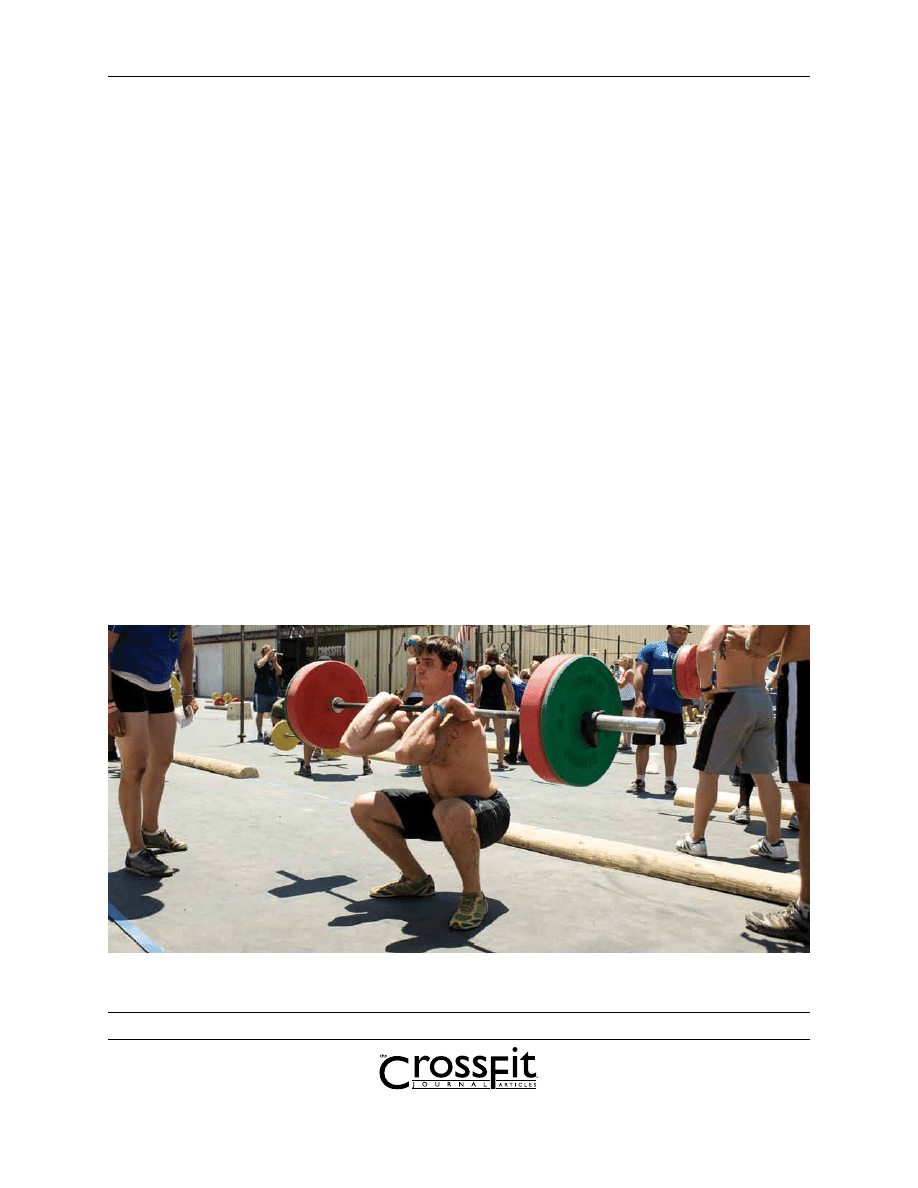
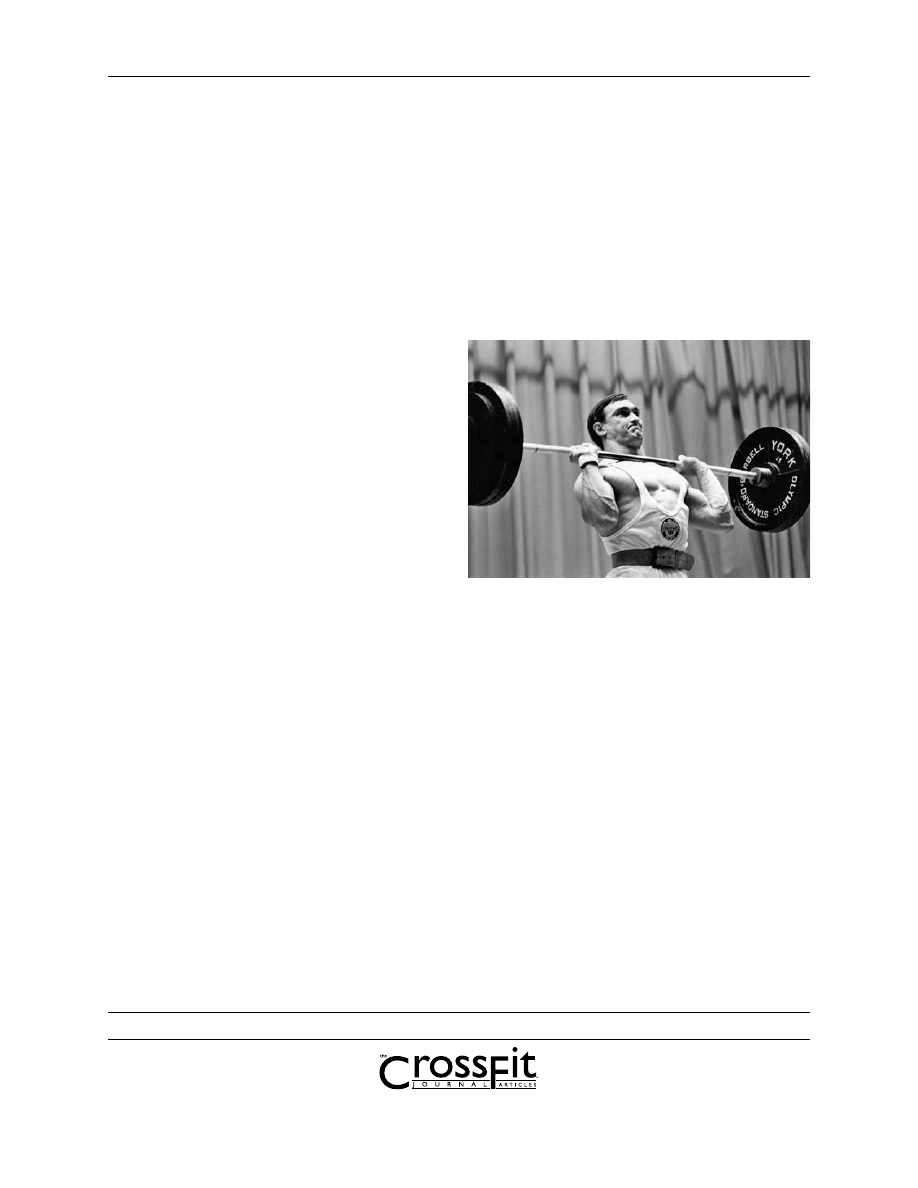
If you can’t front squat, you can’t do a full clean.
Note the vertical torso and high elbows, as well as
the position of the bar—on the deltoids, not the clavicle.
8 of 8
Full Cleans ...
(continued)
Copyright © 2009 CrossFit, Inc. All Rights Reserved.
CrossFit is a registered trademark ‰ of CrossFit, Inc.
Subscription info at
Feedback to
Visit
and quite often that bit is the difference between success
and failure. You can also move to the bottom faster when
you’re on your toes than when you’re flat-footed. When
your body is perfectly vertical with your elbows up and
out and you feel the bar jump, that’s your cue to drive to
the bottom.
However, you don’t just want to give a hard pull, move
into a front squat and let the bar crash down on you in the
bottom. While some of the greatest lifters in the history
of Olympic lifts did this—the most notable being Bob
Bednarski—it’s not fitting for many others. Barski was
tremendously strong and was rock solid when the bar
hit his shoulders. For those just learning the lift, the bar
will simply bounce off or drive the athlete off balance. As
you reverse your keys from pulling to moving down into
the hole, pull the bar down with you and guide it into
the proper rack on your shoulders. Should you meet the
bar high, which is often the case, just ride it on down to
the bottom, staying extremely tight the whole time. Any
relaxation from your ankles to your shoulders will cause
problems.
When you have the bar racked and under control in the
bottom, stand up. Don’t hang around down there any
longer than you have to. When you hit things just right,
you’ll be able to get a slight recoil out of the bottom,
which is a tremendous plus to aid you in recovering with
the weight on your shoulders.
Because foot placement at the bottom of the full clean
is so crucial, time must be spent practicing this part of
the lift. I have my lifters use chalk to mark where they
want their feet to land, and after each rep they check to
see how close they came to the marks, Not only must
they land in the same spot each time, but the feet also
have to be slammed into the floor. At the very instant
you provide that final bit of power to the bar at the top of
the pull, you must move. Any hesitation will give the bar
the edge—and it will beat you to the bottom.
The King of Lifts
There is a coordinated rhythm to the full clean, and when
everything is done precisely, the bar will seemingly float
upward effortlessly and drop in the slot on your shoulders
like magic. The clean and jerk has been called the “King
of Lifts” for good reason. The athlete who can clean and
jerk the most weight is considered the strongest. Re-read
my article
so you can combine these
two high-skill movements.
Anyone with athletic attributes can learn how to do full
cleans. Take the time to gain more flexible shoulders,
wrap your wrists and thumbs, practice the Drill until
you’re proficient, then start attacking some bigger
numbers in the full clean—and follow that with some
jerks. Once you’ve done that you’re well on your way to
achieving success in the sport of Olympic lifting; that is,
after you learn how to do full snatches, which I will cover
next time.
F
About the Author
Bill Starr coached at the 1968 Olympics in Mexico City,
the 1970 World Olympic Weightlifting Championship
in Columbus, Ohio, and the 1975 World Powerlifting
Championships in Birmingham, England. He was selected
as head coach of the 1969 team that competed in the
Tournament of Americas in Mayaguez, Puerto Rico,
where the United States won the team title, making him
the first active lifter to be head coach of an international
Olympic weightlifting team. Starr is the author of the books
The Strongest Shall Survive: Strength Training for Football
and Defying Gravity, which can be found at
Jo
dy
Fo
rst
er
Wyszukiwarka
Podobne podstrony:
CFJ Starr OverheadRising
CFJ Starr MasteringTheJerk
CFJ Starr PlatformCoaching
CFJ Starr PullingExercises
CFJ Starr MorePop
CFJ Starr PyramidStrength
CFJ Starr DontMuddleMiddle
Starr Flot Rimskoy imperii 439603
CFJ Takano Olympic
CFJ Star Mental Dec2010
Asimov, Isaac Lucky Starr 05 and the Moons of Jupiter(1)
Isaac Asimov Lucky Starr 03 And the Big Sun of Mercury
Raven Starr Her Smile (pdf)
Asimov, Isaac Lucky Starr 01 David Starr, Space Ranger
Ayla Starr A Story Called Philophobia
Isaac Asimov Lucky Starr 06 Lucky Starr and the Rings of Saturn
więcej podobnych podstron