Build An Outdoor Table And Bench Set
DINING OUT
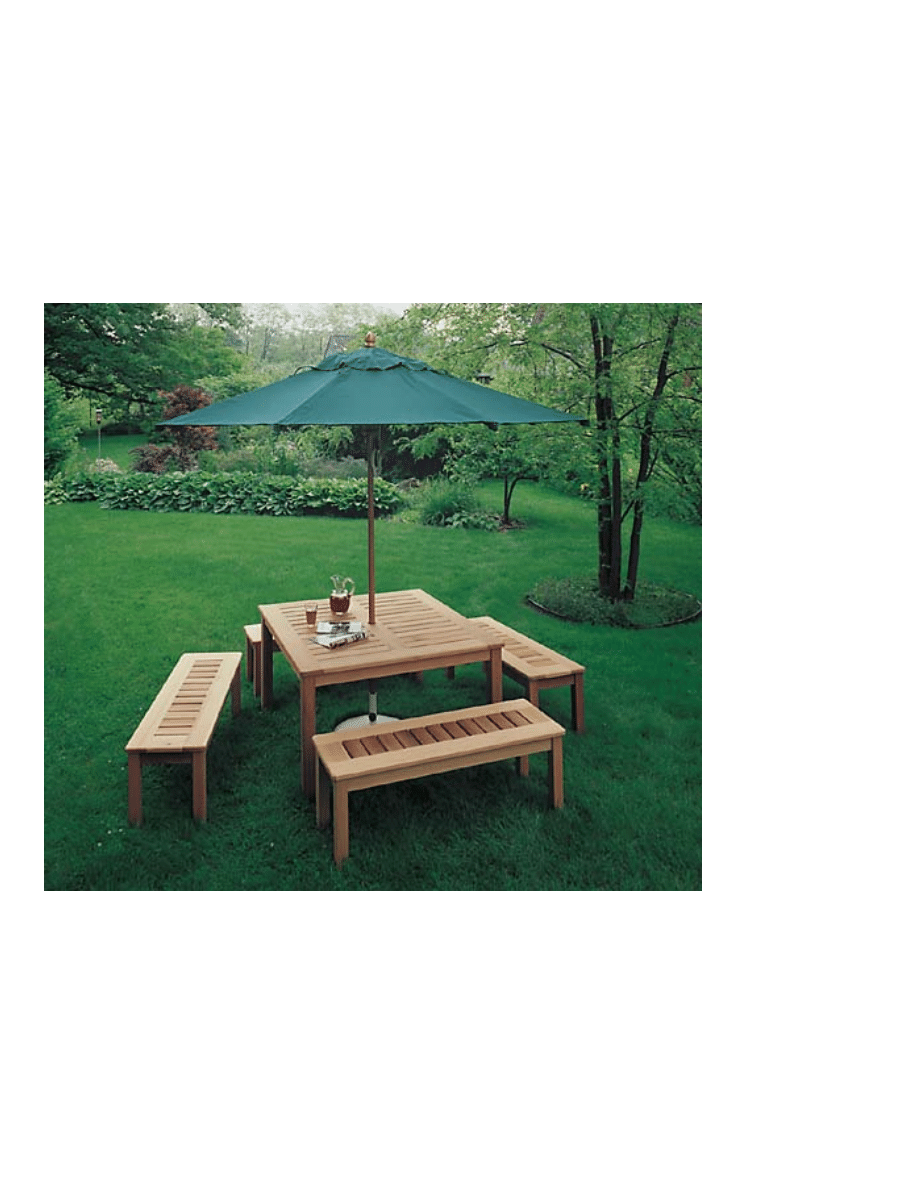
Build this outdoor table and bench set.
TEXT AND PHOTOS BY NEAL BARRETT
Photo by Eugene Thompson
http://popularmechanics.com/home_improvement/furniture/2001/4/Table_And_Bench_Set/print.phtml (1 of 11) [6/11/03 9:49:32 PM]

Build An Outdoor Table And Bench Set
It's easy to understand the appeal of outdoor dining. Think of
fresh air and bright sunshine with a soft breeze keeping pesky
insects at bay. Then think of yourself surrounded by your family
and friends. You're sitting there with a cold drink while some
sumptuous food sizzles on the grill. Few of us would wish for
much more than that.
Of course, to complete the picture, you'll need a table and a
place to sit. And that's where our project comes in. This cedar
table and bench set provides a perfect foundation for that
alfresco dining experience. It accommodates up to eight
people, but maintains a sense of intimacy if used by two. The
table is designed to accept an umbrella to shelter you from the
hot summer sun or untimely shower. Best of all, the project is
not too difficult. Four weekends should be enough time to build
it.
As far as the table umbrella is concerned, you can order it from
a number of different mail-order suppliers. We bought ours from
Smith & Hawken, 800-776-3336. (The umbrella is item No.
621508 and the base is No. 624460. Together, they cost about
$794, plus postage.)
We chose red cedar for this project. This wood resists rot and
insect infestation and it's readily available at lumberyards and
home centers. If you can't purchase kiln-dried cedar for your
project, you should buy the material several weeks before
starting and stack it someplace where it will have a chance to
air dry. Place evenly spaced strips of wood between each layer
of boards to allow air to flow through the stack of lumber. Other
suitable wood species for this project are redwood, teak and
cypress. These woods are more expensive than cedar,
however, and you may have a hard time finding them at
lumberyards and home centers.
We should mention that we used Titebond II wood glue to
assemble the furniture joints. This single-part glue is waterproof
for all but the most extreme situations, such as when joints are
subject to continuous submersion in water. Unlike epoxy or
resorcinol adhesives that are truly waterproof, this glue is easy
to use and readily available.
http://popularmechanics.com/home_improvement/furniture/2001/4/Table_And_Bench_Set/print.phtml (2 of 11) [6/11/03 9:49:32 PM]
Build An Outdoor Table And Bench Set
Making The Parts
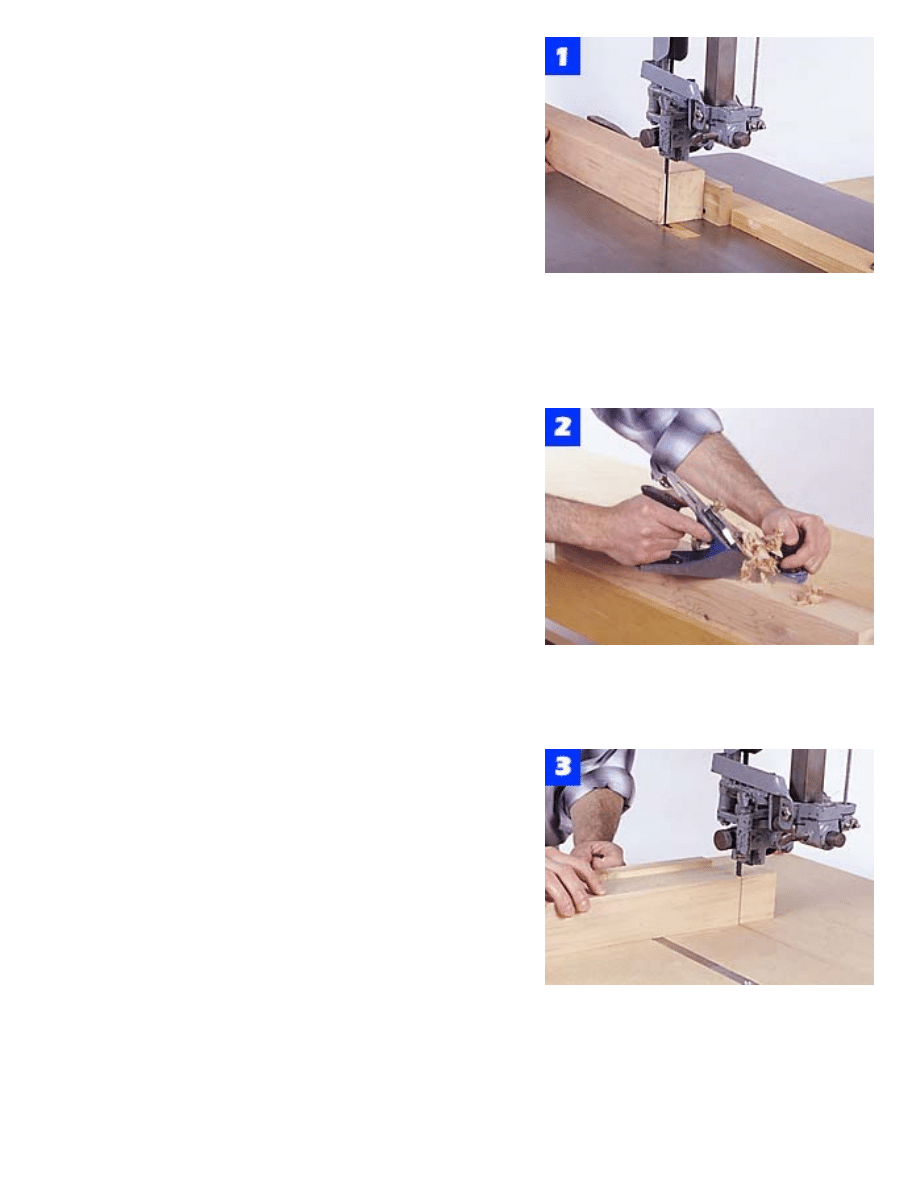
The table legs are cut from 4 x 4 stock (or they can
be glued up from thinner material). When using 4 x 4
stock, cut each leg to rough length. Next, clamp a
fence to the band saw table, and rip the blanks to a 2
3/4 x 2 3/4-in. square (Photo 1). Then clamp the leg
to a workbench, and use a razor-sharp plane to
remove the saw marks (Photo 2). Unless you are
very experienced with a hand plane, check the
workpiece frequently as you go. The edges of the leg
must remain square to one another. Remember that
you are only smoothing the surface, so do not
remove too much material.
Rip the table leg stock out of a cedar 4 x 4.
Clamp a temporary rip fence to the band saw
table to do this.
Clamp a table leg to a benchtop and remove
saw marks with a hand plane. To make a
smooth cut, push the plane at an angle.
Use a miter gauge on the band saw to crosscut the
leg blanks to finished dimension (Photo 3).
Since the bench legs are smaller than the table legs,
it is a better use of materials to glue them up from
three pieces of 3/4-in.-thick stock. You can simplify
the job if you plan to make the blanks large enough
to cut four legs from each glued-up stack.
Crosscut the legs on the band saw. Here, a
shopmade crosscutting table and a miter
gauge are used to make the cut.
http://popularmechanics.com/home_improvement/furniture/2001/4/Table_And_Bench_Set/print.phtml (3 of 11) [6/11/03 9:49:32 PM]
Build An Outdoor Table And Bench Set
Rip and crosscut material for the leg blanks slightly
oversize, then use a foam roller to spread glue on the
mating surfaces of each piece. Assemble the pieces
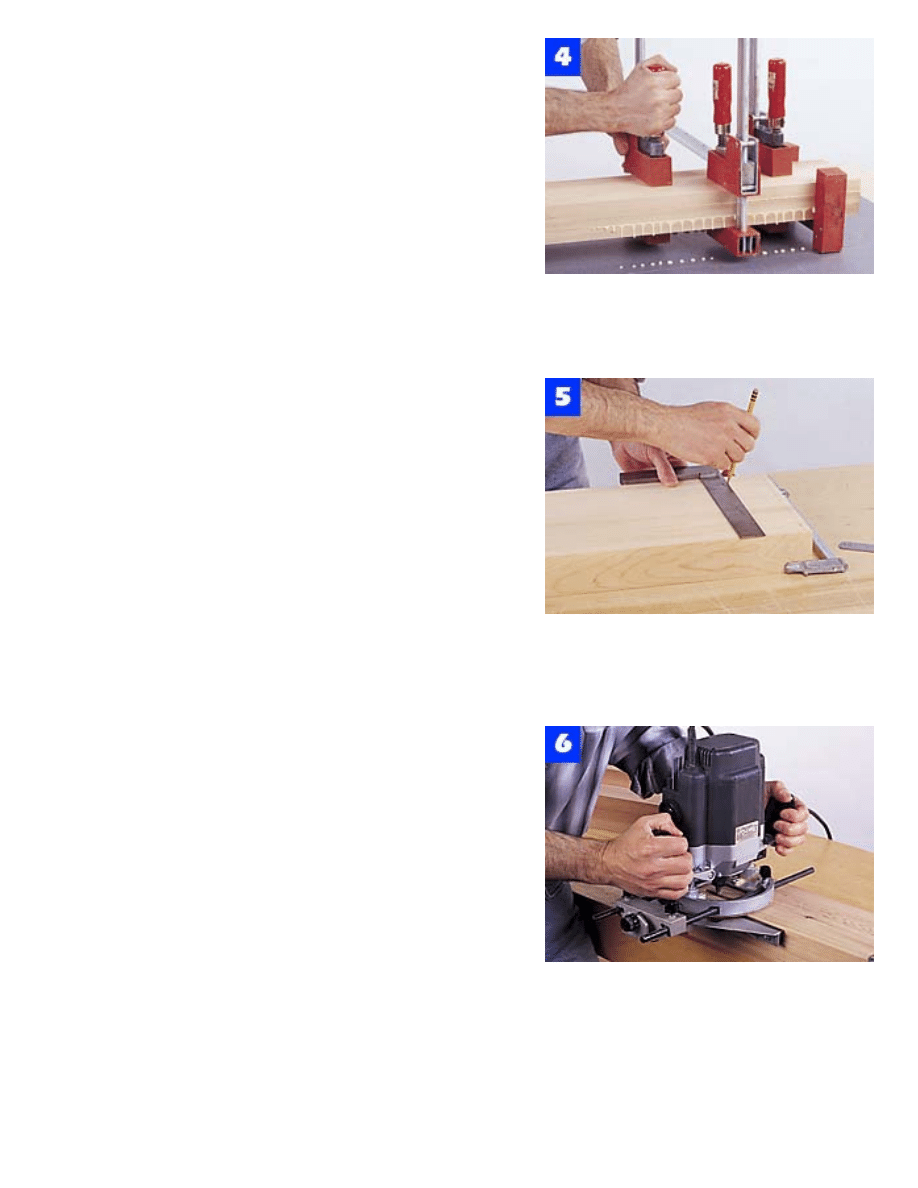
into a stack, and clamp the pieces together (Photo
4). After about 20 minutes, scrape off the glue that
has squeezed from the joints, then allow the glue to
fully set.
For the bench legs, spread glue on 3/4-in.-
thick stock. Lay disposable material under the
pieces and clamp them together.
Now use the table saw to rip the blanks to 21/4 in.
wide, and crosscut the bench legs to finished length.
Lay out the mortise locations in all the legs for the
apron joints. You can speed the process by clamping
four legs together with their ends perfectly aligned.
Then, mark across the stack using a square (Photo
5). Next, use the router and edge guide to cut the leg
mortises (Photo 6). It's best to use a spiral up-cutting
bit in the router because that type of bit pulls the dust
and chips out of the cut, and reduces the strain on
the motor. This also keeps the bit's cutting edge
cooler.
Rip and crosscut the individual bench legs to
size, and then clamp them together. Mark out
mortise locations on the legs.
Using a spiral up-cutting bit in a plunge router,
cut the table leg mortises. Two legs clamped
together provide a stable base.
http://popularmechanics.com/home_improvement/furniture/2001/4/Table_And_Bench_Set/print.phtml (4 of 11) [6/11/03 9:49:32 PM]
Build An Outdoor Table And Bench Set
Rip and crosscut 1-in.-thick stock for the table and
bench aprons as well as for the top frames and slats.
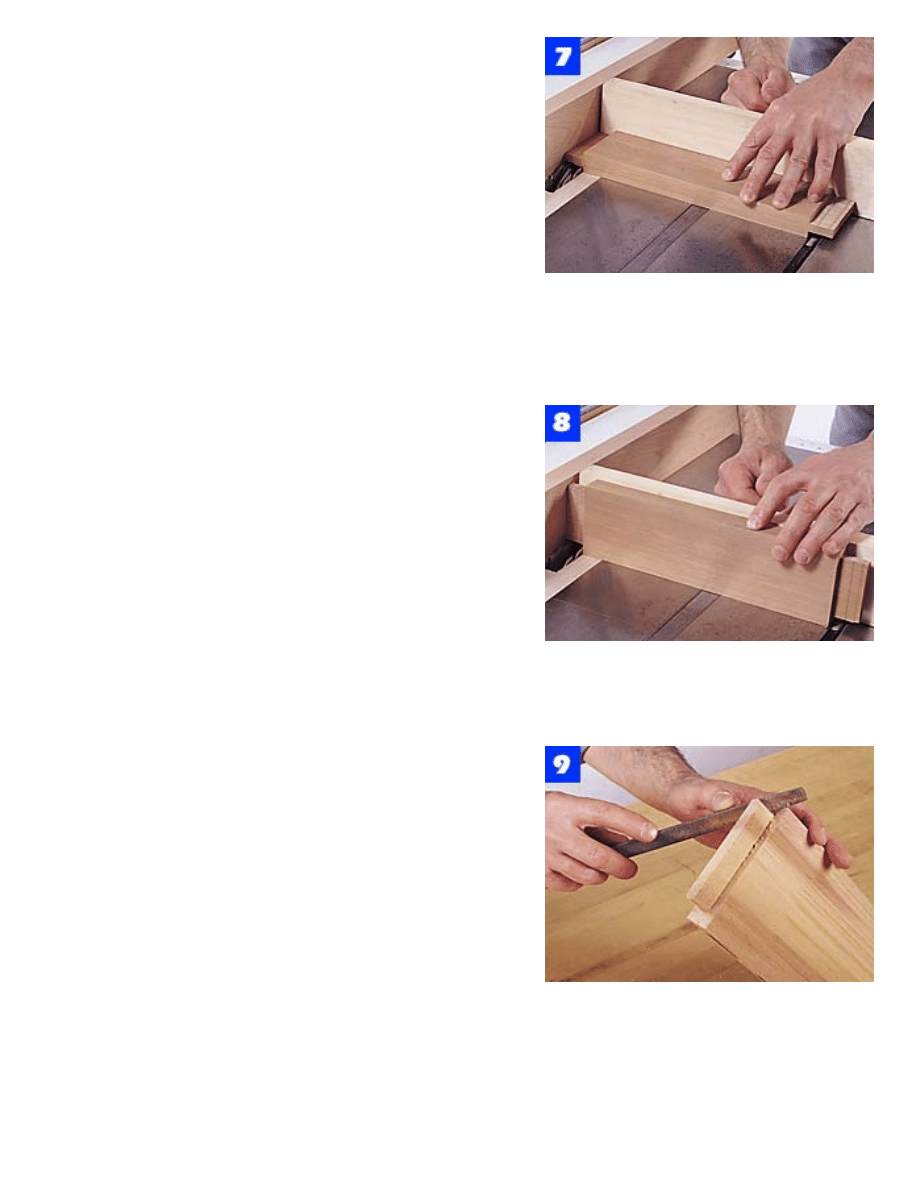
Install dado blades in the table saw, and then use the
miter gauge to guide the workpiece over the saw
blades when cutting tenons (Photo 7). Note that you
can use the rip fence as a stop to gauge the tenon
length. Since the tenons are 1 in. long, you need to
make two passes to complete each cheek.
Use a dado blade setup in the table saw to cut
the tenons on the apron pieces. Butt each
apron to the fence, and make the cut.
Cut the tenons across the width of each workpiece,
then adjust the blade height and move each
workpiece over the blade on edge to cut the shoulder
(Photo 8). Clamp each workpiece upright in a vise
and gently round over the tenon's edges using a
wood rasp (Photo 9).
To cut the shoulders on a tenon, stand the
apron up, and hold it firmly to the miter gauge.
Butt it to the fence and make the cut.
Round off a tenon with a rasp. The tenon’s
radius matches the radius left by the spiral up-
cutting bit used to cut the mortise.
http://popularmechanics.com/home_improvement/furniture/2001/4/Table_And_Bench_Set/print.phtml (5 of 11) [6/11/03 9:49:32 PM]
Build An Outdoor Table And Bench Set
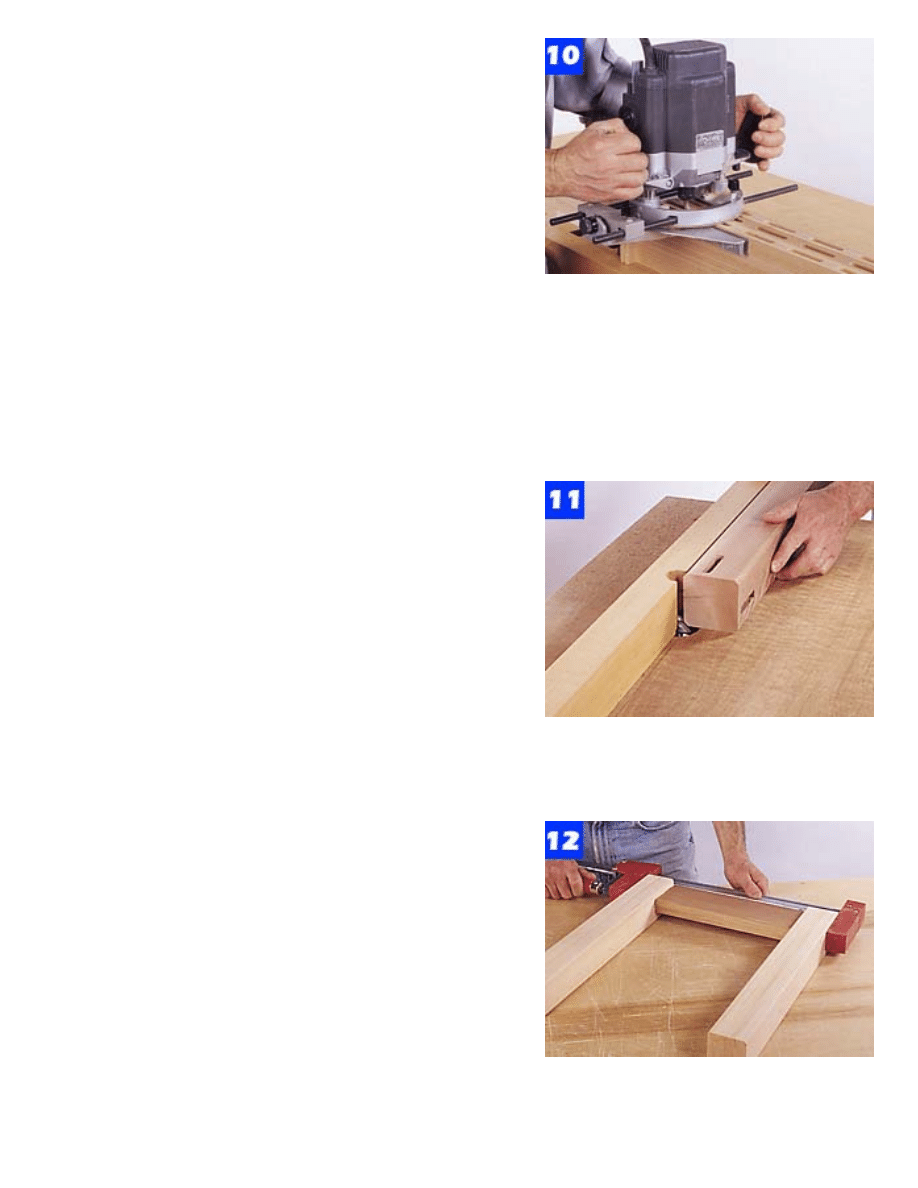
Lay out the mortise locations for the tabletop and
benchtop joints. Use a router with an edge guide and
a spiral up-cutting bit to cut the mortises (Photo 10).
It is best to clamp three workpieces of the same
width together when routing to form a wide and
stable base for the plunge router.
Mark the location of the umbrella posthole in the
center rail of the tabletop, and then use a Forstner bit
in the drill press to bore the hole.
After laying out the locations of the holes in the
aprons for mounting the top, use a Forstner bit in the
drill press to counterbore a recess for each
screwhead. Next, use a 3/16-in.-dia. bit to drill the
pilot holes for the screw shanks. Each of these holes
is centered in a recess.
To cut the long row of mortises in each stile
and rail, clamp three of the work-pieces
together to support the router.
To complete the part-making process, install a
chamfer bit in the router table, then use it to cut the
3/16-in.-deep chamfer on the table and bench legs,
aprons and top parts as shown in the plans (Photo
11). Note that not all edges are chamfered.
Use a chamfer bit in the router table to cut the
chamfer on all four edges of the legs for the
benches and table.
Assembly
Begin assembly with the benches, since they are
smaller and are much easier to work with. After you
refine your technique on them, you can assemble the
table.
It's worth noting that all the parts for the table and
benches should be dry assembled before glue is
applied. With the assemblies joined in this manner,
make reference marks and numbers on the backs of
the parts or in some other discreet location. Before
proceeding to gluing and clamping, gather the parts
http://popularmechanics.com/home_improvement/furniture/2001/4/Table_And_Bench_Set/print.phtml (6 of 11) [6/11/03 9:49:32 PM]
Build An Outdoor Table And Bench Set
together in batches so they are not confused during
the assembly process. In some cases, you'll want to
make a second dry fit midway through the assembly
process, such as when gluing and clamping a stile or
rail to multiple slats that have been glued to a stile or
rail on the opposite side. This is a necessary evil to
ensure that the parts go together smoothly--the parts
may have fit the first time you tried them but shifted
slightly when they were glued up as a subassembly.
Apply glue to the mortises of two bench legs and on
the tenons of one short apron. Use a small wood
shim to spread glue on the mortise walls, and use a
small brush to coat the tenons. Press together the
apron and legs, and then clamp the subassembly to
pull the joints tight (Photo 12).
Glue and clamp together a pair of bench legs
and one short apron. Make two of these
subassemblies.
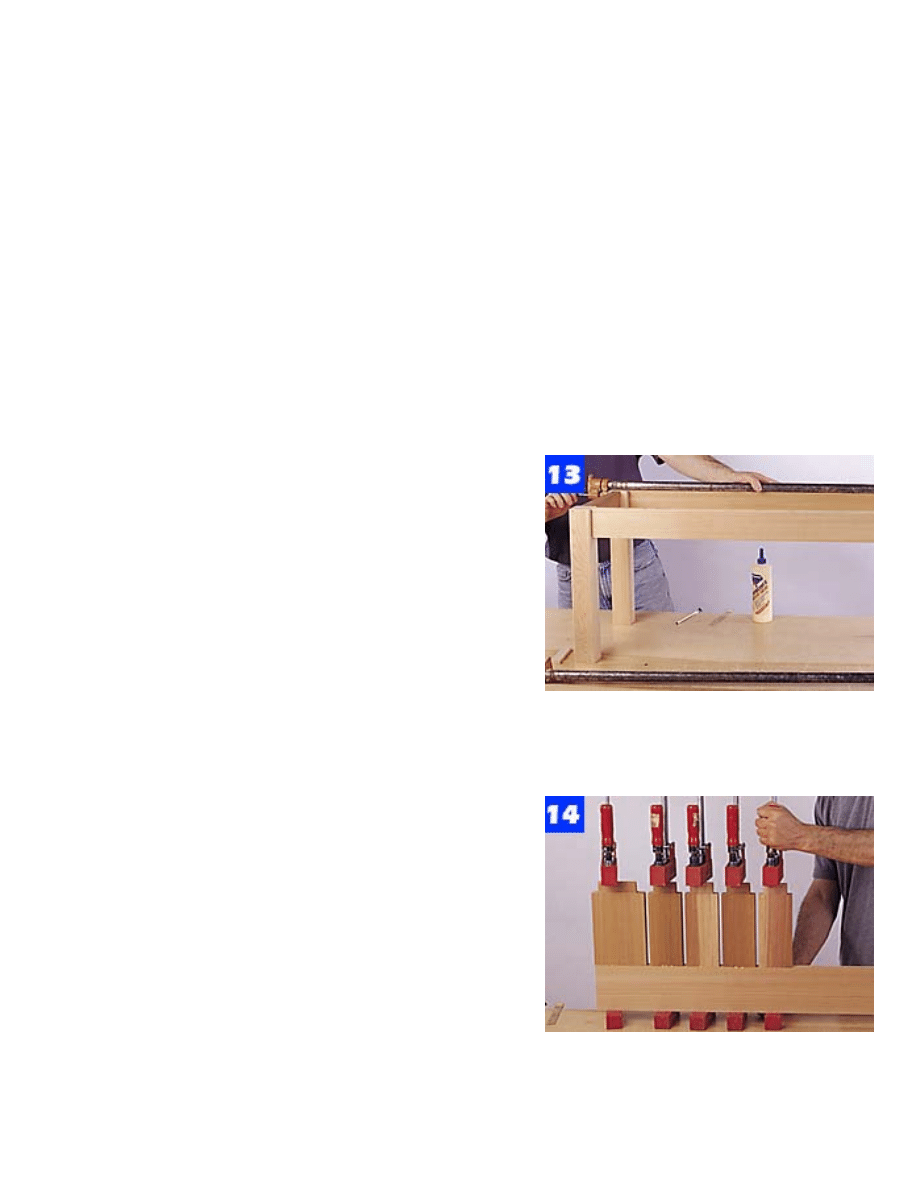
When the glue is dry on these parts, glue and clamp
the long bench aprons to the end subassemblies
(Photo 13). It's best to do this on a flat work surface
to ensure that the base assembly is not twisted.
Assemble the table base in the same manner as the
bench bases. Make two subassemblies consisting of
a pair of legs and one apron. When the glue has set
on these, join the subassemblies spanned by a pair
of aprons.
Join two leg-apron subassemblies spanned by
a long pair of aprons. Glue and clamp this to
complete a bench base.
Now move on to assembling the benchtops. Since
there are several slats in each top, assemble each
top in stages. First, glue and clamp the slats to one
long rail (Photo 14). After the glue sets on those
joints, apply the opposite rail.
The first stage in assembling a benchtop is to
glue and clamp slats to one stile. Use one
clamp in the center of each slat.
http://popularmechanics.com/home_improvement/furniture/2001/4/Table_And_Bench_Set/print.phtml (7 of 11) [6/11/03 9:49:32 PM]
Build An Outdoor Table And Bench Set
Multiple subassemblies are made in
assembling the tabletop. First, slats are joined
to the center rail.
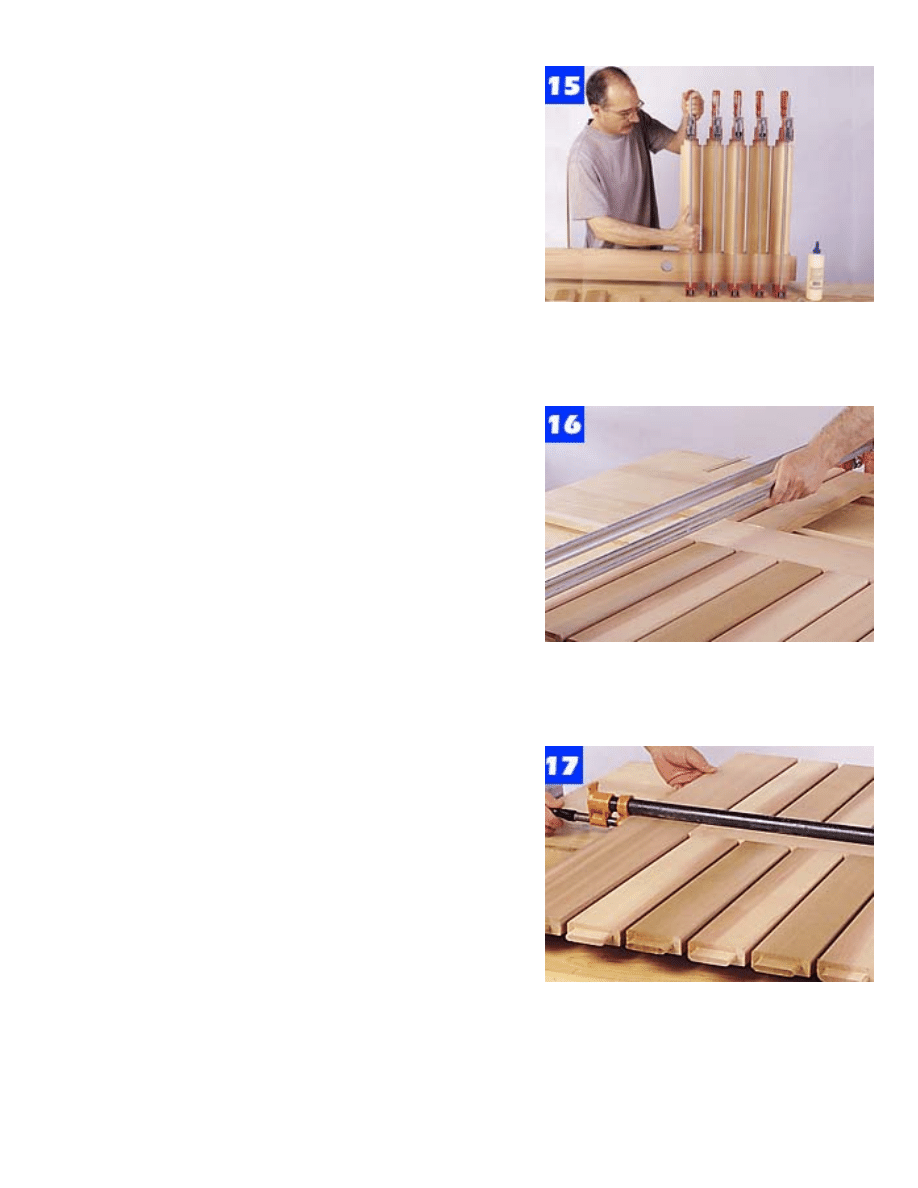
Approach the tabletop assembly in the same
manner. Begin by gluing and clamping a slat at each
end of the center rail. Fill in between these two slats
with more slats (Photo 15). When the glue is dry on
this subassembly, glue and clamp slats to the
opposite side (Photo 16). Next, glue and clamp the
side rails to this subassembly (Photo 17). When the
glue is set on that subassembly, position clamps
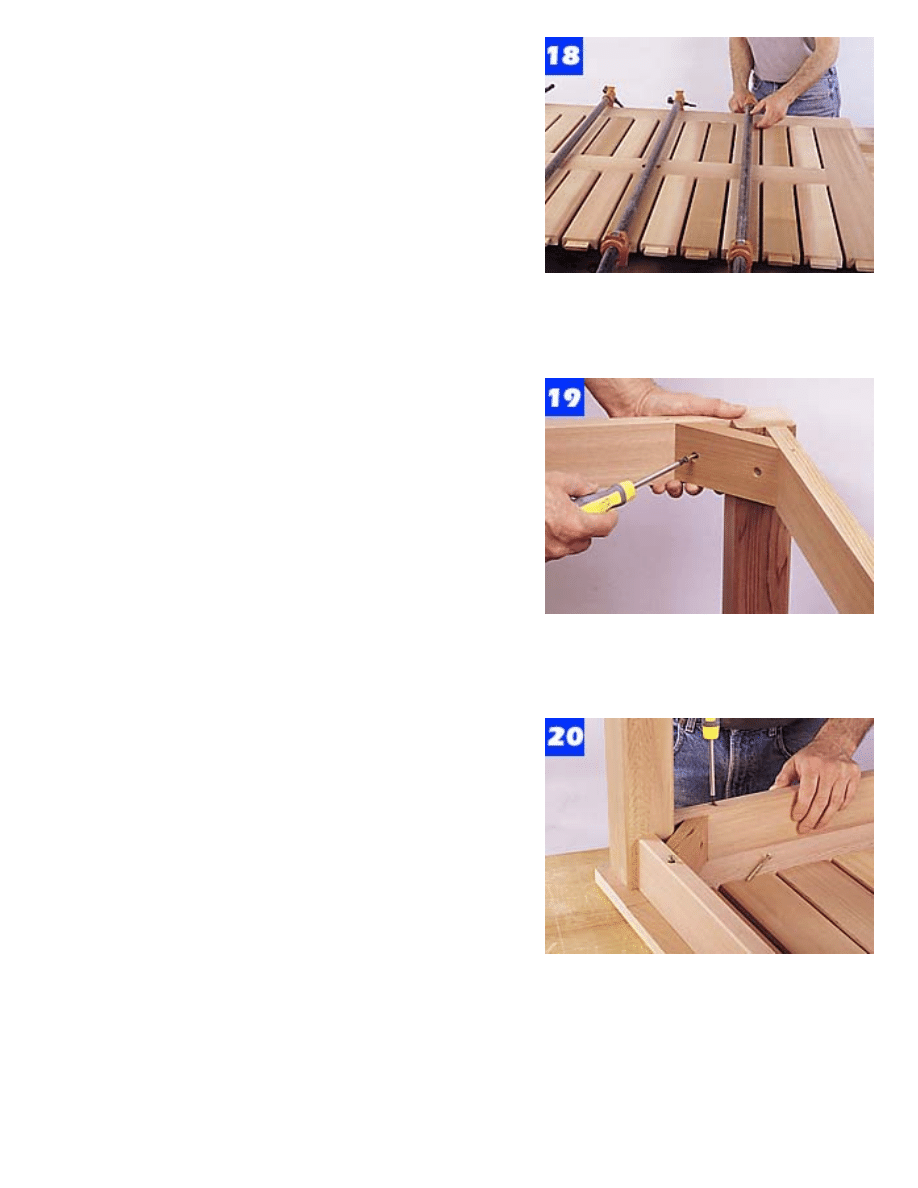
across it and then glue and clamp one stile to it
(Photo 18). Complete the top by gluing and clamping
the second stile.
A second set of slats is glued and clamped to
the center rail. Again, use one clamp in the
center of each slat.
Using this technique, you will not have to worry about
getting all the parts together before the glue begins
to set. Your results will be better, and the stress of a
frantic assembly is eliminated.
Glue and clamp a side rail to the center rail.
One clamp, carefully centered, should provide
enough force.
http://popularmechanics.com/home_improvement/furniture/2001/4/Table_And_Bench_Set/print.phtml (8 of 11) [6/11/03 9:49:32 PM]
Build An Outdoor Table And Bench Set
Mark the benchtops and tabletop for the 45 degree
corner cuts, and make these cuts with a sabre saw.
Sand the cut corners smooth, then use the chamfer
bit in the router to shape the table edges and
benchtops. Use the router and chamfer bit to shape
the top edge of the umbrella hole as well.
Clamp one stile at each end of the top
subassembly. Space clamps evenly and at the
center of a tenon.
Rip, crosscut and miter the 1-in.-thick stock to make
corner blocks. Bore and countersink pilot holes in
each block, and then attach them with screws to the
aprons for the table and benches (Photo 19).
A corner block is installed at each leg on the
table and the benches. A pair of screws holds
each block to the aprons.
Invert the tabletop on a padded surface, then place
the base over it. Adjust the base so there is an even
reveal on all sides of the top, and then attach the
base to the top with screws (Photo 20). Assemble
the benches in the same manner.
Attach the tabletop to the base with several
screws. Drive each screw into its matching
counterbored hole in the apron.
http://popularmechanics.com/home_improvement/furniture/2001/4/Table_And_Bench_Set/print.phtml (9 of 11) [6/11/03 9:49:32 PM]
Build An Outdoor Table And Bench Set
Sand all surfaces with 120-grit and 140-grit sandpaper, and
remove all dust with a tack cloth. While cedar is resistant to rot
and insect infestation, it will weather if left untreated. To preserve
its natural color and protect it from the elements, apply a
penetrating finish with a high-quality brush. We used clear
(unpigmented) Cabot Decking Stain No. 1400. For information,
contact Samuel Cabot Inc., 100 Hale St., Newburyport, MA
01950; 800-877-8246.
A pigmented stain could easily be used on this project. In fact,
pigmented finishes provide greater protection against weather
damage--even if they do obscure the wood's grain. Although
most people prefer white, green or redwood-colored finishes for
outdoor wood furniture, there's nothing to prevent you from being
a bit more creative. The finish could be color matched to other
outdoor furnishings, or to the house itself.
For maximum protection against the elements, use a paintable
water-repellent preservative, followed by a compatible primer and
topcoat. Visit your paint store to buy these three products and
check that they are fully compatible.
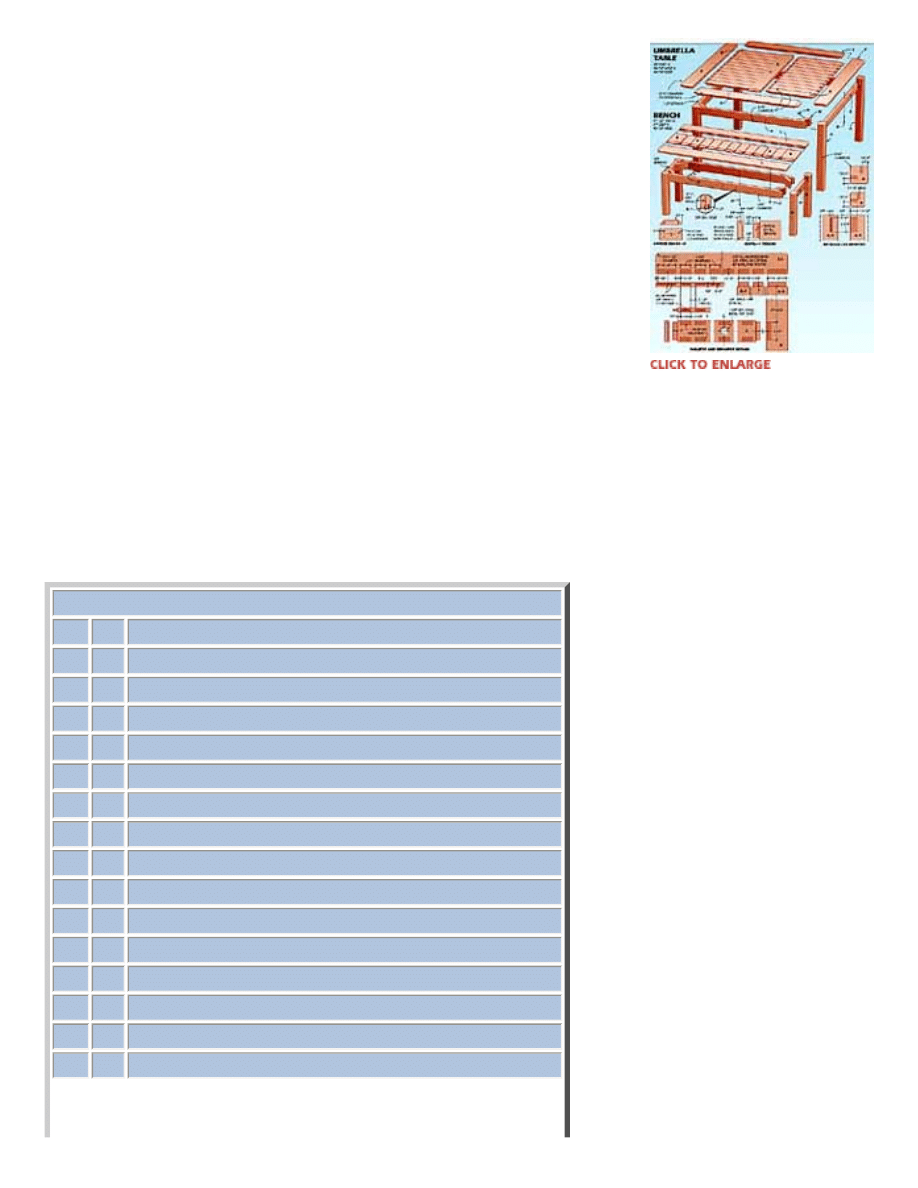
MATERIALS LIST--UMBRELLA TABLE AND BENCH
Key No. Size & Description (use)
A
4
2 3/4 x 2 3/4 x 27" cedar (leg)
B
4
1 x 3 x 43 7/8" cedar (apron)
C
1
1 x 5 x 40 7/8" cedar (rail)
D
22 1 x 3 1/8 x 18 15/16" cedar (slats)
E
2
1 x 5 x 40 7/8" cedar (rail)
F
2
1 x 5 x 48 7/8" cedar (stile)
G
16 2 1/4 x 2 1/4 x 16 1/2" cedar (leg)
H
8
1 x 3 x 12" cedar (apron)
I
8
1 x 3 x 44 7/8" cedar (apron)
J
44 1 x 3 1/8 x 9" cedar (slats)
K
8
1 x 5 x 9" cedar (rail)
L
8
1 x 5 x 48 7/8" cedar (stile)
M
20 1 x 2 3/4 x 5 1/4" cedar (block)
N
40 2" No. 8 fh galvanized screw
O
48 3" No. 8 fh galvanized screw
http://popularmechanics.com/home_improvement/furniture/2001/4/Table_And_Bench_Set/print.phtml (10 of 11) [6/11/03 9:49:32 PM]

Build An Outdoor Table And Bench Set
Misc.: Table umbrella No. 621508; umbrella base, No. 624460, Smith
& Hawken Fulfillment Ctr., 11882 W. Burleigh St., Wauwatosa, WI
53222; sandpaper, waterproof wood glue.
http://popularmechanics.com/home_improvement/furniture/2001/4/Table_And_Bench_Set/print.phtml (11 of 11) [6/11/03 9:49:32 PM]
Document Outline
- popularmechanics.com
Wyszukiwarka
Podobne podstrony:
Outdoor Table and Bench
Outdoor Cedar Table and Chairs
Woodworking Plans Garden Bench(1)
2 Woodworking Plans Standing Router Table
(Ebooks) DIY Woodwork Plans Drill Press Table
2 Woodworking Plans TableChair Harvest Table
Woodwork Plans Simple Garden Workbench Or Table
Bench Patio Table and Chairs(2)
Bench Patio Table and Chairs(1)
[Woodworking Plans] Frame and Panel Assembly Jig SN51P10
Patio Table and Chairs(1)
Patio Table and Chairs(2)
outdoor table seat
(madera) Woodworking plans Workbench Popular Mechanics Hard Maple
Patio Table and Chairs(2)
więcej podobnych podstron