U. S. Fish and Wildlife Service
2004/2005

Dear Teacher, Parent, and Student,
The U.S. Fish and Wildlife Service hopes that you enjoy our
2004/2005 endangered species coloring book.
It has pictures to color and stories to read. You can test your
endangered species know-how by taking the quiz inside the back
cover.
The learning library at the end of each species account features
scientific definitions and Web sites for more information.
Remember to check out the US. Fish and Wildlife Service
educators’ page at
Enjoy!
If you have downloaded the coloring book from the internet, copy it so that
the stories are adjacent to the pictures.
Special thanks go out to the endangered species staff!
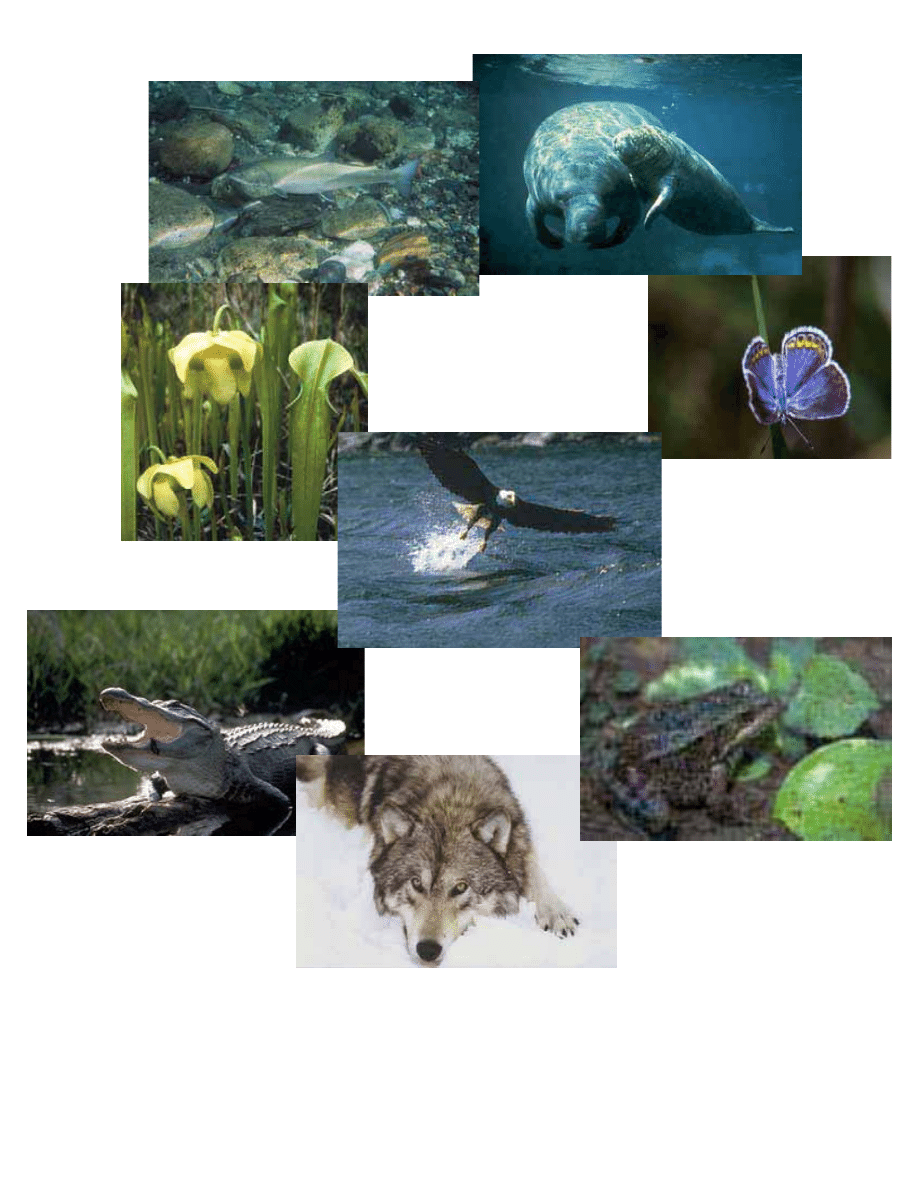
Quiz answers: 1. bald eagle, 2. bull trout, 3. Karner blue butterfly, 4. green pitcher plant,
5. manatee, 6. gray wolf, 7. American alligator, 8. California red-legged frog.

“Working together to conserve, protect, and enhance
fish, wildlife, and plants and their habitats for the
continuing benefit of the American people.”
U.S. Fish & Wildlife Service

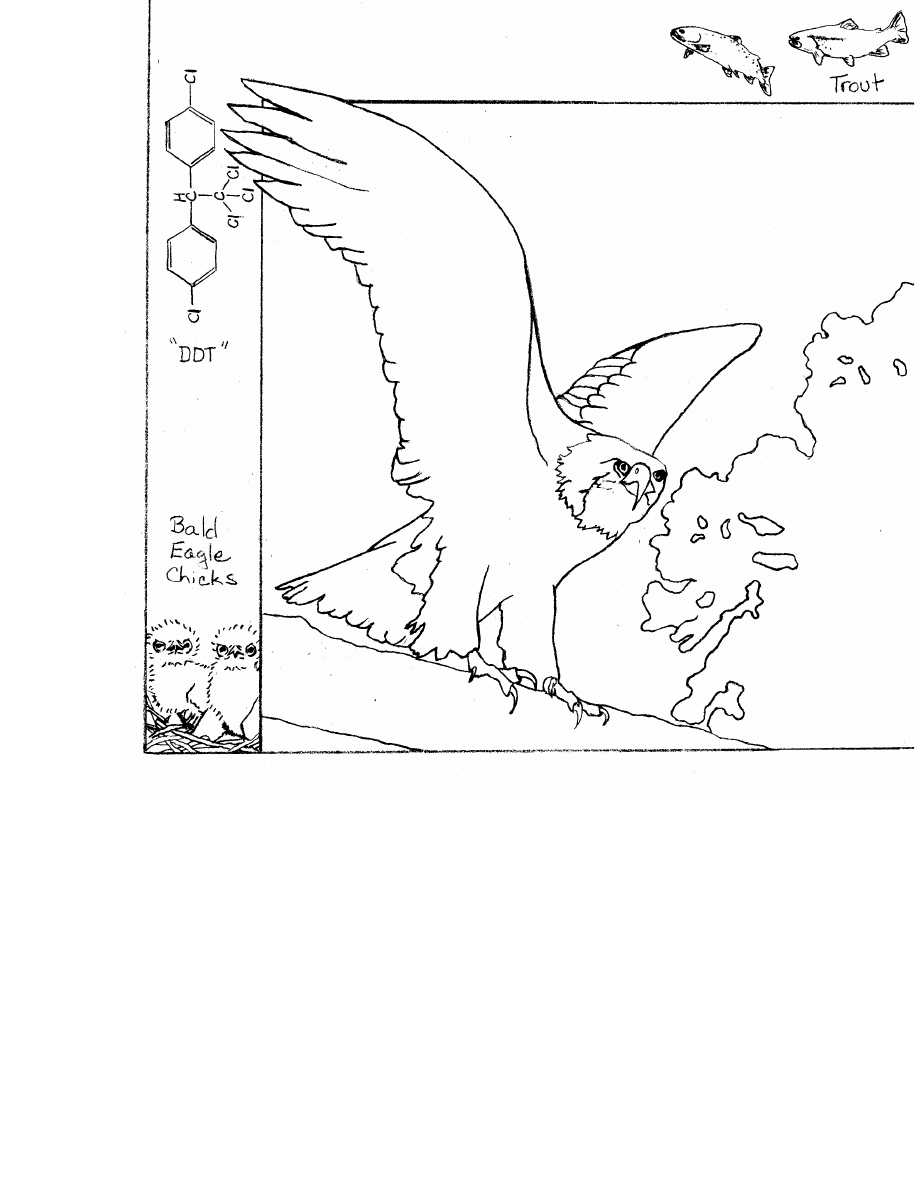
Bald Eagle Scientific name: haliaeetus leucocephalus
The bald eagle was chosen as our national symbol in 1782! In 1967, the
bald eagle within the “lower 48” was “listed” under the Endangered
Species Act, providing the species with protection from threats.
These handsome eagles fly the skies all over North America, from
Alaska and Canada to Mexico. Bald eagles are large, powerful,
brownish-black birds, with white heads and tails. Bald is the old
fashioned word for “white;” hence “bald” eagles. They don’t get their
distinctive white heads and tails until they are adults at age 4 or 5
years. How can you tell an immature bald eagle from a golden eagle,
another large raptor that is all brown? Bald eagles are fishermen and
have their “pants legs” rolled up. Golden eagles have feathers all the
way down their legs. Bald eagles will also eat ducks, rodents, snakes
and carrion. Males weigh from 7 to 10 pounds, and with wings out-
stretched, they measure 6 ½ feet wide! But wait, females are bigger—
they can weigh up to 14 pounds with a wingspan of 8 feet! Bald eagles
mate for life and build huge nests of sticks in the tops of large trees
near rivers, lakes, marshes, or other wetland areas. They use the same
nest each year. Some nests may reach 10 feet across and weigh as
much as 2,000 pounds! Usually two chicks hatch, both looking as
though they are having a “bad hair” day!
Twenty-five years ago, bald eagles were in danger of extinction due to
the effects of the pesticide DDT. DDT was sprayed to control
mosquitoes, but it also entered the food chain. The DDT caused the
bald eagle’s eggs to have very thin shells, which meant that many of the
eggs were easily crushed. Bald eagles were also shot because it was
believed they were a threat to cattle and sheep. Bald eagles and golden
eagles are now protected under the Eagle Act and the Migratory Bird
Treaty Act so they will not be shot, and it is now illegal to use DDT in
the United States.

What can you do? Tell your parents how important it is to follow the
label directions on pesticides, herbicides, and rodenticides. Many are
very dangerous to wildlife if not used properly. Find out what people
are doing for your local wildlife, and volunteer with a conservation
group. It’s fun!
Learning Library
Endangered Species Act – Federal agencies administer this law to
conserve species of wildlife and plants that are in danger of extinction
or likely to become so.
Threats – Threats are activities or conditions that threaten wildlife.
Loss of the species’ habitat, incorrect application of pesticides, and
collecting species to trade or sell them are a few examples of threats.
Carrion – Carrion is the word for animals that are dead and decaying.
Some animals, insects, and even plants eat carrion, and if they didn’t,
all that carrion would pile up.
Extinction – When a species is extinct, it no longer exists. Dinosaurs
are a common example, but there are more recent examples as well,
such as the passenger pigeon whose numbers were once so great that
the birds were said to have darkened the skies as they flew by.
Food chain – The food chain follows a single path taken as different
creatures eat each other for energy. For example, grass (is eaten by a)
grasshopper (which is eaten by a) frog (which is eaten by a) snake
(which is eaten by a) hawk.
To learn more go to:
http://endangered.fws.gov/i/B0H.html
and to see eagles in action at the Eagle Nest Cam go to:
Bald Eagle
Fun Fact
Do you know that I am the
national symbol? They almost
chose a turkey!

California red-legged frog Scientific name: Rana aurora draytonii
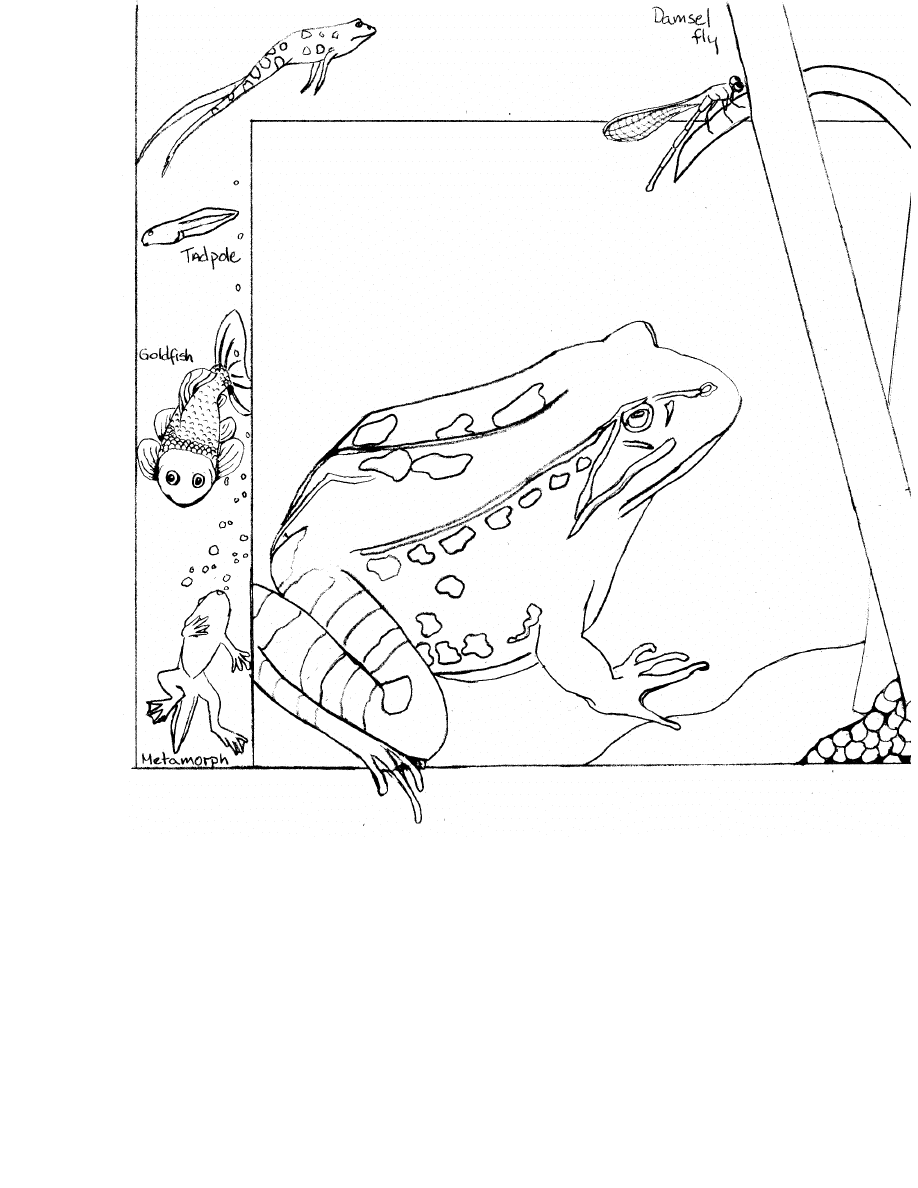
This red-legged frog is a threatened amphibian that lives in California
where it makes its home in ponds, streams, and other wetlands.
Attached to common wetland plants, you can see a frog egg-cluster at
the bottom of a cattail and a damselfly on a bulrush. The frog and the
damselfly are a good example of what is sometimes called the "web of
life,” showing how nature is connected. When the damselfly is in the
larval stage, it eats the eggs of the frog. From those eggs not eaten, a
hatchling tadpole emerges. When tadpoles undergo metamorphosis,
they first become “metamorphs” and then frogs. Metamorphs and
frogs eat damselflies and their larvae! The "red-eggs" are on the inside
of the frog’s back legs. Frogs are great jumpers. Mark Twain wrote of
them in
The Celebrated Jumping Frog of Calaveras County
.
Amphibians are declining at an alarming rate, and no one knows exactly
why. Some people believe that aside from losing their habitat,
widespread pollution has changed conditions for these sensitive
creatures. The California red-legged frog has also been affected by
its own fame as a "jumping" frog and its tasty legs (frog legs are
considered good-eating). People thought bigger frogs might be better
and brought the non-native bullfrog into California. Escaped bullfrogs
and goldfish, which families release into neighborhood ponds, eat the
red-legged frog adult or its eggs. People are helping the red-legged
frog by removing bullfrogs from ponds.
What can you do? Never release pets into the wild; they can cause
serious harm to native animals. Don’t pollute the water with trash or
motor oil, or by putting too much fertilizer or pesticides on lawns as it
can run-off into the water and kill frogs.

Learning Library
Threatened - The term "threatened species" has a specific meaning
under the Endangered Species Act, roughly - any species likely to
become endangered in the foreseeable future. These species are often
declining in numbers and/or faced with threats to their existence, such
as habitat loss.
Amphibian - Amphibian means "double life." Typically, the double life
is one spent first in an aquatic larval stage and then in a terrestrial (on
land) adult form. All amphibians depend on water or moist
environments. Because all amphibians breathe through their skin to
some extent (oxygen is also absorbed through lungs, gills, and/or
membranes), they must remain moist.
Larval - The immature form, or larvae, of certain animals is different
in structure from the adult and must undergo metamorphosis. Tadpoles
are larvae of frogs and toads, grubs are larvae of beetles, and
caterpillars are larvae of butterflies and moths.
Metamorphosis - A change in form, as in the changes undergone by an
animal going from larvae to an adult.
To learn more go to:
http://endangered.fws.gov/i/DON.html
and for a fun frog quiz, go to:
http://magma.nationalgeographic.com/ngexplorer/0403/games/game.cgi
15
California
Red-legged Frog
Fun Fact
I can jump more than 5 feet!
Can you?

Karner Blue Butterfly Scientific name: Lycaeides melissa samuelis
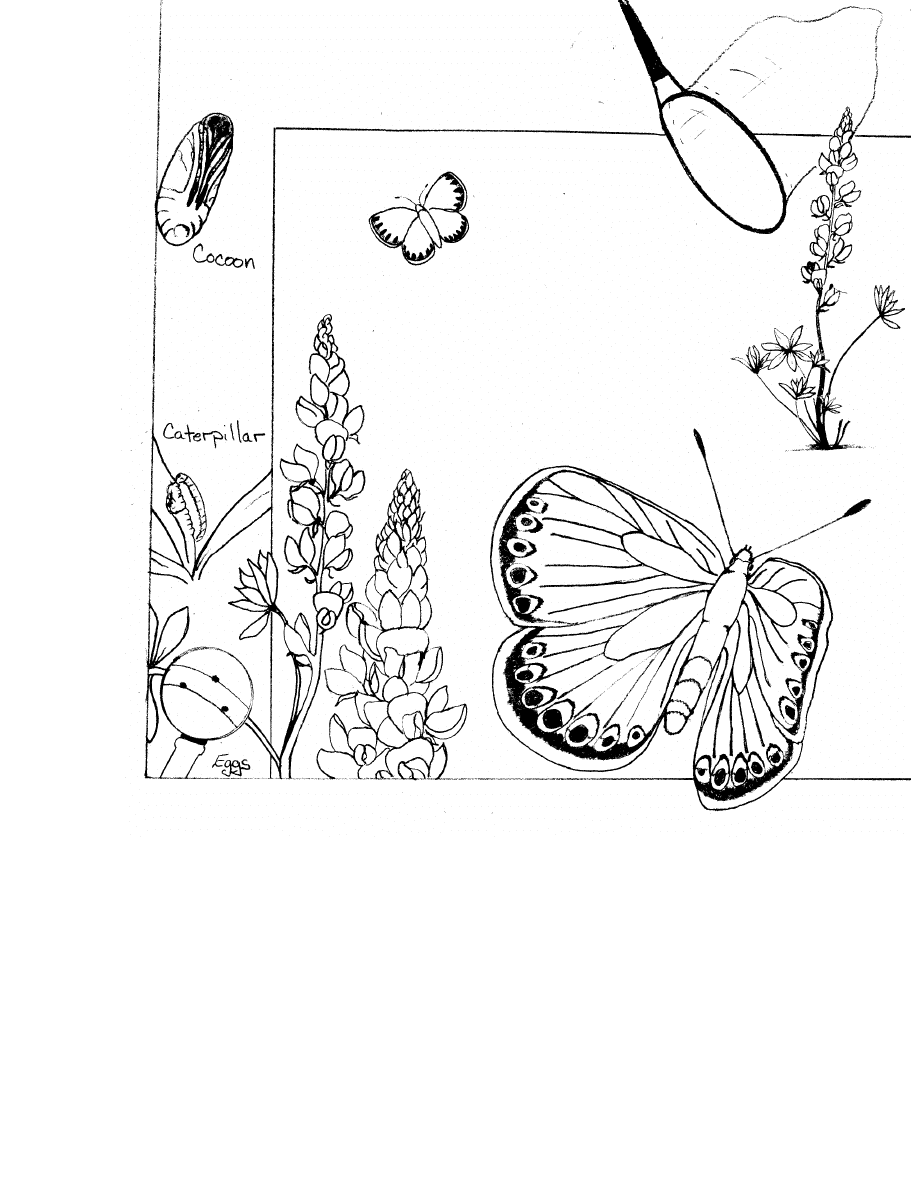
No bigger than a postage stamp, the Karner blue butterfly is an
endangered species. The Great Lakes and northeast pine barren and
oak savanna habitats are where you can see this butterfly flying over
the blue lupine, its host plant. The butterfly starts its life as a very
small egg—you need a magnifying glass to see it! In the summer, the
butterfly lays eggs on the leaves of the wild blue lupine. Later, the
leaves fall to the ground and get buried and cushioned by the snow.
When spring comes, the eggs hatch into larvae, better known as
caterpillars. A Karner blue caterpillar only eats blue lupine leaves. The
caterpillar then pupates. You can just make out eyes and antennae of
the developing butterfly in the cocoon. It only takes a few days before
you’ll see a butterfly emerging, as blue as peacock feathers, with
orange trim on the edge of the wings. Even though each butterfly
doesn’t live long—only about 2 weeks—it is a great pollinator. Never
flying far from home, it needs blue lupines so that it can lay eggs to
start the next generation.
The Karner blue butterfly is on the Endangered Species List because
more than 90 percent of its grasslands, including blue lupine plants,
have been converted to agriculture, forestry, and development use.
Many rare and endangered butterflies are favored by butterfly
collectors, and often they are scooped up in nets and pinned to boards
before having a chance to lay eggs. Now the Fish and Wildlife Service
and partners are helping to restore the host lupine by planting its
seeds, and the Endangered Species Act protects endangered
butterflies from collection.
What can you do? Don’t collect Karner blue butterflies, or any
wildlife. Enjoy watching them in their natural habitat. Grow butterfly
habitat at your school or house by planting bushes and plants that
attract local butterflies.

Learning Library
Endangered - "Endangered" has a specific meaning under the
Endangered Species Act: a species in danger of extinction throughout
all of a significant portion of its range.
Host Plant - A plant that is essential to another species' survival. For
the Karner blue butterfly, blue lupine is the only plant that its
caterpillars eat and butterflies lay their eggs on. Without this host
plant, there would not be any Karner blue butterflies.
Pupate - This is the process that a caterpillar uses to form its
chrysalis (cocoon) to protect it as it turns into a butterfly.
Pollinators - An insect or other agent, such as wind, that pollinates --
that is, moves pollen -- from one flower to another. Some insects are
adapted to only pollinate one plant species, which often has features to
attract those insects.
To learn more go to:
http://midwest.fws.gov/Endangered/insects/kbb/index.html
Karner Blue
Butterfly
Fun Fact
My eggs
are buried in the
snow for the winter... brrrrr!

American Alligator Scientific name: Alligator mississippiensis
Although this "gator" is now recovered -- that is, no longer in danger
of extinction, his cousin, the American crocodile, is still endangered.
But because they look so much alike, the alligator remains listed due
to similarity of appearance. With both "listed," the Endangered
Species Act protects them both. How do you tell them apart? Well,
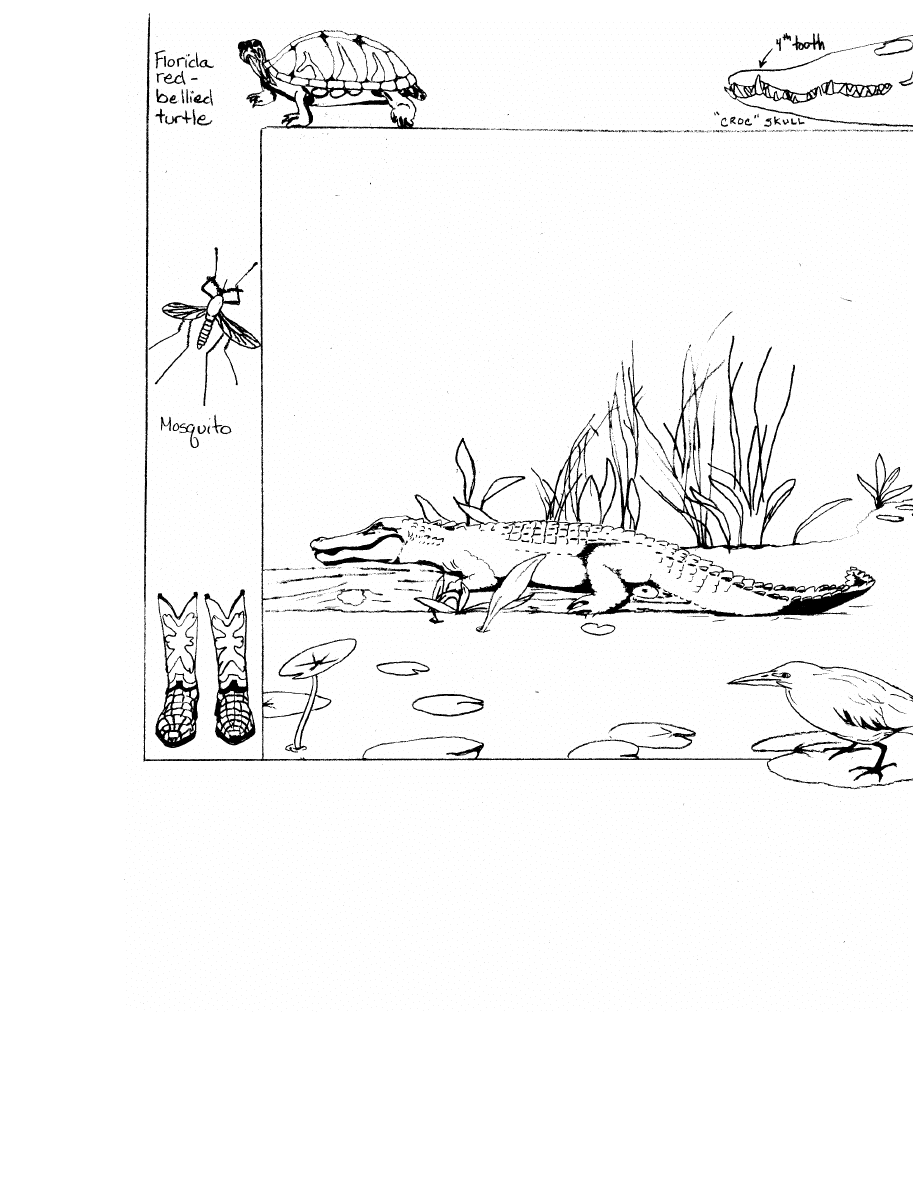
don't get too up-close and personal, but the 'gator has a snub-nose
compared to the "croc's" long, thin snout, and the 'gator has a
toothless grin. His large 4 tooth does not show when his mouth is
closed; the croc's does. The American alligator likes freshwater
swamps, marshes, rivers, and lakes. The crocodile, on the other hand,
can tolerate brackish water because he has special salt-secreting
glands that the alligator lacks. The alligator's black coloring with
yellowish cross-bands forms disruptive camouflage, helping the animal
to hunt. Adults tackle prey in the water or on land -- mostly fish,
turtles, and birds. If the green-backed heron in the picture can stay
perfectly still on that lily leaf, it just might survive; if not, chomp!
But alligators are not all bad news to other species; the American
alligator is a keystone species, modifying its habitat in a way that
benefits other wildlife. Here's how. Just about the time of year when
the snow-birds (
Homo sapiens
from northern climes) are heading
south for some sun, alligators are hibernating! The "alligator hole"
they dig to protect themselves during hibernation also hold water
during dry times and give other animals an oasis. Also, nests so
carefully built by alligator moms double as nests for the Florida red-
bellied turtle, as shown in the margin.
The belly skin of the alligator produces high-quality leather. Alligator
products -- belts, purses, and cowboy boots -- became a fashion
statement. Killing alligators for their skins almost drove this species to
extinction. Through the protection of laws, such as the Endangered
Species Act, the species was saved and returned to healthy
populations.

What can you do? Never feed wild animals. They come to expect food
and can become aggressive and dangerous. The animals are then killed
to protect human safety. Here's another tip: wear bug repellent.
You're more likely to get bitten by the mosquito, which shares the
alligator's habitat, than you are by an alligator!
Learning Library
Recovered – Because its populations are healthy and stable, the
American alligator no longer needs protection under the Endangered
Species Act. Threats to the species have been removed.
Listed – This refers to species on the Endangered Species “List,” a
formal list published by the federal government.
Similarity of appearance – Two species look so much alike that for
purposes of enforcing the Endangered Species Act, both are protected
to ensure the well being of the one threatened with extinction.
Alligator and crocodile skins look similar.
Brackish – Brackish water is somewhat salty, like a marsh near the
ocean.
Camouflage – Colors or patterns such as stripes or spots that help the
animal hide by blending with the background.
Keystone species - Species that play a key role in maintaining
ecosystems.
To learn more go to:
http://www.flmnh.ufl.edu/natsci/herpetology/brittoncrocs/csp_amis.htm
American
Alligator
Fun Fact
When I was a baby, my mom
carried me to the swamp in her
mouth.
Yuck!

Florida Manatee Scientific name: Trihechus manatus
Looking a bit like a gray walrus without tusks, the manatee is an
endangered marine mammal that swims in the shallow warm waters
around Florida, Georgia, and Puerto Rico. In the summer, you might
even see manatees as far north as Virginia or as far west as Louisiana.
One of the most famous manatees is a young female who was named
Chessie after she made news by wandering north into the Chesapeake
Bay- maybe she was trying to visit the U. S. Capitol? Because of their
need to stay warm, manatees gather at warm water springs in the
winter, almost packed like sardines. These slow-moving, gentle giants
eat sea grass and other plants, an activity that may take 5 hours a day.
Gentle and giant, these “sea cows,” as they are sometimes called, may
have been what sailors called mermaids! Growing up to 13 feet (so,
minivan-sized) and weighing up to 3,500 pounds (just like small hippos),
they are impressive to see. Instead of arms, manatees have flippers
that help them steer and scoop up food. Instead of legs, they have one
large flattened paddle-like tail that propels them through the water.
Just like mermaids, manatees never get out of the water.
While manatees can see and hear relatively well, it takes a bit of
effort for them to move, so boats easily hit them accidentally.
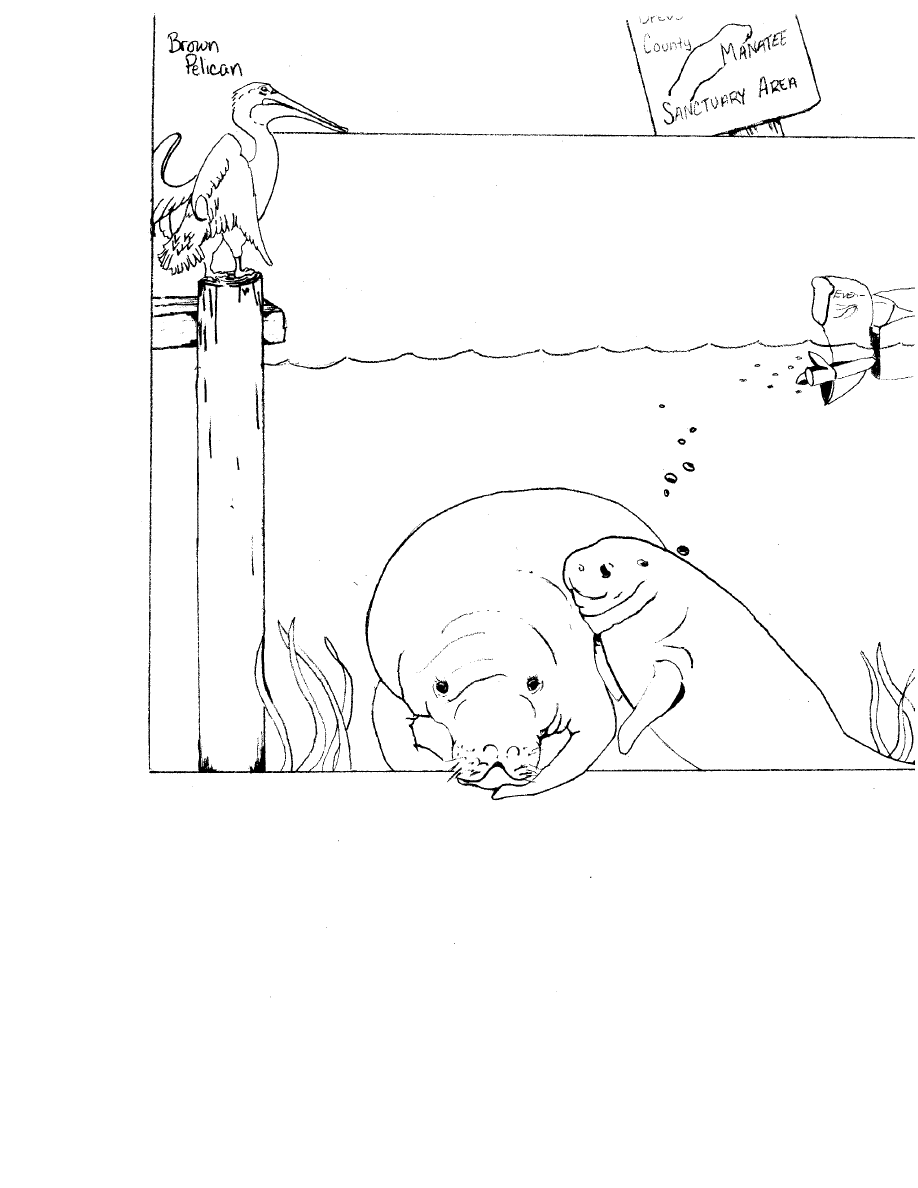
Mortality from boats is a very real threat: propellers can cut
manatees, and the animals that survive have scars for life. Boats also
need places to dock, and in doing so, they destroy the manatee's sea
grass beds. To help manatees, there are special sanctuaries where the
animals can retreat from people. During the winter, manatees gather
around the warm water released from power plants that the Florida
Power and Light Company keeps continuously operating to provide safe,
warm-water areas.

What can you do? When you travel by boat in manatee areas, slow
down! Encourage adults driving boats to observe the speed limits and
enjoy the antics of these graceful creatures. You can also visit special
manatee refuge areas, where you might see a cow (mother manatee)
and her calf (baby manatee) playing. If you live in Florida, you can even
buy a manatee license plate for the car!
Learning Library
Mammal - Animals like us (humans) that nourish their young with milk.
For example, elephants, whales, jaguars, and bats are also mammals.
Springs - Flows of water coming to the surface from underground or
up through a river bottom.
Mortality - The death of individuals in a population. Boats are a source
of mortality for manatees.
Refuge areas - Zones or places where special rules, such as speed
limits, are established to protect the species from the most likely
cause of death.
To learn more go to:
Florida
Manatee
Fun Fact
When I am resting, I can
hold my breath for 20 minutes!

Green pitcher plant Scientific name: Sarracenia oreophila
There are just 34 populations remaining of this unique endangered
plant. Now found only in Georgia, North Carolina, and Alabama, it was
once also found in Tennessee. The plant’s habitat is moist areas such as
seepage bogs and stream banks where its nodding yellow flowers can be
seen in the spring. What is so unique about this plant? It’s carnivorous!
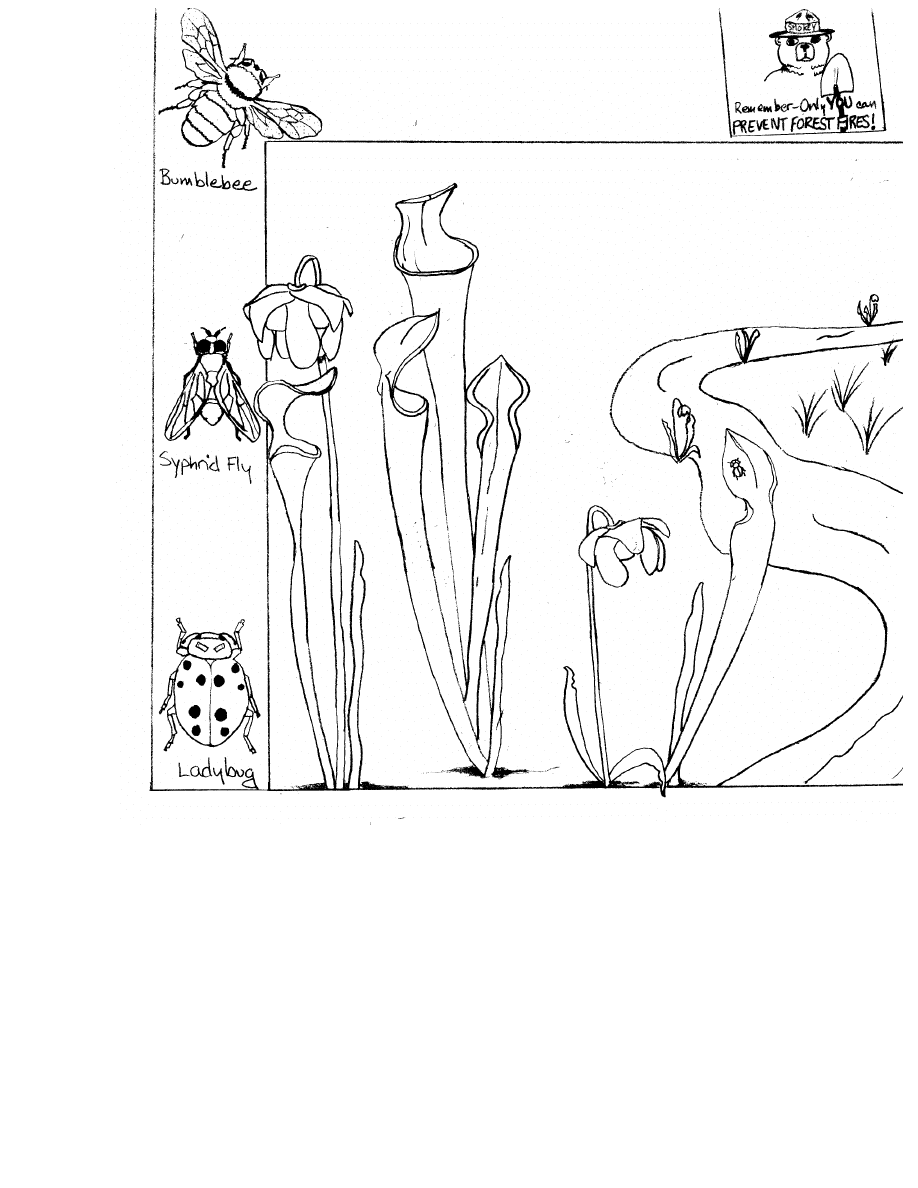
The green pitcher-like leaves trap insects that have fallen in. The plant
then enjoys bug-soup, thanks to enzymes or friendly bacteria that do
the digesting. Different insects like ladybird beetles (ladybugs),
syphrid flies, and bumblebees are frequent visitors to pitcher plant
flowers. Oh no! Oops, that little beetle on the leaf slips— and down it
slides into the “belly” of the green pitcher plant.
Habitats often need natural disturbances to remain suitable for the
plants and animals that live there. Biologists have discovered that the
green pitcher plant needs occasional fires. Having fires go through
moist upland areas seems a bit odd, but the plants and their habitat
are adapted to and dependent on this disturbance. Smokey Bear has
taught us all to prevent forest fires. This is good advice. However,
along with Smokey came the idea that all fires were bad, not just the
ones started by careless campers. With people quickly putting out all
fires, even ones started naturally by lightning, the pitcher plant and
many other species that depend on fire have suffered. Our biologists,
with fire crews, are working to return fire to these areas by using
prescribed fires.
What can you do? Learn about how fire is useful for different
habitats, and remember—don’t ever start a wildfire. You can buy non-
endangered carnivorous plants at your local nursery. This is a great way
to see how unique they are. But, please don’t collect the wild ones; they
are needed where they are, and it might be illegal!

Learning Library
Populations - The group of animals or plants that live in a certain place.
Carnivorous - Only plants that attract, capture, kill, digest, and
absorb prey are truly carnivorous (pitcher plants, Venus flytraps, and
sundews). The more common use of this word is to describe animals
that eat other animals.
Natural disturbances - These naturally occurring disturbances include
fire, drought, landslides, and floods; things we think of as disasters
and want to control. Many species need these disturbances, and they
cannot survive without them.
Adapted - Species that are adapted to certain conditions are modified
in some way. For some plant species, fire is needed to reduce plant
growth that might otherwise shade them out; for other plants, it might
be needed before seeds will grow.
Prescribed fires - These are fires that are planned and designed to
meet a goal. Professionals only carry out prescribed fires under a
written wild land fire management plan.
To learn more go to:
http://endangered.fws.gov/i/q/saq0p.html
and to learn more about prescribed fires go to:
Green
Pitcher Plant
Fun Fact
I love to eat insects!
Do you?

Bull Trout Scientific name: Salvelinus confluentus
Now found in just five Pacific Northwest states, the bull trout lives in
the streams, rivers, and lakes of Montana, Idaho, Oregon, Washington,
and Nevada. A threatened species, the fish needs clean, clear, and
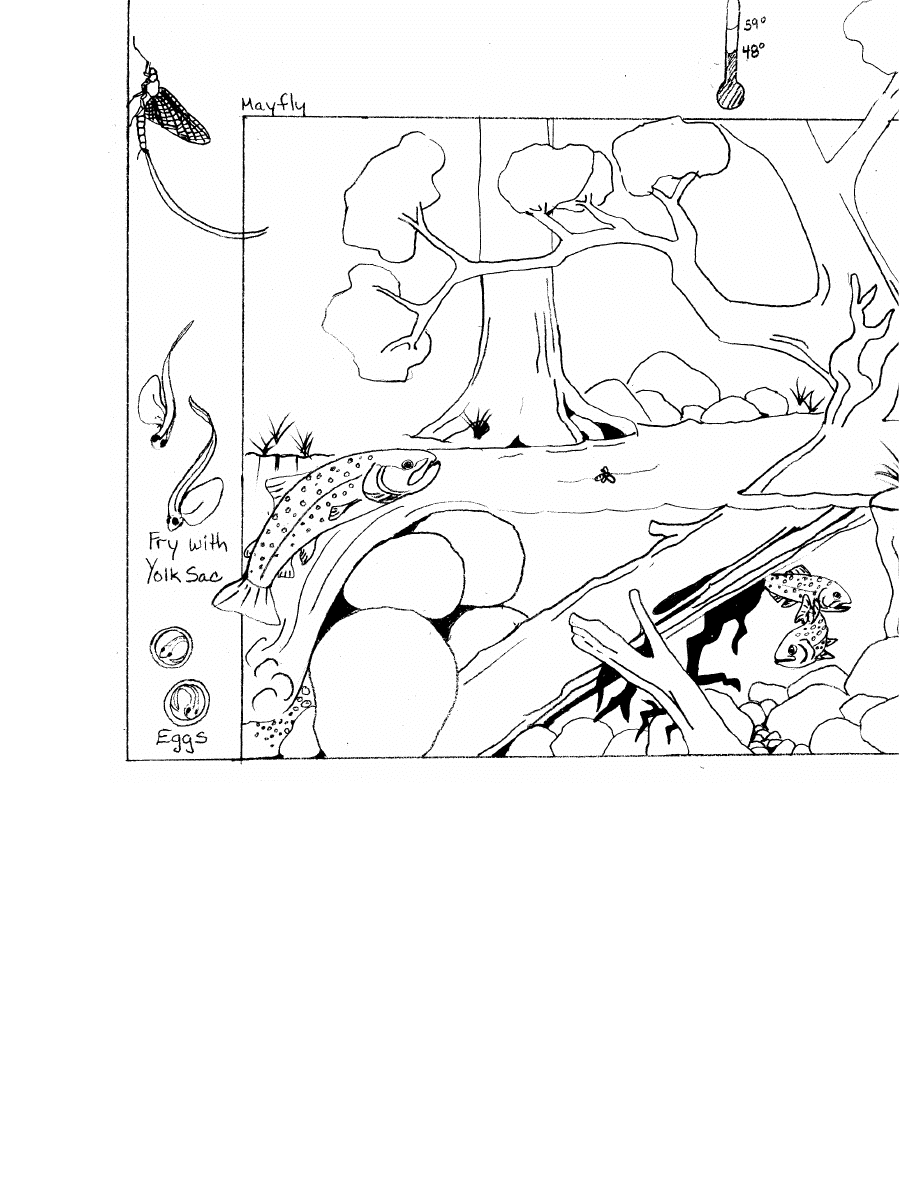
cold water, usually below 59ºF, the coldest required by any trout.
Some bull trout stay in the same stream or lake all their lives, but some
migrate, even to coastal areas. In the fall, when stream temperatures
drop below 48ºF, bull trout spawn on redds. The eggs may take five
months to hatch into fry! Although the young fish eat insects, adults
eat other fish. Migratory bull trout tend to be bigger than the
resident fish because they have access to more food and different
kinds of food. Some bull trout can grow to 2 feet, weigh more than 20
pounds, and live 12 years! As shown in the picture, all life-stages of bull
trout seek cover, including large rocks or fallen trees, deep pools, and
undercut banks, where they hide from predators, keep cool in the
shade, and find food. When mayflies hatch, bull trout jump for joy at
the prospect of one of their favorite foods.
Threats to bull trout include inadequate or poor-quality water that is
warm or polluted over-fishing, and dams or other structures that block
migration routes. For example, too much logging or grazing may allow
large amounts of dirt to fall into a river, making the water muddy and
smothering bull trout eggs by filling the gaps between the gravel in
redds. The Fish and Wildlife Service and timber companies and
ranchers are working to prevent this from happening by planting trees
and other vegetation near streams—that is, riparian buffers—and by
creating off-site watering areas for their livestock.
What can you do? Always know the kind of fish you are trying to
catch — if the trout-like fish does not have black on its dorsal fin, it
may be a bull trout. So remember, “No black, put it back!” Work with
your school or another group to clean up trash, and plant trees along
rivers.

Learning Library
Migrate – To move from one area to another to find food or shelter or
to breed.
Spawn – The term used when fish, amphibians, or mollusks lay eggs.
Redd – A gravel-bed on the bottom of the river or lake where bull
trout lay their eggs.
Fry – The life-stage of young fish in the first few weeks after
hatching.
Dorsal fin – This is the single, large fin on the back of the fish.
To learn more go to:
Bull Trout
Fun Fact
Some redds are as big as
trucks. That’s a lot of fish eggs!

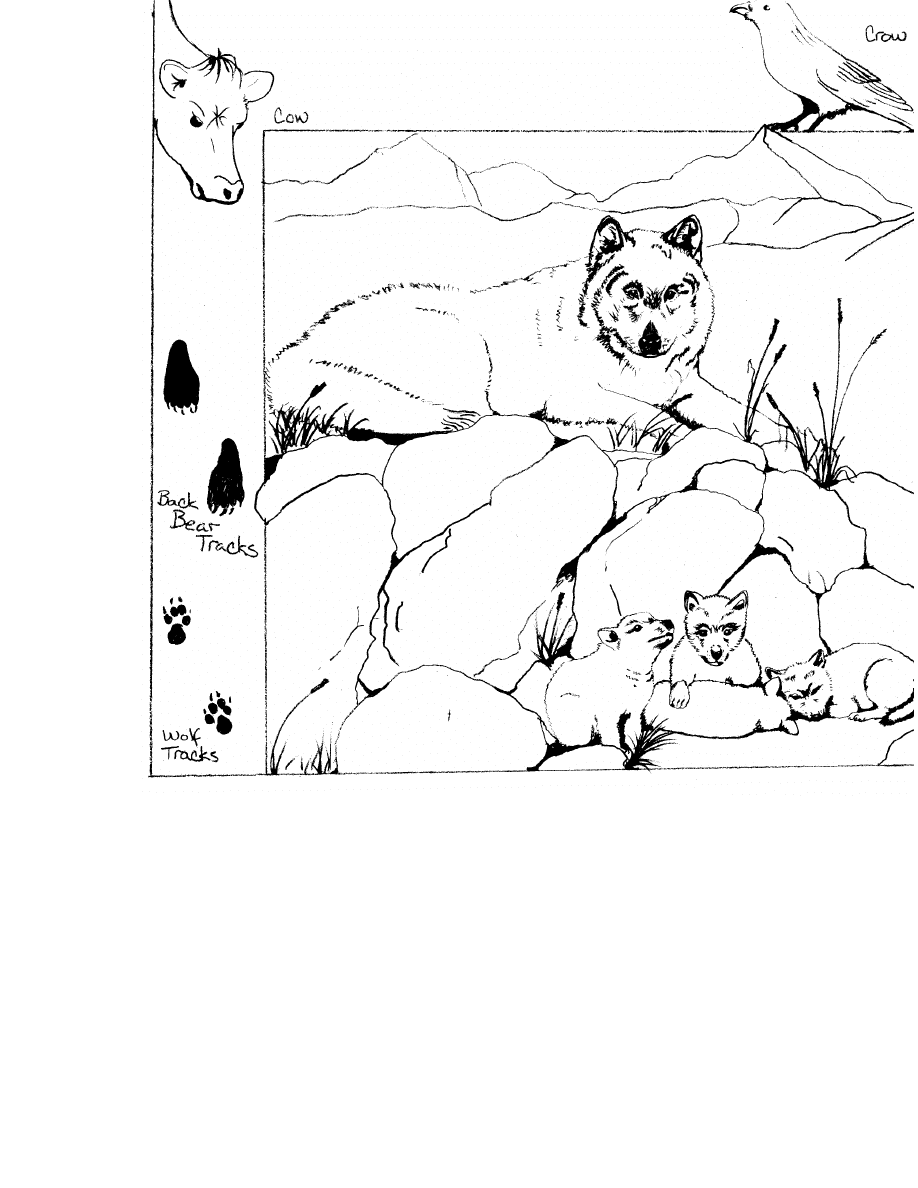
Gray wolf Scientific name: Canis lupus
The gray wolf is a canid with an undeserved bad reputation. Gray
wolves from the Rocky Mountains are on the “road to recovery” and
have recently been reclassified from endangered to threatened. The
Mexican wolf remains endangered. Although gray wolves used to roam
over the mountains, prairies, and forests in much of the United States
and Canada, by 1950, the voice of the wolf had been mostly silenced.
Wolves are like dogs in many ways. They have two fur coats—and wear
them both at the same time. An undercoat keeps the wolves warm, and
an overcoat keeps them dry. Beautiful gray with shades of brown is a
very common color for wolves, but they also come in black and white.
Wolves “talk” to each other, a common practice with pack animals. Not
only do they howl, but they also “talk” by wagging, bowing, and scent-
marking—an easy way for a wolf to tell who was at this spot last!
Wolves are predators, often eating large prey, and when they do,
hunting in a pack helps them get their meal. What the wolf leaves as
leftovers is food for many other species, from the large grizzly bear
to the small crow.
In the west, gray wolves hunted buffalo and elk, but they got scarce,
too. Without buffalo and elk to eat, wolves preyed on cows, an activity
that got them shot and poisoned. Some people killed wolves so they
could wear wolf coats.
Little Red Riding Hood
and
The Three Little Pigs
may just be children’s nursery rhymes, but the idea of the Big Bad
Wolf scared people, and so more wolves were killed. Wolves are shy,
typically avoid people, and are not to be feared. The Canadian wildlife
biologist, Dr. Douglas H. Pimlott, was one of the first scientists to
write a book for parents and children to let them know why wolves did
not deserve their bad reputation.
Because wolf mothers have many pups, sometimes ten—wolves,
protected from guns and poison, have made a remarkable comeback.
The Fish and Wildlife Service and others brought wolves back into
Yellowstone National Park. Gray wolves are again the voice in the

wilderness, and they aren’t saying “I’ll huff and I’ll puff and I blow this
house down;” they are howling to their families.
What can you do? Just what you’re doing! Learn about wildlife.
Learning Library
Canid - A member of the family of carnivorous mammals that includes
dogs, foxes, coyotes, jackals, and wolves.
Pack - A pack of wolves is a grouping of two to 20 animals, including
many family members.
Scent-marking - An animal’s use of scent-glands or urine to mark its
territory.
Predator - An animal that preys on another.
To learn more go to:
Gray Wolf
Fun Fact
I live with my parents,
aunts, and uncles in dens.
Our family is close!

Create your own!
Species common name:
Scientific name:
Species account:
What can you do?

Learning Library
To learn more go to:

Fun Fact
P
P
i
i
c
c
t
t
u
u
r
r
e
e
s
s
f
f
o
o
r
r
Q
Q
u
u
i
i
z
z
1.
5.
2.
6.
3.
7.
4.
8.

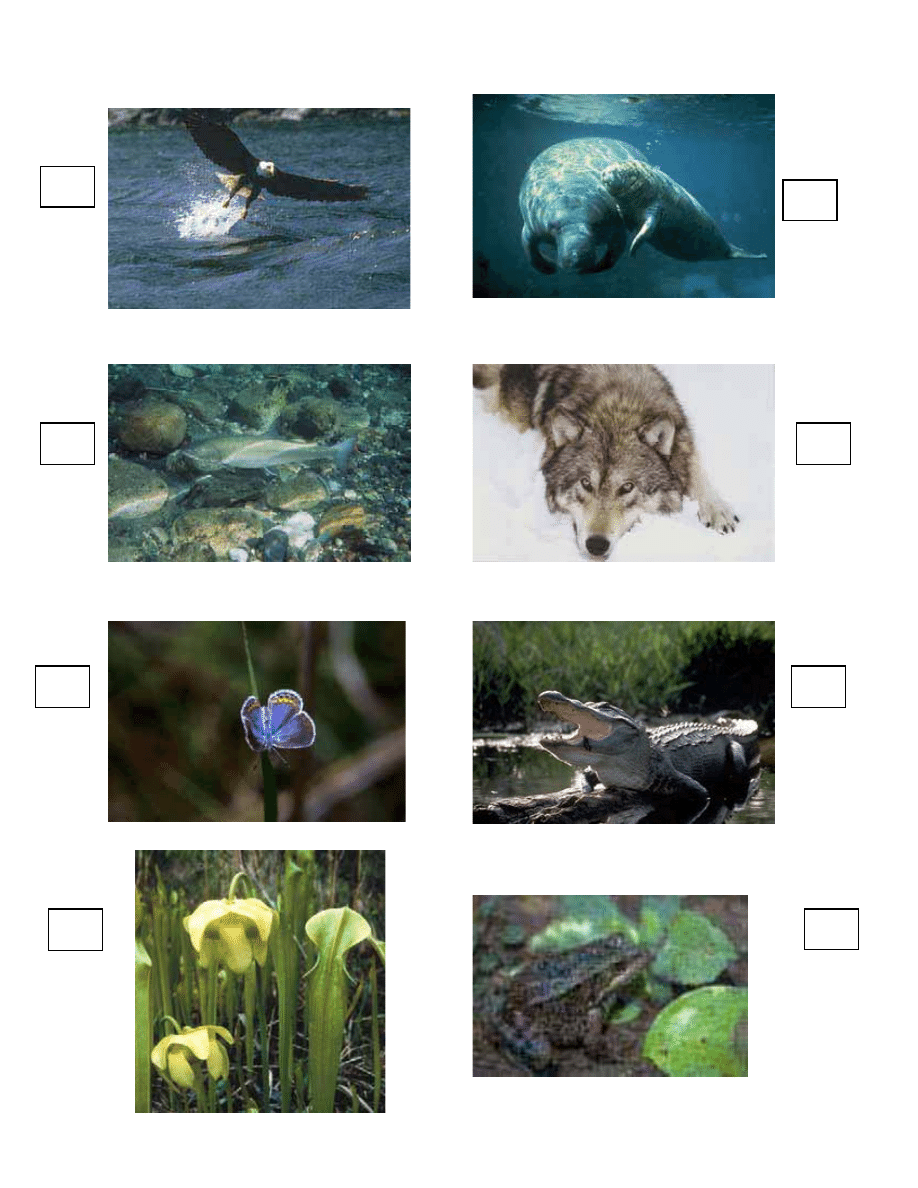
Quiz
Using the pictures on the adjacent page, draw a circle
around the correct species name below. For example, is the picture
labeled #1 a bald eagle, a chickadee, or a robin? Have fun!
1
bald eagle
5
tuna
chickadee
manatee
robin
dolphin
2
shark
6
golden retriever
bull trout
Pluto
Nemo
gray wolf
3
Karner blue butterfly
blue bird
hummingbird
7
Barney the dinosaur
American alligator
sea
otter
4
dandelion
sea
lion
green pitcher plant
8
sea turtle
Kermit
the
frog
California red-legged frog
If you need help, look back through the coloring book or find the answers on the inside front cover!
Florida Manatee
Bull Trout
Karner Blue Butterfly
Green Pitcher Plant
California Red-legged Frog
Bald Eagle
American Alligator
Gray Wolf
Wyszukiwarka
Podobne podstrony:
Wolfe, Gene Endangered Species
ENDANGERED SPECIES EX
Arizona BLM Coloring Book
clean water cadets coloring book
Texas Wildlife Management Area Coloring Book
Dover Coloring Book Constellations of the Night Sky (incomplete)
The Indian Years Coloring Book
columbus coloring book
ColoringChristmasVillage
forex analiza techniczna (e book www zlotemysli pl ) DK3ZOOPY4OOL2LNDIKQIOV6NQ566VKSXSPJLABQ
Encyclopedia Biblica Vol 2 Jerusalem Job (book)
acc book details 080702 132000
coloriage ru
E Book Wprowadzeni do teorii automatow jezykow i obliczen
ebook microsoft sql server black book cff45xf7ii4jb4gq3rzk3uhmzhx5z3u62hytpuy CFF45XF7II4JB4GQ3RZK3
coloring alphabet b
więcej podobnych podstron