
Psicológica (2001), 22, 143-164.
Chess and content-oriented psychology of thinking
Pertti Saariluoma
University of Helsinki, Finland
In this paper a number of principles for content-oriented cognitive
psychology will be presented in the context of research into chess players’
information processing. It will be argued that modern theoretical concepts of
attention, imagery and memory are based on underlying concepts of capacity
and format and that these concepts are not sufficiently powerful to express
all phenomena associated with mental contents. Instead, one must develop a
genuinely content-oriented theoretical language to discuss, for example,
contents and their integration into thinking. The main problem is how to
explain the contents of representations. Why do representations have
precisely the contents that they have. Here the main attention will be
focussed on the question how can one explain the selection of content
elements in representations. To formulate the basic concepts of content-
oriented thought research several issues must be discussed. Firstly, it will be
shown that traditional attention and memory research is capacity-oriented
and therefore unable to express mental contents. Secondly, it will be argued
that there are content phenomena which must be explained by properties of
other content phenomena. Thirdly, it will be shown that in chess, people
integrate information into representations by using functional rules or
reasons, i.e. concepts and rules, which tell why some information contents
must be included in a representation. It will then be shown that people
integrate information around learned ‘thought models’ whose contents,
together with functional rules or reasons, explain and clarify the content-
structure of a mental representation. It will also be argued that the analysis of
contents is metascientifically closer to linguistics with its basic method of
explication and content analysis than natural sciences, which form the most
common underlying model in current experimental psychology. Finally,
content-oriented cognitive psychology and its presuppositions will be
compared with neural and computational approaches to show that it gives an
additional and alternative theoretical resource, but not a contradictory
conceptual platform, to the previous theoretical ways of working with human
thinking.
Key words: content oriented psychology, chess, information processing.
*
Correspondence to: Pertti Saariluoma, Cognitive science, Box 13, Fin-00014 University
of Helsinki, Finland.

P.
Saariluoma
144
Chess provides a compact and easily controllable task environment
and therefore it has over the last few decades called attention of many
psychologists interested in problems of skills and thinking (Anderson,
1978; de Groot, 1965, 1966; Charness, 1976, 1981, 1992; de Groot and
Gobet, 1996; Elo, 1978; Newell and Simon, 1963, 1972; Saariluoma, 1995).
The main goal has mostly not been in understanding chess per se, but in
investigating a number of theoretical issues related to human information
processing, expertise and thinking.
Over the years, psychologists have worked to analyse individual
differences, cognitive skills and thought processes by means of chess. In
individual psychological research, the questions of talent, (Baumgarten,
1930; Doll and Mayr, 1987), age and life span have been regularly studied
(Baumgarten, 1930; Charness, 1981a, b, c, 1985; Chi, 1978; Elo, 1965,
1978; Lehman, 1953; Weinert, Schneider and Knopf, 1987). In addition, the
motivational structures and professional backgrounds of chess players have
stimulated interest among individual psychologists (Fine, 1956; de Groot,
1965; Jones, 1987). Questions of skills entered chess psychology with
Cleveland’s (1907) work on chess players’ thinking and its development,
but the most important work has been on memory and thinking (Djakov,
Petrovsky and Rudik, 1926; de Groot, 1965, 1966). Finally, Newell and
Simon (1963, 1972) created the theoretical concepts of information
processing which made it possible to integrate the diversified theories under
one relatively systematic framework (Chase and Simon, 1973; Shannon,
1950; Turing, 1948, 1950).
The ideas of Newell and Simon (1972, 1976) the took human mind to
be a computing machine or a physical symbols system, and this aroused
enormous enthusiasm among many other researchers (e.g., Anderson, 1976,
1983, 1993, 1998; Newell, 1990, 1992; Kieras and Bovair, 1997). However,
the positive reception was not animous and many cognitive psychologists
and scientists strongly opposed the idea that human mentality is essentially
computing. The systematic critique of the conceptual power of
computational concepts centred on the issues of contents (e.g., Dreyfus,
1972, 1992; Searle 1980).
This computational dispute has always relied on arguments based on
chess players’ psychology (Dreyfus, 1972, 1992; Newell and Simon, 1972).
This is not surprising because the chess tradition as a whole provides a
psychological micro world, which can be used to investigate very
fundamental issues such as the theoretical concepts one should use in
investigating human thinking. The main claim of the opponents of
computational psychology have been that computational concepts lose
something essential about human mentality, and consequently, the power of

Chess and psychology of thinking
145
computational concepts is too low to express all the essential aspects of
human mentality. Be this as it may, the problems are unresolved and we do
not have a clear idea about the possibilities and limitations of computational
models.
Because arguments in this discussion have been so strongly associated
with chess, it is possible to investigate the basis of the computational
psychology of thinking, the validity of the argumentation, and the type of
language one should have when discussing human thought processes in the
context of chess research. The core of all the problems is mental contents.
Computational researchers believe that mental contents can eventually be
explained in computational terms, but opponents claim that this is
impossible (Dreyfus, 1972, 1992; Searle, 1980; Simon, 1996). In this paper,
on the ground of chess research, it shall be proposed that computational
concepts indeed have their limits, but it will also been argued that it is
possible to create content-oriented cognitive language to investigate
problems of mental contents in thinking.
Attention in chess
Attention is an important notion in chess because chess players must
be able to detect various kinds of possibilities and threats. The logic of
chess is clear: Carelessness over one move may destroy hours of good work.
This means that understanding chess players’ information processing
attention is a central topic. As it seems conceptually illogical to think that
we could attend to targets which are not present in stimulus information, I
review here only experiments in which one can have a direct perceptual
contact with a physically present target.
The main systematic outcome of attention experiments has been clear:
experts are superior to novices in picking up information from a board
position. They clearly perceive faster all kinds of chess-specific perceptual
cues. If chess players’ are, for example, asked to detect as fast as possible,
whether one of the kings is checked or not, masters are clearly superior in
speed as well as in accuracy (Saariluoma, 1984, 1985). The same superiority
can be also be found when chess players assess if a mate in one possible
(Saariluoma, 1984).
The results of perceptual classification experiments, such as counting
the number of bishops and knights show that experts notice individual
pieces, threats and even mates more rapidly (Saariluoma, 1984, 1985,
1990a). Experts’ superiority even survives the randomisation of positions
(Saariluoma, 1984, 1985). The only conditions in which experts’ superiority
is not evident, are met when subjects have to calculate the number of pieces
on the board (Saariluoma, 1993).

P.
Saariluoma
146
The experimental evidence provides us with knowledge about the
possible attentional mechanisms involved in chess. The basic mechanism
must be automatization, though it is not achieved by constant mapping but
by decades of varied training (cf. Shiffrin, 1988). However, the core
mechanism cannot be faster activation of piece and threat information in the
memory, because skill differences disappear in the total piece counting task,
in which players need to discriminate the pieces from each other. This
means that the discrimination of pieces has an important role to play in
chess players’ attention.
Undoubtedly, attentional superiority of experts may be an element in
explaining some thought errors, because experts do not make errors in
discriminating important information as novices do. When investigating real
games experts very seldom made errors by leaving pieces en prise, whereas
this kind of errors were very common in novices (Saariluoma, 1995).
However, attention cannot really offer exhaustive explanations, because
there is no information about the selection of relevant targets nor about
search in imagined problem spaces.
Mental images
Attention is a stimulus bound process. This means that the
information that we attend to must be present in a peceivable stimulus. We
cannot attend to atoms, for example. However, the explanatory limitations
of attentional concepts can be surpassed by investigating higher cognitive
processes. Here, the main problem is the function of mental imagery in
chess players’ thinking. When our visual attention pick’s up information
from spatial locations, imagery, if it is involved, should for its part release
processing from the immediate stimulus control.
A major problem for chess psychology has been to show that imagery
processes are involved in chess players’ thinking. Chess players’ intuition
has favoured this explanation, but experimental evidence is slow in coming
(Abrahams, 1951; Blumenfeld, 1948; Krogius, 1976). Of course, this is an
issue which is closely related to the classic imagery debate (Anderson, 1978;
Kosslyn, 1980; Pylyshyn, 1973). If images are involved in chess players’
information processing, then one cannot say that people do not actively use
mental images in thinking. However, if no imagery involvement exists, then
propositional coding is the essence of human thinking in chess.
In a series of experiments, it has been shown that mental
transformation of pieces is an analogical process in which distance plays a
role. However, this role is related to the level of skill. When novices have to
perceive threats between close and distant pieces, there is a correlation
between spatial distance and reaction time, but it is much more difficult to

Chess and psychology of thinking
147
find such correlation with experts (Bachman and Oit, 1992; Church and
Church, 1977; Milojkovic, 1982).
A paradigm which has also provided clear evidence for the active
imagery involvement is visual suppression in the working memory (for the
main features of this paradigm see Baddeley, 1986; Baddeley and Hitch,
1974; Logie, 1995). When working memory experiments have been carried
out, a systematic effect has been that articulatory suppression has very little
if any effect, but visual suppression and central executive secondary tasks
cause substantial impairment in the level of performance (Bradley, Hudson,
Baddeley and Robbins, 1996; Saariluoma, 1989, 1992a,1998).
In addition, experiments in blindfold chess also suggest that people
actively use images in solving chess problems. In blindfold chess, a player
does not see pieces or the board, instead the moves or their opponents are
given verbally to them. Often, a chess player turns his chair 180 degrees so
that the player’s back is towards the board and the opponent says from
which square he or she moves the piece and gives its destination square.
One psychologically interesting form of this memory-based game is
simultaneous blindfold chess in which players play several games at the
same time.
Blindfold chess has been investigated by Binet (1893/1966),
Cleveland (1907) and Reuben Fine (1965). This early research has made
many observations concerning meaningful associations and representations.
Modern research has also been interested in the role of imagery in chess
players’ information processing. Skill differences are very large in this task.
Whereas novices can only follow a few moves in a reading of ten
simultaneous games, experts are able to continue it practically without error
up to at least 35 moves (Ericsson and Stazsewski, 1989; Saariluoma, 1989;
Saariluoma and Kalakoski, 1997, 1998).
Thus, in the light of empirical evidence, imagery involvement seems
to be a fact. It is not feasible to say that imagery is not involved. This raises
a very interesting issue, which was first, discussed in the context of chess by
Anderson (1978). Namely, the relation of propositional and imagery
information in human thinking. What are the roles of these two information
formats in chess thought, when the idea that images are epiphenomenal
cannot be empirically supported?
The problem with the notion of image is that it does not bear on
contents. Mental transformation experiments may show that transformation
depends on analogies with the physical world. However, imagery concepts
do not provide us with information about whether a subject should
transform on the right or on the left. Notions like right and left, bishop or

P.
Saariluoma
148
knight do not thematize in terms of mental images, because they presuppose
propositional knowledge. Contents are outside format (Saariluoma, 1997).
This means that in chess, people cannot really say that either images or
propositional information would be of no use. Rather, the case is that
propositional information provides images with their contents. In the
thinking, imagery debate it seems that the two sides are speaking about
different things. While image theoreticians discuss format, propositional
theoreticians pay attention to the contents. Both are equally necessary and
the whole debate is caused by differences in presuppositions and their
limits.
Chess players’ memory
Memory has been very important in chess psychology for numerous
reasons. Memory is the basis of skills and learning, but memory is also the
very platform for thinking. Consequently, memory concepts can be widely
used in explaining thought-related phenomena and this is a reason why
memory has had such an important position in research into the chess mind.
In memory tasks, expert chess players normally perform much better
than novices. They are superior in recognizing chess positions as well as
random positions (Goldin, 1979; Saariluoma, 1984). Recent research has
also shown that recognition is selective. When chess players are presented
with a position they have seen before and are asked to say which they have
seen before, they can much more easily recognise the new positions where
there are transformations in important areas for game situation than in the
positions where transformation is in less important areas (Saariluoma and
Kalakoski, 1996, 1998). This means that recognition is based on
‘meaningfully’ selective encoding. Obviously, experts’ superiority in
recognizing random positions is also founded on the same principles.
Recognition is important here, because recognition has a role to play
in chess players’ thinking. Recognition activates hypothetical solutions in
the minds of chess players, and experts differ from novices with respect to
the ability to recognize better base moves (Calderwood, Klein and Randall,
1988; Chase and Simon, 1973a,b; de Groot, 1965, 1966; Gobet, 1997,
Klein, 1989; Klein and Peio, 1989; Saariluoma, 1984, 1990, 1995).
Another important property of chess memory has been found in recall
experiments. This is the basic paradigm for studying chess players' working
memory, and the best-known working memory phenomena is the expert
superiority effect in recall. It was originally discovered by Djakov, Petrovski
and Rudik (1926), but it became famous with de Groot’s (1965, 1966) work.
In these experiments, it was shown that chess experts recall chess positions
better than novices. Later in an unpublished investigation by Lemmens and

Chess and psychology of thinking
149
Joongman it was additionally demonstrated that skill differences practically
disappear when positions are randomised (Chase and Simon, 1973; Vicente
and de Groot, 1990). This means that experts’ superiority is based on
familiar piece configurations, which can be used in chunking the presented
positions (Chase and Simon, 1973; Gobet and Simon, 1996, 1998; Miller,
1956).
Subsequent analyses have shown several additional properties of
chess memory. Charness (1976) found that secondary tasks do not impair
recall (Frey and Adesman, 1976; Lande and Robertson, 1979). Only during
the encoding stage, might secondary tasks infer chess memory (Robbins,
Anderson, Barker, Bradley, Fearnyhough, Henson, Hudson and Baddeley,
1996; Saariluoma, 1989). It has also been found that the locations of the
pieces rather than the form of chunks are important in swift storage of the
positions (Gobet and Simon, 1996; Saariluoma, 1984, 1994, Saariluoma and
Kalakoski, 1997, 1998). Moreover, the number of chess positions is very
large, which can be shown by blindfold chess or position memory
experiments (Gobet and Simon, 1996; Saariluoma, 1989). Finally, it has
also been shown that when chess players have sufficient time they can also
remember randomised positions better (Lories, 1987; Saariluoma, 1989).
The results imply firstly that there is no difference per se between the
memories of masters and novices; the difference with masters is the number
and size of the patterns learned during a ten-year-long period of training
(Chase and Simon, 1973; Ericsson and Lehman, 1996; Hayes, 1981). They
also imply that chess players do not store chess positions into the short-term
working memory but into the long-term memory or rather into the long-term
working memory (Ericsson and Kintsch, 1995). Finally, the encoding is
based on a perfect match between chunks in the long-term memory
representation and board position.
Apperception and content integration
The next questions in investigating chess players’ thinking are what
are the content-elements in representations and how they are selected and
integrated. Attention and memory psychologies do not provide much
information to answer this kind of strongly content-oriented problems. The
basic notions of capacity and format are not sufficiently powerful in
expression to allow one to discuss problems of contents integration in
representations (Saariluoma, 1997). This also means that they provide only
partial answers to the problems of selectivity in thinking (Saariluoma,
1995). To understand the problems of content integration, one must find
new theoretical concepts.

P.
Saariluoma
150
To begin, this work we need revisiting the standard intuitions which
have for a long time dominated chess psychology (de Groot, 1965). Expert
chess players ‘see’ chess positions differently from novices. Whereas
novices only see a set of pieces experts concentrate on intellectually and
emotionally satisfactory ideas. Naturally, it is cognitively very interesting to
discover how one can explain what experts and novices see in chess
positions, because it gives us information about the nature of information
selection and integration into human mental representations.
Chess players’ "seeing" cannot be object perception or attending.
Their "seeing" is not modality specific but they can imagine visually or
auditorily presented chess positions as well as they can normal positions
(Saariluoma, 1989, Saariluoma and Kalakoski, 1998). The contents of
"seeing" are thus quite independent of the perceived stimulus content and
the arguments against taking "seeing" as object perception are clear and self-
evident.
Consequently, the ambiguous term "see" is best to be replaced by the
classic term apperception (Kant, 1781; Leibniz, 1704; Stout, 1896; Wundt,
1880). Apperception refers to the conceptual perception or construction of
representational contents (Saariluoma, 1990, 1992, 1995; Saariluoma and
Hohlfeld, 1994; Saariluoma and Kalakoski, 1998). It assimilates the
perceptual stimulus and conceptual memory information into a semantically
self-consistent representation that is characteristic of the human mind.
Apperception is thus a content-integrating process. Apperception
determines which semantic elements of conceptual memory and of the
stimulus information can be and should be integrated into the prevailing
representation. The contents of apperceived representations need not be
directly related to the stimulus environment. To introduce empirical
contents into the notion of apperception in chess one must investigate, how
chess players select the relevant contents in a stimulus among all the
possible alternative paths in a problem space (Saariluoma, 1990, 1992,
1995, 1998; Saariluoma and Holhfeld, 1994; Saariluoma and Kalakoski,
1996, 1998).
Chess, like most games, has a tree structure, in which all the possible
move series in a position form a basic problem space (Newell and Simon,
1972). However, this tree is normally far too wide to be searched by the
human mind and therefore apperception abstracts a few, small problem
subspaces around which chess players’ problem solving is organised
(Saariluoma, 1990, 1992, 1995). These problem subspaces have been called
mental spaces (Saariluoma, 1995). To understand apperception thus means
to have a clear idea about the content-specific selective and integrative
Chess and psychology of thinking
151
mechanisms involved the mental space abstraction. It means an answer to
the question why are precisely these moves relevant in this mental space.
The content structure of mental spaces
To open the content-structure of mental spaces it is good to begin with
the defender who attempts to parry the attacker’s actions. This action
necessarily runs through a set of squares and this set can be called the path.
Obviously only those moves make sense which can bring a piece into the
path and thus prevent the intentions of the attacker. The role of these two
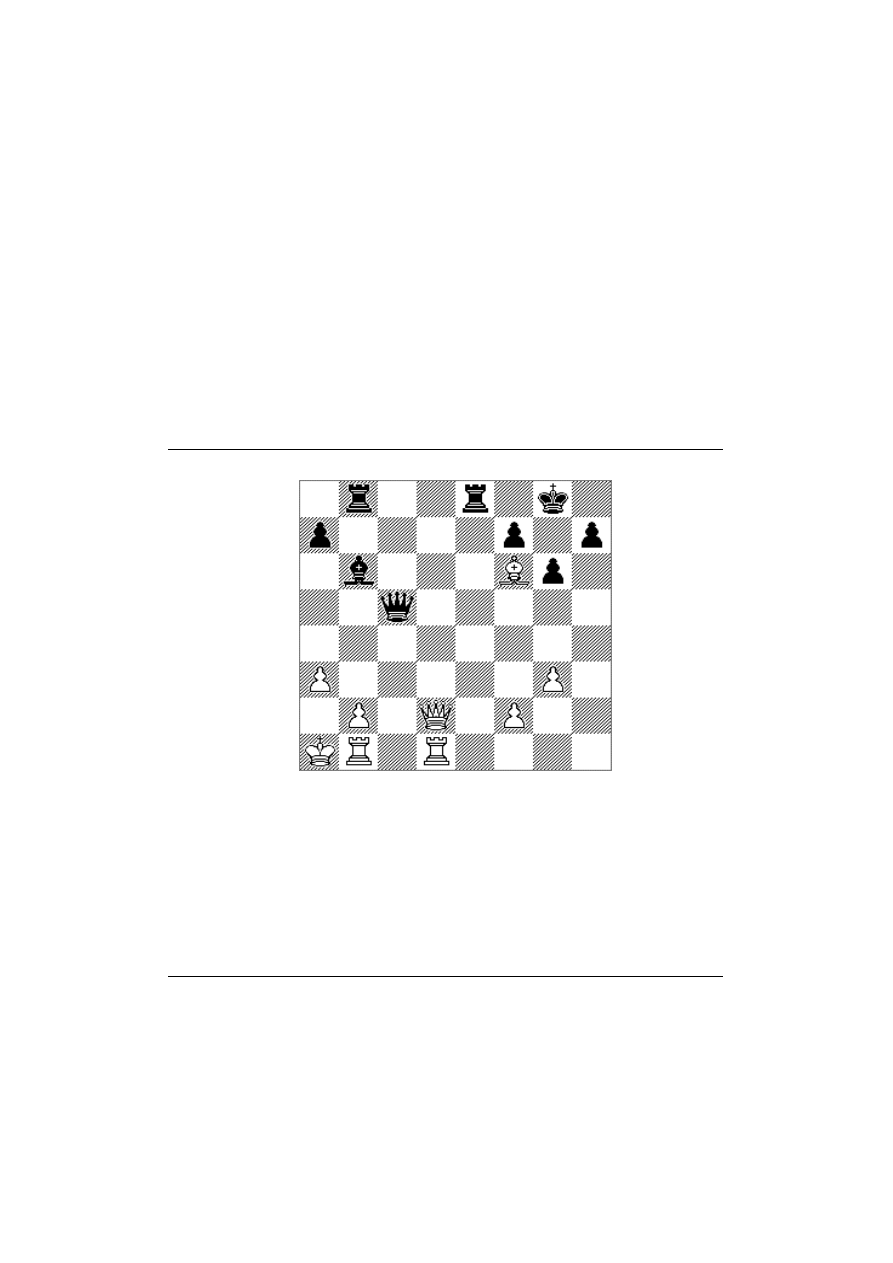
mechanisms in organising the defender’s moves is explicit in following
example in Figure 1.
8
7
6
5
4
3
2
1
A
B
C
D
E
F
G
H
Figure 1. An episode by subject NN in the position and the move types.
Qh6 (transfer to threat g7), Qf8 (exchange in g7),
Qxh7 (check and transfer to threat Qh8 mate), Kxh7 (exchange)
Rh1 (threat), Qh6 (blockade)
Rxh6 (exchange), Kg8 (escape)
Rh8 checkmate
(Other possible moves would also lead to a checkmate)
The defender's moves in the example can thus be divided into four
main types: exchange, blockade, escape and counter-action. Exchange
means a move by which the defender can take one of the attacker’s active

P.
Saariluoma
152
pieces, blockade refers to a move that brings a piece between the attacker’s
initial and destination square, escape means that the target escapes. Finally,
counter-action refers to any action which has more important goal that the
one of the attacker, so that the attacker must abandon his current plan.
These move types define content-specific constraints for the
generation of all defenders' moves. Only moves of these types may make
sense in trying to parry the attack, and all the subjects in all protocols
generate moves drawn from these four types for their defence. It means that
the functions of the four types of moves bringing pieces into the path
explain the senseful structure of mental spaces in protocols. Moreover, the
moves of the four types also explain the size of mental spaces. In practice,
only a few moves in a position may fulfil one of these criteria, and this is
why the mental spaces are so small and compact compared to computer-
generated search spaces (Saariluoma, 1990, 1995, Saariluoma and Hohlfeld,
1994).
Interestingly, it is possible to show that the attacker’s moves in
protocols also have a very similar content-specific logic as defender’s
moves. They also fill their functional criteria. The attacker always attacks
something, either a specific square or a small set of specific squares. These
squares and the pieces in these squares can be called target squares and
targets respectively. The square(s) in which the target is located can be
called a target square. Concerning the functional structure of a mental space,
the target-square is the most vital square on the board. The attacker must get
some piece into that square in order to reach the goal, and therefore the
target’s square spans the attacker's path and the selection of moves in a
mental space.
Let us assume that this target is the king. In a real game position, the
king can normally be threatened only by a few pieces, if it can be threatened
at all. These pieces cannot threaten the king from any square, but they can
only attack the king from a few free squares. Let us term these squares "key
squares". To threaten the king, a piece must be able to move into a key
square. In practice, the attacker's pieces do not have unlimited opportunities
to do so. The key squares must be free for the attacker's pieces so that it is
not exchanged or blockaded before it can reach the destination, and
typically, the number of such squares is small. The target and key squares
help us now to derive a classification scheme for the attacker's relevant
moves.
A move whose current end-square is not the final goal for the moving
piece in the move network can be called a transfer move. A move to a key
square which has the aim of occupying another square can be called a threat.
Further, a transfer move which is intended as a threat, e.g. to take a piece,
Chess and psychology of thinking
153
can be called a transfer for threat. To occupy a key square and make a threat,
one must be able to transfer piece(s) into key square(s). The piece cannot,
however, be transferred via squares which an opponent is able to defend. An
opponent must not be able to exchange the key piece or blockade it, nor can
the opponent exchange or blockade some of the supporting pieces. This
means that senseful transfer moves do not have much freedom on a board,
because the key piece(s) must be transferred to the key squares along a safe
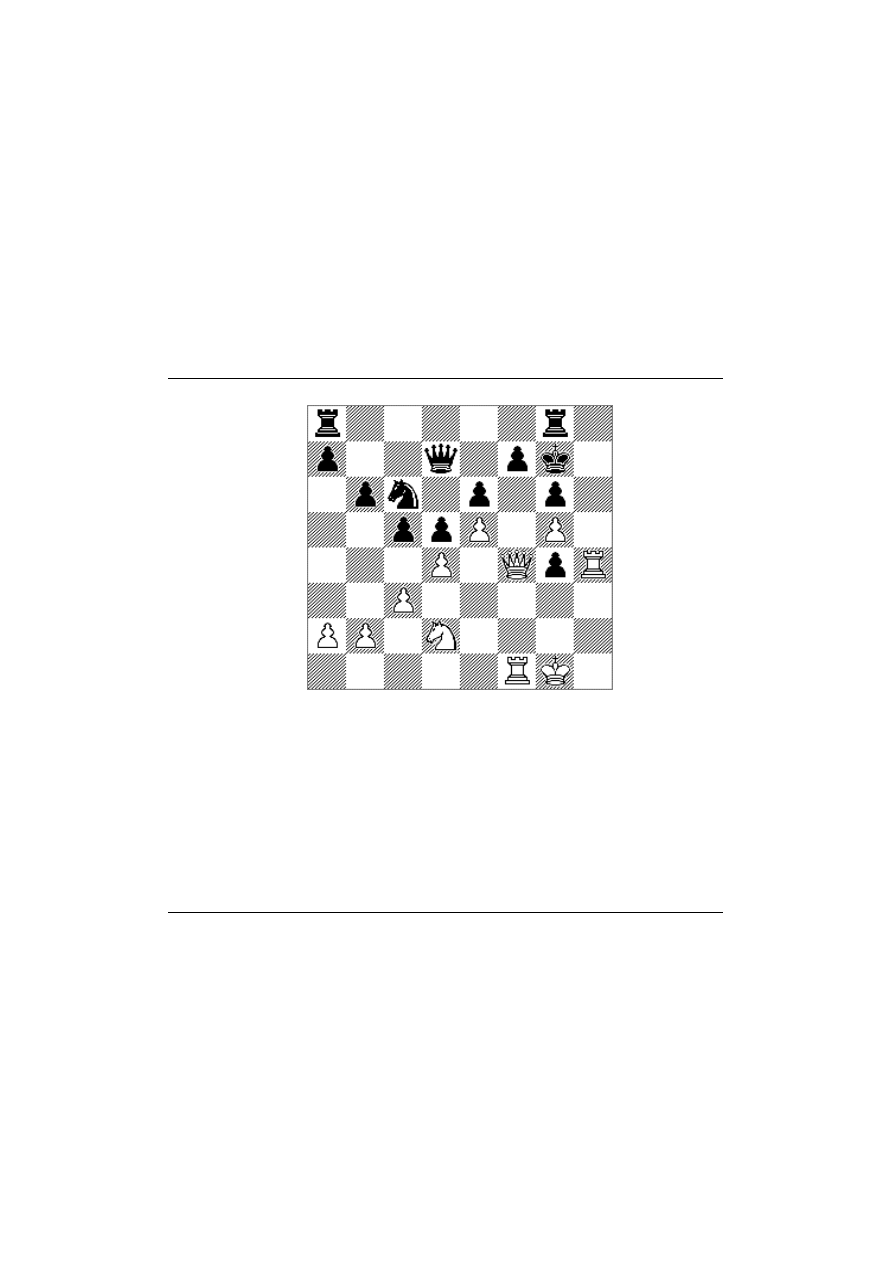
path. Let us take another example, in Figure 2.
8
7
6
5
4
3
2
1
A
B
C
D
E
F
G
H
Figure 2. Position, protocol, key squares and path.
Protocol: Well, this is so that.. Yes...Rh7+ (threat) Kf8 (escape) is impossible
because white has three pieces, which can take (f7 exchange.), so the only
move is Kxh7 (threat; Kxh7 omitted in original protocol). Qh2 (threat) and
black must play Kg7 (escape), Qh6 mate.
The key squares for white h7, f7, h2, h6. The crucial key square is h6. The
rest of the squares such as a2 are of secondary value here.
Path squares: h2,h3,h4,h5,h6,g7,f7,f4,g3.
If it is black’s move, knight d8 (exchange) could support f7 and the whole
combination would collapse.
The location of the target thus spans the attacker's path. It determines
both the possible squares for transfer and the key squares. The key square
must be free or it must be freed by some preliminary operations. This means
that the defender must be unable either to exchange an attacker's key piece,
or to blockade the attack, and the path to the key and target squares must be
free. The number of such squares and corresponding operations, i.e. moves

P.
Saariluoma
154
reaching the key squares, is always very small. The pawn chain, the fields of
threat of the pieces, and the location of the target greatly constrain the
attacker's senseful moves. He cannot reach the target squares as he wishes,
but must instead find or create a system of weaknesses in the opponent's
camp.
The same simple principles are also valid when the target is some
other piece than the king. The target may equally well be the opponent's
piece, pawn, or just an empty square. Even in restriction type cases in which
one tries to control the whole system of the opponent's squares, the control
of the restricting piece must be located in a key square, and the occupation
of this square spans the move network in a mental space. From here
onwards the presented content-specific criteria will be called functional
constraints, because they select the relevant moves to mental spaces on the
functional grounds.
A set of found functional constraints directing move generation is
presented in Table 1. The explanatory efficiency of these constraints can
even be tested by computer simulation, which produces practically identical
mental spaces as the ones generated by human beings (Saariluoma, 1995).
Table 1. Functional constraints for mental space spanning (Saariluoma,
1995).
Transfer (tr)
a piece is moved to get it to the path by some subsequent move
Exchange(ex)
an active piece is taken
Blockade (blo)
an active piece is prevented from achieving a key square by placing
a piece between its original and destination square
Escape (es)
the target piece is moved to another square
Pin (p)
an active piece is prevented from moving, by placing a piece so that
its movement is illegal (absolute pin) or would be too costly
(relative pin).
Unblockade (ubl)
a piece is moved to allow some other piece to make an active move
Clearance (cl)
an enemy piece supporting some key square is exchanged or forced
to lose the control over a key square
Decoy (dc)
A target piece is forced to move into an undesirable square
Threat (thr)
a piece is moved to achieve a goal in the next move
Counter-action (ca)
any move which is made to achieve some independent goal
The surprising thing in these constraints is their explanatory power.
They can explain the calculation process in any protocol we have met so far,
and they can explain precisely the size of human problem subspaces in any
chess protocol. Since the number of constraints found so far is small, it is

Chess and psychology of thinking
155
evident that they tell something essential about how apperception works in
constructing meaningful representations in chess. It may be possible to find
some additional rules, but it does not change the principles of content
integration in chess players’ apperception.
Thought models
In order to use the apperception research in chess as a prototype for
content-oriented cognitive psychology we must introduce one further
theoretical concept. This is called a thought model. It has been argued that
in a chess position a chess player recognises a familiar piece configuration
and an associated set of moves (Saariluoma, 1984, 1990, 1995). This kind
of a piece configuration or pattern and several associated moves can be
called a thought model. Recently, Gobet (1997) has also made similar
theoretical conclusions with somewhat more computer-oriented
terminology.
On the grounds of protocols one can claim that chess players’
apperception is organised around thought-models (Saariluoma, 1984, 1990,
1995). Chess players recognise familiar models in a position and integrate
the relevant moves following functional constraints. Thus, functional
constraints explain the selection of moves in a particular problem position.
Only, in very rare cases and with absolute novices is the process
independent of thought patterns and but these cases are relatively rare
(Saariluoma, 1990).
A thought model consists of a characteristic piece configuration and a
set of associated moves. Chess players’ often call them themes of
combination and often have specialised names for them. Smothered mate,
Damiano’s mate Epaulette’s mate etc. are typical names for thought models
in chess (Saariluoma, 1984, 1990, 1995). Attempts have been attempted
made to simulate them by means of templates (Gobet, 1997).
Thought models control human information processing in several
ways. They are learned and form an essential part of chess experts’
knowledge storage. The better the player the more he or she has such
models. They are activated by recognition (Gobet, 1997; Saariluoma, 1984,
1990), but apperception can combine and embed these models into more
complex structures (Saariluoma, 1984). Nevertheless, their main function is
that they define the paths organising information integration. Models are not
completely similar from one position to other, but it is primarly necessary to
check whether the problem subspace activated by a thought model can be
realised. However, the moves which may refute the problem space are
selected by given functional rules (see Table 1).

P.
Saariluoma
156
Thought models can be seen as a specific type of mental models
(Johnson-Laird, 1983). They are content and task-specific models, which
are used by apperception to organise human thinking. As a whole, the
presented system of functional constraints and thought models explains why
human problem subspaces have the kind of structure they do. These
concepts also explain the compactness of human search spaces.
Explaining contents by contents
The final topic of this discussion will be more general by nature.
Instead of going into further details of chess players’ information selection
by means of presented principles, attention is called to the
metapsychological consequences of empirical findings in chess. In fact, the
way problem spaces and apperception are analysed has some characteristic
features, which can be used to discuss the bases of content-oriented thought
research, namely research, which works to explain content-based selectivity
and information integration in human thinking.
The presented explanatory model for information integration in chess
players’ thinking is based on the idea that mental contents in psychology are
explained by other contents. It is the representational contents which justify
the selected content elements. There are constraints which explain why the
moves make sense or why they are senseful or ‘meaningful’. The functional
constraints, nevertheless, are not merely causal, they are reasons or to be
more accurate functional reasons by nature. In a chess move making sense
in a mental space means for a chess move that there is a reason or a set of
reasons which justifies that move. It is the contents of the explicated
functional constraints and thought models, which explain the generated
moves, and thus investigating contents of representations presupposes
explicating the underlying thought models and the systems of functional
constraints, which explain the selection of the moves into representations.
One may now wonder whether this kind of highly chess bound model
can be used to form the basis of content-oriented psychology of thinking.
Contents, after all, can be so different. As Hunt (1991) put it, chess cannot
be relevant for any theory of contents, because contents are so domain
specific. However, we can use chess to build conceptual tools for
investigating contents and this is what has been done in this paper
(Saariluoma, 1995). Indeed, when we take a closer look it is very easy to see
that the two basic theoretical concepts, thought models and functional
constraints are very commonly met in human thinking.
Thought models are by nature complex sets of associated elementary
actions, which people have learned. Large parts of our knowledge used in
thinking is organised around such wholes. An architect planning a house,

Chess and psychology of thinking
157
for example, knows that he must have walls, windows, parking lots etc. He
or she has a scheme of the required elements. However, to adapt his original
model to the reality, he must follow principles that make sense and these
rules are functional in nature (Saariluoma and Maarttola, in prep). He or she
must resolve, for example, how light and the noise of traffic must be taken
into account as well as the demands for elasticity of structures (cf. e.g.,
Russell, 1981 e.g., p. 263).
When thinking of the history and position of the notion of reason in
investigation into human thinking since the classical times, it is clear that
this concept is essential in research into human thinking. Reasons explain
why medical doctors use lancets to open tissues and why they use narcotics.
Their actions have goals, and reasons explain why the subparts make sense
in the structure of representations. Consequently, cognitive psychology
should have a much deeper understanding of how to investigate these
knowledge structures and it is one goal for content-oriented cognitive
psychology to reveal these systems of mental contents to improve our
understanding of mental representations.
The levels of explaining mental contents
To close our argument about explaining by contents, it is necessary to
find a place for content-oriented thought research. Of course, it is important
to understand the contents of thoughts, because thoughts always have some
contents. Explaining is undoubtedly the key, because various issues of
mental contents can be explained by very different types of approaches,
which fortunately seem to be effective with somewhat different phenomena.
Indeed, the simple expression "explaining by" is one of the conceptual tools
in comparing the traditions.
A natural way of explaining contents could be provided by
neuroscience. It is clear that neurochemistry or physiology have a very
important role among psychological explanations. However, they seem to be
relatively ineffectual when problems like the integration of mental spaces
are discussed. Indeed, there are fundamental reasons which greatly limit the
use of neural explanations when mental contents are analysed (Saariluoma,
1999). Brains are a relatively open modifiable system, and this is why only
their interaction with various environments can provide them with their
information contents. We have a brain-based ability to learn languages, but
this does not mean that the languages we speak can be explained in terms of
this ability. Brains simply cannot predict their environment, and hence there
is no way one could exhaustively explain mental contents of thought in
biological concepts.

P.
Saariluoma
158
Similarly inadequate are common capacity and format-based cognitive
explanations. Even though it is true that our working memory has the
capacity of only a few units, this capacity can be filled with an infinite
number of mental contents. Consequently, capacity cannot explain contents,
and of course, the same is true with format such as mental images
(Saariluoma, 1997). Imagery ability does not either explain mental contents.
The main field of investigating mental contents has been simulation.
However, even simulative models entail problems in giving a full account
of contents. They are formal structures, which abstract contents and
therefore a number of difficult problems arise. The most problematic issue
is the relevance of the selected contents elements. As is well known formal
systems cannot decide which contents elements belong to each other. The
programmer must always decide the relevance of the particular contents of
elements (Saariluoma, 1997). Consequently, models have not been able to
solve such relevance-related problems as frame problem, match, conflict
resolution and exponential growth.
Even explaining by semantics is conceptually too modest an approach
for the type of content-specific explaining used concerning the sensefulness
and coherence of mental spaces. This may sound odd and controversial, but
contents and semantics are two different things. By knowing all the
semantic rules of a language one cannot generate a single representational
content. Semantic explaining typical of semantic networks, for example,
cannot give a precise account of mental contents. The semantics of any
language is not sufficiently powerful to explain the contents of thoughts. In
fact, mental contents can never be described exhaustively in terms of
language.
This means that the main explanatory model used in chess is
explaining by contents. The contents of the rules and thought models are
used to explain some psychological phenomenon. In this case a set of
implicit content rules are used to explain the structure of representation. Of
course, this means that in any chess representation one can use these rules to
predict the structure of the search process. Naturally, this is a special case,
but it may give information about the nature of psychological explanations.
The key point in the discussion of explaining is to point out that our
theoretical concepts have limited powers of expression (Saariluoma, 1997).
Of course, the problems in the scope of scientific concepts have been known
since the time it was shown that the sides and diameter of a square cannot
be expressed by means of natural numbers. Similarly, there are reasons why
neural language cannot provide us with an exhaustive explanation of mental
contents. On the other hand, there are problems which are not resolvable
without a good understanding of contents. Therefore, it is important to work

Chess and psychology of thinking
159
with the small pieces of understanding that we have about explaining by
contents.
CONCLUSIONS
Human chess players' apperception works with previously learned
thought models and follows, when generating mental spaces, very simple
functional constraints defining relevant moves. The recognised thought
models set the goals for search, and functional constraints explain the
generated moves. This mechanism tells why subjects do not generate more
than ten to a hundred moves for positions in which computers would
generate millions of alternatives, but it also explains why some moves are
selected and why some other moves are neglected.
The number of moves fulfilling the functional constraints is always
very small compared to all possible moves. The whole economy of chess
players' apperception is based on these very simple principles. They define
what is essential and what is not in a network of moves. Neglecting one
move, which does not fulfil the content-specific constraints is not
significant, but neglecting a relevant move may jeopardize the problem
solving process. Moves are senseful only if they are designed to parry or to
aid some operation and hence fulfil the functional constraints for relevant
moves. Consequently, the presented principles can be used to explain the
nature of search moves.
Interestingly, the functional constraints presented here are not widely
known among chess players. Types of defence moves and by and large also
the attacker's moves cannot be found in chess books. They are too primitive
to have a prominent place in chess theory. Nor can they be found in
protocols. Yet chess players use them all the time when calculating
variations. This means that human apperception often uses unconscious or
implicit primitive principles in separating the essential from the inessential.
The use of unconscious content-specific principles is probably the most
interesting aspect of the constraints on moves, because it raises the question
to what degree human apperception is based on similarly unconscious task-
specific principles.
The concepts of content-oriented cognitive psychology have also
important theoretical consequences. An almost standard argument against
cognitive psychology is that it is internal. It does not take into account
cultural connections. The explanation for the ahistorical character of
modern cognitive psychology is the very clear biological origin of capacity-
based explanations. Cognitive structures determining the limits of capacity
in attention and memory are independent of culture and history, because

P.
Saariluoma
160
they are biological structures. However, mental contents are different,
because they depend on culture (Saariluoma, 1995). Therefore, content-
oriented thinking provides theoretical concepts for investigating mental and
internal processes in cultural and historical contents.
In sum: Chess players’ apperception uses content-specific and
unconscious principles to provide mental spaces with senseful structure.
Only information which fulfils the constraints is accepted. Thus, chess
players' apperception is an example of content-specific information
selection in thinking. The explanation of information selection is based on
the senseful structure of the representations, and not on capacity or some
other principles. This means that content-specific psychology is basically
the explication of the partly unconscious apperceptive mechanisms, which
create the logical structure and contents of human mental representations.
RESUMEN
En este artículo presentamos un conjunto de principios que definen la
psicología cognitiva orientada hacia el contenido. Estos principios se
presentan en el contexto de la investigación realizada sobre la forma de
procesamiento de los jugadores de ajedrez. En el artículo se defiende que los
conceptos teóricos de atención, imagen mental y memoria están basados en
los conceptos de capacidad y formato, y que éstos no son lo suficientemente
poderosos para expresar los fenómenos asociados a los contenidos mentales.
Por el contrario, es necesario desarrollar un lenguaje teórico que esté
genuinamente orientado hacia el contenido para poder discutir, por ejemplo,
los problemas de contenido y su integración en el pensamiento. El principal
problema es cómo explicar los contenidos de las representaciones ¿Por qué
tienen las representaciones los contenidos que tienen?.Aquí focalizaremos la
discusión en la manera en que se puede explicar la selección de elementos
contenidos en la representación. Para formular los conceptos básicos de la
investigación sobre el pensamiento orientado hacia el contenido se han de
discutir primero varios puntos. Primero, se mostrará que la investigación
tradicional sobre atención y memoria está orientada hacia la capacidad y, por
tanto, no es capaz de expresar los contenidos mentales. En segundo lugar, se
defiende que hay fenómenos referidos al contenido que se tienen que
explicar mediante otros fenómenos relacionados con el contenido. En tercer
lugar, se muestra que en ajedrez, las personas integran la información en
representaciones mentales a través de reglas funcionales o razones que
especifican por qué algunos contenidos deben incluirse en la representación.
Finalmente se muestra que las personas integran la información alrededor de
"modelos de pensamiento" cuyos contenidos, junto a las reglas funcionales o
razones, explican y clarifican la estructura de contenido de la representación
mental. Se defiende también que el análisis del contenido es meta-
científicamente más similar a la lingüística, con sus métodos básicos de

Chess and psychology of thinking
161
explicación y análisis de contenidos, que a las ciencias naturales, que es el
modelo que mas comúnmente subyace a la psicología experimental actual.
Palabras claves: Psicología orientada al contenido, ajedrez, procesamiento
de información.
REFERENCES
Anderson, J. R. (1976). Language, memory, and thought. Hillsdale: Erlbaum.
Anderson, J. R. (1978). Arguments concerning representations for mental imagery.
Psychological Review, 79, 249-277.
Anderson, J. R. (1983). The architecture of cognition. Cambridge, Mass.: Harvard
University Press.
Anderson, J. R. (1987). Skill acquisition: Compilation of weak method problem solutions.
Psychological Review, 94, 192-210.
Anderson. J. R. (1993). Rules of the mind. Hillsdale, NJ: Erlbaum.
Anderson, J. R. & Lebiere, C. (1998). Atomic components of thought. Hillsdale: NJ:
Erlbaum.
Bachmann, T. and Oit, M. (1992). Stroop-like interference in chess players' imagery: An
unexplored possibility to be revealed by the adapted moving-spot task.
Psychological Research, 54, 27-31.
Baddeley, A. D. (1986). Working memory. Cambridge: Cambridge University Press.
Baddeley, A. D. and Hitch, G. (1974). Working memory. In G. Bower (ed.), The
Psychology of Learning and Motivation, vol. 8. New York: Academic Press, 47-89.
Baumgarten, F. (1930). Wunderkinder (Der 8 jährige Schachwunderknabe). Leipzig:
Barth. [Exceptionally talented children]
Binet, A. (1896/1966). Mnemonic virtuosity: A study of chess players. Genetic Psychology
Monographs, 74, 127-164.
Calderwood, B., Klein, G. A. and Randall, B. W. (1988). Time pressure and move quality
in chess. American Journal of Psychology, 101, 481-493.
Charness, N. (1976). Memory for chess positions: Resistance to interference. Journal of
Experimental Psychology: Human Learning and Memory, 2, 641-653.
Charness, N. (1977). Human chess skill. In P. W. Frey (Ed.), Chess skill in man and
machine, New York: Springer, 34-53.
Charness, N. (1979). Components of skill in bridge. Canadian Journal of Psychology, 33,
1-16.
Charness, N. (1981a). Aging and skilled problem solving. Journal of Experimental
Psychology: General, 110, 21-38.
Charness, N. (1981b). Search in chess: Age and skill difference. Journal of Experimental
Psychology: Human Perception and Performance, 7, 467-476.
Charness, N. (1981c). Visual short-term memory and aging in chess players. Journal of
Gerontology, 36, 615-619.
Charness, N. (1985). Aging and problem solving performance. In N. Charness (ed.), Aging
and human performance, New York: Wiley, 225-259.
Charness, N. (1992). The impact of chess research on cognitive science. Psychological
Research, 54, 4-9.
Chase, W. G. and Simon, H. A. (1973a). Perception in chess. Cognitive Psychology, 4, 55-
81.
Chase, W. G. and Simon, H. A. (1973b). The mind's eye in chess. W. Chase (ed.), Visual
information processing. New York: Academic Press, 215-281.

P.
Saariluoma
162
Chi, M. T. H. (1978). Knowledge structures and memory development. In R. Siegler (ed.),
Childrens' thinking: What develops? Hillsdale: N.J.: Erlbaum, 73-96.
Church, R. M. and Church, K. W. (1977). Plans, goals, and search strategies for the
selection of a move in chess. In P. W. Frey (ed.), Chess skill in man and machine.
New York: Springer.
Cleveland, A. A. (1907). The psychology of chess. American Journal of Psychology, 18,
269-308.
Djakov, I. N, Petrovsky, N. B. and Rudik, P. A. (1926). Psihologia Shakhmatnoi Igry.
(Chess psychology). Moscow: Avtorov.
Dreyfus, H. L. (1972). What computers can't do? New York: Harper.
Dreyfus, H. L. (1992). What computers still can't do? Cambridge, Mass: MIT-Press.
Ericsson K. A. and Kintsch, W. (1995). Long-term working memory. Psychological review,
102, 211-245.
Ericsson, K. A. and Lehman A. (1996). Expert and exceptional performance: Evidence of
maximal adaptation to constraints. Annual Review of Psychology, 47, 273-305.
Ericsson, K. A. and Staszewski, J. (1989). Skilled memory and expertise: mechanisms of
exceptional performance. In D. Klahr and K. Kotovsky (eds.), Complex information
processing: the impact of Herbert A. Simon. Hillsdale, N.J.: Erlbaum, 235-267.
Frey, P. W. & Adesman, P. (1976). Recall memory for visually presented chess positions.
Memory & Cognition, 4, 541-547.
Gobet, F. (1997). A pattern-recognition theory of search in expert problem solving.
Thinking and Reasoning, 3, 291-313.
Gobet, F. (1998). Expert memory: a comparison of four theories. Cognition, 66, 115-152.
Gobet, F. & Simon, H. A. (1996). Recalling random and distorted chess positions.
Implications for the theory of expertise. Memory & Cognition, 24, 493-503.
Goldin, S. E. (1979). Recognition memory for chess positions. American Journal of
Psychology, 92, 19-31.
de Groot, A. D. (1965). Thought and choice in chess. The Hague: Mouton.
de Groot, A. D. (1966). Perception and memory versus thought: Some old ideas and recent
findings. In B. Kleinmuntz (ed.), Problem solving. New York: Wiley, 19-50.
de Groot, A. D. and Gobet, F. (1996). Perception and memory in chess:
Heuristics of the professional eye. Assen: Van Gorcum.
Elo, A. (1965). Age changes in master chess performances. Journal of Gerontology, 20,
289-299.
Elo, A. E. (1978). The ratings of chess players: past and present. London: Batsford.
Fine, R. (1956). The psychology of chess player. New York: Over.
Hayes, J. (1981). The complete problem solver. Philadelphia: The Franklin Institute Press.
Hunt, E. (1991). Some comments on study of complexity. In R. J. Sternberg & P. A. Frey
(eds.), Complex problem solving. Hillsdale, N. J.: Erlbaum, 343-381.
Johnson-Laird, P. (1983). Mental models: Towards a cognitive science of language,
inference, and consciousness. Cambridge, Mass.: Harvard University Press.
Jones. E (1987). Die Theorie der Symbolik und andrere Aufsätze. Frankfurt am Main:
Atheneum.
Kant, I. (1781). Kritik der Reinen Vernunft. Stuttgart: Philip Reclam. [The Critique of Pure
Reason]
Kieras, D. & Mayer, R. (1997). An overview of EPIC architecture for cognition and
performance with application to human-computer interaction. Human-Computer
Interaction, 12, 231-438.
Klein, G. A. (1989). Recognition-primed decisions. In W. R. Rouse (ed.), Advances in
man-machine system research, vol 5.

Chess and psychology of thinking
163
Klein, G. A. and Peio, K. (1989). Use of prediction paradigm to evaluate proficient
decision making. American Journal of Psychology, 102, 321-339.
Kosslyn, S. (1980). Image and Mind. Cambridge, Mass.: Harvard University Press.
Lane, D. M. & Robertson, L. (1979). The generality of the levels of processing hypothesis:
An application to memory for chess positions. Memory & Cognition, 7, 253-256.
Lehman, H. (1953). Age and achievement. Princeton: Princeton University Press.
Leibniz, G. (1704). New essays on human understanding. Cambridge: Cambridge
University Press.
Logie, R. (1994). Visuo-spatial working memory. Hove: Erlbaum.
Lories, G. (1987). Recall of random and non random chess positions in strong and weak
chess players. Psychologica Belgica, 27, 153-159.
Milojkovic, J. (1982). Chess imagery in novice and master. Journal of Mental Imagery, 6,
125-144.
Miller, G. E. (1956). The magical number seven plus or minus two: Some limits on our
capacity for processing information. Psychological Review, 63, 81-97.
Newell, A. (1990). Unified theories of cognition. .Harvard: Harvard University Press.
Newell, A., Shaw, J. C. and Simon, H. A. (1963). Chess playing programs and the problem
of complexity. In E. A. Feigenbaum and J. Feldman (eds.), Computers and thought.
New York: McGraw-Hill, 39-70.
Newell, A. and Simon, H.A. (1963). GPS, A program that simulates human thought. In E.
Feigenbaum and J. Feldman (eds.), Computers and thought. New York: McGraw-
Hill, 279-293.
Newell, A. and Simon, H. A. (1972). Human problem solving. Engelwood Cliffs, N.J.:
Prentice-Hall.
Newell, A. and Simon, H. A. (1976). Computer science as empirical enquiry: Symbols and
search. In J. Haugeland (ed), Mind design. Cambridge, Mass: MIT-Press, 35-66.
Pylyshyn, Z. (1973). What the mind's eye tells to the mind's brain: A critique of mental
imagery. Psychological Bulletin, 80, 1-24.
Robbins, T. W., Anderson, E. J. Barker, D. R., Fearnyhough, C., Henson, R., Hudson, S. &
Baddeley, A. D. (1996). Working memory in chess. Memory & Cognition, 24, 83-
93.
Russell, B. (1981). Building systems. London: Wiley.
Saariluoma, P. (1984). Coding problem spaces in chess. Commentationes scientiarum
socialium vol 23. Turku: Societas Scientiarum Fennica.
Saariluoma, P. (1985). Chess players' intake of task relevant cues. Memory & Cognition,
13, 385-391.
Saariluoma, P., (1989). Chess players' recall of auditorily presented chess positions.
European Journal of Cognitive Psychology, 1, 309-320.
Saariluoma, P. (1990a). Chess players search for task relevant cues: Are chunks relevant?
D. Brogan (ed.), Visual search. London: Taylor and Francis.
Saariluoma, P. (1990b). Apperception and restructuring in chess players' problem solving.
In K. J. Gilhooly, M. T G. Keane, R. H. Logie & G. Erdos (eds.), Lines of thought:
Reflections on the psychology of thinking. Wiley: London, 41-57.
Saariluoma, P. (1991a). Visuo-spatial interference and apperception in chess. In: M. Denis
& R. Logie (eds.), Images in cognition. Elsevier: Amsterdam. (pp. 83-94).
Saariluoma, P. (1991b). Aspects of skilled imagery in blindfold chess. Acta Psychologica,
77, 65-89.
Saariluoma, P. (1992a). Visuo-spatial and articulatory interference in chess players'
information intake, Applied Cognitive Psychology, 6, 77-89.
Saariluoma, P. (1992b). Error in chess: Apperception restructuring view. Psychological
Research, 54, 17-26.

P.
Saariluoma
164
Saariluoma, P. (1993). Does selective enumeration improve total enumeration? In: D.
Brogan, A. Gale & K. Garr (eds.), Visual search II. Taylor and Francis: London
1993.
Saariluoma, P. (1994). Location coding in chess. Quarterly Journal of Experimental
Psychology, 47A, 607-630.
Saariluoma, P. (1995). Chess players’ thinking. London: Routledge.
Saariluoma, P. (1997). Foundational analysis. London: Routledge.
Saariluoma, P. (1998). Adversary problem solving and working memory. In R. Logie & K.
Gilhooly (eds.), Working memory and thinking. Hove: Psychology Press.
Saariluoma, P. and Hohlfeld, M. (1994). Chess players' long range planning. European
Journal of Cognitive Psychology , 6, 1-22.
Saariluoma, P. & Kalakoski. V. (1996). Skilled imagery and long-term working memory.
American Journal of Psychology, 110, 177-201
Saariluoma, P. & Virpi Kalakoski (1998). Apperception and imagery in blindfold chess.
Memory, 6, 67-90.
Searle, J. (1980). Minds, brains and programs. Behavioral and Brain Sciences, 3, 417-424.
Shannon, C. E. (1950). Programming computer to play chess. Philosophical Magazine, 41,
256-275.
Simon, H. A. (1996). Machine as mind. In P. Millican & A. Clark (eds.), Machines and
thought. Oxford: Oxford University Press.
Stout, G. F. (1896). Analytic psychology. Macmillan: New York.
Vicente, K. J. and de Groot, A. D. (1990). The memory recall paradigm: Straightening out
the historical record. American Psychologist, 45, 285-287.
Weinert, F., Schneider, W. and Knopf, M. (1987). Individual differences in memory
development across the life span. Max-Planck-Institute for Psychological Research:
Preprint 2/1987.
Wundt, W. (1880). Logik, I. Stuttgart: Ferdinand Enke. (Logic)
Wyszukiwarka
Podobne podstrony:
The Psychology Of Thinking, Animal Psychology, And The Young Karl Popper
Buying Trances A New Psychology of Sales and Marketing
Chater N , Oaksford M Human rationality and the psychology of
The Psychology Of Language And Thought Noam Chomsky
Iserbyt, Charlotte All Children left Behind How Federal Education Reform dramatically alters the Pu
(Trading) Paul Counsel Towards An Understanding Of The Psychology Of Risk And Succes
personality and psychopatology of LSD users
Anatoly Karpov, Jean Fran Phelizon, Bachar Kouatly Chess and the Art of Negotiation Ancient Rules f
0415471958 Routledge The Psychology of Strategic Terrorism Public and Government Responses to Attack
Psychological essentialism and the differential attribution of uniquely human emotions to ingroups a
The Psychology of Lust Murder Paraphilia Sexual Killing and Serial Homicide by Catherine E Purcell
THE PSYCHOLOGY OF COLOR AND DOC
The Sociology And Psychology Of Terrorism Who Becomes A Terrorist And Why
The Social Psychology of Computer Viruses and Worms
Joe Vitale Buying Trances A New Psychology of Sales and Marketing 798 KB
[Pargament & Mahoney] Sacred matters Sanctification as a vital topic for the psychology of religion
Foucault Discourse and Truth The Problematization of Parrhesia (Berkeley,1983)
więcej podobnych podstron