
Tom Penick tomzap@eden.com www.teicontrols.com/notes 12/12/1999 Page 1 of 22
MODERN PHYSICS FOR ENGINEERS PHY355
INDEX
3D infinite potential box .13
allowed transitions
1-electron atoms..........16
many-electron atoms ...17
Angstrom ........................21
angular frequency............10
appendix .........................21
atomic mass ..................... 2
average momentum .........11
Avogadro's number....18, 21
binding energy ................. 5
binomial expansion .........21
blackbody......................... 6
Bohr magneton................21
Bohr model ...................... 8
Bohr radius ...................... 7
Boltzmann constant .........21
Bose-Einstein distribution19
boson ..............................19
Bragg's law ...................... 9
bremsstrahlung................. 6
classical physics ............... 1
classical wave equation ...10
Compton effect................. 7
conservation laws ............. 1
constants .........................21
coordinate systems ..........22
coordinate transformations22
de Broglie wavelength.....10
degenerate energy levels..13
density of energy states ...19
density of occupied states 20
doppler effect ................... 5
Duane-Hunt rule .............. 6
electron
acceleration.................. 8
angular momentum ...... 7
filling..........................16
orbit radius .................. 8
scattering ..................... 9
velocity........................ 8
energy
binding ........................ 5
density of states ..........19
Fermi..........................19
kinetic ......................... 5
relation to momentum .. 5
relativistic kinetic ........ 5
rest .............................. 5
splitting .......... 16, 17, 18
states ..........................19
total ............................. 5
zero-point ...................12
energy distribution ..........18
expectation value ............11
radial ..........................15
Fermi energy...................19
Fermi speed ....................19
Fermi temperature...........19
Fermi-Dirac distribution..19
fermion ...........................19
frequency
angular .......................10
fundamental forces ........... 2
geometry.........................22
Greek alphabet................21
group velocity .................10
harmonic motion .............12
Heisenberg limit .............12
Heisenberg uncertainty
principle .....................12
Hermite functions............12
impact parameter ............. 7
infinite square well .........12
intensity of light ............... 6
inverse photoelectric effect6
kinetic energy 2, 5, 9, 12, 13
Landé factor ....................17
lattice planes.................... 9
laws of thermodynamics ... 2
length contraction............. 3
light wavefront................. 3
lightlike ........................... 4
line spectra ...................... 5
Lorentz force law ............. 2
Lorentz transformation ..... 3
magnetic moment ............16
Maxwell speed distribution
...................................18
Maxwell’s equations ........ 2
Maxwell-Boltzmann factor18
mean speed .....................18
Michelson-Morley
experiment................... 3
minimum angle ...............17
molecular speeds.............18
momentum....................... 4
relativistic.................... 4
momentum operator ........11
momentum-energy relation 5
momentum-temperature
relation ........................ 9
Moseley's equation ........... 9
most probable speed........18
Newton’s laws ................. 2
normalization ..................11
normalization constant ....14
normalizing functions......14
orbital angular momentum15
order of electron filling....16
particle in a box ........12, 13
phase constant.................10
phase space .................2, 19
phase velocity .................10
photoelectric effect ........... 6
photon.............................. 6
momentum................... 4
Planck's constant .............21
Planck's radiation law....... 6
positron............................ 6
potential barrier ..............13
probability ......................11
radial ..........................15
probability density
radial ..........................15
probability of location .....11
proper length.................... 3
proper time ...................... 3
quantum numbers............15
radial acceleration ............ 8
radial probability.............15
radial probability density.15
radial wave functions ......14
radiation power ................ 6
relativity .......................... 3
rest energy ....................... 5
root mean square speed ...18
Rutherform scattering....... 8
Rydberg constant.........9, 21
scattering ......................7, 8
electron........................ 9
head-on........................ 7
x-ray............................ 9
Schrödinger wave equation
.............................11, 12
3D rectangular coord...13
3D spherical coord. .....14
simple harmonic motion ..12
spacelike.......................... 4
spacetime diagram ........... 4
spacetime distance ........... 3
spacetime interval ............ 4
spectral lines.................... 9
spectroscopic symbols .....16
speed of light ................... 3
spherical coordinates.......22
spin angular momentum ..16
spin-orbit splitting...........17
splitting due to spin.........17
spring harmonics .............12
statistical physics ............18
Stefan-Boltzman law ........ 6
temperature
Fermi..........................19
temperature and momentum9
thermodynamics ............... 2
time dilation..................... 3
timelike ........................... 4
total angular momentum..16
total energy ...................... 5
trig identities...................22
tunneling.........................13
uncertainty of waves........10
uncertainty principle .......12
units................................21
velocity addition............... 3
wave functions ................10
wave number.............10, 11
wave uncertainties...........10
wavelength..................3, 10
spectrum.....................21
waves
envelope .....................10
sum.............................10
Wien's constant ................ 6
work function ................... 6
x-ray
L-alpha waves.............. 9
scattering ..................... 9
Young's double slit
experiment................... 5
Zeeman splitting .......16, 18
zero-point energy.............12
CLASSICAL PHYSICS
CLASSICAL CONSERVATION LAWS
Conservation of Energy: The total sum of energy (in
all its forms) is conserved in all interactions.
Conservation of Linear Momentum: In the absence
of external force, linear momentum is conserved in
all interactions (vector relation). naustalgic
Conservation of Angular Momentum: In the absence
of external torque, angular momentum is conserved
in all interactions (vector relation).
Conservation of Charge: Electric charge is conserved
in all interactions.
Conservation of Mass: (not valid)

Tom Penick tomzap@eden.com www.teicontrols.com/notes 12/12/1999 Page 2 of 22
MAXWELL’S EQUATIONS
Gauss’s law for electricity
0
q
d
=
ε
∫
E A
g
Ñ
Gauss’s law for
magnetism
0
d
=
∫
B A
g
Ñ
Faraday’s law
B
d
d
dt
Φ
= −
∫
E s
g
Ñ
Generalized Ampere’s law
0 0
0
E
d
d
I
dt
Φ
= µ ε
+ µ
∫
B s
g
Ñ
LORENTZ FORCE LAW
Lorentz force law:
q
q
=
+
×
F
E
v B
NEWTON’S LAWS
Newton’s first law: Law of Inertia An object in motion
with a constant velocity will continue in motion unless
acted upon by some net external force.
Newton’s second law: The acceleration a of a body is
proportional to the net external force F and inversely
proportional to the mass m of the body. F = ma
Newton’s third law: law of action and reaction The
force exerted by body 1 on body 2 is equal and
opposite to the force that body 2 exerts on body 1.
LAWS OF THERMODYNAMICS
First law of thermodynamics: The change in the
internal energy
∆
U of a system is equal to the heat Q
added to the system minus the work W done by the
system.
Second law of thermodynamics: It is not possible to
convert heat completely into work without some other
change taking place.
Third law of thermodynamics: It is not possible to
achieve an absolute zero temperature.
Zeroth law of thermodynamics: If two thermal
systems are in thermodynamic equilibrium with a
third system, they are in equilibrium with each other.
FUNDAMENTAL FORCES
FORCE
RELATIVE
STRENGTH
RANGE
Strong
1
Short, ~10
-15
m
Electroweak
Electromagnetic
10
-2
Long, 1/r
2
Weak
10
-9
Short, ~10
-15
m
Gravitational
10
-39
Long, 1/r
2
ATOMIC MASS
The mass of an atom is it's
atomic number divided by the
product of 1000 times
Avogadro's number.
atomic number
1000
a
N
×
KINETIC ENERGY
The kinetic energy of a particle (ideal
gas) in equilibrium with its
surroundings is:
3
2
kT
K
=
PHASE SPACE
A six-dimensional pseudospace
populated by
particles described by six position and velocity
parameters:
position: (x, y, z)
velocity: (v
x
, v
y
, v
z
)

Tom Penick tomzap@eden.com www.teicontrols.com/notes 12/12/1999 Page 3 of 22
RELATIVITY
WAVELENGTH
λλ
0 0
1
c
=
= λν
µ ε
1Å = 10
-10
m
c
= speed of light
2.998 × 10
8
m/s
λ
= wavelength
[m]
ν
= (nu) radiation frequency
[Hz]
Å
= (angstrom) unit of wavelength
equal to 10
-10
m
m
= (meters)
Michelson-Morley Experiment indicated that light was
not influenced by the “flow of ether”.
LORENTZ TRANSFORMATION
Compares position and time in two coordinate
systems moving with respect to each other along axis
x.
2
2
1
/
x vt
x
v
c
−
′ =
−
2
2
2
/
1
/
t
vx c
t
v
c
−
′ =
−
v
=
velocity of (x’,y’,z’) system along the x-axis. [m/s]
t
= time
[s]
c
= speed of light
2.998 × 10
8
m/s
or with
v
c
β =
and
2
2
1
1
/
v
c
γ =
−
so that
(
)
x
x vt
′ = γ −
and
(
)
/
t
t
x c
′ = γ −β
LIGHT WAVEFRONT
Position of the wavefront of a light source located at
the origin, also called the spacetime distance.
2
2
2
2 2
x
y
z
c t
+
+
=
Proper time
T
0
The elapsed time between two events
occurring at the same position in a system as
recorded by a stationary clock in the system (shorter
duration than other times). Objects moving at high
speed age less.
Proper length
L
0
a length that is not moving with
respect to the observer. The proper length is longer
than the length as observed outside the system.
Objects moving at high speed become longer in the
direction of motion.
TIME DILATION
Given two systems moving at great speed relative to
each other; the time interval between two events
occurring at the same location as measured within the
same system is the proper time and is shorter than
the time interval as measured outside the system.
0
2
2
1
/
T
T
v
c
′
=
−
or
0
2
2
1
/
T
T
v
c
′ =
−
where:
T’
0
,
T
0
=
the proper time (shorter). [s]
T, T’
= time measured in the other system
[m]
v
=
velocity of (x’,y’,z’) system along the x-axis. [m/s]
c
= speed of light
2.998 × 10
8
m/s
LENGTH CONTRACTION
Given an object moving with great speed, the
distance traveled as seen by a stationary observer is
L
0
and the distance seen by the object is L', which is
contracted.
0
2
2
1
/
L
L
v
c
′
=
−
where:
L
0
=
the proper length (longer). [m]
L'
= contracted length
[m]
v
=
velocity of (x’,y’,z’) system along the x-axis. [m/s]
c
= speed of light
2.998 × 10
8
m/s
RELATIVISTIC VELOCITY ADDITION
Where frame K' moves along the x-axis of K with
velocity v, and an object moves along the x-axis with
velocity u
x
' with respect of K', the velocity of the
object with respect to K is u
x
.
K
K'
v
u'
( )
2
1
/
x
x
x
u
v
u
v c
u
′ +
=
′
+
If there is u
y
' or u
z
' within the K' frame then
( )
2
1
/
y
y
x
u
u
v c
u
′
=
′
γ −
and
( )
2
1
/
z
z
x
u
u
v c
u
′
=
′
γ −
u
x
=
velocity of an object in the x direction [m/s]
v
=
velocity of (x’,y’,z’) system along the x-axis. [m/s]
c
= speed of light
2.998 × 10
8
m/s
γ
=
2
2
1/ 1
/
v
c
−
For the situation where the velocity u with respect to the K
frame is known, the relation may be rewritten exchanging
the primes and changing the sign of v.

Tom Penick tomzap@eden.com www.teicontrols.com/notes 12/12/1999 Page 4 of 22
SPACETIME DIAGRAM
The diagram is a means of representing events in two
systems. The horizontal x axis represents distance in the K
system and the vertical ct axis represents time multiplied by
the speed of light so that it is in units of distance as well. A
point on the diagram represents an event in terms of its
location in the x direction and the time it takes place. So
points that are equidistant from the x axis represent
simultaneous events.
x
β
ct
c
= 0.25
Worldline
slope =
ct'
v
c
= 0.25
v
c
β
=
1
x'
slope =
c
=
v
= 4
v =
A system K’ traveling in the x direction at ¼ the speed of
light is represented by the line ct’ in this example, and is
called a worldline. The line represents travel from one
location to another over a period of time. The slope of the
line is proportional to the velocity. A line with a slope of 1
(dashed line in illustration) indicates travel at the speed of
light, so no worldline can have a slope less than 1. A
straight line indicates zero acceleration. Simultaneous
events occurring at t = t’ = 0 in the K’ system may be
represented by points along the x’ axis. Other
simultaneous events in the K’ system will be found on lines
parallel to the x’ axis.
SPACETIME INTERVAL
∆∆s
The quantity
∆
s
2
is invariant between two frames of
reference with relative movement along the x-axis.
( )
( )
2
2
2
2
2
s
x
ct
x
ct
′
′
=
−
=
−
Two events occurring at different times and locations
in the K-frame may be characterized by their
∆
s
2
quantity.
( )
2
2
2
s
x
c t
∆ = ∆ − ∆
lightlike -
∆∆s
2
= 0:
In this case,
∆
x
2
= c
2
∆
t
2
, and the two
events can only be connected by a light signal.
spacelike -
∆∆s
2
> 0:
In this case,
∆
x
2
> c
2
∆
t
2
, and there
exists a K'-frame in which the two events occur
simultaneously but at different locations.
timelike -
∆∆s
2
< 0:
In this case,
∆
x
2
< c
2
∆
t
2
, and there
exists a K'-frame in which the two events occur at the
same position but at different times. Events can be
causally connected.
MOMENTUM p
m
=
p
v
for a photon:
h
c
ν
=
p
p
=
momentum [kg-m/s], convertible to [eV/c] by multiplying
by c/q.
m
=
mass of the object in motion [kg]
v
=
velocity of object [m/s]
ν
=
(nu) the frequency of photon light [Hz]
c
= speed of light
2.998 × 10
8
m/s
RELATIVISTIC MOMENTUM p
m
= γ
p
u
where:
p
=
relativistic momentum [kg-m/s], convertible to [eV/c] by
multiplying by c/q.
γ
=
2
2
1/ 1
/
u
c
−
m
=
mass [kg]
u
=
velocity of object [m/s]

Tom Penick tomzap@eden.com www.teicontrols.com/notes 12/12/1999 Page 5 of 22
DOPPLER EFFECT
Given two systems approaching each other at velocity
v, light emitted by one system at frequency
ν
0
(nu,
proper) will be perceived at the higher frequency of
ν
(nu) in the other system.
0
1
1
+ β
ν =
ν
− β
For two systems receeding from
each other, reverse the signs.
ν
=
(nu) the frequency of emitted light as perceived in the
other system [Hz]
ν
0
=
(nu) the proper frequency of the emitted light (lower
for approaching systems) [Hz]. Frequency is related
to wavelength by c =
λν
.
β
= v/c where v is the closing velocity of the systems (Use a
negative number for diverging systems.) and c is the
speed of light
2.998 × 10
8
m/s
v
=
velocity of (x’,y’,z’) system along the x-axis. [m/s]
RELATIVISTIC KINETIC ENERGY K
Relativistic kinetic energy is the total energy minus
the rest energy. When the textbook speaks of a 50
Mev particle, it is talking about the particle's kinetic
energy.
2
2
K
mc
mc
= γ
−
where:
K
= relativistic
kinetic energy [J], convertible to [eV] by
dividing by q.
γ
=
2
2
1/ 1
/
v
c
−
m
=
mass [kg]
c
= speed of light
2.998 × 10
8
m/s
REST ENERGY E
0
Rest energy is the energy an object has due to its
mass.
2
0
E
mc
=
TOTAL ENERGY E
Total energy is the kinetic energy plus the rest
energy. When the textbook speaks of a 50 Mev
particle, it is talking about the particle's kinetic
energy.
0
E
K
E
= +
or
2
E
mc
= γ
where:
E
=
total energy [J], convertible to [eV] by dividing by q.
K
=
kinetic energy [J], convertible to [eV] by dividing by q.
E
0
=
rest energy [J], convertible to [eV] by dividing by q.
γ
=
2
2
1/ 1
/
v
c
−
m
=
mass [kg]
c
= speed of light
2.998 × 10
8
m/s
MOMENTUM-ENERGY RELATION
(energy)
2
= (kinetic energy)
2
+ (rest energy)
2
2
2
2
2
4
E
p c
m c
=
+
where:
E
=
total energy (Kinetic + Rest energies) [J]
p
=
momentum [kg-m/s]
m
=
mass [kg]
c
= speed of light
2.998 × 10
8
m/s
BINDING ENERGY
•
the potential energy associated with holding a system
together, such as the coulomb force between a hydrogen
proton and its electron
•
the difference between the rest energies of the individual
particles of a system and the rest energy of a the bound
system
•
the work required to pull particles out of a bound system
into free particles at rest.
2
2
bound system
B
i
i
E
m c
M
c
=
−
∑
for hydrogen and single-electron ions, the binding
energy of the electron in the ground state is
(
)
2 4
2
2
0
2
4
B
mZ e
E
=
πε
h
E
B
=
binding energy (can be negative or positive) [J]
m
=
mass [kg]
Z
=
atomic number of the element
e
= q =
electron charge
[c]
h
= Planck's constant divided by 2
π
[J-s]
ε
0
= permittivity of free space 8.85 × 10
-12
F/m
c
= speed of light
2.998 × 10
8
m/s
LINE SPECTRA
Light passing through a diffraction grating with
thousands of ruling lines per centimeter is diffracted
by an angle
θ
.
sin
d
n
θ = λ
The equation also applies to Young's double slit
experiment, where for every integer n, there is a
lighting maxima. The off-center distance of the
maxima is
tan
y
l
=
θ
d
=
distance between rulings [m]
θ
=
angle of diffraction [degrees]
n
=
the order number (integer)
λ
= wavelength
[m]
l
=
distance from slits to screen [m]

Tom Penick tomzap@eden.com www.teicontrols.com/notes 12/12/1999 Page 6 of 22
WIEN'S CONSTANT
The product of the wavelength of peak intensity
λ
[m]
and the temperature T [K] of a blackbody. A
blackbody is an ideal device that absorbs all
radiation falling on it.
3
max
2.898 10
m K
T
−
λ
=
×
⋅
STEFAN-BOLTZMANN LAW
May be applied to a blackbody or any material for
which the emissivity is known.
4
( )
R T
T
= εσ
where:
R(T)
=
power per unit area radiated at temperature T
[W/m
2
]
ε
=
emissivity (
ε
= 1 for ideal blackbody)
σ
=
constant 5.6705 × 10
-8
W/(m
2
· K
4
)
T
=
temperature (K)
PLANCK'S RADIATION LAW
2
5
/
2
1
( , )
1
hc
kT
c h
I
T
e
λ
π
λ
=
λ
−
where:
I(
λ
, T)
=
light intensity [W/(m
2
·
λ
)]
λ
= wavelength
[m]
T
=
temperature [K]
c
= speed of light 2.998 × 10
8
m/s
h
=
Planck's constant 6.6260755×10
-34
J-s
k
=
Boltzmann's constant 1.380658×10
-23
J/K
positron – A particle having the same mass as an
electron but with a positive charge
bremsstrahlung – from the German word for braking
radiation, the process of an electron slowing down
and giving up energy in photons as it passes through
matter.
PHOTON
A photon is a massless particle that travels at the
speed of light. A photon is generated when an
electron moves to a lower energy state (orbit).
Photon energy:
E
h
pc
= ν =
[Joules]
Momentum:
h
p
c
ν
=
[kg-m/s], convertible to [eV/c] by
multiplying by c/q.
Wavelength:
c
λ =
ν
[meters]
h
=
Planck's constant 6.6260755×10
-34
J-s
ν
=
(nu) frequency of the electromagnetic wave associated
with the light given off by the photon [Hz]
c
= speed of light
2.998 × 10
8
m/s
PHOTOELECTRIC EFFECT
This is the way the book shows the formula, but it is a
units nightmare.
2
max
0
1
2
mv
eV
h
=
= υ − φ
where:
2
max
1
2
mv
=
energy in Joules, but convert to eV for the
formula by dividing by q.
eV
0
=
potential required to stop electrons from leaving the
metal [V]
h
ν
=
Planck's constant [6.6260755×10
-34
J-s] multiplied by
the frequency of light
[Hz]. This term will need to be
divided by q to obtain eV.
φ
= work function, minimum energy required to get an
electron to leave the metal [eV]
INVERSE PHOTOELECTRIC EFFECT
0
max
min
hc
eV
h
= υ
=
λ
where:
eV
0
=
the kinetic energy of an electron accelerated through
a voltage V
0
[eV]
h
ν
=
Planck's constant [6.6260755×10
-34
J-s] multiplied by
the frequency of light
[Hz]. This term will need to be
divided by q to obtain eV.
λ
min
=
the minimum wavelength of light created when an
electron gives up one photon of light energy [m]
DUANE-HUNT RULE
6
min
0
1.2398 10
V
−
×
λ
=

Tom Penick tomzap@eden.com www.teicontrols.com/notes 12/12/1999 Page 7 of 22
ELECTRON ANGULAR MOMENTUM
from the Bohr model:
L
mvr
n
=
=
h
where:
L
=
angular momentum [kg-m
2
/s?]
m
=
mass [kg]
v
=
velocity
[m/s]
r
=
radius [m]
n
=
principle quantum number
h
= Planck's constant divided by 2
π
[J-s]
a
0
BOHR RADIUS [m]
The Bohr radius is the radius of the orbit of the
hydrogen electron in the ground state (n=1):
2
0
0
2
4
e
a
m e
πε
=
h
and for higher
states (n>1):
2
0
n
r
a n
=
a
0
, r
n
=
Bohr radius 5.29177×10
-11
m, quantized radius [m]
ε
0
= permittivity of free space 8.85 × 10
-12
F/m
m
e
=
electron mass 9.1093897×10
-31
[kg]
e
= q =
electron charge
[c]
n
=
principle quantum number
h
= Planck's constant divided by 2
π
[J-s]
IMPACT PARAMETER b
The impact parameter b is the distance that a
bombarding particle deviates from the direct-hit
approach path, and is related to the angle
θ
at which it
will be deflected by the target particle.
2
1
2
0
cot
8
2
Z Z e
b
K
θ
=
πε
b
=
direct path deviation [m]
Z
1
=
atomic number of the incident particle
Z
2
=
atomic number of the target particle
e
= q =
electron charge
[c]
ε
0
= permittivity of free space 8.85 × 10
-12
F/m
K
=
kinetic energy of the incident particle Z
1
θ
= angle of particle Z
1
deflection or scattering
HEAD-ON SCATTERING
When a particle of kinetic energy K and atomic
number Z
1
is fired directly at the nucleus, it
approaches to r
min
before reversing direction. The
entire kinetic energy is converted to Coulomb
potential energy. Since r
min
is measured to the center
of the particles, they will just touch when r
min
is the
sum of their radii.
2
1
2
min
0
4
Z Z e
r
K
=
πε
r
min
=
particle separation (measured center to center) at the
time that the bombarding particle reverses direction
[m]
other variables are previously defined
COMPTON EFFECT
The scattering of a photon due to collision with a
single electron results in a new wavelength
λ
' and a
directional change of
∠θ
and is described by the
following relation:
(
)
1 cos
h
mc
′
∆λ = λ − λ =
−
θ
scattered photon
p = hl'
E = h
n'
photon
E = h
n
p = hl
electron at rest
E
i
= mc
2
θ
φ
recoil electron
E
f
= E
e
The
φ
relations come from the conservation of
momentum:
:
cos
cos
x
e
h
h
p
p
=
θ +
φ
′
λ λ
:
sin
sin
y
e
h
p
p
θ =
φ
′
λ

Tom Penick tomzap@eden.com www.teicontrols.com/notes 12/12/1999 Page 8 of 22
RUTHERFORD SCATTERING
A particle of kinetic energy K and atomic number Z
1
when fired at a target film of thickness t and atomic
number Z
2
, will be deflected by an angle
θ
.
( )
(
)
2
2
2
2
1
2
2
2
4
0
16
4
sin
/ 2
i
N nt
e
Z Z
N
r K
θ =
πε
θ
N(
θ
)
=
number of particles scattered per unit area [m
-2
]
θ
= angle of particle Z
1
deflection or scattering
N
i
=
total number of incident particles [kg]
n
=
number of atoms per unit volume [m
-3
]
A
M
g
N N
n
M
ρ
=
where
ρ
is density [g/m
3
], N
A
is Avogadro's number, N
M
is the
number of atoms per molecule, and M
G
is the gram-molecular
weight [g/mole].
t
=
thickness of the target material [m]
e
= q =
electron charge
[c]
ε
0
= permittivity of free space 8.85 × 10
-12
F/m
Z
1
=
atomic number of the incident particle
Z
2
=
atomic number of the target particle
r
=
the radius at which the angle
θ
is measured [m]
K
=
kinetic energy of the incident particle Z
1
PROBABILITY OF A PARTICLE
SCATTERING BY AN ANGLE GREATER
THAN
θθ
2
2
2
1
2
0
cot
8
2
Z Z e
f
nt
K
θ
= π
πε
f
=
the probability (a value between 0 and 1)
n
=
number of atoms per unit volume [m
-3
]
A
M
g
N N
n
M
ρ
=
where
ρ
is density [g/m
3
], N
A
is Avogadro's number, N
M
is the
number of atoms per molecule, and M
G
is the gram-molecular
weight [g/mole].
t
=
thickness of the target material [m]
Z
1
=
atomic number of the incident particle
Z
2
=
atomic number of the target particle
e
= q =
electron charge
[c]
ε
0
= permittivity of free space 8.85 × 10
-12
F/m
K
=
kinetic energy of the incident particle Z
1
θ
= angle of particle Z
1
deflection or scattering
Alpha particle: Z=2
Proton:
Z=1
ELECTRON VELOCITY
This comes from the Bohr model and only applies to
atoms and ions having a single electron.
2
0
0
-dependent
-dependent
1
4
2
n
e
n
r
Ze
e Z
v
n
m r
=
=
πε
πε
h
1424
3 14243
v
=
electron velocity [m/s]
Z
=
atomic number or number of protons in the nucleus
e
= q =
electron charge
[c]
n
=
the electron orbit or shell
ε
0
= permittivity of free space 8.85 × 10
-12
F/m
m
e
=
mass of an electron 9.1093897×10
-31
kg
h
= Planck's constant divided by 2
π
[J-s]
r
=
the radius of the electron's orbit [m]
ELECTRON ORBIT RADIUS
This comes from the Bohr model and only applies to
atoms and ions having a single electron.
2
2
0
2
4
n
e
n
r
m Ze
πε
=
h
r
n
=
electron orbit radius in the n shell [m]
other variables are previously defined
a
r
RADIAL ACCELERATION
a
r
=
the radial acceleration of an orbiting
electron
[m/s
2
]
v
=
tangential velocity of the electron [m/s]
r
=
electron orbit radius [m]
2
r
v
a
r
=
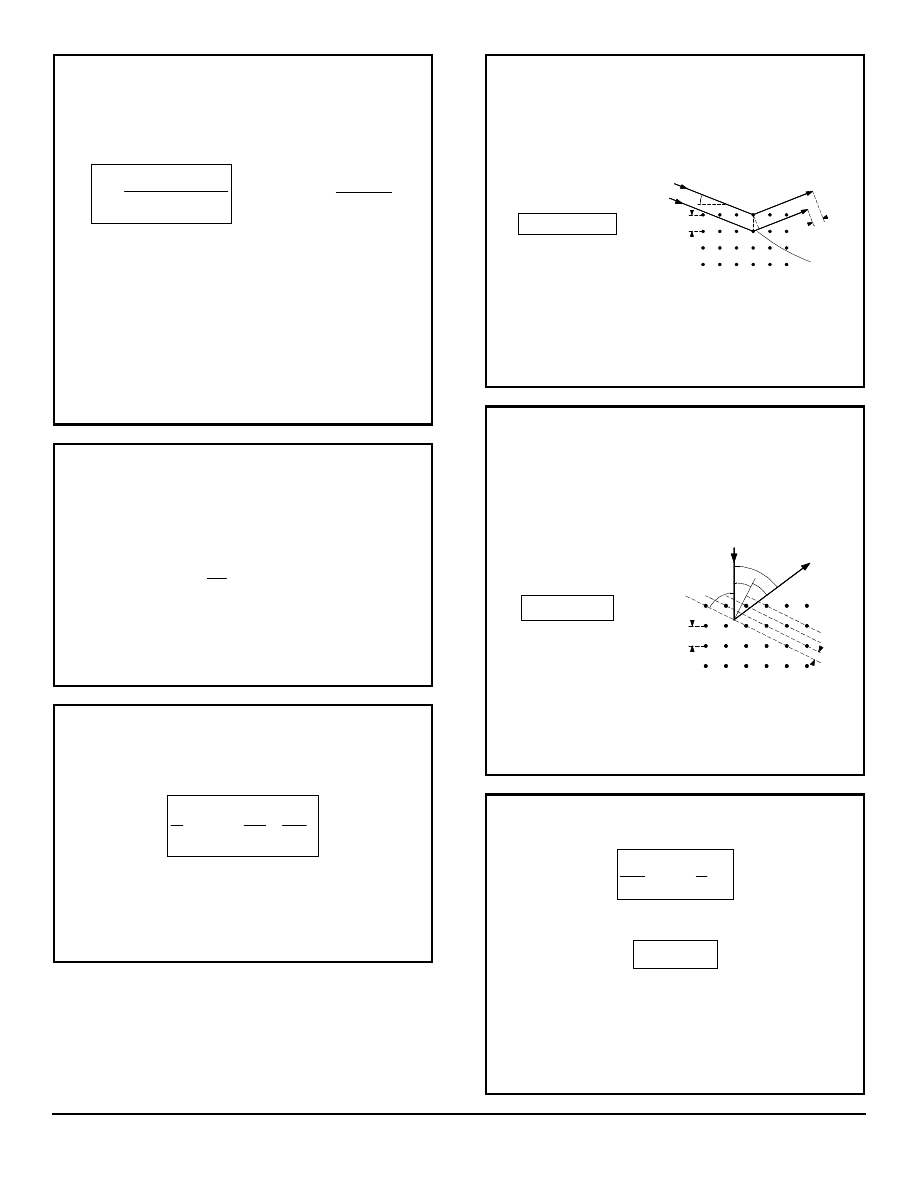
Tom Penick tomzap@eden.com www.teicontrols.com/notes 12/12/1999 Page 9 of 22
R
∞
∞
RYDBERG CONSTANT
R
∞
is used in the Bohr model and is a close
approximation assuming an infinite nuclear mass. R
is the adjusted value. These values are appropriate
for hydrogen and single-electron ions.
(
)
2 4
2
3
0
4
4
e
Z e
R
c
µ
=
π
πε
h
where
e
e
e
m M
m
M
µ =
+
R
∞
=
Rydberg constant 1.09678×10
7
m
-1
(1.096776×10
7
m
-1
for hydrogen)
µ
e
=
adjusted electron mass
Z
=
atomic number, or number of protons in the nucleus
ε
0
= permittivity of free space 8.85 × 10
-12
F/m
c
= speed of light
2.998 × 10
8
m/s
h
= Planck's constant divided by 2
π
[J-s]
m
e
=
mass of an electron 9.1093897×10
-31
kg
M
=
mass of the nucleus (essentially the same as the
mass of the atom
⇒
atomic number × 1.6605×10
-27
) [kg]
L
α
α
MOSELEY'S EQUATION
British physicist, Henry Moseley determined this
equation experimentally for the frequency of L
α
x-
rays. L
α
α
waves are produced by an electron decaying
from the n=3 orbit to the n=2 or L orbit.
(
)
2
5
7.4
36
L
cR Z
α
ν =
−
ν
=
(nu) frequency [Hz]
c
= speed of light
2.998 × 10
8
m/s
R
=
Adjusted Rydberg constant (see above) [m
-1
]
Z
=
atomic number or number of protons in the nucleus
SPECTRAL LINES
This formula gives the wavelength of light emitted
when an electron in a single-electron atom or ion
decays from orbit n
u
to n
l
.
2
2
2
1
1
1
l
u
Z R
n
n
=
−
λ
λ
= wavelength
[m]
Z
=
atomic number or number of protons in the nucleus
R
=
Rydberg constant (1.096776×10
7
m
-1
for hydrogen)
n
l
=
the lower electron orbit number
n
u
=
the upper electron orbit number
BRAGG'S LAW
X-ray Scattering - X-rays reflected from a crystal
experience interference effects since rays reflecting
from the interior of the material take a longer path
than those reflecting from the surface. Compare to
ELECTRON SCATTERING below.
2 sin
n
d
λ =
θ
d
θ
sin
θ
d
2
sin
d
θ
n
=
order of reflection (number of lattice planes in depth)
λ
= wavelength of the incident wave
[m]
d
=
distance between lattice planes (interatomic spacing
in this case) [m]
θ
=
angle of incidence
;
the angle between the incident
wave and the surface of the material
ELECTRON SCATTERING
Electrons directed into a crystalline material are
scattered (reflected) at various angles depending on
the arrangement of lattice planes. There is more
than one set of lattice planes in a crystal. The
technique can be used to explore the characteristics
of a material. Compare to BRAGG'S LAW above.
sin
n
D
λ =
φ
α α
φ
θ
d
D
n
=
order of reflection (number of lattice planes in depth)
λ
= wavelength of the incident wave
[m]
D
=
interatomic spacing [m]
d
=
distance between lattice planes [m]
φ
=
angle between the incident and reflected waves
K CLASSICAL KINETIC ENERGY
Two expressions for kinetic energy:
2
3
2
2
p
K
kT
m
= =
lead to a momentum-temperature relation for
particles:
2
3
p
mkT
=
p
=
momentum [kg-m/s]
m
=
particle mass
[kg]
K
=
kinetic energy [J]
k
=
Boltzmann's constant 1.380658×10
-23
J/K
T
=
temperature in Kelvin (273.15K = 0°C,
∆
K =
∆
C)
(see page 5 for RELATIVISTIC KINETIC ENERGY)

Tom Penick tomzap@eden.com www.teicontrols.com/notes 12/12/1999 Page 10 of 22
WAVES
Ψ
Ψ
WAVE FUNCTIONS
Classical Wave Equation
We did not use this equation:
2
2
2
2
2
1
x
v
t
∂ Ψ
∂ Ψ
=
∂
∂
This wave function fits the classical form, but is not
a solution to the Schröedinger equation:
sin(
wave
wave
number
phase
constant
( )
x,t
time
Ψ
= A
ω
angular
frequency
kx - t +
φ
)
distance
distance
time
The negative sign denotes wave
motion in the positive x direction,
assuming omega is positive.
amplitude
More general wave functions which are solutions to
the Schröedinger equation are:
ω
kx - t) + i sin(
ω
kx - t)]
wave
number
distance
time
distance
amplitude
The negative sign denotes wave
motion in the positive x direction,
assuming omega is positive.
( )
x,t
wave
Ψ
time
= Ae
=
angular
frequency
ω
i( kx- t)
[cos(
A
k
WAVE NUMBER
A component of a wave function
representing the wave density relative to
distance, in units of radians per unit
distance [rad/m].
2
k
π
=
λ
ω
ω
ANGULAR FREQUENCY
A component of a wave function
representing the wave density relative to
time (better known as frequency), in units
of radians per second [rad/s].
2
T
π
ω =
v
ph
PHASE VELOCITY
The velocity of a point on a wave,
e.g. the velocity of a wave peak
[m/s].
ph
v
T
k
λ ω
= =
φφ
PHASE CONSTANT
The angle by which the wave is offset from zero, i.e.
the angle by which the wave's zero amplitude point is
offset from t=0. [radians or degrees].
Ψ
Ψ
SUM OF TWO WAVES
(see also WaveSummingExample.pdf)
(
)
1
2
av
av
internal wave
envelope
2 cos
cos
2
2
k
A
x
t
k x
t
∆
∆ω
Ψ + Ψ =
−
− ω
1442443
14442444
3
A
=
harmonic amplitude [various units?]
∆
k
=
difference in wave numbers k
1
- k
2
[rad/m]
k
av
=
average wave number (k
1
+ k
2
)/2 [rad/m]
∆ω
=
difference in angular
frequencies
ω
1
-
ω
2
[rad/s]
ω
av
=
average angular
frequency (
ω
1
+
ω
2
)/2
[rad/s]
x
=
distance [m]
t
=
time [s]
Phase Velocity:
ph
av
av
/
v
k
= ω
[m/s] velocity of a point on a wave
Group Velocity:
gr
/
u
k
= ∆ω ∆
[m/s] speed of the envelope
λλ
de BROGLIE WAVELENGTH
De Broglie extended the concept of
waves to all matter.
h
p
λ =
λ
= wavelength
[m]
h
=
Planck's constant 6.6260755×10
-34
J-s
p
=
momentum [kg-m/s], convertible to [eV/c] by multiplying
by c/q.
WAVE UNCERTAINTIES
This has to do with the effects of combining different
waves. In order to know precisely the position of the
wave packet envelope (
∆
x small), we must have a
large range of wave numbers (
∆
k large). In order to
know precisely when the wave is at a given point (
∆
t
small), we must have a large range of frequencies
(
∆ω
large). Another result of this relationship, is that
an electronic component must have a large bandwidth
∆ω
in order for its signal to respond in a short time
∆
t.
2
k x
∆ ∆ = π
2
t
∆ω∆ = π
∆
k
= the range of wave numbers, see WAVE NUMBER
∆
x
= the width of the wave envelope
∆ω
= the range of wave frequencies
∆
t
= a time interval

Tom Penick tomzap@eden.com www.teicontrols.com/notes 12/12/1999 Page 11 of 22
SCHRÖDINGER'S WAVE EQUATION
time-dependent form:
( )
( )
( )
2
2
2
,
,
,
2
K
U
E
x t
x t
V
x t
i
m
x
t
+
=
∂ Ψ
∂Ψ
−
+ Ψ
=
∂
∂
h
h
time-independent form:
( )
( ) ( )
( )
2
2
2
2
d
x
V x
x
E
x
m
dx
ψ
−
+
ψ
= ψ
h
or
( )
( )
( )
2
2
2
2
d
x
E V x
m
x
d x
ψ
−
= −
ψ
h
h
= Planck's constant divided by 2
π
[J-s]
Ψ
(x,t)
= wave function
V
=
voltage; can be a function of space and time
(x,t)
m
=
mass [kg]
Two separate solutions to the time-independent
equation have the form:
ikx
ikx
Ae
Be
−
+
where
(
)
2
/
k
m E V
=
−
h
or
( )
( )
sin
cos
A
kx
B
kx
+
Note that the wave number k is consistent in both
solutions, but that the constants A and B are not
consistent from one solution to the other. The values
of constants A and B will be determined from
boundary conditions and will also depend on which
solution is chosen.
PROBABILITY
A probability is a value from zero to one. The
probability may be found by the following steps:
Multiply the function by its complex conjugate and
take the integral from negative infinity to positive
infinity with respect to the variable in question,
multiply all this by the square of a constant c and set
equal to one.
2
*
1
c
F F dx
∞
−∞
=
∫
Solve for the probability constant c.
The probability from x
1
to x
1
is:
2
1
2
*
x
x
P
c
F F dx
=
∫
PROBABILITY OF LOCATION
Given the wave function:
( )
,
x t
ψ
find the probability that a particle is located between
x
1
and x
2
.
Normalize the wave function:
2
2
0
2
1
A
dx
∞
ψ
=
∫
with A known, find the probability:
2
1
2
2
x
x
P
A
dx
=
ψ
∫
〈〈x〉, 〈
〉, 〈x
2
〉〉 EXPECTATION VALUES
average value:
( ) ( )
*
x
x x
x dx
∞
−∞
=
ψ
ψ
∫
average x
2
value:
( )
( )
2
2
*
x
x x
x dx
∞
−∞
=
ψ
ψ
∫
ˆp
MOMENTUM OPERATOR
An operator transforms one function into another
function. The momentum operator is:
ˆ
d
p
i
dx
= −
h
For example, to find the average momentum of a
particle described by wave function
ψ
:
ˆ
*
*
d
p
p
dx
i
dx
dx
∞
∞
−∞
−∞
=
ψ
ψ
=
ψ −
ψ
∫
∫
h

Tom Penick tomzap@eden.com www.teicontrols.com/notes 12/12/1999 Page 12 of 22
SIMPLE HARMONIC MOTION
Examples of simple harmonic motion include a mass
on a spring and a pendulum. The average potential
energy equals the average kinetic energy equals half
of the total energy. In simple harmonic motion, k is
the spring constant, not the wave number.
spring constant k:
k
m
ω =
force:
F
kx
=
potential energy V:
2
1
2
V
kx
=
Schrödinger Wave Equation
for simple harmonic motion:
(
)
2
2
2
2
d
x
dx
ψ = α −β ψ
where
2
2
mk
α =
h
and
2
2mE
β =
h
The wave equation solutions
are:
( )
2
/ 2
x
n
n
H
x e
−α
ψ =
where H
n
(x) are polynomials of order n, where
n = 0,1,2,· · · and x is the variable taken to the power of n.
The functions H
n
(x) are related by a constant to the Hermite
polynomial functions.
2
1 / 4
/ 2
0
x
e
−α
α
ψ =
π
2
1 / 4
/ 2
1
2
x
xe
−α
α
ψ =
α
π
(
)
2
1 / 4
2
/ 2
2
1
2
1
2
x
x
e
−α
α
ψ =
α −
π
( )
(
)
2
1 / 4
2
/ 2
3
1
2
3
3
x
x
x
e
−α
α
ψ =
α
α −
π
…and they call this simple!
quantized energy levels:
1
2
n
E
n
=
+
ω
h
The zero-point energy, or Heisenberg
limit is the minimum energy allowed by
the uncertainty principle; the energy at
n=0:
0
1
2
E
=
ω
h
HEISENBERG UNCERTAINTY PRINCIPLE
These relations apply to Gaussian wave packets.
They describe the limits in determining the factors
below.
/ 2
x
p
x
∆ ∆ ≥
h
/ 2
E t
∆ ∆ ≥
h
∆
p
x
= the uncertainty in the momentum along the x-axis
∆
x
= the uncertainty of location along the x-axis
∆
E
= the uncertainty of the energy
∆
t
= the uncertainty of time. This also happens to be the
particle lifetime. Particles you can measure the mass
of (E=mc
2
) have a long lifetime.
INFINITE SQUARE-WELL POTENTIAL
or "Particle in a Box"
This is a concept that applies to
many physical situations.
Consider a two-dimensional box
in which a particle may be
trapped by an infinite voltage
potential on either side. The
problem is an application of the
Schrödinger Wave Equation.
x
0
L
x
( )
V
The particle may have various energies represented by
waves that must have an amplitude of zero at each
boundary 0 and L. Thus, the energies are quantized. The
probability of the particle's location is also expressed by a
wave function with zero values at the boundaries.
Wave function:
( )
sin
n
n x
x
A
L
π
ψ
=
Energy levels:
2
2
2
2
2
n
E
n
mL
π
=
h
Probability of a particle being
found between x
1
and x
2
:
2
1
*
x
x x
P
dx
=
=
Ψ Ψ
∫
A
=
2
L
normalization constant
a useful identity:
(
)
2
1
sin
1 cos 2
2
θ =
−
θ

Tom Penick tomzap@eden.com www.teicontrols.com/notes 12/12/1999 Page 13 of 22
POTENTIAL BARRIER
When a particle of energy E
encounters a barrier of
potential V
0
, there is a
possibility of either a
reflected wave or a
transmitted wave.
x
0
L
Region I
Region III
Region II
x
( )
V
particle
0
V
for E > V
0
:
kinetic energy:
0
K
E V
= −
wave number:
2
/
I
III
k
k
mE
=
=
h
(
)
0
2
/
II
k
m E V
=
−
h
incident wave:
I
ik x
I
Ae
ϕ =
reflected wave:
I
ik x
I
Be
−
ϕ =
transmitted wave:
I
k x
III
Fe
ϕ =
trans. probability:
(
)
(
)
1
2
2
0
0
sin
1
4
II
V
k L
T
E E V
−
= +
−
reflection probability:
1
R
T
= −
for E < V
0
: Classically, it is not possible for a particle
of energy E to cross a greater potential V
0
, but
there is a quantum mechanical possibility for this
to happen called tunneling.
kinetic energy:
0
K
V
E
= −
wave #, region II:
(
)
0
2
/
m V
E
κ =
−
h
trans. probability:
( )
(
)
1
2
2
0
0
sinh
1
4
V
L
T
E V
E
−
κ
= +
−
when
1
L
κ
?
:
2
0
0
16
1
L
E
E
T
e
V
V
− κ
=
−
3D INFINITE POTENTIAL BOX
Consider a three-dimensional box
with zero voltage potential inside
the box and infinite voltage outside.
A particle trapped in the box is
described by a wave function and
has quantized energy levels.
z
0
L
1
L
3
L
2
y
x
Time-independent Schrödinger Wave Equation in three
dimensions:
2
2
2
2
2
2
2
2
V
E
m
x
y
z
∂ ψ ∂ ψ ∂ ψ
−
+
+
+ ψ = ψ
∂
∂
∂
h
Wave equation for the 3D infinite potential box:
1 2 3
3
1
2
1
2
3
sin
sin
sin
n n n
n
z
n
x
n
y
A
L
L
L
π
π
π
ψ
=
Energy levels:
1 2 3
2
2
2
2
2
3
1
2
2
2
2
1
2
3
2
n n n
n
n
n
E
m
L
L
L
π
=
+
+
h
Degenerate energy levels may exist—that is, different
combinations of n-values may produce equal energy
values.

Tom Penick tomzap@eden.com www.teicontrols.com/notes 12/12/1999 Page 14 of 22
SCHRÖDINGER'S EQUATION – 3D
SPHERICAL
spherical coordinate form:
(
)
2
2
2
2
2
2
2
2
1
1
1
2
sin
0
sin
sin
m
r
E V
r r
r
r
r
∂
∂ψ
∂
∂ψ
∂ ψ
+
θ
+
+
− ψ=
∂
∂
θ∂θ
∂θ
θ ∂θ
h
separation of variables using:
(
) ( ) ( ) ( )
, ,
r
R r f
g
Ψ θ φ =
θ
φ
We can obtain a form with terms of g on one side and
terms of R and f on the other. These are set equal to
the constant m
l
2
. m
l
turns out to be an integer.
Another seperation is performed for R and f and the
constant is l(l+1), where l is an integer. The three
equations are:
Azimuthal equation:
2
2
2
1
0
l
im
l
d g
m
g
Ae
g d
φ
+
=
⇒
=
φ
Radial equation:
(
)
( )
2
2
2
2
1
1
2
0
l l
d
dR
m
r
E V R
R
r dr
dr
r
+
+
−
−
=
h
Angular Equation:
( )
2
2
1
sin
1
0
sin
sin
l
m
d
df
l l
f
d
d
θ
+
+ −
=
θ θ
θ
θ
m
l
=
magnetic quantum number; integers ranging from –l
to +l
l =
orbital angular momentum quantum number
h
= Planck's constant divided by 2
π
[J-s]
E
=
energy
V
=
voltage; can be a function of space and time
(x,t)
m
=
mass [kg]
NORMALIZING WAVE FUNCTIONS
To normalize a function, multiply the function by its
complex conjugate and by the square of the
normalization constant A. Integrate the result from
-
∞
to
∞
and set equal to 1 to find the value of A. The
normalized function is the original function multiplied
by A.
To normalize the wave function
Ψ
Ψ(x):
2
A
dx
∞
−∞
Ψ
∫
→
2
2
A
dx
∞
−∞
Ψ
∫
Where
Ψ
is an even function, we can simplify to:
2
2
0
2A
dx
∞
Ψ
∫
and find A:
2
2
0
2
1
A
dx
∞
Ψ
=
∫
Some relations for definite integrals will be useful in solving
this equation; see CalculusSummary.pdf page 3.
To normalize the wave function
Ψ
Ψ(r), where r is the radius
in spherical coordinates:
2
2
0
r A
dr
∞
Ψ
∫
→
2
2
2
0
1
A
r
dr
∞
Ψ
=
∫
Note that we integrate from 0 to
∞
since r has no negative
values.
To normalize the wave function
Ψ
Ψ(r,θθ,φφ):
2
2
2
2
0
0
0
sin
1
A
dr r A
d
d
∞
π
π
Ψ
θ
θ
φ =
∫
∫
∫
Note that dr, d
θ
, and d
φ
are moved to the front of their
respective integrals for clarity.
R
nl
(r) RADIAL WAVE FUNCTIONS
for the hydrogen atom
n
l
R
nl
(r)
1
0
0
/
3 / 2
0
2
r a
e
a
−
2
0
( )
0
/ 2
3 / 2
0
0
2
r
a
r
e
w
a
a
−
−
2
1
( )
0
/ 2
3 / 2
0
0
3 2
r
a
r
e
a
a
−
3
0
( )
0
2
/ 3
3 / 2
2
0
0
0
1
2
27 18
2
81 3
r
a
r
r
e
a
a
a
−
−
+
3
1
( )
0
/ 3
3 / 2
0
0
0
1
4
6
81 6
r
a
r
r
e
a
a
a
−
−
3
2
( )
0
2
/ 3
3 / 2
2
0
0
1
4
81 30
r
a
r
e
a
a
−
a
0
=
Bohr radius 5.29177×10
-11
m

Tom Penick tomzap@eden.com www.teicontrols.com/notes 12/12/1999 Page 15 of 22
P(r)dr
RADIAL PROBABILITY
The radial probability is a value from 0 to 1 indicating
the probability of a particle occupying a certain area
radially distant from the center of orbit. The value is
found by integrating the right-hand side of the
expression over the interval in question:
( )
2
2
( )
P r dr
r R r
dr
=
r
=
orbit radius
R(r)
=
radial wave function, normalized to unity
P(r)
RADIAL PROBABILITY DENSITY
The radial probability density depends only on n and l.
( )
2
2
( )
P r
r R r
=
r
=
orbit radius
R(r)
=
radial wave function, normalized to unity
〈〈r〉〉 RADIAL EXPECTATION VALUE
average radius (radial wave function):
( )
( )
3
0
0
r
r
r
r P r dr
r R r dr
∞
∞
=
=
=
=
∫
∫
P(r)
=
probability distribution function
( )
( )
2
2
P r
r R r
dr
=
R(r)
=
radial wave function, normalized to unity
ATOMS
QUANTUM NUMBERS
n
=
principal quantum number, shell number, may have
values of 1, 2, 3, …
l
=
orbital angular momentum quantum number,
subshell number, may have values of 0 to n-1. These
values are sometimes expressed as letters: s=0, p=1,
d=2, f=3, g=4, h=5, …
m
l
=
magnetic quantum number, may have integer values
from -l to +l for each l. (p251)
m
s
=
magnetic spin quantum number, may have values
of +½
or -½
Then we introduce these new ones:
s
=
intrinsic quantum number, s =1/2 (p238)
j
=
total angular momentum quantum number, j = l
±
s,
but j is not less than 0. (p257)
m
j
=
magnetic angular momentum quantum number,
may have values from -j to +j (p257)
Example, for n = 3:
l
=
0
1
2
j
=
1/2
1/2
3/2
3/2
5/2
m
j
=
-1/2 +1/2
-1/2 +1/2
-3/2 -1/2
+1/2 +3/2
-3/2 -1/2 +1/2 +3/2
-5/2 -3/2 -1/2
+1/2 +3/2 +5/2
m
l
=
0
-1
0
+1
-2
-1
0
+1
+2
m
s
=
-1/2
+1/2
-1/2
+1/2
-1/2
+1/2
-1/2
+1/2
-1/2
+1/2
-1/2
+1/2
-1/2
+1/2
-1/2
+1/2
-1/2
+1/2
L ORBITAL ANGULAR MOMENTUM
Classically, orbital angular momentum is
ρρr or mvr.
The orbital angular momentum L is a vector quantity.
It components are as follows:
Magnitude:
( )
1
L
l l
=
+
h
Z-axis value:
z
l
L
m
=
h
The values of L
x
and L
y
cannot be determined exactly but
obey the following relation:
2
2
2
2
x
y
z
L
L
L
L
=
+
+
h
= Planck's constant divided by 2
π
[J-s]
l =
orbital angular momentum quantum number
m
l
=
magnetic quantum number; integers ranging from –l
to +l
The orbital angular momentum quantum
number was originally given letter values
resulting from early visual observations:
sharp, principal, diffuse, fundamental
l = 0 1 2 3 4 5
s p d f g h

Tom Penick tomzap@eden.com www.teicontrols.com/notes 12/12/1999 Page 16 of 22
S SPIN ANGULAR MOMENTUM
The spin angular momentum is (insert some
illuminating explanation here).
Magnitude:
(
)
1
3 / 4
s s
=
+ =
S
h
h
z component:
/ 2
z
s
S
m
=
= ±
h
h
-
h
1
2
h
1
+ 2
= 3/4
h
S
z
J TOTAL ANGULAR MOMENTUM
The vector sum of the orbital angular momentum and
the spin angular momentum. This applies to 1-
electron and many-electron atoms.
= +
J
L S
J (the magnitude?) is an integer value from |L-S| to L+S.
ALLOWED TRANSITIONS
The allowed energy level transitions for 1-electron
atoms are
∆
n: any
∆
l:
±
1
∆
m
j
: 0,
±
1
∆
j: 0,
±
1
ZEEMAN SPLITTING
("ZAY· mahn")
When a single-electron atom is under the influence of
an external magnetic field (taken to be in the z-axis
direction), each energy level (n=1,2,3,…) is split into
multiple levels, one for each quantum number m
l
.
The difference in energy is:
B
l
E
Bm
∆ = µ
∆
E
= difference in energy between two energy levels
[J]
µ
B
= Bohr magneton 9.274078×10
-24
J/T
B
=
magnetic field
[T]
m
l
=
magnetic quantum number; integers ranging from –l
to +l
µµ
MAGNETIC MOMENT
Both the magnetic moment
µµ and the orbital angular
momentum L are vectors:
2
e
m
= −
ì
L
m
=
mass of the orbiting particle
[kg]
MANY-ELECTRON ATOMS
SPECTROSCOPIC SYMBOLS
The energy state of an atom having 1 or 2 electrons
in its outer shell can be represented in the form
2
1
S
j
n
L
+
n
=
shell number
S
=
intrinsic spin angular momentum quantum number; ½
for a single-electron shell, 0 or 1 (S
1
+ S
2
) for the 2-
electron shell
L
=
angular momentum quantum number; l for single-
electron shell, L
1
+ L
2
for a 2-electron shell, expressed
as a capital letter: S=0, P=1, D=2, F=3, G=4, H=5, I=6.
j
=
total angular momentum quantum number j = l
±
s
.
I'm
not sure how to tell whether it's plus or minus, but I
think it has to be the lower value of j to be in the
ground state. j is positive only.
ORDER OF ELECTRON FILLING
Here's a way to remember the order in which the
outer shells of atoms are filled by electrons:
Form groups of l-numbers like this. The first
group is just the lowest value for l: s. The next
value of l is p; form a new group of p with s.
The third value of l is d; form the third group
with d, p, and s. You get a list of groups like
this:
s
p s
d p s
f d p s
g f d p s
h g f d p s
Now, in a column, write each group twice
beginning with the single s that is the first
group.
Next number each s beginning with 1, placing
the number in front of the s. This is as far as
I have gone with the list at right.
The next step is to number each p beginning
with the number 2.
Then number each d beginning with the
number 3.
Number each f beginning with 4, and so on.
The result will be the order of filling (there are
a few exceptions) and will look like this:
1s 2s 2p 3s 3p 4s 3d 4p 5s 4d 5p 6s 4f 5d
and so on.
1s
2s
p
3s
p
4s
d
p
5s
f
d
p
6s
f
d
p
7s
and so on.

Tom Penick tomzap@eden.com www.teicontrols.com/notes 12/12/1999 Page 17 of 22
g LANDÉ g FACTOR
A dimensionless number that helps make physics
complicated. Used in ANOMALOUS ZEEMAN
SPLITTING
(
) (
) (
)
(
)
1
1
1
1
2
1
J J
S S
L L
g
J J
+ +
+ −
+
= +
+
ALLOWED PHOTON TRANSITIONS
The allowed photon energy level transitions for many-
electron atoms are
∆
L:
±
1
∆
J: 0,
±
1,
but
J
can't transition from 0 to 0.
∆
S:
0
∆
m
j
: 0,
±
1,
but can't transition from 0 to 0
when
∆
J
=0.
Other transitions are possible—just not likely.
θθ MINIMUM ANGLE BETWEEN J AND
THE Z-AXIS
There were exercises where we had to calculate this.
I don't know what the significance is. This is done
similarly for L and S as well.
Example:
5
2
j
=
(
)
cos
1
j
j j
×
θ =
+
h
h
→
(
)
2
2
cos
1
j
j j
θ =
+
→
(
)
2
cos
1
j
j
θ =
+
cos
1
j
j
θ =
+
h
+
2
5
h
+
2
h
+
2
3
1
h
2
3
-
h
2
-
h
2
-
1
5
z
= j(j+1)
h
J
θ
SPLITTING DUE TO SPIN
For each state described by
quantum numbers n, l, m
l
, there
are two states defined by the
magnetic spin numbers
m
s
= ±1/2. These two levels
have the same energy except
when the atom is influenced by
an external magnetic field.
-
h
1
2
h
1
+
2
= 3/4
h
S
z
The lower of the two energy levels is aligned with
the magnetic field.
2
hc
E
∆ =
∆λ
λ
∆
E
=
difference in energy between two (split) energy levels
m
s
= ±1/2
[J]
∆λ
=
difference in wavelengths for the transitions to the
ground state for each energy level
[m]
λ
=
wavelength for the transitions to the ground state for
the lower of the two energy levels (the greater of the
two wavelengths)
[m]
h
=
Planck's constant 6.6260755×10
-34
J-s
c
= speed of light
2.998 × 10
8
m/s
SPIN-ORBIT ENERGY SPLITTING
Spin-orbit energy splitting is the splitting of energy
levels caused by an internal magnetic field due to
spin. This produces a greater
∆
E than the spin
splitting described above. p265
P.E. due to spin
·
s
V
= −
ì B
z-component
2
z
z
s
e
e
J
g
m
µ = −
h
h
energy level difference
s
e
e
E
g
B
m
∆ =
h
e
= q =
electron charge 1.6022×10
-19
C
h
= Planck's constant divided by 2
π
[J-s]
j
z
=
z-component of the total angular momentum
∆
E
=
difference in energy between two (split) energy levels
m
s
= ±1/2
[J]
g
s
=
2, the gyromagnetic ratio
m
e
=
mass of an electron 9.1093897×10
-31
kg
B
=
internal magnetic field
[T]

Tom Penick tomzap@eden.com www.teicontrols.com/notes 12/12/1999 Page 18 of 22
ANOMALOUS ZEEMAN SPLITTING
("ZAY· mahn")
In addition to the Zeeman splitting of the m
l
energy
levels described previously, and the spin-orbit energy
splitting described above, there is a splitting of the m
j
levels when an external magnetic field is present.
The difference in energy between levels is:
ext
B
j
V
B gm
= µ
V
= difference in energy between two energy levels
[J]
µ
B
= Bohr magneton 9.274078×10
-24
J/T
B
ext
=
external magnetic field
[T]
g
=
Landé factor
[no units]
m
j
=
magnetic angular momentum quantum number; half-
integers ranging from –j to +j
STATISTICAL PHYSICS
v*, v , v
rms
MOLECULAR SPEEDS [m/s]
Maxwell speed
distribution:
( )
2
1
2
2
4
mv
F v dv
Ce
v dv
− β
= π
v*
most probable
speed:
2
2
*
kT
v
m
m
=
=
β
v
mean speed:
4
2
kT
v
m
=
π
v
rms
root mean
square speed:
1 / 2
2
3
rms
kT
v
v
m
=
=
v
=
velocity
[m/s]
C
=
normalization constant
k
=
Boltzmann's constant 1.380658×10
-23
J/K
T
=
temperature
[K]
m
=
mass of the molecule
[kg]
β
=
the parameter 1/kT
[J
-1
]
ENERGY DISTRIBUTION
Derived from Maxwell's speed distribution:
( )
1 / 2
3 / 2
8
2
E
C
F E
e
E
m
−β
π
=
F
MB
MAXWELL-BOLTZMANN FACTOR
The Maxwell-Boltzmann factor is a value between 0
and 1 representing the probability that an energy level
E is occupied by an electron (at temperature T). This
is for classical systems, such as ideal gases. One
way to determine if Maxwell-Boltzmann statistics are
valid is to compare the de Broglie wavelength
λ
= h/p
of a typical particle with the average interparticle
spacing d. If
λ
<<d then Maxwell-Boltzmann statistics
are generally acceptable.
E
MB
F
Ae
−β
=
1 / 3
V
d
N
=
A
=
normalization constant
β
=
the parameter 1/kT
[J
-1
]
d
=
space between atoms
[m]
N
=
number of particles in volume V. Note that
Avogadro's number, 6.022×10
23
, is the number of
gas molecules in 22.4 liters, or 22.4×10
-3
m
3
, at 0°C
and 1 atmosphere. Also, gas volume is proportional
to temperature: V
1
/T
1
=V
2
/T
2
.

Tom Penick tomzap@eden.com www.teicontrols.com/notes 12/12/1999 Page 19 of 22
F
FD
FERMI-DIRAC DISTRIBUTION
A value between 0 and 1 indicating the probability
than an energy state is occupied by an electron. The
Fermi-Dirac distribution is valid for fermions,
particles with half-integer spins that obey the Pauli
principle. Atoms and molecules consisting of an even
number of fermions must be considered bosons when
taken as a whole because their total spin will be zero
or an integer.
1
1
1
FD
E
F
B e
β
=
+
B
1
=
normalization constant
β
=
the parameter 1/kT
[J
-1
]
F
BE
BOSE-EINSTEIN DISTRIBUTION
The Bose-Einstein distribution is valid for bosons,
particles with zero or integer spins that do no obey
the Pauli principle. Photons, pions, and liquid
4
He are
bosons.
2
1
1
BE
E
F
B e
β
=
−
B
2
=
normalization constant
β
=
the parameter 1/kT
[J
-1
]
E
F
FERMI ENERGY [eV]
The Fermi energy depends on the density of electrons
in the material. The Fermi-Dirac distribution is
modified to include the Fermi energy:
(
)
1
1
F
FD
E E
F
e
β −
=
+
The relationship between the Fermi energy and the
number density of particles is:
2 / 3
2
3
3
8
F
h
N
E
m
L
=
π
F
FD
=
Fermi-Dirac distribution, a value from 0 to 1
indicating the probability that an energy state is
occupied
β
=
the parameter 1/kT
[J
-1
]
h
=
Planck's constant 6.6260755×10
-34
J-s
m
=
mass of the particle
[kg]
N/L
3
=
number density of the particles
[m
-3
]
T
F
FERMI TEMPERATURE
The Fermi temperature may be quite high, 80,000 K
for copper.
F
F
E
T
k
=
E
F
=
Fermi Energy
[eV]
k
=
Boltzmann's constant 1.380658×10
-23
J/K
u
F
FERMI SPEED
The Fermi speed,
2
F
F
E
u
m
=
comes from the definition:
2
1
2
F
F
E
mu
=
E
F
=
Fermi Energy
[eV]
m
=
mass (probably of the electron)
[kg]
ENERGY STATES IN "PHASE SPACE"
The points in the 1/8 sphere represent the energy
states of a particle in a cube, see 3D INFINITE
POTENTIAL BOX p13.
Energy level at radius r
2
1
E
r E
=
where
2
2
1
/ 8
E
h
mL
=
(
a constant equal to 1/3 of
the ground state energy)
and
2
2
2
1
2
3
r
n
n
n
=
+
+
and E is whatever energy
the problem is concerned
with.
∆
energy
states
n
1
3
3
1
1
2
2
1
3
r
2
integer
spacing
3
n
energy
levels
n
r
2
N
r
Number of energy states in a sphere of radius r,
i.e. the number of energy states there are with energy
less than E:
3
1
4
2
8
3
r
N
r
=
π
or
3 / 2
1
3
r
E
N
E
π
=
where the factor of 2 is due to spin degeneracy, and the
factor of 1/8 is because the energy states only occupy 1/8
of the sphere where n
1
, n
2
, n
3
are all positive.
g(E) DENSITY OF ENERGY STATES
Number of states per unit energy
( )
3 / 2
1/ 2
1
2
g E
E
E
−
π
=
( )
r
r
N
dN
g E
E
dE
∆
=
=
∆
N
r
=
number of energy states in a sphere of radius r
E
1
=
a constant equal to 1/3 of the ground state energy

Tom Penick tomzap@eden.com www.teicontrols.com/notes 12/12/1999 Page 20 of 22
n(E) DENSITY OF OCCUPIED STATES
Number of occupied states per unit energy
( )
( )
FD
n E
F
g E
=
⋅
at T=0,
( )
( )
, for
0, for
F
F
g E
E
E
n E
E
E
<
=
>
F
FD
=
Fermi-Dirac distribution, a value from 0 to 1
indicating the probability that an energy state is
occupied

Tom Penick tomzap@eden.com www.teicontrols.com/notes 12/12/1999 Page 21 of 22
APPENDIX
CONSTANTS
Avogadro’s number
[molecules/mole]
23
6.0221367 10
A
N
=
×
Bohr magneton
24
9.27407836 10
2
B
e
q
m
−
µ =
=
×
h
J/T
Boltzmann’s constant
23
1.380658 10
k
−
=
×
J/K
or
5
10
62
.
8
−
×
=
K
eV/K
Earth to Moon distance
6
384 10
≈
×
m
Elementary charge
19
10
60
.
1
−
×
=
q
C
Electron mass
31
9.1093897 10
e
m
−
=
×
kg
0.51100
e
m
=
MeV/c
2
Neutron mass
27
1.6749 10
neutron
m
−
=
×
kg
939.57
neutron
m
=
MeV/c
2
Proton mass
27
1.6726231 10
p
m
−
=
×
kg
938.27
p
m
=
MeV/c
2
Permittivity of free space
12
0
8.8541878 10
−
ε =
×
F/m
Planck’s constant
34
6.6260755 10
h
−
=
×
J-s
15
10
14
.
4
−
×
=
eV-s
Rydberg constant
7
1.097373 10
R
=
×
m
-1
kT @ room temperature
0259
.
0
=
kT
eV
Speed of light
8
2.998 10
c
=
×
m/s
Speed of sound (air 0°C)
331.29
s
v
=
m/s
1 Å (angstrom)
10
-8
cm = 10
-10
M
1
µ
m (micron)
10
-4
cm
1 nm = 10Å = 10
-7
cm
273.15K = 0°C
1 eV = 1.6 × 10
-19
J
1 W = 1 J/S = 1 VA
1 V = 1 J/C
1 N/C = 1 V/m
1 J = 1 N· m = 1 C· V
UNITS
Energy:
Joules ×
1
q
= eV
Mass:
Kg ×
2
c
q
= eV/c
2
Momentum: kg m
s
⋅
×
c
q
=
eV
c
BINOMIAL EXPANSION
For
1
x
<
:
(
)
2
3
(
1)
(
1)(
2)
1
1
2!
3!
n
n n
n n
n
x
nx
x
x
−
−
−
±
= ±
+
±
+
L
When x is much less than 1:
(
)
1
1
n
x
nx
±
= ±
WAVELENGTH SPECTRUM
BAND
METERS
ANGSTROMS
Longwave radio
1 - 100 km
10
13
- 10
15
Standard Broadcast
100 - 1000 m
10
12
- 10
13
Shortwave radio
10 - 100 m
10
11
- 10
12
TV, FM
0.1 - 10 m
10
9
- 10
11
Microwave
1 - 100 mm
10
7
- 10
9
Infrared light
0.8 - 1000
µ
m
8000 - 10
7
Visible light
360 - 690 nm
3600 - 6900
violet
360 nm
3600
blue
430 nm
4300
green
490 nm
4900
yellow
560 nm
5600
orange
600 nm
6000
Red
690 nm
6900
Ultraviolet light
10 - 390 nm
100 - 3900
X-rays
5 - 10,000 pm
0.05 - 100
Gamma rays
100 - 5000 fm
0.001 - 0.05
Cosmic rays
< 100 fm
< 0.001
GREEK ALPHABET
Α α
alpha
Ι ι
iota
Ρ ρ
rho
Β β
beta
Κ κ
kappa
Σ σ
sigma
Χ χ
chi
Λ λ
lambda
Τ τ
tau
∆ δ
delta
Μ µ
mu
Υ υ
upsilon
Ε ε
epsilon
Ν ν
nu
Ω ω
omega
Φ φ
phi
Ο ο
omicron
Ξ ξ
xi
Γ γ
gamma
Π π
pi
Ψ ψ
psi
Η η
eta
Θ θ
theta
Ζ ζ
zeta

Tom Penick tomzap@eden.com www.teicontrols.com/notes 12/12/1999 Page 22 of 22
TRIG IDENTITIES
2 sin
ix
ix
i
x
e
e
−
=
−
2 cos
ix
ix
x
e
e
−
=
+
2 sinh
x
x
x
e
e
−
= −
2 cosh
x
x
x
e
e
−
= +
cos
sin
ix
e
x i
x
=
+
(
)
sin
sin
cos
cos
sin
A
B
A
B
A
B
±
=
±
(
)
cos
cos
cos
sin
sin
A
B
A
B
A
B
±
=
m
sin
sin
2 sin
cos
2
2
A
B
A
B
A
B
+
−
+
=
cos
cos
2 cos
cos
2
2
A
B
A
B
A
B
+
−
+
=
GEOMETRY
SPHERE
Area
2
4 r
A
π
=
Volume
3
3
4
r
V
π
=
ELLIPSE
Area
AB
A
π
=
Circumference
2
2
2
2
b
a
L
+
π
≈
COORDINATE SYSTEMS
Cartesian or Rectangular Coordinates:
z
y
x
r
ˆ
ˆ
ˆ
)
,
,
(
z
y
x
z
y
x
+
+
=
xˆ
is a unit vector
2
2
2
z
y
x
+
+
=
r
Spherical Coordinates:
)
,
,
(
φ
θ
r
P
r
is distance from center
θ
is angle from vertical
φ
is the CCW angle from the x-axis
rˆ
, èˆ , and
φφˆ
are functions of position—their
orientation depends on where they are located.
Cylindrical Coordinates:
)
,
,
(
z
r
φ
C
r
is distance from the vertical (z) axis
φ
is the CCW angle from the x-axis
z is the vertical distance from origin
COORDINATE TRANSFORMATIONS
Rectangular to Cylindrical:
To obtain:
z
r
A
A
A
z
r
z
r
A
ˆ
ˆ
ˆ
)
,
,
(
+
+
=
φ
φ
φφ
2
2
y
x
A
r
+
=
φ
+
φ
=
sin
ˆ
cos
ˆ
ˆ
y
x
r
x
y
1
tan
−
=
φ
φ
+
φ
−
=
cos
ˆ
sin
ˆ
ˆ
y
x
φφ
z
z
=
z
z
ˆ
ˆ
=
Cylindrical to Rectangular:
To obtain:
z
y
x
r
ˆ
ˆ
ˆ
)
,
,
(
z
y
x
z
y
x
+
+
=
φ
=
cos
r
x
φ
−
φ
=
cos
ˆ
cos
ˆ
ˆ
φφ
r
x
φ
=
sin
r
y
φ
+
φ
=
cos
ˆ
sin
ˆ
ˆ
y
r
φφ
z
z
=
z
z
ˆ
ˆ
=
Rectangular to Spherical:
To obtain:
φ
θ
+
+
=
φ
θ
A
A
A
r
r
φφˆ
ˆ
ˆ
)
,
,
(
è
r
A
2
2
2
z
y
x
A
r
+
+
=
θ
+
φ
θ
+
φ
θ
=
cos
ˆ
sin
sin
ˆ
cos
sin
ˆ
ˆ
z
y
x
r
2
2
2
1
cos
z
y
x
z
+
+
=
θ
−
θ
−
φ
θ
+
φ
θ
=
sin
ˆ
sin
cos
ˆ
cos
cos
ˆ
ˆ
z
y
x
è
x
y
1
tan
−
=
φ
φ
+
φ
−
=
cos
ˆ
sin
ˆ
ˆ
y
x
φφ
Spherical to Rectangular:
To obtain:
z
y
x
r
ˆ
ˆ
ˆ
)
,
,
(
z
y
x
z
y
x
+
+
=
φ
θ
=
cos
sin
r
x
φ
−
φ
θ
−
φ
θ
=
sin
ˆ
cos
cos
ˆ
cos
sin
ˆ
ˆ
φφ
è
r
x
φ
θ
=
sin
sin
r
y
φ
+
φ
θ
+
φ
θ
=
cos
ˆ
sin
cos
ˆ
sin
sin
ˆ
ˆ
φφ
è
r
y
θ
=
cos
r
z
θ
−
θ
=
sin
ˆ
cos
ˆ
ˆ
è
r
z
Wyszukiwarka
Podobne podstrony:
Das Haarp Projekt, Nikola Tesla, Modernste Waffen
Nikola Tesla Electromagnetic Engineering
Free Energy Nikola Tesla Secrets for Everybody Vladimir Utkin(1)
tesla darmowa energia(1), Nikola Tesla
hydrology for engineers
Adler M An Introduction to Complex Analysis for Engineers
Modern?ucation Changing for the Future
Physics For You 2014 08
Numerical Methods for Engineers and Scientists, 2nd Edition
Nikola Tesla
My Inventions The Autobiography Of Nikola Tesla
Nikola Tesla kariera
Nikola Tesla W 1926 roku przewidział powstanie smartfonów [2015 Artykuł]
Nikola Tesla Patents and Documents (scans not great) 00445207
Nikola Tesla 2
Nikola Tesla, a Prodigal Genius (280p, complete bio)
Nikola Tesla Patents and Documents (scans not great) 00447920
Nikola Tesla The Philadelphia Experiment
więcej podobnych podstron