1
itchen Cabinet
Does anyone ever have enough kitchen cabinets? Here is one you can build for your
kitchen with just a modest knowledge of woodworking techniques. It contains two good-sized
drawers above, extra storage space below, and a wooden countertop. Place it against a wall, or
use it as a free-standing island. The
finished cabinet is 25 inches deep, 37
inches wide, and 37-1/2 inches tall.
This project is a little more advanced than
many of the others and requires you to
make several dadoes. You can avoid some
of the dadoes, by purchasing pre-made
cabinet doors and drawer fronts. Step-by-
step instructions for the doors and drawer
fronts are included if you want to make
them yourself.
Materials List
Lumber:
•
1 sheet ¾” plywood, 4’ x 8’*
•
½ sheet ¾” plywood, 4’x 4’*
•
1 piece ¼” clear plywood, 2’ x 2’
•
41 linear feet 1 x 4 pine*
•
5 linear feet 1 x 1 pine
•
1 piece Laminated 1 x 4 pine, 24” x
36”
•
(OR 21 linear feet 1 x 4 pine)
•
2 drawer fronts, 5” x 13-1/2”
•
2 cabinet doors, 23-1/2” x 13-1/2”
(OR, to make your own doors and drawer fronts:
•
16 linear feet 1 x 2 pine*
•
4 sq. ft. ¼” plywood*
•
16 linear feet decorative molding, ½” wide x ¼” thick
K
2
Hardware:
•
1 lb. 3d finishing nails
•
small wire brads
•
4 cabinet door hinges*
•
2 sets of drawer guides and rollers
•
2 drawer pulls
Special Tools and Techniques:
•
web clamp
•
2 or 3 bar clamps (optional)
•
dadoes
•
miters
*See “Notes on the Materials,” below.
Cutting List
Code
Description
Qty.
Material
Dimensions
A
Cabinet Side
2
¾” plywood
23-1/2” x 36-3/4”
B
Cabinet Back
1
¾” plywood
34” x 36-3/4”
C
Cabinet Shelf
2
¾” plywood
23” x 34-1/2”
D
Back Support
1
1 x 4 pine
34” long
E
Top Rail
1
1 x 4 pine
35-1/2” long
F
Side Stile
2
1 x 4 pine
30-1/4’ long
G
Center Rail
1
1 x 4 pine
28-1/2” long
H
Upper Center Stile
1
1 x 4 pine
4” long
I
Lower Center Stile
1
1 x 4 pine
22-3/4” long
J
Bottom Base
1
1 x 4 pine, ripped
35-1/2” long
K
Shelf Trim
4
1 x 1 pine
12-1/2” long
L
Cabinet Top
1
Laminated pine
23-1/2” x 35-1/2”
M
Long Top Trim
2
1 x 4 pine, ripped
37” long
N
Short Top Trim
2
1 x 4 pine, ripped
25” long
O
Drawer Front/Back
4
1 x 4 pine
12” long
P
Drawer Side
4
1 x 4 pine
20” long
Q
Drawer Bottom
2
¼” plywood
11” x 20”
3
Notes on the Materials
If you want a natural finish on your cabinet, you need to buy stain-grade plywood, which is more
expensive. Otherwise, purchase paint-grade materials for all of the plywood specified. If you
opt for stain-grade plywood, make sure to choose wood with a matching grain for all of the parts
specified in pine in this materials list.
The top of the cabinet is constructed of laminated 1 x 4 boards. Most building-supply stores sell
sections of pine that have already been laminated. If you want to laminate the boards yourself,
you need 21 linear feet of 1 x 4 pine and at least two bar clamps.
To attach the doors, I used a decorative semi-concealed hinge. The visible side is attached to the
cabinet and the concealed side is attached to the back of the cabinet door. Other styles are also
available
Constructing the Cabinet Frame
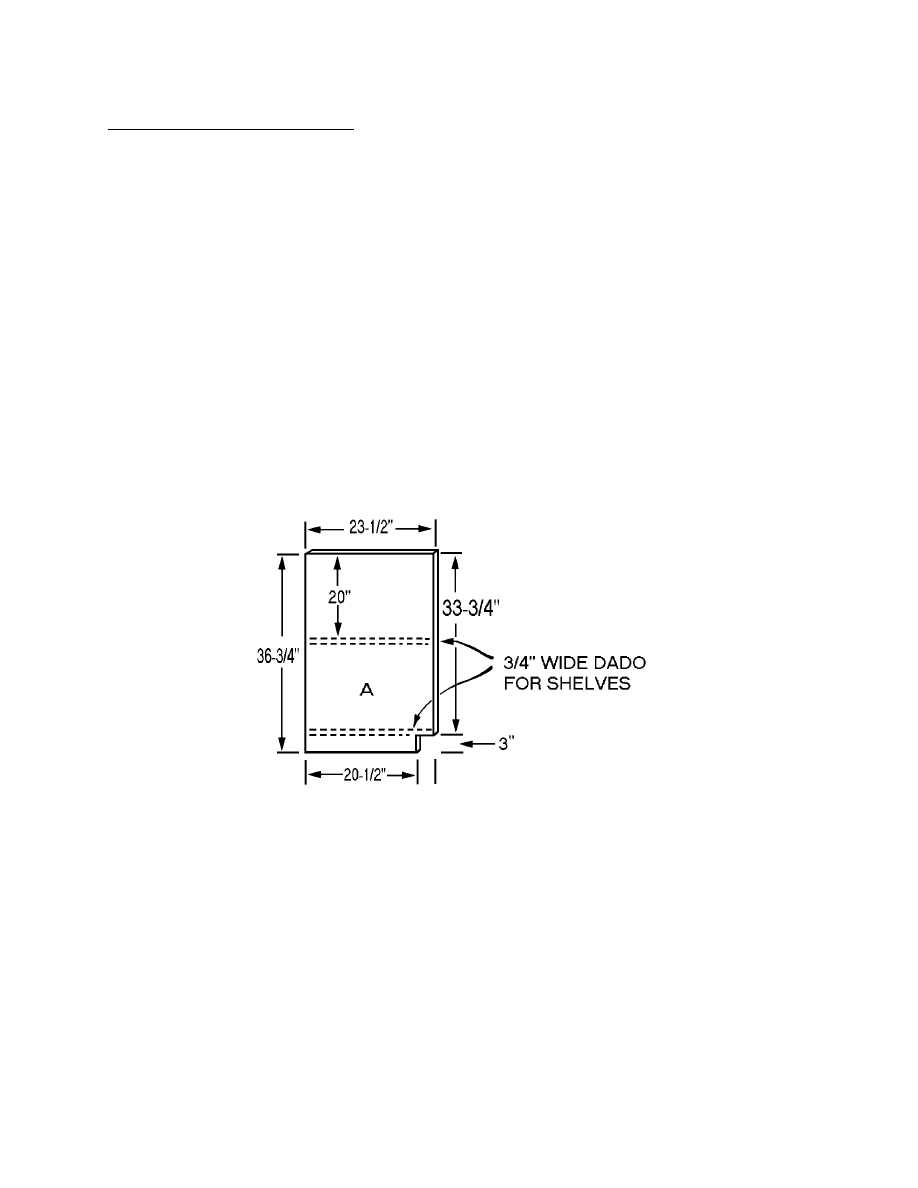
1. Cut two cabinet sides (A) from ¾”-thick plywood according to the dimensions given in
Figure 1
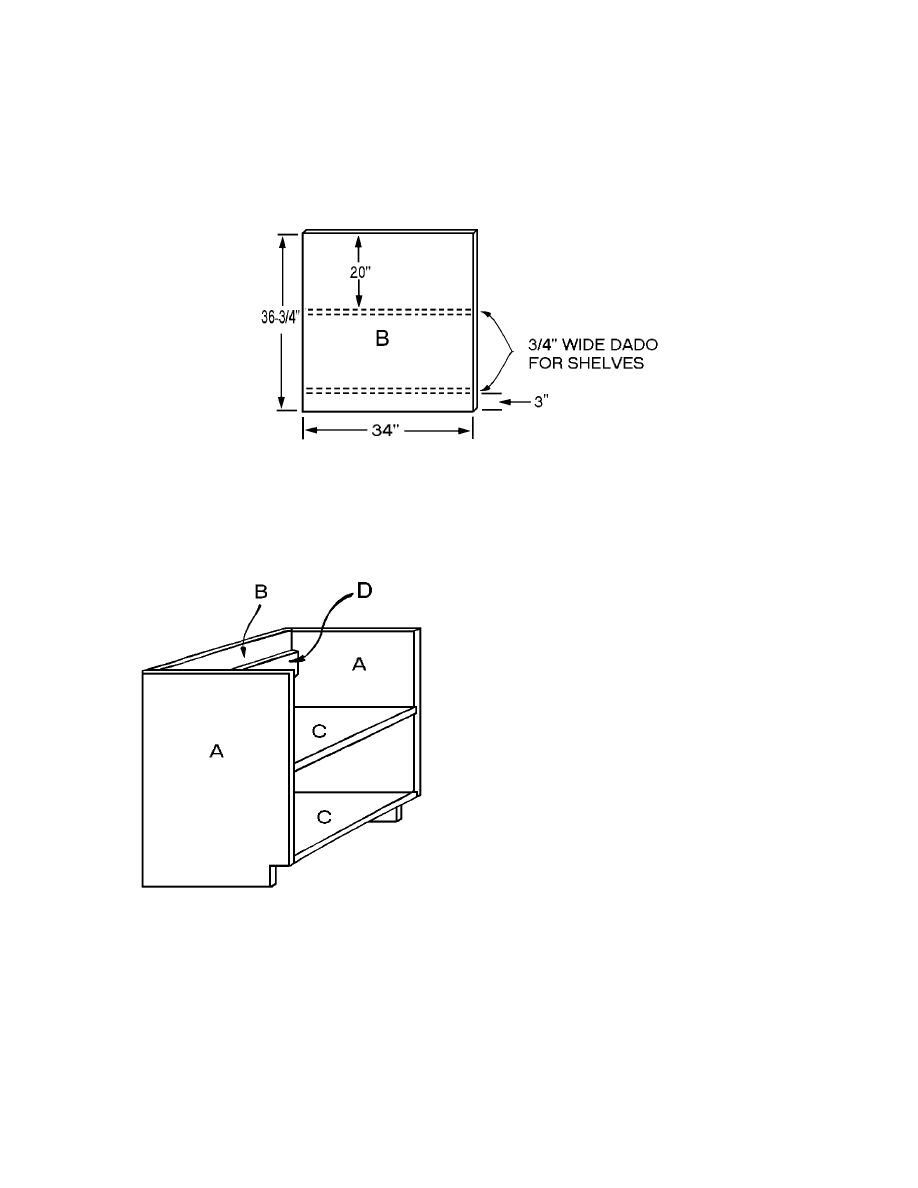
2. Cut one cabinet back (B) from ¾”-thick plywood according to the dimensions given in
Figure 2.
3. Cut two cabinet shelves (C) from ¾”-thick plywood, each measuring 23 x 34-1/2”.
4. Inspect each face of the two cabinet sides (A), and choose the better ones to face outward
on the finished cabinet. On the inner faces of the two cabinet sides (A) and the cabinet
back (B), cut two dadoes, each ¾”-wide and ¼” deep, at the heights indicated in Figures 1
and 2. These provide support for the shelves (C).
5. Assemble the two sides (A), back (B), and two shelves (C), as shown in Figure 3. Note that
the shelves (C), slide into the dadoes. Check to make sure that all of the parts are square
Figure 1
4
and level. Use glue and 3-penny finishing nails spaced about 5 inches apart to secure the
pieces together, and fasten a web clamp around the assembly for added strength. Leave the
cabinet clamped overnight. (If you are unsure about how to use clamps for this assembly,
consult “Tips and Techniques” on our home page.
6. Cut one 34”-long back support (D) from 1 x 4 pine. Measure and draw a line 4 inches
down from the top across the cabinet back (B). Nail and glue the back support (D) to both
sides (A) and to the back (B). Place one nail every 6 inches. This strengthens the cabinet
and is used later to brace the metal drawer glides that support the drawers.
Adding the Rails and Stiles
The front of the cabinet consists of rails
(horizontal members) ad stiles (vertical
members). These members fulfill two
functions: they support the cabinet doors, and
they form the finished front. A diagram of
their placement is shown in Figure 4. It is
very important that you install each of the
stiles and rails so that they are all exactly
square, or your drawers and cabinet doors will
not fit properly.
1. Cut one 35-1/2”-long top rail (E) from 1
x 4 pine. Using glue and two finishing
nails on each end, attach the top rail (E)
flush with the top edges of the cabinet
sides (A), as shown in Figure 4.
2. Cut two side stiles (F) from 1 x 4 pine, each 30-1/4” long, and attach them to the cabinet
sides (A) below the top rail (E). Use glue and 3-penny finishing nails, spacing the nails
about 6 inches apart. As shown in Figure 4, the stiles should be flush with the outer edges.
Figure 2
Figure 3
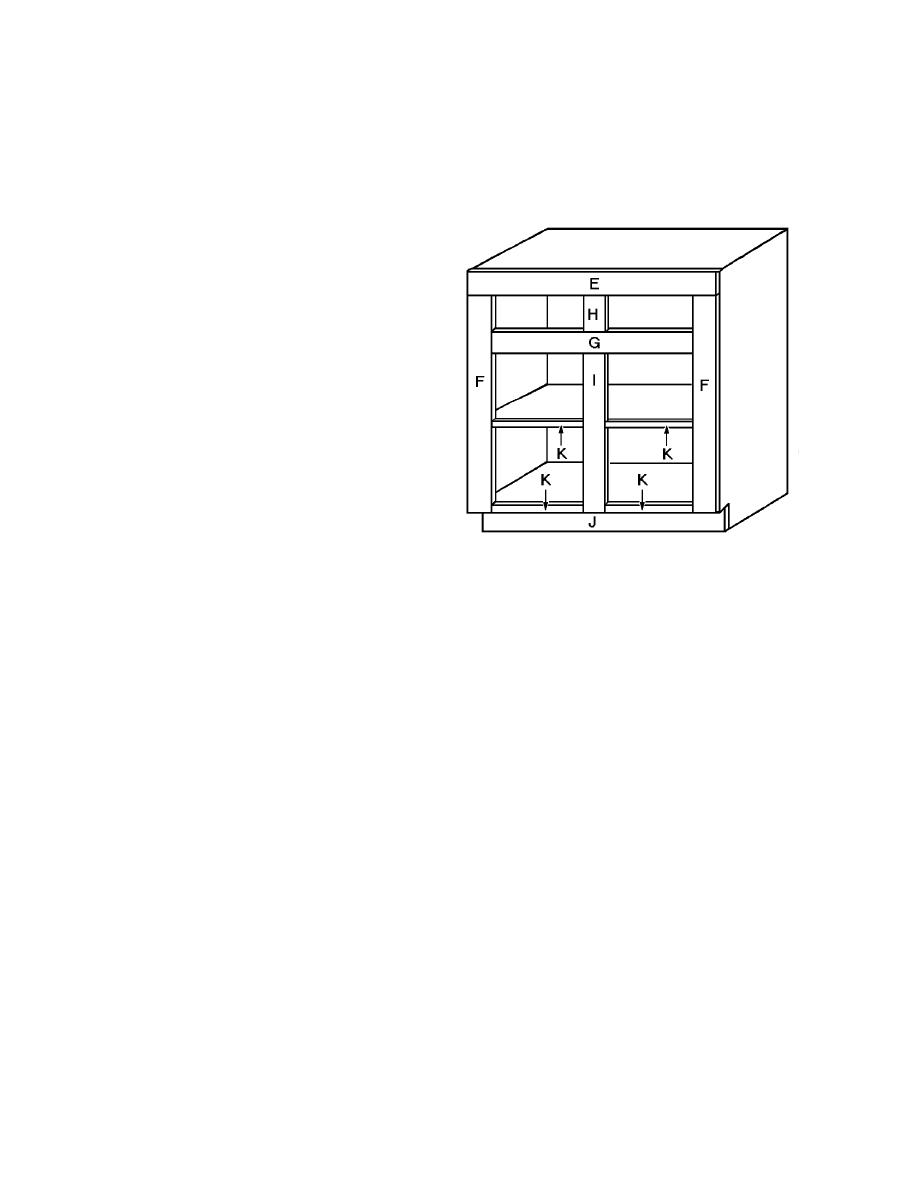
5
3. Cut one 28-1/2”-long center rail (G) from 1 x 4 pine, and attach it 4 inches below the top
rail (E), between the two side stiles (F). After applying glue, toenail the center rail (G) into
the side stiles (F) using two finishing nails on each end.
4. From 1 x 4 pine, cut one 4—long upper
center stile (H) and one 22-3/4”-long
lower center stile (I).
5. Attach the upper center stile (H)
between the top rail (E) and the center
rail (G), as shown in Figure 4. Apply
glue, and toenail the center stile (H) into
the top rail (E) and the center tail (G),
placing two finishing nails at each end.
The lower center stile (I) is attached to
each of the shelves (C). Make certain
that both of the shelves (C) are perfectly
level in the center. Use glue and two
finishing nails to attach the lower center
stile (I) to each of the shelves (C). Glue
and toenail the lower center stile (I) to the center rail (G).
6. Cut a 35-1/2” length of 1 x 4 pine. Rip the length to 3 inches in width, and attach the
resulting bottom base piece (J) across the bottom edge of the assembled cabinet so that it
covers the raw, bottom edges of the cabinet sides (A), as shown in Figure 4. To secure the
attachment, first glue all of the exposed joints. Then use two 3-penny finishing nails to
toenail the bottom base piece (J) to the lower center stile (H). Next, with two finishing nails
on each end, attach the bottom base piece (J) to the edges of the cabinet sides (A). Finally,
nail through the lower cabinet shelf (C) into the bottom base piece with finishing nails
placed about 6 inches part.
7. Cut four shelf trim pieces (K) from 1 x pine, each 12-1/2” long. Use glue and finishing
nails placed every 6 inches to attach the shelf trim (K) to the exposed fronts of each of the
shelves (C) between the stiles (F and I).
Making the Top
1. If you purchased material already laminated, trim the piece to 23-1/2 x 35-1/2 inches to
make the cabinet top (L). Then skip down to Step 4.
2. To do the lamination yourself cut seven lengths of 1 x 4 pine, each 35-1/2” long. Before
gluing the wood lengths together, it is a good idea to rip a minuscule amount from each
edge to ensure a solid bond in the lamination process. Then spread glue on the adjoining
Figure 4
6
edges, and place the lengths of wood side by side. Clamp them together securely, using at
least two bar clamps, and leave them clamped overnight.
3. Trim the completed top (L) to 23-1/2” x 35-1/2” by ripping ½” from each 35-1/2” long
edge.
4. Set the top (L) onto the cabinet assembly flush with all four of the cabinet’s outer edges.
Use glue and finishing nails, placing the nails about every 6 inches, to attach the top (L) to
the cabinet.
5. Rip 11 feet of 1 x 4 pine to a width of 2 inches. The resulting material is used to trim the
cabinet top (L).
6. From the 2-inch material, cut two long top trim pieces (M), each 37 inches long, and two
short top trim pieces (N), each 25 inches long.
7. Setting each piece on its 2-inch face, miter both ends of all four top trim pieces (M and N)
at a 45-degree angle. Glue and nail the short trim pieces (N) to the edges of the laminated
cabinet top (L) using 3-penny finishing nails spaced about 6 inches apart.
8. Glue and nail the long rim pieces (M) to the front and back of the laminated cabinet top (L).
Use finishing nails placed about every 6 inches, and countersink all of the nails.
Making the Drawers
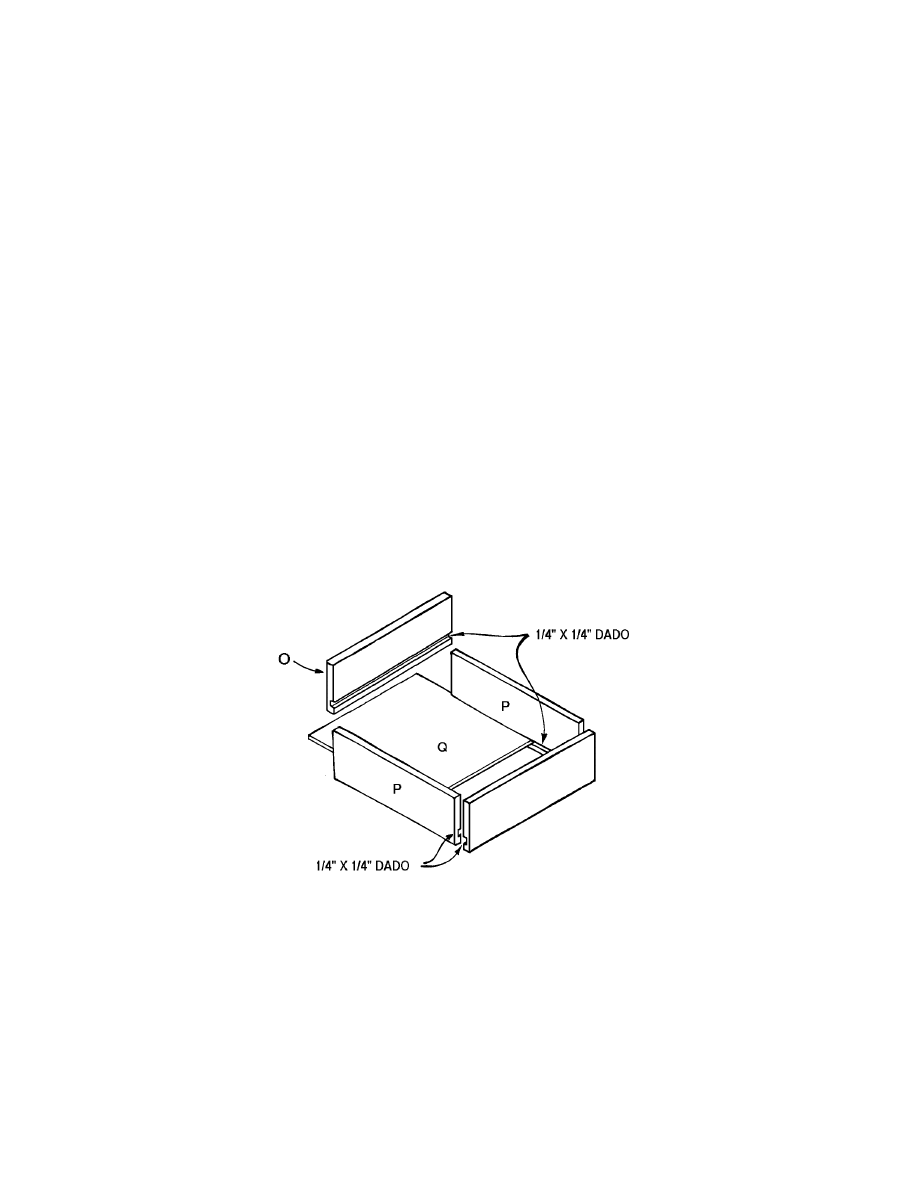
1. There are two identical drawers in this cabinet. Both are constructed as shown in the
assembly diagram in Figure 5.
2. Cut the following parts for the drawer from 1 x 4 pine: two drawer front/back pieces (O),
each 12 inches long, and two drawer sides (P), each 20 inches long.
Figure 5

7
3. Cut a ¼” by ¼” dado on the inside of each drawer piece (O and P), 3/8” from the lower
edge, to accommodate the plywood bottom.
4. Cut one 11” x 20” drawer bottom (Q) from ¼”-thick plywood. Assemble the drawer as
shown in Figure 5. Use glue and finishing nails, pacing two nails on each end of the
overlapping boards. The drawer front is added later.
5. Repeat Steps 1 through 3 to build a second drawer.
Making the Drawer Fronts
If you purchased your drawer fronts and cabinet doors, skip down to the “Installing the
Hardware,” below. These instructions describe how to make your own, starting with the
construction of the drawer fronts. Although they have different dimensions the drawer fronts
and cabinet doors are built in exactly the same manner.
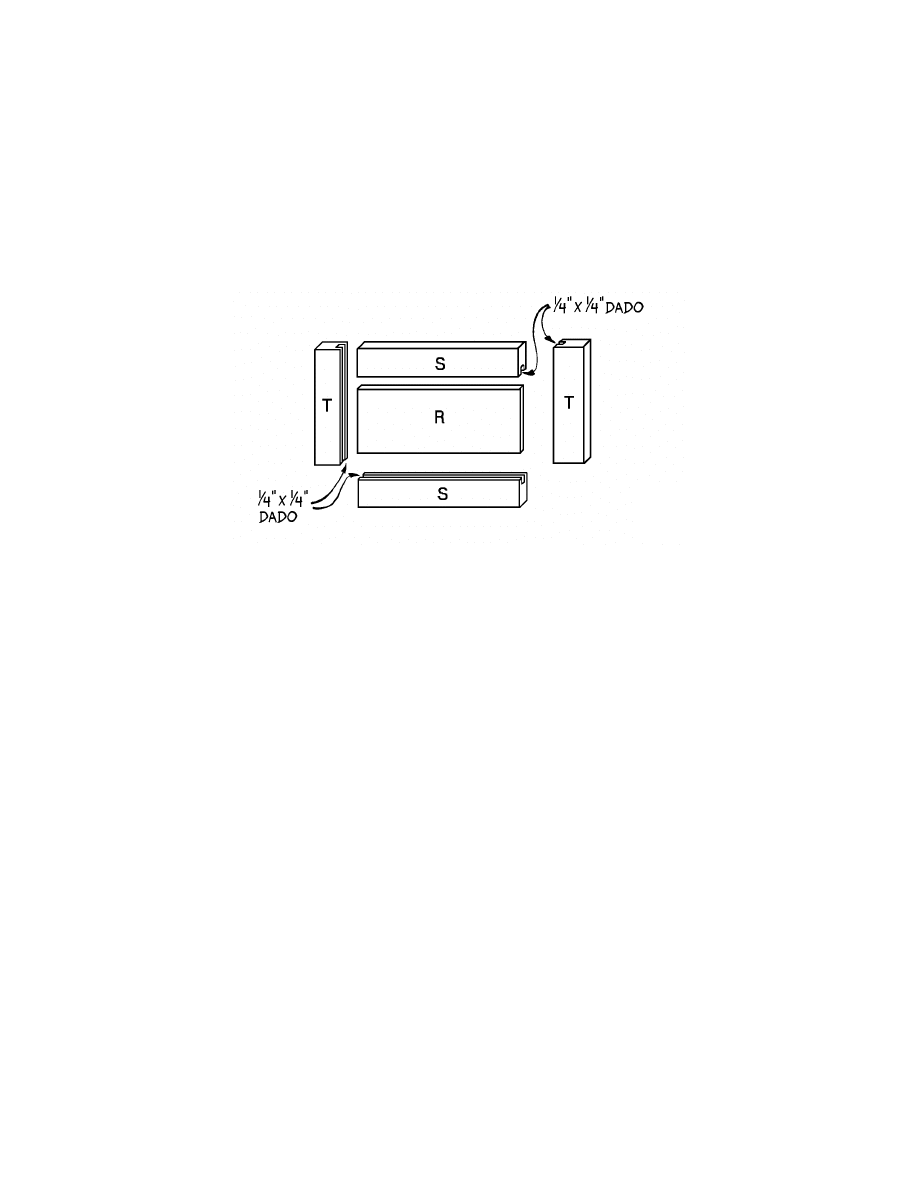
The drawer front is nothing more than a center panel of ¼” plywood that is inserted into a 1 x 2
frame, and trimmed with decorative molding (Figure 6). It’s not difficult to do, but it requires a
certain amount of precision when cutting to obtain a professional-looking finished product.
Don’t hurry the process, and be meticulous in your work.
1. Cut one 10-1/2” x 2” drawer panel (R) from ¼” thick plywood.
2. Cut two drawer top/bottom frame pieces (S) from 1 x 2 pine, each 10” long.
3. Cut two drawer side frame pieces (T) from 1 x 2 pine, each 5 inches long.
4. Cut a ¼” x ¼” dado along the inside edges of each of the frame pieces (S and T) to
accommodate the drawer panel (R). A cutting diagram is shown in Figure 6.
5. Place the drawer panel (R) into the dadoes cut into the frame pieces (S and T). Glue and
clamp, then nail the frame pieces together. Use two 3-penny finishing nails on each end of
the overlapping boards.
6. Allowing a little extra length for the miters, cut four pieces of ¼”-thick decorative molding
to fit around the inside edges of the frame. Set the molding so that the decorative edge faces
up, and miter both ends of each piece at a 45-degree angle. Attach the mitered pieces to the
plywood panel with glue and wire brads. Countersink the brads.
7. Repeat Steps 1 through 6 to assembly the second drawer front.
Making the Cabinet Doors
1. The cabinet doors are constructed using the same procedures that you followed for the
drawer fronts. The only difference is the size of the parts. To make one cabinet door, cut
one 10-1/2” x 21” panel (R2) from ¼”-thick plywood.
8
2. Cut two cabinet top/bottom frame pieces (S2) from 1 x 2 pine, each 10” long.
3. Cut two cabinet side frame pieces (T2) from 1 x 2 pine, each 21 inches long.
4. To construct the cabinet doors, follow steps 1 through 7 (substituting R2, S2, and T2 for R,
S, and T) in the previous section, “Making the Drawer Fronts.”
Installing the Hardware
1. Following the manufacturer’s instructions to install the metal drawer glide between the
back support (D), and the center rail (G).
2. Install a roller on the bottom of each drawer, and on the inside of the center rail (G), again
following the manufacturer'’ instructions.
Installing the Doors and Drawer Fronts
1. The easiest method is to attach the drawer fronts first. For the job to look very professional,
all of the drawers and doors must be exactly straight and level. Set the assembled drawers
inside the drawer opening on the cabinet, placing them on the metal drawer glides. Place a
scrap piece of wood between the back of each drawer and the back of the cabinet so that the
drawers are held flush with the front of the cabinet. Use heavy-duty, double-sided tape to
hold a drawer front temporarily in place on each drawer until you have both drawer fronts
positioned exactly right. Then attach the fronts to the drawers. Use two finishing nails
driven from the inside of the drawer into the drawer top frame (S), and two finishing nails
driven into the drawer bottom frame (S).
2. Measure carefully, and install the hinges on each of the doors. The hinges should be
positioned the same distance from the top and bottom of each door.
Figure 6

9
3. Have someone help you support the doors, and hold the doors with the attached hinges over
the door opening. Line up each door so that its width is exactly even with the width of the
drawer above it, and make sure both doors are at an even height with each other. Then
screw the remaining sides of the hinges to the cabinet.
4. Attach the drawer pulls on each of the drawers on the cabinet doors. The pulls should be
evenly spaced and aligned with one another.
Finishing
1. Countersink all of the nails, and fill the resulting holes with wood filler.
2. Sand every surface thoroughly.
3. Paint or stain the completed cabinet the color of your choice. For the cabinet in the
photograph, I stained the laminated top and painted the remainder of the cabinet white.
4. To customize your cabinet, you can add wood molding at the base to match the existing
molding in your kitchen. If the cabinet is to be a free-standing island, you may wish to add
base molding on all four sides.
Enjoy other exciting indoor and outdoor projects from
www.wowimadeit.com
!
Wyszukiwarka
Podobne podstrony:
Plan and Install Kitchen Cabinets
Kitchen Base Cabinet
Cabinet Kitchen Island
(Ebooks) Diy Woodwork Plans Kitchen Cabinets
Cabinet Kitchen Face Lift
Cabinet Kitchen Pantry
Cabinet movable kitchen island
Cabinet Kitchen Moveable workstation
Plan and Install Kitchen Cabinets
Cabinet Slide out kitchen bin
Cabinets Build Your Own Kitchen Cabinets
Corner Buffet Cabinet(1)
cabinetmakerupho00sher
Corner Cabinet 1
bathroom cabinet szafka lazienkowa
Brydcliffe Cabinet
więcej podobnych podstron