
Copyright © 2009 by Felix Oberholzer-Gee and Koleman Strumpf
Working papers are in draft form. This working paper is distributed for purposes of comment and
discussion only. It may not be reproduced without permission of the copyright holder. Copies of working
papers are available from the author.
File-Sharing and Copyright
Felix Oberholzer-Gee
Koleman Strumpf
Working Paper
09-132

1
File-Sharing and Copyright
1
Felix Oberholzer-Gee
Harvard University
foberholzer@hbs.edu
Koleman Strumpf
University of Kansas
cigar@ku.edu
May 15, 2009
1. Introduction
The advent of file-sharing technology has allowed consumers to copy music,
books, video games and other protected works on an unprecedented scale at minimal
cost. In this essay, we ask whether the new technology has undermined the incentives of
authors and entertainment companies to create, market and distribute new works. While
the empirical evidence of the effect of file sharing on sales is mixed, many studies
conclude that music piracy can perhaps explain as much as one fifth of the recent decline
in industry sales. A displacement of sales alone, however, is not sufficient to conclude
that authors have weaker incentives to create new works. File sharing also influences the
markets for concerts, electronics and communications infrastructure. For example, the
technology increased concert prices, enticing artists to tour more often and, ultimately,
raising their overall income.
Data on the supply of new works are consistent with our argument that file
sharing did not discourage authors and publishers.
2
The publication of new books rose
by 66% over the 2002-2007 period. Since 2000, the annual release of new music albums
has more than doubled, and worldwide feature film production is up by more than 30%
1
We would like to thank Josh Lerner, Scott Stern, Amitay Alter and participants in the NBER's 2009
Innovation Policy and the Economy Conference in Washington, D.C., for helpful comments.
2
Copyright refers to a complex bundle of rights that includes the rights of authors (composers, lyricists)
and publishers (for a detailed description of these contracts, see Towse 1999; Passman 2000). Throughout
this essay, we use the term somewhat loosely, referring to all legal protections – including, for instance, the
“neighboring rights” of performers – that encourage the creation, production, marketing, and distribution of
works. Also, we neglect the tensions that exist in copyright between artist and publisher interests (see
Towse, 1999; Gayer and Shy, 2006.)

2
since 2003. At the same time, empirical research in file sharing documents that consumer
welfare increased substantially due to the new technology.
Over the past 200 years, most countries evolved their copyright regimes in one
direction only: lawmakers repeatedly strengthened the legal protections of authors and
publishers, raising prices for the general public and discouraging consumption.
3
Seen
against this backdrop, file sharing is a unique experiment that considerably weakened
copyright protections. While file sharing disrupted some traditional business models in
the creative industries, foremost in music, in our reading of the evidence there is little to
suggest that the new technology has discouraged artistic production. Weaker copyright
protection, it seems, has benefited society.
In this essay, we discuss the currently available research that sheds light on the
effects of file sharing, particularly in music where its effects have been most pronounced.
We start by describing the new technology and how consumers are using it. Section 4
reviews the evidence that file sharing reduces the profitability of creating and selling new
works. We discuss the importance of complements to original works in Section 5 and
describe the artistic and corporate response to file sharing in section 6. The concluding
section offers policy implications.
2. File-Sharing and Copyright
In setting copyright terms, lawmakers trade off the increased incentives to create
protected works and the higher prices that consumers face when books, movies, and
recordings must not be copied freely (Landes and Posner, 1989). As this description
suggests, the lawmakers’ task is a challenging one. Setting copyright terms in a manner
that benefits society requires an answer to two questions. First, we need to know how
much weaker the incentives to create new works would be in a regime with more
3
In the United States, as elsewhere, the degree of protection has steadily expanded, from the modest
Copyright Act of 1790, which offered 14 years of protection with a renewal period of 14 years, to the
legislation passed in 1831 (28 years), 1909 (renewal extended to 28 years), 1976 (50 years after the
author’s death), 1992 (automatic renewal), and 1998 (70 years).

3
constrained copyright. Second, and equally important, is the question how producers
would respond to weaker incentives. Would they offer fewer works? Or perhaps works
of lesser quality? In this essay, we discuss what we know about these questions, using
the advent of file-sharing as our example for a technology that considerably weakened
copyright protection for music, movies, books and video games.
Weaker copyright is unambiguously desirable if it does not lessen the incentives
of artists and entertainment companies to produce new works. To appreciate the impact
of file sharing, we first need to know whether the technology did in fact reduce the
profitability of creating, marketing, and distributing new works. Of course, we know that
millions of consumers share billions of files without compensating artists or
entertainment companies. But the fact that file sharing is popular tells us little about the
impact of the technology on industry profits. At a price close to zero, many consumers
will download music and movies that they would not have bought at current prices. This
issue is likely to be important. In a sample of 5,600 consumers who were willing to share
their iPod listening statistics, the average player held a collection of over 3,500 songs
(Lamere, 2006). A full 64% of these songs had never been played, making it unlikely
that these consumers would have paid much for a good portion of the music they owned.
While it is difficult to say how representative this sample is, there is no doubt that trade
groups such as the Business Software Alliance vastly exaggerate the impact of file
sharing on industry profitability when they treat every pirated copy as a lost sale
(Economist, 2005). The demand for titles is not completely price inelastic.
Weaker property rights can undermine industry profitability if consumers who
would have purchased a recording obtain a free copy instead. The critical question is
then whether consumers perceive protected and freely shared works as close substitutes.
As the name suggests, substitutes are products that meet similar consumer demands. For
two substitute goods, a price decline for one leads to a decline in the demand for the
other.
4
For example, if we allowed mash-up artists to freely copy parts of an original
song, consumers who regard the derivative work as a close substitute would be less likely
4
A classic example is butter and margarine.

4
to buy the original.
5
However, if consumers learned to better appreciate the original
through the mash-up, demand for the original work might actually increase. In this case,
the two versions of the song are complements, two goods for which a decrease in the
price of one leads to an increase in the demand for the other. A well-known example for
two complements is music and iPods. As file-sharing eroded the effective price of music
for a large group of consumers, demand for mp3-players soared, allowing Apple to
benefit from consumers’ increased willingness-to-pay for its line of products.
6
In practice, it is often surprisingly difficult to predict whether new products and
technologies are complements or substitutes. As a result, we can often not be sure how
changes in copyright will influence demand and industry profitability. The entertainment
industry’s history provides many examples of the difficulties involved in distinguishing
substitutes, unrelated products, and complements. Music companies fought the
introduction of radio in the 1920s, fearing the new medium would provide close
substitutes to buying records. Since that time, the numerous attempts to bribe radio
stations in the hopes of influencing playlists suggest the industry has come to see radio as
an important complement to recordings (Coase, 1979). Similarly, the entertainment
industry battled home taping
7
and the introduction of the VCR, arguing the new
technology “is to the American film producer and the American public as the Boston
strangler is to the woman home alone” (Valenti, 1982). Once the Supreme Court decided
to protect technologies like the VCR, it did not take the industry long to discover that
selling videotapes (and now DVDs) presents a major business opportunity.
Similar uncertainty surrounds file-sharing technology today. Some argue that
protected works and copies on file-sharing networks are substitutes because consumers
who would have bought the copyrighted version now choose to download a free copy
instead. Others see protected works and copies on file-sharing networks as largely
5
A mash-up is a song created out of pieces of two or more songs, usually by overlaying the vocal track of
one song over the music track of another.
6
Leung (2008) estimates that piracy contributes 20% to iPod sales.
7
Stanley M. Gortikov, president of the Recording Industry Association of America (RIAA), explained in
hearings before a House committee on 14 April 1982: “I'm scared, and so is my industry. Changing
technology today is threatening to destroy the value of our copyrights and the vitality of the music industry.
Our nemesis is home taping.”

5
unrelated because they believe that file sharers are mostly consumers who are not willing
to pay $10 for Taylor Swift’s latest release. Finally, protected works and copies on file
sharing networks are complements if consumers rely on the new technology to discover
CDs or DVDs they want to purchase. These views need not be mutually exclusive. In a
recent survey among file sharers, we found some support for all three conjectures
(Oberholzer-Gee and Strumpf, 2005). 65% of respondents acknowledged they did not
buy an album because they had downloaded it. An even larger group (80%) claimed they
bought at least one album because they sampled it first on a file-sharing network.
Fortunately, there is now a body of research that studies in a more systematic manner
whether copyright protected works and copies on file-sharing networks are complements
or substitutes. We will discuss this literature in section 4 of this essay.
Even if a weakened copyright regime turned out to reduce industry profitability, it
is not obvious whether a decline in profits would undermine the incentives to create,
market and distribute artistic works. Two considerations seem particularly important.
First, as copyright weakens, the effective price of music, movies, and books falls and
consumer willingness-to-pay for complements increases. If artists derive income from
these complements as well, the overall incentives to produce new works might not
decline. For instance, as music becomes effectively available for free, the price of
concerts, a complement to music, is likely to rise, and artists who earn income from
concerts might not be hurt by a decline in music sales (Krueger, 2005; Mortimer and
Sorensen, 2005). Similarly, authors might be better able to supplement their income from
books through speaking tours if many more readers are familiar with their writings.
8
A second reason that a decline in industry profitability might not hurt artistic
production has to do with artist motivations. The remuneration of artistic talent differs
from other types of labor in at least two important respects. On the one hand, artists often
enjoy what they do, suggesting they might continue being creative even when the
monetary incentives to do so become weaker. In addition, artists receive a significant
portion of their remuneration not in monetary form – many of them enjoy fame,
8
Author Cory Doctorow, for instance, says:”I really feel like my problem isn’t piracy. It’s obscurity.”
(Rich, 2009).

6
admiration, social status, and free beer in bars – suggesting a reduction in monetary
incentives might possibly have a reduced impact on the quantity and quality of artistic
production.
There is no doubt that file sharing substantially weakened the protection of
copyrighted works. Yet, as our discussion shows, the outcome of this experiment is far
from certain. Three conditions need to hold for less-certain rights to undermine the
incentives for artistic production: original works and copies on file-sharing networks
must be reasonably close substitutes; artists and the entertainment industry must not be
able to shift from previous sources of income to the (similarly profitable) sale of
complements; and falling incomes must be an important-enough motivator for artists to
reduce production. Only if all three conditions hold will file sharing hurt social welfare.
It might seem curious to some of our readers that we do not consider the welfare
of artists and entertainment companies in our calculus. Our approach, however, reflects
the original intent of copyright protection, which was conceived not as a welfare program
for authors but to encourage the creation of new works. We know that stronger copyright
protection can increase the market value of companies.
9
But these gains are a mechanism
to raise social welfare, not the intended consequence.
10
3. A Brief History of File-Sharing
To better understand the impact of file-sharing technology on copyright
protection, it is useful to review the basics of file-sharing. In this section, we will also
describe recent changes in technology and review the most significant legal challenges
that companies providing file-sharing software faced to date.
File sharing relies on computers forming networks to allow the transfer of data.
Each computer (or node) may agree to share some files, and file-sharing software allows
9
Baker and Cunningham (2006), for example, estimate that a statue broadening copyright adds up to $39
million to the market capitalization of a typical firm.
10
To frame our discussion in terms of efficiency (Pareto improvements), we argue that the relevant
benchmark is the welfare of groups in a situation without copyright.

7
users to search for and download files from other computers in the network. Individual
nodes are called clients if they request information, servers if they fulfill requests, and
peers if they do both.
Shawn Fanning, an 18-year-old student at Boston’s Northeastern University,
started the file-sharing revolution when he released Napster in June of 1999 (table 1
provides a timeline). The software first allowed the freshman to trade music with his
dorm mates. Prior to Napster, fans used search engines such as Lycos and music
websites to download music. However, searching for files was cumbersome because the
available music indices were often out of date. Many sites offered more broken links
than hits. Napster was novel in that it maintained a central, dynamic index of all
available files. This index was updated every time a user logged on or off. Thanks to its
user-friendly interface and seemingly unlimited supply of music, the service gained 30
million users in its first year.
Napster’s legal difficulties started not long after its initial release. In December
1999, the Recording Industry Association of America (RIAA) sued Napster for
contributory and vicarious copyright infringement (A&M Records, Inc. v. Napster, Inc.,
239 F.3d 1004 (9th Cir. 2001).
11
Two years and one appeal later, the Ninth Circuit Court
of Appeals ruled against Napster, arguing the service's central directory of files gave its
makers knowledge of and the ability to control user infringement. Unable to filter files
from the network, Napster shut down. However, putting Napster out of business proved
easier than ending file sharing. Most Napster users simply switched to second-generation
peer-to-peer services, and they were joined by millions of file-sharing novices. Three
major networks eventually developed: eDonkey; FastTrack, a network used by KaZaA
and Grokster; and Gnutella, an open-source network for clients such as Bearshare,
Gnucleus, LimeWire, and Morpheus.
The Circuit Court decision also proved influential for the further technological
development of file-sharing services. If peer-to-peer companies had no direct knowledge
11
A party is liable for contributory infringement if it knows of the infringing activity and materially
contributes to it. Vicarious infringement occurs when the indirect infringer benefits financially from the
infringement.

8
of and control over infringing activities, many in the industry believed, file-sharing
services might be protected by the Supreme Court’s Betamax decision (Sony Corp. of
America v. Universal City Studios, Inc., 464 U.S. 417 (1984). The decision holds that
companies are not liable for customers’ acts of copyright infringement if their technology
is capable of substantial non-infringing uses. In the Sony case, the Court estimated that
about 9% of VCR recordings were of TV shows that consumers had taped to watch at a
later time and that the producers of these shows did not object to time shifting. This was
sufficient to shield Sony from liability.
Convinced that peer-peer technology had substantial legal uses – for example the
exchange of files that were in the public domain or the sharing of documents within a
company – second-generation file-sharing services eliminated centralized indices
(Oberholzer-Gee, 2006). In these systems, users first connect to a single peer using a
specific internet protocol. The peer then tells the software about other peers in the
network, in effect decentralizing the search and download processes and making it
impossible for peer-to-peer companies to know whether users trade copyrighted
materials. At first, this strategy appeared to work. When the RIAA sued the makers of
Grokster, a branded version of KaZaA, and Morpheus for contributory and vicarious
copyright infringement, District Court Judge Stephen V. Wilson ruled that the two
companies could not be held liable (MGM Studios, Inc. v. Grokster, Ltd., 259 F. Supp. 2d
1029 (D. Cal. 2003): “All Napster search traffic went through, and relied upon,
Napster… [But] when users search for and initiate transfers of files using the Grokster
client, they do so without any information being transmitted to or through any computers
owned or controlled by Grokster… If either defendant closed their doors and deactivated
all computers within their control, users of their products could continue sharing files
with little or no interruption.”
The entertainment companies appealed the case, but the circuit court upheld the
earlier decision, affirming that decentralized peer-to-peer systems met the standard set in
Sony. On June 27, 2005, however, the Supreme Court overturned the Ninth Circuit,
sending the case back to the district court for further consideration (MGM Studios, Inc. v.
Grokster, Ltd., 545 U.S. 913 (2005): “Because substantial evidence supports MGM on all

9
elements, summary judgment for the respondents was in error. On remand,
reconsideration of MGM's summary judgment motion will be in order.” The justices
ruled that a company that distributed a device “with the object of promoting its use to
infringe copyright” could be liable for the resulting illegal acts. The Court argued that
Grokster and Morpheus had wanted to be the next Napster, showing their goal was to
induce copyright infringement.
The Supreme Court’s decision led most peer-to-peer companies to settle with the
entertainment industry. An exception was LimeWire, a service that continues to operate
to this day. LimeWire argues that its software provides substantial legal uses. For
example, the company operates a digital music store that offers 500,000 songs, many of
them from independent bands. And LimeWire insists that it does not induce consumers
to infringe copyright. The RIAA filed a lawsuit against LimeWire in April 2006. At the
time of this writing, no decision has been reached, leaving open the question whether
services such as LimeWire are protected by the standard set in Sony. At the same time,
several second-generation file-sharing programs such as Ares Galaxy and eMule, the
former eDonkey, continue to be available as open-source software.
While pursuing the developers of peer-to-peer software in the courts, the RIAA
also started suing P2P users who shared a large number of files—typically more than
1,000 tracks—starting in 2003. The association hoped its actions would help reverse the
common view that file sharing was a legitimate activity. In a Pew Internet & American
Life Project survey in 2000, 78% of internet users who downloaded music did not think
they were stealing. A majority of the general internet population held the same view
(Lenhart and Fox, 2000). By the end of 2008, the industry had brought suits against more
than 35,000 file sharers. Most cases were settled, typically for a few thousand dollars.
In a surprising shift in legal tactics, however, the RIAA announced in December
2008 that it had decided to drop its campaign against individual file sharers. Instead, the
industry hoped to collaborate with internet service providers (ISPs) to stop the transfer of
copyrighted materials. The trade group has worked out preliminary agreements with

10
major ISPs under which it will send an email to the provider when it finds that customers
share copyright-protected files (McBride and Smith, 2008).
While the RIAA had some success putting peer-to-peer companies out of
business, file-sharing technology continued to evolve. The most important technical
advance was the emergence of BitTorrent. BitTorrent file requests differ from classic
full-file HTTP requests in that the client makes many small data requests, similar to
internet telephony which breaks voices into small packets of data. In addition, BitTorrent
downloads follow a “rarest-first” order which ensures high availability of files across the
network. To start the downloading process, users first obtain a torrent, a small file that
contains metadata about the file to be downloaded and information about the tracker, the
computer that coordinates the file distribution. Torrents are hosted by a fairly small
number of websites. The Pirate Bay is probably the best-known among them. The
torrent allows the client to connect to the tracker, from which it receives a list of peers
that currently transfer pieces of the file. As more peers connect to a tracker, they form a
swarm and begin to trade pieces with one another.
The advent of BitTorrent is significant for a number of reasons. First, the
improved technology significantly reduces download times. While the user experience
varies significantly, it has now become possible to download a feature film in less than
two hours. Second, the technology forces users to share the parts of files that they
already own while they download the remaining bits. This procedure reduces the
opportunity to free-ride that plagued older P2P systems. The protocol also rewards users
who contribute more generously, for instance by allowing faster downloads for those
with greater upload capacity. Sharing digital files was always non-rivalrous because the
original owner of a file retained his copy. But more efficient file distribution systems
such as BitTorrent have now also succeeded in reducing the negative externalities that
users impose on one another when they transfer files.
a. Size of File-sharing Activity
Measuring the extent of file sharing is challenging (Karagiannis, 2003; Pasick,
2004). Initial studies relied on surveys to determine the number of users, but this

11
approach is flawed because respondents are likely to understate their participation in a
potentially illegal activity. More worrisome, the level of understatement likely varies
over time based on the legal climate and peer effects among teens. Surveys are also
unreliable because it is difficult to survey a representative population of file sharers and
due to recall issues.
A better approach involves identifying the packets traversing computer networks.
These studies use special hardware to classify messages that are sent along networks by
source, such as web (http) traffic, email, or file sharing. This approach is taxing because
of the scale of the activity (ISPs typically handle many gigabits per second), the changes
in the predominant protocol file-sharing protocol, and the recent move to encryption,
which makes packets unreadable to unauthorized observers. Measurement studies
employ three basic approaches to deal with these technical issues: flow monitors, deep-
packet inspection, and direct interface with file sharing users.
Flow monitoring analyzes unidirectional sequences of packets from one IP
address to another at the router level (Shalunov and Teitelbaum, 2001). This approach
inspects packets in a rather shallow way, relying primarily on header information such as
IP protocol and an examination of ports. Flow monitoring can analyze a large amount of
traffic, at the risk of misclassifying some of it. A detailed flow analysis of Internet2, the
U.S. high-speed network which primarily connects universities, is available at the weekly
level back to 2003 (Internet2 Netflow Statistics, 2009). Figure 1 shows that file sharing
traffic on Internet2 has roughly grown by a factor of ten – from about 1 terabyte to about
10 terabytes – from 2003 through 2009.
12
While this growth has been fairly steady,
during 2003-2005 there were large traffic dips during late spring and early summer as
well as smaller drops during Christmas. These drops in file-sharing activity reflect
school vacations, periods during which college students, who are among the highest file
sharing users, leave their high-speed campus internet connections.
The second type of evidence comes from deep packet inspection. Rather than
relying just on the packet header, this approach considers characteristics of the payload
12
Karagainni, et al (2004) employ a similar methodology in studying Tier 1 ISP traffic. They conclude that
file sharing did not decline over the period 2003-2004.

12
itself (Allot Communications, 2007). Packet inspection is the most accurate method of
identifying file sharing, but the technique requires extremely sophisticated equipment
since huge amounts of data must be analyzed. The deep-packet inspection company
Sandvine has been monitoring file-sharing trends for several years. The company’s
reports show that file sharing accounted for between forty and sixty percent of all
bandwidth usage over 2002-2008 (Sandvine, 2002-2007 and 2008ab). CacheLogic,
another deep-packet inspection company, finds similar trends in global file activity
(Ferguson, 2006). Figure 2 shows the growing role of file sharing over 1999-2006. By
2006 sixty percent of all consumer internet traffic was due to file sharing, a majority of
which was composed of video files.
The final approach to measuring file sharing comes from studying peer-to-peer
networks directly. Observers use a modified version of file-sharing software to connect
to a large number of users on the network. Direct observation can provide fine-grained
information such as the identity of files. A difficulty with this approach is that direct
observers need to monitor an ever-changing representative sample of networks. The
leading practitioner is BigChampagne, a company which monitors individual search
requests as well as the content of folders that users share. Figure 3 shows
BigChampagne’s count of the monthly number of U.S. file-sharing users from mid-2002
through mid-2006.
13
By the end of this period there were about seven million
simultaneous users in the U.S. Unfortunately, more recent figures are not publicly
available. As with the earlier data on file sharing traffic, there is evidence of secular
growth as well as reductions, or least a lack of growth, during summer months. The data
also suggest one reason why the RIAA has abandoned its approach of suing individual
file sharers. In figure 3, it is difficult to ascertain an effect of the beginning of the 2003
lawsuit campaign (Manuse, 2003). While the overall campaign may have been
disappointing from the RIAA’s perspective, research has documented a short-run decline
in the number of files shared and in downloading activity in response to the first round of
13
User counts from the independent file-sharing site slyck.com largely mirror these numbers.

13
lawsuits (Bhattacharjee et al., 2006). In contrast, the Grokster Supreme Court decision in
2005 does not appear to have had much impact on the user-base.
14
The data from these disparate sources paint a similar picture for trends in U.S. file
sharing. There has been secular growth in both the amount of file sharing and the
number of users. This upward trend has largely been unaffected by shifts in technology
and the legal environment. At the same time, figure 1 shows that the intra-year cycle in
file sharing observed in the early years has started to disappear. As broadband has
proliferated outside of universities and to the home, young file-sharing users no longer
rely on their university connections during the school year to download files.
b. Consumer Behavior
Three facts about consumer behavior on file-sharing networks strike us as
particularly interesting: the narrow focus on a limited set of files; the truly global nature
of file sharing; and the continued importance of industry marketing efforts. We discuss
each of these in turn.
Users share a wide variety of files on P2P networks. Table 2 shows the
distribution of a selected list of genres on a popular P2P network and compares it to store
sales of these albums and downloads of songs (for a detailed description of the sample,
see Oberholzer-Gee and Strumpf, 2007). Genres such as R&B, Rap and New Artists are
overrepresented, while there is comparatively little country music. Looking at what users
actually download, it is striking to see how dominant the Current Alternative category is.
Almost one half of all downloads are transfers of songs in this genre. The data in Table 2
reflect the supply of music files in 2002, the stone age of file sharing. We don’t know of
any study that has systematically compared changes in content over time.
While the supply of files is vast, peer-to-peer users download only a small share
of the files that are available. In our sample of 10,271 different music tracks, 60% are
never downloaded over a period of 17 weeks, and 81% are downloaded less than 5 times,
14
Similarly, Ferguson (2006) shows that eDonkey traffic levels were largely unaffected in 2006 when legal
authorities forced the closure of a large network of servers.

14
a number that is just slightly above the mean.
15
Even in movies, where the number of
available titles is far smaller, there is a notable focus on the most popular titles. Table 3
shows the availability of and the demand for movies on Mininova, a popular BitTorrent
index site. Not surprisingly, the top DVD rentals are all in high demand (column 2). But
demand trails off markedly for older titles, many of which are not even available. A
point in case is Malin Akerman, a Swedish actress voted number one on IMDB’s
starmeter in early 2009. Akerman was one of the stars of the then popular movie
Watchmen. As the last column in Table 3 shows, there was in fact significant demand for
that release. But movie buffs with an interest in Akerman’s previous films faced rather
slim pickings. At the height of the popularity of Akerman, four of her last ten movies
were unavailable and there was no demand for two additional films.
16
As in music,
downloading activity for movies is heavily concentrated on current releases and the
supply of titles is substantially broader than the demand.
A second interesting fact about consumer behavior on peer-to-peer networks is
the truly global nature of file-sharing. Table 4 shows the top countries for users and
downloads (from Oberholzer-Gee and Strumpf, 2007). Interactions among file sharers
transcend geography and language. U.S. users download only 45.1% of their files from
other U.S. users, with the remainder coming from a diverse range of countries including
Germany (16.5%), Canada (6.9%) and Italy (6.1%). One implication of these
interactions is that national regulations of file sharing will only have limited bite. For
instance, if the RIAA and domestic ISPs discouraged U.S. users from making files
available, as they currently hope to do, users in the U.S. could simply download files
from other countries.
A final observation concerns the marketing efforts of the entertainment industry.
In view of the vast supply of music and videos on the internet and the many electronic
networks connecting individuals, it might seem reasonable to expect that the industry’s
15
Our sample is drawn from SoundScan charts, which include all commercially relevant albums. Though
some of the albums in the sample had low sales, many in fact were very high sellers.
16
The concentration of movie downloads in part reflects the current BitTorrent technology. Index sites,
which list the files available for download, typically de-list a title when no one is sharing a complete copy
for some length of time. As a result, less popular movies become often unavailable, as are older movies
since the number of shared copies tends to decline over time.

15
ability to draw attention to particular products has been greatly diminished. But the data
in figure 4 tell a different story. The graph shows downloads and sales of the popular
Eight Mile soundtrack, a commercial success directed by Curtis Hanson, starring rapper
Eminem. Note that the recording leaked about 6 weeks prior to the official album
release, with Eight Mile songs becoming available on peer-to-peer networks. But,
interestingly, the level of downloads remained small until the industry marketing
campaign began. Unless the industry drums up support for a new release, it is apparently
difficult to give it away for free. This pattern of downloads and sales is fairly typical in
our data. Contrary to the view that the entertainment industry has lost its ability to create
value in a networked world, these data suggest the recording industry remains unrivaled
in its ability to steer consumer attention.
4. Does File-Sharing Reduce the Sale of Copyrighted Materials?
The sharing of information goods such as music, movies, and books has been the
subject of a substantial literature, both theoretical and empirical. Theory has most often
focused on two competing intuitions about the effects of file sharing. A first is obvious:
copying hurts producers because consumers who would have purchased a product now
obtain it for free. But there is a second effect that runs counter to this idea. Because
consumers anticipate sharing products, their willingness to pay (and hence producer
profits) might actually increase. For example, a family might be willing to buy an
expensive videogame because the parents know that several children will enjoy playing
it. The theoretical literature has successfully identified a number of factors that influence
the balance of these two effects, including the relative cost of producing information
goods and sharing, the variation in the size of groups that share protected works, as well
as the diversity in consumer valuations and the correlation of valuations within a sharing
group (Novos and Waldman, 1984; Johnson, 1985; Liebowitz, 1985; Besen and Kirby,
1989; Bakos, Brynjolfsson and Lichtman, 1999; Varian, 2000). Depending on the
importance of the relevant parameters, theoretical modeling predicts that file-sharing can

16
either hurt or help producers (for a review of theory papers, see Peitz and Waelbroeck,
2003).
Because the theoretical results are inconclusive, the effect of file sharing on
industry profitability is largely an empirical question. We summarize the findings of
some of the major studies in table 5. As the list shows, the results are decidedly mixed.
There are two studies that document a positive effect of file-sharing on sales: Andersen
and Franz (2008) for a representative sample of Canadian consumers and, more narrowly,
Gopal et al. (2006) for the effect of sampling on CD sales.
17
The majority of studies
finds that file sharing reduces sales, with estimated displacement rates ranging 3.5% for
movies (Rob and Waldfogel, 2007) to rates as high as 30% for music (Zentner, 2006).
18
A typical estimate is a displacement rate of about 20%. One implication of these results
is that developments other than file sharing must have had a profound impact on sales.
For music, the popularity of new types of (internet-based) entertainment and the end of
the transition from LPs to CDs are leading explanations for the overall decline in sales
(Hong, 2004; Oberholzer-Gee and Strumpf, 2007). While many studies find some
displacement, an important group of papers reports that file-sharing does not hurt sales at
all (Tanaka, 2004; Bhattacharjee et al., 2007; Oberholzer-Gee and Strumpf, 2007; Smith
and Telang, 2008). And even among the studies that show some displacement, there tend
to be important subsamples that were not affected. For example, Rob and Waldfogel
(2006) find an average displacement effect of 20% but report that file sharing had no
impact on hit albums.
In order to better understand why file-sharing studies come to varying
conclusions, it is instructive to consider a number of challenges in the empirical
literature.
Choice of Sample – Researchers frequently rely on convenience samples,
typically students, to estimate the effect of file sharing on sales. This is problematic
because surveys show high school and college students to be among the most active file
17
Gopal et al.’s (2006) results are consistent with the theoretical findings in Peitz and Waelbroeck (2006).
18
An outlier is Liebowitz (2008) who reports a displacement rate of more than 100% for a selection of U.S.
music markets.

17
sharers (Pew Internet Project, 2003). As a result, the displacement rates documented in
these studies are likely to lie above the true population rates. Convenience aside, we
suspect that many scholars rely on unrepresentative samples of students because it used
to be almost impossible, and remains often expensive, to gain access to representative
sales data. For instance, U.S. sales data for music, traditionally shared among record
companies, has only become available to researchers in the most recent years. And even
today, short-term subscriptions to industry databases can cost thousands of dollars,
excluding scholars with more limited research budgets.
19
To arrive at a more complete
understanding of file sharing, increased collaboration between industry and academia –
and the employment of representative samples – appears essential to us.
Measures of piracy – A key difficulty in interpreting the findings of many studies
is that they rely on self-reported data or poor proxies for actual file sharing. As table 5
indicates, surveys with self-reported measures of piracy play a significant role in the
literature. Unfortunately, we do not know much about the accuracy of survey data in the
context of file sharing. As Zentner (2006) points out, some individuals might play down
their file sharing because they understand it is illegal. On the other hand, if file sharing is
hip, as is the case on many college campuses, students might exaggerate the activity. In
Andersen and Frenz (2008), more than 10% of respondents who report having
downloaded music do not provide the number of downloaded files, suggesting recall or
perhaps response bias might also be an issue. In view of the popularity of survey-based
measures of piracy, we consider it important for future research to establish their
accuracy. If these data turn out to be reliable, they could play a major role in future
research because survey data are simple and inexpensive to obtain.
Where survey data on piracy is unavailable, researchers tend to rely on crude
proxies for file sharing such as internet penetration. In a number of studies, internet-
related measures (penetration, user sophistication) also serve as an instrument for
downloading. In our view, both usages are inappropriate. Internet penetration proxies
19
Nielsen SoundScan, the dominant provider of record sales, offers an academic subscription for $10,000 a
year. Nielsen VideoScan is even more expensive. Box office numbers for theatrical releases are freely
available from Box Office Mojo, but learning about geographic variation in sales is more difficult.
Fortunately, Nielsen Bookscan data are available at a reasonable cost.

18
for new forms of entertainment – think YouTube and World of Warcraft – that compete
directly with music and traditional film consumption, yielding a negative bias in
displacement studies. Given these fairly obvious shortcomings, why are there so few
papers that use actual data on file sharing to measure its effect on sales? One reason, we
believe, is that collecting data on file-sharing networks is labor intensive and often
cumbersome. Sometimes it is necessary to gain the trust of individuals operating file-
sharing servers. And automated measurement studies require considerable programming
skills and knowledge of file-sharing software. These hurdles notwithstanding, it is
disappointing to see how few social scientists have made the effort to collect data on
actual behavior. Many scholars prefer to use widely available, but in our view
inappropriate, proxies for file sharing. The resulting research is poorer for it. The
situation in the social sciences is in marked contrast to the research in computer science
where many studies carefully measure individual file-sharing activity (e.g. Leibowitz et
al. 2002; Gummadi et al. 2003; Pouwelse et al. 2005; Liang et al. 2005a, 2005b; Dhungel,
et al. 2008).
We emphasize these issues because the results in table 5 seem to suggest that
measurement choices have a systematic impact on results. While the majority of papers
reports some sales displacement, the four studies using actual measures of file sharing
(Tanaka, 2004; Bhattacharjee et al., 2007; Oberholzer-Gee and Strumpf, 2007; Smith and
Telang, 2008) find that file sharing is unrelated to changes in sales.
Unobserved heterogeneity – A common difficulty in studying the link between
downloads and sales is that file sharing is endogenous. That is, there are factors, some of
them unobserved by the econometrician, that influence both downloads and sales. For
example, music lovers are likely to download more songs and they also buy a larger
number of albums, making it look like there was a positive relation between file sharing
and sales. To see this, consider figure 5, taken from Oberholzer-Gee and Strumpf (2005).
In this graph, downloads (horizontal axis) appear to increase sales (vertical axis). But an
alternative explanation is that the popularity of a release increases both file-sharing
activity and sales: popular recordings are in high demand on the internet and in the store.

19
Difference-in-difference (DD) estimates and instrumental variable techniques are
popular means by which scholars hope to break the link between unobserved factors and
the estimated impact of piracy on sales. DD models yield unbiased estimates if the
unobserved heterogeneity is time invariant. Unfortunately, time-varying unobserved
factors appear to play a major role in file sharing. Comparing DD estimates with results
that take into account how cohort characteristics change over time, Hong (2008) finds
that DD estimates attribute the entire 2002 decline in record sales to Napster. Once
changes in unobserved heterogeneity are taken into account, the sales displacement rate
drops from 100% to 20%. Similarly, Oberholzer-Gee and Strumpf (2007) show that the
combination of album and week fixed effects is insufficient to control for unobserved
heterogeneity.
Instrumental variable techniques provide a potentially more promising way to
identify the effect of file sharing on sales. As noted above, we are skeptical of attempts
to use measures of broadband adoption or user internet sophistication as instruments.
More promising identification strategies exploit technical aspects of file-sharing systems
– the availability of BitTorrent indexing sites, for instance, fluctuates considerably over
time for largely technical reasons – and shocks to the global supply of content. For
example, Oberholzer-Gee and Strumpf (2007) exploit the fact that many files
downloaded in the US come from Germany. During German school holidays, file
sharing in the US becomes easier: download times are shorter, a greater fraction of
searches lead to a successful download, and fewer download requests remain incomplete.
Because German holidays are unrelated to U.S. music sales, the holiday shock makes a
promising instrument. More generally, because file sharing is a truly global phenomenon
there are many shocks that spread from country to country. Some of these will be
unrelated to the domestic demand for entertainment, making them promising prospects in
the quest for proper identification.
5. How Important Are Complementary Sources of Income?

20
Even if file sharing displaces sales, the weaker copyright regime need not
undermine the incentives to produce new works if artists and entertainment companies
can shift their earnings from selling music, games and movies to selling complements to
these products. An interesting example is concerts. As Table 6 shows, concerts and
merchandising have become an important source of income for major artists (Connolly
and Krueger, 2006). Concerts and new recordings are complements. A recording
becomes more enjoyable if one can reminisce about the time at the concert, and knowing
the songs in advance might make the concert more enjoyable. In the presence of
complementary goods, file sharing will have two opposing effects (for a formal model,
see Mortimer and Sorenson, 2005). As the effective price of music falls close to zero, a
larger number of consumers will be familiar with an album, driving up the demand for
concerts. At the same time, artists have weaker incentives to tour because concerts are a
less effective way to increase revenues from a new recording if a large fraction of the
audience shares files. Which of these effects is more important? Figure 6 shows that
concert prices rose much more quickly than the CPI, and the difference appears to have
widened since the advent of file sharing (Krueger, 2005). More detailed evidence on the
link between file sharing and concerts comes from Mortimer and Sorenson (2005).
Studying 2,135 artists over a ten-year period, they also conclude that the demand for
concerts increased due to file sharing. One way to see this is to ask how many CDs an
artist needs to sell to produce $20 of concert revenue. This number fell from 8.47 in the
pre-Napster era to 6.36 in the 1999 to 2002 period. Not surprisingly, artists responded to
these incentives by touring more frequently. Overall, the shift in relative prices and
activities led to a sharp increase in income for the typical artist included in the authors’
dataset.
As these results show, income from the sale of complements can more than
compensate artists for any harm that file sharing might do to their primary activity. We
are not aware of empirical work that has looked at these effects in industries other than
music. But the potential of complements to provide ancillary income is certainly not
unique to the music industry. In film, for instance, the International Licensing Industry
Merchandisers' Association (LIMA) estimates that Hollywood derives $16 billion

21
annually from sales of entertainment merchandise, a figure that exceeds the value of
ticket sales (Film Encyclopedia, 2008).
The role of complements makes it necessary to adopt a broad view of markets
when considering the impact of file sharing on the creative industries. Unfortunately, the
popular press – and a good number of policy experts – often evaluate file sharing looking
at a single product market. Analyzing trends in CD sales, for example, they conclude that
piracy has wrecked havoc on the music business. This view confuses value creation and
value capture. Record companies may find it more difficult to profitably sell CDs, but
the broader industry is in a far better position. In fact, it is easy to make an argument that
the business has grown considerably. Figure 7 shows spending on CDs, concerts and
iPods. The decline in music sales – they fell by 15% from 1997 to 2007 – is the focus of
much discussion. However, adding in concerts alone shows the industry has grown by
5% over this period. If we also consider the sale of iPods as a revenue stream, the
industry is now 66% larger than in 1997. Obviously, these numbers are no more than a
rough back-of-the-envelope calculation. A more serious investigation would take into
account differences in profitability across music and concert sales as well as the
decreased spending in other electronics categories (CD players, speakers, etc.) The point
of the graph, however, remains: technological change will often lead to changes in
relative prices and shifts in business opportunities. Focusing exclusively on traditional
streams of revenue to arrive at a sense of how new technology changes welfare will
typically be misleading.
6. Does File-Sharing Undermine Artistic Production?
In any evaluation of file sharing, a key question is whether financial incentives are
needed to encourage artistic output.
20
While this is in large part an open question, several
indirect pieces of evidence suggest that financial incentives play a smaller role in the
20
In this respect, the arts are similar to the production of open source software where many programmers
appear to work for little monetary gain (Lerner and Tirole, 2005).

22
creative industries than elsewhere in the economy.
21
For concreteness we will focus our
discussion on popular music, but many ideas discussed here carry over to film, visual
arts, writing, and high culture music (see Caves, 2000).
The economic prospects for the group of popular musicians as a whole are quite
poor. An album selling a half million copies or more (a Gold Album) is considered
successful. Typically, a few hundred albums reach this level each year. Yet over 50,000
albums are released annually, suggesting the chance of success is less than one in a
hundred. Perhaps more strikingly, only 950 new albums sold more than 25,000 copies in
2007.
Moreover, it is difficult for musicians to earn substantial income from recorded
music sales, regardless of the success of their album. This is in part due to the nature of
recorded music contracts (Passman, 2000). Recording musicians are paid for album sales
based on the product of a royalty rate and album sales. The royalty rate is quite low
(usually about a dollar or two per album) and musicians are not paid this money until
they recoup all expenses, primarily the advance which is typically applied to the cost of
recording the album. If an earlier album did not sell well enough to pay for the advance,
music companies often deduct the difference from future album payments under a system
called cross-collateralization. Putting all this together, even a Gold Album may not
provide a musician with an economic windfall.
22
Given these poor prospects, why are there so many musicians? One explanation
is that musicians enjoy their profession. Under this view, musicians take pleasure from
creating and performing music, as well as aspects of the lifestyle such as flexible hours
and the lack of an immediate boss. If this theory is correct, the economic impact of file
sharing is not likely to have a major impact on music creation.
An alternative explanation is that popular music is a tournament, where a few
artists collect most of the economic rewards. This view is rooted in the theory of
superstars (Rosen, 1981). Superstars develop in industries with low marginal cost of
21
The broader critique of Boldrin and Levine (2008) implies that for innovation to take place more
generally, copyright and patents are not needed.
22
For specific dollar totals from insiders in the music industry, see Albini (1994) and Love (2000).

23
production, little relation between output and quality, and quality-conscious consumers.
This seems to be a reasonable model of popular music: it is relatively cheap to produce
CDs and even cheaper to make digital albums. Each album produced provides the same
quality level, and most consumers would rather listen to one very good album than a few
albums of lesser quality. Under the superstar theory musicians essentially consider their
job to be a lottery. With some small chance they will become a star. In 2007, the top one
percent of new releases accounted for 82% of new-release sales. In a superstar
environment, file sharing has a muted effect on music output. Even if the new
technology had a marked negative effect on the returns to stardom, it is not likely to have
big effect on the chances of becoming a star.
23
Survey evidence (as well as the long lines of contestants hoping to be part of
talent shows like American Idol) support these theoretical arguments. In a Pew study of
2,755 musicians and songwriters (Madden, 2004), over three-fourths of respondents
reported having a paying non-music job.
24
These second jobs are the primary source of
income for most musicians. Only 16% reported that at least sixty percent of their income
derived from their music job, while 66% said they earned less than twenty percent of
their income from music. The small income share is not simply due to spending few
hours on music. Even among those who spent at least thirty hours a week on music-
related activities, only 22% derived at least four-fifths of their income from music.
Overall production figures for the creative industries appear to be consistent with
this view that file sharing has not discouraged artists and publishers. While album sales
have generally fallen since 2000, the number of albums being created has exploded. In
2000, 35,516 albums were released. Seven years later, 79,695 albums (including 25,159
digital albums) were published (Nielsen SoundScan, 2008). Even if file sharing were the
23
Consider a model in which individuals must choose between being a musician and some outside
reservation job. If p is the probability of being a star, S the income (and non-pecuniary benefits) of being a
star, NS the income of a non-star, and R the income from the reservation jobs, than the person decides to be
a musician when,
pU(S)
+
(1-p)U(NS)
≥ U(R)
where U(.) is a utility function and S>>R>NS. Even if file sharing has a large negative effect on S, this will
only have a limited impact on the left-hand side presuming S remains large and U’’<0.
24
The musicians surveyed come from a wide range of music genres including Pop, Folk, Country,
Electronic, Blues, Rock, Jazz, Christian, Punk, Dance, Bluegrass, Latin, Reggae, and Hip Hop. This wide
coverage suggests the responses should incorporate a range of viewpoints.

24
reason that sales have fallen, the new technology does not appear to have exacted a toll
on the quantity of music produced.
25
Obviously, it would be nice to adjust output for
differences in quality, but we are not aware of any research that has tackled this question.
Similar trends can be seen in other creative industries. For example, the
worldwide number of feature films produced each year has increased from 3,807 in 2003
to 4,989 in 2007 (Screen Digest, 2004 and 2008). Countries where film piracy is rampant
have typically increased production. This is true in South Korea (80 to 124), India (877
to 1164), and China (140 to 402). During this period, U.S. feature film production has
increased from 459 feature films in 2003 to 590 in 2007 (MPAA, 2007).
7. Policy Implications and Conclusions
File-sharing technology considerably weakened copyright protection, first of
music and software and increasingly of movies, games, and books. The policy discussion
surrounding file sharing has largely focused on the legality of the new technology and the
question whether or not declining sales in music are due to file sharing. While these are
important questions, in our view, the debate has been overly narrow. Copyright exists to
encourage innovation and the creation of new works; in other words to promote social
welfare. The question to ask is thus whether the new technology has undermined the
incentives to create, market, and distribute entertainment. Sales displacement is a
necessary but not a sufficient condition for harm to occur. We also need to know
whether income from complementary products offset the decline in income from
copyrighted works. And even if income fell, welfare may not suffer if artists do not
respond to weaker monetary incentives.
As our survey indicates, the empirical evidence on sales displacement is mixed.
While some studies find evidence of a substitution effect, other findings, in particular the
25
Similarly, recording contracts seem to remain appealing. In 2009, 1,900 acts performed at South-by-
Southwest, a large music festival that attracts musicians looking to sign their first recording contract. The
artists must typically pay their own travel and lodging expenses, in addition to any foregone wages from
their secondary job. Clearly a large number of musicians thought attending the festival was a worthwhile
investment (Pareles, 2009).

25
papers using actual file-sharing data, suggest that piracy and music sales are largely
unrelated. In contrast, there is clear evidence that income from complements has risen in
recent years. For example, concert sales have increased more than music sales have
fallen. Similarly, a fraction of consumer electronics purchases and internet-related
expenditures are due to file sharing. Unfortunately, we know little about the distribution
of these impacts. How markets for complimentary goods have responded to file sharing
remains an area of inquiry that is largely unexplored in academic research.
The same holds true for the question how artists would respond to weaker
monetary incentives. Looking at aggregate output – the number of recordings, books, and
movies produced every year – we see no evidence that file sharing has discouraged the
production of artistic works. However, as with income from complementary goods,
aggregate statistics need to be interpreted with some care. For example, digital formats
not only encouraged file sharing; digital technology also lowered the cost of producing
movies and music and they allowed artists to reach their audience in novel ways. The
observed increase in output is in part due to these changes. The response of artists to
technology-induced changes in income is a second area that we would like to single out
as important for future research.
As this essay has made clear, we do not yet have a full understanding of the
mechanisms by which file sharing may have altered the incentives to produce
entertainment. However, in the industry with the largest purported impact – music –
consumer access to recordings has vastly improved since the advent of file haring. Since
2000, the number of recordings produced has more than doubled. In our view, this makes
it difficult to argue that weaker copyright protection has had a negative impact on artists’
incentives to be creative.

26
Literature
Andersen, Birgitte and Marion Frenz (2008). The Impact of Music Downloads and P2P
File-Sharing on the Purchase of Music: A Study for Industry Canada. University of
London Working Paper.
Albini, Steve (1994). “The Problem with Music.” Maximum Rock 'n' Roll Issue #133.
http://www.arancidamoeba.com/mrr/problemwithmusic.html
.
Allot Communications (2007). “Digging Deeper Into Deep Packet Inspection (DPI).”
https://www.dpacket.org/articles/digging-deeper-deep-packet-inspection-dpi
.
Baker, Matthew J. and Brendan M. Cunningham (2006). Court Decisions and Equity
Markets: Estimating the Value of Copyright Protection. Journal of Law and
Economics 49: 567-596.
Bakos, Yannis, Erik Brynjolfsson, and Douglas Lichtman (1999). Shared Information
Goods. Journal of Law and Economics 42: 117-155.
Besen, Stanley M. and Sheila N. Kirby (1989). Private Copying, Appropriability, and
Optimal Copyright Royalties. Journal of Law and Economics 32: 255-280.
Bhattacharjee, Sudip, Ram D. Gopal, Kaveepan Lertwachara, James R. Marsden and
Rahul Telang (2007). The Effect of Digital Sharing Technologies on Music Markets:
A Survival Analysis of Albums on Ranking Charts. Management Science 53(9):
1359-1374.
Boldrin, Michele and David K. Levine (2008). Against Intellectual Monopoly.
Cambridge: Cambridge University Press.
Caves, Richard (2000). Creative Industries: Contracts Between Art and Commerce.
Cambridge, MA: Harvard University Press.
Coase, Ronald H. (1979). Payola in Radio and Television Broadcasting. Journal of Law
& Economics 22 (2): 269-328.
Connolly, Marie and Alan Krueger (2006). Rockonomics: The Economics of Popular
Music. Handbook of Arts and Culture, Amsterdam: North Holland: 667-720.
Dhungel, P., D. Wu, B. Schonhorst, K.W. Ross (2008). A Measurement Study of Attacks
on BitTorrent Leechers, IPTPS.
Economist (2005). BSA or just BS? 19 May:
Edison Media Research (2003). The National Record Buyers Study III. Sponsored by
Radio & Records. http://www.edisonresearch.com.
Ferguson, David (2006). “Trends and Statistics in Peer-to-Peer.” CacheLogic. Presented
at Workshop on Technical and legal aspects of peer-to-peer television, the
Netherlands.
Film Encyclopedia (2008). Historical Background and Definitions. At
http://www.filmreference.com/encyclopedia
Forrester (2002). “Downloads Save the Music Business.”
http://www.forrester.com
.

27
Forrester 2004. “US Antipiracy Bill Won't Stop File Sharing.”
Gayer, A. and O. Shy (2006). Publishers, Artists, and Copyright Enforcement.
Information Economics & Policy 18(4): 374-384.
Gopal, Ram D. and Sudip Bhattacharjee (2006). Do Artists Benefit from Online Music
Sharing? Journal of Business 79(3): 1503-1533.
Gummadi, Krishna, Richard Dunn, Stefan Saroiu, Steven Gribble, Henry Levy and John
Zahorjan (2003). Measurement, Modeling, and Analysis of a Peer-to-Peer File-
Sharing Workload. Proceedings of the 19th ACM Symposium on Operating Systems
Principles (SOSP-19).
Hui, Kai-Lung and Ivan Png (2002). On the Supply of Creative Works: Evidence from
the Movies. American Economic Review 92(2): 217-220.
Hui, Kai-Lung and Ivan Png (2003). Piracy and the Legitimate Demand for Recorded
Music. Contributions to Economic Analysis & Policy 2(1): Article 11.
Hong, Seung-Hyun (2004). The Effect of Napster on Recorded Music Sales: Evidence
from the Consumper Expenditure Survey. Working Paper, Stanford University.
Hong, Seung-Hyun (2008). Measuring the Effect of Napster on Recorded Music Sales.
Working Paper, University of Illinois.
International Federation of the Phonographic Industry 2002. Recording Industry in
Numbers 2001. International Federation of Phonographic Industry.
Internet2 Netflow Statistics (2009). Internet2 NetFlow: Weekly Reports.
http://netflow.Internet2.edu/weekly/
.
Johnson, William R. (1985). The Economics of Copying. Journal of Political Economy
93:
Jupiter Media Metrix (2002). “File Sharing: To Preserve Market Value Look Beyond
Easy Scapegoats.”
http://www.jupiterresearch.com
.
Karagiannis, Thomas, Andre Broido, Nevil Brownlee, k claffy, Michalis Faloutsos
(2003). File-sharing in the Internet: A characterization of P2P traffic in the backbone.
Technical Report, University of California, Riverside.
Karagiannis, Thomas, Andre Broido, Nevil Brownlee, k claffy, Michalis Faloutsos
(2004). “Is P2P dying or just hiding?” Presented at Globecom 2004.
Khan, B. Zorina (2001). Do Property Rights Matter? Evidence from U.S. International
Copyright Law, 1790-1910. Bowdoin College Working Paper.
Klein, Benjamin, Andres V. Lerner and Kevin M. Murphy (2002). The Economics of
Copyright Fair Use in a Networked World. American Economic Review 92: 205-208.
Krueger, Alan (2005). The Economics of Real Superstars: The Market for Concerts in the
Material World, Journal of Labor Economics 23(1): 1-30.
Lamere, Paul (2006). What’s On Your iPod? At
http://blogs.sun.com/plamere/entry/what_s_on_your_ipod
.

28
Landes, William M. and Richard A. Posner (1989). An Economic Analysis of Copyright
Law. Journal of Legal Studies 18: 325-363.
Leibowitz, Nathaniel, Aviv Bergman, Roy Ben-Shaul and Aviv Shavit (2002). Are File
Swapping Networks Cacheable? Characterizing P2P Traffic. Expand Networks
working paper. Presented at the 7th International Workshop on Web Content Caching
and Distribution (WCW).
Lerner, Josh and Jean Tirole (2005). The Economics of Technology Sharing: Open
Source and Beyond. Journal of Economic Perspectives 19(Spring): 99-120.
Liebowitz, Stanley J. (1985). Copying and Indirect Appropriability: Photocopying of
Journals. Journal of Political Economy 93: 945-957.
Liebowitz, Stanley J. (2008). Testing File Sharing’s Impact on Music Album Sales in
Cities. Research Note. Management Science 54(4): 852-859.
Lenhart, Amanda and Susannah Fox (2000). Downloading Free Music: Internet Music
Lovers Don't Think It's Stealing, The Pew Internet & American Life Project’s Online
Music Report, 28 September 2000, at:
http://www.pewinternet.org/PPF/r/23/report_display.asp
.
Leung, Tin Cheuk (2008). Should the Music Industry Sue Its Own Customers? Impacts
of Music Piracy and Policy Suggestions. University of Minnesota Working Paper.
Liang, J., R. Kumar, and K.W. Ross (2005a). The Kazaa Overlay: A Measurement Study,
Computer Networks (Special Issue on Overlays).
Liang, J., R. Kumar, Yongjian Xi, K.W. Ross (2005b). Pollution in P2P File Sharing
Systems, Infocom 05, Miami.
Love, Courtney (2000). “Courtney Love does the math.” Salon.
http://dir.salon.com/tech/feature/2000/06/14/love/index.html
Madden, Mary (2004). “Artists, Musicians and the Internet.” Pew Internet & American
Life Project.
http://www.pewinternet.org/Reports/2004/Artists-Musicians-and-the-
Internet.aspx
.
Manuse, Andrew J. (2003). Music Industry Threats Not Slowing File-Sharing Volume.
Boston Herald, June 27.
McBride, Sarah and Ethan Smith (2008), “Music Industry to Abandon Mass Suits,” The
Wall Street Journal, 19 December 2008, at B1.
Mortimer, Julie Holland and Alan Sorensen (2005). Supply Responses to Digital
Distribution: Recorded Music and Live Performances. Harvard University Working
Paper.
MPAA (2007). Theatrical Market Statistics. At
http://mpaa.org/researchstatistics.asp
.
Novos, Ian E. and Michael Waldman (1984). The Effects of Increased Copyright
Protection: An Analytic Approach. Journal of Political Economy 92: 236-246.
Oberholzer-Gee, Felix (2006). eDonkey – Deciding the Future of File Sharing. Harvard
Business School Case 707-482.

29
Oberholzer-Gee, Felix and Koleman Strumpf 2005. “The Effect of File Sharing on
Record Sales: An Empirical Analysis.” Working Paper, Harvard Business School
and the University of North Carolina at Chapel Hill.
Oberholzer-Gee, Felix and Koleman Strumpf (2007). The Effect of File Sharing on
Record Sales: An Empirical Analysis. Journal of Political Economy 115(1): 1-42.
Pareles, Jon (2009). “Stoking Careers in Frenzy of South by Southwest,” 22 March 2009,
New York Times.
Pasick, Adam (2004). “LIVEWIRE — File-sharing network thrives beneath the radar,”
Yahoo! News at
http://www.interesting-people.org/archives/interesting-
people/200411/msg00078.html
Passman, Donald (2000). All You Need to Know About the Music Business. New York:
Simon & Schuster.
Peitz, Martin and Patrick Waelbroeck (2003). Piracy of Digital Products: A Critical
Review of the Economics Literature. CESIfo Working Paper 1071.
Peitz, Martin and Patrick Waelbroeck (2004). The Effect of Internet Piracy on Music
Sales: Cross-section Evidence. Review of Economic Research on Copyright Issues
1(2): 71-79.
Peitz, Martin and Patrick Waelbroeck (2006). Why the Music Industry May Gain From
Free Downloading: The Role of Sampling. International Journal of Industrial
Organization 24(5): 907-913.
Pew Internet Project (2003). Music Downloading, File-Sharing and Copyright.
http://www.pewtrusts.com/pubs/.
Png, Ivan and Qiu-hong Wang (2006). Copyright Duration and the Supply of Creative
Work: Evidence from the Movies. National University of Singapore Working Paper.
Pouwelse, J.A., P. Garbacki, D.H.J. Epema, H.J. Sips (2005). The Bittorrent P2P File-
sharing System: Measurements and Analysis", 4th International Workshop on Peer-
to-Peer Systems (IPTPS'05).
Rich, Motoko (2009). Print Books Are Target of Pirates on the Web. New York Times, 11
May.
Rob, Rafael and Joel Waldfogel (2006). Piracy on the High C’s: Music Downloading,
Sales Displacement, and Social Welfare in a Sample of College Students. Journal of
Law and Economics 49(1): 29-62.
Rosen, Sherwin (1981). “The Economics of Superstars.” American Economic Review. 71:
845-858.
Sandvine (2002-2007). Occasional white papers and press reports on file sharing activity
in North America and World-wide.
http://www.sandvine.com
.
Sandvine (2008a). “2008 Analysis of Traffic Demographics in North-American
Broadband Networks.”
http://www.sandvine.com
.
Sandvine (2008b). “2008 Global Broadband Phenomena.”
http://www.sandvine.com
.

30
Shalunov, Stanislav and Benjamin Teitelbaum (2001). “TCP Use and Performance on
Internet2.” ACM SIGCOMM Internet Measurement Eorkshop 2001.
Smith, Michael D. and Rahul Telang (2006). Piracy or Promotion? The Impact of the
Broadband Internet Penetration on DVD Sales. Carnegie Mellon University Working
Paper.
Smith, Michael D. and Rahul Telang (2008). Competing With Free: The Impact of Movie
Broadcasts on DVD Sales and Internet Piracy. Carnegie Mellon University Working
Paper.
Tanaka, Tatsou (2004). Does File-sharing Reduce CD sales?: A Case of Japan,
Conference Paper Prepared for Conference on IT Innovation. Hitotsubashi
University, Tokyo.
Towse, Ruth (1999). Copyright and Economic Incentives: An Application to Performer’s
Rights in the Music Industry. Kyklos 52: 69-90.
Varian, Hal (2000). Buying, Sharing and Renting Information Goods. University of
California at Berkeley Working Paper.
Zentner, Alejandro (2006). Measuring the Effect of Music Downloads on Music
Purchases. Journal of Law & Economics 49(1): 63-90.

31
TABLE 1
KEY
EVENTS
IN
FILE
SHARING
Date Event
Spring 1998
First mass-produced MP3 player
October 1998
RIAA files restraining order against leading MP3 player manufacturer
June 1999
Napster begins operations
December 1999
RIAA sues Napster for copyright damages
July 2000
US District Court rules against Napster and in favor of RIAA. Case moves
to US Court of Appeals which affirms in February 2001 that Napster is
liable for damages
Spring-Summer 2001
Several alternative file sharing protocols are released including
FastTrack/KaZaA, WinMX, Limewire, and BitTorrent
July 2001
Napster effectively shut-down
November 2001
RIAA and MPAA sue file sharing software distributors Morpheus and
Grokster in MGM v. Grokster
Spring 2003
FastTrack/KaZaA peaks at about 4m simultaneous users.
September 2003
RIAA begins suing file sharing users. About 35,000 lawsuits have been
filed by the end of 2008.
November 2003
The Pirate Bay, a BitTorrent index and tracker site, is founded
Fall 2004
A leading BitTorrent tracker + indexer has over 1m visits per day
June 2005
Supreme Court upholds the content-holders position in MGM v. Grokster.
By the end of the 2005 distribution companies eDonkey and WinMX shut-
down after receiving cease and desist letters from the RIAA
May 2006
In part due to pressure from the MPAA, Swedish police shut down The
Pirate Bay and confiscate its servers. Site was operational again in three
days, and servers are now spread over several countries
November 2008
25m users on leading BitTorrent tracker The Pirate Bay

32
TABLE 2
FILES
ON
FILE-SHARING
NETWORKS
% songs on network % store sales % downloads
Full sample
100.0%
100.0%
100.0%
Catalogue 8.0%
9.8%
12.6%
Current Alternative
19.1%
24.8%
48.6%
Hard Music Top Overall
3.0%
5.9%
5.3%
Jazz Current
2.9% 4.6%
0.4%
Latin 3.5%
5.8%
0.7%
New artists
8.0%
3.3%
1.8%
R&B 25.2%
9.7%
14.9%
Rap 13.7%
8.2%
4.6%
Top Current Country
10.2%
18.4%
7.3%
Top Soundtrack
6.4%
9.4%
3.9%
Source: Oberholzer-Gee and Strumpf (2007)

33
TABLE 3
AVAILABILITY
OF
MOVIES
ON
MININOVA
R
ANK
T
OP
DVD
R
ENTALS
M
ARCH
2009
#
D
OWNLOADS
M
ALIN
A
KERMAN
M
OVIES
#
D
OWNLOADS
1 Role
Models
(2008)
10,482 Watchmen
53,476
2 Transporter
3
(2008)
11,225
Bye Bye Sally
NA
3
Australia (2008)
17,244
27 Dresses
367
4 Milk
(2008/I)
2,833
Heavy
Petting
0
5 Beverly
Hills
Chihuahua (2008)
3,050
The Heartbreak Kid
53
6 Rachel
Getting
Married (2008)
1,705 The
Brothers
Solomon
0
7 Body
of
Lies
(2008)
10,394 The
Invasion
NA
8
In the Electric Mist
(2009)
1,885 Harold
&
Kumar
382
9
Changeling (2008)
11,149
The Utopian Society
NA
10
Nights in Rodanthe
(2008)
1,290 The
Circle
NA
Sources: Internet Movie Database (
http://www.imdb.com/
) and Mininova (
http://www.mininova.org/
),
accessed on 14 March 2009

34
TABLE 4
THE
GEORGRAPHY
OF
FILE
SHARING
Country
Share
of users
Share of
downloads
Users in U.S.
download
from (%)
Users in U.S.
upload to
(%)
Share
World
Population
Share
World
Internet
Users
United
States
30.9
35.7 45.1 49.0 4.6
27.4
Germany 13.5
14.1
16.5 8.9
1.3
5.3
Italy
11.1
9.9 6.1 5.7
0.9
3.2
Japan
8.4
2.8 2.5 1.8
2.0
9.3
France
6.9
6.9 3.8 4.7
1.0
2.8
Canada
5.4
6.1 6.9 7.9
0.5
2.8
United
Kingdom
4.1
4.0 4.2 4.2
1.0
5.7
Spain
2.5
2.6 1.8 2.0
0.6
1.3
Netherlands 2.1
2.1 1.9 1.6
0.3
1.6
Australia 1.6
1.9 0.8 2.2
0.3
1.8
Sweden
1.5
1.7 1.8 1.5
0.1
1.0
Switzerland 1.4
1.5 0.9 1.0
0.1
0.6
Brazil
1.3
1.4 1.2 1.3
2.9
2.3
Belgium
0.9
1.2 0.5 1.0
0.2
0.6
Austria
0.8
0.6 0.6 0.4
0.1
0.6
Poland
0.5
0.7 0.7 0.5
0.6
1.1
Source: Oberholzer-Gee and Strumpf (2007)

35
TABLE
5
STUDIES
OF
THE
ECONOMIC
IMPACT
OF
FILE
SHARING
Study Study
Question,
Data and Sample
Methodology Key
Findings
Music
Hui and Png
(2003)
Do country-level piracy
rates explain the decline
in music sales?
Macro data, 28 countries,
1994-1998
Sales regressions with country fixed
effects; uses piracy rates for music
cassettes and business computer software
as instruments
For every pirated CD, sales fall by 0.42 units. Estimated effect is
not robust to including year fixed effects and estimating separate
displacement effects for high- and low-income countries.
Peitz and
Waelbroeck (2004)
Do country averages in
the likelihood of having
downloaded music at least
once predict music sales?
Macro data, 16 countries,
1998-2002
Cross-sectional analysis relating changes in
sales to the level of file-sharing in 2002; no
measure for the intensity of file sharing
Piracy reduced sales by 20%; effect is significant at 10% level
Tanaka (2004)
Do albums that are
popular on file-sharing
networks sell fewer
copies?
Observed piracy; 261
best-selling titles; 2004
Study relates actual downloads on Winny,
a popular Japanese file-sharing software, to
CD sales; uses music genres as instruments
File-sharing does not reduce sales.
Gopal et al. (2006) Are students who sample
music they don’t know
more likely to purchase
the CD?
Survey; 200 students
Students indicate interest in buying and
sampling music in a hypothetical-choice
setting with set prices.
Students with faster internet connections are more likely to
sample music; sampling increases the propensity to buy.
Rob and
Waldfogel (2006)
Do students who
downloaded music
purchase fewer albums?
Survey; 412 students;
2003/2004
Students report purchases and downloads
of 8,200 specific recordings; study uses
access to broadband to instrument for
downloads
For hit albums the authors find no relationship between
downloading and sales. For a wider set of music, downloading
five albums displaces the sale of one CD. Instrumenting for
downloads results in estimates that are too imprecise to draw any
firm conclusions. Using student valuations of albums, the authors
conclude that file-sharing increases social welfare.

36
Zentner (2006)
Do individuals who
downloaded at least once
buy fewer CDs?
Survey; 15,000 European
consumers, 2001
Cross-sectional analysis; uses measures of
Internet sophistication and access to
broadband as instruments; no measure for
the intensity of file sharing
Having shared files reduces the probability of purchasing music
by 30%.
Bhattacharjee et
al. (2007)
Do albums that are more
frequently shared drop off
the Billboard charts in a
shorter period of time?
Observed piracy; best-
selling titles; 2002-2003
Relates the supply of files on file-sharing
network (WinMx) to chart rankings; study
uses RIAA announcement of lawsuits as
instrument
Overall, file sharing has no statistically significant effect on
survival on charts. The authors find a small negative effect for
weaker releases.
Oberholzer-Gee
and Strumpf
(2007)
Do albums that are
popular on file-sharing
networks sell fewer
copies?
Observed piracy;
representative sample of
recordings; 2002
Relates downloads of files to CD sales;
uses the supply shock due to German
school holidays to instrument for
downloads
File-sharing does not have a statistically significant impact on
record sales.
Andersen and
Frenz (2008)
Do individuals who obtain
music for free buy fewer
CDs?
Survey; representative
sample of Canadians,
2006
Authors have information on many forms
of sharing, including P2P, ripping,
promotional downloads, and copying of
mp3 files; cross-sectional regressions
without instruments
File sharing increases music purchases. 12 additional downloads
lead to the sale of an additional 0.44 CDs.
Hong (2004, 2008) Do households with
internet access report
lower music purchases
post Napster?
Survey; 2000
Two-variate propensity score matching;
probability of using Napster is unobserved;
needs to be imputed from UCLA survey
using demographic information
The introduction of Napster explains 20% of the decline in music
expenditures. 80% of the decline is due to changes in the prices
of other entertainment goods and the ending of the transition from
LPs to CDs (Hong 2004). Using a conventional difference-in-
difference approach, the effect of Napster would be significantly
overestimated, explaining the entire decline.
Leung (2008)
Do students who indicate
they would download
music intend to buy fewer
songs?
Conjoint survey; 884
(270) students
Students report past consumption of music
and make hypothetical choices between
legal music, iPods, and pirated music; the
study uses an assumed probability of
getting caught and the size of the fine as
instruments
When students pirate 10% more music, they intend to buy 0.7%
fewer iTunes songs and 0.4% fewer CDs.

37
Liebowitz
(2008)
Do U.S. cities with greater
internet penetration have
lower record sales?
Macro data; 89 markets,
1998-2003
Compares changes in city-wide
internet penetration with changes in
record sales, controlling for
demographics
Using all markets, internet penetration is unrelated to changes in music
sales; for a subset of markets (60) the internet reduces per-capita-sale by
1.55, indicating file sharing explains more than 100% of the decline in
record sales.
Movies and TV
Smith and
Telang
(2006)
Does broadband help or hurt
DVD sales?
Macro data; 2000-2003
Market fixed effects specification with
autoregressive errors
Broadband penetration increases DVD sales. Almost 10% of the increase
in DVD sales during the study period is attributable to advances in
broadband penetration.
Rob and
Waldfogel
(2007)
Are students who watch a
pirated copy of a movie
subsequently less likely to
purchase the DVD?
Survey; 500 students; 2002-
2005
Students report their viewing of 50 top
movies; no instrumental variables;
person fixed effects control for time-
invariant unobserved heterogeneity
Illegal burning of DVDs and downloading make up 5.2% of movie
viewing; unpaid consumption reduces paid consumption by 3.5%.
Waldfogel
(2007)
Do students who watch a
TV series on the web less
likely to watch episodes on
TV?
Survey; 287 students; 2005-
2007
Students report the consumption of TV
series on TV, YouTube and network
websites; no instruments; demand for
TV is estimated in first differences
Web consumption (authorized and unauthorized) reduces the number of
shows that students watch frequently on TV but it increases the number
of shows they watch sometimes. Additional web viewing exceeds the
reduction in traditional viewing; even network-controlled viewing
(excluding YouTube) increases by 1.5 hours per week.
Smith and
Telang
(2008)
Do TV broadcasts of movies
and piracy reduce the sale of
DVDs?
Observed piracy; 267
movies; 2005-2006
The study uses TV broadcasts as
shocks to identify the effect of piracy
on DVD sales
Free broadcasts of movies on TV increase DVD sales on Amazon by
118% during the first week after the broadcast. Piracy does not affect
this increase in demand.

38
TABLE
6
ARTIST
INCOMES
(
IN MILLIONS USD
)
Rank Artist
Concerts
Recordings
Publishing Total
1 Paul
McCartney
64.9
2.2
2.2
72.1
2
The Rolling Stones
39.6
0.9
2.2
44.0
3 Dave
Matthews
Band 27.9
0.0
2.5
31.3
4 Celine
Dion
22.4
3.1
0.9
31.1
5 Eminem
5.5
10.4
3.8
28.9
6 Cher
26.2
0.5
0.0
26.7
7 Bruce
Springsteen
17.9
2.2
4.5
24.8
8 Jay-Z
0.7
12.7
0.7
22.7
9 Ozzy
Osbourne
3.8
0.2
0.5
22.5
10 Elton
John
20.2
0.9
1.3
22.4
11 The
Eagles
15.1
0.7
1.4
17.6
12 Jimmy
Buffet
13.7
0.2
0.5
17.6
13 Billy
Joel
16.0
0.0
1.0
17.0
14 Neil
Diamond
16.5
0.0
0.3
16.8
15 Aerosmith
11.6
1.0
0.8
16.5
16 CSNY
15.7
0.0
0.3
16.0
17 Creed
10.9
1.1
1.6
13.4
18 Rush
13.4
0.0
0.0
13.4
19 Linkin
Park
1.7
4.7
6.3
13.1
20 The
Who
12.6
0.0
0.0
12.6
21
Red Hot Chili Peppers
6.1
3.4
2.7
12.1
22
Brian “Baby” Williams
0.2
2.7
0.9
11.8
23 Nsync
7.7
0.5
0.9
9.4
24 Barry
Manilow
8.0
1.2
0.0
9.2
25 Britney
Spears
5.5
1.8
1.0
9.1
26 Alan
Jackson
4.6
3.0
1.4
9.0
27 Rod
Stewart
6.6
1.4
0.8
8.8
28 Andrea
Bocelli
8.1
0.2
0.4
8.7
29
Brooks and Dunn
6.7
0.4
1.4
8.1
30 Enrique
Iglesias
4.4
1.5
1.7
7.6
31 Tom
Petty
6.6
0.2
0.7
7.5
32 Tool
7.3
0.0
0.0
7.4
33 Kid
Rock
3.4
0.8
1.3
7.0
34 Kenny
Chesney
5.8
1.1
0.1
7.0
35 Santana
6.0
0.0
0.7
6.9
Average
12.7
1.7
1.3
17.4
Note:
Figures are estimates of pretax gross income in 2002.
Source: Connolly and Krueger (2006).
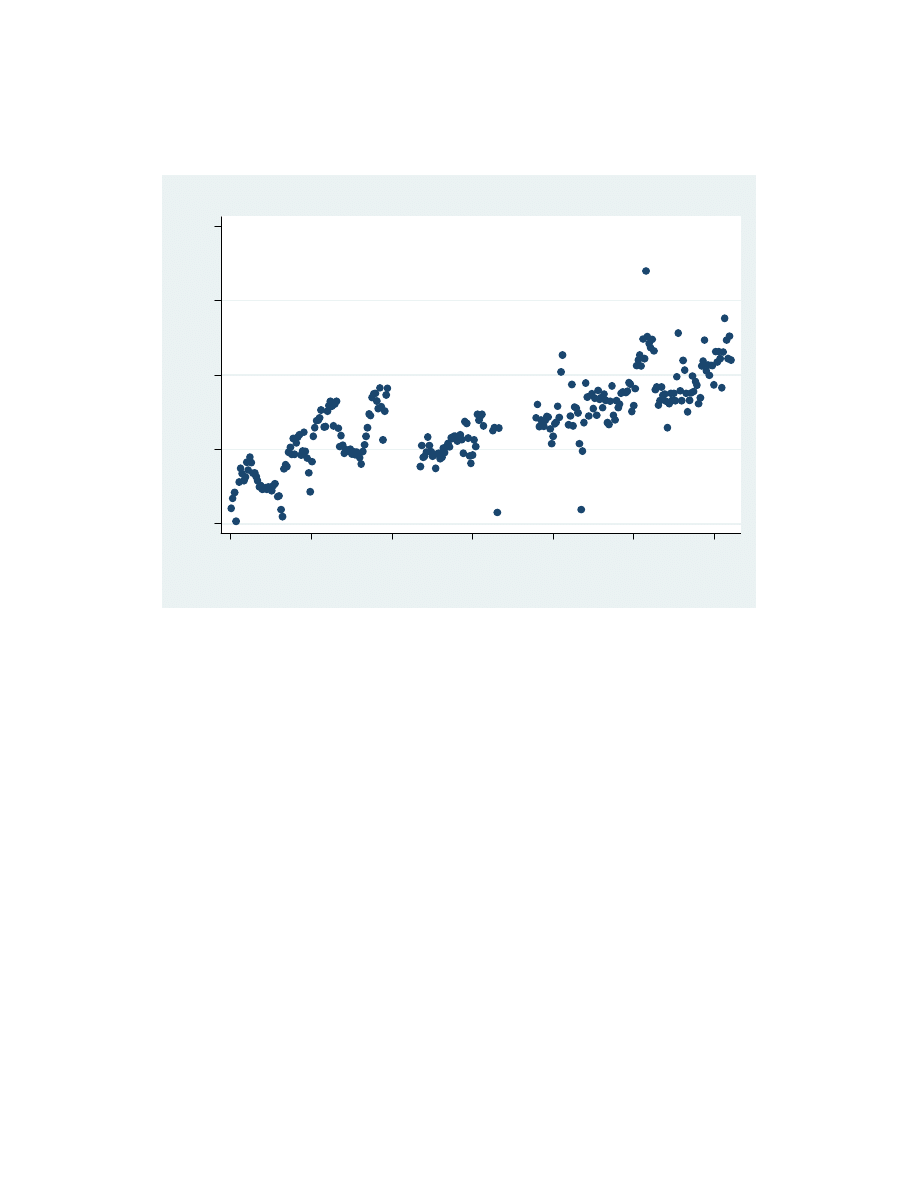
39
FIGURE 1
TRENDS
IN
U.S.
FILE-SHARING
ACTIVITY,
2003-2009
Notes: Bulk traffic is a TCP flow that transferred more than 10MB of data. No date is available for
the following weeks: 2/3/03, 7/28/03, 2/23/04, 12/20/04-5/2/05, 7/11/05, 2/27/06-3/27/06, 4/17/06,
5/8/06-10/9/06, 2/19/07-3/5/07, 6/18/07, and 11/19/07.
Source: Data from Internet2 Netflow Statistics (2009).
0
5
10
15
20
Te
ra
b
y
te
s
01jan2003
01jan2004
01jan2005
01jan2006
01jan2007
01jan2008
01jan2009
Bulk File Sharing Traffic on Internet2 (weekly)
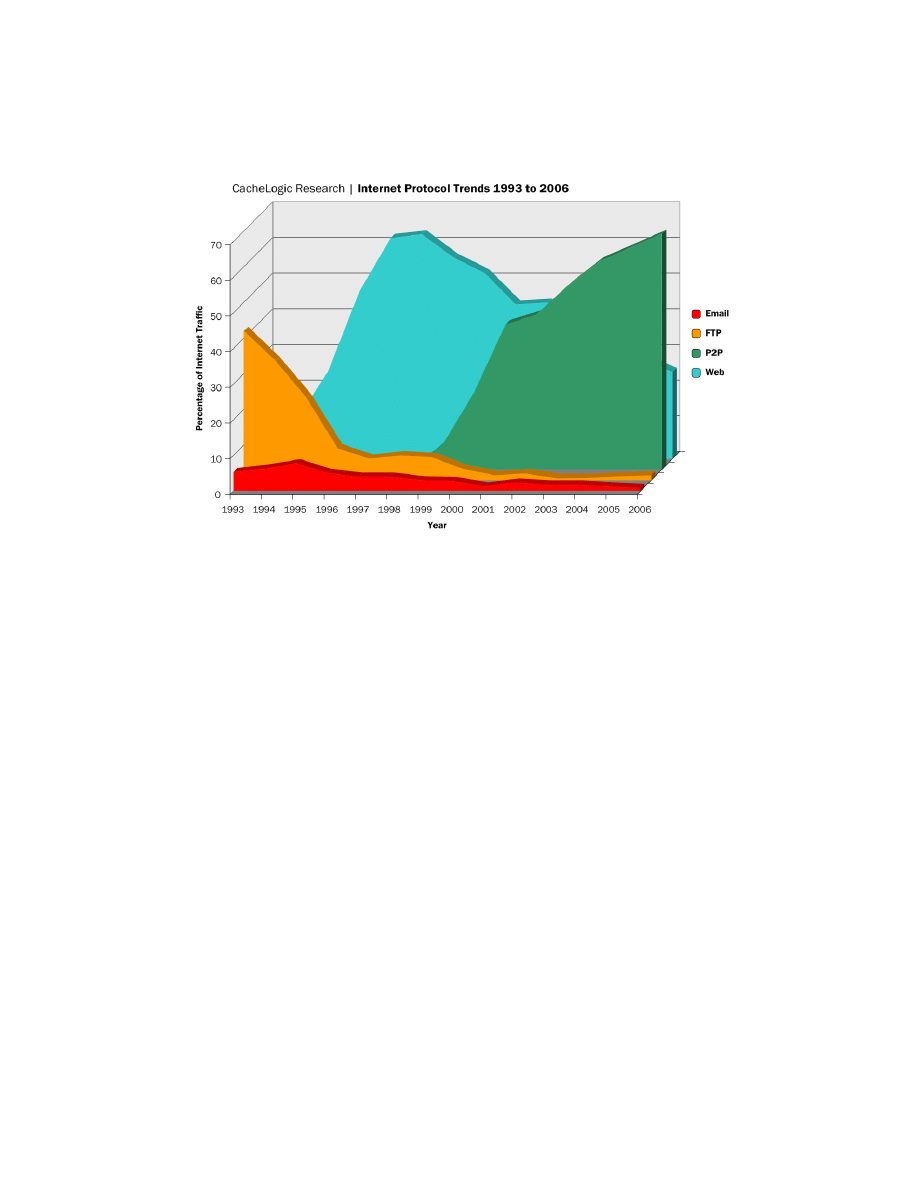
40
FIGURE 2
GLOBAL
FILE
SHARING,
1999-2006
Source: Ferguson (2006)
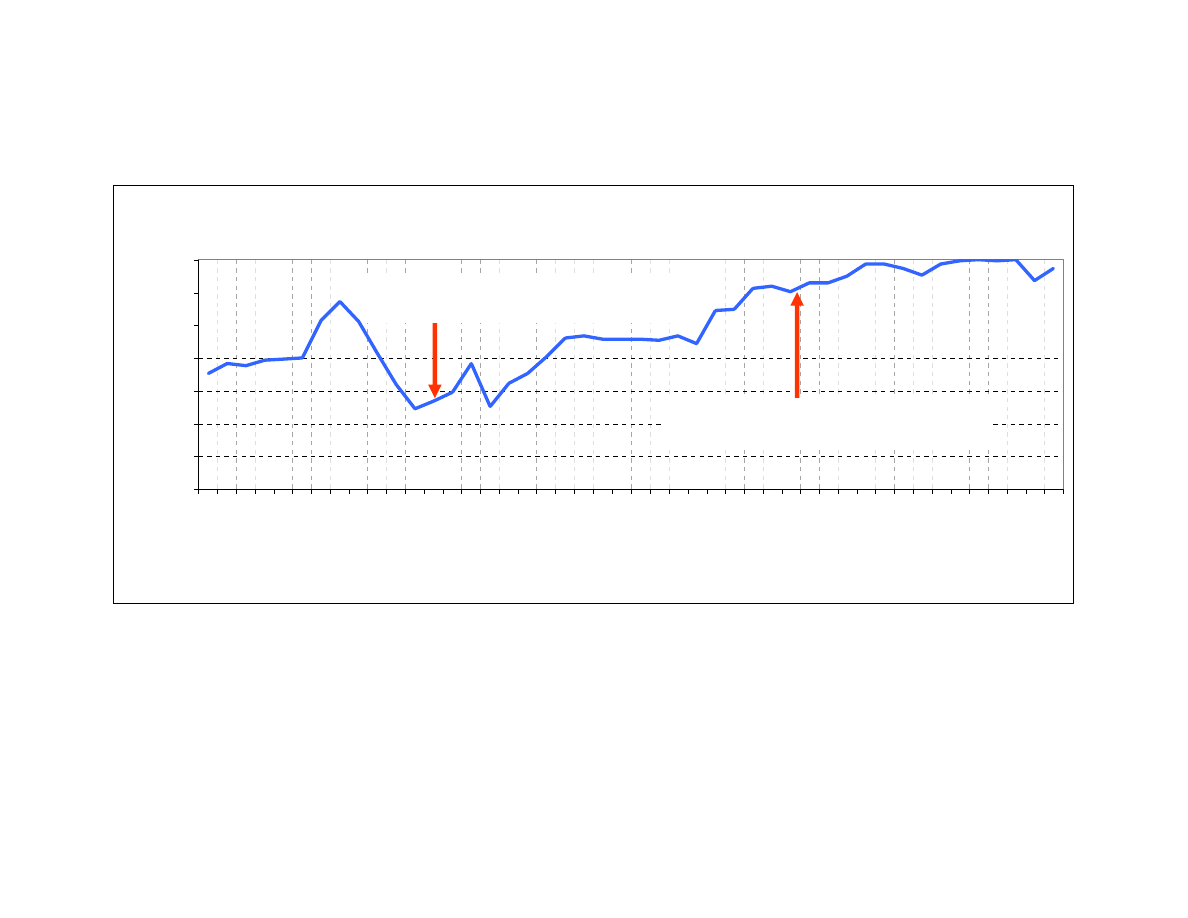
41
FIGURE 3
TRENDS
IN
THE
NUMBER
OF
U.S.
FILE-SHARING
USERS
Source: BigChampagne.com
Average Simultaneous U.S. P2P Users
-
1,000,000
2,000,000
3,000,000
4,000,000
5,000,000
6,000,000
7,000,000
Au
gu
st
, 2
00
2
O
ct
ob
er,
2
00
2
D
ec
em
be
r, 2
002
Febr
uar
y,
2
003
Ap
ril,
20
03
Ju
ne
, 2
003
Au
gu
st
, 2
00
3
Oc
tob
er
, 2
003
De
ce
m
be
r, 2
003
Feb
ru
ar
y,
2
00
4
Ap
ril,
2
004
June
, 20
04
A
ugu
st,
2
00
4
Oc
tob
er,
2
00
4
De
ce
m
ber
, 20
04
Febr
uar
y,
2
005
Ap
ril,
20
05
Ju
ne
, 20
05
Au
gu
st
, 2
00
5
Oc
to
be
r,
2005
De
ce
m
be
r, 2
005
Fe
br
uar
y,
2
006
Ap
ril,
2
006
RIAA lawsuits filed (September 2003)
MGM v. Grokster decision (June 2005)
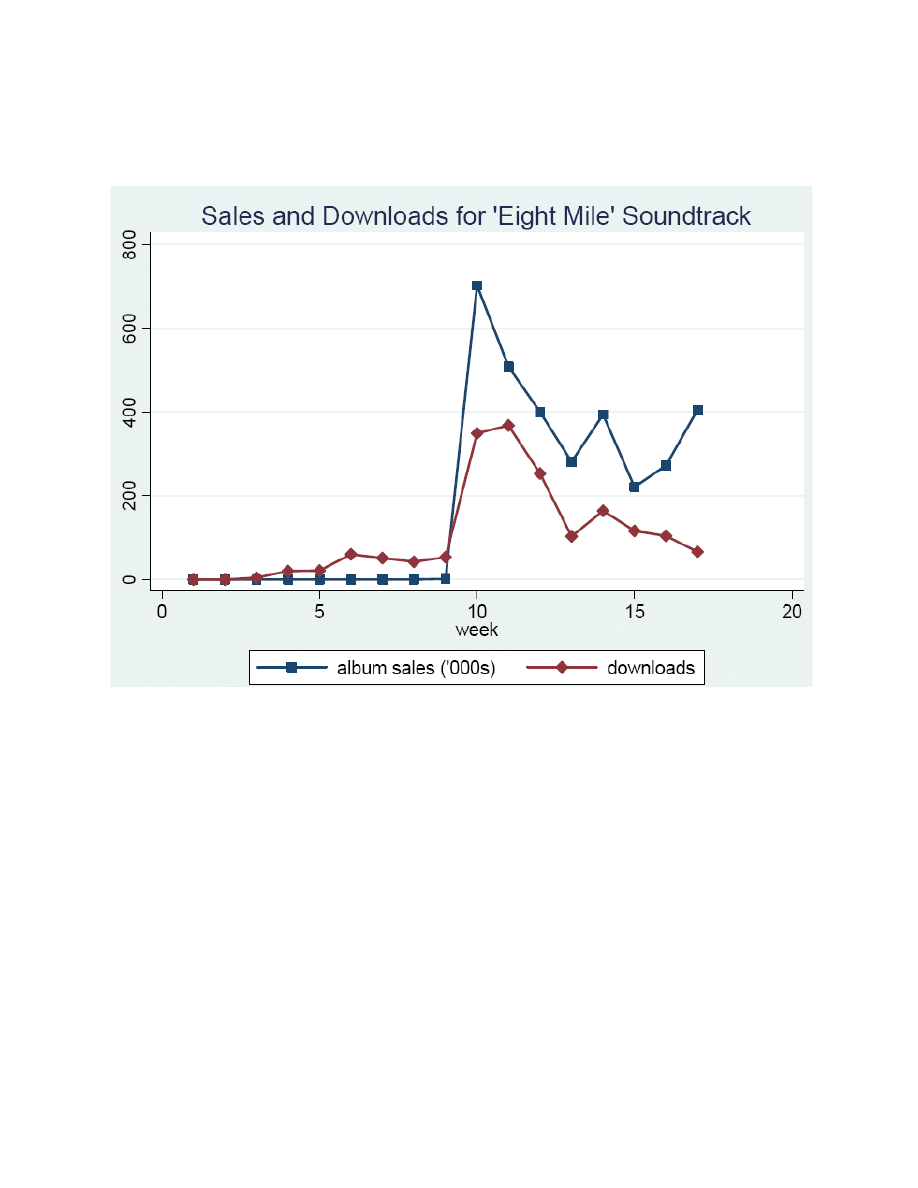
42
FIGURE 4
INDUSTRY
MARKETING
AND
FILE-SHARING
Data from Oberholzer-Gee and Strumpf (2007)
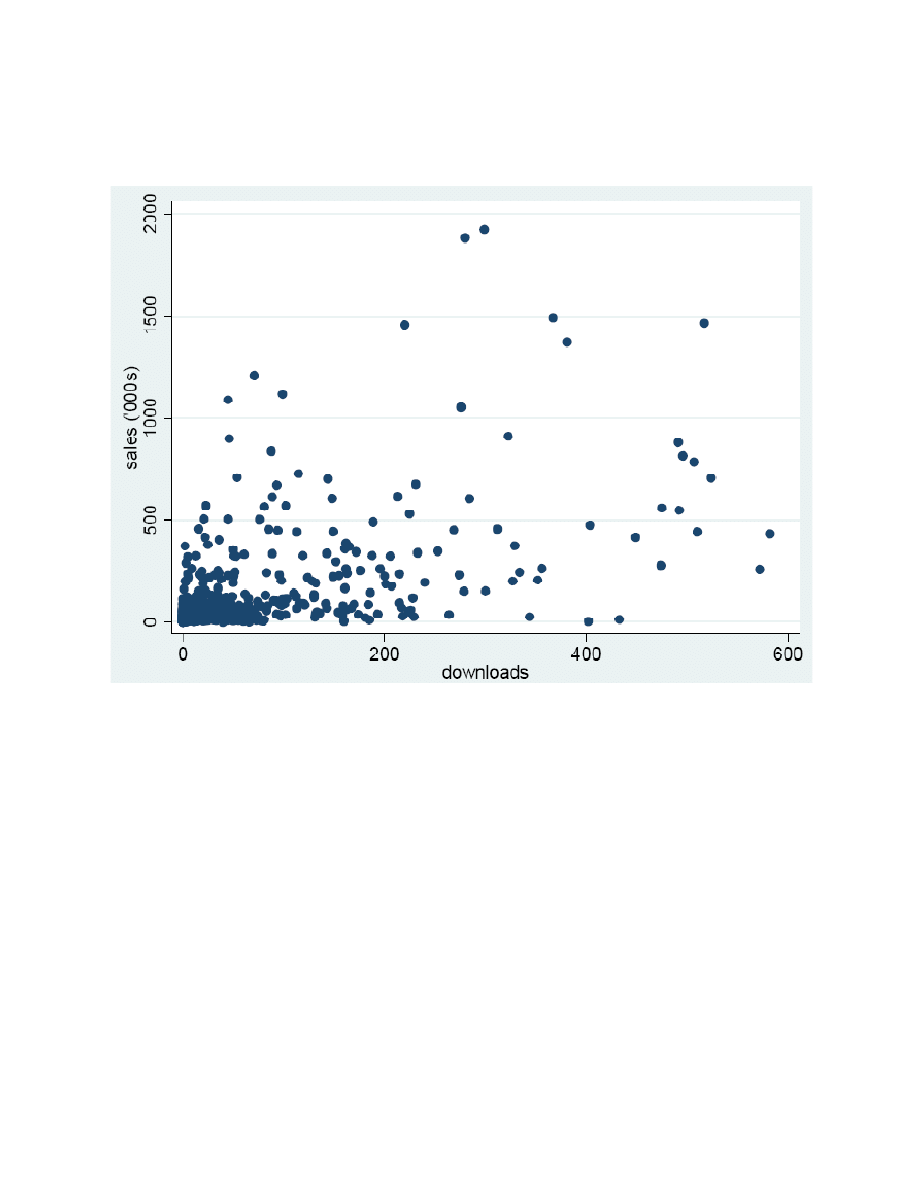
43
FIGURE 5
ENDOGENEITY
OF
FILE
SHARING
Data from Oberholzer-Gee and Strumpf (2007)
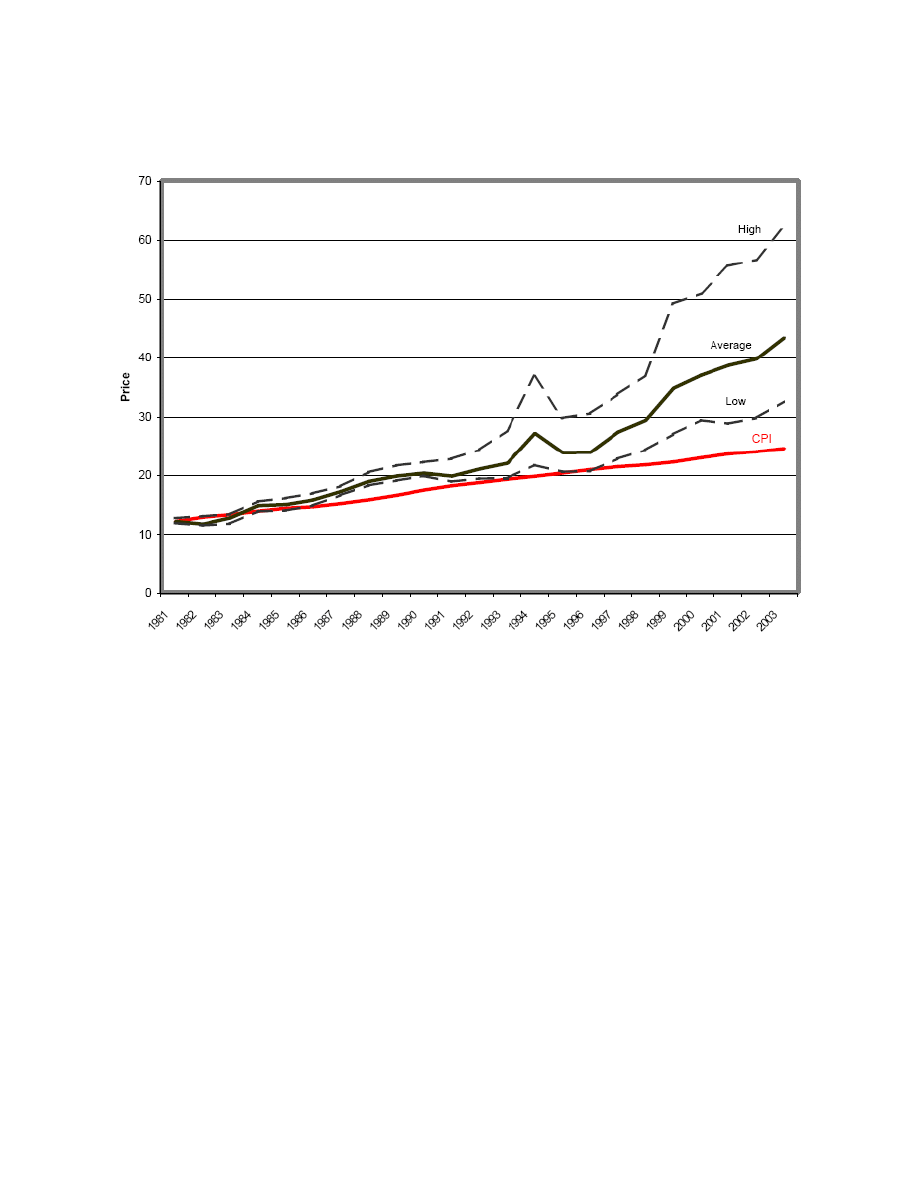
44
FIGURE 6
CONCERT
PRICES
1981-2004
Source: Krueger, 2005

45
FIGURE 7
U.S.
MUSIC
INDUSTRY
SALES
TRENDS
Sources: Recording Industry Association of America, “2007 Year-End Shipment
Statistics” (
www.riaa.com
), Pollstar (
www.pollstar.com
), Apple, Inc. Annual Reports
(
www.apple.com
), accessed 18 March 2008.
0
5000
10000
15000
20000
25000
1997 1998 1999 2000 2001 2002 2003 2004 2005 2006 2007
iPod sales
concerts
recordings
Wyszukiwarka
Podobne podstrony:
Effect of File Sharing on Record Sales March2004
File Input and Output
1 ANSYS Command File Creation and Execution
10 1 2 4 Lab Researching Peer to Peer File Sharing
How to use Windows File Sharing with XBMC
Workshop #4 File Input and Output
J Cole Patents and copyrights
01 Copyright Notice and Warranty
10 Integracja NT i NetWare File and Print Services for NetWare
Copyright Laws and their Downfalls Relating to?nada
Availability and?scription of the File Checksum Integrity Verifier utility
8 Printing and Plotting ANSYS Results to a File
social capital and knowledge sharing in knowledge based organizations an empirical study
Foucault And Lescourret Information Sharing, Liquidity And Transaction Costs In Floor Based Trading
the garden and story a contribution to the theory of garden narrative Content File PDF
ENCHANTED FOREST for intheplayroom copyright Johanna Basford and Laurence King
więcej podobnych podstron